EP2123636A1 - Method for producing aminoacetylpyrrolidinecarbonitrile derivative - Google Patents
Method for producing aminoacetylpyrrolidinecarbonitrile derivative Download PDFInfo
- Publication number
- EP2123636A1 EP2123636A1 EP08722566A EP08722566A EP2123636A1 EP 2123636 A1 EP2123636 A1 EP 2123636A1 EP 08722566 A EP08722566 A EP 08722566A EP 08722566 A EP08722566 A EP 08722566A EP 2123636 A1 EP2123636 A1 EP 2123636A1
- Authority
- EP
- European Patent Office
- Prior art keywords
- group
- substituted
- formula
- acid
- amino
- Prior art date
- Legal status (The legal status is an assumption and is not a legal conclusion. Google has not performed a legal analysis and makes no representation as to the accuracy of the status listed.)
- Granted
Links
- 0 *CC(N(C*C1)C1C(N)=O)=O Chemical compound *CC(N(C*C1)C1C(N)=O)=O 0.000 description 3
Classifications
-
- C—CHEMISTRY; METALLURGY
- C07—ORGANIC CHEMISTRY
- C07D—HETEROCYCLIC COMPOUNDS
- C07D207/00—Heterocyclic compounds containing five-membered rings not condensed with other rings, with one nitrogen atom as the only ring hetero atom
- C07D207/02—Heterocyclic compounds containing five-membered rings not condensed with other rings, with one nitrogen atom as the only ring hetero atom with only hydrogen or carbon atoms directly attached to the ring nitrogen atom
- C07D207/04—Heterocyclic compounds containing five-membered rings not condensed with other rings, with one nitrogen atom as the only ring hetero atom with only hydrogen or carbon atoms directly attached to the ring nitrogen atom having no double bonds between ring members or between ring members and non-ring members
- C07D207/10—Heterocyclic compounds containing five-membered rings not condensed with other rings, with one nitrogen atom as the only ring hetero atom with only hydrogen or carbon atoms directly attached to the ring nitrogen atom having no double bonds between ring members or between ring members and non-ring members with hetero atoms or with carbon atoms having three bonds to hetero atoms with at the most one bond to halogen, e.g. ester or nitrile radicals, directly attached to ring carbon atoms
- C07D207/16—Carbon atoms having three bonds to hetero atoms with at the most one bond to halogen, e.g. ester or nitrile radicals
-
- A—HUMAN NECESSITIES
- A61—MEDICAL OR VETERINARY SCIENCE; HYGIENE
- A61P—SPECIFIC THERAPEUTIC ACTIVITY OF CHEMICAL COMPOUNDS OR MEDICINAL PREPARATIONS
- A61P3/00—Drugs for disorders of the metabolism
- A61P3/08—Drugs for disorders of the metabolism for glucose homeostasis
- A61P3/10—Drugs for disorders of the metabolism for glucose homeostasis for hyperglycaemia, e.g. antidiabetics
-
- A—HUMAN NECESSITIES
- A61—MEDICAL OR VETERINARY SCIENCE; HYGIENE
- A61P—SPECIFIC THERAPEUTIC ACTIVITY OF CHEMICAL COMPOUNDS OR MEDICINAL PREPARATIONS
- A61P43/00—Drugs for specific purposes, not provided for in groups A61P1/00-A61P41/00
Definitions
- the present invention relates to a method for producing an aminoacetylpyrrolidinecarbonitrile derivative which has a dipeptidyl peptidase IV (DPP-IV) inhibitory activity and is useful for the prevention and/or treatment of diseases in which DPP-IV is concerned such as type II diabetes mellitus.
- DPP-IV dipeptidyl peptidase IV
- DPP-IV dipeptidyl peptidase IV
- a dipeptidyl peptidase IV (DPP-IV, hereinafter) inhibitor has been drawing attention as a therapeutic agent for diabetes mellitus (particularly type II diabetes mellitus), and a large number of derivatives having DPP-IV inhibitory action have been reported.
- aminoacetylpyrrolidinecarbonitrile derivatives show an excellent blood sugar lowering action, several compounds promising as antidiabetic agents have been reported.
- aminoacetylpyrrolidinecarbonitrile derivatives are produced by allowing 1-(2-chloroacetyl)pyrrolidine-2-carbonitrile or 1-(2-bromoacetyl)pyrrolidine-2-carbonitrile to react with a corresponding amine in the presence of a base (Patent References 1 to 16).
- Patent References 10 to 13 do not illustratively describe with regard to the synthesis method of an aminoacetylpyrrolidinecarbonitrile derivative through a dehydration reaction of an aminoacetylpyrrolidinecarboxamide derivative, and the Patent References 17 to 19 describe only an illustrative example of carrying out the dehydrating reaction using an intermediate in which a protecting group is introduced into an amino group.
- a safe and efficient method for producing an aminoacetylpyrrolidinecarbonitrile derivative which is useful as a DPP-IV inhibitor is in demand.
- the present invention relates to
- A represents CH 2 , CHF or CF 2 ; and R 1 represents a secondary amino group which may be substituted; and then allowing a dehydrating agent to act thereon;
- R 1 is a secondary amino group represented by the formula (3): R 2 -NH- (3) (in the formula, R 2 represents a C 1 -C 6 alkyl group which may be substituted, a C 3 -C 10 cyclic alkyl group which may be substituted or a C 2 -C 10 cyclic amino group which may be substituted);
- A represents CH 2 , CHF or CF 2 ;
- R 3 represents a C 1 -C 6 alkyl group which may be substituted, a C 3 -C 8 cycloalkyl group which may be substituted, an arylmethyl group which may be substituted, an arylethyl group which may be substituted, an aromatic hydrocarbon which may be substituted, an aromatic hereto ring which may be substituted, or an aliphatic hetero ring which may be substituted; and n represents 1 or 2); and then allowing a dehydrating agent to act thereon;
- the dehydrating agent is a trihalogenoacetic anhydride or a C 1 -C 3 alkylsulfonic anhydride which may be substituted with halogen atom(s);
- the "secondary amino group which may be substituted" as shown in this description means a secondary amino group which may have 1 to 5 substituent groups selected from a halogen atom, a hydroxyl group, a cyano group, a C 1 -C 6 alkoxy group, an aryloxy group which may be substituted, a C 1 -C 6 alkylcarbonyl group, a C 1 -C 6 alkoxycarbonyl group, a C 1 -C 6 alkylthio group, an amino group, a mono- or di-substituted C 1 -C 6 alkylamino group, a 4- to 9-membered cyclic amino group which may contain 1 to 3 hetero atoms, a formylamino group, a C 1 -C 6 alkylcarbonylamino group, a C 1 -C 6 alkoxycarbonylamino group, a C 1 -C 6 alkylsulfonylamino group, and an aryls
- C 1 -C 6 alkyl group which may be substituted means a C 1 -C 6 alkyl group which may have 1 to 5 substituent groups selected from a halogen atom, a hydroxyl group, a cyano group, a C 1 -C 6 alkoxy group, an aryloxy group which may be substituted, a C 1 -C 6 alkylcarbonyl group, a C 1 -C 6 alkoxycarbonyl group, a C 1 -C 6 alkylthio group, an amino group, a mono- or di-substituted C 1 -C 6 alkylamino group, a 4- to 9-membered cyclic amino group which may contain 1 to 3 hetero atoms, a formylamino group, a C 1 -C 6 alkylcarbonylamino group, a C 1 -C 6 alkoxycarbonylamino group, a C 1 -C 6 alkylsulfon
- C 3 -C 10 cycloalkyl group which may be substituted means a C 3 -C 10 cycloalkyl group which may have 1 to 5 substituent groups selected from a halogen atom, a hydroxyl group, a cyano group, a C 1 -C 6 alkoxy group, an aryloxy group which may be substituted, a C 1 -C 6 alkylcarbonyl group, a C 1 -C 6 alkoxycarbonyl group, a C 1 -C 6 alkylthio group, an amino group, a mono- or di-substituted C 1 -C 6 alkylamino group, a 4- to 9-membered cyclic amino group which may contain 1 to 3 hetero atoms, a formylamino group, a C 1 -C 6 alkylcarbonylamino group, a C 1 -C 6 alkoxycarbonylamino group, a C 1 -C 6 al
- C 2 -C 10 cyclic amino group which may be substituted means a C 2 -C 10 cyclic amino group which may have 1 to 5 substituent groups selected from a halogen atom, a hydroxyl group, a cyano group, a C 1 -C 6 alkoxy group, an aryloxy group which may be substituted, a C 1 -C 6 alkylcarbonyl group, a C 1 -C 6 alkoxycarbonyl group, a C 1 -C 6 alkylthio group, an amino group, a mono- or di-substituted C 1 -C 6 alkylamino group, a 4- to 9-membered cyclic amino group which may contain 1 to 3 hetero atoms, a formylamino group, a C 1 -C 6 alkylcarbonylamino group, a C 1 -C 6 alkoxycarbonylamino group, a C 1 -C 6 alkylsul
- C 3 -C 8 cycloalkyl group which may be substituted means a C 3 -C 8 cycloalkyl group which may have 1 to 5 substituent groups selected from a halogen atom, a hydroxyl group, a cyano group, a C 1 -C 6 alkoxy group, an aryloxy group which may be substituted, a C 1 -C 6 alkylcarbonyl group, a C 1 -C 6 alkoxycarbonyl group, a C 1 -C 6 alkylthio group, an amino group, a mono- or di-substituted C 1 -C 6 alkylamino group, a 4- to 9-membered cyclic amino group which may contain 1 to 3 hetero atoms, a formylamino group, a C 1 -C 6 alkylcarbonylamino group, a C 1 -C 6 alkoxycarbonylamino group, a C 1 -C 6 al
- arylmethyl group which may be substituted means an arylmethyl group which may have 1 to 5 substituent groups selected from a halogen atom, a C 1 -C 6 alkyl group which may be substituted, a hydroxyl group, a cyano group, a nitro group, a C 1 -C 6 alkoxy group which may be substituted, an aryloxy group which may be substituted, a C 1 -C 6 alkylcarbonyl group, a C 1 -C 6 alkoxycarbonyl group, a C 1 -C 6 alkylthio group, an amino group, a mono- or di-substituted C 1 -C 6 alkylamino group which may be substituted, an arylamino group which may be substituted, a 4- to 9-membered cyclic amino group which may contain 1 to 3 hetero atoms, a formylamino group, a C 1 -C 6 alkylcarbonylamino
- arylethyl group which may be substituted means an arylethyl group which may have 1 to 5 substituent groups selected from a halogen atom, a C 1 -C 6 alkyl group which may be substituted, a hydroxyl group, a cyano group, a nitro group, a C 1 -C 6 alkoxy group which may be substituted, an aryloxy group which may be substituted, a C 1 -C 6 alkylcarbonyl group, a C 1 -C 6 alkoxycarbonyl group, a C 1 -C 6 alkylthio group, an amino group, a mono- or di-substituted C 1 -C 6 alkylamino group which may be substituted, an arylamino group which may be substituted, 4- to 9-membered cyclic amino group which may contain 1 to 3 hetero atoms, a formylamino group, a C 1 -C 6 alkylcarbonyla
- aromatic hydrocarbon which may be substituted means an aromatic hydrocarbon which may have 1 to 5 substituent groups selected from a halogen atom, a hydroxyl group, a cyano group, a nitro group, a C 1 -C 6 alkyl group which may be substituted, a C 1 -C 6 alkoxy group, a C 1 -C 6 alkylthio group and a C 1 -C 6 dialkylamino group (e.g., a benzene ring, a naphthalene ring, an anthracene ring and the like can be cited).
- substituent groups selected from a halogen atom, a hydroxyl group, a cyano group, a nitro group, a C 1 -C 6 alkyl group which may be substituted, a C 1 -C 6 alkoxy group, a C 1 -C 6 alkylthio group and a C 1 -C 6 dialkylamino group (e.g.
- aromatic hetero ring which may be substituted means an aromatic hetero ring which may have 1 to 5 substituent groups selected from a halogen atom, a hydroxyl group, a cyano group, a nitro group, a C 1 -C 6 alkyl group, a C 1 -C 6 alkoxy group and a C 1 -C 6 alkylthio group (a 5- or 6-membered aromatic monocyclic hetero ring or 9- or 10-membered aromatic condensed hetero ring which contains 1 to 3 hetero atoms optionally selected from a nitrogen atom, an oxygen atom and a sulfur atom, and for example, a pyridine ring, a pyrimidine ring, a pyridazine ring, a triazine ring, a quinoline ring, a naphthyridine ring, a quinazoline ring, an acridine ring, a pyrrole ring, a fur
- the "aliphatic hetero ring which may be substituted" as shown in this description means an aliphatic hetero ring which may have 1 to 5 substituent groups selected from a halogen atom, a C 1 -C 6 alkyl group, a hydroxyl group, a cyano group, a nitro group, a C 1 -C 6 alkoxy group and a C 1 -C 6 alkylthio group (a 4- to 7-membered aliphatic monocyclic hetero ring or 9- or 10-membered aliphatic condensed hetero ring which contains 1 to 3 hetero atoms optionally selected from a nitrogen atom, an oxygen atom and a sulfur atom, and for example, a azetidine ring, a pyrrolidine ring, a tetrahydrofuran ring, a piperidine ring, a morpholine ring, a piperazine ring and the like can be cited).
- the “acid” as shown in this description means an acid which can form a salt of the compound represented by the formula (1), which is soluble in a reaction solvent, and for example, it means a trihalogenoacetic acid such as trifluoroacetic acid, and trichloroacetic acid, or a sulfonic acid such as benzenesulfonic acid and 4-toluenesulfonic acid.
- the "dehydrating agent” as shown in this description means a dehydrating agent which is generally used in a reaction for dehydrating an amido group into a nitrile group, and for example, acid anhydride such as carboxylic anhydride and sulfonic anhydride can be cited.
- trihalogenoacetic acid means, for example, trichloroacetic acid, trifluoroacetic acid or the like.
- arylsulfonic acid which may be substituted as shown in this description means, for example, benzenesulfonic acid, toluenesulfonic acid or the like.
- C 1 -C 3 alkylsulfonic acid which may be substituted with halogen atom(s) means, for example, methanesulfonic acid, trifluoromethanesulfonic acid or the like.
- halogen atom as shown in this description means a fluorine atom, a chlorine atom, a bromine atom or an iodine atom.
- the aminoacetylpyrrolidinecarbonitrile derivative represented by the formula (2) can be obtained by allowing an acid to act on the aminoacetylpyrrolidinecarboxamide derivative represented by the formula (1) and then allowing a dehydrating agent to act thereon.
- an acid may be added after dissolving a compound represented by the formula (1) in a reaction solvent, subsequently allowing a dehydrating agent to act thereon without isolation, or an acid may be allowed to act on a compound represented by the formula (1) to form a salt thereof, subsequently allowing a dehydrating agent to act thereon after isolating the salt.
- any acid may be used as long as it can form a salt with a compound represented by the formula (1) and the salt is soluble in a reaction solvent, and a trihalogenoacetic acid such as trifluoroacetic acid and trichloroacetic acid, and a sulfonic acid such as benzenesulfonic acid and 4-toluenesulfonic acid are preferable, of which trifluoroacetic acid or benzenesulfonic acid is particularly preferable. Its amount to be used is preferably 1 equivalent or more, particularly preferably from 1 to 1.2 equivalents, based on a compound represented by the formula (1).
- a carboxylic anhydride and a sulfonic anhydride can be exemplified, and trihalogenoacetic anhydride such as trifluoroacetic anhydride and trichloroacetic anhydride, and alkylsulfonic anhydride which may be substituted with halogen atom(s) such as methanesulfonic anhydride and trifluoromethanesulfonic anhydride are preferable, of which trifluoroacetic anhydride is particularly preferable.
- Its amount to be used is preferably 1 to 2 equivalents, particularly preferably from 1 to 1.2 equivalents, based on the aminoacetylpyrrolidinecarboxamide derivative represented by the formula (1).
- reaction solvent it may be any inert solvent which can dissolve therein a salt formed from a compound represented by the formula (1) and an acid to be added and does not participate in the reaction, and a chain amide type solvent such as N,N-dimethylformamide and N,N-dimethylacetamide or a cyclic amide type solvent such as N-methyl-2-pyrrolidinone is desirable, of which N,N-dimethylformamide or N,N-dimethylacetamide is more desirable and N,N-dimethylformamide is particularly desirable.
- the reaction can be carried out at from -30°C to 50°C, preferably from -10°C to 30°C, particularly preferably from 0°C to 20°C.
- the aminoacetylpyrrolidinecarboxamide derivative represented by the formula (1) as a material in the present invention can be produced, for example, by the following production method.
- the aminoacetylpyrrolidinecarboxamide derivative represented by the formula (1) can be produced by allowing an acetylpyrrolidinecarboxamide derivative having a leaving group, represented by the formula (6), to react with an amine derivative or a salt thereof in the presence or absence of a base.
- an alkali carbonate such as sodium bicarbonate, potassium carbonate, and cesium carbonate
- tertiary amines such as triethylamine, N,N-diisopropylethylamine, N-methylmorpholine, pyridine, and 4-dimethylaminopyridine
- potassium carbonate or triethylamine is preferable.
- phase-transfer catalyst or an organic salt such as tetrabutylammonium bromide, tetrabutylammonium iodide, lithium bromide, lithium iodide, sodium iodide, and potassium iodide can be exemplified, of which potassium iodide is preferable.
- reaction solvent an inert solvent which does not participate in the reaction such as acetone, tetrahydrofuran, dioxane, ethyl ether, dimethoxyethane, acetonitrile, ethyl acetate, toluene, xylene, dichloromethane, chloroform, N,N-dimethylformamide, N,N-dimethylacetamide, N-methyl-2-pyrrolidone and the like can be exemplified, of which N,N-dimethylformamide or acetonitrile is preferable.
- the above-mentioned reaction can be carried out at from 0 to 100°C, preferably from 0°C to 60°C.
- (2S,4S)-1-[2-[(4-Ethoxycarbonylbicyclo[2.2.2]oct-1-yl)amino]acetyl]-4-fluoropyrrolidine-2-carboxamide (3.70 g) was dissolved in N,N-dimethylformamide (18.5 mL), and while stirring under ice-cooling, trifluoroacetic acid (0.78 mL) was added thereto at an inner temperature of 10°C or lower. After stirring at an inner temperature of from 0 to 10°C for 10 minutes, trifluoroacetic anhydride (1.46 mL) was added dropwise thereto, followed by stirring at the same temperature for 1 hour.
- the reaction solution was poured into ice-water (92.5 mL), potassium carbonate (2.80 g) was added thereto in small portions at an inner temperature of 10°C or lower and then, after gradually increasing the temperature, potassium carbonate (1.50 g) was further added thereto at an inner temperature of from 35 to 40°C. This was stirred at the same temperature for 10 minutes and then ice-cooled and stirred for 1 hour.
- Step 1 Synthesis of (2S,4S)-1-[2-[(4-ethoxycarbonylbicyclo[2.2.2]oct-1-yl)amino]acetyl]-4-fluoropyrrolidine-2-carboxamide benzenesulfonate
- (2S,4S)-1-[2-[(4-Ethoxycarbonylbicyclo[2.2.2]oct-1-yl)amino]acetyl]-4-fluoropyrrolidine-2-carboxamide (1.00 g) was dissolved in dichloromethane (10 mL), and a suspension of benzenesulfonic acid monohydrate (500 mg) in dichloromethane-methanol (5:1, 6 mL) was added thereto, followed by stirring at room temperature for 3 hours.
- Step 2 Synthesis of (2S,4S)-1-[2-[(4-ethoxycarbonylbicyclo[2.2.2]oct-1-yl)amino]acetyl]-4-fluoropyrrolidine-2-carbonitrile
- Step 1 Synthesis of (2S,4S)-1-[2-[(4-ethoxycarbonylbicyclo[2.2.2]oct-1-yl)amino]acetyl]-4-fluoropyrrolidine-2-carboxamide 4-toluenesulfonate
- (2S,4S)-1-[2-[(4-Ethoxycarbonylbicyclo[2.2.2]-oct-1-yl)amino]acetyl]-4-fluoropyrrolidine-2-carboxamide (1.00 g) was dissolved in 2-propanol (10 mL) with heating, and a solution of 4-toluenesulfonic acid monohydrate (541 mg) in 2-propanol (4 mL) was added thereto.
- Step 2 Synthesis of (2S,4S)-1-[2-[(4-ethoxycarbonylbicyclo[2.2.2]oct-1-yl)amino]acetyl]-4-fluoropyrrolidine-2-carbonitrile
- the method of the present invention can suppress side reactions without introducing a protecting group and therefore is a practical method for efficiently producing an aminoacetylpyrrolidinecarbonitrile derivative, in comparison with the conventional methods.
Landscapes
- Chemical & Material Sciences (AREA)
- Organic Chemistry (AREA)
- Health & Medical Sciences (AREA)
- Diabetes (AREA)
- Public Health (AREA)
- Life Sciences & Earth Sciences (AREA)
- Veterinary Medicine (AREA)
- General Health & Medical Sciences (AREA)
- Engineering & Computer Science (AREA)
- Chemical Kinetics & Catalysis (AREA)
- General Chemical & Material Sciences (AREA)
- Medicinal Chemistry (AREA)
- Nuclear Medicine, Radiotherapy & Molecular Imaging (AREA)
- Animal Behavior & Ethology (AREA)
- Pharmacology & Pharmacy (AREA)
- Bioinformatics & Cheminformatics (AREA)
- Endocrinology (AREA)
- Obesity (AREA)
- Emergency Medicine (AREA)
- Hematology (AREA)
- Plural Heterocyclic Compounds (AREA)
- Pyrrole Compounds (AREA)
- Low-Molecular Organic Synthesis Reactions Using Catalysts (AREA)
- Organic Low-Molecular-Weight Compounds And Preparation Thereof (AREA)
- Pyridine Compounds (AREA)
- Pharmaceuticals Containing Other Organic And Inorganic Compounds (AREA)
Abstract

Description
- The present invention relates to a method for producing an aminoacetylpyrrolidinecarbonitrile derivative which has a dipeptidyl peptidase IV (DPP-IV) inhibitory activity and is useful for the prevention and/or treatment of diseases in which DPP-IV is concerned such as type II diabetes mellitus.
- In recent years, a dipeptidyl peptidase IV (DPP-IV, hereinafter) inhibitor has been drawing attention as a therapeutic agent for diabetes mellitus (particularly type II diabetes mellitus), and a large number of derivatives having DPP-IV inhibitory action have been reported. Particularly, since aminoacetylpyrrolidinecarbonitrile derivatives show an excellent blood sugar lowering action, several compounds promising as antidiabetic agents have been reported. It is general that these aminoacetylpyrrolidinecarbonitrile derivatives are produced by allowing 1-(2-chloroacetyl)pyrrolidine-2-carbonitrile or 1-(2-bromoacetyl)pyrrolidine-2-carbonitrile to react with a corresponding amine in the presence of a base (Patent References 1 to 16).
- On the other hand, as a production method which does not use 1-(2-chloroacetyl)pyrrolidine-2-carbonitrile or 1-(2-bromoacetyl)pyrrolidine-2-carbonitrile, a method has been disclosed in which an aminoacetylpyrrolidinecarboxamide derivative is produced and then an aminoacetylpyrrolidinecarbonitrile derivative is produced by carrying out a dehydration reaction (Patent References 10 to 13, Patent References 17 to 19). However, the Patent References 10 to 13 do not illustratively describe with regard to the synthesis method of an aminoacetylpyrrolidinecarbonitrile derivative through a dehydration reaction of an aminoacetylpyrrolidinecarboxamide derivative, and the Patent References 17 to 19 describe only an illustrative example of carrying out the dehydrating reaction using an intermediate in which a protecting group is introduced into an amino group.
- Patent Reference 1:
JP-T-2000-511559 - Patent Reference 2:
JP-T-2002-531547 - Patent Reference 3:
JP-A-2002-356471 - Patent Reference 4:
JP-T-2004-500321 - Patent Reference 5:
JP-T-2005-529078 - Patent Reference 6:
JP-T-2004-503531 - Patent Reference 7:
US 2002/019339 - Patent Reference 8:
WO 04/099185 - Patent Reference 9:
WO 05/075421 - Patent Reference 10:
WO 02/38541 - Patent Reference 11:
WO 03/095425 - Patent Reference 12:
JP-A-2004-26820 - Patent Reference 13:
JP-A-2006-160733 - Patent Reference 14:
JP-A-2002-356472 - Patent Reference 15:
JP-A-2004-2367 - Patent Reference 16:
JP-A-2004-2368 - Patent Reference 17:
WO 03/057666 - Patent Reference 18:
WO 04/026822 - Patent Reference 19:
WO 06/043595 - A safe and efficient method for producing an aminoacetylpyrrolidinecarbonitrile derivative which is useful as a DPP-IV inhibitor is in demand.
- As a result of carrying out extensive studies on the method for producing an aminoacetylpyrrolidinecarbonitrile derivative, the inventors have found a practical production method which can efficiently produce an object substance by suppressing side reactions in comparison with conventional methods, by allowing an acid to act on an aminoacetylpyrrolidinecarboxamide derivative and then allowing a dehydrating agent to act thereon, thus resulting in the accomplishment of the present invention.
- That is, the present invention relates to
- 1) a method for producing an aminoacetylpyrrolidinecarbonitrile derivative represented by the formula (2):
-


- (in the formula, A and R1 are as defined in the following), comprising
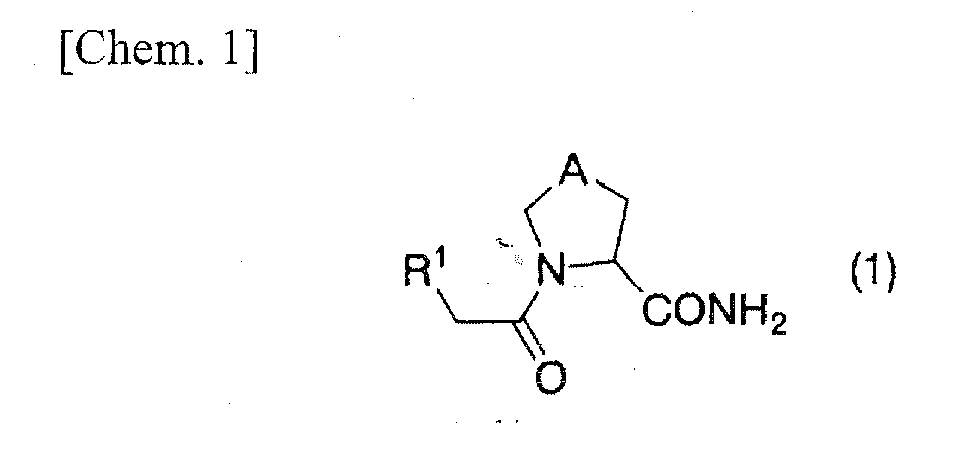
allowing an acid to act on an aminoacetylpyrrolidinecarboxamide derivative represented by the formula (1):
- (in the formula, A represents CH2, CHF or CF2; and R1 represents a secondary amino group which may be substituted); and
then allowing a dehydrating agent to act thereon; - 2) the production method according to 1), wherein, in the formula (1) and formula (2), R1 is a secondary amino group represented by the formula (3):
R2-NH- (3)
(in the formula, R2 represents a C1-C6 alkyl group which may be substituted, a C3-C10 cyclic alkyl group which may be substituted or a C2-C10 cyclic amino group which may be substituted); - 3) a method for producing an aminoacetylpyrrolidinecarbonitrile derivative represented by the formula (5):
-

- (in the formula, A, R3 and n are as defined in the following), comprising
allowing an acid to act on an aminoacetylpyrrolidinecarboxamide derivative represented by the formula (4):
- (in the formula, A represents CH2, CHF or CF2;
R3 represents a C1-C6 alkyl group which may be substituted, a C3-C8 cycloalkyl group which may be substituted, an arylmethyl group which may be substituted, an arylethyl group which may be substituted, an aromatic hydrocarbon which may be substituted, an aromatic hereto ring which may be substituted, or an aliphatic hetero ring which may be substituted; and
n represents 1 or 2); and
then allowing a dehydrating agent to act thereon; - 4) the production method according to 3), wherein, in the formula (4) and formula (5), A is CHF or CF2 and R3 is a C1-C6 alkyl group which may be substituted;
- 5) the production method according to 3), wherein, in the formula (4) and formula (5), A is CHF, R3 is an ethyl group and n is 2;
- 6) the production method according to any one of 1) to 5), wherein the acid is a trihalogenoacetic acid, an arylsulfonic acid which may be substituted or a C1-C3 alkylsulfonic acid which may be substituted with halogen atom(s);
- 7) the production method according to any one of 1) to 6), wherein the acid is trifluoroacetic acid, benzenesulfonic acid or 4-toluenesulfonic acid;
- 8) the production method according to any one of 1) to 7), wherein the dehydrating agent is a trihalogenoacetic anhydride or a C1-C3 alkylsulfonic anhydride which may be substituted with halogen atom(s); and
- 9) the production method according to any one of 1) to 8), wherein the dehydrating agent is trifluoroacetic anhydride.
- An efficient and practical method for producing an aminoacetylpyrrolidinecarbonitrile derivative directly from an aminoacetylpyrrolidinecarboxamide derivative without carrying out protection and deprotection of an amino group, which had been unavoidable when a dehydrating agent is used alone, was established based on the effect of suppressing side reactions according to the present invention.
- The "secondary amino group which may be substituted" as shown in this description means a secondary amino group which may have 1 to 5 substituent groups selected from a halogen atom, a hydroxyl group, a cyano group, a C1-C6 alkoxy group, an aryloxy group which may be substituted, a C1-C6 alkylcarbonyl group, a C1-C6 alkoxycarbonyl group, a C1-C6 alkylthio group, an amino group, a mono- or di-substituted C1-C6 alkylamino group, a 4- to 9-membered cyclic amino group which may contain 1 to 3 hetero atoms, a formylamino group, a C1-C6 alkylcarbonylamino group, a C1-C6 alkoxycarbonylamino group, a C1-C6 alkylsulfonylamino group, and an arylsulfonylamino group which may be substituted;
wherein the "secondary amino group" means an aliphatic or aromatic amino group in which one hydrogen atom is substituted with the nitrogen atom located on the binding position with the acetylpyrrolidine skeleton, which means, for example, an amino group to which a C1-C6 alkyl group such as a methylamino group or a butylamino group is bonded, an amino group to which a C3-C10 cyclic alkyl group such as a cyclohexylamino group, an adamantylamino group or a bicyclo [2.2.2]octylamino group is bonded, an amino group to which a C2-C10 cyclic amino group such as a piperidylamino group or an azabicyclooctylamino group is bonded, an aromatic amino group (e.g., an anilyl group, a pyridylamino group and the like can be exemplified) and the like. - The "C1-C6 alkyl group which may be substituted" as shown in this description means a C1-C6 alkyl group which may have 1 to 5 substituent groups selected from a halogen atom, a hydroxyl group, a cyano group, a C1-C6 alkoxy group, an aryloxy group which may be substituted, a C1-C6 alkylcarbonyl group, a C1-C6 alkoxycarbonyl group, a C1-C6 alkylthio group, an amino group, a mono- or di-substituted C1-C6 alkylamino group, a 4- to 9-membered cyclic amino group which may contain 1 to 3 hetero atoms, a formylamino group, a C1-C6 alkylcarbonylamino group, a C1-C6 alkoxycarbonylamino group, a C1-C6 alkylsulfonylamino group, and an arylsulfonylamino group which may be substituted;
wherein the "C1-C6 alkyl group" means a straight chain or branched lower alkyl group, and for example, a methyl group, an ethyl group, a propyl group, a 1-methylethyl group, a 1-methylpropyl group, a 2-methylpropyl group, a 1-ethylpropyl group, a 2-ethylpropyl group, a butyl group, a hexyl group and the like can be cited. - The "C3-C10 cycloalkyl group which may be substituted" as shown in this description means a C3-C10 cycloalkyl group which may have 1 to 5 substituent groups selected from a halogen atom, a hydroxyl group, a cyano group, a C1-C6 alkoxy group, an aryloxy group which may be substituted, a C1-C6 alkylcarbonyl group, a C1-C6 alkoxycarbonyl group, a C1-C6 alkylthio group, an amino group, a mono- or di-substituted C1-C6 alkylamino group, a 4- to 9-membered cyclic amino group which may contain 1 to 3 hetero atoms, a formylamino group, a C1-C6 alkylcarbonylamino group, a C1-C6 alkoxycarbonylamino group, a C1-C6 alkylsulfonylamino group, and an arylsulfonylamino group which may be substituted;
wherein the "cycloalkyl group" means a C3-C8 cycloalkyl group, a C5-C10 bicycloalkyl group or an adamantyl group;
wherein the "C3-C8 cycloalkyl group" means an alkyl group which has a cycloalkyl ring, and for example, a cyclopropyl group, a cyclopropylmethyl group, a cyclobutyl group, a cyclopentyl group, a cyclohexyl group, a cycloheptyl group, a cyclooctyl group and the like can be cited; and
the "C5-C10 bicycloalkyl group'' means an alkyl group which has a bicycloalkyl ring, and for example, a bicyclopentyl group, a bicyclohexyl group, a bicyclopentyl group, a bicyclooctyl group, a bicyclononyl group, a bicyclodecyl group and the like can be cited. - The "C2-C10 cyclic amino group which may be substituted" as shown in this description means a C2-C10 cyclic amino group which may have 1 to 5 substituent groups selected from a halogen atom, a hydroxyl group, a cyano group, a C1-C6 alkoxy group, an aryloxy group which may be substituted, a C1-C6 alkylcarbonyl group, a C1-C6 alkoxycarbonyl group, a C1-C6 alkylthio group, an amino group, a mono- or di-substituted C1-C6 alkylamino group, a 4- to 9-membered cyclic amino group which may contain 1 to 3 hetero atoms, a formylamino group, a C1-C6 alkylcarbonylamino group, a C1-C6 alkoxycarbonylamino group, a C1-C6 alkylsulfonylamino group, and an arylsulfonylamino group which may be substituted;
wherein the "C2-C10 cyclic amino group" means a cyclic amino group which contains one or more nitrogen atoms in the ring and wherein an oxygen atom or sulfur atom may be present in the ring, and for example, an aziridyl group, a pyrrolidyl group, a piperidyl group, a morpholyl group, an oxazolyl group, an azabicycloheptyl group, an azabicyclooctyl group and the like can be cited. - The "C3-C8 cycloalkyl group which may be substituted" as shown in this description means a C3-C8 cycloalkyl group which may have 1 to 5 substituent groups selected from a halogen atom, a hydroxyl group, a cyano group, a C1-C6 alkoxy group, an aryloxy group which may be substituted, a C1-C6 alkylcarbonyl group, a C1-C6 alkoxycarbonyl group, a C1-C6 alkylthio group, an amino group, a mono- or di-substituted C1-C6 alkylamino group, a 4- to 9-membered cyclic amino group which may contain 1 to 3 hetero atoms, a formylamino group, a C1-C6 alkylcarbonylamino group, a C1-C6 alkoxycarbonylamino group, a C1-C6 alkylsulfonylamino group, and an arylsulfonylamino group which may be substituted;
wherein the "C3-C8 cycloalkyl group" means an alkyl group which has a cycloalkyl ring, and for example, a cyclopropyl group, a cyclopropylmethyl group, a cyclobutyl group, a cyclopentyl group, a cyclohexyl group, a cycloheptyl group, a cyclooctyl group and the like can be cited. - The "arylmethyl group which may be substituted" as shown in this description means an arylmethyl group which may have 1 to 5 substituent groups selected from a halogen atom, a C1-C6 alkyl group which may be substituted, a hydroxyl group, a cyano group, a nitro group, a C1-C6 alkoxy group which may be substituted, an aryloxy group which may be substituted, a C1-C6 alkylcarbonyl group, a C1-C6 alkoxycarbonyl group, a C1-C6 alkylthio group, an amino group, a mono- or di-substituted C1-C6 alkylamino group which may be substituted, an arylamino group which may be substituted, a 4- to 9-membered cyclic amino group which may contain 1 to 3 hetero atoms, a formylamino group, a C1-C6 alkylcarbonylamino group, a C1-C6 alkoxycarbonylamino group, a C1-C6 alkylsulfonylamino group and an arylsulfonylamino group which may be substituted (e.g., a phenylmethyl group, a naphthylmethyl group, a pyridylmethyl group, a quinolylmethyl group, an indolylmethyl group and the like can be cited).
- The "arylethyl group which may be substituted" as shown in this description means an arylethyl group which may have 1 to 5 substituent groups selected from a halogen atom, a C1-C6 alkyl group which may be substituted, a hydroxyl group, a cyano group, a nitro group, a C1-C6 alkoxy group which may be substituted, an aryloxy group which may be substituted, a C1-C6 alkylcarbonyl group, a C1-C6 alkoxycarbonyl group, a C1-C6 alkylthio group, an amino group, a mono- or di-substituted C1-C6 alkylamino group which may be substituted, an arylamino group which may be substituted, 4- to 9-membered cyclic amino group which may contain 1 to 3 hetero atoms, a formylamino group, a C1-C6 alkylcarbonylamino group, a C1-C6 alkoxycarbonylamino group, a C1-C6 alkylsulfonylamino group and an arylsulfonylamino group which may be substituted (e.g., a phenylethyl group, a naphthylethyl group, a pyridylethyl group, a quinolylethyl group, an indolylethyl group and the like can be cited).
- The "aromatic hydrocarbon which may be substituted" as shown in this description means an aromatic hydrocarbon which may have 1 to 5 substituent groups selected from a halogen atom, a hydroxyl group, a cyano group, a nitro group, a C1-C6 alkyl group which may be substituted, a C1-C6 alkoxy group, a C1-C6 alkylthio group and a C1-C6 dialkylamino group (e.g., a benzene ring, a naphthalene ring, an anthracene ring and the like can be cited).
- The "aromatic hetero ring which may be substituted" as shown in this description means an aromatic hetero ring which may have 1 to 5 substituent groups selected from a halogen atom, a hydroxyl group, a cyano group, a nitro group, a C1-C6 alkyl group, a C1-C6 alkoxy group and a C1-C6 alkylthio group (a 5- or 6-membered aromatic monocyclic hetero ring or 9- or 10-membered aromatic condensed hetero ring which contains 1 to 3 hetero atoms optionally selected from a nitrogen atom, an oxygen atom and a sulfur atom, and for example, a pyridine ring, a pyrimidine ring, a pyridazine ring, a triazine ring, a quinoline ring, a naphthyridine ring, a quinazoline ring, an acridine ring, a pyrrole ring, a furan ring, a thiophene ring, an imidazole ring, a pyrazole ring, an oxazole ring, an isoxazole ring, a thiazole ring, an indole ring, a benzofuran ring, a benzothiazole ring, a benzimidazole ring, a benzoxazole ring and the like can be cited).
- The "aliphatic hetero ring which may be substituted" as shown in this description means an aliphatic hetero ring which may have 1 to 5 substituent groups selected from a halogen atom, a C1-C6 alkyl group, a hydroxyl group, a cyano group, a nitro group, a C1-C6 alkoxy group and a C1-C6 alkylthio group (a 4- to 7-membered aliphatic monocyclic hetero ring or 9- or 10-membered aliphatic condensed hetero ring which contains 1 to 3 hetero atoms optionally selected from a nitrogen atom, an oxygen atom and a sulfur atom, and for example, a azetidine ring, a pyrrolidine ring, a tetrahydrofuran ring, a piperidine ring, a morpholine ring, a piperazine ring and the like can be cited).
- The "acid" as shown in this description means an acid which can form a salt of the compound represented by the formula (1), which is soluble in a reaction solvent, and for example, it means a trihalogenoacetic acid such as trifluoroacetic acid, and trichloroacetic acid, or a sulfonic acid such as benzenesulfonic acid and 4-toluenesulfonic acid.
- The "dehydrating agent" as shown in this description means a dehydrating agent which is generally used in a reaction for dehydrating an amido group into a nitrile group, and for example, acid anhydride such as carboxylic anhydride and sulfonic anhydride can be cited.
- The "trihalogenoacetic acid" as shown in this description means, for example, trichloroacetic acid, trifluoroacetic acid or the like.
- The "arylsulfonic acid which may be substituted" as shown in this description means, for example, benzenesulfonic acid, toluenesulfonic acid or the like.
- The "C1-C3 alkylsulfonic acid which may be substituted with halogen atom(s)" as shown in this description means, for example, methanesulfonic acid, trifluoromethanesulfonic acid or the like.
The "halogen atom" as shown in this description means a fluorine atom, a chlorine atom, a bromine atom or an iodine atom. -
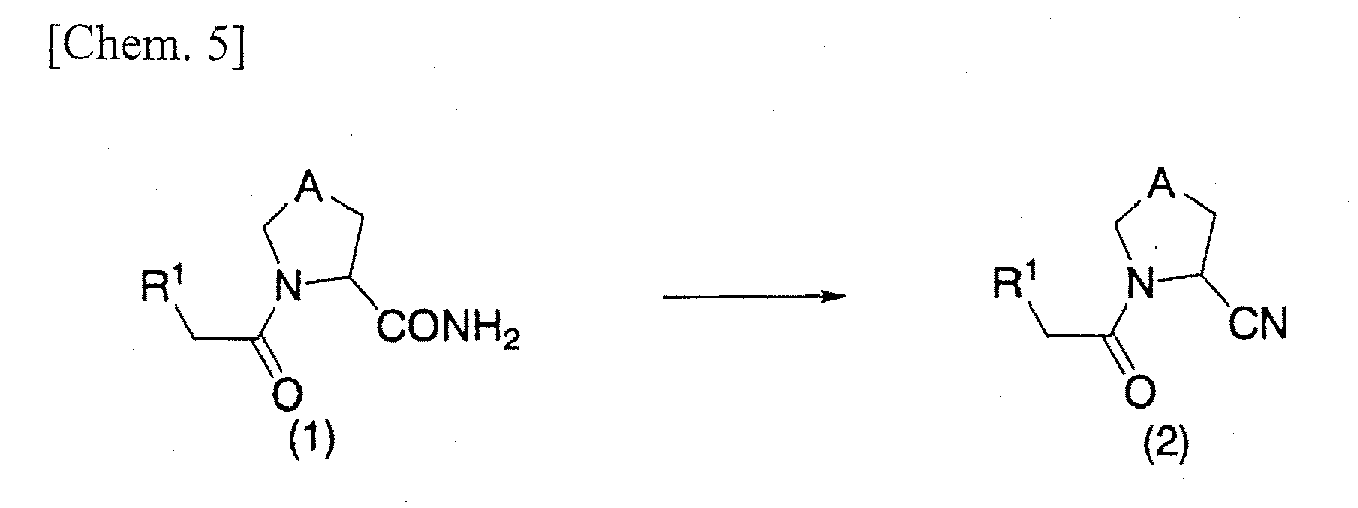
- (In the formula, A and R1 are as defined in the foregoing.)
According to the present invention, the aminoacetylpyrrolidinecarbonitrile derivative represented by the formula (2) can be obtained by allowing an acid to act on the aminoacetylpyrrolidinecarboxamide derivative represented by the formula (1) and then allowing a dehydrating agent to act thereon. In this case, regarding the method for adding the acid and the dehydrating agent, an acid may be added after dissolving a compound represented by the formula (1) in a reaction solvent, subsequently allowing a dehydrating agent to act thereon without isolation, or an acid may be allowed to act on a compound represented by the formula (1) to form a salt thereof, subsequently allowing a dehydrating agent to act thereon after isolating the salt. - As the acid, any acid may be used as long as it can form a salt with a compound represented by the formula (1) and the salt is soluble in a reaction solvent, and a trihalogenoacetic acid such as trifluoroacetic acid and trichloroacetic acid, and a sulfonic acid such as benzenesulfonic acid and 4-toluenesulfonic acid are preferable, of which trifluoroacetic acid or benzenesulfonic acid is particularly preferable. Its amount to be used is preferably 1 equivalent or more, particularly preferably from 1 to 1.2 equivalents, based on a compound represented by the formula (1).
As the dehydrating agent, a carboxylic anhydride and a sulfonic anhydride can be exemplified, and trihalogenoacetic anhydride such as trifluoroacetic anhydride and trichloroacetic anhydride, and alkylsulfonic anhydride which may be substituted with halogen atom(s) such as methanesulfonic anhydride and trifluoromethanesulfonic anhydride are preferable, of which trifluoroacetic anhydride is particularly preferable. Its amount to be used is preferably 1 to 2 equivalents, particularly preferably from 1 to 1.2 equivalents, based on the aminoacetylpyrrolidinecarboxamide derivative represented by the formula (1). - As the reaction solvent, it may be any inert solvent which can dissolve therein a salt formed from a compound represented by the formula (1) and an acid to be added and does not participate in the reaction, and a chain amide type solvent such as N,N-dimethylformamide and N,N-dimethylacetamide or a cyclic amide type solvent such as N-methyl-2-pyrrolidinone is desirable, of which N,N-dimethylformamide or N,N-dimethylacetamide is more desirable and N,N-dimethylformamide is particularly desirable. The reaction can be carried out at from -30°C to 50°C, preferably from -10°C to 30°C, particularly preferably from 0°C to 20°C.
In addition, the aminoacetylpyrrolidinecarboxamide derivative represented by the formula (1) as a material in the present invention can be produced, for example, by the following production method. -

- (In the formula, A and R1 are as defined in the foregoing, and X represents a leaving group such as a chlorine atom, a bromine atom, a methanesulfonyloxy group, and a benzenesulfonyloxy group.)
That is, the aminoacetylpyrrolidinecarboxamide derivative represented by the formula (1) can be produced by allowing an acetylpyrrolidinecarboxamide derivative having a leaving group, represented by the formula (6), to react with an amine derivative or a salt thereof in the presence or absence of a base. - When a base is used in the above-mentioned reaction, an alkali carbonate such as sodium bicarbonate, potassium carbonate, and cesium carbonate, and tertiary amines such as triethylamine, N,N-diisopropylethylamine, N-methylmorpholine, pyridine, and 4-dimethylaminopyridine can be exemplified, of which potassium carbonate or triethylamine is preferable. When a catalyst is used in the above-mentioned reaction, a phase-transfer catalyst or an organic salt such as tetrabutylammonium bromide, tetrabutylammonium iodide, lithium bromide, lithium iodide, sodium iodide, and potassium iodide can be exemplified, of which potassium iodide is preferable. As the reaction solvent, an inert solvent which does not participate in the reaction such as acetone, tetrahydrofuran, dioxane, ethyl ether, dimethoxyethane, acetonitrile, ethyl acetate, toluene, xylene, dichloromethane, chloroform, N,N-dimethylformamide, N,N-dimethylacetamide, N-methyl-2-pyrrolidone and the like can be exemplified, of which N,N-dimethylformamide or acetonitrile is preferable. The above-mentioned reaction can be carried out at from 0 to 100°C, preferably from 0°C to 60°C.
- The following describes the present invention based on Examples, but the present invention is not limited to these Examples. In addition, a production method of the starting compound to be used in Examples was shown as Reference Example.
- Method A: Potassium carbonate (277 mg) was added to a solution of ethyl 4-aminobicyclo[2.2.2]octane-1-carboxylate hydrochloride (319 mg) in N,N-dimethylformamide (1.8 mL), followed by stirring at an inner temperature of 40°C for 30 minutes. (2S,4S)-4-Fluoro-1-[2-(benzenesulfonyloxy)acetyl]pyrrolidine-2-carboxamide (295 mg) was added thereto, followed by stirring at the same temperature for 1 hour. Water (5.4 mL) was added to the reaction solution, followed by stirring at an inner temperature of from 5 to 10°C for 30 minutes. The precipitate were collected by filtration, washed with cold water (4 mL) and then blast-dried at an outer temperature of 40°C, thereby obtaining white crystals of (2S,4S)-1-[2-[(4-ethoxycarbonylbicyclo[2.2.2]oct-1-yl)amino]acetyl]-4-fluoropyrrolidine-2-carboxamide (obtained amount: 247 mg, yield: 75%).
- MS (ESI+) m/z: 370 (M + H+).
HRMS (ESI+) for C18H28FN3O4:
calcd, 370.21421; found, 370.21842.
Method B: Ethyl 4-aminobicyclo[2.2.2]octane-1-carboxylate hydrochloride (68.8 g), potassium carbonate (77.6 g), potassium iodide (46.6 g) and N,N-dimethylformamide (167 mL) were mixed, and (2S,4S)-1-(chloroacetyl)-4-fluoropyrrolidine-2-carboxamide (55.8 g) was added dropwise thereto for 6 hours, while stirring at room temperature. After further stirring at the same temperature for 1 hour, water (1400 mL) was added to the reaction solution, followed by stirring at an inner temperature of 10°C or lower for 1 hour. The precipitate were collected by filtration, washed with cold water (279 mL) and then dried under a reduced pressure at an outer temperature of 60°C, thereby obtaining white crystals of (2S,4S)-1-[2-[(4-ethoxycarbonylbicyclo[2.2.2]oct-1-yl)amino]acetyl]-4-fluoropyrrolidine-2-carboxamide (obtained amount: 72.9 g, yield: 74%). - (2S,4S)-1-[2-[(4-Ethoxycarbonylbicyclo[2.2.2]oct-1-yl)amino]acetyl]-4-fluoropyrrolidine-2-carboxamide (3.70 g) was dissolved in N,N-dimethylformamide (18.5 mL), and while stirring under ice-cooling, trifluoroacetic acid (0.78 mL) was added thereto at an inner temperature of 10°C or lower. After stirring at an inner temperature of from 0 to 10°C for 10 minutes, trifluoroacetic anhydride (1.46 mL) was added dropwise thereto, followed by stirring at the same temperature for 1 hour. The reaction solution was poured into ice-water (92.5 mL), potassium carbonate (2.80 g) was added thereto in small portions at an inner temperature of 10°C or lower and then, after gradually increasing the temperature, potassium carbonate (1.50 g) was further added thereto at an inner temperature of from 35 to 40°C. This was stirred at the same temperature for 10 minutes and then ice-cooled and stirred for 1 hour. The precipitate were collected by filtration, washed with water (37.0 mL) and then dried at 60°C under reduced pressure, thereby obtaining a white powder of (2S,4S)-1-[2-[(4-ethoxycarbonylbicyclo [2.2.2]oct-1-yl)amino]acetyl]-4-fluoropyrrolidine-2-carbonitrile (obtained amount: 2.84 g, yield: 81%).
- MS (ESI+) m/z: 352 (M + H+).
HRMS (ESI+) for C18H28FN3O4: calcd, 352.20364, found, 352.20766. - Using (2S,4S)-1-[2-[(4-ethoxycarbonylbicyclo[2.2.2]oct-1-yl)amino]acetyl]-4-fluoropyrrolidine-2-carboxamide (739 mg), trifluoroacetic anhydride (0.29 mL) as a dehydrating agent and trichloroacetic acid (327 mg) as an acid, a white powder of (2S,4S)-1-[2-[(4-ethoxycarbonylbicyclo[2.2.2]oct-1-yl)amino]acetyl]-4-fluoropyrrolidine-2-carbonitrile was obtained (obtained amount: 524 mg, yield: 75%) by the same method of Example 1.
- Using (2S,4S)-1-[2-[(4-ethoxycarbonylbicyclo[2.2.2]oct-1-yl)amino]acetyl]-4-fluoropyrrolidine-2-carboxamide (3.70 g), trichloroacetic anhydride (1.9 mL) as a dehydrating agent and trifluoroacetic acid (0.78 mL) as an acid, a white powder of (2S,4S)-1-[2-[(4-ethoxycarbonylbicyclo[2.2.2]oct-1-yl)amino]acetyl]-4-fluoropyrrolidine-2-carbonitrile was obtained (obtained amount: 2.86 g, yield: 81 %) by the same method of Example 1.
- Using (2S,4S)-1-[2-[(4-ethoxycarbonylbicyclo[2.2.2]oct-1-yl)amino]acetyl]-4-fluoropyrrolidine-2-carboxamide (1.00 g), trifluoromethanesulfonic anhydride (0.50 mL) as a dehydrating agent and trifluoroacetic acid (0.23 mL) as an acid, a white powder of (2S,4S)-1-[2-[(4-ethoxycarbonylbicyclo[2.2.2]oct-1-yl)amino]acetyl]-4-fluoropyrrolidine-2-carbonitrile was obtained (obtained amount: 754 mg, yield: 79%) by the same method of Example 1.
- Using (2S,4S)-1-[2-[(4-ethoxycarbonylbicyclo[2.2.2]oct-1-yl)amino]acetyl]-4-fluoropyrrolidine-2-carboxamide (500 mg), methanesulfonic anhydride (248 mg) as a dehydrating agent and trifluoroacetic acid (0.11 mL) as an acid, a white powder of (2S,4S)-1-[2-[(4-ethoxycarbonylbicyclo[2.2.2]oct-1-yl)amino]acetyl]-4-fluoropyrrolidine-2-carbonitrile was obtained (obtained amount: 340 mg, yield: 71 %) by the same method of Example 1.
- (2S,4S)-1-[2-[(4-Ethoxycarbonylbicyclo[2.2.2]oct-1-yl)amino]acetyl]-4-fluoropyrrolidine-2-carboxamide (1.00 g) was dissolved in dichloromethane (10 mL), and a suspension of benzenesulfonic acid monohydrate (500 mg) in dichloromethane-methanol (5:1, 6 mL) was added thereto, followed by stirring at room temperature for 3 hours. The precipitate were collected by filtration, washed with dichloromethane (5 mL) and then dried, thereby obtaining a colorless solid of (2S,4S)-1-[2-[(4-ethoxycarbonylbicyclo [2.2.2]oct-1-yl)amino]acetyl]-4-fluoropyrrolidine-2-carboxamide benzenesulfonate (1.15 g, yield: 81%).
Elemental analysis (%): for C18H28FN3O4·C6H6O3S
Calcd: C, 54.63; H, 6.50; N, 7.96
Found: C, 54.42; H, 6.39; N, 8.03 - (2S,4S)-1-[2-[(4-Ethoxycarbonylbicyclo[2.2.2]-oct-1-yl)amino]acetyl]-4-fluoropyrrolidine-2-carboxamide benzenesulfonate (791 mg) was suspended in N,N-dimethylformamide (2.8 mL), and trifluoroacetic acid anhydride (0.22 mL) was added thereto, followed by stirring under ice-cooling for 1 hour. After adding water (14 mL), potassium carbonate (644 mg) was added thereto at a bath temperature of 40°C, followed by ice-cooling and 1 hour of stirring. The precipitate were collected by filtration, washed with water (3 mL) and then blast-dried at 60°C, thereby obtaining a white powder of (2S,4S)-1-[2-[(4-ethoxycarbonylbicyclo[2.2.2]oct-1-yl)amino]acetyl]-4-fluoropyrrolidine-2-carbonitrile (441 mg, 84%).
- (2S,4S)-1-[2-[(4-Ethoxycarbonylbicyclo[2.2.2]-oct-1-yl)amino]acetyl]-4-fluoropyrrolidine-2-carboxamide (1.00 g) was dissolved in 2-propanol (10 mL) with heating, and a solution of 4-toluenesulfonic acid monohydrate (541 mg) in 2-propanol (4 mL) was added thereto. After ice-cooling and subsequent 1 hour of stirring, the precipitate were collected by filtration, washed with 2-propanol (5 mL) and then blast-dried at 60°C, thereby obtaining a colorless solid of (2S,4S)-1-[2-[(4-ethoxycarbonylbicyclo[2.2.2]-oct-1-yl)amino]acetyl]-4-fluoropyrrolidine-2-carboxamide 4-toluenesulfonate (1.28 g, yield: 88%).
Elemental analysis (%): for C18H28FN3O4·C7H8O3S
Calcd: C, 55.44; H, 6.70; N, 7.76
Found: C, 55.16; H, 6.65; N, 7.75 - Using (2S,4S)-1-[2-[(4-ethoxycarbonylbicyclo[2.2.2]oct-1-yl)amino]acetyl]-4-fluoropyrrolidine-2-carboxamide 4-toluenesulfonate (812 mg), a white powder of (2S,4S)-1-[2-[(4-ethoxycarbonylbicyclo[2.2.2]oct-1-yl)amino]acetyl]-4-fluoropyrrolidine-2-carbonitrile (391 mg, yield: 74%) was obtained by the same method of Step 2 in Example 6.
- As for the dehydration reaction of (2S,4S)-1-[2-[(4-ethoxycarbonylbicyclo[2.2.2]oct-1-yl)amino]acetyl]-4-fluoropyrrolidine-2-carboxamide which is an aminoacetylpyrrolidinecarboxamide derivative represented by the formula (1), the following shows a comparison result of a production method of a case of using a dehydrating agent alone and that of a case of using a dehydrating agent and an acid. The comparative example in the following table was carried out in the same manner as the case of Example 1, except that trifluoroacetic acid as the acid was not added. In addition, each formation ratio was calculated by measuring peak strength ratio by HPLC.
-
[Table 1] 
Acid anhydride (eq.) Acid (eq.) Reaction time (h) Desired compound: N-acyl form Comp. Ex. (CF3CO)2O (1.05) none 1 20:1 Example 1 (CF3CO)2O (1.05) CF3CO2H (1.0) 1 217:1 Example 3 (CCl3CO)2O (1.05) CF3CO2H (1.0) 3 N-acyl form was not detected Example 6 (CF3CO)2O (1.05) PhSO3H (1.0)* 1 N-acyl form was not detected Example 7 (CF3CO)2O (1.05) 4-Me-PhSO3H (1.0)* 1 N-acyl form was not detected * In Examples 6 and 7, salt was isolated and then used in the reaction.
** HPLC measuring conditions:
Column: Inertsil ODS-3 (trade name: GL Science Inc.), 4.6 mm in inner diameter x 15 cm in length
Guard column: Inertsil ODS-3 (trade name: GL Science Inc.), 4.0 mm in inner diameter x 10 mm in length
Column temperature: 30°C
Mobile phase: A 0.1% phosphoric acid aqueous solution containing 5 mmol/liter of sodium 1-octanesulfonate is used as a Liquid A, and acetonitrile for liquid chromatography is used as a Liquid B. Liquid A:Liquid B = 66:34
Flow rate: 1.0 mL/min - As shown in the table, in the case of the methods described in the already reported Patent References 10 to 13 or Patent References 17 to 19 (comparative example), considerable amount of by-product of N-acyl form was found when the acetyl group-substituted amino group has no protecting group. However, it was found that side reactions are significantly suppressed by the method of the present invention in which an acid is added in advance or a dehydrating agent is allowed to act thereon after forming a salt.
- That is, the method of the present invention can suppress side reactions without introducing a protecting group and therefore is a practical method for efficiently producing an aminoacetylpyrrolidinecarbonitrile derivative, in comparison with the conventional methods.
- An efficient and practical method for producing an aminoacetylpyrrolidinecarbonitrile derivative represented by the formula (2), which is useful as a DPP-IV inhibitor, can be provided by the present invention, which therefore is industrially useful.
Claims (9)
- A method for producing an aminoacetylpyrrolidinecarbonitrile derivative represented by the formula (2):

allowing an acid to act on an aminoacetylpyrrolidinecarboxamide derivative represented by the formula (1):
R1 represents a secondary amino group which may be substituted); and
then allowing a dehydrating agent to act thereon. - The production method according to claim 1, wherein, in the formula (1) and formula (2), R1 is a secondary amino group represented by the formula (3):
R2-NH- (3)
(in the formula, R2 represents a C1-C6 alkyl group which may be substituted, a C3-C10 cyclic alkyl group which may be substituted or a C2-C10 cyclic amino group which may be substituted). - A method for producing an aminoacetylpyrrolidinecarbonitrile derivative represented by the formula (5):

allowing an acid to act on an aminoacetylpyrrolidinecarboxamide derivative represented by the formula (4):
R3 represents a C1-C6 alkyl group which may be substituted, a C3-C8 cycloalkyl group which may be substituted, an arylmethyl group which may be substituted, an arylethyl group which may be substituted, an aromatic hydrocarbon which may be substituted, an aromatic hereto ring which may be substituted, or an aliphatic hetero ring which may be substituted; and
n represents 1 or 2); and
then allowing a dehydrating agent to act thereon. - The production method according to claim 3, wherein, in the formula (4) and formula (5), A is CHF or CF2 and R3 is a C1-C6 alkyl group which may be substituted.
- The production method according to claim 3, wherein, in the formula (4) and formula (5), A is CHF, R3 is an ethyl group and n is 2.
- The production method according to any one of claims 1 to 5, wherein the acid is a trihalogenoacetic acid, an arylsulfonic acid which may be substituted or a C1-C3 alkylsulfonic acid which may be substituted with halogen atom(s).
- The production method according to any one of claims 1 to 6, wherein the acid is trifluoroacetic acid, benzenesulfonic acid or 4-toluenesulfonic acid.
- The production method according to any one of claims 1 to 7, wherein the dehydrating agent is a trihalogenoacetic anhydride or a C1-C3 alkylsulfonic anhydride which may be substituted with halogen atom(s).
- The production method according to any one of claims 1 to 8, wherein the dehydrating agent is trifluoroacetic anhydride.
Applications Claiming Priority (2)
| Application Number | Priority Date | Filing Date | Title |
|---|---|---|---|
| JP2007073904 | 2007-03-22 | ||
| PCT/JP2008/055202 WO2008114857A1 (en) | 2007-03-22 | 2008-03-21 | Method for producing aminoacetylpyrrolidinecarbonitrile derivative |
Publications (3)
| Publication Number | Publication Date |
|---|---|
| EP2123636A1 true EP2123636A1 (en) | 2009-11-25 |
| EP2123636A4 EP2123636A4 (en) | 2010-12-15 |
| EP2123636B1 EP2123636B1 (en) | 2012-03-21 |
Family
ID=39765957
Family Applications (1)
| Application Number | Title | Priority Date | Filing Date |
|---|---|---|---|
| EP08722566A Not-in-force EP2123636B1 (en) | 2007-03-22 | 2008-03-21 | Method for producing aminoacetylpyrrolidinecarbonitrile derivative |
Country Status (5)
| Country | Link |
|---|---|
| US (1) | US8143427B2 (en) |
| EP (1) | EP2123636B1 (en) |
| JP (1) | JPWO2008114857A1 (en) |
| AT (1) | ATE550319T1 (en) |
| WO (1) | WO2008114857A1 (en) |
Families Citing this family (25)
| Publication number | Priority date | Publication date | Assignee | Title |
|---|---|---|---|---|
| ATE537141T1 (en) | 2004-02-05 | 2011-12-15 | Kyorin Seiyaku Kk | BICYCLOESTER DERIVATIVE |
| AU2007224066B2 (en) * | 2006-03-08 | 2011-10-27 | Kyorin Pharmaceutical Co., Ltd. | Method for producing aminoacetylpyrrolidinecarbonitrile derivative and production intermediate thereof |
| UY32030A (en) | 2008-08-06 | 2010-03-26 | Boehringer Ingelheim Int | "TREATMENT FOR DIABETES IN INAPPROPRIATE PATIENTS FOR THERAPY WITH METFORMIN" |
| CN102119139A (en) * | 2008-08-07 | 2011-07-06 | 杏林制药株式会社 | Process for production of bicyclo[2.2.2]octylamine derivative |
| EP2327406A4 (en) * | 2008-08-14 | 2014-04-09 | Kyorin Seiyaku Kk | STABILIZED PHARMACEUTICAL COMPOSITION |
| MX370599B (en) | 2008-08-15 | 2019-12-18 | Boehringer Ingelheim Int | Purin derivatives for use in the treatment of fab-related diseases. |
| CN102216267A (en) * | 2008-09-16 | 2011-10-12 | 杏林制药株式会社 | Method for purifying aminoacetylpyrrolidinecarbonitrile derivative and salt thereof |
| AR074990A1 (en) | 2009-01-07 | 2011-03-02 | Boehringer Ingelheim Int | TREATMENT OF DIABETES IN PATIENTS WITH AN INAPPROPRIATE GLUCEMIC CONTROL THROUGH METFORMIN THERAPY |
| PL2376447T3 (en) * | 2009-01-09 | 2018-04-30 | Orchid Pharma Limited | Dipeptidyl peptidase iv inhibitors |
| TWI466672B (en) | 2009-01-29 | 2015-01-01 | Boehringer Ingelheim Int | Treatment for diabetes in paediatric patients |
| NZ619520A (en) | 2009-02-13 | 2015-06-26 | Boehringer Ingelheim Int | Antidiabetic medications comprising a dpp-4 inhibitor (linagliptin) optionally in combination with other antidiabetics |
| AR077642A1 (en) | 2009-07-09 | 2011-09-14 | Arena Pharm Inc | METABOLISM MODULATORS AND THE TREATMENT OF DISORDERS RELATED TO THE SAME |
| NZ599298A (en) | 2009-11-27 | 2014-11-28 | Boehringer Ingelheim Int | Treatment of genotyped diabetic patients with dpp-iv inhibitors such as linagliptin |
| EP2547339A1 (en) | 2010-03-18 | 2013-01-23 | Boehringer Ingelheim International GmbH | Combination of a gpr119 agonist and the dpp-iv inhibitor linagliptin for use in the treatment of diabetes and related conditions |
| MX2012011631A (en) | 2010-04-06 | 2013-01-18 | Arena Pharm Inc | Modulators of the gpr119 receptor and the treatment of disorders related thereto. |
| WO2011138421A1 (en) | 2010-05-05 | 2011-11-10 | Boehringer Ingelheim International Gmbh | Combination therapy |
| NZ603319A (en) | 2010-06-24 | 2015-04-24 | Boehringer Ingelheim Int | Diabetes therapy |
| MX2013003184A (en) | 2010-09-22 | 2013-06-07 | Arena Pharm Inc | Modulators of the gpr119 receptor and the treatment of disorders related thereto. |
| WO2012135570A1 (en) | 2011-04-01 | 2012-10-04 | Arena Pharmaceuticals, Inc. | Modulators of the gpr119 receptor and the treatment of disorders related thereto |
| WO2012145361A1 (en) | 2011-04-19 | 2012-10-26 | Arena Pharmaceuticals, Inc. | Modulators of the gpr119 receptor and the treatment of disorders related thereto |
| US20140051714A1 (en) | 2011-04-22 | 2014-02-20 | Arena Pharmaceuticals, Inc. | Modulators Of The GPR119 Receptor And The Treatment Of Disorders Related Thereto |
| US20140038889A1 (en) | 2011-04-22 | 2014-02-06 | Arena Pharmaceuticals, Inc. | Modulators Of The GPR119 Receptor And The Treatment Of Disorders Related Thereto |
| WO2012170702A1 (en) | 2011-06-08 | 2012-12-13 | Arena Pharmaceuticals, Inc. | Modulators of the gpr119 receptor and the treatment of disorders related thereto |
| WO2013055910A1 (en) | 2011-10-12 | 2013-04-18 | Arena Pharmaceuticals, Inc. | Modulators of the gpr119 receptor and the treatment of disorders related thereto |
| WO2013174767A1 (en) | 2012-05-24 | 2013-11-28 | Boehringer Ingelheim International Gmbh | A xanthine derivative as dpp -4 inhibitor for use in modifying food intake and regulating food preference |
Family Cites Families (68)
| Publication number | Priority date | Publication date | Assignee | Title |
|---|---|---|---|---|
| IL111785A0 (en) | 1993-12-03 | 1995-01-24 | Ferring Bv | Dp-iv inhibitors and pharmaceutical compositions containing them |
| US6284284B1 (en) | 1995-06-06 | 2001-09-04 | Advanced Tissue Sciences, Inc. | Compositions and methods for production and use of an injectable naturally secreted extracellular matrix |
| US20020006899A1 (en) | 1998-10-06 | 2002-01-17 | Pospisilik Andrew J. | Use of dipeptidyl peptidase IV effectors for lowering blood pressure in mammals |
| DE122010000020I1 (en) | 1996-04-25 | 2010-07-08 | Prosidion Ltd | Method for lowering the blood glucose level in mammals |
| TW492957B (en) | 1996-11-07 | 2002-07-01 | Novartis Ag | N-substituted 2-cyanopyrrolidnes |
| JPH11322701A (en) * | 1997-08-06 | 1999-11-24 | Toray Ind Inc | Nitrile production method |
| US5965764A (en) | 1997-08-06 | 1999-10-12 | Toray Industries, Inc. | Process for producing a nitrile |
| US20030176357A1 (en) | 1998-10-06 | 2003-09-18 | Pospisilik Andrew J. | Dipeptidyl peptidase IV inhibitors and their uses for lowering blood pressure levels |
| CO5150173A1 (en) | 1998-12-10 | 2002-04-29 | Novartis Ag | COMPOUNDS N- (REPLACED GLYCLE) -2-DIPEPTIDYL-IV PEPTIDASE INHIBITING CYANOPIRROLIDINS (DPP-IV) WHICH ARE EFFECTIVE IN THE TREATMENT OF CONDITIONS MEDIATED BY DPP-IV INHIBITION |
| HUP0400457A2 (en) | 1999-03-19 | 2004-05-28 | Anormed Inc. | Pharmaceutical compositions comprising metal complexes |
| US20040152745A1 (en) | 1999-11-12 | 2004-08-05 | Guilford Pharmaceuticals, Inc. | Dipeptidyl peptidase IV inhibitors and methods of making and using dipeptidyl peptidase IV inhibitors |
| AU1916401A (en) | 1999-11-12 | 2001-06-06 | Guilford Pharmaceuticals Inc. | Dipeptidyl peptidase iv inhibitors and methods of making and using dipeptidyl peptidase iv inhibitors |
| US6380398B2 (en) | 2000-01-04 | 2002-04-30 | Novo Nordisk A/S | Therapeutically active and selective heterocyclic compounds that are inhibitors of the enzyme DPP-IV |
| AU2001228309A1 (en) | 2000-01-24 | 2001-08-07 | Novo-Nordisk A/S | N-substituted 2-cyanopyroles and -pyrrolines which are inhibitors of the enzyme dpp-iv |
| JP2003523396A (en) | 2000-02-25 | 2003-08-05 | ノボ ノルディスク アクティーゼルスカブ | Inhibition of beta cell degeneration |
| US7064145B2 (en) | 2000-02-25 | 2006-06-20 | Novo Nordisk A/S | Inhibition of beta cell degeneration |
| US6395767B2 (en) | 2000-03-10 | 2002-05-28 | Bristol-Myers Squibb Company | Cyclopropyl-fused pyrrolidine-based inhibitors of dipeptidyl peptidase IV and method |
| TW583185B (en) | 2000-06-13 | 2004-04-11 | Novartis Ag | N-(substituted glycyl)-2-cyanopyrrolidines and pharmaceutical composition for inhibiting dipeptidyl peptidase-IV (DPP-IV) or for the prevention or treatment of diseases or conditions associated with elevated levels of DPP-IV comprising the same |
| US6432969B1 (en) | 2000-06-13 | 2002-08-13 | Novartis Ag | N-(substituted glycyl)-2 cyanopyrrolidines, pharmaceutical compositions containing them and their use in inhibiting dipeptidyl peptidase-IV |
| DK1308439T3 (en) | 2000-08-10 | 2009-01-12 | Mitsubishi Tanabe Pharma Corp | Proline derivatives and their use as drugs |
| US20020037829A1 (en) | 2000-08-23 | 2002-03-28 | Aronson Peter S. | Use of DPPIV inhibitors as diuretic and anti-hypertensive agents |
| ATE407924T1 (en) | 2000-10-06 | 2008-09-15 | Mitsubishi Tanabe Pharma Corp | NITROGEN CONTAINING FIVE-MEMBED RING COMPOUNDS |
| JP4329290B2 (en) | 2000-10-06 | 2009-09-09 | 田辺三菱製薬株式会社 | Aliphatic nitrogen-containing five-membered ring compounds |
| JP4329291B2 (en) | 2000-10-06 | 2009-09-09 | 田辺三菱製薬株式会社 | Nitrogen-containing five-membered ring compounds |
| TWI243162B (en) * | 2000-11-10 | 2005-11-11 | Taisho Pharmaceutical Co Ltd | Cyanopyrrolidine derivatives |
| PE20021002A1 (en) | 2001-02-02 | 2002-12-06 | Takeda Chemical Industries Ltd | CONDENSED HETEROCYCLIC COMPOUNDS |
| EP1406872B1 (en) | 2001-06-20 | 2007-12-19 | Merck & Co., Inc. | Dipeptidyl peptidase inhibitors for the treatment of diabetes |
| WO2003002530A2 (en) | 2001-06-27 | 2003-01-09 | Smithkline Beecham Corporation | Pyrrolidines as dipeptidyl peptidase inhibitors |
| ATE370943T1 (en) | 2001-06-27 | 2007-09-15 | Smithkline Beecham Corp | FLUOROPYRROLIDINE AS DIPEPTIDYL-PEPTIDASE INHIBITORS |
| CN1723196A (en) | 2001-06-27 | 2006-01-18 | 史密丝克莱恩比彻姆公司 | Fluoropyrrolidines as dipeptidyl peptidase inhibitors |
| US6869947B2 (en) | 2001-07-03 | 2005-03-22 | Novo Nordisk A/S | Heterocyclic compounds that are inhibitors of the enzyme DPP-IV |
| UA74912C2 (en) | 2001-07-06 | 2006-02-15 | Merck & Co Inc | Beta-aminotetrahydroimidazo-(1,2-a)-pyrazines and tetratriazolo-(4,3-a)-pyrazines as inhibitors of dipeptylpeptidase for the treatment or prevention of diabetes |
| AU2002360732A1 (en) | 2001-12-26 | 2003-07-24 | Guilford Pharmaceuticals | Change inhibitors of dipeptidyl peptidase iv |
| HUP0200849A2 (en) | 2002-03-06 | 2004-08-30 | Sanofi-Synthelabo | N-aminoacetyl-pyrrolidine-2-carbonitrile derivatives, pharmaceutical compositions containing them and process for producing them |
| ES2307916T3 (en) | 2002-03-25 | 2008-12-01 | Nippon Kayaku Kabushiki Kaisha | NEW DERIVATIVE OF ALFA-AMINO-N- (DIAMINOFOSFINIL) LACTAMA. |
| JP4329382B2 (en) | 2002-04-04 | 2009-09-09 | 田辺三菱製薬株式会社 | Pharmaceutical composition |
| JP4329381B2 (en) | 2002-04-04 | 2009-09-09 | 田辺三菱製薬株式会社 | Pharmaceutical composition |
| KR20040105853A (en) | 2002-04-08 | 2004-12-16 | 토렌트 파마슈티칼스 리미티드 | Thiazolidine-4-carbonitriles and analogues and their use as dipeptidyl-peptidas inhobitors |
| US20040106802A1 (en) | 2002-04-08 | 2004-06-03 | Torrent Pharmaceuticals Ltd. | Novel compounds and therapeutic uses thereof |
| JPWO2003095425A1 (en) | 2002-05-09 | 2005-09-15 | 大正製薬株式会社 | Cyanopyrrolidine derivatives |
| JP2004026820A (en) | 2002-05-09 | 2004-01-29 | Taisho Pharmaceut Co Ltd | Dipeptidyl peptidase IV inhibitor |
| HUP0202001A2 (en) | 2002-06-14 | 2005-08-29 | Sanofi-Aventis | Azabicyclo-octane and nonane derivatives with ddp-iv inhibiting activity |
| JPWO2004007446A1 (en) | 2002-07-10 | 2005-11-10 | アステラス製薬株式会社 | Novel azetidine derivative or salt thereof |
| TW200401635A (en) | 2002-07-23 | 2004-02-01 | Yamanouchi Pharma Co Ltd | 2-Cyano-4-fluoropyrrolidine derivative or salt thereof |
| US20040017848A1 (en) | 2002-07-25 | 2004-01-29 | Adc Dsl Systems, Inc. | High-speed digital subscriber line (HDSL) wander reduction |
| AU2003282800B2 (en) | 2002-09-19 | 2009-10-29 | Abbvie Inc. | Pharmaceutical compositions as inhibitors of dipeptidyl peptidase-IV (DPP-IV) |
| US20040121964A1 (en) | 2002-09-19 | 2004-06-24 | Madar David J. | Pharmaceutical compositions as inhibitors of dipeptidyl peptidase-IV (DPP-IV) |
| AU2003902260A0 (en) | 2003-05-09 | 2003-05-29 | Fujisawa Pharmaceutical Co., Ltd. | Dpp-iv inhibitor |
| EP3366283B1 (en) | 2004-01-20 | 2021-09-01 | Novartis AG | Direct compression formulation and process |
| ATE537141T1 (en) | 2004-02-05 | 2011-12-15 | Kyorin Seiyaku Kk | BICYCLOESTER DERIVATIVE |
| WO2005077900A1 (en) | 2004-02-18 | 2005-08-25 | Kyorin Pharmaceutical Co., Ltd. | Bicyclic amide derivatives |
| EP1719757B1 (en) | 2004-02-27 | 2013-10-09 | Kyorin Pharmaceutical Co., Ltd. | Bicyclo derivative |
| TWI415635B (en) | 2004-05-28 | 2013-11-21 | 必治妥施貴寶公司 | Coated tablet formulation and method |
| AR050615A1 (en) | 2004-08-27 | 2006-11-08 | Novartis Ag | PHARMACEUTICAL COMPOSITIONS FOR ORAL ADMINISTRATION |
| EP1799639B1 (en) | 2004-10-12 | 2013-09-04 | Glenmark Pharmaceuticals S.A. | Novel dipeptidyl peptidase iv inhibitors, pharmaceutical compositions containing them, and process for their preparation |
| JP2008019168A (en) | 2004-10-22 | 2008-01-31 | Astellas Pharma Inc | Method for producing 2-cyano-4-fluoropyrrolidine derivative |
| JP2006160733A (en) | 2004-11-15 | 2006-06-22 | Taisho Pharmaceut Co Ltd | Pharmaceuticals containing cyanofluoropyrrolidine derivatives as active ingredients |
| GT200600008A (en) | 2005-01-18 | 2006-08-09 | FORMULATION OF DIRECT COMPRESSION AND PROCESS | |
| MY152185A (en) | 2005-06-10 | 2014-08-29 | Novartis Ag | Modified release 1-[(3-hydroxy-adamant-1-ylamino)-acetyl]-pyrrolidine-2(s)-carbonitrile formulation |
| AU2007224066B2 (en) | 2006-03-08 | 2011-10-27 | Kyorin Pharmaceutical Co., Ltd. | Method for producing aminoacetylpyrrolidinecarbonitrile derivative and production intermediate thereof |
| JP2010120851A (en) | 2007-02-09 | 2010-06-03 | Kyorin Pharmaceut Co Ltd | Dimerized cyclo derivative |
| JP2008239543A (en) | 2007-03-27 | 2008-10-09 | Kyorin Pharmaceut Co Ltd | Method for producing bicycloaminoacetylpyrrolidinecarbonitrile derivative and its production intermediate |
| JP2008290969A (en) | 2007-05-24 | 2008-12-04 | Kyorin Pharmaceut Co Ltd | Method for producing aminoacetylpyrrolidine derivative |
| JP2009114127A (en) | 2007-11-07 | 2009-05-28 | Kyorin Pharmaceut Co Ltd | Process for producing aminoacetylpyrrolidinecarbonitrile derivative |
| CN102119139A (en) | 2008-08-07 | 2011-07-06 | 杏林制药株式会社 | Process for production of bicyclo[2.2.2]octylamine derivative |
| EP2327406A4 (en) | 2008-08-14 | 2014-04-09 | Kyorin Seiyaku Kk | STABILIZED PHARMACEUTICAL COMPOSITION |
| JP2010070454A (en) | 2008-09-16 | 2010-04-02 | Kyorin Pharmaceut Co Ltd | Method for producing aminoacetylpyrrolidinecarbonitrile derivative and production intermediate of the same |
| CN102216267A (en) | 2008-09-16 | 2011-10-12 | 杏林制药株式会社 | Method for purifying aminoacetylpyrrolidinecarbonitrile derivative and salt thereof |
-
2008
- 2008-03-21 AT AT08722566T patent/ATE550319T1/en active
- 2008-03-21 JP JP2009505253A patent/JPWO2008114857A1/en active Pending
- 2008-03-21 WO PCT/JP2008/055202 patent/WO2008114857A1/en not_active Ceased
- 2008-03-21 EP EP08722566A patent/EP2123636B1/en not_active Not-in-force
- 2008-03-21 US US12/450,305 patent/US8143427B2/en not_active Expired - Fee Related
Non-Patent Citations (2)
| Title |
|---|
| No further relevant documents disclosed * |
| See also references of WO2008114857A1 * |
Also Published As
| Publication number | Publication date |
|---|---|
| US8143427B2 (en) | 2012-03-27 |
| ATE550319T1 (en) | 2012-04-15 |
| JPWO2008114857A1 (en) | 2010-07-08 |
| EP2123636A4 (en) | 2010-12-15 |
| WO2008114857A1 (en) | 2008-09-25 |
| EP2123636B1 (en) | 2012-03-21 |
| US20100099892A1 (en) | 2010-04-22 |
Similar Documents
| Publication | Publication Date | Title |
|---|---|---|
| EP2123636B1 (en) | Method for producing aminoacetylpyrrolidinecarbonitrile derivative | |
| JP2010505851A (en) | N-substituted azacyclylamines as histamine-3 antagonists | |
| JP4672647B2 (en) | Process for producing N-substituted 2-cyanopyrrolidine | |
| JP5101489B2 (en) | Process for producing aminoacetylpyrrolidinecarbonitrile derivative and its production intermediate | |
| KR20180128935A (en) | Sultham compounds and methods for their use | |
| WO2025160286A1 (en) | 2-aryl cycloalkyl and heterocycloalkyl inhibitors of nav1.8 for the treatment of pain | |
| JP2009114127A (en) | Process for producing aminoacetylpyrrolidinecarbonitrile derivative | |
| ES2354550B1 (en) | LIBRARY OF N- (1-PHENYL-2-OXO-3-PIPERIDIL) SULFONAMIDS FOR THE DISCOVERY OF DRUGS. | |
| ES2354551B1 (en) | LIBRARIES OF N- (1-PHENYL-2-OXO-3-PIPERIDIL) SULFONAMIDS FOR THE IDENTIFICATION OF BIOLOGICAL AND PHARMACOLOGICAL ACTIVITY. | |
| JP2008290969A (en) | Method for producing aminoacetylpyrrolidine derivative | |
| KR101872051B1 (en) | Primary amine diazeniumdiolate heterocyclic derivatives | |
| EP2332908A1 (en) | Method for purifying aminoacetylpyrrolidinecarbonitrile derivative and salt thereof | |
| KR20220146560A (en) | Potent human neuronal nitric oxide synthase inhibitor | |
| EP3444237B1 (en) | Iridinesulfonamide compound and use method thereof | |
| SK286442B6 (en) | Method for producing N-methyl-N-[(1S)-1-phenyl-2-((3S)-3- hydroxypyrrolidine-1-yl)ethyl]-2,2-diphenylacetamide | |
| JP2010070454A (en) | Method for producing aminoacetylpyrrolidinecarbonitrile derivative and production intermediate of the same | |
| AU2018217664B2 (en) | Sulphamoylaryl derivatives and use thereof as medicaments for the treatment of liver fibrosis | |
| Alizadeh et al. | Synthesis of 4-(1, 3-dioxo-2, 3-dihydro-1H-2-indenyl) substituted 1-benzylpyrrole-3-carboxylates via a tandem four-component reaction | |
| CN121293164A (en) | A small molecule compound, its preparation method, and its application in anticancer drugs | |
| Collar et al. | Enantioselective organocatalytic cycloaddition reactions between enolisable anhydrides and imines | |
| KR20140003482A (en) | Diazeniumdiolate derivatives | |
| Saruta | Traceless Solid-Phase Syntheses for Heterocycles Based on Cyclization-Cleavage Approaches | |
| WO2019126842A1 (en) | Therapeutic compounds and uses thereof |
Legal Events
| Date | Code | Title | Description |
|---|---|---|---|
| PUAI | Public reference made under article 153(3) epc to a published international application that has entered the european phase |
Free format text: ORIGINAL CODE: 0009012 |
|
| 17P | Request for examination filed |
Effective date: 20091013 |
|
| AK | Designated contracting states |
Kind code of ref document: A1 Designated state(s): AT BE BG CH CY CZ DE DK EE ES FI FR GB GR HR HU IE IS IT LI LT LU LV MC MT NL NO PL PT RO SE SI SK TR |
|
| DAX | Request for extension of the european patent (deleted) | ||
| A4 | Supplementary search report drawn up and despatched |
Effective date: 20101116 |
|
| GRAP | Despatch of communication of intention to grant a patent |
Free format text: ORIGINAL CODE: EPIDOSNIGR1 |
|
| GRAS | Grant fee paid |
Free format text: ORIGINAL CODE: EPIDOSNIGR3 |
|
| GRAA | (expected) grant |
Free format text: ORIGINAL CODE: 0009210 |
|
| AK | Designated contracting states |
Kind code of ref document: B1 Designated state(s): AT BE BG CH CY CZ DE DK EE ES FI FR GB GR HR HU IE IS IT LI LT LU LV MC MT NL NO PL PT RO SE SI SK TR |
|
| REG | Reference to a national code |
Ref country code: GB Ref legal event code: FG4D |
|
| REG | Reference to a national code |
Ref country code: CH Ref legal event code: EP |
|
| REG | Reference to a national code |
Ref country code: IE Ref legal event code: FG4D |
|
| REG | Reference to a national code |
Ref country code: AT Ref legal event code: REF Ref document number: 550319 Country of ref document: AT Kind code of ref document: T Effective date: 20120415 |
|
| REG | Reference to a national code |
Ref country code: DE Ref legal event code: R096 Ref document number: 602008014264 Country of ref document: DE Effective date: 20120516 |
|
| PGFP | Annual fee paid to national office [announced via postgrant information from national office to epo] |
Ref country code: GB Payment date: 20120321 Year of fee payment: 5 |
|
| REG | Reference to a national code |
Ref country code: NL Ref legal event code: VDEP Effective date: 20120321 |
|
| PG25 | Lapsed in a contracting state [announced via postgrant information from national office to epo] |
Ref country code: NO Free format text: LAPSE BECAUSE OF FAILURE TO SUBMIT A TRANSLATION OF THE DESCRIPTION OR TO PAY THE FEE WITHIN THE PRESCRIBED TIME-LIMIT Effective date: 20120621 Ref country code: HR Free format text: LAPSE BECAUSE OF FAILURE TO SUBMIT A TRANSLATION OF THE DESCRIPTION OR TO PAY THE FEE WITHIN THE PRESCRIBED TIME-LIMIT Effective date: 20120321 Ref country code: LT Free format text: LAPSE BECAUSE OF FAILURE TO SUBMIT A TRANSLATION OF THE DESCRIPTION OR TO PAY THE FEE WITHIN THE PRESCRIBED TIME-LIMIT Effective date: 20120321 |
|
| LTIE | Lt: invalidation of european patent or patent extension |
Effective date: 20120321 |
|
| PG25 | Lapsed in a contracting state [announced via postgrant information from national office to epo] |
Ref country code: GR Free format text: LAPSE BECAUSE OF FAILURE TO SUBMIT A TRANSLATION OF THE DESCRIPTION OR TO PAY THE FEE WITHIN THE PRESCRIBED TIME-LIMIT Effective date: 20120622 Ref country code: FI Free format text: LAPSE BECAUSE OF FAILURE TO SUBMIT A TRANSLATION OF THE DESCRIPTION OR TO PAY THE FEE WITHIN THE PRESCRIBED TIME-LIMIT Effective date: 20120321 Ref country code: LV Free format text: LAPSE BECAUSE OF FAILURE TO SUBMIT A TRANSLATION OF THE DESCRIPTION OR TO PAY THE FEE WITHIN THE PRESCRIBED TIME-LIMIT Effective date: 20120321 |
|
| PGFP | Annual fee paid to national office [announced via postgrant information from national office to epo] |
Ref country code: FR Payment date: 20120419 Year of fee payment: 5 |
|
| REG | Reference to a national code |
Ref country code: AT Ref legal event code: MK05 Ref document number: 550319 Country of ref document: AT Kind code of ref document: T Effective date: 20120321 |
|
| PG25 | Lapsed in a contracting state [announced via postgrant information from national office to epo] |
Ref country code: CY Free format text: LAPSE BECAUSE OF FAILURE TO SUBMIT A TRANSLATION OF THE DESCRIPTION OR TO PAY THE FEE WITHIN THE PRESCRIBED TIME-LIMIT Effective date: 20120321 |
|
| REG | Reference to a national code |
Ref country code: DE Ref legal event code: R119 Ref document number: 602008014264 Country of ref document: DE Ref country code: DE Ref legal event code: R409 Ref document number: 602008014264 Country of ref document: DE |
|
| PG25 | Lapsed in a contracting state [announced via postgrant information from national office to epo] |
Ref country code: SI Free format text: LAPSE BECAUSE OF FAILURE TO SUBMIT A TRANSLATION OF THE DESCRIPTION OR TO PAY THE FEE WITHIN THE PRESCRIBED TIME-LIMIT Effective date: 20120321 Ref country code: EE Free format text: LAPSE BECAUSE OF FAILURE TO SUBMIT A TRANSLATION OF THE DESCRIPTION OR TO PAY THE FEE WITHIN THE PRESCRIBED TIME-LIMIT Effective date: 20120321 Ref country code: PL Free format text: LAPSE BECAUSE OF FAILURE TO SUBMIT A TRANSLATION OF THE DESCRIPTION OR TO PAY THE FEE WITHIN THE PRESCRIBED TIME-LIMIT Effective date: 20120321 Ref country code: SE Free format text: LAPSE BECAUSE OF FAILURE TO SUBMIT A TRANSLATION OF THE DESCRIPTION OR TO PAY THE FEE WITHIN THE PRESCRIBED TIME-LIMIT Effective date: 20120321 Ref country code: RO Free format text: LAPSE BECAUSE OF FAILURE TO SUBMIT A TRANSLATION OF THE DESCRIPTION OR TO PAY THE FEE WITHIN THE PRESCRIBED TIME-LIMIT Effective date: 20120321 Ref country code: MC Free format text: LAPSE BECAUSE OF NON-PAYMENT OF DUE FEES Effective date: 20120331 Ref country code: IS Free format text: LAPSE BECAUSE OF FAILURE TO SUBMIT A TRANSLATION OF THE DESCRIPTION OR TO PAY THE FEE WITHIN THE PRESCRIBED TIME-LIMIT Effective date: 20120721 Ref country code: BE Free format text: LAPSE BECAUSE OF FAILURE TO SUBMIT A TRANSLATION OF THE DESCRIPTION OR TO PAY THE FEE WITHIN THE PRESCRIBED TIME-LIMIT Effective date: 20120321 Ref country code: CZ Free format text: LAPSE BECAUSE OF FAILURE TO SUBMIT A TRANSLATION OF THE DESCRIPTION OR TO PAY THE FEE WITHIN THE PRESCRIBED TIME-LIMIT Effective date: 20120321 |
|
| REG | Reference to a national code |
Ref country code: CH Ref legal event code: PL |
|
| PG25 | Lapsed in a contracting state [announced via postgrant information from national office to epo] |
Ref country code: SK Free format text: LAPSE BECAUSE OF FAILURE TO SUBMIT A TRANSLATION OF THE DESCRIPTION OR TO PAY THE FEE WITHIN THE PRESCRIBED TIME-LIMIT Effective date: 20120321 Ref country code: PT Free format text: LAPSE BECAUSE OF FAILURE TO SUBMIT A TRANSLATION OF THE DESCRIPTION OR TO PAY THE FEE WITHIN THE PRESCRIBED TIME-LIMIT Effective date: 20120723 |
|
| REG | Reference to a national code |
Ref country code: IE Ref legal event code: MM4A |
|
| PLBE | No opposition filed within time limit |
Free format text: ORIGINAL CODE: 0009261 |
|
| STAA | Information on the status of an ep patent application or granted ep patent |
Free format text: STATUS: NO OPPOSITION FILED WITHIN TIME LIMIT |
|
| PG25 | Lapsed in a contracting state [announced via postgrant information from national office to epo] |
Ref country code: CH Free format text: LAPSE BECAUSE OF NON-PAYMENT OF DUE FEES Effective date: 20120331 Ref country code: LI Free format text: LAPSE BECAUSE OF NON-PAYMENT OF DUE FEES Effective date: 20120331 Ref country code: DK Free format text: LAPSE BECAUSE OF FAILURE TO SUBMIT A TRANSLATION OF THE DESCRIPTION OR TO PAY THE FEE WITHIN THE PRESCRIBED TIME-LIMIT Effective date: 20120321 Ref country code: NL Free format text: LAPSE BECAUSE OF FAILURE TO SUBMIT A TRANSLATION OF THE DESCRIPTION OR TO PAY THE FEE WITHIN THE PRESCRIBED TIME-LIMIT Effective date: 20120321 Ref country code: IE Free format text: LAPSE BECAUSE OF NON-PAYMENT OF DUE FEES Effective date: 20120321 Ref country code: AT Free format text: LAPSE BECAUSE OF FAILURE TO SUBMIT A TRANSLATION OF THE DESCRIPTION OR TO PAY THE FEE WITHIN THE PRESCRIBED TIME-LIMIT Effective date: 20120321 |
|
| REG | Reference to a national code |
Ref country code: DE Ref legal event code: R409 Ref document number: 602008014264 Country of ref document: DE |
|
| 26N | No opposition filed |
Effective date: 20130102 |
|
| PG25 | Lapsed in a contracting state [announced via postgrant information from national office to epo] |
Ref country code: IT Free format text: LAPSE BECAUSE OF FAILURE TO SUBMIT A TRANSLATION OF THE DESCRIPTION OR TO PAY THE FEE WITHIN THE PRESCRIBED TIME-LIMIT Effective date: 20120321 |
|
| PG25 | Lapsed in a contracting state [announced via postgrant information from national office to epo] |
Ref country code: ES Free format text: LAPSE BECAUSE OF FAILURE TO SUBMIT A TRANSLATION OF THE DESCRIPTION OR TO PAY THE FEE WITHIN THE PRESCRIBED TIME-LIMIT Effective date: 20120702 |
|
| PGFP | Annual fee paid to national office [announced via postgrant information from national office to epo] |
Ref country code: DE Payment date: 20120910 Year of fee payment: 5 |
|
| PG25 | Lapsed in a contracting state [announced via postgrant information from national office to epo] |
Ref country code: MT Free format text: LAPSE BECAUSE OF FAILURE TO SUBMIT A TRANSLATION OF THE DESCRIPTION OR TO PAY THE FEE WITHIN THE PRESCRIBED TIME-LIMIT Effective date: 20120321 Ref country code: BG Free format text: LAPSE BECAUSE OF FAILURE TO SUBMIT A TRANSLATION OF THE DESCRIPTION OR TO PAY THE FEE WITHIN THE PRESCRIBED TIME-LIMIT Effective date: 20120621 |
|
| REG | Reference to a national code |
Ref country code: DE Ref legal event code: R409 Ref document number: 602008014264 Country of ref document: DE |
|
| GBPC | Gb: european patent ceased through non-payment of renewal fee |
Effective date: 20130321 |
|
| REG | Reference to a national code |
Ref country code: FR Ref legal event code: ST Effective date: 20131129 |
|
| REG | Reference to a national code |
Ref country code: DE Ref legal event code: R119 Ref document number: 602008014264 Country of ref document: DE Effective date: 20121002 Ref country code: DE Ref legal event code: R119 Ref document number: 602008014264 Country of ref document: DE Effective date: 20131001 |
|
| PG25 | Lapsed in a contracting state [announced via postgrant information from national office to epo] |
Ref country code: DE Free format text: LAPSE BECAUSE OF NON-PAYMENT OF DUE FEES Effective date: 20131001 Ref country code: GB Free format text: LAPSE BECAUSE OF NON-PAYMENT OF DUE FEES Effective date: 20130321 Ref country code: FR Free format text: LAPSE BECAUSE OF NON-PAYMENT OF DUE FEES Effective date: 20130402 |
|
| PG25 | Lapsed in a contracting state [announced via postgrant information from national office to epo] |
Ref country code: TR Free format text: LAPSE BECAUSE OF FAILURE TO SUBMIT A TRANSLATION OF THE DESCRIPTION OR TO PAY THE FEE WITHIN THE PRESCRIBED TIME-LIMIT Effective date: 20120321 |
|
| PG25 | Lapsed in a contracting state [announced via postgrant information from national office to epo] |
Ref country code: LU Free format text: LAPSE BECAUSE OF NON-PAYMENT OF DUE FEES Effective date: 20120321 |
|
| REG | Reference to a national code |
Ref country code: DE Ref legal event code: R097 Ref document number: 602008014264 Country of ref document: DE Effective date: 20130102 |
|
| PG25 | Lapsed in a contracting state [announced via postgrant information from national office to epo] |
Ref country code: HU Free format text: LAPSE BECAUSE OF FAILURE TO SUBMIT A TRANSLATION OF THE DESCRIPTION OR TO PAY THE FEE WITHIN THE PRESCRIBED TIME-LIMIT Effective date: 20080321 |