EP2113339A1 - Alkaline earth carbonate containing mineral for surface cleaning - Google Patents
Alkaline earth carbonate containing mineral for surface cleaning Download PDFInfo
- Publication number
- EP2113339A1 EP2113339A1 EP08103796A EP08103796A EP2113339A1 EP 2113339 A1 EP2113339 A1 EP 2113339A1 EP 08103796 A EP08103796 A EP 08103796A EP 08103796 A EP08103796 A EP 08103796A EP 2113339 A1 EP2113339 A1 EP 2113339A1
- Authority
- EP
- European Patent Office
- Prior art keywords
- alkaline earth
- earth carbonate
- process according
- natural
- natural alkaline
- Prior art date
- Legal status (The legal status is an assumption and is not a legal conclusion. Google has not performed a legal analysis and makes no representation as to the accuracy of the status listed.)
- Withdrawn
Links
- 238000004140 cleaning Methods 0.000 title claims abstract description 43
- BVKZGUZCCUSVTD-UHFFFAOYSA-L Carbonate Chemical compound [O-]C([O-])=O BVKZGUZCCUSVTD-UHFFFAOYSA-L 0.000 title claims description 51
- 229910052500 inorganic mineral Inorganic materials 0.000 title description 6
- 239000011707 mineral Substances 0.000 title description 6
- 238000000034 method Methods 0.000 claims abstract description 60
- 238000005422 blasting Methods 0.000 claims abstract description 31
- 239000007787 solid Substances 0.000 claims abstract description 17
- 238000004519 manufacturing process Methods 0.000 claims abstract description 7
- 239000002245 particle Substances 0.000 claims description 81
- VTYYLEPIZMXCLO-UHFFFAOYSA-L Calcium carbonate Chemical group [Ca+2].[O-]C([O-])=O VTYYLEPIZMXCLO-UHFFFAOYSA-L 0.000 claims description 42
- 239000000463 material Substances 0.000 claims description 23
- 239000004579 marble Substances 0.000 claims description 17
- 239000010459 dolomite Substances 0.000 claims description 14
- 229910000514 dolomite Inorganic materials 0.000 claims description 14
- 229910000831 Steel Inorganic materials 0.000 claims description 13
- 239000003973 paint Substances 0.000 claims description 13
- 239000010959 steel Substances 0.000 claims description 13
- 239000011521 glass Substances 0.000 claims description 11
- 239000002244 precipitate Substances 0.000 claims description 8
- 238000000227 grinding Methods 0.000 claims description 6
- 239000000203 mixture Substances 0.000 claims description 5
- 238000012216 screening Methods 0.000 claims description 5
- 239000004567 concrete Substances 0.000 claims description 3
- 238000009837 dry grinding Methods 0.000 claims description 3
- 239000011777 magnesium Substances 0.000 claims description 3
- OYPRJOBELJOOCE-UHFFFAOYSA-N Calcium Chemical compound [Ca] OYPRJOBELJOOCE-UHFFFAOYSA-N 0.000 claims description 2
- 235000019738 Limestone Nutrition 0.000 claims description 2
- FYYHWMGAXLPEAU-UHFFFAOYSA-N Magnesium Chemical compound [Mg] FYYHWMGAXLPEAU-UHFFFAOYSA-N 0.000 claims description 2
- 239000011575 calcium Substances 0.000 claims description 2
- 229910052791 calcium Inorganic materials 0.000 claims description 2
- HHSPVTKDOHQBKF-UHFFFAOYSA-J calcium;magnesium;dicarbonate Chemical compound [Mg+2].[Ca+2].[O-]C([O-])=O.[O-]C([O-])=O HHSPVTKDOHQBKF-UHFFFAOYSA-J 0.000 claims description 2
- 229910001748 carbonate mineral Inorganic materials 0.000 claims description 2
- 235000019219 chocolate Nutrition 0.000 claims description 2
- 239000010794 food waste Substances 0.000 claims description 2
- 239000006028 limestone Substances 0.000 claims description 2
- 229910052749 magnesium Inorganic materials 0.000 claims description 2
- 235000013336 milk Nutrition 0.000 claims description 2
- 239000008267 milk Substances 0.000 claims description 2
- 210000004080 milk Anatomy 0.000 claims description 2
- JTJMJGYZQZDUJJ-UHFFFAOYSA-N phencyclidine Chemical class C1CCCCN1C1(C=2C=CC=CC=2)CCCCC1 JTJMJGYZQZDUJJ-UHFFFAOYSA-N 0.000 claims description 2
- 239000002023 wood Substances 0.000 claims description 2
- 229910021532 Calcite Inorganic materials 0.000 claims 1
- 239000000049 pigment Substances 0.000 abstract description 2
- 230000003746 surface roughness Effects 0.000 description 25
- 238000000576 coating method Methods 0.000 description 21
- 229910000019 calcium carbonate Inorganic materials 0.000 description 16
- 239000011248 coating agent Substances 0.000 description 16
- XLYOFNOQVPJJNP-UHFFFAOYSA-N water Substances O XLYOFNOQVPJJNP-UHFFFAOYSA-N 0.000 description 15
- GWEVSGVZZGPLCZ-UHFFFAOYSA-N Titan oxide Chemical compound O=[Ti]=O GWEVSGVZZGPLCZ-UHFFFAOYSA-N 0.000 description 14
- 238000010410 dusting Methods 0.000 description 13
- 239000000428 dust Substances 0.000 description 12
- 229910052593 corundum Inorganic materials 0.000 description 11
- 239000010431 corundum Substances 0.000 description 11
- 238000009826 distribution Methods 0.000 description 10
- 239000003795 chemical substances by application Substances 0.000 description 9
- NIXOWILDQLNWCW-UHFFFAOYSA-M Acrylate Chemical compound [O-]C(=O)C=C NIXOWILDQLNWCW-UHFFFAOYSA-M 0.000 description 7
- 239000011230 binding agent Substances 0.000 description 7
- 239000012948 isocyanate Substances 0.000 description 7
- 150000002513 isocyanates Chemical class 0.000 description 7
- 229920000728 polyester Polymers 0.000 description 7
- 238000005488 sandblasting Methods 0.000 description 7
- 238000007873 sieving Methods 0.000 description 7
- UIIMBOGNXHQVGW-UHFFFAOYSA-M Sodium bicarbonate Chemical compound [Na+].OC([O-])=O UIIMBOGNXHQVGW-UHFFFAOYSA-M 0.000 description 6
- 230000000052 comparative effect Effects 0.000 description 6
- 230000000694 effects Effects 0.000 description 6
- 239000000047 product Substances 0.000 description 6
- 238000001035 drying Methods 0.000 description 5
- 229910052751 metal Inorganic materials 0.000 description 5
- 239000002184 metal Substances 0.000 description 5
- 235000010755 mineral Nutrition 0.000 description 5
- VEXZGXHMUGYJMC-UHFFFAOYSA-N Hydrochloric acid Chemical compound Cl VEXZGXHMUGYJMC-UHFFFAOYSA-N 0.000 description 4
- 239000007788 liquid Substances 0.000 description 4
- 235000008939 whole milk Nutrition 0.000 description 4
- PNEYBMLMFCGWSK-UHFFFAOYSA-N Alumina Chemical compound [O-2].[O-2].[O-2].[Al+3].[Al+3] PNEYBMLMFCGWSK-UHFFFAOYSA-N 0.000 description 3
- VYPSYNLAJGMNEJ-UHFFFAOYSA-N Silicium dioxide Chemical compound O=[Si]=O VYPSYNLAJGMNEJ-UHFFFAOYSA-N 0.000 description 3
- 239000011324 bead Substances 0.000 description 3
- VSIIXMUUUJUKCM-UHFFFAOYSA-D pentacalcium;fluoride;triphosphate Chemical compound [F-].[Ca+2].[Ca+2].[Ca+2].[Ca+2].[Ca+2].[O-]P([O-])([O-])=O.[O-]P([O-])([O-])=O.[O-]P([O-])([O-])=O VSIIXMUUUJUKCM-UHFFFAOYSA-D 0.000 description 3
- 235000008476 powdered milk Nutrition 0.000 description 3
- 235000017557 sodium bicarbonate Nutrition 0.000 description 3
- 229910000030 sodium bicarbonate Inorganic materials 0.000 description 3
- -1 wherein a coarse Substances 0.000 description 3
- PEDCQBHIVMGVHV-UHFFFAOYSA-N Glycerine Chemical compound OCC(O)CO PEDCQBHIVMGVHV-UHFFFAOYSA-N 0.000 description 2
- CSNNHWWHGAXBCP-UHFFFAOYSA-L Magnesium sulfate Chemical compound [Mg+2].[O-][S+2]([O-])([O-])[O-] CSNNHWWHGAXBCP-UHFFFAOYSA-L 0.000 description 2
- 150000004649 carbonic acid derivatives Chemical class 0.000 description 2
- 238000004299 exfoliation Methods 0.000 description 2
- 238000002474 experimental method Methods 0.000 description 2
- 239000010419 fine particle Substances 0.000 description 2
- 239000004576 sand Substances 0.000 description 2
- 239000002002 slurry Substances 0.000 description 2
- 239000007921 spray Substances 0.000 description 2
- 239000000126 substance Substances 0.000 description 2
- CURLTUGMZLYLDI-UHFFFAOYSA-N Carbon dioxide Chemical compound O=C=O CURLTUGMZLYLDI-UHFFFAOYSA-N 0.000 description 1
- 235000013162 Cocos nucifera Nutrition 0.000 description 1
- 244000060011 Cocos nucifera Species 0.000 description 1
- RYGMFSIKBFXOCR-UHFFFAOYSA-N Copper Chemical compound [Cu] RYGMFSIKBFXOCR-UHFFFAOYSA-N 0.000 description 1
- 201000010001 Silicosis Diseases 0.000 description 1
- QAOWNCQODCNURD-UHFFFAOYSA-L Sulfate Chemical compound [O-]S([O-])(=O)=O QAOWNCQODCNURD-UHFFFAOYSA-L 0.000 description 1
- 238000005299 abrasion Methods 0.000 description 1
- 239000003082 abrasive agent Substances 0.000 description 1
- 238000005270 abrasive blasting Methods 0.000 description 1
- 239000000654 additive Substances 0.000 description 1
- 238000005054 agglomeration Methods 0.000 description 1
- 230000002776 aggregation Effects 0.000 description 1
- 238000003915 air pollution Methods 0.000 description 1
- 239000003513 alkali Substances 0.000 description 1
- 239000000956 alloy Substances 0.000 description 1
- 229910045601 alloy Inorganic materials 0.000 description 1
- 229910052586 apatite Inorganic materials 0.000 description 1
- 239000007864 aqueous solution Substances 0.000 description 1
- 239000011449 brick Substances 0.000 description 1
- WUKWITHWXAAZEY-UHFFFAOYSA-L calcium difluoride Chemical compound [F-].[F-].[Ca+2] WUKWITHWXAAZEY-UHFFFAOYSA-L 0.000 description 1
- 235000011089 carbon dioxide Nutrition 0.000 description 1
- 238000006243 chemical reaction Methods 0.000 description 1
- 239000002131 composite material Substances 0.000 description 1
- 229910052802 copper Inorganic materials 0.000 description 1
- 239000010949 copper Substances 0.000 description 1
- 230000001627 detrimental effect Effects 0.000 description 1
- 239000010432 diamond Substances 0.000 description 1
- 229910003460 diamond Inorganic materials 0.000 description 1
- 238000005108 dry cleaning Methods 0.000 description 1
- 239000000284 extract Substances 0.000 description 1
- 230000002349 favourable effect Effects 0.000 description 1
- 239000005357 flat glass Substances 0.000 description 1
- 239000010436 fluorite Substances 0.000 description 1
- 235000013305 food Nutrition 0.000 description 1
- 238000005194 fractionation Methods 0.000 description 1
- 235000011187 glycerol Nutrition 0.000 description 1
- 238000009499 grossing Methods 0.000 description 1
- 238000011086 high cleaning Methods 0.000 description 1
- ZLNQQNXFFQJAID-UHFFFAOYSA-L magnesium carbonate Chemical compound [Mg+2].[O-]C([O-])=O ZLNQQNXFFQJAID-UHFFFAOYSA-L 0.000 description 1
- 239000001095 magnesium carbonate Substances 0.000 description 1
- 229910000021 magnesium carbonate Inorganic materials 0.000 description 1
- 229910052943 magnesium sulfate Inorganic materials 0.000 description 1
- 235000019341 magnesium sulphate Nutrition 0.000 description 1
- 150000002739 metals Chemical class 0.000 description 1
- 238000003801 milling Methods 0.000 description 1
- 230000003287 optical effect Effects 0.000 description 1
- 239000011049 pearl Substances 0.000 description 1
- 239000008188 pellet Substances 0.000 description 1
- 239000004033 plastic Substances 0.000 description 1
- 239000000843 powder Substances 0.000 description 1
- 229940088417 precipitated calcium carbonate Drugs 0.000 description 1
- 238000001556 precipitation Methods 0.000 description 1
- 230000001681 protective effect Effects 0.000 description 1
- 230000029058 respiratory gaseous exchange Effects 0.000 description 1
- 238000004062 sedimentation Methods 0.000 description 1
- 238000007493 shaping process Methods 0.000 description 1
- 239000002893 slag Substances 0.000 description 1
- FQENQNTWSFEDLI-UHFFFAOYSA-J sodium diphosphate Chemical compound [Na+].[Na+].[Na+].[Na+].[O-]P([O-])(=O)OP([O-])([O-])=O FQENQNTWSFEDLI-UHFFFAOYSA-J 0.000 description 1
- 239000007779 soft material Substances 0.000 description 1
- 239000004071 soot Substances 0.000 description 1
- 239000000758 substrate Substances 0.000 description 1
- 229910021653 sulphate ion Inorganic materials 0.000 description 1
- 239000002344 surface layer Substances 0.000 description 1
- 230000002459 sustained effect Effects 0.000 description 1
- 238000009423 ventilation Methods 0.000 description 1
- 239000000080 wetting agent Substances 0.000 description 1
Images

Classifications
-
- B—PERFORMING OPERATIONS; TRANSPORTING
- B24—GRINDING; POLISHING
- B24C—ABRASIVE OR RELATED BLASTING WITH PARTICULATE MATERIAL
- B24C11/00—Selection of abrasive materials or additives for abrasive blasts
-
- B—PERFORMING OPERATIONS; TRANSPORTING
- B24—GRINDING; POLISHING
- B24C—ABRASIVE OR RELATED BLASTING WITH PARTICULATE MATERIAL
- B24C11/00—Selection of abrasive materials or additives for abrasive blasts
- B24C11/005—Selection of abrasive materials or additives for abrasive blasts of additives, e.g. anti-corrosive or disinfecting agents in solid, liquid or gaseous form
Definitions
- the present invention relates to a dry blasting process for the cleaning of solid surfaces as well as to special abrasive pigments suitable therefor and a method for their production.
- Blast cleaning also called sand blasting or bead blasting is a generic term for the process of smoothing, shaping and cleaning a hard surface by forcing solid particles across that surface at high speeds using compressed air. The effect is similar to that of using sandpaper, but provides a more even finish with no problems at corners or crannies.
- sandblasting Other materials for sandblasting have been developed to be used instead of sand; for example, steel grit, steel shots, copper slag, glass beads (bead blasting), metal pellets, dry ice, corundum, and even ground coconut shells or corncobs.
- the blast cleaning technique is used for the cleaning of various materials such as metal containers, boat hulls, bricks and concrete work. It is used for cleaning industrial as well as commercial structures.
- blast cleaning There are many different techniques of blast cleaning, such as e.g. dry blasting and wet blasting.
- Wet blasting has many advantages over dry blasting such as no dusting and blasting without surface damage.
- Wet blasting is accomplished by injecting the abrasive into a pressurized water stream or creating a slurry of abrasive and water that is pressurized or introduced into a compressed air stream.
- DE 42 22 884 A1 relates to a method of smooth cleaning building facades by dry blasting, wherein an abrasive blasting agent is entrained in a pressurised air jet.
- the blasting agent consists of a mixture of glass pearls of 70 to 110 microns grain size, normal corundum of 44 to 74 micron grain size, and mixed corundum of 53 to 88 microns grain size, i.e. material not having dusting problems, but being very hard and sharp-edged, respectively, thus having a detrimental effect on a number of surfaces to be cleaned.
- WO 94/07658 A1 relates to a blasting agent for removing coatings like paint, oxides, scales and the like from metals, alloys, composites and similar substrates, and a process for removing said coatings.
- the blasting agent comprises a precipitate or agglomerate of water-insoluble calcium carbonate, magnesium carbonate or mixtures thereof and 0-30 weight % alkali sulphate and/or magnesium sulphate.
- the blasting agent is precipitated calcium carbonate or agglomerates thereof having a particle size of 10-200 ⁇ m, preferably 40 to 80 ⁇ m
- precipitates and agglomerates are essential for avoiding damages to the treated surfaces as it was found that natural water-insoluble carbonate particles like dolomite have a structure which is predominantly crystalline leaving profiles or grooves in the surface.
- US 5,531,634 relates to a method for blast cleaning a solid surface using an abrasive composition of calcium carbonate, wherein a coarse, medium, or fine grade of calcium carbonate having an average Mohs hardness of 4.25, i.e. a very hard kind of calcium carbonate can be used.
- the blasting medium can be pressurized air, but for the control of dust water is injected into the nozzle.
- the use of the different grades depends on the surface to be cleaned, i.e. the softer the surface, the finer the grade.
- the coarse grade can only be used for hard surfaces in view of the use of relatively hard calcium carbonate.
- EP 1 467 841 A1 a further process for removing a coating from a surface is suggested.
- This process is described as an erasing process which has to comply with a number of requirements.
- the erasing agent which may be made up of calcium carbonate comprises a plurality of particles in the form of precipitates or agglomerates and the blasting has to be carried out in a specific angle of incidence of the particles and the surface of between 0° and 60° is required in order to let the round precipitates or agglomerates roll along the surface and thus absorb the coating. Otherwise, the process will not work.
- alkaline earth carbonates can only be controlled by additional material, time and energy consuming steps, such as the use of liquids, or the provision of the calcium carbonate in the form of precipitates or agglomerates in order to provide effective cleaning without dusting or damaging the surface.
- mineral particles which are suitable for the process according to the present invention, mineral particle of a natural source and as well as an easy method for the production of same.
- the above object has been solved by a process for cleaning solid surfaces by dry blasting said surfaces with natural alkaline earth carbonate particles, having a median particle diameter of from 100 to 500 ⁇ m and a Mohs hardness of below 4, provided that the alkaline earth carbonate particles are not in the form of precipitates or agglomerates.
- Natural alkaline earth carbonate which is especially suitable for the process of the invention is natural calcium carbonate and/or natural calcium magnesium carbonate and particularly natural alkaline earth carbonate being selected from the group comprising marble, chalk, dolomite, limestone and mixtures thereof.
- Suitable natural alkaline earth carbonates for the present invention have an average Mohs hardness of preferably from 2.6 to 3.9, especially preferably from 2.6 to 3.4, e.g. 3.
- the Mohs scale of hardness characterizes the scratch resistance of various minerals through the ability of a harder material to scratch a softer material. It was created in 1812 by the German mineralogist Friedrich Mohs and is one of several definitions of hardness in material science. Mohs based the scale on ten minerals that are all readily available. As the hardest known naturally occurring substance, diamond is at the top of the scale having a Mohs hardness of 10. The hardness of a material is measured against the scale by finding the hardest material that the given material can scratch, and/or the softest material that can scratch the given material. For example, if some material is scratched by apatite (5) but not by fluorite (4), its hardness on the Mohs scale would fall between 4 and 5.
- alkaline earth carbonate in the form of marble, especially dolomite containing marble, such as marble originating from South Tyrol (Italy), Kärnten (Austria) or Bergen (Norway).
- the natural alkaline earth carbonate can contain commonly used additives, such as e.g. dry grinding aids and/or wetting agents.
- the alkaline earth carbonate content in the natural alkaline earth carbonate mineral is preferably > 90 wt.-%, more preferably 95 to 99.9 wt.-%, e.g. 99.5 wt.-%.
- the minerals suitable for the present invention furthermore can have a portion, which is insoluble in hydrochloric acid, in an amount of ⁇ 10 wt.-%, preferably ⁇ wt.-%, more preferably ⁇ 2.7 wt.-%, e.g. 0.5 wt.-%.
- Preferred natural alkaline earth carbonate for the use in the present invention has a calcium content of at least 21 wt.-%, preferably > 35 wt.-%, more preferably > 38 wt.-%.
- Preferred natural alkaline earth carbonate for the use in the present invention has a magnesium content of maximum 13 wt.-%, preferably ⁇ 3 wt.-%, more preferably ⁇ 1.5 wt.-%.
- the natural alkaline earth carbonate comprises dolomite in an amount of from 0.1 to 100 wt.-%, preferably from 2 to 10 wt.-%, more preferably from 3 to 7 wt.-%, e.g. 5 wt.-%.
- the alkaline earth carbonate used in the process of the present invention is essentially dry.
- "Essentially dry” in the sense of the present invention means a water content of below 5 wt.-%, preferably below 1 wt.-%, particularly below 0.1 wt.-% based on the weight of the alkaline earth carbonate and measured after drying at 105 °C for 3h in an oven until the weight is constant. If the water content is higher than 5 wt.-%, the sieving and/or classification step in the production of the alkaline earth carbonate particles might be negatively influenced.
- the natural alkaline earth carbonate particles are preferably produced by dry crushing, dividing and/or grinding in a hammer mill to a top cut size of 99 wt.-% ⁇ 7 mm.
- the grinding may be performed in any other known grinding equipments with which those skilled in the art are familiar for the coarse grinding of natural alkaline earth carbonate.
- conventional ball mills, autogenous or non-autogenous milling are suitable for dry grinding the alkaline earth particles used in the present invention.
- Screening with a sieve or screen is most preferred for reducing fines, as well as air fractionation by centrifugal force such as in a cyclone and/or selector.
- fines are washed off or extracted with a non-reacting liquid such as water.
- marble pieces may be comminuted in a hammer mill to a particle size of not more than 7 mm followed by screening at 0.5 mm.
- the fine fraction is treated by air cyclone and/or an air selector to reduce most of the fines having a particle size of smaller than 0.05 mm, better most of the fines ⁇ 0.09 mm or 0.1 mm.
- the alkaline earth carbonate powder obtained can be further classified by sieving using well known standard screens of defined mesh size for example as described in ISO 787/7.
- the classification preferably provides the following fineness:
- the experiments were carried out with a sand blasting gun of the "STAR" type supplied by the company ASTURO, Assago, Italy using nozzles having a round and rectangular shape, respectively.
- the compressed air pressure was 5 bar.
- the distance between the nozzle and the test piece was about 5 cm ( ⁇ 0.5 cm).
- the treated surface area was about 2500 ⁇ 500 mm 2 .
- the surface was examined before and after the treatment by means of an optical scanner.
- the surface roughness was determined using a three-dimensional laser microscope of the type ZEISS LSM 5 Pascal + Imager.Zlm. For determining the depth in ⁇ m, the root mean square deviation of all of the z-values was determined.
- corundum which is a rather sharp-edged abrasive aluminium oxide, is a very effective cleaning medium on hard surfaces like steel sheets.
- Treating medium Natural calcium carbonate (marble containing dolomite from South Tyrol, Italy); median particle diameter: 10 ⁇ m (determined by the sedimentation method in an aqueous solution of 0.1 wt% Na 4 P 2 O 7 with a Sedigraph TM 5100 of Micromeritics Instrument Corporation) Mohs hardness: about 3 Nozzle used: 6 mm x 25 mm Angle of incidence: 90° relative to the surface (i.e. perpendicular to the surface) Treating time: 30 s
- Treated surface in mm 2 2500 Cleaned surface in mm 2 : no determinable cleaning effect Ratio (treated surface/cleaned surface): not determinable Surface roughness: not detectable Dusting during application: extreme; visibility strongly reduced Bulk Density: 0.67 g/ml (The bulk density was calculated by measuring the volume of 100 g of product in a 100 ml graduated beaker (1 ml graduation))
- Coating TiO 2 paint comprising highly cross-linked polyester/acrylate/isocyanate as a binder.
- Treating medium Natural calcium carbonate (marble containing dolomite from South Tyrol, Italy); sieve fraction: 2000 - 3500 ⁇ m; median particle diameter: 2700 ⁇ m Mohs hardness: about 3
- Nozzle used 6 mm x 25 mm
- Angle of incidence 90° relative to the surface (i.e. perpendicular to the surface)
- Treating medium Natural calcium carbonate (marble containing dolomite from South Tyrol, Italy) Mohs hardness: about 3 Median particle diameter: ⁇ 700 ⁇ m Particle size distribution (determined by sieving according to ISO 787/7): > 1250 ⁇ m 2 wt.-% ⁇ 500 ⁇ m 4 wt.-% Nozzle used: 6 mm x 25 mm Angle of incidence: 90° relative to the surface (i.e. perpendicular to the surface) Treating time: 30 s
- Sheet of glass Coating Whole milk having a water content of about 87.5 wt-%, dried to a water content of about 3 wt-% in 12 hours in a drying oven at 110 °C.
- Treating medium Corundum; particle size: 200 - 800 ⁇ m Mohs hardness: 9
- Nozzle used Round; diameter: 10 mm
- Angle of incidence 45° relative to the surface Treating time: 75 g of treating medium in about 10 s
- the dried milk coating was completely removed; however the surface of the sheet of glass was strongly damaged, scratched and matt by the hard corundum particles (visually detectable at a distance of 15 to 30 cm).
- Treating medium Natural calcium carbonate (marble from South Tyrol, Italy, containing 6 - 7 wt.-% dolomite (calculated by analysing the Mg content by ICP in HCl extract)); cf. Figure 2 Mohs hardness: about 3 HCl insolubles: 2.7 wt% Humidity: 0.08 to 0.12 wt.-% Median particle diameter: 137 ⁇ m (cf. Figure 3 ) Particle size distribution (determined by sieving according to ISO 787/7): > 500 ⁇ m 3 wt.-% > 200 ⁇ m 35 wt.-% ⁇ 90 ⁇ m 30 wt.-% ⁇ 45 ⁇ m 5 wt.-%
- Coating TiO 2 paint comprising highly cross-linked polyester/acrylate/isocyanate as a binder.
- Treating medium Natural calcium carbonate (marble containing dolomite from South Tyrol, Italy; cf.
- Example 6 washed to reduce fines ⁇ 45 ⁇ m Mohs hardness: about 3 Humidity: 0.08 to 0.12 wt.-% Median particle diameter: 142 ⁇ m Particle size distribution (determined by sieving according to ISO 787/7): > 500 ⁇ m 3 wt.-% > 200 ⁇ m 35 wt.-% ⁇ 90 ⁇ m 27 wt.-% ⁇ 45 ⁇ m 2 wt.-% Nozzle used: 6 mm x 25 mm Angle of incidence: 90° relative to the surface (i.e. perpendicular to the surface) Treating time: 30 s
- Treating medium Natural calcium carbonate (marble containing dolomite from South Tyrol, Italy) Mohs hardness: about 3 Humidity: 0.08 to 0.12 wt.-% Median particle diameter: 200 ⁇ m Particle size distribution (determined by sieving according to ISO 787/7): > 500 ⁇ m 4 wt.-% > 200 ⁇ m 50 wt.-% ⁇ 90 ⁇ m 8 wt.-% ⁇ 45 ⁇ m 1 wt.-% Nozzle used: 6 mm x 25 mm Angle of incidence: 90° relative to the surface (i.e. perpendicular to the surface) Treating time: 30 s
- the results show that the sample having a median diameter of 200 ⁇ m and a high weight fraction of between 200 to 500 ⁇ m provide even better results with respect to cleaning efficiency and low dusting compared with the samples with a median diameter of 137 and 142 ⁇ m, respectively.
- the surface roughness is about the same.
Landscapes
- Engineering & Computer Science (AREA)
- Mechanical Engineering (AREA)
- Detergent Compositions (AREA)
- Paints Or Removers (AREA)
- Application Of Or Painting With Fluid Materials (AREA)
- Compounds Of Alkaline-Earth Elements, Aluminum Or Rare-Earth Metals (AREA)
Abstract
Description
- The present invention relates to a dry blasting process for the cleaning of solid surfaces as well as to special abrasive pigments suitable therefor and a method for their production.
- Blast cleaning, also called sand blasting or bead blasting is a generic term for the process of smoothing, shaping and cleaning a hard surface by forcing solid particles across that surface at high speeds using compressed air. The effect is similar to that of using sandpaper, but provides a more even finish with no problems at corners or crannies.
- There is a continuous search for new materials and improved techniques of blast cleaning due to numerous disadvantages of the materials previously used. Historically, the material used for sandblasting was sand that had been sieved to a uniform size. However the silica dust produced in the sandblasting process caused silicosis after sustained inhalation of dust. Sandblasting may now only be performed in a controlled environment using ventilation, protective clothing and breathing air supply.
- Other materials for sandblasting have been developed to be used instead of sand; for example, steel grit, steel shots, copper slag, glass beads (bead blasting), metal pellets, dry ice, corundum, and even ground coconut shells or corncobs.
- The blast cleaning technique is used for the cleaning of various materials such as metal containers, boat hulls, bricks and concrete work. It is used for cleaning industrial as well as commercial structures.
- There are many different techniques of blast cleaning, such as e.g. dry blasting and wet blasting.
- Wet blasting has many advantages over dry blasting such as no dusting and blasting without surface damage. Wet blasting is accomplished by injecting the abrasive into a pressurized water stream or creating a slurry of abrasive and water that is pressurized or introduced into a compressed air stream.
- However, there are many applications which need dry conditions, e.g. due to water-sensitivity of the surfaces or blasting material, in which cases wet blasting cannot be used.
- Thus, there is a continuous need for dry blasting materials and techniques providing the maximum safety for the operator by minimum dusting, but at the same time effective cleaning without damaging the surfaces.
- In the prior art there were several suggestions for improved blast cleaning, most of which however relate to wet blast cleaning or insufficient abrasive materials as blasting agents.
- For example,
DE 42 22 884 A1 relates to a method of smooth cleaning building facades by dry blasting, wherein an abrasive blasting agent is entrained in a pressurised air jet. However, the blasting agent consists of a mixture of glass pearls of 70 to 110 microns grain size, normal corundum of 44 to 74 micron grain size, and mixed corundum of 53 to 88 microns grain size, i.e. material not having dusting problems, but being very hard and sharp-edged, respectively, thus having a detrimental effect on a number of surfaces to be cleaned. - In
US 6,113,475 a method of cleaning a container is described and an apparatus therefor for cleaning a surface layer of the container by blasting fine particles of sodium bicarbonate with pressurized air into the container. However, sodium bicarbonate is a very soft material which is only suitable for very special coatings. Thus, it is also mentioned in this document that the method is used for the exfoliation of paint or the like, a prerequisite for which is that the surface to be cleaned must be very even in order to make exfoliation possible. Otherwise, the paints must be soft or unhardened. Furthermore, sodium bicarbonate is hygroscopic and soluble in water and therefore not suitable for the removal of aqueous or moist deposits from surfaces. -
WO 94/07658 A1 - In
US 5,827,114 a slurry blasting process is described employing a liquid carrier medium containing a dispersed water-soluble particulate abrasive to enhance blast cleaning efficiency. The blasting agent however must be blasted in a liquid accelerator stream which may be aqueous or non-aqueous such as glycerine. -
US 5,531,634 relates to a method for blast cleaning a solid surface using an abrasive composition of calcium carbonate, wherein a coarse, medium, or fine grade of calcium carbonate having an average Mohs hardness of 4.25, i.e. a very hard kind of calcium carbonate can be used. The blasting medium can be pressurized air, but for the control of dust water is injected into the nozzle. The use of the different grades depends on the surface to be cleaned, i.e. the softer the surface, the finer the grade. The coarse grade can only be used for hard surfaces in view of the use of relatively hard calcium carbonate. - In
EP 1 467 841 A1 a further process for removing a coating from a surface is suggested. This process is described as an erasing process which has to comply with a number of requirements. The erasing agent which may be made up of calcium carbonate comprises a plurality of particles in the form of precipitates or agglomerates and the blasting has to be carried out in a specific angle of incidence of the particles and the surface of between 0° and 60° is required in order to let the round precipitates or agglomerates roll along the surface and thus absorb the coating. Otherwise, the process will not work. - Thus, the processes of the prior art still have several drawbacks. Either the blasting material is too hard and causes damage to the surface to be cleaned, or too soft leading to dusting or poor cleaning performance.
- Also, the processes using alkaline earth carbonates can only be controlled by additional material, time and energy consuming steps, such as the use of liquids, or the provision of the calcium carbonate in the form of precipitates or agglomerates in order to provide effective cleaning without dusting or damaging the surface.
- Therefore, it is an object of the present invention to provide a process for the dry cleaning of solid surfaces causing little to no abrasion on the surface to be cleaned at a high cleaning efficiency and at low dust exposure.
- Furthermore, it is an object of the present invention to provide mineral particles, which are suitable for the process according to the present invention, mineral particle of a natural source and as well as an easy method for the production of same.
- The above object has been solved by a process for cleaning solid surfaces by dry blasting said surfaces with natural alkaline earth carbonate particles, having a median particle diameter of from 100 to 500 µm and a Mohs hardness of below 4, provided that the alkaline earth carbonate particles are not in the form of precipitates or agglomerates.
- Natural alkaline earth carbonate which is especially suitable for the process of the invention is natural calcium carbonate and/or natural calcium magnesium carbonate and particularly natural alkaline earth carbonate being selected from the group comprising marble, chalk, dolomite, limestone and mixtures thereof.
- Suitable natural alkaline earth carbonates for the present invention have an average Mohs hardness of preferably from 2.6 to 3.9, especially preferably from 2.6 to 3.4, e.g. 3.
- The Mohs scale of hardness characterizes the scratch resistance of various minerals through the ability of a harder material to scratch a softer material. It was created in 1812 by the German mineralogist Friedrich Mohs and is one of several definitions of hardness in material science. Mohs based the scale on ten minerals that are all readily available. As the hardest known naturally occurring substance, diamond is at the top of the scale having a Mohs hardness of 10. The hardness of a material is measured against the scale by finding the hardest material that the given material can scratch, and/or the softest material that can scratch the given material. For example, if some material is scratched by apatite (5) but not by fluorite (4), its hardness on the Mohs scale would fall between 4 and 5.
- Particularly preferred is natural alkaline earth carbonate in the form of marble, especially dolomite containing marble, such as marble originating from South Tyrol (Italy), Kärnten (Austria) or Bergen (Norway).
- Optionally, the natural alkaline earth carbonate can contain commonly used additives, such as e.g. dry grinding aids and/or wetting agents.
- The alkaline earth carbonate content in the natural alkaline earth carbonate mineral is preferably > 90 wt.-%, more preferably 95 to 99.9 wt.-%, e.g. 99.5 wt.-%.
- The minerals suitable for the present invention furthermore can have a portion, which is insoluble in hydrochloric acid, in an amount of ≤ 10 wt.-%, preferably ≤ wt.-%, more preferably < 2.7 wt.-%, e.g. 0.5 wt.-%.
- Preferred natural alkaline earth carbonate for the use in the present invention has a calcium content of at least 21 wt.-%, preferably > 35 wt.-%, more preferably > 38 wt.-%.
- Preferred natural alkaline earth carbonate for the use in the present invention has a magnesium content of maximum 13 wt.-%, preferably < 3 wt.-%, more preferably < 1.5 wt.-%.
- It is furthermore advantageous that the natural alkaline earth carbonate comprises dolomite in an amount of from 0.1 to 100 wt.-%, preferably from 2 to 10 wt.-%, more preferably from 3 to 7 wt.-%, e.g. 5 wt.-%.
- The alkaline earth carbonate used in the process of the present invention is essentially dry. "Essentially dry" in the sense of the present invention means a water content of below 5 wt.-%, preferably below 1 wt.-%, particularly below 0.1 wt.-% based on the weight of the alkaline earth carbonate and measured after drying at 105 °C for 3h in an oven until the weight is constant. If the water content is higher than 5 wt.-%, the sieving and/or classification step in the production of the alkaline earth carbonate particles might be negatively influenced.
- The natural alkaline earth carbonate particles are preferably produced by dry crushing, dividing and/or grinding in a hammer mill to a top cut size of 99 wt.-% < 7 mm.
- The grinding may be performed in any other known grinding equipments with which those skilled in the art are familiar for the coarse grinding of natural alkaline earth carbonate. For example, conventional ball mills, autogenous or non-autogenous milling, are suitable for dry grinding the alkaline earth particles used in the present invention.
- In view of the fact that the content of fines should be as low as possible in order to avoid dusting, combinations of such mills or combinations of one or more such mills with cyclones and sieves are most suitable.
- Screening with a sieve or screen, such as a metal screen, is most preferred for reducing fines, as well as air fractionation by centrifugal force such as in a cyclone and/or selector. Optionally, fines are washed off or extracted with a non-reacting liquid such as water.
- For example, for obtaining marble particles having the desired particle size, marble pieces may be comminuted in a hammer mill to a particle size of not more than 7 mm followed by screening at 0.5 mm. The fine fraction is treated by air cyclone and/or an air selector to reduce most of the fines having a particle size of smaller than 0.05 mm, better most of the fines < 0.09 mm or 0.1 mm.
- It is preferred that, after the comminution step, the alkaline earth carbonate powder obtained can be further classified by sieving using well known standard screens of defined mesh size for example as described in ISO 787/7.
- The classification preferably provides the following fineness:
- the residue on a 500 µm sieve preferably is ≤ 10 wt.-%, more preferably ≤ wt.-%, most preferably ≤ wt.-%, e.g. 3 to 4 wt.-%, and/or
- the residue on a 200 µm sieve preferably is from 20 to 60 wt.-%, more preferably from 25 to 50 wt.-%, most preferably from 30 to 40 wt.-%, e.g. 35 wt.%; and/or
- the residue on a 90 µm sieve preferably is from 50 to 95 wt.-%, more preferably from 70 to 92 wt.-%, especially from 73 to 90 wt.-%, e.g. 80 wt.-%; and/or
- the residue on a 45 µm sieve preferably is ≥ 0 wt.-%, more preferably ≥ 3 wt.-%, most preferably ≥ 5 wt.-%, especially from 97 to 99 wt.-%, e.g. 98 wt.-%.
- dry crushing, dividing and/or grinding the natural alkaline earth carbonate, and
- screening the resulting particles for reducing the fines, which is described in more detail above.
- The following figures, examples and tests will illustrate the present invention, but are not intended to limit the invention in any way.
-
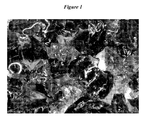
- Figure 1
- is a stereomicroscopic picture of corundum particles of Example 1 at a magnification of 20 x.
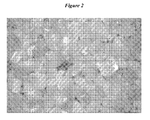
- Figure 2
- is a stereomicroscopic picture of alkaline earth carbonate particles of Example 6 at a magnification of 20 x.
- Figure 3
- shows the particle size distribution curve of alkaline earth carbonate particles of example 6.
- The experiments were carried out with a sand blasting gun of the "STAR" type supplied by the company ASTURO, Assago, Italy using nozzles having a round and rectangular shape, respectively. The compressed air pressure was 5 bar. The distance between the nozzle and the test piece was about 5 cm (± 0.5 cm). The treated surface area was about 2500 ± 500 mm2. The surface was examined before and after the treatment by means of an optical scanner. The surface roughness was determined using a three-dimensional laser microscope of the type ZEISS LSM 5 Pascal + Imager.Zlm. For determining the depth in µm, the root mean square deviation of all of the z-values was determined.
-
Support: Stainless sheet steel (V2A), surface roughness: 1.0 µm Coating: TiO2 paint comprising highly cross-linked polyester/acrylate/isocyanate as a binder. Treating medium: Corundum; particle size: 200 - 800 µm (see Figure 1 ); Mohs hardness: 9Nozzle used: 6 mm x 25 mm Angle of incidence: 90° relative to the surface (i.e. perpendicular to the surface) Treating time: 30 s -
Treated surface in mm2: 2262 Cleaned surface in mm2: 999 Ratio (treated surface/cleaned surface): 2.26 Surface roughness: 6.5 µm Dusting during application: low - The results show that corundum, which is a rather sharp-edged abrasive aluminium oxide, is a very effective cleaning medium on hard surfaces like steel sheets.
-
Support: Stainless sheet steel (V2A), surface roughness: 1.0 µm Coating: TiO2 paint comprising highly cross-linked polyester/acrylate/isocyanate as a binder. Treating medium: Natural calcium carbonate (marble containing dolomite from South Tyrol, Italy); median particle diameter: 10 µm (determined by the sedimentation method in an aqueous solution of 0.1 wt% Na4P2O7 with a Sedigraph™ 5100 of Micromeritics Instrument Corporation) Mohs hardness: about 3 Nozzle used: 6 mm x 25 mm Angle of incidence: 90° relative to the surface (i.e. perpendicular to the surface) Treating time: 30 s -
Treated surface in mm2: 2500 Cleaned surface in mm2: no determinable cleaning effect Ratio (treated surface/cleaned surface): not determinable Surface roughness: not detectable Dusting during application: extreme; visibility strongly reduced Bulk Density: 0.67 g/ml (The bulk density was calculated by measuring the volume of 100 g of product in a 100 ml graduated beaker (1 ml graduation)) - The results show that calcium carbonate particles having a relatively fine particle diameter such as 10 µm are not effective in cleaning solid surfaces.
-
Support: Stainless sheet steel (V2A), surface roughness: 1.0 µm Coating: TiO2 paint comprising highly cross-linked polyester/acrylate/isocyanate as a binder. Treating medium: Natural calcium carbonate (marble containing dolomite from South Tyrol, Italy); sieve fraction: 2000 - 3500 µm; median particle diameter: 2700 µm Mohs hardness: about 3 Nozzle used: 6 mm x 25 mm Angle of incidence: 90° relative to the surface (i.e. perpendicular to the surface) -
Surface roughness: not detectable (particles too coarse to spray. Dust during application: not applicable, particles too coarse to spray Bulk Density: 1.55 g/ml - (The bulk density was calculated by measuring the volume of 100 g of product in a 100 ml graduated beaker (1 ml graduation))
- The particles were too coarse to be sprayed; experiment was abandoned. Thus, also particles having a large diameter cannot be used effectively in blast cleaning.
-
Support: Stainless sheet steel (V2A), surface roughness: 1.0 µm Coating: TiO2 containing paint comprising highly cross-linked polyester/acrylate/isocyanate as a binder. Treating medium: Natural calcium carbonate (marble containing dolomite from South Tyrol, Italy) Mohs hardness: about 3 Median particle diameter: ≅ 700 µm Particle size distribution (determined by sieving according to ISO 787/7): > 1250 µm 2 wt.-% < 500 µm 4 wt.-% Nozzle used: 6 mm x 25 mm Angle of incidence: 90° relative to the surface (i.e. perpendicular to the surface) Treating time: 30 s -
Treated surface in mm2: 2712 Cleaned surface in mm2: 951 Ratio (treated surface/cleaned surface): 2.85 Surface roughness: 2.19 µm Dusting during application: very low dusting Bulk Density: 1.41 g/ml - (The bulk density was calculated by measuring the volume of 100 g of product in a 100 ml graduated beaker (1 ml graduation))
- The results show that the cleaning effect using calcium carbonate particles having a diameter of 700 µm and the above mentioned particle size distribution are nearly as effective as corundum particles. Cleaning with these calcium carbonate particles provides for a much lower surface roughness, but still more than twice as much as surface roughness than the untreated material.
-
Support: Sheet of glass Coating: Whole milk having a water content of about 87.5 wt-%, dried to a water content of about 3 wt-% in 12 hours in a drying oven at 110 °C. Treating medium: Corundum; particle size: 200 - 800 µm Mohs hardness: 9 Nozzle used: Round; diameter: 10 mm Angle of incidence: 45° relative to the surface Treating time: 75 g of treating medium in about 10 s -
Treated surface in mm2: ∼ 4000 Cleaned surface in mm2: > 3000 Ratio (treated surface/cleaned surface): < 5.33 Surface roughness: strong damaging of the glass surface Dust during application: little - The dried milk coating was completely removed; however the surface of the sheet of glass was strongly damaged, scratched and matt by the hard corundum particles (visually detectable at a distance of 15 to 30 cm).
-
Treating medium: Natural calcium carbonate (marble from South Tyrol, Italy, containing 6 - 7 wt.-% dolomite (calculated by analysing the Mg content by ICP in HCl extract)); cf. Figure 2 Mohs hardness: about 3HCl insolubles: 2.7 wt% Humidity: 0.08 to 0.12 wt.-% Median particle diameter: 137 µm (cf. Figure 3 ) Particle size distribution (determined by sieving according to ISO 787/7): > 500 µm 3 wt.-%> 200 µm 35 wt.-% < 90 µm 30 wt.-%< 45 µm 5 wt.-% -
Support: Stainless sheet steel (V2A), surface roughness: 1.0 µm Coating: TiO2 paint comprising highly cross-linked polyester/acrylate/isocyanate as a binder. Nozzle used: 6 mm x 25 mm Angle of incidence: 90° relative to the surface (i.e. perpendicular to the surface) Treating time: 30 s -
Treated surface in mm2: 2327 Cleaned surface in mm2: 276 Ratio (treated surface/cleaned surface): 8.44 Surface roughness: 1.5 µm Dust during application: little Bulk density: 1.45 - (The bulk density was calculated by measuring the volume of 100 g of product in a 100 ml graduated beaker (1 ml graduation))
- The results of test a) show that the cleaning effect using calcium carbonate particles having a median diameter of 137 µm and the above mentioned particle size distribution are not as effective as with corundum particles. However cleaning with calcium carbonate particles according to the invention is much smoother with respect to the surface to be cleaned
-
Support: Stainless sheet steel (V2A), surface roughness: 1.0 µm Coating: Whole milk having a water content of about 87.5 wt-%, dried to a water content of about 3 wt-% in 12 hours in a drying oven at 110 °C. Nozzle used: 6 mm x 25 mm Angle of incidence: 45° relative to the surface Treating time: 30 s -
Treated surface in mm2: 500 Cleaned surface in mm2: > 400 Ratio (treated surface/cleaned surface): < 1.25 Surface roughness: 1.0 - 1.2 µm Dust during application: little - The results of test b) show that the cleaning effect using calcium carbonate particles having a median diameter of 137 µm and the above mentioned particle size distribution are only slightly less effective as with corundum particles. However cleaning with calcium carbonate particles according to the invention is much smoother with respect to the surface to be cleaned. The surface roughness is nearly unchanged.
-
Support: Plate of window glass Coating: Whole milk having water content of about 87.5 wt.%, dried to a water content of about 3 wt.% in 12 hours in a drying oven at 110 °C. Nozzle used: 6 mm x 25 mm Angle of incidence: 45° relative to the surface Treating time: about 30 s - The dried milk coating was completely removed; while the glass surface remained intact (no haze detectable visually at a distance of 15 to 30 cm).
Dust during application: little -
Support: Stainless sheet steel (V2A), surface roughness: 1.0 µm Coating: TiO2 paint comprising highly cross-linked polyester/acrylate/isocyanate as a binder. Treating medium: Natural calcium carbonate (marble containing dolomite from South Tyrol, Italy; cf. Example 6 washed to reduce fines < 45 µm Mohs hardness: about 3 Humidity: 0.08 to 0.12 wt.-% Median particle diameter: 142 µm Particle size distribution (determined by sieving according to ISO 787/7): > 500 µm 3 wt.-% > 200 µm 35 wt.-% < 90 µm 27 wt.-% < 45 µm 2 wt.-% Nozzle used: 6 mm x 25 mm Angle of incidence: 90° relative to the surface (i.e. perpendicular to the surface) Treating time: 30 s -
Treated surface in mm2: 2186 Cleaned surface in mm2: 418 Ratio (treated surface/cleaned surface): 5.23 Surface roughness: 1.2 µm Dust during application: very little Bulk density: 1.50 - (The bulk density was calculated by measuring the volume of 100 g of product in a 100 ml graduated beaker (1 ml graduation))
- Even less dust was observed during surface cleaning compared with the unwashed sample of Example 6 a). Furthermore the results show that the cleaning effect using calcium carbonate particles having a median diameter of 142 µm and the above mentioned particle size distribution are more effective as with the calcium carbonate particles of Example 6, achieving the same or even better surface roughness of the solid surface after cleaning, i.e. effective cleaning at low dusting and very low surface damage is possible with the inventive process.
-
Support: Stainless sheet steel (V2A), surface roughness: 1.0 µm Coating: TiO2 paint comprising highly cross-linked polyester/acrylate/isocyanate as a binder. Treating medium: Natural calcium carbonate (marble containing dolomite from South Tyrol, Italy) Mohs hardness: about 3 Humidity: 0.08 to 0.12 wt.-% Median particle diameter: 200 µm Particle size distribution (determined by sieving according to ISO 787/7): > 500 µm 4 wt.-% > 200 µm 50 wt.-%< 90 µm 8 wt.-% < 45 µm 1 wt.-% Nozzle used: 6 mm x 25 mm Angle of incidence: 90° relative to the surface (i.e. perpendicular to the surface) Treating time: 30 s -
Treated surface in mm2: 2908 Cleaned surface in mm2: 2414 Ratio (treated surface/cleaned surface): 1.21 Surface roughness: 1.4 µm Dust during application: very little - The results show that the sample having a median diameter of 200 µm and a high weight fraction of between 200 to 500 µm provide even better results with respect to cleaning efficiency and low dusting compared with the samples with a median diameter of 137 and 142 µm, respectively. The surface roughness is about the same.
-
Support: Plate of glass Coating: Whole milk having a water content of about 87.5 wt-%, dried to a water content of about 3 wt-% in 12 hours in a drying oven at 110 °C. Treating medium: Natural calcium carbonate (marble containing dolomite from South Tyrol, Italy) Mohs hardness: about 3 Humidity: 0.08 to 0.12 wt.-% Median particle diameter: 200 µm (see Figures 3 to 5 ) Particle size distribution (determined by sieving according to ISO 787/7):> 500 µm 4 wt.-% > 200 µm 50 wt.-%< 90 µm 8 wt.-% < 45 µm 1 wt.-% Nozzle used: 6 mm x 25 mm Angle of incidence: 45° relative to the surface Treating time: 23 g treatment agent in about 10 s - The dried milk coating was completely removed; while the glass surface remained intact (no haze detectable visually at a distance of 15 to 30 cm).
Dust during application: little
The median particle diameter of the natural alkaline earth carbonate particles preferably is from 110 to 400 µm, more preferably from 130 to 300 µm, particularly from 135 to 200 µm, most preferably from 137 to 165 µm, e.g. from 142 to 165 µm measured according to the screening method using ISO screens of defined size. The results are drawn into a xy-graph.
By the use of natural alkaline earth carbonate such as natural marble, no agglomeration or precipitation steps are needed for obtaining particles having an effective size and form in dry blast cleaning, thus providing a more economic and ecologic way of cleaning solid surfaces by dry blasting.
Cleaning in the sense of the present invention means the removal of any kind of coatings from solid surfaces by the treatment with alkaline earth carbonate according to the present invention. Coatings which can be removed are e.g. selected from the group comprising paints, food residues such as e.g. milk or chocolate, pharmaceutical residues in containers or vessels, etc.
By the process according to the invention many kinds of solid surfaces can be cleaned, e.g. surfaces comprising materials selected form the group comprising steel, glass, wood and concrete.
Due to the special form and size of the alkaline earth carbonate particles it is possible to clean the surfaces very effectively without damaging the surface.
Thus, it is especially advantageous to use the process of the present invention in the field of food, pharmaceutical and chemical industry, where there is a continuous need for effective cleaning of production or reaction vessels. However, it can also be used for removing paint such as graffiti or weathering or air pollution products such as soot from walls.
According to the process of the invention there is generally no restriction with respect to the angle with which the alkaline earth carbonate is blasted against the surface. It is preferred that the angle of incidence of the alkaline earth carbonate particles relative to the surface to be cleaned is from 1 to 90°, preferably 30 to 90°, more preferably 40 to 90°, e.g. 45°. Good results can also be achieved at an angle of more than 60° to 90°.
For the blasting operation any blasting equipment suitable for dry blasting can be used, such as for example a sand blasting gun of the "STAR" type supplied by the company ASTURO, Assago, Italy.
The compressed air pressure may be from 0.5 to 250 bar, preferably 1 to 7 bar, more preferably 2 to 6 bar, e.g. 5 bar.
In this respect, any commonly employed nozzles can be used, e.g. having a round or elliptic, square or rectangular shape. Preferably the nozzle is made of metal, glass or plastic, particularly of rubber gum.
Preferably the surface roughness (determined in µm depth using a three-dimensional laser microscope of the type ZEISS LSM 5 Pascal + Imager.Zlm) of the solid surface before and after the treatment remains unchanged. In any case, the surface roughness after the treatment according to the present invention is not more than twice as high than before, preferably not more than 1.5 times higher, more preferably not more than 1.2 times higher.
A further advantage of the process according to the present invention is that the natural alkaline earth carbonate has very favourable characteristics with respect to dusting.
In view of the above advantages, the use of natural alkaline earth carbonate particles having a mean particle diameter of from 100 to 500 µm and a Mohs hardness of below 4 for a process for cleaning solid surfaces as defined above is a further aspect of the invention, provided that the alkaline earth carbonate particles are not in the form of precipitates or agglomerates.
A further aspect of the present invention is the process for their production comprising the steps of
Claims (22)
- A process for cleaning solid surfaces by dry blasting said surfaces with natural alkaline earth carbonate particles having a mean particle diameter of from 100 to 500 µm and a Mohs hardness of below 4, provided that the alkaline earth carbonate particles are not in the form of precipitates or agglomerates.
- The process according to claim 1,
characterized in that the natural alkaline earth carbonate is natural calcium carbonate and/or natural calcium magnesium carbonate. - The process according to any one of claims 1 or 2,
characterized in that the natural alkaline earth carbonate is selected from the group comprising marble, calcite, chalk and dolomite, limestone and mixtures thereof. - The process according to any one of the preceding claims,
characterized in that the natural alkaline earth carbonate has an average Mohs hardness of from 2.6 to 3.9, preferably from 2.6 to 3.4, e.g. 3. - The process according to any one of the preceding claims,
characterized in that the natural alkaline earth carbonate is marble, preferable marble containing dolomite. - The process according to any one of the preceding claims,
characterized in that the alkaline earth carbonate content in the natural alkaline earth carbonate mineral is > 90 wt.-%, more preferably 95 to 99.9 wt.-%, e.g. 99.5 wt.-%. - The process according to any one of the preceding claims,
characterized in that the natural alkaline earth carbonate has a calcium content of at least 21 wt.-%, preferably > 35 wt.-%, more preferably > 38 wt.-%. - The process according to any one of the preceding claims,
characterized in that the natural alkaline earth carbonate has a magnesium content of maximum 13 wt.-%, preferably < 3 wt.-%, more preferably < 1.5 wt.-%. - The process according to any one of the preceding claims,
characterized in that the natural alkaline earth carbonate comprises dolomite in a content of 0.1 to 100 wt.-%, preferably from 2 to 10 wt.-%, more preferably from 3 to 7 wt.-%, e.g. 5 wt.-%. - The process according to any one of the preceding claims,
characterized in that the natural alkaline earth carbonate is classified providing a residue on a 500 µm sieve of ≤ 10 wt.-%, preferably ≤ wt.-%, more preferably ≤ 5 wt.-%, e.g. 3 to 4 wt.-%. - The process according to any one of the preceding claims,
characterized in that the natural alkaline earth carbonate is classified providing a residue on a 200 µm sieve of from 20 to 60 wt.-%, preferably from 25 to 50 wt.-%, more preferably from 30 to 40 wt.-%, e.g. 35 wt.%. - The process according to any one of the preceding claims,
characterized in that the natural alkaline earth carbonate is classified providing a residue on a 90 µm sieve of from 50 to 95 wt.-%, more preferably from 70 to 92 wt.-%, especially from 73 to 90 wt.-%, e.g. 80 wt.-%. - The process according to any one of the preceding claims,
characterized in that the natural alkaline earth carbonate is classified providing a residue on a 45 µm sieve of ≥ 90 wt.-%, more preferably ≥ 3 wt.-%, most preferably ≥ 5 wt.-%, especially from 97 to 99 wt.-%, e.g. 98 wt.-%. - The process according to any one of the preceding claims,
characterized in that from 50 to 80 wt.-%, preferably from 60 to 80 wt.-%, e.g. 65 wt.-% of the natural alkaline earth carbonate particles have a particle size of between 90 to 500 µm. - The process according to any one of the preceding claims,
characterized in that the natural alkaline earth carbonate particles have a median particle diameter of from 110 to 400 µm, more preferably from 130 to 300 µm, particularly from 135 to 200 µm, most preferably from 137 to 165 µm, e.g. from 142 to 160 µm. - The process according to any one of the preceding claims,
characterized in that the natural alkaline earth particles are obtained by dry grinding, e.g. in a ball mill or hammer mill. - The process according to claim 16,
characterized in that the natural alkaline earth particles are obtained by a combination of one or more of such mills with cyclones and sieves. - The process according to any one of the preceding claims,
characterized in that the material to be removed from the solid surfaces is selected from the group comprising paints, food residues such as e.g. milk or chocolate, and pharmaceutical residues. - The process according to any one of the preceding claims,
characterized in that the solid surfaces comprising materials selected from the group comprising steel, glass, wood, and concrete. - The process according to any one of the preceding claims,
characterized in that the angle of incidence of the alkaline earth carbonate particles relative to the surface to be cleaned is from 1 to 90°, preferably 30 to 90°, more preferably 40 to 90°, e.g. 45°, especially preferably more than 60 to 90°. - Use of natural alkaline earth carbonate particles for a process for cleaning solid surfaces according to any one of claims 1 to 20.
- Process for the manufacture of natural alkaline earth carbonate particles having a median particle diameter of from 100 to 500 µm and a Mohs hardness of below 4 for the use in the process according to any one of claims 1 to 20,
characterized by the steps of- dry crushing, dividing and/or grinding the natural alkaline earth carbonate,- screening the resulting particles for reducing the fines.
Priority Applications (14)
| Application Number | Priority Date | Filing Date | Title |
|---|---|---|---|
| EP08103796A EP2113339A1 (en) | 2008-04-30 | 2008-04-30 | Alkaline earth carbonate containing mineral for surface cleaning |
| TW098111602A TWI504480B (en) | 2008-04-30 | 2009-04-08 | Process for cleaning solid surfaces with natural alkaline earth carbonate particles, use of natural alkaline earth carbonate particles for cleaning solid surfaces and process for the manufacture of natural alkaline earth carbonate particles |
| CN200980115448.5A CN102026776B (en) | 2008-04-30 | 2009-04-30 | For the mineral comprising alkaline earth metal carbonate of removing surface |
| PL09738217T PL2296847T3 (en) | 2008-04-30 | 2009-04-30 | Alkaline earth carbonate containing mineral for surface cleaning |
| RU2010148766/02A RU2498891C2 (en) | 2008-04-30 | 2009-04-30 | Mineral bearing alkaline metal carbonate for surface cleaning |
| DK09738217.0T DK2296847T3 (en) | 2008-04-30 | 2009-04-30 | ALKALIC EARTH CARBONATE CONTAINING MINERALS FOR SURFACE CLEANING |
| SI200930898T SI2296847T1 (en) | 2008-04-30 | 2009-04-30 | Alkaline earth carbonate containing mineral for surface cleaning |
| KR1020107025781A KR20110008236A (en) | 2008-04-30 | 2009-04-30 | Minerals containing alkaline earth metal carbonates for cleaning surfaces |
| PT97382170T PT2296847E (en) | 2008-04-30 | 2009-04-30 | Alkaline earth carbonate containing mineral for surface cleaning |
| US12/736,663 US8597077B2 (en) | 2008-04-30 | 2009-04-30 | Alkaline earth carbonate containing mineral for surface cleaning |
| EP09738217.0A EP2296847B1 (en) | 2008-04-30 | 2009-04-30 | Alkaline earth carbonate containing mineral for surface cleaning |
| PCT/EP2009/055273 WO2009133173A1 (en) | 2008-04-30 | 2009-04-30 | Alkaline earth carbonate containing mineral for surface cleaning |
| CA2722676A CA2722676C (en) | 2008-04-30 | 2009-04-30 | Alkaline earth carbonate containing mineral for surface cleaning |
| ES09738217.0T ES2458540T3 (en) | 2008-04-30 | 2009-04-30 | Mineral containing alkaline earth carbonate for surface cleaning |
Applications Claiming Priority (1)
| Application Number | Priority Date | Filing Date | Title |
|---|---|---|---|
| EP08103796A EP2113339A1 (en) | 2008-04-30 | 2008-04-30 | Alkaline earth carbonate containing mineral for surface cleaning |
Publications (1)
| Publication Number | Publication Date |
|---|---|
| EP2113339A1 true EP2113339A1 (en) | 2009-11-04 |
Family
ID=39766908
Family Applications (2)
| Application Number | Title | Priority Date | Filing Date |
|---|---|---|---|
| EP08103796A Withdrawn EP2113339A1 (en) | 2008-04-30 | 2008-04-30 | Alkaline earth carbonate containing mineral for surface cleaning |
| EP09738217.0A Not-in-force EP2296847B1 (en) | 2008-04-30 | 2009-04-30 | Alkaline earth carbonate containing mineral for surface cleaning |
Family Applications After (1)
| Application Number | Title | Priority Date | Filing Date |
|---|---|---|---|
| EP09738217.0A Not-in-force EP2296847B1 (en) | 2008-04-30 | 2009-04-30 | Alkaline earth carbonate containing mineral for surface cleaning |
Country Status (13)
| Country | Link |
|---|---|
| US (1) | US8597077B2 (en) |
| EP (2) | EP2113339A1 (en) |
| KR (1) | KR20110008236A (en) |
| CN (1) | CN102026776B (en) |
| CA (1) | CA2722676C (en) |
| DK (1) | DK2296847T3 (en) |
| ES (1) | ES2458540T3 (en) |
| PL (1) | PL2296847T3 (en) |
| PT (1) | PT2296847E (en) |
| RU (1) | RU2498891C2 (en) |
| SI (1) | SI2296847T1 (en) |
| TW (1) | TWI504480B (en) |
| WO (1) | WO2009133173A1 (en) |
Cited By (1)
| Publication number | Priority date | Publication date | Assignee | Title |
|---|---|---|---|---|
| WO2017103345A1 (en) * | 2015-12-18 | 2017-06-22 | Clean Steel Pori Oy | Method of cleaning heat transfer surfaces of a powerhouse |
Families Citing this family (3)
| Publication number | Priority date | Publication date | Assignee | Title |
|---|---|---|---|---|
| EP2883573B2 (en) | 2013-12-13 | 2020-10-28 | Omya International AG | Abrasive cleaning composition |
| EP3045503A1 (en) | 2015-01-15 | 2016-07-20 | Omya International AG | Surface-treated calcium carbonate with improved stability in environments with a pH of 4.5 to 7 |
| RU2715509C2 (en) * | 2016-09-08 | 2020-02-28 | Геннадий Валерьевич Барсуков | Abrasive mixture for hydroabrasive cutting and method of determining percentage composition thereof |
Citations (11)
| Publication number | Priority date | Publication date | Assignee | Title |
|---|---|---|---|---|
| US5112406A (en) * | 1991-12-03 | 1992-05-12 | Church & Dwight Co., Inc. | Process for removing coatings from sensitive substrates, and sodium sulfate-containing blasting media useful therein |
| WO1993018863A1 (en) * | 1992-03-20 | 1993-09-30 | Church & Dwight Company, Inc. | Abrasive coating remover and process for using same |
| DE4222884A1 (en) | 1992-07-11 | 1994-01-13 | Guenter Keuthe | Building facade dry cleaning by pressurised air jet - uses turbulent air jet and blasting mixt. of glass pearls, normal and mixed corundum |
| WO1994007658A1 (en) | 1992-09-25 | 1994-04-14 | Norsk Hydro A.S. | Blasting agent and a process for removing coatings |
| US5531634A (en) | 1995-02-03 | 1996-07-02 | Schott; Paul | Method of using an abrasive material for blast cleaning of solid surfaces |
| WO1997041975A1 (en) * | 1996-05-09 | 1997-11-13 | Church & Dwight Company, Inc. | Method for cleaning electronic hardware components |
| US5827114A (en) | 1996-09-25 | 1998-10-27 | Church & Dwight Co., Inc. | Slurry blasting process |
| US6113475A (en) | 1998-12-24 | 2000-09-05 | Daiko Electric Co., Ltd. | Method of cleaning container and apparatus therefor |
| WO2004080656A1 (en) * | 2003-03-14 | 2004-09-23 | Workinter Limited | Method for selective removal of materials present in one or more layers on an object, and apparatus for implementation of this method |
| EP1467841A1 (en) | 2002-01-24 | 2004-10-20 | Exa SA | A process for treating a surface |
| JP2006326821A (en) * | 2005-05-27 | 2006-12-07 | Jp Hytec:Kk | Aging coating film peeling method |
Family Cites Families (10)
| Publication number | Priority date | Publication date | Assignee | Title |
|---|---|---|---|---|
| SE455265B (en) * | 1984-03-27 | 1988-07-04 | Arne Alvemarker | BLASTER BODIES OF COMPOSITION MATERIAL TO CLEAN CLEANING DISH |
| RU2002601C1 (en) * | 1990-03-14 | 1993-11-15 | Черч Энд Дуайт Ко., Инк. (Us) | Method for removal of coatings from sensitive metal and composite surfaces and medium for jet blasting |
| JP3124127B2 (en) * | 1992-09-28 | 2001-01-15 | 株式会社ネオス | Cleaning method for semiconductor manufacturing equipment, etc. |
| US5332447A (en) * | 1993-01-21 | 1994-07-26 | Church & Dwight Co., Inc. | Method of cleaning using a blast media containing a surfactant-clathrate compound |
| JPH08318468A (en) | 1995-05-24 | 1996-12-03 | Riyuuki Eng:Kk | Injecting method of abrasives and abrasives using the same |
| DE59602057D1 (en) | 1995-07-24 | 1999-07-08 | Cfm Gmbh | Paint removers |
| JP2004307791A (en) * | 2003-04-08 | 2004-11-04 | Jp Hytec:Kk | Grinding material for blast and its manufacturing method |
| DE102004011087A1 (en) * | 2004-03-06 | 2005-09-22 | Henkel Kgaa | Particles comprising discrete, fine particulate surfactant particles |
| US7731110B2 (en) * | 2005-06-29 | 2010-06-08 | J.M. Huber Corporation | Method for making precipitated silica compositions and products thereof |
| US8138253B2 (en) * | 2005-09-06 | 2012-03-20 | Maruo Calcium Company Limited | Filler for powder coating material and powder coating composition containing the same |
-
2008
- 2008-04-30 EP EP08103796A patent/EP2113339A1/en not_active Withdrawn
-
2009
- 2009-04-08 TW TW098111602A patent/TWI504480B/en not_active IP Right Cessation
- 2009-04-30 CA CA2722676A patent/CA2722676C/en not_active Expired - Fee Related
- 2009-04-30 ES ES09738217.0T patent/ES2458540T3/en active Active
- 2009-04-30 PL PL09738217T patent/PL2296847T3/en unknown
- 2009-04-30 SI SI200930898T patent/SI2296847T1/en unknown
- 2009-04-30 RU RU2010148766/02A patent/RU2498891C2/en active
- 2009-04-30 CN CN200980115448.5A patent/CN102026776B/en not_active Expired - Fee Related
- 2009-04-30 KR KR1020107025781A patent/KR20110008236A/en not_active Ceased
- 2009-04-30 US US12/736,663 patent/US8597077B2/en not_active Expired - Fee Related
- 2009-04-30 WO PCT/EP2009/055273 patent/WO2009133173A1/en not_active Ceased
- 2009-04-30 DK DK09738217.0T patent/DK2296847T3/en active
- 2009-04-30 PT PT97382170T patent/PT2296847E/en unknown
- 2009-04-30 EP EP09738217.0A patent/EP2296847B1/en not_active Not-in-force
Patent Citations (12)
| Publication number | Priority date | Publication date | Assignee | Title |
|---|---|---|---|---|
| US5112406A (en) * | 1991-12-03 | 1992-05-12 | Church & Dwight Co., Inc. | Process for removing coatings from sensitive substrates, and sodium sulfate-containing blasting media useful therein |
| WO1993018863A1 (en) * | 1992-03-20 | 1993-09-30 | Church & Dwight Company, Inc. | Abrasive coating remover and process for using same |
| US5509971A (en) * | 1992-03-20 | 1996-04-23 | Church & Dwight Co., Inc. | Process for removing coatings from hard surfaces |
| DE4222884A1 (en) | 1992-07-11 | 1994-01-13 | Guenter Keuthe | Building facade dry cleaning by pressurised air jet - uses turbulent air jet and blasting mixt. of glass pearls, normal and mixed corundum |
| WO1994007658A1 (en) | 1992-09-25 | 1994-04-14 | Norsk Hydro A.S. | Blasting agent and a process for removing coatings |
| US5531634A (en) | 1995-02-03 | 1996-07-02 | Schott; Paul | Method of using an abrasive material for blast cleaning of solid surfaces |
| WO1997041975A1 (en) * | 1996-05-09 | 1997-11-13 | Church & Dwight Company, Inc. | Method for cleaning electronic hardware components |
| US5827114A (en) | 1996-09-25 | 1998-10-27 | Church & Dwight Co., Inc. | Slurry blasting process |
| US6113475A (en) | 1998-12-24 | 2000-09-05 | Daiko Electric Co., Ltd. | Method of cleaning container and apparatus therefor |
| EP1467841A1 (en) | 2002-01-24 | 2004-10-20 | Exa SA | A process for treating a surface |
| WO2004080656A1 (en) * | 2003-03-14 | 2004-09-23 | Workinter Limited | Method for selective removal of materials present in one or more layers on an object, and apparatus for implementation of this method |
| JP2006326821A (en) * | 2005-05-27 | 2006-12-07 | Jp Hytec:Kk | Aging coating film peeling method |
Cited By (2)
| Publication number | Priority date | Publication date | Assignee | Title |
|---|---|---|---|---|
| WO2017103345A1 (en) * | 2015-12-18 | 2017-06-22 | Clean Steel Pori Oy | Method of cleaning heat transfer surfaces of a powerhouse |
| EP3390908A4 (en) * | 2015-12-18 | 2019-06-26 | Clean Steel Pori Oy | METHOD FOR CLEANING HEAT TRANSFER SURFACES FROM A MACHINE ROOM |
Also Published As
| Publication number | Publication date |
|---|---|
| TW201004742A (en) | 2010-02-01 |
| CA2722676A1 (en) | 2009-11-05 |
| CN102026776B (en) | 2015-11-25 |
| TWI504480B (en) | 2015-10-21 |
| RU2498891C2 (en) | 2013-11-20 |
| KR20110008236A (en) | 2011-01-26 |
| PT2296847E (en) | 2014-04-29 |
| US8597077B2 (en) | 2013-12-03 |
| WO2009133173A1 (en) | 2009-11-05 |
| EP2296847A1 (en) | 2011-03-23 |
| CA2722676C (en) | 2016-03-01 |
| PL2296847T3 (en) | 2014-07-31 |
| EP2296847B1 (en) | 2014-02-26 |
| RU2010148766A (en) | 2012-06-10 |
| ES2458540T3 (en) | 2014-05-06 |
| US20110130076A1 (en) | 2011-06-02 |
| CN102026776A (en) | 2011-04-20 |
| DK2296847T3 (en) | 2014-05-26 |
| SI2296847T1 (en) | 2014-05-30 |
Similar Documents
| Publication | Publication Date | Title |
|---|---|---|
| CA2122361C (en) | Abrasive coating remover and process for using same | |
| US5531634A (en) | Method of using an abrasive material for blast cleaning of solid surfaces | |
| Momber | Blast cleaning technology | |
| US5308404A (en) | Less aggressive blast media formed from compacted particles | |
| EP2296847B1 (en) | Alkaline earth carbonate containing mineral for surface cleaning | |
| US20220033681A1 (en) | Blasting abrasives and method of producing blasting abrasives | |
| US6817927B2 (en) | Method of removing material from an external surface using core/shell particles | |
| US5456628A (en) | Use of specular hematite as an impact material | |
| WO1994007658A1 (en) | Blasting agent and a process for removing coatings | |
| EP4041493A1 (en) | Method of modifying a surface of a workpiece | |
| EP1966087A1 (en) | Milling process | |
| US6007639A (en) | Blasting process for removing contaminants from substrates and potassium magnesium sulfate-containing blast media | |
| Veloz | Practical aspects of using walnut shells for cleaning outdoor sculpture | |
| US20030032370A1 (en) | Process for reclaiming mirror cullet and production of a powdered glass | |
| Visaisouk | Crystalline ice blasting | |
| JP2000225570A (en) | Blasting method | |
| Momber | Abrasive Materials |
Legal Events
| Date | Code | Title | Description |
|---|---|---|---|
| PUAI | Public reference made under article 153(3) epc to a published international application that has entered the european phase |
Free format text: ORIGINAL CODE: 0009012 |
|
| 17P | Request for examination filed |
Effective date: 20080430 |
|
| AK | Designated contracting states |
Kind code of ref document: A1 Designated state(s): AT BE BG CH CY CZ DE DK EE ES FI FR GB GR HR HU IE IS IT LI LT LU LV MC MT NL NO PL PT RO SE SI SK TR |
|
| AX | Request for extension of the european patent |
Extension state: AL BA MK RS |
|
| AKX | Designation fees paid |
Designated state(s): AT BE BG CH CY CZ DE DK EE ES FI FR GB GR HR HU IE IS IT LI LT LU LV MC MT NL NO PL PT RO SE SI SK TR |
|
| 17Q | First examination report despatched |
Effective date: 20100716 |
|
| GRAP | Despatch of communication of intention to grant a patent |
Free format text: ORIGINAL CODE: EPIDOSNIGR1 |
|
| INTG | Intention to grant announced |
Effective date: 20130822 |
|
| RAP1 | Party data changed (applicant data changed or rights of an application transferred) |
Owner name: OMYA INTERNATIONAL AG |
|
| STAA | Information on the status of an ep patent application or granted ep patent |
Free format text: STATUS: THE APPLICATION IS DEEMED TO BE WITHDRAWN |
|
| 18D | Application deemed to be withdrawn |
Effective date: 20140103 |