EP2107722B1 - Procédé de gestion d'un flux de données, passerelle domestique et dispositif correspondants - Google Patents
Procédé de gestion d'un flux de données, passerelle domestique et dispositif correspondants Download PDFInfo
- Publication number
- EP2107722B1 EP2107722B1 EP09156069A EP09156069A EP2107722B1 EP 2107722 B1 EP2107722 B1 EP 2107722B1 EP 09156069 A EP09156069 A EP 09156069A EP 09156069 A EP09156069 A EP 09156069A EP 2107722 B1 EP2107722 B1 EP 2107722B1
- Authority
- EP
- European Patent Office
- Prior art keywords
- pad
- data stream
- terminal
- home gateway
- message
- Prior art date
- Legal status (The legal status is an assumption and is not a legal conclusion. Google has not performed a legal analysis and makes no representation as to the accuracy of the status listed.)
- Active
Links
Images





Classifications
-
- H—ELECTRICITY
- H04—ELECTRIC COMMUNICATION TECHNIQUE
- H04L—TRANSMISSION OF DIGITAL INFORMATION, e.g. TELEGRAPHIC COMMUNICATION
- H04L12/00—Data switching networks
- H04L12/66—Arrangements for connecting between networks having differing types of switching systems, e.g. gateways
-
- H—ELECTRICITY
- H04—ELECTRIC COMMUNICATION TECHNIQUE
- H04L—TRANSMISSION OF DIGITAL INFORMATION, e.g. TELEGRAPHIC COMMUNICATION
- H04L65/00—Network arrangements, protocols or services for supporting real-time applications in data packet communication
- H04L65/10—Architectures or entities
- H04L65/102—Gateways
- H04L65/1023—Media gateways
- H04L65/1026—Media gateways at the edge
-
- H—ELECTRICITY
- H04—ELECTRIC COMMUNICATION TECHNIQUE
- H04M—TELEPHONIC COMMUNICATION
- H04M3/00—Automatic or semi-automatic exchanges
- H04M3/22—Arrangements for supervision, monitoring or testing
- H04M3/2281—Call monitoring, e.g. for law enforcement purposes; Call tracing; Detection or prevention of malicious calls
-
- H—ELECTRICITY
- H04—ELECTRIC COMMUNICATION TECHNIQUE
- H04M—TELEPHONIC COMMUNICATION
- H04M7/00—Arrangements for interconnection between switching centres
- H04M7/006—Networks other than PSTN/ISDN providing telephone service, e.g. Voice over Internet Protocol (VoIP), including next generation networks with a packet-switched transport layer
- H04M7/0066—Details of access arrangements to the networks
- H04M7/0069—Details of access arrangements to the networks comprising a residential gateway, e.g. those which provide an adapter for POTS or ISDN terminals
-
- H—ELECTRICITY
- H04—ELECTRIC COMMUNICATION TECHNIQUE
- H04M—TELEPHONIC COMMUNICATION
- H04M3/00—Automatic or semi-automatic exchanges
- H04M3/42—Systems providing special services or facilities to subscribers
- H04M3/42025—Calling or Called party identification service
- H04M3/42034—Calling party identification service
- H04M3/42059—Making use of the calling party identifier
-
- H—ELECTRICITY
- H04—ELECTRIC COMMUNICATION TECHNIQUE
- H04M—TELEPHONIC COMMUNICATION
- H04M3/00—Automatic or semi-automatic exchanges
- H04M3/42—Systems providing special services or facilities to subscribers
- H04M3/42365—Presence services providing information on the willingness to communicate or the ability to communicate in terms of media capability or network connectivity
Definitions
- the present invention relates generally to the fields of computing and telecommunications, and more specifically it relates to home bridges.
- Such a gateway serves as an entry point on one or more external networks to different user equipments connected to each other on a local network or directly to the home gateway. It is therefore an improved modem, serving as a router connected to one or more external networks such as the Internet and providing various interfaces to user equipment, such as an FXS interface (according to the English “Foreign eXchange Subscriber ”) to an analog phone or WiFi interface (Wireless Fidelity, according to the" Institute of Electronical and Electronics Engineers "(IEEE) 802.11) to a personal computer.
- FXS interface accordinging to the English "Foreign eXchange Subscriber ”
- WiFi interface Wireless Fidelity, according to the" Institute of Electronical and Electronics Engineers "(IEEE) 802.11
- home bridges allow to offer different so-called “convergent” services, such as voice over IP or "VoIP", according to the English “Voice over Internet Prococol", access to the Internet or Internet TV .
- these services are provided independently of one another.
- Domestic gateways do not provide any coupling allowing in particular to ensure that a service provided is delivered to the most appropriate user equipment depending on the context. So when a user browses the Internet on his personal computer connected to a home gateway and a fixed phone, also connected to this gateway, rings, it must stop and move to answer this call, while this call was not necessarily intended for him or that he would have been more appropriate not to answer, for example because the call was hidden. It would have been preferable in this case for the user to receive the call directly on his personal computer, equipped with a loudspeaker and a microphone, after having previously downloaded an appropriate VoIP software.
- the patent application KR20030083843 tries to solve this problem for a home gateway providing a VoIP service to a Local Area Network (LAN) to which multiple computers are connected.
- LAN Local Area Network
- the gateway By consulting a database, in which various information about the users as well as the states of the terminals is recorded, when a call arrives, the gateway transmits the call to the most appropriate terminal.
- this information is not always relevant in the case of a home network: in fact each user equipment is not necessarily assigned to a particular user, and its status is not necessarily linked to the availability of people affected by this equipment.
- this solution is applied in the case described above where a user navigates on his personal computer when the fixed telephone rings, the corresponding call would be automatically redirected to the computer of the user, while this call was not not necessarily intended.
- this independence between the services provided by the same home gateway does not make it possible to combine them, for example to improve a service provided on a user equipment connected to a home gateway by using the capabilities of other equipment also connected to this gateway. .
- the patent application US2004 / 133627 discloses a communication system in which multimedia services, such as notification of service events or call states, or call transfer, are implemented in a communication apparatus which can be either an IP telephone or a residential gateway connected to several terminals . These multimedia services are programmed in XML language. When receiving network events or linked to a terminal to which the communication device is connected, a predefined service logic is implemented.
- the present invention aims to overcome the disadvantages of the prior art by providing a method and devices for a user equipment, or more generally a device, connected to a home gateway, to interact with a service provided by this gateway to another device.
- the invention proposes a method for managing a data flow whose establishment between a source device and a destination device involves the passage of a signaling stream by a home gateway, one of said devices being a first remote device connected to a communication network and the other of said devices being a second device connected to said communication network via said home gateway, characterized in that it comprises a step of notifying a relative event a request to establish said data stream by said home gateway to a third device connected to said home gateway.
- the home gateway informs a terminal a priori not concerned by this service, for example a personal computer on which a user navigates.
- a terminal a priori not concerned by this service for example a personal computer on which a user navigates.
- the notification indicates the arrival of a hidden incoming call on the user's fixed telephone
- the latter selects an option on his personal computer to request the home gateway to transfer the call to a voicemail.
- the notification indicates the arrival of a video stream
- the personal computer receiving this notification will automatically search on the Internet for a web page linked to the corresponding video program and display it on its screen, with a menu allowing the user to ask the home gateway to change the channel received by the television.
- the invention thus allows the user to interact with the services that are provided by his home gateway, to obtain services more adapted to a given context.
- the method of managing a data stream according to the invention further comprises a step of notifying at least one other event relating to the establishment of said data stream when it is established between said data stream. source device and said recipient device.
- the third terminal By being notified of other events relating to the establishment of the data flow, such as the ringing of a telephone if the data stream corresponds to an incoming call, the stall or the hang-up of this telephone, the third terminal has the possibility to interact conditionally with these events. For example, after a predetermined number of rings, the third terminal offers the user a list of actions such as hang-up, transfer of the call to a voicemail, or the transfer of the call to a recipient to select from a drop-down list.
- the method of managing a data stream according to the invention further comprises a step of reception by said home gateway of a request for reproduction of said data stream, sent by said third device, and a step of copying said stream of data and transmission of said stream and copied by said home gateway to said third device.
- This feature allows the user, when the data stream corresponds to an incoming or outgoing telephone call, to listen to the corresponding telephone conversation passing through the home gateway, or to record it.
- the data stream is a video stream
- this feature allows the user to record or watch a broadcast on the receiving television of the video stream.
- the establishment of said data flow is suspended, said home gateway giving control of said data flow to said third device.
- This particular implementation of the invention allows the third device to control the flow of data, that is to say, in particular to prevent the establishment of the data flow or to transfer this data flow to another device before it data flow is established between the source device and the destination device. This gives the user time to decide what to do with a call, for example, before someone else picks up the phone.
- said notification step is followed by a step of receiving a transfer instruction of said data stream to a device other than said recipient device, sent by said third device, and a transfer step by said home gateway of said data stream to said other device.
- the invention makes it possible for the third device to transfer the data stream to a more appropriate device for example. It should be noted that it is possible to perform this transfer without taking control of the data flow by the third device, because the home gateway is cut off from the data stream, it is able to easily transfer the data stream to another device than the recipient device.
- the invention also relates to a home gateway comprising means for connection to a communication network to which a first remote device is connected, connection means to a second device, and means for receiving a signaling stream from one of said devices said source device for establishing a data flow with the other of said devices said receiving device, characterized in that it further comprises means for notifying an event relating to a request for establishing said data flow to a third device when it is connected to said home gateway.
- the home gateway according to the invention further comprises means for interrupting the establishment of said data stream between said source device and said recipient device, and means for receiving at least one instruction sent by said third device and indicating the sequence to be given to said data stream.
- the invention also relates to a device comprising means of connection to a home gateway for accessing a communication network, characterized in that it comprises means for receiving a notification of an event relating to a request for establishment a data flow between two other devices and whose establishment requires the passage of a signaling stream in said home gateway.
- This additional feature allows the receiving device to automatically download relevant information associated with the data stream. For example, if the device is the personal computer of a user and the data stream corresponds to a user's call to an IT support platform, the computer downloads information provided by a linked server to this platform to guide the user in his request for assistance.
- the device according to the invention further comprises means for controlling said data stream to receive it, and voice recognition means able to use a grammar contained in said resource.
- this other feature also allows the user to transfer the call to his computer to use a speech recognition software.
- the latter by identifying key words in the user's conversation, for example performs contextual navigation on the server of the support platform, which improves the service provided to the user.
- the invention finally relates to a computer program comprising instructions for implementing the method according to the invention, when it is executed on a computer.
- the home gateway according to the invention the device according to the invention as well as the computer program according to the invention have advantages similar to those of the method of managing a data stream according to the invention. .
- the home gateway PAD allows the terminal T3 to manage a telephone call between a remote telephone T1 connected directly to the telephone network RES1.
- IP if it is a telephone over IP or via the network PSTN (Switched Telephone Network) otherwise, and the phone T2.
- the data stream is here a bidirectional voice stream transported in the network RES1 on a RTP layer (according to the English "Real-time Transport Prococol").
- the terminal T3 also implements a proprietary interface, symmetrically allowing to receive notifications from the home gateway PAD, and send him instructions to modify a call being established or already established.
- This proprietary interface is for example implemented in an application called "widget", which presents a graphical interface to the user, for viewing a notification of the home gateway PAD and select an action to be performed following this notification.
- This application is either launched automatically when the T3 terminal is started, or manually by the user.
- the proprietary interface between the home gateway PAD and the terminal T3 is implemented in the form of a programming interface, allowing the user to develop his own "widgets", for example a programming interface.
- XML-RPC type according to the English "eXtensible Markup Language Remote Procedure Call".
- the user is able to achieve a coupling between the different services provided by its home gateway, in a manner adapted to its needs.
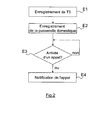
- the method of managing a data stream according to the invention comprises steps E1 to E4 represented in FIG. figure 2 .
- Steps E1 and E2 are steps prior to the operation of the method according to the invention, they take place for example just after switching on the home gateway PAD and connecting the terminal T3 to the home gateway PAD.
- steps E3 and E4 are steps prior to the operation of the method according to the invention, they take place for example just after switching on the home gateway PAD and connecting the terminal T3 to the home gateway PAD.
- steps E3 and E4 When a call arrives, several other steps take place according to the context of use, including steps E3 and E4. Steps E1 and E2 are not repeated during a subsequent call, while steps E3 and E4 are.
- Step E1 is the registration of the terminal T3 with the home gateway PAD to receive notifications of events from it.
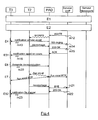
- This recording is effected by sending a message m0 from the terminal T3 to the home gateway PAD as shown in FIG. figure 3 .
- the terminal T3 indicates for which events it wishes to be notified, and whether the notification of a call establishment request must suspend the establishment of the call or not.
- the terminal T3 indicates in the message m0 that it wishes to be notified of the events "arrival of a call", "call in progress” and "end of call", the event "arrival of a call” being in makes the home gateway PAD receive a call setup request.
- the terminal T3 indicates in the message m0 that the notification of a call establishment request does not suspend the establishment of the call, that is to say that the home gateway PAD does not wait.
- the terminal T3 also indicates in this example of operation that wants to be notified of new messages on his voicemail in the network RES1 IP telephony.
- the home gateway PAD responds to the terminal T3 by a message m1 indicating whether the home gateway is operational or not for the IP telephony service.
- the message m1 indicates that the home gateway PAD is not registered in the network RES1 IP telephony.
- the next step E2 is therefore the recording of the home gateway PAD in the IP telephony network RES1. It should be noted that the order of the steps E1 and E2 is irrelevant, these steps simply having to be performed before the arrival of a call.
- the home gateway PAD sends a message m2 to a voice over IP server in the network RES1 IP telephony.
- This m2 message is a REGISTER (Session Initiation Protocol) SIP message that provides the VoIP server with an address that allows the VoIP server to contact the user.
- REGISTER Session Initiation Protocol
- Other protocols can be used in this embodiment of the invention, for example the H.323 protocol of the ITU-T (according to the English "International Telecommunication Union - Telecommunication Standardization Sector") according to the protocol used in the RES1 network.
- the voice over IP server responds with a message m3, which is a SIP message 401 containing an authentication key for authenticating the home gateway PAD.
- the home gateway PAD uses this authentication key, in addition to various identification parameters configured in the home gateway PAD, to calculate an authentication response. It then sends an m4 "SIP REGISTER" response message containing authentication parameters to the VoIP server. Finally the voice over IP server sends a message m5 "SIP 200 OK" to the home gateway PAD, indicating that its registration in the network RES1 is performed. The home gateway PAD then notifies in a message m6 to T3 terminal that the IP telephony service provided by the PAD home gateway is now operational.
- the home gateway PAD is also recorded in this step E2 with a mail server in the network RES1 IP telephony. This allows it to be notified of new messages left on this mail server and to leave an indicator of new messages on the T2 phone.
- the home gateway PAD sends an message m7, which is a SIP SUBSCRIBE message, to the mail server.
- the latter responds to the home gateway PAD with a message m8 "SIP 200 OK" to indicate that his request for subscription to the notification of new messages is accepted.
- the mail server sends a message m9 "SIP NOTIFY" to the home gateway PAD, indicating whether there are new messages or not for the user.
- the home gateway PAD responds to the mail server with a message m10 "SIP 200 OK" to acknowledge the message m9 "SIP NOTIFY", then sends an message m11 to the terminal T3 to notify the status of the user's voicemail, that is, whether or not he has received new voicemails.
- the next step E3 is the waiting time for the home gateway PAD to receive a call establishment request, that is to say for the arrival of a SIP INVITE message corresponding to the message m12. on the figure 3 .
- the next step is step E4.
- step E4 the home gateway PAD having received a SIP INVITE message, it notifies the terminal T3 in a message m13, which contains for example in parameters additional information on the corresponding call, such as an identifier of the 'appellant.
- the terminal T3 having indicated in the message m0 that the notification of a call establishment request does not suspend this call establishment, the home gateway PAD continues in this step E4 call establishment without waiting for response from the terminal T3. If it is an incoming call, it sends a message m14 "SIP 180 Ringing" to the VoIP server in the network RES1 IP telephony, to indicate to the caller that the phone T2 rings .
- next steps then depend on the events related to that particular call. So in the operating example of the figure 3 , a person at the user picks up the terminal T2. The home gateway PAD then sends a message m15 "SIP 200 OK" to the voice over IP server, and a message m16 of call notification in progress to the terminal T3. The VoIP server acknowledges the message m15 with a message "SIP ACK". The voice stream corresponding to the current conversation is indeed now transmitted on the network RES1 and through the home gateway PAD between the two phones T1 and T2. This notification of another event related to the call corresponds to a new step E51, shown in FIG. figure 3 of the process according to the invention.
- the home gateway PAD When one of the parties of the call hangs up, for example that of the telephone T2, the home gateway PAD sends a message m17 "SIP BYE" to the voice over IP server, which responds with a message m18 "SIP 200 OK".
- the home gateway PAD also notifies the terminal T3 of the end of the call by a message m19, which corresponds to a new step E52 of the method of managing a data stream according to the invention.
- the home gateway PAD sends a message m21 "SIP BYE" to the voice over IP server, which responds with a message m22 "SIP 200 OK ".
- the home gateway PAD also notifies, in a step E52 of the method of managing a data stream according to the invention, the terminal T3 of the end of the call by a message m23.
- the application on the terminal T3 of the user allows it to transfer a call, for example to the terminal T3.
- Other transfer destinations are of course possible: for example, in a variant, the terminal T3 transfers the call to another device connected to the home gateway PAD, or to another remote device in the network RES1.
- the first steps E1 to E4 of the method according to the invention are the same as in the example of the figure 3 .
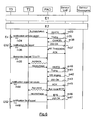
- the terminal T3 sends, in a new step E81 of the method according to the invention, a message m24 requesting transfer of the call to terminal T3, at the home gateway PAD.
- the home gateway PAD Upon receipt of the message m24, the home gateway PAD sends a message m25 "SIP 200 OK" to the voice over IP server in the network RES1 to establish the call between the terminal T3 and the telephone T1, and stops ringing the phone T2.
- the VoIP server acknowledges the message m25 with a message "SIP ACK".
- the home gateway PAD transmits the voice stream on RTP from the network RES1 to the terminal T3, and the voice stream on RTP from the terminal T3 to the network RES1.
- a next step E82 the user selects an option on his application, allowing him to transfer the call again, but on the phone T2.
- the terminal T3 then sends, in this step E82 of the method according to the invention, a message m26 request to transfer the call to the telephone T2, the home gateway PAD.
- the home gateway PAD rings the telephone T2.
- the home gateway PAD sends a message m27 to the terminal T3 to notify that the call is established between the phone T2 and T1 phone.
- the home gateway PAD then transmits the voice stream on RTP from the network RES1 to the telephone T2, possibly after a digital / analog conversion and transmits the voice stream from the telephone T2, possibly after an analog / digital conversion, to the network RES1.
- the user selects an option on the terminal T3 to resume the call on the terminal T3.
- the latter then sends a message m28 request to transfer the call to the terminal T3, to the home gateway PAD.
- the home gateway PAD hangs up the telephone T2, transmits the voice stream on RTP from the network RES1 to the terminal T3, and transmits the voice stream on RTP from the terminal T3 to the network RES1.
- the terminal T3 then sends a call release request message m29 to the home gateway PAD.
- the home gateway PAD then sends an m30 message "SIP BYE" to the voice over IP server, which responds with an m31 message "SIP 200 OK".
- the home gateway PAD also notifies, in a step E52 of the method of managing a data stream according to the invention, the terminal T3 of the end of the call by an message m32.
- the terminal T3 receives only call setup request notifications, and not notifications of other events relating to these calls.
- the terminal T3 receives call setup request notifications only for outgoing calls.
- the terminal T3 indicates, in the message M0 recording to the home gateway PAD, that the notification of a call establishment request suspends the establishment of the call.
- the home gateway PAD waits to receive the call transfer request message m24 from the terminal T3. In this case, if the terminal T3 does not respond after a predetermined time, a mechanism is provided to continue the call setup or stop it based on a default configuration.
- the terminal T3 uses the information provided in a call setup request notification previously received from the home gateway PAD, to allow the user to select a callback option from the terminal T3.
- the first steps E1 to E3 of the method according to the invention are identical to those of the example of FIG. figure 3 .
- step E4 the home gateway PAD receives a call setup request from the telephone T2.
- the home gateway PAD then sends an m33 message "SIP INVITE" to the voice over IP server in the IP telephony network RES1, and notifies the terminal T3 of the request for establishing an outgoing call by an message m34 which comprises in parameters the type of call, that is to say incoming or outgoing, and the number dialed on the phone T2, corresponding to the phone T1.
- the VoIP server responds with an m35 "SIP Trying" message to the home gateway PAD and then sends it a message m36 "SIP CANCEL" to indicate that the call has failed.
- the home gateway PAD then sends a message m37 "SIP 200 OK" to the voice over IP server, and notifies the terminal T3 of the end of the call with an message m38.
- the voice over IP server responds in parallel to the home gateway PAD by a message "SIP 487 Terminated", which the home gateway PAD acknowledges by a message "SIP ACK".
- the application on the terminal T3 then presents the user with an automatic callback option after 10 minutes, for example, to the dialed number provided as parameter in the message m34 received previously. It is assumed here that the user selects this option.
- the terminal T3 After 10 minutes, the terminal T3 then sends a call setup request message m39 between the telephone T2 and the telephone T1 to the home gateway PAD.
- the home gateway PAD then rings the phone T2, and when it is off the hook, it sends a message m40 "SIP INVITE" to the server VoIP to establish a call to the phone T1.
- the voice over IP server responds to the home gateway PAD with a message m41 "Trying”, then sends the home gateway PAD a message m42 "SIP 180 Ringing" indicating that the phone T1 rings, and a message m43 "200 OK" for indicate the stall of the called party.
- the home gateway PAD then sends an message m44 to the terminal T3 to notify it that the call is established between the telephone T1 and the telephone T2, then an m45 message "ACK" to the voice over IP server.
- the bidirectional voice stream corresponding to the current conversation is then transmitted on the network RES1 and through the home gateway PAD between the two phones T1 and T2.
- the home gateway PAD sends a message m46 "SIP BYE" to the voice over IP server, which responds with a message m47 "SIP 200 OK ".
- the home gateway PAD also notifies the terminal T3 of the end of the call by an message m48.
- the application on the terminal T3 provides a contextual navigation service to the user, coupling the IP telephony service with the Internet access service provided by the home gateway PAD.
- This service is for example activated by the user by selecting a specific option on the user interface of the application, after being notified of the arrival of a call on this user interface.
- the first steps E1 to E4 of the method according to the invention are identical to those of the example of FIG. figure 3 .
- the terminal T3 has notified the user of the arrival of a call following receipt of the message m13 of notification of a call setup request
- the user selects a contextual navigation option on the terminal T3.
- the latter then sends a message m49 request to transfer the call to the terminal T3, the home gateway PAD.
- the home gateway PAD Upon receipt of the message m49, the home gateway PAD sends a message m50 "SIP 200 OK" to the voice over IP server in the network RES1 to establish the call between the terminal T3 and the telephone T1, and stops ringing the phone T2.
- the voice over IP server acknowledges the message m50 in parallel by sending a "SIP ACK" message to the home gateway PAD. Then, the home gateway PAD transmits the voice stream on RTP from the network RES1 to the terminal T3, and the voice stream on RTP from the terminal T3 to the network RES1.
- the terminal T3 sends a message m51 "HTTPS (according to the English" HyperText Transmission Protocol Secured ”) GET" to a server SW2 in the Internet network RES2, containing as parameter the telephone number T1 provided by the home gateway PAD to the terminal T3 in the message m13 call establishment request notification.
- HTTPS HyperText Transmission Protocol Secured
- the server SW2 then consults a BDD database of the ENUM type (according to the "Electronic NUMbering" standard defined in the “Internet Engineering Task Force (IETF)”): it sends a message m52 "get” with the parameter T1 phone number, and gets back in a message m53 a URI (according to the English "Uniform Resource Identifier") corresponding to the URL (according to the English "Uniform Resource Locator”) of a site web on an SW1 server in the RES2 Internet network.
- the server SW2 then sends a response message m54 "HTTPS 301 redirect” containing in parameter the URL of this website, to the terminal T3.
- the terminal T3 On receipt of this URL in the message m54, the terminal T3 then downloads, this time in unsecured mode, a speech recognition grammar specific to the service provided by the correspondent of the telephone T1, which is for example a computer support operator .
- the terminal T3 sends an "HTTP GET" message m55 containing in parameter the URL received in the message m54, and a request for downloading a speech recognition grammar, to the server SW1.
- the server SW1 responds to the terminal T3 by an m56 "HTTP 200" message containing as parameter a grammar of speech recognition.
- the terminal T3 On receiving the message m56, the terminal T3 updates a speech recognition software with this grammar containing a list of key words to be detected, and activates this speech recognition software.
- the terminal T3 sends a message m57 "HTTP GET” containing as parameter this key word, to the server SW1.
- the latter responds with a message m58 "HTTP 200" containing as parameter the content of a web page corresponding to this keyword.
- the terminal T3 displays to the user relevant information as his conversation with the correspondent of the telephone T1, for example tables or drawings that are commented on by the correspondent.
- the contextual navigation is effected by the sending of DTMF (from the English "Dual Tone Multi Frequency") by the user on the telephone T2 or by the correspondent of the telephone T1, the reception of these DTMFs being notified by the home gateway PAD to the terminal T3, which will then look for a corresponding web page on the server SW1.
- DTMF from the English "Dual Tone Multi Frequency”
- the terminal T3 is notified of this call by the home gateway PAD, and displays a waiting video to the user, this video being downloaded from a remote server linked to the correspondent of the telephone T1, until a notification is received from the home gateway PAD indicating that the call is established between the telephone T1 and the telephone T2.
- the invention thus makes it possible to use the capabilities of one of the terminals connected to the home gateway PAD to improve a service rendered by the home gateway PAD to another terminal.
- the method of managing a data stream according to the invention allows the latter through the terminal T3, to manage a video stream sent by a remote video server SFT in the network RES2, to a television T4 equipped with a digital decoder.
- the TV T4 is connected to the home gateway PAD by wired or WiFi connection.
- the video streams arriving at the TV T4 therefore transit through the home gateway PAD.
- the home gateway PAD implements a proprietary interface for notifying the terminal T3 of events related to the reception of a video stream on the television T4, and to receive instructions from the terminal T3 concerning this video stream.
- the terminal T3 symmetrically implements a proprietary interface, to receive these notifications and send these instructions to the home gateway PAD.
- This interface is implemented in an application that also has a user interface, presenting it with action buttons.
- FIG. figure 9 An example of operation of the method of managing a data stream according to the invention in this second embodiment is shown in FIG. figure 9 . It is assumed in this example of operation that the terminal T3 has previously registered with the home gateway PAD, to receive from it notifications of events related to the reception of a video stream, similarly to step E1 of the first embodiment of the invention.
- the TV T4 obtains a private IP address from the home gateway PAD using the DHCP protocol (according to the English "Dynamic Host Configuration Protocol"). For this the TV T4 sends a message m59 "DHCP DISCOVER" to the home gateway PAD.
- the home gateway PAD responds with a message m60 "DHCP OFFER" offering a private IP address.
- the TV T4 requests that the home gateway PAD assigns him this private IP address by sending him a message m61 "DHCP REQUEST", and the home gateway PAD returns a message m62 acceptance "DHCP ACK”.
- the home gateway PAD notifies the terminal T3 by a message m63 that the TV T4 is operational to receive video streams.
- a person at the user turns on the TV T4, it sends an m64 message "HTTP GET" containing the URL of an SWT web server represented in the figure 8 at the home gateway PAD which transmits it in the network RES2 to the server SWT.
- the latter returns to the TV T4, via the home gateway PAD, a home page in an "HTTP 200 OK" m65 message, which includes a table of correspondence between audiovisual channels and multicast IP addresses.
- the TV T4 displays on the screen a mosaic of images each representing a channel to select.
- the home gateway PAD Upon receipt of the response message m65 of the SWT server, the home gateway PAD notifies the terminal T3 by a message m66 of the display of the mosaic on the TV T4.
- the message m66 also includes the correspondence table between audiovisual channels and multicast IP addresses.
- a channel x is selected on the TV T4.
- the latter then sends an "IGMP Report" message m67 containing the multicast IP address of the channel x to the home gateway PAD, which transmits it to the video server SFT.
- the home gateway PAD Upon receipt of the message m67, the home gateway PAD also notifies the terminal T3 of the request for establishment of a video stream, by a message m68.
- the message m68 contains as parameter the name of the string x.
- the terminal T3 On receipt of the message m68, the terminal T3 displays on its screen for the user a notification message of reception of the channel x on the TV T4, and various action buttons, including a button to receive the string x on the terminal T3. It is assumed here that the user selects this button.
- the terminal T3 then sends a message m69 requesting reproduction of the string x, to the domestic gateway PAD.
- the home gateway PAD On receiving the message m69, the home gateway PAD, which receives the video stream corresponding to the channel x from the video server SFT and transmits it to the television T4, copies this stream and transmits it in parallel to the terminal T3, which displays on his screen.
- the terminal T3 then sends a message m70 to the home gateway PAD, requesting that the channel received by the TV T4 change to be the string y.
- the home gateway PAD sends an "IGMP Leave” message containing the multicast IP address of the string x to the SFT video server, then an "IGMP Report” message containing the multicast IP address of the string. to the SFT video server, to receive the string y instead of the string x.
- the video server SFT then sends the video stream corresponding to the channel y to the home gateway PAD, which copies this stream and transmits it in parallel to the television T4 and the terminal T3.
- the home gateway PAD implements, for example, several types of proprietary interfaces for the terminal T3, for example a specific interface to event notifications related to video streams, and a specific interface to event notifications related to phone calls.
Landscapes
- Engineering & Computer Science (AREA)
- Signal Processing (AREA)
- Computer Networks & Wireless Communication (AREA)
- Computer Security & Cryptography (AREA)
- Technology Law (AREA)
- Multimedia (AREA)
- Data Exchanges In Wide-Area Networks (AREA)
- Computer And Data Communications (AREA)
Priority Applications (1)
| Application Number | Priority Date | Filing Date | Title |
|---|---|---|---|
| PL09156069T PL2107722T3 (pl) | 2008-03-31 | 2009-03-24 | Sposób zarządzania strumieniem danych, brama miejscowa i odpowiednie urządzenie |
Applications Claiming Priority (1)
| Application Number | Priority Date | Filing Date | Title |
|---|---|---|---|
| FR0852093 | 2008-03-31 |
Publications (2)
| Publication Number | Publication Date |
|---|---|
| EP2107722A1 EP2107722A1 (fr) | 2009-10-07 |
| EP2107722B1 true EP2107722B1 (fr) | 2012-02-29 |
Family
ID=40032799
Family Applications (1)
| Application Number | Title | Priority Date | Filing Date |
|---|---|---|---|
| EP09156069A Active EP2107722B1 (fr) | 2008-03-31 | 2009-03-24 | Procédé de gestion d'un flux de données, passerelle domestique et dispositif correspondants |
Country Status (4)
| Country | Link |
|---|---|
| EP (1) | EP2107722B1 (pl) |
| AT (1) | ATE547867T1 (pl) |
| ES (1) | ES2382941T3 (pl) |
| PL (1) | PL2107722T3 (pl) |
Family Cites Families (3)
| Publication number | Priority date | Publication date | Assignee | Title |
|---|---|---|---|---|
| KR100419017B1 (ko) | 2002-04-22 | 2004-02-14 | 삼성전자주식회사 | 자동 호 분배 및 발신자 정보 표시 시스템 |
| US20040133627A1 (en) * | 2003-01-07 | 2004-07-08 | Raghuraman Kalyanaraman | Communication system, a computer program code embodying in the communication system and methods of operating the same |
| US7983680B2 (en) * | 2005-08-10 | 2011-07-19 | Nextel Communications Inc. | System and method for converged network services |
-
2009
- 2009-03-24 ES ES09156069T patent/ES2382941T3/es active Active
- 2009-03-24 PL PL09156069T patent/PL2107722T3/pl unknown
- 2009-03-24 EP EP09156069A patent/EP2107722B1/fr active Active
- 2009-03-24 AT AT09156069T patent/ATE547867T1/de active
Also Published As
| Publication number | Publication date |
|---|---|
| ES2382941T3 (es) | 2012-06-14 |
| ATE547867T1 (de) | 2012-03-15 |
| PL2107722T3 (pl) | 2012-07-31 |
| EP2107722A1 (fr) | 2009-10-07 |
Similar Documents
| Publication | Publication Date | Title |
|---|---|---|
| CN100571310C (zh) | 在互联网/内联网通话中统一通信的系统 | |
| EP2168356B1 (en) | Video communication method and user terminal | |
| JP5079695B2 (ja) | コンテキストによる電話の増補 | |
| JP4548242B2 (ja) | 音声ip電話方法と装置。 | |
| CA2592809C (en) | Pseudo-rich hybrid phone/browser | |
| CN102148775B (zh) | 网页呼叫服务网关、呼叫服务系统和方法 | |
| GB2432744A (en) | Customised prior-to-answer and in-call media playback services | |
| US7688954B2 (en) | System and method for identifying caller | |
| CN116636199A (zh) | 一种呼叫处理方法、呼叫处理装置及相关设备 | |
| WO2007127752A2 (en) | Method and apparatus for recording calls | |
| JP4646657B2 (ja) | Tv電話アダプタ | |
| US20070274485A1 (en) | Network-independent ringback feature | |
| CN100571303C (zh) | 一种使用智能可视终端实现图像彩铃的方法 | |
| US20080117897A1 (en) | External data access information in a voip conversation | |
| FR2931024A1 (fr) | Conversion voix vers texte en temps reel pour services de telecommunication | |
| EP2107722A1 (fr) | Procédé de gestion d'un flux de données, passerelle domestique et dispositif correspondants | |
| JP2007158737A (ja) | 接続制御装置及び方法並びにプログラム | |
| US9313768B2 (en) | Method and apparatus for providing a VoIP server in a wireless integrated device | |
| EP2064855B1 (fr) | Procede de communication entre plusieurs terminaux | |
| US7860224B1 (en) | Method and apparatus for providing a voicemail notification | |
| KR20170087941A (ko) | 클라이언트 애플리케이션을 통한 pbx 전화 호의 제어 | |
| JP2013219523A (ja) | 通信装置 | |
| FR2889395A1 (fr) | Service de personnalisation de communications par traitement des flux media audio et ou video | |
| US20070130288A1 (en) | Distributed communication through media services | |
| JP2006067102A (ja) | 転送機能を有する電話機 |
Legal Events
| Date | Code | Title | Description |
|---|---|---|---|
| PUAI | Public reference made under article 153(3) epc to a published international application that has entered the european phase |
Free format text: ORIGINAL CODE: 0009012 |
|
| AK | Designated contracting states |
Kind code of ref document: A1 Designated state(s): AT BE BG CH CY CZ DE DK EE ES FI FR GB GR HR HU IE IS IT LI LT LU LV MC MK MT NL NO PL PT RO SE SI SK TR |
|
| AX | Request for extension of the european patent |
Extension state: AL BA RS |
|
| 17P | Request for examination filed |
Effective date: 20100310 |
|
| AKX | Designation fees paid |
Designated state(s): AT BE BG CH CY CZ DE DK EE ES FI FR GB GR HR HU IE IS IT LI LT LU LV MC MK MT NL NO PL PT RO SE SI SK TR |
|
| 17Q | First examination report despatched |
Effective date: 20100811 |
|
| GRAP | Despatch of communication of intention to grant a patent |
Free format text: ORIGINAL CODE: EPIDOSNIGR1 |
|
| GRAS | Grant fee paid |
Free format text: ORIGINAL CODE: EPIDOSNIGR3 |
|
| GRAA | (expected) grant |
Free format text: ORIGINAL CODE: 0009210 |
|
| AK | Designated contracting states |
Kind code of ref document: B1 Designated state(s): AT BE BG CH CY CZ DE DK EE ES FI FR GB GR HR HU IE IS IT LI LT LU LV MC MK MT NL NO PL PT RO SE SI SK TR |
|
| REG | Reference to a national code |
Ref country code: GB Ref legal event code: FG4D Free format text: NOT ENGLISH Ref country code: CH Ref legal event code: EP |
|
| REG | Reference to a national code |
Ref country code: AT Ref legal event code: REF Ref document number: 547867 Country of ref document: AT Kind code of ref document: T Effective date: 20120315 |
|
| REG | Reference to a national code |
Ref country code: IE Ref legal event code: FG4D Free format text: LANGUAGE OF EP DOCUMENT: FRENCH |
|
| REG | Reference to a national code |
Ref country code: DE Ref legal event code: R096 Ref document number: 602009005574 Country of ref document: DE Effective date: 20120426 |
|
| REG | Reference to a national code |
Ref country code: ES Ref legal event code: FG2A Ref document number: 2382941 Country of ref document: ES Kind code of ref document: T3 Effective date: 20120614 |
|
| REG | Reference to a national code |
Ref country code: NL Ref legal event code: VDEP Effective date: 20120229 |
|
| LTIE | Lt: invalidation of european patent or patent extension |
Effective date: 20120229 |
|
| PG25 | Lapsed in a contracting state [announced via postgrant information from national office to epo] |
Ref country code: HR Free format text: LAPSE BECAUSE OF FAILURE TO SUBMIT A TRANSLATION OF THE DESCRIPTION OR TO PAY THE FEE WITHIN THE PRESCRIBED TIME-LIMIT Effective date: 20120229 Ref country code: NL Free format text: LAPSE BECAUSE OF FAILURE TO SUBMIT A TRANSLATION OF THE DESCRIPTION OR TO PAY THE FEE WITHIN THE PRESCRIBED TIME-LIMIT Effective date: 20120229 Ref country code: NO Free format text: LAPSE BECAUSE OF FAILURE TO SUBMIT A TRANSLATION OF THE DESCRIPTION OR TO PAY THE FEE WITHIN THE PRESCRIBED TIME-LIMIT Effective date: 20120529 Ref country code: IS Free format text: LAPSE BECAUSE OF FAILURE TO SUBMIT A TRANSLATION OF THE DESCRIPTION OR TO PAY THE FEE WITHIN THE PRESCRIBED TIME-LIMIT Effective date: 20120629 Ref country code: LT Free format text: LAPSE BECAUSE OF FAILURE TO SUBMIT A TRANSLATION OF THE DESCRIPTION OR TO PAY THE FEE WITHIN THE PRESCRIBED TIME-LIMIT Effective date: 20120229 |
|
| REG | Reference to a national code |
Ref country code: PL Ref legal event code: T3 |
|
| PG25 | Lapsed in a contracting state [announced via postgrant information from national office to epo] |
Ref country code: GR Free format text: LAPSE BECAUSE OF FAILURE TO SUBMIT A TRANSLATION OF THE DESCRIPTION OR TO PAY THE FEE WITHIN THE PRESCRIBED TIME-LIMIT Effective date: 20120530 Ref country code: PT Free format text: LAPSE BECAUSE OF FAILURE TO SUBMIT A TRANSLATION OF THE DESCRIPTION OR TO PAY THE FEE WITHIN THE PRESCRIBED TIME-LIMIT Effective date: 20120629 Ref country code: FI Free format text: LAPSE BECAUSE OF FAILURE TO SUBMIT A TRANSLATION OF THE DESCRIPTION OR TO PAY THE FEE WITHIN THE PRESCRIBED TIME-LIMIT Effective date: 20120229 Ref country code: LV Free format text: LAPSE BECAUSE OF FAILURE TO SUBMIT A TRANSLATION OF THE DESCRIPTION OR TO PAY THE FEE WITHIN THE PRESCRIBED TIME-LIMIT Effective date: 20120229 |
|
| REG | Reference to a national code |
Ref country code: AT Ref legal event code: MK05 Ref document number: 547867 Country of ref document: AT Kind code of ref document: T Effective date: 20120229 |
|
| REG | Reference to a national code |
Ref country code: IE Ref legal event code: FD4D |
|
| PG25 | Lapsed in a contracting state [announced via postgrant information from national office to epo] |
Ref country code: CY Free format text: LAPSE BECAUSE OF FAILURE TO SUBMIT A TRANSLATION OF THE DESCRIPTION OR TO PAY THE FEE WITHIN THE PRESCRIBED TIME-LIMIT Effective date: 20120229 |
|
| PG25 | Lapsed in a contracting state [announced via postgrant information from national office to epo] |
Ref country code: IE Free format text: LAPSE BECAUSE OF FAILURE TO SUBMIT A TRANSLATION OF THE DESCRIPTION OR TO PAY THE FEE WITHIN THE PRESCRIBED TIME-LIMIT Effective date: 20120229 Ref country code: RO Free format text: LAPSE BECAUSE OF FAILURE TO SUBMIT A TRANSLATION OF THE DESCRIPTION OR TO PAY THE FEE WITHIN THE PRESCRIBED TIME-LIMIT Effective date: 20120229 Ref country code: EE Free format text: LAPSE BECAUSE OF FAILURE TO SUBMIT A TRANSLATION OF THE DESCRIPTION OR TO PAY THE FEE WITHIN THE PRESCRIBED TIME-LIMIT Effective date: 20120229 Ref country code: MC Free format text: LAPSE BECAUSE OF NON-PAYMENT OF DUE FEES Effective date: 20120331 Ref country code: SE Free format text: LAPSE BECAUSE OF FAILURE TO SUBMIT A TRANSLATION OF THE DESCRIPTION OR TO PAY THE FEE WITHIN THE PRESCRIBED TIME-LIMIT Effective date: 20120229 Ref country code: DK Free format text: LAPSE BECAUSE OF FAILURE TO SUBMIT A TRANSLATION OF THE DESCRIPTION OR TO PAY THE FEE WITHIN THE PRESCRIBED TIME-LIMIT Effective date: 20120229 Ref country code: SI Free format text: LAPSE BECAUSE OF FAILURE TO SUBMIT A TRANSLATION OF THE DESCRIPTION OR TO PAY THE FEE WITHIN THE PRESCRIBED TIME-LIMIT Effective date: 20120229 Ref country code: CZ Free format text: LAPSE BECAUSE OF FAILURE TO SUBMIT A TRANSLATION OF THE DESCRIPTION OR TO PAY THE FEE WITHIN THE PRESCRIBED TIME-LIMIT Effective date: 20120229 |
|
| PG25 | Lapsed in a contracting state [announced via postgrant information from national office to epo] |
Ref country code: IT Free format text: LAPSE BECAUSE OF FAILURE TO SUBMIT A TRANSLATION OF THE DESCRIPTION OR TO PAY THE FEE WITHIN THE PRESCRIBED TIME-LIMIT Effective date: 20120229 Ref country code: SK Free format text: LAPSE BECAUSE OF FAILURE TO SUBMIT A TRANSLATION OF THE DESCRIPTION OR TO PAY THE FEE WITHIN THE PRESCRIBED TIME-LIMIT Effective date: 20120229 |
|
| PLBE | No opposition filed within time limit |
Free format text: ORIGINAL CODE: 0009261 |
|
| STAA | Information on the status of an ep patent application or granted ep patent |
Free format text: STATUS: NO OPPOSITION FILED WITHIN TIME LIMIT |
|
| PG25 | Lapsed in a contracting state [announced via postgrant information from national office to epo] |
Ref country code: AT Free format text: LAPSE BECAUSE OF FAILURE TO SUBMIT A TRANSLATION OF THE DESCRIPTION OR TO PAY THE FEE WITHIN THE PRESCRIBED TIME-LIMIT Effective date: 20120229 |
|
| 26N | No opposition filed |
Effective date: 20121130 |
|
| REG | Reference to a national code |
Ref country code: DE Ref legal event code: R119 Ref document number: 602009005574 Country of ref document: DE Effective date: 20121002 |
|
| PG25 | Lapsed in a contracting state [announced via postgrant information from national office to epo] |
Ref country code: MK Free format text: LAPSE BECAUSE OF FAILURE TO SUBMIT A TRANSLATION OF THE DESCRIPTION OR TO PAY THE FEE WITHIN THE PRESCRIBED TIME-LIMIT Effective date: 20120229 |
|
| PG25 | Lapsed in a contracting state [announced via postgrant information from national office to epo] |
Ref country code: MT Free format text: LAPSE BECAUSE OF FAILURE TO SUBMIT A TRANSLATION OF THE DESCRIPTION OR TO PAY THE FEE WITHIN THE PRESCRIBED TIME-LIMIT Effective date: 20120229 Ref country code: BG Free format text: LAPSE BECAUSE OF FAILURE TO SUBMIT A TRANSLATION OF THE DESCRIPTION OR TO PAY THE FEE WITHIN THE PRESCRIBED TIME-LIMIT Effective date: 20120529 |
|
| REG | Reference to a national code |
Ref country code: CH Ref legal event code: PL |
|
| PG25 | Lapsed in a contracting state [announced via postgrant information from national office to epo] |
Ref country code: LI Free format text: LAPSE BECAUSE OF NON-PAYMENT OF DUE FEES Effective date: 20130331 Ref country code: CH Free format text: LAPSE BECAUSE OF NON-PAYMENT OF DUE FEES Effective date: 20130331 |
|
| PG25 | Lapsed in a contracting state [announced via postgrant information from national office to epo] |
Ref country code: TR Free format text: LAPSE BECAUSE OF FAILURE TO SUBMIT A TRANSLATION OF THE DESCRIPTION OR TO PAY THE FEE WITHIN THE PRESCRIBED TIME-LIMIT Effective date: 20120229 |
|
| PG25 | Lapsed in a contracting state [announced via postgrant information from national office to epo] |
Ref country code: LU Free format text: LAPSE BECAUSE OF NON-PAYMENT OF DUE FEES Effective date: 20120324 |
|
| PG25 | Lapsed in a contracting state [announced via postgrant information from national office to epo] |
Ref country code: HU Free format text: LAPSE BECAUSE OF FAILURE TO SUBMIT A TRANSLATION OF THE DESCRIPTION OR TO PAY THE FEE WITHIN THE PRESCRIBED TIME-LIMIT Effective date: 20090324 |
|
| PG25 | Lapsed in a contracting state [announced via postgrant information from national office to epo] |
Ref country code: DE Free format text: LAPSE BECAUSE OF FAILURE TO SUBMIT A TRANSLATION OF THE DESCRIPTION OR TO PAY THE FEE WITHIN THE PRESCRIBED TIME-LIMIT Effective date: 20121002 |
|
| REG | Reference to a national code |
Ref country code: FR Ref legal event code: PLFP Year of fee payment: 8 |
|
| REG | Reference to a national code |
Ref country code: FR Ref legal event code: PLFP Year of fee payment: 9 |
|
| REG | Reference to a national code |
Ref country code: FR Ref legal event code: PLFP Year of fee payment: 10 |
|
| PGFP | Annual fee paid to national office [announced via postgrant information from national office to epo] |
Ref country code: ES Payment date: 20250401 Year of fee payment: 17 |
|
| PGFP | Annual fee paid to national office [announced via postgrant information from national office to epo] |
Ref country code: GB Payment date: 20260220 Year of fee payment: 18 |
|
| PGFP | Annual fee paid to national office [announced via postgrant information from national office to epo] |
Ref country code: BE Payment date: 20260219 Year of fee payment: 18 |
|
| PGFP | Annual fee paid to national office [announced via postgrant information from national office to epo] |
Ref country code: FR Payment date: 20260219 Year of fee payment: 18 |
|
| PGFP | Annual fee paid to national office [announced via postgrant information from national office to epo] |
Ref country code: PL Payment date: 20260220 Year of fee payment: 18 |