EP2107150B1 - Steuerverfahren für eine Wäschebehandlungsvorrichtung - Google Patents
Steuerverfahren für eine Wäschebehandlungsvorrichtung Download PDFInfo
- Publication number
- EP2107150B1 EP2107150B1 EP09156696.8A EP09156696A EP2107150B1 EP 2107150 B1 EP2107150 B1 EP 2107150B1 EP 09156696 A EP09156696 A EP 09156696A EP 2107150 B1 EP2107150 B1 EP 2107150B1
- Authority
- EP
- European Patent Office
- Prior art keywords
- temperature
- course
- accommodating space
- laundry
- steam
- Prior art date
- Legal status (The legal status is an assumption and is not a legal conclusion. Google has not performed a legal analysis and makes no representation as to the accuracy of the status listed.)
- Active
Links
Images


Classifications
-
- D—TEXTILES; PAPER
- D06—TREATMENT OF TEXTILES OR THE LIKE; LAUNDERING; FLEXIBLE MATERIALS NOT OTHERWISE PROVIDED FOR
- D06F—LAUNDERING, DRYING, IRONING, PRESSING OR FOLDING TEXTILE ARTICLES
- D06F58/00—Domestic laundry dryers
- D06F58/32—Control of operations performed in domestic laundry dryers
- D06F58/34—Control of operations performed in domestic laundry dryers characterised by the purpose or target of the control
- D06F58/36—Control of operational steps, e.g. for optimisation or improvement of operational steps depending on the condition of the laundry
- D06F58/44—Control of operational steps, e.g. for optimisation or improvement of operational steps depending on the condition of the laundry of conditioning or finishing, e.g. for smoothing or removing creases
-
- D—TEXTILES; PAPER
- D06—TREATMENT OF TEXTILES OR THE LIKE; LAUNDERING; FLEXIBLE MATERIALS NOT OTHERWISE PROVIDED FOR
- D06F—LAUNDERING, DRYING, IRONING, PRESSING OR FOLDING TEXTILE ARTICLES
- D06F35/00—Washing machines, apparatus, or methods not otherwise provided for
-
- A—HUMAN NECESSITIES
- A61—MEDICAL OR VETERINARY SCIENCE; HYGIENE
- A61L—METHODS OR APPARATUS FOR STERILISING MATERIALS OR OBJECTS IN GENERAL; DISINFECTION, STERILISATION OR DEODORISATION OF AIR; CHEMICAL ASPECTS OF BANDAGES, DRESSINGS, ABSORBENT PADS OR SURGICAL ARTICLES; MATERIALS FOR BANDAGES, DRESSINGS, ABSORBENT PADS OR SURGICAL ARTICLES
- A61L2/00—Disinfection or sterilisation of materials or objects, in general; Accessories therefor
- A61L2/02—Disinfection or sterilisation of materials or objects, in general; Accessories therefor using physical processes
- A61L2/04—Heat
- A61L2/06—Hot gas
- A61L2/07—Steam
-
- D—TEXTILES; PAPER
- D06—TREATMENT OF TEXTILES OR THE LIKE; LAUNDERING; FLEXIBLE MATERIALS NOT OTHERWISE PROVIDED FOR
- D06F—LAUNDERING, DRYING, IRONING, PRESSING OR FOLDING TEXTILE ARTICLES
- D06F58/00—Domestic laundry dryers
- D06F58/10—Drying cabinets or drying chambers having heating or ventilating means
-
- D—TEXTILES; PAPER
- D06—TREATMENT OF TEXTILES OR THE LIKE; LAUNDERING; FLEXIBLE MATERIALS NOT OTHERWISE PROVIDED FOR
- D06F—LAUNDERING, DRYING, IRONING, PRESSING OR FOLDING TEXTILE ARTICLES
- D06F73/00—Apparatus for smoothing or removing creases from garments or other textile articles by formers, cores, stretchers, or internal frames, with the application of heat or steam
- D06F73/02—Apparatus for smoothing or removing creases from garments or other textile articles by formers, cores, stretchers, or internal frames, with the application of heat or steam having one or more treatment chambers
-
- D—TEXTILES; PAPER
- D06—TREATMENT OF TEXTILES OR THE LIKE; LAUNDERING; FLEXIBLE MATERIALS NOT OTHERWISE PROVIDED FOR
- D06F—LAUNDERING, DRYING, IRONING, PRESSING OR FOLDING TEXTILE ARTICLES
- D06F2101/00—User input for the control of domestic laundry washing machines, washer-dryers or laundry dryers
- D06F2101/02—Characteristics of laundry or load
-
- D—TEXTILES; PAPER
- D06—TREATMENT OF TEXTILES OR THE LIKE; LAUNDERING; FLEXIBLE MATERIALS NOT OTHERWISE PROVIDED FOR
- D06F—LAUNDERING, DRYING, IRONING, PRESSING OR FOLDING TEXTILE ARTICLES
- D06F2101/00—User input for the control of domestic laundry washing machines, washer-dryers or laundry dryers
- D06F2101/02—Characteristics of laundry or load
- D06F2101/04—Quantity, e.g. weight
-
- D—TEXTILES; PAPER
- D06—TREATMENT OF TEXTILES OR THE LIKE; LAUNDERING; FLEXIBLE MATERIALS NOT OTHERWISE PROVIDED FOR
- D06F—LAUNDERING, DRYING, IRONING, PRESSING OR FOLDING TEXTILE ARTICLES
- D06F2101/00—User input for the control of domestic laundry washing machines, washer-dryers or laundry dryers
- D06F2101/02—Characteristics of laundry or load
- D06F2101/06—Type or material
-
- D—TEXTILES; PAPER
- D06—TREATMENT OF TEXTILES OR THE LIKE; LAUNDERING; FLEXIBLE MATERIALS NOT OTHERWISE PROVIDED FOR
- D06F—LAUNDERING, DRYING, IRONING, PRESSING OR FOLDING TEXTILE ARTICLES
- D06F2101/00—User input for the control of domestic laundry washing machines, washer-dryers or laundry dryers
- D06F2101/20—Operation modes, e.g. delicate laundry washing programs, service modes or refreshment cycles
-
- D—TEXTILES; PAPER
- D06—TREATMENT OF TEXTILES OR THE LIKE; LAUNDERING; FLEXIBLE MATERIALS NOT OTHERWISE PROVIDED FOR
- D06F—LAUNDERING, DRYING, IRONING, PRESSING OR FOLDING TEXTILE ARTICLES
- D06F2103/00—Parameters monitored or detected for the control of domestic laundry washing machines, washer-dryers or laundry dryers
- D06F2103/28—Air properties
- D06F2103/32—Temperature
-
- D—TEXTILES; PAPER
- D06—TREATMENT OF TEXTILES OR THE LIKE; LAUNDERING; FLEXIBLE MATERIALS NOT OTHERWISE PROVIDED FOR
- D06F—LAUNDERING, DRYING, IRONING, PRESSING OR FOLDING TEXTILE ARTICLES
- D06F2105/00—Systems or parameters controlled or affected by the control systems of washing machines, washer-dryers or laundry dryers
- D06F2105/14—Temperature of laundry
-
- D—TEXTILES; PAPER
- D06—TREATMENT OF TEXTILES OR THE LIKE; LAUNDERING; FLEXIBLE MATERIALS NOT OTHERWISE PROVIDED FOR
- D06F—LAUNDERING, DRYING, IRONING, PRESSING OR FOLDING TEXTILE ARTICLES
- D06F2105/00—Systems or parameters controlled or affected by the control systems of washing machines, washer-dryers or laundry dryers
- D06F2105/16—Air properties
- D06F2105/20—Temperature
-
- D—TEXTILES; PAPER
- D06—TREATMENT OF TEXTILES OR THE LIKE; LAUNDERING; FLEXIBLE MATERIALS NOT OTHERWISE PROVIDED FOR
- D06F—LAUNDERING, DRYING, IRONING, PRESSING OR FOLDING TEXTILE ARTICLES
- D06F2105/00—Systems or parameters controlled or affected by the control systems of washing machines, washer-dryers or laundry dryers
- D06F2105/28—Electric heating
-
- D—TEXTILES; PAPER
- D06—TREATMENT OF TEXTILES OR THE LIKE; LAUNDERING; FLEXIBLE MATERIALS NOT OTHERWISE PROVIDED FOR
- D06F—LAUNDERING, DRYING, IRONING, PRESSING OR FOLDING TEXTILE ARTICLES
- D06F2105/00—Systems or parameters controlled or affected by the control systems of washing machines, washer-dryers or laundry dryers
- D06F2105/38—Conditioning or finishing, e.g. control of perfume injection
- D06F2105/40—Conditioning or finishing, e.g. control of perfume injection using water or steam
-
- D—TEXTILES; PAPER
- D06—TREATMENT OF TEXTILES OR THE LIKE; LAUNDERING; FLEXIBLE MATERIALS NOT OTHERWISE PROVIDED FOR
- D06F—LAUNDERING, DRYING, IRONING, PRESSING OR FOLDING TEXTILE ARTICLES
- D06F39/00—Details of washing machines not specific to a single type of machines covered by groups D06F9/00 - D06F27/00
- D06F39/40—Steam generating arrangements
-
- D—TEXTILES; PAPER
- D06—TREATMENT OF TEXTILES OR THE LIKE; LAUNDERING; FLEXIBLE MATERIALS NOT OTHERWISE PROVIDED FOR
- D06F—LAUNDERING, DRYING, IRONING, PRESSING OR FOLDING TEXTILE ARTICLES
- D06F58/00—Domestic laundry dryers
- D06F58/20—General details of domestic laundry dryers
- D06F58/203—Laundry conditioning arrangements
Definitions
- the present invention relates to a cloth treating apparatus. More particularly, the present invention relates to a control method of a cloth treating apparatus capable of supplying steam to laundry received therein appropriately according to load of laundry to sterilize or sanitize laundry.
- Cloth treating apparatuses typically include washing machines, dryers, and laundry machines having washing and drying functions.
- refreshers have been developed, which are capable of refreshing clothes and substantially have improved the standard of living.
- the cloth treating apparatus also have various functions beyond the conventional ones.
- laundry treating machines capable of selectively supplying steam to sanitize or sterilize laundry have also been developed.
- the temperature for the sterilization or sanitization is preset too high in the laundry treating machine capable of spraying steam, the fabric of the laundry to be treated might be damaged. For example, if the temperature of the steam is too high deformation, shrinkage or discoloration may result. On the other hand, if the temperature is preset too low in the laundry treating machine, the sterilization/sanitization process may be incomplete.
- US-A-2008/0040871 discloses a fabric treatment appliance, such as a washing machine, comprising at least one of the tub and drum configured to hold a fabric load, wherein a method of operating the fabric treatment appliance comprises heating the fabric load and, after heating the fabric load, sanitizing the fabric load by heating the fabric load with steam.
- a sterilizer having a steam filled sterilizer chamber for sterilizer articles placed within the chamber, wherein an electronic air valve is provided to control the venting rate of the steam is vented back to a water reservoir after the articles have been sterilized.
- US-B-6 615 850 describes a dishwasher sanitation cycle including sampling a temperature of rinse water inside a dishwasher, executing a heating cycle to keep water temperature at optimum levels, and executing a heat sum cycle to ensure that dishes are sanitized according to excepted standards.
- the present invention is developed to solve the above problems and to provide a control method for a laundry treating machine that is capable of supplying steam appropriately according to load of laundry received therein to prevent energy waste.
- the present invention is directed to a laundry treating machine and a control method of the same.
- a control method of a laundry treating machine comprising an accommodating space receiving laundry therein, the control method includes selecting one of at least two sanitary courses to sanitize objects; and supplying steam to the objects, with controlling a temperature of the accommodating space and a steam supplying time to maintain a temperature of the object to be at a predetermined sanitary standard temperature or higher for a predetermined sanitary standard time or longer according to the selected course.
- a user may select one of preset sanitary courses or the kind of the object.
- the at least two courses may include a first course and a second course in which at least of a predetermined maximum temperature of the accommodating space, a predetermined minimum temperature of the accommodating space and a steam supplying time may be different from corresponding at least one in the first course.
- the load amount of the object in the first course is substantially larger than the load amount of the object in the second course and the predetermined maximum temperature of the accommodating space in the first course is substantially higher than the predetermined maximum temperature of the accommodating space in the second course.
- the steam supplying time in the first course may be substantially longer than the steam supplying time in the second course.
- the steam supplying time in the first course is controlled according to the predetermined maximum temperature of the accommodating space and the steam supplying time in the second course may be controlled according to the predetermined minimum temperature of the accommodating space.
- the first course may include at least two courses configured of A and B courses according to the load amount of the objects, and a heater generating steam may be turned off, if the temperature of the accommodating space reaches the predetermined maximum temperature for the first time in case that the A course is selected, and the heater may be turned off, if the temperature of the accommodating space reaches the predetermined maximum temperature for the second time in case that the B course is selected.
- the temperature of the accommodating space may be feedback-controlled to be maintained between the predetermined maximum temperature and the predetermined minimum temperature of the accommodating space and a heater generating steam may be turned off if the time period for which the temperature of the accommodating space is maintained at the predetermined minimum temperature of the accommodating space or higher is the sanitary standard time or longer.
- the temperature of the accommodating space is controlled according to the predetermined maximum temperature of the accommodating space and if the first course is selected, the temperature of the accommodating space may be feedback-controlled.
- the temperature of the accommodating space may be controlled by turning on or off a heater generating steam.
- the first course includes at least two courses configured of A and B courses, and the heater may be turned off, if the temperature of the accommodating space reaches the predetermined maximum temperature for the first time in case that the A course is selected, and the heater may be turned off, if the temperature of the accommodating space reaches the predetermined maximum temperature for the second time in case that the B course is selected.
- the temperature of the accommodating space may be feedback-controlled to be maintained between the predetermined maximum temperature and the predetermined minimum temperature of the accommodating space, and the heater may be turned off, if the time period for which the temperature of the accommodating space is maintained at the predetermined minimum temperature or higher is the sanitary standard time or longer.
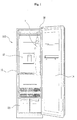
- FIG. 1 is a front view illustrating a laundry treating machine according to an exemplary embodiment of the present invention.
- the disclosure of the exemplary embodiment of the invention presents a refresher refreshing clothes by using steam as a cloth treating machine.
- the present invention is not limited to refreshers and it may be applicable to other kinds of laundry treating apparatus capable of supplying steam to laundry.
- washing machines, dryers, and laundry machines having washing and drying functions may also be applicable to the present invention.
- the term “laundry” here means any piece of clothing, sheets, towels, drapes, shoes, or any object which maybe refreshed or sanitized.
- a configuration of the laundry treating apparatus will now be described and a control method of the same will follow.
- a laundry treating apparatus 100 includes a cabinet 10, a steam generator 30, a controller 80, and a memory 82 (see FIG. 2 ).
- the cabinet 10 defines an accommodating space 12 ready to receive laundry therein.
- the steam generator 30 selectively sprays steam into the accommodating space 12 and the controller 80 controls the steam generator 30 based on programs stored in the memory 82.
- the accommodating space 12 is formed within a cabinet 10, which defines an exterior appearance of the laundry treating machine 100.
- a door 14 is provided to allow a user to selectively open or close the accommodating space during use.
- Various support structures such as a rack 16 may be provided inside the accommodating space 12 to support hanging laundry 1 or laundry placed on the rack.
- the general configuration for supporting the laundry 1 is known in the art to which the present invention pertains, thus the detailed description thereof will be omitted.
- a mechanism compartment 20 may be formed in the cabinet 10 and may comprise the first condensing device 22 and the second condensing device 50.
- the mechanism compartment 20 is preferably provided under the accommodating space 12 and the first and second condensing devices 22 and 50 are positioned inside the mechanism compartment 20.
- the positioning of the mechanism compartment 20 below the accommodating space 12 is preferable, because the dried air supplied thereto is generally a high temperature and therefore has the natural tendency to ascend.
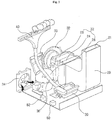
- FIG. 2 is a perspective view schematically illustrating an inner structure of the mechanism compartment 20.
- the steam generator 30 is also positioned in the mechanism compartment 20 to supply steam to the accommodating space (12, see FIG. 1 ).
- the introduction of steam produced by the steam generator into the accommodating space 12 may have various advantageous effects on the laundry to be treated.
- the steam may act to remove wrinkles present in the laundry placed in the accommodating space.
- the introduction of steam may have sanitary effects on the laundry because of its high temperature.
- the steam may have an overall refresh effect, eliminating a fabric bulking problem.
- the timing of spraying steam performed by the steam generator 30 may be adjusted according to the specific circumstances and needs of the user. It is preferable, however, that the steam is sprayed before hot dry air is supplied by a hot air supply device 22, which will be described later. This is because hot air may be supplied to dry the laundry after hot steam is sprayed to the laundry.
- the steam generator 30 includes a heater (not shown) and the water supplied inside the steam generator 30 is heated by the heater to generated steam to be supplied to the accommodating space 12.
- a water supply source supplying water to the steam generator 30 may be an external water tap or a removable container type supply (not shown) provided in the mechanism compartment 20. With the removable container type supply, the user can separate the container from the mechanism compartment 20 and fill up the container with water. Once the container has been filled appropriate, the user can re-install the container back in the mechanism compartment 20 so that it may feed a water supply to the steam generator 30.
- the steam generated by the steam generator 30 may be supplied to the accommodating space 12 via a steam hose 36 and a steam nozzle 40. It is preferable to have a shorter steam hose 36 to prevent the steam passing along the steam hose 36 from decreasing in temperature or condensing. If the mechanism compartment 20 is provided under the accommodating space 12, the steam nozzle 40 may supply steam from a top of the mechanism compartment 20, which is also a bottom of the accommodating space 12.
- the mechanism compartment 20 may further include a hot air supply device 22 to selectively supply hot air to the accommodating space 12.
- the hot air supply device 22 may dehumidify and heat air and supply the resulting dried/heated air into the accommodating space 12 to dry the laundry.
- the hot air supply device 22 may be an electric or gaseous type heater or a heat pump capable of dehumidifying and heating air as shown in FIG. 2 . The following description will present an exemplary embodiment where a heat pump is used as the hot air supply device 22.
- a heat pump 22 corresponding to the hot air supply device 22 may be similar to a heat pump used in an air conditioner. That is, the heat pump may include an evaporator 24, a compressor 26, a condenser 28, and an expansion valve (not shown). Refrigerant is then circulated through the heat pump 22 sequentially, to dehumidify and heat air. Specifically, the evaporator 24 evaporates the refrigerant flowing through it and the refrigerant absorbs latent heat from the ambient air, thus cooling the air and condensing the moisture contained therein. Then the air passes through the condenser 28.
- the refrigerant flowing from the compressor 26 into the condenser 28 is condensed and releases latent heat into the ambient air passing through the condenser, thus heating the ambient air.
- the air that is dried and heated may then be re-supplied to the accommodating space 12 once it has passed the evaporator 24 and the condenser 28.
- An inlet 21 formed on a circulation duct 29 may be disposed at a top of the mechanism compartment 20 and air inside the accommodating space 12 may be drawn into the inlet 21.
- the circulation duct 29 connects the evaporator 24, the condenser 28, and a fan 32, and defines an air circulation flow path.
- the air following the circulation flow path may be drawn into the inlet 21, from the accommodating space, and may pass into the circulation duct 29.
- the air may then be dehumidified and heated as it passes through the heat pump 22, and then may be re-supplied to the accommodating space 12 via an outlet 33 by a fan 32.
- a filter may be provided at the inlet 21.
- the filter provided at the inlet 21 may filter various foreign substances, such as lint, hair, or the like, which might be contained in the air supplied from the accommodating space. Thus, allowing only filtered air to be supplied to the circulation duct 29 and re-supplied to the accommodating space 12.
- a circulation fan 34 may be provided in a rear of the mechanism compartment 20.
- the circulation fan 34 may blow external air into the mechanism compartment 20 to cool the heat pump 22, specifically to cool the compressor 26 of the heat pump 22. This cooling effect prevents the temperature inside the mechanism compartment 20 from increasing to undesirable levels, which may result in damage or otherwise dangerous conditions.
- the laundry should be exposed to an environment having a predetermined high temperature for more than a predetermined time period.
- the predetermined temperature and time period may be adjusted according to sanitization purposes.
- a standard sanitary temperature may be approximately between 55° to 65° and a standard time may be approximately 10 minutes.
- the temperature of the laundry treating machine may be maintained between 55° ⁇ 65° for 10 minutes or more.
- the temperature of the steam supplied should be adjusted appropriately.
- the temperature and time of the steam supplied to the accommodating space 12 should preferably be controlled in accordance with the heat capacity of the load of laundry received therein.
- FIG. 3 is a flow chart illustrating a control method of the laundry treating machine according to an exemplary embodiment of the present invention.
- the control method of the laundry treating machine includes selecting one of at least two sanitary courses to sanitize laundry contained in the accommodating space 12 (S310). Then depending on the course, selected steam is supplied to the laundry at a predetermined temperature and time period (S330).
- at least two courses may be preset based on a load size of the laundry.
- the temperature of the steam supply may be controlled to maintain a predetermined sanitary temperature of the laundry throughout the predetermined time period.
- the user loads the laundry into the laundry treating machine and selects a sanitary course (S310).
- a sanitary course S310
- the user may select one of the at least two sanitary courses preset in the laundry treating machine, which relate to a load amount, i.e. heat capacity of the laundry. It is also envision that the user may also have the option to select a particular type of laundry directly.
- the at least two sanitary courses may include a first and second course.
- Each of the first and second courses may have a predetermined maximum temperature (T_h), a predetermined minimum temperature (T_1) of the accommodating space and a predetermined steam supply time (t).
- T_h predetermined maximum temperature
- T_1 predetermined minimum temperature
- t predetermined steam supply time
- the first and second courses may be classified and programmed according to a load amount, i.e. the heat capacity of the total laundry placed in the accommodating space 12. It is noted that the first and second courses may have at least one of unique maximum temperatures, unique minimum temperatures, or unique steam supplying times.
- the load amounts of the first and second courses may be predetermined.
- the load amount of the laundry in the first course may be preset to be substantially larger than the load amount of the laundry in the second course. If the load amount, i.e. the heat capacity of the total laundry, in the first course is larger, the laundry that would be appropriate for use with the first course may be thick and bulky laundry having a large volume and relatively higher density. If the load amount in the second course is smaller, the laundry that would be appropriate for use with the second may be thin laundry having a small volume and relatively lower density.
- the predetermined maximum temperature (T_h) for the first sanitizing course may be substantially higher than in the second sanitizing (small load, low heat capacity). This is due to the fact that a higher temperature may be necessary to efficiently raise the temperature of a large load of laundry having a high heat capacity. For the same reasons the steam supply time of the first course may be substantially longer than the steam supply time of the second course.
- the controller 80 of the laundry treating machine controls the steam generator 30 according to the course that is selected.
- the temperature of the laundry may be controlled such that it is maintained at the predetermined sanitary temperature or higher.
- a corresponding control method may be applied differently according to the load amount of the selected course. For example, if the load amount, i.e. the heat capacity, of the laundry is large, it may be more difficult to increase the temperature of the laundry. Thus, it is preferable that the temperature of accommodating space is controlled and maintained with respect to the predetermined maximum temperature. If on the other hand, the load amount, i.e. heat capacity, of the laundry is small, the temperature of the laundry may be more easily modified. Here, it is preferable that the temperature of the accommodating space is controlled and maintained with respect to the predetermined minimum temperature or higher.
- the first course may include at least two courses, A and B, which may be preprogrammed in accordance with a predetermined laundry load amount.
- the predetermined load amount of the laundry in course A may be larger than that of the laundry in the B course.
- the controller 80 adjusts the steam supply time period according to the predetermined maximum temperature of the accommodating space.
- the controller 80 also controls the heater of the steam generator 30 such that it shuts the heater off the first time the temperature of the accommodating space reaches the predetermined maximum temperature value.
- course A of the first course may correspond to a course where the laundry load amount is the largest. Given the load amount, the temperature of the laundry may not be quickly modified by the steam. If the maximum temperature value of the accommodating space is set appropriately high, the temperature of the accommodating space will reach the predetermined maximum value and the temperature of the laundry will remain at the sanitary standard value or higher (55° to 65°) even after the heater of the steam generator has been turned off.
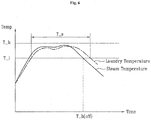
- FIG. 4 is a graph illustrating the temperature changes of the accommodating space and the laundry if course A of the first course is selected.
- the vertical axis defines temperature increase and the horizontal axis defines time passage.
- the temperature of the accommodating space may not change drastically, but rather gradually. This is because the load amount, i.e. heat capacity, of the laundry in course A is large, as mentioned above.
- the heater is turned off (T_h(off))
- the temperature of the accommodating space may decrease drastically, while the temperature of the laundry may decrease more gradually.
- the maximum temperature (T_h) of the accommodating space is appropriately set in course A.
- the maximum temperature of the accommodating space predetermined in course A may be adjusted according to the size of the laundry treating machine, the volume of the accommodating space, and the capacity of the hot air supply device.
- the maximum temperature of the accommodating space is not limited to any specific value, for example, it may be set at approximately 75°C.
- the minimum temperature of the accommodating space (T_1) in course A is also not limited to a specific value and may, for example, be set to be approximately between 60°C and 70°C.
- the load amount of the laundry in course B of the first course may be smaller than that of course A, but larger than that of the second.
- the laundry load is still relatively large and the temperature of the laundry may not be as sensitive to temperature change as compared with in the second course, which will be described in detail.
- the temperature of the laundry may be controlled relative to the predetermined maximum temperature (T_h), similar to course A, however, the heater of the steam generator is turned off if the temperature of the accommodating space reaches the highest value (T_h) for a second time.
- course B is different from course A.
- the laundry in course B may be more sensitive to temperature change than the laundry in course A, but less sensitive to temperature change than the laundry in the second course. If the B course is selected and the temperature of the accommodating space is increased, the temperature of the laundry may be also increased according to the temperature of the accommodating space. Similarly, if the heater is turned off and the temperature of the accommodating space decreases, the temperature of the laundry may decrease accordingly.
- course B provides that the heater is turned off completely only after the temperature of the accommodating space reaches the predetermined maximum value for the second time.
- FIG. 5 is a graph illustrating temperatures of the accommodating space and the laundry in the B course.
- T_h the predetermined maximum value
- the controller 80 turns off the heater only temporarily for a predetermined period of time to prevent the temperature of the laundry from rising too high.
- the heater is then turned on again to prevent the temperature of the laundry from dropping below the sanitary standard value too soon.
- the heater is completely turned off.
- the temperature of the laundry may decrease gradually such that it is maintained at the predetermined sanitary standard value or higher for a predetermined period of time.
- the maximum temperature of the accommodating space in course B may be adjusted depending on the size of the laundry treating machine, the volume of the accommodating space, and the capacity of the hot air supply device.
- the maximum temperature of the accommodating space in the B course is not limited to a specific value.
- the maximum temperature may be set approximately at 70°C and the minimum temperature of the accommodating space in course B may be set approximately between 60°C and 65°C.
- the user may also select the second course in the course selecting step (S310). If the second course is chosen, the controller 80 may adjust the steam supplying time according to the predetermined minimum temperature. Specifically, if the second course is selected, the controller 80 may maintain the temperature of the accommodating space at the standard sanitary temperature or higher for the predetermined standard sanitary time, and may also completely turn off the heater.
- the laundry load amount of the second course is less than the load amount of the first course, and accordingly it has a lower heat capacity. With a lower heat capacity, the laundry will be more sensitive to temperature changes of the accommodating space.
- the minimum temperature of the accommodating space may be set as a sanitary standard temperature, for example, approximately at 60°. The temperature of the accommodating space is then feedback-controlled to be at the predetermined minimum temperature of the accommodating space or higher.
- the temperature of the accommodating space may be maintained at the sanitary standard temperature or higher. If the time period for which the temperature of the accommodating space is maintained at the sanitary standard temperature or higher is the sanitary standard time or longer, it can be expected that the temperature of the laundry may be maintained at the sanitary standard temperature or higher for the sanitary standard time or longer. Thus, in the second course it is preferable that the predetermined minimum temperature of the accommodating space is approximately the same as the sanitary standard temperature.
- FIG. 6 is a graph illustrating temperatures of the accommodating space and the laundry if the second course is selected.
- the temperature of the laundry in the second course may change quite responsively to the changing temperature of the accommodating space.
- the controller 80 feedback-controls the temperature of the accommodating space to be at the predetermined minimum temperature of the accommodating space (T_1) or higher, that is, the sanitary standard temperature or higher.
- T_1 the predetermined minimum temperature of the accommodating space
- the controller 80 may turn off the heater (T_h(off)). Therefore, the temperature of the laundry may be maintained to be at the sanitary standard temperature or higher for the sanitary standard time or longer.
- steam may be supplied appropriately according to the load amount of the laundry treating machine such that damage to the fabric of the laundry may be prevented, while still sanitizing or sterilizing the laundry.
- steam may be supplied according to the load amount such that energy loss of the laundry treating machine may be reduced as much as possible.
Landscapes
- Engineering & Computer Science (AREA)
- Textile Engineering (AREA)
- Health & Medical Sciences (AREA)
- Epidemiology (AREA)
- Life Sciences & Earth Sciences (AREA)
- Animal Behavior & Ethology (AREA)
- General Health & Medical Sciences (AREA)
- Public Health (AREA)
- Veterinary Medicine (AREA)
- Accessory Of Washing/Drying Machine, Commercial Washing/Drying Machine, Other Washing/Drying Machine (AREA)
- Detail Structures Of Washing Machines And Dryers (AREA)
- Control Of Washing Machine And Dryer (AREA)
Claims (10)
- Steuerverfahren einer Wäschebehandlungsvorrichtung (100), die einen Aufnahmeraum (12) aufweist, der darin Wäsche aufnimmt, wobei das Steuerverfahren aufweist:Auswählen von einem von mindestens einem ersten oder zweiten Ablauf, um Wäsche hygienisch zu machen; undZuführen von Dampf zur Wäsche im Aufnahmeraum (12); undSteuern einer Temperatur des Aufnahmeraums (12) und einer Dampfzufuhrzeit durch Zuführen des Dampfes zum Aufnahmeraum (12) entsprechend dem ausgewählten Ablauf; gekennzeichnet durchHalten einer Temperatur der Wäsche für eine vorgegebene Standardsanitärzeit oder länger auf einer vorgegebenen Standardsanitärtemperatur oder höher, entsprechend dem ausgewählten Ablauf durch Steuern einer Heizvorrichtung, die Dampf erzeugt, um eine Dampfzufuhrzeitspanne entsprechend der vorgegebenen Maximaltemperatur des Aufnahmeraums (12) im ersten Ablauf und der vorgegebenen Minimaltemperatur des Aufnahmeraums (12) im zweiten Ablauf einzustellen,wobei die vorgegebene Minimaltemperatur die vorgegebene Standardsanitärtemperatur ist, undwobei eine Wäschebeladungsmenge im ersten Ablauf wesentlich größer als eine Wäschebeladungsmenge im zweiten Ablauf ist und die vorgegebene Maximaltemperatur des Aufnahmeraums (12) im ersten Ablauf wesentlich höher als die vorgegebene Maximaltemperatur des Aufnahmeraums im zweiten Ablauf ist.
- Steuerverfahren nach Anspruch 1, wobei das Auswählen von einem des ersten oder zweiten Ablaufs auf einem von mehreren voreingestellten Sanitärabläufen beruht oder auf der Art der Wäsche beruht.
- Steuerverfahren nach Anspruch 1, wobei sich mindestens eine einer vorgegebenen Maximaltemperatur des Aufnahmeraums (12), einer vorgegebenen Minimaltemperatur des Aufnahmeraums (12) und einer Dampfzufuhrzeit im zweiten Ablauf von einer entsprechenden im ersten Ablauf unterscheidet.
- Steuerverfahren nach Anspruch 1, wobei die Dampfzufuhrzeit im ersten Ablauf wesentlich länger als die Dampfzufuhrzeit im zweiten Ablauf ist.
- Steuerverfahren nach einem der Ansprüche 1 bis 4, wobei der erste Ablauf mindestens einen Ablauf A und eine Ablauf B aufweist, wobei das Steuerverfahren ferner aufweist:Auswählen von einem des Ablaufs A oder des Ablaufs B abhängig von der Wäschebeladungsmenge, undvollständiges Ausschalten der Heizvorrichtung, die Dampf erzeugt, wenn die Temperatur des Aufnahmeraums die vorgegebene Maximaltemperatur zum ersten Mal erreicht, wenn der Ablauf A ausgewählt ist; undzeitweiliges Ausschalten.der Heizvorrichtung, die Dampf erzeugt, wenn die Temperatur des Aufnahmeraums die vorgegebene Maximaltemperatur zum ersten Mal erreicht, dann vollständiges Ausschalten der Heizvorrichtung, wenn die vorgegebene Maximaltemperatur zum zweiten Mal erreicht wird, wenn der Ablauf B ausgewählt ist.
- Steuerverfahren nach einem der Ansprüche 1 bis 4, das ferner aufweist Auswählen des zweiten Ablaufs;
Rückkopplungssteuern der Temperatur des Aufnahmeraums, um die Temperatur des Aufnahmeraums (12) zwischen der vorgegebenen Maximaltemperatur und der vorgegebenen Minimaltemperatur des Aufnahmeraums zu halten; und
Ausschalten der Heizvorrichtung, die Dampf erzeugt, wenn eine Zeitspanne, für die die Temperatur des Aufnahmeraums auf der vorgegebenen Minimaltemperatur des Aufnahmeraums (12) oder höher gehalten wird, gleich oder größer als die vorgegebene Zeit ist. - Steuerverfahren nach Anspruch 3, das ferner aufweist:Steuern der Temperatur des Aufnahmeraums (12) entsprechend der vorgegebenen Maximaltemperatur des Aufnahmeraums, wenn der erste Ablauf ausgewählt ist; undRückkopplungssteuern der Temperatur des Aufnahmeraums (12), wenn der zweite Ablauf ausgewählt ist.
- Steuerverfahren nach Anspruch 7, das ferner das Steuern der Temperatur des Aufnahmeraums (12) durch Ein- oder Ausschalten der Heizvorrichtung aufweist, die Dampf erzeugt.
- Steuerverfahren nach Anspruch 8, wobei der erste Ablauf mindestens einen Ablauf A und einen Ablauf B aufweist, wobei das Steuerverfahren ferner aufweist:Auswählen von einem des Ablaufs A oder des Ablaufs B;vollständiges Ausschalten der Heizvorrichtung, wenn die Temperatur des Aufnahmeraums (12) die vorgegebene Maximaltemperatur zum ersten Mal erreicht, wenn der Ablauf A ausgewählt ist; undzeitweiliges Ausschalten der Heizvorrichtung, wenn die Temperatur des Aufnahmeraums (12) die vorgegebene Maximaltemperatur zum ersten Mal erreicht, dann vollständiges Ausschalten der Heizvorrichtung, wenn die vorgegebene Maximaltemperatur zum zweiten Mal erreicht wird, wenn der Ablauf B ausgewählt ist.
- Steuerverfahren nach Anspruch 8, das ferner aufweist
Auswählen des zweiten Ablaufs;
Rückkopplungssteuern der Temperatur des Aufnahmeraums (12), um die Temperatur des Aufnahmeraums (12) zwischen der vorgegebenen Maximaltemperatur und der vorgegebene Minimaltemperatur des Aufnahmeraums (12) zu halten; und
Ausschalten der Heizvorrichtung, wenn eine Zeitspanne, für die die Temperatur des Aufnahmeraums auf der vorgegebenen Minimaltemperatur des Aufnahmeraums (12) oder höher gehalten wird, gleich oder größer als die Standardsanitärzeit ist.
Applications Claiming Priority (1)
| Application Number | Priority Date | Filing Date | Title |
|---|---|---|---|
| KR1020080030337A KR101467771B1 (ko) | 2008-04-01 | 2008-04-01 | 의류처리장치의 제어방법 |
Publications (2)
| Publication Number | Publication Date |
|---|---|
| EP2107150A1 EP2107150A1 (de) | 2009-10-07 |
| EP2107150B1 true EP2107150B1 (de) | 2017-08-09 |
Family
ID=40810174
Family Applications (1)
| Application Number | Title | Priority Date | Filing Date |
|---|---|---|---|
| EP09156696.8A Active EP2107150B1 (de) | 2008-04-01 | 2009-03-30 | Steuerverfahren für eine Wäschebehandlungsvorrichtung |
Country Status (3)
| Country | Link |
|---|---|
| US (1) | US8261389B2 (de) |
| EP (1) | EP2107150B1 (de) |
| KR (1) | KR101467771B1 (de) |
Cited By (1)
| Publication number | Priority date | Publication date | Assignee | Title |
|---|---|---|---|---|
| WO2022233645A1 (fr) * | 2021-05-06 | 2022-11-10 | Seb S.A. | Procédé d'utilisation d'une enceinte de défroissage mobile |
Families Citing this family (20)
| Publication number | Priority date | Publication date | Assignee | Title |
|---|---|---|---|---|
| US20100299954A1 (en) * | 2009-06-01 | 2010-12-02 | Brian Joseph Roselle | Fabric Refreshing Cabinet Device |
| CA2753289C (en) * | 2009-03-27 | 2013-11-12 | The Procter & Gamble Company | Fluid dispensing system for fabric refreshing cabinet device |
| US9410281B2 (en) | 2009-05-01 | 2016-08-09 | Whirlpool Corporation | Fabric treating systems and accessories |
| CA2761515A1 (en) * | 2009-06-01 | 2010-12-09 | The Procter & Gamble Company | Fabric refreshing cabinet device for increasing flexural rigidity |
| KR101333508B1 (ko) * | 2009-06-01 | 2013-11-28 | 더 프록터 앤드 갬블 캄파니 | 수동적 열 관리 시스템을 포함하는 직물 재생 캐비닛 장치 |
| US8984766B2 (en) | 2009-08-19 | 2015-03-24 | Williams Boot & Glove Dryers Inc. | Boot and glove dryer for food service industry and method of making same |
| US20110041354A1 (en) * | 2009-08-19 | 2011-02-24 | Williams Boot & Glove Dryers Inc. | Boot and glove dryer for food service industry and method of making same |
| KR101191205B1 (ko) * | 2009-12-15 | 2012-10-15 | 엘지전자 주식회사 | 의류처리장치의 제어방법 |
| WO2011108860A2 (en) | 2010-03-03 | 2011-09-09 | Lg Electronics Inc. | Clothes treatment apparatus and control method thereof |
| EP2610387A1 (de) | 2011-12-27 | 2013-07-03 | Koninklijke Philips Electronics N.V. | Anwendung zur Reinigung von Kleidungsstücken |
| US8865065B2 (en) | 2013-01-09 | 2014-10-21 | Global Ozone Innovations, Llc | Ozone sanitizing system |
| CN112888462A (zh) * | 2019-08-26 | 2021-06-01 | 山东英才学院 | 一种用于儿童衣物的压力蒸汽灭菌器 |
| KR20220031333A (ko) * | 2020-09-04 | 2022-03-11 | 엘지전자 주식회사 | 의류처리장치 |
| KR20220108467A (ko) | 2021-01-27 | 2022-08-03 | 에스케이매직 주식회사 | 의류처리장치 및 이의 제어방법 |
| USD1021301S1 (en) * | 2021-05-21 | 2024-04-02 | Lg Electronics Inc. | Body for clothes management apparatus |
| JP1750997S (ja) * | 2021-05-21 | 2023-08-16 | 衣服用除湿脱臭及びしわ除去機の本体 | |
| JP1750999S (ja) * | 2021-05-21 | 2023-08-16 | 衣服用除湿脱臭及びしわ除去機の本体 | |
| JP1750998S (ja) * | 2021-05-21 | 2023-08-16 | 衣服用除湿脱臭及びしわ除去機の本体 | |
| USD1011660S1 (en) * | 2021-08-04 | 2024-01-16 | Samsung Electronics Co., Ltd. | Clothing care machine |
| KR20250072431A (ko) * | 2023-11-16 | 2025-05-23 | 삼성전자주식회사 | 의류 관리 장치 및 그 제어방법 |
Family Cites Families (12)
| Publication number | Priority date | Publication date | Assignee | Title |
|---|---|---|---|---|
| US6615850B1 (en) | 1999-09-10 | 2003-09-09 | General Electric Company | Dishwasher sanitation cycle |
| EP1633404B1 (de) | 2003-06-11 | 2012-03-21 | Midmark Corporation | Sterilisiergerät |
| AU2005247267B2 (en) | 2004-05-31 | 2009-03-12 | Lg Electronics Inc. | Operating method of laundry device |
| DE602006019559D1 (de) * | 2005-03-25 | 2011-02-24 | Lg Electronics Inc | Verfahren zur steuerung des betriebs einer waschmaschine |
| KR101199362B1 (ko) * | 2005-08-25 | 2012-11-09 | 엘지전자 주식회사 | 세탁 장치의 운전 방법 |
| KR100658840B1 (ko) * | 2005-09-13 | 2006-12-15 | 엘지전자 주식회사 | 의류 재생 장치의 제어 방법 |
| KR101265605B1 (ko) | 2006-07-04 | 2013-05-22 | 엘지전자 주식회사 | 의류 처리 장치 |
| US7886392B2 (en) | 2006-08-15 | 2011-02-15 | Whirlpool Corporation | Method of sanitizing a fabric load with steam in a fabric treatment appliance |
| WO2008030066A2 (en) | 2006-09-08 | 2008-03-13 | Lg Electronics Inc. | Laundry machine and controlling method of the same |
| KR100857797B1 (ko) | 2006-09-08 | 2008-09-09 | 엘지전자 주식회사 | 세탁기의 운전방법 |
| US20080092928A1 (en) * | 2006-10-19 | 2008-04-24 | Whirlpool Corporation | Method and Apparatus for Treating Biofilm in an Appliance |
| US8393183B2 (en) * | 2007-05-07 | 2013-03-12 | Whirlpool Corporation | Fabric treatment appliance control panel and associated steam operations |
-
2008
- 2008-04-01 KR KR1020080030337A patent/KR101467771B1/ko active Active
-
2009
- 2009-03-26 US US12/382,904 patent/US8261389B2/en active Active
- 2009-03-30 EP EP09156696.8A patent/EP2107150B1/de active Active
Non-Patent Citations (1)
| Title |
|---|
| None * |
Cited By (2)
| Publication number | Priority date | Publication date | Assignee | Title |
|---|---|---|---|---|
| WO2022233645A1 (fr) * | 2021-05-06 | 2022-11-10 | Seb S.A. | Procédé d'utilisation d'une enceinte de défroissage mobile |
| FR3122671A1 (fr) * | 2021-05-06 | 2022-11-11 | Seb S.A. | Procédé d’utilisation d’une enceinte de défroissage mobile |
Also Published As
| Publication number | Publication date |
|---|---|
| KR101467771B1 (ko) | 2014-12-03 |
| US8261389B2 (en) | 2012-09-11 |
| US20090241268A1 (en) | 2009-10-01 |
| KR20090105084A (ko) | 2009-10-07 |
| EP2107150A1 (de) | 2009-10-07 |
Similar Documents
| Publication | Publication Date | Title |
|---|---|---|
| US8261389B2 (en) | Cloth treating apparatus and controlling method thereof | |
| KR101430477B1 (ko) | 의류처리장치의 제어방법 | |
| US8296888B2 (en) | Laundry treating machine and control method of the same | |
| US9194076B2 (en) | Method for controlling laundry machine | |
| EP2107157B1 (de) | Wäschebehandlungsvorrichtung und Steuerungsverfahren dafür | |
| US20090064531A1 (en) | Cloth treating apparatus | |
| US8037626B2 (en) | Cloth treating apparatus | |
| KR101366273B1 (ko) | 의류처리장치 | |
| KR101122094B1 (ko) | 의류처리장치의 제어방법 | |
| KR101147775B1 (ko) | 의류처리장치의 제어방법 | |
| US20260126229A1 (en) | Shoe care apparatus and control method therefor | |
| US20120285037A1 (en) | Method for controlling a laundry treatment apparatus according to target relative humidity | |
| RU2552513C1 (ru) | Способ дезинфекции белья и стирально-сушильная машина | |
| KR20090033593A (ko) | 가전장치 및 이의 제어방법 | |
| WO2020102918A1 (en) | Laundry washer-dryer with steam treatment. | |
| KR20090013945A (ko) | 의류처리장치 및 그 제어방법 | |
| KR20090100801A (ko) | 의류처리장치의 제어방법 | |
| JP7780034B2 (ja) | 衣類処理装置及び衣類処理装置の制御方法 | |
| KR101397033B1 (ko) | 의류처리장치 | |
| KR101366267B1 (ko) | 의류처리장치 | |
| KR101113883B1 (ko) | 의류처리장치 | |
| KR101476186B1 (ko) | 의류처리장치 | |
| KR20100007342A (ko) | 의류처리장치 | |
| GB2428692A (en) | Steaming and drying apparatus | |
| KR20250115170A (ko) | 의류관리장치의 제어방법 |
Legal Events
| Date | Code | Title | Description |
|---|---|---|---|
| PUAI | Public reference made under article 153(3) epc to a published international application that has entered the european phase |
Free format text: ORIGINAL CODE: 0009012 |
|
| 17P | Request for examination filed |
Effective date: 20090330 |
|
| AK | Designated contracting states |
Kind code of ref document: A1 Designated state(s): AT BE BG CH CY CZ DE DK EE ES FI FR GB GR HR HU IE IS IT LI LT LU LV MC MK MT NL NO PL PT RO SE SI SK TR |
|
| AX | Request for extension of the european patent |
Extension state: AL BA RS |
|
| 17Q | First examination report despatched |
Effective date: 20100506 |
|
| AKX | Designation fees paid |
Designated state(s): DE FR GB IT |
|
| 17Q | First examination report despatched |
Effective date: 20160121 |
|
| GRAP | Despatch of communication of intention to grant a patent |
Free format text: ORIGINAL CODE: EPIDOSNIGR1 |
|
| INTG | Intention to grant announced |
Effective date: 20170216 |
|
| RIC1 | Information provided on ipc code assigned before grant |
Ipc: D06F 58/20 20060101ALN20170203BHEP Ipc: D06F 35/00 20060101AFI20170203BHEP Ipc: D06F 58/28 20060101ALI20170203BHEP Ipc: D06F 73/02 20060101ALI20170203BHEP Ipc: D06F 39/00 20060101ALI20170203BHEP Ipc: A61L 2/07 20060101ALI20170203BHEP |
|
| RIN1 | Information on inventor provided before grant (corrected) |
Inventor name: KIM, DONG WON Inventor name: PARK, DAE YUN Inventor name: HONG, SOG KIE Inventor name: YOO, HEA KYUNG Inventor name: KIM, JONG SEOK |
|
| GRAS | Grant fee paid |
Free format text: ORIGINAL CODE: EPIDOSNIGR3 |
|
| GRAA | (expected) grant |
Free format text: ORIGINAL CODE: 0009210 |
|
| AK | Designated contracting states |
Kind code of ref document: B1 Designated state(s): DE FR GB IT |
|
| REG | Reference to a national code |
Ref country code: GB Ref legal event code: FG4D |
|
| REG | Reference to a national code |
Ref country code: DE Ref legal event code: R096 Ref document number: 602009047601 Country of ref document: DE |
|
| REG | Reference to a national code |
Ref country code: DE Ref legal event code: R097 Ref document number: 602009047601 Country of ref document: DE |
|
| PLBE | No opposition filed within time limit |
Free format text: ORIGINAL CODE: 0009261 |
|
| STAA | Information on the status of an ep patent application or granted ep patent |
Free format text: STATUS: NO OPPOSITION FILED WITHIN TIME LIMIT |
|
| 26N | No opposition filed |
Effective date: 20180511 |
|
| PG25 | Lapsed in a contracting state [announced via postgrant information from national office to epo] |
Ref country code: FR Free format text: LAPSE BECAUSE OF NON-PAYMENT OF DUE FEES Effective date: 20180331 |
|
| PGFP | Annual fee paid to national office [announced via postgrant information from national office to epo] |
Ref country code: GB Payment date: 20240205 Year of fee payment: 16 |
|
| PGFP | Annual fee paid to national office [announced via postgrant information from national office to epo] |
Ref country code: DE Payment date: 20250205 Year of fee payment: 17 |
|
| PGFP | Annual fee paid to national office [announced via postgrant information from national office to epo] |
Ref country code: IT Payment date: 20250206 Year of fee payment: 17 |
|
| GBPC | Gb: european patent ceased through non-payment of renewal fee |
Effective date: 20250330 |
|
| PG25 | Lapsed in a contracting state [announced via postgrant information from national office to epo] |
Ref country code: GB Free format text: LAPSE BECAUSE OF NON-PAYMENT OF DUE FEES Effective date: 20250330 |