EP2106552B1 - Fluidverunreinigungs-detektionseinrichtung - Google Patents
Fluidverunreinigungs-detektionseinrichtung Download PDFInfo
- Publication number
- EP2106552B1 EP2106552B1 EP07854103.4A EP07854103A EP2106552B1 EP 2106552 B1 EP2106552 B1 EP 2106552B1 EP 07854103 A EP07854103 A EP 07854103A EP 2106552 B1 EP2106552 B1 EP 2106552B1
- Authority
- EP
- European Patent Office
- Prior art keywords
- housing
- sensor probe
- core
- base fluid
- contaminant detector
- Prior art date
- Legal status (The legal status is an assumption and is not a legal conclusion. Google has not performed a legal analysis and makes no representation as to the accuracy of the status listed.)
- Active
Links
Images

Classifications
-
- G—PHYSICS
- G01—MEASURING; TESTING
- G01N—INVESTIGATING OR ANALYSING MATERIALS BY DETERMINING THEIR CHEMICAL OR PHYSICAL PROPERTIES
- G01N33/00—Investigating or analysing materials by specific methods not covered by groups G01N1/00 - G01N31/00
- G01N33/26—Oils; Viscous liquids; Paints; Inks
- G01N33/28—Oils, i.e. hydrocarbon liquids
- G01N33/2835—Specific substances contained in the oils or fuels
- G01N33/2847—Water in oils
-
- G—PHYSICS
- G01—MEASURING; TESTING
- G01N—INVESTIGATING OR ANALYSING MATERIALS BY DETERMINING THEIR CHEMICAL OR PHYSICAL PROPERTIES
- G01N27/00—Investigating or analysing materials by the use of electric, electrochemical, or magnetic means
- G01N27/02—Investigating or analysing materials by the use of electric, electrochemical, or magnetic means by investigating impedance
- G01N27/22—Investigating or analysing materials by the use of electric, electrochemical, or magnetic means by investigating impedance by investigating capacitance
- G01N27/223—Investigating or analysing materials by the use of electric, electrochemical, or magnetic means by investigating impedance by investigating capacitance for determining moisture content, e.g. humidity
Definitions
- Water can be easily introduced into liquid fuel tanks through either natural means, such as condensation, or through human error.
- the fuel system industry has paid special attention to preventing water from entering vehicle fuel tanks and fueling systems.
- Many fueling systems are designed to incorporate filters/treaters/processors that remove water and/or particles during the tank filling process. Water can accumulate in the storage tanks from condensation and ambient temperature changes. Additional onboard filtering systems are needed to insure that all the water has been removed from the fuel prior to the fuel being sent to the engine to be burned. While it is the function of the fuel filtration system to effectively remove water, it is also known that these filtration elements can degrade from excessive water and/or other contaminants in the fuel itself.
- a number of existing water detection devices are currently used in the fuel system filtration industry. Many of these existing designs take advantage of the higher density of water compared to the most common petroleum base liquid fuel. Other designs use the electrical conductivity of water to complete an electrical circuit to indicate the presence of water. As water is filtered out of the fuel, it accumulates at the lowest point in the fueling tank, normally in the bottom of the filter vessel. It is at this location that the water detection device is installed. Prior detection devices can normally be categorized as either a mechanical or electrical devices.
- the most common type of mechanical detection device includes a buoy.
- the buoy is weighted such that it will not float in pure fuel. Therefore, the buoy will stay in the down position when the tank is filled with pure fuel. When sufficient contaminant water has accumulated, the buoy floats and triggers an alarm and/or shutdown.
- a disadvantage of the mechanical design is that it has a number of moving parts that can easily become jammed by contaminants commonly found in the water that accumulates in the harsh environment at the bottom of a fuel tank or filter vessel.
- the most common type of electrical water detector utilizes the electrical conductivity of water versus the non-conductive fuel as the means to detect the existence of accumulated water. This is an effective means to detect water in a relatively clean environment.
- petroleum fuel when mixed with water provides a hospitable environment for bacterial micro-growth. This bacteria can form an electrically insulated film over the water detector isolating the sensing electrodes from the water rendering the detector useless.
- an oil deterioration and contamination sensor includes a housing, a substrate with a first capacitive plate mounted within the housing, a second capacitive plate mounted to the housing close to the first capacitive plate, and a total reference capacitor which includes an external fixed reference capacitor.
- the second capacitive plate is mounted to the housing such that a fluid including oil freely circulates within a gap between the first and second capacitive plates thereby defining an oil deterioration and contamination sensor capacitor.
- the respective capacitances of the oil deterioration and contamination capacitor and the total reference capacitor provide an indication of a dielectric constant of the at least one fluid including oil within the gap.
- an oil contamination sensor including sensing electrodes forming a capacitor and wherein the distance between the sensing electrodes can be adjusted.
- a contaminant detection device with few moving parts that can become jammed by contaminants, and that is not susceptible to failure from bacterial growth on the sensing electrodes.
- a contaminant detection device is needed which eliminates the undesirable practice of having to introduce water into the fueling system for a realistic function test.
- Such a new contaminant detection device must provide an effective means of alerting the fueling system operator when excessive amounts of contaminant are accumulated in the fuel/water separator vessel. With an additional control subsystem, this detection device can also disable the fueling system to prevent the malfunctioning filter element from passing water downstream.
- the present invention is a process as it is defined in claim 1 and a contaminant detector as it is defined in claim 10.
- the present invention is directed to a contaminant detector disposed within a base fluid for detecting the presence of a contaminating fluid.
- the contaminant detector comprises a conductive housing, a conductive core slidingly disposed within the housing, a conductive sensor probe extending from the core in non-conductive relation, means for charging the sensor probe and providing an opposite electrical charge to the core and housing to create a closed field loop through the base fluid, means for measuring the capacitance of the base fluid in proximity to the sensor probe in the housing, and means for producing an alarm signal in response to a change in the measured capacitance to indicate the presence of the contaminating fluid in the base fluid above a pre-set threshold.
- a sliding seal between the proximate end of the core and the housing prevents fluid from leaking through.
- the housing extends from the proximate end of the core to beyond the distal end of the core and is configured such that the sensor probe extends beyond the distal end of the housing in non-conductive relation.
- sensor cap is mounted over that portion of the sensor probe that extends beyond the housing and a spring biases the sensor probe away from the housing.
- the spring in conjunction with the sensor cap maintains the sensor probe a fixed distance from the housing.
- an insulating washer between the sensor cap and the housing maintains the sensor probe in electrical isolation from the housing.
- two or more openings in the housing adjacent to the sensor probe permit the passage of fluid into the housing to reach the sensor probe.
- an insulator seal cartridge between the core and the sensor probe maintains the electrical isolation therebetween.
- an insulator also maintains the electrical isolation of the sensor probe from the core.
- the base fluid comprises a fuel and the contaminating fluid comprises water.
- the contaminant detector may be used in a process for detecting the presence of a contaminating fluid in a base fluid comprising the steps of:
- the contaminant detector includes a conductive housing in which the core is slidingly disposed and the sensor probe is disposed in non-conductive relation.
- Testing of the contaminant detector can be achieved by biasing the sensor probe a set distance away from the housing. The sensor probe is then pushed to within a predetermined distance of the housing against the biasing. An alarm signal is produced in response to the measured capacitance.
- the pushing of the sensor probe changes the capacitance between the sensor probe and the housing such that it approaches the capacitance which would be measured when the sensor probe is biased a set distance away from the housing and an amount of the contaminating fluid in the base fluid is above the preset threshold.
- the creating step includes the step of creating the opposite electrical charge in the housing and the measuring step includes the step of measuring the capacitance of the base fluid through the housing.
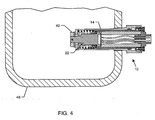
- a contaminant detector may be mounted vertically in a bottom wall of the tank or horizontally in a side wall of the tank.
- the base fluid comprises a fuel and the contaminating fluid comprises water.
- the circuit board is preferably enclosed within the core and electrical power is provided from a source external to the tank.
- the present invention is directed to a contaminant detector 10 for detecting the presence of a contaminating fluid in a base fluid.
- the following detailed description will describe the detector 10 in terms of a fueling system water detection device that detects the presence of water accumulated in the bottom of a fuel tank.
- the principles of the invention are applicable to systems for the detection of contaminants other than water in the presence of base fluids other than fuel.
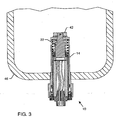
- the contaminant detector 10 consists primarily of a conductive core 12 in a conductive housing 14.
- the detector 10 includes a sliding seal 16 adjacent a proximate end of the detector 10 and the housing 14 includes one or more openings 18 adjacent the distal end of the detector 10.
- the conductive core 12 has a sensor probe 22 that extends from the core 12 in non-conductive relation, and a circuit board 24 electrically coupled to the sensor probe 22.
- the core 12 is configured such that it fits snugly inside the housing 14 of the detector 10.
- the sensor probe 22 is positioned at the distal end of the core 12 such that at least a portion of the sensor probe 22 is external to the core 12.
- An insulator seal cartridge 28 is positioned around the junction between the core 12 and the sensor probe 22. Seals 30 and 32 create a fluid seal which prevents the passage of any fluid to the inside of the core 12.
- the circuit board 24 is positioned inside the core 12 and electrically connected to the sensor probe 22.
- the circuit board 24 is also electrically connected to a connector assembly 26 by wires 34 or other means commonly known in the art.
- the connector assembly 26 is positioned at the proximate end of the core 12 and retained in place by fasteners 36.
- An insulator 38 is positioned inside the core 12 to electrically insulate the sensor probe 22 and circuit board 24 from the core 12.
- the insulator seal cartridge 28 also assists in this electrical insulation.
- the insulator 38 and insulator seal cartridge 28 are made from dielectric material.
- the core 12 and housing 14 are both conductive. However, the present invention does not require electrical current to pass through the core 12, the housing 14 or the base fluid.
- the core 12 and the housing 14 possess a relatively low capacitance with each other, which assists in generating a closed field loop as described below
- a spring 40 is positioned inside the housing 14 between the distal end of the housing and the distal end of the core 12. At least a portion of the sensor probe 22 extends beyond the distal end of the housing 14. A sensor cap 42 is affixed to that portion of the sensor probe 22 that extends beyond the distal end of the housing 14. An insulator washer 44 is positioned between the sensor cap 42 and the housing 14 to maintain the electrical insulation of the sensor probe from the housing 14 and core 12. The spring 40 in combination with the sensor cap 42 biases the sensor probe 22 a fixed distance away from the housing 14. As will be described below this fixed distance biasing is necessary for the operation of the contaminant detector 10.
- the contaminant detector 10 may be mounted in the bottom wall or sidewall of a fuel tank 46.
- the openings 18 in the distal end of the housing 14 allow liquid fuel or liquid water to reach the sensor probe 22.
- the seals 30 and 32 in the insulator seal cartridge 28 prevent fuel or water from entering the inside of the core 12 and interfering with the electronic parts therein.
- the sliding seal 16 in the housing prevents any external leakage between the housing 14 and the core 12.
- the electronic circuit board 24 creates an electrical charge to the sensor probe 22 and an opposite electrical charge to the core 12 and housing 14.
- the sensor probe 22 on the one hand and the core 12 and housing 14 on the other hand serve the function of sensing electrodes. These sensing electrodes with opposite charges actively project a "closed field loop" through the liquid fuel in their proximity. Using the "closed field loop", the circuit board 24 measures the capacitance through the liquid in the proximity of the sensing electrodes. In the presence of pure fuel, the capacitance measured by the circuit board 24 is a known value.
- the circuit board 24 measures changes in the localized capacitance. When the capacitance changes by a predetermined magnitude, indicating the presence of too much water, the circuit board 24 produces an output alarm signal through the connector assembly 26 to an external alarm system (not shown).
- the circuit board 24 detects the presence of water even if the sensing electrodes are covered with a film of bacterial micro growth, contaminants, corrosion, etc.
- the water detection function of the present invention is performed solely through electronic means without any mechanical moving parts.
- the contaminant detector 10 is designed to incorporate a test feature which simulates the presence of water in proximity to the sensing electrodes without the actual introduction of water.
- the circuit board 24 measures any variation of the localized capacitance in order to determine the presence of water in proximity to the sensing electrodes.
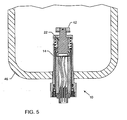
- the variation of localized capacitance can be simulated by varying the distance between the sensor probe 22 and the housing 14. As illustrated in FIG. 5 , the core 12 can be pushed toward the housing 14 against the biasing of the spring 40. As the sensor probe 22 approaches the housing 14 to within a predetermined distance, the localized capacitance between the sensor probe 22 and housing 14 approach the capacitance measured in the operation mode of the detector 10 in the presence of water.
- an output signal will be sent to the external alarm system by the circuit board 24, simulating the detection of excessive accumulated water in the fuel tank 46. Therefore, testing of the detection device assembly can be achieved without the introduction of water into the fuel tank 46.
- the function of the housing 14 in the present invention is to facilitate testing of the contaminant detector 10 without the introduction of water into the fuel tank 46.
- the core 12 can be used independently as the contaminant detector 10 without the inclusion of the housing 14.
- the sensor core 12 may be mounted directly into the fuel tank 46.
- the contaminant detector 10 of the present invention may be applied to the detection of the presence of any undesirable fluid in another.
- the subject fluids must possess the following physical and electrical properties:
- the placement of the contaminant detector 10 in the tank 46 may have to be changed depending upon the relative densities of the subject fluids. If the base fluid is more dense than the contaminant fluid then the contaminant fluid will float on top of the base fluid. In this case the contaminant detector 10 will need to be positioned such that it is near the area of the tank 46 in which the contaminant fluid will settle.
Landscapes
- Chemical & Material Sciences (AREA)
- Health & Medical Sciences (AREA)
- Engineering & Computer Science (AREA)
- Life Sciences & Earth Sciences (AREA)
- Medicinal Chemistry (AREA)
- Oil, Petroleum & Natural Gas (AREA)
- General Chemical & Material Sciences (AREA)
- Food Science & Technology (AREA)
- Chemical Kinetics & Catalysis (AREA)
- Physics & Mathematics (AREA)
- Analytical Chemistry (AREA)
- Biochemistry (AREA)
- General Health & Medical Sciences (AREA)
- General Physics & Mathematics (AREA)
- Immunology (AREA)
- Pathology (AREA)
- Investigating Or Analyzing Materials By The Use Of Electric Means (AREA)
Claims (16)
- Verfahren zum Erfassen des Vorhandenseins eines Verunreinigungsfluids in einem Basisfluid, wobei im Zuge des Verfahrens:ein einen leitenden Kern (12) aufweisender Verunreinigungsdetektor (10) in einem Tank (46), der das Basisfluid enthält, positioniert wird, wobei der Verunreinigungsdetektor ferner versehen ist mit einer Sensorsonde (22), die sich von dem Kern in nicht leitender Beziehung aus erstreckt, und einer Leiterplatte (24), die elektrisch mit der Sensorsonde gekoppelt ist;elektrischer Strom an die Leiterplatte (24) angelegt wird;eine elektrische Ladung in der Sensorsonde (22) erzeugt wird und eine entgegengesetzte elektrische Ladung in dem Kern (12) erzeugt wird, um eine geschlossene Feldschleife durch das Basisfluid zu erzeugen;die Kapazität des Basisfluids in der Nähe der Sensorsonde (22) und dem Kern (12) gemessen wird; undein Alarmsignal in Ansprechen auf eine Änderung der gemessenen Kapazität erzeugt wird, um das Vorhandensein des Verunreinigungsfluids in dem Basisfluid oberhalb eines vorgewählten Schwellwerts anzuzeigen;wobei der Verunreinigungsdetektor ein leitfähiges Gehäuse (14) aufweist, in welchem der Kern (12) gleitend und in leitfähiger Beziehung angeordnet ist;wobei das Verfahren ferner einen Testmodus mit den nachstehenden Schritten umfasst:Vorspannen der Sensorsonde (22) in einem vorgewählten Abstand zu dem Gehäuse (14);Verlagern der Sensorsonde (22) gegen die Vorspannung zu einem vorgewählten Abstand zu dem Gehäuse (14); undErzeugen eines Alarmsignals in Ansprechen auf die gemessene Kapazität.
- Verfahren gemäß Anspruch 1, bei welchem der Schritt des Erzeugens den Schritt des Erzeugens der entgegengesetzten elektrischen Ladung in dem Gehäuse (14) umfasst.
- Verfahren gemäß Anspruch 2, bei welchem der Messschritt den Schritt des Messens der Kapazität des Basisfluids nahe der Sensorsonde (22) und dem Gehäuse (14) umfasst.
- Verfahren nach einem der vorhergehenden Ansprüche, bei welchem der Schritt des Verlagerns die Kapazität zwischen der Sensorsonde (22) und dem Gehäuse (14) so ändert, dass sie sich der Kapazität nähert, die gemessen werden würde, wenn die Sensorsonde um einen vorgewählten Abstand weg von dem Gehäuse vorgespannt ist und eine Menge an Verunreinigungsfluid in dem Basisfluid oberhalb des vorgewählten Schwellwerts ist.
- Verfahren nach einem der vorhergehenden Ansprüche, bei welchem das Basisfluid einen Brennstoff aufweist und das Verunreinigungsfluid Wasser umfasst.
- Verfahren nach einem der vorhergehenden Ansprüche, bei welchem der Verunreinigungsdetektor senkrecht in einer Bodenwand des Tanks (46) angeordnet ist.
- Verfahren nach einem der Ansprüche 1 bis 5, bei welchem der Verunreinigungsdetektor horizontal in einer Seitenwand des Tanks (46) montiert ist.
- Verfahren nach einem der vorhergehenden Ansprüche, bei welchem die Leiterplatte (24) innerhalb des Kerns (12) angeordnet ist.
- Verfahren nach einem der vorhergehenden Ansprüche, bei welchem der elektrische Strom von einer extern bezüglich dem Tank (46) vorgesehenen Quelle bereitgestellt wird.
- Verunreinigungsdetektor, der in einem Basisfluid zum Erfassen des Vorhandenseins eines Verunreinigungsfluids vorgesehen ist, versehen mit:einem leitfähigen Gehäuse (14);einem leitfähigen Kern (12), der gleitend innerhalb des Gehäuses (14) in leitender Beziehung angeordnet ist;einer leitfähigen Sensorsonde (22), die sich in nichtleitender Beziehung von dem Kern aus erstreckt;Mitteln zum Laden der Sensorsonde (22) und um dem Kern (12) und dem Gehäuse (14) eine entgegengesetzte elektrische Ladung bereitzustellen, um eine geschlossene Feldschleife durch das Basisfluid zu erzeugen;Mittel zum Messen der Kapazität des Basisfluids in der Nähe der Sensorsonde (22) und des Gehäuses (14); undMitteln zum Erzeugen eines Alarmsignals in Ansprechen auf eine Änderung der gemessenen Kapazität, um das Vorhandensein des Verunreinigungsfluids in dem Basisfluid oberhalb eines vorgewählten Schwellwerts anzuzeigen;wobei der Verunreinigungsdetektor ferner eine gleitende Dichtung (16) zwischen dem Kern (12) und dem Gehäuse (14) benachbart dem proximalen Ende des Kerns aufweist.
- Verunreinigungsdetektor gemäß Anspruch 10, bei welchem sich das Gehäuse (14) von dem proximalen Ende des Kerns (12) über das distale Ende des Kerns hinaus erstreckt, wobei das Gehäuse so gestaltet ist, dass die Sensorsonde (22) sich über das distale Ende des Gehäuses hinaus in nichtleitender Beziehung erstreckt.
- Verunreinigungsdetektor gemäß einem der Ansprüche 10 bis 11, ferner versehen mit einer Sensorkappe (42), die über jenem Bereich der Sensorsonde (22) montiert ist, der sich über das Gehäuse (14) hinaus erstreckt, sowie einer Feder (40), welche die Sensorsonde weg von dem Gehäuse vorspannt.
- Verunreinigungsdetektor gemäß Anspruch 12, ferner versehen mit einer isolierenden Beilagscheibe (44) zwischen der Sensorkappe (42) und dem Gehäuse (14).
- Verunreinigungsdetektor gemäß einem der Ansprüche 10 bis 13, ferner versehen mit mindestens zwei Öffnungen (18) in dem Gehäuse (14) benachbart der Sensorsonde (22).
- Verunreinigungsdetektor gemäß einem der Ansprüche 10 bis 14, ferner versehen mit einem Isolator (38) zwischen dem Kern (12) und der Sensorsonde (22).
- Verunreinigungsdetektor gemäß einem der Ansprüche 10 bis 14, ferner versehen mit einer Isolatordichtungskartusche (28) zwischen dem Kern (12) und der Sensorsonde (22).
Applications Claiming Priority (2)
| Application Number | Priority Date | Filing Date | Title |
|---|---|---|---|
| US11/625,689 US7574899B2 (en) | 2007-01-22 | 2007-01-22 | Fluid contaminant detection device |
| PCT/US2007/081532 WO2008091418A1 (en) | 2007-01-22 | 2007-10-16 | Fluid contaminant detection device |
Publications (3)
| Publication Number | Publication Date |
|---|---|
| EP2106552A1 EP2106552A1 (de) | 2009-10-07 |
| EP2106552A4 EP2106552A4 (de) | 2013-02-13 |
| EP2106552B1 true EP2106552B1 (de) | 2014-02-26 |
Family
ID=39640689
Family Applications (1)
| Application Number | Title | Priority Date | Filing Date |
|---|---|---|---|
| EP07854103.4A Active EP2106552B1 (de) | 2007-01-22 | 2007-10-16 | Fluidverunreinigungs-detektionseinrichtung |
Country Status (6)
| Country | Link |
|---|---|
| US (1) | US7574899B2 (de) |
| EP (1) | EP2106552B1 (de) |
| CN (1) | CN101636660B (de) |
| BR (1) | BRPI0720334A2 (de) |
| SA (1) | SA08280768B1 (de) |
| WO (1) | WO2008091418A1 (de) |
Families Citing this family (7)
| Publication number | Priority date | Publication date | Assignee | Title |
|---|---|---|---|---|
| US8410948B2 (en) * | 2008-05-12 | 2013-04-02 | John Vander Horst | Recreational vehicle holding tank sensor probe |
| GB0822415D0 (en) * | 2008-12-09 | 2009-01-14 | Denby Carl | Storage tank monitoring apparatus |
| WO2012122523A1 (en) * | 2011-03-09 | 2012-09-13 | Warren Oden Lee | Three dimensional transducer |
| US9522353B2 (en) | 2013-08-13 | 2016-12-20 | Michael Richardson | Fuel filter device |
| CN105203602B (zh) * | 2015-10-15 | 2018-05-01 | 广东美的厨房电器制造有限公司 | 油烟机及其油污程度检测装置和方法 |
| US11426648B2 (en) | 2018-02-14 | 2022-08-30 | Brunswick Bowling Products Llc | Contaminant detection/sensing system for bowling lane conditioning machine |
| US11658443B2 (en) | 2021-04-13 | 2023-05-23 | Apple Inc. | Liquid detection and corrosion mitigation |
Family Cites Families (13)
| Publication number | Priority date | Publication date | Assignee | Title |
|---|---|---|---|---|
| US1960168A (en) * | 1933-03-28 | 1934-05-22 | Light Sensitive Apparatus Corp | Oil tester using radio frequency |
| US4296310A (en) * | 1979-08-20 | 1981-10-20 | Alco Standard Corporation | Cooking device with water detecting means |
| US4316174A (en) * | 1979-12-26 | 1982-02-16 | General Motors Corporation | Threshold detector for a condition indication |
| US4349882A (en) * | 1980-08-22 | 1982-09-14 | Veeder Industries Inc. | Liquid level measuring system |
| US5033289A (en) * | 1988-05-16 | 1991-07-23 | Texaco Inc. | Water cut monitoring means and method |
| CN2058852U (zh) * | 1989-09-25 | 1990-07-04 | 廉其杭 | 医用输液瓶液面监测报警器 |
| US5260667A (en) * | 1991-12-02 | 1993-11-09 | Intevep, S.A. | Method and apparatus for determining the percentage water condent of oil in water emulsion by specific admittance measurement |
| US5547565A (en) * | 1994-12-05 | 1996-08-20 | Baldwin Filters, Inc. | Fuel/water separator with adaptor plate for drain valve and water detector |
| US5824889A (en) * | 1997-03-06 | 1998-10-20 | Kavlico Corporation | Capacitive oil deterioration and contamination sensor |
| CN2311773Y (zh) * | 1997-09-04 | 1999-03-24 | 王喜民 | 锅炉水质监测仪 |
| JP2001041918A (ja) * | 1999-08-03 | 2001-02-16 | Honda Motor Co Ltd | オイルの気体濃度検出装置 |
| US6690281B2 (en) * | 2000-12-18 | 2004-02-10 | Joseph A. Palmer | Water detector and alarm |
| JP4017989B2 (ja) * | 2001-05-17 | 2007-12-05 | シーメンス ヴィディーオー オートモティヴ コーポレイション | 車両用の燃料センサー |
-
2007
- 2007-01-22 US US11/625,689 patent/US7574899B2/en active Active
- 2007-10-16 EP EP07854103.4A patent/EP2106552B1/de active Active
- 2007-10-16 WO PCT/US2007/081532 patent/WO2008091418A1/en not_active Ceased
- 2007-10-16 BR BRPI0720334-9A2A patent/BRPI0720334A2/pt not_active IP Right Cessation
- 2007-10-16 CN CN200780050274XA patent/CN101636660B/zh not_active Expired - Fee Related
-
2008
- 2008-01-07 SA SA8280768A patent/SA08280768B1/ar unknown
Also Published As
| Publication number | Publication date |
|---|---|
| SA08280768B1 (ar) | 2011-09-13 |
| US7574899B2 (en) | 2009-08-18 |
| CN101636660A (zh) | 2010-01-27 |
| BRPI0720334A2 (pt) | 2015-01-27 |
| US20080174442A1 (en) | 2008-07-24 |
| EP2106552A4 (de) | 2013-02-13 |
| WO2008091418A1 (en) | 2008-07-31 |
| CN101636660B (zh) | 2013-11-13 |
| EP2106552A1 (de) | 2009-10-07 |
Similar Documents
| Publication | Publication Date | Title |
|---|---|---|
| US7574899B2 (en) | Fluid contaminant detection device | |
| RU2761093C9 (ru) | Емкостный датчик уровня границы раздела сред с соединительной муфтой для корпуса для электродов | |
| RU2789846C2 (ru) | Резервуар для хранения топлива, содержащий один емкостный датчик уровня границы раздела сред | |
| RU2784786C2 (ru) | Топливный бак транспортного средства, содержащий один емкостный датчик уровня границы раздела сред | |
| RU2790197C2 (ru) | Соединительная муфта для корпуса для электродов емкостного датчика уровня границы раздела сред | |
| RU2790412C2 (ru) | Резервуар для хранения топлива, содержащий несколько емкостных датчиков уровня границы раздела сред | |
| RU2784642C2 (ru) | Топливный бак транспортного средства, содержащий один емкостный датчик уровня границы раздела сред | |
| RU2784638C2 (ru) | Топливный бак транспортного средства, содержащий несколько емкостных датчиков уровня границы раздела сред | |
| RU2784703C2 (ru) | Топливный бак транспортного средства, содержащий несколько емкостных датчиков уровня границы раздела сред | |
| RU2790408C2 (ru) | Резервуар для хранения топлива, содержащий один емкостный датчик уровня границы раздела сред | |
| RU2784596C2 (ru) | Чувствительный элемент емкостного датчика уровня границы раздела сред | |
| RU2790473C2 (ru) | Резервуар для хранения топлива, содержащий несколько емкостных датчиков уровня границы раздела сред | |
| RU2784785C2 (ru) | Топливный бак транспортного средства, содержащий несколько емкостных датчиков уровня границы раздела сред | |
| RU2784614C2 (ru) | Система мониторинга расхода жидкости, содержащая один емкостный датчик уровня границы раздела сред | |
| RU2784644C2 (ru) | Топливный бак транспортного средства, содержащий несколько емкостных датчиков уровня границы раздела сред | |
| RU2784643C2 (ru) | Топливный бак транспортного средства | |
| RU2784608C2 (ru) | Емкостный датчик уровня границы раздела сред | |
| RU2790411C2 (ru) | Резервуар для хранения топлива, содержащий несколько емкостных датчиков уровня границы раздела сред | |
| RU2784646C2 (ru) | Топливный бак транспортного средства, содержащий один емкостный датчик уровня границы раздела сред | |
| RU2784748C2 (ru) | Топливный бак транспортного средства, содержащий один емкостный датчик уровня границы раздела сред | |
| RU2790424C2 (ru) | Способ предварительной калибровки емкостного датчика уровня границы раздела сред | |
| RU2782968C2 (ru) | Топливный бак транспортного средства | |
| RU2789720C2 (ru) | Топливная канистра для транспортировки топлива, содержащая один емкостный датчик уровня границы раздела сред | |
| RU2789715C2 (ru) | Резервуар для хранения топлива, содержащий несколько емкостных датчиков уровня границы раздела сред | |
| RU2790426C2 (ru) | Корпус для электродов емкостного датчика границы раздела сред |
Legal Events
| Date | Code | Title | Description |
|---|---|---|---|
| PUAI | Public reference made under article 153(3) epc to a published international application that has entered the european phase |
Free format text: ORIGINAL CODE: 0009012 |
|
| 17P | Request for examination filed |
Effective date: 20090722 |
|
| AK | Designated contracting states |
Kind code of ref document: A1 Designated state(s): AT BE BG CH CY CZ DE DK EE ES FI FR GB GR HU IE IS IT LI LT LU LV MC MT NL PL PT RO SE SI SK TR |
|
| RIN1 | Information on inventor provided before grant (corrected) |
Inventor name: WONG, TAK-YIU Inventor name: DALTON, TIMOTHY ALLEN Inventor name: MINOTT, BRUCE ROSS |
|
| DAX | Request for extension of the european patent (deleted) | ||
| A4 | Supplementary search report drawn up and despatched |
Effective date: 20130116 |
|
| RIC1 | Information provided on ipc code assigned before grant |
Ipc: G01R 27/08 20060101AFI20130110BHEP |
|
| GRAP | Despatch of communication of intention to grant a patent |
Free format text: ORIGINAL CODE: EPIDOSNIGR1 |
|
| INTG | Intention to grant announced |
Effective date: 20131001 |
|
| GRAS | Grant fee paid |
Free format text: ORIGINAL CODE: EPIDOSNIGR3 |
|
| GRAA | (expected) grant |
Free format text: ORIGINAL CODE: 0009210 |
|
| AK | Designated contracting states |
Kind code of ref document: B1 Designated state(s): AT BE BG CH CY CZ DE DK EE ES FI FR GB GR HU IE IS IT LI LT LU LV MC MT NL PL PT RO SE SI SK TR |
|
| REG | Reference to a national code |
Ref country code: GB Ref legal event code: FG4D |
|
| REG | Reference to a national code |
Ref country code: CH Ref legal event code: EP |
|
| REG | Reference to a national code |
Ref country code: AT Ref legal event code: REF Ref document number: 653892 Country of ref document: AT Kind code of ref document: T Effective date: 20140315 |
|
| REG | Reference to a national code |
Ref country code: IE Ref legal event code: FG4D |
|
| REG | Reference to a national code |
Ref country code: DE Ref legal event code: R096 Ref document number: 602007035280 Country of ref document: DE Effective date: 20140410 |
|
| REG | Reference to a national code |
Ref country code: NL Ref legal event code: VDEP Effective date: 20140226 |
|
| REG | Reference to a national code |
Ref country code: AT Ref legal event code: MK05 Ref document number: 653892 Country of ref document: AT Kind code of ref document: T Effective date: 20140226 |
|
| REG | Reference to a national code |
Ref country code: LT Ref legal event code: MG4D |
|
| PG25 | Lapsed in a contracting state [announced via postgrant information from national office to epo] |
Ref country code: LT Free format text: LAPSE BECAUSE OF FAILURE TO SUBMIT A TRANSLATION OF THE DESCRIPTION OR TO PAY THE FEE WITHIN THE PRESCRIBED TIME-LIMIT Effective date: 20140226 Ref country code: IS Free format text: LAPSE BECAUSE OF FAILURE TO SUBMIT A TRANSLATION OF THE DESCRIPTION OR TO PAY THE FEE WITHIN THE PRESCRIBED TIME-LIMIT Effective date: 20140626 |
|
| PG25 | Lapsed in a contracting state [announced via postgrant information from national office to epo] |
Ref country code: CY Free format text: LAPSE BECAUSE OF FAILURE TO SUBMIT A TRANSLATION OF THE DESCRIPTION OR TO PAY THE FEE WITHIN THE PRESCRIBED TIME-LIMIT Effective date: 20140226 Ref country code: FI Free format text: LAPSE BECAUSE OF FAILURE TO SUBMIT A TRANSLATION OF THE DESCRIPTION OR TO PAY THE FEE WITHIN THE PRESCRIBED TIME-LIMIT Effective date: 20140226 Ref country code: SE Free format text: LAPSE BECAUSE OF FAILURE TO SUBMIT A TRANSLATION OF THE DESCRIPTION OR TO PAY THE FEE WITHIN THE PRESCRIBED TIME-LIMIT Effective date: 20140226 Ref country code: AT Free format text: LAPSE BECAUSE OF FAILURE TO SUBMIT A TRANSLATION OF THE DESCRIPTION OR TO PAY THE FEE WITHIN THE PRESCRIBED TIME-LIMIT Effective date: 20140226 Ref country code: PT Free format text: LAPSE BECAUSE OF FAILURE TO SUBMIT A TRANSLATION OF THE DESCRIPTION OR TO PAY THE FEE WITHIN THE PRESCRIBED TIME-LIMIT Effective date: 20140626 Ref country code: NL Free format text: LAPSE BECAUSE OF FAILURE TO SUBMIT A TRANSLATION OF THE DESCRIPTION OR TO PAY THE FEE WITHIN THE PRESCRIBED TIME-LIMIT Effective date: 20140226 |
|
| PG25 | Lapsed in a contracting state [announced via postgrant information from national office to epo] |
Ref country code: BE Free format text: LAPSE BECAUSE OF FAILURE TO SUBMIT A TRANSLATION OF THE DESCRIPTION OR TO PAY THE FEE WITHIN THE PRESCRIBED TIME-LIMIT Effective date: 20140226 Ref country code: LV Free format text: LAPSE BECAUSE OF FAILURE TO SUBMIT A TRANSLATION OF THE DESCRIPTION OR TO PAY THE FEE WITHIN THE PRESCRIBED TIME-LIMIT Effective date: 20140226 |
|
| PG25 | Lapsed in a contracting state [announced via postgrant information from national office to epo] |
Ref country code: CZ Free format text: LAPSE BECAUSE OF FAILURE TO SUBMIT A TRANSLATION OF THE DESCRIPTION OR TO PAY THE FEE WITHIN THE PRESCRIBED TIME-LIMIT Effective date: 20140226 Ref country code: DK Free format text: LAPSE BECAUSE OF FAILURE TO SUBMIT A TRANSLATION OF THE DESCRIPTION OR TO PAY THE FEE WITHIN THE PRESCRIBED TIME-LIMIT Effective date: 20140226 Ref country code: EE Free format text: LAPSE BECAUSE OF FAILURE TO SUBMIT A TRANSLATION OF THE DESCRIPTION OR TO PAY THE FEE WITHIN THE PRESCRIBED TIME-LIMIT Effective date: 20140226 Ref country code: RO Free format text: LAPSE BECAUSE OF FAILURE TO SUBMIT A TRANSLATION OF THE DESCRIPTION OR TO PAY THE FEE WITHIN THE PRESCRIBED TIME-LIMIT Effective date: 20140226 |
|
| REG | Reference to a national code |
Ref country code: DE Ref legal event code: R097 Ref document number: 602007035280 Country of ref document: DE |
|
| PG25 | Lapsed in a contracting state [announced via postgrant information from national office to epo] |
Ref country code: ES Free format text: LAPSE BECAUSE OF FAILURE TO SUBMIT A TRANSLATION OF THE DESCRIPTION OR TO PAY THE FEE WITHIN THE PRESCRIBED TIME-LIMIT Effective date: 20140226 Ref country code: SK Free format text: LAPSE BECAUSE OF FAILURE TO SUBMIT A TRANSLATION OF THE DESCRIPTION OR TO PAY THE FEE WITHIN THE PRESCRIBED TIME-LIMIT Effective date: 20140226 Ref country code: PL Free format text: LAPSE BECAUSE OF FAILURE TO SUBMIT A TRANSLATION OF THE DESCRIPTION OR TO PAY THE FEE WITHIN THE PRESCRIBED TIME-LIMIT Effective date: 20140226 |
|
| PLBE | No opposition filed within time limit |
Free format text: ORIGINAL CODE: 0009261 |
|
| STAA | Information on the status of an ep patent application or granted ep patent |
Free format text: STATUS: NO OPPOSITION FILED WITHIN TIME LIMIT |
|
| 26N | No opposition filed |
Effective date: 20141127 |
|
| REG | Reference to a national code |
Ref country code: DE Ref legal event code: R097 Ref document number: 602007035280 Country of ref document: DE Effective date: 20141127 |
|
| PG25 | Lapsed in a contracting state [announced via postgrant information from national office to epo] |
Ref country code: IT Free format text: LAPSE BECAUSE OF FAILURE TO SUBMIT A TRANSLATION OF THE DESCRIPTION OR TO PAY THE FEE WITHIN THE PRESCRIBED TIME-LIMIT Effective date: 20140226 |
|
| PG25 | Lapsed in a contracting state [announced via postgrant information from national office to epo] |
Ref country code: SI Free format text: LAPSE BECAUSE OF FAILURE TO SUBMIT A TRANSLATION OF THE DESCRIPTION OR TO PAY THE FEE WITHIN THE PRESCRIBED TIME-LIMIT Effective date: 20140226 Ref country code: MC Free format text: LAPSE BECAUSE OF FAILURE TO SUBMIT A TRANSLATION OF THE DESCRIPTION OR TO PAY THE FEE WITHIN THE PRESCRIBED TIME-LIMIT Effective date: 20140226 Ref country code: LU Free format text: LAPSE BECAUSE OF FAILURE TO SUBMIT A TRANSLATION OF THE DESCRIPTION OR TO PAY THE FEE WITHIN THE PRESCRIBED TIME-LIMIT Effective date: 20141016 |
|
| REG | Reference to a national code |
Ref country code: CH Ref legal event code: PL |
|
| REG | Reference to a national code |
Ref country code: IE Ref legal event code: MM4A |
|
| PG25 | Lapsed in a contracting state [announced via postgrant information from national office to epo] |
Ref country code: CH Free format text: LAPSE BECAUSE OF NON-PAYMENT OF DUE FEES Effective date: 20141031 Ref country code: LI Free format text: LAPSE BECAUSE OF NON-PAYMENT OF DUE FEES Effective date: 20141031 |
|
| PG25 | Lapsed in a contracting state [announced via postgrant information from national office to epo] |
Ref country code: IE Free format text: LAPSE BECAUSE OF NON-PAYMENT OF DUE FEES Effective date: 20141016 |
|
| PG25 | Lapsed in a contracting state [announced via postgrant information from national office to epo] |
Ref country code: BG Free format text: LAPSE BECAUSE OF FAILURE TO SUBMIT A TRANSLATION OF THE DESCRIPTION OR TO PAY THE FEE WITHIN THE PRESCRIBED TIME-LIMIT Effective date: 20140226 |
|
| PG25 | Lapsed in a contracting state [announced via postgrant information from national office to epo] |
Ref country code: GR Free format text: LAPSE BECAUSE OF FAILURE TO SUBMIT A TRANSLATION OF THE DESCRIPTION OR TO PAY THE FEE WITHIN THE PRESCRIBED TIME-LIMIT Effective date: 20140527 |
|
| PG25 | Lapsed in a contracting state [announced via postgrant information from national office to epo] |
Ref country code: MT Free format text: LAPSE BECAUSE OF FAILURE TO SUBMIT A TRANSLATION OF THE DESCRIPTION OR TO PAY THE FEE WITHIN THE PRESCRIBED TIME-LIMIT Effective date: 20140226 Ref country code: HU Free format text: LAPSE BECAUSE OF FAILURE TO SUBMIT A TRANSLATION OF THE DESCRIPTION OR TO PAY THE FEE WITHIN THE PRESCRIBED TIME-LIMIT; INVALID AB INITIO Effective date: 20071016 Ref country code: TR Free format text: LAPSE BECAUSE OF FAILURE TO SUBMIT A TRANSLATION OF THE DESCRIPTION OR TO PAY THE FEE WITHIN THE PRESCRIBED TIME-LIMIT Effective date: 20140226 |
|
| REG | Reference to a national code |
Ref country code: FR Ref legal event code: PLFP Year of fee payment: 10 |
|
| REG | Reference to a national code |
Ref country code: FR Ref legal event code: PLFP Year of fee payment: 11 |
|
| REG | Reference to a national code |
Ref country code: FR Ref legal event code: PLFP Year of fee payment: 12 |
|
| REG | Reference to a national code |
Ref country code: DE Ref legal event code: R082 Ref document number: 602007035280 Country of ref document: DE Ref country code: DE Ref legal event code: R081 Ref document number: 602007035280 Country of ref document: DE Owner name: EATON INTELLIGENT POWER LIMITED, IE Free format text: FORMER OWNER: ARGO-TECH CORP. COSTA MESA, COSTA MESA, CALIF., US |
|
| P01 | Opt-out of the competence of the unified patent court (upc) registered |
Effective date: 20230521 |
|
| PGFP | Annual fee paid to national office [announced via postgrant information from national office to epo] |
Ref country code: GB Payment date: 20250923 Year of fee payment: 19 |
|
| PGFP | Annual fee paid to national office [announced via postgrant information from national office to epo] |
Ref country code: FR Payment date: 20250924 Year of fee payment: 19 |
|
| PGFP | Annual fee paid to national office [announced via postgrant information from national office to epo] |
Ref country code: DE Payment date: 20250923 Year of fee payment: 19 |