EP2105288A1 - Selbstheilendes Elastomersystem - Google Patents
Selbstheilendes Elastomersystem Download PDFInfo
- Publication number
- EP2105288A1 EP2105288A1 EP08005971A EP08005971A EP2105288A1 EP 2105288 A1 EP2105288 A1 EP 2105288A1 EP 08005971 A EP08005971 A EP 08005971A EP 08005971 A EP08005971 A EP 08005971A EP 2105288 A1 EP2105288 A1 EP 2105288A1
- Authority
- EP
- European Patent Office
- Prior art keywords
- elastomer
- functional groups
- reaction
- matrix
- additive
- Prior art date
- Legal status (The legal status is an assumption and is not a legal conclusion. Google has not performed a legal analysis and makes no representation as to the accuracy of the status listed.)
- Withdrawn
Links
- 229920001971 elastomer Polymers 0.000 title claims abstract description 261
- 239000000806 elastomer Substances 0.000 title claims abstract description 252
- 125000000524 functional group Chemical group 0.000 claims abstract description 126
- 238000006243 chemical reaction Methods 0.000 claims abstract description 105
- 239000011159 matrix material Substances 0.000 claims abstract description 97
- 239000000654 additive Substances 0.000 claims abstract description 86
- 230000000996 additive effect Effects 0.000 claims abstract description 70
- 239000007791 liquid phase Substances 0.000 claims abstract description 61
- 239000003054 catalyst Substances 0.000 claims abstract description 38
- 230000035876 healing Effects 0.000 claims abstract description 24
- 239000002245 particle Substances 0.000 claims abstract description 24
- 239000003999 initiator Substances 0.000 claims abstract description 16
- 238000004132 cross linking Methods 0.000 claims abstract description 11
- 230000003993 interaction Effects 0.000 claims abstract description 10
- 230000015572 biosynthetic process Effects 0.000 claims abstract description 9
- 230000002209 hydrophobic effect Effects 0.000 claims abstract description 3
- 239000000470 constituent Substances 0.000 claims abstract 3
- 239000004971 Cross linker Substances 0.000 claims description 9
- 238000000034 method Methods 0.000 claims description 7
- 230000008569 process Effects 0.000 claims description 6
- -1 alkoxysiloxane Chemical group 0.000 claims description 5
- 125000003178 carboxy group Chemical group [H]OC(*)=O 0.000 claims description 5
- 150000001408 amides Chemical class 0.000 claims description 3
- 150000002148 esters Chemical class 0.000 claims description 3
- 150000001412 amines Chemical class 0.000 claims description 2
- 150000001993 dienes Chemical class 0.000 claims description 2
- KPUWHANPEXNPJT-UHFFFAOYSA-N disiloxane Chemical class [SiH3]O[SiH3] KPUWHANPEXNPJT-UHFFFAOYSA-N 0.000 claims description 2
- 230000032050 esterification Effects 0.000 claims description 2
- 238000005886 esterification reaction Methods 0.000 claims description 2
- VGEWEGHHYWGXGG-UHFFFAOYSA-N ethyl n-hydroxycarbamate Chemical compound CCOC(=O)NO VGEWEGHHYWGXGG-UHFFFAOYSA-N 0.000 claims description 2
- 239000012948 isocyanate Substances 0.000 claims description 2
- 150000002513 isocyanates Chemical class 0.000 claims description 2
- 125000003396 thiol group Chemical group [H]S* 0.000 claims description 2
- 125000000391 vinyl group Chemical group [H]C([*])=C([H])[H] 0.000 claims description 2
- 229920002554 vinyl polymer Polymers 0.000 claims description 2
- 239000012528 membrane Substances 0.000 claims 1
- 239000002184 metal Substances 0.000 claims 1
- 238000004519 manufacturing process Methods 0.000 abstract description 3
- 239000002775 capsule Substances 0.000 description 24
- 239000000126 substance Substances 0.000 description 16
- 239000000463 material Substances 0.000 description 13
- 239000012071 phase Substances 0.000 description 13
- 238000000576 coating method Methods 0.000 description 8
- 239000007788 liquid Substances 0.000 description 8
- 239000005060 rubber Substances 0.000 description 8
- 230000000694 effects Effects 0.000 description 6
- 229920000642 polymer Polymers 0.000 description 6
- 238000006116 polymerization reaction Methods 0.000 description 6
- VHYFNPMBLIVWCW-UHFFFAOYSA-N 4-Dimethylaminopyridine Chemical compound CN(C)C1=CC=NC=C1 VHYFNPMBLIVWCW-UHFFFAOYSA-N 0.000 description 4
- 229920000459 Nitrile rubber Polymers 0.000 description 4
- 239000012876 carrier material Substances 0.000 description 4
- 239000000203 mixture Substances 0.000 description 4
- 239000000376 reactant Substances 0.000 description 4
- 230000004044 response Effects 0.000 description 4
- 238000000926 separation method Methods 0.000 description 4
- 238000004073 vulcanization Methods 0.000 description 4
- 229920002943 EPDM rubber Polymers 0.000 description 3
- 239000006229 carbon black Substances 0.000 description 3
- 235000019241 carbon black Nutrition 0.000 description 3
- 239000011248 coating agent Substances 0.000 description 3
- 238000009833 condensation Methods 0.000 description 3
- 230000005494 condensation Effects 0.000 description 3
- 238000005336 cracking Methods 0.000 description 3
- 239000000945 filler Substances 0.000 description 3
- 239000000178 monomer Substances 0.000 description 3
- 230000001737 promoting effect Effects 0.000 description 3
- 230000035882 stress Effects 0.000 description 3
- 229960000549 4-dimethylaminophenol Drugs 0.000 description 2
- OKTJSMMVPCPJKN-UHFFFAOYSA-N Carbon Chemical compound [C] OKTJSMMVPCPJKN-UHFFFAOYSA-N 0.000 description 2
- 206010029719 Nonspecific reaction Diseases 0.000 description 2
- VYPSYNLAJGMNEJ-UHFFFAOYSA-N Silicium dioxide Chemical compound O=[Si]=O VYPSYNLAJGMNEJ-UHFFFAOYSA-N 0.000 description 2
- 239000003963 antioxidant agent Substances 0.000 description 2
- 229910052799 carbon Inorganic materials 0.000 description 2
- 229920001577 copolymer Polymers 0.000 description 2
- 230000007423 decrease Effects 0.000 description 2
- 230000006735 deficit Effects 0.000 description 2
- 238000009826 distribution Methods 0.000 description 2
- 239000013536 elastomeric material Substances 0.000 description 2
- 230000009442 healing mechanism Effects 0.000 description 2
- 239000010687 lubricating oil Substances 0.000 description 2
- 239000006249 magnetic particle Substances 0.000 description 2
- 238000005649 metathesis reaction Methods 0.000 description 2
- 238000002156 mixing Methods 0.000 description 2
- 239000000843 powder Substances 0.000 description 2
- 238000002360 preparation method Methods 0.000 description 2
- 238000007789 sealing Methods 0.000 description 2
- 230000000087 stabilizing effect Effects 0.000 description 2
- 230000001960 triggered effect Effects 0.000 description 2
- 125000003903 2-propenyl group Chemical group [H]C([*])([H])C([H])=C([H])[H] 0.000 description 1
- NLZUEZXRPGMBCV-UHFFFAOYSA-N Butylhydroxytoluene Chemical compound CC1=CC(C(C)(C)C)=C(O)C(C(C)(C)C)=C1 NLZUEZXRPGMBCV-UHFFFAOYSA-N 0.000 description 1
- 229920000049 Carbon (fiber) Polymers 0.000 description 1
- 238000005698 Diels-Alder reaction Methods 0.000 description 1
- 244000043261 Hevea brasiliensis Species 0.000 description 1
- 229920013646 Hycar Polymers 0.000 description 1
- 229920013647 Krynac Polymers 0.000 description 1
- OUBMGJOQLXMSNT-UHFFFAOYSA-N N-isopropyl-N'-phenyl-p-phenylenediamine Chemical compound C1=CC(NC(C)C)=CC=C1NC1=CC=CC=C1 OUBMGJOQLXMSNT-UHFFFAOYSA-N 0.000 description 1
- CBENFWSGALASAD-UHFFFAOYSA-N Ozone Chemical compound [O-][O+]=O CBENFWSGALASAD-UHFFFAOYSA-N 0.000 description 1
- 229920006169 Perfluoroelastomer Polymers 0.000 description 1
- 239000005062 Polybutadiene Substances 0.000 description 1
- 235000021355 Stearic acid Nutrition 0.000 description 1
- NINIDFKCEFEMDL-UHFFFAOYSA-N Sulfur Chemical compound [S] NINIDFKCEFEMDL-UHFFFAOYSA-N 0.000 description 1
- 238000005299 abrasion Methods 0.000 description 1
- 239000012190 activator Substances 0.000 description 1
- 239000004480 active ingredient Substances 0.000 description 1
- 239000002313 adhesive film Substances 0.000 description 1
- 150000001298 alcohols Chemical class 0.000 description 1
- 150000001350 alkyl halides Chemical group 0.000 description 1
- 229910052782 aluminium Inorganic materials 0.000 description 1
- 230000003078 antioxidant effect Effects 0.000 description 1
- 239000002216 antistatic agent Substances 0.000 description 1
- 239000008346 aqueous phase Substances 0.000 description 1
- 229920001400 block copolymer Polymers 0.000 description 1
- 238000009835 boiling Methods 0.000 description 1
- NTXGQCSETZTARF-UHFFFAOYSA-N buta-1,3-diene;prop-2-enenitrile Chemical compound C=CC=C.C=CC#N NTXGQCSETZTARF-UHFFFAOYSA-N 0.000 description 1
- 238000003490 calendering Methods 0.000 description 1
- 239000004917 carbon fiber Substances 0.000 description 1
- 239000002041 carbon nanotube Substances 0.000 description 1
- 229910021393 carbon nanotube Inorganic materials 0.000 description 1
- 125000002843 carboxylic acid group Chemical group 0.000 description 1
- 150000001735 carboxylic acids Chemical class 0.000 description 1
- 150000001875 compounds Chemical class 0.000 description 1
- 229920006037 cross link polymer Polymers 0.000 description 1
- 239000003431 cross linking reagent Substances 0.000 description 1
- 230000006866 deterioration Effects 0.000 description 1
- 239000000975 dye Substances 0.000 description 1
- 230000009881 electrostatic interaction Effects 0.000 description 1
- 230000006355 external stress Effects 0.000 description 1
- 239000000835 fiber Substances 0.000 description 1
- 229920001973 fluoroelastomer Polymers 0.000 description 1
- NBVXSUQYWXRMNV-UHFFFAOYSA-N fluoromethane Chemical compound FC NBVXSUQYWXRMNV-UHFFFAOYSA-N 0.000 description 1
- 239000003292 glue Substances 0.000 description 1
- 239000012510 hollow fiber Substances 0.000 description 1
- 229920001519 homopolymer Polymers 0.000 description 1
- 125000002887 hydroxy group Chemical group [H]O* 0.000 description 1
- 229910010272 inorganic material Inorganic materials 0.000 description 1
- 239000011147 inorganic material Substances 0.000 description 1
- 150000002500 ions Chemical class 0.000 description 1
- IQPQWNKOIGAROB-UHFFFAOYSA-N isocyanate group Chemical group [N-]=C=O IQPQWNKOIGAROB-UHFFFAOYSA-N 0.000 description 1
- 229920003049 isoprene rubber Polymers 0.000 description 1
- 238000011068 loading method Methods 0.000 description 1
- 239000000314 lubricant Substances 0.000 description 1
- 238000005461 lubrication Methods 0.000 description 1
- 239000006247 magnetic powder Substances 0.000 description 1
- 230000007246 mechanism Effects 0.000 description 1
- 239000003094 microcapsule Substances 0.000 description 1
- 239000012764 mineral filler Substances 0.000 description 1
- 239000002480 mineral oil Substances 0.000 description 1
- 235000010446 mineral oil Nutrition 0.000 description 1
- 229920003052 natural elastomer Polymers 0.000 description 1
- 229920001194 natural rubber Polymers 0.000 description 1
- QIQXTHQIDYTFRH-UHFFFAOYSA-N octadecanoic acid Chemical compound CCCCCCCCCCCCCCCCCC(O)=O QIQXTHQIDYTFRH-UHFFFAOYSA-N 0.000 description 1
- OQCDKBAXFALNLD-UHFFFAOYSA-N octadecanoic acid Natural products CCCCCCCC(C)CCCCCCCCC(O)=O OQCDKBAXFALNLD-UHFFFAOYSA-N 0.000 description 1
- 239000003921 oil Substances 0.000 description 1
- 239000004033 plastic Substances 0.000 description 1
- 229920003023 plastic Polymers 0.000 description 1
- 239000004014 plasticizer Substances 0.000 description 1
- 229920001084 poly(chloroprene) Polymers 0.000 description 1
- 229920002857 polybutadiene Polymers 0.000 description 1
- 229920000120 polyethyl acrylate Polymers 0.000 description 1
- 239000011148 porous material Substances 0.000 description 1
- 238000010944 pre-mature reactiony Methods 0.000 description 1
- 239000011253 protective coating Substances 0.000 description 1
- 238000007342 radical addition reaction Methods 0.000 description 1
- 230000009467 reduction Effects 0.000 description 1
- 238000003303 reheating Methods 0.000 description 1
- 238000005096 rolling process Methods 0.000 description 1
- 125000005624 silicic acid group Chemical class 0.000 description 1
- 239000000377 silicon dioxide Substances 0.000 description 1
- 235000012239 silicon dioxide Nutrition 0.000 description 1
- 230000006641 stabilisation Effects 0.000 description 1
- 238000011105 stabilization Methods 0.000 description 1
- 239000003381 stabilizer Substances 0.000 description 1
- 239000008117 stearic acid Substances 0.000 description 1
- 229920003048 styrene butadiene rubber Polymers 0.000 description 1
- 229910052717 sulfur Inorganic materials 0.000 description 1
- 239000011593 sulfur Substances 0.000 description 1
- 229920001897 terpolymer Polymers 0.000 description 1
- 230000008646 thermal stress Effects 0.000 description 1
- 229920001169 thermoplastic Polymers 0.000 description 1
- 239000004416 thermosoftening plastic Substances 0.000 description 1
- 238000009827 uniform distribution Methods 0.000 description 1
Images

Classifications
-
- C—CHEMISTRY; METALLURGY
- C08—ORGANIC MACROMOLECULAR COMPOUNDS; THEIR PREPARATION OR CHEMICAL WORKING-UP; COMPOSITIONS BASED THEREON
- C08L—COMPOSITIONS OF MACROMOLECULAR COMPOUNDS
- C08L13/00—Compositions of rubbers containing carboxyl groups
-
- B—PERFORMING OPERATIONS; TRANSPORTING
- B29—WORKING OF PLASTICS; WORKING OF SUBSTANCES IN A PLASTIC STATE IN GENERAL
- B29C—SHAPING OR JOINING OF PLASTICS; SHAPING OF MATERIAL IN A PLASTIC STATE, NOT OTHERWISE PROVIDED FOR; AFTER-TREATMENT OF THE SHAPED PRODUCTS, e.g. REPAIRING
- B29C73/00—Repairing of articles made from plastics or substances in a plastic state, e.g. of articles shaped or produced by using techniques covered by this subclass or subclass B29D
- B29C73/16—Auto-repairing or self-sealing arrangements or agents
- B29C73/163—Sealing compositions or agents, e.g. combined with propellant agents
-
- B—PERFORMING OPERATIONS; TRANSPORTING
- B29—WORKING OF PLASTICS; WORKING OF SUBSTANCES IN A PLASTIC STATE IN GENERAL
- B29C—SHAPING OR JOINING OF PLASTICS; SHAPING OF MATERIAL IN A PLASTIC STATE, NOT OTHERWISE PROVIDED FOR; AFTER-TREATMENT OF THE SHAPED PRODUCTS, e.g. REPAIRING
- B29C73/00—Repairing of articles made from plastics or substances in a plastic state, e.g. of articles shaped or produced by using techniques covered by this subclass or subclass B29D
- B29C73/16—Auto-repairing or self-sealing arrangements or agents
- B29C73/22—Auto-repairing or self-sealing arrangements or agents the article containing elements including a sealing composition, e.g. powder being liberated when the article is damaged
-
- C—CHEMISTRY; METALLURGY
- C08—ORGANIC MACROMOLECULAR COMPOUNDS; THEIR PREPARATION OR CHEMICAL WORKING-UP; COMPOSITIONS BASED THEREON
- C08L—COMPOSITIONS OF MACROMOLECULAR COMPOUNDS
- C08L19/00—Compositions of rubbers not provided for in groups C08L7/00 - C08L17/00
- C08L19/006—Rubber characterised by functional groups, e.g. telechelic diene polymers
-
- C—CHEMISTRY; METALLURGY
- C08—ORGANIC MACROMOLECULAR COMPOUNDS; THEIR PREPARATION OR CHEMICAL WORKING-UP; COMPOSITIONS BASED THEREON
- C08K—Use of inorganic or non-macromolecular organic substances as compounding ingredients
- C08K3/00—Use of inorganic substances as compounding ingredients
- C08K3/01—Use of inorganic substances as compounding ingredients characterized by their specific function
- C08K3/013—Fillers, pigments or reinforcing additives
Definitions
- the invention relates to self-healing elastomer systems and elastomers, processes for their preparation and their use.
- Elastomeric plastics can be damaged by external influences. Such damage is particularly problematic in the use of elastomers as seals and coatings.
- the elastomers may undesirably alter their structure upon exposure to elevated temperature, pressure, mechanical stress, exposure to chemicals such as ozone, or external stress.
- damage to the surface or cracks may occur.
- the material is often prone to further damage after the occurrence of first cracks or surface damage.
- an initially fine crack can deepen on further loading and lead to the fact that the material as a whole no longer fulfills its effect. Therefore, in many applications, the gaskets or coatings often need to be inspected and repaired or replaced.
- White et al. (Nature 2001, 409, 794-797 ) describe a procedure in which the components necessary for healing enter the matrix are incorporated.
- One of the components in "encapsulated form” is admixed with the elastomer.
- a catalyst is incorporated in the polymer matrix. If damaged (cracking), the capsules open, releasing the healing component. In the presence of the catalyst, a polymerization reaction takes place, which should lead to the closure of the crack.
- the W02007 / 143475 describes self-healing elastomers in which differently filled capsules are embedded in the matrix. In first capsules a polymerizable material is contained, while in second capsules a polymerization activator is included.
- capsules medicinal substances or healing substance systems
- catalyst systems are very limited.
- these capsules of typical application times often have to "over-spend” over several years, in order to be able to develop their effect in a targeted manner.
- a further disadvantage of the known systems is that, when capsules are used, it is fundamentally not possible to carry out a completely homogeneous distribution of the healing substances into the elastomer matrix.
- the capsules In order to achieve as homogeneous a stranding as possible, the capsules must be particularly small and as many capsules as possible. However, a high proportion of capsules undesirably affects the elastomeric properties.
- the volume of liquid contained decreases with the third power of the capsule radius. This means that even a small reduction in the capsule diameter is accompanied by a large decrease in the amount of reactants contained
- capsules it is important that the capsule material be highly compatible with the polymeric material. Otherwise, a uniform distribution of the capsules in the elastomer matrix is not obtained, which can lead to a deterioration of the mechanical properties. In case of uneven distribution, areas in the material may also arise for which a self-healing effect is not given.
- the healing substance is also released relatively "nonspecifically", since the released amount can always be only a multiple of the capsule contents. Thus, with a small damage to the material, the same amount of active ingredient can be released as in the case of significantly greater damage. It also does not ensure that a fine crack is always on a capsule meets and this opens. The healing mechanism can only cause a one-time closure of the tear, since no substances from the outside get to the damaged area. Another disadvantage is that both the production of such filled capsules and their processing is complex and expensive.
- the invention has for its object to provide a self-healing system that overcomes the disadvantages described. It is intended to provide a self-healing system that is hard to produce in a simple manner and efficiently heals damage in elastomers.
- the liquid phase adjoins at least one surface of the elastomer. Under normal conditions, ie in the absence of damage, it is essentially not in contact with the interior of the elastomer and with the first functional groups H. In the event of damage to the elastomer or a separating layer between the elastomer and the liquid phase, the liquid phase undesirably penetrates into the interior of the elastomer and comes into contact with the functional groups H.
- the elastomer comprises an elastomer matrix.
- This refers to a crosslinked polymer skeleton which has elastomeric properties.
- the elastomer may contain additional components that are not part of the crosslinked elastomer matrix.
- the elastomer may also be coated, for example, with a release layer that separates the liquid from the elastomer matrix. Such an arrangement is referred to in this application as "elastomer", even if the separation layer itself is not made of an elastomeric material.
- the reaction of the first functional groups F stabilizes the elastomer.
- the reaction takes place substantially selectively at the sites on the damaged surface of the elastomer which contact the liquid phase.
- the reaction of the first functional groups H thus at least partially effects the self-healing of the system. Therefore, it is also referred to as "Heitungsre press" according to the invention.
- Heitungsre press By stabilizing the damaged elastomer, the damage or further damage is counteracted or the damage is eliminated.
- Self-healing means all Components required for the course of the healing reaction are contained in the system according to the invention.
- the reaction can therefore take place without external intervention. There is no need to add a component from the outside, such as by a user or device. However, according to the invention, this does not preclude the system from being changed from the outside.
- the additive may be added to a liquid phase after a particular load or damage.
- the damage may be any type of impairment of the structure of the elastomer causing the additive to contact the first functional groups H. In particular, this is the case when the liquid phase comes into contact with the interior of the elastomer or penetrates into the interior of the elastomer. This can happen if cracks develop in the elastomer or the surface becomes worn or damaged. If the elastomer has a release layer, the damage may also be that the release layer is destroyed.
- the elastomer matrix contains first functional groups H in the interior.
- the functional groups can be covalently bonded to the elastomer matrix, but they can also be added as an additive or supported filler material to the elastomer compound.
- “Inside” means that the elastomer has the first functional groups H at positions that are not in contact with the liquid phase in the undamaged state. However, this does not exclude that first reactive groups H are present on the surface of the elastomer. In this case, the surface of the elastomer must not contact the liquid phase in the undamaged state.
- the elastomer in this case may have a release layer which separates the elastomeric matrix from the liquid phase.
- the surface of the elastomer can be pretreated so that functional groups H react with F at the surface.
- the liquid phase contains an excess of the additive and reacts on contact with the elastomer first with the reactive groups of the surface. This leaves a stable self-healing system with reactive groups inside the elastomer and additive in the liquid phase.
- the first functional groups are preferably uniformly distributed in the interior of the elastomer.
- the healing reaction of the first functional groups H of the system takes place either with each other or with at least one other reaction partner, the additive from the liquid having at least second functional groups F.
- This reaction can be accelerated by a catalyst to which the polymer matrix is added.
- the invention is based on the basic principle that at least one component which is required for the course of the healing reaction is not contained in the elastomer, but as an additive in the liquid phase.
- the system contains a catalyst which accelerates the reaction between the first functional groups H and that of the additive F, wherein the catalyst are parts of the polymer matrix, are covalently attached thereto, are not covalently embedded in the matrix or / or components of the additive.
- the self-healing elastomer system contains a catalyst that catalyzes the reaction or a coagent that promotes the reaction.
- the coagent may be, for example, a reaction accelerator or initiator.
- the catalyst and the Coagens may be the additive, be part of the additive, be additionally contained in the liquid phase and / or be contained in the elastomer.
- the additive has second functional groups F, the reaction of the first functional groups H of the elastomer matrix with the second functional groups of the additive F taking place.
- the system may additionally comprise a catalyst or coagent promoting the reaction. These may be in the elastomer or in the liquid phase.
- each additive has at least one functional group F. If there is a single functional group per additive, the additives attach to the elastomer as a result of the reaction. The result is a layer or a film, whereby a further removal of the elastomer is prevented. If two or more functional groups F are present per additive, crosslinking may take place during the healing reaction.
- the additive may combine at least two different first functional groups H of the first phase.
- the additive is a polymerizable monomer.
- the first functional groups of the elastomer matrix are sites of attachment for polymerization.
- the elastomer matrix contains a catalyst or coagent which promotes the reaction, for example a reaction initiator or accelerator.
- the reaction of the first functional groups of the elastomer matrix takes place with one another, for example if non-crosslinked double bonds are present in the elastomer matrix.
- this is Additive preferably is a catalyst or coagent which promotes the reaction, for example a reaction initiator or accelerator, or a crosslinker.
- the elastomer matrix has second functional groups covalently bonded to the elastomer matrix, the reaction of the first functional groups of the elastomer matrix with the second functional groups of the elastomer matrix.
- the additive is preferably a catalyst or coagent promoting the reaction, for example, a reaction initiator or accelerator, or a crosslinker.
- coagents which are not covalently bonded to the matrix and which have second functional groups are contained in the elastomer matrix, the reaction of the first functional groups of the elastomer matrix with the second functional groups of the coagents.
- the additive is preferably a catalyst or coagent promoting the reaction, for example, a reaction initiator or accelerator.
- the elastomer matrix contains a polymerizable monomer.
- the first functional groups of the elastomer matrix are sites of attachment for polymerization.
- the additive is a catalyst or coagent that promotes the reaction, for example, a reaction initiator or accelerator.
- the reaction of the first functional groups of the elastomer matrix may be a chemical or a physical reaction. Covalent bonds are formed in a chemical reaction.
- the Functional groups interact with each other or with other functional groups resulting in stabilization of the elastomer at the damaged site.
- the reaction may be the formation of covalent bonds or the formation of non-covalent interaction selected from van der Waals, magnetic, electrostatic, ionic, hydrophobic, dipolar or other interactions.
- the functional groups and the additive are each magnetic and / or ionic in each case and have an affinity for one another.
- permanent magnetic particles are present in the elastomer matrix and a magnetic, but non-permanent magnetic powder in the liquid phase, wherein the powder may be free or enveloped by elastomer or polymers and wherein the average particle size of the powder is below 1 micron lies.
- Table 1 shows exemplary embodiments of the invention.
- Table 1 Self-healing Concepts ⁇ / i> elastomer Liquid phase Type of reaction Consistent force
- Two different functional groups A and B catalyst Catalyst triggers reaction of A with B, which results in covalent bonding
- Catalyst triggers reaction of A with B, which results in covalent bonding covalent bond
- Functional groups are uncrosslinked elastomer components crosslinkers Post-crosslinking "when needed" Covalent bond Functional groups are not chemically reactive, but sticky adhering to matrix Healing substance forms adhesive film on matrix and thus prevents further tearing Dipole / van der Waals, magnetic or electrostatic interaction
- Suitable chemical reactions include, for example, polymerization, condensation, metathesis reaction, Dials-Alder reaction, allyl addition and radical addition.
- the functional groups are, for example selected from vinyl, diene, amine, alkoxysiloxane, carboxyl, hydroxy, urethane, isocyanate, siloxane, ester, amide and thiol groups.
- Table 2 shows how the first functional group of the elastomer matrix H and the second functional group of the additive F can be selected to obtain a chemical reaction between the elastomer and the additive.
- Table 2 Self-healing concepts through reactions with the additive.
- First functional groups of the elastomer H Second functional groups of the additive in the liquid phase F Catalyst or coagent Mechanism of reaction
- C C RSSR SH possible addition
- C C Diene bond if necessary Cu-cat. or similar Diels-Alder
- the reaction is preferably a crosslinking reaction.
- a precondition for a crosslinking reaction is that reactants (crosslinkers) having at least two reactive groups F in a molecule or on a particle are present.
- the additives serve as crosslinkers.
- particles having a plurality of second functional groups F are particularly preferred.
- the particles can thus be firmly bound to the elastomer and prevent bridging by cracking.
- the elastomer may consist of known rubbers, such as ethylene-propylene-diene rubber (EPDM rubber).
- EPDM rubber has a high elasticity and a good chemical resistance especially against polar organic media and can be used over a wide temperature range.
- rubbers selected from natural rubber, isoprene rubber, butadiene rubber, chloroprene rubber, styrene-butadiene rubber or hydrogenated nitrile-butadiene rubber (HNBR). In this case, homopolymers, copolymers or block copolymers can be used.
- fluorinated or chlorinated rubbers such as perfluororubber (FFKM), fluororubber (FKM) or propylene-tetrafluoroethylene rubber (PTFE), as well as copolymers thereof.
- FFKM perfluororubber
- FKM fluororubber
- PTFE propylene-tetrafluoroethylene rubber
- the elastomer may contain conventional additives such as dyes, fillers, plasticizers, antistatic agents, antioxidants, and rubber-specific crosslinking chemicals.
- the additive consists of particles containing the second functional groups F on the surface.
- the particles may consist of a carrier material, on the surface of which the second functional groups F are applied.
- Carrier material is an elastomeric material into consideration. Suitable examples are elastomeric particles having OH groups on the surface (Micromorph TM, RheinChemie, Rheinau).
- Further suitable support materials are, for example, functionalized carbon blacks, graphites, carbon fibers, carbon nanotubes, silicic acids, aluminum silicates and mineral fillers.
- the use of particles is advantageous because they can fill the cracks.
- the size of the particles is selected so that they are able to diffuse into cracks and to close the cracks by the reaction (or "glue together" the crack walls).
- elastomeric particles, thermoplastic particles, carbon in particle, fiber or hollow fiber form, or other inorganic materials such as silica, which are optionally functionalized may be used as support material.
- the mean particle diameter of the particles can be ⁇ 5, ⁇ 3 or ⁇ 1 ⁇ m.
- the mean particle diameter of the particles is 10 nm to 10 ⁇ m, in particular between 30 nm and 5 ⁇ m, or between 100 nm and 3 ⁇ m.
- the average dimension in at least two dimensions is below 1 ⁇ m.
- the liquid phase contains crosslinkable additives having second functional groups F and the elastomer matrix contains catalysts and / or reaction initiators or accelerators. These may be present in the matrix in pure or in supported form. If they are in supported form, they may be incorporated into precipitated or fumed silicas or carbon blacks in the elastomer.
- This catalyst or reaction initiator or accelerator may promote or initiate a reaction of the first functional groups H of the elastomer matrix with the additive.
- double bonds of the additive with the elastomer matrix or with specially introduced into the elastomer react reactive groups.
- the elastomer matrix may, for example, be derivatized with carboxylic acid groups (in carboxylated nitrile-butadiene rubber, XNBR). Isocyanate groups or specific crosslinking sites such as haloalkane groups (-CH 2 Cl or -CH 2 Br) in fluorocarbon rubber (FKM) or polyethyl acrylate ( ACM).
- the elastomer contains non-covalently attached matrix-functional group, for example in the form of short-chain polymers (Nipol TM, Zeon Chemicals or Hycar TM, Lubrizol Corp.).
- the first functional groups can be attached to the elastomer matrix by chemical reactions.
- a filler having first reactive groups on the surface can also be incorporated into the elastomer matrix. This can be incorporated into the elastomer matrix during vulcanization, for example.
- the system additionally includes a release layer positioned between the elastomer and the liquid phase.
- the liquid phase does not directly contact the elastomer in the normal state, but rather the separating layer.
- the release layer may be porous provided that the pore size is so small that the additive can not diffuse to the elastomer.
- the release layer is at least partially released the underlying elastomer having the first functional groups H and gets in contact with the additive.
- the release layer consists for example of an elastomer. The same elastomer can be used as in the reactive elastomer component, if a component required for the healing reaction is missing.
- the reaction requires a catalyst embedded in the elastomer matrix
- the same elastomer as in the reactive elastomer phase without embedded catalyst can be used as the release layer.
- a protective coating for example a bonded coating.
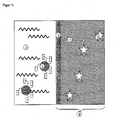
- the FIG. 1 shows a self-healing elastomer system according to the invention in the undamaged state.
- the system contains an elastomer (6) with a crosslinked rubber (1).
- a separating layer (2) separates the liquid phase (3) containing the additive (4) from the functional groups F in the elastomer.
- the release layer (2) is applied by subsequent coating of the material.
- the separating layer (2) is such that it can not react with the liquid medium (3) and the functional groups (5) H and also adheres well to the elastomer.
- the elastomer matrix (1) contains functional groups (5) H and may undergo a chemical or physical reaction with the functional groups F of the additive (4) or in its presence.
- the additive (4) added to the liquid medium consists of FIG. 1 of particles of a carrier material and second functional groups (F) on its surface.
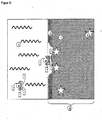
- FIG. 2 shows the self-healing reaction of an elastomer system according to the invention in which a crack has formed in the elastomer (6).
- the crack passes through the separation layer (2) so that the liquid phase (3) comes into contact with the interior of the elastomer.
- the soluble additive is in the form of particles in which second reactive groups (F) are bound to a carrier material (4).
- the soluble additives diffuse into the crack and react via the second functional groups (F) with the first functional groups H (5) of the elastomer. This fixes the particles in the crack, stabilizing the elastomer and stopping crack growth.
- crosslinking takes place in which a plurality of bonds are formed between an additive and the elastomer matrix.
- the FIG. 3 shows by way of example a self-healing of an elastomer (6) according to the invention in the event of damage to a separating layer (2).
- the liquid phase contains monomeric additives (3) which consist of the same building blocks as the polymeric separating layer (2).
- the liquid phase contains particles (4) with functional groups F. If the release layer is damaged, for example by abrasion, then the functional groups of the elastomer matrix come into contact with the monomeric additives (3) of the liquid phase.
- the monomeric additives (3) react with functional groups H of the polymer matrix, for example with double bonds.
- the reaction is by catalysts supported in the elastomer. By this reaction, the open position is closed and the separation layer (2) regenerated.
- the elastomer according to the invention which optionally has the separating layer, forms a shaped body.
- the shaped body is preferably a seal or a coating. Seals and coatings are often in contact with liquids and prone to damage such as cracks and surface damage. Such damage is often difficult or cumbersome to detect and can cause the seals or coatings no longer perform their duties and consequential damage.
- the elastomer is a sealing ring, for example a Radialwelleridichtring or O-ring.
- the first functional groups are carboxyl groups and the elastomer matrix contains a catalyst for esterification.
- the elastomer may have a release layer.
- the invention also relates to the use of the system according to the invention or of the elastomer for healing damage to elastomers.
- the system according to the invention is self-healing. However, this does not exclude that the system is changed from the outside.
- the additive may be added to the liquid phase at intervals to compensate for consumption.
- the additive can also be added only when needed in a desired concentration. This can be useful, for example, if it is certain or possible; that the elastomer is damaged, for example because of an increased mechanical or thermal stress. It can also be routinely tested whether there is still enough reactive additive in the liquid phase. at The additive is then re-added, or replaced, or the entire liquid phase with the additive is replaced.
- the system according to the invention has numerous advantages over known systems.
- a reaction is triggered as soon as the liquid phase penetrates into the interior of the elastomer. It is not necessary that a capsule ruptures due to a minimum mechanical load.
- the crack growth according to the invention can be counteracted already at an early stage of cracking.
- the invention enables a high selectivity of the healing response by the complete spatial separation of a component of the healing reaction of the elastomer.
- the system effectively responds to the point where the damage occurred.
- a crack can be partially or completely closed.
- nonspecific reactions can be triggered by the damage of capsules.
- it is precluded that a reaction begins at a location of the elastomer at which the liquid phase does not penetrate into the interior of the elastomer.
- the healing mechanism proceeds through the interaction of a mobile component from the liquid medium with an immobile component of the rubber.
- a complete polymerization reaction is not necessary for the healing of damage, but only the reaction at specific contact points.
- the particles then fill in cracks or cover the damaged surface of the elastomer.
- the invention enables the onset of the healing response immediately upon entry Damage at the place of damage.
- the additive can exert its effect directly on the site of the damage.
- An undesirable reaction does not take place either within the elastomer or in the liquid phase.
- neither an impairment of the elastomer phase by irregularities nor a lump formation in the liquid phase takes place.
- crosslinking of different sites at the crack surface may take place. This "bridging effect" through the formation of a molecular clamp prevents further crack propagation.
- composition of an elastomeric system according to the invention for a radial shaft seal in a lubricating oil Composition of an elastomeric system according to the invention for a radial shaft seal in a lubricating oil.
- the elastomer is composed as indicated in Table 3. Examples 1 and 2 are according to the invention.
- the control composition (left column) contains no catalyst so that the healing reaction does not take place.
- lubricating oil for the radial shaft sealing rings is used as standard GE M1-220 N (Klüber Lubrications, Kunststoff) on mineral oil basis. To this, 15% by weight of Micromorph 20 are added as an additive.
Landscapes
- Chemical & Material Sciences (AREA)
- Health & Medical Sciences (AREA)
- Chemical Kinetics & Catalysis (AREA)
- Medicinal Chemistry (AREA)
- Polymers & Plastics (AREA)
- Organic Chemistry (AREA)
- Engineering & Computer Science (AREA)
- Mechanical Engineering (AREA)
- Sealing Material Composition (AREA)
- Treatments Of Macromolecular Shaped Articles (AREA)
- Processes Of Treating Macromolecular Substances (AREA)
- Compositions Of Macromolecular Compounds (AREA)
Abstract
Description
- Gegenstand der Erfindung sind selbstheilende Elastomersysteme und Elastomere, Verfahren zu deren Herstellung und deren Verwendung.
- Elastomere Kunststoffe können durch äußere Einflüsse beschädigt werden. Solche Schäden sind insbesondere bei dem Einsatz von Elastomeren als Dichtungen und Beschichtungen problematisch. Die Elastomere können beispielsweise bei Einwirkung erhöhter Temperatur, Druck, mechanischer Belastung, bei Einwirkung von Chemikalien wie Ozon, oder bei äußerer Spannung ihre Struktur in unerwünschter Weise verändern. Dabei können insbesondere Schädigungen der Oberfläche oder Risse entstehen. Das Material ist nach dem Entstehen erster Risse oder Oberflächenschäden oft besonders anfällig für weitere Schäden. So kann sich ein anfänglich feiner Riss bei weiterer Belastung vertiefen und dazu führen, dass das Material insgesamt nicht mehr seine Wirkung erfüllt. Daher müssen bei vielen Anwendungen die Dichtungen oder Beschichtungen häufig überprüft und ausgebessert oder ausgetauscht werden.
- Es wurde versucht, diese Probleme durch den Einsatz von "selbstheilenden" Elastomeren zu überwinden.
- White et al. (Nature 2001, 409, 794-797) beschreiben ein Verfahren, bei dem die für die Heilung notwendigen Komponenten in die Matrix eingearbeitet sind. Dabei wird eine der Komponenten in "verkapselter Form" dem Elastomer beigemischt ist. Als zweite Komponente ist ein Katalysator in die Polymermatrix eingearbeitet. Bei Schädigung (Rissbildung) öffnen sich die Kapseln, wodurch die heilende Komponente freigesetzt wird. In Gegenwart des Katalysators findet eine Polymerisationsreaktion statt, die zum Verschließen des Risses führen soll.
- Die
W02007/143475 beschreibt selbstheilende Elastomere, bei denen unterschiedlich befüllte Kapseln in die Matrix eingebettet sind. In ersten Kapseln ist ein polymerisierbares Material enthalten, während in zweiten Kapseln ein Polymerisationsaktivator enthalten ist. - Bei diesen Systemen sind alle Reaktanten, die an der Heilungsreaktion beteiligt sind, in die Matrix eingearbeitet. Solche Systeme weisen den Nachteil auf, das auch bei üblichen Belastungen und normalem Gebrach Mikrokapseln geöffnet werden können und die Heilsubstanz und reaktionsfähige Substanz miteinander reagieren. So sind gerade Dichtungen und Beschichtungen oft erhöhtem Druck und mechanischen Belastungen ausgesetzt. Auch die Herstellung solcher Materialien geht mit mechanischen Belastungen einher, die zur unerwünschten Öffnung von Kapseln und zu einer vorzeitigen Reaktion führen können, beispielsweise beim Mischen in einem Innenmischer, beim Walzen, Extrudieren oder Kalandrieren. Die verkapselten Reaktanden und Katalysatoren müssen während des gesamten Elastomer-Herstellungs-Prozesses stabil bleiben, also während der Mischung, Vulkanisation und dem Nachheizen bei erhöhter Temperatur bis über 180 °C, bei erhöhtem Druck und in Gegenwart von Radikalen. Dadurch ist die Auswahl an Heilsubstanzen bzw. Heilsubstanz-Systemen ("Kapseln") sowie Katalysatorsystemen sehr eingeschränkt. Beispielsweise muss der Siedepunkt der Monomere, die zur Polymerisation gebracht werden sollen und so die "heilende Substanz" erzeugen, über der Vulkanisationstemperatur liegen, da andernfalls die Kapseln aufplatzen.
Zudem müssen diese Kapseln typischer Anwendungszeiten oftmals über mehrere Jahre "überieben", um dann im Bedarfsfall ihre Wirkung noch gezielt entfalten zu können. - Ein weiterer Nachteil der bekannten Systeme ist, dass bei der Verwendung von Kapseln grundsätzlich nicht eine völlig homogene Verteilung der Heilsubstanzen in die Elastomermatrix erfolgen kann. Um eine möglichst homogene Verseilung zu erzielen, müssen die Kapseln besonders klein sein und möglichst viele Kapseln vorhanden sein. Ein hoher Anteil von Kapseln beeinflusst jedoch die Elastomereigenschaften in unerwünschter Weise. Bei der Auswahl kleiner Kapseln wirkt sich nachteilig aus, dass das enthaltene Flüssigkeitsvolumen mit der dritten Potenz des Kapselradius abnimmt. Dies bedeutet, dass bereits eine kleine Verringerung des Kapseldurchmessers mit einer großen Abnahme der Menge der enthaltenen Reaktanten einhergeht
- Darüber hinaus ist es bei dem Einsatz von Kapseln wichtig, dass das Kapselmaterial in hohem Maße mit dem Polymermaterial kompatibel ist. Andernfalls wird nicht eine gleichmäßige Verteilung der Kapseln in der Elastomermatrix erhalten, was zu einer Verschlechterung der mechanischen Eigenschaften führen kann. Bei ungleichmäßiger Verteilung können auch Bereiche in dem Material entstehen, für die eine selbstheilende Wirkung nicht gegeben ist.
- Die Heilsubstanz wird auch relativ "unspezifisch" freigesetzt, da die freigesetzte Menge immer nur ein Vielfaches des Kapselinhalts sein kann. So kann bei einer kleinen Schädigung des Materials dieselbe Menge an Wirkstoff freigesetzt werden wie bei einer deutlich größeren Schädigung. Es ist auch nicht sichergestellt, dass ein feiner Riss immer auf eine Kapsel trifft und diese öffnet. Der Heilungsmechanismus kann auch nur ein einmaliges Verschließen des Risses bewirken, da keine Substanzen von außen zu der beschädigten Stelle gelangen. Ein weiterer Nachteil ist, dass sowohl die Herstellung solcher gefüllter Kapseln als auch deren Verarbeitung aufwändig und teuer ist.
- Der Erfindung liegt die Aufgabe zugrunde, ein selbstheilendes Systems bereitzustellen, das die beschriebenen Nachteile überwindet. Es soll ein selbstheilendes System bereitgestellt werden, das auf einfache hart herstellbar ist und effizient Beschädigungen in Elastomeren heilt.
- Das der Erfindung zugrunde liegende Problem wird überraschenderweise gelöst durch ein selbstheilendes Elastomersystem, Elastomere, Verfahren und Verwendungen gemäß den Patentansprüchen.
- Das erfindungsgemäße selbstheilende Elastomersystem umfasst
- a) ein Elastomer, das eine Oberfläche und ein Inneres aufweist, wobei das Elastomer eine Elastomermatrix aufweist, wobei die Elastomermatrix im Inneren spezifische Bereiche kovalent gebundene erste funktionelle Gruppen (H, wie in
Figur 1 gekennzeichnet) enthält, sowie optional einem weiteren Katalysator, der die Reaktion beschleunigt, und - b) eine flüssige Phase, die an die Oberfläche des Elastomers angrenzt, wobei die flüssige Phase ein spezielles Additiv enthält, das ebenfalls spezifische funktionelle Gruppen (F, wie in
Figur 1 gekennzeichnet) aufweist, - Die flüssige Phase grenzt zumindest an eine Oberfläche des Elastomers an. Sie steht unter normalen Bedingungen, also in Abwesenheit einer Beschädigung, im Wesentlichen nicht mit dem Inneren des Elastomers und mit den ersten funktionellen Gruppen H in Kontakt. Bei einer Beschädigung des Elastomers oder einer Trennschicht zwischen dem Elastomer und der flüssigen Phase dringt die flüssige Phase in unerwünschter Weise in das Innere des Elastomers ein und kommt mit den funktionellen Gruppen H in Kontakt.
- Das Elastomer umfasst eine Elastomermatrix. Damit wird ein vernetztes Polymergerüst bezeichnet, das elastomere Eigenschaften aufweist. Das Elastomer kann zusätzliche Komponenten enthalten, die nicht Bestandteil der vernetzten Elastomermatrix sind. Das Elastomer kann auch beschichtet sein, beispielsweise mit einer Trennschicht, die die Flüssigkeit von der Elastomermatrix trennt. Eine solche Anordnung wird im Rahmen dieser Anmeldung als "Elastomer" bezeichnet, auch wenn die Trennschicht selbst nicht aus einem elastomeren Material besteht.
- Durch die Reaktion der ersten funktionellen Gruppen F wird das Elastomer stabilisiert. Die Reaktion findet im Wesentlichen selektiv an den Stellen an der geschädigten Oberfläche des Elastomers statt, die mit der flüssigen Phase in Kontakt treten. Die Reaktion der ersten funktionellen Gruppen H bewirkt so zumindest teilweise die Selbstheilung des Systems. Sie wird daher erfindungsgemäß auch als "Heitungsreaktion" bezeichnet. Durch die Stabilisierung des geschädigten Elastomers wird der Beschädigung oder einer weiteren Beschädigung entgegenwirkt oder die Beschädigung beseitigt. "Selbstheilend" bedeutet, dass alle Komponenten, die für den Ablauf der Heilungsreaktion erforderlich sind, in dem erfindungsgemäßen System enthalten sind. Die Reaktion kann daher ohne Eingriff von außen stattfinden. Es muss keine Komponente von außen hinzugefügt werden, beispielsweise durch einen Anwender oder ein Gerät. Dadurch wird jedoch erfindungsgemäß nicht ausgeschlossen, dass das System von außen verändert wird. Beispielsweise kann einer flüssigen Phase nach einer besonderen Belastung oder einer Beschädigung das Additiv zugesetzt werden.
- Die Beschädigung kann jede Art von Beeinträchtigung der Struktur des Elastomers sein, die bewirkt, dass das Additiv mit den ersten funktionellen Gruppen H in Kontakt tritt. Insbesondere ist dies der Fall, wenn die flüssige Phase mit dem Inneren des Elastomers in Kontakt tritt oder in das Innere des Elastomers eindringt. Dies kann geschehen, wenn in dem Elastomer Risse entstehen oder die Oberfläche abgenutzt oder beschädigt wird. Wenn das Elastomer eine Trennschicht aufweist, kann die Beschädigung auch darin liegen, dass die Trennschicht zerstört wird.
- Die Elastomermatrix enthält im Inneren erste funktionelle Gruppen H. Die funktionellen Gruppen können kovalent mit der Elastomermatrix verbunden sein, sie können aber auch als Additiv oder geträgertes Füllstoffmaterial dem Elastomercompound zugesetzt sein.
- "Im Inneren" bedeutet, dass das Elastomer die ersten funktionellen Gruppen H an Positionen aufweist, die im unbeschädigten Zustand nicht mit der flüssigen Phase in Kontakt stehen. Dies schließt jedoch nicht aus, dass an der Oberfläche des Elastomers erste reaktive Gruppen H vorhanden sind. In diesem Falle darf die Oberfläche des Elastomers im nicht beschädigten Zustand nicht die flüssige Phase kontaktieren. Das Elastomer kann in diesem Falle eine Trennschicht aufweisen, die die Elastomermatrix von der flüssigen Phase trennt.
- Wenn keine Trennschicht vorhanden ist, kann die Oberfläche des Elastomers vorbehandelt werden, so dass funktionelle Gruppen H mit F an der Oberfläche abreagieren. In einer weiteren Ausführungsform der Erfindung enthält die flüssige Phase einen Überschuss des Additivs und reagiert bei Kontaktieren mit dem Elastomer zunächst mit den reaktiven Gruppen der Oberfläche. Es verbleibt ein stabiles selbstheilendes System mit reaktiven Gruppen im Inneren des Elastomers und Additiv in der flüssigen Phase. Die ersten funktionellen Gruppen sind bevorzugt gleichmäßig im Inneren des Elastomers verteilt.
- Die Heilungsreaktion der ersten funktionellen Gruppen H des Systems erfolgt entweder untereinander oder mit mindestens einem weiteren Reaktionspartner, dem Additiv aus der Flüssigkeit, der mindestens zweite funktionelle Gruppen F aufweist. Diese Reaktion kann durch einen Katalysator, der der Polymermatix zugesetzt ist, beschleunigt werden. Die Erfindung beruht auf dem Grundprinzip, dass mindestens eine Komponente, die für den Ablauf der Heilungsreaktion erforderlich ist, nicht in dem Elastomer enthalten ist, sondern als Additiv in der flüssigen Phase.
- In einer bevorzugten Ausführungsform der Erfindung enthält das System einen Katalysator, der die Reaktion zwischen den ersten funktionellen Gruppen H und den des Additivs F beschleunigt, wobei der Katalysator Teile der Polymermatrix sind, an diese kovalent angehängt sind, nicht kovalent in die Matrix eingebettet sind oder/oder Bestandteile des Additivs sind.
- Vorzugsweise enthält das selbstheilende Elastomersystem einen Katalysator, der die Reaktion katalysiert, oder ein Coagens, das die Reaktion fördert. Das Coagens kann beispielsweise ein Reaktionsbeschleuniger oder -initiator sein. Der Katalysator und das Coagens können dabei das Additiv sein, Bestandteil des Additivs sein, zusätzlich in der flüssigen Phase enthalten sein und/oder in dem Elastomer enthalten sein.
- In einer Ausführungsform der Erfindung weist das Additiv zweite funktionelle Gruppen F auf, wobei die Reaktion der ersten funktionellen Gruppen H der Elastomermatrix mit den zweiten funktionellen Gruppen des Additivs F erfolgt. Das System kann zusätzlich einen Katalysator oder ein Coagens, das die Reaktion fördert, aufweisen. Diese können in dem Elastomer oder in der flüssigen Phase vorliegen.
- Dabei weist jedes Additiv mindestens eine funktionelle Gruppe F auf. Sofern eine einzige funktionelle Gruppe pro Additiv vorliegt, lagern sich die Additive in Folge der Reaktion an das Elastomer an. Es entsteht eine Schicht oder ein Film, wodurch eine weitere Abtragung des Elastomers verhindert wird. Sofern zwei oder mehr funktionelle Gruppen F pro Additiv vorliegen, kann bei der Heilungsreaktion eine Vernetzung stattfinden. Das Additiv kann mindestens zwei verschiedene erste funktionelle Gruppen H der ersten Phase miteinander verbinden.
- In einer Ausführungsform der Erfindung ist das Additiv ein polymerisierbares Monomer. Die ersten funktionellen Gruppen der Elastomermatrix sind Anlagerungsstellen zur Polymerisation. Die Elastomermatrix enthält einen Katalysator oder ein Coagens, das die Reaktion fördert, beispielweise einen Reaktionsinitiator oder - beschleuniger.
- In einer weiteren Ausführungsform der Erfindung erfolgt die Reaktion der ersten funktionellen Gruppen der Elastomermatrix untereinander, beispielsweise wenn in der Elastomermatrix nicht vernetzte Doppelbindungen enthalten sind. Bei dieser Ausführungsform ist das Additiv bevorzugt ein Katalysator oder ein Coagens, das die Reaktion fördert, beispielweise ein Reaktionsinitiator oder beschleuniger, oder ein Vernetzer.
- In einer weiteren Ausführungsform der Erfindung weist die Elastomermatrix zweite funktionelle Gruppen auf, die mit der Elastomermatrix kovalent verbunden sind, wobei die Reaktion der ersten funktionellen Gruppen der Elastomermatrix mit den zweiten funktionellen Gruppen der Elastomermatrix erfolgt. Bei dieser Ausführungsform, ist das Additiv bevorzugt ein Katalysator oder ein Coagens, das die Reaktion fördert, beispielweise ein Reaktionsinitiator oder -beschleuniger, oder ein Vernetzer.
- In einer weiteren Ausführungsform der Erfindung sind in der Elastomermatrix Coagentien enthalten, die mit der Matrix nicht kovalent verbunden sind und die zweite funktionelle Gruppen aufweisen, wobei die Reaktion der ersten funktionellen Gruppen der Elastomermatrix mit den zweiten funktionellen Gruppen der Coagentien erfolgt. Bei dieser Ausführungsform ist das Additiv bevorzugt ein Katalysator oder ein Coagens, das die Reaktion fördert, beispielweise ein Reaktionsinitiator oder -beschleuniger.
- In einer weiteren Ausführungsform der Erfindung enthält die Elastomermatrix ein polymerisierbares Monomer. Die ersten funktionellen Gruppen der Elastomermatrix sind Anlagerungsstellen zur Polymerisation. Das Additiv ist ein Katalysator oder ein Coagens, das die Reaktion fördert, beispielweise einen Reaktionsinitiator oder -beschleuniger.
- Die Reaktion der ersten funktionellen Gruppen der Elastomermatrix kann eine chemische oder eine physikalische Reaktion sein. Bei einer chemischen Reaktion werden kovalente Bindungen ausgebildet. Die funktionellen Gruppen gehen eine Interaktion untereinander oder mit weiteren funktionellen Gruppen ein, die zu einer Stabilisierung des Elastomers an der beschädigten Stelle führt. Die Reaktion kann die Ausbildung kovalenter Bindungen oder die Ausbildung nicht kovalenter Wechselwirkung sein, ausgewählt aus van der Waals, magnetischen, elektrostatischen, ionischen, hydrophoben, dipolaren oder sonstigen Wechselwirkungen.
- In weiteren Ausführungsformen der Erfindung sind die funktionellen Gruppen und das Additiv jeweils magnetisch und/oder jeweils ionisch und weisen eine Affinität zueinander auf. Bei der Verwendung magnetischer Wechselwirkungen ist vorzugsweise zwischen der flüssigen Phase und dem Elastomer eine Trennschicht aus einem Material vorhanden, das die magnetischen Wechselwirkungen abschirmt. Sobald die Trennschicht beschädigt und das Elastomer freilegt wird, können sich magnetische Partikel aus der flüssigen Phase anlagern und die Oberfläche versiegeln.
- In einer Ausführungsform der Erfindung liegen in der Elastomermatrix permanentmagnetische Partikel und in der flüssigen Phase ein magnetisches, aber nicht-permanent-magnetisches Pulver vor, wobei das Pulver frei oder umhüllt von Elastomer oder Polymeren sein kann und wobei die durchschnittliche Partikelgröße des Pulvers unterhalb 1 µm liegt.
- In der Tabelle 1 sind beispielhafte Ausführungsformen der Erfindung dargestellt.
Tabelle 1: Selbstheilungs-Konzepte Elastomer Flüssige Phase Art der Reaktion Zusammenhaltende Kraft Zwei verschiedene funktionelle Gruppen A und B Katalysator Katalysator löst Reaktion von A mit B aus, bei der kovalente Bindung entsteht kovalente Bindung Funktionelle Gruppe A und Katalysator Funktionelle Gruppe B Katalysator löst Reaktion von A mit B aus, bei der kovalente Bindung entsteht kovalent Bindung Funktionelle Gruppen sind unvernetzte Elastomer-Anteile Vernetzer Nachvernetzung "bei Bedarf" kovalente Bindung Funktionelle Gruppen sind nicht chemisch reaktiv, aber haftend haftend auf Matrix Heilsubstanz bildet Haftfilm auf Matrix und verhindert so weiteres Einreißen Dipol-/ van der Waals-, magnetische oder elektrostatische Wechselwirkung - Geeignete chemische Reaktionen sind beispielsweise Polymerisation, Kondensation, Metathese-Reaktion, Dials-Alder-Reaktion, Allyl-Addition und radikalische Addition. Die funktionellen Gruppen sind beispielsweise ausgewählt aus Vinyl-, Dien-, Amin-, Alkoxysiloxan-, Carboxyl-, Hydroxy-, Urethan-, Isocyanat-, Siloxan-, Ester-, Amid- und Thiolgruppen.
- In der Tabelle 2 ist gezeigt, wie die erste funktionelle Gruppe der Elastomermatrix H und die zweite funktionelle Gruppe des Additivs F ausgewählt sein können, um eine chemische Reaktion zwischen dem Elastomer und dem Additiv zu erhalten.
Tabelle 2: Selbstheilungs-Konzepte durch Reaktionen mit dem Additiv. Erste funktionelle Gruppen des Elastomers H Zweite funktionelle Gruppen des Additivs in der flüssigen Phase F Katalysator oder Coagens Mechanismus der Reaktion C=C R-S-S-R S-H möglich Addition C=C Dien-Bindung ggf. Cu-Kat. oder ähnlich Diels-Alder C=C C=C WCl6 Metathese Polyuretan, Carbonsäure oder Siloxan-Si(OEt)3 -OH Ti-Kat., DMAP Kondensation Ester öder Amid -COOH möglich Kondensation ionisch ionisch - Salzbildung - Die Reaktion ist vorzugsweise eine Vernetzungsreaktion. Voraussetzung für eine Vernetzungsreaktion ist, dass Reaktanden (Vernetzer) vorliegen, die in einem Molekül oder auf einem Partikel mindestens zwei reaktive Gruppen F aufweisen. In einer bevorzugten Ausführungsform dienen die Additive als Vernetzer.
- Besonders bevorzugt ist der Einsatz von Partikeln, die eine Vielzahl von zweiten funktionellen Gruppen F aufweisen, als Additive. Die Partikel können so fest an das Elastomer gebunden werden und durch Brückenwirkung ein Risswachstum verhindern.
- Das Elastomer kann aus bekannten Kautschuken bestehen, wie Ethylen-Propylen-Dien-Kautschuk (EPDM-Kautschuk). EPDM-Kautschuk weist eine hohe Elastizität und eine gute chemische Beständigkeit insbesondere gegenüber polaren organischen Medien auf und ist über einen breiten Temperaturbereich einsetzbar. Es können auch Kautschuke eingesetzt werden, ausgewählt aus Naturkautschuk, Isopren-Kautschuk, Butadien-Kautschuk, Chloropren-Kautschuk, Styrol-Butadien-Kautschuk oder hydrogenierter Nitril-Butadien-Kautschuk (HNBR). Dabei können Homopolymere, Copolymere oder Blockcopolymere eingesetzt werden. Es sind auch fluorierte oder chlorierte Kautschuke einsetzbar, wie Perfluorkautschuk (FFKM), Fluor-Kautschuk (FKM) oder Propylen-Tetrafluorethylen-Kautschuk (PTFE), sowie Copolymere davon. Das Elastomer kann übliche Zusatzstoffe enthalten, wie Farbstoffe, Füllstoff, Weichmacher, Antistatika, Antioxidantien sowie kautschukspezifische Vemetzungschemikalien.
- In einer bevorzugten Ausführungsform besteht das Additiv aus Partikeln, die die zweiten funktionellen Gruppen F an der Oberfläche enthalten. Dabei können die Partikel aus einem Trägermaterial bestehen, an dessen Oberfläche die zweiten funktionellen Gruppen F aufgebracht sind. Als Trägermaterial kommt ein elastomeres Material in Betracht. Geeignet sind beispielsweise elastomere Partikel, die OH-Gruppen an der Oberfläche aufweisen (Micromorph™, RheinChemie, Rheinau). Weitere geeignete Trägermaterialien sind beispielsweise funktionalisierte Ruße, Graphite, Kohlenstoff-Fasern, Carbon Nanotubes, Kieselsäuren, Aluminiumsilicate und mineralische Füllstoffe. Der Einsatz von Partikeln ist vorteilhaft, da diese die Risse füllen können. Die Größe der Partikel wird so ausgewählt, dass sie in der Lage sind, in Risse zu diffundieren bzw. zu migrieren und die Risse durch die Reaktion zu schließen (oder die Risswände "zusammenzukleistern"). Als Trägermaterial können beispielsweise Elastomer-Partikel, Thermoplast-Partikel, Kohlenstoff in Partikel-, Faser-oder Hohlfaserform, oder andere anorganische Materialien wie Silica eingesetzt werden, die gegebenenfalls funktionalisiert sind. Das mittlere Teilchendurchmesser der Partikel kann <5, <3 oder <1 µm liegen. In bevorzugten Ausführungsformen ist das mittlere Teilchendurchmesser der Partikel 10 nm bis 10 µm, insbesondere zwischen 30 nm und 5 µm oder zwischen 100 nm und 3 µm. Vorzugsweise ist die durchschnittliche Abmessung in mindestens zwei Dimensionen unterhalb 1 µm.
- In einer bevorzugten Ausführungsform der Erfindung enthält die flüssige Phase vernetzbare Additive mit zweiten funktionellen Gruppen F, und die Elastomermatrix enthält Katalysatoren und/oder Reaktionsinitiatoren oder -beschleuniger. Diese können in der Matrix in reiner oder auch in geträgerter Form vorliegen. Liegen sie in geträgerter Form vor, so können sie auf gefällten oder pyrogenen Kieselsäuren oder Rußen in das Elastomer eingearbeitet sein.
- Dieser Katalysator oder Reaktionsinitiator oder -beschleuniger kann eine Reaktion der ersten funktionellen Gruppen H der Elastomermatrix mit dem Additiv fördern oder auslösen. So können Doppelbindungen des Additivs mit der Elastomermatrix oder mit speziell in das Elastomer eingebrachten reaktiven Gruppen reagieren. Die Elastomermatrix kann beispielsweise mit Carbonsäuregruppen (in carboxyliertem Nitril-Butadien-Kautschuk, XNBR) derivatisiert sein: Geeignet sind auch Isocyanatgruppen oder spezielle Vernetzungsstellen wie Halogenalkangruppen (-CH2Cl oder-CH2Br) in Flourkarbon-Kautschuk (FKM) oder Polyethylacrylat (ACM). Es ist auch möglich, dass das Elastomer nicht kovalent an die Matrix gebundene funktionelle Gruppe enthält, beispielsweise in Form von kurzkettigen Polymeren (Nipol™, Zeon Chemicals oder Hycar™, Lubrizol Corp.). Die ersten funktionellen Gruppen können durch chemische Reaktionen an die Elastomermatrix angehängt sein. Es kann auch ein Füllstoff mit ersten reaktiven Gruppen an der Oberfläche in die Elastomermatrix eingearbeitet sein. Dieser lässt sich beispielsweise während der Vulkanisation in die Elastomermatrix einbinden.
- In einer bevorzugten Ausführungsform weist das System zusätzlich eine Trennschicht auf, die zwischen dem Elastomer und der flüssigen Phase positioniert ist. In diesem Falle kontaktiert die flüssige Phase im Normalzustand nicht direkt das Elastomer, sondern die Trennschicht. Die Trennschicht kann porös sein, sofern die Porengröße so klein ist, dass das Additiv nicht zu dem Elastomer diffundieren kann. Bei einer Schädigung,der Trennschicht wird zumindest zum Teil das darunter liegende Elastomer mit den ersten funktionellen Gruppen H freigesetzt und gerät in Kontakt mit dem Additiv. Die Trennschicht besteht beispielsweise aus einem Elastomer. Es kann das gleiche Elastomer eingesetzt werden wie in der reaktiven Elastomerkomponente, sofern eine Komponente, die zur Heilungsreaktion erforderlich ist, fehlt. Wenn beispielsweise die Reaktion einen in der Elastomermatrix eingebetteten Katalysator erfordert, so kann als Trennschicht das gleiche Elastomer wie in der reaktiven Elastomerphase ohne eingebetteten Katalysator verwendet werden. Geeignet ist auch ein Schutzlack, z.B. ein Gleitlack.
- In einer Ausführungsform der Erfindung enthält das Elastomer zusätzlich ein Coagens, das nicht kovalent mit der Elastomermatrix verbunden ist und das an der Interaktion der funktionellen Gruppen der Elastomermatrix und des Additivs beteiligt ist. Das Coagens kann beispielsweise ein Katalysator, ein Reaktionsinitiator, ein Reaktionsbeschleuniger oder ein Vernetzer sein. Die flüssige Phase kann beispielsweise eine wässrige Phase oder eine Ölphase, beispielsweise ein Schmiermittel, sein. Sie kann aber auch sonstige flüssige Komponenten enthalten oder daraus bestehen, wie Alkohole. Die flüssige Phase kann neben den Additiven, die die Heilungsreaktion unterstützen, weitere übliche Zusätze enthalten, wie gelöste Ionen.
- Die
Figur 1 zeigt schematisch und beispielhaft ein erfindungsgemäßes selbstheilendes Elastomersystem im nicht beschädigten Zustand. - Die
Figur 2 zeigt schematisch und beispielhaft die Selbstheilungsreaktion eines erfindungsgemäßen Elastomersystems, bei dem in dem Elastomer ein Riss entstanden ist. - Die
Figur 3 zeigt schematisch und beispielhaft die erfindungsgemäße Selbstheilung eines Elastomers bei Beschädigung einer Trennschicht. - Die
Figur 1 zeigt ein erfindungsgemäßes selbstheilendes Elastomersystem im nicht beschädigten Zustand. Das System enthält ein Elastomer (6) mit einem vernetzten Kautschuk (1). Eine Trennschicht (2) trennt die flüssige Phase (3), die das Additiv (4) enthält, von den funktionellen Gruppen F in dem Elastomer. Die Trennschicht (2) wird durch nachträgliches Beschichten des Werkstoffes aufgebracht. Die Trennschicht (2) ist so beschaffen, dass sie nicht mit dem flüssigen Medium (3) und den funktionellen Gruppen (5) H reagieren kann und außerdem gut an das Elastomer haftet Die Elastomermatrix (1) beinhaltet funktionelle Gruppen (5) H und kann mit den funktionellen Gruppen F des Additiv (4) oder in dessen Gegenwart eine chemische oder physikalische Reaktion eingehen. Das Additiv (4), das dem flüssigen Medium zugegeben wird, besteht inFigur 1 aus Partikeln aus einem Trägermaterial und zweiten funktionellen Gruppen (F) auf dessen Oberfläche. - Die
Figur 2 zeigt die Selbstheilungsreaktion eines erfindungsgemäßen Elastomersystems, bei dem in dem Elastomer (6) ein Riss entstanden ist. Der Riss geht durch die Trennschicht (2) hindurch, so dass die flüssige Phase (3) in Kontakt mit dem Inneren des Elastomers tritt. Das lösliche Additiv liegt in Form von Partikeln vor, bei denen zweite reaktive Gruppen (F) an ein Trägermaterial (4) gebunden sind. Die löslichen Additive diffundieren in den Riss und reagieren dort über die zweiten funktionellen Gruppen (F) mit den ersten funktionellen Gruppen H (5) des Elastomers. Dadurch werden die Partikel in dem Riss fixiert, wodurch das Elastomer stabilisiert wird und das Risswachstum gestoppt wird. Vorzugsweise findet bei der Reaktion eine Vernetzung statt, bei der zwischen einem Additiv und der Elastomermatrix mehrere Bindungen ausgebildet werden. - Die
Figur 3 zeigt beispielhaft eine erfindungsgemäße Selbstheilung eines Elastomers (6) bei Beschädigung einer Trennschicht (2). In der flüssigen Phase sind monomere Additive (3) enthalten, die aus denselben Bausteinen bestehen wie die polymere Trennschicht (2). Zusätzlich enthält die flüssige Phase Partikel (4) mit funktionellen Gruppen F. Wird die Trennschicht beschädigt, beispielsweise durch Abrieb, dann kommen die funktionellen Gruppen der Elastomermatrix mit den monomeren Additiven (3) der flüssigen Phase in Kontakt. Die monomeren Additive (3) reagieren mit funktionellen Gruppen H der Polymermatrix, z.B. mit Doppelbindungen. Gegebenenfalls wird die Reaktion durch Katalysatoren in dem Elastomer unterstützt. Durch diese Reaktion wird die offene Stelle geschlossen und die Trennschicht (2) regeneriert. - Das erfindungsgemäße Elastomer, das gegebenenfalls die Trennschicht aufweist, bildet einen Formköper. Der Formkörper ist bevorzugt eine Dichtung oder eine Beschichtung. Dichtungen und Beschichtungen stehen häufig in Kontakt mit Flüssigkeiten und sind anfällig für Beschädigungen wie Risse und Oberflächenschäden. Solche Schäden sind oft nur schwer oder umständlich zu erkennen und können bewirken, dass die Dichtungen oder Beschichtungen ihre Aufgaben nicht mehr erfüllen und dass Folgeschäden entstehen. Bevorzugt ist das Elastomer ein Dichtungsring, beispielsweise ein Radialwelleridichtring oder O-Ring.
- Gegenstand der Erfindung ist auch ein Elastomer, das eine Oberfläche und ein Inneres aufweist, wobei das Elastomer eine Elastomermatrix aufweist, wobei die Elastomermatrix im Inneren kovalent gebundene erste funktionelle Gruppen H aufweist, und das Elastomer an der Oberfläche im wesentlichen keine kovalent gebundenen ersten funktionelle Gruppen H aufweist, wobei
- (a) die Elastomermatrix zweite funktionelle Gruppen aufweist, die Bestandteile der Elastomermatrix sind oder an diese angehängt sind und/oder
- (b) wobei nicht kovalent verbunden in der Elastomermatrix Coagentien, die zweite funktionelle Gruppen aufweisen, Katalysatoren, Reaktionsinitiatoren, Reaktionsbeschleuniger und/oder Vernetzer enthalten sind,
- In einer bevorzugten Ausführungsform sind die ersten funktionellen Gruppen Carboxylgruppen, und in der Elastomermatrix ist ein Katalysator für eine Veresterung enthalten. Das Elastomer kann eine Trennschicht aufweisen.
- Gegenstand der Erfindung ist auch die Verwendung des erfindungsgemäßen Systems oder des Elastomers zur Heilung von Beschädigungen von Elastomeren.
- Gegenstand der Erfindung ist auch ein Verfahren zur Herstellung eines selbstheilenden Elastomersystems oder zur Heilung von Beschädigungen eines Elastomers, wobei
- (a) ein Elastomer bereitgestellt wird, das eine Oberfläche und ein Inneres aufweist, wobei das Elastomer eine Elastomermatrix aufweist, wobei die Elastomermatrix im Inneren kovalent gebundene erste funktionelle Gruppen aufweist, und
- (b) eine flüssige Phase hinzugegeben wird, die an die Oberfläche des Elastomers angrenzt, wobei die flüssige Phase ein Additiv enthält,
- Gegenstand der Erfindung ist auch ein Verfahren zur Herstellung eines selbstheilenden Elastomersystems oder zur Heilung von Beschädigungen eines Elastomer, wobei das Elastomersystem
- (a) ein Elastomer, das eine Oberfläche und ein Inneres aufweist, wobei das Elastomer eine Elastomermatrix aufweist, wobei die Elastomermatrix im Inneren kovalent gebundene erste funktionelle Gruppen aufweist, und
- (b) eine flüssige Phase, die an die Oberfläche des Elastomers angrenzt, aufweist,
- Das erfindungsgemäße System ist selbstheilend. Dies schließt jedoch nicht aus, dass das System von außen verändert wird. So ist es erfindungsgemäß möglich, insbesondere die Zusammensetzung der flüssigen Phase im Hinblick auf bestimmte Anforderungen oder äußere Umstände anzupassen. Beispielsweise kann das Additiv der flüssigen Phase intervallweise zugegeben werden, um einen Verbrauch zu kompensieren. Das Additiv kann auch erst bei Bedarf in einer gewünschten Konzentration zugegeben werden. Dies kann beispielsweise sinnvoll sein, wenn feststeht oder es möglich ist; dass das Elastomer beschädigt ist, beispielsweise wegen einer erhöhten mechanischen oder Temperaturbelastung. Es kann auch routinemäßig getestet werden, ob in der flüssigen Phase noch genügend reaktives Additiv vorhanden ist. Bei Bedarf wird dann das Additiv erneut zugesetzt, oder ausgetauscht, oder die gesamte flüssige Phase mit dem Additiv wird ausgetauscht.
- Das erfindungsgemäße System weist gegenüber bekannten Systemen zahlreiche Vorteile auf. Bei dem erfindungsgemäßen System wird eine Reaktion ausgelöst, sobald die flüssige Phase in das Innere des Elastomers eindringt. Es ist nicht erst erforderlich, dass durch eine mechanische Mindestbelastung eine Kapsel aufreißt. So kann dem Risswachstum erfindungsgemäß bereits in einem frühen Stadium der Rissbildung entgegengewirkt werden.
- Die Erfindung ermöglicht eine hohe Selektivität der Heilungsreaktion durch die vollständige räumliche Trennung einer Komponente der Heilungsreaktion des Elastomers. Das System reagiert effektiv an der Stelle, wo der Schaden entstanden ist. Ein Riss kann teilweise oder vollständig geschlossen werden. Es erfolgt keine unspezifische Reaktion an anderen Stellen in dem Elastomer. Bei bekannten Systemen mit Kapseln können unspezifische Reaktionen durch die Beschädigung von Kapseln ausgelöst werden. Erfindungsgemäß ist es dagegen ausgeschlossen, dass eine Reaktion an einer Stelle des Elastomers einsetzt, an der die flüssige Phase nicht in das Innere des Elastomers eindringt.
- Der Heilungsmechanismus verläuft über die Interaktion einer mobilen Komponente aus dem flüssigen Medium mit einer immobilen Komponente des Kautschuks. Bei dem erfindungsgemäßen Einsatz von Partikeln als lösliche Additive ist zur Heilung von Schäden nicht eine vollständige Polymerisationsreaktion notwendig, sondern nur die Reaktion an bestimmten Kontaktpunkten. Die Partikel füllen dann Risse aus oder decken die beschädigte Oberfläche des Elastomers ab. Die Erfindung ermöglicht das Einsetzen der Heilungsreaktion unmittelbar bei Eintritt der Beschädigung am Ort der Beschädigung. Das Additiv kann seine Wirkung unmittelbar am Ort des Schadens entfalten. Eine unerwünschte Reaktion findet weder innerhalb des Elastomers noch in der flüssigen Phase statt. So erfolgt weder eine Beeinträchtigung der Elastomerphase durch Unregelmäßigkeiten noch eine Klumpenbildung in der flüssigen Phase. Bei Rissen kann eine Vernetzung von unterschiedlichen Stellen an der Rissoberfläche stattfinden. Dieser "Brückeneffekt" durch Ausbildung einer molekularen Klammer verhindert die weitere Rissausbreitung.
- Das Elastomer ist wie in der Tabelle 3 angegeben zusammengesetzt. Die Beispiele 1 und 2 sind erfindungsgemäß. Die Kontrollzusammensetzung (Spalte links) enthält keinen Katalysator, so dass die Heilungsreaktion nicht stattfindet.
Tabelle 3: Zusammensetzungen des Elastomers: Kontrolle Nr.1 Nr.2 Krynac 740 1) 100 phr 100 phr 100 phr Ruß N 550 30 phr 30 phr 30 phr Dusantox IPPD 2) 2 phr 2 phr 2 phr Stearinsäure 2 phr 2 phr 2 phr Wingstay 29 3) 1 phr 1 phr 1 phr ZnO2 (70 %) 4) 7 phr 7 phr 7 phr ZBEC-70 4) 2 phr 2 phr 2 phr CLD 4) 1,5 phr 1,5 phr 1,5 phr Schwefel 2 phr 2 phr 2 phr DMAP 5) 3 phr 5 phr 1) Carboxyliertes Butadien-Acrylonitril Terpolymer von Lanxess
2) Stabilisator, Antioxidans
3) Antioxidans
4) Vulkanisationsbeschleuniger
5) Vernetzungskatalysator der Selbstheilung - Als Schmieröl für die Radialwellendichtringe wird als Standard GE M1-220 N (Klüber Lubrications, München) auf Mineralölbasis verwendet. Diesem werden als Additiv 15 Gew-% Micromorph 20 zugesetzt.
Claims (21)
- Selbstheilendes Elastomersystem, enthaltend(a) ein Elastomer, das eine Oberfläche und ein Inneres aufweist, wobei das Elastomer eine Elastomermatrix aufweist, wobei die Elastomermatrix im inneren kovalent gebundene erste funktionelle Gruppen aufweist, und(b) eine flüssige Phase, die an die Oberfläche des Elastomers angrenzt, wobei die flüssige Phase ein Additiv enthält,wobei die ersten funktionellen Gruppen und das Additiv so ausgewählt sind, dass im Falle einer Beschädigung des Elastomers erste funktionelle Gruppen, die mit der flüssigen Phase in Kontakt treten, eine Reaktion eingehen.
- Elastomersystem nach Anspruch 1, wobei die durch die Reaktion das Elastomer stabilisiert wird.
- Elastomersystem nach Anspruch 1 oder 2, wobei das System zweite funktionelle Gruppen enthält, die mit den ersten funktionellen Gruppen reagieren können, wobei die zweiten funktionellen Gruppen Bestandteile der Elastomermatrix sind, an diese angehängt sind, nicht kovalent verbunden in die Matrix eingebettet sind oder/oder Bestandteile des Additivs sind.
- Elastomersystem nach einem der vorhergehenden Ansprüche, wobei das System einen Katalysator, Reaktionsbeschleuniger und/oder Reaktionsinitiator enthält.
- Elastomersystem nach einem der Ansprüche 1 bis 4, wobei das Additiv zweite funktionelle Gruppen aufweist, wobei die Reaktion der ersten funktionellen Gruppen der Elastomermatrix mit den zweiten funktionellen Gruppen des Additivs erfolgt.
- Elastomersystem nach einem der Ansprüche 1 bis 4, wobei die Reaktion der ersten funktionellen Gruppen untereinander erfolgt.
- Elastomersystem nach einem der Ansprüche 1 bis 4, wobei die Elastomermatrix zweite funktionelle Gruppen aufweist, die mit der Elastomermatrix kovalent verbunden sind, wobei die Reaktion der ersten funktionellen Gruppen der Elastomermatrix mit den zweiten funktionellen Gruppen erfolgt.
- Elastomersystem nach einem der Ansprüche 1 bis 4, wobei in der Elastomermatrix Coagentien enthalten sind, die mit der Matrix nicht kovalent verbunden sind und die zweite funktionelle Gruppen aufweisen, wobei die Reaktion der ersten funktionellen Gruppen der Elastomermatrix mit den zweiten funktionellen Gruppen der Coagentien erfolgt.
- Elastomersystem nach einem der vorhergehenden Ansprüche, wobei die Reaktion die Ausbildung kovalenter Bindungen oder die Ausbildung nicht kovalenter Wechselwirkung ist, ausgewählt aus van der Waals, magnetischen, elektrostatischen, ionischen, hydrophoben, dipolaren oder sonstigen Wechselwirkungen.
- Elastomersystem nach einem der vorhergehenden Ansprüche, wobei die Reaktion eine Vernetzungsreaktion ist.
- Elastomersystem nach Anspruch 10, wobei die vernetzbaren Gruppen ausgewählt sind aus Vinyl-, Dien-, Amin-, Alkoxysiloxan-, Carboxyl-, Hydroxy-, Urethan-, Isocyanat, Siloxan-, Ester-, Amid-und Thiolgruppen.
- Elastomersystem nach einem der vorhergehenden Ansprüche, wobei das Additiv aus Partikeln besteht, die an der Oberfläche zweite funktionelle Gruppen enthalten.
- Elastomersystem nach einem der vorhergehenden Ansprüche, wobei die funktionellen Gruppen und das Additiv jeweils magnetisch und/oder jeweils ionisch sind und eine Affinität zueinander aufweisen.
- Elastomersystem nach einem der vorhergehenden Ansprüche, wobei das Elastomer zusätzlich eine Trennschicht aufweist, die zwischen der Elastomermatrix und der flüssigen Phase angeordnet ist.
- Elastomer, das eine Oberfläche und ein Inneres aufweist, wobei das Elastomer eine Elastomermatrix aufweist, wobei die Elastomermatrix im Inneren kovalent gebundene erste funktionelle Gruppen aufweist, und das Elastomer an der Oberfläche im wesentlichen keine kovalent gebundenen ersten funktionelle Gruppen aufweist, wobei(a) die Elastomermatrix zweite funktionelle Gruppen aufweist, die Bestandteile der Elastomermatrix sind oder an diese angehängt sind und/oder r(b) nicht kovalent verbunden in der Elastomermatrix Coagentien, die zweite funktionelle Gruppen aufweisen, Katalysatoren, Reaktionsinitiatoren, Reaktionsbeschleuniger und/oder Vernetzer enthalten sind,wobei die zweiten funktionellen Gruppen, die Katalysatoren, die Reaktionsinitiatoren, Reaktionsbeschleuniger und/oder die Vernetzer so ausgewählt sind, dass sie eine Reaktion mit den ersten funktionellen Gruppen eingehen oder katalysieren oder initiieren, wenn eine weitere Komponente in das Elastomer eindringt.
- Selbstheilendes Elastomer nach Anspruch 15, dadurch gekennzeichnet, dass die ersten funktionellen Gruppen Carboxylgruppen sind und das in der Elastomermatrix ein Katalysator für eine Veresterung enthalten ist.
- Selbstheilendes Elastomer nach Anspruch 15 oder 16, dadurch gekennzeichnet, dass es eine Trennschicht aufweist.
- Verwendung eines Systems gemäß den Ansprüchen 1 bis 15 oder eines Elastomers nach Anspruch 15, 16 oder 17 zur Heilung von Beschädigungen von Elastomeren.
- Verfahren zur Herstellung eines selbstheilenden Elastomersystems oder zur Heilung von Beschädigungen eines Elastomers, wobei(a) ein Elastomer bereitgestellt wird, das eine Oberfläche und ein Inneres aufweist, wobei das Elastomer eine Elastomermatrix aufweist, wobei die Elastomermatrix im Inneren kovalent gebundene erste funktionelle Gruppen aufweist, und(b) eine flüssige Phase hinzugegeben wird, die an die Oberfläche des Elastomers angrenzt, wobei die flüssige Phase ein Additiv enthält,wobei die ersten funktionellen Gruppen und das Additiv so ausgewählt sind, dass im Falle einer Beschädigung des Elastomers erste funktionelle Gruppen, die mit der flüssigen Phase in Kontakt treten, eine Reaktion eingehen.
- Verfahren zur Herstellung eines selbstheilenden Elastomersystems oder zur Heilung von Beschädigungen eines Elastomers, wobei das Elastomersystem(a) ein Elastomer, das eine Oberfläche und ein Inneres aufweist, wobei das Elastomer eine Elastomermatrix aufweist, wobei die Elastomermatrix im Inneren kovalent gebundene erste funktionelle Gruppen aufweist, und(b) eine flüssige Phase, die an die Oberfläche des Elastomers angrenzt, aufweist,dadurch gekennzeichnet, dass der flüssigen Phase ein Additiv zugesetzt wird, wobei die ersten funktionellen Gruppen und das Additiv so ausgewählt sind, dass im Falle einer Beschädigung des Elastomers erste funktionelle Gruppen, die mit der flüssigen Phase in Kontakt treten, eine Reaktion eingehen.
- Verwendung eines nach einem der vorherigen Ansprüchen beschriebenen Elastomer-Systems für Dichtungen, Membranen, Bälge, Formteile, Gummi-Metall-Teile, Buchsen oder Hydrolager.
Priority Applications (3)
| Application Number | Priority Date | Filing Date | Title |
|---|---|---|---|
| EP08005971A EP2105288A1 (de) | 2008-03-28 | 2008-03-28 | Selbstheilendes Elastomersystem |
| JP2009078675A JP2009242800A (ja) | 2008-03-28 | 2009-03-27 | 自己修復性エラストマー系 |
| US12/412,925 US20090247694A1 (en) | 2008-03-28 | 2009-03-27 | Self-healing elastomer system |
Applications Claiming Priority (1)
| Application Number | Priority Date | Filing Date | Title |
|---|---|---|---|
| EP08005971A EP2105288A1 (de) | 2008-03-28 | 2008-03-28 | Selbstheilendes Elastomersystem |
Publications (1)
| Publication Number | Publication Date |
|---|---|
| EP2105288A1 true EP2105288A1 (de) | 2009-09-30 |
Family
ID=39576654
Family Applications (1)
| Application Number | Title | Priority Date | Filing Date |
|---|---|---|---|
| EP08005971A Withdrawn EP2105288A1 (de) | 2008-03-28 | 2008-03-28 | Selbstheilendes Elastomersystem |
Country Status (3)
| Country | Link |
|---|---|
| US (1) | US20090247694A1 (de) |
| EP (1) | EP2105288A1 (de) |
| JP (1) | JP2009242800A (de) |
Cited By (1)
| Publication number | Priority date | Publication date | Assignee | Title |
|---|---|---|---|---|
| CN109320723A (zh) * | 2018-10-12 | 2019-02-12 | 泉州三欣新材料科技有限公司 | 一种自修复型有机硅树脂及其制备方法 |
Families Citing this family (12)
| Publication number | Priority date | Publication date | Assignee | Title |
|---|---|---|---|---|
| US8206789B2 (en) * | 2009-11-03 | 2012-06-26 | Wd Media, Inc. | Glass substrates and methods of annealing the same |
| US8316668B1 (en) | 2010-09-23 | 2012-11-27 | Wd Media, Inc. | Composite magnetic recording medium |
| DE102010047735B4 (de) * | 2010-10-08 | 2015-02-12 | Fraunhofer-Gesellschaft zur Förderung der angewandten Forschung e.V. | Anordnung mit selbstheilender Schutzschicht |
| US8834962B2 (en) | 2011-06-03 | 2014-09-16 | WD Media, LLC | Methods for improving the strength of glass substrates |
| MX377354B (es) * | 2013-03-15 | 2025-03-07 | William B Coe | Sistema de reparación de pavimento |
| WO2015119688A2 (en) | 2013-11-18 | 2015-08-13 | University Of Florida Research Foundation, Inc. | Shape-memory-self-healing polymers (smshps) |
| KR102346955B1 (ko) | 2015-01-30 | 2022-01-04 | 삼성디스플레이 주식회사 | 가요성 윈도우 기판 및 이를 구비한 가요성 표시 장치 |
| KR102305462B1 (ko) * | 2015-04-30 | 2021-09-27 | 삼성디스플레이 주식회사 | 가요성 윈도우 기판 및 이를 구비한 가요성 표시 장치 |
| US20190237228A1 (en) * | 2016-10-12 | 2019-08-01 | The Regents Of The University Of California | Printed flexible electronic devices containing self-repairing structures |
| WO2019100069A1 (en) * | 2017-11-20 | 2019-05-23 | The Regents Of The University Of Colorado, A Body Corporate | Dynamic covalent thermoset nanocomposites and uses thereof |
| KR102709935B1 (ko) * | 2018-06-29 | 2024-09-24 | 삼성전자주식회사 | 자가 복원성 복합체 및 이를 포함하는 소자 |
| CN112049351A (zh) * | 2020-09-16 | 2020-12-08 | 邓秀美 | 一种连接处自修复型外墙装饰用瓷砖 |
Citations (6)
| Publication number | Priority date | Publication date | Assignee | Title |
|---|---|---|---|---|
| US4271052A (en) * | 1978-07-17 | 1981-06-02 | Polysar Limited | Carboxylated nitrile rubber vulcanizates |
| EP0181441A1 (de) * | 1984-10-05 | 1986-05-21 | Hüls Aktiengesellschaft | Vernetzbare Massen |
| EP0393871A1 (de) * | 1989-04-19 | 1990-10-24 | W.R. Grace & Co.-Conn. | Abdichten von Behältern |
| US6003876A (en) * | 1994-08-26 | 1999-12-21 | Koyo Seiko Co., Ltd. | Sealing member and capped bearing |
| EP1721959A2 (de) * | 2005-03-24 | 2006-11-15 | Rhein Chemie Rheinau GmbH | Verwendung von vernetzten Mikrogelen zur Modifikation des temperaturabhängigen Verhaltens von nicht-vernetzbaren organischen Medien |
| WO2007143475A1 (en) | 2006-06-02 | 2007-12-13 | The Board Of Trustees Of The University Of Illinois | Self-healing elastomer system |
Family Cites Families (7)
| Publication number | Priority date | Publication date | Assignee | Title |
|---|---|---|---|---|
| SE462327B (sv) * | 1986-04-17 | 1990-06-11 | Claes M C Sandels | Elastisk kropp |
| US5561173A (en) * | 1990-06-19 | 1996-10-01 | Carolyn M. Dry | Self-repairing, reinforced matrix materials |
| JPH1067866A (ja) * | 1996-08-29 | 1998-03-10 | Shin Etsu Chem Co Ltd | 土木用止水シート及び遮水シート |
| US6518330B2 (en) * | 2001-02-13 | 2003-02-11 | Board Of Trustees Of University Of Illinois | Multifunctional autonomically healing composite material |
| US7108914B2 (en) * | 2002-07-15 | 2006-09-19 | Motorola, Inc. | Self-healing polymer compositions |
| JP4880983B2 (ja) * | 2005-11-28 | 2012-02-22 | 株式会社ブリヂストン | パンクシーリング剤 |
| US9415575B2 (en) * | 2008-01-25 | 2016-08-16 | The Board Of Trustees Of The University Of Illinois | Self-healing laminate system |
-
2008
- 2008-03-28 EP EP08005971A patent/EP2105288A1/de not_active Withdrawn
-
2009
- 2009-03-27 JP JP2009078675A patent/JP2009242800A/ja active Pending
- 2009-03-27 US US12/412,925 patent/US20090247694A1/en not_active Abandoned
Patent Citations (6)
| Publication number | Priority date | Publication date | Assignee | Title |
|---|---|---|---|---|
| US4271052A (en) * | 1978-07-17 | 1981-06-02 | Polysar Limited | Carboxylated nitrile rubber vulcanizates |
| EP0181441A1 (de) * | 1984-10-05 | 1986-05-21 | Hüls Aktiengesellschaft | Vernetzbare Massen |
| EP0393871A1 (de) * | 1989-04-19 | 1990-10-24 | W.R. Grace & Co.-Conn. | Abdichten von Behältern |
| US6003876A (en) * | 1994-08-26 | 1999-12-21 | Koyo Seiko Co., Ltd. | Sealing member and capped bearing |
| EP1721959A2 (de) * | 2005-03-24 | 2006-11-15 | Rhein Chemie Rheinau GmbH | Verwendung von vernetzten Mikrogelen zur Modifikation des temperaturabhängigen Verhaltens von nicht-vernetzbaren organischen Medien |
| WO2007143475A1 (en) | 2006-06-02 | 2007-12-13 | The Board Of Trustees Of The University Of Illinois | Self-healing elastomer system |
Non-Patent Citations (1)
| Title |
|---|
| WHITE ET AL., NATURE, vol. 409, 2001, pages 794 - 797 |
Cited By (2)
| Publication number | Priority date | Publication date | Assignee | Title |
|---|---|---|---|---|
| CN109320723A (zh) * | 2018-10-12 | 2019-02-12 | 泉州三欣新材料科技有限公司 | 一种自修复型有机硅树脂及其制备方法 |
| CN109320723B (zh) * | 2018-10-12 | 2021-05-04 | 佛山市十而立新材料有限公司 | 一种自修复型有机硅树脂及其制备方法 |
Also Published As
| Publication number | Publication date |
|---|---|
| US20090247694A1 (en) | 2009-10-01 |
| JP2009242800A (ja) | 2009-10-22 |
Similar Documents
| Publication | Publication Date | Title |
|---|---|---|
| US20090247694A1 (en) | Self-healing elastomer system | |
| DE3689229T2 (de) | Herstellung von Gummi-Mischungen. | |
| DE69520446T2 (de) | Vulkanisierbare kautschukzusammensetzung, dichtung zur verwendung im dynamischen zustand und werkstoff dafür | |
| EP1044246B1 (de) | Wasserquellendes dichtungsmaterial | |
| DE1650105C3 (de) | Dichtungswerkstoff | |
| EP3249006A1 (de) | Kautschuk- oder elastomerzusammensetzungen und verfahren zu deren herstellung | |
| DE112015002409B4 (de) | Kautschukzusammensetzung für Reifen, vulkanisiertes Produkt und Verwendung des vulkanisierten Produkts in einem spikelosen Reifen | |
| DE1770946C3 (de) | Mineralölgestreckte Kautschukmischung | |
| WO2016050487A1 (de) | Dichtkörper für dynamische anwendungen | |
| DE19635020A1 (de) | Ethylen-Propylen-Kautschukmischung und aus dieser formulierter Schlauch | |
| DE102014225565A1 (de) | EPDM-Kautschukzusammensetzung für eine Schalldämpferhalterung mit einer hohen Wärmebeständigkeit und einer geringen dynamischen Kennzahl | |
| DE3852464T2 (de) | EPDM-Gummidichtungen für hydraulische Zylinder. | |
| DE19628177A1 (de) | Selbstklebeband | |
| EP1470937A1 (de) | Kautschukmischung und Fahrzeugluftreifen mit einer solchen Mischung | |
| DE60109231T2 (de) | Kautschukprodukt gebunden an eine metallische Struktur und Verfahren zu seiner Herstellung | |
| DE10314599A1 (de) | Verwendung einer vernetzten Polymerzusammensetzung als wasseraufnehmende Komponente in Dichtungs- und Absorptionsmaterialien | |
| DE102018106882A1 (de) | Verbundwerkstoffe verstärkt für elastische Substanzen und das Herstellungsverfahren dafür | |
| WO2007033893A1 (de) | Kautschukmischung für innerliner von fahrzeugluftreifen | |
| CN113402788B (zh) | 含有阻尼改性剂的硫化组合物、硫化橡胶及其制备方法和应用 | |
| DE102022206180A1 (de) | Verfahren zur Herstellung einer Dispersion und deren Verwendung | |
| DE102020107979A1 (de) | Flüssiger guayulenaturkautschuk als ein verarbeitungshilfsmittel | |
| WO2008049567A2 (de) | Gleitlack zur beschichtung von elastomeren | |
| EP3546202B1 (de) | Verfahren zur herstellung eines selbsttätig abdichtenden reifendichtmittels, reifendichtmittel und fahrzeugluftreifen, der das reifendichtmittel aufweist | |
| DE2450660C2 (de) | Mit einem Metallkern versehenes Dichtungsmaterial | |
| DE102019120368A1 (de) | Dynamische Wellenabdichtung |
Legal Events
| Date | Code | Title | Description |
|---|---|---|---|
| PUAI | Public reference made under article 153(3) epc to a published international application that has entered the european phase |
Free format text: ORIGINAL CODE: 0009012 |
|
| AK | Designated contracting states |
Kind code of ref document: A1 Designated state(s): AT BE BG CH CY CZ DE DK EE ES FI FR GB GR HR HU IE IS IT LI LT LU LV MC MT NL NO PL PT RO SE SI SK TR |
|
| AX | Request for extension of the european patent |
Extension state: AL BA MK RS |
|
| 17P | Request for examination filed |
Effective date: 20100326 |
|
| AKX | Designation fees paid |
Designated state(s): AT BE BG CH CY CZ DE DK EE ES FI FR GB GR HR HU IE IS IT LI LT LU LV MC MT NL NO PL PT RO SE SI SK TR |
|
| 17Q | First examination report despatched |
Effective date: 20100630 |
|
| GRAP | Despatch of communication of intention to grant a patent |
Free format text: ORIGINAL CODE: EPIDOSNIGR1 |
|
| STAA | Information on the status of an ep patent application or granted ep patent |
Free format text: STATUS: THE APPLICATION IS DEEMED TO BE WITHDRAWN |
|
| 18D | Application deemed to be withdrawn |
Effective date: 20121026 |