EP2103833A1 - Friction material - Google Patents
Friction material Download PDFInfo
- Publication number
- EP2103833A1 EP2103833A1 EP09155234A EP09155234A EP2103833A1 EP 2103833 A1 EP2103833 A1 EP 2103833A1 EP 09155234 A EP09155234 A EP 09155234A EP 09155234 A EP09155234 A EP 09155234A EP 2103833 A1 EP2103833 A1 EP 2103833A1
- Authority
- EP
- European Patent Office
- Prior art keywords
- friction material
- graphite
- friction
- petroleum coke
- volume
- Prior art date
- Legal status (The legal status is an assumption and is not a legal conclusion. Google has not performed a legal analysis and makes no representation as to the accuracy of the status listed.)
- Granted
Links
Images


Classifications
-
- C—CHEMISTRY; METALLURGY
- C09—DYES; PAINTS; POLISHES; NATURAL RESINS; ADHESIVES; COMPOSITIONS NOT OTHERWISE PROVIDED FOR; APPLICATIONS OF MATERIALS NOT OTHERWISE PROVIDED FOR
- C09K—MATERIALS FOR MISCELLANEOUS APPLICATIONS, NOT PROVIDED FOR ELSEWHERE
- C09K3/00—Materials not provided for elsewhere
- C09K3/14—Anti-slip materials; Abrasives
-
- F—MECHANICAL ENGINEERING; LIGHTING; HEATING; WEAPONS; BLASTING
- F16—ENGINEERING ELEMENTS AND UNITS; GENERAL MEASURES FOR PRODUCING AND MAINTAINING EFFECTIVE FUNCTIONING OF MACHINES OR INSTALLATIONS; THERMAL INSULATION IN GENERAL
- F16D—COUPLINGS FOR TRANSMITTING ROTATION; CLUTCHES; BRAKES
- F16D69/00—Friction linings; Attachment thereof; Selection of coacting friction substances or surfaces
- F16D69/02—Composition of linings ; Methods of manufacturing
- F16D69/025—Compositions based on an organic binder
- F16D69/026—Compositions based on an organic binder containing fibres
-
- F—MECHANICAL ENGINEERING; LIGHTING; HEATING; WEAPONS; BLASTING
- F16—ENGINEERING ELEMENTS AND UNITS; GENERAL MEASURES FOR PRODUCING AND MAINTAINING EFFECTIVE FUNCTIONING OF MACHINES OR INSTALLATIONS; THERMAL INSULATION IN GENERAL
- F16D—COUPLINGS FOR TRANSMITTING ROTATION; CLUTCHES; BRAKES
- F16D2200/00—Materials; Production methods therefor
- F16D2200/006—Materials; Production methods therefor containing fibres or particles
- F16D2200/0069—Materials; Production methods therefor containing fibres or particles being characterised by their size
-
- Y—GENERAL TAGGING OF NEW TECHNOLOGICAL DEVELOPMENTS; GENERAL TAGGING OF CROSS-SECTIONAL TECHNOLOGIES SPANNING OVER SEVERAL SECTIONS OF THE IPC; TECHNICAL SUBJECTS COVERED BY FORMER USPC CROSS-REFERENCE ART COLLECTIONS [XRACs] AND DIGESTS
- Y10—TECHNICAL SUBJECTS COVERED BY FORMER USPC
- Y10T—TECHNICAL SUBJECTS COVERED BY FORMER US CLASSIFICATION
- Y10T428/00—Stock material or miscellaneous articles
- Y10T428/29—Coated or structually defined flake, particle, cell, strand, strand portion, rod, filament, macroscopic fiber or mass thereof
- Y10T428/2982—Particulate matter [e.g., sphere, flake, etc.]
Definitions
- This invention relates to a friction material used in an automobile brake device and particularly relates to a friction material that effectively inhibits water fade.
- the friction material especially used in the brake pad may be classified into three types, i.e., semi-metallic friction material including a steel fiber as a fiber base material, low steel friction material including a steel fiber in a part of the fiber base material, and Non-Asbestos-Organic (NAO) friction material not including steel fiber as the fiber base material.
- semi-metallic friction material including a steel fiber as a fiber base material
- low steel friction material including a steel fiber in a part of the fiber base material
- NAO Non-Asbestos-Organic
- the semi-metallic friction material is characterized by having a high wear resistance; the low steel friction material is characterized by having highly effective braking; and the NAO friction material is characterized by having a minimal brake noise occurrence.
- the NAO friction material includes a fiber base material, such as nonferrous metal fiber, organic fiber, and inorganic fiber; a binder, such as thermosetting resin; and a frictional wear modifier, such as an organic filler, an inorganic filler, an inorganic abrasive material, a lubricant, and a metal particle and so on.
- a fiber base material such as nonferrous metal fiber, organic fiber, and inorganic fiber
- a binder such as thermosetting resin
- a frictional wear modifier such as an organic filler, an inorganic filler, an inorganic abrasive material, a lubricant, and a metal particle and so on.
- the NAO friction material minimizes brake noise occurrence, but on the other hand, the use of the NAO friction material decreases the brake effectiveness because a thin water film forms between the friction surface of the friction material and the friction surface of the mating member when water breaks into a gap between both friction surfaces, i.e., the use of the NAO friction material causes water fade.
- Patent Document 1 shows a method of dissolving water fade by controlling the pressure on the friction material against the brake disc.
- Water fade can be inhibited by creating sufficient roughness on the friction surface of such as the brake disc or the brake drum.
- the sufficient roughness reduces the water surface tension, thereby making it difficult to form a thin water film.
- the semi-metallic friction materials and low steel friction materials including steel fiber with a large abrasive force creates sufficient roughness on the friction surface of the brake disc or brake drum, and therefore water fade occurrence is minimized.
- the inorganic abrasive material to be applied in the friction material may be hardened; the particle diameter may be enlarged; or additives may be increased.
- a problem of failing to meet other required performance arises because these changes of the friction material contribute to lowering the wear resistance and heighten the aggressiveness against the mating surface (aggressiveness against the surface of the mating member).
- Patent Document 2 shows a brake pad that improves drainage and inhibits water fade occurrence by using multiple slits on the friction surface of the brake pad, where the slits are extending from an approximately center line to both ends in a longitudinal direction of the friction material and inclining in a frictional direction of the mating member.
- Patent Document 3 shows a friction material including a high hardness inorganic abrasive material, and a friction material including an inorganic abrasive material, 5 volume % of graphite, and 0.5-3 volume % of coke is shown in the embodiment.
- effective inhibition of water fade cannot be expected in the friction material in the Patent Document 3.
- Graphite has a crystal structure with laminated two-dimension graphite sheet layers of honeycomb structure, and when a shearing force is applied it generates interlaminar slide indicating fine lubricant function; therefore, graphite has widely been used as a lubricant of the friction material.
- graphite is crystalline and tends to grow a film on the friction surface of the mating member and thus increases the thickness thereof.
- This thickened graphite film hinders the abrasive function of the inorganic abrasive material, and therefore creating sufficient roughness on the friction surface of the mating member cannot be realized, which makes it easy to form the thin water film and therefore water fade tends to occur.
- Patent Document 4 Japanese Provisional Patent Publication No. 2004-155843
- Patent Document 5 Japanese Provisional Patent Publication No. 2007-056063
- Patent Document 6 Japanese Provisional Patent Publication No. 2007-112952
- Patent Document 1 Japanese Provisional Patent Publication No. 2007-191010
- Patent Document 3 Japanese Provisional Patent Publication No. 2007-326999
- Patent Document 6 Japanese Provisional Patent Publication No. 2007-112952
- An object of this invention is to provide a friction material that effectively inhibits water fade, provides good brake effectiveness, a good wear resistance, and low aggressiveness against the mating surface without increasing the number of steps to manufacture.
- the inventor of this invention focused on removing an element of hindering the abrasive function rather than increasing the abrasive force of the inorganic abrasive material, and contrary to the traditional practice of maximizing the additional amount of graphite without significantly decreasing the frictional coefficient so as to improve the wear resistance, the inventor tried to decrease the additional amount of graphite based on the theory that the film formed on the graphite hinders the abrasive function of the inorganic abrasive material.
- Petroleum coke is added as lubricant because reducing the amount of graphite causes problems of unstable brake effectiveness and lowering the wear resistance. Petroleum coke is an amorphous material which makes it difficult to grow the film which hinders the abrasive function of the abrasion material.
- the wear resistance does not lower, and sufficient roughness can be created on the friction surface of the mating member by the abrasive force without heightening the aggressiveness against the mating surface, thereby effectively inhibiting water fade.
- a friction material comprising: inorganic abrasive material including 0.5-10 volume % of inorganic particles relative to the total amount of the friction material; and lubricant including graphite and petroleum coke in the amount of 8-15 volume % relative to the total amount of the friction material, the inorganic particles are 5-8 Mohs' hardness and an average particle diameter thereof is 0.5-10 ⁇ m, and a proportion of graphite and petroleum coke is 2:8-3:7 volume ratio.
- the present invention provides the friction material without increasing the manufacturing steps of the same, which can effectively inhibit water fade, have good brake effectiveness and a good wear resistance, and low aggressiveness against the mating surface.
- FIG. 2 is a table showing Embodiments 9-15 of the raw material composition for the friction material
- FIG. 3 is a table showing Comparative Examples 1-10 of the raw material composition for the friction material
- FIG. 5 is a table showing the performance evaluation results of Embodiments 9-15.
- FIG. 6 is a table showing the performance evaluation results of Comparative Examples 1-10.
- inorganic particles which have 5-8 Mohs' hardness and an average particle diameter thereof is 0.5-10 ⁇ m, are used in the amount of 0.5-10 volume % relative to the total amount of the friction material.
- the inorganic abrasive material with 5-8 Mohs' hardness can be selected from a group of zirconium silicate (7.5 Mohs' hardness), silicon dioxide (7 Mohs' hardness), zirconium oxide (7 Mohs' hardness), titanium dioxide (6 Mohs' hardness), and magnetite(Fe3O4) (5 Mohs' hardness) or any combination of the items in the group.
- Mohs' hardness is less than 5, no sufficient roughness can be created on the friction surface of the mating member, thereby not providing effective inhibition of water fade while if Mohs' hardness is over 8, the wear resistance is lowered and the aggressiveness against the surface of the mating member heightens.
- Mohs's hardness in the present invention uses 10 phase Mohs' hardness.
- the average particle diameter of the inorganic abrasive material is less than 0.5 ⁇ m, sufficient roughness cannot be created on the friction surface of the mating member, thereby not providing effective inhibition of water fade.
- the wear resistance lowers and the aggressiveness against the mating surface heightens.
- the average particle diameter of the present invention is 50 % particle diameter measured by a Laser Diffraction-type Particle Size Distribution Measuring Method.
- the inorganic abrasive material in the present invention has a large abrasive force against the mating member and is shaped in an indeterminate form having corners.
- the inorganic abrasive material in the present invention does not include inorganic particles manufactured by melting or electromelting in almost spherical-shape which have 5-8 Mohs' hardness and a small abrasive force against the mating material.
- the average particle diameter of 400-900 ⁇ m, more preferably 600-700 ⁇ m. If the average particle diameter is too small the contacting surface area with the mating member is small, which provides insufficient lubricant function and lowers the wear resistance, while if the average particle diameter is too large then the petroleum coke tends to drop from the friction material surface, which lowers the wear resistance.
- a nonferrous metal fiber such as copper, brass, or bronze , an organic fiber such as aramid, acrylic or carbon, and an inorganic fiber such as ceramic, rock wool, or potassium titanate fiber can be named as the fiber base where either a single element or combined multiple elements from the above may be used.
- the content of fiber included in the fiber base is preferably 5-60 volume % relative to the total amount of the friction material to secure sufficient mechanical strength, and more preferably 10-50 volume %.
- the binder may be a thermosetting resin such as phenolic resin or epoxy resin; a thermosetting resin obtained after modification of phenolic resin or epoxy resin by cashew oil, silicone oil, or various elastomers; a thermosetting resin obtained after dispersing such as the various elastomers and fluorine polymer, where a single element or combined multiple elements from the above may be used.
- a thermosetting resin such as phenolic resin or epoxy resin
- a thermosetting resin obtained after dispersing such as the various elastomers and fluorine polymer, where a single element or combined multiple elements from the above may be used.
- the content of the binder is preferably 10-30 volume % relative to the total amount of friction material to secure sufficient mechanical strength and a wear resistance, and more preferably 12-25 volume %.
- the frictional wear modifier may be an organic filler such as cashew dust, rubber dust (a tire tread rubber pulverized powder); various unvulcanized rubber particle s, various vulcanized rubber particles; an inorganic filler such as barium sulfate, calcium carbonate, calcium hydroxide, vermiculite, mica, and almost spherical inorganic particles; a lubricant such as molybdenum disulfide, tin sulfide, zinc sulfide, and ferric sulfide; and a metal particle such as copper particle, brass particle, zinc particle, and aluminum particle, where a single element or combined multiple elements from the above may be used.
- an organic filler such as cashew dust, rubber dust (a tire tread rubber pulverized powder); various unvulcanized rubber particle s, various vulcanized rubber particles; an inorganic filler such as barium sulfate, calcium carbonate, calcium hydroxide, vermiculite, mica, and almost spher
- the content of the frictional wear modifier is preferably 40-70 volume % according to the desired frictional wear characteristics relative to the total amount of the friction material, and more preferably 0-70 volume %.
- This pre-formed product and the iron back plate, which is pre-cleaned, surface treated, and has adhesive applied thereon, are superposed to be placed in a heat-forming metal die to be heated at the forming temperature of 155 and pressurized at the forming pressure of 40MPa for 5 minutes, heat-treated (postcured) in a heat treatment chamber at 200 for 4 hours, coated, baked, and grinded to form the brake pad for automobiles in the Embodiments and the Comparative Examples.
- Embodiments 1-15 and Comparative Examples 1-10 is installed on a dynamo meter and is tested according to the standard of water recovery test, JASO C406-00 (Automobile-Brake Device-Dynamometer Testing Method), and the water recovery ratio is calculated.
- a brake pad for an automobile as in Embodiments 1-15 and Comparative Examples 1-10 is set in the dynamometer to test the same according to a general wear test (initial braking temperature at 200°C) of JASO C427-88 (Brake Lining, Pad Friction Dynamometer Testing), and the wearing amount of the brake pad and the wearing amount of the brake disc were measured.
- the friction material which is involving 0.5-10 volume % of inorganic particle, as the inorganic abrasive material, with Mohs' hardness 5-8 and average particle diameter 0.5-10 ⁇ m relative to the entire amount of the friction material, and the graphite and the petroleum coke, as a part of the lubricant, with 8-15 volume % relative to the entire amount of the friction material, where the ratio of the graphite to petroleum coke is 2:8-3:7 in volume ratio, can effectively inhibit water fade and provide a good wear resistance and low aggressiveness against the mating surface.
- the present invention provides a friction material that: does not increase manufacturing steps; can effectively inhibit water fade; provides good brake effectiveness and a good wear resistance; and give low aggressiveness against the mating surface; and the friction material is useful from a productivity point of view. Moreover, the present invention provides, without depending upon the special control system to control the pressure force of the friction material against the brake disc, a practical and useful friction material that can effectively inhibit water fade.
Landscapes
- Engineering & Computer Science (AREA)
- General Engineering & Computer Science (AREA)
- Mechanical Engineering (AREA)
- Chemical & Material Sciences (AREA)
- Materials Engineering (AREA)
- Organic Chemistry (AREA)
- Braking Arrangements (AREA)
Abstract
Description
- This invention relates to a friction material used in an automobile brake device and particularly relates to a friction material that effectively inhibits water fade.
- Conventional automobile brake devices are disc brake devices or drum brake devices that use a brake pad or brake shoe as a friction member which is formed by affixing the friction material on a metal base member.
- The friction material especially used in the brake pad may be classified into three types, i.e., semi-metallic friction material including a steel fiber as a fiber base material, low steel friction material including a steel fiber in a part of the fiber base material, and Non-Asbestos-Organic (NAO) friction material not including steel fiber as the fiber base material.
- The semi-metallic friction material is characterized by having a high wear resistance; the low steel friction material is characterized by having highly effective braking; and the NAO friction material is characterized by having a minimal brake noise occurrence.
- In recent years there is a demand for minimal brake noise occurrence, therefore the NAO friction material with no steel fiber has widely been used in the brake pad. The NAO friction material includes a fiber base material, such as nonferrous metal fiber, organic fiber, and inorganic fiber; a binder, such as thermosetting resin; and a frictional wear modifier, such as an organic filler, an inorganic filler, an inorganic abrasive material, a lubricant, and a metal particle and so on.
- The NAO friction material minimizes brake noise occurrence, but on the other hand, the use of the NAO friction material decreases the brake effectiveness because a thin water film forms between the friction surface of the friction material and the friction surface of the mating member when water breaks into a gap between both friction surfaces, i.e., the use of the NAO friction material causes water fade.
- The Japanese Provisional Patent Publication No.
2007-191010 - However, the method of the
Patent Document 1 requires a highly precise pressure control mechanism, and therefore a technology to inhibit water fade using improved friction members, such as the brake pad, and without the use of the pressure control mechanism, was demanded. - Water fade can be inhibited by creating sufficient roughness on the friction surface of such as the brake disc or the brake drum. The sufficient roughness reduces the water surface tension, thereby making it difficult to form a thin water film.
- The semi-metallic friction materials and low steel friction materials including steel fiber with a large abrasive force, creates sufficient roughness on the friction surface of the brake disc or brake drum, and therefore water fade occurrence is minimized.
- However, there is a problem when using NAO friction materials with no steel fiber and a small abrasive force in that it is difficult to create sufficient roughness on the friction surface of the brake disc or brake drum and therefore water fade tends to occur.
- In order to increase the abrasive force, the inorganic abrasive material to be applied in the friction material may be hardened; the particle diameter may be enlarged; or additives may be increased. However, a problem of failing to meet other required performance arises because these changes of the friction material contribute to lowering the wear resistance and heighten the aggressiveness against the mating surface (aggressiveness against the surface of the mating member).
- The Japanese Provisional Patent Publication No.
H08-2278866 - However, in this document, specially designed slots are required, which increase the manufacturing steps.
- Also, the Japanese Provisional Patent Publication No.
2007-326999
However, effective inhibition of water fade cannot be expected in the friction material in thePatent Document 3. - This is due to an excessive amount of graphite addition. Graphite has a crystal structure with laminated two-dimension graphite sheet layers of honeycomb structure, and when a shearing force is applied it generates interlaminar slide indicating fine lubricant function; therefore, graphite has widely been used as a lubricant of the friction material. However, graphite is crystalline and tends to grow a film on the friction surface of the mating member and thus increases the thickness thereof.
- This thickened graphite film hinders the abrasive function of the inorganic abrasive material, and therefore creating sufficient roughness on the friction surface of the mating member cannot be realized, which makes it easy to form the thin water film and therefore water fade tends to occur.
- The Japanese Provisional Patent Publication No.
2004-155843 2007-056063 2007-112952 - [Patent Document 1] Japanese Provisional Patent Publication No.
2007-191010 - [Patent Document 2] Japanese Provisional Patent Publication No.
H08-227866 - [Patent Document 3] Japanese Provisional Patent Publication No.
2007-326999 - [Patent Document 4] Japanese Provisional Patent Publication No.
2004-155843 - [Patent Document 5] Japanese Provisional Patent Publication No.
2007-056063 - [Patent Document 6] Japanese Provisional Patent Publication No.
2007-112952 - An object of this invention is to provide a friction material that effectively inhibits water fade, provides good brake effectiveness, a good wear resistance, and low aggressiveness against the mating surface without increasing the number of steps to manufacture.
- The inventor of this invention focused on removing an element of hindering the abrasive function rather than increasing the abrasive force of the inorganic abrasive material, and contrary to the traditional practice of maximizing the additional amount of graphite without significantly decreasing the frictional coefficient so as to improve the wear resistance, the inventor tried to decrease the additional amount of graphite based on the theory that the film formed on the graphite hinders the abrasive function of the inorganic abrasive material.
- Petroleum coke is added as lubricant because reducing the amount of graphite causes problems of unstable brake effectiveness and lowering the wear resistance. Petroleum coke is an amorphous material which makes it difficult to grow the film which hinders the abrasive function of the abrasion material.
- Then, by including graphite and petroleum coke where the amount of graphite and petroleum coke combined is 8-15 volume % of the total amount of the friction material and a proportion of the graphite to petroleum coke is 2:8-3:7 volume ratio, the wear resistance does not lower, and sufficient roughness can be created on the friction surface of the mating member by the abrasive force without heightening the aggressiveness against the mating surface, thereby effectively inhibiting water fade.
- This invention relates to the friction material including particular inorganic abrasive materials and lubricant in a particular proportion, which is based on the following technology.
- (1) A friction material comprising: inorganic abrasive material including 0.5-10 volume % of inorganic particles relative to the total amount of the friction material; and lubricant including graphite and petroleum coke in the amount of 8-15 volume % relative to the total amount of the friction material, the inorganic particles are 5-8 Mohs' hardness and an average particle diameter thereof is 0.5-10µm, and a proportion of graphite and petroleum coke is 2:8-3:7 volume ratio.
- (2) The friction material according to (1) wherein the average particle diameter of said petroleum coke is 400-900µm.
- The present invention provides the friction material without increasing the manufacturing steps of the same, which can effectively inhibit water fade, have good brake effectiveness and a good wear resistance, and low aggressiveness against the mating surface.
- The above and other objects of the present invention will become readily apparent by reference to the following detailed description when considered in conjunction with the accompanying drawings wherein:
-
FIG. 1 is a table showing Embodiments 1-8 of the raw material composition for the friction material; -
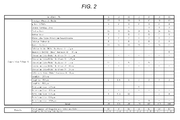
FIG. 2 is a table showing Embodiments 9-15 of the raw material composition for the friction material; -
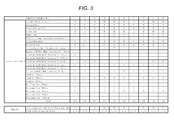
FIG. 3 is a table showing Comparative Examples 1-10 of the raw material composition for the friction material; -
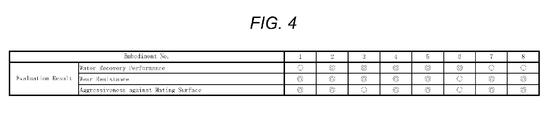
FIG. 4 is a table showing the performance evaluation results of Embodiments 1-8; -
FIG. 5 is a table showing the performance evaluation results of Embodiments 9-15; and -
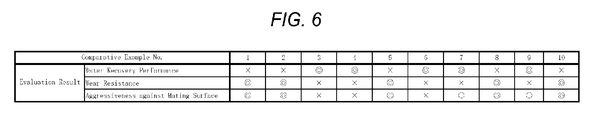
FIG. 6 is a table showing the performance evaluation results of Comparative Examples 1-10. - In the present invention, inorganic particles, which have 5-8 Mohs' hardness and an average particle diameter thereof is 0.5-10µm, are used in the amount of 0.5-10 volume % relative to the total amount of the friction material.
- The inorganic abrasive material with 5-8 Mohs' hardness can be selected from a group of zirconium silicate (7.5 Mohs' hardness), silicon dioxide (7 Mohs' hardness), zirconium oxide (7 Mohs' hardness), titanium dioxide (6 Mohs' hardness), and magnetite(Fe3O4) (5 Mohs' hardness) or any combination of the items in the group.
- If Mohs' hardness is less than 5, no sufficient roughness can be created on the friction surface of the mating member, thereby not providing effective inhibition of water fade while if Mohs' hardness is over 8, the wear resistance is lowered and the aggressiveness against the surface of the mating member heightens.
Here, Mohs's hardness in the present invention uses 10 phase Mohs' hardness. - Furthermore, if the average particle diameter of the inorganic abrasive material is less than 0.5µm, sufficient roughness cannot be created on the friction surface of the mating member, thereby not providing effective inhibition of water fade.
- If the average particle diameter of the inorganic abrasive material is over 10µm, the wear resistance lowers and the aggressiveness against the mating surface heightens.
- If the additional amount of the inorganic abrasive material is less than 0.5 volume %, no sufficient roughness can be created on the mating material, thereby not providing effective inhibition of water fade, while if the additional amount of the inorganic abrasive material is over 10 volume % then the wear resistance is lowered and the aggressiveness against the mating surface heightens.
Here, the average particle diameter of the present invention is 50 % particle diameter measured by a Laser Diffraction-type Particle Size Distribution Measuring Method. - The inorganic abrasive material in the present invention has a large abrasive force against the mating member and is shaped in an indeterminate form having corners.
- The inorganic abrasive material in the present invention does not include inorganic particles manufactured by melting or electromelting in almost spherical-shape which have 5-8 Mohs' hardness and a small abrasive force against the mating material.
- In the present invention, graphite and petroleum coke, in amount of 8-15 volume % relative to the total amount of the friction material, are used as a part of the lubricant.
- If the amount of graphite and petroleum coke is less than 8 volume %, no sufficient lubrication function can be expected, which lowers the wear resistance, while if the amount of graphite and petroleum coke is over 15 volume %, the friction coefficient becomes unstable, and thus degrades the brake effectiveness.
- Furthermore, too little graphite lowers the wear resistance at high temperatures and too much graphite damages effective inhibition of water fade and therefore graphite and petroleum coke are added so that the proportion of the same becomes 2:9-3:7 volume ratio.
- In the present invention, it is preferable to use graphite with an average particle diameter of 200-500µm, and more preferably 300-400µm.
If the average particle diameter is too small then the contacting surface area with the mating member is small, which provides insufficient lubricant function and lowers the wear resistance, while if the average particle diameter is too large then the contacting surface area with the mating member is large, which makes it easier to form a film on the mating member and damages effective inhibition of water fade. - Also, natural graphite, artificial graphite, or a combination thereof can be used as graphite.
- In the present invention, it is preferable to use petroleum coke with the average particle diameter of 400-900µm, more preferably 600-700µm.
If the average particle diameter is too small the contacting surface area with the mating member is small, which provides insufficient lubricant function and lowers the wear resistance, while if the average particle diameter is too large then the petroleum coke tends to drop from the friction material surface, which lowers the wear resistance. - Furthermore, the friction material of the present invention includes fiber base materials, such as nonferrous metal fiber, organic fiber, and inorganic fiber generally used for friction materials; a binder such as a thermosetting resin; a frictional wear modifier, such as an organic filler or an inorganic filler; a lubricant; a metal particle other than the above-identified inorganic abrasive material; graphite and petroleum coke.
- A nonferrous metal fiber such as copper, brass, or bronze , an organic fiber such as aramid, acrylic or carbon, and an inorganic fiber such as ceramic, rock wool, or potassium titanate fiber can be named as the fiber base where either a single element or combined multiple elements from the above may be used.
- The content of fiber included in the fiber base is preferably 5-60 volume % relative to the total amount of the friction material to secure sufficient mechanical strength, and more preferably 10-50 volume %.
- The binder may be a thermosetting resin such as phenolic resin or epoxy resin; a thermosetting resin obtained after modification of phenolic resin or epoxy resin by cashew oil, silicone oil, or various elastomers; a thermosetting resin obtained after dispersing such as the various elastomers and fluorine polymer, where a single element or combined multiple elements from the above may be used.
- The content of the binder is preferably 10-30 volume % relative to the total amount of friction material to secure sufficient mechanical strength and a wear resistance, and more preferably 12-25 volume %.
- The frictional wear modifier may be an organic filler such as cashew dust, rubber dust (a tire tread rubber pulverized powder); various unvulcanized rubber particle s, various vulcanized rubber particles; an inorganic filler such as barium sulfate, calcium carbonate, calcium hydroxide, vermiculite, mica, and almost spherical inorganic particles; a lubricant such as molybdenum disulfide, tin sulfide, zinc sulfide, and ferric sulfide; and a metal particle such as copper particle, brass particle, zinc particle, and aluminum particle, where a single element or combined multiple elements from the above may be used.
- The content of the frictional wear modifier is preferably 40-70 volume % according to the desired frictional wear characteristics relative to the total amount of the friction material, and more preferably 0-70 volume %.
- The friction material of the present invention is manufactured through the steps of uniformly mixing a predetermined amount of the above-explained inorganic abrasive material, the graphite, the petroleum coke, the fiber base, the binder, and the frictional wear modifier with a mixer such as a Loedige Mixer or an Eirich Mixer, a step of pre-forming, such as placing the obtained raw mixture in a pre-forming die, a step of heat-pressure-forming such as placing the pre-formed product in a heat forming die to process at the forming temperature of 130-180°C, forming pressure of 15-49MPa, for 3-10 minutes, a step of heat treating (postcuring) the obtained formed part at 140-250°C for 2-12 hours, a step of grinding the friction surface, and if necessary and appropriate, the steps of coating, baking, and scorching.
- When manufacturing the brake pads at the heat pressure forming step, a metal back plate that was already cleaned, surface treated, and had an adhesive applied thereon, is superposed on the above-stated pre-formed part to form the brake pad.
- The raw material composition for the friction material, as shown in Tables (Embodiments 1-8:
FIG. 1 , Embodiments 9-15:FIG. 2 . Comparative Examples 1-10: Table 3). is mixed for about 10 minutes by a Loedige Mixer, and the resultant mixture is placed in the pre-forming die to be pre-formed by pressurizing at 35MPa for 1 minute. - This pre-formed product and the iron back plate, which is pre-cleaned, surface treated, and has adhesive applied thereon, are superposed to be placed in a heat-forming metal die to be heated at the forming temperature of 155 and pressurized at the forming pressure of 40MPa for 5 minutes, heat-treated (postcured) in a heat treatment chamber at 200 for 4 hours, coated, baked, and grinded to form the brake pad for automobiles in the Embodiments and the Comparative Examples.
- The brake pad of Embodiments 1-15 and Comparative Examples 1-10 is installed on a dynamo meter and is tested according to the standard of water recovery test, JASO C406-00 (Automobile-Brake Device-Dynamometer Testing Method), and the water recovery ratio is calculated.
- Used caliper brake type: floating type caliper
- Inertia: 7.0kg/m2
- Formula: Water Recovery Ratio (%) = Minimum friction coefficient at Recovery Test / Average friction coefficient at Baseline Check x 100
- The evaluation standard for effective inhibition of water fade is:
- ⊚ : 90% or more
- ○ : less than 90%, 80% or more
- × : less than 80%
- A brake pad for an automobile as in Embodiments 1-15 and Comparative Examples 1-10 is set in the dynamometer to test the same according to a general wear test (initial braking temperature at 200°C) of JASO C427-88 (Brake Lining, Pad Friction Dynamometer Testing), and the wearing amount of the brake pad and the wearing amount of the brake disc were measured.
- Used caliper brake type: floating type caliper
- Inertia 7.0kg/m2
-
- ⊚ : less than 0.15mm
- ○ : 0.15mm or more, less than 0.25mm
- × : 0.25mm or more
-
- ⊚ : less than 5µm
- ○ : 5µm or more, less than 10µm
- × : 10µm or more
- Performance evaluation results of Embodiments and Comparative Examples are shown in Tables 4-6.
- From the performance evaluation results in Tables 4-6, the friction material, which is involving 0.5-10 volume % of inorganic particle, as the inorganic abrasive material, with Mohs' hardness 5-8 and average particle diameter 0.5-10µm relative to the entire amount of the friction material, and the graphite and the petroleum coke, as a part of the lubricant, with 8-15 volume % relative to the entire amount of the friction material, where the ratio of the graphite to petroleum coke is 2:8-3:7 in volume ratio, can effectively inhibit water fade and provide a good wear resistance and low aggressiveness against the mating surface.
- Furthermore, from the performance evaluation result as shown in
Embodiments Embodiment - The present invention provides a friction material that: does not increase manufacturing steps; can effectively inhibit water fade; provides good brake effectiveness and a good wear resistance; and give low aggressiveness against the mating surface; and the friction material is useful from a productivity point of view.
Moreover, the present invention provides, without depending upon the special control system to control the pressure force of the friction material against the brake disc, a practical and useful friction material that can effectively inhibit water fade. - While the embodiments of the present invention disclosed herein are presently considered to be preferred embodiments, various changes and modifications can be made without departing from the spirit and scope of the present invention. The scope of the invention is indicated in the appended claims, and all changes that come within the meaning and range of equivalents are intended to be embraced therein.
Claims (2)
- A friction material comprising:inorganic abrasive material including 0.5-10 volume % of inorganic particles relative to the total amount of the friction material; andlubricant including graphite and petroleum coke in the amount of 8-15 volume % relative to the total amount of the friction material,said inorganic particles are 5-8 Mohs' hardness and an average particle diameter thereof is 0.5-10µm, and a proportion of graphite and petroleum coke is 2:8-3:7 volume ratio.
- The friction material according to Claim 1, characterized in that the average particle diameter of said petroleum coke is 400-900µm.
Applications Claiming Priority (1)
| Application Number | Priority Date | Filing Date | Title |
|---|---|---|---|
| JP2008073323A JP5221177B2 (en) | 2008-03-21 | 2008-03-21 | Friction material |
Publications (2)
| Publication Number | Publication Date |
|---|---|
| EP2103833A1 true EP2103833A1 (en) | 2009-09-23 |
| EP2103833B1 EP2103833B1 (en) | 2014-07-02 |
Family
ID=40653536
Family Applications (1)
| Application Number | Title | Priority Date | Filing Date |
|---|---|---|---|
| EP09155234.9A Active EP2103833B1 (en) | 2008-03-21 | 2009-03-16 | Friction material |
Country Status (4)
| Country | Link |
|---|---|
| US (1) | US8057591B2 (en) |
| EP (1) | EP2103833B1 (en) |
| JP (1) | JP5221177B2 (en) |
| KR (1) | KR101562392B1 (en) |
Cited By (5)
| Publication number | Priority date | Publication date | Assignee | Title |
|---|---|---|---|---|
| CN102235453A (en) * | 2010-04-23 | 2011-11-09 | 日清纺制动器株式会社 | Disc brake pad |
| CN103603900A (en) * | 2013-11-19 | 2014-02-26 | 青岛广联达精密机械有限公司 | Low-noise disc brake pad material |
| CN106795423A (en) * | 2014-10-14 | 2017-05-31 | 日本制动工业株式会社 | Friction material composition, friction material and friction part |
| EP3239264A4 (en) * | 2014-12-24 | 2018-09-12 | Japan Brake Industrial Co., Ltd. | Friction material composition, friction material using same, and friction member |
| WO2019120648A1 (en) * | 2017-12-19 | 2019-06-27 | Federal-Mogul Friction Products Gmbh | Hybrid friction lining material, brake linings produced from same and method for producing same |
Families Citing this family (10)
| Publication number | Priority date | Publication date | Assignee | Title |
|---|---|---|---|---|
| JP6024460B2 (en) * | 2010-11-19 | 2016-11-16 | 日立化成株式会社 | Non-asbestos friction material composition, friction material and friction member using the same |
| JP6061592B2 (en) * | 2011-10-11 | 2017-01-18 | 曙ブレーキ工業株式会社 | Friction material and friction material manufacturing method |
| JP6290598B2 (en) | 2013-11-12 | 2018-03-07 | 曙ブレーキ工業株式会社 | Friction material composition and friction material |
| JP6254424B2 (en) * | 2013-11-12 | 2017-12-27 | 曙ブレーキ工業株式会社 | Friction material |
| JP5878951B2 (en) * | 2014-04-17 | 2016-03-08 | 日清紡ブレーキ株式会社 | Friction material |
| JP6958352B2 (en) * | 2015-04-28 | 2021-11-02 | 戸田工業株式会社 | Filler for friction material |
| JP6621110B2 (en) * | 2015-11-10 | 2019-12-18 | 日清紡ブレーキ株式会社 | Friction material |
| JP6836716B2 (en) * | 2017-02-22 | 2021-03-03 | 昭和電工マテリアルズ株式会社 | Friction material composition |
| JP2019206627A (en) * | 2018-05-28 | 2019-12-05 | 株式会社アドヴィックス | Friction material and friction material composition |
| JP7020506B2 (en) * | 2020-04-09 | 2022-02-16 | 昭和電工マテリアルズ株式会社 | Friction materials and friction members |
Citations (9)
| Publication number | Priority date | Publication date | Assignee | Title |
|---|---|---|---|---|
| US4217255A (en) * | 1977-07-14 | 1980-08-12 | Abex Corporation | Composition railroad friction material with synthetic fiber content |
| JPH08277866A (en) | 1995-04-04 | 1996-10-22 | Akebono Brake Ind Co Ltd | Brake pad |
| WO1998040641A1 (en) * | 1997-03-10 | 1998-09-17 | Alliedsignal Inc. | Coated friction pad for brake assembly |
| JP2004155843A (en) | 2002-11-05 | 2004-06-03 | Nisshinbo Ind Inc | Non-asbestos friction material |
| US20040175544A1 (en) * | 2002-12-04 | 2004-09-09 | Iwao Saikatsu | Non-asbestos-based friction materials |
| JP2007056063A (en) | 2005-08-22 | 2007-03-08 | Advics:Kk | Stainless fibrous base material for friction material |
| JP2007112952A (en) | 2005-10-24 | 2007-05-10 | Nisshinbo Ind Inc | Friction material |
| JP2007191010A (en) | 2006-01-18 | 2007-08-02 | Toyota Motor Corp | Disc brake device |
| US20070287768A1 (en) * | 2006-06-09 | 2007-12-13 | Akebono Brake Industry Co., Ltd. | Friction material |
Family Cites Families (16)
| Publication number | Priority date | Publication date | Assignee | Title |
|---|---|---|---|---|
| JPS58180573A (en) * | 1982-04-16 | 1983-10-22 | Toshiba Tungaloy Co Ltd | Wet friction material |
| US4722950A (en) | 1986-07-07 | 1988-02-02 | Allied Corporation | Friction material |
| JPH0323265A (en) * | 1989-06-16 | 1991-01-31 | Akebono Brake Res & Dev Center Ltd | Hybrid c/c composite for friction material and production thereof |
| JPH04306288A (en) * | 1991-04-03 | 1992-10-29 | Nisshinbo Ind Inc | Non-asbestos friction material |
| US5549511A (en) | 1994-12-06 | 1996-08-27 | International Business Machines Corporation | Variable travel carrier device and method for planarizing semiconductor wafers |
| JPH0931440A (en) * | 1995-07-21 | 1997-02-04 | Aisin Chem Co Ltd | Friction material |
| JP2000219872A (en) * | 1998-11-27 | 2000-08-08 | Nisshinbo Ind Inc | Friction material for parking brake |
| JP2000319635A (en) * | 1999-05-14 | 2000-11-21 | Hitachi Chem Co Ltd | Friction material composition and friction material using this |
| JP2000345141A (en) * | 1999-06-08 | 2000-12-12 | Tokai Carbon Co Ltd | Sintered metal friction material |
| JP2001240847A (en) * | 1999-12-20 | 2001-09-04 | Akebono Brake Ind Co Ltd | Frictional material |
| JP2001234960A (en) * | 2000-02-23 | 2001-08-31 | Aisin Seiki Co Ltd | Friction materials, pads, shoes |
| JP4071434B2 (en) * | 2000-10-31 | 2008-04-02 | 株式会社曙ブレーキ中央技術研究所 | Friction material for brake |
| JP2006249244A (en) * | 2005-03-10 | 2006-09-21 | Tanaka Seimitsu Kogyo Kk | Friction material |
| JP2006290938A (en) * | 2005-04-06 | 2006-10-26 | Nippon Brake Kogyo Kk | Friction material |
| DE102007061459B4 (en) * | 2006-12-27 | 2020-10-08 | Akebono Brake Industry Co., Ltd. | Asbestos-free friction material |
| JP5540396B2 (en) | 2009-02-27 | 2014-07-02 | 曙ブレーキ工業株式会社 | Friction material |
-
2008
- 2008-03-21 JP JP2008073323A patent/JP5221177B2/en active Active
-
2009
- 2009-01-30 KR KR1020090007217A patent/KR101562392B1/en active Active
- 2009-03-16 US US12/404,969 patent/US8057591B2/en active Active
- 2009-03-16 EP EP09155234.9A patent/EP2103833B1/en active Active
Patent Citations (10)
| Publication number | Priority date | Publication date | Assignee | Title |
|---|---|---|---|---|
| US4217255A (en) * | 1977-07-14 | 1980-08-12 | Abex Corporation | Composition railroad friction material with synthetic fiber content |
| JPH08277866A (en) | 1995-04-04 | 1996-10-22 | Akebono Brake Ind Co Ltd | Brake pad |
| WO1998040641A1 (en) * | 1997-03-10 | 1998-09-17 | Alliedsignal Inc. | Coated friction pad for brake assembly |
| JP2004155843A (en) | 2002-11-05 | 2004-06-03 | Nisshinbo Ind Inc | Non-asbestos friction material |
| US20040175544A1 (en) * | 2002-12-04 | 2004-09-09 | Iwao Saikatsu | Non-asbestos-based friction materials |
| JP2007056063A (en) | 2005-08-22 | 2007-03-08 | Advics:Kk | Stainless fibrous base material for friction material |
| JP2007112952A (en) | 2005-10-24 | 2007-05-10 | Nisshinbo Ind Inc | Friction material |
| JP2007191010A (en) | 2006-01-18 | 2007-08-02 | Toyota Motor Corp | Disc brake device |
| US20070287768A1 (en) * | 2006-06-09 | 2007-12-13 | Akebono Brake Industry Co., Ltd. | Friction material |
| JP2007326999A (en) | 2006-06-09 | 2007-12-20 | Akebono Brake Ind Co Ltd | Friction material |
Cited By (9)
| Publication number | Priority date | Publication date | Assignee | Title |
|---|---|---|---|---|
| CN102235453A (en) * | 2010-04-23 | 2011-11-09 | 日清纺制动器株式会社 | Disc brake pad |
| CN102235453B (en) * | 2010-04-23 | 2015-06-24 | 日清纺制动器株式会社 | Disc brake pad |
| CN103603900A (en) * | 2013-11-19 | 2014-02-26 | 青岛广联达精密机械有限公司 | Low-noise disc brake pad material |
| CN106795423A (en) * | 2014-10-14 | 2017-05-31 | 日本制动工业株式会社 | Friction material composition, friction material and friction part |
| EP3239264A4 (en) * | 2014-12-24 | 2018-09-12 | Japan Brake Industrial Co., Ltd. | Friction material composition, friction material using same, and friction member |
| WO2019120648A1 (en) * | 2017-12-19 | 2019-06-27 | Federal-Mogul Friction Products Gmbh | Hybrid friction lining material, brake linings produced from same and method for producing same |
| CN111492149A (en) * | 2017-12-19 | 2020-08-04 | 联邦-莫高摩擦产品有限公司 | Hybrid friction pad material and brake pad made therefrom and method of making the same |
| CN111492149B (en) * | 2017-12-19 | 2022-02-08 | 联邦-莫高摩擦产品有限公司 | Hybrid friction plate material, brake pad manufactured by same and manufacturing method thereof |
| US11359688B2 (en) | 2017-12-19 | 2022-06-14 | Federal-Mogul Friction Products Gmbh | Hybrid friction lining material, brake linings produced from same and method for producing same |
Also Published As
| Publication number | Publication date |
|---|---|
| US20090239076A1 (en) | 2009-09-24 |
| KR101562392B1 (en) | 2015-10-21 |
| EP2103833B1 (en) | 2014-07-02 |
| JP5221177B2 (en) | 2013-06-26 |
| KR20090101081A (en) | 2009-09-24 |
| JP2009227768A (en) | 2009-10-08 |
| US8057591B2 (en) | 2011-11-15 |
Similar Documents
| Publication | Publication Date | Title |
|---|---|---|
| EP2103833B1 (en) | Friction material | |
| US20130096228A1 (en) | Friction material | |
| KR102255672B1 (en) | Friction material | |
| JP5797428B2 (en) | Disc brake pad | |
| JP6226042B2 (en) | Non-asbestos friction material composition, friction material and friction member using the same | |
| WO2007106880A2 (en) | Friction material | |
| US20190107164A1 (en) | Friction material composition | |
| JP2008163178A (en) | Friction material for brake | |
| WO2012020660A1 (en) | Friction material composition, and friction material and friction member using same | |
| WO2012066966A1 (en) | Non-asbestos friction material composition, friction material using same, and friction member | |
| CN108291133B (en) | Friction material | |
| JP5540396B2 (en) | Friction material | |
| CN114174420A (en) | friction material | |
| JP2011236332A (en) | Friction material | |
| JP4412475B2 (en) | Friction material | |
| JP6254424B2 (en) | Friction material | |
| JP7358843B2 (en) | Friction materials and friction material compositions | |
| JP6439914B2 (en) | Friction material | |
| JP2009298847A (en) | Friction material | |
| US20180172098A1 (en) | Friction material | |
| JP5519142B2 (en) | Friction member and brake device | |
| JP6031393B2 (en) | Brake friction material |
Legal Events
| Date | Code | Title | Description |
|---|---|---|---|
| PUAI | Public reference made under article 153(3) epc to a published international application that has entered the european phase |
Free format text: ORIGINAL CODE: 0009012 |
|
| AK | Designated contracting states |
Kind code of ref document: A1 Designated state(s): AT BE BG CH CY CZ DE DK EE ES FI FR GB GR HR HU IE IS IT LI LT LU LV MC MK MT NL NO PL PT RO SE SI SK TR |
|
| AX | Request for extension of the european patent |
Extension state: AL BA RS |
|
| 17P | Request for examination filed |
Effective date: 20100323 |
|
| AKX | Designation fees paid |
Designated state(s): AT BE BG CH CY CZ DE DK EE ES FI FR GB GR HR HU IE IS IT LI LT LU LV MC MK MT NL NO PL PT RO SE SI SK TR |
|
| GRAP | Despatch of communication of intention to grant a patent |
Free format text: ORIGINAL CODE: EPIDOSNIGR1 |
|
| GRAS | Grant fee paid |
Free format text: ORIGINAL CODE: EPIDOSNIGR3 |
|
| GRAP | Despatch of communication of intention to grant a patent |
Free format text: ORIGINAL CODE: EPIDOSNIGR1 |
|
| INTG | Intention to grant announced |
Effective date: 20140129 |
|
| GRAL | Information related to payment of fee for publishing/printing deleted |
Free format text: ORIGINAL CODE: EPIDOSDIGR3 |
|
| GRAS | Grant fee paid |
Free format text: ORIGINAL CODE: EPIDOSNIGR3 |
|
| GRAA | (expected) grant |
Free format text: ORIGINAL CODE: 0009210 |
|
| AK | Designated contracting states |
Kind code of ref document: B1 Designated state(s): AT BE BG CH CY CZ DE DK EE ES FI FR GB GR HR HU IE IS IT LI LT LU LV MC MK MT NL NO PL PT RO SE SI SK TR |
|
| REG | Reference to a national code |
Ref country code: GB Ref legal event code: FG4D |
|
| REG | Reference to a national code |
Ref country code: CH Ref legal event code: EP Ref country code: AT Ref legal event code: REF Ref document number: 676105 Country of ref document: AT Kind code of ref document: T Effective date: 20140715 |
|
| REG | Reference to a national code |
Ref country code: IE Ref legal event code: FG4D |
|
| REG | Reference to a national code |
Ref country code: DE Ref legal event code: R096 Ref document number: 602009025036 Country of ref document: DE Effective date: 20140814 |
|
| REG | Reference to a national code |
Ref country code: AT Ref legal event code: MK05 Ref document number: 676105 Country of ref document: AT Kind code of ref document: T Effective date: 20140702 |
|
| REG | Reference to a national code |
Ref country code: NL Ref legal event code: VDEP Effective date: 20140702 |
|
| REG | Reference to a national code |
Ref country code: LT Ref legal event code: MG4D |
|
| PG25 | Lapsed in a contracting state [announced via postgrant information from national office to epo] |
Ref country code: ES Free format text: LAPSE BECAUSE OF FAILURE TO SUBMIT A TRANSLATION OF THE DESCRIPTION OR TO PAY THE FEE WITHIN THE PRESCRIBED TIME-LIMIT Effective date: 20140702 Ref country code: NO Free format text: LAPSE BECAUSE OF FAILURE TO SUBMIT A TRANSLATION OF THE DESCRIPTION OR TO PAY THE FEE WITHIN THE PRESCRIBED TIME-LIMIT Effective date: 20141002 Ref country code: PT Free format text: LAPSE BECAUSE OF FAILURE TO SUBMIT A TRANSLATION OF THE DESCRIPTION OR TO PAY THE FEE WITHIN THE PRESCRIBED TIME-LIMIT Effective date: 20141103 Ref country code: GR Free format text: LAPSE BECAUSE OF FAILURE TO SUBMIT A TRANSLATION OF THE DESCRIPTION OR TO PAY THE FEE WITHIN THE PRESCRIBED TIME-LIMIT Effective date: 20141003 Ref country code: LT Free format text: LAPSE BECAUSE OF FAILURE TO SUBMIT A TRANSLATION OF THE DESCRIPTION OR TO PAY THE FEE WITHIN THE PRESCRIBED TIME-LIMIT Effective date: 20140702 Ref country code: SE Free format text: LAPSE BECAUSE OF FAILURE TO SUBMIT A TRANSLATION OF THE DESCRIPTION OR TO PAY THE FEE WITHIN THE PRESCRIBED TIME-LIMIT Effective date: 20140702 Ref country code: CZ Free format text: LAPSE BECAUSE OF FAILURE TO SUBMIT A TRANSLATION OF THE DESCRIPTION OR TO PAY THE FEE WITHIN THE PRESCRIBED TIME-LIMIT Effective date: 20140702 Ref country code: BG Free format text: LAPSE BECAUSE OF FAILURE TO SUBMIT A TRANSLATION OF THE DESCRIPTION OR TO PAY THE FEE WITHIN THE PRESCRIBED TIME-LIMIT Effective date: 20141002 Ref country code: FI Free format text: LAPSE BECAUSE OF FAILURE TO SUBMIT A TRANSLATION OF THE DESCRIPTION OR TO PAY THE FEE WITHIN THE PRESCRIBED TIME-LIMIT Effective date: 20140702 |
|
| PG25 | Lapsed in a contracting state [announced via postgrant information from national office to epo] |
Ref country code: NL Free format text: LAPSE BECAUSE OF FAILURE TO SUBMIT A TRANSLATION OF THE DESCRIPTION OR TO PAY THE FEE WITHIN THE PRESCRIBED TIME-LIMIT Effective date: 20140702 Ref country code: IS Free format text: LAPSE BECAUSE OF FAILURE TO SUBMIT A TRANSLATION OF THE DESCRIPTION OR TO PAY THE FEE WITHIN THE PRESCRIBED TIME-LIMIT Effective date: 20141102 Ref country code: AT Free format text: LAPSE BECAUSE OF FAILURE TO SUBMIT A TRANSLATION OF THE DESCRIPTION OR TO PAY THE FEE WITHIN THE PRESCRIBED TIME-LIMIT Effective date: 20140702 Ref country code: CY Free format text: LAPSE BECAUSE OF FAILURE TO SUBMIT A TRANSLATION OF THE DESCRIPTION OR TO PAY THE FEE WITHIN THE PRESCRIBED TIME-LIMIT Effective date: 20140702 Ref country code: HR Free format text: LAPSE BECAUSE OF FAILURE TO SUBMIT A TRANSLATION OF THE DESCRIPTION OR TO PAY THE FEE WITHIN THE PRESCRIBED TIME-LIMIT Effective date: 20140702 Ref country code: PL Free format text: LAPSE BECAUSE OF FAILURE TO SUBMIT A TRANSLATION OF THE DESCRIPTION OR TO PAY THE FEE WITHIN THE PRESCRIBED TIME-LIMIT Effective date: 20140702 Ref country code: LV Free format text: LAPSE BECAUSE OF FAILURE TO SUBMIT A TRANSLATION OF THE DESCRIPTION OR TO PAY THE FEE WITHIN THE PRESCRIBED TIME-LIMIT Effective date: 20140702 |
|
| REG | Reference to a national code |
Ref country code: DE Ref legal event code: R097 Ref document number: 602009025036 Country of ref document: DE |
|
| PG25 | Lapsed in a contracting state [announced via postgrant information from national office to epo] |
Ref country code: RO Free format text: LAPSE BECAUSE OF FAILURE TO SUBMIT A TRANSLATION OF THE DESCRIPTION OR TO PAY THE FEE WITHIN THE PRESCRIBED TIME-LIMIT Effective date: 20140702 Ref country code: SK Free format text: LAPSE BECAUSE OF FAILURE TO SUBMIT A TRANSLATION OF THE DESCRIPTION OR TO PAY THE FEE WITHIN THE PRESCRIBED TIME-LIMIT Effective date: 20140702 Ref country code: IT Free format text: LAPSE BECAUSE OF FAILURE TO SUBMIT A TRANSLATION OF THE DESCRIPTION OR TO PAY THE FEE WITHIN THE PRESCRIBED TIME-LIMIT Effective date: 20140702 Ref country code: EE Free format text: LAPSE BECAUSE OF FAILURE TO SUBMIT A TRANSLATION OF THE DESCRIPTION OR TO PAY THE FEE WITHIN THE PRESCRIBED TIME-LIMIT Effective date: 20140702 Ref country code: DK Free format text: LAPSE BECAUSE OF FAILURE TO SUBMIT A TRANSLATION OF THE DESCRIPTION OR TO PAY THE FEE WITHIN THE PRESCRIBED TIME-LIMIT Effective date: 20140702 |
|
| PLBE | No opposition filed within time limit |
Free format text: ORIGINAL CODE: 0009261 |
|
| STAA | Information on the status of an ep patent application or granted ep patent |
Free format text: STATUS: NO OPPOSITION FILED WITHIN TIME LIMIT |
|
| 26N | No opposition filed |
Effective date: 20150407 |
|
| PG25 | Lapsed in a contracting state [announced via postgrant information from national office to epo] |
Ref country code: MC Free format text: LAPSE BECAUSE OF FAILURE TO SUBMIT A TRANSLATION OF THE DESCRIPTION OR TO PAY THE FEE WITHIN THE PRESCRIBED TIME-LIMIT Effective date: 20140702 Ref country code: LU Free format text: LAPSE BECAUSE OF FAILURE TO SUBMIT A TRANSLATION OF THE DESCRIPTION OR TO PAY THE FEE WITHIN THE PRESCRIBED TIME-LIMIT Effective date: 20150316 |
|
| REG | Reference to a national code |
Ref country code: CH Ref legal event code: PL |
|
| GBPC | Gb: european patent ceased through non-payment of renewal fee |
Effective date: 20150316 |
|
| PG25 | Lapsed in a contracting state [announced via postgrant information from national office to epo] |
Ref country code: SI Free format text: LAPSE BECAUSE OF FAILURE TO SUBMIT A TRANSLATION OF THE DESCRIPTION OR TO PAY THE FEE WITHIN THE PRESCRIBED TIME-LIMIT Effective date: 20140702 |
|
| REG | Reference to a national code |
Ref country code: FR Ref legal event code: ST Effective date: 20151130 |
|
| REG | Reference to a national code |
Ref country code: IE Ref legal event code: MM4A |
|
| PG25 | Lapsed in a contracting state [announced via postgrant information from national office to epo] |
Ref country code: IE Free format text: LAPSE BECAUSE OF NON-PAYMENT OF DUE FEES Effective date: 20150316 Ref country code: CH Free format text: LAPSE BECAUSE OF NON-PAYMENT OF DUE FEES Effective date: 20150331 Ref country code: GB Free format text: LAPSE BECAUSE OF NON-PAYMENT OF DUE FEES Effective date: 20150316 Ref country code: LI Free format text: LAPSE BECAUSE OF NON-PAYMENT OF DUE FEES Effective date: 20150331 |
|
| PG25 | Lapsed in a contracting state [announced via postgrant information from national office to epo] |
Ref country code: FR Free format text: LAPSE BECAUSE OF NON-PAYMENT OF DUE FEES Effective date: 20150331 |
|
| PG25 | Lapsed in a contracting state [announced via postgrant information from national office to epo] |
Ref country code: BE Free format text: LAPSE BECAUSE OF FAILURE TO SUBMIT A TRANSLATION OF THE DESCRIPTION OR TO PAY THE FEE WITHIN THE PRESCRIBED TIME-LIMIT Effective date: 20140702 |
|
| PG25 | Lapsed in a contracting state [announced via postgrant information from national office to epo] |
Ref country code: MT Free format text: LAPSE BECAUSE OF FAILURE TO SUBMIT A TRANSLATION OF THE DESCRIPTION OR TO PAY THE FEE WITHIN THE PRESCRIBED TIME-LIMIT Effective date: 20140702 |
|
| PG25 | Lapsed in a contracting state [announced via postgrant information from national office to epo] |
Ref country code: HU Free format text: LAPSE BECAUSE OF FAILURE TO SUBMIT A TRANSLATION OF THE DESCRIPTION OR TO PAY THE FEE WITHIN THE PRESCRIBED TIME-LIMIT; INVALID AB INITIO Effective date: 20090316 |
|
| PG25 | Lapsed in a contracting state [announced via postgrant information from national office to epo] |
Ref country code: TR Free format text: LAPSE BECAUSE OF FAILURE TO SUBMIT A TRANSLATION OF THE DESCRIPTION OR TO PAY THE FEE WITHIN THE PRESCRIBED TIME-LIMIT Effective date: 20140702 |
|
| REG | Reference to a national code |
Ref country code: DE Ref legal event code: R082 Ref document number: 602009025036 Country of ref document: DE Representative=s name: SCHMIDT-IP PATENTANWALTSKANZLEI, DE |
|
| PG25 | Lapsed in a contracting state [announced via postgrant information from national office to epo] |
Ref country code: MK Free format text: LAPSE BECAUSE OF FAILURE TO SUBMIT A TRANSLATION OF THE DESCRIPTION OR TO PAY THE FEE WITHIN THE PRESCRIBED TIME-LIMIT Effective date: 20140702 |
|
| REG | Reference to a national code |
Ref country code: DE Ref legal event code: R082 Ref document number: 602009025036 Country of ref document: DE Representative=s name: SCHMIDT, AXEL, DIPL.-ING., DE |
|
| PGFP | Annual fee paid to national office [announced via postgrant information from national office to epo] |
Ref country code: DE Payment date: 20260128 Year of fee payment: 18 |