EP2103714A1 - Porous titanium having low contact resistance - Google Patents
Porous titanium having low contact resistance Download PDFInfo
- Publication number
- EP2103714A1 EP2103714A1 EP07850558A EP07850558A EP2103714A1 EP 2103714 A1 EP2103714 A1 EP 2103714A1 EP 07850558 A EP07850558 A EP 07850558A EP 07850558 A EP07850558 A EP 07850558A EP 2103714 A1 EP2103714 A1 EP 2103714A1
- Authority
- EP
- European Patent Office
- Prior art keywords
- porous titanium
- contact resistance
- titanium
- network
- porous
- Prior art date
- Legal status (The legal status is an assumption and is not a legal conclusion. Google has not performed a legal analysis and makes no representation as to the accuracy of the status listed.)
- Granted
Links
Images



Classifications
-
- H—ELECTRICITY
- H01—ELECTRIC ELEMENTS
- H01M—PROCESSES OR MEANS, e.g. BATTERIES, FOR THE DIRECT CONVERSION OF CHEMICAL ENERGY INTO ELECTRICAL ENERGY
- H01M4/00—Electrodes
- H01M4/86—Inert electrodes with catalytic activity, e.g. for fuel cells
- H01M4/88—Processes of manufacture
- H01M4/8803—Supports for the deposition of the catalytic active composition
- H01M4/8807—Gas diffusion layers
-
- C—CHEMISTRY; METALLURGY
- C23—COATING METALLIC MATERIAL; COATING MATERIAL WITH METALLIC MATERIAL; CHEMICAL SURFACE TREATMENT; DIFFUSION TREATMENT OF METALLIC MATERIAL; COATING BY VACUUM EVAPORATION, BY SPUTTERING, BY ION IMPLANTATION OR BY CHEMICAL VAPOUR DEPOSITION, IN GENERAL; INHIBITING CORROSION OF METALLIC MATERIAL OR INCRUSTATION IN GENERAL
- C23C—COATING METALLIC MATERIAL; COATING MATERIAL WITH METALLIC MATERIAL; SURFACE TREATMENT OF METALLIC MATERIAL BY DIFFUSION INTO THE SURFACE, BY CHEMICAL CONVERSION OR SUBSTITUTION; COATING BY VACUUM EVAPORATION, BY SPUTTERING, BY ION IMPLANTATION OR BY CHEMICAL VAPOUR DEPOSITION, IN GENERAL
- C23C24/00—Coating starting from inorganic powder
- C23C24/08—Coating starting from inorganic powder by application of heat or pressure and heat
- C23C24/082—Coating starting from inorganic powder by application of heat or pressure and heat without intermediate formation of a liquid in the layer
- C23C24/085—Coating with metallic material, i.e. metals or metal alloys, optionally comprising hard particles, e.g. oxides, carbides or nitrides
- C23C24/087—Coating with metal alloys or metal elements only
-
- C—CHEMISTRY; METALLURGY
- C23—COATING METALLIC MATERIAL; COATING MATERIAL WITH METALLIC MATERIAL; CHEMICAL SURFACE TREATMENT; DIFFUSION TREATMENT OF METALLIC MATERIAL; COATING BY VACUUM EVAPORATION, BY SPUTTERING, BY ION IMPLANTATION OR BY CHEMICAL VAPOUR DEPOSITION, IN GENERAL; INHIBITING CORROSION OF METALLIC MATERIAL OR INCRUSTATION IN GENERAL
- C23C—COATING METALLIC MATERIAL; COATING MATERIAL WITH METALLIC MATERIAL; SURFACE TREATMENT OF METALLIC MATERIAL BY DIFFUSION INTO THE SURFACE, BY CHEMICAL CONVERSION OR SUBSTITUTION; COATING BY VACUUM EVAPORATION, BY SPUTTERING, BY ION IMPLANTATION OR BY CHEMICAL VAPOUR DEPOSITION, IN GENERAL
- C23C28/00—Coating for obtaining at least two superposed coatings either by methods not provided for in a single one of groups C23C2/00 - C23C26/00 or by combinations of methods provided for in subclasses C23C and C25C or C25D
- C23C28/04—Coating for obtaining at least two superposed coatings either by methods not provided for in a single one of groups C23C2/00 - C23C26/00 or by combinations of methods provided for in subclasses C23C and C25C or C25D only coatings of inorganic non-metallic material
- C23C28/042—Coating for obtaining at least two superposed coatings either by methods not provided for in a single one of groups C23C2/00 - C23C26/00 or by combinations of methods provided for in subclasses C23C and C25C or C25D only coatings of inorganic non-metallic material including a refractory ceramic layer, e.g. refractory metal oxides, ZrO2, rare earth oxides
-
- C—CHEMISTRY; METALLURGY
- C23—COATING METALLIC MATERIAL; COATING MATERIAL WITH METALLIC MATERIAL; CHEMICAL SURFACE TREATMENT; DIFFUSION TREATMENT OF METALLIC MATERIAL; COATING BY VACUUM EVAPORATION, BY SPUTTERING, BY ION IMPLANTATION OR BY CHEMICAL VAPOUR DEPOSITION, IN GENERAL; INHIBITING CORROSION OF METALLIC MATERIAL OR INCRUSTATION IN GENERAL
- C23C—COATING METALLIC MATERIAL; COATING MATERIAL WITH METALLIC MATERIAL; SURFACE TREATMENT OF METALLIC MATERIAL BY DIFFUSION INTO THE SURFACE, BY CHEMICAL CONVERSION OR SUBSTITUTION; COATING BY VACUUM EVAPORATION, BY SPUTTERING, BY ION IMPLANTATION OR BY CHEMICAL VAPOUR DEPOSITION, IN GENERAL
- C23C28/00—Coating for obtaining at least two superposed coatings either by methods not provided for in a single one of groups C23C2/00 - C23C26/00 or by combinations of methods provided for in subclasses C23C and C25C or C25D
- C23C28/04—Coating for obtaining at least two superposed coatings either by methods not provided for in a single one of groups C23C2/00 - C23C26/00 or by combinations of methods provided for in subclasses C23C and C25C or C25D only coatings of inorganic non-metallic material
- C23C28/048—Coating for obtaining at least two superposed coatings either by methods not provided for in a single one of groups C23C2/00 - C23C26/00 or by combinations of methods provided for in subclasses C23C and C25C or C25D only coatings of inorganic non-metallic material with layers graded in composition or physical properties
-
- H—ELECTRICITY
- H01—ELECTRIC ELEMENTS
- H01M—PROCESSES OR MEANS, e.g. BATTERIES, FOR THE DIRECT CONVERSION OF CHEMICAL ENERGY INTO ELECTRICAL ENERGY
- H01M4/00—Electrodes
- H01M4/86—Inert electrodes with catalytic activity, e.g. for fuel cells
- H01M4/88—Processes of manufacture
- H01M4/8817—Treatment of supports before application of the catalytic active composition
-
- H—ELECTRICITY
- H01—ELECTRIC ELEMENTS
- H01M—PROCESSES OR MEANS, e.g. BATTERIES, FOR THE DIRECT CONVERSION OF CHEMICAL ENERGY INTO ELECTRICAL ENERGY
- H01M4/00—Electrodes
- H01M4/86—Inert electrodes with catalytic activity, e.g. for fuel cells
- H01M4/90—Selection of catalytic material
-
- H—ELECTRICITY
- H01—ELECTRIC ELEMENTS
- H01M—PROCESSES OR MEANS, e.g. BATTERIES, FOR THE DIRECT CONVERSION OF CHEMICAL ENERGY INTO ELECTRICAL ENERGY
- H01M8/00—Fuel cells; Manufacture thereof
- H01M8/02—Details
- H01M8/0202—Collectors; Separators, e.g. bipolar separators; Interconnectors
- H01M8/023—Porous and characterised by the material
- H01M8/0232—Metals or alloys
-
- H—ELECTRICITY
- H01—ELECTRIC ELEMENTS
- H01M—PROCESSES OR MEANS, e.g. BATTERIES, FOR THE DIRECT CONVERSION OF CHEMICAL ENERGY INTO ELECTRICAL ENERGY
- H01M8/00—Fuel cells; Manufacture thereof
- H01M8/02—Details
- H01M8/0202—Collectors; Separators, e.g. bipolar separators; Interconnectors
- H01M8/023—Porous and characterised by the material
- H01M8/0241—Composites
-
- H—ELECTRICITY
- H01—ELECTRIC ELEMENTS
- H01M—PROCESSES OR MEANS, e.g. BATTERIES, FOR THE DIRECT CONVERSION OF CHEMICAL ENERGY INTO ELECTRICAL ENERGY
- H01M8/00—Fuel cells; Manufacture thereof
- H01M8/02—Details
- H01M8/0202—Collectors; Separators, e.g. bipolar separators; Interconnectors
- H01M8/023—Porous and characterised by the material
- H01M8/0241—Composites
- H01M8/0245—Composites in the form of layered or coated products
-
- H—ELECTRICITY
- H01—ELECTRIC ELEMENTS
- H01M—PROCESSES OR MEANS, e.g. BATTERIES, FOR THE DIRECT CONVERSION OF CHEMICAL ENERGY INTO ELECTRICAL ENERGY
- H01M8/00—Fuel cells; Manufacture thereof
- H01M8/10—Fuel cells with solid electrolytes
- H01M2008/1095—Fuel cells with polymeric electrolytes
-
- Y—GENERAL TAGGING OF NEW TECHNOLOGICAL DEVELOPMENTS; GENERAL TAGGING OF CROSS-SECTIONAL TECHNOLOGIES SPANNING OVER SEVERAL SECTIONS OF THE IPC; TECHNICAL SUBJECTS COVERED BY FORMER USPC CROSS-REFERENCE ART COLLECTIONS [XRACs] AND DIGESTS
- Y02—TECHNOLOGIES OR APPLICATIONS FOR MITIGATION OR ADAPTATION AGAINST CLIMATE CHANGE
- Y02E—REDUCTION OF GREENHOUSE GAS [GHG] EMISSIONS, RELATED TO ENERGY GENERATION, TRANSMISSION OR DISTRIBUTION
- Y02E60/00—Enabling technologies; Technologies with a potential or indirect contribution to GHG emissions mitigation
- Y02E60/30—Hydrogen technology
- Y02E60/50—Fuel cells
-
- Y—GENERAL TAGGING OF NEW TECHNOLOGICAL DEVELOPMENTS; GENERAL TAGGING OF CROSS-SECTIONAL TECHNOLOGIES SPANNING OVER SEVERAL SECTIONS OF THE IPC; TECHNICAL SUBJECTS COVERED BY FORMER USPC CROSS-REFERENCE ART COLLECTIONS [XRACs] AND DIGESTS
- Y10—TECHNICAL SUBJECTS COVERED BY FORMER USPC
- Y10S—TECHNICAL SUBJECTS COVERED BY FORMER USPC CROSS-REFERENCE ART COLLECTIONS [XRACs] AND DIGESTS
- Y10S977/00—Nanotechnology
- Y10S977/70—Nanostructure
- Y10S977/762—Nanowire or quantum wire, i.e. axially elongated structure having two dimensions of 100 nm or less
-
- Y—GENERAL TAGGING OF NEW TECHNOLOGICAL DEVELOPMENTS; GENERAL TAGGING OF CROSS-SECTIONAL TECHNOLOGIES SPANNING OVER SEVERAL SECTIONS OF THE IPC; TECHNICAL SUBJECTS COVERED BY FORMER USPC CROSS-REFERENCE ART COLLECTIONS [XRACs] AND DIGESTS
- Y10—TECHNICAL SUBJECTS COVERED BY FORMER USPC
- Y10S—TECHNICAL SUBJECTS COVERED BY FORMER USPC CROSS-REFERENCE ART COLLECTIONS [XRACs] AND DIGESTS
- Y10S977/00—Nanotechnology
- Y10S977/70—Nanostructure
- Y10S977/81—Of specified metal or metal alloy composition
-
- Y—GENERAL TAGGING OF NEW TECHNOLOGICAL DEVELOPMENTS; GENERAL TAGGING OF CROSS-SECTIONAL TECHNOLOGIES SPANNING OVER SEVERAL SECTIONS OF THE IPC; TECHNICAL SUBJECTS COVERED BY FORMER USPC CROSS-REFERENCE ART COLLECTIONS [XRACs] AND DIGESTS
- Y10—TECHNICAL SUBJECTS COVERED BY FORMER USPC
- Y10S—TECHNICAL SUBJECTS COVERED BY FORMER USPC CROSS-REFERENCE ART COLLECTIONS [XRACs] AND DIGESTS
- Y10S977/00—Nanotechnology
- Y10S977/70—Nanostructure
- Y10S977/811—Of specified metal oxide composition, e.g. conducting or semiconducting compositions such as ITO, ZnOx
-
- Y—GENERAL TAGGING OF NEW TECHNOLOGICAL DEVELOPMENTS; GENERAL TAGGING OF CROSS-SECTIONAL TECHNOLOGIES SPANNING OVER SEVERAL SECTIONS OF THE IPC; TECHNICAL SUBJECTS COVERED BY FORMER USPC CROSS-REFERENCE ART COLLECTIONS [XRACs] AND DIGESTS
- Y10—TECHNICAL SUBJECTS COVERED BY FORMER USPC
- Y10T—TECHNICAL SUBJECTS COVERED BY FORMER US CLASSIFICATION
- Y10T428/00—Stock material or miscellaneous articles
- Y10T428/12—All metal or with adjacent metals
- Y10T428/12479—Porous [e.g., foamed, spongy, cracked, etc.]
-
- Y—GENERAL TAGGING OF NEW TECHNOLOGICAL DEVELOPMENTS; GENERAL TAGGING OF CROSS-SECTIONAL TECHNOLOGIES SPANNING OVER SEVERAL SECTIONS OF THE IPC; TECHNICAL SUBJECTS COVERED BY FORMER USPC CROSS-REFERENCE ART COLLECTIONS [XRACs] AND DIGESTS
- Y10—TECHNICAL SUBJECTS COVERED BY FORMER USPC
- Y10T—TECHNICAL SUBJECTS COVERED BY FORMER US CLASSIFICATION
- Y10T428/00—Stock material or miscellaneous articles
- Y10T428/12—All metal or with adjacent metals
- Y10T428/12493—Composite; i.e., plural, adjacent, spatially distinct metal components [e.g., layers, joint, etc.]
- Y10T428/12771—Transition metal-base component
- Y10T428/12806—Refractory [Group IVB, VB, or VIB] metal-base component
-
- Y—GENERAL TAGGING OF NEW TECHNOLOGICAL DEVELOPMENTS; GENERAL TAGGING OF CROSS-SECTIONAL TECHNOLOGIES SPANNING OVER SEVERAL SECTIONS OF THE IPC; TECHNICAL SUBJECTS COVERED BY FORMER USPC CROSS-REFERENCE ART COLLECTIONS [XRACs] AND DIGESTS
- Y10—TECHNICAL SUBJECTS COVERED BY FORMER USPC
- Y10T—TECHNICAL SUBJECTS COVERED BY FORMER US CLASSIFICATION
- Y10T428/00—Stock material or miscellaneous articles
- Y10T428/12—All metal or with adjacent metals
- Y10T428/12493—Composite; i.e., plural, adjacent, spatially distinct metal components [e.g., layers, joint, etc.]
- Y10T428/12771—Transition metal-base component
- Y10T428/12861—Group VIII or IB metal-base component
- Y10T428/12889—Au-base component
Definitions
- the present invention relates to porous titanium having a low contact resistance in which Au adheres to at least an outer surface of the skeletal structure of the porous titanium body via diffusion bonding to form a continuous network structure.
- the porous titanium is used for an air electrode and a fuel electrode of a polymer electrolyte fuel cell.
- a polymer electrolyte fuel cell usually has an air electrode provided at one side of an electrolyte and a fuel electrode provided at the other side of the electrolyte.
- the air electrode and the fuel electrode are both formed from a conductive porous body with a catalyst.
- a plurality of such structures is stacked together via separators to form a polymer electrolyte fuel cell.
- the air electrodes and the first separators are in contact with each other, and the fuel electrodes and the second separators are in contact with each other. Contact resistance therebetween should be low.
- the separator is commonly a carbon plate or a metal plate.
- Examples of the conductive porous body for forming the air electrode and the fuel electrode include nonwoven fabric of carbon fiber which is called carbon paper, and porous metal, and so on.
- a metal plate such as a titanium plate
- the titanium plate is plated with Au in order to reduce contact resistance that may be high in a use environment due to an oxide layer having high electrical resistance formed on the titanium surface.
- Such an Au-plated titanium plate is heat-treated to reduce the contact resistance (see Patent Document 1).
- a known method of forming an Au coating on the surface of the titanium plate includes depositing Au after removing a Ti oxide layer formed on the titanium plate (see Patent Document 2).
- Porous titanium having great corrosion resistance as a conductive porous body for the air electrode and the fuel electrode of the polymer electrolyte fuel cell.
- Porous titanium usually includes continuous holes 1 opening on the surface and being connected to inner holes and a skeleton 2, as shown in Fig. 7 .
- An enlarged view of area A of the skeleton 2 of the porous titanium in Fig. 7 is shown in Fig. 8 .
- a Ti oxide layer 3 is naturally developed on a surface of the skeleton 2 of the porous titanium when the porous titanium is left in the atmosphere.
- the Ti oxide layer 3 formed on an outer skeletal surface 4 of the porous titanium is known to lower conductivity and thus increase contact resistance.
- the porous titanium is used for the air electrode and the fuel electrode of the polymer electrolyte fuel cell, it is therefore preferable to employ the porous titanium having Au coating on the surface as in the separator.
- the surface of the porous titanium has continuous holes connected to the inside at the porosity of not less than 60%.
- the Au coating is formed not only on the entire outer skeletal surface but the entire inner skeletal surface of the porous titanium. Since the Au coating is formed also on the inner skeletal surface, which is not a contact portion, an excessively large amount of costly Au is consumed.
- the polymer electrolyte fuel cell is often used as a power source of mobile devices, such as portable notebook personal computers and mobile phones, and is thus frequently subject to vibration.
- a surface of the Au coating on the outer skeletal surface of the air electrode and the fuel electrode that is in contact with the separator is often deformed or peeled off, thereby increasing the contact resistance.
- the porous titanium-made air electrode and the fuel electrode of the polymer electrolyte fuel cell have porosity and their substantial outer areas are thus extremely small. If the surface of the Au coating is deformed or peeled off, the contact resistance increases significantly as compared with ordinary air electrodes and fuel electrodes in which the Au coating is formed in the entire surface of the titanium metal.
- the present inventors have conducted research to produce porous titanium having great conductivity to be used for the air electrode and the fuel electrode of the polymer electrolyte fuel cell at a lower cost and to provide porous titanium in which Au formed on the outer skeletal surface thereof is not deformed or peeled off even if subject to wear resulting from vibration and therefore the contact resistance does not become high for a long time.
- porous titanium having great conductivity to be used for the air electrode and the fuel electrode of the polymer electrolyte fuel cell at a lower cost and to provide porous titanium in which Au formed on the outer skeletal surface thereof is not deformed or peeled off even if subject to wear resulting from vibration and therefore the contact resistance does not become high for a long time.
- the present invention has been made in view of the aforementioned knowledge, and has the following configurations.
- Fig. 1 is a drawing of an electron microstructure of the Au network formed on the outer surface of the skeletal structure of the porous titanium body having a low contact resistance according to an aspect of the present invention.
- an Au code 5 is formed on the outer skeletal surface and a Ti oxide layer 3 is formed between adjacent Au codes 5.
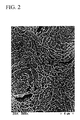
- Fig. 2 is a photograph of an electron microstructure of an Au network formed on an outer skeletal surface of porous titanium having a low contact resistance produced in Example 1, which will be described later, according to an aspect of the present invention.
- Fig. 1 is a drawing of an electron microstructure of the Au network formed on the outer surface of the skeletal structure of the porous titanium body having a low contact resistance according to an aspect of the present invention.
- an Au code 5 is formed on the outer skeletal surface and a Ti oxide layer 3 is formed between adjacent Au codes 5.
- Fig. 2 is a photograph of an electron microstructure of an Au network formed on an outer skeletal surface of porous titanium having a low contact resistance produced in Example 1, which will be described later
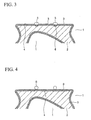
- FIG. 3 is a cross-sectional view of porous titanium having a low contact resistance according to an aspect of the present invention.
- Figs. 4 to 6 are cross-sectional views illustrating a production method of the porous titanium having a low contact resistance shown in Fig. 3 according to an aspect of the present invention.
- Fig. 7 is a cross-sectional view of ordinary porous titanium.
- Fig. 8 is an enlarged cross-sectional view of an area A of Fig. 7 .
- Figs. 9A to 9C are cross-sectional views illustrating an increase in contact resistance when porous titanium having a narrow width of an Au code in an Au network formed on a surface thereof is immersed in a sulfuric acid solution for a long time.
- Fig. 10 is a cross-sectional view illustrating that the width of an Au code in an Au network formed on a surface of porous titanium having a low contact resistance according to the present invention is preferably in a range of 0.3 to 10 ⁇ m at least at one position.
- the Au network is formed on the outer surface of the skeletal structure of the porous titanium body and the Ti oxide layers 3 are formed between adjacent Au code s 5 in the Au network. If the width of the Au code 5 is too narrow, the contact resistance may become high when the porous titanium having the Au network formed on the outer skeletal surface is immersed in, for example, a sulfuric acid solution for a prolonged time. The reason therefore will be described with reference to Figs. 9A to 9C .
- the reference numeral 5 in Figs. 9A and 9B denotes a schematic cross section of the Au code shown in Fig. 1 .
- the Ti oxide layer 3 grows and increases in thickness T as shown in Fig. 9A .
- the Ti oxide layer 3 grows below the Au code 5 from the outer circumference of the Au code 5 so as to move the Au code 5 up toward the surface of the Ti oxide layer 3 as shown in Fig. 9B .
- the Au code 5 is moved upward and removed from the skeleton 2 as shown in Fig. 9C .
- the Ti oxide layer 3 now exists between the Au code 5 and the skeleton 2.
- a diffusion bonding section 6 is eventually absorbed and disappears. As a result, the contact resistance becomes high.
- the width S of the Au code 5 is less than 0.3 ⁇ m, the contact resistance may become higher in a relatively short time when immersed in a sulfuric acid solution. Therefore, the width S of the Au code 5 is preferably not narrower than 0.3 ⁇ m.
- the Au network is formed on the outer surface of the skeletal structure of the porous titanium body and the adjacent Au codes 5 of the Au network are connected to each other as shown in Fig. 1 .
- the contact resistance never becomes higher when the porous titanium is immersed in, for example, a sulfuric acid solution for a prolonged time so long as the width of the Au code of the Au network sticking to the outer skeletal surface is in a range of 0.3 to 10 ⁇ m at least at one position.
- normal porous titanium is prepared first.
- the normal porous titanium includes the continuous holes 1 opening on a surface and being connected to inner holes as shown in Figs. 7 and 8 .
- the Ti oxide layer 3, which is a natural oxidation layer, is formed at least on the outer skeletal surface 4 of the skeleton 2.
- an Au colloid liquid in which extra-fine Au particles are suspended is applied to the Ti oxide layer 3 formed on the outer skeletal surface 4 of normal porous titanium and then dried as quickly as possible. In this manner, an aggregate of the extra-fine Au powder deposits on the Ti oxide layer 3, which is a natural oxidation layer, to form a network structure.
- the Au colloid liquid may be applied by any method, including using a brush or an airbrush, roll printing, spray coating, transferring and pad printing. Among these, using an airbrush is the most preferable.
- the Au colloid liquid is applied on the Ti oxide layer 3, which is a natural oxidation layer, formed on the outer skeletal surface 4 of the porous titanium such that the Au code occupies 20 to 80% of the surface area of the outer skeletal surface 4. If the application amount is less than 20%, the Au colloid liquid is applied in a granular manner rather than in a network manner. On the other hand, if the application amount is more than 80%, stickiness reduces to easily allow separation.
- the Au colloid liquid is applied to the Ti oxide layer 3, then dried in as short a time as possible, and the porous titanium is heated and kept at higher than 300°C in a vacuum atmosphere.
- oxygen included in the Ti oxide layer 3, which is a natural oxidation layer diffuses into the titanium of the skeleton 2 to form solid solution, and metallic titanium is generated on the outer surface 4 of the porous titanium.
- the Au code 5 forms the diffusion bonding section 6 so as to firmly stick to the outer skeletal surface 4 of the titanium metal via diffusion bonding.
- the porous titanium is left in an oxidizing atmosphere, such as the ambient atmosphere, with the Au code 5 firmly sticking to the outer skeletal surface 4 by diffusion bonding, the Au code 5 adheres via diffusion bonding to the outer skeletal surface 4 of the titanium metal and the Ti oxide layer 3 is formed on the outer skeletal surface 4 at an area where no Au code 5 exists as illustrated in the cross section of Fig. 3 . Since the Ti oxide layer 3 is formed to surround the Au code 5, the Au code 5 adheres still more firmly at least to the outer surface of the skeletal structure of the porous titanium body. In this manner, the porous titanium having a low contact resistance according to the present invention is obtained.
- the porous titanium having a low contact resistance produced by being left in the oxidizing atmosphere, such as the ambient atmosphere may include the Ti oxide layer 3 having insufficient thickness. In that case, the thickness of the Ti oxide layer 3 can be increased by heating the porous titanium having a low contact resistance produced by being left in the oxidizing atmosphere, such as the ambient atmosphere, in the ambient atmosphere.
- the porous titanium having a low contact resistance according to the present invention shown in the cross section of Fig. 3 may also be produced in the following manner.
- the Au colloid liquid in which extra-fine Au particles are suspended is applied to the Ti oxide layer 3, which is a natural oxidation layer, formed on the outer skeletal surface 4 of normal porous titanium and then dried in as short a time as possible.
- the Au code 5 forms the diffusion bonding section 6 so as to firmly stick to the outer skeletal surface 4 of the titanium metal via diffusion bonding.
- the porous titanium is treated in the ambient air in the oxidizing atmosphere, the Ti oxide layer 3 is formed to have an increased thickness on the outer skeletal surface 4 in areas where the Au colloid is not deposited and thus no Au code 5 is provided. Since this thick Ti oxide layer 3 is formed to surround the Au code 5, the Au code 5 adheres still more firmly at least to the outer skeletal surface 4 of the porous titanium. In this manner, the bonding structure illustrated in the cross-sectional view of Fig. 3 is provided.
- the Ti oxide layer 3 has a thickness greater than a predetermined thickness, an increase in thickness of the Ti oxide layer 3 becomes slower even if immersed in a sulfuric acid solution for a prolonged time, and thus the contact resistance never increases.
- the Ti oxide layer 3 preferably has a certain thickness after the application of the Au colloid liquid and heat-treatment. If the thickness T of the Ti oxide layer 3 formed in the porous titanium having a low contact resistance according to the present invention is not less than 30 nm, growth of the Ti oxide layer 3 in the sulfuric acid solution becomes significantly slow and thus the contact resistance never increases even if the porous titanium is left in the sulfuric acid solution for a prolonged time.
- the width S of the Au code 5 formed on the porous titanium having a low contact resistance according to the present invention is preferably in the range of 0.3 to 10 ⁇ m and the thickness T of the Ti oxide layer 3 after heat treatment is preferably in the range of 30 to 150 nm.
- any kind of porous titanium may be used.
- examples thereof may include: a fiber sintered body obtained by sintering titanium fiber; a powder sintered body obtained by sintering titanium powder in, for example, a usual sintering process or titanium powder; and sponge-like porous foamed titanium obtained by preparing slurry of titanium powder with, for example, a binder and a foaming agent, extending the slurry on a carrier sheet by, for example, doctor blading, heating the slurry to foam, drying the slurry to provide a green body, and then degreasing and sintering the green body.
- the sponge-like porous foamed titanium is preferably used because of its easily-controlled porosity during the production process and of a large contact area.
- the porous titanium having a low contact resistance according to the present invention contributes greatly to an improvement in performance of polymer electrolyte fuel cells in the following aspects. Since the Au code adheres almost only to the outer skeletal surface via diffusion bonding, an amount of Au used can be reduced as compared with a case in which the Au coating is formed on the entire outer skeletal surface and the entire inner wall of the hole. Accordingly, the porous titanium having a low contact resistance may be used for the air electrode and the fuel electrode of the polymer electrolyte fuel cell at a lower cost.
- the Au code sticking at least outer surface of the skeletal structure of the porous titanium body having a low contact resistance according to the present invention is covered with a hard Ti oxide layer, the Au code is not deformed or peeled off even if subjected to outer pressure resulting from, for example, vibration. Furthermore, the contact resistance can be kept low for a prolonged time even if the porous titanium is immersed in a corrosive solution, such as a sulfuric acid solution.
- the following substances are prepared: titanium powder having an average particle diameter of 10 micrometer as raw powder; 10% solution of methylcellulose as a water soluble resin binder; ethylene glycol as a plasticizer; alkyl benzene sodium sulfonate as a frothering agent; and neopentane as a foaming agent. Subsequently, 20 mass% of the raw powder, 10 mass% of the water soluble resin binder, 1 mass% of the plasticizer, 1 mass% of the frothering agent, 0.6 mass% of the foaming agent, and water as the remainder are blended and kneaded for 15 minutes to provide foamed slurry.
- the obtained foamed slurry is deposited on a PET film by doctor blading at a blade gap of 0.5 mm, fed to a constant temperature and humidity chamber, and then made to foam at the temperature of 35°C and humidity of 90% for the duration of 25 minutes. Subsequently, the slurry is air-dried at the temperature of 80°C for the duration of 20 minutes to provide a sponge-like green compact.
- the compact is removed from the PET film, placed on an alumina plate, degreased at the temperature of 550°C for the duration of 180 minutes in an Ar atmosphere, and then sintered in a vacuum sintering furnace in an atmosphere of 5x10 -3 Pa, at the temperature of 1200°C for the duration of 1 hour.
- porous foamed titanium plate with porosity of 90% and thickness of 1.0 mm is obtained.
- the obtained porous foamed titanium plate is cut into pieces of 30 mm in length and 30 mm in width to prepare the porous foamed titanium material.
- An Au colloid liquid is prepared in the following process. Chloroauric acid as a main ingredient of Au particles is first dissolved in methanol so that the Au concentration becomes 4.0 mass% with gamma-aminopropyl triethoxysilane as a protecting agent precursor and dimethylamine borane as a reducing agent.
- the methanol solution in which the chloroauric acid has been dissolved is gradually added to prepare a mixed solution.
- a proper amount of dimethylamine borane as a reducing agent is added to the mixed solution. Reduction of the mixed solution is conducted while keeping the temperature of the mixed solution at 60°C and stirring the mixed solution by using a magnetic stirrer.
- the mixed solution which has undergone the reduction reaction is cooled to room temperature and then desalted by an ultrafiltration method. A proper amount of water is added to adjust the concentration. In this manner, an Au colloid liquid having concentration of 50 mass% with the water as a dispersion medium is obtained.
- the obtained Au colloid liquid was repeatedly sprayed onto the previously prepared porous foamed titanium material and dried immediately.
- the Au network was deposited to the outer skeletal surface of the porous foamed titanium material to coat the surface at the ratio shown in Table 1.
- the porous foamed titanium material was subjected to heat treatment with the Au network sticking to the outer skeletal surface thereof in the vacuum atmosphere at the temperature shown in Table 1 for the duration of 1 hour and then subjected to heat treatment in the ambient atmosphere at the temperature shown in Table 1 for the duration of 10 minutes.
- the present invention porous titanium samples 1 to 8 and comparative porous titanium samples 1 to 4 to which the Au network adheres via diffusion bonding to the outer skeletal surface of the porous foamed titanium material were produced.
- the outer skeletal surfaces of the present invention porous titanium samples 1 to 8 and the comparative porous titanium samples 1 to 4 ware observed with an electron microscope and it was found that the Au network was formed in each of these outer skeletal surfaces.
- the photograph of the electron microstructure of the porous titanium sample 7 is shown in Fig. 2 .
- the maximum widths of the Au code of the Au network formed on the outer skeletal surfaces of the present invention porous titanium samples 1 to 8 and the comparative porous titanium samples 1 to 4 were measured. Further, the average thickness of the Ti oxide layer formed in the clearance between adjacent Au codes was measured. The results are shown in Table 1.
- a related art porous titanium sample 1 was prepared by plating Au under normal conditions onto the surface of a previously prepared porous foamed titanium material.
- the present invention porous titanium samples 1 to 8, the comparative porous titanium samples 1 to 4 and the related art porous titanium sample 1 prepared in the reference example 1 ware each immersed in a sulfuric acid solution at the temperature of 50°C and pH of 2, kept there under the potential of 800 V (with respect to hydrogen) and taken out after 100 hours, 500 hours or 1,000 hours. Then, each of the samples was washed sufficiently with distilled water and dried in the ambient atmosphere. Subsequently, each of the present invention porous titanium samples 1 to 8, the comparative porous titanium samples 1 to 4 and the related art porous titanium sample 1 was placed between two copper plates of 50 mm in length, 50 mm in width and 10 mm in thickness and fixed there via a spring. Each of the samples was then fixed via a spring such that surface pressure between each of the samples and the copper plate was set to 1 MPa. Resistance between the copper plates was measured in this state. The obtained values are shown in Table 1 as the contact resistance values.
- each of the present invention porous titanium samples 1 to 8, the comparative porous titanium samples 1 to 4 and the related art porous titanium sample 1 were placed between two copper plates of 50 mm in length, 50 mm in width and 10 mm in thickness and fixed there via a spring. Deflection of the spring was adjusted such that surface pressure between each of the samples and the copper plate is set to 1 MPa. Resistance between the copper plates was measured under this load and the obtained values are shown in Table 1 as the contact resistance values before the vibration test. Subsequently, each of the present invention porous titanium samples 1 to 8, the comparative porous titanium samples 1 to 4 and the related art porous titanium sample 1 were placed between two copper plates of 50 mm in length, 50 mm in width and 10 mm in thickness and fixed there via a spring.
- Deflection of the spring was adjusted such that surface pressure between each of the samples and the copper plate was set to 1 MPa.
- Each of the samples was placed on a vibration test facility under the load to undergo the vibration test at a frequency of 67 Hz and vibration acceleration of 70m/second 2 for the duration of 2 hours. After the vibration test, resistance between the copper plates was measured under the load at the site. The obtained values are shown in Table 1 as the contact resistance values after the vibration test.
- the present invention porous titanium samples 1 to 8 had considerably less contact resistance after the fuel cell environmental electrical connection test as compared with the related art porous titanium sample 1, and had considerably smaller variation in contact resistance both before and after the vibration test.
- the Comparative porous titanium samples 1 to 4 which are out of the range of the present invention, had unacceptable results.
- the previously obtained Au colloid liquid is diluted with ethanol so that the Au content became 4 mass%.
- the diluted Au colloid liquid was repeatedly sprayed onto the previously prepared porous foamed titanium material using an airbrush (TAB-02 manufactured by TRUSCO) at an air pressure of 0.1 MPa to coat the outer skeletal surface of the porous foamed titanium material at the ratio shown in Table 2.
- the Au colloid liquid is dried immediately to deposit the Au network to the outer skeletal surface of the porous foamed titanium material.
- the porous foamed titanium material was subjected to heat treatment with the Au network sticking to the outer skeletal surface thereof in the vacuum atmosphere at the temperature shown in Table 2 for the duration of 1 hour and then subject to heat treatment in the ambient atmosphere at the temperature shown in Table 2 for the duration of 10 minutes.
- the present invention porous titanium samples 9 to 16 to which the Au network stuck via diffusion bonding to the outer skeletal surface of the porous foamed titanium material were produced.
- the outer skeletal surfaces of the present invention porous titanium samples 9 to 16 were observed with an electron microscope and it was found that the Au network is formed in each of these outer skeletal surfaces.
- the maximum widths of the Au code of the Au network formed on the outer skeletal surfaces of the present invention porous titanium samples 9 to 16 were measured. Further, the average thickness of the Ti oxide layer formed in the clearance between adjacent Au codes was measured. The results are shown in Table 2.
- the previously obtained Au colloid liquid was diluted with ethanol so that the Au content became 4 mass%.
- the diluted Au colloid liquid was repeatedly sprayed onto the previously prepared porous foamed titanium material using an airbrush (TAB-02 manufactured by TRUSCO) at the air pressure of 0.1 MPa to coat the outer skeletal surface of the porous foamed titanium material at the ratio shown in Table 3.
- the Au colloid liquid was dried immediately to deposit the Au network to the outer skeletal surface of the porous foamed titanium material.
- the porous foamed titanium material was subjected to heat treatment with the Au network sticking to the outer skeletal surface thereof in the ambient atmosphere at the temperature shown in Table 3 for the duration of 30 minutes.
- the present invention porous titanium samples 17 to 24 to which the Au network stuck via diffusion bonding to the outer skeletal surface of the porous foamed titanium material were produced.
- the outer skeletal surfaces of the present invention porous titanium samples 17 to 24 were observed with an electron microscope and it was found that the Au network was formed in each of these outer skeletal surfaces.
- the maximum widths of the Au code of the Au network formed on the outer skeletal surfaces of the present invention porous titanium samples 17 to 24 were measured. Further, the average thickness of the Ti oxide layer formed in the clearance between adjacent Au codes was measured. The results are shown in Table 3.
- Table 3 Porous titanium Application ratio of Au colloid (%) Conditions of heat treatment Maximum width of Au code ( ⁇ m) Average thickness of Ti Oxide layer (nm) Value of contact resistance after fuel cell environmental electrical connection test (m ⁇ . cm 2 ) Value of contact resistance (m ⁇ .
- the present invention porous titanium samples 9 to 24 have considerably smaller values of contact resistance after the fuel cell environmental electrical connection test as compared with the related art porous titanium sample 1 shown in Table 1, and have considerably smaller variation in contact resistance both before and after the vibration test.
- the porous titanium having a low contact resistance according to the present invention contributes greatly to an improvement in performance of polymer electrolyte fuel cells in the following aspects. Since the Au code adheres almost only to the outer skeletal surface via diffusion bonding, an amount of Au used can be reduced as compared with a case in which the Au coating is formed on the entire outer skeletal surface and the entire inner wall of the hole. Accordingly, the porous titanium having a low contact resistance may be used for the air electrode and the fuel electrode of the polymer electrolyte fuel cell at a lower cost.
- the Au code sticking at least outer surface of the skeletal structure of the porous titanium body having a low contact resistance according to the present invention is covered with a hard Ti oxide layer, the Au code does not deform or peel off even if subjected to outer pressure resulting from, for example, vibration. Furthermore, the contact resistance can be kept low for a prolonged period of time even if the porous titanium is immersed in a corrosive solution, such as a sulfuric acid solution. Accordingly, the present invention has excellent industrial applicability.
Landscapes
- Chemical & Material Sciences (AREA)
- Engineering & Computer Science (AREA)
- Chemical Kinetics & Catalysis (AREA)
- General Chemical & Material Sciences (AREA)
- Electrochemistry (AREA)
- Manufacturing & Machinery (AREA)
- Materials Engineering (AREA)
- Sustainable Energy (AREA)
- Life Sciences & Earth Sciences (AREA)
- Metallurgy (AREA)
- Sustainable Development (AREA)
- Mechanical Engineering (AREA)
- Composite Materials (AREA)
- Organic Chemistry (AREA)
- Inorganic Chemistry (AREA)
- Ceramic Engineering (AREA)
- Fuel Cell (AREA)
- Inert Electrodes (AREA)
- Inorganic Compounds Of Heavy Metals (AREA)
- Other Surface Treatments For Metallic Materials (AREA)
- Powder Metallurgy (AREA)
Abstract
Description
- The present invention relates to porous titanium having a low contact resistance in which Au adheres to at least an outer surface of the skeletal structure of the porous titanium body via diffusion bonding to form a continuous network structure. The porous titanium is used for an air electrode and a fuel electrode of a polymer electrolyte fuel cell.
Priority is claimed on Japanese Patent Application No.2006-335609, filed on December 13, 2006 2007-292956, filed on November 12, 2007 - A polymer electrolyte fuel cell usually has an air electrode provided at one side of an electrolyte and a fuel electrode provided at the other side of the electrolyte. The air electrode and the fuel electrode are both formed from a conductive porous body with a catalyst. In general, a plurality of such structures is stacked together via separators to form a polymer electrolyte fuel cell. The air electrodes and the first separators are in contact with each other, and the fuel electrodes and the second separators are in contact with each other. Contact resistance therebetween should be low. The separator is commonly a carbon plate or a metal plate. Examples of the conductive porous body for forming the air electrode and the fuel electrode include nonwoven fabric of carbon fiber which is called carbon paper, and porous metal, and so on. If a metal plate, such as a titanium plate, is employed as the separator for the polymer electrolyte fuel cell, the titanium plate is plated with Au in order to reduce contact resistance that may be high in a use environment due to an oxide layer having high electrical resistance formed on the titanium surface. Such an Au-plated titanium plate is heat-treated to reduce the contact resistance (see Patent Document 1).
A known method of forming an Au coating on the surface of the titanium plate includes depositing Au after removing a Ti oxide layer formed on the titanium plate (see Patent Document 2). - It has been considered to employ porous titanium having great corrosion resistance as a conductive porous body for the air electrode and the fuel electrode of the polymer electrolyte fuel cell. Porous titanium usually includes
continuous holes 1 opening on the surface and being connected to inner holes and askeleton 2, as shown inFig. 7 . An enlarged view of area A of theskeleton 2 of the porous titanium inFig. 7 is shown inFig. 8 . As shown inFig. 8 , aTi oxide layer 3 is naturally developed on a surface of theskeleton 2 of the porous titanium when the porous titanium is left in the atmosphere. In particular theTi oxide layer 3 formed on an outerskeletal surface 4 of the porous titanium is known to lower conductivity and thus increase contact resistance. When the porous titanium is used for the air electrode and the fuel electrode of the polymer electrolyte fuel cell, it is therefore preferable to employ the porous titanium having Au coating on the surface as in the separator. - Patent Document 1: Japanese Unexamined Patent Application, First Publication No.
2004-134276 - Patent Document 2: Japanese Unexamined Patent Application, First Publication No.
2001-6713 - The surface of the porous titanium has continuous holes connected to the inside at the porosity of not less than 60%. When depositing Au on the surface of the porous titanium by plating, a CVD process, a PVD process or other methods, the Au coating is formed not only on the entire outer skeletal surface but the entire inner skeletal surface of the porous titanium. Since the Au coating is formed also on the inner skeletal surface, which is not a contact portion, an excessively large amount of costly Au is consumed.
- The polymer electrolyte fuel cell is often used as a power source of mobile devices, such as portable notebook personal computers and mobile phones, and is thus frequently subject to vibration. When the polymer electrolyte fuel cell in which the porous titanium having the Au coating deposited by plating, a CVD process, a PVD process or other methods on the outer skeletal surface is used for the air electrode and the fuel electrode is subject to vibration, a surface of the Au coating on the outer skeletal surface of the air electrode and the fuel electrode that is in contact with the separator is often deformed or peeled off, thereby increasing the contact resistance. The porous titanium-made air electrode and the fuel electrode of the polymer electrolyte fuel cell have porosity and their substantial outer areas are thus extremely small. If the surface of the Au coating is deformed or peeled off, the contact resistance increases significantly as compared with ordinary air electrodes and fuel electrodes in which the Au coating is formed in the entire surface of the titanium metal.
- Under these circumstances, the present inventors have conducted research to produce porous titanium having great conductivity to be used for the air electrode and the fuel electrode of the polymer electrolyte fuel cell at a lower cost and to provide porous titanium in which Au formed on the outer skeletal surface thereof is not deformed or peeled off even if subject to wear resulting from vibration and therefore the contact resistance does not become high for a long time. As a result, they discovered the following.
- (A) An amount of a costly Au colloid liquid used can be reduced when applied to the outer surface of the skeletal structure of the porous titanium body since the Au colloid liquid is not applied deep in the hole opening. If the Au colloid liquid is dried in a short time as possible after application, the applied Au colloid aggregates during drying and Au adheres to the outer surface of the skeletal structure of the porous titanium body to form a network structure.
- (B) When the porous titanium with Au sticking to the outer skeletal surface to form a network structure is heated at a temperature higher than 300°C in a vacuum or inert gas atmosphere, oxygen included in the Ti oxide layer formed on the outer skeletal surface diffuses into underlying titanium to form solid solution, and metallic titanium is generated on the outer surface of the skeletal structure of the porous titanium body. When continuously heated under the same condition, Au scattering and sticking at least to the outer skeletal surface adheres via diffusion bonding to the outer skeletal surface formed of the titanium metal, and adheres firmly to the outer skeletal surface to form a network structure.
- (C) When the porous titanium with Au sticking via diffusion bonding to the outer skeletal surface of the titanium metal to form a network structure is maintained in the ambient atmosphere or then subjected to optional heating, a Ti oxide layer is formed in a clearance where no Au network sticking via diffusion bonding to the outer skeletal surface formed of titanium metal exists. Such a hard Ti oxide layer helps reduce wear and deformation due to vibration, thereby preventing an increase in contact resistance caused by vibration.
- (D) If the width of the Au code of the Au network is too narrow, the contact resistance becomes high when the porous titanium is immersed in a sulfuric acid solution for a prolonged time. The width of the Au code should therefore be not narrower than 0.3 µm at least at one position. If the width of the Au code is not narrower than 0.3 µm at least at one position, the contact resistance hardly becomes high even if the porous titanium is immersed in a sulfuric acid solution for a prolonged time. The width of the Au code is preferably in a range of 0.3 to 10 µm in consideration of the width of the outer surface of the skeletal structure of the porous titanium body.
- (E) The Ti oxide layer formed in the clearance between adjacent Au codes of the Au network should have a thickness of 30 to 150 nm.
- The present invention has been made in view of the aforementioned knowledge, and has the following configurations.
- (1) Porous titanium having a low contact resistance comprising:
- a porous titanium body having a skeletal structure and continuous holes that opens on an outer surface of the porous titanium body and are connected to each other to form inner holes;
- an Au network formed on at least an outer surface of the skeletal structure of the porous titanium body as a continuous network structure by adhering and diffusion bonding Au on the outer surface of the skeletal structure; and
- Ti oxide layers formed in clearances between adjacent Au codes of the Au network.
- (2) Porous titanium having a low contact resistance according to the above (1), in which the width of at least a part of each of the Au codes of the Au network is 0.3 to 10 µm, preferably 0.4 to 8.0 µm and more preferably 0.5 to 5.0 µm.
- (3) Porous titanium having a low contact resistance according to the above (1) or (2), in which the thickness of the Ti oxide layer, which is formed in the clearance between adjacent Au codes of the Au network is 30 to 150 nm, preferably 40 to 135 nm and more preferably 50 to 120 nm.
- Referring now to the drawings, the porous titanium having a low contact resistance and a method of producing the same according to the present invention will be described.
Fig. 1 is a drawing of an electron microstructure of the Au network formed on the outer surface of the skeletal structure of the porous titanium body having a low contact resistance according to an aspect of the present invention. In the drawing, anAu code 5 is formed on the outer skeletal surface and aTi oxide layer 3 is formed betweenadjacent Au codes 5.
Fig. 2 is a photograph of an electron microstructure of an Au network formed on an outer skeletal surface of porous titanium having a low contact resistance produced in Example 1, which will be described later, according to an aspect of the present invention.
Fig. 3 is a cross-sectional view of porous titanium having a low contact resistance according to an aspect of the present invention.
Figs. 4 to 6 are cross-sectional views illustrating a production method of the porous titanium having a low contact resistance shown inFig. 3 according to an aspect of the present invention.
Fig. 7 is a cross-sectional view of ordinary porous titanium.
Fig. 8 is an enlarged cross-sectional view of an area A ofFig. 7 .
Figs. 9A to 9C are cross-sectional views illustrating an increase in contact resistance when porous titanium having a narrow width of an Au code in an Au network formed on a surface thereof is immersed in a sulfuric acid solution for a long time.
Fig. 10 is a cross-sectional view illustrating that the width of an Au code in an Au network formed on a surface of porous titanium having a low contact resistance according to the present invention is preferably in a range of 0.3 to 10 µm at least at one position. - As shown in
Fig. 1 , in the porous titanium having a low contact resistance according to the present invention, the Au network is formed on the outer surface of the skeletal structure of the porous titanium body and theTi oxide layers 3 are formed between adjacent Au code s 5 in the Au network. If the width of theAu code 5 is too narrow, the contact resistance may become high when the porous titanium having the Au network formed on the outer skeletal surface is immersed in, for example, a sulfuric acid solution for a prolonged time.
The reason therefore will be described with reference toFigs. 9A to 9C . Thereference numeral 5 inFigs. 9A and 9B denotes a schematic cross section of the Au code shown inFig. 1 . When the porous titanium having the Au network with theAu code 5 of narrow width S formed on the outer skeletal surface is immersed in a sulfuric acid solution for a prolonged time, theTi oxide layer 3 grows and increases in thickness T as shown inFig. 9A . When theTi oxide layer 3 grows and increases in thickness T, theTi oxide layer 3 grows below theAu code 5 from the outer circumference of theAu code 5 so as to move theAu code 5 up toward the surface of theTi oxide layer 3 as shown inFig. 9B . When this phenomenon further develops, theAu code 5 is moved upward and removed from theskeleton 2 as shown inFig. 9C . TheTi oxide layer 3 now exists between theAu code 5 and theskeleton 2. Adiffusion bonding section 6 is eventually absorbed and disappears. As a result, the contact resistance becomes high. - In a structure with the
Au code 5 having a greater width S as shown inFig. 10 , however, even if the thickness T of theTi oxide layer 3 increases and theTi oxide layer 3 grows below theAu code 5 from the outer circumference of theAu code 5, a long period of time will be required until theAu code 5 is removed from theskeleton 2 as shown inFig. 9C . TheAu code 5 is therefore hardly removed from the skeleton formed of titanium metal and the contact resistance hardly becomes high for the duration of normal use. If the width S of theAu code 5 is less than 0.3 µm, the contact resistance may become higher in a relatively short time when immersed in a sulfuric acid solution. Therefore, the width S of theAu code 5 is preferably not narrower than 0.3 µm. On the other hand, if the width S of theAu code 5 is as large as 10 µm or more, stickiness of theAu code 5 to theskeleton 2 reduces to easily cause separation.
In the porous titanium having a low contact resistance according to the present invention, the Au network is formed on the outer surface of the skeletal structure of the porous titanium body and theadjacent Au codes 5 of the Au network are connected to each other as shown inFig. 1 . Since the Au network is connected also to wider portions of theAu code 5, even if there is a narrow portion a of theAu code 5 and that portion a is separated apart from theskeleton 2, the contact resistance never becomes higher when the porous titanium is immersed in, for example, a sulfuric acid solution for a prolonged time so long as the width of the Au code of the Au network sticking to the outer skeletal surface is in a range of 0.3 to 10 µm at least at one position. - In production of the porous titanium having a low contact resistance according to the present invention, normal porous titanium is prepared first. The normal porous titanium includes the
continuous holes 1 opening on a surface and being connected to inner holes as shown inFigs. 7 and 8 . TheTi oxide layer 3, which is a natural oxidation layer, is formed at least on the outerskeletal surface 4 of theskeleton 2.
Next, as shown inFig. 4 , an Au colloid liquid in which extra-fine Au particles are suspended is applied to theTi oxide layer 3 formed on the outerskeletal surface 4 of normal porous titanium and then dried as quickly as possible. In this manner, an aggregate of the extra-fine Au powder deposits on theTi oxide layer 3, which is a natural oxidation layer, to form a network structure. The Au colloid liquid may be applied by any method, including using a brush or an airbrush, roll printing, spray coating, transferring and pad printing. Among these, using an airbrush is the most preferable.
The Au colloid liquid is applied on theTi oxide layer 3, which is a natural oxidation layer, formed on the outerskeletal surface 4 of the porous titanium such that the Au code occupies 20 to 80% of the surface area of the outerskeletal surface 4. If the application amount is less than 20%, the Au colloid liquid is applied in a granular manner rather than in a network manner. On the other hand, if the application amount is more than 80%, stickiness reduces to easily allow separation. - The Au colloid liquid is applied to the
Ti oxide layer 3, then dried in as short a time as possible, and the porous titanium is heated and kept at higher than 300°C in a vacuum atmosphere. In this manner, as shown inFig. 5 , oxygen included in theTi oxide layer 3, which is a natural oxidation layer, diffuses into the titanium of theskeleton 2 to form solid solution, and metallic titanium is generated on theouter surface 4 of the porous titanium. When continuously heated under the same condition, as shown inFig. 6 , theAu code 5 forms thediffusion bonding section 6 so as to firmly stick to the outerskeletal surface 4 of the titanium metal via diffusion bonding.
If the porous titanium is left in an oxidizing atmosphere, such as the ambient atmosphere, with theAu code 5 firmly sticking to the outerskeletal surface 4 by diffusion bonding, theAu code 5 adheres via diffusion bonding to the outerskeletal surface 4 of the titanium metal and theTi oxide layer 3 is formed on the outerskeletal surface 4 at an area where noAu code 5 exists as illustrated in the cross section ofFig. 3 . Since theTi oxide layer 3 is formed to surround theAu code 5, theAu code 5 adheres still more firmly at least to the outer surface of the skeletal structure of the porous titanium body. In this manner, the porous titanium having a low contact resistance according to the present invention is obtained.
The porous titanium having a low contact resistance produced by being left in the oxidizing atmosphere, such as the ambient atmosphere, may include theTi oxide layer 3 having insufficient thickness. In that case, the thickness of theTi oxide layer 3 can be increased by heating the porous titanium having a low contact resistance produced by being left in the oxidizing atmosphere, such as the ambient atmosphere, in the ambient atmosphere.
The porous titanium having a low contact resistance according to the present invention shown in the cross section ofFig. 3 may also be produced in the following manner. The Au colloid liquid in which extra-fine Au particles are suspended is applied to theTi oxide layer 3, which is a natural oxidation layer, formed on the outerskeletal surface 4 of normal porous titanium and then dried in as short a time as possible. The obtained porous titanium as shown inFig. 4 is heat-treated at the temperature of 300 to 500°C in the ambient atmosphere. In this case, when the porous titanium as shown inFig. 4 in which theAu code 5 sticking to theTi oxide layer 3, which is a natural oxidation layer, is heat-treated at the temperature of 300 to 500°C in the ambient atmosphere, oxygen included in theTi oxide layer 3, which is a natural oxidation layer, diffuses in to the titanium of theskeleton 2 to form solid solution, and metallic titanium is generated on theouter surface 4 of the porous titanium, since theTi oxide layer 3 which is a natural oxidation layer, directly below theAu code 5 is not in touch with the ambient air. Then theAu code 5 forms thediffusion bonding section 6 so as to firmly stick to the outerskeletal surface 4 of the titanium metal via diffusion bonding. Since the porous titanium is treated in the ambient air in the oxidizing atmosphere, theTi oxide layer 3 is formed to have an increased thickness on the outerskeletal surface 4 in areas where the Au colloid is not deposited and thus noAu code 5 is provided. Since this thickTi oxide layer 3 is formed to surround theAu code 5, theAu code 5 adheres still more firmly at least to the outerskeletal surface 4 of the porous titanium. In this manner, the bonding structure illustrated in the cross-sectional view ofFig. 3 is provided. - If the
Ti oxide layer 3 has a thickness greater than a predetermined thickness, an increase in thickness of theTi oxide layer 3 becomes slower even if immersed in a sulfuric acid solution for a prolonged time, and thus the contact resistance never increases. Thus, in order to prevent an increase in the contact resistance, theTi oxide layer 3 preferably has a certain thickness after the application of the Au colloid liquid and heat-treatment.
If the thickness T of theTi oxide layer 3 formed in the porous titanium having a low contact resistance according to the present invention is not less than 30 nm, growth of theTi oxide layer 3 in the sulfuric acid solution becomes significantly slow and thus the contact resistance never increases even if the porous titanium is left in the sulfuric acid solution for a prolonged time. On the other hand, if theTi oxide layer 3 is initially formed by methods such as heating in the ambient air to have a thickness of greater than 150 nm, the initial resistance may disadvantageously increase.
Accordingly, the width S of theAu code 5 formed on the porous titanium having a low contact resistance according to the present invention is preferably in the range of 0.3 to 10 µm and the thickness T of theTi oxide layer 3 after heat treatment is preferably in the range of 30 to 150 nm. - In the production of the porous titanium having a low contact resistance according to the present invention, any kind of porous titanium may be used. Examples thereof may include: a fiber sintered body obtained by sintering titanium fiber; a powder sintered body obtained by sintering titanium powder in, for example, a usual sintering process or titanium powder; and sponge-like porous foamed titanium obtained by preparing slurry of titanium powder with, for example, a binder and a foaming agent, extending the slurry on a carrier sheet by, for example, doctor blading, heating the slurry to foam, drying the slurry to provide a green body, and then degreasing and sintering the green body. Among these, the sponge-like porous foamed titanium is preferably used because of its easily-controlled porosity during the production process and of a large contact area.
- The porous titanium having a low contact resistance according to the present invention contributes greatly to an improvement in performance of polymer electrolyte fuel cells in the following aspects. Since the Au code adheres almost only to the outer skeletal surface via diffusion bonding, an amount of Au used can be reduced as compared with a case in which the Au coating is formed on the entire outer skeletal surface and the entire inner wall of the hole. Accordingly, the porous titanium having a low contact resistance may be used for the air electrode and the fuel electrode of the polymer electrolyte fuel cell at a lower cost. In addition, since the Au code sticking at least outer surface of the skeletal structure of the porous titanium body having a low contact resistance according to the present invention is covered with a hard Ti oxide layer, the Au code is not deformed or peeled off even if subjected to outer pressure resulting from, for example, vibration. Furthermore, the contact resistance can be kept low for a prolonged time even if the porous titanium is immersed in a corrosive solution, such as a sulfuric acid solution.
-
-
Fig. 1 is a drawing of an electron microstructure of an Au network formed on an outer skeletal surface of porous titanium having a low contact resistance according to an aspect of the present invention. -
Fig. 2 is a photograph of an electron microstructure of an Au network formed on an outer skeletal surface of porous titanium having a low contact resistance produced in Example 1 according to an aspect of the present invention. -
Fig. 3 is a cross-sectional view of porous titanium having a low contact resistance according to an aspect of the present invention. -
Fig. 4 is cross-sectional view illustrating a production method of the porous titanium having a low contact resistance shown inFig. 3 according to an aspect of the present invention. -
Fig. 5 is cross-sectional view illustrating a production method of the porous titanium having a low contact resistance shown inFig. 3 according to an aspect of the present invention. -
Fig. 6 is cross-sectional view illustrating a production method of the porous titanium having a low contact resistance shown inFig. 3 according to an aspect of the present invention. -
Fig. 7 is a cross-sectional view of ordinary porous titanium. -
Fig. 8 is an enlarged cross-sectional view of an area A ofFig. 7 . -
Fig. 9A is cross-sectional view illustrating an increase in contact resistance when porous titanium having a narrow width of an Au code in an Au network formed on a surface thereof is immersed in a sulfuric acid solution for a long time. -
Fig. 9B is cross-sectional view illustrating an increase in contact resistance when porous titanium having a narrow width of an Au code in an Au network formed on a surface thereof is immersed in a sulfuric acid solution for a long time. -
Fig. 9C is cross-sectional view illustrating an increase in contact resistance when porous titanium having a narrow width of an Au code in an Au network formed on a surface thereof is immersed in a sulfuric acid solution for a long time. -
Fig. 10 is a cross-sectional view illustrating that the width of an Au code in an Au network formed on a surface of porous titanium having a low contact resistance according to the present invention is preferably in a range of 0.3 to 10 µm at least at one position. -
- 1: continuous holes
- 2: skeleton
- 3: Ti oxide layer
- 4: outer skeletal surface
- 5: Au code
- 6: diffusion bonding section
- The following substances are prepared: titanium powder having an average particle diameter of 10 micrometer as raw powder; 10% solution of methylcellulose as a water soluble resin binder; ethylene glycol as a plasticizer; alkyl benzene sodium sulfonate as a frothering agent; and neopentane as a foaming agent.
Subsequently, 20 mass% of the raw powder, 10 mass% of the water soluble resin binder, 1 mass% of the plasticizer, 1 mass% of the frothering agent, 0.6 mass% of the foaming agent, and water as the remainder are blended and kneaded for 15 minutes to provide foamed slurry.
The obtained foamed slurry is deposited on a PET film by doctor blading at a blade gap of 0.5 mm, fed to a constant temperature and humidity chamber, and then made to foam at the temperature of 35°C and humidity of 90% for the duration of 25 minutes. Subsequently, the slurry is air-dried at the temperature of 80°C for the duration of 20 minutes to provide a sponge-like green compact. The compact is removed from the PET film, placed on an alumina plate, degreased at the temperature of 550°C for the duration of 180 minutes in an Ar atmosphere, and then sintered in a vacuum sintering furnace in an atmosphere of 5x10⁻³Pa, at the temperature of 1200°C for the duration of 1 hour. In this manner, a porous foamed titanium plate with porosity of 90% and thickness of 1.0 mm is obtained. The obtained porous foamed titanium plate is cut into pieces of 30 mm in length and 30 mm in width to prepare the porous foamed titanium material.
An Au colloid liquid is prepared in the following process. Chloroauric acid as a main ingredient of Au particles is first dissolved in methanol so that the Au concentration becomes 4.0 mass% with gamma-aminopropyl triethoxysilane as a protecting agent precursor and dimethylamine borane as a reducing agent.
Subsequently, to 8.00 g of gamma-aminopropyl triethoxysilane and 12.00 g of acetylaceton, the methanol solution in which the chloroauric acid has been dissolved is gradually added to prepare a mixed solution. To the mixed solution, a proper amount of dimethylamine borane as a reducing agent is added. Reduction of the mixed solution is conducted while keeping the temperature of the mixed solution at 60°C and stirring the mixed solution by using a magnetic stirrer. The mixed solution which has undergone the reduction reaction is cooled to room temperature and then desalted by an ultrafiltration method. A proper amount of water is added to adjust the concentration. In this manner, an Au colloid liquid having concentration of 50 mass% with the water as a dispersion medium is obtained. - The obtained Au colloid liquid was repeatedly sprayed onto the previously prepared porous foamed titanium material and dried immediately. In this manner, the Au network was deposited to the outer skeletal surface of the porous foamed titanium material to coat the surface at the ratio shown in Table 1. The porous foamed titanium material was subjected to heat treatment with the Au network sticking to the outer skeletal surface thereof in the vacuum atmosphere at the temperature shown in Table 1 for the duration of 1 hour and then subjected to heat treatment in the ambient atmosphere at the temperature shown in Table 1 for the duration of 10 minutes. In this manner, the present invention
porous titanium samples 1 to 8 and comparativeporous titanium samples 1 to 4 to which the Au network adheres via diffusion bonding to the outer skeletal surface of the porous foamed titanium material were produced.
The outer skeletal surfaces of the present inventionporous titanium samples 1 to 8 and the comparativeporous titanium samples 1 to 4 ware observed with an electron microscope and it was found that the Au network was formed in each of these outer skeletal surfaces. The photograph of the electron microstructure of the porous titanium sample 7 is shown inFig. 2 .
The maximum widths of the Au code of the Au network formed on the outer skeletal surfaces of the present inventionporous titanium samples 1 to 8 and the comparativeporous titanium samples 1 to 4 were measured. Further, the average thickness of the Ti oxide layer formed in the clearance between adjacent Au codes was measured. The results are shown in Table 1. - A related art
porous titanium sample 1 was prepared by plating Au under normal conditions onto the surface of a previously prepared porous foamed titanium material. - The following fuel cell environmental electrical connection test and the vibration test were conducted on the present invention
porous titanium samples 1 to 8 and the comparativeporous titanium samples 1 to 4 prepared in Example 1 and on the related artporous titanium sample 1 prepared in the reference example 1. - The present invention
porous titanium samples 1 to 8, the comparativeporous titanium samples 1 to 4 and the related artporous titanium sample 1 prepared in the reference example 1 ware each immersed in a sulfuric acid solution at the temperature of 50°C and pH of 2, kept there under the potential of 800 V (with respect to hydrogen) and taken out after 100 hours, 500 hours or 1,000 hours. Then, each of the samples was washed sufficiently with distilled water and dried in the ambient atmosphere. Subsequently, each of the present inventionporous titanium samples 1 to 8, the comparativeporous titanium samples 1 to 4 and the related artporous titanium sample 1 was placed between two copper plates of 50 mm in length, 50 mm in width and 10 mm in thickness and fixed there via a spring. Each of the samples was then fixed via a spring such that surface pressure between each of the samples and the copper plate was set to 1 MPa. Resistance between the copper plates was measured in this state. The obtained values are shown in Table 1 as the contact resistance values. - Each of the present invention
porous titanium samples 1 to 8, the comparativeporous titanium samples 1 to 4 and the related artporous titanium sample 1 were placed between two copper plates of 50 mm in length, 50 mm in width and 10 mm in thickness and fixed there via a spring. Deflection of the spring was adjusted such that surface pressure between each of the samples and the copper plate is set to 1 MPa. Resistance between the copper plates was measured under this load and the obtained values are shown in Table 1 as the contact resistance values before the vibration test.
Subsequently, each of the present inventionporous titanium samples 1 to 8, the comparativeporous titanium samples 1 to 4 and the related artporous titanium sample 1 were placed between two copper plates of 50 mm in length, 50 mm in width and 10 mm in thickness and fixed there via a spring. Deflection of the spring was adjusted such that surface pressure between each of the samples and the copper plate was set to 1 MPa. Each of the samples was placed on a vibration test facility under the load to undergo the vibration test at a frequency of 67 Hz and vibration acceleration of 70m/second2 for the duration of 2 hours. After the vibration test, resistance between the copper plates was measured under the load at the site. The obtained values are shown in Table 1 as the contact resistance values after the vibration test. -
Table 1 Porous titanium Application ratio of Au colloid (%) Conditions of heat treatment Maximum width of Au code
(µm)Average thickness of Ti oxide layer (nm) Value of contact resistance after fuel cell environmental electrical connection test (mΩ. cm2) Value of contact resistance (mΩ. cm2) Heated temperature in vacuum
(°C)Heated temperature in ambient air (°C) Before test After 100 hours After 500 hours After 1000 hours Before vibration test After vibration test Present invention 1 20 400 450 0.5 50 1.9 2.2 2.2 2.3 1.9 2.1 2 30 500 500 0.5 100 2.2 2.3 2.5 2.5 2.2 2.4 3 40 400 450 1 50 1.6 1.8 1.9 2.0 1.6 1.8 4 50 500 470 1 75 1.5 1.8 1.9 1.9 1.5 1.5 5 20 450 430 0.3 30 2.0 2.5 2.5 2.5 2.0 2.8 6 50 400 430 3 30 1.4 1.6 1.6 1.6 1.4 1.8 7 60 420 450 5 50 1.4 1.5 1.6 1.6 1.4 1.7 8 70 420 500 10 100 1.9 2.0 2.1 2.1 1.9 2.3 Comparative 1 30 400 600 0.5 250* 15 16 16 17 15 15 2 30 500 300 0.3 10* 1.9 3.4 7.8 40 1.9 2.0 3 5 450 500 0.05* 100 40 41 45 45 40 40 4 85 400 500 12* 100 1.9 2.1 2.1 2.1 1.9 7.8 Related art 1Normal Au plating - - 1.3 1.3 1.4 1.4 1.3 5.5 * represents values out of the range of the present invention. - From the result shown in Table 1, the present invention
porous titanium samples 1 to 8 had considerably less contact resistance after the fuel cell environmental electrical connection test as compared with the related artporous titanium sample 1, and had considerably smaller variation in contact resistance both before and after the vibration test. The Comparativeporous titanium samples 1 to 4, which are out of the range of the present invention, had unacceptable results. - The previously obtained Au colloid liquid is diluted with ethanol so that the Au content became 4 mass%. The diluted Au colloid liquid was repeatedly sprayed onto the previously prepared porous foamed titanium material using an airbrush (TAB-02 manufactured by TRUSCO) at an air pressure of 0.1 MPa to coat the outer skeletal surface of the porous foamed titanium material at the ratio shown in Table 2. The Au colloid liquid is dried immediately to deposit the Au network to the outer skeletal surface of the porous foamed titanium material. The porous foamed titanium material was subjected to heat treatment with the Au network sticking to the outer skeletal surface thereof in the vacuum atmosphere at the temperature shown in Table 2 for the duration of 1 hour and then subject to heat treatment in the ambient atmosphere at the temperature shown in Table 2 for the duration of 10 minutes. In this manner, the present invention porous titanium samples 9 to 16 to which the Au network stuck via diffusion bonding to the outer skeletal surface of the porous foamed titanium material were produced.
The outer skeletal surfaces of the present invention porous titanium samples 9 to 16 were observed with an electron microscope and it was found that the Au network is formed in each of these outer skeletal surfaces. The maximum widths of the Au code of the Au network formed on the outer skeletal surfaces of the present invention porous titanium samples 9 to 16 were measured. Further, the average thickness of the Ti oxide layer formed in the clearance between adjacent Au codes was measured. The results are shown in Table 2. -
Table 2 Porous titanium Application ratio of Au colloid (%) Conditions of heat treatment Maximum width of Au code
(µm)Average thickness of Ti oxide layer
(nm)Value of contact resistance after fuel cell environmental electrical connection test (mΩ. cm2) Value of contact resistance (mΩ. cm2) Heated temperature in vacuum
(°C)Heated temperature in ambient air (°C) Before test After 100 hours After 500 hours After 1000 hours Before vibration test After vibration test Present invention 9 20 400 400 0.4 50 2.0 2.1 2.2 2.3 2.0 2.3 10 30 500 420 0.5 50 2.5 2.5 2.6 2.7 2.5 2.6 11 40 400 500 1 100 2.5 2.5 2.5 2.6 2.5 2.5 12 50 500 470 2 80 2.4 2.6 2.6 2.7 2.4 2.7 13 30 450 400 0.6 40 2.0 2.2 2.3 2.4 2.0 2.3 14 50 400 400 1.8 40 2.0 2.3 2.3 2.3 2.0 2.1 15 60 420 450 3 70 2.2 2.2 2.3 2.3 2.2 2.5 16 80 400 450 10 70 2.1 2.2 2.2 2.2 2.1 2.5 - The previously obtained Au colloid liquid was diluted with ethanol so that the Au content became 4 mass%. The diluted Au colloid liquid was repeatedly sprayed onto the previously prepared porous foamed titanium material using an airbrush (TAB-02 manufactured by TRUSCO) at the air pressure of 0.1 MPa to coat the outer skeletal surface of the porous foamed titanium material at the ratio shown in Table 3. The Au colloid liquid was dried immediately to deposit the Au network to the outer skeletal surface of the porous foamed titanium material. The porous foamed titanium material was subjected to heat treatment with the Au network sticking to the outer skeletal surface thereof in the ambient atmosphere at the temperature shown in Table 3 for the duration of 30 minutes. In this manner, the present invention porous titanium samples 17 to 24 to which the Au network stuck via diffusion bonding to the outer skeletal surface of the porous foamed titanium material were produced.
The outer skeletal surfaces of the present invention porous titanium samples 17 to 24 were observed with an electron microscope and it was found that the Au network was formed in each of these outer skeletal surfaces. The maximum widths of the Au code of the Au network formed on the outer skeletal surfaces of the present invention porous titanium samples 17 to 24 were measured. Further, the average thickness of the Ti oxide layer formed in the clearance between adjacent Au codes was measured. The results are shown in Table 3. -
Table 3 Porous titanium Application ratio of Au colloid (%) Conditions of heat treatment Maximum width of Au code (µm) Average thickness of Ti Oxide layer
(nm)Value of contact resistance after fuel cell environmental electrical connection test (mΩ. cm2) Value of contact resistance (mΩ. cm2) Healed temperature in ambient air
(°C)Before test After 100 hours After 500 hours After 1000 hours Before vibration test After vibration test Present invention 17 20 400 0.5 50 2.2 2.4 2.5 2.6 2.2 2.5 18 30 450 0.6 100 2.7 2.7 2.7 2.8 2.7 2.9 19 40 350 1.0 40 2.5 2.7 2.8 2.9 2.5 2.7 20 50 300 1.8 30 2.2 2.5 2.6 2.7 2.2 2.7 21 50 400 3.0 40 2.5 2.6 2.6 2.8 2.5 2.7 22 50 500 2.3 120 2.8 2.8 2.8 2.9 2.8 2.9 23 60 400 5 60 2.2 2.3 2.4 2.5 2.2 2.6 24 80 400 10 70 2.1 2.4 2.4 2.5 2.1 2.6 - From the result shown in Tables 2 and 3, the present invention porous titanium samples 9 to 24 have considerably smaller values of contact resistance after the fuel cell environmental electrical connection test as compared with the related art
porous titanium sample 1 shown in Table 1, and have considerably smaller variation in contact resistance both before and after the vibration test. - The porous titanium having a low contact resistance according to the present invention contributes greatly to an improvement in performance of polymer electrolyte fuel cells in the following aspects. Since the Au code adheres almost only to the outer skeletal surface via diffusion bonding, an amount of Au used can be reduced as compared with a case in which the Au coating is formed on the entire outer skeletal surface and the entire inner wall of the hole. Accordingly, the porous titanium having a low contact resistance may be used for the air electrode and the fuel electrode of the polymer electrolyte fuel cell at a lower cost. In addition, since the Au code sticking at least outer surface of the skeletal structure of the porous titanium body having a low contact resistance according to the present invention is covered with a hard Ti oxide layer, the Au code does not deform or peel off even if subjected to outer pressure resulting from, for example, vibration. Furthermore, the contact resistance can be kept low for a prolonged period of time even if the porous titanium is immersed in a corrosive solution, such as a sulfuric acid solution. Accordingly, the present invention has excellent industrial applicability.
Claims (3)
- Porous titanium having a low contact resistance comprising:a porous titanium body having a skeletal structure and continuous holes that opens on an outer surface of the porous titanium body and are connected to each other to form inner holes;an Au network formed on at least an outer surface of the skeletal structure of the porous titanium body as a continuous network structure by adhering and diffusion bonding Au on the outer surface of the skeletal structure; andTi oxide layers formed in clearances between adjacent Au codes of the Au network.
- Porous titanium having a low contact resistance according to claim 1, wherein the width of at least a part of each of the Au codes of the Au network is 0.3 to 10 µm.
- Porous titanium having a low contact resistance according to claim 1 or 2, wherein the thickness of the Ti oxide layer formed in the clearance between adjacent Au codes of the Au network is 30 to 150 nm.
Applications Claiming Priority (3)
| Application Number | Priority Date | Filing Date | Title |
|---|---|---|---|
| JP2006335609 | 2006-12-13 | ||
| JP2007292956A JP5125435B2 (en) | 2006-12-13 | 2007-11-12 | Porous titanium with low contact resistance |
| PCT/JP2007/074038 WO2008072697A1 (en) | 2006-12-13 | 2007-12-13 | Porous titanium having low contact resistance |
Publications (3)
| Publication Number | Publication Date |
|---|---|
| EP2103714A1 true EP2103714A1 (en) | 2009-09-23 |
| EP2103714A4 EP2103714A4 (en) | 2012-12-26 |
| EP2103714B1 EP2103714B1 (en) | 2014-10-29 |
Family
ID=39511713
Family Applications (1)
| Application Number | Title | Priority Date | Filing Date |
|---|---|---|---|
| EP07850558.3A Not-in-force EP2103714B1 (en) | 2006-12-13 | 2007-12-13 | Porous titanium having low contact resistance |
Country Status (5)
| Country | Link |
|---|---|
| US (1) | US7794853B2 (en) |
| EP (1) | EP2103714B1 (en) |
| JP (1) | JP5125435B2 (en) |
| CN (1) | CN101563482B (en) |
| WO (1) | WO2008072697A1 (en) |
Families Citing this family (1)
| Publication number | Priority date | Publication date | Assignee | Title |
|---|---|---|---|---|
| KR101199244B1 (en) | 2008-06-27 | 2012-11-09 | 스미토모 겐키 가부시키가이샤 | Hybrid construction machine |
Family Cites Families (12)
| Publication number | Priority date | Publication date | Assignee | Title |
|---|---|---|---|---|
| US5645626A (en) * | 1990-08-10 | 1997-07-08 | Bend Research, Inc. | Composite hydrogen separation element and module |
| CA2300008C (en) | 1999-03-09 | 2006-07-04 | Nippon Steel Corporation | Stainless steel and titanium for solid polymer electrolyte fuel cell members |
| JP5047408B2 (en) * | 1999-06-16 | 2012-10-10 | 新日本製鐵株式会社 | Stainless steel or titanium separator for polymer electrolyte fuel cell |
| US6531238B1 (en) * | 2000-09-26 | 2003-03-11 | Reliant Energy Power Systems, Inc. | Mass transport for ternary reaction optimization in a proton exchange membrane fuel cell assembly and stack assembly |
| KR100707755B1 (en) * | 2002-01-21 | 2007-04-17 | 미츠비시 마테리알 고베 툴스 가부시키가이샤 | Surface-coated cutting tool member exhibiting excellent wear resistance in a high-speed cutting process and a method of forming the hard coating layer on the surface of the cutting tool |
| JP2004134276A (en) * | 2002-10-11 | 2004-04-30 | Daido Steel Co Ltd | Material for polymer electrolyte fuel cell and method for producing the same |
| JP3452140B1 (en) * | 2003-01-08 | 2003-09-29 | スガ試験機株式会社 | Water electrolysis device |
| DE102004014076B3 (en) * | 2004-03-19 | 2005-12-22 | Fraunhofer-Gesellschaft zur Förderung der angewandten Forschung e.V. | Metal foam body with open-pore structure and process for its preparation |
| JP2006335609A (en) | 2005-06-02 | 2006-12-14 | Gifu Prefecture | Method for decorating ceramic products and ceramic products |
| JP4895012B2 (en) * | 2005-09-16 | 2012-03-14 | 三菱マテリアル株式会社 | Porous titanium having low contact resistance and method for producing the same |
| CA2633531A1 (en) * | 2005-12-13 | 2008-05-22 | University Of Nevada, Reno | Preparation of nano-tubular titania substrates having gold and carbon particles deposited thereon and their use in photo-electrolysis of water |
| JP4857885B2 (en) | 2006-04-24 | 2012-01-18 | 株式会社デンソー | Display device |
-
2007
- 2007-11-12 JP JP2007292956A patent/JP5125435B2/en not_active Expired - Fee Related
- 2007-12-13 WO PCT/JP2007/074038 patent/WO2008072697A1/en not_active Ceased
- 2007-12-13 US US12/518,509 patent/US7794853B2/en not_active Expired - Fee Related
- 2007-12-13 CN CN2007800455772A patent/CN101563482B/en not_active Expired - Fee Related
- 2007-12-13 EP EP07850558.3A patent/EP2103714B1/en not_active Not-in-force
Also Published As
| Publication number | Publication date |
|---|---|
| CN101563482B (en) | 2012-02-08 |
| JP5125435B2 (en) | 2013-01-23 |
| WO2008072697A1 (en) | 2008-06-19 |
| JP2008169472A (en) | 2008-07-24 |
| EP2103714B1 (en) | 2014-10-29 |
| EP2103714A4 (en) | 2012-12-26 |
| US20100015507A1 (en) | 2010-01-21 |
| CN101563482A (en) | 2009-10-21 |
| US7794853B2 (en) | 2010-09-14 |
Similar Documents
| Publication | Publication Date | Title |
|---|---|---|
| CN102473935B (en) | Titanium material for solid polymer fuel cell diaphragm and manufacturing method thereof | |
| KR101597970B1 (en) | Preparing method of alloy catalyst using poly dopamine coating and alloy catalyst thereby | |
| CN1279646C (en) | Improvements to fuel cells and related devices | |
| US8334233B2 (en) | Catalyst layer-supporting substrate, method of producing the same and fuel cell | |
| CN1961443A (en) | Nickel foam and felt-based anode for solid oxide fuel cells | |
| JP2005191002A (en) | Gas diffusion layer for fuel cell, electrode, membrane electrode assembly and method for producing the same | |
| JP2010033759A (en) | Manufacturing method of catalyst-layer-carrying base substrate, catalyst-layer-carrying base substrate, membrane electrode assembly, and fuel cell | |
| CN102820475A (en) | Ternary platinum alloy catalyst | |
| CN101390236A (en) | Separator for solid polymer fuel cell and manufacturing method thereof | |
| KR20170121289A (en) | Title: TITANIUM MATERIAL, SEPARATOR, AND SOLID POLYMERIC FUEL CELL, AND METHOD FOR MANUFACTURING TITANIUM MATERIAL | |
| EP2103714B1 (en) | Porous titanium having low contact resistance | |
| JP4066154B2 (en) | Porous metal gas diffusion sheet for polymer electrolyte fuel cell that exhibits excellent contact surface conductivity over a long period of time | |
| WO2009084893A2 (en) | Manufacturing method of porous metal electrode for molten carbonate fuel cells using dry process | |
| JP6206622B1 (en) | Titanium material, separator and polymer electrolyte fuel cell | |
| JP2003123774A (en) | Manufacturing method of electrode for fuel cell, electrode for fuel cell, coating composition, manufacturing method for, the composition solid polymer fuel cell, manufacturing method for the cell | |
| JP6753165B2 (en) | Titanium material for separators of polymer electrolyte fuel cells, and separators using it | |
| JP2003308847A (en) | Method of manufacturing electrode for fuel cell, coating composition and method of manufacturing it | |
| KR101338047B1 (en) | Cathode for molten carbonate fuel cell and manufacturing method of the same | |
| JP2017088955A (en) | Titanium material for separator of solid polymer form fuel cell and separator using the same | |
| KR20090067960A (en) | Corrosion Resistance Coating Method of Molten Carbonate Fuel Cell Separator | |
| KR20120092334A (en) | Solid oxidee fuel cell cathode comprising materials coated with silver nano particle and method for manufacturing the same | |
| JP2001329380A (en) | Method for manufacturing porous plate material | |
| JP4066155B2 (en) | Porous metal gas diffusion sheet for polymer electrolyte fuel cell that exhibits excellent contact surface conductivity over a long period of time | |
| JP2010238517A (en) | Solid polymer fuel cell comprising a porous metal gas diffusion sheet that exhibits excellent contact surface conductivity over a long period of time as a structural member | |
| Hai et al. | Surface activation of conductive porous alumina by depositing nickel particles |
Legal Events
| Date | Code | Title | Description |
|---|---|---|---|
| PUAI | Public reference made under article 153(3) epc to a published international application that has entered the european phase |
Free format text: ORIGINAL CODE: 0009012 |
|
| 17P | Request for examination filed |
Effective date: 20090618 |
|
| AK | Designated contracting states |
Kind code of ref document: A1 Designated state(s): AT BE BG CH CY CZ DE DK EE ES FI FR GB GR HU IE IS IT LI LT LU LV MC MT NL PL PT RO SE SI SK TR |
|
| DAX | Request for extension of the european patent (deleted) | ||
| A4 | Supplementary search report drawn up and despatched |
Effective date: 20121126 |
|
| RIC1 | Information provided on ipc code assigned before grant |
Ipc: H01M 4/86 20060101ALI20121120BHEP Ipc: H01M 4/88 20060101ALI20121120BHEP Ipc: H01M 8/02 20060101ALI20121120BHEP Ipc: C23C 24/08 20060101AFI20121120BHEP Ipc: C23C 10/60 20060101ALI20121120BHEP Ipc: C23C 28/00 20060101ALI20121120BHEP Ipc: H01M 8/10 20060101ALI20121120BHEP Ipc: C23C 10/18 20060101ALI20121120BHEP |
|
| RIC1 | Information provided on ipc code assigned before grant |
Ipc: C23C 10/18 20060101ALI20131018BHEP Ipc: H01M 4/86 20060101ALI20131018BHEP Ipc: H01M 8/10 20060101ALN20131018BHEP Ipc: C23C 28/00 20060101ALI20131018BHEP Ipc: C23C 24/08 20060101AFI20131018BHEP Ipc: H01M 8/02 20060101ALI20131018BHEP Ipc: H01M 4/88 20060101ALI20131018BHEP Ipc: C23C 10/60 20060101ALI20131018BHEP |
|
| RIC1 | Information provided on ipc code assigned before grant |
Ipc: C23C 10/60 20060101ALI20131028BHEP Ipc: H01M 4/86 20060101ALI20131028BHEP Ipc: C23C 24/08 20060101AFI20131028BHEP Ipc: C23C 10/18 20060101ALI20131028BHEP Ipc: C23C 28/00 20060101ALI20131028BHEP Ipc: H01M 4/88 20060101ALI20131028BHEP Ipc: H01M 8/02 20060101ALI20131028BHEP Ipc: H01M 8/10 20060101ALN20131028BHEP |
|
| GRAP | Despatch of communication of intention to grant a patent |
Free format text: ORIGINAL CODE: EPIDOSNIGR1 |
|
| RIC1 | Information provided on ipc code assigned before grant |
Ipc: H01M 8/10 20060101ALN20131219BHEP Ipc: C23C 10/60 20060101ALI20131219BHEP Ipc: C23C 24/08 20060101AFI20131219BHEP Ipc: C23C 28/00 20060101ALI20131219BHEP Ipc: H01M 4/88 20060101ALI20131219BHEP Ipc: H01M 8/02 20060101ALI20131219BHEP Ipc: C23C 10/18 20060101ALI20131219BHEP Ipc: H01M 4/86 20060101ALI20131219BHEP |
|
| INTG | Intention to grant announced |
Effective date: 20140109 |
|
| RIN1 | Information on inventor provided before grant (corrected) |
Inventor name: HAYASHI, TOSHIHARU Inventor name: HOSHINO, KOJI Inventor name: ORITO, KENJI Inventor name: WADA, MASAHIRO Inventor name: IZUMI, REIKO |
|
| GRAP | Despatch of communication of intention to grant a patent |
Free format text: ORIGINAL CODE: EPIDOSNIGR1 |
|
| INTG | Intention to grant announced |
Effective date: 20140522 |
|
| RIC1 | Information provided on ipc code assigned before grant |
Ipc: C23C 28/04 20060101ALI20140509BHEP Ipc: C23C 10/60 20060101ALI20140509BHEP Ipc: C23C 10/18 20060101ALI20140509BHEP Ipc: H01M 8/10 20060101ALN20140509BHEP Ipc: H01M 4/88 20060101ALI20140509BHEP Ipc: H01M 8/02 20060101ALI20140509BHEP Ipc: C23C 24/08 20060101AFI20140509BHEP Ipc: C23C 28/00 20060101ALI20140509BHEP Ipc: H01M 4/86 20060101ALI20140509BHEP |
|
| GRAS | Grant fee paid |
Free format text: ORIGINAL CODE: EPIDOSNIGR3 |
|
| GRAA | (expected) grant |
Free format text: ORIGINAL CODE: 0009210 |
|
| AK | Designated contracting states |
Kind code of ref document: B1 Designated state(s): AT BE BG CH CY CZ DE DK EE ES FI FR GB GR HU IE IS IT LI LT LU LV MC MT NL PL PT RO SE SI SK TR |
|
| REG | Reference to a national code |
Ref country code: GB Ref legal event code: FG4D |
|
| REG | Reference to a national code |
Ref country code: CH Ref legal event code: EP |
|
| REG | Reference to a national code |
Ref country code: AT Ref legal event code: REF Ref document number: 693664 Country of ref document: AT Kind code of ref document: T Effective date: 20141115 |
|
| REG | Reference to a national code |
Ref country code: IE Ref legal event code: FG4D |
|
| REG | Reference to a national code |
Ref country code: DE Ref legal event code: R096 Ref document number: 602007039078 Country of ref document: DE Effective date: 20141211 |
|
| REG | Reference to a national code |
Ref country code: AT Ref legal event code: MK05 Ref document number: 693664 Country of ref document: AT Kind code of ref document: T Effective date: 20141029 |
|
| REG | Reference to a national code |
Ref country code: NL Ref legal event code: VDEP Effective date: 20141029 |
|
| REG | Reference to a national code |
Ref country code: LT Ref legal event code: MG4D |
|
| PG25 | Lapsed in a contracting state [announced via postgrant information from national office to epo] |
Ref country code: FI Free format text: LAPSE BECAUSE OF FAILURE TO SUBMIT A TRANSLATION OF THE DESCRIPTION OR TO PAY THE FEE WITHIN THE PRESCRIBED TIME-LIMIT Effective date: 20141029 Ref country code: ES Free format text: LAPSE BECAUSE OF FAILURE TO SUBMIT A TRANSLATION OF THE DESCRIPTION OR TO PAY THE FEE WITHIN THE PRESCRIBED TIME-LIMIT Effective date: 20141029 Ref country code: NL Free format text: LAPSE BECAUSE OF FAILURE TO SUBMIT A TRANSLATION OF THE DESCRIPTION OR TO PAY THE FEE WITHIN THE PRESCRIBED TIME-LIMIT Effective date: 20141029 Ref country code: IS Free format text: LAPSE BECAUSE OF FAILURE TO SUBMIT A TRANSLATION OF THE DESCRIPTION OR TO PAY THE FEE WITHIN THE PRESCRIBED TIME-LIMIT Effective date: 20150228 Ref country code: LT Free format text: LAPSE BECAUSE OF FAILURE TO SUBMIT A TRANSLATION OF THE DESCRIPTION OR TO PAY THE FEE WITHIN THE PRESCRIBED TIME-LIMIT Effective date: 20141029 Ref country code: PT Free format text: LAPSE BECAUSE OF FAILURE TO SUBMIT A TRANSLATION OF THE DESCRIPTION OR TO PAY THE FEE WITHIN THE PRESCRIBED TIME-LIMIT Effective date: 20150302 |
|
| PG25 | Lapsed in a contracting state [announced via postgrant information from national office to epo] |
Ref country code: LV Free format text: LAPSE BECAUSE OF FAILURE TO SUBMIT A TRANSLATION OF THE DESCRIPTION OR TO PAY THE FEE WITHIN THE PRESCRIBED TIME-LIMIT Effective date: 20141029 Ref country code: SE Free format text: LAPSE BECAUSE OF FAILURE TO SUBMIT A TRANSLATION OF THE DESCRIPTION OR TO PAY THE FEE WITHIN THE PRESCRIBED TIME-LIMIT Effective date: 20141029 Ref country code: CY Free format text: LAPSE BECAUSE OF FAILURE TO SUBMIT A TRANSLATION OF THE DESCRIPTION OR TO PAY THE FEE WITHIN THE PRESCRIBED TIME-LIMIT Effective date: 20141029 Ref country code: AT Free format text: LAPSE BECAUSE OF FAILURE TO SUBMIT A TRANSLATION OF THE DESCRIPTION OR TO PAY THE FEE WITHIN THE PRESCRIBED TIME-LIMIT Effective date: 20141029 Ref country code: PL Free format text: LAPSE BECAUSE OF FAILURE TO SUBMIT A TRANSLATION OF THE DESCRIPTION OR TO PAY THE FEE WITHIN THE PRESCRIBED TIME-LIMIT Effective date: 20141029 Ref country code: GR Free format text: LAPSE BECAUSE OF FAILURE TO SUBMIT A TRANSLATION OF THE DESCRIPTION OR TO PAY THE FEE WITHIN THE PRESCRIBED TIME-LIMIT Effective date: 20150130 |
|
| PG25 | Lapsed in a contracting state [announced via postgrant information from national office to epo] |
Ref country code: BE Free format text: LAPSE BECAUSE OF NON-PAYMENT OF DUE FEES Effective date: 20141231 |
|
| REG | Reference to a national code |
Ref country code: DE Ref legal event code: R097 Ref document number: 602007039078 Country of ref document: DE |
|
| PG25 | Lapsed in a contracting state [announced via postgrant information from national office to epo] |
Ref country code: LU Free format text: LAPSE BECAUSE OF FAILURE TO SUBMIT A TRANSLATION OF THE DESCRIPTION OR TO PAY THE FEE WITHIN THE PRESCRIBED TIME-LIMIT Effective date: 20141213 Ref country code: SK Free format text: LAPSE BECAUSE OF FAILURE TO SUBMIT A TRANSLATION OF THE DESCRIPTION OR TO PAY THE FEE WITHIN THE PRESCRIBED TIME-LIMIT Effective date: 20141029 Ref country code: EE Free format text: LAPSE BECAUSE OF FAILURE TO SUBMIT A TRANSLATION OF THE DESCRIPTION OR TO PAY THE FEE WITHIN THE PRESCRIBED TIME-LIMIT Effective date: 20141029 Ref country code: DK Free format text: LAPSE BECAUSE OF FAILURE TO SUBMIT A TRANSLATION OF THE DESCRIPTION OR TO PAY THE FEE WITHIN THE PRESCRIBED TIME-LIMIT Effective date: 20141029 Ref country code: RO Free format text: LAPSE BECAUSE OF FAILURE TO SUBMIT A TRANSLATION OF THE DESCRIPTION OR TO PAY THE FEE WITHIN THE PRESCRIBED TIME-LIMIT Effective date: 20141029 Ref country code: CZ Free format text: LAPSE BECAUSE OF FAILURE TO SUBMIT A TRANSLATION OF THE DESCRIPTION OR TO PAY THE FEE WITHIN THE PRESCRIBED TIME-LIMIT Effective date: 20141029 |
|
| REG | Reference to a national code |
Ref country code: CH Ref legal event code: PL |
|
| PG25 | Lapsed in a contracting state [announced via postgrant information from national office to epo] |
Ref country code: IT Free format text: LAPSE BECAUSE OF FAILURE TO SUBMIT A TRANSLATION OF THE DESCRIPTION OR TO PAY THE FEE WITHIN THE PRESCRIBED TIME-LIMIT Effective date: 20141029 |
|
| PLBE | No opposition filed within time limit |
Free format text: ORIGINAL CODE: 0009261 |
|
| STAA | Information on the status of an ep patent application or granted ep patent |
Free format text: STATUS: NO OPPOSITION FILED WITHIN TIME LIMIT |
|
| GBPC | Gb: european patent ceased through non-payment of renewal fee |
Effective date: 20150129 |
|
| REG | Reference to a national code |
Ref country code: IE Ref legal event code: MM4A |
|
| REG | Reference to a national code |
Ref country code: FR Ref legal event code: ST Effective date: 20150831 |
|
| 26N | No opposition filed |
Effective date: 20150730 |
|
| PG25 | Lapsed in a contracting state [announced via postgrant information from national office to epo] |
Ref country code: GB Free format text: LAPSE BECAUSE OF NON-PAYMENT OF DUE FEES Effective date: 20150129 Ref country code: CH Free format text: LAPSE BECAUSE OF NON-PAYMENT OF DUE FEES Effective date: 20141231 Ref country code: LI Free format text: LAPSE BECAUSE OF NON-PAYMENT OF DUE FEES Effective date: 20141231 Ref country code: IE Free format text: LAPSE BECAUSE OF NON-PAYMENT OF DUE FEES Effective date: 20141213 |
|
| PG25 | Lapsed in a contracting state [announced via postgrant information from national office to epo] |
Ref country code: FR Free format text: LAPSE BECAUSE OF NON-PAYMENT OF DUE FEES Effective date: 20141231 |
|
| PG25 | Lapsed in a contracting state [announced via postgrant information from national office to epo] |
Ref country code: SI Free format text: LAPSE BECAUSE OF FAILURE TO SUBMIT A TRANSLATION OF THE DESCRIPTION OR TO PAY THE FEE WITHIN THE PRESCRIBED TIME-LIMIT Effective date: 20141029 |
|
| PG25 | Lapsed in a contracting state [announced via postgrant information from national office to epo] |
Ref country code: BG Free format text: LAPSE BECAUSE OF FAILURE TO SUBMIT A TRANSLATION OF THE DESCRIPTION OR TO PAY THE FEE WITHIN THE PRESCRIBED TIME-LIMIT Effective date: 20141029 Ref country code: MC Free format text: LAPSE BECAUSE OF FAILURE TO SUBMIT A TRANSLATION OF THE DESCRIPTION OR TO PAY THE FEE WITHIN THE PRESCRIBED TIME-LIMIT Effective date: 20141029 |
|
| PG25 | Lapsed in a contracting state [announced via postgrant information from national office to epo] |
Ref country code: TR Free format text: LAPSE BECAUSE OF FAILURE TO SUBMIT A TRANSLATION OF THE DESCRIPTION OR TO PAY THE FEE WITHIN THE PRESCRIBED TIME-LIMIT Effective date: 20141029 Ref country code: MT Free format text: LAPSE BECAUSE OF FAILURE TO SUBMIT A TRANSLATION OF THE DESCRIPTION OR TO PAY THE FEE WITHIN THE PRESCRIBED TIME-LIMIT Effective date: 20141029 Ref country code: HU Free format text: LAPSE BECAUSE OF FAILURE TO SUBMIT A TRANSLATION OF THE DESCRIPTION OR TO PAY THE FEE WITHIN THE PRESCRIBED TIME-LIMIT; INVALID AB INITIO Effective date: 20071213 |
|
| PGFP | Annual fee paid to national office [announced via postgrant information from national office to epo] |
Ref country code: DE Payment date: 20211210 Year of fee payment: 15 |
|
| REG | Reference to a national code |
Ref country code: DE Ref legal event code: R119 Ref document number: 602007039078 Country of ref document: DE |
|
| PG25 | Lapsed in a contracting state [announced via postgrant information from national office to epo] |
Ref country code: DE Free format text: LAPSE BECAUSE OF NON-PAYMENT OF DUE FEES Effective date: 20230701 |