EP2096692A1 - Cathode active material, and cathode and lithium battery including the same - Google Patents
Cathode active material, and cathode and lithium battery including the same Download PDFInfo
- Publication number
- EP2096692A1 EP2096692A1 EP09153701A EP09153701A EP2096692A1 EP 2096692 A1 EP2096692 A1 EP 2096692A1 EP 09153701 A EP09153701 A EP 09153701A EP 09153701 A EP09153701 A EP 09153701A EP 2096692 A1 EP2096692 A1 EP 2096692A1
- Authority
- EP
- European Patent Office
- Prior art keywords
- active material
- cathode active
- cathode
- formula
- lithium
- Prior art date
- Legal status (The legal status is an assumption and is not a legal conclusion. Google has not performed a legal analysis and makes no representation as to the accuracy of the status listed.)
- Granted
Links
Images

Classifications
-
- H—ELECTRICITY
- H01—ELECTRIC ELEMENTS
- H01M—PROCESSES OR MEANS, e.g. BATTERIES, FOR THE DIRECT CONVERSION OF CHEMICAL ENERGY INTO ELECTRICAL ENERGY
- H01M4/00—Electrodes
- H01M4/02—Electrodes composed of, or comprising, active material
- H01M4/13—Electrodes for accumulators with non-aqueous electrolyte, e.g. for lithium-accumulators; Processes of manufacture thereof
- H01M4/131—Electrodes based on mixed oxides or hydroxides, or on mixtures of oxides or hydroxides, e.g. LiCoOx
-
- H—ELECTRICITY
- H01—ELECTRIC ELEMENTS
- H01M—PROCESSES OR MEANS, e.g. BATTERIES, FOR THE DIRECT CONVERSION OF CHEMICAL ENERGY INTO ELECTRICAL ENERGY
- H01M4/00—Electrodes
- H01M4/02—Electrodes composed of, or comprising, active material
- H01M4/36—Selection of substances as active materials, active masses, active liquids
- H01M4/58—Selection of substances as active materials, active masses, active liquids of inorganic compounds other than oxides or hydroxides, e.g. sulfides, selenides, tellurides, halogenides or LiCoFy; of polyanionic structures, e.g. phosphates, silicates or borates
-
- H—ELECTRICITY
- H01—ELECTRIC ELEMENTS
- H01M—PROCESSES OR MEANS, e.g. BATTERIES, FOR THE DIRECT CONVERSION OF CHEMICAL ENERGY INTO ELECTRICAL ENERGY
- H01M10/00—Secondary cells; Manufacture thereof
- H01M10/02—Details
-
- H—ELECTRICITY
- H01—ELECTRIC ELEMENTS
- H01M—PROCESSES OR MEANS, e.g. BATTERIES, FOR THE DIRECT CONVERSION OF CHEMICAL ENERGY INTO ELECTRICAL ENERGY
- H01M10/00—Secondary cells; Manufacture thereof
- H01M10/05—Accumulators with non-aqueous electrolyte
- H01M10/052—Li-accumulators
- H01M10/0525—Rocking-chair batteries, i.e. batteries with lithium insertion or intercalation in both electrodes; Lithium-ion batteries
-
- H—ELECTRICITY
- H01—ELECTRIC ELEMENTS
- H01M—PROCESSES OR MEANS, e.g. BATTERIES, FOR THE DIRECT CONVERSION OF CHEMICAL ENERGY INTO ELECTRICAL ENERGY
- H01M4/00—Electrodes
- H01M4/02—Electrodes composed of, or comprising, active material
-
- H—ELECTRICITY
- H01—ELECTRIC ELEMENTS
- H01M—PROCESSES OR MEANS, e.g. BATTERIES, FOR THE DIRECT CONVERSION OF CHEMICAL ENERGY INTO ELECTRICAL ENERGY
- H01M4/00—Electrodes
- H01M4/02—Electrodes composed of, or comprising, active material
- H01M4/36—Selection of substances as active materials, active masses, active liquids
- H01M4/48—Selection of substances as active materials, active masses, active liquids of inorganic oxides or hydroxides
- H01M4/485—Selection of substances as active materials, active masses, active liquids of inorganic oxides or hydroxides of mixed oxides or hydroxides for inserting or intercalating light metals, e.g. LiTi2O4 or LiTi2OxFy
-
- H—ELECTRICITY
- H01—ELECTRIC ELEMENTS
- H01M—PROCESSES OR MEANS, e.g. BATTERIES, FOR THE DIRECT CONVERSION OF CHEMICAL ENERGY INTO ELECTRICAL ENERGY
- H01M4/00—Electrodes
- H01M4/02—Electrodes composed of, or comprising, active material
- H01M4/36—Selection of substances as active materials, active masses, active liquids
- H01M4/48—Selection of substances as active materials, active masses, active liquids of inorganic oxides or hydroxides
- H01M4/50—Selection of substances as active materials, active masses, active liquids of inorganic oxides or hydroxides of manganese
- H01M4/505—Selection of substances as active materials, active masses, active liquids of inorganic oxides or hydroxides of manganese of mixed oxides or hydroxides containing manganese for inserting or intercalating light metals, e.g. LiMn2O4 or LiMn2OxFy
-
- H—ELECTRICITY
- H01—ELECTRIC ELEMENTS
- H01M—PROCESSES OR MEANS, e.g. BATTERIES, FOR THE DIRECT CONVERSION OF CHEMICAL ENERGY INTO ELECTRICAL ENERGY
- H01M4/00—Electrodes
- H01M4/02—Electrodes composed of, or comprising, active material
- H01M4/36—Selection of substances as active materials, active masses, active liquids
- H01M4/48—Selection of substances as active materials, active masses, active liquids of inorganic oxides or hydroxides
- H01M4/52—Selection of substances as active materials, active masses, active liquids of inorganic oxides or hydroxides of nickel, cobalt or iron
- H01M4/525—Selection of substances as active materials, active masses, active liquids of inorganic oxides or hydroxides of nickel, cobalt or iron of mixed oxides or hydroxides containing iron, cobalt or nickel for inserting or intercalating light metals, e.g. LiNiO2, LiCoO2 or LiCoOxFy
-
- Y—GENERAL TAGGING OF NEW TECHNOLOGICAL DEVELOPMENTS; GENERAL TAGGING OF CROSS-SECTIONAL TECHNOLOGIES SPANNING OVER SEVERAL SECTIONS OF THE IPC; TECHNICAL SUBJECTS COVERED BY FORMER USPC CROSS-REFERENCE ART COLLECTIONS [XRACs] AND DIGESTS
- Y02—TECHNOLOGIES OR APPLICATIONS FOR MITIGATION OR ADAPTATION AGAINST CLIMATE CHANGE
- Y02E—REDUCTION OF GREENHOUSE GAS [GHG] EMISSIONS, RELATED TO ENERGY GENERATION, TRANSMISSION OR DISTRIBUTION
- Y02E60/00—Enabling technologies; Technologies with a potential or indirect contribution to GHG emissions mitigation
- Y02E60/10—Energy storage using batteries
Definitions
- aspects of the present invention relate to a cathode active material and a cathode and a lithium battery using the same, and more particularly, to a cathode active material doped with a metal, and a cathode and a lithium battery including the same.
- transition metal compounds such as LiNiO 2 , LiCoO 2 , LiMn 2 O 4 , LiFePO 4 , LiNi x Co 1-x O 2 (0 ⁇ x ⁇ 1), and LiNi 1-x-y Co x Mn y O 2 (0 ⁇ x ⁇ 0.5, 0 ⁇ y ⁇ 0.5), or lithium oxide
- LiCoO 2 is relatively expensive and has a limited actual electrical capacity of 140 mAh/g.
- LiCoO 2 if 50% or more of lithium is removed from LiCoO 2 by charging, LiCoO 2 exist in the form of Li 1-x CoO 2 (x>0.5).
- the oxide in the form of Li 1-x CoO 2 (x>0.5) is unstable and unsafe.
- LiCoO 2 only about 50% of its theoretical capacity of LiCoO 2 is used, due to its structural instability. Only about 140 mAh/g can be utilized when 0.5 or more of Li remain in Li 1 - x CoO 2 (x ⁇ 0.5) and when the charge voltage is 4.2V versus Li metal. If, in order to utilize the LiCoO 2 to 50% or more of its theoretical capacity, the charged voltage is increased to 4.2V or more, LiCoO 2 becomes Li 1-x CoO 2 (x >0.5), and the crystal structure of the Li 1-x CoO 2 (x >0.5) undergoes phase transition from a hexagonal phase to a monoclinic phase, thereby becoming structurally unstable, and as the cycle progresses, the electrical capacity is drastically reduced.
- Lithium metal oxides in the form of Li[Li xM1-x ]O 2 (x>0, M is a plurality of transition metals) provide an increased electrical capacity of 250-280 mAh/g.
- the lithium metal oxides, including excess lithium have low electrical conductivity, poor cycle properties, and their high rate properties are deteriorated.
- aspects of the present invention also provide a cathode and a lithium battery including the cathode active material.
- the lithium metal oxide Li[Li x Me y M z ]O 2+d is obtained by additionally doping a new metal M to a lithium metal oxide including excess lithium and metal Me; and thus, a battery using the lithium metal oxide according to aspects of the present invention has improved cycle properties and high rate properties.
- the doping content of the new metal M in the lithium metal oxide Li[Li x Me y M z ]O 2+d may preferably be less than 10 mol% of a total number of moles of the [Li x Me y M z ] portion of the Li[Li x Me y M z ]O 2+d .
- the doping content is given as z, which is in the range of 0 ⁇ z ⁇ 0.1. The content range is suitable for improving the cycle properties of the battery. If the z value is outside of the range above, there may be a significant reduction in the battery capacity.
- the metal Me may preferably include a plurality of metals.
- z may be in the range of 0 ⁇ z ⁇ 0.05.
- z may preferably be in the range of 0 ⁇ z ⁇ 0.05.
- z may preferably be in the range of 0 ⁇ z ⁇ 0.05.
- z may preferably be in the range of 0 ⁇ z ⁇ 0.05.
- the lithium metal oxide may preferably be Li[Li 0.2 Ni 0.16 CO 0.08 Mn 0.54 MO 0.02 ]O 2 , Li[Li 0.2 Ni 0.16 CO 0.08 Mn 0.52 MO 0.04 ]O 2 , Li[Li 0.2 Ni 0.2 CO 0.08 Mn 0.48 Mo 0.04 ]O 2 , or the like.
- a method of preparing the lithium metal oxide includes: preparing a sol by mixing a metal precursor, diluted nitric acid, an aqueous citric acid solution, and ethylene glycol; forming a gel by heating the sol, and pyrolyzing the gel; and heat treating the pyrolyzed gel.
- the metal precursor may be a precursor of lithium composing the lithium metal oxide, and other metal precursors.
- the form of the metal precursor is not particularly limited, but is generally a metal-containing salt or a complex of metal coordinated with an organic ligand.
- the content of individual metal precursors according to the type of the metal composing the metal precursor may be appropriately selected by considering the composition of the lithium metal oxide.
- the metal precursor may preferably include: a first metal precursor including at least one metal selected from the group consisting of Ti, V, Cr, Mn, Fe, Co, Ni, Cu, Al, Mg, Zr, and B; a second metal precursor including at least one metal selected from the group consisting of Mo, W, Ir, Ni, and Mg; and a lithium metal precursor.
- the first metal precursor may include nickel acetate, cobalt acetate, and manganese acetate
- the second metal precursor may include ammonium heptamolybdate
- the lithium metal precursor may include lithium carbonate or the like.
- the citric acid acts as a chelating agent.
- the ethylene glycol is gelled to act as a matrix.
- the concentration of the diluted nitric acid may preferably be 0.01 to 10 wt%.
- a mixing ratio of the metal precursor, citric acid, and ethylene glycol may be appropriately selected as required.
- the step of forming a gel by heating the sol, and then, pyrolyzing the gel accompanies a phase change which occurs when the sol-containing reaction vessel is continuously heated. That is, if the reaction vessel containing the sol is heated, the sol transforms into a gel, and the residue is pyrolyzed after all the water is evaporated.
- the heating may preferably be performed under 300 to 500°C for 1 to 5 hours, but may be appropriately selected as required.
- the heat treatment of the pyrolyzed gel may preferably be performed by flowing dry air thereacross at 850 to 1100°C for 3 to 12 hours, but may be appropriately selected as required.
- the heat treated lithium metal oxide may preferably be dry-cooled in a furnace.
- a method of preparing the lithium metal oxide includes: preparing a first aqueous solution including a first metal precursor; preparing a second aqueous solution including a lithium metal precursor and acetic acid; preparing a third aqueous solution by adding a second metal precursor and citric acid to the second aqueous solution; obtaining a precipitate by adding an aqueous oxalic acid solution to a mixture solution of the first and third aqueous solutions; removing water from the precipitate and pyrolyzing the precipitate; and heat treating the pyrolyzed precipitate.
- the first metal precursor may preferably be a precursor including at least one metal selected from the group consisting of Ti, V, Cr, Mn, Fe, Co, Ni, Cu, Al, Mg, Zr, and B.
- the second metal precursor may preferably include at least one metal selected from the group consisting of Mo, W, Ir, Ni, and Mg.
- the first metal precursor may include nickel acetate, cobalt acetate, and manganese acetate
- the second metal precursor may include ammonium heptamolybdate
- the lithium metal precursor may include lithium carbonate or the like.
- the acetic acid acts to uniformly dissolve the metal precursors.
- the oxalic acid acts as a precipitating agent, and the citric acid acts as a chelating agent.
- the mixing ratio of the metal precursors and acetic acid or citiric acid within each aqueous solution may be appropriately selected as necessary.
- the concentration of the oxalic acid solution may also be appropriately selected as necessary.
- the mixing ratio of the three types of solutions may also be appropriately selected as necessary.
- the process of pyrolyzing the precipitate may preferably be performed at 300 to 500°C for 1 to 5 hours, but may be appropriately selected as necessary.
- the heat treatment of the pyrolyzed gel may preferably be performed at 850 to 1100°C for 3 to 12 hours, but may be appropriately selected as necessary.
- the heat-treated lithium metal oxide may preferably be dried in a furnace.
- the cathode according to another embodiment of the present invention includes the cathode active material.
- the cathode may be, for example, prepared by molding a cathode mixture material, including the cathode active material and a binder, into a predetermined form, or by applying the cathode mixture material on a current collector, such as copper foil or aluminum foil.
- a cathode mixture material which is a mixture of a cathode active material, a conducting material, a binder, and a solvent, is prepared.
- the cathode may be obtained by either directly coating the cathode mixture material on the aluminum foil current collector, or by casting the cathode mixture material on a separate support, and then laminating the cathode active material film separated from the support on the aluminum foil current collector.
- the cathode is not limited to the above, but may also be in other forms.
- the conducting material may be carbon black, graphite microparticles, and the like
- the binder may be vinylidene fluoride/hexafluoropropylene copolymer, polyvinylidene fluoride (PVDF), polyacrylonitrile (PAN), polymethylmethacrylate, polytetrafluoroethylene and mixtures thereof, or styrene butadiene rubber-based polymer
- the solvent may be N-methylpyrrolidone, acetone, or water.
- the contents of the cathode active material, the conducting material, the binder, and the solvent may be selected as necessary.
- the lithium battery according to another embodiment of the present invention uses the cathode including the cathode active material, and may be prepared by the following method.
- the cathode is prepared according to the method of cathode preparation.
- an anode mixture material is prepared by mixing an anode active material, a conducting material, a binder, and a solvent.
- An anode plate is obtained by either coating an anode mixture material directly on a copper current collector, or by casting the anode mixture material on a separate support, and then laminating the anode active material film, separated from the support, on the copper current collector.
- the contents of the anode active material, conducting material, binder and solvent may be selected as necessary.
- the anode active material may be a lithium metal, lithium alloy, carbon material, graphite, or the like.
- the conducting material, binder, and the solvent in the anode mixture material may be the same as those used in the cathode. If necessary, a plasticizer may further be added to the cathode mixture material and/or the anode mixture material to form pores within the electrode plates.
- the cathode and the anode may be separated from each other by a separator that may be selected as necessary.
- a separator which has low resistance to ion transportation of the electrode and high electrolyte hydration abilities is preferable.
- glass fiber, polyester, Teflon®, polyethylene, polypropylene, polytetrafluoroethylene (PTFE), or a combination selected therefrom may be used, and may either be woven or nonwoven.
- separators that are flexible, such as polyethylene and polypropylene may be used for lithium ion batteries, and separators with high organic electrolyte solution impregnating abilities may be used for lithium ion polymer batteries that may be prepared using the following method.
- a separator composition is prepared by mixing a polymer resin, a filler, and a solvent, and the separator composition may be coated directly on the electrode and dried to form a separator film. Alternately, the separator composition may be cast on a support and dried, and then the separator film separated from the support may be laminated on the electrode.
- the polymer resin is not particularly limited, and any material used for binding materials of the electrode may be used.
- any material used for binding materials of the electrode may be used.
- vinylidenefluoride/hexafluoropropylene copolymer polyvinylidene fluoride (PVDF), polyacrylonitrile, polymethylmethacrylate, or mixtures thereof may be used.
- PVDF polyvinylidene fluoride
- the electrolyte solution may be a solvent of propylene carbonate, ethylene carbonate, fluoroethylene carbonate, butylene carbonate, dimethyl carbonate, diethyl carbonate, methylethyl carbonate, methylpropyl carbonate, ethylpropyl carbonate, methylisopropyl carbonate, dipropyl carbonate, dibutyl carbonate, benzonitrile, acetonitrile, tetrahydrofuran, 2-methyltetrahydrofuran, ⁇ -butyrolactone, dioxorane, 4-methyldioxorane, N,N-dimethylformamide, dimethylacetamide, dimethylsulfoxide, dioxane, 1,2-dimethoxyethane, sulforane, dichloroethane, chlorobenzene, nitrobenzene, diethylene glycol, dimethyl ether, or mixtures thereof, with a lithium salt such as LiPF 6 , LiBF 4
- a separator may be disposed between the cathode plate and the anode plate to form a battery structure. If such a battery structure is coiled or folded into a cylindrical battery case or a rectangular battery case, and the organic electrolyte solution is injected thereto, a lithium ion battery is completed. If such a battery structure is stacked in a bi-cell structure, impregnated with the organic electrolyte solution, and packaged and sealed in a pouch, a lithium ion polymer battery is completed.
- lithium carbonate, nickel acetate, cobalt acetate, manganese acetate, and ammonium heptamolybdate were selected.
- the starting materials were prepared by calculating the molar ratios between Li, Ni, Co, Mn, and Mo accordingly.
- the starting materials were dissolved in 50 ml of diluted nitric acid solution where 5 g of nitric acid (60 wt%) and 50 ml of deionized water are mixed, and 50ml of citric acid solution (2M) and 30 ml of ethylene glycol were added to the solution to produce a sol.
- the sol was heated to evaporate water therefrom to form a gel, and the gel was continuously heated to pyrolyze. Then, the pyrolyzed gel was placed in a furnace through which dry air flowed and heat treated at 1000°C for 5 hours to prepare a cathode active material, which was then left in the furnace to be cooled.
- Li[Li 0.2 Ni 0.16 Co 0.08 Mn 0.52 Mo 0.04 ]O 2 was produced using the same method as in Example 1 above, except that the starting materials were prepared with modified molar ratios between Li, Ni, Co, Mn, and Mo accordingly.
- lithium carbonate, nickel acetate, cobalt acetate, manganese acetate, and ammonium heptamolybdate were selected.
- the starting materials were prepared by calculating the molar ratios between Li, Ni, Co, Mn, and Mo accordingly.
- An aqueous solution was prepared by adding 3.5 ml of acetic acid and 1.8266 g of lithium carbonate to 100 ml of distilled water. 0.2825 g of ammonium heptamolybdate and 4 g of citric acid were added to the aqueous solution and stirred to produce an aqueous Li/Mo solution.
- An aqueous Ni/Co/Mn solution was prepared by adding 1.9909 g of nickel acetate, 0.7971 g of cobalt acetate, and 4.7057 g of manganese acetate to 100 ml of deionized water. 7.5642 g of oxalic acid was added to 100 ml of deionized water to produce an oxalic acid solution.
- the oxalic acid solution was added to a mixture of the aqueous Ni/Co/Mn solution and the aqueous Li/Mo solution, and the metal ions were precipitated in the forms of metal oxalate salts.
- the precipitate-containing solution was heated at 100°C to dry the moisture, and the dried precipitate was additionally heated at 500°C for 3 hours to pyrolyze.
- the pyrolyzed precipitate was placed in a furnace through which dry air flowed, and heat treated at 1000°C for 5 hours to produce a cathode active material, which was then left in the furnace to be cooled.
- lithium carbonate, nickel acetate, cobalt acetate, and manganese acetate were selected. 0.04 mol of Li[Li 0.2 Ni 0.16 Co 0.08 Mn 0.56 ]O 2 was produced using the same method as in Example 1, except that the starting materials were prepared by calculating the molar ratios between Li, Ni, Co, and Mn accordingly.
- the cathode active material powder synthesized in Example 1 and a carbon conducting material (Ketjen Black; EC-600JD) were mixed uniformly in a weight ratio of 93:3, and a polyvinylidene fluoride (PVDF) binder solution was added to produce a slurry with a weight ratio of active material: carbon conducting material: binder to be 93:3:4.
- a carbon conducting material Ketjen Black; EC-600JD
- PVDF polyvinylidene fluoride
- the active material slurry was coated on an aluminum foil of 15 ⁇ m in thickness, and dried to produce a cathode plate, and was additionally vacuum dried to fabricate a coin cell (CR2016 type) of 12 mm in diameter.
- a lithium battery was produced using the same method as in Example 4, except that the cathode active material synthesized in Example 2 was used.
- a lithium battery was produced using the same method as in Example 4, except that the cathode active material synthesized in Example 3 was used.
- a lithium battery was produced using the same method as in Example 4, except that the cathode active material synthesized in Comparative Example 1 was used.
- the coin cells prepared in Examples 4 to 6 and Comparative Example 2 were charged at a constant current of 125 mA/g until a voltage of 4.6V versus Li was reached. After reaching the voltage of 4.6V, the coin cells were charged at a constant voltage until the constant current value reached to 1/10 of the 125 mA/g. After charging, the coin cells were discharged at a constant current of 50 mA/g each until a voltage of 2V versus Li was reached, and the discharge capacity was measured. The measured results are shown in Table 1 below.
- FIGS. 2A and 2B graphs of dQ/dV with respect to voltage (V) at 1 st , 5 th , 10 th , 15 th , and 20 th cycles of the coin cells prepared in Examples 4 and Comparative Example 2 are shown in FIGS. 2A and 2B respectively.
- Table 1 Discharge Capacity [mAh/g] Capacity Ratio [%] Capacity Retention Ratio [%] Example 4 246 81 92
- Comparative Example 2 showed a reduction of derivative values by an increased overpotential as the cycles increase, but in FIG. 2B of Example 4, the increase in the overpotential was suppressed, and thus a change in the derivative values was reduced.
- Examples 4 to 6 showed improved high rate discharge properties (capacity ratio) as compared to Comparative Example 2.
- a first set of 7 coin cells was prepared according to Example 6 and a second set of 7 coin cells was prepared according to Comparative Example 2.
- XRD X-ray diffraction
- the remaining 6 coin cells of the first set produced according to Example 6 were charge/discharged as follows.
- the 6 coin cells were charged at a constant current of 125 mAh/g until a voltage of 4.6V versus Li metal was reached. After reaching the voltage of 4.6V, the 6 coin cells were charged at a constant voltage until the constant current value reached 1/10 of the 125 mA/g.
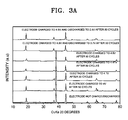
- the 6 coin cells were discharged at a constant current of 125 mA/g until a voltage of 2V versus Li was reached. The charge/discharge was performed 50 times. Then, 4 of the coin cells of the first set were charged until 4V, 4.1V 4.47V, and 4.6V respectively, and were taken apart to measure the XRD, and the remaining 2 coin cells were charged until 4.6V, and were discharged until 3.7V and 2.5V respectively, and were taken apart to measure the XRD. The results are shown in FIG. 3A .
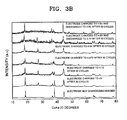
- the 7 coin cells of the second set, produced according to Comparative Example 2 were also analyzed in terms of their XRD of cathode active material by using the same method as above, and the results are shown in FIG. 3B .
- FIG. 3A is an XRD analysis result of Example 6 to illustrate XRD of an initial electrode and XRD after 50 cycles at respective charge/discharge voltages
- FIG. 3B is an XRD analysis result of Comparative Example 2 to illustrate XRD of an initial electrode and XRD after 50 cycles at respective charge/discharge voltages. It can be seen that, after 50 cycles, the cathode active material of Example 6 maintains a better crystalline state than that of Comparative Example 2. This is a result of improved cycle properties of the initial electrode produced according to Example 6 as compared to Comparative Example 2.
Landscapes
- Chemical & Material Sciences (AREA)
- Chemical Kinetics & Catalysis (AREA)
- Electrochemistry (AREA)
- General Chemical & Material Sciences (AREA)
- Engineering & Computer Science (AREA)
- Inorganic Chemistry (AREA)
- Materials Engineering (AREA)
- Manufacturing & Machinery (AREA)
- Battery Electrode And Active Subsutance (AREA)
- Secondary Cells (AREA)
Abstract
<Formula 1> Li[LixMeyMz]O2+d
wherein x+y+z=1; 0<x<0.33; 0<z<0.1; 0≤d≤0.1; Me is at least one metal selected from the group consisting of Ti, V, Cr, Mn, Fe, Co, Ni, Cu, Al, Mg, Zr, and B; and M is at least one metal selected from the group consisting of Mo, W, Ir, Ni, and Mg.
Description
- Aspects of the present invention relate to a cathode active material and a cathode and a lithium battery using the same, and more particularly, to a cathode active material doped with a metal, and a cathode and a lithium battery including the same.
- As a cathode active material for lithium batteries, transition metal compounds, such as LiNiO2, LiCoO2, LiMn2O4, LiFePO4, LiNixCo1-xO2(0≤x≤1), and LiNi1-x-yCoxMnyO2(0≤x≤0.5, 0≤y≤0.5), or lithium oxide, are used. A representative cathode active material is LiCoO2, but LiCoO2 is relatively expensive and has a limited actual electrical capacity of 140 mAh/g. Moreover, if 50% or more of lithium is removed from LiCoO2 by charging, LiCoO2 exist in the form of Li1-xCoO2 (x>0.5). The oxide in the form of Li1-xCoO2 (x>0.5) is unstable and unsafe.
- Specifically, only about 50% of its theoretical capacity of LiCoO2 is used, due to its structural instability. Only about 140 mAh/g can be utilized when 0.5 or more of Li remain in Li1-xCoO2 (x <0.5) and when the charge voltage is 4.2V versus Li metal. If, in order to utilize the LiCoO2 to 50% or more of its theoretical capacity, the charged voltage is increased to 4.2V or more, LiCoO2 becomes Li1-xCoO2 (x >0.5), and the crystal structure of the Li1-xCoO2 (x >0.5) undergoes phase transition from a hexagonal phase to a monoclinic phase, thereby becoming structurally unstable, and as the cycle progresses, the electrical capacity is drastically reduced. In order to solve these drawbacks, cathode active materials such as LiNixco1-xO2 (x=1, 2) or LiNi1-x-yCoxMnyO2(0≤x≤0.5, 0≤y≤0.5) have been used, but such cathode active materials do not show good swelling resistance under high temperature. Lithium metal oxides in the form of Li[LixM1-x]O2 (x>0, M is a plurality of transition metals) provide an increased electrical capacity of 250-280 mAh/g. However, the lithium metal oxides, including excess lithium, have low electrical conductivity, poor cycle properties, and their high rate properties are deteriorated.
- Aspects of the present invention provide a cathode active material including a lithium metal oxide of Formula 1 below:
<Formula 1> Li[LixMeyMz]O2+d
wherein x+y+z=1; 0<x<0.33; 0<z<0.1; 0≤d≤0.1; Me is at least one metal selected from the group consisting of Ti, V, Cr, Mn, Fe, Co, Ni, Cu, Al, Mg, Zr, and B; and M is at least one metal selected from the group consisting of Mo, W, Ir, Ni, and Mg. - Aspects of the present invention also provide a cathode and a lithium battery including the cathode active material.
- Additional aspects and/or advantages of the invention will be set forth in part in the description which follows and, in part, will be obvious from the description, or may be learned by practice of the invention.
- These and/or other aspects and advantages of the invention will become apparent and more readily appreciated from the following description of the embodiments, taken in conjunction with the accompanying drawings of which:
-
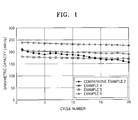
FIG. 1 is test result of charge/discharge for lithium batteries prepared from Examples 4 to 6 according to aspects of the present invention and Comparative Example 2; -
FIG. 2A is a graph illustrating charge/discharge curves of lithium batteries prepared from Comparative Example 2 at 1st , 5th , 10th , 15th , and 20th cycles, shown as a derivative of electrical capacity (dQ/dV) with respect to voltage (V); -
FIG. 2B is a graph illustrating charge/discharge curves of lithium batteries prepared from Example 4 according to aspects of the present invention at 1st , 5th , 10th , 15th , and 20th cycles, shown as a derivative of electrical capacity (dQ/dV) with respect to voltage (V); -
FIG. 3A is an XRD analysis result of Example 6 according to aspects of the present invention to illustrate XRD of an initial electrode and XRD after 50 cycles at respective charge/discharge voltages. -
FIG. 3B is an XRD analysis result of Comparative Example 2 to illustrate XRD of an initial electrode and XRD after 50 cycles at respective charge/discharge voltages. - Reference will now be made in detail to the present embodiments of the present invention, examples of which are illustrated in the accompanying drawings, wherein like reference numerals refer to the like elements throughout. The embodiments are described below in order to explain the present invention by referring to the figures. In the following, "selected from at least one," or similar language, is intended to mean that the item selected may be only one or one of each of the items listed in the group.
- A cathode active material according to an embodiment of the present invention includes a lithium metal oxide of Formula 1 below:
<Formula 1> Li[LixMeyMz]O2+d
wherein x+y+z=1; 0<x<0.33; 0<z<0.1; 0≤d≤0.1; Me is at least one metal selected from the group consisting of Ti, V, Cr, Mn, Fe, Co, Ni, Cu, Al, Mg, Zr, and B; and M is at least one metal selected from the group consisting of Mo, W, Ir, Ni, and Mg. - The lithium metal oxide Li[LixMeyMz]O2+d is obtained by additionally doping a new metal M to a lithium metal oxide including excess lithium and metal Me; and thus, a battery using the lithium metal oxide according to aspects of the present invention has improved cycle properties and high rate properties. The doping content of the new metal M in the lithium metal oxide Li[LixMeyMz]O2+d may preferably be less than 10 mol% of a total number of moles of the [LixMeyMz] portion of the Li[LixMeyMz]O2+d. In Formula 1 above, the doping content is given as z, which is in the range of 0<z<0.1. The content range is suitable for improving the cycle properties of the battery. If the z value is outside of the range above, there may be a significant reduction in the battery capacity. Also, the metal Me may preferably include a plurality of metals.
- According to another embodiment of the present invention, z may be in the range of 0<z<0.05.
- According to another embodiment of the present invention, the lithium metal oxide may be represented by Formula 2 below:
<Formula 2> Li[LixMeyMoz]O2+d
wherein x+y+z=1; 0<x<0.33, 0<z<0.1; 0≤d≤0.1, and Me is at least one metal selected from the group consisting of Ti, V, Cr, Mn, Fe, Co, Ni, Cu, Al, Mg, Zr, and B. In particular, z may preferably be in the range of 0<z<0.05. - According to another embodiment of the present invention, the lithium metal oxide may be represented by Formula 3 below:
<Formula 3> Li[LixNiaCobMncMz]O2+d
wherein x+a+b+c+z=1; 0<x<0.33, 0<z<0.1, 0<a<0.2, 0<b<0.2, 0<c<0.6; 0≤d≤0.1, and M is at least one metal selected from the group consisting of Mo, W, Ir, Ni, and Mg. In particular, z may preferably be in the range of 0<z<0.05. - According to another embodiment of the present invention, the lithium metal oxide may be represented by Formula 4 below:
<Formula 4> Li[LixNiaCobMncMoz]O2+d
wherein x+a+b+c+z=1; 0<x<0.33, 0<z<0.1, 0<a<0.2, 0<b<0.2, 0<c<0.6; and 0≤d≤0.1. - In particular, z may preferably be in the range of 0<z<0.05.
- In particular, the lithium metal oxide may preferably be
Li[Li0.2Ni0.16CO0.08Mn0.54MO0.02]O2, Li[Li0.2Ni0.16CO0.08Mn0.52MO0.04]O2, Li[Li0.2Ni0.2CO0.08Mn0.48Mo0.04]O2, or the like. - According to the current embodiment of the present invention, a method of preparing the lithium metal oxide includes: preparing a sol by mixing a metal precursor, diluted nitric acid, an aqueous citric acid solution, and ethylene glycol; forming a gel by heating the sol, and pyrolyzing the gel; and heat treating the pyrolyzed gel.
- The metal precursor may be a precursor of lithium composing the lithium metal oxide, and other metal precursors. The form of the metal precursor is not particularly limited, but is generally a metal-containing salt or a complex of metal coordinated with an organic ligand.
- The content of individual metal precursors according to the type of the metal composing the metal precursor may be appropriately selected by considering the composition of the lithium metal oxide. The metal precursor may preferably include: a first metal precursor including at least one metal selected from the group consisting of Ti, V, Cr, Mn, Fe, Co, Ni, Cu, Al, Mg, Zr, and B; a second metal precursor including at least one metal selected from the group consisting of Mo, W, Ir, Ni, and Mg; and a lithium metal precursor. For example, the first metal precursor may include nickel acetate, cobalt acetate, and manganese acetate, and the second metal precursor may include ammonium heptamolybdate, and the lithium metal precursor may include lithium carbonate or the like.
- The citric acid acts as a chelating agent. The ethylene glycol is gelled to act as a matrix. The concentration of the diluted nitric acid may preferably be 0.01 to 10 wt%.
- A mixing ratio of the metal precursor, citric acid, and ethylene glycol may be appropriately selected as required.
- The step of forming a gel by heating the sol, and then, pyrolyzing the gel accompanies a phase change which occurs when the sol-containing reaction vessel is continuously heated. That is, if the reaction vessel containing the sol is heated, the sol transforms into a gel, and the residue is pyrolyzed after all the water is evaporated. During the pyrolysis of the sol, the heating may preferably be performed under 300 to 500°C for 1 to 5 hours, but may be appropriately selected as required. The heat treatment of the pyrolyzed gel may preferably be performed by flowing dry air thereacross at 850 to 1100°C for 3 to 12 hours, but may be appropriately selected as required. The heat treated lithium metal oxide may preferably be dry-cooled in a furnace.
- According to another embodiment of the present invention, a method of preparing the lithium metal oxide includes: preparing a first aqueous solution including a first metal precursor; preparing a second aqueous solution including a lithium metal precursor and acetic acid; preparing a third aqueous solution by adding a second metal precursor and citric acid to the second aqueous solution; obtaining a precipitate by adding an aqueous oxalic acid solution to a mixture solution of the first and third aqueous solutions; removing water from the precipitate and pyrolyzing the precipitate; and heat treating the pyrolyzed precipitate.
- The first metal precursor may preferably be a precursor including at least one metal selected from the group consisting of Ti, V, Cr, Mn, Fe, Co, Ni, Cu, Al, Mg, Zr, and B. The second metal precursor may preferably include at least one metal selected from the group consisting of Mo, W, Ir, Ni, and Mg.
- For example, the first metal precursor may include nickel acetate, cobalt acetate, and manganese acetate, and the second metal precursor may include ammonium heptamolybdate, and the lithium metal precursor may include lithium carbonate or the like.
- The acetic acid acts to uniformly dissolve the metal precursors. The oxalic acid acts as a precipitating agent, and the citric acid acts as a chelating agent.
- The mixing ratio of the metal precursors and acetic acid or citiric acid within each aqueous solution may be appropriately selected as necessary. The concentration of the oxalic acid solution may also be appropriately selected as necessary. Moreover, the mixing ratio of the three types of solutions may also be appropriately selected as necessary.
- The process of pyrolyzing the precipitate may preferably be performed at 300 to 500°C for 1 to 5 hours, but may be appropriately selected as necessary. The heat treatment of the pyrolyzed gel may preferably be performed at 850 to 1100°C for 3 to 12 hours, but may be appropriately selected as necessary. The heat-treated lithium metal oxide may preferably be dried in a furnace.
- The cathode according to another embodiment of the present invention includes the cathode active material. The cathode may be, for example, prepared by molding a cathode mixture material, including the cathode active material and a binder, into a predetermined form, or by applying the cathode mixture material on a current collector, such as copper foil or aluminum foil.
- In particular, a cathode mixture material, which is a mixture of a cathode active material, a conducting material, a binder, and a solvent, is prepared. The cathode may be obtained by either directly coating the cathode mixture material on the aluminum foil current collector, or by casting the cathode mixture material on a separate support, and then laminating the cathode active material film separated from the support on the aluminum foil current collector. However, the cathode is not limited to the above, but may also be in other forms.
- The conducting material may be carbon black, graphite microparticles, and the like, and the binder may be vinylidene fluoride/hexafluoropropylene copolymer, polyvinylidene fluoride (PVDF), polyacrylonitrile (PAN), polymethylmethacrylate, polytetrafluoroethylene and mixtures thereof, or styrene butadiene rubber-based polymer, and the solvent may be N-methylpyrrolidone, acetone, or water. The contents of the cathode active material, the conducting material, the binder, and the solvent may be selected as necessary.
- The lithium battery according to another embodiment of the present invention uses the cathode including the cathode active material, and may be prepared by the following method.
- First, the cathode is prepared according to the method of cathode preparation. Next, an anode mixture material is prepared by mixing an anode active material, a conducting material, a binder, and a solvent. An anode plate is obtained by either coating an anode mixture material directly on a copper current collector, or by casting the anode mixture material on a separate support, and then laminating the anode active material film, separated from the support, on the copper current collector. Here, the contents of the anode active material, conducting material, binder and solvent may be selected as necessary.
- The anode active material may be a lithium metal, lithium alloy, carbon material, graphite, or the like. The conducting material, binder, and the solvent in the anode mixture material may be the same as those used in the cathode. If necessary, a plasticizer may further be added to the cathode mixture material and/or the anode mixture material to form pores within the electrode plates.
- The cathode and the anode may be separated from each other by a separator that may be selected as necessary. In particular, a separator which has low resistance to ion transportation of the electrode and high electrolyte hydration abilities is preferable. For example, glass fiber, polyester, Teflon®, polyethylene, polypropylene, polytetrafluoroethylene (PTFE), or a combination selected therefrom may be used, and may either be woven or nonwoven. More particularly, separators that are flexible, such as polyethylene and polypropylene, may be used for lithium ion batteries, and separators with high organic electrolyte solution impregnating abilities may be used for lithium ion polymer batteries that may be prepared using the following method.
- A separator composition is prepared by mixing a polymer resin, a filler, and a solvent, and the separator composition may be coated directly on the electrode and dried to form a separator film. Alternately, the separator composition may be cast on a support and dried, and then the separator film separated from the support may be laminated on the electrode.
- The polymer resin is not particularly limited, and any material used for binding materials of the electrode may be used. For example, vinylidenefluoride/hexafluoropropylene copolymer, polyvinylidene fluoride (PVDF), polyacrylonitrile, polymethylmethacrylate, or mixtures thereof may be used.
- The electrolyte solution may be a solvent of propylene carbonate, ethylene carbonate, fluoroethylene carbonate, butylene carbonate, dimethyl carbonate, diethyl carbonate, methylethyl carbonate, methylpropyl carbonate, ethylpropyl carbonate, methylisopropyl carbonate, dipropyl carbonate, dibutyl carbonate, benzonitrile, acetonitrile, tetrahydrofuran, 2-methyltetrahydrofuran, γ-butyrolactone, dioxorane, 4-methyldioxorane, N,N-dimethylformamide, dimethylacetamide, dimethylsulfoxide, dioxane, 1,2-dimethoxyethane, sulforane, dichloroethane, chlorobenzene, nitrobenzene, diethylene glycol, dimethyl ether, or mixtures thereof, with a lithium salt such as LiPF6, LiBF4, LiSbF6, LiAsF6, LiClO4, LiCF3SO3, Li(CF3SO2)2N, LiC4F9SO3, LiAlO2, LiAlCl4, LiN(CxF2x+1SO2)(CyF2y+1SO2) (where x and y are natural numbers) LiCl, Lil, or mixtures thereof dissolved in the solvent. A separator may be disposed between the cathode plate and the anode plate to form a battery structure. If such a battery structure is coiled or folded into a cylindrical battery case or a rectangular battery case, and the organic electrolyte solution is injected thereto, a lithium ion battery is completed. If such a battery structure is stacked in a bi-cell structure, impregnated with the organic electrolyte solution, and packaged and sealed in a pouch, a lithium ion polymer battery is completed.
- Aspects of the present invention will now be described in more detail with reference to the following examples. However, these examples are for illustrative purposes only and are not intended to limit the scope of the invention.
- As starting materials, lithium carbonate, nickel acetate, cobalt acetate, manganese acetate, and ammonium heptamolybdate were selected. In order to produce 0.04 mol of Li[Li0.2Ni0.16Co0.08Mn0.54Mo0.02]O2, the starting materials were prepared by calculating the molar ratios between Li, Ni, Co, Mn, and Mo accordingly.
- The starting materials were dissolved in 50 ml of diluted nitric acid solution where 5 g of nitric acid (60 wt%) and 50 ml of deionized water are mixed, and 50ml of citric acid solution (2M) and 30 ml of ethylene glycol were added to the solution to produce a sol.
- The sol was heated to evaporate water therefrom to form a gel, and the gel was continuously heated to pyrolyze. Then, the pyrolyzed gel was placed in a furnace through which dry air flowed and heat treated at 1000°C for 5 hours to prepare a cathode active material, which was then left in the furnace to be cooled.
- 0.04 mol of Li[Li0.2Ni0.16Co0.08Mn0.52Mo0.04]O2 was produced using the same method as in Example 1 above, except that the starting materials were prepared with modified molar ratios between Li, Ni, Co, Mn, and Mo accordingly.
- As starting materials, lithium carbonate, nickel acetate, cobalt acetate, manganese acetate, and ammonium heptamolybdate were selected. In order to produce 0.04 mol of Li[Li0.2Ni0.2Co0.08Mn0.48Mo0.04]O2, the starting materials were prepared by calculating the molar ratios between Li, Ni, Co, Mn, and Mo accordingly.
- An aqueous solution was prepared by adding 3.5 ml of acetic acid and 1.8266 g of lithium carbonate to 100 ml of distilled water. 0.2825 g of ammonium heptamolybdate and 4 g of citric acid were added to the aqueous solution and stirred to produce an aqueous Li/Mo solution. An aqueous Ni/Co/Mn solution was prepared by adding 1.9909 g of nickel acetate, 0.7971 g of cobalt acetate, and 4.7057 g of manganese acetate to 100 ml of deionized water. 7.5642 g of oxalic acid was added to 100 ml of deionized water to produce an oxalic acid solution.
- The oxalic acid solution was added to a mixture of the aqueous Ni/Co/Mn solution and the aqueous Li/Mo solution, and the metal ions were precipitated in the forms of metal oxalate salts.
- The precipitate-containing solution was heated at 100°C to dry the moisture, and the dried precipitate was additionally heated at 500°C for 3 hours to pyrolyze. The pyrolyzed precipitate was placed in a furnace through which dry air flowed, and heat treated at 1000°C for 5 hours to produce a cathode active material, which was then left in the furnace to be cooled.
- As starting materials, lithium carbonate, nickel acetate, cobalt acetate, and manganese acetate were selected. 0.04 mol of Li[Li0.2Ni0.16Co0.08Mn0.56]O2 was produced using the same method as in Example 1, except that the starting materials were prepared by calculating the molar ratios between Li, Ni, Co, and Mn accordingly.
- The cathode active material powder synthesized in Example 1 and a carbon conducting material (Ketjen Black; EC-600JD) were mixed uniformly in a weight ratio of 93:3, and a polyvinylidene fluoride (PVDF) binder solution was added to produce a slurry with a weight ratio of active material: carbon conducting material: binder to be 93:3:4.
- The active material slurry was coated on an aluminum foil of 15 µm in thickness, and dried to produce a cathode plate, and was additionally vacuum dried to fabricate a coin cell (CR2016 type) of 12 mm in diameter.
- When preparing the coin cell, metal lithium was used as a counter electrode, and 1.3M LiPF6 dissolved in a mixture solvent of ethylene carbonate(EC):diethyl carbonate(DEC) (3:7 volume ratio) was used as an electrolyte.
- A lithium battery was produced using the same method as in Example 4, except that the cathode active material synthesized in Example 2 was used.
- A lithium battery was produced using the same method as in Example 4, except that the cathode active material synthesized in Example 3 was used.
- A lithium battery was produced using the same method as in Example 4, except that the cathode active material synthesized in Comparative Example 1 was used.
- The coin cells prepared in Examples 4 to 6 and Comparative Example 2 were charged at a constant current of 125 mA/g until a voltage of 4.6V versus Li was reached. After reaching the voltage of 4.6V, the coin cells were charged at a constant voltage until the constant current value reached to 1/10 of the 125 mA/g. After charging, the coin cells were discharged at a constant current of 50 mA/g each until a voltage of 2V versus Li was reached, and the discharge capacity was measured. The measured results are shown in Table 1 below.
- The coin cells prepared in Examples 4 to 6 and Comparative Example 2 were charged at a constant current of 125 mA/g until a voltage of 4.6V versus Li was reached. After reaching the voltage of 4.6V, the coin cells were charged at a constant voltage until the constant current value reached 1/10 of the 125 mA/g. After charging, the coin cells were discharged at constant currents of 250 mA/g (1C rate) and 25 mA/g (0.1C rate) each until a voltage of 2V versus Li was reached to evaluate the high rate discharge properties. The measured results are shown in Table 1 below, and the high rate discharge properties are represented by a capacitance ratio of Equation 1.

- The coin cells prepared in Examples 4 to 6 and Comparative Example 2 were charged at a constant current of 125 mA/g until a voltage of 4.6V versus Li was reached. After reaching the voltage of 4.6V, the coin cells were charged at a constant voltage until the constant current value reached 1/10 of the 125 mA/g. After charging, the coin cells were discharged at a constant current of 125 mA/g until a voltage of 2V versus Li was reached. The charge/discharge cycle was repeated 20 times and the results are shown in
FIG. 1 and Table 1. The capacity retention ratio in Table 1 is represented byEquation 2 below.

- Moreover, graphs of dQ/dV with respect to voltage (V) at 1st, 5th, 10th, 15th, and 20th cycles of the coin cells prepared in Examples 4 and Comparative Example 2 are shown in
FIGS. 2A and 2B respectively.Table 1 Discharge Capacity
[mAh/g]Capacity Ratio [%] Capacity Retention
Ratio [%]Example 4 246 81 92 Example 5 216 79 94 Example 6 268 87 94 Comparative Example 2 261 77 73 - As shown in
FIG. 1 and Table 1, Examples 4 to 6, in which cathode active materials according to aspects of the present invention are used, demonstrated better cycle properties (capacity retention ratio) than Comparative Example 2. - As shown in
FIG. 2A , Comparative Example 2 showed a reduction of derivative values by an increased overpotential as the cycles increase, but inFIG. 2B of Example 4, the increase in the overpotential was suppressed, and thus a change in the derivative values was reduced. - In addition, Examples 4 to 6 showed improved high rate discharge properties (capacity ratio) as compared to Comparative Example 2.
- Two sets of 7 coin cells were produced. A first set of 7 coin cells was prepared according to Example 6 and a second set of 7 coin cells was prepared according to Comparative Example 2. First, one of the first set of coin cells, produced according to Example 6 and not yet charge/discharged, was taken apart and the X-ray diffraction (XRD) for the cathode active material was analyzed. Next, the remaining 6 coin cells of the first set produced according to Example 6 were charge/discharged as follows. The 6 coin cells were charged at a constant current of 125 mAh/g until a voltage of 4.6V versus Li metal was reached. After reaching the voltage of 4.6V, the 6 coin cells were charged at a constant voltage until the constant current value reached 1/10 of the 125 mA/g. After charging, the 6 coin cells were discharged at a constant current of 125 mA/g until a voltage of 2V versus Li was reached. The charge/discharge was performed 50 times. Then, 4 of the coin cells of the first set were charged until 4V, 4.1V 4.47V, and 4.6V respectively, and were taken apart to measure the XRD, and the remaining 2 coin cells were charged until 4.6V, and were discharged until 3.7V and 2.5V respectively, and were taken apart to measure the XRD. The results are shown in
FIG. 3A . - The 7 coin cells of the second set, produced according to Comparative Example 2, were also analyzed in terms of their XRD of cathode active material by using the same method as above, and the results are shown in
FIG. 3B . -
FIG. 3A is an XRD analysis result of Example 6 to illustrate XRD of an initial electrode and XRD after 50 cycles at respective charge/discharge voltages, andFIG. 3B is an XRD analysis result of Comparative Example 2 to illustrate XRD of an initial electrode and XRD after 50 cycles at respective charge/discharge voltages. It can be seen that, after 50 cycles, the cathode active material of Example 6 maintains a better crystalline state than that of Comparative Example 2. This is a result of improved cycle properties of the initial electrode produced according to Example 6 as compared to Comparative Example 2. - Although a few embodiments of the present invention have been shown and described, it would be appreciated by those skilled in the art that changes may be made in this embodiment without departing from the principles of the invention, the scope of which is defined in the claims and their equivalents.
Claims (15)
- A cathode active material comprising a lithium metal oxide of Formula 1 below:
<Formula 1> Li[LixMeyMz]O2+d
wherein x+y+z=1; 0<x<0.33; 0<z<0.1; 0≤d≤0.1;
Me is at least one metal selected from the group consisting of Ti, V, Cr, Mn, Fe, Co, Ni, Cu, Al, Mg, Zr, and B; and
M is at least one metal selected from the group consisting of Mo, W, Ir, Ni, and Mg. - The cathode active material of claim 1, wherein z is in the range of 0<z<0.05.
- The cathode of active material of claim 1, wherein the lithium metal oxide is represented by Formula 2 below:
<Formula 2> Li[LixMeyMz]O2+d
wherein x+y+z=1; 0<x<0.33; 0<z<0.1; 0≤d≤0.1; and
Me is at least one metal selected from the group consisting of Ti, V, Cr, Mn, Fe, Co, Ni, Cu, Al, Mg, Zr, and B. - The cathode active material of claim 3, wherein z is in the range of 0<z<0.05.
- The cathode active material of claim 1, wherein the lithium metal oxide is represented by Formula 3 below:
<Formula 3> Li[LixNiaCobMncMz]O2+d
wherein x+a+b+c+z=1; 0<x<0.33; 0<z<0.1; 0<a<0.2; 0<b<0.2; 0<c<0.6; 0≤d≤0.1; and
M is at least one metal selected from the group consisting of Mo, W, Ir, Ni, and Mg. - The cathode active material of claim 5, wherein z is in the range of 0<z<0.05.
- The cathode active material of claim 1, wherein the lithium metal oxide is represented by Formula 4 below:
<Formula 4> Li[LixNiaCobMncMz]O2+d
wherein x+a+b+c+z=1; 0<x<0.33, 0<z<0.1, 0<a<0.2, 0<b<0.2, 0<c<0.6; and 0≤d≤0.1. - The cathode active material of claim 7, wherein z is in the range of 0<z<0.05.
- The cathode active material of claim 1, wherein the lithium metal oxide of Formula 1 is
Li[Li0.2Ni0.16Co0.08Mn0.54Mo0.02]O2.
- The cathode active material of claim 1, wherein the lithium metal oxide of Formula 1 is
Li[Li0.2Ni0.16Co0.08Mn0.52Mo0.04]O2.
- The cathode active material of claim 1, wherein the lithium metal oxide of Formula 1 is
Li[Li0.2Ni0.2Co0.08Mn0.48Mo0.04]O2.
- A cathode, comprising:a cathode active material according to any of claims 1-11.
- A lithium battery, comprising:an anode;a cathode according to claim 12; anda separator disposed between the anode and the cathode.
- A method of preparing a lithium metal oxide for use in the cathode active material of claim 1, comprising preparing a sol by mixing a metal precursor, diluted nitric acid, an aqueous citric acid solution, and ethylene glycol;
forming a gel by heating the sol, and pyrolyzing the gel; and
heat treating the pyrolyzed gel. - A method of preparing a lithium metal oxide for use in the cathode active material of claim 1, comprising:preparing a first aqueous solution including a first metal precursor;preparing a second aqueous solution including a lithium metal precursor and acetic acid; preparing a third aqueous solution by adding a second metal precursor and citric acid to the second aqueous solution;obtaining a precipitate by adding an aqueous oxalic acid solution to a mixture solution of the first and third aqueous solutions; removing water from the precipitate and pyrolyzing the precipitate; andheat treating the pyrolyzed precipitate.
Applications Claiming Priority (1)
| Application Number | Priority Date | Filing Date | Title |
|---|---|---|---|
| KR1020080018533A KR101473322B1 (en) | 2008-02-28 | 2008-02-28 | Cathode active material, anode and lithium battery employing the same |
Publications (2)
| Publication Number | Publication Date |
|---|---|
| EP2096692A1 true EP2096692A1 (en) | 2009-09-02 |
| EP2096692B1 EP2096692B1 (en) | 2013-10-02 |
Family
ID=40740124
Family Applications (1)
| Application Number | Title | Priority Date | Filing Date |
|---|---|---|---|
| EP09153701.9A Active EP2096692B1 (en) | 2008-02-28 | 2009-02-26 | Cathode active material, and cathode and lithium battery including the same |
Country Status (4)
| Country | Link |
|---|---|
| US (1) | US8758942B2 (en) |
| EP (1) | EP2096692B1 (en) |
| JP (1) | JP5808073B2 (en) |
| KR (1) | KR101473322B1 (en) |
Cited By (9)
| Publication number | Priority date | Publication date | Assignee | Title |
|---|---|---|---|---|
| EP2879213A4 (en) * | 2013-09-30 | 2015-11-04 | Lg Chemical Ltd | CATHODE ACTIVE MATERIAL FOR SECONDARY BATTERY AND METHOD FOR PREPARING THE SAME |
| US9941508B2 (en) | 2013-09-30 | 2018-04-10 | Lg Chem, Ltd. | Cathode active material for secondary battery, method of manufacturing the same, and cathode for lithium secondary battery including the cathode active material |
| US10026960B2 (en) | 2013-09-30 | 2018-07-17 | Lg Chem, Ltd. | Cathode active material coating solution for secondary battery and method of manufacturing the same |
| US10756338B2 (en) | 2013-09-30 | 2020-08-25 | Lg Chem, Ltd. | Cathode active material for secondary battery and method of manufacturing the same |
| CN111916729A (en) * | 2020-08-06 | 2020-11-10 | 合肥工业大学 | Ternary lithium nickel cobalt manganese oxide material and preparation method and application thereof |
| EP3518330A4 (en) * | 2016-09-21 | 2020-11-11 | Basf Toda Battery Materials LLC | CATHODE ACTIVE MATERIAL AND METHOD OF MANUFACTURING THEREOF AND SECONDARY BATTERY WITH ANHYDROUS ELECTROLYTE |
| EP4216311A4 (en) * | 2020-12-04 | 2024-10-16 | Ecopro Bm Co., Ltd. | Cathode active material and lithium secondary battery comprising same |
| US12183916B2 (en) | 2016-09-21 | 2024-12-31 | Basf Toda Battery Materials Llc | Positive electrode active material and method for producing same, and non-aqueous electrolyte secondary battery using same |
| WO2025132353A1 (en) * | 2023-12-19 | 2025-06-26 | Umicore | Cathode active material for rechargeable batteries |
Families Citing this family (25)
| Publication number | Priority date | Publication date | Assignee | Title |
|---|---|---|---|---|
| KR20110019574A (en) | 2009-08-20 | 2011-02-28 | 삼성에스디아이 주식회사 | Cathode active material, positive electrode and lithium battery using same, and method for manufacturing same |
| KR101705250B1 (en) | 2010-03-19 | 2017-02-09 | 삼성전자주식회사 | Cathode active material, and cathode and lithium battery containing the material |
| JP2012142154A (en) * | 2010-12-28 | 2012-07-26 | Sony Corp | Lithium ion secondary battery, power tool, electric vehicle and power storage system |
| JP2012142155A (en) | 2010-12-28 | 2012-07-26 | Sony Corp | Lithium secondary battery, positive electrode active material, positive electrode, power tool, electric vehicle, and power storage system |
| KR101608733B1 (en) | 2011-12-06 | 2016-04-04 | 에스케이이노베이션 주식회사 | Method for manufacturing cathode active material for lithium secondary battery |
| JP2013175401A (en) * | 2012-02-27 | 2013-09-05 | Hitachi Ltd | Positive electrode material |
| EP2634148B1 (en) * | 2012-03-01 | 2015-04-01 | GS Yuasa International Ltd. | Active material for non-aqueous electrolyte secondary battery, method for production of the active material, electrode for non-aqueous electrolyte secondary battery and non-aqueous electrolyte secondary battery |
| JP5921930B2 (en) * | 2012-03-28 | 2016-05-24 | 日本ケミコン株式会社 | Manufacturing method of electrode material for secondary battery |
| KR101570977B1 (en) * | 2012-11-22 | 2015-11-23 | 주식회사 엘지화학 | Lithium Secondary Battery |
| US10128540B2 (en) | 2012-11-22 | 2018-11-13 | Lg Chem, Ltd. | Lithium secondary battery |
| KR102007411B1 (en) | 2013-01-07 | 2019-10-01 | 삼성에스디아이 주식회사 | Positive active material, positive electrode and lithium battery comprising the same, and method for preparation of the positive active material |
| KR102100925B1 (en) | 2013-03-22 | 2020-04-14 | 삼성전자주식회사 | Substrate assembly, method of forming the substrate assembly, and electronic device comprising the same |
| EP2879210B1 (en) * | 2013-09-30 | 2020-01-15 | LG Chem, Ltd. | Cathode active material coating solution for secondary battery and method for preparing same |
| US11569494B2 (en) * | 2013-10-23 | 2023-01-31 | Cps Technology Holdings Llc | Aqueous cathode slurry |
| JP5732122B2 (en) * | 2013-11-11 | 2015-06-10 | 株式会社日立製作所 | Positive electrode active material, positive electrode, and lithium ion secondary battery |
| KR102163731B1 (en) | 2013-11-22 | 2020-10-08 | 삼성전자주식회사 | Electrolyte for lithium battery and lithium battery comprising the same |
| JP6065874B2 (en) | 2014-05-27 | 2017-01-25 | 住友金属鉱山株式会社 | Positive electrode active material for non-aqueous electrolyte secondary battery, method for producing the same, and non-aqueous electrolyte secondary battery using the positive electrode active material |
| US11011746B2 (en) | 2015-07-13 | 2021-05-18 | Samsung Electronics Co., Ltd. | Composite cathode active material for lithium battery, cathode for lithium battery including the same, and lithium battery including the cathode |
| US10862106B2 (en) | 2015-10-28 | 2020-12-08 | Samsung Electronics Co., Ltd. | Composite positive electrode active material, positive electrode including the same, and lithium battery including the positive electrode |
| JP6329311B2 (en) * | 2016-09-21 | 2018-05-23 | Basf戸田バッテリーマテリアルズ合同会社 | Positive electrode active material, method for producing the same, and nonaqueous electrolyte secondary battery |
| KR102488677B1 (en) * | 2017-05-12 | 2023-01-16 | 주식회사 엘지에너지솔루션 | Method for preparing lithium secondary battery |
| CL2017002221A1 (en) * | 2017-09-01 | 2018-01-19 | Univ Antofagasta | Magnesium-doped manganese spinel, cathode material comprising it, preparation method, and lithium ion battery comprising it |
| KR102757221B1 (en) * | 2018-11-28 | 2025-01-21 | 현대자동차주식회사 | lithium secondary battery and MANUFACTURING METHOD THEREOF |
| CZ308296B6 (en) * | 2019-08-01 | 2020-04-22 | Univerzita Tomáše Bati ve Zlíně | A method of preparing a cathode material for a lithium-sulphur battery |
| CN111276686B (en) * | 2020-02-16 | 2022-09-16 | 四川新锂想能源科技有限责任公司 | High-nickel quaternary lithium ion battery material Li-Ni-Co-Mn-Mo-O and preparation method thereof |
Citations (3)
| Publication number | Priority date | Publication date | Assignee | Title |
|---|---|---|---|---|
| US20070122703A1 (en) | 2003-05-28 | 2007-05-31 | Pamela Whitfield | Lithium metal oxide electrodes for lithium cells and batteries |
| US20070292763A1 (en) | 2006-06-19 | 2007-12-20 | University Of Chicago | Cathode material for lithium batteries |
| EP1936718A1 (en) * | 2006-12-13 | 2008-06-25 | Samsung SDI Co., Ltd. | Cathode active material for a lithium battery |
Family Cites Families (18)
| Publication number | Priority date | Publication date | Assignee | Title |
|---|---|---|---|---|
| US292763A (en) * | 1884-01-29 | Combined letter-scale and coin-tester | ||
| US122703A (en) * | 1872-01-16 | Improvement in weather-strips | ||
| JPH10321228A (en) | 1997-05-16 | 1998-12-04 | Nippon Telegr & Teleph Corp <Ntt> | Positive active material for lithium battery, method for producing the same, and lithium battery using the same |
| US6517974B1 (en) * | 1998-01-30 | 2003-02-11 | Canon Kabushiki Kaisha | Lithium secondary battery and method of manufacturing the lithium secondary battery |
| US7608365B1 (en) * | 1999-05-25 | 2009-10-27 | Samsung Sdi Co., Ltd. | Positive active material composition for rechargeable lithium battery and method of preparing positive electrode using same |
| US6680143B2 (en) * | 2000-06-22 | 2004-01-20 | The University Of Chicago | Lithium metal oxide electrodes for lithium cells and batteries |
| US6677082B2 (en) * | 2000-06-22 | 2004-01-13 | The University Of Chicago | Lithium metal oxide electrodes for lithium cells and batteries |
| JP4082214B2 (en) * | 2000-11-20 | 2008-04-30 | 中央電気工業株式会社 | Nonaqueous electrolyte secondary battery and its positive electrode active material |
| TW560099B (en) * | 2001-04-20 | 2003-11-01 | Japan Storage Battery Co Ltd | Non-aqueous electrolyte secondary battery |
| JP4639573B2 (en) | 2002-03-25 | 2011-02-23 | 住友化学株式会社 | Method for producing positive electrode active material for non-aqueous secondary battery |
| KR100557241B1 (en) | 2003-04-25 | 2006-03-15 | 학교법인 한양학원 | 5V Grade Spinel Composite Solid Oxide Using Ultrasonic Spray Pyrolysis and Battery Using the Oxide and Its Manufacturing Method |
| JP4539816B2 (en) * | 2004-02-20 | 2010-09-08 | 日本電気株式会社 | Positive electrode for lithium secondary battery and lithium secondary battery |
| JP4968503B2 (en) | 2005-04-26 | 2012-07-04 | ソニー株式会社 | Lithium secondary battery |
| JP4993891B2 (en) * | 2005-09-22 | 2012-08-08 | 三洋電機株式会社 | Nonaqueous electrolyte secondary battery |
| CN101146746A (en) * | 2005-09-28 | 2008-03-19 | Agc清美化学股份有限公司 | Method for producing lithium-containing composite oxide |
| JP4785482B2 (en) | 2005-09-28 | 2011-10-05 | 三洋電機株式会社 | Nonaqueous electrolyte secondary battery |
| JP5173145B2 (en) * | 2006-02-08 | 2013-03-27 | 三洋電機株式会社 | Nonaqueous electrolyte secondary battery |
| JP5315591B2 (en) * | 2006-02-20 | 2013-10-16 | ソニー株式会社 | Positive electrode active material and battery |
-
2008
- 2008-02-28 KR KR1020080018533A patent/KR101473322B1/en active Active
- 2008-11-19 US US12/273,847 patent/US8758942B2/en active Active
-
2009
- 2009-02-26 EP EP09153701.9A patent/EP2096692B1/en active Active
- 2009-02-27 JP JP2009046471A patent/JP5808073B2/en active Active
Patent Citations (3)
| Publication number | Priority date | Publication date | Assignee | Title |
|---|---|---|---|---|
| US20070122703A1 (en) | 2003-05-28 | 2007-05-31 | Pamela Whitfield | Lithium metal oxide electrodes for lithium cells and batteries |
| US20070292763A1 (en) | 2006-06-19 | 2007-12-20 | University Of Chicago | Cathode material for lithium batteries |
| EP1936718A1 (en) * | 2006-12-13 | 2008-06-25 | Samsung SDI Co., Ltd. | Cathode active material for a lithium battery |
Non-Patent Citations (2)
| Title |
|---|
| PARK ET AL., JOURNAL OF POWER SOURCES, vol. 146, 2005, pages 622 - 625 |
| SANG-HO, SUNG WOO OH, YANG-KOOK SUN: "Synthesis and structural characterization of layered Li[Ni1/3+xCo1/3Mn1/3?2xMox]O2 cathode materials by ultrasonic spray pyrolysis", JOURNAL OF POWER SOURCES, vol. 146, 4 May 2006 (2006-05-04), online, pages 622 - 625, XP002533941 * |
Cited By (11)
| Publication number | Priority date | Publication date | Assignee | Title |
|---|---|---|---|---|
| EP2879213A4 (en) * | 2013-09-30 | 2015-11-04 | Lg Chemical Ltd | CATHODE ACTIVE MATERIAL FOR SECONDARY BATTERY AND METHOD FOR PREPARING THE SAME |
| US9941508B2 (en) | 2013-09-30 | 2018-04-10 | Lg Chem, Ltd. | Cathode active material for secondary battery, method of manufacturing the same, and cathode for lithium secondary battery including the cathode active material |
| US10026960B2 (en) | 2013-09-30 | 2018-07-17 | Lg Chem, Ltd. | Cathode active material coating solution for secondary battery and method of manufacturing the same |
| US10756338B2 (en) | 2013-09-30 | 2020-08-25 | Lg Chem, Ltd. | Cathode active material for secondary battery and method of manufacturing the same |
| EP3518330A4 (en) * | 2016-09-21 | 2020-11-11 | Basf Toda Battery Materials LLC | CATHODE ACTIVE MATERIAL AND METHOD OF MANUFACTURING THEREOF AND SECONDARY BATTERY WITH ANHYDROUS ELECTROLYTE |
| US11121365B2 (en) | 2016-09-21 | 2021-09-14 | Basf Toda Battery Materials Llc | Positive electrode active material and method for producing same, and non-aqueous electrolyte secondary battery using same |
| US12183916B2 (en) | 2016-09-21 | 2024-12-31 | Basf Toda Battery Materials Llc | Positive electrode active material and method for producing same, and non-aqueous electrolyte secondary battery using same |
| CN111916729A (en) * | 2020-08-06 | 2020-11-10 | 合肥工业大学 | Ternary lithium nickel cobalt manganese oxide material and preparation method and application thereof |
| EP4216311A4 (en) * | 2020-12-04 | 2024-10-16 | Ecopro Bm Co., Ltd. | Cathode active material and lithium secondary battery comprising same |
| US12500236B2 (en) | 2020-12-04 | 2025-12-16 | Ecopro Bm Co., Ltd. | Positive electrode active material and lithium secondary battery including the same |
| WO2025132353A1 (en) * | 2023-12-19 | 2025-06-26 | Umicore | Cathode active material for rechargeable batteries |
Also Published As
| Publication number | Publication date |
|---|---|
| KR20090093165A (en) | 2009-09-02 |
| JP2009206100A (en) | 2009-09-10 |
| KR101473322B1 (en) | 2014-12-24 |
| EP2096692B1 (en) | 2013-10-02 |
| JP5808073B2 (en) | 2015-11-10 |
| US20090220859A1 (en) | 2009-09-03 |
| US8758942B2 (en) | 2014-06-24 |
Similar Documents
| Publication | Publication Date | Title |
|---|---|---|
| EP2096692B1 (en) | Cathode active material, and cathode and lithium battery including the same | |
| JP7500178B2 (en) | Composite positive electrode active material, positive electrode containing the same, lithium battery, and method of manufacturing the same | |
| KR101705250B1 (en) | Cathode active material, and cathode and lithium battery containing the material | |
| US7927506B2 (en) | Cathode active material and lithium battery using the same | |
| EP3693341A1 (en) | Composite cathode active material, cathode and lithium battery each containing composite cathode active material, and preparation method of cathode active material | |
| EP1909345B1 (en) | Cathode active material for a lithium battery | |
| EP3632851A1 (en) | Composite cathode active material, cathode and lithium battery each containing composite cathode active material, and method of preparing composite cathode active material | |
| US8722250B2 (en) | Cathode active material, cathode including the cathode active material, lithium battery employing the cathode, and method of preparing the same | |
| KR101264332B1 (en) | Cathode active material and lithium battery using the same | |
| KR101601917B1 (en) | Positive active material for rechargeable lithium battery, method for manufacturing the same, and rechargeable lithium battery including the same | |
| US9786906B2 (en) | Composite cathode materials with controlled irreversible capacity loss for lithium ion batteries | |
| EP3096388B1 (en) | Nonaqueous electrolyte secondary battery and battery pack of same | |
| KR101458676B1 (en) | Positive active material for lithium secondary battery, method of preparing the same, and lithium secondary battery using the same | |
| CN107431242A (en) | Battery | |
| EP2523239A2 (en) | Cathode active material containing lithium manganese oxide that exhibits excellent charge-discharge characteristics in 4v and 3v regions | |
| EP4216311A1 (en) | Cathode active material and lithium secondary battery comprising same | |
| EP2985824A1 (en) | Cathode material, cathode including the same, and lithium battery including the cathode | |
| KR101676687B1 (en) | Positive active material for rechargeable lithium battery, method for manufacturing the same, and rechargeable lithium battery including the same | |
| KR101576274B1 (en) | Positive active material for rechargeable lithium battery, method for manufacturing the same, and rechargeable lithium battery including the same | |
| EP2624343B1 (en) | Positive electrode active material for a lithium secondary battery, method for preparing same, and lithium secondary battery comprising same | |
| KR20170067082A (en) | Cathode additives for lithium secondary battery and secondary battery comprising the same | |
| KR101602419B1 (en) | A positive electrode active material, a positive electrode containing the positive electrode active material, and a lithium battery employing the positive electrode | |
| EP2819223A1 (en) | Positive electrode active material | |
| JP2014086382A (en) | Method for manufacturing nonaqueous electrolyte secondary battery, and battery manufactured by the method |
Legal Events
| Date | Code | Title | Description |
|---|---|---|---|
| PUAI | Public reference made under article 153(3) epc to a published international application that has entered the european phase |
Free format text: ORIGINAL CODE: 0009012 |
|
| AK | Designated contracting states |
Kind code of ref document: A1 Designated state(s): AT BE BG CH CY CZ DE DK EE ES FI FR GB GR HR HU IE IS IT LI LT LU LV MC MK MT NL NO PL PT RO SE SI SK TR |
|
| AX | Request for extension of the european patent |
Extension state: AL BA RS |
|
| 17P | Request for examination filed |
Effective date: 20091202 |
|
| 17Q | First examination report despatched |
Effective date: 20100105 |
|
| AKX | Designation fees paid |
Designated state(s): CH DE FR GB LI |
|
| GRAJ | Information related to disapproval of communication of intention to grant by the applicant or resumption of examination proceedings by the epo deleted |
Free format text: ORIGINAL CODE: EPIDOSDIGR1 |
|
| GRAP | Despatch of communication of intention to grant a patent |
Free format text: ORIGINAL CODE: EPIDOSNIGR1 |
|
| GRAP | Despatch of communication of intention to grant a patent |
Free format text: ORIGINAL CODE: EPIDOSNIGR1 |
|
| RIC1 | Information provided on ipc code assigned before grant |
Ipc: H01M 4/52 20100101ALI20121211BHEP Ipc: H01M 4/50 20100101ALI20121211BHEP Ipc: H01M 4/02 20060101ALI20121211BHEP Ipc: H01M 4/48 20100101AFI20121211BHEP Ipc: H01M 10/0525 20100101ALI20121211BHEP |
|
| GRAP | Despatch of communication of intention to grant a patent |
Free format text: ORIGINAL CODE: EPIDOSNIGR1 |
|
| INTG | Intention to grant announced |
Effective date: 20130711 |
|
| GRAS | Grant fee paid |
Free format text: ORIGINAL CODE: EPIDOSNIGR3 |
|
| GRAA | (expected) grant |
Free format text: ORIGINAL CODE: 0009210 |
|
| AK | Designated contracting states |
Kind code of ref document: B1 Designated state(s): CH DE FR GB LI |
|
| REG | Reference to a national code |
Ref country code: GB Ref legal event code: FG4D |
|
| REG | Reference to a national code |
Ref country code: CH Ref legal event code: EP |
|
| REG | Reference to a national code |
Ref country code: DE Ref legal event code: R096 Ref document number: 602009019137 Country of ref document: DE Effective date: 20131205 |
|
| REG | Reference to a national code |
Ref country code: DE Ref legal event code: R097 Ref document number: 602009019137 Country of ref document: DE |
|
| PLBE | No opposition filed within time limit |
Free format text: ORIGINAL CODE: 0009261 |
|
| STAA | Information on the status of an ep patent application or granted ep patent |
Free format text: STATUS: NO OPPOSITION FILED WITHIN TIME LIMIT |
|
| 26N | No opposition filed |
Effective date: 20140703 |
|
| REG | Reference to a national code |
Ref country code: CH Ref legal event code: PL |
|
| REG | Reference to a national code |
Ref country code: DE Ref legal event code: R097 Ref document number: 602009019137 Country of ref document: DE Effective date: 20140703 |
|
| PG25 | Lapsed in a contracting state [announced via postgrant information from national office to epo] |
Ref country code: CH Free format text: LAPSE BECAUSE OF NON-PAYMENT OF DUE FEES Effective date: 20140228 Ref country code: LI Free format text: LAPSE BECAUSE OF NON-PAYMENT OF DUE FEES Effective date: 20140228 |
|
| REG | Reference to a national code |
Ref country code: FR Ref legal event code: PLFP Year of fee payment: 8 |
|
| REG | Reference to a national code |
Ref country code: FR Ref legal event code: PLFP Year of fee payment: 9 |
|
| REG | Reference to a national code |
Ref country code: FR Ref legal event code: PLFP Year of fee payment: 10 |
|
| P01 | Opt-out of the competence of the unified patent court (upc) registered |
Effective date: 20230528 |
|
| PGFP | Annual fee paid to national office [announced via postgrant information from national office to epo] |
Ref country code: GB Payment date: 20260128 Year of fee payment: 18 |
|
| PGFP | Annual fee paid to national office [announced via postgrant information from national office to epo] |
Ref country code: DE Payment date: 20260128 Year of fee payment: 18 |
|
| PGFP | Annual fee paid to national office [announced via postgrant information from national office to epo] |
Ref country code: FR Payment date: 20260121 Year of fee payment: 18 |