EP2093258A2 - Infrared dye composition, infrared ray absorbing ink and electrophotographic toner - Google Patents
Infrared dye composition, infrared ray absorbing ink and electrophotographic toner Download PDFInfo
- Publication number
- EP2093258A2 EP2093258A2 EP20090152447 EP09152447A EP2093258A2 EP 2093258 A2 EP2093258 A2 EP 2093258A2 EP 20090152447 EP20090152447 EP 20090152447 EP 09152447 A EP09152447 A EP 09152447A EP 2093258 A2 EP2093258 A2 EP 2093258A2
- Authority
- EP
- European Patent Office
- Prior art keywords
- group
- dye composition
- compound
- infrared dye
- range
- Prior art date
- Legal status (The legal status is an assumption and is not a legal conclusion. Google has not performed a legal analysis and makes no representation as to the accuracy of the status listed.)
- Granted
Links
- 239000000203 mixture Substances 0.000 title claims abstract description 114
- 150000001875 compounds Chemical class 0.000 claims abstract description 104
- 238000002835 absorbance Methods 0.000 claims abstract description 74
- 238000010521 absorption reaction Methods 0.000 claims abstract description 56
- 230000003595 spectral effect Effects 0.000 claims abstract description 53
- -1 carbamoyloxy group Chemical group 0.000 claims description 258
- 125000000217 alkyl group Chemical group 0.000 claims description 39
- 125000003118 aryl group Chemical group 0.000 claims description 32
- 125000000623 heterocyclic group Chemical group 0.000 claims description 31
- 125000001424 substituent group Chemical group 0.000 claims description 24
- 125000003545 alkoxy group Chemical group 0.000 claims description 20
- 125000004435 hydrogen atom Chemical group [H]* 0.000 claims description 19
- 125000004104 aryloxy group Chemical group 0.000 claims description 18
- 125000003277 amino group Chemical group 0.000 claims description 17
- 125000003710 aryl alkyl group Chemical group 0.000 claims description 17
- LKKPNUDVOYAOBB-UHFFFAOYSA-N naphthalocyanine Chemical compound N1C(N=C2C3=CC4=CC=CC=C4C=C3C(N=C3C4=CC5=CC=CC=C5C=C4C(=N4)N3)=N2)=C(C=C2C(C=CC=C2)=C2)C2=C1N=C1C2=CC3=CC=CC=C3C=C2C4=N1 LKKPNUDVOYAOBB-UHFFFAOYSA-N 0.000 claims description 17
- 125000005843 halogen group Chemical group 0.000 claims description 15
- 125000003342 alkenyl group Chemical group 0.000 claims description 12
- 125000004414 alkyl thio group Chemical group 0.000 claims description 12
- 125000003178 carboxy group Chemical group [H]OC(*)=O 0.000 claims description 12
- 125000004453 alkoxycarbonyl group Chemical group 0.000 claims description 11
- 125000005110 aryl thio group Chemical group 0.000 claims description 11
- 125000000020 sulfo group Chemical group O=S(=O)([*])O[H] 0.000 claims description 11
- 125000000304 alkynyl group Chemical group 0.000 claims description 10
- 125000004093 cyano group Chemical group *C#N 0.000 claims description 9
- 125000000449 nitro group Chemical group [O-][N+](*)=O 0.000 claims description 8
- 125000005328 phosphinyl group Chemical group [PH2](=O)* 0.000 claims description 8
- 125000004644 alkyl sulfinyl group Chemical group 0.000 claims description 7
- 125000004390 alkyl sulfonyl group Chemical group 0.000 claims description 7
- 125000004397 aminosulfonyl group Chemical group NS(=O)(=O)* 0.000 claims description 7
- 125000005135 aryl sulfinyl group Chemical group 0.000 claims description 7
- 125000004391 aryl sulfonyl group Chemical group 0.000 claims description 7
- 125000003917 carbamoyl group Chemical group [H]N([H])C(*)=O 0.000 claims description 7
- 125000002887 hydroxy group Chemical group [H]O* 0.000 claims description 7
- 125000004423 acyloxy group Chemical group 0.000 claims description 6
- 125000004466 alkoxycarbonylamino group Chemical group 0.000 claims description 6
- 125000006598 aminocarbonylamino group Chemical group 0.000 claims description 6
- PYKYMHQGRFAEBM-UHFFFAOYSA-N anthraquinone Natural products CCC(=O)c1c(O)c2C(=O)C3C(C=CC=C3O)C(=O)c2cc1CC(=O)OC PYKYMHQGRFAEBM-UHFFFAOYSA-N 0.000 claims description 6
- 125000005162 aryl oxy carbonyl amino group Chemical group 0.000 claims description 6
- 125000004657 aryl sulfonyl amino group Chemical group 0.000 claims description 6
- 125000000753 cycloalkyl group Chemical group 0.000 claims description 6
- 229910021645 metal ion Inorganic materials 0.000 claims description 6
- 125000001820 oxy group Chemical group [*:1]O[*:2] 0.000 claims description 6
- 125000004469 siloxy group Chemical group [SiH3]O* 0.000 claims description 6
- 125000003808 silyl group Chemical group [H][Si]([H])([H])[*] 0.000 claims description 6
- 125000004149 thio group Chemical group *S* 0.000 claims description 6
- 125000003396 thiol group Chemical group [H]S* 0.000 claims description 6
- 125000004442 acylamino group Chemical group 0.000 claims description 5
- 125000005194 alkoxycarbonyloxy group Chemical group 0.000 claims description 5
- 125000004656 alkyl sulfonylamino group Chemical group 0.000 claims description 5
- 125000003368 amide group Chemical group 0.000 claims description 5
- 125000005161 aryl oxy carbonyl group Chemical group 0.000 claims description 5
- 125000005200 aryloxy carbonyloxy group Chemical group 0.000 claims description 5
- 150000001768 cations Chemical group 0.000 claims description 5
- 125000005420 sulfonamido group Chemical group S(=O)(=O)(N*)* 0.000 claims description 5
- 125000002252 acyl group Chemical group 0.000 claims description 4
- 150000001450 anions Chemical group 0.000 claims description 4
- 230000003472 neutralizing effect Effects 0.000 claims description 3
- 239000000975 dye Substances 0.000 description 95
- 125000004432 carbon atom Chemical group C* 0.000 description 89
- 239000000976 ink Substances 0.000 description 57
- 239000002904 solvent Substances 0.000 description 52
- 239000002245 particle Substances 0.000 description 48
- 239000011358 absorbing material Substances 0.000 description 39
- 238000000034 method Methods 0.000 description 34
- 239000000843 powder Substances 0.000 description 32
- 229920005989 resin Polymers 0.000 description 26
- 239000011347 resin Substances 0.000 description 26
- YXFVVABEGXRONW-UHFFFAOYSA-N Toluene Chemical compound CC1=CC=CC=C1 YXFVVABEGXRONW-UHFFFAOYSA-N 0.000 description 24
- 125000001309 chloro group Chemical group Cl* 0.000 description 19
- 238000007639 printing Methods 0.000 description 19
- 230000015572 biosynthetic process Effects 0.000 description 18
- 229910052809 inorganic oxide Inorganic materials 0.000 description 18
- 238000002156 mixing Methods 0.000 description 16
- XEKOWRVHYACXOJ-UHFFFAOYSA-N Ethyl acetate Chemical compound CCOC(C)=O XEKOWRVHYACXOJ-UHFFFAOYSA-N 0.000 description 15
- VYPSYNLAJGMNEJ-UHFFFAOYSA-N Silicium dioxide Chemical compound O=[Si]=O VYPSYNLAJGMNEJ-UHFFFAOYSA-N 0.000 description 15
- 239000003795 chemical substances by application Substances 0.000 description 14
- 229920001296 polysiloxane Polymers 0.000 description 14
- 238000000576 coating method Methods 0.000 description 13
- ZWEHNKRNPOVVGH-UHFFFAOYSA-N 2-Butanone Chemical compound CCC(C)=O ZWEHNKRNPOVVGH-UHFFFAOYSA-N 0.000 description 12
- 239000011248 coating agent Substances 0.000 description 12
- 239000000463 material Substances 0.000 description 12
- JUJWROOIHBZHMG-UHFFFAOYSA-N Pyridine Chemical compound C1=CC=NC=C1 JUJWROOIHBZHMG-UHFFFAOYSA-N 0.000 description 11
- 239000006185 dispersion Substances 0.000 description 11
- VTYYLEPIZMXCLO-UHFFFAOYSA-L Calcium carbonate Chemical compound [Ca+2].[O-]C([O-])=O VTYYLEPIZMXCLO-UHFFFAOYSA-L 0.000 description 10
- 238000003756 stirring Methods 0.000 description 10
- 238000000862 absorption spectrum Methods 0.000 description 9
- 230000000052 comparative effect Effects 0.000 description 9
- IEQIEDJGQAUEQZ-UHFFFAOYSA-N phthalocyanine Chemical group N1C(N=C2C3=CC=CC=C3C(N=C3C4=CC=CC=C4C(=N4)N3)=N2)=C(C=CC=C2)C2=C1N=C1C2=CC=CC=C2C4=N1 IEQIEDJGQAUEQZ-UHFFFAOYSA-N 0.000 description 9
- 239000000126 substance Substances 0.000 description 9
- 239000001993 wax Substances 0.000 description 9
- 239000000654 additive Substances 0.000 description 8
- 239000011230 binding agent Substances 0.000 description 8
- GWEVSGVZZGPLCZ-UHFFFAOYSA-N Titan oxide Chemical compound O=[Ti]=O GWEVSGVZZGPLCZ-UHFFFAOYSA-N 0.000 description 7
- 229910052736 halogen Inorganic materials 0.000 description 7
- 150000002367 halogens Chemical class 0.000 description 7
- 239000003960 organic solvent Substances 0.000 description 7
- 239000005011 phenolic resin Substances 0.000 description 7
- 238000002834 transmittance Methods 0.000 description 7
- OISVCGZHLKNMSJ-UHFFFAOYSA-N 2,6-dimethylpyridine Chemical compound CC1=CC=CC(C)=N1 OISVCGZHLKNMSJ-UHFFFAOYSA-N 0.000 description 6
- CSCPPACGZOOCGX-UHFFFAOYSA-N Acetone Chemical compound CC(C)=O CSCPPACGZOOCGX-UHFFFAOYSA-N 0.000 description 6
- 239000004215 Carbon black (E152) Substances 0.000 description 6
- LYCAIKOWRPUZTN-UHFFFAOYSA-N Ethylene glycol Chemical compound OCCO LYCAIKOWRPUZTN-UHFFFAOYSA-N 0.000 description 6
- ZMXDDKWLCZADIW-UHFFFAOYSA-N N,N-Dimethylformamide Chemical compound CN(C)C=O ZMXDDKWLCZADIW-UHFFFAOYSA-N 0.000 description 6
- XLOMVQKBTHCTTD-UHFFFAOYSA-N Zinc monoxide Chemical compound [Zn]=O XLOMVQKBTHCTTD-UHFFFAOYSA-N 0.000 description 6
- 125000001931 aliphatic group Chemical group 0.000 description 6
- MVPPADPHJFYWMZ-UHFFFAOYSA-N chlorobenzene Chemical compound ClC1=CC=CC=C1 MVPPADPHJFYWMZ-UHFFFAOYSA-N 0.000 description 6
- 239000003086 colorant Substances 0.000 description 6
- 238000005516 engineering process Methods 0.000 description 6
- 239000004210 ether based solvent Substances 0.000 description 6
- 229910052731 fluorine Inorganic materials 0.000 description 6
- 238000010438 heat treatment Methods 0.000 description 6
- 229930195733 hydrocarbon Natural products 0.000 description 6
- 150000002430 hydrocarbons Chemical class 0.000 description 6
- 150000002500 ions Chemical class 0.000 description 6
- 229910052751 metal Inorganic materials 0.000 description 6
- 239000002184 metal Substances 0.000 description 6
- 150000002736 metal compounds Chemical class 0.000 description 6
- 239000003921 oil Substances 0.000 description 6
- 235000019198 oils Nutrition 0.000 description 6
- 239000000377 silicon dioxide Substances 0.000 description 6
- 125000005017 substituted alkenyl group Chemical group 0.000 description 6
- 125000000547 substituted alkyl group Chemical group 0.000 description 6
- 125000004426 substituted alkynyl group Chemical group 0.000 description 6
- XLYOFNOQVPJJNP-UHFFFAOYSA-N water Substances O XLYOFNOQVPJJNP-UHFFFAOYSA-N 0.000 description 6
- RSWGJHLUYNHPMX-UHFFFAOYSA-N Abietic-Saeure Natural products C12CCC(C(C)C)=CC2=CCC2C1(C)CCCC2(C)C(O)=O RSWGJHLUYNHPMX-UHFFFAOYSA-N 0.000 description 5
- 0 CC[C@@]1C([C@](*)C2)[C@]2CC1 Chemical compound CC[C@@]1C([C@](*)C2)[C@]2CC1 0.000 description 5
- KHPCPRHQVVSZAH-HUOMCSJISA-N Rosin Natural products O(C/C=C/c1ccccc1)[C@H]1[C@H](O)[C@@H](O)[C@@H](O)[C@@H](CO)O1 KHPCPRHQVVSZAH-HUOMCSJISA-N 0.000 description 5
- 150000001408 amides Chemical class 0.000 description 5
- 239000012752 auxiliary agent Substances 0.000 description 5
- 125000000751 azo group Chemical group [*]N=N[*] 0.000 description 5
- 229910000019 calcium carbonate Inorganic materials 0.000 description 5
- 238000006243 chemical reaction Methods 0.000 description 5
- 238000001035 drying Methods 0.000 description 5
- 238000007720 emulsion polymerization reaction Methods 0.000 description 5
- 229910052740 iodine Inorganic materials 0.000 description 5
- UMJSCPRVCHMLSP-UHFFFAOYSA-N pyridine Natural products COC1=CC=CN=C1 UMJSCPRVCHMLSP-UHFFFAOYSA-N 0.000 description 5
- 150000003457 sulfones Chemical class 0.000 description 5
- ANRHNWWPFJCPAZ-UHFFFAOYSA-M thionine Chemical class [Cl-].C1=CC(N)=CC2=[S+]C3=CC(N)=CC=C3N=C21 ANRHNWWPFJCPAZ-UHFFFAOYSA-M 0.000 description 5
- KHPCPRHQVVSZAH-UHFFFAOYSA-N trans-cinnamyl beta-D-glucopyranoside Natural products OC1C(O)C(O)C(CO)OC1OCC=CC1=CC=CC=C1 KHPCPRHQVVSZAH-UHFFFAOYSA-N 0.000 description 5
- QPFMBZIOSGYJDE-UHFFFAOYSA-N 1,1,2,2-tetrachloroethane Chemical compound ClC(Cl)C(Cl)Cl QPFMBZIOSGYJDE-UHFFFAOYSA-N 0.000 description 4
- FKNQCJSGGFJEIZ-UHFFFAOYSA-N 4-methylpyridine Chemical compound CC1=CC=NC=C1 FKNQCJSGGFJEIZ-UHFFFAOYSA-N 0.000 description 4
- IAZDPXIOMUYVGZ-UHFFFAOYSA-N Dimethylsulphoxide Chemical compound CS(C)=O IAZDPXIOMUYVGZ-UHFFFAOYSA-N 0.000 description 4
- LFQSCWFLJHTTHZ-UHFFFAOYSA-N Ethanol Chemical compound CCO LFQSCWFLJHTTHZ-UHFFFAOYSA-N 0.000 description 4
- 150000001242 acetic acid derivatives Chemical class 0.000 description 4
- 238000005054 agglomeration Methods 0.000 description 4
- 230000002776 aggregation Effects 0.000 description 4
- PNEYBMLMFCGWSK-UHFFFAOYSA-N aluminium oxide Inorganic materials [O-2].[O-2].[O-2].[Al+3].[Al+3] PNEYBMLMFCGWSK-UHFFFAOYSA-N 0.000 description 4
- 239000000460 chlorine Substances 0.000 description 4
- 229910052681 coesite Inorganic materials 0.000 description 4
- 229910052906 cristobalite Inorganic materials 0.000 description 4
- JHIVVAPYMSGYDF-UHFFFAOYSA-N cyclohexanone Chemical compound O=C1CCCCC1 JHIVVAPYMSGYDF-UHFFFAOYSA-N 0.000 description 4
- 125000003754 ethoxycarbonyl group Chemical group C(=O)(OCC)* 0.000 description 4
- 239000010410 layer Substances 0.000 description 4
- 229910001416 lithium ion Inorganic materials 0.000 description 4
- 238000004519 manufacturing process Methods 0.000 description 4
- 238000005259 measurement Methods 0.000 description 4
- 238000010297 mechanical methods and process Methods 0.000 description 4
- 125000001160 methoxycarbonyl group Chemical group [H]C([H])([H])OC(*)=O 0.000 description 4
- 125000002496 methyl group Chemical group [H]C([H])([H])* 0.000 description 4
- 239000002480 mineral oil Substances 0.000 description 4
- 235000010446 mineral oil Nutrition 0.000 description 4
- 239000000178 monomer Substances 0.000 description 4
- 150000002825 nitriles Chemical class 0.000 description 4
- 238000007645 offset printing Methods 0.000 description 4
- 150000002989 phenols Chemical class 0.000 description 4
- 125000001997 phenyl group Chemical group [H]C1=C([H])C([H])=C(*)C([H])=C1[H] 0.000 description 4
- 238000006116 polymerization reaction Methods 0.000 description 4
- 229910001414 potassium ion Inorganic materials 0.000 description 4
- 238000010298 pulverizing process Methods 0.000 description 4
- 229910001415 sodium ion Inorganic materials 0.000 description 4
- 239000003549 soybean oil Substances 0.000 description 4
- 235000012424 soybean oil Nutrition 0.000 description 4
- 229910052682 stishovite Inorganic materials 0.000 description 4
- 125000003107 substituted aryl group Chemical group 0.000 description 4
- 238000004381 surface treatment Methods 0.000 description 4
- JOUDBUYBGJYFFP-FOCLMDBBSA-N thioindigo Chemical class S\1C2=CC=CC=C2C(=O)C/1=C1/C(=O)C2=CC=CC=C2S1 JOUDBUYBGJYFFP-FOCLMDBBSA-N 0.000 description 4
- ZSUXOVNWDZTCFN-UHFFFAOYSA-L tin(ii) bromide Chemical compound Br[Sn]Br ZSUXOVNWDZTCFN-UHFFFAOYSA-L 0.000 description 4
- 229910052905 tridymite Inorganic materials 0.000 description 4
- QTBSBXVTEAMEQO-UHFFFAOYSA-N Acetic acid Chemical compound CC(O)=O QTBSBXVTEAMEQO-UHFFFAOYSA-N 0.000 description 3
- WEVYAHXRMPXWCK-UHFFFAOYSA-N Acetonitrile Chemical compound CC#N WEVYAHXRMPXWCK-UHFFFAOYSA-N 0.000 description 3
- 229910021554 Chromium(II) chloride Inorganic materials 0.000 description 3
- 229910006111 GeCl2 Inorganic materials 0.000 description 3
- KFZMGEQAYNKOFK-UHFFFAOYSA-N Isopropanol Chemical compound CC(C)O KFZMGEQAYNKOFK-UHFFFAOYSA-N 0.000 description 3
- OKKJLVBELUTLKV-UHFFFAOYSA-N Methanol Chemical compound OC OKKJLVBELUTLKV-UHFFFAOYSA-N 0.000 description 3
- LRHPLDYGYMQRHN-UHFFFAOYSA-N N-Butanol Chemical compound CCCCO LRHPLDYGYMQRHN-UHFFFAOYSA-N 0.000 description 3
- 229910010068 TiCl2 Inorganic materials 0.000 description 3
- ZMANZCXQSJIPKH-UHFFFAOYSA-N Triethylamine Chemical compound CCN(CC)CC ZMANZCXQSJIPKH-UHFFFAOYSA-N 0.000 description 3
- 229910007928 ZrCl2 Inorganic materials 0.000 description 3
- 230000000996 additive effect Effects 0.000 description 3
- 239000005456 alcohol based solvent Substances 0.000 description 3
- 239000003429 antifungal agent Substances 0.000 description 3
- 229940121375 antifungal agent Drugs 0.000 description 3
- 239000004599 antimicrobial Substances 0.000 description 3
- 238000009835 boiling Methods 0.000 description 3
- 150000001721 carbon Chemical group 0.000 description 3
- 229910052799 carbon Inorganic materials 0.000 description 3
- 229910052801 chlorine Inorganic materials 0.000 description 3
- 150000001805 chlorine compounds Chemical class 0.000 description 3
- XBWRJSSJWDOUSJ-UHFFFAOYSA-L chromium(ii) chloride Chemical compound Cl[Cr]Cl XBWRJSSJWDOUSJ-UHFFFAOYSA-L 0.000 description 3
- 238000004040 coloring Methods 0.000 description 3
- 229920001577 copolymer Polymers 0.000 description 3
- XCJYREBRNVKWGJ-UHFFFAOYSA-N copper(II) phthalocyanine Chemical compound [Cu+2].C12=CC=CC=C2C(N=C2[N-]C(C3=CC=CC=C32)=N2)=NC1=NC([C]1C=CC=CC1=1)=NC=1N=C1[C]3C=CC=CC3=C2[N-]1 XCJYREBRNVKWGJ-UHFFFAOYSA-N 0.000 description 3
- BUMGIEFFCMBQDG-UHFFFAOYSA-N dichlorosilicon Chemical compound Cl[Si]Cl BUMGIEFFCMBQDG-UHFFFAOYSA-N 0.000 description 3
- 238000010894 electron beam technology Methods 0.000 description 3
- 125000001495 ethyl group Chemical group [H]C([H])([H])C([H])([H])* 0.000 description 3
- 230000002349 favourable effect Effects 0.000 description 3
- 125000000524 functional group Chemical group 0.000 description 3
- QHGIKMVOLGCZIP-UHFFFAOYSA-N germanium dichloride Chemical compound Cl[Ge]Cl QHGIKMVOLGCZIP-UHFFFAOYSA-N 0.000 description 3
- 239000005453 ketone based solvent Substances 0.000 description 3
- 239000007791 liquid phase Substances 0.000 description 3
- IPJKJLXEVHOKSE-UHFFFAOYSA-L manganese dihydroxide Chemical compound [OH-].[OH-].[Mn+2] IPJKJLXEVHOKSE-UHFFFAOYSA-L 0.000 description 3
- SGLXWMAOOWXVAM-UHFFFAOYSA-L manganese(2+);octanoate Chemical compound [Mn+2].CCCCCCCC([O-])=O.CCCCCCCC([O-])=O SGLXWMAOOWXVAM-UHFFFAOYSA-L 0.000 description 3
- 125000001624 naphthyl group Chemical group 0.000 description 3
- 229910052755 nonmetal Inorganic materials 0.000 description 3
- 230000005693 optoelectronics Effects 0.000 description 3
- 230000000704 physical effect Effects 0.000 description 3
- 239000000049 pigment Substances 0.000 description 3
- 238000001228 spectrum Methods 0.000 description 3
- 150000003462 sulfoxides Chemical class 0.000 description 3
- 230000002194 synthesizing effect Effects 0.000 description 3
- OGIDPMRJRNCKJF-UHFFFAOYSA-N titanium oxide Inorganic materials [Ti]=O OGIDPMRJRNCKJF-UHFFFAOYSA-N 0.000 description 3
- ZWYDDDAMNQQZHD-UHFFFAOYSA-L titanium(ii) chloride Chemical compound [Cl-].[Cl-].[Ti+2] ZWYDDDAMNQQZHD-UHFFFAOYSA-L 0.000 description 3
- 239000003981 vehicle Substances 0.000 description 3
- 125000000391 vinyl group Chemical group [H]C([*])=C([H])[H] 0.000 description 3
- 239000011787 zinc oxide Substances 0.000 description 3
- MYRTYDVEIRVNKP-UHFFFAOYSA-N 1,2-Divinylbenzene Chemical compound C=CC1=CC=CC=C1C=C MYRTYDVEIRVNKP-UHFFFAOYSA-N 0.000 description 2
- RYHBNJHYFVUHQT-UHFFFAOYSA-N 1,4-Dioxane Chemical compound C1COCCO1 RYHBNJHYFVUHQT-UHFFFAOYSA-N 0.000 description 2
- KZYAYVSWIPZDKL-UHFFFAOYSA-N 1,4-diamino-2,3-dichloroanthracene-9,10-dione Chemical compound O=C1C2=CC=CC=C2C(=O)C2=C1C(N)=C(Cl)C(Cl)=C2N KZYAYVSWIPZDKL-UHFFFAOYSA-N 0.000 description 2
- XWKFPIODWVPXLX-UHFFFAOYSA-N 2-methyl-5-methylpyridine Natural products CC1=CC=C(C)N=C1 XWKFPIODWVPXLX-UHFFFAOYSA-N 0.000 description 2
- WBCXRDHKXHADQF-UHFFFAOYSA-N 4,11-diamino-2-(3-methoxypropyl)naphtho[2,3-f]isoindole-1,3,5,10-tetrone Chemical compound O=C1C2=CC=CC=C2C(=O)C2=C1C(N)=C(C(N(CCCOC)C1=O)=O)C1=C2N WBCXRDHKXHADQF-UHFFFAOYSA-N 0.000 description 2
- GZVHEAJQGPRDLQ-UHFFFAOYSA-N 6-phenyl-1,3,5-triazine-2,4-diamine Chemical compound NC1=NC(N)=NC(C=2C=CC=CC=2)=N1 GZVHEAJQGPRDLQ-UHFFFAOYSA-N 0.000 description 2
- 229920000178 Acrylic resin Polymers 0.000 description 2
- 239000004925 Acrylic resin Substances 0.000 description 2
- SOGAXMICEFXMKE-UHFFFAOYSA-N Butylmethacrylate Chemical compound CCCCOC(=O)C(C)=C SOGAXMICEFXMKE-UHFFFAOYSA-N 0.000 description 2
- QPLDLSVMHZLSFG-UHFFFAOYSA-N Copper oxide Chemical compound [Cu]=O QPLDLSVMHZLSFG-UHFFFAOYSA-N 0.000 description 2
- 229910021600 Germanium(II) bromide Inorganic materials 0.000 description 2
- RRHGJUQNOFWUDK-UHFFFAOYSA-N Isoprene Chemical compound CC(=C)C=C RRHGJUQNOFWUDK-UHFFFAOYSA-N 0.000 description 2
- 241000617482 Kiwa Species 0.000 description 2
- CPLXHLVBOLITMK-UHFFFAOYSA-N Magnesium oxide Chemical compound [Mg]=O CPLXHLVBOLITMK-UHFFFAOYSA-N 0.000 description 2
- 229920000877 Melamine resin Polymers 0.000 description 2
- AFVFQIVMOAPDHO-UHFFFAOYSA-N Methanesulfonic acid Chemical compound CS(O)(=O)=O AFVFQIVMOAPDHO-UHFFFAOYSA-N 0.000 description 2
- BAPJBEWLBFYGME-UHFFFAOYSA-N Methyl acrylate Chemical compound COC(=O)C=C BAPJBEWLBFYGME-UHFFFAOYSA-N 0.000 description 2
- YNAVUWVOSKDBBP-UHFFFAOYSA-N Morpholine Chemical group C1COCCN1 YNAVUWVOSKDBBP-UHFFFAOYSA-N 0.000 description 2
- FXHOOIRPVKKKFG-UHFFFAOYSA-N N,N-Dimethylacetamide Chemical compound CN(C)C(C)=O FXHOOIRPVKKKFG-UHFFFAOYSA-N 0.000 description 2
- SECXISVLQFMRJM-UHFFFAOYSA-N N-Methylpyrrolidone Chemical compound CN1CCCC1=O SECXISVLQFMRJM-UHFFFAOYSA-N 0.000 description 2
- 229930192627 Naphthoquinone Natural products 0.000 description 2
- CTQNGGLPUBDAKN-UHFFFAOYSA-N O-Xylene Chemical compound CC1=CC=CC=C1C CTQNGGLPUBDAKN-UHFFFAOYSA-N 0.000 description 2
- ISWSIDIOOBJBQZ-UHFFFAOYSA-N Phenol Chemical compound OC1=CC=CC=C1 ISWSIDIOOBJBQZ-UHFFFAOYSA-N 0.000 description 2
- NBIIXXVUZAFLBC-UHFFFAOYSA-N Phosphoric acid Chemical compound OP(O)(O)=O NBIIXXVUZAFLBC-UHFFFAOYSA-N 0.000 description 2
- 239000004698 Polyethylene Substances 0.000 description 2
- 239000004743 Polypropylene Substances 0.000 description 2
- 239000004793 Polystyrene Substances 0.000 description 2
- RWRDLPDLKQPQOW-UHFFFAOYSA-N Pyrrolidine Chemical group C1CCNC1 RWRDLPDLKQPQOW-UHFFFAOYSA-N 0.000 description 2
- PPBRXRYQALVLMV-UHFFFAOYSA-N Styrene Chemical compound C=CC1=CC=CC=C1 PPBRXRYQALVLMV-UHFFFAOYSA-N 0.000 description 2
- QAOWNCQODCNURD-UHFFFAOYSA-N Sulfuric acid Chemical compound OS(O)(=O)=O QAOWNCQODCNURD-UHFFFAOYSA-N 0.000 description 2
- WYURNTSHIVDZCO-UHFFFAOYSA-N Tetrahydrofuran Chemical compound C1CCOC1 WYURNTSHIVDZCO-UHFFFAOYSA-N 0.000 description 2
- 229910021626 Tin(II) chloride Inorganic materials 0.000 description 2
- XSQUKJJJFZCRTK-UHFFFAOYSA-N Urea Chemical compound NC(N)=O XSQUKJJJFZCRTK-UHFFFAOYSA-N 0.000 description 2
- 229920001807 Urea-formaldehyde Polymers 0.000 description 2
- XTXRWKRVRITETP-UHFFFAOYSA-N Vinyl acetate Chemical compound CC(=O)OC=C XTXRWKRVRITETP-UHFFFAOYSA-N 0.000 description 2
- 235000012544 Viola sororia Nutrition 0.000 description 2
- 241001106476 Violaceae Species 0.000 description 2
- MCMNRKCIXSYSNV-UHFFFAOYSA-N Zirconium dioxide Chemical compound O=[Zr]=O MCMNRKCIXSYSNV-UHFFFAOYSA-N 0.000 description 2
- 125000000738 acetamido group Chemical group [H]C([H])([H])C(=O)N([H])[*] 0.000 description 2
- 229920000180 alkyd Polymers 0.000 description 2
- 239000003963 antioxidant agent Substances 0.000 description 2
- 230000003078 antioxidant effect Effects 0.000 description 2
- 125000006615 aromatic heterocyclic group Chemical group 0.000 description 2
- TZCXTZWJZNENPQ-UHFFFAOYSA-L barium sulfate Chemical compound [Ba+2].[O-]S([O-])(=O)=O TZCXTZWJZNENPQ-UHFFFAOYSA-L 0.000 description 2
- 150000001602 bicycloalkyls Chemical group 0.000 description 2
- 229910052794 bromium Inorganic materials 0.000 description 2
- 125000000484 butyl group Chemical group [H]C([*])([H])C([H])([H])C([H])([H])C([H])([H])[H] 0.000 description 2
- ODINCKMPIJJUCX-UHFFFAOYSA-N calcium oxide Inorganic materials [Ca]=O ODINCKMPIJJUCX-UHFFFAOYSA-N 0.000 description 2
- 125000001951 carbamoylamino group Chemical group C(N)(=O)N* 0.000 description 2
- 239000006229 carbon black Substances 0.000 description 2
- 229910001914 chlorine tetroxide Inorganic materials 0.000 description 2
- 239000000470 constituent Substances 0.000 description 2
- 229910052593 corundum Inorganic materials 0.000 description 2
- 125000004122 cyclic group Chemical group 0.000 description 2
- 125000000392 cycloalkenyl group Chemical group 0.000 description 2
- HPXRVTGHNJAIIH-UHFFFAOYSA-N cyclohexanol Chemical compound OC1CCCCC1 HPXRVTGHNJAIIH-UHFFFAOYSA-N 0.000 description 2
- 125000000113 cyclohexyl group Chemical group [H]C1([H])C([H])([H])C([H])([H])C([H])(*)C([H])([H])C1([H])[H] 0.000 description 2
- 125000001511 cyclopentyl group Chemical group [H]C1([H])C([H])([H])C([H])([H])C([H])(*)C1([H])[H] 0.000 description 2
- DIOQZVSQGTUSAI-UHFFFAOYSA-N decane Chemical compound CCCCCCCCCC DIOQZVSQGTUSAI-UHFFFAOYSA-N 0.000 description 2
- 238000011161 development Methods 0.000 description 2
- DUVPPTXIBVUIKL-UHFFFAOYSA-N dibromogermanium Chemical compound Br[Ge]Br DUVPPTXIBVUIKL-UHFFFAOYSA-N 0.000 description 2
- KBDJQNUZLNUGDS-UHFFFAOYSA-N dibromosilicon Chemical compound Br[Si]Br KBDJQNUZLNUGDS-UHFFFAOYSA-N 0.000 description 2
- 235000014113 dietary fatty acids Nutrition 0.000 description 2
- XBDQKXXYIPTUBI-UHFFFAOYSA-N dimethylselenoniopropionate Natural products CCC(O)=O XBDQKXXYIPTUBI-UHFFFAOYSA-N 0.000 description 2
- 239000002270 dispersing agent Substances 0.000 description 2
- 238000004090 dissolution Methods 0.000 description 2
- 150000004662 dithiols Chemical class 0.000 description 2
- 230000000694 effects Effects 0.000 description 2
- 239000003822 epoxy resin Substances 0.000 description 2
- 239000003759 ester based solvent Substances 0.000 description 2
- 150000002148 esters Chemical class 0.000 description 2
- FJKIXWOMBXYWOQ-UHFFFAOYSA-N ethenoxyethane Chemical compound CCOC=C FJKIXWOMBXYWOQ-UHFFFAOYSA-N 0.000 description 2
- 239000000194 fatty acid Substances 0.000 description 2
- 229930195729 fatty acid Natural products 0.000 description 2
- 150000004665 fatty acids Chemical class 0.000 description 2
- 239000010419 fine particle Substances 0.000 description 2
- 230000005484 gravity Effects 0.000 description 2
- 125000005842 heteroatom Chemical group 0.000 description 2
- FFUAGWLWBBFQJT-UHFFFAOYSA-N hexamethyldisilazane Chemical compound C[Si](C)(C)N[Si](C)(C)C FFUAGWLWBBFQJT-UHFFFAOYSA-N 0.000 description 2
- 239000010954 inorganic particle Substances 0.000 description 2
- 229910001867 inorganic solvent Inorganic materials 0.000 description 2
- 239000003049 inorganic solvent Substances 0.000 description 2
- 238000004898 kneading Methods 0.000 description 2
- 239000000944 linseed oil Substances 0.000 description 2
- 235000021388 linseed oil Nutrition 0.000 description 2
- 239000007788 liquid Substances 0.000 description 2
- 125000000956 methoxy group Chemical group [H]C([H])([H])O* 0.000 description 2
- SKTCDJAMAYNROS-UHFFFAOYSA-N methoxycyclopentane Chemical compound COC1CCCC1 SKTCDJAMAYNROS-UHFFFAOYSA-N 0.000 description 2
- 125000000250 methylamino group Chemical group [H]N(*)C([H])([H])[H] 0.000 description 2
- 239000012046 mixed solvent Substances 0.000 description 2
- 150000002828 nitro derivatives Chemical class 0.000 description 2
- 125000004433 nitrogen atom Chemical group N* 0.000 description 2
- 229910052760 oxygen Inorganic materials 0.000 description 2
- 239000003002 pH adjusting agent Substances 0.000 description 2
- 239000012188 paraffin wax Substances 0.000 description 2
- VLTRZXGMWDSKGL-UHFFFAOYSA-M perchlorate Chemical compound [O-]Cl(=O)(=O)=O VLTRZXGMWDSKGL-UHFFFAOYSA-M 0.000 description 2
- 125000002080 perylenyl group Chemical group C1(=CC=C2C=CC=C3C4=CC=CC5=CC=CC(C1=C23)=C45)* 0.000 description 2
- 239000003208 petroleum Substances 0.000 description 2
- 125000000951 phenoxy group Chemical group [H]C1=C([H])C([H])=C(O*)C([H])=C1[H] 0.000 description 2
- XNGIFLGASWRNHJ-UHFFFAOYSA-N phthalic acid Chemical compound OC(=O)C1=CC=CC=C1C(O)=O XNGIFLGASWRNHJ-UHFFFAOYSA-N 0.000 description 2
- 239000001007 phthalocyanine dye Substances 0.000 description 2
- 239000004014 plasticizer Substances 0.000 description 2
- 229920000647 polyepoxide Polymers 0.000 description 2
- 229920000728 polyester Polymers 0.000 description 2
- 229920000573 polyethylene Polymers 0.000 description 2
- 239000003505 polymerization initiator Substances 0.000 description 2
- 229920001155 polypropylene Polymers 0.000 description 2
- 229920002223 polystyrene Polymers 0.000 description 2
- 229920000915 polyvinyl chloride Polymers 0.000 description 2
- 150000003248 quinolines Chemical class 0.000 description 2
- 239000002994 raw material Substances 0.000 description 2
- 229910001419 rubidium ion Inorganic materials 0.000 description 2
- 150000003839 salts Chemical class 0.000 description 2
- 239000004576 sand Substances 0.000 description 2
- 239000003352 sequestering agent Substances 0.000 description 2
- 238000010008 shearing Methods 0.000 description 2
- 229920002050 silicone resin Polymers 0.000 description 2
- 239000007787 solid Substances 0.000 description 2
- 238000001694 spray drying Methods 0.000 description 2
- 238000005507 spraying Methods 0.000 description 2
- HXJUTPCZVOIRIF-UHFFFAOYSA-N sulfolane Chemical compound O=S1(=O)CCCC1 HXJUTPCZVOIRIF-UHFFFAOYSA-N 0.000 description 2
- 229910052717 sulfur Inorganic materials 0.000 description 2
- 150000003467 sulfuric acid derivatives Chemical class 0.000 description 2
- 239000004094 surface-active agent Substances 0.000 description 2
- 238000003786 synthesis reaction Methods 0.000 description 2
- 238000012360 testing method Methods 0.000 description 2
- 229920001187 thermosetting polymer Polymers 0.000 description 2
- XOLBLPGZBRYERU-UHFFFAOYSA-N tin dioxide Chemical compound O=[Sn]=O XOLBLPGZBRYERU-UHFFFAOYSA-N 0.000 description 2
- AXZWODMDQAVCJE-UHFFFAOYSA-L tin(II) chloride (anhydrous) Chemical compound [Cl-].[Cl-].[Sn+2] AXZWODMDQAVCJE-UHFFFAOYSA-L 0.000 description 2
- 229910021509 tin(II) hydroxide Inorganic materials 0.000 description 2
- JTDNNCYXCFHBGG-UHFFFAOYSA-L tin(ii) iodide Chemical compound I[Sn]I JTDNNCYXCFHBGG-UHFFFAOYSA-L 0.000 description 2
- AUZMWGNTACEWDV-UHFFFAOYSA-L titanium(2+);dibromide Chemical compound Br[Ti]Br AUZMWGNTACEWDV-UHFFFAOYSA-L 0.000 description 2
- 239000012808 vapor phase Substances 0.000 description 2
- 229920002554 vinyl polymer Polymers 0.000 description 2
- 239000000080 wetting agent Substances 0.000 description 2
- 125000001834 xanthenyl group Chemical class C1=CC=CC=2OC3=CC=CC=C3C(C12)* 0.000 description 2
- 239000008096 xylene Substances 0.000 description 2
- 229910001845 yogo sapphire Inorganic materials 0.000 description 2
- AVQQQNCBBIEMEU-UHFFFAOYSA-N 1,1,3,3-tetramethylurea Chemical compound CN(C)C(=O)N(C)C AVQQQNCBBIEMEU-UHFFFAOYSA-N 0.000 description 1
- NCWDBNBNYVVARF-UHFFFAOYSA-N 1,3,2-dioxaborolane Chemical group B1OCCO1 NCWDBNBNYVVARF-UHFFFAOYSA-N 0.000 description 1
- AIGNCQCMONAWOL-UHFFFAOYSA-N 1,3-benzoselenazole Chemical group C1=CC=C2[se]C=NC2=C1 AIGNCQCMONAWOL-UHFFFAOYSA-N 0.000 description 1
- BCMCBBGGLRIHSE-UHFFFAOYSA-N 1,3-benzoxazole Chemical group C1=CC=C2OC=NC2=C1 BCMCBBGGLRIHSE-UHFFFAOYSA-N 0.000 description 1
- OGYGFUAIIOPWQD-UHFFFAOYSA-N 1,3-thiazolidine Chemical group C1CSCN1 OGYGFUAIIOPWQD-UHFFFAOYSA-N 0.000 description 1
- WPWHSFAFEBZWBB-UHFFFAOYSA-N 1-butyl radical Chemical compound [CH2]CCC WPWHSFAFEBZWBB-UHFFFAOYSA-N 0.000 description 1
- JTPNRXUCIXHOKM-UHFFFAOYSA-N 1-chloronaphthalene Chemical compound C1=CC=C2C(Cl)=CC=CC2=C1 JTPNRXUCIXHOKM-UHFFFAOYSA-N 0.000 description 1
- UZKWTJUDCOPSNM-UHFFFAOYSA-N 1-ethenoxybutane Chemical compound CCCCOC=C UZKWTJUDCOPSNM-UHFFFAOYSA-N 0.000 description 1
- YQTCQNIPQMJNTI-UHFFFAOYSA-N 2,2-dimethylpropan-1-one Chemical group CC(C)(C)[C]=O YQTCQNIPQMJNTI-UHFFFAOYSA-N 0.000 description 1
- OEPOKWHJYJXUGD-UHFFFAOYSA-N 2-(3-phenylmethoxyphenyl)-1,3-thiazole-4-carbaldehyde Chemical compound O=CC1=CSC(C=2C=C(OCC=3C=CC=CC=3)C=CC=2)=N1 OEPOKWHJYJXUGD-UHFFFAOYSA-N 0.000 description 1
- SBYMUDUGTIKLCR-UHFFFAOYSA-N 2-chloroethenylbenzene Chemical compound ClC=CC1=CC=CC=C1 SBYMUDUGTIKLCR-UHFFFAOYSA-N 0.000 description 1
- 125000001340 2-chloroethyl group Chemical group [H]C([H])(Cl)C([H])([H])* 0.000 description 1
- 125000001731 2-cyanoethyl group Chemical group [H]C([H])(*)C([H])([H])C#N 0.000 description 1
- XVTXLKJBAYGTJS-UHFFFAOYSA-N 2-methylpenta-1,4-dien-3-one Chemical compound CC(=C)C(=O)C=C XVTXLKJBAYGTJS-UHFFFAOYSA-N 0.000 description 1
- 125000000094 2-phenylethyl group Chemical group [H]C1=C([H])C([H])=C(C([H])=C1[H])C([H])([H])C([H])([H])* 0.000 description 1
- 125000003903 2-propenyl group Chemical group [H]C([*])([H])C([H])=C([H])[H] 0.000 description 1
- 125000001494 2-propynyl group Chemical group [H]C#CC([H])([H])* 0.000 description 1
- 125000000175 2-thienyl group Chemical group S1C([*])=C([H])C([H])=C1[H] 0.000 description 1
- PYSRRFNXTXNWCD-UHFFFAOYSA-N 3-(2-phenylethenyl)furan-2,5-dione Chemical compound O=C1OC(=O)C(C=CC=2C=CC=CC=2)=C1 PYSRRFNXTXNWCD-UHFFFAOYSA-N 0.000 description 1
- 125000004179 3-chlorophenyl group Chemical group [H]C1=C([H])C(*)=C([H])C(Cl)=C1[H] 0.000 description 1
- ZCYVEMRRCGMTRW-UHFFFAOYSA-N 7553-56-2 Chemical group [I] ZCYVEMRRCGMTRW-UHFFFAOYSA-N 0.000 description 1
- 229910018085 Al-F Inorganic materials 0.000 description 1
- 229910018179 Al—F Inorganic materials 0.000 description 1
- QGZKDVFQNNGYKY-UHFFFAOYSA-O Ammonium Chemical compound [NH4+] QGZKDVFQNNGYKY-UHFFFAOYSA-O 0.000 description 1
- 238000012935 Averaging Methods 0.000 description 1
- LSNNMFCWUKXFEE-UHFFFAOYSA-M Bisulfite Chemical compound OS([O-])=O LSNNMFCWUKXFEE-UHFFFAOYSA-M 0.000 description 1
- WKBOTKDWSSQWDR-UHFFFAOYSA-N Bromine atom Chemical group [Br] WKBOTKDWSSQWDR-UHFFFAOYSA-N 0.000 description 1
- DKPFZGUDAPQIHT-UHFFFAOYSA-N Butyl acetate Natural products CCCCOC(C)=O DKPFZGUDAPQIHT-UHFFFAOYSA-N 0.000 description 1
- OKTJSMMVPCPJKN-UHFFFAOYSA-N Carbon Chemical compound [C] OKTJSMMVPCPJKN-UHFFFAOYSA-N 0.000 description 1
- JIGUQPWFLRLWPJ-UHFFFAOYSA-N Ethyl acrylate Chemical compound CCOC(=O)C=C JIGUQPWFLRLWPJ-UHFFFAOYSA-N 0.000 description 1
- 229910006158 GeF2 Inorganic materials 0.000 description 1
- 229910006162 GeI2 Inorganic materials 0.000 description 1
- 101000619542 Homo sapiens E3 ubiquitin-protein ligase parkin Proteins 0.000 description 1
- OAKJQQAXSVQMHS-UHFFFAOYSA-N Hydrazine Chemical compound NN OAKJQQAXSVQMHS-UHFFFAOYSA-N 0.000 description 1
- 235000000177 Indigofera tinctoria Nutrition 0.000 description 1
- HBBGRARXTFLTSG-UHFFFAOYSA-N Lithium ion Chemical compound [Li+] HBBGRARXTFLTSG-UHFFFAOYSA-N 0.000 description 1
- VVQNEPGJFQJSBK-UHFFFAOYSA-N Methyl methacrylate Chemical compound COC(=O)C(C)=C VVQNEPGJFQJSBK-UHFFFAOYSA-N 0.000 description 1
- KKCBUQHMOMHUOY-UHFFFAOYSA-N Na2O Inorganic materials [O-2].[Na+].[Na+] KKCBUQHMOMHUOY-UHFFFAOYSA-N 0.000 description 1
- 239000004677 Nylon Substances 0.000 description 1
- 239000002033 PVDF binder Substances 0.000 description 1
- OAICVXFJPJFONN-UHFFFAOYSA-N Phosphorus Chemical compound [P] OAICVXFJPJFONN-UHFFFAOYSA-N 0.000 description 1
- 239000004952 Polyamide Substances 0.000 description 1
- 239000004372 Polyvinyl alcohol Substances 0.000 description 1
- NPYPAHLBTDXSSS-UHFFFAOYSA-N Potassium ion Chemical compound [K+] NPYPAHLBTDXSSS-UHFFFAOYSA-N 0.000 description 1
- OFOBLEOULBTSOW-UHFFFAOYSA-N Propanedioic acid Natural products OC(=O)CC(O)=O OFOBLEOULBTSOW-UHFFFAOYSA-N 0.000 description 1
- 229910004016 SiF2 Inorganic materials 0.000 description 1
- FKNQFGJONOIPTF-UHFFFAOYSA-N Sodium cation Chemical compound [Na+] FKNQFGJONOIPTF-UHFFFAOYSA-N 0.000 description 1
- 229920000147 Styrene maleic anhydride Polymers 0.000 description 1
- 241000519996 Teucrium chamaedrys Species 0.000 description 1
- FZWLAAWBMGSTSO-UHFFFAOYSA-N Thiazole Chemical group C1=CSC=N1 FZWLAAWBMGSTSO-UHFFFAOYSA-N 0.000 description 1
- 229910010347 TiF2 Inorganic materials 0.000 description 1
- 229920002433 Vinyl chloride-vinyl acetate copolymer Polymers 0.000 description 1
- QYKIQEUNHZKYBP-UHFFFAOYSA-N Vinyl ether Chemical class C=COC=C QYKIQEUNHZKYBP-UHFFFAOYSA-N 0.000 description 1
- 238000005299 abrasion Methods 0.000 description 1
- 125000002777 acetyl group Chemical group [H]C([H])([H])C(*)=O 0.000 description 1
- 125000005595 acetylacetonate group Chemical group 0.000 description 1
- 150000008065 acid anhydrides Chemical class 0.000 description 1
- 125000000641 acridinyl group Chemical class C1(=CC=CC2=NC3=CC=CC=C3C=C12)* 0.000 description 1
- 229920000800 acrylic rubber Polymers 0.000 description 1
- 229910001413 alkali metal ion Inorganic materials 0.000 description 1
- 125000003282 alkyl amino group Chemical group 0.000 description 1
- 125000003806 alkyl carbonyl amino group Chemical group 0.000 description 1
- 125000004448 alkyl carbonyl group Chemical group 0.000 description 1
- 125000005196 alkyl carbonyloxy group Chemical group 0.000 description 1
- HSFWRNGVRCDJHI-UHFFFAOYSA-N alpha-acetylene Natural products C#C HSFWRNGVRCDJHI-UHFFFAOYSA-N 0.000 description 1
- 229910000147 aluminium phosphate Inorganic materials 0.000 description 1
- 150000001412 amines Chemical class 0.000 description 1
- 229920003180 amino resin Polymers 0.000 description 1
- APUPEJJSWDHEBO-UHFFFAOYSA-P ammonium molybdate Chemical compound [NH4+].[NH4+].[O-][Mo]([O-])(=O)=O APUPEJJSWDHEBO-UHFFFAOYSA-P 0.000 description 1
- 239000011609 ammonium molybdate Substances 0.000 description 1
- 235000018660 ammonium molybdate Nutrition 0.000 description 1
- 229940010552 ammonium molybdate Drugs 0.000 description 1
- 125000002490 anilino group Chemical group [H]N(*)C1=C([H])C([H])=C([H])C([H])=C1[H] 0.000 description 1
- 239000012164 animal wax Substances 0.000 description 1
- 125000001204 arachidyl group Chemical group [H]C([*])([H])C([H])([H])C([H])([H])C([H])([H])C([H])([H])C([H])([H])C([H])([H])C([H])([H])C([H])([H])C([H])([H])C([H])([H])C([H])([H])C([H])([H])C([H])([H])C([H])([H])C([H])([H])C([H])([H])C([H])([H])C([H])([H])C([H])([H])[H] 0.000 description 1
- 125000004658 aryl carbonyl amino group Chemical group 0.000 description 1
- 125000005129 aryl carbonyl group Chemical group 0.000 description 1
- 125000005199 aryl carbonyloxy group Chemical group 0.000 description 1
- 125000004429 atom Chemical group 0.000 description 1
- IRERQBUNZFJFGC-UHFFFAOYSA-L azure blue Chemical compound [Na+].[Na+].[Na+].[Na+].[Na+].[Na+].[Na+].[Na+].[Al+3].[Al+3].[Al+3].[Al+3].[Al+3].[Al+3].[S-]S[S-].[O-][Si]([O-])([O-])[O-].[O-][Si]([O-])([O-])[O-].[O-][Si]([O-])([O-])[O-].[O-][Si]([O-])([O-])[O-].[O-][Si]([O-])([O-])[O-].[O-][Si]([O-])([O-])[O-] IRERQBUNZFJFGC-UHFFFAOYSA-L 0.000 description 1
- QVQLCTNNEUAWMS-UHFFFAOYSA-N barium oxide Inorganic materials [Ba]=O QVQLCTNNEUAWMS-UHFFFAOYSA-N 0.000 description 1
- IOJUPLGTWVMSFF-UHFFFAOYSA-N benzothiazole Chemical group C1=CC=C2SC=NC2=C1 IOJUPLGTWVMSFF-UHFFFAOYSA-N 0.000 description 1
- 125000003354 benzotriazolyl group Chemical group N1N=NC2=C1C=CC=C2* 0.000 description 1
- 125000003236 benzoyl group Chemical group [H]C1=C([H])C([H])=C(C([H])=C1[H])C(*)=O 0.000 description 1
- 125000001231 benzoyloxy group Chemical group C(C1=CC=CC=C1)(=O)O* 0.000 description 1
- 125000001797 benzyl group Chemical group [H]C1=C([H])C([H])=C(C([H])=C1[H])C([H])([H])* 0.000 description 1
- 229910052796 boron Inorganic materials 0.000 description 1
- 238000005282 brightening Methods 0.000 description 1
- 150000001649 bromium compounds Chemical class 0.000 description 1
- CQEYYJKEWSMYFG-UHFFFAOYSA-N butyl acrylate Chemical compound CCCCOC(=O)C=C CQEYYJKEWSMYFG-UHFFFAOYSA-N 0.000 description 1
- 229910001417 caesium ion Inorganic materials 0.000 description 1
- 239000004202 carbamide Substances 0.000 description 1
- 125000002915 carbonyl group Chemical group [*:2]C([*:1])=O 0.000 description 1
- 150000001732 carboxylic acid derivatives Chemical class 0.000 description 1
- 239000004359 castor oil Substances 0.000 description 1
- 235000019438 castor oil Nutrition 0.000 description 1
- 239000003054 catalyst Substances 0.000 description 1
- 239000003518 caustics Substances 0.000 description 1
- CETPSERCERDGAM-UHFFFAOYSA-N ceric oxide Chemical compound O=[Ce]=O CETPSERCERDGAM-UHFFFAOYSA-N 0.000 description 1
- 229910000420 cerium oxide Inorganic materials 0.000 description 1
- 229910000422 cerium(IV) oxide Inorganic materials 0.000 description 1
- 239000012986 chain transfer agent Substances 0.000 description 1
- 239000011362 coarse particle Substances 0.000 description 1
- 239000000084 colloidal system Substances 0.000 description 1
- 150000004696 coordination complex Chemical class 0.000 description 1
- 238000004132 cross linking Methods 0.000 description 1
- 150000001925 cycloalkenes Chemical class 0.000 description 1
- 230000007423 decrease Effects 0.000 description 1
- 230000007547 defect Effects 0.000 description 1
- MGNHOGAVECORPT-UHFFFAOYSA-N difluorosilicon Chemical compound F[Si]F MGNHOGAVECORPT-UHFFFAOYSA-N 0.000 description 1
- YOBCTIIWHLYFII-UHFFFAOYSA-L difluorotitanium Chemical compound F[Ti]F YOBCTIIWHLYFII-UHFFFAOYSA-L 0.000 description 1
- IAGYEMVJHPEPGE-UHFFFAOYSA-N diiodogermanium Chemical compound I[Ge]I IAGYEMVJHPEPGE-UHFFFAOYSA-N 0.000 description 1
- RNRZLEZABHZRSX-UHFFFAOYSA-N diiodosilicon Chemical compound I[Si]I RNRZLEZABHZRSX-UHFFFAOYSA-N 0.000 description 1
- JJQZDUKDJDQPMQ-UHFFFAOYSA-N dimethoxy(dimethyl)silane Chemical compound CO[Si](C)(C)OC JJQZDUKDJDQPMQ-UHFFFAOYSA-N 0.000 description 1
- LIKFHECYJZWXFJ-UHFFFAOYSA-N dimethyldichlorosilane Chemical compound C[Si](C)(Cl)Cl LIKFHECYJZWXFJ-UHFFFAOYSA-N 0.000 description 1
- CZZYITDELCSZES-UHFFFAOYSA-N diphenylmethane Chemical class C=1C=CC=CC=1CC1=CC=CC=C1 CZZYITDELCSZES-UHFFFAOYSA-N 0.000 description 1
- 238000009826 distribution Methods 0.000 description 1
- GMSCBRSQMRDRCD-UHFFFAOYSA-N dodecyl 2-methylprop-2-enoate Chemical compound CCCCCCCCCCCCOC(=O)C(C)=C GMSCBRSQMRDRCD-UHFFFAOYSA-N 0.000 description 1
- 239000003995 emulsifying agent Substances 0.000 description 1
- 235000019441 ethanol Nutrition 0.000 description 1
- UIWXSTHGICQLQT-UHFFFAOYSA-N ethenyl propanoate Chemical compound CCC(=O)OC=C UIWXSTHGICQLQT-UHFFFAOYSA-N 0.000 description 1
- 125000001301 ethoxy group Chemical group [H]C([H])([H])C([H])([H])O* 0.000 description 1
- SUPCQIBBMFXVTL-UHFFFAOYSA-N ethyl 2-methylprop-2-enoate Chemical compound CCOC(=O)C(C)=C SUPCQIBBMFXVTL-UHFFFAOYSA-N 0.000 description 1
- 125000006125 ethylsulfonyl group Chemical group 0.000 description 1
- 125000002534 ethynyl group Chemical group [H]C#C* 0.000 description 1
- 238000007667 floating Methods 0.000 description 1
- NBVXSUQYWXRMNV-UHFFFAOYSA-N fluoromethane Chemical compound FC NBVXSUQYWXRMNV-UHFFFAOYSA-N 0.000 description 1
- 125000002485 formyl group Chemical group [H]C(*)=O 0.000 description 1
- 125000002541 furyl group Chemical group 0.000 description 1
- 230000004927 fusion Effects 0.000 description 1
- 125000002350 geranyl group Chemical group [H]C([*])([H])/C([H])=C(C([H])([H])[H])/C([H])([H])C([H])([H])C([H])=C(C([H])([H])[H])C([H])([H])[H] 0.000 description 1
- GGJOARIBACGTDV-UHFFFAOYSA-N germanium difluoride Chemical compound F[Ge]F GGJOARIBACGTDV-UHFFFAOYSA-N 0.000 description 1
- ZEMPKEQAKRGZGQ-XOQCFJPHSA-N glycerol triricinoleate Natural products CCCCCC[C@@H](O)CC=CCCCCCCCC(=O)OC[C@@H](COC(=O)CCCCCCCC=CC[C@@H](O)CCCCCC)OC(=O)CCCCCCCC=CC[C@H](O)CCCCCC ZEMPKEQAKRGZGQ-XOQCFJPHSA-N 0.000 description 1
- 238000007646 gravure printing Methods 0.000 description 1
- 150000004820 halides Chemical class 0.000 description 1
- LNEPOXFFQSENCJ-UHFFFAOYSA-N haloperidol Chemical compound C1CC(O)(C=2C=CC(Cl)=CC=2)CCN1CCCC(=O)C1=CC=C(F)C=C1 LNEPOXFFQSENCJ-UHFFFAOYSA-N 0.000 description 1
- PBZROIMXDZTJDF-UHFFFAOYSA-N hepta-1,6-dien-4-one Chemical compound C=CCC(=O)CC=C PBZROIMXDZTJDF-UHFFFAOYSA-N 0.000 description 1
- FUZZWVXGSFPDMH-UHFFFAOYSA-N hexanoic acid Chemical compound CCCCCC(O)=O FUZZWVXGSFPDMH-UHFFFAOYSA-N 0.000 description 1
- 125000004051 hexyl group Chemical group [H]C([H])([H])C([H])([H])C([H])([H])C([H])([H])C([H])([H])C([H])([H])* 0.000 description 1
- 229920001519 homopolymer Polymers 0.000 description 1
- 238000009396 hybridization Methods 0.000 description 1
- 125000002883 imidazolyl group Chemical group 0.000 description 1
- 230000001771 impaired effect Effects 0.000 description 1
- 229940097275 indigo Drugs 0.000 description 1
- COHYTHOBJLSHDF-UHFFFAOYSA-N indigo powder Chemical class N1C2=CC=CC=C2C(=O)C1=C1C(=O)C2=CC=CC=C2N1 COHYTHOBJLSHDF-UHFFFAOYSA-N 0.000 description 1
- 125000001041 indolyl group Chemical group 0.000 description 1
- 239000003112 inhibitor Substances 0.000 description 1
- 229920000592 inorganic polymer Polymers 0.000 description 1
- 125000001449 isopropyl group Chemical group [H]C([H])([H])C([H])(*)C([H])([H])[H] 0.000 description 1
- DZFWNZJKBJOGFQ-UHFFFAOYSA-N julolidine Chemical group C1CCC2=CC=CC3=C2N1CCC3 DZFWNZJKBJOGFQ-UHFFFAOYSA-N 0.000 description 1
- 229910052743 krypton Inorganic materials 0.000 description 1
- DNNSSWSSYDEUBZ-UHFFFAOYSA-N krypton atom Chemical compound [Kr] DNNSSWSSYDEUBZ-UHFFFAOYSA-N 0.000 description 1
- 239000006233 lamp black Substances 0.000 description 1
- PBOSTUDLECTMNL-UHFFFAOYSA-N lauryl acrylate Chemical compound CCCCCCCCCCCCOC(=O)C=C PBOSTUDLECTMNL-UHFFFAOYSA-N 0.000 description 1
- MOUPNEIJQCETIW-UHFFFAOYSA-N lead chromate Chemical compound [Pb+2].[O-][Cr]([O-])(=O)=O MOUPNEIJQCETIW-UHFFFAOYSA-N 0.000 description 1
- 150000002642 lithium compounds Chemical class 0.000 description 1
- 235000010187 litholrubine BK Nutrition 0.000 description 1
- 230000007774 longterm Effects 0.000 description 1
- 239000001095 magnesium carbonate Substances 0.000 description 1
- ZLNQQNXFFQJAID-UHFFFAOYSA-L magnesium carbonate Chemical compound [Mg+2].[O-]C([O-])=O ZLNQQNXFFQJAID-UHFFFAOYSA-L 0.000 description 1
- 229910000021 magnesium carbonate Inorganic materials 0.000 description 1
- 230000005389 magnetism Effects 0.000 description 1
- 229940002712 malachite green oxalate Drugs 0.000 description 1
- VZCYOOQTPOCHFL-UPHRSURJSA-N maleic acid Chemical compound OC(=O)\C=C/C(O)=O VZCYOOQTPOCHFL-UPHRSURJSA-N 0.000 description 1
- 239000011976 maleic acid Substances 0.000 description 1
- 150000002689 maleic acids Chemical class 0.000 description 1
- JDSHMPZPIAZGSV-UHFFFAOYSA-N melamine Chemical compound NC1=NC(N)=NC(N)=N1 JDSHMPZPIAZGSV-UHFFFAOYSA-N 0.000 description 1
- 238000002844 melting Methods 0.000 description 1
- 230000008018 melting Effects 0.000 description 1
- 229940098779 methanesulfonic acid Drugs 0.000 description 1
- 239000005055 methyl trichlorosilane Substances 0.000 description 1
- XJRBAMWJDBPFIM-UHFFFAOYSA-N methyl vinyl ether Chemical compound COC=C XJRBAMWJDBPFIM-UHFFFAOYSA-N 0.000 description 1
- CXKWCBBOMKCUKX-UHFFFAOYSA-M methylene blue Chemical compound [Cl-].C1=CC(N(C)C)=CC2=[S+]C3=CC(N(C)C)=CC=C3N=C21 CXKWCBBOMKCUKX-UHFFFAOYSA-M 0.000 description 1
- 125000006216 methylsulfinyl group Chemical group [H]C([H])([H])S(*)=O 0.000 description 1
- 125000004170 methylsulfonyl group Chemical group [H]C([H])([H])S(*)(=O)=O 0.000 description 1
- JLUFWMXJHAVVNN-UHFFFAOYSA-N methyltrichlorosilane Chemical compound C[Si](Cl)(Cl)Cl JLUFWMXJHAVVNN-UHFFFAOYSA-N 0.000 description 1
- 239000004200 microcrystalline wax Substances 0.000 description 1
- 235000019808 microcrystalline wax Nutrition 0.000 description 1
- 239000012184 mineral wax Substances 0.000 description 1
- 239000003607 modifier Substances 0.000 description 1
- 150000005673 monoalkenes Chemical class 0.000 description 1
- 239000012170 montan wax Substances 0.000 description 1
- 125000004123 n-propyl group Chemical group [H]C([H])([H])C([H])([H])C([H])([H])* 0.000 description 1
- 150000002823 nitrates Chemical class 0.000 description 1
- 229910052757 nitrogen Inorganic materials 0.000 description 1
- HILCQVNWWOARMT-UHFFFAOYSA-N non-1-en-3-one Chemical compound CCCCCCC(=O)C=C HILCQVNWWOARMT-UHFFFAOYSA-N 0.000 description 1
- 229920001778 nylon Polymers 0.000 description 1
- NOPZJEGEHWRZSE-UHFFFAOYSA-N octadecyl formate Chemical group CCCCCCCCCCCCCCCCCCOC=O NOPZJEGEHWRZSE-UHFFFAOYSA-N 0.000 description 1
- 229940065472 octyl acrylate Drugs 0.000 description 1
- ANISOHQJBAQUQP-UHFFFAOYSA-N octyl prop-2-enoate Chemical compound CCCCCCCCOC(=O)C=C ANISOHQJBAQUQP-UHFFFAOYSA-N 0.000 description 1
- 235000014593 oils and fats Nutrition 0.000 description 1
- 125000001117 oleyl group Chemical group [H]C([*])([H])C([H])([H])C([H])([H])C([H])([H])C([H])([H])C([H])([H])C([H])([H])C([H])([H])/C([H])=C([H])\C([H])([H])C([H])([H])C([H])([H])C([H])([H])C([H])([H])C([H])([H])C([H])([H])C([H])([H])[H] 0.000 description 1
- 229920000620 organic polymer Polymers 0.000 description 1
- 150000002902 organometallic compounds Chemical class 0.000 description 1
- 230000003204 osmotic effect Effects 0.000 description 1
- BMMGVYCKOGBVEV-UHFFFAOYSA-N oxo(oxoceriooxy)cerium Chemical compound [Ce]=O.O=[Ce]=O BMMGVYCKOGBVEV-UHFFFAOYSA-N 0.000 description 1
- 125000001037 p-tolyl group Chemical group [H]C1=C([H])C(=C([H])C([H])=C1*)C([H])([H])[H] 0.000 description 1
- 102000045222 parkin Human genes 0.000 description 1
- UCUUFSAXZMGPGH-UHFFFAOYSA-N penta-1,4-dien-3-one Chemical class C=CC(=O)C=C UCUUFSAXZMGPGH-UHFFFAOYSA-N 0.000 description 1
- PNJWIWWMYCMZRO-UHFFFAOYSA-N pent‐4‐en‐2‐one Natural products CC(=O)CC=C PNJWIWWMYCMZRO-UHFFFAOYSA-N 0.000 description 1
- 125000006678 phenoxycarbonyl group Chemical group 0.000 description 1
- WRAQQYDMVSCOTE-UHFFFAOYSA-N phenyl prop-2-enoate Chemical compound C=CC(=O)OC1=CC=CC=C1 WRAQQYDMVSCOTE-UHFFFAOYSA-N 0.000 description 1
- 125000003170 phenylsulfonyl group Chemical group C1(=CC=CC=C1)S(=O)(=O)* 0.000 description 1
- 229910052698 phosphorus Inorganic materials 0.000 description 1
- 239000011574 phosphorus Substances 0.000 description 1
- 229940099800 pigment red 48 Drugs 0.000 description 1
- 125000004193 piperazinyl group Chemical group 0.000 description 1
- 125000003386 piperidinyl group Chemical group 0.000 description 1
- 229920003227 poly(N-vinyl carbazole) Polymers 0.000 description 1
- 229920002493 poly(chlorotrifluoroethylene) Polymers 0.000 description 1
- 229920003229 poly(methyl methacrylate) Polymers 0.000 description 1
- 229920002285 poly(styrene-co-acrylonitrile) Polymers 0.000 description 1
- 229920002037 poly(vinyl butyral) polymer Polymers 0.000 description 1
- 229920002239 polyacrylonitrile Polymers 0.000 description 1
- 229920002647 polyamide Polymers 0.000 description 1
- 229920006122 polyamide resin Polymers 0.000 description 1
- 239000004417 polycarbonate Substances 0.000 description 1
- 229920000515 polycarbonate Polymers 0.000 description 1
- 239000005023 polychlorotrifluoroethylene (PCTFE) polymer Substances 0.000 description 1
- 229920000642 polymer Polymers 0.000 description 1
- 239000004926 polymethyl methacrylate Substances 0.000 description 1
- 229920000098 polyolefin Polymers 0.000 description 1
- 229920005672 polyolefin resin Polymers 0.000 description 1
- 229920001343 polytetrafluoroethylene Polymers 0.000 description 1
- 239000004810 polytetrafluoroethylene Substances 0.000 description 1
- 229920002635 polyurethane Polymers 0.000 description 1
- 239000004814 polyurethane Substances 0.000 description 1
- 229920002689 polyvinyl acetate Polymers 0.000 description 1
- 239000011118 polyvinyl acetate Substances 0.000 description 1
- 229920002451 polyvinyl alcohol Polymers 0.000 description 1
- 239000004800 polyvinyl chloride Substances 0.000 description 1
- 229920001289 polyvinyl ether Polymers 0.000 description 1
- 229920002620 polyvinyl fluoride Polymers 0.000 description 1
- 229920006215 polyvinyl ketone Polymers 0.000 description 1
- 229920000131 polyvinylidene Polymers 0.000 description 1
- 229920002981 polyvinylidene fluoride Polymers 0.000 description 1
- NOTVAPJNGZMVSD-UHFFFAOYSA-N potassium monoxide Inorganic materials [K]O[K] NOTVAPJNGZMVSD-UHFFFAOYSA-N 0.000 description 1
- 125000001844 prenyl group Chemical group [H]C([*])([H])C([H])=C(C([H])([H])[H])C([H])([H])[H] 0.000 description 1
- 238000002360 preparation method Methods 0.000 description 1
- 230000002265 prevention Effects 0.000 description 1
- 125000002924 primary amino group Chemical group [H]N([H])* 0.000 description 1
- 238000012545 processing Methods 0.000 description 1
- 235000019260 propionic acid Nutrition 0.000 description 1
- 125000001436 propyl group Chemical group [H]C([*])([H])C([H])([H])C([H])([H])[H] 0.000 description 1
- 125000003226 pyrazolyl group Chemical group 0.000 description 1
- JUJWROOIHBZHMG-UHFFFAOYSA-O pyridinium Chemical compound C1=CC=[NH+]C=C1 JUJWROOIHBZHMG-UHFFFAOYSA-O 0.000 description 1
- 125000004076 pyridyl group Chemical group 0.000 description 1
- 125000000246 pyrimidin-2-yl group Chemical group [H]C1=NC(*)=NC([H])=C1[H] 0.000 description 1
- 125000000714 pyrimidinyl group Chemical group 0.000 description 1
- 125000000168 pyrrolyl group Chemical group 0.000 description 1
- IUVKMZGDUIUOCP-BTNSXGMBSA-N quinbolone Chemical compound O([C@H]1CC[C@H]2[C@H]3[C@@H]([C@]4(C=CC(=O)C=C4CC3)C)CC[C@@]21C)C1=CCCC1 IUVKMZGDUIUOCP-BTNSXGMBSA-N 0.000 description 1
- IZMJMCDDWKSTTK-UHFFFAOYSA-N quinoline yellow Chemical compound C1=CC=CC2=NC(C3C(C4=CC=CC=C4C3=O)=O)=CC=C21 IZMJMCDDWKSTTK-UHFFFAOYSA-N 0.000 description 1
- 229940051201 quinoline yellow Drugs 0.000 description 1
- 235000012752 quinoline yellow Nutrition 0.000 description 1
- 239000004172 quinoline yellow Substances 0.000 description 1
- 125000002943 quinolinyl group Chemical group N1=C(C=CC2=CC=CC=C12)* 0.000 description 1
- 150000003254 radicals Chemical class 0.000 description 1
- 230000035484 reaction time Effects 0.000 description 1
- 238000011160 research Methods 0.000 description 1
- 229940081623 rose bengal Drugs 0.000 description 1
- 229930187593 rose bengal Natural products 0.000 description 1
- STRXNPAVPKGJQR-UHFFFAOYSA-N rose bengal A Natural products O1C(=O)C(C(=CC=C2Cl)Cl)=C2C21C1=CC(I)=C(O)C(I)=C1OC1=C(I)C(O)=C(I)C=C21 STRXNPAVPKGJQR-UHFFFAOYSA-N 0.000 description 1
- VDNLFJGJEQUWRB-UHFFFAOYSA-N rose bengal free acid Chemical compound OC(=O)C1=C(Cl)C(Cl)=C(Cl)C(Cl)=C1C1=C2C=C(I)C(=O)C(I)=C2OC2=C(I)C(O)=C(I)C=C21 VDNLFJGJEQUWRB-UHFFFAOYSA-N 0.000 description 1
- 229920006395 saturated elastomer Polymers 0.000 description 1
- 229910052711 selenium Inorganic materials 0.000 description 1
- 229920002545 silicone oil Polymers 0.000 description 1
- 239000008247 solid mixture Substances 0.000 description 1
- 239000012798 spherical particle Substances 0.000 description 1
- ANOBYBYXJXCGBS-UHFFFAOYSA-L stannous fluoride Chemical compound F[Sn]F ANOBYBYXJXCGBS-UHFFFAOYSA-L 0.000 description 1
- 239000007858 starting material Substances 0.000 description 1
- 125000003696 stearoyl group Chemical group O=C([*])C([H])([H])C([H])([H])C([H])([H])C([H])([H])C([H])([H])C([H])([H])C([H])([H])C([H])([H])C([H])([H])C([H])([H])C([H])([H])C([H])([H])C([H])([H])C([H])([H])C([H])([H])C([H])([H])C([H])([H])[H] 0.000 description 1
- VEALVRVVWBQVSL-UHFFFAOYSA-N strontium titanate Chemical compound [Sr+2].[O-][Ti]([O-])=O VEALVRVVWBQVSL-UHFFFAOYSA-N 0.000 description 1
- 229920003048 styrene butadiene rubber Polymers 0.000 description 1
- 150000003440 styrenes Chemical class 0.000 description 1
- 239000002344 surface layer Substances 0.000 description 1
- 238000010189 synthetic method Methods 0.000 description 1
- 229910052714 tellurium Inorganic materials 0.000 description 1
- 125000000999 tert-butyl group Chemical group [H]C([H])([H])C(*)(C([H])([H])[H])C([H])([H])[H] 0.000 description 1
- ILMRJRBKQSSXGY-UHFFFAOYSA-N tert-butyl(dimethyl)silicon Chemical group C[Si](C)C(C)(C)C ILMRJRBKQSSXGY-UHFFFAOYSA-N 0.000 description 1
- YLQBMQCUIZJEEH-UHFFFAOYSA-N tetrahydrofuran Natural products C=1C=COC=1 YLQBMQCUIZJEEH-UHFFFAOYSA-N 0.000 description 1
- 125000000147 tetrahydroquinolinyl group Chemical group N1(CCCC2=CC=CC=C12)* 0.000 description 1
- CMJCEVKJYRZMIA-UHFFFAOYSA-M thallium(i) iodide Chemical compound [Tl]I CMJCEVKJYRZMIA-UHFFFAOYSA-M 0.000 description 1
- 229920005992 thermoplastic resin Polymers 0.000 description 1
- 125000001544 thienyl group Chemical group 0.000 description 1
- VZCYOOQTPOCHFL-UHFFFAOYSA-N trans-butenedioic acid Natural products OC(=O)C=CC(O)=O VZCYOOQTPOCHFL-UHFFFAOYSA-N 0.000 description 1
- 238000012546 transfer Methods 0.000 description 1
- 229910001428 transition metal ion Inorganic materials 0.000 description 1
- IMFACGCPASFAPR-UHFFFAOYSA-N tributylamine Chemical compound CCCCN(CCCC)CCCC IMFACGCPASFAPR-UHFFFAOYSA-N 0.000 description 1
- RCHUVCPBWWSUMC-UHFFFAOYSA-N trichloro(octyl)silane Chemical compound CCCCCCCC[Si](Cl)(Cl)Cl RCHUVCPBWWSUMC-UHFFFAOYSA-N 0.000 description 1
- ZMANZCXQSJIPKH-UHFFFAOYSA-O triethylammonium ion Chemical compound CC[NH+](CC)CC ZMANZCXQSJIPKH-UHFFFAOYSA-O 0.000 description 1
- NMEPHPOFYLLFTK-UHFFFAOYSA-N trimethoxy(octyl)silane Chemical compound CCCCCCCC[Si](OC)(OC)OC NMEPHPOFYLLFTK-UHFFFAOYSA-N 0.000 description 1
- 125000000026 trimethylsilyl group Chemical group [H]C([H])([H])[Si]([*])(C([H])([H])[H])C([H])([H])[H] 0.000 description 1
- 150000004961 triphenylmethanes Chemical class 0.000 description 1
- 239000002383 tung oil Substances 0.000 description 1
- 235000013799 ultramarine blue Nutrition 0.000 description 1
- 125000002948 undecyl group Chemical group [H]C([*])([H])C([H])([H])C([H])([H])C([H])([H])C([H])([H])C([H])([H])C([H])([H])C([H])([H])C([H])([H])C([H])([H])C([H])([H])[H] 0.000 description 1
- 239000012178 vegetable wax Substances 0.000 description 1
- KOZCZZVUFDCZGG-UHFFFAOYSA-N vinyl benzoate Chemical compound C=COC(=O)C1=CC=CC=C1 KOZCZZVUFDCZGG-UHFFFAOYSA-N 0.000 description 1
- 229920001567 vinyl ester resin Polymers 0.000 description 1
- FUSUHKVFWTUUBE-UHFFFAOYSA-N vinyl methyl ketone Natural products CC(=O)C=C FUSUHKVFWTUUBE-UHFFFAOYSA-N 0.000 description 1
- XOSXWYQMOYSSKB-LDKJGXKFSA-L water blue Chemical compound CC1=CC(/C(\C(C=C2)=CC=C2NC(C=C2)=CC=C2S([O-])(=O)=O)=C(\C=C2)/C=C/C\2=N\C(C=C2)=CC=C2S([O-])(=O)=O)=CC(S(O)(=O)=O)=C1N.[Na+].[Na+] XOSXWYQMOYSSKB-LDKJGXKFSA-L 0.000 description 1
Images


Classifications
-
- C—CHEMISTRY; METALLURGY
- C09—DYES; PAINTS; POLISHES; NATURAL RESINS; ADHESIVES; COMPOSITIONS NOT OTHERWISE PROVIDED FOR; APPLICATIONS OF MATERIALS NOT OTHERWISE PROVIDED FOR
- C09B—ORGANIC DYES OR CLOSELY-RELATED COMPOUNDS FOR PRODUCING DYES, e.g. PIGMENTS; MORDANTS; LAKES
- C09B67/00—Influencing the physical, e.g. the dyeing or printing properties of dyestuffs without chemical reactions, e.g. by treating with solvents grinding or grinding assistants, coating of pigments or dyes; Process features in the making of dyestuff preparations; Dyestuff preparations of a special physical nature, e.g. tablets, films
- C09B67/0033—Blends of pigments; Mixtured crystals; Solid solutions
- C09B67/0034—Mixtures of two or more pigments or dyes of the same type
- C09B67/0038—Mixtures of anthraquinones
-
- C—CHEMISTRY; METALLURGY
- C09—DYES; PAINTS; POLISHES; NATURAL RESINS; ADHESIVES; COMPOSITIONS NOT OTHERWISE PROVIDED FOR; APPLICATIONS OF MATERIALS NOT OTHERWISE PROVIDED FOR
- C09D—COATING COMPOSITIONS, e.g. PAINTS, VARNISHES OR LACQUERS; FILLING PASTES; CHEMICAL PAINT OR INK REMOVERS; INKS; CORRECTING FLUIDS; WOODSTAINS; PASTES OR SOLIDS FOR COLOURING OR PRINTING; USE OF MATERIALS THEREFOR
- C09D11/00—Inks
- C09D11/02—Printing inks
- C09D11/03—Printing inks characterised by features other than the chemical nature of the binder
- C09D11/037—Printing inks characterised by features other than the chemical nature of the binder characterised by the pigment
-
- C—CHEMISTRY; METALLURGY
- C09—DYES; PAINTS; POLISHES; NATURAL RESINS; ADHESIVES; COMPOSITIONS NOT OTHERWISE PROVIDED FOR; APPLICATIONS OF MATERIALS NOT OTHERWISE PROVIDED FOR
- C09D—COATING COMPOSITIONS, e.g. PAINTS, VARNISHES OR LACQUERS; FILLING PASTES; CHEMICAL PAINT OR INK REMOVERS; INKS; CORRECTING FLUIDS; WOODSTAINS; PASTES OR SOLIDS FOR COLOURING OR PRINTING; USE OF MATERIALS THEREFOR
- C09D11/00—Inks
- C09D11/30—Inkjet printing inks
- C09D11/32—Inkjet printing inks characterised by colouring agents
- C09D11/328—Inkjet printing inks characterised by colouring agents characterised by dyes
-
- G—PHYSICS
- G03—PHOTOGRAPHY; CINEMATOGRAPHY; ANALOGOUS TECHNIQUES USING WAVES OTHER THAN OPTICAL WAVES; ELECTROGRAPHY; HOLOGRAPHY
- G03G—ELECTROGRAPHY; ELECTROPHOTOGRAPHY; MAGNETOGRAPHY
- G03G9/00—Developers
- G03G9/08—Developers with toner particles
- G03G9/09—Colouring agents for toner particles
- G03G9/0906—Organic dyes
- G03G9/0918—Phthalocyanine dyes
-
- G—PHYSICS
- G03—PHOTOGRAPHY; CINEMATOGRAPHY; ANALOGOUS TECHNIQUES USING WAVES OTHER THAN OPTICAL WAVES; ELECTROGRAPHY; HOLOGRAPHY
- G03G—ELECTROGRAPHY; ELECTROPHOTOGRAPHY; MAGNETOGRAPHY
- G03G9/00—Developers
- G03G9/08—Developers with toner particles
- G03G9/09—Colouring agents for toner particles
- G03G9/0906—Organic dyes
- G03G9/0924—Dyes characterised by specific substituents
-
- G—PHYSICS
- G03—PHOTOGRAPHY; CINEMATOGRAPHY; ANALOGOUS TECHNIQUES USING WAVES OTHER THAN OPTICAL WAVES; ELECTROGRAPHY; HOLOGRAPHY
- G03G—ELECTROGRAPHY; ELECTROPHOTOGRAPHY; MAGNETOGRAPHY
- G03G9/00—Developers
- G03G9/08—Developers with toner particles
- G03G9/09—Colouring agents for toner particles
- G03G9/0926—Colouring agents for toner particles characterised by physical or chemical properties
Definitions
- the present invention relates to an infrared dye composition, and more particularly to an infrared dye composition having gray balance in the visible light region, light-fastness, and other physical properties, for use in optoelectronics products including an infrared ray absorbing ink, such as an infrared ray absorbing printing ink or infrared ray absorbing ink jet ink, an infrared ray absorbing recording material, such as an electrophotographic toner; and an infrared ray absorbing filter.
- an infrared ray absorbing ink such as an infrared ray absorbing printing ink or infrared ray absorbing ink jet ink
- an infrared ray absorbing recording material such as an electrophotographic toner
- an infrared ray absorbing filter such as an infrared ray absorbing filter.
- a near-infrared ray absorbing material is used for a near-infrared ray absorbing recording material, such as a near-infrared ray absorbing printing ink.
- a near-infrared ray absorbing material When a near-infrared ray absorbing material is produced, some uses thereof require a non-conspicuous dye. However, almost all near-infrared ray absorbing dyes have secondary absorption in a part of the visible light region and a main absorption in the near-infrared region. Thus, color due to the secondary absorption has been regarded as a problem.
- JP-A Japanese Patent Application Laid-Open
- 2007-56105 discloses a phthalocyanine dye having a specific structure with a high visible light transmittance, an excellent balance in transmittance at wavelengths of blue (around 460 nm), green (around 545 nm), and red (around 610 nm), and a high cut efficiency of near-infrared light in a wavelength range of from 850 nm to 950 nm.
- 2003-262719 discloses, as a near-infrared ray absorbing filter for use in a plasma display, a near-infrared ray absorbing filter having an absorption transmittance of 40% or higher in which a filter having an average transmittance in a range of from 800 nm to 900 nm of 10% or lower and a dye having an absorption in the visible light region are used in combination.
- a first aspect of the present invention provides an infrared dye composition comprising at least:
- a second aspect of the present invention provides an infrared ray absorbing ink including the infrared dye composition according to the first aspect of the invention described above.
- a third aspect of the present invention provides an electrophotographic toner including the infrared dye composition according to the first aspect of the invention described above.
- An object of the present invention is to provide an infrared dye composition having gray balance in the visible light region, light-fastness, and other physical properties, for use in optoelectronics products including an infrared ray absorbing ink, such as an infrared ray absorbing printing ink or infrared ray absorbing ink jet ink, an infrared ray absorbing recording material, such as a electrophotographic toner, and an infrared ray absorbing filter.
- an infrared ray absorbing ink such as an infrared ray absorbing printing ink or infrared ray absorbing ink jet ink
- an infrared ray absorbing recording material such as a electrophotographic toner
- an infrared ray absorbing filter such as an infrared ray absorbing filter.
- the phthalocyanine dye disclosed in JP-A No. 2007-56105 has a specific structure in which an OR 2 group or an NHR 3 group is located at the ⁇ position of a phthalocyanine skeleton and an SR 1 group is located at the ⁇ position thereof, and thus has had a problem with difficulty in synthesis, resulting in increased costs.
- the near-infrared ray absorbing filter disclosed in JP-A No. 2003-262719 uses a diarylthiol metal complex as an infrared dye, and coloring due to secondary absorption of the infrared dye in the visible light region is corrected with a dye having absorption in the visible light region.
- a gray color tone may be provided, it has had a problem in that the visible light transmittance decreases on the whole.
- an infrared dye composition which has a high visible light transmittance and is substantially free from coloring has been demanded particularly for use in a near-infrared ray absorbing recording material, such as a near-infrared ray absorbing printing ink or the like.
- an infrared dye composition comprising at least:
- the infrared dye composition comprises two or more of compound (II).
- the Dmax/Dmin ratio is 4 or lower.
- the maximum absorbance (Dmax) is 0.2 or lower.
- the compound (I) comprises a naphthalocyanine dye or a diimonium compound.
- the naphthalocyanine dye is represented by the following formula (I-a).
- R 11 , R 12 , R 13 , R 14 , R 15 , R 16 , R 21 , R 22 , R 23 , R 24 , R 25 , R 26 , R 31 , R 32 , R 33 , R 34 , R 35 , R 36 , R 41 , R 42 , R 43 , R 44 , R 45 , and R 46 each independently represent a hydrogen atom or a substituent selected from the group consisting of a halogen atom, an alkyl group, an alkenyl group, an alkynyl group, an aryl group, a cyano group, a hydroxy group, a nitro group, a carboxy group, an alkoxy group, an aryloxy group, a silyloxy group, a heterocyclic oxy group, an acyloxy group, a carbamoyloxy group, an alkoxycarbonyloxy group, an aryloxycarbonyloxy group, an amino group, an
- the diimonium compound is represented by the following formula (V).
- R 91 , R 92 , R 93 , R 94 , R 95 , R 96 , R 97 , and R 98 each independently represent a hydrogen atom, an alkyl group, a cycloalkyl group, an aryl group, or an aralkyl group;
- R 99 , R 100 , R 101 , and R 102 each independently represent an alkyl group, an alkoxy group, an aryloxy group, a halogen atom, an alkoxycarbonyl group, an amino group, an alkyl-substituted amino group, an amido group, a sulfonamido group, a cyano group, a nitro group, or a carboxy group;
- An infrared ray absorbing ink of the present invention comprises an infrared dye composition comprising at least:
- An electrophotographic toner of the present invention comprises an infrared dye composition comprising at least:
- an infrared dye composition having gray balance in the visible light region, light-fastness, and other physical properties for use in an infrared ray absorbing ink, such as a near-infrared ray absorbing printing ink or a near-infrared ray absorbing ink, or an electrophotographic toner.
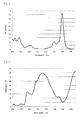
- the spectral absorption spectrum of the infrared dye composition of the present invention is measured as described later. From the measured spectral absorption spectrum, the spectral absorption maximum wavelength in the wavelength range of from 400 nm to 1,050 nm, a ratio of an absorbance at the spectral absorption maximum wavelength to the maximum absorbance (Dmax) in the range of from 400 nm to 700 nm, the maximum absorbance (Dmax) and the minimum absorbance (Dmin) in the range of from 400 nm to 700 nm can be determined.
- a solution for confirming the spectral absorption maximum wavelength is obtained by dissolving the compounds (I) and (II) in an organic or inorganic solvent or water, either singly or as a mixture.
- the organic solvent include amide solvents (e.g., N,N-dimethylformamide, N,N-dimethylacetamide, and 1-methyl-2-pyrrolidone), sulfone solvents (e.g., sulfolane), sulfoxide solvents (e.g., dimethyl sulfoxide), ureido solvents (e.g., tetramethylurea), ether solvents (e.g., dioxane, tetrahydrofuran, and cyclopentyl methyl ether), ketone solvents (e.g., acetone and cyclohexanone), hydrocarbon solvents (e.g., toluene, xylene, and n-decane), halogen solvents (
- amide solvents sulfone solvents, sulfoxide solvents, ureido solvents, ether solvents, ketone solvents, halogen solvents, hydrocarbon solvents, alcohol solvents, ester solvents, or nitrile solvents are preferable.
- the concentrations of the compounds (I) and (II) for measurement are not particularly limited insofar as the maximum wavelength of spectral absorption can be confirmed, and are preferably in a range of from 1 ⁇ 10 -7 mol/L to 1 ⁇ 10 13 mol/L.
- the measurement temperatures are not particularly limited, and are preferably from 0°C to 80°C.
- a spectral absorption measurement apparatus there is no particular limitation on a spectral absorption measurement apparatus, and a common spectral absorption measurement apparatus (e.g., U-4100 spectrophotometer, manufactured by Hitachi High-Technologies Corp.) can be used.
- a common spectral absorption measurement apparatus e.g., U-4100 spectrophotometer, manufactured by Hitachi High-Technologies Corp.
- the infrared dye composition of the present invention contains at least: a compound (I) having a spectral absorption maximum wavelength in a range of from 750 nm to 1,050 nm; and a compound (II) having a spectral absorption maximum wavelength in a range of from 400 nm to 700 nm.
- the infrared dye composition of the present invention may contain, as components other than the dyes, additives, such as a binder, an antiseptic agent, an electrification modifier, carbon black, a UV-light absorbing material, an antioxidant, a radical trap agent, an emulsifier, and an antifungal agent.
- the infrared dye composition of the present invention may be a solid mixture containing only a dye or containing a dye and an additive, i.e., powder, liquid, a mixture of powder and liquid, or may have a state in which they are dispersed in a medium.
- the medium include water, an organic solvent, and an organic or inorganic polymer as a binder.
- an aliphatic group refers to an alkyl group, a substituted alkyl group, an alkenyl group, a substituted alkenyl group, an alkynyl group, a substituted alkynyl group, an aralkyl group, and a substituted aralkyl group.
- the alkyl group may be branched or may form a ring.
- the alkyl group preferably has 1 to 20 carbon atoms, and more preferably 1 to 18 carbon atoms.
- the alkyl portion of the substituted alkyl group is similar to the above-mentioned alkyl group.
- the alkenyl group may be branched or may form a ring.
- the alkenyl group preferably has 2 to 20 carbon atoms, and more preferably 2 to 18 carbon atoms.
- the alkenyl portion of the substituted alkenyl group is similar to the above-mentioned alkenyl group.
- the alkynyl group may be branched or may form a ring.
- the alkynyl group preferably has 2 to 20 carbon atoms, and more preferably 2 to 18 carbon atoms.
- the alkynyl portion of the substituted alkynyl group is similar to the above-mentioned alkynyl group.
- the alkyl portions of the aralkyl group and the substituted aralkyl group are similar to the above-mentioned alkyl group.
- the aryl portions of the aralkyl group and the substituted aralkyl group are similar to an aryl group mentioned later.
- Examples of a substituent of the alkyl portions of the substituted alkyl group, substituted alkenyl group, substituted alkynyl group, and substituted aralkyl group include halogen atoms (e.g., a chlorine atom, a bromine atom, and an iodine atom), alkyl groups [Straight-chain, branched, or cyclic, substituted or unsubstituted alkyl groups are mentioned.
- alkyl groups preferably alkyl groups having 1 to 30 carbon atoms, e.g., methyl, ethyl, n-propyl, isopropyl, t-butyl, n-octyl, eicosyl, 2-chloroethyl, 2-cyanoethyl, and 2-ethylhexyl
- cycloalkyl groups preferably substituted or unsubstituted cycloalkyl groups having 3 to 30 carbon atoms, e.g., cyclohexyl, cyclopentyl and 4-n-dodecylcyclohexyl
- bicycloalkyl groups Preferable are substituted or unsubstituted bicycloalkyl groups having 5 to 30 carbon atoms, i.e., monovalent groups in which one hydrogen atom has been removed from bicycloalkanes having 5 to 30 carbon atoms.
- alkyl groups e.g., an alkyl group of an alkylthio group
- alkenyl groups preferably substituted or unsubstituted alkenyl groups having 2 to 30 carbon atoms, e.g., vinyl, allyl, prenyl, geranyl, and oleyl
- alkenyl groups preferably substituted or unsubstituted alkenyl groups having 2 to 30 carbon atoms, e.g., vinyl, allyl, prenyl, geranyl, and oleyl
- cycloalkenyl groups (Preferable are substituted or unsubstituted cycloalkenyl groups having 3 to 30 carbon atoms, i.e. monovalent groups in which one hydrogen atom of cycloalkenes having 3 to 30 carbon atoms has been removed. For example, 2-cyclopenten-1-yl and 2-cyclohexen-1-yl are mentioned.), bicycloalkenyl groups (Substituted or unsubstituted bicycloalkenyl groups are mentioned. Preferable are substituted or unsubstituted bicycloalkenyl groups having 5 to 30 carbon atoms, i.e., monovalent groups in which one hydrogen atom of bicycloalkenes having one double bond has been removed.
- bicyclo[2,2,1]hept-2-en-1-yl and bicyclo[2,2,2]oct-2-en-4-yl are included.
- alkynyl groups preferably substituted or unsubstituted alkynyl groups having 2 to 30 carbon atoms, e.g., ethynyl, propargyl, and a trimethylsilylethynyl group
- aryl groups preferably substituted or unsubstituted aryl groups having 6 to 30 carbons atoms, e.g., phenyl, p-tolyl, naphthyl, m-chlorophenyl, and o-hexadecanoylaminophenyl
- heterocyclic groups Preferable are monovalent groups in which one hydrogen atom has been removed from 5- or 6-membered, substituted or unsubstituted aromatic or non- aromatic heterocyclic compounds. More preferable are 5- or 6-membered aromatic heterocyclic compounds having 3 to 30 carbon atoms.
- 2-furil, 2-thienyl, 2-pyrimidinyl, and 2-benzothiazolyl are mentioned.
- cyano groups preferably substituted or unsubstituted alkoxy groups having 1 to 30 carbon atoms, e.g., methoxy, ethoxy, isopropoxy, t-butoxy, n-octyloxy, and 2-methoxyethoxy
- aryloxy groups preferably substituted or unsubstituted aryloxy groups having 6 to 30 carbon atoms, e.g., phenoxy, 2-methylphenoxy, 4-t-butylphenoxy, 3-nitrophenoxy, and 2-tetradecanoylaminophenoxy
- silyloxy groups preferably silyloxy groups having 3 to 20 carbon atoms, e.g., trimethylsilyloxy and t-butyldimethylsilyloxy
- heterocyclic oxy groups preferably substituted or un
- acyloxy groups (preferably formyloxy groups, substituted or unsubstituted alkylcarbonyloxy group having 2 to 30 carbon atoms, and substituted or unsubstituted aryl carbonyloxy groups having 6 to 30 carbon atoms, e.g., formyloxy, acetyloxy, pivaloyloxy, stearoyloxy, benzoyloxy, and p-methoxyphenylcarbonyloxy), carbamoyloxy groups (preferably substituted or unsubstituted carbamoyloxy groups having 1 to 30 carbon atoms, e.g., N,N-dimethylcarbamoyloxy, N,N-diethylcarbamoyloxy, morpholinocarbonyloxy, N,N-di-n-octylaminocarbonyloxy, and N-n-octylcarbamoyloxy), alkoxycarbonyloxy groups (preferably substituted or unsubsti
- amino groups preferably amino groups, substituted or unsubstituted alkylamino groups having 1 to 30 carbon atoms, and substituted or unsubstituted anilino group having 6 to 30 carbon atoms, e.g., amino, methylamino, dimethylamino, anilino, N-methyl-anilino, and diphenylamino
- acylamino groups preferably formylamino groups, substituted or unsubstituted alkylcarbonylamino groups having 1 to 30 carbon atoms, and substituted or unsubstituted arylcarbonylamino groups having 6 to 30 carbon atoms, e.g., formylamino, acetylamino, pivaloylamino, lauroylamino, benzoylamino, and 3,4,5-tri-n-octyloxyphenylcarbonylamino), aminocarbonylamino groups (preferably substituted or unsubstituted aminocarbony
- sulfamoylamino groups (preferably substituted or unsubstituted sulfamoylamino groups having 0 to 30 carbon atoms, e.g., sulfamoylamino, N,N-dimethylamino sulfonylamino, and N-n-octylamino sulfonylamino), alkylsulfonylamino groups and arylsulfonylamino groups (preferably substituted or unsubstituted alkylsulfonylamino having 1 to 30 carbon atoms and substituted or unsubstituted arylsulfonylamino groups having 6 to 30 carbon atoms, e.g., methylsulfonylamino, butylsulfonylamino, phenylsulfonylamino, 2,3,5-trichlorophenylsulfonylamino, and p-
- heterocyclic thio groups preferably substituted or unsubstituted heterocyclic thio groups having 2 to 30 carbon atoms, e.g., 2-benzothiazolylthio and 1-phenyltetrazol-5-ylthio
- sulfamoyl groups preferably substituted or unsubstituted sulfamoyl groups having 0 to 30 carbon atoms, e.g., N-ethylsulfamoyl, N-(3-dodecyloxypropyl)sulfamoyl, N,N-dimethylsulfamoyl, N-acetylsulfamoyl, N-benzoylsulfamoyl, and N-(N'-phenylcarbamoyl)sulfamoyl), sulfo groups, alkylsulfinyl groups, arylsulfinyl groups (preferably substituted or unsubstit
- acyl groups (preferably formyl groups, substituted or unsubstituted alkylcarbonyl groups having 2 to 30 carbon atoms, substituted or unsubstituted arylcarbonyl groups having 7 to 30 carbon atoms, substituted or unsubstituted heterocyclic carbonyl groups having 4 to 30 carbon atoms in which the carbonyl group bonds to a carbon atom of the heterocycle, e.g., acetyl, pivaloyl, 2-chloroacetyl, stearoyl, benzoyl, p-n-octyloxyphenylcarbonyl, 2-pyridylcarbonyl, and 2-furylcarbonyl), aryloxycarbonyl groups (preferably substituted or unsubstituted aryloxycarbonyl groups having 7 to 30 carbon atoms, e.g., phenoxycarbonyl, o-chlorophenoxycarbonyl, m-nitrophenoxycarbonyl, and p-
- arylazo groups and heterocyclic azo groups preferably substituted or unsubstituted arylazo groups having 6 to 30 carbon atoms and substituted or unsubstituted heterocyclic azo groups having 3 to 30 carbon atoms, e.g., phenylazo, p-chlorophenylazo, and 5-ethylthio-1,3,4-thiadiazol-2-ylazo), imido groups (preferably N-succinimido and N-phthalimido), phosphino groups (preferably substituted or unsubstituted phosphino groups having 2 to 30 carbon atoms, e.g., dimethylphosphino, diphenylphosphino, and methylphenoxyphosphino), phosphinyl groups (preferably substituted or unsubstituted phosphinyl groups having 2 to 30 carbon atoms, e.g., phosphinyl, dioctyloxyphosphinyl, and die
- the hydrogen atom may be removed, and the groups may be further substituted by the above-mentioned group.
- functional groups include an alkylcarbonylaminosulfonyl group, an arylcarbonylaminosulfonyl group, an alkylsulfonylaminocarbonyl group, and an arylsulfonylaminocarbonyl group.
- examples thereof include methylsulfonylaminocarbonyl, p-methylphenylsulfonylaminocarbonyl, acetylaminosulfonyl, and benzoylaminosulfonyl.
- Examples of a substituent of the aryl portion of the substituted aralkyl group are similar to the examples of a substituent of the substituted aryl groups mentioned later.
- the aromatic groups refer to aryl groups and substituted aryl groups.
- an aliphatic ring, another aromatic ring, or a heterocycle may be condensed.
- the aromatic group preferably has 6 to 40 carbon atoms, more preferably 6 to 30 carbon atoms, and even more preferably 6 to 20 carbon atoms.
- phenyl or naphthyl is preferable as an aryl group, and phenyl is particularly preferable.
- the aryl portion of the substituted aryl group is similar to the above-mentioned aryl groups.
- substituent of the substituted aryl groups are similar to the above-mentioned examples of substituent of the alkyl portions of a substituted alkyl group, a substituted alkenyl group, a substituted alkynyl group, and a substituted aralkyl group.
- the heterocyclic groups preferably contain a 5-membered or 6-membered, saturated or unsaturated heterocycle.
- an aliphatic ring, an aromatic ring, or another heterocycle may be condensed.
- a heteroatom of the heterocycle include B, N, O, S, Se, and Te.
- N, O, and S are preferable.
- a carbon atom of the heterocycle has a free valence (monovalent) (it means that the heterocyclic group is to be bonded at a carbon atom thereof).
- the heterocyclic group preferably has 1 to 40 carbon atoms, more preferably 1 to 30 carbon atoms, and even more preferably 1 to 20 carbon atoms.
- Examples of the saturated heterocycle include a pyrrolidine ring, a morpholine ring, a 2-bora-1,3-dioxolane ring, and 1,3-thiazolidine ring.
- Examples of the unsaturated heterocycles include an imidazole ring, a thiazole ring, a benzothiazole ring, a benzooxazole ring, a benzotriazole ring, a benzoselenazole ring, a pyridine ring, a pyrimidine ring, and a quinoline ring.
- the heterocyclic groups may have a substituent.
- substituents are similar to the previously-mentioned examples of substituent of the alkyl portions of a substituted alkyl group, a substituted alkenyl group, a substituted alkynyl group, and a substituted aralkyl group.
- the spectral absorption maximum wavelength of the compound (I) in the present invention is in a wavelength range of from 750 nm to 1,050 nm, preferably from 800 nm to 1,000 nm, more preferably from 820 nm to 950 nm, and most preferably from 830 nm to 880 nm.
- the compound (I) include phthalocyanine compounds, naphthalocyanine compounds, diimonium compounds, cyanine compounds, squarylium compounds, polymethine compounds, azomethine compounds, oxonol compounds, croconium compounds, and dithiol metal complexes.
- phthalocyanine compounds naphthalocyanine compounds, diimonium compounds, cyanine compounds, and croconium compounds are preferable, naphthalocyanine compounds and diimonium compounds are more preferable, and naphthalocyanine compounds are the most preferable.
- a naphthalocyanine dye used in the present invention is preferably a compound represented by the following formula (I-a).
- R 11 , R 12 , R 13 , R 14 , R 15 , R 16 , R 21 , R 22 , R 23 , R 24 , R 25 , R 26 , R 31 , R 32 , R 33 , R 34 , R 35 , R 36 , R 41 , R 42 , R 43 , R 44 , R 45 , and R 46 each independently represent a hydrogen atom or a substituent.
- the substituent include those similar to the above-mentioned examples of a substituent of alkyl portions of substituted alkyl groups, substituted alkenyl groups, substituted alkynyl groups, and substituted aralkyl groups.
- R 11 , R 12 , R 13 , R 14 , R 15 , R 16 , R 21 , R 22 , R 23 , R 24 , R 25 , R 26 , R 31 , R 32 , R 33 , R 34 , R 35 , R 36 , R 41 , R 42 , R 43 , R 44 , R 45 , and R 46 are a halogen atom, an alkyl group, an alkenyl group, an alkynyl group, an aryl group, a cyano group, a hydroxy group, a nitro group, a carboxy group, an alkoxy group, an aryloxy group, a silyloxy group, a heterocyclic oxy group, an acyloxy group, a carbamoyloxy group, an alkoxycarbonyloxy group, an aryloxycarbonyloxy group, an amino group, an acylamino group, an aminocarbonylamino group, an alkoxycarbony
- a halogen atom an alkyl group, an aryl group, a cyano group, a hydroxy group, a nitro group, a carboxy group, an alkoxy group, an aryloxy group, a silyloxy group, a heterocyclic oxy group, an acyloxy group, a carbamoyloxy group, an amino group, an acylamino group, an aminocarbonylamino group, an alkoxycarbonylamino group, an aryloxycarbonylamino group, a sulfamoylamino group, an alkylsulfonylamino group, an arylsulfonylamino group, a mercapto group, an alkylthio group, an arylthio group, a heterocyclic thio group, a sulfamoyl group, a sulfo group, an alkylsulfinyl group, an arylsul
- a halogen atom an alkyl group, an aryl group, a hydroxy group, an alkoxy group, an aryloxy group, an amino group, a mercapto group, an alkylthio group, an arylthio group, a sulfamoyl group, a sulfo group, an alkylsulfinyl group, an arylsulfinyl group, an alkylsulfonyl group and an arylsulfonyl group. Still more preferable are a halogen atom, an alkyl group, an aryl group, an alkoxy group, an aryloxy group, an alkylthio group, and an arylthio group.
- an alkyl group having 1 to 8 carbon atoms an aryl group having 6 to 10 carbon atoms, an alkoxy group having 1 to 8 carbon atoms, an aryloxy group having 6 to 10 carbon atoms, an alkylthio group having 1 to 8 carbon atoms, and an arylthio group having 6 to 10 carbon atoms.
- an alkoxy group having 1 to 6 carbon atoms is the most preferable.
- M 211 represents a hydrogen atom, a metal ion or a group containing a metal ion.
- n1 is 1 or 2.
- (M 211 )n1 is preferably two hydrogen atoms, two Li + ions, two Na + ions, two K + ions, two Rb + ions, two Cs + ions, a Be 2+ ion, an Mg 2+ ion, a Ca 2+ ion, a Ti 2+ ion, an Mn 2+ ion, an Fe 2+ ion, a Co 2+ ion, an Ni 2+ ion, a Cu 2+ ion, a Zn 2+ ion, an Ru 2+ ion, an Rh 2+ ion, a Pd 2+ ion, a Pt 2+ ion, a Ba 2+ ion, a Cd 2+ ion, an Hg 2+ ion, a Pb 2+ ion, an S
- (M 211 )n1 is two hydrogen atoms, two Li + ions, two Na + ions, two K + ions, two Rb + ions, a Be 2+ ion, an Mg 2+ ion, a Ca 2+ ion, a Ti 2+ ion, an Mn 2+ ion, an Fe 2+ ion, a Co 2+ ion, an Ni 2+ ion, a Cu 2+ ion, a Zn 2+ ion, an Ru 2+ ion, an Rh 2+ ion, a Pd 2+ ion, a Pt 2+ ion, a Ba 2+ ion, an Sn 2+ ion, Al-Cl, Al-Br, Ga-Cl, Ga-F, Ga-I, Ga-Br, In-Cl, In-Br, Tl-Cl, Tl-Br, Mn-OH, Fe-Cl, Ru-Cl, CrCl, a
- (M 211 )n1 is two hydrogen atoms, two Li + ions, two Na + ions, two K + ions, a Be 2+ ion, an Mg 2+ ion, a Ca 2+ ion, a Ti 2+ ion, an Mn 2+ ion, an Fe 2+ ion, a Co 2+ ion, an Ni 2+ ion, a Cu 2+ ion, a Zn 2+ ion, an Ru 2+ ion, an Rh 2+ ion, a Pd 2+ ion, a Pt 2+ ion, a Ba 2+ ion, an Sn 2+ ion, Al-Cl, Ga-Cl, In-Cl, Tl-Cl, Mn-OH, Fe-Cl, Ru-Cl, CrCl 2 , SiCl 2 , ZrCl 2 , GeCl 2 , TiCl 2 , Si(OH) 2 , Ge
- (M 211 )n1 is two hydrogen atoms, an Mn 2+ ion, VO, a Zn 2+ ion or a Cu 2+ ion. Even more preferably, (M 211 )n1 is VO, a Zn 2+ ion or a Cu 2+ ion. Most preferably, M 211 is a Cu 2+ ion, and n1 is 1.
- bonds between M 211 and two secondary nitrogen atoms of the naphthalocyanine ring are a covalent bond, an ionic bond or a coordination bond. In the case where M 211 is a transition metal ion, M 211 may form coordination bonds with two tertiary nitrogen atoms of the naphthalocyanine ring.
- synthesis thereof can be achieved by once synthesizing a non-metal body of phthalocyanine or naphthalocyanine using a lithium compound, and then using a metal compound as described later.
- this method is more preferable for synthesizing a metal body of naphthalocyanine.
- the amount of the metal compound with respect to 1 mol of the non-metal body of naphthalocyanine is preferably from 0.1 mol to 10 mol, more preferably from 0.5 mol to 5 mol, and even more preferably from 1 to 3 mol.
- the metal compound inorganic metal compounds and organometallic compounds can be used. Examples thereof include halides (e.g., chlorides and bromides), sulfates, nitrates, cyanides, acetates, and metal acetylacetonato. Among these, chlorides, sulfates, cyanides, and acetates are preferable, chlorides and acetates are more preferable, and acetates are the most preferable.
- amide solvents e.g., N,N-dimethylformamide, N,N-dimethylacetamide, and 1-methyl-2-pyrrolidone
- sulfone solvents e.g., sulfolane
- sulfoxide solvents e.g., dimethyl sulfoxide
- ether solvents e.g., dioxane and cyclopentyl methyl ether
- ketone solvents e.g., acetone and cyclohexanone
- hydrocarbon solvents e.g., toluene and xylene
- halogen solvents e.g., tetrachloroethane and chlorobenzene
- alcohol solvents e.g., 1-butanol, ethylene glycol, and cyclohexanol
- pyridine solvents e.g., pyridine, ⁇ -picoline, and 2,6-lutidine
- amide solvents, sulfone solvents, ether solvents, hydrocarbon solvents, halogen solvents, and pyridine solvents are preferable; sulfone solvents, ether solvents, hydrocarbon solvents, and halogen solvents are more preferable; ether solvents, hydrocarbon solvents, and halogen solvents are even more preferable; halogen solvents are still more preferable; and chlorobenzene is the most preferable.
- the reaction temperature is from -30°C to 250°C, preferably from 0°C to 200°C, more preferably from 20°C to 150°C, and even more preferably from 50°C to 100°C.
- the reaction time is in a range of from 5 minutes to 30 hours.
- the diimonium compound is preferably a compound represented by the following formula (V):
- R 91 , R 92 , R 93 , R 94 , R 95 , R 96 , R 97 , and R 98 each independently represent a hydrogen atom, an alkyl group, a cycloalkyl group, an aryl group, an aralkyl group or a heterocyclic group.
- R 99 , R 100 , R 101 , and R 102 each independently represent an alkyl group, an alkoxy group, an aryloxy group, a halogen atom, an alkoxycarbonyl group, an amino group, an alkyl-substituted amino group, an amido group, a sulfonamido group, a cyano group, a nitro group, or a carboxy group.
- R 91 and R 92 , R 93 and R 94 , R 95 and R 96 , R 97 and R 98 , R 91 and R 99 , R 92 and R 99 , R 93 and R 100 , R 94 and R 100 , R 95 and R 101 , R 96 and R 101 , R 97 and R 102 , and R 98 and R 102 may bond to each other to form a 5-or 6-membered ring.
- n is an integer of from 0 to 3.
- X is an anion or a cation required for neutralizing electrical charge in the molecule; and
- m is an integer of from 0 to 6.
- the alkyl group preferably has 1 to 20 carbon atoms, more preferably has 1 to 12 carbon atoms, and most preferably has 1 to 8 carbon atoms.
- Examples of the alkyl group include methyl, ethyl, propyl, butyl, hexyl and undecyl.
- the alkyl group may be branched.
- the alkyl group may have a substituent.
- substituents examples include a halogen atom (F, Cl, Br), an alkoxycarbonyl group (e.g., methoxycarbonyl, ethoxycarbonyl), hydroxy, an alkoxy group (e.g., methoxy, ethoxy, isobutoxy), an aryloxy group (e.g., phenoxy), an acyloxy group (e.g., acetyloxy, butyryloxy, hexyryloxy, benzoyloxy), carboxy and sulfo.
- examples of the cycloalkyl group include cyclopentyl and cyclohexyl.
- the aryl group preferably has 6 to 12 carbon atoms.
- Examples of the aryl group include phenyl and naphthyl.
- the aryl group may have a substituent.
- substituent include an alkyl group having 1 to 8 carbon atoms (e.g., methyl, ethyl, butyl), an alkoxy group having 1 to 6 carbon atoms (e.g., methoxy, ethoxy), an aryloxy group (e.g., phenoxy, p-chlorophenoxy), a halogen atom (F, Cl, Br), an alkoxycarbonyl group (e.g., methoxycarbonyl, ethoxycarbonyl), amino, an alkyl-substituted amino group (e.g., methylamino), an amido group (e.g., acetamido), a sulfonamido group (e.g., methanesulfonamido), cyano, nitro, carboxy and sulfo.
- the aralkyl group preferably has 7 to 12 carbon atoms.
- Examples of the aralkyl group include benzyl and phenethyl.
- the aralkyl group may have a substituent.
- Examples of the substituent include an alkyl group having 1 to 8 carbon atoms (e.g., methyl), an alkoxy group having 1 to 6 carbon atoms (e.g., methoxy), a halogen atom (e.g., Cl), carboxy and sulfo.
- examples of the heterocyclic group include thienyl, furyl, pyrrolyl, pyrazolyl, pyridyl and indolyl.
- the alkoxy group preferably has 1 to 6 carbon atoms.
- the alkoxy groups include methoxy and ethoxy.
- the aryloxy group may have a substituent. Examples of the substituent include a halogen atom (e.g., Cl). Examples of the aryloxy group include phenoxy and p-chlorophenoxy.
- examples of the alkoxycarbonyl group include methoxycarbonyl and ethoxycarbonyl.
- examples of the alkyl-substituted amino group include methylamino.
- examples of the amido group include acetamido.
- examples of the sulfonamido group include methanesulfonamido.
- Examples of the rings formed by combining R 91 and R 92 , R 93 and R 94 , R 95 and R 96 or R 97 and R 98 include piperazine ring, piperidine ring, morpholine ring and pyrrolidine ring.
- Examples of the rings formed by combining R 91 and R 99 , R 92 and R 99 , R 93 and R 100 , R 94 and R 100 , R 95 and R 101 , R 96 and R 101 , R 97 and R 102 or R 98 and R 102 include julolidine ring and tetrahydroquinoline ring.
- R 99 , R 100 , R 101 or R 102 is combined with R 91 , R 92 , R 93 , R 94 , R 95 , R 96 , R 97 or R 98 to form a ring
- the position of R 99 , R 100 , R 101 or R 102 is preferably adjacent to the position of R 91 , R 92 , R 93 , R 94 , R 95 , R 96 , R 97 or R 93 .
- examples of the anion represented by X include a halide ion (Cl - , Br - , I - ), p-toluenesulfonate ion, ethylsulfate ion, PF 6 - , BF 4 - and ClO 4 - .
- a halide ion Cl - , Br - , I -
- p-toluenesulfonate ion ethylsulfate ion
- PF 6 - ethylsulfate ion
- Examples of the cation include an alkali metal ion (e.g., sodium ion, potassium ion, lithium ion), an ammonium ion (e.g., triethylammonium ion) and a pyridinium ion.
- alkali metal ion e.g., sodium ion, potassium ion, lithium ion
- ammonium ion e.g., triethylammonium ion
- pyridinium ion pyridinium ion.
- phthalocyanine compounds described in JP-A No. 2000-281919 in addition to the above compounds, phthalocyanine compounds described in JP-A No. 2000-281919 ; naphthalocyanine compounds described in JP-A Nos. 2-43269 and 2-138382 , and Journal of Chemical Society Parkin Transaction I, pages 2453-2458 (1998 ); diimonium compounds, cyanine compounds, squarylium compounds, polymethine compounds, azomethine compounds, oxonol compounds, and croconium compounds described in JP-A No. 10-180947 ; and dithiol metal complexes described in JP-A No. 2003-139946 can be used.
- the compound (II) used in the present invention has a spectral absorption maximum wavelength in a range of from 400 nm to 700 nm.
- the compound (II) used in the present invention forms an infrared dye composition with the compound (I).
- the mixing ratio of the compound (II) is determined in a range where a maximum absorbance (Dmax) in the range of from 400 nm to 700 nm is 0.5 or lower when an absorbance of the infrared dye composition at a spectral absorption maximum wavelength in a range of from 750 nm to 1,050 nm is designated as 1.
- a compound having absorption in the wavelength range where the absorbance is low is selected according to an absorption spectrum of the compound (I) in the range of from 400 nm to 700 nm so that the ratio (Dmax/Dmin) of the maximum absorbance (Dmax) to a minimum absorbance (Dmin) of the infrared dye composition in the range of from 400 nm to 700 nm might be 10 or lower.
- two or more of compound (II) may be used in combination, and preferably one to five of them, more preferably one to four of them, even more preferably two to four of them, and most preferably two of them are used in combination.
- Preferable examples of the compound (II) used in the present invention include azo compounds, anthraquinone compounds, phthalocyanine compounds, indigo compounds, thioindigo compounds, diphenylmethane compounds, triphenylmethane compounds, polymethine compounds, azomethine compounds, xanthene compounds, acridine compounds, quinoneimine compounds, cyanine compounds, quinoline compounds, nitro compounds, naphthoquinone compounds, perylene compounds, and perynone compounds.
- azo compounds, anthraquinone compounds, phthalocyanine compounds, thioindigo compounds, azomethine compounds, xanthene compounds, cyanine compounds, quinoline compounds, nitro compounds, naphthoquinone compounds, perylene compounds, and perynone compound are preferable.
- Azo compounds, anthraquinone compounds, phthalocyanine compounds, thioindigo compounds, and perynone compounds are more preferable.
- Anthraquinone compounds, thioindigo compounds, and perynone compounds are the most preferable.
- Specific examples of the compound (II) include the following compounds, but the present invention is not limited thereto.
- C. I. Disperse Yellows 3, 23, 42, 54, 64, 71, 79, 82, 114, 119, 163, and 211,
- C.I. Solvent Yellows 2, 5, 14, 16, 19, 21, 33, 56, 72, 82, 93, 98, 114, and 145, 160: 1, 163, and 176,
- C.I. Disperse Reds 1, 5, 9, 11, 13, 22, 50, 60, 73, 74, 82, 91, 92, 135, 152, 153, 167, 177, 179, 277, 343, 356, and 362, C.I.
- a maximum absorbance (Dmax) in a range of from 400 nm to 700 nm is 0.5 or lower; and a ratio (Dmax/Dmin) of the maximum absorbance (Dmax) to a minimum absorbance (Dmin) in the range of from 400 nm to 700 nm is 10 or lower.
- the Dmax/Dmin ratio is preferably 8 or lower, more preferably 6 or lower, even more preferably 5 or lower, still more preferably 4 or lower, and most preferably 3 or lower.
- the maximum absorbance (Dmax) in the range of from 400 nm to 700 nm is 0.5 or lower, preferably 0.4 or lower, more preferably 0.3 or lower, and most preferably 0.2 or lower.
- a printing ink using the infrared dye composition of the present invention contains a binder resin or a vehicle, a plasticizer, a solvent, etc.
- the vehicle can be composed of, for example, resins [phenol resins (phenol resins, rosin-modified phenol resins using rosins, such as rosin, hardened rosin, and polymerized rosin, etc.), maleic acid resins (rosin-modified maleic acid resins, rosin ester resins, etc.), alkyd resins or modified alkyd resins, petroleum resins, etc.]; oils and fats [dry oil or semi-dry oil (linseed oil, polymerized linseed oil, tung oil, soybean oil, etc.), synthetic dry oil (dehydrated castor oil, maleic oil, etc.), etc.]; solvents having a high boiling point (petroleum solvents having a boiling point in a range of from about 260°C to about 350°C, such as mineral oil); etc.
- a plasticizer for allowing flexibility and strength stability to a printing film a solvent for adjusting viscosity and giving drying properties, and auxiliary agents for dryness, viscosity, and dispersibility, such as various reaction agents, can be suitably added as required.
- a dye mixture may be added while maintaining its powder form, and it is also preferable to add a dye mixture while being dissolved in an appropriate solvent.
- a photo-polymerization curable ink or an electron beam curable ink may be used.
- a main component of a cured product of these inks is an acrylic resin. Therefore, the above-mentioned inks contain an alkyl monomer.
- An ink containing these resins or monomers is solvent free, and causes a continuous polymerization reaction to be cured by electromagnetic waves or electron beam irradiation.
- a photo-polymerization initiator and, as required, a sensitizer and an auxiliary agent, such as a polymerization inhibitor or a chain transfer agent can be suitably added.
- An electron beam curable ink can be obtained using a resin or a monomer similar to that in the UV-light irradiation type ink without requiring a photo-polymerization initiator, and adding various auxiliary additives as required.
- a printing method using a printing ink containing the infrared dye composition of the present invention is, for example, typography printing, offset printing, flexo printing, gravure printing, or silk printing, and can be achieved using a generally-used printing machine.
- An ink jet ink containing the infrared dye composition of the present invention is composed of water or a water-soluble organic solvent, a dispersant, and a dye mixture of the present invention, and, as required, a coloring material, and various additives.
- An ink composition containing the infrared dye composition of the present invention preferably includes water and a water-soluble organic solvent, and more preferably includes a wetting agent containing an organic solvent having a high boiling point.
- the addition amount of the wetting agent is preferably from 2% by weight to 30% by weight, and more preferably from 5% by weight to 20% by weight, with respect to the amount of ink.
- a surfactant, sugar, a pH adjusting agent, an anti-corrosive agent, an antiseptic agent, an antifungal agent, a phosphorus antioxidant, a sequestering agent, etc. can be added as required.
- An ink jet ink containing the infrared dye composition of the present invention can be produced by dissolving or dispersing and mixing the above-mentioned components by an appropriate method.
- a dye mixture, a high-molecular dispersant, and water are mixed using an appropriate dispersing machine (e.g., a ball mill, a sand mill, an attritor, a roll mill, an agitator mill, a Henschel Mixer, a colloid mill, an ultrasonic homogenizer, a jet mill, an Ong Mill, etc.), to prepare a uniform dispersion.
- an appropriate dispersing machine e.g., a ball mill, a sand mill, an attritor, a roll mill, an agitator mill, a Henschel Mixer, a colloid mill, an ultrasonic homogenizer, a jet mill, an Ong Mill, etc.
- water, a sequestering agent, an osmotic solvent, a surfactant, a water-soluble organic solvent, sugar, a pH adjusting agent, an antiseptic agent, an antifungal agent, etc. are added to the uniform dispersion, and mixed sufficiently to thereby prepare an ink solution.
- the resultant is filtered so as to remove coarse particles and foreign substances causing clogging to obtain a target ink jet ink.
- An electrophotographic toner containing the infrared dye composition of the present invention contains infrared ray absorbing particles whose surfaces have been coated with a near-infrared ray absorbing material.
- the near-infrared ray absorbing material the dye mixture of the present invention can be used.
- An electrophotographic toner containing the infrared dye composition of the present invention contains a binder resin.
- the binder resin the following materials can be used, for example. However, the present invention is not limited to the following materials.
- binder resin examples include homopolymers or copolymers of styrenes, such as styrene or chlorostyrene; monoolefins, such as ethylene, propylene, butylene, or isoprene; vinyl esters, such as vinyl acetate, vinyl propionate, vinyl benzoate, or vinyl acetate; ⁇ -methylene aliphatic monocarboxylic acid esters, such as methyl acrylate, ethyl acrylate, butyl acrylate, dodecyl acrylate, octyl acrylate, phenyl acrylate, methyl methacrylate, ethyl methacrylate, butyl methacrylate, or dodecyl methacrylate; vinyl ethers, such as vinyl methyl ether, vinyl ethyl ether, or vinyl butyl ether; or vinyl ketones, such as vinyl methyl ketone, vinyl hexyl ketone, or vinyl is
- an especially typical binder resin examples include polystyrene, a styrene- alkyl acrylate copolymer, a styrene-alkyl methacrylate copolymer, a styrene-acrylonitrile copolymer, a styrene-butadiene copolymer, a styrene-maleic anhydride copolymer, polyethylene, and polypropylene.
- polyester, polyurethane, an epoxy resin, a silicone resin, polyamide, modified rosin, paraffin, and waxes are mentioned.
- particle surfaces are coated with a near-infrared ray absorbing material.
- a near-infrared ray absorbing material optically (under visible lights) white or transparent particles are preferable.
- white or transparent particles There is no particular limitation on the white or transparent particles insofar as materials thereof look white because all visible lights are reflected or are transparent to visible lights.
- Known material particles such as inorganic particles, thermoplastic resin particles, and thermosetting resin particles, can be used.
- the near-infrared ray absorbing material By incorporating, in a toner, fine particles which are obtained by coating the near-infrared ray absorbing material on the surfaces of the optically (under visible lights) white or transparent particles, the near-infrared ray absorbing material can be more uniformly dispersed in the toner in a smaller amount.
- a production method of thin-layer coating on particle surfaces with a near-infrared ray absorbing material will be described.
- a resin used for thin- layer coating include polyolefin resins, such as polyethylene or polypropylene; polyvinyl resins and polyvinylidene resins, such as polystyrene, an acrylic resin, polyacrylonitrile, polyvinyl acetate, polyvinyl alcohol, polyvinyl butyral, polyvinyl chloride, polyvinyl carbazole, polyvinyl ether, or polyvinyl ketone; vinyl chloride-vinyl acetate copolymers; styrene-acrylic acid copolymers; straight silicone resins containing organosiloxane bond or modified articles thereof; fluorocarbon resins, such as polytetrafluoroethylene, polyvinyl fluoride, polyvinylidene fluoride, or polychlorotrifluoroethylene; polyesters; and polycarbonates.
- a crosslinking component such as divinylbenzene
- thermosetting resin examples include phenol resins; amino resins, such as urea-formaldehyde resins, melamine resins, benzoguanamine resins, urea resins, polyamide resins, and epoxy resins.
- inorganic particles examples include particles of silica, alumina, titania, zinc oxide, strontium titanate, cerium oxide, or calcium carbonate; and silica particles having a high transparency are preferable.
- a liquid phase treatment or a vapor phase treatment may be employed.
- surface treatment is carried out by putting a near-infrared ray absorbing material and particles to be treated in a solvent which can solve the near-infrared ray absorbing material, stirring and mixing the mixture, thereafter removing the solvent, and drying and pulverizing the resultant.
- a spray-drying method involving spraying a solvent in which a near-infrared ray absorbing material has been dissolved to floating particles so that the near-infrared ray absorbing material is adhered to the particle surfaces, and drying the resultant; and a mechanical method involving mixing a near-infrared ray absorbing material and particles to be treated, and applying mechanical share stress for stretching and sticking the near-infrared ray absorbing material on the surface of the particles to be treated are mentioned.
- the mechanical method is preferable, considering the environment.
- Particles whose surfaces have been treated with a near-infrared ray absorbing material in the embodiment of the invention can be obtained by mixing particles to be treated and alkoxysilane or polysiloxane, coating the surfaces of the particles to be treated with alkoxysilane or polysiloxane (pretreatment), and then mixing the particles to be treated, which have been coated with alkoxysilane or polysiloxane, and a near-infrared ray absorbing material.
- known methods such as a method using a hybridizer, can be used.
- the particles to be treated be inorganic oxide fine powder which is easy to pretreatment.
- Coating of the inorganic oxide fine powder with alkoxysilane or polysiloxane may be carried out by mechanically mixing and stirring inorganic oxide fine powder and alkoxysilane or polysiloxane, or by mechanically mixing and stirring inorganic oxide fine powder while spraying alkoxysilane or polysiloxane to the inorganic oxide fine powder. Almost all of the added alkoxysilane or polysiloxane is coated on the particle surfaces of the inorganic oxide fine powder.
- coated alkoxysilane may be coated in the form of an organosilane compound generated from alkoxysilanes, in which the organosilane compound is generated from a part of alkoxysilane while undergoing the coating process.
- an apparatus capable of applying shearing force to a powder layer is preferable.
- an apparatus capable of simultaneously shearing, squeezing with a spatula, and compressing is preferable.
- a wheel-type kneader, a ball-type kneader, a blade-type kneader, or a roll-type kneader can be used.
- a wheel-type kneader can be more effectively used.
- the wheel-type kneader include an edge runner (same as a "mix muller", a “Simpson mill”, and a “sand mill”), a multi-mill, a Stotts mill, a wet pan mill, a connor mill, and a ring muller.
- an edge runner, a multi-mill, a Stotts mill, a wet pan mill, and a ring muller are preferable, with an edge runner being more preferable.
- Specific examples of the ball-type kneader include a vibration mill.
- Specific examples of the blade-type kneader include a Henschel mixer, a planetary mixer, and a Nauta mixer.
- Specific examples of the roll-type kneader include an extruder.
- the conditions at the time of stirring and mixing are determined so that alkoxysilane or polysiloxane might be coated as uniformly as possible on the particle surfaces of inorganic oxide fine powder. More specifically, the treatment conditions may be suitably adjusted in such a manner that a line load is in a range of from 19.6 N/cm to 1,960 N/cm (from 2 kg/cm to 200 kg/cm), preferably from 98 N/cm to 1,470 N/cm (from 10 kg/cm to 150 kg/cm), and more preferably from 147 N/cm to 980 N/cm (from 15 kg/cm to 100 kg/cm) and a treatment time is in a range of from 5 minutes to 120 minutes, and preferably from 10 minutes to 90 minutes.
- a stirring rate is in a range of from 2 rpm to 2,000 rpm, preferably from 5 rpm to 1,000 rpm, and more preferably from 10 rpm to 800 rpm.
- the addition amount of alkoxysilane or polysiloxane is preferably from 0.15 part by weight to 45 parts by weight based on 100 parts by weight of inorganic oxide fine powder.
- the addition amount is lower than 0.15 part by weight, it is difficult to adhere a near-infrared ray absorbing material in such a manner as to provide target inorganic oxide fine powder whose surfaces have been uniformly coated with the near-infrared ray absorbing material.
- the addition amount is from 0.15 part by weight to 45 parts by weight, the infrared ray absorbing material in an amount of from 3 parts by weight to 30 parts by weight can adhere to 100 parts by weight of inorganic oxide fine powder.
- it is meaningless to add alkoxysilane or polysiloxane more than necessary in the amount exceeding 45 parts by weight.
- a near-infrared ray absorbing material is added to the inorganic oxide fine powder which has been coated with alkoxysilane or polysiloxane, and the resultant is stirred and mixed. Thereby, the near-infrared ray absorbing material is made to adhere to the alkoxysilane-coated powder or the polysiloxane-coated powder. As required, drying treatment or heating treatment may be further performed.
- the conditions at the time of stirring and mixing are determined in such a manner that a near-infrared ray absorbing material is uniformly adhered. More specifically, the conditions may be suitably adjusted in such a manner that a line load is in a range of from 19.6 N/cm to 1,960 N/cm (from 2 kg/cm to 200 kg/cm), preferably from 98 N/cm to 1,470 N/cm (from 10 kg/cm to 150 kg/cm), and more preferably from 147 N/cm to 980 N/cm (from 15 kg/cm to 100 kg/cm) and a treatment time is in a range of from 5 minutes to 120 minutes, and preferably from 10 minutes to 90 minutes.
- a stirring rate is from 2 rpm to 2,000 rpm, preferably from 5 rpm to 1,000 rpm, and more preferably from 10 rpm to 800 rpm.
- the addition amount of a near-infrared ray absorbing material is from 3 parts by weight to 30 parts by weight with respect to 100 parts by weight of inorganic oxide fine powder. More preferable is from 3 parts by weight to 15 parts by weight.
- the addition amount of the near-infrared ray absorbing material is outside the above-mentioned range, the target inorganic oxide fine powder whose surfaces have been uniformly coated with the near-infrared ray absorbing material cannot be obtained.
- a heating temperature in a drying step or a heating step is generally preferably from 40°C to 150°C, and more preferably from 60°C to 120°C.
- a treatment time is preferably from 10 minutes to 12 hours, and more preferably from 30 minutes to 3 hours.
- Alkoxysilane used for coating inorganic oxide fine powder is finally formed into an organosilane compound generated from the alkoxysilane by undergoing these processes, and coated.
- Examples of the inorganic oxide fine powder used in the present invention include powder of SiO 2 , TiO 2 , Al 2 O 3 , CuO, ZnO, SnO 2 , CeO 2 , MgO, BaO, CaO, K 2 O, Na 2 O, ZrO 2 , CaO ⁇ SiO 2 , K 2 O-(TiO 2 ) n , Al 2 O 3 ⁇ 2SiO 2 , CaCO 3 , MgCO 3 , BaSO 4 , and MgSO 2 .
- Other known substances can also be used.
- a substance which has been subjected to hydrophobization treatment can be used.
- SiO 2 which has a low specific gravity and is relatively difficult to isolate from a toner, is preferable, because SiO 2 exceedingly exhibits effects.
- An average dispersion diameter of particles carrying the near-infrared ray absorbing material on the surfaces needs to be in a range of 0.5 ⁇ m or lower.
- the average dispersion diameter is in the above-mentioned range, scattering of particles themselves is reduced to increase transparency.
- the average dispersion diameter refers to an average particle diameter of each near-infrared ray absorbing material dispersed in a toner.
- the average dispersion diameter is determined from a value obtained by averaging particle diameters of 1000 particles of particulate near-infrared ray absorbing material dispersed in a toner, in which the particle diameters have been calculated based on each cross sectional area by observation under TEM (Transmittance Electron Microscope: trade name JEM-1010, manufactured by JEOL Datum).
- the invisible toner may contain, in addition to a binder resin, the above-described near-infrared absorbing material, and a fluorescent brightening agent, at least one of wax for adjusting fixation property, an electrification control agent for adjusting electrification, etc., as an internal additive which is incorporated and dispersed in a toner for use.
- wax examples include paraffin wax and its derivatives, montan wax and derivatives thereof, microcrystalline wax and derivatives thereof, Fischer Tropsch wax and derivatives thereof, polyolefin wax and derivatives thereof.
- derivatives include oxides, polymers with a vinyl monomer, and graft modified substances.
- alcohol, fatty acid, vegetable wax, animal wax, mineral wax, ester wax, acid amide, etc. can be used.
- the addition amount of wax with respect to the amount of the invisible toner is preferably from 1% by weight to 10% by weight, and more preferably from 3% by weight to 10% by weight.
- the addition amount of wax is smaller than 1% by weight, sufficient fixation latitude (temperature range of a fixing roll where fixation can be carried out without offset of a toner) cannot be obtained.
- the addition amount is larger than 10% by weight, dispersion uniformity of a near-infrared ray absorbing material is impaired.
- powder fluidity of a toner is deteriorated and free wax is adhered to the surface of a photoconductor forming an electrostatic latent image, which makes it impossible to accurately form an electrostatic latent image.
- fluidity, development performance and transfer properties of an invisible toner, inorganic powder or resin powder can be used singly or in combination as an additive.
- Examples of the inorganic powder include carbon black, silica, alumina, titania, and zinc oxide.
- resin powder include spherical particles of PMMA, nylon, melamine, benzoguanamine, or fluorocarbon-resin; and amorphous powder of vinylidene chloride or fatty acid metal salt.
- the addition amount of these additives is preferably in a range of from 0.2% by weight to 4% by weight, and more preferably in a range of from 0.5% by weight to 3% by weight with respect to the amount of the invisible toner particles.
- thermoly melting and kneading treatment is preferably employed. Kneading in such a case can be carried out using various heating kneaders.
- the heating kneader include a three-roll kneader, a uniaxial screw kneader, a biaxial screw kneader, and a Banbury mixer kneader.
- invisible toner particles there is no particular limitation on methods of producing invisible toner particles, and known methods can be used for the production thereof.
- pulverization thereof can be achieved using a micronizer, ULMAX, a JET-O-mizer, KTM (krypton), a turbo midget, etc.
- the toner shape after pulverization can be changed.
- conglobation by hot air can also be mentioned.
- classifying treatment may be performed to thereby adjust a toner particle size distribution.
- a toner can be also produced by a so-called polymerization method, typically an emulsion polymerization agglomeration method using emulsified fine particles.
- a so-called polymerization method typically an emulsion polymerization agglomeration method using emulsified fine particles.
- a method of intentionally controlling a toner shape and a surface structure methods of producing a toner by emulsion polymerization agglomeration methods described in Japanese Patent No. 2547016 and JP-A No. 6-250439 have been proposed in recent years. Since, in the emulsion polymerization agglomeration method, an atomized raw material having a size of 1 micron or lower is generally used as a starting material, a toner having a small diameter can be efficiently produced theoretically.
- the production method generally involves producing a resin dispersion by emulsion polymerization or the like, producing a colorant dispersion in which a colorant has been dispersed in a solvent, mixing the resin dispersion and the colorant dispersion, forming agglomerated particles having a diameter equivalent to a toner particle diameter, and then uniting the agglomerated particles by heating to form a toner.
- a resin dispersion by emulsion polymerization or the like
- a colorant dispersion in which a colorant has been dispersed in a solvent
- mixing the resin dispersion and the colorant dispersion forming agglomerated particles having a diameter equivalent to a toner particle diameter
- it is difficult to intentionally control a surface composition because the toner surface and the inside have a similar composition.
- a volume average particle diameter of an invisible toner is preferably in a range of from 3 ⁇ m to 15 ⁇ m, and more preferably from 5 ⁇ m to 12 ⁇ m.
- the volume average particle diameter is lower than 3 ⁇ m, the electrostatic adhesion becomes larger than gravity, sometimes resulting in difficulty in handling as powder.
- the volume average particle diameter is larger than 15 ⁇ m, high definition recording of invisible information may be difficult.
- An electrophotographic developing agent in an embodiment of the present invention contains a carrier and an electrophotographic toner. It is preferable that the electrophotographic toner be an electrophotographic toner of the present invention.
- the electrophotographic developing agent in the embodiment of the invention can be obtained by mixing a carrier and the electrophotographic toner of the present invention according to known methods. Moreover, it is preferable that the electrophotographic developing agent according to the present invention be a two-component developing agent obtained by mixing the electrophotographic toner which is nonmagnetic and a carrier having magnetism.
- the invisible toner concentration (TC) in a developing agent is preferably in a range of from 3% by weight to 15% by weight, and more preferably in a range of from 5% by weight to 12% by weight. It should be noted that the invisible toner concentration (TC) is expressed by the following equation.
- TC % by weight Weight of invisible toner contained in developing agent g / Total weight of developing agent g ⁇ 100
- the charge amount of the invisible toner in a developing agent is preferably in a range of from 5 ⁇ C/g to 80 ⁇ C/g, and more preferably from 10 ⁇ C/g to 60 ⁇ C/g in terms of an absolute value.
- a) only an invisible image is provided on the surface of an image output medium, b) an invisible image and a visible image are successively laminated on the surface of an image output medium, or c) an invisible image and a visible image are provided in different areas on the surface of an image output medium; at least one image selected from a), b), and c) is provided; and at least one of the invisible images of a), b), and c) is composed of a two dimensional pattern.
- the invisible image be composed of the electrophotographic toner of the present invention.
- the "invisible image” in the embodiment of the present invention refers to an image which can be recognized by a reader, such as a CCD, in the infrared region and cannot be visually recognized (i.e., invisible) in the visible light region because an invisible toner forming an invisible image does not have color-forming properties due to absorption of a specific wavelength in the visible light region.
- the "visible image” in the embodiment of the present invention refers to an image which cannot be recognized by a reader, such as a CCD, in the infrared region and can be visually recognized (i.e., visible) in the visible light region because a visible toner forming a visible image has color-forming properties due to absorption of a specific wavelength in the visible light region.
- An invisible image formed by the image forming method in the embodiment of the present invention is formed using the electrophotographic toner of the invention. Therefore, a mechanical treatment of reading and decoding can be performed stably by infrared ray irradiation over a long period of time, and information can be recorded with high density. Moreover, since the invisible image does not have color-forming properties in the visible light region and is invisible, the invisible image can be formed in arbitrary regions on an image formation surface of an image output medium irrespective of whether a visible image is provided on the image formation surface.
- the invisible image be formed between the visible image and the image output medium surface in a region where the visible image and the invisible image are formed while being overlapped.
- the existence of the invisible image can be confirmed based on gloss differences between a region where the invisible image has been formed and the other regions without impairing quality of the visible image.
- the invisible image By forming the invisible image between the image output medium surface and the visible image, the invisible image is protected by the visible image. Therefore, the invisible image is difficult to deteriorate due to abrasion or the like of the image formation surface of the image output medium on which the visible image and the invisible image have been formed. Therefore, the mechanical treatment of reading and decoding can be stably performed by infrared ray irradiation over a longer period of time.
- a visible image is composed of a toner of at least any one of yellow color, magenta color and cyan color, which has an absorption of 5% or lower in the near-infrared region.
- toners when an electrophotographic method is employed also for visible image formation, known toners can be used as a toner used for visible image formation. From the viewpoint of securing reading accuracy of invisible information, it is preferable to use a toner of yellow color, magenta color, or cyan color having an absorbance in the near-infrared region (near-infrared ray absorbance) of 5% or lower (hereinafter sometimes referred to as a "visible toner").
- the visible toner may be any colors other than yellow, magenta, and cyan color and may be a toner of a desired color, such as red, blue, or green. It is preferable for the visible toners of any colors to have a near-infrared ray absorbance of 5% or lower.
- a visible image may also be taken as an invisible image in the case where an image formation surface, on an image output medium surface, where an invisible image and a visible image have been formed, is mechanically read by infrared ray irradiation
- mechanical reading is performed without specifying a region, on the image formation surface, where an invisible image has been formed or when an invisible image is formed between a visible image and the image output medium surface, it may become difficult to read only information of the invisible image and accurately decode the same.
- the near-infrared ray absorbance of the visible toner can be obtained according to the following equation by determining a spectral reflectance (VT(i)) of a visible image formed with the visible toner in the near-infrared region and a spectral reflectance M(i) of an image output medium using a spectral reflectance meter (a spectrophotometer "U-4100", manufactured by Hitachi) similarly to the case of the invisible toner described above.
- VT(i) spectral reflectance of a visible image formed with the visible toner in the near-infrared region
- M(i) of an image output medium using a spectral reflectance meter (a spectrophotometer "U-4100", manufactured by Hitachi) similarly to the case of the invisible toner described above.
- Typical examples of a colorant used for obtaining the above-described visible toner include aniline blue, chalco oil blue, chrome yellow, ultramarine blue, Dupont Oil Red, quinoline yellow, methylene blue chloride, phthalocyanine blue, malachite green oxalate, lamp black, rose bengal, C. I. Pigment Red 48: 1, C.I. Pigment Red 122, C.I. Pigment Red 57:1, C.I. Pigment Yellow 97, C.I. Pigment Yellow 12, C.I. Pigment Blue 15:1, and C.I. Pigment Blue 15:3.
- the near-infrared ray absorbance of an invisible toner for forming an invisible image is larger than the near-infrared ray absorbance of a visible toner for forming a visible image by preferably 15% or more, and more preferably 30% or more.
- a difference in near-infrared ray absorbance between an invisible toner for forming an invisible image and a visible toner for forming a visible image is determined according to the following equation by determining a spectral reflectance (IP(i)) of an invisible image (solid image) formed on an image output medium surface and a spectral reflectance VP(i) of a visible image (solid image) formed on an image output medium surface using a spectral reflectance meter ("U-4100" spectrophotometer, manufactured by Hitachi).
- the infrared dye composition of the present invention is preferably used as infrared ray absorbing recording materials, such as an infrared ray absorbing printing ink, an infrared ray absorbing ink jet ink, or an electrophotographic toner; infrared ray absorbing compositions for use in optoelectronics products, such as a near-infrared ray absorbing filter for use in a plasma display; and infrared ray absorbing inks using the same.
- infrared ray absorbing recording materials such as an infrared ray absorbing printing ink, an infrared ray absorbing ink jet ink, or an electrophotographic toner
- infrared ray absorbing compositions for use in optoelectronics products such as a near-infrared ray absorbing filter for use in a plasma display
- infrared ray absorbing inks using the same such as a near-infrared ray absorbing filter for use in
- an infrared dye composition of the present invention was obtained.
- the spectral absorption spectrum of the obtained infrared dye composition was measured using a spectrophotometer (U-4100 spectrophotometer, manufactured by Hitachi High-Technologies Corp.). Results are shown in Fig. 1 .
- the infrared dye composition had an absorption maximum at 846 nm. When the absorbance at the absorption maximum wavelength was designated as 1, the maximum absorbance (Dmax) in a range of from 400 nm to 700 nm was 0.12.
- a value (Dmax/Dmin) obtained by dividing the maximum absorbance (Dmax) by the minimum absorbance (Dmin) in the range of from 400 nm to 700 nm was 2.4. It should be noted that when the spectral absorption spectrum of a toluene solution of each of the compound No. I-4, the compound (II-1), and the compound (II-2) was measured, the toluene solutions of each of the compound No. I-4, the compound (II-1) and the compound (II-2) had an absorption maximum at 848 nm, 674 nm, and 552 nm, respectively.
- the spectral absorption spectrum of the obtained infrared dye composition was measured using a spectrophotometer (U-4100 spectrophotometer, manufactured by Hitachi High-Technologies Corp.). The obtained results are shown in Fig. 2 .
- the infrared dye composition has an absorption maximum at 846 nm.
- the absorbance at the absorption maximum wavelength was designated as 1
- the maximum absorbance (Dmax) in the range of from 400 nm to 700 nm was 0.12.
- a value (Dmax/Dmin) obtained by dividing the maximum absorbance (Dmax) by the minimum absorbance (Dmin) in the range of from 400 nm to 700 nm was 3.5.
- An infrared dye composition which is obtained by dissolving 0.3 part by weight of the dye mixture of Example 1 in 20 parts by weight of a mixed solvent of ethyl acetate and methyl ethyl ketone in which the ratio of ethyl acetate/methyl ethyl ketone was 1/1, 15 parts by weight of calcium carbonate, 25 parts by weight of rosin-modified phenol resin ("Tamanol 350", manufactured by Arakawa Kagaku Kogyo Co., Ltd.), 23 parts by weight of soybean oil, 25 parts by weight of mineral oil, 2 parts by weight of manganese octylate, and 5 parts by weight of auxiliary agents were kneaded to thereby prepare an offset printing ink.
- a mixed solvent of ethyl acetate and methyl ethyl ketone in which the ratio of ethyl acetate/methyl ethyl ketone was 1/1
- 15 parts by weight of calcium carbonate 25 parts by weight
- Coating was performed with a blade (25 ⁇ m) on an art paper (Tokuhishi art) using the printing ink.
- the reflectance of the coating surface was measured using a U-4100 spectrophotometer manufactured by Hitachi High-Technologies Corp. The obtained results are shown in Fig. 3 . When visually observed, the color was gray.
- An infrared dye composition which is obtained by dissolving 0.3 part by weight of the dye mixture of Example 2 in 20 parts by weight of a mixed solvent of ethyl acetate and methyl ethyl ketone in which the ratio of ethyl acetate/methyl ethyl ketone was 1/1, 15 parts by weight of calcium carbonate, 25 parts by weight of rosin-modified phenol resin ("Tamanol 350", manufactured by Arakawa Kagaku Kogyo Co., Ltd.), 23 parts by weight of soybean oil, 25 parts by weight of mineral oil, 2 parts by weight of manganese octylate, and 5 parts by weight of auxiliary agents were kneaded to thereby prepare an offset printing ink.
- a mixed solvent of ethyl acetate and methyl ethyl ketone in which the ratio of ethyl acetate/methyl ethyl ketone was 1/1
- 15 parts by weight of calcium carbonate 25 parts by weight
- Coating was performed with a blade (25 ⁇ m) on an art paper (Tokuhishi art) using the printing ink.
- the reflectance of the coating surface was measured using a U-4100 spectrophotometer manufactured by Hitachi High-Technologies Corp. The obtained results are shown in Fig. 4 . When visually observed, the color was gray.
- Example B An ink composition was prepared in a similar manner to that in Example B described in JP-A No. 2005-126725 , except using the dye mixture of Example 1 of the present invention in place of a dye used in Example B described in JP-A No. 2005-126725 . Then, a test was similarly performed, except using the ink composition in place of an ink jet recording ink used in Example 3 described in JP-A No. 2002-146254 , and then favorable results were obtained.
- a comparative infrared dye composition was prepared in a similar manner to the process in the preparation of the infrared dye composition of Example 1, except that 5.6 mg of compound (I-4) was used in place of 18 mg of the dye mixture.
- the spectral absorption of the obtained comparative infrared dye composition was measured in a similar manner to that in Example 1. Results are shown in Fig. 5 .
- the comparative infrared dye composition had an absorption maximum at 848 nm, and when the absorbance at the absorption maximum wavelength was designated as 1, the maximum absorbance (Dmax) in the range of from 400 nm to 700 nm was 0.11.
- a value (Dmax/Dmin) obtained by dividing the maximum absorbance (Dmax) by the minimum absorbance (Dmin) in the range of from 400 nm to 700 nm was 18.
- an offset-printing ink (dry offset ink) containing 0.3 part by weight of compound (I-4), 15 parts by weight of calcium carbonate, 25 parts by weight of rosin-modified phenol resin ("Tamanol 350", manufactured by Arakawa Kagaku Kogyo Co., Ltd.), 23 parts by weight of soybean oil, 25 parts by weight of mineral oil, 2 parts by weight of manganese octylate, and 5 parts by weight of auxiliary agents was prepared. Coating was performed with a blade (25 ⁇ m) on an art paper (Tokuhishi art) using the printing ink. The reflectance of the coating surface was measured using a U-4100 spectrophotometer manufactured by Hitachi High-Technologies Corp. The obtained results are shown in Fig. 6 . When visually observed, the paper was colored orange.
- the infrared dye composition of the present invention has an absorption maximum wavelength in a range of from 750 nm to 1050 nm.
- an absorbance at the absorption maximum wavelength is designated as 1
- a maximum absorbance in the range of from 400 nm to 700 nm is 0.5 or lower.
- a value (Dmax/Dmin) obtained by dividing the maximum absorbance (Dmax) by the minimum absorbance (Dmin) in the range of from 400 nm to 700 nm is 10 or lower.
- Each color of printed substances using a printing ink or an ink jet recording ink each containing the infrared dye composition of the present invention is gray when visually observed.
- the Dmax/Dmin value is as high as 18, which exceeds 10.
- the printed substance using the comparative sample is colored orange, which is far from an invisible ink.
Landscapes
- Chemical & Material Sciences (AREA)
- Organic Chemistry (AREA)
- General Physics & Mathematics (AREA)
- Physics & Mathematics (AREA)
- Life Sciences & Earth Sciences (AREA)
- Materials Engineering (AREA)
- Wood Science & Technology (AREA)
- Engineering & Computer Science (AREA)
- Chemical Kinetics & Catalysis (AREA)
- General Chemical & Material Sciences (AREA)
- Inks, Pencil-Leads, Or Crayons (AREA)
- Ink Jet Recording Methods And Recording Media Thereof (AREA)
- Developing Agents For Electrophotography (AREA)
- Ink Jet (AREA)
- Optical Filters (AREA)
Abstract
Description
- The present invention relates to an infrared dye composition, and more particularly to an infrared dye composition having gray balance in the visible light region, light-fastness, and other physical properties, for use in optoelectronics products including an infrared ray absorbing ink, such as an infrared ray absorbing printing ink or infrared ray absorbing ink jet ink, an infrared ray absorbing recording material, such as an electrophotographic toner; and an infrared ray absorbing filter.
- A near-infrared ray absorbing material is used for a near-infrared ray absorbing recording material, such as a near-infrared ray absorbing printing ink. When a near-infrared ray absorbing material is produced, some uses thereof require a non-conspicuous dye. However, almost all near-infrared ray absorbing dyes have secondary absorption in a part of the visible light region and a main absorption in the near-infrared region. Thus, color due to the secondary absorption has been regarded as a problem. For example, Japanese Patent Application Laid-Open (JP-A) No.
2007-56105 JP-A No. 2003-262719 - The present invention has been made in view of the above circumstances and provides an infrared dye composition, an infrared ray absorbing ink and an electrophotographic toner with the following aspects.
A first aspect of the present invention provides an infrared dye composition comprising at least: - a compound (1) whose spectral absorption maximum wavelength in a range of from 400 nm to 1,050 nm is in a range of from 750 nm to 1,050 nm; and
- a compound (II) whose spectral absorption maximum wavelength in a range of from 400 nm to 1,050 nm is in a range of from 400 nm to 700 nm, wherein
- when an absorbance of the infrared dye composition at a spectral absorption maximum wavelength in the range of from 750 nm to 1,050 nm is designated as 1, a maximum absorbance (Dmax) of the infrared dye composition in the range of from 400 nm to 700 nm is 0.5 or lower, and a ratio (Dmax/Dmin) of the maximum absorbance (Dmax) to a minimum absorbance (Dmin) of the infrared dye composition in the range of from 400 nm to 700 nm is 10 or lower.
- A second aspect of the present invention provides an infrared ray absorbing ink including the infrared dye composition according to the first aspect of the invention described above.
A third aspect of the present invention provides an electrophotographic toner including the infrared dye composition according to the first aspect of the invention described above. -
-
Fig. 1 is a spectral absorption spectrum of an infrared dye composition of the present invention. -
Fig. 2 is a spectral absorption spectrum of an infrared dye composition having another composition of the present invention. -
Fig. 3 is a spectral reflection spectrum of printed matter that uses an ink containing the infrared dye composition of the present invention. -
Fig. 4 is a spectral reflection spectrum of printed matter that uses an ink containing the infrared dye composition having another composition of the present invention. -
Fig. 5 is a spectral absorption spectrum of a comparative infrared dye composition. -
Fig. 6 is a spectral reflection spectrum of printed matter that uses an ink containing the comparative infrared dye composition. - An object of the present invention is to provide an infrared dye composition having gray balance in the visible light region, light-fastness, and other physical properties, for use in optoelectronics products including an infrared ray absorbing ink, such as an infrared ray absorbing printing ink or infrared ray absorbing ink jet ink, an infrared ray absorbing recording material, such as a electrophotographic toner, and an infrared ray absorbing filter.
- The phthalocyanine dye disclosed in
JP-A No. 2007-56105 - Moreover, the near-infrared ray absorbing filter disclosed in
JP-A No. 2003-262719 - Therefore, an infrared dye composition which has a high visible light transmittance and is substantially free from coloring has been demanded particularly for use in a near-infrared ray absorbing recording material, such as a near-infrared ray absorbing printing ink or the like.
- After earnest research by the present inventors, the aim of the present invention has been addressed by the provision of an infrared dye composition comprising at least:
- a compound (I) whose spectral absorption maximum wavelength in a range of from 400 nm to 1,050 nm is in a range of from 750 nm to 1,050 nm; and
- a compound (II) whose spectral absorption maximum wavelength in a range of from 400 nm to 1,050 nm is in a range of from 400 nm to 700 nm, wherein
- when an absorbance of the infrared dye composition at a spectral absorption maximum wavelength in the range of from 750 nm to 1,050 nm is designated as 1, a maximum absorbance (Dmax) of the infrared dye composition in the range of from 400 nm to 700 nm is 0.5 or lower, and a ratio (Dmax/Dmin) of the maximum absorbance (Dmax) to a minimum absorbance (Dmin) of the infrared dye composition in the range of from 400 nm to 700 nm is 10 or lower.
- Preferably, the infrared dye composition comprises two or more of compound (II).
Preferably, the Dmax/Dmin ratio is 4 or lower.
Preferably, the maximum absorbance (Dmax) is 0.2 or lower.
Preferably, the compound (I) comprises a naphthalocyanine dye or a diimonium compound. - Preferably, the naphthalocyanine dye is represented by the following formula (I-a).

- In formula (I-a), R11, R12, R13, R14, R15, R16, R21, R22, R23, R24, R25, R26, R31, R32, R33, R34, R35, R36, R41, R42, R43, R44, R45, and R46 each independently represent a hydrogen atom or a substituent selected from the group consisting of a halogen atom, an alkyl group, an alkenyl group, an alkynyl group, an aryl group, a cyano group, a hydroxy group, a nitro group, a carboxy group, an alkoxy group, an aryloxy group, a silyloxy group, a heterocyclic oxy group, an acyloxy group, a carbamoyloxy group, an alkoxycarbonyloxy group, an aryloxycarbonyloxy group, an amino group, an acylamino group, an aminocarbonylamino group, an alkoxycarbonylamino group, an aryloxycarbonylamino group, a sulfamoylamino group, an alkylsulfonylamino group, an arylsulfonylamino group, a mercapto group, an alkylthio group, an arylthio group, a heterocyclic thio group, a sulfamoyl group, a sulfo group, an alkylsulfinyl group, an arylsulfinyl group, an alkylsulfonyl group, an arylsulfonyl group, an acyl group, an aryloxycarbonyl group, an alkoxycarbonyl group, a carbamoyl group, an imido group, a phosphino group, a phosphinyl group, a phosphinyloxy group, a phosphinylamino group, and a silyl group. M211 represents a hydrogen atom, a metal ion or a group containing a metal ion. n1 is 1 or 2.
- Preferably, the diimonium compound is represented by the following formula (V).

- In formula (V), R91, R92, R93, R94, R95, R96, R97, and R98 each independently represent a hydrogen atom, an alkyl group, a cycloalkyl group, an aryl group, or an aralkyl group; R99, R100, R101, and R102 each independently represent an alkyl group, an alkoxy group, an aryloxy group, a halogen atom, an alkoxycarbonyl group, an amino group, an alkyl-substituted amino group, an amido group, a sulfonamido group, a cyano group, a nitro group, or a carboxy group; R91 and R92, R93 and R94, R95 and R96, R97 and R98, R91 and R99, R92 and R99, R93 and R100, R94 and R100, R95 and R101, R96 and R101, R97 and R102, or R98 and R102 each independently may bond to each other to form a 5- or 6-membered ring; n is an integer of from 0 to 3; X is an anion or cation required for neutralizing electrical charge in the molecule; and m is an integer of from 0 to 6.
Preferably, the compound (II) is an anthraquinone compound, a thioindigo compound, or a perynone compound. - An infrared ray absorbing ink of the present invention comprises an infrared dye composition comprising at least:
- a compound (I) whose spectral absorption maximum wavelength in a range of from 400 nm to 1,050 nm is in a range of from 750 nm to 1,050 nm; and
- a compound (II) whose spectral absorption maximum wavelength in a range of from 400 nm to 1,050 nm is in a range of from 400 nm to 700 nm, wherein
- when an absorbance of the infrared dye composition at a spectral absorption maximum wavelength in the range of from 750 nm to 1,050 nm is designated as 1, a maximum absorbance (Dmax) of the infrared dye composition in the range of from 400 nm to 700 nm is 0.5 or lower, and a ratio (Dmax/Dmin) of the maximum absorbance (Dmax) to a minimum absorbance (Dmin) of the infrared dye composition in the range of from 400 nm to 700 nm is 10 or lower.
- An electrophotographic toner of the present invention comprises an infrared dye composition comprising at least:
- a compound (I) whose spectral absorption maximum wavelength in a range of from 400 nm to 1,050 nm is in a range of from 750 nm to 1,050 nm; and
- a compound (II) whose spectral absorption maximum wavelength in a range of from 400 nm to 1,050 nm is in a range of from 400 nm to 700 nm, wherein
- when an absorbance of the infrared dye composition at a spectral absorption maximum wavelength in the range of from 750 nm to 1,050 nm is designated as 1, a maximum absorbance (Dmax) of the infrared dye composition in the range of from 400 nm to 700 nm is 0.5 or lower, and a ratio (Dmax/Dmin) of the maximum absorbance (Dmax) to a minimum absorbance (Dmin) of the infrared dye composition in the range of from 400 nm to 700 nm is 10 or lower.
- According to the present invention, there is provided an infrared dye composition having gray balance in the visible light region, light-fastness, and other physical properties for use in an infrared ray absorbing ink, such as a near-infrared ray absorbing printing ink or a near-infrared ray absorbing ink, or an electrophotographic toner.
- Hereinafter, practical embodiments of the present invention will be described in more detail.
- The infrared dye composition of the present invention is characterized in that it contains at least:
- (1) a compound (I) whose spectral absorption maximum wavelength in a range of from 400 nm to 1,050 nm is in a range of from 750 nm to 1,050 nm; and
- (2) a compound (II) whose spectral absorption maximum wavelength in a range of from 400 nm to 1,050 nm is in a range of from 400 nm to 700 nm, in which
- (3) when an absorbance of the infrared dye composition at a spectral absorption maximum wavelength in the range of from 750 nm to 1,050 nm is designated as 1, a maximum absorbance (Dmax) of the infrared dye composition in the range of from 400 nm to 700 nm is 0.5 or lower; and
- (4) a ratio (Dmax/Dmin) of the maximum absorbance (Dmax) to a minimum absorbance (Dmin) of the infrared dye composition in the range of from 400 nm to 700 nm is 10 or lower.
- The spectral absorption spectrum of the infrared dye composition of the present invention is measured as described later. From the measured spectral absorption spectrum, the spectral absorption maximum wavelength in the wavelength range of from 400 nm to 1,050 nm, a ratio of an absorbance at the spectral absorption maximum wavelength to the maximum absorbance (Dmax) in the range of from 400 nm to 700 nm, the maximum absorbance (Dmax) and the minimum absorbance (Dmin) in the range of from 400 nm to 700 nm can be determined.
- A solution for confirming the spectral absorption maximum wavelength is obtained by dissolving the compounds (I) and (II) in an organic or inorganic solvent or water, either singly or as a mixture.
Examples of the organic solvent include amide solvents (e.g., N,N-dimethylformamide, N,N-dimethylacetamide, and 1-methyl-2-pyrrolidone), sulfone solvents (e.g., sulfolane), sulfoxide solvents (e.g., dimethyl sulfoxide), ureido solvents (e.g., tetramethylurea), ether solvents (e.g., dioxane, tetrahydrofuran, and cyclopentyl methyl ether), ketone solvents (e.g., acetone and cyclohexanone), hydrocarbon solvents (e.g., toluene, xylene, and n-decane), halogen solvents (e.g., tetrachloroethane, chlorobenzene, and chloronaphthalene), alcohol solvents (e.g., methanol, ethanol, isopropyl alcohol, ethylene glycol, cyclohexanol, and phenol), pyridine solvents (e.g., pyridine, γ-picoline, and 2,6-lutidine), ester solvents (e.g., ethyl acetate and butyl acetate), carboxylic acid solvents (e.g., acetic acid and propionic acid), nitrile solvents (e.g., acetonitrile), sulfonic acid solvents (e.g., methanesulfonic acid), and amine solvents (e.g., triethylamine and tributylamine).
Examples of the inorganic solvent include sulfuric acid and phosphoric acid. - From the viewpoint of solubility of the compounds (I) and (II), amide solvents, sulfone solvents, sulfoxide solvents, ureido solvents, ether solvents, ketone solvents, halogen solvents, hydrocarbon solvents, alcohol solvents, ester solvents, or nitrile solvents are preferable.
- The concentrations of the compounds (I) and (II) for measurement are not particularly limited insofar as the maximum wavelength of spectral absorption can be confirmed, and are preferably in a range of from 1 × 10⁻⁷ mol/L to 1 × 10¹³ mol/L.
The measurement temperatures are not particularly limited, and are preferably from 0°C to 80°C. - There is no particular limitation on a spectral absorption measurement apparatus, and a common spectral absorption measurement apparatus (e.g., U-4100 spectrophotometer, manufactured by Hitachi High-Technologies Corp.) can be used.
- The infrared dye composition of the present invention contains at least: a compound (I) having a spectral absorption maximum wavelength in a range of from 750 nm to 1,050 nm; and a compound (II) having a spectral absorption maximum wavelength in a range of from 400 nm to 700 nm. The infrared dye composition of the present invention may contain, as components other than the dyes, additives, such as a binder, an antiseptic agent, an electrification modifier, carbon black, a UV-light absorbing material, an antioxidant, a radical trap agent, an emulsifier, and an antifungal agent.
The infrared dye composition of the present invention may be a solid mixture containing only a dye or containing a dye and an additive, i.e., powder, liquid, a mixture of powder and liquid, or may have a state in which they are dispersed in a medium. Examples of the medium include water, an organic solvent, and an organic or inorganic polymer as a binder. - Hereinafter, each constituent component will be described in detail.
- First, substituent in the compounds in the present invention will be described.
In this specification, an aliphatic group refers to an alkyl group, a substituted alkyl group, an alkenyl group, a substituted alkenyl group, an alkynyl group, a substituted alkynyl group, an aralkyl group, and a substituted aralkyl group. The alkyl group may be branched or may form a ring. The alkyl group preferably has 1 to 20 carbon atoms, and more preferably 1 to 18 carbon atoms. The alkyl portion of the substituted alkyl group is similar to the above-mentioned alkyl group. The alkenyl group may be branched or may form a ring. The alkenyl group preferably has 2 to 20 carbon atoms, and more preferably 2 to 18 carbon atoms. The alkenyl portion of the substituted alkenyl group is similar to the above-mentioned alkenyl group. The alkynyl group may be branched or may form a ring. The alkynyl group preferably has 2 to 20 carbon atoms, and more preferably 2 to 18 carbon atoms. The alkynyl portion of the substituted alkynyl group is similar to the above-mentioned alkynyl group. The alkyl portions of the aralkyl group and the substituted aralkyl group are similar to the above-mentioned alkyl group. The aryl portions of the aralkyl group and the substituted aralkyl group are similar to an aryl group mentioned later. - Examples of a substituent of the alkyl portions of the substituted alkyl group, substituted alkenyl group, substituted alkynyl group, and substituted aralkyl group include halogen atoms (e.g., a chlorine atom, a bromine atom, and an iodine atom), alkyl groups [Straight-chain, branched, or cyclic, substituted or unsubstituted alkyl groups are mentioned. They include alkyl groups (preferably alkyl groups having 1 to 30 carbon atoms, e.g., methyl, ethyl, n-propyl, isopropyl, t-butyl, n-octyl, eicosyl, 2-chloroethyl, 2-cyanoethyl, and 2-ethylhexyl), cycloalkyl groups (preferably substituted or unsubstituted cycloalkyl groups having 3 to 30 carbon atoms, e.g., cyclohexyl, cyclopentyl and 4-n-dodecylcyclohexyl), bicycloalkyl groups (Preferable are substituted or unsubstituted bicycloalkyl groups having 5 to 30 carbon atoms, i.e., monovalent groups in which one hydrogen atom has been removed from bicycloalkanes having 5 to 30 carbon atoms. For example, bicyclo[1,2,2]heptan-2-yl and bicyclo[2,2,2]octan-3-yl are mentioned.), and tricyclo structures having many ring structures. The alkyl groups (e.g., an alkyl group of an alkylthio group) in substituents described later also refer to alkyl groups having the above-described concept.], alkenyl groups [Straight-chain, branched, or cyclic, substituted or unsubstituted alkenyl groups are mentioned. They include alkenyl groups (preferably substituted or unsubstituted alkenyl groups having 2 to 30 carbon atoms, e.g., vinyl, allyl, prenyl, geranyl, and oleyl),
- cycloalkenyl groups (Preferable are substituted or unsubstituted cycloalkenyl groups having 3 to 30 carbon atoms, i.e. monovalent groups in which one hydrogen atom of cycloalkenes having 3 to 30 carbon atoms has been removed. For example, 2-cyclopenten-1-yl and 2-cyclohexen-1-yl are mentioned.), bicycloalkenyl groups (Substituted or unsubstituted bicycloalkenyl groups are mentioned. Preferable are substituted or unsubstituted bicycloalkenyl groups having 5 to 30 carbon atoms, i.e., monovalent groups in which one hydrogen atom of bicycloalkenes having one double bond has been removed. For example, bicyclo[2,2,1]hept-2-en-1-yl and bicyclo[2,2,2]oct-2-en-4-yl are included.], alkynyl groups (preferably substituted or unsubstituted alkynyl groups having 2 to 30 carbon atoms, e.g., ethynyl, propargyl, and a trimethylsilylethynyl group), aryl groups (preferably substituted or unsubstituted aryl groups having 6 to 30 carbons atoms, e.g., phenyl, p-tolyl, naphthyl, m-chlorophenyl, and o-hexadecanoylaminophenyl),
- heterocyclic groups (Preferable are monovalent groups in which one hydrogen atom has been removed from 5- or 6-membered, substituted or unsubstituted aromatic or non- aromatic heterocyclic compounds. More preferable are 5- or 6-membered aromatic heterocyclic compounds having 3 to 30 carbon atoms. For example, 2-furil, 2-thienyl, 2-pyrimidinyl, and 2-benzothiazolyl are mentioned.), cyano groups, hydroxy groups, nitro groups, carboxy groups, alkoxy groups (preferably substituted or unsubstituted alkoxy groups having 1 to 30 carbon atoms, e.g., methoxy, ethoxy, isopropoxy, t-butoxy, n-octyloxy, and 2-methoxyethoxy), aryloxy groups (preferably substituted or unsubstituted aryloxy groups having 6 to 30 carbon atoms, e.g., phenoxy, 2-methylphenoxy, 4-t-butylphenoxy, 3-nitrophenoxy, and 2-tetradecanoylaminophenoxy), silyloxy groups (preferably silyloxy groups having 3 to 20 carbon atoms, e.g., trimethylsilyloxy and t-butyldimethylsilyloxy), heterocyclic oxy groups (preferably substituted or unsubstituted heterocyclic oxy groups having 2 to 30 carbon atoms, e.g., 1-phenyltetrazole-5-oxy, and 2-tetrahydropyranyloxy),
- acyloxy groups (preferably formyloxy groups, substituted or unsubstituted alkylcarbonyloxy group having 2 to 30 carbon atoms, and substituted or unsubstituted aryl carbonyloxy groups having 6 to 30 carbon atoms, e.g., formyloxy, acetyloxy, pivaloyloxy, stearoyloxy, benzoyloxy, and p-methoxyphenylcarbonyloxy), carbamoyloxy groups (preferably substituted or unsubstituted carbamoyloxy groups having 1 to 30 carbon atoms, e.g., N,N-dimethylcarbamoyloxy, N,N-diethylcarbamoyloxy, morpholinocarbonyloxy, N,N-di-n-octylaminocarbonyloxy, and N-n-octylcarbamoyloxy), alkoxycarbonyloxy groups (preferably substituted or unsubstituted alkoxycarbonyloxy groups having 2 to 30 carbon atoms, e.g., methoxycarbonyloxy, ethoxycarbonyloxy, t-butoxycarbonyloxy, and n-octylcarbonyloxy), aryloxycarbonyloxy groups (preferably substituted or unsubstituted aryloxycarbonyloxy groups having 7 to 30 carbon atoms, e.g., phenoxycarbonyloxy, p-methoxyphenoxycarbonyloxy, and p-n-hexadecyloxyphenoxy carbonyloxy),
- amino groups (preferably amino groups, substituted or unsubstituted alkylamino groups having 1 to 30 carbon atoms, and substituted or unsubstituted anilino group having 6 to 30 carbon atoms, e.g., amino, methylamino, dimethylamino, anilino, N-methyl-anilino, and diphenylamino), acylamino groups (preferably formylamino groups, substituted or unsubstituted alkylcarbonylamino groups having 1 to 30 carbon atoms, and substituted or unsubstituted arylcarbonylamino groups having 6 to 30 carbon atoms, e.g., formylamino, acetylamino, pivaloylamino, lauroylamino, benzoylamino, and 3,4,5-tri-n-octyloxyphenylcarbonylamino), aminocarbonylamino groups (preferably substituted or unsubstituted aminocarbonylamino groups having 1 to 30 carbon atoms, e.g., carbamoylamino, N,N-dimethylaminocarbonylamino, N.N-diethylaminocarbonylamino, and morpholinocarbonylamino), alkoxycarbonylamino groups (preferably substituted or unsubstituted alkoxycarbonylamino groups having 2 to 30 carbon atoms, e.g., methoxycarbonylamino, ethoxycarbonylamino, t-butoxycarbonylamino, n-octadecyloxycarbonylamino, and N-methyl-methoxycarbonylamino), aryloxycarbonylamino groups (preferably substituted or unsubstituted aryloxycarbonylamino groups having 7 to 30 carbon atoms, e.g., phenoxycarbonylamino, p-chlorophenoxycarbonylamino, and m-n-octyloxyphenoxycarbonylamino),
- sulfamoylamino groups (preferably substituted or unsubstituted sulfamoylamino groups having 0 to 30 carbon atoms, e.g., sulfamoylamino, N,N-dimethylamino sulfonylamino, and N-n-octylamino sulfonylamino), alkylsulfonylamino groups and arylsulfonylamino groups (preferably substituted or unsubstituted alkylsulfonylamino having 1 to 30 carbon atoms and substituted or unsubstituted arylsulfonylamino groups having 6 to 30 carbon atoms, e.g., methylsulfonylamino, butylsulfonylamino, phenylsulfonylamino, 2,3,5-trichlorophenylsulfonylamino, and p-methylphenylsulfonylamino), mercapto groups, alkylthio groups (preferably substituted or unsubstituted alkylthio groups having 1 to 30 carbon atoms, e.g., methylthio, ethylthio, and n-hexadecylthio), arylthio groups (preferably substituted or unsubstituted arylthio having 6 to 30 carbon atoms, e.g., phenylthio, p-chlorophenylthio, and m-methoxyphenylthio),
- heterocyclic thio groups (preferably substituted or unsubstituted heterocyclic thio groups having 2 to 30 carbon atoms, e.g., 2-benzothiazolylthio and 1-phenyltetrazol-5-ylthio), sulfamoyl groups (preferably substituted or unsubstituted sulfamoyl groups having 0 to 30 carbon atoms, e.g., N-ethylsulfamoyl, N-(3-dodecyloxypropyl)sulfamoyl, N,N-dimethylsulfamoyl, N-acetylsulfamoyl, N-benzoylsulfamoyl, and N-(N'-phenylcarbamoyl)sulfamoyl), sulfo groups, alkylsulfinyl groups, arylsulfinyl groups (preferably substituted or unsubstituted alkylsulfinyl groups having 1 to 30 carbon atoms and substituted or unsubstituted arylsulfinyl groups having 6 to 30 carbon atoms, e.g., methylsulfinyl, ethylsulfinyl, phenylsulfinyl, and p-methylphenylsulfinyl), alkylsulfonyl groups, arylsulfonyl groups (preferably substituted or unsubstituted alkylsulfonyl groups having 1 to 30 carbon atoms and substituted or unsubstituted arylsulfonyl groups having 6 to 30 carbon atoms, e.g., methylsulfonyl, ethylsulfonyl, phenylsulfonyl, and p-methylphenylsulfonyl),
- acyl groups (preferably formyl groups, substituted or unsubstituted alkylcarbonyl groups having 2 to 30 carbon atoms, substituted or unsubstituted arylcarbonyl groups having 7 to 30 carbon atoms, substituted or unsubstituted heterocyclic carbonyl groups having 4 to 30 carbon atoms in which the carbonyl group bonds to a carbon atom of the heterocycle, e.g., acetyl, pivaloyl, 2-chloroacetyl, stearoyl, benzoyl, p-n-octyloxyphenylcarbonyl, 2-pyridylcarbonyl, and 2-furylcarbonyl), aryloxycarbonyl groups (preferably substituted or unsubstituted aryloxycarbonyl groups having 7 to 30 carbon atoms, e.g., phenoxycarbonyl, o-chlorophenoxycarbonyl, m-nitrophenoxycarbonyl, and p-t-butylphenoxycarbonyl), alkoxycarbonyl groups (preferably substituted or unsubstituted alkoxycarbonyl groups having 2 to 30 carbon atoms, e.g., methoxycarbonyl, ethoxycarbonyl, t-butoxycarbonyl, and n-octadecyloxycarbonyl), carbamoyl groups (preferably substituted or unsubstituted carbamoyl groups having 1 to 30 carbon atoms, e.g., carbamoyl, N-methylcarbamoyl, N,N-dimethylcarbamoyl, N,N-di-n-octylcarbamoyl, and N-(methylsulfonyl)carbamoyl),
- arylazo groups and heterocyclic azo groups (preferably substituted or unsubstituted arylazo groups having 6 to 30 carbon atoms and substituted or unsubstituted heterocyclic azo groups having 3 to 30 carbon atoms, e.g., phenylazo, p-chlorophenylazo, and 5-ethylthio-1,3,4-thiadiazol-2-ylazo), imido groups (preferably N-succinimido and N-phthalimido), phosphino groups (preferably substituted or unsubstituted phosphino groups having 2 to 30 carbon atoms, e.g., dimethylphosphino, diphenylphosphino, and methylphenoxyphosphino), phosphinyl groups (preferably substituted or unsubstituted phosphinyl groups having 2 to 30 carbon atoms, e.g., phosphinyl, dioctyloxyphosphinyl, and diethoxyphosphinyl), phosphinyloxy groups (preferably substituted or unsubstituted phosphinyloxy groups having 2 to 30 carbon atoms, e.g., diphenoxyphosphinyloxy and dioctyloxyphosphinyloxy), phosphinylamino groups (preferably substituted or unsubstituted phosphinyl amino groups having 2 to 30 carbon atoms, e.g., dimethoxyphosphinylamino and dimethylaminophosphinylamino), and silyl groups (preferably substituted or unsubstituted silyl groups having 3 to 30 carbon atoms, e.g., trimethylsilyl, t-butyldimethylsilyl, and phenyldimethylsilyl).
- With respect to functional groups having a hydrogen atom among the above-mentioned functional groups, the hydrogen atom may be removed, and the groups may be further substituted by the above-mentioned group. Examples of such functional groups include an alkylcarbonylaminosulfonyl group, an arylcarbonylaminosulfonyl group, an alkylsulfonylaminocarbonyl group, and an arylsulfonylaminocarbonyl group. Examples thereof include methylsulfonylaminocarbonyl, p-methylphenylsulfonylaminocarbonyl, acetylaminosulfonyl, and benzoylaminosulfonyl.
- Examples of a substituent of the aryl portion of the substituted aralkyl group are similar to the examples of a substituent of the substituted aryl groups mentioned later.
- In this specification, the aromatic groups refer to aryl groups and substituted aryl groups. To the aromatic groups, an aliphatic ring, another aromatic ring, or a heterocycle may be condensed. The aromatic group preferably has 6 to 40 carbon atoms, more preferably 6 to 30 carbon atoms, and even more preferably 6 to 20 carbon atoms. Among the above, phenyl or naphthyl is preferable as an aryl group, and phenyl is particularly preferable.
- The aryl portion of the substituted aryl group is similar to the above-mentioned aryl groups. Examples of substituent of the substituted aryl groups are similar to the above-mentioned examples of substituent of the alkyl portions of a substituted alkyl group, a substituted alkenyl group, a substituted alkynyl group, and a substituted aralkyl group.
- In this specification, the heterocyclic groups preferably contain a 5-membered or 6-membered, saturated or unsaturated heterocycle. To the heterocycle, an aliphatic ring, an aromatic ring, or another heterocycle may be condensed. Examples of a heteroatom of the heterocycle include B, N, O, S, Se, and Te. As the heteroatom, N, O, and S are preferable. It is preferable that a carbon atom of the heterocycle has a free valence (monovalent) (it means that the heterocyclic group is to be bonded at a carbon atom thereof). The heterocyclic group preferably has 1 to 40 carbon atoms, more preferably 1 to 30 carbon atoms, and even more preferably 1 to 20 carbon atoms. Examples of the saturated heterocycle include a pyrrolidine ring, a morpholine ring, a 2-bora-1,3-dioxolane ring, and 1,3-thiazolidine ring. Examples of the unsaturated heterocycles include an imidazole ring, a thiazole ring, a benzothiazole ring, a benzooxazole ring, a benzotriazole ring, a benzoselenazole ring, a pyridine ring, a pyrimidine ring, and a quinoline ring. The heterocyclic groups may have a substituent. Examples of the substituent are similar to the previously-mentioned examples of substituent of the alkyl portions of a substituted alkyl group, a substituted alkenyl group, a substituted alkynyl group, and a substituted aralkyl group.
- The spectral absorption maximum wavelength of the compound (I) in the present invention is in a wavelength range of from 750 nm to 1,050 nm, preferably from 800 nm to 1,000 nm, more preferably from 820 nm to 950 nm, and most preferably from 830 nm to 880 nm.
Examples of the compound (I) include phthalocyanine compounds, naphthalocyanine compounds, diimonium compounds, cyanine compounds, squarylium compounds, polymethine compounds, azomethine compounds, oxonol compounds, croconium compounds, and dithiol metal complexes. Among these, phthalocyanine compounds, naphthalocyanine compounds, diimonium compounds, cyanine compounds, and croconium compounds are preferable, naphthalocyanine compounds and diimonium compounds are more preferable, and naphthalocyanine compounds are the most preferable. - A naphthalocyanine dye used in the present invention is preferably a compound represented by the following formula (I-a).

- Preferable as R11, R12, R13, R14, R15, R16, R21, R22, R23, R24, R25, R26, R31, R32, R33, R34, R35, R36, R41, R42, R43, R44, R45, and R46 are a halogen atom, an alkyl group, an alkenyl group, an alkynyl group, an aryl group, a cyano group, a hydroxy group, a nitro group, a carboxy group, an alkoxy group, an aryloxy group, a silyloxy group, a heterocyclic oxy group, an acyloxy group, a carbamoyloxy group, an alkoxycarbonyloxy group, an aryloxycarbonyloxy group, an amino group, an acylamino group, an aminocarbonylamino group, an alkoxycarbonylamino group, an aryloxycarbonylamino group, a sulfamoylamino group, an alkysulfonylamino group, an arylsulfonylamino group, a mercapto group, an alkylthio group, an arylthio group, a heterocyclic thio group, a sulfamoyl group, a sulfo group, an alkylsulfinyl group, an arylsulfinyl group, an alkylsulfonyl group, an arylsulfonyl group, an acyl group, an aryloxycarbonyl group, an alkoxycarbonyl group, a carbamoyl group, an imido group, a phosphino group, a phosphinyl group, a phosphinyloxy group, a phosphinylamino group, and a silyl group.
- More preferable are a halogen atom, an alkyl group, an aryl group, a cyano group, a hydroxy group, a nitro group, a carboxy group, an alkoxy group, an aryloxy group, a silyloxy group, a heterocyclic oxy group, an acyloxy group, a carbamoyloxy group, an amino group, an acylamino group, an aminocarbonylamino group, an alkoxycarbonylamino group, an aryloxycarbonylamino group, a sulfamoylamino group, an alkylsulfonylamino group, an arylsulfonylamino group, a mercapto group, an alkylthio group, an arylthio group, a heterocyclic thio group, a sulfamoyl group, a sulfo group, an alkylsulfinyl group, an arylsulfinyl group, an alkylsulfonyl group, an arylsulfonyl group, a carbamoyl group, an imido group, a phosphino group, a phosphinyl group, a phosphinyloxy group, a phosphinylamino group, and a silyl group. Even more preferable are a halogen atom, an alkyl group, an aryl group, a hydroxy group, an alkoxy group, an aryloxy group, an amino group, a mercapto group, an alkylthio group, an arylthio group, a sulfamoyl group, a sulfo group, an alkylsulfinyl group, an arylsulfinyl group, an alkylsulfonyl group and an arylsulfonyl group. Still more preferable are a halogen atom, an alkyl group, an aryl group, an alkoxy group, an aryloxy group, an alkylthio group, and an arylthio group.
- Still more preferable are a halogen atom, an alkyl group having 1 to 20 carbon atoms, an aryl group having 6 to 20 carbon atoms, an alkoxy group having 1 to 20 carbon atoms, an aryloxy group having 6 to 20 carbon atoms, an alkylthio group having 1 to 20 carbon atoms, and an arylthio group having 6 to 20 carbon atoms. Still more preferable are an alkyl group having 1 to 8 carbon atoms, an aryl group having 6 to 10 carbon atoms, an alkoxy group having 1 to 8 carbon atoms, an aryloxy group having 6 to 10 carbon atoms, an alkylthio group having 1 to 8 carbon atoms, and an arylthio group having 6 to 10 carbon atoms.
- Still more preferable are an alkoxy group having 1 to 6 carbon atoms, an aryloxy group having 6 to 8 carbon atoms, an alkylthio group having 1 to 6 carbon atoms, and an arylthio group having 6 to 8 carbon atoms. An alkoxy group having 1 to 4 carbon atoms is the most preferable.
- M211 represents a hydrogen atom, a metal ion or a group containing a metal ion. n1 is 1 or 2.
(M211)n1 is preferably two hydrogen atoms, two Li+ ions, two Na+ ions, two K+ ions, two Rb+ ions, two Cs+ ions, a Be2+ ion, an Mg2+ ion, a Ca2+ ion, a Ti2+ ion, an Mn2+ ion, an Fe2+ ion, a Co2+ ion, an Ni2+ ion, a Cu2+ ion, a Zn2+ ion, an Ru2+ ion, an Rh2+ ion, a Pd2+ ion, a Pt2+ ion, a Ba2+ ion, a Cd2+ ion, an Hg2+ ion, a Pb2+ ion, an Sn2+ ion, Al-Cl, Al-Br, Al-F, Al-I, Ga-Cl, Ga-F, Ga-I, Ga-Br, In-Cl, In-Br, In-I, In-F, Tl-Cl, Tl-Br, Tl-I, Tl-F, Mn-OH, Fe-Cl, Ru-Cl, CrCl2, SiCl2, SiBr2, SiF2, SiI2, ZrCl2, GeCl2, GeBr2, GeI2, GeF2, SnCl2, SnBr2, SnI2, SnF2, TiCl2, TiBr2, TiF2, Si(OH)2, Ge(OH)2, Zr(OH)2, Mn(OH)2, Sn(OH)2, TiR2, CrR2, SiR2, SnR2, GeR2, Si(OR)2, Sn(OR)2, Ge(OR)2, Ti(OR)2, Cr(OR)2, Sn(SR)2, Ge(SR)2 [R represents an aliphatic group or an aromatic group], VO, MnO, or TiO. - Preferably, (M211)n1 is two hydrogen atoms, two Li+ ions, two Na+ ions, two K+ ions, two Rb+ ions, a Be2+ ion, an Mg2+ ion, a Ca2+ ion, a Ti2+ ion, an Mn2+ ion, an Fe2+ ion, a Co2+ ion, an Ni2+ ion, a Cu2+ ion, a Zn2+ ion, an Ru2+ ion, an Rh2+ ion, a Pd2+ ion, a Pt2+ ion, a Ba2+ ion, an Sn2+ ion, Al-Cl, Al-Br, Ga-Cl, Ga-F, Ga-I, Ga-Br, In-Cl, In-Br, Tl-Cl, Tl-Br, Mn-OH, Fe-Cl, Ru-Cl, CrCl2, SiCl2, SiBr2, ZrCl2, GeCl2, GeBr2, SnCl2, SnBr2, TiCl2, TiBr2, Si(OH)2, Ge(OH)2, Zr(OH)2, Mn(OH)2, Sn(OH)2, TiR2, CrR2, SiR2, SnR2, GeR2, Si(OR)2, Sn(OR)2, Ge(OR)2, Ti(OR)2, Cr(OR)2, Sn(SR)2, Ge(SR)2 [R represents an aliphatic group or an aromatic group], VO, MnO or TiO.
- More preferably, (M211)n1 is two hydrogen atoms, two Li+ ions, two Na+ ions, two K+ ions, a Be2+ ion, an Mg2+ ion, a Ca2+ ion, a Ti2+ ion, an Mn2+ ion, an Fe2+ ion, a Co2+ ion, an Ni2+ ion, a Cu2+ ion, a Zn2+ ion, an Ru2+ ion, an Rh2+ ion, a Pd2+ ion, a Pt2+ ion, a Ba2+ ion, an Sn2+ ion, Al-Cl, Ga-Cl, In-Cl, Tl-Cl, Mn-OH, Fe-Cl, Ru-Cl, CrCl2, SiCl2, ZrCl2, GeCl2, TiCl2, Si(OH)2, Ge(OH)2, Zr(OH)2, Mn(OH)2, TiR2, CrR2, SiR2, GeR2, Si(OR)2, Ge(OR)2, Ti(OR)2, Cr(OR)2 [R represents an aliphatic group or an aromatic group], VO, MnO or TiO.
- Still more preferably, (M211)n1 is two hydrogen atoms, an Mn2+ ion, VO, a Zn2+ ion or a Cu2+ ion. Even more preferably, (M211)n1 is VO, a Zn2+ ion or a Cu2+ ion. Most preferably, M211 is a Cu2+ ion, and n1 is 1.
In formula (I-a), bonds between M211 and two secondary nitrogen atoms of the naphthalocyanine ring are a covalent bond, an ionic bond or a coordination bond. In the case where M211 is a transition metal ion, M211 may form coordination bonds with two tertiary nitrogen atoms of the naphthalocyanine ring. - Specific examples of the compounds represented by formula (I-a) according to the present invention are shown below, but the present invention is not limited thereto.


- Next, a method of producing the compound represented by formula (I-a) will be described. As a reaction for obtaining the compound represented by formula (I-a), it is known to directly synthesize phthalocyanine and naphthalocyanine having a metal at the center from a corresponding phthalic acid or a derivative thereof (acid anhydride, diamide, dinitrile, etc.) in the coexistence with a metal compound (described in, for example, Chemistry-A·European Journal, vol. 9, pages 5123 to 5134 (2003)). During the reaction, it is preferable that a catalyst (e.g., ammonium molybdate) and urea coexist. Or, synthesis thereof can be achieved by once synthesizing a non-metal body of phthalocyanine or naphthalocyanine using a lithium compound, and then using a metal compound as described later. In particular, for synthesizing a metal body of naphthalocyanine, this method is more preferable.
- As the proportion of raw materials for synthesizing the compound represented by formula (I-a) using a non-metal body of naphthalocyanine and a metal compound, the amount of the metal compound with respect to 1 mol of the non-metal body of naphthalocyanine is preferably from 0.1 mol to 10 mol, more preferably from 0.5 mol to 5 mol, and even more preferably from 1 to 3 mol. As the metal compound, inorganic metal compounds and organometallic compounds can be used. Examples thereof include halides (e.g., chlorides and bromides), sulfates, nitrates, cyanides, acetates, and metal acetylacetonato. Among these, chlorides, sulfates, cyanides, and acetates are preferable, chlorides and acetates are more preferable, and acetates are the most preferable.
- As a solvent used for the reaction, for example, amide solvents (e.g., N,N-dimethylformamide, N,N-dimethylacetamide, and 1-methyl-2-pyrrolidone), sulfone solvents (e.g., sulfolane), sulfoxide solvents (e.g., dimethyl sulfoxide), ether solvents (e.g., dioxane and cyclopentyl methyl ether), ketone solvents (e.g., acetone and cyclohexanone), hydrocarbon solvents (e.g., toluene and xylene), halogen solvents (e.g., tetrachloroethane and chlorobenzene), alcohol solvents (e.g., 1-butanol, ethylene glycol, and cyclohexanol), and pyridine solvents (e.g., pyridine, γ-picoline, and 2,6-lutidine) are used singly or as a mixture. Among these, amide solvents, sulfone solvents, ether solvents, hydrocarbon solvents, halogen solvents, and pyridine solvents are preferable; sulfone solvents, ether solvents, hydrocarbon solvents, and halogen solvents are more preferable; ether solvents, hydrocarbon solvents, and halogen solvents are even more preferable; halogen solvents are still more preferable; and chlorobenzene is the most preferable.
- The reaction temperature is from -30°C to 250°C, preferably from 0°C to 200°C, more preferably from 20°C to 150°C, and even more preferably from 50°C to 100°C. The reaction time is in a range of from 5 minutes to 30 hours.
- In the present invention, the diimonium compound is preferably a compound represented by the following formula (V):

- In formula (V), R91, R92, R93, R94, R95, R96, R97, and R98 each independently represent a hydrogen atom, an alkyl group, a cycloalkyl group, an aryl group, an aralkyl group or a heterocyclic group. R99, R100, R101, and R102 each independently represent an alkyl group, an alkoxy group, an aryloxy group, a halogen atom, an alkoxycarbonyl group, an amino group, an alkyl-substituted amino group, an amido group, a sulfonamido group, a cyano group, a nitro group, or a carboxy group. Each combination of R91 and R92, R93 and R94, R95 and R96, R97 and R98, R91 and R99, R92 and R99, R93 and R100, R94 and R100, R95 and R101, R96 and R101, R97 and R102, and R98 and R102 may bond to each other to form a 5-or 6-membered ring. n is an integer of from 0 to 3. X is an anion or a cation required for neutralizing electrical charge in the molecule; and m is an integer of from 0 to 6.
- In formula (V), the alkyl group preferably has 1 to 20 carbon atoms, more preferably has 1 to 12 carbon atoms, and most preferably has 1 to 8 carbon atoms. Examples of the alkyl group include methyl, ethyl, propyl, butyl, hexyl and undecyl. The alkyl group may be branched. The alkyl group may have a substituent. Examples of the substituent include a halogen atom (F, Cl, Br), an alkoxycarbonyl group (e.g., methoxycarbonyl, ethoxycarbonyl), hydroxy, an alkoxy group (e.g., methoxy, ethoxy, isobutoxy), an aryloxy group (e.g., phenoxy), an acyloxy group (e.g., acetyloxy, butyryloxy, hexyryloxy, benzoyloxy), carboxy and sulfo.
In formula (V), examples of the cycloalkyl group include cyclopentyl and cyclohexyl.
In formula (V), the aryl group preferably has 6 to 12 carbon atoms. Examples of the aryl group include phenyl and naphthyl. The aryl group may have a substituent. Examples of the substituent include an alkyl group having 1 to 8 carbon atoms (e.g., methyl, ethyl, butyl), an alkoxy group having 1 to 6 carbon atoms (e.g., methoxy, ethoxy), an aryloxy group (e.g., phenoxy, p-chlorophenoxy), a halogen atom (F, Cl, Br), an alkoxycarbonyl group (e.g., methoxycarbonyl, ethoxycarbonyl), amino, an alkyl-substituted amino group (e.g., methylamino), an amido group (e.g., acetamido), a sulfonamido group (e.g., methanesulfonamido), cyano, nitro, carboxy and sulfo. - In formula (V), the aralkyl group preferably has 7 to 12 carbon atoms. Examples of the aralkyl group include benzyl and phenethyl. The aralkyl group may have a substituent. Examples of the substituent include an alkyl group having 1 to 8 carbon atoms (e.g., methyl), an alkoxy group having 1 to 6 carbon atoms (e.g., methoxy), a halogen atom (e.g., Cl), carboxy and sulfo.
In formula (V), examples of the heterocyclic group include thienyl, furyl, pyrrolyl, pyrazolyl, pyridyl and indolyl.
In formula (V), the alkoxy group preferably has 1 to 6 carbon atoms. Examples of the alkoxy groups include methoxy and ethoxy.
In formula (V), the aryloxy group may have a substituent. Examples of the substituent include a halogen atom (e.g., Cl). Examples of the aryloxy group include phenoxy and p-chlorophenoxy.
In formula (V), examples of the alkoxycarbonyl group include methoxycarbonyl and ethoxycarbonyl.
In formula (V), examples of the alkyl-substituted amino group include methylamino.
In formula (V), examples of the amido group include acetamido.
In formula (V), examples of the sulfonamido group include methanesulfonamido. - Examples of the rings formed by combining R91 and R92, R93 and R94, R95 and R96 or R97 and R98 include piperazine ring, piperidine ring, morpholine ring and pyrrolidine ring. Examples of the rings formed by combining R91 and R99, R92 and R99, R93 and R100, R94 and R100, R95 and R101, R96 and R101, R97 and R102 or R98 and R102 include julolidine ring and tetrahydroquinoline ring. In the case where R99, R100, R101 or R102 is combined with R91, R92, R93, R94, R95, R96, R97 or R98 to form a ring, the position of R99, R100, R101 or R102 is preferably adjacent to the position of R91, R92, R93, R94, R95, R96, R97 or R93 .
In formula (V), examples of the anion represented by X include a halide ion (Cl-, Br-, I-), p-toluenesulfonate ion, ethylsulfate ion, PF6 -, BF4 - and ClO4 -. In the case where the molecule of the compound has two carboxy or sulfo groups, m is 0. In the case where the molecule of the compound has three or more carboxy of sulfo groups, X should be a cation. Examples of the cation include an alkali metal ion (e.g., sodium ion, potassium ion, lithium ion), an ammonium ion (e.g., triethylammonium ion) and a pyridinium ion.
Specific examples of the diimonium compound represented by formula (V) are shown below, but the present invention is not limited thereto.
R X m (501) n-C4H9 PF6 Θ 2 (502) CH2CO2H ClO4 Θ 2 (503) C2H4SO3 Θ K⊕ 6 (504) C4H8SO3 Θ K⊕ 6 43-25335 - In the present invention, in addition to the above compounds, phthalocyanine compounds described in
JP-A No. 2000-281919 JP-A Nos. 2-43269 2-138382 JP-A No. 10-180947 JP-A No. 2003-139946 - The compound (II) used in the present invention has a spectral absorption maximum wavelength in a range of from 400 nm to 700 nm.
The compound (II) used in the present invention forms an infrared dye composition with the compound (I). The mixing ratio of the compound (II) is determined in a range where a maximum absorbance (Dmax) in the range of from 400 nm to 700 nm is 0.5 or lower when an absorbance of the infrared dye composition at a spectral absorption maximum wavelength in a range of from 750 nm to 1,050 nm is designated as 1. Furthermore, a compound having absorption in the wavelength range where the absorbance is low is selected according to an absorption spectrum of the compound (I) in the range of from 400 nm to 700 nm so that the ratio (Dmax/Dmin) of the maximum absorbance (Dmax) to a minimum absorbance (Dmin) of the infrared dye composition in the range of from 400 nm to 700 nm might be 10 or lower. - In the present invention, two or more of compound (II) may be used in combination, and preferably one to five of them, more preferably one to four of them, even more preferably two to four of them, and most preferably two of them are used in combination.
- Preferable examples of the compound (II) used in the present invention include azo compounds, anthraquinone compounds, phthalocyanine compounds, indigo compounds, thioindigo compounds, diphenylmethane compounds, triphenylmethane compounds, polymethine compounds, azomethine compounds, xanthene compounds, acridine compounds, quinoneimine compounds, cyanine compounds, quinoline compounds, nitro compounds, naphthoquinone compounds, perylene compounds, and perynone compounds.
Among these, azo compounds, anthraquinone compounds, phthalocyanine compounds, thioindigo compounds, azomethine compounds, xanthene compounds, cyanine compounds, quinoline compounds, nitro compounds, naphthoquinone compounds, perylene compounds, and perynone compound are preferable. Azo compounds, anthraquinone compounds, phthalocyanine compounds, thioindigo compounds, and perynone compounds are more preferable. Anthraquinone compounds, thioindigo compounds, and perynone compounds are the most preferable. - Specific examples of the compound (II) include the following compounds, but the present invention is not limited thereto.
C. I. Disperse Yellows 3, 23, 42, 54, 64, 71, 79, 82, 114, 119, 163, and 211, C.I. Solvent Yellows 2, 5, 14, 16, 19, 21, 33, 56, 72, 82, 93, 98, 114, and 145, 160: 1, 163, and 176, C.I. DisperseReds Blues 3, 56, 60, 73, 77, 79, 87, 102, 148, 165, 183, 257, 284, 366, and 367, C.I. Disperse Violets 1, 8, 26, 28, 31, 33, 36, 63, 77, and 93, C.I. Solvent Reds 1, 3, 8, 23, 24, 25, 26, 49, 52, 111, 122, 132, 135, 146, 168, 179, 196, 197, 207, and 242, C.I.Solvent Blues 4, 5, 35, 36, 63, 70, 78, 87, 94, 97, 101, and 104, and C.I. Solvent Violets 8, 9, 13, 14, 31, 36, and 59 are mentioned. - In the infrared dye composition in the present invention, when an absorbance of the infrared dye composition at a spectral absorption maximum wavelength in a range of from 750 nm to 1,050 nm is designated as 1, a maximum absorbance (Dmax) in a range of from 400 nm to 700 nm is 0.5 or lower; and a ratio (Dmax/Dmin) of the maximum absorbance (Dmax) to a minimum absorbance (Dmin) in the range of from 400 nm to 700 nm is 10 or lower.
The Dmax/Dmin ratio is preferably 8 or lower, more preferably 6 or lower, even more preferably 5 or lower, still more preferably 4 or lower, and most preferably 3 or lower. When an absorbance at the spectral absorption maximum wavelength in the range of from 750 nm to 1,050 nm is designated as 1, the maximum absorbance (Dmax) in the range of from 400 nm to 700 nm is 0.5 or lower, preferably 0.4 or lower, more preferably 0.3 or lower, and most preferably 0.2 or lower. - A printing ink using the infrared dye composition of the present invention contains a binder resin or a vehicle, a plasticizer, a solvent, etc.
The vehicle can be composed of, for example, resins [phenol resins (phenol resins, rosin-modified phenol resins using rosins, such as rosin, hardened rosin, and polymerized rosin, etc.), maleic acid resins (rosin-modified maleic acid resins, rosin ester resins, etc.), alkyd resins or modified alkyd resins, petroleum resins, etc.]; oils and fats [dry oil or semi-dry oil (linseed oil, polymerized linseed oil, tung oil, soybean oil, etc.), synthetic dry oil (dehydrated castor oil, maleic oil, etc.), etc.]; solvents having a high boiling point (petroleum solvents having a boiling point in a range of from about 260°C to about 350°C, such as mineral oil); etc.
Furthermore, to the vehicle, a plasticizer for allowing flexibility and strength stability to a printing film, a solvent for adjusting viscosity and giving drying properties, and auxiliary agents for dryness, viscosity, and dispersibility, such as various reaction agents, can be suitably added as required. Moreover, a dye mixture may be added while maintaining its powder form, and it is also preferable to add a dye mixture while being dissolved in an appropriate solvent. - Moreover, a photo-polymerization curable ink or an electron beam curable ink may be used. A main component of a cured product of these inks is an acrylic resin. Therefore, the above-mentioned inks contain an alkyl monomer. An ink containing these resins or monomers is solvent free, and causes a continuous polymerization reaction to be cured by electromagnetic waves or electron beam irradiation. Among the above, to a UV-light irradiation type ink, a photo-polymerization initiator and, as required, a sensitizer and an auxiliary agent, such as a polymerization inhibitor or a chain transfer agent, can be suitably added. An electron beam curable ink can be obtained using a resin or a monomer similar to that in the UV-light irradiation type ink without requiring a photo-polymerization initiator, and adding various auxiliary additives as required.
- There is no particular limitation on a printing method using a printing ink containing the infrared dye composition of the present invention. Such printing is, for example, typography printing, offset printing, flexo printing, gravure printing, or silk printing, and can be achieved using a generally-used printing machine.
- An ink jet ink containing the infrared dye composition of the present invention is composed of water or a water-soluble organic solvent, a dispersant, and a dye mixture of the present invention, and, as required, a coloring material, and various additives.
- An ink composition containing the infrared dye composition of the present invention preferably includes water and a water-soluble organic solvent, and more preferably includes a wetting agent containing an organic solvent having a high boiling point. The addition amount of the wetting agent is preferably from 2% by weight to 30% by weight, and more preferably from 5% by weight to 20% by weight, with respect to the amount of ink. In addition, a surfactant, sugar, a pH adjusting agent, an anti-corrosive agent, an antiseptic agent, an antifungal agent, a phosphorus antioxidant, a sequestering agent, etc., can be added as required.
- An ink jet ink containing the infrared dye composition of the present invention can be produced by dissolving or dispersing and mixing the above-mentioned components by an appropriate method. First, a dye mixture, a high-molecular dispersant, and water are mixed using an appropriate dispersing machine (e.g., a ball mill, a sand mill, an attritor, a roll mill, an agitator mill, a Henschel Mixer, a colloid mill, an ultrasonic homogenizer, a jet mill, an Ong Mill, etc.), to prepare a uniform dispersion. Subsequently, water, a sequestering agent, an osmotic solvent, a surfactant, a water-soluble organic solvent, sugar, a pH adjusting agent, an antiseptic agent, an antifungal agent, etc., are added to the uniform dispersion, and mixed sufficiently to thereby prepare an ink solution. After sufficiently stirring, the resultant is filtered so as to remove coarse particles and foreign substances causing clogging to obtain a target ink jet ink.
- An electrophotographic toner containing the infrared dye composition of the present invention contains infrared ray absorbing particles whose surfaces have been coated with a near-infrared ray absorbing material. As the near-infrared ray absorbing material, the dye mixture of the present invention can be used.
- An electrophotographic toner containing the infrared dye composition of the present invention contains a binder resin. As the binder resin, the following materials can be used, for example. However, the present invention is not limited to the following materials.
- Examples of the binder resin include homopolymers or copolymers of styrenes, such as styrene or chlorostyrene; monoolefins, such as ethylene, propylene, butylene, or isoprene; vinyl esters, such as vinyl acetate, vinyl propionate, vinyl benzoate, or vinyl acetate; α-methylene aliphatic monocarboxylic acid esters, such as methyl acrylate, ethyl acrylate, butyl acrylate, dodecyl acrylate, octyl acrylate, phenyl acrylate, methyl methacrylate, ethyl methacrylate, butyl methacrylate, or dodecyl methacrylate; vinyl ethers, such as vinyl methyl ether, vinyl ethyl ether, or vinyl butyl ether; or vinyl ketones, such as vinyl methyl ketone, vinyl hexyl ketone, or vinyl isopropenyl ketone.
- Examples of an especially typical binder resin include polystyrene, a styrene- alkyl acrylate copolymer, a styrene-alkyl methacrylate copolymer, a styrene-acrylonitrile copolymer, a styrene-butadiene copolymer, a styrene-maleic anhydride copolymer, polyethylene, and polypropylene. Furthermore, polyester, polyurethane, an epoxy resin, a silicone resin, polyamide, modified rosin, paraffin, and waxes are mentioned.
- In an embodiment of the invention, particle surfaces are coated with a near-infrared ray absorbing material. As particles to be coated with a near-infrared ray absorbing material, optically (under visible lights) white or transparent particles are preferable. There is no particular limitation on the white or transparent particles insofar as materials thereof look white because all visible lights are reflected or are transparent to visible lights. Known material particles, such as inorganic particles, thermoplastic resin particles, and thermosetting resin particles, can be used.
- By incorporating, in a toner, fine particles which are obtained by coating the near-infrared ray absorbing material on the surfaces of the optically (under visible lights) white or transparent particles, the near-infrared ray absorbing material can be more uniformly dispersed in the toner in a smaller amount.
- A production method of thin-layer coating on particle surfaces with a near-infrared ray absorbing material will be described.
- Specific examples of a resin used for thin- layer coating include polyolefin resins, such as polyethylene or polypropylene; polyvinyl resins and polyvinylidene resins, such as polystyrene, an acrylic resin, polyacrylonitrile, polyvinyl acetate, polyvinyl alcohol, polyvinyl butyral, polyvinyl chloride, polyvinyl carbazole, polyvinyl ether, or polyvinyl ketone; vinyl chloride-vinyl acetate copolymers; styrene-acrylic acid copolymers; straight silicone resins containing organosiloxane bond or modified articles thereof; fluorocarbon resins, such as polytetrafluoroethylene, polyvinyl fluoride, polyvinylidene fluoride, or polychlorotrifluoroethylene; polyesters; and polycarbonates. By using a crosslinking component, such as divinylbenzene, simultaneously with resin formation, hardened resin particles can be produced.
- Examples of a thermosetting resin include phenol resins; amino resins, such as urea-formaldehyde resins, melamine resins, benzoguanamine resins, urea resins, polyamide resins, and epoxy resins.
- Examples of inorganic particles include particles of silica, alumina, titania, zinc oxide, strontium titanate, cerium oxide, or calcium carbonate; and silica particles having a high transparency are preferable.
- There is no particular limitation on surface treatment method, and a liquid phase treatment or a vapor phase treatment may be employed. For example, in a liquid phase treatment, surface treatment is carried out by putting a near-infrared ray absorbing material and particles to be treated in a solvent which can solve the near-infrared ray absorbing material, stirring and mixing the mixture, thereafter removing the solvent, and drying and pulverizing the resultant. Moreover, in a vapor phase treatment, a spray-drying method involving spraying a solvent in which a near-infrared ray absorbing material has been dissolved to floating particles so that the near-infrared ray absorbing material is adhered to the particle surfaces, and drying the resultant; and a mechanical method involving mixing a near-infrared ray absorbing material and particles to be treated, and applying mechanical share stress for stretching and sticking the near-infrared ray absorbing material on the surface of the particles to be treated are mentioned. However, in the liquid phase treatment and the spray-drying method, formation of agglomerated particles is not avoided and a large amount of solvent is used. Therefore, the mechanical method is preferable, considering the environment.
- Hereinafter, a surface treatment method by the mechanical method will be described in detail.
- Particles whose surfaces have been treated with a near-infrared ray absorbing material in the embodiment of the invention can be obtained by mixing particles to be treated and alkoxysilane or polysiloxane, coating the surfaces of the particles to be treated with alkoxysilane or polysiloxane (pretreatment), and then mixing the particles to be treated, which have been coated with alkoxysilane or polysiloxane, and a near-infrared ray absorbing material. As the mechanical method, known methods, such as a method using a hybridizer, can be used. For uniform surface treatment, it is preferable to pre-treat the particles to be treated before performing stretching and sticking of the near-infrared ray absorbing material. According to this method, the particle surfaces can be uniformly treated with the near-infrared ray absorbing material.
- Here, in the case of using the above treatment method, it is preferable that the particles to be treated be inorganic oxide fine powder which is easy to pretreatment.
- Coating of the inorganic oxide fine powder with alkoxysilane or polysiloxane may be carried out by mechanically mixing and stirring inorganic oxide fine powder and alkoxysilane or polysiloxane, or by mechanically mixing and stirring inorganic oxide fine powder while spraying alkoxysilane or polysiloxane to the inorganic oxide fine powder. Almost all of the added alkoxysilane or polysiloxane is coated on the particle surfaces of the inorganic oxide fine powder.
- It should be noted that the coated alkoxysilane may be coated in the form of an organosilane compound generated from alkoxysilanes, in which the organosilane compound is generated from a part of alkoxysilane while undergoing the coating process.
- Also in this case, there is no influence on the following adhesion of the near-infrared ray absorbing material.
- As a device for stirring and mixing inorganic oxide fine powder and alkoxysilane or polysiloxane or stirring and mixing the infrared ray absorbing material and inorganic oxide fine powder whose particle surfaces have been coated with an organosilane compound generated from alkoxysilane or polysiloxane, an apparatus capable of applying shearing force to a powder layer is preferable. In particular, an apparatus capable of simultaneously shearing, squeezing with a spatula, and compressing is preferable. For example, a wheel-type kneader, a ball-type kneader, a blade-type kneader, or a roll-type kneader, can be used. In the practice of the present invention, a wheel-type kneader can be more effectively used. Specific examples of the wheel-type kneader include an edge runner (same as a "mix muller", a "Simpson mill", and a "sand mill"), a multi-mill, a Stotts mill, a wet pan mill, a connor mill, and a ring muller. Among the above, an edge runner, a multi-mill, a Stotts mill, a wet pan mill, and a ring muller are preferable, with an edge runner being more preferable. Specific examples of the ball-type kneader include a vibration mill. Specific examples of the blade-type kneader include a Henschel mixer, a planetary mixer, and a Nauta mixer. Specific examples of the roll-type kneader include an extruder.
- The conditions at the time of stirring and mixing are determined so that alkoxysilane or polysiloxane might be coated as uniformly as possible on the particle surfaces of inorganic oxide fine powder. More specifically, the treatment conditions may be suitably adjusted in such a manner that a line load is in a range of from 19.6 N/cm to 1,960 N/cm (from 2 kg/cm to 200 kg/cm), preferably from 98 N/cm to 1,470 N/cm (from 10 kg/cm to 150 kg/cm), and more preferably from 147 N/cm to 980 N/cm (from 15 kg/cm to 100 kg/cm) and a treatment time is in a range of from 5 minutes to 120 minutes, and preferably from 10 minutes to 90 minutes. It should be noted that the treatment conditions may be suitably adjusted in such a manner that a stirring rate is in a range of from 2 rpm to 2,000 rpm, preferably from 5 rpm to 1,000 rpm, and more preferably from 10 rpm to 800 rpm.
- The addition amount of alkoxysilane or polysiloxane is preferably from 0.15 part by weight to 45 parts by weight based on 100 parts by weight of inorganic oxide fine powder. In the case where the addition amount is lower than 0.15 part by weight, it is difficult to adhere a near-infrared ray absorbing material in such a manner as to provide target inorganic oxide fine powder whose surfaces have been uniformly coated with the near-infrared ray absorbing material. When the addition amount is from 0.15 part by weight to 45 parts by weight, the infrared ray absorbing material in an amount of from 3 parts by weight to 30 parts by weight can adhere to 100 parts by weight of inorganic oxide fine powder. Thus, it is meaningless to add alkoxysilane or polysiloxane more than necessary in the amount exceeding 45 parts by weight.
- Subsequently, a near-infrared ray absorbing material is added to the inorganic oxide fine powder which has been coated with alkoxysilane or polysiloxane, and the resultant is stirred and mixed. Thereby, the near-infrared ray absorbing material is made to adhere to the alkoxysilane-coated powder or the polysiloxane-coated powder. As required, drying treatment or heating treatment may be further performed.
- It is preferable to slowly, particularly over about 5 minutes to 60 minutes, add a near-infrared ray absorbing material in a small portion.
- The conditions at the time of stirring and mixing are determined in such a manner that a near-infrared ray absorbing material is uniformly adhered. More specifically, the conditions may be suitably adjusted in such a manner that a line load is in a range of from 19.6 N/cm to 1,960 N/cm (from 2 kg/cm to 200 kg/cm), preferably from 98 N/cm to 1,470 N/cm (from 10 kg/cm to 150 kg/cm), and more preferably from 147 N/cm to 980 N/cm (from 15 kg/cm to 100 kg/cm) and a treatment time is in a range of from 5 minutes to 120 minutes, and preferably from 10 minutes to 90 minutes. It should be noted that the treatment conditions may be suitably adjusted in such a manner that a stirring rate is from 2 rpm to 2,000 rpm, preferably from 5 rpm to 1,000 rpm, and more preferably from 10 rpm to 800 rpm.
- The addition amount of a near-infrared ray absorbing material is from 3 parts by weight to 30 parts by weight with respect to 100 parts by weight of inorganic oxide fine powder. More preferable is from 3 parts by weight to 15 parts by weight. When the addition amount of the near-infrared ray absorbing material is outside the above-mentioned range, the target inorganic oxide fine powder whose surfaces have been uniformly coated with the near-infrared ray absorbing material cannot be obtained.
- A heating temperature in a drying step or a heating step is generally preferably from 40°C to 150°C, and more preferably from 60°C to 120°C. A treatment time is preferably from 10 minutes to 12 hours, and more preferably from 30 minutes to 3 hours.
- Alkoxysilane used for coating inorganic oxide fine powder is finally formed into an organosilane compound generated from the alkoxysilane by undergoing these processes, and coated.
- Examples of the inorganic oxide fine powder used in the present invention include powder of SiO2, TiO2, Al2O3, CuO, ZnO, SnO2, CeO2, MgO, BaO, CaO, K2O, Na2O, ZrO2, CaO·SiO2, K2O-(TiO2)n, Al2O3·2SiO2, CaCO3, MgCO3, BaSO4, and MgSO2. Other known substances can also be used. As required, a substance which has been subjected to hydrophobization treatment can be used. As inorganic oxide fine powder whose surface has been coated with an infrared ray absorbing material, SiO2, which has a low specific gravity and is relatively difficult to isolate from a toner, is preferable, because SiO2 exceedingly exhibits effects.
- Examples of a hydrophobization agent which can be used for hydrophobization treatment include alkylchlorosilanes, such as methyltrichlorosilane, octyltrichlorosilane, and dimethyldichlorosilane; alkylmethoxysilanes, such as dimethyldimethoxysilane and octyltrimethoxysilane; hexamethyldisilazane; and silicone oil.
- An average dispersion diameter of particles carrying the near-infrared ray absorbing material on the surfaces needs to be in a range of 0.5 µm or lower. When the average dispersion diameter is in the above-mentioned range, scattering of particles themselves is reduced to increase transparency.
- The "average dispersion diameter" as used herein refers to an average particle diameter of each near-infrared ray absorbing material dispersed in a toner. The average dispersion diameter is determined from a value obtained by averaging particle diameters of 1000 particles of particulate near-infrared ray absorbing material dispersed in a toner, in which the particle diameters have been calculated based on each cross sectional area by observation under TEM (Transmittance Electron Microscope: trade name JEM-1010, manufactured by JEOL Datum).
- When an electrophotographic toner is an invisible toner, the invisible toner may contain, in addition to a binder resin, the above-described near-infrared absorbing material, and a fluorescent brightening agent, at least one of wax for adjusting fixation property, an electrification control agent for adjusting electrification, etc., as an internal additive which is incorporated and dispersed in a toner for use.
- Examples of the wax include paraffin wax and its derivatives, montan wax and derivatives thereof, microcrystalline wax and derivatives thereof, Fischer Tropsch wax and derivatives thereof, polyolefin wax and derivatives thereof. Examples of the derivatives include oxides, polymers with a vinyl monomer, and graft modified substances. In addition to the above, alcohol, fatty acid, vegetable wax, animal wax, mineral wax, ester wax, acid amide, etc., can be used.
- The addition amount of wax with respect to the amount of the invisible toner is preferably from 1% by weight to 10% by weight, and more preferably from 3% by weight to 10% by weight. When the addition amount of wax is smaller than 1% by weight, sufficient fixation latitude (temperature range of a fixing roll where fixation can be carried out without offset of a toner) cannot be obtained. In contrast, when the addition amount is larger than 10% by weight, dispersion uniformity of a near-infrared ray absorbing material is impaired. Moreover, powder fluidity of a toner is deteriorated and free wax is adhered to the surface of a photoconductor forming an electrostatic latent image, which makes it impossible to accurately form an electrostatic latent image.
- Furthermore, in order to further increase a long-term storability, fluidity, development performance and transfer properties of an invisible toner, inorganic powder or resin powder can be used singly or in combination as an additive.
- Examples of the inorganic powder include carbon black, silica, alumina, titania, and zinc oxide. Examples of resin powder include spherical particles of PMMA, nylon, melamine, benzoguanamine, or fluorocarbon-resin; and amorphous powder of vinylidene chloride or fatty acid metal salt. The addition amount of these additives is preferably in a range of from 0.2% by weight to 4% by weight, and more preferably in a range of from 0.5% by weight to 3% by weight with respect to the amount of the invisible toner particles.
- As a method of adding the above-mentioned internal additives to the inside of invisible toner particles, known methods can be used, and particularly thermally melting and kneading treatment is preferably employed. Kneading in such a case can be carried out using various heating kneaders. Examples of the heating kneader include a three-roll kneader, a uniaxial screw kneader, a biaxial screw kneader, and a Banbury mixer kneader.
- There is no particular limitation on methods of producing invisible toner particles, and known methods can be used for the production thereof. When invisible toner particles are produced by pulverization of the above-mentioned kneaded material, pulverization thereof can be achieved using a micronizer, ULMAX, a JET-O-mizer, KTM (krypton), a turbo midget, etc. Furthermore, by applying mechanical external force, as a post process thereof, using a hybridization system (manufactured by NARA MACHINERY CO.,LTD.), a mechano fusion system (manufactured by Hosokawa Micron CORP.), a kryptron system (manufactured by Kawasaki Heavy Industries, Ltd.), etc., the toner shape after pulverization can be changed. Moreover, conglobation by hot air can also be mentioned. Furthermore, classifying treatment may be performed to thereby adjust a toner particle size distribution.
- Moreover, a toner can be also produced by a so-called polymerization method, typically an emulsion polymerization agglomeration method using emulsified fine particles. In particular, as a method of intentionally controlling a toner shape and a surface structure, methods of producing a toner by emulsion polymerization agglomeration methods described in Japanese Patent No.
2547016 JP-A No. 6-250439 3141783 - A volume average particle diameter of an invisible toner is preferably in a range of from 3 µm to 15 µm, and more preferably from 5 µm to 12 µm. When the volume average particle diameter is lower than 3 µm, the electrostatic adhesion becomes larger than gravity, sometimes resulting in difficulty in handling as powder. In contrast, when the volume average particle diameter is larger than 15 µm, high definition recording of invisible information may be difficult.
- An electrophotographic developing agent in an embodiment of the present invention contains a carrier and an electrophotographic toner. It is preferable that the electrophotographic toner be an electrophotographic toner of the present invention.
- The electrophotographic developing agent in the embodiment of the invention can be obtained by mixing a carrier and the electrophotographic toner of the present invention according to known methods. Moreover, it is preferable that the electrophotographic developing agent according to the present invention be a two-component developing agent obtained by mixing the electrophotographic toner which is nonmagnetic and a carrier having magnetism.
- The invisible toner concentration (TC) in a developing agent is preferably in a range of from 3% by weight to 15% by weight, and more preferably in a range of from 5% by weight to 12% by weight. It should be noted that the invisible toner concentration (TC) is expressed by the following equation.
-

- When the charge amount of an invisible toner at the time when a developing agent is produced by mixing the invisible toner and a carrier is excessively high, adhesion of the toner to the carrier becomes excessively strong, which may create a phenomenon that an invisible toner is not developed. In contrast, when the charge amount thereof is excessively low, adhesion of the invisible toner to the carrier becomes to weaken, resulting in occurrence of a toner cloud due to a free toner, and then fogging at the time of image formation may pose a problem.
- Therefore, from the viewpoint of performing favorable development, the charge amount of the invisible toner in a developing agent is preferably in a range of from 5 µC/g to 80 µC/g, and more preferably from 10 µC/g to 60 µC/g in terms of an absolute value.
- In a method of forming an image in the present invention, a) only an invisible image is provided on the surface of an image output medium, b) an invisible image and a visible image are successively laminated on the surface of an image output medium, or c) an invisible image and a visible image are provided in different areas on the surface of an image output medium; at least one image selected from a), b), and c) is provided; and at least one of the invisible images of a), b), and c) is composed of a two dimensional pattern. In the method, it is preferable that the invisible image be composed of the electrophotographic toner of the present invention.
- The "invisible image" in the embodiment of the present invention refers to an image which can be recognized by a reader, such as a CCD, in the infrared region and cannot be visually recognized (i.e., invisible) in the visible light region because an invisible toner forming an invisible image does not have color-forming properties due to absorption of a specific wavelength in the visible light region.
- The "visible image" in the embodiment of the present invention refers to an image which cannot be recognized by a reader, such as a CCD, in the infrared region and can be visually recognized (i.e., visible) in the visible light region because a visible toner forming a visible image has color-forming properties due to absorption of a specific wavelength in the visible light region.
- An invisible image formed by the image forming method in the embodiment of the present invention is formed using the electrophotographic toner of the invention. Therefore, a mechanical treatment of reading and decoding can be performed stably by infrared ray irradiation over a long period of time, and information can be recorded with high density. Moreover, since the invisible image does not have color-forming properties in the visible light region and is invisible, the invisible image can be formed in arbitrary regions on an image formation surface of an image output medium irrespective of whether a visible image is provided on the image formation surface.
- However, in the present invention, when a visible image region and an invisible image region which have been formed on the image formation surface are partially or completely overlapped, it is preferable that the invisible image be formed between the visible image and the image output medium surface in a region where the visible image and the invisible image are formed while being overlapped. In such a case, even when the image formation surface is visually observed from the front, only the visible image can be recognized. However, when the image formation surface is visually observed from oblique angles, the existence of the invisible image can be confirmed based on gloss differences between a region where the invisible image has been formed and the other regions without impairing quality of the visible image.
- In contrast, when the invisible image is formed on the visible image surface formed in the image output medium surface, visible lights are blocked by the invisible image, which may hinder color formation of the visible image, resulting in the formation of image defects.
- By forming the invisible image between the image output medium surface and the visible image, the invisible image is protected by the visible image. Therefore, the invisible image is difficult to deteriorate due to abrasion or the like of the image formation surface of the image output medium on which the visible image and the invisible image have been formed. Therefore, the mechanical treatment of reading and decoding can be stably performed by infrared ray irradiation over a longer period of time.
- In confidential documents, valuable papers, etc., having a high possibility of suffering serious disadvantages due to circulation of forged materials, excellent forgery prevention effects can be obtained. This is because information recorded as an invisible image in order to identify truth or falsehood is protected by a visible image, and thus it is very difficult to remove or rewrite the information.
- In the image forming method in the embodiment of the invention, it is preferable that a visible image is composed of a toner of at least any one of yellow color, magenta color and cyan color, which has an absorption of 5% or lower in the near-infrared region.
- In the present invention, when an electrophotographic method is employed also for visible image formation, known toners can be used as a toner used for visible image formation. From the viewpoint of securing reading accuracy of invisible information, it is preferable to use a toner of yellow color, magenta color, or cyan color having an absorbance in the near-infrared region (near-infrared ray absorbance) of 5% or lower (hereinafter sometimes referred to as a "visible toner").
- It should be noted that the visible toner may be any colors other than yellow, magenta, and cyan color and may be a toner of a desired color, such as red, blue, or green. It is preferable for the visible toners of any colors to have a near-infrared ray absorbance of 5% or lower.
- When the near-infrared ray absorbance of a visible toner is 5% or more, a visible image may also be taken as an invisible image in the case where an image formation surface, on an image output medium surface, where an invisible image and a visible image have been formed, is mechanically read by infrared ray irradiation In particular, when mechanical reading is performed without specifying a region, on the image formation surface, where an invisible image has been formed or when an invisible image is formed between a visible image and the image output medium surface, it may become difficult to read only information of the invisible image and accurately decode the same.
- The near-infrared ray absorbance of the visible toner can be obtained according to the following equation by determining a spectral reflectance (VT(i)) of a visible image formed with the visible toner in the near-infrared region and a spectral reflectance M(i) of an image output medium using a spectral reflectance meter (a spectrophotometer "U-4100", manufactured by Hitachi) similarly to the case of the invisible toner described above.
-

- Typical examples of a colorant used for obtaining the above-described visible toner include aniline blue, chalco oil blue, chrome yellow, ultramarine blue, Dupont Oil Red, quinoline yellow, methylene blue chloride, phthalocyanine blue, malachite green oxalate, lamp black, rose bengal, C. I. Pigment Red 48: 1, C.I. Pigment Red 122, C.I. Pigment Red 57:1, C.I. Pigment Yellow 97, C.I. Pigment Yellow 12, C.I. Pigment Blue 15:1, and C.I. Pigment Blue 15:3.
- It is preferable that other constituent requirements of the toner for visible image formation be similar to the previously-described requirements in the invisible toner, except for a near-infrared ray absorbing material and the absorbance properties.
- In order to increase reading accuracy of an invisible image, the near-infrared ray absorbance of an invisible toner for forming an invisible image is larger than the near-infrared ray absorbance of a visible toner for forming a visible image by preferably 15% or more, and more preferably 30% or more.
- When a difference in the near-infrared ray absorbance between an invisible image and a visible image is lower than 15%, it sometimes becomes difficult to recognize and read only the invisible image by binary processing while defining a fixed contrast (threshold) as a boundary so as to read an image while identifying whether the image is an invisible image at the time of mechanically reading in a region having an absorbance between the near-infrared ray absorbance of the invisible image and the near-infrared light absorbance of the visible image. More specifically, in such a case, there is a possibility that the visible image may hinder reading of the invisible image and accurate decoding of information recorded on the invisible image.
- It should be noted that a difference in near-infrared ray absorbance between an invisible toner for forming an invisible image and a visible toner for forming a visible image (hereinafter sometimes referred to as "near-infrared ray absorbance difference") is determined according to the following equation by determining a spectral reflectance (IP(i)) of an invisible image (solid image) formed on an image output medium surface and a spectral reflectance VP(i) of a visible image (solid image) formed on an image output medium surface using a spectral reflectance meter ("U-4100" spectrophotometer, manufactured by Hitachi).
-

- The infrared dye composition of the present invention is preferably used as infrared ray absorbing recording materials, such as an infrared ray absorbing printing ink, an infrared ray absorbing ink jet ink, or an electrophotographic toner; infrared ray absorbing compositions for use in optoelectronics products, such as a near-infrared ray absorbing filter for use in a plasma display; and infrared ray absorbing inks using the same.
- Hereinafter, the present invention will be described in more detail with reference to Examples, but is not limited thereto.
- To 18 mg of a dye mixture in which compound (I) (compound No. I-4), compound (II-1) (Plast Blue DB-367, manufactured by Arimoto Chemical Co., Ltd., C. I. Disperse Blue 60), and compound (II-2) (KP Plast Violet R, manufactured by Kiwa Chemical Industry Co., Ltd., C.I. Disperse Violet 28) were mixed so that the weight ratio of compound (I)/compound (II-1)/compound (II-2) would be 10/4/4, and then toluene was added so that the volume would reach 50 mL for dissolution. Further, to 1 mL of the obtained solution, toluene was added to reach 40 mL, whereby an infrared dye composition of the present invention was obtained. The spectral absorption spectrum of the obtained infrared dye composition was measured using a spectrophotometer (U-4100 spectrophotometer, manufactured by Hitachi High-Technologies Corp.). Results are shown in
Fig. 1 .
The infrared dye composition had an absorption maximum at 846 nm. When the absorbance at the absorption maximum wavelength was designated as 1, the maximum absorbance (Dmax) in a range of from 400 nm to 700 nm was 0.12. A value (Dmax/Dmin) obtained by dividing the maximum absorbance (Dmax) by the minimum absorbance (Dmin) in the range of from 400 nm to 700 nm was 2.4.
It should be noted that when the spectral absorption spectrum of a toluene solution of each of the compound No. I-4, the compound (II-1), and the compound (II-2) was measured, the toluene solutions of each of the compound No. I-4, the compound (II-1) and the compound (II-2) had an absorption maximum at 848 nm, 674 nm, and 552 nm, respectively. - To 13 mg of a dye mixture in which compound I-4, compound (II-1) (Plast Blue DB-367, manufactured by Arimoto Chemical Co., Ltd., C. I. Disperse Blue 60), and compound (II-2) (KP Plast Violet R, manufactured by Kiwa Chemical Industry Co., Ltd., C.I. Disperse Violet 28) were mixed so that the weight ratio of compound I-4/compound (II-1)/compound (II-2) would be 30/4/4, toluene was added so that the volume would reach 50 mL for dissolution. Further, to 1 mL of the obtained solution, toluene was added to reach 40 mL, whereby an infrared dye composition was obtained. The spectral absorption spectrum of the obtained infrared dye composition was measured using a spectrophotometer (U-4100 spectrophotometer, manufactured by Hitachi High-Technologies Corp.).
The obtained results are shown inFig. 2 . The infrared dye composition has an absorption maximum at 846 nm. When the absorbance at the absorption maximum wavelength was designated as 1, the maximum absorbance (Dmax) in the range of from 400 nm to 700 nm was 0.12. A value (Dmax/Dmin) obtained by dividing the maximum absorbance (Dmax) by the minimum absorbance (Dmin) in the range of from 400 nm to 700 nm was 3.5. - An infrared dye composition which is obtained by dissolving 0.3 part by weight of the dye mixture of Example 1 in 20 parts by weight of a mixed solvent of ethyl acetate and methyl ethyl ketone in which the ratio of ethyl acetate/methyl ethyl ketone was 1/1, 15 parts by weight of calcium carbonate, 25 parts by weight of rosin-modified phenol resin ("
Tamanol 350", manufactured by Arakawa Kagaku Kogyo Co., Ltd.), 23 parts by weight of soybean oil, 25 parts by weight of mineral oil, 2 parts by weight of manganese octylate, and 5 parts by weight of auxiliary agents were kneaded to thereby prepare an offset printing ink. Coating was performed with a blade (25 µm) on an art paper (Tokuhishi art) using the printing ink. The reflectance of the coating surface was measured using a U-4100 spectrophotometer manufactured by Hitachi High-Technologies Corp. The obtained results are shown inFig. 3 . When visually observed, the color was gray. - An infrared dye composition which is obtained by dissolving 0.3 part by weight of the dye mixture of Example 2 in 20 parts by weight of a mixed solvent of ethyl acetate and methyl ethyl ketone in which the ratio of ethyl acetate/methyl ethyl ketone was 1/1, 15 parts by weight of calcium carbonate, 25 parts by weight of rosin-modified phenol resin ("
Tamanol 350", manufactured by Arakawa Kagaku Kogyo Co., Ltd.), 23 parts by weight of soybean oil, 25 parts by weight of mineral oil, 2 parts by weight of manganese octylate, and 5 parts by weight of auxiliary agents were kneaded to thereby prepare an offset printing ink. Coating was performed with a blade (25 µm) on an art paper (Tokuhishi art) using the printing ink. The reflectance of the coating surface was measured using a U-4100 spectrophotometer manufactured by Hitachi High-Technologies Corp. The obtained results are shown inFig. 4 . When visually observed, the color was gray. - A test was performed in a similar manner to that in Examples described in
JP-A No. 2005-221892 JP-A No. 2005-221892 - An ink composition was prepared in a similar manner to that in Example B described in
JP-A No. 2005-126725 JP-A No. 2005-126725 JP-A No. 2002-146254 - A comparative infrared dye composition was prepared in a similar manner to the process in the preparation of the infrared dye composition of Example 1, except that 5.6 mg of compound (I-4) was used in place of 18 mg of the dye mixture. The spectral absorption of the obtained comparative infrared dye composition was measured in a similar manner to that in Example 1. Results are shown in
Fig. 5 . The comparative infrared dye composition had an absorption maximum at 848 nm, and when the absorbance at the absorption maximum wavelength was designated as 1, the maximum absorbance (Dmax) in the range of from 400 nm to 700 nm was 0.11. A value (Dmax/Dmin) obtained by dividing the maximum absorbance (Dmax) by the minimum absorbance (Dmin) in the range of from 400 nm to 700 nm was 18. - Using a three-roll mill, an offset-printing ink (dry offset ink) containing 0.3 part by weight of compound (I-4), 15 parts by weight of calcium carbonate, 25 parts by weight of rosin-modified phenol resin ("
Tamanol 350", manufactured by Arakawa Kagaku Kogyo Co., Ltd.), 23 parts by weight of soybean oil, 25 parts by weight of mineral oil, 2 parts by weight of manganese octylate, and 5 parts by weight of auxiliary agents was prepared. Coating was performed with a blade (25 µm) on an art paper (Tokuhishi art) using the printing ink. The reflectance of the coating surface was measured using a U-4100 spectrophotometer manufactured by Hitachi High-Technologies Corp. The obtained results are shown inFig. 6 . When visually observed, the paper was colored orange. - As described above, the infrared dye composition of the present invention has an absorption maximum wavelength in a range of from 750 nm to 1050 nm. Concerning the infrared dye composition of the present invention, when an absorbance at the absorption maximum wavelength is designated as 1, a maximum absorbance in the range of from 400 nm to 700 nm is 0.5 or lower. Moreover, a value (Dmax/Dmin) obtained by dividing the maximum absorbance (Dmax) by the minimum absorbance (Dmin) in the range of from 400 nm to 700 nm is 10 or lower. Each color of printed substances using a printing ink or an ink jet recording ink each containing the infrared dye composition of the present invention is gray when visually observed. In contrast, with respect to the comparative sample, the Dmax/Dmin value is as high as 18, which exceeds 10. The printed substance using the comparative sample is colored orange, which is far from an invisible ink.
Claims (10)
- An infrared dye composition comprising at least:a compound (I) whose spectral absorption maximum wavelength in a range of from 400 nm to 1,050 nm is in a range of from 750 nm to 1,050 nm; anda compound (II) whose spectral absorption maximum wavelength in a range of from 400 nm to 1,050 nm is in a range of from 400 nm to 700 nm, whereinwhen an absorbance of the infrared dye composition at a spectral absorption maximum wavelength in the range of from 750 nm to 1,050 nm is designated as 1, a maximum absorbance (Dmax) of the infrared dye composition in the range of from 400 nm to 700 nm is 0.5 or lower, and a ratio (Dmax/Dmin) of the maximum absorbance (Dmax) to a minimum absorbance (Dmin) of the infrared dye composition in the range of from 400 nm to 700 nm is 10 or lower.
- The infrared dye composition according to claim 1, wherein the infrared dye composition contains two or more of compound (II).
- The infrared dye composition according to claim 1, wherein the Dmax/Dmin ratio is 4 or lower.
- The infrared dye composition according to claim 1, wherein the maximum absorbance (Dmax) is 0.2 or lower.
- The infrared dye composition according to claim 1, wherein the compound (I) comprises a naphthalocyanine dye or a diimonium compound.
- The infrared dye composition according to claim 5, wherein the naphthalocyanine dye is represented by the following formula (I-a):

- The infrared dye composition according to claim 5, wherein the diimonium compound is represented by the following formula (V):
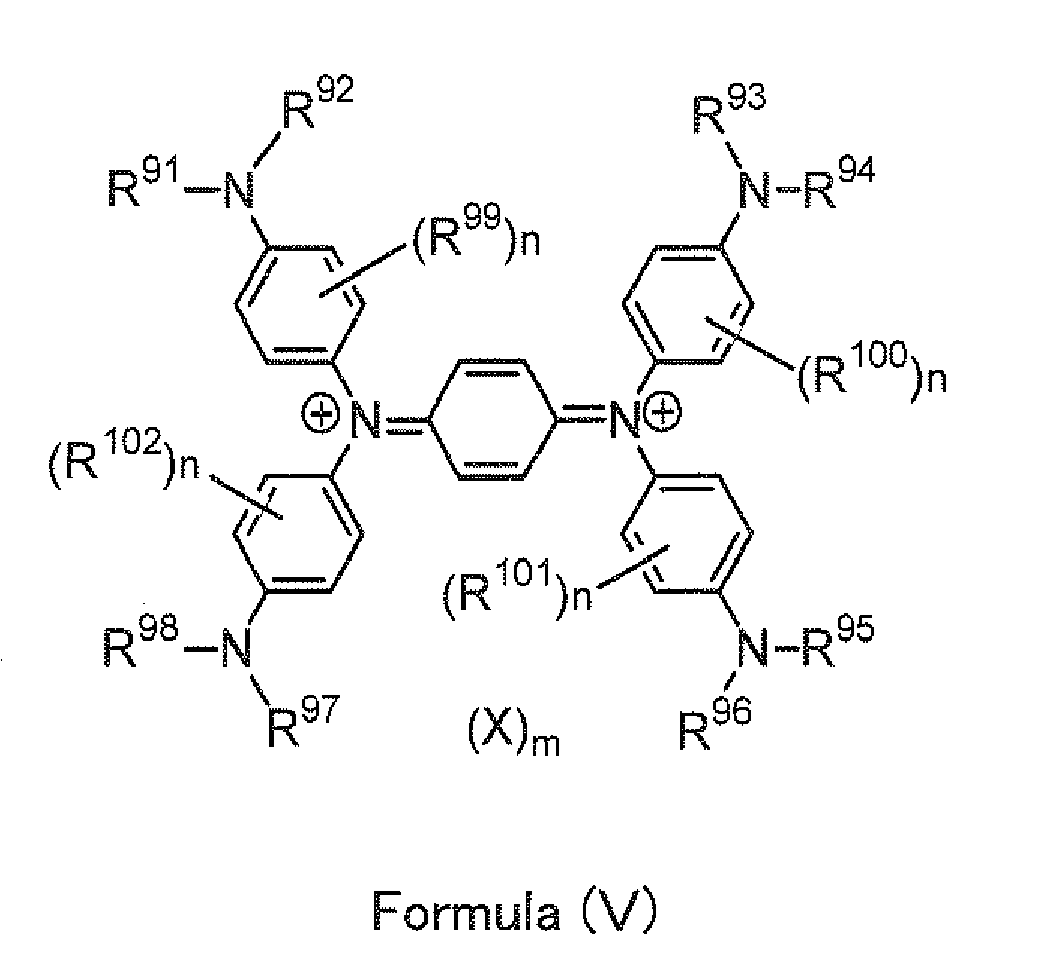
- The infrared dye composition according to claim 1, wherein the compound (II) is an anthraquinone compound, a thioindigo compound, or a perynone compound.
- An infrared ray absorbing ink, comprising the infrared dye composition according to claim 1.
- An electrophotographic toner, comprising the infrared dye composition according to claim 1.
Applications Claiming Priority (1)
| Application Number | Priority Date | Filing Date | Title |
|---|---|---|---|
| JP2008031836 | 2008-02-13 |
Publications (3)
| Publication Number | Publication Date |
|---|---|
| EP2093258A2 true EP2093258A2 (en) | 2009-08-26 |
| EP2093258A3 EP2093258A3 (en) | 2010-09-29 |
| EP2093258B1 EP2093258B1 (en) | 2012-07-11 |
Family
ID=40848208
Family Applications (1)
| Application Number | Title | Priority Date | Filing Date |
|---|---|---|---|
| EP20090152447 Not-in-force EP2093258B1 (en) | 2008-02-13 | 2009-02-10 | Infrared dye composition, infrared ray absorbing ink and electrophotographic toner |
Country Status (3)
| Country | Link |
|---|---|
| US (1) | US20090202930A1 (en) |
| EP (1) | EP2093258B1 (en) |
| JP (1) | JP2009215542A (en) |
Cited By (1)
| Publication number | Priority date | Publication date | Assignee | Title |
|---|---|---|---|---|
| CN104877433A (en) * | 2015-06-23 | 2015-09-02 | 苏州安洁科技股份有限公司 | Infrared light-transmitting printing ink |
Families Citing this family (12)
| Publication number | Priority date | Publication date | Assignee | Title |
|---|---|---|---|---|
| JP2010197305A (en) * | 2009-02-26 | 2010-09-09 | Fujifilm Corp | Method for proving genuineness of product using naphthalocyanine compound, signal conversion method, printing ink or toner, and method for manufacturing the naphthalocyanine compound |
| US8383309B2 (en) * | 2009-11-03 | 2013-02-26 | Xerox Corporation | Preparation of sublimation colorant dispersion |
| JP5697894B2 (en) * | 2010-05-17 | 2015-04-08 | 富士フイルム株式会社 | Infrared absorbing composition, infrared absorbing ink, recorded matter, image recording method, and image detection method |
| JP2011241274A (en) * | 2010-05-17 | 2011-12-01 | Fujifilm Corp | Infrared absorption nature composition, infrared absorption nature ink, recorded matter, image recording method, and image detecting method |
| JP2014047302A (en) * | 2012-08-31 | 2014-03-17 | Fujifilm Corp | Ink composition, and image-forming method |
| DE102014115156B4 (en) * | 2013-10-17 | 2021-09-16 | Samsung Sdi Co., Ltd. | Transparent conductor and optical display equipped with it |
| CN107004683B (en) | 2014-12-04 | 2020-10-16 | Jsr株式会社 | Solid-state imaging device |
| TWI675907B (en) | 2015-01-21 | 2019-11-01 | 日商Jsr股份有限公司 | Solid imaging device |
| CN110419006B (en) * | 2017-03-31 | 2022-10-14 | 京瓷办公信息系统株式会社 | Electrophotographic photoreceptor and image forming apparatus |
| JP7141791B2 (en) * | 2017-12-27 | 2022-09-26 | 花王株式会社 | Method for producing aqueous pigment dispersion |
| US20240101849A1 (en) * | 2020-12-16 | 2024-03-28 | Yamamoto Chemicals, Inc. | Printed material |
| TWI862969B (en) * | 2022-08-23 | 2024-11-21 | 財團法人紡織產業綜合研究所 | Liquid color masterbatch composition and fabricating method for colored fiber |
Citations (14)
| Publication number | Priority date | Publication date | Assignee | Title |
|---|---|---|---|---|
| JPS4325335B1 (en) | 1963-05-16 | 1968-11-01 | ||
| JPH0243269A (en) | 1987-10-20 | 1990-02-13 | Mitsui Toatsu Chem Inc | 1,2-naphthalocyanine near-infrared absorber and display and recording material containing same |
| JPH02138382A (en) | 1988-04-01 | 1990-05-28 | Mitsui Toatsu Chem Inc | Alkylphthalocyanine near-infrared absorber, and display and recording material containing same |
| JPH06250439A (en) | 1993-02-25 | 1994-09-09 | Xerox Corp | Preparation of toner composition |
| JP2547016B2 (en) | 1987-05-15 | 1996-10-23 | 日本カーバイド工業株式会社 | Toner for electrostatic image development |
| JPH10180947A (en) | 1996-11-07 | 1998-07-07 | Fuji Photo Film Co Ltd | Antireflective film and plasma display using the film |
| JP2000281919A (en) | 1999-03-30 | 2000-10-10 | Yamamoto Chem Inc | Phthalocyanine compound, its production, and near- infrared absorber containing it |
| JP3141783B2 (en) | 1996-07-11 | 2001-03-05 | 富士ゼロックス株式会社 | Manufacturing method of electrostatic image developing toner, electrostatic image developing toner, electrostatic image developer, and image forming method |
| JP2002146254A (en) | 2000-11-17 | 2002-05-22 | Konica Corp | Infrared absorption ink for invisible pattern formation, toner for electrophotography for invisible pattern formation, ink jet recording liquid for invisible pattern formation, thermal transcription material for invisible pattern formation, and invisible pattern formation using them |
| JP2003139946A (en) | 2001-11-01 | 2003-05-14 | Mitsubishi Chemicals Corp | Near infrared absorption filter |
| JP2003262719A (en) | 1995-12-22 | 2003-09-19 | Mitsui Chemicals Inc | Method for manufacturing filter for plasma display and display device equipped with the filter |
| JP2005126725A (en) | 1999-04-06 | 2005-05-19 | Seiko Epson Corp | Ink composition comprising a copper complex colorant |
| JP2005221892A (en) | 2004-02-06 | 2005-08-18 | Fuji Xerox Co Ltd | Electrophotographic toner and method for forming image by using the same |
| JP2007056105A (en) | 2005-08-23 | 2007-03-08 | Nippon Shokubai Co Ltd | Phthalocyanine compound and near-infrared absorbing dye comprising the same |
Family Cites Families (12)
| Publication number | Priority date | Publication date | Assignee | Title |
|---|---|---|---|---|
| JPH0638124B2 (en) * | 1983-08-22 | 1994-05-18 | 日本化薬株式会社 | Near infrared absorption filter |
| DE4310371A1 (en) * | 1993-03-30 | 1994-10-06 | Basf Ag | Process for the preparation of naphthalocyanines |
| US5804102A (en) * | 1995-12-22 | 1998-09-08 | Mitsui Chemicals, Inc. | Plasma display filter |
| JPH11326629A (en) * | 1998-05-15 | 1999-11-26 | Toyobo Co Ltd | Infrared absorption filter |
| GB0126103D0 (en) * | 2001-10-31 | 2002-01-02 | Avecia Ltd | Ink compositions |
| JP2004226929A (en) * | 2003-01-27 | 2004-08-12 | Fujitsu Ltd | Image forming color toner, color image forming method, color image forming apparatus, and toner cartridge |
| JP4333510B2 (en) * | 2004-07-22 | 2009-09-16 | 富士ゼロックス株式会社 | Infrared absorber, electrophotographic toner and image forming apparatus using the same |
| JP2006038935A (en) * | 2004-07-22 | 2006-02-09 | Fuji Xerox Co Ltd | Image forming method and image forming apparatus |
| JP3904028B2 (en) * | 2004-12-28 | 2007-04-11 | 東洋紡績株式会社 | Wavelength selective absorption filter |
| JP4498177B2 (en) * | 2005-03-15 | 2010-07-07 | 富士フイルム株式会社 | Positive photosensitive composition and image recording material using the same |
| US7473802B2 (en) * | 2005-09-05 | 2009-01-06 | Fujifilm Corporation | Method of producing near-infrared absorbing dye compound |
| JP2007262323A (en) * | 2006-03-29 | 2007-10-11 | Fujifilm Corp | Near-infrared absorbing material |
-
2009
- 2009-02-06 JP JP2009026438A patent/JP2009215542A/en active Pending
- 2009-02-10 EP EP20090152447 patent/EP2093258B1/en not_active Not-in-force
- 2009-02-13 US US12/371,244 patent/US20090202930A1/en not_active Abandoned
Patent Citations (14)
| Publication number | Priority date | Publication date | Assignee | Title |
|---|---|---|---|---|
| JPS4325335B1 (en) | 1963-05-16 | 1968-11-01 | ||
| JP2547016B2 (en) | 1987-05-15 | 1996-10-23 | 日本カーバイド工業株式会社 | Toner for electrostatic image development |
| JPH0243269A (en) | 1987-10-20 | 1990-02-13 | Mitsui Toatsu Chem Inc | 1,2-naphthalocyanine near-infrared absorber and display and recording material containing same |
| JPH02138382A (en) | 1988-04-01 | 1990-05-28 | Mitsui Toatsu Chem Inc | Alkylphthalocyanine near-infrared absorber, and display and recording material containing same |
| JPH06250439A (en) | 1993-02-25 | 1994-09-09 | Xerox Corp | Preparation of toner composition |
| JP2003262719A (en) | 1995-12-22 | 2003-09-19 | Mitsui Chemicals Inc | Method for manufacturing filter for plasma display and display device equipped with the filter |
| JP3141783B2 (en) | 1996-07-11 | 2001-03-05 | 富士ゼロックス株式会社 | Manufacturing method of electrostatic image developing toner, electrostatic image developing toner, electrostatic image developer, and image forming method |
| JPH10180947A (en) | 1996-11-07 | 1998-07-07 | Fuji Photo Film Co Ltd | Antireflective film and plasma display using the film |
| JP2000281919A (en) | 1999-03-30 | 2000-10-10 | Yamamoto Chem Inc | Phthalocyanine compound, its production, and near- infrared absorber containing it |
| JP2005126725A (en) | 1999-04-06 | 2005-05-19 | Seiko Epson Corp | Ink composition comprising a copper complex colorant |
| JP2002146254A (en) | 2000-11-17 | 2002-05-22 | Konica Corp | Infrared absorption ink for invisible pattern formation, toner for electrophotography for invisible pattern formation, ink jet recording liquid for invisible pattern formation, thermal transcription material for invisible pattern formation, and invisible pattern formation using them |
| JP2003139946A (en) | 2001-11-01 | 2003-05-14 | Mitsubishi Chemicals Corp | Near infrared absorption filter |
| JP2005221892A (en) | 2004-02-06 | 2005-08-18 | Fuji Xerox Co Ltd | Electrophotographic toner and method for forming image by using the same |
| JP2007056105A (en) | 2005-08-23 | 2007-03-08 | Nippon Shokubai Co Ltd | Phthalocyanine compound and near-infrared absorbing dye comprising the same |
Non-Patent Citations (2)
| Title |
|---|
| CHEMISTRY-A-EUROPEAN JOURNAL, vol. 9, 2003, pages 5123 - 5134 |
| JOURNAL OF CHEMICAL SOCIETY PARKIN TRANSACTION I, 1998, pages 2453 - 2458 |
Cited By (1)
| Publication number | Priority date | Publication date | Assignee | Title |
|---|---|---|---|---|
| CN104877433A (en) * | 2015-06-23 | 2015-09-02 | 苏州安洁科技股份有限公司 | Infrared light-transmitting printing ink |
Also Published As
| Publication number | Publication date |
|---|---|
| EP2093258B1 (en) | 2012-07-11 |
| JP2009215542A (en) | 2009-09-24 |
| EP2093258A3 (en) | 2010-09-29 |
| US20090202930A1 (en) | 2009-08-13 |
Similar Documents
| Publication | Publication Date | Title |
|---|---|---|
| EP2093258B1 (en) | Infrared dye composition, infrared ray absorbing ink and electrophotographic toner | |
| JP4510914B2 (en) | Dye compound, yellow toner, thermal transfer recording sheet, and ink | |
| JP5717230B2 (en) | Two-component diketopyrrolopyrrole pigment composition for use in color filters | |
| CN103703081B (en) | Partially green blue pigments, the dye compositions comprising this pigment and image recording material | |
| JP4815429B2 (en) | Violet colorant for color filters | |
| WO2010098002A1 (en) | Method for proving authenticity using naphthalocyanine compound, signal transduction method, polymer welding method, method for producing lithographic printing plate, printing ink, toner, heat-shielding material, and method for producing naphthalocyanine compound | |
| JP2010229389A (en) | Infrared absorbing material and method for synthesizing the same, coloring composition, ink, toner, printed matter, image recording method, and image information detecting method | |
| JP2000281927A (en) | Pigment dispersing agent and its use | |
| JP2009132911A (en) | Coloring composition, production method and coloring method | |
| JP6770979B2 (en) | Use of novel naphthol AS pigment mixture in printing materials | |
| JP2010533745A (en) | Particulate epsilon-copper phthalocyanine-pigment formulation | |
| JP5062460B2 (en) | Crude pigment | |
| JP4694559B2 (en) | Dye preparations based on phthalocyanine dyes | |
| KR20080012322A (en) | C.I. Pigment Blue-80 series blue dye | |
| US20140004458A1 (en) | Magenta toner | |
| JP2014177575A (en) | Method for preparing monoazo pigment composition, toner, and inkjet ink | |
| US20080166650A1 (en) | Colorant and toner | |
| JP5526794B2 (en) | Image forming material, method for producing image forming material, dye-containing composition, and method for producing dye-containing composition | |
| KR101668966B1 (en) | Pigment composition, coloring composition and process for producing pigment composition | |
| JP2015034363A (en) | Dye ability improvement method | |
| JP5465718B2 (en) | Dye derivative, coloring agent and coloring method | |
| TW200416259A (en) | Blue colorant with particularly high purity and positive triboelectric control effect | |
| JP2012193368A (en) | Crude pigment, and crude pigment dispersion | |
| JP5236176B2 (en) | Black resin composition | |
| JP2007100061A (en) | Coloring composition, ink jet recording liquid, ink jet recording method, color toner, color filter, optical information recording medium, optical information recording method, dye and metal chelate dye |
Legal Events
| Date | Code | Title | Description |
|---|---|---|---|
| PUAI | Public reference made under article 153(3) epc to a published international application that has entered the european phase |
Free format text: ORIGINAL CODE: 0009012 |
|
| AK | Designated contracting states |
Kind code of ref document: A2 Designated state(s): AT BE BG CH CY CZ DE DK EE ES FI FR GB GR HR HU IE IS IT LI LT LU LV MC MK MT NL NO PL PT RO SE SI SK TR |
|
| AX | Request for extension of the european patent |
Extension state: AL BA RS |
|
| PUAL | Search report despatched |
Free format text: ORIGINAL CODE: 0009013 |
|
| RIC1 | Information provided on ipc code assigned before grant |
Ipc: G03G 9/09 20060101ALI20100819BHEP Ipc: C09B 67/22 20060101AFI20090722BHEP Ipc: C09D 11/00 20060101ALI20100819BHEP |
|
| AK | Designated contracting states |
Kind code of ref document: A3 Designated state(s): AT BE BG CH CY CZ DE DK EE ES FI FR GB GR HR HU IE IS IT LI LT LU LV MC MK MT NL NO PL PT RO SE SI SK TR |
|
| AX | Request for extension of the european patent |
Extension state: AL BA RS |
|
| 17P | Request for examination filed |
Effective date: 20110317 |
|
| AKX | Designation fees paid |
Designated state(s): AT BE BG CH CY CZ DE DK EE ES FI FR GB GR HR HU IE IS IT LI LT LU LV MC MK MT NL NO PL PT RO SE SI SK TR |
|
| RIC1 | Information provided on ipc code assigned before grant |
Ipc: C09D 11/00 20060101ALI20110526BHEP Ipc: C09B 67/22 20060101AFI20110526BHEP Ipc: G03G 9/09 20060101ALI20110526BHEP |
|
| GRAP | Despatch of communication of intention to grant a patent |
Free format text: ORIGINAL CODE: EPIDOSNIGR1 |
|
| GRAS | Grant fee paid |
Free format text: ORIGINAL CODE: EPIDOSNIGR3 |
|
| GRAA | (expected) grant |
Free format text: ORIGINAL CODE: 0009210 |
|
| AK | Designated contracting states |
Kind code of ref document: B1 Designated state(s): AT BE BG CH CY CZ DE DK EE ES FI FR GB GR HR HU IE IS IT LI LT LU LV MC MK MT NL NO PL PT RO SE SI SK TR |
|
| REG | Reference to a national code |
Ref country code: GB Ref legal event code: FG4D |
|
| REG | Reference to a national code |
Ref country code: CH Ref legal event code: EP |
|
| REG | Reference to a national code |
Ref country code: AT Ref legal event code: REF Ref document number: 566138 Country of ref document: AT Kind code of ref document: T Effective date: 20120715 |
|
| REG | Reference to a national code |
Ref country code: IE Ref legal event code: FG4D |
|
| REG | Reference to a national code |
Ref country code: DE Ref legal event code: R096 Ref document number: 602009008149 Country of ref document: DE Effective date: 20120906 |
|
| REG | Reference to a national code |
Ref country code: NL Ref legal event code: VDEP Effective date: 20120711 |
|
| REG | Reference to a national code |
Ref country code: AT Ref legal event code: MK05 Ref document number: 566138 Country of ref document: AT Kind code of ref document: T Effective date: 20120711 |
|
| REG | Reference to a national code |
Ref country code: LT Ref legal event code: MG4D Effective date: 20120711 |
|
| PG25 | Lapsed in a contracting state [announced via postgrant information from national office to epo] |
Ref country code: CY Free format text: LAPSE BECAUSE OF FAILURE TO SUBMIT A TRANSLATION OF THE DESCRIPTION OR TO PAY THE FEE WITHIN THE PRESCRIBED TIME-LIMIT Effective date: 20120711 Ref country code: AT Free format text: LAPSE BECAUSE OF FAILURE TO SUBMIT A TRANSLATION OF THE DESCRIPTION OR TO PAY THE FEE WITHIN THE PRESCRIBED TIME-LIMIT Effective date: 20120711 Ref country code: NO Free format text: LAPSE BECAUSE OF FAILURE TO SUBMIT A TRANSLATION OF THE DESCRIPTION OR TO PAY THE FEE WITHIN THE PRESCRIBED TIME-LIMIT Effective date: 20121011 Ref country code: HR Free format text: LAPSE BECAUSE OF FAILURE TO SUBMIT A TRANSLATION OF THE DESCRIPTION OR TO PAY THE FEE WITHIN THE PRESCRIBED TIME-LIMIT Effective date: 20120711 Ref country code: LT Free format text: LAPSE BECAUSE OF FAILURE TO SUBMIT A TRANSLATION OF THE DESCRIPTION OR TO PAY THE FEE WITHIN THE PRESCRIBED TIME-LIMIT Effective date: 20120711 Ref country code: IS Free format text: LAPSE BECAUSE OF FAILURE TO SUBMIT A TRANSLATION OF THE DESCRIPTION OR TO PAY THE FEE WITHIN THE PRESCRIBED TIME-LIMIT Effective date: 20121111 Ref country code: BE Free format text: LAPSE BECAUSE OF FAILURE TO SUBMIT A TRANSLATION OF THE DESCRIPTION OR TO PAY THE FEE WITHIN THE PRESCRIBED TIME-LIMIT Effective date: 20120711 Ref country code: FI Free format text: LAPSE BECAUSE OF FAILURE TO SUBMIT A TRANSLATION OF THE DESCRIPTION OR TO PAY THE FEE WITHIN THE PRESCRIBED TIME-LIMIT Effective date: 20120711 |
|
| PG25 | Lapsed in a contracting state [announced via postgrant information from national office to epo] |
Ref country code: PL Free format text: LAPSE BECAUSE OF FAILURE TO SUBMIT A TRANSLATION OF THE DESCRIPTION OR TO PAY THE FEE WITHIN THE PRESCRIBED TIME-LIMIT Effective date: 20120711 Ref country code: GR Free format text: LAPSE BECAUSE OF FAILURE TO SUBMIT A TRANSLATION OF THE DESCRIPTION OR TO PAY THE FEE WITHIN THE PRESCRIBED TIME-LIMIT Effective date: 20121012 Ref country code: SE Free format text: LAPSE BECAUSE OF FAILURE TO SUBMIT A TRANSLATION OF THE DESCRIPTION OR TO PAY THE FEE WITHIN THE PRESCRIBED TIME-LIMIT Effective date: 20120711 Ref country code: LV Free format text: LAPSE BECAUSE OF FAILURE TO SUBMIT A TRANSLATION OF THE DESCRIPTION OR TO PAY THE FEE WITHIN THE PRESCRIBED TIME-LIMIT Effective date: 20120711 Ref country code: SI Free format text: LAPSE BECAUSE OF FAILURE TO SUBMIT A TRANSLATION OF THE DESCRIPTION OR TO PAY THE FEE WITHIN THE PRESCRIBED TIME-LIMIT Effective date: 20120711 Ref country code: PT Free format text: LAPSE BECAUSE OF FAILURE TO SUBMIT A TRANSLATION OF THE DESCRIPTION OR TO PAY THE FEE WITHIN THE PRESCRIBED TIME-LIMIT Effective date: 20121112 |
|
| PG25 | Lapsed in a contracting state [announced via postgrant information from national office to epo] |
Ref country code: NL Free format text: LAPSE BECAUSE OF FAILURE TO SUBMIT A TRANSLATION OF THE DESCRIPTION OR TO PAY THE FEE WITHIN THE PRESCRIBED TIME-LIMIT Effective date: 20120711 |
|
| PG25 | Lapsed in a contracting state [announced via postgrant information from national office to epo] |
Ref country code: RO Free format text: LAPSE BECAUSE OF FAILURE TO SUBMIT A TRANSLATION OF THE DESCRIPTION OR TO PAY THE FEE WITHIN THE PRESCRIBED TIME-LIMIT Effective date: 20120711 Ref country code: ES Free format text: LAPSE BECAUSE OF FAILURE TO SUBMIT A TRANSLATION OF THE DESCRIPTION OR TO PAY THE FEE WITHIN THE PRESCRIBED TIME-LIMIT Effective date: 20121022 Ref country code: EE Free format text: LAPSE BECAUSE OF FAILURE TO SUBMIT A TRANSLATION OF THE DESCRIPTION OR TO PAY THE FEE WITHIN THE PRESCRIBED TIME-LIMIT Effective date: 20120711 Ref country code: DK Free format text: LAPSE BECAUSE OF FAILURE TO SUBMIT A TRANSLATION OF THE DESCRIPTION OR TO PAY THE FEE WITHIN THE PRESCRIBED TIME-LIMIT Effective date: 20120711 Ref country code: CZ Free format text: LAPSE BECAUSE OF FAILURE TO SUBMIT A TRANSLATION OF THE DESCRIPTION OR TO PAY THE FEE WITHIN THE PRESCRIBED TIME-LIMIT Effective date: 20120711 |
|
| PLBE | No opposition filed within time limit |
Free format text: ORIGINAL CODE: 0009261 |
|
| STAA | Information on the status of an ep patent application or granted ep patent |
Free format text: STATUS: NO OPPOSITION FILED WITHIN TIME LIMIT |
|
| PG25 | Lapsed in a contracting state [announced via postgrant information from national office to epo] |
Ref country code: SK Free format text: LAPSE BECAUSE OF FAILURE TO SUBMIT A TRANSLATION OF THE DESCRIPTION OR TO PAY THE FEE WITHIN THE PRESCRIBED TIME-LIMIT Effective date: 20120711 Ref country code: IT Free format text: LAPSE BECAUSE OF FAILURE TO SUBMIT A TRANSLATION OF THE DESCRIPTION OR TO PAY THE FEE WITHIN THE PRESCRIBED TIME-LIMIT Effective date: 20120711 |
|
| 26N | No opposition filed |
Effective date: 20130412 |
|
| PG25 | Lapsed in a contracting state [announced via postgrant information from national office to epo] |
Ref country code: BG Free format text: LAPSE BECAUSE OF FAILURE TO SUBMIT A TRANSLATION OF THE DESCRIPTION OR TO PAY THE FEE WITHIN THE PRESCRIBED TIME-LIMIT Effective date: 20121011 |
|
| REG | Reference to a national code |
Ref country code: DE Ref legal event code: R097 Ref document number: 602009008149 Country of ref document: DE Effective date: 20130412 |
|
| PG25 | Lapsed in a contracting state [announced via postgrant information from national office to epo] |
Ref country code: MC Free format text: LAPSE BECAUSE OF NON-PAYMENT OF DUE FEES Effective date: 20130228 |
|
| REG | Reference to a national code |
Ref country code: CH Ref legal event code: PL |
|
| PG25 | Lapsed in a contracting state [announced via postgrant information from national office to epo] |
Ref country code: LI Free format text: LAPSE BECAUSE OF NON-PAYMENT OF DUE FEES Effective date: 20130228 Ref country code: CH Free format text: LAPSE BECAUSE OF NON-PAYMENT OF DUE FEES Effective date: 20130228 |
|
| REG | Reference to a national code |
Ref country code: FR Ref legal event code: ST Effective date: 20131031 |
|
| REG | Reference to a national code |
Ref country code: IE Ref legal event code: MM4A |
|
| PG25 | Lapsed in a contracting state [announced via postgrant information from national office to epo] |
Ref country code: IE Free format text: LAPSE BECAUSE OF NON-PAYMENT OF DUE FEES Effective date: 20130210 Ref country code: FR Free format text: LAPSE BECAUSE OF NON-PAYMENT OF DUE FEES Effective date: 20130228 |
|
| PG25 | Lapsed in a contracting state [announced via postgrant information from national office to epo] |
Ref country code: MT Free format text: LAPSE BECAUSE OF FAILURE TO SUBMIT A TRANSLATION OF THE DESCRIPTION OR TO PAY THE FEE WITHIN THE PRESCRIBED TIME-LIMIT Effective date: 20120711 |
|
| PG25 | Lapsed in a contracting state [announced via postgrant information from national office to epo] |
Ref country code: TR Free format text: LAPSE BECAUSE OF FAILURE TO SUBMIT A TRANSLATION OF THE DESCRIPTION OR TO PAY THE FEE WITHIN THE PRESCRIBED TIME-LIMIT Effective date: 20120711 |
|
| PG25 | Lapsed in a contracting state [announced via postgrant information from national office to epo] |
Ref country code: LU Free format text: LAPSE BECAUSE OF NON-PAYMENT OF DUE FEES Effective date: 20130210 Ref country code: HU Free format text: LAPSE BECAUSE OF FAILURE TO SUBMIT A TRANSLATION OF THE DESCRIPTION OR TO PAY THE FEE WITHIN THE PRESCRIBED TIME-LIMIT; INVALID AB INITIO Effective date: 20090210 Ref country code: MK Free format text: LAPSE BECAUSE OF FAILURE TO SUBMIT A TRANSLATION OF THE DESCRIPTION OR TO PAY THE FEE WITHIN THE PRESCRIBED TIME-LIMIT Effective date: 20120711 |
|
| PGFP | Annual fee paid to national office [announced via postgrant information from national office to epo] |
Ref country code: GB Payment date: 20210203 Year of fee payment: 13 Ref country code: DE Payment date: 20210126 Year of fee payment: 13 |
|
| REG | Reference to a national code |
Ref country code: DE Ref legal event code: R119 Ref document number: 602009008149 Country of ref document: DE |
|
| GBPC | Gb: european patent ceased through non-payment of renewal fee |
Effective date: 20220210 |
|
| PG25 | Lapsed in a contracting state [announced via postgrant information from national office to epo] |
Ref country code: GB Free format text: LAPSE BECAUSE OF NON-PAYMENT OF DUE FEES Effective date: 20220210 Ref country code: DE Free format text: LAPSE BECAUSE OF NON-PAYMENT OF DUE FEES Effective date: 20220901 |