EP2091007B1 - Two-dimension code, decoding method thereof and printing publication for applying two-dimension code - Google Patents
Two-dimension code, decoding method thereof and printing publication for applying two-dimension code Download PDFInfo
- Publication number
- EP2091007B1 EP2091007B1 EP07817108A EP07817108A EP2091007B1 EP 2091007 B1 EP2091007 B1 EP 2091007B1 EP 07817108 A EP07817108 A EP 07817108A EP 07817108 A EP07817108 A EP 07817108A EP 2091007 B1 EP2091007 B1 EP 2091007B1
- Authority
- EP
- European Patent Office
- Prior art keywords
- dots
- code
- dot
- positioning
- coordinates
- Prior art date
- Legal status (The legal status is an assumption and is not a legal conclusion. Google has not performed a legal analysis and makes no representation as to the accuracy of the status listed.)
- Active
Links
Images


Classifications
-
- G—PHYSICS
- G06—COMPUTING OR CALCULATING; COUNTING
- G06V—IMAGE OR VIDEO RECOGNITION OR UNDERSTANDING
- G06V30/00—Character recognition; Recognising digital ink; Document-oriented image-based pattern recognition
- G06V30/10—Character recognition
- G06V30/22—Character recognition characterised by the type of writing
- G06V30/224—Character recognition characterised by the type of writing of printed characters having additional code marks or containing code marks
-
- G—PHYSICS
- G06—COMPUTING OR CALCULATING; COUNTING
- G06K—GRAPHICAL DATA READING; PRESENTATION OF DATA; RECORD CARRIERS; HANDLING RECORD CARRIERS
- G06K19/00—Record carriers for use with machines and with at least a part designed to carry digital markings
- G06K19/06—Record carriers for use with machines and with at least a part designed to carry digital markings characterised by the kind of the digital marking, e.g. shape, nature, code
- G06K19/06009—Record carriers for use with machines and with at least a part designed to carry digital markings characterised by the kind of the digital marking, e.g. shape, nature, code with optically detectable marking
- G06K19/06037—Record carriers for use with machines and with at least a part designed to carry digital markings characterised by the kind of the digital marking, e.g. shape, nature, code with optically detectable marking multi-dimensional coding
-
- G—PHYSICS
- G06—COMPUTING OR CALCULATING; COUNTING
- G06K—GRAPHICAL DATA READING; PRESENTATION OF DATA; RECORD CARRIERS; HANDLING RECORD CARRIERS
- G06K19/00—Record carriers for use with machines and with at least a part designed to carry digital markings
- G06K19/06—Record carriers for use with machines and with at least a part designed to carry digital markings characterised by the kind of the digital marking, e.g. shape, nature, code
-
- G—PHYSICS
- G06—COMPUTING OR CALCULATING; COUNTING
- G06V—IMAGE OR VIDEO RECOGNITION OR UNDERSTANDING
- G06V10/00—Arrangements for image or video recognition or understanding
- G06V10/20—Image preprocessing
- G06V10/24—Aligning, centring, orientation detection or correction of the image
Definitions
- This invention relates to a two-dimensional code, a decoding method thereof, and an application thereof in a printing publication.
- the main form of the two-dimensional code is plain code.
- the reading apparatus can touch-read the two-dimensional code symbol that is printed clearly between words and paragraphs or some visible places on the page.
- This kind of plain code can only appear on the blank places of the page and usually in the form of a single code, so the beauty of the page will be influenced more or less.
- the plain code usually will be printed a little big so it can be found easily, although the requirement for printing precision is rather low, the head of the reading apparatus needs to be big for touch-reading.
- the objective of this invention is to provide a two-dimensional code and its decoding method adapted to store data, convenient for reading and having easy decoding algorithm, and the publication with the multimedia data index information using this two-dimensional code.
- the two-dimensional code was designed to meet the requirements of the conventional printing condition of the publication, so it is more convenient and reliable in use.
- this invention firstly discloses a two-dimensional code, having code symbols comprising an array of bar code cells with different optical reflectance on a basement; said code symbol is a rectangle, wherein said bar code cells in said code symbol are solid dots arranged at equal intervals and the cells located at four corners of said code symbol are four positioning dots for defining and recognizing the border, the rest of the cells are data dots, said positioning dots are larger than said data dots; said data dots are all within the rectangle defined by linking said positioning dots' centers; a plurality of said code symbols are arranged repeatedly on the basement seamlessly jointed as a code matrix, including at least two same code symbols, and adjacent code symbols share same two positioning dots; wherein the diameter of said positioning dots is twice that of said data dots, said code symbol including 10 ⁇ 10 bar code cells, wherein except the positioning dots, every adjacent 8 data dots constitute a group to represent one code word; the coordinates of the said positioning dots are respectively (0,0), (9,0), (0,9)and (9,9); in the chessboard coordinate system defined by coordinates
- this invention provides a printing publication, using said two dimensional code, characterized in that said publication is printed with normal words and pictures and the two dimensional code to be recognized by a device.
- Said code symbols can not be seen by eyes in normal reading environment; or compared with normal words and pictures, said code symbols can not be seen easily.
- Said bar code cells includes deep color cells and light color cells representing respectively the values of binary system 1 and 0, and said light color cells can be shown directly by the background color of paper or other print mediums.
- Said code symbol cells are printed with infrared ink that shows different reflectivity to different lights of infrared spectrum and shows same reflectivity to lights of visible spectrum, while the other contents covering the said code symbol use ink printing transmissive to lights of the infrared spectrum.
- Information carried by the two-dimensional code includes the multimedia data index coding corresponding to different parts of the said publication and the publishing species index coding of said publication.
- the said multimedia data index coding corresponding to the different parts of the said publication and the publishing species index coding of the said publication includes 6 functional sections consisting of fixed length of digit numbers: language number, classification number, class index number, page sequence number, code sequence number and error check number; wherein the language number is the digit code name of language stipulated by the language of the publication; classification number is the digit code name of publication classification with some language according to the book species; class index number represents the specific order of some classified book of the publication with some language, that can be numerical order; the page sequence number is the page digit of the said publication corresponding to the content of index coding; code sequence number is the number corresponding to the amount of two-dimensional codes and marking sequence used in the pages including the two-dimensional codes; error check number is to check the correctness of the index coding.
- the said multimedia data index coding corresponding to the different parts of the said publication and the publishing species index coding of the said publication includes a 16-digit decimal number, wherein the length of every functional section is respectively: language number 1 digit, classification number 2 digits, class index number 6 digits, page sequence number 4 digits, code sequence number 2 digits and parity check number 1 digit.
- the value of the said publishing species index coding and the parity check digit of the said multimedia data index coding are calculated by the first 15 decimal numbers of the coding, and the calculation method is: respectively and in sequence putting the first 15 decimal numbers from the multimedia data index of publication as the cardinal number, and using "1"and "2" as weighted factors to be respectively multiplied by decimal numbers of the cardinal number, and then dividing the product sum by modulus 10, wherein every section of cardinal number is multiplied with the weighted factor, if the product is more than 10, add the tens digit of this product with single digit together to get every product sum, when every product sum is less than 10, add 10 to the product sum and then divide the sum by modulus 10, and the difference between its remainder and 10 is the value of parity check digit.
- this invention provides a decoding method of the two-dimensional code including the following steps:
- the process of selecting positioning dots in said step 5) may include:
- the process of matching the positioning dots in the rectangle mode in the said step 6) may include:
- the grouping process of the data dots in the said step 7) may include:
- the publication using the two-dimensional code of this invention can be read by a reading apparatus conveniently because of the large printing area using the same code with repetition array, and without the action "focus on", the reading apparatus can be placed freely but always in the range of code.
- the reading apparatus can be placed freely but always in the range of code.
- the two-dimensional code of this invention can non-repeatedly encode all the voice index number of the whole publication, the publication using this kind of two-dimensional code totally possesses the quantity condition to become a new kind of publication.
- the decoding algorithm computation is small, and the decoding time is shorter, the low-cost hardware can be used to reduce the cost of publication with the two-dimensional code of this invention.
- the unit module of the two-dimensional code is in two colors, so the bar code can assure the legibility only if there is enough difference between the foreground color and background color's brightness values; the background color can directly use the ground color of paper or other printing media to reduce the printing cost.
- the two-dimensional code of this invention its bar code cell of the code can use circular dots or solid dots having another shape. Every black dot represents a bar code cell, every corresponding white dot also represents a bar code cell. If the value of a black dot is 1, then the value of a white dot is 0, and vice versa.
- the white dot needs not be printed, but may directly use the ground color of the printing media such as paper and so on.
- the diameter of the black dot needs to be big enough and the specific printing should base on the printing machine.
- RS coding is used to assure enough error correcting capability.
- the decoding computation is small, so it is convenient for the low-cost MCU operation.
- the two-dimensional code of this invention can be printed as hiding code, such that you can not see the code symbol under the light except using special equipment or specific light.
- the two-dimensional code of this invention also can support plain code that is easy to find by eyes, because the hiding code can be amplified to print, or be arranged in the arrays (equivalent to the size of the words) and enlarge the black dot.
- plain code that is easy to find by eyes, because the hiding code can be amplified to print, or be arranged in the arrays (equivalent to the size of the words) and enlarge the black dot.
- the multi-code arrangement can reduce the requirement of "focus on".
- the total side length of the code needs to be as small as possible.
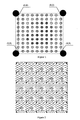
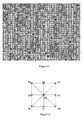
- Figure 1 is the schematic diagram of single code symbol of this invention
- Figure 2 is the schematic diagram of multi-code adjacent repeated arrangement of this invention.
- the big black dot at the four corners of the code symbol in Figure 1 is the recognition and positioning characteristic
- the small circle dot is the bar code cell to represent data
- the diameter of the big circular dot can be twice that of the small circular dot
- the big circular dot is always deep color
- the deep color of the small circular dot represents 1
- the light color represents 0
- every 8 adjacent circular dots marked the same kind image represent one code word
- one code symbol possesses 12 code words, respectively be marked code word 1 ⁇ code word 12 from left to right and from up to down.
- the code word, the coordinate of the code word in the symbol and the bit sequence arrangement of the code word are all defined as the following layout chart of code word: Layout of code words Sequence number of code word Coordinates of the code word in the symbol is (x, y) and the bit sequence arrangement (bit7 ⁇ bit0) 1 (1,0), (2,0), (0,1), (1,1), (2,1), (0,2), (1,2), (2,2) 2 (3,0), (4,0), (5,0), (6,0), (3,1), (4,1), (5,1), (6,1) 3 (7,0), (8,0), (7,1), (8, 1), (9,1), (7,2), (8,2), (9,2) 4 (3,2), (4,2), (2,3), (3,3), (4,3), (2,4), (3,4), (4,4) 5 (5,2), (6,2), (5,3), (6,3), (7,3), (5,4), (6,4), (7,4) 6 (0,3), (1,3), (0,4), (1,4), (0,5)
- the coding capacity of one code symbol including 12 bytes can rationally distribute the length of the data code and error correcting code.
- the same code is repeatedly arranged in the horizontal and vertical directions to improve the hitting rate, the adjacent two codes share two big positioning circular dots for producing seamlessly joined code and improving the area efficiency to the maximum extent.
- the decoding is started after the image of the two-dimensional code symbol of this invention is obtained.
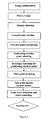
- the specific steps include: image enhancement, binary image, margin checking, closed border tracing, circular dot recognizing, positioning circular dot selecting, rectangle matching the positioning circular dot, data dot grouping, data dot matrix reconstruction, and error correction and recovery of the code word.
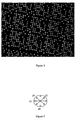
- image enhancing is performed on the original image of Figure 4 to improve the recognition rate of the code and then produce the image enhancement of Figure 5 .
- the algorithm of the image enhancement can use USM (Unsharp Mask) that is familiar to persons in the digital image processing field, the principle is first to deal with the original image by two-dimensional gauss low-pass and then get the blurry image, then reduce this blurry image from the original image to get the image with enhanced contrast ratio.
- USM Unsharp Mask
- a threshold value T is set (0 ⁇ T ⁇ 255), the brightness of pixel higher than T is white, other pixels are black because dynamic range of the pixel luminance value is enlarged after the image enhancement, background brightness approaches to the maximum value 255, the pixel brightness composing the circular dot approaches to the minimum value 0, thus it is very easy to choose a fixed or dynamic threshold value T.
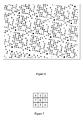
- the image of Figure 6 can be obtained after binary processing.
- margin pixels the pixel having a value 0 and the adjacent 8 pixels including a non-zero pixel.
- the adjacent pixel's definition of some pixel is as shown in Figure 7 ; the pixel with code 0, the code of its adjacent 8 pixels is respectively from 1 to 8.
- the operation project of closed border tracing is the margin image produced from the border checking of the last step, including the following steps:
- the aim of this step is to eliminate some noise data from the checking result of the Step 4, that is to give up the non-circular closed border, and the judgment basis of noise data is the circular geometric feature. If the code symbol uses the two-dimensional code of this invention and its cell is the solid dot with other sizes, then do not implement this step.
- This process selects the positioning circular dot from the circular dots that have been recognized.
- Figure 10 firstly count the histogram of circular dot's area to find area value So of the most centralized distributed area histogram, and the range with the So as the center is corresponding to the area of data circular dot, and the area of positioning circular dot is in the range with the 4* So as the center.
- the area histogram is divided into two parts, one part corresponding to data circular dot, one part corresponding to the positioning circular dot.
- This kind of calculation based on the count is steady because there are 96 data dots in one code symbol, according to the statistical value the amount of deep color circular dots is 48, so the area histogram can not have the unstable statistical result caused by too small amount of the circular dots.
- the code symbol uses the two-dimensional code of this invention, its cell is the solid dot with other non-round size
- this step firstly calculate the area within every closed border and then count the histogram of every closed border area, find the area value So of the most centralized distributed area histogram, and that corresponding to one range with the So as the center is the area of data circular dot, and the area of positioning dot is several times that of that data dot, and this multiple can be defined according to the size of positioning dot and data dot determined previously.
- extract two parts from the area histogram one part corresponding to data circular dot with So as the center, one part corresponding to positioning circular dot with the several times of So as the center.
- This method judges the noise data according to the area size of closed border, some closed border with too big or too small areas without statistic characteristic will be discarded.
- P 0 is the first reference dot
- P 1 is the second reference dot
- the angle of all the polar coordinates is in [0,360]
- code words are recovered by reconstructing the data dot matrix obtained in said step 9, according to the inverse process of the codeword layout in the coding process, and the code words obtained from step 8 are error corrected by using Reed-Solomon correcting algorithm and according to decoding parameter corresponding to the coding parameter.
- the index of this multimedia data can be printed in the corresponding places of the books, for example in the contents of the books, and/or the first page of different chapters in the books, or different places of the page.
- the index of this multimedia data can be read by multimedia playing device and chosen to the playing paragraph automatically.
- the two-dimensional code of this invention used in the publication printed as the shading of page with the array of code symbol, and other word contents covering the code, thus it is not necessary to focus on the code symbol when the reading device is reading the code symbol, and the code symbol between lines can always be obtained.
- the page typesetting is beautiful.
- the unified coding method is used to make all kinds of different publication have the unique and unified code.
- the standard unified code is convenient for the spread and application of the multimedia data publication.
- the programming structure of the standard two-dimensional code publication species index coding and multimedia data index coding corresponding to the different parts in the said publication includes:
- multimedia index coding information of one publication is as follows: Language number classification number class index number 1 10 100258 Page sequence number code sequence number error check number 0035 12 9
- the classification number is the classification digital code specifically defined for the two-dimensional code complication of the publication, the "classification” is specifically defined according to the book species matching the publication. This period of serial numbers represents the specific classification number of every language. Every classification number is 2-digit decimal number, and the classification of the two-dimensional code is in the range of "00 ⁇ 99".
- Class index number is the order representing digit specifically defined for the two-dimensional code complication of the publication.
- the digit number of every class index number is 6-digit decimal number, compiling numerical number according to the demand of publishing species and sequence , the class index number value range of the two-dimensional code is from 000000 to 999999. Every publication of every species must be given a different class index number.
- the quantity of language number can be divided into 10
- every language kind can be divided into 100 species (classification) numbers
- every species can publish 1 million kinds of books.
- every language kind supports up to a hundred million kinds of books; and this coding scheme can support 1 billion kinds of publications.
- the page sequence number is the page digit marking adopted into the two-dimensional code of the publication.
- the digit number of every page sequence number is 4-digit decimal number, starting to code the numerical number according to the page sequence of every page from 01.
- the code sequence number of every two-dimensional code has the value range from 01 to 99. For example when some publication only has one two-dimensional code on page 8, its page sequence number and code sequence number represented as "00080 1 ".
- the parity check digit is the last number of the publication two-dimensional code compilation to check the correctness of coding.
- the parity check digit only can be any integer from 1 to 10, when parity check digit is 10, it is represented by "0". Therefore, the parity check digit only can be 1234567890. For example:1 1 6 0 6 3 4 5 2 0 0 8 6 2 9 (6) 2 1 2 1 2 1 2 1 2 1 2 1 2 1 2 1 Product:1 2 6 0 6 6 4 10 2 0 0 16 6 4 9
- code 1160634520086296 is a correct publication multimedia index coding.
- the characteristic of the publication two-dimensional code compilation structure is that the structure of publication multimedia index coding is 16 bits decimal number and be compiled as two-dimensional code, each section of length is constant digit number, the distribution of every publication multimedia index coding is unique, the compiled two-dimensional code ensures correct reading of MPR reading apparatus or other multimedia playing devices, and it is convenient for management by the computer.
- the two-dimensional code of this invention is 1160634520086296, it can be divided into 6 sections according to the order, the language number is fixed as 1, the classification number is fixed as 16, the class index number is fixed as 063452, the page sequence number is fixed as 0086, the code sequence number is fixed as 29, the parity check digit is fixed as 6, thus getting 1-16-063452-0086-29-6. Therefore, the two-dimensional code compilation is the 29 th code on the page 86 of the 063452 nd publication with language kind code 1 and classification code 16.
Landscapes
- Engineering & Computer Science (AREA)
- Physics & Mathematics (AREA)
- General Physics & Mathematics (AREA)
- Theoretical Computer Science (AREA)
- Multimedia (AREA)
- Computer Vision & Pattern Recognition (AREA)
- Image Processing (AREA)
- Printers Characterized By Their Purpose (AREA)
- Image Analysis (AREA)
- Dot-Matrix Printers And Others (AREA)
- Compression, Expansion, Code Conversion, And Decoders (AREA)
- Character Discrimination (AREA)
Abstract
Description
- This invention relates to a two-dimensional code, a decoding method thereof, and an application thereof in a printing publication.
- Customarily, people always read traditional publications, such as books, newspapers, and so on, with their eyes, which will be tiresome easily after long time using, this way of getting information is rather boring, and it is impossible for a person who is blind or has eye disease to read. Thus the voice reading publication has appeared recently, which uses a two-dimensional voice reading device to decode and pronounce the content of one book, so that the readers can listen, improving the effect of reading or memory. Moreover, it is also convenient for the blind or those who have eye disease to read.
- Usually the main form of the two-dimensional code is plain code. On the voice reading publication, the reading apparatus can touch-read the two-dimensional code symbol that is printed clearly between words and paragraphs or some visible places on the page. This kind of plain code can only appear on the blank places of the page and usually in the form of a single code, so the beauty of the page will be influenced more or less. And the plain code usually will be printed a little big so it can be found easily, although the requirement for printing precision is rather low, the head of the reading apparatus needs to be big for touch-reading.
- On the market the two-dimensional code voice reading device has appeared and used the conventional two-dimensional code to mark phonetic places but its amount of the phonetic index is limited so that different publications need to use the same code, resulting in mistakes of phonetic content, because the phonetic file of the reading device corresponds to the target publication.
- The objective of this invention is to provide a two-dimensional code and its decoding method adapted to store data, convenient for reading and having easy decoding algorithm, and the publication with the multimedia data index information using this two-dimensional code. The two-dimensional code was designed to meet the requirements of the conventional printing condition of the publication, so it is more convenient and reliable in use.
- To achieve the object, this invention firstly discloses a two-dimensional code, having code symbols comprising an array of bar code cells with different optical reflectance on a basement; said code symbol is a rectangle, wherein said bar code cells in said code symbol are solid dots arranged at equal intervals and the cells located at four corners of said code symbol are four positioning dots for defining and recognizing the border, the rest of the cells are data dots, said positioning dots are larger than said data dots; said data dots are all within the rectangle defined by linking said positioning dots' centers; a plurality of said code symbols are arranged repeatedly on the basement seamlessly jointed as a code matrix, including at least two same code symbols, and adjacent code symbols share same two positioning dots; wherein the diameter of said positioning dots is twice that of said data dots,
said code symbol including 10×10 bar code cells, wherein except the positioning dots, every adjacent 8 data dots constitute a group to represent one code word; the coordinates of the said positioning dots are respectively (0,0), (9,0), (0,9)and (9,9); in the chessboard coordinate system defined by coordinates of the positioning dots, the data dots are divided into 12 groups that respectively represent one code word; the unit coordinates of the first group include(1,0), (2,0), (0,1), (1,1), (2,1), (0,2), (1,2), (2,2); the unit coordinates of the second group include(3,0), (4,0), (5,0), (6,0), (3,1), (4,1), (5,1), (6,1); the unit coordinates of the third group include (7,0), (8,0), (7,1), (8, 1), (9,1), (7,2), (8,2), (9,2); the unit coordinates of the forth group include (3,2), (4,2), (2,3), (3,3), (4,3), (2,4), (3,4), (4,4); the unit coordinates of the fifth group include (5,2), (6,2), (5,3), (6,3), (7,3), (5,4), (6,4), (7,4); the unit coordinates of the sixth group include (0,3), (1,3), (0,4), (1,4), (0,5), (1,5), (0,6), (1,6); the unit coordinates of the seventh group include (8,3), (9,3), (8,4), (9,4), (8,5), (9,5), (8,6), (9,6); the unit coordinates of the eighth group include (2,5), (3,5), (4,5), (2,6), (3,6), (4,6), (3,7), (4,7); the unit coordinates of the ninth group include (5,5), (6,5), (7,5), (5,6), (6,6), (7,6), (5,7), (6,7); the unit coordinates of the tenth group include (0,7), (1,7), (2,7), (0,8), (1,8), (2,8), (2,9), (3,9); the unit coordinates of the eleventh group include(3,8), (4,8), (5,8), (6,8), (3,9), (4,9), (5,9), (6,9); the unit coordinates of the twelfth group include (7,7), (8, 7), (9,7), (7,8), (8,8), (9,8), (7,9), (8,9). - Secondly, this invention provides a printing publication,
using said two dimensional code, characterized in that said publication is printed with normal words and pictures and the two dimensional code to be recognized by a device. - Said code symbols can not be seen by eyes in normal reading environment; or compared with normal words and pictures, said code symbols can not be seen easily.
- Said bar code cells includes deep color cells and light color cells representing respectively the values of
binary system - Said code symbol cells are printed with infrared ink that shows different reflectivity to different lights of infrared spectrum and shows same reflectivity to lights of visible spectrum, while the other contents covering the said code symbol use ink printing transmissive to lights of the infrared spectrum.
- Information carried by the two-dimensional code includes the multimedia data index coding corresponding to different parts of the said publication and the publishing species index coding of said publication.
- The said multimedia data index coding corresponding to the different parts of the said publication and the publishing species index coding of the said publication includes 6 functional sections consisting of fixed length of digit numbers: language number, classification number, class index number, page sequence number, code sequence number and error check number; wherein the language number is the digit code name of language stipulated by the language of the publication; classification number is the digit code name of publication classification with some language according to the book species; class index number represents the specific order of some classified book of the publication with some language, that can be numerical order; the page sequence number is the page digit of the said publication corresponding to the content of index coding; code sequence number is the number corresponding to the amount of two-dimensional codes and marking sequence used in the pages including the two-dimensional codes; error check number is to check the correctness of the index coding.
- The said multimedia data index coding corresponding to the different parts of the said publication and the publishing species index coding of the said publication includes a 16-digit decimal number, wherein the length of every functional section is respectively:
language number 1 digit,classification number 2 digits, class index number 6 digits,page sequence number 4 digits,code sequence number 2 digits andparity check number 1 digit. The value of the said publishing species index coding and the parity check digit of the said multimedia data index coding are calculated by the first 15 decimal numbers of the coding, and the calculation method is: respectively and in sequence putting the first 15 decimal numbers from the multimedia data index of publication as the cardinal number, and using "1"and "2" as weighted factors to be respectively multiplied by decimal numbers of the cardinal number, and then dividing the product sum by modulus 10, wherein every section of cardinal number is multiplied with the weighted factor, if the product is more than 10, add the tens digit of this product with single digit together to get every product sum, when every product sum is less than 10, add 10 to the product sum and then divide the sum by modulus 10, and the difference between its remainder and 10 is the value of parity check digit. - Thirdly, this invention provides a decoding method of the two-dimensional code including the following steps:
- 1) reading the code symbols by using a reading device, getting a gray code symbol image;
- 2) binarizing the gray code symbol image and get a binary image;
- 3) parsing the binary image, detecting the margin of each dot to obtain dot images having margin;
- 4) parsing the dot images having margin to track their closed borders and giving up all the non-closed borders to obtain an image comprised of the closed borders;
- 5) parsing the image of the closed borders, computing the area within every closed border in order to select the positioning dots;
- 6) matching the positioning dots in a rectangle mode to select one single image of the code symbol;
- 7) grouping the data dots from the image of the code symbols;
- 8) reconstructing a matrix of data dots; and
- 9) reducing codes according to the inverse process of codes layout in coding process.
- The process of selecting positioning dots in said step 5) may include:
- 51) computing the area within every closed border so as to count an area histogram within all closed borders and finding the most concentrated area value So from the area histogram;
- 52) defining the closed borders centered at So and accord complying with a regulated error range as the data dots; and defming the closed borders having an area of a known multiple of So and complying with a regulated error range as the positioning dots, wherein when the known bar code cells are circular dots, the method further includes, before the step5, step 5') a process of recognizing the circular dots, comprising:
- 51') adding the pixel abscissa of all the border points of each closed border, and then dividing the cumulative total of the pixel abscissa by the sum of border points to get the pixel abscissa u of the center point of the closed border; adding the pixel ordinate of all the border points of the closed border, and then dividing the cumulative total of the pixel ordinate by the sum of border points to get the pixel ordinate v of the center point of the closed border;
- 52') according to the pixel coordinates (u, v) of the center point of the closed border, finding the diameter of the closed border in four directions to get four length values respectively d1,d2,d3,d4;
- 53') calculating the average diameter d=(d1+d2+d3+d4)/4, and defining the round's standard degree N=|d-d1|/d+|d-d2|/d+|d-d3|/d+d-d4|/d;
- 54') calculating the value N of each closed border, discarding the closed borders having a value N greater than the setting threshold value TN according to actual statistic results, and considering the rest closed borders as the borders of bar code circular dots.
- The process of matching the positioning dots in the rectangle mode in the said step 6) may include:
- 61) choosing the closest positioning dot to the center of image asa first reference dot;
- 62) choosing the other closest positioning dot to the first reference dot as a second reference dot;
- 63) using the side defined by the two reference dots as a reference border of a target rectangle, the first reference dot as the origin, and calculating the second reference dot's polar coordinate(r0, θ0);
- 64) calculating the rest positioning dots' polar coordinates (ri, θi) relative to the first reference dot's polar coordinates, i∈[1∼n],wherein n is the sum of positioning dots;
- 65)using the first reference dot as a center, relative to the reference side, calculating the polar coordinates of the other positioning dots of four rectangles of possible four code symbols;


wherein: P0 is the first reference dot, P1 is the second reference dot, the angle of all the polar coordinates is in [0,360]; - 66) finding the matching polar coordinates from dots P1 to P8 in the calculation result of Step 64), determining if the matching of dots P0, P1 and P2, P3 will compose the first target rectangle, if the matching is not successful, then determining if dots P0 and P3, P4 and P5 will compose the second target rectangle, if still not successful, then determining if the matching of dots P0 and P5, P6 and P7 will compose the third target rectangle, if not successful again, then determining if the matching of dots P0, Planed P8, P7 will compose the fourth target rectangle; if still can not be matched, then the decoding fails.
- The grouping process of the data dots in the said step 7) may include:
- 71) defining a closed quadrilateral according to the coordinates of four positioning dots , and
- 72) judging whether the data dots are within the quadrilateral or not, and the data dots within the quadrilateral belonging to the current code symbol;
and the process of reconstructing the data dots' matrix in the said step8) including: - 81) setting unit module coordinates of four positioning dots, and then setting chessboard coordinates of each bar code cell; and
- 82) according to coordinate correcting formula, calculating the corresponding coordinates of the bar code chessboard according to the center coordinates of each data dot.
- The method of judging whether one dot is within the quadrilateral or not of the said step72) may include: respectively judging whether one dot is within the two groups of corresponding sides of the quadrilateral or not; if yes, this dot being within the quadrilateral; if no, this dot being not within the quadrilateral; setting the linear equation of the two sides y= k1* x+ b1; y= k2*x + b2; the condition of dot(x0, y0) within the two sides: (k1* x0+b1- y0)*( k2* x0+ b2- y0)<0.
- This invention provides the following advantageous effects by using the above technology solution:
- The two-dimensional code of this invention uses the positioning dot having an area greater than that of the data dot at the four corners of the code symbol, and the array of the code symbol has the same positioning dot, without the requirement of two-dimensional code for quiet zone. The same code can be printed repeatedly and seamlessly jointed as a code matrix, so it is very convenient to gain code. The decoding calculation of the bar code is simplified and the code can be printed more closely and smaller to improve the coding efficiency. The two-dimensional code of this invention does not need to be seen clearly by eyes and does not need to occupy empty page, so it will not affect the printing and typesetting of the publication and be convenient for using. The application of the two-dimensional code of this invention is very easy and it is quick to read data, highly reliability and low bit error rate. The requirement for device is simple, which is beneficial for popularization and application.
- The publication using the two-dimensional code of this invention can be read by a reading apparatus conveniently because of the large printing area using the same code with repetition array, and without the action "focus on", the reading apparatus can be placed freely but always in the range of code. When using repeated large area printing, if the words cover the alignment area of the two-dimensional code, some two-dimensional code can be exposed totally between the words and paragraphs; or using different ink to let the reading apparatus produce perspective effect on the printing content covering the bar code so that the two-dimensional code can be read conveniently.
- Because the two-dimensional code of this invention can non-repeatedly encode all the voice index number of the whole publication, the publication using this kind of two-dimensional code totally possesses the quantity condition to become a new kind of publication. As the decoding algorithm computation is small, and the decoding time is shorter, the low-cost hardware can be used to reduce the cost of publication with the two-dimensional code of this invention. The unit module of the two-dimensional code is in two colors, so the bar code can assure the legibility only if there is enough difference between the foreground color and background color's brightness values; the background color can directly use the ground color of paper or other printing media to reduce the printing cost.
-
-
Figure 1 is a schematic diagram of a single code symbol of this invention. -
Figure 2 is a schematic diagram of a multi-code adjacent repeated arrangement of this invention. -
Figure 3 is a decoding flow chart of the two-dimensional code of this invention. -
Figure 4 is an original image of a two-dimensional code of this invention achieved by using a reading apparatus. -
Figure 5 is an enhanced image of the original image ofFigure 4 . -
Figure 6 is a binary image of the original image ofFigure 5 . -
Figure 7 is a definition schematic diagram of the adjacent pixels of some pixel in border check. -
Figure 8 is a border image when border checking the binary image ofFigure 6 . -
Figure 9 is a schematic diagram to calculate the round's standard degree of the closed border image. -
Figure 10 is a schematic diagram of a result of selecting the positioning dots in the decoding process. -
Figure 11 is a schematic diagram of rectangle matching positioning circular dots in the decoding process. -
Figure 12 is a schematic diagram of a rectangle matching result of the positioning circular dots. -
Figure 13 is a circular dot layout chart of a bar code symbol by decoding reconstruction. - An embodiment of the invention will now be described with reference to the accompanying figures.
- The two-dimensional code of this invention, its bar code cell of the code can use circular dots or solid dots having another shape. Every black dot represents a bar code cell, every corresponding white dot also represents a bar code cell. If the value of a black dot is 1, then the value of a white dot is 0, and vice versa. The white dot needs not be printed, but may directly use the ground color of the printing media such as paper and so on.
- The diameter of the black dot needs to be big enough and the specific printing should base on the printing machine. RS coding is used to assure enough error correcting capability. The decoding computation is small, so it is convenient for the low-cost MCU operation.
- The two-dimensional code of this invention can be printed as hiding code, such that you can not see the code symbol under the light except using special equipment or specific light. The two-dimensional code of this invention also can support plain code that is easy to find by eyes, because the hiding code can be amplified to print, or be arranged in the arrays (equivalent to the size of the words) and enlarge the black dot. When printing with plain code, the multi-code arrangement can reduce the requirement of "focus on". The total side length of the code needs to be as small as possible.
- According to
Figure 1 and Figure 2, Figure 1 is the schematic diagram of single code symbol of this invention, andFigure 2 is the schematic diagram of multi-code adjacent repeated arrangement of this invention. The big black dot at the four corners of the code symbol inFigure 1 is the recognition and positioning characteristic, the small circle dot is the bar code cell to represent data, the diameter of the big circular dot can be twice that of the small circular dot, the big circular dot is always deep color, the deep color of the small circular dot represents 1, and the light color represents 0; every 8 adjacent circular dots marked the same kind image represent one code word, one code symbol possesses 12 code words, respectively be markedcode word 1∼code word 12 from left to right and from up to down. The code word, the coordinate of the code word in the symbol and the bit sequence arrangement of the code word are all defined as the following layout chart of code word:Layout of code words Sequence number of code word Coordinates of the code word in the symbol is (x, y) and the bit sequence arrangement (bit7∼bit0) 1 (1,0), (2,0), (0,1), (1,1), (2,1), (0,2), (1,2), (2,2) 2 (3,0), (4,0), (5,0), (6,0), (3,1), (4,1), (5,1), (6,1) 3 (7,0), (8,0), (7,1), (8, 1), (9,1), (7,2), (8,2), (9,2) 4 (3,2), (4,2), (2,3), (3,3), (4,3), (2,4), (3,4), (4,4) 5 (5,2), (6,2), (5,3), (6,3), (7,3), (5,4), (6,4), (7,4) 6 (0,3), (1,3), (0,4), (1,4), (0,5), (1,5), (0,6), (1,6) 7 (8,3), (9,3), (8,4), (9,4), (8,5), (9,5), (8,6), (9,6) 8 (2,5), (3,5), (4,5), (2,6), (3,6), (4,6), (3,7), (4,7) 9 (5,5), (6,5), (7,5), (5,6), (6,6), (7,6), (5,7), (6,7) 10 (0,7), (1,7), (2,7), (0,8), (1,8), (2,8), (2,9), (3,9) 11 (3,8), (4,8), (5,8), (6,8), (3,9), (4,9), (5,9), (6,9) 12 (7,7), (8,7), (9,7), (7,8), (8,8), (9,8), (7,9), (8,9) - The coding capacity of one code symbol including 12 bytes can rationally distribute the length of the data code and error correcting code. The same code is repeatedly arranged in the horizontal and vertical directions to improve the hitting rate, the adjacent two codes share two big positioning circular dots for producing seamlessly joined code and improving the area efficiency to the maximum extent.
- The decoding is started after the image of the two-dimensional code symbol of this invention is obtained. For example, refer to the decoding flow chart of
Figure 3 , the specific steps include: image enhancement, binary image, margin checking, closed border tracing, circular dot recognizing, positioning circular dot selecting, rectangle matching the positioning circular dot, data dot grouping, data dot matrix reconstruction, and error correction and recovery of the code word. - The following is the detailed decoding process:
- If it is in demand, image enhancing is performed on the original image of
Figure 4 to improve the recognition rate of the code and then produce the image enhancement ofFigure 5 . The algorithm of the image enhancement can use USM (Unsharp Mask) that is familiar to persons in the digital image processing field, the principle is first to deal with the original image by two-dimensional gauss low-pass and then get the blurry image, then reduce this blurry image from the original image to get the image with enhanced contrast ratio. Suppose the original image is F(x, y), then the enhancement image is V(x, y)=F(x, y) +K×(F(x, y)-U(x, y)), wherein K is the intensification factor, the empirical value is 1∼4, and the enhancement effect is more distinct when K is greater, but the noise also will be enlarged in the image. - Binary processing is performed on the enhancement image, a threshold value T is set (0<T<255), the brightness of pixel higher than T is white, other pixels are black because dynamic range of the pixel luminance value is enlarged after the image enhancement, background brightness approaches to the maximum value 255, the pixel brightness composing the circular dot approaches to the
minimum value 0, thus it is very easy to choose a fixed or dynamic threshold value T. The image ofFigure 6 can be obtained after binary processing. - Margin check the image after binary processing, the definition of margin pixels is: the pixel having a
value 0 and the adjacent 8 pixels including a non-zero pixel. The adjacent pixel's definition of some pixel is as shown inFigure 7 ; the pixel withcode 0, the code of its adjacent 8 pixels is respectively from 1 to 8. - Mark the maximum brightness 255 if one pixel is margin pixel, otherwise
mark 0. Margin check all the pixels in the binary image can get the margin image as shown inFigure 8 . - The operation project of closed border tracing is the margin image produced from the border checking of the last step, including the following steps:
- A) scanning the margin image by the main direction of row (i.e. from the left to right, from the up to down), the first margin pixel gained by scanning as the starting pixel of the border tracing, this process ends if there is no margin pixel;
- B) putting the coordinates of the starting pixel into the queue Q and mark the starting pixel as 0 to represent that it has been traced;
- C) judging whether the adjacent 8 pixels of the starting pixel have margin pixel or not, if yes, then freely choosing one pixel as the starting dot for next tracing and jump to last step B; if no, this tracing ends, the coordinate list in the queue Q will be a closed border, that is the border of candidate targeted circular dot, storing the coordinate list of the queue Q and empty it, then jumping to step A.
- The border of the circular dot image has been all checked after this process ends, and the check result is mixed into some noise black dot at the same time.
- The aim of this step is to eliminate some noise data from the checking result of the
Step 4, that is to give up the non-circular closed border, and the judgment basis of noise data is the circular geometric feature. If the code symbol uses the two-dimensional code of this invention and its cell is the solid dot with other sizes, then do not implement this step. As shown inFigure 9 , to one closed border, firstly add the abscissa of all the border points and then the accumulative total is divided by the total amount of border points to get center point's abscissa u of the closed border, and then add the ordinate of all the border points, the accumulative total is divided by the total amount of border point to get center point's ordinate v, the center point's coordinate of the closed border is used to scan the diameter of closed border in the four directions, thereby respectively getting four length values d1, d2, d3, d4, suppose the average diameter is d=(d1+d2+d3+d4)/4, define the round's standard degree N=| d-d1|/d+|d-d2|/d+|d-d3/d+|d-d4|/d. When the value of N is smaller, the reliability that the closed border is round is higher. Calculate the value of N to every closed border, discard the closed border having the value of N greater than a threshold value TN, the rest closed border is considered as the border of bar code circular dot. - This process selects the positioning circular dot from the circular dots that have been recognized. Please refer to
Figure 10 , firstly count the histogram of circular dot's area to find area value So of the most centralized distributed area histogram, and the range with the So as the center is corresponding to the area of data circular dot, and the area of positioning circular dot is in the range with the 4* So as the center. According to this, the area histogram is divided into two parts, one part corresponding to data circular dot, one part corresponding to the positioning circular dot. This kind of calculation based on the count is steady because there are 96 data dots in one code symbol, according to the statistical value the amount of deep color circular dots is 48, so the area histogram can not have the unstable statistical result caused by too small amount of the circular dots. - If the code symbol uses the two-dimensional code of this invention, its cell is the solid dot with other non-round size, when implementing this step, firstly calculate the area within every closed border and then count the histogram of every closed border area, find the area value So of the most centralized distributed area histogram, and that corresponding to one range with the So as the center is the area of data circular dot, and the area of positioning dot is several times that of that data dot, and this multiple can be defined according to the size of positioning dot and data dot determined previously. According to this, extract two parts from the area histogram, one part corresponding to data circular dot with So as the center, one part corresponding to positioning circular dot with the several times of So as the center. This method judges the noise data according to the area size of closed border, some closed border with too big or too small areas without statistic characteristic will be discarded.
- Four positioning circular dots defme one independent code symbol, and this process determines which positioning circular dots define the code symbol according to the precondition that the positioning circular dots at the four corners of every code compose one rectangle.
- The process is as follows:
- a) choosing the closest positioning dot to the center of image as a first reference dot;
- b) choosing the other closest positioning dot to the first reference as a second reference dot;
- c) using the side defined by the two reference dots as a reference border of target rectangle, the first reference dot as the origin, and calculating the second reference dot's polar coordinates (r0,θ0);
- d) calculating the first reference dot's polar coordinates (ri,θi) relative to the rest positioning dots, i∈[1∼n], wherein n is the sum of positioning dots;
- e) using the first reference dot as center, relative to the reference side, calculating polar coordinates of the other positioning dots about the contour-rectangle of possible four code symbols;


- Wherein: P0 is the first reference dot, P1 is the second reference dot, the angle of all the polar coordinates is in [0,360];
- f) finding the matching polar coordinates from P1 to P8 in the calculation result of Step d), the matching dot of P0, P1 and P2, P3 composing the first target rectangle, the matching dot of P0 and P3, P4 and P5 composing the second target rectangle, the matching dot of P0 and P5, P6 and P7 composing the third target rectangle, and the matching dot of P0, P1 and P8, P7 composing the fourth target rectangle
- After the four positioning circular dots of the code have been confirmed, using four coordinates of the positioning circular dot to define a closed quadrangle, data dot within the quadrangle belongs to the data dot of the current code. Judging whether one dot is within the quadrangle can be implemented by judging whether one dot is within the two opposite edges of the quadrangle in twice, the judging method is:
- Suppose the linear equations of the two sides are: y= k1* x+ b1; y= k2*x + b2; the condition of dot (x0, y0) is within the two sides:
- Suppose the nominal coordinates of the positioning circular dot at the four corners of the bar code are respectively (0,0), (20,0), (0,20) and (20,20); according to the coordinates of these four positioning circular dots and the following coordinate correcting formula, calculate the nominal coordinate of the data circular dot in the bar code: x'= k0* x+ k1* x*y+ k2* y+ k3; y'= k4* x+ k5*x*y+ k6* y+ k7;
(x', y') is the nominal coordinates of the bar code circular dot, (x, y) is the center coordinates of the circular dot in the image; insert the nominal coordinates of the positioning circular dot at the four corners of the bar code and their coordinates of the image in the above formula to calculate eight linear equations, solve the equations to get the results k0∼k7, and then insert k0∼k7 in the equation to get the coordinate transformation equation, and then insert the center coordinates of every data dot of the image in this equation, and calculate the nominal coordinates of this data dot of this bar code. Because the said coordinate transformation puts the positioning origin mapping in the top left corner as the origin of the target rectangle, the nominal coordinate value of every data dot in the bar code is odd, and the coordinate value after transformation needs to be an integer to the nearest odd number. - As shown in
Figure 13 , code words are recovered by reconstructing the data dot matrix obtained in saidstep 9, according to the inverse process of the codeword layout in the coding process, and the code words obtained fromstep 8 are error corrected by using Reed-Solomon correcting algorithm and according to decoding parameter corresponding to the coding parameter. - With the development of computer technology and storage technology, publication with words and pictures always accompany with corresponding multimedia audio and video data. Books always are divided into some parts according to chapters and at the same time include page numbers, the reading apparatus can choose to read different chapters according to the contents of the book; the multimedia audio and video data corresponding to the books also can be divided into some corresponding parts, the reading apparatus also can choose the corresponding parts to play according to the index. Also, some publication can pronounce some words or be translated to be another word, this kind of translation and phonetic notation also can be stored by using multimedia methods, and matching with index. Using the two-dimensional code of this invention, the index of this multimedia data can be printed in the corresponding places of the books, for example in the contents of the books, and/or the first page of different chapters in the books, or different places of the page. At the same time the index of this multimedia data can be read by multimedia playing device and chosen to the playing paragraph automatically.
- The two-dimensional code of this invention used in the publication, printed as the shading of page with the array of code symbol, and other word contents covering the code, thus it is not necessary to focus on the code symbol when the reading device is reading the code symbol, and the code symbol between lines can always be obtained. In addition, the page typesetting is beautiful.
- When the two-dimensional code of this invention is used as the index of the multimedia data, the unified coding method is used to make all kinds of different publication have the unique and unified code. The standard unified code is convenient for the spread and application of the multimedia data publication.
- The programming structure of the standard two-dimensional code publication species index coding and multimedia data index coding corresponding to the different parts in the said publication includes:
- The content of every two-dimensional code all consists of 16-digit decimal number, divided into 6 functional sections, every section has fixed digit number length including: language number, classification number, class index number, page sequence number, code sequence number, error check number.
- For example the multimedia index coding information of one publication is as follows:
Language number classification number class index number 1 10 100258 Page sequence number code sequence number error check number 0035 12 9 - Wherein:
- The language number is the language digital code specifically defined for the two-dimensional code complication of the publication, the length of the language number is 1-digit decimal number, indicating Chinese, English, French, German, Russian, Spanish, other languages and 2 candidate languages, respectively represented by
number - The classification number is the classification digital code specifically defined for the two-dimensional code complication of the publication, the "classification" is specifically defined according to the book species matching the publication. This period of serial numbers represents the specific classification number of every language. Every classification number is 2-digit decimal number, and the classification of the two-dimensional code is in the range of "00∼99".
- Class index number is the order representing digit specifically defined for the two-dimensional code complication of the publication. The digit number of every class index number is 6-digit decimal number, compiling numerical number according to the demand of publishing species and sequence , the class index number value range of the two-dimensional code is from 000000 to 999999. Every publication of every species must be given a different class index number.
- So, the quantity of language number can be divided into 10, every language kind can be divided into 100 species (classification) numbers, every species can publish 1 million kinds of books. Thus, every language kind supports up to a hundred million kinds of books; and this coding scheme can support 1 billion kinds of publications.
- The page sequence number is the page digit marking adopted into the two-dimensional code of the publication. The digit number of every page sequence number is 4-digit decimal number, starting to code the numerical number according to the page sequence of every page from 01. The code sequence number of every two-dimensional code has the value range from 01 to 99. For example when some publication only has one two-dimensional code on
page 8, its page sequence number and code sequence number represented as "00080 1 ". - The parity check digit is the last number of the publication two-dimensional code compilation to check the correctness of coding.
- The value of parity check digit is calculated by the first 15 digits of the decimal numbers of coding, the calculation method is: respectively and in sequence putting the first 15 decimal numbers from the multimedia data index of publication as the cardinal number, using "1" and "2" as weighted factors to be respectively multiplied by with decimal numbers of the cardinal number, and then dividing the product sum by modulus 10, wherein every section of cardinal number is multiplied with the weighted factor, such as 10→1+0=1, 16→1+6=7, if the product is more than 10, add the tens digit of this product with single digit together to get every product sum, when every product sum is less than 10, add 10 to the product sum and then divide the sum by modulus 10, and the difference between its remainder and 10 is the value of parity check bit. So the value of the parity check digit only can be any integer from 1 to 10, when parity check digit is 10, it is represented by "0". Therefore, the parity check digit only can be 1234567890.
For example:1 1 6 0 6 3 4 5 2 0 0 8 6 2 9 (6) 2 1 2 1 2 1 2 1 2 1 2 1 2 1 Product:1 2 6 0 6 6 4 10 2 0 0 16 6 4 9 - Sum of every product:
1+2+6+0+6+6+4+(1+0)+2+0+0+(1+6)+6+4+9=54
54÷10=5.4 - Parity check digit: 10-4=6
- Checking calculation:
1+2+6+0+6+6+4+(1+0)+2+0+0+(1+6)+6+4+9+6=60
60÷10=6 - Reason: when the sum of separate product of parity check digit and the first 15 values of decimal numbers of coding can be exactly divided by the modulus, the coding is right.
- So, code 1160634520086296 is a correct publication multimedia index coding.
- The characteristic of the publication two-dimensional code compilation structure is that the structure of publication multimedia index coding is 16 bits decimal number and be compiled as two-dimensional code, each section of length is constant digit number, the distribution of every publication multimedia index coding is unique, the compiled two-dimensional code ensures correct reading of MPR reading apparatus or other multimedia playing devices, and it is convenient for management by the computer.
- For example: when the two-dimensional code of this invention is 1160634520086296, it can be divided into 6 sections according to the order, the language number is fixed as 1, the classification number is fixed as 16, the class index number is fixed as 063452, the page sequence number is fixed as 0086, the code sequence number is fixed as 29, the parity check digit is fixed as 6, thus getting 1-16-063452-0086-29-6. Therefore, the two-dimensional code compilation is the 29th code on the page 86 of the 063452nd publication with
language kind code 1 and classification code 16.

Claims (11)
- A two-dimensional code, having code symbols comprising an array of bar code cells with different optical reflectance on a basement; said code symbol is rectangular, wherein said bar code cells in said code symbol are solid dots arranged at equal intervals and the cells located at four corners of said code symbol are four positioning dots for defining and recognizing the border, the rest of the cells are data dots, said positioning dots are larger than said data dots; said data dots are all within a rectangle defined by linking said four positioning dots' centers; a plurality of said code symbols are arranged repeatedly on the basement seamlessly joined as a code matrix, the code matrix including at least two code symbols, and adjacent code symbols share two positioning dots; wherein the diameter of said positioning dots is twice that of said data dots, characterized in that said code symbol includes 10×10 bar code cells, wherein except the positioning dots, every adjacent 8 data dots constitute a group to represent one code word; the coordinates of said positioning dots are respectively (0,0), (9,0), (0,9) and (9,9); in the chessboard coordinate system defined by coordinates of the positioning dots, the data dots are divided into 12 groups that respectively represent one code word; the unit coordinates of the first group include (1,0), (2,0), (0,1), (1,1), (2,1), (0,2), (1,2), (2,2); the unit coordinates of the second group include (3,0), (4,0), (5,0), (6,0), (3,1), (4,1), (5,1), (6,1); the unit coordinates of the third group include (7,0), (8,0), (7,1), (8, 1), (9,1), (7,2), (8,2), (9,2); the unit coordinates of the forth group include (3,2), (4,2), (2,3), (3,3), (4,3), (2,4), (3,4), (4,4); the unit coordinates of the fifth group include (5,2), (6,2), (5,3), (6,3), (7,3), (5,4), (6,4), (7,4); the unit coordinates of the sixth group include (0,3), (1,3), (0,4), (1,4), (0,5), (1,5), (0,6), (1,6); the unit coordinates of the seventh group include (8,3), (9,3), (8,4), (9,4), (8,5), (9,5), (8,6), (9,6); the unit coordinates of the eighth group include (2,5), (3,5), (4,5), (2,6), (3,6), (4,6), (3,7), (4,7); the unit coordinates of the ninth group include (5,5), (6,5), (7,5), (5,6), (6,6), (7,6), (5,7), (6,7); the unit coordinates of the tenth group include (0,7), (1,7), (2,7), (0,8), (1,8), (2,8), (2,9), (3,9); the unit coordinates of the eleventh group include (3,8), (4,8), (5,8), (6,8), (3,9), (4,9), (5,9), (6,9); the unit coordinates of the twelfth group include (7,7), (8, 7), (9,7), (7,8), (8,8), (9,8), (7,9), (8,9).
- A printing publication comprising the two dimensional code as claimed in claim 1, characterized in that said publication is printed with normal words and pictures and the two dimensional code to be recognized by a device.
- The printing publication according to claim 2, characterized in that said code symbols can not be seen by eyes in normal reading environment; or compared with normal words and pictures, said code symbols can not be seen easily.
- The printing publication according to claim 2, characterized in that said bar code cells include deep color cells and light color cells representing respectively the values of binary system 1 and 0, and said light color cells can be shown directly by the background color of paper or other print mediums.
- The printing publication according to claim 2, characterized in that said code symbol cells are printed with infrared ink that shows different reflectivity to different lights of infrared spectrum and shows same reflectivity to lights of visible spectrum, while the other contents covering the said code symbol use ink printing transmissive to lights of the infrared spectrum.
- The printing publication according to claim 2, characterized in that information carried by the two-dimensional code includes a multimedia data index coding corresponding to different parts of the said publication and a publishing species index coding of said publication.
- A decoding method for decoding a two-dimensional code as claimed in claim 1, comprising the following steps:1) reading the code symbols by using a reading device, getting a gray code symbol image;2) binarizing the gray code symbol image and getting a binary image;3) parsing the binary image, detecting a border of each dot to obtain a margin dot image;4) parsing the margin dot image to track its closed borders and giving up all the non-closed borders to obtain an image of the closed borders;5) parsing the image of the closed borders, computing an area within every closed border in order to select the positioning dots;6) matching the positioning dots in a rectangle mode to select one single image of the code symbol;7) grouping the data dots from the one single image of the code symbol;8) reconstructing a matrix of the data dots; and9) reducing codes according to an inverse process of codes layout in a coding process.
- The method according to claim 7, characterized in that the process of selecting positioning dots in said step 5) includes:51) computing the area within every closed border so as to count an area histogram within all closed borders and finding the most concentrated area value So from the area histogram;52) defining the closed borders centered at So and in accordance with a regulated error range as the data dots; and defining the closed borders having an area of a known multiple of So and complying with a regulated error range as the positioning dots, wherein when the known bar code cells are circular dots, the method further includes, before the step 5, step 5') a process of recognizing the circular dots, comprising:51') adding a pixel abscissa of all the border points of each closed border, and then dividing the cumulative total of the pixel abscissa by the sum of border points to get the pixel abscissa u of the center point of the closed border; adding a pixel ordinate of all the border points of the closed border, and then dividing the cumulative total of the pixel ordinate by the sum of border points to get the pixel ordinate v of the center point of the closed border;52') according to the pixel coordinates (u, v) of the center point of the closed border, finding the diameter of the closed border in four directions to get four length values respectively d1, d2, d3, d4;53') calculating the average diameter d=(d1+d2+d3+d4)/4, and defining the round's standard degree N=|d-d1|/d+|d-d2|d+|d-d3|/d+|d-d4|/d;54') calculating the value N of each closed border, discarding the closed borders having a value N greater than a setting threshold value TN according to actual statistic results, and considering the rest closed borders as the borders of bar code circular dots.
- The method according to claim 7 or 8, characterized in that the process of matching the positioning dots in the rectangle mode in the said step 6) includes:61) choosing the closest positioning dot to the center of the image as a first reference dot;62) choosing the other closest positioning dot to the first reference dot as a second reference dot;63) using the side defined by the two reference dots as a reference border of a target rectangle, the first reference dot as the origin, and calculating the second reference dot's polar coordinate(r0, θ0);64) calculating the rest positioning dots' polar coordinates (ri, θi) relative to the first reference dot's polar coordinates, i∈[1∼n],wherein n is the sum of positioning dots;65) using the first reference dot as a center, relative to the reference side, calculating the polar coordinates of the other positioning dots of four rectangles of possible four code symbols;


wherein: P0 is the first reference dot, P1 is the second reference dot, the angle of all the polar coordinates is in [0,360];66) finding the matching polar coordinates from dots P1 to P8 in the calculation result of Step 64) determining if the matching of dots P0, P1 and P2, P3 will compose the first target rectangle, if the matching is not successful, then determining if dots P0 and P3, P4 and P5 will compose the second target rectangle, if still not successful, then determining if the matching of dots Po and P5, P6and P7 will compose the third target rectangle, if not successful again, then determining if the matching of dots P0, P1and P8, P7 will compose the fourth target rectangle; if still can not be matched, then the decoding fails. - The method according to claim 7 or 8, characterized in that the grouping process of the data dots in said step 7) includes:71) defining a closed quadrilateral according to the coordinates of four positioning dots, and72) judging whether the data dots are within the quadrilateral or not, and the data dots within the quadrilateral belonging to the current code symbol;
and the process of reconstructing the data dots' matrix in the said step 8) including:81) setting unit module coordinates of four positioning dots, and then setting chessboard coordinates of each bar code cell; and82) according to coordinate correcting formula, calculating the corresponding coordinates of the bar code chessboard according to the center coordinates of each data dot. - The method according to claim 10, characterized in that the method of judging whether one dot is within the quadrilateral or not of the said step 72) includes: respectively judging whether one dot is within the two groups of corresponding sides of the quadrilateral or not; if yes, this dot being within the quadrilateral; if no, this dot being not within the quadrilateral; setting the linear equation of the two sides y= k1* x+ b1; y= k2*x + b2; the condition of dot (x0, y0) within the two sides: (k1* x0+b1- y0)*( k2* x0+ b2- y0)<0.
Priority Applications (3)
| Application Number | Priority Date | Filing Date | Title |
|---|---|---|---|
| PL07817108T PL2091007T3 (en) | 2006-11-16 | 2007-10-17 | Two-dimension code, decoding method thereof and printing publication for applying two-dimension code |
| SI200730908T SI2091007T1 (en) | 2006-11-16 | 2007-10-17 | Two-dimension code, decoding method thereof and printing publication for applying two-dimension code |
| CY20121100384T CY1112697T1 (en) | 2006-11-16 | 2012-04-24 | DOUBLE CODE, METHOD OF DISCLOSING THIS AND PRINT PUBLISHING FOR DOUBLE CODE APPLICATION |
Applications Claiming Priority (2)
| Application Number | Priority Date | Filing Date | Title |
|---|---|---|---|
| CNB2006101568794A CN100511271C (en) | 2006-11-16 | 2006-11-16 | two-dimensional code decoding method |
| PCT/CN2007/070917 WO2008058480A1 (en) | 2006-11-16 | 2007-10-17 | Two-dimension code, decoding method thereof and printing publication for applying two-dimension code |
Publications (3)
| Publication Number | Publication Date |
|---|---|
| EP2091007A1 EP2091007A1 (en) | 2009-08-19 |
| EP2091007A4 EP2091007A4 (en) | 2010-07-07 |
| EP2091007B1 true EP2091007B1 (en) | 2012-01-25 |
Family
ID=38082885
Family Applications (1)
| Application Number | Title | Priority Date | Filing Date |
|---|---|---|---|
| EP07817108A Active EP2091007B1 (en) | 2006-11-16 | 2007-10-17 | Two-dimension code, decoding method thereof and printing publication for applying two-dimension code |
Country Status (13)
| Country | Link |
|---|---|
| US (1) | US7997502B2 (en) |
| EP (1) | EP2091007B1 (en) |
| JP (1) | JP4975109B2 (en) |
| KR (1) | KR101046162B1 (en) |
| CN (1) | CN100511271C (en) |
| AT (1) | ATE543152T1 (en) |
| CY (1) | CY1112697T1 (en) |
| DK (1) | DK2091007T3 (en) |
| ES (1) | ES2380828T3 (en) |
| PL (1) | PL2091007T3 (en) |
| PT (1) | PT2091007E (en) |
| SI (1) | SI2091007T1 (en) |
| WO (1) | WO2008058480A1 (en) |
Families Citing this family (76)
| Publication number | Priority date | Publication date | Assignee | Title |
|---|---|---|---|---|
| CN100511271C (en) | 2006-11-16 | 2009-07-08 | 深圳市天朗时代科技有限公司 | two-dimensional code decoding method |
| CN101398907B (en) * | 2007-09-26 | 2011-08-10 | 中国科学院自动化研究所 | Two-dimension code structure and decoding method for movable robot |
| WO2009143731A1 (en) * | 2008-05-27 | 2009-12-03 | 北京华旗资讯数码科技有限公司 | An anti-forgery system and its method for identifying the truth of an object by verifying a micro-code and a verification code |
| CN101727596B (en) * | 2008-10-13 | 2013-09-18 | 义隆电子股份有限公司 | Dot code pattern and image processing device for processing dot code pattern |
| CN101540610B (en) * | 2009-01-07 | 2011-12-28 | 湖南大学 | Two-dimensional non-isolated bit constraint coding/decoding method and codec thereof |
| WO2011044685A1 (en) * | 2009-10-18 | 2011-04-21 | Research In Motion Limited | Constructing a combined tracking address |
| CN101794404A (en) * | 2010-03-09 | 2010-08-04 | 刘建生 | Method for coding and reading invisible two-dimensional codes |
| CN102214312A (en) * | 2010-04-12 | 2011-10-12 | 深圳市奥尼电子工业有限公司 | Two-dimensional code and automatic identification voice playing device using same |
| CN101908128B (en) * | 2010-06-01 | 2012-06-20 | 福建新大陆电脑股份有限公司 | Aztec Code bar code decoding chip and decoding method thereof |
| WO2012076931A1 (en) * | 2010-12-09 | 2012-06-14 | Datalogic Scanning Group S.R.L. | Method for decoding a two-dimensional optical code |
| CN102799795B (en) * | 2011-05-25 | 2016-08-17 | 中国医学科学院药用植物研究所 | Species move identification system, terminal, server and method |
| CN102567763B (en) * | 2011-12-27 | 2014-11-05 | 方正国际软件有限公司 | Method and system for storing and reading data |
| CN102708349B (en) * | 2012-05-11 | 2014-11-05 | 深圳市天朗时代科技有限公司 | Method for decoding matrix two-dimensional code |
| CN102708351B (en) * | 2012-05-24 | 2014-07-23 | 江南大学 | Method for fast identifying Data Matrix two-dimensional bar code under complicated working condition background |
| CN103839027B (en) * | 2012-11-22 | 2017-04-12 | 腾讯科技(深圳)有限公司 | Picture analysis method and picture analysis device |
| US9152830B2 (en) | 2013-03-15 | 2015-10-06 | Pictech Management Limited | Color restoration for color space encoded image |
| US9159011B2 (en) | 2013-03-15 | 2015-10-13 | Pictech Management Limited | Information broadcast using color space encoded image |
| US9161062B2 (en) | 2013-03-15 | 2015-10-13 | Pictech Management Limited | Image encoding and decoding using color space |
| WO2014170763A2 (en) * | 2013-03-15 | 2014-10-23 | Mesh-Iliescu Alisa | Information exchange using color space encoded image |
| US9152613B2 (en) | 2013-03-15 | 2015-10-06 | Pictech Management Limited | Self-publication using color space encoded image |
| US9147143B2 (en) | 2013-03-15 | 2015-09-29 | Pictech Management Limited | Book using color space encoded image |
| US9189721B2 (en) | 2013-03-15 | 2015-11-17 | Pictech Management Limited | Data backup using color space encoded image |
| US9027843B2 (en) * | 2013-03-15 | 2015-05-12 | Pictech Management Limited | Information exchange display using color space encoded image |
| US8973844B2 (en) | 2013-03-15 | 2015-03-10 | Pictech Management Limited | Information exchange using photo camera as display for color space encoded image |
| US9396169B2 (en) | 2013-03-15 | 2016-07-19 | Pictech Management Limited | Combination book with e-book using color space encoded image with color correction using a pseudo-euclidean metric in the color space |
| US9386185B2 (en) | 2013-03-15 | 2016-07-05 | Pictech Management Limited | Encoding large documents using color space encoded image with color correction using a pseudo-euclidean metric in the color space |
| US9117151B2 (en) | 2013-03-15 | 2015-08-25 | Pictech Management Limited | Information exchange using color space encoded image |
| US9027842B2 (en) * | 2013-03-15 | 2015-05-12 | Pictech Management Limited | Broadcasting independent of network availability using color space encoded image |
| US9014473B2 (en) | 2013-03-15 | 2015-04-21 | Pictech Management Limited | Frame of color space encoded image for distortion correction |
| WO2014170761A2 (en) * | 2013-03-15 | 2014-10-23 | Mesh-Iliescu Alisa | Information broadcast using color space encoded image |
| US9129346B2 (en) | 2013-03-15 | 2015-09-08 | Pictech Management Limited | Image fragmentation for distortion correction of color space encoded image |
| US9042663B2 (en) | 2013-03-15 | 2015-05-26 | Pictech Management Limited | Two-level error correcting codes for color space encoded image |
| US9161061B2 (en) | 2013-03-15 | 2015-10-13 | Pictech Management Limited | Data storage and exchange device for color space encoded images |
| CN103177281A (en) * | 2013-04-12 | 2013-06-26 | 江苏圆坤二维码研究院有限公司 | Two-dimensional code compiling method |
| CN103729933A (en) * | 2013-04-16 | 2014-04-16 | 立德高科(北京)数码科技有限责任公司 | Anti-counterfeiting recognition system for civil aviation travel itinerary bill |
| CN103310258B (en) * | 2013-06-09 | 2016-02-17 | 江苏科技大学 | A kind of self-adaptation expansion black and white code encoding method |
| WO2014198055A1 (en) * | 2013-06-14 | 2014-12-18 | Intel Corporation | Image processing including adjoin feature based object detection, and/or bilateral symmetric object segmentation |
| CN103440516B (en) * | 2013-08-26 | 2016-08-24 | 佛山市南海兴发印务实业有限公司 | Two-dimension code label and generation method and apparatus thereof |
| CN104517089B (en) * | 2013-09-29 | 2017-09-26 | 北大方正集团有限公司 | A kind of Quick Response Code decodes system and method |
| CN104517110B (en) * | 2013-09-29 | 2018-01-05 | 北大方正集团有限公司 | The binarization method and system of a kind of image in 2 D code |
| CN103646264B (en) * | 2013-11-06 | 2016-07-06 | 杭州电子科技大学 | A kind of dimension code anti-counterfeit method of multiple information encryption |
| CN103802512B (en) * | 2014-01-24 | 2016-03-16 | 陆江 | The preparation method of a kind of security stamp and anti-counterfeiting technology thereof |
| CN103793739A (en) * | 2014-02-18 | 2014-05-14 | 立德高科(北京)数码科技有限责任公司 | Method for carrying out information definition on dot matrix graph made of invisible light materials |
| WO2015181580A1 (en) * | 2014-05-27 | 2015-12-03 | Invenciones Tecnológicas Spa | Automated review of forms through augmented reality |
| CN104573781B (en) * | 2014-12-05 | 2018-01-30 | 中国科学院信息工程研究所 | A kind of Quick Response Code encoding and decoding method |
| CN104700260A (en) * | 2015-03-26 | 2015-06-10 | 何冬华 | Method for achieving bus taking voucher by using two-dimension code displayed by mobile phone |
| WO2017082607A1 (en) * | 2015-11-09 | 2017-05-18 | Samsung Electronics Co., Ltd. | Electronic device and operating method of the same |
| CN105894067B (en) | 2016-02-06 | 2018-08-07 | 深圳市天朗时代科技有限公司 | A kind of coding and reading method of dot matrix Quick Response Code |
| CN105760919B (en) | 2016-02-06 | 2018-08-07 | 深圳市天朗时代科技有限公司 | A kind of coding of dot matrix Quick Response Code and recognition methods |
| CN105930891A (en) * | 2016-04-18 | 2016-09-07 | 闫河 | Method for generating two-dimensional code |
| CN106372562B (en) * | 2016-08-31 | 2022-08-26 | 北京数码通科技有限公司 | Packaging coiled material, and method and system for positioning two-dimensional code on coiled material |
| CN106485305A (en) * | 2016-09-07 | 2017-03-08 | 西北工业大学 | A kind of implementation method of color 2 D code |
| CN107153804B (en) * | 2017-06-07 | 2020-06-30 | 福州觉感视觉软件科技有限公司 | Method for generating and identifying stacked two-dimensional code with positioning area |
| CN107590522B (en) | 2017-08-23 | 2020-08-21 | 阿里巴巴集团控股有限公司 | Method and device for generating and identifying identification code |
| CN107862235B (en) * | 2017-11-08 | 2021-02-26 | 青岛海信移动通信技术股份有限公司 | Two-dimensional code position positioning method and device and terminal equipment |
| CN111527513A (en) * | 2017-12-19 | 2020-08-11 | 蔡和平制作有限公司 | Interactive printed publication |
| CN109190926A (en) * | 2018-08-13 | 2019-01-11 | 武汉楚冠捷汽车科技有限公司 | A kind of SMT throws plate and misplaces and tool and gauge life span management system |
| CN109492451B (en) * | 2018-10-30 | 2022-08-16 | 维沃移动通信有限公司 | Coded image identification method and mobile terminal |
| CN109635613B (en) * | 2018-11-20 | 2021-05-25 | 华南农业大学 | A two-dimensional code generation method, system and device for spherical surface |
| CN109543803B (en) * | 2018-11-23 | 2022-07-22 | 上海好想法网络科技有限公司 | Coding system and decoding system capable of editing primary-secondary color two-dimensional codes |
| CN110111612A (en) * | 2019-04-11 | 2019-08-09 | 深圳市学之友科技有限公司 | A kind of photo taking type reading method, system and point read equipment |
| JP7251283B2 (en) * | 2019-04-16 | 2023-04-04 | 大日本印刷株式会社 | Two-dimensional code, method of forming two-dimensional code, printed matter and package printed with two-dimensional code |
| CN111738389B (en) * | 2019-05-28 | 2024-03-01 | 北京京东乾石科技有限公司 | QR code generation method and generation system |
| US11126808B1 (en) * | 2019-05-30 | 2021-09-21 | Owens-Brockway Glass Container Inc. | Methods for dot code image processing on a glass container |
| JP6931935B2 (en) * | 2019-10-11 | 2021-09-08 | 株式会社テララコード研究所 | Two-dimensional symbols and how to read two-dimensional symbols |
| CN113702398B (en) * | 2021-08-25 | 2024-02-20 | 北京美立刻医疗器械有限公司 | Automatic quality inspection method and device for bracket-free appliance based on visual identification technology |
| CN114169483B (en) * | 2021-12-15 | 2023-09-26 | 上海大学 | A design and recognition system for Dot point code |
| CN114386552B (en) * | 2021-12-28 | 2024-03-15 | 阿依瓦(北京)技术有限公司 | Bar code generating and reading method and device and computer readable storage medium |
| CN114494316A (en) * | 2022-01-28 | 2022-05-13 | 瑞芯微电子股份有限公司 | Corner marking method, parameter calibration method, medium, and electronic device |
| CN114463533A (en) * | 2022-02-09 | 2022-05-10 | 成都市思博睿科技有限公司 | Novel method for rapidly collecting detection result of coronavirus |
| CN114492706B (en) * | 2022-04-15 | 2022-07-01 | 北京紫光青藤微系统有限公司 | Method and device for estimating module size of DM (direct memory access) code, decoding equipment and storage medium |
| CN114820827B (en) * | 2022-05-06 | 2024-10-15 | 翼存(上海)智能科技有限公司 | Data decoding method for rectangular gray-scale dot matrix image for data storage |
| CN116070592B (en) * | 2023-03-07 | 2023-10-31 | 江西风向标智能科技有限公司 | Multi-page paper card based on positioning points and direction page number identification method and system thereof |
| CN117314951B (en) * | 2023-11-20 | 2024-01-26 | 四川数盾科技有限公司 | Two-dimensional code recognition preprocessing method and system |
| CN117811837B (en) * | 2024-02-29 | 2024-05-28 | 广州天竞智能科技有限公司 | Unidirectional data transmission system with high privacy security |
| CN120588656B (en) * | 2025-08-07 | 2025-11-14 | 厦门鹿匠科技股份有限公司 | A thermal printing control method |
Family Cites Families (17)
| Publication number | Priority date | Publication date | Assignee | Title |
|---|---|---|---|---|
| JP3568374B2 (en) * | 1992-09-28 | 2004-09-22 | オリンパス株式会社 | Dot code and information reproduction system |
| JPH07108786A (en) * | 1993-10-15 | 1995-04-25 | Hitachi Maxell Ltd | Printed matter having latent image and audiovisual device using the same |
| JP3639328B2 (en) * | 1994-10-14 | 2005-04-20 | オリンパス株式会社 | Information recording medium, two-dimensional code, information reproducing system, and information reproducing method |
| US5835629A (en) * | 1995-04-13 | 1998-11-10 | Olympus Optical Co., Ltd. | Code pattern-image processing apparatus |
| JPH10326331A (en) * | 1997-03-24 | 1998-12-08 | Olympus Optical Co Ltd | Recording medium with dot code, and code reader |
| JP4197768B2 (en) * | 1998-07-27 | 2008-12-17 | オリンパス株式会社 | Information reading system |
| JP4128307B2 (en) * | 1999-06-22 | 2008-07-30 | オリンパス株式会社 | Code image reader |
| AU2003900983A0 (en) * | 2003-03-04 | 2003-03-20 | Silverbrook Research Pty Ltd | Methods, systems and apparatus (NPT023) |
| US7150400B2 (en) | 2004-05-18 | 2006-12-19 | Tripletail Ventures, Inc. | Method and apparatus for capturing and decoding an image of a remotely located bar code |
| JP2003162685A (en) * | 2001-11-28 | 2003-06-06 | Olympus Optical Co Ltd | Code reader |
| US6915020B2 (en) * | 2001-12-19 | 2005-07-05 | Hewlett-Packard Development Company, L.P. | Generating graphical bar codes by halftoning with embedded graphical encoding |
| JP4198392B2 (en) * | 2002-05-30 | 2008-12-17 | 株式会社リコー | Two-dimensional code reading device, image input device, two-dimensional code reading method, image input method, program thereof, and recording medium recording the program |
| JP4540397B2 (en) * | 2004-06-07 | 2010-09-08 | アライ株式会社 | Two-dimensional code, two-dimensional code forming apparatus and forming method, and two-dimensional code reading apparatus and reading method |
| CN1283994C (en) * | 2005-01-11 | 2006-11-08 | 中国人民解放军第三军医大学野战外科研究所 | Two-dimensional coding marking method for biological chip |
| CN100369059C (en) * | 2006-01-18 | 2008-02-13 | 冯文伦 | Matrix type two-dimensional bar code and its encoding and decoding method |
| CN100377173C (en) * | 2006-03-17 | 2008-03-26 | 北京紫光捷通科技有限公司 | A method of constructing two-dimensional code based on hexadecimal code |
| CN100511271C (en) * | 2006-11-16 | 2009-07-08 | 深圳市天朗时代科技有限公司 | two-dimensional code decoding method |
-
2006
- 2006-11-16 CN CNB2006101568794A patent/CN100511271C/en active Active
-
2007
- 2007-10-17 PT PT07817108T patent/PT2091007E/en unknown
- 2007-10-17 EP EP07817108A patent/EP2091007B1/en active Active
- 2007-10-17 ES ES07817108T patent/ES2380828T3/en active Active
- 2007-10-17 US US12/300,542 patent/US7997502B2/en active Active
- 2007-10-17 WO PCT/CN2007/070917 patent/WO2008058480A1/en not_active Ceased
- 2007-10-17 AT AT07817108T patent/ATE543152T1/en active
- 2007-10-17 PL PL07817108T patent/PL2091007T3/en unknown
- 2007-10-17 DK DK07817108.9T patent/DK2091007T3/en active
- 2007-10-17 SI SI200730908T patent/SI2091007T1/en unknown
- 2007-10-17 JP JP2009536588A patent/JP4975109B2/en active Active
- 2007-10-17 KR KR1020097012463A patent/KR101046162B1/en active Active
-
2012
- 2012-04-24 CY CY20121100384T patent/CY1112697T1/en unknown
Also Published As
| Publication number | Publication date |
|---|---|
| CY1112697T1 (en) | 2016-02-10 |
| KR101046162B1 (en) | 2011-07-04 |
| CN100511271C (en) | 2009-07-08 |
| US20090184171A1 (en) | 2009-07-23 |
| EP2091007A1 (en) | 2009-08-19 |
| ATE543152T1 (en) | 2012-02-15 |
| KR20090096461A (en) | 2009-09-10 |
| PL2091007T3 (en) | 2012-07-31 |
| WO2008058480A1 (en) | 2008-05-22 |
| PT2091007E (en) | 2012-04-26 |
| DK2091007T3 (en) | 2012-05-14 |
| EP2091007A4 (en) | 2010-07-07 |
| JP4975109B2 (en) | 2012-07-11 |
| JP2010510561A (en) | 2010-04-02 |
| US7997502B2 (en) | 2011-08-16 |
| CN1963843A (en) | 2007-05-16 |
| ES2380828T3 (en) | 2012-05-18 |
| SI2091007T1 (en) | 2012-06-29 |
Similar Documents
| Publication | Publication Date | Title |
|---|---|---|
| EP2091007B1 (en) | Two-dimension code, decoding method thereof and printing publication for applying two-dimension code | |
| CN101477638B (en) | Two-dimensional code, printed publication applying the two-dimensional code and decoding process | |
| Buoy et al. | Toward a low-resource non-latin-complete baseline: an exploration of khmer optical character recognition | |
| US7864986B2 (en) | Optical mark reading that uses a disregard state as part of an unambiguous symbology of marks to fill into response bubbles | |
| US10395155B2 (en) | Billboard containing encoded information | |
| US4523331A (en) | Automated image input, storage and output system | |
| CN101546387B (en) | Storage method of multimedia material index information and printed publication thereof | |
| US6701023B1 (en) | Reducing appearance differences between coded and noncoded units of text | |
| CN116129446A (en) | Handwritten Chinese character recognition method based on deep learning | |
| CN112036290B (en) | A complex scene text recognition method and system based on class label encoding representation | |
| CN114241486A (en) | Method for improving accuracy rate of identifying student information of test paper | |
| CN117131895B (en) | Method for batch generation of unified vision AI two-dimension code and computer readable storage medium | |
| CN114254719B (en) | Anti-counterfeiting two-dimensional code generation method and device | |
| CN112418374B (en) | Information code generation method | |
| KR20220106332A (en) | Braille Learning Tutor System | |
| JP7699770B2 (en) | Method for generating an image integrated with a two-dimensional code | |
| TWM618756U (en) | Image recognition system | |
| TWI904806B (en) | Method for handwritten font customization, system and computer-readable medium | |
| US20210089140A1 (en) | Surfaces with information marks | |
| CN108734167A (en) | A kind of contaminated film character recognition method | |
| CN120412004A (en) | Method, device, equipment and storage device for automatically generating answering program | |
| CN1912864A (en) | Method of embedding dark lines in sheet | |
| CN117874062A (en) | A method and system for managing Chinese and Western medicine identification information | |
| TW202607680A (en) | Method for handwritten font customization, system and computer-readable medium | |
| CN112258375A (en) | Method and system for filling specific text information into associated image boundary |
Legal Events
| Date | Code | Title | Description |
|---|---|---|---|
| PUAI | Public reference made under article 153(3) epc to a published international application that has entered the european phase |
Free format text: ORIGINAL CODE: 0009012 |
|
| 17P | Request for examination filed |
Effective date: 20090616 |
|
| AK | Designated contracting states |
Kind code of ref document: A1 Designated state(s): AT BE BG CH CY CZ DE DK EE ES FI FR GB GR HU IE IS IT LI LT LU LV MC MT NL PL PT RO SE SI SK TR |
|
| DAX | Request for extension of the european patent (deleted) | ||
| A4 | Supplementary search report drawn up and despatched |
Effective date: 20100608 |
|
| GRAP | Despatch of communication of intention to grant a patent |
Free format text: ORIGINAL CODE: EPIDOSNIGR1 |
|
| RIC1 | Information provided on ipc code assigned before grant |
Ipc: G06K 9/18 20060101ALI20110624BHEP Ipc: G06K 19/06 20060101AFI20110624BHEP |
|
| GRAS | Grant fee paid |
Free format text: ORIGINAL CODE: EPIDOSNIGR3 |
|
| GRAA | (expected) grant |
Free format text: ORIGINAL CODE: 0009210 |
|
| AK | Designated contracting states |
Kind code of ref document: B1 Designated state(s): AT BE BG CH CY CZ DE DK EE ES FI FR GB GR HU IE IS IT LI LT LU LV MC MT NL PL PT RO SE SI SK TR |
|
| REG | Reference to a national code |
Ref country code: GB Ref legal event code: FG4D |
|
| REG | Reference to a national code |
Ref country code: CH Ref legal event code: EP |
|
| REG | Reference to a national code |
Ref country code: AT Ref legal event code: REF Ref document number: 543152 Country of ref document: AT Kind code of ref document: T Effective date: 20120215 |
|
| REG | Reference to a national code |
Ref country code: IE Ref legal event code: FG4D |
|
| REG | Reference to a national code |
Ref country code: DE Ref legal event code: R096 Ref document number: 602007020313 Country of ref document: DE Effective date: 20120322 |
|
| REG | Reference to a national code |
Ref country code: NL Ref legal event code: T3 |
|
| REG | Reference to a national code |
Ref country code: SE Ref legal event code: TRGR |
|
| REG | Reference to a national code |
Ref country code: RO Ref legal event code: EPE |
|
| REG | Reference to a national code |
Ref country code: PT Ref legal event code: SC4A Free format text: AVAILABILITY OF NATIONAL TRANSLATION Effective date: 20120413 |
|
| REG | Reference to a national code |
Ref country code: DK Ref legal event code: T3 |
|
| REG | Reference to a national code |
Ref country code: ES Ref legal event code: FG2A Ref document number: 2380828 Country of ref document: ES Kind code of ref document: T3 Effective date: 20120518 |
|
| REG | Reference to a national code |
Ref country code: EE Ref legal event code: FG4A Ref document number: E006622 Country of ref document: EE Effective date: 20120412 |
|
| REG | Reference to a national code |
Ref country code: GR Ref legal event code: EP Ref document number: 20120400893 Country of ref document: GR Effective date: 20120518 |
|
| REG | Reference to a national code |
Ref country code: SK Ref legal event code: T3 Ref document number: E 11522 Country of ref document: SK |
|
| REG | Reference to a national code |
Ref country code: PL Ref legal event code: T3 |
|
| REG | Reference to a national code |
Ref country code: HU Ref legal event code: AG4A Ref document number: E013690 Country of ref document: HU |
|
| PLBE | No opposition filed within time limit |
Free format text: ORIGINAL CODE: 0009261 |
|
| STAA | Information on the status of an ep patent application or granted ep patent |
Free format text: STATUS: NO OPPOSITION FILED WITHIN TIME LIMIT |
|
| 26N | No opposition filed |
Effective date: 20121026 |
|
| REG | Reference to a national code |
Ref country code: DE Ref legal event code: R097 Ref document number: 602007020313 Country of ref document: DE Effective date: 20121026 |
|
| REG | Reference to a national code |
Ref country code: FR Ref legal event code: PLFP Year of fee payment: 9 |
|
| REG | Reference to a national code |
Ref country code: FR Ref legal event code: PLFP Year of fee payment: 10 |
|
| REG | Reference to a national code |
Ref country code: FR Ref legal event code: PLFP Year of fee payment: 11 |
|
| REG | Reference to a national code |
Ref country code: FR Ref legal event code: PLFP Year of fee payment: 12 |
|
| PGFP | Annual fee paid to national office [announced via postgrant information from national office to epo] |
Ref country code: LU Payment date: 20191021 Year of fee payment: 13 |
|
| PGFP | Annual fee paid to national office [announced via postgrant information from national office to epo] |
Ref country code: FI Payment date: 20191022 Year of fee payment: 13 Ref country code: SK Payment date: 20191011 Year of fee payment: 13 Ref country code: CY Payment date: 20191014 Year of fee payment: 13 Ref country code: BG Payment date: 20191023 Year of fee payment: 13 Ref country code: HU Payment date: 20191016 Year of fee payment: 13 Ref country code: IE Payment date: 20191022 Year of fee payment: 13 Ref country code: RO Payment date: 20191014 Year of fee payment: 13 Ref country code: CZ Payment date: 20191011 Year of fee payment: 13 Ref country code: LT Payment date: 20191011 Year of fee payment: 13 Ref country code: MC Payment date: 20191014 Year of fee payment: 13 |
|
| PGFP | Annual fee paid to national office [announced via postgrant information from national office to epo] |
Ref country code: SI Payment date: 20191010 Year of fee payment: 13 Ref country code: BE Payment date: 20191021 Year of fee payment: 13 Ref country code: EE Payment date: 20191018 Year of fee payment: 13 Ref country code: LV Payment date: 20191011 Year of fee payment: 13 Ref country code: IS Payment date: 20191010 Year of fee payment: 13 Ref country code: GR Payment date: 20191022 Year of fee payment: 13 |
|
| PGFP | Annual fee paid to national office [announced via postgrant information from national office to epo] |
Ref country code: AT Payment date: 20191022 Year of fee payment: 13 Ref country code: MT Payment date: 20191014 Year of fee payment: 13 |
|
| REG | Reference to a national code |
Ref country code: EE Ref legal event code: MM4A Ref document number: E006622 Country of ref document: EE Effective date: 20201031 |
|
| REG | Reference to a national code |
Ref country code: FI Ref legal event code: MAE |
|
| REG | Reference to a national code |
Ref country code: AT Ref legal event code: MM01 Ref document number: 543152 Country of ref document: AT Kind code of ref document: T Effective date: 20201017 |
|
| REG | Reference to a national code |
Ref country code: SK Ref legal event code: MM4A Ref document number: E 11522 Country of ref document: SK Effective date: 20201017 |
|
| PG25 | Lapsed in a contracting state [announced via postgrant information from national office to epo] |
Ref country code: MC Free format text: LAPSE BECAUSE OF NON-PAYMENT OF DUE FEES Effective date: 20201103 Ref country code: LU Free format text: LAPSE BECAUSE OF NON-PAYMENT OF DUE FEES Effective date: 20201017 |
|
| REG | Reference to a national code |
Ref country code: BE Ref legal event code: MM Effective date: 20201031 |
|
| PG25 | Lapsed in a contracting state [announced via postgrant information from national office to epo] |
Ref country code: CZ Free format text: LAPSE BECAUSE OF NON-PAYMENT OF DUE FEES Effective date: 20201017 Ref country code: CY Free format text: LAPSE BECAUSE OF NON-PAYMENT OF DUE FEES Effective date: 20201017 Ref country code: EE Free format text: LAPSE BECAUSE OF NON-PAYMENT OF DUE FEES Effective date: 20201031 Ref country code: BG Free format text: LAPSE BECAUSE OF NON-PAYMENT OF DUE FEES Effective date: 20210430 Ref country code: RO Free format text: LAPSE BECAUSE OF NON-PAYMENT OF DUE FEES Effective date: 20201017 Ref country code: SK Free format text: LAPSE BECAUSE OF NON-PAYMENT OF DUE FEES Effective date: 20201017 Ref country code: GR Free format text: LAPSE BECAUSE OF NON-PAYMENT OF DUE FEES Effective date: 20210510 Ref country code: FI Free format text: LAPSE BECAUSE OF NON-PAYMENT OF DUE FEES Effective date: 20201017 |
|
| REG | Reference to a national code |
Ref country code: LT Ref legal event code: MM4D Effective date: 20201017 |
|
| PG25 | Lapsed in a contracting state [announced via postgrant information from national office to epo] |
Ref country code: HU Free format text: LAPSE BECAUSE OF NON-PAYMENT OF DUE FEES Effective date: 20201018 Ref country code: SI Free format text: LAPSE BECAUSE OF NON-PAYMENT OF DUE FEES Effective date: 20201018 Ref country code: LV Free format text: LAPSE BECAUSE OF NON-PAYMENT OF DUE FEES Effective date: 20201017 Ref country code: AT Free format text: LAPSE BECAUSE OF NON-PAYMENT OF DUE FEES Effective date: 20201017 Ref country code: BE Free format text: LAPSE BECAUSE OF NON-PAYMENT OF DUE FEES Effective date: 20201031 |
|
| REG | Reference to a national code |
Ref country code: SI Ref legal event code: KO00 Effective date: 20210812 |
|
| PG25 | Lapsed in a contracting state [announced via postgrant information from national office to epo] |
Ref country code: LT Free format text: LAPSE BECAUSE OF NON-PAYMENT OF DUE FEES Effective date: 20201017 Ref country code: IE Free format text: LAPSE BECAUSE OF NON-PAYMENT OF DUE FEES Effective date: 20201017 |
|
| PG25 | Lapsed in a contracting state [announced via postgrant information from national office to epo] |
Ref country code: MT Free format text: LAPSE BECAUSE OF NON-PAYMENT OF DUE FEES Effective date: 20201017 |
|
| PGFP | Annual fee paid to national office [announced via postgrant information from national office to epo] |
Ref country code: NL Payment date: 20231019 Year of fee payment: 17 |
|
| PGFP | Annual fee paid to national office [announced via postgrant information from national office to epo] |
Ref country code: ES Payment date: 20231222 Year of fee payment: 17 |
|
| PGFP | Annual fee paid to national office [announced via postgrant information from national office to epo] |
Ref country code: TR Payment date: 20231016 Year of fee payment: 17 Ref country code: SE Payment date: 20231019 Year of fee payment: 17 Ref country code: PT Payment date: 20231006 Year of fee payment: 17 Ref country code: IT Payment date: 20231026 Year of fee payment: 17 Ref country code: DK Payment date: 20231024 Year of fee payment: 17 Ref country code: DE Payment date: 20231020 Year of fee payment: 17 Ref country code: CH Payment date: 20231102 Year of fee payment: 17 |
|
| PGFP | Annual fee paid to national office [announced via postgrant information from national office to epo] |
Ref country code: PL Payment date: 20231006 Year of fee payment: 17 |
|
| REG | Reference to a national code |
Ref country code: DE Ref legal event code: R119 Ref document number: 602007020313 Country of ref document: DE |
|
| REG | Reference to a national code |
Ref country code: DK Ref legal event code: EBP Effective date: 20241031 |
|
| REG | Reference to a national code |
Ref country code: CH Ref legal event code: PL |
|
| REG | Reference to a national code |
Ref country code: SE Ref legal event code: EUG |
|
| REG | Reference to a national code |
Ref country code: NL Ref legal event code: MM Effective date: 20241101 |
|
| PG25 | Lapsed in a contracting state [announced via postgrant information from national office to epo] |
Ref country code: DE Free format text: LAPSE BECAUSE OF NON-PAYMENT OF DUE FEES Effective date: 20250501 |
|
| PG25 | Lapsed in a contracting state [announced via postgrant information from national office to epo] |
Ref country code: NL Free format text: LAPSE BECAUSE OF NON-PAYMENT OF DUE FEES Effective date: 20241101 |
|
| PG25 | Lapsed in a contracting state [announced via postgrant information from national office to epo] |
Ref country code: PT Free format text: LAPSE BECAUSE OF NON-PAYMENT OF DUE FEES Effective date: 20250417 |
|
| PG25 | Lapsed in a contracting state [announced via postgrant information from national office to epo] |
Ref country code: CH Free format text: LAPSE BECAUSE OF NON-PAYMENT OF DUE FEES Effective date: 20241031 |
|
| PG25 | Lapsed in a contracting state [announced via postgrant information from national office to epo] |
Ref country code: DK Free format text: LAPSE BECAUSE OF NON-PAYMENT OF DUE FEES Effective date: 20241031 |
|
| PG25 | Lapsed in a contracting state [announced via postgrant information from national office to epo] |
Ref country code: SE Free format text: LAPSE BECAUSE OF NON-PAYMENT OF DUE FEES Effective date: 20241018 Ref country code: IT Free format text: LAPSE BECAUSE OF NON-PAYMENT OF DUE FEES Effective date: 20241017 |
|
| PG25 | Lapsed in a contracting state [announced via postgrant information from national office to epo] |
Ref country code: IS Free format text: LAPSE BECAUSE OF NON-PAYMENT OF DUE FEES Effective date: 20210512 |
|
| REG | Reference to a national code |
Ref country code: ES Ref legal event code: FD2A Effective date: 20251128 |
|
| PGFP | Annual fee paid to national office [announced via postgrant information from national office to epo] |
Ref country code: GB Payment date: 20251022 Year of fee payment: 19 |
|
| PGFP | Annual fee paid to national office [announced via postgrant information from national office to epo] |
Ref country code: FR Payment date: 20251029 Year of fee payment: 19 |
|
| PG25 | Lapsed in a contracting state [announced via postgrant information from national office to epo] |
Ref country code: ES Free format text: LAPSE BECAUSE OF NON-PAYMENT OF DUE FEES Effective date: 20241018 |