EP2089390B1 - Heptarylen-und octarylentetracarbonsäurediimide und deren herstellung - Google Patents
Heptarylen-und octarylentetracarbonsäurediimide und deren herstellung Download PDFInfo
- Publication number
- EP2089390B1 EP2089390B1 EP07821820A EP07821820A EP2089390B1 EP 2089390 B1 EP2089390 B1 EP 2089390B1 EP 07821820 A EP07821820 A EP 07821820A EP 07821820 A EP07821820 A EP 07821820A EP 2089390 B1 EP2089390 B1 EP 2089390B1
- Authority
- EP
- European Patent Office
- Prior art keywords
- und
- alkyl
- radicals
- aryl
- polysubstituted
- Prior art date
- Legal status (The legal status is an assumption and is not a legal conclusion. Google has not performed a legal analysis and makes no representation as to the accuracy of the status listed.)
- Not-in-force
Links
Classifications
-
- C—CHEMISTRY; METALLURGY
- C07—ORGANIC CHEMISTRY
- C07D—HETEROCYCLIC COMPOUNDS
- C07D471/00—Heterocyclic compounds containing nitrogen atoms as the only ring hetero atoms in the condensed system, at least one ring being a six-membered ring with one nitrogen atom, not provided for by groups C07D451/00 - C07D463/00
- C07D471/02—Heterocyclic compounds containing nitrogen atoms as the only ring hetero atoms in the condensed system, at least one ring being a six-membered ring with one nitrogen atom, not provided for by groups C07D451/00 - C07D463/00 in which the condensed system contains two hetero rings
- C07D471/06—Peri-condensed systems
-
- C—CHEMISTRY; METALLURGY
- C07—ORGANIC CHEMISTRY
- C07D—HETEROCYCLIC COMPOUNDS
- C07D221/00—Heterocyclic compounds containing six-membered rings having one nitrogen atom as the only ring hetero atom, not provided for by groups C07D211/00 - C07D219/00
- C07D221/02—Heterocyclic compounds containing six-membered rings having one nitrogen atom as the only ring hetero atom, not provided for by groups C07D211/00 - C07D219/00 condensed with carbocyclic rings or ring systems
- C07D221/04—Ortho- or peri-condensed ring systems
- C07D221/18—Ring systems of four or more rings
-
- C—CHEMISTRY; METALLURGY
- C09—DYES; PAINTS; POLISHES; NATURAL RESINS; ADHESIVES; COMPOSITIONS NOT OTHERWISE PROVIDED FOR; APPLICATIONS OF MATERIALS NOT OTHERWISE PROVIDED FOR
- C09B—ORGANIC DYES OR CLOSELY-RELATED COMPOUNDS FOR PRODUCING DYES, e.g. PIGMENTS; MORDANTS; LAKES
- C09B5/00—Dyes with an anthracene nucleus condensed with one or more heterocyclic rings with or without carbocyclic rings
- C09B5/62—Cyclic imides or amidines of peri-dicarboxylic acids of the anthracene, benzanthrene, or perylene series
-
- C—CHEMISTRY; METALLURGY
- C09—DYES; PAINTS; POLISHES; NATURAL RESINS; ADHESIVES; COMPOSITIONS NOT OTHERWISE PROVIDED FOR; APPLICATIONS OF MATERIALS NOT OTHERWISE PROVIDED FOR
- C09B—ORGANIC DYES OR CLOSELY-RELATED COMPOUNDS FOR PRODUCING DYES, e.g. PIGMENTS; MORDANTS; LAKES
- C09B57/00—Other synthetic dyes of known constitution
- C09B57/08—Naphthalimide dyes; Phthalimide dyes
-
- C—CHEMISTRY; METALLURGY
- C09—DYES; PAINTS; POLISHES; NATURAL RESINS; ADHESIVES; COMPOSITIONS NOT OTHERWISE PROVIDED FOR; APPLICATIONS OF MATERIALS NOT OTHERWISE PROVIDED FOR
- C09B—ORGANIC DYES OR CLOSELY-RELATED COMPOUNDS FOR PRODUCING DYES, e.g. PIGMENTS; MORDANTS; LAKES
- C09B67/00—Influencing the physical, e.g. the dyeing or printing properties of dyestuffs without chemical reactions, e.g. by treating with solvents grinding or grinding assistants, coating of pigments or dyes; Process features in the making of dyestuff preparations; Dyestuff preparations of a special physical nature, e.g. tablets, films
- C09B67/0033—Blends of pigments; Mixtured crystals; Solid solutions
- C09B67/0034—Mixtures of two or more pigments or dyes of the same type
Definitions
- the present invention relates to heptarylene and Octarylentetracarbonklarediimide and their preparation and use.
- Rylenetetracarboxylic diimides are known to be of particular application interest due to their strong absorption in the near-infrared (NIR) region of the electromagnetic spectrum.
- NIR near-infrared
- Pentarylene and hexarylene derivatives which are unsubstituted or have a low degree of substitution are of NG Pschirer et al., Angew. Chem. Int. Ed. 45 (2006), 1401-1404 described.
- n1, n1 satisfy at least one of the following conditions.
- n, n1 are integers whose sum is a number from 0 to 12, ie 0, 1, 2, 3, 4 , 5, 6, 7, 8, 9, 10, 11 or 12, preferably 4, 5, 6, 7, 8, 9 or 10, in particular 5, 6, 7 or 8.
- n + n1 8 + 0, 7 + 0, 6 + 0, 5 + 0, 4 + 0, 3 + 0, 2 + 0, 1 + 0, 0 + 0, 8 + 1, 7 + 1, 6 + 1, 5 + 1, 4 + 1, 3 + 1, 2 + 1, 1 + 1, 0 + 1, 8 + 2, 7 + 2, 6 + 2, 5 + 2, 4 + 2, 3 + 2, 2 + 2, 1 + 2, 0 + 2, 8 + 3, 7 + 3, 6 + 3, 5 + 3, 4 + 3, 3 + 3, 2 + 3, 1 + 3, 0 + 3, 8 + 4, 7 + 4, 6 + 4.
- n + n1 are 6 + 4, 5 + 4, 4 + 4, 3 + 4, 6 + 3, 5 + 3, 4 + 3, 3 + 3, 6 + 2, 5 + 2, 4 + 2, 3 + 2, 2 + 2.
- n + n1 are 8 + 0, 7 + 0, 6 + 0, 5 + 0, 4 + 0, 3 + 0, 2 + 0, 1 + 0, 0 + 0, 8 + 1, 7 + 1, 6 + 1, 5 + 1, 4 + 1, 3 + 1, 2 + 1, 1 + 1, 0 + 1, 8 + 2, 7 + 2, 6 + 2, 5 + 2, 4 + 2, 3 + 2, 2 + 2, 1 + 2, 0 + 2, 8 + 3, 7 + 3, 6 + 3, 5 + 3, 4 + 3, 3 + 3, 2 + 3, 1 + 3, 0 + 3.
- n + n1 are 6 + 6, 6 + 5, 6 + 4, 6 + 3, 5 + 6, 5 + 5, 5 + 4, 5 + 3, 4 + 6, 4 + 5, 4 + 4, 4 + 3, 3 + 6, 3 + 5, 3 + 4, 3 + 3, 2 + 2.
- Heptarylentetracarbon Acidiimide of the general formula (I) or mixtures thereof wherein n and n1 are integers whose sum is a number from 0 to 12, that is 0, 1, 2, 3, 4, 5, 6, 7 , 8, 9, 10, 11 or 12, preferably 4, 5, 6, 7, 8, 9 or 10, especially 5, 6, 7 or 8, and R, R A , R ', m, m1 are as above have given meaning.
- n + n1 examples are 8 + 0, 7 + 0, 6 + 0, 5 + 0, 4 + 0, 3 + 0, 2 + 0, 1 + 0, 0 + 0, 8 + 1, 7 + 1, 6 + 1, 5 + 1, 4 + 1, 3 + 1, 2 + 1, 1 + 1, 0 + 1, 8 + 2, 7 + 2, 6 + 2, 5 + 2, 4 + 2, 3 + 2, 2 + 2, 1 + 2, 0 + 2, 8 + 3, 7 + 3, 6 + 3, 5 + 3, 4 + 3, 3 + 3, 2 + 3, 1 + 3, 0 + 3, 8 + 4, 7 + 4, 6 + 4, 5 + 4, 4 + 4, 3 + 4, 2 + 4, 1 + 4, 0 + 4, 7 + 5, 6 + 5, 5 + 5, 4 + 5, 3 + 5, 2 + 5, 1 + 5, 0 + 5, 6 + 6, 5 + 6, 4 + 6, 3 + 6, 2 + 6, 1 + 6, 0 + 6.
- Preferred for n + n1 are 6 + 4, 5 + 4, 4 + 4, 3 + 4, 6 + 3, 5 + 3, 4 + 3, 6 + 2, 5 + 2, 4 + 2, 3 + 2, 2 + 2.
- the heptarylene compounds according to the invention can thus with the aid of the method according to the invention by coupling a corresponding Quaterrylenharm with the corresponding Terrylenharm be obtained.
- the heptarylene compounds of the invention may have a high degree of substitution. However, the sum of the substituents R and R A is at most 12.
- Octarylentetracarbonklarediimide the general formula (I) or mixtures thereof, wherein n and n1 are integers whose sum 0 to 16, that is 0, 1, 2, 3, 4, 5, 6, 7, 8, 9, 10, 11, 12, 13, 14, 15 or 16, preferably 4, 5, 6, 7, 8, 9 or 10, more preferably 4, 5, 6, 7 or 8, especially 5, 6, 7 or 8 and R, R A , R ', m, m1 have the abovementioned meaning.
- n + n1 are 8 + 0, 7 + 0, 6 + 0, 5 + 0, 4 + 0, 3 + 0, 2 + 0, 1 + 0, 0 + 0, 8 + 1, 7 + 1, 6 + 1, 5 + 1, 4 + 1, 3 + 1, 2 + 1, 1 + 1, 0 + 1, 8 + 2, 7 + 2, 6 + 2, 5 + 2, 4 + 2, 3 + 2, 2 + 2, 1 + 2, 0 + 2, 8 + 3, 7 + 3, 6 + 3, 5 + 3, 4 + 3, 3 + 3, 2 + 3, 1 + 3, 0 + 3, 8 + 4, 7 + 4, 6 + 4, 5 + 4, 4 + 4, 3 + 4, 2 + 4, 1 + 4, 0 + 4, 8 + 5, 7 + 5, 6 + 5, 5 + 5, 4 + 5, 3 + 5, 2 + 5, 1 + 5, 0 + 5, 8 + 6, 7 + 6, 6 + 6, 5 + 6, 4 + 6, 3 + 6, 2 + 6, 1 + 6, 0 + 6,8 + 7, 7 + 7, 6 + 7, 5 + 7, 4 + 7, 3 + 7, 2 + 7, 1 + 7, 0 + 7,8 + 8, 7 + 8, 6 + 8, 5 + 8, 4 + 8, 3 + 8, 2 + 8, 1 +
- the octarylene compounds according to the invention can thus be obtained by means of the process of the invention by coupling two corresponding quaterrylene compounds.
- the octarylene compounds of the invention may have a high degree of substitution. However, the sum of the substituents R and R A is at most 16.
- the starting compounds according to the formulas (II), (III), (IIIa) are known from the prior art or can be prepared by means of syntheses of analogous compounds known from the literature.
- terrylene and Quaterrylenderivate that can serve as starting materials for the process of the invention for the preparation of Heptarylen- and Octarylentetracarbon Acidiimiden are in the German patent application with the application number 10 2005 021362 described.
- a preparation of the imide compounds according to the invention can be carried out analogously.
- the inventive method for the preparation of Heptarylen- and Octrylenentetracarbon Acidiimiden contains as a first step (a) the coupling of at least one Quaterrylenjur of formula (II) with at least one compound of formula (III), wherein the linkage of the two blocks each with the aid of the groups Y and Y 1 takes place.
- Y and Y 1 may be halides, by means of which the desired binding of the two aromatic building blocks is made possible with the aid of a catalytic coupling. It is likewise possible for one of the radicals Y, Y 1 to be a halide and the other to be a boronic acid or a similar compound of the formula B (OR ") 2. Coupling then takes place via the so-called Suzuki reaction in both cases the halides are bromide or chloride.
- the preparation of the diimides according to the invention by means of the process according to the invention is preferably carried out in the presence of an organic solvent, if desired in admixture with water, and a transition metal catalyst and a base, wherein as stated above, one of the two components may be a boronic acid derivative and the other a halide ,
- Such a boronic acid derivative is obtainable, for example, by reacting the corresponding halogenated aromatic with the aid of diboranes of the general formula (IV) (R “O) 2 BB (OR”) 2 in the presence of an aprotic organic solvent, a transition metal catalyst and a base.
- Suitable diboranes of the general formula (IV) are, in particular, bis (1,2- and 1,3-diolato) diboranes, tetraalkoxydiboranes, tetracycloalkoxydiboranes and tetra (het) aryloxydiboranes and also their mixed forms.
- Examples of these compounds include: bis (pinacolato) diborane, bis (1,2-benzodiolato) diborane, bis (2,2-dimethyl-1,3-propanediolato) diborane, bis (1,1,3,3 tetramethyl-1,3-pro-pandiolato) diborane, bis (4,5-pinanediolato) diborane, bis (tetramethoxy) diborane, bis (tetra-cyclopentoxy) diborane, bis (tetraphenoxy) diborane and bis (4-pyridiyloxy) diborane ,
- diboranes of the general formula (IV) in which the two radicals R "located on a boron atom are joined together to form a five-membered or six-membered ring containing the two oxygen atoms and the boron atom , also bicyclic, rings, with 5 to 7 C-atoms anneliert as ring members.
- All rings or ring systems can by up to 4 C 1 -C 30 alkyl, C 5 -C 8 cycloalkyl, aryl and / / or hetaryl radicals are preferably substituted by up to 4 C 1 -C 4 -alkyl radicals, examples of these preferred diboranes being the abovementioned bis (1,2- and 1,3-diolato) -diboranes, where pinacolato) diborane is particularly preferred.
- the molar ratio of diborane of the general formula (IV) to the halogenated aromatic is generally from 0.8: 1 to 3: 1, in particular from 1.5: 1 to 2: 1.
- Suitable solvents are in principle all stable under the reaction conditions against bases aprotic solvent having a boiling point above the selected reaction temperature in which the starting materials at reaction temperature completely and the catalysts and bases used at least partially dissolve, so that substantially homogeneous reaction conditions. Both nonpolar aprotic and polar aprotic solvents can be used.
- non-polar aprotic solvents are solvents boiling at> 100 ° C. from the following groups: aliphatic (especially C 8 -C 18 ) alkanes, unsubstituted, alkyl-substituted and condensed cycloaliphatic compounds (especially unsubstituted C 7 -C 10 -cycloalkanes, C C 6 -C 8 -cycloalkanes which are substituted by one to three C 1 -C 6 -alkyl groups, polycyclic saturated hydrocarbons having 10 to 18 C-atoms), alkyl- and cycloalkyl-substituted aromatics (in particular benzene, which is substituted by one to three C 1 -C 6 -alkyl groups or a C 5 -C 8 -cycloalkyl radical is substituted) and fused aromatics which may be alkyl-substituted and / or partially hydrogenated (in particular naphthalene which is substituted by
- particularly preferred solvents include: octane, isooctane, nonane, isononane, decane, isodecane, undecane, dodecane, hexadecane and octadecane; Cycloheptane, cyclooctane, methylcyclohexane, dimethylcyclohexane, trimethylcyclohexane, ethylcyclohexane, diethylcyclohexane, propylcyclohexane, isopropylcyclohexane, dipropylcyclohexane, butylcyclohexane, tert-butylcyclohexane, methylcycloheptane and methylcyclooctane; Toluene, o-, m- and p-xylene, 1,3,5-trimethylbenzene (mesitylene), 1,2,4- and 1,2,3
- Butylbenzene and cyclohexylbenzene Naphthalene, decahydronaphthalene (decalin), 1- and 2-methylnaphthalene, and 1- and 2-ethylnaphthalene; Combinations of the aforementioned solvents, as they can be obtained from the high-boiling, partially or fully hydrogenated fractions of thermal and catalytic cracking processes in crude oil or naphtha, for example mixtures of Exsol ® type and alkylbenzene ® Solvesso® type.
- Very particularly preferred solvents are xylene (all isomers), mesitylene and especially toluene.
- Suitable polar aprotic solvents are N, N-disubstituted aliphatic carboxylic acid amides (in particular N, N-di-C 1 -C 4 -alkyl-C 1 -C 4 -carboxamides), nitrogen-containing heterocycles and aprotic ethers (especially cyclic ethers, Di-aryl ethers and di-C 1 -C 6 -alkyl ethers of monomeric and oligomeric C 2 -C 3 -alkylene glycols which may contain up to 6 alkylene oxide units, especially diethylene glycol di-C 1 -C 4 -alkyl ethers).
- solvents are: N, N-dimethylformamide, N, N-diethylformamide, N, N-dimethylacetamide and N, N-dimethylbutyramide; N-methyl-2-pyrrolidone, quinoline, isoquinoline, quinaldine, pyrimidine, N-methylpiperidine and pyridine; Tetrahydrofuran, dioxane, diphenyl ether, diethylene glycol di-methyl, diethyl, dipropyl, diisopropyl, di-n-butyl, di-sec-butyl and di-tert-butyl ether, Diethylene glycol methyl ethyl ether, triethylene glycol dimethyl and diethyl ether and triethylene glycol methyl ethyl ether.
- the amount of solvent is generally 10 to 1000 ml, preferably 20 to 300 ml, per g of halogenated aromatic.
- transition metal catalysts are palladium complexes which, in turn, are generally used in amounts of from 1 to 20 mol%, in particular from 2 to 10 mol%, based on the halogenated aromatic.
- the additional presence of free ligand molecules is usually not required.
- Such catalysts are tetrakis (triphenylphosphine) palladium (0), tetrakis (tris-o-tolylphosphine) palladium (0), [1,2-bis (diphenylphosphino) ethane] palladium (II) chloride, [1,1'- Bis (diphenylphosphino) ferrocene] palladium (II) chloride, bis (triethylphosphine) palladium (II) chloride, bis (tricyclohexylphosphine) palladium (II) acetate, (2,2'-bipyridyl) palladium (II) chloride, bis (triphenylphosphine) palladium (II) chloride, tris (dibenzylideneacetone) dipalladium (0), 1,5-cyclooctadiene palladium (II) chloride, bis (acetonitrile) pal
- the simultaneous presence of free ligand molecules for example of tri (tert-butyl) phosphine, tri (i-butyl) phosphine, triphenylphosphine and tris (o-tolyl) phosphine and 2-dicyclohexylphosphino-2,6-dimethoxybiphenyl is recommended.
- Usual amounts are 80 to 500 mol%, preferably 100 to 300 mol%, based on the transition metal catalyst.
- the base used are preferably the alkali metal salts, in particular the sodium and especially the potassium salts, weak organic and inorganic acids such as sodium acetate, potassium acetate, sodium carbonate, sodium bicarbonate, potassium carbonate and potassium bicarbonate, phosphate, fluorides such as potassium fluoride used.
- Preferred bases are the acetates, especially potassium acetate.
- the reaction temperature is usually from 20 to 180 ° C, especially at 60 to 120 ° C.
- the reaction time is usually 0.5 to 30 hours, in particular 1 to 20 hours.
- the halogenated aromatic and solvent are added, the diborane of the general formula (IV), the transition metal catalyst and the base are added in succession and the mixture is heated for 0.5 to 30 h under protective gas to the desired reaction temperature. After cooling to room temperature, the solid components are filtered from the reaction mixture and the solvent is distilled off under reduced pressure.
- the Suzuki reaction of the boronic acid derivative thus prepared with the corresponding halogenated aromatic can in principle be used for the preparation of the product in step (a) of the process according to the invention under analogous conditions, wherein instead of the diborane, the corresponding boronic acid derivative is reacted with the corresponding halogenated aromatic.
- reaction of the boronic acid derivative with the halogenated aromatic is preferably carried out in the presence of an organic solvent, if desired mixed with water, and of a transition metal catalyst and a base, the molar ratio of boronic acid derivative to halogenated aromatic being generally 0.8: 1 to 3: 1, preferably 0.9: 1 to 2: 1.
- Suitable solvents are all solvents in which the reactants are completely dissolved at reaction temperature and the catalysts and bases used at least partially, so that substantially homogeneous reaction conditions are present.
- octane, isooctane, nonane, isononane, decane, isodecane, undecane, dodecane, hexadecane and octadecane are suitable; Cycloheptane, cyclooctane, methylcyclohexane, dimethylcyclohexane, trimethylcyclohexane, ethylcyclohexane, diethylcyclohexane, propylcyclohexane, isopropylcyclohexane, dipropylcyclohexane, butylcyclohexane, tert-butylcyclohexane, methylcycloheptane and methylcyclooctane; Toluene, o-, m- and p-xylene, 1,3,5-trimethylbenzene (mesitylene), 1,2,4- and 1,2,3-trimethylbenzene
- Butylbenzene and cyclohexylbenzene Naphthalene, decahydronaphthalene (decalin), 1- and 2-methylnaphthalene, and 1- and 2-ethylnaphthalene; Combinations of the aforementioned solvents, as they can be obtained from the high-boiling, partially or fully hydrogenated fractions of thermal and catalytic cracking processes in crude oil or naphtha, for example mixtures of Exsol ® type and alkylbenzene ® Solvesso® type.
- Very particularly preferred solvents are xylene (all isomers), mesitylene and especially toluene.
- the amount of solvent is usually from 10 to 1000 ml, preferably from 20 to 100 ml per g of boronic acid derivative.
- water is used as an additional solvent.
- 10 to 1000 ml, in particular 250 to 500 ml, of water per I of organic solvent are generally used.
- Palladium complexes are likewise preferably used as transition metal catalysts.
- the amount of catalyst used is usually 1 to 20 mol%, in particular 1.5 to 5 mol%, based on the boronic acid derivative.
- the simultaneous presence of free ligand molecules e.g. tri (tert-butyl) phosphine, tri (i-butyl) phosphine, triphenylphosphine and tris (o-tolyl) phosphine and 2-dicyclohexylphosphino-2,6-dimethoxybiphenyl.
- free ligand molecules e.g. tri (tert-butyl) phosphine, tri (i-butyl) phosphine, triphenylphosphine and tris (o-tolyl) phosphine and 2-dicyclohexylphosphino-2,6-dimethoxybiphenyl.
- Usual amounts are 80 to 500 mol%, preferably 100 to 300 mol%, based on the transition metal catalyst.
- the carbonates such as sodium carbonate and especially potassium carbonate are particularly preferred.
- Phosphates such as sodium or potassium phosphate, are also preferred here.
- the amount of base is from 0.1 to 10 mol, in particular from 0.2 to 5 mol, per mole of boronic acid derivative.
- the reaction temperature is generally 20 to 180 ° C, preferably 60 to 120 ° C. If water is used, it is recommended that the reaction is not carried out at temperatures above 100 ° C, since otherwise would have to work under pressure.
- the reaction is usually completed in 0.5 to 48 hours, especially in 5 to 20 hours.
- the boronic acid derivative and the halogenated aromatic as well as solvent are introduced, transition metal catalyst and the base, preferably dissolved in water or a water / alcohol mixture, are added and the mixture is heated for 0.5 to 48 h under protective gas to the desired reaction temperature. After cooling to room temperature, the organic phase is separated from the reaction mixture and the solvent is distilled off under reduced pressure.
- step (b) The purity of the product thus prepared from step (a) of the process according to the invention for preparing heptarylene and octarylene tetracarboxylic diimides is generally sufficient for the further reaction in step (b).
- the crude product can be further purified by washing with water and, if desired, a suitable organic solvent, in particular a chlorinated aliphatic or aromatic hydrocarbon, or by column chromatography on silica gel with a mixture of methylene chloride and hexane or pentane or with toluene as the eluent.
- the yield in step a) of the process according to the invention is usually from 50 to 90%.
- the coupling can be carried out, for example, in the presence of 30 to 70 mol%, based on the halogenated aromatic, of a diborane of the general formula (IV), a transition metal catalyst, a base and an aprotic solvent according to a Suzuki coupling reaction, wherein the Boronic acid derivative formed in situ is not intermediately isolated, but is reacted directly with the remaining halogenated aromatic.
- aprotic organic solvent is usually used in amounts of from 10 to 100 ml, in particular from 20 to 50 ml, per g of halogenated aromatic compounds.
- the reaction temperature is generally from 20 to 100 ° C, preferably from 60 to 80 ° C, and the reaction time at 12 to 72 h, preferably 24 to 48 h.
- the halogenated aromatic and solvent are added, the diborane of the general formula (IV), the transition metal catalyst and the base are added in succession and the mixture is heated to the desired reaction temperature for 12 to 72 hours. After cooling to room temperature, the organic phase is separated from the reaction mixture and the solvent is distilled off under reduced pressure.
- step (b) of the process according to the invention the purity of the product obtained is usually sufficient for the subsequent cyclodehydration in step (b) of the process according to the invention. Further purification is possible, for example, by column chromatography.
- the yield is usually 80 to 95%.
- This coupling can take place, for example, in the presence of an organic transition metal complex as a catalyst, free ligand molecules and an aprotic solvent in the sense of a homo-coupling.
- Suitable inert diluents are, for example, aliphatic carboxylic acid amides such as N, N-dimethylformamide and N, N-dimethylacetamide, aliphatic and cycloaliphatic ethers such as 1,2-dimethoxyethane, and aromatics such as benzene, toluene and xylene, where N, N-dimethylformamide and N, N-dimethylacetoamide are preferred.
- the amount of diluent is usually 20 to 100 g, preferably 25 to 45 g per gram of halogen compound.
- nickel complexes are suitable, for example bis (triphenylphosphine) nickel (II) chloride, tetrakis (triphenylphosphine) nickel (0), [1 , 2-bis (diphenylphosphino) ethane] nickel (II) chloride and preferably bis (1,5-cyclooctadiene) nickel (0).
- the catalysts can also be obtained by the addition of transition metal salts or compounds, free ligands such as cyclooctadiene, bipyridyl, triphenylphosphine, trifluorophosphine, ⁇ -, ⁇ - and ⁇ -bonded olefins, cycloolefins, aromatics and antiaromatics, carbonyls, hydrogen and halogen as well as their Generate mixtures and, if necessary, oxidizing and reducing agents.
- free ligands such as cyclooctadiene, bipyridyl, triphenylphosphine, trifluorophosphine, ⁇ -, ⁇ - and ⁇ -bonded olefins, cycloolefins, aromatics and antiaromatics, carbonyls, hydrogen and halogen as well as their Generate mixtures and, if necessary, oxidizing and reducing agents.
- the simultaneous presence of free ligand molecules is always recommended, in particular mixtures of cyclooctadiene and bipyridyl in a molar ratio of 1: 1 to 8: 1.
- the coupling temperature is generally 40 to 80 ° C, preferably 60 to 70 ° C.
- the reaction time is usually 24 to 48 h, in particular 36 to 48 h.
- this direct coupling is advantageously carried out in such a way that the halogen compound, the organometallic catalyst and free ligand molecules are used in an inert diluent and, if appropriate, heated under inert gas for 24 to 48 h to the desired reaction temperature.
- the reaction mixture in water which may optionally contain methanol, is a dilute inorganic acid, eg. As dilute hydrochloric acid, and filtered from the precipitate formed, washed with water and dried in vacuo.
- the purity of the product according to the invention thus produced is generally sufficient for the subsequent cyclodehydration in step (b) of the process according to the invention.
- the product may be further purified by column chromatography on silica gel with a mixture of methylene chloride and hexane or pentane as the eluent.
- the yield is generally 70 to 90%.
- step (b) of the process according to the invention the cyclodehydration of the reaction product obtained in step (a) takes place.
- the cyclodehydration can be carried out in an organic and reaction medium containing hydroxyl and amino functions and a substantially undissolved base, or in the presence of a base-stable, high-boiling, organic solvent and an alkali metal or alkaline earth metal-containing base and a nitrogen-containing auxiliary base.
- the first-mentioned process variant is preferred.
- amino alcohols having from 2 to 20, preferably from 2 to 10, carbon atoms are suitable as the organic reaction medium.
- the carbon chain of these alcohols may be interrupted by oxygen atoms in ether function.
- particularly suitable solvents are ethanolamine, triethanolamine and diethanolamine, with ethanolamine being preferred. It is also possible to use mixtures of alcohols and amines, each having a boiling point of at least 70 ° C and are liquid at the reaction temperature.
- reaction medium per gram of starting compound used.
- substantially insoluble base are the alkali metal salts, especially the sodium salts and especially the potassium salts, weak organic and preferably weak inorganic acids such as formates, acetates, propionates, bicarbonates and more preferably carbonates, especially sodium carbonate and especially potassium carbonate.
- weak organic and preferably weak inorganic acids such as formates, acetates, propionates, bicarbonates and more preferably carbonates, especially sodium carbonate and especially potassium carbonate.
- the amount of base is 1 to 10 mol, preferably 2 to 5 mol, per mole of starting compound.
- the reaction temperature is generally 40 to 200 ° C, especially at 80 to 160 ° C.
- the reaction time is usually 0.5 to 24 hours, preferably 1 to 12 hours.
- the diimides according to the invention can be purified by removing catalyst residues by rapid filtration through silica gel with a halogenated aliphatic hydrocarbon, such as methylene chloride. Residues of unreacted starting materials can be removed by column chromatography on silica gel with methylene chloride as eluent or by repeated washing with hexane or pentane.
- a halogenated aliphatic hydrocarbon such as methylene chloride
- the yield is generally 90 to 100%.
- alkyls are methyl, ethyl, propyl, isopropyl, butyl, isobutyl, tert-butyl, pentyl, isopentyl, neopentyl, tert-pentyl, hexyl, 2-methylpentyl, heptyl, 1-ethylpentyl, octyl, 2-ethylhexyl, Isooctyl, nonyl, isononyl, decyl, isodecyl, undecyl, dodecyl, tridecyl, isotridecyl, tetradecyl, pentadecyl, hexadecyl, heptadecyl, octadecyl, nonadecyl and eicosyl (the above designations isooctyl, isononyl, isodecyl,
- alkyls interrupted by oxygen are 2-methoxyethyl, 2-ethoxyethyl, 2-propoxyethyl, 2-isopropoxyethyl, 2-butoxyethyl, 2- and 3-methoxypropyl, 2- and 3-ethoxypropyl, 2- and 3-propoxypropyl, 2- and 3-butoxy-propyl, 2- and 4-methoxybutyl, 2- and 4-ethoxybutyl, 2- and 4-propoxybutyl, 3,6-di-oxaheptyl, 3,6-dioxaoctyl, 4,8-dioxanonyl, 3, 7-dioxaoctyl, 3,7-dioxanonyl, 4,7-dioxa-octyl, 4,7-dioxanonyl, 2- and 4-butoxybutyl, 4,8-dioxadecyl, 3,6,9-trioxadecyl, 3,6,9 Trio
- alkyls interrupted by sulfur are 2-methylthioethyl, 2-ethylthioethyl, 2-propylthioethyl, 2-isopropylthioethyl, 2-butylthio-ethyl, 2- and 3-methylthiopropyl, 2- and 3-ethylthiopropyl, 2- and 3-propylthiopropyl, 2- and 3-butylthiopropyl, 2- and 4-methylthiobutyl, 2- and 4-ethylthiobutyl, 2- and 4-propylthiobutyl, 3,6-dithiaheptyl, 3,6-dithiaoctyl, 4,8-dithianonyl, 3, 7-dithiaoctyl, 3,7-di-thianonyl, 2- and 4-butylthiobutyl, 4,8-dithiadecyl, 3,6,9-trithiadecyl, 3,6,9-trithia-unde
- alkyls interrupted by amino groups are 2-monomethyl- and 2-monoethylaminoethyl, 2-dimethylaminoethyl, 2- and 3-dimethylaminopropyl, 3-monoisopropylaminopropyl, 2- and 4-monopropylaminobutyl, 2- and 4-dimethylaminobutyl, 6-methyl-3 , 6-diazaheptyl, 3,6-dimethyl-3,6-diazaheptyl, 3,6-di-azaoctyl, 3,6-dimethyl-3,6-diazaoctyl, 9-methyl-3,6,9-triazadecyl, 3 , 6,9-trimethyl-3,6,9-triazadecyl, 3,6,9-triazaundecyl, 3,6,9-trimethyl-3,6,9-triazaundecyl, 12-methyl-3,6,9,12 tetraazatridecyl and 3,6,9,12-tetra
- Optionally substituted cycloalkyls are, for example, cyclopropyl, cyclobutyl, cyclopentyl, 2- and 3-methylcyclopentyl, 2- and 3-ethylcyclopentyl, cyclohexyl, 2-, 3- and 4-methylcyclohexyl, 2-, 3- and 4-ethylcyclohexyl, 3 and 4-propylcyclohexyl, 3- and 4-isopropylcyclohexyl, 3- and 4-butylcyclohexyl, 3- and 4-sec-butylcyclohexyl, 3- and 4-tert-butylcyclohexyl, cycloheptyl, 2-, 3- and 4- Methylcycloheptyl, 2-, 3- and 4-ethylcycloheptyl, 3- and 4-propylcycloheptyl, 3- and 4-isopropyl-propylcycloheptyl, 3- and 4-butylcycloheptyl,
- diimides of the general formulas (I) or mixtures thereof according to the invention are preferably those in which R and R A have the same meaning.
- the diimides of the general formulas (I) or mixtures thereof according to the invention are likewise preferably those in which R, R A are, independently of one another, aryloxy or arylthio, where the entire ring system is mono- or polysubstituted by the radicals (i), ( ii), (iii), (iv) and / or (v) may be substituted as indicated above. It is particularly preferred if R, R A can be mono- or poly-substituted by a radical (i) independently of one another.
- the diimides of the general formula (I) or mixtures thereof according to the invention are those in which R, R A are each independently are, in which XO or S is and R 4 , R 5 , R 6 independently of one another may be hydrogen or the radicals (i), (ii), (iii), (iv) and / or (v) as specified above, with the proviso that at least one of the radicals R 4 , R 6 is not hydrogen.
- R 4 is C 1 -C 30 alkyl or C 3 -C 8 cycloalkyl, no ternary carbon atom occurs in the 1-position.
- both R 4 are not hydrogen and R 5 , R 6 is hydrogen or that R 6 is not hydrogen and R 4 , R 5 are hydrogen.
- the diimides of the general formula (I) or mixtures thereof according to the invention are those in which each R 'independently of one another is C 1 -C 30 -alkyl or aryl, where the entire ring system is mono- or polysubstituted by the radicals ( i), (ii), (iii), (iv) and / or (v) may be substituted as indicated above.
- R ' is monosubstituted or polysubstituted by a radical (i).
- all R ' are the same.
- the diimides of the general formula (I) according to the invention exhibit strong absorption in the infrared range at wavelengths from 750 to 1300 nm. Their functionalization can be selected specifically so that they can be adapted directly to the desired end use.
- Rylenharmen of formula (II) are, as mentioned above, as starting compounds for the preparation of Heptarylen- and Octarylentetracarbonklarediimide and can be obtained with the aid of compounds of formula (IIIb) / (IIIb '), wherein the compounds of formula (IIIb) / (IIIb ') were previously unknown.
- steps (a) and (b) are, as stated above, a Suzuki reaction and a cyclodehydration, so that the above is basically analogous.
- step (a) the compound of formula (IIIa) is used in excess.
- the excess is at least seven times.
- step (b) the reaction is preferably carried out in the presence of a metal salt, such as iron (III) chloride.
- the mixture was heated to 85 ° C under N 2 and stirred for 14 h at this temperature. After cooling to room temperature, the organic phase was separated and the solvent removed in vacuo. The crude product was subjected to column chromatography on silica gel with toluene as the eluent.
- reaction product was precipitated onto water, filtered off, washed with hot water and finally with hexane until the effluent became colorless. The residue was subjected overnight to a Soxhlet extraction with hexane. The product was dried in vacuo at 70 ° C.
Landscapes
- Chemical & Material Sciences (AREA)
- Organic Chemistry (AREA)
- Nitrogen Condensed Heterocyclic Rings (AREA)
- Chemical Kinetics & Catalysis (AREA)
- Indole Compounds (AREA)
Description
- Die vorliegende Erfindung betrifft Heptarylen- und Octarylentetracarbonsäurediimide sowie deren Herstellung und Verwendung.
- Rylentetracarbonsäurediimide sind bekanntermaßen aufgrund ihrer starken Absorption im Nahinfrarot (NIR-)-Bereich des elektromagnetischen Spektrums von besonderem anwendungstechnischen Interesse.
- So wird zum Beispiel in
WO-A 02/77081 - Pentarylen- und Hexarylenderivate, die unsubstituiert sind oder einen geringen Substitutionsgrad aufweisen, sind von N. G. Pschirer et al., Angew. Chem. Int. Ed. 45 (2006), 1401-1404 beschrieben.
- Ähnliche Pentarylen- und Hexarylenderivate sind auch in
DE-A 10 2005 018241 beschrieben. Thermochrome Terrylen- und Quaterylen-Farbstoffe wurden inWO-A 02/068538 WO-A 2004/026965 beschreibt Anthrachinonrylen-Derivate und deren Herstellung sowie Verwendung als Farbstoffe. - Trotz der bereits beschriebenen Pentarylen- und Hexarylenderivate sowie deren Verwendung im Zusammenhang mit deren Absorptionsvermögen im NIR besteht ein Bedarf an weiteren höheren, insbesondere hochsubstituierten, Derivaten sowie an Verfahren zu deren Herstellung.
- Eine Aufgabe der vorliegenden Erfindung ist somit die Bereitstellung solcher Derivate und Verfahren zu deren Herstellung, die insbesondere aufgrund ihres Absorptionsvermögens von besonderem Interesse sind und aufgrund möglichst einfacher Herstellverfahren trotz ihres vergleichsweise hohen Molekulargewichts und gegebenenfalls hohen Substitutionsgrades leicht herstellbar sein sollen.
- Diese Aufgabe wird gelöst durch ein Verfahren zur Herstellung von Heptarylen- und Octarylentetracarbonsäuredümiden, die Schritte enthaltend
- (a) Kupplung mindestens einer Quaterrylenverbindung der Formel (II)

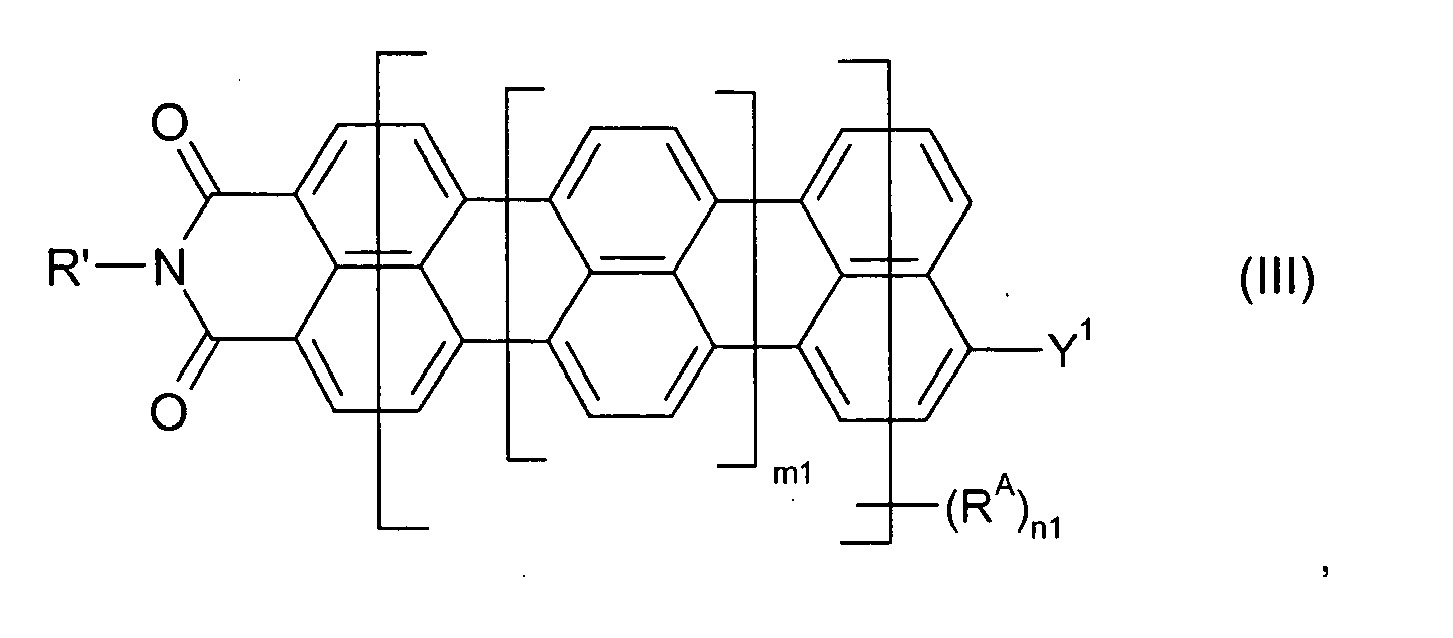
- Y, Y1 beide Halogen sind oder ein Rest von Y, Y1 Halogen und der andere B(OR")2 ist;
- Jedes R, RA unabhängig voneinander gleiche oder verschiedene der folgenden Reste sind:
- Aryloxy, Arylthio, Hetaryloxy oder Hetarylthio, an das jeweils weitere gesättigte oder ungesättigte 5- bis 7-gliedrige Ringe, deren Kohlenstoffgerüst durch eine oder mehrere Gruppierungen -O-, -S-, -NR1-, -N=CR1-, -CO-, -SO- und/oder -SO2- unterbrochen sein kann, anneliert sein können, wobei das gesamte Ringsystem ein- oder mehrfach durch die Reste (i), (ii), (iii), (iv) und/oder (v) substituiert sein kann:
- (i) C1-C30-Alkyl, dessen Kohlenstoffkette durch eine oder mehrere Gruppierungen -O-, -S-, -NR1-, -N=CR1-, -C≡C-, -CR1=CR1-, -CO-, -SO- und/oder - SO2- unterbrochen sein kann und das ein- oder mehrfach substituiert sein kann durch: C1-C12-Alkoxy, C1-C6-Alkylthio, -C≡CR1, -CR1=CR1 2, Hydroxy, Mercapto, Halogen, Cyano, Nitro, -NR2R3, -NR2COR3, -CONR2R3, -SO2NR2R3, -COOR2, -SO3R2, -PR2R3 ,-POR2R3, Aryl und/oder gesättigtes oder ungesättigtes C4-C7-Cycloalkyl, dessen Kohlenstoffgerüst durch eine oder mehrere Gruppierungen -O-, -S-, -NR1-, -N=CR1-, -CR1=CR1-, -CO-, -SO- und/oder -SO2- unterbrochen sein kann, wobei die Aryl- und Cycloalkylreste jeweils ein- oder mehrfach durch C1-C18-Alkyl und/oder die vorstehenden, als Substituenten für Alkyl genannten Reste substituiert sein können;
- (ii) C3-C8-Cycloalkyl, dessen Kohlenstoffgerüst durch eine oder mehrere Gruppierungen -O-, -S-, -NR1-, -N=CR1-, -CR1=CR1-, -CO-, -SO- und/oder - SO2- unterbrochen sein kann und an das weitere gesättigte oder ungesättigte 5- bis 7-gliedrige Ringe, deren Kohlenstoffgerüst durch eine oder mehrere Gruppierungen -O-, -S-, -NR1-, -N=CR1-, -CR1=CR1-, -CO-, -SO- und/oder - SO2- unterbrochen sein kann, anneliert sein können, wobei das gesamte Ringsystem ein- oder mehrfach substituiert sein kann durch: C1-C18-Alkyl, C1-C12-Alkoxy, C1-C6-Alkylthio, -C≡CR1, -CR1=CR1 2, Hydroxy, Mercapto, Halogen, Cyano, Nitro, -NR2R3, -NR2COR3, -CONR2R3, -SO2NR2R3, -COOR2, - SO3R2, -PR2R3 und/oder -POR2R3;
- (iii) Aryl oder Hetaryl, an das weitere gesättigte oder ungesättigte 5- bis 7-gliedrige Ringe, deren Kohlenstoffgerüst durch eine oder mehrere Gruppierungen -O-, -S-, -NR1-, -N=CR1-, -CR1=CR1-, -CO-, -SO- und/oder -SO2- unterbrochen sein kann, anneliert sein können, wobei das gesamte Ringsystem ein- oder mehrfach substituiert sein kann durch: C1-C18-Alkyl, C1-C12-Alkoxy, C1-C6-Alkylthio, -C≡CR1, -CR1=CR1 2, Hydroxy, Mercapto, Halogen, Cyano, Nitro, -NR2R3, -NR2COR3, -CONR2R3, -SO2NR2R3, -COOR2, -SO3R2, -PR2R3, -POR2R3, Aryl und/oder Hetaryl, das jeweils durch C1-C18-Alkyl, C1-C12-Alkoxy, Hydroxy, Mercapto, Halogen, Cyano, Nitro, -NR2R3, -NR2COR3, - CONR2R3, -SO2NR2R3, -COOR2, -SO3R2, -PR2R3 und/oder -POR2R3 substituiert sein kann;
- (iv) ein Rest -U-Aryl, der ein- oder mehrfach durch die vorstehenden, als Substituenten für die Arylreste (iii) genannten Reste substituiert sein kann, wobei U eine Gruppierung -O-, -S-, -NR1-, -CO-, -SO- oder -SO2- bedeutet;
- (v) C1-C12-Alkoxy, C1-C6-Alkylthio, -C≡CR1, -CR1=CR1 2, Hydroxy, Mercapto, Halogen, Cyano, Nitro, -NR2R3, -NR2COR3, -CONR2R3, -SONR2R3, - COOR2, -SO3R2, -PR2R3 und/oder -POR2R3;
- jedes R' jeweils unabhängig Wasserstoff;
- C1-C30-Alkyl, dessen Kohlenstoffkette durch eine oder mehrere Gruppierungen -O-, -S-, -NR1-, -N=CR1-, -C≡C-, -CR1=CR1-, -CO-, -SO- und/oder - SO2- unterbrochen sein kann und das ein- oder mehrfach durch die als Substituenten für die Reste R genannten Reste (ii), (iii), (iv) und/oder (v) substituiert sein kann;
- C3-C8-Cycloalkyl, an das weitere gesättigte oder ungesättigte 5- bis 7-gliedrige Ringe, deren Kohlenstoffgerüst durch eine oder mehrere grupperungen -O-, -S-, -NR1-, -N=CR1-, -CR1=CR1-, -CO-, -SO- und/oder -SO2- unterbrochen sein kann, anneliert sein können, wobei das gesamte Ringsystem durch die als Substituenten für die Reste R genannten Reste (i), (ii), (iii), (iv) und/oder (v) substituiert sein kann; oder
- Aryl oder Hetaryl, an das weitere gesättigte oder ungesättigte 5- bis 7-gliedrige Ringe, deren Kohlenstoffgerüst durch eine oder mehrere Gruppierungen -O-, -S-, -NR1-, -N=CR1-, -CR1=CR1-, -CO-, -SO- und/oder -SO2- unterbrochen sein kann, anneliert sein können, wobei das gesamte Ringsystem substituiert sein kann durch die als Substituenten für die Reste R genannten Reste (i), (ii), (iii), (iv), (v), Aryl- und/oder Hetarylazo, das jeweils durch C1-C10-Alkyl, C1-C6-Alkoxy und/oder Cyano substituiert sein kann, ist;
- jedes R" unabhängig voneinander Wasserstoff, C1-C30-Alkyl, C5-C8-Cycloalkyl, Aryl oder Hetaryl ist oder miteinander verbunden unter Ausbildung eines die beiden Sauerstoffatome sowie das Boratom enthaltenden 5- bis 7-gliedrigen Rings, an den ungesättigte oder gesättigte Ringe anneliert sein können und der an den Kohlenstoffatomen durch bis zu 4 C1-C30-Alkyl-, C5-C8-Cycloalkyl-, Aryl- oder Hetarylgruppen substituiert sein kann, sind;
- R1 Wasserstoff oder C1-C18-Alkyl, wobei die Reste R1 gleich oder verschieden sein können, wenn sie mehrfach auftreten, ist;
- R2, R3 unabhängig voneinander Wasserstoff;
- C1-C18-Alkyl, dessen Kohlenstoffkette durch eine oder mehrere Gruppierungen -O-, -S-, -CO-, -SO- und/oder -SO2- unterbrochen sein kann und das ein- oder mehrfach durch C1-C12-Alkoxy, C1-C6-Alkylthio, Hydroxy, Mercapto, Halogen, Cyano, Nitro und/oder -COOR1 substituiert sein kann;
- Aryl oder Hetaryl, an das jeweils weitere gesättigte oder ungesättigte 5- bis 7-gliedrige Ringe, deren Kohlenstoffgerüst durch eine oder mehrere Gruppierungen -O-, -S-, -CO- und/oder -SO2- unterbrochen sein kann, anneliert sein können, wobei das gesamte Ringsystem ein- oder mehrfach durch C1-C12-Alkyl und/oder die vorstehenden, als Substituenten für Alkyl genannten Reste substituiert sein kann, sind;
- und wobei m, m1, n, n1 mindestens eine der folgenden Bedingungen erfüllen:
- m = 2, m1 = 1 und n, n1 sind ganze Zahlen, deren Summe eine Zahl von 0 bis 12 ergibt;
- m = 2, m1 = 2 und n, n1 sind ganze Zahlen, deren Summe eine Zahl von 0 bis 16 ergibt;
- (b) Cyclodehydrierung des in Schritt (a) erhaltenen Umsetzungsproduktes zu einer Rylenverbindung der allgemeinen Formel (I)

- Für das erfindungsgemäße Verfahren erfüllen m, m1, n, n1 mindestens eine der folgenden Bedingungen erfüllen.
- Zur Herstellung von Heptarylentetracarbonsäurediimiden werden ein entsprechendes Quaterrylen und ein entsprechendes Terylen (m = 1, m1 = 1) umgesetzt, wobei n, n1 ganze Zahlen sind, deren Summe eine Zahl von 0 bis 12, also 0, 1, 2, 3, 4, 5, 6, 7, 8, 9, 10, 11 oder 12, vorzugsweise 4, 5, 6, 7, 8, 9 oder 10, insbesondere 5, 6, 7 oder 8, ergibt. Beispiele für n + n1 sind 8 + 0, 7 + 0, 6 + 0, 5 + 0, 4 + 0, 3 + 0, 2 + 0, 1 + 0, 0 + 0, 8 + 1, 7 + 1, 6 + 1, 5 + 1, 4 + 1, 3 + 1, 2 + 1, 1 + 1, 0 + 1, 8 + 2, 7 + 2, 6 + 2, 5 + 2, 4 + 2, 3 + 2, 2 + 2, 1 + 2, 0 + 2, 8 + 3, 7 + 3, 6 + 3, 5 + 3, 4 + 3, 3 + 3, 2 + 3, 1 + 3, 0 + 3, 8 + 4, 7 + 4, 6 + 4. 5 + 4, 4 + 4, 3 + 4, 2 + 4, 1 + 4, 0 + 4, 7 + 5, 6 + 5, 5 + 5, 4 + 5, 3 + 5, 2 + 5, 1 + 5, 0 + 5, 6 + 6, 5 + 6, 4 + 6, 3 + 6, 2 + 6, 1 + 6, 0 + 6. Bevorzugt für n + n1 sind 6 + 4, 5 + 4, 4 + 4, 3 + 4, 6 + 3, 5 + 3, 4 + 3, 3 + 3, 6 + 2, 5 + 2, 4 + 2, 3 + 2, 2 + 2.
- Zur Herstellung von Octarylentetracarbonsäurediimiden werden zwei entsprechende Quaterrylene (m = 2, m1 = 2) umgesetzt, wobei n, n1 ganze Zahlen sind, deren Summe eine Zahl von 0 bis 16, also 0, 1, 2, 3, 4, 5, 6, 7, 8, 9, 10, 11, 12, 13, 14, 15 oder 16, vorzugsweise 4, 5, 6, 7, 8, 9 oder 10, mehr bevorzugt 4, 5, 6, 7 oder 8 insbesondere 5, 6, 7 oder 8 ergibt. Beispiele für n + n1 sind 8 + 0, 7 + 0, 6 + 0, 5 + 0, 4 + 0, 3 + 0, 2 + 0, 1 + 0, 0 + 0, 8 + 1, 7 + 1, 6 + 1, 5 + 1, 4 + 1, 3 + 1, 2 + 1, 1 + 1, 0 + 1, 8 + 2, 7 + 2, 6 + 2, 5 + 2, 4 + 2, 3 + 2, 2 + 2, 1 + 2, 0 + 2, 8 + 3, 7 + 3, 6 + 3, 5+ 3, 4 + 3, 3 + 3, 2 + 3, 1 + 3, 0 + 3. 8 + 4, 7 + 4, 6 + 4, 5 + 4, 4 + 4, 3 + 4, 2 + 4, 1 + 4, 0 + 4, 8 + 5, 7 + 5, 6 + 5, 5 + 5, 4 + 5, 3 + 5, 2 + 5, 1 + 5, 0 + 5, 8 + 6, 7 + 6, 6 + 6, 5 + 6, 4 + 6, 3 + 6, 2 + 6, 1 + 6, 0 + 6, 8 + 7, 7 + 7, 6 + 7, 5 + 7, 4 + 7, 3 + 7, 2 + 7, 1 + 7, 0 + 7, 8 + 8, 7 + 8, 6 + 8, 5 + 8, 4 + 8, 3 + 8, 2 + 8, 1 + 8, 0 + 8. Bevorzugt für n + n1 sind 6 + 6, 6 + 5, 6 + 4, 6 + 3, 5 + 6, 5 + 5, 5 + 4, 5 + 3, 4 + 6, 4 + 5, 4 + 4, 4 + 3, 3 + 6, 3 + 5, 3 + 4, 3 + 3, 2 + 2.
- Weiterhin wird die Aufgabe gelöst durch Heptarylentetracarbonsäurediimide der allgemeinen Formel (I) oder Mischungen davon, wobei n und n1 ganze Zahlen sind, deren Summe eine Zahl von 0 bis 12, also 0, 1, 2, 3, 4, 5, 6, 7, 8, 9, 10, 11 oder 12, vorzugsweise 4, 5, 6, 7, 8, 9 oder 10, insbesondere 5, 6, 7 oder 8, ergibt und R, RA, R', m, m1 die oben angegebene Bedeutung besitzen. Beispiele für n + n1 sind 8 + 0, 7 + 0, 6 + 0, 5 + 0, 4 + 0, 3 + 0, 2 + 0, 1 + 0, 0 + 0, 8 + 1, 7 + 1, 6 + 1, 5 + 1, 4 + 1, 3 + 1, 2 + 1, 1 + 1, 0 + 1, 8 + 2, 7 + 2, 6 + 2, 5 + 2, 4 + 2, 3 + 2, 2 + 2, 1 + 2, 0 + 2, 8 + 3, 7 + 3, 6 + 3, 5 + 3, 4 + 3, 3 + 3, 2 + 3, 1 +3, 0 + 3, 8 + 4, 7 + 4, 6 + 4, 5 + 4, 4 + 4, 3 + 4, 2 + 4, 1 + 4, 0 + 4, 7 + 5, 6 + 5, 5 + 5, 4 + 5, 3 + 5, 2 + 5, 1 + 5, 0 + 5, 6 + 6, 5 + 6, 4 + 6, 3 + 6, 2 + 6, 1 + 6, 0 + 6. Bevorzugt für n + n1 sind 6 + 4, 5 + 4, 4 + 4, 3 + 4, 6 + 3, 5 + 3, 4 + 3, 3 + 3, 6 + 2, 5 + 2, 4 + 2, 3 + 2, 2 + 2.
- Die erfindungsgemäßen Heptarylenverbindungen können also mit Hilfe des erfindungsgemäßen Verfahrens durch Kupplung einer entsprechenden Quaterrylenverbindung mit der entsprechenden Terrylenverbindung erhalten werden. Die erfindungsgemäßen Heptarylenverbindungen können einen hohen Substitutionsgrad aufweisen. Die Summe der Substituenten R und RA beträgt jedoch maximal 12.
- Die Aufgabe wird weiterhin gelöst durch Octarylentetracarbonsäurediimide der allgemeinen Formel (I) oder Mischungen davon, wobei n und n1 ganze Zahlen sind, deren Summe 0 bis 16, also 0, 1, 2, 3, 4, 5, 6, 7, 8, 9, 10, 11, 12, 13, 14, 15 oder 16, vorzugsweise 4, 5, 6, 7, 8, 9 oder 10, mehr bevorzugt 4, 5, 6, 7 oder 8 insbesondere 5, 6, 7 oder 8 ergibt und R, RA, R', m, m1 die oben angegebene Bedeutung besitzen. Beispiele für n + n1 sind 8 + 0, 7 + 0, 6 + 0, 5 + 0, 4 + 0, 3 + 0, 2 + 0, 1 + 0, 0 + 0, 8 + 1, 7 + 1, 6 + 1, 5 + 1, 4 + 1, 3 + 1, 2 + 1, 1 + 1, 0 + 1, 8 + 2, 7 + 2, 6 + 2, 5 + 2, 4 + 2, 3 + 2, 2 + 2, 1 + 2, 0 + 2, 8 + 3, 7 + 3, 6 + 3, 5+ 3, 4 + 3, 3 + 3, 2 + 3, 1 + 3, 0 + 3, 8 + 4, 7 + 4, 6 + 4, 5 + 4, 4 + 4, 3 + 4, 2 + 4, 1 + 4, 0 + 4, 8 + 5, 7 + 5, 6 + 5, 5 + 5, 4 + 5, 3 + 5, 2 + 5, 1 + 5, 0 + 5, 8 + 6, 7 + 6, 6 + 6, 5 + 6, 4 + 6, 3 + 6, 2 + 6, 1 + 6, 0 + 6,8 + 7, 7 + 7, 6 + 7, 5 + 7, 4 + 7, 3 + 7, 2 + 7, 1 + 7, 0 + 7,8 + 8, 7 + 8, 6 + 8, 5 + 8, 4 + 8, 3 + 8, 2 + 8, 1 + 8, 0 + 8, Bevorzugt für n + n1 sind 6 + 6, 6 + 5, 6 + 4, 6 + 3, 5 + 6, 5 + 5, 5 + 4, 5 + 3, 4 + 6, 4 + 5, 4 + 4, 4 + 3, 3 + 6, 3 + 5, 3 + 4, 3 + 3, 2 + 2.
- Die erfindungsgemäßen Octarylenverbindungen können also mit Hilfe des erfindungsgemäßen Verfahrens durch Kupplung zweier entsprechenden Quaterrylenverbindungen erhalten werden. Die erfindungsgemäßen Octarylenverbindungen können einen hohen Substitutionsgrad aufweisen. Die Summe der Substituenten R und RA beträgt jedoch maximal 16.
- Die Ausgangsverbindungen gemäß der Formeln (II), (III), (IIIa) sind aus dem Stand der Technik bekannt oder können anhand literaturbekannter Synthesen analoger Verbindungen hergestellt werden. Insbesondere Terrylen- und Quaterrylenderivate, die als Ausgangsstoffe für das erfindungsgemäße Verfahren zur Herstellung von Heptarylen- und Octarylentetracarbonsäurediimiden dienen können, sind in der deutschen Patentanmeldung mit der Anmeldenummer
10 2005 021362 beschrieben. Darüber hinaus wird die Herstellung von Hexarylen- und Pentarylentetracarbonsäurediimiden inDE-A 10 2005 018241 beschrieben. Eine Herstellung der erfindungsgemäßen Imidverbindungen kann analog erfolgen. - Das erfindungsgemäße Verfahren zur Herstellung von Heptarylen- und Octrylentetracarbonsäurediimiden enthält als ersten Schritt (a) die Kupplung mindestens einer Quaterrylenverbindung der Formel (II) mit mindestens einer Verbindung der Formel (III), wobei die Verknüpfung der beiden Bausteine jeweils mit Hilfe der Gruppen Y und Y1 erfolgt.
- Dabei können Y und Y1 Halogenide sein, durch die mit Hilfe einer katalytischen Kupplung die gewünschte Bindung der beiden aromatischen Bausteine ermöglicht wird. Ebenso ist es möglich, dass einer der Reste Y, Y1 ein Halogenid und der andere eine Boronsäure oder eine ähnliche Verbindung der Formel B(OR")2 sein kann. Eine Kupplung erfolgt dann über die sog. Suzuki-Reaktion. Vorzugsweise handelt es sich in beiden Fällen bei den Halogeniden um Bromid oder Chlorid.
- Die Herstellung der erfindungsgemäßen Diimide mit Hilfe des erfindungsgemäßen Verfahrens erfolgt vorzugsweise in Gegenwart eines organischen Lösemittels, gewünschtenfalls im Gemisch mit Wasser, sowie eines Übergangsmetallkatalysators und einer Base, wobei wie oben ausgeführt wurde, einer der beiden Bausteine ein Boronäurederivat und der andere ein Halogenid darstellen kann.
- Ein solches Boronsäurederivat ist beispielsweise durch Umsetzung des entsprechenden halogenierten Aromaten mit Hilfe von Diboranen der allgemeinen Formel (IV) (R"O)2B-B(OR")2 in Gegenwart eines aprotischen organischen Lösungsmittels, eines Übergangsmetallkatalysators und einer Base erhältlich.
- Geeignete Diborane der allgemeinen Formel (IV) sind insbesondere Bis(1,2- und 1,3-diolato)diborane, Tetraalkoxydiborane, Tetracycloalkoxydiborane und Tetra(het)aryloxydiborane sowie deren Mischformen. Als Beispiele für diese Verbindungen seien genannt: Bis(pinacolato)diboran, Bis(1,2-benzodiolato)-diboran, Bis(2,2-dimethyl-1,3-propandiolato)diboran, Bis(1,1,3,3-tetramethyl-1,3-pro-pandiolato)diboran, Bis(4,5-pinandiolato)diboran, Bis(tetramethoxy)diboran, Bis(tetra-cyclopentoxy)diboran, Bis(tetraphenoxy)diboran und Bis(4-pyridiyloxy)diboran.
- Bevorzugt sind Diborane der allgemeinen Formel (IV), bei denen die beiden an einem Boratom befindlichen Reste R" unter Ausbildung eines die beiden Sauerstoffatome sowie das Boratom enthaltenden Fünf- oder Sechsrings miteinander verbunden sind. An die gebildeten Fünf- oder Sechsringe können aromatische oder gesättigte, auch bicyclische, Ringe, mit 5 bis 7 C-Atomen als Ringglieder anneliert sein. Alle Ringe bzw. Ringsysteme können durch bis zu 4 C1-C30-Alkyl-, C5-C8-Cycloalkyl-, Aryl- und/oder Hetarylreste substituiert sein, vorzugsweise sind sie durch bis zu 4 C1-C4-Alkylreste substituiert. Beispiele für diese bevorzugten Diborane sind die bereits oben genannten Bis(1,2- und 1,3-diolato)-diborane, wobei Bis(pinacolato)diboran besonders bevorzugt ist.
- Das Molverhältnis Diboran der allgemeinen Formel (IV) zum halogenierten Aromaten liegt dabei im Allgemeinen bei 0,8 : 1 bis 3 : 1, insbesondere bei 1,5 : 1 bis 2 : 1.
- Als Lösungsmittel sind grundsätzlich alle unter den Reaktionsbedingungen gegen Basen stabilen aprotischen Lösungsmittel mit einem Siedepunkt oberhalb der gewählten Reaktionstemperatur geeignet, in denen sich die Edukte bei Reaktionstemperatur vollständig und die verwendeten Katalysatoren und Basen zumindest partiell lösen, so dass weitgehend homogene Reaktionsbedingungen vorliegen. Es können sowohl unpolare aprotische als auch polare aprotische Lösungsmittel eingesetzt werden.
- Beispiele für bevorzugte unpolar-aprotische Lösungsmittel sind bei > 100°C siedende Lösungsmittel aus den folgenden Gruppen: Aliphaten (insbesondere C8-C18-Alkane), unsubstituierte, alkylsubstituierte und kondensierte Cycloaliphaten (insbesondere unsubstituierte C7-C10-Cycloalkane, C6-C8-Cycloalkane, die durch ein bis drei C1-C6-Alkylgruppen substituiert sind, polycyclische gesättigte Kohlenwasserstoffe mit 10 bis 18 C-Atomen), alkyl- und cycloalkylsubstituierte Aromaten (insbesondere Benzol, das durch ein bis drei C1-C6-Alkylgruppen oder einen C5-C8-Cycloalkylrest substituiert ist) und kondensierte Aromaten, die alkylsubstituiert und/oder teilhydriert sein können (insbesondere Naphthalin, das durch ein bis vier C1-C6-Alkylgruppen substituiert ist) sowie Mischungen dieser Lösungsmittel.
- Als Beispiele für besonders bevorzugte Lösungsmittel seien im einzelnen genannt: Octan, Isooctan, Nonan, Isononan, Decan, Isodecan, Undecan, Dodecan, Hexadecan und Octadecan; Cycloheptan, Cyclooctan, Methylcyclohexan, Dimethylcyclohexan, Trimethylcyclohexan, Ethylcyclohexan, Diethylcyclohexan, Propylcyclohexan, Isopropylcyclohexan, Dipropylcyclohexan, Butylcyclohexan, tert.-Butylcyclohexan, Methyl-cycloheptan und Methylcyclooctan; Toluol, o-, m- und p-Xylol, 1,3,5-Trimethylbenzol (Mesitylen), 1,2,4- und 1,2,3-Trimethylbenzol, Ethylbenzol, Propylbenzol, Isopropylbenzol, Butylbenzol, Isobutylbenzol, tert.-Butylbenzol und Cyclohexylbenzol; Naphthalin, Decahydronaphthalin (Dekalin), 1- und 2-Methylnaphthalin und 1- und 2-Ethyl-naphthalin; Kombinationen aus den zuvor genannten Lösungsmitteln, wie sie aus den hochsiedenden, teil- oder durchhydrierten Fraktionen thermischer und katalytischer Crackprozesse bei der Rohöl- oder Naphthaverarbeitung gewonnen werden können, z.B. Gemische vom Exsol® Typ und Alkylbenzolgemische vom Solvesso® Typ.
- Ganz besonders bevorzugte Lösungsmittel sind Xylol (alle Isomeren), Mesitylen und vor allem Toluol.
- Beispiele für geeignete polar-aprotische Lösungsmittel sind N,N-disubstituierte aliphatische Carbonsäureamide (insbesondere N,N-Di-C1-C4-alkyl-C1-C4-carbonsäureamide), stickstoffhaltige Heterocyclen und aprotische Ether (insbesondere cyclische Ether, Di-arylether und Di-C1-C6-alkylether von monomeren und oligomeren C2-C3-Alkylenglyko-len, die bis zu 6 Alkylenoxideinheiten enthalten können, vor allem Diethylenglykoldi-C1-C4-alkylether).
- Als Beispiele für besonders geeignete Lösungsmittel seien im einzelnen genannt: N,N-Dimethylformamid, N,N-Diethylformamid, N,N-Dimethylacetamid und N,N-Dimethylbutyramid; N-Methyl-2-pyrrolidon, Chinolin, Isochinolin, Chinaldin, Pyrimidin, N-Methylpiperidin und Pyridin; Tetrahydrofuran, Dioxan, Diphenylether, Diethylenglykoldi-methyl-, - diethyl-, -dipropyl-, -diisopropyl-, -di-n-butyl-, -di-sec.-butyl- und -di-tert.-butyl-ether, Diethylenglykolmethylethylether, Triethylenglykoldimethyl- und -diethylether und Triethylenglykolmethylethylether.
- Die Lösungsmittelmenge beträgt in der Regel 10 bis 1000 ml, bevorzugt 20 bis 300 ml, pro g halogeniertem Aromat.
- Als Übergangsmetallkatalysator eignen sich insbesondere Palladiumkomplexe, die wiederum in der Regel in Mengen von 1 bis 20 mol%, vor allem 2 bis 10 mol-%, bezogen auf den halogenierten Aromaten eingesetzt werden. Die zusätzliche Anwesenheit von freien Ligandmolekülen ist üblicherweise nicht erforderlich.
- Beispiele für solche Katalysatoren sind Tetrakis(triphenylphosphin)palladium(0), Tetrakis(tris-o-tolylphosphin)palladium(0), [1,2-Bis(diphenylphosphino)ethan]palladium(II)chlorid, [1,1'-Bis(diphenylphosphino)-ferrocen]palladium(II)chlorid, Bis(triethylphosphin)palladium(II)chlorid, Bis(tricyclo-hexylphosphin)palladium(II)acetat, (2,2'-Bipyridyl)palladium(II)chlorid, Bis(triphenyl-phosphin)palladium(II)chlorid, Tris(dibenzylidenaceton)dipalladium(0), 1,5-Cycloocta-dienpalladium(II)chlorid, Bis(acetonitril)palladium(II)chlorid und Bis(benzonitril)palla-dium(II)chlorid, Palladium(II)acetat, wobei [1,1'-Bis(diphenylphosphino)ferrocen]palladium(II)chlorid, Tetrakis(triphenylphosphin)palladium(0) und Palladium(II)acetat bevorzugt sind.
- In der Regel empfiehlt sich die gleichzeitige Anwesenheit freier Ligandmoleküle, z.B. von Tri(tert.-butyl)phosphin, Tri(i-butyl)phosphin, Triphenylphosphin und Tris(o-tolyl)phosphin und 2-Dicyclohexylphosphino-2,6-dimethoxybiphenyl. Übliche Mengen liegen bei 80 bis 500 mol%, bevorzugt 100 bis 300 mol-%, bezogen auf den Übergangsmetallkatalysator. Als Base kommen vorzugsweise die Alkalimetallsalze, insbesondere die Natrium- und vor allem die Kaliumsalze, schwacher organischer und anorganischer Säuren, wie Natriumacetat, Kaliumacetat, Natriumcarbonat, Natriumhydrogencarbonat, Kaliumcarbonat und Kaliumhydrogencarbonat, Phosphat, Fluoride wie Kaliumfluorid, zum Einsatz. Bevorzugte Basen sind die Acetate, vor allem Kaliumacetat.
- Im Allgemeinen werden 1 bis 5 mol, bevorzugt 2 bis 4, mol, Base pro mol halogeniertem Aromaten verwendet.
- Die Reaktionstemperatur liegt üblicherweise bei 20 bis 180°C, vor allem bei 60 bis 120°C.
- Die Reaktionszeit beträgt in der Regel 0,5 bis 30 h, insbesondere 1 bis 20 h.
- Vefahrenstechnisch geht man bei der Herstellung der Boronsäurederivate zweckmäßigerweise wie folgt vor:
- Man legt den halogenierten Aromaten und Lösungsmittel vor, gibt das Diboran der allgemeinen Formel (IV), den Übergangsmetallkatalysator und die Base nacheinander zu und erhitzt die Mischung 0,5 bis 30 h unter Schutzgas auf die gewünschte Reaktionstemperatur. Nach Abkühlen auf Raumtemperatur filtriert man die festen Bestandteile aus dem Reaktionsgemisch ab und destilliert das Lösungsmittel unter vermindertem Druck ab.
- Die Suzuki-Reaktion des so hergestellten Boronsäurederivates mit dem entsprechenden halogenierten Aromaten kann grundsätzlich zur Herstellung des Produktes in Schritt (a) des erfindungsgemäßen Verfahrens unter analogen Bedingungen verwendet werden, wobei an Stelle des Diborans das entsprechende Boronsäurederivat mit dem entsprechenden halogenierten Aromaten umgesetzt wird.
- Vorzugsweise erfolgt jedoch die Umsetzung des Boronsäurederivates mit dem halogenierten Aromaten in Gegenwart eines organischen Lösungsmittels, gewünschtenfalls im Gemisch mit Wasser, sowie eines Übergangsmetallkatalysators und einer Base, wobei das Molverhältnis von Boronsäurederivat zu halogeniertem Aromaten dabei in der Regel 0,8 : 1 bis 3 : 1, vorzugsweise 0,9 : 1 bis 2 : 1 beträgt.
- Als Lösungsmittel eignen sich alle Lösungsmittel, in denen sich die Edukte bei Reaktionstemperatur vollständig und die verwendeten Katalysatoren und Basen zumindest partiell lösen, so dass weitgehend homogene Reaktionsbedingungen vorliegen.
- Beispielsweise geeignet sind Octan, Isooctan, Nonan, Isononan, Decan, Isodecan, Undecan, Dodecan, Hexadecan und Octadecan; Cycloheptan, Cyclooctan, Methylcyclohexan, Dimethylcyclohexan, Trimethylcyclohexan, Ethylcyclohexan, Diethylcyclohexan, Propylcyclohexan, Isopropylcyclohexan, Dipropylcyclohexan, Butylcyclohexan, tert.-Butylcyclohexan, Methyl-cycloheptan und Methylcyclooctan; Toluol, o-, m- und p-Xylol, 1,3,5-Trimethylbenzol (Mesitylen), 1,2,4- und 1,2,3-Trimethylbenzol, Ethylbenzol, Propylbenzol, Isopropylbenzol, Butylbenzol, Isobutylbenzol, tert.-Butylbenzol und Cyclohexylbenzol; Naphthalin, Decahydronaphthalin (Dekalin), 1- und 2-Methylnaphthalin und 1- und 2-Ethyl-naphthalin; Kombinationen aus den zuvor genannten Lösungsmitteln, wie sie aus den hochsiedenden, teil- oder durchhydrierten Fraktionen thermischer und katalytischer Crackprozesse bei der Rohöl- oder Naphthaverarbeitung gewonnen werden können, z.B. Gemische vom Exsol® Typ und Alkylbenzolgemische vom Solvesso® Typ.
- Ganz besonders bevorzugte Lösungsmittel sind Xylol (alle Isomeren), Mesitylen und vor allem Toluol.
- Die Lösungsmittelmenge liegt üblicherweise bei 10 bis 1000 ml, vorzugsweise bei 20 bis 100 ml, je g Boronsäurederivat.
- Vorzugsweise setzt man Wasser als zusätzliches Lösungsmittel ein. In diesem Fall werden in der Regel 10 bis 1000 ml, insbesondere 250 bis 500 ml, Wasser je I organisches Lösungsmittel verwendet.
- Als Übergangsmetallkatalysatoren werden ebenfalls vorzugsweise Palladiumkomplexe eingesetzt. Die Einsatzmenge Katalysator beträgt üblicherweise 1 bis 20 mol%, insbesondere 1,5 bis 5 mol-%, bezogen auf das Boronsäurederivat.
- In der Regel empfiehlt sich die gleichzeitige Anwesenheit freier Ligandmoleküle, z.B. von Tri(tert.-butyl)phosphin, Tri(i-butyl)phosphin, Triphenylphosphin und Tris(o-tolyl)phosphin und 2-Dicyclohexylphosphino-2,6-dimethoxybiphenyl. Übliche Mengen liegen bei 80 bis 500 mol%, bevorzugt 100 bis 300 mol-%, bezogen auf den Übergangsmetallkatalysator.
- Als Base sind Alkalimetallsalze schwacher Säuren bevorzugt, wobei die Carbonate, wie Natriumcarbonat und vor allem Kaliumcarbonat besonders bevorzugt sind. Auch Phosphate, wie Natrium- oder Kaliumphosphat, sind hierbei bevorzugt. In der Regel liegt die Basenmenge bei 0,1 bis 10 mol, insbesondere bei 0,2 bis 5 mol, je mol Boronsäurederivat. Die Reaktionstemperatur beträgt im Allgemeinen 20 bis 180°C, bevorzugt 60 bis 120°C. Wird Wasser eingesetzt, so empfiehlt es sich, die Umsetzung nicht bei Temperaturen über 100°C vorzunehmen, da ansonsten unter Druck gearbeitet werden müsste.
- Die Reaktion ist üblicherweise in 0,5 bis 48 h, insbesondere in 5 bis 20 h, beendet.
- Verfahrenstechnisch geht man zweckmäßigerweise wie folgt vor:
- Man legt das Boronsäurederivat und den halogenierten Aromaten sowie Lösungsmittel vor, gibt Übergangsmetallkatalysator und die vorzugsweise in Wasser oder einem Wasser/Alkohol-Gemisch gelöste Base zu und erhitzt die Mischung 0,5 bis 48 h unter Schutzgas auf die gewünschte Reaktionstemperatur. Nach Abkühlen auf Raumtemperatur trennt man die organische Phase aus dem Reaktionsgemisch ab und destilliert das Lösungsmittel unter vermindertem Druck ab.
- Die Reinheit des so hergestellten Produktes aus Schritt (a) des erfindungsgemäßen Verfahrens zur Herstellung der Heptarylen- und Octarytentetracarbonsäurediimide reicht im allgemeinen für die weitere Umsetzung in Schritt (b) aus. Gegebenenfalls kann das Rohprodukt durch Waschen mit Wasser und gewünschtenfalls einem geeigneten organischen Lösungsmittel, insbesondere einem chlorierten aliphatischen oder aromatischen Kohlenwasserstoff, oder durch Säulenchromatographie an Kieselgel mit einem Gemisch von Methylenchlorid und Hexan oder Pentan oder mit Toluol als Eluens weiter aufgereinigt werden.
- Die Ausbeute in Schritt a) des erfindungsgemäßen Verfahrens liegt üblicherweise bei 50 bis 90%.
- Neben der oben beschriebenen Suzuki-Reaktion, die ein entsprechendes Boronsäurederivat erfordert, kann auch eine direkte Kupplung, insbesondere bei Homokupplungen, von Halogeniden erfolgen.
- Hierbei kann die Umsetzung der entsprechend halogenierten Aromaten der Formel (II) und (III) in Gegenwart eines Diborans der allgemeinen Formel (IV) erfolgen. Dabei läuft schließlich ebenfalls eine Suzuki-Reaktion ab, wobei jedoch das entsprechende Boronsäurederivat nur in situ erzeugt wird.
- Die ·Kupplung kann dabei beispielsweise in Gegenwart von 30 bis 70 mol-%, bezogen auf das den halogenierten Aromaten, eines Diborans der allgemeinen Formel (IV), eines Übergangsmetallkatalysators, einer Base und eines aprotischen Lösungsmittels gemäß einer Suzuki-Kupplungsreaktion erfolgen, wobei das in situ gebildete Boronsäurederivat nicht zwischenisoliert, sondern direkt mit dem verbleibenden halogenierten Aromaten umgesetzt wird.
- Bei dieser Verfahrensvariante wird analog wie oben vorgegangen, wobei jedoch beispielsweise nur 30 bis 70 mol-% Diboran der allgemeinen Formel (IV), bezogen auf den halogenierten Aromaten eingesetzt werden.
- In der Regel werden 1 bis 20 mol-%, bevorzugt 5 bis 10 mol-%, Übergangsmetallkatalysator und 1 bis 5 mol, vorzugsweise 2 bis 3 mol, Base je mol halogeniertem Aromaten verwendet. Das aprotische organische Lösungsmittel kommt üblicherweise in Mengen von 10 bis 100 ml, insbesondere 20 bis 50 ml, je g halogeniertem Aromaten zum Einsatz.
- Die Reaktionstemperatur liegt im Allgemeinen bei 20 bis 100°C, vorzugsweise bei 60 bis 80°C, und die Reaktionsdauer bei 12 bis 72 h, bevorzugt 24 bis 48 h.
- Verfahrenstechnisch geht man zweckmäßigerweise wie folgt vor:
- Man legt den halogenierten Aromaten und Lösungsmittel vor, gibt dass Diboran der allgemeinen Formel (IV), den Übergangsmetallkatalysator und die Base nacheinander zu und erhitzt die Mischung 12 bis 72 h auf die gewünschte Reaktionstemperatur. Nach Abkühlen auf Raumtemperatur trennt man die organische Phase aus dem Reaktionsgemisch ab und destilliert das Lösungsmittel unter vermindertem Druck ab.
- Auch hier reicht die Reinheit des erhaltenen Produktes in der Regel für die nachfolgende Cyclodehydrierung in Schritt (b) des erfindungsgemäßen Verfahrens aus. Eine weitere Aufreinigung ist beispielsweise durch Säulenchromatographie möglich.
- Die Ausbeute liegt üblicherweise bei 80 bis 95%.
- Darüber hinaus besteht die Möglichkeit eine direkte Kupplung der halogenierten Aromaten durchzuführen, ohne dass ein Diboran eingesetzt wird.
- Diese Kupplung kann dabei beispielsweise in Gegenwart eines organischen Übergangmetallkomplexes als Katalysator, freier Ligandmoleküle und eines aprotischen Lösungsmittels im Sinne einer Homo-Kupplung erfolgen.
- Geeignete inerte Verdünnungsmittel sind zum Beispiel aliphatische Carbonsäureamide, wie N, N-Dimethylformamid und N, N-Dimethylacedamid, aliphatische und cycloaliphatische Ether, wie 1, 2-Dimethoxyethan, und Aromaten, wie Benzol, Toluol und Xylol, wobei N, N-Dimethylformamid und N, N-Dimethylacedamid bevorzugt sind.
- Die Verdünnungsmittelmenge beträgt in der Regel 20 bis 100 g, vorzugsweise 25 bis 45 g je Gramm Halogenverbindung.
- Bei den als Katalysator dienenden organischen Übergangsmetallkomplexen kommen neben den bekannten Palladiumkomplexen, wie Tetrakis(triphenylphosphin)palladium(0) insbesondere Nickelkomplexe in Betracht, zum Beispiel Bis(triphenylphosphin)nickel(II)chlorid, Tetrakis(triphenylphosphin)nickel(0), [1,2-Bis(diphenylphosphino)ethan]nickel(II)chlorid und bevorzugt Bis(1,5-cyclooktadien)nickel(0). Man kann die Katalysatoren auch durch die Zugabe von Übergangsmetallsalzen oder -verbindungen, freien Liganden wie Cyclooctadien, Bipyridyl, Triphenylphosphin, Trifluorphosphin, η-, δ- und π-gebundenen Olefinen, Cycloolefinen, Aromaten und Antiaromaten, Carbonylen, Wasserstoff und Halogen sowie auch deren Mischungen und erforderlichenfalls Oxidations- und Reduktionsmitteln erzeugen.
- Im Allgemeinen werden 40 bis 150 mol%, vorzugsweise 50 bis 100 mol-%, organischer Übergangsmetallkomplex bezogen auf die eingesetzte Halogenverbindung eingesetzt.
- In der Regel empfiehlt sich stets die gleichzeitige Anwesenheit von freien Ligandmolekülen, wie insbesondere Mischungen von Cyclooctadien und Bipyridyl im molaren Verhältnis von 1 : 1 bis 8 : 1. Hierbei sind Mengen von üblicherweise 80 bis 900 mol-%, bevorzugt 80 bis 200 mol%, bevorzugt bezogen auf die Halogenverbindung geeignet.
- Die Kupplungstemperatur beträgt im Allgemeinen 40 bis 80°C, vorzugsweise 60 bis 70°C.
- Die Reaktionszeit liegt in der Regel bei 24 bis 48 h, insbesondere bei 36 bis 48 h.
- Verfahrenstechnisch geht man bei dieser direkten Kupplung zweckmäßigerweise so vor, dass man die Halogenverbindung, den metallorganischen Katalysator sowie freie Ligandmoleküle im inerten Verdünnungsmittel vorlegt und, ggf. unter Schutzgas 24 bis 48 h auf die gewünschte Reaktionstemperatur erhitzt. Nach Abkühlen trägt man das Reaktionsgemisch in Wasser, das ggf. Methanol enthalten kann, ein, gibt verdünnte anorganische Säure, z. B. verdünnte Salzsäure, zu und filtriert den gebildeten Niederschlag ab, wäscht mit Wasser und trocknet im Vakuum.
- Die Reinheit des so hergestellten erfindungsgemäßen Produktes reicht im Allgemeinen für die nachfolgende Cyclodehydrierung in Schritt (b) des erfindungsgemäßen Verfahrens aus. Gegebenenfalls kann das Produkt noch zusätzlich durch eine Säulenchromatographie an Kieselgel mit einem Gemisch von Methylenchlorid und Hexan oder Pentan als Elluenz weiter aufgereinigt werden.
- Die Ausbeute liegt im Allgemeinen bei 70 bis 90%.
- In Schritt (b) des erfindungsgemäßen Verfahrens findet die Cylclodehydrierung des in Schritt (a) erhaltenen Umsetzungsprodukts statt. Die Cyclodehydrierung kann in einem Hydroxy- und Aminofunktionen aufweisenden und eine im Wesentlichen ungelöste Base enthaltenden organischen Reaktionsmedium oder in Gegenwart eines basenstabilen, hochsiedenden, organischen Lösemittels sowie einer alkali- oder erdalkalimetallhaltigen Base und einer stickstoffhaltigen Hilfsbase vorgenommen werden.
- Bevorzugt ist die erstgenannte Verfahrensvariante. Hierbei sind als organisches Reaktionsmedium vor allem Aminoalkohole geeignet, die 2 bis 20, vorzugsweise 2 bis 10 Kohlenstoffatome aufweisen. Die Kohlenstoffkette dieser Alkohole kann durch Sauerstoffatome in Etherfunktion unterbrochen sein. Beispiele für besonders geeignete Lösungsmittel sind Ethanolamin, Triethanolamin und Diethanolamin, wobei Ethanolamin bevorzugt ist. Es ist auch möglich, Mischungen von Alkoholen und Aminen zu verwenden, die jeweils einen Siedepunkt von mindestens 70°C haben und bei der Reaktionstemperatur flüssig sind.
- Üblicherweise werden 1,5 bis 150 ml, bevorzugt 5 bis 50 ml, Reaktionsmedium je Gramm Ausgangsverbindung eingesetzt.
- Als im Reaktionsmedium wesentlich unlösliche Base eignen sich die Alkalimetallsalze, insbesondere die Natriumsalze und v.a. die Kaliumsalze, schwacher organischer und bevorzugt schwacher anorganischer Säuren, wie Formiate, Acetate, Propionate, Hydrogencarbonate und besonders bevorzugt Karbonate, insbesondere Natriumkarbonat und v.a. Kaliumkarbonat.
- In der Regel beträgt die Basenmenge 1 bis 10 mol, bevorzugt 2 bis 5 mol, je Mol Ausgangsverbindung.
- Die Reaktionstemperatur liegt im Allgemeinen bei 40 bis 200°C, insbesondere bei 80 bis 160°C.
- Die Reaktionszeit beträgt üblicherweise 0,5 bis 24 h, vorzugsweise 1 bis 12 h.
- Verfahrenstechnisch geht man zweckmäßigerweise so vor, dass man eine Mischung Ausgangsverbindung, Lösungsmittel und Base 0,5 bis 24 h unter Schutzgas bei der gewünschten Reaktionstemperatur rührt und das gebildete erfindungsgemäße Produkt der Formel (I) nach Abkühlen auf Raumtemperatur durch Zugabe eines Alkohols, wie -Ethanol, oder von Wasser aus dem Reaktionsgemisch ausfällt, abfiltriert und mit Wasser wäscht.
- Die Reinigung der erfindungsgemäßen Diimide kann dadurch erfolgen, dass Katalysatorrückstände durch eine schnelle Filtration über Kieselgel unterwaschen mit einem halogenierten aliphatischen Kohlenwasserstoff, wie Methylenchlorid, entfernt werden. Rückstände nicht umgesetzter Edukte können durch Säulenchromatographie an Kieselgel mit Methylenchlorid als Eluenz oder durch wiederholtes Waschen mit Hexan oder Pentan entfernt werden.
- Die Ausbeute liegt im Allgemeinen bei 90 bis 100%.
- Als Produkt nach dem erfindungsgemäßen Verfahren zur Herstellung von Heptarylen- und Octarylentetracarbonsäuredimiden werden Diimide der allgemeinen Formel (I)

- Jedes R, RA unabhängig voneinander sind gleiche oder verschiedene der folgenden Reste:
- Aryloxy, Arylthio, Hetaryloxy oder Hetarylthio, an das jeweils weitere gesättigte oder ungesättigte 5- bis 7-gliedrige Ringe, deren Kohlenstoffgerüst durch eine oder mehrere Gruppierungen -O-, -S-, -NR1-, -N=CR1-, -CO-, -SO- und/oder -SO2- unterbrochen sein kann, anneliert sein können, wobei das gesamte Ringsystem ein- oder mehrfach durch die Reste (i), (ii), (iii), (iv) und/oder (v) substituiert sein kann:
- (i) C1-C30-Alkyl, dessen Kohlenstoffkette durch eine oder mehrere Gruppierungen -O-, -S-, -NR1-, -N=CR1-, -C≡C-, -CR1=CR1-, -CO-, -SO- und/oder - SO2- unterbrochen sein kann und das ein- oder mehrfach substituiert sein kann durch: C1-C12-Alkoxy, C1-C6-Alkylthio, -C≡CR1,
-CR1=CR1 2, Hydroxy, Mercapto, Halogen, Cyano, Nitro, -NR2R3,
-NR2COR3, -CONR2R3, -SO2NR2R3, -COOR2, -SO3R2, -PR2R3 ,-POR2R3, Aryl und/oder gesättigtes oder ungesättigtes C4-C7-Cycloalkyl, dessen Kohlenstoffgerüst durch eine oder mehrere Gruppierungen -O-, -S-,
-NR1-, -N=CR1-, -CR1=CR1-, -CO-, -SO- und/oder -SO2- unterbrochen sein kann, wobei die Aryl- und Cycloalkylreste jeweils ein- oder mehrfach durch C1-C18-Alkyl und/oder die vorstehenden, als Substituenten für Alkyl genannten Reste substituiert sein können; - (ii) C3-C8-Cycloalkyl, dessen Kohlenstoffgerüst durch eine oder mehrere Gruppierungen -O-, -S-, -NR1-, -N=CR1-, -CR1=CR1-, -CO-, -SO- und/oder - SO2- unterbrochen sein kann und an das weitere gesättigte oder ungesättigte 5- bis 7-gliedrige Ringe, deren Kohlenstoffgerüst durch eine oder mehrere Gruppierungen -O-, -S-, -NR1-, -N=CR1-, -CR1=CR1-, -CO-, -SO- und/oder - SO2- unterbrochen sein kann, anneliert sein können, wobei das gesamte Ringsystem ein- oder mehrfach substituiert sein kann durch: C1-C18-Alkyl, C1-C12-Alkoxy, C1-C6-Alkylthio, -C≡CR1, -CR1=CR1 2, Hydroxy, Mercapto, Halogen, Cyano, Nitro, -NR2R3, -NR2COR3, -CONR2R3, -SO2NR2R3, -COOR2, - SO3R2, -PR2R3 und/oder -POR2R3;
- (iii) Aryl oder Hetaryl, an das weitere gesättigte oder ungesättigte 5- bis 7-gliedrige Ringe, deren Kohlenstoffgerüst durch eine oder mehrere Gruppierungen -O-, -S-, -NR1-, -N=CR1-, -CR1=CR1-, -CO-, -SO- und/oder -SO2- unterbrochen sein kann, anneliert sein können, wobei das gesamte Ringsystem ein- oder mehrfach substituiert sein kann durch: C1-C18-Alkyl, C1-C12-Alkoxy, C1-C6-Alkylthio, -C≡CR1, -CR1=CR1 2, Hydroxy, Mercapto, Halogen, Cyano, Nitro, -NR2R3, -NR2COR3, -CONR2R3, -SO2NR2R3, -COOR2, -SO3R2, -PR2R3, -POR2R3, Aryl und/oder Hetaryl, das jeweils durch C1-C18-Alkyl, C1-C12-Alkoxy, Hydroxy, Mercapto, Halogen, Cyano, Nitro, -NR2R3, -NR2COR3, - CONR2R3, -SO2NR2R3, -COOR2, -SO3R2, -PR2R3 und/oder -POR2R3 substituiert sein kann;
- (iv) ein Rest -U-Aryl, der ein- oder mehrfach durch die vorstehenden, als Substituenten für die Arylreste (iii) genannten Reste substituiert sein kann, wobei U eine Gruppierung -O-, -S-, -NR1-, -CO-, -SO- oder -SO2- bedeutet;
- (v) C1-C12-Alkoxy, C1-C6-Alkylthio, -C≡CR1, -CR1=CR1 2, Hydroxy, Mercapto, Halogen, Cyano, Nitro, -NR2R3, -NR2COR3, -CONR2R3, -SO2NR2R3, - COOR2, -SO3R2, -PR2R3 und/oder -POR2R3;
- (i) C1-C30-Alkyl, dessen Kohlenstoffkette durch eine oder mehrere Gruppierungen -O-, -S-, -NR1-, -N=CR1-, -C≡C-, -CR1=CR1-, -CO-, -SO- und/oder - SO2- unterbrochen sein kann und das ein- oder mehrfach substituiert sein kann durch: C1-C12-Alkoxy, C1-C6-Alkylthio, -C≡CR1,
- jedes R' ist jeweils unabhängig Wasserstoff;
C1-C30-Alkyl, dessen Kohlenstoffkette durch eine oder mehrere Gruppierungen -O-, -S-, -NR1-, -N=CR1-, -C≡C-, -CR1=CR1-, -CO-, -SO- und/oder - SO2- unterbrochen sein kann und das ein- oder mehrfach durch die als Substituenten für die Reste R genannten Reste (ii), (iii), (iv) und/oder (v) substituiert sein kann;
C3-C8-Cycloalkyl, an das weitere gesättigte oder ungesättigte 5- bis 7-gliedrige Ringe, deren Kohlenstoffgerüst durch eine oder mehrere Gruppierungen -O-, -S-, -NR1-, -N=CR1-, -CR1=CR1-, -CO-, -SO- und/oder -SO2- unterbrochen sein kann, anneliert sein können, wobei das gesamte Ringsystem durch die als Substituenten für die Reste R genannten Reste (i), (ii), (iii), (iv) und/oder (v) substituiert sein kann; oder
Aryl oder Hetaryl, an das weitere gesättigte oder ungesättigte 5- bis 7-gliedrige Ringe, deren Kohlenstoffgerüst durch eine oder mehrere Gruppierungen -O-, -S-, -NR1-, -N=CR1-, -CR1=CR1-, -CO-, -SO- und/oder -SO2- unterbrochen sein kann, anneliert sein können, wobei das gesamte Ringsystem substituiert sein kann durch die als Substituenten für die Reste R genannten Reste (i), (ii), (iii), (iv), (v), Aryl- und/oder Hetarylazo, das jeweils durch C1-C10-Alkyl, C1-C6-Alkoxy und/oder Cyano substituiert sein kann. - Hierbei haben die Variablen R", R1 bis R2 die folgende Bedeutung:
- Jedes R" ist unabhängig voneinander Wasserstoff, C1-C30-Alkyl, C5-C8-Cycloalkyl, Aryl oder Hetaryl oder miteinander verbunden unter Ausbildung eines die beiden Sauerstoffatome sowie das Boratom enthaltenden 5- bis 7-gliedrigen Rings, an den ungesättigte oder gesättigte Ringe anneliert sein können und der an den Kohlenstoffatomen durch bis zu 4 C1-C30-Alkyl-, C5-C8-Cycloalkyl-, Aryl- oder Hetarylgruppen substituiert sein kann;
- R1 ist Wasserstoff oder C1-C18-Alkyl, wobei die Reste R1 gleich oder verschieden sein können, wenn sie mehrfach auftreten;
- R2, R3 sind unabhängig voneinander Wasserstoff;
C1-C18-Alkyl, dessen Kohlenstoffkette durch eine oder mehrere Gruppie-rungen -O-, -S-, - CO-, -SO- und/oder -SO2- unterbrochen sein kann und das ein- oder mehrfach durch C1-C12-Alkoxy, C1-C6-Alkylthio, Hydroxy, Mercapto, Halogen, Cyano, Nitro und/oder -COOR1 substituiert sein kann;
Aryl oder Hetaryl, an das jeweils weitere gesättigte oder ungesättigte 5- bis 7-gliedrige Ringe, deren Kohlenstoffgerüst durch eine oder mehrere Gruppierungen -O-, -S-, -CO- und/oder -SO2- unterbrochen sein kann, anneliert sein können, wobei das gesamte Ringsystem ein- oder mehrfach durch C1-C12-Alkyl und/oder die vorstehenden, als Substituenten für Alkyl genannten Reste substituiert sein kann.
- Als Beispiele für die in den Formeln genannten Reste R, RA, R', R", R1 bis R3 sowie deren Substituenten seien im Einzelnen genannt:
- Beispiele für Alkyle sind Methyl, Ethyl, Propyl, Isopropyl, Butyl, Isobutyl, tert.-Butyl, Pentyl, Isopentyl, Neopentyl, tert.-Pentyl, Hexyl, 2-Methylpentyl, Heptyl, 1-Ethylpentyl, Octyl, 2-Ethylhexyl, Isooctyl, Nonyl, Isononyl, Decyl, Isodecyl, Undecyl, Dodecyl, Tridecyl, Isotridecyl, Tetradecyl, Pentadecyl, Hexadecyl, Heptadecyl, Octadecyl, Nonadecyl und Eicosyl (die obigen Bezeichnungen Isooctyl, Isononyl, Isodecyl und Isotridecyl sind Trivialbezeichnungen und stammen von den nach der Oxosynthese erhaltenen Alkoholen); Die als Indizes angegebenen Zahlen nach dem Symbol "C" beziehen sich auf die Mindest- und Höchstanzahl der C-Atome der Alkyle.
- Beispiele für durch Sauerstoff unterbrochene Alkyle sind 2-Methoxyethyl, 2-Ethoxyethyl, 2-Propoxyethyl, 2-Isopropoxyethyl, 2-Butoxyethyl, 2- und 3-Methoxypropyl, 2- und 3-Ethoxypropyl, 2- und 3-Propoxypropyl, 2- und 3-Butoxy-propyl, 2- und 4-Methoxybutyl, 2- und 4-Ethoxybutyl, 2- und 4-Propoxybutyl, 3,6-Di-oxaheptyl, 3,6-Dioxaoctyl, 4,8-Dioxanonyl, 3,7-Dioxaoctyl, 3,7-Dioxanonyl, 4,7-Dioxa-octyl, 4,7-Dioxanonyl, 2- und 4-Butoxybutyl, 4,8-Dioxadecyl, 3,6,9-Trioxadecyl, 3,6,9-Trioxaundecyl, 3,6,9-Trioxadodecyl, 3,6,9,12-Tetraoxatridecyl und 3,6,9,12-Tetraoxa-tetradecyl;
- Beispiele für durch Schwefel unterbrochene Alkyle sind 2-Methylthioethyl, 2-Ethylthioethyl, 2-Propylthioethyl, 2-Isopropylthioethyl, 2-Butylthio-ethyl, 2- und 3-Methylthiopropyl, 2- und 3-Ethylthiopropyl, 2- und 3-Propylthiopropyl, 2- und 3-Butylthiopropyl, 2- und 4-Methylthiobutyl, 2- und 4-Ethylthiobutyl, 2- und 4-Pro-pylthiobutyl, 3,6-Dithiaheptyl, 3,6-Dithiaoctyl, 4,8-Dithianonyl, 3,7-Dithiaoctyl, 3,7-Di-thianonyl, 2- und 4-Butylthiobutyl, 4,8-Dithiadecyl, 3,6,9-Trithiadecyl, 3,6,9-Trithia-undecyl, 3,6,9-Trithiadodecyl, 3,6,9,12-Tetrathiatridecyl und 3,6,9,12-Tetrathiatetra-decyl;
- Beispiele für durch Aminogruppen unterbrochene Alkyle sind 2-Monomethyl- und 2-Monoethylaminoethyl, 2-Dimethylaminoethyl, 2- und 3- Dimethylaminopropyl, 3-Monoisopropylaminopropyl, 2- und 4-Monopropylaminobutyl, 2- und 4-Dimethylaminobutyl, 6-Methyl-3,6-diazaheptyl, 3,6-Dimethyl-3,6-diazaheptyl, 3,6-Di-azaoctyl, 3,6-Dimethyl-3,6-diazaoctyl, 9-Methyl-3,6,9-triazadecyl, 3,6,9-Trimethyl-3,6,9-triazadecyl, 3,6,9-Triazaundecyl, 3,6,9-Trimethyl-3,6,9-triazaundecyl, 12-Methyl-3,6,9,12-tetraazatridecyl und 3,6,9,12-Tetramethyl-3,6,9,12-tetraazatridecyl;
- Weitere Beispiele für Alkylgruppen, die unterbrochen und/oder Substituenten aufweisen, sind
- (1-Ethylethyliden)aminoethylen, (1-Ethylethyliden)aminopropylen, (1-Ethylethyliden)-aminobutylen, (1-Ethylethyliden)aminodecylen und (1-Ethylethyliden)aminododecylen;
- Propan-2-on-1-yl, Butan-3-on-1-yl, Butan-3-on-2-yl und 2-Ethylpentan-3-on-1-yl;
- 2-Methylsulfoxidoethyl, 2-Ethylsulfoxidoethyl, 2-Propylsulfoxidoethyl, 2-Isopropylsulfoxidoethyl, 2-Butylsulfoxidoethyl, 2- und 3-Methylsulfoxidopropyl, 2- und 3-Ethylsulfoxidopropyl, 2- und 3-Propylsulfoxidopropyl, 2- und 3-Butylsulfoxidopropyl, 2- und 4-Methylsulfoxidobutyl, 2- und 4-Ethylsulfoxidobutyl, 2- und 4-Propylsulfoxidobutyl und 4-Butylsulfoxidobutyl;
- 2-Methylsulfonylethyl, 2-Ethylsulfonylethyl, 2-Propylsulfonylethyl, 2-Isopropylsulfonyl-ethyl, 2-Butylsulfonylethyl, 2- und 3-Methylsulfonylpropyl, 2- und 3-Ethylsulfonylpropyl, 2- und 3-Propylsulfonylpropyl, 2- und 3-Butylsulfonylproypl, 2- und 4-Methylsulfonyl-butyl, 2- und 4-Ethylsulfonylbutyl, 2- und 4-Propylsulfonylbutyl und 4-Butylsulfonylbutyl;
- Carboxymethyl, 2-Carboxyethyl, 3-Carboxypropyl, 4-Carboxybutyl, 5-Carboxypentyl, 6-Carboxyhexyl, 8-Carboxyoctyl, 10-Carboxydecyl, 12-Carboxydodecyl und 14-Carboxytetradecyl;
- Sulfomethyl, 2-Sulfoethyl, 3-Sulfopropyl, 4-Sulfobutyl, 5-Sulfopentyl, 6-Sulfohexyl, 8-Sulfooctyl, 10-Sulfodecyl, 12-Sulfododecyl und 14-Sulfotetradecyl;
- 2-Hydroxyethyl, 2- und 3-Hydroxypropyl, 1-Hydroxyprop-2-yl, 3- und 4-Hydroxybutyl, 1-Hydroxybut-2-yl und 8-Hydroxy-4-oxaoctyl;
- 2-Cyanoethyl, 3-Cyanopropyl, 3- und 4-Cyanobutyl, 2-Methyl-3-ethyl-3-cyanopropyl, 7-Cyano-7-ethylheptyl und 4-Methyl-7-methyl-7-cyanoheptyl;
- 2-Chlorethyl, 2- und 3-Chlorpropyl, 2-, 3- und 4-Chlorbutyl, 2-Bromethyl, 2- und 3-Brompropyl und 2-, 3- und 4-Brombutyl;
- 2-Nitroethyl, 2- und 3-Nitropropyl und 2-, 3- und 4-Nitrobutyl;
- Beispiele für Alkyloxy sind Methoxy, Ethoxy, Propoxy, Isopropoxy, Butoxy, Isobutoxy, sec.-Butoxy, tert.-Butoxy, Pentoxy, Isopentoxy, Neopentoxy, tert.-Pentoxy und Hexoxy;
- Beispiele für Alkylthio sind Methylthio, Ethylthio, Propylthio, Isopropylthio, Butylthio, Isobutylthio, sec.-Butylthio, tert.-Butylthio, Pentylthio, Isopentylthio, Neopentylthio, tert.-Pentylthio und Hexylthio;
- Beispiele für Reste mit Dreifachbindung sind Ethinyl, 1- und 2-Propinyl, 1-, 2- und 3-Butinyl, 1-, 2-, 3- und 4-Pentinyl, 1-, 2-, 3-, 4- und 5-Hexinyl, 1-, 2-, 3-, 4-, 5-, 6-, 7-, 8- und 9-Decinyl, 1-, 2-, 3-, 4-, 5-, 6-, 7-, 8-, 9-, 10- und 11-Dodecinyl und 1-, 2-, 3-, 4-, 5-, 6-, 7-, 8-, 9-, 10-, 11-, 12-, 13-, 14-, 15-, 16- und 17-Octadecinyl;
- Beispiele für Reste mit Doppelbindung sind Ethenyl, 1- und 2-Propenyl, 1-, 2- und 3-Butenyl, 1-, 2-, 3- und 4-Pentenyl, 1-, 2-, 3-, 4- und 5-Hexenyl, 1-, 2-, 3-, 4-, 5-, 6-, 7-, 8- und 9-Decenyl, 1-, 2-, 3-, 4-, 5-, 6-, 7-, 8-, 9-, 10- und 11-Dodecenyl und 1-, 2-, 3-, 4-, 5-, 6- , 7-, 8-, 9-, 10-, 11-, 12-, 13-, 14-, 15-, 16- und 17-Octadecenyl;
- Beispiele für weitere Reste sind
- Methylamino, Ethylamino, Propylamino, Isopryplamino, Butylamino, Isobutylamino, Pentylamino, Hexylamino, Dimethylamino, Methylethylamino, Diethylamino, Dipropyl-amino, Diisopropylamino, Dibutylamino, Diisobutylamino, Dipentylamino, Dihexylamino, Dicyclopentylamino, Dicyclohexylamino, Dicycloheptylamino, Diphenylamino und Dibenzylamino;
- Formylamino, Acetylamino, Propionylamino und Benzoylamino;
- Carbamoyl, Methylaminocarbonyl, Ethylaminocarbonyl, Propylaminocarbonyl, Butylaminocarbonyl, Pentylaminocarbonyl, Hexylaminocarbonyl, Heptylaminocarbonyl, Octylaminocarbonyl, Nonylaminocarbonyl, Decylaminocarbonyl und Phenylamino-carbonyl;
- Aminosulfonyl, N,N-Dimethylaminosulfonyl, N,N-Diethylaminosulfonyl, N-Methyl-N-ethylaminosulfonyl, N-Methyl-N-dodecylaminosulfonyl, N-Dodecylaminosulfonyl, (N,N-Dimethylamino)ethylaminosulfonyl, N,N-(Propoxyethyl)dodecylaminosulfonyl, N,N-Diphenylaminosulfonyl, N,N-(4-tert.-Butylphenyl)octadecylaminosulfonyl und N,N-Bis(4-Chlorphenyl)aminosulfonyl;
- Methoxycarbonyl, Ethoxycarbonyl, Propoxycarbonyl, Isopropoxycarbonyl, Hexoxycarbonyl, Dodecyloxycarbonyl, Octadecyloxycarbonyl, Phenoxycarbonyl, (4-tert.-Butyl-phenoxy)carbonyl und (4-Chlorphenoxy)carbonyl;
- Methoxysulfonyl, Ethoxysulfonyl, Propoxysulfonyl, Isopropoxysulfonyl, Butoxysulfonyl, Isobutoxysulfonyl, tert.-Butoxysulfonyl, Hexoxysulfonyl, Dodecyloxysulfonyl, Octadecyloxysulfonyl, Phenoxysulfonyl, 1- und 2-Naphthyloxysulfonyl, (4-tert.-Butylphenoxy)-sulfonyl und (4-Chlorphenoxy)sulfonyl;
- Diphenylphosphino, Di-(o-tolyl)phosphino und Diphenylphosphinoxido;
- Halogene sind Chlor, Brom und lod;
- Aryl- bzw. Hetarylazo sind beispielsweise Phenylazo, 2-Napthylazo, 2-Pyridylazo und 2-Pyrimidylazo;
- Gegebenenfalls substituierte Cycloalkyle sind beispielsweise Cyclopropyl, Cyclobutyl, Cyclopentyl, 2- und 3-Methylcyclopentyl, 2- und 3-Ethylcyclo-pentyl, Cyclohexyl, 2-, 3- und 4-Methylcyclohexyl, 2-, 3- und 4-Ethylcyclohexyl, 3- und 4-Propylcyclohexyl, 3- und 4-Isopropylcyclohexyl, 3- und 4-Butylcyclohexyl, 3- und 4-sec.-Butylcyclohexyl, 3- und 4-tert.-Butylcyclohexyl, Cycloheptyl, 2-, 3- und 4-Methyl-cycloheptyl, 2-, 3- und 4-Ethylcycloheptyl, 3- und 4-Propylcycloheptyl, 3- und 4-Iso-propylcycloheptyl, 3- und 4-Butylcycloheptyl, 3- und 4-sec.-Butylcycloheptyl, 3- und 4-tert.-Butylcycloheptyl, Cyclooctyl, 2-, 3-, 4- und 5-Methylcyclooctyl, 2-, 3-, 4- und 5-Ethylcyclooctyl und 3-, 4- und 5-Propylcyclooctyl; 3- und 4-Hydroxycyclohexyl, 3- und 4- Nitrocyclohexyl und 3- und 4-Chlorcyclohexyl. Die als Indizes angegebenen Zahlen nach dem Symbol "C" beziehen sich auf die Mindest- und Höchstanzahl der C-Atome der Cycloalkyle.
- Beispiele für gegebenenfalls unterbrochene Cycloalkyle sind
- 1-, 2- und 3-Cyclopentenyl, 1-, 2-, 3- und 4-Cyclohexenyl, 1-, 2- und 3-Cycloheptenyl und 1-, 2-, 3- und 4-Cyclooctenyl;
- 2-Dioxanyl, 1-Morpholinyl, 1-Thiomorpholinyl, 2- und 3-Tetrahydrofuryl, 1-, 2- und 3-Pyrrolidinyl, 1-Piperazyl, 1-Diketopiperazyl und 1-, 2-, 3- und 4-Piperidyl;
- Gegebenenfalls kondensierte und/oder substituierte und/oder unterbrochene Aryl- und Hetarylgruppen sollten mindestens 3 bis 14 Ringatome aufweisen, vorzugsweise 5 bis 10 Ringatome, und sind beispielsweise
- Phenyl, 2-Naphthyl, 2- und 3-Pyrryl, 2-, 3- und 4-Pyridyl, 2-, 4- und 5-Pyrimidyl, 3-, 4- und 5-Pyrazolyl, 2-, 4- und 5-Imidazolyl, 2-, 4- und 5-Thiazolyl, 3-(1,2,4-Triazyl), 2-(1,3,5-Triazyl), 6-Chinaldyl, 3-, 5-, 6- und 8-Chinolinyl, 2-Benzoxazolyl, 2-Benzothia-zolyl, 5-Benzothiadiazolyl, 2- und 5-Benzimidazolyl und 1- und 5-Isochinolyl;
- 1-, 2-, 3-, 4-, 5-, 6- und 7-Indolyl, 1-, 2-, 3-, 4-, 5-, 6- und 7-Isoindolyl, 5-(4-Methylisoindolyl), 5-(4-Phenylisoindolyl), 1-, 2-, 4-, 6-, 7- und 8-(1,2,3,4-Tetrahydroisochinolinyl), 3-(5-Phenyl)-(1,2,3,4-tetrahydroisochinolinyl), 5-(3-Dodecyl-(1,2,3,4-tetrahydroiso-chinolinyl), 1-, 2-, 3-, 4-, 5-, 6-, 7- und 8-(1,2,3,4-Tetrahydrochinolinyl) und 2-, 3-, 4-, 5-, 6-, 7- und 8-Chromanyl, 2-, 4- und 7-Chinolinyl, 2-(4-Phenylchinolinyl) und 2-(5-Ethyl-chinolinyl);
- 2-, 3- und 4-Methylphenyl, 2,4-, 3,5- und 2,6-Dimethylphenyl, 2,4,6-Trimethylphenyl, 2-, 3- und 4-Ethylphenyl, 2,4-, 3,5- und 2,6-Diethylphenyl, 2,4,6-Triethylphenyl, 2-, 3- und 4-Propylphenyl, 2,4-, 3,5- und 2,6-Dipropylphenyl, 2,4,6-Tripropylphenyl, 2-, 3- und 4-Isopropylphenyl, 2,4-, 3,5- und 2,6-Diisopropylphenyl, 2,4,6-Triisopropylphenyl, 2-, 3- und 4-Butylphenyl, 2,4-, 3,5- und 2,6-Dibutylphenyl, 2,4,6-Tributylphenyl, 2-, 3- und 4-Isobutylphenyl, 2,4-, 3,5- und 2,6-Diisobutylphenyl, 2,4,6-Triisobutylphenyl, 2-, 3- und 4-sec.-Butylphenyl, 2,4-, 3,5- und 2,6-Di-sec.-butylphenyl und 2,4,6-Tri-sec.-butyl-phenyl; 2-, 3- und 4-Methoxyphenyl, 2,4-, 3,5- und 2,6-Dimethoxyphenyl, 2,4,6-Tri-methoxyphenyl, 2-, 3- und 4-Ethoxyphenyl, 2,4-, 3,5- und 2,6-Diethoxyphenyl, 2,4,6-Triethoxyphenyl, 2-, 3- und 4-Propoxyphenyl, 2,4-, 3,5- und 2,6-Dipropoxyphenyl, 2-, 3- und 4-Isopropoxyphenyl, 2,4- und 2,6-Diisopropoxyphenyl und 2-, 3- und 4-Butoxy-phenyl; 2-, 3- und 4-Chlorphenyl und 2,4-, 3,5- und 2,6-Dichlorphenyl; 2-, 3- und 4-Hydroxyphenyl und 2,4-, 3,5- und 2,6-Dihydroxyphenyl; 2-, 3- und 4-Cyanophenyl; 3- und 4-Carboxyphenyl; 3- und 4-Carboxamidophenyl, 3- und 4-N-Methylcarboxamido-phenyl und 3- und 4-N-Ethylcarboxamidophenyl; 3- und 4-Acetylaminophenyl, 3- und 4-Propionylaminophenyl und 3- und 4-Buturylaminophenyl; 3- und 4-N-Phenylamino-phenyl, 3- und 4-N-(o-Tolyl)aminophenyl, 3- und 4-N-(m-Tolyl)aminophenyl und 3- und 4-(p-Tolyl)aminophenyl; 3- und 4-(2-Pyridyl)aminophenyl, 3- und 4-(3-Pyridyl)amino-phenyl, 3- und 4-(4-Pyridyl)aminophenyl, 3- und 4-(2-Pyrimidyl)aminophenyl und 4-(4-Pyrimidyl)aminophenyl;
- 4-Phenylazophenyl, 4-(1-Naphthylazo)phenyl, 4-(2-Naphthylazo)phenyl, 4-(4-Naphthylazo)phenyl,4-(2-Pyriylazo)phenyl, 4-(3-Pyridylazo)phenyl, 4-(4-Pyridylazo)phenyl, 4-(2-Pyrimidylazo)phenyl, 4-(4-Pyrimidylazo)phenyl und 4-(5-Pyrimidylazo)phenyl;
- Phenoxy, Phenylthio, 2-Naphthoxy, 2-Naphthylthio, 2-, 3- und 4-Pyridyloxy, 2-, 3- und 4-Pyridylthio, 2-, 4- und 5-Pyrimidyloxy und 2-, 4- und 5-Pyrimidylthio.
- Vorzugsweise handelt es sich bei den erfindungsgemäßen Diimiden der allgemeinen Formeln (I) oder Mischungen davon um solche, bei denen R und RA die gleiche Bedeutung besitzen.
- Ebenfalls bevorzugt handelt es sich bei den erfindungsgemäßen Diimiden der allgemeinen Formeln (I) oder Mischungen davon um solche, bei denen R, RA unabhängig voneinander Aryloxy oder Arylthio sind, wobei das gesamte Ringsystem ein- oder mehrfach durch die Reste (i), (ii), (iii), (iv) und/oder (v) wie oben angegeben, substituiert sein kann. Insbesondere bevorzugt ist, wenn R, RA unabhängig voneinander ein- oder mehrfach durch einen Rest (i) substituiert sein kann.
- Ebenfalls bevorzugt handelt es sich bei den erfindungsgemäßen Diimiden der allgemeinen Formeln (I) oder Mischungen davon um solche, bei denen R, RA unabhängig voneinander

wobei
X O oder S ist und
R4, R5, R6 unabhängig voneinander Wasserstoff oder die Reste (i), (ii), (iii), (iv) und/oder (v) wie oben angegeben mit der Maßgabe sein können, dass zumindest einer der Reste R4, R6 kein Wasserstoff ist. Insbesondere bevorzugt ist, dass wenn R4 C1-C30 Alkyl oder C3-C8 Cycloalkyl ist, in der 1-Position kein ternäres Kohlenstoffatom auftritt. - Weiterhin bevorzugt ist, dass beide R4 kein Wasserstoff und R5, R6 Wasserstoff sind oder dass R6 kein Wasserstoff ist und R4, R5 Wasserstoff sind.
- Ebenfalls bevorzugt handelt es sich bei den erfindungsgemäßen Diimiden der allgemeinen Formeln (I) oder Mischungen davon um solche, bei denen jedes R' unabhängig voneinander C1-C30 Alkyl oder Aryl ist, wobei das gesamte Ringsystem ein- oder mehrfach durch die Reste (i), (ii), (iii), (iv) und/oder (v) wie oben angegeben, substituiert sein kann. Insbesondere bevorzugt ist R' ein- oder mehrfach durch einen Rest (i) substituiert. Ebenfalls bevorzugt sind alle R' gleich.
- Die erfindungsgemäßen Diimide der allgemeinen Formel (I) zeigen starke Absorption im Infrarotbereich bei Wellenlängen von 750 bis 1300 nm. Ihre Funktionalisierung kann gezielt gewählt werden, so dass sie direkt an den gewünschten Verwendungszweck angepasst werden können.
- Sie eignen sich für eine Vielzahl von Anwendungen, wie die Einfärbung von hochmolekularen organischen und anorganischen Materialien, z.B. von Lacken, Druckfarben und Kunststoffen, zur Herstellung im nahinfraroten Bereich des elektromagnetischen Spek-trums absorbierender wäßriger Polymerisatdispersionen, zur Erzeugung für das menschliche Auge nicht sichtbarer, Infrarotlicht absorbierender Markierungen und Beschriftungen, als Infrarotabsorber für das Wärmemanagement, als IR-laserstrahlen-absorbierende Materialien beim Schweißbehandeln von Kunststoffteilen, als Halbleiter in der organischen Elektronik, als Emitter in Elektro- und Chemilumineszenzanwendungen sowie als Aktivkomponenten in der Photovoltaik.
- Ein weiterer Gegenstand der vorliegenden Erfindung ist ein Verfahren zur Herstellung einer Quaterrylenverbindung der allgemeinen Formel (II)

- (a) Kupplung mindestens einer Perylenverbindung der Formel (II)


ein Rest von Y, Y1 Halogen und der andere B(OR")2 ist, m = 0 ist und R, R', n, die oben angegebene Bedeutung besitzen, zu einer Verbindung der allgemeinen Formel (IIIb)/(IIIb')

- (b) Cyclodehydrierung der in Schritt (a) erhaltenen Verbindung der allgemeinen Formel (IIIb)/(IIIb') zu einer Rylenverbindung der allgemeinen Formel (II), wobei Y1 in Formel (IIIb)/(IIIb') die Bedeutung von Y in Formel (II) hat.
- Solche Rylenverbindungen der Formel (II) eignen sich, wie oben erwähnt, als Ausgangsverbindungen zur Herstellung der Heptarylen- und Octarylentetracarbonsäurediimide und können mit Hilfe von Verbindungen der Formel (IIIb)/(IIIb') erhalten werden, wobei die Verbindungen der Formel (IIIb)/(IIIb') bislang nicht bekannt waren.
- Ein weiterer Gegenstand der vorliegenden Erfindung ist daher eine Verbindung der allgemeinen Formel (IIIb) oder (IIIb')


- Bei den Reaktionen der Schritte (a) und (b) handelt es sich wie weiter oben ausgeführt um eine Suzuki-Reaktion und eine Cyclodehydrierung, so dass das oben ausgeführte grundsätzlich analog gilt.
- Vorzugsweise wird dabei in Schritt (a) die Verbindung der Formel (IIIa) im Überschuss eingesetzt. Vorzugsweise beträgt der Überschuss mindestens das Siebenfache. In Schritt (b) erfolgt die Umsetzung bevorzugt in Gegenwart eines Metallsalzes, wie beispielsweise Eisen(III)-chlorid.
- Zu einer unter Argon gerührten Mischung von 0,51g (0,5 mmol) N-(2,6-Diisopropylphenyl-4-(4,4,5,5-tetramethyl-1,3,2-dioxaboran-2-yl)-perylen-3,4-dicarbonsäureimid und 1,43 g (3,5 mmol) 3,9(10)-dibromoperylen in 40 mL Toluol und 2mL Ethanol wurden zuerst eine Lösung von 0,5 mL Kaliumcarbonat in Wasser (2M) und dann 0,03 g (0,03 mmol) Pd(PPh3)4 zugegeben. Die Mischung wurde unter Argon auf 70°C erhitzt und 6 h bei dieser Temperatur gerührt. Nach Abkühlen auf Raumtemperatur wurde die organische Phase abgetrennt und das Lösungsmittel im Vakuum abgezogen. Das Rohprodukt wurde einer Säulenchromatographie an Kieselgel mit Toluol als Eluens unterzogen.
- Es wurden 0,42 g Produkt in Form eines roten Feststoffs erhalten, was einer Ausbeute von 69% entspricht.
- Analytische Daten:
- Rf = 0,72 (toluene);
- MS (FD): m/z (rel. Int.) = 1220,6 (100%) [M+];
- 1H-NMR (250 MHz, CD2Cl2, 25 °C): δ = 9,48 (d, 1H, PMI H-7), 9,35 (d, 1H, PMI H-12), 8,20-8,40 (m, 2H, Ar-H), 8,26 (s, 1H, PMI H-5), 8,24 (s, 1H, PMI H-2), 8,09 (t, 2H, Ar-H), 7,80 (d, 1H, Ar-H), 7,64 (dd, 3H, Ar-H), 7,51-7,54 (m, 2H, Ar-H), 7,44 (d, 4H, phenoxy m-H), 7,32 (d, 4H, phenoxy o-H), 7,06-7,35 (m, 6H, Ar-H), 2,74 (sep, 2H, CH i-propyl), 1,74 (s, 4H), 1,38 (s, 12H), 1,12 (d, 12H), 0,73 (s, 9H), 0,72 (s, 9H);
- 13C-NMR (62,9 MHz, CD2Cl2, 25 °C): 163,66, 154,20, 153,74, 146,45, 131,24, 130,09, 129,24, 128,46, 128,41, 127,31, 127,08, 124,40, 118,79, 118,63, 57, 41, 38,64, 32,60, 31,85, 31,67, 29,43, 24,09.
- Zu einer Lösung von 0,2 g (0,16 mmol) Produkt aus Beispiel 1 in 10 ml Methylenchlorid wurde eine Lösung von 0,41 g (2,56 mmol) Eisen(III)chlorid in 2 ml wasserfrei Nitromethan unter Argon zugetropft. Nach einer Reaktionszeit von 24 h bei Raumtemperatur wurde das Lösungsmittel abgezogen, die Reaktionsmischung mit wäßriger Salzsäure versetzt, filtriert und mit Methanol gewaschen. Das Rohprodukt wurde einer Säulenchromatographie an Kieselgel mit Dichlormethan als Eluens unterzogen.
- Es wurden 0,12 g Produkt in Form eines grünen Feststoffs erhalten, was einer Ausbeute von 60% entspricht.
- Analytische Daten:
- Rf = 0,58 (toluene);
- MS (FD): m/z (rel.int.) 1218,8 (100%), M+, 609,9 (40%), M/2;
- UV-Vis (CH2Cl2): λmax (ε): 732 (177100), 668 (78000), 359 (17200), 260 (122000)
- Zu einer unter N2 gerührten Mischung von 0,057g (0,04 mmol) N-(2,6-Diisopropylphenyl-1,6,9,14-tetra[2,6-diisopropylphenoxy] -11-(4,4,5,5-tetramethyl-1,3,2-dioxaboran-2-yl)- terrylen-3,4-dicarbonsäureimid und 0,063 g (0,04 mmol) N-(2,6-Diisopropylphenyl-1,6,11,15-tetra[4-(1,1,3,3-tetramethylbutyl)-phenoxy]-13-chloro-quaterrylen-3,4-dicarbonsäureimid in 15 ml Toluol wurden zuerst eine Lösung von 0,038 g (0,28 mmol) Kaliumcarbonat in 4 ml Wasser und 0,4 mL Ethanol und dann 0,001 g (0,004 mmol) Palladium(II)-acetat und 0,008 g (0,003 mmol) 2-Dicyclohexylphosphino-2,6-dimethoxybiphenyl zugegeben. Die Mischung wurde unter N2 auf 85°C erhitzt und 14 h bei dieser Temperatur gerührt. Nach Abkühlen auf Raumtemperatur wurde die organische Phase abgetrennt und das Lösungsmittel im Vakuum abgezogen. Das Rohprodukt wurde einer Säulenchromatographie an Kieselgel mit Toluol als Eluens unterzogen.
- Es wurden 60 mg Produkt in Form eines schwarzgrünen Feststoffs erhalten, was einer Ausbeute von 52% entspricht.
- Analytische Daten:
- Rf = 0,2 (Toluol);
- MS (Maldi): m/z (rel. Int.) = 2853,5(100%) [M+].
- Zu einer gerührten Mischung von 40 mg Ni(cod)2 und 0,1 mL Cyclooctadiene und 24 mg 2,2'-bispyridyl in 15 ml wasserfrei DMF wurden eine Lösung von 0,017 g (0,1 mmol) N-(2,6-Diisopropylphenyl-1,6-bis[4-(1,1,3,3-tetramethylbutyl)-phenoxy]-13-bromo-quaterrylen-3,4-dicarbonsäureimid in 10 ml Toluol im Glove-Box zugegeben. Die Mischung wurde im Glove-Box auf 70°C erhitzt und 48 h bei dieser Temperatur gerührt. Nach Abkühlen auf Raumtemperatur wurde die organische Phase abgetrennt und das Lösungsmittel im Vakuum abgezogen. Das Rohprodukt wurde einer Säulenchromatographie an Kieselgel mit CH2Cl2 als Eluens unterzogen.
- Es wurden 130 mg Produkt in Form eines schwarzgrünen Feststoffs erhalten, was einer Ausbeute von 83% entspricht.
- Analytische Daten:
- Rf = 0,68 (Toluol);
- MS (Maldi): m/z (rel. Int.) = 2286.5(100%) [M+].
- UV-Vis (Toluol): λmax (ε): 753 (340000), 687 (181000), 359 (39000).
- 0,74 g (0,47 mmol) N-(2,6-Diisopropylphenyl-1,6,11,15-tetra[4-(1,1,3,3-tetramethylbutyl)-phenoxy]-13-cholro-quaterrylen-3,4-dicarbonsäureimid wurde unter N2 in 10 ml Toluol und 1 ml Wasser bei Raumtemperatur gerührt. Nach 10 min gab man 0,14 g (0,56 mmol) Bispinacolato-diboron, 0,22 g (0,94 mmol) Kaliumphosphat-Monohydrat, 0,007g (0,017 mmol) 2-Dicyclohexylphosphino-2,6-dimethoxy-biphenyl und 0,002 g (0,008 mmol) Palladium-(II)-acetat hinzu. Die Mischung wurde auf 100°C erhitzt und 24 h bei dieser Temperatur gerührt. Das abgekühlte Reaktionsgemisch wurde mit 50 ml Toluol versetzt und mit 50 ml HCl (1 M) extrahiert. Die organische Phase wurde mit MgSO4 getrocknet und eingedampft. Der Rückstand wurde einer Säulenchromatographie an Kieselgel mit Dichlormethan:n-Hexan (7:3) als Eluens unterzogen.
- Es wurden 0,46 g Produkt in Form eines schwarzgrünen Feststoffs erhalten, was einer Ausbeute von 64% entspricht.
- Analytische Daten:
- UV-Vis (CH2Cl2): λmax (ε) = 773 (200 000 M-1 cm-1);
- MS (Maldi): m/z (rel. Int.) = 3089,4 (100%) [M-].
- Eine Mischung von 0,03 g (0,01 mmol) Produkt aus Beispiel 3, 0,063 g (0,5 mmol) Kaliumcarbonat und 10 mL Ethanolamin wurde auf 120°C unter Stickstoffatmosphare erhitzt. Nach 6 h war noch viel Edukt mittels DC beobachtet. Nach 30 h war Edukt komplett umgesetzt.
- Nach Abkühlen wurde das Reaktionsprodukt auf Wasser gefällt, abfiltriert, mit heißem Wasser und abschließend mit Hexans gewaschen, bis der Ablauf farblos wurde. Dem Ruckstand wurde übernacht ein Soxhlet-Extraktion mit Hexans unterzogen. Das Produkt wurde im Vakuum bei 70°C getrocknet.
- Es wurden 18 mg Produkt in Form eines schwarzen Feststoffs erhalten, was einer Ausbeute von 63% entspricht.
- Analytische Daten:
- UV-Vis (CHCl3): λmax = 973, 862 nm;
- MS (Maldi): m/z (rel. Int.) = 2615,5 (100%) [M+].
- Eine Mischung von 0,4 g (0,13 mmol) Produkt aus Beispiel 5, 0,54 g (1,4 mmol) Kaliumcarbonat, 10 mL Ethanolamin und 5 ml Diethylenglykoldiethylether wurde auf 120°C unter Stickstoffatmosphäre erhitzt. Die Reaktion wurde vom DC und UV-Vis Spektrum per Stunde beobachtet. Nach 3 Stunden war das Edukt komplett umgesetzt. Nach Abkühlen wurde das Reaktionsprodukt auf 1 M HCl gefällt, abfiltriert, mit heißem Wasser gewaschen, bis der Ablauf farblos wurde. Das Produkt wurde im Vakuum bei 70°C getrocknet.
- Es wurden 0,4 g Produkt in Form eines schwarzen Feststoffs erhalten, was einer Ausbeute von 99% entspricht. Die Lösung in CH3Cl des Feststoffes ist fast farblos.
- Analytische Daten:
- UV-Vis (CH2Cl2): λmax (ε) = 1066 nm (2620 000 M-1cm-1);
- MS (Maldi): m/z (rel. Int.) = 3087,5 (100%) [M+].
Claims (14)
- Verfahren zur Herstellung von Heptarylen- und Octarylentetracarbonsäurediimiden, die Schritte enthaltend(a) Kupplung mindestens einer Quaterrylenverbindung der Formel (II)


Y, Y1 beide Halogen sind oder ein Rest von Y, Y1 Halogen und der andere B(OR")2 ist;
Jedes R, RA unabhängig voneinander gleiche oder verschiedene der folgenden Reste sind:Aryloxy, Arylthio, Hetaryloxy oder Hetarylthio, an das jeweils weitere gesättigte oder ungesättigte 5- bis 7-gliedrige Ringe, deren Kohlenstoffgerüst durch eine oder mehrere Gruppierungen -O-, -S-, -NR1-, -N=CR1-, -CO-, -SO- und/oder -SO2- unterbrochen sein kann, anneliert sein können, wobei das gesamte Ringsystem ein- oder mehrfach durch die Reste (i), (ii), (iii), (iv) und/oder (v) substituiert sein kann:(i) C1-C30-Alkyl, dessen Kohlenstoffkette durch eine oder mehrere Gruppierungen -O-, -S-, -NR1-, -N=CR1-, -C≡C-, -CR1=CR1-, -CO-, -SO- und/oder - SO2- unterbrochen sein kann und das ein- oder mehrfach substituiert sein kann durch: C1-C12-Alkoxy, C1-C6-Alkylthio, -C≡CR1,
-CR1=CR1 2, Hydroxy, Mercapto, Halogen, Cyano, Nitro, -NR2R3,
-NR2COR3, -CONR2R3, -SO2NR2R3, -COOR2, -SO3R2, -PR2R3 ,-POR2R3, Aryl und/oder gesättigtes oder ungesättigtes C4-C7-Cycloalkyl, dessen Kohlenstoffgerüst durch eine oder mehrere Gruppierungen -O-, -S-,
-NR1-, -N=CR1-, -CR1=CR1-, -CO-, -SO- und/oder -SO2- unterbrochen sein kann, wobei die Aryl- und Cycloalkylreste jeweils ein- oder mehrfach durch C1-C18-Alkyl und/oder die vorstehenden, als Substituenten für Alkyl genannten Reste substituiert sein können;(ii) C3-C8-Cycloalkyl, dessen Kohlenstoffgerüst durch eine oder mehrere Gruppierungen -O-, -S-, -NR1-, -N=CR1-, -CR1=CR1-, -CO-, -SO- und/oder - SO2- unterbrochen sein kann und an das weitere gesättigte oder ungesättigte 5- bis 7-gliedrige Ringe, deren Kohlenstoffgerüst durch eine oder mehrere Gruppierungen -O-, -S-, -NR1-, -N=CR1-, -CR1=CR1-, -CO-, -SO- und/oder - SO2- unterbrochen sein kann, anneliert sein können, wobei das gesamte Ringsystem ein- oder mehrfach substituiert sein kann durch: C1-C18-Alkyl, C1-C12-Alkoxy, C1-C6-Alkylthio, -C≡CR1, -CR1=CR1 2, Hydroxy, Mercapto, Halogen, Cyano, Nitro, -NR2R3, -NR2COR3, -CONR2R3, -SO2NR2R3, -COOR2, - SO3R2, -PR2R3 und/oder -POR2R3;(iii) Aryl oder Hetaryl, an das weitere gesättigte oder ungesättigte 5- bis 7-gliedrige Ringe, deren Kohlenstoffgerüst durch eine oder mehrere Gruppierungen -O-, -S-, -NR1-, -N=CR1-, -CR1=CR1-, -CO-, -SO- und/oder -SO2- unterbrochen sein kann, anneliert sein können, wobei das gesamte Ringsystem ein- oder mehrfach substituiert sein kann durch: C1-C18-Alkyl, C1-C12-Alkoxy, C1-C6-Alkylthio, -C≡CR1, -CR1=CR1 2, Hydroxy, Mercapto, Halogen, Cyano, Nitro, -NR2R3, -NR2COR3, -CONR2R3, -SO2NR2R3, -COOR2, -SO3R2, -PR2R3, -POR2R3, Aryl und/oder Hetaryl, das jeweils durch C1-C18-Alkyl, C1-C12-Alkoxy, Hydroxy, Mercapto, Halogen, Cyano, Nitro, -NR2R3, -NR2COR3, - CONR2R3, -SO2NR2R3, -COOR2, -SO3R2, -PR2R3 und/oder -POR2R3 substituiert sein kann;(iv) ein Rest -U-Aryl, der ein- oder mehrfach durch die vorstehenden, als Substituenten für die Arylreste (iii) genannten Reste substituiert sein kann, wobei U eine Gruppierung -O-, -S-, -NR1-, -CO-, -SO- oder -SO2- bedeutet;(v) C1-C12-Alkoxy, C1-C6-Alkylthio, -C≡CR1, -CR1=CR1 2, Hydroxy, Mercapto, Halogen, Cyano, Nitro, -NR2R3, -NR2COR3, -CONR2R3, -SO2NR2R3, - COOR2, -SO3R2, -PR2R3 und/oder -POR2R3;jedes R' jeweils unabhängig Wasserstoff;
C1-C30-Alkyl, dessen Kohlenstoffkette durch eine oder mehrere Gruppierungen -O-, -S-, -NR1-, -N=CR1-, -C≡C-, -CR1=CR1-, -CO-, -SO- und/oder - SO2- unterbrochen sein kann und das ein- oder mehrfach durch die als Substituenten für die Reste R genannten Reste (ii), (iii), (iv) und/oder (v) substituiert sein kann;
C3-C8-Cycloalkyl, an das weitere gesättigte oder ungesättigte 5- bis 7-gliedrige Ringe, deren Kohlenstoffgerüst durch eine oder mehrere Gruppierungen -O-, -S-, -NR1-, -N=CR1-, -CR1=CR1-, -CO-, -SO- und/oder -SO2- unterbrochen sein kann, anneliert sein können, wobei das gesamte Ringsystem durch die als Substituenten für die Reste R genannten Reste (i), (ii), (iii), (iv) und/oder (v) substituiert sein kann; oder
Aryl oder Hetaryl, an das weitere gesättigte oder ungesättigte 5- bis 7-gliedrige Ringe, deren Kohlenstoffgerüst durch eine oder mehrere Gruppierungen -O-, -S-, -NR1-, -N=CR1-, -CR1=CR1-, -CO-, -SO- und/oder -SO2- unterbrochen sein kann, anneliert sein können, wobei das gesamte Ringsystem substituiert sein kann durch die als Substituenten für die Reste R genannten Reste (i), (ii), (iii), (iv), (v), Aryl- und/oder Hetarylazo, das jeweils durch C1-C10-Alkyl, C1-C6-Alkoxy und/oder Cyano substituiert sein kann, ist;
jedes R" unabhängig voneinander Wasserstoff, C1-C30-Alkyl, C5-C8-Cycloalkyl, Aryl oder Hetaryl ist oder miteinander verbunden unter Ausbildung eines die beiden Sauerstoffatome sowie das Boratom enthaltenden 5- bis 7-gliedrigen Rings, an den ungesättigte oder gesättigte Ringe anneliert sein können und der an den Kohlenstoffatomen durch bis zu 4 C1-C30-Alkyl-, C5-C8-Cycloalkyl-, Aryl- oder Hetarylgruppen substituiert sein kann, sind;
R1 Wasserstoff oder C1-C18-Alkyl, wobei die Reste R1 gleich oder verschieden sein können, wenn sie mehrfach auftreten, ist;
R2, R3 unabhängig voneinander Wasserstoff;
C1-C18-Alkyl, dessen Kohlenstoffkette durch eine oder mehrere Gruppierungen -O-, -S-, -CO-, -SO- und/oder -SO2- unterbrochen sein kann und das ein- oder mehrfach durch C1-C12-Alkoxy, C1-C6-Alkylthio, Hydroxy, Mercapto, Halogen, Cyano, Nitro und/oder-COOR1 substituiert sein kann;
Aryl oder Hetaryl, an das jeweils weitere gesättigte oder ungesättigte 5- bis 7-gliedrige Ringe, deren Kohlenstoffgerüst durch eine oder mehrere Gruppierungen -O-, -S-, -CO- und/oder -SO2- unterbrochen sein kann, anneliert sein können, wobei das gesamte Ringsystem ein- oder mehrfach durch C1-C12-Alkyl und/oder die vorstehenden, als Substituenten für Alkyl genannten Reste substituiert sein kann, sind;
und wobei m, m1, n, n1 mindestens eine der folgenden Bedingungen erfüllen:
m = 2, m1 = 1 und n, n1 sind ganze Zahlen, deren Summe eine Zahl von 0 bis 12 ergibt;
m = 2, m1 = 2 und n, n1 sind ganze Zahlen, deren Summe eine Zahl von 0 bis 16 ergibt;(b) Cyclodehydrierung des in Schritt (a) erhaltenen Umsetzungsproduktes zu einer Rylenverbindung der allgemeinen Formel (I)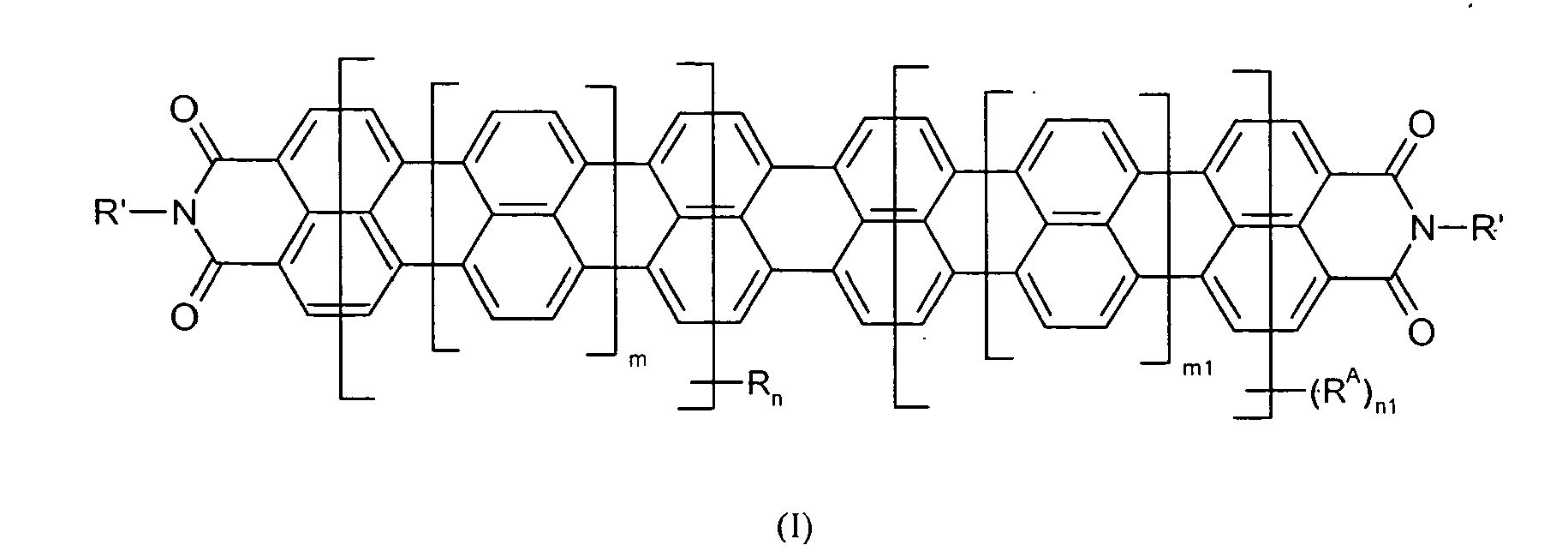
- Heptarylentetracarbonsäurediimid der allgemeinen Formel (I) oder Mischungen davon, wobei n und n1 ganze Zahlen sind, deren Summe eine Zahl von 0 bis 12 ergibt und R, RA, R', m, m1 die in Anspruch 1 angegebene Bedeutung besitzen.
- Octarylentetracarbonsäurediimid der allgemeinen Formel (I) oder Mischungen davon, wobei n und n1 ganze Zahlen sind, deren Summe eine Zahl von 0 bis 16 ergibt und R, RA, R', m, m1 die in Anspruch 1 angegebene Bedeutung besitzen.
- Diimid oder Mischungen davon nach Anspruch 2 oder 3, dadurch gekennzeichnet, dass R und RA die gleiche Bedeutung besitzen.
- Diimid oder Mischungen davon nach einem der Ansprüche 2 bis 4, dadurch gekennzeichnet, dass R, RA unabhängig voneinander Aryloxy oder Arylthio sind, wobei das gesamte Ringsystem ein- oder mehrfach durch die Reste (i), (ii), (iii), (iv) und/oder (v) wie in Anspruch 1 angegeben, substituiert sein kann.
- Diimid oder Mischungen davon nach Anspruch 5, dadurch gekennzeichnet, dass R, RA unabhängig voneinander ein- oder mehrfach durch einen Rest (i) substituiert sein kann.
- Diimid oder Mischungen davon nach Anspruch 5 oder 6, dadurch gekennzeichnet, dass R, RA unabhängig voneinander

wobei- X O oder S ist undR4, R5, R6 unabhängig voneinander Wasserstoff oder die Reste (i), (ii), (iii), (iv) und/oder (v) wie in Anspruch 1 angegeben mit der Maßgabe sein können, dass zumindest einer der Reste R4, R6 kein Wasserstoff ist. - Diimid nach Anspruch 7, dadurch gekennzeichnet, dass wenn R4 C1-C30 Alkyl oder C3-C8 Cycloalkyl ist, in der 1-Position kein ternäres Kohlenstoffatom auftritt.
- Diimid oder Mischungen davon nach Anspruch 7 oder 8, dadurch gekennzeichnet, dass beide R4 kein Wasserstoff und R5, R6 Wasserstoff sind oder dass R6 kein Wasserstoff ist und R4, R5 Wasserstoff sind.
- Diimid oder Mischungen davon nach einem der Ansprüche 2 bis 9, dadurch gekennzeichnet, dass jedes R' unabhängig voneinander C1-C30 Alkyl oder Aryl ist, wobei das gesamte Ringsystem ein- oder mehrfach durch die Reste (i), (ii), (iii), (iv) und/oder (v) wie in Anspruch 1 angegeben, substituiert sein kann.
- Diimid oder Mischungen davon nach Anspruch 10, dadurch gekennzeichnet, dass R' ein- oder mehrfach durch einen Rest (i) substituiert ist.
- Verwendung eines Diimids oder Mischungen davon nach einem der Ansprüche 2 bis 11 zur Einfärbung von hochmolekularen organischen und anorganischen Materialien, als Dispergierhilfsmittel und Pigmentadditive für organische Pigmente, zur Herstellung im nahinfraroten Bereich des elektromagnetischen Spektrums absorbierender wässriger Polymerisatdispersionen, zur Erzeugung für das menschliche Auge nicht sichtbarer, Infrarotlicht absorbierender Markierungen und Beschriftungen, als Infrarotabsorber für das Wärmemanagement, als IR-laserstrahlenabsorbierende Materialien beim Schweißbehandeln von Kunststoffteilen, als Halbleiter in der organischen Elektronik, als Emitter in Elektro- und Chemilumineszenzanwendungen oder als Aktivkomponente in der Photovoltaik.
- Verfahren zur Herstellung einer Quaterrylenverbindung der allgemeinen Formel (II)
 (a) Kupplung mindestens einer Perylenverbindung der Formel (II)

ein Rest von Y, Y1 Halogen und der andere B(OR")2 ist, m = 0 ist und R, R', n, die in Anspruch 1 angegebene Bedeutung besitzen, zu einer Verbindung der allgemeinen Formel (IIIb)/(IIIb')
 (b) Cyclodehydrierung der in Schritt (a) erhaltenen Verbindung der allgemeinen Formel (IIIb)/(IIIb') zu einer Rylenverbindung der allgemeinen Formel (II), wobei Y1 in Formel (IIIb)/(IIIb') die Bedeutung von Y in Formel (II) hat.
 - Verbindung der allgemeinen Formel (IIIb) oder (IIIb')


Priority Applications (1)
| Application Number | Priority Date | Filing Date | Title |
|---|---|---|---|
| EP07821820A EP2089390B1 (de) | 2006-11-02 | 2007-10-25 | Heptarylen-und octarylentetracarbonsäurediimide und deren herstellung |
Applications Claiming Priority (3)
| Application Number | Priority Date | Filing Date | Title |
|---|---|---|---|
| EP06123380 | 2006-11-02 | ||
| PCT/EP2007/061457 WO2008052927A1 (de) | 2006-11-02 | 2007-10-25 | Heptarylen-und octarylentetracarbonsäurediimide und deren herstellung |
| EP07821820A EP2089390B1 (de) | 2006-11-02 | 2007-10-25 | Heptarylen-und octarylentetracarbonsäurediimide und deren herstellung |
Publications (2)
| Publication Number | Publication Date |
|---|---|
| EP2089390A1 EP2089390A1 (de) | 2009-08-19 |
| EP2089390B1 true EP2089390B1 (de) | 2011-07-27 |
Family
ID=39099930
Family Applications (1)
| Application Number | Title | Priority Date | Filing Date |
|---|---|---|---|
| EP07821820A Not-in-force EP2089390B1 (de) | 2006-11-02 | 2007-10-25 | Heptarylen-und octarylentetracarbonsäurediimide und deren herstellung |
Country Status (5)
| Country | Link |
|---|---|
| US (1) | US8052899B2 (de) |
| EP (1) | EP2089390B1 (de) |
| AT (1) | ATE517900T1 (de) |
| ES (1) | ES2370936T3 (de) |
| WO (1) | WO2008052927A1 (de) |
Families Citing this family (7)
| Publication number | Priority date | Publication date | Assignee | Title |
|---|---|---|---|---|
| WO2005089094A2 (en) * | 2003-11-21 | 2005-09-29 | The Board Of Regents Of The University And Community College System Of Nevada | Materials and methods for the preparation of anisotropically-ordered solids |
| EP2181096A1 (de) * | 2007-07-23 | 2010-05-05 | Basf Se | Verwendung von rylenderivaten als aktive komponenten in solarzellen und photodetektoren |
| KR20100097662A (ko) * | 2007-10-31 | 2010-09-03 | 바스프 에스이 | 할로겐화 프탈로시아닌의 용도 |
| JP2012503320A (ja) * | 2008-09-19 | 2012-02-02 | ビーエーエスエフ ソシエタス・ヨーロピア | 有機太陽電池におけるジベンゾテトラフェニルペリフランテンの使用 |
| US20160113906A1 (en) | 2014-09-19 | 2016-04-28 | Board Of Regents, The University Of Texas System | Methods of preparing extrudates |
| JP7114578B2 (ja) | 2016-10-06 | 2022-08-08 | ビーエーエスエフ ソシエタス・ヨーロピア | 2-フェニルフェノキシ置換ペリレンビスイミド化合物およびそれらの使用 |
| EP3816238B9 (de) | 2019-11-04 | 2023-06-21 | Textilchemie Dr. Petry Gmbh | Polyparaperylenderivate und verfahren zur herstellung davon |
Family Cites Families (5)
| Publication number | Priority date | Publication date | Assignee | Title |
|---|---|---|---|---|
| DE10108601A1 (de) * | 2001-02-22 | 2002-09-05 | Basf Ag | Thermochrome Rylenfarbstoffe |
| PT1379577E (pt) | 2001-03-23 | 2004-11-30 | Solutia Inc | Controlo da radiacao solar em vidros de seguranca laminados |
| DE10238994A1 (de) * | 2002-08-20 | 2004-02-26 | Basf Ag | Rylenfarbstoffe |
| DE102005018241A1 (de) * | 2005-04-19 | 2006-10-26 | Basf Ag | Hexarylen- und Pentarylentetracarbonsäurediimide |
| WO2009115553A1 (en) * | 2008-03-19 | 2009-09-24 | Basf Se | N,n'-bis(fluorophenylalkyl)-substituted perylene-3,4:9,10-tetracarboximides, and the preparation and use thereof |
-
2007
- 2007-10-25 EP EP07821820A patent/EP2089390B1/de not_active Not-in-force
- 2007-10-25 ES ES07821820T patent/ES2370936T3/es active Active
- 2007-10-25 AT AT07821820T patent/ATE517900T1/de active
- 2007-10-25 WO PCT/EP2007/061457 patent/WO2008052927A1/de not_active Ceased
- 2007-10-25 US US12/513,410 patent/US8052899B2/en not_active Expired - Fee Related
Also Published As
| Publication number | Publication date |
|---|---|
| ATE517900T1 (de) | 2011-08-15 |
| US8052899B2 (en) | 2011-11-08 |
| US20100072438A1 (en) | 2010-03-25 |
| EP2089390A1 (de) | 2009-08-19 |
| WO2008052927A1 (de) | 2008-05-08 |
| ES2370936T3 (es) | 2011-12-23 |
Similar Documents
| Publication | Publication Date | Title |
|---|---|---|
| EP1879847B1 (de) | Terrylen- und quaterrylenderivate | |
| EP1874773B1 (de) | Hexarylen- und pentarylentetracarbonsäurediimide | |
| JP5511743B2 (ja) | クアテリレン−3,4:13,14−テトラカルボン酸ジイミドの直接合成を介した製造方法 | |
| US8202994B2 (en) | Pentarylene- and hexarylenetetracarboximides and preparation thereof | |
| US8052899B2 (en) | Heptarylene-and octarylenetetracarboximides and preparation thereof | |
| EP1917311B1 (de) | Mehrfachchromophore auf rylenbasis | |
| EP1711469B1 (de) | Verfahren zur herstellung von terrylen-3,4:11,12-tetracarbonsäurediimiden durch direktsynthese | |
| WO2005070894A1 (de) | Verfahren zur herstellung von terrylen-3,4:11,12-tetracarbonsäurediimiden | |
| EP2285806B1 (de) | Dreifach und vierfach substituierte pentarylentetracarbonsäurediimide |
Legal Events
| Date | Code | Title | Description |
|---|---|---|---|
| PUAI | Public reference made under article 153(3) epc to a published international application that has entered the european phase |
Free format text: ORIGINAL CODE: 0009012 |
|
| 17P | Request for examination filed |
Effective date: 20090602 |
|
| AK | Designated contracting states |
Kind code of ref document: A1 Designated state(s): AT BE BG CH CY CZ DE DK EE ES FI FR GB GR HU IE IS IT LI LT LU LV MC MT NL PL PT RO SE SI SK TR |
|
| 17Q | First examination report despatched |
Effective date: 20091012 |
|
| DAX | Request for extension of the european patent (deleted) | ||
| GRAP | Despatch of communication of intention to grant a patent |
Free format text: ORIGINAL CODE: EPIDOSNIGR1 |
|
| GRAS | Grant fee paid |
Free format text: ORIGINAL CODE: EPIDOSNIGR3 |
|
| GRAA | (expected) grant |
Free format text: ORIGINAL CODE: 0009210 |
|
| AK | Designated contracting states |
Kind code of ref document: B1 Designated state(s): AT BE BG CH CY CZ DE DK EE ES FI FR GB GR HU IE IS IT LI LT LU LV MC MT NL PL PT RO SE SI SK TR |
|
| REG | Reference to a national code |
Ref country code: GB Ref legal event code: FG4D Free format text: NOT ENGLISH |
|
| REG | Reference to a national code |
Ref country code: CH Ref legal event code: EP |
|
| REG | Reference to a national code |
Ref country code: DE Ref legal event code: R096 Ref document number: 502007007822 Country of ref document: DE Effective date: 20110929 |
|
| REG | Reference to a national code |
Ref country code: NL Ref legal event code: VDEP Effective date: 20110727 |
|
| REG | Reference to a national code |
Ref country code: ES Ref legal event code: FG2A Ref document number: 2370936 Country of ref document: ES Kind code of ref document: T3 Effective date: 20111223 |
|
| PG25 | Lapsed in a contracting state [announced via postgrant information from national office to epo] |
Ref country code: NL Free format text: LAPSE BECAUSE OF FAILURE TO SUBMIT A TRANSLATION OF THE DESCRIPTION OR TO PAY THE FEE WITHIN THE PRESCRIBED TIME-LIMIT Effective date: 20110727 Ref country code: FI Free format text: LAPSE BECAUSE OF FAILURE TO SUBMIT A TRANSLATION OF THE DESCRIPTION OR TO PAY THE FEE WITHIN THE PRESCRIBED TIME-LIMIT Effective date: 20110727 Ref country code: PT Free format text: LAPSE BECAUSE OF FAILURE TO SUBMIT A TRANSLATION OF THE DESCRIPTION OR TO PAY THE FEE WITHIN THE PRESCRIBED TIME-LIMIT Effective date: 20111128 Ref country code: IS Free format text: LAPSE BECAUSE OF FAILURE TO SUBMIT A TRANSLATION OF THE DESCRIPTION OR TO PAY THE FEE WITHIN THE PRESCRIBED TIME-LIMIT Effective date: 20111127 Ref country code: LT Free format text: LAPSE BECAUSE OF FAILURE TO SUBMIT A TRANSLATION OF THE DESCRIPTION OR TO PAY THE FEE WITHIN THE PRESCRIBED TIME-LIMIT Effective date: 20110727 Ref country code: SE Free format text: LAPSE BECAUSE OF FAILURE TO SUBMIT A TRANSLATION OF THE DESCRIPTION OR TO PAY THE FEE WITHIN THE PRESCRIBED TIME-LIMIT Effective date: 20110727 |
|
| PG25 | Lapsed in a contracting state [announced via postgrant information from national office to epo] |
Ref country code: LV Free format text: LAPSE BECAUSE OF FAILURE TO SUBMIT A TRANSLATION OF THE DESCRIPTION OR TO PAY THE FEE WITHIN THE PRESCRIBED TIME-LIMIT Effective date: 20110727 Ref country code: PL Free format text: LAPSE BECAUSE OF FAILURE TO SUBMIT A TRANSLATION OF THE DESCRIPTION OR TO PAY THE FEE WITHIN THE PRESCRIBED TIME-LIMIT Effective date: 20110727 Ref country code: CY Free format text: LAPSE BECAUSE OF FAILURE TO SUBMIT A TRANSLATION OF THE DESCRIPTION OR TO PAY THE FEE WITHIN THE PRESCRIBED TIME-LIMIT Effective date: 20110727 Ref country code: SI Free format text: LAPSE BECAUSE OF FAILURE TO SUBMIT A TRANSLATION OF THE DESCRIPTION OR TO PAY THE FEE WITHIN THE PRESCRIBED TIME-LIMIT Effective date: 20110727 Ref country code: GR Free format text: LAPSE BECAUSE OF FAILURE TO SUBMIT A TRANSLATION OF THE DESCRIPTION OR TO PAY THE FEE WITHIN THE PRESCRIBED TIME-LIMIT Effective date: 20111028 |
|
| REG | Reference to a national code |
Ref country code: IE Ref legal event code: FD4D |
|
| PG25 | Lapsed in a contracting state [announced via postgrant information from national office to epo] |
Ref country code: SK Free format text: LAPSE BECAUSE OF FAILURE TO SUBMIT A TRANSLATION OF THE DESCRIPTION OR TO PAY THE FEE WITHIN THE PRESCRIBED TIME-LIMIT Effective date: 20110727 Ref country code: CZ Free format text: LAPSE BECAUSE OF FAILURE TO SUBMIT A TRANSLATION OF THE DESCRIPTION OR TO PAY THE FEE WITHIN THE PRESCRIBED TIME-LIMIT Effective date: 20110727 Ref country code: IE Free format text: LAPSE BECAUSE OF FAILURE TO SUBMIT A TRANSLATION OF THE DESCRIPTION OR TO PAY THE FEE WITHIN THE PRESCRIBED TIME-LIMIT Effective date: 20110727 |
|
| PG25 | Lapsed in a contracting state [announced via postgrant information from national office to epo] |
Ref country code: RO Free format text: LAPSE BECAUSE OF FAILURE TO SUBMIT A TRANSLATION OF THE DESCRIPTION OR TO PAY THE FEE WITHIN THE PRESCRIBED TIME-LIMIT Effective date: 20110727 Ref country code: MC Free format text: LAPSE BECAUSE OF NON-PAYMENT OF DUE FEES Effective date: 20111031 Ref country code: EE Free format text: LAPSE BECAUSE OF FAILURE TO SUBMIT A TRANSLATION OF THE DESCRIPTION OR TO PAY THE FEE WITHIN THE PRESCRIBED TIME-LIMIT Effective date: 20110727 |
|
| REG | Reference to a national code |
Ref country code: CH Ref legal event code: PL |
|
| PLBE | No opposition filed within time limit |
Free format text: ORIGINAL CODE: 0009261 |
|
| STAA | Information on the status of an ep patent application or granted ep patent |
Free format text: STATUS: NO OPPOSITION FILED WITHIN TIME LIMIT |
|
| PG25 | Lapsed in a contracting state [announced via postgrant information from national office to epo] |
Ref country code: DK Free format text: LAPSE BECAUSE OF FAILURE TO SUBMIT A TRANSLATION OF THE DESCRIPTION OR TO PAY THE FEE WITHIN THE PRESCRIBED TIME-LIMIT Effective date: 20110727 |
|
| 26N | No opposition filed |
Effective date: 20120502 |
|
| PG25 | Lapsed in a contracting state [announced via postgrant information from national office to epo] |
Ref country code: LI Free format text: LAPSE BECAUSE OF NON-PAYMENT OF DUE FEES Effective date: 20111031 Ref country code: CH Free format text: LAPSE BECAUSE OF NON-PAYMENT OF DUE FEES Effective date: 20111031 |
|
| REG | Reference to a national code |
Ref country code: DE Ref legal event code: R097 Ref document number: 502007007822 Country of ref document: DE Effective date: 20120502 |
|
| PG25 | Lapsed in a contracting state [announced via postgrant information from national office to epo] |
Ref country code: MT Free format text: LAPSE BECAUSE OF FAILURE TO SUBMIT A TRANSLATION OF THE DESCRIPTION OR TO PAY THE FEE WITHIN THE PRESCRIBED TIME-LIMIT Effective date: 20110727 |
|
| PG25 | Lapsed in a contracting state [announced via postgrant information from national office to epo] |
Ref country code: LU Free format text: LAPSE BECAUSE OF NON-PAYMENT OF DUE FEES Effective date: 20111025 |
|
| PG25 | Lapsed in a contracting state [announced via postgrant information from national office to epo] |
Ref country code: BG Free format text: LAPSE BECAUSE OF FAILURE TO SUBMIT A TRANSLATION OF THE DESCRIPTION OR TO PAY THE FEE WITHIN THE PRESCRIBED TIME-LIMIT Effective date: 20111027 |
|
| PG25 | Lapsed in a contracting state [announced via postgrant information from national office to epo] |
Ref country code: HU Free format text: LAPSE BECAUSE OF FAILURE TO SUBMIT A TRANSLATION OF THE DESCRIPTION OR TO PAY THE FEE WITHIN THE PRESCRIBED TIME-LIMIT Effective date: 20110727 |
|
| REG | Reference to a national code |
Ref country code: AT Ref legal event code: MM01 Ref document number: 517900 Country of ref document: AT Kind code of ref document: T Effective date: 20121031 |
|
| PG25 | Lapsed in a contracting state [announced via postgrant information from national office to epo] |
Ref country code: AT Free format text: LAPSE BECAUSE OF NON-PAYMENT OF DUE FEES Effective date: 20121031 |
|
| PGFP | Annual fee paid to national office [announced via postgrant information from national office to epo] |
Ref country code: TR Payment date: 20131003 Year of fee payment: 7 |
|
| REG | Reference to a national code |
Ref country code: FR Ref legal event code: PLFP Year of fee payment: 9 |
|
| REG | Reference to a national code |
Ref country code: FR Ref legal event code: PLFP Year of fee payment: 10 |
|
| PGFP | Annual fee paid to national office [announced via postgrant information from national office to epo] |
Ref country code: BE Payment date: 20161025 Year of fee payment: 10 Ref country code: ES Payment date: 20161125 Year of fee payment: 10 |
|
| PG25 | Lapsed in a contracting state [announced via postgrant information from national office to epo] |
Ref country code: TR Free format text: LAPSE BECAUSE OF NON-PAYMENT OF DUE FEES Effective date: 20141025 |
|
| REG | Reference to a national code |
Ref country code: FR Ref legal event code: PLFP Year of fee payment: 11 |
|
| REG | Reference to a national code |
Ref country code: BE Ref legal event code: MM Effective date: 20171031 |
|
| PG25 | Lapsed in a contracting state [announced via postgrant information from national office to epo] |
Ref country code: BE Free format text: LAPSE BECAUSE OF NON-PAYMENT OF DUE FEES Effective date: 20171031 |
|
| REG | Reference to a national code |
Ref country code: FR Ref legal event code: PLFP Year of fee payment: 12 |
|
| REG | Reference to a national code |
Ref country code: ES Ref legal event code: FD2A Effective date: 20181221 |
|
| PG25 | Lapsed in a contracting state [announced via postgrant information from national office to epo] |
Ref country code: ES Free format text: LAPSE BECAUSE OF NON-PAYMENT OF DUE FEES Effective date: 20171026 |
|
| PGFP | Annual fee paid to national office [announced via postgrant information from national office to epo] |
Ref country code: IT Payment date: 20181024 Year of fee payment: 12 Ref country code: FR Payment date: 20181025 Year of fee payment: 12 |
|
| PG25 | Lapsed in a contracting state [announced via postgrant information from national office to epo] |
Ref country code: FR Free format text: LAPSE BECAUSE OF NON-PAYMENT OF DUE FEES Effective date: 20191031 Ref country code: IT Free format text: LAPSE BECAUSE OF NON-PAYMENT OF DUE FEES Effective date: 20191025 |
|
| PGFP | Annual fee paid to national office [announced via postgrant information from national office to epo] |
Ref country code: GB Payment date: 20201027 Year of fee payment: 14 |
|
| PGFP | Annual fee paid to national office [announced via postgrant information from national office to epo] |
Ref country code: DE Payment date: 20201228 Year of fee payment: 14 |
|
| REG | Reference to a national code |
Ref country code: DE Ref legal event code: R119 Ref document number: 502007007822 Country of ref document: DE |
|
| GBPC | Gb: european patent ceased through non-payment of renewal fee |
Effective date: 20211025 |
|
| PG25 | Lapsed in a contracting state [announced via postgrant information from national office to epo] |
Ref country code: GB Free format text: LAPSE BECAUSE OF NON-PAYMENT OF DUE FEES Effective date: 20211025 Ref country code: DE Free format text: LAPSE BECAUSE OF NON-PAYMENT OF DUE FEES Effective date: 20220503 |