EP2081907B1 - Aryl piperazine derivatives useful for the treatment of neuropsychiatry disorders - Google Patents
Aryl piperazine derivatives useful for the treatment of neuropsychiatry disorders Download PDFInfo
- Publication number
- EP2081907B1 EP2081907B1 EP07821255A EP07821255A EP2081907B1 EP 2081907 B1 EP2081907 B1 EP 2081907B1 EP 07821255 A EP07821255 A EP 07821255A EP 07821255 A EP07821255 A EP 07821255A EP 2081907 B1 EP2081907 B1 EP 2081907B1
- Authority
- EP
- European Patent Office
- Prior art keywords
- aryl piperazine
- pharmaceutically acceptable
- acceptable salt
- piperazine derivative
- trifluoromethyl
- Prior art date
- Legal status (The legal status is an assumption and is not a legal conclusion. Google has not performed a legal analysis and makes no representation as to the accuracy of the status listed.)
- Not-in-force
Links
- XJPVUJYLKOZVMH-UHFFFAOYSA-N Fc1cccc(N2CCNCC2)c1F Chemical compound Fc1cccc(N2CCNCC2)c1F XJPVUJYLKOZVMH-UHFFFAOYSA-N 0.000 description 1
Classifications
-
- C—CHEMISTRY; METALLURGY
- C07—ORGANIC CHEMISTRY
- C07D—HETEROCYCLIC COMPOUNDS
- C07D215/00—Heterocyclic compounds containing quinoline or hydrogenated quinoline ring systems
- C07D215/02—Heterocyclic compounds containing quinoline or hydrogenated quinoline ring systems having no bond between the ring nitrogen atom and a non-ring member or having only hydrogen atoms or carbon atoms directly attached to the ring nitrogen atom
- C07D215/16—Heterocyclic compounds containing quinoline or hydrogenated quinoline ring systems having no bond between the ring nitrogen atom and a non-ring member or having only hydrogen atoms or carbon atoms directly attached to the ring nitrogen atom with hetero atoms or with carbon atoms having three bonds to hetero atoms with at the most one bond to halogen, e.g. ester or nitrile radicals, directly attached to ring carbon atoms
- C07D215/48—Carbon atoms having three bonds to hetero atoms with at the most one bond to halogen
-
- A—HUMAN NECESSITIES
- A61—MEDICAL OR VETERINARY SCIENCE; HYGIENE
- A61P—SPECIFIC THERAPEUTIC ACTIVITY OF CHEMICAL COMPOUNDS OR MEDICINAL PREPARATIONS
- A61P15/00—Drugs for genital or sexual disorders; Contraceptives
- A61P15/08—Drugs for genital or sexual disorders; Contraceptives for gonadal disorders or for enhancing fertility, e.g. inducers of ovulation or of spermatogenesis
-
- A—HUMAN NECESSITIES
- A61—MEDICAL OR VETERINARY SCIENCE; HYGIENE
- A61P—SPECIFIC THERAPEUTIC ACTIVITY OF CHEMICAL COMPOUNDS OR MEDICINAL PREPARATIONS
- A61P21/00—Drugs for disorders of the muscular or neuromuscular system
-
- A—HUMAN NECESSITIES
- A61—MEDICAL OR VETERINARY SCIENCE; HYGIENE
- A61P—SPECIFIC THERAPEUTIC ACTIVITY OF CHEMICAL COMPOUNDS OR MEDICINAL PREPARATIONS
- A61P25/00—Drugs for disorders of the nervous system
-
- A—HUMAN NECESSITIES
- A61—MEDICAL OR VETERINARY SCIENCE; HYGIENE
- A61P—SPECIFIC THERAPEUTIC ACTIVITY OF CHEMICAL COMPOUNDS OR MEDICINAL PREPARATIONS
- A61P25/00—Drugs for disorders of the nervous system
- A61P25/04—Centrally acting analgesics, e.g. opioids
-
- A—HUMAN NECESSITIES
- A61—MEDICAL OR VETERINARY SCIENCE; HYGIENE
- A61P—SPECIFIC THERAPEUTIC ACTIVITY OF CHEMICAL COMPOUNDS OR MEDICINAL PREPARATIONS
- A61P25/00—Drugs for disorders of the nervous system
- A61P25/14—Drugs for disorders of the nervous system for treating abnormal movements, e.g. chorea, dyskinesia
-
- A—HUMAN NECESSITIES
- A61—MEDICAL OR VETERINARY SCIENCE; HYGIENE
- A61P—SPECIFIC THERAPEUTIC ACTIVITY OF CHEMICAL COMPOUNDS OR MEDICINAL PREPARATIONS
- A61P25/00—Drugs for disorders of the nervous system
- A61P25/14—Drugs for disorders of the nervous system for treating abnormal movements, e.g. chorea, dyskinesia
- A61P25/16—Anti-Parkinson drugs
-
- A—HUMAN NECESSITIES
- A61—MEDICAL OR VETERINARY SCIENCE; HYGIENE
- A61P—SPECIFIC THERAPEUTIC ACTIVITY OF CHEMICAL COMPOUNDS OR MEDICINAL PREPARATIONS
- A61P25/00—Drugs for disorders of the nervous system
- A61P25/18—Antipsychotics, i.e. neuroleptics; Drugs for mania or schizophrenia
-
- A—HUMAN NECESSITIES
- A61—MEDICAL OR VETERINARY SCIENCE; HYGIENE
- A61P—SPECIFIC THERAPEUTIC ACTIVITY OF CHEMICAL COMPOUNDS OR MEDICINAL PREPARATIONS
- A61P25/00—Drugs for disorders of the nervous system
- A61P25/20—Hypnotics; Sedatives
-
- A—HUMAN NECESSITIES
- A61—MEDICAL OR VETERINARY SCIENCE; HYGIENE
- A61P—SPECIFIC THERAPEUTIC ACTIVITY OF CHEMICAL COMPOUNDS OR MEDICINAL PREPARATIONS
- A61P25/00—Drugs for disorders of the nervous system
- A61P25/22—Anxiolytics
-
- A—HUMAN NECESSITIES
- A61—MEDICAL OR VETERINARY SCIENCE; HYGIENE
- A61P—SPECIFIC THERAPEUTIC ACTIVITY OF CHEMICAL COMPOUNDS OR MEDICINAL PREPARATIONS
- A61P25/00—Drugs for disorders of the nervous system
- A61P25/24—Antidepressants
-
- A—HUMAN NECESSITIES
- A61—MEDICAL OR VETERINARY SCIENCE; HYGIENE
- A61P—SPECIFIC THERAPEUTIC ACTIVITY OF CHEMICAL COMPOUNDS OR MEDICINAL PREPARATIONS
- A61P25/00—Drugs for disorders of the nervous system
- A61P25/28—Drugs for disorders of the nervous system for treating neurodegenerative disorders of the central nervous system, e.g. nootropic agents, cognition enhancers, drugs for treating Alzheimer's disease or other forms of dementia
-
- A—HUMAN NECESSITIES
- A61—MEDICAL OR VETERINARY SCIENCE; HYGIENE
- A61P—SPECIFIC THERAPEUTIC ACTIVITY OF CHEMICAL COMPOUNDS OR MEDICINAL PREPARATIONS
- A61P25/00—Drugs for disorders of the nervous system
- A61P25/30—Drugs for disorders of the nervous system for treating abuse or dependence
-
- A—HUMAN NECESSITIES
- A61—MEDICAL OR VETERINARY SCIENCE; HYGIENE
- A61P—SPECIFIC THERAPEUTIC ACTIVITY OF CHEMICAL COMPOUNDS OR MEDICINAL PREPARATIONS
- A61P25/00—Drugs for disorders of the nervous system
- A61P25/30—Drugs for disorders of the nervous system for treating abuse or dependence
- A61P25/36—Opioid-abuse
-
- A—HUMAN NECESSITIES
- A61—MEDICAL OR VETERINARY SCIENCE; HYGIENE
- A61P—SPECIFIC THERAPEUTIC ACTIVITY OF CHEMICAL COMPOUNDS OR MEDICINAL PREPARATIONS
- A61P43/00—Drugs for specific purposes, not provided for in groups A61P1/00-A61P41/00
Definitions
- This invention provides novel aryl piperazine derivatives having medical utility, in particular as modulators of dopamine and serotonin receptors, preferably the D 3 , 5HT 1A and 5-HT 2A receptor subtypes, and in particular useful for the treatment of neuropsychiatric disorders, incl. schizophrenia.
- Dopamine is involved in several important functions, excitatory and inhibitory, via dopaminergic receptors in the central and peripherical nervous system.
- Dopamine receptors were originally classified into two main groups: D 1 and D 2 .
- the five currently cloned dopamine receptors fall into these classes.
- the D 1 -like receptors include D 1 and D 5
- the D 2 -like receptors include D 2 , D 3 and D 4 .
- the dopamine receptors are recognised as potential therapeutic targets for various neurological and psychiatric disorders, in particular psychotic disorders, incl. schizophrenia.
- Other therapeutic indications associated with the dopamine receptors include depression, Parkinson's disease, Huntington's disease, movement disorders such as dystonia, anxiety, restlessness, obsessive-compulsive disorders, mania, geriatric disorders, dementia, sexual dysfunction, musculo-skeletal pain symptoms, e.g. pain associated with fibromyalgia, substance abuse (cocaine abuse and addiction), abuse liability and withdrawal symptoms in drug addicts, and sleep disorders.
- Still other therapeutic indications include eating disorders such as overeating, compulsive overeating, inability to regulate eating, bulimia and Binge-eating disorder.
- the compounds of the invention may be useful for the treatment of abuse liability and withdrawal symptoms caused by termination of use of addictive substances.
- addictive substances include nicotine containing products such as tobacco, opioids such as heroin, cocaine and morphine, cannabis, benzodiazepines, benzodiazepine-like drugs, and alcohol.
- addictive substances include nicotine containing products such as tobacco, opioids such as heroin, cocaine and morphine, cannabis, benzodiazepines, benzodiazepine-like drugs, and alcohol.
- Withdrawal from addictive substances is in general a traumatic experience characterised by anxiety and frustration, anger, anxiety, difficulties in concentrating, restlessness, decreased heart rate and increased appetite and weight gain.
- receptor selective ligands find use as diagnostic tools in diagnostic methods, and in particular for in vivo receptor imaging (neuroimaging).
- WO 2006/072608 describes aryl piperazine derivatives useful as as modulators of dopamine and serotonin receptors. However, the aryl piperazine derivatives of the present invention have not been reported.
- WO 03/028728 describes certain substituted piperazinyl-butyl-carboxamides, incl. 3- and 4-quinoline derivatives, useful as dopamine D3 selective ligands. However, the 6-quinoline derivatives of the present invention have not been disclosed.
- aryl piperazine derivatives show superior activity as modulators of dopamine and serotonin receptors, preferably the D 3 , 5HT 1A and 5-HT 2A receptor subtypes, has no significant activity on hERG, and has a good bioavailability when administered p.o.
- the invention provides novel aryl piperazine derivatives represented by Formula I an enantiomer thereof or a mixture of its enantiomers, or a pharmaceutically acceptable salt thereof, wherein, R 1 , R 2 and R 3 , independently of each other, represent hydrogen, methyl, hydroxy, methoxy, halo, trifluoromethyl, cyano or carboxy.
- the invention relates to the use of the aryl piperazine derivative of the invention, or a pharmaceutically acceptable salt thereof, for the manufacture of a pharmaceutical composition.
- the invention relates to the use of the aryl piperazine derivative of the invention, or a pharmaceutically acceptable salt thereof, for use as a medicament, or for the manufacture of a pharmaceutical composition for the treatment, prevention or alleviation of a disease or a disorder or a condition of a mammal, including a human, which disease, disorder or condition is responsive to modulation of the dopamine and serotonin receptors.
- the invention provides novel aryl piperazine derivatives represented by Formula I an enantiomer thereof or a mixture of its enantiomers, or a pharmaceutically acceptable salt thereof, wherein, R 1 , R 2 and R 3 , independently of each other, represent hydrogen, methyl, hydroxy, methoxy, halo, trifluoromethyl, cyano or carboxy.
- the aryl piperazine derivative of the invention is a compound of Formula I, wherein R 1 , R 2 and R 3 , independently of each other, represent hydrogen, methyl, methoxy, halo, trifluoromethyl, cyano or carboxy.
- the aryl piperazine derivative of the invention is a compound of Formula I, wherein R 1 , R 2 and R 3 , independently of each other, represent hydrogen, methyl, hydroxy, methoxy, halo or trifluoromethyl.
- R 1 , R 2 and R 3 independently of each other, represent hydrogen, methyl, methoxy, halo or trifluoromethyl.
- R 1 , R 2 and R 3 independently of each other, represent hydrogen, hydroxy or halo.
- R 1 , R 2 and R 3 independently of each other, represent hydrogen or halo.
- the aryl piperazine derivative of the invention is a compound of Formula I, wherein R 1 , R 2 and R 3 , independently of each other, represent hydrogen, halo, hydroxy or trifluoromethyl.
- R 1 , R 2 and R 3 independently of each other, represent hydrogen, halo or trifluoromethyl.
- R 1 , R 2 and R 3 independently of each other, represent hydrogen or halo.
- the aryl piperazine derivative of the invention is a compound of Formula I, wherein R 1 , R 2 and R 3 , independently of each other, represent hydrogen, fluoro, chloro, bromo or trifluoromethyl.
- R 1 , R 2 and R 3 independently of each other, represent hydrogen or fluoro.
- the aryl piperazine derivative of the invention is a compound of Formula I, wherein one of R 1 , R 2 and R 3 , represents hydrogen or hydroxy; and the two others of R 1 , R 2 and R 3 , independently of each other, represent methyl, methoxy, halo, trifluoromethyl, cyano or carboxy.
- one of R 1 , R 2 and R 3 represents hydrogen; and the two others of R 1 , R 2 and R 3 represent methyl, methoxy, halo, trifluoromethyl, cyano or carboxy.
- one of R 1 , R 2 and R 3 represents hydrogen or hydroxy; and the two others of R 1 , R 2 and R 3 represent halo, and in particular fluoro.
- one of R 1 , R 2 and R 3 represents hydrogen or hydroxy; and the two others of R 1 , R 2 and R 3 represent halo, and in particular fluoro.
- one of R 1 , R 2 and R 3 represents hydrogen; and the two others of R 1 , R 2 and R 3 represent halo, and in particular fluoro.
- the aryl piperazine derivative of the invention is a compound of Formula I, wherein two of R 1 , R 2 and R 3 , represents hydrogen; and the last one of R 1 , R 2 and R 3 represent methyl, hydroxy, methoxy, halo, trifluoromethyl, cyano or carboxy.
- two of R 1 , R 2 and R 3 represents hydrogen; and the last one of R 1 , R 2 and R 3 represent methyl, methoxy, halo, trifluoromethyl, cyano or carboxy.
- two of R 1 , R 2 and R 3 represents hydrogen; and the last one of R 1 , R 2 and R 3 represent hydroxy.
- the aryl piperazine derivative of the invention is N -(4-(4-Phenylpiperazin-1-yl)butyl)quinoline-6-carboxamide; or Quinoline-6-carboxylic acid ⁇ 4-[4-(2,3-difluoro-phenyl)-piperazin-1-yl]-butyl ⁇ -amide; an enantiomer thereof or a mixture of its enantiomers, or a pharmaceutically acceptable salt thereof.
- aryl piperazine derivatives of the invention may be provided in any form suitable for the intended administration. Suitable forms include pharmaceutically (i.e. physiologically) acceptable salts of the aryl piperazine derivatives of the invention.
- salts include, without limitation, the non-toxic inorganic and organic acid salts such as the hydrochloride, the hydrobromide, the nitrate, the perchlorate, the phosphate, the sulphate, the formate, the acetate, the aconate, the ascorbate, the benzenesulphonate, the benzoate, the cinnamate, the citrate, the embonate, the enantate, the fumarate, the glutamate, the glycolate, the lactate, the maleate, the malonate, the mandelate, the methanesulphonate, the naphthalene-2-sulphonate derived, the phthalate, the salicylate, the sorbate, the stearate, the succinate, the tartrate, the toluene-p-sulphonate, and the like.
- Such salts may be formed by procedures well known and described in the art.
- aryl piperazine derivatives of the present invention may exist in (+) and (-) forms as well as in racemic forms ( ⁇ ).
- the racemates of these isomers and the individual isomers themselves are within the scope of the present invention.
- Racemic forms can be resolved into the optical antipodes by known methods and techniques.
- One way of separating the diastereomeric salts is by use of an optically active acid, and liberating the optically active amine compound by treatment with a base.
- Another method for resolving racemates into the optical antipodes is based upon chromatography on an optical active matrix.
- a stereoselective synthetic approach may be pursued.
- Racemic compounds of the present invention can thus be resolved into their optical antipodes, e.g., by fractional crystallisation of D- or L- (tartrates, mandelates, or camphorsulphonate) salts for example.
- Starting materials and/or intermediate compounds used for producing the chemical compounds of the present invention may also be resolved by the formation of diastereomeric amides by reaction of the aryl piperazine derivative of the present invention with an optically active activated carboxylic acid such as that derived from (+) or (-) phenylalanine, (+) or (-) phenylglycine, (+) or (-) camphanic acid or by the formation of diastereomeric carbamates by reaction of the starting material or intermediate compound for use according to the present invention with an optically active chloroformate or the like.
- an optically active activated carboxylic acid such as that derived from (+) or (-) phenylalanine, (+) or (-) phenylglycine, (+) or (-) camphanic acid
- Optical active compounds can also be prepared from optical active starting materials.
- aryl piperazine derivatives of the invention may be prepared by conventional methods for chemical synthesis, e.g. those described in the working examples.
- amides may be prepared by transforming acids or acid chlorides into the corresponding hydroxy amides by a standard procedure.
- Esters may be obtained by reacting acidic starting materials with 1,4-dihydroxybutane. After substitution of the terminal hydroxy group by bromine, hydroxyl amides may be treated with the aryl piperazine in the presence of a base to give the desired end product.
- Compounds based on a ethereal tether may be synthesized starting from the appropriate phenol, which is then condensed with 14-dihydroxybutane or 1,5-dihydroxypentane, followed by transformation into the final products as described above.
- Intermediate compounds invention may be resolved by the formation of diastereomeric amides by reaction with an optically active activated carboxylic acid such as that derived from (+) or (-) phenylalanine, (+) or (-) phenylglycine, (+) or (-) camphanic acid or by the formation of diastereomeric carbamates by reaction of the intermediate compound with an optically active chloroformate or the like.
- an optically active activated carboxylic acid such as that derived from (+) or (-) phenylalanine, (+) or (-) phenylglycine, (+) or (-) camphanic acid
- the aryl piperazine derivatives of the invention were found to possess selectivity for the dopamine and serotonin receptors. Therefore, in a preferred embodiment, the invention relates to use of the aryl piperazine derivatives of the invention for the manufacture of a pharmaceutical composition for the treatment, prevention or alleviation of a disease or a disorder or a condition of a mammal, including a human, which disease, disorder or condition is responsive to modulation of the dopamine and serotonin receptors, in particular the D 3 , 5HT 1A and 5-HT 2A receptor subtypes.
- the aryl piperazine derivatives of the invention has no significant activity on hERG, and has a good bioavailability when administered p.o.
- the invention relates to use of the aryl piperazine derivatives of the invention for the manufacture of a pharmaceutical composition for the treatment, prevention or alleviation of a disease or a disorder or a condition of a mammal, including a human, which disease, disorder or condition is responsive to modulation of the dopamine and serotonin receptors.
- the disease, disorder or condition is a neurological or psychiatric disorders, in particular psychotic disorders, incl. schizophrenia, depression, Parkinson's disease, Huntington's disease, movement disorders, in particular dystonia, anxiety, restlessness, obsessive-compulsive disorders, mania, geriatric disorders, dementia, sexual dysfunction, musculo-skeletal pain symptoms, in particular pain associated with fibromyalgia, sleep disorders, substance abuse or addiction, and abuse liability and withdrawal symptoms in drug addicts, cocaine abuse or addiction.
- psychotic disorders incl.
- the disease, disorder or condition is a neurological or psychiatric disorder, in particular a psychotic disorder, preferably schizophrenia.
- the disease, disorder or condition contemplated according to the invention is schizophrenia or Parkinson's disease.
- the disease, disorder or condition contemplated according to the invention an eating disorder, overeating, compulsive overeating, inability to regulate eating, bulimia or Binge-eating disorder.
- the disease, disorder or condition contemplated according to the invention is abuse liability or withdrawal symptoms caused by termination of use of addictive substances.
- addictive substances include nicotine containing products such as tobacco, opioids such as heroin, cocaine and morphine, cannabis, benzodiazepines, benzodiazepine-like drugs, and alcohol.
- addictive substances include nicotine containing products such as tobacco, opioids such as heroin, cocaine and morphine, cannabis, benzodiazepines, benzodiazepine-like drugs, and alcohol.
- Withdrawal from addictive substances is in general a traumatic experience characterised by anxiety and frustration, anger, anxiety, difficulties in concentrating, restlessness, decreased heart rate and increased appetite and weight gain.
- aryl piperazine derivatives of the invention are used as diagnostic tools in diagnostic methods, and in particular for in vivo receptor imaging (neuroimaging).
- the invention provides novel pharmaceutical compositions comprising a therapeutically effective amount of the aryl piperazine derivative of the invention.
- an aryl piperazine derivative of the invention for use in therapy may be administered in the form of the raw chemical compound, it is preferred to introduce the active ingredient, optionally in the form of a physiologically acceptable salt, in a pharmaceutical composition together with one or more adjuvants, excipients, carriers, buffers, diluents, and/or other customary pharmaceutical auxiliaries.
- the invention provides pharmaceutical compositions comprising the aryl piperazine derivative of the invention, or a pharmaceutically acceptable salt or derivative thereof, together with one or more pharmaceutically acceptable carriers, and, optionally, other therapeutic and/or prophylactic ingredients, know and used in the art.
- the carrier(s) must be "acceptable” in the sense of being compatible with the other ingredients of the formulation and not harmful to the recipient thereof.
- the pharmaceutical composition of the invention may be administered by any convenient route, which suits the desired therapy.
- Preferred routes of administration include oral administration, in particular in tablet, in capsule, in dragé, in powder, or in liquid form, and parenteral administration, in particular cutaneous, subcutaneous, intramuscular, or intravenous injection.
- the pharmaceutical composition of the invention can be prepared by any person skilled in the art, by use of standard methods and conventional techniques, appropriate to the desired formulation. When desired, compositions adapted to give sustained release of the active ingredient may be employed.
- compositions containing of from about 0.1 to about 500 mg of active ingredient per individual dose, preferably of from about 1 to about 100 mg, most preferred of from about 1 to about 10 mg, are suitable for therapeutic treatments.
- the active ingredient may be administered in one or several doses per day.
- a satisfactory result can, in certain instances, be obtained at a dosage as low as 0.1 ⁇ g/kg i.v. and 1 ⁇ g/kg p.o.
- the upper limit of the dosage range is presently considered to be about 10 mg/kg i.v. and 100 mg/kg p.o.
- Preferred ranges are from about 0.1 ⁇ g/kg to about 10 mg/kg/day i.v., and from about 1 ⁇ g/kg to about 100 mg/kg/day p.o.
- 6-methylquinoline was oxidized to the corresponding quinoline-6-carboxylic acid (2) by using chromium trioxide in acidic medium.
- the acid 2 was transformed, by means of a coupling reaction with 4-aminobutanol, in the presence of 1-hydroxybenzotriazole (HOBt) and 1,3-dicyclohexylcarbodiimide (DCC), into the hydroxyl amide 3.
- HOBt 1-hydroxybenzotriazole
- DCC 1,3-dicyclohexylcarbodiimide
- Reagents were purchased from Aldrich and were used as received. Reaction progress was monitored by TLC using Merk silica gel 60 F254 (0.040-0.063 mm) with detection by UV. Merk silica gel 60 F254 (0.040-0.063 mm) was used for column chromatography.
- ESI-MS spectra were performed by Agilent 1100 Series LC/MSD spectrometer and by LCQDeca-THERMOFINNIGAN spectrometer.
- Yields refer to purified products and are not optimised. All moisture-sensitive reactions were performed under argon atmosphere using oven-dried glassware and anhydrous solvents. All the organic layers were dried using anhydrous sodium sulphate.
- compound 5 1,2 was transformed into the corresponding hydrochloride salt by a standard procedure.
- Trifluoroacetic acid (4 mL) was added to 7, cooling in ice bath, and the mixture was stirred for 60 min. at room temperature. The crude was concentrated and washed with diethylether till the solid became colorless.
- N -(4-bromobutyl)quinoline-6-carboxamide (4) 480.0 mg, 1.56 mmol
- 1-phenylpiperazine 238.0 ⁇ L, 1.56 mmol
- triethylamine 240.0 ⁇ L, 1.72 mmol
- the affinity of Compound 5 of the invention for the dopamine and serotonin receptor subtypes was determined using standard receptor binding assays accomplished by MDS Pharma Services using the assay conditions specified below.
- Serotonin (5-Hydroxytryptamine) 5-HT 1A (MDS Catalog No. 271110)
- Serotonin (5-Hydroxytryptamine) 5-HT 2A (MDS Catalog No. 271650)
Landscapes
- Health & Medical Sciences (AREA)
- Organic Chemistry (AREA)
- Chemical & Material Sciences (AREA)
- Bioinformatics & Cheminformatics (AREA)
- Engineering & Computer Science (AREA)
- Neurology (AREA)
- General Health & Medical Sciences (AREA)
- Nuclear Medicine, Radiotherapy & Molecular Imaging (AREA)
- General Chemical & Material Sciences (AREA)
- Pharmacology & Pharmacy (AREA)
- Life Sciences & Earth Sciences (AREA)
- Animal Behavior & Ethology (AREA)
- Medicinal Chemistry (AREA)
- Public Health (AREA)
- Veterinary Medicine (AREA)
- Chemical Kinetics & Catalysis (AREA)
- Biomedical Technology (AREA)
- Neurosurgery (AREA)
- Psychiatry (AREA)
- Addiction (AREA)
- Psychology (AREA)
- Pain & Pain Management (AREA)
- Reproductive Health (AREA)
- Hospice & Palliative Care (AREA)
- Anesthesiology (AREA)
- Gynecology & Obstetrics (AREA)
- Pregnancy & Childbirth (AREA)
- Endocrinology (AREA)
- Orthopedic Medicine & Surgery (AREA)
- Physical Education & Sports Medicine (AREA)
- Pharmaceuticals Containing Other Organic And Inorganic Compounds (AREA)
- Quinoline Compounds (AREA)
Abstract
Description
- This invention provides novel aryl piperazine derivatives having medical utility, in particular as modulators of dopamine and serotonin receptors, preferably the D3, 5HT1A and 5-HT2A receptor subtypes, and in particular useful for the treatment of neuropsychiatric disorders, incl. schizophrenia.
- Dopamine is involved in several important functions, excitatory and inhibitory, via dopaminergic receptors in the central and peripherical nervous system. Dopamine receptors were originally classified into two main groups: D1 and D2. The five currently cloned dopamine receptors fall into these classes. Thus, the D1-like receptors include D1 and D5, while the D2-like receptors include D2, D3 and D4.
- The dopamine receptors, and in particular the D2-like receptors, are recognised as potential therapeutic targets for various neurological and psychiatric disorders, in particular psychotic disorders, incl. schizophrenia. Other therapeutic indications associated with the dopamine receptors include depression, Parkinson's disease, Huntington's disease, movement disorders such as dystonia, anxiety, restlessness, obsessive-compulsive disorders, mania, geriatric disorders, dementia, sexual dysfunction, musculo-skeletal pain symptoms, e.g. pain associated with fibromyalgia, substance abuse (cocaine abuse and addiction), abuse liability and withdrawal symptoms in drug addicts, and sleep disorders.
- Still other therapeutic indications include eating disorders such as overeating, compulsive overeating, inability to regulate eating, bulimia and Binge-eating disorder.
- Also the compounds of the invention may be useful for the treatment of abuse liability and withdrawal symptoms caused by termination of use of addictive substances. Such addictive substances include nicotine containing products such as tobacco, opioids such as heroin, cocaine and morphine, cannabis, benzodiazepines, benzodiazepine-like drugs, and alcohol. Withdrawal from addictive substances is in general a traumatic experience characterised by anxiety and frustration, anger, anxiety, difficulties in concentrating, restlessness, decreased heart rate and increased appetite and weight gain.
- Finally receptor selective ligands find use as diagnostic tools in diagnostic methods, and in particular for in vivo receptor imaging (neuroimaging).
-
WO 2006/072608 describes aryl piperazine derivatives useful as as modulators of dopamine and serotonin receptors. However, the aryl piperazine derivatives of the present invention have not been reported. -
WO 03/028728 - Leopoldo et al.; J. Med. Chem. 2006 49 358-365, describe the design, synthesis, and binding affinities of potential PET ligands, incl. certain 6-quinoline derivatives, for visualization of brain dopamine D3 receptors. However, the 6-quinoline derivatives of the present invention have not been disclosed.
-
US 4,803,203 discloses certain heterocyclic piperazinyl alkoxy-benzheterocyclic derivatives useful as antipsychotic agents. However, the 6-quinoline derivatives of the present invention have not been disclosed. - According to the present invention it has now been found that a particular group of aryl piperazine derivatives show superior activity as modulators of dopamine and serotonin receptors, preferably the D3, 5HT1A and 5-HT2A receptor subtypes, has no significant activity on hERG, and has a good bioavailability when administered p.o.
- Therefore, in its first aspect, the invention provides novel aryl piperazine derivatives represented by Formula I

R1, R2 and R3, independently of each other, represent hydrogen, methyl, hydroxy, methoxy, halo, trifluoromethyl, cyano or carboxy. - In another aspect the invention relates to the use of the aryl piperazine derivative of the invention, or a pharmaceutically acceptable salt thereof, for the manufacture of a pharmaceutical composition.
- Viewed from yet another aspect the invention relates to the use of the aryl piperazine derivative of the invention, or a pharmaceutically acceptable salt thereof, for use as a medicament, or for the manufacture of a pharmaceutical composition for the treatment, prevention or alleviation of a disease or a disorder or a condition of a mammal, including a human, which disease, disorder or condition is responsive to modulation of the dopamine and serotonin receptors.
- Other objects of the invention will be apparent to the person skilled in the art from the following detailed description and examples.
- According to the present invention it has now been found that a particular group of aryl piperazine derivatives show a superior biological profile as modulators of dopamine and serotonin receptors.
- Therefore, in its first aspect, the invention provides novel aryl piperazine derivatives represented by Formula I

- In a preferred embodiment the aryl piperazine derivative of the invention is a compound of Formula I, wherein R1, R2 and R3, independently of each other, represent hydrogen, methyl, methoxy, halo, trifluoromethyl, cyano or carboxy.
- In another preferred embodiment the aryl piperazine derivative of the invention is a compound of Formula I, wherein R1, R2 and R3, independently of each other, represent hydrogen, methyl, hydroxy, methoxy, halo or trifluoromethyl.
- In a more preferred embodiment R1, R2 and R3, independently of each other, represent hydrogen, methyl, methoxy, halo or trifluoromethyl.
- In an even more preferred embodiment R1, R2 and R3, independently of each other, represent hydrogen, hydroxy or halo.
- In a still more preferred embodiment R1, R2 and R3, independently of each other, represent hydrogen or halo.
- In a third preferred embodiment the aryl piperazine derivative of the invention is a compound of Formula I, wherein R1, R2 and R3, independently of each other, represent hydrogen, halo, hydroxy or trifluoromethyl.
- In a more preferred embodiment R1, R2 and R3, independently of each other, represent hydrogen, halo or trifluoromethyl.
- In an even more preferred embodiment R1, R2 and R3, independently of each other, represent hydrogen or halo.
- In a fourth preferred embodiment the aryl piperazine derivative of the invention is a compound of Formula I, wherein R1, R2 and R3, independently of each other, represent hydrogen, fluoro, chloro, bromo or trifluoromethyl.
- In a more preferred embodiment R1, R2 and R3, independently of each other, represent hydrogen or fluoro.
- In a fifth preferred embodiment the aryl piperazine derivative of the invention is a compound of Formula I, wherein one of R1, R2 and R3, represents hydrogen or hydroxy; and the two others of R1, R2 and R3, independently of each other, represent methyl, methoxy, halo, trifluoromethyl, cyano or carboxy.
- In a more preferred embodiment one of R1, R2 and R3, represents hydrogen; and the two others of R1, R2 and R3 represent methyl, methoxy, halo, trifluoromethyl, cyano or carboxy.
- In an even more preferred embodiment one of R1, R2 and R3, represents hydrogen or hydroxy; and the two others of R1, R2 and R3 represent halo, and in particular fluoro.
- In a still more preferred embodiment one of R1, R2 and R3, represents hydrogen or hydroxy; and the two others of R1, R2 and R3 represent halo, and in particular fluoro.
- In a yet more preferred embodiment one of R1, R2 and R3, represents hydrogen; and the two others of R1, R2 and R3 represent halo, and in particular fluoro.
- In a sixth preferred embodiment the aryl piperazine derivative of the invention is a compound of Formula I, wherein two of R1, R2 and R3, represents hydrogen; and the last one of R1, R2 and R3 represent methyl, hydroxy, methoxy, halo, trifluoromethyl, cyano or carboxy.
- In a more preferred embodiment two of R1, R2 and R3, represents hydrogen; and the last one of R1, R2 and R3 represent methyl, methoxy, halo, trifluoromethyl, cyano or carboxy.
- In an even more preferred embodiment two of R1, R2 and R3, represents hydrogen; and the last one of R1, R2 and R3 represent hydroxy.
- In a most preferred embodiment the aryl piperazine derivative of the invention is
N-(4-(4-Phenylpiperazin-1-yl)butyl)quinoline-6-carboxamide; or
Quinoline-6-carboxylic acid {4-[4-(2,3-difluoro-phenyl)-piperazin-1-yl]-butyl}-amide;
an enantiomer thereof or a mixture of its enantiomers, or a pharmaceutically acceptable salt thereof. - Any combination of two or more of the embodiments described herein is considered within the scope of the present invention.
- The aryl piperazine derivatives of the invention may be provided in any form suitable for the intended administration. Suitable forms include pharmaceutically (i.e. physiologically) acceptable salts of the aryl piperazine derivatives of the invention.
- Examples of pharmaceutically acceptable salts include, without limitation, the non-toxic inorganic and organic acid salts such as the hydrochloride, the hydrobromide, the nitrate, the perchlorate, the phosphate, the sulphate, the formate, the acetate, the aconate, the ascorbate, the benzenesulphonate, the benzoate, the cinnamate, the citrate, the embonate, the enantate, the fumarate, the glutamate, the glycolate, the lactate, the maleate, the malonate, the mandelate, the methanesulphonate, the naphthalene-2-sulphonate derived, the phthalate, the salicylate, the sorbate, the stearate, the succinate, the tartrate, the toluene-p-sulphonate, and the like. Such salts may be formed by procedures well known and described in the art.
- Some of the aryl piperazine derivatives of the present invention may exist in (+) and (-) forms as well as in racemic forms (±). The racemates of these isomers and the individual isomers themselves are within the scope of the present invention.
- Racemic forms can be resolved into the optical antipodes by known methods and techniques. One way of separating the diastereomeric salts is by use of an optically active acid, and liberating the optically active amine compound by treatment with a base. Another method for resolving racemates into the optical antipodes is based upon chromatography on an optical active matrix. A stereoselective synthetic approach may be pursued. Racemic compounds of the present invention can thus be resolved into their optical antipodes, e.g., by fractional crystallisation of D- or L- (tartrates, mandelates, or camphorsulphonate) salts for example.
- Starting materials and/or intermediate compounds used for producing the chemical compounds of the present invention may also be resolved by the formation of diastereomeric amides by reaction of the aryl piperazine derivative of the present invention with an optically active activated carboxylic acid such as that derived from (+) or (-) phenylalanine, (+) or (-) phenylglycine, (+) or (-) camphanic acid or by the formation of diastereomeric carbamates by reaction of the starting material or intermediate compound for use according to the present invention with an optically active chloroformate or the like.
- Additional methods for the resolving the optical isomers are known in the art. Such methods include those described by Jaques J, Collet A, & Wilen S in "Enantiomers, Racemates, and Resolutions", John Wiley and Sons, New York (1981).
- Optical active compounds can also be prepared from optical active starting materials.
- The aryl piperazine derivatives of the invention may be prepared by conventional methods for chemical synthesis, e.g. those described in the working examples.
- Generally amides may be prepared by transforming acids or acid chlorides into the corresponding hydroxy amides by a standard procedure. Esters may be obtained by reacting acidic starting materials with 1,4-dihydroxybutane. After substitution of the terminal hydroxy group by bromine, hydroxyl amides may be treated with the aryl piperazine in the presence of a base to give the desired end product. Compounds based on a ethereal tether may be synthesized starting from the appropriate phenol, which is then condensed with 14-dihydroxybutane or 1,5-dihydroxypentane, followed by transformation into the final products as described above.
- Intermediate compounds invention may be resolved by the formation of diastereomeric amides by reaction with an optically active activated carboxylic acid such as that derived from (+) or (-) phenylalanine, (+) or (-) phenylglycine, (+) or (-) camphanic acid or by the formation of diastereomeric carbamates by reaction of the intermediate compound with an optically active chloroformate or the like.
- The aryl piperazine derivatives of the invention were found to possess selectivity for the dopamine and serotonin receptors. Therefore, in a preferred embodiment, the invention relates to use of the aryl piperazine derivatives of the invention for the manufacture of a pharmaceutical composition for the treatment, prevention or alleviation of a disease or a disorder or a condition of a mammal, including a human, which disease, disorder or condition is responsive to modulation of the dopamine and serotonin receptors, in particular the D3, 5HT1A and 5-HT2A receptor subtypes.
- Moreover, the aryl piperazine derivatives of the invention has no significant activity on hERG, and has a good bioavailability when administered p.o.
- Therefore, in a preferred embodiment, the invention relates to use of the aryl piperazine derivatives of the invention for the manufacture of a pharmaceutical composition for the treatment, prevention or alleviation of a disease or a disorder or a condition of a mammal, including a human, which disease, disorder or condition is responsive to modulation of the dopamine and serotonin receptors.
- In a more preferred embodiment the disease, disorder or condition is a neurological or psychiatric disorders, in particular psychotic disorders, incl. schizophrenia, depression, Parkinson's disease, Huntington's disease, movement disorders, in particular dystonia, anxiety, restlessness, obsessive-compulsive disorders, mania, geriatric disorders, dementia, sexual dysfunction, musculo-skeletal pain symptoms, in particular pain associated with fibromyalgia, sleep disorders, substance abuse or addiction, and abuse liability and withdrawal symptoms in drug addicts, cocaine abuse or addiction.
- In an even more preferred embodiment the disease, disorder or condition is a neurological or psychiatric disorder, in particular a psychotic disorder, preferably schizophrenia.
- In another preferred embodiment the disease, disorder or condition contemplated according to the invention is schizophrenia or Parkinson's disease.
- In a third preferred embodiment the disease, disorder or condition contemplated according to the invention an eating disorder, overeating, compulsive overeating, inability to regulate eating, bulimia or Binge-eating disorder.
- In a fourth preferred embodiment the disease, disorder or condition contemplated according to the invention is abuse liability or withdrawal symptoms caused by termination of use of addictive substances. Such addictive substances include nicotine containing products such as tobacco, opioids such as heroin, cocaine and morphine, cannabis, benzodiazepines, benzodiazepine-like drugs, and alcohol. Withdrawal from addictive substances is in general a traumatic experience characterised by anxiety and frustration, anger, anxiety, difficulties in concentrating, restlessness, decreased heart rate and increased appetite and weight gain.
- In yet another preferred embodiment the aryl piperazine derivatives of the invention are used as diagnostic tools in diagnostic methods, and in particular for in vivo receptor imaging (neuroimaging).
- In another aspect the invention provides novel pharmaceutical compositions comprising a therapeutically effective amount of the aryl piperazine derivative of the invention.
- While an aryl piperazine derivative of the invention for use in therapy may be administered in the form of the raw chemical compound, it is preferred to introduce the active ingredient, optionally in the form of a physiologically acceptable salt, in a pharmaceutical composition together with one or more adjuvants, excipients, carriers, buffers, diluents, and/or other customary pharmaceutical auxiliaries.
- In a preferred embodiment, the invention provides pharmaceutical compositions comprising the aryl piperazine derivative of the invention, or a pharmaceutically acceptable salt or derivative thereof, together with one or more pharmaceutically acceptable carriers, and, optionally, other therapeutic and/or prophylactic ingredients, know and used in the art. The carrier(s) must be "acceptable" in the sense of being compatible with the other ingredients of the formulation and not harmful to the recipient thereof.
- The pharmaceutical composition of the invention may be administered by any convenient route, which suits the desired therapy. Preferred routes of administration include oral administration, in particular in tablet, in capsule, in dragé, in powder, or in liquid form, and parenteral administration, in particular cutaneous, subcutaneous, intramuscular, or intravenous injection. The pharmaceutical composition of the invention can be prepared by any person skilled in the art, by use of standard methods and conventional techniques, appropriate to the desired formulation. When desired, compositions adapted to give sustained release of the active ingredient may be employed.
- Further details on techniques for formulation and administration may be found in the latest edition of Remington's Pharmaceutical Sciences (Maack Publishing Co., Easton, PA).
- The actual dosage depends on the nature and severity of the disease being treated, and is within the discretion of the physician, and may be varied by titration of the dosage to the particular circumstances of this invention to produce the desired therapeutic effect. However, it is presently contemplated that pharmaceutical compositions containing of from about 0.1 to about 500 mg of active ingredient per individual dose, preferably of from about 1 to about 100 mg, most preferred of from about 1 to about 10 mg, are suitable for therapeutic treatments.
- The active ingredient may be administered in one or several doses per day. A satisfactory result can, in certain instances, be obtained at a dosage as low as 0.1 µg/kg i.v. and 1 µg/kg p.o. The upper limit of the dosage range is presently considered to be about 10 mg/kg i.v. and 100 mg/kg p.o. Preferred ranges are from about 0.1 µg/kg to about 10 mg/kg/day i.v., and from about 1 µg/kg to about 100 mg/kg/day p.o.
- The invention is further illustrated with reference to the following examples, which are not intended to be in any way limiting to the scope of the invention as claimed.
- The synthetic strategy followed to obtain Compounds 51 and 52 is reported in Scheme 1, below.
- Commercially available 6-methylquinoline was oxidized to the corresponding quinoline-6-carboxylic acid (2) by using chromium trioxide in acidic medium. The acid 2 was transformed, by means of a coupling reaction with 4-aminobutanol, in the presence of 1-hydroxybenzotriazole (HOBt) and 1,3-dicyclohexylcarbodiimide (DCC), into the hydroxyl amide 3. This latter, after bromination of the hydroxyl group, gave the bromo-derivative 4 that was treated with the opportune arylpiperazine in the presence of a base to give the desired products (51,2 ).

- 2,3-Difluoro phenylpiperazine, necessary for the synthesis of 52 , was obtained, according to Scheme 2, from Boc-piperazine and 1-bromo-2,3-difluorobenzene (6) by a standard palladium catalyzed reaction followed by deprotection with trifluoroacetic acid (TFA).

- Reagents were purchased from Aldrich and were used as received. Reaction progress was monitored by TLC using Merk silica gel 60 F254 (0.040-0.063 mm) with detection by UV. Merk silica gel 60 F254 (0.040-0.063 mm) was used for column chromatography.
- Melting points were determined in Pyrex capillary tubes using an Electrothermal 8103 apparatus and are uncorrected. 1H NMR and 13C NMR were recorded on Varian 300 MHz spectrometer with TMS as internal standard. Splitting patterns are described as singlet (s), doublet (d), triplet (t), quartet (q), double doublet (dd) and broad (br); the value of chemical shifts (δ) are given in ppm and coupling constants (J) in Hertz.
- ESI-MS spectra were performed by Agilent 1100 Series LC/MSD spectrometer and by LCQDeca-THERMOFINNIGAN spectrometer.
- Elemental analyses were performed on a Perkin Elmer 240C elemental analyser and the results were within ± 0.4% of the theoretical values, unless otherwise noted.
- Yields refer to purified products and are not optimised. All moisture-sensitive reactions were performed under argon atmosphere using oven-dried glassware and anhydrous solvents. All the organic layers were dried using anhydrous sodium sulphate.
- For testing, compound 51,2 was transformed into the corresponding hydrochloride salt by a standard procedure.
-

- To a solution of 6-methylquinoline (100.0 mg, 0.70 mmol) in H2O (1.0 mL) and H2SO4 (0.25 mL) chromium trioxide (272.0 mg, 2.72 mmol) was added in portions at 0°C and refluxing for twenty-four hours. The crystalline precipitate of the hydrosulphate which separated upon cooling was removed by filtration, dissolved in 10% sodium hydroxide water solution and, after wash with hexane, was reprecipitated with acetic acid to give 85.0 mg of title compound (70% yield) that was used in the following step without further purification. 1H NMR, 300 MHz, (DMSO- d6 ) δ 7.61 (dd, 1H, J1 = 8.3 Hz, J2 = 4.2 Hz), 8.08 (d, 1H, J = 8.8 Hz), 8.20 (dd, 1H, J1 = 8.8 Hz, J2 = 1.7 Hz), 8.56 (d, 1H, J = 8.2 Hz), 8.67 (m, 1H), 9.00 (dd, 1H, J1 = 4.1 Hz, J2 = 1.5 Hz), 13.20 (br s, 1H); 13C NMR, 300 MHz, (DMSO- d6 ) 122.9, 127.9, 129.2, 129.5, 130.0, 131.7, 138.2, 150.0, 153.4, 167.7; ESI-MS m/z 196 [M+Na]+, 174 [M+H]+. Anal. (C10H7NO2) C, H, N.
-

- To a solution of 6-quinolinecarboxylic acid (2) (200.0 mg, 1.16 mmol) in dry dichloromethane (20.0 mL), triethylamine (162.0 µL, 1.16 mmol), 1-hydroxybenzotriazole hydrate (171.0 mg, 1.27 mmol) and N-(3-dimethylaminopropyl)-N'-ethylcarbodiimide hydrochloride (243.0 mg, 1.27 mmol) were added at 0°C under argon atmosphere; the suspension was warmed to room temperature and stirred for 1 h. Then 4-amino-1-butanol (117.0 µL, 1.27 mmol) was added and the mixture was stirred overnight at room temperature. The resulting suspension was evaporated and the crude product was purified by means of flash chromatography (10% methanol in chloroform) to give 275.0 mg of 3 as white solid (97% yield). Mp (methanol) 121-122°C; 1H NMR, 300 MHz, (CDCl3) δ 1.67-1.84 (m, 4H), 2.13 (br s, 1H); 3.48-3.59 (m, 2H), 3.76 (m, 2H), 7.02 (br s, 1H), 7.43 (m, 1H), 8.01-8.12 (m, 2H), 8.20 (d, 1H, J = 8.5 Hz), 8.30 (m, 1H), 8.94 (m, 1H). ESI-MS m/z 511 [2M+Na]+, 267 [M+Na]+, 245 [M+H]+. Anal. (C14H16N2O2) C, H, N.
-

- To a solution of N-(4-hydroxybutyl)quinoline-6-carboxamide (5) (500.0 mg, 2.05 mmol) in dry acetonitrile (30.0 mL), triphenylphosphine (808.0 mg, 3.08 mmol) and carbon tetrabromide (1021.0 mg, 3.08 mmol) were added under vigorous stirring at room temperature. After 2 h the mixture was quenched with 15% NaOH and extracted with EtOAc (3 x 10 mL). The organic layers were dried and evaporated. The residue was chromatographed (10% methanol in chloroform) to give 480.0 mg of 4 (75% yield) as yellow solid. 1H NMR, 300 MHz, (CDCl3) δ 1.66 (m, 2H), 1.77 (m, 2H), 3.26 (m, 2H), 3.36 (m, 2H), 7.22 (dd, 1H, J1 = 8.2 Hz, J2 = 4.4 Hz), 7.79 (br s, 1H), 7.88 (m, 2H), 7.97 (dd, 1H, J1 = 8.9 Hz, J2 = 1.9 Hz), 8.17 (d, 1H, J = 1.5 Hz), 8.75 (dd, 1H, J1 , = 4.3 Hz, J2 = 1.6 Hz); ESI-MS m/z 637 [2M+Na]+, 330 [M+Na]+, 308 [M+H]+. Anal. (C14H15BrN2O) C, H, N.
-

- In a sealed tube, 1-bromo-2,3-difluorobenzene (517 mg, 2.68 mmol) Pd2(dba)2 (2%), BINAP (4%), and sodium t-butoxide (386.4 mg, 4.02 mmol) were added to N-Boc-piperazine (500 mg, 2.68 mmol) and the solids were dissolved in dry toluene (5 mL). The mixture was stirred at 70°C for 90 min., filtered over Celite®, washing with etylacetate and the organic layer was evaporated under reduced pressure. The crude was purified by flash chromatography (40% etylacetate in hexane) to give 7 as pail yellow solid (95% yield): 1H NMR, 300MHz, (CDCl3) δ 1.38 (s, 9H), 2.91 (m, 4H),3.48 (m, 4H), 6.55 (m, 1H), 6.66 (m, 1H), 6.83 (m, 1H). ESI-MS m/z 321 [M+Na+], 221, 199. Anal (C15H20F2N2O2) C, H, N.
-

- Trifluoroacetic acid (4 mL) was added to 7, cooling in ice bath, and the mixture was stirred for 60 min. at room temperature. The crude was concentrated and washed with diethylether till the solid became colorless.
-

- To a stirred solution of N-(4-bromobutyl)quinoline-6-carboxamide (4) (480.0 mg, 1.56 mmol) in dry acetonitrile (30.0 mL) under argon, 1-phenylpiperazine (238.0 µL, 1.56 mmol) and triethylamine (240.0 µL, 1.72 mmol) were added and the solution was refluxed overnight under stirring. The solvent was removed and the crude product was chromatographed (10% methanol in chloroform) to give 390.0 mg of 51 (65% yield) as white solid: mp (methanol) 151-152°C; 1H NMR, 300 MHz, (CDCl3) δ 1.65-1.75 (m, 4H), 2.45 (m, 2H), 2.58 (m, 4H), 3.14 (m, 4H), 3.54 (m, 2H), 6.84 (m, 3H), 7.07 (br s, 1H), 7.23 (m, 2H), 7.41 (m, 1H), 8.03 (m, 1H), 8.13 (m, 2H), 8.26 (m, 1H), 8.95 (m, 1H); 13C NMR (CDCl3); 24.7, 27.6, 40.4, 49.2, 53.4, 58.1, 116.2, 120.0, 122.1, 127.5, 127.8, 129.3, 130.1, 133.1, 137.1, 149.5, 151.4 (2CIV), 125.1, 167.3; ESI-MS m/z 411 [M+Na]+, 389 [M+H]+. Anal. (C24H28N4O) C, H, N.
-
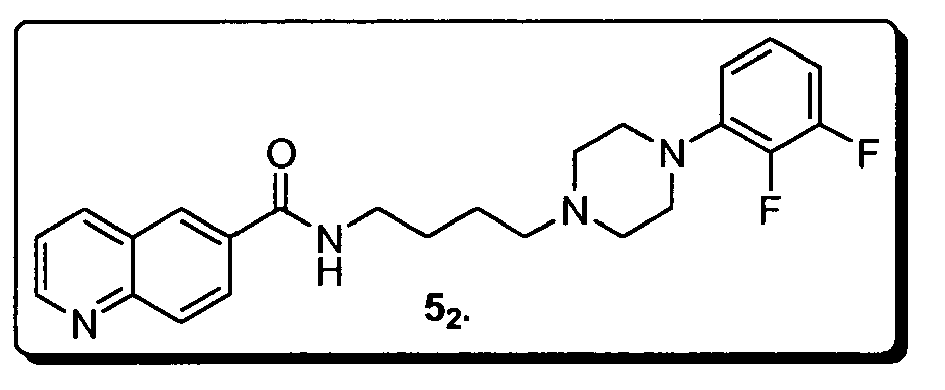
- To a stirred solution of N-(4-bromobutyl)quinoline-6-carboxamide (4) (120.0 mg, 0.39 mmol) in dry acetonitrile (10.0 mL) under argon, 1-(2,3-difluorophenyl)piperazine trifluoroacetate (8) (181 mg, 0.585 mmol) and triethylamine (109 µL, 0.78 mmol) were added and the solution was refluxed overnight under stirring. The solvent was removed and the crude product was chromatographed (10% methanol in chloroform) to give 100.0 mg of 52 (60% yield) as amorphous solid: 1H NMR, 300 MHz, (CDCl3) δ 1.72 (m, 4H), 2.47 (t, 2H, J = 6.9 Hz), 2.61 (m, 4H), 3.06 (m, 4H), 3.54 (q, 2H, J = 6.1 Hz), 6.55 (t, 1H, J = 7.8 Hz), 6.76 (m, 1H), 6.92 (m, 2H), 7.45 (m, 1H), 8.03 (m, 1H), 8.15 (m, 1H), 8.25 (m, 1H), 8.29 (m, 1H), 8.97 (m, 1H). ESI-MS m/z 447 [M+Na]+, 425 [M+H]+. Anal. (C24H26F2N4O) C, H, N.
- The affinity of Compound 5 of the invention for the dopamine and serotonin receptor subtypes was determined using standard receptor binding assays accomplished by MDS Pharma Services using the assay conditions specified below.
- From these determinations the Compound 5 of the invention was found to be selective for dopamine D3 and having a Ki in the subnanomolar range.
-
- Human recombinant CHO cells
- Ligand = 0.7 nM [3H]-Spiperone
- Non-specific = 25 µM S(-)-Sulpiride
-
- Human recombinant (CHO cells)
- Ligand = 1.5 nM [3H] 8-OH-DPAT
- Non-specific = 10 µM Metergoline
-
- Human recombinant (CHO cells)
- Ligand = 0.5 nM [3H] Ketanserin
- Non-specific = 1 µM Mianserin
Claims (12)
- An aryl piperazine derivative represented by Formula I

- The aryl piperazine derivative of claim 1, or a pharmaceutically acceptable salt thereof, wherein R1, R2 and R3, independently of each other, represent hydrogen, methyl, hydroxy, methoxy, halo or trifluoromethyl.
- The aryl piperazine derivative of claims 1, or a pharmaceutically acceptable salt thereof, wherein R1, R2 and R3, independently of each other, represent hydrogen, halo, hydroxy or trifluoromethyl.
- The aryl piperazine derivative of claim 1, or a pharmaceutically acceptable salt thereof, wherein R1, R2 and R3, independently of each other, represent hydrogen, fluoro, chloro, bromo or trifluoromethyl.
- The aryl piperazine derivative of claim 1, or a pharmaceutically acceptable salt thereof, wherein
one of R1, R2 and R3, represents hydrogen or hydroxy; and
the two others of R1, R2 and R3, independently of each other, represent methyl, methoxy, halo, trifluoromethyl, cyano or carboxy. - The aryl piperazine derivative of claim 1, or a pharmaceutically acceptable salt thereof, wherein
two of R1, R2 and R3, represents hydrogen; and
the last one of R1, R2 and R3 represent methyl, hydroxy, methoxy, halo, trifluoromethyl, cyano or carboxy. - The aryl piperazine derivative of claim 1, which is
N-(4-(4-Phenylpiperazin-1-yl)butyl)quinoline-6-carboxamide; or
Quinoline-6-carboxylic acid {4-[4-(2,3-difluoro-phenyl)-piperazin-1-yl]-butyl}-amide;
an enantiomer thereof or a mixture of its enantiomers, or a pharmaceutically acceptable salt thereof. - A pharmaceutical composition comprising a therapeutically effective amount of an aryl piperazine derivative of any one of claims 1-7, or a pharmaceutically- acceptable addition salt thereof, together with at least one pharmaceutically acceptable carrier or diluent.
- The aryl piperazine derivative of any one of claims 1-7, or a pharmaceutically acceptable salt thereof, for use as a medicament.
- Use of the aryl piperazine derivative of any one of claims 1-7, or a pharmaceutically acceptable salt thereof, for the manufacture of a pharmaceutical composition.
- Use of the aryl piperazine derivative of any one of claims 1-7, or a pharmaceutically acceptable salt thereof, for the manufacture of a pharmaceutical composition for the treatment, prevention or alleviation of psychotic disorders, ind. scnizophrenia, depression, Parkinson's disease, Huntington's disease, movement disorders, dystonia, anxiety, restlessness, obsessive-compulsive disorders, mania, geriatric disorders, dementia, sexual dysfunction, musculo-skeletal pain symptoms, pain associated with fibromyalgia, sleep disorders, substance abuse or addiction, abuse liability and withdrawal symptoms in drug addicts, cocaine abuse or addiction.
- The use according to claim 11, wherein the disease or a disorder or a condition is schizophrenia.
Applications Claiming Priority (3)
| Application Number | Priority Date | Filing Date | Title |
|---|---|---|---|
| US85131006P | 2006-10-13 | 2006-10-13 | |
| DKPA200601328 | 2006-10-13 | ||
| PCT/EP2007/060888 WO2008043839A1 (en) | 2006-10-13 | 2007-10-12 | Aryl piperazine derivatives useful for the treatment of neuropsychiatry disorders |
Publications (2)
| Publication Number | Publication Date |
|---|---|
| EP2081907A1 EP2081907A1 (en) | 2009-07-29 |
| EP2081907B1 true EP2081907B1 (en) | 2011-01-26 |
Family
ID=38896827
Family Applications (1)
| Application Number | Title | Priority Date | Filing Date |
|---|---|---|---|
| EP07821255A Not-in-force EP2081907B1 (en) | 2006-10-13 | 2007-10-12 | Aryl piperazine derivatives useful for the treatment of neuropsychiatry disorders |
Country Status (7)
| Country | Link |
|---|---|
| US (1) | US20100087445A1 (en) |
| EP (1) | EP2081907B1 (en) |
| JP (1) | JP2010505919A (en) |
| AU (1) | AU2007306274A1 (en) |
| CA (1) | CA2672920A1 (en) |
| MX (1) | MX2009003390A (en) |
| WO (1) | WO2008043839A1 (en) |
Families Citing this family (3)
| Publication number | Priority date | Publication date | Assignee | Title |
|---|---|---|---|---|
| EP2238125A1 (en) * | 2008-02-01 | 2010-10-13 | NeuroSearch A/S | Novel aryl piperazine derivatives useful as modulators of dopamine and serotonin receptors |
| WO2010040808A1 (en) * | 2008-10-10 | 2010-04-15 | Neurosearch A/S | Novel quinolinylamide derivatives useful as modulators of dopamine and serotonin receptors |
| EP2625895B1 (en) | 2010-10-07 | 2016-12-07 | Telefonaktiebolaget LM Ericsson (publ) | Time slot sharing in tdma communication system |
Family Cites Families (3)
| Publication number | Priority date | Publication date | Assignee | Title |
|---|---|---|---|---|
| US4803203A (en) | 1986-11-05 | 1989-02-07 | Warner-Lambert Company | Phenyl and heterocyclic piperazinyl alkoxy-benzheterocyclic compounds as antipsychotic agents |
| HUP0103987A3 (en) * | 2001-09-28 | 2004-11-29 | Richter Gedeon Vegyeszet | Phenylpiperazinylalkyl carboxylic acid amid derivatives, process for their preparation, pharmaceutical compositions containing them and their intermediates |
| US20090238761A1 (en) * | 2005-01-03 | 2009-09-24 | Universita Degli Studi Di Siena | Novel Aryl Piperazine Derivatives With Medical Utility |
-
2007
- 2007-10-12 WO PCT/EP2007/060888 patent/WO2008043839A1/en not_active Ceased
- 2007-10-12 CA CA002672920A patent/CA2672920A1/en not_active Abandoned
- 2007-10-12 US US12/445,370 patent/US20100087445A1/en not_active Abandoned
- 2007-10-12 JP JP2009531858A patent/JP2010505919A/en not_active Abandoned
- 2007-10-12 MX MX2009003390A patent/MX2009003390A/en not_active Application Discontinuation
- 2007-10-12 AU AU2007306274A patent/AU2007306274A1/en not_active Abandoned
- 2007-10-12 EP EP07821255A patent/EP2081907B1/en not_active Not-in-force
Also Published As
| Publication number | Publication date |
|---|---|
| US20100087445A1 (en) | 2010-04-08 |
| CA2672920A1 (en) | 2008-04-17 |
| EP2081907A1 (en) | 2009-07-29 |
| AU2007306274A1 (en) | 2008-04-17 |
| WO2008043839A1 (en) | 2008-04-17 |
| JP2010505919A (en) | 2010-02-25 |
| MX2009003390A (en) | 2009-04-09 |
Similar Documents
| Publication | Publication Date | Title |
|---|---|---|
| JPH09291034A (en) | Condensed pyridine compound and its use as a medicine | |
| JP2922122B2 (en) | Aminoquinoline derivative | |
| KR19990028757A (en) | Benzo [g] quinoline derivatives | |
| EP1268466A1 (en) | Decahydro-isoquinolines | |
| JPH04211058A (en) | Nerve-stabilizing 3-piperidino-4-hydroxycoumarone derivative | |
| JPS63277671A (en) | 3-amino-dihydro-(1)-benzopyrane and benzothiopyrane | |
| HU186523B (en) | Process for producing quinoline derivatives | |
| JPH10504315A (en) | Biphenylamide derivatives as 5HT 1D antagonists | |
| US20100087445A1 (en) | Aryl piperazine derivatives useful for the treatment of neuropsychiatry disorders | |
| US20040034036A1 (en) | N-(3,5-dichloro-2-methoxyphenyl)-4-methoxy-3-piperazin-1-yl-benzenesulfonamide | |
| JPH09506885A (en) | Indole, indoline and quinoline derivatives having 5HT-1D (anti-depressant) activity | |
| US20110059019A1 (en) | Novel aryl piperazine derivatives useful as modulators of dopamine and serotonin receptors | |
| US20110085978A1 (en) | Novel quinolinylamide derivatives useful as modulators of dopamine and serotonin receptors | |
| JPH07258233A (en) | New aminoalkylbenzoxazolinone and benzo- thiazolinone, their production and pharmaceutical compositions containing them | |
| EP0175452B1 (en) | 1,3-disubstituted piperidine compounds as neuroleptic agents | |
| JPH037280A (en) | Novel benzothiopyranylamine | |
| US20110207773A1 (en) | Novel phenyl-quinoline-carboxylic acid pyridine derivatives useful as modulators of nicotinic acetylcholine receptors | |
| HUT77316A (en) | 6-methoxy-1h-benzotriazole-5-carboxamide derivatives, process for producing the same, and medicinal composition containing the same | |
| CN101568524A (en) | Aryl piperazine derivatives useful for the treatment of neuropsychiatry disorders | |
| SK137597A3 (en) | 1-£'omega'-(3,4-dihydro-2-naphthalenyl)alkyl| cyclic amine derivatives, process for producing the same, and medicinal composition containing the same | |
| JPH07304740A (en) | Carbostyril derivative | |
| JP2001512491A (en) | 1- (isoquinolin-1-yl) -4- (1-phenylmethyl) piperazine; a dopamine receptor subtype-specific ligand | |
| JP2002504125A (en) | Dopamine D (2) 2-aminoalkylaminoquinoline as ligand | |
| WO2010040808A1 (en) | Novel quinolinylamide derivatives useful as modulators of dopamine and serotonin receptors | |
| JPH07165720A (en) | Carbostyril derivative and therapeutic agent for schizophrenia containing the same derivative |
Legal Events
| Date | Code | Title | Description |
|---|---|---|---|
| PUAI | Public reference made under article 153(3) epc to a published international application that has entered the european phase |
Free format text: ORIGINAL CODE: 0009012 |
|
| 17P | Request for examination filed |
Effective date: 20090513 |
|
| AK | Designated contracting states |
Kind code of ref document: A1 Designated state(s): AT BE BG CH CY CZ DE DK EE ES FI FR GB GR HU IE IS IT LI LT LU LV MC MT NL PL PT RO SE SI SK TR |
|
| 17Q | First examination report despatched |
Effective date: 20090728 |
|
| DAX | Request for extension of the european patent (deleted) | ||
| GRAP | Despatch of communication of intention to grant a patent |
Free format text: ORIGINAL CODE: EPIDOSNIGR1 |
|
| GRAS | Grant fee paid |
Free format text: ORIGINAL CODE: EPIDOSNIGR3 |
|
| GRAA | (expected) grant |
Free format text: ORIGINAL CODE: 0009210 |
|
| AK | Designated contracting states |
Kind code of ref document: B1 Designated state(s): AT BE BG CH CY CZ DE DK EE ES FI FR GB GR HU IE IS IT LI LT LU LV MC MT NL PL PT RO SE SI SK TR |
|
| REG | Reference to a national code |
Ref country code: GB Ref legal event code: FG4D |
|
| REG | Reference to a national code |
Ref country code: CH Ref legal event code: EP |
|
| REG | Reference to a national code |
Ref country code: IE Ref legal event code: FG4D |
|
| REF | Corresponds to: |
Ref document number: 602007012285 Country of ref document: DE Date of ref document: 20110310 Kind code of ref document: P |
|
| REG | Reference to a national code |
Ref country code: DE Ref legal event code: R096 Ref document number: 602007012285 Country of ref document: DE Effective date: 20110310 |
|
| REG | Reference to a national code |
Ref country code: NL Ref legal event code: VDEP Effective date: 20110126 |
|
| LTIE | Lt: invalidation of european patent or patent extension |
Effective date: 20110126 |
|
| PG25 | Lapsed in a contracting state [announced via postgrant information from national office to epo] |
Ref country code: SE Free format text: LAPSE BECAUSE OF FAILURE TO SUBMIT A TRANSLATION OF THE DESCRIPTION OR TO PAY THE FEE WITHIN THE PRESCRIBED TIME-LIMIT Effective date: 20110126 Ref country code: PT Free format text: LAPSE BECAUSE OF FAILURE TO SUBMIT A TRANSLATION OF THE DESCRIPTION OR TO PAY THE FEE WITHIN THE PRESCRIBED TIME-LIMIT Effective date: 20110526 Ref country code: LV Free format text: LAPSE BECAUSE OF FAILURE TO SUBMIT A TRANSLATION OF THE DESCRIPTION OR TO PAY THE FEE WITHIN THE PRESCRIBED TIME-LIMIT Effective date: 20110126 Ref country code: LT Free format text: LAPSE BECAUSE OF FAILURE TO SUBMIT A TRANSLATION OF THE DESCRIPTION OR TO PAY THE FEE WITHIN THE PRESCRIBED TIME-LIMIT Effective date: 20110126 Ref country code: IS Free format text: LAPSE BECAUSE OF FAILURE TO SUBMIT A TRANSLATION OF THE DESCRIPTION OR TO PAY THE FEE WITHIN THE PRESCRIBED TIME-LIMIT Effective date: 20110526 Ref country code: GR Free format text: LAPSE BECAUSE OF FAILURE TO SUBMIT A TRANSLATION OF THE DESCRIPTION OR TO PAY THE FEE WITHIN THE PRESCRIBED TIME-LIMIT Effective date: 20110427 Ref country code: ES Free format text: LAPSE BECAUSE OF FAILURE TO SUBMIT A TRANSLATION OF THE DESCRIPTION OR TO PAY THE FEE WITHIN THE PRESCRIBED TIME-LIMIT Effective date: 20110507 |
|
| PG25 | Lapsed in a contracting state [announced via postgrant information from national office to epo] |
Ref country code: NL Free format text: LAPSE BECAUSE OF FAILURE TO SUBMIT A TRANSLATION OF THE DESCRIPTION OR TO PAY THE FEE WITHIN THE PRESCRIBED TIME-LIMIT Effective date: 20110126 Ref country code: BG Free format text: LAPSE BECAUSE OF FAILURE TO SUBMIT A TRANSLATION OF THE DESCRIPTION OR TO PAY THE FEE WITHIN THE PRESCRIBED TIME-LIMIT Effective date: 20110426 Ref country code: CY Free format text: LAPSE BECAUSE OF FAILURE TO SUBMIT A TRANSLATION OF THE DESCRIPTION OR TO PAY THE FEE WITHIN THE PRESCRIBED TIME-LIMIT Effective date: 20110126 Ref country code: BE Free format text: LAPSE BECAUSE OF FAILURE TO SUBMIT A TRANSLATION OF THE DESCRIPTION OR TO PAY THE FEE WITHIN THE PRESCRIBED TIME-LIMIT Effective date: 20110126 Ref country code: AT Free format text: LAPSE BECAUSE OF FAILURE TO SUBMIT A TRANSLATION OF THE DESCRIPTION OR TO PAY THE FEE WITHIN THE PRESCRIBED TIME-LIMIT Effective date: 20110126 Ref country code: SI Free format text: LAPSE BECAUSE OF FAILURE TO SUBMIT A TRANSLATION OF THE DESCRIPTION OR TO PAY THE FEE WITHIN THE PRESCRIBED TIME-LIMIT Effective date: 20110126 Ref country code: PL Free format text: LAPSE BECAUSE OF FAILURE TO SUBMIT A TRANSLATION OF THE DESCRIPTION OR TO PAY THE FEE WITHIN THE PRESCRIBED TIME-LIMIT Effective date: 20110126 Ref country code: FI Free format text: LAPSE BECAUSE OF FAILURE TO SUBMIT A TRANSLATION OF THE DESCRIPTION OR TO PAY THE FEE WITHIN THE PRESCRIBED TIME-LIMIT Effective date: 20110126 |
|
| PG25 | Lapsed in a contracting state [announced via postgrant information from national office to epo] |
Ref country code: EE Free format text: LAPSE BECAUSE OF FAILURE TO SUBMIT A TRANSLATION OF THE DESCRIPTION OR TO PAY THE FEE WITHIN THE PRESCRIBED TIME-LIMIT Effective date: 20110126 Ref country code: DK Free format text: LAPSE BECAUSE OF FAILURE TO SUBMIT A TRANSLATION OF THE DESCRIPTION OR TO PAY THE FEE WITHIN THE PRESCRIBED TIME-LIMIT Effective date: 20110126 |
|
| PG25 | Lapsed in a contracting state [announced via postgrant information from national office to epo] |
Ref country code: SK Free format text: LAPSE BECAUSE OF FAILURE TO SUBMIT A TRANSLATION OF THE DESCRIPTION OR TO PAY THE FEE WITHIN THE PRESCRIBED TIME-LIMIT Effective date: 20110126 Ref country code: CZ Free format text: LAPSE BECAUSE OF FAILURE TO SUBMIT A TRANSLATION OF THE DESCRIPTION OR TO PAY THE FEE WITHIN THE PRESCRIBED TIME-LIMIT Effective date: 20110126 Ref country code: RO Free format text: LAPSE BECAUSE OF FAILURE TO SUBMIT A TRANSLATION OF THE DESCRIPTION OR TO PAY THE FEE WITHIN THE PRESCRIBED TIME-LIMIT Effective date: 20110126 |
|
| PLBE | No opposition filed within time limit |
Free format text: ORIGINAL CODE: 0009261 |
|
| STAA | Information on the status of an ep patent application or granted ep patent |
Free format text: STATUS: NO OPPOSITION FILED WITHIN TIME LIMIT |
|
| 26N | No opposition filed |
Effective date: 20111027 |
|
| REG | Reference to a national code |
Ref country code: DE Ref legal event code: R097 Ref document number: 602007012285 Country of ref document: DE Effective date: 20111027 |
|
| PG25 | Lapsed in a contracting state [announced via postgrant information from national office to epo] |
Ref country code: MC Free format text: LAPSE BECAUSE OF NON-PAYMENT OF DUE FEES Effective date: 20111031 Ref country code: IT Free format text: LAPSE BECAUSE OF FAILURE TO SUBMIT A TRANSLATION OF THE DESCRIPTION OR TO PAY THE FEE WITHIN THE PRESCRIBED TIME-LIMIT Effective date: 20110126 |
|
| REG | Reference to a national code |
Ref country code: CH Ref legal event code: PL |
|
| GBPC | Gb: european patent ceased through non-payment of renewal fee |
Effective date: 20111012 |
|
| REG | Reference to a national code |
Ref country code: FR Ref legal event code: ST Effective date: 20120629 |
|
| PG25 | Lapsed in a contracting state [announced via postgrant information from national office to epo] |
Ref country code: CH Free format text: LAPSE BECAUSE OF NON-PAYMENT OF DUE FEES Effective date: 20111031 Ref country code: DE Free format text: LAPSE BECAUSE OF NON-PAYMENT OF DUE FEES Effective date: 20120501 Ref country code: LI Free format text: LAPSE BECAUSE OF NON-PAYMENT OF DUE FEES Effective date: 20111031 |
|
| REG | Reference to a national code |
Ref country code: IE Ref legal event code: MM4A |
|
| REG | Reference to a national code |
Ref country code: DE Ref legal event code: R119 Ref document number: 602007012285 Country of ref document: DE Effective date: 20120501 |
|
| PG25 | Lapsed in a contracting state [announced via postgrant information from national office to epo] |
Ref country code: GB Free format text: LAPSE BECAUSE OF NON-PAYMENT OF DUE FEES Effective date: 20111012 Ref country code: FR Free format text: LAPSE BECAUSE OF NON-PAYMENT OF DUE FEES Effective date: 20111102 |
|
| PG25 | Lapsed in a contracting state [announced via postgrant information from national office to epo] |
Ref country code: IE Free format text: LAPSE BECAUSE OF NON-PAYMENT OF DUE FEES Effective date: 20111012 |
|
| PG25 | Lapsed in a contracting state [announced via postgrant information from national office to epo] |
Ref country code: MT Free format text: LAPSE BECAUSE OF FAILURE TO SUBMIT A TRANSLATION OF THE DESCRIPTION OR TO PAY THE FEE WITHIN THE PRESCRIBED TIME-LIMIT Effective date: 20110126 |
|
| PG25 | Lapsed in a contracting state [announced via postgrant information from national office to epo] |
Ref country code: LU Free format text: LAPSE BECAUSE OF NON-PAYMENT OF DUE FEES Effective date: 20111012 |
|
| PG25 | Lapsed in a contracting state [announced via postgrant information from national office to epo] |
Ref country code: TR Free format text: LAPSE BECAUSE OF FAILURE TO SUBMIT A TRANSLATION OF THE DESCRIPTION OR TO PAY THE FEE WITHIN THE PRESCRIBED TIME-LIMIT Effective date: 20110126 |
|
| PG25 | Lapsed in a contracting state [announced via postgrant information from national office to epo] |
Ref country code: HU Free format text: LAPSE BECAUSE OF FAILURE TO SUBMIT A TRANSLATION OF THE DESCRIPTION OR TO PAY THE FEE WITHIN THE PRESCRIBED TIME-LIMIT Effective date: 20110126 |