EP2076129B1 - Novel curcumin dimer - Google Patents
Novel curcumin dimer Download PDFInfo
- Publication number
- EP2076129B1 EP2076129B1 EP07852691.0A EP07852691A EP2076129B1 EP 2076129 B1 EP2076129 B1 EP 2076129B1 EP 07852691 A EP07852691 A EP 07852691A EP 2076129 B1 EP2076129 B1 EP 2076129B1
- Authority
- EP
- European Patent Office
- Prior art keywords
- curcumin
- mmol
- derivatives
- mono
- dextran
- Prior art date
- Legal status (The legal status is an assumption and is not a legal conclusion. Google has not performed a legal analysis and makes no representation as to the accuracy of the status listed.)
- Active
Links
- 0 **C1C(*)=CC(*C(CC(*c(cc2*)ccc2O)=O)=*)=CC1 Chemical compound **C1C(*)=CC(*C(CC(*c(cc2*)ccc2O)=O)=*)=CC1 0.000 description 3
- YHIIZEUUZWLAMM-UHFFFAOYSA-O CCc(cc1N=C=O)ccc1[OH2+] Chemical compound CCc(cc1N=C=O)ccc1[OH2+] YHIIZEUUZWLAMM-UHFFFAOYSA-O 0.000 description 1
Classifications
-
- C—CHEMISTRY; METALLURGY
- C07—ORGANIC CHEMISTRY
- C07C—ACYCLIC OR CARBOCYCLIC COMPOUNDS
- C07C229/00—Compounds containing amino and carboxyl groups bound to the same carbon skeleton
- C07C229/02—Compounds containing amino and carboxyl groups bound to the same carbon skeleton having amino and carboxyl groups bound to acyclic carbon atoms of the same carbon skeleton
- C07C229/04—Compounds containing amino and carboxyl groups bound to the same carbon skeleton having amino and carboxyl groups bound to acyclic carbon atoms of the same carbon skeleton the carbon skeleton being acyclic and saturated
- C07C229/06—Compounds containing amino and carboxyl groups bound to the same carbon skeleton having amino and carboxyl groups bound to acyclic carbon atoms of the same carbon skeleton the carbon skeleton being acyclic and saturated having only one amino and one carboxyl group bound to the carbon skeleton
- C07C229/10—Compounds containing amino and carboxyl groups bound to the same carbon skeleton having amino and carboxyl groups bound to acyclic carbon atoms of the same carbon skeleton the carbon skeleton being acyclic and saturated having only one amino and one carboxyl group bound to the carbon skeleton the nitrogen atom of the amino group being further bound to acyclic carbon atoms or to carbon atoms of rings other than six-membered aromatic rings
- C07C229/12—Compounds containing amino and carboxyl groups bound to the same carbon skeleton having amino and carboxyl groups bound to acyclic carbon atoms of the same carbon skeleton the carbon skeleton being acyclic and saturated having only one amino and one carboxyl group bound to the carbon skeleton the nitrogen atom of the amino group being further bound to acyclic carbon atoms or to carbon atoms of rings other than six-membered aromatic rings to carbon atoms of acyclic carbon skeletons
-
- A—HUMAN NECESSITIES
- A61—MEDICAL OR VETERINARY SCIENCE; HYGIENE
- A61K—PREPARATIONS FOR MEDICAL, DENTAL OR TOILETRY PURPOSES
- A61K8/00—Cosmetics or similar toiletry preparations
- A61K8/18—Cosmetics or similar toiletry preparations characterised by the composition
- A61K8/30—Cosmetics or similar toiletry preparations characterised by the composition containing organic compounds
- A61K8/33—Cosmetics or similar toiletry preparations characterised by the composition containing organic compounds containing oxygen
- A61K8/37—Esters of carboxylic acids
-
- A—HUMAN NECESSITIES
- A61—MEDICAL OR VETERINARY SCIENCE; HYGIENE
- A61K—PREPARATIONS FOR MEDICAL, DENTAL OR TOILETRY PURPOSES
- A61K8/00—Cosmetics or similar toiletry preparations
- A61K8/18—Cosmetics or similar toiletry preparations characterised by the composition
- A61K8/30—Cosmetics or similar toiletry preparations characterised by the composition containing organic compounds
- A61K8/33—Cosmetics or similar toiletry preparations characterised by the composition containing organic compounds containing oxygen
- A61K8/39—Derivatives containing from 2 to 10 oxyalkylene groups
-
- A—HUMAN NECESSITIES
- A61—MEDICAL OR VETERINARY SCIENCE; HYGIENE
- A61K—PREPARATIONS FOR MEDICAL, DENTAL OR TOILETRY PURPOSES
- A61K8/00—Cosmetics or similar toiletry preparations
- A61K8/18—Cosmetics or similar toiletry preparations characterised by the composition
- A61K8/30—Cosmetics or similar toiletry preparations characterised by the composition containing organic compounds
- A61K8/49—Cosmetics or similar toiletry preparations characterised by the composition containing organic compounds containing heterocyclic compounds
- A61K8/494—Cosmetics or similar toiletry preparations characterised by the composition containing organic compounds containing heterocyclic compounds with more than one nitrogen as the only hetero atom
- A61K8/496—Triazoles or their condensed derivatives, e.g. benzotriazoles
-
- A—HUMAN NECESSITIES
- A61—MEDICAL OR VETERINARY SCIENCE; HYGIENE
- A61K—PREPARATIONS FOR MEDICAL, DENTAL OR TOILETRY PURPOSES
- A61K8/00—Cosmetics or similar toiletry preparations
- A61K8/18—Cosmetics or similar toiletry preparations characterised by the composition
- A61K8/72—Cosmetics or similar toiletry preparations characterised by the composition containing organic macromolecular compounds
- A61K8/81—Cosmetics or similar toiletry preparations characterised by the composition containing organic macromolecular compounds obtained by reactions involving only carbon-to-carbon unsaturated bonds
- A61K8/8141—Compositions of homopolymers or copolymers of compounds having one or more unsaturated aliphatic radicals, each having only one carbon-to-carbon double bond, and at least one being terminated by only one carboxyl radical, or of salts, anhydrides, esters, amides, imides or nitriles thereof; Compositions of derivatives of such polymers
- A61K8/8147—Homopolymers or copolymers of acids; Metal or ammonium salts thereof, e.g. crotonic acid, (meth)acrylic acid; Compositions of derivatives of such polymers
-
- A—HUMAN NECESSITIES
- A61—MEDICAL OR VETERINARY SCIENCE; HYGIENE
- A61P—SPECIFIC THERAPEUTIC ACTIVITY OF CHEMICAL COMPOUNDS OR MEDICINAL PREPARATIONS
- A61P25/00—Drugs for disorders of the nervous system
-
- A—HUMAN NECESSITIES
- A61—MEDICAL OR VETERINARY SCIENCE; HYGIENE
- A61P—SPECIFIC THERAPEUTIC ACTIVITY OF CHEMICAL COMPOUNDS OR MEDICINAL PREPARATIONS
- A61P25/00—Drugs for disorders of the nervous system
- A61P25/28—Drugs for disorders of the nervous system for treating neurodegenerative disorders of the central nervous system, e.g. nootropic agents, cognition enhancers, drugs for treating Alzheimer's disease or other forms of dementia
-
- A—HUMAN NECESSITIES
- A61—MEDICAL OR VETERINARY SCIENCE; HYGIENE
- A61P—SPECIFIC THERAPEUTIC ACTIVITY OF CHEMICAL COMPOUNDS OR MEDICINAL PREPARATIONS
- A61P35/00—Antineoplastic agents
-
- A—HUMAN NECESSITIES
- A61—MEDICAL OR VETERINARY SCIENCE; HYGIENE
- A61P—SPECIFIC THERAPEUTIC ACTIVITY OF CHEMICAL COMPOUNDS OR MEDICINAL PREPARATIONS
- A61P39/00—General protective or antinoxious agents
- A61P39/06—Free radical scavengers or antioxidants
-
- A—HUMAN NECESSITIES
- A61—MEDICAL OR VETERINARY SCIENCE; HYGIENE
- A61Q—SPECIFIC USE OF COSMETICS OR SIMILAR TOILETRY PREPARATIONS
- A61Q19/00—Preparations for care of the skin
- A61Q19/02—Preparations for care of the skin for chemically bleaching or whitening the skin
-
- C—CHEMISTRY; METALLURGY
- C07—ORGANIC CHEMISTRY
- C07C—ACYCLIC OR CARBOCYCLIC COMPOUNDS
- C07C247/00—Compounds containing azido groups
- C07C247/02—Compounds containing azido groups with azido groups bound to acyclic carbon atoms of a carbon skeleton
- C07C247/04—Compounds containing azido groups with azido groups bound to acyclic carbon atoms of a carbon skeleton being saturated
-
- C—CHEMISTRY; METALLURGY
- C07—ORGANIC CHEMISTRY
- C07C—ACYCLIC OR CARBOCYCLIC COMPOUNDS
- C07C49/00—Ketones; Ketenes; Dimeric ketenes; Ketonic chelates
- C07C49/20—Unsaturated compounds containing keto groups bound to acyclic carbon atoms
- C07C49/24—Unsaturated compounds containing keto groups bound to acyclic carbon atoms containing hydroxy groups
- C07C49/245—Unsaturated compounds containing keto groups bound to acyclic carbon atoms containing hydroxy groups containing six-membered aromatic rings
- C07C49/248—Unsaturated compounds containing keto groups bound to acyclic carbon atoms containing hydroxy groups containing six-membered aromatic rings having unsaturation outside the aromatic rings
-
- C—CHEMISTRY; METALLURGY
- C07—ORGANIC CHEMISTRY
- C07C—ACYCLIC OR CARBOCYCLIC COMPOUNDS
- C07C49/00—Ketones; Ketenes; Dimeric ketenes; Ketonic chelates
- C07C49/20—Unsaturated compounds containing keto groups bound to acyclic carbon atoms
- C07C49/255—Unsaturated compounds containing keto groups bound to acyclic carbon atoms containing ether groups, groups, groups, or groups
-
- C—CHEMISTRY; METALLURGY
- C07—ORGANIC CHEMISTRY
- C07C—ACYCLIC OR CARBOCYCLIC COMPOUNDS
- C07C69/00—Esters of carboxylic acids; Esters of carbonic or haloformic acids
- C07C69/52—Esters of acyclic unsaturated carboxylic acids having the esterified carboxyl group bound to an acyclic carbon atom
-
- C—CHEMISTRY; METALLURGY
- C07—ORGANIC CHEMISTRY
- C07C—ACYCLIC OR CARBOCYCLIC COMPOUNDS
- C07C69/00—Esters of carboxylic acids; Esters of carbonic or haloformic acids
- C07C69/52—Esters of acyclic unsaturated carboxylic acids having the esterified carboxyl group bound to an acyclic carbon atom
- C07C69/602—Dicarboxylic acid esters having at least two carbon-to-carbon double bonds
-
- C—CHEMISTRY; METALLURGY
- C07—ORGANIC CHEMISTRY
- C07D—HETEROCYCLIC COMPOUNDS
- C07D249/00—Heterocyclic compounds containing five-membered rings having three nitrogen atoms as the only ring hetero atoms
- C07D249/02—Heterocyclic compounds containing five-membered rings having three nitrogen atoms as the only ring hetero atoms not condensed with other rings
- C07D249/04—1,2,3-Triazoles; Hydrogenated 1,2,3-triazoles
-
- A—HUMAN NECESSITIES
- A61—MEDICAL OR VETERINARY SCIENCE; HYGIENE
- A61K—PREPARATIONS FOR MEDICAL, DENTAL OR TOILETRY PURPOSES
- A61K2800/00—Properties of cosmetic compositions or active ingredients thereof or formulation aids used therein and process related aspects
- A61K2800/40—Chemical, physico-chemical or functional or structural properties of particular ingredients
- A61K2800/52—Stabilizers
- A61K2800/522—Antioxidants; Radical scavengers
-
- A—HUMAN NECESSITIES
- A61—MEDICAL OR VETERINARY SCIENCE; HYGIENE
- A61K—PREPARATIONS FOR MEDICAL, DENTAL OR TOILETRY PURPOSES
- A61K2800/00—Properties of cosmetic compositions or active ingredients thereof or formulation aids used therein and process related aspects
- A61K2800/40—Chemical, physico-chemical or functional or structural properties of particular ingredients
- A61K2800/56—Compounds, absorbed onto or entrapped into a solid carrier, e.g. encapsulated perfumes, inclusion compounds, sustained release forms
Definitions
- Curcuma Longa commonly referred to as turmeric is used in south Asian cooking, as a cosmetic, and in the ancient Ayurvedic system of medicine.
- the Banerjee lab at College of Staten Island and other groups have established that curcumin (1Z,6Z)-1,7-bis(4-hydroxy-3-methoxyphenyl)hepta-1,6-diene 3,5-dione, the primary active ingredient in turmeric, has potent anticancer properties. Curcumin exerts its anticancer effect through the suppression of NF-k ⁇ .
- Curcumin mediates its therapeutic effect by regulating the transcription factor NF-k ⁇ and NF-k ⁇ regulated gene products COX-2, cyclin Dl, adhesion molecules, MMPs, inducible nitric oxide synthase, Bc1-XL, Be 1-2 and TNF.
- curcumin has two phenolic groups, which can be used for chemical modification. Most curcumin derivatives reported in literature are symmetric in that both the phenolic groups have been chemically modified in the same wary. Rare exceptions have been reported.
- the Mizushina, et al. reference [5] reported the use of monoacetylcurcumin as an inhibitor of eukaryotic DNA polymerase ⁇ and as a ligand for inhibitor-affinity chromntography. See Mizushina, et al. Monoacetylcurcumin; A new inhibitor of eukaryotic DNA polymerase and a new ligand for inhibitor-affinity chromatography, Biochemical and Biophysical Research Communications (2005) 337, 1288-1295 . The utility of monoacctylcurcumin is limited since it docs not contain a reactive group at the phenolic position.
- curcumin One of the major limitations of ummodified curcumin is its poor water and plasma solubility. A recent study has shown that even doses as high as 8 g of curcumin per day administered to human subjects result in an average peak serum concentration of only 652.5 ng/ml [9]. There is a need for curcumin derivatives that have improved water solubility and that still maintain their biological activity. For example, unmodified phenolic groups, in many cases, are responsible for beneficial antioxidant properties.
- US 5,861,415 describes abioprotectant composition containing curcuminoids, their method of use and extraction processes for obtaining them. Curcuminoids were found to have anti-oxidant, anti-inflammatory, antibacterial, antifungal, anti parasitic, antimutagen, anticancer, and detox properties.
- US 5,891,924 describes a method of inhibiting the activation of NF kappa B transcription factor using curcumin.
- US 6,653,327 describes a cross-regulin composition of turmeric derived tetrahydrocurcumin (THC) for skin lightening and protection against UVB rays.
- THC turmeric derived tetrahydrocurcumin
- the invention relates to a curcumin dimer of the formula according to claim 1.
- curcumin monomers with the following modification at the phenolic group a single acrylate or methacrylate, a single carboxylic acid, alkyne, N-Hydroxysuccinimide, a single azide group and Curcumin/tetrahydrocurcumin-triazole PEG, compounds 1a, 1b, 1c, 1d, 1e, and 1f, respectively, are illustrated in Scheme 1.
- the mono-carboxylic acid derivative of curcumin 1b is synthesized by reacting curcumin 1 with glutaric anhydride in the presence of base.
- Curcumin mono-azide derivative 1e is synthesized by an amide coupling reaction between curcumin mono-carboxylic acid 1b and an Amino-PEG Azide using 1,3-dicyclohexylcarbodiimide (DCC) at room temperature,
- DCC 1,3-dicyclohexylcarbodiimide
- the mono-alkyne derivative of curcumin 1c is synthesized by etherifying curcumin with propargyl bromide; K 2 CO 3 is used as a base in DMF at room temperature.
- Mono-triazole-PEG derivative of curcumin 1f is synthesized by condensing mono-alkyne derivative of curcumin 1e with azidotrietheylene glycol under the Sharpless "click" condition (eopper(II) sulfate and sodium ascorbate).
- a curcumin dimer is synthesized by reacting curcumin mono-alkyne derivative 1c with curcumin mono-azide derivative 1e using copper(II) sulfate and sodium ascorbate.
- the curcumin dimer, 1g has two curcumin moieties connected by a triazole link and a PEG spacer.
- the dimer has two phenolic groups like the parent molecule 1.
- the carboxylic acid group of 1b can be conjugated to proteins, biopolymers and synthetic polymers; the azide 1e and the alkyne derivative 1e can be attached to modified proteins and polymers via the "click" bioconjugation reaction.
- Bioconjugates can be synthesized using the curcumin derivatives.
- the reactive curcumin intermediate derivatives react with a variety of biopolymers to for macromolecular entities that can be useful in delivering the curcumin entities in vivo in a biocompatible and efficacious manner that enhances bioactivity.
- the curcumin intermediate derivatives can be reacted with polysaccaride containing pendant amines.
- the curcumin intermediate derivatives can be reacted with proteins having amine residues, e.g. , lysine.
- proteins having amine residues e.g. , lysine.
- An example of this is given in Scheme 5.
- a protein such as avidin containing lysine groups can react with a carboxyl modified curcumin to produce a bioconjugate with an amine linkage.
- a protein with lysine residues which is reacted with a carboxyl containing molecule is described in Raja, et al. "One-Pot Synthesis, Purification, and Formulation of Bionanoparticle-CpG Oligodeoxynucleotide Hepatitis B Surface Antigen Conjugate Vaccine via Tangential Flow Filtration.” Bioconjugate Chem., 2007.
- Synthetic polymers can also be reacted with curcumin intermediate derivatives to form a synthetic polymer conjugate.
- an amine pendant synthetic polymer such as poly 2 amino ethyl methacrylate can be reacted with a carboxyl containing curcumin derivative to produce a synthetic polymer conjugate with pendant curcumin moieties connected to the polymer using amide linkages.
- a carboxylic pendant synthetic polymer such as poly acrylic acid can be reacted with a amine containing curcumin derivative to produce a synthetic polymer conjugate with pendant curcumin moieties connected to the polymer using amide linkages.
- PEG polyethylene glycol
- PEG containing polymers are typically water soluble and biocompatible.
- an azide terminated synthetic polymer such as PEG azide can be reacted with an alkyne containing curcumin derivative to produce a synthetic polymer conjugate with curcumin moieties connected to the polymer using triazole linkages If.
- the monomers can be polymerized to form curcumin polymers and copolymers.
- polymers and copolymers are produced by polymerizing curcumin/tetrahydrocurcumin acrylate and methacrylate by uncontrolled and controlled radical polymerization methods, e.g. . atom transfer radical polymerization or RAFT.
- Synthetic polymers such as poly-2-aminoethyl methacrylate, polylysine, and dendrimers can be covalently modified with multiple amine functionalities
- Polymers displaying multiple copies of azides or alkynes arc shown in Scheme 3.
- Biopolymers including polysaccharides such as dextrans using the curcumin analogs 1a-1e are shown in Scheme 4.
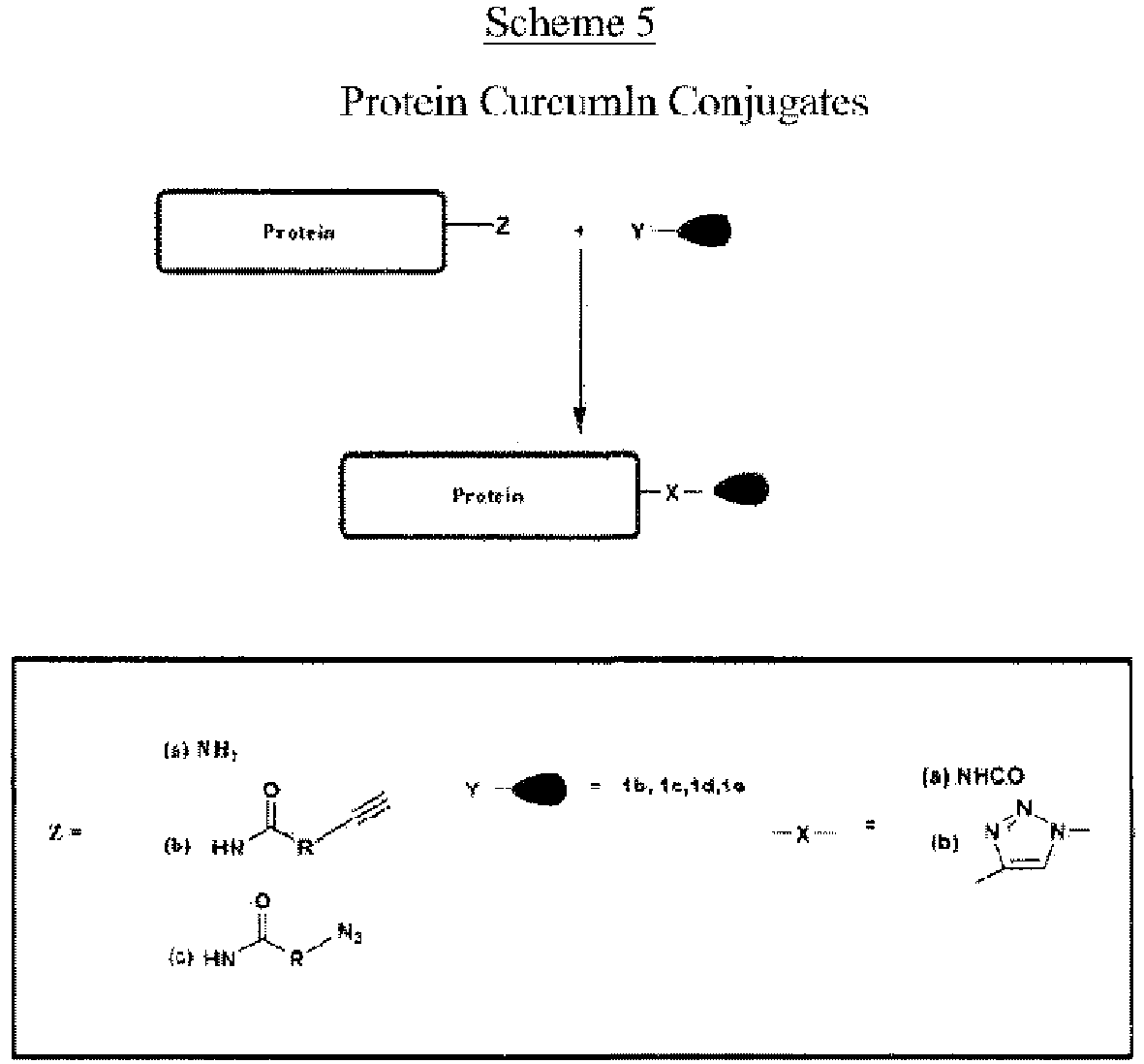
- the chemical modification of proteins such as Protein A, Protein G , Protein I antibodies, avidin, TAT peptide, collagen, elastin and bionanoparticles using the analogs 1a-1e and the resulting curcumin modified polymers are shown in Scheme 5.
- the protein is streptavidin.
- Curcumin/TIIC and the TIIC and curcumin derivatives are used as monomers in step condensation polymerisation to produce both homopolymers and copolymers with comonomers, e.g ., lactic acid, glycolic acids and amino acids, as well as any of the polymers mentioned above.
- comonomers e.g ., lactic acid, glycolic acids and amino acids
- Curcumin-modified dextrans are a typical example of curcumin modified polymers synthesized: Aminated dextrans were conjugated with Curcumin-R-COOH (Ib) (Scheme 4). The resulting conjugates were characterized via size exclusion FPLC. The dextran curcumin conjugates elute at the same retention time as the starting amino dextran and has absorbance maximum at 430 nm, which arises from the conjugated curcumin.
- spacers such as polyethylene glycol or a carbohydrate
- Curcumin has absorbance maximum at 430 nm and a molar extinction coefficient of 50,000; unlike many other dyes curcumin is completely non-toxic. Curcumin dyes can be excited at 460nm to produce strong fluorescence emission. The same optics and technology (for techniques like confocal microscopy, fluorescence microcopy and gel imaging) which have been widely established and commercialized for the chromophore fluorescein can be employed for curcumin conjugates.
- biopolymer component is either a polysaccharide, a protein, DNA or RNA.
- Curcumin-R-COOH (1b) has been modified to produce the corresponding N-hydroxy succinimide (1d), curcumin-alkyne (1c) and curcumin azide (1e).
- Each curcumin derivative is bioconjugated to create a biopolymer that can be used as an eco-friendly dye.
- compounds 1b and 1d can be conveniently conjugated to the lysine residues of proteins, the azide and the alkyne derivatives can be attached to proteins via the 'click' bioconjugation reaction [6,7],
- Compounds 1c and 1e have the advantage that unlike most reactive groups which are used for bioconjugation, alkyne and azide groups are stable in aqueous media (Scheme 5).
- the absorbance and fluorescence properties of these dyes are similar to the parent molecule.
- the molar extinction coefficient of some dyes are presented in Table 1. Table 1.
- AD Alzheimer's disease
- curcumin crosses the blood-brain barrier and binds amyloid plaques.
- curcumin labeled the plaques and reduced amyloid levels and plaque burden [8],
- curcumin analogs in Scheme 1 were analyzed for their ability to label amyloid plaque. The results were good. Curcumin-dextran (50nmol with respect to curcumin) was used to efficiently label human heart tissue (tissue slides were purchased from Sigma), the stained slides were imaged by confocal laser scanning microscopy.
- the curcumin chromophore was excited with a 458 nm laser. Optics employed for the fluorescein chromophore will work efficiently for the curcumin derivatives.
- Congo red is the current dye of choice to stain amyloid tissue [12].
- Congo red has the disadvantage of being toxic.
- a much higher congo red dye concentration must be used for staining compared to the concentration of curcumin.
- curcumin dyes have the advantage of being non-toxic.
- Amyloid plaque (Fibrils) were formed by adding 40 ⁇ L of the amyloid ⁇ peptide AP-40 solution to a 96 well plate (40 ⁇ L per plate) and incubated for 3 days at 37°C. Either Curcumin-COOH or control buffer was added to the wells. The final concentrations were 8 ⁇ M Curcumin-COOH and 50 ⁇ G/mL Ap-40. The Curcumin-COOH and control amyloid plaque samples were incubated for three more days at 37°C. The formation of plaque in the control samples was inferred from the UV spectrum of the control sample.
- the small molecule curcumin analogs including curcumin dimers, curcumin polymers and curcumin modified polymers, typical examples shown in Schemes 1-6 can be used for the treatment of cancer.
- the curcumin dimers and the polymer curcumin conjugate such as dextran-curcumin conjugate arc more potent than the unmodified parent molecule curcumin in their ability to destroy Oligodendroglioma cells.
- Oligodendroglioma cells were treated with 50 micro molar concentration of curcumin and asymmetric curcumin dimer stained with DAPPI presented.
- the curcumin dimer was observed as being superior in inducing apoptosis relative to the parent compound curcumin. Extensive apoptosis characterized by nuclear condensation (marked by bright blue DAPI staining) is observed in the cells exposed to curcumin dimer.
- the blood vessels in tumors have abnormal architectures and impaired functional regulation.
- vascular permeability in tumors is greatly enhanced for polymers which are retained in tumors for extended periods. This phenomenon is referred to as the "enhanced permeability and retention (EPR) effect.”
- EPR enhanced permeability and retention
- Macromolecules are therefore ideal for selective delivery to tumors.
- the EPR effect has facilitated the development of macromolecular drugs consisting of various polymer-drug conjugates (pendant type), polymeric micelles, and liposomes that exhibit better therapeutic efficacy and fewer side effects than the parent low-mol.-wt. compounds [15].
- Dextran is non-toxic, it is a naturally occurring polysaccharide that is synthesized in yeast and bacteria. It has been used as a drug carrier to transport greater concentration of anti-neoplastic pharmaceuticals to tumor sites in vivo [16] and in synthesizing fluorescent tracers [17].
- Curcumin-dextran conjugates have multiple copies of curcumin attached to dextran. These conjugated have been shown to have an amplified efficiency (a polyvalent response) in destroying cancer cells.
- the dextran-curcumin conjugates are also highly soluble in water and have the advantage of enhanced permeation and retention.
- Curcumin is a powerful antioxidant [18] and skin protectant that has been used in oil-based cosmetic formulations in India.
- curcumin is used in SparshTM and Vicco Turmeric creamTM.
- Tetrahydocurcumin has been recently used as an additive in cosmetic formulations, because it has skin lightening and antioxidant properties and the aesthetic advantage that it is colorless unlike curcumin which is yellow colored [19, 20,21,22].
- Most commercial cosmetic formulations are not oil-based. Incorporating curcumin or tetrahydocurcumin into non-oil-based formulations at high concentrations is challenging because both molecules exhibit poor water solubility.
- the small molecule and polymeric curcumin/tetrahydrocurcumin derivatives have improved water solubility and blending characteristics in cosmetic formulations.
- the polymeric curcumin derivatives have the added advantage that they would be retained for a longer periods on the skin.
- the polymeric derivatives have several copies of tetrahydrocurcumin/curcumin attached per polymer molecule, this polyvalent display of bioactive molecules leads to an amplified biological response of selectively killing cancer cells.
- the curcumin molecules may be incorporated into cosmetic formulations for prevention of melanoma by skin damage due to sunlight, for lightening skin color and for protecting the skin from free radical damage.
- Collagen and elastin are routinely used in cosmetic formulations for improving the texture of the skin and in anti-aging formulations [23-24],
- the elastin/collagen conjugates with tetrahydrocurcumin/curcumin combine the powerful skin protectant, antioxidant and skin lightening properties of the curcumin/THC analogs along with the beneficial properties of collagen and elastin in a unique fashion. These compounds represent a new generation of active ingredients in cosmetic formulations.
- Reagent-grade solvents such as acetone and tetrahydrofuran were used without further purification.
- HPLC High Performance Liquid Chromatography
- methylene chloride was used with pure solv TM solvent purification system.
- curcumin was obtained from Acros-Organics. Copper acetate and sodium ascorbate were purchased from Sigma.
- Silica gel 60 F 254 plates for thin-layer chromatography (TLC) were purchased from Merck. Column chromatographic separations were carried out using silica gel (Fisher) with a particle size of 0.040-0.063 mm.
- Nuclear magnetic resonance (NMR) was recorded on Bruker Advance 600 (600 MHz) spectrometers.
- Mass spectra (ES-MS) were recorded on a LC/MS and Time Of Flight (TOF) mass spectrometer.
- U.V.- Visible spectra were recorded using a ChemStation Rev. A. 10.01 from Agilent Technologies
- Amino Dextran 40, 70, 500 g/mole was purchased from Invitrogen.
- the FPLC-AKTA Purifier model 18-1400-00 with the Superose 6 10/300 GL column from Amersham Bioseiences was used to analyze pure Amino Dextran 40k, 70k, and 500k and the 40k, 70k, 500k and other bio-conjugates.
- Deionized water was used as the primary solvent which was at a flow rate of 0.200mL/min. Deionized water was used because Amino Dextran is very soluble in water, and this would minimize any possible interference with the absorbance
- Curcumin (5 g, 13.57 mmol) and K 2 CO 3 (1.88 g, 13.62 mmol) were dissolved in 60 mL DMF, and 1.62 g (13.61 mmol) of propargyl bromide was added. The mixture was stirred at room temperature under Ar for 49 h. H 2 O was added to the mixture and solvent was removed under vacuum. The product was purified on column chromatography, eluting with CH 2 Cl 2 hexane 50:50- CH 2 Cl 2 . Yield 47%.
- NMRNMR 1 H (CDCI3), ⁇ (ppm): 3.55-3.60 (m, 8H); 3.72-3.72 (t, 3H); 3.87-3.94 (m, 8H); 4.54-4.55 (t, 2H); 5.80 (s, 1H); 6.07 (s, 1H); 6,46-6.50 (dd, 2H); 6.92-6.94 (d, 1H); 7.05-7.12 (m, 5H); 7.56-7.60 (q, 2H); 7.92 (s, 1H).).
- MS (ESI) calcd .
- Number of Curcumin molecules attached per polymer molecule is 22 (Estimated from UV spectroscopy using the extinction coefficient for Curcurnin-COOH).
Landscapes
- Chemical & Material Sciences (AREA)
- Health & Medical Sciences (AREA)
- Organic Chemistry (AREA)
- Life Sciences & Earth Sciences (AREA)
- Public Health (AREA)
- Veterinary Medicine (AREA)
- Animal Behavior & Ethology (AREA)
- General Health & Medical Sciences (AREA)
- Birds (AREA)
- Epidemiology (AREA)
- Emergency Medicine (AREA)
- Nuclear Medicine, Radiotherapy & Molecular Imaging (AREA)
- Pharmacology & Pharmacy (AREA)
- Medicinal Chemistry (AREA)
- General Chemical & Material Sciences (AREA)
- Chemical Kinetics & Catalysis (AREA)
- Engineering & Computer Science (AREA)
- Bioinformatics & Cheminformatics (AREA)
- Biomedical Technology (AREA)
- Neurology (AREA)
- Neurosurgery (AREA)
- Dermatology (AREA)
- Toxicology (AREA)
- Psychiatry (AREA)
- Hospice & Palliative Care (AREA)
- Biochemistry (AREA)
- Organic Low-Molecular-Weight Compounds And Preparation Thereof (AREA)
- Acyclic And Carbocyclic Compounds In Medicinal Compositions (AREA)
- Medicinal Preparation (AREA)
- Cosmetics (AREA)
- Pharmaceuticals Containing Other Organic And Inorganic Compounds (AREA)
Description
- Curcuma Longa commonly referred to as turmeric is used in south Asian cooking, as a cosmetic, and in the ancient Ayurvedic system of medicine. The Banerjee lab at College of Staten Island and other groups have established that curcumin (1Z,6Z)-1,7-bis(4-hydroxy-3-methoxyphenyl)hepta-1,6-diene 3,5-dione, the primary active ingredient in turmeric, has potent anticancer properties. Curcumin exerts its anticancer effect through the suppression of NF-kβ. Curcumin mediates its therapeutic effect by regulating the transcription factor NF-kβ and NF-kβ regulated gene products COX-2, cyclin Dl, adhesion molecules, MMPs, inducible nitric oxide synthase, Bc1-XL, Be 1-2 and TNF.

- curcumin has two phenolic groups, which can be used for chemical modification. Most curcumin derivatives reported in literature are symmetric in that both the phenolic groups have been chemically modified in the same wary. Rare exceptions have been reported. For example, the Mizushina, et al. reference [5] reported the use of monoacetylcurcumin as an inhibitor of eukaryotic DNA polymerase λ and as a ligand for inhibitor-affinity chromntography. See Mizushina, et al. Monoacetylcurcumin; A new inhibitor of eukaryotic DNA polymerase and a new ligand for inhibitor-affinity chromatography, Biochemical and Biophysical Research Communications (2005) 337, 1288-1295. The utility of monoacctylcurcumin is limited since it docs not contain a reactive group at the phenolic position.
- One of the major limitations of ummodified curcumin is its poor water and plasma solubility. A recent study has shown that even doses as high as 8 g of curcumin per day administered to human subjects result in an average peak serum concentration of only 652.5 ng/ml [9]. There is a need for curcumin derivatives that have improved water solubility and that still maintain their biological activity. For example, unmodified phenolic groups, in many cases, are responsible for beneficial antioxidant properties.
-
US 5,861,415 describes abioprotectant composition containing curcuminoids, their method of use and extraction processes for obtaining them. Curcuminoids were found to have anti-oxidant, anti-inflammatory, antibacterial, antifungal, anti parasitic, antimutagen, anticancer, and detox properties.US 5,891,924 describes a method of inhibiting the activation of NF kappa B transcription factor using curcumin.US 6,653,327 describes a cross-regulin composition of turmeric derived tetrahydrocurcumin (THC) for skin lightening and protection against UVB rays.US 6,887,898 describes turmeric extracts to be effective in treating beta-Amyloid protein-induced disease. Chemical Abstracts, vol. 8, no. 7, 2005, abstract no. 2006:1205794, pertains to an article by Jianmin Liu, et al, entitled "Design, synthesis and primary evaluation on curcumin derivative as prodrugs of antitumor", pages 543-545, which discloses certain maleoylaminoacylcurcumin derivatives as antitumor agents.WO2004031122 discloses certain mono- and di- acylated curcumin derivatives.WO200202582 - The invention relates to a curcumin dimer of the formula according to claim 1.
- Six curcumin monomers with the following modification at the phenolic group: a single acrylate or methacrylate, a single carboxylic acid, alkyne, N-Hydroxysuccinimide, a single azide group and Curcumin/tetrahydrocurcumin-triazole PEG, compounds 1a, 1b, 1c, 1d, 1e, and 1f, respectively, are illustrated in Scheme 1.

- In scheme 1.1, method for synthesizing the compounds of Scheme 1 are shown. The mono-carboxylic acid derivative of curcumin 1b is synthesized by reacting curcumin 1 with glutaric anhydride in the presence of base. Curcumin mono-azide derivative 1e is synthesized by an amide coupling reaction between curcumin mono-carboxylic acid 1b and an Amino-PEG Azide using 1,3-dicyclohexylcarbodiimide (DCC) at room temperature, The mono-alkyne derivative of curcumin 1c is synthesized by etherifying curcumin with propargyl bromide; K2CO3 is used as a base in DMF at room temperature. Etherification involving curcumin and propargyl bromide proceeded efficiently at room temperature. Mono-triazole-PEG derivative of curcumin 1f is synthesized by condensing mono-alkyne derivative of curcumin 1e with azidotrietheylene glycol under the Sharpless "click" condition (eopper(II) sulfate and sodium ascorbate). A curcumin dimer is synthesized by reacting curcumin mono-alkyne derivative 1c with curcumin mono-azide derivative 1e using copper(II) sulfate and sodium ascorbate. The curcumin dimer, 1g has two curcumin moieties connected by a triazole link and a PEG spacer. The dimer has two phenolic groups like the parent molecule 1.
- The carboxylic acid group of 1b can be conjugated to proteins, biopolymers and synthetic polymers; the azide 1e and the alkyne derivative 1e can be attached to modified proteins and polymers via the "click" bioconjugation reaction.
-

- Bioconjugates can be synthesized using the curcumin derivatives. The reactive curcumin intermediate derivatives react with a variety of biopolymers to for macromolecular entities that can be useful in delivering the curcumin entities in vivo in a biocompatible and efficacious manner that enhances bioactivity.
- For example, the curcumin intermediate derivatives can be reacted with polysaccaride containing pendant amines. This involves reaction of a carboxyl acid containing curcumin derivative with a polysaccaride containing pendant amine such as amino dextran shown in Scheme 4. See Hermanson, G.,T. Bioconjugate Techniques; Academic Press: San Diego, California. 1996; Chapter 15, P 624.
- In another example, the curcumin intermediate derivatives can be reacted with proteins having amine residues, e.g., lysine. An example of this is given in Scheme 5. Note that a protein such as avidin containing lysine groups can react with a carboxyl modified curcumin to produce a bioconjugate with an amine linkage. A protein with lysine residues which is reacted with a carboxyl containing molecule is described in Raja, et al. "One-Pot Synthesis, Purification, and Formulation of Bionanoparticle-CpG Oligodeoxynucleotide Hepatitis B Surface Antigen Conjugate Vaccine via Tangential Flow Filtration." Bioconjugate Chem., 2007. 18, 285. Other possible synthesis shown in Scheme 5 include either acetylene modified curcumin reacted with an azide modified protein or azide modified curcumin reacted with an acetylene modified protein, to a produce a curcumin protein bioconjugate having a triazole linkage.
- Synthetic polymers can also be reacted with curcumin intermediate derivatives to form a synthetic polymer conjugate. For example, an amine pendant synthetic polymer such as poly 2 amino ethyl methacrylate can be reacted with a carboxyl containing curcumin derivative to produce a synthetic polymer conjugate with pendant curcumin moieties connected to the polymer using amide linkages. This can be found in Scheme 3. In another example, a carboxylic pendant synthetic polymer such as poly acrylic acid can be reacted with a amine containing curcumin derivative to produce a synthetic polymer conjugate with pendant curcumin moieties connected to the polymer using amide linkages.
- Another class of synthetic polymer conjugates would contain polyethylene glycol (PEG). PEG containing polymers are typically water soluble and biocompatible. For example an azide terminated synthetic polymer such as PEG azide can be reacted with an alkyne containing curcumin derivative to produce a synthetic polymer conjugate with curcumin moieties connected to the polymer using triazole linkages If.
- Similarly, the monomers can be polymerized to form curcumin polymers and copolymers. In Scheme 2, polymers and copolymers are produced by polymerizing curcumin/tetrahydrocurcumin acrylate and methacrylate by uncontrolled and controlled radical polymerization methods, e.g.. atom transfer radical polymerization or RAFT.


- Synthetic polymers such as poly-2-aminoethyl methacrylate, polylysine, and dendrimers can be covalently modified with multiple amine functionalities, Polymers displaying multiple copies of azides or alkynes arc shown in Scheme 3. Biopolymers including polysaccharides such as dextrans using the curcumin analogs 1a-1e are shown in Scheme 4. The chemical modification of proteins such as Protein A, Protein G , Protein I antibodies, avidin, TAT peptide, collagen, elastin and bionanoparticles using the analogs 1a-1e and the resulting curcumin modified polymers are shown in Scheme 5. In another embodiment, the protein is streptavidin.


- Curcumin/TIIC and the TIIC and curcumin derivatives are used as monomers in step condensation polymerisation to produce both homopolymers and copolymers with comonomers, e.g., lactic acid, glycolic acids and amino acids, as well as any of the polymers mentioned above.
- Polymers of lactic acid and glycolic acid have been reported in literature for biomedical applications.25,13Curcumin-modified dextrans are a typical example of curcumin modified polymers synthesized: Aminated dextrans were conjugated with Curcumin-R-COOH (Ib) (Scheme 4). The resulting conjugates were characterized via size exclusion FPLC. The dextran curcumin conjugates elute at the same retention time as the starting amino dextran and has absorbance maximum at 430 nm, which arises from the conjugated curcumin.
- Curcumin/tetrabydrocurcumin dimers synthesized by connecting two curcumin molecules using spacers such as polyethylene glycol or a carbohydrate, the covalent connecting links between curcumin/tetrahydrocurcumin or its derivatives 1a-1e and the spacers being an ester, amide or triazole are illustrated (Scheme 6), the dimers have two phenolic groups like the parent molecule along with improved water solubility and amplified biological activity.

- Small molecule and polymeric curcumin derivatives were studied for use as bioconjugation dyes and for imaging applications with special emphasis on imaging amyloid plaque, in vitro and in vivo.
- Curcumin has absorbance maximum at 430 nm and a molar extinction coefficient of 50,000; unlike many other dyes curcumin is completely non-toxic. Curcumin dyes can be excited at 460nm to produce strong fluorescence emission. The same optics and technology (for techniques like confocal microscopy, fluorescence microcopy and gel imaging) which have been widely established and commercialized for the chromophore fluorescein can be employed for curcumin conjugates.
- Inexpensive, eco-friendly dyes based on this 'green fluorescent chemical' for bioconjugation applications can be made where the biopolymer component is either a polysaccharide, a protein, DNA or RNA. Curcumin-R-COOH (1b) has been modified to produce the corresponding N-hydroxy succinimide (1d), curcumin-alkyne (1c) and curcumin azide (1e).
- Each curcumin derivative is bioconjugated to create a biopolymer that can be used as an eco-friendly dye. For example, compounds 1b and 1d can be conveniently conjugated to the lysine residues of proteins, the azide and the alkyne derivatives can be attached to proteins via the 'click' bioconjugation reaction [6,7], Compounds 1c and 1e have the advantage that unlike most reactive groups which are used for bioconjugation, alkyne and azide groups are stable in aqueous media (Scheme 5). The absorbance and fluorescence properties of these dyes are similar to the parent molecule. The molar extinction coefficient of some dyes are presented in Table 1.
Table 1. Molar Extinction Coefficient of Curcumin Analogs Molecule Molar Extinction Coeffecient Curcumin-Carbxylic Acid 57022 Curcumin-Azide 26764 Curcumin-Alkyne 29510 Curcumin Acrylate 46874 - Alzheimer's disease (AD) involves amyloid β accumulation, inflammation and oxidative damage of the brain. It has recently been shown using transgenic mouse model studies that injected curcumin crosses the blood-brain barrier and binds amyloid plaques. When fed to the mice with advanced amyloid accumulation, curcumin labeled the plaques and reduced amyloid levels and plaque burden [8],
- The curcumin analogs in Scheme 1 were analyzed for their ability to label amyloid plaque. The results were good. Curcumin-dextran (50nmol with respect to curcumin) was used to efficiently label human heart tissue (tissue slides were purchased from Sigma), the stained slides were imaged by confocal laser scanning microscopy.
- The curcumin chromophore was excited with a 458 nm laser. Optics employed for the fluorescein chromophore will work efficiently for the curcumin derivatives.
- The superior solubility and polyvalent presentation of multiple copies of curcumin on polymeric scaffolds presented in Schemes 2-6 will enable more efficient labeling and dissolution of amyloid invitrio and in vivo. The curcumin modified polymers will have enhanced pharmacokinetics via increased plasma circulation time compared to small molecule analogs [10]. Many of the conjugates such as the TAT peptide-curcumin conjugate would cross the blood brain barrier effectively because it has been previously shown that TAT peptide helps in transporting quantum dots effectively across the blood brain barrier [11], The curcumin dimers disclosed in this patent have two phenolic groups per molecule along with superior water and plasma solubility compared to the parent curcumin molecule.
- Congo red is the current dye of choice to stain amyloid tissue [12]. However, Congo red has the disadvantage of being toxic. A much higher congo red dye concentration must be used for staining compared to the concentration of curcumin. curcumin dyes have the advantage of being non-toxic.
- Polarized light micrograph images of heart amyloid fibrils stained using dextran-curcumin conjugate and control Congo red stained sample prove that the curcumin analogs are excellent staining reagents. Small molecule analogs and curcumin modified polymers can be used for both diagnostic and therapeutic applications in vitro and in vivo in diseases associated with amyloid accumulation and uncontrolled protein aggregation including Alzheimer's and Mad Cows disease (prion disease) in mammals including homosapiens.
- For example, the ability of Curcumin-COOH (1 b) to dissolve amyloid plaque can be seen. Amyloid plaque (Fibrils) were formed by adding 40µL of the amyloid β peptide AP-40 solution to a 96 well plate (40µL per plate) and incubated for 3 days at 37°C. Either Curcumin-COOH or control buffer was added to the wells. The final concentrations were 8 µM Curcumin-COOH and 50µG/mL Ap-40. The Curcumin-COOH and control amyloid plaque samples were incubated for three more days at 37°C. The formation of plaque in the control samples was inferred from the UV spectrum of the control sample. Increased absorbance intensity throughout the UV-visible spectrum due to light scattering from the aggregates was observed. The UV spectrum of the Curcumin-COOH treated amyloid has a reduced absorbance relative to the control samples, aggregates are absent because the curcumin analog dissolves the plaque. The absorbance spectrum results were confirmed by studying the same samples used for the UV absorbance spectroscopy by Transmission electron microscopy. A network of fibers was observed in the control amyloid plaque samples whereas the fibrils were completely absent in the plaque samples treated with curcumin-COOH. This proves that the curcumin analogs covered in this patent are very effective in dissolving amyloid plaque.
- The small molecule curcumin analogs including curcumin dimers, curcumin polymers and curcumin modified polymers, typical examples shown in Schemes 1-6 can be used for the treatment of cancer. The curcumin dimers and the polymer curcumin conjugate such as dextran-curcumin conjugate arc more potent than the unmodified parent molecule curcumin in their ability to destroy Oligodendroglioma cells. Oligodendroglioma cells were treated with 50 micro molar concentration of curcumin and asymmetric curcumin dimer stained with DAPPI presented. The curcumin dimer was observed as being superior in inducing apoptosis relative to the parent compound curcumin. Extensive apoptosis characterized by nuclear condensation (marked by bright blue DAPI staining) is observed in the cells exposed to curcumin dimer.
- Data obtained at concentrations 20 µM and 50 µM show that the analogs cause considerable apoptosis. Very limited cell death is seen in human fibroblasts, which serve as a benign control cell line. The percentage of apoptosis is lower at higher concentrations (100 µM and more) as compared to that at 20 µM and 50 µM for all the compounds including curcumin because at higher concentration curcumin and analogs cause HOG cell necrosis. This alternate pathway of cell killing has been established via DNA laddering studies.
- The blood vessels in tumors have abnormal architectures and impaired functional regulation. In particular vascular permeability in tumors is greatly enhanced for polymers which are retained in tumors for extended periods. This phenomenon is referred to as the "enhanced permeability and retention (EPR) effect." Macromolecules are therefore ideal for selective delivery to tumors. The EPR effect has facilitated the development of macromolecular drugs consisting of various polymer-drug conjugates (pendant type), polymeric micelles, and liposomes that exhibit better therapeutic efficacy and fewer side effects than the parent low-mol.-wt. compounds [15].
- Dextran is non-toxic, it is a naturally occurring polysaccharide that is synthesized in yeast and bacteria. It has been used as a drug carrier to transport greater concentration of anti-neoplastic pharmaceuticals to tumor sites in vivo [16] and in synthesizing fluorescent tracers [17]. Curcumin-dextran conjugates have multiple copies of curcumin attached to dextran. These conjugated have been shown to have an amplified efficiency (a polyvalent response) in destroying cancer cells. The dextran-curcumin conjugates are also highly soluble in water and have the advantage of enhanced permeation and retention.
- Curcumin is a powerful antioxidant [18] and skin protectant that has been used in oil-based cosmetic formulations in India. For example, curcumin is used in Sparsh™ and Vicco Turmeric cream™. Tetrahydocurcumin has been recently used as an additive in cosmetic formulations, because it has skin lightening and antioxidant properties and the aesthetic advantage that it is colorless unlike curcumin which is yellow colored [19, 20,21,22]. Most commercial cosmetic formulations are not oil-based. Incorporating curcumin or tetrahydocurcumin into non-oil-based formulations at high concentrations is challenging because both molecules exhibit poor water solubility.
- The small molecule and polymeric curcumin/tetrahydrocurcumin derivatives have improved water solubility and blending characteristics in cosmetic formulations. The polymeric curcumin derivatives have the added advantage that they would be retained for a longer periods on the skin. The polymeric derivatives have several copies of tetrahydrocurcumin/curcumin attached per polymer molecule, this polyvalent display of bioactive molecules leads to an amplified biological response of selectively killing cancer cells. The curcumin molecules may be incorporated into cosmetic formulations for prevention of melanoma by skin damage due to sunlight, for lightening skin color and for protecting the skin from free radical damage. Collagen and elastin are routinely used in cosmetic formulations for improving the texture of the skin and in anti-aging formulations [23-24], The elastin/collagen conjugates with tetrahydrocurcumin/curcumin combine the powerful skin protectant, antioxidant and skin lightening properties of the curcumin/THC analogs along with the beneficial properties of collagen and elastin in a unique fashion. These compounds represent a new generation of active ingredients in cosmetic formulations.
- The specific examples describe a preferred method for synthesizing the compounds.
- Reagent-grade solvents such as acetone and tetrahydrofuran were used without further purification. For High Performance Liquid Chromatography (HPLC), methylene chloride was used with pure solv™ solvent purification system. curcumin was obtained from Acros-Organics. Copper acetate and sodium ascorbate were purchased from Sigma. Silica gel 60 F 254 plates for thin-layer chromatography (TLC) were purchased from Merck. Column chromatographic separations were carried out using silica gel (Fisher) with a particle size of 0.040-0.063 mm. Nuclear magnetic resonance (NMR) was recorded on Bruker Advance 600 (600 MHz) spectrometers. Mass spectra (ES-MS) were recorded on a LC/MS and Time Of Flight (TOF) mass spectrometer. U.V.- Visible spectra were recorded using a ChemStation Rev. A. 10.01 from Agilent Technologies
- Amino Dextran 40, 70, 500 g/mole was purchased from Invitrogen. The FPLC-AKTA Purifier model 18-1400-00 with the Superose 6 10/300 GL column from Amersham Bioseiences was used to analyze pure Amino Dextran 40k, 70k, and 500k and the 40k, 70k, 500k and other bio-conjugates. Deionized water was used as the primary solvent which was at a flow rate of 0.200mL/min. Deionized water was used because Amino Dextran is very soluble in water, and this would minimize any possible interference with the absorbance
-

- One g (2.71 mmol) curcumin was dissolved in 25 ml acetone, 0.37 g (3.66 mmol) Et3N was added dropwise under ice temperature. Methacryloyl chloride 0.34 g (3.25 mmol) was added dropwise in 20 ml acetone. After the addition was complete, the reaction mixture was stirred for 95 minutes under 0°C. The temperature was then increased to 59 °C and refluxed overnight under nitrogen. The solution was evaporated under reduced pressure and a sticky solid was obtained. The residue was purified on column chromatography, eluting with CH2-Cl2:hexane, 9:1. Yield 1.842g (19 % and 8%). 1H NMR (CDCl3), δ (ppm): Compound 1, 2.08 (s, 3H); 3.87 (s, 3H); 3.95 (s, 3H); 5.78 5.83 (dd, 2H); 6.38 (s, 1H); 6.48-4.57 (dd, 2H); 6.93 (d, 1H); 7.05-7.16 (m, 6H); 7.60-7.62 (d, 2H). 13C NMR (CDCl3), δ (ppm): 18.44; 55.93; 101.55; 109.60; 111.45; 114.83; 120.98; 121.75; 123.04; 123.31, 124.13; 127.53; 133.96; 135.38; 139.48; 141.09; 141.42; 146.78; 147.96; 151.52; 165.24; 181.86; 184.46. MS (ESI) calcd. for C25H24O7 436.45; found: 437.2 [M+H]+. 459.1 [M +Na]. Compound 2, 2.08 (s, 6H); 3.85 (s. 6H); 5.78-5.86 (dd, 4H); 6.38 (s, 2H); 6.56-4.59 (d, 2II); 7,09-7.18 (m, 6H); 7.62-7.64 (d, 2H).
-
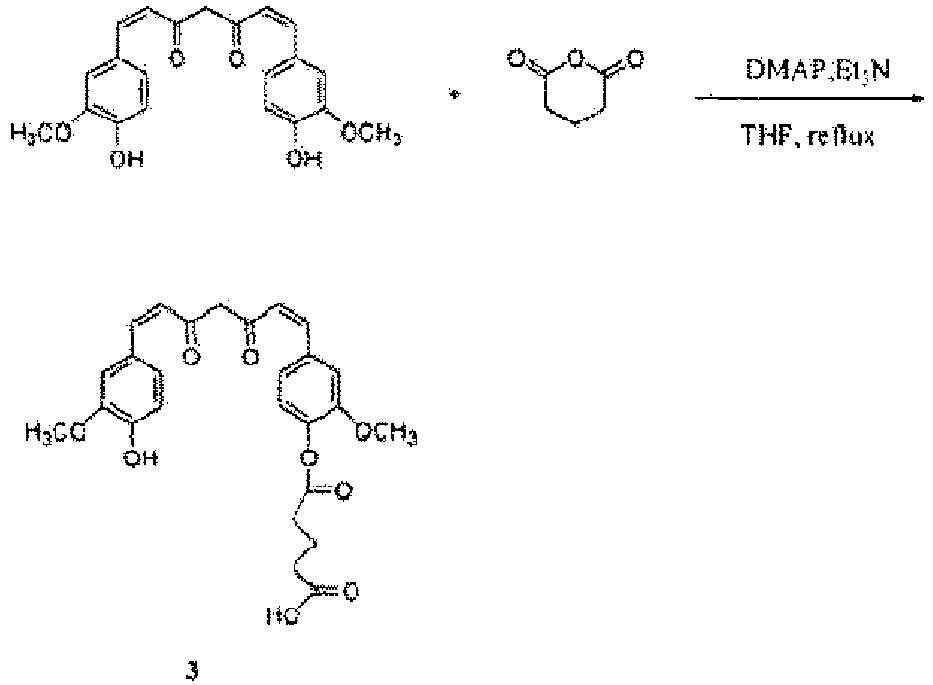
- To a solution of 2.01 g (5.46 mmol) of curcumin, 112 mg (0.92 mmol) of DMAP, and 0.685 g (6 mmol) glutaric anhydride (95%) in 100 ml THF was added 1.33 ml (9.55 mmol) Et3N. The reaction was stirred at reflux under argon overnight. Purified on column chromatography, eluting with CH2C2-Cl2;MeOH, 95:5. Yield 84%. NMR 1H (CDCl3), δ (ppm): compound (3), 1.97-2.14 (m, 2H); 2.43-2.79 (m, 4H); 3.87-3.95 (d, 6H); 5.83 (s, 2H); 6.45-6.59 (t, 2H); 6.91-7.18 (m, 6H); 7-57-7.65 (d. 2H). I3C NMR (CDCI3), δ (ppm): 19.98; 32.76; 55.82; 101.61; 109,86: 111.36; 115.04; 120.95; 121.54; 123.05; 124.16; 127.35; 133.89; 139.38; 139.99; 141.06; 147.03; 148.22; 151.23; 170.98; 177.374; 181.73; 184.65. MS (ESI) calcd. for C26H26O9: 482.48: found: 483.2 [M+H]+. See Robert E. Gawley; Mykhaylo Dukh; Claudia M. Cardona; Stephan II. Jannach; Denise Greathouse. Org. Lettl., Vol. 7, No. 14. 2005.2953-2956.
-

- To a solution of 158 mg (0.45 mmol) of 3 in 3 mL dry THF at room temperature was added 206 mg (0.427 mmol) of O-(2-Aminoethyl)-O'-(2-azidoethyl)pentaethylene glycol and 96 mg (0.47 mmol) of 1,3-dicyclohexylcarbodiimide. The mixture was stirred at 25 °C overnight. The reaction mixture was then diluted with 10 mL of ethyl acetate, filtered to remove the urea byproduct, and the organic solvent was removed with a vacuum pump. The product was dissolved in methylene chloride and washed with water. Then, the organic phase was separated and dried with vacuum pump. The product was purified using column chromatography, eluding with CH2Cl2 CH2Cl2:MeOH, 95:5. Yield 29%. NMR +H (CDCl3), δ (ppm): 1.72-1.78 (m, 2H); 2.35-2,38 (m, 2H); 2.66-2.70 (m, 2H); 3.37-3.66 (m, 28H); 3.88 (s, 3H);3.95 (s, 3H); 6.40 (s, 1H); 6.48-6.57 (m, 2H); 6.93-6.94 (s, 1H); 7.05-7.27 (m, 6H); 7.59-7.63 (m, 2H). MALDI-TOF MS (calcd. for C40H54N4O14 814.36), found; 837.38 [M1 +Na], 853.35 [M + K], See Alwarsamy Jeganathan; Stewart K. Richardson; Rajarathnam S. Mani; Boyd E. Haley; David S. Watt. J. Org. Chem. 1986, 51, 5362-5367.
-

- Curcumin (5 g, 13.57 mmol) and K2CO3 (1.88 g, 13.62 mmol) were dissolved in 60 mL DMF, and 1.62 g (13.61 mmol) of propargyl bromide was added. The mixture was stirred at room temperature under Ar for 49 h. H2O was added to the mixture and solvent was removed under vacuum. The product was purified on column chromatography, eluting with CH2Cl2 hexane 50:50- CH2Cl2. Yield 47%. NMR NMR H (CDCI3), (ppm): 2.54 (s, 1H); 3.94 (d, 6H); 4.81 (d, 2H); 5.82 (s, 1H); 5.93 (s, 1H); 6.47-6.52 (t, 2H); 6.93-7.15 (m, 6H); 7.59-7,61 (dd, 2H). MS (ESI) calcd. for C24H22O6 406.43; found: 407.2 [M+H] 445.2 [M + K].
-

- To a stirred solution of Mono-Propargyl Curcumin 5 (63 mg, 0.16 mmol) and 2-(2-(2-azidoethoxy)ethoxy)ethanol (46 mg, 0.26 mmol) in tBuOH (1.1 mL) and CHCl3 (0.3 mL) was added a prepared solution of Cu(OAc)2 (8 mg, 0.03 mmol) and sodium ascorbate (13 mg, 0.07 mmol) in H2O (1.3 mL). After vigorous stirring overnight the solvent was removed under vacuum. The mixture was dissolved in CHCl3, washed with H2O and the organic phase was separated, dried over Na2SO4 and evaporated Purification was performed by column chromatography, eluting with CH2Cl2-CH2Cl2: MeOH 98:2. Yield 26%. NMRNMR 1H (CDCI3), δ (ppm): 3.55-3.60 (m, 8H); 3.72-3.72 (t, 3H); 3.87-3.94 (m, 8H); 4.54-4.55 (t, 2H); 5.80 (s, 1H); 6.07 (s, 1H); 6,46-6.50 (dd, 2H); 6.92-6.94 (d, 1H); 7.05-7.12 (m, 5H); 7.56-7.60 (q, 2H); 7.92 (s, 1H).). MS (ESI) calcd. for C30H35N3O9: 581.61; found: 582,3 [M+H]\604.3 [M +Na], 620.3 [M + K], See Maarten Ijsselstijn and Jean-Christophe Cinirat. Tetrahedron. 2006, 62, 3837-3842.
-

- Compound 7 was synthesized using the same procedure employed for the synthesis of 6. The product was isolated in 41% yield. NMR 1H (CDCl3), δ (ppm): 1.60-1.63 (bd, 2H); 2.26-2.29 (t, 2H); 2.47-2.49 (t, 2H); 3.41-3.42 (t, 2H); 3.53-3.63 (m, 26H); 3.86-3.95 (m, 12H); 4.54-4.55 (d, 4H); 5.33 (s, 2H); 6.55-6.56 (bd, 4H); 6.94-7.11 (bm, 12H); 7.59 (s, 4H); 7.87 (s, 1H).). MALDI-TOF MS (calcd. for C64H76N4O20 1220.51), found: 1243.52 [M | Na], 1259.47 [Nf | K]. See Maarten Ijsselstijn and Jean-Christophe Cintrat. Tetrahedron. 2006, 62, 3837-3842,
- Dextran 32 mg (8x 10⁻⁴ mmol), mono-carbonyl butanoic acid curcumin 69 mg (1.4* 10-3mmol) and DCC (1,3- dicyclohexylcarbodiimide) 48 mg (2.3*10-3 mmol) were dissolved in 1 ml dry DMSO. The reaction was stirred for 24 h at reflux under argon. The solution was filtered, dialyzed with SnakeSkin pleated dialysis tubing with Millipore water, centrifuged and lyophilized. A cotton candy-like product (31 mg) was obtained in quantitative yield. NMR1H (D20), δ (ppm): compound 1, 1.77 (m, ); 1.93-2.04 (bm); 2.17-2.21 (m); 2.86-2.91 (m); 3.52-3.60 (m); 3.72-3.78 (m); 3.92-4.01 (dd); 5.00 (d). Number of Curcumin molecules attached per polymer molecule is 10 (Estimated from UV spectroscopy using the extinction coefficient for Curcumin-COOH).
- Dextran 122 mg (3 x 10⁻³ mmol), Mono-carbonyl butanoic acid curcumin 16 mg (3.3x10⁻⁴ mmol) and DCC (1,3- dicyclohexylcarbodiimide) 10 mg (4.8*10-4 mmol) were dissolved in 5.5 ml dry DMSO. The reaction was stirred for 24 h at reflux under argon The solution was filtered, dialyzed with SnakeSkin pleated dialysis tubing with Millipore water, centrifuged and lyophilized. The product resembled cotton candy and the yield was quantitative. NMR 1H (D20), δ (ppm): compound 2,1.35-1.39 (m); 1.67 (m,); 1.78-1.92 (bm); 2.33 (bm); 2.41-2.44 (t); 3.53-3.56 (t); 3.59-3.61 (m); 3.73-3.79 (m); 3.93-4.02 (dd); 5.00 (d). Number of Curcumin molecules attached per polymer molecule is 22 (Estimated from UV spectroscopy using the extinction coefficient for Curcurnin-COOH).
-
- 1. Chattopadhyay, Ishita.; Biswas, Kaushik.; Bandyopadhyay, Uday; Banerjee, Ranajit K. Turmeric and curcumin: biological actions and medicinal applications. Current Science (2004). 87(1), 44-53.
- 2.Agarwal, Bharat, B.; and Shishodia, S. Molecular targets of dietary agents for the prevention and therapy of cancer. Biochemical Pharmacology (2006), 71, 1397-1421.
- 3.Leyon, P. V.; Kuttan, G. Studies on the role of some synthetic curcuminoid derivatives in the inhibition of tumour specific angiogenesis. Jounal of Experimental & Clinical Cancer Research (2003), 22(1), 77-83.
- 4.Nurfinal, A.N.; Reksohadiprodjo, M.S.; Timmerman, H .; Jenie, U.A.; Sugiyant, D .; van der Goot, H. Synthesis of some symmetrical curcumin derivatives and their antiinflammatory activity. Eur J Med Chem (1997) 32, 321-328.
- 5. Mizushina, Y.; Ishidoh, T.; Takeuchi, T.; Shimazaki, N.; Kuiwai, O.; Kuramochi, K.; Kobayashi, S.; Sugawara, F.; Sakaguchi, K.; Yoshida, H. Monoacetylcurcumin: A new inhibitor of eukaryotic DNA polymerase and a new ligand for inhibitor-affinity chromatography, Biochemical and Biophysical Research Communications (2005) 337, 1288-1295
- 6. Raja, Krishnaswami S./Gupta, Sayam Sen.; Kaltgrad, Eiton.; Strable, Erica.; Finn, M. G. Virus-glycopolymer conjugates by copper(I) catalysis of atom transfer radical polymerization and azide-alkyne cycloaddition. Chemical Communications (2005), (34), 4315-4317.
- 7. Wang, Qian; Chan, Timothy R.; Hilgraf, Robert; Fokin, Valery V.; Sharpless, K. Barry; Finn. M. G.. Bioconjugation by copper(I)-catalyzed azide-alkyne [3 + 2] cycloaddition. Journal of the American Chemical Society (2003), 125(11), 3192-3193.
- 8. Yang, Fusheng; Lim, Giselle P.; Begum, Aynun N.; Ubeda, Oliver J.; Simmons, Mychica R.; Ambegaokar, Surendra S.; Chen, Pingping.; Kayed, Rakez.; Glabe, Charles G.; Frautschy, Salley A.; and Cole, Gregory M. Curcumin Inhibits Formation of Amyloid Oligomers and Fibrils, Binds Plaques, and Reduces Amyloid in Vivo. Journal of Biol. Chem. (2005) 280(7), 5892-5901.
- 9. Cheng, A.L.; Hsu, C.H.; Lin, J.K.; Hsu, M.M; Ho, Y.F; Shen, T.S; Ko, J.Y; Lin, J.T; Lin, B.R; Wu, M.S.; Yu, H.S.; Jee, S.H.; Chen, G.S.; Chen, T.M.; Chen, C.A.; Lai, M.K.; Pu, Y.S.; Pan, M.H.; Wang, Y.J.; Tsai, C.C.; and Hsich, C.Y. Phase 1 Clinical Trial of Curcumin, a Chemopreventive Agent, in Patients with High-risk of Pre-malignant Lesions, Anticancer Res 21: 2895- 2001.
- 10. Harris, J.M. Poly (ethylene glycol) chemistry, Plenum Press, New York
- 11. Santra, S.; Yang, H.; Stanley, J.T.; Holloway, P.H; Moudgil, B.M.; Walter, G.; and Mericle, R.A. Rapid and affective labelling of brain tissue using TAT-conjugated CdS:Mn/ZnS quantum dots. Chem Commun (2005) 3144-3146.
- 12. Puchtler, H., Sweat, F., and Levine, M. (1962) J. Histochem. Cytochem. 10, 355-364
- 13. Gilding, D. K.., A. M. Reed (December 1979). "Biodegradable polymers for use in surgery - polyglycolic/poly (lactic acid) homo- and copolymers: 1". Polymer 20: 1459-1464.
- 14.
Kurzroch, R.; Li, L.; Mehta, K., Aggarwai. B. B. Liposomal curcumin for treatment of cancer. PCT Int. Appl. (2004), 66 pp. CODEN: PIXXD2 WO 2004080396 A2 20040923 - 15. Maeda, H.; Greish, K.; Fang, J. The enhanced permeability and retention effect and polymeric drugs: a paradigm shift for cancer chemotherapy in the 21 st century. Advances in Polymer Science (2006), 193(Polymer Therapeutics II), 103-121. Publisher: Springer GmbH.
- 16. Heindel, N.D.; Zhao,II., Leiby, J., VanDongen, J.M.; Lacey, C.J.; Lima, D.A.; Shabsoug, B. and Buzby, J.II. Hydrazide pharmaceuticals as conjugates to polyaldehyde dextran: Synthesis characterization and stability. Bioconjugate. Chem. (1990) 1, 77-82.
- 17. Gee, K. R.; Weinberg, E. S., Kozlowski, D.J. Caged Q-rhodamine dextran: a new photo-activated fluorescent tracer. Bioorganic & Medicinal Chemistry Letters (2001), 11(16), 2181-2183.
- 18. Jovanovic, V.; Boone, C.W.; Steenken, S.; Trinoga, M. and Kaskey, R.B. How Curcumin Works Preferentially with Water Soluble Antioxidants J. Am. Chem. Soc. (2001), J23, 3064-3068
- 19.
Hasegawa, K; Maeda, N. Skin-lightening cosmetics containing tetrahydrocurcuminoids. (Shiseido Co., Ltd., Japan) (2004), 38 pp. CODEN: JKXXAF JP 2004115381 A2 20040415 JP 2002-277174 20020924 - 20.
Rieks, A; Kaehler, M.; Kirchner, U.; Wiggenhorn, K.; Kinzer, M. Preparation of novel curcumin/tetrahydrocurcumin derivatives for use in cosmetics, pharmaceuticals and for nutrition. (Andre Rieks - Labor fuer Enzymtechnologie G.m.b.h.. Germany). PCTInt. Appl. (2004), 54 pp. CODEN: PIXXD2 WO 2004031122 A1 20040415 - 21. Use of antioxidants for the preparation of pharmaceutical or cosmetic compositions for protecting the skin from damages by infrared-radiation. (Stada Arzneilnittel A.-G., Germany). Eur. Pat. Appl. (2005), 12 pp. CODEN: EPXXDW
EP 1591104 A1 20051102 - 22. Cross regulin composition of turmeric-derived Tetrahydrocurcuminoids for skin lightening and protection against UVB rays Sabinsa Corporation,
US Patent Number 665332723 . Method for sterilizing a native collagen in liquid medium, sterile native collagen obtained, compositions containing it and uses, Mansour Hamza, Octapharma Agency, Patent NumberUS 2002061842 . - 24. Partridge, S. Elastin , Adv. In Protein Chemistry, Academic Press, New York, (1962), 1Z, 227. 25 Kricheldorf, H. R. Syntheses and application of polylactides. Chemosphere (2001), 43 (1), 49-54.
Claims (1)
- A curcumin dimer of the formula :

Priority Applications (1)
| Application Number | Priority Date | Filing Date | Title |
|---|---|---|---|
| EP14176038.9A EP2813145A1 (en) | 2006-10-12 | 2007-10-12 | Novel curcumin and tetrahydrocurcumin derivatives |
Applications Claiming Priority (2)
| Application Number | Priority Date | Filing Date | Title |
|---|---|---|---|
| US82918506P | 2006-10-12 | 2006-10-12 | |
| PCT/US2007/021805 WO2008045534A2 (en) | 2006-10-12 | 2007-10-12 | Novel curcumin and tetrahydrocurcumin derivatives |
Related Child Applications (2)
| Application Number | Title | Priority Date | Filing Date |
|---|---|---|---|
| EP14176038.9A Division-Into EP2813145A1 (en) | 2006-10-12 | 2007-10-12 | Novel curcumin and tetrahydrocurcumin derivatives |
| EP14176038.9A Division EP2813145A1 (en) | 2006-10-12 | 2007-10-12 | Novel curcumin and tetrahydrocurcumin derivatives |
Publications (3)
| Publication Number | Publication Date |
|---|---|
| EP2076129A2 EP2076129A2 (en) | 2009-07-08 |
| EP2076129A4 EP2076129A4 (en) | 2011-10-19 |
| EP2076129B1 true EP2076129B1 (en) | 2016-05-04 |
Family
ID=39283467
Family Applications (2)
| Application Number | Title | Priority Date | Filing Date |
|---|---|---|---|
| EP07852691.0A Active EP2076129B1 (en) | 2006-10-12 | 2007-10-12 | Novel curcumin dimer |
| EP14176038.9A Withdrawn EP2813145A1 (en) | 2006-10-12 | 2007-10-12 | Novel curcumin and tetrahydrocurcumin derivatives |
Family Applications After (1)
| Application Number | Title | Priority Date | Filing Date |
|---|---|---|---|
| EP14176038.9A Withdrawn EP2813145A1 (en) | 2006-10-12 | 2007-10-12 | Novel curcumin and tetrahydrocurcumin derivatives |
Country Status (5)
| Country | Link |
|---|---|
| US (2) | US8487139B2 (en) |
| EP (2) | EP2076129B1 (en) |
| JP (1) | JP2010506836A (en) |
| CA (1) | CA2665916C (en) |
| WO (1) | WO2008045534A2 (en) |
Families Citing this family (43)
| Publication number | Priority date | Publication date | Assignee | Title |
|---|---|---|---|---|
| JP2010506836A (en) * | 2006-10-12 | 2010-03-04 | リサーチ ファウンデイション オブ ザ シティー ユニヴァーシティ オブ ニューヨーク | Novel curcumin and tetrahydrocurcumin derivatives |
| JP2010013411A (en) * | 2008-07-05 | 2010-01-21 | Hiroshi Maeda | Anti-inflammatory agent |
| JP2011527340A (en) * | 2008-07-07 | 2011-10-27 | ライラ ファーマシューティカルズ ピーブイティ.エルティディ. | Orally active curcuminoid compounds |
| US20120003177A1 (en) * | 2008-09-17 | 2012-01-05 | Youqing Shen | Curcumin-containing polymers and water-soluble curcumin derivatives as prodrugs of prodrug carriers |
| US9221877B2 (en) * | 2008-09-19 | 2015-12-29 | Board Of Supervisors Of Louisiana State University And Agricultural And Mechanical College | Curcumin conjugates for treating and preventing cancers |
| JP5699286B2 (en) * | 2009-02-27 | 2015-04-08 | 国立大学法人滋賀医科大学 | Imaging and in vitro diagnostics for intractable neurological diseases |
| ES2761173T3 (en) | 2009-05-15 | 2020-05-19 | Univ New York State Res Found | Curcumin analogues as zinc chelators and their uses |
| US8747890B2 (en) | 2009-11-19 | 2014-06-10 | Signpath Pharma Inc. | Intravenous infusion of curcumin and a calcium channel blocker |
| US9446145B2 (en) * | 2009-12-02 | 2016-09-20 | Research Foundation Of The City University Of New York | Curcumin-antibody conjugates as anti-cancer agents |
| WO2011106691A2 (en) * | 2010-02-26 | 2011-09-01 | Research Foundation Of The City University Of New York | Curcumin derivatives |
| US9393198B2 (en) * | 2010-03-22 | 2016-07-19 | Signpath Pharma Inc. | Intravenous curcumin and derivatives for treatment of neurodegenerative and stress disorders |
| CN101830819B (en) * | 2010-05-26 | 2013-08-28 | 福建医科大学 | Phenylbutyryl curcumin derivate and application thereof in anti-tumor drug preparation |
| WO2012138907A2 (en) * | 2011-04-05 | 2012-10-11 | Translational Genomics Research Institute | Solid forms of curcumin |
| US10117881B2 (en) | 2011-06-03 | 2018-11-06 | Signpath Pharma, Inc. | Protective effect of DMPC, DMPG, DMPC/DMPG, LYSOPG and LYSOPC against drugs that cause channelopathies |
| US10449193B2 (en) | 2011-06-03 | 2019-10-22 | Signpath Pharma Inc. | Protective effect of DMPC, DMPG, DMPC/DMPG, lysoPG and lysoPC against drugs that cause channelopathies |
| US10349884B2 (en) | 2011-06-03 | 2019-07-16 | Sighpath Pharma Inc. | Liposomal mitigation of drug-induced inhibition of the cardiac ikr channel |
| US12004868B2 (en) | 2011-06-03 | 2024-06-11 | Signpath Pharma Inc. | Liposomal mitigation of drug-induced inhibition of the cardiac IKr channel |
| WO2012167212A2 (en) | 2011-06-03 | 2012-12-06 | Signpath Pharma Inc. | Liposomal mitigation of drug-induced long qt syndrome and potassium delayed-rectifier current |
| US10238602B2 (en) | 2011-06-03 | 2019-03-26 | Signpath Pharma, Inc. | Protective effect of DMPC, DMPG, DMPC/DMPG, LysoPG and LysoPC against drugs that cause channelopathies |
| US9220695B2 (en) | 2012-06-29 | 2015-12-29 | The Research Foundation For The State University Of New York | Polyenolic zinc-binding agents (pezbins) actively promote inactivation of cancer stem cells and potentiate cytotoxic anti-tumor drug substances |
| AT515178A5 (en) | 2012-08-31 | 2015-07-15 | Univ North Texas | CURCUMIN-ER, A NANOCURCUMIN FROM LIPOSOMAL PLGA WITH CONTINUED RELEASE TO MINIMIZE QT EXTENSION TO CANCER THERAPY |
| CN103214359B (en) * | 2013-04-08 | 2015-05-20 | 洛阳师范学院 | Method for preparing curcumin oligomer |
| CN103601672B (en) * | 2013-11-04 | 2016-08-17 | 广东中烟工业有限责任公司 | A kind of Curcuminoids and its preparation method and application |
| WO2015095576A1 (en) | 2013-12-18 | 2015-06-25 | Signpath Pharma, Inc. | Liposomal mitigation of drug-induced inhibition of the cardiac ikr channel |
| CN103952008B (en) * | 2014-04-01 | 2016-01-20 | 浙江理工大学 | Based on the water-soluble curcumine dyestuff of modifying for chemical structure, preparation method and application |
| US10085951B2 (en) | 2014-12-11 | 2018-10-02 | Designs For Health, Inc. | Curcuminoid formulations and related methods of treatment |
| JP6153552B2 (en) * | 2015-02-13 | 2017-06-28 | 大和ハウス工業株式会社 | Simple evaluation method for oil |
| US9610893B2 (en) | 2015-03-18 | 2017-04-04 | Car1St Technologies, Llc | Methods and systems for providing alerts to a driver of a vehicle via condition detection and wireless communications |
| US10328855B2 (en) | 2015-03-18 | 2019-06-25 | Uber Technologies, Inc. | Methods and systems for providing alerts to a connected vehicle driver and/or a passenger via condition detection and wireless communications |
| KR102638618B1 (en) | 2016-04-27 | 2024-02-21 | 사인패스 파마 인코포레이티드 | Prevention of drug-induced atrio-ventricular block |
| US10300000B2 (en) | 2016-09-12 | 2019-05-28 | The Research Foundation For The State University Of New York | Inhibition of melanogenesis by chemically modified curcumins |
| CN106916085A (en) * | 2017-01-12 | 2017-07-04 | 永胜光学股份有限公司 | Modified curcumin |
| MX389034B (en) | 2017-07-07 | 2025-03-20 | Instituto Nac De Neurologia Y Neurocirugia Manuel Velasco Suarez | MULTIRRESISTANT TUMORS SENSITIZING AGENT. |
| EP4065152A1 (en) | 2019-11-25 | 2022-10-05 | Institut National de la Santé et de la Recherche Médicale (INSERM) | Trem-1 inhibitors for the treatment of vaso-occlusions and tissue injuries in patients suffering from sickle cell disease |
| WO2022190915A1 (en) * | 2021-03-10 | 2022-09-15 | 国立大学法人秋田大学 | Novel compound or salt thereof, and antitumor activator containing same as active ingredient |
| EP4304626A1 (en) | 2021-03-12 | 2024-01-17 | Institut National de la Santé et de la Recherche Médicale (INSERM) | Trem-1 inhibitors for the treatment of marfan syndrome |
| TWI758153B (en) * | 2021-04-01 | 2022-03-11 | 星歐光學股份有限公司 | Contact lens product |
| US20240318003A1 (en) * | 2021-07-06 | 2024-09-26 | Dic Corporation | Compound using natural pigment |
| CN113845460B (en) * | 2021-07-29 | 2023-02-14 | 浙江海洋大学 | Curcumin derivative with photosensitive bactericidal activity, preparation method and fresh shrimp photodynamic sterilization and preservation method |
| EP4416501A1 (en) | 2021-10-11 | 2024-08-21 | INSERM (Institut National de la Santé et de la Recherche Médicale) | Use of trem-1 for predicting and preventing postoperative complications after cardiac surgery with cardiopulmonary by-pass |
| CN117654510B (en) * | 2023-11-24 | 2026-02-03 | 广西民族大学 | Titanium dioxide supported nickel catalyst, preparation method and application |
| WO2025196177A1 (en) | 2024-03-21 | 2025-09-25 | Institut National de la Santé et de la Recherche Médicale | Use of soluble trem-1 as a biomarker for assessing the risk of cardiovascular disease in asymptomatic subjects |
| CN119162086B (en) * | 2024-08-22 | 2025-07-08 | 昆明医科大学 | THC-induced in-vitro blood brain barrier injury model, construction method and application thereof |
Family Cites Families (16)
| Publication number | Priority date | Publication date | Assignee | Title |
|---|---|---|---|---|
| US5861415A (en) | 1996-07-12 | 1999-01-19 | Sami Chemicals & Extracts, Ltd. | Bioprotectant composition, method of use and extraction process of curcuminoids |
| US5891924A (en) | 1996-09-26 | 1999-04-06 | Research Development Foundation | Curcumin (diferuloylmethane) inhibition of NFκB activation |
| US20020061842A1 (en) | 1998-04-10 | 2002-05-23 | Octapharma Ag | Method for sterilizing a native collagen in liquid medium, sterile native collagen obtained, compositions containing it and uses |
| US6653327B2 (en) | 1999-04-09 | 2003-11-25 | Sabinsa Corporation | Cross-regulin composition of tumeric-derived tetrahydrocurcuminoids for skin lightening and protection against UVB rays |
| US6887898B1 (en) | 1999-10-22 | 2005-05-03 | Darrick S. H. L. Kim | Pharmaceutical compositions useful in prevention and treatment of beta-Amyloid protein-induced disease |
| DE10031955A1 (en) * | 2000-06-30 | 2002-01-17 | Deutsches Krebsforsch | Curcumin derivatives with improved water solubility compared to curcumin and medicaments containing them |
| US6790979B2 (en) * | 2002-04-17 | 2004-09-14 | University Of North Carolina At Chapel Hill | Curcumin analogues and uses thereof |
| US7355081B2 (en) * | 2002-04-17 | 2008-04-08 | The University Of North Carolina At Chapel Hill | Curcumin analogues and uses thereof |
| US20040014721A1 (en) * | 2002-06-10 | 2004-01-22 | Oklahoma Medical Research Foundation | Method for using tethered bis(polyhydroxyphenyls) and O-alkyl derivatives thereof in treating inflammatory conditions of the central nervous system |
| JP2004115381A (en) | 2002-09-24 | 2004-04-15 | Shiseido Co Ltd | External preparation for skin |
| WO2004031122A1 (en) | 2002-10-01 | 2004-04-15 | Dr. André Rieks - Labor Für Enzymtechnologie Gmbh | Novel curcumin/tetrahydrocurcumin derivatives for using in cosmetics, pharmaceuticals and for nutrition |
| WO2004080396A2 (en) | 2003-03-07 | 2004-09-23 | The University Of Texas Md Anderson Cancer Center | Liposomal curcumin for treatment of cancer |
| EP1591104A1 (en) | 2004-03-17 | 2005-11-02 | Stada Arzneimittel Ag | Use of antioxidants for the preparation of pharmaceutical or cosmetic compositions for protecting the skin from damages by infrared-radiations |
| JP2010506836A (en) * | 2006-10-12 | 2010-03-04 | リサーチ ファウンデイション オブ ザ シティー ユニヴァーシティ オブ ニューヨーク | Novel curcumin and tetrahydrocurcumin derivatives |
| US20100316631A1 (en) | 2006-10-19 | 2010-12-16 | The Uab Research Foundation | Water Soluble Curcumin-Based Compounds |
| WO2009064485A1 (en) * | 2007-11-16 | 2009-05-22 | Trustees Of Columbia University In The City Of New York | Antioxidant flavonoid derivatives |
-
2007
- 2007-10-12 JP JP2009532428A patent/JP2010506836A/en active Pending
- 2007-10-12 EP EP07852691.0A patent/EP2076129B1/en active Active
- 2007-10-12 EP EP14176038.9A patent/EP2813145A1/en not_active Withdrawn
- 2007-10-12 WO PCT/US2007/021805 patent/WO2008045534A2/en not_active Ceased
- 2007-10-12 CA CA2665916A patent/CA2665916C/en active Active
- 2007-10-12 US US12/445,356 patent/US8487139B2/en active Active
-
2013
- 2013-07-15 US US13/942,606 patent/US9447023B2/en not_active Expired - Fee Related
Also Published As
| Publication number | Publication date |
|---|---|
| EP2076129A4 (en) | 2011-10-19 |
| US20130296527A1 (en) | 2013-11-07 |
| US20100240905A1 (en) | 2010-09-23 |
| CA2665916A1 (en) | 2008-04-17 |
| US8487139B2 (en) | 2013-07-16 |
| EP2076129A2 (en) | 2009-07-08 |
| WO2008045534A2 (en) | 2008-04-17 |
| CA2665916C (en) | 2015-12-08 |
| JP2010506836A (en) | 2010-03-04 |
| US9447023B2 (en) | 2016-09-20 |
| EP2813145A1 (en) | 2014-12-17 |
| WO2008045534A3 (en) | 2008-06-12 |
Similar Documents
| Publication | Publication Date | Title |
|---|---|---|
| US9447023B2 (en) | Curcumin and tetrahydrocurcumin derivatives | |
| EP2649033B1 (en) | Compositions and methods for stabilizing ingredients using 2,4-pentanedione compounds | |
| CN104994831A (en) | Use of a resveratrol derivative for skin whitening | |
| KR102502512B1 (en) | Cosmetics compositions for antioxidant | |
| JP2006519227A (en) | Cosmetic UV screen composition and amino-butadiene based UV-absorbing composite therefor | |
| EP0624599B1 (en) | Derivatives of mono (6-amino-desoxy)cyclodextrin substituted in position 6 with an alpha aminoacid group, process of their preparation and applications | |
| JP6131265B2 (en) | Nitron compounds and their use in personal care. | |
| FR2840806A1 (en) | COLORED SELF-TANNING COMPOSITIONS COMPRISING AT LEAST ONE RED OR ORANGE DYE CHOSEN AMONG FLUORANES OR THEIR ALKALI METAL SALTS | |
| JP6734204B2 (en) | Polymer nitrones and their use in personal care | |
| EP2886101A1 (en) | Sunscreen compositions containing an ultraviolet radiation-absorbing polymer | |
| HUP0401434A2 (en) | Photosensitizing agent containing sulphonated meso-tetra-phenylporphyrin, process for its preparation and pharmaceutical compositions containing thereof | |
| CA2352450A1 (en) | Formulation consisting of at least one uv filter and one non-substitute flavylium salt in position 3 for skin colouring and uses | |
| FR2799120A1 (en) | MATERIAL COMPRISING AN ORGANIC UV-A FILTER AND METHOD FOR MOVING THE MAXIMUM ABSORPTION WAVELENGTH | |
| JPH07206669A (en) | Tyrosinase inhibitor activator | |
| LU83807A1 (en) | USE OF BENZOQUINONES FOR THE DIRECT COLORING OF KERATINIC FIBERS | |
| EP1697006B2 (en) | Use of peptides to protect skin from hair treatment agents | |
| JP2005505556A (en) | Carboxylate-gated-nitroxide (CGN) compounds and compositions and methods of use thereof | |
| Centini et al. | New multifunctional surfactants from natural phenolic acids | |
| CN113677321B (en) | Compositions comprising specific hyperbranched copolymers and 1,3-propylene glycol and/or N-hydroxyoctanamide | |
| CN112789026A (en) | sunscreen preparations | |
| JP2013107859A (en) | Skin cosmetic preparation for external use comprising connarus extract | |
| JP3027409B2 (en) | Cosmetics | |
| WO2019173705A1 (en) | Avobenzone-dendrimer conjugates | |
| Zhang et al. | Novel synthetic curcuminoids: Not merely an anticancer agent. | |
| Helal | IN VITRO STUDIES ON CYANIDIN PROTECTION AGAINST DOXORUBICIN CARDIOMYOCYTE CYTOTOXICITY AND ANTICANCER ACTIVITY |
Legal Events
| Date | Code | Title | Description |
|---|---|---|---|
| PUAI | Public reference made under article 153(3) epc to a published international application that has entered the european phase |
Free format text: ORIGINAL CODE: 0009012 |
|
| 17P | Request for examination filed |
Effective date: 20090512 |
|
| AK | Designated contracting states |
Kind code of ref document: A2 Designated state(s): AT BE BG CH CY CZ DE DK EE ES FI FR GB GR HU IE IS IT LI LT LU LV MC MT NL PL PT RO SE SI SK TR |
|
| DAX | Request for extension of the european patent (deleted) | ||
| RIC1 | Information provided on ipc code assigned before grant |
Ipc: A01N 43/20 20060101AFI20110804BHEP Ipc: A01N 43/24 20060101ALI20110804BHEP Ipc: A61K 31/335 20060101ALI20110804BHEP |
|
| A4 | Supplementary search report drawn up and despatched |
Effective date: 20110915 |
|
| 17Q | First examination report despatched |
Effective date: 20120723 |
|
| RAP1 | Party data changed (applicant data changed or rights of an application transferred) |
Owner name: RESEARCH FOUNDATION OF THE CITY UNIVERSITY OF NEW |
|
| GRAP | Despatch of communication of intention to grant a patent |
Free format text: ORIGINAL CODE: EPIDOSNIGR1 |
|
| RIC1 | Information provided on ipc code assigned before grant |
Ipc: A01N 43/20 20060101AFI20151023BHEP Ipc: C07D 249/04 20060101ALI20151023BHEP Ipc: A01N 43/24 20060101ALI20151023BHEP Ipc: A61Q 19/02 20060101ALI20151023BHEP Ipc: A61K 31/4192 20060101ALI20151023BHEP |
|
| INTG | Intention to grant announced |
Effective date: 20151119 |
|
| GRAS | Grant fee paid |
Free format text: ORIGINAL CODE: EPIDOSNIGR3 |
|
| GRAA | (expected) grant |
Free format text: ORIGINAL CODE: 0009210 |
|
| AK | Designated contracting states |
Kind code of ref document: B1 Designated state(s): AT BE BG CH CY CZ DE DK EE ES FI FR GB GR HU IE IS IT LI LT LU LV MC MT NL PL PT RO SE SI SK TR |
|
| REG | Reference to a national code |
Ref country code: GB Ref legal event code: FG4D |
|
| REG | Reference to a national code |
Ref country code: CH Ref legal event code: EP |
|
| REG | Reference to a national code |
Ref country code: AT Ref legal event code: REF Ref document number: 796039 Country of ref document: AT Kind code of ref document: T Effective date: 20160515 |
|
| REG | Reference to a national code |
Ref country code: IE Ref legal event code: FG4D |
|
| REG | Reference to a national code |
Ref country code: DE Ref legal event code: R096 Ref document number: 602007046199 Country of ref document: DE |
|
| REG | Reference to a national code |
Ref country code: NL Ref legal event code: MP Effective date: 20160504 |
|
| REG | Reference to a national code |
Ref country code: LT Ref legal event code: MG4D |
|
| REG | Reference to a national code |
Ref country code: FR Ref legal event code: PLFP Year of fee payment: 10 |
|
| PG25 | Lapsed in a contracting state [announced via postgrant information from national office to epo] |
Ref country code: LT Free format text: LAPSE BECAUSE OF FAILURE TO SUBMIT A TRANSLATION OF THE DESCRIPTION OR TO PAY THE FEE WITHIN THE PRESCRIBED TIME-LIMIT Effective date: 20160504 Ref country code: FI Free format text: LAPSE BECAUSE OF FAILURE TO SUBMIT A TRANSLATION OF THE DESCRIPTION OR TO PAY THE FEE WITHIN THE PRESCRIBED TIME-LIMIT Effective date: 20160504 Ref country code: NL Free format text: LAPSE BECAUSE OF FAILURE TO SUBMIT A TRANSLATION OF THE DESCRIPTION OR TO PAY THE FEE WITHIN THE PRESCRIBED TIME-LIMIT Effective date: 20160504 |
|
| REG | Reference to a national code |
Ref country code: AT Ref legal event code: MK05 Ref document number: 796039 Country of ref document: AT Kind code of ref document: T Effective date: 20160504 |
|
| PG25 | Lapsed in a contracting state [announced via postgrant information from national office to epo] |
Ref country code: SE Free format text: LAPSE BECAUSE OF FAILURE TO SUBMIT A TRANSLATION OF THE DESCRIPTION OR TO PAY THE FEE WITHIN THE PRESCRIBED TIME-LIMIT Effective date: 20160504 Ref country code: PT Free format text: LAPSE BECAUSE OF FAILURE TO SUBMIT A TRANSLATION OF THE DESCRIPTION OR TO PAY THE FEE WITHIN THE PRESCRIBED TIME-LIMIT Effective date: 20160905 Ref country code: LV Free format text: LAPSE BECAUSE OF FAILURE TO SUBMIT A TRANSLATION OF THE DESCRIPTION OR TO PAY THE FEE WITHIN THE PRESCRIBED TIME-LIMIT Effective date: 20160504 Ref country code: ES Free format text: LAPSE BECAUSE OF FAILURE TO SUBMIT A TRANSLATION OF THE DESCRIPTION OR TO PAY THE FEE WITHIN THE PRESCRIBED TIME-LIMIT Effective date: 20160504 Ref country code: GR Free format text: LAPSE BECAUSE OF FAILURE TO SUBMIT A TRANSLATION OF THE DESCRIPTION OR TO PAY THE FEE WITHIN THE PRESCRIBED TIME-LIMIT Effective date: 20160805 |
|
| PG25 | Lapsed in a contracting state [announced via postgrant information from national office to epo] |
Ref country code: IT Free format text: LAPSE BECAUSE OF FAILURE TO SUBMIT A TRANSLATION OF THE DESCRIPTION OR TO PAY THE FEE WITHIN THE PRESCRIBED TIME-LIMIT Effective date: 20160504 |
|
| PG25 | Lapsed in a contracting state [announced via postgrant information from national office to epo] |
Ref country code: EE Free format text: LAPSE BECAUSE OF FAILURE TO SUBMIT A TRANSLATION OF THE DESCRIPTION OR TO PAY THE FEE WITHIN THE PRESCRIBED TIME-LIMIT Effective date: 20160504 Ref country code: RO Free format text: LAPSE BECAUSE OF FAILURE TO SUBMIT A TRANSLATION OF THE DESCRIPTION OR TO PAY THE FEE WITHIN THE PRESCRIBED TIME-LIMIT Effective date: 20160504 Ref country code: CZ Free format text: LAPSE BECAUSE OF FAILURE TO SUBMIT A TRANSLATION OF THE DESCRIPTION OR TO PAY THE FEE WITHIN THE PRESCRIBED TIME-LIMIT Effective date: 20160504 Ref country code: SK Free format text: LAPSE BECAUSE OF FAILURE TO SUBMIT A TRANSLATION OF THE DESCRIPTION OR TO PAY THE FEE WITHIN THE PRESCRIBED TIME-LIMIT Effective date: 20160504 Ref country code: DK Free format text: LAPSE BECAUSE OF FAILURE TO SUBMIT A TRANSLATION OF THE DESCRIPTION OR TO PAY THE FEE WITHIN THE PRESCRIBED TIME-LIMIT Effective date: 20160504 |
|
| REG | Reference to a national code |
Ref country code: DE Ref legal event code: R097 Ref document number: 602007046199 Country of ref document: DE |
|
| PG25 | Lapsed in a contracting state [announced via postgrant information from national office to epo] |
Ref country code: BE Free format text: LAPSE BECAUSE OF FAILURE TO SUBMIT A TRANSLATION OF THE DESCRIPTION OR TO PAY THE FEE WITHIN THE PRESCRIBED TIME-LIMIT Effective date: 20160504 Ref country code: AT Free format text: LAPSE BECAUSE OF FAILURE TO SUBMIT A TRANSLATION OF THE DESCRIPTION OR TO PAY THE FEE WITHIN THE PRESCRIBED TIME-LIMIT Effective date: 20160504 Ref country code: PL Free format text: LAPSE BECAUSE OF FAILURE TO SUBMIT A TRANSLATION OF THE DESCRIPTION OR TO PAY THE FEE WITHIN THE PRESCRIBED TIME-LIMIT Effective date: 20160504 |
|
| PLBE | No opposition filed within time limit |
Free format text: ORIGINAL CODE: 0009261 |
|
| STAA | Information on the status of an ep patent application or granted ep patent |
Free format text: STATUS: NO OPPOSITION FILED WITHIN TIME LIMIT |
|
| 26N | No opposition filed |
Effective date: 20170207 |
|
| PG25 | Lapsed in a contracting state [announced via postgrant information from national office to epo] |
Ref country code: SI Free format text: LAPSE BECAUSE OF FAILURE TO SUBMIT A TRANSLATION OF THE DESCRIPTION OR TO PAY THE FEE WITHIN THE PRESCRIBED TIME-LIMIT Effective date: 20160504 |
|
| REG | Reference to a national code |
Ref country code: CH Ref legal event code: PL |
|
| PG25 | Lapsed in a contracting state [announced via postgrant information from national office to epo] |
Ref country code: MC Free format text: LAPSE BECAUSE OF FAILURE TO SUBMIT A TRANSLATION OF THE DESCRIPTION OR TO PAY THE FEE WITHIN THE PRESCRIBED TIME-LIMIT Effective date: 20160504 |
|
| REG | Reference to a national code |
Ref country code: IE Ref legal event code: MM4A |
|
| PG25 | Lapsed in a contracting state [announced via postgrant information from national office to epo] |
Ref country code: CH Free format text: LAPSE BECAUSE OF NON-PAYMENT OF DUE FEES Effective date: 20161031 Ref country code: LI Free format text: LAPSE BECAUSE OF NON-PAYMENT OF DUE FEES Effective date: 20161031 |
|
| PG25 | Lapsed in a contracting state [announced via postgrant information from national office to epo] |
Ref country code: LU Free format text: LAPSE BECAUSE OF NON-PAYMENT OF DUE FEES Effective date: 20161012 |
|
| REG | Reference to a national code |
Ref country code: FR Ref legal event code: PLFP Year of fee payment: 11 |
|
| PG25 | Lapsed in a contracting state [announced via postgrant information from national office to epo] |
Ref country code: IE Free format text: LAPSE BECAUSE OF NON-PAYMENT OF DUE FEES Effective date: 20161012 |
|
| PG25 | Lapsed in a contracting state [announced via postgrant information from national office to epo] |
Ref country code: CY Free format text: LAPSE BECAUSE OF FAILURE TO SUBMIT A TRANSLATION OF THE DESCRIPTION OR TO PAY THE FEE WITHIN THE PRESCRIBED TIME-LIMIT Effective date: 20160504 Ref country code: HU Free format text: LAPSE BECAUSE OF FAILURE TO SUBMIT A TRANSLATION OF THE DESCRIPTION OR TO PAY THE FEE WITHIN THE PRESCRIBED TIME-LIMIT; INVALID AB INITIO Effective date: 20071012 |
|
| PG25 | Lapsed in a contracting state [announced via postgrant information from national office to epo] |
Ref country code: TR Free format text: LAPSE BECAUSE OF FAILURE TO SUBMIT A TRANSLATION OF THE DESCRIPTION OR TO PAY THE FEE WITHIN THE PRESCRIBED TIME-LIMIT Effective date: 20160504 Ref country code: IS Free format text: LAPSE BECAUSE OF FAILURE TO SUBMIT A TRANSLATION OF THE DESCRIPTION OR TO PAY THE FEE WITHIN THE PRESCRIBED TIME-LIMIT Effective date: 20160504 Ref country code: MT Free format text: LAPSE BECAUSE OF NON-PAYMENT OF DUE FEES Effective date: 20161031 |
|
| PG25 | Lapsed in a contracting state [announced via postgrant information from national office to epo] |
Ref country code: BG Free format text: LAPSE BECAUSE OF FAILURE TO SUBMIT A TRANSLATION OF THE DESCRIPTION OR TO PAY THE FEE WITHIN THE PRESCRIBED TIME-LIMIT Effective date: 20160504 |
|
| REG | Reference to a national code |
Ref country code: FR Ref legal event code: PLFP Year of fee payment: 12 |
|
| PGFP | Annual fee paid to national office [announced via postgrant information from national office to epo] |
Ref country code: DE Payment date: 20251029 Year of fee payment: 19 |
|
| PGFP | Annual fee paid to national office [announced via postgrant information from national office to epo] |
Ref country code: GB Payment date: 20251027 Year of fee payment: 19 |
|
| PGFP | Annual fee paid to national office [announced via postgrant information from national office to epo] |
Ref country code: FR Payment date: 20251027 Year of fee payment: 19 |