EP2076052A2 - Synchronisieren von Audio- und Video-Frames - Google Patents
Synchronisieren von Audio- und Video-Frames Download PDFInfo
- Publication number
- EP2076052A2 EP2076052A2 EP08254028A EP08254028A EP2076052A2 EP 2076052 A2 EP2076052 A2 EP 2076052A2 EP 08254028 A EP08254028 A EP 08254028A EP 08254028 A EP08254028 A EP 08254028A EP 2076052 A2 EP2076052 A2 EP 2076052A2
- Authority
- EP
- European Patent Office
- Prior art keywords
- video
- audio
- time
- renderer
- frames
- Prior art date
- Legal status (The legal status is an assumption and is not a legal conclusion. Google has not performed a legal analysis and makes no representation as to the accuracy of the status listed.)
- Withdrawn
Links
- 238000000034 method Methods 0.000 claims description 10
- 238000004590 computer program Methods 0.000 claims 2
- 230000001360 synchronised effect Effects 0.000 description 3
- 238000004891 communication Methods 0.000 description 2
- 238000012986 modification Methods 0.000 description 2
- 230000004048 modification Effects 0.000 description 2
- 230000001413 cellular effect Effects 0.000 description 1
- 230000006835 compression Effects 0.000 description 1
- 238000007906 compression Methods 0.000 description 1
- 238000010586 diagram Methods 0.000 description 1
- 229910003460 diamond Inorganic materials 0.000 description 1
- 239000010432 diamond Substances 0.000 description 1
- 229920000642 polymer Polymers 0.000 description 1
- 239000004065 semiconductor Substances 0.000 description 1
- 238000012358 sourcing Methods 0.000 description 1
- 230000003068 static effect Effects 0.000 description 1
- 230000000007 visual effect Effects 0.000 description 1
Images

Classifications
-
- H—ELECTRICITY
- H04—ELECTRIC COMMUNICATION TECHNIQUE
- H04N—PICTORIAL COMMUNICATION, e.g. TELEVISION
- H04N21/00—Selective content distribution, e.g. interactive television or video on demand [VOD]
- H04N21/80—Generation or processing of content or additional data by content creator independently of the distribution process; Content per se
- H04N21/85—Assembly of content; Generation of multimedia applications
- H04N21/854—Content authoring
- H04N21/8547—Content authoring involving timestamps for synchronizing content
-
- H—ELECTRICITY
- H04—ELECTRIC COMMUNICATION TECHNIQUE
- H04N—PICTORIAL COMMUNICATION, e.g. TELEVISION
- H04N21/00—Selective content distribution, e.g. interactive television or video on demand [VOD]
- H04N21/20—Servers specifically adapted for the distribution of content, e.g. VOD servers; Operations thereof
- H04N21/23—Processing of content or additional data; Elementary server operations; Server middleware
- H04N21/236—Assembling of a multiplex stream, e.g. transport stream, by combining a video stream with other content or additional data, e.g. inserting a URL [Uniform Resource Locator] into a video stream, multiplexing software data into a video stream; Remultiplexing of multiplex streams; Insertion of stuffing bits into the multiplex stream, e.g. to obtain a constant bit-rate; Assembling of a packetised elementary stream
- H04N21/2368—Multiplexing of audio and video streams
-
- H—ELECTRICITY
- H04—ELECTRIC COMMUNICATION TECHNIQUE
- H04N—PICTORIAL COMMUNICATION, e.g. TELEVISION
- H04N21/00—Selective content distribution, e.g. interactive television or video on demand [VOD]
- H04N21/40—Client devices specifically adapted for the reception of or interaction with content, e.g. set-top-box [STB]; Operations thereof
- H04N21/43—Processing of content or additional data, e.g. demultiplexing additional data from a digital video stream; Elementary client operations, e.g. monitoring of home network or synchronising decoder's clock; Client middleware
- H04N21/4302—Content synchronisation processes, e.g. decoder synchronisation
- H04N21/4307—Synchronising the rendering of multiple content streams or additional data on devices, e.g. synchronisation of audio on a mobile phone with the video output on the TV screen
- H04N21/43072—Synchronising the rendering of multiple content streams or additional data on devices, e.g. synchronisation of audio on a mobile phone with the video output on the TV screen of multiple content streams on the same device
-
- H—ELECTRICITY
- H04—ELECTRIC COMMUNICATION TECHNIQUE
- H04N—PICTORIAL COMMUNICATION, e.g. TELEVISION
- H04N21/00—Selective content distribution, e.g. interactive television or video on demand [VOD]
- H04N21/40—Client devices specifically adapted for the reception of or interaction with content, e.g. set-top-box [STB]; Operations thereof
- H04N21/43—Processing of content or additional data, e.g. demultiplexing additional data from a digital video stream; Elementary client operations, e.g. monitoring of home network or synchronising decoder's clock; Client middleware
- H04N21/434—Disassembling of a multiplex stream, e.g. demultiplexing audio and video streams, extraction of additional data from a video stream; Remultiplexing of multiplex streams; Extraction or processing of SI; Disassembling of packetised elementary stream
- H04N21/4341—Demultiplexing of audio and video streams
Definitions
- This relates generally to presenting audio and video information.
- Audio and video information may be presented on output devices using presentation time stamps.
- a presentation time stamp may be provided for each audio and video frame. Thus, when the current time equals the appropriate presentation time stamp time, a sequence of audio data or video frame may be displayed.
- the presentation time stamps are embedded within the encoded content.
- An audio and a video renderer present the audio and video frames to an output display device at an appropriate time.
- the synchronization between the presentation of audio and video frames may be important to an enhanced user experience. If the audio and video frames are not synchronized, irregularities may occur. For example, the viewer may see a speaker's lips moving, but may realize that the audio has already been played or has still not been played.
- Presentation time stamps are embedded within encoded content called a packetized elementary stream.
- a presentation time stamp is placed in a packet header to indicate the exact time that a portion of a portion of decoded audio or video data is to be presented to a viewer.
- the encoded content may be any type of audio and video material, including movies, games, or other graphics.
- a renderer is any component that decides when either audio or video is sent to an output device.
- An output device may be a television, a monitor, an audio/video receiver, or a computer display, to mention some examples.
- content contains initial audio and video presentation time stamps close to one another in time.
- the first video frame is displayed very soon after startup and may be close to the first rendered audio sample, thereby maintaining audio/visual synchronization.
- the actual times may depend on the content and the software and hardware used.
- the content may not follow this sequence.
- the content can be encoded so that the first video presentation time stamp comes some amount of time after the first audio presentation time stamp, for example. In such a case, the user hears audio a few seconds before the first video frame. In Internet Protocol streaming, this may cause a channel change time to seem longer than desirable to the end user.
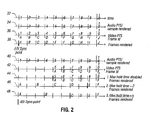
- the line 32 shows increasing units of time.
- the line 34 shows an audio presentation time stamp and indicates when the sample is rendered in one embodiment.
- the line 36 shows a video presentation time stamp and frame identifier which are synchronized with each unit of time and with the audio presentation time stamp.
- the audio/video synchronization point (AN sync point), indicated in line 38, is immediate and each frame thereafter has synchronization between audio and video.
- line 40 shows an audio presentation time stamp and the time when the audio sample is rendered which, in this case, corresponds to each unit of time.
- Line 42 shows the video presentation time stamp and the frame identifier, and, in this case, the first video presentation time stamp does not occur until time unit 5.
- an audio video presentation system 10 may receive an audio/video (A/V) stream at a decoder 12.
- the system is a consumer electronics device implemented using a system on a chip.
- the decoder 12 decodes any encoding or compression of a sequence of frames and provides a frame presentation time stamp and frames to a renderer 14.
- the decoder 12 may remove headers from packets in the stream and extract audio and video presentation time stamps.
- the decoder 12 may also remove audio and video frames from the stream.
- the renderer 14 may receive a clock signal, a flip signal, and a hold_time signal as indicated.
- the renderer 14 provides a frame to an output device 16 which may be an audio/video display device.
- the audio/video display device may be a computer, a television, or a cellular telephone, to mention a few examples.
- the system 10 may comprise a computer system, an appliance, a work station, a terminal, a handheld device, a personal digital assistant, a television, a set top box, a telephone, a handset, a wireless access point, or a subscriber station, to mention a few examples.
- the system 10 may be a media processing system to communicate or process different types of information, such as media information and control information.
- media information may include any data or signals representing content meant for a user, such as media content, voice information, video information, audio information, image information, textual information, etc.
- Control information may refer to any data or signals representing commands, instructions, or control words meant for an audio system.
- the system 10 may be implemented as a wired communication system, a wireless communication system, or a combination of the two.
- the source of the audio video stream may comprise any media source capable of sourcing or delivering media information or control information. This information may be provided to a large number of nodes, only one of which is shown in Figure 1 .
- the media source may be any hardware or software element capable of storing and/or delivering media information.
- the information may provide streaming information as indicated in some embodiments. It may also provide broadcast information or digital audio video signals.
- the maximum hold time (hold_time) is introduced by the renderer 14 to handle audio and video content.
- the maximum hold time may be programmed by a distributor, fixed based on content analysis, or adjusted dynamically by the system, to mention a few examples.
- the maximum hold time is configurable. By configurable, it is intended to refer to the ability to set or change the maximum hold time after the system has been manufactured.
- the hold_time may be set by a system integrator.
- the maximum hold time is the maximum time for which a frame is held on a display before a new frame is flipped in its place, assuming uncompressed video frames are available in the renderer 14.
- the maximum hold time may also be understood as the maximum time allowed between two consecutive frame flips to the display 16.
- a dynamically configurable system may set the hold_time variable based on various characteristics of an A/V stream, the current time, or the state of the system.
- One such characteristic is the time between a video frame and an audio frame that includes the audio that goes with the video frame.
- the larger the time between the video and audio frame the greater the hold_time.
- the hold_time may be configured automatically based on the nature of the A/V stream.
- the hold_time may also be set based on the type of system 10.
- the hold_time may be calculated based on the difference between the current time and the next presentation time stamp. For example, the larger the difference between the next video presentation time stamp and the current time, the greater the hold time.
- the hold_time may be calculated based on the amount of audio or video data currently buffered within the system.
- the first video frame is sent by the renderer 14 to the display 16 right away. If no frame is flipped within a maximum hold time after the previous frame flip, the next frame in the stream is sent to the display 16. If frames were flipped in the interim, the previous flip time is updated and the renderer 14 waits for the hold time from that flip time.
- line 46 in this example, with a maximum hold time equal 2, the frames A, B, C, D, and E are displayed, separated by two time units. Audio/video synchronization is not achieved until the time E. However, frames are displayed from the start and, after the time E, audio and video synchronization is achieved.
- Video is presented to the display right away, along with the audio, giving the impression to the user of a faster startup or channel change, in some embodiments.
- Audio/video synchronization may not be obtained initially and the video may be displayed in slow motion until audio/video synchronization is achieved.
- the actual time before achieving audio/video synchronization depends on the maximum hold time and the difference between the initial audio and video presentation time stamps.
- the maximum hold time may be greater than one frame interval for audio/video synchronization to be achieved. For example, for 30 frames-per-second content, the maximum hold time may be greater than 0.033 seconds.
- the maximum hold time may also let the video renderer 14 recover from abnormally large presentation time stamps received in the middle of content playback. Instead of causing video freezes, the renderer 14 may only stall for the hold time after the previous flip.
- the use of the maximum hold time may provide the user with the impression of a faster channel change because video may be presented to the display as soon as it is decoded by the decoder 12. It may also increase the robustness of the video renderer and may allow it to deal with content where the video presentation time stamps are much ahead compared to the audio presentation time stamps. The renderer 14 then has a mechanism to recover from frames with presentation time stamps far in the future, for example, because of errors, instead of causing video freeze in some embodiments.
- a sequence 18 may be implemented in software, hardware, or firmware.
- software it may be stored on a storage device 18a within the renderer 14 in one embodiment. It may also be stored outside the renderer 14, in some embodiments, and may be stored in any semiconductor memory, for example.
- the renderer 14 is a processor-based system such as a controller.
- variable prev_flip_time is set equal to the variable current_time which is simply the current time.
- variable hold_time is set equal to an assigned value in one embodiment.
- the assigned value may be assigned by the user, may be preset by the manufacturer, and may be deduced from operator controls. For example, a signal may be provided with the audio/video stream which tells the renderer 14 what is the assigned value. Alternatively, the system can detect the offset between audio and video presentation time stamps and assess the best hold time to use under the circumstances.
- the current time and the next frame in the queue are obtained, as indicated in block 22.
- the current time may be obtained from a clock and the next frame in the queue is received from the decoder 12 (as indicated in Figure 1 ).
- a check determines whether the frame presentation time stamp equals the current time or the variable prev_flip_time plus the hold_time equals the current time. In either of these circumstances, a frame is sent to the display 16 by the renderer 14. Thus, if the presentation time stamp calls for display, the display occurs. If the presentation time stamp still does not call for the display of the video frame, then a check determines whether the hold time has passed since the last frame display or frame flip. If so, the frame is displayed in either case (block 26). After displaying the frame in block 16, the variable prev_flip_time is set equal to the new current time, in block 28, and the queue pointer is incremented to point to the next frame (block 30).
- the storage device 18a may be implemented using any machine readable or computer readable media capable of storing data, including both volatile and non-volatile memory.
- the storage device 18a may include read only memory, random access memory, dynamic random access memory, double data rate dynamic random access memory, synchronous dynamic random access memory, static random access memory, programmable read only memory, erasable programmable read only memory, electrically erasable programmable read only memory, flash memory, polymer memory, ovonic memory, phase change or ferroelectric memory, or any other type of media suitable for storing information.
- All or part of the storage device 18a may be included on the same integrated circuit as the renderer 14 or, alternatively, some portion or all of the storage device 18a may be disposed on an integrated circuit or other medium, for example a hard disk drive, that is external to the integrated circuit of the renderer 14.
- the embodiments are not limited in this context.
- references throughout this specification to "one embodiment” or “an embodiment” mean that a particular feature, structure, or characteristic described in connection with the embodiment is included in at least one implementation encompassed within the present invention. Thus, appearances of the phrase “one embodiment” or “in an embodiment” are not necessarily referring to the same embodiment. Furthermore, the particular features, structures, or characteristics may be instituted in other suitable forms other than the particular embodiment illustrated and all such forms may be encompassed within the claims of the present application.
Landscapes
- Engineering & Computer Science (AREA)
- Multimedia (AREA)
- Signal Processing (AREA)
- Computer Security & Cryptography (AREA)
- Two-Way Televisions, Distribution Of Moving Picture Or The Like (AREA)
- Indexing, Searching, Synchronizing, And The Amount Of Synchronization Travel Of Record Carriers (AREA)
Applications Claiming Priority (1)
| Application Number | Priority Date | Filing Date | Title |
|---|---|---|---|
| US12/006,083 US9571901B2 (en) | 2007-12-28 | 2007-12-28 | Synchronizing audio and video frames |
Publications (2)
| Publication Number | Publication Date |
|---|---|
| EP2076052A2 true EP2076052A2 (de) | 2009-07-01 |
| EP2076052A3 EP2076052A3 (de) | 2009-07-29 |
Family
ID=40568375
Family Applications (1)
| Application Number | Title | Priority Date | Filing Date |
|---|---|---|---|
| EP08254028A Withdrawn EP2076052A3 (de) | 2007-12-28 | 2008-12-17 | Synchronisieren von Audio- und Video-Frames |
Country Status (3)
| Country | Link |
|---|---|
| US (1) | US9571901B2 (de) |
| EP (1) | EP2076052A3 (de) |
| CN (1) | CN101478683B (de) |
Cited By (1)
| Publication number | Priority date | Publication date | Assignee | Title |
|---|---|---|---|---|
| EP3073754A1 (de) * | 2015-03-25 | 2016-09-28 | Hangzhou Hikvision Digital Technology Co., Ltd. | Systeme und verfahren zur videospielsteuerung |
Families Citing this family (13)
| Publication number | Priority date | Publication date | Assignee | Title |
|---|---|---|---|---|
| CN101616331B (zh) * | 2009-07-27 | 2011-07-20 | 北京汉邦高科数字技术有限公司 | 一种对视频帧率及音视频同步性能进行测试的方法 |
| US8533259B2 (en) * | 2011-01-27 | 2013-09-10 | Rhythm NewMediaInc. | Efficient real-time stitching of multimedia files |
| US9179118B2 (en) | 2011-05-12 | 2015-11-03 | Intel Corporation | Techniques for synchronization of audio and video |
| EP2948949A4 (de) * | 2013-01-24 | 2016-09-21 | Telesofia Medical Ltd | System und verfahren zur flexiblen videokonstruktion |
| US10068508B2 (en) | 2013-08-30 | 2018-09-04 | Google Llc | Measuring user interface performance consistency |
| CN105187896B (zh) * | 2015-09-09 | 2019-04-23 | 暴风集团股份有限公司 | 多分段的媒体文件播放方法和系统 |
| US10862944B1 (en) | 2017-06-23 | 2020-12-08 | Amazon Technologies, Inc. | Real-time video streaming with latency control |
| US20190114733A1 (en) * | 2017-10-12 | 2019-04-18 | Red Hat, Inc. | Display content currentness validation |
| US11025858B2 (en) * | 2019-08-08 | 2021-06-01 | Netflix, Inc. | Frame rate conversion |
| CN111757144B (zh) * | 2020-04-13 | 2022-03-08 | 湖南化工职业技术学院(湖南工业高级技工学校) | 一种网络计算机多媒体视频播放方法和系统 |
| CN111988641B (zh) * | 2020-07-28 | 2022-07-15 | 上海工程技术大学 | 传输流复用音视频时间同步方法 |
| CN112929713B (zh) * | 2021-02-07 | 2024-04-02 | Oppo广东移动通信有限公司 | 数据同步方法、装置、终端及存储介质 |
| CN114071185B (zh) * | 2021-11-16 | 2025-09-16 | 北京百度网讯科技有限公司 | 视频流下发的方法、相关装置及计算机程序产品 |
Citations (1)
| Publication number | Priority date | Publication date | Assignee | Title |
|---|---|---|---|---|
| EP1643772A2 (de) * | 2004-10-04 | 2006-04-05 | Broadcom Corporation | System, Verfahren und Vorrichtung zum störungsfreien Kanalwechsel |
Family Cites Families (13)
| Publication number | Priority date | Publication date | Assignee | Title |
|---|---|---|---|---|
| US5598352A (en) | 1994-09-30 | 1997-01-28 | Cirrus Logic, Inc. | Method and apparatus for audio and video synchronizing in MPEG playback systems |
| US6262776B1 (en) * | 1996-12-13 | 2001-07-17 | Microsoft Corporation | System and method for maintaining synchronization between audio and video |
| JPH10262208A (ja) | 1997-03-19 | 1998-09-29 | Sony Corp | 同期ずれ制御装置及び方法 |
| EP1708487B1 (de) * | 1997-08-29 | 2013-05-08 | Panasonic Corporation | Verfahren und Vorrichtung zur Wiedergabe einer hochauflösenden optischen Videoplatte |
| JP3063841B2 (ja) | 1997-11-26 | 2000-07-12 | 日本電気株式会社 | オーディオ・ビデオ同期再生装置 |
| JP3104681B2 (ja) * | 1998-06-10 | 2000-10-30 | 日本電気株式会社 | オーディオ・ビデオ同期再生方法および装置 |
| JP4389365B2 (ja) * | 1999-09-29 | 2009-12-24 | ソニー株式会社 | トランスポートストリーム記録装置および方法、トランスポートストリーム再生装置および方法、並びにプログラム記録媒体 |
| SE517245C2 (sv) * | 2000-09-14 | 2002-05-14 | Ericsson Telefon Ab L M | Synkronisering av audio- och videosignaler |
| US6906755B2 (en) * | 2002-01-04 | 2005-06-14 | Microsoft Corporation | Method and apparatus for synchronizing audio and video data |
| FR2849328A1 (fr) * | 2002-12-20 | 2004-06-25 | St Microelectronics Sa | Procede et dispositif de synchronisation de la presentation de trames audio et/ou de trames video |
| WO2005117431A1 (en) | 2004-05-26 | 2005-12-08 | Vividas Technologies Pty Ltd | Method for synchronising video and audio data |
| US7519845B2 (en) * | 2005-01-05 | 2009-04-14 | Microsoft Corporation | Software-based audio rendering |
| US7643513B2 (en) * | 2005-11-30 | 2010-01-05 | Broadcom Corporation | Method and system for audio and video transport |
-
2007
- 2007-12-28 US US12/006,083 patent/US9571901B2/en not_active Expired - Fee Related
-
2008
- 2008-12-17 EP EP08254028A patent/EP2076052A3/de not_active Withdrawn
- 2008-12-26 CN CN2008101847791A patent/CN101478683B/zh not_active Expired - Fee Related
Patent Citations (1)
| Publication number | Priority date | Publication date | Assignee | Title |
|---|---|---|---|---|
| EP1643772A2 (de) * | 2004-10-04 | 2006-04-05 | Broadcom Corporation | System, Verfahren und Vorrichtung zum störungsfreien Kanalwechsel |
Cited By (4)
| Publication number | Priority date | Publication date | Assignee | Title |
|---|---|---|---|---|
| EP3073754A1 (de) * | 2015-03-25 | 2016-09-28 | Hangzhou Hikvision Digital Technology Co., Ltd. | Systeme und verfahren zur videospielsteuerung |
| US10182238B2 (en) | 2015-03-25 | 2019-01-15 | Hangzhou Hikvision Digital Technology Co., Ltd. | Systems and methods for controlling video display |
| US10798406B2 (en) | 2015-03-25 | 2020-10-06 | Hangzhou Hikvision Digital Technology Co., Ltd. | Systems and methods for controlling video display |
| EP4300970A3 (de) * | 2015-03-25 | 2024-02-28 | Hangzhou Hikvision Digital Technology Co., Ltd. | Systeme und verfahren zur videospielsteuerung |
Also Published As
| Publication number | Publication date |
|---|---|
| CN101478683B (zh) | 2013-04-10 |
| CN101478683A (zh) | 2009-07-08 |
| EP2076052A3 (de) | 2009-07-29 |
| US9571901B2 (en) | 2017-02-14 |
| US20090169176A1 (en) | 2009-07-02 |
Similar Documents
| Publication | Publication Date | Title |
|---|---|---|
| US9571901B2 (en) | Synchronizing audio and video frames | |
| US10659721B2 (en) | Method of processing a sequence of coded video frames | |
| US6031584A (en) | Method for reducing digital video frame frequency while maintaining temporal smoothness | |
| TWI358234B (en) | Data transmission system, receiving apparatus, and | |
| JP5452495B2 (ja) | オーディオ・ビデオレンダリングの早期開始システム及び方法 | |
| JPWO2002023908A1 (ja) | ネットワーク動画音声の配信方法、その装置及び動画音声の作成方法 | |
| US7493644B1 (en) | Method, apparatus, and system for video fast forward functionality in a mobile phone | |
| US10045071B2 (en) | Method and system for fast digital channel change utilizing time-stamp management | |
| CN110300326B (zh) | 一种视频卡顿的检测方法、装置、电子设备及存储介质 | |
| US8842740B2 (en) | Method and system for fast channel change | |
| CN111131874B (zh) | 一种解决h.265码流随机接入点播放卡顿的方法、设备及计算机存储介质 | |
| US8009741B2 (en) | Command packet system and method supporting improved trick mode performance in video decoding systems | |
| US20060072671A1 (en) | System, method and apparatus for clean channel change | |
| CN1893383B (zh) | 提供根据剩余存储器容量的可记录时间的方法及其终端 | |
| JP4511952B2 (ja) | メディア再生装置 | |
| US20060203853A1 (en) | Apparatus and methods for video synchronization by parsing time stamps from buffered packets | |
| JP6464647B2 (ja) | 動画像処理方法、動画像の送信装置、動画像処理システムおよび動画像処理プログラム | |
| US7577204B2 (en) | Hits stream rewind | |
| CN105187862B (zh) | 一种分布式播放器流量控制方法及系统 | |
| KR20060105326A (ko) | 디지털 방송 시스템의 av 출력 방법 및 장치 | |
| JP2007274441A (ja) | 画像再生装置および画像再生方法 | |
| JP2004007541A (ja) | データ多重方法及び多重データ復号方法 | |
| JP2005236559A (ja) | 映像受信装置 | |
| JP2006262465A (ja) | バッファに貯蔵されたパケットからタイムスタンプをパーシングしてビデオ同期化を実行する装置及び方法 | |
| JP2008072265A (ja) | デジタル放送番組データ再生制御方法 |
Legal Events
| Date | Code | Title | Description |
|---|---|---|---|
| PUAI | Public reference made under article 153(3) epc to a published international application that has entered the european phase |
Free format text: ORIGINAL CODE: 0009012 |
|
| PUAL | Search report despatched |
Free format text: ORIGINAL CODE: 0009013 |
|
| AK | Designated contracting states |
Kind code of ref document: A2 Designated state(s): AT BE BG CH CY CZ DE DK EE ES FI FR GB GR HR HU IE IS IT LI LT LU LV MC MT NL NO PL PT RO SE SI SK TR |
|
| AX | Request for extension of the european patent |
Extension state: AL BA MK RS |
|
| AK | Designated contracting states |
Kind code of ref document: A3 Designated state(s): AT BE BG CH CY CZ DE DK EE ES FI FR GB GR HR HU IE IS IT LI LT LU LV MC MT NL NO PL PT RO SE SI SK TR |
|
| AX | Request for extension of the european patent |
Extension state: AL BA MK RS |
|
| 17P | Request for examination filed |
Effective date: 20100119 |
|
| 17Q | First examination report despatched |
Effective date: 20100226 |
|
| AKX | Designation fees paid |
Designated state(s): AT BE BG CH CY CZ DE DK EE ES FI FR GB GR HR HU IE IS IT LI LT LU LV MC MT NL NO PL PT RO SE SI SK TR |
|
| STAA | Information on the status of an ep patent application or granted ep patent |
Free format text: STATUS: THE APPLICATION IS DEEMED TO BE WITHDRAWN |
|
| 18D | Application deemed to be withdrawn |
Effective date: 20130801 |