EP2075552B1 - Ink-jet printer with ink flow velocity detector - Google Patents
Ink-jet printer with ink flow velocity detector Download PDFInfo
- Publication number
- EP2075552B1 EP2075552B1 EP08022323A EP08022323A EP2075552B1 EP 2075552 B1 EP2075552 B1 EP 2075552B1 EP 08022323 A EP08022323 A EP 08022323A EP 08022323 A EP08022323 A EP 08022323A EP 2075552 B1 EP2075552 B1 EP 2075552B1
- Authority
- EP
- European Patent Office
- Prior art keywords
- light
- ink
- section
- emitting
- flow
- Prior art date
- Legal status (The legal status is an assumption and is not a legal conclusion. Google has not performed a legal analysis and makes no representation as to the accuracy of the status listed.)
- Ceased
Links
Images



Classifications
-
- G—PHYSICS
- G01—MEASURING; TESTING
- G01F—MEASURING VOLUME, VOLUME FLOW, MASS FLOW OR LIQUID LEVEL; METERING BY VOLUME
- G01F1/00—Measuring the volume flow or mass flow of fluid or fluent solid material wherein the fluid passes through a meter in a continuous flow
- G01F1/05—Measuring the volume flow or mass flow of fluid or fluent solid material wherein the fluid passes through a meter in a continuous flow by using mechanical effects
- G01F1/20—Measuring the volume flow or mass flow of fluid or fluent solid material wherein the fluid passes through a meter in a continuous flow by using mechanical effects by detection of dynamic effects of the flow
- G01F1/28—Measuring the volume flow or mass flow of fluid or fluent solid material wherein the fluid passes through a meter in a continuous flow by using mechanical effects by detection of dynamic effects of the flow by drag-force, e.g. vane type or impact flowmeter
-
- B—PERFORMING OPERATIONS; TRANSPORTING
- B41—PRINTING; LINING MACHINES; TYPEWRITERS; STAMPS
- B41J—TYPEWRITERS; SELECTIVE PRINTING MECHANISMS, i.e. MECHANISMS PRINTING OTHERWISE THAN FROM A FORME; CORRECTION OF TYPOGRAPHICAL ERRORS
- B41J2/00—Typewriters or selective printing mechanisms characterised by the printing or marking process for which they are designed
- B41J2/005—Typewriters or selective printing mechanisms characterised by the printing or marking process for which they are designed characterised by bringing liquid or particles selectively into contact with a printing material
- B41J2/01—Ink jet
- B41J2/17—Ink jet characterised by ink handling
- B41J2/175—Ink supply systems ; Circuit parts therefor
-
- G—PHYSICS
- G01—MEASURING; TESTING
- G01L—MEASURING FORCE, STRESS, TORQUE, WORK, MECHANICAL POWER, MECHANICAL EFFICIENCY, OR FLUID PRESSURE
- G01L1/00—Measuring force or stress, in general
- G01L1/04—Measuring force or stress, in general by measuring elastic deformation of gauges, e.g. of springs
- G01L1/044—Measuring force or stress, in general by measuring elastic deformation of gauges, e.g. of springs of leaf springs
-
- G—PHYSICS
- G01—MEASURING; TESTING
- G01L—MEASURING FORCE, STRESS, TORQUE, WORK, MECHANICAL POWER, MECHANICAL EFFICIENCY, OR FLUID PRESSURE
- G01L1/00—Measuring force or stress, in general
- G01L1/24—Measuring force or stress, in general by measuring variations of optical properties of material when it is stressed, e.g. by photoelastic stress analysis using infrared, visible light, ultraviolet
-
- G—PHYSICS
- G01—MEASURING; TESTING
- G01L—MEASURING FORCE, STRESS, TORQUE, WORK, MECHANICAL POWER, MECHANICAL EFFICIENCY, OR FLUID PRESSURE
- G01L1/00—Measuring force or stress, in general
- G01L1/26—Auxiliary measures taken, or devices used, in connection with the measurement of force, e.g. for preventing influence of transverse components of force, for preventing overload
Definitions
- the present invention relates to an ink-jet printer which is provided with a flow velocity detector.
- a flow rate meter which is based on the Pitot tube system
- the flow rate meter flow velocity meter
- the flow rate meter including a Pitot tube which is arranged in a gas flow of a gas to be measured, a differential pressure detector which detects the differential pressure between the total pressure in a total pressure-detecting tube of the Pitot tube and the static pressure in a static pressure-detecting tube, and a calculating means which calculates the flow velocity of the gas in accordance with a detection output of the differential pressure detector (see Japanese Patent Application Laid-open No. JP-2004-294147 ).
- An ultrasonic flow rate meter is known as another example of the flow rate meter.
- an ultrasonic flow rate meter is known, wherein an ultrasonic wave signal, which is generated by an ultrasonic vibrator disposed on the upstream side of a tube passage, is received by an ultrasonic vibrator disposed on the downstream side, and an ultrasonic wave signal, which is generated by the ultrasonic vibrator disposed on the downstream side, is received by the ultrasonic vibrator disposed on the upstream side.
- Two pieces of digital data which are obtained by sampling the signals respectively, are determined, and then the total sum of differences between two signal arrays is determined in a calculating unit while deviating the time axes of the pieces of data.
- the transmission time difference is determined in CPU on the basis of the point at which the total sum of the differences is minimized to determine the flow velocity of the fluid (see Japanese Patent Application Laid-open No. JP-2007-298347 ).
- An ultrasonic Doppler flow rate meter is known as still another example of the flow velocity meter.
- an ultrasonic Doppler flow rate meter is known, which measures the flow rate of the fluid allowed to naturally flow downwardly in a tube passage in accordance with the following procedure.
- an ultrasonic wave having a constant frequency is transmitted at an angle of elevation in the flow direction from a transmitting element provided at a central portion of the bottom of the tube passage.
- An emission wave is received by a receiving element to obtain a beat waveform including the information of a Doppler shift frequency by means of a heterodyne detecting section.
- the signal except for the noise is allowed to pass by means of a bandpass filter, and the AD conversion is performed by means of an AD converter.
- a frequency spectrum of the beat waveform is determined by means of a high speed Fourier transformation section.
- a peak frequency in the frequency spectrum is determined by means of a peak detecting section.
- the average flow velocity and the flow rate are calculated on the basis of the peak frequency by means of a flow rate calculating section.
- JP-2004-170308 A discloses a pressure sensitive device comprising a flow passage-forming section which defines a flow passage; a stress light-emitting section arranged at the flow passage-forming section to receive a stress having a magnitude depending on the fluid pressure and which emits a light of which amount corresponds to a change caused by the received stress; and a light-receiving sensor which receives the light emitted by the stress light-emitting section, wherein a fluid pressure is detected based on an amount of the light received by the light-receiving sensor to generate a detection signal.
- the present invention has been made in order to solve the problems as described above, the object of which is to provide an ink-jet printer which is provided with a flow velocity detector which has a simple structure, which is small-sized, and which is provided at low cost. This object is achieved by the ink-jet printer having the features of claim 1.
- the stress light-emitting section when the ink flows through the flow passage, the stress light-emitting section receives the stress having the magnitude depending on the flow velocity of the ink. Therefore, the light is emitted at the luminance corresponding to the change of the received stress.
- the light-receiving sensor is capable of detecting the flow velocity of the ink by receiving the light emitted by the stress light-emitting section to generate the detection signal. Accordingly, it is possible to detect or sense the fact that the ink is allowed to flow through the flow passage.
- the flow velocity detector of the ink-jet printer according to the present invention may further include a deformation-facilitating structure which is formed on the flow passage-forming section and which is deformable at a magnitude depending on the flow velocity of the ink, and the deformation-facilitating structure may be provided with the stress light-emitting section.
- the deformation-facilitating structure when the ink flows through the flow passage, the deformation-facilitating structure is deformed at the magnitude corresponding to the flow velocity of the ink.
- the stress light-emitting section is deformed in accordance with the deformation of the deformation-facilitating structure to emit the light.
- the deformation-facilitating structure makes it possible to obtain the relatively large deformation even when the flow velocity of the ink is relatively small.
- the relatively large deformation can be applied to the stress light-emitting section. Therefore, it is possible to detect the relatively small flow velocity by means of the flow velocity detector of the ink-jet printer.
- the deformation-facilitating structure may have a protrusion which protrudes into the flow passage, or a thin-walled section or a low rigidity section which is formed in the flow passage-forming section.
- the projection, the thin-walled section, or the low rigidity section can be formed to be deformable at the necessary magnitude corresponding to the flow velocity of the ink allowed to flow through the flow passage.
- the stress light-emitting section is deformed in accordance with the deformation of the projection or the like. Therefore, the stress light-emitting section is successfully allowed to emit the light at the required luminance.
- a part of the flow passage-forming section, through which the light is transmitted may be formed of a light-transmissive material such that the light emitted by the stress light-emitting section arrives at the light-receiving sensor.
- the light-receiving sensor when the stress light-emitting section emits the light in accordance with the flow of the ink through the flow passage, the light can arrive at the light-receiving sensor by being transmitted through the predetermined route formed of the light-transmissive material and/or through the space in some cases.
- the route (flow passage-forming section), through which the light is transmitted is formed of the light-transmissive material so that the light, which is emitted by the stress light-emitting section, arrives at the light-receiving sensor. Accordingly, the light-receiving sensor can receive the light emitted by the stress light-emitting section.
- the ink-jet printer is capable of detecting the flow velocity of the ink. Therefore, for example, when the purge operation is performed to discharge the ink from nozzles of an ink-jet head as the maintenance for the ink-jet printer, it is possible to check whether or not the ink is discharged from the nozzles.
- the flow passage may be formed as a plurality of flow passages, and the flow passage-forming section may have a plurality of individual flow passage-forming sections each of which defines one of the flow passages;
- the stress light-emitting section may include a plurality of individual stress light-emitting sections each of which is arranged at one of the individual flow passage-forming sections;
- the light-receiving sensor may include a single light-receiving sensor; and the flow velocity detector may successively receive lights emitted from the respective individual stress light-emitting sections by the single light-receiving sensor to detect flow velocity of the ink in each of the flow passages.
- the single light-receiving sensor can be used to successively receive the lights emitted by the plurality of stress light-emitting sections provided for the respective flow passage-forming sections for forming the plurality of fluid flow passages. Accordingly, it is possible to detect the flow velocities of the inks contained in the respective flow passages. As described above, it is enough to provide one light-receiving sensor. Therefore, it is possible to simplify the structure of the printer, and it is possible to decrease the cost.
- the ink-jet printer according to the present invention may further include a movable section which movably supports the plurality of individual flow passage-forming sections having the individual stress light-emitting sections arranged therein, wherein the single light-receiving sensor may be fixed at a predetermined position; and the movable section may be moved so that the lights successively emitted by the plurality of individual stress light-emitting sections are successively received by the single light-receiving sensor and that the flow velocity of the ink in each of the respective flow passages is detected.
- the movable section When the flow velocities of the inks contained in the plurality of flow passages are detected respectively by means of the flow velocity detector, then the movable section is moved, and the lights, which are emitted from the plurality of stress light-emitting sections respectively, can be successively received by the one light-receiving sensor fixed to the fixed section. Accordingly, it is possible to detect the flow velocities of the inks contained in the respective flow passages.
- the movable section is, for example, a carriage on which the ink-jet head based on the serial system is provided, it is unnecessary to provide any exclusive moving mechanism for moving the movable section. Accordingly, it is possible to simplify the structure of the printer, and it is possible to lower the cost.
- the stress light-emitting section which is provided in the flow passage, receives the stress of the magnitude corresponding to the flow velocity of the ink.
- the light is emitted at the luminance corresponding to the change of the received stress.
- the flow velocity of the ink is detected by receiving the light by means of the light-receiving sensor. Therefore, the structure is simple and small-sized. It is possible to detect the flow velocity of the ink at the low cost.
- the ink-jet printer concerning the present invention, it is possible to detect the flow velocity of the ink. Therefore, for example, when the purge operation is performed to discharge the ink from the nozzles of the ink-jet head, it is possible to check whether or not the ink is discharged from the nozzles. Accordingly, it is possible to avoid any erroneous printing which would be otherwise caused by the fact that the ink is not discharged from the nozzles.
- an ink-jet printer 11 performs the printing such that inks 15, which are formed into minute droplets, are allowed to blow against a recording medium 12 such as the printing paper.
- a flow velocity detector 13 which is provided for the ink-jet printer 11, detects the flow velocity brought about when the ink 15 is allowed to flow through each of first to fourth ink flow passages 14a to 14d shown in Fig. 10 .
- the first to fourth ink flow passages 14a to 14d are communicated with a large number of nozzles (not shown) which are provided on the lower surface of a head unit 16 shown in Fig. 9 .
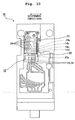
- Fig. 10 shows a magnified plan view illustrating the head unit 16.
- the purpose of detecting or sensing the flow velocity of the ink 15 is to check whether or not the ink 15 is discharged from the nozzles, for example, when the purge operation is performed to discharge the ink 15 from the nozzles of the ink-jet head 17 as the maintenance for the ink-jet printer 11.
- Fig. 8 shows a perspective view illustrating the appearance of the ink-jet printer 11
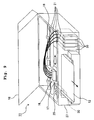
- Fig. 9 shows a perspective view illustrating a state in which a lid member 18 of the ink-jet printer 11 is open.
- a guide rail 19 is arranged substantially horizontally in the ink-jet printer (liquid droplet discharge apparatus) 11.
- the head unit 16 is supported by the guide rail 19 by the aid of a carriage (not shown) so that the head unit 16 is slidable in the scanning direction along the guide rail 19.
- the head unit 16 is connected to a rotary shaft of a motor by the aid of unillustrated pulleys and a timing belt. When the motor is driven and rotated in the forward or reverse direction, the head unit 16 is subjected to the reciprocating scanning along the guide rail 19.
- FIG. 9 As shown in Fig. 9 , four flexible ink supply tubes 21, which supply the four color inks (black, cyan, magenta, and yellow) from four ink cartridges (liquid supply sources) 20 installed to a cartridge installing section respectively, are connected to the head unit 16. Further, an ink-jet head 17 is carried on the head unit 16. The ink-jet head 17 discharges the inks (liquid droplets) 15 from the plurality of nozzles toward the surface of the recording medium 12 such as the printing paper to be transported in the predetermined paper feed direction perpendicular to the scanning direction therebelow.
- the flow velocity detector 13 includes first to fourth projections 23 each of which serves as a deformation-facilitating structure (a structure which is susceptible to deform) provided to protrude on the inner surface of one of the flow passage-forming sections (individual flow passage-forming sections) 22 for forming one of the first to fourth ink flow passages (individual flow passages) 14a to 14d, stress light-emitting sections (individual stress light-emitting sections) 24 each of which is provided on the surface of one of the first to fourth projections 23, and one light-receiving sensor 25 which receives the light emitted from each of the stress light-emitting sections 24.
- Fig. 1A shows the first ink flow passage 14a.
- the first to fourth ink flow passages 14a to 14d are provided on the upper surface portions of the head unit 16.
- the first to fourth projections 23, which protrude toward the inside of the flow passages respectively, are provided one by one at predetermined positions for the first to fourth ink flow passages 14a to 14d.
- One end or first end of each of the first to fourth ink flow passages 14a to 14d provided for the head unit 16 is formed as an ink inlet port 26.
- One end of each of ink supply tubes 21, which corresponds to each of the ink inlet ports 26, is connected to each of the ink inlet ports 26.
- each of the first to fourth ink flow passages 14a to 14d is communicated with a plurality of nozzle holes which are provided on the lower surface of the ink-jet head 17 carried on the head unit 16 and which correspond to each of the first to fourth ink flow passages 14a to 14d.
- the light-receiving sensor 25 is provided fixedly on the inner surface of the side wall of a body 27 of the ink-jet printer 11.
- a light-receiving section 25a which is provided on the lower surface of the light-receiving sensor 25, is positioned at each of the positions disposed over or above each of the first to fourth projections 23 arranged for the four respective first to fourth ink flow passages 14a to 14d as shown in Fig. 10 .
- first maintenance position when the flow velocity of the ink 15 contained in the first ink flow passage 14a disposed at the right end, the head unit 16 is moved so that the first projection 23, which is arranged in the first ink flow passage 14a, is positioned under or below the light-receiving section 25a of the light-receiving sensor 25.
- first maintenance position The position of the head unit 16, which is provided in this situation, is referred to as "first maintenance position".
- the head unit 16 is moved so that corresponding one of the second to fourth projections 23, which is arranged in the one of the second to fourth ink flow passages 14b to 14d, is positioned under or below the light-receiving section 25a of the light-receiving sensor 25.
- the positions of the head unit 16, which are provided in these situations, are referred to as "second to fourth maintenance positions" respectively (not shown).
- the flow passage-forming sections 22, which form the first to fourth ink flow passages 14a to 14d, are formed of a synthetic resin having the light-transmissive property. Therefore, the lights, which are emitted from the stress light-emitting sections 24 provided on the surfaces of the first to fourth projections 23 arranged in the first to fourth ink flow passages 14a to 14d respectively, are capable of arriving at the light-receiving sensor 25.
- the first to fourth ink flow passages 14a to 14d shown in Fig. 10 are equivalent components, and the first to fourth projections 23 provided with the stress light-emitting sections 24 arranged in the first to fourth ink flow passages 14a to 14d respectively are also equivalent components.
- the following explanation will be made about the first ink flow passage 14a and the first projection 23 provided with the stress light-emitting section 24. Any explanation will be omitted about the second to fourth ink flow passages 14b to 14d and the second to fourth projections 23 provided with the stress light-emitting sections 24.
- Fig. 1A shows a sectional view as obtained when the flow passage-forming section 22 for forming the first ink flow passage 14a is cut in the direction parallel to the flow passage direction.
- Fig. 1B shows a vertical sectional view illustrating the flow passage-forming section 22 provided with the first projection 23 shown in Fig. 1A .
- the first ink flow passage 14a has a circular vertical cross-sectional shape, which is formed by the flow passage-forming section 22.
- the first projection 23 is the deformation-facilitating structure.
- the deformation-facilitating structure herein means a structure which is greatly deformed when the stress is applied.
- the first projection 23 is deformed so that the first projection 23 is flexibly warped or bent to a great extent in the direction of the flow of the ink.
- the first projection 23 is formed to have a cantilever support structure on the inner surface of the cylindrical flow passage-forming section 22 which forms the first ink flow passage 14a.
- the first projection 23 is formed to have a length extending from the portion which is closest to the light-receiving sensor 25 to the position which is slightly short of the central position of the first ink flow passage 14a.
- the first projection 23 is a substantially trapezoidal shaped plate member which is tapered at positions nearer to the forward end.
- the plate surface thereof is perpendicular to the extending direction of the first ink flow passage 14a (see Fig. 1B ).
- the thickness of the first projection 23 is also tapered at positions nearer to the forward end.
- the first projection 23 has a proximal end portion 123a which is joined to the wall surface of the first ink flow passage 14a, and an extending portion 123b which extends toward the inside of the first ink flow passage 14a in the plane perpendicular to the flow direction of the ink in the first ink flow passage 14a from the proximal end portion 123a.
- the thickness (length in the direction of the flow of the ink) and the width of the extending portion 123b are smaller than the thickness and the width of the proximal end portion 123a, respectively.
- the first projection 23 is arranged so that the plate surface is perpendicular to the direction of the first ink flow passage 14a.
- the first projection 23 behaves as the resistance to the flow of the ink 15 in the first ink flow passage 14a to provide a relatively large flexure or warpage.
- the reason, why the first projection 23 behaves as the resistance to the flow of the ink 15 to provide the relatively large flexure, is that it is intended to apply a relatively large stress to the stress light-emitting section 24 provided on the plate surface of the first projection 23 so that the luminance (intensity) of the light emitted by the stress light-emitting section 24 is increased.
- the stress light-emitting section 24 is secured to the plate surface of the first projection 23, for example, by means of the application or coating to provide a predetermined thickness.
- the plate surface of the first projection 23, to which the stress light-emitting section 24 is secured, is the surface disposed on the side on which the ink 15 allowed to flow through the first ink flow passage 14a is allowed to collide therewith.
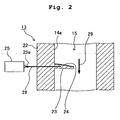
- the first projection 23 which is provided with the stress light-emitting section 24, is used, as shown in Fig. 2 , the first projection 23 is warped and deformed in the flow direction of the ink 15 at a magnitude corresponding to the flow velocity of the ink 15.
- the stress light-emitting section 24 receives the stress of the magnitude corresponding to the flow velocity of the ink 15, and the stress light-emitting section 24 emits the light at a luminance (intensity) corresponding to the change of the received stress.
- the luminance of the stress light-emitting section 24 is changed in correlation with the amount of change of the stress per unit time (stress velocity).
- the stress light-emitting section 24 in order to allow the stress light-emitting section 24 to emit the light at the high luminance, it is appropriate that the magnitude of the stress applied to the stress light-emitting section 24 is greatly changed in a short period of time.
- the arrow 28 shown in Fig. 2 indicates the light emitted by the stress light-emitting section 24.
- the arrow 29 indicates the flow direction of the ink 15.
- the light which is emitted by each of the stress light-emitting sections 24 provided on the surfaces of the second to fourth projections 23 arranged in the second to fourth ink flow passages 14a to 14d respectively, is transmitted through each of the flow passage-forming sections 22 having the light-transmissive property at each of different timings, and the light 23 is received by the light-receiving sensor 25.
- the head unit 16 is successively moved from the first maintenance position to the second, third, and fourth maintenance positions, and thus the flow velocities of the inks 15 contained in the first to fourth ink flow passages 14a to 14d can be detected or sensed by using one light-receiving sensor 25.
- the ink-jet printer 11 further includes a calculation control section (not shown).
- the calculation control section includes, for example, a central processing unit (CPU), which functions as a judging section as described later on.
- the light-receiving sensor 25 is electrically connected to the calculation control section.
- the judging section judges whether or not the light-receiving sensor 25 outputs the detection signal.
- the light-receiving sensor 25 outputs the detection signal when the light-receiving sensor 25 receives the light 28 of not less than the predetermined luminance (intensity) emitted by each of the stress light-emitting sections 24 provided on each of the surfaces of the first to fourth projections 23.
- the judging section when the luminance (intensity) of the light 28 emitted by a certain stress light-emitting section 24 is not less than the predetermined value, i.e., when the judging section judges that the light-receiving sensor 25 outputs the detection signal, then the judging section is capable of judging that the ink 15 of not less than a prescribed amount is discharged from the nozzle holes communicated with the ink flow passage in which the concerning stress light-emitting section 24 is arranged. In this situation, for example, the judging section is capable of judging that the purge operation is normal in relation to the concerning ink flow passage.
- the judging section is capable of judging that the ink 15 of not less than the prescribed amount is not discharged from the nozzle holes communicated with the ink flow passage in which the concerning stress light-emitting section 24 is arranged.
- the judging section is capable of judging that the purge operation is abnormal in relation to the concerning ink flow passage.
- the stress light-emitting section 24 is, for example, a substance obtained by adding europium (Eu) (rare earth substance) as the light emission center to Sr 3 Al 2 O 6 (aluminic acid salt) as the base material, or a material obtained by adding neodymium (Nd) (transition metal substance) as the light emission center to Ca 3 Al 2 O 6 (aluminic acid salt) as the base material.
- Eu europium
- Nd neodymium
- the stress light-emitting material can be prepared by adding 0.6 wt % Eu as the light emission center and 1 wt % boric acid as the flux to Sr 3 Al 2 O 6 as the base material, followed by being sintered at 1300 °C for about 4 hours in a reducing atmosphere (Ar + H 2 5 %).
- the obtained product can be utilized by converting it into a powder.
- those usable as the stress light-emitting material include, for example, Sr 0.90 Al 2 O 3.90 : Eu 0.01 (see Japanese Patent Application Laid-open No. JP 2000-63824 ), Ca 2 Al 2 SiO 7 : Ce, Ca 2 MgSi 2 O 7 : Ce (see Japanese Patent Application Laid-open No. JP 2001-49251 ), and ZnAl 2 O 4 : Mn, BaAl 2 O 4 : Ce (see Japanese Patent Application Laid-open No. JP 2001-64638 ).
- the stress light-emitting section 24 is provided on the plate surface of the first projection 23 (and the second to fourth projections 23), then the powder of the stress light-emitting material is mixed with an adhesive of, for example, the epoxy system having the light-transmissive property to prepare a paste, and the paste is applied to have a predetermined thickness onto the plate surface of the first projection 23 (and the second to fourth projections 23). In this way, the stress light-emitting section 24 is provided on the plate surface of the first projection 23 (and the second to fourth projections 23).
- the calculation control section controls the head unit 16 to move to the first maintenance position. Accordingly, it is possible to detect the flow velocity of the ink 15 contained in the first ink flow passage 14a disposed at the right end.
- the first projection 23, which is arranged in the first ink flow passage 14a and which is provided with the stress light-emitting section 24, is positioned under or below the light-receiving section 25a of the light-receiving sensor 25.
- the calculation control section performs the purge operation to discharge the inks 15, for example, from the plurality of nozzles of the ink-jet head 17 communicated with the first to fourth ink flow passages 14a to 14d respectively.
- the first projection 23 is deformed in an amount of deformation corresponding to the flow velocity of the ink 15, and the stress light-emitting section 24 is deformed to emit the light in accordance with the deformation of the first projection 23.
- the light-receiving sensor 25 is capable of receiving the light 28 emitted by the stress light-emitting section 24.
- the judging section can judge that the ink 15 of not less than the prescribed amount is discharged from the nozzle holes communicated with the first ink flow passage 14a in which the concerning stress light-emitting section 24 is arranged. In this situation, for example, the judging section can judge that the purge operation is normal in relation to the first ink flow passage 14a, and this fact can be displayed on a display section (not shown).
- the judging section can judge that the ink 15 of not less than the prescribed amount is not discharged from the nozzle holes communicated with the first ink flow passage 14a in which the concerning stress light-emitting section 24 is arranged. In this situation, for example, the judging section can judge that the purge operation is abnormal in relation to the first ink flow passage 14a, and this fact can be displayed on the display section (not shown).
- each of the second to fourth projections 23, which is arranged in each of the second to fourth ink flow passages 14b to 14d, is positioned under or below the light-receiving section 25a of the light-receiving sensor 25 at the predetermined timing.
- the judging section of the calculation control section judges whether or not the luminance (intensity) of the light 28 emitted by each of the stress light-emitting sections 24 provided for the second to fourth projections 23 is not less than the predetermined value, i.e., whether or not the light-receiving sensor 25 outputs the detection signal. Further, the judging section judges whether the purge operation is normal or abnormal in relation to each of the second to fourth ink flow passages 14b to 14d, and this fact is displayed on the display section (not shown).
- the luminance (intensity) of the light - emitted by the stress light-emitting section 24 is less than the predetermined value, i.e., in case the judging section judges that the light-receiving sensor 25 does not output the detection signal, even when the purge operation is performed, for example, for the predetermined period of time as described above, then it is found that the flow velocity of the ink is lowered in the ink flow passage.
- the cause of the decrease in the ink flow velocity includes, for example, the increase in the flow resistance of the ink contained in the ink flow passage due to the drying and/or the increase in viscosity of the ink 15 and the clog-up of the filter due to any foreign matter. In such a situation, this fact can be displayed on the display section and/or the operator can be informed of this fact in order to perform any process for removing each of the causes.
- a purge cap 30 is shown in Fig. 10 .
- the purge cap 30 makes tight contact with the nozzle forming surface of the head unit 16, when the head unit 16 is moved to each of the first to fourth maintenance positions to perform the purge operation.
- the inks 15 contained in the head unit 16 can be forcibly discharged from the plurality of respective nozzles by lowering the pressure in the purge cap by means of an unillustrated pump.
- the stress light-emitting sections 24 of the flow velocity detector 13 are arranged in the first to fourth ink flow passages 14a to 14d, respectively.
- the stress light-emitting section 24 receives the stress of the magnitude corresponding to the flow velocity of the ink 15, the stress light-emitting section 24 emits the light at the luminance corresponding to the change of the received stress.
- the flow velocity detector 13 detects the flow velocity of the ink 15 such that the light 28, which is emitted from the stress light-emitting section 24, is received by the light-receiving sensor 25. Therefore, the structure of the flow velocity detector 13 can be simplified and small-sized. It is possible to detect the flow velocity of the ink 15 at the low cost.
- the flow velocity detector 13 When the flow velocity detector 13 is applied to the ink-jet printer 11, it is possible to check whether or not the ink 15 is discharged from the nozzles, for example, when the purge operation is performed to discharge the ink 15 from the nozzles of the ink-jet head 17. Accordingly, it is possible to avoid any erroneous printing which would be otherwise caused by the failure of the discharge of the ink 15 from the nozzles.
- each of the first to fourth projections 23, which serves as the deformation-facilitating structure that is deformable at the magnitude corresponding to the flow velocity of the ink 15 allowed to flow through each of the ink flow passages, is provided for each of the flow passage-forming sections 22 of the first to fourth ink flow passages 14a to 14d.
- the stress light-emitting section 24 is provided for each of the first to fourth projections 23. Therefore, even when the flow velocity of the ink 15 is relatively small, the relatively large deformation is applied to the stress light-emitting section 24 owing to each of the first to fourth projections 23 as the deformation-facilitating structure. Therefore, it is possible to detect the relatively small flow velocity by means of the flow velocity detector 13.
- each of the first to fourth projections 23 allowed to protrude into the first to fourth ink flow passages 14a to 14d is formed as the deformation-facilitating structure.
- each of the first to fourth projections 23 can be formed to be deformable at the necessary magnitude corresponding to the flow velocity of the ink 15 allowed to flow through each of the first to fourth ink flow passages 14a to 14d by adjusting, for example, the thickness, the length, the shape, the material, and the protruding angle of each of the first to fourth projections 23.
- the stress light-emitting sections 24 are deformed in accordance with the deformation of the first to fourth projections 23. Therefore, when the first to fourth projections 23, which serve as the deformation-facilitating structures, are allowed to have the structures which are deformable with ease as described above, it is possible to allow the stress light-emitting sections 24 to emit the lights at the necessary luminance.
- the stress light-emitting section 24 emits the light as the ink 15 is allowed to flow through each of the first to fourth ink flow passages 14a to 14d
- the light 28 arrives at the light-receiving sensor 25 by being transmitted through the space and the predetermined route of the flow passage-forming section 22 formed of the light-transmissive material.
- the stress light-emitting section 24 when the stress light-emitting section 24 is provided at the inside of the flow passage-forming section 22 for forming each of the first to fourth ink flow passages 14a to 14d, the predetermined route of the flow passage-forming section 22, through which the light 28 is transmitted, is formed of the light-transmissive material so that the light 28, which is emitted by the stress light-emitting section 24, arrives at the light-receiving sensor 25. Accordingly, the light 28, which is emitted by the stress light-emitting section 24, can be received by the light-receiving sensor 25.
- one light-receiving sensor 25 can be used to successively receive the lights 28 emitted by the four stress light-emitting sections 24 arranged in the flow passage-forming sections 22 for forming the first to fourth ink flow passages 14a to 14d. Accordingly, it is possible to detect the flow velocities of the inks 15 contained in the first to fourth ink flow passages 14a to 14d respectively. As described above, it is enough to provide one light-receiving sensor 25. Therefore, it is possible to simplify the structure of the printer 11, and it is possible to decrease the cost.
- the head unit 16 is provided for the ink-jet printer 11 based on the serial system shown in Fig. 9 .
- the ink-jet printer 11 based on the serial system has a moving mechanism for moving the head unit 16 in order to perform the printing. Therefore, the moving mechanism can be utilized in order to move the first to fourth ink flow passages 14a to 14d (head unit 16) to the first to fourth maintenance positions. In other words, it is unnecessary to provide any exclusive moving mechanism for moving, to the first to fourth maintenance positions, the first to fourth ink flow passages 14a to 14d (head unit 16) arranged with the first to fourth projections 23. Accordingly, it is possible to simplify the structure of the printer 11, and it is possible to lower the cost.
- the plate surface of the first projection 23, to which the stress light-emitting section 24 is secured is the surface disposed on the side on which the ink 15 flowing through the first ink flow passage 14a is allowed to collide therewith.
- the stress light-emitting section 24 may be secured to the plate surface disposed on the side opposite to the surface with which the ink 15 is allowed to collide.
- the response of the deformation of the stress light-emitting section 24 is somewhat deteriorated.
- the dust, which is contained in the ink 15 hardly makes contact with the stress light-emitting section 24. Therefore, the stress light-emitting section 24 can be prevented from being damaged.
- a flow velocity detector 33 of an ink-jet printer 11 of a second embodiment of the present invention is different from the flow velocity detector 13 of the ink-jet printer of the first embodiment shown in Figs. 1 , 2 , and 8 to 10 with respect to the following points. That is, in the first embodiment, the stress light-emitting sections 24 with the predetermined thickness are provided on the respective plate surfaces of the first to fourth projections 23 (only the first projection 23 is shown) in the flow velocity detector 13 shown, for example, in Fig. 1 .
- first to fourth light-emitting projections 34 are provided in place of the first to fourth projections 23 and the stress light-emitting sections 24 in the flow velocity detector 33 of the second embodiment shown in Figs. 3A and 3B .
- the first to fourth light-emitting projections 34 are formed by mixing and dispersing a powder of the stress light-emitting material in a light-transmissive synthetic resin material.
- the first to fourth light-emitting projections 34 themselves are the stress light-emitting sections, and the stress light-emitting sections are formed as the deformation-facilitating structures.
- the first to fourth light-emitting projections 34 are formed by mixing and dispersing the powder of the stress light-emitting material in the light-transmissive synthetic resin material as described above. Therefore, the powder of the stress light-emitting material undergoes no fear of being disengaged from the first to fourth light-emitting projections 34, and it is possible to emit the light for a long period of time.
- the ink-jet printer provided with the flow velocity detector 33 of the ink-jet printer of the second embodiment is constructed equivalently to the flow velocity detector 13 in the ink-jet printer 11 of the first embodiment to provide the same or equivalent function except for the different points described above. Accordingly, the equivalent portions of the first and second embodiments are designated by the same reference numerals in the drawings, and any explanation about the equivalent portions are omitted.
- Fig. 3A shows a state in which the ink 15 contained in the first ink flow passage 14a does not flow and the ink 15 stays. In this state, the first projection 23 is not deformed by the flow of the ink 15. Therefore, the first light-emitting projection 34 does not emit the light, and the light-receiving sensor 25 receives no light from the first light emitting projection.
- Fig. 3B shows a state in which the ink 15 contained in the first ink flow passage 14a flows, and the first light-emitting projection 34 is deformed by the flow of the ink 15.
- the magnitude of the stress per unit time applied to the first light-emitting projection 34 is changed as well.
- the first light-emitting projection 34 emits the light, and hence the light-receiving sensor 25 can receive the light emitted by the first light-emitting projection 34.
- the first to fourth light-emitting projections 34 can be formed such that a powder of the stress light-emitting material is kneaded with a light-transmissive synthetic resin material including, for example, polyethylene (PE), polypropylene (PP), polymethyl methacrylate (PMMA), polycarbonate (PC), ABS resin, and polystyrene (PS), followed by performing, for example, the injection molding.
- a light-transmissive synthetic resin material including, for example, polyethylene (PE), polypropylene (PP), polymethyl methacrylate (PMMA), polycarbonate (PC), ABS resin, and polystyrene (PS), followed by performing, for example, the injection molding.
- First to fourth light-emitting projections 34 (only the first light-emitting projection 34 is shown) of the third embodiment shown in Fig. 4A are equivalent to the first to fourth light-emitting projections 34 of the second embodiment shown in Figs. 3A and 3B .
- Mirror surface layers 37 are provided on the entire surfaces of the first to fourth light-emitting projections 34 of the third embodiment respectively.
- a mirror surface is formed on the inner surface of the mirror surface layer 37.
- the mirror surface layer 37 can be formed by forming a film, for example, by means of the sputtering method, for example, with aluminum, nickel, or silver on the surface of each of the first to fourth light-emitting projections 34.
- the mirror surface layer 37 can be also formed by applying a paint containing a powder of the metal as described above.
- the third embodiment is equivalent to the second embodiment. Therefore, equivalent portions are designated by the same reference numerals in the drawing, and any explanation about the equivalent portions is omitted.
- the mirror surface layer 37 is provided on the entire surface of each of the first to fourth light-emitting projections 34, then the light 28, which is included in the light 28 emitted by each of the first to fourth light-emitting projections 34 and which is not directed to the light-receiving sensor 25 directly, can be reflected by the mirror surface layer 37, and the light 28 can be directed to the light-receiving sensor 25. Accordingly, the light 28 of each of the first to fourth light-emitting projections 34 to perform the light emission at a relatively small luminance (intensity) can be collected, and the light 28 can be received by the light-receiving sensor 25.
- a white reflective layer may be provided by using, for example, titanium oxide.
- the color of the reflective layer is not limited to white.
- the reflective layer can be formed with any arbitrary color and any arbitrary material provided that the light 28, which is included in the light 28 emitted by each of the first to fourth light-emitting projections 34 and which is not directed to the light-receiving sensor 25 directly, can be reflected and directed to the light-receiving sensor 25.
- First to fourth light-emitting projections 34 (only the first light-emitting projection 34 is shown) of the fourth embodiment shown in Fig. 4B are equivalent to the first to fourth light-emitting projections 34 of the second embodiment shown in Figs. 3A and 3B .
- Opaque layers 40 are provided on the entire surfaces of the first to fourth light-emitting projections 34 of the fourth embodiment respectively.
- the opaque layer 40 can be formed by applying an opaque paint to the surface of each of the first to fourth light-emitting projections 34.
- the fourth embodiment is equivalent to the second embodiment. Therefore, equivalent portions are designated by the same reference numerals in the drawing, and any explanation about the equivalent portions is omitted.
- the opaque layer 40 is provided on the entire surface of each of the first to fourth light-emitting projections 34, the light 28, which is emitted by each of the first to fourth light-emitting projections 34, cannot be radiated onto the ink 15 contained in each of the first to fourth ink flow passages 14a to 14d. It is possible to avoid, for example, any quality change of the ink 15 which would be otherwise caused, for example, by radiating the light onto the ink 15.
- First to fourth projections 23 (only the first projection 23 is shown), which are provided with stress light-emitting sections 24 included in the fifth embodiment shown in Fig. 5 , are equivalent to the first to fourth projections 23 provided with the stress light-emitting sections 24 included in the first embodiment shown in Fig. 2 .
- Mirror surface layers 37 are formed on the entire surfaces of the first to fourth projections 23 of the fifth embodiment.
- An inner surface (surface opposed to the first projection 23 or the stress light-emitting section 24) of the mirror surface layer 37 is formed as a mirror surface.
- An optical guide path 43 is formed on the outer surface of the flow passage-forming section 22, i.e., on the surface disposed on the side directed toward the light-receiving sensor 25.
- the optical guide path 43 is provided as follows. That is, a recess 44 is formed on the outer surface of the flow passage-forming section 22, and a mirror surface layer 45 is provided on the entire side surface of the recess 44 except for the bottom surface disposed on the side directed toward each of the first to fourth projections 23.
- An inner surface (surface not opposed to the flow passage-forming member 22) of the mirror surface layer 45 is formed to provide the mirror surface.
- the fifth embodiment is equivalent to the first embodiment. Therefore, equivalent portions are designated by the same reference numerals in the drawing, and any explanation about the equivalent portions is omitted.
- the light 28, which is included in the light emitted by each of the stress light-emitting sections 24 of the first to fourth projections 23 and which is not directed toward the light-receiving sensor 25 directly, can be reflected by the mirror surface layer 37, and the light 28 can be directed toward the light-receiving sensor 25.
- the light 28, which is directed toward the light-receiving sensor 25 can be allowed to pass through the optical guide path 43, and the light 28 can be directed to the light-receiving sensor 25.
- the optical guide path 43 makes it possible to reflect the light 28 allowed to come from the bottom surface of the recess 44 by the mirror surface layer 45 so that the light 28 is directed to the light-receiving sensor 25.
- the light 28 of the stress light-emitting section 24 which effects the light emission at a relatively small luminance (intensity) can be collected, and the light 28 can be received by the light-receiving sensor 25.
- the light-receiving sensor 25 As a result, it is possible to detect a relatively small flow velocity of the ink 15 contained in each of the first to fourth ink flow passages 14a to 14d.
- a flow velocity detector 47 of an ink-jet printer 11 of a sixth embodiment according to the present invention is different from the first embodiment shown, for example, in Fig. 2 as follows. That is, in the first embodiment shown, for example, in Fig. 2 , the light 28, which is emitted from each of the stress light-emitting sections 24 provided for the first to fourth projections 23, is transmitted through the flow passage-forming section 22 having the light-transmissive property, and the light 28 is received by the light-receiving sensor 25.
- first to fourth projections 23 are provided on outer surfaces (surface not facing the first ink flow passage) of thin-walled sections 48 formed for flow passage-forming sections 22, stress light-emitting sections 49 are provided to have a predetermined thickness on outer surfaces of the respective thin-walled sections 48, and the light 28, which is emitted from each of the stress light-emitting sections 49, is received by the light-receiving sensor 25 in the sixth embodiment shown in Figs. 6A and 6B .
- the stress light-emitting section 49 is equivalent to the stress light-emitting section of the first embodiment.
- the thin-walled section 48 and the stress light-emitting section 49 are deformed in accordance with the deformation of the first projection 23.
- the stress light-emitting section 49 emits the light at a luminance (intensity) depending on the change of the deformation of the stress light-emitting section 49, and the light 28 is received by the light-receiving sensor 25.
- the respective stress light-emitting sections 49 are provided on the outer surfaces of the thin-walled sections 48. Therefore, the light 28, which is emitted from the stress light-emitting section 49, can be received by the light-receiving sensor 25 without transmitting the light 28 through the flow passage-forming section 22. Accordingly, it is possible to avoid the decrease in the luminance (intensity) which would be otherwise caused such that the light 28 emitted from the stress light-emitting section 49 is transmitted through the flow passage-forming section 22. Further, an opaque material can be used as the material for the flow passage-forming section 22. Further, the stress light-emitting section 49 makes no contact with the ink.
- the first projection 23 is deformed by the stress received from the ink allowed to flow through the flow passage.
- the flow velocity detector 47 in the ink-jet printer 11 of the sixth embodiment is constructed equivalently to the flow velocity detector 13 in the ink-jet printer 11 of the first embodiment, wherein the function is effected equivalently. Therefore, equivalent portions are designated by the same reference numerals in the drawings, and any explanation about the equivalent portions is omitted.
- a flow velocity detector 51 of an ink-jet printer 11 of a seventh embodiment according to the present invention The seventh embodiment shown in Fig. 7A is different from the first embodiment shown, for example, in Fig. 2 in the following point.
- the stress light-emitting sections 24 are provided for the first to fourth projections 23 as the deformation-facilitating structures respectively, and the light 28, which is emitted by each of the stress light-emitting sections 24, is received by the light-receiving sensor 25.
- first to fourth light-emitting thin-walled sections 52 as deformation-facilitating structures are provided for flow passage-forming sections 22, and the light 28, which is emitted by each of the first to fourth light-emitting thin-walled sections 52, is received by the light-receiving sensor 25.
- the seventh embodiment as shown in Fig. 7A , for example, when the ink 15 in the first ink flow passage 14 flows, and the first light-emitting thin-walled section 52 is deformed inwardly, then the first light-emitting thin-walled section 52 emits the light at a luminance (intensity) corresponding to the change of the deformation, and the light is received by the light-receiving sensor 25.
- the first to fourth light-emitting thin-walled sections 52 can be manufactured in the same manner as the first to fourth light-emitting projections 34 of the second embodiment. That is, each of the first to fourth light-emitting thin-walled sections 52 can be formed by mixing and dispersing a powder of the stress light-emitting material in a synthetic resin material having the light-transmissive property. In other words, the first to fourth light-emitting thin-walled sections 52 themselves are the stress light-emitting sections, and the stress light-emitting sections are formed as the deformation-facilitating structures.
- the flow velocity detector 51 in the ink-jet printer 11 of the seventh embodiment is constructed equivalently to the flow velocity detector 13 in the ink-jet printer 11 of the first embodiment, wherein the function is effected equivalently. Therefore, equivalent portions are designated by the same reference numerals in the drawing, and any explanation about the equivalent portions is omitted.
- First to fourth light-emitting thin-walled sections 52 (only the first light-emitting thin-walled section 52 is shown) of the eighth embodiment shown in Fig. 7B are equivalent to those of the seventh embodiment shown in Fig. 7A .
- the first to fourth light-emitting thin-walled sections 52 are formed by bottom walls of recesses 55 provided on outer surfaces of flow passage-forming sections 22 for forming the first to fourth ink flow passages 14a to 14d respectively.
- a soft member 56 which is composed of, for example, a synthetic resin foam such as epoxy resin having the light-transmissive property, is provided and secured in each of the recesses 55.
- the soft member 56 and each of the first to fourth light-emitting thin-walled sections 52 constitute a low rigidity section 57 as a form of the deformation-facilitating structure.
- the eighth embodiment as shown in Fig. 7B , for example, when the ink 15 contained in the first ink flow passage 14a is allowed to flow, and the first light-emitting thin-walled section 52 is deformed inwardly, then the first light-emitting thin-walled section 52 emits the light at a luminance (intensity) corresponding to the change of the deformation, and the light is received by the light-receiving sensor 25.
- the flow velocity detector 54 in the ink-jet printer 11 of the eighth embodiment is constructed equivalently to the flow velocity detector 51 and the ink-jet printer 11 of the seventh embodiment, wherein the function is effected equivalently. Therefore, equivalent portions are designated by the same reference numerals in the drawing, and any explanation about the equivalent portions is omitted.
- First to fourth light-emitting thin-walled sections 52 (only the first light-emitting thin-walled section 52 is shown) and respective low rigidity sections 57 provided with soft members 56 of the ninth embodiment shown in Fig. 7C are equivalent to those of the eighth embodiment.
- the low rigidity section 57 of the ninth embodiment is provided at each of outer portions of respective flow passage-forming sections 22 for forming bent portions of first to fourth ink flow passages 14a to 14d.
- the ninth embodiment as shown in Fig. 7C , for example, when the ink 15 in the first ink flow passage 14a flows, and the first light-emitting thin-walled section 52 is deformed outwardly, then the first light-emitting thin-walled section 52 emits the light at a luminance (intensity) corresponding to the change of the deformation, and the light 28 is received by the light-receiving sensor 25.
- the flow velocity detector 59 in the ink-jet printer 11 of the ninth embodiment is constructed equivalently to the flow velocity detector 54 in the ink-jet printer 11 of the eighth embodiment, wherein the function is effected equivalently. Therefore, equivalent portions are designated by the same reference numerals in the drawing, and any explanation about the equivalent portions is omitted.
- the stress light-emitting section 24 is provided and/or the stress light-emitting material is applied with respect to each of the first to fourth projections 23, the first to fourth light-emitting projections 34, and the first to fourth light-emitting thin-walled sections 52 as the deformation-facilitating structures.
- the stress light-emitting section 24 may be provided at any place at which the stress is exerted on the stress light-emitting section 24 resulting from the flow of the ink, including, for example, the inner surface, the outer surface, or the inside of the flow passage-forming section 22.
- the cross-sectional shape of the ink flow passage (cross-sectional shape in the plane perpendicular to the direction of the flow of the ink) is circular.
- the ink flow passage may be formed to have, for example, a circular tube-shaped form.
- the ink flow passage may be formed such that a groove, which is formed on a plate member, for example, by means of the etching, is covered with a resin film or the like.
- each of the first to fourth projections 23, each of the first to fourth light-emitting projections 34, and each of the first to fourth light-emitting thin-walled sections 52 are arranged one by one for each of the first to fourth ink flow passages 14a to 14d. However, in place thereof, a plurality of them may be arranged in each of the ink flow passages 14a to 14d.
- one light-receiving sensor 25 is used to detect the flow velocities of the inks 15 contained in the first to fourth ink flow passages 14a to 14d.
- the following arrangement is also available. That is, four of the light-receiving sensors in total may be provided one by one for the first to fourth ink flow passages 14a to 14d respectively, and the flow velocities of the inks 15 in the first to fourth ink flow passages 14a to 14d may be detected by means of the light-receiving sensors provided corresponding to the respective flow passages.
- the flow velocities of the inks 15 flowing through the respective ink flow passages are measured in order to detect whether or not the inks flow normally in the purge operation.
- the present invention is not limited to only this way of use.
- the present invention is usable in order to detect the flow velocity of the ink in any arbitrary way of use.
- the ink-jet printer according to the present invention provided with the flow velocity detector have the simple structures and the small sizes. The excellent effect is provided such that the flow velocity of the ink can be detected at the low cost.
- the present invention is appropriate to be applied to the ink-jet printer provided with the flow velocity detector.
Landscapes
- Physics & Mathematics (AREA)
- General Physics & Mathematics (AREA)
- Fluid Mechanics (AREA)
- Ink Jet (AREA)
- Measuring Volume Flow (AREA)
Description
- The present invention relates to an ink-jet printer which is provided with a flow velocity detector.
- Conventionally, a flow rate meter (flow velocity meter), which is based on the Pitot tube system, is known as the flow rate meter (flow velocity meter) which measures the flow velocity of a fluid. As an example thereof, a flow rate meter based on the Pitot tube is known, the flow rate meter including a Pitot tube which is arranged in a gas flow of a gas to be measured, a differential pressure detector which detects the differential pressure between the total pressure in a total pressure-detecting tube of the Pitot tube and the static pressure in a static pressure-detecting tube, and a calculating means which calculates the flow velocity of the gas in accordance with a detection output of the differential pressure detector (see Japanese Patent Application Laid-open No.
JP-2004-294147 - An ultrasonic flow rate meter is known as another example of the flow rate meter. As an example thereof, an ultrasonic flow rate meter is known, wherein an ultrasonic wave signal, which is generated by an ultrasonic vibrator disposed on the upstream side of a tube passage, is received by an ultrasonic vibrator disposed on the downstream side, and an ultrasonic wave signal, which is generated by the ultrasonic vibrator disposed on the downstream side, is received by the ultrasonic vibrator disposed on the upstream side. Two pieces of digital data, which are obtained by sampling the signals respectively, are determined, and then the total sum of differences between two signal arrays is determined in a calculating unit while deviating the time axes of the pieces of data. The transmission time difference is determined in CPU on the basis of the point at which the total sum of the differences is minimized to determine the flow velocity of the fluid (see Japanese Patent Application Laid-open No.
JP-2007-298347 - An ultrasonic Doppler flow rate meter is known as still another example of the flow velocity meter. As an example thereof, an ultrasonic Doppler flow rate meter is known, which measures the flow rate of the fluid allowed to naturally flow downwardly in a tube passage in accordance with the following procedure. At first, an ultrasonic wave having a constant frequency is transmitted at an angle of elevation in the flow direction from a transmitting element provided at a central portion of the bottom of the tube passage. An emission wave is received by a receiving element to obtain a beat waveform including the information of a Doppler shift frequency by means of a heterodyne detecting section. Subsequently, the signal except for the noise is allowed to pass by means of a bandpass filter, and the AD conversion is performed by means of an AD converter. After that, a frequency spectrum of the beat waveform is determined by means of a high speed Fourier transformation section. Further, a peak frequency in the frequency spectrum (Doppler shift frequency) is determined by means of a peak detecting section. The average flow velocity and the flow rate are calculated on the basis of the peak frequency by means of a flow rate calculating section. In accordance with the procedure as described above, it is possible to measure the flow rate of the fluid allowed to naturally flow downwardly in the tube passage (see Japanese Patent Application Laid-open No.
JP-9-229734 - However, in the case of the conventional flow rate meter based on the Pitot tube, the ultrasonic flow rate meter, and the ultrasonic Doppler flow rate meter, the structure is complicated and large-sized and the cost is expensive as well. Therefore, it is desired to use a small-sized and low cost flow rate meter, for example, when the flow velocity is measured for the ink allowed to flow through an ink flow passage of an ink-jet printer.
US 20070176984 describes an ink-jet printer with a flow measuring unit, without specifying details about the flow meter.
However, it is difficult to use the conventional flow rate meter, for example, for the way of use to measure the flow velocity of the ink in an ink-jet printer, because the structure is complicated and large-sized and the cost is expensive as well in the case of the conventional flow rate meter as described above. -
JP-2004-170308 A - The present invention has been made in order to solve the problems as described above, the object of which is to provide an ink-jet printer which is provided with a flow velocity detector which has a simple structure, which is small-sized, and which is provided at low cost. This object is achieved by the ink-jet printer having the features of claim 1.
- According to the present invention, when the ink flows through the flow passage, the stress light-emitting section receives the stress having the magnitude depending on the flow velocity of the ink. Therefore, the light is emitted at the luminance corresponding to the change of the received stress. The light-receiving sensor is capable of detecting the flow velocity of the ink by receiving the light emitted by the stress light-emitting section to generate the detection signal. Accordingly, it is possible to detect or sense the fact that the ink is allowed to flow through the flow passage.
- The flow velocity detector of the ink-jet printer according to the present invention may further include a deformation-facilitating structure which is formed on the flow passage-forming section and which is deformable at a magnitude depending on the flow velocity of the ink, and the deformation-facilitating structure may be provided with the stress light-emitting section.
- In this arrangement, when the ink flows through the flow passage, the deformation-facilitating structure is deformed at the magnitude corresponding to the flow velocity of the ink. The stress light-emitting section is deformed in accordance with the deformation of the deformation-facilitating structure to emit the light. The deformation-facilitating structure makes it possible to obtain the relatively large deformation even when the flow velocity of the ink is relatively small. The relatively large deformation can be applied to the stress light-emitting section. Therefore, it is possible to detect the relatively small flow velocity by means of the flow velocity detector of the ink-jet printer.
- In the flow velocity detector of the ink-jet printer according to the present invention, the deformation-facilitating structure may have a protrusion which protrudes into the flow passage, or a thin-walled section or a low rigidity section which is formed in the flow passage-forming section.
- In this arrangement, when the protrusion which protrudes into the flow passage or the thin-walled section or the low rigidity section is adopted as the deformation-facilitating structure, the projection, the thin-walled section, or the low rigidity section can be formed to be deformable at the necessary magnitude corresponding to the flow velocity of the ink allowed to flow through the flow passage. The stress light-emitting section is deformed in accordance with the deformation of the projection or the like. Therefore, the stress light-emitting section is successfully allowed to emit the light at the required luminance.
- In the flow velocity detector of the ink-jet printer according to the present invention, a part of the flow passage-forming section, through which the light is transmitted, may be formed of a light-transmissive material such that the light emitted by the stress light-emitting section arrives at the light-receiving sensor.
- In this arrangement, when the stress light-emitting section emits the light in accordance with the flow of the ink through the flow passage, the light can arrive at the light-receiving sensor by being transmitted through the predetermined route formed of the light-transmissive material and/or through the space in some cases. In other words, for example, when the stress light-emitting section is provided at the inside of the flow passage-forming section for forming the flow passage, the route (flow passage-forming section), through which the light is transmitted, is formed of the light-transmissive material so that the light, which is emitted by the stress light-emitting section, arrives at the light-receiving sensor. Accordingly, the light-receiving sensor can receive the light emitted by the stress light-emitting section.
- According to the present invention, the ink-jet printer is capable of detecting the flow velocity of the ink. Therefore, for example, when the purge operation is performed to discharge the ink from nozzles of an ink-jet head as the maintenance for the ink-jet printer, it is possible to check whether or not the ink is discharged from the nozzles.
- In the ink-jet printer of the present invention, the flow passage may be formed as a plurality of flow passages, and the flow passage-forming section may have a plurality of individual flow passage-forming sections each of which defines one of the flow passages; the stress light-emitting section may include a plurality of individual stress light-emitting sections each of which is arranged at one of the individual flow passage-forming sections; the light-receiving sensor may include a single light-receiving sensor; and the flow velocity detector may successively receive lights emitted from the respective individual stress light-emitting sections by the single light-receiving sensor to detect flow velocity of the ink in each of the flow passages.
- According to the flow velocity detector of the ink-jet printer according to the present invention, the single light-receiving sensor can be used to successively receive the lights emitted by the plurality of stress light-emitting sections provided for the respective flow passage-forming sections for forming the plurality of fluid flow passages. Accordingly, it is possible to detect the flow velocities of the inks contained in the respective flow passages. As described above, it is enough to provide one light-receiving sensor. Therefore, it is possible to simplify the structure of the printer, and it is possible to decrease the cost.
- The ink-jet printer according to the present invention may further include a movable section which movably supports the plurality of individual flow passage-forming sections having the individual stress light-emitting sections arranged therein, wherein the single light-receiving sensor may be fixed at a predetermined position; and the movable section may be moved so that the lights successively emitted by the plurality of individual stress light-emitting sections are successively received by the single light-receiving sensor and that the flow velocity of the ink in each of the respective flow passages is detected.
- When the flow velocities of the inks contained in the plurality of flow passages are detected respectively by means of the flow velocity detector, then the movable section is moved, and the lights, which are emitted from the plurality of stress light-emitting sections respectively, can be successively received by the one light-receiving sensor fixed to the fixed section. Accordingly, it is possible to detect the flow velocities of the inks contained in the respective flow passages. When the movable section is, for example, a carriage on which the ink-jet head based on the serial system is provided, it is unnecessary to provide any exclusive moving mechanism for moving the movable section. Accordingly, it is possible to simplify the structure of the printer, and it is possible to lower the cost.
- According to the flow velocity detector of the ink-jet printer according to the present invention, the following arrangement is provided. That is, the stress light-emitting section, which is provided in the flow passage, receives the stress of the magnitude corresponding to the flow velocity of the ink. The light is emitted at the luminance corresponding to the change of the received stress. The flow velocity of the ink is detected by receiving the light by means of the light-receiving sensor. Therefore, the structure is simple and small-sized. It is possible to detect the flow velocity of the ink at the low cost.
- According to the ink-jet printer concerning the present invention, it is possible to detect the flow velocity of the ink. Therefore, for example, when the purge operation is performed to discharge the ink from the nozzles of the ink-jet head, it is possible to check whether or not the ink is discharged from the nozzles. Accordingly, it is possible to avoid any erroneous printing which would be otherwise caused by the fact that the ink is not discharged from the nozzles.
-
-
Figs. 1A and 1B show a flow velocity detector of an ink-jet printer according to a first embodiment of the present invention, whereinFig. 1A shows a lateral sectional view illustrating a light-receiving sensor and a first projection provided with a stress light-emitting section allowed to protrude into a first ink flow passage, andFig. 1B shows a sectional view as viewed from a direction of IB-IB shown inFig. 1A . -
Fig. 2 shows a lateral sectional view illustrating a state in which the ink is allowed to flow as starting fromFig. 1A and the light-receiving sensor receives the light emitted by the stress light-emitting section. -
Fig. 3A and 3B show a flow velocity detector of an ink-jet printer according to a second embodiment of the present invention, whereinFig. 3A shows a lateral sectional view illustrating a light-receiving sensor and a first light-emitting projection allowed to protrude into a first ink flow passage, andFig. 3B shows a lateral sectional view illustrating a state in which the ink is allowed to flow as starting fromFig. 3A and the light-receiving sensor receives the light emitted by the first light-emitting projection. -
Fig. 4A relates to a flow velocity detector of an ink-jet printer according to a third embodiment of the present invention, which shows a lateral sectional view illustrating a light-receiving sensor and a first light-emitting projection allowed to protrude into a first ink flow passage, andFig. 4B relates to a flow velocity detector of an ink-jet printer according to a fourth embodiment of the present invention, which shows a lateral sectional view illustrating a light-receiving sensor and a first light-emitting projection allowed to protrude into a first ink flow passage. -
Fig. 5 relates to a flow velocity detector of an ink-jet printer according to a fifth embodiment of the present invention, which shows a lateral sectional view illustrating a light-receiving sensor and a first projection provided with a stress light-emitting section allowed to protrude into a first ink flow passage. -
Fig. 6A relates to a flow velocity detector of an ink-jet printer according to a sixth embodiment of the present invention, which shows a lateral sectional view illustrating a light-receiving sensor, a stress light-emitting section, and a first projection allowed to protrude into a first ink flow passage, andFig. 6B shows a lateral sectional view illustrating a state in which the ink is allowed to flow as starting fromFig. 6A and the light-receiving sensor receives the light emitted by the stress light-emitting section provided on a thin-walled section. -
Fig. 7A relates to a flow velocity detector of an ink-jet printer according to a seventh embodiment of the present invention, which shows a lateral sectional view illustrating a light-receiving sensor and a first light-emitting thin-walled section formed for a flow passage-forming section for forming a first ink flow passage,Fig. 7B relates to a flow velocity detector of an ink-jet printer according to an eighth embodiment of the present invention, which shows a lateral sectional view illustrating a light-receiving sensor and a low rigidity section including a first light-emitting thin-walled section formed for a flow passage-forming section for forming a first ink flow passage, andFig. 7C relates to a flow velocity detector of an ink-jet printer according to a ninth embodiment of the present invention, which shows a lateral sectional view illustrating a light-receiving sensor and a low rigidity section including a first light-emitting thin-walled section formed for a flow passage-forming section for forming a first ink flow passage. -
Fig. 8 shows a perspective view illustrating an ink-jet printer according to the first embodiment of the present invention. -
Fig. 9 shows a perspective view illustrating a lid-open state to depict the internal mechanism of the ink-jet printer according to the first embodiment of the present invention. -
Fig. 10 shows a magnified plan view illustrating a head unit provided for the ink-jet printer according to the first embodiment of the present invention. - An explanation will be made below with reference to
Figs. 1 ,2 , and8 to 10 about a first embodiment of the ink-jet printer according to the present invention and the ink-jet printer provided with a flow velocity detector. As shown inFig. 8 , an ink-jet printer 11 performs the printing such thatinks 15, which are formed into minute droplets, are allowed to blow against arecording medium 12 such as the printing paper. Aflow velocity detector 13, which is provided for the ink-jet printer 11, detects the flow velocity brought about when theink 15 is allowed to flow through each of first to fourthink flow passages 14a to 14d shown inFig. 10 . The first to fourthink flow passages 14a to 14d are communicated with a large number of nozzles (not shown) which are provided on the lower surface of ahead unit 16 shown inFig. 9 .Fig. 10 shows a magnified plan view illustrating thehead unit 16. - The purpose of detecting or sensing the flow velocity of the
ink 15 is to check whether or not theink 15 is discharged from the nozzles, for example, when the purge operation is performed to discharge theink 15 from the nozzles of the ink-jet head 17 as the maintenance for the ink-jet printer 11. -
Fig. 8 shows a perspective view illustrating the appearance of the ink-jet printer 11, andFig. 9 shows a perspective view illustrating a state in which alid member 18 of the ink-jet printer 11 is open. - As shown in
Fig. 9 , aguide rail 19 is arranged substantially horizontally in the ink-jet printer (liquid droplet discharge apparatus) 11. Thehead unit 16 is supported by theguide rail 19 by the aid of a carriage (not shown) so that thehead unit 16 is slidable in the scanning direction along theguide rail 19. Thehead unit 16 is connected to a rotary shaft of a motor by the aid of unillustrated pulleys and a timing belt. When the motor is driven and rotated in the forward or reverse direction, thehead unit 16 is subjected to the reciprocating scanning along theguide rail 19. - As shown in
Fig. 9 , four flexibleink supply tubes 21, which supply the four color inks (black, cyan, magenta, and yellow) from four ink cartridges (liquid supply sources) 20 installed to a cartridge installing section respectively, are connected to thehead unit 16. Further, an ink-jet head 17 is carried on thehead unit 16. The ink-jet head 17 discharges the inks (liquid droplets) 15 from the plurality of nozzles toward the surface of therecording medium 12 such as the printing paper to be transported in the predetermined paper feed direction perpendicular to the scanning direction therebelow. - Next, the
flow velocity detector 13 will be explained, for example, with reference toFigs. 1A ,2 ,9 , and10 . As shown inFig. 1A , theflow velocity detector 13 includes first tofourth projections 23 each of which serves as a deformation-facilitating structure (a structure which is susceptible to deform) provided to protrude on the inner surface of one of the flow passage-forming sections (individual flow passage-forming sections) 22 for forming one of the first to fourth ink flow passages (individual flow passages) 14a to 14d, stress light-emitting sections (individual stress light-emitting sections) 24 each of which is provided on the surface of one of the first tofourth projections 23, and one light-receivingsensor 25 which receives the light emitted from each of the stress light-emittingsections 24.Fig. 1A shows the firstink flow passage 14a. - As shown in
Fig. 10 , the first to fourthink flow passages 14a to 14d are provided on the upper surface portions of thehead unit 16. The first tofourth projections 23, which protrude toward the inside of the flow passages respectively, are provided one by one at predetermined positions for the first to fourthink flow passages 14a to 14d. One end or first end of each of the first to fourthink flow passages 14a to 14d provided for thehead unit 16 is formed as anink inlet port 26. One end of each ofink supply tubes 21, which corresponds to each of theink inlet ports 26, is connected to each of theink inlet ports 26. The other end or second end of each of the first to fourthink flow passages 14a to 14d is communicated with a plurality of nozzle holes which are provided on the lower surface of the ink-jet head 17 carried on thehead unit 16 and which correspond to each of the first to fourthink flow passages 14a to 14d. - As schematically shown in
Fig. 9 , the light-receivingsensor 25 is provided fixedly on the inner surface of the side wall of abody 27 of the ink-jet printer 11. When thehead unit 16 shown inFig. 9 is moved to each of the four positions, i.e., the first to fourth maintenance positions disposed at the left end along theguide rail 19, a light-receivingsection 25a, which is provided on the lower surface of the light-receivingsensor 25, is positioned at each of the positions disposed over or above each of the first tofourth projections 23 arranged for the four respective first to fourthink flow passages 14a to 14d as shown inFig. 10 . - In other words, as shown in
Fig. 10 , when the flow velocity of theink 15 contained in the firstink flow passage 14a disposed at the right end, thehead unit 16 is moved so that thefirst projection 23, which is arranged in the firstink flow passage 14a, is positioned under or below the light-receivingsection 25a of the light-receivingsensor 25. The position of thehead unit 16, which is provided in this situation, is referred to as "first maintenance position". - Similarly, when the flow velocity is detected for the
ink 15 contained in any one of the second to fourthink flow passages 14b to 14d provided on the left side of the first maintenance position, thehead unit 16 is moved so that corresponding one of the second tofourth projections 23, which is arranged in the one of the second to fourthink flow passages 14b to 14d, is positioned under or below the light-receivingsection 25a of the light-receivingsensor 25. The positions of thehead unit 16, which are provided in these situations, are referred to as "second to fourth maintenance positions" respectively (not shown). - The flow passage-forming
sections 22, which form the first to fourthink flow passages 14a to 14d, are formed of a synthetic resin having the light-transmissive property. Therefore, the lights, which are emitted from the stress light-emittingsections 24 provided on the surfaces of the first tofourth projections 23 arranged in the first to fourthink flow passages 14a to 14d respectively, are capable of arriving at the light-receivingsensor 25. - The first to fourth
ink flow passages 14a to 14d shown inFig. 10 are equivalent components, and the first tofourth projections 23 provided with the stress light-emittingsections 24 arranged in the first to fourthink flow passages 14a to 14d respectively are also equivalent components. The following explanation will be made about the firstink flow passage 14a and thefirst projection 23 provided with the stress light-emittingsection 24. Any explanation will be omitted about the second to fourthink flow passages 14b to 14d and the second tofourth projections 23 provided with the stress light-emittingsections 24. -
Fig. 1A shows a sectional view as obtained when the flow passage-formingsection 22 for forming the firstink flow passage 14a is cut in the direction parallel to the flow passage direction.Fig. 1B shows a vertical sectional view illustrating the flow passage-formingsection 22 provided with thefirst projection 23 shown inFig. 1A . - As shown in
Fig. 1B , the firstink flow passage 14a has a circular vertical cross-sectional shape, which is formed by the flow passage-formingsection 22. - The
first projection 23 is the deformation-facilitating structure. The deformation-facilitating structure herein means a structure which is greatly deformed when the stress is applied. When the force, which is brought about by the flow of the ink, is applied to thefirst projection 23 as described later on, thefirst projection 23 is deformed so that thefirst projection 23 is flexibly warped or bent to a great extent in the direction of the flow of the ink. As shown inFigs. 1A and 1B , thefirst projection 23 is formed to have a cantilever support structure on the inner surface of the cylindrical flow passage-formingsection 22 which forms the firstink flow passage 14a. Thefirst projection 23 is formed to have a length extending from the portion which is closest to the light-receivingsensor 25 to the position which is slightly short of the central position of the firstink flow passage 14a. - As shown in
Figs. 1A and 1B , thefirst projection 23 is a substantially trapezoidal shaped plate member which is tapered at positions nearer to the forward end. The plate surface thereof is perpendicular to the extending direction of the firstink flow passage 14a (seeFig. 1B ). As shown inFig. 1A , the thickness of thefirst projection 23 is also tapered at positions nearer to the forward end. In other words, thefirst projection 23 has a proximal end portion 123a which is joined to the wall surface of the firstink flow passage 14a, and an extending portion 123b which extends toward the inside of the firstink flow passage 14a in the plane perpendicular to the flow direction of the ink in the firstink flow passage 14a from the proximal end portion 123a. The thickness (length in the direction of the flow of the ink) and the width of the extending portion 123b are smaller than the thickness and the width of the proximal end portion 123a, respectively. As described above, thefirst projection 23 is arranged so that the plate surface is perpendicular to the direction of the firstink flow passage 14a. Therefore, thefirst projection 23 behaves as the resistance to the flow of theink 15 in the firstink flow passage 14a to provide a relatively large flexure or warpage. The reason, why thefirst projection 23 behaves as the resistance to the flow of theink 15 to provide the relatively large flexure, is that it is intended to apply a relatively large stress to the stress light-emittingsection 24 provided on the plate surface of thefirst projection 23 so that the luminance (intensity) of the light emitted by the stress light-emittingsection 24 is increased. - As shown in
Fig. 1A , the stress light-emittingsection 24 is secured to the plate surface of thefirst projection 23, for example, by means of the application or coating to provide a predetermined thickness. The plate surface of thefirst projection 23, to which the stress light-emittingsection 24 is secured, is the surface disposed on the side on which theink 15 allowed to flow through the firstink flow passage 14a is allowed to collide therewith. - When the
first projection 23, which is provided with the stress light-emittingsection 24, is used, as shown inFig. 2 , thefirst projection 23 is warped and deformed in the flow direction of theink 15 at a magnitude corresponding to the flow velocity of theink 15. When thefirst projection 23 is warped and deformed as described above, then the stress light-emittingsection 24 receives the stress of the magnitude corresponding to the flow velocity of theink 15, and the stress light-emittingsection 24 emits the light at a luminance (intensity) corresponding to the change of the received stress. Strictly speaking, the luminance of the stress light-emittingsection 24 is changed in correlation with the amount of change of the stress per unit time (stress velocity). In other words, in order to allow the stress light-emittingsection 24 to emit the light at the high luminance, it is appropriate that the magnitude of the stress applied to the stress light-emittingsection 24 is greatly changed in a short period of time. Thearrow 28 shown inFig. 2 indicates the light emitted by the stress light-emittingsection 24. Thearrow 29 indicates the flow direction of theink 15. - As shown in
Fig. 2 , the light 28, which is emitted by the stress light-emittingsection 24 provided on the surface of thefirst projection 23 arranged in the firstink flow passage 14a, is transmitted through the flow passage-formingsection 22 having the light-transmissive property, and the light 28 is received by the light-receivingsensor 25. - Similarly, although not shown, the light, which is emitted by each of the stress light-emitting
sections 24 provided on the surfaces of the second tofourth projections 23 arranged in the second to fourthink flow passages 14a to 14d respectively, is transmitted through each of the flow passage-formingsections 22 having the light-transmissive property at each of different timings, and the light 23 is received by the light-receivingsensor 25. In other words, thehead unit 16 is successively moved from the first maintenance position to the second, third, and fourth maintenance positions, and thus the flow velocities of theinks 15 contained in the first to fourthink flow passages 14a to 14d can be detected or sensed by using one light-receivingsensor 25. - The ink-
jet printer 11 further includes a calculation control section (not shown). The calculation control section includes, for example, a central processing unit (CPU), which functions as a judging section as described later on. The light-receivingsensor 25 is electrically connected to the calculation control section. - The judging section judges whether or not the light-receiving
sensor 25 outputs the detection signal. The light-receivingsensor 25 outputs the detection signal when the light-receivingsensor 25 receives the light 28 of not less than the predetermined luminance (intensity) emitted by each of the stress light-emittingsections 24 provided on each of the surfaces of the first tofourth projections 23. - In this arrangement, when the luminance (intensity) of the light 28 emitted by a certain stress light-emitting
section 24 is not less than the predetermined value, i.e., when the judging section judges that the light-receivingsensor 25 outputs the detection signal, then the judging section is capable of judging that theink 15 of not less than a prescribed amount is discharged from the nozzle holes communicated with the ink flow passage in which the concerning stress light-emittingsection 24 is arranged. In this situation, for example, the judging section is capable of judging that the purge operation is normal in relation to the concerning ink flow passage. - However, when the luminance (intensity) of the light 28 emitted by a certain stress light-emitting
section 24 is less than the predetermined value, i.e., when the judging section judges that the light-receivingsensor 25 does not output the detection signal, then the judging section is capable of judging that theink 15 of not less than the prescribed amount is not discharged from the nozzle holes communicated with the ink flow passage in which the concerning stress light-emittingsection 24 is arranged. In this situation, for example, the judging section is capable of judging that the purge operation is abnormal in relation to the concerning ink flow passage. - Next, the stress light-emitting
section 24 will be explained. The stress light-emittingsection 24 is, for example, a substance obtained by adding europium (Eu) (rare earth substance) as the light emission center to Sr3Al2O6 (aluminic acid salt) as the base material, or a material obtained by adding neodymium (Nd) (transition metal substance) as the light emission center to Ca3Al2O6 (aluminic acid salt) as the base material. More specifically, the stress light-emitting material can be prepared by adding 0.6 wt % Eu as the light emission center and 1 wt % boric acid as the flux to Sr3Al2O6 as the base material, followed by being sintered at 1300 °C for about 4 hours in a reducing atmosphere (Ar + H2 5 %). The obtained product can be utilized by converting it into a powder. - Other than the above, those usable as the stress light-emitting material include, for example, Sr0.90Al2O3.90: Eu0.01 (see Japanese Patent Application Laid-open No.
JP 2000-63824 JP 2001-49251 JP 2001-64638 - As shown in
Fig. 1A , when the stress light-emittingsection 24 is provided on the plate surface of the first projection 23 (and the second to fourth projections 23), then the powder of the stress light-emitting material is mixed with an adhesive of, for example, the epoxy system having the light-transmissive property to prepare a paste, and the paste is applied to have a predetermined thickness onto the plate surface of the first projection 23 (and the second to fourth projections 23). In this way, the stress light-emittingsection 24 is provided on the plate surface of the first projection 23 (and the second to fourth projections 23). - Next, an explanation will be made about a procedure to detect the flow velocity of the
ink 15 contained in each of the first to fourthink flow passages 14a to 14d provided in thehead unit 16 shown inFig. 10 , by using the ink-jet printer 11 provided with theflow velocity detector 13 constructed as described above. The purpose of detecting the flow velocity of theink 15 contained in each of the first to fourthink flow passages 14a to 14d as described above is to check whether or not theink 15 is discharged from the nozzles, for example, when the purge operation is performed to discharge theink 15 from the nozzles of the ink-jet head 17 during the maintenance for the ink-jet printer 11. - At first, when the operator makes the purge operation instruction by operating an operation switch provided for the ink-
jet printer 11, as shown inFig. 10 , the calculation control section controls thehead unit 16 to move to the first maintenance position. Accordingly, it is possible to detect the flow velocity of theink 15 contained in the firstink flow passage 14a disposed at the right end. In this situation, thefirst projection 23, which is arranged in the firstink flow passage 14a and which is provided with the stress light-emittingsection 24, is positioned under or below the light-receivingsection 25a of the light-receivingsensor 25. The calculation control section performs the purge operation to discharge theinks 15, for example, from the plurality of nozzles of the ink-jet head 17 communicated with the first to fourthink flow passages 14a to 14d respectively. - In this situation, when the
ink 15 contained in the firstink flow passage 14a is discharged from the nozzles and theink 15 is allowed to flow through the firstink flow passage 14a, then thefirst projection 23 is deformed in an amount of deformation corresponding to the flow velocity of theink 15, and the stress light-emittingsection 24 is deformed to emit the light in accordance with the deformation of thefirst projection 23. The light-receivingsensor 25 is capable of receiving the light 28 emitted by the stress light-emittingsection 24. - When it is judged that the luminance (intensity) of the light 28 emitted by the stress light-emitting
section 24 provided on thefirst projection 23 is not less than the predetermined value, i.e., when the judging section of the calculation control section judges that the light-receivingsensor 25 outputs the detection signal, then the judging section can judge that theink 15 of not less than the prescribed amount is discharged from the nozzle holes communicated with the firstink flow passage 14a in which the concerning stress light-emittingsection 24 is arranged. In this situation, for example, the judging section can judge that the purge operation is normal in relation to the firstink flow passage 14a, and this fact can be displayed on a display section (not shown). - However, when it is judged that the luminance (intensity) of the light emitted by the stress light-emitting
section 24 provided on thefirst projection 23 is less than the predetermined value, i.e., when the judging section of the calculation control section judges that the light-receivingsensor 25 does not output the detection signal, then the judging section can judge that theink 15 of not less than the prescribed amount is not discharged from the nozzle holes communicated with the firstink flow passage 14a in which the concerning stress light-emittingsection 24 is arranged. In this situation, for example, the judging section can judge that the purge operation is abnormal in relation to the firstink flow passage 14a, and this fact can be displayed on the display section (not shown). - Similarly, when the flow velocities of the
inks 15 contained in the second to fourthink flow passages 14b to 14d successively provided on the left side of the firstink flow passage 14a shown inFig. 10 are detected, thehead unit 16 is successively moved at the predetermined timings to the second to fourth maintenance positions. In this situation, each of the second tofourth projections 23, which is arranged in each of the second to fourthink flow passages 14b to 14d, is positioned under or below the light-receivingsection 25a of the light-receivingsensor 25 at the predetermined timing. - In the same manner as described above, when each of the second to
fourth projections 23 is moved to the position under or below the light-receivingsection 25a of the light-receivingsensor 25 at the predetermined timing, then the judging section of the calculation control section judges whether or not the luminance (intensity) of the light 28 emitted by each of the stress light-emittingsections 24 provided for the second tofourth projections 23 is not less than the predetermined value, i.e., whether or not the light-receivingsensor 25 outputs the detection signal. Further, the judging section judges whether the purge operation is normal or abnormal in relation to each of the second to fourthink flow passages 14b to 14d, and this fact is displayed on the display section (not shown). - In case the luminance (intensity) of the light - emitted by the stress light-emitting
section 24 is less than the predetermined value, i.e., in case the judging section judges that the light-receivingsensor 25 does not output the detection signal, even when the purge operation is performed, for example, for the predetermined period of time as described above, then it is found that the flow velocity of the ink is lowered in the ink flow passage. The cause of the decrease in the ink flow velocity includes, for example, the increase in the flow resistance of the ink contained in the ink flow passage due to the drying and/or the increase in viscosity of theink 15 and the clog-up of the filter due to any foreign matter. In such a situation, this fact can be displayed on the display section and/or the operator can be informed of this fact in order to perform any process for removing each of the causes. - A
purge cap 30 is shown inFig. 10 . Thepurge cap 30 makes tight contact with the nozzle forming surface of thehead unit 16, when thehead unit 16 is moved to each of the first to fourth maintenance positions to perform the purge operation. In this situation, theinks 15 contained in thehead unit 16 can be forcibly discharged from the plurality of respective nozzles by lowering the pressure in the purge cap by means of an unillustrated pump. - As described above, as shown in
Figs. 1A and 1B , the stress light-emittingsections 24 of theflow velocity detector 13 are arranged in the first to fourthink flow passages 14a to 14d, respectively. When each of the stress light-emittingsections 24, which is provided on each of the first tofourth projections 23, receives the stress of the magnitude corresponding to the flow velocity of theink 15, the stress light-emittingsection 24 emits the light at the luminance corresponding to the change of the received stress. Theflow velocity detector 13 detects the flow velocity of theink 15 such that the light 28, which is emitted from the stress light-emittingsection 24, is received by the light-receivingsensor 25. Therefore, the structure of theflow velocity detector 13 can be simplified and small-sized. It is possible to detect the flow velocity of theink 15 at the low cost. - When the
flow velocity detector 13 is applied to the ink-jet printer 11, it is possible to check whether or not theink 15 is discharged from the nozzles, for example, when the purge operation is performed to discharge theink 15 from the nozzles of the ink-jet head 17. Accordingly, it is possible to avoid any erroneous printing which would be otherwise caused by the failure of the discharge of theink 15 from the nozzles. - In the
flow velocity detector 13 shown inFigs. 1A and 1B , each of the first tofourth projections 23, which serves as the deformation-facilitating structure that is deformable at the magnitude corresponding to the flow velocity of theink 15 allowed to flow through each of the ink flow passages, is provided for each of the flow passage-formingsections 22 of the first to fourthink flow passages 14a to 14d. The stress light-emittingsection 24 is provided for each of the first tofourth projections 23. Therefore, even when the flow velocity of theink 15 is relatively small, the relatively large deformation is applied to the stress light-emittingsection 24 owing to each of the first tofourth projections 23 as the deformation-facilitating structure. Therefore, it is possible to detect the relatively small flow velocity by means of theflow velocity detector 13. - As shown in
Figs. 1A and 1B , each of the first tofourth projections 23 allowed to protrude into the first to fourthink flow passages 14a to 14d is formed as the deformation-facilitating structure. In this arrangement, each of the first tofourth projections 23 can be formed to be deformable at the necessary magnitude corresponding to the flow velocity of theink 15 allowed to flow through each of the first to fourthink flow passages 14a to 14d by adjusting, for example, the thickness, the length, the shape, the material, and the protruding angle of each of the first tofourth projections 23. The stress light-emittingsections 24 are deformed in accordance with the deformation of the first tofourth projections 23. Therefore, when the first tofourth projections 23, which serve as the deformation-facilitating structures, are allowed to have the structures which are deformable with ease as described above, it is possible to allow the stress light-emittingsections 24 to emit the lights at the necessary luminance. - As shown in
Fig. 2 , when the stress light-emittingsection 24 emits the light as theink 15 is allowed to flow through each of the first to fourthink flow passages 14a to 14d, the light 28 arrives at the light-receivingsensor 25 by being transmitted through the space and the predetermined route of the flow passage-formingsection 22 formed of the light-transmissive material. In other words, when the stress light-emittingsection 24 is provided at the inside of the flow passage-formingsection 22 for forming each of the first to fourthink flow passages 14a to 14d, the predetermined route of the flow passage-formingsection 22, through which the light 28 is transmitted, is formed of the light-transmissive material so that the light 28, which is emitted by the stress light-emittingsection 24, arrives at the light-receivingsensor 25. Accordingly, the light 28, which is emitted by the stress light-emittingsection 24, can be received by the light-receivingsensor 25. - According to the
flow velocity detector 13 provided for the ink-jet printer 11 shown inFigs. 1 ,2 ,9 , and10 , one light-receivingsensor 25 can be used to successively receive thelights 28 emitted by the four stress light-emittingsections 24 arranged in the flow passage-formingsections 22 for forming the first to fourthink flow passages 14a to 14d. Accordingly, it is possible to detect the flow velocities of theinks 15 contained in the first to fourthink flow passages 14a to 14d respectively. As described above, it is enough to provide one light-receivingsensor 25. Therefore, it is possible to simplify the structure of theprinter 11, and it is possible to decrease the cost. - When the flow velocities of the
inks 15 contained in the plurality of first to fourthink flow passages 14a to 14d are detected respectively by means of theflow velocity detector 13 provided for the ink-jet printer 11 shown inFigs. 1 ,2 ,9 , and10 , then themovable head unit 16 is moved to the first to fourth maintenance positions, in sequence, and thelights 28, which are emitted from the four stress light-emittingsections 24, are successively received by one light-receivingsensor 25 fixed to the main body 27 (casing 27). Accordingly, it is possible to detect the flow velocities of theinks 15 contained in the first to fourthink flow passages 14a to 14d respectively. Thehead unit 16 is provided for the ink-jet printer 11 based on the serial system shown inFig. 9 . The ink-jet printer 11 based on the serial system has a moving mechanism for moving thehead unit 16 in order to perform the printing. Therefore, the moving mechanism can be utilized in order to move the first to fourthink flow passages 14a to 14d (head unit 16) to the first to fourth maintenance positions. In other words, it is unnecessary to provide any exclusive moving mechanism for moving, to the first to fourth maintenance positions, the first to fourthink flow passages 14a to 14d (head unit 16) arranged with the first tofourth projections 23. Accordingly, it is possible to simplify the structure of theprinter 11, and it is possible to lower the cost. - In the first embodiment described above, the plate surface of the
first projection 23, to which the stress light-emittingsection 24 is secured, is the surface disposed on the side on which theink 15 flowing through the firstink flow passage 14a is allowed to collide therewith. However, the stress light-emittingsection 24 may be secured to the plate surface disposed on the side opposite to the surface with which theink 15 is allowed to collide. In this arrangement, the response of the deformation of the stress light-emittingsection 24 is somewhat deteriorated. However, the dust, which is contained in theink 15, hardly makes contact with the stress light-emittingsection 24. Therefore, the stress light-emittingsection 24 can be prevented from being damaged. - Next, an explanation will be made with reference to
Figs. 3A and 3B about aflow velocity detector 33 of an ink-jet printer 11 of a second embodiment of the present invention. Theflow velocity detector 33 of the ink-jet printer of the second embodiment shown inFigs. 3A and 3B is different from theflow velocity detector 13 of the ink-jet printer of the first embodiment shown inFigs. 1 ,2 , and8 to 10 with respect to the following points. That is, in the first embodiment, the stress light-emittingsections 24 with the predetermined thickness are provided on the respective plate surfaces of the first to fourth projections 23 (only thefirst projection 23 is shown) in theflow velocity detector 13 shown, for example, inFig. 1 . On the other hand, in the second embodiment, first to fourth light-emitting projections 34 (only the first light-emittingprojection 34 is shown) are provided in place of the first tofourth projections 23 and the stress light-emittingsections 24 in theflow velocity detector 33 of the second embodiment shown inFigs. 3A and 3B . - The first to fourth light-emitting
projections 34 are formed by mixing and dispersing a powder of the stress light-emitting material in a light-transmissive synthetic resin material. In other words, the first to fourth light-emittingprojections 34 themselves are the stress light-emitting sections, and the stress light-emitting sections are formed as the deformation-facilitating structures. - The first to fourth light-emitting
projections 34 are formed by mixing and dispersing the powder of the stress light-emitting material in the light-transmissive synthetic resin material as described above. Therefore, the powder of the stress light-emitting material undergoes no fear of being disengaged from the first to fourth light-emittingprojections 34, and it is possible to emit the light for a long period of time. - The ink-jet printer provided with the
flow velocity detector 33 of the ink-jet printer of the second embodiment is constructed equivalently to theflow velocity detector 13 in the ink-jet printer 11 of the first embodiment to provide the same or equivalent function except for the different points described above. Accordingly, the equivalent portions of the first and second embodiments are designated by the same reference numerals in the drawings, and any explanation about the equivalent portions are omitted. -
Fig. 3A shows a state in which theink 15 contained in the firstink flow passage 14a does not flow and theink 15 stays. In this state, thefirst projection 23 is not deformed by the flow of theink 15. Therefore, the first light-emittingprojection 34 does not emit the light, and the light-receivingsensor 25 receives no light from the first light emitting projection.Fig. 3B shows a state in which theink 15 contained in the firstink flow passage 14a flows, and the first light-emittingprojection 34 is deformed by the flow of theink 15. When the flow rate of theink 15 is changed temporally or in a time-dependent manner as when the flow of the ink is started and when the flow of the ink comes to an end, then the magnitude of the stress per unit time applied to the first light-emittingprojection 34 is changed as well. In accordance therewith, the first light-emittingprojection 34 emits the light, and hence the light-receivingsensor 25 can receive the light emitted by the first light-emittingprojection 34. - The following method is available to manufacture the first to fourth light-emitting
projections 34. That is, for example, the first to fourth light-emittingprojections 34 can be formed such that a powder of the stress light-emitting material is kneaded with a light-transmissive synthetic resin material including, for example, polyethylene (PE), polypropylene (PP), polymethyl methacrylate (PMMA), polycarbonate (PC), ABS resin, and polystyrene (PS), followed by performing, for example, the injection molding. - Next, an explanation will be made with reference to
Fig. 4A about aflow velocity detector 36 of an ink-jet printer 11 according to a third embodiment of the present invention. First to fourth light-emitting projections 34 (only the first light-emittingprojection 34 is shown) of the third embodiment shown inFig. 4A are equivalent to the first to fourth light-emittingprojections 34 of the second embodiment shown inFigs. 3A and 3B . Mirror surface layers 37 are provided on the entire surfaces of the first to fourth light-emittingprojections 34 of the third embodiment respectively. A mirror surface is formed on the inner surface of themirror surface layer 37. Themirror surface layer 37 can be formed by forming a film, for example, by means of the sputtering method, for example, with aluminum, nickel, or silver on the surface of each of the first to fourth light-emittingprojections 34. Alternatively, themirror surface layer 37 can be also formed by applying a paint containing a powder of the metal as described above. Other than the above, the third embodiment is equivalent to the second embodiment. Therefore, equivalent portions are designated by the same reference numerals in the drawing, and any explanation about the equivalent portions is omitted. - When the
mirror surface layer 37 is provided on the entire surface of each of the first to fourth light-emittingprojections 34, then the light 28, which is included in the light 28 emitted by each of the first to fourth light-emittingprojections 34 and which is not directed to the light-receivingsensor 25 directly, can be reflected by themirror surface layer 37, and the light 28 can be directed to the light-receivingsensor 25. Accordingly, the light 28 of each of the first to fourth light-emittingprojections 34 to perform the light emission at a relatively small luminance (intensity) can be collected, and the light 28 can be received by the light-receivingsensor 25. As a result, it is possible to detect a relatively small flow velocity of theink 15 contained in each of the first to fourthink flow passages 14a to 14d. In place of themirror surface layer 37, for example, a white reflective layer may be provided by using, for example, titanium oxide. The color of the reflective layer is not limited to white. The reflective layer can be formed with any arbitrary color and any arbitrary material provided that the light 28, which is included in the light 28 emitted by each of the first to fourth light-emittingprojections 34 and which is not directed to the light-receivingsensor 25 directly, can be reflected and directed to the light-receivingsensor 25. - Next, an explanation will be made with reference to
Fig. 4B about aflow velocity detector 39 of an ink-jet printer 11 of a fourth embodiment according to the present invention. First to fourth light-emitting projections 34 (only the first light-emittingprojection 34 is shown) of the fourth embodiment shown inFig. 4B are equivalent to the first to fourth light-emittingprojections 34 of the second embodiment shown inFigs. 3A and 3B .Opaque layers 40 are provided on the entire surfaces of the first to fourth light-emittingprojections 34 of the fourth embodiment respectively. Theopaque layer 40 can be formed by applying an opaque paint to the surface of each of the first to fourth light-emittingprojections 34. Other than the above, the fourth embodiment is equivalent to the second embodiment. Therefore, equivalent portions are designated by the same reference numerals in the drawing, and any explanation about the equivalent portions is omitted. - When the
opaque layer 40 is provided on the entire surface of each of the first to fourth light-emittingprojections 34, the light 28, which is emitted by each of the first to fourth light-emittingprojections 34, cannot be radiated onto theink 15 contained in each of the first to fourthink flow passages 14a to 14d. It is possible to avoid, for example, any quality change of theink 15 which would be otherwise caused, for example, by radiating the light onto theink 15. - Next, an explanation will be made about a
flow velocity detector 42 of an ink-jet printer 11 of a fifth embodiment according to the present invention. First to fourth projections 23 (only thefirst projection 23 is shown), which are provided with stress light-emittingsections 24 included in the fifth embodiment shown inFig. 5 , are equivalent to the first tofourth projections 23 provided with the stress light-emittingsections 24 included in the first embodiment shown inFig. 2 . Mirror surface layers 37 are formed on the entire surfaces of the first tofourth projections 23 of the fifth embodiment. An inner surface (surface opposed to thefirst projection 23 or the stress light-emitting section 24) of themirror surface layer 37 is formed as a mirror surface. Each of proximal end portions of the first tofourth projections 23 included in the fifth embodiment shown inFig. 5 is connected to a light-transmissive flow passage-formingsection 22. Anoptical guide path 43 is formed on the outer surface of the flow passage-formingsection 22, i.e., on the surface disposed on the side directed toward the light-receivingsensor 25. Theoptical guide path 43 is provided as follows. That is, arecess 44 is formed on the outer surface of the flow passage-formingsection 22, and amirror surface layer 45 is provided on the entire side surface of therecess 44 except for the bottom surface disposed on the side directed toward each of the first tofourth projections 23. An inner surface (surface not opposed to the flow passage-forming member 22) of themirror surface layer 45 is formed to provide the mirror surface. Other than the above, the fifth embodiment is equivalent to the first embodiment. Therefore, equivalent portions are designated by the same reference numerals in the drawing, and any explanation about the equivalent portions is omitted. - When the
mirror surface layer 37 is provided on the entire surface of each of the first tofourth projections 23 provided with the stress light-emittingsections 24 as described above, then the light 28, which is included in the light emitted by each of the stress light-emittingsections 24 of the first tofourth projections 23 and which is not directed toward the light-receivingsensor 25 directly, can be reflected by themirror surface layer 37, and the light 28 can be directed toward the light-receivingsensor 25. Further, the light 28, which is directed toward the light-receivingsensor 25, can be allowed to pass through theoptical guide path 43, and the light 28 can be directed to the light-receivingsensor 25. Theoptical guide path 43 makes it possible to reflect the light 28 allowed to come from the bottom surface of therecess 44 by themirror surface layer 45 so that the light 28 is directed to the light-receivingsensor 25. - Accordingly, the light 28 of the stress light-emitting
section 24 which effects the light emission at a relatively small luminance (intensity) can be collected, and the light 28 can be received by the light-receivingsensor 25. As a result, it is possible to detect a relatively small flow velocity of theink 15 contained in each of the first to fourthink flow passages 14a to 14d. - Next, an explanation will be made with reference to
Figs. 6A and 6B about aflow velocity detector 47 of an ink-jet printer 11 of a sixth embodiment according to the present invention. The sixth embodiment shown inFigs. 6A and 6B is different from the first embodiment shown, for example, inFig. 2 as follows. That is, in the first embodiment shown, for example, inFig. 2 , the light 28, which is emitted from each of the stress light-emittingsections 24 provided for the first tofourth projections 23, is transmitted through the flow passage-formingsection 22 having the light-transmissive property, and the light 28 is received by the light-receivingsensor 25. On the contrary, first to fourth projections 23 (only thefirst projection 23 is shown) are provided on outer surfaces (surface not facing the first ink flow passage) of thin-walled sections 48 formed for flow passage-formingsections 22, stress light-emittingsections 49 are provided to have a predetermined thickness on outer surfaces of the respective thin-walled sections 48, and the light 28, which is emitted from each of the stress light-emittingsections 49, is received by the light-receivingsensor 25 in the sixth embodiment shown inFigs. 6A and 6B . The stress light-emittingsection 49 is equivalent to the stress light-emitting section of the first embodiment. - According to the sixth embodiment, as shown in
Fig. 6B , for example, when theink 15 in the firstink flow passage 14a flows, and thefirst projection 23 is deformed, then the thin-walled section 48 and the stress light-emittingsection 49 are deformed in accordance with the deformation of thefirst projection 23. The stress light-emittingsection 49 emits the light at a luminance (intensity) depending on the change of the deformation of the stress light-emittingsection 49, and the light 28 is received by the light-receivingsensor 25. - As shown in
Figs. 6A and 6B , the respective stress light-emittingsections 49 are provided on the outer surfaces of the thin-walled sections 48. Therefore, the light 28, which is emitted from the stress light-emittingsection 49, can be received by the light-receivingsensor 25 without transmitting the light 28 through the flow passage-formingsection 22. Accordingly, it is possible to avoid the decrease in the luminance (intensity) which would be otherwise caused such that the light 28 emitted from the stress light-emittingsection 49 is transmitted through the flow passage-formingsection 22. Further, an opaque material can be used as the material for the flow passage-formingsection 22. Further, the stress light-emittingsection 49 makes no contact with the ink. Therefore, there is no fear of the deterioration of the stress light-emittingsection 49, which would be otherwise caused, for example, by the flow of the ink or the collision with any impurity contained in the ink. In this embodiment, thefirst projection 23 is deformed by the stress received from the ink allowed to flow through the flow passage. However, it is not necessarily indispensable that thefirst projection 23 itself is deformed. In other words, even when thefirst projection 23 is formed of, for example, a high rigidity material, and thefirst projection 23 is not deformed by the stress received from the ink, then it is enough that the stress, which is received by the ink, can be transmitted to the thin-walled section 48, and the thin-walled section 48 can be deformed. - Other than the above, the
flow velocity detector 47 in the ink-jet printer 11 of the sixth embodiment is constructed equivalently to theflow velocity detector 13 in the ink-jet printer 11 of the first embodiment, wherein the function is effected equivalently. Therefore, equivalent portions are designated by the same reference numerals in the drawings, and any explanation about the equivalent portions is omitted. - Next, an explanation will be made with reference to
Fig. 7A about aflow velocity detector 51 of an ink-jet printer 11 of a seventh embodiment according to the present invention. The seventh embodiment shown inFig. 7A is different from the first embodiment shown, for example, inFig. 2 in the following point. In the first embodiment shown, for example, inFig. 1 , the stress light-emittingsections 24 are provided for the first tofourth projections 23 as the deformation-facilitating structures respectively, and the light 28, which is emitted by each of the stress light-emittingsections 24, is received by the light-receivingsensor 25. On the contrary, in the seventh embodiment shown inFig. 7A , first to fourth light-emitting thin-walled sections 52 as deformation-facilitating structures (only the first light-emitting thin-walled section 52 is shown) are provided for flow passage-formingsections 22, and the light 28, which is emitted by each of the first to fourth light-emitting thin-walled sections 52, is received by the light-receivingsensor 25. - According to the seventh embodiment, as shown in
Fig. 7A , for example, when theink 15 in the first ink flow passage 14 flows, and the first light-emitting thin-walled section 52 is deformed inwardly, then the first light-emitting thin-walled section 52 emits the light at a luminance (intensity) corresponding to the change of the deformation, and the light is received by the light-receivingsensor 25. - The first to fourth light-emitting thin-
walled sections 52 can be manufactured in the same manner as the first to fourth light-emittingprojections 34 of the second embodiment. That is, each of the first to fourth light-emitting thin-walled sections 52 can be formed by mixing and dispersing a powder of the stress light-emitting material in a synthetic resin material having the light-transmissive property. In other words, the first to fourth light-emitting thin-walled sections 52 themselves are the stress light-emitting sections, and the stress light-emitting sections are formed as the deformation-facilitating structures. - Other than the above, the
flow velocity detector 51 in the ink-jet printer 11 of the seventh embodiment is constructed equivalently to theflow velocity detector 13 in the ink-jet printer 11 of the first embodiment, wherein the function is effected equivalently. Therefore, equivalent portions are designated by the same reference numerals in the drawing, and any explanation about the equivalent portions is omitted. - Next, an explanation will be made with reference to
Fig. 7B about aflow velocity detector 54 of an ink-jet printer 11 of an eighth embodiment according to the present invention. First to fourth light-emitting thin-walled sections 52 (only the first light-emitting thin-walled section 52 is shown) of the eighth embodiment shown inFig. 7B are equivalent to those of the seventh embodiment shown inFig. 7A . The first to fourth light-emitting thin-walled sections 52 are formed by bottom walls ofrecesses 55 provided on outer surfaces of flow passage-formingsections 22 for forming the first to fourthink flow passages 14a to 14d respectively. Asoft member 56, which is composed of, for example, a synthetic resin foam such as epoxy resin having the light-transmissive property, is provided and secured in each of therecesses 55. Thesoft member 56 and each of the first to fourth light-emitting thin-walled sections 52 constitute alow rigidity section 57 as a form of the deformation-facilitating structure. - According to the eighth embodiment, as shown in
Fig. 7B , for example, when theink 15 contained in the firstink flow passage 14a is allowed to flow, and the first light-emitting thin-walled section 52 is deformed inwardly, then the first light-emitting thin-walled section 52 emits the light at a luminance (intensity) corresponding to the change of the deformation, and the light is received by the light-receivingsensor 25. - Other than the above, the
flow velocity detector 54 in the ink-jet printer 11 of the eighth embodiment is constructed equivalently to theflow velocity detector 51 and the ink-jet printer 11 of the seventh embodiment, wherein the function is effected equivalently. Therefore, equivalent portions are designated by the same reference numerals in the drawing, and any explanation about the equivalent portions is omitted. - Next, an explanation will be made with reference to
Fig. 7C about a ninth embodiment of aflow velocity detector 59 of an ink-jet printer 11 according to the present invention. First to fourth light-emitting thin-walled sections 52 (only the first light-emitting thin-walled section 52 is shown) and respectivelow rigidity sections 57 provided withsoft members 56 of the ninth embodiment shown inFig. 7C are equivalent to those of the eighth embodiment. However, thelow rigidity section 57 of the ninth embodiment is provided at each of outer portions of respective flow passage-formingsections 22 for forming bent portions of first to fourthink flow passages 14a to 14d. - According to the ninth embodiment, as shown in
Fig. 7C , for example, when theink 15 in the firstink flow passage 14a flows, and the first light-emitting thin-walled section 52 is deformed outwardly, then the first light-emitting thin-walled section 52 emits the light at a luminance (intensity) corresponding to the change of the deformation, and the light 28 is received by the light-receivingsensor 25. - Other than the above, the
flow velocity detector 59 in the ink-jet printer 11 of the ninth embodiment is constructed equivalently to theflow velocity detector 54 in the ink-jet printer 11 of the eighth embodiment, wherein the function is effected equivalently. Therefore, equivalent portions are designated by the same reference numerals in the drawing, and any explanation about the equivalent portions is omitted. - In the embodiments described above, the stress light-emitting
section 24 is provided and/or the stress light-emitting material is applied with respect to each of the first tofourth projections 23, the first to fourth light-emittingprojections 34, and the first to fourth light-emitting thin-walled sections 52 as the deformation-facilitating structures. However, in place thereof, although not shown in the drawings, it is not necessarily indispensable that the deformation-facilitating structure as described above is provided. For example, the stress light-emittingsection 24 may be provided at any place at which the stress is exerted on the stress light-emittingsection 24 resulting from the flow of the ink, including, for example, the inner surface, the outer surface, or the inside of the flow passage-formingsection 22. Further, it is not necessarily indispensable that the cross-sectional shape of the ink flow passage (cross-sectional shape in the plane perpendicular to the direction of the flow of the ink) is circular. The ink flow passage may be formed to have, for example, a circular tube-shaped form. The ink flow passage may be formed such that a groove, which is formed on a plate member, for example, by means of the etching, is covered with a resin film or the like. - In the embodiments described above, each of the first to
fourth projections 23, each of the first to fourth light-emittingprojections 34, and each of the first to fourth light-emitting thin-walled sections 52 are arranged one by one for each of the first to fourthink flow passages 14a to 14d. However, in place thereof, a plurality of them may be arranged in each of theink flow passages 14a to 14d. - Further, in the embodiments described above, one light-receiving
sensor 25 is used to detect the flow velocities of theinks 15 contained in the first to fourthink flow passages 14a to 14d. However, in place thereof, the following arrangement is also available. That is, four of the light-receiving sensors in total may be provided one by one for the first to fourthink flow passages 14a to 14d respectively, and the flow velocities of theinks 15 in the first to fourthink flow passages 14a to 14d may be detected by means of the light-receiving sensors provided corresponding to the respective flow passages. Further, in the first to ninth embodiments described above, the flow velocities of theinks 15 flowing through the respective ink flow passages are measured in order to detect whether or not the inks flow normally in the purge operation. However, the present invention is not limited to only this way of use. The present invention is usable in order to detect the flow velocity of the ink in any arbitrary way of use. - As described above, the ink-jet printer according to the present invention provided with the flow velocity detector have the simple structures and the small sizes. The excellent effect is provided such that the flow velocity of the ink can be detected at the low cost. The present invention is appropriate to be applied to the ink-jet printer provided with the flow velocity detector.
Claims (6)
- An ink-jet printer with a flow velocity detector (13; 33; 36; 39; 42; 47; 51; 54; 59) which detects a flow velocity of an ink (15) flowing through a flow passage (14a-14d), the flow velocity detector (13; 33; 36; 39; 42; 51; 54; 59) characterised by comprising:a flow passage-forming section (22) which defines the flow passage (14a-14d);a stress light-emitting section (24) which is arranged at the flow passage-forming section (22) to receive a stress having a magnitude depending on the flow velocity of the ink (15) and which emits a light of which amount corresponds to a change caused by the received stress; anda light-receiving sensor (25) which receives the light emitted by the stress light-emitting section (24), wherein the flow velocity of the ink (15) is detected based on an amount of the light received by the light-receiving sensor (25) to generate a detection signal,
- The ink-jet printer according to claim 1, wherein the flow velocity detector (13; 33; 36; 39; 42; 47; 51; 54; 59) further comprises a deformation-facilitating structure (23; 34; 52; 57) which is formed on the flow passage-forming section (22) and which is deformable at a magnitude depending on the flow velocity of the ink (15), wherein the deformation-facilitating structure (23; 34; 52; 57) is provided with the stress light-emitting section (24).
- The ink-jet printer according to claim 2, wherein the deformation-facilitating structure (23; 34; 52; 57) has a protrusion (34) which protrudes into the flow passage (14a-14d), or a thin-walled section (48; 52) or a low rigidity section (57) which is formed in the flow passage-forming section (22).
- The ink-jet printer according to any one of claims 1 to 3, wherein a part of the flow passage-forming section (22), through which the light is transmitted, is formed of a light-transmissive material such that the light emitted by the stress light-emitting section (24) arrives at the light-receiving sensor (25).
- The ink-jet printer according to any one of claims 1 to 4, wherein
the flow passage (14a-14d) is formed as a plurality of flow passages (14a-14d), and the flow passage-forming section (22) has a plurality of individual flow passage-forming sections (22) each of which defines one of the flow passages (14a-14d);
the stress light-emitting section (24) includes a plurality of individual stress light-emitting sections (24) each of which is arranged at one of the individual flow passage-forming sections (22);
the light-receiving sensor (25) includes a single light-receiving sensor (25); and
the flow velocity detector (13; 33; 36; 39; 42; 47; 51; 54; 59) successively receives lights emitted from the respective individual stress light-emitting sections (24) by the single light-receiving sensor (25) to detect flow velocity of the ink (15) in each of the flow passages (14a-14d). - The ink-jet printer according to claim 5, further comprising a movable section which movably supports the plurality of individual flow passage-forming sections (22) having the individual stress light-emitting sections (24) arranged therein, wherein the single light-receiving sensor (25) is fixed at a predetermined position; and the movable section is moved so that the lights successively emitted by the plurality of individual stress light-emitting sections (24) are successively received by the single light-receiving sensor (25) and that the flow velocity of the ink (15) in each of the respective flow passages (14a-14d) is detected.
Applications Claiming Priority (1)
| Application Number | Priority Date | Filing Date | Title |
|---|---|---|---|
| JP2007341563A JP2009162600A (en) | 2007-12-29 | 2007-12-29 | Flow rate detector and inkjet printer |
Publications (3)
| Publication Number | Publication Date |
|---|---|
| EP2075552A2 EP2075552A2 (en) | 2009-07-01 |
| EP2075552A3 EP2075552A3 (en) | 2009-10-28 |
| EP2075552B1 true EP2075552B1 (en) | 2011-06-01 |
Family
ID=40383629
Family Applications (1)
| Application Number | Title | Priority Date | Filing Date |
|---|---|---|---|
| EP08022323A Ceased EP2075552B1 (en) | 2007-12-29 | 2008-12-22 | Ink-jet printer with ink flow velocity detector |
Country Status (4)
| Country | Link |
|---|---|
| US (1) | US7633603B2 (en) |
| EP (1) | EP2075552B1 (en) |
| JP (1) | JP2009162600A (en) |
| CN (1) | CN101470129B (en) |
Families Citing this family (7)
| Publication number | Priority date | Publication date | Assignee | Title |
|---|---|---|---|---|
| JP2013159068A (en) | 2012-02-07 | 2013-08-19 | Brother Industries Ltd | Droplet discharge device |
| AU2014245218B2 (en) * | 2013-03-29 | 2017-04-06 | Sakai Chemical Industry Co., Ltd. | Mechanoluminescent material and use applications thereof, raw material composition for mechanoluminescent material, and method for producing mechanoluminescent material |
| JP2017164964A (en) * | 2016-03-16 | 2017-09-21 | 株式会社日立産機システム | Inkjet recording device and control method for inkjet recording device |
| FR3049214B1 (en) | 2016-03-22 | 2018-04-27 | Dover Europe Sarl | DEBIT AND USE IN A PRINTER |
| FR3049343A1 (en) * | 2016-03-22 | 2017-09-29 | Dover Europe Sarl | DEVICE FOR MEASURING FLOW AND VISCOSITY AND ITS USE IN A PRINTER |
| CN106949858B (en) * | 2017-05-05 | 2019-09-10 | 山东大学 | Utilize the device and method of power quick particle measurement high-speed cutting deformed area strain property |
| CN116953280B (en) * | 2022-10-31 | 2026-04-17 | 郑州大学 | A water velocity sensor and its fabrication method |
Citations (1)
| Publication number | Priority date | Publication date | Assignee | Title |
|---|---|---|---|---|
| US20070176984A1 (en) * | 2006-01-27 | 2007-08-02 | Seiko Epson Corporation | Liquid ejecting apparatus |
Family Cites Families (13)
| Publication number | Priority date | Publication date | Assignee | Title |
|---|---|---|---|---|
| US4727756A (en) * | 1986-10-24 | 1988-03-01 | Lew Hyok S | Vortex shedding flowmeter with lever action signal amplification |
| AUPN232195A0 (en) * | 1995-04-12 | 1995-05-04 | Eastman Kodak Company | Multiple simultaneous drop sizes in proximity lift printing |
| US6175416B1 (en) * | 1996-08-06 | 2001-01-16 | Brown University Research Foundation | Optical stress generator and detector |
| JPH09229734A (en) | 1996-02-27 | 1997-09-05 | Aichi Tokei Denki Co Ltd | Ultrasonic doppler flow meter |
| JP2992631B1 (en) | 1998-08-12 | 1999-12-20 | 工業技術院長 | Stress-stimulated luminescent material and manufacturing method thereof |
| JP3511083B2 (en) | 1999-08-06 | 2004-03-29 | 独立行政法人産業技術総合研究所 | High intensity stress luminescent material, manufacturing method thereof, and luminescent method using the same |
| JP3273317B2 (en) | 1999-08-25 | 2002-04-08 | 独立行政法人産業技術総合研究所 | Stress-stimulated luminescent material and method of manufacturing the same |
| JP2004170308A (en) * | 2002-11-21 | 2004-06-17 | Omron Corp | Pressure sensitive device |
| JP2004294147A (en) | 2003-03-26 | 2004-10-21 | Yamatake Corp | Current meter |
| EP1669812A3 (en) * | 2004-11-26 | 2010-04-21 | Konica Minolta Business Technologies, Inc. | Image forming method and image forming apparatus |
| JP4185906B2 (en) * | 2004-12-01 | 2008-11-26 | キヤノン株式会社 | Image gas resistance test method |
| US7283215B2 (en) * | 2006-03-03 | 2007-10-16 | Guiren Wang | Method and apparatus for fluid velocity measurement based on photobleaching |
| JP5113343B2 (en) | 2006-04-28 | 2013-01-09 | 東京計装株式会社 | Ultrasonic flow meter |
-
2007
- 2007-12-29 JP JP2007341563A patent/JP2009162600A/en active Pending
-
2008
- 2008-12-22 EP EP08022323A patent/EP2075552B1/en not_active Ceased
- 2008-12-22 US US12/341,729 patent/US7633603B2/en active Active
- 2008-12-25 CN CN2008101885914A patent/CN101470129B/en not_active Expired - Fee Related
Patent Citations (1)
| Publication number | Priority date | Publication date | Assignee | Title |
|---|---|---|---|---|
| US20070176984A1 (en) * | 2006-01-27 | 2007-08-02 | Seiko Epson Corporation | Liquid ejecting apparatus |
Also Published As
| Publication number | Publication date |
|---|---|
| JP2009162600A (en) | 2009-07-23 |
| EP2075552A2 (en) | 2009-07-01 |
| CN101470129B (en) | 2011-04-27 |
| US20090168047A1 (en) | 2009-07-02 |
| CN101470129A (en) | 2009-07-01 |
| US7633603B2 (en) | 2009-12-15 |
| EP2075552A3 (en) | 2009-10-28 |
Similar Documents
| Publication | Publication Date | Title |
|---|---|---|
| US7633603B2 (en) | Flow velocity detector and ink-jet printer | |
| US7628465B2 (en) | Image recording apparatus and image recording method | |
| US5988784A (en) | Method and apparatus for recording information with corrected drive timing | |
| US6783210B2 (en) | Ink jet recording apparatus and method of driving the same | |
| EP2008829B1 (en) | Recording apparatus | |
| US9056455B2 (en) | Liquid discharge device, testing method, and medium with recorded program | |
| US10875299B2 (en) | Liquid droplet ejecting apparatus and liquid droplet ejecting head | |
| JP2009039916A (en) | Recording position adjusting method and recording apparatus | |
| US20140125723A1 (en) | Liquid ejecting apparatus | |
| US9199450B2 (en) | Liquid discharge apparatus and residual vibration detection method | |
| JP2000238339A (en) | Recording apparatus and recording position correcting method for the apparatus | |
| EP3711954B1 (en) | Liquid ejecting head and liquid- ejecting recording apparatus | |
| US9156252B2 (en) | Liquid ejection apparatus and sensor unit | |
| US20020109754A1 (en) | Ink jet recording head, driving condition setting method thereof, and ink jet recording device | |
| JP4529396B2 (en) | Printing apparatus, test pattern, and printing method | |
| JPS6292850A (en) | Inkjet recording device | |
| US7422304B2 (en) | Liquid ejecting head and liquid ejecting apparatus incorporating the same | |
| JP4407397B2 (en) | Printing apparatus and printing method | |
| JP2012166486A (en) | Liquid ejection device, inspection method, and program | |
| US20180072068A1 (en) | Cartridge, liquid ejecting apparatus, and remaining liquid amount detection method | |
| JP5736824B2 (en) | Liquid ejection apparatus, inspection method and program | |
| JP2012000775A (en) | Liquid jetting apparatus and liquid jetting method | |
| JP2005144949A (en) | Ink remaining amount detection device, ink cartridge, and droplet discharge device | |
| JP2005246695A (en) | Ink jet recorder | |
| JP4487608B2 (en) | Control method for liquid ejecting apparatus and liquid ejecting apparatus |
Legal Events
| Date | Code | Title | Description |
|---|---|---|---|
| PUAI | Public reference made under article 153(3) epc to a published international application that has entered the european phase |
Free format text: ORIGINAL CODE: 0009012 |
|
| AK | Designated contracting states |
Kind code of ref document: A2 Designated state(s): AT BE BG CH CY CZ DE DK EE ES FI FR GB GR HR HU IE IS IT LI LT LU LV MC MT NL NO PL PT RO SE SI SK TR |
|
| AX | Request for extension of the european patent |
Extension state: AL BA MK RS |
|
| PUAL | Search report despatched |
Free format text: ORIGINAL CODE: 0009013 |
|
| AK | Designated contracting states |
Kind code of ref document: A3 Designated state(s): AT BE BG CH CY CZ DE DK EE ES FI FR GB GR HR HU IE IS IT LI LT LU LV MC MT NL NO PL PT RO SE SI SK TR |
|
| AX | Request for extension of the european patent |
Extension state: AL BA MK RS |
|
| 17P | Request for examination filed |
Effective date: 20100426 |
|
| AKX | Designation fees paid |
Designated state(s): DE FR GB |
|
| 17Q | First examination report despatched |
Effective date: 20100629 |
|
| RIC1 | Information provided on ipc code assigned before grant |
Ipc: G01F 1/28 20060101AFI20100903BHEP Ipc: B41J 2/125 20060101ALI20100903BHEP |
|
| RTI1 | Title (correction) |
Free format text: INK-JET PRINTER WITH INK FLOW VELOCITY DETECTOR |
|
| GRAP | Despatch of communication of intention to grant a patent |
Free format text: ORIGINAL CODE: EPIDOSNIGR1 |
|
| GRAS | Grant fee paid |
Free format text: ORIGINAL CODE: EPIDOSNIGR3 |
|
| GRAA | (expected) grant |
Free format text: ORIGINAL CODE: 0009210 |
|
| AK | Designated contracting states |
Kind code of ref document: B1 Designated state(s): DE FR GB |
|
| REG | Reference to a national code |
Ref country code: GB Ref legal event code: FG4D |
|
| REG | Reference to a national code |
Ref country code: DE Ref legal event code: R096 Ref document number: 602008007310 Country of ref document: DE Effective date: 20110714 |
|
| PLBE | No opposition filed within time limit |
Free format text: ORIGINAL CODE: 0009261 |
|
| STAA | Information on the status of an ep patent application or granted ep patent |
Free format text: STATUS: NO OPPOSITION FILED WITHIN TIME LIMIT |
|
| 26N | No opposition filed |
Effective date: 20120302 |
|
| REG | Reference to a national code |
Ref country code: DE Ref legal event code: R097 Ref document number: 602008007310 Country of ref document: DE Effective date: 20120302 |
|
| REG | Reference to a national code |
Ref country code: FR Ref legal event code: PLFP Year of fee payment: 8 |
|
| REG | Reference to a national code |
Ref country code: FR Ref legal event code: PLFP Year of fee payment: 9 |
|
| REG | Reference to a national code |
Ref country code: FR Ref legal event code: PLFP Year of fee payment: 10 |
|
| P01 | Opt-out of the competence of the unified patent court (upc) registered |
Effective date: 20230529 |
|
| PGFP | Annual fee paid to national office [announced via postgrant information from national office to epo] |
Ref country code: GB Payment date: 20231108 Year of fee payment: 16 |
|
| PGFP | Annual fee paid to national office [announced via postgrant information from national office to epo] |
Ref country code: FR Payment date: 20231108 Year of fee payment: 16 Ref country code: DE Payment date: 20231108 Year of fee payment: 16 |
|
| REG | Reference to a national code |
Ref country code: DE Ref legal event code: R119 Ref document number: 602008007310 Country of ref document: DE |
|
| GBPC | Gb: european patent ceased through non-payment of renewal fee |
Effective date: 20241222 |
|
| PG25 | Lapsed in a contracting state [announced via postgrant information from national office to epo] |
Ref country code: DE Free format text: LAPSE BECAUSE OF NON-PAYMENT OF DUE FEES Effective date: 20250701 |
|
| PG25 | Lapsed in a contracting state [announced via postgrant information from national office to epo] |
Ref country code: GB Free format text: LAPSE BECAUSE OF NON-PAYMENT OF DUE FEES Effective date: 20241222 |
|
| PG25 | Lapsed in a contracting state [announced via postgrant information from national office to epo] |
Ref country code: FR Free format text: LAPSE BECAUSE OF NON-PAYMENT OF DUE FEES Effective date: 20241231 |