EP2066480B1 - Flattened bamboo panel - Google Patents
Flattened bamboo panel Download PDFInfo
- Publication number
- EP2066480B1 EP2066480B1 EP07825597.3A EP07825597A EP2066480B1 EP 2066480 B1 EP2066480 B1 EP 2066480B1 EP 07825597 A EP07825597 A EP 07825597A EP 2066480 B1 EP2066480 B1 EP 2066480B1
- Authority
- EP
- European Patent Office
- Prior art keywords
- bamboo
- panel
- culm wall
- zone
- culm
- Prior art date
- Legal status (The legal status is an assumption and is not a legal conclusion. Google has not performed a legal analysis and makes no representation as to the accuracy of the status listed.)
- Active
Links
Images







Classifications
-
- E—FIXED CONSTRUCTIONS
- E04—BUILDING
- E04C—STRUCTURAL ELEMENTS; BUILDING MATERIALS
- E04C2/00—Building elements of relatively thin form for the construction of parts of buildings, e.g. sheet materials, slabs, or panels
- E04C2/02—Building elements of relatively thin form for the construction of parts of buildings, e.g. sheet materials, slabs, or panels characterised by specified materials
- E04C2/10—Building elements of relatively thin form for the construction of parts of buildings, e.g. sheet materials, slabs, or panels characterised by specified materials of wood, fibres, chips, vegetable stems, or the like; of plastics; of foamed products
- E04C2/16—Building elements of relatively thin form for the construction of parts of buildings, e.g. sheet materials, slabs, or panels characterised by specified materials of wood, fibres, chips, vegetable stems, or the like; of plastics; of foamed products of fibres, chips, vegetable stems, or the like
-
- B—PERFORMING OPERATIONS; TRANSPORTING
- B27—WORKING OR PRESERVING WOOD OR SIMILAR MATERIAL; NAILING OR STAPLING MACHINES IN GENERAL
- B27J—MECHANICAL WORKING OF CANE, CORK, OR SIMILAR MATERIALS
- B27J1/00—Mechanical working of cane or the like
-
- Y—GENERAL TAGGING OF NEW TECHNOLOGICAL DEVELOPMENTS; GENERAL TAGGING OF CROSS-SECTIONAL TECHNOLOGIES SPANNING OVER SEVERAL SECTIONS OF THE IPC; TECHNICAL SUBJECTS COVERED BY FORMER USPC CROSS-REFERENCE ART COLLECTIONS [XRACs] AND DIGESTS
- Y10—TECHNICAL SUBJECTS COVERED BY FORMER USPC
- Y10T—TECHNICAL SUBJECTS COVERED BY FORMER US CLASSIFICATION
- Y10T428/00—Stock material or miscellaneous articles
- Y10T428/24—Structurally defined web or sheet [e.g., overall dimension, etc.]
- Y10T428/24479—Structurally defined web or sheet [e.g., overall dimension, etc.] including variation in thickness
-
- Y—GENERAL TAGGING OF NEW TECHNOLOGICAL DEVELOPMENTS; GENERAL TAGGING OF CROSS-SECTIONAL TECHNOLOGIES SPANNING OVER SEVERAL SECTIONS OF THE IPC; TECHNICAL SUBJECTS COVERED BY FORMER USPC CROSS-REFERENCE ART COLLECTIONS [XRACs] AND DIGESTS
- Y10—TECHNICAL SUBJECTS COVERED BY FORMER USPC
- Y10T—TECHNICAL SUBJECTS COVERED BY FORMER US CLASSIFICATION
- Y10T428/00—Stock material or miscellaneous articles
- Y10T428/24—Structurally defined web or sheet [e.g., overall dimension, etc.]
- Y10T428/24479—Structurally defined web or sheet [e.g., overall dimension, etc.] including variation in thickness
- Y10T428/2457—Parallel ribs and/or grooves
Definitions
- the present invention pertains to the field of flattened bamboo panels.
- the present invention relates to a flattened bamboo panel having one single, solid layer of pressed bamboo culm wall with both exterior and interior zones.
- the processed bamboo panel is adhesive free. Also disclosed is the process of constructing such bamboo panel.
- bamboo panels are constructed from tube-shaped bamboo canes, which consist of nodes and culm wall. From outside to inside, the bamboo culm wall further comprises of exterior zone, middle zone and interior zone. To make a bamboo panel, a substantial portion of the exterior and interior zones of the culm wall is typically removed before it is extended and flattened to make the panel.
- the common culm-splitting approach in bamboo plate industry has low material utilization rate, and its extensive use of adhesive also results in high manufacturing costs.
- the bamboo-tube-compressing-and-expanding approach improves the utilization rate; however, the processed panel surfaces often contain obvious cracks.
- the rotatory-cutting-and-expanding approach imposes stringent requirements on the shape of culm wall and therefore cannot be applied in mass production.
- the whole-bamboo-cane-extending approach improves the surface smoothness of the processed panel; however, the raw material utilization rate is still low because most of the exterior and interior zones of the bamboo culm wall must be removed.
- the thickness of the bamboo panels so constructed is often less than 8 mm.
- CA 2379878 discloses a bamboo panel including two bottom and top bamboo layers, the bottom layer having a grain direction transverse to a grain direction of the top layer to increase flexibility of the panel.
- the invention relates to a bamboo panel formed by a flattened single layer of bamboo culm wall, wherein said bamboo culm wall comprises an exterior zone, a middle zone, and an interior zone, each of the exterior zone and interior zone contains an uttermost portion, and a plurality of diagonal cuts is formed on the interior zone before the bamboo culm wall is flattened.
- Said bamboo panel is adhesive-free.
- the bamboo culm wall is a whole bamboo cane.
- Said panel has a thickness from about 4 to about 25 mm.
- the diagonal cuts are divided into two sets in which diagonal cuts within each set are substantially parallel to each other while the two sets of diagonal cuts intersect each other.
- An angle of between approximately 10° to 60° is formed between the diagonal cuts within each set and grain direction of the bamboo panel.
- the invention further relates to a method of manufacturing a bamboo panel, comprising the steps of:
- the softened culm wall is gradually flattened by a plurality of pressing devices with different pressing arc degrees.
- the softened culm wall is first pressed by a pressing device having the greatest pressing arc, and is pressed last by a pressing device having the least pressing arc.
- the softened culm wall is gradually flattened by a plurality or set of rollers with different arc degrees.
- the softened culm wall is first pressed by a roller having the greatest arc degree, and is pressed last by a roller having the least arc degree.
- An angle of between approximately 10 to 60° is formed between the diagonal cuts and grain direction of the bamboo panel.
- the softening temperature ranges from approximately 140° C to 200° C.
- the softening temperature ranges from approximately 160° C to 190° C.
- Said bamboo culm wall is a whole bamboo cane.
- the diagonal cuts are divided into two sets in which diagonal cuts in each set are parallel to each other while the two sets of diagonal cuts intersect each other.
- the softened bamboo culm wall is gradually flattened under pushing of a cylinder-shaped rotating axle.
- a thickness of approximately 0.3 ⁇ 2 mm bamboo culm wall is removed from the uttermost portions of said interior zone and said exterior zone.
- a flattened bamboo panel comprises a single layer of bamboo culm wall, wherein said bamboo culm wall comprises an exterior zone, a middle zone, and an interior zone, wherein each of the exterior zone and interior zone contains an uttermost portion.
- the flattened bamboo panel is constructed from one single bamboo cane.
- panel refers to a comparatively thin, flat piece of wood or the like.
- panel refers to a comparatively thin, flat piece of bamboo.
- the processes disclosed in this invention may involve no use of adhesive.
- the flattened bamboo panel is adhesive-free.
- the flattened bamboo panel is a high-density panel.
- FIG. 1 a section of a bamboo cane is illustrated in FIG. 1 , showing the bamboo cane 1 consists of bamboo node 2 and culm wall 3.
- FIG. 2 A magnified view of the cross section of a bamboo cane 1 is illustrated in FIG. 2 , showing that culm wall 3 further consists of three different zones with different fiber density and tissue types therein.
- exterior zone 4 of the culm wall 3 has a higher fiber density and a higher hardness than the interior zone 6.
- the culm wall between the exterior zone 4 and the interior zones 6 is defined in this application as the "middle culm zone" or "middle zone" 5.
- Each of the exterior zone and interior zone contains an uttermost portion.
- the uttermost portion of the exterior zone is located at the exterior surface of a bamboo culm wall.
- the uttermost portion of the interior zone is located at the interior surface of the bamboo culm wall.
- Preliminary processing of raw bamboo canes may include one or more of the following steps: a) cutting a section of raw bamboo cane 1; b) removing node 2 (from outside of the bamboo cane) ; c) cutting and opening the bamboo cane along its longitudinal length to form one or several pieces of bamboo culm wall 3; d) further removing node 2 (from inside); e) soaking and heating the processed bamboo culm wall until the bamboo tissue is softened (the softening process)
- a final bamboo panel product 7 is illustrated in FIG. 3 .
- the panel 7 has two parallel longitudinal surfaces 9 (top) and 9a (bottom), two longitudinal cross sections 8 and 8a, which are parallel to each other and to the bamboo grain direction.
- the two longitudinal cross sections 8 and 8a are perpendicular to the two longitudinal surfaces 9 and 9a.
- bamboo panel products constructed by prior art often results in obvious cracks on surfaces due to improper extending and flattening method.
- the thickness of the final product is greatly limited because a large portion of the exterior zone and the interior zone must be removed before the flattening process.
- a method of manufacturing a flattened bamboo panel comprises the steps of: a) longitudinally cutting open a bamboo cane along its entire length to form one or more pieces of bamboo culm wall comprising an exterior zone, a middle zone and an interior zone; b) soaking and heating the bamboo culm wall, thereby forming a softened culm wall (the softening process) ; and c) flattening the softened culm wall in a gradual or multi-steps process.
- the preliminarily treated bamboo culm wall, in step c) above, is rotated and gradually flattened by using a rotating-flattening device.
- the softened culm wall is gradually flattened by being pushed over a cylinder-shaped rotating axle.
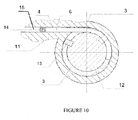
- the rotating-flattening device comprises an enclosing shell 11, a cylinder-shaped rotatable axle 12, and a protruding block 13 attached to axle 12 and connecting to the interior surface of the enclosing shell 11.
- a movable second block 14 is placed in the flattening section 15 to provide controllable pressure perpendicular to one of the longitudinal cross sections 8 or 8a of the culm wall 3.
- the preliminarily treated bamboo cane is placed into the tube-shaped gap formed between axle 12 and enclosing shell 11 with its longitudinal cross surface 8 and 8a touching blocks 13 and 14 respectively.
- Axle 12 is then turned counter clock-wise. As a result, the bamboo cane is gradually pushed into the flattening section 15 and flattened. As axle 12 is turning, controllable pressure is applied to block 14 so that the longitudinal cross sections 8 and 8a of the bamboo culm cane are pressed during the flattening process. Pressure applied to 8 and 8a helps to close cracks formed in the interior zone of the bamboo culm wall during the flattening process, thereby enhancing the panel density and surface hardness.
- the softened culm wall is gradually flattened by a plurality or set of pressing devices, each of which has a different pressing arc.
- the preliminarily treated bamboo culm wall 3 is gradually flattened by a plurality or set of pressing devices 16a - 16g, each of which having a different pressing arc.
- the softened culm wall is first pressed by a pressing device having the greatest pressing arc in the set, and is pressed last by a pressing device having the least pressing arc in the set.
- the preliminarily treated bamboo culm wall 3 is first placed in device 16a (with an upper pressing board 17 and a base 18) and pressed. The same process is then repeated by using devices 16b, 16c, 16d, 16e, and 16f, each device having a slightly decreased pressing arc.
- the upper board 17 and base 18 are replaced by a pair of completely flat boards 19. Two blocks 20 and 20a are further placed in the last pressing device and the longitudinal cross sections 8 and 8a of the bamboo culm 3 are further compressed.
- the softened culm wall is gradually flattened by contacting a plurality or set of rollers, each of which has a different arc degree.
- the preliminarily processed bamboo culm wall is gradually flattened by contacting a plurality or set of rollers, each of which having a different arc degree.
- the softened culm wall is first pressed by a roller having the greatest arc degree in the set, and is pressed last by a roller having the least arc degree in the set.
- the flattening process begins when the interior surface of the preliminarily processed culm wall 3 is run over by the first roller 21a, which has the highest arc degree. The process may then be repeated with the second, third, fourth and more roller (s), each with a gradually decreased arc degree. With the last roller being flat, culm wall 3 is completely flattened. The flattened bamboo panel may further be trimmed on the longitudinal cross sections 8 and 8a.
- the interior zone of a bamboo culm wall is marked with a plurality of parallel diagonal cuts.
- a plurality of diagonal cuts 10 and 10a are made on the interior zone of the bamboo culm wall before the bamboo culm wall is extended and flattened, for the purpose of directing and reducing cracks.
- the depth of the cuts depends on the hardness, shape and size of the bamboo culm wall.
- the diagonal cuts should penetrate the interior zone 6 and into, but not through, the middle zone 5.
- Flattening process performed by common pressing devices often results in cracks in the interior zone of the bamboo panel 7. Such cracks may penetrate through the entire culm wall and reach the top surface 9, resulting obvious cracks thereupon or even splitting the bamboo panel 7.
- Diagonal cuts made across the interior zone of the bamboo culm panel 7 tend to release pressure in the interior zone and make the flattening process easier without deepening the cracks.
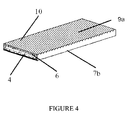
- the interior zone of the flattened bamboo panel is marked with a plurality of parallel diagonal cuts. As shown m FIG. 4 , a plurality of parallel diagonal cuts is made on the interior zone of the bamboo panel 10.
- an angel of between approximately 10° to 60° is formed between the diagonal cuts and grain direction of the bamboo panel. Also shown in FIG 5 , the angel formed between the diagonal cuts and grain direction of the bamboo panel is between approximately 10° to 60°.
- two sets of diagonal cuts are made on the interior zone of the bamboo panel; the diagonal cuts within each set are parallel to each other. It is important that the two sets of cuts are located in opposite side of the grain direction, and the angel formed by each cut and the grain direction is between approximately 10° and 60°.
- two sets of diagonal cuts 10 and 10a are made on the interior zone of the bamboo panel 7; the diagonal cuts within each group are parallel to each other. Each set of cuts are located m opposite side of the grain direction, and the angel formed by each cut and the grain direction is between approximately 10° and 60°.
- a method of manufacturing a flattened bamboo panel comprises the steps of: a) longitudinally cutting open a bamboo cane along its entire length to form one or more pieces of bamboo culm wall comprising an exterior zone, a middle zone and an interior zone; b) marking the interior zone with a plurality of parallel cuts wherein the cuts and the grain direction form a degree between approximately 10° and 60°; c) soaking and heating the bamboo culm wall, thereby forming a softened culm wall (the softening process) ; and d) flattening the softened culm wall.
- bamboo culm wall pieces after being marked with diagonal cuts can be extended and flattened using common flattening device (such as Fig. 8 and Fig. 9 ) without significant cracks being formed.
- the culm wall is soaked and heated to a temperature of about 140°C to 200°C in the softening process.
- the temperature is preferably between approximately 160°C and 190°C.
- the process may further include a step of removing a portion of the exterior and interior zones of bamboo culm wall after the culm wall is flattened.
- a portion of the exterior zone and the interior zone of the bamboo culm wall is removed after the bamboo culm wall is flattened. Accordingly, in an embodiment of the flattened bamboo panel, an uttermost portion from each said exterior zone and interior zone is removed. In another embodiment of the flattened bamboo panel, a thickness of approximately 0.5 mm bamboo culm wall is removed from the uttermost portion of said exterior and interior zones.
- the process disclosed above in this invention can greatly increase bamboo raw material utilization rate and significantly increase the thickness of the final panel product.
- the average thickness of the final panel can be as high as 4-25mm.
- the flattened bamboo panel has a thickness from about 4 to about 25 mm.
- this invention provides a flattened bamboo panel made by the above disclosed methods. In some embodiment, this invention further provides a high-density, flattened bamboo panel made by the above disclosed methods.
Landscapes
- Engineering & Computer Science (AREA)
- Life Sciences & Earth Sciences (AREA)
- Architecture (AREA)
- Mechanical Engineering (AREA)
- Forests & Forestry (AREA)
- Wood Science & Technology (AREA)
- Civil Engineering (AREA)
- Structural Engineering (AREA)
- Finishing Walls (AREA)
- Chemical And Physical Treatments For Wood And The Like (AREA)
Description
- This application claims priority of Chinese Serial No.
200620108337.5, filed September 29, 2006 - The present invention pertains to the field of flattened bamboo panels.
- The present invention relates to a flattened bamboo panel having one single, solid layer of pressed bamboo culm wall with both exterior and interior zones. Made from one single bamboo cane, the processed bamboo panel is adhesive free. Also disclosed is the process of constructing such bamboo panel.
- Various bamboo products are known in the art. Typically, bamboo panels are constructed from tube-shaped bamboo canes, which consist of nodes and culm wall. From outside to inside, the bamboo culm wall further comprises of exterior zone, middle zone and interior zone. To make a bamboo panel, a substantial portion of the exterior and interior zones of the culm wall is typically removed before it is extended and flattened to make the panel.
- Problems that may arise in such process include low utilization rate of the raw material, excessive use of adhesive, obvious cracks on the surface of the processed panel and high manufacturing costs.
- Numerous attempts have been tried to address the above problems. The common culm-splitting approach in bamboo plate industry has low material utilization rate, and its extensive use of adhesive also results in high manufacturing costs. The bamboo-tube-compressing-and-expanding approach improves the utilization rate; however, the processed panel surfaces often contain obvious cracks. The rotatory-cutting-and-expanding approach imposes stringent requirements on the shape of culm wall and therefore cannot be applied in mass production. The whole-bamboo-cane-extending approach improves the surface smoothness of the processed panel; however, the raw material utilization rate is still low because most of the exterior and interior zones of the bamboo culm wall must be removed. The thickness of the bamboo panels so constructed is often less than 8 mm.
-
CA 2379878 discloses a bamboo panel including two bottom and top bamboo layers, the bottom layer having a grain direction transverse to a grain direction of the top layer to increase flexibility of the panel. - However, such a known bamboo panel does not address to the problem of providing a bamboo panel formed by a flattened single layer of bamboo culm wall to reduce cracks on the surface of the processed panel.
- Accordingly, there is a need for an improved method to construct bamboo panel from bamboo canes.
- In this respect, the invention relates to a bamboo panel formed by a flattened single layer of bamboo culm wall, wherein said bamboo culm wall comprises an exterior zone, a middle zone, and an interior zone, each of the exterior zone and interior zone contains an uttermost portion, and a plurality of diagonal cuts is formed on the interior zone before the bamboo culm wall is flattened.
- Said bamboo panel is adhesive-free.
- The bamboo culm wall is a whole bamboo cane.
- Said panel has a thickness from about 4 to about 25 mm.
- The diagonal cuts are divided into two sets in which diagonal cuts within each set are substantially parallel to each other while the two sets of diagonal cuts intersect each other.
- An angle of between approximately 10° to 60° is formed between the diagonal cuts within each set and grain direction of the bamboo panel.
- The invention further relates to a method of manufacturing a bamboo panel, comprising the steps of:
- a) longitudinally cutting open a bamboo cane along its entire length to form one or more pieces of bamboo culm wall comprising an exterior zone, a middle zone and an interior zone;
- b) softening said bamboo culm wall with high temperature;
- c) forming a plurality of diagonal cuts on said interior zone; and
- d) flattening said softened culm wall.
- According to one embodiment, the softened culm wall is gradually flattened by a plurality of pressing devices with different pressing arc degrees.
- Advantageously, the softened culm wall is first pressed by a pressing device having the greatest pressing arc, and is pressed last by a pressing device having the least pressing arc.
- According to another embodiment, the softened culm wall is gradually flattened by a plurality or set of rollers with different arc degrees.
- According to yet another embodiment, the softened culm wall is first pressed by a roller having the greatest arc degree, and is pressed last by a roller having the least arc degree.
- An angle of between approximately 10 to 60° is formed between the diagonal cuts and grain direction of the bamboo panel.
- Preferably, the softening temperature ranges from approximately 140° C to 200° C.
- Advantageously, the softening temperature ranges from approximately 160° C to 190° C.
- Said bamboo culm wall is a whole bamboo cane.
- The diagonal cuts are divided into two sets in which diagonal cuts in each set are parallel to each other while the two sets of diagonal cuts intersect each other.
- The softened bamboo culm wall is gradually flattened under pushing of a cylinder-shaped rotating axle.
- A thickness of approximately 0.3∼2 mm bamboo culm wall is removed from the uttermost portions of said interior zone and said exterior zone.
-
-
Figure 1 illustrates a trimetric view of a section of bamboo cane. -
Figure 2 illustrates a schematic view of the cross section of bamboo culm wall and different zones therein. -
Figure 3 illustrates a schematic view of the structure of a bamboo panel constructed according to the teachings of the present invention. -
Figure 4 illustrates a trimetric view of the structure of a variation of the bamboo panel as constructed according to the teachings of the present invention. -
Figure 5 illustrates a trimetric view of the structure of yet another variation of the bamboo panel as constructed according to the teachings of the present invention. -
Figure 6 illustrates a trimetric view of a piece of culm wall marked with non-penetrating, diagonal cut on its interior longitudinal surface before being pressed. -
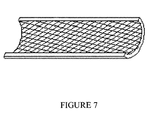
Figure 7 illustrates a trimetric view of an alternative piece of culm wall marked with non-penetrating, diagonal cut on its interior longitudinal surface before being pressed. -
Figure 8 illustrates a side view of a pressing device used to press culm walls shown inFigure 6 and7 . -
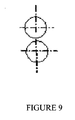
Figure 9 illustrates a side view of an alternative pressing device used to press culm walls shown inFigure 6 and7 . -
Figure 10 illustrates a side view of the pressing device at work with the softened culm wall inside. -
Figure 11 illustrates side views of an alternative design of pressing device used for gradually flattening the bamboo culm wall. -
Figure 12 . illustrates a schematic view of yet another alternative design of pressing device used for gradually flattening the bamboo culm wall. - As it is well known a flattened bamboo panel comprises a single layer of bamboo culm wall, wherein said bamboo culm wall comprises an exterior zone, a middle zone, and an interior zone, wherein each of the exterior zone and interior zone contains an uttermost portion. In one embodiment, the flattened bamboo panel is constructed from one single bamboo cane.
- The term "panel" refers to a comparatively thin, flat piece of wood or the like. In this invention, the term "panel" refers to a comparatively thin, flat piece of bamboo.
- The processes disclosed in this invention may involve no use of adhesive. In one embodiment, the flattened bamboo panel is adhesive-free. In another embodiment, the flattened bamboo panel is a high-density panel.
- Referring to the drawings, a section of a bamboo cane is illustrated in
FIG. 1 , showing thebamboo cane 1 consists ofbamboo node 2 andculm wall 3. A magnified view of the cross section of abamboo cane 1 is illustrated inFIG. 2 , showing thatculm wall 3 further consists of three different zones with different fiber density and tissue types therein. Generally,exterior zone 4 of theculm wall 3 has a higher fiber density and a higher hardness than theinterior zone 6. The culm wall between theexterior zone 4 and theinterior zones 6 is defined in this application as the "middle culm zone" or "middle zone" 5. Each of the exterior zone and interior zone contains an uttermost portion. The uttermost portion of the exterior zone is located at the exterior surface of a bamboo culm wall. The uttermost portion of the interior zone is located at the interior surface of the bamboo culm wall. - Preliminary processing of raw bamboo canes may include one or more of the following steps: a) cutting a section of
raw bamboo cane 1; b) removing node 2 (from outside of the bamboo cane) ; c) cutting and opening the bamboo cane along its longitudinal length to form one or several pieces ofbamboo culm wall 3; d) further removing node 2 (from inside); e) soaking and heating the processed bamboo culm wall until the bamboo tissue is softened (the softening process) - According to the prior art method, after the bamboo culm is preliminarily treated, it further needs to be extended, flattened and pressed to make a usable bamboo panel. A final
bamboo panel product 7 is illustrated inFIG. 3 . Thepanel 7 has two parallel longitudinal surfaces 9 (top) and 9a (bottom), twolongitudinal cross sections 8 and 8a, which are parallel to each other and to the bamboo grain direction. The twolongitudinal cross sections 8 and 8a are perpendicular to the twolongitudinal surfaces - Bamboo panel products constructed by prior art often results in obvious cracks on surfaces due to improper extending and flattening method. In addition, the thickness of the final product (bamboo panel) is greatly limited because a large portion of the exterior zone and the interior zone must be removed before the flattening process.
- A novel method is disclosed in this invention to properly extend and flatten the preliminarily treated bamboo panel. According to one embodiment, a method of manufacturing a flattened bamboo panel comprises the steps of: a) longitudinally cutting open a bamboo cane along its entire length to form one or more pieces of bamboo culm wall comprising an exterior zone, a middle zone and an interior zone; b) soaking and heating the bamboo culm wall, thereby forming a softened culm wall (the softening process) ; and c) flattening the softened culm wall in a gradual or multi-steps process. The preliminarily treated bamboo culm wall, in step c) above, is rotated and gradually flattened by using a rotating-flattening device. In another embodiment, the softened culm wall is gradually flattened by being pushed over a cylinder-shaped rotating axle. As illustrated in
FIG. 10 , the rotating-flattening device comprises an enclosingshell 11, a cylinder-shapedrotatable axle 12, and a protrudingblock 13 attached toaxle 12 and connecting to the interior surface of the enclosingshell 11. A movablesecond block 14 is placed in theflattening section 15 to provide controllable pressure perpendicular to one of thelongitudinal cross sections 8 or 8a of theculm wall 3. The preliminarily treated bamboo cane is placed into the tube-shaped gap formed betweenaxle 12 and enclosingshell 11 with itslongitudinal cross surface 8 and8a touching blocks Axle 12 is then turned counter clock-wise. As a result, the bamboo cane is gradually pushed into the flatteningsection 15 and flattened. Asaxle 12 is turning, controllable pressure is applied to block 14 so that thelongitudinal cross sections 8 and 8a of the bamboo culm cane are pressed during the flattening process. Pressure applied to 8 and 8a helps to close cracks formed in the interior zone of the bamboo culm wall during the flattening process, thereby enhancing the panel density and surface hardness. - In a separate embodiment of the method of manufacturing a flattened bamboo panel, the softened culm wall is gradually flattened by a plurality or set of pressing devices, each of which has a different pressing arc. As illustrated in
FIG. 11 , the preliminarily treatedbamboo culm wall 3 is gradually flattened by a plurality or set ofpressing devices 16a - 16g, each of which having a different pressing arc. In a still further embodiment, the softened culm wall is first pressed by a pressing device having the greatest pressing arc in the set, and is pressed last by a pressing device having the least pressing arc in the set. As shown inFigure 11 , the preliminarily treatedbamboo culm wall 3 is first placed indevice 16a (with an upper pressingboard 17 and a base 18) and pressed. The same process is then repeated by usingdevices upper board 17 andbase 18 are replaced by a pair of completelyflat boards 19. Twoblocks longitudinal cross sections 8 and 8a of thebamboo culm 3 are further compressed. - In a separate embodiment of the method of manufacturing a flattened bamboo panel, the softened culm wall is gradually flattened by contacting a plurality or set of rollers, each of which has a different arc degree. As shown in
Figure 12 , the preliminarily processed bamboo culm wall is gradually flattened by contacting a plurality or set of rollers, each of which having a different arc degree. In a still further embodiment, the softened culm wall is first pressed by a roller having the greatest arc degree in the set, and is pressed last by a roller having the least arc degree in the set. As shown inFigure 12 , the flattening process begins when the interior surface of the preliminarily processedculm wall 3 is run over by thefirst roller 21a, which has the highest arc degree. The process may then be repeated with the second, third, fourth and more roller (s), each with a gradually decreased arc degree. With the last roller being flat,culm wall 3 is completely flattened. The flattened bamboo panel may further be trimmed on thelongitudinal cross sections 8 and 8a. - The interior zone of a bamboo culm wall is marked with a plurality of parallel diagonal cuts. As illustrated in
FIGS. 6 and7 , a plurality ofdiagonal cuts interior zone 6 and into, but not through, themiddle zone 5. Flattening process performed by common pressing devices often results in cracks in the interior zone of thebamboo panel 7. Such cracks may penetrate through the entire culm wall and reach thetop surface 9, resulting obvious cracks thereupon or even splitting thebamboo panel 7. Diagonal cuts made across the interior zone of thebamboo culm panel 7 tend to release pressure in the interior zone and make the flattening process easier without deepening the cracks. - In one embodiment of the flattened bamboo panel, the interior zone of the flattened bamboo panel is marked with a plurality of parallel diagonal cuts. As shown m
FIG. 4 , a plurality of parallel diagonal cuts is made on the interior zone of thebamboo panel 10. In a still another embodiment of the flattened bamboo panel, an angel of between approximately 10° to 60° is formed between the diagonal cuts and grain direction of the bamboo panel. Also shown inFIG 5 , the angel formed between the diagonal cuts and grain direction of the bamboo panel is between approximately 10° to 60°. - In another embodiment of the flattened bamboo panel, two sets of diagonal cuts (in two directions) are made on the interior zone of the bamboo panel; the diagonal cuts within each set are parallel to each other. It is important that the two sets of cuts are located in opposite side of the grain direction, and the angel formed by each cut and the grain direction is between approximately 10° and 60°. As shown in
FIG. 5 , two sets ofdiagonal cuts bamboo panel 7; the diagonal cuts within each group are parallel to each other. Each set of cuts are located m opposite side of the grain direction, and the angel formed by each cut and the grain direction is between approximately 10° and 60°. - In a separate further embodiment, a method of manufacturing a flattened bamboo panel comprises the steps of: a) longitudinally cutting open a bamboo cane along its entire length to form one or more pieces of bamboo culm wall comprising an exterior zone, a middle zone and an interior zone; b) marking the interior zone with a plurality of parallel cuts wherein the cuts and the grain direction form a degree between approximately 10° and 60°; c) soaking and heating the bamboo culm wall, thereby forming a softened culm wall (the softening process) ; and d) flattening the softened culm wall. As shown in
FIGS 6 ,7 ,8 and9 , bamboo culm wall pieces after being marked with diagonal cuts can be extended and flattened using common flattening device (such asFig. 8 andFig. 9 ) without significant cracks being formed. - In another embodiment of the above-disclosed methods of manufacturing a flattened bamboo panel, the culm wall is soaked and heated to a temperature of about 140°C to 200°C in the softening process. In a still further embodiment, the temperature is preferably between approximately 160°C and 190°C.
- The process may further include a step of removing a portion of the exterior and interior zones of bamboo culm wall after the culm wall is flattened. In one embodiment of the method of manufacturing a flattened bamboo panel, a portion of the exterior zone and the interior zone of the bamboo culm wall is removed after the bamboo culm wall is flattened. Accordingly, in an embodiment of the flattened bamboo panel, an uttermost portion from each said exterior zone and interior zone is removed. In another embodiment of the flattened bamboo panel, a thickness of approximately 0.5 mm bamboo culm wall is removed from the uttermost portion of said exterior and interior zones.
- The process disclosed above in this invention can greatly increase bamboo raw material utilization rate and significantly increase the thickness of the final panel product. As a result, the average thickness of the final panel can be as high as 4-25mm. In a separate embodiment, the flattened bamboo panel has a thickness from about 4 to about 25 mm.
- Finally, this invention provides a flattened bamboo panel made by the above disclosed methods. In some embodiment, this invention further provides a high-density, flattened bamboo panel made by the above disclosed methods.
Claims (18)
- A bamboo panel characterized in that it is formed by a flattened single layer of bamboo culm wall (3), wherein said bamboo culm wall (3) comprises an exterior zone (4), a middle zone (5), and an interior zone (6), each of the exterior zone (4) and interior zone (6) contains an uttermost portion, and a plurality of diagonal cuts (10, 10a) is formed on the interior zone (6) before the bamboo culm wall (3) is flattened.
- The bamboo panel of claim 1, wherein said bamboo panel (7) is adhesive-free.
- The bamboo panel of claim 1, wherein the bamboo culm wall (3) is a whole bamboo cane (1).
- The bamboo panel of claim 1, wherein said panel (7) has a thickness from about 4 to about 25 mm.
- The bamboo panel of claim 1, wherein the diagonal cuts (10, 10a) are divided into two sets in which diagonal cuts within each set are substantially parallel to each other while the two sets of diagonal cuts intersect each other.
- The bamboo panel of claim 5, wherein an angle of between approximately 10° to 60° is formed between the diagonal cuts (10, 10a) within each set and grain direction of the bamboo panel (7).
- A method of manufacturing a bamboo panel, characterized in that it comprises the steps of:a) longitudinally cutting open a bamboo cane (1) along its entire length to form one or more pieces of bamboo culm wall (3) comprising an exterior zone (4), a middle zone (5) and an interior zone (6) ;b) softening said bamboo culm wall (3) with high temperature ;c) forming a plurality of diagonal cuts (10, 10a) on said interior zone (6) ; andd) flattening said softened culm wall (3).
- The method of claim 7, wherein the softened culm wall (3) is gradually flattened by a plurality of pressing devices (16a-16g) with different pressing arc degrees.
- The method of claim 8, wherein the softened culm wall (3) is first pressed by a pressing device (16a) having the greatest pressing arc, and is pressed last by a pressing device (16g) having the least pressing arc.
- The method of claim 7, wherein the softened culm wall (3) is gradually flattened by a plurality or set of rollers (21a-21e) with different arc degrees.
- The method of claim 7, wherein the softened culm wall (3) is first pressed by a roller (21a) having the greatest arc degree, and is pressed last by a roller (21e) having the least arc degree.
- The method of claim 7, wherein an angle of between approximately 10° to 60° is formed between the diagonal cuts (10, 10a) and grain direction of the bamboo panel (7).
- The method of claim 7, wherein the softening temperature ranges from approximately 140° C to 200° C.
- The method of claim 13, wherein the softening temperature ranges from approximately 160° C to 190° C.
- The method of claim 7, wherein said bamboo culm wall (3) is a whole bamboo cane (1).
- The method of claim 7, wherein the diagonal cuts (10, 10a) are divided into two sets in which diagonal cuts in each set are parallel to each other while the two sets of diagonal cuts intersect each other.
- The method of claim 7, wherein the softened bamboo culm wall (3) is gradually flattened under pushing of a cylinder-shaped rotating axle (12).
- The method of claim 7, wherein a thickness of approximately 0.3∼2 mm bamboo culm wall (3) is removed from the uttermost portions of said interior zone (6) and said exterior zone (4).
Applications Claiming Priority (2)
| Application Number | Priority Date | Filing Date | Title |
|---|---|---|---|
| CN200620108337.5U CN200957623Y (en) | 2006-09-29 | 2006-09-29 | High-density flattening plate |
| PCT/IB2007/003366 WO2008038137A2 (en) | 2006-09-29 | 2007-09-28 | Flattened bamboo panel |
Publications (3)
| Publication Number | Publication Date |
|---|---|
| EP2066480A2 EP2066480A2 (en) | 2009-06-10 |
| EP2066480A4 EP2066480A4 (en) | 2012-06-20 |
| EP2066480B1 true EP2066480B1 (en) | 2014-07-02 |
Family
ID=38784497
Family Applications (1)
| Application Number | Title | Priority Date | Filing Date |
|---|---|---|---|
| EP07825597.3A Active EP2066480B1 (en) | 2006-09-29 | 2007-09-28 | Flattened bamboo panel |
Country Status (6)
| Country | Link |
|---|---|
| US (1) | US8354161B2 (en) |
| EP (1) | EP2066480B1 (en) |
| CN (1) | CN200957623Y (en) |
| ES (1) | ES2496973T3 (en) |
| RU (1) | RU2401194C1 (en) |
| WO (1) | WO2008038137A2 (en) |
Families Citing this family (13)
| Publication number | Priority date | Publication date | Assignee | Title |
|---|---|---|---|---|
| CN101528431B (en) * | 2006-09-29 | 2014-10-22 | 浙江大庄实业集团有限公司 | Flattened bamboo panel |
| CN100584555C (en) * | 2007-10-22 | 2010-01-27 | 杭州大庄地板有限公司 | Flattened bamboo plate making method |
| DE202009001085U1 (en) | 2009-01-23 | 2010-02-11 | Ganz, Rudolf | Flat pressed bamboo without knots |
| EP2397289A4 (en) * | 2009-02-13 | 2012-10-17 | Res Inst Wood Ind Caf | ARTIFICIAL BAMBOO PLATE AND MANUFACTURING METHOD THEREFOR |
| FR2967088B1 (en) * | 2010-11-04 | 2013-06-21 | Lineazen | METHOD FOR MANUFACTURING INTEGRATED MULTIFUNCTIONAL BUILDING SYSTEMS AND ASSOCIATED BUILDING SYSTEMS FROM BAMBOO BANDS, METHOD FOR MANUFACTURING BAMBOO BANDS. |
| CN102490223B (en) * | 2011-12-16 | 2014-10-29 | 福建农林大学 | Method for flattening moso bamboo |
| CN103317576B (en) * | 2013-04-23 | 2015-12-02 | 浙江林碳木业科技有限公司 | A kind of manufacture method of large format charing plate |
| US9416931B1 (en) | 2015-07-21 | 2016-08-16 | Larry D. Ross | Method of making a bamboo lamp or other item |
| US9962894B1 (en) * | 2015-11-09 | 2018-05-08 | Bamcore LLC | Press to flatten bamboo stalks |
| CN106426487B (en) * | 2016-11-08 | 2018-08-28 | 浙江省林业科学研究院 | A kind of processing method on high-quality bamboo flattening floor |
| CN109352784A (en) * | 2018-10-19 | 2019-02-19 | 南京林业大学 | A kind of manufacturing method of round bamboo reinforced composite material |
| CN109571670B (en) * | 2018-12-17 | 2021-08-03 | 国际竹藤中心 | A kind of preparation method of bamboo-sized timber suitable for mass production |
| CA3235217A1 (en) * | 2021-11-16 | 2023-05-25 | Long Bamboo Technology Group Co.,Ltd. | Bamboo outer skin-retaining bamboo veneer and preparation process thereof |
Family Cites Families (13)
| Publication number | Priority date | Publication date | Assignee | Title |
|---|---|---|---|---|
| US1688569A (en) * | 1927-06-06 | 1928-10-23 | Wensel Theodor | Built-up shaft or rod and the like and method of producing same |
| US2582065A (en) * | 1948-05-18 | 1952-01-08 | Rasor Orval | Method of constructing cylindrical containers |
| US2980153A (en) | 1958-11-12 | 1961-04-18 | Oren P Burch | Method of preparing plywood planking for compound bending |
| JPH07115325B2 (en) * | 1990-07-06 | 1995-12-13 | 鹿児島県 | Long bamboo plate manufacturing method and device |
| JPH0639806A (en) | 1992-06-30 | 1994-02-15 | Kaneyoshi Arakawa | Bamboo veneer and its manufacture |
| RU2076804C1 (en) * | 1994-01-10 | 1997-04-10 | Хабаровский государственный технический университет | Method for producing stripped veneer |
| JPH0957714A (en) | 1995-06-14 | 1997-03-04 | Tanakamasakatsu Kenchiku Sekkei Jimusho:Kk | Structural laminated wood using bamboo and its manufacturing method |
| SE511488C2 (en) * | 1998-02-25 | 1999-10-04 | Johan Human | Procedure for the manufacture of a wall part for a housing body |
| US6098680A (en) * | 1999-08-31 | 2000-08-08 | Nien Made Enterprise Co., Ltd | Slats of bamboo window shade and method for making same |
| CA2379878A1 (en) | 2001-04-20 | 2002-10-20 | Hai Ping Cao | Two-ply flooring having a cross-grain bottom ply |
| US6823908B2 (en) * | 2001-10-25 | 2004-11-30 | Angela S. H. Hsu | Method for forming bamboo slats of window blinds |
| JP2006255911A (en) * | 2005-03-15 | 2006-09-28 | Tadashi Kunitake | Bamboo laminated structural member and its manufacturing method |
| JP2006255991A (en) | 2005-03-16 | 2006-09-28 | Mitsubishi Motors Corp | Synthetic panel |
-
2006
- 2006-09-29 CN CN200620108337.5U patent/CN200957623Y/en not_active Expired - Lifetime
-
2007
- 2007-09-28 WO PCT/IB2007/003366 patent/WO2008038137A2/en not_active Ceased
- 2007-09-28 RU RU2009115818/12A patent/RU2401194C1/en active
- 2007-09-28 EP EP07825597.3A patent/EP2066480B1/en active Active
- 2007-09-28 US US12/090,811 patent/US8354161B2/en active Active - Reinstated
- 2007-09-28 ES ES07825597.3T patent/ES2496973T3/en active Active
Also Published As
| Publication number | Publication date |
|---|---|
| WO2008038137A2 (en) | 2008-04-03 |
| EP2066480A2 (en) | 2009-06-10 |
| ES2496973T3 (en) | 2014-09-22 |
| WO2008038137A3 (en) | 2009-04-23 |
| RU2401194C1 (en) | 2010-10-10 |
| US20090178732A1 (en) | 2009-07-16 |
| CN200957623Y (en) | 2007-10-10 |
| EP2066480A4 (en) | 2012-06-20 |
| US8354161B2 (en) | 2013-01-15 |
Similar Documents
| Publication | Publication Date | Title |
|---|---|---|
| US8354161B2 (en) | Flattened bamboo panel | |
| CN100584555C (en) | Flattened bamboo plate making method | |
| CN110587737B (en) | Bamboo material unfolding method and bamboo plate | |
| CN102632532B (en) | Bamboo block thermal shaping method and device | |
| EP3424654B1 (en) | Corrugated board manufacturing system and corrugated board manufacturing method | |
| CN103878850A (en) | Split arc bamboo chips and manufacturing method thereof | |
| CN115648378A (en) | A hot-pressing moisture-removal method for pavement of bamboo oriented strand board | |
| CN109531737B (en) | Bamboo expanding device | |
| CN101528431B (en) | Flattened bamboo panel | |
| CN1134866A (en) | Bamboo fiber veneer board and method for mfg. same | |
| CN114012843A (en) | Processing and forming method of bamboo jointed board | |
| EP1954491B1 (en) | Plastic composite panel with the appearance and texture similar to natural lumbers | |
| CN100384604C (en) | A kind of manufacturing method of sliced thin bamboo | |
| CN101119831B (en) | Method for producing formed wooden article | |
| EP4393670B1 (en) | Green bamboo veneer and manufacturing process thereof | |
| CN210414877U (en) | Bamboo exhibition machine | |
| JP2006255911A (en) | Bamboo laminated structural member and its manufacturing method | |
| CN100408287C (en) | Process for manufacturing bamboo column by bamboo | |
| CN118528367A (en) | Bamboo board and preparation method thereof | |
| HK1040975A1 (en) | Solid state material | |
| CN100400249C (en) | Splice bamboo plate and its making method | |
| JP2001287205A (en) | Method for processing trough-like bamboo into flat plate | |
| CN2827679Y (en) | Compressing machine for bamboo strip | |
| JPH06106506A (en) | Bamboo plywood and its production | |
| CN121316075A (en) | A bamboo tray and its processing technology |
Legal Events
| Date | Code | Title | Description |
|---|---|---|---|
| PUAI | Public reference made under article 153(3) epc to a published international application that has entered the european phase |
Free format text: ORIGINAL CODE: 0009012 |
|
| 17P | Request for examination filed |
Effective date: 20090420 |
|
| AK | Designated contracting states |
Kind code of ref document: A2 Designated state(s): AT BE BG CH CY CZ DE DK EE ES FI FR GB GR HU IE IS IT LI LT LU LV MC MT NL PL PT RO SE SI SK TR |
|
| AX | Request for extension of the european patent |
Extension state: AL BA HR MK RS |
|
| RIN1 | Information on inventor provided before grant (corrected) |
Inventor name: XU, XUFENG Inventor name: LIU, HONGZHENG Inventor name: LIN, HAI |
|
| DAX | Request for extension of the european patent (deleted) | ||
| A4 | Supplementary search report drawn up and despatched |
Effective date: 20120522 |
|
| RIC1 | Information provided on ipc code assigned before grant |
Ipc: E04C 2/16 20060101ALI20120515BHEP Ipc: B27J 1/00 20060101ALI20120515BHEP Ipc: B27J 7/00 20060101AFI20120515BHEP |
|
| 17Q | First examination report despatched |
Effective date: 20130208 |
|
| GRAP | Despatch of communication of intention to grant a patent |
Free format text: ORIGINAL CODE: EPIDOSNIGR1 |
|
| INTG | Intention to grant announced |
Effective date: 20140213 |
|
| RAP1 | Party data changed (applicant data changed or rights of an application transferred) |
Owner name: DASSO INDUSTRIAL GROUP CO., LTD. |
|
| GRAS | Grant fee paid |
Free format text: ORIGINAL CODE: EPIDOSNIGR3 |
|
| GRAA | (expected) grant |
Free format text: ORIGINAL CODE: 0009210 |
|
| AK | Designated contracting states |
Kind code of ref document: B1 Designated state(s): AT BE BG CH CY CZ DE DK EE ES FI FR GB GR HU IE IS IT LI LT LU LV MC MT NL PL PT RO SE SI SK TR |
|
| REG | Reference to a national code |
Ref country code: GB Ref legal event code: FG4D |
|
| REG | Reference to a national code |
Ref country code: AT Ref legal event code: REF Ref document number: 675666 Country of ref document: AT Kind code of ref document: T Effective date: 20140715 Ref country code: CH Ref legal event code: EP |
|
| REG | Reference to a national code |
Ref country code: IE Ref legal event code: FG4D |
|
| REG | Reference to a national code |
Ref country code: DE Ref legal event code: R096 Ref document number: 602007037495 Country of ref document: DE Effective date: 20140814 |
|
| REG | Reference to a national code |
Ref country code: ES Ref legal event code: FG2A Ref document number: 2496973 Country of ref document: ES Kind code of ref document: T3 Effective date: 20140922 |
|
| REG | Reference to a national code |
Ref country code: SE Ref legal event code: TRGR |
|
| REG | Reference to a national code |
Ref country code: NL Ref legal event code: T3 |
|
| REG | Reference to a national code |
Ref country code: AT Ref legal event code: MK05 Ref document number: 675666 Country of ref document: AT Kind code of ref document: T Effective date: 20140702 |
|
| REG | Reference to a national code |
Ref country code: LT Ref legal event code: MG4D |
|
| PG25 | Lapsed in a contracting state [announced via postgrant information from national office to epo] |
Ref country code: FI Free format text: LAPSE BECAUSE OF FAILURE TO SUBMIT A TRANSLATION OF THE DESCRIPTION OR TO PAY THE FEE WITHIN THE PRESCRIBED TIME-LIMIT Effective date: 20140702 Ref country code: CZ Free format text: LAPSE BECAUSE OF FAILURE TO SUBMIT A TRANSLATION OF THE DESCRIPTION OR TO PAY THE FEE WITHIN THE PRESCRIBED TIME-LIMIT Effective date: 20140702 Ref country code: GR Free format text: LAPSE BECAUSE OF FAILURE TO SUBMIT A TRANSLATION OF THE DESCRIPTION OR TO PAY THE FEE WITHIN THE PRESCRIBED TIME-LIMIT Effective date: 20141003 Ref country code: BG Free format text: LAPSE BECAUSE OF FAILURE TO SUBMIT A TRANSLATION OF THE DESCRIPTION OR TO PAY THE FEE WITHIN THE PRESCRIBED TIME-LIMIT Effective date: 20141002 Ref country code: LT Free format text: LAPSE BECAUSE OF FAILURE TO SUBMIT A TRANSLATION OF THE DESCRIPTION OR TO PAY THE FEE WITHIN THE PRESCRIBED TIME-LIMIT Effective date: 20140702 Ref country code: PT Free format text: LAPSE BECAUSE OF FAILURE TO SUBMIT A TRANSLATION OF THE DESCRIPTION OR TO PAY THE FEE WITHIN THE PRESCRIBED TIME-LIMIT Effective date: 20141103 |
|
| PG25 | Lapsed in a contracting state [announced via postgrant information from national office to epo] |
Ref country code: LV Free format text: LAPSE BECAUSE OF FAILURE TO SUBMIT A TRANSLATION OF THE DESCRIPTION OR TO PAY THE FEE WITHIN THE PRESCRIBED TIME-LIMIT Effective date: 20140702 Ref country code: AT Free format text: LAPSE BECAUSE OF FAILURE TO SUBMIT A TRANSLATION OF THE DESCRIPTION OR TO PAY THE FEE WITHIN THE PRESCRIBED TIME-LIMIT Effective date: 20140702 Ref country code: PL Free format text: LAPSE BECAUSE OF FAILURE TO SUBMIT A TRANSLATION OF THE DESCRIPTION OR TO PAY THE FEE WITHIN THE PRESCRIBED TIME-LIMIT Effective date: 20140702 Ref country code: IS Free format text: LAPSE BECAUSE OF FAILURE TO SUBMIT A TRANSLATION OF THE DESCRIPTION OR TO PAY THE FEE WITHIN THE PRESCRIBED TIME-LIMIT Effective date: 20141102 Ref country code: CY Free format text: LAPSE BECAUSE OF FAILURE TO SUBMIT A TRANSLATION OF THE DESCRIPTION OR TO PAY THE FEE WITHIN THE PRESCRIBED TIME-LIMIT Effective date: 20140702 |
|
| REG | Reference to a national code |
Ref country code: CH Ref legal event code: NV Representative=s name: TROESCH SCHEIDEGGER WERNER AG, CH |
|
| REG | Reference to a national code |
Ref country code: DE Ref legal event code: R097 Ref document number: 602007037495 Country of ref document: DE |
|
| PG25 | Lapsed in a contracting state [announced via postgrant information from national office to epo] |
Ref country code: EE Free format text: LAPSE BECAUSE OF FAILURE TO SUBMIT A TRANSLATION OF THE DESCRIPTION OR TO PAY THE FEE WITHIN THE PRESCRIBED TIME-LIMIT Effective date: 20140702 Ref country code: LU Free format text: LAPSE BECAUSE OF FAILURE TO SUBMIT A TRANSLATION OF THE DESCRIPTION OR TO PAY THE FEE WITHIN THE PRESCRIBED TIME-LIMIT Effective date: 20140928 Ref country code: SK Free format text: LAPSE BECAUSE OF FAILURE TO SUBMIT A TRANSLATION OF THE DESCRIPTION OR TO PAY THE FEE WITHIN THE PRESCRIBED TIME-LIMIT Effective date: 20140702 Ref country code: MC Free format text: LAPSE BECAUSE OF FAILURE TO SUBMIT A TRANSLATION OF THE DESCRIPTION OR TO PAY THE FEE WITHIN THE PRESCRIBED TIME-LIMIT Effective date: 20140702 Ref country code: DK Free format text: LAPSE BECAUSE OF FAILURE TO SUBMIT A TRANSLATION OF THE DESCRIPTION OR TO PAY THE FEE WITHIN THE PRESCRIBED TIME-LIMIT Effective date: 20140702 Ref country code: RO Free format text: LAPSE BECAUSE OF FAILURE TO SUBMIT A TRANSLATION OF THE DESCRIPTION OR TO PAY THE FEE WITHIN THE PRESCRIBED TIME-LIMIT Effective date: 20140702 |
|
| PLBE | No opposition filed within time limit |
Free format text: ORIGINAL CODE: 0009261 |
|
| STAA | Information on the status of an ep patent application or granted ep patent |
Free format text: STATUS: NO OPPOSITION FILED WITHIN TIME LIMIT |
|
| 26N | No opposition filed |
Effective date: 20150407 |
|
| PG25 | Lapsed in a contracting state [announced via postgrant information from national office to epo] |
Ref country code: BE Free format text: LAPSE BECAUSE OF NON-PAYMENT OF DUE FEES Effective date: 20140930 |
|
| REG | Reference to a national code |
Ref country code: IE Ref legal event code: MM4A |
|
| PG25 | Lapsed in a contracting state [announced via postgrant information from national office to epo] |
Ref country code: IE Free format text: LAPSE BECAUSE OF NON-PAYMENT OF DUE FEES Effective date: 20140928 |
|
| PG25 | Lapsed in a contracting state [announced via postgrant information from national office to epo] |
Ref country code: SI Free format text: LAPSE BECAUSE OF FAILURE TO SUBMIT A TRANSLATION OF THE DESCRIPTION OR TO PAY THE FEE WITHIN THE PRESCRIBED TIME-LIMIT Effective date: 20140702 |
|
| PG25 | Lapsed in a contracting state [announced via postgrant information from national office to epo] |
Ref country code: MT Free format text: LAPSE BECAUSE OF FAILURE TO SUBMIT A TRANSLATION OF THE DESCRIPTION OR TO PAY THE FEE WITHIN THE PRESCRIBED TIME-LIMIT Effective date: 20140702 |
|
| PG25 | Lapsed in a contracting state [announced via postgrant information from national office to epo] |
Ref country code: HU Free format text: LAPSE BECAUSE OF FAILURE TO SUBMIT A TRANSLATION OF THE DESCRIPTION OR TO PAY THE FEE WITHIN THE PRESCRIBED TIME-LIMIT; INVALID AB INITIO Effective date: 20070928 Ref country code: BE Free format text: LAPSE BECAUSE OF FAILURE TO SUBMIT A TRANSLATION OF THE DESCRIPTION OR TO PAY THE FEE WITHIN THE PRESCRIBED TIME-LIMIT Effective date: 20140702 Ref country code: TR Free format text: LAPSE BECAUSE OF FAILURE TO SUBMIT A TRANSLATION OF THE DESCRIPTION OR TO PAY THE FEE WITHIN THE PRESCRIBED TIME-LIMIT Effective date: 20140702 |
|
| REG | Reference to a national code |
Ref country code: FR Ref legal event code: PLFP Year of fee payment: 10 |
|
| REG | Reference to a national code |
Ref country code: FR Ref legal event code: PLFP Year of fee payment: 11 |
|
| REG | Reference to a national code |
Ref country code: FR Ref legal event code: PLFP Year of fee payment: 12 |
|
| REG | Reference to a national code |
Ref country code: CH Ref legal event code: PUE Owner name: DASSO INTERNATIONAL INC., US Free format text: FORMER OWNER: DASSO INDUSTRIAL GROUP CO., LTD., CN |
|
| REG | Reference to a national code |
Ref country code: NL Ref legal event code: PD Owner name: DASSO INTERNATIONAL INC.; US Free format text: DETAILS ASSIGNMENT: CHANGE OF OWNER(S), ASSIGNMENT; FORMER OWNER NAME: DASSO INDUSTRIAL GROUP CO., LTD. Effective date: 20191023 |
|
| REG | Reference to a national code |
Ref country code: DE Ref legal event code: R082 Ref document number: 602007037495 Country of ref document: DE Representative=s name: SCHOPPE, ZIMMERMANN, STOECKELER, ZINKLER, SCHE, DE Ref country code: DE Ref legal event code: R081 Ref document number: 602007037495 Country of ref document: DE Owner name: DASSO INTERNATIONAL INC., NEW YORK, US Free format text: FORMER OWNER: DASSO INDUSTRIAL GROUP CO., LTD., HANGZHOU CITY, CN |
|
| REG | Reference to a national code |
Ref country code: GB Ref legal event code: 732E Free format text: REGISTERED BETWEEN 20191031 AND 20191106 |
|
| REG | Reference to a national code |
Ref country code: ES Ref legal event code: PC2A Owner name: DASSO INTERNATIONAL INC. Effective date: 20191212 |
|
| PGFP | Annual fee paid to national office [announced via postgrant information from national office to epo] |
Ref country code: IT Payment date: 20220829 Year of fee payment: 16 Ref country code: GB Payment date: 20220825 Year of fee payment: 16 |
|
| GBPC | Gb: european patent ceased through non-payment of renewal fee |
Effective date: 20230928 |
|
| PG25 | Lapsed in a contracting state [announced via postgrant information from national office to epo] |
Ref country code: GB Free format text: LAPSE BECAUSE OF NON-PAYMENT OF DUE FEES Effective date: 20230928 |
|
| PG25 | Lapsed in a contracting state [announced via postgrant information from national office to epo] |
Ref country code: GB Free format text: LAPSE BECAUSE OF NON-PAYMENT OF DUE FEES Effective date: 20230928 |
|
| PG25 | Lapsed in a contracting state [announced via postgrant information from national office to epo] |
Ref country code: IT Free format text: LAPSE BECAUSE OF NON-PAYMENT OF DUE FEES Effective date: 20230928 |
|
| PG25 | Lapsed in a contracting state [announced via postgrant information from national office to epo] |
Ref country code: IT Free format text: LAPSE BECAUSE OF NON-PAYMENT OF DUE FEES Effective date: 20230928 |
|
| PGFP | Annual fee paid to national office [announced via postgrant information from national office to epo] |
Ref country code: NL Payment date: 20250826 Year of fee payment: 19 |
|
| REG | Reference to a national code |
Ref country code: CH Ref legal event code: U11 Free format text: ST27 STATUS EVENT CODE: U-0-0-U10-U11 (AS PROVIDED BY THE NATIONAL OFFICE) Effective date: 20251001 |
|
| PGFP | Annual fee paid to national office [announced via postgrant information from national office to epo] |
Ref country code: DE Payment date: 20250819 Year of fee payment: 19 |
|
| PGFP | Annual fee paid to national office [announced via postgrant information from national office to epo] |
Ref country code: FR Payment date: 20250821 Year of fee payment: 19 |
|
| PGFP | Annual fee paid to national office [announced via postgrant information from national office to epo] |
Ref country code: SE Payment date: 20250827 Year of fee payment: 19 |
|
| PGFP | Annual fee paid to national office [announced via postgrant information from national office to epo] |
Ref country code: CH Payment date: 20251001 Year of fee payment: 19 |
|
| PGFP | Annual fee paid to national office [announced via postgrant information from national office to epo] |
Ref country code: ES Payment date: 20251015 Year of fee payment: 19 |