EP2063433B1 - Verfahren zur Herstellung von magnetischen Partikeln zur selektiven Entfernung von Kontaminanten aus einer Lösung - Google Patents
Verfahren zur Herstellung von magnetischen Partikeln zur selektiven Entfernung von Kontaminanten aus einer Lösung Download PDFInfo
- Publication number
- EP2063433B1 EP2063433B1 EP20080075793 EP08075793A EP2063433B1 EP 2063433 B1 EP2063433 B1 EP 2063433B1 EP 20080075793 EP20080075793 EP 20080075793 EP 08075793 A EP08075793 A EP 08075793A EP 2063433 B1 EP2063433 B1 EP 2063433B1
- Authority
- EP
- European Patent Office
- Prior art keywords
- contaminant ions
- selectively removing
- solution according
- solution
- magnetic particles
- Prior art date
- Legal status (The legal status is an assumption and is not a legal conclusion. Google has not performed a legal analysis and makes no representation as to the accuracy of the status listed.)
- Not-in-force
Links
Images


Classifications
-
- G—PHYSICS
- G21—NUCLEAR PHYSICS; NUCLEAR ENGINEERING
- G21F—PROTECTION AGAINST X-RADIATION, GAMMA RADIATION, CORPUSCULAR RADIATION OR PARTICLE BOMBARDMENT; TREATING RADIOACTIVELY CONTAMINATED MATERIAL; DECONTAMINATION ARRANGEMENTS THEREFOR
- G21F9/00—Treating radioactively contaminated material; Decontamination arrangements therefor
- G21F9/04—Treating liquids
- G21F9/06—Processing
- G21F9/12—Processing by absorption; by adsorption; by ion-exchange
-
- B—PERFORMING OPERATIONS; TRANSPORTING
- B01—PHYSICAL OR CHEMICAL PROCESSES OR APPARATUS IN GENERAL
- B01J—CHEMICAL OR PHYSICAL PROCESSES, e.g. CATALYSIS OR COLLOID CHEMISTRY; THEIR RELEVANT APPARATUS
- B01J20/00—Solid sorbent compositions or filter aid compositions; Sorbents for chromatography; Processes for preparing, regenerating or reactivating thereof
- B01J20/28—Solid sorbent compositions or filter aid compositions; Sorbents for chromatography; Processes for preparing, regenerating or reactivating thereof characterised by their form or physical properties
- B01J20/28002—Solid sorbent compositions or filter aid compositions; Sorbents for chromatography; Processes for preparing, regenerating or reactivating thereof characterised by their form or physical properties characterised by their physical properties
- B01J20/28009—Magnetic properties
-
- B—PERFORMING OPERATIONS; TRANSPORTING
- B01—PHYSICAL OR CHEMICAL PROCESSES OR APPARATUS IN GENERAL
- B01J—CHEMICAL OR PHYSICAL PROCESSES, e.g. CATALYSIS OR COLLOID CHEMISTRY; THEIR RELEVANT APPARATUS
- B01J45/00—Ion-exchange in which a complex or a chelate is formed; Use of material as complex or chelate forming ion-exchangers; Treatment of material for improving the complex or chelate forming ion-exchange properties
-
- B—PERFORMING OPERATIONS; TRANSPORTING
- B01—PHYSICAL OR CHEMICAL PROCESSES OR APPARATUS IN GENERAL
- B01J—CHEMICAL OR PHYSICAL PROCESSES, e.g. CATALYSIS OR COLLOID CHEMISTRY; THEIR RELEVANT APPARATUS
- B01J47/00—Ion-exchange processes in general; Apparatus therefor
- B01J47/018—Granulation; Incorporation of ion-exchangers in a matrix; Mixing with inert materials
-
- B—PERFORMING OPERATIONS; TRANSPORTING
- B03—SEPARATION OF SOLID MATERIALS USING LIQUIDS OR USING PNEUMATIC TABLES OR JIGS; MAGNETIC OR ELECTROSTATIC SEPARATION OF SOLID MATERIALS FROM SOLID MATERIALS OR FLUIDS; SEPARATION BY HIGH-VOLTAGE ELECTRIC FIELDS
- B03C—MAGNETIC OR ELECTROSTATIC SEPARATION OF SOLID MATERIALS FROM SOLID MATERIALS OR FLUIDS; SEPARATION BY HIGH-VOLTAGE ELECTRIC FIELDS
- B03C1/00—Magnetic separation
- B03C1/005—Pretreatment specially adapted for magnetic separation
- B03C1/015—Pretreatment specially adapted for magnetic separation by chemical treatment imparting magnetic properties to the material to be separated, e.g. roasting, reduction, oxidation
-
- G—PHYSICS
- G21—NUCLEAR PHYSICS; NUCLEAR ENGINEERING
- G21C—NUCLEAR REACTORS
- G21C19/00—Arrangements for treating, for handling, or for facilitating the handling of, fuel or other materials which are used within the reactor, e.g. within its pressure vessel
- G21C19/42—Reprocessing of irradiated fuel
- G21C19/44—Reprocessing of irradiated fuel of irradiated solid fuel
- G21C19/46—Aqueous processes, e.g. by using organic extraction means, including the regeneration of these means
-
- Y—GENERAL TAGGING OF NEW TECHNOLOGICAL DEVELOPMENTS; GENERAL TAGGING OF CROSS-SECTIONAL TECHNOLOGIES SPANNING OVER SEVERAL SECTIONS OF THE IPC; TECHNICAL SUBJECTS COVERED BY FORMER USPC CROSS-REFERENCE ART COLLECTIONS [XRACs] AND DIGESTS
- Y02—TECHNOLOGIES OR APPLICATIONS FOR MITIGATION OR ADAPTATION AGAINST CLIMATE CHANGE
- Y02E—REDUCTION OF GREENHOUSE GAS [GHG] EMISSIONS, RELATED TO ENERGY GENERATION, TRANSMISSION OR DISTRIBUTION
- Y02E30/00—Energy generation of nuclear origin
- Y02E30/30—Nuclear fission reactors
-
- Y—GENERAL TAGGING OF NEW TECHNOLOGICAL DEVELOPMENTS; GENERAL TAGGING OF CROSS-SECTIONAL TECHNOLOGIES SPANNING OVER SEVERAL SECTIONS OF THE IPC; TECHNICAL SUBJECTS COVERED BY FORMER USPC CROSS-REFERENCE ART COLLECTIONS [XRACs] AND DIGESTS
- Y02—TECHNOLOGIES OR APPLICATIONS FOR MITIGATION OR ADAPTATION AGAINST CLIMATE CHANGE
- Y02W—CLIMATE CHANGE MITIGATION TECHNOLOGIES RELATED TO WASTEWATER TREATMENT OR WASTE MANAGEMENT
- Y02W30/00—Technologies for solid waste management
- Y02W30/50—Reuse, recycling or recovery technologies
Definitions
- Effluents usually contain radioactive species in very low molar concentration (typically about 10 -15 to 10 -12 moles per liter) and the chemistry of the radioactive ions is usually distinctly different from other harmless dissolved species present in greater concentration. This permits the design of specific removal methods to target the radioactive ions only.
- the most typical way of removing contaminants from solution is to transfer the contaminants to a different phase, normally from liquid to solid. If the radioactive ions bind onto particles added to the solution, the particles can be removed by solid liquid separation techniques.
- selective solid absorbers which remove radioactive ions, including industrial scale applications such as the use of clinoptilolite for the selective removal of cesium and strontium from effluents from the Sellafield plant in the UK.
- the ion exchange capacity was small.
- the ion exchange functionality was only present on the surface of these particles, not throughout their volume. To overcome this the absorption on the particles was usually made reversible, so that the contaminant could be removed from the absorber and the absorber reused.
- the requirement for reversibility of the absorption reaction placed limitations on the choice of the selective absorber used, and limited the selectivity achievable for any specific contaminant. The capacity limitation therefore restricted the usefulness of the concept to a few special applications.
- the natural iron can also be replaced with intensely ferromagnetic materials, thereby improving information storage properties or, for the present purposes, aiding the subsequent magnetic filtration.
- the removal of these non-functionalized enhanced magnetic ferritins (magnetoferritins) from water solution has been demonstrated using modern magnetic filtration methods.
- the subject process uses magnetic particles that are very small magnetic species which have selective ion exchange functionalities attached to their surface. These functionalities, also referred to as functions, bond to specific contaminant ions dissolved in a solution.
- the ion exchange functions have highly selective properties which can capture specific contaminant ions which are in low concentrations while being inert to other solution constituents which are not target contaminants and may be present in much higher concentrations.
- target contaminants include: radionuclides from liquid wastes and process solutions at nuclear power plants, such as cobalt or cesium potentially present in nuclear power plant effluents, plutonium or other alpha emitters, and other specific non-radioactive contaminants.
- Other radionuclides that may be targeted for selective removal include antimony-124 and -125, present in certain nuclear power plant liquid waste streams, and technetium-99, created by nuclear fuel reprocessing.
- the ion exchange function is selected to be inert to other non-radioactive and/or non-hazardous constituents such as sodium which may be present in much greater concentrations than the target contaminant ions. If more than one contaminant is present, a combination of different magnetic particles can be used together to decontaminate the solution.
- the ability of the ion exchange function to properly absorb target ions while avoiding the absorption of non-target ions is known as "selectivity.”
- An ion exchange function which has a high selectivity absorbs primarily target ions while being inert to non-target ions.
- low selectivity ion exchange functions absorb both target and non-target ions which are similar in size. Higher selectivity ion exchange functions are more efficient because a higher percentage of target ions are absorbed by the magnetic particles.
- Selectivity is achieved either through differences in the thermodynamic free energy of binding between the ion exchange function and the contaminant ion compared with the non-hazardous constituents, or through kinetic differences in the rate of the binding reaction. Many factors influence this selectivity, such as the geometry of the ion exchange function, polarizability and cavity size.
- the ion exchange function can be either reversible or irreversible.
- Reversible ion exchange functions allow the magnetic particle to bond to and release the target ion. More specifically, magnetic particles with reversible ion exchange functions may be added to a solution and the target ions may be absorbed. The magnetic particles may then be removed from the solution and the reversible ion exchange function can release the contaminant ions. The magnetic particles can then be reused to remove more contaminants from the solution. Irreversible ion exchange functions do not allow the target contaminant ions to be released after they have been absorbed by the magnetic particle. Because the ion exchange function does not release the target contaminant ions the magnetic particles can only be used once.
- the ion exchange functions of the magnetic particles have the highest possible selectivity to only absorb specific target radionuclides or other low concentration contaminant ions from a solution.
- selectivity is high the volume of waste produced by the decontamination system is minimized because the magnetic particles primarily absorb only the contaminants and other non-harmful ions are not absorbed.
- each magnetic particle will only have a single type of attached ion exchange function, or ligand, for absorbing a single contaminant. If multiple types of contaminants are being removed, different types of magnetic particles having the corresponding ion exchange functions are used together. Alternatively, a single type of magnetic particles having multiple ion exchange functions can be added to a solution to remove multiple types of contaminants.
- the magnetic particles are mixed with the contaminated solution and the ion exchange function, or ligand, bonds with specific types of contaminant ions while being inert to other ions.
- the magnetic particles must come into contact with the target contaminant ions for the binding reaction to occur.
- the solution may be mechanically agitated to induce contact between the contaminant ions and the magnetic particles.
- Each ion exchange function or ligand may target one specific contaminant ion and for complete removal of this contaminant ion there must be enough magnetic particles having the ion exchange function ligands to absorb all of the contaminant ions.
- a single type of magnetic particle can be used if only one type of ionic contaminant is being removed. However, it is also possible to use more than one type of magnetic particle, each having a different ion exchange function to simultaneously remove two or more types of contaminant ions.
- the contaminant ions and magnetic particles are removed from the solution by magnetic filtration after the contaminant ions are absorbed by the magnetic particle.
- the magnetic filtration may require passing the solution through a magnetic filter having a high tesla magnet surrounding a mesh or powder filter element. When the filter is full, a cleaning process is performed to release the trapped magnetic particles and the absorbed contaminant ions.
- the magnetic field of the magnetic filter is turned off and the particles are easily be flushed out of the filter, such as by backwashing.
- the magnetic particles and absorbed contaminants may be disposed or alternatively the magnetic species, or core, may be separated from the magnetic particles and reused.
- the decontamination process may be performed in a pipeline which transports the contaminated solution.
- the magnetic particles may be added to the pipeline and mixed with the contaminated solution.
- the target contaminant ions selectively bond to the magnetic particles.
- the solution then flows through a magnetic filter which traps the magnetic particles and contaminant ions.
- the rest of the solution may exit the magnetic filter in a decontaminated state.
- Magnetic particles suitable for use in the subject process may have particle sizes less than or equal to about one micron, and in certain embodiments, in the range of about 5nm to about 500nm.
- DTPA is moderately selective, being able to select, for example, between cesium and strontium.
- the functionalized magnetic particle must be properly selective, being coupled to larger ion exchange functional moieties.
- the principal problem which is typically common to all fully selective functions (including but not limited to calixarenes and others), is that there is a significant hindrance in the coupling process between the hydrophilic nanoparticle and the large and rather hydrophobic ion exchange function. Standard coupling reactions fail to provide a product with sufficient yield to be commercially useful.
- calixarenes as a selective chelating function to attach to the ferritin to make the magnetic molecule.
- These calixarene functions are particularly useful, because by making variants of the basic structure it is possible to produce a family of functions, each of which is selective for different radionuclides.
- the attachment mechanism could be the same in each case, thereby allowing a family of selective particles to be produced by a single common methodology.
- the identification and selection of particular calixarene functions for particular contaminants is known, as are types of selective macromolecules other than calixarenes.
- the subject coupling mechanism has been used to produce a cesium-selective calixarene attached to a ferritin nanoparticle in good yield.
- the same mechanism may be used for any hydrophilic nanoparticle and any sterically hindered hydrophobic selective ion exchange function.
- the subject coupling mechanism comprises the selection of a particular sequence of chemical coupling reactions to fix a highly selective chelating macromolecular function onto the magnetic nanoparticle.
- Ferritin is merely an example of the type of nanoparticle for which the coupling mechanism can be used.
- the mechanism can also be used for silica based nanoparticles, among others.
- a large chelating molecule designed for selective capture of a particular contaminant species (such as a radioactive nuclide), may be attached to a magnetic nanoparticle with amine functional groups by means of formation of an amide bond to create a functionalized magnetic particle molecule.
- the carboxylic acid function on the chelating molecule is activated by formation of an acyl fluoride, in certain embodiments typically (though not exclusively) using diethylaminosulphure trifluoride (hereinafter "DAST") as the fluorinating agent.
- DAST diethylaminosulphure trifluoride
- the resulting magnetic species can be used to remove contaminants from solution by the methods described in our U.S. Patent Number 6,972,095 .
- the present process enables high selectivity of removal of radionuclides and other low concentration contaminants from solution. This enables volumes of waste to be minimized.
- a chelating function with high selectivity for the target contaminant is chosen to couple to the magnetic nanoparticle to create the final functionalised magnetic molecule or particle.
- calixarenes are particularly suitable for this purpose.
- modified calixarenes may selectively chelate Am, Pu, Ra, Sr, Tc and U, among other actinides and lanthanides.
- examples include, but are not limited to, calix[4]arenes and caliix[6]arenes having alkyl, alkoxy, aryl, amide, ester, carboxylic acid and other ligand groups.
- U.S. Patent No. 6,630,114 discloses various calixarenes having phosphinoxide-acetamide substituents bearing alkyl, aryl or alkoxy groups that may be used to extract such species from aqueous solution.
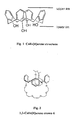
- Fig. 1 illustrates the calix[4]arene structure.
- the calix[4]arene was modified by the addition of a crown ether bridge as shown in Fig. 2 .
- the form of the crown contributes to the selectivity of the calixarene molecule.
- the 1,3-Calix[4]arene crown-5 is selective for potassium over cesium, whereas the crown-6 provides high selectivity for cesium over potassium.
- the crown-6 form can be further enhanced by the use of two crowns (bis-crown-6) and substitution within the crown, as shown in Fig. 3 .
- crowns may be synthesized using aromatic groups at the three positions furthest from the calixarene ring. It is also considered that with the 1,3 alternate calixarene structure, the pi-electrons from the calixarene phenol rings interact with the metal cation to assist stabilization.
- the 1,3 Calix[4]bis crown-6 structure was chosen for the purpose of demonstrating selection between cesium and strontium.
- one of the crowns may be replaced with two pendant alkyl chains of between seven and eleven units long as shown in Fig. 4 .
- Such calixarenes have been attached to particle surfaces and have continued to exhibit selectivity for cesium.
- the calixarene molecule is useful as a basic unit from which to build selective chelation forms.
- Various modified calixarenes have shown selectivity for transition metals, lead, mercury and cadmium, lanthanides, actinides, alkali and alkaline metals.
- the use of the present coupling process for attachment of the calixarene to the magnetic particle, such as ferritin, increases the ion selective options by substituting in the appropriate modified calixarene.
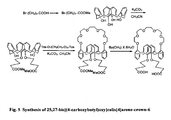
- a cesium specific chelating agent 25,27-bis[(4-carboxybutyl)oxylcalix[4]arene-crown-6 (calixcrown-6) was synthesized according to the synthetic route used by Nechifor et al., as illustrated in Fig. 5 , in order to demonstrate specific separations.
- the ability of the synthesized calixcrown-6 to separate Cs + was assessed by proton NMR and a solvent extraction method.
- NMR of the freshly synthesized calixcrown-6 was taken in deuterated chloroform.
- cesium picrate was added in 1:1 molar ratio.
- the solution was left for half an hour before another NMR was taken.
- the two NMRs were compared.
- the synthesized calixcrown-6 was dissolved in distilled ethyl acetate.
- a known amount of radioactive Cs + and cesium picrate was dissolved in deionised water. The two solutions were mixed for half an hour. After mixing, 0.5 ml was extracted from each of the aqueous and organic layers, and the radioactive cesium was counted in a gamma well counter.
- Suitable magnetic nanoparticles include those magnetic particles with a surface function of OH, COOH or NH 2 .
- Small particle size results in achieving good capacity for contaminants since the attachment of the chelating agent and the ion complexation takes place on the particle surface only. If there is good capacity for contaminants it is not necessary to make the complexation or chelation reaction reversible, which in turn means that there is a wider possible choice of possible chelators, resulting in greater selectivity.
- the amine groups of macromolecules are often the targeted functional groups for the attachment of specific chelating agents through the formation of amide bonds.
- Amide bond formation may be accomplished by the reaction of amines with activated carboxylic acids.
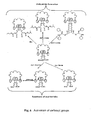
- the activation of carboxyl groups may be achieved in many different ways, including formation of mixed anhydrides and acyl halides as illustrated in Fig. 6 .
- Mixed anhydride is formed by reacting the carboxylic acid with a second much cheaper carboxylic moiety.
- a reagent to produce mixed anhydrides is isobutylchloroformate (IBC), a cheap and readily available reagent, which alone, or together with N-methylmorpholine (NMM) as base, may be used for amide bond formation.
- IBC isobutylchloroformate
- NMM N-methylmorpholine
- mixed anhydride may be produced using carbodiimides as activating agents.
- carbodiimides include, but are mot limited to dicyclohexyl carbodiimide (DCC), diisopropyl carbodiimide (DIC) and 1-ethyl-3-(3'-dimethylaminopropyl)carbodiimide hydrochloride (EDAC).
- DCC dicyclohexyl carbodiimide
- DIC diisopropyl carbodiimide
- EDAC 1-ethyl-3-(3'-dimethylaminopropyl)carbodiimide hydrochloride
- a representative, but not limiting nucleophile for this purpose is hydroxybenzotriazolate (HOBt).
- acyl chlorides can be produced using acyl chloride forming chloride compounds including but not limited to thionyl chloride, oxalyl chloride ((COCl) 2 ) or phosphorus trichloride(PCl 3 ), among others. They react with amines in a dry solvent in the presence of a base to trap the formed hydrochloric acid.
- acyl chlorides are used less often in amide bond formation due to the danger of hydrolysis and other possible side reactions.
- acyl fluorides as active intermediates, as they are less moisture sensitive and more reactive towards amines
- the fluorinating agent cyanuric fluoride is used, although due to the formation of insoluble cyanuric acid during workup, other fluorinating agents have been developed including N,N-tetramethylfluoroformamidium hexafluorophosphate (TFFH) and diethylaminosulphure trifluoride (DAST).
- Aldehydes can be synthesized by reacting acyl halides with hydrides but, hydrides are very reactive to stop at the aldehyde stage and can continue the reaction towards the formation of primary alcohols. To stop the reaction at the formation of aldehyde the syntheses were conducted at very low temperatures (-10, -60 and -70°C) using precise amounts of hydride. However, despite every effort, IR spectra and color test of the products indicated that the conversion of the acyl chloride proceeded to the formation of primary alcohols.
- acyl fluorides were better suited active intermediates because they were less moisture sensitive and more reactive towards amines than acyl chlorides.
- the carboxyl groups of the calixarene were activated by the synthesis of acyl fluoride using DAST as fluorinating agent. IR spectrum analysis indicated the successful preparation of the fluoride intermediate. To reduce the possibility of hydrolysis, the fluoride was mixed with the ferritin solution immediately after preparation. The attachment was confirmed by using the produced ferritin-calixarene molecule for cesium separation. Results indicated that approximately 500 calixarene groups were attached successfully to a ferritin molecule and the produced moiety was able to separate cesium ions from solution.
- a batch of magnetoferritin was obtained from Nanomagnetics (Bristol, England).
- the magnetoferritin solution contained the freshly made, unseparated particles in 2mg/ml concentration.
- the synthesised acyl fluoride was attached to magnetoferritin as follows: Magnetoferritin solution (5.5ml containing 11mg of magnetoferritin) was added to sodium bicarbonate solution (0.1 mol/dm 3 , 14.5ml) and the acyl fluoride 25,27-bis[(4-carboxybutyl)oxy]calyx-[4]arene-crown-6 fluoride (34.1mg, 4.1x10 -5 mol) was dissolved in dimethylsulfoxide (DMSO) (1ml). The dissolved fluoride (0.5ml) was mixed with the prepared magnetoferritin solution (20ml) and left at room temperature overnight. A control solution was also prepared by mixing the magnetoferritin solution (20ml) with DMSO (0.5ml) and leaving it at room temperature overnight.
- DMSO dimethylsulfoxide
- radioactive cesium solution supplied by Platom Radioisotope Centre in Tru containing 67.89MBq/ml radioactivity
- radioactive cesium solution supplied by Platom Radioisotope Centre in Tru containing 67.89MBq/ml radioactivity
- the prepared magnetoferritin-25,27,bis[(4,carboxybutyl)dxy]calix[4]arcnc-crown-6 solution (1ml) was added to the radioactive cesium solution (2ml) and shaken for 1 hour.
- the control solution was also treated the same way.
- Separation equipment was constructed which consisted of a short open top plastic column filled with iron filing and two magnets. The sample (1ml) was loaded into the column with the magnets in place, washed with water and the effluent was collected (10ml). After the third fraction the magnets were removed and further three fractions were collected. A radioactivity in each fraction was measured using a 1282 CompuCount universal gamma counter.
- the calixarene was attached to magnetoferritin through formation of acyl fluoride as active intermediate and the ability of the produced magnetoferritin-calixarene molecule was used to sequester radioactive cesium from solution.
- Two control solutions were also tested similarly: magnetoferritin without calixarene and deionised water. Table 1 lists the detected counts per minutes in the sample and control solutions. Table 1.
- the prepared solution containing the functionalized magnetic particles (1ml) was added to the radioactive cesium solution (2ml) and shaken for 1 hour.
- the control solution was also treated the same way.
- a similar but smaller separation equipment was constructed by filling a 2.5ml syringe with 0.5ml of iron filing and placing it next to only one magnet.
- the sample (1ml) was loaded into the column with the magnets in place, washed with water (1ml) twice and the effluents were collected. The magnets were removed and the filter was washed again.
- a radioactivity in each fraction was measured using a 1282 CompuCount universal gamma counter.
- the Chemicell samples were unstable, they aggregated and sedimented to the bottom of the vial after attachment of the chelating agents. Although they were re-dispersed using vortex but they aggregated again within 24 hours.
- a column was put together using steel powder as filter and magnets provided the magnetic field. The sample was loaded onto the column with the magnets on and washed with water. No color was visible indicating that the sample stayed on the filter. The magnets were removed and the column was washed with water but still the sample was still not visible. After several attempt the column was disassembled and the still powder was washed with water. The solution on top of the steel powder was colored indicating the presence of the magnetic particles.
- the next column was put together using steel wool.
- the sample left the column instantly without magnetic field indicating that wool was a better filter.
- the particles could not be removed even after the magnets were removed.
- the particles must have aggregated in the column forming large clusters that could not fit through the pores of the filter.
- Ferritin-calixarene molecule was tested to separate cesium ions from strontium ions from solutions containing equal amounts of ions. Results showed that ferritin-calixarene complexed approximately twice as much cesium as strontium.
- the magnetic particles coupled to selectively chelating ion exchange functionality containing moieties prepared by the subject process may be used to remove radioactive species from radioactive oil scale waste in water, pre-treated according to methods disclosed in WO2002/013202 .
- the volume reduction of radioactive oil scale waste may be achieved by a process which comprises: a) providing a de-oiled solid scale material; b) subjecting the solid scale material to a solvent such as an alkaline aqueous solution, optionally containing a chelating agent, having the ability of dissolving barium and strontium sulphates together with associated radioactive species, such as radium, therefrom so as to form a scale solution; c) separating any undissolved solid from the scale solution; d) contacting the scale solution with anion exchange material so as to remove sulphate ion therefrom; e) contacting the resulting sulphate-ion depleted solution with magnetic particles coupled to selectively chelating ion exchange functionality containing moieties prepared by the subject process so as to accomplish separation of radium and optionally other radioactive species from barium and strontium by allowing the chelating functionality coupled magnetic particles to selectively bind one or more of radium and other radioactive species; and, f)
Landscapes
- Chemical & Material Sciences (AREA)
- Chemical Kinetics & Catalysis (AREA)
- Organic Chemistry (AREA)
- Physics & Mathematics (AREA)
- Engineering & Computer Science (AREA)
- General Engineering & Computer Science (AREA)
- High Energy & Nuclear Physics (AREA)
- General Chemical & Material Sciences (AREA)
- Analytical Chemistry (AREA)
- Plasma & Fusion (AREA)
- Solid-Sorbent Or Filter-Aiding Compositions (AREA)
- Water Treatment By Sorption (AREA)
Claims (19)
- Verfahren zur selektiven Entfernung von kontaminierenden Ionen aus einer Lösung, umfassend:a) Inkontaktbringen der Lösung mit magnetischen Teilchen, die an Reste gekoppelt sind, welche eine selektive, Chelat-bildende Ionenaustauscherfunktionalität enthalten, hergestellt durch:i) Aktivieren von Carboxylgruppen auf den eine selektive, Chelat-bildende Ionenaustauscherfunktionalität enthaltenden Reste durch Bildung eines Acylfluorids, undii) Umsetzen des Acylfluorids mit den magnetischen Teilchen, wobei die magnetischen Teilchen eine Teilchengröße von unter 10.000 nm (10 Mikron) aufweisen;b) den Chelat-bildenden, funktionalitätsgekoppelten magnetischen Teilchen wird ermöglicht, ein oder mehrere der kontaminierenden Ionen zu binden; undc) Extrahieren der Chelat-bildenden, funktionalitätsgekoppelten magnetischen Teilchen und der kontaminierenden Ionen aus der Lösung durch Magnetfiltration.
- Verfahren zur selektiven Entfernung von kontaminierenden Ionen aus der Lösung nach Anspruch 1, wobei die magnetischen Teilchen eine Oberflächenfunktion von zumindest einem von OH, COOH oder NH2 enthalten.
- Verfahren zur selektiven Entfernung kontaminierender Ionen aus der Lösung nach Anspruch 1 oder 2, wobei das Umsetzen des Acylfluorids mit den magnetischen Teilchen über die Bildung einer Amidbindung erfolgt.
- Verfahren zur selektiven Entfernung kontaminierender Ionen aus der Lösung nach irgendeinem vorhergehenden Anspruch, wobei die magnetischen Teilchen eine Teilchengröße von kleiner als oder gleich etwa 1.000 nm (etwa 1 Mikron), wahlweise im Bereich von etwa 5 nm bis etwa 500 nm, aufweisen.
- Verfahren zur selektiven Entfernung kontaminierender Ionen aus der Lösung nach irgendeinem vorhergehenden Anspruch, wobei die magnetischen Teilchen ein Magnetoferritinmolekül aufweisen.
- Verfahren zur selektiven Entfernung kontaminierender Ionen aus der Lösung nach irgendeinem vorhergehenden Anspruch, wobei die Ionenaustauscherfunktionalität ein nicht-polymeres, hydrophobes Makromolekül aufweist.
- Verfahren zur selektiven Entfernung kontaminierender Ionen aus der Lösung nach irgendeinem vorhergehenden Anspruch, wobei die Ionenaustauscherfunktionalität ein Calixaren aufweist.
- Verfahren zur selektiven Entfernung kontaminierender Ionen aus der Lösung nach Anspruch 7, wobei das Calixaren wenigstens Alkyl-, Alkoxy-, Amid-, Aryl-, Ester- oder Carbonsäure-Chelat-bildende Liganden umfasst.
- Verfahren zur selektiven Entfernung kontaminierender Ionen aus der Lösung nach Anspruch 7 oder 8, wobei die Carboxylgruppen des Calixarens durch die Synthese des Acylfluorids unter Verwendung eines fluorierenden Mittels aktiviert werden.
- Verfahren zur selektiven Entfernung kontaminierender Ionen aus der Lösung nach Anspruch 9, wobei das fluorierende Mittel wenigstens eines aus Diethylaminoschwefeitrifluorid (DAST) oder N,N-Tetramethylfluoroformamidium-hexafluorophosphat (TFFH) umfasst.
- Verfahren zur selektiven Entfernung kontaminierender Ionen aus der Lösung nach Anspruch 9 oder 10, wobei das synthetisierte Acylfluorid an Magnetoferritin angehängt ist, um ein Ferritin-Calixaren-Molekül mit multiplen Calixarengruppen zu bilden.
- Verfahren zur selektiven Entfernung kontaminierender Ionen aus der Lösung nach irgendeinem vorhergehenden Anspruch, wobei die Ionenaustauschfunktionalität ein Calix[4]aren umfasst.
- Verfahren zur selektiven Entfernung kontaminierender Ionen aus der Lösung nach irgendeinem vorhergehenden Anspruch, wobei die Ionenaustauschfunktionalität umfasst:25,27-Bis[(4-carboxybutyl)oxy]calix[4]aren-Kronen-6.
- Verfahren zur selektiven Entfernung kontaminierender Ionen aus der Lösung nach irgendeinem vorhergehenden Anspruch, wobei die kontaminierenden Ionen Cäsium umfassen.
- Verfahren zur selektiven Entfernung kontaminierender Ionen aus der Lösung nach irgendeinem der Ansprüche 1 bis 13, wobei die kontaminierenden Ionen wenigstens eines aus Am, Co, Pu, Ra, Sr, Tc oder U umfassen.
- Verfahren zur selektiven Entfernung kontaminierender Ionen aus der Lösung nach irgendeinem der Ansprüche 1 bis 13, wobei die kontaminierenden Ionen zumindest eines von radioaktivem Actinid oder Lanthanid umfassen.
- Verfahren zur selektiven Entfernung kontaminierender Ionen aus der Lösung nach irgendeinem der Ansprüche 1 bis 13, wobei die Lösung eine entölte oil scale Lösung ist, die Barium, Strontium und ein radioaktives kontaminierendes Ion, wahlweise Radium, enthält, aus dem nicht gelöstes Feststoff und Sulfation entfernt wurden, wobei das radioaktive kontaminierende Ion von Barium und Strontium getrennt wird.
- Verfahren zur selektiven Entfernung kontaminierender Ionen aus der Lösung nach irgendeinem vorhergehenden Anspruch, wobei die magnetische Filtration die Verwendung eines Hochtesla-Magneten und eines Filterelements umfasst.
- Verfahren zur selektiven Entfernung kontaminierender Ionen aus der Lösung nach irgendeinem vorhergehenden Anspruch, wobei die magnetische Filtration die Verwendung eines magnetischen Filters umfasst, um die Chelat-bildende Funktionalität, die mit den magnetischen Teilchen gekoppelt ist und kontaminierende Ionen gebunden hat, einzufangen, und weiterhin umfassend das Entfernen der Chelat-bildenden Funktionalität, die mit magnetischen Teilchen gekoppelt ist und kontaminierende Ionen gebunden enthält, aus dem magnetischen Filter durch Rückwaschen des magnetischen Filters.
Applications Claiming Priority (1)
| Application Number | Priority Date | Filing Date | Title |
|---|---|---|---|
| US230307P | 2007-11-08 | 2007-11-08 |
Publications (2)
| Publication Number | Publication Date |
|---|---|
| EP2063433A1 EP2063433A1 (de) | 2009-05-27 |
| EP2063433B1 true EP2063433B1 (de) | 2010-06-09 |
Family
ID=40532633
Family Applications (1)
| Application Number | Title | Priority Date | Filing Date |
|---|---|---|---|
| EP20080075793 Not-in-force EP2063433B1 (de) | 2007-11-08 | 2008-09-30 | Verfahren zur Herstellung von magnetischen Partikeln zur selektiven Entfernung von Kontaminanten aus einer Lösung |
Country Status (5)
| Country | Link |
|---|---|
| US (1) | US8097164B2 (de) |
| EP (1) | EP2063433B1 (de) |
| AT (1) | ATE470938T1 (de) |
| CA (1) | CA2639881C (de) |
| DE (1) | DE602008001478D1 (de) |
Families Citing this family (11)
| Publication number | Priority date | Publication date | Assignee | Title |
|---|---|---|---|---|
| US8157986B2 (en) | 2008-08-27 | 2012-04-17 | Seoul National University Research & Development Business Foundation | Magnetic nanoparticle complex |
| CN101797494B (zh) * | 2010-03-05 | 2012-08-15 | 中国科学院上海应用物理研究所 | 一种磁固相分离剂及其制备方法 |
| JP4932054B1 (ja) * | 2011-04-28 | 2012-05-16 | 学校法人慈恵大学 | 放射性物質類除染システム、及び放射性物質類の除染方法、及び除染用磁性複合粒子 |
| WO2013028153A2 (en) * | 2011-08-19 | 2013-02-28 | Weinberg Medical Physics Llc | Method and apparatus for removing noxious materials from cells |
| EP2631917A1 (de) * | 2012-02-24 | 2013-08-28 | Commissariat à l'Énergie Atomique et aux Énergies Alternatives | Feststoff-Flüssigkeitsverfahren zur Extraktion von Radionukliden aus Abfalllösungen |
| EP3510601B1 (de) * | 2016-09-06 | 2021-05-12 | Westinghouse Electric Sweden AB | Brennstoffbündel |
| CN207038182U (zh) * | 2017-03-29 | 2018-02-23 | 泰拉能源有限责任公司 | 铯收集器 |
| CN108043575B (zh) * | 2017-12-07 | 2022-05-31 | 浙江海洋大学 | 一种铁屑清除系统中的铁屑分离单元 |
| CN108579702A (zh) * | 2018-05-16 | 2018-09-28 | 东华理工大学 | 一种碳基超分子吸附剂的制备方法及其应用 |
| KR20210121562A (ko) * | 2020-03-30 | 2021-10-08 | 한국원자력연구원 | 방사성 폐기물의 선택적 전처리 방법 |
| DE102022133329A1 (de) * | 2022-12-14 | 2024-06-20 | Hydroisotop GmbH, Laboratorium zur Bestimmung von Isotopen in Umwelt und Hydrologie | Verfahren zur Extraktion von Bestandteilen aus wässrigen Fluiden |
Family Cites Families (13)
| Publication number | Priority date | Publication date | Assignee | Title |
|---|---|---|---|---|
| GB9115018D0 (en) | 1991-07-11 | 1991-08-28 | Bradtec Ltd | Purification of solutions |
| US5595666A (en) | 1993-05-07 | 1997-01-21 | The United States Of America As Represented By The United States Department Of Energy | Removal of radioactive materials and heavy metals from water using magnetic resin |
| US5564104A (en) | 1993-06-08 | 1996-10-08 | Cortex Biochem, Inc. | Methods of removing radioactively labled biological molecules from liquid radioactive waste |
| US5491219A (en) | 1993-06-11 | 1996-02-13 | Protein Magnetics | Ferritin with ferrimagnetically ordered ferrite core and method technical field |
| GB9402334D0 (en) | 1994-02-07 | 1994-03-30 | Bradtecltd | Magnetic particles a method for the preparation thereof and their use in the purification of solutions |
| US5855790A (en) | 1994-02-07 | 1999-01-05 | Selective Environmental Technologies, Inc. | Magnetic particles, a method for the preparation thereof and their use in the purification of solutions |
| GB9426023D0 (en) | 1994-12-22 | 1995-02-22 | Bradtec Ltd | Process for decontaminating radioactive materials |
| US6117413A (en) | 1997-11-12 | 2000-09-12 | Battelle Memorial Institute | Radionuclide-binding compound, a radionuclide delivery system, a method of making a radium complexing compound, a method of extracting a radionuclide, and a method of delivering a radionuclide |
| CA2336355C (en) | 1998-07-02 | 2006-09-19 | Arch Development Corporation | Bifunctional phenyl monophosphonic/sulfonic acid ion exchange resin and process for using the same |
| US6232353B1 (en) | 1998-07-02 | 2001-05-15 | Arch Development Corporation | Bifunctional phenyl monophosphonic/sulfonic acid ion exchange resin and process for using the same |
| FR2788523B1 (fr) * | 1999-01-18 | 2001-02-16 | Commissariat Energie Atomique | Derives de calixarenes, leur procede de preparation et leur utilisation pour l'extraction des actinides et des lanthanides |
| SE517130C2 (sv) | 2000-08-10 | 2002-04-16 | Studsvik Radwaste Ab | Förfarande och anordning för volymreduktion av radioaktivt oljescaleavfall |
| US6972095B1 (en) | 2003-05-07 | 2005-12-06 | Electric Power Research Institute | Magnetic molecules: a process utilizing functionalized magnetic ferritins for the selective removal of contaminants from solution by magnetic filtration |
-
2008
- 2008-09-17 US US12/212,206 patent/US8097164B2/en not_active Expired - Fee Related
- 2008-09-29 CA CA 2639881 patent/CA2639881C/en not_active Expired - Fee Related
- 2008-09-30 EP EP20080075793 patent/EP2063433B1/de not_active Not-in-force
- 2008-09-30 DE DE200860001478 patent/DE602008001478D1/de active Active
- 2008-09-30 AT AT08075793T patent/ATE470938T1/de not_active IP Right Cessation
Also Published As
| Publication number | Publication date |
|---|---|
| DE602008001478D1 (de) | 2010-07-22 |
| CA2639881C (en) | 2013-06-18 |
| CA2639881A1 (en) | 2009-05-08 |
| US20090120880A1 (en) | 2009-05-14 |
| EP2063433A1 (de) | 2009-05-27 |
| US8097164B2 (en) | 2012-01-17 |
| ATE470938T1 (de) | 2010-06-15 |
Similar Documents
| Publication | Publication Date | Title |
|---|---|---|
| US8097164B2 (en) | Process for preparing magnetic particles for selectively removing contaminants from solution | |
| Mokhtari et al. | A review of calixarene applications in nuclear industries | |
| Van Hecke et al. | Separation of actinides from low level liquid wastes (LLLW) by extraction chromatography using novel DMDOHEMA and TODGA impregnated resins | |
| Kaur et al. | Conjugates of Magnetic Nanoparticle Actinide Specific Chelator for Radioactive Waste Separation | |
| US5322644A (en) | Process for decontamination of radioactive materials | |
| JP5841933B2 (ja) | 新規吸着剤、その製造方法およびその使用 | |
| Kushwaha et al. | Polymer nanorings with uranium specific clefts for selective recovery of uranium from acidic effluents via reductive adsorption | |
| Kiegiel et al. | Application of calixarenes as macrocyclic ligands for Uranium (VI): A review | |
| EP2797081A1 (de) | Verfahren zum entfernen von cäsiumionen in wässrigen lösungen unter verwendung magnetischer partikel | |
| CN115267878B (zh) | 一种用于分离和检测铀的树脂及制备方法 | |
| Miloudi et al. | Hyper-branched phosphonated polyethyleneimine composite for the removal of samarium (III) ions from aqueous solutions: effect of process parameters | |
| CA2521639C (en) | Magnetic molecules: process utilizing functionalized magnetic ferritins for the selective removal of contaminants from solution by magnetic filtration | |
| Urban et al. | Functionalized paramagnetic nanoparticles for waste water treatment | |
| Lyu et al. | Selective adsorption of rubidium onto a new 1, 3-alternate calix [4] crown-5 mesoporous adsorbent with a polar carrier containing polyalkyl ester | |
| Brotin et al. | Impact of the syn/anti relative configuration of cryptophane-222 on the binding affinity of cesium and thallium | |
| Nath | Nanomaterial for the management of radioactive waste | |
| Boukhalfa et al. | Extraction of plutonium using DIPEX immobilized in polystyrene thin films | |
| Sharma et al. | Trace detection of La (III), Ce (III), Ce (IV), Nd (III), and Gd (III) using 2, 8, 14, 20-tetramethyl-5, 7-dinitro calix [4] resorcinarene polyhydroxamic acid by solid-phase extraction and separation | |
| Dasthaiah et al. | Studies on the uptake of Am (III) and Eu (III) on ionic liquid modified polystyrene-divinyl benzene | |
| Gado et al. | Modification of uranium determination procedures by alpha spectrometry using graphene oxide functionalized 4-aminobenzenesulfonate | |
| Zuba et al. | Comparison study of ruthenium sorption on Fe3O4 and Fe3O4@ MnO2 in hydrochloric and nitric acids | |
| Shirvani-Arani et al. | Enriched 146Nd recovery from a 147Pm production process by applying ion imprinting technique | |
| Samanta et al. | Removal of radioruthenium from alkaline intermediate level radioactive waste solution: A laboratory investigation | |
| Suneesh et al. | Novel Diglycolamic Acid Functionalized Iron Oxide Particles for the Mutual Separation of Eu (III) and Am (III) | |
| Rajput et al. | Covalent grafting of Diglycolamide functionalities over Merrifield resin for the uptake of trivalent f-block metal ions from acidic aqueous feed |
Legal Events
| Date | Code | Title | Description |
|---|---|---|---|
| PUAI | Public reference made under article 153(3) epc to a published international application that has entered the european phase |
Free format text: ORIGINAL CODE: 0009012 |
|
| AK | Designated contracting states |
Kind code of ref document: A1 Designated state(s): AT BE BG CH CY CZ DE DK EE ES FI FR GB GR HR HU IE IS IT LI LT LU LV MC MT NL NO PL PT RO SE SI SK TR |
|
| AX | Request for extension of the european patent |
Extension state: AL BA MK RS |
|
| 17P | Request for examination filed |
Effective date: 20090612 |
|
| 17Q | First examination report despatched |
Effective date: 20090821 |
|
| GRAP | Despatch of communication of intention to grant a patent |
Free format text: ORIGINAL CODE: EPIDOSNIGR1 |
|
| AKX | Designation fees paid |
Designated state(s): AT BE BG CH CY CZ DE DK EE ES FI FR GB GR HR HU IE IS IT LI LT LU LV MC MT NL NO PL PT RO SE SI SK TR |
|
| GRAS | Grant fee paid |
Free format text: ORIGINAL CODE: EPIDOSNIGR3 |
|
| GRAA | (expected) grant |
Free format text: ORIGINAL CODE: 0009210 |
|
| AK | Designated contracting states |
Kind code of ref document: B1 Designated state(s): AT BE BG CH CY CZ DE DK EE ES FI FR GB GR HR HU IE IS IT LI LT LU LV MC MT NL NO PL PT RO SE SI SK TR |
|
| REG | Reference to a national code |
Ref country code: CH Ref legal event code: EP |
|
| REG | Reference to a national code |
Ref country code: IE Ref legal event code: FG4D |
|
| REF | Corresponds to: |
Ref document number: 602008001478 Country of ref document: DE Date of ref document: 20100722 Kind code of ref document: P |
|
| REG | Reference to a national code |
Ref country code: NL Ref legal event code: VDEP Effective date: 20100609 |
|
| PG25 | Lapsed in a contracting state [announced via postgrant information from national office to epo] |
Ref country code: LT Free format text: LAPSE BECAUSE OF FAILURE TO SUBMIT A TRANSLATION OF THE DESCRIPTION OR TO PAY THE FEE WITHIN THE PRESCRIBED TIME-LIMIT Effective date: 20100609 Ref country code: NO Free format text: LAPSE BECAUSE OF FAILURE TO SUBMIT A TRANSLATION OF THE DESCRIPTION OR TO PAY THE FEE WITHIN THE PRESCRIBED TIME-LIMIT Effective date: 20100909 Ref country code: SE Free format text: LAPSE BECAUSE OF FAILURE TO SUBMIT A TRANSLATION OF THE DESCRIPTION OR TO PAY THE FEE WITHIN THE PRESCRIBED TIME-LIMIT Effective date: 20100609 |
|
| LTIE | Lt: invalidation of european patent or patent extension |
Effective date: 20100609 |
|
| PG25 | Lapsed in a contracting state [announced via postgrant information from national office to epo] |
Ref country code: HR Free format text: LAPSE BECAUSE OF FAILURE TO SUBMIT A TRANSLATION OF THE DESCRIPTION OR TO PAY THE FEE WITHIN THE PRESCRIBED TIME-LIMIT Effective date: 20100609 Ref country code: AT Free format text: LAPSE BECAUSE OF FAILURE TO SUBMIT A TRANSLATION OF THE DESCRIPTION OR TO PAY THE FEE WITHIN THE PRESCRIBED TIME-LIMIT Effective date: 20100609 Ref country code: FI Free format text: LAPSE BECAUSE OF FAILURE TO SUBMIT A TRANSLATION OF THE DESCRIPTION OR TO PAY THE FEE WITHIN THE PRESCRIBED TIME-LIMIT Effective date: 20100609 Ref country code: SI Free format text: LAPSE BECAUSE OF FAILURE TO SUBMIT A TRANSLATION OF THE DESCRIPTION OR TO PAY THE FEE WITHIN THE PRESCRIBED TIME-LIMIT Effective date: 20100609 Ref country code: LV Free format text: LAPSE BECAUSE OF FAILURE TO SUBMIT A TRANSLATION OF THE DESCRIPTION OR TO PAY THE FEE WITHIN THE PRESCRIBED TIME-LIMIT Effective date: 20100609 |
|
| PG25 | Lapsed in a contracting state [announced via postgrant information from national office to epo] |
Ref country code: CY Free format text: LAPSE BECAUSE OF FAILURE TO SUBMIT A TRANSLATION OF THE DESCRIPTION OR TO PAY THE FEE WITHIN THE PRESCRIBED TIME-LIMIT Effective date: 20100609 Ref country code: PL Free format text: LAPSE BECAUSE OF FAILURE TO SUBMIT A TRANSLATION OF THE DESCRIPTION OR TO PAY THE FEE WITHIN THE PRESCRIBED TIME-LIMIT Effective date: 20100609 |
|
| PG25 | Lapsed in a contracting state [announced via postgrant information from national office to epo] |
Ref country code: EE Free format text: LAPSE BECAUSE OF FAILURE TO SUBMIT A TRANSLATION OF THE DESCRIPTION OR TO PAY THE FEE WITHIN THE PRESCRIBED TIME-LIMIT Effective date: 20100609 Ref country code: NL Free format text: LAPSE BECAUSE OF FAILURE TO SUBMIT A TRANSLATION OF THE DESCRIPTION OR TO PAY THE FEE WITHIN THE PRESCRIBED TIME-LIMIT Effective date: 20100609 |
|
| PG25 | Lapsed in a contracting state [announced via postgrant information from national office to epo] |
Ref country code: IS Free format text: LAPSE BECAUSE OF FAILURE TO SUBMIT A TRANSLATION OF THE DESCRIPTION OR TO PAY THE FEE WITHIN THE PRESCRIBED TIME-LIMIT Effective date: 20101009 Ref country code: CZ Free format text: LAPSE BECAUSE OF FAILURE TO SUBMIT A TRANSLATION OF THE DESCRIPTION OR TO PAY THE FEE WITHIN THE PRESCRIBED TIME-LIMIT Effective date: 20100609 Ref country code: BE Free format text: LAPSE BECAUSE OF FAILURE TO SUBMIT A TRANSLATION OF THE DESCRIPTION OR TO PAY THE FEE WITHIN THE PRESCRIBED TIME-LIMIT Effective date: 20100609 Ref country code: SK Free format text: LAPSE BECAUSE OF FAILURE TO SUBMIT A TRANSLATION OF THE DESCRIPTION OR TO PAY THE FEE WITHIN THE PRESCRIBED TIME-LIMIT Effective date: 20100609 Ref country code: RO Free format text: LAPSE BECAUSE OF FAILURE TO SUBMIT A TRANSLATION OF THE DESCRIPTION OR TO PAY THE FEE WITHIN THE PRESCRIBED TIME-LIMIT Effective date: 20100609 |
|
| PG25 | Lapsed in a contracting state [announced via postgrant information from national office to epo] |
Ref country code: IT Free format text: LAPSE BECAUSE OF FAILURE TO SUBMIT A TRANSLATION OF THE DESCRIPTION OR TO PAY THE FEE WITHIN THE PRESCRIBED TIME-LIMIT Effective date: 20100609 |
|
| PLBE | No opposition filed within time limit |
Free format text: ORIGINAL CODE: 0009261 |
|
| STAA | Information on the status of an ep patent application or granted ep patent |
Free format text: STATUS: NO OPPOSITION FILED WITHIN TIME LIMIT |
|
| PG25 | Lapsed in a contracting state [announced via postgrant information from national office to epo] |
Ref country code: DK Free format text: LAPSE BECAUSE OF FAILURE TO SUBMIT A TRANSLATION OF THE DESCRIPTION OR TO PAY THE FEE WITHIN THE PRESCRIBED TIME-LIMIT Effective date: 20100609 Ref country code: MC Free format text: LAPSE BECAUSE OF NON-PAYMENT OF DUE FEES Effective date: 20100930 |
|
| PG25 | Lapsed in a contracting state [announced via postgrant information from national office to epo] |
Ref country code: GR Free format text: LAPSE BECAUSE OF FAILURE TO SUBMIT A TRANSLATION OF THE DESCRIPTION OR TO PAY THE FEE WITHIN THE PRESCRIBED TIME-LIMIT Effective date: 20100910 |
|
| REG | Reference to a national code |
Ref country code: DE Ref legal event code: R097 Ref document number: 602008001478 Country of ref document: DE Effective date: 20110309 |
|
| PG25 | Lapsed in a contracting state [announced via postgrant information from national office to epo] |
Ref country code: IE Free format text: LAPSE BECAUSE OF NON-PAYMENT OF DUE FEES Effective date: 20100930 |
|
| PG25 | Lapsed in a contracting state [announced via postgrant information from national office to epo] |
Ref country code: MT Free format text: LAPSE BECAUSE OF FAILURE TO SUBMIT A TRANSLATION OF THE DESCRIPTION OR TO PAY THE FEE WITHIN THE PRESCRIBED TIME-LIMIT Effective date: 20100609 |
|
| PG25 | Lapsed in a contracting state [announced via postgrant information from national office to epo] |
Ref country code: LU Free format text: LAPSE BECAUSE OF NON-PAYMENT OF DUE FEES Effective date: 20100930 Ref country code: BG Free format text: LAPSE BECAUSE OF FAILURE TO SUBMIT A TRANSLATION OF THE DESCRIPTION OR TO PAY THE FEE WITHIN THE PRESCRIBED TIME-LIMIT Effective date: 20100609 Ref country code: HU Free format text: LAPSE BECAUSE OF FAILURE TO SUBMIT A TRANSLATION OF THE DESCRIPTION OR TO PAY THE FEE WITHIN THE PRESCRIBED TIME-LIMIT Effective date: 20101210 |
|
| PG25 | Lapsed in a contracting state [announced via postgrant information from national office to epo] |
Ref country code: TR Free format text: LAPSE BECAUSE OF FAILURE TO SUBMIT A TRANSLATION OF THE DESCRIPTION OR TO PAY THE FEE WITHIN THE PRESCRIBED TIME-LIMIT Effective date: 20100609 |
|
| REG | Reference to a national code |
Ref country code: CH Ref legal event code: PL |
|
| PG25 | Lapsed in a contracting state [announced via postgrant information from national office to epo] |
Ref country code: PT Free format text: LAPSE BECAUSE OF NON-PAYMENT OF DUE FEES Effective date: 20100609 Ref country code: CH Free format text: LAPSE BECAUSE OF NON-PAYMENT OF DUE FEES Effective date: 20120930 Ref country code: LI Free format text: LAPSE BECAUSE OF NON-PAYMENT OF DUE FEES Effective date: 20120930 |
|
| PG25 | Lapsed in a contracting state [announced via postgrant information from national office to epo] |
Ref country code: BG Free format text: LAPSE BECAUSE OF FAILURE TO SUBMIT A TRANSLATION OF THE DESCRIPTION OR TO PAY THE FEE WITHIN THE PRESCRIBED TIME-LIMIT Effective date: 20100909 |
|
| PG25 | Lapsed in a contracting state [announced via postgrant information from national office to epo] |
Ref country code: ES Free format text: LAPSE BECAUSE OF FAILURE TO SUBMIT A TRANSLATION OF THE DESCRIPTION OR TO PAY THE FEE WITHIN THE PRESCRIBED TIME-LIMIT Effective date: 20100920 |
|
| PGFP | Annual fee paid to national office [announced via postgrant information from national office to epo] |
Ref country code: GB Payment date: 20140929 Year of fee payment: 7 Ref country code: FR Payment date: 20140917 Year of fee payment: 7 |
|
| PGFP | Annual fee paid to national office [announced via postgrant information from national office to epo] |
Ref country code: DE Payment date: 20140929 Year of fee payment: 7 |
|
| REG | Reference to a national code |
Ref country code: DE Ref legal event code: R119 Ref document number: 602008001478 Country of ref document: DE |
|
| GBPC | Gb: european patent ceased through non-payment of renewal fee |
Effective date: 20150930 |
|
| REG | Reference to a national code |
Ref country code: FR Ref legal event code: ST Effective date: 20160531 |
|
| PG25 | Lapsed in a contracting state [announced via postgrant information from national office to epo] |
Ref country code: GB Free format text: LAPSE BECAUSE OF NON-PAYMENT OF DUE FEES Effective date: 20150930 Ref country code: DE Free format text: LAPSE BECAUSE OF NON-PAYMENT OF DUE FEES Effective date: 20160401 |
|
| PG25 | Lapsed in a contracting state [announced via postgrant information from national office to epo] |
Ref country code: FR Free format text: LAPSE BECAUSE OF NON-PAYMENT OF DUE FEES Effective date: 20150930 |