EP2059527B1 - Modified glycoproteins - Google Patents
Modified glycoproteins Download PDFInfo
- Publication number
- EP2059527B1 EP2059527B1 EP07803166.3A EP07803166A EP2059527B1 EP 2059527 B1 EP2059527 B1 EP 2059527B1 EP 07803166 A EP07803166 A EP 07803166A EP 2059527 B1 EP2059527 B1 EP 2059527B1
- Authority
- EP
- European Patent Office
- Prior art keywords
- fvii
- glycoprotein
- protein
- modified
- modified glycoprotein
- Prior art date
- Legal status (The legal status is an assumption and is not a legal conclusion. Google has not performed a legal analysis and makes no representation as to the accuracy of the status listed.)
- Not-in-force
Links
- 102000003886 Glycoproteins Human genes 0.000 title claims description 209
- 108090000288 Glycoproteins Proteins 0.000 title claims description 209
- 238000000034 method Methods 0.000 claims description 64
- -1 periodate ions Chemical class 0.000 claims description 63
- 108090000765 processed proteins & peptides Proteins 0.000 claims description 54
- 229920001223 polyethylene glycol Polymers 0.000 claims description 45
- 239000002202 Polyethylene glycol Substances 0.000 claims description 41
- 102000004196 processed proteins & peptides Human genes 0.000 claims description 41
- 150000004676 glycans Chemical class 0.000 claims description 39
- 102000009027 Albumins Human genes 0.000 claims description 28
- 108010088751 Albumins Proteins 0.000 claims description 28
- 229920001184 polypeptide Polymers 0.000 claims description 26
- 229940012413 factor vii Drugs 0.000 claims description 18
- 229920000642 polymer Polymers 0.000 claims description 16
- 102100023804 Coagulation factor VII Human genes 0.000 claims description 14
- 102100026735 Coagulation factor VIII Human genes 0.000 claims description 14
- 229920002307 Dextran Polymers 0.000 claims description 14
- 108010023321 Factor VII Proteins 0.000 claims description 14
- 101000911390 Homo sapiens Coagulation factor VIII Proteins 0.000 claims description 14
- 239000000412 dendrimer Substances 0.000 claims description 14
- 229920000736 dendritic polymer Polymers 0.000 claims description 14
- 229920002451 polyvinyl alcohol Polymers 0.000 claims description 14
- 239000004372 Polyvinyl alcohol Substances 0.000 claims description 13
- 230000000144 pharmacologic effect Effects 0.000 claims description 13
- 230000002163 immunogen Effects 0.000 claims description 12
- 230000007935 neutral effect Effects 0.000 claims description 12
- 229920000858 Cyclodextrin Polymers 0.000 claims description 11
- 230000002209 hydrophobic effect Effects 0.000 claims description 11
- 235000014113 dietary fatty acids Nutrition 0.000 claims description 10
- 229930195729 fatty acid Natural products 0.000 claims description 10
- 239000000194 fatty acid Substances 0.000 claims description 10
- 229920000233 poly(alkylene oxides) Polymers 0.000 claims description 10
- 229920001515 polyalkylene glycol Polymers 0.000 claims description 10
- 229920001451 polypropylene glycol Polymers 0.000 claims description 10
- 229910052799 carbon Inorganic materials 0.000 claims description 9
- IJGRMHOSHXDMSA-UHFFFAOYSA-N Atomic nitrogen Chemical compound N#N IJGRMHOSHXDMSA-UHFFFAOYSA-N 0.000 claims description 8
- 125000003172 aldehyde group Chemical group 0.000 claims description 8
- 229910052757 nitrogen Inorganic materials 0.000 claims description 8
- 229910052760 oxygen Inorganic materials 0.000 claims description 8
- 229920001503 Glucan Polymers 0.000 claims description 7
- 150000001412 amines Chemical class 0.000 claims description 7
- 150000001735 carboxylic acids Chemical class 0.000 claims description 7
- 150000004665 fatty acids Chemical class 0.000 claims description 7
- HFHDHCJBZVLPGP-UHFFFAOYSA-N schardinger α-dextrin Chemical compound O1C(C(C2O)O)C(CO)OC2OC(C(C2O)O)C(CO)OC2OC(C(C2O)O)C(CO)OC2OC(C(O)C2O)C(CO)OC2OC(C(C2O)O)C(CO)OC2OC2C(O)C(O)C1OC2CO HFHDHCJBZVLPGP-UHFFFAOYSA-N 0.000 claims description 7
- BHQCQFFYRZLCQQ-UHFFFAOYSA-N (3alpha,5alpha,7alpha,12alpha)-3,7,12-trihydroxy-cholan-24-oic acid Natural products OC1CC2CC(O)CCC2(C)C2C1C1CCC(C(CCC(O)=O)C)C1(C)C(O)C2 BHQCQFFYRZLCQQ-UHFFFAOYSA-N 0.000 claims description 6
- 239000004380 Cholic acid Substances 0.000 claims description 6
- 235000019416 cholic acid Nutrition 0.000 claims description 6
- BHQCQFFYRZLCQQ-OELDTZBJSA-N cholic acid Chemical compound C([C@H]1C[C@H]2O)[C@H](O)CC[C@]1(C)[C@@H]1[C@@H]2[C@@H]2CC[C@H]([C@@H](CCC(O)=O)C)[C@@]2(C)[C@@H](O)C1 BHQCQFFYRZLCQQ-OELDTZBJSA-N 0.000 claims description 6
- 229960002471 cholic acid Drugs 0.000 claims description 6
- KXGVEGMKQFWNSR-UHFFFAOYSA-N deoxycholic acid Natural products C1CC2CC(O)CCC2(C)C2C1C1CCC(C(CCC(O)=O)C)C1(C)C(O)C2 KXGVEGMKQFWNSR-UHFFFAOYSA-N 0.000 claims description 6
- 150000002433 hydrophilic molecules Chemical class 0.000 claims description 6
- 150000003009 phosphonic acids Chemical class 0.000 claims description 6
- 230000000717 retained effect Effects 0.000 claims description 6
- 230000005714 functional activity Effects 0.000 claims description 5
- 125000004435 hydrogen atom Chemical group [H]* 0.000 claims description 5
- 229920000620 organic polymer Polymers 0.000 claims description 5
- 229920005646 polycarboxylate Polymers 0.000 claims description 5
- OKTJSMMVPCPJKN-UHFFFAOYSA-N Carbon Chemical compound [C] OKTJSMMVPCPJKN-UHFFFAOYSA-N 0.000 claims description 4
- QVGXLLKOCUKJST-UHFFFAOYSA-N atomic oxygen Chemical compound [O] QVGXLLKOCUKJST-UHFFFAOYSA-N 0.000 claims description 4
- 229910052739 hydrogen Inorganic materials 0.000 claims description 4
- 239000001301 oxygen Substances 0.000 claims description 4
- 150000003460 sulfonic acids Chemical class 0.000 claims description 4
- 230000001590 oxidative effect Effects 0.000 claims description 3
- 102000004169 proteins and genes Human genes 0.000 description 119
- 108090000623 proteins and genes Proteins 0.000 description 119
- 235000018102 proteins Nutrition 0.000 description 115
- 239000000203 mixture Substances 0.000 description 81
- FAPWRFPIFSIZLT-UHFFFAOYSA-M Sodium chloride Chemical compound [Na+].[Cl-] FAPWRFPIFSIZLT-UHFFFAOYSA-M 0.000 description 76
- YMAWOPBAYDPSLA-UHFFFAOYSA-N glycylglycine Chemical compound [NH3+]CC(=O)NCC([O-])=O YMAWOPBAYDPSLA-UHFFFAOYSA-N 0.000 description 51
- 239000011780 sodium chloride Substances 0.000 description 38
- 239000000872 buffer Substances 0.000 description 37
- 229940024606 amino acid Drugs 0.000 description 34
- 235000001014 amino acid Nutrition 0.000 description 33
- 239000008194 pharmaceutical composition Substances 0.000 description 33
- 150000001413 amino acids Chemical class 0.000 description 32
- 239000000243 solution Substances 0.000 description 31
- 238000002360 preparation method Methods 0.000 description 27
- 230000000694 effects Effects 0.000 description 26
- UXVMQQNJUSDDNG-UHFFFAOYSA-L Calcium chloride Chemical compound [Cl-].[Cl-].[Ca+2] UXVMQQNJUSDDNG-UHFFFAOYSA-L 0.000 description 25
- 239000001110 calcium chloride Substances 0.000 description 25
- 229910001628 calcium chloride Inorganic materials 0.000 description 25
- 102000005962 receptors Human genes 0.000 description 24
- 108020003175 receptors Proteins 0.000 description 24
- 230000027455 binding Effects 0.000 description 23
- 238000001727 in vivo Methods 0.000 description 23
- 238000003860 storage Methods 0.000 description 19
- RTZKZFJDLAIYFH-UHFFFAOYSA-N Diethyl ether Chemical compound CCOCC RTZKZFJDLAIYFH-UHFFFAOYSA-N 0.000 description 18
- 230000005847 immunogenicity Effects 0.000 description 17
- 108010000499 Thromboplastin Proteins 0.000 description 16
- 102000002262 Thromboplastin Human genes 0.000 description 16
- 239000003102 growth factor Substances 0.000 description 16
- 108010054265 Factor VIIa Proteins 0.000 description 15
- 125000003275 alpha amino acid group Chemical group 0.000 description 15
- 238000003556 assay Methods 0.000 description 15
- 230000002829 reductive effect Effects 0.000 description 15
- 229940012414 factor viia Drugs 0.000 description 14
- 239000000499 gel Substances 0.000 description 14
- NOESYZHRGYRDHS-UHFFFAOYSA-N insulin Chemical compound N1C(=O)C(NC(=O)C(CCC(N)=O)NC(=O)C(CCC(O)=O)NC(=O)C(C(C)C)NC(=O)C(NC(=O)CN)C(C)CC)CSSCC(C(NC(CO)C(=O)NC(CC(C)C)C(=O)NC(CC=2C=CC(O)=CC=2)C(=O)NC(CCC(N)=O)C(=O)NC(CC(C)C)C(=O)NC(CCC(O)=O)C(=O)NC(CC(N)=O)C(=O)NC(CC=2C=CC(O)=CC=2)C(=O)NC(CSSCC(NC(=O)C(C(C)C)NC(=O)C(CC(C)C)NC(=O)C(CC=2C=CC(O)=CC=2)NC(=O)C(CC(C)C)NC(=O)C(C)NC(=O)C(CCC(O)=O)NC(=O)C(C(C)C)NC(=O)C(CC(C)C)NC(=O)C(CC=2NC=NC=2)NC(=O)C(CO)NC(=O)CNC2=O)C(=O)NCC(=O)NC(CCC(O)=O)C(=O)NC(CCCNC(N)=N)C(=O)NCC(=O)NC(CC=3C=CC=CC=3)C(=O)NC(CC=3C=CC=CC=3)C(=O)NC(CC=3C=CC(O)=CC=3)C(=O)NC(C(C)O)C(=O)N3C(CCC3)C(=O)NC(CCCCN)C(=O)NC(C)C(O)=O)C(=O)NC(CC(N)=O)C(O)=O)=O)NC(=O)C(C(C)CC)NC(=O)C(CO)NC(=O)C(C(C)O)NC(=O)C1CSSCC2NC(=O)C(CC(C)C)NC(=O)C(NC(=O)C(CCC(N)=O)NC(=O)C(CC(N)=O)NC(=O)C(NC(=O)C(N)CC=1C=CC=CC=1)C(C)C)CC1=CN=CN1 NOESYZHRGYRDHS-UHFFFAOYSA-N 0.000 description 14
- 230000001225 therapeutic effect Effects 0.000 description 14
- KCXVZYZYPLLWCC-UHFFFAOYSA-N EDTA Chemical compound OC(=O)CN(CC(O)=O)CCN(CC(O)=O)CC(O)=O KCXVZYZYPLLWCC-UHFFFAOYSA-N 0.000 description 13
- HNDVDQJCIGZPNO-YFKPBYRVSA-N L-histidine Chemical compound OC(=O)[C@@H](N)CC1=CN=CN1 HNDVDQJCIGZPNO-YFKPBYRVSA-N 0.000 description 13
- 235000011148 calcium chloride Nutrition 0.000 description 13
- 230000003647 oxidation Effects 0.000 description 13
- 238000007254 oxidation reaction Methods 0.000 description 13
- XLYOFNOQVPJJNP-UHFFFAOYSA-N water Substances O XLYOFNOQVPJJNP-UHFFFAOYSA-N 0.000 description 13
- WEVYAHXRMPXWCK-UHFFFAOYSA-N Acetonitrile Chemical compound CC#N WEVYAHXRMPXWCK-UHFFFAOYSA-N 0.000 description 12
- 230000015572 biosynthetic process Effects 0.000 description 12
- 239000007857 degradation product Substances 0.000 description 12
- 239000003814 drug Substances 0.000 description 12
- JQWHASGSAFIOCM-UHFFFAOYSA-M sodium periodate Chemical compound [Na+].[O-]I(=O)(=O)=O JQWHASGSAFIOCM-UHFFFAOYSA-M 0.000 description 12
- PEDCQBHIVMGVHV-UHFFFAOYSA-N Glycerine Chemical compound OCC(O)CO PEDCQBHIVMGVHV-UHFFFAOYSA-N 0.000 description 11
- 238000002835 absorbance Methods 0.000 description 11
- 210000004027 cell Anatomy 0.000 description 11
- 229960002885 histidine Drugs 0.000 description 11
- KHIWWQKSHDUIBK-UHFFFAOYSA-N periodic acid Chemical compound OI(=O)(=O)=O KHIWWQKSHDUIBK-UHFFFAOYSA-N 0.000 description 11
- 150000003254 radicals Chemical class 0.000 description 11
- 239000011541 reaction mixture Substances 0.000 description 11
- 239000000126 substance Substances 0.000 description 11
- 102000007644 Colony-Stimulating Factors Human genes 0.000 description 10
- 108010071942 Colony-Stimulating Factors Proteins 0.000 description 10
- 108060003951 Immunoglobulin Proteins 0.000 description 10
- FFEARJCKVFRZRR-BYPYZUCNSA-N L-methionine Chemical compound CSCC[C@H](N)C(O)=O FFEARJCKVFRZRR-BYPYZUCNSA-N 0.000 description 10
- 229940047120 colony stimulating factors Drugs 0.000 description 10
- 229940079593 drug Drugs 0.000 description 10
- 102000018358 immunoglobulin Human genes 0.000 description 10
- 229940072221 immunoglobulins Drugs 0.000 description 10
- 102000002467 interleukin receptors Human genes 0.000 description 10
- 108010093036 interleukin receptors Proteins 0.000 description 10
- 229930182817 methionine Natural products 0.000 description 10
- 235000010482 polyoxyethylene sorbitan monooleate Nutrition 0.000 description 10
- 229920000053 polysorbate 80 Polymers 0.000 description 10
- 150000003839 salts Chemical class 0.000 description 10
- DHMQDGOQFOQNFH-UHFFFAOYSA-N Glycine Chemical compound NCC(O)=O DHMQDGOQFOQNFH-UHFFFAOYSA-N 0.000 description 9
- 102000035195 Peptidases Human genes 0.000 description 9
- 108091005804 Peptidases Proteins 0.000 description 9
- HEMHJVSKTPXQMS-UHFFFAOYSA-M Sodium hydroxide Chemical compound [OH-].[Na+] HEMHJVSKTPXQMS-UHFFFAOYSA-M 0.000 description 9
- 238000007792 addition Methods 0.000 description 9
- 239000002738 chelating agent Substances 0.000 description 9
- HNDVDQJCIGZPNO-UHFFFAOYSA-N histidine Natural products OC(=O)C(N)CC1=CN=CN1 HNDVDQJCIGZPNO-UHFFFAOYSA-N 0.000 description 9
- 239000007788 liquid Substances 0.000 description 9
- 239000003755 preservative agent Substances 0.000 description 9
- 239000000523 sample Substances 0.000 description 9
- 125000005629 sialic acid group Chemical group 0.000 description 9
- 238000002415 sodium dodecyl sulfate polyacrylamide gel electrophoresis Methods 0.000 description 9
- 239000011550 stock solution Substances 0.000 description 9
- 125000001424 substituent group Chemical group 0.000 description 9
- 235000000346 sugar Nutrition 0.000 description 9
- 239000004475 Arginine Substances 0.000 description 8
- 102000004506 Blood Proteins Human genes 0.000 description 8
- 108010017384 Blood Proteins Proteins 0.000 description 8
- ODKSFYDXXFIFQN-BYPYZUCNSA-P L-argininium(2+) Chemical compound NC(=[NH2+])NCCC[C@H]([NH3+])C(O)=O ODKSFYDXXFIFQN-BYPYZUCNSA-P 0.000 description 8
- KDXKERNSBIXSRK-YFKPBYRVSA-N L-lysine Chemical compound NCCCC[C@H](N)C(O)=O KDXKERNSBIXSRK-YFKPBYRVSA-N 0.000 description 8
- ODKSFYDXXFIFQN-UHFFFAOYSA-N arginine Natural products OC(=O)C(N)CCCNC(N)=N ODKSFYDXXFIFQN-UHFFFAOYSA-N 0.000 description 8
- 235000009697 arginine Nutrition 0.000 description 8
- 229960003121 arginine Drugs 0.000 description 8
- 230000004071 biological effect Effects 0.000 description 8
- 210000004369 blood Anatomy 0.000 description 8
- 239000008280 blood Substances 0.000 description 8
- 230000003247 decreasing effect Effects 0.000 description 8
- 239000012634 fragment Substances 0.000 description 8
- 238000004255 ion exchange chromatography Methods 0.000 description 8
- 239000007951 isotonicity adjuster Substances 0.000 description 8
- 238000005259 measurement Methods 0.000 description 8
- 230000002335 preservative effect Effects 0.000 description 8
- 229920001612 Hydroxyethyl starch Polymers 0.000 description 7
- 102000004877 Insulin Human genes 0.000 description 7
- 108090001061 Insulin Proteins 0.000 description 7
- 239000004365 Protease Substances 0.000 description 7
- 101800004937 Protein C Proteins 0.000 description 7
- 102000017975 Protein C Human genes 0.000 description 7
- 101800001700 Saposin-D Proteins 0.000 description 7
- 239000012505 Superdex™ Substances 0.000 description 7
- 150000001875 compounds Chemical class 0.000 description 7
- 230000021615 conjugation Effects 0.000 description 7
- 229940050526 hydroxyethylstarch Drugs 0.000 description 7
- 229940125396 insulin Drugs 0.000 description 7
- FZWBNHMXJMCXLU-BLAUPYHCSA-N isomaltotriose Chemical compound O[C@@H]1[C@@H](O)[C@H](O)[C@@H](CO)O[C@@H]1OC[C@@H]1[C@@H](O)[C@H](O)[C@@H](O)[C@@H](OC[C@@H](O)[C@@H](O)[C@H](O)[C@@H](O)C=O)O1 FZWBNHMXJMCXLU-BLAUPYHCSA-N 0.000 description 7
- 239000003446 ligand Substances 0.000 description 7
- 239000000047 product Substances 0.000 description 7
- 229960000856 protein c Drugs 0.000 description 7
- 239000003381 stabilizer Substances 0.000 description 7
- 238000006467 substitution reaction Methods 0.000 description 7
- 150000005846 sugar alcohols Chemical class 0.000 description 7
- 239000004094 surface-active agent Substances 0.000 description 7
- 210000001519 tissue Anatomy 0.000 description 7
- JKMHFZQWWAIEOD-UHFFFAOYSA-N 2-[4-(2-hydroxyethyl)piperazin-1-yl]ethanesulfonic acid Chemical compound OCC[NH+]1CCN(CCS([O-])(=O)=O)CC1 JKMHFZQWWAIEOD-UHFFFAOYSA-N 0.000 description 6
- 102000015081 Blood Coagulation Factors Human genes 0.000 description 6
- 108010039209 Blood Coagulation Factors Proteins 0.000 description 6
- 0 C*(C(C)=*)OC(COC(N)=O)COC(NI)=O Chemical compound C*(C(C)=*)OC(COC(N)=O)COC(NI)=O 0.000 description 6
- 102100030563 Coagulation factor XI Human genes 0.000 description 6
- 101710161089 Coagulation factor XI Proteins 0.000 description 6
- 108090000723 Insulin-Like Growth Factor I Proteins 0.000 description 6
- 108010063738 Interleukins Proteins 0.000 description 6
- 102000015696 Interleukins Human genes 0.000 description 6
- AYFVYJQAPQTCCC-GBXIJSLDSA-N L-threonine Chemical group C[C@@H](O)[C@H](N)C(O)=O AYFVYJQAPQTCCC-GBXIJSLDSA-N 0.000 description 6
- 108090001090 Lectins Proteins 0.000 description 6
- 102000004856 Lectins Human genes 0.000 description 6
- KDXKERNSBIXSRK-UHFFFAOYSA-N Lysine Natural products NCCCCC(N)C(O)=O KDXKERNSBIXSRK-UHFFFAOYSA-N 0.000 description 6
- 239000004472 Lysine Substances 0.000 description 6
- 108010022233 Plasminogen Activator Inhibitor 1 Proteins 0.000 description 6
- 102100039418 Plasminogen activator inhibitor 1 Human genes 0.000 description 6
- 229940096437 Protein S Drugs 0.000 description 6
- 108010066124 Protein S Proteins 0.000 description 6
- 102000029301 Protein S Human genes 0.000 description 6
- 108090000373 Tissue Plasminogen Activator Proteins 0.000 description 6
- 102000003978 Tissue Plasminogen Activator Human genes 0.000 description 6
- ZMANZCXQSJIPKH-UHFFFAOYSA-N Triethylamine Chemical compound CCN(CC)CC ZMANZCXQSJIPKH-UHFFFAOYSA-N 0.000 description 6
- WQZGKKKJIJFFOK-PHYPRBDBSA-N alpha-D-galactose Chemical group OC[C@H]1O[C@H](O)[C@H](O)[C@@H](O)[C@H]1O WQZGKKKJIJFFOK-PHYPRBDBSA-N 0.000 description 6
- 125000000539 amino acid group Chemical group 0.000 description 6
- OWMVSZAMULFTJU-UHFFFAOYSA-N bis-tris Chemical compound OCCN(CCO)C(CO)(CO)CO OWMVSZAMULFTJU-UHFFFAOYSA-N 0.000 description 6
- 239000003114 blood coagulation factor Substances 0.000 description 6
- 238000002144 chemical decomposition reaction Methods 0.000 description 6
- 229960004132 diethyl ether Drugs 0.000 description 6
- 229940088597 hormone Drugs 0.000 description 6
- 239000005556 hormone Substances 0.000 description 6
- 229940047124 interferons Drugs 0.000 description 6
- 239000002523 lectin Substances 0.000 description 6
- 229960003646 lysine Drugs 0.000 description 6
- 235000018977 lysine Nutrition 0.000 description 6
- 239000000463 material Substances 0.000 description 6
- 125000001360 methionine group Chemical class N[C@@H](CCSC)C(=O)* 0.000 description 6
- OXCMYAYHXIHQOA-UHFFFAOYSA-N potassium;[2-butyl-5-chloro-3-[[4-[2-(1,2,4-triaza-3-azanidacyclopenta-1,4-dien-5-yl)phenyl]phenyl]methyl]imidazol-4-yl]methanol Chemical compound [K+].CCCCC1=NC(Cl)=C(CO)N1CC1=CC=C(C=2C(=CC=CC=2)C2=N[N-]N=N2)C=C1 OXCMYAYHXIHQOA-UHFFFAOYSA-N 0.000 description 6
- 210000002966 serum Anatomy 0.000 description 6
- 238000012360 testing method Methods 0.000 description 6
- 235000008521 threonine Nutrition 0.000 description 6
- 229960000187 tissue plasminogen activator Drugs 0.000 description 6
- 108700028369 Alleles Proteins 0.000 description 5
- 102000011022 Chorionic Gonadotropin Human genes 0.000 description 5
- 108010062540 Chorionic Gonadotropin Proteins 0.000 description 5
- 102000004127 Cytokines Human genes 0.000 description 5
- 108090000695 Cytokines Proteins 0.000 description 5
- 102000018386 EGF Family of Proteins Human genes 0.000 description 5
- 108010066486 EGF Family of Proteins Proteins 0.000 description 5
- 108090000394 Erythropoietin Proteins 0.000 description 5
- 102000003951 Erythropoietin Human genes 0.000 description 5
- 102000018233 Fibroblast Growth Factor Human genes 0.000 description 5
- 108050007372 Fibroblast Growth Factor Proteins 0.000 description 5
- 102000012673 Follicle Stimulating Hormone Human genes 0.000 description 5
- 108010079345 Follicle Stimulating Hormone Proteins 0.000 description 5
- 102000015611 Hypothalamic Hormones Human genes 0.000 description 5
- 108010024118 Hypothalamic Hormones Proteins 0.000 description 5
- CKLJMWTZIZZHCS-REOHCLBHSA-N L-aspartic acid Chemical compound OC(=O)[C@@H](N)CC(O)=O CKLJMWTZIZZHCS-REOHCLBHSA-N 0.000 description 5
- 108010064851 Plant Proteins Proteins 0.000 description 5
- 102000003946 Prolactin Human genes 0.000 description 5
- 108010057464 Prolactin Proteins 0.000 description 5
- 108010039491 Ricin Proteins 0.000 description 5
- 102000013275 Somatomedins Human genes 0.000 description 5
- 101150109894 TGFA gene Proteins 0.000 description 5
- 239000004473 Threonine Chemical group 0.000 description 5
- AYFVYJQAPQTCCC-UHFFFAOYSA-N Threonine Chemical group CC(O)C(N)C(O)=O AYFVYJQAPQTCCC-UHFFFAOYSA-N 0.000 description 5
- 102000011923 Thyrotropin Human genes 0.000 description 5
- 108010061174 Thyrotropin Proteins 0.000 description 5
- DTQVDTLACAAQTR-UHFFFAOYSA-N Trifluoroacetic acid Chemical compound OC(=O)C(F)(F)F DTQVDTLACAAQTR-UHFFFAOYSA-N 0.000 description 5
- 108060008682 Tumor Necrosis Factor Proteins 0.000 description 5
- 108060008683 Tumor Necrosis Factor Receptor Proteins 0.000 description 5
- 108010004977 Vasopressins Proteins 0.000 description 5
- 102000002852 Vasopressins Human genes 0.000 description 5
- 239000007864 aqueous solution Substances 0.000 description 5
- 235000003704 aspartic acid Nutrition 0.000 description 5
- 229960005261 aspartic acid Drugs 0.000 description 5
- OQFSQFPPLPISGP-UHFFFAOYSA-N beta-carboxyaspartic acid Natural products OC(=O)C(N)C(C(O)=O)C(O)=O OQFSQFPPLPISGP-UHFFFAOYSA-N 0.000 description 5
- 230000015556 catabolic process Effects 0.000 description 5
- 238000006243 chemical reaction Methods 0.000 description 5
- 229940015047 chorionic gonadotropin Drugs 0.000 description 5
- 238000004587 chromatography analysis Methods 0.000 description 5
- 230000035602 clotting Effects 0.000 description 5
- 238000013270 controlled release Methods 0.000 description 5
- 238000006731 degradation reaction Methods 0.000 description 5
- 229940105423 erythropoietin Drugs 0.000 description 5
- 229940028334 follicle stimulating hormone Drugs 0.000 description 5
- 239000012458 free base Substances 0.000 description 5
- 230000006870 function Effects 0.000 description 5
- 210000003714 granulocyte Anatomy 0.000 description 5
- 239000002303 hypothalamus releasing factor Substances 0.000 description 5
- 238000011065 in-situ storage Methods 0.000 description 5
- 229940047122 interleukins Drugs 0.000 description 5
- 235000021118 plant-derived protein Nutrition 0.000 description 5
- 239000000843 powder Substances 0.000 description 5
- 229940097325 prolactin Drugs 0.000 description 5
- 235000019419 proteases Nutrition 0.000 description 5
- 235000004400 serine Nutrition 0.000 description 5
- 229960002898 threonine Drugs 0.000 description 5
- 230000008467 tissue growth Effects 0.000 description 5
- 238000011282 treatment Methods 0.000 description 5
- 102000003390 tumor necrosis factor Human genes 0.000 description 5
- 102000003298 tumor necrosis factor receptor Human genes 0.000 description 5
- 230000000007 visual effect Effects 0.000 description 5
- 206010053567 Coagulopathies Diseases 0.000 description 4
- 108010054218 Factor VIII Proteins 0.000 description 4
- 102000001690 Factor VIII Human genes 0.000 description 4
- 239000004471 Glycine Substances 0.000 description 4
- 241001465754 Metazoa Species 0.000 description 4
- 102000005348 Neuraminidase Human genes 0.000 description 4
- 108010006232 Neuraminidase Proteins 0.000 description 4
- 101000886298 Pseudoxanthomonas mexicana Dipeptidyl aminopeptidase 4 Proteins 0.000 description 4
- MTCFGRXMJLQNBG-UHFFFAOYSA-N Serine Natural products OCC(N)C(O)=O MTCFGRXMJLQNBG-UHFFFAOYSA-N 0.000 description 4
- 108010071390 Serum Albumin Proteins 0.000 description 4
- 102000007562 Serum Albumin Human genes 0.000 description 4
- 230000002411 adverse Effects 0.000 description 4
- SQVRNKJHWKZAKO-UHFFFAOYSA-N beta-N-Acetyl-D-neuraminic acid Natural products CC(=O)NC1C(O)CC(O)(C(O)=O)OC1C(O)C(O)CO SQVRNKJHWKZAKO-UHFFFAOYSA-N 0.000 description 4
- 239000002775 capsule Substances 0.000 description 4
- 238000012217 deletion Methods 0.000 description 4
- 230000037430 deletion Effects 0.000 description 4
- 229960000301 factor viii Drugs 0.000 description 4
- 229930182830 galactose Natural products 0.000 description 4
- 235000011187 glycerol Nutrition 0.000 description 4
- 229960002449 glycine Drugs 0.000 description 4
- 230000013595 glycosylation Effects 0.000 description 4
- 238000006206 glycosylation reaction Methods 0.000 description 4
- 229910052736 halogen Inorganic materials 0.000 description 4
- 150000002367 halogens Chemical class 0.000 description 4
- 230000002440 hepatic effect Effects 0.000 description 4
- 229940099816 human factor vii Drugs 0.000 description 4
- 230000028993 immune response Effects 0.000 description 4
- 238000005342 ion exchange Methods 0.000 description 4
- DNIAPMSPPWPWGF-UHFFFAOYSA-N monopropylene glycol Natural products CC(O)CO DNIAPMSPPWPWGF-UHFFFAOYSA-N 0.000 description 4
- 229920001542 oligosaccharide Polymers 0.000 description 4
- 150000002482 oligosaccharides Chemical class 0.000 description 4
- 230000004962 physiological condition Effects 0.000 description 4
- 229920001282 polysaccharide Polymers 0.000 description 4
- 239000005017 polysaccharide Substances 0.000 description 4
- 239000002244 precipitate Substances 0.000 description 4
- 230000008569 process Effects 0.000 description 4
- 238000000159 protein binding assay Methods 0.000 description 4
- 230000017854 proteolysis Effects 0.000 description 4
- 229960001153 serine Drugs 0.000 description 4
- SQVRNKJHWKZAKO-OQPLDHBCSA-N sialic acid Chemical class CC(=O)N[C@@H]1[C@@H](O)C[C@@](O)(C(O)=O)OC1[C@H](O)[C@H](O)CO SQVRNKJHWKZAKO-OQPLDHBCSA-N 0.000 description 4
- 239000000725 suspension Substances 0.000 description 4
- XOAAWQZATWQOTB-UHFFFAOYSA-N taurine Chemical compound NCCS(O)(=O)=O XOAAWQZATWQOTB-UHFFFAOYSA-N 0.000 description 4
- JADVWWSKYZXRGX-UHFFFAOYSA-M thioflavine T Chemical group [Cl-].C1=CC(N(C)C)=CC=C1C1=[N+](C)C2=CC=C(C)C=C2S1 JADVWWSKYZXRGX-UHFFFAOYSA-M 0.000 description 4
- MTCFGRXMJLQNBG-REOHCLBHSA-N (2S)-2-Amino-3-hydroxypropansäure Chemical compound OC[C@H](N)C(O)=O MTCFGRXMJLQNBG-REOHCLBHSA-N 0.000 description 3
- 108010078791 Carrier Proteins Proteins 0.000 description 3
- FBPFZTCFMRRESA-KVTDHHQDSA-N D-Mannitol Chemical compound OC[C@@H](O)[C@@H](O)[C@H](O)[C@H](O)CO FBPFZTCFMRRESA-KVTDHHQDSA-N 0.000 description 3
- 238000002965 ELISA Methods 0.000 description 3
- 239000001828 Gelatine Substances 0.000 description 3
- DTHNMHAUYICORS-KTKZVXAJSA-N Glucagon-like peptide 1 Chemical compound C([C@@H](C(=O)N[C@@H]([C@@H](C)CC)C(=O)N[C@@H](C)C(=O)N[C@@H](CC=1C2=CC=CC=C2NC=1)C(=O)N[C@@H](CC(C)C)C(=O)N[C@@H](C(C)C)C(=O)N[C@@H](CCCCN)C(=O)NCC(=O)N[C@@H](CCCNC(N)=N)C(N)=O)NC(=O)[C@H](CCC(O)=O)NC(=O)[C@H](CCCCN)NC(=O)[C@H](C)NC(=O)[C@H](C)NC(=O)[C@H](CCC(N)=O)NC(=O)CNC(=O)[C@H](CCC(O)=O)NC(=O)[C@H](CC(C)C)NC(=O)[C@H](CC=1C=CC(O)=CC=1)NC(=O)[C@H](CO)NC(=O)[C@H](CO)NC(=O)[C@@H](NC(=O)[C@H](CC(O)=O)NC(=O)[C@H](CO)NC(=O)[C@@H](NC(=O)[C@H](CC=1C=CC=CC=1)NC(=O)[C@@H](NC(=O)CNC(=O)[C@H](CCC(O)=O)NC(=O)[C@H](C)NC(=O)[C@@H](N)CC=1N=CNC=1)[C@@H](C)O)[C@@H](C)O)C(C)C)C1=CC=CC=C1 DTHNMHAUYICORS-KTKZVXAJSA-N 0.000 description 3
- AGPKZVBTJJNPAG-WHFBIAKZSA-N L-isoleucine Chemical compound CC[C@H](C)[C@H](N)C(O)=O AGPKZVBTJJNPAG-WHFBIAKZSA-N 0.000 description 3
- QEFRNWWLZKMPFJ-ZXPFJRLXSA-N L-methionine (R)-S-oxide Chemical compound C[S@@](=O)CC[C@H]([NH3+])C([O-])=O QEFRNWWLZKMPFJ-ZXPFJRLXSA-N 0.000 description 3
- QEFRNWWLZKMPFJ-UHFFFAOYSA-N L-methionine sulphoxide Natural products CS(=O)CCC(N)C(O)=O QEFRNWWLZKMPFJ-UHFFFAOYSA-N 0.000 description 3
- 229930195725 Mannitol Natural products 0.000 description 3
- 229920003171 Poly (ethylene oxide) Polymers 0.000 description 3
- DBMJMQXJHONAFJ-UHFFFAOYSA-M Sodium laurylsulphate Chemical compound [Na+].CCCCCCCCCCCCOS([O-])(=O)=O DBMJMQXJHONAFJ-UHFFFAOYSA-M 0.000 description 3
- 229920002472 Starch Polymers 0.000 description 3
- 229930006000 Sucrose Natural products 0.000 description 3
- 238000010521 absorption reaction Methods 0.000 description 3
- 238000012382 advanced drug delivery Methods 0.000 description 3
- 125000003118 aryl group Chemical group 0.000 description 3
- 239000002585 base Substances 0.000 description 3
- 229940031422 benefix Drugs 0.000 description 3
- 150000001720 carbohydrates Chemical class 0.000 description 3
- 125000003178 carboxy group Chemical group [H]OC(*)=O 0.000 description 3
- KRKNYBCHXYNGOX-UHFFFAOYSA-N citric acid Chemical class OC(=O)CC(O)(C(O)=O)CC(O)=O KRKNYBCHXYNGOX-UHFFFAOYSA-N 0.000 description 3
- 239000006185 dispersion Substances 0.000 description 3
- 238000012377 drug delivery Methods 0.000 description 3
- 239000000839 emulsion Substances 0.000 description 3
- 230000001747 exhibiting effect Effects 0.000 description 3
- 238000001914 filtration Methods 0.000 description 3
- 108020001507 fusion proteins Proteins 0.000 description 3
- 102000037865 fusion proteins Human genes 0.000 description 3
- 229920000159 gelatin Polymers 0.000 description 3
- 235000019322 gelatine Nutrition 0.000 description 3
- 238000004128 high performance liquid chromatography Methods 0.000 description 3
- XNXVOSBNFZWHBV-UHFFFAOYSA-N hydron;o-methylhydroxylamine;chloride Chemical compound Cl.CON XNXVOSBNFZWHBV-UHFFFAOYSA-N 0.000 description 3
- RAXXELZNTBOGNW-UHFFFAOYSA-N imidazole Natural products C1=CNC=N1 RAXXELZNTBOGNW-UHFFFAOYSA-N 0.000 description 3
- 239000004615 ingredient Substances 0.000 description 3
- 238000002347 injection Methods 0.000 description 3
- 239000007924 injection Substances 0.000 description 3
- 238000003780 insertion Methods 0.000 description 3
- 230000037431 insertion Effects 0.000 description 3
- AGPKZVBTJJNPAG-UHFFFAOYSA-N isoleucine Natural products CCC(C)C(N)C(O)=O AGPKZVBTJJNPAG-UHFFFAOYSA-N 0.000 description 3
- 229960000310 isoleucine Drugs 0.000 description 3
- 235000014705 isoleucine Nutrition 0.000 description 3
- 210000004185 liver Anatomy 0.000 description 3
- 238000011068 loading method Methods 0.000 description 3
- 239000000594 mannitol Substances 0.000 description 3
- 235000010355 mannitol Nutrition 0.000 description 3
- 238000004519 manufacturing process Methods 0.000 description 3
- 230000001404 mediated effect Effects 0.000 description 3
- 239000000693 micelle Substances 0.000 description 3
- 239000004005 microsphere Substances 0.000 description 3
- 239000002674 ointment Substances 0.000 description 3
- 150000002923 oximes Chemical class 0.000 description 3
- 150000003904 phospholipids Chemical class 0.000 description 3
- 230000002797 proteolythic effect Effects 0.000 description 3
- 238000001542 size-exclusion chromatography Methods 0.000 description 3
- 235000019333 sodium laurylsulphate Nutrition 0.000 description 3
- 241000894007 species Species 0.000 description 3
- 238000001694 spray drying Methods 0.000 description 3
- 239000008107 starch Substances 0.000 description 3
- 235000019698 starch Nutrition 0.000 description 3
- 229960004793 sucrose Drugs 0.000 description 3
- 230000009261 transgenic effect Effects 0.000 description 3
- PUPZLCDOIYMWBV-UHFFFAOYSA-N (+/-)-1,3-Butanediol Chemical compound CC(O)CCO PUPZLCDOIYMWBV-UHFFFAOYSA-N 0.000 description 2
- 125000003837 (C1-C20) alkyl group Chemical group 0.000 description 2
- PORPENFLTBBHSG-MGBGTMOVSA-N 1,2-dihexadecanoyl-sn-glycerol-3-phosphate Chemical compound CCCCCCCCCCCCCCCC(=O)OC[C@H](COP(O)(O)=O)OC(=O)CCCCCCCCCCCCCCC PORPENFLTBBHSG-MGBGTMOVSA-N 0.000 description 2
- HZAXFHJVJLSVMW-UHFFFAOYSA-N 2-Aminoethan-1-ol Chemical compound NCCO HZAXFHJVJLSVMW-UHFFFAOYSA-N 0.000 description 2
- WRMNZCZEMHIOCP-UHFFFAOYSA-N 2-phenylethanol Chemical compound OCCC1=CC=CC=C1 WRMNZCZEMHIOCP-UHFFFAOYSA-N 0.000 description 2
- CFKMVGJGLGKFKI-UHFFFAOYSA-N 4-chloro-m-cresol Chemical compound CC1=CC(O)=CC=C1Cl CFKMVGJGLGKFKI-UHFFFAOYSA-N 0.000 description 2
- BPYKTIZUTYGOLE-IFADSCNNSA-N Bilirubin Chemical compound N1C(=O)C(C)=C(C=C)\C1=C\C1=C(C)C(CCC(O)=O)=C(CC2=C(C(C)=C(\C=C/3C(=C(C=C)C(=O)N\3)C)N2)CCC(O)=O)N1 BPYKTIZUTYGOLE-IFADSCNNSA-N 0.000 description 2
- 241000282472 Canis lupus familiaris Species 0.000 description 2
- 102100022641 Coagulation factor IX Human genes 0.000 description 2
- 108091035707 Consensus sequence Proteins 0.000 description 2
- SRBFZHDQGSBBOR-IOVATXLUSA-N D-xylopyranose Chemical compound O[C@@H]1COC(O)[C@H](O)[C@H]1O SRBFZHDQGSBBOR-IOVATXLUSA-N 0.000 description 2
- 102000004190 Enzymes Human genes 0.000 description 2
- 108090000790 Enzymes Proteins 0.000 description 2
- LFQSCWFLJHTTHZ-UHFFFAOYSA-N Ethanol Chemical compound CCO LFQSCWFLJHTTHZ-UHFFFAOYSA-N 0.000 description 2
- 108010076282 Factor IX Proteins 0.000 description 2
- VZCYOOQTPOCHFL-OWOJBTEDSA-N Fumaric acid Chemical compound OC(=O)\C=C\C(O)=O VZCYOOQTPOCHFL-OWOJBTEDSA-N 0.000 description 2
- 101710198884 GATA-type zinc finger protein 1 Proteins 0.000 description 2
- 102100039847 Globoside alpha-1,3-N-acetylgalactosaminyltransferase 1 Human genes 0.000 description 2
- 102400000326 Glucagon-like peptide 2 Human genes 0.000 description 2
- 101800000221 Glucagon-like peptide 2 Proteins 0.000 description 2
- WQZGKKKJIJFFOK-GASJEMHNSA-N Glucose Natural products OC[C@H]1OC(O)[C@H](O)[C@@H](O)[C@@H]1O WQZGKKKJIJFFOK-GASJEMHNSA-N 0.000 description 2
- 239000000095 Growth Hormone-Releasing Hormone Substances 0.000 description 2
- SQUHHTBVTRBESD-UHFFFAOYSA-N Hexa-Ac-myo-Inositol Natural products CC(=O)OC1C(OC(C)=O)C(OC(C)=O)C(OC(C)=O)C(OC(C)=O)C1OC(C)=O SQUHHTBVTRBESD-UHFFFAOYSA-N 0.000 description 2
- 241000238631 Hexapoda Species 0.000 description 2
- 101000887519 Homo sapiens Globoside alpha-1,3-N-acetylgalactosaminyltransferase 1 Proteins 0.000 description 2
- OAKJQQAXSVQMHS-UHFFFAOYSA-N Hydrazine Chemical compound NN OAKJQQAXSVQMHS-UHFFFAOYSA-N 0.000 description 2
- MHAJPDPJQMAIIY-UHFFFAOYSA-N Hydrogen peroxide Chemical compound OO MHAJPDPJQMAIIY-UHFFFAOYSA-N 0.000 description 2
- KFZMGEQAYNKOFK-UHFFFAOYSA-N Isopropanol Chemical compound CC(C)O KFZMGEQAYNKOFK-UHFFFAOYSA-N 0.000 description 2
- SHZGCJCMOBCMKK-DHVFOXMCSA-N L-fucopyranose Chemical group C[C@@H]1OC(O)[C@@H](O)[C@H](O)[C@@H]1O SHZGCJCMOBCMKK-DHVFOXMCSA-N 0.000 description 2
- QIVBCDIJIAJPQS-VIFPVBQESA-N L-tryptophane Chemical compound C1=CC=C2C(C[C@H](N)C(O)=O)=CNC2=C1 QIVBCDIJIAJPQS-VIFPVBQESA-N 0.000 description 2
- TWRXJAOTZQYOKJ-UHFFFAOYSA-L Magnesium chloride Chemical compound [Mg+2].[Cl-].[Cl-] TWRXJAOTZQYOKJ-UHFFFAOYSA-L 0.000 description 2
- GMPKIPWJBDOURN-UHFFFAOYSA-N Methoxyamine Chemical compound CON GMPKIPWJBDOURN-UHFFFAOYSA-N 0.000 description 2
- OVRNDRQMDRJTHS-CBQIKETKSA-N N-Acetyl-D-Galactosamine Chemical compound CC(=O)N[C@H]1[C@@H](O)O[C@H](CO)[C@H](O)[C@@H]1O OVRNDRQMDRJTHS-CBQIKETKSA-N 0.000 description 2
- MBLBDJOUHNCFQT-UHFFFAOYSA-N N-acetyl-D-galactosamine Natural products CC(=O)NC(C=O)C(O)C(O)C(O)CO MBLBDJOUHNCFQT-UHFFFAOYSA-N 0.000 description 2
- OVRNDRQMDRJTHS-FMDGEEDCSA-N N-acetyl-beta-D-glucosamine Chemical group CC(=O)N[C@H]1[C@H](O)O[C@H](CO)[C@@H](O)[C@@H]1O OVRNDRQMDRJTHS-FMDGEEDCSA-N 0.000 description 2
- SEQKRHFRPICQDD-UHFFFAOYSA-N N-tris(hydroxymethyl)methylglycine Chemical compound OCC(CO)(CO)[NH2+]CC([O-])=O SEQKRHFRPICQDD-UHFFFAOYSA-N 0.000 description 2
- ISWSIDIOOBJBQZ-UHFFFAOYSA-N Phenol Chemical compound OC1=CC=CC=C1 ISWSIDIOOBJBQZ-UHFFFAOYSA-N 0.000 description 2
- NBIIXXVUZAFLBC-UHFFFAOYSA-N Phosphoric acid Chemical compound OP(O)(O)=O NBIIXXVUZAFLBC-UHFFFAOYSA-N 0.000 description 2
- 239000004952 Polyamide Substances 0.000 description 2
- 102100040918 Pro-glucagon Human genes 0.000 description 2
- 108020004511 Recombinant DNA Proteins 0.000 description 2
- 229910006074 SO2NH2 Inorganic materials 0.000 description 2
- 229910006069 SO3H Inorganic materials 0.000 description 2
- CDBYLPFSWZWCQE-UHFFFAOYSA-L Sodium Carbonate Chemical compound [Na+].[Na+].[O-]C([O-])=O CDBYLPFSWZWCQE-UHFFFAOYSA-L 0.000 description 2
- 101710142969 Somatoliberin Proteins 0.000 description 2
- 102100022831 Somatoliberin Human genes 0.000 description 2
- CZMRCDWAGMRECN-UGDNZRGBSA-N Sucrose Chemical compound O[C@H]1[C@H](O)[C@@H](CO)O[C@@]1(CO)O[C@@H]1[C@H](O)[C@@H](O)[C@H](O)[C@@H](CO)O1 CZMRCDWAGMRECN-UGDNZRGBSA-N 0.000 description 2
- HEDRZPFGACZZDS-MICDWDOJSA-N Trichloro(2H)methane Chemical compound [2H]C(Cl)(Cl)Cl HEDRZPFGACZZDS-MICDWDOJSA-N 0.000 description 2
- QIVBCDIJIAJPQS-UHFFFAOYSA-N Tryptophan Natural products C1=CC=C2C(CC(N)C(O)=O)=CNC2=C1 QIVBCDIJIAJPQS-UHFFFAOYSA-N 0.000 description 2
- LFTYTUAZOPRMMI-NESSUJCYSA-N UDP-N-acetyl-alpha-D-galactosamine Chemical compound O1[C@H](CO)[C@H](O)[C@H](O)[C@@H](NC(=O)C)[C@H]1O[P@](O)(=O)O[P@](O)(=O)OC[C@@H]1[C@@H](O)[C@@H](O)[C@H](N2C(NC(=O)C=C2)=O)O1 LFTYTUAZOPRMMI-NESSUJCYSA-N 0.000 description 2
- LFTYTUAZOPRMMI-UHFFFAOYSA-N UNPD164450 Natural products O1C(CO)C(O)C(O)C(NC(=O)C)C1OP(O)(=O)OP(O)(=O)OCC1C(O)C(O)C(N2C(NC(=O)C=C2)=O)O1 LFTYTUAZOPRMMI-UHFFFAOYSA-N 0.000 description 2
- HSCJRCZFDFQWRP-UHFFFAOYSA-N Uridindiphosphoglukose Natural products OC1C(O)C(O)C(CO)OC1OP(O)(=O)OP(O)(=O)OCC1C(O)C(O)C(N2C(NC(=O)C=C2)=O)O1 HSCJRCZFDFQWRP-UHFFFAOYSA-N 0.000 description 2
- LQEBEXMHBLQMDB-UHFFFAOYSA-N [[5-(2-amino-6-oxo-3h-purin-9-yl)-3,4-dihydroxyoxolan-2-yl]methoxy-hydroxyphosphoryl] (3,4,5-trihydroxy-6-methyloxan-2-yl) hydrogen phosphate Chemical compound OC1C(O)C(O)C(C)OC1OP(O)(=O)OP(O)(=O)OCC1C(O)C(O)C(N2C3=C(C(N=C(N)N3)=O)N=C2)O1 LQEBEXMHBLQMDB-UHFFFAOYSA-N 0.000 description 2
- DZBUGLKDJFMEHC-UHFFFAOYSA-N acridine Chemical compound C1=CC=CC2=CC3=CC=CC=C3N=C21 DZBUGLKDJFMEHC-UHFFFAOYSA-N 0.000 description 2
- 230000010933 acylation Effects 0.000 description 2
- 238000005917 acylation reaction Methods 0.000 description 2
- 239000000654 additive Substances 0.000 description 2
- 230000000996 additive effect Effects 0.000 description 2
- 230000002776 aggregation Effects 0.000 description 2
- 238000004220 aggregation Methods 0.000 description 2
- 150000001299 aldehydes Chemical class 0.000 description 2
- 125000003545 alkoxy group Chemical group 0.000 description 2
- 239000013566 allergen Substances 0.000 description 2
- WPYMKLBDIGXBTP-UHFFFAOYSA-N benzoic acid Chemical compound OC(=O)C1=CC=CC=C1 WPYMKLBDIGXBTP-UHFFFAOYSA-N 0.000 description 2
- 229920001400 block copolymer Polymers 0.000 description 2
- 239000012503 blood component Substances 0.000 description 2
- 239000007853 buffer solution Substances 0.000 description 2
- DWKPZOZZBLWFJX-UHFFFAOYSA-L calcium;1,4-bis(2-ethylhexoxy)-1,4-dioxobutane-2-sulfonate Chemical compound [Ca+2].CCCCC(CC)COC(=O)CC(S([O-])(=O)=O)C(=O)OCC(CC)CCCC.CCCCC(CC)COC(=O)CC(S([O-])(=O)=O)C(=O)OCC(CC)CCCC DWKPZOZZBLWFJX-UHFFFAOYSA-L 0.000 description 2
- 235000014633 carbohydrates Nutrition 0.000 description 2
- 150000005829 chemical entities Chemical class 0.000 description 2
- 239000003153 chemical reaction reagent Substances 0.000 description 2
- 239000003795 chemical substances by application Substances 0.000 description 2
- OSASVXMJTNOKOY-UHFFFAOYSA-N chlorobutanol Chemical compound CC(C)(O)C(Cl)(Cl)Cl OSASVXMJTNOKOY-UHFFFAOYSA-N 0.000 description 2
- 239000000306 component Substances 0.000 description 2
- 238000002425 crystallisation Methods 0.000 description 2
- 230000008025 crystallization Effects 0.000 description 2
- 229940097362 cyclodextrins Drugs 0.000 description 2
- 238000001514 detection method Methods 0.000 description 2
- 235000019329 dioctyl sodium sulphosuccinate Nutrition 0.000 description 2
- 239000006196 drop Substances 0.000 description 2
- 239000000975 dye Substances 0.000 description 2
- 239000003480 eluent Substances 0.000 description 2
- 229940088598 enzyme Drugs 0.000 description 2
- 238000002474 experimental method Methods 0.000 description 2
- 229960004222 factor ix Drugs 0.000 description 2
- 238000004108 freeze drying Methods 0.000 description 2
- FBPFZTCFMRRESA-GUCUJZIJSA-N galactitol Chemical compound OC[C@H](O)[C@@H](O)[C@@H](O)[C@H](O)CO FBPFZTCFMRRESA-GUCUJZIJSA-N 0.000 description 2
- 238000007429 general method Methods 0.000 description 2
- TWSALRJGPBVBQU-PKQQPRCHSA-N glucagon-like peptide 2 Chemical compound C([C@@H](C(=O)N[C@H](C(=O)N[C@@H](CC(N)=O)C(=O)N[C@@H](CC=1C2=CC=CC=C2NC=1)C(=O)N[C@@H](CC(C)C)C(=O)N[C@@H]([C@@H](C)CC)C(=O)N[C@@H](CCC(N)=O)C(=O)N[C@@H]([C@@H](C)O)C(=O)N[C@@H](CCCCN)C(=O)N[C@@H]([C@@H](C)CC)C(=O)N[C@@H]([C@@H](C)O)C(=O)N[C@@H](CC(O)=O)C(O)=O)[C@@H](C)CC)NC(=O)[C@H](CC(O)=O)NC(=O)[C@H](CCCNC(N)=N)NC(=O)[C@H](C)NC(=O)[C@H](C)NC(=O)[C@H](CC(C)C)NC(=O)[C@H](CC(N)=O)NC(=O)[C@H](CC(O)=O)NC(=O)[C@H](CC(C)C)NC(=O)[C@@H](NC(=O)[C@@H](NC(=O)[C@H](CC(N)=O)NC(=O)[C@H](CCSC)NC(=O)[C@H](CCC(O)=O)NC(=O)[C@H](CC(O)=O)NC(=O)[C@H](CO)NC(=O)[C@H](CC=1C=CC=CC=1)NC(=O)[C@H](CO)NC(=O)CNC(=O)[C@H](CC(O)=O)NC(=O)[C@H](C)NC(=O)[C@@H](N)CC=1NC=NC=1)[C@@H](C)O)[C@@H](C)CC)C1=CC=CC=C1 TWSALRJGPBVBQU-PKQQPRCHSA-N 0.000 description 2
- 239000008103 glucose Substances 0.000 description 2
- 125000000404 glutamine group Chemical group N[C@@H](CCC(N)=O)C(=O)* 0.000 description 2
- 238000001802 infusion Methods 0.000 description 2
- CDAISMWEOUEBRE-GPIVLXJGSA-N inositol Chemical compound O[C@H]1[C@H](O)[C@@H](O)[C@H](O)[C@H](O)[C@@H]1O CDAISMWEOUEBRE-GPIVLXJGSA-N 0.000 description 2
- 229960000367 inositol Drugs 0.000 description 2
- 230000003993 interaction Effects 0.000 description 2
- 230000000670 limiting effect Effects 0.000 description 2
- 239000004973 liquid crystal related substance Substances 0.000 description 2
- RLSSMJSEOOYNOY-UHFFFAOYSA-N m-cresol Chemical compound CC1=CC=CC(O)=C1 RLSSMJSEOOYNOY-UHFFFAOYSA-N 0.000 description 2
- 238000012423 maintenance Methods 0.000 description 2
- 125000000311 mannosyl group Chemical group C1([C@@H](O)[C@@H](O)[C@H](O)[C@H](O1)CO)* 0.000 description 2
- 239000012528 membrane Substances 0.000 description 2
- HEBKCHPVOIAQTA-UHFFFAOYSA-N meso ribitol Natural products OCC(O)C(O)C(O)CO HEBKCHPVOIAQTA-UHFFFAOYSA-N 0.000 description 2
- 239000000178 monomer Substances 0.000 description 2
- 239000002736 nonionic surfactant Substances 0.000 description 2
- QWVGKYWNOKOFNN-UHFFFAOYSA-N o-cresol Chemical compound CC1=CC=CC=C1O QWVGKYWNOKOFNN-UHFFFAOYSA-N 0.000 description 2
- WWZKQHOCKIZLMA-UHFFFAOYSA-N octanoic acid Chemical compound CCCCCCCC(O)=O WWZKQHOCKIZLMA-UHFFFAOYSA-N 0.000 description 2
- 210000000056 organ Anatomy 0.000 description 2
- 150000007530 organic bases Chemical class 0.000 description 2
- IWDCLRJOBJJRNH-UHFFFAOYSA-N p-cresol Chemical compound CC1=CC=C(O)C=C1 IWDCLRJOBJJRNH-UHFFFAOYSA-N 0.000 description 2
- 238000007911 parenteral administration Methods 0.000 description 2
- 230000003132 peptidolytic effect Effects 0.000 description 2
- 229920001983 poloxamer Polymers 0.000 description 2
- 229920002647 polyamide Polymers 0.000 description 2
- 229920000136 polysorbate Polymers 0.000 description 2
- 229920000036 polyvinylpyrrolidone Polymers 0.000 description 2
- 235000013855 polyvinylpyrrolidone Nutrition 0.000 description 2
- CACRHRQTJDKAPJ-UHFFFAOYSA-M potassium;1,4-bis(2-ethylhexoxy)-1,4-dioxobutane-2-sulfonate Chemical compound [K+].CCCCC(CC)COC(=O)CC(S([O-])(=O)=O)C(=O)OCC(CC)CCCC CACRHRQTJDKAPJ-UHFFFAOYSA-M 0.000 description 2
- 238000011321 prophylaxis Methods 0.000 description 2
- 229960004063 propylene glycol Drugs 0.000 description 2
- 235000013772 propylene glycol Nutrition 0.000 description 2
- 235000019833 protease Nutrition 0.000 description 2
- 230000002685 pulmonary effect Effects 0.000 description 2
- 238000000746 purification Methods 0.000 description 2
- 238000011160 research Methods 0.000 description 2
- CDAISMWEOUEBRE-UHFFFAOYSA-N scyllo-inosotol Natural products OC1C(O)C(O)C(O)C(O)C1O CDAISMWEOUEBRE-UHFFFAOYSA-N 0.000 description 2
- 150000003384 small molecules Chemical class 0.000 description 2
- APSBXTVYXVQYAB-UHFFFAOYSA-M sodium docusate Chemical compound [Na+].CCCCC(CC)COC(=O)CC(S([O-])(=O)=O)C(=O)OCC(CC)CCCC APSBXTVYXVQYAB-UHFFFAOYSA-M 0.000 description 2
- 239000007921 spray Substances 0.000 description 2
- 238000007920 subcutaneous administration Methods 0.000 description 2
- 239000000758 substrate Substances 0.000 description 2
- 239000005720 sucrose Substances 0.000 description 2
- 238000013268 sustained release Methods 0.000 description 2
- 239000012730 sustained-release form Substances 0.000 description 2
- 239000003826 tablet Substances 0.000 description 2
- 229960003080 taurine Drugs 0.000 description 2
- CWERGRDVMFNCDR-UHFFFAOYSA-N thioglycolic acid Chemical compound OC(=O)CS CWERGRDVMFNCDR-UHFFFAOYSA-N 0.000 description 2
- VZCYOOQTPOCHFL-UHFFFAOYSA-N trans-butenedioic acid Natural products OC(=O)C=CC(O)=O VZCYOOQTPOCHFL-UHFFFAOYSA-N 0.000 description 2
- LENZDBCJOHFCAS-UHFFFAOYSA-N tris Chemical compound OCC(N)(CO)CO LENZDBCJOHFCAS-UHFFFAOYSA-N 0.000 description 2
- 229960004799 tryptophan Drugs 0.000 description 2
- 238000011179 visual inspection Methods 0.000 description 2
- HDTRYLNUVZCQOY-UHFFFAOYSA-N α-D-glucopyranosyl-α-D-glucopyranoside Natural products OC1C(O)C(O)C(CO)OC1OC1C(O)C(O)C(O)C(CO)O1 HDTRYLNUVZCQOY-UHFFFAOYSA-N 0.000 description 1
- DNIAPMSPPWPWGF-VKHMYHEASA-N (+)-propylene glycol Chemical compound C[C@H](O)CO DNIAPMSPPWPWGF-VKHMYHEASA-N 0.000 description 1
- XHTORJWGZKCDGL-GRGSLBFTSA-N (2s)-1-[(2r,3r)-2-amino-3-methylpentanoyl]-n-[(2s)-5-(diaminomethylideneamino)-1-(4-nitroanilino)-1-oxopentan-2-yl]pyrrolidine-2-carboxamide Chemical compound CC[C@@H](C)[C@@H](N)C(=O)N1CCC[C@H]1C(=O)N[C@@H](CCCN=C(N)N)C(=O)NC1=CC=C([N+]([O-])=O)C=C1 XHTORJWGZKCDGL-GRGSLBFTSA-N 0.000 description 1
- LAXXPOJCFVMVAX-ZETCQYMHSA-N (2s)-2-amino-4-butylsulfanylbutanoic acid Chemical compound CCCCSCC[C@H](N)C(O)=O LAXXPOJCFVMVAX-ZETCQYMHSA-N 0.000 description 1
- BUVCJVSDXCCEOY-LURJTMIESA-N (2s)-5-(diaminomethylideneamino)-2-(ethylamino)pentanoic acid Chemical compound CCN[C@H](C(O)=O)CCCNC(N)=N BUVCJVSDXCCEOY-LURJTMIESA-N 0.000 description 1
- ASWBNKHCZGQVJV-UHFFFAOYSA-N (3-hexadecanoyloxy-2-hydroxypropyl) 2-(trimethylazaniumyl)ethyl phosphate Chemical class CCCCCCCCCCCCCCCC(=O)OCC(O)COP([O-])(=O)OCC[N+](C)(C)C ASWBNKHCZGQVJV-UHFFFAOYSA-N 0.000 description 1
- RUDATBOHQWOJDD-UHFFFAOYSA-N (3beta,5beta,7alpha)-3,7-Dihydroxycholan-24-oic acid Natural products OC1CC2CC(O)CCC2(C)C2C1C1CCC(C(CCC(O)=O)C)C1(C)CC2 RUDATBOHQWOJDD-UHFFFAOYSA-N 0.000 description 1
- 125000006702 (C1-C18) alkyl group Chemical group 0.000 description 1
- 125000006527 (C1-C5) alkyl group Chemical group 0.000 description 1
- WRIDQFICGBMAFQ-UHFFFAOYSA-N (E)-8-Octadecenoic acid Natural products CCCCCCCCCC=CCCCCCCC(O)=O WRIDQFICGBMAFQ-UHFFFAOYSA-N 0.000 description 1
- DNIAPMSPPWPWGF-GSVOUGTGSA-N (R)-(-)-Propylene glycol Chemical compound C[C@@H](O)CO DNIAPMSPPWPWGF-GSVOUGTGSA-N 0.000 description 1
- BJEPYKJPYRNKOW-REOHCLBHSA-N (S)-malic acid Chemical compound OC(=O)[C@@H](O)CC(O)=O BJEPYKJPYRNKOW-REOHCLBHSA-N 0.000 description 1
- SIWVGXQOXWGJCI-UHFFFAOYSA-N 1,2-bis(ethenyl)benzene;2-ethenylbenzenesulfonic acid Chemical compound C=CC1=CC=CC=C1C=C.OS(=O)(=O)C1=CC=CC=C1C=C SIWVGXQOXWGJCI-UHFFFAOYSA-N 0.000 description 1
- KILNVBDSWZSGLL-KXQOOQHDSA-N 1,2-dihexadecanoyl-sn-glycero-3-phosphocholine Chemical compound CCCCCCCCCCCCCCCC(=O)OC[C@H](COP([O-])(=O)OCC[N+](C)(C)C)OC(=O)CCCCCCCCCCCCCCC KILNVBDSWZSGLL-KXQOOQHDSA-N 0.000 description 1
- TZCPCKNHXULUIY-RGULYWFUSA-N 1,2-distearoyl-sn-glycero-3-phosphoserine Chemical compound CCCCCCCCCCCCCCCCCC(=O)OC[C@H](COP(O)(=O)OC[C@H](N)C(O)=O)OC(=O)CCCCCCCCCCCCCCCCC TZCPCKNHXULUIY-RGULYWFUSA-N 0.000 description 1
- YPFDHNVEDLHUCE-UHFFFAOYSA-N 1,3-propanediol Substances OCCCO YPFDHNVEDLHUCE-UHFFFAOYSA-N 0.000 description 1
- PKYCWFICOKSIHZ-UHFFFAOYSA-N 1-(3,7-dihydroxyphenoxazin-10-yl)ethanone Chemical compound OC1=CC=C2N(C(=O)C)C3=CC=C(O)C=C3OC2=C1 PKYCWFICOKSIHZ-UHFFFAOYSA-N 0.000 description 1
- ZPDQFUYPBVXUKS-YADHBBJMSA-N 1-stearoyl-sn-glycero-3-phosphoserine Chemical compound CCCCCCCCCCCCCCCCCC(=O)OC[C@@H](O)COP(O)(=O)OC[C@H](N)C(O)=O ZPDQFUYPBVXUKS-YADHBBJMSA-N 0.000 description 1
- OWEGMIWEEQEYGQ-UHFFFAOYSA-N 100676-05-9 Natural products OC1C(O)C(O)C(CO)OC1OCC1C(O)C(O)C(O)C(OC2C(OC(O)C(O)C2O)CO)O1 OWEGMIWEEQEYGQ-UHFFFAOYSA-N 0.000 description 1
- 238000005160 1H NMR spectroscopy Methods 0.000 description 1
- LDGWQMRUWMSZIU-LQDDAWAPSA-M 2,3-bis[(z)-octadec-9-enoxy]propyl-trimethylazanium;chloride Chemical compound [Cl-].CCCCCCCC\C=C/CCCCCCCCOCC(C[N+](C)(C)C)OCCCCCCCC\C=C/CCCCCCCC LDGWQMRUWMSZIU-LQDDAWAPSA-M 0.000 description 1
- IEQAICDLOKRSRL-UHFFFAOYSA-N 2-[2-[2-[2-[2-[2-[2-[2-[2-[2-[2-[2-[2-[2-[2-[2-[2-[2-[2-[2-[2-[2-(2-dodecoxyethoxy)ethoxy]ethoxy]ethoxy]ethoxy]ethoxy]ethoxy]ethoxy]ethoxy]ethoxy]ethoxy]ethoxy]ethoxy]ethoxy]ethoxy]ethoxy]ethoxy]ethoxy]ethoxy]ethoxy]ethoxy]ethoxy]ethanol Chemical compound CCCCCCCCCCCCOCCOCCOCCOCCOCCOCCOCCOCCOCCOCCOCCOCCOCCOCCOCCOCCOCCOCCOCCOCCOCCOCCOCCO IEQAICDLOKRSRL-UHFFFAOYSA-N 0.000 description 1
- PZEUTLIKVUEDLB-UHFFFAOYSA-N 2-[[[2-[[6-amino-2-[[2-[[6-amino-2-[[2-[[2-[[2-[[2-[[2-[2-[[1-[2-[[2-[[2-[[2-[[2-[[2-[[6-amino-2-[[2-[[2-[2-[[2-[[2-[(2-aminoacetyl)amino]-3-methylpentanoyl]amino]acetyl]amino]propanoylamino]-3-methylbutanoyl]amino]-4-methylpentanoyl]amino]hexanoyl]amino]-3-methylbutanoyl]amino]-4-methylpentanoyl]amino]-3-hydroxybutanoyl]amino]-3-methylbutanoyl]amino]acetyl]amino]-4-methylpentanoyl]pyrrolidine-2-carbonyl]amino]propanoylamino]-4-methylpentanoyl]amino]-3-methylpentanoyl]amino]-3-hydroxypropanoyl]amino]-3-(1H-indol-3-yl)propanoyl]amino]-3-methylpentanoyl]amino]hexanoyl]amino]-5-carbamimidamidopentanoyl]amino]hexanoyl]amino]-3-(carbamoylamino)propanoyl]-(3-amino-3-oxopropyl)carbamoyl]amino]pentanediamide Chemical compound CCC(C)C(NC(=O)CN)C(=O)NCC(=O)NC(C)C(=O)NC(C(C)C)C(=O)NC(CC(C)C)C(=O)NC(CCCCN)C(=O)NC(C(C)C)C(=O)NC(CC(C)C)C(=O)NC(C(C)O)C(=O)NC(C(C)C)C(=O)NCC(=O)NC(CC(C)C)C(=O)N1CCCC1C(=O)NC(C)C(=O)NC(CC(C)C)C(=O)NC(C(C)CC)C(=O)NC(CO)C(=O)NC(Cc1c[nH]c2ccccc12)C(=O)NC(C(C)CC)C(=O)NC(CCCCN)C(=O)NC(CCCNC(N)=N)C(=O)NC(CCCCN)C(=O)NC(CNC(N)=O)C(=O)N(CCC(N)=O)C(=O)NC(CCC(N)=O)C(N)=O PZEUTLIKVUEDLB-UHFFFAOYSA-N 0.000 description 1
- WBBPRCNXBQTYLF-UHFFFAOYSA-N 2-methylthioethanol Chemical compound CSCCO WBBPRCNXBQTYLF-UHFFFAOYSA-N 0.000 description 1
- QCDWFXQBSFUVSP-UHFFFAOYSA-N 2-phenoxyethanol Chemical compound OCCOC1=CC=CC=C1 QCDWFXQBSFUVSP-UHFFFAOYSA-N 0.000 description 1
- LQJBNNIYVWPHFW-UHFFFAOYSA-N 20:1omega9c fatty acid Natural products CCCCCCCCCCC=CCCCCCCCC(O)=O LQJBNNIYVWPHFW-UHFFFAOYSA-N 0.000 description 1
- TVZRAEYQIKYCPH-UHFFFAOYSA-N 3-(trimethylsilyl)propane-1-sulfonic acid Chemical compound C[Si](C)(C)CCCS(O)(=O)=O TVZRAEYQIKYCPH-UHFFFAOYSA-N 0.000 description 1
- TUBRCQBRKJXJEA-UHFFFAOYSA-N 3-[hexadecyl(dimethyl)azaniumyl]propane-1-sulfonate Chemical compound CCCCCCCCCCCCCCCC[N+](C)(C)CCCS([O-])(=O)=O TUBRCQBRKJXJEA-UHFFFAOYSA-N 0.000 description 1
- DUVVGYBLYHSFMV-YGEZULPYSA-N 4-methyl-n-[[(2r,3r,4s,5s,6r)-3,4,5-trihydroxy-6-(hydroxymethyl)oxan-2-yl]carbamoyl]benzamide Chemical compound C1=CC(C)=CC=C1C(=O)NC(=O)N[C@H]1[C@H](O)[C@@H](O)[C@H](O)[C@@H](CO)O1 DUVVGYBLYHSFMV-YGEZULPYSA-N 0.000 description 1
- QSBYPNXLFMSGKH-UHFFFAOYSA-N 9-Heptadecensaeure Natural products CCCCCCCC=CCCCCCCCC(O)=O QSBYPNXLFMSGKH-UHFFFAOYSA-N 0.000 description 1
- QTBSBXVTEAMEQO-UHFFFAOYSA-M Acetate Chemical compound CC([O-])=O QTBSBXVTEAMEQO-UHFFFAOYSA-M 0.000 description 1
- NIXOWILDQLNWCW-UHFFFAOYSA-M Acrylate Chemical compound [O-]C(=O)C=C NIXOWILDQLNWCW-UHFFFAOYSA-M 0.000 description 1
- 229920001450 Alpha-Cyclodextrin Polymers 0.000 description 1
- GUBGYTABKSRVRQ-XLOQQCSPSA-N Alpha-Lactose Chemical compound O[C@@H]1[C@@H](O)[C@@H](O)[C@@H](CO)O[C@H]1O[C@@H]1[C@@H](CO)O[C@H](O)[C@H](O)[C@H]1O GUBGYTABKSRVRQ-XLOQQCSPSA-N 0.000 description 1
- 244000036975 Ambrosia artemisiifolia Species 0.000 description 1
- 101001094887 Ambrosia artemisiifolia Pectate lyase 1 Proteins 0.000 description 1
- 101001123576 Ambrosia artemisiifolia Pectate lyase 2 Proteins 0.000 description 1
- 101001123572 Ambrosia artemisiifolia Pectate lyase 3 Proteins 0.000 description 1
- 101000573177 Ambrosia artemisiifolia Pectate lyase 5 Proteins 0.000 description 1
- 235000003129 Ambrosia artemisiifolia var elatior Nutrition 0.000 description 1
- 102000001049 Amyloid Human genes 0.000 description 1
- 108010094108 Amyloid Proteins 0.000 description 1
- 108010039627 Aprotinin Proteins 0.000 description 1
- 102000005427 Asialoglycoprotein Receptor Human genes 0.000 description 1
- 108010002913 Asialoglycoproteins Proteins 0.000 description 1
- DCXYFEDJOCDNAF-UHFFFAOYSA-N Asparagine Natural products OC(=O)C(N)CC(N)=O DCXYFEDJOCDNAF-UHFFFAOYSA-N 0.000 description 1
- 101000588395 Bacillus subtilis (strain 168) Beta-hexosaminidase Proteins 0.000 description 1
- 239000005711 Benzoic acid Substances 0.000 description 1
- KWIUHFFTVRNATP-UHFFFAOYSA-N Betaine Natural products C[N+](C)(C)CC([O-])=O KWIUHFFTVRNATP-UHFFFAOYSA-N 0.000 description 1
- 241000212384 Bifora Species 0.000 description 1
- 241000283690 Bos taurus Species 0.000 description 1
- LVDKZNITIUWNER-UHFFFAOYSA-N Bronopol Chemical compound OCC(Br)(CO)[N+]([O-])=O LVDKZNITIUWNER-UHFFFAOYSA-N 0.000 description 1
- QFOHBWFCKVYLES-UHFFFAOYSA-N Butylparaben Chemical compound CCCCOC(=O)C1=CC=C(O)C=C1 QFOHBWFCKVYLES-UHFFFAOYSA-N 0.000 description 1
- 125000000739 C2-C30 alkenyl group Chemical group 0.000 description 1
- 239000005635 Caprylic acid (CAS 124-07-2) Substances 0.000 description 1
- 239000004215 Carbon black (E152) Substances 0.000 description 1
- 102000014914 Carrier Proteins Human genes 0.000 description 1
- LZZYPRNAOMGNLH-UHFFFAOYSA-M Cetrimonium bromide Chemical compound [Br-].CCCCCCCCCCCCCCCC[N+](C)(C)C LZZYPRNAOMGNLH-UHFFFAOYSA-M 0.000 description 1
- GHXZTYHSJHQHIJ-UHFFFAOYSA-N Chlorhexidine Chemical compound C=1C=C(Cl)C=CC=1NC(N)=NC(N)=NCCCCCCN=C(N)N=C(N)NC1=CC=C(Cl)C=C1 GHXZTYHSJHQHIJ-UHFFFAOYSA-N 0.000 description 1
- KRKNYBCHXYNGOX-UHFFFAOYSA-K Citrate Chemical compound [O-]C(=O)CC(O)(CC([O-])=O)C([O-])=O KRKNYBCHXYNGOX-UHFFFAOYSA-K 0.000 description 1
- FBPFZTCFMRRESA-FSIIMWSLSA-N D-Glucitol Natural products OC[C@H](O)[C@H](O)[C@@H](O)[C@H](O)CO FBPFZTCFMRRESA-FSIIMWSLSA-N 0.000 description 1
- HEBKCHPVOIAQTA-QWWZWVQMSA-N D-arabinitol Chemical compound OC[C@@H](O)C(O)[C@H](O)CO HEBKCHPVOIAQTA-QWWZWVQMSA-N 0.000 description 1
- FBPFZTCFMRRESA-JGWLITMVSA-N D-glucitol Chemical compound OC[C@H](O)[C@@H](O)[C@H](O)[C@H](O)CO FBPFZTCFMRRESA-JGWLITMVSA-N 0.000 description 1
- WQZGKKKJIJFFOK-QTVWNMPRSA-N D-mannopyranose Chemical compound OC[C@H]1OC(O)[C@@H](O)[C@@H](O)[C@@H]1O WQZGKKKJIJFFOK-QTVWNMPRSA-N 0.000 description 1
- 229920001353 Dextrin Polymers 0.000 description 1
- 239000004375 Dextrin Substances 0.000 description 1
- FEWJPZIEWOKRBE-JCYAYHJZSA-N Dextrotartaric acid Chemical compound OC(=O)[C@H](O)[C@@H](O)C(O)=O FEWJPZIEWOKRBE-JCYAYHJZSA-N 0.000 description 1
- BWGNESOTFCXPMA-UHFFFAOYSA-N Dihydrogen disulfide Chemical compound SS BWGNESOTFCXPMA-UHFFFAOYSA-N 0.000 description 1
- 108010016626 Dipeptides Proteins 0.000 description 1
- ZGTMUACCHSMWAC-UHFFFAOYSA-L EDTA disodium salt (anhydrous) Chemical compound [Na+].[Na+].OC(=O)CN(CC([O-])=O)CCN(CC(O)=O)CC([O-])=O ZGTMUACCHSMWAC-UHFFFAOYSA-L 0.000 description 1
- 102000010911 Enzyme Precursors Human genes 0.000 description 1
- 108010062466 Enzyme Precursors Proteins 0.000 description 1
- 102100031939 Erythropoietin Human genes 0.000 description 1
- IAYPIBMASNFSPL-UHFFFAOYSA-N Ethylene oxide Chemical compound C1CO1 IAYPIBMASNFSPL-UHFFFAOYSA-N 0.000 description 1
- CTKXFMQHOOWWEB-UHFFFAOYSA-N Ethylene oxide/propylene oxide copolymer Chemical compound CCCOC(C)COCCO CTKXFMQHOOWWEB-UHFFFAOYSA-N 0.000 description 1
- PIICEJLVQHRZGT-UHFFFAOYSA-N Ethylenediamine Chemical compound NCCN PIICEJLVQHRZGT-UHFFFAOYSA-N 0.000 description 1
- 101710163305 Fibril protein Proteins 0.000 description 1
- 229930091371 Fructose Natural products 0.000 description 1
- 239000005715 Fructose Substances 0.000 description 1
- RFSUNEUAIZKAJO-ARQDHWQXSA-N Fructose Chemical compound OC[C@H]1O[C@](O)(CO)[C@@H](O)[C@@H]1O RFSUNEUAIZKAJO-ARQDHWQXSA-N 0.000 description 1
- IECPWNUMDGFDKC-UHFFFAOYSA-N Fusicsaeure Chemical class C12C(O)CC3C(=C(CCC=C(C)C)C(O)=O)C(OC(C)=O)CC3(C)C1(C)CCC1C2(C)CCC(O)C1C IECPWNUMDGFDKC-UHFFFAOYSA-N 0.000 description 1
- 108010015133 Galactose oxidase Proteins 0.000 description 1
- 102000002464 Galactosidases Human genes 0.000 description 1
- 108010093031 Galactosidases Proteins 0.000 description 1
- 108060003306 Galactosyltransferase Proteins 0.000 description 1
- 102000030902 Galactosyltransferase Human genes 0.000 description 1
- 108060003199 Glucagon Proteins 0.000 description 1
- 102000051325 Glucagon Human genes 0.000 description 1
- 101800004266 Glucagon-like peptide 1(7-37) Proteins 0.000 description 1
- 108010055629 Glucosyltransferases Proteins 0.000 description 1
- 102000000340 Glucosyltransferases Human genes 0.000 description 1
- WHUUTDBJXJRKMK-UHFFFAOYSA-N Glutamic acid Natural products OC(=O)C(N)CCC(O)=O WHUUTDBJXJRKMK-UHFFFAOYSA-N 0.000 description 1
- JZNWSCPGTDBMEW-UHFFFAOYSA-N Glycerophosphorylethanolamin Natural products NCCOP(O)(=O)OCC(O)CO JZNWSCPGTDBMEW-UHFFFAOYSA-N 0.000 description 1
- ZWZWYGMENQVNFU-UHFFFAOYSA-N Glycerophosphorylserin Natural products OC(=O)C(N)COP(O)(=O)OCC(O)CO ZWZWYGMENQVNFU-UHFFFAOYSA-N 0.000 description 1
- 108010031186 Glycoside Hydrolases Proteins 0.000 description 1
- 102000005744 Glycoside Hydrolases Human genes 0.000 description 1
- 108700023372 Glycosyltransferases Proteins 0.000 description 1
- 102000051366 Glycosyltransferases Human genes 0.000 description 1
- 108010008488 Glycylglycine Proteins 0.000 description 1
- 229920003114 HPC-L Polymers 0.000 description 1
- 229920003115 HPC-SL Polymers 0.000 description 1
- 241000282412 Homo Species 0.000 description 1
- 101000611183 Homo sapiens Tumor necrosis factor Proteins 0.000 description 1
- 108010000521 Human Growth Hormone Proteins 0.000 description 1
- 102000008100 Human Serum Albumin Human genes 0.000 description 1
- 108091006905 Human Serum Albumin Proteins 0.000 description 1
- 229920002153 Hydroxypropyl cellulose Polymers 0.000 description 1
- 102000004218 Insulin-Like Growth Factor I Human genes 0.000 description 1
- 102000048143 Insulin-Like Growth Factor II Human genes 0.000 description 1
- 108090001117 Insulin-Like Growth Factor II Proteins 0.000 description 1
- 108010005716 Interferon beta-1a Proteins 0.000 description 1
- 108010050904 Interferons Proteins 0.000 description 1
- 102000014150 Interferons Human genes 0.000 description 1
- LKDRXBCSQODPBY-AMVSKUEXSA-N L-(-)-Sorbose Chemical compound OCC1(O)OC[C@H](O)[C@@H](O)[C@@H]1O LKDRXBCSQODPBY-AMVSKUEXSA-N 0.000 description 1
- AHLPHDHHMVZTML-BYPYZUCNSA-N L-Ornithine Chemical compound NCCC[C@H](N)C(O)=O AHLPHDHHMVZTML-BYPYZUCNSA-N 0.000 description 1
- DCXYFEDJOCDNAF-REOHCLBHSA-N L-asparagine Chemical compound OC(=O)[C@@H](N)CC(N)=O DCXYFEDJOCDNAF-REOHCLBHSA-N 0.000 description 1
- GGLZPLKKBSSKCX-YFKPBYRVSA-N L-ethionine Chemical compound CCSCC[C@H](N)C(O)=O GGLZPLKKBSSKCX-YFKPBYRVSA-N 0.000 description 1
- WHUUTDBJXJRKMK-VKHMYHEASA-N L-glutamic acid Chemical compound OC(=O)[C@@H](N)CCC(O)=O WHUUTDBJXJRKMK-VKHMYHEASA-N 0.000 description 1
- ROHFNLRQFUQHCH-YFKPBYRVSA-N L-leucine Chemical compound CC(C)C[C@H](N)C(O)=O ROHFNLRQFUQHCH-YFKPBYRVSA-N 0.000 description 1
- COLNVLDHVKWLRT-QMMMGPOBSA-N L-phenylalanine Chemical compound OC(=O)[C@@H](N)CC1=CC=CC=C1 COLNVLDHVKWLRT-QMMMGPOBSA-N 0.000 description 1
- KZSNJWFQEVHDMF-BYPYZUCNSA-N L-valine Chemical compound CC(C)[C@H](N)C(O)=O KZSNJWFQEVHDMF-BYPYZUCNSA-N 0.000 description 1
- GUBGYTABKSRVRQ-QKKXKWKRSA-N Lactose Natural products OC[C@H]1O[C@@H](O[C@H]2[C@H](O)[C@@H](O)C(O)O[C@@H]2CO)[C@H](O)[C@@H](O)[C@H]1O GUBGYTABKSRVRQ-QKKXKWKRSA-N 0.000 description 1
- ROHFNLRQFUQHCH-UHFFFAOYSA-N Leucine Natural products CC(C)CC(N)C(O)=O ROHFNLRQFUQHCH-UHFFFAOYSA-N 0.000 description 1
- GUBGYTABKSRVRQ-PICCSMPSSA-N Maltose Natural products O[C@@H]1[C@@H](O)[C@H](O)[C@@H](CO)O[C@@H]1O[C@@H]1[C@@H](CO)OC(O)[C@H](O)[C@H]1O GUBGYTABKSRVRQ-PICCSMPSSA-N 0.000 description 1
- 108010031099 Mannose Receptor Proteins 0.000 description 1
- 102000001696 Mannosidases Human genes 0.000 description 1
- 108010054377 Mannosidases Proteins 0.000 description 1
- 108010087568 Mannosyltransferases Proteins 0.000 description 1
- 102000006722 Mannosyltransferases Human genes 0.000 description 1
- CERQOIWHTDAKMF-UHFFFAOYSA-M Methacrylate Chemical compound CC(=C)C([O-])=O CERQOIWHTDAKMF-UHFFFAOYSA-M 0.000 description 1
- 241000699670 Mus sp. Species 0.000 description 1
- KWIUHFFTVRNATP-UHFFFAOYSA-O N,N,N-trimethylglycinium Chemical compound C[N+](C)(C)CC(O)=O KWIUHFFTVRNATP-UHFFFAOYSA-O 0.000 description 1
- FSVCELGFZIQNCK-UHFFFAOYSA-N N,N-bis(2-hydroxyethyl)glycine Chemical compound OCCN(CCO)CC(O)=O FSVCELGFZIQNCK-UHFFFAOYSA-N 0.000 description 1
- 108091006036 N-glycosylated proteins Proteins 0.000 description 1
- 230000004988 N-glycosylation Effects 0.000 description 1
- 125000001429 N-terminal alpha-amino-acid group Chemical group 0.000 description 1
- 230000004989 O-glycosylation Effects 0.000 description 1
- 239000005642 Oleic acid Substances 0.000 description 1
- ZQPPMHVWECSIRJ-UHFFFAOYSA-N Oleic acid Natural products CCCCCCCCC=CCCCCCCCC(O)=O ZQPPMHVWECSIRJ-UHFFFAOYSA-N 0.000 description 1
- 108010038807 Oligopeptides Proteins 0.000 description 1
- 102000015636 Oligopeptides Human genes 0.000 description 1
- AHLPHDHHMVZTML-UHFFFAOYSA-N Orn-delta-NH2 Natural products NCCCC(N)C(O)=O AHLPHDHHMVZTML-UHFFFAOYSA-N 0.000 description 1
- UTJLXEIPEHZYQJ-UHFFFAOYSA-N Ornithine Natural products OC(=O)C(C)CCCN UTJLXEIPEHZYQJ-UHFFFAOYSA-N 0.000 description 1
- 101800001388 Oxyntomodulin Proteins 0.000 description 1
- 102400000319 Oxyntomodulin Human genes 0.000 description 1
- CWRVKFFCRWGWCS-UHFFFAOYSA-N Pentrazole Chemical compound C1CCCCC2=NN=NN21 CWRVKFFCRWGWCS-UHFFFAOYSA-N 0.000 description 1
- 241001662443 Phemeranthus parviflorus Species 0.000 description 1
- 101710177166 Phosphoprotein Proteins 0.000 description 1
- 102000010780 Platelet-Derived Growth Factor Human genes 0.000 description 1
- 108010038512 Platelet-Derived Growth Factor Proteins 0.000 description 1
- RVGRUAULSDPKGF-UHFFFAOYSA-N Poloxamer Chemical compound C1CO1.CC1CO1 RVGRUAULSDPKGF-UHFFFAOYSA-N 0.000 description 1
- 239000004698 Polyethylene Chemical class 0.000 description 1
- 229920002562 Polyethylene Glycol 3350 Polymers 0.000 description 1
- 229920002565 Polyethylene Glycol 400 Polymers 0.000 description 1
- 229920000954 Polyglycolide Polymers 0.000 description 1
- 108010066816 Polypeptide N-acetylgalactosaminyltransferase Proteins 0.000 description 1
- 229920001213 Polysorbate 20 Polymers 0.000 description 1
- 229920001214 Polysorbate 60 Polymers 0.000 description 1
- OFOBLEOULBTSOW-UHFFFAOYSA-N Propanedioic acid Natural products OC(=O)CC(O)=O OFOBLEOULBTSOW-UHFFFAOYSA-N 0.000 description 1
- XBDQKXXYIPTUBI-UHFFFAOYSA-N Propionic acid Substances CCC(O)=O XBDQKXXYIPTUBI-UHFFFAOYSA-N 0.000 description 1
- GOOHAUXETOMSMM-UHFFFAOYSA-N Propylene oxide Chemical compound CC1CO1 GOOHAUXETOMSMM-UHFFFAOYSA-N 0.000 description 1
- 108010029485 Protein Isoforms Proteins 0.000 description 1
- 102000001708 Protein Isoforms Human genes 0.000 description 1
- 101710123874 Protein-glutamine gamma-glutamyltransferase Proteins 0.000 description 1
- 239000004373 Pullulan Substances 0.000 description 1
- 229920001218 Pullulan Polymers 0.000 description 1
- IDIDJDIHTAOVLG-UHFFFAOYSA-N S-methyl-L-cysteine Natural products CSCC(N)C(O)=O IDIDJDIHTAOVLG-UHFFFAOYSA-N 0.000 description 1
- IDIDJDIHTAOVLG-VKHMYHEASA-N S-methylcysteine Chemical compound CSC[C@H](N)C(O)=O IDIDJDIHTAOVLG-VKHMYHEASA-N 0.000 description 1
- 239000011542 SDS running buffer Substances 0.000 description 1
- 240000004808 Saccharomyces cerevisiae Species 0.000 description 1
- 102000003838 Sialyltransferases Human genes 0.000 description 1
- 108090000141 Sialyltransferases Proteins 0.000 description 1
- BQCADISMDOOEFD-UHFFFAOYSA-N Silver Chemical compound [Ag] BQCADISMDOOEFD-UHFFFAOYSA-N 0.000 description 1
- VMHLLURERBWHNL-UHFFFAOYSA-M Sodium acetate Chemical group [Na+].CC([O-])=O VMHLLURERBWHNL-UHFFFAOYSA-M 0.000 description 1
- 239000004288 Sodium dehydroacetate Substances 0.000 description 1
- 239000004141 Sodium laurylsulphate Substances 0.000 description 1
- 241000282887 Suidae Species 0.000 description 1
- NINIDFKCEFEMDL-UHFFFAOYSA-N Sulfur Chemical compound [S] NINIDFKCEFEMDL-UHFFFAOYSA-N 0.000 description 1
- 239000005864 Sulphur Substances 0.000 description 1
- UZMAPBJVXOGOFT-UHFFFAOYSA-N Syringetin Natural products COC1=C(O)C(OC)=CC(C2=C(C(=O)C3=C(O)C=C(O)C=C3O2)O)=C1 UZMAPBJVXOGOFT-UHFFFAOYSA-N 0.000 description 1
- 210000001744 T-lymphocyte Anatomy 0.000 description 1
- FEWJPZIEWOKRBE-UHFFFAOYSA-N Tartaric acid Natural products [H+].[H+].[O-]C(=O)C(O)C(O)C([O-])=O FEWJPZIEWOKRBE-UHFFFAOYSA-N 0.000 description 1
- 229920002359 Tetronic® Polymers 0.000 description 1
- 102100030951 Tissue factor pathway inhibitor Human genes 0.000 description 1
- 108010009583 Transforming Growth Factors Proteins 0.000 description 1
- 102000009618 Transforming Growth Factors Human genes 0.000 description 1
- HDTRYLNUVZCQOY-WSWWMNSNSA-N Trehalose Natural products O[C@@H]1[C@@H](O)[C@@H](O)[C@@H](CO)O[C@@H]1O[C@@H]1[C@H](O)[C@@H](O)[C@@H](O)[C@@H](CO)O1 HDTRYLNUVZCQOY-WSWWMNSNSA-N 0.000 description 1
- 239000007997 Tricine buffer Substances 0.000 description 1
- 239000007983 Tris buffer Substances 0.000 description 1
- 239000013504 Triton X-100 Substances 0.000 description 1
- 229920004890 Triton X-100 Polymers 0.000 description 1
- 102100040247 Tumor necrosis factor Human genes 0.000 description 1
- HSCJRCZFDFQWRP-ABVWGUQPSA-N UDP-alpha-D-galactose Chemical compound O[C@@H]1[C@@H](O)[C@@H](O)[C@@H](CO)O[C@@H]1OP(O)(=O)OP(O)(=O)OC[C@@H]1[C@@H](O)[C@@H](O)[C@H](N2C(NC(=O)C=C2)=O)O1 HSCJRCZFDFQWRP-ABVWGUQPSA-N 0.000 description 1
- HSCJRCZFDFQWRP-JZMIEXBBSA-N UDP-alpha-D-glucose Chemical compound O[C@@H]1[C@@H](O)[C@H](O)[C@@H](CO)O[C@@H]1OP(O)(=O)OP(O)(=O)OC[C@@H]1[C@@H](O)[C@@H](O)[C@H](N2C(NC(=O)C=C2)=O)O1 HSCJRCZFDFQWRP-JZMIEXBBSA-N 0.000 description 1
- KZSNJWFQEVHDMF-UHFFFAOYSA-N Valine Natural products CC(C)C(N)C(O)=O KZSNJWFQEVHDMF-UHFFFAOYSA-N 0.000 description 1
- TVXBFESIOXBWNM-UHFFFAOYSA-N Xylitol Natural products OCCC(O)C(O)C(O)CCO TVXBFESIOXBWNM-UHFFFAOYSA-N 0.000 description 1
- DGEZNRSVGBDHLK-UHFFFAOYSA-N [1,10]phenanthroline Chemical compound C1=CN=C2C3=NC=CC=C3C=CC2=C1 DGEZNRSVGBDHLK-UHFFFAOYSA-N 0.000 description 1
- 210000001015 abdomen Anatomy 0.000 description 1
- 238000009825 accumulation Methods 0.000 description 1
- 239000002253 acid Substances 0.000 description 1
- 230000002378 acidificating effect Effects 0.000 description 1
- 239000011149 active material Substances 0.000 description 1
- 239000000443 aerosol Substances 0.000 description 1
- 238000013019 agitation Methods 0.000 description 1
- 238000007605 air drying Methods 0.000 description 1
- 150000001298 alcohols Chemical class 0.000 description 1
- 125000001931 aliphatic group Chemical group 0.000 description 1
- 125000005907 alkyl ester group Chemical group 0.000 description 1
- 125000000217 alkyl group Chemical group 0.000 description 1
- XXROGKLTLUQVRX-UHFFFAOYSA-N allyl alcohol Chemical group OCC=C XXROGKLTLUQVRX-UHFFFAOYSA-N 0.000 description 1
- HDTRYLNUVZCQOY-LIZSDCNHSA-N alpha,alpha-trehalose Chemical compound O[C@@H]1[C@@H](O)[C@H](O)[C@@H](CO)O[C@@H]1O[C@@H]1[C@H](O)[C@@H](O)[C@H](O)[C@@H](CO)O1 HDTRYLNUVZCQOY-LIZSDCNHSA-N 0.000 description 1
- 108010061314 alpha-L-Fucosidase Proteins 0.000 description 1
- 102000012086 alpha-L-Fucosidase Human genes 0.000 description 1
- HFHDHCJBZVLPGP-RWMJIURBSA-N alpha-cyclodextrin Chemical compound OC[C@H]([C@H]([C@@H]([C@H]1O)O)O[C@H]2O[C@@H]([C@@H](O[C@H]3O[C@H](CO)[C@H]([C@@H]([C@H]3O)O)O[C@H]3O[C@H](CO)[C@H]([C@@H]([C@H]3O)O)O[C@H]3O[C@H](CO)[C@H]([C@@H]([C@H]3O)O)O3)[C@H](O)[C@H]2O)CO)O[C@@H]1O[C@H]1[C@H](O)[C@@H](O)[C@@H]3O[C@@H]1CO HFHDHCJBZVLPGP-RWMJIURBSA-N 0.000 description 1
- 229940043377 alpha-cyclodextrin Drugs 0.000 description 1
- BJEPYKJPYRNKOW-UHFFFAOYSA-N alpha-hydroxysuccinic acid Natural products OC(=O)C(O)CC(O)=O BJEPYKJPYRNKOW-UHFFFAOYSA-N 0.000 description 1
- 229910000147 aluminium phosphate Inorganic materials 0.000 description 1
- 125000003368 amide group Chemical group 0.000 description 1
- 230000003024 amidolytic effect Effects 0.000 description 1
- 150000001414 amino alcohols Chemical group 0.000 description 1
- HAMNKKUPIHEESI-UHFFFAOYSA-N aminoguanidine Chemical compound NNC(N)=N HAMNKKUPIHEESI-UHFFFAOYSA-N 0.000 description 1
- BFNBIHQBYMNNAN-UHFFFAOYSA-N ammonium sulfate Chemical compound N.N.OS(O)(=O)=O BFNBIHQBYMNNAN-UHFFFAOYSA-N 0.000 description 1
- 229910052921 ammonium sulfate Inorganic materials 0.000 description 1
- 235000011130 ammonium sulphate Nutrition 0.000 description 1
- 238000004458 analytical method Methods 0.000 description 1
- 125000000129 anionic group Chemical group 0.000 description 1
- 235000003484 annual ragweed Nutrition 0.000 description 1
- 229940053200 antiepileptics fatty acid derivative Drugs 0.000 description 1
- 239000003963 antioxidant agent Substances 0.000 description 1
- 238000013459 approach Methods 0.000 description 1
- 229960004405 aprotinin Drugs 0.000 description 1
- 239000007900 aqueous suspension Substances 0.000 description 1
- PYMYPHUHKUWMLA-UHFFFAOYSA-N arabinose Natural products OCC(O)C(O)C(O)C=O PYMYPHUHKUWMLA-UHFFFAOYSA-N 0.000 description 1
- 150000001483 arginine derivatives Chemical class 0.000 description 1
- 150000001491 aromatic compounds Chemical class 0.000 description 1
- 210000001367 artery Anatomy 0.000 description 1
- 108010006523 asialoglycoprotein receptor Proteins 0.000 description 1
- 235000009582 asparagine Nutrition 0.000 description 1
- 229960001230 asparagine Drugs 0.000 description 1
- 125000000613 asparagine group Chemical group N[C@@H](CC(N)=O)C(=O)* 0.000 description 1
- 238000003149 assay kit Methods 0.000 description 1
- 230000001363 autoimmune Effects 0.000 description 1
- 230000001580 bacterial effect Effects 0.000 description 1
- OGBUMNBNEWYMNJ-UHFFFAOYSA-N batilol Chemical class CCCCCCCCCCCCCCCCCCOCC(O)CO OGBUMNBNEWYMNJ-UHFFFAOYSA-N 0.000 description 1
- 239000003659 bee venom Substances 0.000 description 1
- UREZNYTWGJKWBI-UHFFFAOYSA-M benzethonium chloride Chemical compound [Cl-].C1=CC(C(C)(C)CC(C)(C)C)=CC=C1OCCOCC[N+](C)(C)CC1=CC=CC=C1 UREZNYTWGJKWBI-UHFFFAOYSA-M 0.000 description 1
- 229960001950 benzethonium chloride Drugs 0.000 description 1
- 235000010233 benzoic acid Nutrition 0.000 description 1
- 229960004365 benzoic acid Drugs 0.000 description 1
- SRBFZHDQGSBBOR-UHFFFAOYSA-N beta-D-Pyranose-Lyxose Natural products OC1COC(O)C(O)C1O SRBFZHDQGSBBOR-UHFFFAOYSA-N 0.000 description 1
- WQZGKKKJIJFFOK-VFUOTHLCSA-N beta-D-glucose Chemical compound OC[C@H]1O[C@@H](O)[C@H](O)[C@@H](O)[C@@H]1O WQZGKKKJIJFFOK-VFUOTHLCSA-N 0.000 description 1
- WHGYBXFWUBPSRW-FOUAGVGXSA-N beta-cyclodextrin Chemical compound OC[C@H]([C@H]([C@@H]([C@H]1O)O)O[C@H]2O[C@@H]([C@@H](O[C@H]3O[C@H](CO)[C@H]([C@@H]([C@H]3O)O)O[C@H]3O[C@H](CO)[C@H]([C@@H]([C@H]3O)O)O[C@H]3O[C@H](CO)[C@H]([C@@H]([C@H]3O)O)O[C@H]3O[C@H](CO)[C@H]([C@@H]([C@H]3O)O)O3)[C@H](O)[C@H]2O)CO)O[C@@H]1O[C@H]1[C@H](O)[C@@H](O)[C@@H]3O[C@@H]1CO WHGYBXFWUBPSRW-FOUAGVGXSA-N 0.000 description 1
- GUBGYTABKSRVRQ-QUYVBRFLSA-N beta-maltose Chemical compound OC[C@H]1O[C@H](O[C@H]2[C@H](O)[C@@H](O)[C@H](O)O[C@@H]2CO)[C@H](O)[C@@H](O)[C@@H]1O GUBGYTABKSRVRQ-QUYVBRFLSA-N 0.000 description 1
- 229960004853 betadex Drugs 0.000 description 1
- 229960003237 betaine Drugs 0.000 description 1
- 239000007998 bicine buffer Substances 0.000 description 1
- 239000003613 bile acid Substances 0.000 description 1
- 239000011230 binding agent Substances 0.000 description 1
- 230000000975 bioactive effect Effects 0.000 description 1
- 238000004166 bioassay Methods 0.000 description 1
- 229940019700 blood coagulation factors Drugs 0.000 description 1
- 108010006025 bovine growth hormone Proteins 0.000 description 1
- 210000003123 bronchiole Anatomy 0.000 description 1
- 229960003168 bronopol Drugs 0.000 description 1
- 239000004067 bulking agent Substances 0.000 description 1
- 235000006263 bur ragweed Nutrition 0.000 description 1
- LLSDKQJKOVVTOJ-UHFFFAOYSA-L calcium chloride dihydrate Chemical compound O.O.[Cl-].[Cl-].[Ca+2] LLSDKQJKOVVTOJ-UHFFFAOYSA-L 0.000 description 1
- 229940052299 calcium chloride dihydrate Drugs 0.000 description 1
- 150000001732 carboxylic acid derivatives Chemical class 0.000 description 1
- 239000000969 carrier Substances 0.000 description 1
- 239000004359 castor oil Substances 0.000 description 1
- 235000019438 castor oil Nutrition 0.000 description 1
- 239000003093 cationic surfactant Substances 0.000 description 1
- 230000001413 cellular effect Effects 0.000 description 1
- 239000001913 cellulose Substances 0.000 description 1
- 229920002678 cellulose Polymers 0.000 description 1
- 229940106189 ceramide Drugs 0.000 description 1
- 150000001783 ceramides Chemical class 0.000 description 1
- 229960001927 cetylpyridinium chloride Drugs 0.000 description 1
- YMKDRGPMQRFJGP-UHFFFAOYSA-M cetylpyridinium chloride Chemical compound [Cl-].CCCCCCCCCCCCCCCC[N+]1=CC=CC=C1 YMKDRGPMQRFJGP-UHFFFAOYSA-M 0.000 description 1
- 230000008859 change Effects 0.000 description 1
- 229960003260 chlorhexidine Drugs 0.000 description 1
- 229960004926 chlorobutanol Drugs 0.000 description 1
- 229960002242 chlorocresol Drugs 0.000 description 1
- MXOAEAUPQDYUQM-UHFFFAOYSA-N chlorphenesin Chemical compound OCC(O)COC1=CC=C(Cl)C=C1 MXOAEAUPQDYUQM-UHFFFAOYSA-N 0.000 description 1
- OEYIOHPDSNJKLS-UHFFFAOYSA-N choline Chemical compound C[N+](C)(C)CCO OEYIOHPDSNJKLS-UHFFFAOYSA-N 0.000 description 1
- 229960001231 choline Drugs 0.000 description 1
- YKCWQPZFAFZLBI-UHFFFAOYSA-N cibacron blue Chemical group C1=2C(=O)C3=CC=CC=C3C(=O)C=2C(N)=C(S(O)(=O)=O)C=C1NC(C=C1S(O)(=O)=O)=CC=C1NC(N=1)=NC(Cl)=NC=1NC1=CC=CC=C1S(O)(=O)=O YKCWQPZFAFZLBI-UHFFFAOYSA-N 0.000 description 1
- 229940001468 citrate Drugs 0.000 description 1
- 238000000975 co-precipitation Methods 0.000 description 1
- 230000035071 co-translational protein modification Effects 0.000 description 1
- 238000005354 coacervation Methods 0.000 description 1
- 229910017052 cobalt Inorganic materials 0.000 description 1
- 239000010941 cobalt Substances 0.000 description 1
- GUTLYIVDDKVIGB-UHFFFAOYSA-N cobalt atom Chemical compound [Co] GUTLYIVDDKVIGB-UHFFFAOYSA-N 0.000 description 1
- 238000002288 cocrystallisation Methods 0.000 description 1
- 235000003488 common ragweed Nutrition 0.000 description 1
- 238000009833 condensation Methods 0.000 description 1
- 230000005494 condensation Effects 0.000 description 1
- 210000000795 conjunctiva Anatomy 0.000 description 1
- 238000007796 conventional method Methods 0.000 description 1
- 229920001577 copolymer Polymers 0.000 description 1
- XUJNEKJLAYXESH-UHFFFAOYSA-N cysteine Natural products SCC(N)C(O)=O XUJNEKJLAYXESH-UHFFFAOYSA-N 0.000 description 1
- 125000000151 cysteine group Chemical class N[C@@H](CS)C(=O)* 0.000 description 1
- 102000003675 cytokine receptors Human genes 0.000 description 1
- 108010057085 cytokine receptors Proteins 0.000 description 1
- 230000006240 deamidation Effects 0.000 description 1
- 230000002939 deleterious effect Effects 0.000 description 1
- KXGVEGMKQFWNSR-LLQZFEROSA-N deoxycholic acid Chemical compound C([C@H]1CC2)[C@H](O)CC[C@]1(C)[C@@H]1[C@@H]2[C@@H]2CC[C@H]([C@@H](CCC(O)=O)C)[C@@]2(C)[C@@H](O)C1 KXGVEGMKQFWNSR-LLQZFEROSA-N 0.000 description 1
- 229960003964 deoxycholic acid Drugs 0.000 description 1
- 230000001419 dependent effect Effects 0.000 description 1
- 230000000368 destabilizing effect Effects 0.000 description 1
- 239000003599 detergent Substances 0.000 description 1
- 235000019425 dextrin Nutrition 0.000 description 1
- 229940099371 diacetylated monoglycerides Drugs 0.000 description 1
- 235000013681 dietary sucrose Nutrition 0.000 description 1
- KCFYHBSOLOXZIF-UHFFFAOYSA-N dihydrochrysin Natural products COC1=C(O)C(OC)=CC(C2OC3=CC(O)=CC(O)=C3C(=O)C2)=C1 KCFYHBSOLOXZIF-UHFFFAOYSA-N 0.000 description 1
- 239000003085 diluting agent Substances 0.000 description 1
- 239000000539 dimer Substances 0.000 description 1
- 150000002009 diols Chemical class 0.000 description 1
- FRKBLBQTSTUKOV-UHFFFAOYSA-N diphosphatidyl glycerol Natural products OP(O)(=O)OCC(OP(O)(O)=O)COP(O)(O)=O FRKBLBQTSTUKOV-UHFFFAOYSA-N 0.000 description 1
- 229940042399 direct acting antivirals protease inhibitors Drugs 0.000 description 1
- BNIILDVGGAEEIG-UHFFFAOYSA-L disodium hydrogen phosphate Chemical compound [Na+].[Na+].OP([O-])([O-])=O BNIILDVGGAEEIG-UHFFFAOYSA-L 0.000 description 1
- 238000010494 dissociation reaction Methods 0.000 description 1
- 230000005593 dissociations Effects 0.000 description 1
- 238000004090 dissolution Methods 0.000 description 1
- 238000009826 distribution Methods 0.000 description 1
- 229940018614 docusate calcium Drugs 0.000 description 1
- 229940018600 docusate potassium Drugs 0.000 description 1
- 229960000878 docusate sodium Drugs 0.000 description 1
- QBHFVMDLPTZDOI-UHFFFAOYSA-N dodecylphosphocholine Chemical compound CCCCCCCCCCCCOP([O-])(=O)OCC[N+](C)(C)C QBHFVMDLPTZDOI-UHFFFAOYSA-N 0.000 description 1
- 238000011833 dog model Methods 0.000 description 1
- 239000002552 dosage form Substances 0.000 description 1
- 229940000406 drug candidate Drugs 0.000 description 1
- 239000003937 drug carrier Substances 0.000 description 1
- 229940112141 dry powder inhaler Drugs 0.000 description 1
- 230000002500 effect on skin Effects 0.000 description 1
- 230000009881 electrostatic interaction Effects 0.000 description 1
- 230000008030 elimination Effects 0.000 description 1
- 238000003379 elimination reaction Methods 0.000 description 1
- 238000010828 elution Methods 0.000 description 1
- 239000012149 elution buffer Substances 0.000 description 1
- 238000004945 emulsification Methods 0.000 description 1
- 239000003995 emulsifying agent Substances 0.000 description 1
- 238000005538 encapsulation Methods 0.000 description 1
- 230000007613 environmental effect Effects 0.000 description 1
- 230000002255 enzymatic effect Effects 0.000 description 1
- 230000009144 enzymatic modification Effects 0.000 description 1
- 238000006911 enzymatic reaction Methods 0.000 description 1
- 150000002148 esters Chemical class 0.000 description 1
- 229940031098 ethanolamine Drugs 0.000 description 1
- 150000002169 ethanolamines Chemical class 0.000 description 1
- YYXLGGIKSIZHSF-UHFFFAOYSA-N ethene;furan-2,5-dione Chemical compound C=C.O=C1OC(=O)C=C1 YYXLGGIKSIZHSF-UHFFFAOYSA-N 0.000 description 1
- 239000004403 ethyl p-hydroxybenzoate Substances 0.000 description 1
- 235000010228 ethyl p-hydroxybenzoate Nutrition 0.000 description 1
- 229940043351 ethyl-p-hydroxybenzoate Drugs 0.000 description 1
- HXQVQGWHFRNKMS-UHFFFAOYSA-M ethylmercurithiosalicylic acid Chemical compound CC[Hg]SC1=CC=CC=C1C(O)=O HXQVQGWHFRNKMS-UHFFFAOYSA-M 0.000 description 1
- NUVBSKCKDOMJSU-UHFFFAOYSA-N ethylparaben Chemical compound CCOC(=O)C1=CC=C(O)C=C1 NUVBSKCKDOMJSU-UHFFFAOYSA-N 0.000 description 1
- 230000005284 excitation Effects 0.000 description 1
- 230000007717 exclusion Effects 0.000 description 1
- 108010015174 exendin 3 Proteins 0.000 description 1
- LMHMJYMCGJNXRS-IOPUOMRJSA-N exendin-3 Chemical compound C([C@@H](C(=O)N[C@@H]([C@@H](C)CC)C(=O)N[C@@H](CCC(O)=O)C(=O)N[C@@H](CC=1C2=CC=CC=C2NC=1)C(=O)N[C@@H](CC(C)C)C(=O)N[C@@H](CCCCN)C(=O)N[C@@H](CC(N)=O)C(=O)NCC(=O)NCC(=O)N1[C@@H](CCC1)C(=O)N[C@@H](CO)C(=O)N[C@@H](CO)C(=O)NCC(=O)N[C@@H](C)C(=O)N1[C@@H](CCC1)C(=O)N1[C@@H](CCC1)C(=O)N1[C@@H](CCC1)C(=O)N[C@@H](CO)C(N)=O)NC(=O)[C@H](CC(C)C)NC(=O)[C@H](CCCNC(N)=N)NC(=O)[C@@H](NC(=O)[C@H](C)NC(=O)[C@H](CCC(O)=O)NC(=O)[C@H](CCC(O)=O)NC(=O)[C@H](CCC(O)=O)NC(=O)[C@H](CCSC)NC(=O)[C@H](CCC(N)=O)NC(=O)[C@H](CCCCN)NC(=O)[C@H](CO)NC(=O)[C@H](CC(C)C)NC(=O)[C@H](CC(O)=O)NC(=O)[C@H](CO)NC(=O)[C@@H](NC(=O)[C@H](CC=1C=CC=CC=1)NC(=O)[C@@H](NC(=O)CNC(=O)[C@H](CC(O)=O)NC(=O)[C@H](CO)NC(=O)[C@@H](N)CC=1N=CNC=1)[C@H](C)O)[C@H](C)O)C(C)C)C1=CC=CC=C1 LMHMJYMCGJNXRS-IOPUOMRJSA-N 0.000 description 1
- 238000000605 extraction Methods 0.000 description 1
- 238000001125 extrusion Methods 0.000 description 1
- 239000003889 eye drop Substances 0.000 description 1
- 229940012356 eye drops Drugs 0.000 description 1
- 239000003885 eye ointment Substances 0.000 description 1
- 238000000855 fermentation Methods 0.000 description 1
- 230000004151 fermentation Effects 0.000 description 1
- 239000012530 fluid Substances 0.000 description 1
- 239000007850 fluorescent dye Substances 0.000 description 1
- 125000001153 fluoro group Chemical group F* 0.000 description 1
- 239000006260 foam Substances 0.000 description 1
- 125000002485 formyl group Chemical group [H]C(*)=O 0.000 description 1
- 239000001530 fumaric acid Substances 0.000 description 1
- 235000011087 fumaric acid Nutrition 0.000 description 1
- IECPWNUMDGFDKC-MZJAQBGESA-N fusidic acid Chemical class O[C@@H]([C@@H]12)C[C@H]3\C(=C(/CCC=C(C)C)C(O)=O)[C@@H](OC(C)=O)C[C@]3(C)[C@@]2(C)CC[C@@H]2[C@]1(C)CC[C@@H](O)[C@H]2C IECPWNUMDGFDKC-MZJAQBGESA-N 0.000 description 1
- 229960004675 fusidic acid Drugs 0.000 description 1
- 230000004927 fusion Effects 0.000 description 1
- GDSRMADSINPKSL-HSEONFRVSA-N gamma-cyclodextrin Chemical compound OC[C@H]([C@H]([C@@H]([C@H]1O)O)O[C@H]2O[C@@H]([C@@H](O[C@H]3O[C@H](CO)[C@H]([C@@H]([C@H]3O)O)O[C@H]3O[C@H](CO)[C@H]([C@@H]([C@H]3O)O)O[C@H]3O[C@H](CO)[C@H]([C@@H]([C@H]3O)O)O[C@H]3O[C@H](CO)[C@H]([C@@H]([C@H]3O)O)O[C@H]3O[C@H](CO)[C@H]([C@@H]([C@H]3O)O)O3)[C@H](O)[C@H]2O)CO)O[C@@H]1O[C@H]1[C@H](O)[C@@H](O)[C@@H]3O[C@@H]1CO GDSRMADSINPKSL-HSEONFRVSA-N 0.000 description 1
- 229940080345 gamma-cyclodextrin Drugs 0.000 description 1
- 150000002270 gangliosides Chemical class 0.000 description 1
- 150000002271 geminal diols Chemical group 0.000 description 1
- MASNOZXLGMXCHN-ZLPAWPGGSA-N glucagon Chemical compound C([C@@H](C(=O)N[C@H](C(=O)N[C@@H](CCC(N)=O)C(=O)N[C@@H](CC=1C2=CC=CC=C2NC=1)C(=O)N[C@@H](CC(C)C)C(=O)N[C@@H](CCSC)C(=O)N[C@@H](CC(N)=O)C(=O)N[C@@H]([C@@H](C)O)C(O)=O)C(C)C)NC(=O)[C@H](CC(O)=O)NC(=O)[C@H](CCC(N)=O)NC(=O)[C@H](C)NC(=O)[C@H](CCCNC(N)=N)NC(=O)[C@H](CCCNC(N)=N)NC(=O)[C@H](CO)NC(=O)[C@H](CC(O)=O)NC(=O)[C@H](CC(C)C)NC(=O)[C@H](CC=1C=CC(O)=CC=1)NC(=O)[C@H](CCCCN)NC(=O)[C@H](CO)NC(=O)[C@H](CC=1C=CC(O)=CC=1)NC(=O)[C@H](CC(O)=O)NC(=O)[C@H](CO)NC(=O)[C@@H](NC(=O)[C@H](CC=1C=CC=CC=1)NC(=O)[C@@H](NC(=O)CNC(=O)[C@H](CCC(N)=O)NC(=O)[C@H](CO)NC(=O)[C@@H](N)CC=1NC=NC=1)[C@@H](C)O)[C@@H](C)O)C1=CC=CC=C1 MASNOZXLGMXCHN-ZLPAWPGGSA-N 0.000 description 1
- 229960004666 glucagon Drugs 0.000 description 1
- 125000002791 glucosyl group Chemical group C1([C@H](O)[C@@H](O)[C@H](O)[C@H](O1)CO)* 0.000 description 1
- 235000013922 glutamic acid Nutrition 0.000 description 1
- 239000004220 glutamic acid Substances 0.000 description 1
- 229960002989 glutamic acid Drugs 0.000 description 1
- 125000005456 glyceride group Chemical group 0.000 description 1
- ZEMPKEQAKRGZGQ-XOQCFJPHSA-N glycerol triricinoleate Natural products CCCCCC[C@@H](O)CC=CCCCCCCCC(=O)OC[C@@H](COC(=O)CCCCCCCC=CC[C@@H](O)CCCCCC)OC(=O)CCCCCCCC=CC[C@H](O)CCCCCC ZEMPKEQAKRGZGQ-XOQCFJPHSA-N 0.000 description 1
- 150000002327 glycerophospholipids Chemical class 0.000 description 1
- 239000000348 glycosyl donor Substances 0.000 description 1
- 125000003147 glycosyl group Chemical group 0.000 description 1
- 102000035122 glycosylated proteins Human genes 0.000 description 1
- 108091005608 glycosylated proteins Proteins 0.000 description 1
- 108700014210 glycosyltransferase activity proteins Proteins 0.000 description 1
- 229940043257 glycylglycine Drugs 0.000 description 1
- 239000007999 glycylglycine buffer Substances 0.000 description 1
- 150000002373 hemiacetals Chemical class 0.000 description 1
- 150000002391 heterocyclic compounds Chemical class 0.000 description 1
- 229920006158 high molecular weight polymer Polymers 0.000 description 1
- 238000000265 homogenisation Methods 0.000 description 1
- 229940066369 honey bee venom Drugs 0.000 description 1
- 150000007857 hydrazones Chemical class 0.000 description 1
- 229930195733 hydrocarbon Natural products 0.000 description 1
- 150000002430 hydrocarbons Chemical class 0.000 description 1
- 239000000017 hydrogel Substances 0.000 description 1
- 230000007062 hydrolysis Effects 0.000 description 1
- 238000006460 hydrolysis reaction Methods 0.000 description 1
- 230000005661 hydrophobic surface Effects 0.000 description 1
- 125000002768 hydroxyalkyl group Chemical group 0.000 description 1
- 229920003088 hydroxypropyl methyl cellulose Polymers 0.000 description 1
- 235000010979 hydroxypropyl methyl cellulose Nutrition 0.000 description 1
- 150000002462 imidazolines Chemical class 0.000 description 1
- ZCTXEAQXZGPWFG-UHFFFAOYSA-N imidurea Chemical compound O=C1NC(=O)N(CO)C1NC(=O)NCNC(=O)NC1C(=O)NC(=O)N1CO ZCTXEAQXZGPWFG-UHFFFAOYSA-N 0.000 description 1
- 229940113174 imidurea Drugs 0.000 description 1
- 210000000987 immune system Anatomy 0.000 description 1
- 238000003018 immunoassay Methods 0.000 description 1
- 239000007943 implant Substances 0.000 description 1
- 238000011534 incubation Methods 0.000 description 1
- 239000003978 infusion fluid Substances 0.000 description 1
- 230000002401 inhibitory effect Effects 0.000 description 1
- ZPNFWUPYTFPOJU-LPYSRVMUSA-N iniprol Chemical group C([C@H]1C(=O)NCC(=O)NCC(=O)N[C@H]2CSSC[C@H]3C(=O)N[C@@H](CCCCN)C(=O)N[C@@H](C)C(=O)N[C@@H](CCCNC(N)=N)C(=O)N[C@H](C(N[C@H](C(=O)N[C@@H](CCCNC(N)=N)C(=O)N[C@@H](CC=4C=CC(O)=CC=4)C(=O)N[C@@H](CC=4C=CC=CC=4)C(=O)N[C@@H](CC=4C=CC(O)=CC=4)C(=O)N[C@@H](CC(N)=O)C(=O)N[C@@H](C)C(=O)N[C@@H](CCCCN)C(=O)N[C@@H](C)C(=O)NCC(=O)N[C@@H](CC(C)C)C(=O)N[C@@H](CSSC[C@H](NC(=O)[C@H](CC(O)=O)NC(=O)[C@H](CCC(O)=O)NC(=O)[C@H](C)NC(=O)[C@H](CO)NC(=O)[C@H](CCCCN)NC(=O)[C@H](CC=4C=CC=CC=4)NC(=O)[C@H](CC(N)=O)NC(=O)[C@H](CC(N)=O)NC(=O)[C@H](CCCNC(N)=N)NC(=O)[C@H](CCCCN)NC(=O)[C@H](C)NC(=O)[C@H](CCCNC(N)=N)NC2=O)C(=O)N[C@@H](CCSC)C(=O)N[C@@H](CCCNC(N)=N)C(=O)N[C@@H]([C@@H](C)O)C(=O)N[C@@H](CSSC[C@H](NC(=O)[C@H](CC=2C=CC=CC=2)NC(=O)[C@H](CC(O)=O)NC(=O)[C@H]2N(CCC2)C(=O)[C@@H](N)CCCNC(N)=N)C(=O)N[C@@H](CC(C)C)C(=O)N[C@@H](CCC(O)=O)C(=O)N2[C@@H](CCC2)C(=O)N2[C@@H](CCC2)C(=O)N[C@@H](CC=2C=CC(O)=CC=2)C(=O)N[C@@H]([C@@H](C)O)C(=O)NCC(=O)N2[C@@H](CCC2)C(=O)N3)C(=O)NCC(=O)NCC(=O)N[C@@H](C)C(O)=O)C(=O)N[C@@H](CCC(N)=O)C(=O)N[C@H](C(=O)N[C@@H](CC=2C=CC=CC=2)C(=O)N[C@H](C(=O)N1)C(C)C)[C@@H](C)O)[C@@H](C)CC)=O)[C@@H](C)CC)C1=CC=C(O)C=C1 ZPNFWUPYTFPOJU-LPYSRVMUSA-N 0.000 description 1
- 230000010354 integration Effects 0.000 description 1
- 229960004461 interferon beta-1a Drugs 0.000 description 1
- 210000000936 intestine Anatomy 0.000 description 1
- 238000007918 intramuscular administration Methods 0.000 description 1
- 238000007912 intraperitoneal administration Methods 0.000 description 1
- 238000010253 intravenous injection Methods 0.000 description 1
- 229920000831 ionic polymer Polymers 0.000 description 1
- 108010075079 isoleucyl-prolyl-arginine-4-nitroanilide Proteins 0.000 description 1
- QXJSBBXBKPUZAA-UHFFFAOYSA-N isooleic acid Natural products CCCCCCCC=CCCCCCCCCC(O)=O QXJSBBXBKPUZAA-UHFFFAOYSA-N 0.000 description 1
- 210000003734 kidney Anatomy 0.000 description 1
- 239000008101 lactose Substances 0.000 description 1
- 238000011031 large-scale manufacturing process Methods 0.000 description 1
- 125000000400 lauroyl group Chemical group O=C([*])C([H])([H])C([H])([H])C([H])([H])C([H])([H])C([H])([H])C([H])([H])C([H])([H])C([H])([H])C([H])([H])C([H])([H])C([H])([H])[H] 0.000 description 1
- PYIDGJJWBIBVIA-UYTYNIKBSA-N lauryl glucoside Chemical compound CCCCCCCCCCCCO[C@@H]1O[C@H](CO)[C@@H](O)[C@H](O)[C@H]1O PYIDGJJWBIBVIA-UYTYNIKBSA-N 0.000 description 1
- 230000000503 lectinlike effect Effects 0.000 description 1
- 230000029226 lipidation Effects 0.000 description 1
- 108010013555 lipoprotein-associated coagulation inhibitor Proteins 0.000 description 1
- 239000002502 liposome Substances 0.000 description 1
- 150000004668 long chain fatty acids Chemical class 0.000 description 1
- 210000002540 macrophage Anatomy 0.000 description 1
- 229910001629 magnesium chloride Inorganic materials 0.000 description 1
- 230000014759 maintenance of location Effects 0.000 description 1
- VZCYOOQTPOCHFL-UPHRSURJSA-N maleic acid Chemical compound OC(=O)\C=C/C(O)=O VZCYOOQTPOCHFL-UPHRSURJSA-N 0.000 description 1
- 239000011976 maleic acid Substances 0.000 description 1
- 239000001630 malic acid Substances 0.000 description 1
- 235000011090 malic acid Nutrition 0.000 description 1
- 230000003211 malignant effect Effects 0.000 description 1
- 230000000873 masking effect Effects 0.000 description 1
- 230000007246 mechanism Effects 0.000 description 1
- 230000037353 metabolic pathway Effects 0.000 description 1
- 239000002207 metabolite Substances 0.000 description 1
- 229910052751 metal Inorganic materials 0.000 description 1
- 239000002184 metal Substances 0.000 description 1
- 229910021645 metal ion Inorganic materials 0.000 description 1
- 229940071648 metered dose inhaler Drugs 0.000 description 1
- 229960004452 methionine Drugs 0.000 description 1
- 125000000956 methoxy group Chemical group [H]C([H])([H])O* 0.000 description 1
- 239000004292 methyl p-hydroxybenzoate Substances 0.000 description 1
- 235000010270 methyl p-hydroxybenzoate Nutrition 0.000 description 1
- GRVDJDISBSALJP-UHFFFAOYSA-N methyloxidanyl Chemical group [O]C GRVDJDISBSALJP-UHFFFAOYSA-N 0.000 description 1
- LXCFILQKKLGQFO-UHFFFAOYSA-N methylparaben Chemical compound COC(=O)C1=CC=C(O)C=C1 LXCFILQKKLGQFO-UHFFFAOYSA-N 0.000 description 1
- 239000004530 micro-emulsion Substances 0.000 description 1
- 235000013336 milk Nutrition 0.000 description 1
- 210000004080 milk Anatomy 0.000 description 1
- 239000008267 milk Substances 0.000 description 1
- 230000004048 modification Effects 0.000 description 1
- 238000012986 modification Methods 0.000 description 1
- 108091005601 modified peptides Proteins 0.000 description 1
- 102000035118 modified proteins Human genes 0.000 description 1
- 108091005573 modified proteins Proteins 0.000 description 1
- 239000003068 molecular probe Substances 0.000 description 1
- PXZWGQLGAKCNKD-DPNMSELWSA-N molport-023-276-326 Chemical compound C([C@@H](C(=O)N[C@H](C(=O)N[C@@H](CCC(N)=O)C(=O)N[C@@H](CC=1C2=CC=CC=C2NC=1)C(=O)N[C@@H](CC(C)C)C(=O)N[C@@H](CCSC)C(=O)N[C@@H](CC(N)=O)C(=O)N[C@H](C(=O)N[C@@H](CCCCN)C(=O)N[C@@H](CCCNC(N)=N)C(=O)N[C@@H](CC(N)=O)C(=O)N[C@@H](CCCCN)C(=O)N[C@@H](CC(N)=O)C(=O)N[C@@H](CC(N)=O)C(=O)N[C@@H]([C@@H](C)CC)C(=O)N[C@@H](C)C(O)=O)[C@@H](C)O)C(C)C)NC(=O)[C@H](CC(O)=O)NC(=O)[C@H](CCC(N)=O)NC(=O)[C@H](C)NC(=O)[C@H](CCCNC(N)=N)NC(=O)[C@H](CCCNC(N)=N)NC(=O)[C@H](CO)NC(=O)[C@H](CC(O)=O)NC(=O)[C@H](CC(C)C)NC(=O)[C@H](CC=1C=CC(O)=CC=1)NC(=O)[C@H](CCCCN)NC(=O)[C@H](CO)NC(=O)[C@H](CC=1C=CC(O)=CC=1)NC(=O)[C@H](CC(O)=O)NC(=O)[C@H](CO)NC(=O)[C@@H](NC(=O)[C@H](CC=1C=CC=CC=1)NC(=O)[C@@H](NC(=O)CNC(=O)[C@H](CCC(N)=O)NC(=O)[C@H](CO)NC(=O)[C@@H](N)CC=1NC=NC=1)[C@@H](C)O)[C@@H](C)O)C1=CC=CC=C1 PXZWGQLGAKCNKD-DPNMSELWSA-N 0.000 description 1
- 229910000403 monosodium phosphate Inorganic materials 0.000 description 1
- 235000019799 monosodium phosphate Nutrition 0.000 description 1
- PJUIMOJAAPLTRJ-UHFFFAOYSA-N monothioglycerol Chemical compound OCC(O)CS PJUIMOJAAPLTRJ-UHFFFAOYSA-N 0.000 description 1
- 210000003205 muscle Anatomy 0.000 description 1
- 230000035772 mutation Effects 0.000 description 1
- 125000001419 myristoyl group Chemical group O=C([*])C([H])([H])C([H])([H])C([H])([H])C([H])([H])C([H])([H])C([H])([H])C([H])([H])C([H])([H])C([H])([H])C([H])([H])C([H])([H])C([H])([H])C([H])([H])[H] 0.000 description 1
- 239000002105 nanoparticle Substances 0.000 description 1
- 239000006199 nebulizer Substances 0.000 description 1
- 231100000252 nontoxic Toxicity 0.000 description 1
- 230000003000 nontoxic effect Effects 0.000 description 1
- 229960002446 octanoic acid Drugs 0.000 description 1
- ZQPPMHVWECSIRJ-KTKRTIGZSA-N oleic acid Chemical compound CCCCCCCC\C=C/CCCCCCCC(O)=O ZQPPMHVWECSIRJ-KTKRTIGZSA-N 0.000 description 1
- 229960003104 ornithine Drugs 0.000 description 1
- 230000003204 osmotic effect Effects 0.000 description 1
- 238000010979 pH adjustment Methods 0.000 description 1
- 239000002245 particle Substances 0.000 description 1
- 239000006072 paste Substances 0.000 description 1
- 230000037361 pathway Effects 0.000 description 1
- 230000006320 pegylation Effects 0.000 description 1
- JLFNLZLINWHATN-UHFFFAOYSA-N pentaethylene glycol Chemical compound OCCOCCOCCOCCOCCO JLFNLZLINWHATN-UHFFFAOYSA-N 0.000 description 1
- 239000000813 peptide hormone Substances 0.000 description 1
- 239000000137 peptide hydrolase inhibitor Substances 0.000 description 1
- 125000005010 perfluoroalkyl group Chemical group 0.000 description 1
- 229940083254 peripheral vasodilators imidazoline derivative Drugs 0.000 description 1
- 239000000546 pharmaceutical excipient Substances 0.000 description 1
- 230000003285 pharmacodynamic effect Effects 0.000 description 1
- 238000005191 phase separation Methods 0.000 description 1
- 229960005323 phenoxyethanol Drugs 0.000 description 1
- WVDDGKGOMKODPV-ZQBYOMGUSA-N phenyl(114C)methanol Chemical compound O[14CH2]C1=CC=CC=C1 WVDDGKGOMKODPV-ZQBYOMGUSA-N 0.000 description 1
- COLNVLDHVKWLRT-UHFFFAOYSA-N phenylalanine Natural products OC(=O)C(N)CC1=CC=CC=C1 COLNVLDHVKWLRT-UHFFFAOYSA-N 0.000 description 1
- WTJKGGKOPKCXLL-RRHRGVEJSA-N phosphatidylcholine Chemical compound CCCCCCCCCCCCCCCC(=O)OC[C@H](COP([O-])(=O)OCC[N+](C)(C)C)OC(=O)CCCCCCCC=CCCCCCCCC WTJKGGKOPKCXLL-RRHRGVEJSA-N 0.000 description 1
- 150000008105 phosphatidylcholines Chemical class 0.000 description 1
- 150000008104 phosphatidylethanolamines Chemical class 0.000 description 1
- 150000003905 phosphatidylinositols Chemical class 0.000 description 1
- 230000000704 physical effect Effects 0.000 description 1
- 230000010399 physical interaction Effects 0.000 description 1
- 229920001993 poloxamer 188 Polymers 0.000 description 1
- 229940044519 poloxamer 188 Drugs 0.000 description 1
- 229920001992 poloxamer 407 Polymers 0.000 description 1
- 229940044476 poloxamer 407 Drugs 0.000 description 1
- 229920001987 poloxamine Polymers 0.000 description 1
- 229920000747 poly(lactic acid) Polymers 0.000 description 1
- 229920000573 polyethylene Chemical class 0.000 description 1
- 239000004633 polyglycolic acid Substances 0.000 description 1
- 239000004626 polylactic acid Substances 0.000 description 1
- 238000012667 polymer degradation Methods 0.000 description 1
- 239000000256 polyoxyethylene sorbitan monolaurate Substances 0.000 description 1
- 235000010486 polyoxyethylene sorbitan monolaurate Nutrition 0.000 description 1
- 239000000244 polyoxyethylene sorbitan monooleate Substances 0.000 description 1
- 229940068968 polysorbate 80 Drugs 0.000 description 1
- 229920000166 polytrimethylene carbonate Polymers 0.000 description 1
- 239000001267 polyvinylpyrrolidone Substances 0.000 description 1
- 239000011148 porous material Substances 0.000 description 1
- 230000004481 post-translational protein modification Effects 0.000 description 1
- 230000001376 precipitating effect Effects 0.000 description 1
- 238000001556 precipitation Methods 0.000 description 1
- 239000002243 precursor Substances 0.000 description 1
- GCYXWQUSHADNBF-AAEALURTSA-N preproglucagon 78-108 Chemical compound C([C@@H](C(=O)N[C@@H]([C@@H](C)CC)C(=O)N[C@@H](C)C(=O)N[C@@H](CC=1C2=CC=CC=C2NC=1)C(=O)N[C@@H](CC(C)C)C(=O)N[C@@H](C(C)C)C(=O)N[C@@H](CCCCN)C(=O)NCC(=O)N[C@@H](CCCNC(N)=N)C(=O)NCC(O)=O)NC(=O)[C@H](CCC(O)=O)NC(=O)[C@H](CCCCN)NC(=O)[C@H](C)NC(=O)[C@H](C)NC(=O)[C@H](CCC(N)=O)NC(=O)CNC(=O)[C@H](CCC(O)=O)NC(=O)[C@H](CC(C)C)NC(=O)[C@H](CC=1C=CC(O)=CC=1)NC(=O)[C@H](CO)NC(=O)[C@H](CO)NC(=O)[C@@H](NC(=O)[C@H](CC(O)=O)NC(=O)[C@H](CO)NC(=O)[C@@H](NC(=O)[C@H](CC=1C=CC=CC=1)NC(=O)[C@@H](NC(=O)CNC(=O)[C@H](CCC(O)=O)NC(=O)[C@H](C)NC(=O)[C@@H](N)CC=1N=CNC=1)[C@@H](C)O)[C@@H](C)O)C(C)C)C1=CC=CC=C1 GCYXWQUSHADNBF-AAEALURTSA-N 0.000 description 1
- 239000003805 procoagulant Substances 0.000 description 1
- 230000002035 prolonged effect Effects 0.000 description 1
- 239000004405 propyl p-hydroxybenzoate Substances 0.000 description 1
- 235000010232 propyl p-hydroxybenzoate Nutrition 0.000 description 1
- QELSKZZBTMNZEB-UHFFFAOYSA-N propylparaben Chemical compound CCCOC(=O)C1=CC=C(O)C=C1 QELSKZZBTMNZEB-UHFFFAOYSA-N 0.000 description 1
- 230000004845 protein aggregation Effects 0.000 description 1
- 235000004252 protein component Nutrition 0.000 description 1
- 238000001742 protein purification Methods 0.000 description 1
- 235000019423 pullulan Nutrition 0.000 description 1
- 238000011002 quantification Methods 0.000 description 1
- 125000001453 quaternary ammonium group Chemical group 0.000 description 1
- 235000009736 ragweed Nutrition 0.000 description 1
- 108010013773 recombinant FVIIa Proteins 0.000 description 1
- 230000009467 reduction Effects 0.000 description 1
- 230000001105 regulatory effect Effects 0.000 description 1
- 239000011347 resin Substances 0.000 description 1
- 229920005989 resin Polymers 0.000 description 1
- 238000004007 reversed phase HPLC Methods 0.000 description 1
- 238000012552 review Methods 0.000 description 1
- 239000012723 sample buffer Substances 0.000 description 1
- 230000035945 sensitivity Effects 0.000 description 1
- 238000000926 separation method Methods 0.000 description 1
- 150000003355 serines Chemical class 0.000 description 1
- 125000003607 serino group Chemical group [H]N([H])[C@]([H])(C(=O)[*])C(O[H])([H])[H] 0.000 description 1
- 238000010008 shearing Methods 0.000 description 1
- 229910052709 silver Inorganic materials 0.000 description 1
- 239000004332 silver Substances 0.000 description 1
- 238000002741 site-directed mutagenesis Methods 0.000 description 1
- 238000003998 size exclusion chromatography high performance liquid chromatography Methods 0.000 description 1
- 239000011734 sodium Substances 0.000 description 1
- 239000001632 sodium acetate Substances 0.000 description 1
- 235000017281 sodium acetate Nutrition 0.000 description 1
- 229960004249 sodium acetate Drugs 0.000 description 1
- 229960005480 sodium caprylate Drugs 0.000 description 1
- 229910000029 sodium carbonate Inorganic materials 0.000 description 1
- 229940001593 sodium carbonate Drugs 0.000 description 1
- NRHMKIHPTBHXPF-TUJRSCDTSA-M sodium cholate Chemical compound [Na+].C([C@H]1C[C@H]2O)[C@H](O)CC[C@]1(C)[C@@H]1[C@@H]2[C@@H]2CC[C@H]([C@@H](CCC([O-])=O)C)[C@@]2(C)[C@@H](O)C1 NRHMKIHPTBHXPF-TUJRSCDTSA-M 0.000 description 1
- 235000019259 sodium dehydroacetate Nutrition 0.000 description 1
- 229940079839 sodium dehydroacetate Drugs 0.000 description 1
- AJPJDKMHJJGVTQ-UHFFFAOYSA-M sodium dihydrogen phosphate Chemical compound [Na+].OP(O)([O-])=O AJPJDKMHJJGVTQ-UHFFFAOYSA-M 0.000 description 1
- OABYVIYXWMZFFJ-ZUHYDKSRSA-M sodium glycocholate Chemical compound [Na+].C([C@H]1C[C@H]2O)[C@H](O)CC[C@]1(C)[C@@H]1[C@@H]2[C@@H]2CC[C@H]([C@@H](CCC(=O)NCC([O-])=O)C)[C@@]2(C)[C@@H](O)C1 OABYVIYXWMZFFJ-ZUHYDKSRSA-M 0.000 description 1
- BYKRNSHANADUFY-UHFFFAOYSA-M sodium octanoate Chemical compound [Na+].CCCCCCCC([O-])=O BYKRNSHANADUFY-UHFFFAOYSA-M 0.000 description 1
- 239000001488 sodium phosphate Substances 0.000 description 1
- 229910000162 sodium phosphate Inorganic materials 0.000 description 1
- 235000011008 sodium phosphates Nutrition 0.000 description 1
- JAJWGJBVLPIOOH-IZYKLYLVSA-M sodium taurocholate Chemical compound [Na+].C([C@H]1C[C@H]2O)[C@H](O)CC[C@]1(C)[C@@H]1[C@@H]2[C@@H]2CC[C@H]([C@@H](CCC(=O)NCCS([O-])(=O)=O)C)[C@@]2(C)[C@@H](O)C1 JAJWGJBVLPIOOH-IZYKLYLVSA-M 0.000 description 1
- DSOWAKKSGYUMTF-GZOLSCHFSA-M sodium;(1e)-1-(6-methyl-2,4-dioxopyran-3-ylidene)ethanolate Chemical compound [Na+].C\C([O-])=C1/C(=O)OC(C)=CC1=O DSOWAKKSGYUMTF-GZOLSCHFSA-M 0.000 description 1
- IWQPOPSAISBUAH-VOVMJQHHSA-M sodium;2-[[(2z)-2-[(3r,4s,5s,8s,9s,10s,11r,13r,14s,16s)-16-acetyl-3,11-dihydroxy-4,8,10,14-tetramethyl-2,3,4,5,6,7,9,11,12,13,15,16-dodecahydro-1h-cyclopenta[a]phenanthren-17-ylidene]-6-methylheptanoyl]amino]ethanesulfonate Chemical compound [Na+].C1C[C@@H](O)[C@@H](C)[C@@H]2CC[C@]3(C)[C@@]4(C)C[C@H](C(C)=O)/C(=C(C(=O)NCCS([O-])(=O)=O)/CCCC(C)C)[C@@H]4C[C@@H](O)[C@H]3[C@]21C IWQPOPSAISBUAH-VOVMJQHHSA-M 0.000 description 1
- AIDBEARHLBRLMO-UHFFFAOYSA-M sodium;dodecyl sulfate;2-morpholin-4-ylethanesulfonic acid Chemical compound [Na+].OS(=O)(=O)CCN1CCOCC1.CCCCCCCCCCCCOS([O-])(=O)=O AIDBEARHLBRLMO-UHFFFAOYSA-M 0.000 description 1
- 239000007787 solid Substances 0.000 description 1
- 239000002904 solvent Substances 0.000 description 1
- 238000000935 solvent evaporation Methods 0.000 description 1
- 239000000600 sorbitol Substances 0.000 description 1
- 239000006076 specific stabilizer Substances 0.000 description 1
- 230000000087 stabilizing effect Effects 0.000 description 1
- 239000008223 sterile water Substances 0.000 description 1
- 210000002784 stomach Anatomy 0.000 description 1
- KDYFGRWQOYBRFD-UHFFFAOYSA-L succinate(2-) Chemical compound [O-]C(=O)CCC([O-])=O KDYFGRWQOYBRFD-UHFFFAOYSA-L 0.000 description 1
- 125000000185 sucrose group Chemical group 0.000 description 1
- 150000008163 sugars Chemical class 0.000 description 1
- 239000000829 suppository Substances 0.000 description 1
- 230000002459 sustained effect Effects 0.000 description 1
- 230000008685 targeting Effects 0.000 description 1
- 239000011975 tartaric acid Substances 0.000 description 1
- 235000002906 tartaric acid Nutrition 0.000 description 1
- ULZGCGDOIRDAKD-UHFFFAOYSA-N tert-butyl n-(4-aminobutoxy)carbamate Chemical compound CC(C)(C)OC(=O)NOCCCCN ULZGCGDOIRDAKD-UHFFFAOYSA-N 0.000 description 1
- 238000010257 thawing Methods 0.000 description 1
- 229940124597 therapeutic agent Drugs 0.000 description 1
- 230000000930 thermomechanical effect Effects 0.000 description 1
- 150000003588 threonines Chemical class 0.000 description 1
- 238000012032 thrombin generation assay Methods 0.000 description 1
- 239000012929 tonicity agent Substances 0.000 description 1
- 239000008181 tonicity modifier Substances 0.000 description 1
- 230000000699 topical effect Effects 0.000 description 1
- 231100000167 toxic agent Toxicity 0.000 description 1
- 239000003440 toxic substance Substances 0.000 description 1
- 238000007056 transamidation reaction Methods 0.000 description 1
- 230000009466 transformation Effects 0.000 description 1
- 230000001131 transforming effect Effects 0.000 description 1
- ILWRPSCZWQJDMK-UHFFFAOYSA-N triethylazanium;chloride Chemical compound Cl.CCN(CC)CC ILWRPSCZWQJDMK-UHFFFAOYSA-N 0.000 description 1
- RYFMWSXOAZQYPI-UHFFFAOYSA-K trisodium phosphate Chemical compound [Na+].[Na+].[Na+].[O-]P([O-])([O-])=O RYFMWSXOAZQYPI-UHFFFAOYSA-K 0.000 description 1
- 241000701447 unidentified baculovirus Species 0.000 description 1
- RUDATBOHQWOJDD-UZVSRGJWSA-N ursodeoxycholic acid Chemical compound C([C@H]1C[C@@H]2O)[C@H](O)CC[C@]1(C)[C@@H]1[C@@H]2[C@@H]2CC[C@H]([C@@H](CCC(O)=O)C)[C@@]2(C)CC1 RUDATBOHQWOJDD-UZVSRGJWSA-N 0.000 description 1
- 229960001661 ursodiol Drugs 0.000 description 1
- 239000006213 vaginal ring Substances 0.000 description 1
- 239000004474 valine Substances 0.000 description 1
- 230000002792 vascular Effects 0.000 description 1
- 239000003981 vehicle Substances 0.000 description 1
- 210000003462 vein Anatomy 0.000 description 1
- 235000008979 vitamin B4 Nutrition 0.000 description 1
- 108010047303 von Willebrand Factor Proteins 0.000 description 1
- 102100036537 von Willebrand factor Human genes 0.000 description 1
- 229960001134 von willebrand factor Drugs 0.000 description 1
- 239000003643 water by type Substances 0.000 description 1
- 239000000080 wetting agent Substances 0.000 description 1
- 239000000811 xylitol Substances 0.000 description 1
- HEBKCHPVOIAQTA-SCDXWVJYSA-N xylitol Chemical compound OC[C@H](O)[C@@H](O)[C@H](O)CO HEBKCHPVOIAQTA-SCDXWVJYSA-N 0.000 description 1
- 235000010447 xylitol Nutrition 0.000 description 1
- 229960002675 xylitol Drugs 0.000 description 1
- 125000000969 xylosyl group Chemical group C1([C@H](O)[C@@H](O)[C@H](O)CO1)* 0.000 description 1
- 239000002888 zwitterionic surfactant Substances 0.000 description 1
Classifications
-
- C—CHEMISTRY; METALLURGY
- C07—ORGANIC CHEMISTRY
- C07K—PEPTIDES
- C07K17/00—Carrier-bound or immobilised peptides; Preparation thereof
- C07K17/02—Peptides being immobilised on, or in, an organic carrier
- C07K17/08—Peptides being immobilised on, or in, an organic carrier the carrier being a synthetic polymer
-
- C—CHEMISTRY; METALLURGY
- C07—ORGANIC CHEMISTRY
- C07K—PEPTIDES
- C07K1/00—General methods for the preparation of peptides, i.e. processes for the organic chemical preparation of peptides or proteins of any length
- C07K1/107—General methods for the preparation of peptides, i.e. processes for the organic chemical preparation of peptides or proteins of any length by chemical modification of precursor peptides
- C07K1/1072—General methods for the preparation of peptides, i.e. processes for the organic chemical preparation of peptides or proteins of any length by chemical modification of precursor peptides by covalent attachment of residues or functional groups
- C07K1/1077—General methods for the preparation of peptides, i.e. processes for the organic chemical preparation of peptides or proteins of any length by chemical modification of precursor peptides by covalent attachment of residues or functional groups by covalent attachment of residues other than amino acids or peptide residues, e.g. sugars, polyols, fatty acids
-
- A—HUMAN NECESSITIES
- A61—MEDICAL OR VETERINARY SCIENCE; HYGIENE
- A61K—PREPARATIONS FOR MEDICAL, DENTAL OR TOILETRY PURPOSES
- A61K38/00—Medicinal preparations containing peptides
- A61K38/16—Peptides having more than 20 amino acids; Gastrins; Somatostatins; Melanotropins; Derivatives thereof
- A61K38/17—Peptides having more than 20 amino acids; Gastrins; Somatostatins; Melanotropins; Derivatives thereof from animals; from humans
- A61K38/36—Blood coagulation or fibrinolysis factors
- A61K38/37—Factors VIII
-
- A—HUMAN NECESSITIES
- A61—MEDICAL OR VETERINARY SCIENCE; HYGIENE
- A61K—PREPARATIONS FOR MEDICAL, DENTAL OR TOILETRY PURPOSES
- A61K38/00—Medicinal preparations containing peptides
- A61K38/16—Peptides having more than 20 amino acids; Gastrins; Somatostatins; Melanotropins; Derivatives thereof
- A61K38/43—Enzymes; Proenzymes; Derivatives thereof
- A61K38/46—Hydrolases (3)
- A61K38/48—Hydrolases (3) acting on peptide bonds (3.4)
- A61K38/482—Serine endopeptidases (3.4.21)
- A61K38/4846—Factor VII (3.4.21.21); Factor IX (3.4.21.22); Factor Xa (3.4.21.6); Factor XI (3.4.21.27); Factor XII (3.4.21.38)
-
- A—HUMAN NECESSITIES
- A61—MEDICAL OR VETERINARY SCIENCE; HYGIENE
- A61K—PREPARATIONS FOR MEDICAL, DENTAL OR TOILETRY PURPOSES
- A61K47/00—Medicinal preparations characterised by the non-active ingredients used, e.g. carriers or inert additives; Targeting or modifying agents chemically bound to the active ingredient
- A61K47/50—Medicinal preparations characterised by the non-active ingredients used, e.g. carriers or inert additives; Targeting or modifying agents chemically bound to the active ingredient the non-active ingredient being chemically bound to the active ingredient, e.g. polymer-drug conjugates
- A61K47/51—Medicinal preparations characterised by the non-active ingredients used, e.g. carriers or inert additives; Targeting or modifying agents chemically bound to the active ingredient the non-active ingredient being chemically bound to the active ingredient, e.g. polymer-drug conjugates the non-active ingredient being a modifying agent
- A61K47/56—Medicinal preparations characterised by the non-active ingredients used, e.g. carriers or inert additives; Targeting or modifying agents chemically bound to the active ingredient the non-active ingredient being chemically bound to the active ingredient, e.g. polymer-drug conjugates the non-active ingredient being a modifying agent the modifying agent being an organic macromolecular compound, e.g. an oligomeric, polymeric or dendrimeric molecule
- A61K47/59—Medicinal preparations characterised by the non-active ingredients used, e.g. carriers or inert additives; Targeting or modifying agents chemically bound to the active ingredient the non-active ingredient being chemically bound to the active ingredient, e.g. polymer-drug conjugates the non-active ingredient being a modifying agent the modifying agent being an organic macromolecular compound, e.g. an oligomeric, polymeric or dendrimeric molecule obtained otherwise than by reactions only involving carbon-to-carbon unsaturated bonds, e.g. polyureas or polyurethanes
- A61K47/60—Medicinal preparations characterised by the non-active ingredients used, e.g. carriers or inert additives; Targeting or modifying agents chemically bound to the active ingredient the non-active ingredient being chemically bound to the active ingredient, e.g. polymer-drug conjugates the non-active ingredient being a modifying agent the modifying agent being an organic macromolecular compound, e.g. an oligomeric, polymeric or dendrimeric molecule obtained otherwise than by reactions only involving carbon-to-carbon unsaturated bonds, e.g. polyureas or polyurethanes the organic macromolecular compound being a polyoxyalkylene oligomer, polymer or dendrimer, e.g. PEG, PPG, PEO or polyglycerol
-
- A—HUMAN NECESSITIES
- A61—MEDICAL OR VETERINARY SCIENCE; HYGIENE
- A61P—SPECIFIC THERAPEUTIC ACTIVITY OF CHEMICAL COMPOUNDS OR MEDICINAL PREPARATIONS
- A61P7/00—Drugs for disorders of the blood or the extracellular fluid
- A61P7/04—Antihaemorrhagics; Procoagulants; Haemostatic agents; Antifibrinolytic agents
-
- C—CHEMISTRY; METALLURGY
- C07—ORGANIC CHEMISTRY
- C07K—PEPTIDES
- C07K14/00—Peptides having more than 20 amino acids; Gastrins; Somatostatins; Melanotropins; Derivatives thereof
- C07K14/435—Peptides having more than 20 amino acids; Gastrins; Somatostatins; Melanotropins; Derivatives thereof from animals; from humans
- C07K14/745—Blood coagulation or fibrinolysis factors
- C07K14/755—Factors VIII, e.g. factor VIII C (AHF), factor VIII Ag (VWF)
-
- C—CHEMISTRY; METALLURGY
- C12—BIOCHEMISTRY; BEER; SPIRITS; WINE; VINEGAR; MICROBIOLOGY; ENZYMOLOGY; MUTATION OR GENETIC ENGINEERING
- C12N—MICROORGANISMS OR ENZYMES; COMPOSITIONS THEREOF; PROPAGATING, PRESERVING, OR MAINTAINING MICROORGANISMS; MUTATION OR GENETIC ENGINEERING; CULTURE MEDIA
- C12N9/00—Enzymes; Proenzymes; Compositions thereof; Processes for preparing, activating, inhibiting, separating or purifying enzymes
- C12N9/14—Hydrolases (3)
- C12N9/48—Hydrolases (3) acting on peptide bonds (3.4)
- C12N9/50—Proteinases, e.g. Endopeptidases (3.4.21-3.4.25)
- C12N9/64—Proteinases, e.g. Endopeptidases (3.4.21-3.4.25) derived from animal tissue
- C12N9/6421—Proteinases, e.g. Endopeptidases (3.4.21-3.4.25) derived from animal tissue from mammals
- C12N9/6424—Serine endopeptidases (3.4.21)
- C12N9/6437—Coagulation factor VIIa (3.4.21.21)
-
- C—CHEMISTRY; METALLURGY
- C12—BIOCHEMISTRY; BEER; SPIRITS; WINE; VINEGAR; MICROBIOLOGY; ENZYMOLOGY; MUTATION OR GENETIC ENGINEERING
- C12N—MICROORGANISMS OR ENZYMES; COMPOSITIONS THEREOF; PROPAGATING, PRESERVING, OR MAINTAINING MICROORGANISMS; MUTATION OR GENETIC ENGINEERING; CULTURE MEDIA
- C12N9/00—Enzymes; Proenzymes; Compositions thereof; Processes for preparing, activating, inhibiting, separating or purifying enzymes
- C12N9/14—Hydrolases (3)
- C12N9/48—Hydrolases (3) acting on peptide bonds (3.4)
- C12N9/50—Proteinases, e.g. Endopeptidases (3.4.21-3.4.25)
- C12N9/64—Proteinases, e.g. Endopeptidases (3.4.21-3.4.25) derived from animal tissue
- C12N9/6421—Proteinases, e.g. Endopeptidases (3.4.21-3.4.25) derived from animal tissue from mammals
- C12N9/6424—Serine endopeptidases (3.4.21)
- C12N9/644—Coagulation factor IXa (3.4.21.22)
-
- C—CHEMISTRY; METALLURGY
- C12—BIOCHEMISTRY; BEER; SPIRITS; WINE; VINEGAR; MICROBIOLOGY; ENZYMOLOGY; MUTATION OR GENETIC ENGINEERING
- C12N—MICROORGANISMS OR ENZYMES; COMPOSITIONS THEREOF; PROPAGATING, PRESERVING, OR MAINTAINING MICROORGANISMS; MUTATION OR GENETIC ENGINEERING; CULTURE MEDIA
- C12N9/00—Enzymes; Proenzymes; Compositions thereof; Processes for preparing, activating, inhibiting, separating or purifying enzymes
- C12N9/96—Stabilising an enzyme by forming an adduct or a composition; Forming enzyme conjugates
-
- C—CHEMISTRY; METALLURGY
- C12—BIOCHEMISTRY; BEER; SPIRITS; WINE; VINEGAR; MICROBIOLOGY; ENZYMOLOGY; MUTATION OR GENETIC ENGINEERING
- C12Y—ENZYMES
- C12Y304/00—Hydrolases acting on peptide bonds, i.e. peptidases (3.4)
- C12Y304/21—Serine endopeptidases (3.4.21)
- C12Y304/21021—Coagulation factor VIIa (3.4.21.21)
-
- C—CHEMISTRY; METALLURGY
- C12—BIOCHEMISTRY; BEER; SPIRITS; WINE; VINEGAR; MICROBIOLOGY; ENZYMOLOGY; MUTATION OR GENETIC ENGINEERING
- C12Y—ENZYMES
- C12Y304/00—Hydrolases acting on peptide bonds, i.e. peptidases (3.4)
- C12Y304/21—Serine endopeptidases (3.4.21)
- C12Y304/21022—Coagulation factor IXa (3.4.21.22)
-
- A—HUMAN NECESSITIES
- A61—MEDICAL OR VETERINARY SCIENCE; HYGIENE
- A61K—PREPARATIONS FOR MEDICAL, DENTAL OR TOILETRY PURPOSES
- A61K38/00—Medicinal preparations containing peptides
Definitions
- the present invention relates to the preparation of improved drugs, especially to the preparation of modified glycoproteins having improved pharmacodynamic and/or pharmacokinetic properties.
- Proteins of biological origin hold great promise as therapeutical agents as they often possess high efficacy and high selectivity towards their natural ligands. Being of biological origin increases the likelihood that they are non-toxic and thus safer to use than conventional small molecular drugs, as the organism already posses well defined clearing mechanisms as well as metabolic pathways for their disposal. This in combination with the fact, that proteins now can be produced by recombinant DNA techniques in a variety of different expression systems, allowing for large-scale production, render proteins ideal drug candidates.
- therapeutically interesting proteins such as hormones, soluble receptors, cytokines, enzymes, etc., often have short circulation half-life in the body, generally reducing their therapeutic utility.
- Therapeutic proteins are removed from circulation by a number of routes. For some pharmacologically active proteins, there are specific receptors which mediate removal from circulation. Proteins which are glycosylated may be cleared by lectin-like receptors in the liver, which exhibit specificity only for the carbohydrate portion of those molecules. Nonspecific clearance by the kidney of proteins and peptides (particularly non-glycosylated proteins and peptides) below about 50 kDa has also been documented. It has been noted that asialo-glycoproteins are cleared more quickly by the liver than native glycoproteins or proteins lacking glycosylation ( Bocci (1990) Advanced Drug Delivery Reviews 4: 149 ).
- Therapeutic proteins are also cleared from circulation by the immune system in the event that they are not completely identical to autologous proteins, since even small variations in amino acid sequence or 3-dimensional structure can render a therapeutic protein immunogenic.
- the immune response induced by a therapeutic protein can further have various undesired effects apart from the accelerated removal from circulation: Antibodies may interfere with or block the therapeutic effect via steric hindrance of access to binding sites in the therapeutic protein, induced antibodies may cross-react with autologous proteins and thereby result in autoimmune reactions etc. It is also of interest to modify therapeutic proteins so as to target them to certain cells, organs or tissues. Conjugation or fusion of proteins to ligand molecules that have high affinity for molecules present in specialised cells or tissues is one known way of achieving this effect.
- EP0605963 discloses the preparation of polymer modified glycoproteins, wherein the bond between the polymer and the glycoprotein is either a hydrazone or an oxime, obtained by reacting an aldehyde from the glycoprotein with a polymer having either a hydrazine or oxyiamine reactive group.
- WO2005014024 provides conjugates comprising a polymer and a protein linked via an oxime bond.
- the present invention provides for the prolongation of the circulating half-life of soluble glycoprotein derivatives, thus reducing the quantity of injected material and frequency of injection required for maintenance of therapeutically effective levels of circulating glycoprotein for treatment or prophylaxis.
- the short in vivo plasma half-life of certain therapeutically active glycoproteins is undesirable due to the frequency and the amount of soluble protein which would be required in treatment or prophylaxis.
- the present invention provides means to prolong the circulating half-life of such glycoproteins with an effective change to the glycoprotein structure and with the substantial maintenance of biological activity.
- the present invention provides for convenient methods of preparing glycoprotein derivatives, where an oxime of a polymeric moiety is introduced at a glycosyl group in the glycoprotein, where said modified glycoprotein has improved pharmacologic properties compared to the starting glycoprotein.
- the aldehyde group or groups in P-(CHO) n+m may transiently exist in its/their geminal diol form(s), or as hemiacetal(s). Also it is to be understood by P- and -P- that the glycoprotein comprising one or more oxidized glucan terminals of said glycoprotein, wherein the chemical bonds is to said one or more glucan terminals.
- glycoproteins that individual modified glycoprotein molecules within a preparation may not have the exact same chemical structure, which may vary considerably within individual glycoprotein molecules.
- the starting glycoprotein P* typically exists in different glycoforms.
- glycoforms protein isoforms of the same protein having different polysaccharides attached to them, by either posttranslational or cotranslational modifications.
- some molecules with a preparation may not by modified at all, and some molecules may be modified with more than one polymeric moiety, which again may be modified on different glycan terminals of each individual glycoprotein.
- P* is therefore to be considered as a plurality of protein P glycoforms.
- non-reducing glycan terminal or “non-reducing glycan terminals” refers to the terminal end or ends of an oligosaccharide that is not reduced using e.g. Fehling solution or Tollens reagens, in contrast to the reducing end of an oligosaccharide, that are oxidized with these reagents.
- oligosaccharides are usually attatched to the protein at their reducing terminal via a glycoside- or glycosamino bond.
- Non-reducing ends of the oligosaccharide include by illustration and not by limitation terminal sialic acids residues on complex N- and O-glycans; terminal sialic acids residues on hybride N-glycans; terminal mannose residues on high-mannose N-glycans; terminal galactose residues on complex N-and O-glycans; terminal galactose residues on hybride N-glycans; terminal N-acetylgalactose residues on complex N-and O-glycans; terminal N-acetylgalactose residues on hybride N-glycans; terminal N-acetylglucosamine residues on complex N-and O-glycans; terminal N-acetylglucosamine residues on hybride N-glycans; terminal mannose residues on full or partly exposed trimannose core residues; terminal fucose residues, including core fucose residues; terminal glucose and xylose residues.
- the starting glycoprotein P* may optionally be trimmed with sialidases, galactosidases, N-acetylglucosaminidases, mannosidases or fucosidases, if a particular terminal glycan moiety is prefered for the periodate reaction.
- the glycan moiety may be re-modelled using e.g.
- sialyltransferase galactosyltransferases, N-acetylglucosaminosyltransferases; N-acetylgalactosaminosyltransferases; mannosyltransferases and respective sugar donors such as CMP-Sia; UDP-Gal; GDP-Fuc ect.
- periodate to oxidize glycan terminals of glycoproteins is well documented and has been used as a general method for preparing protein conjugates.
- International patent application with publication number WO 06/071801 describes the oxidation of glycan terminals on von Willebrand Factor and its application for preparing pegylated versions of the protein.
- International patent application with publication number WO 00/23114 describes methodology for preparing pegylated versions of interferon-beta-1a
- International patent application with publication number WO 92/16555 describes several methods to conjugate PEG moieties to proteins, in which formation of aldehyde functions on glycan terminals using periodate is mentioned.
- periodate is also known to oxidize amino acid side chains such as metheonine, and to cleave N-terminal amino acids containing amino alcohols moieties such as serine and threonine.
- side chain oxidation of metheonine may lead to changes in the biological profile of the protein and in particular to changes in the biological activity.
- the activated form of recombinant coagulation factor FVII e.g. FVIIa
- FVIIa has proven to be highly sensitive towards metheonine oxidation.
- FVIIa binding to soluble tissue factor (TF) is weaker, as manifested by a threefold increase in the dissociation constant. Also the amidolytic activity in the metheonine oxidized FVIIa in complex with soluble TF is only 80% compared to that of the native FVIIa-TF complex.
- the present invention relates to a method for preparing modified glycoprotein, wherein said glycoprotein is N-glycosylated and/or O-glycosylated and/or contains sialic acid moieties.
- the present invention relates to a method for preparing modified glycoprotein, which method comprises the further step of confirming that the modified glycoprotein has improved pharmacologic properties compared to the starting glycoprotein.
- the improved pharmacologic property is selected from the group consisting of increased bioavailability, increased functional in vivo half-life, increased in vivo plasma half-life, reduced immunogenicity, increased protease resistance, increased affinity for albumin, improved affinity for a receptor, increased storage stability, decreased functional in vivo half-life, decreased in vivo plasma half-life.
- the increased half-life is obtained by M and/or M' being a group that increases molecular weight so that renal clearance is reduced or abolished and/or by M and/or M' being a group that masks binding partners for hepatic receptors.
- the reduced immunogenicity is obtained by M and/or M' being a group which blocks antibody binding to immunogenic sites.
- the improved affinity for albumin is obtained by M and/or M' being a group which has high affinity for albumin.
- the improved affinity for a receptor is obtained by M and/or M' being a group which specifically binds a surface receptor on a target cell.
- PAO polyalkylene oxide
- PAG polyalkylene glycol
- PEG polyethylene glycol
- PPG polypropylene glycol
- PVA polyvinyl alcohol
- polycarboxylate polyvinylpyrolidone
- M and/or M' is selected from hydroxyalkyl starch (HAS) and hydroxyethyl starch (HES) such as the compounds discribed in Clin Pharmacokinet 2005; 44 (7): 681-699 , and disclosed in WO2006094810A2 ; Suitable activated forms of HES is disclosed in WO2005092369A2 .
- HES hydroxyalkyl starch
- HES hydroxyethyl starch
- M and/or M' is poly(1-hydroxymethylethylene hydroxymethylformal) (PHF) or similar degraded dextranes such as the ones described in WO2006094810A2 , where also suitable activated forms of the polymers are disclosed.
- PHF poly(1-hydroxymethylethylene hydroxymethylformal)
- M and/or M' is selected from zwitter ionic polymers such as those disclosed in WO03062290A1 .
- the polymer is 2-methacryloyloxy-2'-ethyltrimethylammoniumphosphate inner salt (MPC).
- M and/or M' is selected from the group consisting of a serum protein binding-ligand and a small organic molecule containing moieties that under physiological conditions alters charge properties, a structure which inhibits glycans from binding to receptors, and a neutral substituent that prevent glycan specific recognition.
- Factor VIII or “FVIII polypeptide”, as used herein includes FVIII:C, B-domain deleted versions of FVIII, amino acid variants and and combinations thereof.
- said periodate ions are present in an amount of less than 20 equivalents, such as less than 10 equivalents, such as less than 5 equivalents, such as less than 1 equivalents relative to the number of non-reducing glycan terminals present on the glycoprotein, such as in the range
- the number of periodate ions are present in an amount of 10-20 equivalent relative to the number of non-reducing glycan terminals present on the glycoprotein. In another embodiment, the number of periodate ions are present in an amount of 5-10 equivalent relative to the number of non-reducing glycan terminals present on the glycoprotein. In another embodiment, the number of periodate ions are present in an amount of 2-5 equivalent relative to the number of non-reducing glycan terminals present on the glycoprotein. In another embodiment, the number of periodate ions are present in an amount of equivalent that substantially equals to the number of non-reducing glycan terminals present on the glycoprotein. In another embodiment, the number of periodate ions are present in an amount of 0.1-0.9 equivalent relative to the number of non-reducing glycan terminals present on the glycoprotein.
- a sub-stoichometric amount of periodate is used relative to the number of non reducing glycan terminals presented on the glycoprotein.
- polypeptide is a linear, singlechain molecule consisting of peptide-bonded amino acid residues. Hence, the term embraces peptides (2-10 amino acid residues), oligopeptides (11-100 amino acid residues) and proper polypeptides (in excess of 100 amino acid residues). A polypeptide is thus a structural unit, which may be biologically active, but it can also lack any function.
- a “protein” is in the present context a functional or non-functional molecule or complex comprising at least one polypeptide, so apart from monomers, the term also includes polymeric molecules such as homo- and heteromultimers.
- a protein may include prosthetic groups, and may include various glycoslylation and lipidation patterns.
- a "glycoprotein” as used herein is a protein that in some way is glycosylated. In some embodiments of the invention, the glycoprotein is N-glycosylated and/or O-glycosylated and/or is modified with sialic acid moeities.
- the method for producing the modified glycosylated molecule comprises the further step of confirming that the modified glycoprotein has improved pharmacologic properties compared to the glycosylated starting molecule.
- the improved pharmacologic property is selected from the group consisting of increased bioavailability, increased functional in vivo half-life, increased in vivo plasma half-life, reduced immunogenicity, increased protease resistance, increased affinity for albumin, improved affinity for a receptor, increased storage stability.
- the term "functional in vivo half-life” is used in its normal meaning, i.e., the time at which 50% of the biological activity of the modified glycoprotein or a reference molecule is still present in the body/target organ, or the time it takes for the activity of the modified glycoprotein or reference molecule to drop to 50% of its peak value.
- “in vivo plasma half-life” may be determined, i.e., the time at which 50% of the modified glycoproteins or reference molecules circulate in the plasma or bloodstream prior to being cleared. Determination of plasma half-life is often more simple than determining functional half-life and the magnitude of plasma half-life is usually a good indication of the magnitude of functional in vivo half-life.
- plasma half-life examples include serum half-life, circulating half-life, circulatory half-life, serum clearance, plasma clearance, and clearance half-life.
- the functionality to be retained is normally selected from procoagulant, proteolytic, co-factor binding, receptor binding activity, or other type of biological activity associated with the particular protein.
- the term "increased" as used about the functional in vivo half-life or plasma half-life indicates that the relevant half-life of the modified glycoprotein is statistically significantly increased relative to that of a reference molecule, such as an otherwise identical glycoprotein which has, however, not been subjected to the method of the invention.
- the half-life is determined under comparable conditions.
- the relevant half-life may be increased by at least about 25%, such as by at least about 50%, e.g., by at least about 100%, 150%, 200%, 250%, or 500%.
- the modified glycoproteins of the present invention exhibit an increase in half-life of at least about 0.25 h, preferably at least about 0.5 h, more preferably at least about 1 h, and most preferably at least about 2 h, relative to the half-life of of the un-modified glycoprotein.
- Measurement of in vivo biological half-life can be carried out in a number of ways as described in the literature.
- modified FVIIa coagulation factor VIIa
- FDA reference number 96-0597 An example using modified FVIIa (coagulation factor VIIa) of an assay for the measurement of in vivo half-life of rFVIIa and variants thereof is described in FDA reference number 96-0597. Briefly, FVIIa clotting activity is measured in plasma drawn prior to and during a 24-hour period after administration of the modified glycoprotein. The median apparent volume of distribution at steady state is measured and the median clearance determined.
- Bioavailability refers to the proportion of an administered dose of a glycoconjugate that can be detected in plasma at predetermined times after administration. Typically, bioavailability is measured in test animals by administering a dose of between about 25-250 ⁇ g/kg of the preparation; obtaining plasma samples at predetermined times after administration; and determining the content of glycoprotein in the samples using a suitable bioassay, or immunoassay, or an equivalent assay. The data are typically displayed graphically as [glycoprotein] v. time and the bioavailability is expressed as the area under the curve (AUC). Relative bioavailability of a test preparation refers to the ratio between the AUC of the test preparation and that of the un-modified glycoprotein.
- the preparations of the present invention exhibit a relative bioavailability of at least about 110%, preferably at least about 120%, more preferably at least about 130% and most preferably at least about 140% of the bioavailability of the corresponding un-modified glycoprotein.
- the bioavailability may be measured in any mammalian species, preferably dogs, and the predetermined times used for calculating AUC may encompass different increments from 10 min- 8 h.
- Bioavailability may, for example, be measured in a dog model as follows: The experiment is performed as a four leg cross-over study in 12 Beagle dogs divided in four groups.
- All animals receive a test preparation A and a reference preparation B at a dose of about 90 ⁇ g/kg in a suitable buffer such as glycylglycine buffer (pH 5.5) containing sodium chloride (2.92 mg/ml), calcium chloride dihydrate (1.47 mg/ml), mannitol (30 mg/ml) and polysorbate 80.
- a suitable buffer such as glycylglycine buffer (pH 5.5) containing sodium chloride (2.92 mg/ml), calcium chloride dihydrate (1.47 mg/ml), mannitol (30 mg/ml) and polysorbate 80.
- Blood samples are drawn at 10, 30, and 60 minutes and 2, 3, 4, 6 and 8 hours following the initial administration. Plasma is obtained from the samples and glycoprotein is quantified by ELISA.
- Immunogenicity of a preparation refers to the ability of the preparation, when administered to a human, to elicit a deleterious immune response, whether humoral, cellular, or both. In any human sub-population, there may exist individuals who exhibit sensitivity to particular administered proteins. Immunogenicity may be measured by quantifying the presence of anti-glycoprotein antibodies and/or glycoprotein responsive T-cells in a sensitive individual, using conventional methods known in the art.
- the modified glycoproteins of the present invention exhibit a decrease in immunogenicity in a sensitive individual of at least about 10%, preferably at least about 25%, more preferably at least about 40% and most preferably at least about 50%, relative to the immunogenicity for that individual of the un-modified glycoprotein.
- Immunogenicity of a drug also relates to the fact that proteinaceous drugs may be immunogenic in non-sensitive subjects, meaning that repeated administrations of the drug leads to continuous boosting of an immune response against the drug. This is in most cases undesirable because the immune response will interfere with the activity of the drug, whereby it becomes necessary to administer increasing dosages of the drug over time in order to provide a therapeutic effect.
- the modified glycoproteins of the present invention exhibit a decrease in immunogenicity in non-sensitive subjects of at least about 10%, preferably at least about 25%, more preferably at least about 40% and most preferably at least about 50%, relative to the immunogenicity for that individual of the un-modified glycoprotein.
- proteases protected as used herein referring to a glycoprotein means a glycoprotein which has been chemically modified in order to render said compound resistant to the plasma peptidases or proteases. Proteases in plasma are known to be involved in the degradation of several peptide hormones and also play a role in degradation of larger proteins.
- DPPIV dipeptidyl aminopeptidase IV
- Peptides and their degradation products may be monitored by their absorbance at 220 nm (peptide bonds) or 280 nm (aromatic amino acids), and are quantified by integration of their peak areas related to those of standards.
- the rate of hydrolysis of a peptide by dipeptidyl aminopeptidase IV is estimated at incubation times which result in less than 10% of the peptide being hydrolysed.
- Serum albumin The most abundant protein component in circulating blood of mammalian species is serum albumin, which is normally present at a concentration of approximately 3 to 4.5 grams per 100 milliters of whole blood.
- Serum albumin is a blood protein of approximately 70,000 daltons which provides several important functions in the circulatory system. For instance, it functions as a transporter of a variety of organic molecules found in the blood, as the main transporter of various metabolites such as fatty acids and bilirubin through the blood, and, owing to its abundance, as an osmotic regulator of the circulating blood.
- Serum albumin has a half-life of more than one week, and one approach to increasing the plasma half-life of peptides has been to derivatize the peptides with a chemical entity that binds to serum albumin.
- the term "albumin binder" refers to such chemical entities that are known to bind to plasma proteins, such as albumin.
- Albumin binding property may be determined as described in J.Med.Chem, 43, 2000, 1986-1992 .
- Albumin binding moieties may include fatty acid derivatives, organic sulfatated polyaromates such as cibacron, as well as peptides comprising less than 40 amino acid residues such as moieties disclosed in J. Biol Chem. 277, 38 (2002) 35035-35043 .
- the modified glycoproteins, prepared according to the present invention exhibit improved functional properties relative to the un-modified glycoprotein.
- the improved functional properties may include, without limitation, a) physical properties such as, e.g., improved storage stability; b) improved pharmacokinetic properties such as, e.g., increased bioavailability and half-life; and c) reduced immunogenicity in humans.
- Storage stability of a glycoprotein may be assessed by measuring (a) the time required for 20% of the bioactivity of a preparation to decay when stored as a dry powder at 25°C and/or (b) the time required for a doubling in the proportion of predetermined degradation products, such as, e.g., aggregates, in the preparation.
- the modified glycoproteins of the invention exhibit an increase of at least about 30%, preferably at least about 60% and more preferably at least about 100%, in the time required for 20% of the bioactivity to decay relative to the time required for the un-modified glycoprotein, when a preparation comprising the glycoprotein are stored as dry powders at 25°C.
- Bioactivity measurements may be performed in accordance with the kind of bioactivity associated with the particular protein; in case of, e.g., coagulation factors, bioactivity may be measured using any of a clotting assay, proteolysis assay, TF-binding assay, or TF-independent thrombin generation assay.
- the preparations of the invention exhibit an increase of at least about 30%, preferably at least about 60%, and more preferably at least about 100%, in the time required for doubling of predetermined degradation products, such as, e.g., aggregates, relative to a reference preparation, when both preparations are stored as dry powders at 25°C.
- predetermined degradation products such as, e.g., aggregates, relative to a reference preparation
- the content of aggregates may, for example, be determined by gel permeation HPLC, or another type of well-known chromatography methods. In the case of coagulation factors, aggregates may be determined by gel permeation HPLC on a Protein Pak 300 SW column (7.5 x 300 mm) (Waters, 80013) as follows.
- the column is equilibrated with Eluent A (0.2 M ammonium sulfate, 5 % isopropanol, pH adjusted to 2.5 with phosphoric acid, and thereafter pH is adjusted to 7.0 with triethylamine), after which 25 ⁇ g of sample is applied to the column.
- Elution is with Eluent A at a flow rate of 0.5 ml/min for 30 min, and detection is achieved by measuring absorbance at 215 nm.
- the content of aggregates is calculated as the peak area of the coagulation factors aggregates/total area of coagulation factor peaks (monomer and aggregates).
- L and L' represents a bivalent chemical linker, which may be identical or may be different.
- L and L' independently represents a bond
- M and/or M' increased half-life is obtained by M and/or M' being a group that increases molecular weight so that renal clearance is reduced or abolished and/or by M and/or M' being a group that masks binding partners for hepatic receptors.
- the reduced immunogenicity is obtained by M and/or M' being a group which blocks antibody binding to immunogenic sites.
- improved affinity for albumin is obtained by M and/or M' being a group which has high affinity for albumin.
- improved affinity for a receptor is obtained by M and/or M' being a group which specifically binds a surface receptor on a target cell.
- the substituent M and/or M' can be any functionality improving group, e.g. a "protractor group".
- a protractor group As used herein this means a group which upon conjugation to a protein or peptide increases the circulation half-life of said protein or peptide, when compared to the unmodified protein or peptide.
- the specific principle behind the protractive effect may be caused by increased size, shielding of peptide sequences that can be recognized by peptidases or antibodies, or masking of glycanes in such way that they are not recognized by glycan specific receptores present in e.g. the liver or on macrophages, preventing or decreasing clearance.
- the protractive effect of the protractor group can e.g. also be caused by binding to blood components such as albumin, or by specific or unspecific adhesion to vascular tissue.
- the conjugated glycoprotein should substantially preserve biological activity of the non-modified glycoprotein.
- M and/or M' is a group that targets the modified glycoprotein to a certain type of cell or tissue, as is e.g. of interest if the glycoprotein has to exert its effect at a very high local concentration.
- M and/or M' is in its own right an active principle, e.g. a radionuclide or a toxic substance - this can e.g. be convenient in cases where the unmodified glycoprotein has high affinity for a receptor in malignant tissue and thus functions as a targeting moiety in the modified molecule.
- M and/or M' is selected from the group consisting of:
- the polymeric molecule is selected from the group consisting of dendrimers (e.g. with a molecular weight in the range of 700-10.000 Da or dendrimers as disclosed in International Patent Application WO 2005014049 ), polyalkylene oxide (PAO), including polyalkylene glycol (PAG), such as polyethylene glycol (PEG) and polypropylene glycol (PPG), branched PEGs, polyvinyl alcohol (PVA), polycarboxylate, poly-vinylpyrolidone, polyethylene-co-maleic acid anhydride, polystyrene-co-maleic acid anhydride, and dextran, including carboxymethyl-dextran, HES, PHF or MPC.
- the polymeric molecule is a PEG group.
- the polymeric molecule is a dendrimer.
- M and/or M' is a protractor group selected from the group consisting of serum protein binding-ligands, such as serum protein binding-ligands, such as compounds which bind to albumin, such as fatty acids, C5-C24 fatty acid, aliphatic diacid (e.g. C5-C24), a structure (e.g. sialic acid derivatives or mimetics) which inhibits the glycans from binding to receptors (e.g.
- asialoglycoprotein receptor and mannose receptor a small organic molecule containing moieties that under physiological conditions alters charge properties, such as carboxylic acids or amines, or neutral substituents that prevent glycan specific recognition such as smaller alkyl substituents (e.g., C1-C5 alkyl), a low molecular organic charged radical (e.g. C1-C25), which may contain one or more carboxylic acids, amines, sulfonic, phosphonic acids, or combination thereof; a low molecular neutral hydrophilic molecule (e.g.
- C1-C25 such as cyclodextrin, or a polyethylene chain which may optionally branched; polyethyleneglycol with an avarage molecular weight of 2-40 KDa; a well defined precission polymer such as a dendrimer with an exact molecular mass ranging from 700 to 20.000 Da, or more preferably between 700-10.000 Da; and a substantially non-imunogenic glycoprotein such as albumin or an antibody or part of an antibody optionally containing a Fc-domain.
- a well defined precission polymer such as a dendrimer with an exact molecular mass ranging from 700 to 20.000 Da, or more preferably between 700-10.000 Da
- a substantially non-imunogenic glycoprotein such as albumin or an antibody or part of an antibody optionally containing a Fc-domain.
- M and/or M' are selected independently from:
- M and/or M' are selected independently from: wherein Z is 14, 16, 18 or 20, wherein Q represents an integer from 10-20, 10-30, 10-40, 20-30, 20-40, 30-40, such as 10, 20 or 30. or
- M-L-ONH2 and/or M'L'-ONH2 is: and and
- M-L-ONH2 and/or M'-L'-ONH2 are indepentently selected amongst: and
- M-L-ONH2 and/or M'-L'-ONH2 is independently selected amongst and
- M-L-ONH2 and/or M'-L'-ONH2 is independently selected amongst and M and/or M' may be an organic radical selected from one of the groups below:
- M and/or M' is C 1 -C 20 -alkyl, such as C 1 -C 18 -alkyl.
- C 14 -, C 16 - and C 18 -alkyl which optionally may be substituted with in particular charged groups, polar groups and/or halogens. Examples of such substituents include -CO 2 H, tetrazol and halogen.
- all hydrogens in the C 1 -C 20 -alkyl are substituted with fluoro to form perfluoroalkyl.
- M' is different from M. In particular embodiments M' has a substantially lower molecular weight than M. In one particular embodiment, M' is methoxyl amin (MeONH 2 )
- the Glycoprotein P* comprises a glycan terminal, that is reactive to oxidation by periodate.
- the reactive group in P* is part of a carbohydrate, or derived from a carbohydrate residue such as those found in N- or O-glycanes of glycosylated glycoproteins.
- the reactive group of a glycoprotein P* may be a sialic acid residue.
- P* is selected from FVII, FVIII, FIX, FX, FII, FV, protein C, protein S, tPA, PAI-1, tissue factor, FXI, FXII, FXIII, as well as sequence variants thereof; immunoglobulins, cytokines such as interleukins, alpha-, beta-, and gamma-interferons, colony stimulating factors including granulocyte colony stimulating factors, fibroblast growth factors, platelet derived growth factors and phospholipase-activating protein (PUP).
- cytokines such as interleukins, alpha-, beta-, and gamma-interferons
- colony stimulating factors including granulocyte colony stimulating factors, fibroblast growth factors, platelet derived growth factors and phospholipase-activating protein (PUP).
- P* can also be any other protein and peptide of general biological and therapeutic interest include insulin, plant proteins such as lectins and ricins, tumor necrosis factors and related alleles, soluble forms of tumor necrosis factor receptors, interleukin receptors and soluble forms of interleukin receptors, growth factors such as tissue growth factors, such as TGFa's or TGFps and epidermal growth factors, hormones, somatomedins, erythropoietin, pigmentary hormones, hypothalamic releasing factors, antidiuretic hormones, prolactin, chorionic gonadotropin, follicle-stimulating hormone, thyroid-stimulating hormone, tissue plasminogen activator, and immunoglobulins such as IgG, IgE, IgM, IgA, and IgD, and fragments thereof.
- growth factors such as tissue growth factors, such as TGFa's or TGFps and epidermal growth factors, hormones, somatomedin
- Peptides and proteins, that do not contain glycan terminals can be glycosylated either enzymatically as described in Li Shao et all. Glycobiology 12(11) 762-770 (2002 ) using glycosyltransferases, or chemically synthesised , for example by using standard peptide chemistry and glycosylated amino acid components such as N-galactosylated asparagine.
- glycosylation sites may be engineered into proteins or peptides which in vivo normally are produced in their non-glycosylated form.
- insertion of the consensus sequence Cys-XXX-Ser-XXX-Pro-Cys in an EGF repeat allows for selective O-glycosylation of serine using UDP-Glucose and glucosyltransferase ( Li Shao et all. Glycobiology 12(11) 762-770 (2002 )), whereas insertion of the consensus sequence Asn-XXX-Ser/Thr allows for N-glycosylation ( R.A. Dwek, Chem. Rev. 1996, 96, 683-720 ).
- Peptide sequences containing threonine or serine also undergoes glycosylation in the presence of UDP-GalNAc:polypeptide N-acetylgalactosaminyltransferase and UDP-GalNAc in a sequence dependent manner (see for example B.C. O'Connell, F.K.Hagen and L.A. Tabak in J. Biol. Chem. 267(35), 25010-25018 (1992 )).
- site directed mutagenesis introducing cystein mutations can be used for introduction of galactose or galactose containing sugar structures via mixed disulphide fromation as described by D.P. Gamblin et al. in Angew. Chem.Int.
- Galactose or N-acetylgalactosamine containing peptide and proteins can also be made by conjugation to proteins or peptides containing non-biogenical handles such as methods described by P.G. Schultz in J.Am.Chem.Soc, 125, 1702 (2003 ), or unspecifically by direct glycosylation of peptides using glycosyl donor substrates such as trichloroacetamidyl galactosides ect.
- Production og N-glycosylated proteins are not limited to the use of mammalian host cells such as CHO or BHK cells, but also can be performed in insect cells, yeast, or by using bacterial cells as described by M. Wacker et al. in Science, 298, 1790-1793 (2002 ).
- the peptide is aprotinin, tissue factor pathway inhibitor or other protease inhibitors, insulin or insulin precursors, human or bovine growth hormone, interleukin, glucagon, oxyntomodulin,GLP-1, GLP-2, IGF-I, IGF-II, tissue plasminogen activator, transforming growth factor ⁇ or ⁇ , platelet-derived growth factor, GRF (growth hormone releasing factor), human growth factor, immunoglobulines, EPO, TPA, protein C, blood coagulation factors such as FVII, FVIII, FIX, FX, FII, FV, protein C, protein S, PAI-1, tissue factor, FXI, FXII, and FXIII, exendin-3, exentidin-4, and enzymes or functional analogues thereof.
- the term "functional analogue” is meant to indicate a protein with a similar function as the native protein.
- the protein may be structurally similar to the native protein and may be derived from the native protein by addition of one or more amino acids to either or both the C and N-terminal end of the native protein, substitution of one or more amino acids at one or a number of different sites in the native amino acid sequence, deletion of one or more amino acids at either or both ends of the native protein or at one or several sites in the amino acid sequence, or insertion of one or more amino acids at one or more sites in the native amino acid sequence.
- the protein may be acylated in one or more positions, see, e.g., WO 98/08871 , which discloses acylation of GLP-1 and analogues thereof, and WO 98/08872 , which discloses acylation of GLP-2 and analogues thereof.
- An example of an acylated GLP-1 derivative is Lys26(N epsilon -tetradecanoyl)-GLP-1 (7-37) which is GLP-1 (7-37) wherein the epsilon-amino group of the Lys residue in position 26 has been tetradecanoylated.
- the proteins or portions thereof can be prepared or isolated by using techniques known to those of ordinary skill in the art such as tissue culture, extraction from animal sources, or by recombinant DNA methodologies.
- Transgenic sources of the proteins, peptides, amino acid sequences and the like are also contemplated. Such materials are obtained form transgenic animals. i. e., mice, pigs, cows, etc., wherein the proteins expressed in milk, blood or tissues.
- Transgenic insects and baculovirus expression systems are also contemplated as sources.
- mutant versions, of proteins, such as mutant TNF's and/or mutant interferons are also within the scope of the invention.
- Other proteins of interest are allergen proteins such as ragweed, Antigen E, honeybee venom, mite allergen, and the like.
- the glycoprotein is a FVII polypeptide.
- the polypeptides are wild-type Factor VIIa.
- Factor VII polypeptide or "FVII polypeptide” means any protein comprising the amino acid sequence 1-406 of wild-type human Factor VIIa (i.e., a polypeptide having the amino acid sequence disclosed in U.S. Patent No. 4,784,950 ), as well as variants thereof.
- Factor VII is intended to encompass Factor VII polypeptides in their uncleaved (zymogen) form, as well as those that have been proteolytically processed to yield their respective bioactive forms, which may be designated Factor VIIa.
- Factor VII is cleaved between residues 152 and 153 to yield Factor VIIa.
- variants of Factor VII may exhibit different properties relative to human Factor VII, including stability, phospholipid binding, altered specific activity, and the like.
- wild type human FVIIa is a polypeptide having the amino acid sequence disclosed in U.S. Patent No. 4,784,950 .
- Non-limiting examples of Factor VII variants include S52A-FVIIa, S60A-FVIIa ( Lino et al., Arch. Biochem. Biophys. 352: 182-192, 1998 ); FVIIa variants exhibiting increased proteolytic stability as disclosed in U.S. Patent No. 5,580,560 ; Factor VIIa that has been proteolytically cleaved between residues 290 and 291 or between residues 315 and 316 ( Mollerup et al., Biotechnol. Bioeng. 48:501-505, 1995 ); oxidized forms of Factor VIIa ( Kornfelt et al., Arch. Biochem. Biophys.
- Non-limiting examples of FVII variants having increased biological activity compared to wild-type FVIIa include FVII variants as disclosed in WO 01/83725 , WO 02/22776 , WO 02/077218 , PCT/DK02/00635 (corresponding to WO 03/027147 ), Danish patent application PA 2002 01423 (corresponding to WO 04/029090 ), Danish patent application PA 2001 01627 (corresponding to WO 03/027147 ); WO 02/38162 (Scripps Research Institute); and FVIIa variants with enhanced activity as disclosed in JP 2001061479 (Chemo-Sero-Therapeutic Res Inst.).
- variants of factor VII include, without limitation, L305V-FVII, L305V/M306D/D309S-FVII, L305I-FVII, L305T-FVII, F374P-FVII, V158T/M298Q-FVII, V158D/E296V/M298Q-FVII, K337A-FVII, M298Q-FVII, V158D/M298Q-FVII, L305V/K337A-FVII, V158D/E296V/M298Q/L305V-FVII, V158D/E296V/M298Q/K337A-FVII, V158D/E296V/M298Q/L305V/K337A-FVII, K157A-FVII, E296V-FVII, E296V/M298Q-FVII, V158D/E296V-FVII, V158
- the glycoprotein is a FVIII polypeptide. In one embodiment, the glycoprotein is a FIX polypeptide.
- modified glycoprotein is in some embodiments of the invention selected from modified FVII, FVIII, FIX, FX, FII, FV, protein C, protein S, tPA, PAI-1, tissue factor, FXI, FXII, FXIII, as well as sequence variants thereof; immunoglobulins, cytokines such as interleukins, alpha-, beta-, and gamma-interferons, colony stimulating factors including granulocyte colony stimulating factors, fibroblast growth factors, platelet derived growth factors and phospholipase-activating protein (PUP).
- modified glycoproteins are modified proteins and peptides of general biological and therapeutic interest, e.g. including insulin, plant proteins such as lectins and ricins, tumor necrosis factors and related alleles, soluble forms of tumor necrosis factor receptors, interleukin receptors and soluble forms of interleukin receptors, growth factors such as tissue growth factors, such as TGFa's or TGFps and epidermal growth factors, hormones, somatomedins, erythropoietin, pigmentary hormones, hypothalamic releasing factors, antidiuretic hormones, prolactin, chorionic gonadotropin, follicle-stimulating hormone, thyroid-stimulating hormone, tissue plasminogen activator, and immunoglobulins such as IgG, IgE, IgM, IgA, and IgD, and fragments thereof.
- tissue growth factors such as TGFa's or TGFps and epidermal growth factors
- the modified glycoprotein is N-glycosylated and/or O-glycosylated and/or contains sialic acid moieties.
- the modified glycoprotein has improved pharmacologic property selected from the group consisting of increased bioavailability, increased functional in vivo half-life, increased in vivo plasma half-life, reduced immunogenicity, increased protease resistance, increased affinity for albumin, improved affinity for a receptor, increased storage stability, decreased functional in vivo half-life, decreased in vivo plasma half-life.
- the increased half-life is obtained by M being a group that increases molecular weight so that renal clearance is reduced or abolished and/or by M being a group that masks binding partners for hepatic receptors.
- reduced immunogenicity is obtained by M being a group which blocks antibody binding to immunogenic sites.
- improved affinity for albumin is obtained by M being a group which has high affinity for albumin.
- improved affinity for a receptor is obtained by M being a group which specifically binds a surface receptor on a target cell.
- the modified glycoprotein is wherein M is selected from the group consisting of: a low molecular weight organic charged radical, which may contain one or more carboxylic acids, amines, sulfonic acids, phosphonic acids, or combinations thereof; a low molecular weight neutral hydrophilic molecule, such as cyclodextrin or a optionally branched polyethylene chain; a low molecular weight hydrophobic molecule such as a fatty acid or cholic acid or derivatives thereof; a polyethylene glycol with an average molecular weight of 2-40 kDa; a well-defined precision polymer such as a dendrimer with an exact molecular mass ranging from 700 Da to 20 kDa; a substantially non-immunogenic polypeptide such as albumin, an antibody or a part of an antibody optionally containing a Fc-domain; and a high molecular weight organic polymer.
- a low molecular weight organic charged radical which may contain one or more carboxylic acids, amines
- the modified glycoprotein is wherein M is selected from the group consisting of a dendrimer, polyalkylene oxide (PAO), including polyalkylene glycol (PAG), such as polyethylene glycol (PEG) and polypropylene glycol (PPG), branched PEG, polyvinyl alcohol (PVA), polycarboxylate, poly-vinylpyrolidone, polyethylene-co-maleic acid anhydride, polystyrene-co-maleic acid anhydride, dextran, carboxymethyl-dextran, HES, MPC or PHF.
- PAO polyalkylene oxide
- PAG polyalkylene glycol
- PEG polyethylene glycol
- PPG polypropylene glycol
- PVA polyvinyl alcohol
- polycarboxylate poly-vinylpyrolidone
- polyethylene-co-maleic acid anhydride polystyrene-co-maleic acid anhydride
- dextran carboxymethyl-dextran
- HES HES
- the modified glycoprotein is wherein M is selected from the group consisting of a serum protein binding-ligand and a small organic molecule containing moieties that under physiological conditions alters charge properties, a structure which inhibits glycans from binding to receptors, and a neutral substituent that prevent glycan specific recognition.
- the modified glycoprotein according to the invention is wherein P is selected from FVII, FVIII, FIX, FX, FII, FV, protein C, protein S, tPA, PAI-1, tissue factor, FXI, FXII, FXIII, as well as sequence variants thereof; immunoglobulins, cytokines such as interleukins, alpha-, beta-, and gamma-interferons, colony stimulating factors including granulocyte colony stimulating factors, fibroblast growth factors, platelet derived growth factors, phospholipase-activating protein (PUP), insulin, plant proteins such as lectins and ricins, tumor necrosis factors and related alleles, soluble forms of tumor necrosis factor receptors, interleukin receptors and soluble forms of interleukin receptors, growth factors such as tissue growth factors, such as TGFa's or TGFps and epidermal growth factors, hormones, somatomedins, erythropoie
- the modified glycoprotein according to the invention is wherein the glycoprotein is a Factor VII polypeptide.
- the modified glycoprotein according to the invention is wherein the glycoprotein has the amino acid sequence of wild-type human Factor VII.
- the modified glycoprotein according to the invention is wherein the modified glycoprotein exhibit at least about 10 %, such as at least about 20 %, such as at least about 40 %, such as at least about 60 %, such as at least about 80 %, such as at least about 100 % of the specific activity of un-modified Factor VII polypeptide when tested in one or more of a clotting assay, proteolysis assay, or TF binding assay as described in the present specification.
- the modified glycoprotein according to the invention is wherein the modified glycoprotein exhibits a bioavailability that is at least about 110% of the bioavailability of the un-modified glycoprotein, such as at least about 120%, about 130%, or at least about 140% of the bioavailability of the un-modified glycoprotein.
- the modified glycoprotein according to the invention is wherein the modified glycoprotein exhibits a serum half-life that is at least about 125% of the half-life of the un-modified glycoprotein, such as about 150%, about 200%, or at least about 250% of the half-life of the un-modified glycoprotein.
- the method for production of the modified glycosylated molecules comprises the further step of formulating said glycosylated molecule as a pharmaceutical composition.
- n is limited by the number of non-reducing glycan terminals of a specific glycoprotein.
- Another object of the present invention is to provide a pharmaceutical composition
- a pharmaceutical composition comprising a modified glycoprotein which is present in a concentration from 10 -12 mg/ml to 200 mg/ml, such as e.g. 10 -10 mg/ml to 5 mg/ml and wherein said composition has a pH from 2.0 to 10.0.
- the composition may further comprise a buffer system, preservative(s), tonicity agent(s), chelating agent(s), stabilizers and surfactants.
- the pharmaceutical composition is an aqueous composition, i.e. composition comprising water. Such composition is typically a solution or a suspension.
- the pharmaceutical composition is an aqueous solution.
- aqueous composition is defined as a composition comprising at least 50 % w/w water.
- aqueous solution is defined as a solution comprising at least 50 %w/w water, and the term “aqueous suspension” is defined as a suspension comprising at least 50 %w/w water.
- the pharmaceutical composition is a freeze-dried composition, whereto the physician or the patient adds solvents and/or diluents prior to use.
- the pharmaceutical composition is a dried composition (e.g. freeze-dried or spray-dried) ready for use without any prior dissolution.
- the invention in a further aspect relates to a pharmaceutical composition
- a pharmaceutical composition comprising an aqueous solution of a Modified glycoprotein, and a buffer, wherein said Modified glycoprotein is present in a concentration from 0.1-100 mg/ml or above, and wherein said composition has a pH from about 2.0 to about 10.0.
- the pH of the composition is selected from the list consisting of 2.0, 2.1, 2.2, 2.3, 2.4, 2.5, 2.6, 2.7, 2.8, 2.9, 3.0, 3.1, 3.2, 3.3, 3.4, 3.5, 3.6, 3.7, 3.8, 3.9, 4.0, 4.1, 4.2, 4.3, 4.4, 4.5, 4.6, 4.7, 4.8, 4.9, 5.0, 5.1, 5.2, 5.3, 5.4, 5.5, 5.6, 5.7, 5.8, 5.9, 6.0, 6.1, 6.2, 6.3, 6.4, 6.5, 6.6, 6.7, 6.8, 6.9, 7.0, 7.1, 7.2, 7.3, 7.4, 7.5, 7.6, 7.7, 7.8, 7.9, 8.0, 8.1, 8.2, 8.3, 8.4, 8.5, 8.6, 8.7, 8.8, 8.9, 9.0, 9.1, 9.2, 9.3, 9.4, 9.5, 9.6, 9.7, 9.8, 9.9, and 10.0.
- the buffer is selected from the group consisting of sodium acetate, sodium carbonate, citrate, glycylglycine, histidine, glycine, lysine, arginine, sodium dihydrogen phosphate, disodium hydrogen phosphate, sodium phosphate, and tris(hydroxymethyl)-aminomethan, bicine, tricine, malic acid, succinate, maleic acid, fumaric acid, tartaric acid, aspartic acid or mixtures thereof.
- Each one of these specific buffers constitutes an alternative embodiment of the invention.
- the composition further comprises a pharmaceutically acceptable preservative.
- the preservative is selected from the group consisting of phenol, o-cresol, m-cresol, p-cresol, methyl p-hydroxybenzoate, propyl p-hydroxybenzoate, 2-phenoxyethanol, butyl p-hydroxybenzoate, 2-phenylethanol, benzyl alcohol, chlorobutanol, and thiomerosal, bronopol, benzoic acid, imidurea, chlorohexidine, sodium dehydroacetate, chlorocresol, ethyl p-hydroxybenzoate, benzethonium chloride, chlorphenesine (3p-chlorphenoxypropane-1,2-diol) or mixtures thereof.
- the preservative is present in a concentration from 0.1 mg/ml to 20 mg/ml. In a further embodiment of the invention the preservative is present in a concentration from 0.1 mg/ml to 5 mg/ml. In a further embodiment of the invention the preservative is present in a concentration from 5 mg/ml to 10 mg/ml. In a further embodiment of the invention the preservative is present in a concentration from 10 mg/ml to 20 mg/ml. Each one of these specific preservatives constitutes an alternative embodiment of the invention.
- the use of a preservative in pharmaceutical compositions is well-known to the skilled person. For convenience reference is made to Remington: The Science and Practice of Pharmacy, 20th edition, 2000 .
- the composition further comprises an isotonic agent.
- the isotonic agent is selected from the group consisting of a salt (e.g. sodium chloride), a sugar or sugar alcohol, an amino acid (e.g. L-glycine, L-histidine, arginine, lysine, isoleucine, aspartic acid, tryptophan, threonine), an alditol (e.g. glycerol (glycerine), 1,2-propanediol (propyleneglycol), 1,3-propanediol, 1,3-butanediol) polyethyleneglycol (e.g. PEG400), or mixtures thereof.
- a salt e.g. sodium chloride
- a sugar or sugar alcohol e.g. sodium chloride
- an amino acid e.g. L-glycine, L-histidine, arginine, lysine, isoleucine, aspartic acid, tryptophan
- Any sugar such as mono-, di-, or polysaccharides, or water-soluble glucans, including for example fructose, glucose, mannose, sorbose, xylose, maltose, lactose, sucrose, trehalose, dextran, pullulan, dextrin, cyclodextrin, soluble starch, hydroxyethyl starch and carboxymethylcellulose-Na may be used.
- the sugar additive is sucrose.
- Sugar alcohol is defined as a C4-C8 hydrocarbon having at least one -OH group and includes, for example, mannitol, sorbitol, inositol, galactitol, dulcitol, xylitol, and arabitol.
- the sugar alcohol additive is mannitol.
- the sugars or sugar alcohols mentioned above may be used individually or in combination. There is no fixed limit to the amount used, as long as the sugar or sugar alcohol is soluble in the liquid preparation and does not adversely effect the stabilizing effects obtained using the methods of the invention.
- the sugar or sugar alcohol concentration is between about 1 mg/ml and about 150 mg/ml.
- the isotonic agent is present in a concentration from 1 mg/ml to 50 mg/ml. In a further embodiment of the invention the isotonic agent is present in a concentration from 1 mg/ml to 7 mg/ml. In a further embodiment of the invention the isotonic agent is present in a concentration from 8 mg/ml to 24 mg/ml. In a further embodiment of the invention the isotonic agent is present in a concentration from 25 mg/ml to 50 mg/ml. Each one of these specific isotonic agents constitutes an alternative embodiment of the invention.
- the use of an isotonic agent in pharmaceutical compositions is well-known to the skilled person. For convenience reference is made to Remington: The Science and Practice of Pharmacy, 20th edition, 2000 .
- the composition further comprises a chelating agent.
- the chelating agent is selected from salts of ethylenediaminetetraacetic acid (EDTA), citric acid, and aspartic acid, and mixtures thereof.
- the chelating agent is present in a concentration from 0.1mg/ml to 5mg/ml.
- the chelating agent is present in a concentration from 0.1mg/ml to 2mg/ml.
- the chelating agent is present in a concentration from 2mg/ml to 5mg/ml.
- Each one of these specific chelating agents constitutes an alternative embodiment of the invention.
- the use of a chelating agent in pharmaceutical compositions is well-known to the skilled person. For convenience reference is made to Remington: The Science and Practice ofPharmacy, 20th edition, 2000 .
- composition further comprises a stabilizer.
- a stabilizer in pharmaceutical compositions is well-known to the skilled person. For convenience reference is made to Remington: The Science and Practice of Pharmacy, 20th edition, 2000 .
- compositions of the invention are stabilized liquid pharmaceutical compositions whose therapeutically active components include a protein that possibly exhibits aggregate formation during storage in liquid pharmaceutical compositions.
- aggregate formation is intended a physical interaction between the protein molecules that results in formation of oligomers, which may remain soluble, or large visible aggregates that precipitate from the solution.
- during storage is intended a liquid pharmaceutical composition or composition once prepared, is not immediately administered to a subject. Rather, following preparation, it is packaged for storage, either in a liquid form, in a frozen state, or in a dried form for later reconstitution into a liquid form or other form suitable for administration to a subject.
- liquid pharmaceutical composition or composition is dried either by freeze drying (i.e., lyophilization; see, for example, Williams and Polli (1984) J. Parenteral Sci. Technol. 38:48-59 ), spray drying (see Masters (1991) in Spray-Drying Handbook (5th ed; Longman Scientific and Technical, Essez, U.K.), pp. 491-676 ; Broadhead et al. (1992) Drug Devel. Ind. Pharm. 18:1169-1206 ; and Mumenthaler et al. (1994) Pharm. Res. 11:12-20 ), or air drying ( Carpenter and Crowe (1988) Cryobiology 25:459-470 ; and Roser (1991) Biopharm.
- Aggregate formation by a protein during storage of a liquid pharmaceutical composition can adversely affect biological activity of that protein, resulting in loss of therapeutic efficacy of the pharmaceutical composition. Furthermore, aggregate formation may cause other problems such as blockage of tubing, membranes, or pumps when the protein-containing pharmaceutical composition is administered using an infusion system.
- compositions of the invention may further comprise an amount of an amino acid base sufficient to decrease aggregate formation by the protein during storage of the composition.
- amino acid base is intended an amino acid or a combination of amino acids, where any given amino acid is present either in its free base form or in its salt form. Where a combination of amino acids is used, all of the amino acids may be present in their free base forms, all may be present in their salt forms, or some may be present in their free base forms while others are present in their salt forms.
- amino acids to use in preparing the compositions of the invention are those carrying a charged side chain, such as arginine, lysine, aspartic acid, and glutamic acid.
- Any stereoisomer (i.e., L or D isomer, or mixtures thereof) of a particular amino acid (methionine, histidine, arginine, lysine, isoleucine, aspartic acid, tryptophan, threonine and mixtures thereof) or combinations of these stereoisomers or glycine or an organic base such as but not limited to imidazole, may be present in the pharmaceutical compositions of the invention so long as the particular amino acid or organic base is present either in its free base form or its salt form.
- the L-stereoisomer of an amino acid is used.
- the D-stereoisomer is used.
- Compositions of the invention may also be formulated with analogues of these amino acids.
- amino acid analogue is intended a derivative of the naturally occurring amino acid that brings about the desired effect of decreasing aggregate formation by the protein during storage of the liquid pharmaceutical compositions of the invention.
- Suitable arginine analogues include, for example, aminoguanidine, ornithine and N-monoethyl L-arginine
- suitable methionine analogues include ethionine and buthionine
- suitable cysteine analogues include S-methyl-L cysteine.
- the amino acid analogues are incorporated into the compositions in either their free base form or their salt form.
- the amino acids or amino acid analogues are used in a concentration, which is sufficient to prevent or delay aggregation of the protein.
- methionine (or other sulphuric amino acids or amino acid analogous) may be added to inhibit oxidation of methionine residues to methionine sulfoxide when the protein acting as the therapeutic agent is a protein comprising at least one methionine residue susceptible to such oxidation.
- inhibitor is intended minimal accumulation of methionine oxidized species over time. Inhibiting methionine oxidation results in greater retention of the protein in its proper molecular form. Any stereoisomer of methionine (L or D isomer) or any combinations thereof can be used.
- the amount to be added should be an amount sufficient to inhibit oxidation of the methionine residues such that the amount of methionine sulfoxide is acceptable to regulatory agencies. Typically, this means that the composition contains no more than about 10% to about 30% methionine sulfoxide. Generally, this can be obtained by adding methionine such that the ratio of methionine added to methionine residues ranges from about 1:1 to about 1000:1, such as 10:1 to about 100:1.
- the composition further comprises a stabilizer selected from the group of high molecular weight polymers or low molecular compounds.
- the stabilizer is selected from polyethylene glycol (e.g. PEG 3350), polyvinyl alcohol (PVA), polyvinylpyrrolidone, carboxy-/hydroxycellulose or derivates thereof (e.g. HPC, HPC-SL, HPC-L and HPMC), cyclodextrins, sulphur-containing substances as monothioglycerol, thioglycolic acid and 2-methylthioethanol, and different salts (e.g. sodium chloride).
- PEG 3350 polyethylene glycol
- PVA polyvinyl alcohol
- PVpyrrolidone polyvinylpyrrolidone
- carboxy-/hydroxycellulose or derivates thereof e.g. HPC, HPC-SL, HPC-L and HPMC
- cyclodextrins e.g. sulphur-containing substances as monothioglycerol,
- compositions may also comprise additional stabilizing agents, which further enhance stability of a therapeutically active protein therein.
- Stabilizing agents of particular interest to the present invention include, but are not limited to, methionine and EDTA, which protect the protein against methionine oxidation, and a nonionic surfactant, which protects the protein against aggregation associated with freeze-thawing or mechanical shearing.
- the composition further comprises a surfactant.
- the surfactant is selected from a detergent, ethoxylated castor oil, polyglycolyzed glycerides, acetylated monoglycerides, sorbitan fatty acid esters, polyoxypropylene-polyoxyethylene block polymers (eg. poloxamers such as Pluronic ® F68, poloxamer 188 and 407, Triton X-100 ), polyoxyethylene sorbitan fatty acid esters, polyoxyethylene and polyethylene derivatives such as alkylated and alkoxylated derivatives (tweens, e.g.
- Tween-20, Tween-40, Tween-80 and Brij-35 monoglycerides or ethoxylated derivatives thereof, diglycerides or polyoxyethylene derivatives thereof, alcohols, glycerol, lectins and phospholipids (eg. phosphatidyl serine, phosphatidyl choline, phosphatidyl ethanolamine, phosphatidyl inositol, diphosphatidyl glycerol and sphingomyelin), derivates of phospholipids (eg. dipalmitoyl phosphatidic acid) and lysophospholipids (eg.
- phospholipids eg. dipalmitoyl phosphatidic acid
- lysophospholipids eg.
- ceramides e.g. sodium tauro-dihydrofusidate etc.
- long-chain fatty acids and salts thereof C 6 -C 12 (eg.
- acylcarnitines and derivatives N ⁇ -acylated derivatives of lysine, arginine or histidine, or side-chain acylated derivatives of lysine or arginine, N ⁇ -acylated derivatives of dipeptides comprising any combination of lysine, arginine or histidine and a neutral or acidic amino acid, N ⁇ -acylated derivative of a tripeptide comprising any combination of a neutral amino acid and two charged amino acids, DSS (docusate sodium, CAS registry no [577-11-7]), docusate calcium, CAS registry no [128-49-4]), docusate potassium, CAS registry no [7491-09-0]), SDS (sodium dodecyl sulphate or sodium lauryl sulphate), sodium caprylate, cholic acid or derivatives thereof, bile acids and salts thereof and glycine or taurine conjugates
- DSS docusate sodium, CAS
- N-alkyl-N,N-dimethylammonio-1-propanesulfonates 3-cholamido-1-propyldimethylammonio-1-propanesulfonate
- cationic surfactants quaternary ammonium bases
- nonionic surfactants e.g. Dodecyl ⁇ -D-glucopyranoside
- poloxamines eg. Tetronic's
- the surfactant may be selected from the group of imidazoline derivatives, or mixtures thereof.
- Such additional ingredients may include wetting agents, emulsifiers, antioxidants, bulking agents, tonicity modifiers, chelating agents, metal ions, oleaginous vehicles, proteins (e.g., human serum albumin, gelatine or proteins) and a zwitterion (e.g., an amino acid such as betaine, taurine, arginine, glycine, lysine and histidine).
- additional ingredients should not adversely affect the overall stability of the pharmaceutical composition of the present invention.
- compositions containing a Modified glycoprotein according to the present invention may be administered to a patient in need of such treatment at several sites, for example, at topical sites, for example, skin and mucosal sites, at sites which bypass absorption, for example, administration in an artery, in a vein, in the heart, and at sites which involve absorption, for example, administration in the skin, under the skin, in a muscle or in the abdomen.
- topical sites for example, skin and mucosal sites
- sites which bypass absorption for example, administration in an artery, in a vein, in the heart
- sites which involve absorption for example, administration in the skin, under the skin, in a muscle or in the abdomen.
- Administration of pharmaceutical compositions according to the invention may be through several routes of administration, for example, lingual, sublingual, buccal, in the mouth, oral, in the stomach and intestine, nasal, pulmonary, for example, through the bronchioles and alveoli or a combination thereof, epidermal, dermal, transdermal, vaginal, rectal, ocular, for examples through the conjunctiva, uretal, and parenteral to patients in need of such a treatment.
- routes of administration for example, lingual, sublingual, buccal, in the mouth, oral, in the stomach and intestine, nasal, pulmonary, for example, through the bronchioles and alveoli or a combination thereof, epidermal, dermal, transdermal, vaginal, rectal, ocular, for examples through the conjunctiva, uretal, and parenteral to patients in need of such a treatment.
- compositions of the current invention may be administered in several dosage forms, for example, as solutions, suspensions, emulsions, microemulsions, multiple emulsion, foams, salves, pastes, plasters, ointments, tablets, coated tablets, rinses, capsules, for example, hard gelatine capsules and soft gelatine capsules, suppositories, rectal capsules, drops, gels, sprays, powder, aerosols, inhalants, eye drops, ophthalmic ointments, ophthalmic rinses, vaginal pessaries, vaginal rings, vaginal ointments, injection solution, in situ transforming solutions, for example in situ gelling, in situ setting, in situ precipitating, in situ crystallization, infusion solution, and implants.
- solutions for example, suspensions, emulsions, microemulsions, multiple emulsion, foams, salves, pastes, plasters, ointments, tablets, coated tablets, rinses,
- compositions of the invention may further be compounded in, or attached to, for example through covalent, hydrophobic and electrostatic interactions, a drug carrier, drug delivery system and advanced drug delivery system in order to further enhance stability of the Modified glycoprotein, increase bioavailability, increase solubility, decrease adverse effects, achieve chronotherapy well known to those skilled in the art, and increase patient compliance or any combination thereof.
- carriers, drug delivery systems and advanced drug delivery systems include, but are not limited to, polymers, for example cellulose and derivatives, polysaccharides, for example dextran and derivatives, starch and derivatives, poly(vinyl alcohol), acrylate and methacrylate polymers, polylactic and polyglycolic acid and block co-polymers thereof, polyethylene glycols, carrier proteins, for example albumin, gels, for example, thermogelling systems, for example block co-polymeric systems well known to those skilled in the art, micelles, liposomes, microspheres, nanoparticulates, liquid crystals and dispersions thereof, L2 phase and dispersions there of, well known to those skilled in the art of phase behaviour in lipid-water systems, polymeric micelles, multiple emulsions, self-emulsifying, self-microemulsifying, cyclodextrins and derivatives thereof, and dendrimers.
- polymers for example cellulose and derivatives, polysaccharides, for example dextran and derivative
- compositions of the current invention are useful in the composition of solids, semisolids, powder and solutions for pulmonary administration of Modified glycoprotein, using, for example a metered dose inhaler, dry powder inhaler and a nebulizer, all being devices well known to those skilled in the art.
- compositions of the current invention are specifically useful in the composition of controlled, sustained, protracting, retarded, and slow release drug delivery systems. More specifically, but not limited to, compositions are useful in composition of parenteral controlled release and sustained release systems (both systems leading to a many-fold reduction in number of administrations), well known to those skilled in the art. Even more preferably, are controlled release and sustained release systems administered subcutaneous.
- examples of useful controlled release system and compositions are hydrogels, oleaginous gels, liquid crystals, polymeric micelles, microspheres, nanoparticles,
- Methods to produce controlled release systems useful for compositions of the current invention include, but are not limited to, crystallization, condensation, co-crystallization, precipitation, co-precipitation, emulsification, dispersion, high pressure homogenisation, encapsulation, spray drying, microencapsulating, coacervation, phase separation, solvent evaporation to produce microspheres, extrusion and supercritical fluid processes.
- General reference is made to Handbook of Pharmaceutical Controlled Release (Wise, D.L., ed. Marcel Dekker, New York, 2000 ) and Drug and the Pharmaceutical Sciences vol. 99: Protein Composition and Delivery (MacNally, E.J., ed. Marcel Dekker, New York, 2000 ).
- Parenteral administration may be performed by subcutaneous, intramuscular, intraperitoneal or intravenous injection by means of a syringe, optionally a pen-like syringe.
- parenteral administration can be performed by means of an infusion pump.
- a further option is a composition which may be a solution or suspension for the administration of the Modified glycoprotein in the form of a nasal or pulmonal spray.
- the pharmaceutical compositions containing the Modified glycoprotein of the invention can also be adapted to transdermal administration, e.g. by needle-free injection or from a patch, optionally an iontophoretic patch, or transmucosal, e.g. buccal, administration.
- stabilized composition refers to a composition with increased physical stability, increased chemical stability or increased physical and chemical stability.
- physical stability of the protein composition refers to the tendency of the protein to form biologically inactive and/or insoluble aggregates of the protein as a result of exposure of the protein to thermo-mechanical stresses and/or interaction with interfaces and surfaces that are destabilizing, such as hydrophobic surfaces and interfaces.
- Physical stability of the aqueous protein compositions is evaluated by means of visual inspection and/or turbidity measurements after exposing the composition filled in suitable containers (e.g. cartridges or vials) to mechanical/physical stress (e.g. agitation) at different temperatures for various time periods. Visual inspection of the compositions is performed in a sharp focused light with a dark background.
- the turbidity of the composition is characterized by a visual score ranking the degree of turbidity for instance on a scale from 0 to 3 (a composition showing no turbidity corresponds to a visual score 0, and a composition showing visual turbidity in daylight corresponds to visual score 3).
- a composition is classified physical unstable with respect to protein aggregation, when it shows visual turbidity in daylight.
- the turbidity of the composition can be evaluated by simple turbidity measurements well-known to the skilled person.
- Physical stability of the aqueous protein compositions can also be evaluated by using a spectroscopic agent or probe of the conformational status of the protein.
- the probe is preferably a small molecule that preferentially binds to a non-native conformer of the protein.
- Thioflavin T is a fluorescent dye that has been widely used for the detection of amyloid fibrils. In the presence of fibrils, and perhaps other protein configurations as well, Thioflavin T gives rise to a new excitation maximum at about 450 nm and enhanced emission at about 482 nm when bound to a fibril protein form. Unbound Thioflavin T is essentially non-fluorescent at the wavelengths.
- Other small molecules can be used as probes of the changes in protein structure from native to non-native states. For instance the "hydrophobic patch" probes that bind preferentially to exposed hydrophobic patches of a protein.
- the hydrophobic patches are generally buried within the tertiary structure of a protein in its native state, but become exposed as a protein begins to unfold or denature.
- these small molecular, spectroscopic probes are aromatic, hydrophobic dyes, such as antrhacene, acridine, phenanthroline or the like.
- Other spectroscopic probes are metal-amino acid complexes, such as cobalt metal complexes of hydrophobic amino acids, such as phenylalanine, leucine, isoleucine, methionine, and valine, or the like.
- chemical stability of the protein composition refers to chemical covalent changes in the protein structure leading to formation of chemical degradation products with potential less biological potency and/or potential increased immunogenic properties compared to the native protein structure.
- chemical degradation products can be formed depending on the type and nature of the native protein and the environment to which the protein is exposed. Elimination of chemical degradation can most probably not be completely avoided and increasing amounts of chemical degradation products is often seen during storage and use of the protein composition as well-known by the person skilled in the art.
- Most proteins are prone to deamidation, a process in which the side chain amide group in glutaminyl or asparaginyl residues is hydrolysed to form a free carboxylic acid.
- a “stabilized composition” refers to a composition with increased physical stability, increased chemical stability or increased physical and chemical stability.
- a composition must be stable during use and storage (in compliance with recommended use and storage conditions) until the expiration date is reached.
- the pharmaceutical composition comprising the Modified glycoprotein is stable for more than 6 weeks of usage and for more than 3 years of storage.
- the pharmaceutical composition comprising the modified glycoprotein is stable for more than 4 weeks of usage and for more than 3 years of storage.
- the pharmaceutical composition comprising the modified glycoprotein is stable for more than 4 weeks of usage and for more than two years of storage.
- the pharmaceutical composition comprising the Modified glycoprotein is stable for more than 2 weeks of usage and for more than two years of storage.
- Protein purifications on ion-exchange column (HiTrap Q HP, Amersham Bioscience) or size exclusion column (XK26/60 HiLoad Superdex 200, Amersham Bioscience) were performed using an ⁇ kta FPLC, with a FC-950 fraction collector (Amersham Bioscience). Elution buffers, columns and fraction collector were thermostated at 5°C.
- SDS-PAGE was performed using InvitrogenTM's Xcell SurelockTM Mini-Cell system with precast 4-12% Bis-Tris gels, NuPAGE MES SDS running buffer, Mark 12 standard and NUPAGE LDS sample buffer according to Invitrogen's standard protocol. Gels were stained with SimpleBlueTM according to Invitrogen protocols.
- Peptidolytic activity was meassured using the chromogenic substrate S-2288 ( H -D-Ile-Pro-Arg- p -nitroaniline) from Chromogenix, Mölndal, Sweden.
- the following protocol was applied: 10 mM stock solution of S2288 in Hepes buffer was prepared. Similar a 200 nM stock solution of tissue factor in Hepes buffer was prepared. 200 nM stock solutions of test entities and reference compound (e.g. wild type FVIIa) were prepared in Hepes buffer. Compounds were tested in ELISA wells in triplicates.
- 10K PEG-ONH2 10K-SMB-PEG (1,00 g; 0.1 mmol; Nektar Inc) was dissolved in DCM (10 ml). 4-( N -t-butoxycarbonylaminoxy)butylamine (0.20 g, 1 mmol, prepared as described in WO 2005014049 A2 ) was added and the mixture was stirred at rt. for 16h. Diethylether (90 ml) was added and the white precipitate was filtered off. The process was repeated by redissolving the precipitate in DCM (10 ml) and adding diethylether (90 ml).
- the precipitated material was then redissolved in DCM (6 ml) and Amberlyst 15 ion exchange resin (2,0 g; previously washed with DCM and 10% EtOH in DCM) was added. The mixture was stirred for 30 min at rt, then the resin was filtered off, and washed extensively with DCM. The combined DCM solutions were concentrated to a minimal volumne on a rotary evaporater, then diethylether (90 ml) was added to precipitate the product. The product was dissolved in DCM (6 ml) and TFA (6 ml) was added. The mixture was stirred at rt for 1 ⁇ 2h. Product was precipitated with diethylether (100 ml), and filtered off.
- Factor VIIa 14 mg, 0.28 umol dissolved in 10 ml 25 mM Gly-Gly, 50 mM NaCl, 25 mM CaCl2, pH 6.0 (GlyGly buffer) was added 100 ul of a 20 mM NaIO 4 solution in CaCl 2 free GlyGly buffer and 1000 ul of a solution of 10K-PEG-ONH 2 (Example 1, 42 mg; 4.2 umol; 15 eqvivalents relative to factor VIIa) in GlyGly buffer. The mixture was placed on ice for 2h, with occasional shaking.
- Non pegylated FVIIa was removed from glycopegylated FVIIa variants recovered in pooled fractions from HiTrap Q by size exclusion chromatography on Superdex 200 using an ⁇ KTA FPLC with Frac-950 (Amersham Bioscience) run at 5°C.
- the XK26/60 HiLoad Superdex 200 column (320 ml cv) was pre-equilibrated (10 cv) and after loading eluted with 25 mM GlyGly, 50 mM NaCl, 25 mM CaCl2, pH 6.0, at a flow rate of 2.5 ml/min. The effluent was monitored by absorbance at 280 nm. 10 ml fractions were collected.
- Fractions were analyzed on SDS-PAGE (4-12% Bis-Tris NuPAGE gels) stained with Simple Blue as described by Invitrogen. Fractions containing pure mono-pegylated FVIIa were pooled and concentrated by filtering through an Amicon UltraTM-15 (10K MWCO) centrifuge filter at 4000 rpm, 10°C, for 13.5 min. obtaining a final volume of 4.1 ml.
- Peptidolytical activity (S2288 assay) was 79% relative to wt FVIIa.
- Factor VIIa 14 mg, 0.28 umol dissolved in 10 ml 25 mM Gly-Gly, 50 mM NaCl, 25 mM CaCl2, pH 6.0 (GlyGly buffer) was added 100 ul of a 20 mM NaIO 4 solution in CaCl 2 free GlyGly buffer and 1000 ul of a solution of 10K-PEG-ONH 2 (Example 1, 42 mg; 4.2 umol; 15 eqvivalents relative to factor VIIa) in GlyGly buffer. The mixture was placed a 4°C for 24h, with occasional shaking.
- Non pegylated FVIIa was removed from glycopegylated FVIIa variants recovered in pooled fractions from HiTrap Q by size exclusion chromatography on Superdex 200 using an ⁇ KTA FPLC with Frac-950 (Amersham Bioscience) run at 5°C.
- the XK26/60 HiLoad Superdex 200 column (320 ml cv) was pre-equilibrated (10 cv) and after loading eluted with 25 mM GlyGly, 50 mM NaCl, 25 mM CaCl2, pH 6.0, at a flow rate of 2.5 ml/min. The effluent was monitored by absorbance at 280 nm. 10 ml fractions were collected.
- Non pegylated FVIIa was removed from glycopegylated FVIIa variants recovered in pooled fractions from HiTrap Q by size exclusion chromatography on Superdex 200 using an ⁇ KTA FPLC with Frac-950 (Amersham Bioscience) run at 5°C.
- the XK26/60 HiLoad Superdex 200 column (320 ml cv) was pre-equilibrated (10 cv) and after loading eluted with 25 mM GlyGly, 50 mM NaCl, 25 mM CaCl2, pH 6.0, at a flow rate of 2.5 ml/min. The effluent was monitored by absorbance at 280 nm. 10 ml fractions were collected.
- Factor IX Factor IX (BeneFix) was purified from excipients according to the following procedure: The freeze dried material (1000 IU) was reconstituted in sterile water (4 ml) and added EDTA (200 ul, 0.25M aqueous solution, pH 6). After 10 min at 5 °C, the sample was loaded un to a 1 ml Resource Q column (Amersham Bioscience) pre-equilibrated in 25 mM GlyGly, 100 mM NaCl, pH 6.0. The column was operated at a flow rate of 1 ml/min.
- the column was eluded with 25 mM GlyGly, 100 mM NaCl, pH 6.0 (buffer A) over 30 cv; followed by 25 mM GlyGly, 100 mM NaCl, 10 mM CaCl 2 , pH 6.0 (buffer B) over 15 cv at constant flow (1 ml/min) and temperature (5°C).
- the effluent was monitored by absorbance at 280 nm. A 4.2 ml fraction was collected, and protein concentration was determined by absorbance (1.32/mg/ml) to be 0.52 mg/ml.
- Metheonine (100 ul, 5mM in 25 mM GlyGly, 100 mM NaCl, pH 6.0), followed be MeONH2 (100 ul, 5 mM in 25 mM GlyGly, 100 mM NaCl, pH 6.0) was then added. The mixture was left at room temperature for 30 min, and then frozen to -80 °C until further purification.
- the mixture was then applied on to the Resource Q column which was pre-equilibrated in 20 cv of 10 mM histidine, 50 mM NaCl, 10 mM EDTA, 0.01% Tween 80, pH 6.0.
- the column was washed with 15 cv of 10 mM histidine, 50 mM NaCl, 10 mM EDTA, 0.01% Tween 80, pH 6.0 followed by 15 cv of 10 mM histidine, 50 mM NaCl, 0.01% Tween 80, pH 6.0 (buffer A).
- Sialic acid content was determined using Amplex Red Neuraminidase (Sialidase) Assay Kit (A-22178) from Molecular Probes Inc. (29851 Willow Creek Road, Eugene, OR 97402), as described in WO 2005014035 A2 .
- Factor VIII (Refacto; Wyeth, 2000 IE) was dissolved in 1 ml dispension buffer containing: NaCl (36 mg/ml); saccharose (12 mg/ml); L-histidine (6 mg/ml); KCI (1 mg/ml); polysorbat 80 (0,4 mg/ml). Then 400 IE (in 200 ul constitution buffer) was bufferexchanged into 20 mM GlyGly, 0.15 M NaCl; 10 mM CaCl2; 0.02% Tween 80, pH 7.3 by spinfiltration using Amicon Ultra 15, 10K MWCO (3x12 min, 13.000 rpm).
Landscapes
- Health & Medical Sciences (AREA)
- Chemical & Material Sciences (AREA)
- Life Sciences & Earth Sciences (AREA)
- Organic Chemistry (AREA)
- Engineering & Computer Science (AREA)
- Bioinformatics & Cheminformatics (AREA)
- General Health & Medical Sciences (AREA)
- Genetics & Genomics (AREA)
- Zoology (AREA)
- Medicinal Chemistry (AREA)
- Wood Science & Technology (AREA)
- Biochemistry (AREA)
- Molecular Biology (AREA)
- Biomedical Technology (AREA)
- General Engineering & Computer Science (AREA)
- Proteomics, Peptides & Aminoacids (AREA)
- Veterinary Medicine (AREA)
- Animal Behavior & Ethology (AREA)
- Pharmacology & Pharmacy (AREA)
- Public Health (AREA)
- Gastroenterology & Hepatology (AREA)
- Biotechnology (AREA)
- Microbiology (AREA)
- Epidemiology (AREA)
- Hematology (AREA)
- Biophysics (AREA)
- Immunology (AREA)
- Chemical Kinetics & Catalysis (AREA)
- General Chemical & Material Sciences (AREA)
- Toxicology (AREA)
- Analytical Chemistry (AREA)
- Diabetes (AREA)
- Nuclear Medicine, Radiotherapy & Molecular Imaging (AREA)
- Peptides Or Proteins (AREA)
- Medicines That Contain Protein Lipid Enzymes And Other Medicines (AREA)
Description
- The present invention relates to the preparation of improved drugs, especially to the preparation of modified glycoproteins having improved pharmacodynamic and/or pharmacokinetic properties.
- Proteins of biological origin hold great promise as therapeutical agents as they often possess high efficacy and high selectivity towards their natural ligands. Being of biological origin increases the likelihood that they are non-toxic and thus safer to use than conventional small molecular drugs, as the organism already posses well defined clearing mechanisms as well as metabolic pathways for their disposal. This in combination with the fact, that proteins now can be produced by recombinant DNA techniques in a variety of different expression systems, allowing for large-scale production, render proteins ideal drug candidates. However, therapeutically interesting proteins such as hormones, soluble receptors, cytokines, enzymes, etc., often have short circulation half-life in the body, generally reducing their therapeutic utility.
- Therapeutic proteins are removed from circulation by a number of routes. For some pharmacologically active proteins, there are specific receptors which mediate removal from circulation. Proteins which are glycosylated may be cleared by lectin-like receptors in the liver, which exhibit specificity only for the carbohydrate portion of those molecules. Nonspecific clearance by the kidney of proteins and peptides (particularly non-glycosylated proteins and peptides) below about 50 kDa has also been documented. It has been noted that asialo-glycoproteins are cleared more quickly by the liver than native glycoproteins or proteins lacking glycosylation (Bocci (1990) Advanced Drug Delivery Reviews 4: 149). Therapeutic proteins are also cleared from circulation by the immune system in the event that they are not completely identical to autologous proteins, since even small variations in amino acid sequence or 3-dimensional structure can render a therapeutic protein immunogenic. The immune response induced by a therapeutic protein can further have various undesired effects apart from the accelerated removal from circulation: Antibodies may interfere with or block the therapeutic effect via steric hindrance of access to binding sites in the therapeutic protein, induced antibodies may cross-react with autologous proteins and thereby result in autoimmune reactions etc. It is also of interest to modify therapeutic proteins so as to target them to certain cells, organs or tissues. Conjugation or fusion of proteins to ligand molecules that have high affinity for molecules present in specialised cells or tissues is one known way of achieving this effect.
-
EP0605963 discloses the preparation of polymer modified glycoproteins, wherein the bond between the polymer and the glycoprotein is either a hydrazone or an oxime, obtained by reacting an aldehyde from the glycoprotein with a polymer having either a hydrazine or oxyiamine reactive group. -
WO2005014024 provides conjugates comprising a polymer and a protein linked via an oxime bond. - There is therefore a general need for provision of methods of preparing modified (therapeutic) proteins which exhibit prolonged serum half-life and/or reduced immunogenicity and/or improved pharmacological properties.
- The present invention provides for the prolongation of the circulating half-life of soluble glycoprotein derivatives, thus reducing the quantity of injected material and frequency of injection required for maintenance of therapeutically effective levels of circulating glycoprotein for treatment or prophylaxis. The short in vivo plasma half-life of certain therapeutically active glycoproteins is undesirable due to the frequency and the amount of soluble protein which would be required in treatment or prophylaxis. The present invention provides means to prolong the circulating half-life of such glycoproteins with an effective change to the glycoprotein structure and with the substantial maintenance of biological activity.
- The present invention provides for convenient methods of preparing glycoprotein derivatives, where an oxime of a polymeric moiety is introduced at a glycosyl group in the glycoprotein, where said modified glycoprotein has improved pharmacologic properties compared to the starting glycoprotein.
- Thus, the invention relates to a method for preparing a modified glycoprotein with the general structure
(M-L-O-N=CH)n-P-(CH=N-O-L'-M')m (formula I)
wherein M and optionally M' independently is a polymeric moiety for increasing the molecular weight of the modified glycoprotein, and wherein L and L' independently represent a bivalent linker, and wherein P represents a glycoprotein comprising one or more oxidized glucan terminals of said glycoprotein, O, N, C and H represents oxygen, nitrogen, carbon and hydrogen atoms respectively, n is 1-10, m is 0-50, the method comprising the steps of - a) oxidizing with periodate ions at least one glycan terminal present on glycoprotein P*, wherein P* represents a plurality of glycoforms to obtain the glycoprotein P(CHO)n+m containing one or more aldehyde groups, and
- b) reacting P(CHO)n+m with M-L-O-NH2 to obtain the modified glycoprotein with the structure (M-L-O-N=CH)n-P-(CHO)m, and
- c) reacting any non-reacted aldehyde group in glycoprotein with structure (M-L-O-N=CH)n-P-(CHO)m with M'-L'-O-NH2 to obtain the modified glycoprotein with the structure (M-L-ON=CH)n-P-(CH=N-O-L'-M')m,
- It is to be understood that the aldehyde group or groups in P-(CHO)n+m may transiently exist in its/their geminal diol form(s), or as hemiacetal(s).
Also it is to be understood by P- and -P- that the glycoprotein comprising one or more oxidized glucan terminals of said glycoprotein, wherein the chemical bonds is to said one or more glucan terminals. - It is to be understood by "a plurality of modified glycoproteins" that individual modified glycoprotein molecules within a preparation may not have the exact same chemical structure, which may vary considerably within individual glycoprotein molecules. The starting glycoprotein P* typically exists in different glycoforms. By "glycoforms" is meant protein isoforms of the same protein having different polysaccharides attached to them, by either posttranslational or cotranslational modifications. Also some molecules with a preparation may not by modified at all, and some molecules may be modified with more than one polymeric moiety, which again may be modified on different glycan terminals of each individual glycoprotein. P* is therefore to be considered as a plurality of protein P glycoforms.
- The terms "non-reducing glycan terminal" or "non-reducing glycan terminals" refers to the terminal end or ends of an oligosaccharide that is not reduced using e.g. Fehling solution or Tollens reagens, in contrast to the reducing end of an oligosaccharide, that are oxidized with these reagents. In glycoproteins, oligosaccharides are usually attatched to the protein at their reducing terminal via a glycoside- or glycosamino bond. Non-reducing ends of the oligosaccharide include by illustration and not by limitation terminal sialic acids residues on complex N- and O-glycans; terminal sialic acids residues on hybride N-glycans; terminal mannose residues on high-mannose N-glycans; terminal galactose residues on complex N-and O-glycans; terminal galactose residues on hybride N-glycans; terminal N-acetylgalactose residues on complex N-and O-glycans; terminal N-acetylgalactose residues on hybride N-glycans; terminal N-acetylglucosamine residues on complex N-and O-glycans; terminal N-acetylglucosamine residues on hybride N-glycans; terminal mannose residues on full or partly exposed trimannose core residues; terminal fucose residues, including core fucose residues; terminal glucose and xylose residues.
- The starting glycoprotein P* may optionally be trimmed with sialidases, galactosidases, N-acetylglucosaminidases, mannosidases or fucosidases, if a particular terminal glycan moiety is prefered for the periodate reaction. Alternatively the glycan moiety may be re-modelled using e.g. sialyltransferase, galactosyltransferases, N-acetylglucosaminosyltransferases; N-acetylgalactosaminosyltransferases; mannosyltransferases and respective sugar donors such as CMP-Sia; UDP-Gal; GDP-Fuc ect.
- The use of periodate to oxidize glycan terminals of glycoproteins is well documented and has been used as a general method for preparing protein conjugates. International patent application with publication number
WO 06/071801 WO 00/23114 WO 92/16555 - Besides cleaving diols on sugar moieties, periodate is also known to oxidize amino acid side chains such as metheonine, and to cleave N-terminal amino acids containing amino alcohols moieties such as serine and threonine. In some cases, side chain oxidation of metheonine may lead to changes in the biological profile of the protein and in particular to changes in the biological activity. As stated in Kornfelt, T; Persson, E. and Palm, L.; Archives of Biochemistry and Biophysics Vol. 363 , No. 1 pp. 43-54 (1999 ), the activated form of recombinant coagulation factor FVII (e.g. FVIIa) has proven to be highly sensitive towards metheonine oxidation. After oxidation of metheonine 298 and 306 with hydrogen peroxide, FVIIa binding to soluble tissue factor (TF) is weaker, as manifested by a threefold increase in the dissociation constant. Also the amidolytic activity in the metheonine oxidized FVIIa in complex with soluble TF is only 80% compared to that of the native FVIIa-TF complex.
- Not surprisingly, and in line with these observations, we have found that when using periodate mediated conjugation methods as those generally described in the litteratur and mentioned above, a significant and in some cases complete loss in the peptidolytical activity of FVIIa, as measured by its ability to cleave known peptide substrates, is observed.
Thus the known methods for periodate mediated conjugation of e.g. PEG moieties is of very limited use, when working with glycoproteins that are highly sensitive to oxidation.
This present invention describes general methods for circumventing this problem and thus discloses for the first time methods that enable the preparation of oxime conjugated glycoproteins with retained functional activities. - When applying low concentrations, and in term of equivalents - near stoichiometric amount of periodate relative to the number of non-reducing glycan terminals present on the glycoprotein, biological activity, can be preserved. Surprisingly, oxidation with stoichiometric amount of periodate-ions and subsequent conjugation chemistry procced within acceptable time frames, and provide biological functional protein conjugates in high purity and with moderate to good yields.
- In one embodiment the present invention relates to a method for preparing modified glycoprotein, wherein said glycoprotein is N-glycosylated and/or O-glycosylated and/or contains sialic acid moieties.
- In a further embodiment the present invention relates to a method for preparing modified glycoprotein, which method comprises the further step of confirming that the modified glycoprotein has improved pharmacologic properties compared to the starting glycoprotein.
- In one embodiment the improved pharmacologic property is selected from the group consisting of increased bioavailability, increased functional in vivo half-life, increased in vivo plasma half-life, reduced immunogenicity, increased protease resistance, increased affinity for albumin, improved affinity for a receptor, increased storage stability, decreased functional in vivo half-life, decreased in vivo plasma half-life.
- In one embodiment the increased half-life is obtained by M and/or M' being a group that increases molecular weight so that renal clearance is reduced or abolished and/or by M and/or M' being a group that masks binding partners for hepatic receptors.
- In one embodiment the reduced immunogenicity is obtained by M and/or M' being a group which blocks antibody binding to immunogenic sites.
- In one embodiment the improved affinity for albumin is obtained by M and/or M' being a group which has high affinity for albumin.
- In one embodiment the improved affinity for a receptor is obtained by M and/or M' being a group which specifically binds a surface receptor on a target cell.
- In a further embodiment the present invention relates to a method for preparing modified glycoprotein with the general structure
(M-L-O-N=CH)n-P-(CH=N-O-L'-M')m (formula I),
wherein M and/or M' is selected from the group consisting of: a low molecular weight organic charged radical, which may contain one or more carboxylic acids, amines, sulfonic acids, phosphonic acids, or combinations thereof; a low molecular weight neutral hydrophilic molecule, such as cyclodextrin or optionally a branched polyethylene chain; a low molecular weight hydrophobic molecule such as a fatty acid or cholic acid or derivatives thereof; a polyethylene glycol with an average molecular weight of 2-40 kDa; a well-defined precision polymer such as a dendrimer with an exact molecular mass ranging from 700 Da to 20 kDa; a substantially non-immunogenic polypeptide such as albumin, an antibody or a part of an antibody optionally containing a Fc-domain; and a high molecular weight organic polymer. - In a further embodiment the present invention relates to a method for preparing modified glycoprotein with the general structure
(M-L-O-N=CH)n-P-(CH=N-O-L'-M')m (formula I),
wherein M and/or M' is selected from the group consisting of a dendrimer, polyalkylene oxide (PAO), including polyalkylene glycol (PAG), such as polyethylene glycol (PEG) and polypropylene glycol (PPG), branched PEG, polyvinyl alcohol (PVA), polycarboxylate, polyvinylpyrolidone, polyethylene-co-maleic acid anhydride, polystyrene-co-maleic acid anhydride, dextran, carboxymethyl-dextran. - In a further embodiment, M and/or M' is selected from hydroxyalkyl starch (HAS) and hydroxyethyl starch (HES) such as the compounds discribed in Clin Pharmacokinet 2005; 44 (7): 681-699, and disclosed in
WO2006094810A2 ; Suitable activated forms of HES is disclosed inWO2005092369A2 . - In a further embodiment, M and/or M' is poly(1-hydroxymethylethylene hydroxymethylformal) (PHF) or similar degraded dextranes such as the ones described in
WO2006094810A2 , where also suitable activated forms of the polymers are disclosed. - In a further embodiment, M and/or M' is selected from zwitter ionic polymers such as those disclosed in
WO03062290A1 - In a further embodiment the present invention relates to a method for preparing modified glycoprotein with the general structure
(M-L-O-N=CH)n-P-(CH=N-O-L'-M')m (formula I),
wherein M and/or M' is selected from the group consisting of a serum protein binding-ligand and a small organic molecule containing moieties that under physiological conditions alters charge properties, a structure which inhibits glycans from binding to receptors, and a neutral substituent that prevent glycan specific recognition. - In a further embodiment the present invention relates to a method for preparing modified glycoprotein with the general structure
(M-L-O-N=CH)n-P-(CH=N-O-L'-M')m (formula I),
wherein P is selected from FVII, FVIII, FIX, FX, FII, FV, protein C, protein S, tPA, PAI-1, tissue factor, FXI, FXII, FXIII, as well as sequence variants thereof; immunoglobulins, cytokines such as interleukins, alpha-, beta-, and gamma-interferons, colony stimulating factors including granulocyte colony stimulating factors, fibroblast growth factors, platelet derived growth factors, phospholipase-activating protein (PUP), insulin, plant proteins such as lectins and ricins, tumor necrosis factors and related alleles, soluble forms of tumor necrosis factor receptors, interleukin receptors and soluble forms of interleukin receptors, growth factors such as tissue growth factors, such as TGFa's or TGFps and epidermal growth factors, hormones, somatomedins, erythropoietin, pigmentary hormones, hypothalamic releasing factors, antidiuretic hormones, prolactin, chorionic gonadotropin, follicle-stimulating hormone, thyroid-stimulating hormone, tissue plasminogen activator, and immunoglobulins such as IgG, IgE, IgM, IgA, and IgD, and fragments thereof, or any fusion proteins comprising any of the above mentioned proteins or fragments thereof. - In a further embodiment the present invention relates to a method for preparing modified glycoprotein with the general structure
(M-L-O-N=CH)n-P-(CH=N-O-L'-M')m (formula I),
wherein the glycoprotein is a Factor VII polypeptide. - In a further embodiment the present invention relates to a method for preparing modified glycoprotein with the general structure
(M-L-O-N=CH)n-P-(CH=N-O-L'-M')m (formula I),
wherein the glycoprotein has the amino acid sequence of wild-type human Factor VII. - In a further embodiment the present invention relates to a method for preparing modified glycoprotein with the general structure
(M-L-O-N=CH)n-P-(CH=N-O-L'-M')m (formula I),
wherein the glycoprotein is a Factor VIII polypeptide. - "Factor VIII" or "FVIII polypeptide", as used herein includes FVIII:C, B-domain deleted versions of FVIII, amino acid variants and and combinations thereof.
- In a further embodiment the present invention relates to a method for preparing modified glycoprotein with the general structure
(M-L-O-N=CH)n-P-(CH=N-O-L'-M')m (formula I),
wherein the modified glycoprotein exhibit at least about 10 %, such as at least about 20 %, such as at least about 40 %, such as at least about 60 %, such as at least about 80 %, such as at least about 100 % of the specific activity of un-modified Factor VII polypeptide when tested in one or more of a clotting assay, proteolysis assay, or TF binding assay as described in the present specification. - In a further embodiment the present invention relates to a method for preparing modified glycoprotein with the general structure
(M-L-O-N=CH)n-P-(CH=N-O-L'-M')m (formula I),
wherein the modified glycoprotein exhibits a bioavailability that is at least about 110% of the bioavailability of the un-modified glycoprotein, such as at least about 120%, about 130%, or at least about 140% of the bioavailability of the un-modified glycoprotein. - In a further embodiment the present invention relates to a method for preparing modified glycoprotein with the general structure
(M-L-O-N=CH)n-P-(CH=N-O-L'-M')m (formula I),
wherein the modified glycoprotein exhibits a serum half-life that is at least about 125% of the half-life of the un-modified glycoprotein, such as about 150%, about 200%, or at least about 250% of the half-life of the un-modified glycoprotein. - In a further embodiment the present invention relates to a method for preparing modified glycoprotein with the general structure
(M-L-O-N=CH)n-P-(CH=N-O-L'-M')m (formula I),
wherein said periodate ions are present in an amount of less than 20 equivalents, such as less than 10 equivalents, such as less than 5 equivalents, such as less than 1 equivalents relative to the number of non-reducing glycan terminals present on the glycoprotein, such as in the range of 0.1-20 equivalents, such as in the range of 0.1-10 equivalents, such as in the range of 0.1-5 equivalents, such as in the range of 0.1-1 equivalents, relative to the number of non-reducing glycan terminals present on the glycoprotein. - Thus, in one embodiment, the number of periodate ions are present in an amount of 10-20 equivalent relative to the number of non-reducing glycan terminals present on the glycoprotein. In another embodiment, the number of periodate ions are present in an amount of 5-10 equivalent relative to the number of non-reducing glycan terminals present on the glycoprotein. In another embodiment, the number of periodate ions are present in an amount of 2-5 equivalent relative to the number of non-reducing glycan terminals present on the glycoprotein. In another embodiment, the number of periodate ions are present in an amount of equivalent that substantially equals to the number of non-reducing glycan terminals present on the glycoprotein. In another embodiment, the number of periodate ions are present in an amount of 0.1-0.9 equivalent relative to the number of non-reducing glycan terminals present on the glycoprotein.
- In another embodiment, a sub-stoichometric amount of periodate is used relative to the number of non reducing glycan terminals presented on the glycoprotein.
In the present specification and claims, the term "polypeptide" is a linear, singlechain molecule consisting of peptide-bonded amino acid residues. Hence, the term embraces peptides (2-10 amino acid residues), oligopeptides (11-100 amino acid residues) and proper polypeptides (in excess of 100 amino acid residues). A polypeptide is thus a structural unit, which may be biologically active, but it can also lack any function. A "protein" is in the present context a functional or non-functional molecule or complex comprising at least one polypeptide, so apart from monomers, the term also includes polymeric molecules such as homo- and heteromultimers. A protein may include prosthetic groups, and may include various glycoslylation and lipidation patterns. A "glycoprotein" as used herein is a protein that in some way is glycosylated. In some embodiments of the invention, the glycoprotein is N-glycosylated and/or O-glycosylated and/or is modified with sialic acid moeities. - In another embodiment, the method for producing the modified glycosylated molecule comprises the further step of confirming that the modified glycoprotein has improved pharmacologic properties compared to the glycosylated starting molecule.
- Typically, the improved pharmacologic property is selected from the group consisting of increased bioavailability, increased functional in vivo half-life, increased in vivo plasma half-life, reduced immunogenicity, increased protease resistance, increased affinity for albumin, improved affinity for a receptor, increased storage stability.
- The term "functional in vivo half-life" is used in its normal meaning, i.e., the time at which 50% of the biological activity of the modified glycoprotein or a reference molecule is still present in the body/target organ, or the time it takes for the activity of the modified glycoprotein or reference molecule to drop to 50% of its peak value. As an alternative to determining functional in vivo half-life, "in vivo plasma half-life" may be determined, i.e., the time at which 50% of the modified glycoproteins or reference molecules circulate in the plasma or bloodstream prior to being cleared. Determination of plasma half-life is often more simple than determining functional half-life and the magnitude of plasma half-life is usually a good indication of the magnitude of functional in vivo half-life. Alternative terms to plasma half-life include serum half-life, circulating half-life, circulatory half-life, serum clearance, plasma clearance, and clearance half-life. The functionality to be retained is normally selected from procoagulant, proteolytic, co-factor binding, receptor binding activity, or other type of biological activity associated with the particular protein.
- The term "increased" as used about the functional in vivo half-life or plasma half-life indicates that the relevant half-life of the modified glycoprotein is statistically significantly increased relative to that of a reference molecule, such as an otherwise identical glycoprotein which has, however, not been subjected to the method of the invention. Thus, the half-life is determined under comparable conditions. For instance the relevant half-life may be increased by at least about 25%, such as by at least about 50%, e.g., by at least about 100%, 150%, 200%, 250%, or 500%. In some embodiments, the modified glycoproteins of the present invention exhibit an increase in half-life of at least about 0.25 h, preferably at least about 0.5 h, more preferably at least about 1 h, and most preferably at least about 2 h, relative to the half-life of of the un-modified glycoprotein.
- Measurement of in vivo biological half-life can be carried out in a number of ways as described in the literature. An example using modified FVIIa (coagulation factor VIIa) of an assay for the measurement of in vivo half-life of rFVIIa and variants thereof is described in FDA reference number 96-0597. Briefly, FVIIa clotting activity is measured in plasma drawn prior to and during a 24-hour period after administration of the modified glycoprotein. The median apparent volume of distribution at steady state is measured and the median clearance determined.
- "Bioavailability" refers to the proportion of an administered dose of a glycoconjugate that can be detected in plasma at predetermined times after administration. Typically, bioavailability is measured in test animals by administering a dose of between about 25-250 µg/kg of the preparation; obtaining plasma samples at predetermined times after administration; and determining the content of glycoprotein in the samples using a suitable bioassay, or immunoassay, or an equivalent assay. The data are typically displayed graphically as [glycoprotein] v. time and the bioavailability is expressed as the area under the curve (AUC). Relative bioavailability of a test preparation refers to the ratio between the AUC of the test preparation and that of the un-modified glycoprotein.
- In some embodiments, the preparations of the present invention exhibit a relative bioavailability of at least about 110%, preferably at least about 120%, more preferably at least about 130% and most preferably at least about 140% of the bioavailability of the corresponding un-modified glycoprotein. The bioavailability may be measured in any mammalian species, preferably dogs, and the predetermined times used for calculating AUC may encompass different increments from 10 min- 8 h. Bioavailability may, for example, be measured in a dog model as follows: The experiment is performed as a four leg cross-over study in 12 Beagle dogs divided in four groups. All animals receive a test preparation A and a reference preparation B at a dose of about 90 µg/kg in a suitable buffer such as glycylglycine buffer (pH 5.5) containing sodium chloride (2.92 mg/ml), calcium chloride dihydrate (1.47 mg/ml), mannitol (30 mg/ml) and polysorbate 80. Blood samples are drawn at 10, 30, and 60 minutes and 2, 3, 4, 6 and 8 hours following the initial administration. Plasma is obtained from the samples and glycoprotein is quantified by ELISA.
- The term "Immunogenicity" of a preparation refers to the ability of the preparation, when administered to a human, to elicit a deleterious immune response, whether humoral, cellular, or both. In any human sub-population, there may exist individuals who exhibit sensitivity to particular administered proteins. Immunogenicity may be measured by quantifying the presence of anti-glycoprotein antibodies and/or glycoprotein responsive T-cells in a sensitive individual, using conventional methods known in the art. In some embodiments, the modified glycoproteins of the present invention exhibit a decrease in immunogenicity in a sensitive individual of at least about 10%, preferably at least about 25%, more preferably at least about 40% and most preferably at least about 50%, relative to the immunogenicity for that individual of the un-modified glycoprotein.
- Immunogenicity of a drug also relates to the fact that proteinaceous drugs may be immunogenic in non-sensitive subjects, meaning that repeated administrations of the drug leads to continuous boosting of an immune response against the drug. This is in most cases undesirable because the immune response will interfere with the activity of the drug, whereby it becomes necessary to administer increasing dosages of the drug over time in order to provide a therapeutic effect. In some embodiments, the modified glycoproteins of the present invention exhibit a decrease in immunogenicity in non-sensitive subjects of at least about 10%, preferably at least about 25%, more preferably at least about 40% and most preferably at least about 50%, relative to the immunogenicity for that individual of the un-modified glycoprotein.
- The term "protease protected" as used herein referring to a glycoprotein means a glycoprotein which has been chemically modified in order to render said compound resistant to the plasma peptidases or proteases. Proteases in plasma are known to be involved in the degradation of several peptide hormones and also play a role in degradation of larger proteins.
- Resistance of a glycoprotein to degradation by for instance dipeptidyl aminopeptidase IV (DPPIV) is determined by the following degradation assay: Aliquots of the glycoprotein (5 nmol) are incubated at 37 °C with 1 µL of purified dipeptidyl aminopeptidase IV corresponding to an enzymatic activity of 5 mU for 10-180 minutes in 100 µL of 0.1 M triethylamine-HCl buffer, pH 7.4. Enzymatic reactions are terminated by the addition of 5 µL of 10% trifluoroacetic acid, and the peptide degradation products are separated and quantified using HPLC analysis. One method for performing this analysis is : The mixtures are applied onto a Vydac C18 widepore (30 nm pores, 5 µm particles) 250 x 4.6 mm column and eluted at a flow rate of 1 ml/min with linear stepwise gradients of acetonitrile in 0.1% trifluoroacetic acid (0% acetonitrile for 3 min, 0-24% acetonitrile for 17 min, 24-48% acetonitrile for 1 min) according to Siegel et al., Regul. Pept. 1999;79:93-102 and Mentlein et al. Eur. J. Biochem. 1993;214:829-35. Peptides and their degradation products may be monitored by their absorbance at 220 nm (peptide bonds) or 280 nm (aromatic amino acids), and are quantified by integration of their peak areas related to those of standards. The rate of hydrolysis of a peptide by dipeptidyl aminopeptidase IV is estimated at incubation times which result in less than 10% of the peptide being hydrolysed.
- The most abundant protein component in circulating blood of mammalian species is serum albumin, which is normally present at a concentration of approximately 3 to 4.5 grams per 100 milliters of whole blood. Serum albumin is a blood protein of approximately 70,000 daltons which provides several important functions in the circulatory system. For instance, it functions as a transporter of a variety of organic molecules found in the blood, as the main transporter of various metabolites such as fatty acids and bilirubin through the blood, and, owing to its abundance, as an osmotic regulator of the circulating blood. Serum albumin has a half-life of more than one week, and one approach to increasing the plasma half-life of peptides has been to derivatize the peptides with a chemical entity that binds to serum albumin. The term "albumin binder" refers to such chemical entities that are known to bind to plasma proteins, such as albumin. Albumin binding property may be determined as described in J.Med.Chem, 43, 2000, 1986-1992. Albumin binding moieties may include fatty acid derivatives, organic sulfatated polyaromates such as cibacron, as well as peptides comprising less than 40 amino acid residues such as moieties disclosed in J. Biol Chem. 277, 38 (2002) 35035-35043.
- The modified glycoproteins, prepared according to the present invention exhibit improved functional properties relative to the un-modified glycoprotein. The improved functional properties may include, without limitation, a) physical properties such as, e.g., improved storage stability; b) improved pharmacokinetic properties such as, e.g., increased bioavailability and half-life; and c) reduced immunogenicity in humans.
Storage stability of a glycoprotein may be assessed by measuring (a) the time required for 20% of the bioactivity of a preparation to decay when stored as a dry powder at 25°C and/or (b) the time required for a doubling in the proportion of predetermined degradation products, such as, e.g., aggregates, in the preparation. - In some embodiments, the modified glycoproteins of the invention exhibit an increase of at least about 30%, preferably at least about 60% and more preferably at least about 100%, in the time required for 20% of the bioactivity to decay relative to the time required for the un-modified glycoprotein, when a preparation comprising the glycoprotein are stored as dry powders at 25°C.
- Bioactivity measurements may be performed in accordance with the kind of bioactivity associated with the particular protein; in case of, e.g., coagulation factors, bioactivity may be measured using any of a clotting assay, proteolysis assay, TF-binding assay, or TF-independent thrombin generation assay.
- In some embodiments, the preparations of the invention exhibit an increase of at least about 30%, preferably at least about 60%, and more preferably at least about 100%, in the time required for doubling of predetermined degradation products, such as, e.g., aggregates, relative to a reference preparation, when both preparations are stored as dry powders at 25°C. The content of aggregates may, for example, be determined by gel permeation HPLC, or another type of well-known chromatography methods. In the case of coagulation factors, aggregates may be determined by gel permeation HPLC on a Protein Pak 300 SW column (7.5 x 300 mm) (Waters, 80013) as follows. The column is equilibrated with Eluent A (0.2 M ammonium sulfate, 5 % isopropanol, pH adjusted to 2.5 with phosphoric acid, and thereafter pH is adjusted to 7.0 with triethylamine), after which 25 µg of sample is applied to the column. Elution is with Eluent A at a flow rate of 0.5 ml/min for 30 min, and detection is achieved by measuring absorbance at 215 nm. The content of aggregates is calculated as the peak area of the coagulation factors aggregates/total area of coagulation factor peaks (monomer and aggregates).
- L and L' represents a bivalent chemical linker, which may be identical or may be different.
- In one embodiment L and L' independently represents a bond or

- In the following, the substituent M and/or M' will be discussed.
In one embodiment of the invention, increased half-life is obtained by M and/or M' being a group that increases molecular weight so that renal clearance is reduced or abolished and/or by M and/or M' being a group that masks binding partners for hepatic receptors. In an alternative embodiment, the reduced immunogenicity is obtained by M and/or M' being a group which blocks antibody binding to immunogenic sites. In yet another embodiment, improved affinity for albumin is obtained by M and/or M' being a group which has high affinity for albumin. And in yet another embodiment improved affinity for a receptor is obtained by M and/or M' being a group which specifically binds a surface receptor on a target cell.
The substituent M and/or M' can be any functionality improving group, e.g. a "protractor group". As used herein this means a group which upon conjugation to a protein or peptide increases the circulation half-life of said protein or peptide, when compared to the unmodified protein or peptide. The specific principle behind the protractive effect may be caused by increased size, shielding of peptide sequences that can be recognized by peptidases or antibodies, or masking of glycanes in such way that they are not recognized by glycan specific receptores present in e.g. the liver or on macrophages, preventing or decreasing clearance. The protractive effect of the protractor group can e.g. also be caused by binding to blood components such as albumin, or by specific or unspecific adhesion to vascular tissue. The conjugated glycoprotein should substantially preserve biological activity of the non-modified glycoprotein. - Other possibilities include those where M and/or M' is a group that targets the modified glycoprotein to a certain type of cell or tissue, as is e.g. of interest if the glycoprotein has to exert its effect at a very high local concentration. Yet further possibilities include those where M and/or M' is in its own right an active principle, e.g. a radionuclide or a toxic substance - this can e.g. be convenient in cases where the unmodified glycoprotein has high affinity for a receptor in malignant tissue and thus functions as a targeting moiety in the modified molecule.
- In one embodiment of the invention M and/or M' is selected from the group consisting of:
- A low molecular organic charged radical (15-1000 Da), which may contain one or more carboxylic acids, amines sulfonic acids, phosphonic acids, or combination thereof,
- A low molecular (15-1000 Da) neutral hydrophilic molecule, such as cyclodextrin, or a polyethylene chain which may optionally branched,
- A low molecular (15-1000 Da) hydrophobic molecule such as a fatty acid or cholic acid or derivatives theroff,
- Polyethyleneglycol with an avarage molecular weight of 2-40 KDa,
- A well defined precission polymer such as a dendrimer with an exact molecular mass ranging from 700 to 20.000 Da, or more preferably between 700-10.000 Da,
- A substantially non imunogenic glycoprotein such as albumin or an antibody or part of an antibody optionally containing a Fc-domain, and
- A high molecular weight organic polymer such as dextran.
- In one embodiment of the invention the polymeric molecule is selected from the group consisting of dendrimers (e.g. with a molecular weight in the range of 700-10.000 Da or dendrimers as disclosed in International Patent Application
WO 2005014049 ), polyalkylene oxide (PAO), including polyalkylene glycol (PAG), such as polyethylene glycol (PEG) and polypropylene glycol (PPG), branched PEGs, polyvinyl alcohol (PVA), polycarboxylate, poly-vinylpyrolidone, polyethylene-co-maleic acid anhydride, polystyrene-co-maleic acid anhydride, and dextran, including carboxymethyl-dextran, HES, PHF or MPC. In one embodiment of the invention, the polymeric molecule is a PEG group. In one embodiment of the invention, the polymeric molecule is a dendrimer. - In one embodiment of the invention, M and/or M' is a protractor group selected from the group consisting of serum protein binding-ligands, such as serum protein binding-ligands, such as compounds which bind to albumin, such as fatty acids, C5-C24 fatty acid, aliphatic diacid (e.g. C5-C24), a structure (e.g. sialic acid derivatives or mimetics) which inhibits the glycans from binding to receptors (e.g. asialoglycoprotein receptor and mannose receptor), a small organic molecule containing moieties that under physiological conditions alters charge properties, such as carboxylic acids or amines, or neutral substituents that prevent glycan specific recognition such as smaller alkyl substituents (e.g., C1-C5 alkyl), a low molecular organic charged radical (e.g. C1-C25), which may contain one or more carboxylic acids, amines, sulfonic, phosphonic acids, or combination thereof; a low molecular neutral hydrophilic molecule (e.g. C1-C25), such as cyclodextrin, or a polyethylene chain which may optionally branched; polyethyleneglycol with an avarage molecular weight of 2-40 KDa; a well defined precission polymer such as a dendrimer with an exact molecular mass ranging from 700 to 20.000 Da, or more preferably between 700-10.000 Da; and a substantially non-imunogenic glycoprotein such as albumin or an antibody or part of an antibody optionally containing a Fc-domain.
- In one embodiment M and/or M' are selected independently from:


- In one embodiment M and/or M' are selected independently from:


wherein Z is 14, 16, 18 or 20, 


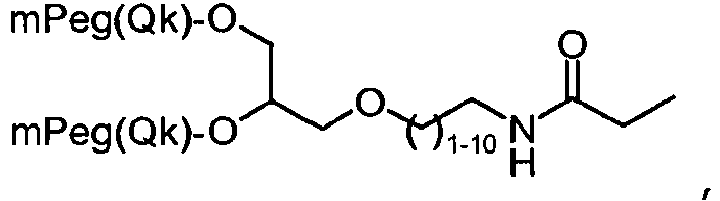
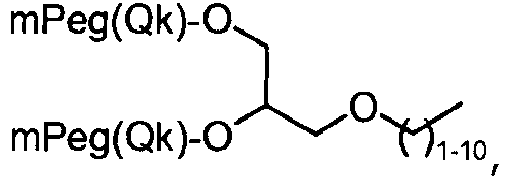


- In one embodiment, M-L-ONH2 and/or M'L'-ONH2 is:

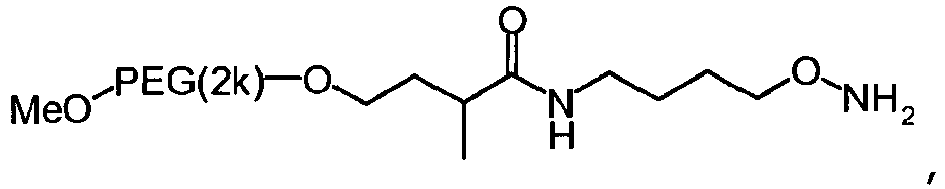


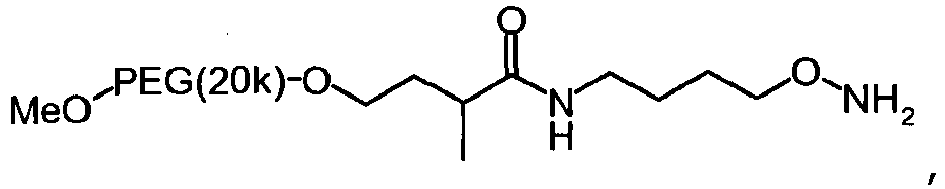


- In one embodiment M-L-ONH2 and/or M'-L'-ONH2 are indepentently selected amongst:


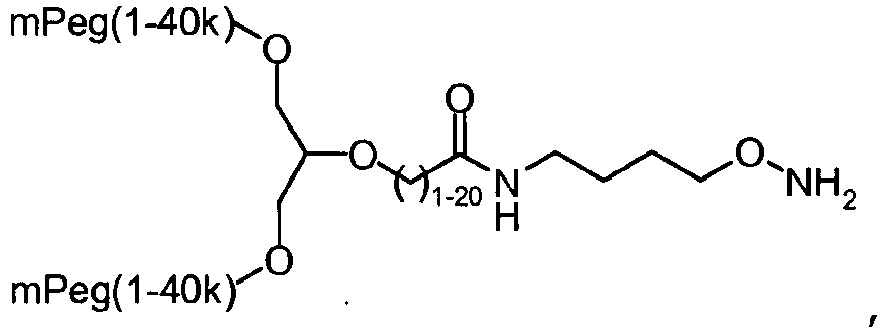


- In one embodiment, M-L-ONH2 and/or M'-L'-ONH2 is independently selected amongst


- In one embodiment M-L-ONH2 and/or M'-L'-ONH2 is independently selected amongst


- straight, branched and/or cyclic C1-30alkyl, C2-30alkenyl, C2-30alkynyl, C1-30heteroalkyl, C2-30heteroalkenyl, C2-30heteroalkynyl, wherein one or more homocyclic aromatic compound biradical or heterocyclic compound biradical may be inserted, and wherein said C1-30 or C2-30 radicals may optionally be substituted with one or more substituents selected from -CO2H, -SO3H, -PO2OH, -SO2NH2, -NH2, -OH, -SH, halogen, or aryl, wherein said aryl is optionally substituted with -CO2H, -SO3H, PO2OH, -SO2NH2, -NH2, -OH, -SH, or halogen; steroid radicals; lipid radicals;
- polysaccharide radicals, e.g. dextrans; α-, β-, or γ-cyclodextrin, polyamide radicals e.g. polyamino acid radicals; PVP radicals; PVA radicals; poly(1-3-dioxalane); poly(1,3,6-trioxane); ethylene/maleic anhydride polymer;
- Cibacron dye stuffs, such as Cibacron Blue 3GA, and polyamide chains of specified length, as disclosed in
WO 00/12587 - a substantially non-immunogenic protein residue such as a blood component like albuminyl derivative, or an antibody or a domain thereof such as a Fc domain from human normal IgG1, as described in Kan, SK et al in The Journal of Immunology 2001, 166(2), 1320-1326 or in Stevenson, GT, The Journal of Immunology 1997, 158, 2242-2250;
- polyethylene glycol (PEG) or methoxy polyethylene glycol (mPEG) radicals and amino derivatives thereof, where the avarage molecular weight may be between 500 and 100,000 Da, such as between 500 and 60,000 Da, such as between 1000 and 40,000 Da, such as between 5000 and 40,000 Da;
- moieties that are known to bind to plasma proteins, such as e.g. albumin, where the albumin binding property may be determined as described in J.Med.Chem, 43, 2000, 1986-1992, or an albumin binding moiety such as a peptide comprising less than 40 amino acid residues such as moieties disclosed in J. Biol Chem. 277, 38 (2002) 35035-35043.
- In other embodiments, M and/or M' is C1-C20-alkyl, such as C1-C18-alkyl. Specific mentioning is made of C14-, C16- and C18-alkyl, which optionally may be substituted with in particular charged groups, polar groups and/or halogens. Examples of such substituents include -CO2H, tetrazol and halogen. In a particular embodiment, all hydrogens in the C1-C20-alkyl are substituted with fluoro to form perfluoroalkyl.
- In particular embodiments M' is different from M. In particular embodiments M' has a substantially lower molecular weight than M. In one particular embodiment, M' is methoxyl amin (MeONH2)
- In the following, the substituent P* will be discussed.
- The Glycoprotein P* comprises a glycan terminal, that is reactive to oxidation by periodate.
- Thus, the reactive group in P* is part of a carbohydrate, or derived from a carbohydrate residue such as those found in N- or O-glycanes of glycosylated glycoproteins. Alternatively the reactive group of a glycoprotein P* may be a sialic acid residue.
- In one embodiment P* is selected from FVII, FVIII, FIX, FX, FII, FV, protein C, protein S, tPA, PAI-1, tissue factor, FXI, FXII, FXIII, as well as sequence variants thereof; immunoglobulins, cytokines such as interleukins, alpha-, beta-, and gamma-interferons, colony stimulating factors including granulocyte colony stimulating factors, fibroblast growth factors, platelet derived growth factors and phospholipase-activating protein (PUP). P* can also be any other protein and peptide of general biological and therapeutic interest include insulin, plant proteins such as lectins and ricins, tumor necrosis factors and related alleles, soluble forms of tumor necrosis factor receptors, interleukin receptors and soluble forms of interleukin receptors, growth factors such as tissue growth factors, such as TGFa's or TGFps and epidermal growth factors, hormones, somatomedins, erythropoietin, pigmentary hormones, hypothalamic releasing factors, antidiuretic hormones, prolactin, chorionic gonadotropin, follicle-stimulating hormone, thyroid-stimulating hormone, tissue plasminogen activator, and immunoglobulins such as IgG, IgE, IgM, IgA, and IgD, and fragments thereof.
- Peptides and proteins, that do not contain glycan terminals can be glycosylated either enzymatically as described in Li Shao et all. Glycobiology 12(11) 762-770 (2002) using glycosyltransferases, or chemically synthesised , for example by using standard peptide chemistry and glycosylated amino acid components such as N-galactosylated asparagine.
- Alternatively glycosylation sites may be engineered into proteins or peptides which in vivo normally are produced in their non-glycosylated form. For example insertion of the consensus sequence Cys-XXX-Ser-XXX-Pro-Cys in an EGF repeat allows for selective O-glycosylation of serine using UDP-Glucose and glucosyltransferase (Li Shao et all. Glycobiology 12(11) 762-770 (2002)), whereas insertion of the consensus sequence Asn-XXX-Ser/Thr allows for N-glycosylation (R.A. Dwek, Chem. Rev. 1996, 96, 683-720). Peptide sequences containing threonine or serine also undergoes glycosylation in the presence of UDP-GalNAc:polypeptide N-acetylgalactosaminyltransferase and UDP-GalNAc in a sequence dependent manner (see for example B.C. O'Connell, F.K.Hagen and L.A. Tabak in J. Biol. Chem. 267(35), 25010-25018 (1992)). Alternatively site directed mutagenesis introducing cystein mutations can be used for introduction of galactose or galactose containing sugar structures via mixed disulphide fromation as described by D.P. Gamblin et al. in Angew. Chem.Int. Ed., 43, 828 (2004). Galactose or N-acetylgalactosamine containing peptide and proteins can also be made by conjugation to proteins or peptides containing non-biogenical handles such as methods described by P.G. Schultz in J.Am.Chem.Soc, 125, 1702 (2003), or unspecifically by direct glycosylation of peptides using glycosyl donor substrates such as trichloroacetamidyl galactosides ect. Addition of glycosidase inhibitores to fermentation cultures, thereby producing glycoproteins with truncated glycan structures as described in
US 4925796A /US 5272066A1 is also a possibility for obtaining galactose or N-acetylgalactosamine containing proteins, as well as enzymatic modification of glutamine residues using TGase (see for example M. Sato et al. Angew. Chem. Int. Ed. 43, 1516-1520, (2004)). - Production og N-glycosylated proteins are not limited to the use of mammalian host cells such as CHO or BHK cells, but also can be performed in insect cells, yeast, or by using bacterial cells as described by M. Wacker et al. in Science, 298, 1790-1793 (2002). In an embodiment of the invention the peptide is aprotinin, tissue factor pathway inhibitor or other protease inhibitors, insulin or insulin precursors, human or bovine growth hormone, interleukin, glucagon, oxyntomodulin,GLP-1, GLP-2, IGF-I, IGF-II, tissue plasminogen activator, transforming growth factor γ or β, platelet-derived growth factor, GRF (growth hormone releasing factor), human growth factor, immunoglobulines, EPO, TPA, protein C, blood coagulation factors such as FVII, FVIII, FIX, FX, FII, FV, protein C, protein S, PAI-1, tissue factor, FXI, FXII, and FXIII, exendin-3, exentidin-4, and enzymes or functional analogues thereof. In the present context, the term "functional analogue" is meant to indicate a protein with a similar function as the native protein. The protein may be structurally similar to the native protein and may be derived from the native protein by addition of one or more amino acids to either or both the C and N-terminal end of the native protein, substitution of one or more amino acids at one or a number of different sites in the native amino acid sequence, deletion of one or more amino acids at either or both ends of the native protein or at one or several sites in the amino acid sequence, or insertion of one or more amino acids at one or more sites in the native amino acid sequence. Furthermore the protein may be acylated in one or more positions, see, e.g.,
WO 98/08871 WO 98/08872 - The proteins or portions thereof can be prepared or isolated by using techniques known to those of ordinary skill in the art such as tissue culture, extraction from animal sources, or by recombinant DNA methodologies. Transgenic sources of the proteins, peptides, amino acid sequences and the like are also contemplated. Such materials are obtained form transgenic animals. i. e., mice, pigs, cows, etc., wherein the proteins expressed in milk, blood or tissues. Transgenic insects and baculovirus expression systems are also contemplated as sources. Moreover, mutant versions, of proteins, such as mutant TNF's and/or mutant interferons are also within the scope of the invention. Other proteins of interest are allergen proteins such as ragweed, Antigen E, honeybee venom, mite allergen, and the like.
- The foregoing is illustrative of the biologically active peptides which are suitable for conjugation with a protractor group in accordance with the invention. It is to be understood that those biologically active materials not specifically mentioned but having suitable peptides are also intended and are within the scope of the present invention.
In one embodiment, the glycoprotein is a FVII polypeptide. In one embodiment, the polypeptides are wild-type Factor VIIa. - As used herein, the terms "Factor VII polypeptide " or "FVII polypeptide" means any protein comprising the amino acid sequence 1-406 of wild-type human Factor VIIa (i.e., a polypeptide having the amino acid sequence disclosed in
U.S. Patent No. 4,784,950 ), as well as variants thereof. - The term "Factor VII" is intended to encompass Factor VII polypeptides in their uncleaved (zymogen) form, as well as those that have been proteolytically processed to yield their respective bioactive forms, which may be designated Factor VIIa. Typically, Factor VII is cleaved between residues 152 and 153 to yield Factor VIIa. Such variants of Factor VII may exhibit different properties relative to human Factor VII, including stability, phospholipid binding, altered specific activity, and the like.
- As used herein, "wild type human FVIIa" is a polypeptide having the amino acid sequence disclosed in
U.S. Patent No. 4,784,950 . - Non-limiting examples of Factor VII variants include S52A-FVIIa, S60A-FVIIa ( Lino et al., Arch. Biochem. Biophys. 352: 182-192, 1998); FVIIa variants exhibiting increased proteolytic stability as disclosed in
U.S. Patent No. 5,580,560 ; Factor VIIa that has been proteolytically cleaved between residues 290 and 291 or between residues 315 and 316 (Mollerup et al., Biotechnol. Bioeng. 48:501-505, 1995); oxidized forms of Factor VIIa (Kornfelt et al., Arch. Biochem. Biophys. 363:43-54, 1999); FVII variants as disclosed inPCT/DK02/00189 WO 02/077218 WO 02/38162 WO 99/20767 US 6017882 andUS 6747003 ,US patent application 20030100506 (University of Minnesota) andWO 00/66753 US 20010018414 ,US 2004220106 , andUS 200131005 , US patentsUS 6762286 andUS 6693075 (University of Minnesota); and FVII variants as disclosed inWO 01/58935 US 6806063 ,US patent application 20030096338 (Maxygen ApS),WO 03/93465 WO 04/029091 WO 04/083361 WO 04/111242 WO 04/108763 - Non-limiting examples of FVII variants having increased biological activity compared to wild-type FVIIa include FVII variants as disclosed in
WO 01/83725 WO 02/22776 WO 02/077218 PCT/DK02/00635 WO 03/027147 2002 01423 WO 04/029090 PA 2001 01627 WO 03/027147 WO 02/38162 JP 2001061479 - Examples of variants of factor VII include, without limitation, L305V-FVII, L305V/M306D/D309S-FVII, L305I-FVII, L305T-FVII, F374P-FVII, V158T/M298Q-FVII, V158D/E296V/M298Q-FVII, K337A-FVII, M298Q-FVII, V158D/M298Q-FVII, L305V/K337A-FVII, V158D/E296V/M298Q/L305V-FVII, V158D/E296V/M298Q/K337A-FVII, V158D/E296V/M298Q/L305V/K337A-FVII, K157A-FVII, E296V-FVII, E296V/M298Q-FVII, V158D/E296V-FVII, V158D/M298K-FVII, and S336G-FVII, L305V/K337A-FVII, L305V/V158D-FVII, L305V/E296V-FVII, L305V/M298Q-FVII, L305V/V158T-FVII, L305V/K337A/V158T-FVII, L305V/K337A/M298Q-FVII, L305V/K337A/E296V-FVII, L305V/K337A/V158D-FVII, L305V/V158D/M298Q-FVII, L305V/V158D/E296V-FVII, L305V/V158T/M298Q-FVII, L305V/V158T/E296V-FVII, L305V/E296V/M298Q-FVII, L305V/V158D/E296V/M298Q-FVII, L305V/V158T/E296V/M298Q-FVII, L305V/V158T/K337A/M298Q-FVII, L305V/V158T/E296V/K337A-FVII, L305V/V158D/K337A/M298Q-FVII, L305V/V158D/E296V/K337A-FVII, L305V/V158D/E296V/M298Q/K337A-FVII, L305V/V158T/E296V/M298Q/K337A-FVII, S314E/K316H-FVII, S314E/K316Q-FVII, S314E/L305V-FVII, S314E/K337A-FVII, S314E/V158D-FVII, S314E/E296V-FVII, S314E/M298Q-FVII, S314E/V158T-FVII, K316H/L305V-FVII, K316H/K337A-FVII, K316H/V158D-FVII, K316H/E296V-FVII, K316H/M298Q-FVII, K316H/V158T-FVII, K316Q/L305V-FVII, K316Q/K337A-FVII, K316Q/V158D-FVII, K316Q/E296V-FVII, K316Q/M298Q-FVII, K316Q/V158T-FVII, S314E/L305V/K337A-FVII, S314E/L305V/V158D-FVII, S314E/L305V/E296V-FVII, S314E/L305V/M298Q-FVII, S314E/L305V/V158T-FVII, S314E/L305V/K337A/V158T-FVII, S314E/L305V/K337A/M298Q-FVII, S314E/L305V/K337A/E296V-FVII, S314E/L305V/K337A/V158D-FVII, S314E/L305V/V158D/M298Q-FVII, S314E/L305V/V158D/E296V-FVII, S314E/L305V/V158T/M298Q-FVII, S314E/L305V/V158T/E296V-FVII, S314E/L305V/E296V/M298Q-FVII, S314E/L305V/V158D/E296V/M298Q-FVII, S314E/L305V/V158T/E296V/M298Q-FVII, S314E/L305V/V158T/K337A/M298Q-FVII, S314E/L305V/V158T/E296V/K337A-FVII, S314E/L305V/V158D/K337A/M298Q-FVII, S314E/L305V/V158D/E296V/K337A-FVII, S314E/L305V/V158D/E296V/M298Q/K337A-FVII, S314E/L305V/V158T/E296V/M298Q/K337A-FVII, K316H/L305V/K337A-FVII, K316H/L305V/V158D-FVII, K316H/L305V/E296V-FVII, K316H/L305V/M298Q-FVII, K316H/L305V/V158T-FVII, K316H/L305V/K337A/V158T-FVII, K316H/L305V/K337A/M298Q-FVII, K316H/L305V/K337A/E296V-FVII, K316H/L305V/K337A/V158D-FVII, K316H/L305V/V158D/M298Q-FVII, K316H/L305V/V158D/E296V-FVII, K316H/L305V/V158T/M298Q-FVII, K316H/L305V/V158T/E296V-FVII, K316H/L305V/E296V/M298Q-FVII, K316H/L305V/V158D/E296V/M298Q-FVII, K316H/L305V/V158T/E296V/M298Q-FVII, K316H/L305V/V158T/K337A/M298Q-FVII, K316H/L305V/V158T/E296V/K337A-FVII, K316H/L305V/V158D/K337A/M298Q-FVII, K316H/L305V/V158D/E296V/K337A -FVII, K316H/L305V/V158D/E296V/M298Q/K337A-FVII, K316H/L305V/V158T/E296V/M298Q/K337A-FVII, K316Q/L305V/K337A-FVII, K316Q/L305V/V158D-FVII, K316Q/L305V/E296V-FVII, K316Q/L305V/M298Q-FVII, K316Q/L305V/V158T-FVII, K316Q/L305V/K337A/V158T-FVII, K316Q/L305V/K337A/M298Q-FVII, K316Q/L305V/K337A/E296V-FVII, K316Q/L305V/K337A/V158D-FVII, K316Q/L305V/V158D/M298Q-FVII, K316Q/L305V/V158D/E296V-FVII, K316Q/L305V/V158T/M298Q-FVII, K316Q/L305V/V158T/E296V-FVII, K316Q/L305V/E296V/M298Q-FVII, K316Q/L305V/V158D/E296V/M298Q-FVII, K316Q/L305V/V158T/E296V/M298Q-FVII, K316Q/L305V/V158T/K337A/M298Q-FVII, K316Q/L305V/V158T/E296V/K337A-FVII, K316Q/L305V/V158D/K337A/M298Q-FVII, K316Q/L305V/V158D/E296V/K337A -FVII, K316Q/L305V/V158D/E296V/M298Q/K337A-FVII, K316Q/L305V/V158T/E296V/M298Q/K337A-FVII, F374Y/K337A-FVII, F374Y/V158D-FVII, F374Y/E296V-FVII, F374Y/M298Q-FVII, F374Y/V158T-FVII, F374Y/S314E-FVII, F374Y/L305V-FVII, F374Y/L305V/K337A-FVII, F374Y/L305V/V158D-FVII, F374Y/L305V/E296V-FVII, F374Y/L305V/M298Q-FVII, F374Y/L305V/V158T-FVII, F374Y/L305V/S314E-FVII, F374Y/K337A/S314E-FVII, F374Y/K337A/V158T-FVII, F374Y/K337A/M298Q-FVII, F374Y/K337A/E296V-FVII, F374Y/K337A/V158D-FVII, F374Y/V158D/S314E-FVII, F374Y/V158D/M298Q-FVII, F374Y/V158D/E296V-FVII, F374Y/V158T/S314E-FVII, F374Y/V158T/M298Q-FVII, F374Y/V158T/E296V-FVII, F374Y/E296V/S314E-FVII, F374Y/S314E/M298Q-FVII, F374Y/E296V/M298Q-FVII, F374Y/L305V/K337A/V158D-FVII, F374Y/L305V/K337A/E296V-FVII, F374Y/L305V/K337A/M298Q-FVII, F374Y/L305V/K337A/V158T-FVII, F374Y/L305V/K337A/S314E-FVII, F374Y/L305V/V158D/E296V-FVII, F374Y/L305V/V158D/M298Q-FVII, F374Y/L305V/V158D/S314E-FVII, F374Y/L305V/E296V/M298Q-FVII, F374Y/L305V/E296V/V158T-FVII, F374Y/L305V/E296V/S314E-FVII, F374Y/L305V/M298Q/V158T-FVII, F374Y/L305V/M298Q/S314E-FVII, F374Y/L305V/V158T/S314E-FVII, F374Y/K337A/S314E/V158T-FVII, F374Y/K337A/S314E/M298Q-FVII, F374Y/K337A/S314E/E296V-FVII, F374Y/K337A/S314E/V158D-FVII, F374Y/K337A/V158T/M298Q-FVII, F374Y/K337A/V158T/E296V-FVII, F374Y/K337A/M298Q/E296V-FVII, F374Y/K337A/M298Q/V158D-FVII, F374Y/K337A/E296V/V158D-FVII, F374Y/V158D/S314E/M298Q-FVII, F374Y/V158D/S314E/E296V-FVII, F374Y/V158D/M298Q/E296V-FVII, F374Y/V158T/S314E/E296V-FVII, F374Y/V158T/S314E/M298Q-FVII, F374Y/V158T/M298Q/E296V-FVII, F374Y/E296V/S314E/M298Q-FVII, F374Y/L305V/M298Q/K337A/S314E-FVII, F374Y/L305V/E296V/K337A/S314E-FVII, F374Y/E296V/M298Q/K337A/S314E-FVII, F374Y/L305V/E296V/M298Q/K337A -FVII, F374Y/L305V/E296V/M298Q/S314E-FVII, F374Y/V158D/E296V/M298Q/K337A-FVII, F374Y/V158D/E296V/M298Q/S314E-FVII, F374Y/L305V/V158D/K337A/S314E-FVII, F374Y/V158D/M298Q/K337A/S314E-FVII, F374Y/V158D/E296V/K337A/S314E-FVII, F374Y/L305V/V158D/E296V/M298Q-FVII, F374Y/L305V/V158D/M298Q/K337A-FVII, F374Y/L305V/V158D/E296V/K337A-FVII, F374Y/L305V/V158D/M298Q/S314E-FVII, F374Y/L305V/V158D/E296V/S314E-FVII, F374Y/V158T/E296V/M298Q/K337A-FVII, F374Y/V158T/E296V/M298Q/S314E-FVII, F374Y/L305V/V158T/K337A/S314E-FVII, F374Y/V158T/M298Q/K337A/S314E-FVII, F374Y/V158T/E296V/K337A/S314E-FVII, F374Y/L305V/V158T/E296V/M298Q-FVII, F374Y/L305V/V158T/M298Q/K337A-FVII, F374Y/L305V/V158T/E296V/K337A-FVII, F374Y/L305V/V158T/M298Q/S314E-FVII, F374Y/L305V/V158T/E296V/S314E-FVII, F374Y/E296V/M298Q/K337A/V158T/S314E-FVII, F374Y/V158D/E296V/M298Q/K337A/S314E-FVII, F374Y/L305V/V158D/E296V/M298Q/S314E-FVII, F374Y/L305V/E296V/M298Q/V158T/S314E-FVII, F374Y/L305V/E296V/M298Q/K337A/V158T-FVII, F374Y/L305V/E296V/K337A/V158T/S314E-FVII, F374Y/L305V/M298Q/K337A/V158T/S314E-FVII, F374Y/L305V/V158D/E296V/M298Q/K337A-FVII, F374Y/L305V/V158D/E296V/K337A/S314E-FVII, F374Y/L305V/V158D/M298Q/K337A/S314E-FVII, F374Y/L305V/E296V/M298Q/K337A/V158T/S314E-FVII, F374Y/L305V/V158D/E296V/M298Q/K337A/S314E-FVII, S52A-Factor VII, S60A-Factor VII; R152E-Factor VII, S344A-Factor VII, T106N-FVII, K143N/N145T-FVII, V253N-FVII, R290N/A292T-FVII, G291N-FVII, R315N/V317T-FVII, K143N/N145T/R315N/V317T-FVII; and FVII having substitutions, additions or deletions in the amino acid sequence from 233Thr to 240Asn; FVII having substitutions, additions or deletions in the amino acid sequence from 304Arg to 329Cys; and FVII having substitutions, additions or deletions in the amino acid sequence from 153Ile to 223Arg.
- In one embodiment, the glycoprotein is a FVIII polypeptide. In one embodiment, the glycoprotein is a FIX polypeptide.
- The present invention also pertains to novel modified glycoproteins with the general structure
(M-L-O-N=CH)n-P-(CH=N-O-L'-M')m (formula I)
wherein M and optionally M' independently is a polymeric moiety for increasing the molecular weight of the modified glycoprotein, and wherein L and L' independently represent a bivalent linker, and wherein P represents a glycoprotein comprising one or more oxidized glucan terminals of said glycoprotein, O, N, C and H represents oxygen, nitrogen, carbon and hydrogen atoms respectively, n is 1-10, m is 0-50, wherein said modified glycoprotein has improved pharmacologic properties compared to the starting glycoprotein P* and has retained its functional activity. - Such a modified glycoprotein is in some embodiments of the invention selected from modified FVII, FVIII, FIX, FX, FII, FV, protein C, protein S, tPA, PAI-1, tissue factor, FXI, FXII, FXIII, as well as sequence variants thereof; immunoglobulins, cytokines such as interleukins, alpha-, beta-, and gamma-interferons, colony stimulating factors including granulocyte colony stimulating factors, fibroblast growth factors, platelet derived growth factors and phospholipase-activating protein (PUP).
- Other modified glycoproteins are modified proteins and peptides of general biological and therapeutic interest, e.g. including insulin, plant proteins such as lectins and ricins, tumor necrosis factors and related alleles, soluble forms of tumor necrosis factor receptors, interleukin receptors and soluble forms of interleukin receptors, growth factors such as tissue growth factors, such as TGFa's or TGFps and epidermal growth factors, hormones, somatomedins, erythropoietin, pigmentary hormones, hypothalamic releasing factors, antidiuretic hormones, prolactin, chorionic gonadotropin, follicle-stimulating hormone, thyroid-stimulating hormone, tissue plasminogen activator, and immunoglobulins such as IgG, IgE, IgM, IgA, and IgD, and fragments thereof.
- In one embodiment of the invention the modified glycoprotein is N-glycosylated and/or O-glycosylated and/or contains sialic acid moieties.
- In one embodiment of the invention the modified glycoprotein has improved pharmacologic property selected from the group consisting of increased bioavailability, increased functional in vivo half-life, increased in vivo plasma half-life, reduced immunogenicity, increased protease resistance, increased affinity for albumin, improved affinity for a receptor, increased storage stability, decreased functional in vivo half-life, decreased in vivo plasma half-life. In one embodiment the increased half-life is obtained by M being a group that increases molecular weight so that renal clearance is reduced or abolished and/or by M being a group that masks binding partners for hepatic receptors. In one embodiment reduced immunogenicity is obtained by M being a group which blocks antibody binding to immunogenic sites. In one embodiment improved affinity for albumin is obtained by M being a group which has high affinity for albumin. In one embodiment improved affinity for a receptor is obtained by M being a group which specifically binds a surface receptor on a target cell.
- In one embodiment of the invention the modified glycoprotein is wherein M is selected from the group consisting of: a low molecular weight organic charged radical, which may contain one or more carboxylic acids, amines, sulfonic acids, phosphonic acids, or combinations thereof; a low molecular weight neutral hydrophilic molecule, such as cyclodextrin or a optionally branched polyethylene chain; a low molecular weight hydrophobic molecule such as a fatty acid or cholic acid or derivatives thereof; a polyethylene glycol with an average molecular weight of 2-40 kDa; a well-defined precision polymer such as a dendrimer with an exact molecular mass ranging from 700 Da to 20 kDa; a substantially non-immunogenic polypeptide such as albumin, an antibody or a part of an antibody optionally containing a Fc-domain; and a high molecular weight organic polymer.
- In one embodiment of the invention the modified glycoprotein is wherein M is selected from the group consisting of a dendrimer, polyalkylene oxide (PAO), including polyalkylene glycol (PAG), such as polyethylene glycol (PEG) and polypropylene glycol (PPG), branched PEG, polyvinyl alcohol (PVA), polycarboxylate, poly-vinylpyrolidone, polyethylene-co-maleic acid anhydride, polystyrene-co-maleic acid anhydride, dextran, carboxymethyl-dextran, HES, MPC or PHF.
- In one embodiment of the invention the modified glycoprotein is wherein M is selected from the group consisting of a serum protein binding-ligand and a small organic molecule containing moieties that under physiological conditions alters charge properties, a structure which inhibits glycans from binding to receptors, and a neutral substituent that prevent glycan specific recognition.
- In one embodiment the modified glycoprotein according to the invention is wherein P is selected from FVII, FVIII, FIX, FX, FII, FV, protein C, protein S, tPA, PAI-1, tissue factor, FXI, FXII, FXIII, as well as sequence variants thereof; immunoglobulins, cytokines such as interleukins, alpha-, beta-, and gamma-interferons, colony stimulating factors including granulocyte colony stimulating factors, fibroblast growth factors, platelet derived growth factors, phospholipase-activating protein (PUP), insulin, plant proteins such as lectins and ricins, tumor necrosis factors and related alleles, soluble forms of tumor necrosis factor receptors, interleukin receptors and soluble forms of interleukin receptors, growth factors such as tissue growth factors, such as TGFa's or TGFps and epidermal growth factors, hormones, somatomedins, erythropoietin, pigmentary hormones, hypothalamic releasing factors, antidiuretic hormones, prolactin, chorionic gonadotropin, follicle-stimulating hormone, thyroid-stimulating hormone, tissue plasminogen activator, and immunoglobulins such as IgG, IgE, IgM, IgA, and IgD, and fragments thereof, or any fusion proteins comprising any of the above mentioned proteins or fragments thereof.
- In one embodiment the modified glycoprotein according to the invention is wherein the glycoprotein is a Factor VII polypeptide.
- In one embodiment the modified glycoprotein according to the invention is wherein the glycoprotein has the amino acid sequence of wild-type human Factor VII.
- In one-embodiment the modified glycoprotein according to the invention is wherein the modified glycoprotein exhibit at least about 10 %, such as at least about 20 %, such as at least about 40 %, such as at least about 60 %, such as at least about 80 %, such as at least about 100 % of the specific activity of un-modified Factor VII polypeptide when tested in one or more of a clotting assay, proteolysis assay, or TF binding assay as described in the present specification.
- In one embodiment the modified glycoprotein according to the invention is wherein the modified glycoprotein exhibits a bioavailability that is at least about 110% of the bioavailability of the un-modified glycoprotein, such as at least about 120%, about 130%, or at least about 140% of the bioavailability of the un-modified glycoprotein.
- In one embodiment the modified glycoprotein according to the invention is wherein the modified glycoprotein exhibits a serum half-life that is at least about 125% of the half-life of the un-modified glycoprotein, such as about 150%, about 200%, or at least about 250% of the half-life of the un-modified glycoprotein.
- In one embodiment, the method for production of the modified glycosylated molecules comprises the further step of formulating said glycosylated molecule as a pharmaceutical composition.
- In one embodiment of the invention, m in the modified glycoproteins with the general structure (M-L-O-N=CH)n-P-(CH=N-O-L'-M')m is in the range of 0-50, such as 0-20, such as 0-10, such as 0-5, such as 0-3.
- In the modified glycoproteins with the general structure (M-L-O-N=CH)n-P-(CH=N-O-L'-M')m n is limited by the number of non-reducing glycan terminals of a specific glycoprotein. Thus, in one embodiment of the invention, n in the modified glycoproteins with the general structure (M-L-O-N=CH)n-P-(CH=N-O-L'-M')m equals the number of non-reducing glycan terminals present on the glycoprotein. In another embodiment of the invention, n in the modified glycoproteins with the general structure (M-L-O-N=CH)n-P-(CH=N-O-L'-M')m is in the range of 1-10, such as 1-5, such as 1-3, such as 1-2, such as 1, such as 2, such as 3.
- In one embodiment the modified glycoprotein with the general structure (M-L-O-N=CH)n-P-(CH=N-O-L'-M')m (formula I) is selected from the list consisting of


- Another object of the present invention is to provide a pharmaceutical composition comprising a modified glycoprotein which is present in a concentration from 10-12 mg/ml to 200 mg/ml, such as e.g. 10-10 mg/ml to 5 mg/ml and wherein said composition has a pH from 2.0 to 10.0. The composition may further comprise a buffer system, preservative(s), tonicity agent(s), chelating agent(s), stabilizers and surfactants. In one embodiment of the invention the pharmaceutical composition is an aqueous composition, i.e. composition comprising water. Such composition is typically a solution or a suspension. In a further embodiment of the invention the pharmaceutical composition is an aqueous solution. The term "aqueous composition" is defined as a composition comprising at least 50 % w/w water. Likewise, the term "aqueous solution" is defined as a solution comprising at least 50 %w/w water, and the term "aqueous suspension" is defined as a suspension comprising at least 50 %w/w water.
- In another embodiment the pharmaceutical composition is a freeze-dried composition, whereto the physician or the patient adds solvents and/or diluents prior to use. In another embodiment the pharmaceutical composition is a dried composition (e.g. freeze-dried or spray-dried) ready for use without any prior dissolution.
- In a further aspect the invention relates to a pharmaceutical composition comprising an aqueous solution of a Modified glycoprotein, and a buffer, wherein said Modified glycoprotein is present in a concentration from 0.1-100 mg/ml or above, and wherein said composition has a pH from about 2.0 to about 10.0.
- In another embodiment of the invention the pH of the composition is selected from the list consisting of 2.0, 2.1, 2.2, 2.3, 2.4, 2.5, 2.6, 2.7, 2.8, 2.9, 3.0, 3.1, 3.2, 3.3, 3.4, 3.5, 3.6, 3.7, 3.8, 3.9, 4.0, 4.1, 4.2, 4.3, 4.4, 4.5, 4.6, 4.7, 4.8, 4.9, 5.0, 5.1, 5.2, 5.3, 5.4, 5.5, 5.6, 5.7, 5.8, 5.9, 6.0, 6.1, 6.2, 6.3, 6.4, 6.5, 6.6, 6.7, 6.8, 6.9, 7.0, 7.1, 7.2, 7.3, 7.4, 7.5, 7.6, 7.7, 7.8, 7.9, 8.0, 8.1, 8.2, 8.3, 8.4, 8.5, 8.6, 8.7, 8.8, 8.9, 9.0, 9.1, 9.2, 9.3, 9.4, 9.5, 9.6, 9.7, 9.8, 9.9, and 10.0.
- In a further embodiment of the invention the buffer is selected from the group consisting of sodium acetate, sodium carbonate, citrate, glycylglycine, histidine, glycine, lysine, arginine, sodium dihydrogen phosphate, disodium hydrogen phosphate, sodium phosphate, and tris(hydroxymethyl)-aminomethan, bicine, tricine, malic acid, succinate, maleic acid, fumaric acid, tartaric acid, aspartic acid or mixtures thereof. Each one of these specific buffers constitutes an alternative embodiment of the invention.
- In a further embodiment of the invention the composition further comprises a pharmaceutically acceptable preservative. In a further embodiment of the invention the preservative is selected from the group consisting of phenol, o-cresol, m-cresol, p-cresol, methyl p-hydroxybenzoate, propyl p-hydroxybenzoate, 2-phenoxyethanol, butyl p-hydroxybenzoate, 2-phenylethanol, benzyl alcohol, chlorobutanol, and thiomerosal, bronopol, benzoic acid, imidurea, chlorohexidine, sodium dehydroacetate, chlorocresol, ethyl p-hydroxybenzoate, benzethonium chloride, chlorphenesine (3p-chlorphenoxypropane-1,2-diol) or mixtures thereof. In a further embodiment of the invention the preservative is present in a concentration from 0.1 mg/ml to 20 mg/ml. In a further embodiment of the invention the preservative is present in a concentration from 0.1 mg/ml to 5 mg/ml. In a further embodiment of the invention the preservative is present in a concentration from 5 mg/ml to 10 mg/ml. In a further embodiment of the invention the preservative is present in a concentration from 10 mg/ml to 20 mg/ml. Each one of these specific preservatives constitutes an alternative embodiment of the invention. The use of a preservative in pharmaceutical compositions is well-known to the skilled person. For convenience reference is made to Remington: The Science and Practice of Pharmacy, 20th edition, 2000.
- In a further embodiment of the invention the composition further comprises an isotonic agent. In a further embodiment of the invention the isotonic agent is selected from the group consisting of a salt (e.g. sodium chloride), a sugar or sugar alcohol, an amino acid (e.g. L-glycine, L-histidine, arginine, lysine, isoleucine, aspartic acid, tryptophan, threonine), an alditol (e.g. glycerol (glycerine), 1,2-propanediol (propyleneglycol), 1,3-propanediol, 1,3-butanediol) polyethyleneglycol (e.g. PEG400), or mixtures thereof. Any sugar such as mono-, di-, or polysaccharides, or water-soluble glucans, including for example fructose, glucose, mannose, sorbose, xylose, maltose, lactose, sucrose, trehalose, dextran, pullulan, dextrin, cyclodextrin, soluble starch, hydroxyethyl starch and carboxymethylcellulose-Na may be used. In one embodiment the sugar additive is sucrose. Sugar alcohol is defined as a C4-C8 hydrocarbon having at least one -OH group and includes, for example, mannitol, sorbitol, inositol, galactitol, dulcitol, xylitol, and arabitol. In one embodiment the sugar alcohol additive is mannitol. The sugars or sugar alcohols mentioned above may be used individually or in combination. There is no fixed limit to the amount used, as long as the sugar or sugar alcohol is soluble in the liquid preparation and does not adversely effect the stabilizing effects obtained using the methods of the invention. In one embodiment, the sugar or sugar alcohol concentration is between about 1 mg/ml and about 150 mg/ml. In a further embodiment of the invention the isotonic agent is present in a concentration from 1 mg/ml to 50 mg/ml. In a further embodiment of the invention the isotonic agent is present in a concentration from 1 mg/ml to 7 mg/ml. In a further embodiment of the invention the isotonic agent is present in a concentration from 8 mg/ml to 24 mg/ml. In a further embodiment of the invention the isotonic agent is present in a concentration from 25 mg/ml to 50 mg/ml. Each one of these specific isotonic agents constitutes an alternative embodiment of the invention. The use of an isotonic agent in pharmaceutical compositions is well-known to the skilled person. For convenience reference is made to Remington: The Science and Practice of Pharmacy, 20th edition, 2000.
- In a further embodiment of the invention the composition further comprises a chelating agent. In a further embodiment of the invention the chelating agent is selected from salts of ethylenediaminetetraacetic acid (EDTA), citric acid, and aspartic acid, and mixtures thereof. In a further embodiment of the invention the chelating agent is present in a concentration from 0.1mg/ml to 5mg/ml. In a further embodiment of the invention the chelating agent is present in a concentration from 0.1mg/ml to 2mg/ml. In a further embodiment of the invention the chelating agent is present in a concentration from 2mg/ml to 5mg/ml. Each one of these specific chelating agents constitutes an alternative embodiment of the invention. The use of a chelating agent in pharmaceutical compositions is well-known to the skilled person. For convenience reference is made to Remington: The Science and Practice ofPharmacy, 20th edition, 2000.
- In a further embodiment of the invention the composition further comprises a stabilizer. The use of a stabilizer in pharmaceutical compositions is well-known to the skilled person. For convenience reference is made to Remington: The Science and Practice of Pharmacy, 20th edition, 2000.
- More particularly, compositions of the invention are stabilized liquid pharmaceutical compositions whose therapeutically active components include a protein that possibly exhibits aggregate formation during storage in liquid pharmaceutical compositions. By "aggregate formation" is intended a physical interaction between the protein molecules that results in formation of oligomers, which may remain soluble, or large visible aggregates that precipitate from the solution. By "during storage" is intended a liquid pharmaceutical composition or composition once prepared, is not immediately administered to a subject. Rather, following preparation, it is packaged for storage, either in a liquid form, in a frozen state, or in a dried form for later reconstitution into a liquid form or other form suitable for administration to a subject. By "dried form" is intended the liquid pharmaceutical composition or composition is dried either by freeze drying (i.e., lyophilization; see, for example, Williams and Polli (1984) J. Parenteral Sci. Technol. 38:48-59), spray drying (see Masters (1991) in Spray-Drying Handbook (5th ed; Longman Scientific and Technical, Essez, U.K.), pp. 491-676; Broadhead et al. (1992) Drug Devel. Ind. Pharm. 18:1169-1206; and Mumenthaler et al. (1994) Pharm. Res. 11:12-20), or air drying (Carpenter and Crowe (1988) Cryobiology 25:459-470; and Roser (1991) Biopharm. 4:47-53). Aggregate formation by a protein during storage of a liquid pharmaceutical composition can adversely affect biological activity of that protein, resulting in loss of therapeutic efficacy of the pharmaceutical composition. Furthermore, aggregate formation may cause other problems such as blockage of tubing, membranes, or pumps when the protein-containing pharmaceutical composition is administered using an infusion system.
- The pharmaceutical compositions of the invention may further comprise an amount of an amino acid base sufficient to decrease aggregate formation by the protein during storage of the composition. By "amino acid base" is intended an amino acid or a combination of amino acids, where any given amino acid is present either in its free base form or in its salt form. Where a combination of amino acids is used, all of the amino acids may be present in their free base forms, all may be present in their salt forms, or some may be present in their free base forms while others are present in their salt forms. In one embodiment, amino acids to use in preparing the compositions of the invention are those carrying a charged side chain, such as arginine, lysine, aspartic acid, and glutamic acid. Any stereoisomer (i.e., L or D isomer, or mixtures thereof) of a particular amino acid (methionine, histidine, arginine, lysine, isoleucine, aspartic acid, tryptophan, threonine and mixtures thereof) or combinations of these stereoisomers or glycine or an organic base such as but not limited to imidazole, may be present in the pharmaceutical compositions of the invention so long as the particular amino acid or organic base is present either in its free base form or its salt form. In one embodiment the L-stereoisomer of an amino acid is used. In one embodiment the D-stereoisomer is used. Compositions of the invention may also be formulated with analogues of these amino acids. By "amino acid analogue" is intended a derivative of the naturally occurring amino acid that brings about the desired effect of decreasing aggregate formation by the protein during storage of the liquid pharmaceutical compositions of the invention. Suitable arginine analogues include, for example, aminoguanidine, ornithine and N-monoethyl L-arginine, suitable methionine analogues include ethionine and buthionine and suitable cysteine analogues include S-methyl-L cysteine. As with the other amino acids, the amino acid analogues are incorporated into the compositions in either their free base form or their salt form. In a further embodiment of the invention the amino acids or amino acid analogues are used in a concentration, which is sufficient to prevent or delay aggregation of the protein.
- In a further embodiment of the invention methionine (or other sulphuric amino acids or amino acid analogous) may be added to inhibit oxidation of methionine residues to methionine sulfoxide when the protein acting as the therapeutic agent is a protein comprising at least one methionine residue susceptible to such oxidation. By "inhibit" is intended minimal accumulation of methionine oxidized species over time. Inhibiting methionine oxidation results in greater retention of the protein in its proper molecular form. Any stereoisomer of methionine (L or D isomer) or any combinations thereof can be used. The amount to be added should be an amount sufficient to inhibit oxidation of the methionine residues such that the amount of methionine sulfoxide is acceptable to regulatory agencies. Typically, this means that the composition contains no more than about 10% to about 30% methionine sulfoxide. Generally, this can be obtained by adding methionine such that the ratio of methionine added to methionine residues ranges from about 1:1 to about 1000:1, such as 10:1 to about 100:1.
- In a further embodiment of the invention the composition further comprises a stabilizer selected from the group of high molecular weight polymers or low molecular compounds. In a further embodiment of the invention the stabilizer is selected from polyethylene glycol (e.g. PEG 3350), polyvinyl alcohol (PVA), polyvinylpyrrolidone, carboxy-/hydroxycellulose or derivates thereof (e.g. HPC, HPC-SL, HPC-L and HPMC), cyclodextrins, sulphur-containing substances as monothioglycerol, thioglycolic acid and 2-methylthioethanol, and different salts (e.g. sodium chloride). Each one of these specific stabilizers constitutes an alternative embodiment of the invention.
- The pharmaceutical compositions may also comprise additional stabilizing agents, which further enhance stability of a therapeutically active protein therein. Stabilizing agents of particular interest to the present invention include, but are not limited to, methionine and EDTA, which protect the protein against methionine oxidation, and a nonionic surfactant, which protects the protein against aggregation associated with freeze-thawing or mechanical shearing.
- In a further embodiment of the invention the composition further comprises a surfactant. In a further embodiment of the invention the surfactant is selected from a detergent, ethoxylated castor oil, polyglycolyzed glycerides, acetylated monoglycerides, sorbitan fatty acid esters, polyoxypropylene-polyoxyethylene block polymers (eg. poloxamers such as Pluronic® F68, poloxamer 188 and 407, Triton X-100 ), polyoxyethylene sorbitan fatty acid esters, polyoxyethylene and polyethylene derivatives such as alkylated and alkoxylated derivatives (tweens, e.g. Tween-20, Tween-40, Tween-80 and Brij-35), monoglycerides or ethoxylated derivatives thereof, diglycerides or polyoxyethylene derivatives thereof, alcohols, glycerol, lectins and phospholipids (eg. phosphatidyl serine, phosphatidyl choline, phosphatidyl ethanolamine, phosphatidyl inositol, diphosphatidyl glycerol and sphingomyelin), derivates of phospholipids (eg. dipalmitoyl phosphatidic acid) and lysophospholipids (eg. palmitoyl lysophosphatidyl-L-serine and 1-acyl-sn-glycero-3-phosphate esters of ethanolamine, choline, serine or threonine) and alkyl, alkoxyl (alkyl ester), alkoxy (alkyl ether)- derivatives of lysophosphatidyl and phosphatidylcholines, e.g. lauroyl and myristoyl derivatives of lysophosphatidylcholine, dipalmitoylphosphatidylcholine, and modifications of the polar head group, that is cholines, ethanolamines, phosphatidic acid, serines, threonines, glycerol, inositol, and the positively charged DODAC, DOTMA, DCP, BISHOP, lysophosphatidylserine and lysophosphatidylthreonine, and glycerophospholipids (eg. cephalins), glyceroglycolipids (eg. galactopyransoide), sphingoglycolipids (eg. ceramides, gangliosides), dodecylphosphocholine, hen egg lysolecithin, fusidic acid derivatives- (e.g. sodium tauro-dihydrofusidate etc.), long-chain fatty acids and salts thereof C6-C12 (eg. oleic acid and caprylic acid), acylcarnitines and derivatives, Nα-acylated derivatives of lysine, arginine or histidine, or side-chain acylated derivatives of lysine or arginine, Nα-acylated derivatives of dipeptides comprising any combination of lysine, arginine or histidine and a neutral or acidic amino acid, Nα-acylated derivative of a tripeptide comprising any combination of a neutral amino acid and two charged amino acids, DSS (docusate sodium, CAS registry no [577-11-7]), docusate calcium, CAS registry no [128-49-4]), docusate potassium, CAS registry no [7491-09-0]), SDS (sodium dodecyl sulphate or sodium lauryl sulphate), sodium caprylate, cholic acid or derivatives thereof, bile acids and salts thereof and glycine or taurine conjugates, ursodeoxycholic acid, sodium cholate, sodium deoxycholate, sodium taurocholate, sodium glycocholate, N-Hexadecyl-N,N-dimethyl-3-ammonio-l-propanesulfonate, anionic (alkyl-aryl-sulphonates) monovalent surfactants, zwitterionic surfactants (e.g. N-alkyl-N,N-dimethylammonio-1-propanesulfonates, 3-cholamido-1-propyldimethylammonio-1-propanesulfonate, cationic surfactants (quaternary ammonium bases) (e.g. cetyl-trimethylammonium bromide, cetylpyridinium chloride), nonionic surfactants (eg. Dodecyl β-D-glucopyranoside), poloxamines (eg. Tetronic's), which are tetrafunctional block copolymers derived from sequential addition of propylene oxide and ethylene oxide to ethylenediamine, or the surfactant may be selected from the group of imidazoline derivatives, or mixtures thereof. Each one of these specific surfactants constitutes an alternative embodiment of the invention.
- The use of a surfactant in pharmaceutical compositions is well-known to the skilled person. For convenience reference is made to Remington: The Science and Practice of Pharmacy, 20th edition, 2000.
- It is possible that other ingredients may be present in the pharmaceutical composition of the present invention. Such additional ingredients may include wetting agents, emulsifiers, antioxidants, bulking agents, tonicity modifiers, chelating agents, metal ions, oleaginous vehicles, proteins (e.g., human serum albumin, gelatine or proteins) and a zwitterion (e.g., an amino acid such as betaine, taurine, arginine, glycine, lysine and histidine). Such additional ingredients, of course, should not adversely affect the overall stability of the pharmaceutical composition of the present invention.
- Pharmaceutical compositions containing a Modified glycoprotein according to the present invention may be administered to a patient in need of such treatment at several sites, for example, at topical sites, for example, skin and mucosal sites, at sites which bypass absorption, for example, administration in an artery, in a vein, in the heart, and at sites which involve absorption, for example, administration in the skin, under the skin, in a muscle or in the abdomen.
- Administration of pharmaceutical compositions according to the invention may be through several routes of administration, for example, lingual, sublingual, buccal, in the mouth, oral, in the stomach and intestine, nasal, pulmonary, for example, through the bronchioles and alveoli or a combination thereof, epidermal, dermal, transdermal, vaginal, rectal, ocular, for examples through the conjunctiva, uretal, and parenteral to patients in need of such a treatment.
- Compositions of the current invention may be administered in several dosage forms, for example, as solutions, suspensions, emulsions, microemulsions, multiple emulsion, foams, salves, pastes, plasters, ointments, tablets, coated tablets, rinses, capsules, for example, hard gelatine capsules and soft gelatine capsules, suppositories, rectal capsules, drops, gels, sprays, powder, aerosols, inhalants, eye drops, ophthalmic ointments, ophthalmic rinses, vaginal pessaries, vaginal rings, vaginal ointments, injection solution, in situ transforming solutions, for example in situ gelling, in situ setting, in situ precipitating, in situ crystallization, infusion solution, and implants.
- Compositions of the invention may further be compounded in, or attached to, for example through covalent, hydrophobic and electrostatic interactions, a drug carrier, drug delivery system and advanced drug delivery system in order to further enhance stability of the Modified glycoprotein, increase bioavailability, increase solubility, decrease adverse effects, achieve chronotherapy well known to those skilled in the art, and increase patient compliance or any combination thereof. Examples of carriers, drug delivery systems and advanced drug delivery systems include, but are not limited to, polymers, for example cellulose and derivatives, polysaccharides, for example dextran and derivatives, starch and derivatives, poly(vinyl alcohol), acrylate and methacrylate polymers, polylactic and polyglycolic acid and block co-polymers thereof, polyethylene glycols, carrier proteins, for example albumin, gels, for example, thermogelling systems, for example block co-polymeric systems well known to those skilled in the art, micelles, liposomes, microspheres, nanoparticulates, liquid crystals and dispersions thereof, L2 phase and dispersions there of, well known to those skilled in the art of phase behaviour in lipid-water systems, polymeric micelles, multiple emulsions, self-emulsifying, self-microemulsifying, cyclodextrins and derivatives thereof, and dendrimers.
- Compositions of the current invention are useful in the composition of solids, semisolids, powder and solutions for pulmonary administration of Modified glycoprotein, using, for example a metered dose inhaler, dry powder inhaler and a nebulizer, all being devices well known to those skilled in the art.
- Compositions of the current invention are specifically useful in the composition of controlled, sustained, protracting, retarded, and slow release drug delivery systems. More specifically, but not limited to, compositions are useful in composition of parenteral controlled release and sustained release systems (both systems leading to a many-fold reduction in number of administrations), well known to those skilled in the art. Even more preferably, are controlled release and sustained release systems administered subcutaneous. Without limiting the scope of the invention, examples of useful controlled release system and compositions are hydrogels, oleaginous gels, liquid crystals, polymeric micelles, microspheres, nanoparticles,
- Methods to produce controlled release systems useful for compositions of the current invention include, but are not limited to, crystallization, condensation, co-crystallization, precipitation, co-precipitation, emulsification, dispersion, high pressure homogenisation, encapsulation, spray drying, microencapsulating, coacervation, phase separation, solvent evaporation to produce microspheres, extrusion and supercritical fluid processes. General reference is made to Handbook of Pharmaceutical Controlled Release (Wise, D.L., ed. Marcel Dekker, New York, 2000) and Drug and the Pharmaceutical Sciences vol. 99: Protein Composition and Delivery (MacNally, E.J., ed. Marcel Dekker, New York, 2000).
Parenteral administration may be performed by subcutaneous, intramuscular, intraperitoneal or intravenous injection by means of a syringe, optionally a pen-like syringe. Alternatively, parenteral administration can be performed by means of an infusion pump. A further option is a composition which may be a solution or suspension for the administration of the Modified glycoprotein in the form of a nasal or pulmonal spray. As a still further option, the pharmaceutical compositions containing the Modified glycoprotein of the invention can also be adapted to transdermal administration, e.g. by needle-free injection or from a patch, optionally an iontophoretic patch, or transmucosal, e.g. buccal, administration. - The term "stabilized composition" refers to a composition with increased physical stability, increased chemical stability or increased physical and chemical stability.
- The term "physical stability" of the protein composition as used herein refers to the tendency of the protein to form biologically inactive and/or insoluble aggregates of the protein as a result of exposure of the protein to thermo-mechanical stresses and/or interaction with interfaces and surfaces that are destabilizing, such as hydrophobic surfaces and interfaces. Physical stability of the aqueous protein compositions is evaluated by means of visual inspection and/or turbidity measurements after exposing the composition filled in suitable containers (e.g. cartridges or vials) to mechanical/physical stress (e.g. agitation) at different temperatures for various time periods. Visual inspection of the compositions is performed in a sharp focused light with a dark background. The turbidity of the composition is characterized by a visual score ranking the degree of turbidity for instance on a scale from 0 to 3 (a composition showing no turbidity corresponds to a visual score 0, and a composition showing visual turbidity in daylight corresponds to visual score 3). A composition is classified physical unstable with respect to protein aggregation, when it shows visual turbidity in daylight. Alternatively, the turbidity of the composition can be evaluated by simple turbidity measurements well-known to the skilled person. Physical stability of the aqueous protein compositions can also be evaluated by using a spectroscopic agent or probe of the conformational status of the protein. The probe is preferably a small molecule that preferentially binds to a non-native conformer of the protein. One example of a small molecular spectroscopic probe of protein structure is Thioflavin T. Thioflavin T is a fluorescent dye that has been widely used for the detection of amyloid fibrils. In the presence of fibrils, and perhaps other protein configurations as well, Thioflavin T gives rise to a new excitation maximum at about 450 nm and enhanced emission at about 482 nm when bound to a fibril protein form. Unbound Thioflavin T is essentially non-fluorescent at the wavelengths.
Other small molecules can be used as probes of the changes in protein structure from native to non-native states. For instance the "hydrophobic patch" probes that bind preferentially to exposed hydrophobic patches of a protein. The hydrophobic patches are generally buried within the tertiary structure of a protein in its native state, but become exposed as a protein begins to unfold or denature. Examples of these small molecular, spectroscopic probes are aromatic, hydrophobic dyes, such as antrhacene, acridine, phenanthroline or the like. Other spectroscopic probes are metal-amino acid complexes, such as cobalt metal complexes of hydrophobic amino acids, such as phenylalanine, leucine, isoleucine, methionine, and valine, or the like. - The term "chemical stability" of the protein composition as used herein refers to chemical covalent changes in the protein structure leading to formation of chemical degradation products with potential less biological potency and/or potential increased immunogenic properties compared to the native protein structure. Various chemical degradation products can be formed depending on the type and nature of the native protein and the environment to which the protein is exposed. Elimination of chemical degradation can most probably not be completely avoided and increasing amounts of chemical degradation products is often seen during storage and use of the protein composition as well-known by the person skilled in the art. Most proteins are prone to deamidation, a process in which the side chain amide group in glutaminyl or asparaginyl residues is hydrolysed to form a free carboxylic acid. Other degradations pathways involves formation of high molecular weight transformation products where two or more protein molecules are covalently bound to each other through transamidation and/or disulfide interactions leading to formation of covalently bound dimer, oligomer and polymer degradation products (Stability of Protein Pharmaceuticals, Ahern. T.J. & Manning M.C., Plenum Press, New York 1992). Oxidation (of for instance methionine residues) can be mentioned as another variant of chemical degradation. The chemical stability of the protein composition can be evaluated by measuring the amount of the chemical degradation products at various time-points after exposure to different environmental conditions (the formation of degradation products can often be accelerated by for instance increasing temperature). The amount of each individual degradation product is often determined by separation of the degradation products depending on molecule size and/or charge using various chromatography techniques (e.g. SEC-HPLC and/or RP-HPLC).
- Hence, as outlined above, a "stabilized composition" refers to a composition with increased physical stability, increased chemical stability or increased physical and chemical stability. In general, a composition must be stable during use and storage (in compliance with recommended use and storage conditions) until the expiration date is reached.
In one embodiment of the invention the pharmaceutical composition comprising the Modified glycoprotein is stable for more than 6 weeks of usage and for more than 3 years of storage. - In another embodiment of the invention the pharmaceutical composition comprising the modified glycoprotein is stable for more than 4 weeks of usage and for more than 3 years of storage.
- In a further embodiment of the invention the pharmaceutical composition comprising the modified glycoprotein is stable for more than 4 weeks of usage and for more than two years of storage.
- In an even further embodiment of the invention the pharmaceutical composition comprising the Modified glycoprotein is stable for more than 2 weeks of usage and for more than two years of storage.
- The use of the terms "a" and "an" and "the" and similar referents in the context of describing the invention are to be construed to cover both the singular and the plural, unless otherwise indicated herein or clearly contradicted by context.
- Unless otherwise stated, all exact values provided herein are representative of corresponding approximate values (e.g., all exact exemplary values provided with respect to a particular factor or measurement can be considered to also provide a corresponding approximate measurement, modified by "about," where appropriate).
- The description herein of any aspect or embodiment of the invention using terms such as "comprising", "having," "including," or "containing" with reference to an element or elements is intended to provide support for a similar aspect or embodiment of the invention that "consists of", "consists essentially of", or "substantially comprises" that particular element or elements, unless otherwise stated or clearly contradicted by context (e.g., a composition described herein as comprising a particular element should be understood as also describing a composition consisting of that element, unless otherwise stated or clearly contradicted by context).
- All headings and sub-headings are used herein for convenience only and should not be construed as limiting the invention in any way.
- The use of any and all examples, or exemplary language (e.g., "such as") provided herein, is intended merely to better illuminate the invention and does not pose a limitation on the scope of the invention unless otherwise claimed. No language in the specification should be construed as indicating any non-claimed element as essential to the practice of the invention.
- The citation of patent documents herein is done for convenience only and does not reflect any view of the validity, patentability, and/or enforceability of such patent documents.
-
- SDS-PAGE: sodium dodecyl sulphate - polyacrylamide gel electrophoresis
- EDTA: ethylenediamino tetraacetic acid
- FVIIa: Factor VIIa
- FVIII: Factor VIII
- FIX: Factor IX
- Protein purifications on ion-exchange column (HiTrap Q HP, Amersham Bioscience) or size exclusion column (XK26/60 HiLoad Superdex 200, Amersham Bioscience) were performed using an Äkta FPLC, with a FC-950 fraction collector (Amersham Bioscience). Elution buffers, columns and fraction collector were thermostated at 5°C.
- SDS-PAGE was performed using Invitrogen™'s Xcell Surelock™ Mini-Cell system with precast 4-12% Bis-Tris gels, NuPAGE MES SDS running buffer, Mark 12 standard and NUPAGE LDS sample buffer according to Invitrogen's standard protocol. Gels were stained with SimpleBlue™ according to Invitrogen protocols.
-
- GlyGly buffer: 25 mM Gly-Gly, 50 mM NaCl, 25 mM CaCl2, pH 6.0
- CaCl2 free GlyGly buffer: 25 mM Gly-Gly, 50 mM NaCl, pH 6.0
- Hepes buffer: 50 mM Hepes, 100 mM NaCl, 5 mM CaCl2, 0,01% Tween 80, pH = 7.4
- Correlation study between NaIO4 and residual peptiodlytical activity → non obvious relation.
- Peptidolytic activity was meassured using the chromogenic substrate S-2288 (H-D-Ile-Pro-Arg-p-nitroaniline) from Chromogenix, Mölndal, Sweden. The following protocol was applied: 10 mM stock solution of S2288 in Hepes buffer was prepared. Similar a 200 nM stock solution of tissue factor in Hepes buffer was prepared. 200 nM stock solutions of test entities and reference compound (e.g. wild type FVIIa) were prepared in Hepes buffer. Compounds were tested in ELISA wells in triplicates. In a typical experiment, 10 ul of 200 nM test entity solutions, 50 ul of 200 nM tissue factor stock solutions and 135 ul Hepes buffer were added to the well. The reaction was initiated by addition of 5ul of 200 nM S2288 stock solution. Wells were contineously analyzed in an ELISA - reader (absorbance at 405 nm) for 15 min. at room temperature. Relative activities were calculated from the initial rates, and compared to wild type FVIIa rates. Activities for modified FVIIa analogues were reported as a percentage of the activity of wild type FVIIa.
- 10K PEG-ONH2: 10K-SMB-PEG (1,00 g; 0.1 mmol; Nektar Inc) was dissolved in DCM (10 ml). 4-(N-t-butoxycarbonylaminoxy)butylamine (0.20 g, 1 mmol, prepared as described in
WO 2005014049 A2 ) was added and the mixture was stirred at rt. for 16h. Diethylether (90 ml) was added and the white precipitate was filtered off. The process was repeated by redissolving the precipitate in DCM (10 ml) and adding diethylether (90 ml). The precipitated material was then redissolved in DCM (6 ml) and Amberlyst 15 ion exchange resin (2,0 g; previously washed with DCM and 10% EtOH in DCM) was added. The mixture was stirred for 30 min at rt, then the resin was filtered off, and washed extensively with DCM. The combined DCM solutions were concentrated to a minimal volumne on a rotary evaporater, then diethylether (90 ml) was added to precipitate the product. The product was dissolved in DCM (6 ml) and TFA (6 ml) was added. The mixture was stirred at rt for ½h. Product was precipitated with diethylether (100 ml), and filtered off. The product was redissolved in DCM (5 ml) and triethylamine (1 ml) was added. The mixture was stirred for 5 min, then the product was precipitated again with diethylether (100 ml). The precipitate was filtered off, washer twice with diethylether and dried overnight in vacuum oven. Yield: 475 mg (46 %). 1H-NMR (CDCl3; selected peaks): δ 1.25 ppm (d, 3H); 1.50-1.75 (m, 6H); 1.82 (m, 1H); 3.38 (s, 3H); 3,45-3,90 (m, ca. 900 H). - Factor VIIa (14 mg, 0.28 umol) dissolved in 10 ml 25 mM Gly-Gly, 50 mM NaCl, 25 mM CaCl2, pH 6.0 (GlyGly buffer) was added 100 ul of a 20 mM NaIO4 solution in CaCl2 free GlyGly buffer and 1000 ul of a solution of 10K-PEG-ONH2 (Example 1, 42 mg; 4.2 umol; 15 eqvivalents relative to factor VIIa) in GlyGly buffer. The mixture was placed on ice for 2h, with occasional shaking. 500 ul of a solution of MeONH2.HCl (17 mg; 0,21 mmol) in GlyGly buffer (pH adjusted to 6.0 with 1M NaOH) was then added to the reaction mixture. The mixture was left on ice for additional 10 min. The reaction mixture was then added a cold solution of 100 mM dibasic EDTA (4,5 ml) while maintaining pH below 9.0. pH was then adjusted to 8.0 using 100 ul 1N aqueous HCl.
- Excessive PEG-ONH2 was removed by ion exchange chromatography. The cooled reaction mixture was loaded on to a 5 ml HiTrap Q ion-exchange column (Amersham Bioscience) pre-equilibrated in 25 mM GlyGly, 50 mM NaCl, pH 8.0. The column was eluded with 25 mM GlyGly, 50 mM NaCl, pH 8.0 (buffer A) over 10 cv; followed by 25 mM GlyGly, 50 mM NaCl, 25 mM CaCl2, pH 8.0 (buffer B) over 15 cv at constant flow (1 ml/min) and temperature (5°C). The effluent was monitored by absorbance at 280 nm.
- Non pegylated FVIIa was removed from glycopegylated FVIIa variants recovered in pooled fractions from HiTrap Q by size exclusion chromatography on Superdex 200 using an ÄKTA FPLC with Frac-950 (Amersham Bioscience) run at 5°C. The XK26/60 HiLoad Superdex 200 column (320 ml cv) was pre-equilibrated (10 cv) and after loading eluted with 25 mM GlyGly, 50 mM NaCl, 25 mM CaCl2, pH 6.0, at a flow rate of 2.5 ml/min. The effluent was monitored by absorbance at 280 nm. 10 ml fractions were collected. Fractions were analyzed on SDS-PAGE (4-12% Bis-Tris NuPAGE gels) stained with Simple Blue as described by Invitrogen. Fractions containing pure mono-pegylated FVIIa were pooled and concentrated by filtering through an Amicon Ultra™-15 (10K MWCO) centrifuge filter at 4000 rpm, 10°C, for 13.5 min. obtaining a final volume of 4.1 ml.
- Protein concentration was determined to be 0.29 mg/ml by UV measurements (using E 280 nm = 1.32 ml/mg/cm), which equals to 0.35 mg/ml of FVIIa-10K PEG. Peptidolytical activity (S2288 assay) was 79% relative to wt FVIIa.
- Factor VIIa (14 mg, 0.28 umol) dissolved in 10 ml 25 mM Gly-Gly, 50 mM NaCl, 25 mM CaCl2, pH 6.0 (GlyGly buffer) was added 100 ul of a 20 mM NaIO4 solution in CaCl2 free GlyGly buffer and 1000 ul of a solution of 10K-PEG-ONH2 (Example 1, 42 mg; 4.2 umol; 15 eqvivalents relative to factor VIIa) in GlyGly buffer. The mixture was placed a 4°C for 24h, with occasional shaking. 500 ul of a solution of MeONH2.HCl (17 mg; 0,21 mmol) in GlyGly buffer (pH adjusted to 6.0 with 1M NaOH) was then added to the reaction mixture. The mixture was left on ice for additional 10 min. The reaction mixture was then added a cold solution of 100 mM dibasic EDTA (4,5 ml) while maintaining pH below 9.0. pH was then adjusted to 8.0 using 60 ul 1N aqueous HCl.
- Excessive PEG-ONH2 was removed by ion exchange chromatography. The cooled reaction mixture was loaded on to a 5 ml HiTrap Q ion-exchange column (Amersham Bioscience) pre-equilibrated in 25 mM GlyGly, 50 mM NaCl, pH 8.0. The column was eluded with 25 mM GlyGly, 50 mM NaCl, pH 8.0 (buffer A) over 10 cv; followed by 25 mM GlyGly, 50 mM NaCl, 25 mM CaCl2, pH 8.0 (buffer B) over 15 cv at constant flow (1 ml/min) and temperature (5°C). The effluent was monitored by absorbance at 280 nm.
- Non pegylated FVIIa was removed from glycopegylated FVIIa variants recovered in pooled fractions from HiTrap Q by size exclusion chromatography on Superdex 200 using an ÄKTA FPLC with Frac-950 (Amersham Bioscience) run at 5°C. The XK26/60 HiLoad Superdex 200 column (320 ml cv) was pre-equilibrated (10 cv) and after loading eluted with 25 mM GlyGly, 50 mM NaCl, 25 mM CaCl2, pH 6.0, at a flow rate of 2.5 ml/min. The effluent was monitored by absorbance at 280 nm. 10 ml fractions were collected. Fractions were analyzed on SDS-PAGE (4-12% Bis-Tris NuPAGE gels) stained with Simple Blue as described by Invitrogen. Fractions were pooled according to the PEG-substitution level, and concentrated by filtering through an Amicon Ultra™-15 (10K MWCO) centrifuge filter at 4000 rpm, 10°C.
HS (tri/tetra 10K PEG) FVIIa: 0.92 mg protein (UV280 nm)/ml, total volume = 1.6 ml.
HS (di/tri 10K PEG) FVIIa: 0.63 mg protein (UV280 nm)/ml, total volume = 1.4 ml.
LS (mono/di 10K PEG) FVIIa: 1.2 mg protein (UV280 nm)/ml, total volume = 1.4 ml.
Mono 10K PEG FVIIa: 0.7 mg protein (UV280 nm)/ml, total volume = 2.3 ml. - Factor VIIa (14 mg, 0.28 umol) dissolved in 15 ml 25 mM Gly-Gly, 50 mM NaCl, 25 mM CaCl2, pH 6.0 (GlyGly buffer) was added 50 ul 20 mM NaIO4 solution in CaCl2 free GlyGly buffer and 1500 ul of a solution of 40K-PEG-ONH2 ((20K PEG)OCH2(20K PEG)OCHCH2OC(=O)O-CH2CH2ONH2;
WO 2006042847 , 112 mg; 2.8 umol; 10 eqvivalents relative to factor VIIa) in GlyGly buffer. The mixture was placed a 4°C for 48h, with occasional shaking. 500 ul of a solution of MeONH2.HCl (17 mg; 0,21 mmol) in GlyGly buffer was then added to the reaction mixture followed by pH adjustment to pH 6.0 using 1N NaOH. The mixture was left on ice for 10 min. The reaction mixture was then added a cold solution of 100 mM dibasic EDTA (4,5 ml) while maintaining pH below 9.0. pH was then adjusted to 8.0 using 60 ul 1N aqueous HCl. - Excessive PEG-ONH2 was removed by ion exchange chromatography. The cooled reaction mixture was loaded on to a 5 ml HiTrap Q ion-exchange column (Amersham Bioscience) pre-equilibrated in 25 mM GlyGly, 50 mM NaCl, pH 8.0. The column was eluded with 25 mM GlyGly, 50 mM NaCl, pH 8.0 (buffer A) over 10 cv; followed by 25 mM GlyGly, 50 mM NaCl, 25 mM CaCl2, pH 8.0 (buffer B) over 15 cv at constant flow (1 ml/min) and temperature (5°C). The effluent was monitored by absorbance at 280 nm. Fractions were pooled and pH adjusted to 6.0 using1N HCl.
- Non pegylated FVIIa was removed from glycopegylated FVIIa variants recovered in pooled fractions from HiTrap Q by size exclusion chromatography on Superdex 200 using an ÄKTA FPLC with Frac-950 (Amersham Bioscience) run at 5°C. The XK26/60 HiLoad Superdex 200 column (320 ml cv) was pre-equilibrated (10 cv) and after loading eluted with 25 mM GlyGly, 50 mM NaCl, 25 mM CaCl2, pH 6.0, at a flow rate of 2.5 ml/min. The effluent was monitored by absorbance at 280 nm. 10 ml fractions were collected. Fractions containing UV activity (280 nm) were analyzed on SDS-PAGE (4-12% Bis-Tris NuPAGE gels) stained with Simple Blue as described by Invitrogen. Fractions were pooled according to the PEG-substitution level, and concentrated by filtering through an Amicon Ultra™-15 (10K MWCO) centrifuge filter at 4000 rpm, 10°C.
HS (di/tri 40K PEG) FVIIa: 0.46 mg protein (UV280 nm)/ml, total volume = 3.0 ml.
LS (mono/di 40K PEG) FVIIa: 0.75 mg protein (UV280 nm)/ml, total volume = 3.7 ml.
Mono 40K-PEGFVIIa: 0.53 mg protein (UV280 nm)/ml, total volume = 4.5 ml. - The following stock solutions were prepared:
- 2.8 mM PEG stock solution: 5K-PEG-ONH2 (4.03 mg; 0.8 umol, prepared from 5K-PEG-NHS ester as described in Example 1) dissolved in 281 ul CaCl2 free GlyGly buffer (25 mM Gly-Gly, 50 mM NaCl, pH 6.0). 20 mM NaIO4 stock solution: NaIO4 (426 mg; 2 mmol) in 100 ml CaCl2 free GlyGly buffer (25 mM Gly-Gly, 50 mM NaCl, pH 6.0). 100 mM EDTA solution: EDTA - disodium salt (292 mg) in 10 ml water. 1M CaCl2-solution: CaCl2 (1.12g) in 10 ml water (filtered through 0.45 um filter). 12.8 uM Factor VIIa solution: (1.4 mg, 0.028 umol) dissolved in 1.0 ml 25 mM Gly-Gly, 50 mM NaCl, 25 mM CaCl2, pH 6.0 (GlyGly buffer) was added 95 ul of a 100 mM EDTA solution followed by 1.095 ml CaCl2 free GlyGly buffer (final FVIIa concentration = 0.64 mg/ml). Stock solutions were mixed according to the following scheme:
- All the reaction mixtures was shaken gently at room temperature for 2h. To each vial was then added 25 ul 1M CaCl2 solution. Samples were then analyzed for peptiodlytical activity as described in the assay section.
Entry Final NaIO4-conc. FVIIa:NaIO4 ratio Sialic Acid :NaIO4 ratio* Relative peptidolytical activity 1 0.0 mM 1:0 1:0 100 2 4.0 mM 1:625 1:138 3,6 3 2.0 mM ∼1:312 ∼1:70 15 4 0.4 mM ∼1:63 ∼1:14 47 5 0.1 mM ∼1:16 ∼1:3.5 82 * Average number of sialic acids on FVIIa equals 4.5 as determined by neuraminidase - galactose oxidase assay as described in example 8 below. - In all cases, an indetical mixture of mono- di- and tri pegylated product was obtained, as analyzed by SDS-PAGE (4-12% Bis-Tris NuPAGE gels) stained with SilverQuest as described by Invitrogen.
- These materials are prepared using the protocol described in example 3.
- Factor IX (BeneFix) was purified from excipients according to the following procedure: The freeze dried material (1000 IU) was reconstituted in sterile water (4 ml) and added EDTA (200 ul, 0.25M aqueous solution, pH 6). After 10 min at 5 °C, the sample was loaded un to a 1 ml Resource Q column (Amersham Bioscience) pre-equilibrated in 25 mM GlyGly, 100 mM NaCl, pH 6.0. The column was operated at a flow rate of 1 ml/min. The column was eluded with 25 mM GlyGly, 100 mM NaCl, pH 6.0 (buffer A) over 30 cv; followed by 25 mM GlyGly, 100 mM NaCl, 10 mM CaCl2, pH 6.0 (buffer B) over 15 cv at constant flow (1 ml/min) and temperature (5°C). The effluent was monitored by absorbance at 280 nm. A 4.2 ml fraction was collected, and protein concentration was determined by absorbance (1.32/mg/ml) to be 0.52 mg/ml.
- Purified Benefix in 25 mM GlyGly, 100 mM NaCl, pH 6.0 (2 ml; 1.04 mg; 18.54 mmol) was added 80 ul (1 mM NaIO4, 80 nmol, 1 equivalent relative to sialic acid content on BeneFix). The mixture was stirred at room temperature for 2h, then a solution of 40K-PEG-ONH2 ((20K PEG)OCH2(20K PEG)OCHCH2OC(=O)O-CH2CH2ONH2;
WO 2006042847 ; 926 ul; 500 uM; 25x) in 25 mM GlyGly, 100 mM NaCl, pH 6.0 was added. The mixture was left at rt for 48h. Metheonine (100 ul, 5mM in 25 mM GlyGly, 100 mM NaCl, pH 6.0), followed be MeONH2 (100 ul, 5 mM in 25 mM GlyGly, 100 mM NaCl, pH 6.0) was then added. The mixture was left at room temperature for 30 min, and then frozen to -80 °C until further purification. - Excessive PEG-ONH2 reagent, and non pegylated FIX was removed from the glycopegylated FIX variants by ion-exchange chromatography using a 1 ml Resource Q column operated on an ÄKTA FPLC with Frac-950 (all from Amersham Bioscience). The effluent was monitored by absorption at 280 nm. 1000 ul fractions were collected, and the flow was maintained at 1 ml/min during the process. The frozen reaction mixture was slowly thawed, and added EDTA (400 ul, 0.25M aqueous solution, pH 6). Conductivity of the mixture was adjusted to 9.3 mS by addition of water. The mixture was then applied on to the Resource Q column which was pre-equilibrated in 20 cv of 10 mM histidine, 50 mM NaCl, 10 mM EDTA, 0.01% Tween 80, pH 6.0. The column was washed with 15 cv of 10 mM histidine, 50 mM NaCl, 10 mM EDTA, 0.01% Tween 80, pH 6.0 followed by 15 cv of 10 mM histidine, 50 mM NaCl, 0.01% Tween 80, pH 6.0 (buffer A). The column was then eluted with an increasing gradient (0-80%) of 10 mM histidine, 50 mM MgCl2, 0.01% Tween 80, pH 6.0 (buffer B), over 15 cv, followed by 100% buffer B over 20 cv. Fractions were analyzed on SDS-PAGE (4-12% Bis-Tris NuPAGE gels) stained with Simple Blue as described by Invitrogen. Fractions were pooled according to the PEG-substitution level.
LS (mono/di 40K PEG) FIX: 34.3 ug protein (UV280 nm)/ml, total volume = 3 ml.
Mono 40K-PEG-FIX: 70.7 ug protein (UV280 nm)/ml, total volume = 3 ml. - Sialic acid content was determined using Amplex Red Neuraminidase (Sialidase) Assay Kit (A-22178) from Molecular Probes Inc. (29851 Willow Creek Road, Eugene, OR 97402), as described in
WO 2005014035 A2 . - Factor VIII (Refacto; Wyeth, 2000 IE) was dissolved in 1 ml dispension buffer containing: NaCl (36 mg/ml); saccharose (12 mg/ml); L-histidine (6 mg/ml); KCI (1 mg/ml); polysorbat 80 (0,4 mg/ml). Then 400 IE (in 200 ul constitution buffer) was bufferexchanged into 20 mM GlyGly, 0.15 M NaCl; 10 mM CaCl2; 0.02% Tween 80, pH 7.3 by spinfiltration using Amicon Ultra 15, 10K MWCO (3x12 min, 13.000 rpm). To 30 ul of this FVIII solution was added 10 ul of a 500 uM 40K-PEG-ONH2 (SunBright GL2-400CA; 20 mg/ml) in 20 mM GlyGly, 0.15 M NaCl; 10 mM CaCl2; 0.02% Tween 80, pH 7.3 followed by 3 ul of a 100 uM aqueous NaIO4 and 12 ul 20 mM GlyGly, 0.15 M NaCl; 10 mM CaCl2; 0.02% Tween 80, pH 7.3 solution. Reaction was incubated for 16h@4°C, then analyzed by SDS-Gel, (7% Tris acetat gel 150V/70 min) and silver stained with SilverQuest as described by Invitrogen.
- To better illustrate the invention described herein, a nonlimiting list of some of exemplary clauses and features of the invention are provided here:
- 1. A method for preparing a modified glycoprotein with the general structure
(M-L-O-N=CH)n-P-(CH=N-O-L'-M')m (formula I),
wherein M and optionally M' independently is a polymeric moiety for increasing the molecular weight of the modified glycoprotein, and wherein L and L' independently represent a bivalent linker, and wherein P represents a glycoprotein comprising one or more oxidized glucan terminals of said glycoprotein, O, N, C and H represents oxygen, nitrogen, carbon and hydrogen atoms respectively, n is 1-10, m is 0-50, the method comprising the steps of- a) oxidizing with periodate ions at least one glycan terminal present on glycoprotein P*, wherein P* represents a plurality of glycoforms to obtain the glycoprotein P-(CHO)n+m containing one or more aldehyde groups, and
- b) reacting P(CHO)n+m with M-L-O-NH2 to obtain the modified glycoprotein with the structure (M-L-O-N=CH)n-P-(CHO)m, and
- c) reacting any non-reacted aldehyde group in glycoprotein with structure (M-L-O-N=CH)n-P-(CHO)m with M'-L'-O-NH2 to obtain the modified glycoprotein with the structure (M-L-O-N=CH)n-P-(CH=N-O-L'-M')m,
- 2. The method according to embodiment 1, wherein said glycoprotein is N-glycosylated and/or O-glycosylated and/or contains sialic acid moieties.
- 3. The method according to any one of the preceding embodiments, which comprises the further step of confirming that the modified glycoprotein has improved pharmacologic properties compared to the starting glycoprotein.
- 4. The method according to any one of the preceding embodiments, wherein the improved pharmacologic property is selected from the group consisting of increased bioavailability, increased functional in vivo half-life, increased in vivo plasma half-life, reduced immunogenicity, increased protease resistance, increased affinity for albumin, improved affinity for a receptor, increased storage stability, decreased functional in vivo half-life, decreased in vivo plasma half-life.
- 5. The method according to embodiment 4, wherein the increased half-life is obtained by M and/or M' being a group that increases molecular weight so that renal clearance is reduced or abolished and/or by M being a group that masks binding partners for hepatic receptors.
- 6. The method according to embodiment 4, wherein the reduced immunogenicity is obtained by M and/or M' being a group which blocks antibody binding to immunogenic sites.
- 7. The method according to embodiment 4, wherein the improved affinity for albumin is obtained by M and/or M' being a group which has high affinity for albumin.
- 8. The method according to embodiment 4, wherein the improved affinity for a receptor is obtained by M and/or M' being a group which specifically binds a surface receptor on a target cell.
- 9. The method according to any one of the preceding embodiments, wherein M and/or M' is selected from the group consisting of: a low molecular weight organic charged radical, which may contain one or more carboxylic acids, amines, sulfonic acids, phosphonic acids, or combinations thereof; a low molecular weight neutral hydrophilic molecule, such as cyclodextrin or a optionally branched polyethylene chain; a low molecular weight hydrophobic molecule such as a fatty acid or cholic acid or derivatives thereof; a polyethylene glycol with an average molecular weight of 2-40 kDa; a well-defined precision polymer such as a dendrimer with an exact molecular mass ranging from 700 Da to 20 kDa; a substantially non-immunogenic polypeptide such as albumin, an antibody or a part of an antibody optionally containing a Fc-domain; and a high molecular weight organic polymer.
- 10. The method according to any to any one of the preceding embodiments, wherein M and/or M' is selected from the group consisting of a dendrimer, polyalkylene oxide (PAO), including polyalkylene glycol (PAG), such as polyethylene glycol (PEG) and polypropylene glycol (PPG), branched PEG, polyvinyl alcohol (PVA), polycarboxylate, poly-vinylpyrolidone, polyethylene-co-maleic acid anhydride, polystyrene-co-maleic acid anhydride, dextran, carboxymethyl-dextran, HES, MPC, and PHF.
- 11. The method according to any one of embodiments 1-9, wherein M and/or M' is selected from the group consisting of a serum protein binding-ligand and a small organic molecule containing moieties that under physiological conditions alters charge properties, a structure which inhibits glycans from binding to receptors, and a neutral substituent that prevent glycan specific recognition.
- 12. The method according to any one of the preceding embodiments, wherein P is selected from FVII, FVIII, FIX, FX, FII, FV, protein C, protein S, tPA, PAI-1, tissue factor, FXI, FXII, FXIII, as well as sequence variants thereof; immunoglobulins, cytokines such as interleukins, alpha-, beta-, and gamma-interferons, colony stimulating factors including granulocyte colony stimulating factors, fibroblast growth factors, platelet derived growth factors, phospholipase-activating protein (PUP), insulin, plant proteins such as lectins and ricins, tumor necrosis factors and related alleles, soluble forms of tumor necrosis factor receptors, interleukin receptors and soluble forms of interleukin receptors, growth factors such as tissue growth factors, such as TGFa's or TGFps and epidermal growth factors, hormones, somatomedins, erythropoietin, pigmentary hormones, hypothalamic releasing factors, antidiuretic hormones, prolactin, chorionic gonadotropin, follicle-stimulating hormone, thyroid-stimulating hormone, tissue plasminogen activator, and immunoglobulins such as IgG, IgE, IgM, IgA, and IgD, and fragments thereof, or any fusion proteins comprising any of the above mentioned proteins or fragments thereof.
- 13. The method according to any one of embodiments 1-12, wherein the glycoprotein is a Factor VII polypeptide.
- 14. The method according to any one of embodiments 1-12, wherein the glycoprotein has the amino acid sequence of wild-type human Factor VII.
- 15. The method according to any one of embodiments 13-14, wherein the modified glycoprotein exhibit at least about 10 %, such as at least about 20 %, such as at least about 40 %, such as at least about 60 %, such as at least about 80 %, such as at least about 100 % of the specific activity of un-modified Factor VII polypeptide when tested in one or more of a clotting assay, proteolysis assay, or TF binding assay as described in the present specification.
- 16. The method according to any one of embodiments 1-15, wherein the modified glycoprotein exhibits a bioavailability that is at least about 110% of the bioavailability of the un-modified glycoprotein, such as at least about 120%, about 130%, or at least about 140% of the bioavailability of the un-modified glycoprotein.
- 17. The method according to any one of embodiments 1-15, wherein the modified glycoprotein exhibits a serum half-life that is at least about 125% of the half-life of the unmodified glycoprotein, such as about 150%, about 200%, or at least about 250% of the half-life of the un-modified glycoprotein.
- 18. The method according to any one of embodiments 1-17, wherein said periodate ions are present in an amount of less than 20 equivalents, such as less than 10 equivalents, such as less than 5 equivalents, such as less than 1 equivalents relative to the number of non-reducing glycan terminals present on the glycoprotein, such as in the range of 0.1-20 equivalents, such as in the range of 0.1-10 equivalents, such as in the range of 0.1-5 equivalents, such as in the range of 0.1-1 equivalents, relative to the number of non-reducing glycan terminals present on the glycoprotein.
| Entry | 12.8 uM FVIIa | CaCl2-free GlyGly buffer | 20 mM NaIO4 | 2.8 mM PEG5000-ONH2 | total volume |
| 1 | 50 ul | 40 ul | 0 ul | 10 ul | 100 ul |
| 2 | 50 ul | 20 ul | 20 ul | 10 ul | 100 ul |
| 3 | 50 ul | 30 ul | 10 ul | 10 ul | 100 ul |
| 4 | 50 ul | 38 ul | 2 ul | 10 ul | 100 ul |
| 5 | 50 ul | 39,5 ul | 0,5 ul | 10 ul | 100 ul |
Claims (6)
- A method for preparing a modified glycoprotein with the general structure (M-L-O-N=CH)n-P-(CH=N-O-L'-M')m (formula I)
wherein M and optionally M' independently is a polymeric moiety for increasing the molecular weight of the modified glycoprotein, and wherein L and L' independently represent a bivalent linker, and wherein P represents a glycoprotein comprising one or more oxidized glucan terminals of said glycoprotein, O, N, C and H represents oxygen, nitrogen, carbon and hydrogen atoms respectively, n is 1-10, m is 0-50, the method comprising the steps ofa) oxidizing with periodate ions at least one glycan terminal present on glycoprotein P*, wherein P* represents a plurality of glycoforms to obtain the glycoprotein P-(CHO)n+m containing one or more aldehyde groups, andb) reacting P(CHO)n+m with M-L-O-NH2 to obtain the modified glycoprotein with the structure (M-L-O-N=CH)n-P-(CHO)m, andc) reacting any non-reacted aldehyde group in glycoprotein with structure (M-L-O-N=CH)n-P-(CHO)m with M'-L'-O-NH2 to obtain the modified glycoprotein with the structure (M-L-O-N=CH)n-P-(CH=N-O-L'-M')m,wherein said periodate ions are present in an amount of 0.1-5 equivalents relative to the number of non-reducing glycan terminals present on the glycoprotein, and wherein said modified glycoprotein has improved pharmacologic properties compared to the starting glycoprotein P* and has retained its functional activity, and wherein P is selected from FVII, FVIII and FIX. - The method according to claim 1, wherein M and/or M' is selected from the group consisting of: a low molecular weight organic charged radical, which may contain one or more carboxylic acids, amines, sulfonic acids, phosphonic acids, or combinations thereof; a low molecular weight neutral hydrophilic molecule, such as cyclodextrin or a optionally branched polyethylene chain; a low molecular weight hydrophobic molecule such as a fatty acid or cholic acid or derivatives thereof; a polyethylene glycol with an average molecular weight of 2-40 kDa; a well-defined precision polymer such as a dendrimer with an exact molecular mass ranging from 700 Da to 20 kDa; a substantially non-immunogenic polypeptide such as albumin, an antibody or a part of an antibody optionally containing a Fc-domain; and a high molecular weight organic polymer.
- The method according to any one of the preceding claims, wherein M and/or M' is selected from the group consisting of a dendrimer, polyalkylene oxide (PAO), including polyalkylene glycol (PAG), such as polyethylene glycol (PEG) and polypropylene glycol (PPG), branched PEG, polyvinyl alcohol (PVA), polycarboxylate, poly-vinylpyrolidone, polyethylene-co-maleic acid anhydride, polystyrene-co-maleic acid anhydride, dextran, carboxymethyldextran, HES, MPC, and PHF.
- The method according to any one of claims 1-3, wherein the glycoprotein is a Factor VII polypeptide.
- The method according to any one of claims 1-4, wherein the modified glycoprotein exhibits a bioavailability that is at least about 110% of the bioavailability of the un-modified glycoprotein, such as at least about 120%, about 130%, or at least about 140% of the bioavailability of the un-modified glycoprotein.
- The method according to any one of claims 1-5 , wherein said periodate ions are present in an amount of 0.1-1 equivalents, relative to the number of non-reducing glycan terminals present on the glycoprotein.
Priority Applications (1)
| Application Number | Priority Date | Filing Date | Title |
|---|---|---|---|
| EP07803166.3A EP2059527B1 (en) | 2006-09-01 | 2007-09-03 | Modified glycoproteins |
Applications Claiming Priority (4)
| Application Number | Priority Date | Filing Date | Title |
|---|---|---|---|
| EP06120000 | 2006-09-01 | ||
| EP07101674 | 2007-02-02 | ||
| PCT/EP2007/059180 WO2008025856A2 (en) | 2006-09-01 | 2007-09-03 | Modified glycoproteins |
| EP07803166.3A EP2059527B1 (en) | 2006-09-01 | 2007-09-03 | Modified glycoproteins |
Publications (2)
| Publication Number | Publication Date |
|---|---|
| EP2059527A2 EP2059527A2 (en) | 2009-05-20 |
| EP2059527B1 true EP2059527B1 (en) | 2014-12-03 |
Family
ID=38657836
Family Applications (1)
| Application Number | Title | Priority Date | Filing Date |
|---|---|---|---|
| EP07803166.3A Not-in-force EP2059527B1 (en) | 2006-09-01 | 2007-09-03 | Modified glycoproteins |
Country Status (5)
| Country | Link |
|---|---|
| US (2) | US20100056428A1 (en) |
| EP (1) | EP2059527B1 (en) |
| JP (1) | JP5570809B2 (en) |
| ES (1) | ES2531934T3 (en) |
| WO (1) | WO2008025856A2 (en) |
Families Citing this family (81)
| Publication number | Priority date | Publication date | Assignee | Title |
|---|---|---|---|---|
| US8008252B2 (en) | 2001-10-10 | 2011-08-30 | Novo Nordisk A/S | Factor VII: remodeling and glycoconjugation of Factor VII |
| US7214660B2 (en) | 2001-10-10 | 2007-05-08 | Neose Technologies, Inc. | Erythropoietin: remodeling and glycoconjugation of erythropoietin |
| US7157277B2 (en) * | 2001-11-28 | 2007-01-02 | Neose Technologies, Inc. | Factor VIII remodeling and glycoconjugation of Factor VIII |
| US7795210B2 (en) * | 2001-10-10 | 2010-09-14 | Novo Nordisk A/S | Protein remodeling methods and proteins/peptides produced by the methods |
| US7173003B2 (en) * | 2001-10-10 | 2007-02-06 | Neose Technologies, Inc. | Granulocyte colony stimulating factor: remodeling and glycoconjugation of G-CSF |
| MXPA04012496A (en) * | 2002-06-21 | 2005-09-12 | Novo Nordisk Healthcare Ag | Pegylated factor vii glycoforms. |
| JP2006523211A (en) * | 2003-03-14 | 2006-10-12 | ネオス テクノロジーズ インコーポレイテッド | Branched water-soluble polymers and their composites |
| NZ542586A (en) * | 2003-04-09 | 2009-11-27 | Biogenerix Ag | Method of forming a covalent conjugate between a G-CSF peptide and PEG |
| WO2006127896A2 (en) | 2005-05-25 | 2006-11-30 | Neose Technologies, Inc. | Glycopegylated factor ix |
| US8791070B2 (en) | 2003-04-09 | 2014-07-29 | Novo Nordisk A/S | Glycopegylated factor IX |
| AU2004240553A1 (en) * | 2003-05-09 | 2004-12-02 | Neose Technologies, Inc. | Compositions and methods for the preparation of human growth hormone glycosylation mutants |
| US9005625B2 (en) * | 2003-07-25 | 2015-04-14 | Novo Nordisk A/S | Antibody toxin conjugates |
| US20080305992A1 (en) | 2003-11-24 | 2008-12-11 | Neose Technologies, Inc. | Glycopegylated erythropoietin |
| US8633157B2 (en) * | 2003-11-24 | 2014-01-21 | Novo Nordisk A/S | Glycopegylated erythropoietin |
| WO2005055946A2 (en) * | 2003-12-03 | 2005-06-23 | Neose Technologies, Inc. | Glycopegylated granulocyte colony stimulating factor |
| US20060040856A1 (en) | 2003-12-03 | 2006-02-23 | Neose Technologies, Inc. | Glycopegylated factor IX |
| US7956032B2 (en) | 2003-12-03 | 2011-06-07 | Novo Nordisk A/S | Glycopegylated granulocyte colony stimulating factor |
| US7338933B2 (en) * | 2004-01-08 | 2008-03-04 | Neose Technologies, Inc. | O-linked glycosylation of peptides |
| WO2006010143A2 (en) | 2004-07-13 | 2006-01-26 | Neose Technologies, Inc. | Branched peg remodeling and glycosylation of glucagon-like peptide-1 [glp-1] |
| US20090292110A1 (en) * | 2004-07-23 | 2009-11-26 | Defrees Shawn | Enzymatic modification of glycopeptides |
| EP1799249A2 (en) * | 2004-09-10 | 2007-06-27 | Neose Technologies, Inc. | Glycopegylated interferon alpha |
| EP3061461A1 (en) | 2004-10-29 | 2016-08-31 | ratiopharm GmbH | Remodeling and glycopegylation of fibroblast growth factor (fgf) |
| JP2008526864A (en) * | 2005-01-06 | 2008-07-24 | ネオス テクノロジーズ インコーポレイテッド | Sugar linkage using sugar fragments |
| US9029331B2 (en) * | 2005-01-10 | 2015-05-12 | Novo Nordisk A/S | Glycopegylated granulocyte colony stimulating factor |
| EP1871795A4 (en) | 2005-04-08 | 2010-03-31 | Biogenerix Ag | Compositions and methods for the preparation of protease resistant human growth hormone glycosylation mutants |
| US20110003744A1 (en) * | 2005-05-25 | 2011-01-06 | Novo Nordisk A/S | Glycopegylated Erythropoietin Formulations |
| WO2006127910A2 (en) * | 2005-05-25 | 2006-11-30 | Neose Technologies, Inc. | Glycopegylated erythropoietin formulations |
| US20070105755A1 (en) | 2005-10-26 | 2007-05-10 | Neose Technologies, Inc. | One pot desialylation and glycopegylation of therapeutic peptides |
| WO2007056191A2 (en) * | 2005-11-03 | 2007-05-18 | Neose Technologies, Inc. | Nucleotide sugar purification using membranes |
| US7645860B2 (en) * | 2006-03-31 | 2010-01-12 | Baxter Healthcare S.A. | Factor VIII polymer conjugates |
| KR20080108147A (en) | 2006-03-31 | 2008-12-11 | 백스터 인터내셔널 인코포레이티드 | Pegylated Factor VIII |
| US7982010B2 (en) | 2006-03-31 | 2011-07-19 | Baxter International Inc. | Factor VIII polymer conjugates |
| US7985839B2 (en) | 2006-03-31 | 2011-07-26 | Baxter International Inc. | Factor VIII polymer conjugates |
| US20080242607A1 (en) * | 2006-07-21 | 2008-10-02 | Neose Technologies, Inc. | Glycosylation of peptides via o-linked glycosylation sequences |
| US8969532B2 (en) | 2006-10-03 | 2015-03-03 | Novo Nordisk A/S | Methods for the purification of polypeptide conjugates comprising polyalkylene oxide using hydrophobic interaction chromatography |
| BRPI0717505B8 (en) * | 2006-10-04 | 2021-05-25 | Novo Nordisk As | peptide conjugate and pharmaceutical formulation |
| CN101796063B (en) * | 2007-04-03 | 2017-03-22 | 拉蒂奥法姆有限责任公司 | methods of treatment using glycopegylated G-CSF |
| EP2152233A1 (en) | 2007-05-02 | 2010-02-17 | Novo Nordisk Health Care AG | High concentration factor vii polypeptide formulations comprising an aromatic preservative and an antioxidant |
| US20110177029A1 (en) * | 2007-06-04 | 2011-07-21 | Novo Nordisk A/S | O-linked glycosylation using n-acetylglucosaminyl transferases |
| US9493499B2 (en) | 2007-06-12 | 2016-11-15 | Novo Nordisk A/S | Process for the production of purified cytidinemonophosphate-sialic acid-polyalkylene oxide (CMP-SA-PEG) as modified nucleotide sugars via anion exchange chromatography |
| US7968811B2 (en) * | 2007-06-29 | 2011-06-28 | Harley-Davidson Motor Company Group, Inc. | Integrated ignition and key switch |
| US8207112B2 (en) * | 2007-08-29 | 2012-06-26 | Biogenerix Ag | Liquid formulation of G-CSF conjugate |
| JP5647899B2 (en) * | 2008-01-08 | 2015-01-07 | ラツィオファルム ゲーエムベーハーratiopharm GmbH | Glycoconjugation of polypeptides using oligosaccharyltransferase |
| DK2257311T3 (en) | 2008-02-27 | 2014-06-30 | Novo Nordisk As | Conjugated Factor VIII Molecules |
| JP5642065B2 (en) * | 2008-05-23 | 2014-12-17 | ノボ ノルディスク ヘルス ケア アーゲー | Low viscosity composition comprising pegylated GLA-domain containing protein |
| AU2014268202B2 (en) * | 2008-08-01 | 2017-08-03 | Takeda Pharmaceutical Company Limited | Factor VIII Polymer Conjugates |
| US20120093840A1 (en) * | 2009-04-06 | 2012-04-19 | Novo Nordisk A/S | Targeted delivery of factor viii proteins to platelets |
| US8637640B2 (en) * | 2009-07-27 | 2014-01-28 | Baxter International Inc. | Blood coagulation protein conjugates |
| WO2011012850A2 (en) * | 2009-07-27 | 2011-02-03 | Lipoxen Technologies Limited | Glycopolysialylation of non-blood coagulation proteins |
| US8809501B2 (en) | 2009-07-27 | 2014-08-19 | Baxter International Inc. | Nucleophilic catalysts for oxime linkage |
| US8642737B2 (en) * | 2010-07-26 | 2014-02-04 | Baxter International Inc. | Nucleophilic catalysts for oxime linkage |
| RU2744370C2 (en) | 2009-07-27 | 2021-03-05 | Баксалта Инкорпорейтед | Blood coagulation protein conjugates |
| CN102770458A (en) | 2009-12-02 | 2012-11-07 | 阿塞勒隆制药公司 | Compositions and methods for increasing serum half-life of Fc fusion proteins |
| WO2011075185A1 (en) | 2009-12-18 | 2011-06-23 | Oligasis | Targeted drug phosphorylcholine polymer conjugates |
| US9493543B2 (en) | 2010-02-16 | 2016-11-15 | Novo Nordisk A/S | Factor VIII fusion protein |
| WO2011101277A1 (en) * | 2010-02-16 | 2011-08-25 | Novo Nordisk A/S | Conjugated proteins |
| GB201007356D0 (en) | 2010-04-30 | 2010-06-16 | Leverton Licence Holdings Ltd | Conjugated factor VIIa |
| KR20120002129A (en) * | 2010-06-30 | 2012-01-05 | 한미홀딩스 주식회사 | Factor 7 Drug Conjugates Using Immunoglobulin Fragments |
| AU2011282571C1 (en) * | 2010-07-30 | 2018-04-05 | Takeda Pharmaceutical Company Limited | Nucleophilic catalysts for oxime linkage |
| JP6042335B2 (en) | 2010-09-15 | 2016-12-14 | ノヴォ ノルディスク アー/エス | Factor VIII mutant with reduced cellular uptake |
| PL2654794T3 (en) * | 2010-12-22 | 2020-07-27 | Baxalta GmbH | Materials and methods for conjugating a water soluble fatty acid derivative to a protein |
| EP2714093A1 (en) | 2011-05-27 | 2014-04-09 | Baxter International Inc. | Therapeutic proteins with increased half-life and methods of preparing same |
| EP2718328A4 (en) | 2011-06-08 | 2014-12-24 | Acceleron Pharma Inc | COMPOSITIONS AND METHODS FOR INCREASING SERIAL HALF LIFE |
| GB201910190D0 (en) | 2012-04-16 | 2019-08-28 | Cantab Biopharmaceuticals Patents Ltd | Optimised subsutaneous therapeutic agents |
| AU2013204754C1 (en) * | 2012-05-16 | 2018-10-11 | Takeda Pharmaceutical Company Limited | Nucleophilic Catalysts for Oxime Linkage |
| JP2015533152A (en) | 2012-10-15 | 2015-11-19 | ノヴォ・ノルディスク・ヘルス・ケア・アーゲー | Factor VII conjugate |
| JP6382933B2 (en) | 2013-03-15 | 2018-08-29 | ダブリュ.エル.ゴア アンド アソシエイツ,インコーポレイティドW.L. Gore & Associates, Incorporated | Aqueous delivery system for low surface energy structures |
| WO2015035342A2 (en) | 2013-09-08 | 2015-03-12 | Oligasis Llc | Factor viii zwitterionic polymer conjugates |
| CN105637088A (en) | 2013-10-15 | 2016-06-01 | 诺和诺德保健股份有限公司 | coagulation factor VII polypeptide |
| US9840553B2 (en) | 2014-06-28 | 2017-12-12 | Kodiak Sciences Inc. | Dual PDGF/VEGF antagonists |
| KR20210013299A (en) | 2014-10-17 | 2021-02-03 | 코디악 사이언시스 인코포레이티드 | Butyrylcholinesterase zwitterionic polymer conjugates |
| US20160130324A1 (en) | 2014-10-31 | 2016-05-12 | Shire Human Genetic Therapies, Inc. | C1 Inhibitor Fusion Proteins and Uses Thereof |
| JP2015155469A (en) * | 2015-06-01 | 2015-08-27 | バクスター・インターナショナル・インコーポレイテッドBaxter International Incorp0Rated | Factor FVIII polymer conjugate |
| WO2017087882A1 (en) | 2015-11-19 | 2017-05-26 | Shire Human Genetic Therapies, Inc. | Recombinant human c1 esterase inhibitor and uses thereof |
| MX2018006738A (en) | 2015-12-03 | 2018-09-21 | Baxalta Inc | Factor viii with extended half-life and reduced ligand-binding properties. |
| KR20250057128A (en) | 2015-12-30 | 2025-04-28 | 코디악 사이언시스 인코포레이티드 | Antibodies and conjugates thereof |
| WO2018017923A1 (en) * | 2016-07-22 | 2018-01-25 | Nektar Therapeutics | Conjugates of a factor viii moiety having an oxime-containing linkage |
| US12071476B2 (en) | 2018-03-02 | 2024-08-27 | Kodiak Sciences Inc. | IL-6 antibodies and fusion constructs and conjugates thereof |
| JP2018115170A (en) * | 2018-03-02 | 2018-07-26 | バクスアルタ ゲーエムベーハー | Factor FVIII polymer conjugate |
| US20220023430A1 (en) | 2018-11-13 | 2022-01-27 | Lipoxen Technologies Limited | Glycopolysialylation of blinatumomab |
| AU2020364071A1 (en) | 2019-10-10 | 2022-05-26 | Kodiak Sciences Inc. | Methods of treating an eye disorder |
Family Cites Families (38)
| Publication number | Priority date | Publication date | Assignee | Title |
|---|---|---|---|---|
| GR860984B (en) | 1985-04-17 | 1986-08-18 | Zymogenetics Inc | Expression of factor vii and ix activities in mammalian cells |
| US5272066A (en) | 1986-03-07 | 1993-12-21 | Massachusetts Institute Of Technology | Synthetic method for enhancing glycoprotein stability |
| US4925796A (en) | 1986-03-07 | 1990-05-15 | Massachusetts Institute Of Technology | Method for enhancing glycoprotein stability |
| US5580560A (en) | 1989-11-13 | 1996-12-03 | Novo Nordisk A/S | Modified factor VII/VIIa |
| WO1992016555A1 (en) | 1991-03-18 | 1992-10-01 | Enzon, Inc. | Hydrazine containing conjugates of polypeptides and glycopolypeptides with polymers |
| NO934477L (en) * | 1992-12-09 | 1994-06-10 | Ortho Pharma Corp | PEG hydrazone and PEG oxime-binding reagents and protein derivatives thereof |
| NZ250375A (en) | 1992-12-09 | 1995-07-26 | Ortho Pharma Corp | Peg hydrazone and peg oxime linkage forming reagents and protein derivatives |
| JP3149958B2 (en) | 1996-08-30 | 2001-03-26 | ノボ ノルディスク アクティーゼルスカブ | GLP-1 derivative |
| AU4112497A (en) | 1996-08-30 | 1998-03-19 | Novo Nordisk A/S | Glp-2 derivatives |
| US6693075B1 (en) | 1997-10-23 | 2004-02-17 | Regents Of The University Of Minnesota | Modified vitamin K-dependent polypeptides |
| US6017882A (en) | 1997-10-23 | 2000-01-25 | Regents Of The University Of Minnesota | Modified vitamin K-dependent polypeptides |
| US7247708B2 (en) | 1997-10-23 | 2007-07-24 | Regents Of The University Of Minnesota | Modified vitamin K-dependent polypeptides |
| US6747003B1 (en) | 1997-10-23 | 2004-06-08 | Regents Of The University Of Minnesota | Modified vitamin K-dependent polypeptides |
| HK1043801A1 (en) | 1998-08-28 | 2002-09-27 | 格莱风科学公司 | Polyamide chains of precise length, methods to manufacture them and their conjugates with proteins |
| DK1656952T3 (en) | 1998-10-16 | 2014-01-20 | Biogen Idec Inc | Polyalkylene glycol conjugates of interferon beta-1A and applications thereof |
| JP4451514B2 (en) | 1999-08-24 | 2010-04-14 | 財団法人化学及血清療法研究所 | Blood coagulation factor VII variant |
| EP1982732A3 (en) | 2000-02-11 | 2011-06-08 | Bayer HealthCare LLC | Factor VII or VIIA-like conjugates |
| US6952212B2 (en) | 2000-03-24 | 2005-10-04 | Telefonaktiebolaget Lm Ericsson (Publ) | Frame decimation for structure from motion |
| AU2001254624A1 (en) | 2000-05-03 | 2001-11-12 | Novo-Nordisk A/S | Human coagulation factor vii variants |
| HUP0301246A3 (en) | 2000-09-13 | 2005-12-28 | Novo Nordisk Healthcare Ag | Human coagulation factor vii variants |
| AU2002218029A1 (en) | 2000-11-09 | 2002-05-21 | The Scripps Research Institute | Modified factor viia |
| IL157842A0 (en) | 2001-03-22 | 2004-03-28 | Novo Nordisk Healthcare Ag | Coagulation factor vii derivatives |
| ATE532858T1 (en) | 2001-09-27 | 2011-11-15 | Novo Nordisk Healthcare Ag | HUMAN CLOTTING FACTOR VII POLYPEPTIDES |
| US8048408B2 (en) | 2002-01-16 | 2011-11-01 | Biocompatibles Uk Limited | Polymer conjugates |
| US7700733B2 (en) | 2002-04-30 | 2010-04-20 | Bayer Healthcare Llc | Factor VII or VIIa polypeptide variants |
| BR0311978A (en) * | 2002-06-21 | 2005-03-22 | Novo Nordisk Healthcare Ag | Preparation, method for preparing it, pharmaceutical formulation, methods for treating a factor responsive syndrome vii, to prevent unwanted bleeding, to prevent unwanted blood clotting and to prevent tissue factor mediated reactions, and to use a preparation |
| WO2004029090A1 (en) | 2002-09-25 | 2004-04-08 | Novo Nordisk Health Care Ag | Human coagulation factor vii polypeptides |
| EP1549677B1 (en) | 2002-09-30 | 2011-04-13 | Bayer HealthCare LLC | FVII OR FVIIa VARIANTS HAVING INCREASED CLOTTING ACTIVITY |
| DK2085470T3 (en) | 2003-03-20 | 2012-08-06 | Bayer Healthcare Llc | FVII or FVIIa variants |
| CA2528239A1 (en) | 2003-06-05 | 2004-12-16 | Canadian Blood Services | Mutants of the factor vii epidermal growth factor domain |
| DK1644504T3 (en) | 2003-06-19 | 2010-05-25 | Bayer Healthcare Llc | Factor VII or -VIIA-Gla domain variants |
| WO2005014024A2 (en) * | 2003-08-08 | 2005-02-17 | Fresenius Kabi Deutschland Gmbh | Conjugates of a polymer and a protein linked by an oxime linking group |
| JP2007501812A (en) | 2003-08-08 | 2007-02-01 | ノボ ノルディスク アクティーゼルスカブ | Synthesis and application of new structurally well-defined branched polymers as binders for peptides |
| CN103755800B (en) * | 2004-02-02 | 2016-02-24 | Ambrx公司 | Modified human interferon polypeptides and its purposes |
| WO2005092369A2 (en) | 2004-03-11 | 2005-10-06 | Fresenius Kabi Deutschland Gmbh | Conjugates of hydroxyethyl starch and erythropoietin |
| US20080076700A1 (en) | 2004-10-18 | 2008-03-27 | Novo Nordisk A/S | Method for the Preparation of Oxime, Thiazolidine, Dithiane, Dithiolane, or Hydrazone Linked Analogues of Growth Hormone |
| BRPI0519562A2 (en) | 2004-12-27 | 2009-01-27 | Baxter Int | proteinaceous construct, complex, method for prolonging the in vivo half-life of factor viii (fviii) or a biologically active derivative of the same pharmaceutical composition, and method for forming a proteinaceous construct |
| AU2006222187A1 (en) | 2005-03-11 | 2006-09-14 | Fresenius Kabi Deutschland Gmbh | Production of bioactive glycoproteins from inactive starting material by conjugation with hydroxyalkylstarch |
-
2007
- 2007-09-03 ES ES07803166.3T patent/ES2531934T3/en active Active
- 2007-09-03 JP JP2009526124A patent/JP5570809B2/en not_active Expired - Fee Related
- 2007-09-03 EP EP07803166.3A patent/EP2059527B1/en not_active Not-in-force
- 2007-09-03 US US12/439,221 patent/US20100056428A1/en not_active Abandoned
- 2007-09-03 WO PCT/EP2007/059180 patent/WO2008025856A2/en not_active Ceased
-
2015
- 2015-11-09 US US14/935,906 patent/US20160120997A1/en not_active Abandoned
Also Published As
| Publication number | Publication date |
|---|---|
| US20100056428A1 (en) | 2010-03-04 |
| EP2059527A2 (en) | 2009-05-20 |
| ES2531934T3 (en) | 2015-03-20 |
| US20160120997A1 (en) | 2016-05-05 |
| JP5570809B2 (en) | 2014-08-13 |
| WO2008025856A2 (en) | 2008-03-06 |
| WO2008025856A3 (en) | 2008-04-17 |
| JP2010501638A (en) | 2010-01-21 |
Similar Documents
| Publication | Publication Date | Title |
|---|---|---|
| US20100056428A1 (en) | Modified proteins | |
| US20080108557A1 (en) | Modified Proteins | |
| AU2005243427B2 (en) | O-linked glycoforms of polypeptides and method to manufacture them | |
| ES2363205T3 (en) | PEGILATED FACTOR VII GLICOFORMS. | |
| CN103215328B (en) | The joint of transglutaminase mediated peptide | |
| US8053410B2 (en) | Pegylated factor VII glycoforms | |
| US9234192B2 (en) | Conjugated proteins | |
| US20090176967A1 (en) | Conjugation of FVII | |
| US20070037966A1 (en) | Hydrophobic interaction chromatography purification of factor VII polypeptides | |
| CN101535339B (en) | Modified proteins | |
| JP5703020B2 (en) | Compositions and methods for selectively modifying proteins | |
| JP2010536923A5 (en) |
Legal Events
| Date | Code | Title | Description |
|---|---|---|---|
| PUAI | Public reference made under article 153(3) epc to a published international application that has entered the european phase |
Free format text: ORIGINAL CODE: 0009012 |
|
| 17P | Request for examination filed |
Effective date: 20090401 |
|
| AK | Designated contracting states |
Kind code of ref document: A2 Designated state(s): AT BE BG CH CY CZ DE DK EE ES FI FR GB GR HU IE IS IT LI LT LU LV MC MT NL PL PT RO SE SI SK TR |
|
| AX | Request for extension of the european patent |
Extension state: AL BA HR MK RS |
|
| 17Q | First examination report despatched |
Effective date: 20090724 |
|
| DAX | Request for extension of the european patent (deleted) | ||
| RAP1 | Party data changed (applicant data changed or rights of an application transferred) |
Owner name: NOVO NORDISK HEALTH CARE AG |
|
| GRAP | Despatch of communication of intention to grant a patent |
Free format text: ORIGINAL CODE: EPIDOSNIGR1 |
|
| INTG | Intention to grant announced |
Effective date: 20140806 |
|
| GRAS | Grant fee paid |
Free format text: ORIGINAL CODE: EPIDOSNIGR3 |
|
| GRAA | (expected) grant |
Free format text: ORIGINAL CODE: 0009210 |
|
| AK | Designated contracting states |
Kind code of ref document: B1 Designated state(s): AT BE BG CH CY CZ DE DK EE ES FI FR GB GR HU IE IS IT LI LT LU LV MC MT NL PL PT RO SE SI SK TR |
|
| REG | Reference to a national code |
Ref country code: GB Ref legal event code: FG4D |
|
| REG | Reference to a national code |
Ref country code: AT Ref legal event code: REF Ref document number: 699310 Country of ref document: AT Kind code of ref document: T Effective date: 20141215 Ref country code: CH Ref legal event code: EP |
|
| REG | Reference to a national code |
Ref country code: IE Ref legal event code: FG4D |
|
| REG | Reference to a national code |
Ref country code: DE Ref legal event code: R096 Ref document number: 602007039552 Country of ref document: DE Effective date: 20150108 |
|
| REG | Reference to a national code |
Ref country code: ES Ref legal event code: FG2A Ref document number: 2531934 Country of ref document: ES Kind code of ref document: T3 Effective date: 20150320 |
|
| REG | Reference to a national code |
Ref country code: NL Ref legal event code: VDEP Effective date: 20141203 |
|
| REG | Reference to a national code |
Ref country code: AT Ref legal event code: MK05 Ref document number: 699310 Country of ref document: AT Kind code of ref document: T Effective date: 20141203 |
|
| PG25 | Lapsed in a contracting state [announced via postgrant information from national office to epo] |
Ref country code: FI Free format text: LAPSE BECAUSE OF FAILURE TO SUBMIT A TRANSLATION OF THE DESCRIPTION OR TO PAY THE FEE WITHIN THE PRESCRIBED TIME-LIMIT Effective date: 20141203 Ref country code: LT Free format text: LAPSE BECAUSE OF FAILURE TO SUBMIT A TRANSLATION OF THE DESCRIPTION OR TO PAY THE FEE WITHIN THE PRESCRIBED TIME-LIMIT Effective date: 20141203 Ref country code: NL Free format text: LAPSE BECAUSE OF FAILURE TO SUBMIT A TRANSLATION OF THE DESCRIPTION OR TO PAY THE FEE WITHIN THE PRESCRIBED TIME-LIMIT Effective date: 20141203 |
|
| REG | Reference to a national code |
Ref country code: LT Ref legal event code: MG4D |
|
| PG25 | Lapsed in a contracting state [announced via postgrant information from national office to epo] |
Ref country code: GR Free format text: LAPSE BECAUSE OF FAILURE TO SUBMIT A TRANSLATION OF THE DESCRIPTION OR TO PAY THE FEE WITHIN THE PRESCRIBED TIME-LIMIT Effective date: 20150304 Ref country code: CY Free format text: LAPSE BECAUSE OF FAILURE TO SUBMIT A TRANSLATION OF THE DESCRIPTION OR TO PAY THE FEE WITHIN THE PRESCRIBED TIME-LIMIT Effective date: 20141203 Ref country code: AT Free format text: LAPSE BECAUSE OF FAILURE TO SUBMIT A TRANSLATION OF THE DESCRIPTION OR TO PAY THE FEE WITHIN THE PRESCRIBED TIME-LIMIT Effective date: 20141203 Ref country code: SE Free format text: LAPSE BECAUSE OF FAILURE TO SUBMIT A TRANSLATION OF THE DESCRIPTION OR TO PAY THE FEE WITHIN THE PRESCRIBED TIME-LIMIT Effective date: 20141203 Ref country code: LV Free format text: LAPSE BECAUSE OF FAILURE TO SUBMIT A TRANSLATION OF THE DESCRIPTION OR TO PAY THE FEE WITHIN THE PRESCRIBED TIME-LIMIT Effective date: 20141203 |
|
| PG25 | Lapsed in a contracting state [announced via postgrant information from national office to epo] |
Ref country code: EE Free format text: LAPSE BECAUSE OF FAILURE TO SUBMIT A TRANSLATION OF THE DESCRIPTION OR TO PAY THE FEE WITHIN THE PRESCRIBED TIME-LIMIT Effective date: 20141203 Ref country code: PT Free format text: LAPSE BECAUSE OF FAILURE TO SUBMIT A TRANSLATION OF THE DESCRIPTION OR TO PAY THE FEE WITHIN THE PRESCRIBED TIME-LIMIT Effective date: 20150403 Ref country code: SK Free format text: LAPSE BECAUSE OF FAILURE TO SUBMIT A TRANSLATION OF THE DESCRIPTION OR TO PAY THE FEE WITHIN THE PRESCRIBED TIME-LIMIT Effective date: 20141203 Ref country code: RO Free format text: LAPSE BECAUSE OF FAILURE TO SUBMIT A TRANSLATION OF THE DESCRIPTION OR TO PAY THE FEE WITHIN THE PRESCRIBED TIME-LIMIT Effective date: 20141203 Ref country code: CZ Free format text: LAPSE BECAUSE OF FAILURE TO SUBMIT A TRANSLATION OF THE DESCRIPTION OR TO PAY THE FEE WITHIN THE PRESCRIBED TIME-LIMIT Effective date: 20141203 |
|
| REG | Reference to a national code |
Ref country code: FR Ref legal event code: PLFP Year of fee payment: 9 |
|
| PG25 | Lapsed in a contracting state [announced via postgrant information from national office to epo] |
Ref country code: IS Free format text: LAPSE BECAUSE OF FAILURE TO SUBMIT A TRANSLATION OF THE DESCRIPTION OR TO PAY THE FEE WITHIN THE PRESCRIBED TIME-LIMIT Effective date: 20150403 Ref country code: PL Free format text: LAPSE BECAUSE OF FAILURE TO SUBMIT A TRANSLATION OF THE DESCRIPTION OR TO PAY THE FEE WITHIN THE PRESCRIBED TIME-LIMIT Effective date: 20141203 |
|
| REG | Reference to a national code |
Ref country code: DE Ref legal event code: R026 Ref document number: 602007039552 Country of ref document: DE |
|
| PLBI | Opposition filed |
Free format text: ORIGINAL CODE: 0009260 |
|
| PLAX | Notice of opposition and request to file observation + time limit sent |
Free format text: ORIGINAL CODE: EPIDOSNOBS2 |
|
| 26 | Opposition filed |
Opponent name: BAXALTA GMBH Effective date: 20150903 |
|
| PG25 | Lapsed in a contracting state [announced via postgrant information from national office to epo] |
Ref country code: DK Free format text: LAPSE BECAUSE OF FAILURE TO SUBMIT A TRANSLATION OF THE DESCRIPTION OR TO PAY THE FEE WITHIN THE PRESCRIBED TIME-LIMIT Effective date: 20141203 |
|
| PLAF | Information modified related to communication of a notice of opposition and request to file observations + time limit |
Free format text: ORIGINAL CODE: EPIDOSCOBS2 |
|
| PG25 | Lapsed in a contracting state [announced via postgrant information from national office to epo] |
Ref country code: SI Free format text: LAPSE BECAUSE OF FAILURE TO SUBMIT A TRANSLATION OF THE DESCRIPTION OR TO PAY THE FEE WITHIN THE PRESCRIBED TIME-LIMIT Effective date: 20141203 |
|
| PLBB | Reply of patent proprietor to notice(s) of opposition received |
Free format text: ORIGINAL CODE: EPIDOSNOBS3 |
|
| PG25 | Lapsed in a contracting state [announced via postgrant information from national office to epo] |
Ref country code: LU Free format text: LAPSE BECAUSE OF FAILURE TO SUBMIT A TRANSLATION OF THE DESCRIPTION OR TO PAY THE FEE WITHIN THE PRESCRIBED TIME-LIMIT Effective date: 20150903 Ref country code: MC Free format text: LAPSE BECAUSE OF FAILURE TO SUBMIT A TRANSLATION OF THE DESCRIPTION OR TO PAY THE FEE WITHIN THE PRESCRIBED TIME-LIMIT Effective date: 20141203 |
|
| REG | Reference to a national code |
Ref country code: CH Ref legal event code: PL |
|
| PG25 | Lapsed in a contracting state [announced via postgrant information from national office to epo] |
Ref country code: BE Free format text: LAPSE BECAUSE OF FAILURE TO SUBMIT A TRANSLATION OF THE DESCRIPTION OR TO PAY THE FEE WITHIN THE PRESCRIBED TIME-LIMIT Effective date: 20141203 |
|
| REG | Reference to a national code |
Ref country code: IE Ref legal event code: MM4A |
|
| PG25 | Lapsed in a contracting state [announced via postgrant information from national office to epo] |
Ref country code: LI Free format text: LAPSE BECAUSE OF NON-PAYMENT OF DUE FEES Effective date: 20150930 Ref country code: CH Free format text: LAPSE BECAUSE OF NON-PAYMENT OF DUE FEES Effective date: 20150930 Ref country code: IE Free format text: LAPSE BECAUSE OF NON-PAYMENT OF DUE FEES Effective date: 20150903 |
|
| REG | Reference to a national code |
Ref country code: FR Ref legal event code: PLFP Year of fee payment: 10 |
|
| PG25 | Lapsed in a contracting state [announced via postgrant information from national office to epo] |
Ref country code: MT Free format text: LAPSE BECAUSE OF FAILURE TO SUBMIT A TRANSLATION OF THE DESCRIPTION OR TO PAY THE FEE WITHIN THE PRESCRIBED TIME-LIMIT Effective date: 20141203 |
|
| PG25 | Lapsed in a contracting state [announced via postgrant information from national office to epo] |
Ref country code: BG Free format text: LAPSE BECAUSE OF FAILURE TO SUBMIT A TRANSLATION OF THE DESCRIPTION OR TO PAY THE FEE WITHIN THE PRESCRIBED TIME-LIMIT Effective date: 20141203 Ref country code: HU Free format text: LAPSE BECAUSE OF FAILURE TO SUBMIT A TRANSLATION OF THE DESCRIPTION OR TO PAY THE FEE WITHIN THE PRESCRIBED TIME-LIMIT; INVALID AB INITIO Effective date: 20070903 |
|
| PLCK | Communication despatched that opposition was rejected |
Free format text: ORIGINAL CODE: EPIDOSNREJ1 |
|
| STAA | Information on the status of an ep patent application or granted ep patent |
Free format text: STATUS: THE PATENT HAS BEEN GRANTED |
|
| APBM | Appeal reference recorded |
Free format text: ORIGINAL CODE: EPIDOSNREFNO |
|
| APBP | Date of receipt of notice of appeal recorded |
Free format text: ORIGINAL CODE: EPIDOSNNOA2O |
|
| REG | Reference to a national code |
Ref country code: FR Ref legal event code: PLFP Year of fee payment: 11 |
|
| APAH | Appeal reference modified |
Free format text: ORIGINAL CODE: EPIDOSCREFNO |
|
| PG25 | Lapsed in a contracting state [announced via postgrant information from national office to epo] |
Ref country code: TR Free format text: LAPSE BECAUSE OF FAILURE TO SUBMIT A TRANSLATION OF THE DESCRIPTION OR TO PAY THE FEE WITHIN THE PRESCRIBED TIME-LIMIT Effective date: 20141203 |
|
| APBQ | Date of receipt of statement of grounds of appeal recorded |
Free format text: ORIGINAL CODE: EPIDOSNNOA3O |
|
| REG | Reference to a national code |
Ref country code: DE Ref legal event code: R100 Ref document number: 602007039552 Country of ref document: DE |
|
| APBU | Appeal procedure closed |
Free format text: ORIGINAL CODE: EPIDOSNNOA9O |
|
| PLAB | Opposition data, opponent's data or that of the opponent's representative modified |
Free format text: ORIGINAL CODE: 0009299OPPO |
|
| PLBN | Opposition rejected |
Free format text: ORIGINAL CODE: 0009273 |
|
| STAA | Information on the status of an ep patent application or granted ep patent |
Free format text: STATUS: OPPOSITION REJECTED |
|
| 27O | Opposition rejected |
Effective date: 20171102 |
|
| R26 | Opposition filed (corrected) |
Opponent name: BAXALTA GMBH Effective date: 20150903 |
|
| REG | Reference to a national code |
Ref country code: FR Ref legal event code: PLFP Year of fee payment: 12 |
|
| PGFP | Annual fee paid to national office [announced via postgrant information from national office to epo] |
Ref country code: FR Payment date: 20180822 Year of fee payment: 12 Ref country code: DE Payment date: 20180821 Year of fee payment: 12 Ref country code: IT Payment date: 20180828 Year of fee payment: 12 |
|
| PGFP | Annual fee paid to national office [announced via postgrant information from national office to epo] |
Ref country code: GB Payment date: 20180823 Year of fee payment: 12 |
|
| PGFP | Annual fee paid to national office [announced via postgrant information from national office to epo] |
Ref country code: ES Payment date: 20181001 Year of fee payment: 12 |
|
| REG | Reference to a national code |
Ref country code: DE Ref legal event code: R119 Ref document number: 602007039552 Country of ref document: DE |
|
| PG25 | Lapsed in a contracting state [announced via postgrant information from national office to epo] |
Ref country code: DE Free format text: LAPSE BECAUSE OF NON-PAYMENT OF DUE FEES Effective date: 20200401 |
|
| PG25 | Lapsed in a contracting state [announced via postgrant information from national office to epo] |
Ref country code: IT Free format text: LAPSE BECAUSE OF NON-PAYMENT OF DUE FEES Effective date: 20190903 |
|
| GBPC | Gb: european patent ceased through non-payment of renewal fee |
Effective date: 20190903 |
|
| PG25 | Lapsed in a contracting state [announced via postgrant information from national office to epo] |
Ref country code: FR Free format text: LAPSE BECAUSE OF NON-PAYMENT OF DUE FEES Effective date: 20190930 Ref country code: GB Free format text: LAPSE BECAUSE OF NON-PAYMENT OF DUE FEES Effective date: 20190903 |
|
| REG | Reference to a national code |
Ref country code: ES Ref legal event code: FD2A Effective date: 20210127 |
|
| PG25 | Lapsed in a contracting state [announced via postgrant information from national office to epo] |
Ref country code: ES Free format text: LAPSE BECAUSE OF NON-PAYMENT OF DUE FEES Effective date: 20190904 |