EP2056513A2 - Verfahren zur Datenübertragung unter Verwendung von HARQ - Google Patents
Verfahren zur Datenübertragung unter Verwendung von HARQ Download PDFInfo
- Publication number
- EP2056513A2 EP2056513A2 EP08167828A EP08167828A EP2056513A2 EP 2056513 A2 EP2056513 A2 EP 2056513A2 EP 08167828 A EP08167828 A EP 08167828A EP 08167828 A EP08167828 A EP 08167828A EP 2056513 A2 EP2056513 A2 EP 2056513A2
- Authority
- EP
- European Patent Office
- Prior art keywords
- data
- redundancy
- transmission
- redundancy version
- harq
- Prior art date
- Legal status (The legal status is an assumption and is not a legal conclusion. Google has not performed a legal analysis and makes no representation as to the accuracy of the status listed.)
- Withdrawn
Links
- 230000005540 biological transmission Effects 0.000 title claims abstract description 76
- 238000000034 method Methods 0.000 title claims abstract description 44
- 238000004891 communication Methods 0.000 claims description 18
- 230000011664 signaling Effects 0.000 description 12
- 230000009897 systematic effect Effects 0.000 description 10
- 230000001360 synchronised effect Effects 0.000 description 8
- 230000003044 adaptive effect Effects 0.000 description 4
- 238000001514 detection method Methods 0.000 description 4
- 230000008859 change Effects 0.000 description 3
- 238000010586 diagram Methods 0.000 description 2
- 230000008569 process Effects 0.000 description 2
- 238000013468 resource allocation Methods 0.000 description 2
- 230000004044 response Effects 0.000 description 2
- 230000008901 benefit Effects 0.000 description 1
- 125000004122 cyclic group Chemical group 0.000 description 1
- 238000005562 fading Methods 0.000 description 1
- 230000003595 spectral effect Effects 0.000 description 1
Images

Classifications
-
- H—ELECTRICITY
- H04—ELECTRIC COMMUNICATION TECHNIQUE
- H04L—TRANSMISSION OF DIGITAL INFORMATION, e.g. TELEGRAPHIC COMMUNICATION
- H04L1/00—Arrangements for detecting or preventing errors in the information received
- H04L1/12—Arrangements for detecting or preventing errors in the information received by using return channel
- H04L1/16—Arrangements for detecting or preventing errors in the information received by using return channel in which the return channel carries supervisory signals, e.g. repetition request signals
- H04L1/18—Automatic repetition systems, e.g. Van Duuren systems
- H04L1/1812—Hybrid protocols; Hybrid automatic repeat request [HARQ]
- H04L1/1819—Hybrid protocols; Hybrid automatic repeat request [HARQ] with retransmission of additional or different redundancy
-
- H—ELECTRICITY
- H04—ELECTRIC COMMUNICATION TECHNIQUE
- H04L—TRANSMISSION OF DIGITAL INFORMATION, e.g. TELEGRAPHIC COMMUNICATION
- H04L1/00—Arrangements for detecting or preventing errors in the information received
- H04L1/12—Arrangements for detecting or preventing errors in the information received by using return channel
- H04L1/16—Arrangements for detecting or preventing errors in the information received by using return channel in which the return channel carries supervisory signals, e.g. repetition request signals
- H04L1/18—Automatic repetition systems, e.g. Van Duuren systems
- H04L1/1867—Arrangements specially adapted for the transmitter end
- H04L1/189—Transmission or retransmission of more than one copy of a message
-
- H—ELECTRICITY
- H04—ELECTRIC COMMUNICATION TECHNIQUE
- H04L—TRANSMISSION OF DIGITAL INFORMATION, e.g. TELEGRAPHIC COMMUNICATION
- H04L1/00—Arrangements for detecting or preventing errors in the information received
- H04L1/004—Arrangements for detecting or preventing errors in the information received by using forward error control
- H04L1/0045—Arrangements at the receiver end
- H04L1/0047—Decoding adapted to other signal detection operation
- H04L1/005—Iterative decoding, including iteration between signal detection and decoding operation
-
- H—ELECTRICITY
- H04—ELECTRIC COMMUNICATION TECHNIQUE
- H04L—TRANSMISSION OF DIGITAL INFORMATION, e.g. TELEGRAPHIC COMMUNICATION
- H04L1/00—Arrangements for detecting or preventing errors in the information received
- H04L1/004—Arrangements for detecting or preventing errors in the information received by using forward error control
- H04L1/0056—Systems characterized by the type of code used
- H04L1/0064—Concatenated codes
- H04L1/0066—Parallel concatenated codes
-
- H—ELECTRICITY
- H04—ELECTRIC COMMUNICATION TECHNIQUE
- H04L—TRANSMISSION OF DIGITAL INFORMATION, e.g. TELEGRAPHIC COMMUNICATION
- H04L1/00—Arrangements for detecting or preventing errors in the information received
- H04L1/004—Arrangements for detecting or preventing errors in the information received by using forward error control
- H04L1/0056—Systems characterized by the type of code used
- H04L1/0067—Rate matching
-
- H—ELECTRICITY
- H04—ELECTRIC COMMUNICATION TECHNIQUE
- H04L—TRANSMISSION OF DIGITAL INFORMATION, e.g. TELEGRAPHIC COMMUNICATION
- H04L1/00—Arrangements for detecting or preventing errors in the information received
- H04L1/004—Arrangements for detecting or preventing errors in the information received by using forward error control
- H04L1/0056—Systems characterized by the type of code used
- H04L1/0071—Use of interleaving
Definitions
- the present invention relates to wireless communications, and more particularly, to a method of data transmission using hybrid automatic repeat request (HARQ).
- HARQ hybrid automatic repeat request
- An error correction scheme is used to secure communication reliability.
- Examples of the error correction scheme include a forward error correction (FEC) scheme and an automatic repeat request (ARQ) scheme.
- FEC forward error correction
- ARQ automatic repeat request
- a transmitter encodes information bits by using an extra error correction code and then transmits the information bits.
- a receiver demodulates received signals, then decodes the error correction code, and then restores the transmitted information. According to the decoding process, received signal errors can be corrected.
- received signal errors can be corrected.
- the transmitter corrects errors by retransmitting data.
- Examples of the ARQ scheme include stop and wait (SAW), go-back-N (GBN), selective repeat (SR), etc.
- a turbo code is a type of the error correction code.
- the turbo code consists of a recursive systematic convolution encoder and an interleaver.
- a quadratic polynomial permutation (QPP) interleaver is an example of an interleaver that is used to facilitate parallel decoding when the turbo code is implemented in practice. It is known that the QPP interleaver maintains a good performance only when a data block has a specific size. The larger the data block size, the better the performance of the turbo code.
- encoding is performed by dividing the data block into several small data blocks.
- the divided small data blocks are referred to as code blocks.
- the code blocks have the same size. However, due to a size limit in the QPP interleaver, among a plurality of code blocks, one or more code blocks may have different sizes.
- the purpose of performing interleaving is to reduce an influence of burst errors which occurs when data is transmitted through a wireless channel.
- the interleaved data is mapped to an actual radio resource when transmitted. A constant amount of radio resources are used when transmission is made in practice. Accordingly, an encoded code block needs to undergo rate matching. In general, the rate matching is achieved with puncturing or repetition.
- the rate matching may be performed in a unit of a code block which is encoded similarly to a wideband code division multiple access (WCDMA) of the 3 rd generation partnership project (3GPP).
- WCDMA wideband code division multiple access
- 3GPP 3 rd generation partnership project
- the FEC scheme has an advantage in that a time delay is small and in that information to be exchanged between transmitting/receiving ends is not required.
- the FEC scheme has a disadvantage in that system efficiency deteriorates in a good channel environment. Transmission reliability can be improved using the ARQ scheme.
- the ARQ scheme has a disadvantage in that a time delay occurs and in that system efficiency deteriorates in a poor channel environment.
- a hybrid automatic repeat request (HARQ) scheme is proposed by combining the FEC and the ARQ. According to the HARQ scheme, whether unrecoverable errors are included in data received by a physical layer is determined, and retransmission is requested when an error occurs, thereby improving performance.
- a HARQ-based retransmission scheme can be classified into a synchronous HARQ and an asynchronous HARQ.
- the synchronous HARQ is a scheme in which data is retransmitted at a time point known to a transmitter and a receiver.
- signaling such as a HARQ processor number can be omitted.
- the asynchronous HARQ is a scheme in which resources for retransmission are allocated at an arbitrary time point. In the asynchronous HARQ, an overhead occurs due to an extra signaling.
- the HARQ can be classified into an adaptive HARQ and a non-adaptive HARQ.
- the transmission attribute includes resource allocation, a modulation scheme, a transport block size, etc.
- transmission attributes are entirely or partially changed.
- the transmission attributes used for the first transmission are persistently used irrespective of the changes in the channel condition.
- the receiver When no error is detected from received data, the receiver transmits an acknowledgement (ACK) signal as a response signal and thus informs the transmitter of successful reception. When an error is detected from the received data, the receiver transmits a negative-acknowledgement (NACK) signal as the response signal, and thus informs the transmitter of error detection. The transmitter can retransmit the data upon receiving the NACK signal.
- ACK acknowledgement
- NACK negative-acknowledgement
- a HARQ-based receiver basically attempts error correction of the received data, and determines whether to perform retransmission by using an error detection code.
- the error detection code may be a cyclic redundancy check (CRC).
- CRC cyclic redundancy check
- the receiver transmits the NACK signal to the transmitter.
- the transmitter Upon receiving the NACK signal, the transmitter transmits suitable retransmission data according to a HARQ mode (i.e., a chase combining mode or an incremental redundancy (IR) mode).
- a HARQ mode i.e., a chase combining mode or an incremental redundancy (IR) mode
- the HARQ mode can be classified into the chase combining mode and the IR mode.
- the chase combining mode to obtain a signal-to-noise ratio (SNR)
- SNR signal-to-noise ratio
- IR mode additional redundant information is incrementally transmitted with retransmitted data to obtain a coding gain and to reduce an overhead resulted from retransmission.
- the RV When circular buffer rate matching is used in the IR mode, the RV generally indicates a transmission start position of a data block transmitted or retransmitted from a circular buffer. That is, a specific number of transmission start positions have to be defined in the circular buffer, wherein the specific number is equal to the number of RVs.
- Retransmission is required when a channel condition is poor. It is not desired to use the coding rate, modulation scheme, and resource allocation, which are used in the first transmission, without alternation whenever data is retransmitted. This is because a channel condition changed when the data is retransmitted cannot be properly taken into consideration. Therefore, if the coding rate or modulation scheme changes over time, there is a need for a method of transmitting data, whereby an error correction rate is increased by adaptively selecting a transmission start position of data.
- the present invention provides a method of data transmission using hybrid automatic repeat request (HARQ) for increasing an error correction rate by effectively selecting a redundancy version.
- HARQ hybrid automatic repeat request
- the present invention also provides a method of transmitting data using a predetermined redundancy version according to a transmission number in a synchronous HARQ.
- a method of transmitting data from a user terminal to a base station uses a hybrid automatic repeat request (HARQ) scheme with a plurality of redundancy versions of said data, each of the redundancy versions (RV) indicating a transmission start position of a data block in a circular buffer.
- the method comprises, carried out in the user terminal performing a first transmission of the data using the HARQ scheme with a first redundancy version, performing at least one retransmission of the data using the HARQ scheme with various redundancy versions, and for each retransmission, determining the redundancy version to be used by considering the previously used redundancy version and a predetermined sequence. Within one sequence, at least two redundancy versions following each other have non consecutive start positions.
- said sequence is cyclically used to perform repeated retransmissions.
- the plurality of redundancy versions comprises four redundancy versions with respectively four different start positions in the circular buffer.
- said sequence is formed of redundancy versions set in the following order, considering their start positions: the first, the third, the fourth and the second redundancy version.
- the redundancy version with the first start position is used only for the first transmission and the retransmissions are performed using a sequence formed of redundancy versions set in the following order, considering their start positions: the third, the fourth and the second redundancy version.
- one redundancy version is specifically used for the first transmission.
- the redundancy versions have all the same size and have start positions equidistantly separated in the circular buffer.
- the method further comprises, carried out in the user terminal receiving scheduling information from the base station, selecting a redundancy version based on the scheduling information, performing a transmission with the selected redundancy version and performing further retransmissions of the data using redundancy versions by considering the selected redundancy version and the predetermined sequence.
- the scheduling information comprises an indicator of the redundancy version to be selected.
- the scheduling information comprises an indicator of the current communication situation and a redundancy version with a start position immediately next to the start position of the last redundancy version transmitted is selected.
- the scheduling information comprises a new data indicator (NDI) and, upon reception, the user terminal performs a first transmission.
- NDI new data indicator
- the invention also relates to a corresponding user terminal, a base station and a communication system.
- HARQ hybrid automatic repeat request
- Data of a circular buffer is transmitted as fast as possible, thus a data transfer throughput can be improved.
- efficiency of uplink transmission using a synchronous HARQ can be increased.
- FIG. 1 shows a wireless communication system
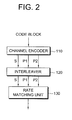
- FIG. 2 is a block diagram showing a channel encoding procedure.
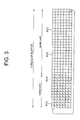
- FIG. 3 shows a transmission start position according to a redundancy version (RV) in a system using rate matching in a circular buffer.
- RV redundancy version
- FIG. 1 shows a wireless communication system.
- the wireless communication system can be widely deployed to provide a variety of communication services, such as voices, packet data, etc.
- the wireless communication system includes a base station (BS) 20 and at least one user equipment (UE) 10.
- the UE 10 may be fixed or mobile, and may be referred to as another terminology, such as a mobile station (MS), a user terminal (UT), a subscriber station (SS), a wireless device, etc.
- the BS 20 is generally a fixed station that communicates with the UE 10 and may be referred to as another terminology, such as a node-B, a base transceiver system (BTS), an access point, etc. There are one or more cells within the coverage of the BS 20.
- a downlink represents a communication link from the BS 20 to the UE 10
- an uplink represents a communication link from the UE 10 to the BS 20.
- a transmitter may be a part of the BS 20, and a receiver may be a part of the UE 10.
- the transmitter may be a part of the UE 10, and the receiver may be a part of the BS 20.
- Downlink and uplink transmissions can be made using different multiple access schemes. For example, orthogonal frequency division multiple access (OFDMA) may be used for downlink transmission, and single carrier-frequency division multiple access (SC-FDMA) may be used for uplink transmission.
- OFDMA orthogonal frequency division multiple access
- SC-FDMA single carrier-frequency division multiple access
- the multiple access schemes may be based on code division multiple access (CDMA), time division multiple access (TDMA), frequency division multiple access (FDMA), single-carrier FDMA (SC-FDMA), orthogonal frequency division multiple access (OFDMA), or other well-known modulation schemes.
- CDMA code division multiple access
- TDMA time division multiple access
- FDMA frequency division multiple access
- SC-FDMA single-carrier FDMA
- OFDMA orthogonal frequency division multiple access
- the OFDM scheme uses a plurality of orthogonal subcarriers. Further, the OFDM scheme uses orthogonality between inverse fast Fourier transform (IFFT) and fast Fourier transform (FFT).
- IFFT inverse fast Fourier transform
- FFT fast Fourier transform
- the transmitter transmits data by performing IFFT.
- the receiver restores original data by performing FFT on a received signal.
- the transmitter uses IFFT to combine the plurality of subcarriers, and the receiver uses FFT to split the plurality of subcarriers.
- complexity of the receiver can be reduced in a frequency selective fading environment of a broadband channel, and the spectral efficiency can be improved through selective scheduling in a frequency domain by utilizing channel characteristics which are different from one subcarrier to another.
- An OFDMA scheme is an OFDM-based multiple access scheme. According to the OFDMA scheme, a radio resource can be more efficiently used by allocating different subcarriers to multiple users.
- FIG. 2 is a block diagram showing a channel encoding procedure. This is a case where one code block is transmitted in a format of a plurality of data streams after channel encoding, interleaving, and rate matching.
- the code block is a specific-sized data block for performing channel encoding.
- a plurality of code blocks may have the same size or may have different sizes.
- a channel encoder 110 performs channel encoding on an input code block.
- the channel encoder 110 may use a turbo code.
- the turbo code consists of a recursive systematic convolution encoder and an interleaver.
- the turbo code generates systematic bits and parity bits on a bit-basis from the input code block. It is assumed herein that, by using a 1/3 code rate, one systematic block S and two parity blocks P1 and P2 are generated.
- the systematic block is a set of systematic bits.
- the parity block is a set of parity bits.
- An interleaver 120 performs interleaving on the channel-encoded code block so as to reduce an influence of a burst error.
- the interleaver 120 can perform interleaving for the systematic block S and the two parity blocks P1 and P2.
- a rate matching unit 130 matches the channel-encoded code block to fit a size of a radio resource.
- the rate matching can be performed in a unit of a channel-encoded code block.
- the rate matching can be performed by separating the two parity blocks P2 and P2.
- FIG. 3 shows a transmission start position according to a redundancy version (RV) in a system using rate matching in a circular buffer.
- RV redundancy version
- a circular buffer horizontally consists of 36 logical data blocks. Among them, 1/3 parts of the logical data blocks (i.e., 12 data blocks) are systematic blocks, and subsequent 2/3 parts of the logical data blocks (i.e., 24 data blocks) are parity blocks. There are four RVs, that is, RV0 to RV3. An interval between RVs is obtained by dividing a total circular buffer size by the number of RVs. The RV is determined upon failure in data transmission using hybrid automatic repeat request (HARQ) . A transmission or retransmission start position of a data block changes according to the RV.
- HARQ hybrid automatic repeat request
- the RV0 to RV3 are redundancy versions indicating different transmission or retransmission start positions.
- a 0 th redundancy version hereinafter, RV0
- transmission is made starting from a 2 nd data block in the circular buffer.
- a 1 st redundancy version hereinafter, RV1
- transmission is made starting from an 11 th data block in the circular buffer.
- a 2 nd redundancy version hereinafter, RV2
- transmission is made starting from a 20 th data block.
- a 3 rd redundancy version hereinafter, RV3
- transmission is made starting from a 29 th data block.
- the coding rate of the turbo code is 1/3, and the number of RVs is 4.
- this is for exemplary purposes only, and thus a different coding rate, a different number of RVs, and a different RV start position may be used in the present invention.
- Scheduling information (e.g., a scheduling grant) for first transmission must be transmitted. Scheduling information for retransmission is optionally transmitted. For a case where there is no scheduling information for retransmission, an RV to be used in transmission needs to be independently defined by the user terminal.
- data can be transmitted using the HARQ by determining a fixed RV to be used for first transmission and retransmission of data in a circular buffer irrespective of a coding rate.
- the entire circular buffer may be divided into a constant number of data blocks to determine a fixed transmission start position of RV. In this case, a throughput can be improved when it is determined to transmit data of the circular buffer as fast as possible.
- a portion occupied by the circular buffer according to the coding rate is as shown in Table 1 below.
- Table 1 coding rate portion 2/3 ⁇ coding rate ⁇ 1 1 ⁇ portion ⁇ 2 4/9 ⁇ coding rate ⁇ 2/3 2 ⁇ portion ⁇ 3 1/3 ⁇ coding rate ⁇ 4/9 3 ⁇ portion ⁇ 4
- a set of fixed RVs to be used in respective transmissions can be selected as shown in Table 2 irrespective of the coding rate. It will be assumed herein that RV0 is an RV which is always used in first transmission. [Table 2] Tx number 1 2 3 4 1 st RV combination RV0 RV2 RV1 RV3 2 nd RV combination RV0 RV2 RV3 RV1
- RV0 is selected for the 1 st Tx number and RV2 for the 2 nd Tx number, and so on.
- the selected RVs in the 3 rd and the 4 th Tx numbers are different respectively between the 1 st and the 2 nd RV combinations.
- an RV set of Table 2 can be repeated, or data can be transmitted by defining a new fixed RV combination. In this case, even if the scheduling information for retransmission is transmitted and thus the coding rate is changed, data is transmitted according to the previously fixed RV set.
- Table 5 shows RV combinations (i.e., 3 rd to 6 th RV combinations) when transmission is made 5 times or more.
- the 1 st RV combination of Table 1 above is repeated two times.
- the 1 st RV combination of Table 1 above is repeated two times but an RV0 having systematic bits are excluded in the 2 nd repetition.
- the 2 nd RV combination of Table 1 above is repeated two times.
- the 2 nd RV combination of Table 1 above is repeated two times but an RV0 having systematic bits are excluded in the 2 nd repetition.
- a throughput can be improved when it is determined to transmit data of the circular buffer as fast as possible.
- the aforementioned fixed RV combination is for exemplary purposes only.
- the RV combination may change according to the Tx number.
- an RV combination may be predetermined according to a coding rate, and thereafter when scheduling information for retransmission is transmitted, data using the HARQ may be transmitted by selecting an RV in consideration of a changed coding rate.
- RV set is determined according to an initial coding rate (CR) as shown in Table 4.
- CR initial coding rate
- Table 4 coding rate RV combination based on Tx number 2/3 ⁇ CRO ⁇ 1 RVO->RV1->RV2->RV3 4/9 ⁇ CR1 ⁇ 2/3 RVO->RV2->RV1->RV3 1/3 ⁇ CR2 ⁇ 4/9 RVO->RV3->RV2->RV1
- a next RV is determined according to a previous RV.
- the previous RV is RV2 when data is transmitted with a coding rate of CR0
- the next RV is RV3.
- Table 5 shows a method of RV selection in a case where a coding rate changes upon transmitting the scheduling information for retransmission when an RV combination is determined according to the coding rate as shown in Table 4 above.
- a 1 st Tx number has a coding rate of CR0, and thus first transmission is determined to RV0 according to Table 4 above. Since the coding rate changes to CR1 at a 2 nd Tx number, a next RV is determined to RV1. This is to regulate an amount of data according to the changed coding rate by selecting an RV immediately next to the latest RV at a time point where the coding rate changes.
- the coding rate is maintained to CR1 at a 3 rd Tx number.
- an RV sequence is determined according to the RV combination based on CR1. Since the previous RV is RV1, the next RV is determined to RV3 according to Table 4 above.
- the coding rate changes to CR2 at a last 4 th Tx number. Thus, RV0, which is an RV next to RV 3, is selected again. As such, transmission efficiency can be improved by adaptively selecting an RV according to a previous RV and a coding rate.
- the change of coding rate is just on example of a communication situation in which the method comprises selecting an RV immediately next to the previous transmitted RV, regardless of the currently used RV combination.
- Other predetermined communication situations such as a change of modulation or the like, can trigger this embodiment.
- a synchronous HARQ can be used to reduce a signaling overhead.
- the signaling overhead is reduced by using a predetermined RV.
- a throughput of HARQ can be improved.
- a time point at which transmitting/receiving ends transmit data is known. Therefore, if an RV sequence is clearly determined between the transmitting/receiving ends, signaling for RV is unnecessary. By considering this, a method of reporting an RV by using previous control information without additional signaling is required.
- a new data indicator may be used to report an RV.
- the NDI is signaling required to report whether a data block currently transmitted is a new data block.
- the RV is implicitly reported using the NDI instead of explicitly reporting the RV. Therefore, an overhead caused by additional RV signaling can be reduced.
- Table 6 shows a method of selecting an RV according to a 1-bit NDI when the 3 rd RV combination of Table 3 is used.
- the NDI is 1, it indicates new data transmission, whereas if the NDI of 0, it indicates retransmission.
- the other way around is also possible.
- the NDI is 1, which indicates new data. Since this is first transmission, data is transmitted using RV0. Thereafter, the NDI continuously indicates 0, which means retransmission. Therefore, the next RV for the 2 nd Tx number is determined to be RV2 by a previous RV(RV0) as in the 3 rd RV combination.
- a retransmission sequence number may be used to report an RV.
- the time point at which the transmitting/receiving ends transmit data blocks is known.
- the RV can be reported using the RSN instead of the NDI.
- a specific value of the RSN is defined to indicate first transmission. If the RSN is 1-bit information, the RSN is either 0 or 1, wherein '0' indicates first transmission and '1' indicates retransmission.
- the RSN is 2-bit information
- '0' indicates first transmission, and transmission is achieved according to an RSN in the sequence of '0->1->2->3'. After 4 th transmission, the RSN may continuously remain in '3'.
- 3GPP 3 rd generation partnership project
- HSUPA high speed uplink packet access
- Table 7 shows a method of selecting an RV according to a 1-bit RSN when the 4 th and 5 th RV combinations of Table 3 above are used.
- Table 7 Tx number 1 2 3 4 5 6 7 ⁇ 4 th RV combination RSN 0 1 1 1 1 1 1 ... RV RV0 RV2 RV1 RV3 RV2 RV1 RV3 ... 5 th RV combination RSN 0 1 1 1 1 1 1 ... RV RV0 RV2 RV1 RV3 RV0 RV2 RV1 ...
- the RSN is 0 at a 1 st Tx number, which indicates first transmission.
- the RSN is 1 throughout 2 nd to 7 th Tx numbers, which indicates retransmission.
- the RV may be determined according to the 4 th and 5 th RV combinations of Table 3 above.
- the RSN is not always transmitted but transmitted only when scheduling information exists. Therefore, even if the RSN is not transmitted in the middle of transmission, the receiver has to use the RSN in consideration of this situation.
- Table 8 shows a method of selecting an RV according to a 2-bit RSN when the 3 rd and 4 th RV combinations of Table 3 above are used.
- Table 8 Tx number 1 2 3 4 5 6 7 ... 3 ra RV combination RSN 0 1 2 3 3 3 3 ... RV RV0 RV2 RV1 RV3 RV0 RV2 RV1 ... 4 th RV combination RSN 0 1 2 3 1 2 3 ... RV RV0 RV2 RV1 RV3 RV2 RV1 RV3 ...
- an actually transmitted RV may differ according to a Tx number. This has to be agreed in advance between the transmitter and the receiver. For example, a currently transmitted subframe number may be used.
- the RV can be known from the RSN included in scheduling information for retransmission. That is, when the RSN is represented in 2 bits, the RNS is transmitted in the form of 0, 1, 2, 3, 3, 3, 3, 3 ... or 0, 1, 2, 3, 1, 2, 3 ..., and an RV corresponding to each RSN is assigned.
- Table 9 shows a method of selecting an RV in a case where there is no RSN since scheduling information for retransmission is not transmitted when the 3 rd and 4 th RV combinations of Table 3 above are used.
- an i th RV is selected to RV2, which is an RV next to RV0, according to a sequence of the 3 rd RV combination by considering a previous RV0.
- an i th RV is selected to RV2, which is an RV next to RV3, according to a sequence of the 4 th RV combination by considering a previous RV3.
- Table 10 shows the signaling method of explicitly reporting the RV according to the 4 th RV combination of Table 3 above.
- Table 10 Tx number 1 2 3 4 5 6 7 4 th RV combination RV value 0 2 1 3 2 1 3 RV RV0 RV2 RV1 RV3 RV2 RV1 RV3
- All functions described above may be performed by a processor such as a microprocessor, a controller, a microcontroller, and an application specific integrated circuit (ASIC) according to software or program code for performing the functions.
- the program code may be designed, developed, and implemented on the basis of the descriptions of the present invention, and this is well known to those skilled in the art.
Landscapes
- Engineering & Computer Science (AREA)
- Computer Networks & Wireless Communication (AREA)
- Signal Processing (AREA)
- Detection And Prevention Of Errors In Transmission (AREA)
- Mobile Radio Communication Systems (AREA)
Applications Claiming Priority (2)
| Application Number | Priority Date | Filing Date | Title |
|---|---|---|---|
| US98323607P | 2007-10-29 | 2007-10-29 | |
| KR1020080001946A KR20090043414A (ko) | 2007-10-29 | 2008-01-07 | Harq를 이용한 데이터 전송방법 |
Publications (1)
| Publication Number | Publication Date |
|---|---|
| EP2056513A2 true EP2056513A2 (de) | 2009-05-06 |
Family
ID=40380309
Family Applications (1)
| Application Number | Title | Priority Date | Filing Date |
|---|---|---|---|
| EP08167828A Withdrawn EP2056513A2 (de) | 2007-10-29 | 2008-10-29 | Verfahren zur Datenübertragung unter Verwendung von HARQ |
Country Status (3)
| Country | Link |
|---|---|
| US (1) | US20090125774A1 (de) |
| EP (1) | EP2056513A2 (de) |
| WO (1) | WO2009057922A1 (de) |
Cited By (6)
| Publication number | Priority date | Publication date | Assignee | Title |
|---|---|---|---|---|
| EP3079272A4 (de) * | 2013-12-03 | 2017-08-02 | LG Electronics Inc. | Verfahren und vorrichtungen zur uplink-übertragung in drahtloszugangssystem zur unterstützung von maschinenartiger kommunikation |
| WO2018068025A1 (en) * | 2016-10-07 | 2018-04-12 | Idac Holdings, Inc. | Rate matching and harq with irregular modulation |
| CN108270525A (zh) * | 2016-12-30 | 2018-07-10 | 华为技术有限公司 | 冗余版本传输方法及设备 |
| WO2019160768A1 (en) * | 2018-02-16 | 2019-08-22 | At & T Intellectual Property I, L.P. | Reducing control channel overhead in 5g or other next generation networks |
| CN110431779A (zh) * | 2017-03-24 | 2019-11-08 | 瑞典爱立信有限公司 | 用于检测由于数据打孔而损坏的数据的传输的网络节点、ue及其中的方法 |
| CN110999089A (zh) * | 2017-08-10 | 2020-04-10 | 上海诺基亚贝尔股份有限公司 | 方法和装置 |
Families Citing this family (17)
| Publication number | Priority date | Publication date | Assignee | Title |
|---|---|---|---|---|
| WO2009113301A1 (ja) | 2008-03-12 | 2009-09-17 | パナソニック株式会社 | 無線通信装置、無線通信システム及び無線通信方法 |
| WO2010016669A2 (en) * | 2008-08-04 | 2010-02-11 | Samsung Electronics Co., Ltd. | Signal transmission method and apparatus for user equipment in mobile communication system |
| WO2010031873A1 (en) * | 2008-09-22 | 2010-03-25 | Nokia Siemens Networks Oy | Method and apparatus for providing signaling of redundancy versions |
| CN102035617B (zh) * | 2009-09-29 | 2015-04-01 | 中兴通讯股份有限公司 | 一种通信系统中信道编码的速率匹配方法和装置 |
| CN102045146A (zh) * | 2009-10-15 | 2011-05-04 | 上海华为技术有限公司 | 一种混合自动重传请求合并方法、装置及系统 |
| CN102075285B (zh) * | 2009-11-25 | 2013-06-05 | 中兴通讯股份有限公司 | 一种速率匹配方法及装置 |
| CN103428836B (zh) * | 2012-05-16 | 2016-03-30 | 华为技术有限公司 | 基于harq的数据传输方法、设备和系统 |
| US10064164B2 (en) | 2014-08-18 | 2018-08-28 | Apple Inc. | Radio access technology with non-continuous and periodic PUSCH transmission |
| BR112017014096A2 (pt) * | 2014-12-31 | 2018-03-06 | Qualcomm Incorporated | sistemas e métodos para recuperação de informações a partir de pacotes de versão de redundância |
| JP6476311B2 (ja) * | 2015-04-17 | 2019-02-27 | パナソニック インテレクチュアル プロパティ コーポレーション オブ アメリカPanasonic Intellectual Property Corporation of America | 時分割複信(tdd)におけるマシンタイプ通信のチャネルのレートマッチング |
| EP3566351B1 (de) * | 2017-02-06 | 2024-04-03 | Mediatek Inc. | Verfahren und vorrichtung für kommunikation |
| KR102529800B1 (ko) | 2017-03-23 | 2023-05-09 | 삼성전자주식회사 | 폴라 코드의 부호율 조정 방법 및 장치 |
| CN111095837B (zh) * | 2017-09-11 | 2022-07-29 | 上海诺基亚贝尔股份有限公司 | 用于上行链路传输的方法和装置 |
| WO2019136632A1 (en) * | 2018-01-10 | 2019-07-18 | Qualcomm Incorporated | Techniques and apparatuses for redundancy scheme selection |
| CN110392442B (zh) | 2018-04-18 | 2022-06-14 | 华为技术有限公司 | 通信方法及装置 |
| CN110753402B (zh) * | 2019-09-30 | 2023-04-28 | 中国信息通信研究院 | 一种上行调度资源多配置数据传送方法和设备 |
| WO2021223047A1 (en) * | 2020-05-02 | 2021-11-11 | Qualcomm Incorporated | Feedback scheme for systematic raptor codes |
Family Cites Families (9)
| Publication number | Priority date | Publication date | Assignee | Title |
|---|---|---|---|---|
| US6308294B1 (en) * | 1999-11-17 | 2001-10-23 | Motorola, Inc. | Adaptive hybrid ARQ using turbo code structure |
| KR20020001173A (ko) * | 2000-06-26 | 2002-01-09 | 박종섭 | 비동기 무선통신 시스템에서 데이터 및 데이터 정보 전달방법 |
| US7260770B2 (en) * | 2001-10-22 | 2007-08-21 | Motorola, Inc. | Block puncturing for turbo code based incremental redundancy |
| ATE309652T1 (de) * | 2001-11-16 | 2005-11-15 | Matsushita Electric Industrial Co Ltd | Arq wiederübertragungsverfahren mit inkrementaler redundanz unter verwendung von bit umordnungsarten |
| KR100899736B1 (ko) * | 2002-05-25 | 2009-05-27 | 삼성전자주식회사 | 무선 패킷 데이터 채널 수신장치 및 방법 |
| US7007218B2 (en) * | 2004-02-03 | 2006-02-28 | Harris Corporation | Adaptive rate code combining automatic repeat request (ARQ) communications method and system |
| KR100646799B1 (ko) * | 2004-05-06 | 2006-11-24 | 삼성전자주식회사 | 이동통신 시스템에서 전송채널들의 레이트 매칭 파라미터 결정 방법 및 장치 |
| US7890834B2 (en) * | 2007-06-20 | 2011-02-15 | Motorola Mobility, Inc. | Apparatus comprising a circular buffer and method for assigning redundancy versions to a circular buffer |
| US7924763B2 (en) * | 2007-12-11 | 2011-04-12 | Motorola Mobility, Inc. | Method and appratus for rate matching within a communication system |
-
2008
- 2008-10-27 WO PCT/KR2008/006333 patent/WO2009057922A1/en not_active Ceased
- 2008-10-29 US US12/260,857 patent/US20090125774A1/en not_active Abandoned
- 2008-10-29 EP EP08167828A patent/EP2056513A2/de not_active Withdrawn
Cited By (16)
| Publication number | Priority date | Publication date | Assignee | Title |
|---|---|---|---|---|
| US10841906B2 (en) | 2013-12-03 | 2020-11-17 | Lg Electronics Inc. | Methods and apparatuses for transmitting uplink in wireless access system supporting machine-type communication |
| US10034275B2 (en) | 2013-12-03 | 2018-07-24 | Lg Electronics Inc. | Methods and apparatuses for transmitting uplink in wireless access system supporting machine-type communication |
| EP3079272A4 (de) * | 2013-12-03 | 2017-08-02 | LG Electronics Inc. | Verfahren und vorrichtungen zur uplink-übertragung in drahtloszugangssystem zur unterstützung von maschinenartiger kommunikation |
| WO2018068025A1 (en) * | 2016-10-07 | 2018-04-12 | Idac Holdings, Inc. | Rate matching and harq with irregular modulation |
| CN109997326A (zh) * | 2016-10-07 | 2019-07-09 | Idac控股公司 | 具有不规则调制的速率匹配和harq |
| CN109997326B (zh) * | 2016-10-07 | 2022-10-28 | Idac控股公司 | 具有不规则调制的速率匹配和harq |
| US11356193B2 (en) | 2016-10-07 | 2022-06-07 | Idac Holdings, Inc. | Rate matching and HARQ with irregular modulation |
| CN108270525A (zh) * | 2016-12-30 | 2018-07-10 | 华为技术有限公司 | 冗余版本传输方法及设备 |
| CN108270525B (zh) * | 2016-12-30 | 2021-02-12 | 华为技术有限公司 | 冗余版本传输方法及设备 |
| CN110431779B (zh) * | 2017-03-24 | 2022-05-27 | 瑞典爱立信有限公司 | 检测由于数据打孔损坏的数据传输的节点、ue及方法 |
| CN110431779A (zh) * | 2017-03-24 | 2019-11-08 | 瑞典爱立信有限公司 | 用于检测由于数据打孔而损坏的数据的传输的网络节点、ue及其中的方法 |
| CN110999089A (zh) * | 2017-08-10 | 2020-04-10 | 上海诺基亚贝尔股份有限公司 | 方法和装置 |
| CN110999089B (zh) * | 2017-08-10 | 2024-05-17 | 上海诺基亚贝尔股份有限公司 | 方法和装置 |
| US10680778B2 (en) | 2018-02-16 | 2020-06-09 | At&T Intellectual Property I, L.P. | Reducing control channel overhead in 5G or other next generation networks |
| US11159296B2 (en) | 2018-02-16 | 2021-10-26 | At&T Intellectual Property I, L.P. | Reducing control channel overhead in 5G or other next generation networks |
| WO2019160768A1 (en) * | 2018-02-16 | 2019-08-22 | At & T Intellectual Property I, L.P. | Reducing control channel overhead in 5g or other next generation networks |
Also Published As
| Publication number | Publication date |
|---|---|
| WO2009057922A1 (en) | 2009-05-07 |
| US20090125774A1 (en) | 2009-05-14 |
Similar Documents
| Publication | Publication Date | Title |
|---|---|---|
| EP2056513A2 (de) | Verfahren zur Datenübertragung unter Verwendung von HARQ | |
| US8667357B2 (en) | Method for conducting HARQ with a wireless communications system | |
| US11101932B2 (en) | Telecommunications apparatus and methods | |
| EP2266239B1 (de) | Auswahl von weiterübertragungseinstellungen für harq in wcdma- und lte-netzwerken | |
| JP2010538574A (ja) | Harqを用いたデータ伝送方法 | |
| KR101530712B1 (ko) | Harq를 이용한 데이터 전송방법 | |
| KR101265637B1 (ko) | 복수 개의 harq 프로세스 채널을 순차적으로 사용하여데이터를 송신하는 방법 | |
| CN101662346B (zh) | 自动重传控制方法、通信系统及其发射机和接收机 | |
| US8750104B2 (en) | Method for performing HARQ operation in wireless communication system | |
| US20100262886A1 (en) | Selective decoding of re-transmitted data blocks | |
| Cipriano et al. | Overview of ARQ and HARQ in beyond 3G systems | |
| US20090046713A1 (en) | Method and apparatus for transmitting non-decodable packets | |
| KR101548744B1 (ko) | Harq를 이용한 데이터 전송방법 | |
| KR101140091B1 (ko) | 무선통신 시스템에서 harq 수행 방법 | |
| US8599696B2 (en) | Method of processing adaptive hybrid automatic repeat request (HARQ) scheme by selecting a start point of data block in a mother code | |
| CN106559189B (zh) | 一种基于harq的数据传输方法、装置及系统 | |
| KR101117002B1 (ko) | 무선통신 시스템에서 harq 수행 방법 | |
| KR101426957B1 (ko) | 무선 통신 시스템에서 데이터 코딩 방법 및 송신기 | |
| KR101426956B1 (ko) | Harq를 이용한 데이터 전송방법 | |
| KR101603328B1 (ko) | Harq를 이용한 데이터 전송방법 | |
| Uzawa et al. | PCI reduction method suitable for type-II HARQ with SR-ARQ | |
| Moh et al. | 5 Enhanced Hybrid ARQ | |
| Kalyan | Chase Combining HARQ Process in LTE |
Legal Events
| Date | Code | Title | Description |
|---|---|---|---|
| PUAI | Public reference made under article 153(3) epc to a published international application that has entered the european phase |
Free format text: ORIGINAL CODE: 0009012 |
|
| 17P | Request for examination filed |
Effective date: 20081029 |
|
| AK | Designated contracting states |
Kind code of ref document: A2 Designated state(s): AT BE BG CH CY CZ DE DK EE ES FI FR GB GR HR HU IE IS IT LI LT LU LV MC MT NL NO PL PT RO SE SI SK TR |
|
| AX | Request for extension of the european patent |
Extension state: AL BA MK RS |
|
| STAA | Information on the status of an ep patent application or granted ep patent |
Free format text: STATUS: THE APPLICATION IS DEEMED TO BE WITHDRAWN |
|
| 18D | Application deemed to be withdrawn |
Effective date: 20130503 |