EP2052629A1 - Soy sauce seasoning having high -aminobutyric acid content - Google Patents
Soy sauce seasoning having high -aminobutyric acid content Download PDFInfo
- Publication number
- EP2052629A1 EP2052629A1 EP07745415A EP07745415A EP2052629A1 EP 2052629 A1 EP2052629 A1 EP 2052629A1 EP 07745415 A EP07745415 A EP 07745415A EP 07745415 A EP07745415 A EP 07745415A EP 2052629 A1 EP2052629 A1 EP 2052629A1
- Authority
- EP
- European Patent Office
- Prior art keywords
- aminobutyric acid
- soy sauce
- acid content
- seasoning
- sauce seasoning
- Prior art date
- Legal status (The legal status is an assumption and is not a legal conclusion. Google has not performed a legal analysis and makes no representation as to the accuracy of the status listed.)
- Withdrawn
Links
Classifications
-
- A—HUMAN NECESSITIES
- A23—FOODS OR FOODSTUFFS; TREATMENT THEREOF, NOT COVERED BY OTHER CLASSES
- A23L—FOODS, FOODSTUFFS OR NON-ALCOHOLIC BEVERAGES, NOT OTHERWISE PROVIDED FOR; PREPARATION OR TREATMENT THEREOF
- A23L33/00—Modifying nutritive qualities of foods; Dietetic products; Preparation or treatment thereof
- A23L33/10—Modifying nutritive qualities of foods; Dietetic products; Preparation or treatment thereof using additives
- A23L33/17—Amino acids, peptides or proteins
- A23L33/175—Amino acids
-
- A—HUMAN NECESSITIES
- A23—FOODS OR FOODSTUFFS; TREATMENT THEREOF, NOT COVERED BY OTHER CLASSES
- A23L—FOODS, FOODSTUFFS OR NON-ALCOHOLIC BEVERAGES, NOT OTHERWISE PROVIDED FOR; PREPARATION OR TREATMENT THEREOF
- A23L27/00—Spices; Flavouring agents or condiments; Artificial sweetening agents; Table salts; Dietetic salt substitutes; Preparation or treatment thereof
- A23L27/50—Soya sauce
-
- A—HUMAN NECESSITIES
- A23—FOODS OR FOODSTUFFS; TREATMENT THEREOF, NOT COVERED BY OTHER CLASSES
- A23V—INDEXING SCHEME RELATING TO FOODS, FOODSTUFFS OR NON-ALCOHOLIC BEVERAGES AND LACTIC OR PROPIONIC ACID BACTERIA USED IN FOODSTUFFS OR FOOD PREPARATION
- A23V2002/00—Food compositions, function of food ingredients or processes for food or foodstuffs
Definitions
- the present invention relates to a soy sauce seasoning having high ⁇ -aminobutyric acid content, in which qualities such as color and gloss, deliciousness, ⁇ -aminobutyric acid content and the like are stabilized.
- ⁇ -Aminobutyric acid is an amino acid broadly distributed in the animal and plant kingdom and is a neurotransmitter which is present in the brain and spinal cord of mammals.
- effects such as hypotensive activity, diabetes mellitus preventive and diabetes mellitus improving activities, renal function activating activity, liver function improving activity, obesity preventive activity, climacteric disturbance improving activity and indefinite complaint improving activity, sleeplessness improving and ataractic and lenitive activities, improving activity of disturbance of memory, deodorization activity and the like have been confirmed by animal tests and human clinical tests.
- soy sauce which contains ⁇ -aminobutyric acid examples include an article of fermented food prepared by adding Lactobacillus plantarum to fermented fish sauce containing L-glutamic acid or the like, a seasoning prepared by pupae of silkworm together with unrefined soy sauce which are fermented and aged them and a seasoning prepared by producing and preparing a soy sauce koji after mixing malt with soybean or defatted soybean and carrying out fermentation and aging are reported (e.g., see Patent References 1 to 3). Additionally, a technique for improving taste of a soy sauce containing ⁇ -aminobutyric acid with potassium is reported (e.g., see Patent Reference 4).
- soy sauce qualities are not carried out in these related arts. Namely, when ⁇ -aminobutyric acid is added to soy sauce at a high concentration for the purpose of obtaining further superior health functions, there is a problem that the pH rises in concentration-dependent manner due to the buffer activity possessed by itself to lower soy sauce qualities such as the stabilities regarding color and gloss, deliciousness, ⁇ -aminobutyric acid content and the like.
- the problem of the present invention is to provide a soy sauce seasoning having high ⁇ -aminobutyric acid content, in which qualities such as color and gloss, deliciousness, ⁇ -aminobutyric acid content and the like are stabilized.
- the inventors of the present invention have carried out intensive studies and found as a result that a soy sauce seasoning containing ⁇ -aminobutyric acid in which qualities such as color and gloss, deliciousness, ⁇ -aminobutyric acid content and the like are stabilized can be obtained when pH is adjusted within a certain range during allowing ⁇ -aminobutyric acid to be contained in a soy sauce seasoning at a high concentration.
- the present invention was accomplished.
- the present invention relates to:
- soy sauce seasoning having high ⁇ -aminobutyric acid content, in which soy sauce qualities such as color and gloss, deliciousness, ⁇ -aminobutyric acid content and the like are stabilized can be provided.
- soy sauce seasoning in addition to general soy sauce in which cereals are used as the ingredient, fermented fish sauce in which fish and shellfishes and the like are used as the ingredient, and processed soy sauce as their processed products, can be used.
- ⁇ -aminobutyric acid is added to the soy sauce seasoning at a high concentration of 0.5% (w/v) or more, preferably from 0.5 to 5.0% (w/v), more preferably from 1.5 to 5.0% (w/v).
- a superior health function such as hypotensive activity cannot be obtained sufficiently.
- the ⁇ -aminobutyric acid content exceeds 5.0% (w/v) on the other hand, it is undesirable in terms of sensory and unsuitable as a soy sauce seasoning.
- ⁇ -aminobutyric acid to be added to the soy sauce seasoning in the present invention a commercially available ⁇ -aminobutyric acid powder, culture liquid of ⁇ -aminobutyric acid which is obtained by various types of microbial fermentation and the like can be used.
- y-aminobutyric acid it can be added as such in the case of the culture liquid, while in the case of the powder, it is difficult to be uniformly mixed as such after its addition and it is desirable to add after dissolving in water or salt solution.
- examples of the timing of adding ⁇ -aminobutyric acid include the time of the standard adjustment by mixing the soy sauce seasoning or a processed soy sauce with salt water and various types of condiment, just before squeezing of the unrefined mixture of the soy sauce or a fermented fish sauce, just after squeezing of the unrefined mixture, and the like.
- the adjustment of pH according to the present invention is carried out by adding acidulants to the soy sauce seasoning containing ⁇ -aminobutyric acid.
- acidulants and the like organic acids such as lactic acid, citric acid, acetic acid, tartaric acid, glacial acetic acid, malic acid and the like and salts thereof can be used. It is preferable to use lactic acid, citric acid or acetic acid, or a sodium salt thereof, which has less influence on the sensory.
- soy sauces As described in the tests sections in Table 2 were prepared and subjected to a color and gloss stability test and sensory test.
- the Koikuchi soy sauce or Usukuchi soy sauce to which the ⁇ -aminobutyric acid powder was not added was used as the control, and those which were significantly identified by a three point identification method were judged as " ⁇ ", and those which were not identified were judged as " ⁇ ” (Table 1).
- Test Section 9 (inventive article), Test Section 12 (control article), Test Section 21 (inventive article) and Test Section 24 (control article) subjected to the test of Example 2 was preserved at 40°C for 2 weeks (corresponds to 1.5 months of preservation at room temperature in a PET bottle), and the ⁇ -aminobutyric acid content was measured using a Hitachi high performance automatic amino acid analyzer, Model L-8500.
- the ⁇ -aminobutyric acid content before preservation was defined as 100% and comparison of the residual ratios of the ⁇ -aminobutyric acid content after preservation was carried out.
- the quality of the articles of the present invention regarding the ⁇ -aminobutyric acid content is stable, since they have higher residual ratio in comparison with the control articles (Table 3).
- soy sauce seasoning having high ⁇ -aminobutyric acid content, in which soy sauce qualities such as color and gloss, deliciousness, ⁇ -aminobutyric acid content and the like are stabilized can be provided.
Landscapes
- Life Sciences & Earth Sciences (AREA)
- Health & Medical Sciences (AREA)
- Nutrition Science (AREA)
- Chemical & Material Sciences (AREA)
- Engineering & Computer Science (AREA)
- Food Science & Technology (AREA)
- Polymers & Plastics (AREA)
- Proteomics, Peptides & Aminoacids (AREA)
- Mycology (AREA)
- Soy Sauces And Products Related Thereto (AREA)
- Seasonings (AREA)
Abstract
Description
- The present invention relates to a soy sauce seasoning having high γ-aminobutyric acid content, in which qualities such as color and gloss, deliciousness, γ-aminobutyric acid content and the like are stabilized.
- With the increasing national consciousness on health, concern has been concentrated in the improvement of daily living customs, particularly dietary life. Based on such background, articles containing physiologically functional components having healthy functions such as healthy food, supplements and the like food have been broadly popularized. Particularly, food for specified health uses have been received by the market with high reliability as food articles which were examined and permitted by the Ministry of Health, Labor and Welfare on their effects and efficacies.
- γ-Aminobutyric acid is an amino acid broadly distributed in the animal and plant kingdom and is a neurotransmitter which is present in the brain and spinal cord of mammals. As the function of γ-aminobutyric acid, effects such as hypotensive activity, diabetes mellitus preventive and diabetes mellitus improving activities, renal function activating activity, liver function improving activity, obesity preventive activity, climacteric disturbance improving activity and indefinite complaint improving activity, sleeplessness improving and ataractic and lenitive activities, improving activity of disturbance of memory, deodorization activity and the like have been confirmed by animal tests and human clinical tests. Particularly, regarding the hypotensive activity of γ-aminobutyric acid, there are articles of food for specified health uses which are permitted to use the expression that they are fitted for persons having a little high blood pressure, and which are physiologically functional components which draws special attention in recent years (e.g., see Non-patent Reference 1).
- Examples of the soy sauce which contains γ-aminobutyric acid include an article of fermented food prepared by adding Lactobacillus plantarum to fermented fish sauce containing L-glutamic acid or the like, a seasoning prepared by pupae of silkworm together with unrefined soy sauce which are fermented and aged them and a seasoning prepared by producing and preparing a soy sauce koji after mixing malt with soybean or defatted soybean and carrying out fermentation and aging are reported (e.g., see Patent References 1 to 3). Additionally, a technique for improving taste of a soy sauce containing γ-aminobutyric acid with potassium is reported (e.g., see Patent Reference 4).
- However, examinations regarding the stability of soy sauce qualities are not carried out in these related arts. Namely, when γ-aminobutyric acid is added to soy sauce at a high concentration for the purpose of obtaining further superior health functions, there is a problem that the pH rises in concentration-dependent manner due to the buffer activity possessed by itself to lower soy sauce qualities such as the stabilities regarding color and gloss, deliciousness, γ-aminobutyric acid content and the like.
- Patent Reference 1: Japanese Patent No.
2704493 - Patent Reference 2:
JP-A-2006-34278 - Patent Reference 3:
JP-A-2005-323594 - Patent Reference 4:
JP-A-2006-136262 - Non-patent Reference 1: "Summary of Permitted (Admitted) Items of Food for Specified Health Uses", Ministry of Health, Labor and Welfare, [online], February 27, 2006, [retrieval on June 15, 2006], internet <URL:http://www.mhlw.go.jp/topics/0102/xls/tp0221-2a.xls>
- The problem of the present invention is to provide a soy sauce seasoning having high γ-aminobutyric acid content, in which qualities such as color and gloss, deliciousness, γ-aminobutyric acid content and the like are stabilized.
- In order to solve the above-mentioned problems, the inventors of the present invention have carried out intensive studies and found as a result that a soy sauce seasoning containing γ-aminobutyric acid in which qualities such as color and gloss, deliciousness, γ-aminobutyric acid content and the like are stabilized can be obtained when pH is adjusted within a certain range during allowing γ-aminobutyric acid to be contained in a soy sauce seasoning at a high concentration. Thus, the present invention was accomplished.
- Namely, the present invention relates to:
- (1) a soy sauce seasoning having high γ-aminobutyric acid content, which comprises from 0.5 to 5.0% (w/v) of γ-aminobutyric acid and has pH of from 4.7 to 5.0.
- According to the present invention, a soy sauce seasoning having high γ-aminobutyric acid content, in which soy sauce qualities such as color and gloss, deliciousness, γ-aminobutyric acid content and the like are stabilized can be provided.
- The following describes the present invention in detail.
- As the soy sauce seasoning to be used as the base of the present invention, in addition to general soy sauce in which cereals are used as the ingredient, fermented fish sauce in which fish and shellfishes and the like are used as the ingredient, and processed soy sauce as their processed products, can be used.
- According to the present invention, in order to obtain more superior health functions of γ-aminobutyric acid, γ-aminobutyric acid is added to the soy sauce seasoning at a high concentration of 0.5% (w/v) or more, preferably from 0.5 to 5.0% (w/v), more preferably from 1.5 to 5.0% (w/v). When the γ-aminobutyric acid content is less than 0.5% (w/v), a superior health function such as hypotensive activity cannot be obtained sufficiently. When the γ-aminobutyric acid content exceeds 5.0% (w/v) on the other hand, it is undesirable in terms of sensory and unsuitable as a soy sauce seasoning.
- As the γ-aminobutyric acid to be added to the soy sauce seasoning in the present invention, a commercially available γ-aminobutyric acid powder, culture liquid of γ-aminobutyric acid which is obtained by various types of microbial fermentation and the like can be used. With regard to the addition of y-aminobutyric acid to the soy sauce seasoning, it can be added as such in the case of the culture liquid, while in the case of the powder, it is difficult to be uniformly mixed as such after its addition and it is desirable to add after dissolving in water or salt solution. Additionally, examples of the timing of adding γ-aminobutyric acid include the time of the standard adjustment by mixing the soy sauce seasoning or a processed soy sauce with salt water and various types of condiment, just before squeezing of the unrefined mixture of the soy sauce or a fermented fish sauce, just after squeezing of the unrefined mixture, and the like.
- When preservative property of the soy sauce seasoning which contains γ-aminobutyric acid and obtained in this manner was examined, deep coloring of the color of soy sauce is considerably advanced when the amount of y-aminobutyric acid to be added is increased to 0.5% (w/v) or more, and distinct lowering of the qualities were also found by a sensory test. Additionally, stability reduction of the qualities as the soy sauce containing γ-aminobutyric acid, such as significant reduction even on the γ-aminobutyric acid content, was confirmed. When pH of the soy sauce seasoning to which γ-aminobutyric acid was added at a high concentration was measured for the purpose of searching for the cause of this stability reduction of qualities, it was confirmed that the pH rises in a concentration-dependent manner by the buffer action of γ-aminobutyric acid.
- Accordingly, based on the assumption that the rise in pH is the cause of the stability reduction of the qualities, an examination was carried out on the possibility of improving the stability by lowering the pH with acidulants such as lactic acid, citric acid, acetic acid and the like. As a result, it was found that the stability of qualities is improved by adjusting the pH in the soy sauce seasoning containing γ-aminobutyric acid at a high concentration of from 0.5 to 5.0% (w/v) to be 5.0 or less. On the other hand, although it was found that similar effect of the stability improvement of qualities can be obtained even at a pH of less than 4.7, it is no longer usable as a soy sauce seasoning since strong acidity is felt. Based on the above reasons, it was decided that the pH suited for the quality stability of the soy sauce seasoning containing from 0.5 to 5.0% (w/v) of y-aminobutyric acid is from 4.7 to 5.0. Thus, it was decided that the pH in the present invention is adjusted within the range.
- The adjustment of pH according to the present invention is carried out by adding acidulants to the soy sauce seasoning containing γ-aminobutyric acid. As the acidulants and the like, organic acids such as lactic acid, citric acid, acetic acid, tartaric acid, glacial acetic acid, malic acid and the like and salts thereof can be used. It is preferable to use lactic acid, citric acid or acetic acid, or a sodium salt thereof, which has less influence on the sensory.
- In spite of the high γ-aminobutyric acid content, qualities such as color and gloss, deliciousness, γ-aminobutyric acid content and the like are stabilized in the soy sauce seasoning of the present invention having high γ-aminobutyric acid content obtained by the above-mentioned manner.
- Although the following describes the present invention in detail with reference to examples, the present invention is not limited thereby.
- By adding γ-aminobutyric acid powder (manufactured by Ajinomoto Healthy Supply) to commercially available Koikuchi soy sauce and Usukuchi soy sauce (manufactured by Kikkoman Corporation), changes in pH were observed (Table 1). It was found that the pH of soy sauce rises according to increase in the γ-aminobutyric acid content, and the pH becomes 5.0 or more in each of the soy sauce when the content becomes 0.5% (w/v) or more.
Table 1 γ-Aminobutyric acid content
(% (w/v))pH of Koikuchi soy sauce pH of Usukuchi soy sauce 0.0 4.90 4.87 0.2 4.95 4.93 0.4 4.98 4.98 0.5 5.00 5.00 0.6 5.01 5.02 0.8 5.03 5.06 1.0 5.06 5.10 1.2 5.08 5.13 1.4 5.11 5.15 1.6 5.13 5.18 1.8 5.15 5.21 2.0 5.17 5.25 3.0 5.25 5.33 4.0 5.32 5.47 5.0 5.43 5.53 - By adding a γ-aminobutyric acid powder (manufactured by Ajinomoto Healthy Supply) to commercially available Koikuchi soy sauce and Usukuchi soy sauce (manufactured by Kikkoman Corporation), the soy sauces as described in the tests sections in Table 2 were prepared and subjected to a color and gloss stability test and sensory test.
- In color and gloss stability test, 15 mL of each soy sauce was put into an L-tube and shaken for 8 hours under a condition of 40°C (corresponds to 1 month of preservation at room temperature in a PET bottle) to accelerate oxidation, and its color and gloss was compared with that before commencement of the test, based on the CIE 1976 L*a*b* color difference formula. Regarding the evaluation of color difference (ΔE), in accordance with the "Color Conditioning Method" edited by Suga Test Instruments Co., Ltd. (1977), the test section showing a color difference of less than 1.5, which is within such a range that the color difference was hardly detectable, was judged as "○", while the test section showing a color difference of 1.5 or more, which was equal to or larger than the detectable color difference, was judged as "×". Regarding the results of sensory test, the Koikuchi soy sauce or Usukuchi soy sauce to which the γ-aminobutyric acid powder was not added was used as the control, and those which were significantly identified by a three point identification method were judged as "×", and those which were not identified were judged as "○" (Table 1).
- As a result, it was confirmed that the quantities regarding color and gloss and deliciousness are stable in the case of the inventive articles in which the pH was adjusted at from 4.7 to 5.0, in comparison with the pH-unadjusted control articles.

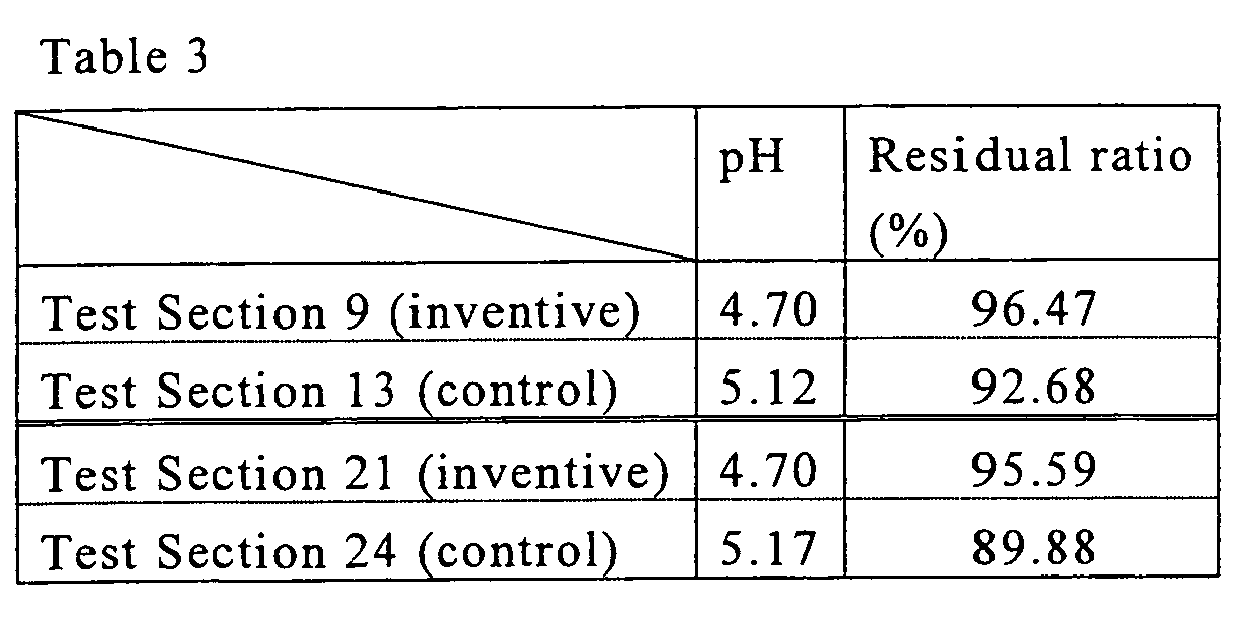
- Each of the Test Section 9 (inventive article), Test Section 12 (control article), Test Section 21 (inventive article) and Test Section 24 (control article) subjected to the test of Example 2 was preserved at 40°C for 2 weeks (corresponds to 1.5 months of preservation at room temperature in a PET bottle), and the γ-aminobutyric acid content was measured using a Hitachi high performance automatic amino acid analyzer, Model L-8500. The γ-aminobutyric acid content before preservation was defined as 100% and comparison of the residual ratios of the γ-aminobutyric acid content after preservation was carried out. As a result, it was confirmed that the quality of the articles of the present invention regarding the γ-aminobutyric acid content is stable, since they have higher residual ratio in comparison with the control articles (Table 3).
- Although the present invention has been described in detail with reference to specific examples in the foregoing, it is apparent to person skilled in the art that it is possible to add various alterations and modifications insofar as the alterations and the modifications do not deviate from the sprit and scope of the present invention.
- This patent application is based on Japanese Patent Application No.
2006-166846 filed on June 16, 2006 - According to the present invention, a soy sauce seasoning having high γ-aminobutyric acid content, in which soy sauce qualities such as color and gloss, deliciousness, γ-aminobutyric acid content and the like are stabilized can be provided.
Claims (1)
- A soy sauce seasoning having high γ-aminobutyric acid content, which comprises from 0.5 to 5.0% (w/v) of γ-aminobutyric acid and has pH of from 4.7 to 5.0.
Applications Claiming Priority (2)
| Application Number | Priority Date | Filing Date | Title |
|---|---|---|---|
| JP2006166846 | 2006-06-16 | ||
| PCT/JP2007/062161 WO2007145334A1 (en) | 2006-06-16 | 2007-06-15 | SOY SAUCE SEASONING HAVING HIGH γ-AMINOBUTYRIC ACID CONTENT |
Publications (2)
| Publication Number | Publication Date |
|---|---|
| EP2052629A1 true EP2052629A1 (en) | 2009-04-29 |
| EP2052629A4 EP2052629A4 (en) | 2010-08-25 |
Family
ID=38831847
Family Applications (1)
| Application Number | Title | Priority Date | Filing Date |
|---|---|---|---|
| EP07745415A Withdrawn EP2052629A4 (en) | 2006-06-16 | 2007-06-15 | Soy sauce seasoning having high -aminobutyric acid content |
Country Status (7)
| Country | Link |
|---|---|
| US (1) | US20090202696A1 (en) |
| EP (1) | EP2052629A4 (en) |
| JP (1) | JPWO2007145334A1 (en) |
| CN (1) | CN101472486A (en) |
| SG (1) | SG172608A1 (en) |
| TW (1) | TW200824581A (en) |
| WO (1) | WO2007145334A1 (en) |
Families Citing this family (3)
| Publication number | Priority date | Publication date | Assignee | Title |
|---|---|---|---|---|
| EP2124572A4 (en) | 2007-02-28 | 2012-03-28 | Invasive Animals Ltd | NITRITE SALTS USED AS PEAS IN BAITS FOR OMNIVORUS MAMMALS |
| CN102429207B (en) * | 2011-10-27 | 2013-04-17 | 华南理工大学 | Method for preparing soy sauce which is rich in gamma-aminobutyric acid |
| CN104886603B (en) * | 2015-06-17 | 2017-08-22 | 青岛海百合生物技术有限公司 | A kind of seafood condiment rich in gamma aminobutyric acid and preparation method thereof |
Family Cites Families (9)
| Publication number | Priority date | Publication date | Assignee | Title |
|---|---|---|---|---|
| JPH0779637B2 (en) * | 1988-08-11 | 1995-08-30 | キッコーマン株式会社 | Low phosphorus food manufacturing method |
| JP2704493B2 (en) * | 1994-02-18 | 1998-01-26 | 京都府 | Production method of fermented food |
| JP3154613B2 (en) * | 1994-05-24 | 2001-04-09 | 株式会社トクヤマ | Method and apparatus for producing reduced salt soy sauce |
| JP2003024015A (en) * | 2001-07-23 | 2003-01-28 | Kozo Asano | Food material highly containing gamma-aminobutyric acid from sesame as raw material and method for producing the same |
| JP2005323594A (en) | 2004-04-14 | 2005-11-24 | Tokyo Univ Of Agriculture | Production of soy sauce and soy sauce-like seasonings |
| JP2006034278A (en) | 2004-07-29 | 2006-02-09 | Tokyo Univ Of Agriculture | Seasoning liquid production method |
| JP2006087328A (en) * | 2004-09-22 | 2006-04-06 | Kikkoman Corp | Low-salt soy sauce |
| JP4630042B2 (en) | 2004-11-12 | 2011-02-09 | 花王株式会社 | Liquid seasoning |
| JP2006166846A (en) | 2004-12-17 | 2006-06-29 | Yanmar Co Ltd | Forcing culture apparatus of plant culture installation |
-
2007
- 2007-06-15 CN CNA2007800225319A patent/CN101472486A/en active Pending
- 2007-06-15 SG SG2011036357A patent/SG172608A1/en unknown
- 2007-06-15 JP JP2008521278A patent/JPWO2007145334A1/en active Pending
- 2007-06-15 TW TW096121916A patent/TW200824581A/en unknown
- 2007-06-15 US US12/304,482 patent/US20090202696A1/en not_active Abandoned
- 2007-06-15 EP EP07745415A patent/EP2052629A4/en not_active Withdrawn
- 2007-06-15 WO PCT/JP2007/062161 patent/WO2007145334A1/en not_active Ceased
Also Published As
| Publication number | Publication date |
|---|---|
| JPWO2007145334A1 (en) | 2009-11-12 |
| CN101472486A (en) | 2009-07-01 |
| US20090202696A1 (en) | 2009-08-13 |
| TW200824581A (en) | 2008-06-16 |
| SG172608A1 (en) | 2011-07-28 |
| WO2007145334A1 (en) | 2007-12-21 |
| EP2052629A4 (en) | 2010-08-25 |
Similar Documents
| Publication | Publication Date | Title |
|---|---|---|
| KR20090032547A (en) | Method for producing vegetable extract fermentation broth and vegetable extract fermentation broth prepared thereby | |
| JP4128892B2 (en) | Method for enhancing salty taste of food and drink and seasoning used therefor | |
| KR101093531B1 (en) | Kimchi ripening method for BAA production | |
| EP2002735A2 (en) | Fermented soy sauce with less soy sauce flavor and process for producing the same | |
| US20090202696A1 (en) | Soy sauce seasoning having high gamma-aminobutyric acid content | |
| CN1666642A (en) | Instant fish noodle and making method thereof | |
| KR101817226B1 (en) | Flat fish sikhae containing high GABA and method for preparing thereof | |
| KR20080111270A (en) | Mushroom extract, jelly and kochujang containing it | |
| JPH11206356A (en) | Aqueous solution composition for food preservation and method for producing the same | |
| CN105725013B (en) | A kind of colourless low-sugar type amino acid drink and its preparation technology | |
| JP6841371B1 (en) | Iron compound and collagen-containing composition | |
| KR102768714B1 (en) | Compositions Comprising Fermented Honeybee Drone Pupas and Uses Thereof | |
| EP3207808B1 (en) | Low-ph soy sauce | |
| CN103181535A (en) | Condiment used for making roast duck and preparation method thereof | |
| Senphan et al. | Low-sodium Chaya Leaf Seasoning Powder with Potassium Chloride Substitution: Nutritional, Antioxidant, and Microbial Quality Assessment. | |
| KR100526774B1 (en) | sauce and thereof using anchovy pickle | |
| KR102360914B1 (en) | A process for the preparation of taste soy sauce and the taste soy sauce prepared therefrom | |
| KR101766398B1 (en) | Method for producing salt containing dried kimchi powder and P. vannamei powder and seasoning using the same | |
| CN110522001A (en) | A kind of pickled vegetable pickles oil and preparation method thereof | |
| KR102342363B1 (en) | Method For Producing Salted Fish Containing Wasabi Treated With Organic Acid And Antioxidant | |
| KR100825261B1 (en) | Functional Onion Pickles Using Licorice and Angelica and Its Manufacturing Method | |
| JP4964674B2 (en) | Production method of seasoning containing lactic acid bacteria | |
| CN118104729A (en) | A fish oil-containing emulsion without fishy smell and preparation method thereof | |
| KR102030478B1 (en) | Liquid typed mixed souce comprising salted shrimp for manufacturing kimchi and liquid typed mixed souce comprising salted shrimp manufactued by using the same | |
| KR101176325B1 (en) | Manufacturing method for fermented squid sikhae at low salt and low calorie |
Legal Events
| Date | Code | Title | Description |
|---|---|---|---|
| PUAI | Public reference made under article 153(3) epc to a published international application that has entered the european phase |
Free format text: ORIGINAL CODE: 0009012 |
|
| 17P | Request for examination filed |
Effective date: 20081212 |
|
| AK | Designated contracting states |
Kind code of ref document: A1 Designated state(s): AT BE BG CH CY CZ DE DK EE ES FI FR GB GR HU IE IS IT LI LT LU LV MC MT NL PL PT RO SE SI SK TR |
|
| AX | Request for extension of the european patent |
Extension state: AL BA HR MK RS |
|
| RBV | Designated contracting states (corrected) |
Designated state(s): ES GB NL |
|
| REG | Reference to a national code |
Ref country code: DE Ref legal event code: 8566 |
|
| RIC1 | Information provided on ipc code assigned before grant |
Ipc: A23L 1/227 20060101ALI20100624BHEP Ipc: A23L 1/238 20060101ALI20100624BHEP Ipc: A23L 1/22 20060101AFI20080229BHEP |
|
| A4 | Supplementary search report drawn up and despatched |
Effective date: 20100726 |
|
| DAX | Request for extension of the european patent (deleted) | ||
| STAA | Information on the status of an ep patent application or granted ep patent |
Free format text: STATUS: THE APPLICATION HAS BEEN WITHDRAWN |
|
| 18W | Application withdrawn |
Effective date: 20130409 |