EP2050605A2 - Sliding roof structure and vehicle equipped with the same - Google Patents
Sliding roof structure and vehicle equipped with the same Download PDFInfo
- Publication number
- EP2050605A2 EP2050605A2 EP08164117A EP08164117A EP2050605A2 EP 2050605 A2 EP2050605 A2 EP 2050605A2 EP 08164117 A EP08164117 A EP 08164117A EP 08164117 A EP08164117 A EP 08164117A EP 2050605 A2 EP2050605 A2 EP 2050605A2
- Authority
- EP
- European Patent Office
- Prior art keywords
- cover
- vehicle
- cover member
- roof
- rails
- Prior art date
- Legal status (The legal status is an assumption and is not a legal conclusion. Google has not performed a legal analysis and makes no representation as to the accuracy of the status listed.)
- Withdrawn
Links
- 238000003860 storage Methods 0.000 claims abstract description 45
- 238000004804 winding Methods 0.000 claims abstract description 8
- 239000005357 flat glass Substances 0.000 description 7
- 230000000717 retained effect Effects 0.000 description 4
- 238000005520 cutting process Methods 0.000 description 2
- 239000004744 fabric Substances 0.000 description 2
- 239000011521 glass Substances 0.000 description 2
- 238000000034 method Methods 0.000 description 2
- 238000007599 discharging Methods 0.000 description 1
- 238000003780 insertion Methods 0.000 description 1
- 230000037431 insertion Effects 0.000 description 1
- 238000004519 manufacturing process Methods 0.000 description 1
- XLYOFNOQVPJJNP-UHFFFAOYSA-N water Substances O XLYOFNOQVPJJNP-UHFFFAOYSA-N 0.000 description 1
Images








Classifications
-
- B—PERFORMING OPERATIONS; TRANSPORTING
- B60—VEHICLES IN GENERAL
- B60J—WINDOWS, WINDSCREENS, NON-FIXED ROOFS, DOORS, OR SIMILAR DEVICES FOR VEHICLES; REMOVABLE EXTERNAL PROTECTIVE COVERINGS SPECIALLY ADAPTED FOR VEHICLES
- B60J7/00—Non-fixed roofs; Roofs with movable panels, e.g. rotary sunroofs
- B60J7/02—Non-fixed roofs; Roofs with movable panels, e.g. rotary sunroofs of sliding type, e.g. comprising guide shoes
- B60J7/06—Non-fixed roofs; Roofs with movable panels, e.g. rotary sunroofs of sliding type, e.g. comprising guide shoes with non-rigid element or elements
- B60J7/061—Non-fixed roofs; Roofs with movable panels, e.g. rotary sunroofs of sliding type, e.g. comprising guide shoes with non-rigid element or elements sliding and folding
-
- B—PERFORMING OPERATIONS; TRANSPORTING
- B60—VEHICLES IN GENERAL
- B60J—WINDOWS, WINDSCREENS, NON-FIXED ROOFS, DOORS, OR SIMILAR DEVICES FOR VEHICLES; REMOVABLE EXTERNAL PROTECTIVE COVERINGS SPECIALLY ADAPTED FOR VEHICLES
- B60J7/00—Non-fixed roofs; Roofs with movable panels, e.g. rotary sunroofs
- B60J7/02—Non-fixed roofs; Roofs with movable panels, e.g. rotary sunroofs of sliding type, e.g. comprising guide shoes
- B60J7/06—Non-fixed roofs; Roofs with movable panels, e.g. rotary sunroofs of sliding type, e.g. comprising guide shoes with non-rigid element or elements
- B60J7/067—Non-fixed roofs; Roofs with movable panels, e.g. rotary sunroofs of sliding type, e.g. comprising guide shoes with non-rigid element or elements sliding and winding up
-
- B—PERFORMING OPERATIONS; TRANSPORTING
- B60—VEHICLES IN GENERAL
- B60J—WINDOWS, WINDSCREENS, NON-FIXED ROOFS, DOORS, OR SIMILAR DEVICES FOR VEHICLES; REMOVABLE EXTERNAL PROTECTIVE COVERINGS SPECIALLY ADAPTED FOR VEHICLES
- B60J7/00—Non-fixed roofs; Roofs with movable panels, e.g. rotary sunroofs
- B60J7/20—Vehicle storage compartments for roof parts or for collapsible flexible tops
Definitions
- the present invention relates to a sliding roof structure for covering the opening in a roof of a vehicle with a cover.
- vehicle roof structures such as sunroof, open roof and sliding roof are well known.
- the sliding roof structure also known as canvas top structure or open roof structure, which hereinafter called sliding roof structure in this specification, allows the roof to be opened more widely, thus providing passengers enhanced sense of openness.
- a part of the roof 210 of a sliding roof type vehicle 200 is cut off to form an opening 211, to which a cover member 220 is attached in openable/closable state.
- a cover member 220 is attached in openable/closable state.
- a conventional sliding roof type vehicle is disclosed in JP2003-507244A ( Figures 1 and 2 )
- the opening 211 In order to provide passengers on a sliding roof type vehicle 200 with enhanced sense of openness, the opening 211 must be made as large as possible. However, with the conventional sliding roof type vehicles, the opening 211 cannot be made larger exceeding the limitations imposed by their manufacturing procedures, where the roof of the vehicle is replaced by a sliding roof. In addition, as shown in Figure 19 , the folded cover member 220 occupies some part of the opening 211, hampering the opening from being made larger.
- the purpose of the present invention is to provide an opening larger than that of conventional sliding roof type vehicles by transferring folded cover into the vehicle.
- a sliding roof structure for opening/closing an opening in the roof of a vehicle with a cover member comprising; a cover storage means which constitutes the rear end of the roof and stores the cover member, and a guiding means for transferring the cover storage means between a position at the rear end of the roof and a position inside the vehicle.
- the cover storage means includes a winding means for winding the cover member.
- the guiding means is equipped with lifting/lowering rails installed between the position at the rear end of the roof and the position inside the vehicle.
- the sliding roof structure has a stopper mechanism for maintaining the cover storage means at the rear end of the roof. Also the lifting/lowering rails are installed inclined so that the position inside the vehicle is nearer to the front than the position at the rear end of the vehicle.
- a sliding roof structure for opening/closing an opening in the roof of a vehicle with a cover comprising; opening/closing rails installed along the opening for guiding the transfer of the cover member, a cover member tray for holding the folded cover member, and r lifting/lowering rails for guiding the cover member tray from the roof position to the position inside the vehicle, which is under the roof position.
- a sliding roof structure of a vehicle comprising: an opening formed in the roof, a foldable cover member for covering the opening, opening/closing rails installed along the edge portion on the right and left sides of the opening to guide the cover member so that the cover member slides in the longitudinal direction of the vehicle, a cover member tray for holding the folded cover member, lifting/lowering rails for guiding the cover member tray so that the cover member tray moves between the first position at the rear side of the opening/closing rails and the second position under the first position, and retaining means for retaining the cover member tray at the first position in releasable state, wherein the cover member is slid and folded toward the rear side of the roof to form the opening, the entire cover member is placed on the cover, and the cover member tray is lowered from the first position to the second position inside the vehicle.
- the cover member tray includes a convex protruding outward in the width direction of the vehicle at the edge portion on right and left sides of the tray, the lifting/lowering rails include a guide groove along which the convex slides, the retaining means includes a protruding piece that protrudes into or retracted from the guide groove, and the convex is placed on the protruding piece to retain the cover member tray at the first position.
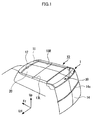
- Figure 1 shows a perspective view of a hatchback type vehicle (10) featuring a sliding roof structure of the first embodiment of this invention.
- This vehicle 10 has an opening 12 in its roof 11.
- the opening 12 has been formed by cutting the area from the rear to the front of the roof in an arch-like shape, with the edges on both sides left as they are.
- This opening 12 can be covered with a cover 20, or left open.
- the first rails 13L and 13R for transferring the cover 20 are installed along the right and left edges of the opening 12, which extend in the longitudinal direction of the vehicle.
- the roof 11 of the vehicle 10 of the first embodiment of this invention has been cut in a gate-like shape, and as shown in Figure 2 , there is nothing between the right and left rear corners 14L, 14R of the roof.
- a cover storage member 30 is provided between both corners 14L, 14R. This cover storage member 30 constitutes the rear edge of the roof 11.
- the rear door and rear window glass are not shown.
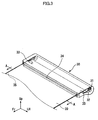
- Figure 3 is a perspective view of the cover storage member 30 provided with a space for storing the cover.
- a shaft 31, to which one end of the cover 20 is fastened, and a motor 33 for rotating the shaft 31 via a belt 32 are provided within the storage space.
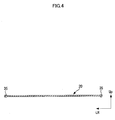
- Figure 4 is a cross-sectional view viewed from A-A in Figure 3 .
- a wire 35 is attached to the both ends of the cover 20, and one end of the wire 35 is fastened to the shaft 31.
- the wire 35 is sent from the entrance 34 of the cover storage member 30 toward the front of the roof along the first rails 13L, 13R by normal rotation of the motor 33.
- the cover stretches over the roof 11, following the movement of the wire 35, thus covering the opening 12.
- reverse rotation of the motor 33 winds up the cover 20 stretched over the roof 11 along with the wire 35, thus forming the opening 12.
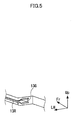
- the edge of the insertion slot 13G at the rear end of the first rail 13R is chamfered so that the cover 20 sent from the entrance 34 of the cover storage member 30 enters the first rails 13L, 13R smoothly.
- the sliding roof structure of the first embodiment of this invention is designed to allow the cover storage member 30 to move from the position at the rear edge of the roof, hereafter referred to as position A, to the position on the deck shown by dotted line at the back of the rear seat 15, hereafter referred to as position B.
- the sliding roof structure 1 of this invention is equipped with a guiding means 40 for transferring the cover storage member 30 between position A and position B, as shown in Figure 6 .
- this guiding means 40 is equipped with second rails 41, which are installed between position A and position B to move the cover storage member 30 up and down, and a transferring means 42 for moving the cover storage member 30.
- the second rails 41 installed on the inner walls 19 (see figure 2 ) at the rear of the vehicle extend in the vertical direction.
- two rails 41 are laid apart from each other in the longitudinal direction of the vehicle on the right and left sides of the vehicle.
- a convex protruding outward in the width direction of the vehicle is provided on the right and left edges of the cover storage member 30 as shown in Figure 7 .
- two convexes 36, 36 are provided apart from each other in the longitudinal direction of the vehicle. These convexes 36 are slid along and supported by the second rails 41, which allows the cover storage member 30 to move up and down.
- the cover storage member 30 moves up and down along the second rails 41 via the transferring means 42.
- the transferring means 42 is comprised of a motor 42A, pulley 42B mounted to the rotating shaft of the motor 42A, wire 42C sent from the pulley 42 via normal rotation of the motor 42A and rewound around the pulley 42B via reverse rotation of the motor 42A, and tube 42D for guiding the wire 42C.
- the edges of the tube 42D are attached to the lower part of the second rails 41, and the wire 42C coming out of the tube 42D passes within the second rails 41 and connected to the convex 36 provided at the edges of the cover storage member 30, which slides along the second rails 41, from the bottom.
- the first embodiment of this invention is equipped with a stopper mechanism 50, which prevents the cover storage member 30 from going down when it is at position A.
- a stopper mechanism 50 which prevents the cover storage member 30 from going down when it is at position A.
- locking members 51 for locking the convexes 36 at the top of the second rails 41 are installed at the top of the second rails 41, in a state in which the locking members 51 are protruded into or retracted from the second rails 41, and normally kept protruded with the repulsive force of springs 52.
- the deck 60 is provided with a concave 61 for partially embedding the cover storage member 30.
- the sliding roof structure 1 of the first embodiment of this invention is described below.
- the front part of the cover 20 is slid toward the back of the vehicle as in the case of conventional sliding roof type vehicles.
- reverse rotation of the motor 33 installed within the cover storage member 30 winds the cover 20 up around the shaft 31, and thus the cover 20 is stored in the cover storage member 30.
- the position of the cover storage member 30 is controlled by the stopper mechanism 50 so that it is maintained at position A. If a user operates the in-vehicle switch to drive the transferring means 42, the motor 42A is actuated to wind up the wire 42C around the pulley 42B, thus applying force for transporting the cover storage member 30 downward.
- the cover 20 wound up as a result of forming the opening 12 in the roof 11 can be transferred from the position on the roof 11 to inside the vehicle. Consequently, since the cover does not occupy a part of the roof 11, unlike conventional sliding roof structures, the opening 12 can be made larger. Meanwhile, since the cover 20 is wound up within the cover storage member 30, it is not visible through the rear window glass 14a even if it is transferred to inside the vehicle. In addition, in the first embodiment of this invention, since the top edge of the rear window glass 14a is configured to directly contact the cover storage member 30 at position A, a larger opening is formed by lowering the cover storage member 30 together with the rear window glass 14a.
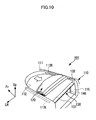
- FIG. 10 shows a perspective view of a hatchback type vehicle 110 featuring a sliding roof structure 101 of the second embodiment of this invention.
- the vehicle 110 has an opening 112 in its roof 111.
- the opening 112 has been formed by cutting the area from the rear to the front of the roof in an arch-like shape, with the edges on both sides left as they are. This opening 112 can be covered by a cover 120, or left open.
- the cover 120 is equipped with multiple rods (not shown), which extend outward in the width direction, placed at specified intervals in the longitudinal direction of the vehicle.
- the tip of each rod protrudes from the right or left edge of the cover 120 outwards in the width direction of the vehicle.
- the first rails 113L and 113R for guiding the tip of these rods are provided along the right and left edges, which extend in the longitudinal direction of the vehicle, of the opening 112 respectively.
- the cover 120 is supported by and slides along the first rails 113L and 113R.
- the cover 120 is folded through a process in which the cloth between rods adjacent to each other is folded when the front and the rear edges of the cover 120 are moved closer to each other. By folding the cover 120 while moving it toward the rear side of the vehicle, an opening 112 is formed.
- the sliding roof structure 101 in the second embodiment of this invention is configured to allow the cover 120 to move from the roof surface to inside the vehicle.
- the sliding roof structure 101 of this invention is equipped with a tray for the cover 130, second rails 140, and a retaining means 150 (see Figure 13 ).
- the tray for the cover 130 is used for placing the cover on it in folded state for transportation. As shown in Figure 11 , the tray for the cover 130 moves between position A, the rear end of the first rail 113R laid in horizontal direction, and position B, the second position that is lower than position A.
- the tray for the cover 130 is provided with a base plate 131, whose long sides extend in the width direction of the vehicle, and extension rails 132, 132 installed at the right and left sides of the base plate 131.
- the dimensions of the base plate 131 are determined so that it extends horizontally under the entire area of folded cover.
- the extension rails 132, 132 are used for guiding the tips of the rods, which protrude from the right and left edges of the cover 120, respectively.
- the extension rails 132, 132 are placed behind the first rails 113L, 113R at the same height as the first rails (113L, 113R).
- extension guide grooves 132A which are connected to the guide grooves 113A of the first rails 113L, 113R in a state in which the tray for the cover 130 is retained at the first position (A), are formed on the extension rails 132, 132, as shown in Figure 11 .
- each rod is transferred along these guide grooves 113A, 132A.
- the rod mounted to the back end of the cover 120 is fastened to the tray for the cover 130.
- the extension guide groove 132A of the extension rail 132 extends to the middle of the extension rail 132 slightly to the rear of the vehicle, and the rod mounted to the rear end of the cover 120 are fastened at the position of the rear end of this extension guide groove 132A.
- a convex protruding outward in the width direction of the vehicle is provided at the right and left sides of the tray for the cover 130.
- the convex 133 is mounted to the base plate 131 via a bracket 134.
- two convexes 133, 133 are provided apart from each other in the longitudinal direction of the vehicle.
- the second rails 140 installed on the inner wall 115 at the rear of the vehicle extend in the vertical direction.
- two rails 140, 140 each are laid apart from each other in the longitudinal direction of the vehicle on the right and left sides of the vehicle.
- a guide groove 141 for guiding the convex is formed along the longitudinal direction of the second rails 140, 140.
- the dimensions of the second rails 140, 140 are determined, and the second rails 140, 140 are mounted to a desired position on the internal wall 115, so that the tray for the cover 130 can be transferred vertically, guided by the second rails 140, from the first position (A), which is on the surface of the roof, to the second position (B), the position within the vehicle directly below the first position (A).
- a retaining means 150 is used for retaining the tray for the cover 130 at the top of the second rails 140, in a state where the cover can be released.
- the tray for the cover 130 is retained at the first position (A) with the retaining means 150.
- the retaining means 150 is equipped with a protruding piece 151, which can be protruded into or retracted from the guide groove 141 of the second rail 140.
- the protruding piece 151 is comprised of a base 151A and a rotating part 151C, which is mounted to the base 151A in rotatable state via a hinge 151B.
- the base 151A moves within a cylindrical part 143, which is integrated in the side wall 142 of the guide groove 141. Furthermore, as shown in Figure 15 , the base 151A is forced to move toward the guide groove 141 with a spring 145.
- the cylindrical part 143 is formed with its shaft extended in the direction orthogonal to the longitudinal direction of the guide groove 141.
- the base 151A moves within the cylindrical part 143 to make the rotating part 151C, which is installed at the edge of the base 151A, protrude into or retract from the guide groove 141.
- the length (L) of the rotating part 151C is made longer than the width (W) of the guide groove 141 (see Figure 14 ), and consequently, when the rotating part 151C is protruded into the guide groove 141, its connecting part with the base 151A is placed on the guiding surface 143A of the cylindrical part 143. Furthermore, a concave 141B for housing the rotating part 151C is provided on the surface 141A of the guide groove 141 above the guiding surface 143A The rotating part 151C of the protruding piece 151 is rotated upward and then housed in the concave 141B. The depth and shape of the concave 141B is determined so that the rotating part 151C is housed flash with the surface of the guide groove 141.
- a wire 155 is connected to the protruding piece 151, and the other end of the wire is connected to a switching device (not shown) installed within the vehicle via a pulley 156.
- the switching device integrates a motor, for example, and the motor winds up the wire 155 to retract the protruding piece 151 of the retaining means 150 from the guide groove 141.
- This structure allows the convex 133 placed on the upper surface of the protruding piece 151 to move downward when the protruding piece 151 is retracted from the guide groove 141, and thus the tray for the cover 130 can move downward.
- the tray for the cover 130 is moved up or down along the second rails 140 with a lifting and lowering device160 shown in Figure 16 .
- the lifting and lowering device 160 is equipped with a motor 161 and two pairs of wires 162 connected to the motor 161.
- the end of a pair of wires 162, 162 is attached on the right and left sides of the tray for the cover 130 at positions away from each other in the longitudinal direction of the vehicle.
- the motor 161 controls the length of the wire 162, thus lifting or lowering the tray for the cover 130.
- the tray for the cover 130 is shown schematically in Figure 16 .
- the tray for the cover 130 can be lifted by winding up the wire 160B connected to the convex 133 with a motor 160A installed at the position adjacent to the surface of the roof at the rear part of the vehicle, as shown in Figure 17 .
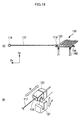
- first hook members 121 are provided on both sides of the front edge of the cover 120, as shown in Figure 18 (A) , and the first hook members 121 are transferred toward the front or the rear side of the roof as a result of winding up or discharging of the wire 117 by the motor 116 integrated in the roof 111, and the opening 112 is thus closed or formed.
- the second hook member 118 mounted to the tip of the wire 117 is engaged in the first hook member 121.
- the first hook member 121 and the second hook member 118 are engaged in the longitudinal direction of the vehicle as shown by ⁇ in Figure 18 (B) .
- the shape and orientation of the hook constituting each hook member 118, 121 are determined so that the first hook member 121 is disengaged from the second hook member 118 when moved downward from the engaged position.
- the sliding roof structure 101 of the second embodiment of this invention is described below.
- the front part of the cover is slid toward the rear side of the vehicle as in the case of conventional sliding roof type vehicles ( Figure 10 ).
- the cloth between the front edge and the rear edge of the cover is folded and placed on the tray for the cover 130.
- the retaining means 150 maintains the tray for the cover 130 at the first position (A). If a user operates an in-vehicle switch to wind up the wire 155 connected to the protruding piece 151 of the retaining means 150, the protruding piece 151 is retracted from the guide groove 141. Consequently, the convex 133 moves downward, allowing the tray for the cover 130 to move from the first position (A) to the second position (B).
- the sliding roof structure 101 With the sliding roof structure 101 thus configured, by forming the opening 112 in the roof 111, the folded cover 120 can be moved from the position on the roof 111 to inside the vehicle. Since the cover 120 does not remain on the roof 111, unlike conventional sliding roof structures, a large opening 112 can be formed. Furthermore, since the top edge of the rear door glass directly contacts the tray for the cover 130, the opening can be made even larger if the rear door glass is lowered.
- the present invention allows the cover, which is folded to form an opening in the roof, to be transferred from the top (roof) to inside the vehicle. Consequently, the cover does not occupy roof area, unlike conventional sliding roof structures, allowing the opening to be made larger and thus providing passengers with enhanced sense of openness.
- Various embodiments are allowed without departing from the scope of the invention.
Landscapes
- Engineering & Computer Science (AREA)
- Mechanical Engineering (AREA)
- Fittings On The Vehicle Exterior For Carrying Loads, And Devices For Holding Or Mounting Articles (AREA)
Abstract
Description
- The present invention relates to a sliding roof structure for covering the opening in a roof of a vehicle with a cover.
- In order to lighten and facilitate taking in outside air into vehicle interior, vehicle roof structures such as sunroof, open roof and sliding roof are well known. Compared with the sunroof structure, the sliding roof structure, also known as canvas top structure or open roof structure, which hereinafter called sliding roof structure in this specification, allows the roof to be opened more widely, thus providing passengers enhanced sense of openness.
- As shown in
Figure 19 , a part of theroof 210 of a slidingroof type vehicle 200 is cut off to form anopening 211, to which acover member 220 is attached in openable/closable state. With this type ofvehicle 200, by sliding and thus folding thecover member 220 toward the rear or the front side of the vehicle, the opening 211 is formed.
A conventional sliding roof type vehicle is disclosed inJP2003-507244A Figures 1 and2 ) - In order to provide passengers on a sliding
roof type vehicle 200 with enhanced sense of openness, the opening 211 must be made as large as possible. However, with the conventional sliding roof type vehicles, the opening 211 cannot be made larger exceeding the limitations imposed by their manufacturing procedures, where the roof of the vehicle is replaced by a sliding roof. In addition, as shown inFigure 19 , the foldedcover member 220 occupies some part of the opening 211, hampering the opening from being made larger. - The purpose of the present invention is to provide an opening larger than that of conventional sliding roof type vehicles by transferring folded cover into the vehicle.
- This invention involves followings.
(1) A sliding roof structure for opening/closing an opening in the roof of a vehicle with a cover member comprising; a cover storage means which constitutes the rear end of the roof and stores the cover member, and a guiding means for transferring the cover storage means between a position at the rear end of the roof and a position inside the vehicle.
In this case, the cover storage means includes a winding means for winding the cover member.
The guiding means is equipped with lifting/lowering rails installed between the position at the rear end of the roof and the position inside the vehicle.
The sliding roof structure has a stopper mechanism for maintaining the cover storage means at the rear end of the roof.
Also the lifting/lowering rails are installed inclined so that the position inside the vehicle is nearer to the front than the position at the rear end of the vehicle. - (2) A sliding roof structure for opening/closing an opening in the roof of a vehicle with a cover comprising; opening/closing rails installed along the opening for guiding the transfer of the cover member, a cover member tray for holding the folded cover member, and r lifting/lowering rails for guiding the cover member tray from the roof position to the position inside the vehicle, which is under the roof position.
- (3) A sliding roof structure of a vehicle comprising: an opening formed in the roof, a foldable cover member for covering the opening, opening/closing rails installed along the edge portion on the right and left sides of the opening to guide the cover member so that the cover member slides in the longitudinal direction of the vehicle, a cover member tray for holding the folded cover member, lifting/lowering rails for guiding the cover member tray so that the cover member tray moves between the first position at the rear side of the opening/closing rails and the second position under the first position, and retaining means for retaining the cover member tray at the first position in releasable state, wherein the cover member is slid and folded toward the rear side of the roof to form the opening, the entire cover member is placed on the cover, and the cover member tray is lowered from the first position to the second position inside the vehicle. opening.
The cover member tray includes a convex protruding outward in the width direction of the vehicle at the edge portion on right and left sides of the tray, the lifting/lowering rails include a guide groove along which the convex slides, the retaining means includes a protruding piece that protrudes into or retracted from the guide groove, and the convex is placed on the protruding piece to retain the cover member tray at the first position.
(4) A vehicle having one of sliding roof structure of above mentioned structure (1) to (3). -
-
Figure 1 is a perspective rear view of a vehicle adopting a sliding roof structure of the first embodiment of this invention. -
Figure 2 is a schematic perspective view of the rear part of the vehicle shown inFigure 1 . -
Figure 3 is a perspective view of a cover storage member of the first embodiment of this invention. -
Figure 4 is a cross-sectional view viewed from A-A inFigure 3 . -
Figure 5 is a perspective view showing the rear end of the first rail of the first embodiment of this invention. -
Figure 6 shows the sliding roof structure of the first embodiment of this invention. -
Figure 7 is a perspective view showing the sliding roof structure of the first embodiment of this invention. -
Figure 8 shows a stopper mechanism of the first mechanism of this invention. -
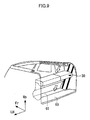
Figure 9 is a perspective view for describing the operation of a sliding roof structure of the first embodiment of this invention. -
Figure 10 is a perspective view showing the rear part of a vehicle adopting a sliding roof structure of the second embodiment of this invention. -
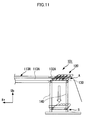
Figure 11 is a schematic cross-sectional view of the rear part of the vehicle shown inFigure 10 . -
Figure 12 is a schematic cross-sectional view of the rear part of the vehicle shown inFigure 10 . -
Figure 13 is a perspective of the retaining means in the sliding roof structure shown inFigure 10 . -
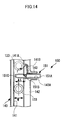
Figure 14 is a side view of the retaining means in the sliding roof structure shown inFigure 10 . -
Figure 15 is a perspective of the retaining means shown inFigure 14 . -
Figure 16 is a perspective view of the lifting and lowering device in the sliding roof structure shown inFigure 10 . -
Figure 17 is a perspective view of another lifting and lowering device in the sliding roof structure shown inFigure 10 . -
Figure 18 shows a mechanism for sliding the cover in the sliding roof structure inFigure 1 . -
Figure 19 is a perspective view of a conventional sliding roof type vehicle. - The first embodiment of this invention is described below based on drawings. The arrow marked as "Fr" in the drawing indicates the front of the vehicle, while "Up" indicates the top and "LH" the left-hand side of the vehicle.
Figure 1 shows a perspective view of a hatchback type vehicle (10) featuring a sliding roof structure of the first embodiment of this invention. - This
vehicle 10 has an opening 12 in itsroof 11. Theopening 12 has been formed by cutting the area from the rear to the front of the roof in an arch-like shape, with the edges on both sides left as they are. This opening 12 can be covered with acover 20, or left open. Thefirst rails cover 20 are installed along the right and left edges of theopening 12, which extend in the longitudinal direction of the vehicle. - The
roof 11 of thevehicle 10 of the first embodiment of this invention has been cut in a gate-like shape, and as shown inFigure 2 , there is nothing between the right and leftrear corners 14L, 14R of the roof. As shown inFigure 1 , acover storage member 30 is provided between bothcorners 14L, 14R. Thiscover storage member 30 constitutes the rear edge of theroof 11. InFigure 2 , the rear door and rear window glass are not shown. -
Figure 3 is a perspective view of thecover storage member 30 provided with a space for storing the cover. Ashaft 31, to which one end of thecover 20 is fastened, and amotor 33 for rotating theshaft 31 via abelt 32 are provided within the storage space.Figure 4 is a cross-sectional view viewed from A-A inFigure 3 . Awire 35 is attached to the both ends of thecover 20, and one end of thewire 35 is fastened to theshaft 31. Thewire 35 is sent from theentrance 34 of thecover storage member 30 toward the front of the roof along thefirst rails motor 33. The cover stretches over theroof 11, following the movement of thewire 35, thus covering theopening 12. On the other hand, reverse rotation of themotor 33 winds up thecover 20 stretched over theroof 11 along with thewire 35, thus forming theopening 12. - As shown in
Figure 5 , the edge of theinsertion slot 13G at the rear end of thefirst rail 13R is chamfered so that thecover 20 sent from theentrance 34 of thecover storage member 30 enters thefirst rails - As shown in
Figure 1 , in a state in which therear window glass 14a of therear door 14 is closed, the top edge of therear window glass 14a contacts the rear edge of thecover storage member 30 in sealed state or water tight. The bottom face of thecover storage member 30 constitutes a part of the ceiling of the vehicle. - Furthermore, as shown in
Figure 6 , the sliding roof structure of the first embodiment of this invention is designed to allow thecover storage member 30 to move from the position at the rear edge of the roof, hereafter referred to as position A, to the position on the deck shown by dotted line at the back of therear seat 15, hereafter referred to as position B. - To achieve this, the sliding roof structure 1 of this invention is equipped with a guiding means 40 for transferring the
cover storage member 30 between position A and position B, as shown inFigure 6 . As shown inFigure 7 , this guiding means 40 is equipped withsecond rails 41, which are installed between position A and position B to move thecover storage member 30 up and down, and a transferring means 42 for moving thecover storage member 30. The second rails 41 installed on the inner walls 19 (seefigure 2 ) at the rear of the vehicle extend in the vertical direction. In the first embodiment of this invention, tworails 41 are laid apart from each other in the longitudinal direction of the vehicle on the right and left sides of the vehicle. In order for thecover storage member 30 to move along thesecond rails 41, a convex protruding outward in the width direction of the vehicle is provided on the right and left edges of thecover storage member 30 as shown inFigure 7 . In the first embodiment of this invention, twoconvexes convexes 36 are slid along and supported by thesecond rails 41, which allows thecover storage member 30 to move up and down. - As shown in
Figure 7 , thecover storage member 30 moves up and down along thesecond rails 41 via the transferring means 42. The transferring means 42 is comprised of amotor 42A,pulley 42B mounted to the rotating shaft of themotor 42A,wire 42C sent from the pulley 42 via normal rotation of themotor 42A and rewound around thepulley 42B via reverse rotation of themotor 42A, andtube 42D for guiding thewire 42C. As shown inFigure 7 , the edges of thetube 42D are attached to the lower part of thesecond rails 41, and thewire 42C coming out of thetube 42D passes within thesecond rails 41 and connected to the convex 36 provided at the edges of thecover storage member 30, which slides along thesecond rails 41, from the bottom. By controlling the length of thewire 42C on thesecond rails 41 with themotor 42A, thecover storage member 30 moves up and down. - Furthermore, the first embodiment of this invention is equipped with a
stopper mechanism 50, which prevents thecover storage member 30 from going down when it is at position A. As shown inFigure 8 , lockingmembers 51 for locking theconvexes 36 at the top of thesecond rails 41 are installed at the top of thesecond rails 41, in a state in which thelocking members 51 are protruded into or retracted from thesecond rails 41, and normally kept protruded with the repulsive force ofsprings 52. - If force is applied to move the
cover storage member 30 downward, resisting the repulsive force of thesprings 52, in a state in which downward movement is restricted by thestopper mechanism 50 as shown inFigure 8 , the convex 36 moves downward, pushing aside the lockingmember 51, thus allowing thecover storage member 30 to come down and be placed on the surface of the deck as shown inFigure 6 . Thedeck 60 is provided with a concave 61 for partially embedding thecover storage member 30. - The operation of the sliding roof structure 1 of the first embodiment of this invention is described below.
To form anopening 12 in theroof 11, the front part of thecover 20 is slid toward the back of the vehicle as in the case of conventional sliding roof type vehicles. In this case, reverse rotation of themotor 33 installed within thecover storage member 30 winds thecover 20 up around theshaft 31, and thus thecover 20 is stored in thecover storage member 30. The position of thecover storage member 30 is controlled by thestopper mechanism 50 so that it is maintained at position A. If a user operates the in-vehicle switch to drive the transferring means 42, themotor 42A is actuated to wind up thewire 42C around thepulley 42B, thus applying force for transporting thecover storage member 30 downward. Consequently, the convex 36 pushes aside the lockingmember 51, thus allowing thecover storage member 30 to move downward from position A to position B as shown inFigure 9 . Therear window glass 14a must be lowered slightly before lowering thecover storage member 30.
The above procedure is reversed to move thecover 20 stored at position B upward and stretch it over the roof. - With the sliding roof structure 1 designed to operate as shown above, the
cover 20 wound up as a result of forming theopening 12 in theroof 11 can be transferred from the position on theroof 11 to inside the vehicle. Consequently, since the cover does not occupy a part of theroof 11, unlike conventional sliding roof structures, theopening 12 can be made larger. Meanwhile, since thecover 20 is wound up within thecover storage member 30, it is not visible through therear window glass 14a even if it is transferred to inside the vehicle.
In addition, in the first embodiment of this invention, since the top edge of therear window glass 14a is configured to directly contact thecover storage member 30 at position A, a larger opening is formed by lowering thecover storage member 30 together with therear window glass 14a. - The first embodiment of this invention is described above. Various embodiments are allowed without departing from the scope of the invention. The above description applies to the configuration in which the second rails extend from position A to position B, which is lower and slightly to the front of the vehicle than position A. However, position B may be directly below position A.
- The second embodiment of this invention is described below based on the drawings. The arrow marked as "Fr" in the drawing indicates the front of the vehicle, while "Up" indicates the top and "LH" the left-hand side of the vehicle.
Figure 10 shows a perspective view of ahatchback type vehicle 110 featuring a slidingroof structure 101 of the second embodiment of this invention. - The
vehicle 110 has anopening 112 in itsroof 111. Theopening 112 has been formed by cutting the area from the rear to the front of the roof in an arch-like shape, with the edges on both sides left as they are. Thisopening 112 can be covered by acover 120, or left open. - The
cover 120 is equipped with multiple rods (not shown), which extend outward in the width direction, placed at specified intervals in the longitudinal direction of the vehicle. The tip of each rod protrudes from the right or left edge of thecover 120 outwards in the width direction of the vehicle. The first rails 113L and 113R for guiding the tip of these rods are provided along the right and left edges, which extend in the longitudinal direction of the vehicle, of theopening 112 respectively. - The
cover 120 is supported by and slides along thefirst rails cover 120 is folded through a process in which the cloth between rods adjacent to each other is folded when the front and the rear edges of thecover 120 are moved closer to each other. By folding thecover 120 while moving it toward the rear side of the vehicle, anopening 112 is formed. - Furthermore, as shown in
Figure 11 , the slidingroof structure 101 in the second embodiment of this invention is configured to allow thecover 120 to move from the roof surface to inside the vehicle. To achieve this, the slidingroof structure 101 of this invention is equipped with a tray for thecover 130,second rails 140, and a retaining means 150 (seeFigure 13 ). - As shown in
Figure 13 , the tray for thecover 130 is used for placing the cover on it in folded state for transportation. As shown inFigure 11 , the tray for thecover 130 moves between position A, the rear end of thefirst rail 113R laid in horizontal direction, and position B, the second position that is lower than position A. - As shown in
Figure 10 , the tray for thecover 130 is provided with abase plate 131, whose long sides extend in the width direction of the vehicle, and extension rails 132, 132 installed at the right and left sides of thebase plate 131. The dimensions of thebase plate 131 are determined so that it extends horizontally under the entire area of folded cover. - The extension rails 132, 132 are used for guiding the tips of the rods, which protrude from the right and left edges of the
cover 120, respectively. In a state in which the tray for thecover 130 is retained at the first position (A) (Figure 11 ) by the retaining means 50, which is to be described later, the extension rails 132, 132 are placed behind thefirst rails extension guide grooves 132A, which are connected to theguide grooves 113A of thefirst rails cover 130 is retained at the first position (A), are formed on the extension rails 132, 132, as shown inFigure 11 . The edge of each rod is transferred along theseguide grooves cover 120 is fastened to the tray for thecover 130. Theextension guide groove 132A of theextension rail 132 extends to the middle of theextension rail 132 slightly to the rear of the vehicle, and the rod mounted to the rear end of thecover 120 are fastened at the position of the rear end of thisextension guide groove 132A. - As shown in
Figure 12 , a convex protruding outward in the width direction of the vehicle is provided at the right and left sides of the tray for thecover 130. The convex 133 is mounted to thebase plate 131 via abracket 134. In the second embodiment of this invention, twoconvexes - To guide and support these
convexes second rails 140 installed on theinner wall 115 at the rear of the vehicle extend in the vertical direction. For each of the convex installed on both sides of the tray for thecover 130, tworails guide groove 141 for guiding the convex is formed along the longitudinal direction of thesecond rails guide groove 141, the tray for thecover 130 is moved up or down. In the second embodiment, the dimensions of thesecond rails second rails internal wall 115, so that the tray for thecover 130 can be transferred vertically, guided by thesecond rails 140, from the first position (A), which is on the surface of the roof, to the second position (B), the position within the vehicle directly below the first position (A). - As shown in
Figure 13 , a retaining means 150 is used for retaining the tray for thecover 130 at the top of thesecond rails 140, in a state where the cover can be released. The tray for thecover 130 is retained at the first position (A) with the retaining means 150. For that purpose, the retaining means 150 is equipped with a protrudingpiece 151, which can be protruded into or retracted from theguide groove 141 of thesecond rail 140.
As shown inFigure 14 , the protrudingpiece 151 is comprised of abase 151A and a rotating part 151C, which is mounted to thebase 151A in rotatable state via ahinge 151B. Thebase 151A moves within acylindrical part 143, which is integrated in theside wall 142 of theguide groove 141. Furthermore, as shown inFigure 15 , thebase 151A is forced to move toward theguide groove 141 with aspring 145. Thecylindrical part 143 is formed with its shaft extended in the direction orthogonal to the longitudinal direction of theguide groove 141. Thebase 151A moves within thecylindrical part 143 to make the rotating part 151C, which is installed at the edge of thebase 151A, protrude into or retract from theguide groove 141. The length (L) of the rotating part 151C is made longer than the width (W) of the guide groove 141 (seeFigure 14 ), and consequently, when the rotating part 151C is protruded into theguide groove 141, its connecting part with thebase 151A is placed on the guidingsurface 143A of thecylindrical part 143. Furthermore, a concave 141B for housing the rotating part 151C is provided on thesurface 141A of theguide groove 141 above the guidingsurface 143A The rotating part 151C of the protrudingpiece 151 is rotated upward and then housed in the concave 141B. The depth and shape of the concave 141B is determined so that the rotating part 151C is housed flash with the surface of theguide groove 141. - With this retaining means 150, when the convex 133 is placed on the upper surface of the protruding
piece 151, which protrudes into theguide groove 141, the tray for thecover 130 is retained at the first position (A). Meanwhile, as shown inFigure 14 , when the convex 133 moves from under toward the protrudingpiece 151 and touches the protrudingpiece 151, which protrudes into theguide groove 141, the rotating part 151C of the protrudingpiece 151 rotates upward, thus ensuring the upward movement of the convex 133. - Furthermore, as shown in
Figures 13 and15 , awire 155 is connected to the protrudingpiece 151, and the other end of the wire is connected to a switching device (not shown) installed within the vehicle via apulley 156. The switching device integrates a motor, for example, and the motor winds up thewire 155 to retract the protrudingpiece 151 of the retaining means 150 from theguide groove 141. This structure allows the convex 133 placed on the upper surface of the protrudingpiece 151 to move downward when the protrudingpiece 151 is retracted from theguide groove 141, and thus the tray for thecover 130 can move downward. - The tray for the
cover 130 is moved up or down along thesecond rails 140 with a lifting and lowering device160 shown inFigure 16 . The lifting and loweringdevice 160 is equipped with amotor 161 and two pairs ofwires 162 connected to themotor 161. The end of a pair ofwires cover 130 at positions away from each other in the longitudinal direction of the vehicle. Themotor 161 controls the length of thewire 162, thus lifting or lowering the tray for thecover 130. The tray for thecover 130 is shown schematically inFigure 16 .
Instead of providing the lifting and loweringdevice 160, the tray for thecover 130 can be lifted by winding up thewire 160B connected to the convex 133 with amotor 160A installed at the position adjacent to the surface of the roof at the rear part of the vehicle, as shown inFigure 17 . - In addition, in the second embodiment,
first hook members 121 are provided on both sides of the front edge of thecover 120, as shown inFigure 18 (A) , and thefirst hook members 121 are transferred toward the front or the rear side of the roof as a result of winding up or discharging of thewire 117 by themotor 116 integrated in theroof 111, and theopening 112 is thus closed or formed. Thesecond hook member 118 mounted to the tip of thewire 117 is engaged in thefirst hook member 121. Thefirst hook member 121 and thesecond hook member 118 are engaged in the longitudinal direction of the vehicle as shown by α inFigure 18 (B) . The shape and orientation of the hook constituting eachhook member first hook member 121 is disengaged from thesecond hook member 118 when moved downward from the engaged position. - The sliding
roof structure 101 of the second embodiment of this invention is described below.
In order to form theopening 112 in theroof 111, the front part of the cover is slid toward the rear side of the vehicle as in the case of conventional sliding roof type vehicles (Figure 10 ). At this time, the cloth between the front edge and the rear edge of the cover is folded and placed on the tray for thecover 130. The retaining means 150 maintains the tray for thecover 130 at the first position (A). If a user operates an in-vehicle switch to wind up thewire 155 connected to the protrudingpiece 151 of the retaining means 150, the protrudingpiece 151 is retracted from theguide groove 141. Consequently, the convex 133 moves downward, allowing the tray for thecover 130 to move from the first position (A) to the second position (B). - With the sliding
roof structure 101 thus configured, by forming theopening 112 in theroof 111, the foldedcover 120 can be moved from the position on theroof 111 to inside the vehicle. Since thecover 120 does not remain on theroof 111, unlike conventional sliding roof structures, alarge opening 112 can be formed. Furthermore, since the top edge of the rear door glass directly contacts the tray for thecover 130, the opening can be made even larger if the rear door glass is lowered. - As explained above, the present invention allows the cover, which is folded to form an opening in the roof, to be transferred from the top (roof) to inside the vehicle. Consequently, the cover does not occupy roof area, unlike conventional sliding roof structures, allowing the opening to be made larger and thus providing passengers with enhanced sense of openness. Various embodiments are allowed without departing from the scope of the invention.
Claims (10)
- A sliding roof structure comprising: an opening formed in the roof of a vehicle, a foldable cover member for covering the opening, and rails installed along the edge portion on the right and left sides of the opening to guide the cover member so that the cover member is slid in the longitudinal direction of the vehicle, wherein the cover member is slid and folded toward the rear side of the roof to form the opening, characterized in that a cover member holding section for holding the folded cover member and guiding means for guiding the cover member holding section are provided so that the cover member holding section moves between a position at the rear end of the roof and a position inside the vehicle.
- The sliding roof structure according to claim 1, characterized in that the cover member holding section is a cover storage means which constitutes the rear end of the roof and stores the cover member.
- The sliding roof structure according to claim 2, wherein the cover storage means includes a winding means for winding the cover member.
- The sliding roof structure according to any one of claims 1 to 3, wherein the guiding means includes lifting/lowering rails installed between the position at the rear end of the roof and the position inside the vehicle, and a transferring means for transferring the cover storage means.
- A cover member storage structure according to any one of claims 1 to 4, characterized by a stopper mechanism for holding the cover storage means at the rear end of the roof.
- The sliding roof structure according to claims 4 or 5, characterized in that the lifting/lowering rails are installed inclined, with the position inside the vehicle placed nearer to the front of the vehicle than the position at the rear end of the roof.
- A cover member sliding structure according to claim 1, characterized in that the cover member holding section is a cover member tray for holding the folded cover member.
- The sliding roof structure according to claim 7, characterized by a retaining means for retaining the cover member tray at the rear end of the opening/closing rails.
- The sliding roof structure according to claim 8, characterized in that the guiding means includes lifting/lowering rails which are installed between the position at the rear end of the roof and the position inside the vehicle, the cover member tray is equipped with a convex protruding outward in the width direction of the vehicle at the right and left sides of the tray, the lifting/lowering rails include a guide groove for transferring the convex, the retaining means includes a protruding piece that is protruded into or retracted from the guide groove, and the convex is placed on the protruding piece in order to hold the cover member tray at the position at the rear end of the opening/closing rails.
- A vehicle having one of sliding roof structure according to claim 1-9.
Applications Claiming Priority (2)
| Application Number | Priority Date | Filing Date | Title |
|---|---|---|---|
| JP2007268434A JP4534236B2 (en) | 2007-10-15 | 2007-10-15 | Canvas top structure |
| JP2007275815A JP4465688B2 (en) | 2007-10-23 | 2007-10-23 | Canvas storage structure |
Publications (2)
| Publication Number | Publication Date |
|---|---|
| EP2050605A2 true EP2050605A2 (en) | 2009-04-22 |
| EP2050605A3 EP2050605A3 (en) | 2010-05-05 |
Family
ID=40130509
Family Applications (1)
| Application Number | Title | Priority Date | Filing Date |
|---|---|---|---|
| EP08164117A Withdrawn EP2050605A3 (en) | 2007-10-15 | 2008-09-11 | Sliding roof structure and vehicle equipped with the same |
Country Status (2)
| Country | Link |
|---|---|
| US (1) | US7891729B2 (en) |
| EP (1) | EP2050605A3 (en) |
Cited By (1)
| Publication number | Priority date | Publication date | Assignee | Title |
|---|---|---|---|---|
| FR2950839A1 (en) * | 2009-10-01 | 2011-04-08 | Webasto Systemes Carrosserie | Convertible vehicle i.e. automobile, has foldable flexible roof whose fabric is adapted to be moved between opening roof position and drophead position when rear window is in opened position |
Families Citing this family (4)
| Publication number | Priority date | Publication date | Assignee | Title |
|---|---|---|---|---|
| DE102014211163B4 (en) * | 2013-06-28 | 2023-12-21 | Bos Gmbh & Co. Kg | Protective device for a loading space of a motor vehicle and drive device therefor |
| US9340143B2 (en) * | 2014-08-27 | 2016-05-17 | Ford Global Technologies, Llc | Adjustable cargo track system on side panel |
| DE102015220192B3 (en) * | 2015-10-16 | 2017-03-09 | Bos Gmbh & Co. Kg | Protective device for a loading space of a motor vehicle |
| USD847078S1 (en) * | 2017-07-06 | 2019-04-30 | Fca Us Llc | Automobile roof |
Citations (2)
| Publication number | Priority date | Publication date | Assignee | Title |
|---|---|---|---|---|
| JP2003507244A (en) | 1999-08-24 | 2003-02-25 | プジョー シトロエン オートモビル エス アー | Removable covering module for the living space of a motor vehicle and motor vehicle equipped with such a module |
| EP1747925A1 (en) | 2005-07-27 | 2007-01-31 | ArvinMeritor GmbH | Assembly consisting of one motor vehicle folding top and one roller blind |
Family Cites Families (13)
| Publication number | Priority date | Publication date | Assignee | Title |
|---|---|---|---|---|
| US2210590A (en) * | 1937-08-30 | 1940-08-06 | Jobst Conrad | Automobile |
| CH403509A (en) * | 1963-11-18 | 1965-11-30 | Rollman Paul | Convertible roof |
| JPH0722342Y2 (en) | 1989-02-25 | 1995-05-24 | 池田物産株式会社 | Car canvas top structure |
| JP3305784B2 (en) | 1992-12-21 | 2002-07-24 | ベバスト ジャパン株式会社 | Canvas top switchgear |
| US5655807A (en) * | 1996-03-25 | 1997-08-12 | Rosario; Israel | Cover for the bed of a pickup truck with an associated roll-up housing |
| DE19927234C1 (en) | 1999-06-15 | 2000-07-27 | Webasto Vehicle Sys Int Gmbh | Guide rail for accommodating displaceable vehicle roof part(s) has first section with centring element that interacts with complementary counter element on second section |
| DE10032378C2 (en) | 2000-07-06 | 2002-10-24 | Webasto Vehicle Sys Int Gmbh | Convertible vehicle roof |
| JP4243480B2 (en) * | 2000-11-09 | 2009-03-25 | イナルファ・ルーフ・システムズ・グループ・ベーフェー | OPEN ROOF STRUCTURE FOR VEHICLE AND VEHICLE HAVING SUCH OPEN ROOF STRUCTURE |
| DE10233029B4 (en) * | 2002-07-20 | 2005-01-05 | Webasto Vehicle Systems International Gmbh | Vehicle with changeable rear body |
| JP2003160063A (en) | 2002-09-06 | 2003-06-03 | Hiroshi Yano | Passenger car with deformable trunk |
| FR2865163B1 (en) * | 2004-01-21 | 2007-11-30 | France Design | VEHICLE WITH DISCOVERABLE ROOF AND REAR TAIL |
| JP4413068B2 (en) | 2004-04-28 | 2010-02-10 | ベバスト ジャパン株式会社 | Vehicle roof storage structure |
| FR2902045B1 (en) * | 2006-06-12 | 2013-09-06 | Heuliez | RETRACTABLE ROOF INSERTED IN A SUPERIOR WALL OF A VEHICLE |
-
2008
- 2008-09-11 EP EP08164117A patent/EP2050605A3/en not_active Withdrawn
- 2008-09-11 US US12/209,130 patent/US7891729B2/en not_active Expired - Fee Related
Patent Citations (2)
| Publication number | Priority date | Publication date | Assignee | Title |
|---|---|---|---|---|
| JP2003507244A (en) | 1999-08-24 | 2003-02-25 | プジョー シトロエン オートモビル エス アー | Removable covering module for the living space of a motor vehicle and motor vehicle equipped with such a module |
| EP1747925A1 (en) | 2005-07-27 | 2007-01-31 | ArvinMeritor GmbH | Assembly consisting of one motor vehicle folding top and one roller blind |
Cited By (1)
| Publication number | Priority date | Publication date | Assignee | Title |
|---|---|---|---|---|
| FR2950839A1 (en) * | 2009-10-01 | 2011-04-08 | Webasto Systemes Carrosserie | Convertible vehicle i.e. automobile, has foldable flexible roof whose fabric is adapted to be moved between opening roof position and drophead position when rear window is in opened position |
Also Published As
| Publication number | Publication date |
|---|---|
| US20090224572A1 (en) | 2009-09-10 |
| US7891729B2 (en) | 2011-02-22 |
| EP2050605A3 (en) | 2010-05-05 |
Similar Documents
| Publication | Publication Date | Title |
|---|---|---|
| CN205706108U (en) | Light shielding device | |
| EP2050605A2 (en) | Sliding roof structure and vehicle equipped with the same | |
| KR101690823B1 (en) | Sunshade device | |
| KR20110063373A (en) | Protective device for in-vehicle space | |
| KR20150002545A (en) | Shading device for a glass surface region of a motor vehicle | |
| JP2008534358A (en) | Car cargo space cover | |
| JP5431838B2 (en) | Sunshade equipment | |
| JP7342327B2 (en) | Deflector mechanism of sunroof device | |
| KR102298958B1 (en) | Structure of Electric Sun-rood and Sun-shade | |
| US9586463B2 (en) | Top for an openable vehicle roof | |
| JP2010018233A (en) | Front door opening/closing device | |
| JP4534236B2 (en) | Canvas top structure | |
| US11731495B2 (en) | Drip mechanism of sunroof device | |
| KR100868657B1 (en) | Car sun visor device | |
| JP2010069928A (en) | Cover device for luggage compartment of automobile | |
| JP4465688B2 (en) | Canvas storage structure | |
| JP4397231B2 (en) | Sunroof device | |
| US8020915B2 (en) | Openable roof system for a motor car | |
| KR100747030B1 (en) | Vehicle sunroof switchgear | |
| JP4568871B2 (en) | Tonneau cover device | |
| JP4352431B2 (en) | Canvas storage structure | |
| JP3120245B2 (en) | Sunroof equipment | |
| JP3100306B2 (en) | Sunroof shade device | |
| JPH02212220A (en) | Motor-driven slide type sunvisor | |
| JP2005186810A (en) | Rear gate device for vehicle |
Legal Events
| Date | Code | Title | Description |
|---|---|---|---|
| PUAI | Public reference made under article 153(3) epc to a published international application that has entered the european phase |
Free format text: ORIGINAL CODE: 0009012 |
|
| AK | Designated contracting states |
Kind code of ref document: A2 Designated state(s): AT BE BG CH CY CZ DE DK EE ES FI FR GB GR HR HU IE IS IT LI LT LU LV MC MT NL NO PL PT RO SE SI SK TR |
|
| AX | Request for extension of the european patent |
Extension state: AL BA MK RS |
|
| PUAL | Search report despatched |
Free format text: ORIGINAL CODE: 0009013 |
|
| AK | Designated contracting states |
Kind code of ref document: A3 Designated state(s): AT BE BG CH CY CZ DE DK EE ES FI FR GB GR HR HU IE IS IT LI LT LU LV MC MT NL NO PL PT RO SE SI SK TR |
|
| AX | Request for extension of the european patent |
Extension state: AL BA MK RS |
|
| 17P | Request for examination filed |
Effective date: 20101103 |
|
| AKX | Designation fees paid |
Designated state(s): DE FR IT |
|
| 17Q | First examination report despatched |
Effective date: 20120625 |
|
| STAA | Information on the status of an ep patent application or granted ep patent |
Free format text: STATUS: THE APPLICATION IS DEEMED TO BE WITHDRAWN |
|
| 18D | Application deemed to be withdrawn |
Effective date: 20120906 |