EP2048823A1 - Method and apparatus for power management in communication system - Google Patents
Method and apparatus for power management in communication system Download PDFInfo
- Publication number
- EP2048823A1 EP2048823A1 EP07301455A EP07301455A EP2048823A1 EP 2048823 A1 EP2048823 A1 EP 2048823A1 EP 07301455 A EP07301455 A EP 07301455A EP 07301455 A EP07301455 A EP 07301455A EP 2048823 A1 EP2048823 A1 EP 2048823A1
- Authority
- EP
- European Patent Office
- Prior art keywords
- access point
- buffered
- data
- multicast
- message
- Prior art date
- Legal status (The legal status is an assumption and is not a legal conclusion. Google has not performed a legal analysis and makes no representation as to the accuracy of the status listed.)
- Withdrawn
Links
Images



Classifications
-
- H—ELECTRICITY
- H04—ELECTRIC COMMUNICATION TECHNIQUE
- H04W—WIRELESS COMMUNICATION NETWORKS
- H04W68/00—User notification, e.g. alerting and paging, for incoming communication, change of service or the like
- H04W68/02—Arrangements for increasing efficiency of notification or paging channel
- H04W68/025—Indirect paging
-
- H—ELECTRICITY
- H04—ELECTRIC COMMUNICATION TECHNIQUE
- H04L—TRANSMISSION OF DIGITAL INFORMATION, e.g. TELEGRAPHIC COMMUNICATION
- H04L12/00—Data switching networks
- H04L12/02—Details
- H04L12/16—Arrangements for providing special services to substations
- H04L12/18—Arrangements for providing special services to substations for broadcast or conference, e.g. multicast
- H04L12/189—Arrangements for providing special services to substations for broadcast or conference, e.g. multicast in combination with wireless systems
-
- H—ELECTRICITY
- H04—ELECTRIC COMMUNICATION TECHNIQUE
- H04W—WIRELESS COMMUNICATION NETWORKS
- H04W4/00—Services specially adapted for wireless communication networks; Facilities therefor
- H04W4/06—Selective distribution of broadcast services, e.g. multimedia broadcast multicast service [MBMS]; Services to user groups; One-way selective calling services
-
- Y—GENERAL TAGGING OF NEW TECHNOLOGICAL DEVELOPMENTS; GENERAL TAGGING OF CROSS-SECTIONAL TECHNOLOGIES SPANNING OVER SEVERAL SECTIONS OF THE IPC; TECHNICAL SUBJECTS COVERED BY FORMER USPC CROSS-REFERENCE ART COLLECTIONS [XRACs] AND DIGESTS
- Y02—TECHNOLOGIES OR APPLICATIONS FOR MITIGATION OR ADAPTATION AGAINST CLIMATE CHANGE
- Y02D—CLIMATE CHANGE MITIGATION TECHNOLOGIES IN INFORMATION AND COMMUNICATION TECHNOLOGIES [ICT], I.E. INFORMATION AND COMMUNICATION TECHNOLOGIES AIMING AT THE REDUCTION OF THEIR OWN ENERGY USE
- Y02D30/00—Reducing energy consumption in communication networks
- Y02D30/70—Reducing energy consumption in communication networks in wireless communication networks
Definitions
- the present invention relates to communication system, and more particularly, to a method and apparatus for power saving in the communication system.
- Energy conservation is an important issue in the communication system, especially in a Wireless Local Area Networking (WLAN) system.
- WLAN Wireless Local Area Networking
- a power saving mechanism is proposed within the IEEE802.11 standards.
- an IEEE802.11 based wireless adapter, or station can be in one of two states at any time, awake or sleep.
- the sleep state usually consumes an order of magnitude less power than the awake state. Therefore, the task of the power saving mechanism is to maximize time spent in the sleep state and minimize time spent in the awake state, while not degrading the networking performance of the device.
- Fig.8 shows a simplified block diagram of a basic service set (BSS) (80) with access point (AP) (81) and multiple communication units, such as wireless stations (82-1 to 82-n).
- BSS basic service set
- AP access point
- CAM constant active mode
- PSM power saving mode
- the wireless adapter remains in an awake state during its entire working time, monitoring the wireless channel and ready to receive or transmit frames including data at any time.
- An AP(81) delivers frames destined for a station in CAM without buffering. Obviously the CAM causes substantial power consumption for a wireless station which has limited battery life.
- a station in PSM (any of stations 82) cooperates with its associated AP (81) to achieve power savings.
- the general idea is for the AP to buffer frames for stations in PSM and to synchronize these stations to wake up at the same time.
- the AP announces its buffer status to the associated wireless stations by using a beacon frame message.
- the AP periodically transmits the beacon frame message and a wireless station in PSM shall power up to listen to the beacon to check whether there are data frames buffered in the AP.
- the stations determine whether there are buffered data frames by analyzing bitmap information in a traffic indication map (TIM) element contained in the beacon.
- TIM traffic indication map
- a beacon may indicate whether there are unicast data frames or broadcast/multicast (B/M) data frames buffered at the AP.
- B/M broadcast/multicast
- the multicast frames are defined herein as frames that are intended to be received by selected wireless stations that are assigned to a multicast group with a multicast group address to which the multicast frames are directed.
- the broadcast frames are intended to be received by all wireless stations.
- the unicast frames are defined herein as frames that are intended to be received by one wireless station.
- the AP buffers incoming frames destined to a power saving (PS) station, announces this event through the TIM in a beacon frame, and then these buffered frames are retrieved by the PS station through PS-Poll requests.
- PS power saving
- the AP buffers all incoming broadcast/multicast frames if any client in the BSS is in PSM, and sends them out without polling after a beacon with a delivery traffic indication message (DTIM) has been transmitted.
- DTIM delivery traffic indication message
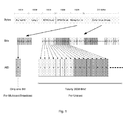
- the TIM element of the beacon frame plays a key role in the overall procedure. It provides a one to one mapping between bits therein and wireless stations through the association identifiers (AIDs). AIDs are assigned to each client within a basic service set (BSS) during the association procedure. When a client joins a BSS the AP gives the client an AID. Each station associated with the AP is assigned one bit in the bitmap of a TIM with the position of the bit being related to the AID the station. The bit number N corresponds with the AID N in the TIM bitmap. If the bit N is set in the TIM of a beacon, the existence of buffered unicast frames for the station AID N is indicated.
- BSS basic service set
- each field of the TIM structure is described as follows: Element ID (one byte) is an identification of this length-variable element in the beacon frame, and its value 5 indicates that this is a traffic indication map (TIM).
- the Length field (one byte) gives the total length of the information field, which consists of the following four fields:
- a special bit corresponding to AID 0 is reserved for B/M frames, and the bitmap control bit 0 corresponds to AID 0. If there is at least one associated station works in PSM, then any incoming B/M frames at the AP causes this bit to be set to 1 and the B/M frames are buffered. Thus, while the TIM can uniquely identify a station with buffered unicast frames at the AP, the one bit corresponding to AID 0 (referred as the B/M bit in the following text) can only indicate the existence of B/M frames without identifying the group or specific stations having buffered B/M frames. If the B/M bit is set in the TIM, then it requires that all PSM stations stay awake in order not to miss any B/M data.
- the PSM outperforms the CAM in terms of power consumption, at the cost of networking performance, such as delay and throughput.
- the current PSM is still not efficient enough to achieve power conservation.
- the current mechanism uses one bit to indicate the existence of buffered B/M frames at the AP. Therefore, the current mechanism does not differentiate between multicast frames and broadcast frames, and moreover, multicast frames belonging to different multicast groups are treated as the same. This coarse granularity makes the scheme work inefficiently in multicast environments.
- the major deficiency lies in that a wireless station has to stay in the active state whenever there are multicast frames transmitting at the AP, even if these frames are destined to other multicast groups than the group this station belongs to, or a worse case that this station does not join any multicast group any multicast group at all.
- the energy used to scout multicast traffic that will not be received by a station is an unnecessary waste.
- An object of the invention is to resolve the above problems, especially to provide a method and apparatus for power saving in the communication system by selectively awake the communication units to receive the buffered multicast frames at the access point.
- a method in a communication system for transmitting data from an access point to communication units capable of operating in a power-saving mode comprising: assigning, by the access point, an first association identifier in a message to each of the communication units respectively to indicate the presence of respective buffered multicast data; setting, by the access point, the first association identifiers corresponding to the communication units belonging to one or more multicast groups to receive multicast data buffered at the access point currently; and broadcasting, by the access point, the message to awake the communication units belonging to the one or more multicast groups so as to transmit the buffered multicast data thereto.
- an access point in a communication system for transmitting data to communication units capable of operating in a power-saving mode
- the access point comprising: a memory for buffering data to be transmitted to the communication units which are operating in the power-saving mode; and a processor for assigning an first association identifier in a message to each of the communication units respectively to indicate the presence of respective buffered multicast data; and setting the first association identifiers corresponding to the communication units belonging to one or more multicast groups to receive multicast data buffered at the access point currently; and a transmitter for transmitting the message to awake the communication units belonging to the one or more multicast groups and transmitting the buffered multicast data thereto.
- a method used in a communication unit capable of operating in a power-saving mode for receiving data from an access point in a communication system comprising: receiving a message from the access point through the communication system; checking an first association identifier for the communication unit in the message, which is pre-assigned by the access point to indicate the presence of buffered multicast data to be transmitted to the communication unit; and waking up to receive the multicast data if the first association identifier is set.
- a communication unit capable of operating in a power-saving mode in a communication system for receiving data from an access point, the communication unit comprising: a receiver for receiving data and a message from the access point; and a processor for cooperating with the receiver to receive a message from the access point through the communication system; check an first association identifier for the communication unit in the message, which is pre-assigned by the access point to indicate the presence of buffered multicast data including data to be transmitted to the communication unit; and wake up the communication unit to receive the multicast data if the first association identifier is set.
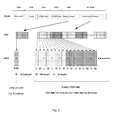
- Fig.2 is an exemplary diagram of a beacon with a newly designed TIM structure according to the first embodiment of the invention.
- the bits for indicating the presence of buffered multicast frames (M) and unicast frames (U) for each of the stations are distinguished through a series of pair of bits. One bit in a pair is used for unicast frames of a station and the other for multicast frames of the station.
- any single wireless station is provided with two successive bits acting as indicators, one for the buffered unicast frames at AP (referred as a U bit), and the other for the multicast frames (referred as a M bit).
- U bit the buffered unicast frames at AP
- M bit the multicast frames
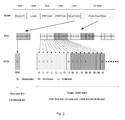
- Fig. 3 is an exemplary diagram of a beacon with another newly designed TIM structure according to the first embodiment of the invention.
- U unicast frames buffered at AP
- M multicast frames buffered at AP.
- the TIMs in Fig 2 and Fig 3 present two structures which serve the same goal just by applying different two-bit allocation schemes.
- each mobile station After the AP broadcasts a TIM element contained in a beacon, each mobile station received this message has to check the bitmap and find its unicast and multicast traffic indication bits in the TIM.
- the function of bits in bitmap control field and virtual bitmap field has been changed.
- the M bits in the virtual bitmap field are traffic indicators of the multicast frames in the AP buffer.
- Each associated wireless station is allocated one such bit in virtual bitmap to handle the multicast frames. Setting this bit to 1 means any one or both of the following events happen 1) one or more multicast frames destined for this wireless station have been buffered at the AP; 2) one or more broadcast frames have been buffered at the AP.
- this bit should be set to zero if there are no pending broadcast frames and the multicast frames buffered at the AP.
- this bit is actually used for the buffered multicast/broadcast frames, and it considers the broadcast frames as a special multicast frames. Therefore, in case any of the M bit s in the bitmap are set to 1, the first bit of the bitmap control field AID 0 of TIM should also be set to 1.
- a station will wake up to receive the buffered frames at the AP as long as the corresponding M bit is set to 1 in the DTIM.
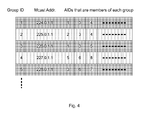
- an IGMP (Internet Group Multicast Protocol)-like group membership look-up table is maintained at AP to differentiate all multicast groups.
- the look-up table can be created and maintained by IGMP message snooping at AP.
- Fig. 4 is an exemplary structure of this table. This look-up table establishes a mapping from a multicast group (identified by its multicast address) to all the mobile stations (represented by their AIDs) in the BSS that are members of this multicast group.
- the AP checks all the buffered multicast frames and set these multicast bits to 1 according to the look-up in the table. This mapping provides a group-level granularity for supporting multicast in power management. In addition, the AP will check whether there are buffered broadcast frames to set all the M bits to 1.
- Establishing and maintaining of such table is a procedure similar to IGMP protocol does. It is easy for one skilled in the art to create such table by sniffing IGMP messages coming from uplink router and downlink mobile stations within the BSS with various means.
- the AID 0 in the virtual bitmap control field is referred as B/M bit, which is a traffic indicator of the broadcast/multicast frames in the AP buffer.
- This bit is set to 1 only in DTIMs if there are broadcast/multicast frames buffered at AP.
- This B/M bit should be set to zero if there are no pending broadcast frames and the multicast frames buffered at the AP.
- set B/M bit to 1 does not mean all stations shall wake up to receive buffered frames, which is different with that in the prior art. The station still need to check the M bit to determine its states.
- B/M Although it seems that it is not very necessary to set B/M to 1 according to the embodiment, it has compatibility with stations in the prior art.
- the stations in the prior art can not check M bits for the multicast/broadcast frames, but they can still check the B/M bit to get such information so as to determine their states according to the specification 802.11.
- the U bits in the virtual bitmap field are Traffic indicators of the unicast frames at the AP buffer. Each bit matches exactly one station, paired with an M bit, and it is set to 1 if there are unicast frames buffered at the AP buffer and destined to corresponding station. Thus, the function of U bits is the same as that in the original 802.11 TIMs.
- Fig. 5 is a flow chart depicting a method for sending multicast/broadcast message in the communication system according to the embodiment of the invention.
- the AP assigns the association identifier for multicast frames in a beacon frame to each of the communication units respectively according to the above arrangement, and receives a multicast message directed to one or more of the plurality of multicast groups or broadcast message.
- the wireless stations to receive the frames buffered currently are determined according to the multicast group address. This can be accomplished by using the look-up table in Fig.4 according to the multicast address.
- the AP determines firstly whether there are buffered broadcast frames, and if the result is yes, set all the M bits corresponding to all the stations to 1. Thus, the look-up table does not need to be detected.
- step 503 set the M bits in the beacon frame corresponding to the determined wireless stations to 1.
- the U bits and the B/M bit are also set according to the above-mentioned method.
- the AP broadcasts a beacon frame to selectively awaken all wireless stations belonging to said multicast address so as to transmit the multicast frames thereto. This can be accomplished by transmitting a beacon frame with the set TIM to the wireless stations. In this manner, any other wireless stations not belonging to the multicast address are allowed to remain asleep.
- the U bit for a station is set, the station still needs to wake up to receive the unicast frames.
- the wireless stations that are being selectively awakened are programmed to remain awake sufficiently long, e.g. to receive the buffered messages. This can be accomplished by the use of a timer and/or a counter.
- the awakened wireless station can also be programmed to remain awake until the detection of the next DTIM beacon or until the end of the session.
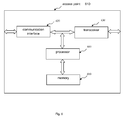
- Fig. 6 is an exemplary configuration of an AP 610 in accordance with the present invention.
- the AP 610 works as the central coordinator and scheduler, and comprises a communication interface 620 for handing communication with other portions of the WLAN through a communication path and receiving frames therefrom, a processor 640 coupled with the communication interface 620 for processing the communication and for controlling the AP 610, a transceiver 630 coupled to the processor 640 and communication interface 620 for communicating with the wireless stations and sending frames thereto. It is known that the transceiver 630 can also be separated to a transmitter and a receiver as required.
- the AP 610 also includes a memory 650 for storing the buffered frames, the above-mentioned look-up table, and executable instructions and data for programming the processor 640 in according to the present invention. It will be appreciable that the communication interface 620, the processor 640, the transceiver 630 and the memory 650 can be combined in whole or in part and fabricated as an integrated circuit.
- the AP 610 assigns two bits to each wireless station, wherein one bit is used for unicast of a station and the other for multicast of the station. Then, the AP 610 fills the TIM structure by setting the corresponding M bits to 1 if there are buffered multicast/broadcast frames, setting the corresponding U bits to 1 if there are buffered unicast frames, and setting the B/M bit to 1 if there are buffered multicast or broadcast frames. That is, the AP transmits the buffered frames according to the above flow chart.
- Fig. 7 is an exemplary configuration of a wireless station 710 in accordance with the present invention.
- the wireless station 710 comprises a processor 701 for controlling the station 710, a transceiver 702 coupled to the processor 701 for communicating with the AP 610, a user interface 703 comprising well-known elements, such as a keypad, a display, and audio transducers.
- the wireless station 710 includes a memory 704 coupled to the processor 701 comprising executable instructions and data for programming the processor 701 in accordance with the present invention. It will be appreciable that the processor 701, the transceiver 702, and the memory 704 can be combined in whole or in part and fabricated as an integrated circuit.
- Each station 710 in power saving mode shall power up to listen to the beacon periodically transmitted by the AP to check whether there are frames buffered in the AP.
- the station will wake up if the corresponding U bit or M bit is set to 1. However, the station does not wake up according to the B/M bit which can be used by the prior art stations.
- the M bits are used for only indicating the buffered multicast frames, and not for the buffered broadcast frames.
- the M/B bit is used for indicating the buffered multicast/broadcast frames.
- Each buffering queue operates in a FIFO manner.
- One thing should be mentioned is that certain priorities have been assigned for these queues during the operating procedure.
- the AP shall transmit the frames in the broadcast queue first, giving a high priority to that queue, and then the multicast queue, which possesses a middle-level priority, and the unicast queue is handled last, which corresponds to a low priority.
- the priority-based queuing mechanism makes it possible for a station to sleep even during a beacon interval.
- the station when the B/M is set to 1, and the corresponding M bit is set to 0, the station will wait some times as required to receive the broadcast frames if broadcast frames are buffered at the AP. Then if there is no frame arriving, the station will be asleep. In addition, when the B/M is set to 0, and the corresponding M bit is set to 0, the station will stay asleep, and do not need to wait for the buffered frames.
- the method and arrangement of the present invention provides a more efficient and fine-granular power saving scheme.
- the multicast frames from different groups can be differentiated and thereafter it can avoid all stations from wakening up to receive the multicast frame of some groups of stations.
- the method can be compatible with the prior art method in 802.11 standard.
- WLAN is adapted to illustrate the embodiments of the invention.
- data is transmitted and received in the form of frame.
- any form of data can also be adapted.
- the association identifier is transmitted in the beacon frame.
- the association identifier can be transmitted in any message.
Landscapes
- Engineering & Computer Science (AREA)
- Computer Networks & Wireless Communication (AREA)
- Signal Processing (AREA)
- Mobile Radio Communication Systems (AREA)
- Small-Scale Networks (AREA)
Priority Applications (7)
| Application Number | Priority Date | Filing Date | Title |
|---|---|---|---|
| EP07301455A EP2048823A1 (en) | 2007-10-12 | 2007-10-12 | Method and apparatus for power management in communication system |
| PCT/EP2008/063123 WO2009047179A1 (en) | 2007-10-12 | 2008-10-01 | Method and apparatus for power management in communication system |
| CN200880111240A CN101861715A (zh) | 2007-10-12 | 2008-10-01 | 通信系统中的电源管理方法和设备 |
| KR1020107010281A KR20100095524A (ko) | 2007-10-12 | 2008-10-01 | 통신 시스템에서의 파워 관리를 위한 방법 및 장치 |
| JP2010528363A JP2011501488A (ja) | 2007-10-12 | 2008-10-01 | 通信システムにおけるパワーマネジメント方法及び装置 |
| EP08804947A EP2206290A1 (en) | 2007-10-12 | 2008-10-01 | Method and apparatus for power management in communication system |
| US12/802,432 US20100265864A1 (en) | 2007-10-12 | 2010-06-07 | Method and apparatus for power management in communication system |
Applications Claiming Priority (1)
| Application Number | Priority Date | Filing Date | Title |
|---|---|---|---|
| EP07301455A EP2048823A1 (en) | 2007-10-12 | 2007-10-12 | Method and apparatus for power management in communication system |
Publications (1)
| Publication Number | Publication Date |
|---|---|
| EP2048823A1 true EP2048823A1 (en) | 2009-04-15 |
Family
ID=39166670
Family Applications (2)
| Application Number | Title | Priority Date | Filing Date |
|---|---|---|---|
| EP07301455A Withdrawn EP2048823A1 (en) | 2007-10-12 | 2007-10-12 | Method and apparatus for power management in communication system |
| EP08804947A Withdrawn EP2206290A1 (en) | 2007-10-12 | 2008-10-01 | Method and apparatus for power management in communication system |
Family Applications After (1)
| Application Number | Title | Priority Date | Filing Date |
|---|---|---|---|
| EP08804947A Withdrawn EP2206290A1 (en) | 2007-10-12 | 2008-10-01 | Method and apparatus for power management in communication system |
Country Status (6)
| Country | Link |
|---|---|
| US (1) | US20100265864A1 (enExample) |
| EP (2) | EP2048823A1 (enExample) |
| JP (1) | JP2011501488A (enExample) |
| KR (1) | KR20100095524A (enExample) |
| CN (1) | CN101861715A (enExample) |
| WO (1) | WO2009047179A1 (enExample) |
Cited By (4)
| Publication number | Priority date | Publication date | Assignee | Title |
|---|---|---|---|---|
| EP2161953A3 (en) * | 2008-09-09 | 2011-01-12 | NTT DoCoMo, Inc. | Access point, wireless communication station, wireless communication system and wireless communication method |
| WO2012154421A1 (en) * | 2011-05-10 | 2012-11-15 | Motorola Mobility Llc | Method and apparatus for providing wireless service to a collective of remote units by a wireless local area network |
| WO2013130851A1 (en) * | 2012-03-02 | 2013-09-06 | Qualcomm Incorporated | Apparatus and methods for access identifier based multicast communication |
| EP2784948A4 (en) * | 2011-11-24 | 2014-12-17 | Lg Electronics Inc | GROUP-BASED DATA TRANSMISSION AND RECEIVING METHOD IN A WLAN SYSTEM AND DEVICE FOR SUPPORTING THIS METHOD |
Families Citing this family (45)
| Publication number | Priority date | Publication date | Assignee | Title |
|---|---|---|---|---|
| US8879516B2 (en) | 2008-12-10 | 2014-11-04 | Marvell World Trade Ltd | Efficient formats of beacon, announcement, and beamforming training frames |
| KR101576142B1 (ko) * | 2009-06-12 | 2015-12-10 | 삼성전자주식회사 | 휴대용 단말기에서 무선랜 모듈의 전원 관리 방법 및 장치 |
| US8971223B2 (en) | 2010-05-11 | 2015-03-03 | Qualcomm Incorporated | Wireless personal area network coordinator |
| US9510322B2 (en) * | 2010-09-14 | 2016-11-29 | Nokia Technologies Oy | D2D communication procedures: beaconing; broadcast; conflict resolution |
| US8761065B2 (en) * | 2010-11-16 | 2014-06-24 | Intel Corporation | Techniques for wakeup signaling for a very low power WLAN device |
| US8644211B2 (en) * | 2010-12-16 | 2014-02-04 | Palo Alto Research Center Incorporated | Energy-efficient content retrieval in content-centric networks |
| JP5858626B2 (ja) | 2011-02-25 | 2016-02-10 | 任天堂株式会社 | 無線通信プログラム、情報処理装置、および通信制御方法 |
| US8879450B2 (en) * | 2011-03-29 | 2014-11-04 | Intel Corporation | Enhancing PS-poll for low-power WiFi |
| US9204330B2 (en) | 2011-03-30 | 2015-12-01 | Lg Electronics Inc. | Method and apparatus for generating traffic indicator map in wireless communication system |
| US8774145B2 (en) * | 2011-04-01 | 2014-07-08 | Intel Corporation | Techniques to determine user presence |
| US9144056B2 (en) * | 2011-09-09 | 2015-09-22 | Qualcomm Incorporated | Broadcast teardown apparatus and method |
| CN103891235B (zh) * | 2011-10-07 | 2017-05-31 | 英特尔公司 | 用于无线网络中的业务指示映射的方法和布置 |
| US9888407B2 (en) | 2011-11-01 | 2018-02-06 | Intel Corporation | Methods and arrangements for traffic indication mapping in wireless networks |
| US9379868B2 (en) * | 2011-12-05 | 2016-06-28 | Broadcom Corporation | Subsequent association identifier (AID) update within single user, multiple user, multiple access, and/or MIMO wireless communications |
| US9326234B2 (en) * | 2011-12-16 | 2016-04-26 | Stmicroelectronics, Inc. | Sub-1GHZ group power save |
| CN105309004B (zh) * | 2012-01-31 | 2019-07-12 | 马维尔国际贸易有限公司 | 用于处理无线通信中的mac报头的方法和装置 |
| US9398611B2 (en) | 2012-02-15 | 2016-07-19 | Lg Electronics Inc. | Method for accessing channels in wireless communication systems and apparatus for same |
| US9467890B2 (en) * | 2012-02-18 | 2016-10-11 | Lg Electronics Inc. | Method for transmitting and receiving traffic indication maps in wireless communication systems and apparatus for same |
| US20130223306A1 (en) * | 2012-02-23 | 2013-08-29 | Nokia Corporation | Buffered Frames Indication Enhancement To Enable Power Savings |
| US9936454B2 (en) * | 2012-03-12 | 2018-04-03 | Agency For Science, Technology And Research | Stations, access points, communication systems and methods of controlling the same |
| KR101605328B1 (ko) * | 2012-04-03 | 2016-03-22 | 엘지전자 주식회사 | 무선 통신 시스템에서 트래픽 지시 맵 송수신 방법 및 이를 위한 장치 |
| US8879458B2 (en) * | 2012-04-23 | 2014-11-04 | Hewlett-Packard Development Company, L.P. | Transmission in a network with active and sleeping clients |
| US9485728B1 (en) * | 2012-05-15 | 2016-11-01 | Marvell International Ltd. | Power saving with WNM-sleep mode |
| KR101561114B1 (ko) | 2012-06-13 | 2015-10-16 | 주식회사 케이티 | 인코딩된 팀 정보 통신 방법 |
| US9226227B2 (en) * | 2012-06-29 | 2015-12-29 | Marvell World Trade Ltd. | Group based beacons |
| US9237481B2 (en) * | 2012-07-09 | 2016-01-12 | Intel Corporation | Methods and arrangements for traffic indication map segmentation in wireless networks |
| US9220032B2 (en) | 2012-08-24 | 2015-12-22 | Intel Corporation | Methods and arrangements for traffic indication mapping in wireless networks |
| US8934390B2 (en) * | 2012-09-28 | 2015-01-13 | Stmicroelectronics, Inc. | Enhancement of low power medium access STAs |
| EP2858409B1 (en) | 2012-10-29 | 2018-05-16 | LG Electronics Inc. | Method and device for transmitting and receiving traffic indication map in wireless lan system |
| US9503979B2 (en) * | 2012-11-30 | 2016-11-22 | Google Technology Holdings LLC | Delivering data to a wireless station |
| KR101996681B1 (ko) * | 2013-02-01 | 2019-07-05 | 한국전자통신연구원 | 스테이션들의 유형에 기초하여 연결 아이디를 할당하는 액세스 포인트 및 그 액세스 포인트의 동작 방법 |
| US9078210B2 (en) | 2013-02-07 | 2015-07-07 | Qualcomm Incorporated | Systems and methods for power saving for multicast and broadcast data |
| CN104022842A (zh) * | 2013-03-01 | 2014-09-03 | 华为技术有限公司 | 组播信息传输方法及设备 |
| WO2014134942A1 (zh) | 2013-03-06 | 2014-09-12 | 华为技术有限公司 | 一种组播数据包传输方法及装置 |
| CN105474743B (zh) * | 2013-09-18 | 2019-05-10 | 华为技术有限公司 | 接入点之间接口的建立方法和装置 |
| CN103581056A (zh) * | 2013-10-25 | 2014-02-12 | 盛科网络(苏州)有限公司 | 网络通信中通过分层队列调度实现拥塞管理的方法 |
| CN103945510B (zh) * | 2014-03-27 | 2017-06-16 | 西安电子科技大学 | 站点区分广播帧与组播帧的方法 |
| US9462549B2 (en) * | 2014-03-28 | 2016-10-04 | Intel Corporation | Systems and methods for optimizing power consumption associated with processing group addressed messages |
| CN108811048B (zh) * | 2017-04-27 | 2022-03-29 | 珠海市魅族科技有限公司 | 无线局域网的通信方法、通信装置和通信设备 |
| CN109548120B (zh) * | 2017-09-22 | 2022-02-11 | 珠海市魅族科技有限公司 | 无线局域网的通信方法、装置、站点设备和接入点设备 |
| CN116669156A (zh) * | 2017-12-14 | 2023-08-29 | 松下电器(美国)知识产权公司 | 接收装置、接收方法和集成电路 |
| US11375453B2 (en) * | 2017-12-21 | 2022-06-28 | Apple Inc. | Power-efficient communication of group-addressed frames |
| CN110662292B (zh) | 2018-06-29 | 2023-04-07 | 慧与发展有限责任合伙企业 | 传输多播帧 |
| US10728849B2 (en) * | 2018-11-01 | 2020-07-28 | Cisco Technology, Inc. | Traffic indicator map for networks with multiple access points |
| EP4360395A4 (en) * | 2021-06-23 | 2024-08-28 | Guangdong Oppo Mobile Telecommunications Corp., Ltd. | METHODS AND DEVICES FOR TRAFFIC INDICATION IN WIRELESS LOCAL AREA NETWORKS |
Citations (2)
| Publication number | Priority date | Publication date | Assignee | Title |
|---|---|---|---|---|
| US20050254444A1 (en) * | 2004-05-12 | 2005-11-17 | Meier Robert C | Power-save method for 802.11 multicast paging applications |
| US20050276237A1 (en) * | 2004-06-15 | 2005-12-15 | Motorola, Inc. | Method and apparatus for sending a multicast message |
Family Cites Families (3)
| Publication number | Priority date | Publication date | Assignee | Title |
|---|---|---|---|---|
| US7412265B2 (en) * | 2003-06-12 | 2008-08-12 | Industrial Technology Research Institute | Method and system for power-saving in a wireless local area network |
| US7408931B2 (en) * | 2004-12-29 | 2008-08-05 | Motorola, Inc. | Methods for delivery in a wireless communications network |
| JP4955362B2 (ja) * | 2006-10-13 | 2012-06-20 | Necインフロンティア株式会社 | 無線lanシステムおよび無線通信方法 |
-
2007
- 2007-10-12 EP EP07301455A patent/EP2048823A1/en not_active Withdrawn
-
2008
- 2008-10-01 CN CN200880111240A patent/CN101861715A/zh active Pending
- 2008-10-01 JP JP2010528363A patent/JP2011501488A/ja active Pending
- 2008-10-01 EP EP08804947A patent/EP2206290A1/en not_active Withdrawn
- 2008-10-01 KR KR1020107010281A patent/KR20100095524A/ko not_active Withdrawn
- 2008-10-01 WO PCT/EP2008/063123 patent/WO2009047179A1/en not_active Ceased
-
2010
- 2010-06-07 US US12/802,432 patent/US20100265864A1/en not_active Abandoned
Patent Citations (2)
| Publication number | Priority date | Publication date | Assignee | Title |
|---|---|---|---|---|
| US20050254444A1 (en) * | 2004-05-12 | 2005-11-17 | Meier Robert C | Power-save method for 802.11 multicast paging applications |
| US20050276237A1 (en) * | 2004-06-15 | 2005-12-15 | Motorola, Inc. | Method and apparatus for sending a multicast message |
Non-Patent Citations (1)
| Title |
|---|
| IEEE: "Part 11: Wireless LAN Medium Access Control (MAC) and Physical Layer (PHY) Specifications (Revision of IEEE Std 802.11-1999 )", IEEE STD 802.11 - 2007, 12 June 2007 (2007-06-12), pages I-2,79-104,425 - 436, XP002473481, ISBN: 0-7381-5656-6, Retrieved from the Internet <URL:http://standards.ieee.org/getieee802/download/802.11-2007.pdf> [retrieved on 20080318] * |
Cited By (10)
| Publication number | Priority date | Publication date | Assignee | Title |
|---|---|---|---|---|
| EP2161953A3 (en) * | 2008-09-09 | 2011-01-12 | NTT DoCoMo, Inc. | Access point, wireless communication station, wireless communication system and wireless communication method |
| US8310968B2 (en) | 2008-09-09 | 2012-11-13 | Ntt Docomo, Inc. | Access point, wireless communication station, wireless communication system and wireless communication method |
| WO2012154421A1 (en) * | 2011-05-10 | 2012-11-15 | Motorola Mobility Llc | Method and apparatus for providing wireless service to a collective of remote units by a wireless local area network |
| KR101537181B1 (ko) * | 2011-05-10 | 2015-07-16 | 모토로라 모빌리티 엘엘씨 | 무선 로컬 영역 네트워크에 의해 원격 유닛들의 집단에 무선 서비스를 제공하는 방법 및 장치 |
| US9788348B2 (en) | 2011-05-10 | 2017-10-10 | Google Technology Holdings LLC | Method and apparatus for providing wireless service to a collective of remote units by a wireless local area network |
| EP2784948A4 (en) * | 2011-11-24 | 2014-12-17 | Lg Electronics Inc | GROUP-BASED DATA TRANSMISSION AND RECEIVING METHOD IN A WLAN SYSTEM AND DEVICE FOR SUPPORTING THIS METHOD |
| US9503976B2 (en) | 2011-11-24 | 2016-11-22 | Lg Electronics Inc. | Grouping-based data transceiving method in wireless LAN system and apparatus for supporting same |
| WO2013130851A1 (en) * | 2012-03-02 | 2013-09-06 | Qualcomm Incorporated | Apparatus and methods for access identifier based multicast communication |
| JP2015515177A (ja) * | 2012-03-02 | 2015-05-21 | クゥアルコム・インコーポレイテッドQualcomm Incorporated | アクセス識別子ベースマルチキャスト通信のための装置および方法 |
| US9386423B2 (en) | 2012-03-02 | 2016-07-05 | Qualcomm Incorporated | Apparatus and methods for access identifier based multicast communication |
Also Published As
| Publication number | Publication date |
|---|---|
| CN101861715A (zh) | 2010-10-13 |
| US20100265864A1 (en) | 2010-10-21 |
| WO2009047179A1 (en) | 2009-04-16 |
| JP2011501488A (ja) | 2011-01-06 |
| EP2206290A1 (en) | 2010-07-14 |
| KR20100095524A (ko) | 2010-08-31 |
Similar Documents
| Publication | Publication Date | Title |
|---|---|---|
| US20100265864A1 (en) | Method and apparatus for power management in communication system | |
| JP5456488B2 (ja) | Wlanのパワーマネジメントのための方法と装置 | |
| EP1530384B1 (en) | Method for transmitting traffic indication message in a broadband wireless access communication system | |
| CN113613316B (zh) | 下行业务数据的指示方法和设备 | |
| CN100499403C (zh) | 用于在宽带无线接入通信系统中控制睡眠模式与唤醒模式之间的状态转换的系统和方法 | |
| CN101674530B (zh) | 无线通信基站、无线通信终端、无线通信系统以及方法 | |
| US20140092797A1 (en) | ENHANCEMENT OF LOW POWER MEDIUM ACCESS STAs | |
| WO2007140343A2 (en) | Reliable multicast in a network having a power saving protocol | |
| He et al. | Scheduled PSM for minimizing energy in wireless LANs | |
| CN107396433A (zh) | 基于ndn架构的无线局域网节能方法及sta |
Legal Events
| Date | Code | Title | Description |
|---|---|---|---|
| PUAI | Public reference made under article 153(3) epc to a published international application that has entered the european phase |
Free format text: ORIGINAL CODE: 0009012 |
|
| AK | Designated contracting states |
Kind code of ref document: A1 Designated state(s): AT BE BG CH CY CZ DE DK EE ES FI FR GB GR HU IE IS IT LI LT LU LV MC MT NL PL PT RO SE SI SK TR |
|
| AX | Request for extension of the european patent |
Extension state: AL BA HR MK RS |
|
| AKX | Designation fees paid | ||
| REG | Reference to a national code |
Ref country code: DE Ref legal event code: 8566 |
|
| RAP1 | Party data changed (applicant data changed or rights of an application transferred) |
Owner name: THOMSON LICENSING |
|
| STAA | Information on the status of an ep patent application or granted ep patent |
Free format text: STATUS: THE APPLICATION IS DEEMED TO BE WITHDRAWN |
|
| 18D | Application deemed to be withdrawn |
Effective date: 20091016 |