EP2048246B1 - Verfahren zur gewinnung eines oligonukleotids - Google Patents
Verfahren zur gewinnung eines oligonukleotids Download PDFInfo
- Publication number
- EP2048246B1 EP2048246B1 EP07790559A EP07790559A EP2048246B1 EP 2048246 B1 EP2048246 B1 EP 2048246B1 EP 07790559 A EP07790559 A EP 07790559A EP 07790559 A EP07790559 A EP 07790559A EP 2048246 B1 EP2048246 B1 EP 2048246B1
- Authority
- EP
- European Patent Office
- Prior art keywords
- nucleic acid
- acid molecule
- target substance
- rna
- oligonucleotide
- Prior art date
- Legal status (The legal status is an assumption and is not a legal conclusion. Google has not performed a legal analysis and makes no representation as to the accuracy of the status listed.)
- Not-in-force
Links
- 238000000034 method Methods 0.000 title claims abstract description 87
- 108091034117 Oligonucleotide Proteins 0.000 title claims abstract description 69
- 108020004707 nucleic acids Proteins 0.000 claims abstract description 105
- 102000039446 nucleic acids Human genes 0.000 claims abstract description 105
- 150000007523 nucleic acids Chemical class 0.000 claims abstract description 105
- 239000013076 target substance Substances 0.000 claims abstract description 95
- 108091008103 RNA aptamers Proteins 0.000 claims abstract description 56
- 238000001962 electrophoresis Methods 0.000 claims abstract description 40
- 108090000623 proteins and genes Proteins 0.000 claims description 49
- 102000004169 proteins and genes Human genes 0.000 claims description 30
- 239000000499 gel Substances 0.000 claims description 22
- PEDCQBHIVMGVHV-UHFFFAOYSA-N Glycerine Chemical compound OCC(O)CO PEDCQBHIVMGVHV-UHFFFAOYSA-N 0.000 claims description 21
- 239000011543 agarose gel Substances 0.000 claims description 14
- 229920002401 polyacrylamide Polymers 0.000 claims description 8
- 229930006000 Sucrose Natural products 0.000 claims description 3
- CZMRCDWAGMRECN-UGDNZRGBSA-N Sucrose Chemical compound O[C@H]1[C@H](O)[C@@H](CO)O[C@@]1(CO)O[C@@H]1[C@H](O)[C@@H](O)[C@H](O)[C@@H](CO)O1 CZMRCDWAGMRECN-UGDNZRGBSA-N 0.000 claims description 3
- 235000013681 dietary sucrose Nutrition 0.000 claims description 3
- 229960004793 sucrose Drugs 0.000 claims description 3
- 238000011534 incubation Methods 0.000 claims 1
- 230000004544 DNA amplification Effects 0.000 abstract description 2
- 108020004414 DNA Proteins 0.000 description 44
- 239000000758 substrate Substances 0.000 description 39
- 238000000338 in vitro Methods 0.000 description 32
- 239000000047 product Substances 0.000 description 21
- 239000000203 mixture Substances 0.000 description 20
- 239000000243 solution Substances 0.000 description 19
- 230000003321 amplification Effects 0.000 description 14
- 238000003199 nucleic acid amplification method Methods 0.000 description 14
- 238000000605 extraction Methods 0.000 description 13
- 238000011084 recovery Methods 0.000 description 13
- 239000000872 buffer Substances 0.000 description 10
- 238000006243 chemical reaction Methods 0.000 description 10
- 108091069025 single-strand RNA Proteins 0.000 description 10
- 238000002474 experimental method Methods 0.000 description 9
- TWRXJAOTZQYOKJ-UHFFFAOYSA-L Magnesium chloride Chemical compound [Mg+2].[Cl-].[Cl-] TWRXJAOTZQYOKJ-UHFFFAOYSA-L 0.000 description 8
- 230000000052 comparative effect Effects 0.000 description 8
- 238000013518 transcription Methods 0.000 description 8
- 230000035897 transcription Effects 0.000 description 8
- 239000012148 binding buffer Substances 0.000 description 7
- 230000015572 biosynthetic process Effects 0.000 description 7
- 230000001419 dependent effect Effects 0.000 description 7
- 230000002285 radioactive effect Effects 0.000 description 7
- ISWSIDIOOBJBQZ-UHFFFAOYSA-N Phenol Chemical compound OC1=CC=CC=C1 ISWSIDIOOBJBQZ-UHFFFAOYSA-N 0.000 description 6
- 101710137500 T7 RNA polymerase Proteins 0.000 description 6
- 239000007983 Tris buffer Substances 0.000 description 6
- -1 antibodies Proteins 0.000 description 6
- 238000002360 preparation method Methods 0.000 description 6
- LENZDBCJOHFCAS-UHFFFAOYSA-N tris Chemical compound OCC(N)(CO)CO LENZDBCJOHFCAS-UHFFFAOYSA-N 0.000 description 6
- 108010092799 RNA-directed DNA polymerase Proteins 0.000 description 5
- JLCPHMBAVCMARE-UHFFFAOYSA-N [3-[[3-[[3-[[3-[[3-[[3-[[3-[[3-[[3-[[3-[[3-[[5-(2-amino-6-oxo-1H-purin-9-yl)-3-[[3-[[3-[[3-[[3-[[3-[[5-(2-amino-6-oxo-1H-purin-9-yl)-3-[[5-(2-amino-6-oxo-1H-purin-9-yl)-3-hydroxyoxolan-2-yl]methoxy-hydroxyphosphoryl]oxyoxolan-2-yl]methoxy-hydroxyphosphoryl]oxy-5-(5-methyl-2,4-dioxopyrimidin-1-yl)oxolan-2-yl]methoxy-hydroxyphosphoryl]oxy-5-(6-aminopurin-9-yl)oxolan-2-yl]methoxy-hydroxyphosphoryl]oxy-5-(6-aminopurin-9-yl)oxolan-2-yl]methoxy-hydroxyphosphoryl]oxy-5-(6-aminopurin-9-yl)oxolan-2-yl]methoxy-hydroxyphosphoryl]oxy-5-(6-aminopurin-9-yl)oxolan-2-yl]methoxy-hydroxyphosphoryl]oxyoxolan-2-yl]methoxy-hydroxyphosphoryl]oxy-5-(5-methyl-2,4-dioxopyrimidin-1-yl)oxolan-2-yl]methoxy-hydroxyphosphoryl]oxy-5-(4-amino-2-oxopyrimidin-1-yl)oxolan-2-yl]methoxy-hydroxyphosphoryl]oxy-5-(5-methyl-2,4-dioxopyrimidin-1-yl)oxolan-2-yl]methoxy-hydroxyphosphoryl]oxy-5-(5-methyl-2,4-dioxopyrimidin-1-yl)oxolan-2-yl]methoxy-hydroxyphosphoryl]oxy-5-(6-aminopurin-9-yl)oxolan-2-yl]methoxy-hydroxyphosphoryl]oxy-5-(6-aminopurin-9-yl)oxolan-2-yl]methoxy-hydroxyphosphoryl]oxy-5-(4-amino-2-oxopyrimidin-1-yl)oxolan-2-yl]methoxy-hydroxyphosphoryl]oxy-5-(4-amino-2-oxopyrimidin-1-yl)oxolan-2-yl]methoxy-hydroxyphosphoryl]oxy-5-(4-amino-2-oxopyrimidin-1-yl)oxolan-2-yl]methoxy-hydroxyphosphoryl]oxy-5-(6-aminopurin-9-yl)oxolan-2-yl]methoxy-hydroxyphosphoryl]oxy-5-(4-amino-2-oxopyrimidin-1-yl)oxolan-2-yl]methyl [5-(6-aminopurin-9-yl)-2-(hydroxymethyl)oxolan-3-yl] hydrogen phosphate Polymers Cc1cn(C2CC(OP(O)(=O)OCC3OC(CC3OP(O)(=O)OCC3OC(CC3O)n3cnc4c3nc(N)[nH]c4=O)n3cnc4c3nc(N)[nH]c4=O)C(COP(O)(=O)OC3CC(OC3COP(O)(=O)OC3CC(OC3COP(O)(=O)OC3CC(OC3COP(O)(=O)OC3CC(OC3COP(O)(=O)OC3CC(OC3COP(O)(=O)OC3CC(OC3COP(O)(=O)OC3CC(OC3COP(O)(=O)OC3CC(OC3COP(O)(=O)OC3CC(OC3COP(O)(=O)OC3CC(OC3COP(O)(=O)OC3CC(OC3COP(O)(=O)OC3CC(OC3COP(O)(=O)OC3CC(OC3COP(O)(=O)OC3CC(OC3COP(O)(=O)OC3CC(OC3COP(O)(=O)OC3CC(OC3COP(O)(=O)OC3CC(OC3CO)n3cnc4c(N)ncnc34)n3ccc(N)nc3=O)n3cnc4c(N)ncnc34)n3ccc(N)nc3=O)n3ccc(N)nc3=O)n3ccc(N)nc3=O)n3cnc4c(N)ncnc34)n3cnc4c(N)ncnc34)n3cc(C)c(=O)[nH]c3=O)n3cc(C)c(=O)[nH]c3=O)n3ccc(N)nc3=O)n3cc(C)c(=O)[nH]c3=O)n3cnc4c3nc(N)[nH]c4=O)n3cnc4c(N)ncnc34)n3cnc4c(N)ncnc34)n3cnc4c(N)ncnc34)n3cnc4c(N)ncnc34)O2)c(=O)[nH]c1=O JLCPHMBAVCMARE-UHFFFAOYSA-N 0.000 description 5
- 239000000126 substance Substances 0.000 description 5
- OSBLTNPMIGYQGY-UHFFFAOYSA-N 2-amino-2-(hydroxymethyl)propane-1,3-diol;2-[2-[bis(carboxymethyl)amino]ethyl-(carboxymethyl)amino]acetic acid;boric acid Chemical compound OB(O)O.OCC(N)(CO)CO.OC(=O)CN(CC(O)=O)CCN(CC(O)=O)CC(O)=O OSBLTNPMIGYQGY-UHFFFAOYSA-N 0.000 description 4
- 108091023037 Aptamer Proteins 0.000 description 4
- 108020004635 Complementary DNA Proteins 0.000 description 4
- 102000004163 DNA-directed RNA polymerases Human genes 0.000 description 4
- 108090000626 DNA-directed RNA polymerases Proteins 0.000 description 4
- 241000588724 Escherichia coli Species 0.000 description 4
- 101710175625 Maltose/maltodextrin-binding periplasmic protein Proteins 0.000 description 4
- XSQUKJJJFZCRTK-UHFFFAOYSA-N Urea Chemical compound NC(N)=O XSQUKJJJFZCRTK-UHFFFAOYSA-N 0.000 description 4
- 238000000211 autoradiogram Methods 0.000 description 4
- 238000010804 cDNA synthesis Methods 0.000 description 4
- 230000000295 complement effect Effects 0.000 description 4
- 239000002299 complementary DNA Substances 0.000 description 4
- 230000000694 effects Effects 0.000 description 4
- 238000012869 ethanol precipitation Methods 0.000 description 4
- 229910001629 magnesium chloride Inorganic materials 0.000 description 4
- 239000012528 membrane Substances 0.000 description 4
- 238000000163 radioactive labelling Methods 0.000 description 4
- 108091003079 Bovine Serum Albumin Proteins 0.000 description 3
- 108010014303 DNA-directed DNA polymerase Proteins 0.000 description 3
- 102000016928 DNA-directed DNA polymerase Human genes 0.000 description 3
- 102000004190 Enzymes Human genes 0.000 description 3
- 108090000790 Enzymes Proteins 0.000 description 3
- 102100034343 Integrase Human genes 0.000 description 3
- 239000000020 Nitrocellulose Substances 0.000 description 3
- 239000008051 TBE buffer Substances 0.000 description 3
- KGBXLFKZBHKPEV-UHFFFAOYSA-N boric acid Chemical compound OB(O)O KGBXLFKZBHKPEV-UHFFFAOYSA-N 0.000 description 3
- 239000004327 boric acid Substances 0.000 description 3
- 229940098773 bovine serum albumin Drugs 0.000 description 3
- 239000007853 buffer solution Substances 0.000 description 3
- 239000003795 chemical substances by application Substances 0.000 description 3
- 150000001875 compounds Chemical class 0.000 description 3
- ZMMJGEGLRURXTF-UHFFFAOYSA-N ethidium bromide Chemical compound [Br-].C12=CC(N)=CC=C2C2=CC=C(N)C=C2[N+](CC)=C1C1=CC=CC=C1 ZMMJGEGLRURXTF-UHFFFAOYSA-N 0.000 description 3
- 229960005542 ethidium bromide Drugs 0.000 description 3
- 230000003993 interaction Effects 0.000 description 3
- 229920001220 nitrocellulos Polymers 0.000 description 3
- 238000002264 polyacrylamide gel electrophoresis Methods 0.000 description 3
- 238000010839 reverse transcription Methods 0.000 description 3
- 239000002904 solvent Substances 0.000 description 3
- 238000003786 synthesis reaction Methods 0.000 description 3
- 238000005406 washing Methods 0.000 description 3
- JKMHFZQWWAIEOD-UHFFFAOYSA-N 2-[4-(2-hydroxyethyl)piperazin-1-yl]ethanesulfonic acid Chemical compound OCC[NH+]1CCN(CCS([O-])(=O)=O)CC1 JKMHFZQWWAIEOD-UHFFFAOYSA-N 0.000 description 2
- 108091008102 DNA aptamers Proteins 0.000 description 2
- KCXVZYZYPLLWCC-UHFFFAOYSA-N EDTA Chemical compound OC(=O)CN(CC(O)=O)CCN(CC(O)=O)CC(O)=O KCXVZYZYPLLWCC-UHFFFAOYSA-N 0.000 description 2
- 239000007995 HEPES buffer Substances 0.000 description 2
- FAPWRFPIFSIZLT-UHFFFAOYSA-M Sodium chloride Chemical compound [Na+].[Cl-] FAPWRFPIFSIZLT-UHFFFAOYSA-M 0.000 description 2
- ISAKRJDGNUQOIC-UHFFFAOYSA-N Uracil Chemical compound O=C1C=CNC(=O)N1 ISAKRJDGNUQOIC-UHFFFAOYSA-N 0.000 description 2
- 239000000654 additive Substances 0.000 description 2
- 230000000996 additive effect Effects 0.000 description 2
- 239000004202 carbamide Substances 0.000 description 2
- NKLPQNGYXWVELD-UHFFFAOYSA-M coomassie brilliant blue Chemical compound [Na+].C1=CC(OCC)=CC=C1NC1=CC=C(C(=C2C=CC(C=C2)=[N+](CC)CC=2C=C(C=CC=2)S([O-])(=O)=O)C=2C=CC(=CC=2)N(CC)CC=2C=C(C=CC=2)S([O-])(=O)=O)C=C1 NKLPQNGYXWVELD-UHFFFAOYSA-M 0.000 description 2
- OPTASPLRGRRNAP-UHFFFAOYSA-N cytosine Chemical compound NC=1C=CNC(=O)N=1 OPTASPLRGRRNAP-UHFFFAOYSA-N 0.000 description 2
- UYTPUPDQBNUYGX-UHFFFAOYSA-N guanine Chemical compound O=C1NC(N)=NC2=C1N=CN2 UYTPUPDQBNUYGX-UHFFFAOYSA-N 0.000 description 2
- 229920002521 macromolecule Polymers 0.000 description 2
- 239000002777 nucleoside Substances 0.000 description 2
- 150000003833 nucleoside derivatives Chemical class 0.000 description 2
- 238000003757 reverse transcription PCR Methods 0.000 description 2
- 241000894007 species Species 0.000 description 2
- RWQNBRDOKXIBIV-UHFFFAOYSA-N thymine Chemical compound CC1=CNC(=O)NC1=O RWQNBRDOKXIBIV-UHFFFAOYSA-N 0.000 description 2
- 230000002103 transcriptional effect Effects 0.000 description 2
- QKNYBSVHEMOAJP-UHFFFAOYSA-N 2-amino-2-(hydroxymethyl)propane-1,3-diol;hydron;chloride Chemical compound Cl.OCC(N)(CO)CO QKNYBSVHEMOAJP-UHFFFAOYSA-N 0.000 description 1
- 229930024421 Adenine Natural products 0.000 description 1
- GFFGJBXGBJISGV-UHFFFAOYSA-N Adenine Chemical compound NC1=NC=NC2=C1N=CN2 GFFGJBXGBJISGV-UHFFFAOYSA-N 0.000 description 1
- 229920000936 Agarose Polymers 0.000 description 1
- 208000002109 Argyria Diseases 0.000 description 1
- 241000713838 Avian myeloblastosis virus Species 0.000 description 1
- UXVMQQNJUSDDNG-UHFFFAOYSA-L Calcium chloride Chemical compound [Cl-].[Cl-].[Ca+2] UXVMQQNJUSDDNG-UHFFFAOYSA-L 0.000 description 1
- 102000053642 Catalytic RNA Human genes 0.000 description 1
- 108090000994 Catalytic RNA Proteins 0.000 description 1
- PTHCMJGKKRQCBF-UHFFFAOYSA-N Cellulose, microcrystalline Chemical compound OC1C(O)C(OC)OC(CO)C1OC1C(O)C(O)C(OC)C(CO)O1 PTHCMJGKKRQCBF-UHFFFAOYSA-N 0.000 description 1
- 102000053602 DNA Human genes 0.000 description 1
- 101100532034 Drosophila melanogaster RTase gene Proteins 0.000 description 1
- LFQSCWFLJHTTHZ-UHFFFAOYSA-N Ethanol Chemical compound CCO LFQSCWFLJHTTHZ-UHFFFAOYSA-N 0.000 description 1
- 102000003886 Glycoproteins Human genes 0.000 description 1
- 108090000288 Glycoproteins Proteins 0.000 description 1
- 241000282414 Homo sapiens Species 0.000 description 1
- 102000003896 Myeloperoxidases Human genes 0.000 description 1
- 108090000235 Myeloperoxidases Proteins 0.000 description 1
- 238000012408 PCR amplification Methods 0.000 description 1
- 108091030071 RNAI Proteins 0.000 description 1
- 101800001838 Serine protease/helicase NS3 Proteins 0.000 description 1
- VMHLLURERBWHNL-UHFFFAOYSA-M Sodium acetate Chemical compound [Na+].CC([O-])=O VMHLLURERBWHNL-UHFFFAOYSA-M 0.000 description 1
- 239000008049 TAE buffer Substances 0.000 description 1
- 108010006785 Taq Polymerase Proteins 0.000 description 1
- 241000700605 Viruses Species 0.000 description 1
- HGEVZDLYZYVYHD-UHFFFAOYSA-N acetic acid;2-amino-2-(hydroxymethyl)propane-1,3-diol;2-[2-[bis(carboxymethyl)amino]ethyl-(carboxymethyl)amino]acetic acid Chemical compound CC(O)=O.OCC(N)(CO)CO.OC(=O)CN(CC(O)=O)CCN(CC(O)=O)CC(O)=O HGEVZDLYZYVYHD-UHFFFAOYSA-N 0.000 description 1
- 230000003213 activating effect Effects 0.000 description 1
- 229960000643 adenine Drugs 0.000 description 1
- 230000004075 alteration Effects 0.000 description 1
- 239000000427 antigen Substances 0.000 description 1
- 102000036639 antigens Human genes 0.000 description 1
- 108091007433 antigens Proteins 0.000 description 1
- 239000001110 calcium chloride Substances 0.000 description 1
- 229910001628 calcium chloride Inorganic materials 0.000 description 1
- 150000001720 carbohydrates Chemical class 0.000 description 1
- 235000014633 carbohydrates Nutrition 0.000 description 1
- 229920002678 cellulose Polymers 0.000 description 1
- 239000001913 cellulose Substances 0.000 description 1
- 239000007795 chemical reaction product Substances 0.000 description 1
- 238000003776 cleavage reaction Methods 0.000 description 1
- 238000010367 cloning Methods 0.000 description 1
- 238000005520 cutting process Methods 0.000 description 1
- 229940104302 cytosine Drugs 0.000 description 1
- 238000009792 diffusion process Methods 0.000 description 1
- 239000003814 drug Substances 0.000 description 1
- 229940079593 drug Drugs 0.000 description 1
- 239000003792 electrolyte Substances 0.000 description 1
- 238000005516 engineering process Methods 0.000 description 1
- 150000002148 esters Chemical group 0.000 description 1
- GNBHRKFJIUUOQI-UHFFFAOYSA-N fluorescein Chemical compound O1C(=O)C2=CC=CC=C2C21C1=CC=C(O)C=C1OC1=CC(O)=CC=C21 GNBHRKFJIUUOQI-UHFFFAOYSA-N 0.000 description 1
- 150000004676 glycans Chemical class 0.000 description 1
- 239000005090 green fluorescent protein Substances 0.000 description 1
- 239000003102 growth factor Substances 0.000 description 1
- 208000006454 hepatitis Diseases 0.000 description 1
- 231100000283 hepatitis Toxicity 0.000 description 1
- 125000000487 histidyl group Chemical group [H]N([H])C(C(=O)O*)C([H])([H])C1=C([H])N([H])C([H])=N1 0.000 description 1
- 239000005556 hormone Substances 0.000 description 1
- 229940088597 hormone Drugs 0.000 description 1
- 229910052739 hydrogen Inorganic materials 0.000 description 1
- 239000001257 hydrogen Substances 0.000 description 1
- 238000003384 imaging method Methods 0.000 description 1
- 150000002500 ions Chemical class 0.000 description 1
- 239000003446 ligand Substances 0.000 description 1
- 238000004519 manufacturing process Methods 0.000 description 1
- 229910021645 metal ion Inorganic materials 0.000 description 1
- 238000012986 modification Methods 0.000 description 1
- 230000004048 modification Effects 0.000 description 1
- 108091008104 nucleic acid aptamers Proteins 0.000 description 1
- 238000001668 nucleic acid synthesis Methods 0.000 description 1
- 239000002773 nucleotide Substances 0.000 description 1
- 125000003729 nucleotide group Chemical group 0.000 description 1
- 125000002467 phosphate group Chemical group [H]OP(=O)(O[H])O[*] 0.000 description 1
- 229920001282 polysaccharide Polymers 0.000 description 1
- 239000005017 polysaccharide Substances 0.000 description 1
- 238000001556 precipitation Methods 0.000 description 1
- 102000004196 processed proteins & peptides Human genes 0.000 description 1
- 108090000765 processed proteins & peptides Proteins 0.000 description 1
- 239000011541 reaction mixture Substances 0.000 description 1
- 108091092562 ribozyme Proteins 0.000 description 1
- 239000012146 running buffer Substances 0.000 description 1
- 230000007017 scission Effects 0.000 description 1
- 239000001632 sodium acetate Substances 0.000 description 1
- 235000017281 sodium acetate Nutrition 0.000 description 1
- 239000011780 sodium chloride Substances 0.000 description 1
- 238000001179 sorption measurement Methods 0.000 description 1
- 235000000346 sugar Nutrition 0.000 description 1
- 238000001308 synthesis method Methods 0.000 description 1
- 230000009897 systematic effect Effects 0.000 description 1
- 230000001225 therapeutic effect Effects 0.000 description 1
- 229940113082 thymine Drugs 0.000 description 1
- 238000011144 upstream manufacturing Methods 0.000 description 1
- 229940035893 uracil Drugs 0.000 description 1
Images

Classifications
-
- C—CHEMISTRY; METALLURGY
- C12—BIOCHEMISTRY; BEER; SPIRITS; WINE; VINEGAR; MICROBIOLOGY; ENZYMOLOGY; MUTATION OR GENETIC ENGINEERING
- C12N—MICROORGANISMS OR ENZYMES; COMPOSITIONS THEREOF; PROPAGATING, PRESERVING, OR MAINTAINING MICROORGANISMS; MUTATION OR GENETIC ENGINEERING; CULTURE MEDIA
- C12N15/00—Mutation or genetic engineering; DNA or RNA concerning genetic engineering, vectors, e.g. plasmids, or their isolation, preparation or purification; Use of hosts therefor
- C12N15/09—Recombinant DNA-technology
- C12N15/11—DNA or RNA fragments; Modified forms thereof; Non-coding nucleic acids having a biological activity
- C12N15/115—Aptamers, i.e. nucleic acids binding a target molecule specifically and with high affinity without hybridising therewith ; Nucleic acids binding to non-nucleic acids, e.g. aptamers
-
- C—CHEMISTRY; METALLURGY
- C12—BIOCHEMISTRY; BEER; SPIRITS; WINE; VINEGAR; MICROBIOLOGY; ENZYMOLOGY; MUTATION OR GENETIC ENGINEERING
- C12N—MICROORGANISMS OR ENZYMES; COMPOSITIONS THEREOF; PROPAGATING, PRESERVING, OR MAINTAINING MICROORGANISMS; MUTATION OR GENETIC ENGINEERING; CULTURE MEDIA
- C12N2310/00—Structure or type of the nucleic acid
- C12N2310/10—Type of nucleic acid
- C12N2310/16—Aptamers
-
- C—CHEMISTRY; METALLURGY
- C12—BIOCHEMISTRY; BEER; SPIRITS; WINE; VINEGAR; MICROBIOLOGY; ENZYMOLOGY; MUTATION OR GENETIC ENGINEERING
- C12N—MICROORGANISMS OR ENZYMES; COMPOSITIONS THEREOF; PROPAGATING, PRESERVING, OR MAINTAINING MICROORGANISMS; MUTATION OR GENETIC ENGINEERING; CULTURE MEDIA
- C12N2330/00—Production
- C12N2330/30—Production chemically synthesised
Definitions
- the present invention relates to a method for obtaining oligonucleotide.
- oligonucleotides such as DNA and RNA mainly have a function, as molecules concerning the synthesis of proteins
- molecules perform the expression of function thereof by means of the interaction with gene, e.g. ribozyme and RNai. Attention is currently focused on the application for therapeutical field.
- the aptamer has been paid attention as a nucleic acid which binds to macromolecule such as proteins capable of altering the function of the macromolecule.
- new aptamers have been obtained.
- RNA aptamer has been generally obtained in accordance with SELEX method (Systematic Evolution of Ligands by Exponential enrichment) (see Patent Document 1).
- SELEX method Systematic Evolution of Ligands by Exponential enrichment
- a target substance such as protein
- DNA library comprising randomized sequence to form a complex of RNA/target substance.
- the complex of RNA/target substance is attached on a protein-adsorptive filter such as nitrocellulose filter. Free RNA which is not involved to form the complex is included on the filter, in addition to the complex or RNA/target substance.
- the free RNA is physically washed from the filter by using a buffer.
- the filter is treated with a buffer containing any agent including urea to obtain a desired RNA from the complex of RNA/target substance which is included on the filter.
- the obtained RNA is amplified with PCR methods to obtain a gene product, and the above-mentioned steps of the formation of complex, and the wishing and treatment through the filter are repeated.
- the SELEX method is a method for obtaining gene products which can specifically bind to target substance by means of repeating such steps.
- the oligonucleotide such as RNA aptamer in accordance with the SELEX method
- the protein-adsorptive filter such as nitrocellulose filter.
- the oligonucleotide which cannot be bound to the target substance that is, the oligonucleotide not to be subjected to obtain with this method will be also attached on the filter by means of nonspecific adsorption it with the filter.
- Patent Document 1
- JP 2763958B The document by CONRAD R.C. ET AL.: "IN VITRO SELECTION OF NUCLEIC ACID APTAMERS THAT BIND PROTEINS", METHODS IN ENZYMOLOGY, Vol. 267, 1 January 1996 (1996-01-01), pages 336-367 , discloses a method for obtaining a RNA molecule with a high binding capacity to a protein, whereby a combination of modified cellulose filters and polyacrylamide gel electrophoresis is used to separate the RNA/ protein complex from unbound RNA molecules. Afterwards, the RNA/protein complex is eluted, the target RNA molecule is recovered and reverse transcribed for PCR amplification.
- RNA target molecules Amplified ds-DNA molecules are then transcribed to provide the desired amount of RNA target molecules.
- the present invention is based on such a problem, and is to provide a method for obtaining an oligonucleotide such as RNA aptamer having high binding capacity to a target substance with easy-to-use and high specificity.
- the method for obtaining oligonucleotide according to the present invention is defined in claim 1.
- the "step of performing an electrophoresis of a nucleic acid molecule/target substance complex comprising a nucleic acid molecule, and a target substance” is referred to as an electrophoresis step
- the "step of recovering said nucleic acid molecule/target substance complex” is referred to as a recovery step
- the "step of extracting the nucleic acid molecule from said nucleic acid molecule/target substance complex” is referred to as an extraction step
- the "step of gene amplifying said nucleic acid molecule.” is referred to as an amplification step.
- the method for obtaining oligonucleotide according to the present invention is a method for obtaining the oligonucleotide which can be bound to the target substance, from the nucleic acid molecule wherein it performs the steps of the electrophoresis step, the recovery step, the extraction step and the amplification step to obtain the gene product such as DNA and RNA, and if necessary, the obtained gene product is subjected to perform the steps including the electrophoresis step and the following steps.
- the electrophoresis step in the method for obtaining oligonucleotide according to the present invention is performed such that the mixture containing nucleic acid molecule such as single strand RNA and nucleic acid molecule/target substance complex comprising the target substance such as proteins is introduced into an appropriate substrate such as agarose gel and a voltage is applied to the substrate. This will result in separating the nucleic acid molecule and the nucleic acid molecule/target substance complex contained in the mixture due to the difference in mobility in the substrate.
- the electrophoresis step is performed with at least 1 to 3 times, specially, preferably with once in the agarose gel in view of efficiently obtaining the oligonucleotide.
- the agarose gel is preferably used for the first time of the electrophoresis step. This will enable to efficiently remove the nucleic acid molecule such as DNA molecule which non-specifically binds.
- the method preferably comprises the electrophoresis step using the agarose gel and the electrophoresis step using the polyacrylamide gel. This will enable to fractionate and obtain candidates to be subjected such as aptamer with easy-to-handle and in a short time. Such a candidate can be specifically fractionated and obtained in the polyacrylamide gel method.
- the nucleic acid molecule generically refers to as a so-called nucleic acid including adenine, guanine, cytosine, thymine and uracil, and/or so-called gene-related substances of nucleoside comprising nucleic acid analog substance in which the sugar portion of the nucleoside is ester-linked with the phosphate residue thereof.
- example of the nucleic acid molecule includes single strand DNA, single strand DNA, double strand DNA and double strand RNA.
- RNA aptamer single strand RNA
- the nucleic acid molecule may comprise: a region containing randomized sequence consisting of A, G, C and U (hereinafter, referred also to as a random region); and a fixed sequence containing a known sequence at 5'-end and 3'-end of the random region (hereinafter, referred also to as a 5'-end fixed sequence and a 3'-send fixed sequence, respectively).
- a random region a region containing randomized sequence consisting of A, G, C and U
- a fixed sequence containing a known sequence at 5'-end and 3'-end of the random region hereinafter, referred also to as a 5'-end fixed sequence and a 3'-send fixed sequence, respectively.
- Such a nucleic acid molecule can be easily obtained as the following method. That is, a gene product comprising a complementary DNA to the above-mentioned single strand RNA ; (5'-end fixed sequence-random region-3' -end fixed sequence) may be preliminary prepared, and the object nucleic acid molecule may be prepared from such a gene product with DNA-dependent RNA polymerase such as T7 RNA polymerase in accordance with in vitro transcription method. In this case, a sequence capable of activating the promoter activity of the DNA dependent RNA polymerase as used may be linked to the upstream of the complementary sequence to the 5'-end fixed sequence.
- DNA-dependent RNA polymerase such as T7 RNA polymerase
- the 5'-end fixed sequence and 3'-send fixed sequence of the nucleic acid molecule is not limited so far as it has less effect for binding the nucleic acid molecule and target substance and it provides a primer region necessary for PCR methods in the amplification step.
- the 3'-end fixed sequence will offer the primer region for RNA dependent DNA polymerase and DNA dependent DNA polymerase in the amplification steep
- the 5'-end fixed sequence will offer the primer region for DNA dependent DNA polymerase in the amplification step. Accordingly, the 5'-end fixed sequence and 3'- end fixed sequence may be appropriately selected based on the expression profile of the activity of these polymerases.
- the random region of the nucleic acid molecule is a gene comprising A, G, C and U (in the sequence listing, correctively referred to as "n") having a predetermined base length.
- the base length may be appropriately altered based on the oligonucleotide to be subjected to obtain and on the property of the target substance, and may be, for example, 15 to 60 bases.
- a method for manufacture of the random region is not limited, including artificial synthesis, semi-artificial synthesis.
- example of such a method includes a synthesis method using nucleic acid synthesis apparatuses such at 3400 DNA synthesizer (Applied Biosystems), an extraction method according to the well known method such as the phenol extraction of natural origin gene products, and a preparation method of cleaving such a gene product with gene cleavage enzymes.
- the present invention is not limited to use the single strand RNA, although the above-mentioned description is for the single strand RNA as one of examples of the nucleic acid molecule used in the method for obtaining oligonucleotide according to the present invention.
- the nucleic acid molecule can be prepared by appropriately selecting the sequence, primer and enzymes and the others based on the molecular species.
- the target substance means a counterpart substance to be obtained in the present invention.
- Example of the target substance includes molecules, compounds and substances which can form a complex with nucleic acid molecule by means of the intermolecular associations such as hydrogen bonding and ion binding with the oligonucleotide.
- example of the target substance includes peptides, proteins, glycoproteins, hormones, growth factors, receptors, antigens, antibodies, nucleic acids, polysaccharides, carbohydrates and synthetic compounds.
- the nucleic acid molecule/target substance complex comprising the nucleic acid molecule and the target substance is prepared by incubating the nucleic acid molecule and the target substance in buffers such as Tris-based or in an appropriate solvent for a predetermined period.
- buffers such as Tris-based or in an appropriate solvent for a predetermined period.
- high density solution such as a glycerol is preferably added.
- Example of such an additive includes glycerol and saccharose solution.
- the amount of the additive is not limited so far as the formation of the nucleic acid molecule/target substance complex is not inhibited. According to the invention, the amount is in the range of 10 to 30 w/v% (10 to 30 v/v% with regard to the volume of the reaction mixture).
- monovalent or divalent cationic ion may be added.
- a method for preparing the nucleic acid molecule/target substance complex may be such that the nucleic acid molecule and the target substance is added to and in contact with the above-mentioned appropriate solvent. Such a contact is performed at which the substrate is introduced, in case of performing the electrophoresis step. In addition, it may be performed in an appropriate container.
- the substrate used in the electrophoresis step is not limited to so far as the nucleic acid molecule and the nucleic acid molecule/target substance complex contained in the mixture can be electrically separated.
- Example of the substrate includes agarose gel, polyacrylamide gel and watersoluble cellulose gel.
- the concentration of the substrate is not limited to so far as the nucleic acid molecule and the nucleic acid molecule/target substance complex can be separated in the substrate.
- the concentration of the substrate may be in the range of 0.5% to 2.0%, preferably 0.7% to 1.5%.
- the concentration of the substrate may be in the range of 5 to 20%, preferably 7 to 12%.
- the substrate may be prepared to solve in buffers capable of electrically charging the nucleic acid molecule, the nucleic acid molecule/target substance complex and the others.
- a well-known buffer which can be used for the electrophoresis may be used, including Tris-based and HEPES-based buffer.
- Tris-based and HEPES-based buffer examples include TBE buffer (Tris-borate-EDTA buffer) and TAE buffer (Tris-acetate-EDTA buffer).
- the electrophoresis in the electrophoresis step may be performed such that the binding condition of the nucleic acid molecule/target substance complex is maintained in the substrate and an appropriate voltage is applied for the mixture introduced in the substrate so as to be capable of transferring the nucleic acid molecule and the nucleic acid molecule/target substance complex in the substrate with different mobility.
- the range of the voltage and the applied time may be appropriately selected in view of the mobility of the mixture in the substrate. For example, in case of performing the electrophoresis step using the agarose gel, the electrophoresis can be performed for 5 to 30 minutes at the voltage of 50 to 150V.
- the electrophoresis can be performed for 1 to 4 hours at the voltage of 100 to 200 V.
- the applied time may be that the nucleic acid molecule/target substance complex and the nucleic acid molecule or the target substance which is not involved in the formation of the nucleic acid molecule/target substance complex can be electrophoretically separated.
- the temperature of the electrophoresis step is not limited so far as the mobile phase is not solidified, and may be the range of 2°C to room temperature.
- the mobile phase performing the electrophoresis step may be used so far as the binding condition of the nucleic acid molecule/target substance complex is at least maintained, including a solvent containing a well-known buffer such as Tris. If necessary, electrolytes such as cationic ion and anionic ion may be added in the mobile phase.
- the mobile phase may contain monovalent or divalent cationic ion in view of maintaining the binding condition of the nucleic acid molecule/target substance complex.
- So separated nucleic acid molecule/target substance complex from the nucleic acid molecule in the substrate is provided in the following recovery step.
- the recovery step is a step of recovering the nucleic acid molecule/target substance complex from the substrate as obtained in the electrophoresis step.
- the recovery step may be appropriately selected in accordance with the existence form of the nucleic acid molecule/target substance complex in the substrate.
- example of means for carrying out the recovery step includes a method of directly inserting an appropriate dispensing apparatus or instrument such as pipette into the well of the substrate to collect the subject, or a method of cutting the substrate containing nucleic acid molecule/target substance complex with cutter to recover the subject as a piece of the substrate.
- the nucleic acid molecule/target substance complex contained in the substrate after the electrophoresis step may be located in and near the well in which the mixture is introduced in the substrate, or may form the band shape in the substrate, depending on the condition of the electrophoresis.
- the means may be inserted in the well to directly collect the nucleic acid molecule/target substance complex.
- This technique may be applied in case of locating the nucleic acid molecule/target substance complex near the well. In this case, the nucleic acid molecule/target substance complex will be recovered in the solution state.
- the substrate near the well may be cut into the piece of the substrate having an appropriate size to collect the nucleic acid molecule/target substance complex along with the substrate.
- This technique can be applied in case that the nucleic acid molecule/target substance complex forms the band shape in the substrate. That is, in case of locating the nucleic acid molecule/target substance complex in the substrate, a part of the substrate containing the nucleic acid molecule/target substance complex may be cut with cutter to recover the nucleic acid molecule/target substance complex along with the substrate.
- one of the above-mentioned techniques or an appropriate combination thereof may be selected.
- an appropriate method capable of observing these molecules and/or substances may be appropriately used as a method for confirming the existence of the nucleic acid molecule/target substance complex in the substrate.
- example of the method of confirming the existence of the nucleic acid molecule in the substrate includes a method of visualizing the molecule using a well-known detecting agent for the gene product such as ethidium bromide and cybergreen.
- a well-known detecting agent for the gene product such as ethidium bromide and cybergreen.
- the nucleic acid molecule is preliminary labeled with radioactive compounds such as 32 P-ATP or with fluorescence agent such as fluorescein and Cy5, and these labels are detected.
- example of the method of confirming the existence of the target substance in the substrate includes a method for visualizing the protein such as silver staining, coomassie brilliant blue (CBB) straining.
- CBB coomassie brilliant blue
- So recovered nucleic acid molecule/target substance complex will be provided in the following extraction step.
- the extraction step is a step of extracting the nucleic acid molecule from the nucleic acid molecule/target substance complex recovered in the recovery step.
- the extraction step may be appropriately performed in accordance with the existence form (e.g. the solution state, and a state along with the substrate) of the nucleic acid molecule/target substance complex obtained in the recovery step.
- Example of the recovery step includes a well-known method of recovering gene products such as phenol extraction, ethanol precipitation and spin column method.
- the nucleic acid molecule may be extracted from the nucleic acid molecule/target substance complex using the phenol extraction and ethanol precipitation and the others.
- the nucleic acid molecule may be extracted from the nucleic acid molecule/target substance complex using the spin column having an appropriate cut off value based on the molecular weight and other property of the target substance.
- So extracted nucleic acid molecule will be provided in the following amplification step.
- the amplification step is a step of amplifying the nucleic acid molecule obtained in the extraction step and the other steps.
- the amplification step is a step of the gene amplification using PCR methods such as RT-PCR, PCR and in vitro transcription.
- the amplification step may be performed, by utilizing the fixed sequence contained in the 5'-end and 3'-end of the nucleic acid molecule, with the primer which complementary binding to these fixed sequences.
- the amplification step using the single strand RNA will be explained.
- RNA dependent DNA polymerase reverse transcriptase
- reverse transcriptase reverse transcriptase originated from avian myeloblastosis virus (AMV Reverse Transcriptase
- AMV Reverse Transcriptase avian myeloblastosis virus
- primer complementary to the fixed sequence at 3'-end of the single strand RNA are incubated to amplify the complementary DNA to this single strand RNA.
- So amplified complementary DNA are further amplified into a double strand DNA by using primers complementary to the 5'-end fixed sequence and the 3'-end fixed sequence contained in the complementary DNA and a well-known DNA dependent RNA polymerase such as Taq DNA polymerase.
- the double strand DNA is transcribed into the single strand RNA with a well-known DNA dependent.
- RNA polymerase such as T7 RNA polymerase.
- the subject nucleic acid molecule capable of binding to the target substance are specifically amplified through the steps of the electrophoresis step, the recovery step, the extraction step and the amplification step.
- the amplification step may be appropriatly performed by selecting polymerases and primers in accordance with the subject nucleic acid molecule to be amplified, in case of using the other nucleic acid such as single strand DNA, double strand RNA and double strand RNA as the nucleic acid molecule.
- So transcribed nucleic acid molecule may be as the oligonucleotide obtained in the method for obtaining oligonucleotide according to the present invention.
- the nucleic acid molecule may be subjected to repeating the above-mentioned steps, if necessary.
- the method for obtaining oligonucleotide according to the present invention may comprise a step of using the filter in accordance with the above-mentioned method in addition to the electrophoresis step.
- the step of using the filter in accordance with SELEX method is the same in the prior art.
- oligonucleotide (sequence number 1), and 0, 200 nM, 2 ⁇ M and 4 ⁇ M of ⁇ NS3 protein (sequence number 2) originated from NS3 protease of hepatitis virus C wherein the His-Tag having 6 histidine residues is liked to the N terminal of the protein (hereinafter, referred simply to as ⁇ NS3 protein) were incubated in a binding buffer solution (20 ⁇ L of reaction volume) at 20% final concentration of glycerol (50 mM of Tris-HCl (pH7.8), 5 mM of MgCl 2 and 5 mM of CaCl 2 ) for 20 minutes at room temperature.
- glycerol 50 mM of Tris-HCl (pH7.8), 5 mM of MgCl 2 and 5 mM of CaCl 2
- lane 1 corresponds to tRNA
- lane 2 corresponds to control
- lanes 3 to 6 correspond to mixtures containing 200 nM of oligonucleotide and ⁇ NS3 protein wherein the concentrations of ⁇ NS3 protein are 0, 200 nM, 2 ⁇ M and 4 ⁇ M, respectively.
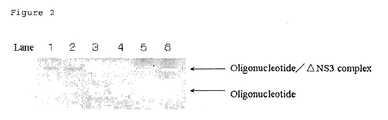
- the Reference Example 2 was performed similar to the Reference Example 1, except that 2 ⁇ M of ⁇ NS3 protein and 0, 200 nM, 1 ⁇ M and 2 ⁇ M of tRNA (Product name: 10 109 541 001 (Roche)) were used to contain in the mixture, instead of 0, 200 nM, 2 ⁇ M and 4 ⁇ M of ⁇ NS3 protein, and the gel was observed. The result is shown in Figure 2 .
- lane 1 corresponds to tRNA
- lane 2 corresponds to control
- lanes 3 to 6 correspond to mixtures containing 200 nM of oligonucleotide, 200 nM of ⁇ NS3 protein and tRNA wherein the concentrations of tRNA are 0, 200 nM, 1 ⁇ M and 2 ⁇ M, respectively.
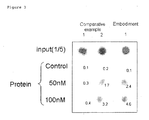
- the following [Gel method] was performed for fifth generation, using 200 nM of ⁇ NS3 protein as the target substance. Then, the double strand DNA products at each generation were subjected to the following [Radiolabeling] to obtain radiolabeled-in vitro transcripts. The transcripts and 0 nM (no proteins), 50 nM and 100 nM of ⁇ NS3 protein, were subjected to the following [Binding Experiment]. The obtained radioactive intensities are shown in Table 1.
- the Comparative Example 2 was performed as the same as the Comparative Example 1, except that the following [SELEX method] was performed for seventh generation instead of fourth generation in the Comparative Example 1. The result is shown in Figure 3 and Table 2.
- RNA pool (sequence number 5).
- DNA synthesizer 334 DNA synthesizer (Applied Biosystems)
- This pool (about 10 ⁇ M) and a base sequence of a primer comprising 5'-end of T7 promoter sequence (sequence number 4) were reacted in the presence of the DNA polymerase to link the T7 promoter.
- a transcriptional reaction was performed, using T7 RNA polymerase with so obtained double strand DNA as the template to obtain RNA pool (sequence number 5).
- RNA pool 200 nm to 20 ⁇ M of the RNA pool was added to the binding buffer solution and stood for 5 minutes at room temperature. Then, to the solution, a metal ion (Mg2+, final concentration of 5 mM) and glycerol was added to prepare its concentration as 20%, and the target substance was added, and stood for 10 minutes at room temperature.
- a metal ion (Mg2+, final concentration of 5 mM) and glycerol was added to prepare its concentration as 20%, and the target substance was added, and stood for 10 minutes at room temperature.
- the mixture was introduced into wells of 1% agarose gel which is preliminary cut at the circumference of the well, and the electrophoresis was performed for 7 minutes at 100 V in TBE buffer solution.
- the solution in the well was recovered, and the oligonucleotide solution was recovered, from the agarose gel piece which is preliminary cut, with spin column (Product Name: Ultrafree-DA (Millipore)).
- the solution in the well and the oligonucleotide solution obtained from the agarose gel piece were subjected to ethanol precipitation to obtain an oligonucleotide.
- RNA pool and the target substance were mixed in the binding buffer solution, and the mixture was introduced in the nitrocellulose membrane fixed to the pop top holder to filter the mixture, and the membrane was washed with 1 mL of the binding buffer solution. Then, the membrane was immersed in 200 pL of an eluting solution (0.4 M of sodium acetate, 5 mM of EDTA and 7 M of urea (pH5.5)), and heated for 5 minutes at 90°C. So obtained solution was subjected to the ethanol precipitation to obtain an oligonucleotide.
- an eluting solution 0.4 M of sodium acetate, 5 mM of EDTA and 7 M of urea (pH5.5)
- the reverse transcription reaction was performed for 1 hour at 42°C with all of the oligonucleotides was recovered, primer 1 (sequence number 6) and Reverse-iT RTase Blend (ABgene).
- the PCR reaction was performed for 18 cycles, using the whole volume of the reaction product of the reverse transcription reaction, 60 pg of primer 2 (sequence number 7) and primer 3 (sequence number 6) with gene Taq enzyme (Nippon Gene) to obtain a double strand DNA product, wherein one cycle of the 18 cycles corresponds to reactions for 30 seconds at 95°C, for 30 seconds at 55°C and for 30 seconds at 74°C.
- the in vitro transcription reaction was performed, using the double strand DNA product (0.5 ⁇ g) as obtained in the PCR reaction and T7 RNA polymerase (Product Name: Ampliscribe (EPICENTRE), volume used 1 ⁇ L) to obtain an in vitro transcript.
- the radiolabeled in vitro transcript and the target protein were incubated in the binding buffer solution for 10 minutes at room temperature.
- the obtained mixture was introduced on the filter (Product Name; MF-membrane filter (Millipore)) which is sucked with the sucker, the filter was then washed with 20 times volume of the binding buffer solution with regard to the mixture.
- the radioactive intensity of so obtained filter was measured with the Bioimaging analyzer (BAS-2500, FUJIFILM (using BAS-MS2040 as the imaging plate)).
- the radioactive intensity was visualized with ImageReader (Id.), and so obtained date was quantified with ImageGauge ver. 4.0 (Id.).
- the gene sequence of the in vitro transcript at the first generation in the Embodiment 1 was analyzed. As the result, 43% of these sequences were identical each other among the clone as separated and extracted. In addition, the gene sequence of the in vitro transcript at the third generation was analyzed. As the result, 66% of these sequences were identical each other among thereof.
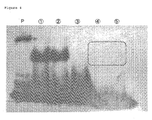
- lane P corresponds to the RNA pool only
- lanes 1 and 2 correspond to the mouse IgG and the RNA aptamer corresponding thereto
- lane 3 corresponds to yellowish-green fluorescent protein (CpYGFP; sequence number 15) only
- lane 4 corresponds to MPO only
- lane 5 corresponds to the radiorabeled in vitro transcript as obtained in use of the mixture of MPO, CpYGFP and MBP, respectively.
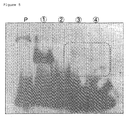
- lane P corresponds to the RNA pool 2 only
- lanes 1 corresponds to the mouse IgG and the RNA aptamer corresponding thereto
- lane 2 corresponds to CpYGFP only
- lane 3 corresponds to MPO only
- lane 4 corresponds to the radiorabeled in vitro transcript as obtained in use of the mixture of MPO, CpYGFP and MBP, respectively.
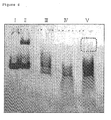
- lane I indicates the RNA aptamer to the mouse IgG
- lane II indicates the mouse IgG and the RNA aptamer corresponding thereto
- lane III indicates CpYGFP only
- lane IV indicates the radiorabeled in vitro transcript as obtained in CpYGFP
- MPO indicates the radiorabeled in vitro transcript as obtained in MPO, and MPO.
- the encircled region with the dashed line indicates the gel as collected.
- RNA pool 2 was performed as the same as the above-mentioned [Preparation of RNA pool], except that the RNA as shown in sequence number 10 was used instead of the DNA as shown in sequence number 3, to obtain a double strand DNA. Then, a transcriptional reaction was performed, using T7 RNA polymerase with to obtained double strand DNA as the template to obtain a DNA pool 2 (sequence number 11).
- RNA pool 2 500 pM was added in a binding buffer 2 (50 mM HEPES/KOH (pH 7.6), 100 mM of NaCl, 5 mM of MgCl 2 x and 20% or glycerol), and the target substance was further added, and stood for 30 minutes at room temperature.
- a binding buffer 2 50 mM HEPES/KOH (pH 7.6), 100 mM of NaCl, 5 mM of MgCl 2 x and 20% or glycerol
- the mixture was subjected to the above-mentioned [Gel method] to obtain an oligonucleotide.
- RNA pool 500 pM was replaced with the radiolabeled in vitro transcript at the just before generation, 1% agarose gel was replaced with polyacrylamide (8%; 45 mM of Tris, 0.45 mM of boric acid and 2.5 mM of MgCl 2 ), and THE buffer solution was replaced with a Running Buffer (45 mM Tris, 0.4.5 mM of boric acid, and 2.5 mM of MgCl 2 ) to perform the electrophoresis for 2 hours at 4°C with 160 V (CV).
- Running Buffer 45 mM Tris, 0.4.5 mM of boric acid, and 2.5 mM of MgCl 2
- RNA molecule was extracted by means of the free diffusion into the buffer solution, and was subjected to an appropriate method such as alcohol precipitation to efficiently obtain an oligonucleotide.
- the oligonucleotide was subjected to the [Gel method 2].
- Reverse transcription reaction was performed as the same as the above-mentioned [RT], except that primer 11 (sequence number 12) was used instead of primer 1 (sequence number 6)
- PCR 2 was performed as the same as the above-mentioned [PCR], except that primer 2 (sequence number 7) and primer 3 (sequence number 8) were replaced with primer 12 (sequence number 13) and primer 13 (sequence number 14), respectively to obtain a double strand RNA product.
- the in vitro transcript at the fourth generation as obtained in the Embodiment 2-1 was subjected to the TA cloning, and base sequences of the cloned 50 colonies were analyzed. As the result, the oligonucleotides of sequence numbers 16 and 17 were obtained.
- RNA pool 2 Sequence Number 16 OnM MPO 1.49 0.24 50nM MPO 2.66 12.48* 100nM RPO 1.70 11.44* BSA 1.86 2.46
Landscapes
- Health & Medical Sciences (AREA)
- Life Sciences & Earth Sciences (AREA)
- Engineering & Computer Science (AREA)
- Genetics & Genomics (AREA)
- Biomedical Technology (AREA)
- Chemical & Material Sciences (AREA)
- Molecular Biology (AREA)
- Organic Chemistry (AREA)
- Biotechnology (AREA)
- General Engineering & Computer Science (AREA)
- Zoology (AREA)
- Bioinformatics & Cheminformatics (AREA)
- Wood Science & Technology (AREA)
- Microbiology (AREA)
- Plant Pathology (AREA)
- Physics & Mathematics (AREA)
- Biochemistry (AREA)
- General Health & Medical Sciences (AREA)
- Biophysics (AREA)
- Measuring Or Testing Involving Enzymes Or Micro-Organisms (AREA)
Claims (5)
- Verfahren zum Erhalten eines Oligonukleotids, umfassend die Schritte:Durchführen einer Elektrophorese unter Verwendung eines Agarosegels von einem Nukleinsäuremolekül/Zielsubstanz-Komplex, umfassend ein Nukleinsäuremolekül und eine Zielsubstanz, wobei der Nukleinsäuremolekül/Zielsubstanz-Komplex durch Inkubation mit wenigstens einem von Glycerol und Saccharose hergerichtet worden ist, wobei die Menge von Glycerol und/oder Saccharose in dem Bereich von 10 bis 30 w/v% ist;Rückgewinnen des Nukleinsäuremolekül/Zielsubstanz-Komplexes;Extrahieren des Nukleinsäuremoleküls von dem Nukleinsäuremolekül/Zielsubstanz-Komplex;Gen-Vervielfältigen des Nukleinsäuremoleküls.
- Verfahren zum Erhalten eines Oligonukleotids nach Anspruch 1, wobei das Verfahren zum Erhalten des Oligonukleotids ferner den Schritt des Durchführens der Elektrophorese unter Verwendung eines Polyacrylamidgels umfasst.
- Verfahren zum Erhalten eines Oligonukleotids nach Anspruch 1 oder 2, ferner umfassend einen Schritt des Kontaktierens des Nukleinsäuremoleküls und der Zielsubstanz vor dem Schritt des Durchführens der Elektrophorese.
- Verfahren zum Erhalten eines Oligonukleotids nach einem der Ansprüche 1 bis 3, wobei das Oligonukleotid ein RNA-Aptamer ist.
- Verfahren zum Erhalten eines Oligonukleotids nach einem der Ansprüche 1 bis 4, wobei die Zielsubstanz ein Protein ist.
Applications Claiming Priority (2)
| Application Number | Priority Date | Filing Date | Title |
|---|---|---|---|
| JP2006212046 | 2006-08-03 | ||
| PCT/JP2007/063741 WO2008015884A1 (en) | 2006-08-03 | 2007-07-10 | Method for obtaining oligonucleotide |
Publications (2)
| Publication Number | Publication Date |
|---|---|
| EP2048246A1 EP2048246A1 (de) | 2009-04-15 |
| EP2048246B1 true EP2048246B1 (de) | 2011-09-14 |
Family
ID=38997066
Family Applications (1)
| Application Number | Title | Priority Date | Filing Date |
|---|---|---|---|
| EP07790559A Not-in-force EP2048246B1 (de) | 2006-08-03 | 2007-07-10 | Verfahren zur gewinnung eines oligonukleotids |
Country Status (5)
| Country | Link |
|---|---|
| US (1) | US20100129870A1 (de) |
| EP (1) | EP2048246B1 (de) |
| JP (1) | JPWO2008015884A1 (de) |
| AU (1) | AU2007279823A1 (de) |
| WO (1) | WO2008015884A1 (de) |
Families Citing this family (1)
| Publication number | Priority date | Publication date | Assignee | Title |
|---|---|---|---|---|
| JP5967687B2 (ja) * | 2009-07-17 | 2016-08-10 | Necソリューションイノベータ株式会社 | スフィンゴシルホスホリルコリンに結合するアプタマー分子 |
Family Cites Families (6)
| Publication number | Priority date | Publication date | Assignee | Title |
|---|---|---|---|---|
| DE69128350T2 (de) | 1990-06-11 | 1998-03-26 | Nexstar Pharmaceuticals Inc | Nukleinsäureliganden |
| US5707796A (en) * | 1990-06-11 | 1998-01-13 | Nexstar Pharmaceuticals, Inc. | Method for selecting nucleic acids on the basis of structure |
| US6465189B1 (en) * | 1990-06-11 | 2002-10-15 | Gilead Sciences, Inc. | Systematic evolution of ligands by exponential enrichment: blended selex |
| US5756291A (en) * | 1992-08-21 | 1998-05-26 | Gilead Sciences, Inc. | Aptamers specific for biomolecules and methods of making |
| AU2003238772A1 (en) * | 2002-05-31 | 2003-12-19 | Regents Of The University Of Minnesota | In vitro evaluation of nucleic acid ligands |
| JP4284426B2 (ja) | 2005-02-01 | 2009-06-24 | 株式会社大一商会 | 遊技機 |
-
2007
- 2007-07-10 JP JP2008527694A patent/JPWO2008015884A1/ja active Pending
- 2007-07-10 AU AU2007279823A patent/AU2007279823A1/en not_active Abandoned
- 2007-07-10 US US12/376,182 patent/US20100129870A1/en not_active Abandoned
- 2007-07-10 EP EP07790559A patent/EP2048246B1/de not_active Not-in-force
- 2007-07-10 WO PCT/JP2007/063741 patent/WO2008015884A1/ja not_active Ceased
Also Published As
| Publication number | Publication date |
|---|---|
| AU2007279823A1 (en) | 2008-02-07 |
| WO2008015884A1 (en) | 2008-02-07 |
| JPWO2008015884A1 (ja) | 2009-12-17 |
| EP2048246A1 (de) | 2009-04-15 |
| US20100129870A1 (en) | 2010-05-27 |
Similar Documents
| Publication | Publication Date | Title |
|---|---|---|
| US11702698B2 (en) | Enhancing specificity of analyte binding | |
| WO2023076345A1 (en) | Methods for spatial analysis using targeted rna capture | |
| CN115916999A (zh) | 用于使用靶向rna耗竭进行空间分析的方法 | |
| EP3597746B1 (de) | Verfahren zur herstellung eines komplexes aus rna-moleküle und peptid und verwendung davon | |
| RU2666989C2 (ru) | Мультиплексные анализы на основе аптамеров | |
| FR2737502A1 (fr) | Procede de detection d'acides nucleiques utilisant des sondes nucleotidiques permettant a la fois une capture specifique et une detection | |
| JP2003525033A5 (de) | ||
| US8703416B2 (en) | Method for purification and identification of sperm cells | |
| Krause et al. | Solution hybridization-nuclease protection assays for sensitive detection of differentially spliced substance P-and neurokinin A-encoding messenger ribonucleic acids | |
| EP3511421A1 (de) | Zusammensetzung und verfahren zur verbesserung der sensitivität und spezifität des nachweises von nukleinsäuren unter verwendung von dcas9-protein und grna-bindung an die gewünschte nukleinsäuresequenz | |
| Lv et al. | Quantitative analysis of noncoding RNA from paired fresh and formalin-fixed paraffin-embedded brain tissues | |
| EP3617326A1 (de) | Verfahren zum nachweis eines kleinen bcr-abl1-gens | |
| EP2048246B1 (de) | Verfahren zur gewinnung eines oligonukleotids | |
| Klaff et al. | Complex formation of the spinach chloroplast psbA mRNA 5'untranslated region with proteins is dependent on the RNA structure | |
| EP2633076A1 (de) | Chemisch verstärkte primerzusammensetzungen, verfahren und kits | |
| EP2098594B1 (de) | Nukleinsäuremolekül mit fähigkeit zur bindung an aus kaninchen stammenden igg-antikörper | |
| JP2001525180A (ja) | タンパク質及び遺伝子を迅速同定するための選択的方法並びにその使用 | |
| KR102539423B1 (ko) | 엑소좀 유래 rna를 이용한 비침습적 대장암 진단 및 분석법 | |
| CN117730149A (zh) | 单链rna纯化方法 | |
| WO2008124111A2 (en) | System for pulling out regulatory elements in vitro | |
| CN119570798B (zh) | 一种结合gprin1蛋白的核酸适配体、应用及其筛选方法 | |
| EP3833781B1 (de) | Verfahren zum nachweisen und/oder quantifizieren einer zielnukleotidsequenz | |
| KR102916060B1 (ko) | 표적 뉴클레오티드 서열을 검출 및/또는 정량화하는 방법 | |
| KR102089371B1 (ko) | 혈관면역아세포성 t 세포 림프종 진단용 마커 및 이의 용도 | |
| Hahn et al. | Messenger RNA in the brain |
Legal Events
| Date | Code | Title | Description |
|---|---|---|---|
| PUAI | Public reference made under article 153(3) epc to a published international application that has entered the european phase |
Free format text: ORIGINAL CODE: 0009012 |
|
| 17P | Request for examination filed |
Effective date: 20090216 |
|
| AK | Designated contracting states |
Kind code of ref document: A1 Designated state(s): AT BE BG CH CY CZ DE DK EE ES FI FR GB GR HU IE IS IT LI LT LU LV MC MT NL PL PT RO SE SI SK TR |
|
| AX | Request for extension of the european patent |
Extension state: AL BA HR MK RS |
|
| DAX | Request for extension of the european patent (deleted) | ||
| RBV | Designated contracting states (corrected) |
Designated state(s): CH DE FR GB LI |
|
| 17Q | First examination report despatched |
Effective date: 20090924 |
|
| GRAP | Despatch of communication of intention to grant a patent |
Free format text: ORIGINAL CODE: EPIDOSNIGR1 |
|
| GRAS | Grant fee paid |
Free format text: ORIGINAL CODE: EPIDOSNIGR3 |
|
| GRAA | (expected) grant |
Free format text: ORIGINAL CODE: 0009210 |
|
| AK | Designated contracting states |
Kind code of ref document: B1 Designated state(s): CH DE FR GB LI |
|
| REG | Reference to a national code |
Ref country code: GB Ref legal event code: FG4D |
|
| REG | Reference to a national code |
Ref country code: CH Ref legal event code: EP |
|
| REG | Reference to a national code |
Ref country code: DE Ref legal event code: R096 Ref document number: 602007017226 Country of ref document: DE Effective date: 20111208 |
|
| REG | Reference to a national code |
Ref country code: CH Ref legal event code: NV Representative=s name: E. BLUM & CO. AG PATENT- UND MARKENANWAELTE VSP |
|
| PLBE | No opposition filed within time limit |
Free format text: ORIGINAL CODE: 0009261 |
|
| STAA | Information on the status of an ep patent application or granted ep patent |
Free format text: STATUS: NO OPPOSITION FILED WITHIN TIME LIMIT |
|
| PGFP | Annual fee paid to national office [announced via postgrant information from national office to epo] |
Ref country code: CH Payment date: 20120606 Year of fee payment: 6 |
|
| 26N | No opposition filed |
Effective date: 20120615 |
|
| REG | Reference to a national code |
Ref country code: DE Ref legal event code: R097 Ref document number: 602007017226 Country of ref document: DE Effective date: 20120615 |
|
| REG | Reference to a national code |
Ref country code: CH Ref legal event code: PL |
|
| PG25 | Lapsed in a contracting state [announced via postgrant information from national office to epo] |
Ref country code: LI Free format text: LAPSE BECAUSE OF NON-PAYMENT OF DUE FEES Effective date: 20130731 Ref country code: CH Free format text: LAPSE BECAUSE OF NON-PAYMENT OF DUE FEES Effective date: 20130731 |
|
| REG | Reference to a national code |
Ref country code: DE Ref legal event code: R082 Ref document number: 602007017226 Country of ref document: DE Representative=s name: PATENTANWAELTE BETTEN & RESCH, DE |
|
| REG | Reference to a national code |
Ref country code: DE Ref legal event code: R082 Ref document number: 602007017226 Country of ref document: DE Representative=s name: BETTEN & RESCH PATENT- UND RECHTSANWAELTE PART, DE Effective date: 20140728 Ref country code: DE Ref legal event code: R081 Ref document number: 602007017226 Country of ref document: DE Owner name: NEC SOLUTION INNOVATORS, LTD., TOKYO, JP Free format text: FORMER OWNERS: NATIONAL INSTITUTE OF ADVANCED INDUSTRIAL SCIENCE AND TECHNOLOGY, TOKIO/TOKYO, JP; NEC SOFT, LTD., TOKIO/TOKYO, JP Effective date: 20140728 Ref country code: DE Ref legal event code: R081 Ref document number: 602007017226 Country of ref document: DE Owner name: NATIONAL INSTITUTE OF ADVANCED INDUSTRIAL SCIE, JP Free format text: FORMER OWNERS: NATIONAL INSTITUTE OF ADVANCED INDUSTRIAL SCIENCE AND TECHNOLOGY, TOKIO/TOKYO, JP; NEC SOFT, LTD., TOKIO/TOKYO, JP Effective date: 20140728 Ref country code: DE Ref legal event code: R081 Ref document number: 602007017226 Country of ref document: DE Owner name: NATIONAL INSTITUTE OF ADVANCED INDUSTRIAL SCIE, JP Free format text: FORMER OWNER: NATIONAL INSTITUTE OF ADVANCED , NEC SOFT, LTD., , JP Effective date: 20140728 Ref country code: DE Ref legal event code: R081 Ref document number: 602007017226 Country of ref document: DE Owner name: NEC SOLUTION INNOVATORS, LTD., TOKYO, JP Free format text: FORMER OWNER: NATIONAL INSTITUTE OF ADVANCED , NEC SOFT, LTD., , JP Effective date: 20140728 Ref country code: DE Ref legal event code: R082 Ref document number: 602007017226 Country of ref document: DE Representative=s name: PATENTANWAELTE BETTEN & RESCH, DE Effective date: 20140728 |
|
| REG | Reference to a national code |
Ref country code: FR Ref legal event code: CD Owner name: NEC SOLUTION INNOVATORS,LTD, JP Effective date: 20140827 Ref country code: FR Ref legal event code: CD Owner name: NATIONAL INSTITUTE OF ADVANCED INDUSTRIAL SCIE, JP Effective date: 20140827 |
|
| PGFP | Annual fee paid to national office [announced via postgrant information from national office to epo] |
Ref country code: DE Payment date: 20140702 Year of fee payment: 8 |
|
| PGFP | Annual fee paid to national office [announced via postgrant information from national office to epo] |
Ref country code: GB Payment date: 20140709 Year of fee payment: 8 Ref country code: FR Payment date: 20140708 Year of fee payment: 8 |
|
| REG | Reference to a national code |
Ref country code: DE Ref legal event code: R119 Ref document number: 602007017226 Country of ref document: DE |
|
| GBPC | Gb: european patent ceased through non-payment of renewal fee |
Effective date: 20150710 |
|
| PG25 | Lapsed in a contracting state [announced via postgrant information from national office to epo] |
Ref country code: DE Free format text: LAPSE BECAUSE OF NON-PAYMENT OF DUE FEES Effective date: 20160202 Ref country code: GB Free format text: LAPSE BECAUSE OF NON-PAYMENT OF DUE FEES Effective date: 20150710 |
|
| REG | Reference to a national code |
Ref country code: FR Ref legal event code: ST Effective date: 20160331 |
|
| PG25 | Lapsed in a contracting state [announced via postgrant information from national office to epo] |
Ref country code: FR Free format text: LAPSE BECAUSE OF NON-PAYMENT OF DUE FEES Effective date: 20150731 |