EP2047970A2 - Procédé de soudage de deux éléments en matériau polymère opaques et résistants à haute température - Google Patents
Procédé de soudage de deux éléments en matériau polymère opaques et résistants à haute température Download PDFInfo
- Publication number
- EP2047970A2 EP2047970A2 EP08166237A EP08166237A EP2047970A2 EP 2047970 A2 EP2047970 A2 EP 2047970A2 EP 08166237 A EP08166237 A EP 08166237A EP 08166237 A EP08166237 A EP 08166237A EP 2047970 A2 EP2047970 A2 EP 2047970A2
- Authority
- EP
- European Patent Office
- Prior art keywords
- elements
- resistant
- polymer material
- laser
- pigment
- Prior art date
- Legal status (The legal status is an assumption and is not a legal conclusion. Google has not performed a legal analysis and makes no representation as to the accuracy of the status listed.)
- Withdrawn
Links
Images
Classifications
-
- B—PERFORMING OPERATIONS; TRANSPORTING
- B29—WORKING OF PLASTICS; WORKING OF SUBSTANCES IN A PLASTIC STATE IN GENERAL
- B29C—SHAPING OR JOINING OF PLASTICS; SHAPING OF MATERIAL IN A PLASTIC STATE, NOT OTHERWISE PROVIDED FOR; AFTER-TREATMENT OF THE SHAPED PRODUCTS, e.g. REPAIRING
- B29C65/00—Joining or sealing of preformed parts, e.g. welding of plastics materials; Apparatus therefor
- B29C65/02—Joining or sealing of preformed parts, e.g. welding of plastics materials; Apparatus therefor by heating, with or without pressure
- B29C65/14—Joining or sealing of preformed parts, e.g. welding of plastics materials; Apparatus therefor by heating, with or without pressure using wave energy, i.e. electromagnetic radiation, or particle radiation
- B29C65/16—Laser beams
-
- B—PERFORMING OPERATIONS; TRANSPORTING
- B29—WORKING OF PLASTICS; WORKING OF SUBSTANCES IN A PLASTIC STATE IN GENERAL
- B29C—SHAPING OR JOINING OF PLASTICS; SHAPING OF MATERIAL IN A PLASTIC STATE, NOT OTHERWISE PROVIDED FOR; AFTER-TREATMENT OF THE SHAPED PRODUCTS, e.g. REPAIRING
- B29C65/00—Joining or sealing of preformed parts, e.g. welding of plastics materials; Apparatus therefor
- B29C65/02—Joining or sealing of preformed parts, e.g. welding of plastics materials; Apparatus therefor by heating, with or without pressure
- B29C65/14—Joining or sealing of preformed parts, e.g. welding of plastics materials; Apparatus therefor by heating, with or without pressure using wave energy, i.e. electromagnetic radiation, or particle radiation
- B29C65/16—Laser beams
- B29C65/1629—Laser beams characterised by the way of heating the interface
- B29C65/1635—Laser beams characterised by the way of heating the interface at least passing through one of the parts to be joined, i.e. laser transmission welding
-
- B—PERFORMING OPERATIONS; TRANSPORTING
- B29—WORKING OF PLASTICS; WORKING OF SUBSTANCES IN A PLASTIC STATE IN GENERAL
- B29C—SHAPING OR JOINING OF PLASTICS; SHAPING OF MATERIAL IN A PLASTIC STATE, NOT OTHERWISE PROVIDED FOR; AFTER-TREATMENT OF THE SHAPED PRODUCTS, e.g. REPAIRING
- B29C65/00—Joining or sealing of preformed parts, e.g. welding of plastics materials; Apparatus therefor
- B29C65/02—Joining or sealing of preformed parts, e.g. welding of plastics materials; Apparatus therefor by heating, with or without pressure
- B29C65/14—Joining or sealing of preformed parts, e.g. welding of plastics materials; Apparatus therefor by heating, with or without pressure using wave energy, i.e. electromagnetic radiation, or particle radiation
-
- B—PERFORMING OPERATIONS; TRANSPORTING
- B29—WORKING OF PLASTICS; WORKING OF SUBSTANCES IN A PLASTIC STATE IN GENERAL
- B29C—SHAPING OR JOINING OF PLASTICS; SHAPING OF MATERIAL IN A PLASTIC STATE, NOT OTHERWISE PROVIDED FOR; AFTER-TREATMENT OF THE SHAPED PRODUCTS, e.g. REPAIRING
- B29C65/00—Joining or sealing of preformed parts, e.g. welding of plastics materials; Apparatus therefor
- B29C65/02—Joining or sealing of preformed parts, e.g. welding of plastics materials; Apparatus therefor by heating, with or without pressure
- B29C65/14—Joining or sealing of preformed parts, e.g. welding of plastics materials; Apparatus therefor by heating, with or without pressure using wave energy, i.e. electromagnetic radiation, or particle radiation
- B29C65/16—Laser beams
- B29C65/1629—Laser beams characterised by the way of heating the interface
- B29C65/1654—Laser beams characterised by the way of heating the interface scanning at least one of the parts to be joined
- B29C65/1658—Laser beams characterised by the way of heating the interface scanning at least one of the parts to be joined scanning once, e.g. contour laser welding
-
- B—PERFORMING OPERATIONS; TRANSPORTING
- B29—WORKING OF PLASTICS; WORKING OF SUBSTANCES IN A PLASTIC STATE IN GENERAL
- B29C—SHAPING OR JOINING OF PLASTICS; SHAPING OF MATERIAL IN A PLASTIC STATE, NOT OTHERWISE PROVIDED FOR; AFTER-TREATMENT OF THE SHAPED PRODUCTS, e.g. REPAIRING
- B29C65/00—Joining or sealing of preformed parts, e.g. welding of plastics materials; Apparatus therefor
- B29C65/02—Joining or sealing of preformed parts, e.g. welding of plastics materials; Apparatus therefor by heating, with or without pressure
- B29C65/14—Joining or sealing of preformed parts, e.g. welding of plastics materials; Apparatus therefor by heating, with or without pressure using wave energy, i.e. electromagnetic radiation, or particle radiation
- B29C65/16—Laser beams
- B29C65/1629—Laser beams characterised by the way of heating the interface
- B29C65/1674—Laser beams characterised by the way of heating the interface making use of laser diodes
-
- B—PERFORMING OPERATIONS; TRANSPORTING
- B29—WORKING OF PLASTICS; WORKING OF SUBSTANCES IN A PLASTIC STATE IN GENERAL
- B29C—SHAPING OR JOINING OF PLASTICS; SHAPING OF MATERIAL IN A PLASTIC STATE, NOT OTHERWISE PROVIDED FOR; AFTER-TREATMENT OF THE SHAPED PRODUCTS, e.g. REPAIRING
- B29C65/00—Joining or sealing of preformed parts, e.g. welding of plastics materials; Apparatus therefor
- B29C65/02—Joining or sealing of preformed parts, e.g. welding of plastics materials; Apparatus therefor by heating, with or without pressure
- B29C65/14—Joining or sealing of preformed parts, e.g. welding of plastics materials; Apparatus therefor by heating, with or without pressure using wave energy, i.e. electromagnetic radiation, or particle radiation
- B29C65/16—Laser beams
- B29C65/1677—Laser beams making use of an absorber or impact modifier
-
- B—PERFORMING OPERATIONS; TRANSPORTING
- B29—WORKING OF PLASTICS; WORKING OF SUBSTANCES IN A PLASTIC STATE IN GENERAL
- B29C—SHAPING OR JOINING OF PLASTICS; SHAPING OF MATERIAL IN A PLASTIC STATE, NOT OTHERWISE PROVIDED FOR; AFTER-TREATMENT OF THE SHAPED PRODUCTS, e.g. REPAIRING
- B29C66/00—General aspects of processes or apparatus for joining preformed parts
- B29C66/01—General aspects dealing with the joint area or with the area to be joined
- B29C66/05—Particular design of joint configurations
- B29C66/10—Particular design of joint configurations particular design of the joint cross-sections
- B29C66/11—Joint cross-sections comprising a single joint-segment, i.e. one of the parts to be joined comprising a single joint-segment in the joint cross-section
- B29C66/112—Single lapped joints
- B29C66/1122—Single lap to lap joints, i.e. overlap joints
-
- B—PERFORMING OPERATIONS; TRANSPORTING
- B29—WORKING OF PLASTICS; WORKING OF SUBSTANCES IN A PLASTIC STATE IN GENERAL
- B29C—SHAPING OR JOINING OF PLASTICS; SHAPING OF MATERIAL IN A PLASTIC STATE, NOT OTHERWISE PROVIDED FOR; AFTER-TREATMENT OF THE SHAPED PRODUCTS, e.g. REPAIRING
- B29C66/00—General aspects of processes or apparatus for joining preformed parts
- B29C66/40—General aspects of joining substantially flat articles, e.g. plates, sheets or web-like materials; Making flat seams in tubular or hollow articles; Joining single elements to substantially flat surfaces
- B29C66/41—Joining substantially flat articles ; Making flat seams in tubular or hollow articles
- B29C66/43—Joining a relatively small portion of the surface of said articles
-
- B—PERFORMING OPERATIONS; TRANSPORTING
- B29—WORKING OF PLASTICS; WORKING OF SUBSTANCES IN A PLASTIC STATE IN GENERAL
- B29C—SHAPING OR JOINING OF PLASTICS; SHAPING OF MATERIAL IN A PLASTIC STATE, NOT OTHERWISE PROVIDED FOR; AFTER-TREATMENT OF THE SHAPED PRODUCTS, e.g. REPAIRING
- B29C66/00—General aspects of processes or apparatus for joining preformed parts
- B29C66/70—General aspects of processes or apparatus for joining preformed parts characterised by the composition, physical properties or the structure of the material of the parts to be joined; Joining with non-plastics material
- B29C66/73—General aspects of processes or apparatus for joining preformed parts characterised by the composition, physical properties or the structure of the material of the parts to be joined; Joining with non-plastics material characterised by the intensive physical properties of the material of the parts to be joined, by the optical properties of the material of the parts to be joined, by the extensive physical properties of the parts to be joined, by the state of the material of the parts to be joined or by the material of the parts to be joined being a thermoplastic or a thermoset
- B29C66/733—General aspects of processes or apparatus for joining preformed parts characterised by the composition, physical properties or the structure of the material of the parts to be joined; Joining with non-plastics material characterised by the intensive physical properties of the material of the parts to be joined, by the optical properties of the material of the parts to be joined, by the extensive physical properties of the parts to be joined, by the state of the material of the parts to be joined or by the material of the parts to be joined being a thermoplastic or a thermoset characterised by the optical properties of the material of the parts to be joined, e.g. fluorescence, phosphorescence
- B29C66/7336—General aspects of processes or apparatus for joining preformed parts characterised by the composition, physical properties or the structure of the material of the parts to be joined; Joining with non-plastics material characterised by the intensive physical properties of the material of the parts to be joined, by the optical properties of the material of the parts to be joined, by the extensive physical properties of the parts to be joined, by the state of the material of the parts to be joined or by the material of the parts to be joined being a thermoplastic or a thermoset characterised by the optical properties of the material of the parts to be joined, e.g. fluorescence, phosphorescence at least one of the parts to be joined being opaque, transparent or translucent to visible light
- B29C66/73361—General aspects of processes or apparatus for joining preformed parts characterised by the composition, physical properties or the structure of the material of the parts to be joined; Joining with non-plastics material characterised by the intensive physical properties of the material of the parts to be joined, by the optical properties of the material of the parts to be joined, by the extensive physical properties of the parts to be joined, by the state of the material of the parts to be joined or by the material of the parts to be joined being a thermoplastic or a thermoset characterised by the optical properties of the material of the parts to be joined, e.g. fluorescence, phosphorescence at least one of the parts to be joined being opaque, transparent or translucent to visible light at least one of the parts to be joined being opaque to visible light
-
- B—PERFORMING OPERATIONS; TRANSPORTING
- B29—WORKING OF PLASTICS; WORKING OF SUBSTANCES IN A PLASTIC STATE IN GENERAL
- B29C—SHAPING OR JOINING OF PLASTICS; SHAPING OF MATERIAL IN A PLASTIC STATE, NOT OTHERWISE PROVIDED FOR; AFTER-TREATMENT OF THE SHAPED PRODUCTS, e.g. REPAIRING
- B29C66/00—General aspects of processes or apparatus for joining preformed parts
- B29C66/70—General aspects of processes or apparatus for joining preformed parts characterised by the composition, physical properties or the structure of the material of the parts to be joined; Joining with non-plastics material
- B29C66/73—General aspects of processes or apparatus for joining preformed parts characterised by the composition, physical properties or the structure of the material of the parts to be joined; Joining with non-plastics material characterised by the intensive physical properties of the material of the parts to be joined, by the optical properties of the material of the parts to be joined, by the extensive physical properties of the parts to be joined, by the state of the material of the parts to be joined or by the material of the parts to be joined being a thermoplastic or a thermoset
- B29C66/739—General aspects of processes or apparatus for joining preformed parts characterised by the composition, physical properties or the structure of the material of the parts to be joined; Joining with non-plastics material characterised by the intensive physical properties of the material of the parts to be joined, by the optical properties of the material of the parts to be joined, by the extensive physical properties of the parts to be joined, by the state of the material of the parts to be joined or by the material of the parts to be joined being a thermoplastic or a thermoset characterised by the material of the parts to be joined being a thermoplastic or a thermoset
- B29C66/7392—General aspects of processes or apparatus for joining preformed parts characterised by the composition, physical properties or the structure of the material of the parts to be joined; Joining with non-plastics material characterised by the intensive physical properties of the material of the parts to be joined, by the optical properties of the material of the parts to be joined, by the extensive physical properties of the parts to be joined, by the state of the material of the parts to be joined or by the material of the parts to be joined being a thermoplastic or a thermoset characterised by the material of the parts to be joined being a thermoplastic or a thermoset characterised by the material of at least one of the parts being a thermoplastic
- B29C66/73921—General aspects of processes or apparatus for joining preformed parts characterised by the composition, physical properties or the structure of the material of the parts to be joined; Joining with non-plastics material characterised by the intensive physical properties of the material of the parts to be joined, by the optical properties of the material of the parts to be joined, by the extensive physical properties of the parts to be joined, by the state of the material of the parts to be joined or by the material of the parts to be joined being a thermoplastic or a thermoset characterised by the material of the parts to be joined being a thermoplastic or a thermoset characterised by the material of at least one of the parts being a thermoplastic characterised by the materials of both parts being thermoplastics
-
- B—PERFORMING OPERATIONS; TRANSPORTING
- B29—WORKING OF PLASTICS; WORKING OF SUBSTANCES IN A PLASTIC STATE IN GENERAL
- B29C—SHAPING OR JOINING OF PLASTICS; SHAPING OF MATERIAL IN A PLASTIC STATE, NOT OTHERWISE PROVIDED FOR; AFTER-TREATMENT OF THE SHAPED PRODUCTS, e.g. REPAIRING
- B29C65/00—Joining or sealing of preformed parts, e.g. welding of plastics materials; Apparatus therefor
- B29C65/02—Joining or sealing of preformed parts, e.g. welding of plastics materials; Apparatus therefor by heating, with or without pressure
- B29C65/14—Joining or sealing of preformed parts, e.g. welding of plastics materials; Apparatus therefor by heating, with or without pressure using wave energy, i.e. electromagnetic radiation, or particle radiation
- B29C65/16—Laser beams
- B29C65/1603—Laser beams characterised by the type of electromagnetic radiation
- B29C65/1609—Visible light radiation, e.g. by visible light lasers
-
- B—PERFORMING OPERATIONS; TRANSPORTING
- B29—WORKING OF PLASTICS; WORKING OF SUBSTANCES IN A PLASTIC STATE IN GENERAL
- B29C—SHAPING OR JOINING OF PLASTICS; SHAPING OF MATERIAL IN A PLASTIC STATE, NOT OTHERWISE PROVIDED FOR; AFTER-TREATMENT OF THE SHAPED PRODUCTS, e.g. REPAIRING
- B29C65/00—Joining or sealing of preformed parts, e.g. welding of plastics materials; Apparatus therefor
- B29C65/02—Joining or sealing of preformed parts, e.g. welding of plastics materials; Apparatus therefor by heating, with or without pressure
- B29C65/14—Joining or sealing of preformed parts, e.g. welding of plastics materials; Apparatus therefor by heating, with or without pressure using wave energy, i.e. electromagnetic radiation, or particle radiation
- B29C65/16—Laser beams
- B29C65/1603—Laser beams characterised by the type of electromagnetic radiation
- B29C65/1612—Infrared [IR] radiation, e.g. by infrared lasers
- B29C65/1616—Near infrared radiation [NIR], e.g. by YAG lasers
-
- B—PERFORMING OPERATIONS; TRANSPORTING
- B29—WORKING OF PLASTICS; WORKING OF SUBSTANCES IN A PLASTIC STATE IN GENERAL
- B29C—SHAPING OR JOINING OF PLASTICS; SHAPING OF MATERIAL IN A PLASTIC STATE, NOT OTHERWISE PROVIDED FOR; AFTER-TREATMENT OF THE SHAPED PRODUCTS, e.g. REPAIRING
- B29C65/00—Joining or sealing of preformed parts, e.g. welding of plastics materials; Apparatus therefor
- B29C65/02—Joining or sealing of preformed parts, e.g. welding of plastics materials; Apparatus therefor by heating, with or without pressure
- B29C65/14—Joining or sealing of preformed parts, e.g. welding of plastics materials; Apparatus therefor by heating, with or without pressure using wave energy, i.e. electromagnetic radiation, or particle radiation
- B29C65/16—Laser beams
- B29C65/1629—Laser beams characterised by the way of heating the interface
- B29C65/1654—Laser beams characterised by the way of heating the interface scanning at least one of the parts to be joined
-
- B—PERFORMING OPERATIONS; TRANSPORTING
- B29—WORKING OF PLASTICS; WORKING OF SUBSTANCES IN A PLASTIC STATE IN GENERAL
- B29C—SHAPING OR JOINING OF PLASTICS; SHAPING OF MATERIAL IN A PLASTIC STATE, NOT OTHERWISE PROVIDED FOR; AFTER-TREATMENT OF THE SHAPED PRODUCTS, e.g. REPAIRING
- B29C65/00—Joining or sealing of preformed parts, e.g. welding of plastics materials; Apparatus therefor
- B29C65/02—Joining or sealing of preformed parts, e.g. welding of plastics materials; Apparatus therefor by heating, with or without pressure
- B29C65/14—Joining or sealing of preformed parts, e.g. welding of plastics materials; Apparatus therefor by heating, with or without pressure using wave energy, i.e. electromagnetic radiation, or particle radiation
- B29C65/16—Laser beams
- B29C65/1687—Laser beams making use of light guides
-
- B—PERFORMING OPERATIONS; TRANSPORTING
- B29—WORKING OF PLASTICS; WORKING OF SUBSTANCES IN A PLASTIC STATE IN GENERAL
- B29C—SHAPING OR JOINING OF PLASTICS; SHAPING OF MATERIAL IN A PLASTIC STATE, NOT OTHERWISE PROVIDED FOR; AFTER-TREATMENT OF THE SHAPED PRODUCTS, e.g. REPAIRING
- B29C66/00—General aspects of processes or apparatus for joining preformed parts
- B29C66/01—General aspects dealing with the joint area or with the area to be joined
- B29C66/342—Preventing air-inclusions
-
- B—PERFORMING OPERATIONS; TRANSPORTING
- B29—WORKING OF PLASTICS; WORKING OF SUBSTANCES IN A PLASTIC STATE IN GENERAL
- B29C—SHAPING OR JOINING OF PLASTICS; SHAPING OF MATERIAL IN A PLASTIC STATE, NOT OTHERWISE PROVIDED FOR; AFTER-TREATMENT OF THE SHAPED PRODUCTS, e.g. REPAIRING
- B29C66/00—General aspects of processes or apparatus for joining preformed parts
- B29C66/70—General aspects of processes or apparatus for joining preformed parts characterised by the composition, physical properties or the structure of the material of the parts to be joined; Joining with non-plastics material
- B29C66/71—General aspects of processes or apparatus for joining preformed parts characterised by the composition, physical properties or the structure of the material of the parts to be joined; Joining with non-plastics material characterised by the composition of the plastics material of the parts to be joined
-
- B—PERFORMING OPERATIONS; TRANSPORTING
- B29—WORKING OF PLASTICS; WORKING OF SUBSTANCES IN A PLASTIC STATE IN GENERAL
- B29C—SHAPING OR JOINING OF PLASTICS; SHAPING OF MATERIAL IN A PLASTIC STATE, NOT OTHERWISE PROVIDED FOR; AFTER-TREATMENT OF THE SHAPED PRODUCTS, e.g. REPAIRING
- B29C66/00—General aspects of processes or apparatus for joining preformed parts
- B29C66/70—General aspects of processes or apparatus for joining preformed parts characterised by the composition, physical properties or the structure of the material of the parts to be joined; Joining with non-plastics material
- B29C66/73—General aspects of processes or apparatus for joining preformed parts characterised by the composition, physical properties or the structure of the material of the parts to be joined; Joining with non-plastics material characterised by the intensive physical properties of the material of the parts to be joined, by the optical properties of the material of the parts to be joined, by the extensive physical properties of the parts to be joined, by the state of the material of the parts to be joined or by the material of the parts to be joined being a thermoplastic or a thermoset
- B29C66/737—General aspects of processes or apparatus for joining preformed parts characterised by the composition, physical properties or the structure of the material of the parts to be joined; Joining with non-plastics material characterised by the intensive physical properties of the material of the parts to be joined, by the optical properties of the material of the parts to be joined, by the extensive physical properties of the parts to be joined, by the state of the material of the parts to be joined or by the material of the parts to be joined being a thermoplastic or a thermoset characterised by the state of the material of the parts to be joined
- B29C66/7377—General aspects of processes or apparatus for joining preformed parts characterised by the composition, physical properties or the structure of the material of the parts to be joined; Joining with non-plastics material characterised by the intensive physical properties of the material of the parts to be joined, by the optical properties of the material of the parts to be joined, by the extensive physical properties of the parts to be joined, by the state of the material of the parts to be joined or by the material of the parts to be joined being a thermoplastic or a thermoset characterised by the state of the material of the parts to be joined amorphous, semi-crystalline or crystalline
- B29C66/73771—General aspects of processes or apparatus for joining preformed parts characterised by the composition, physical properties or the structure of the material of the parts to be joined; Joining with non-plastics material characterised by the intensive physical properties of the material of the parts to be joined, by the optical properties of the material of the parts to be joined, by the extensive physical properties of the parts to be joined, by the state of the material of the parts to be joined or by the material of the parts to be joined being a thermoplastic or a thermoset characterised by the state of the material of the parts to be joined amorphous, semi-crystalline or crystalline the to-be-joined area of at least one of the parts to be joined being amorphous
- B29C66/73772—General aspects of processes or apparatus for joining preformed parts characterised by the composition, physical properties or the structure of the material of the parts to be joined; Joining with non-plastics material characterised by the intensive physical properties of the material of the parts to be joined, by the optical properties of the material of the parts to be joined, by the extensive physical properties of the parts to be joined, by the state of the material of the parts to be joined or by the material of the parts to be joined being a thermoplastic or a thermoset characterised by the state of the material of the parts to be joined amorphous, semi-crystalline or crystalline the to-be-joined area of at least one of the parts to be joined being amorphous the to-be-joined areas of both parts to be joined being amorphous
-
- B—PERFORMING OPERATIONS; TRANSPORTING
- B29—WORKING OF PLASTICS; WORKING OF SUBSTANCES IN A PLASTIC STATE IN GENERAL
- B29C—SHAPING OR JOINING OF PLASTICS; SHAPING OF MATERIAL IN A PLASTIC STATE, NOT OTHERWISE PROVIDED FOR; AFTER-TREATMENT OF THE SHAPED PRODUCTS, e.g. REPAIRING
- B29C66/00—General aspects of processes or apparatus for joining preformed parts
- B29C66/80—General aspects of machine operations or constructions and parts thereof
- B29C66/83—General aspects of machine operations or constructions and parts thereof characterised by the movement of the joining or pressing tools
- B29C66/832—Reciprocating joining or pressing tools
- B29C66/8322—Joining or pressing tools reciprocating along one axis
-
- B—PERFORMING OPERATIONS; TRANSPORTING
- B29—WORKING OF PLASTICS; WORKING OF SUBSTANCES IN A PLASTIC STATE IN GENERAL
- B29C—SHAPING OR JOINING OF PLASTICS; SHAPING OF MATERIAL IN A PLASTIC STATE, NOT OTHERWISE PROVIDED FOR; AFTER-TREATMENT OF THE SHAPED PRODUCTS, e.g. REPAIRING
- B29C66/00—General aspects of processes or apparatus for joining preformed parts
- B29C66/90—Measuring or controlling the joining process
- B29C66/93—Measuring or controlling the joining process by measuring or controlling the speed
- B29C66/934—Measuring or controlling the joining process by measuring or controlling the speed by controlling or regulating the speed
-
- B—PERFORMING OPERATIONS; TRANSPORTING
- B29—WORKING OF PLASTICS; WORKING OF SUBSTANCES IN A PLASTIC STATE IN GENERAL
- B29C—SHAPING OR JOINING OF PLASTICS; SHAPING OF MATERIAL IN A PLASTIC STATE, NOT OTHERWISE PROVIDED FOR; AFTER-TREATMENT OF THE SHAPED PRODUCTS, e.g. REPAIRING
- B29C66/00—General aspects of processes or apparatus for joining preformed parts
- B29C66/90—Measuring or controlling the joining process
- B29C66/93—Measuring or controlling the joining process by measuring or controlling the speed
- B29C66/939—Measuring or controlling the joining process by measuring or controlling the speed characterised by specific speed values or ranges
-
- B—PERFORMING OPERATIONS; TRANSPORTING
- B29—WORKING OF PLASTICS; WORKING OF SUBSTANCES IN A PLASTIC STATE IN GENERAL
- B29K—INDEXING SCHEME ASSOCIATED WITH SUBCLASSES B29B, B29C OR B29D, RELATING TO MOULDING MATERIALS OR TO MATERIALS FOR MOULDS, REINFORCEMENTS, FILLERS OR PREFORMED PARTS, e.g. INSERTS
- B29K2071/00—Use of polyethers, e.g. PEEK, i.e. polyether-etherketone or PEK, i.e. polyetherketone or derivatives thereof, as moulding material
-
- B—PERFORMING OPERATIONS; TRANSPORTING
- B29—WORKING OF PLASTICS; WORKING OF SUBSTANCES IN A PLASTIC STATE IN GENERAL
- B29K—INDEXING SCHEME ASSOCIATED WITH SUBCLASSES B29B, B29C OR B29D, RELATING TO MOULDING MATERIALS OR TO MATERIALS FOR MOULDS, REINFORCEMENTS, FILLERS OR PREFORMED PARTS, e.g. INSERTS
- B29K2079/00—Use of polymers having nitrogen, with or without oxygen or carbon only, in the main chain, not provided for in groups B29K2061/00 - B29K2077/00, as moulding material
- B29K2079/08—PI, i.e. polyimides or derivatives thereof
- B29K2079/085—Thermoplastic polyimides, e.g. polyesterimides, PEI, i.e. polyetherimides, or polyamideimides; Derivatives thereof
-
- B—PERFORMING OPERATIONS; TRANSPORTING
- B29—WORKING OF PLASTICS; WORKING OF SUBSTANCES IN A PLASTIC STATE IN GENERAL
- B29K—INDEXING SCHEME ASSOCIATED WITH SUBCLASSES B29B, B29C OR B29D, RELATING TO MOULDING MATERIALS OR TO MATERIALS FOR MOULDS, REINFORCEMENTS, FILLERS OR PREFORMED PARTS, e.g. INSERTS
- B29K2081/00—Use of polymers having sulfur, with or without nitrogen, oxygen or carbon only, in the main chain, as moulding material
- B29K2081/04—Polysulfides, e.g. PPS, i.e. polyphenylene sulfide or derivatives thereof
-
- B—PERFORMING OPERATIONS; TRANSPORTING
- B29—WORKING OF PLASTICS; WORKING OF SUBSTANCES IN A PLASTIC STATE IN GENERAL
- B29K—INDEXING SCHEME ASSOCIATED WITH SUBCLASSES B29B, B29C OR B29D, RELATING TO MOULDING MATERIALS OR TO MATERIALS FOR MOULDS, REINFORCEMENTS, FILLERS OR PREFORMED PARTS, e.g. INSERTS
- B29K2081/00—Use of polymers having sulfur, with or without nitrogen, oxygen or carbon only, in the main chain, as moulding material
- B29K2081/06—PSU, i.e. polysulfones; PES, i.e. polyethersulfones or derivatives thereof
-
- B—PERFORMING OPERATIONS; TRANSPORTING
- B29—WORKING OF PLASTICS; WORKING OF SUBSTANCES IN A PLASTIC STATE IN GENERAL
- B29K—INDEXING SCHEME ASSOCIATED WITH SUBCLASSES B29B, B29C OR B29D, RELATING TO MOULDING MATERIALS OR TO MATERIALS FOR MOULDS, REINFORCEMENTS, FILLERS OR PREFORMED PARTS, e.g. INSERTS
- B29K2105/00—Condition, form or state of moulded material or of the material to be shaped
- B29K2105/0005—Condition, form or state of moulded material or of the material to be shaped containing compounding ingredients
- B29K2105/0032—Pigments, colouring agents or opacifiyng agents
-
- B—PERFORMING OPERATIONS; TRANSPORTING
- B29—WORKING OF PLASTICS; WORKING OF SUBSTANCES IN A PLASTIC STATE IN GENERAL
- B29K—INDEXING SCHEME ASSOCIATED WITH SUBCLASSES B29B, B29C OR B29D, RELATING TO MOULDING MATERIALS OR TO MATERIALS FOR MOULDS, REINFORCEMENTS, FILLERS OR PREFORMED PARTS, e.g. INSERTS
- B29K2995/00—Properties of moulding materials, reinforcements, fillers, preformed parts or moulds
- B29K2995/0003—Properties of moulding materials, reinforcements, fillers, preformed parts or moulds having particular electrical or magnetic properties, e.g. piezoelectric
- B29K2995/0007—Insulating
-
- B—PERFORMING OPERATIONS; TRANSPORTING
- B29—WORKING OF PLASTICS; WORKING OF SUBSTANCES IN A PLASTIC STATE IN GENERAL
- B29K—INDEXING SCHEME ASSOCIATED WITH SUBCLASSES B29B, B29C OR B29D, RELATING TO MOULDING MATERIALS OR TO MATERIALS FOR MOULDS, REINFORCEMENTS, FILLERS OR PREFORMED PARTS, e.g. INSERTS
- B29K2995/00—Properties of moulding materials, reinforcements, fillers, preformed parts or moulds
- B29K2995/0012—Properties of moulding materials, reinforcements, fillers, preformed parts or moulds having particular thermal properties
- B29K2995/0017—Heat stable
-
- B—PERFORMING OPERATIONS; TRANSPORTING
- B29—WORKING OF PLASTICS; WORKING OF SUBSTANCES IN A PLASTIC STATE IN GENERAL
- B29K—INDEXING SCHEME ASSOCIATED WITH SUBCLASSES B29B, B29C OR B29D, RELATING TO MOULDING MATERIALS OR TO MATERIALS FOR MOULDS, REINFORCEMENTS, FILLERS OR PREFORMED PARTS, e.g. INSERTS
- B29K2995/00—Properties of moulding materials, reinforcements, fillers, preformed parts or moulds
- B29K2995/0018—Properties of moulding materials, reinforcements, fillers, preformed parts or moulds having particular optical properties, e.g. fluorescent or phosphorescent
- B29K2995/002—Coloured
-
- B—PERFORMING OPERATIONS; TRANSPORTING
- B29—WORKING OF PLASTICS; WORKING OF SUBSTANCES IN A PLASTIC STATE IN GENERAL
- B29K—INDEXING SCHEME ASSOCIATED WITH SUBCLASSES B29B, B29C OR B29D, RELATING TO MOULDING MATERIALS OR TO MATERIALS FOR MOULDS, REINFORCEMENTS, FILLERS OR PREFORMED PARTS, e.g. INSERTS
- B29K2995/00—Properties of moulding materials, reinforcements, fillers, preformed parts or moulds
- B29K2995/0018—Properties of moulding materials, reinforcements, fillers, preformed parts or moulds having particular optical properties, e.g. fluorescent or phosphorescent
- B29K2995/0025—Opaque
-
- B—PERFORMING OPERATIONS; TRANSPORTING
- B29—WORKING OF PLASTICS; WORKING OF SUBSTANCES IN A PLASTIC STATE IN GENERAL
- B29K—INDEXING SCHEME ASSOCIATED WITH SUBCLASSES B29B, B29C OR B29D, RELATING TO MOULDING MATERIALS OR TO MATERIALS FOR MOULDS, REINFORCEMENTS, FILLERS OR PREFORMED PARTS, e.g. INSERTS
- B29K2995/00—Properties of moulding materials, reinforcements, fillers, preformed parts or moulds
- B29K2995/0018—Properties of moulding materials, reinforcements, fillers, preformed parts or moulds having particular optical properties, e.g. fluorescent or phosphorescent
- B29K2995/0026—Transparent
- B29K2995/0027—Transparent for light outside the visible spectrum
-
- B—PERFORMING OPERATIONS; TRANSPORTING
- B29—WORKING OF PLASTICS; WORKING OF SUBSTANCES IN A PLASTIC STATE IN GENERAL
- B29K—INDEXING SCHEME ASSOCIATED WITH SUBCLASSES B29B, B29C OR B29D, RELATING TO MOULDING MATERIALS OR TO MATERIALS FOR MOULDS, REINFORCEMENTS, FILLERS OR PREFORMED PARTS, e.g. INSERTS
- B29K2995/00—Properties of moulding materials, reinforcements, fillers, preformed parts or moulds
- B29K2995/0037—Other properties
- B29K2995/0068—Permeability to liquids; Adsorption
- B29K2995/0069—Permeability to liquids; Adsorption non-permeable
-
- B—PERFORMING OPERATIONS; TRANSPORTING
- B29—WORKING OF PLASTICS; WORKING OF SUBSTANCES IN A PLASTIC STATE IN GENERAL
- B29L—INDEXING SCHEME ASSOCIATED WITH SUBCLASS B29C, RELATING TO PARTICULAR ARTICLES
- B29L2031/00—Other particular articles
- B29L2031/34—Electrical apparatus, e.g. sparking plugs or parts thereof
- B29L2031/3481—Housings or casings incorporating or embedding electric or electronic elements
-
- Y—GENERAL TAGGING OF NEW TECHNOLOGICAL DEVELOPMENTS; GENERAL TAGGING OF CROSS-SECTIONAL TECHNOLOGIES SPANNING OVER SEVERAL SECTIONS OF THE IPC; TECHNICAL SUBJECTS COVERED BY FORMER USPC CROSS-REFERENCE ART COLLECTIONS [XRACs] AND DIGESTS
- Y10—TECHNICAL SUBJECTS COVERED BY FORMER USPC
- Y10T—TECHNICAL SUBJECTS COVERED BY FORMER US CLASSIFICATION
- Y10T428/00—Stock material or miscellaneous articles
- Y10T428/31504—Composite [nonstructural laminate]
- Y10T428/31507—Of polycarbonate
-
- Y—GENERAL TAGGING OF NEW TECHNOLOGICAL DEVELOPMENTS; GENERAL TAGGING OF CROSS-SECTIONAL TECHNOLOGIES SPANNING OVER SEVERAL SECTIONS OF THE IPC; TECHNICAL SUBJECTS COVERED BY FORMER USPC CROSS-REFERENCE ART COLLECTIONS [XRACs] AND DIGESTS
- Y10—TECHNICAL SUBJECTS COVERED BY FORMER USPC
- Y10T—TECHNICAL SUBJECTS COVERED BY FORMER US CLASSIFICATION
- Y10T428/00—Stock material or miscellaneous articles
- Y10T428/31504—Composite [nonstructural laminate]
- Y10T428/31721—Of polyimide
-
- Y—GENERAL TAGGING OF NEW TECHNOLOGICAL DEVELOPMENTS; GENERAL TAGGING OF CROSS-SECTIONAL TECHNOLOGIES SPANNING OVER SEVERAL SECTIONS OF THE IPC; TECHNICAL SUBJECTS COVERED BY FORMER USPC CROSS-REFERENCE ART COLLECTIONS [XRACs] AND DIGESTS
- Y10—TECHNICAL SUBJECTS COVERED BY FORMER USPC
- Y10T—TECHNICAL SUBJECTS COVERED BY FORMER US CLASSIFICATION
- Y10T428/00—Stock material or miscellaneous articles
- Y10T428/31504—Composite [nonstructural laminate]
- Y10T428/31942—Of aldehyde or ketone condensation product
Definitions
- the invention also relates to an assembly of elements made of high temperature resistant thermoplastic material and an encapsulation device, or housing, of a power converter comprising such an assembly.
- the encapsulants or the converter housing comprise an assembly of a plurality of elements made of polymeric material, assembled to one another by means of a material forming an adhesive and waterproof joint, such as silicone. These elements are for example assembled so as to form protective covers including in their thickness cooling ducts of the energy converter. The latter can indeed rise to temperatures substantially greater than 250 ° C but accepts no thermal drift. As such, the conduits are traversed by a coolant or coolant such as a mixture of water and glycol.
- the adhesive seal is not satisfactory to ensure in the long run a complete seal between the elements of the housing, because of its physical and chemical properties. This results in coolant leaks which can lead to short circuit problems in the power converter.
- the document WO-2006/08 56 43 discloses a method of welding two polymeric material elements, one of which is rendered opaque to visible radiation and laser radiation and the other is rendered opaque to visible radiation and transparent to laser radiation by adding an anthraquinone dye.
- a dye makes it possible to weld technical polymers which have a softening point and an operating temperature lower than the dye degradation temperature which occurs at 250 ° C.
- Such a welding process does not make it possible to weld polymers whose processing temperature is very high, especially above 300 ° C.
- One of the objectives of the invention is to overcome this problem by proposing a method of welding two opaque elements in which the weld is well made at the interface between the two elements and where the properties of the materials of the elements are not changed.
- the invention relates to a process of the aforementioned type, in which the upper element is rendered, during its preparation, opaque to visible radiation and transparent to laser radiation by adding a pigment to the polymer material, said pigment of inorganic or organic nature, not modifying the properties of the polymeric material, being transparent to laser radiation and resistant to high temperature.
- the invention also relates to an assembly of elements made of high-temperature resistant thermoplastic material, comprising a plurality of elements of visible light-resistant polymer material which are resistant to high temperature, in which at least one of the elements comprises a pigment added to the polymeric material, said pigment, of mineral or organic nature, not modifying the properties of the polymer material, being transparent to laser radiation and resistant to high temperature.
- the invention also relates to a casing of a power converter comprising at least one assembly as described above.
- the invention also relates to a polymer material opaque to visible light radiation and resistant to high temperature, comprising a pigment added to the polymer material, said pigment, of inorganic or organic nature, not modifying the properties of the polymer material, being transparent to laser radiation and resistant to high temperature, so that polymeric material is transparent to laser radiation.
- the invention also relates to the use of a polymeric material as described above in a welding method as described above.
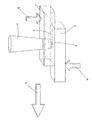
- the laser welding is described, by means of laser radiation 1 from a laser source (not shown), from a lower element 2 to an upper element 4.
- the lower element 2 and the upper element 4 are made from the same thermoplastic polymer material resistant to high temperature.
- This material belongs for example to the group of polyetherimide, sulfonated thermoplastics such as polysulfone or polyethersulfone and their derivatives, polyetheretherketone (PEEK) or polyphenylene sulfide (PPS) or any other high-performance thermoplastic, in particular amorphous .
- the lower element 2 is rendered opaque to laser radiation and visible radiation by means of a micrometric carbon powder mixed with the polymer material.
- opaque laser radiation and visible radiation it is meant that visible light radiation or laser radiation does not pass through the lower element 2.
- the lower element 2 comprises, for example, 0.6% by volume of micrometric carbon powder. (grains of diameter between 2 and 15 microns) mixed with a polymer.
- the carbon powder absorbs the laser radiation 1, which has the effect of heat and melt the surface 6 of the lower element 2 when it is touched by the laser radiation 1.
- the upper element 4 is rendered opaque to visible radiation by means of a mineral pigment.
- This pigment has the characteristics of being virtually transparent to laser radiation 1, that is to say that it absorbs only very little laser radiation, and to be opaque to visible light.
- this additive does not modify the properties of the polymer material of the upper element 4, in particular its mechanical, electrical and chemical properties.
- One of the mechanical properties not modified by the additive is, for example, the Young's modulus of the polymer material.
- Electrical properties not modified by the additive are, for example, the breakdown voltage and the field of rupture of the polymer material.
- One of the chemical properties that are not modified by the additive is, for example, the chemical inertness of the polymer material, that is to say its compatibility with other materials. The properties mentioned above are given by way of non-limiting example.
- the pigment is resistant to very high temperatures, for example greater than 800 ° C. and in particular greater than 1000 ° C., and can therefore be used with polymers whose processing temperature is very high, like the PEEK.
- the inorganic pigment is for example a spinel of cobalt aluminum oxide (Al 2 O 3 , CoO) or cobalt oxide alone (CoO) or cobalt phosphate (Co 3 (PO 4 ) 2 ) or manganese violet.
- the upper element 4 comprises, for example, 0.14% by volume of pigment of the cobalt aluminum oxide type (Al 2 O 3 , CoO)
- the polymer material of the lower 2 and upper 4 elements, as well as the pigment of the upper element 4 are resistant to temperatures of at least 250 ° C.
- the upper element 4 is disposed on the surface 6 of the lower element 2 on an assembly zone 8.
- the laser radiation 1 is emitted from the laser source above the upper element 4. Due to the transparency of the pigment to the laser radiation 1, the laser radiation passes through the upper element 4 and reaches the surface 6 of the element lower 2 in the assembly zone 8. Due to the presence of the carbon powder in the lower element 2, the laser radiation 1 is absorbed at the surface 6 and causes the melting of the material of the lower element 2, which creates the weld at the interface between the upper element 4 and the lower element 2.
- the lower 2 and upper 4 elements are pressed against each other during welding, as shown by the arrows 10 of the figure.
- the laser source is movable so that the laser radiation 1 scans the assembly area 8 and performs welding over the entire area, as shown by the arrow 12 of the figure.
- the elements 2 and 4 may be of any shape.
- the placement of the elements relative to each other is achieved by means of a 3-axis table for a simple geometry, for example for substantially planar elements.
- the laser radiation is brought by means of optical fibers which allow precise positioning of the laser radiation 1 on the assembly zone 8.
- the laser source is for example a continuous emission diode, emitting in the visible or in the near infrared, preferably of wavelength substantially equal to 808 nm.
- a single passage of laser radiation is sufficient to perform the welding at a scanning speed substantially between 0.1 mm.s -1 and 1 mm.s -1 , preferably substantially equal to 0.5 mm.s -1 .
- the laser beam is homogeneous and of substantially rectangular shape, the rectangle having a width substantially between 4 and 5 cm and a length substantially between 0.5 mm and 5 mm.
- the power of the laser is substantially between 100 W and 500 W, preferably substantially equal to 350 W.
- the laser diode may be supplied with a current substantially between 10 A and 50 A, preferably between 20 A and 30 A, this which gives it a power density substantially between 0.8 W.mm -1 and 1.6 W.mm -1 .
- the method described above thus makes it possible to perform the welding of two opaque elements to visible light without modifying the electrical, mechanical and chemical characteristics of the polymer materials of the elements.
- the process can be used with any type of polymeric materials, and especially lower technical polymers. softening temperature.
- the addition of a pigment therefore represents a more "universal" solution than the use of a dye for welding any type of polymer material.
- the use of a dye limits the type of polymer materials that can be welded because of the limited thermal stability of the dye. With a dye, only technical polymers of lower softening temperature can be welded together, while the use of a pigment can be welded in addition to polymers whose processing temperature is very high.
- weld bead produced is perfectly sealed since the elements are connected to each other by a continuity of the same material and this bead has the same characteristics as the lower element 2 and upper 4.
- the overall quality of the weld joint can be greatly improved through the use of a PTFE side edge (not shown) that conforms to the peripheral shape of the elements to be welded.
- This external template prohibits any overflow of plastic material. It also prevents the formation of bubbles in the weld bead that could be harmful to electrical operation (partial discharges)
- Such a housing comprises at least one assembly of a plurality of elements which are assembled to each other according to the method described above.
- the assembled elements make it possible to produce cooling channels in which circulates a cooling liquid, for example formed of water and glycol.
- a cooling liquid for example formed of water and glycol.
- the sealing of the weld makes it possible to obtain channels without risk of leaks and thus of short circuits.
- the housing is an electrical insulator.
- the assembly of elements made of high-temperature resistant polymer material also finds applications in other fields, such as the automotive industry, aeronautics, microelectronics, etc.
Landscapes
- Physics & Mathematics (AREA)
- Engineering & Computer Science (AREA)
- Mechanical Engineering (AREA)
- Optics & Photonics (AREA)
- Health & Medical Sciences (AREA)
- Electromagnetism (AREA)
- Toxicology (AREA)
- Microelectronics & Electronic Packaging (AREA)
- Lining Or Joining Of Plastics Or The Like (AREA)
Abstract
- préparer un élément inférieur (2) en matériau polymère opaque et résistant à haute température auquel est ajouté une poudre de carbone de sorte que l'élément inférieur (2) est apte à absorber un rayonnement laser (1),
- préparer un élément supérieur (4) en matériau polymère résistant à haute température,
- souder au laser les éléments inférieur (2) et supérieur (4) au moyen d'un rayonnement laser (1) traversant l'élément supérieur (4) et réalisant le soudage à l'interface entre l'élément supérieur (4) et l'élément inférieur (2).
Description
- La présente invention concerne un procédé de soudage de deux éléments en matériau polymère opaques et résistants à haute température, du type comprenant les étapes suivantes :
- préparer un élément inférieur en matériau polymère résistant à haute température et auquel est ajouté une poudre de carbone de sorte que l'élément inférieur soit opaque au rayonnement lumineux visible et soit apte à absorber un rayonnement laser,
- préparer un élément supérieur en matériau polymère résistant à haute température,
- souder au laser les éléments inférieur et supérieur au moyen d'un rayonnement laser traversant l'élément supérieur et réalisant le soudage à l'interface entre l'élément supérieur et l'élément inférieur.
- L'invention concerne également un assemblage d'éléments en matériau thermoplastique résistant à hautes températures et un dispositif d'encapsulement, ou boîtier, d'un convertisseur de puissance comprenant un tel assemblage.
- Dans les convertisseurs de puissance connus, les dispositifs d'encapsulement ou encore le boîtier des convertisseurs comprennent un assemblage d'une pluralité d'éléments en matériau polymère, assemblés les uns aux autres au moyen d'un matériau formant un joint adhésif et étanche, tel que du silicone. Ces éléments sont par exemple assemblés de sorte à former des capots protecteurs incluant dans leur épaisseur des conduits de refroidissement du convertisseur d'énergie. Ce dernier peut en effet monter à des températures sensiblement supérieures à 250°C mais n'accepte aucune dérive thermique. A ce titre, les conduits sont traversés par un fluide caloporteur ou liquide de refroidissement tel qu'un mélange d'eau et de glycol.
- Cependant, le joint adhésif n'est pas satisfaisant pour assurer sur le long terme une étanchéité totale entre les éléments du boîtier, du fait de ses propriétés physiques et chimiques. Il se produit alors des fuites du liquide de refroidissement ce qui peut entraîner des problèmes de court-circuit du convertisseur de puissance.
- Pour pallier cet inconvénient, une solution idéale serait de souder les éléments en matériau polymère les uns aux autres. Ainsi, les zones d'assemblage entre les éléments seraient parfaitement étanches du fait de la soudure qui crée une continuité de matériau dans la zone d'assemblage et donc un joint en matériau polymère présentant les mêmes propriétés physiques et chimiques que les éléments assemblés.
- Cependant, la soudure au laser de deux éléments en matériau polymère opaques et résistant à haute température pose problème, car il faut s'assurer que le rayonnement laser traverse un des éléments et provoque la soudure à l'interface entre les deux éléments, sans modifier les propriétés électriques, mécaniques et chimiques des matériaux polymères.
- Le document
WO-2006/08 56 43 décrit un procédé de soudage de deux éléments en matériau polymère dont l'un est rendu opaque au rayonnement visible et au rayonnement laser et l'autre est rendu opaque au rayonnement visible et transparent au rayonnement laser par ajout d'un colorant du type anthraquinone. Un tel colorant permet de souder des polymères techniques qui présentent un point de ramollissement et une température de mise en oeuvre inférieure à la température de dégradation du colorant qui survient dès 250°C. Un tel procédé de soudage ne permet pas de souder des polymères dont la température de mise en oeuvre est très élevée notamment au-delà de 300°C. - L'un des objectifs de l'invention est de pallier ce problème en proposant un procédé de soudage de deux éléments opaques dans lequel la soudure est bien réalisée à l'interface entre les deux éléments et où les propriétés des matériaux des éléments ne sont pas modifiées.
- A cet effet, l'invention concerne un procédé du type précité, dans lequel l'élément supérieur est rendu, au cours de sa préparation, opaque au rayonnement visible et transparent au rayonnement laser par ajout d'un pigment au matériau polymère, ledit pigment, de nature minérale ou organique, ne modifiant pas les propriétés du matériau polymère, étant transparent au rayonnement laser et résistant à haute température.
- Selon d'autres caractéristiques du procédé :
- l'élément supérieur et l'élément inférieur sont pressés l'un contre l'autre lors du soudage au laser ;
- les matériaux polymères des éléments inférieur et supérieur et le pigment ajouté à l'élément supérieur sont résistants à des températures d'au moins 250 °C ;
- les matériaux polymères des éléments inférieur et supérieur appartiennent à la famille :
- des polyétherimide,
- des thermoplastiques à rotule sulfone tels que le polysulfone, le polyéthersulfone et autres dérivés,
- des polyétheréthercétone,
- du poly(sulfure de phénylène),
- du polycarbonate,
- des formulations obtenues par mélange ou co-réaction des composés susmentionnés,
- le pigment est un oxyde de cobalt et d'aluminium (Al2O3, CoO) ou l'oxyde de cobalt seul (CoO) ou le phosphate de cobalt (Co3(PO4)2) ou le violet de manganèse ; et
- une source laser est déplacée au-dessus d'une zone d'assemblage des deux éléments de sorte que le rayonnement laser, émis par la source laser, balaye ladite zone d'assemblage,
- la poudre de carbone mélangée au polymère de l'élément inférieur est une poudre de carbone micrométrique.
- L'invention concerne également un assemblage d'éléments en matériau thermoplastique résistant à hautes températures, comprenant une pluralité d'éléments en matériau polymère opaques au rayonnement lumineux visible et résistants à haute température, dans lequel au moins un des éléments comprend un pigment ajouté au matériau polymère, ledit pigment, de nature minérale ou organique, ne modifiant pas les propriétés du matériau polymère, étant transparent au rayonnement laser et résistant à haute température.
- Selon d'autres caractéristiques de l'assemblage :
- les zones d'assemblage entre les éléments sont étanches ;
- l'assemblage est électriquement isolant ; et
- les éléments sont assemblés entre eux par un procédé de soudage tel que défini ci-dessus.
- L'invention concerne également un boîtier d'un convertisseur de puissance comprenant au moins un assemblage tel que décrit ci-dessus.
- L'invention concerne également un matériau polymère opaque au rayonnement lumineux visible et résistant à haute température, comprenant un pigment ajouté au matériau polymère, ledit pigment, de nature minérale ou organique, ne modifiant pas les propriétés du matériau polymère, étant transparent au rayonnement laser et résistant à haute température, de sorte que matériau polymère est transparent au rayonnement laser.
- L'invention concerne également l'utilisation d'un matériau polymère tel que décrit ci-dessus dans un procédé de soudage tel que décrit précédemment.
- D'autres aspects et avantages de l'invention apparaîtront à la lecture de la description qui suit, donnée à titre d'exemple et faite en référence à la figure annexée qui est une représentation schématique d'une étape de soudure au laser de deux éléments.
- En référence à la figure unique, on décrit le soudage au laser, au moyen d'un rayonnement laser 1 issue d'une source laser (non représentée), d'un élément inférieur 2 à un élément supérieur 4.
- L'élément inférieur 2 et l'élément supérieur 4 sont réalisés à partir d'un même matériau polymère thermoplastique résistant à haute température. Ce matériau appartient par exemple au groupe des polyétherimide, les thermoplastiques à rotule sulfone tels que le polysulfone ou le polyéthersulfone et leurs dérivés, polyétheréthercétone (PEEK) ou poly(sulfure de phénylène) (PPS) ou tout autres thermoplastiques à hautes performances, notamment amorphe.
- L'élément inférieur 2 est rendu opaque au rayonnement laser et au rayonnement visible au moyen d'une poudre de carbone micrométrique mélangée au matériau polymère. Par opaque au rayonnement laser et au rayonnement visible, on entend qu'un rayonnement lumineux visible ou un rayonnement laser ne traversent pas l'élément inférieur 2. L'élément inférieur 2 comprend par exemple 0,6% en volume de poudre de carbone micrométrique (grains de diamètre compris entre 2 et 15 µm) mélangé à un polymère. La poudre de carbone absorbe le rayonnement laser 1, ce qui a pour effet de faire chauffer et fondre la surface 6 de l'élément inférieur 2 lorsqu'elle est touchée par le rayonnement laser 1.
- L'élément supérieur 4 est rendu opaque au rayonnement visible au moyen d'un pigment minéral. Ce pigment a pour caractéristiques d'être quasi-transparent au rayonnement laser 1, c'est-à-dire qu'il n'absorbe que très peu le rayonnement laser, et d'être opaque à la lumière visible. En outre, cet additif ne modifie pas les propriétés du matériau polymère de l'élément supérieur 4, notamment ses propriétés mécaniques, électriques et chimiques. Une des propriétés mécaniques non modifiées par l'additif est par exemple le module d'Young du matériau polymère. Des propriétés électriques non modifiées par l'additif sont par exemple la tension de claquage et le champ de rupture du matériau polymère. Une des propriétés chimiques non modifiées par l'additif est par exemple l'inertie chimique du matériau polymère, c'est-à-dire sa compatibilité avec d'autres matériaux. Les propriétés mentionnées ci-dessus ne sont données qu'à titre d'exemple non limitatif.
- Le pigment est résistant aux très hautes températures, par exemple supérieures à 800°C et notamment supérieures à 1000°C, et peut donc être utilisé avec les polymères dont la température de mise en oeuvre est très élevée à l'image du PEEK.. Le pigment minéral est par exemple une spinelle d'oxyde de cobalt et d'aluminium (Al2O3, CoO) ou l'oxyde de cobalt seul (CoO) ou le phosphate de cobalt (Co3(PO4)2) ou le violet de manganèse. L'élément supérieur 4 comprend par exemple 0,14% en volume de pigment de type oxyde de cobalt et d'aluminium (Al2O3, CoO)
- Le matériau polymère des éléments inférieur 2 et supérieur 4, ainsi que le pigment de l'élément supérieur 4 sont résistants à des températures d'au moins 250°C.
- Pour réaliser le soudage, l'élément supérieur 4 est disposé sur la surface 6 de l'élément inférieur 2 sur une zone d'assemblage 8.
- Le rayonnement laser 1 est émis depuis la source laser au-dessus de l'élément supérieur 4. Du fait de la transparence du pigment au rayonnement laser 1, le rayonnement laser traverse l'élément supérieur 4 et atteint la surface 6 de l'élément inférieur 2 dans la zone d'assemblage 8. Du fait de la présence de la poudre de carbone dans l'élément inférieur 2, le rayonnement laser 1 est absorbé au niveau de la surface 6 et provoque la fusion du matériau de l'élément inférieur 2, ce qui crée la soudure à l'interface entre l'élément supérieur 4 et l'élément inférieur 2.
- Les éléments inférieur 2 et supérieur 4 sont pressés l'un contre l'autre lors du soudage, comme représenté par les flèches 10 de la figure.
- De plus, la source laser est mobile de sorte que le rayonnement laser 1 balaye la zone d'assemblage 8 et réalise la soudure sur toute cette zone, comme représenté par la flèche 12 de la figure.
- Les éléments 2 et 4 peuvent être de forme quelconque. Le placement des éléments l'un par rapport à l'autre est réalisé au moyen d'une table 3 axes pour une géométrie simple, par exemple pour des éléments sensiblement plans. Pour une géométrie complexe, le rayonnement laser est amené au moyen de fibres optiques qui permettent un positionnement précis du rayonnement laser 1 sur la zone d'assemblage 8.
- La source laser est par exemple une diode à émission continue, émettant dans le visible ou dans le proche infrarouge, de préférence de longueur d'onde sensiblement égale à 808 nm. Un seul passage de rayonnement laser suffit à réaliser la soudure à une vitesse de balayage sensiblement comprise entre 0,1 mm.s-1 et 1 mm.s-1, de préférence sensiblement égale à 0,5 mm.s-1. Le faisceau laser est homogène et de forme sensiblement rectangulaire, le rectangle présentant une largeur sensiblement comprise entre 4 et 5 cm et une longueur sensiblement comprise entre 0,5 mm et 5 mm. La puissance du laser est sensiblement comprise entre 100 W et 500 W, de préférence sensiblement égale à 350 W. La diode laser peut être alimentée par un courant sensiblement compris entre 10 A et 50 A, de préférence entre 20 A et 30 A, ce qui lui confère une densité de puissance sensiblement comprise entre de 0,8 W.mm-1 et 1,6 W.mm-1.
- Le procédé décrit ci-dessus permet donc de réaliser le soudage de deux éléments opaques à la lumière visible sans modifier les caractéristiques électriques, mécaniques et chimiques des matériaux polymères des éléments. Notamment, on peut réaliser le soudage de deux éléments résistants aux très hautes températures. Cependant, le procédé peut être utilisé avec tout type de matériaux polymères, et notamment des polymères techniques de plus basse température de ramollissement. L'ajout d'un pigment représente donc une solution plus « universelle » que l'utilisation d'un colorant pour la soudure de tout type de matériaux polymères. En effet, l'utilisation d'un colorant limite le type de matériaux polymères pouvant être soudés du fait de la stabilité thermique limitée du colorant. Avec un colorant, seuls des polymères techniques de plus basse température de ramollissement peuvent être soudés entre eux, tandis que l'utilisation d'un pigment permet de souder en plus des polymères dont la température de mise en oeuvre est très élevée.
- De plus, le cordon de soudure réalisé est parfaitement étanche étant donné que les éléments sont liés l'un à l'autre par une continuité d'un même matériau et que ce cordon présente les mêmes caractéristiques que les élément inférieur 2 et supérieur 4. La qualité globale du joint de soudure peut être grandement améliorée grâce à l'utilisation d'une bordure latérale en PTFE (non représentée) qui épouse la forme périphérique des éléments à souder. Ce gabarit extérieur interdit tout débordement de matière plastique. Il prévient également la formation de bulles au sein du cordon de soudure qui pourraient être néfastes au fonctionnement électrique (décharges partielles)
- Le procédé décrit ci-dessus trouve notamment des applications pour réaliser des assemblages d'éléments en matériau polymère résistants à hautes températures, notamment des boîtiers de convertisseur de puissance. Un tel boîtier comprend au moins un assemblage d'une pluralité d'éléments qui sont assemblés les uns aux autres selon le procédé décrit ci-dessus.
- Ces convertisseurs dégagent une chaleur importante et le procédé permet de réaliser un boîtier, résistant à de telles températures pouvant monter jusqu'à au moins 250°C.
- Les éléments assemblés permettent de réaliser des canaux de refroidissement dans lesquels circule un liquide de refroidissement par exemple formé d'eau et de glycol. L'étanchéité de la soudure permet d'obtenir des canaux sans risque de fuites et donc de courts-circuits.
- De plus, du fait des propriétés électriques des éléments assemblés et du cordon de soudure, le boîtier est un isolant électrique.
- L'assemblage d'éléments en matériau polymère résistant à hautes températures trouve également des applications dans d'autres domaines, tels que l'industrie automobile, l'aéronautique, la microélectronique etc.
Claims (14)
- Procédé de soudage de deux éléments (2, 4) en matériau polymère opaques au rayonnement lumineux visible et résistants à haute température, comprenant les étapes suivantes :- préparer un élément inférieur (2) en matériau polymère résistant à haute température et auquel est ajouté une poudre de carbone de sorte que l'élément inférieur (2) soit opaque au rayonnement lumineux visible et soit apte à absorber un rayonnement laser (1),- préparer un élément supérieur (4) en matériau polymère résistant à haute température,- souder au laser les éléments inférieur (2) et supérieur (4) au moyen d'un rayonnement laser (1) traversant l'élément supérieur (4) et réalisant le soudage à l'interface entre l'élément supérieur (4) et l'élément inférieur (2),caractérisé en ce que l'élément supérieur (4) est rendu, au cours de sa préparation, opaque au rayonnement visible et transparent au rayonnement laser par ajout d'un pigment au matériau polymère, ledit pigment, de nature minérale ou organique, ne modifiant pas les propriétés du matériau polymère, étant transparent au rayonnement laser et résistant à haute température.
- Procédé de soudage selon la revendication 1, caractérisé en ce que l'élément supérieur (4) et l'élément inférieur (2) sont pressés l'un contre l'autre lors du soudage au laser.
- Procédé de soudage selon la revendication 1 ou 2, caractérisé en ce que les matériaux polymères des éléments inférieur (2) et supérieur (4) et le pigment ajouté à l'élément supérieur (4) sont résistants à des températures d'au moins 250 °C.
- Procédé de soudage selon l'une quelconque des revendications 1 à 3, caractérisé en ce que les matériaux polymères des élément inférieur (2) et supérieur (4) appartiennent à la famille :- des polyétherimide,- des thermoplastiques à rotule sulfone tels que le polysulfone, le polyéthersulfone et autres dérivés,- des polyétheréthercétone,- du poly(sulfure de phénylène),- du polycarbonate,- des formulations obtenues par mélange ou co-réaction des composés susmentionnés.
- Procédé de soudage selon l'une quelconque des revendications 1 à 4, caractérisé en ce que le pigment est un oxyde de cobalt et d'aluminium (Al2O3, CoO) ou l'oxyde de cobalt seul (CoO) ou le phosphate de cobalt (Co3(PO4)2) ou le violet de manganèse.
- Procédé de soudage selon l'une quelconque des revendications 1 à 5, caractérisé en ce qu'une source laser est déplacée au-dessus d'une zone d'assemblage (8) des deux éléments (2, 4) de sorte que le rayonnement laser (1), émis par la source laser, balaye ladite zone d'assemblage (8).
- Procédé de soudage selon l'une quelconque des revendications 1 à 6, caractérisé en ce que la poudre de carbone mélangée au polymère de l'élément inférieur (2) est une poudre de carbone micrométrique.
- Assemblage d'éléments en matériau thermoplastique résistant à hautes températures, comprenant une pluralité d'éléments (2, 4) en matériau polymère opaques au rayonnement lumineux visible et résistants à haute température, caractérisé en ce qu'au moins un des éléments (4) comprend un pigment ajouté au matériau polymère, ledit pigment, de nature minérale ou organique, ne modifiant pas les propriétés du matériau polymère, étant transparent au rayonnement laser et résistant à haute température.
- Assemblage selon la revendication 8, caractérisé en ce que les zones d'assemblage (8) entre les éléments (2, 4) sont étanches.
- Assemblage selon la revendication 8 ou 9, caractérisé en ce qu'il est électriquement isolant.
- Assemblage selon l'une quelconque des revendications 8 à 10, caractérisé en ce que les éléments (2, 4) sont assemblés entre eux par un procédé de soudage selon l'une quelconque des revendications 1 à 6.
- Boîtier d'un convertisseur de puissance, caractérisé en ce qu'il comprend au moins un assemblage selon l'une quelconque des revendications 8 à 11.
- Matériau polymère opaque au rayonnement lumineux visible et résistant à haute température, caractérisé en ce qu'il comprend un pigment ajouté au matériau polymère, ledit pigment, de nature minérale ou organique, ne modifiant pas les propriétés du matériau polymère, étant transparent au rayonnement laser et résistant à haute température, de sorte que matériau polymère est transparent au rayonnement laser.
- Utilisation d'un matériau polymère selon la revendication 13 dans un procédé de soudage selon l'une quelconque des revendications 1 à 7.
Applications Claiming Priority (1)
| Application Number | Priority Date | Filing Date | Title |
|---|---|---|---|
| FR0758190A FR2922149B1 (fr) | 2007-10-10 | 2007-10-10 | Procede de soudage de deux elements en materiau polymere opaques et resistant a haute temperature |
Publications (2)
| Publication Number | Publication Date |
|---|---|
| EP2047970A2 true EP2047970A2 (fr) | 2009-04-15 |
| EP2047970A3 EP2047970A3 (fr) | 2014-05-28 |
Family
ID=39415134
Family Applications (1)
| Application Number | Title | Priority Date | Filing Date |
|---|---|---|---|
| EP20080166237 Withdrawn EP2047970A3 (fr) | 2007-10-10 | 2008-10-09 | Procédé de soudage de deux éléments en matériau polymère opaques et résistants à haute température |
Country Status (8)
| Country | Link |
|---|---|
| US (1) | US20090239081A1 (fr) |
| EP (1) | EP2047970A3 (fr) |
| JP (1) | JP2009107335A (fr) |
| KR (1) | KR20090037356A (fr) |
| CN (1) | CN101412816A (fr) |
| CA (1) | CA2641098A1 (fr) |
| FR (1) | FR2922149B1 (fr) |
| RU (1) | RU2008140214A (fr) |
Cited By (2)
| Publication number | Priority date | Publication date | Assignee | Title |
|---|---|---|---|---|
| WO2012119967A1 (fr) * | 2011-03-08 | 2012-09-13 | Basf Se | Polyester transparent au rayonnement laser et contenant des sels inorganiques |
| EP2383104A3 (fr) * | 2010-04-27 | 2014-01-22 | WAREMA Kunststofftechnik und Maschinenbau GmbH | Soudage au laser de pièces en matière plastique |
Families Citing this family (6)
| Publication number | Priority date | Publication date | Assignee | Title |
|---|---|---|---|---|
| JP5366637B2 (ja) * | 2008-08-29 | 2013-12-11 | 朝日電装株式会社 | シリンダ錠の保護装置 |
| CN103002679A (zh) * | 2011-09-14 | 2013-03-27 | 深圳市联亨技术有限公司 | 一种铝机柜加工方法 |
| JP6024152B2 (ja) * | 2012-03-29 | 2016-11-09 | 東洋製罐株式会社 | 容器及び蓋のレーザ溶着による密封方法 |
| FR3050795B1 (fr) * | 2016-04-27 | 2019-11-29 | Valeo Iluminacion | Dispositif lumineux comprenant au moins deux parties soudees au laser |
| CN114715441A (zh) * | 2022-03-09 | 2022-07-08 | 上海卫星工程研究所 | 卫星动力系统热控制方法及系统 |
| CN115383863B (zh) * | 2022-08-31 | 2023-04-14 | 福建农林大学 | 一种可定制图案的透光竹刨花板及其制备方法 |
Family Cites Families (12)
| Publication number | Priority date | Publication date | Assignee | Title |
|---|---|---|---|---|
| DE19960104A1 (de) * | 1999-12-14 | 2001-06-21 | Bayer Ag | Laserdurchstrahlschweißbare thermoplastische Formmassen |
| JP3887629B2 (ja) * | 2004-03-30 | 2007-02-28 | オリヱント化学工業株式会社 | レーザー光透過性着色熱可塑性樹脂組成物及びその関連技術 |
| JP2006152007A (ja) * | 2003-01-29 | 2006-06-15 | Orient Chem Ind Ltd | レーザー光透過性着色熱可塑性樹脂組成物及びレーザー溶着方法 |
| US20050003301A1 (en) * | 2003-01-29 | 2005-01-06 | Orient Chemical Industries, Ltd. | Laser ray transmitting colored thermoplastic resin composition and method of laser welding |
| DE10324324A1 (de) * | 2003-05-27 | 2004-12-16 | Bayer Ag | Polyamid-Formmassen |
| US20060151099A1 (en) * | 2003-08-27 | 2006-07-13 | Orient Chemical Industries, Ltd. | Method for laser welding |
| JP4996836B2 (ja) * | 2004-07-22 | 2012-08-08 | ダイセルポリマー株式会社 | レーザー溶着用ラベル及び複合成形品 |
| US7879929B2 (en) * | 2004-10-06 | 2011-02-01 | Orient Chemical Industries Co., Ltd. | Quinophthalone compound, mixed colorant, laser ray transmitting colored resin composition, and laser-welded product |
| WO2006085643A1 (fr) * | 2005-02-09 | 2006-08-17 | Orient Chemical Industries, Ltd. | Materiau soude au laser d’un element permeable au rayon laser contenant un sel de metal alcalinoterreux d’un colorant a base d’acide d'anthraquinone |
| US20080069997A1 (en) * | 2005-02-09 | 2008-03-20 | Syuuji Sugawara | Laser-welded article of laser-transmissible workpiece including alkaline earth metal salt of anthrapyridone acid dye |
| CN1923897A (zh) * | 2005-09-01 | 2007-03-07 | 东方化学工业株式会社 | 激光透过性着色树脂组合物及其相关技术 |
| DE602006012770D1 (de) * | 2005-09-21 | 2010-04-22 | Orient Chemical Ind | Laserverschweißter Gegenstand |
-
2007
- 2007-10-10 FR FR0758190A patent/FR2922149B1/fr not_active Expired - Fee Related
-
2008
- 2008-10-09 CA CA 2641098 patent/CA2641098A1/fr not_active Abandoned
- 2008-10-09 RU RU2008140214/12A patent/RU2008140214A/ru not_active Application Discontinuation
- 2008-10-09 US US12/287,448 patent/US20090239081A1/en not_active Abandoned
- 2008-10-09 EP EP20080166237 patent/EP2047970A3/fr not_active Withdrawn
- 2008-10-10 JP JP2008263423A patent/JP2009107335A/ja active Pending
- 2008-10-10 KR KR1020080099676A patent/KR20090037356A/ko not_active Withdrawn
- 2008-10-10 CN CNA2008101785085A patent/CN101412816A/zh active Pending
Cited By (2)
| Publication number | Priority date | Publication date | Assignee | Title |
|---|---|---|---|---|
| EP2383104A3 (fr) * | 2010-04-27 | 2014-01-22 | WAREMA Kunststofftechnik und Maschinenbau GmbH | Soudage au laser de pièces en matière plastique |
| WO2012119967A1 (fr) * | 2011-03-08 | 2012-09-13 | Basf Se | Polyester transparent au rayonnement laser et contenant des sels inorganiques |
Also Published As
| Publication number | Publication date |
|---|---|
| US20090239081A1 (en) | 2009-09-24 |
| KR20090037356A (ko) | 2009-04-15 |
| JP2009107335A (ja) | 2009-05-21 |
| EP2047970A3 (fr) | 2014-05-28 |
| FR2922149A1 (fr) | 2009-04-17 |
| RU2008140214A (ru) | 2010-04-20 |
| CA2641098A1 (fr) | 2009-04-10 |
| FR2922149B1 (fr) | 2011-06-10 |
| CN101412816A (zh) | 2009-04-22 |
Similar Documents
| Publication | Publication Date | Title |
|---|---|---|
| EP2047970A2 (fr) | Procédé de soudage de deux éléments en matériau polymère opaques et résistants à haute température | |
| CA2337220C (fr) | Joints de recouvrement et joints aboutes produits simultanement | |
| US20020100540A1 (en) | Simultaneous butt and lap joints | |
| US20230207721A1 (en) | Method For Fabricating A Photovoltaic Module Including Laser Cutting Of A Photovoltaic Label | |
| JP5969479B2 (ja) | ガラスパッケージを封止するプロセスおよび得られるガラスパッケージ | |
| CN102403466A (zh) | 一种用于光电器件封装的激光键合方法 | |
| US9421712B2 (en) | Laser joining method | |
| JPWO2007034978A1 (ja) | レーザー溶着体 | |
| US20050218123A1 (en) | Laser welding method of resin materials | |
| WO2013154037A1 (fr) | Procédé pour le soudage au laser | |
| KR101748879B1 (ko) | 수지 부재의 레이저 접합 방법 및 수지 부재의 레이저 접합체 | |
| CN101291798A (zh) | 用于激光焊接三个聚合物层的方法以及由该方法生产的制品 | |
| US20110061884A1 (en) | Laser assisted system and method for bonding of surfaces; microcavity for packaging mems devices | |
| CN102173218A (zh) | 一种激光打标机的新用途 | |
| JP4439290B2 (ja) | 熱可塑性樹脂製部の製造方法 | |
| JP4792429B2 (ja) | レーザー溶着体 | |
| CN105026897A (zh) | 流量传感器 | |
| FR3165572A1 (fr) | Procédé de fabrication d’un panneau multicellulaire par soudage radiatif | |
| CN111113910A (zh) | 一种激光焊接方法及其激光焊接装置 | |
| JP2009125963A (ja) | 熱可塑性樹脂部材の溶着方法 | |
| CN117060181A (zh) | 针对介质密封插入件的方法和模制件 | |
| CN114768895A (zh) | 一种适用于热塑性聚合物材料微流控芯片的激光键合方法 | |
| Hoult | Laser welding of polymer micro-fluidic devices using novel diode laser sources | |
| FR3097465A1 (fr) | Elément de support avec portion d’isolation thermique | |
| JP2024166633A (ja) | 繊維含有率の異なる短繊維複相強化熱可塑性樹脂構造体、その接合体及び製造方法 |
Legal Events
| Date | Code | Title | Description |
|---|---|---|---|
| PUAI | Public reference made under article 153(3) epc to a published international application that has entered the european phase |
Free format text: ORIGINAL CODE: 0009012 |
|
| AK | Designated contracting states |
Kind code of ref document: A2 Designated state(s): AT BE BG CH CY CZ DE DK EE ES FI FR GB GR HR HU IE IS IT LI LT LU LV MC MT NL NO PL PT RO SE SI SK TR |
|
| AX | Request for extension of the european patent |
Extension state: AL BA MK RS |
|
| PUAL | Search report despatched |
Free format text: ORIGINAL CODE: 0009013 |
|
| AK | Designated contracting states |
Kind code of ref document: A3 Designated state(s): AT BE BG CH CY CZ DE DK EE ES FI FR GB GR HR HU IE IS IT LI LT LU LV MC MT NL NO PL PT RO SE SI SK TR |
|
| AX | Request for extension of the european patent |
Extension state: AL BA MK RS |
|
| RIC1 | Information provided on ipc code assigned before grant |
Ipc: B29K 71/00 20060101ALN20140422BHEP Ipc: B29K 79/00 20060101ALN20140422BHEP Ipc: B29C 65/16 20060101AFI20140422BHEP Ipc: B29K 81/00 20060101ALN20140422BHEP |
|
| STAA | Information on the status of an ep patent application or granted ep patent |
Free format text: STATUS: THE APPLICATION IS DEEMED TO BE WITHDRAWN |
|
| 18D | Application deemed to be withdrawn |
Effective date: 20140501 |