EP2044835A1 - Greenhouse system - Google Patents
Greenhouse system Download PDFInfo
- Publication number
- EP2044835A1 EP2044835A1 EP07117824A EP07117824A EP2044835A1 EP 2044835 A1 EP2044835 A1 EP 2044835A1 EP 07117824 A EP07117824 A EP 07117824A EP 07117824 A EP07117824 A EP 07117824A EP 2044835 A1 EP2044835 A1 EP 2044835A1
- Authority
- EP
- European Patent Office
- Prior art keywords
- relevant
- plants
- light
- greenhouse
- illumination
- Prior art date
- Legal status (The legal status is an assumption and is not a legal conclusion. Google has not performed a legal analysis and makes no representation as to the accuracy of the status listed.)
- Withdrawn
Links
- 238000005286 illumination Methods 0.000 claims abstract description 37
- 230000003595 spectral effect Effects 0.000 claims abstract description 19
- 230000012010 growth Effects 0.000 claims abstract description 14
- 238000011161 development Methods 0.000 claims abstract description 10
- 230000018109 developmental process Effects 0.000 claims abstract description 9
- 230000036541 health Effects 0.000 claims abstract description 9
- 230000008635 plant growth Effects 0.000 claims abstract description 9
- 230000008901 benefit Effects 0.000 claims abstract description 8
- 238000004378 air conditioning Methods 0.000 claims abstract description 7
- 241000607479 Yersinia pestis Species 0.000 claims abstract description 5
- 238000003491 array Methods 0.000 claims abstract description 5
- 201000010099 disease Diseases 0.000 claims abstract description 5
- 208000037265 diseases, disorders, signs and symptoms Diseases 0.000 claims abstract description 5
- 238000010438 heat treatment Methods 0.000 claims abstract description 5
- 239000004065 semiconductor Substances 0.000 claims description 6
- 238000001228 spectrum Methods 0.000 claims description 4
- 241000196324 Embryophyta Species 0.000 description 40
- DGAQECJNVWCQMB-PUAWFVPOSA-M Ilexoside XXIX Chemical compound C[C@@H]1CC[C@@]2(CC[C@@]3(C(=CC[C@H]4[C@]3(CC[C@@H]5[C@@]4(CC[C@@H](C5(C)C)OS(=O)(=O)[O-])C)C)[C@@H]2[C@]1(C)O)C)C(=O)O[C@H]6[C@@H]([C@H]([C@@H]([C@H](O6)CO)O)O)O.[Na+] DGAQECJNVWCQMB-PUAWFVPOSA-M 0.000 description 9
- 229910052708 sodium Inorganic materials 0.000 description 9
- 239000011734 sodium Substances 0.000 description 9
- 229920003266 Leaf® Polymers 0.000 description 5
- 239000002826 coolant Substances 0.000 description 3
- 235000013399 edible fruits Nutrition 0.000 description 3
- 230000029553 photosynthesis Effects 0.000 description 3
- 238000010672 photosynthesis Methods 0.000 description 3
- 239000000758 substrate Substances 0.000 description 3
- 230000003287 optical effect Effects 0.000 description 2
- 230000005855 radiation Effects 0.000 description 2
- MCSXGCZMEPXKIW-UHFFFAOYSA-N 3-hydroxy-4-[(4-methyl-2-nitrophenyl)diazenyl]-N-(3-nitrophenyl)naphthalene-2-carboxamide Chemical compound Cc1ccc(N=Nc2c(O)c(cc3ccccc23)C(=O)Nc2cccc(c2)[N+]([O-])=O)c(c1)[N+]([O-])=O MCSXGCZMEPXKIW-UHFFFAOYSA-N 0.000 description 1
- 241000238631 Hexapoda Species 0.000 description 1
- 230000007812 deficiency Effects 0.000 description 1
- 230000006735 deficit Effects 0.000 description 1
- 230000000694 effects Effects 0.000 description 1
- 238000005265 energy consumption Methods 0.000 description 1
- 230000007613 environmental effect Effects 0.000 description 1
- 239000012530 fluid Substances 0.000 description 1
- 229910001507 metal halide Inorganic materials 0.000 description 1
- 150000005309 metal halides Chemical class 0.000 description 1
- 238000000034 method Methods 0.000 description 1
- 239000000203 mixture Substances 0.000 description 1
- 238000012544 monitoring process Methods 0.000 description 1
- 235000015097 nutrients Nutrition 0.000 description 1
- 230000008121 plant development Effects 0.000 description 1
- 238000009423 ventilation Methods 0.000 description 1
- 239000002699 waste material Substances 0.000 description 1
- XLYOFNOQVPJJNP-UHFFFAOYSA-N water Substances O XLYOFNOQVPJJNP-UHFFFAOYSA-N 0.000 description 1
- 229910052724 xenon Inorganic materials 0.000 description 1
- FHNFHKCVQCLJFQ-UHFFFAOYSA-N xenon atom Chemical compound [Xe] FHNFHKCVQCLJFQ-UHFFFAOYSA-N 0.000 description 1
Images
Classifications
-
- A—HUMAN NECESSITIES
- A01—AGRICULTURE; FORESTRY; ANIMAL HUSBANDRY; HUNTING; TRAPPING; FISHING
- A01G—HORTICULTURE; CULTIVATION OF VEGETABLES, FLOWERS, RICE, FRUIT, VINES, HOPS OR SEAWEED; FORESTRY; WATERING
- A01G7/00—Botany in general
- A01G7/04—Electric or magnetic or acoustic treatment of plants for promoting growth
- A01G7/045—Electric or magnetic or acoustic treatment of plants for promoting growth with electric lighting
-
- H—ELECTRICITY
- H05—ELECTRIC TECHNIQUES NOT OTHERWISE PROVIDED FOR
- H05B—ELECTRIC HEATING; ELECTRIC LIGHT SOURCES NOT OTHERWISE PROVIDED FOR; CIRCUIT ARRANGEMENTS FOR ELECTRIC LIGHT SOURCES, IN GENERAL
- H05B45/00—Circuit arrangements for operating light-emitting diodes [LED]
- H05B45/20—Controlling the colour of the light
-
- H—ELECTRICITY
- H05—ELECTRIC TECHNIQUES NOT OTHERWISE PROVIDED FOR
- H05B—ELECTRIC HEATING; ELECTRIC LIGHT SOURCES NOT OTHERWISE PROVIDED FOR; CIRCUIT ARRANGEMENTS FOR ELECTRIC LIGHT SOURCES, IN GENERAL
- H05B45/00—Circuit arrangements for operating light-emitting diodes [LED]
- H05B45/20—Controlling the colour of the light
- H05B45/22—Controlling the colour of the light using optical feedback
-
- Y—GENERAL TAGGING OF NEW TECHNOLOGICAL DEVELOPMENTS; GENERAL TAGGING OF CROSS-SECTIONAL TECHNOLOGIES SPANNING OVER SEVERAL SECTIONS OF THE IPC; TECHNICAL SUBJECTS COVERED BY FORMER USPC CROSS-REFERENCE ART COLLECTIONS [XRACs] AND DIGESTS
- Y02—TECHNOLOGIES OR APPLICATIONS FOR MITIGATION OR ADAPTATION AGAINST CLIMATE CHANGE
- Y02P—CLIMATE CHANGE MITIGATION TECHNOLOGIES IN THE PRODUCTION OR PROCESSING OF GOODS
- Y02P60/00—Technologies relating to agriculture, livestock or agroalimentary industries
- Y02P60/14—Measures for saving energy, e.g. in green houses
Definitions
- the present invention concerns a greenhouse system, comprising illumination means for the illumination of plants etc. inside the greenhouse for the benefit of plant growth.
- illumination means for the illumination of plants etc. inside the greenhouse for the benefit of plant growth.
- SBLED(s) semiconductor based light emitting devices
- LEDs light emitting diodes
- SBLEDs are already available for various wavelengths between about 350 - 750 nm (see also below) and in various different embodiments; and the developments are still going on.
- semiconductor based light emitting devices there is less load on air-conditioning equipment because elements with a light emitting wavelength band that does not include heat rays can be employed, and the apparatus can also be made more compact, so luminous efficiency is better.
- Another advantage is that the life of a light emitting diode is several times longer than that of a high-pressure sodium lamp. Also, the shape of the illuminator can flexibly and easily be modified in accordance with the plants being illuminated, and the light density can easily be controlled by arranging numerous semiconductor based light emitting devices in a linear or planar array.
- Another advantage of using semiconductor based light emitting devices is that irradiation with pulsed light is possible.
- light is pulsed (intermittent light emission)
- the amount of photosynthesis per unit of light would be increased over that achieved with continuous light, without optical saturation which may occur under intense light. It is stated that the utilization efficiency of light is better using short-period pulsed light than using continuous light.
- the invention comprises enhanced monitoring or sensing the growth, development and/or health of the relevant plants and adequate "fine tuning" of the properties of their illumination.
- a greenhouse system which comprises illumination means for the illumination of plants etc. inside the greenhouse for the benefit of plant growth, to include sensor means for measuring one or more variables which are directly or indirectly related to the growth, development or health of those plants or relevant groups of plants, as well as control means which are arranged to control the illumination means in dependency of the output of the sensor means.
- the illumination means and control means are arranged to vary the intensity as well as the spectral distribution of the light emitted by the illumination means.
- illumination means which comprise one or more SBLED arrays, the emitted light of which mainly covers a spectral distribution which is relevant for the plant growth.
- This enables the possibility of varying the spectral density distribution in dependency of the actual growth, development or health of the plants, e.g. w.r.t. the size of the (sensed) plant roots, leaf size, stem size, fruit or flower size etc.
- the emitted light comprises a spectrum which is relevant for pest and/or disease control.
- the emitted light may be pulsed light, wherein, according to a preferred option of the invention, the pulse characteristics may be varied by the control means in dependency of the output of the sensor means.
- control means are arranged to interpret the relevant variables measured by the sensor means and to assess the actual and/or expected growth of the relevant plants, and to control the intensity and/or the spectral distribution of the light emitted by the illumination means to those relevant plants in accordance with the assessment result.
- one or more sensors may be provided for measuring the intensity and/or spectral distribution of the actual light in the greenhouse, thus enabling that such incident light may be e.g. filtered, screened etc. by filters, screens etc., or that the incident light is supplemented by the artificial, spectrally "fine tuned” illumination.
- One or more sensors may be provided for measuring one or more plant dimensions, e.g. the size of the plant roots, leafs, stems, fruits or flowers, of the relevant plants or groups of plants.
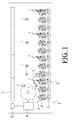
- the greenhouse 1 comprises illumination means for the illumination of plants etc. inside the greenhouse for the benefit of plant growth, which are formed by several illumination armatures 2.
- the armatures 2 each comprise one or more SBLED arrays (not shown explicitly), the emitted light of which mainly covers a spectral distribution which is relevant for the growth, development or health of plants 3 inside the greenhouse. Moreover, the emitted light may comprise a spectrum which is relevant for pest and/or disease control.
- the roots 4 of those plants 3 may be surrounded by tubes 5, via which nutrients, water etc. may be supplied to those roots.
- the plant's stem(s) and leafs 6 extend upwards into the greenhouse.
- the control means comprise a computerized control module 9 which is arranged to control the SBLED armatures 2 in dependency of the output of the sensors 7 and 8.
- the sensors 7 and 8 are able to communicate with the control module 9 via a (e.g. short distance) wireless network.
- the control module 9 may control the SBLED armatures 2 via a illumination driver 11 (which of course can be incorporated in the control module 9).
- the SBLED armatures 2 and the control module 9 are arranged to vary the intensity and the spectral distribution of the light emitted by the SBLED arrays inside the armatures 2.
- the SBLED array(s) comprise SBLEDs having different emission wavelengths, e.g. Colour Wavelength Near UV 385 nm Blue 464 nm Red-orange 622 nm Red 637 nm Red 640 nm Deep red 662 nm Infrared 736 nm
- the control module 9 (via driver 11) is able to energize the SBLEDs per individual colour, thus realizing that the distribution of the whole wavelength spectrum from 464nm through 736nm can be varied in (mean) intensity.
- the behaviour of the plants depends on the wavelength distribution of the emitted light, in this way the condition of the plants can be measured by the sensors 7/8 and that plant condition can - if necessary - be corrected by changing the intensity per wavelength distribution of the light. In this way the efficiency of growth process can be optimized automatically, resulting in optimal plant quality, minimal waste and minimal energy consumption for artificial illumination, ventilation etc.
- the control module 9 is arranged, by means of dedicated software and/or hardware, e.g. comprising a kind of plant behaviour model, to interpret the relevant variables measured by the sensor modules 7/8 and to assess, by using that model, the actual and/or expected growth of the relevant plants, and, as a result, to control the intensity and/or the spectral distribution of the light emitted by the illumination armatures 2 to the relevant plants (e.g. plant groups or individual plants) in accordance with the assessment result from the plant behaviour model.
- the relevant plants e.g. plant groups or individual plants
- those deficiencies can be counteracted by adequate illumination (and possibly further) measures, e.g. including that the wavelength distribution emitted by the illumination armatures 2 is changed by the control module 9.
- the SBLED armatures 2 may be cooled by means of a cooling medium, e.g. a fluid or air, which cooling medium preferably can be connected to a heating or air conditioning system of the greenhouse, thus enabling that the energy which in the armatures 2 is not converted into light but into heat (about 75%), can be recuperated.
- a cooling medium e.g. a fluid or air
- the heat is mainly generated at the backside of the SBLEDs (contrary to e.g. in sodium lamps etc.
Landscapes
- Life Sciences & Earth Sciences (AREA)
- Biodiversity & Conservation Biology (AREA)
- Botany (AREA)
- Ecology (AREA)
- Forests & Forestry (AREA)
- Environmental Sciences (AREA)
- Cultivation Of Plants (AREA)
- Greenhouses (AREA)
Abstract
Description
- The present invention concerns a greenhouse system, comprising illumination means for the illumination of plants etc. inside the greenhouse for the benefit of plant growth. Such systems are of common knowledge.
- Recent years have shown increasing practical application of large-scale plant growing systems that make use of artificial light sources, which are less susceptible to the effects of external factors (such as long- and short-term weather conditions and insect damage). The most commonly-used light sources include high-pressure sodium lamps, low-pressure sodium lamps, xenon lamps, metal halide lamps, fluorescent lamps, and microwave lamps. Of these, high-pressure sodium lamps are the most popular because of their relatively high luminous efficiency. Still, an artificial light source such as a high-pressure sodium lamp strikes a poor balance between red (wavelength band: 640 to 690 nm) and blue (wavelength band: 420 to 470 nm), which is important for photosynthesis etc., and therefore the output had to be raised in order to cultivate healthy plants. Furthermore, low-pressure sodium lamps have higher luminous efficiency than high-pressure sodium lamps, but pose problems with optical quality because they output single-wavelength light of the sodium D line, and it is also difficult to raise the output.
- Another problem with artificial light sources is that the large amount of radiated heat imposes a heavy load on air-conditioning units, and the plants have to be kept sufficiently far away from the light source in order to keep them from being damaged by this thermal radiation; this tends to result in a bulkier apparatus.
- In view of the above problems, artificial light sources that make use of semiconductor based light emitting devices, hereinafter abbreviated as SBLED(s), e.g. light emitting diodes (LEDs), have been proposed in some publications, e.g. in
EP1374665 . SBLEDs are already available for various wavelengths between about 350 - 750 nm (see also below) and in various different embodiments; and the developments are still going on. With semiconductor based light emitting devices, there is less load on air-conditioning equipment because elements with a light emitting wavelength band that does not include heat rays can be employed, and the apparatus can also be made more compact, so luminous efficiency is better. Another advantage is that the life of a light emitting diode is several times longer than that of a high-pressure sodium lamp. Also, the shape of the illuminator can flexibly and easily be modified in accordance with the plants being illuminated, and the light density can easily be controlled by arranging numerous semiconductor based light emitting devices in a linear or planar array. - Another advantage of using semiconductor based light emitting devices is that irradiation with pulsed light is possible. When light is pulsed (intermittent light emission), the amount of photosynthesis per unit of light would be increased over that achieved with continuous light, without optical saturation which may occur under intense light. It is stated that the utilization efficiency of light is better using short-period pulsed light than using continuous light.
- It is an aim of the present invention to promote the growth, development and health of the plants. Another aim of the invention is to realize substantial energy savings. The invention comprises enhanced monitoring or sensing the growth, development and/or health of the relevant plants and adequate "fine tuning" of the properties of their illumination.
- To that end it is preferred, according to the present invention, in a greenhouse system which comprises illumination means for the illumination of plants etc. inside the greenhouse for the benefit of plant growth, to include sensor means for measuring one or more variables which are directly or indirectly related to the growth, development or health of those plants or relevant groups of plants, as well as control means which are arranged to control the illumination means in dependency of the output of the sensor means.
- It is highly preferred, in such a greenhouse system, that the illumination means and control means are arranged to vary the intensity as well as the spectral distribution of the light emitted by the illumination means. Well fit for varying the intensity and the spectral distribution are illumination means which comprise one or more SBLED arrays, the emitted light of which mainly covers a spectral distribution which is relevant for the plant growth. This enables the possibility of varying the spectral density distribution in dependency of the actual growth, development or health of the plants, e.g. w.r.t. the size of the (sensed) plant roots, leaf size, stem size, fruit or flower size etc. Moreover, when pests, plant diseases etc. is sensed, it is preferred that the emitted light comprises a spectrum which is relevant for pest and/or disease control.
- As known as such from the prior art, the emitted light may be pulsed light, wherein, according to a preferred option of the invention, the pulse characteristics may be varied by the control means in dependency of the output of the sensor means.
- It is preferred that the control means are arranged to interpret the relevant variables measured by the sensor means and to assess the actual and/or expected growth of the relevant plants, and to control the intensity and/or the spectral distribution of the light emitted by the illumination means to those relevant plants in accordance with the assessment result.
- E.g. in greenhouses which are arranged to use incident (sun)light, one or more sensors may be provided for measuring the intensity and/or spectral distribution of the actual light in the greenhouse, thus enabling that such incident light may be e.g. filtered, screened etc. by filters, screens etc., or that the incident light is supplemented by the artificial, spectrally "fine tuned" illumination.
- One or more sensors may be provided for measuring one or more plant dimensions, e.g. the size of the plant roots, leafs, stems, fruits or flowers, of the relevant plants or groups of plants.
- The invention will discussed now referencing to
figure 1 , showing an exemplary configuration of the greenhouse system as preferred by the present invention. - The
greenhouse 1 comprises illumination means for the illumination of plants etc. inside the greenhouse for the benefit of plant growth, which are formed byseveral illumination armatures 2. Thearmatures 2 each comprise one or more SBLED arrays (not shown explicitly), the emitted light of which mainly covers a spectral distribution which is relevant for the growth, development or health of plants 3 inside the greenhouse. Moreover, the emitted light may comprise a spectrum which is relevant for pest and/or disease control. Theroots 4 of those plants 3 may be surrounded by tubes 5, via which nutrients, water etc. may be supplied to those roots. The plant's stem(s) and leafs 6 extend upwards into the greenhouse. - Sensors modules 7 are provided for measuring variables are directly or indirectly related to the growth, development or health of the plants, either all plants together or - as shown - in relevant groups or individually. Each sensor module 7 may comprise different sensors 7a, 7b and 7c, related to different aspects of the plant growth, development or health, e.g. the plant (stem) height, the size of the leafs and the density of the roots. Besides sensors for measuring plant dimensions and other plant characteristics, sensors 8 may be provided for measuring e.g. environmental variables like the intensity and/or spectral distribution of the actual light in the greenhouse which may be a mixture of incident natural light and artificial light from the
armatures 2. Relevant sensor types may comprise sensors for sensing: - PAR (Photo Active Radiation) light
- air humidity
- room temperature
- plant temperature
- mean temperature over e.g. 24 hours
- CO2
- efficiency photo synthesis
- plant stress or illumination load
- amount of stored CO2 (via assimilation model)
- amount of used light
- substrate temperature
- electric conductivity of the substrate
- moisture content of the substrate
- Vapor Pressure Deficit
- light sum
- degree hours
- thickness of the leaf or stem
- sap flow
- The control means comprise a computerized control module 9 which is arranged to control the SBLED
armatures 2 in dependency of the output of the sensors 7 and 8. The sensors 7 and 8 are able to communicate with the control module 9 via a (e.g. short distance) wireless network. The control module 9 may control the SBLEDarmatures 2 via a illumination driver 11 (which of course can be incorporated in the control module 9). - The SBLED
armatures 2 and the control module 9 are arranged to vary the intensity and the spectral distribution of the light emitted by the SBLED arrays inside thearmatures 2. The SBLED array(s) comprise SBLEDs having different emission wavelengths, e.g.Colour Wavelength Near UV 385 nm Blue 464 nm Red-orange 622 nm Red 637 nm Red 640 nm Deep red 662 nm Infrared 736 nm - The control module 9 (via driver 11) is able to energize the SBLEDs per individual colour, thus realizing that the distribution of the whole wavelength spectrum from 464nm through 736nm can be varied in (mean) intensity. As the behaviour of the plants depends on the wavelength distribution of the emitted light, in this way the condition of the plants can be measured by the sensors 7/8 and that plant condition can - if necessary - be corrected by changing the intensity per wavelength distribution of the light. In this way the efficiency of growth process can be optimized automatically, resulting in optimal plant quality, minimal waste and minimal energy consumption for artificial illumination, ventilation etc.
- The (mean) intensity of the various SBLEDs may be varied by means of pulsed SBLED energizing e.g. by variation of the width ratio between the energizing and the non-energizing periods of the pulses, i.e. by pulse width variation, and/or by varying the pulse shape and/or the pulse frequency. Besides for the benefit of being able to vary the intensity of the various SBLEDs, the utilization efficiency of light is considered to be better with pulsed light than with continuous light (see also e.g.
EP1374665 ). - The control module 9 is arranged, by means of dedicated software and/or hardware, e.g. comprising a kind of plant behaviour model, to interpret the relevant variables measured by the sensor modules 7/8 and to assess, by using that model, the actual and/or expected growth of the relevant plants, and, as a result, to control the intensity and/or the spectral distribution of the light emitted by the
illumination armatures 2 to the relevant plants (e.g. plant groups or individual plants) in accordance with the assessment result from the plant behaviour model. In this way, when e.g. is assessed that a plant (group) is growing too fast or too slow, or doesn't develop fruit in time etc., those deficiencies can be counteracted by adequate illumination (and possibly further) measures, e.g. including that the wavelength distribution emitted by theillumination armatures 2 is changed by the control module 9. - Finally, it is noted that, to still increase the energy efficiency of the greenhouse system (which, after all, was one aim of the present invention), the
SBLED armatures 2 may be cooled by means of a cooling medium, e.g. a fluid or air, which cooling medium preferably can be connected to a heating or air conditioning system of the greenhouse, thus enabling that the energy which in thearmatures 2 is not converted into light but into heat (about 75%), can be recuperated. This is a special opportunity of SBLED armatures, as in SBLEDs, as a result of their nature, the heat is mainly generated at the backside of the SBLEDs (contrary to e.g. in sodium lamps etc. which radiate their heat from their illuminating front side) and, due to that, can be collected from the backside of thearmatures 2 without hindering the light emission at the frond side, and can - via a cooling medium and a circulation system - supplied to the greenhouse's heating or air conditioning system or any other heating or air conditioning system.
Claims (10)
- Greenhouse system, comprising illumination means (2) for the illumination of plants (3) etc. inside the greenhouse (1) for the benefit of plant growth; sensor means (7,8) for measuring one or more variables which are directly or indirectly related to the growth, development or health of those plants or relevant groups of them; and control means (9,11) which are arranged to control the illumination means in dependency of the output of the sensor means.
- Greenhouse system according to claim 1, the illumination means and control means being arranged to vary the intensity and the spectral distribution of the light emitted by the illumination means.
- Greenhouse system according to claim 2, the illumination means comprising one or more arrays of semiconductor based light emitting devices (SBLEDs), the emitted light of which mainly covers a spectral distribution which is relevant for the plant growth.
- Greenhouse system according to claim 3, the emitted light comprising a spectrum which is relevant for pest and/or disease control.
- Greenhouse system according to claim 3, the emitted light being pulsed light, the pulse characteristics being variable by the control means in dependency of the output of the sensor means.
- Greenhouse system according to claim 2, the control means being arranged to interpret the relevant variables measured by the sensor means and to assess the actual and/or expected growth of the relevant plants, and to control the intensity and/or the spectral distribution of the light emitted by the illumination means to those relevant plants in accordance with the assessment result.
- Greenhouse system according to claim 1, comprising one or more sensors (8) for measuring the intensity and/or spectral distribution of the actual light in the greenhouse.
- Greenhouse system according to claim 1, comprising one or more sensors (7) for measuring one or more plant dimensions of the relevant plants or groups of plants.
- Greenhouse system according to claim 3, the illumination means (2) comprising heat collection means which are able to be connected to heating or air conditioning means inside or outside the relevant greenhouse.
- Software program means for control means which are arranged to interpret variables measured by sensor means in a greenhouse and to assess the actual and/or expected growth of the relevant plants, and to control the intensity and/or the spectral distribution of light emitted by illumination means, e.g. comprising semiconductor based light emitting devices (SBLEDs), to those relevant plants in accordance with the assessment result.
Priority Applications (4)
| Application Number | Priority Date | Filing Date | Title |
|---|---|---|---|
| EP07117824A EP2044835A1 (en) | 2007-10-03 | 2007-10-03 | Greenhouse system |
| EP08826662.2A EP2197261B1 (en) | 2007-10-03 | 2008-10-03 | Greenhouse system |
| US12/681,101 US8373361B2 (en) | 2007-10-03 | 2008-10-03 | Greenhouse system |
| PCT/NL2008/050635 WO2009045107A1 (en) | 2007-10-03 | 2008-10-03 | Greenhouse system |
Applications Claiming Priority (1)
| Application Number | Priority Date | Filing Date | Title |
|---|---|---|---|
| EP07117824A EP2044835A1 (en) | 2007-10-03 | 2007-10-03 | Greenhouse system |
Publications (1)
| Publication Number | Publication Date |
|---|---|
| EP2044835A1 true EP2044835A1 (en) | 2009-04-08 |
Family
ID=38963077
Family Applications (2)
| Application Number | Title | Priority Date | Filing Date |
|---|---|---|---|
| EP07117824A Withdrawn EP2044835A1 (en) | 2007-10-03 | 2007-10-03 | Greenhouse system |
| EP08826662.2A Not-in-force EP2197261B1 (en) | 2007-10-03 | 2008-10-03 | Greenhouse system |
Family Applications After (1)
| Application Number | Title | Priority Date | Filing Date |
|---|---|---|---|
| EP08826662.2A Not-in-force EP2197261B1 (en) | 2007-10-03 | 2008-10-03 | Greenhouse system |
Country Status (3)
| Country | Link |
|---|---|
| US (1) | US8373361B2 (en) |
| EP (2) | EP2044835A1 (en) |
| WO (1) | WO2009045107A1 (en) |
Cited By (9)
| Publication number | Priority date | Publication date | Assignee | Title |
|---|---|---|---|---|
| WO2010004489A1 (en) * | 2008-07-11 | 2010-01-14 | Koninklijke Philips Electronics N.V. | Illumination arrangement for illuminating horticultural growths |
| CN103749188A (en) * | 2013-12-27 | 2014-04-30 | 宁波丰德科技信息咨询有限公司 | Flowerpot with automatic disinsection function |
| EP2964012A4 (en) * | 2013-03-05 | 2016-10-12 | Xiant Technologies Inc | PHOTON MODULATION MANAGEMENT SYSTEM |
| US9844209B1 (en) | 2014-11-24 | 2017-12-19 | Xiant Technologies, Inc. | Photon modulation management system for stimulation of a desired response in birds |
| US9907296B2 (en) | 2013-03-05 | 2018-03-06 | Xiant Technologies, Inc. | Photon modulation management system for stimulation of a desired response in birds |
| US10182557B2 (en) | 2013-03-05 | 2019-01-22 | Xiant Technologies, Inc. | Photon modulation management system for stimulation of a desired response in birds |
| US10638669B2 (en) | 2014-08-29 | 2020-05-05 | Xiant Technologies, Inc | Photon modulation management system |
| US11058889B1 (en) | 2017-04-03 | 2021-07-13 | Xiant Technologies, Inc. | Method of using photon modulation for regulation of hormones in mammals |
| US11278009B2 (en) | 2013-03-05 | 2022-03-22 | Xiant Technologies, Inc. | Photon modulation management system for stimulation of a desired response in birds |
Families Citing this family (64)
| Publication number | Priority date | Publication date | Assignee | Title |
|---|---|---|---|---|
| US10716269B2 (en) | 2008-08-12 | 2020-07-21 | Rain Bird Corporation | Methods and systems for irrigation control |
| TR200805998A2 (en) * | 2008-08-12 | 2009-12-21 | Kodalfa B�Lg� Ve �Let���M Teknoloj�Ler� Sanay� Ve T�Caret A.�. | Remote wireless climate monitoring and control system for greenhouses |
| KR20110073010A (en) * | 2009-12-23 | 2011-06-29 | 한국전자통신연구원 | Greenhouse Plant Growth Regulator Using Solar Wavelength Control and Its Control Method |
| IL205410A0 (en) * | 2010-04-28 | 2010-12-30 | Gaash Lighting Products Ltd | Method and system of illuminating plants |
| CN102147127B (en) * | 2011-03-24 | 2013-04-03 | 中国扬子集团滁州扬子空调器有限公司 | Air-conditioning system of closed artificial light plant factory |
| TWM428665U (en) * | 2011-04-01 | 2012-05-11 | Ritedia Corp | LED plant production device |
| US8689483B2 (en) * | 2011-04-14 | 2014-04-08 | Thermo Plus Technology Inc. | Apparatus for controlling growth of organisms |
| US9955552B2 (en) * | 2011-04-14 | 2018-04-24 | Suntracker Technologies Ltd. | Predictive daylight harvesting system |
| US9703275B2 (en) | 2011-06-23 | 2017-07-11 | Rain Bird Corporation | Methods and systems for irrigation and climate control |
| US9829869B2 (en) | 2011-06-23 | 2017-11-28 | Rain Bird Corporation | Methods and systems for irrigation and climate control |
| US20130006401A1 (en) * | 2011-06-30 | 2013-01-03 | Xinxin Shan | Networked intelligent plant growth system |
| US8919037B1 (en) * | 2011-09-16 | 2014-12-30 | Andrew Petran | Method and system of preventing plastic out-gassing in plant tunnels |
| WO2013089818A1 (en) * | 2011-12-13 | 2013-06-20 | Podponics, Llc | Apparatus and method for optimizing delivery of nutrients in a hydroponics system |
| WO2013148254A1 (en) * | 2012-03-30 | 2013-10-03 | Dow Agrosciences Llc | Lighting system |
| CN102762013A (en) * | 2012-05-10 | 2012-10-31 | 上海交通大学 | Intelligent control system for greenhouse LED light source |
| CN102736596B (en) * | 2012-06-11 | 2014-10-29 | 南京农业大学 | Multi-scale greenhouse environment control system based on crop information fusion |
| RU2632961C2 (en) * | 2012-07-11 | 2017-10-11 | Филипс Лайтинг Холдинг Б.В., Nl | Lighting device, capable support of garden lighting, and method of lighting in gardening |
| US9206966B2 (en) * | 2012-09-12 | 2015-12-08 | Sensity Systems Inc. | Method and apparatus for optimized plant growth |
| EP2934090A4 (en) * | 2012-12-20 | 2016-07-27 | Heliospectra Ab | Method and illumination system for plant recovery from stress |
| JP5723902B2 (en) * | 2013-02-04 | 2015-05-27 | 昭和電工株式会社 | Plant cultivation method |
| EP2953447B1 (en) * | 2013-02-08 | 2025-04-23 | Rockwool A/S | Plant growth system |
| JP2016524470A (en) * | 2013-06-06 | 2016-08-18 | フロラ フォトニカ エルティーディーFlora Fotonica Ltd | Plant lighting system and method |
| WO2015028883A1 (en) * | 2013-08-27 | 2015-03-05 | Almendra Pte. Ltd. | Rigs for illuminating fields and methods of illuminating plants |
| CN103575389B (en) * | 2013-11-08 | 2015-08-26 | 蚌埠玻璃工业设计研究院 | A kind of device detecting intensity of illumination based on photovoltaic effect |
| CN103704063B (en) * | 2013-12-17 | 2014-12-17 | 京东方科技集团股份有限公司 | Plant growing device and plant growing control method thereof |
| DK201400055U3 (en) * | 2014-03-28 | 2015-07-10 | Plantui Oy | Hydroponic cultivation device |
| US9532411B2 (en) * | 2014-04-04 | 2016-12-27 | iUNU, LLC | Lighting fixture with application controller |
| US9681515B2 (en) | 2015-05-13 | 2017-06-13 | Juha Rantala | LED structure with a dynamic spectrum and a method |
| EP3143869A1 (en) * | 2015-09-17 | 2017-03-22 | Université d'Avignon et des Pays de Vaucluse | Method for stimulating the resistance of plants to biotic stress by uv radiation exposure |
| US9901039B1 (en) * | 2015-09-25 | 2018-02-27 | Chad Eric Dellerson | Grow light fan |
| EP3453232A4 (en) | 2016-05-02 | 2020-07-29 | Growflux Inc. | SYSTEM AND METHOD FOR EXTENDED GARDEN LIGHTING |
| US20170311553A1 (en) | 2016-05-02 | 2017-11-02 | Sensor Electronic Technology, Inc. | Ultraviolet Plant Illumination System |
| EP3261102A1 (en) | 2016-06-23 | 2017-12-27 | Rain Bird Corporation | Universal solenoid |
| CN106258644B (en) * | 2016-10-31 | 2020-01-21 | 深圳春沐源控股有限公司 | Temperature adjusting method and temperature adjusting device for crop greenhouse |
| CN106545763A (en) * | 2016-11-01 | 2017-03-29 | 新疆智农物联科技有限公司 | A kind of manufacture method of the plant LED light illuminator that can lift illuminance |
| US10006619B1 (en) | 2016-12-28 | 2018-06-26 | WLC Enterprises, Inc. | Combination LED lighting and fan apparatus |
| TR201708590A2 (en) * | 2017-06-09 | 2018-12-21 | Arcelik As | A PLANT CABINET WITH LIGHT INTENSITY CONTROLLED |
| US10980120B2 (en) | 2017-06-15 | 2021-04-13 | Rain Bird Corporation | Compact printed circuit board |
| US11102867B2 (en) * | 2017-08-02 | 2021-08-24 | Suntracker Technologies Ltd. | Transitional lighting for entraining biological rhythms |
| US11013078B2 (en) | 2017-09-19 | 2021-05-18 | Agnetix, Inc. | Integrated sensor assembly for LED-based controlled environment agriculture (CEA) lighting, and methods and apparatus employing same |
| US10999976B2 (en) | 2017-09-19 | 2021-05-11 | Agnetix, Inc. | Fluid-cooled lighting systems and kits for controlled agricultural environments, and methods for installing same |
| EP3662201B1 (en) | 2017-09-19 | 2023-06-07 | Agnetix, Inc. | Fluid-cooled led-based lighting methods and apparatus for controlled environment agriculture |
| US11464173B2 (en) * | 2018-02-28 | 2022-10-11 | Aessense Technology Hong Kong Limited | Horticultural system with closed-loop light control |
| US11503782B2 (en) | 2018-04-11 | 2022-11-22 | Rain Bird Corporation | Smart drip irrigation emitter |
| EP3787393A4 (en) | 2018-05-04 | 2022-01-26 | Agnetix, Inc. | PROCESSES, APPARATUS, AND SYSTEMS FOR ILLUMINATION AND DISTRIBUTED DETECTION IN REGULATED AGRICULTURAL ENVIRONMENTS |
| US11483981B1 (en) * | 2018-05-14 | 2022-11-01 | Crop One Holdings, Inc. | Systems and methods for providing a low energy use farm |
| AU2019381761A1 (en) | 2018-11-13 | 2021-05-27 | Agnetix, Inc. | Fluid-cooled led-based lighting methods and apparatus for controlled environment agriculture |
| US10440900B1 (en) | 2019-01-22 | 2019-10-15 | Calyx Cultivation Tech. Corp. | Grow light with adjustable height and emission spectrum |
| IL293798A (en) | 2019-12-10 | 2022-08-01 | Agnetix Inc | Multisensory imaging methods and apparatus for controlled environment horticulture using irradiators and cameras and/or sensors |
| WO2021119587A1 (en) | 2019-12-12 | 2021-06-17 | Agnetix, Inc. | Fluid-cooled led-based lighting fixture in close proximity grow systems for controlled environment horticulture |
| US11707022B2 (en) * | 2020-02-14 | 2023-07-25 | Seoul Viosys Co., Ltd. | Light device for plant cultivation |
| US11499707B2 (en) | 2020-04-13 | 2022-11-15 | Calyxpure, Inc. | Light fixture having a fan and ultraviolet sterilization functionality |
| US11721465B2 (en) | 2020-04-24 | 2023-08-08 | Rain Bird Corporation | Solenoid apparatus and methods of assembly |
| US12596070B1 (en) * | 2021-01-13 | 2026-04-07 | Mjnn Llc | Monitoring chlorophyll fluorescence and green light reflectance to detect plant stress |
| US20220362432A1 (en) | 2021-05-11 | 2022-11-17 | Calyxpure, Inc. | Sensor System for a Light Fixture Having Ultraviolet Sterilization Functionality |
| US11759540B2 (en) | 2021-05-11 | 2023-09-19 | Calyxpure, Inc. | Portable disinfection unit |
| CN113197000B (en) * | 2021-05-12 | 2022-05-10 | 珠海美光原科技股份有限公司 | Method, device, electronic device and storage medium for supplementary light in greenhouse |
| CA3139742A1 (en) | 2021-11-23 | 2023-05-23 | Led Smart Inc. | Plant growth system |
| CA3162554A1 (en) | 2022-06-10 | 2023-12-10 | Led Smart Inc. | Controlled lighting system |
| CN115623932B (en) * | 2022-09-23 | 2025-05-30 | 深圳市富尔顿照明科技有限公司 | A method and device for full-spectrum illumination of plants |
| US20240171565A1 (en) * | 2022-10-07 | 2024-05-23 | Yen Lam Pham | Horticulture cloud platform |
| CN116171754B (en) * | 2023-03-03 | 2024-12-03 | 中国农业科学院都市农业研究所 | Application method of thermoluminescent material |
| CN116428535A (en) * | 2023-03-20 | 2023-07-14 | 深圳市富尔顿照明科技有限公司 | Lighting device for full-period growth of plants |
| CN118474939A (en) * | 2024-07-09 | 2024-08-09 | 凉山康利农业集团有限公司 | Visible light intensity control method and system |
Citations (4)
| Publication number | Priority date | Publication date | Assignee | Title |
|---|---|---|---|---|
| EP1374665A1 (en) | 2001-02-28 | 2004-01-02 | CCS Inc. | Method of cultivating plant and illuminator for cultivating plant |
| EP1374667A2 (en) * | 2002-06-18 | 2004-01-02 | Smeg S.p.A. | Small-sized greenhouse with controlled internal environment |
| EP1621069A1 (en) * | 2004-07-26 | 2006-02-01 | Hortilux Schréder B.V. | Method, greenhouse and an installation for illuminating plants |
| WO2007105946A2 (en) * | 2006-03-10 | 2007-09-20 | Green Q Group B.V. | Sensors for controlling lightinng |
Family Cites Families (1)
| Publication number | Priority date | Publication date | Assignee | Title |
|---|---|---|---|---|
| WO2007016407A1 (en) * | 2005-08-01 | 2007-02-08 | Pioneer Hi-Bred International, Inc. | Sensor system, method, and computer program product for plant phenotype measurement in agricultural environments |
-
2007
- 2007-10-03 EP EP07117824A patent/EP2044835A1/en not_active Withdrawn
-
2008
- 2008-10-03 EP EP08826662.2A patent/EP2197261B1/en not_active Not-in-force
- 2008-10-03 US US12/681,101 patent/US8373361B2/en not_active Expired - Fee Related
- 2008-10-03 WO PCT/NL2008/050635 patent/WO2009045107A1/en not_active Ceased
Patent Citations (4)
| Publication number | Priority date | Publication date | Assignee | Title |
|---|---|---|---|---|
| EP1374665A1 (en) | 2001-02-28 | 2004-01-02 | CCS Inc. | Method of cultivating plant and illuminator for cultivating plant |
| EP1374667A2 (en) * | 2002-06-18 | 2004-01-02 | Smeg S.p.A. | Small-sized greenhouse with controlled internal environment |
| EP1621069A1 (en) * | 2004-07-26 | 2006-02-01 | Hortilux Schréder B.V. | Method, greenhouse and an installation for illuminating plants |
| WO2007105946A2 (en) * | 2006-03-10 | 2007-09-20 | Green Q Group B.V. | Sensors for controlling lightinng |
Cited By (17)
| Publication number | Priority date | Publication date | Assignee | Title |
|---|---|---|---|---|
| WO2010004489A1 (en) * | 2008-07-11 | 2010-01-14 | Koninklijke Philips Electronics N.V. | Illumination arrangement for illuminating horticultural growths |
| US8604700B2 (en) | 2008-07-11 | 2013-12-10 | Koninklijke Philips N.V. | Illumination arrangement for illuminating horticultural growths |
| US10609909B2 (en) | 2013-03-05 | 2020-04-07 | Xiant Technologies, Inc. | Photon modulation management system for stimulation of a desired response in birds |
| US11278009B2 (en) | 2013-03-05 | 2022-03-22 | Xiant Technologies, Inc. | Photon modulation management system for stimulation of a desired response in birds |
| EP2964012A4 (en) * | 2013-03-05 | 2016-10-12 | Xiant Technologies Inc | PHOTON MODULATION MANAGEMENT SYSTEM |
| US10182557B2 (en) | 2013-03-05 | 2019-01-22 | Xiant Technologies, Inc. | Photon modulation management system for stimulation of a desired response in birds |
| US9907296B2 (en) | 2013-03-05 | 2018-03-06 | Xiant Technologies, Inc. | Photon modulation management system for stimulation of a desired response in birds |
| CN103749188A (en) * | 2013-12-27 | 2014-04-30 | 宁波丰德科技信息咨询有限公司 | Flowerpot with automatic disinsection function |
| CN103749188B (en) * | 2013-12-27 | 2016-07-13 | 宁波丰德科技信息咨询有限公司 | A kind of deinsectization flowerpot automatically |
| US10638669B2 (en) | 2014-08-29 | 2020-05-05 | Xiant Technologies, Inc | Photon modulation management system |
| US11832568B2 (en) | 2014-08-29 | 2023-12-05 | Xiant Technologies, Inc. | Photon modulation management system |
| US9844209B1 (en) | 2014-11-24 | 2017-12-19 | Xiant Technologies, Inc. | Photon modulation management system for stimulation of a desired response in birds |
| US10709114B2 (en) | 2014-11-24 | 2020-07-14 | Xiant Technologies, Inc. | Photon modulation management system for stimulation of a desired response in birds |
| US11470822B2 (en) | 2014-11-24 | 2022-10-18 | Xiant Technologies, Inc. | Photon modulation management system for stimulation of a desired response in birds |
| US11058889B1 (en) | 2017-04-03 | 2021-07-13 | Xiant Technologies, Inc. | Method of using photon modulation for regulation of hormones in mammals |
| US11833366B2 (en) | 2017-04-03 | 2023-12-05 | Xiant Technologies, Inc. | Method of using photon modulation for regulation of hormones in mammals |
| US12311192B2 (en) | 2017-04-03 | 2025-05-27 | Xiant Technologies, Inc. | Method of using photon modulation for regulation of hormones in mammals |
Also Published As
| Publication number | Publication date |
|---|---|
| EP2197261B1 (en) | 2017-05-31 |
| WO2009045107A1 (en) | 2009-04-09 |
| US20100289411A1 (en) | 2010-11-18 |
| EP2197261A1 (en) | 2010-06-23 |
| US8373361B2 (en) | 2013-02-12 |
Similar Documents
| Publication | Publication Date | Title |
|---|---|---|
| EP2197261B1 (en) | Greenhouse system | |
| CA2724794C (en) | Method and apparatus for using light emitting diodes in a greenhouse setting | |
| EP1479286B1 (en) | Method and apparatus for irradiation of plants using light emitting diodes | |
| DK2348814T3 (en) | Plant and method for growing a plant in at least partially regulated environments | |
| KR200362989Y1 (en) | Apparatus for culturing dye plants using LED light source | |
| EP1374665A1 (en) | Method of cultivating plant and illuminator for cultivating plant | |
| JP2010512780A (en) | Lighting device | |
| Gomez et al. | Physiological and productivity responses of high-wire tomato as affected by supplemental light source and distribution within the canopy | |
| WO2012133130A1 (en) | Light irradiation device, strawberry cultivation system, and strawberry cultivation method | |
| CN116171753B (en) | A lighting device and method for mobile animal and plant breeding equipment | |
| KR20090124155A (en) | Plant cultivation luminaire and intelligent light environment control system using light emitting diode | |
| RU2454066C2 (en) | Light diode phyto-irradiator | |
| US8739465B2 (en) | Light sources and methods for illuminating plants to achieve effective plant growth | |
| KR20130052306A (en) | Lighting apparatus for plant cultivation | |
| EP2761987B1 (en) | Method for cultivating plant | |
| JP2006042706A (en) | Fe light source for growing plant and plant factory using the fe light source | |
| KR102604933B1 (en) | Lighting device for plant growth | |
| JP2023174451A (en) | Plant cultivation method and plant cultivation device | |
| RU2723725C1 (en) | Artificial phyto-lighting system | |
| US20130329417A1 (en) | Novel light sources and methods for illuminating plants to achieve effective plant growth | |
| CN114128543A (en) | Laser light supplement lamp for land protection and crop growth insect prevention | |
| JP2017046651A (en) | Plant cultivation luminaire and plant cultivation method using the same | |
| CN216131832U (en) | Cambered surface shape plant light filling lamp | |
| US20130326947A1 (en) | Novel light sources and methods for illuminating plants to achieve effective plant growth | |
| JP2023174498A (en) | Plant cultivation method and plant cultivation device |
Legal Events
| Date | Code | Title | Description |
|---|---|---|---|
| PUAI | Public reference made under article 153(3) epc to a published international application that has entered the european phase |
Free format text: ORIGINAL CODE: 0009012 |
|
| AK | Designated contracting states |
Kind code of ref document: A1 Designated state(s): AT BE BG CH CY CZ DE DK EE ES FI FR GB GR HU IE IS IT LI LT LU LV MC MT NL PL PT RO SE SI SK TR |
|
| AX | Request for extension of the european patent |
Extension state: AL BA HR MK RS |
|
| RAP1 | Party data changed (applicant data changed or rights of an application transferred) |
Owner name: NEDERLANDSE ORGANISATIE VOOR TOEGEPAST-NATUURWETEN |
|
| RIN1 | Information on inventor provided before grant (corrected) |
Inventor name: AULBERS, ANTONIUS PAULUS Inventor name: OOSTERHUIS, GERRIT Inventor name: SMITS, JOHANNES JACOBUS |
|
| AKX | Designation fees paid | ||
| REG | Reference to a national code |
Ref country code: DE Ref legal event code: 8566 |
|
| STAA | Information on the status of an ep patent application or granted ep patent |
Free format text: STATUS: THE APPLICATION IS DEEMED TO BE WITHDRAWN |
|
| 18D | Application deemed to be withdrawn |
Effective date: 20091009 |