EP2042627A1 - False twist yarn and process for producing the same - Google Patents
False twist yarn and process for producing the same Download PDFInfo
- Publication number
- EP2042627A1 EP2042627A1 EP07790586A EP07790586A EP2042627A1 EP 2042627 A1 EP2042627 A1 EP 2042627A1 EP 07790586 A EP07790586 A EP 07790586A EP 07790586 A EP07790586 A EP 07790586A EP 2042627 A1 EP2042627 A1 EP 2042627A1
- Authority
- EP
- European Patent Office
- Prior art keywords
- false twisting
- yam
- ratio
- yarn
- heat treatment
- Prior art date
- Legal status (The legal status is an assumption and is not a legal conclusion. Google has not performed a legal analysis and makes no representation as to the accuracy of the status listed.)
- Granted
Links
Images


Classifications
-
- D—TEXTILES; PAPER
- D02—YARNS; MECHANICAL FINISHING OF YARNS OR ROPES; WARPING OR BEAMING
- D02G—CRIMPING OR CURLING FIBRES, FILAMENTS, THREADS, OR YARNS; YARNS OR THREADS
- D02G1/00—Producing crimped or curled fibres, filaments, yarns, or threads, giving them latent characteristics
- D02G1/02—Producing crimped or curled fibres, filaments, yarns, or threads, giving them latent characteristics by twisting, fixing the twist and backtwisting, i.e. by imparting false twist
-
- D—TEXTILES; PAPER
- D02—YARNS; MECHANICAL FINISHING OF YARNS OR ROPES; WARPING OR BEAMING
- D02G—CRIMPING OR CURLING FIBRES, FILAMENTS, THREADS, OR YARNS; YARNS OR THREADS
- D02G1/00—Producing crimped or curled fibres, filaments, yarns, or threads, giving them latent characteristics
- D02G1/02—Producing crimped or curled fibres, filaments, yarns, or threads, giving them latent characteristics by twisting, fixing the twist and backtwisting, i.e. by imparting false twist
- D02G1/04—Devices for imparting false twist
- D02G1/06—Spindles
Definitions
- the present invention relates to a false twisting yam composed of monofilaments containing a polyester component of which main repeating unit is polytrimethylene terephthalate, and to a production method thereof.
- polyester fiber is majorly applied not only to clothing but also to general sheet materials for interior field, because of the advantage that it is excellent in functionality, easiness of handling and fashionability. It is doubtless that such era in which polyester fiber is major will be continued more and its technical improvement and development will be continued.
- Polylactic acid fiber or polytrimethylene terephthalate fiber is proposed and have been developed into practical use.
- Polytrimethylene terephthalate fiber has a low fiber Young's modulus and, in case where it is used as a fabric such as a pile cloth, it becomes to a material having a very soft texture.
- it is understood to be a material excellent in light resistance and wear resistance.
- 2 heater false twisting yarns of polytrimethylene terephthalate are proposed (i.e., refer to Patent references 1 and 2).
- crimp development by dry heat is large to result in a material having an insufficient softness, and especially, a fabric with long piles having a high quality feeling cannot be obtained.
- its strength is insufficient and, for industrial material uses such as a car sheet of which standard is high, it is a material which cannot satisfy the fabric standard.
- the purpose of the present invention is to provide a false twisting yarn having a high strength and a soft texture when processed into a pile cloth, and capable of obtaining a pile cloth excellent in later stage processability.
- a false twisting yarn of polytrimethylene terephthalate-based fiber capable of producing a fabric having a soft texture and a low shrinkage of which soft texture is not lost by heat history in later stage processes can be produced by false twisting a polytrimethylene terephthalate-based fiber yam by using a 2 step heater false twisting method under a specified condition, and completed the present invention.
- the present invention has the following constitution. That is,
- polytrimethylene terephthalate fiber In case where polytrimethylene terephthalate fiber is used alone, as to strength, heat shrinkage, crimp fixation, wear durability, light resistance, etc., it shows considerably inferior characteristics and is not a level comparative to conventional polyester fiber. In particular, in case where it is used for a napped pile cloth, its inferiority still more becomes a problem. In order to improve the quality, there are many proposals to make polytrimethylene terephthalate into side-by-side type composite fibers with other polyester-based components, and considerable technical improvements have been made. However, such a side-by-side type composite fiber forms a high crimp by an effect of difference of shrink characteristics, and it is not suitable for a pile cloth which requires pile napping properties.
- the inventors intensively investigated to improve the inferiority of the above-mentioned polytrimethylene terephthalate fiber, and as a result, found a false twisting yam of which characteristics are similar to conventional polyester fiber, and is excellent in handling property, and completed the present invention.
- a shrinkage ratio by wet heat treatment at 98°C for 20 minutes (hereafter, referred to as 98°C wet heat shrinkage ratio) is 5% or less.
- the 98°C wet heat shrinkage ratio is preferably 3% or less and it may also be 0%.
- the cloth structure is densified at dyeing process to result in a cloth of which texture is stiff. And, at a yam dyeing process, it causes defects in process such as uneven dyeing.
- a false twisting yam of which shrinkage ratio by wet heat treatment at 130°C for 20 minutes (hereafter, referred to as 130°C wet heat shrinkage ratio) is 5% or less is more preferably used.
- the 130°C wet heat shrinkage ratio is preferably 3% or less and it may also be 0%.
- determination methods of the 98°C wet heat shrinkage ratio and the 130°C wet heat shrinkage ratio are in accordance with the methods described in the section of examples.
- a ratio (TS/WS) of elastic stretch ratio after wet heat treatment at 90°C for 20 minutes (WS) and elastic stretch ratio after dry heat treatment at 90°C for 15 minutes (TS) is, 0 ⁇ TS/WS ⁇ 1.
- TS/WS>1 at a dry heat treatment after dyeing, a fiber crimp is developed greatly, and especially in case where it is used as a pile cloth, the pile length becomes short due to the crimp and results in a cloth of a stiff texture.
- a false twisting yarn of 0.2 ⁇ TS/WS ⁇ 0.8 is used.
- a tensile strength of the false twisting yarn of the present invention is 2.0 cN/dtex or more. In case where the tensile strength is lower than 2.0 cN/dtex or less, problems of a defect of later stage processability or a shortage of cloth strength arises. It is preferable that the tensile strength of the false twisting yam is 2.5 cN/dtex or more, since it becomes a false twisting yarn capable of being used as a material for vehicle interior or the like which has a strict cloth standard.
- the tensile strength of the false twisting yarn is higher, and although not especially limited, when the raw fiber strength at present time is considered, about 4.0 cN/dtex is made as the upper limit of the false twisting yam strength.
- method of determination of the tensile strength is based on the method described in the section of examples.
- a false twisting yam of which elastic stretch ratio after dry heat treatment at 90°C for 15 minutes (TS) is 20% or less is preferable, more preferably 10% or less, and still more preferably 5% or less.
- TS elastic stretch ratio
- a false twisting yam having an elastic stretch ratio (TS) of about 20%, but it is possible to obtain a pile cloth more excellent in texture or quality by using a false twisting yam having an elastic stretch ratio (TS) of 10% or less, still further, of 5% or less.
- TS elastic stretch ratio
- the elastic stretch ratio (TS) is larger than 0%.
- a false twisting yarn having a number of crimp of monofilament of 1 to 20 crimps/cm is preferably used.
- the texture may become inferior in pile cloth.
- the monofilament contains a polyester component (A) of which main component is polytrimethylene terephthalate and other polyester component (B), and is a composite fiber (C) in which these components (A) and (B) are composited in a core sheath configuration along the fiber length direction.
- the polytrimethylene terephthalate component (A) and the other polyester component (B) are adhered substantially concentrically in a core sheath configuration.
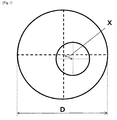
- To be substantially concentrically in a core sheath configuration means that distance of center positions of the above-mentioned 2 components is small, and although not especially limited, the following range is applied as an index. Difference of center positions of 2 components : X / diameter of cross section of composite fiber C : D ⁇ 100 ⁇ 10 %
- the difference of center positions of the 2 components X is, as shown in Figs. 1 and 2 , distance between centers of the 2 components in cross section of the composite fiber (C). And, in case where the cross section of the composite fiber (C) cross section is flat or irregular, the longest portion of the diameter of cross section (D) is taken as the diameter of cross section of the composite fiber (C).
- the composite fiber (C) does not have a latent crimp, and a crimp configuration after false twisting becomes stable.
- the strength is greatly improved, and it becomes possible to obtain a cloth having a soft texture. And, handling property in later stage processes and cloth quality are also improved to make it possible to obtain effects of the same level as that of the conventional polyester, and it is attractive that approximately the same processes as those of the conventional polyester fiber can be applied.
- the polytrimethylene terephthalate component (A) in the present invention is a polyester obtainable from terephthalic acid as the main acid component and 1,3-propane diol as the main glycol component.
- it is a polyester in which 80 mol% or more of the repeating unit is trimethylene terephthalate unit.
- 80 mol% or more of the repeating unit is trimethylene terephthalate unit.
- it may contain a copolymerization component capable of forming an ester bond.
- dicarboxylic acids such as isophthalic acid, succinic acid, cyclohexane dicarboxylic acid, adipic acid, dimer acid, sebacic acid, 5-sodium sulfoisophthalate, diols such as ethylene glycol, diethylene glycol, butane diol, neopentyl glycol, cyclohexane dimethanol, polyethylene glycol, polypropylene glycol can be mentioned, but not limited thereto.
- dicarboxylic acids such as isophthalic acid, succinic acid, cyclohexane dicarboxylic acid, adipic acid, dimer acid, sebacic acid, 5-sodium sulfoisophthalate
- diols such as ethylene glycol, diethylene glycol, butane diol, neopentyl glycol, cyclohexane dimethanol, polyethylene glycol, polypropylene glycol can be mentioned, but not limited thereto
- titanium dioxide as a delustering agent, fine particles of silica or alumina as a lubricant, a hindered phenol derivative as an antioxidant, a color pigment, etc.
- titanium dioxide as a delustering agent
- fine particles of silica or alumina as a lubricant
- a hindered phenol derivative as an antioxidant
- a color pigment etc.
- 1,3-propane diol a 1,3-propane diol prepared by a plant-based production method is preferably used.
- polyester component (B) polyethylene terephthalate, polybutylene terephthalate or the like can preferably be used.
- polyethylene terephthalate component is most preferably used.
- the polyethylene terephthalate a polyester obtainable from terephthalic acid as the main acid component and ethylene glycol as the main glycol component is preferable.
- it is a polyethylene terephthalate in which 80 mol% or more of the repeating unit is ethylene terephthalate unit.
- a copolymerization component capable of forming an ester bond may be contained.
- the copolymerization component is, preferably in a ratio of 0 to 15 mol%, more preferably in a ratio of 10 mol% or less.
- the copolymerization component for example, sulfonic acid, sodium sulfonate, sulfuric acid, sulfuric acid ester, diethyl sulfate, ethyl sulfate, aliphatic sulfonic acid, ethane sulfonic acid, chlorobenzene sulfonic acid, alicyclic sulfonic acid, dicarboxylic acids such as isophthalic acid, sebacic acid, azelaic acid, dimer acid, adipic acid, oxalic acid or decane dicarboxylic acid, dicarboxylic acids such as hydroxy carboxylic acids including p-hydroxy benzoic acid and ⁇ -caprolactone, diols such as triethylene glycol, polyethylene glycol, propane diol, butane diol, pentane diol, hydroquinone or bisphenol A, are preferably used. And, as required, titanium dioxide which is a delustering agent, fine
- the fiber configuration of the composite fiber (C) it is preferable to make it into a core sheath type structure in which the polytrimethylene terephthalate component (A) is disposed in the sheath side which is the outer surface of the fiber, and the other polyester component (B) is disposed in the core side, but not limited thereto, and the core component and the sheath component may be reversed.
- a soft texture and a silky coloring which are characteristic to the polytrimethylene terephthalate component (A) are exhibited, and inferiorities such as of light resistance, pile napping properties, wear durability and pile falling down resistance are covered by the polyester component (B),and a high quality napped pile cloth can be obtained.
- the polytrimethylene terephthalate component (A) in sheath side and the polyester component (B) is disposed in core side, it is preferable the polytrimethylene terephthalate component (A) in a ratio of 30 to 90 wt% and the polyester component (B) in a ratio of 10 to 70 wt% are contained in the composite fiber (C).
- ratio of the polytrimethylene terephthalate component (A) in the composite fiber (C) is preferably 30 to 90 wt% and still more preferably 50 to 80 wt%.
- ratio of the polyester component (B) in the composite fiber (C) is preferably 10 to 70 wt%, and 20 to 50 wt% is more preferable.
- fiber cross sectional shape of the composite fiber (C) although not especially limited, those of which sheath component at fiber outer surface/core component are both perfect circle or those of which sheath component/core component are both ellipse shape are preferably used in view of spinnability or strength. In particular, those of which sheath component/core component are both ellipse shape are preferable since it is still softer and its pile cloth surface is full of volume feeling and it is possible to obtain an interior pile cloth excellent in suede-like sense.
- monofilament fiber thickness of the composite fiber (C) it is preferable to make it into a multifilament yam of 5 dtex (decitex) or less, since it is possible to obtain an excellent pile cloth which exhibits up to a suede sense by synergizing a fluffy feeling and a soft texture.
- the monofilament fiber thickness is made into a still lower fiber thickness, it is preferable to be in the range of 0.5 to 2.0 dtex.
- the false twisting yam of the present invention further satisfies all of the following characteristics (1'), (2), (3') and (4).
- the false twisting yarn is dyed in a yam dyeing process while developing crimp.
- said false twisting yam is formed into a pile cloth and heat set by a dry heat treatment process.
- the wet heat shrinkage ratio of the false twisting yam is large as stated above, since not only the soft texture is impaired but also it causes defects of process such as an uneven dyeing at the yarn dyeing process, a false twisting yarn of which 130°C wet heat shrinkage ratio is 5% or less is preferable.
- a false twisting yam of which elastic stretch ratio after dry heat treatment at 90°C for 15 minutes is 0% or more and 5% or less is more preferable.
- a false twisting yarn of which tensile strength is 2.5 cN/dtex or more it is also possible to use for a vehicle interior material which has a strict cloth standard. That is, by using a false twisting yam which satisfies all of the above-mentioned characteristics, it is possible to obtain a high quality pile cloth suitable for a vehicle interior material or the like.
- degree of crimp in configuration is suitably used as an index for expressing a moderate crimp of the false twisting yarn.
- the degree of crimp in configuration (KS) is a monofilament crimp of false twisting yarn observed by an optical microscope as shown in Fig. 3 , after the false twisting yam is treated under no load at 98°C in wet heat for 30 minutes and after dried, and expressed by the following equation.
- the width of crimp (L) is the distance of inflection points (valley), and the height of crimp (T) is the height from the common tangent between these inflection points (valley) to the inflection point (peak).
- the degree of crimp in configuration (KS) shows a bending configuration of crimp based on an observation of crimp, and in case where the degree of crimp in configuration (KS) is 0%, texture of pile cloth or quality of surface feeling lowers, and in case where a yarn dyeing is carried out, circulation of liquid flow becomes non-uniform to cause an uneven dyeing.
- the degree of crimp in configuration (KS) exceeds 30%, crimp development is large and texture of the pile cloth becomes stiff. Accordingly, an appropriate range is, 0% ⁇ degree of crimp in configuration (KS) ⁇ 30%.
- the 2 heater false twisting method is a method in which, after a false twisting of fiber is carried out in a twist region heater (1st step heater), the obtained false twisting yarn is successively heat set by a 2nd set heater (2nd step heater).
- temperature of the twist region heater, temperature of the 2nd set heater, false twist coefficient, and feeding ratio in the 2nd set heater are important.
- the yam temperature at the exit of the twist region heater is made to 120°C or more and 200°C or less
- the yarn temperature at the exit of the 2nd set heater is made to 120°C or more and 200°C or less
- the false twisting coefficient (K) is made to 10,000 or more and 25,000 or less
- the feeding ratio (%) in the 2nd set heater is made to 5% or more and 30% or less.
- twist region heater temperature the yam temperature at the exit of the twist region heater (hereafter, referred to as twist region heater temperature) is 120°C or more and 200°C or less, and preferably, it is 140°C or more and 180°C or less. In case where the twist region heater temperature is lower than 120°C, heat set ability to the imparted crimp is lost, and in case where it is higher than 200°C, strength of the false twisting yam decreases to decrease productivity, and thus, they are not preferable.
- the yarn temperature at the exit of the heater it is measured for the yam just after the exit of the heater by using a non-contact thermometer produced by Muratec, Ltd.
- the yarn temperature at the exit of the 2nd set heater (hereafter, referred to as 2nd set heater temperature) is 120°C or more and 200°C or less, and it is preferably 130°C or more and 180°C or less.
- 2nd set heater temperature By heat setting the false twisting yam at the 2nd set heater, it is possible to decrease wet heat shrinkage ratio, and possible to remove excessive crimp of the false twisting yarn.
- the 2nd set heater temperature is lower than 120°C, it is impossible to obtain a false twisting yam of a low wet heat shrinkage ratio, and, in case where it is higher than 200°C, it is not preferable since strength of false twisting yam decreases to decrease productivity.
- the constituting fiber of the false twisting yarn is the core sheath type composite fiber (C) containing the above-mentioned polytrimethylene terephthalate component (A) and the polyethylene terephthalate component (B), and subjected to a false twisting in the above-mentioned temperature, in the composite fiber (C), it results in a condition in which the crimp of the polytrimethylene terephthalate component (A) is set and the crimp of the polyethylene terephthalate component (B) is not sufficiently set. Therefore, compared to a false twisting yarn in which the polytrimethylene terephthalate component is100%, crimp is not developed largely by a dry heat treatment after a wet heat treatment. Accordingly, preferable characteristics as the false twisting yarn of the present invention can easily be obtained.
- false twisting coefficient (K) is 10,000 or more and 25,000 or less, and more preferably 12,000 or more and 20,000 or less. By carrying out a false twisting in such range of false twisting coefficient, it is possible that the obtained false twisting yam can exhibit a moderate crimp.
- false twisting coefficient (K) is expressed by (actual number of false twisting: T/m) ⁇ (fiber thickness: denier) 1/2 .
- the false twisting yarn is heat set in a crimped condition.
- shrinkage ratio of the false twisting yarn can be made low, and a low percentage of crimp and a moderate crimp configuration are obtained.
- a feeding ratio in the 2nd set heater is less than 5%, it becomes impossible to decrease shrinkage ratio of the false twisting yarn, and in case where it exceeds 30%, it is not preferable since a slacking is made in the 2nd set heater, to cause a decrease of productivity.
- any generally employed method can be employed such as a pin type, a friction disk type, a nip belt type or an air twisting type.
- the false twisting yarn of the present invention is used as the core yam or sheath yam, in addition to textures such as volume feeling or softness, it is possible to obtain a pile cloth having a peculiar surface feeling.
- the false twisting yarn of the present invention is preferable to use as a sheath yarn of the composite intermingling yam, and a material having a high shrinkage ratio as a core yam, since a pile cloth especially with a volume feeling and having a peculiar surface feeling is made.
- the material having a high shrinkage ratio is, not especially limited, but a copolymerization polyester copolymerized with isophthalic acid, bisphenol or the like are mentioned.
- the shrinkage ratio of the core yarn it is preferable that the boiling water shrinkage ratio is 15% or more, and 20% or more is more preferable.
- a core yam of the polyester-based component is preferably used.
- a method for intermingling the false twisting yarns it may be any generally employable method such as an interlace intermingling, a fluid disturbance (“Taslan” (registered trademark)) intermingling.
- 0.8g of a sample polymer is dissolved in10 ml o-chlorophenol (hereafter, abbreviated as OCP), and its relative viscosity at 25°C [ ⁇ r ] is measured by an Oswald viscometer. It is a value (IV) calculated from the relative viscosity according to the following equation.
- OCP o-chlorophenol
- wet heat shrinkage ratio was measured in accordance with JIS-L-1013 ⁇ Test Method of Hot Water Shrinkage Ratio (1999 edition), and an average of 10 times was calculated.
- a tensile strength and elongation of a sample was measured in accordance with JIS-L-1013 method, Tensile Test Method of Synthetic Fiber Filament (1999 edition).
- a sensory judgment of covering properties and napped fiber feeling of a pile cloth surface was carried out by a 4 levels evaluation of "quality ⁇ fiber napping property is excellent to bad" (A; excellent quality, B; good, C; rather bad, D; bad) by visual observation, and is expressed by an average result of 5 skilled persons.
- a core sheath composite fiber consisting of 70 wt% of polytrimethylene terephthalate homopolymer having an intrinsic viscosity (IV) of 1.40 as sheath component and 30 wt% polyethylene terephthalate homopolymer having an intrinsic viscosity (IV) of 0.60 as core component was spun.
- the core component and the sheath component were separately melted at a spinning temperature of 280°C, respectively, extruded from a composite spinning spinneret of sheath/core concentric type having 60 holes, and taken up at a spinning speed of 3300 m/min.
- a round type cross sectional highly oriented undrawn yam of 1 dtex (decitex)-60fil (filament) was obtained.
- the obtained undrawn yam was drawn, by using a drawing machine equipped with a set of hot roll-hot plate, at a hot roll temperature of 85°C, a hot plate temperature of 145°C and a draw ratio of 1.40 times, to obtain a drawn yam of 84dtex-60fil.
- Physical characteristics of the obtained drawn yam were tensile strength 3.4 cN/dtex, elongation 41 % and 98°C boiling water wet heat shrinkage ratio 9.5%.
- Example 1 by using 2 drawn yarns obtained by the above-mentioned method and by using TH312 false twisting machine (twist region heater is a contact type, 2nd set heater is a non-contact type and processing mechanism is a pin false twisting method) produced by Aiki Seisakusho, a 2 heater false twisting is carried out at a twist region heater temperature of 170°C, a 2nd set heater temperature of 150°C, a process speed of 130 m/min, a draw ratio of 1.03, a number of false twisting of 1800 T/m and at a feeding ratio of 20%, and a false twisting yarn of 180dtex-120fil was obtained.
- the yarn temperature at the exit of the twist region heater was 169°C to 170°C, and the yam temperature at the exit of the 2nd set heater was 148 to 150°C.
- a false twisting yarn of 177dtex-120fil was obtained by carrying out 2 heater false twisting in the same way as Example 1 except making into a twist region heater temperature of 170°C, a 2nd set heater temperature of 160°C, a process speed of 130 m/min, a draw ratio of 1.03, a number of false twisting 2200 T/m and a feeding ratio of 14%.
- the yam temperature at the exit of the twist region heater was 169°C to 170°C, and the yam temperature at the exit of the 2nd set heater was 158 to 160°C.
- a 2 step heater false twisting was carried out ,by using one yarn of the same drawn yam as that of Examples 1and 2, and by using the same false twisting machine, at a twist region heater temperature of 160°C, a 2nd set heater temperature of 150°C, a process speed of 130 m/min, a draw ratio of 1.03, a number of false twist of 1900 T/m and a feeding ratio in 2nd set heater of 12%, and a processed yam of 87dtex-60fil was obtained.
- a pile cloth was obtained in the same way as Example 1. And, physical characteristics of the obtained false twisting yarn and evaluation results of the pile cloth are shown in Table 1.
- Polytrimethylene terephthalate having an intrinsic viscosity (IV) of 1.40 was melted at 275°C, extruded from a spinneret having 60 holes, and taken up at a spinning speed of 3300 m/min to obtain a round cross-sectional type highly oriented undrawn yam of 118 dtex (decitex)-60fil(filament).
- the drawn yam obtained by the above-mentioned method was subjected to a 2 step heater false twisting by using the same false twisting machine as those of Examples 1and 2, at a twist region heater temperature of 170°C, a 2nd set heater temperature of 150°C, a process speed of 130 m/min, a draw ratio of 1.01 and a number of false twist of 1900 T/m, and a false twisting yam of 84dtex-60fil was obtained.
- the yarn temperature at the exit of the twist region heater was 168°C to 170°C
- the yam temperature at the exit of the 2nd set heater was 148 to 150°C.
- the feeding ratio in the 2nd set heater was made into the condition shown in Table 1.
- a pile cloth was prepared by using the obtained false twisting yarn in the same way as Example 1. Physical characteristics of the obtained false twisting yarn and evaluation results of the pile cloth are shown in Table 1.
- this false twisting yarn and a high shrinkage yarn consisting of a polyester containing sulfonic acid and isophthalic acid as copolymerization components (56dtex-24fil, tensile strength 4.0 cN/dtex, elongation 41.3% and boiling water shrinkage 9.9%) are intermingled by an air intermingling by using an interlace nozzle, and a false twisted intermingling yam of 156 dtex was obtained.
- a pile cloth was prepared in the same way as Example 1. Physical characteristics of the obtained false twisting yam and evaluation results of the pile cloth are shown in Table 1. And, the pile cloth was a cloth having a volume feeling of piles and a peculiar particulate sense in surface feeling.
- a one step heater false twisting was carried out in a condition at a twist region heater temperature of 160°C, a process speed of 130 m/min, a draw ratio of 1.03 and a number of false twist of 3200 T/m, and a processed yam of 84dtex-60fil was obtained.
- the yam temperature at the exit of the twist region heater was 158°C to 160°C.
- a pile cloth was prepared in the same way as Example 1. Physical characteristics of the obtained false twisting yarn and evaluation results of the pile cloth are shown in Table 1.
- a 2 heater false twisting was carried out at a twist region heater temperature of 170°C, a 2nd set heater temperature of 150°C, a process speed of 130 m/min, a draw ratio of 1.01, a number of false twist of 2300 T/m and a feeding ratio in the 2nd set heater of 20%, and a false twisting yam of 178dtex-120fil was obtained.
- the yam temperature at the exit of the twist region heater was 169°C to 170°C, and the yam temperature at the exit of the 2nd set heater was 148 to 150°C.
- a pile cloth was prepared in the same way as Example 1. Physical characteristics of the obtained false twisting yarn and evaluation results of the pile cloth are shown in Table 1. The pile cloth was rather stiff in texture, and a high grade one could not be obtained.
- a 2 heater false twisting was carried out at a twist region heater temperature of 170°C, a 2nd set heater temperature of 150°C, a process speed of 130 m/min, a draw ratio of 1.01, a number of false twist of 2400 T/m and a feeding ratio in the 2nd set heater of 20%, and a false twisting yam of 180dtex-120fil was obtained.
- the yam temperature at the exit of the twist region heater was 169°C to 170°C, and the yam temperature at the exit of the 2nd set heater was 148 to 150°C.
- a pile cloth was prepared in the same way as Example 1. Physical characteristics of the obtained false twisting yam and evaluation results of the pile cloth are shown in Table 1. The pile cloth was rather stiff in texture, and a high grade one could not be obtained.
- a 2 heater false twisting was carried out at a twist region heater temperature of 170°C, a 2nd set heater temperature of 150°C, a process speed of 130 m/min, a draw ratio of 1.01, a number of false twist of 2400 T/m and a feeding ratio in the 2nd set heater of 3%,and a false twisting yarn of 169 dtex-120fil was obtained.
- the yam temperature at the exit of the twist region heater was 169°C to 170°C, and the yam temperature at the exit of the 2nd set heater was 148 to 150°C.
- a pile cloth was prepared in the same way as Example 1. Physical characteristics of the obtained false twisting yarn and evaluation results of the pile cloth are shown in Table 1. The pile cloth was stiff in texture, and a high grade one could not be obtained.
- a core sheath composite fiber is spun in the same way as Example 1 except changing the ratio of polytrimethylene terephthalate homopolymer and polyethylene terephthalate homopolymer to those shown in Table 2.
- a 2 step heater false twisting is carried out by using the obtained core sheath composite fiber in the same way as Example 1, and further, a pile cloth is prepared in the same way as Example 1. Physical characteristics of the obtained false twisting yam and evaluation results of the pile cloth are understood to be those as shown in Table 2.
- a pile cloth having a soft texture and a low shrinkage can be prepared.
- the soft texture possessed by the material is not lost by heat history at later stage processes.
Landscapes
- Engineering & Computer Science (AREA)
- Mechanical Engineering (AREA)
- Textile Engineering (AREA)
- Yarns And Mechanical Finishing Of Yarns Or Ropes (AREA)
- Woven Fabrics (AREA)
- Multicomponent Fibers (AREA)
Abstract
Description
- The present invention relates to a false twisting yam composed of monofilaments containing a polyester component of which main repeating unit is polytrimethylene terephthalate, and to a production method thereof.
- Nowadays, polyester fiber is majorly applied not only to clothing but also to general sheet materials for interior field, because of the advantage that it is excellent in functionality, easiness of handling and fashionability. It is doubtless that such era in which polyester fiber is major will be continued more and its technical improvement and development will be continued.
- However, in recent years, in view of the global environmental conservation, enhancement of approach to recycling and getting rid of petroleum-based synthetic fiber are strongly desired, and in the car industry which is center of the industry, there have been movements to take initiative of this problem. In the fiber industry, too, it becomes essential to prepare for materials capable of converting to natural cultivation-reduction type.
- In view of the above-mentioned background, toward the future, polylactic acid fiber or polytrimethylene terephthalate fiber is proposed and have been developed into practical use. Polytrimethylene terephthalate fiber has a low fiber Young's modulus and, in case where it is used as a fabric such as a pile cloth, it becomes to a material having a very soft texture. In addition, it is understood to be a material excellent in light resistance and wear resistance.
- As a fiber to be used for such a pile cloth, for example, 2 heater false twisting yarns of polytrimethylene terephthalate are proposed (i.e., refer to Patent references 1 and 2). However, in the 2 heater false twisting yarn of polytrimethylene terephthalate, crimp development by dry heat is large to result in a material having an insufficient softness, and especially, a fabric with long piles having a high quality feeling cannot be obtained. In addition, its strength is insufficient and, for industrial material uses such as a car sheet of which standard is high, it is a material which cannot satisfy the fabric standard.
- As a material in which defects of polytrimethylene terephthalate material such as of the above-mentioned are improved and having handling properties of conventional polyester, a material in which polytrimethylene terephthalate and polyethylene terephthalate are composited into a core sheath configuration is proposed (i.e., refer to Patent reference 3). However, since the softness of the material is lost in later stage processing, a further preferable false twisting yam has been desired.
- Patent reference 1:
JP-2001-348740A - Patent reference 2: Publication of
JP Patent No. 3208362 - Patent reference 3:
JP-2005-113279A - The purpose of the present invention is to provide a false twisting yarn having a high strength and a soft texture when processed into a pile cloth, and capable of obtaining a pile cloth excellent in later stage processability.
- The inventors of the present invention found that a false twisting yarn of polytrimethylene terephthalate-based fiber capable of producing a fabric having a soft texture and a low shrinkage of which soft texture is not lost by heat history in later stage processes can be produced by false twisting a polytrimethylene terephthalate-based fiber yam by using a 2 step heater false twisting method under a specified condition, and completed the present invention.
- In order to achieve the above-mentioned purpose, the present invention has the following constitution. That is,
- [1] A false twisting yarn composed of monofilaments containing a polyester component of which main component is polytrimethylene terephthalate, wherein said false twisting yam is a false twisting yam which satisfies all of the following characteristics (1) to (3).
- (1) A shrinkage ratio by wet heat treatment at 98°C for 20 minutes is 5% or less
- (2) A ratio (TS/WS) of elastic stretch ratio after wet heat treatment at 90°C for 20 minutes (WS) and elastic stretch ratio after dry heat treatment at 90°C for 15 minutes (TS) is, 0 < TS/WS ≤ 1
- (3) A tensile strength is 2.0 cN/dtex or more
- [2] A false twisting yarn of the above-mentioned [1], wherein the monofilament is a composite fiber which contains a polyester component (A) of which main component is polytrimethylene terephthalate and other polyester component (B), and these components (A) and (B) are composited in a core sheath configuration along the fiber length direction.
- [3] A false twisting yam described in the above-mentioned [2], wherein said polyester component (B) is a polyester of which main component is polyethylene terephthalate.
- [4] A false twisting yam described in the above-mentioned [2] or [3], wherein the polyester component (A) of which main component is polytrimethylene terephthalate is disposed in the sheath side, and a ratio of said component (A) in the monofilament is 30 to 90 wt%.
- [5] A false twisting yarn described in any one of the above-mentioned [1] to [4], wherein a number of crimp is 1 to 20 crimps/cm.
- [6] A false twisting yam described in any one of the above-mentioned [1] to [5], wherein all of the following (1'), (2), (3') and (4) are satisfied.
- (1') A shrinkage ratio by wet heat treatment at 130°C for 20 minutes is 5% or less
- (2) A ratio (TS/WS) of elastic stretch ratio after wet heat treatment at 90°C for 20 minutes (WS) and elastic stretch ratio after dry heat treatment at 90°C for 15 minutes (TS) is, 0 < TS/WS ≤ 1
- (3') A tensile strength is 2.5 cN/dtex or more
- (4) An elastic stretch ratio after dry heat treatment at 90°C for 15 minutes is 0% or more and 5% or less
- [7] A production method of a false twisting yam in which a false twisting is carried out by using a 2 heater false twisting method to a fiber composed of monofilaments containing a polyester component of which main component is polytrimethylene terephthalate, which is a production method of the false twisting yam in which said false twisting is carried out at a yam temperature at exit of twist region heater of 120°C or more and 200°C or less, at a yarn temperature at exit of 2nd set heater of 120°C or more and 200°C or less, at a false twisting coefficient (K) of 10,000 or more and 25,000 or less, and at a feeding ratio (%) in the 2nd set heater of 5% or more and 30% or less.
- [8] A pile cloth containing a false twisting yarn described in any one of the above-mentioned [1] to [6].
- [9] A composite intermingling yarn containing a false twisting yam described in any one of the above-mentioned [1] to [6].
- It is possible to produce a pile cloth having a soft texture and a low shrinkage by using the false twisting yarn of the present invention. The obtained pile cloth does not lose soft texture of the material by heat history in later stage processes.
-
- [
Fig. 1 ] A view showing an example of difference X between center positions of the 2 components. - [
Fig. 2 ] A view showing an example of difference X between center positions of the 2 components. - [
Fig. 3 ] A view showing a height of crimp T and a width of crimp L of a monofilament of false twisting yarn. -
- X: Difference of center positions of the 2 components
- C: Diameter of fiber cross section
- L: Width of crimp
- T: Height of crimp
- In case where polytrimethylene terephthalate fiber is used alone, as to strength, heat shrinkage, crimp fixation, wear durability, light resistance, etc., it shows considerably inferior characteristics and is not a level comparative to conventional polyester fiber. In particular, in case where it is used for a napped pile cloth, its inferiority still more becomes a problem. In order to improve the quality, there are many proposals to make polytrimethylene terephthalate into side-by-side type composite fibers with other polyester-based components, and considerable technical improvements have been made. However, such a side-by-side type composite fiber forms a high crimp by an effect of difference of shrink characteristics, and it is not suitable for a pile cloth which requires pile napping properties.
- The inventors intensively investigated to improve the inferiority of the above-mentioned polytrimethylene terephthalate fiber, and as a result, found a false twisting yam of which characteristics are similar to conventional polyester fiber, and is excellent in handling property, and completed the present invention.
- In the false twisting yarn of the present invention, in order to obtain a pile cloth having a soft texture, it is important to satisfy that a shrinkage ratio by wet heat treatment at 98°C for 20 minutes (hereafter, referred to as 98°C wet heat shrinkage ratio) is 5% or less. The 98°C wet heat shrinkage ratio is preferably 3% or less and it may also be 0%. In case where the 98°C wet heat shrinkage ratio exceeds 5%, the cloth structure is densified at dyeing process to result in a cloth of which texture is stiff. And, at a yam dyeing process, it causes defects in process such as uneven dyeing. Furthermore, when the dyeing temperature is considered, a false twisting yam of which shrinkage ratio by wet heat treatment at 130°C for 20 minutes (hereafter, referred to as 130°C wet heat shrinkage ratio) is 5% or less is more preferably used. The 130°C wet heat shrinkage ratio is preferably 3% or less and it may also be 0%. Whereas, determination methods of the 98°C wet heat shrinkage ratio and the 130°C wet heat shrinkage ratio are in accordance with the methods described in the section of examples.
- Furthermore, in the false twisting yam of the present invention, it is important that a ratio (TS/WS) of elastic stretch ratio after wet heat treatment at 90°C for 20 minutes (WS) and elastic stretch ratio after dry heat treatment at 90°C for 15 minutes (TS) is, 0 < TS/WS ≤ 1. In case where TS/WS>1, at a dry heat treatment after dyeing, a fiber crimp is developed greatly, and especially in case where it is used as a pile cloth, the pile length becomes short due to the crimp and results in a cloth of a stiff texture. As a still more preferable range, a false twisting yarn of 0.2 ≤ TS/WS ≤ 0.8 is used. Whereas, methods of determination of the elastic stretch ratio after wet heat treatment at 90°C for 20 minutes (WS) and the elastic stretch ratio after dry heat treatment at 90°C for 15 minutes (TS) are in accordance with the methods described in the section of examples.
- It is important that a tensile strength of the false twisting yarn of the present invention is 2.0 cN/dtex or more. In case where the tensile strength is lower than 2.0 cN/dtex or less, problems of a defect of later stage processability or a shortage of cloth strength arises. It is preferable that the tensile strength of the false twisting yam is 2.5 cN/dtex or more, since it becomes a false twisting yarn capable of being used as a material for vehicle interior or the like which has a strict cloth standard. It is preferable that the tensile strength of the false twisting yarn is higher, and although not especially limited, when the raw fiber strength at present time is considered, about 4.0 cN/dtex is made as the upper limit of the false twisting yam strength. Whereas, method of determination of the tensile strength is based on the method described in the section of examples.
- Furthermore, in the false twisting yam, it is preferable that a crimp development is small at steps after the pile formation, especially at the step of dry heat treatment. Therefore, a false twisting yam of which elastic stretch ratio after dry heat treatment at 90°C for 15 minutes (TS) is 20% or less is preferable, more preferably 10% or less, and still more preferably 5% or less. In case where the elastic stretch ratio (TS) is more than 20%, at the dry heat treatment, crimp of the false twisting yarn is developed greatly, and the texture of pile cloth may become rather stiff. Here, depending on a design of the cloth or the like, it is possible to use a false twisting yam having an elastic stretch ratio (TS) of about 20%, but it is possible to obtain a pile cloth more excellent in texture or quality by using a false twisting yam having an elastic stretch ratio (TS) of 10% or less, still further, of 5% or less. On the other hand, since it is preferable, in a high quality pile cloth, that a fine crimp is present, it is preferable that the elastic stretch ratio (TS) is larger than 0%.
- Furthermore, in the present invention, a false twisting yarn having a number of crimp of monofilament of 1 to 20 crimps/cm is preferably used. In a false twisting yam having a number of crimp exceeding 20 crimps/cm or more, the texture may become inferior in pile cloth.
- In the false twisting yarn of the present invention, it is preferable that the monofilament contains a polyester component (A) of which main component is polytrimethylene terephthalate and other polyester component (B), and is a composite fiber (C) in which these components (A) and (B) are composited in a core sheath configuration along the fiber length direction.
- Furthermore, in the composite fiber (C), it is preferable that the polytrimethylene terephthalate component (A) and the other polyester component (B) are adhered substantially concentrically in a core sheath configuration. To be substantially concentrically in a core sheath configuration means that distance of center positions of the above-mentioned 2 components is small, and although not especially limited, the following range is applied as an index.

- Here, the difference of center positions of the 2 components X is, as shown in
Figs. 1 and2 , distance between centers of the 2 components in cross section of the composite fiber (C). And, in case where the cross section of the composite fiber (C) cross section is flat or irregular, the longest portion of the diameter of cross section (D) is taken as the diameter of cross section of the composite fiber (C). By being this distance of center positions of the 2 components small, the composite fiber (C) does not have a latent crimp, and a crimp configuration after false twisting becomes stable. - In the composite fiber (C), by compositing the polytrimethylene terephthalate component (A) and the other polyester component (B), the strength is greatly improved, and it becomes possible to obtain a cloth having a soft texture. And, handling property in later stage processes and cloth quality are also improved to make it possible to obtain effects of the same level as that of the conventional polyester, and it is attractive that approximately the same processes as those of the conventional polyester fiber can be applied.
- Here, the polytrimethylene terephthalate component (A) in the present invention is a polyester obtainable from terephthalic acid as the main acid component and 1,3-propane diol as the main glycol component. Preferably, it is a polyester in which 80 mol% or more of the repeating unit is trimethylene terephthalate unit. However, in a ratio of 20 mol% or less, more preferably in a ratio of 10 mol% or less, it may contain a copolymerization component capable of forming an ester bond. As the copolymerization component, for example, dicarboxylic acids such as isophthalic acid, succinic acid, cyclohexane dicarboxylic acid, adipic acid, dimer acid, sebacic acid, 5-sodium sulfoisophthalate, diols such as ethylene glycol, diethylene glycol, butane diol, neopentyl glycol, cyclohexane dimethanol, polyethylene glycol, polypropylene glycol can be mentioned, but not limited thereto. And, as required, titanium dioxide as a delustering agent, fine particles of silica or alumina as a lubricant, a hindered phenol derivative as an antioxidant, a color pigment, etc., may be added. And, as to the 1,3-propane diol, a 1,3-propane diol prepared by a plant-based production method is preferably used.
- In addition, as the other polyester component (B), polyethylene terephthalate, polybutylene terephthalate or the like can preferably be used. In consideration of compatibility with the polytrimethylene terephthalate component (A), strength and handling property in later stage processes, polyethylene terephthalate component is most preferably used.
- As the polyethylene terephthalate, a polyester obtainable from terephthalic acid as the main acid component and ethylene glycol as the main glycol component is preferable. Preferably, it is a polyethylene terephthalate in which 80 mol% or more of the repeating unit is ethylene terephthalate unit. However, in a ratio of 20 mol% or less, a copolymerization component capable of forming an ester bond may be contained. The copolymerization component is, preferably in a ratio of 0 to 15 mol%, more preferably in a ratio of 10 mol% or less. As the copolymerization component, for example, sulfonic acid, sodium sulfonate, sulfuric acid, sulfuric acid ester, diethyl sulfate, ethyl sulfate, aliphatic sulfonic acid, ethane sulfonic acid, chlorobenzene sulfonic acid, alicyclic sulfonic acid, dicarboxylic acids such as isophthalic acid, sebacic acid, azelaic acid, dimer acid, adipic acid, oxalic acid or decane dicarboxylic acid, dicarboxylic acids such as hydroxy carboxylic acids including p-hydroxy benzoic acid and ε-caprolactone, diols such as triethylene glycol, polyethylene glycol, propane diol, butane diol, pentane diol, hydroquinone or bisphenol A, are preferably used. And, as required, titanium dioxide which is a delustering agent, fine particles of silica or alumina as a lubricant, a hindered phenol derivative as an antioxidant, a color pigment, etc., may be added.
- As the fiber configuration of the composite fiber (C), it is preferable to make it into a core sheath type structure in which the polytrimethylene terephthalate component (A) is disposed in the sheath side which is the outer surface of the fiber, and the other polyester component (B) is disposed in the core side, but not limited thereto, and the core component and the sheath component may be reversed. By making it into the core sheath type structure, a soft texture and a silky coloring which are characteristic to the polytrimethylene terephthalate component (A) are exhibited, and inferiorities such as of light resistance, pile napping properties, wear durability and pile falling down resistance are covered by the polyester component (B),and a high quality napped pile cloth can be obtained.
- In case where the polytrimethylene terephthalate component (A) is disposed in sheath side and the polyester component (B) is disposed in core side, it is preferable the polytrimethylene terephthalate component (A) in a ratio of 30 to 90 wt% and the polyester component (B) in a ratio of 10 to 70 wt% are contained in the composite fiber (C). And, in case where the polytrimethylene terephthalate component (A) is disposed in sheath side and the polyester component (B) is disposed in core side, ratio of the polytrimethylene terephthalate component (A) in the composite fiber (C) is preferably 30 to 90 wt% and still more preferably 50 to 80 wt%. In this case, ratio of the polyester component (B) in the composite fiber (C) is preferably 10 to 70 wt%, and 20 to 50 wt% is more preferable.
- As fiber cross sectional shape of the composite fiber (C), although not especially limited, those of which sheath component at fiber outer surface/core component are both perfect circle or those of which sheath component/core component are both ellipse shape are preferably used in view of spinnability or strength. In particular, those of which sheath component/core component are both ellipse shape are preferable since it is still softer and its pile cloth surface is full of volume feeling and it is possible to obtain an interior pile cloth excellent in suede-like sense.
- As to monofilament fiber thickness of the composite fiber (C), it is preferable to make it into a multifilament yam of 5 dtex (decitex) or less, since it is possible to obtain an excellent pile cloth which exhibits up to a suede sense by synergizing a fluffy feeling and a soft texture. Here, in view of commercial product development, in case where the monofilament fiber thickness is made into a still lower fiber thickness, it is preferable to be in the range of 0.5 to 2.0 dtex.
- It is preferable that the false twisting yam of the present invention further satisfies all of the following characteristics (1'), (2), (3') and (4).
- (1') 130°C wet heat shrinkage ratio is 5% or less
- (2) A ratio (TS/WS) of elastic stretch ratio after wet heat treatment at 90°C for 20 minutes (WS) and elastic stretch ratio after dry heat treatment at 90°C for 15 minutes (TS) is, 0 < TS/WS ≤ 1
- (3') A tensile strength is 2.5 cN/dtex or more
- (4) An elastic stretch ratio after dry heat treatment at 90°C for 15 minutes is 0% or more and 5% or less.
- An example of procedure for obtaining a pile cloth by using the false twisting yam is explained. First, the false twisting yarn is dyed in a yam dyeing process while developing crimp. Next, said false twisting yam is formed into a pile cloth and heat set by a dry heat treatment process. When the wet heat shrinkage ratio of the false twisting yam is large as stated above, since not only the soft texture is impaired but also it causes defects of process such as an uneven dyeing at the yarn dyeing process, a false twisting yarn of which 130°C wet heat shrinkage ratio is 5% or less is preferable. And, since it is not preferable that the crimp developed at the yam dyeing is highly developed at a dry heat treatment in later processes, it is necessary to satisfy the inequality of 0 < TS/WS ≤ 1. Here, a false twisting yam of which elastic stretch ratio after dry heat treatment at 90°C for 15 minutes is 0% or more and 5% or less is more preferable. And, by using a false twisting yarn of which tensile strength is 2.5 cN/dtex or more, it is also possible to use for a vehicle interior material which has a strict cloth standard. That is, by using a false twisting yam which satisfies all of the above-mentioned characteristics, it is possible to obtain a high quality pile cloth suitable for a vehicle interior material or the like.
- As an index for expressing a moderate crimp of the false twisting yarn, degree of crimp in configuration (KS) is suitably used. Here, the degree of crimp in configuration (KS) is a monofilament crimp of false twisting yarn observed by an optical microscope as shown in
Fig. 3 , after the false twisting yam is treated under no load at 98°C in wet heat for 30 minutes and after dried, and expressed by the following equation.
- Here, the width of crimp (L) is the distance of inflection points (valley), and the height of crimp (T) is the height from the common tangent between these inflection points (valley) to the inflection point (peak). The degree of crimp in configuration (KS) shows a bending configuration of crimp based on an observation of crimp, and in case where the degree of crimp in configuration (KS) is 0%, texture of pile cloth or quality of surface feeling lowers, and in case where a yarn dyeing is carried out, circulation of liquid flow becomes non-uniform to cause an uneven dyeing. On the other hand, in case where the degree of crimp in configuration (KS) exceeds 30%, crimp development is large and texture of the pile cloth becomes stiff. Accordingly, an appropriate range is, 0% < degree of crimp in configuration (KS) ≤ 30%.
- Next, a method for producing the false twisting yam of the present invention is explained. In the present invention, it is important to employ a 2 heater false twisting method. The 2 heater false twisting method is a method in which, after a false twisting of fiber is carried out in a twist region heater (1st step heater), the obtained false twisting yarn is successively heat set by a 2nd set heater (2nd step heater). Here, in order to impart necessary characteristics as a false twisting yam of the present invention to the false twisting yarn to be obtained, temperature of the twist region heater, temperature of the 2nd set heater, false twist coefficient, and feeding ratio in the 2nd set heater are important. That is, the yam temperature at the exit of the twist region heater is made to 120°C or more and 200°C or less, the yarn temperature at the exit of the 2nd set heater is made to 120°C or more and 200°C or less, the false twisting coefficient (K) is made to 10,000 or more and 25,000 or less, and the feeding ratio (%) in the 2nd set heater is made to 5% or more and 30% or less.
- It is important that the yam temperature at the exit of the twist region heater (hereafter, referred to as twist region heater temperature) is 120°C or more and 200°C or less, and preferably, it is 140°C or more and 180°C or less. In case where the twist region heater temperature is lower than 120°C, heat set ability to the imparted crimp is lost, and in case where it is higher than 200°C, strength of the false twisting yam decreases to decrease productivity, and thus, they are not preferable. As to the yarn temperature at the exit of the heater, it is measured for the yam just after the exit of the heater by using a non-contact thermometer produced by Muratec, Ltd.
- In addition, it is also important that the yarn temperature at the exit of the 2nd set heater (hereafter, referred to as 2nd set heater temperature) is 120°C or more and 200°C or less, and it is preferably 130°C or more and 180°C or less. By heat setting the false twisting yam at the 2nd set heater, it is possible to decrease wet heat shrinkage ratio, and possible to remove excessive crimp of the false twisting yarn. In case where the 2nd set heater temperature is lower than 120°C, it is impossible to obtain a false twisting yam of a low wet heat shrinkage ratio, and, in case where it is higher than 200°C, it is not preferable since strength of false twisting yam decreases to decrease productivity.
- In particular, in case where the constituting fiber of the false twisting yarn is the core sheath type composite fiber (C) containing the above-mentioned polytrimethylene terephthalate component (A) and the polyethylene terephthalate component (B), and subjected to a false twisting in the above-mentioned temperature, in the composite fiber (C), it results in a condition in which the crimp of the polytrimethylene terephthalate component (A) is set and the crimp of the polyethylene terephthalate component (B) is not sufficiently set. Therefore, compared to a false twisting yarn in which the polytrimethylene terephthalate component is100%, crimp is not developed largely by a dry heat treatment after a wet heat treatment. Accordingly, preferable characteristics as the false twisting yarn of the present invention can easily be obtained.
- Furthermore, it is important to satisfy that the false twisting coefficient (K) is 10,000 or more and 25,000 or less, and more preferably 12,000 or more and 20,000 or less. By carrying out a false twisting in such range of false twisting coefficient, it is possible that the obtained false twisting yam can exhibit a moderate crimp. Here, false twisting coefficient (K) is expressed by (actual number of false twisting: T/m) × (fiber thickness: denier) 1/2.
- Furthermore, by making a feeding ratio in the 2nd set heater to a high feeding ratio as 5% or more and 30% or less, the false twisting yarn is heat set in a crimped condition. By this way, shrinkage ratio of the false twisting yarn can be made low, and a low percentage of crimp and a moderate crimp configuration are obtained. In case where a feeding ratio in the 2nd set heater is less than 5%, it becomes impossible to decrease shrinkage ratio of the false twisting yarn, and in case where it exceeds 30%, it is not preferable since a slacking is made in the 2nd set heater, to cause a decrease of productivity.
- As a method of the false twisting, any generally employed method can be employed such as a pin type, a friction disk type, a nip belt type or an air twisting type.
- Furthermore, by making a composite intermingling yarn in which the false twisting yam of the present invention is used as the core yam or sheath yam, in addition to textures such as volume feeling or softness, it is possible to obtain a pile cloth having a peculiar surface feeling. Here, it is preferable to use the false twisting yarn of the present invention as a sheath yarn of the composite intermingling yam, and a material having a high shrinkage ratio as a core yam, since a pile cloth especially with a volume feeling and having a peculiar surface feeling is made. Here, the material having a high shrinkage ratio is, not especially limited, but a copolymerization polyester copolymerized with isophthalic acid, bisphenol or the like are mentioned. And, although not especially limited, as to the shrinkage ratio of the core yarn, it is preferable that the boiling water shrinkage ratio is 15% or more, and 20% or more is more preferable. When strength or dyeability is considered, a core yam of the polyester-based component is preferably used.
- As a method for intermingling the false twisting yarns, it may be any generally employable method such as an interlace intermingling, a fluid disturbance ("Taslan" (registered trademark)) intermingling.
- Hereafter, embodiments of the present invention are explained with reference to examples, but the present invention is not limited at all by the examples. Whereas, evaluations are based on the following determination methods.
- 0.8g of a sample polymer is dissolved in10 ml o-chlorophenol (hereafter, abbreviated as OCP), and its relative viscosity at 25°C [ηr] is measured by an Oswald viscometer. It is a value (IV) calculated from the relative viscosity according to the following equation.


Whereas, η: Viscosity of polymer solution,
η0: Viscosity of OCP,
t: Fall time of solution (sec),
q: Density of solution (g/cm3),
t0: Fall time OCP (sec),
q0: Density of OCP (g/cm3). - A sample was treated under a load of 2.6×10⁻⁴ cN/dtex and under a dry heat of 90°C for 15 minutes. After that, the load was removed and after the sample was slackened at room temperature for 24 hours to stabilize its crimp, the elastic stretch ratio was measured in accordance with JIS-L-1013 · Test Method of Stretch Properties (1999 edition), and an average of 10 times was calculated.
- A sample was treated under a load of 2.6×10⁻⁴ cN/dtex and under a wet heat of 90°C for 20 minutes. After that, the load was removed and after the sample was slackened at room temperature for 24 hours to stabilize its crimp, the elastic stretch ratio was measured in accordance with JIS-L-1013 · Test Method of Stretch Properties (1999 edition), and an average of 10 times was calculated.
- After a sample was treated under a wet heat condition of 98°C or 130°C for 20 minutes, wet heat shrinkage ratio was measured in accordance with JIS-L-1013 · Test Method of Hot Water Shrinkage Ratio (1999 edition), and an average of 10 times was calculated.
- After a sample was treated under a load of 2.6×10⁻⁴ cN/dtex and under a dry heat of 90°C for 15 minutes, the load was removed and after the sample was slackened at room temperature for 24 hours to stabilize its crimp. After that, in a condition under a load of 1.8×10⁻³ cN/dtex, numbers of peak and valley of crimp for sample length of 1cm of monofilament was measured, the respective values were totaled and multiplied by 1/2, and the product was taken as the number of crimp. An average of 10 times were calculated, and expressed in crimps/cm.
- A tensile strength and elongation of a sample was measured in accordance with JIS-L-1013 method, Tensile Test Method of Synthetic Fiber Filament (1999 edition).
- A sensory judgment of covering properties and napped fiber feeling of a pile cloth surface was carried out by a 4 levels evaluation of "quality·fiber napping property is excellent to bad" (A; excellent quality, B; good, C; rather bad, D; bad) by visual observation, and is expressed by an average result of 5 skilled persons.
- As to surface touch of pile cloth, a sensory judgment was carried out by a 4 levels evaluation of "softness is excellent to coarse" (A; softness excellent, B; softness good, C; smooth and silky feeling is strong, D; coarse), and is expressed by an average result of 5 skilled persons.
- As to sense of surface glossiness of pile cloth, a sensory judgment was carried out by a 4 levels evaluation of "excellent silky glossiness to unpleasant glossiness" (A; excellent silky glossiness, B; the same is good, C; semi-dull polyester tone, D; bright polyester tone), and is expressed by an average result of 5 skilled persons.
- "Later stage passability " at pile cloth production is judged by a 4 levels evaluation (A; no yam breakage, B; some yarn breakages but no problem in cloth, C; some yam breakages and some problems in cloth quality, D; unable to knit due to yam breakages).
- A core sheath composite fiber consisting of 70 wt% of polytrimethylene terephthalate homopolymer having an intrinsic viscosity (IV) of 1.40 as sheath component and 30 wt% polyethylene terephthalate homopolymer having an intrinsic viscosity (IV) of 0.60 as core component was spun. The core component and the sheath component were separately melted at a spinning temperature of 280°C, respectively, extruded from a composite spinning spinneret of sheath/core concentric type having 60 holes, and taken up at a spinning speed of 3300 m/min. A round type cross sectional highly oriented undrawn yam of 1 dtex (decitex)-60fil (filament) was obtained.
- The obtained undrawn yam was drawn, by using a drawing machine equipped with a set of hot roll-hot plate, at a hot roll temperature of 85°C, a hot plate temperature of 145°C and a draw ratio of 1.40 times, to obtain a drawn yam of 84dtex-60fil. Physical characteristics of the obtained drawn yam were tensile strength 3.4 cN/dtex, elongation 41 % and 98°C boiling water wet heat shrinkage ratio 9.5%.
- In Example 1, by using 2 drawn yarns obtained by the above-mentioned method and by using TH312 false twisting machine (twist region heater is a contact type, 2nd set heater is a non-contact type and processing mechanism is a pin false twisting method) produced by Aiki Seisakusho, a 2 heater false twisting is carried out at a twist region heater temperature of 170°C, a 2nd set heater temperature of 150°C, a process speed of 130 m/min, a draw ratio of 1.03, a number of false twisting of 1800 T/m and at a feeding ratio of 20%, and a false twisting yarn of 180dtex-120fil was obtained. The yarn temperature at the exit of the twist region heater was 169°C to 170°C, and the yam temperature at the exit of the 2nd set heater was 148 to 150°C. Furthermore, in Example 2, a false twisting yarn of 177dtex-120fil was obtained by carrying out 2 heater false twisting in the same way as Example 1 except making into a twist region heater temperature of 170°C, a 2nd set heater temperature of 160°C, a process speed of 130 m/min, a draw ratio of 1.03, a number of false twisting 2200 T/m and a feeding ratio of 14%. The yam temperature at the exit of the twist region heater was 169°C to 170°C, and the yam temperature at the exit of the 2nd set heater was 158 to 160°C.
- By using the obtained false twisting yarn as a pile yam, and by using a polyester 84dtex-24fil yarn as a base yarn, a cut pile cloth having a pile length of 2.5 mm was knitted by a tricot machine of 22 gauge. Physical characteristics of the false twisting yam and evaluation results of the pile cloth are shown in Table 1.
- A 2 step heater false twisting was carried out ,by using one yarn of the same drawn yam as that of Examples 1and 2, and by using the same false twisting machine, at a twist region heater temperature of 160°C, a 2nd set heater temperature of 150°C, a process speed of 130 m/min, a draw ratio of 1.03, a number of false twist of 1900 T/m and a feeding ratio in 2nd set heater of 12%, and a processed yam of 87dtex-60fil was obtained. A pile cloth was obtained in the same way as Example 1. And, physical characteristics of the obtained false twisting yarn and evaluation results of the pile cloth are shown in Table 1.
- Polytrimethylene terephthalate having an intrinsic viscosity (IV) of 1.40 was melted at 275°C, extruded from a spinneret having 60 holes, and taken up at a spinning speed of 3300 m/min to obtain a round cross-sectional type highly oriented undrawn yam of 118 dtex (decitex)-60fil(filament).
- Furthermore, by using a drawing machine equipped with a set of hot roll-hot plate, it was drawn at a hot roll temperature of 85°C, hot plate temperature of 145°C and a draw ratio of 1.40 times, and a drawn yarn of 84dtex-60fil was obtained. Physical characteristics of said drawn yam were, tensile strength 3.3 cN/dtex, elongation 37% and boiling water shrinkage ratio 7.8%.
- The drawn yam obtained by the above-mentioned method was subjected to a 2 step heater false twisting by using the same false twisting machine as those of Examples 1and 2, at a twist region heater temperature of 170°C, a 2nd set heater temperature of 150°C, a process speed of 130 m/min, a draw ratio of 1.01 and a number of false twist of 1900 T/m, and a false twisting yam of 84dtex-60fil was obtained. The yarn temperature at the exit of the twist region heater was 168°C to 170°C, and the yam temperature at the exit of the 2nd set heater was 148 to 150°C. Here, the feeding ratio in the 2nd set heater was made into the condition shown in Table 1. A pile cloth was prepared by using the obtained false twisting yarn in the same way as Example 1. Physical characteristics of the obtained false twisting yarn and evaluation results of the pile cloth are shown in Table 1.
- After the false twisting in Example 3, without winding, this false twisting yarn and a high shrinkage yarn consisting of a polyester containing sulfonic acid and isophthalic acid as copolymerization components (56dtex-24fil, tensile strength 4.0 cN/dtex, elongation 41.3% and boiling water shrinkage 9.9%) are intermingled by an air intermingling by using an interlace nozzle, and a false twisted intermingling yam of 156 dtex was obtained.
- A pile cloth was prepared in the same way as Example 1. Physical characteristics of the obtained false twisting yam and evaluation results of the pile cloth are shown in Table 1. And, the pile cloth was a cloth having a volume feeling of piles and a peculiar particulate sense in surface feeling.
- By using the same drawn yam and the same false twisting machine as Examples 1and 2, a one step heater false twisting was carried out in a condition at a twist region heater temperature of 160°C, a process speed of 130 m/min, a draw ratio of 1.03 and a number of false twist of 3200 T/m, and a processed yam of 84dtex-60fil was obtained. The yam temperature at the exit of the twist region heater was 158°C to 160°C. A pile cloth was prepared in the same way as Example 1. Physical characteristics of the obtained false twisting yarn and evaluation results of the pile cloth are shown in Table 1.
- By using 2 yarns of the same drawn yarn as Example 4 and the same false twisting machine, a 2 heater false twisting was carried out at a twist region heater temperature of 170°C, a 2nd set heater temperature of 150°C, a process speed of 130 m/min, a draw ratio of 1.01, a number of false twist of 2300 T/m and a feeding ratio in the 2nd set heater of 20%, and a false twisting yam of 178dtex-120fil was obtained. The yam temperature at the exit of the twist region heater was 169°C to 170°C, and the yam temperature at the exit of the 2nd set heater was 148 to 150°C. A pile cloth was prepared in the same way as Example 1. Physical characteristics of the obtained false twisting yarn and evaluation results of the pile cloth are shown in Table 1. The pile cloth was rather stiff in texture, and a high grade one could not be obtained.
- By using 2 yarns of the same drawn yarn as Examples 1and 2and by using the same false twisting machine, a 2 heater false twisting was carried out at a twist region heater temperature of 170°C, a 2nd set heater temperature of 150°C, a process speed of 130 m/min, a draw ratio of 1.01, a number of false twist of 2400 T/m and a feeding ratio in the 2nd set heater of 20%, and a false twisting yam of 180dtex-120fil was obtained. The yam temperature at the exit of the twist region heater was 169°C to 170°C, and the yam temperature at the exit of the 2nd set heater was 148 to 150°C. A pile cloth was prepared in the same way as Example 1. Physical characteristics of the obtained false twisting yam and evaluation results of the pile cloth are shown in Table 1. The pile cloth was rather stiff in texture, and a high grade one could not be obtained.
- By using 2 yarns of the same drawn yarn as Examples 1and 2 and by using the same false twisting machine, a 2 heater false twisting was carried out at a twist region heater temperature of 170°C, a 2nd set heater temperature of 150°C, a process speed of 130 m/min, a draw ratio of 1.01, a number of false twist of 2400 T/m and a feeding ratio in the 2nd set heater of 3%,and a false twisting yarn of 169 dtex-120fil was obtained. The yam temperature at the exit of the twist region heater was 169°C to 170°C, and the yam temperature at the exit of the 2nd set heater was 148 to 150°C. A pile cloth was prepared in the same way as Example 1. Physical characteristics of the obtained false twisting yarn and evaluation results of the pile cloth are shown in Table 1. The pile cloth was stiff in texture, and a high grade one could not be obtained.
-
<Table 1> Ex. 1 Ex. 2 Ex. 3 Ex. 4 Ex. 5 Comp. ex. 1 Comp. ex. 2 Comp. ex. 3 Comp. ex. 4 Drawn yarn Sheath component PTT PTT PTT PTT PTT PTT PTT PTT PTT Core component PET PET PET PET PET PET PET Fiber thickness constitution (dtex-fil)
Composite ratio (sheath/core)84-60
70/3084-60
70/3084-60
70/3084-60
-84-60
70/3084-60
70/3084-60
-84-60
70/3084-60
70/30False twisting conditions Process speed (m/min)
1 HT/2 HT temperature (°C)
Number of twist (t/m)
False twisting coefficient (K)
2 HT feeding ratio130
170/150
1800
15700
20130
170/160
2200
19100
14130
160/150
1900
16500
12130
170/150
1900
16500
12130
160/150
1900
16500
12130
160/3200
27800
-130
170/150
2400
20900
20130
180/130
2400
20900
20130
180/130
2400
20900
3Characteristics of false twisting yarn Fiber thickness (dtex) 180 177 87 90 89 84 178 180 169 Elastic stretch ratio TS (%) after 90°C dry heat treatment 12.3 4.8 3.2 4.6 3.2 318.2 18.3 37.8 4.4 Elastic stretch ratio WS (%) after 90°C wet heat treatment 21.0 11.1 6.0 4.9 6.0 256.1 17.7 35.9 3.8 TS/WS 0.58 0.43 0.53 0.94 0.53 1.24 1.03 1.05 1.16 Number of crimp (crimps/cm) 5.20 8.55 2.80 3.35 3.60 98.00 12.60 14.80 3.80 98°C wet heat shrinkage ratio (%) 2.5 1.1 1.3 2.8 1.3 11.5 2.4 3.9 10.6 130°C wet heat shrinkage ratio (%) 4.8 3.5 3.7 4.7 3.7 18.1 4.8 6.6 14.3 Strength (cN/dtex) 3.02 3.05 2.98 2.56 2.98 2.99 2.39 2.71 3.07 Processability False twisting processability A A A B A A B A A Later stage passability in cloth production A A A B B A C A D Texture Softness A B A A C D B C D Surface quality A A B B A C C C D Surface feeling A B A A B C B B C PET : polyethylene terephthalate
PTT : polytrimethylene terephthalate - A core sheath composite fiber is spun in the same way as Example 1 except changing the ratio of polytrimethylene terephthalate homopolymer and polyethylene terephthalate homopolymer to those shown in Table 2. A 2 step heater false twisting is carried out by using the obtained core sheath composite fiber in the same way as Example 1, and further, a pile cloth is prepared in the same way as Example 1. Physical characteristics of the obtained false twisting yam and evaluation results of the pile cloth are understood to be those as shown in Table 2.
-
<Table 2> Ex. 6 Ex. 7 Ex. 8 Comp. ex. 5 Drawn yarn Sheath component PTT PTT PTT PTT Core component PET PET PET PET Fiber thickness constitution (dtex-fil) 84-60 84-60 84-60 84-60 Composite ratio (sheath/core) 50/50 90/10 30/70 20/80 False twisting condition Process speed (m/min) 130 130 130 130 1 HT/2 HT temperature (°C) 170/150 170/150 170/150 170/150 Number of false twist (T/m) 1800 1800 1800 1800 False twisting coefficient (K) 15700 15700 15700 15700 2 HT feeding ratio 20 20 20 20 Characteristics of false twisting yarn Fiber thickness (dtex) 132 120 103 102 Elastic stretch ratio TS (%) after 90°C 7.6 15.3 10.2 13.0 dry heat treatment Elastic stretch ratio WS (%) after 90°C 15.4 23.0 13.0 12.1 wet heat treatment TS/WS 0.49 0.67 0.78 1.07 Number of crimp (crimps/cm) 4.63 5.20 1.80 0.53 98°C wet heat shrinkage ratio (%) 2.3 2.9 1.9 13.0 130°C wet heat shrinkage ratio (%) 4.5 6.3 4.1 12.5 Strength (cN/dtex) 3.20 2.85 3.80 4.31 Processability False twisting processability A A A A Later stage passability in cloth production A A A A Texture Softness A A B D Surface quality A A A B surface feeling A A B C - By using the false twisting yarn of the present invention, a pile cloth having a soft texture and a low shrinkage can be prepared. In the obtained pile cloth, the soft texture possessed by the material is not lost by heat history at later stage processes.
Claims (9)
- A false twisting yam composed of monofilaments containing a polyester component of which main component is polytrimethylene terephthalate, wherein said false twisting yam is a false twisting yarn which satisfies all of the following characteristics (1) to (3);(1) A shrinkage ratio by wet heat treatment at 98°C for 20 minutes is 5% or less;(2) A ratio (TS/WS) of elastic stretch ratio after wet heat treatment at 90°C for 20 minutes (WS) and elastic stretch ratio after dry heat treatment at 90°C for 15 minutes (TS) is, 0 < TS/WS ≤ 1 and;(3) A tensile strength is 2.0 cN/dtex or more.
- A false twisting yam according to Claim 1, wherein the monofilament is a composite fiber which contains a polyester component (A) of which main component is polytrimethylene terephthalate and other polyester component (B), and these components (A) and (B) are composited in a core sheath configuration along the fiber length direction.
- A false twisting yarn according to Claim 2, wherein said polyester component (B) is a polyester of which main component is polyethylene terephthalate.
- A false twisting yam according to Claim 2 or 3, wherein the polyester component (A) of which main component is polytrimethylene terephthalate is disposed in the sheath side, and a ratio of said component (A) in the monofilament is 30 to 90 wt%.
- A false twisting yam according to any one of Claims 1 to 4, wherein a number of crimp is 1 to 20 crimps/cm.
- A false twisting yam according to any one of Claims 1 to 5, wherein all of the following characteristics (1'), (2), (3') and (4) are satisfied.(1') A shrinkage ratio by wet heat treatment at 130°C for 20 minutes is 5% or less(2) A ratio (TS/WS) of elastic stretch ratio after wet heat treatment at 90°C for 20 minutes (WS) and elastic stretch ratio after dry heat treatment at 90°C for 15 minutes (TS) is, 0 < TS/WS ≤ 1(3') A tensile strength is 2.5 cN/dtex or more(4) An elastic stretch ratio after dry heat treatment at 90°C for 15 minutes is 0% or more and 5% or less
- A production method of a false twisting yarn in which a false twisting is carried out by using a 2 heater false twisting method to a fiber composed of monofilaments containing a polyester component of which main component is polytrimethylene terephthalate, wherein said false twisting is carried out at a yarn temperature at exit of twist region heater of 120°C or more and 200°C or less, at a yarn temperature at exit of 2nd set heater of 120°C or more and 200°C or less, at a false twisting coefficient (K) of 10,000 or more and 25,000 or less, and at a feeding ratio (%) in the 2nd set heater of 5% or more and 30% or less.
- A pile cloth containing a false twisting yam described in any one of Claims 1 to 6.
- A composite intermingling yam containing a false twisting yam described in any one of Claims 1 to 6.
Priority Applications (1)
| Application Number | Priority Date | Filing Date | Title |
|---|---|---|---|
| PL07790586T PL2042627T3 (en) | 2006-07-12 | 2007-07-11 | False twist yarn and process for producing the same |
Applications Claiming Priority (2)
| Application Number | Priority Date | Filing Date | Title |
|---|---|---|---|
| JP2006191265 | 2006-07-12 | ||
| PCT/JP2007/063782 WO2008007682A1 (en) | 2006-07-12 | 2007-07-11 | False twist yarn and process for producing the same |
Publications (3)
| Publication Number | Publication Date |
|---|---|
| EP2042627A1 true EP2042627A1 (en) | 2009-04-01 |
| EP2042627A4 EP2042627A4 (en) | 2010-06-02 |
| EP2042627B1 EP2042627B1 (en) | 2012-10-17 |
Family
ID=38923238
Family Applications (1)
| Application Number | Title | Priority Date | Filing Date |
|---|---|---|---|
| EP07790586A Not-in-force EP2042627B1 (en) | 2006-07-12 | 2007-07-11 | False twist yarn and process for producing the same |
Country Status (7)
| Country | Link |
|---|---|
| US (1) | US7958714B2 (en) |
| EP (1) | EP2042627B1 (en) |
| CN (1) | CN101490323B (en) |
| ES (1) | ES2396158T3 (en) |
| PL (1) | PL2042627T3 (en) |
| PT (1) | PT2042627E (en) |
| WO (1) | WO2008007682A1 (en) |
Family Cites Families (12)
| Publication number | Priority date | Publication date | Assignee | Title |
|---|---|---|---|---|
| JP3124259B2 (en) | 1997-09-11 | 2001-01-15 | 旭化成工業株式会社 | False twisted yarn and method for producing the same |
| JP3208362B2 (en) * | 1997-09-19 | 2001-09-10 | 旭化成株式会社 | Silky tone pile fabric |
| JP2001303378A (en) * | 2000-02-15 | 2001-10-31 | Asahi Kasei Corp | Composite yarn |
| TW480298B (en) * | 2000-03-24 | 2002-03-21 | Toray Industries | Rough-twist processed yarn and its manufacturing method and its manufacturing device |
| JP2001348740A (en) * | 2000-06-01 | 2001-12-21 | Asahi Kasei Corp | Polyester false twist yarn and method for producing the same |
| US20020116802A1 (en) | 2000-07-14 | 2002-08-29 | Marc Moerman | Soft and stretchable textile fabrics made from polytrimethylene terephthalate |
| DE60238909D1 (en) * | 2001-04-17 | 2011-02-24 | Teijin Fibers Ltd | FLEXIBLE WIRE YARN OF POLYESTER COMPOSITE FIBER AND METHOD FOR THE PRODUCTION THEREOF |
| MXPA04004233A (en) * | 2001-11-06 | 2004-11-29 | Asahi Kasei Fibers Corp | Polyester composite fiber package. |
| WO2004063437A1 (en) * | 2003-01-16 | 2004-07-29 | Teijin Fibers Limited | Polyester fiber and false twist yarn comprising the same |
| JP4506130B2 (en) * | 2003-09-05 | 2010-07-21 | 東レ株式会社 | Dyed yarn and method for producing the same |
| JP4419503B2 (en) * | 2003-10-03 | 2010-02-24 | 東レ株式会社 | Pile fiber and pile fabric |
| JP4329565B2 (en) * | 2004-02-20 | 2009-09-09 | 東レ株式会社 | Crimped yarn and fiber structure with excellent heat resistance |
-
2007
- 2007-07-11 PL PL07790586T patent/PL2042627T3/en unknown
- 2007-07-11 PT PT77905867T patent/PT2042627E/en unknown
- 2007-07-11 US US12/373,073 patent/US7958714B2/en not_active Expired - Fee Related
- 2007-07-11 EP EP07790586A patent/EP2042627B1/en not_active Not-in-force
- 2007-07-11 ES ES07790586T patent/ES2396158T3/en active Active
- 2007-07-11 CN CN2007800261508A patent/CN101490323B/en not_active Expired - Fee Related
- 2007-07-11 WO PCT/JP2007/063782 patent/WO2008007682A1/en not_active Ceased
Also Published As
| Publication number | Publication date |
|---|---|
| EP2042627A4 (en) | 2010-06-02 |
| EP2042627B1 (en) | 2012-10-17 |
| PL2042627T3 (en) | 2013-03-29 |
| US20090199533A1 (en) | 2009-08-13 |
| PT2042627E (en) | 2013-01-14 |
| US7958714B2 (en) | 2011-06-14 |
| ES2396158T3 (en) | 2013-02-19 |
| CN101490323B (en) | 2011-03-16 |
| WO2008007682A1 (en) | 2008-01-17 |
| CN101490323A (en) | 2009-07-22 |
Similar Documents
| Publication | Publication Date | Title |
|---|---|---|
| WO2009088008A1 (en) | Normal pressure cation dyeable polyester and fiber | |
| KR20010049484A (en) | Soft Stretch Yarns and Process for the Preparation Thereof | |
| EP4043623A1 (en) | Sheath-core composite fiber and multifilament | |
| KR20080050502A (en) | High Crimp Composite Fiber Cheese Package And Method Of Manufacturing The Same | |
| JP4419503B2 (en) | Pile fiber and pile fabric | |
| EP2042627B1 (en) | False twist yarn and process for producing the same | |
| EP4379099A1 (en) | Composite fiber bundle and fiber product | |
| JP5205841B2 (en) | False twisted yarn and method for producing the same | |
| JP4487973B2 (en) | Polyester resin composition | |
| JP2006348411A (en) | Crimped yarn made of core-sheath composite fiber and fabric using the same | |
| JP2005113309A (en) | Modified cross-section polytrimethylene terephthalate fiber | |
| JP3992604B2 (en) | Polyester blended yarn | |
| JP4639889B2 (en) | Polytrimethylene terephthalate extra fine yarn | |
| EP4442875A1 (en) | Eccentric core-sheath composite false twisted yarn and woven/knitted fabric using same | |
| KR101033751B1 (en) | Polyester cross section split yarn and manufacturing method | |
| WO2025004957A1 (en) | Polyester multifilament and sea-island composite polyester fiber | |
| JP2702128B2 (en) | Pile yarn for napping fabric | |
| JP2005194661A (en) | Polyester blended yarn | |
| JP4729832B2 (en) | Polylactic acid crimped yarn with excellent high-temperature mechanical properties | |
| JPH11229228A (en) | Hollow multifilaments and fabrics | |
| JPH0978347A (en) | Polyester fiber | |
| JP2006283215A (en) | Polylactic acid-based composite combined filament yarn and woven/knitted fabric | |
| JP2001271239A (en) | Different shrinkage mixed fiber and manufacturing method | |
| JP2001172836A (en) | Low shrinkage polyester yarn and polyester blended yarn composed of it | |
| JPH11107089A (en) | Glossy polyester blended yarn |
Legal Events
| Date | Code | Title | Description |
|---|---|---|---|
| PUAI | Public reference made under article 153(3) epc to a published international application that has entered the european phase |
Free format text: ORIGINAL CODE: 0009012 |
|
| 17P | Request for examination filed |
Effective date: 20090126 |
|
| AK | Designated contracting states |
Kind code of ref document: A1 Designated state(s): AT BE BG CH CY CZ DE DK EE ES FI FR GB GR HU IE IS IT LI LT LU LV MC MT NL PL PT RO SE SI SK TR |
|
| AX | Request for extension of the european patent |
Extension state: AL BA HR MK RS |
|
| RIN1 | Information on inventor provided before grant (corrected) |
Inventor name: UENO, NOBORU Inventor name: DATE, HIROAKI |
|
| A4 | Supplementary search report drawn up and despatched |
Effective date: 20100504 |
|
| RIC1 | Information provided on ipc code assigned before grant |
Ipc: D02G 1/06 20060101ALI20100427BHEP Ipc: D02G 1/02 20060101ALI20100427BHEP Ipc: D03D 27/00 20060101AFI20100427BHEP |
|
| 17Q | First examination report despatched |
Effective date: 20110317 |
|
| REG | Reference to a national code |
Ref country code: DE Ref legal event code: R079 Ref document number: 602007026168 Country of ref document: DE Free format text: PREVIOUS MAIN CLASS: D02G0003020000 Ipc: D03D0027000000 |
|
| RIC1 | Information provided on ipc code assigned before grant |
Ipc: D02G 1/06 20060101ALI20110729BHEP Ipc: D02G 1/02 20060101ALI20110729BHEP Ipc: D03D 27/00 20060101AFI20110729BHEP |
|
| DAX | Request for extension of the european patent (deleted) | ||
| GRAP | Despatch of communication of intention to grant a patent |
Free format text: ORIGINAL CODE: EPIDOSNIGR1 |
|
| GRAS | Grant fee paid |
Free format text: ORIGINAL CODE: EPIDOSNIGR3 |
|
| GRAA | (expected) grant |
Free format text: ORIGINAL CODE: 0009210 |
|
| AK | Designated contracting states |
Kind code of ref document: B1 Designated state(s): AT BE BG CH CY CZ DE DK EE ES FI FR GB GR HU IE IS IT LI LT LU LV MC MT NL PL PT RO SE SI SK TR |
|
| REG | Reference to a national code |
Ref country code: GB Ref legal event code: FG4D |
|
| REG | Reference to a national code |
Ref country code: CH Ref legal event code: EP |
|
| REG | Reference to a national code |
Ref country code: IE Ref legal event code: FG4D |
|
| REG | Reference to a national code |
Ref country code: AT Ref legal event code: REF Ref document number: 579972 Country of ref document: AT Kind code of ref document: T Effective date: 20121115 |
|
| REG | Reference to a national code |
Ref country code: DE Ref legal event code: R096 Ref document number: 602007026168 Country of ref document: DE Effective date: 20121213 |
|
| REG | Reference to a national code |
Ref country code: PT Ref legal event code: SC4A Free format text: AVAILABILITY OF NATIONAL TRANSLATION Effective date: 20121221 |
|
| REG | Reference to a national code |
Ref country code: SE Ref legal event code: TRGR |
|
| REG | Reference to a national code |
Ref country code: ES Ref legal event code: FG2A Ref document number: 2396158 Country of ref document: ES Kind code of ref document: T3 Effective date: 20130219 |
|
| REG | Reference to a national code |
Ref country code: SK Ref legal event code: T3 Ref document number: E 13097 Country of ref document: SK |
|
| REG | Reference to a national code |
Ref country code: NL Ref legal event code: VDEP Effective date: 20121017 |
|
| REG | Reference to a national code |
Ref country code: LT Ref legal event code: MG4D |
|
| REG | Reference to a national code |
Ref country code: PL Ref legal event code: T3 |
|
| PG25 | Lapsed in a contracting state [announced via postgrant information from national office to epo] |
Ref country code: LT Free format text: LAPSE BECAUSE OF FAILURE TO SUBMIT A TRANSLATION OF THE DESCRIPTION OR TO PAY THE FEE WITHIN THE PRESCRIBED TIME-LIMIT Effective date: 20121017 Ref country code: NL Free format text: LAPSE BECAUSE OF FAILURE TO SUBMIT A TRANSLATION OF THE DESCRIPTION OR TO PAY THE FEE WITHIN THE PRESCRIBED TIME-LIMIT Effective date: 20121017 Ref country code: FI Free format text: LAPSE BECAUSE OF FAILURE TO SUBMIT A TRANSLATION OF THE DESCRIPTION OR TO PAY THE FEE WITHIN THE PRESCRIBED TIME-LIMIT Effective date: 20121017 Ref country code: IS Free format text: LAPSE BECAUSE OF FAILURE TO SUBMIT A TRANSLATION OF THE DESCRIPTION OR TO PAY THE FEE WITHIN THE PRESCRIBED TIME-LIMIT Effective date: 20130217 |
|
| PG25 | Lapsed in a contracting state [announced via postgrant information from national office to epo] |
Ref country code: LV Free format text: LAPSE BECAUSE OF FAILURE TO SUBMIT A TRANSLATION OF THE DESCRIPTION OR TO PAY THE FEE WITHIN THE PRESCRIBED TIME-LIMIT Effective date: 20121017 Ref country code: SI Free format text: LAPSE BECAUSE OF FAILURE TO SUBMIT A TRANSLATION OF THE DESCRIPTION OR TO PAY THE FEE WITHIN THE PRESCRIBED TIME-LIMIT Effective date: 20121017 Ref country code: CY Free format text: LAPSE BECAUSE OF FAILURE TO SUBMIT A TRANSLATION OF THE DESCRIPTION OR TO PAY THE FEE WITHIN THE PRESCRIBED TIME-LIMIT Effective date: 20121017 Ref country code: GR Free format text: LAPSE BECAUSE OF FAILURE TO SUBMIT A TRANSLATION OF THE DESCRIPTION OR TO PAY THE FEE WITHIN THE PRESCRIBED TIME-LIMIT Effective date: 20130118 |
|
| PG25 | Lapsed in a contracting state [announced via postgrant information from national office to epo] |
Ref country code: BG Free format text: LAPSE BECAUSE OF FAILURE TO SUBMIT A TRANSLATION OF THE DESCRIPTION OR TO PAY THE FEE WITHIN THE PRESCRIBED TIME-LIMIT Effective date: 20130117 Ref country code: EE Free format text: LAPSE BECAUSE OF FAILURE TO SUBMIT A TRANSLATION OF THE DESCRIPTION OR TO PAY THE FEE WITHIN THE PRESCRIBED TIME-LIMIT Effective date: 20121017 Ref country code: DK Free format text: LAPSE BECAUSE OF FAILURE TO SUBMIT A TRANSLATION OF THE DESCRIPTION OR TO PAY THE FEE WITHIN THE PRESCRIBED TIME-LIMIT Effective date: 20121017 |
|
| PLBE | No opposition filed within time limit |
Free format text: ORIGINAL CODE: 0009261 |
|
| STAA | Information on the status of an ep patent application or granted ep patent |
Free format text: STATUS: NO OPPOSITION FILED WITHIN TIME LIMIT |
|
| PG25 | Lapsed in a contracting state [announced via postgrant information from national office to epo] |
Ref country code: RO Free format text: LAPSE BECAUSE OF FAILURE TO SUBMIT A TRANSLATION OF THE DESCRIPTION OR TO PAY THE FEE WITHIN THE PRESCRIBED TIME-LIMIT Effective date: 20121017 |
|
| 26N | No opposition filed |
Effective date: 20130718 |
|
| REG | Reference to a national code |
Ref country code: DE Ref legal event code: R097 Ref document number: 602007026168 Country of ref document: DE Effective date: 20130718 |
|
| PG25 | Lapsed in a contracting state [announced via postgrant information from national office to epo] |
Ref country code: MC Free format text: LAPSE BECAUSE OF FAILURE TO SUBMIT A TRANSLATION OF THE DESCRIPTION OR TO PAY THE FEE WITHIN THE PRESCRIBED TIME-LIMIT Effective date: 20121017 |
|
| REG | Reference to a national code |
Ref country code: CH Ref legal event code: PL |
|
| REG | Reference to a national code |
Ref country code: IE Ref legal event code: MM4A |
|
| PG25 | Lapsed in a contracting state [announced via postgrant information from national office to epo] |
Ref country code: CH Free format text: LAPSE BECAUSE OF NON-PAYMENT OF DUE FEES Effective date: 20130731 Ref country code: LI Free format text: LAPSE BECAUSE OF NON-PAYMENT OF DUE FEES Effective date: 20130731 |
|
| PG25 | Lapsed in a contracting state [announced via postgrant information from national office to epo] |
Ref country code: IE Free format text: LAPSE BECAUSE OF NON-PAYMENT OF DUE FEES Effective date: 20130711 |
|
| PG25 | Lapsed in a contracting state [announced via postgrant information from national office to epo] |
Ref country code: TR Free format text: LAPSE BECAUSE OF FAILURE TO SUBMIT A TRANSLATION OF THE DESCRIPTION OR TO PAY THE FEE WITHIN THE PRESCRIBED TIME-LIMIT Effective date: 20121017 Ref country code: MT Free format text: LAPSE BECAUSE OF FAILURE TO SUBMIT A TRANSLATION OF THE DESCRIPTION OR TO PAY THE FEE WITHIN THE PRESCRIBED TIME-LIMIT Effective date: 20121017 |
|
| PG25 | Lapsed in a contracting state [announced via postgrant information from national office to epo] |
Ref country code: LU Free format text: LAPSE BECAUSE OF NON-PAYMENT OF DUE FEES Effective date: 20130711 Ref country code: HU Free format text: LAPSE BECAUSE OF FAILURE TO SUBMIT A TRANSLATION OF THE DESCRIPTION OR TO PAY THE FEE WITHIN THE PRESCRIBED TIME-LIMIT; INVALID AB INITIO Effective date: 20070711 |
|
| REG | Reference to a national code |
Ref country code: FR Ref legal event code: PLFP Year of fee payment: 10 |
|
| REG | Reference to a national code |
Ref country code: FR Ref legal event code: PLFP Year of fee payment: 11 |
|
| PGFP | Annual fee paid to national office [announced via postgrant information from national office to epo] |
Ref country code: CZ Payment date: 20170614 Year of fee payment: 11 Ref country code: FR Payment date: 20170613 Year of fee payment: 11 Ref country code: SK Payment date: 20170614 Year of fee payment: 11 |
|
| PGFP | Annual fee paid to national office [announced via postgrant information from national office to epo] |
Ref country code: BE Payment date: 20170613 Year of fee payment: 11 Ref country code: PL Payment date: 20170621 Year of fee payment: 11 |
|
| PGFP | Annual fee paid to national office [announced via postgrant information from national office to epo] |
Ref country code: DE Payment date: 20170705 Year of fee payment: 11 Ref country code: GB Payment date: 20170705 Year of fee payment: 11 Ref country code: ES Payment date: 20170804 Year of fee payment: 11 Ref country code: IT Payment date: 20170720 Year of fee payment: 11 |
|
| PGFP | Annual fee paid to national office [announced via postgrant information from national office to epo] |
Ref country code: SE Payment date: 20170711 Year of fee payment: 11 Ref country code: PT Payment date: 20170711 Year of fee payment: 11 Ref country code: AT Payment date: 20170626 Year of fee payment: 11 |
|
| REG | Reference to a national code |
Ref country code: DE Ref legal event code: R119 Ref document number: 602007026168 Country of ref document: DE |
|
| REG | Reference to a national code |
Ref country code: AT Ref legal event code: MM01 Ref document number: 579972 Country of ref document: AT Kind code of ref document: T Effective date: 20180711 |
|
| GBPC | Gb: european patent ceased through non-payment of renewal fee |
Effective date: 20180711 |
|
| REG | Reference to a national code |
Ref country code: BE Ref legal event code: MM Effective date: 20180731 |
|
| REG | Reference to a national code |
Ref country code: SK Ref legal event code: MM4A Ref document number: E 13097 Country of ref document: SK Effective date: 20180711 |
|
| PG25 | Lapsed in a contracting state [announced via postgrant information from national office to epo] |
Ref country code: GB Free format text: LAPSE BECAUSE OF NON-PAYMENT OF DUE FEES Effective date: 20180711 Ref country code: CZ Free format text: LAPSE BECAUSE OF NON-PAYMENT OF DUE FEES Effective date: 20180711 Ref country code: AT Free format text: LAPSE BECAUSE OF NON-PAYMENT OF DUE FEES Effective date: 20180711 Ref country code: FR Free format text: LAPSE BECAUSE OF NON-PAYMENT OF DUE FEES Effective date: 20180731 Ref country code: DE Free format text: LAPSE BECAUSE OF NON-PAYMENT OF DUE FEES Effective date: 20190201 |
|
| PG25 | Lapsed in a contracting state [announced via postgrant information from national office to epo] |
Ref country code: SK Free format text: LAPSE BECAUSE OF NON-PAYMENT OF DUE FEES Effective date: 20180711 Ref country code: PT Free format text: LAPSE BECAUSE OF NON-PAYMENT OF DUE FEES Effective date: 20190111 Ref country code: BE Free format text: LAPSE BECAUSE OF NON-PAYMENT OF DUE FEES Effective date: 20180731 Ref country code: SE Free format text: LAPSE BECAUSE OF NON-PAYMENT OF DUE FEES Effective date: 20180712 |
|
| PG25 | Lapsed in a contracting state [announced via postgrant information from national office to epo] |
Ref country code: IT Free format text: LAPSE BECAUSE OF NON-PAYMENT OF DUE FEES Effective date: 20180711 |
|
| REG | Reference to a national code |
Ref country code: ES Ref legal event code: FD2A Effective date: 20190917 |
|
| PG25 | Lapsed in a contracting state [announced via postgrant information from national office to epo] |
Ref country code: ES Free format text: LAPSE BECAUSE OF NON-PAYMENT OF DUE FEES Effective date: 20180712 |
|
| PG25 | Lapsed in a contracting state [announced via postgrant information from national office to epo] |
Ref country code: PL Free format text: LAPSE BECAUSE OF NON-PAYMENT OF DUE FEES Effective date: 20180711 |