EP2036430A2 - Vegetation basis and method of production thereof - Google Patents
Vegetation basis and method of production thereof Download PDFInfo
- Publication number
- EP2036430A2 EP2036430A2 EP08016143A EP08016143A EP2036430A2 EP 2036430 A2 EP2036430 A2 EP 2036430A2 EP 08016143 A EP08016143 A EP 08016143A EP 08016143 A EP08016143 A EP 08016143A EP 2036430 A2 EP2036430 A2 EP 2036430A2
- Authority
- EP
- European Patent Office
- Prior art keywords
- vegetation
- fiber
- basis
- sheath
- vegetation basis
- Prior art date
- Legal status (The legal status is an assumption and is not a legal conclusion. Google has not performed a legal analysis and makes no representation as to the accuracy of the status listed.)
- Withdrawn
Links
- 238000000034 method Methods 0.000 title claims abstract description 22
- 238000004519 manufacturing process Methods 0.000 title abstract description 26
- 239000000835 fiber Substances 0.000 claims abstract description 141
- 239000002689 soil Substances 0.000 claims abstract description 105
- XLYOFNOQVPJJNP-UHFFFAOYSA-N water Substances O XLYOFNOQVPJJNP-UHFFFAOYSA-N 0.000 claims abstract description 47
- 239000004831 Hot glue Substances 0.000 claims abstract description 45
- SVPXDRXYRYOSEX-UHFFFAOYSA-N bentoquatam Chemical compound O.O=[Si]=O.O=[Al]O[Al]=O SVPXDRXYRYOSEX-UHFFFAOYSA-N 0.000 claims abstract description 30
- 239000000440 bentonite Substances 0.000 claims abstract description 28
- 229910000278 bentonite Inorganic materials 0.000 claims abstract description 28
- 239000002657 fibrous material Substances 0.000 claims abstract description 28
- 229920000642 polymer Polymers 0.000 claims abstract description 21
- 238000000465 moulding Methods 0.000 claims abstract description 18
- 230000008569 process Effects 0.000 claims abstract description 16
- 229920000728 polyester Polymers 0.000 claims description 74
- 238000002844 melting Methods 0.000 claims description 44
- 239000000203 mixture Substances 0.000 claims description 24
- 229920002261 Corn starch Polymers 0.000 claims description 22
- 239000008120 corn starch Substances 0.000 claims description 22
- 238000010438 heat treatment Methods 0.000 claims description 21
- 238000002156 mixing Methods 0.000 claims description 19
- -1 polyethylene Polymers 0.000 claims description 17
- 238000001035 drying Methods 0.000 claims description 9
- 239000004698 Polyethylene Substances 0.000 claims description 7
- 229920000573 polyethylene Polymers 0.000 claims description 7
- 239000004743 Polypropylene Substances 0.000 claims description 5
- 229920001155 polypropylene Polymers 0.000 claims description 5
- 238000011068 loading method Methods 0.000 claims description 4
- 239000004433 Thermoplastic polyurethane Substances 0.000 claims description 3
- 150000001336 alkenes Chemical class 0.000 claims description 3
- JRZJOMJEPLMPRA-UHFFFAOYSA-N olefin Natural products CCCCCCCC=C JRZJOMJEPLMPRA-UHFFFAOYSA-N 0.000 claims description 3
- 229920002803 thermoplastic polyurethane Polymers 0.000 claims description 3
- 239000003822 epoxy resin Substances 0.000 claims description 2
- 229920000647 polyepoxide Polymers 0.000 claims description 2
- 229920001225 polyester resin Polymers 0.000 claims description 2
- 229920005989 resin Polymers 0.000 claims description 2
- 239000011347 resin Substances 0.000 claims description 2
- 230000001070 adhesive effect Effects 0.000 abstract description 31
- 239000000853 adhesive Substances 0.000 abstract description 30
- 230000008635 plant growth Effects 0.000 abstract description 20
- 230000008018 melting Effects 0.000 description 28
- 229940092782 bentonite Drugs 0.000 description 25
- 241000196324 Embryophyta Species 0.000 description 20
- 239000000306 component Substances 0.000 description 19
- 239000011148 porous material Substances 0.000 description 15
- 239000000463 material Substances 0.000 description 12
- 239000002245 particle Substances 0.000 description 11
- 230000000694 effects Effects 0.000 description 10
- JVTAAEKCZFNVCJ-UHFFFAOYSA-N lactic acid Chemical compound CC(O)C(O)=O JVTAAEKCZFNVCJ-UHFFFAOYSA-N 0.000 description 10
- 229920000747 poly(lactic acid) Polymers 0.000 description 10
- 239000007788 liquid Substances 0.000 description 9
- 239000000126 substance Substances 0.000 description 9
- 239000008358 core component Substances 0.000 description 8
- 238000010521 absorption reaction Methods 0.000 description 6
- 238000010586 diagram Methods 0.000 description 6
- 239000000843 powder Substances 0.000 description 6
- 239000004310 lactic acid Substances 0.000 description 5
- 235000014655 lactic acid Nutrition 0.000 description 5
- 230000004224 protection Effects 0.000 description 5
- 230000015572 biosynthetic process Effects 0.000 description 4
- 238000005520 cutting process Methods 0.000 description 4
- 239000003337 fertilizer Substances 0.000 description 4
- 229920002521 macromolecule Polymers 0.000 description 4
- 235000015097 nutrients Nutrition 0.000 description 4
- 229920002994 synthetic fiber Polymers 0.000 description 4
- 235000013162 Cocos nucifera Nutrition 0.000 description 3
- 229920001807 Urea-formaldehyde Polymers 0.000 description 3
- 150000001875 compounds Chemical class 0.000 description 3
- 238000000748 compression moulding Methods 0.000 description 3
- 238000010276 construction Methods 0.000 description 3
- 238000001816 cooling Methods 0.000 description 3
- 230000006378 damage Effects 0.000 description 3
- 230000007547 defect Effects 0.000 description 3
- 239000004744 fabric Substances 0.000 description 3
- 230000007062 hydrolysis Effects 0.000 description 3
- 238000006460 hydrolysis reaction Methods 0.000 description 3
- 230000001965 increasing effect Effects 0.000 description 3
- 239000010410 layer Substances 0.000 description 3
- 239000003415 peat Substances 0.000 description 3
- 239000010451 perlite Substances 0.000 description 3
- 235000019362 perlite Nutrition 0.000 description 3
- 229920003023 plastic Polymers 0.000 description 3
- 239000004033 plastic Substances 0.000 description 3
- 229920005749 polyurethane resin Polymers 0.000 description 3
- 239000002994 raw material Substances 0.000 description 3
- 229920005992 thermoplastic resin Polymers 0.000 description 3
- CURLTUGMZLYLDI-UHFFFAOYSA-N Carbon dioxide Chemical compound O=C=O CURLTUGMZLYLDI-UHFFFAOYSA-N 0.000 description 2
- 241000737241 Cocos Species 0.000 description 2
- 229920000742 Cotton Polymers 0.000 description 2
- 102000004190 Enzymes Human genes 0.000 description 2
- 108090000790 Enzymes Proteins 0.000 description 2
- 241001465754 Metazoa Species 0.000 description 2
- 241000220286 Sedum Species 0.000 description 2
- 229920002472 Starch Polymers 0.000 description 2
- 229910021536 Zeolite Inorganic materials 0.000 description 2
- 230000000844 anti-bacterial effect Effects 0.000 description 2
- QVGXLLKOCUKJST-UHFFFAOYSA-N atomic oxygen Chemical compound [O] QVGXLLKOCUKJST-UHFFFAOYSA-N 0.000 description 2
- 230000008901 benefit Effects 0.000 description 2
- 239000011230 binding agent Substances 0.000 description 2
- 229920000704 biodegradable plastic Polymers 0.000 description 2
- 229920002678 cellulose Polymers 0.000 description 2
- 235000010980 cellulose Nutrition 0.000 description 2
- 230000008859 change Effects 0.000 description 2
- 239000003795 chemical substances by application Substances 0.000 description 2
- 238000004140 cleaning Methods 0.000 description 2
- 238000000354 decomposition reaction Methods 0.000 description 2
- HNPSIPDUKPIQMN-UHFFFAOYSA-N dioxosilane;oxo(oxoalumanyloxy)alumane Chemical compound O=[Si]=O.O=[Al]O[Al]=O HNPSIPDUKPIQMN-UHFFFAOYSA-N 0.000 description 2
- 235000013399 edible fruits Nutrition 0.000 description 2
- 229920001971 elastomer Polymers 0.000 description 2
- 238000003912 environmental pollution Methods 0.000 description 2
- 230000012010 growth Effects 0.000 description 2
- 239000004790 ingeo Substances 0.000 description 2
- 230000005764 inhibitory process Effects 0.000 description 2
- 238000012423 maintenance Methods 0.000 description 2
- WSFSSNUMVMOOMR-NJFSPNSNSA-N methanone Chemical compound O=[14CH2] WSFSSNUMVMOOMR-NJFSPNSNSA-N 0.000 description 2
- 229910052760 oxygen Inorganic materials 0.000 description 2
- 239000001301 oxygen Substances 0.000 description 2
- 230000035699 permeability Effects 0.000 description 2
- 230000000704 physical effect Effects 0.000 description 2
- 229920001610 polycaprolactone Polymers 0.000 description 2
- 239000004626 polylactic acid Substances 0.000 description 2
- 230000009467 reduction Effects 0.000 description 2
- 239000008107 starch Substances 0.000 description 2
- 235000019698 starch Nutrition 0.000 description 2
- 239000010455 vermiculite Substances 0.000 description 2
- 235000019354 vermiculite Nutrition 0.000 description 2
- 229910052902 vermiculite Inorganic materials 0.000 description 2
- 239000000080 wetting agent Substances 0.000 description 2
- 239000010457 zeolite Substances 0.000 description 2
- 241000894006 Bacteria Species 0.000 description 1
- 229920002134 Carboxymethyl cellulose Polymers 0.000 description 1
- 244000060011 Cocos nucifera Species 0.000 description 1
- WQZGKKKJIJFFOK-GASJEMHNSA-N Glucose Natural products OC[C@H]1OC(O)[C@H](O)[C@@H](O)[C@@H]1O WQZGKKKJIJFFOK-GASJEMHNSA-N 0.000 description 1
- 108010068370 Glutens Proteins 0.000 description 1
- 241000238631 Hexapoda Species 0.000 description 1
- 239000004367 Lipase Substances 0.000 description 1
- 102000004882 Lipase Human genes 0.000 description 1
- 108090001060 Lipase Proteins 0.000 description 1
- ISWSIDIOOBJBQZ-UHFFFAOYSA-N Phenol Chemical compound OC1=CC=CC=C1 ISWSIDIOOBJBQZ-UHFFFAOYSA-N 0.000 description 1
- 239000004372 Polyvinyl alcohol Substances 0.000 description 1
- 229920002125 Sokalan® Polymers 0.000 description 1
- 229920006328 Styrofoam Polymers 0.000 description 1
- 240000008042 Zea mays Species 0.000 description 1
- 235000005824 Zea mays ssp. parviglumis Nutrition 0.000 description 1
- 235000002017 Zea mays subsp mays Nutrition 0.000 description 1
- 238000005299 abrasion Methods 0.000 description 1
- 230000002745 absorbent Effects 0.000 description 1
- 239000002250 absorbent Substances 0.000 description 1
- 230000002730 additional effect Effects 0.000 description 1
- 239000000654 additive Substances 0.000 description 1
- 230000001464 adherent effect Effects 0.000 description 1
- 229920003232 aliphatic polyester Polymers 0.000 description 1
- 239000003963 antioxidant agent Substances 0.000 description 1
- 230000003078 antioxidant effect Effects 0.000 description 1
- 229920005601 base polymer Polymers 0.000 description 1
- 235000013361 beverage Nutrition 0.000 description 1
- 239000001569 carbon dioxide Substances 0.000 description 1
- 229910002092 carbon dioxide Inorganic materials 0.000 description 1
- 239000001768 carboxy methyl cellulose Substances 0.000 description 1
- 235000010948 carboxy methyl cellulose Nutrition 0.000 description 1
- 239000008112 carboxymethyl-cellulose Substances 0.000 description 1
- 229940105329 carboxymethylcellulose Drugs 0.000 description 1
- 230000015556 catabolic process Effects 0.000 description 1
- 239000001913 cellulose Substances 0.000 description 1
- 239000004927 clay Substances 0.000 description 1
- 230000009194 climbing Effects 0.000 description 1
- 238000004891 communication Methods 0.000 description 1
- 230000000295 complement effect Effects 0.000 description 1
- 230000006835 compression Effects 0.000 description 1
- 238000007906 compression Methods 0.000 description 1
- 235000009508 confectionery Nutrition 0.000 description 1
- 239000000470 constituent Substances 0.000 description 1
- 235000005822 corn Nutrition 0.000 description 1
- 238000006731 degradation reaction Methods 0.000 description 1
- 230000001627 detrimental effect Effects 0.000 description 1
- ONCZQWJXONKSMM-UHFFFAOYSA-N dialuminum;disodium;oxygen(2-);silicon(4+);hydrate Chemical compound O.[O-2].[O-2].[O-2].[O-2].[O-2].[O-2].[O-2].[O-2].[O-2].[O-2].[O-2].[O-2].[Na+].[Na+].[Al+3].[Al+3].[Si+4].[Si+4].[Si+4].[Si+4] ONCZQWJXONKSMM-UHFFFAOYSA-N 0.000 description 1
- 239000003814 drug Substances 0.000 description 1
- 239000000428 dust Substances 0.000 description 1
- 239000000806 elastomer Substances 0.000 description 1
- 230000002708 enhancing effect Effects 0.000 description 1
- 230000007613 environmental effect Effects 0.000 description 1
- 125000003700 epoxy group Chemical group 0.000 description 1
- 125000004185 ester group Chemical group 0.000 description 1
- 150000002148 esters Chemical class 0.000 description 1
- 238000000855 fermentation Methods 0.000 description 1
- 230000004151 fermentation Effects 0.000 description 1
- 239000000945 filler Substances 0.000 description 1
- 239000008103 glucose Substances 0.000 description 1
- 235000021312 gluten Nutrition 0.000 description 1
- LNEPOXFFQSENCJ-UHFFFAOYSA-N haloperidol Chemical compound C1CC(O)(C=2C=CC(Cl)=CC=2)CCN1CCCC(=O)C1=CC=C(F)C=C1 LNEPOXFFQSENCJ-UHFFFAOYSA-N 0.000 description 1
- 239000010903 husk Substances 0.000 description 1
- 230000003301 hydrolyzing effect Effects 0.000 description 1
- 230000006872 improvement Effects 0.000 description 1
- 230000002401 inhibitory effect Effects 0.000 description 1
- 235000008446 instant noodles Nutrition 0.000 description 1
- 238000009413 insulation Methods 0.000 description 1
- 230000009545 invasion Effects 0.000 description 1
- 238000002386 leaching Methods 0.000 description 1
- 235000019421 lipase Nutrition 0.000 description 1
- 238000002074 melt spinning Methods 0.000 description 1
- 239000012528 membrane Substances 0.000 description 1
- 230000004060 metabolic process Effects 0.000 description 1
- VUZPPFZMUPKLLV-UHFFFAOYSA-N methane;hydrate Chemical compound C.O VUZPPFZMUPKLLV-UHFFFAOYSA-N 0.000 description 1
- 230000003020 moisturizing effect Effects 0.000 description 1
- 239000000178 monomer Substances 0.000 description 1
- 239000004745 nonwoven fabric Substances 0.000 description 1
- 229920001778 nylon Polymers 0.000 description 1
- 230000003287 optical effect Effects 0.000 description 1
- 238000004806 packaging method and process Methods 0.000 description 1
- 229920002401 polyacrylamide Polymers 0.000 description 1
- 239000004584 polyacrylic acid Substances 0.000 description 1
- 239000004645 polyester resin Substances 0.000 description 1
- 229920013716 polyethylene resin Polymers 0.000 description 1
- 238000006116 polymerization reaction Methods 0.000 description 1
- 229920002451 polyvinyl alcohol Polymers 0.000 description 1
- 235000019422 polyvinyl alcohol Nutrition 0.000 description 1
- 230000010490 psychological well-being Effects 0.000 description 1
- 230000029058 respiratory gaseous exchange Effects 0.000 description 1
- 239000005060 rubber Substances 0.000 description 1
- 239000004576 sand Substances 0.000 description 1
- 239000013535 sea water Substances 0.000 description 1
- UQDJGEHQDNVPGU-UHFFFAOYSA-N serine phosphoethanolamine Chemical compound [NH3+]CCOP([O-])(=O)OCC([NH3+])C([O-])=O UQDJGEHQDNVPGU-UHFFFAOYSA-N 0.000 description 1
- 229940080314 sodium bentonite Drugs 0.000 description 1
- 229910000280 sodium bentonite Inorganic materials 0.000 description 1
- 239000002904 solvent Substances 0.000 description 1
- 239000002344 surface layer Substances 0.000 description 1
- 239000000725 suspension Substances 0.000 description 1
- 239000012209 synthetic fiber Substances 0.000 description 1
- 235000013619 trace mineral Nutrition 0.000 description 1
- 239000011573 trace mineral Substances 0.000 description 1
- 238000009423 ventilation Methods 0.000 description 1
- 125000000391 vinyl group Chemical group [H]C([*])=C([H])[H] 0.000 description 1
- 229920002554 vinyl polymer Polymers 0.000 description 1
- 239000002699 waste material Substances 0.000 description 1
- 239000001993 wax Substances 0.000 description 1
Images


Classifications
-
- A—HUMAN NECESSITIES
- A01—AGRICULTURE; FORESTRY; ANIMAL HUSBANDRY; HUNTING; TRAPPING; FISHING
- A01G—HORTICULTURE; CULTIVATION OF VEGETABLES, FLOWERS, RICE, FRUIT, VINES, HOPS OR SEAWEED; FORESTRY; WATERING
- A01G2/00—Vegetative propagation
-
- A—HUMAN NECESSITIES
- A01—AGRICULTURE; FORESTRY; ANIMAL HUSBANDRY; HUNTING; TRAPPING; FISHING
- A01G—HORTICULTURE; CULTIVATION OF VEGETABLES, FLOWERS, RICE, FRUIT, VINES, HOPS OR SEAWEED; FORESTRY; WATERING
- A01G24/00—Growth substrates; Culture media; Apparatus or methods therefor
-
- A—HUMAN NECESSITIES
- A01—AGRICULTURE; FORESTRY; ANIMAL HUSBANDRY; HUNTING; TRAPPING; FISHING
- A01G—HORTICULTURE; CULTIVATION OF VEGETABLES, FLOWERS, RICE, FRUIT, VINES, HOPS OR SEAWEED; FORESTRY; WATERING
- A01G24/00—Growth substrates; Culture media; Apparatus or methods therefor
- A01G24/10—Growth substrates; Culture media; Apparatus or methods therefor based on or containing inorganic material
- A01G24/12—Growth substrates; Culture media; Apparatus or methods therefor based on or containing inorganic material containing soil minerals
- A01G24/15—Calcined rock, e.g. perlite, vermiculite or clay aggregates
-
- A—HUMAN NECESSITIES
- A01—AGRICULTURE; FORESTRY; ANIMAL HUSBANDRY; HUNTING; TRAPPING; FISHING
- A01G—HORTICULTURE; CULTIVATION OF VEGETABLES, FLOWERS, RICE, FRUIT, VINES, HOPS OR SEAWEED; FORESTRY; WATERING
- A01G24/00—Growth substrates; Culture media; Apparatus or methods therefor
- A01G24/20—Growth substrates; Culture media; Apparatus or methods therefor based on or containing natural organic material
- A01G24/22—Growth substrates; Culture media; Apparatus or methods therefor based on or containing natural organic material containing plant material
-
- A—HUMAN NECESSITIES
- A01—AGRICULTURE; FORESTRY; ANIMAL HUSBANDRY; HUNTING; TRAPPING; FISHING
- A01G—HORTICULTURE; CULTIVATION OF VEGETABLES, FLOWERS, RICE, FRUIT, VINES, HOPS OR SEAWEED; FORESTRY; WATERING
- A01G24/00—Growth substrates; Culture media; Apparatus or methods therefor
- A01G24/20—Growth substrates; Culture media; Apparatus or methods therefor based on or containing natural organic material
- A01G24/22—Growth substrates; Culture media; Apparatus or methods therefor based on or containing natural organic material containing plant material
- A01G24/25—Dry fruit hulls or husks, e.g. chaff or coir
-
- A—HUMAN NECESSITIES
- A01—AGRICULTURE; FORESTRY; ANIMAL HUSBANDRY; HUNTING; TRAPPING; FISHING
- A01G—HORTICULTURE; CULTIVATION OF VEGETABLES, FLOWERS, RICE, FRUIT, VINES, HOPS OR SEAWEED; FORESTRY; WATERING
- A01G24/00—Growth substrates; Culture media; Apparatus or methods therefor
- A01G24/30—Growth substrates; Culture media; Apparatus or methods therefor based on or containing synthetic organic compounds
-
- A—HUMAN NECESSITIES
- A01—AGRICULTURE; FORESTRY; ANIMAL HUSBANDRY; HUNTING; TRAPPING; FISHING
- A01G—HORTICULTURE; CULTIVATION OF VEGETABLES, FLOWERS, RICE, FRUIT, VINES, HOPS OR SEAWEED; FORESTRY; WATERING
- A01G24/00—Growth substrates; Culture media; Apparatus or methods therefor
- A01G24/40—Growth substrates; Culture media; Apparatus or methods therefor characterised by their structure
- A01G24/44—Growth substrates; Culture media; Apparatus or methods therefor characterised by their structure in block, mat or sheet form
-
- A—HUMAN NECESSITIES
- A01—AGRICULTURE; FORESTRY; ANIMAL HUSBANDRY; HUNTING; TRAPPING; FISHING
- A01G—HORTICULTURE; CULTIVATION OF VEGETABLES, FLOWERS, RICE, FRUIT, VINES, HOPS OR SEAWEED; FORESTRY; WATERING
- A01G24/00—Growth substrates; Culture media; Apparatus or methods therefor
- A01G24/60—Apparatus for preparing growth substrates or culture media
-
- E—FIXED CONSTRUCTIONS
- E02—HYDRAULIC ENGINEERING; FOUNDATIONS; SOIL SHIFTING
- E02D—FOUNDATIONS; EXCAVATIONS; EMBANKMENTS; UNDERGROUND OR UNDERWATER STRUCTURES
- E02D17/00—Excavations; Bordering of excavations; Making embankments
- E02D17/20—Securing of slopes or inclines
-
- E—FIXED CONSTRUCTIONS
- E02—HYDRAULIC ENGINEERING; FOUNDATIONS; SOIL SHIFTING
- E02D—FOUNDATIONS; EXCAVATIONS; EMBANKMENTS; UNDERGROUND OR UNDERWATER STRUCTURES
- E02D17/00—Excavations; Bordering of excavations; Making embankments
- E02D17/20—Securing of slopes or inclines
- E02D17/202—Securing of slopes or inclines with flexible securing means
Definitions
- the present invention relates to a vegetation basis either prepared by mixing a sheath-core type polyester staple fiber with an artificial soil or comprised of a fibrous material, a hot melt adhesive and the balance of bed soil, and a process for production thereof. More specifically, the present invention relates to a vegetation basis which can provide the condition suitable for plant growth by mixing the general commercial, artificial soil with a fibrous material and a hot melt adhesive to form a sponge type netted construct having the crumbled structure, thereby giving the bonding strength to the artificial soil, while has a light weight and further, either has a semi-permanent durability or is degradable within a short period of time, if desired, and to a process for production thereof.
- the vegetation basis denotes the bases made from artificial soil capable of allowing the plant to germinate, root and grow.
- the vegetation bases In general, in order to allow the plant to grow such areas as rooftop, vertical wall of buildings, concrete block, bank protection block, concrete slope of tide embankment, etc. there is a need of the artificial ground and construct. Therefore, for eliminating any inconvenience due to addition of the artificial soil and separate complicated and difficult constructs in such areas, and reducing the construction costs the vegetation bases have been used. In addition, the vegetation bases have been widely used to form the vegetation base for preventing the leaching of earth and sand from slopes resulting from the road construction to cut mountains or the river conservation work, by a simple construction work within a short period of time.
- the most widely used vegetation basis is the vegetation mat.
- the vegetation mat is manufactured generally by compression molding of the artificial soil into the checkerboard pattern.
- the artificial soil has been generally used for greening the artificial ground such as rooftops, and in order to facilitate the work with the artificial soil the vegetation mat has been used.
- the space such as rooftops is greened using the vegetation mat, due to the insulating effect of plants the energy required for the heating and cooling of buildings can be reduced, the urban heat island to more increase the atmospheric temperature over the city as compared to that in the suburbs can be prevented, and further it is possible to provide the air cleaning effect and the psychological wellbeing to persons.
- the major aspects to be considered in the vegetation mat include first the easy handling through maintaining the mechanical shape of the mat or basis at a minimum, and secondly, the permeability, absorbability, drainage and nutrient adsorbability suitable for plant growth, and next, the weight and durability.
- the properties for the bed soil as the basic raw material of the vegetation mat should provide with the following requisites, i.e. (1) appropriate water holding capacity and fertilizer holding capacity, (2) optimum permeability to help root respiration, (3) not containing any bacteria, worms and seeds, (4) maintenance of the acidity in the range of weak acidity to neutrality, (5) uniform physico-chemical properties, (6) suitable and uniform particle size of the bed soil, (7) easy handling property, and (8) superiority of block formation (root tangibility).
- the artificial soil used for the vegetation mat can be generally classified into the bed soil as the artificial soil required for seedling, and the culture soil as the artificial soil required for plant growth.
- the bed soil used as the artificial soil has been commercially available from many companies, and typically comprises cocopeat (coir), peat moss, vermiculite, zeolite, perlite, water-soluble fertilizer and antibacterial substances and wetting agents although their compositional ratios may be different from each other.
- the vegetation basis has been manufactured in the manner either that the adhesive is added to the artificial soil followed by compression molding or that the artificial soil is wrapped with the natural fiber (e.g. coir).
- Coir is the cellulose collected from fruits of coconut palm, and has not so much high strength and is relatively elastic and light, and particularly does not well rot in sea water but has the limitation in use as the natural fiber with respect to the strength or weathering resistance.
- the adhesives As the major material for the artificial soil, perlite is extensively used because it has a low density and a low unit cost.
- Urea resin is generally used as the adhesives.
- the components of the adhesive comprise phenol and formaldehyde, which cause the problem that they may have a bad influence on the growth of plant.
- the molding step must perform with using a high pressure, which brings the condition that pores present in the soil disappear.
- the pores mean the gap between soil particles as one of the physical properties of the soil. As the particle size is larger and uniform, many gaps between particles are present to grow the pores. Since the pores play a role of retaining air and water, it may be said a good soil is the soil in which water absorption and air ventilation are well achieved. Thus, if the pores are reduced, there is the problem that it may have a bad influence on the plant growth.
- the typical planting methods for the vegetation basis in the prior art are those for mixing, or applying to the surface, the seeds and, in case of the seedlings, for cutting the basis and then digging the contents away and planting the seedlings. Therefore, there was the problem that when the vegetation basis is intended to vertically stand, the contents are more readily discharged through such grating holes to more shorten the durability of said basis.
- Korean Registered Patent No. 10-0500963 discloses the sedum vegetative mat comprised of a natural fiber net on the back side, an artificial soil layer laid on the surface layer thereof, a sedum trophosome scattered and compressed on the artificial soil layer, and a natural fiber net attached on the surface side of the artificial soil layer; and Korean Registered Patent No.
- 10-0537293 discloses the vegetation mat manufactured by addition of 40 to 50% by weight of coconut chip, 40 to 50% by weight of coco dust, 1 to 10% by weight of peat moss, 1 to 10% by weight of decomposed bark, natural fertilizer, inorganic-based trace element additives to a coir cloth manufactured utilizing a coir as the fiber collected from fruits of coconut palm, followed by compression molding.
- said inventions emphasized on the eco-friendly elements to use the natural fiber, wrap the outside of the mat with the net of such natural fiber and then mold the artificial soil under compression. Therefore, since in said methods the artificial soil itself has no adhesive property, there is the problem that the pressure applied for molding a shape of the vegetation mat cause brings about reduction of the pores present in the artificial soil and thus, is not desirable to the plant growth. Further, upon passing one or more year after disposing the vegetation basis on the vertical wall there was also the problem that said basis rots and flows down to so that the original purpose of said basis cannot be attained.
- the natural fiber net used for preventing the discharge of the artificial soil from the inside of the mat has a low durability due to the limit of natural fibers so that the artificial soil present in the mat may be discharged not long after disposing the mat to make the attainment of the original purpose of the mat difficult and to cause a necessity of the complicated reconstruction. Further, there is also the problem that since the plants are planted after the vegetation holes are cut into the grating form, the contents are more readily discharged from such holes.
- Korean Registered Patent No. 10-0750564 discloses the vegetation mat which has a rigid grid having the grating net structure and in which the vegetation bed is bonded with the eco-friendly adhesive comprised of 70 to 80% by weight of carboxy methylcellulose, 2 to 15% by weight of the germinating and rooting promoter, and water constituting the balance.
- the adhesive is eco-friendly, at least an amount of the adhesive should be used so as to have a minimum bonding strength, and therefore, the components of the adhesive may impede the formation of pores within the vegetation mat, and further, use of such separate construct as the rigid grid, in addition to the vegetation mat, may cause the problem of an increase in the manufacturing unit cost.
- the non-rotting fibers or frameworks are needed.
- the basis which is readily and rapidly decomposed is needed, since the basis is eco-friendly when the vegetation basis is rotted and decomposed after the plants take root and then the root block is completely established.
- the present invention is contrived in order to solve the above-mentioned problems.
- the object of the present invention is to provide a vegetation basis manufactured by mixing an artificial soil with a fiber having the adhesive strength.
- Another object of the present invention is to provide a vegetation basis having pores suitable to the plant growth, which is allowed to have a sufficient bonding strength to the artificial soil by mixing the artificial soil with a fibrous material and a hot melt adhesive as the eco-friendly powder adhesive rather than the liquid adhesive, and can also be molded even under a low pressure at a low temperature.
- Another object of the present invention is to provide a sponge-type vegetation basis, which has a crumbled structure while also providing the vegetation basis, by utilizing a semi-permanently, non-rotting fiber.
- the crumbled structure means the soil-forming structures formed by gathering grains together to form crumbs, which are then gathered, and having more gaps, as compared to the grain structure, so as to well pass water and air, and further allowing the roots of plants to easily extend.
- Another object of the present invention is to provide an eco-friendly vegetation basis which utilizes the biodegradable fiber so that it can be readily decomposed within a short period of time after the plants take root.
- Another object of the present invention is to provide a vegetation basis wherein the artificial soil can readily absorb water after drying while also having a sufficient strength.
- Another object of the present invention is to provide a process for production of said vegetation basis.
- the vegetation basis formed by mixing a sheath-core type of the polyester staple fiber, which provides in itself with the adhesive strength to the artificial soil, with the artificial soil is provided.
- the vegetation basis comprised of the fibrous material, the hot melt adhesive and the artificial soil is provided.
- the vegetation basis which is capable of molding under a low pressure at a low temperature while overcoming the defects to disappear the pores of the artificial soil when the liquid adhesives including urea resin serve as the binder, in order to maintain the crumbled structure effective for the plant growth the eco-friendly, fine powder type of the hot melt adhesive, which provides the bonding strength through melting with heat and then cooling down, together with the fibrous material is used to provide with the bonding strength to the artificial soil.
- a biodegradable fiber can be used as the fibrous material.
- the biodegradable fibers suitable for the present invention include corn starch fibers or sheath-core type corn starch fibers.
- bentonite or a water absorbant polymer can be additionally included so that the vegetation basis as manufactured can readily absorb water after drying.
- the process for manufacturing the vegetation basis comprises the step of preparing the artificial soil and the fibrous material; the step of mixing said components; the step of loading the resulting mixture of said components into the mold; the step of molding said loaded mixture with heating; and the step of drying the molded mixture. If appropriate, in case where the vegetation basis comprising the hot melt adhesive, bentonite or a water absorbant polymer is desired to be manufactured, such materials are mixed with said materials.
- the vegetation basis manufactured by the present invention provides a high bonding strength by the sponge-type network structure formed upon melting the low-melting polyester staple rather than by the adhesive, it has no problem such as inhibition of the plant growth with components of the adhesive, and improves the defects in the prior vegetation bases not to absorb water, with maintaining the pores in the artificial soil as they are. Further, the present invention can provide the high strength vegetative basis capable of absorbing water upon short raining and watering in the nature, by means of the strong water absorption property of bentonite or water absorbant polymer, while maintaining the supply of nutrients sufficient for the growth of plants and the physico-chemical properties of the basis.
- the vegetation basis which has no problem such as inhibition of the plant growth by mixing the artificial fiber as not being readily rotted, can be processed into various shapes only with heat or drying even without using any additional construct such as nets so that it can keep its shape even in case where the basis is vertically constructed, and is semi-permanent due to a rigid property of the artificial fiber.
- the vegetation basis can be decomposed within a short period of time after rooting the plants to enjoy the eco-friendly effect.
- either the vegetation basis comprising 100 parts by weight of the artificial soil and 4 to 30 parts by weight of the sheath-core type polyester staple fiber having the melting point of 70 to 150°C of the sheath component and of at least 270°C of the core component (hereinafter, referred to as 'the sheath-core type polyester staple fiber') and/or the vegetation basis comprising 0.2 to 8 parts by weight of the hot melt adhesive is/are provided.
- the vegetation basis comprising 0.1 to 5 parts by volume of the fibrous material, 0.1 to 5 parts by volume of the hot melt adhesive and the artificial soil as the balance is provided.
- the vegetation basis comprising 0.1 to 5 parts by volume of the fibrous material, 0.1 to 5 parts by volume of the hot melt adhesive, 0.5 to 10 parts by volume of bentonite and the bed soil as the balance is provided.
- the vegetation basis comprising 0.1 to 5 parts by volume of the fibrous material, 0.1 to 5 parts by volume of the hot melt adhesive, 0.5 to 10 parts by volume of water absorbant polymer and the bed soil as the balance is provided.
- Said fibrous material can be selected from polyester staple fibers, sheath-core type polyester staple fibers, OEP (fibers having melting point of about 140-145°C of the sheath part comprised of low-melting polyethylene and melting point of 160-165°C of the core part comprised of polypropylene, for the use as hygienic materials including diaper, sanitary napkin, etc., and as non-woven fabrics for other various purposes), corn starch fibers and sheath-core type corn starch fibers.
- the vegetation basis which is capable of molding under a low pressure at a low temperature while overcoming the defects to disappear the pores of the artificial soil when general liquid adhesives is used as the binder between particles of the artificial soil, in order to maintain the crumbled structure effective for the plant growth either the sheath-core type polyester staple fiber or the hot melt adhesive, which provides the bonding strength through melting with heat and then cooling down, together with the fibrous material is used to provide with the bonding strength to the artificial soil.
- the crumbled structure of the artificial soil included in the vegetation basis manufactured according to the present invention is shown in Figure 1 .
- the polyester fiber is the generic name of fibers prepared from polymeric compounds having ester groups in the molecule as the raw material.
- the polyester fiber has various merits including high strength, especially good knot strength and abrasion strength, no crumpling, rapid drying, no invasion with chemicals or bugs, etc. Other characteristic features include a high resistance to the heat.
- synthetic fibers are weak to the heat but, inter alia , polyesters are most resistant to heat with having the melting point of about 270°C.
- polyester fibers many attempts have been made in order to change the properties and effects thereof for the purpose of improvement or reformation..
- One of them is the low-melting polyester (LMP) fiber.
- the low-melting polyester fiber is the polyester which has the melting point of 70 to 150°C, and thus can be melted at low temperature and bonded without using any adhesive.
- the present invention uses the sheath-core type polyester staple fiber instead of the liquid adhesives, wherein the low-melting polyester staple fiber forming the sheath component is melted while providing the direct bonding strength between particles of the artificial soil as well as connecting between the polyester fibers to form the network structure.
- the sheath-core type polyester staple fiber when the sheath-core type polyester staple fiber is mixed with the artificial soil and then heated to the temperature higher than the melting point of the sheath component but lower than the melting point of the core component, for example, 70 to 250°C, only the sheath component is melted to form the network structure while the core component remains with not melting so as to provide the framework of the network structure, which plays a role in increasing the bonding strength to the vegetation basis as well as in providing the structure capable of firmly fixing the root as the plants grow.
- the network structure formed as the sheath component is melted provides with the bonding strength to the vegetation basis even without using any liquid adhesive so that the shape of the vegetation basis can be supported even without using any additional structure such as for wrapping the outside with the net, and therefore, it is possible to maintain the shape even in case where the basis is vertically positioned on such areas as sharp slops, vertical walls of buildings or soundproofing walls. Further, the shape maintenance of the basis can be semi-permanently continued due to the strength and weatherability of polyester fibers.
- the present invention provides the vegetation basis formed by mixing 100 parts by weight of the artificial soil with 4 to 30 parts by weight of the sheath-core type polyester staple fiber. If the sheath-core type polyester staple fiber is mixed in an amount less than 4 parts by weight, a sufficient bonding strength is not provided to the vegetation basis, whereas if the amount of said fiber is in excess of 30 parts by weight, the polyester fiber may be tangled with each other and the bonding strength is too strong and a ratio of the artificial soil is lowered so that the basis may not be desirable to the growth of plants.
- the sheath-core type polyester staple fiber of the present invention is present in the twisted state of respective strands, and is mixed by means of various mixers utilizing the rotation of 500 rpm or more but of 6,000 rpm or less, as known to a person skilled in the art. If the rotation is less than 500 rpm, the mixing of the staple fiber with the artificial soil is not well accomplished, whereas if the rotation is in excess of 6,000 rpm, the rotation is too strong so that the polyester staple fibers may be tangled together, the artificial soil may be physically deformed into too small grain thereby making the soil pores inferior. After mixing the artificial soil with the sheath-core type polyester staple fiber, the sponge-type network structure is formed by heating the resulting mixture to melt the low-melting polyester staple fiber.
- the heating temperature is preferably in the range of 70 to 250°. If the heating temperature is lower than 70°C, the low-melting polyester staple fiber cannot be melted, whereas if the heating temperature is higher than 250°C, even the polyester staple fiber as the core component may be melted as well as the low-melting polyester fiber.
- the bonding strength may not be sufficient and thus, the case where the basis is easily broken may be caused.
- the mixing ratio of the fiber is raised to 30 parts by weight or more for enhancing the bonding strength, the bonding strength is enhanced but moisture is readily dried and the basis is not desirable to the sight of view due to so much fiber mass, and a bad influence on the plant growth may be caused.
- the powder-type hot melt adhesive which provides the bonding strength with melting at temperature of about 70°C to 200°C can be additionally included in an amount of 0.2 to 8 parts by weight to enhance the bonding strength of the vegetation mat thus manufactured and further to overcome such problems.
- the hot melt adhesive is a pollution-free, hot melting adhesive, which does not use any of water and solvents; is formed by mixing the main three components, i.e. the base polymer, a thermoplastic resin (20-50%), and a tackifier (30-50%) and waxes (10-30%) to decrease the viscosity and improve the applicability upon melting, with an antioxidant and a filler; and when applying and adhering it to the surface of the adherend in the melted state with heating, is solidified to display the adhesion.
- It is the adhesive used for the automatic package in producing beverage, confectionery, instant noodle, pharmaceuticals and other necessaries of life, and has a softening point (melting point) of about 70°C to 200°C.
- the hot melt adhesive includes thermoplastic polyurethane elastic resins (TPU) having all the properties of rubber and plastics, epoxy resins as the thermoplastic resin produced by polymerization of epoxy group, polyester resins belonging to the thermoplastic resin, and polyethylene resins as most extensively diffused in the world.
- TPU thermoplastic polyurethane elastic resins
- the low-melting polyester fiber can be softened at temperature of 70-150°C, and therefore, can be used as the hot melt adhesive.
- the polyurethane resins can be more widely used in constructing with the vegetation basis and therefore, are more advantageous in relation to the product according to the present invention, since they are an elastomer having good flexibility.
- the hot melt adhesive takes various forms including bar, plate, etc.
- the present invention uses the adhesive in the form of a fine powder.
- Use of the hot melt adhesive in the form of a fine powder can provide the advantages that the removal of pores present in the artificial soil as caused by using the existing adhesives, i.e. liquid type adhesives can be prevented, and the hot melt adhesive can be uniformly blended in the manufacturing procedures.
- Use of the hot melt adhesive, instead of the liquid type adhesives can also enjoy the additional effect that the production of volatile substances including formaldehyde, as generated in using the liquid type adhesives, can be prevented to make the working environment advantageous.
- the hot melt adhesive When used together with the sheath-core type polyester staple fiber, the hot melt adhesive is included in an amount of 0.2 to 8 parts by weight. If the amount is less than 0.2 parts by weight, the problems that the working efficiency is lowered and the artificial soil readily leaves from the basis may be caused, since the solidarity becomes not enough. On the contrary, if the amount is greater than 8 parts by weight, the solidarity is too much strong and the elasticity is lowered, and further, it looks like a white powder to damage a good appearance.
- sheath-core type polyester staple fiber results in providing the direct bonding strength between particles of the artificial soil which give, together with the adhesive strength of the hot melt adhesive used in the present invention, a stronger bonding strength between particles of the artificial soil.
- the low-melting polyester fiber upon melting the low-melting polyester fiber interconnects between polyester fibers to form the sponge-type network structure.
- the sheath-core type polyester staple fiber When the sheath-core type polyester staple fiber is mixed with the artificial soil and then heated at temperature greater than the melting point of the sheath component but less than the melting point of the core component, only the low-melting polyester fiber is melted to form the network structure while the polyester fiber of the core component is maintained without melting to provide the framework of the network structure, which plays a role in increasing the bonding strength to the vegetation basis as well as in providing the structure capable of firmly fixing the root as the plants grow.
- the hot melt adhesive can also be used together with general polyester staple fibers, biodegradable fibers or OEP, as well as said sheath-core type polyester staple fiber. If said fibrous materials are sued together with the powder-type hot melt adhesive, the hot melt adhesive is melted with a high heat to provide the direct bonding strength between particles of the artificial soil and further to interconnect between fibrous materials resulting in formation of the sponge-type network structure.
- the hot melt adhesive When used together with other fibrous materials than the sheath-core type polyester staple fiber, the hot melt adhesive is included in an amount of 0.1 to 5 parts by volume. If the amount is less than 0.1 parts by volume, the disadvantages that the working efficiency is lowered, the vegetation basis may be broken or crushed, and of course, the artificial soil readily leaves from the basis may be caused, since the solidarity becomes very weak. On the contrary, if the amount is greater than 5 parts by volume, the solidarity is too much strong and the elasticity is lowered, and further, it looks like a white powder to damage a good appearance.
- the biodegradable fiber used in the present invention denotes a natural fiber, particularly corn starch fibers or sheath-core type corn starch fibers.
- a natural fiber particularly corn starch fibers or sheath-core type corn starch fibers.
- the vegetation basis has the advantage that since it is decomposed after rooting the plants, no environmental pollution is caused.
- general natural fibers including celluloses, for example, coir in the present invention since they are gone with burning during the manufacturing procedures according to the present invention, for example, corn starch fibers which does not bum at 150°C is suitable to the present invention.
- the biodegradable fibers are decomposed by the process which comprises first decomposing the plastic chains into the low molecular compounds with hydrolytic enzymes externally secreted from microbes, followed by absorption of the decomposed products into the body of microbes and the metabolism into various biomolecules, carbon dioxide and water.
- the decomposition of the biodegradable macromolecules occurs through hydrolysis, oxygen, or hydrolysis of ester linkage with such enzymes as lipase.
- the degradation rate is greatly varied depending on the structure and morphology of macromolecules, the reproduction conditions of microbes, the oxygen activity, etc.
- the biodegradable macromolecules which can be completely degraded include polycarprolactone (PCL), poly(hydroxyalkanate) (PHA), poly(lactic acid) (PLA), poly(hydroxy butyrate valerate) (PHBV), poly(butylene succinate) (PBA), and other aliphatic polyesters and natural macromolecules.
- PCL polycarprolactone
- PHA poly(hydroxyalkanate)
- PLA poly(lactic acid)
- PHBV poly(hydroxy butyrate valerate)
- PBA poly(butylene succinate)
- PLA poly lactic acid
- lactic acid is a polymer of the low molecular compound (monomer), called lactic acid, present in the living organisms, and has been known that it is converted into the low molecular compound by hydrolysis with water and then, decomposed with microbes.
- Poly lactic acid fibers are prepared according to the process which comprises fermenting corn starch to produce lactic acid via glucose and then condensing lactic acid to prepare PLA, which is then subjected to melt spinning or melt molding procedure together with polyesters or nylons.
- Corn is composed of starch, gluten, husk, hull and fiber, and germ, with starch accounting for 65%, which is converted into lactic acid through fermentation.
- the optical isomer in which L-form of lactic acid constitutes the main part and D-form is also present is produced.
- Cargill Inc. in USA has developed the raw material of PLA (NatureWorks PLA) and supplied under the trademark "Ingeo". Also, three to four Japanese companies and Novament of Intaly have also developed and practically implemented PLA materials. It has been known that PLA has the molecular structure of H-(OCH(CH 3 )CO)n-OH and the melting point of about 175°C. Therefore, it dose not burn at high temperature of the process for manufacturing the vegetation basis of the present invention and remains in the artificial soil to keep the framework of the basis.
- sheath-core type corn starch fibers were also marketed and therefore, such commercialized product can be purchased and used. They can be prepared so that the sheath component has a low-melting point (e.g. 130-140°C) and the core component has a high-melting point (e.g. 160-170°C).
- the sheath-core type corn starch fibers provides the effects identical to those of using said sheath-core type polyester fibers, and thus, forms sufficient pores in the artificial soil and also allows the soil structure to have a strong solidarity.
- General polyester staple fibers, sheath-core type polyester staple fibers or OEP are used at a ratio of 0.1 to 5 parts by volume on the basis of the volume of the vegetation basis. If said volume ratio thereof is below 0.1, the fibrous materials are insufficient to form and support the framework of the basis construct, and thus, after some natural fibers are rotted upon passing 2 to 3 years, the problem may be caused in semi-permanently supporting the basis construct.
- the fibers are mixed in a too much amount so that in watering frequently or in a large quantity the bed soil present on the surface, and bentonite or water absorbant polymer, which can be additionally included, may be washed out to form a wad of cotton or a non-fabric, and a rate of the artificial soil is lowered to make the vegetation basis unsuitable to the plant growth.
- bentonite or water absorbant polymer which can be additionally included
- the fibrous materials are insufficient to form and support the framework of the basis construct, whereas at a ratio in excess of 5 parts by volume a wad of cotton or a non-fabric may be formed and the problem that it is undesirable to the plant growth may be caused.
- the vegetation basis manufactured according to the present invention can additionally include bentonite or a water absorbant polymer.
- the physical properties of bentonite include a property to absorb water by 5 times the weight with expanding the volume by about 13-16 times the original volume upon reacting with water, and an adherent property upon mixing with other materials as the active clay which is dispersed in water to improve the viscosity, gel strength and suspension degree. Further, sodium bentonite has no chemical activity, and therefore, has no influence on the original chemical properties of the materials to be adhered.
- bentonite can improve the disadvantages of the general bed oil for horticultural use to not absorb water upon completely drying with heat, and can allow constructing the vegetation basis which intactly maintains the supply of nutrients sufficient to the growth of plants and the physico-chemical properties, while it can also allow constructing the vegetation basis capable of rapidly absorbing water upon short raining and watering in the nature by easily and uniformly absorbing water due to the strong water absorption property of bentonite.
- Water absorbant polymer is used as an agent for absorbing water, and thus, can also play the same role as bentonite.
- the water absorbant polymer is preferably selected from the group consisting of crosslinked polyacrylic acid, crosslinked polyacrylamide, crosslinked polyvinylalcohol, mixtures of water absorbent polymers, such as ready-made or commercially available mixtures, e.g. terra cottem ® , or any combination of the foregoing.
- bentonite is used at the ratio of 0.5 to 10 parts by volume on the basis of the total volume of the vegetation basis. If bentonite is mixed in the ratio less than 0.5 parts by volume, it causes the disadvantages that a sufficient bonding strength cannot be provided to the vegetation basis and it may result in the condition resulting from use of fibrous material alone that the surface of the vegetation basis is rough and the artificial soil readily leaves from the basis, i.e. that the vegetation basis may too easily be broken or crushed so that a sever problem in molding the product itself as well as the working efficiency may be raised. In case where the amount is in excess of 10 parts by volume, the volumetric expansion is too much and the water drainage is significantly lowered thereby possibly having a bad influence on the growth of root.
- Water absorbant polymer is also used at the ratio of 0.5 to 10 parts by volume. When water absorbant polymer is used at the ratio greater than 10 parts by volume, it may take water even from the roots of plants to dry the plant, the water moisturizing effect thereof for a long period of time may result in rotting the roots of plants, and the volumetric expansion due to water absorption thereof may cause the destruction of a shape of the vegetation mat. If water absorbant polymer is less than 0.5 parts by volume, water cannot be uniformly distributed, the production cost is increased and its use may become insignificant.
- the fibers used in the present invention are a staple fiber having a length of 2 to 20 mm. If the length of the staple fiber is less than 2 mm, it is difficult to provide with a sufficient bonding strength to the vegetation basis due to a poor formation of the network structure, whereas if the length is longer than 20 mm, the fibers are tangled with each other and thus, cannot be uniformly blended with the artificial soil, and further, after molding the solidarity thereof is too strong in so much that the growth of roots may be impeded.
- the artificial soil can be generally commercially available, and usually includes cocopeat (coir), peat moss, vermiculite, zeolite, perlite, water-soluble fertilizer and antibacterial substances and wetting agents although their constituents and their compositional ratio may be somewhat different depending on the manufacturers.
- the mixing of the components of the present invention as used together with the artificial soil can be made using various mixers known to a person skilled in the present technical field, it is desirable to mix them by means of a rotation force. Since the sheath-core type polyester staple fibers, polyester staple fibers, biodegradable fibers or OEP are present in the state that respective strands thereof are uniformly adhered to each other, it is desirable to mix them with the artificial soil while rotating in order to break up said fibers. For the above reason, it is desirable to rotate in the rate of 500 to 6,000 rpm.
- the artificial soil and the sheath-core type polyester staple fiber, polyester staple fibers, OEP, or biodegradable fibers or OEP are mixed with the hot melt adhesive and, if desired, bentonite or water absorbant polymer, and then this composition is heated, the sponge-type network structure is formed by melted hot melt adhesive, and in case where bentonite is mixed, the structure can have a stronger bonding strength due to the bonding strength of bentonite.
- the heating temperature is preferably in the range of 70 to 250°. If the heating temperature is lower than 70°C, the fibers of the sheath component and the hot melt adhesive cannot be melted, whereas if the heating temperature is higher than 250°C, a fire may break out due to heating of the materials.
- the lower limit of the heating temperature must be higher than the lower melting limit of the hot melt adhesive as used and the lower melting limit of the sheath component of the sheath-core type fibers.
- the upper limit must be less than the upper melting limit of the core component.
- the heating can be made using various methods known to a person skilled in the present technical field, the heating by means of a high frequency drier using microwave is preferable.
- the desired temperature can be attained within a short period of time, the heat is smoothly transferred to the mixed composition within a short period of time to uniformly form the sponge-type network structure having a strong bonding strength throughout the composition while melting the fibers of the sheath component and the hot melt adhesive and drying bentonite.
- Heating may be provided in the form of steam and various forms of energy. Heating with steam as above is an improve method capable of uniformly transferring heat to various forms of the three-dimensional constructs.
- the pressurization is preferably made using the steam pressure of 2 to 7 kg/cm 2 . If the pressure is less than 2 kg/cm 2 , the heat is not sufficiently transferred to the mixed composition, whereas if the pressure is greater than 7 kg/cm 2 , pores suitable to the growth of plants may be disappeared by such pressure to cause the impediment of plant growth.
- Microwave is a kind of electromagnetic waves, and denotes an electromagnetic wave having a very short wavelength. It names generically an electric wave having the frequency of about 1,000 MHz (megahertz) to 30 GHz (gigahertz, 1 gigahertz), and the wavelength of about 1-30 cm. Among them, except for those used for communication, the frequencies conventionally used in the general field of industry are 915 MHz and 2.45 GHz, which frequency are used in the high frequency driers conventionally used in home.
- the molding step and the heating step can be simultaneously conducted, that is, the molding is carried out by heating the composition in the mold having a certain shape under pressure.
- the vegetation basis of the present invention can be well processable and therefore, the shape and size of the basis to be molded can be diversely manufactured by changing the mold. Therefore, the vegetation basis can be molded in the form of the mat having a grid pattern, and further, vary various forms of the vegetation basis can be manufactured depending on the shapes of molds including block forms or the shapes of animals.
- the planting can be easily and conveniently conducted by pre-forming the planting holes in molding the vegetation basis.
- the process for manufacturing the vegetation basis comprises the step of preparing the artificial soil, the sheath-core type polyester staple fibers, polyester staple fibers, OEP or biodegradable fibers, and the hot melt adhesive, and if desired, bentonite or water absorbant polymer; the step of mixing said components; the step of loading the resulting mixture of said components into the mold; the step of applying the pressure to the said loaded mixture; the step of molding said loaded mixture with heating; and the step of drying the molded mixture.
- the mixed materials can be discharged in a certain quantity from a metering device and loaded into the mold having planting holes (holes for planting the plants to the vegetation basis) to form the vegetation basis having the planting holes. Simultaneously with the completion of molding, the vegetation basis is completely produced. This process produces the double effect to generate no pollutional material and further to completely eradicate sundry microbes and harmful insects with high steam temperature.
- Example 1 Production of the vegetation basis comprising the sheath-core type polyester staple fiber
- the artificial soil was Baroker® bed soil sold by Seoul Bio Co., Ltd., with using in an amount of 100 parts by weight.
- the sheath-core type polyester fiber (Ezbon-L®, Saehan Industries Inc., Korea) was used in an amount of 20 parts by weight with cutting to 6 mm. They were introduced into the rotational mixer and then mixed together with 3,000 rpm. It was confirmed that the mutually twisted, sheath-core type polyester staple fibers were disentangled and well accomplished the blending with the artificial soil.
- the mixed composition was loaded into the mold having a grid pattern and then introduced into the high frequency drier (ANYHYDRO®.
- Example 2 Production of the vegetation basis comprising the sheath-core type polyester staple fiber and the hot melt adhesive
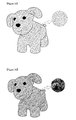
- the vegetation mat having a shape of animal was prepared identically to Example 1 except that the polyurethane resin (UNEX4073, DAKOTA, Belgium) as the hot melt adhesive was additionally included in an amount of 5 parts by weight ( Figures 3a, 3b ). It could be confirmed that the soil in the vegetation mat as produced formed the crumbled structure ( Figure 1 ).
- the polyurethane resin UNEX4073, DAKOTA, Belgium
- Example 3 Production of the vegetation basis comprising the polyester staple fiber
- the artificial soil was Baroker® bed soil sold by Seoul Bio Co., Ltd., with using in an amount of 95 parts by volume.
- the polyester fiber was used in an amount of 3 parts by volume with cutting to 10 mm.
- the hot melt adhesive the polyurethane resin having melting point of 130°C (UNEX4073, DAKOTA, Belgium) as purchased from the market was used in an amount of 2 parts by volume. They were introduced into the rotational mixer and then mixed together with 4,000 rpm. It was confirmed that the mutually twisted, sheath-core type polyester fibers were disentangled and well accomplished the blending with the artificial soil.
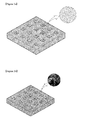
- the mixed composition was loaded into the mold having a grid pattern and then introduced into the high frequency drier (ANYHYDRO®, Jeenyang Platech Co., Ltd., Korea) and heated to 170°C for 200 seconds under pressure of 5 kg/cm 2 to produce the vegetation mat comprising the polyester staple fiber in a grid pattern ( Figures 2a, 2b ).
- the frequency as used as 2.45 GHz. It could be confirmed that the soil in the vegetation mat as produced formed the crumbled structure ( Figures 1 and 4 ). However, bentonite was excluded in Figure 4 .
- Example 4 Production of the vegetation basis comprising corn starch fiber
- Example 3 Under the same conditions as in Example 3, except that the corn starch fiber having melting point of 165°C (Ingeo®, Cargill Inc., USA) was used instead of the sheath-core type polyester fiber used in Example 3, the vegetation mat having a grid pattern was produced. It could be confirmed that the soil in the vegetation mat as produced formed the crumbled structure ( Figures 1 and 4 ). However, bentonite was excluded in Figure 1 .
- Example 2 While maintaining the other conditions of Example 1, the mixture discharged from a metering device was loaded into the mold having planting holes to produce the vegetation basis having planting holes ( Figures 2a, 2b ).
- the vegetation basis having a grid pattern was produced identically to Example 1, except that in Example 3 the bed soil was used in an amount of 93 parts by volume, the sheath-core type corn starch fiber was used in amount of 2 parts by volume with cutting to 10 mm, bentonite (Volclay Super Gel®, Volclay Korea, Korea) was used in an amount of 2.5 parts by volume, and the hot melt adhesive was used in an amount of 2.5 parts by volume. It could be confirmed that the soil in the vegetation mat as produced formed the crumbled structure ( Figure 4 ).
Landscapes
- Life Sciences & Earth Sciences (AREA)
- Environmental Sciences (AREA)
- Engineering & Computer Science (AREA)
- Mining & Mineral Resources (AREA)
- Civil Engineering (AREA)
- Paleontology (AREA)
- General Life Sciences & Earth Sciences (AREA)
- General Engineering & Computer Science (AREA)
- Structural Engineering (AREA)
- Soil Sciences (AREA)
- Chemical & Material Sciences (AREA)
- Inorganic Chemistry (AREA)
- Botany (AREA)
- Developmental Biology & Embryology (AREA)
- Cultivation Of Plants (AREA)
Abstract
Description
- The present invention relates to a vegetation basis either prepared by mixing a sheath-core type polyester staple fiber with an artificial soil or comprised of a fibrous material, a hot melt adhesive and the balance of bed soil, and a process for production thereof. More specifically, the present invention relates to a vegetation basis which can provide the condition suitable for plant growth by mixing the general commercial, artificial soil with a fibrous material and a hot melt adhesive to form a sponge type netted construct having the crumbled structure, thereby giving the bonding strength to the artificial soil, while has a light weight and further, either has a semi-permanent durability or is degradable within a short period of time, if desired, and to a process for production thereof.
- The vegetation basis denotes the bases made from artificial soil capable of allowing the plant to germinate, root and grow.
- In general, in order to allow the plant to grow such areas as rooftop, vertical wall of buildings, concrete block, bank protection block, concrete slope of tide embankment, etc. there is a need of the artificial ground and construct. Therefore, for eliminating any inconvenience due to addition of the artificial soil and separate complicated and difficult constructs in such areas, and reducing the construction costs the vegetation bases have been used. In addition, the vegetation bases have been widely used to form the vegetation base for preventing the leaching of earth and sand from slopes resulting from the road construction to cut mountains or the river conservation work, by a simple construction work within a short period of time. Furthermore, as recently a shortage of the green zone due to urbanization and the effects of plant, including air cleaning, soundproofing, insulation, etc., have been noted, the attempt to green the vertical exterior walls of buildings or in the soundproofing walls around the road, the bridge piers, the retaining walls of the road, the median strips, etc., with various plants by means of the vegetation mat has been made instead of the simple greening with climbing plants in the prior art.
- The most widely used vegetation basis is the vegetation mat. The vegetation mat is manufactured generally by compression molding of the artificial soil into the checkerboard pattern. The artificial soil has been generally used for greening the artificial ground such as rooftops, and in order to facilitate the work with the artificial soil the vegetation mat has been used. When the space such as rooftops is greened using the vegetation mat, due to the insulating effect of plants the energy required for the heating and cooling of buildings can be reduced, the urban heat island to more increase the atmospheric temperature over the city as compared to that in the suburbs can be prevented, and further it is possible to provide the air cleaning effect and the psychological wellbeing to persons.
- The major aspects to be considered in the vegetation mat include first the easy handling through maintaining the mechanical shape of the mat or basis at a minimum, and secondly, the permeability, absorbability, drainage and nutrient adsorbability suitable for plant growth, and next, the weight and durability.
- The properties for the bed soil as the basic raw material of the vegetation mat should provide with the following requisites, i.e. (1) appropriate water holding capacity and fertilizer holding capacity, (2) optimum permeability to help root respiration, (3) not containing any bacteria, worms and seeds, (4) maintenance of the acidity in the range of weak acidity to neutrality, (5) uniform physico-chemical properties, (6) suitable and uniform particle size of the bed soil, (7) easy handling property, and (8) superiority of block formation (root tangibility).
- The artificial soil used for the vegetation mat can be generally classified into the bed soil as the artificial soil required for seedling, and the culture soil as the artificial soil required for plant growth. The bed soil used as the artificial soil has been commercially available from many companies, and typically comprises cocopeat (coir), peat moss, vermiculite, zeolite, perlite, water-soluble fertilizer and antibacterial substances and wetting agents although their compositional ratios may be different from each other.
- In the prior art, the vegetation basis has been manufactured in the manner either that the adhesive is added to the artificial soil followed by compression molding or that the artificial soil is wrapped with the natural fiber (e.g. coir). Coir is the cellulose collected from fruits of coconut palm, and has not so much high strength and is relatively elastic and light, and particularly does not well rot in sea water but has the limitation in use as the natural fiber with respect to the strength or weathering resistance.
- As the major material for the artificial soil, perlite is extensively used because it has a low density and a low unit cost. Urea resin is generally used as the adhesives. However, the components of the adhesive comprise phenol and formaldehyde, which cause the problem that they may have a bad influence on the growth of plant. Further, when the artificial soil is solidified with using such liquid type adhesives as urea resin, the molding step must perform with using a high pressure, which brings the condition that pores present in the soil disappear. The pores mean the gap between soil particles as one of the physical properties of the soil. As the particle size is larger and uniform, many gaps between particles are present to grow the pores. Since the pores play a role of retaining air and water, it may be said a good soil is the soil in which water absorption and air ventilation are well achieved. Thus, if the pores are reduced, there is the problem that it may have a bad influence on the plant growth.
- Depending on the used place and function of the vegetation mat, one of the important factors is the durability. Up to the present, many vegetation mats for greening the vertical wall have been manufactured with the natural fiber and the bed soil. However, upon passing one or more year after manufacturing and disposing the mat there was the problem that the vegetation mat loses its original function because of rottenness itself to reduce the mat to the half and to flow down.
- The typical planting methods for the vegetation basis in the prior art are those for mixing, or applying to the surface, the seeds and, in case of the seedlings, for cutting the basis and then digging the contents away and planting the seedlings. Therefore, there was the problem that when the vegetation basis is intended to vertically stand, the contents are more readily discharged through such grating holes to more shorten the durability of said basis.
- In order to solve such problems, various alternatives have been suggested. For example, Korean Registered Patent No.
10-0500963 10-0537293 - However, said inventions emphasized on the eco-friendly elements to use the natural fiber, wrap the outside of the mat with the net of such natural fiber and then mold the artificial soil under compression. Therefore, since in said methods the artificial soil itself has no adhesive property, there is the problem that the pressure applied for molding a shape of the vegetation mat cause brings about reduction of the pores present in the artificial soil and thus, is not desirable to the plant growth. Further, upon passing one or more year after disposing the vegetation basis on the vertical wall there was also the problem that said basis rots and flows down to so that the original purpose of said basis cannot be attained.
- In case of the vegetation mat wrapped with the natural fiber on the outside thereof, it has no difference in the reduction of weight as compared to the light soil used to form the vegetation space, and when the mat is exposed to a sun light or a dramatic change of temperature, the natural fiber net used for preventing the discharge of the artificial soil from the inside of the mat has a low durability due to the limit of natural fibers so that the artificial soil present in the mat may be discharged not long after disposing the mat to make the attainment of the original purpose of the mat difficult and to cause a necessity of the complicated reconstruction. Further, there is also the problem that since the plants are planted after the vegetation holes are cut into the grating form, the contents are more readily discharged from such holes. Such problems are more remarkable particularly when the mat is disposed on the sharply sloped place or on the vertical wall or soundproofing wall. In addition, wrapping the outside of the vegetation mat with the net makes the manufacturing procedures more complicated to ultimately result in an increase of the production unit cost, and use of the coir for the outer net may cause a possibility of inhibiting the absorption of water and nutrients by plants due to the oil fraction membrane of coir.
- Further, Korean Registered Patent No.
10-0750564 - In order to maintain the vertical wall for a long period, the non-rotting fibers or frameworks are needed. On the contrary, to cover the construct having a gentle slope such as bank protections or ponds the basis which is readily and rapidly decomposed is needed, since the basis is eco-friendly when the vegetation basis is rotted and decomposed after the plants take root and then the root block is completely established.
- The present invention is contrived in order to solve the above-mentioned problems. The object of the present invention is to provide a vegetation basis manufactured by mixing an artificial soil with a fiber having the adhesive strength.
- Another object of the present invention is to provide a vegetation basis having pores suitable to the plant growth, which is allowed to have a sufficient bonding strength to the artificial soil by mixing the artificial soil with a fibrous material and a hot melt adhesive as the eco-friendly powder adhesive rather than the liquid adhesive, and can also be molded even under a low pressure at a low temperature.
- Another object of the present invention is to provide a sponge-type vegetation basis, which has a crumbled structure while also providing the vegetation basis, by utilizing a semi-permanently, non-rotting fiber. Here, the crumbled structure means the soil-forming structures formed by gathering grains together to form crumbs, which are then gathered, and having more gaps, as compared to the grain structure, so as to well pass water and air, and further allowing the roots of plants to easily extend.
- Another object of the present invention is to provide an eco-friendly vegetation basis which utilizes the biodegradable fiber so that it can be readily decomposed within a short period of time after the plants take root.
- Another object of the present invention is to provide a vegetation basis wherein the artificial soil can readily absorb water after drying while also having a sufficient strength..
- Another object of the present invention is to provide a process for production of said vegetation basis.
- In order to attain the object of the present invention, the vegetation basis formed by mixing a sheath-core type of the polyester staple fiber, which provides in itself with the adhesive strength to the artificial soil, with the artificial soil is provided.
- In order to attain another object of the present invention, the vegetation basis comprised of the fibrous material, the hot melt adhesive and the artificial soil is provided.
- In the present invention, by constructing the vegetation basis which is capable of molding under a low pressure at a low temperature while overcoming the defects to disappear the pores of the artificial soil when the liquid adhesives including urea resin serve as the binder, in order to maintain the crumbled structure effective for the plant growth the eco-friendly, fine powder type of the hot melt adhesive, which provides the bonding strength through melting with heat and then cooling down, together with the fibrous material is used to provide with the bonding strength to the artificial soil.
- As the fibrous material, general polyester staple fibers, sheath-core type polyester staple fibers or sheath-core type OEP (olefin polyethylene polypropylene - the inside is comprised of the polypropylene fiber having melting point of about 165°C and the outside is comprised of the low-melting polyethylene fiber) staple fibers can be used in order to manufacture the semi-permanent vegetation basis. In addition, to provide the vegetation basis which can decomposed within a short period of time after taking the roots of plants so as to be suitable to use on the gentle slope such as bank protections or ponds, a biodegradable fiber can be used as the fibrous material. The biodegradable fibers suitable for the present invention include corn starch fibers or sheath-core type corn starch fibers.
- Further, bentonite or a water absorbant polymer can be additionally included so that the vegetation basis as manufactured can readily absorb water after drying.
- The process for manufacturing the vegetation basis according to the present invention comprises the step of preparing the artificial soil and the fibrous material; the step of mixing said components; the step of loading the resulting mixture of said components into the mold; the step of molding said loaded mixture with heating; and the step of drying the molded mixture. If appropriate, in case where the vegetation basis comprising the hot melt adhesive, bentonite or a water absorbant polymer is desired to be manufactured, such materials are mixed with said materials.
- Since the vegetation basis manufactured by the present invention provides a high bonding strength by the sponge-type network structure formed upon melting the low-melting polyester staple rather than by the adhesive, it has no problem such as inhibition of the plant growth with components of the adhesive, and improves the defects in the prior vegetation bases not to absorb water, with maintaining the pores in the artificial soil as they are. Further, the present invention can provide the high strength vegetative basis capable of absorbing water upon short raining and watering in the nature, by means of the strong water absorption property of bentonite or water absorbant polymer, while maintaining the supply of nutrients sufficient for the growth of plants and the physico-chemical properties of the basis. Furthermore, in the present invention it is provided the vegetation basis which has no problem such as inhibition of the plant growth by mixing the artificial fiber as not being readily rotted, can be processed into various shapes only with heat or drying even without using any additional construct such as nets so that it can keep its shape even in case where the basis is vertically constructed, and is semi-permanent due to a rigid property of the artificial fiber. In addition, when the biodegradable fiber is used instead of the artificial fiber, the vegetation basis can be decomposed within a short period of time after rooting the plants to enjoy the eco-friendly effect.
- In order to attain the object of the present invention, either the vegetation basis comprising 100 parts by weight of the artificial soil and 4 to 30 parts by weight of the sheath-core type polyester staple fiber having the melting point of 70 to 150°C of the sheath component and of at least 270°C of the core component (hereinafter, referred to as 'the sheath-core type polyester staple fiber') and/or the vegetation basis comprising 0.2 to 8 parts by weight of the hot melt adhesive is/are provided.
- In order to attain the other object of the present invention, the vegetation basis comprising 0.1 to 5 parts by volume of the fibrous material, 0.1 to 5 parts by volume of the hot melt adhesive and the artificial soil as the balance is provided.
- In order to attain another object of the present invention, the vegetation basis comprising 0.1 to 5 parts by volume of the fibrous material, 0.1 to 5 parts by volume of the hot melt adhesive, 0.5 to 10 parts by volume of bentonite and the bed soil as the balance is provided.
- In order to attain another object of the present invention, the vegetation basis comprising 0.1 to 5 parts by volume of the fibrous material, 0.1 to 5 parts by volume of the hot melt adhesive, 0.5 to 10 parts by volume of water absorbant polymer and the bed soil as the balance is provided.
- Said fibrous material can be selected from polyester staple fibers, sheath-core type polyester staple fibers, OEP (fibers having melting point of about 140-145°C of the sheath part comprised of low-melting polyethylene and melting point of 160-165°C of the core part comprised of polypropylene, for the use as hygienic materials including diaper, sanitary napkin, etc., and as non-woven fabrics for other various purposes), corn starch fibers and sheath-core type corn starch fibers.
- In the present invention, by constructing the vegetation basis which is capable of molding under a low pressure at a low temperature while overcoming the defects to disappear the pores of the artificial soil when general liquid adhesives is used as the binder between particles of the artificial soil, in order to maintain the crumbled structure effective for the plant growth either the sheath-core type polyester staple fiber or the hot melt adhesive, which provides the bonding strength through melting with heat and then cooling down, together with the fibrous material is used to provide with the bonding strength to the artificial soil. The crumbled structure of the artificial soil included in the vegetation basis manufactured according to the present invention is shown in
Figure 1 . - The polyester fiber is the generic name of fibers prepared from polymeric compounds having ester groups in the molecule as the raw material. The polyester fiber has various merits including high strength, especially good knot strength and abrasion strength, no crumpling, rapid drying, no invasion with chemicals or bugs, etc. Other characteristic features include a high resistance to the heat. In general, synthetic fibers are weak to the heat but, inter alia, polyesters are most resistant to heat with having the melting point of about 270°C. For polyester fibers, many attempts have been made in order to change the properties and effects thereof for the purpose of improvement or reformation.. One of them is the low-melting polyester (LMP) fiber. The low-melting polyester fiber is the polyester which has the melting point of 70 to 150°C, and thus can be melted at low temperature and bonded without using any adhesive.
- The present invention uses the sheath-core type polyester staple fiber instead of the liquid adhesives, wherein the low-melting polyester staple fiber forming the sheath component is melted while providing the direct bonding strength between particles of the artificial soil as well as connecting between the polyester fibers to form the network structure. That is, when the sheath-core type polyester staple fiber is mixed with the artificial soil and then heated to the temperature higher than the melting point of the sheath component but lower than the melting point of the core component, for example, 70 to 250°C, only the sheath component is melted to form the network structure while the core component remains with not melting so as to provide the framework of the network structure, which plays a role in increasing the bonding strength to the vegetation basis as well as in providing the structure capable of firmly fixing the root as the plants grow. The network structure formed as the sheath component is melted provides with the bonding strength to the vegetation basis even without using any liquid adhesive so that the shape of the vegetation basis can be supported even without using any additional structure such as for wrapping the outside with the net, and therefore, it is possible to maintain the shape even in case where the basis is vertically positioned on such areas as sharp slops, vertical walls of buildings or soundproofing walls. Further, the shape maintenance of the basis can be semi-permanently continued due to the strength and weatherability of polyester fibers.
- The present invention provides the vegetation basis formed by mixing 100 parts by weight of the artificial soil with 4 to 30 parts by weight of the sheath-core type polyester staple fiber. If the sheath-core type polyester staple fiber is mixed in an amount less than 4 parts by weight, a sufficient bonding strength is not provided to the vegetation basis, whereas if the amount of said fiber is in excess of 30 parts by weight, the polyester fiber may be tangled with each other and the bonding strength is too strong and a ratio of the artificial soil is lowered so that the basis may not be desirable to the growth of plants.
- The sheath-core type polyester staple fiber of the present invention is present in the twisted state of respective strands, and is mixed by means of various mixers utilizing the rotation of 500 rpm or more but of 6,000 rpm or less, as known to a person skilled in the art. If the rotation is less than 500 rpm, the mixing of the staple fiber with the artificial soil is not well accomplished, whereas if the rotation is in excess of 6,000 rpm, the rotation is too strong so that the polyester staple fibers may be tangled together, the artificial soil may be physically deformed into too small grain thereby making the soil pores inferior. After mixing the artificial soil with the sheath-core type polyester staple fiber, the sponge-type network structure is formed by heating the resulting mixture to melt the low-melting polyester staple fiber. The heating temperature is preferably in the range of 70 to 250°. If the heating temperature is lower than 70°C, the low-melting polyester staple fiber cannot be melted, whereas if the heating temperature is higher than 250°C, even the polyester staple fiber as the core component may be melted as well as the low-melting polyester fiber.
- Meanwhile, according to the study conducted by the present inventors it could be observed that when the vegetation mat is manufactured using only the sheath-core type staple fiber, there is the problem that the bonding strength may not be sufficient and thus, the case where the basis is easily broken may be caused. When the mixing ratio of the fiber is raised to 30 parts by weight or more for enhancing the bonding strength, the bonding strength is enhanced but moisture is readily dried and the basis is not desirable to the sight of view due to so much fiber mass, and a bad influence on the plant growth may be caused. Thus, it has been found that as the agent playing a role of the adhesive to complement the above-mentioned problems the powder-type hot melt adhesive which provides the bonding strength with melting at temperature of about 70°C to 200°C can be additionally included in an amount of 0.2 to 8 parts by weight to enhance the bonding strength of the vegetation mat thus manufactured and further to overcome such problems.
- The hot melt adhesive is a pollution-free, hot melting adhesive, which does not use any of water and solvents; is formed by mixing the main three components, i.e. the base polymer, a thermoplastic resin (20-50%), and a tackifier (30-50%) and waxes (10-30%) to decrease the viscosity and improve the applicability upon melting, with an antioxidant and a filler; and when applying and adhering it to the surface of the adherend in the melted state with heating, is solidified to display the adhesion. It is the adhesive used for the automatic package in producing beverage, confectionery, instant noodle, pharmaceuticals and other necessaries of life, and has a softening point (melting point) of about 70°C to 200°C. Such hot melt adhesive has been disclosed in Korean Registered Patent No.
10-0815142 - Although the hot melt adhesive takes various forms including bar, plate, etc., the present invention uses the adhesive in the form of a fine powder. Use of the hot melt adhesive in the form of a fine powder can provide the advantages that the removal of pores present in the artificial soil as caused by using the existing adhesives, i.e. liquid type adhesives can be prevented, and the hot melt adhesive can be uniformly blended in the manufacturing procedures. Use of the hot melt adhesive, instead of the liquid type adhesives, can also enjoy the additional effect that the production of volatile substances including formaldehyde, as generated in using the liquid type adhesives, can be prevented to make the working environment advantageous.
- When used together with the sheath-core type polyester staple fiber, the hot melt adhesive is included in an amount of 0.2 to 8 parts by weight. If the amount is less than 0.2 parts by weight, the problems that the working efficiency is lowered and the artificial soil readily leaves from the basis may be caused, since the solidarity becomes not enough. On the contrary, if the amount is greater than 8 parts by weight, the solidarity is too much strong and the elasticity is lowered, and further, it looks like a white powder to damage a good appearance.
- Use of the sheath-core type polyester staple fiber results in providing the direct bonding strength between particles of the artificial soil which give, together with the adhesive strength of the hot melt adhesive used in the present invention, a stronger bonding strength between particles of the artificial soil. In addition, upon melting the low-melting polyester fiber interconnects between polyester fibers to form the sponge-type network structure. When the sheath-core type polyester staple fiber is mixed with the artificial soil and then heated at temperature greater than the melting point of the sheath component but less than the melting point of the core component, only the low-melting polyester fiber is melted to form the network structure while the polyester fiber of the core component is maintained without melting to provide the framework of the network structure, which plays a role in increasing the bonding strength to the vegetation basis as well as in providing the structure capable of firmly fixing the root as the plants grow.
- In the present invention, it could be found that the hot melt adhesive can also be used together with general polyester staple fibers, biodegradable fibers or OEP, as well as said sheath-core type polyester staple fiber. If said fibrous materials are sued together with the powder-type hot melt adhesive, the hot melt adhesive is melted with a high heat to provide the direct bonding strength between particles of the artificial soil and further to interconnect between fibrous materials resulting in formation of the sponge-type network structure.
- When used together with other fibrous materials than the sheath-core type polyester staple fiber, the hot melt adhesive is included in an amount of 0.1 to 5 parts by volume. If the amount is less than 0.1 parts by volume, the disadvantages that the working efficiency is lowered, the vegetation basis may be broken or crushed, and of course, the artificial soil readily leaves from the basis may be caused, since the solidarity becomes very weak. On the contrary, if the amount is greater than 5 parts by volume, the solidarity is too much strong and the elasticity is lowered, and further, it looks like a white powder to damage a good appearance.
- The biodegradable fiber used in the present invention denotes a natural fiber, particularly corn starch fibers or sheath-core type corn starch fibers. In case where such biodegradable fiber is used on the bank protections or the construct having a gentle slope such as ponds or reservoir the vegetation basis has the advantage that since it is decomposed after rooting the plants, no environmental pollution is caused. In using general natural fibers including celluloses, for example, coir in the present invention, since they are gone with burning during the manufacturing procedures according to the present invention, for example, corn starch fibers which does not bum at 150°C is suitable to the present invention.
- General plastics widely used in the modem society require at least hundreds of years for decomposition or, in general, are substantially not decomposed, under the natural environment, and therefore, are detrimental to the appearance. Further, since various kinds of waste vinyl bags, packaging papers, styrofoams, etc are not properly disposed, they are regarded as being the major cause to pollute the environment. Therefore, the new material which can be readily decomposed under the conditions of the natural environment to cause no problem of environmental pollution is highly required. According to such requirement, 'the biodegradable plastics' or 'the biodegradable fibers' have been proposed.
- The biodegradable fibers are decomposed by the process which comprises first decomposing the plastic chains into the low molecular compounds with hydrolytic enzymes externally secreted from microbes, followed by absorption of the decomposed products into the body of microbes and the metabolism into various biomolecules, carbon dioxide and water. The decomposition of the biodegradable macromolecules occurs through hydrolysis, oxygen, or hydrolysis of ester linkage with such enzymes as lipase. The degradation rate is greatly varied depending on the structure and morphology of macromolecules, the reproduction conditions of microbes, the oxygen activity, etc. The biodegradable macromolecules which can be completely degraded include polycarprolactone (PCL), poly(hydroxyalkanate) (PHA), poly(lactic acid) (PLA), poly(hydroxy butyrate valerate) (PHBV), poly(butylene succinate) (PBA), and other aliphatic polyesters and natural macromolecules.
- Of such biodegradable plastics, PLA (poly lactic acid) is a polymer of the low molecular compound (monomer), called lactic acid, present in the living organisms, and has been known that it is converted into the low molecular compound by hydrolysis with water and then, decomposed with microbes. Poly lactic acid fibers are prepared according to the process which comprises fermenting corn starch to produce lactic acid via glucose and then condensing lactic acid to prepare PLA, which is then subjected to melt spinning or melt molding procedure together with polyesters or nylons. Corn is composed of starch, gluten, husk, hull and fiber, and germ, with starch accounting for 65%, which is converted into lactic acid through fermentation. In this case, the optical isomer in which L-form of lactic acid constitutes the main part and D-form is also present is produced. Cargill Inc. in USA has developed the raw material of PLA (NatureWorks PLA) and supplied under the trademark "Ingeo". Also, three to four Japanese companies and Novament of Intaly have also developed and practically implemented PLA materials. It has been known that PLA has the molecular structure of H-(OCH(CH3)CO)n-OH and the melting point of about 175°C. Therefore, it dose not burn at high temperature of the process for manufacturing the vegetation basis of the present invention and remains in the artificial soil to keep the framework of the basis. Although general corn starch fibers can also be used, the sheath-core type corn starch fibers were also marketed and therefore, such commercialized product can be purchased and used. They can be prepared so that the sheath component has a low-melting point (e.g. 130-140°C) and the core component has a high-melting point (e.g. 160-170°C). The sheath-core type corn starch fibers provides the effects identical to those of using said sheath-core type polyester fibers, and thus, forms sufficient pores in the artificial soil and also allows the soil structure to have a strong solidarity.
- General polyester staple fibers, sheath-core type polyester staple fibers or OEP are used at a ratio of 0.1 to 5 parts by volume on the basis of the volume of the vegetation basis. If said volume ratio thereof is below 0.1, the fibrous materials are insufficient to form and support the framework of the basis construct, and thus, after some natural fibers are rotted upon passing 2 to 3 years, the problem may be caused in semi-permanently supporting the basis construct. On the contrary, if the ratio is in excess of 5 parts by volume, the fibers are mixed in a too much amount so that in watering frequently or in a large quantity the bed soil present on the surface, and bentonite or water absorbant polymer, which can be additionally included, may be washed out to form a wad of cotton or a non-fabric, and a rate of the artificial soil is lowered to make the vegetation basis unsuitable to the plant growth. Although there is no special problem, it may generate the environmental revulsion and thus, is unsuitable. The corn starch fiber and the sheath-core type corn starch fiber are used at the same volumetric ratio as above, for the reasons as stated above. That is, in case where the volumetric ratio is below 0.1, the fibrous materials are insufficient to form and support the framework of the basis construct, whereas at a ratio in excess of 5 parts by volume a wad of cotton or a non-fabric may be formed and the problem that it is undesirable to the plant growth may be caused.
- The vegetation basis manufactured according to the present invention can additionally include bentonite or a water absorbant polymer. The physical properties of bentonite include a property to absorb water by 5 times the weight with expanding the volume by about 13-16 times the original volume upon reacting with water, and an adherent property upon mixing with other materials as the active clay which is dispersed in water to improve the viscosity, gel strength and suspension degree.
Further, sodium bentonite has no chemical activity, and therefore, has no influence on the original chemical properties of the materials to be adhered. In addition, by means of such properties which are not changed even under the conditions including lapse of time and high temperature bentonite can improve the disadvantages of the general bed oil for horticultural use to not absorb water upon completely drying with heat, and can allow constructing the vegetation basis which intactly maintains the supply of nutrients sufficient to the growth of plants and the physico-chemical properties, while it can also allow constructing the vegetation basis capable of rapidly absorbing water upon short raining and watering in the nature by easily and uniformly absorbing water due to the strong water absorption property of bentonite. Water absorbant polymer is used as an agent for absorbing water, and thus, can also play the same role as bentonite. The water absorbant polymer is preferably selected from the group consisting of crosslinked polyacrylic acid, crosslinked polyacrylamide, crosslinked polyvinylalcohol, mixtures of water absorbent polymers, such as ready-made or commercially available mixtures, e.g. terra cottem®, or any combination of the foregoing. - In the present invention, bentonite is used at the ratio of 0.5 to 10 parts by volume on the basis of the total volume of the vegetation basis. If bentonite is mixed in the ratio less than 0.5 parts by volume, it causes the disadvantages that a sufficient bonding strength cannot be provided to the vegetation basis and it may result in the condition resulting from use of fibrous material alone that the surface of the vegetation basis is rough and the artificial soil readily leaves from the basis, i.e. that the vegetation basis may too easily be broken or crushed so that a sever problem in molding the product itself as well as the working efficiency may be raised. In case where the amount is in excess of 10 parts by volume, the volumetric expansion is too much and the water drainage is significantly lowered thereby possibly having a bad influence on the growth of root. Water absorbant polymer is also used at the ratio of 0.5 to 10 parts by volume. When water absorbant polymer is used at the ratio greater than 10 parts by volume, it may take water even from the roots of plants to dry the plant, the water moisturizing effect thereof for a long period of time may result in rotting the roots of plants, and the volumetric expansion due to water absorption thereof may cause the destruction of a shape of the vegetation mat. If water absorbant polymer is less than 0.5 parts by volume, water cannot be uniformly distributed, the production cost is increased and its use may become insignificant.
- The fibers used in the present invention are a staple fiber having a length of 2 to 20 mm. If the length of the staple fiber is less than 2 mm, it is difficult to provide with a sufficient bonding strength to the vegetation basis due to a poor formation of the network structure, whereas if the length is longer than 20 mm, the fibers are tangled with each other and thus, cannot be uniformly blended with the artificial soil, and further, after molding the solidarity thereof is too strong in so much that the growth of roots may be impeded.
- The artificial soil can be generally commercially available, and usually includes cocopeat (coir), peat moss, vermiculite, zeolite, perlite, water-soluble fertilizer and antibacterial substances and wetting agents although their constituents and their compositional ratio may be somewhat different depending on the manufacturers.
- Although the mixing of the components of the present invention as used together with the artificial soil can be made using various mixers known to a person skilled in the present technical field, it is desirable to mix them by means of a rotation force. Since the sheath-core type polyester staple fibers, polyester staple fibers, biodegradable fibers or OEP are present in the state that respective strands thereof are uniformly adhered to each other, it is desirable to mix them with the artificial soil while rotating in order to break up said fibers. For the above reason, it is desirable to rotate in the rate of 500 to 6,000 rpm.
- When the artificial soil and the sheath-core type polyester staple fiber, polyester staple fibers, OEP, or biodegradable fibers or OEP are mixed with the hot melt adhesive and, if desired, bentonite or water absorbant polymer, and then this composition is heated, the sponge-type network structure is formed by melted hot melt adhesive, and in case where bentonite is mixed, the structure can have a stronger bonding strength due to the bonding strength of bentonite. The heating temperature is preferably in the range of 70 to 250°. If the heating temperature is lower than 70°C, the fibers of the sheath component and the hot melt adhesive cannot be melted, whereas if the heating temperature is higher than 250°C, a fire may break out due to heating of the materials. The lower limit of the heating temperature must be higher than the lower melting limit of the hot melt adhesive as used and the lower melting limit of the sheath component of the sheath-core type fibers. The upper limit must be less than the upper melting limit of the core component.
- Although the heating can be made using various methods known to a person skilled in the present technical field, the heating by means of a high frequency drier using microwave is preferable. When heating with the microwave, the desired temperature can be attained within a short period of time, the heat is smoothly transferred to the mixed composition within a short period of time to uniformly form the sponge-type network structure having a strong bonding strength throughout the composition while melting the fibers of the sheath component and the hot melt adhesive and drying bentonite. In the present invention, it is desirable to use the microwave for 10 to 600 seconds. If the time of using the microwave is less than 10 seconds, a sufficient heat cannot be provided, whereas if the time is in excess of 600 seconds, the hourly throughput may be lowered to increase the production unit cost. Heating may be provided in the form of steam and various forms of energy. Heating with steam as above is an improve method capable of uniformly transferring heat to various forms of the three-dimensional constructs. The pressurization is preferably made using the steam pressure of 2 to 7 kg/cm2. If the pressure is less than 2 kg/cm2, the heat is not sufficiently transferred to the mixed composition, whereas if the pressure is greater than 7 kg/cm2, pores suitable to the growth of plants may be disappeared by such pressure to cause the impediment of plant growth.
- Microwave is a kind of electromagnetic waves, and denotes an electromagnetic wave having a very short wavelength. It names generically an electric wave having the frequency of about 1,000 MHz (megahertz) to 30 GHz (gigahertz, 1 gigahertz), and the wavelength of about 1-30 cm. Among them, except for those used for communication, the frequencies conventionally used in the general field of industry are 915 MHz and 2.45 GHz, which frequency are used in the high frequency driers conventionally used in home.
- In molding the mixed composition, the molding step and the heating step can be simultaneously conducted, that is, the molding is carried out by heating the composition in the mold having a certain shape under pressure. The vegetation basis of the present invention can be well processable and therefore, the shape and size of the basis to be molded can be diversely manufactured by changing the mold. Therefore, the vegetation basis can be molded in the form of the mat having a grid pattern, and further, vary various forms of the vegetation basis can be manufactured depending on the shapes of molds including block forms or the shapes of animals. In addition, the planting can be easily and conveniently conducted by pre-forming the planting holes in molding the vegetation basis.
- The process for manufacturing the vegetation basis according to the present invention comprises the step of preparing the artificial soil, the sheath-core type polyester staple fibers, polyester staple fibers, OEP or biodegradable fibers, and the hot melt adhesive, and if desired, bentonite or water absorbant polymer; the step of mixing said components; the step of loading the resulting mixture of said components into the mold; the step of applying the pressure to the said loaded mixture; the step of molding said loaded mixture with heating; and the step of drying the molded mixture.
- In loading the mixture into the mold, the mixed materials can be discharged in a certain quantity from a metering device and loaded into the mold having planting holes (holes for planting the plants to the vegetation basis) to form the vegetation basis having the planting holes. Simultaneously with the completion of molding, the vegetation basis is completely produced. This process produces the double effect to generate no pollutional material and further to completely eradicate sundry microbes and harmful insects with high steam temperature.
- The present invention will be specifically illustrated by the following examples. The examples are intended to illustrate the invention but are not construed to limit the scope of the present invention.
- The artificial soil was Baroker® bed soil sold by Seoul Bio Co., Ltd., with using in an amount of 100 parts by weight. The sheath-core type polyester fiber (Ezbon-L®, Saehan Industries Inc., Korea) was used in an amount of 20 parts by weight with cutting to 6 mm. They were introduced into the rotational mixer and then mixed together with 3,000 rpm. It was confirmed that the mutually twisted, sheath-core type polyester staple fibers were disentangled and well accomplished the blending with the artificial soil. The mixed composition was loaded into the mold having a grid pattern and then introduced into the high frequency drier (ANYHYDRO®. Jeenyang Platech Co., Ltd., Korea) and heated to 170°C for 200 seconds under pressure of 4 kg/cm2 to produce the vegetation mat comprising the sheath-core type polyester staple fiber in a grid pattern (
Figures 2a, 2b ). The frequency as used as 2.45 GHz. It could be confirmed that the soil in the vegetation mat as produced formed the crumbled structure (Figure 1 ). - The vegetation mat having a shape of animal was prepared identically to Example 1 except that the polyurethane resin (UNEX4073, DAKOTA, Belgium) as the hot melt adhesive was additionally included in an amount of 5 parts by weight (
Figures 3a, 3b ). It could be confirmed that the soil in the vegetation mat as produced formed the crumbled structure (Figure 1 ). - The artificial soil was Baroker® bed soil sold by Seoul Bio Co., Ltd., with using in an amount of 95 parts by volume. The polyester fiber was used in an amount of 3 parts by volume with cutting to 10 mm. As the hot melt adhesive, the polyurethane resin having melting point of 130°C (UNEX4073, DAKOTA, Belgium) as purchased from the market was used in an amount of 2 parts by volume. They were introduced into the rotational mixer and then mixed together with 4,000 rpm. It was confirmed that the mutually twisted, sheath-core type polyester fibers were disentangled and well accomplished the blending with the artificial soil. The mixed composition was loaded into the mold having a grid pattern and then introduced into the high frequency drier (ANYHYDRO®, Jeenyang Platech Co., Ltd., Korea) and heated to 170°C for 200 seconds under pressure of 5 kg/cm2 to produce the vegetation mat comprising the polyester staple fiber in a grid pattern (
Figures 2a, 2b ). The frequency as used as 2.45 GHz. It could be confirmed that the soil in the vegetation mat as produced formed the crumbled structure (Figures 1 and4 ). However, bentonite was excluded inFigure 4 . - Under the same conditions as in Example 3, except that the corn starch fiber having melting point of 165°C (Ingeo®, Cargill Inc., USA) was used instead of the sheath-core type polyester fiber used in Example 3, the vegetation mat having a grid pattern was produced. It could be confirmed that the soil in the vegetation mat as produced formed the crumbled structure (
Figures 1 and4 ). However, bentonite was excluded inFigure 1 . - While maintaining the other conditions of Example 1, the mixture discharged from a metering device was loaded into the mold having planting holes to produce the vegetation basis having planting holes (
Figures 2a, 2b ). - The vegetation basis having a grid pattern was produced identically to Example 1, except that in Example 3 the bed soil was used in an amount of 93 parts by volume, the sheath-core type corn starch fiber was used in amount of 2 parts by volume with cutting to 10 mm, bentonite (Volclay Super Gel®, Volclay Korea, Korea) was used in an amount of 2.5 parts by volume, and the hot melt adhesive was used in an amount of 2.5 parts by volume. It could be confirmed that the soil in the vegetation mat as produced formed the crumbled structure (
Figure 4 ). - Under the same conditions as in Example 5, except that terra cottem (TerraCottem®, Terra Green Co., Ltd., Korea) was used in an amount of 2.5 parts by volume instead of bentonite, the vegetation mat having a grid pattern was produced. It could be confirmed that the soil in the vegetation mat as produced formed the crumbled structure (
Figure 4 ). However, bentonite inFigure 4 means terra cottem. -
-
Figure 1 is an enlarged diagram showing the sponge-type network structure between the polyester staple fiber and particles of the artificial soil as formed in the present invention; -
Figure 2a is a diagram showing one embodiment of the sponge-type vegetation basis of the present invention as molded in the form of a mat having planting holes.Figure 2b is a diagram showing an embodiment of the sponge-type molding of the vegetation basis of the present invention having the crumbled structure made from the fibrous material, bentonite, the artificial soil and the hot melt adhesive; -
Figure 3a is a diagram showing an embodiment of the vegetation basis of the present invention as molded using the biodegradable fiber for bank protection, andFigure 3b is a diagram showing an embodiment of the sponge-type molding of the vegetation basis of the present invention made from the biodegradable fibrous material, the artificial soil and the hot melt adhesive; and -
Figure 4 is a diagram showing the crumbled structure of the vegetation basis produced according to the present invention. -
- 10 ... Polyester staple fiber
- 12 ... Structure formed by melting the low-melting polyester staple fiber
- 13 ... Particles of the artificial soil
- 21 ... Fibrous material
- 22-24 ... Materials constituting the artificial soil
- 25 ... Hot melt adhesive
- 26 ... Bentonite or water absorbant polymer
Claims (13)
- A vegetation basis comprising 100 parts by weight of an artificial soil and 4 to 30 parts by weight of a sheath-core type polyester staple fiber.
- The vegetation basis according to claim 1, characterized in that a hot melt adhesive is additionally included in an amount of 0.2 to 8 parts by weight.
- The vegetation basis comprising 0.1 to 5 parts by volume of a fibrous material, 0.1 to 5 parts by volume of a hot melt adhesive and a bed soil as the balance.
- The vegetation basis according to claim 3, characterized in that bentonite is additionally included in an amount of 0.5 to 10 parts by volume.
- The vegetation basis according to claim 3, characterized in that a water absorbant polymer is additionally included in an amount of 0.5 to 10 parts by volume.
- The vegetation basis according to any one of claims 3 to 5, characterized in that said fibrous material is selected from the group consisting of a polyester staple fiber, a sheath-core type polyester staple fiber, OEP (olefin polyethylene polypropylene), a corn starch fiber and a sheath-core type corn starch fiber.
- The vegetation basis according to claim 6, characterized in that said fibrous material is selected from the group consisting of a corn starch fiber and a sheath-core type corn starch fiber.
- The vegetation basis according to any one of claims 3 to 5, characterized in that said hot melt adhesive is selected from the group consisting of a thermoplastic polyurethane elastic resin, an epoxy resin, a polyester-based resin, a polyethylene (PE), and a low-melting polyester fiber.
- A process for producing a vegetation basis comprising the step of preparing an artificial soil, a fibrous material and, optionally, a hot melt adhesive; the step of mixing said components; the step of loading the resulting mixture of said components into the mold; the step of applying the pressure to the loaded mixture; the step of molding said loaded mixture with heating; and the step of drying the molded mixture.
- The process for producing a vegetation basis according to claim 9, characterized in that bentonite is additionally included.
- The process for producing a vegetation basis according to claim 9, characterized in that a water absorbant polymer is additionally included.
- The process for producing a vegetation basis according to any one of claims 9 to 11, characterized in that said fibrous material is selected from the group consisting of a polyester staple fiber, a sheath-core type polyester staple fiber, OEP (olefin polyethylene polypropylene), a corn starch fiber and a sheath-core type corn starch fiber.
- The process for producing a vegetation basis according to any one of claims 9 to 10, characterized in that said mold has a planting hole.
Applications Claiming Priority (1)
| Application Number | Priority Date | Filing Date | Title |
|---|---|---|---|
| KR1020070093655A KR100807285B1 (en) | 2007-09-14 | 2007-09-14 | Vegetation base using polyester short fibers and its production method |
Publications (2)
| Publication Number | Publication Date |
|---|---|
| EP2036430A2 true EP2036430A2 (en) | 2009-03-18 |
| EP2036430A3 EP2036430A3 (en) | 2009-04-29 |
Family
ID=39383300
Family Applications (1)
| Application Number | Title | Priority Date | Filing Date |
|---|---|---|---|
| EP08016143A Withdrawn EP2036430A3 (en) | 2007-09-14 | 2008-09-12 | Vegetation basis and method of production thereof |
Country Status (4)
| Country | Link |
|---|---|
| US (1) | US7868057B2 (en) |
| EP (1) | EP2036430A3 (en) |
| KR (1) | KR100807285B1 (en) |
| CN (1) | CN101427648B (en) |
Cited By (1)
| Publication number | Priority date | Publication date | Assignee | Title |
|---|---|---|---|---|
| WO2011098211A1 (en) * | 2010-02-15 | 2011-08-18 | BLüCHER GMBH | Adsorptive structures having a particle and/or aerosol filter function and method for producing such adsorptive structures |
Families Citing this family (21)
| Publication number | Priority date | Publication date | Assignee | Title |
|---|---|---|---|---|
| US9730395B2 (en) * | 2007-07-11 | 2017-08-15 | Gary R. Hartman | Modular growing panel system and method for covering structures with vegetation |
| KR101110523B1 (en) * | 2009-02-16 | 2012-02-06 | 박공영 | Wall recording system |
| NL1039140C2 (en) * | 2011-10-29 | 2013-05-06 | Synbra Tech Bv | GROWTH SUBSTRATE FOR PLANTS. |
| WO2014117276A1 (en) * | 2013-02-01 | 2014-08-07 | University Of Guelph | Soilless pre-vegetated mat and process for production thereof |
| KR101480276B1 (en) * | 2014-01-28 | 2015-01-14 | 주식회사 그린기술 | Biofilm media consisting of bonded granules |
| WO2016134087A1 (en) * | 2015-02-19 | 2016-08-25 | Scannell Christopher | Use of bentonite for improving plant growth-related traits |
| CN104920187A (en) * | 2015-05-29 | 2015-09-23 | 余启佳 | Method for planting lettuces without soil |
| CN104920185A (en) * | 2015-05-29 | 2015-09-23 | 余启佳 | Soilless cultivation method of Amaranthus tricolor |
| CN104920186A (en) * | 2015-05-29 | 2015-09-23 | 余启佳 | Soilless cultivation method of Chinese bulbous onion |
| CN104920195A (en) * | 2015-05-29 | 2015-09-23 | 余启佳 | Soilless cultivation method of broccoli |
| CN104920189A (en) * | 2015-05-29 | 2015-09-23 | 余启佳 | Soilless cultivation method of Chinese kale |
| CN105367216B (en) * | 2015-09-30 | 2017-11-21 | 湖南垒土农业科技发展有限公司 | A kind of plasticity fiber compost and preparation method thereof |
| CN105297178B (en) * | 2015-09-30 | 2017-04-19 | 湖南垒土农业科技发展有限公司 | Hot melt binding composite fiber capable of organically integrating with culture soil matrix |
| CA3051410A1 (en) * | 2017-01-26 | 2018-08-02 | Jiffy International As | Wood fibers for enhanced binding in growing media |
| CN107646416A (en) * | 2017-11-03 | 2018-02-02 | 西南大学 | A kind of moulding polypropylene floral organ of flax textile |
| DE202019101576U1 (en) * | 2019-03-20 | 2020-05-07 | Michael Eisele | Flexible element for regulating the water supply in the root area of plants |
| CN112167008B (en) * | 2020-10-16 | 2022-07-12 | 中国农业科学院都市农业研究所 | Seedling substrate production device and process and seedling substrate block produced by same |
| CN112189534B (en) * | 2020-10-16 | 2022-08-12 | 中国农业科学院都市农业研究所 | A floating cultivation substrate |
| CN113661897A (en) * | 2021-07-16 | 2021-11-19 | 夏举佩 | Light water-retaining implant for three-dimensional greening |
| CN114457841B (en) * | 2022-02-21 | 2023-03-03 | 成都理工大学 | A concrete retaining wall hard landscape ecological softening structure and its construction method |
| CA3253146A1 (en) * | 2022-05-26 | 2023-11-30 | Profile Products Llc | Hydroponic substrate |
Citations (6)
| Publication number | Priority date | Publication date | Assignee | Title |
|---|---|---|---|---|
| EP0409186A2 (en) * | 1989-07-21 | 1991-01-23 | Takeda Garden Products Co., Ltd. | Artificial bed soil |
| KR100500963B1 (en) | 2003-05-23 | 2005-07-18 | 삼성에버랜드 주식회사 | Sedum mat and vegetative sound proof unit and vegetative sound proof wall |
| KR100537293B1 (en) | 2003-04-14 | 2005-12-19 | 강태호 | the greening mat for artificial ground |
| US20060070294A1 (en) * | 2004-10-04 | 2006-04-06 | Profile Products L.L.C. | Netless fiber mulch mats bound with bicomponent fibers |
| KR100750564B1 (en) | 2006-11-23 | 2007-08-20 | 석성기업주식회사 | Vegetation mat system and greening method using the same |
| KR100815142B1 (en) | 2003-06-06 | 2008-03-19 | 도소 가부시키가이샤 | Aromatic petroleum resin for hot-melt adhesive, aromatic petroleum resin composition for hot-melt adhesive and hot-melt adhesive composition |
Family Cites Families (53)
| Publication number | Priority date | Publication date | Assignee | Title |
|---|---|---|---|---|
| US3056757A (en) * | 1959-10-14 | 1962-10-02 | American Cyanamid Co | Soil having incorporated therein an aqueous gel of bisacrylamide polymer and water soluble metal salt |
| DE2025316B2 (en) * | 1969-06-06 | 1974-05-09 | David Salzburg Rack (Oesterreich) | |
| US3844987A (en) * | 1972-07-28 | 1974-10-29 | Union Carbide Corp | Contour adapted passenger loading ramp biodegradable transplanter containers |
| US3921333A (en) * | 1972-07-28 | 1975-11-25 | Union Carbide Corp | Transplanter containers made from biodegradable-environmentally degradable blends |
| GB1431546A (en) * | 1973-12-12 | 1976-04-07 | British Petroleum Co | Protection method |
| US4004368A (en) * | 1975-02-24 | 1977-01-25 | Cabot Corporation | Agricultural soil compositions |
| DE2607347C3 (en) * | 1975-02-24 | 1978-09-28 | Hayashibara Biochemical Laboratories, Inc., Okayama | Granulated and / or compression molded grocery products |
| US4495310A (en) * | 1981-05-08 | 1985-01-22 | Gravi-Mechanics Co. | Method of forming a urethane prepolymer and its use in consolidating aggregate material |
| US4447380A (en) * | 1981-12-16 | 1984-05-08 | Owens-Corning Fiberglas Corporation | Expanded inorganic aggregate bonded with calcium silicate hydrate as thermal insulation |
| JPS62169604A (en) * | 1985-07-08 | 1987-07-25 | Dai Ichi Kogyo Seiyaku Co Ltd | Manufacture of sheet and molded form |
| US4790691A (en) | 1986-10-03 | 1988-12-13 | Freed W Wayne | Fiber reinforced soil and method |
| US4936711A (en) * | 1988-02-12 | 1990-06-26 | Kabushiki Kaisha Kumagaigumi | Process for preparing vegetation bedrock and muddy borrow soil base material blasting nozzle used therefor |
| JPH02145133A (en) * | 1988-11-28 | 1990-06-04 | Kureha Chem Ind Co Ltd | Granular material for cultivating plant |
| JPH07113068B2 (en) * | 1989-12-11 | 1995-12-06 | 東レ株式会社 | Fiber-reinforced foam and method for producing the same |
| US6495656B1 (en) * | 1990-11-30 | 2002-12-17 | Eastman Chemical Company | Copolyesters and fibrous materials formed therefrom |
| US5588783A (en) * | 1992-05-08 | 1996-12-31 | The United States Of America As Represented By The Secretary Of The Army | Soil reinforcement with adhesive-coated fibers |
| US5660900A (en) * | 1992-08-11 | 1997-08-26 | E. Khashoggi Industries | Inorganically filled, starch-bound compositions for manufacturing containers and other articles having a thermodynamically controlled cellular matrix |
| CN1098431A (en) * | 1993-07-31 | 1995-02-08 | 金永求 | Artificial soil composition and the method for planting plant on the surface, hillside fields |
| JPH0750924A (en) * | 1993-08-11 | 1995-02-28 | Sekisui Plastics Co Ltd | Soil substitute and method for producing the same |
| JPH07155076A (en) * | 1993-12-09 | 1995-06-20 | Okabe Kinzoku Kk | Artificial soil and method of manufacturing the same |
| US5753330A (en) * | 1994-12-22 | 1998-05-19 | Chisso Corporation | Cylindrically shaped product |
| CA2180900C (en) * | 1995-07-10 | 1999-10-12 | Tetsuya Tanoshima | Culture soil, process for producing the same and seedling-growing peat board |
| US5746546A (en) * | 1996-01-24 | 1998-05-05 | Stabilizer, Inc. | Soil stabilization composition and method |
| US6032410A (en) * | 1997-01-28 | 2000-03-07 | E. I. Du Pont De Nemours And Company | Sod or other vegetation |
| US6042305A (en) * | 1997-08-15 | 2000-03-28 | Ppg Industries Ohio, Inc. | Fiber-reinforced soil mixtures |
| US6397520B1 (en) * | 1997-12-19 | 2002-06-04 | E. I. Du Pont De Nemours And Company | Method of supporting plant growth using polymer fibers as a soil substitute |
| US6029395A (en) * | 1998-01-05 | 2000-02-29 | Morgan; Albert W. | Biodegradable mulch mat |
| US6293045B1 (en) * | 1998-01-05 | 2001-09-25 | Albert W. Morgan | Biodegradable mulch mat |
| AU1078400A (en) * | 1998-11-06 | 2000-05-29 | M & M Laboratory Co., Ltd. | Water-holding carriers for plants and water-holding materials for growing plants |
| CN1074237C (en) * | 1998-12-31 | 2001-11-07 | 顾卫 | Bioengineering method for preventing soil erosion by soil protection fiber cotton net |
| DE19910267A1 (en) * | 1999-03-08 | 2000-09-14 | Stockhausen Chem Fab Gmbh | Mixture of a vegetable residue and a water-absorbing polymer |
| US6290769B1 (en) * | 1999-06-22 | 2001-09-18 | Siplast, Inc. | Lightweight insulating concrete and method for using same |
| NZ500247A (en) * | 1999-10-12 | 2002-10-25 | Christopher John Frogley | Propagation substrate having non-compressed sphagnum moss and non-toxic resin binder |
| US6829860B1 (en) * | 2000-02-22 | 2004-12-14 | Summit Seed, Inc. | Pelletized straw mulch and method of use thereof for soil stabilization and grass and wildflower seed enhancement |
| US20030060113A1 (en) * | 2001-09-20 | 2003-03-27 | Christie Peter A. | Thermo formable acoustical panel |
| TW503496B (en) * | 2001-12-31 | 2002-09-21 | Megic Corp | Chip packaging structure and manufacturing process of the same |
| US6846858B2 (en) * | 2002-04-24 | 2005-01-25 | Brenton L. Lemay | Artificial soil composition and methods of its making and use |
| FR2843523B1 (en) * | 2002-08-13 | 2005-03-04 | Ahlstrom Research & Services | BIODEGRADABLE FIBROUS SUPPORT FOR SOIL FLOORING |
| US6729807B1 (en) * | 2002-11-07 | 2004-05-04 | Profile Products L.L.C. | Integral lofty polymer grid and fiber web matrix turf reinforcement mats |
| ZA200506336B (en) * | 2003-02-12 | 2006-10-25 | Koch Cellulose Llc | Seedbed for growing vegetation |
| TW592629B (en) * | 2003-02-26 | 2004-06-21 | Yuen Foong Yu Paper Mfg Co Ltd | The manufacturing method for a plant fiber mulching mat |
| WO2004098270A1 (en) | 2003-05-01 | 2004-11-18 | Bki Holding Corporation | Improved hydroponic growth medium |
| US20070289543A1 (en) * | 2006-06-16 | 2007-12-20 | The Clorox Company | Clumping Animal Litter |
| US20050178056A1 (en) * | 2004-02-13 | 2005-08-18 | Morrone Jack L. | Landscaping fabrics and methods of making and using the same |
| JP2005232405A (en) * | 2004-02-23 | 2005-09-02 | Unitika Ltd | Lightweight soil conditioner for soil for medium |
| US20060150494A1 (en) * | 2004-12-15 | 2006-07-13 | Masson Norman G | Plant growing media |
| EP1680954A1 (en) * | 2005-01-14 | 2006-07-19 | Chisso Corporation | Nursery bed for transplantation |
| NL1029571C2 (en) | 2005-07-20 | 2007-01-23 | Jiffy Internat As | Method for growing plants as well as a growing medium. |
| KR100631380B1 (en) | 2006-05-16 | 2006-10-04 | 김성철 | Construction Method of Synthetic Green Soil Containing Steel Fiber for Ecological Restoration of Cutout Slopes |
| JP2008265874A (en) * | 2007-03-29 | 2008-11-06 | Nippon Sheet Glass Co Ltd | Glass fiber package, glass fiber packaging method and glass fiber product using the same |
| EP2173835A1 (en) * | 2007-07-18 | 2010-04-14 | Leonard Kosinski | Plant growth medium |
| US8221542B2 (en) * | 2007-12-13 | 2012-07-17 | Georgia-Pacific Gypsum Llc | Non-cement fire door core |
| JP5125494B2 (en) * | 2007-12-27 | 2013-01-23 | ソニー株式会社 | Method for producing printed matter |
-
2007
- 2007-09-14 KR KR1020070093655A patent/KR100807285B1/en active Active
-
2008
- 2008-09-10 US US12/283,203 patent/US7868057B2/en not_active Expired - Fee Related
- 2008-09-12 CN CN2008101785865A patent/CN101427648B/en not_active Expired - Fee Related
- 2008-09-12 EP EP08016143A patent/EP2036430A3/en not_active Withdrawn
Patent Citations (6)
| Publication number | Priority date | Publication date | Assignee | Title |
|---|---|---|---|---|
| EP0409186A2 (en) * | 1989-07-21 | 1991-01-23 | Takeda Garden Products Co., Ltd. | Artificial bed soil |
| KR100537293B1 (en) | 2003-04-14 | 2005-12-19 | 강태호 | the greening mat for artificial ground |
| KR100500963B1 (en) | 2003-05-23 | 2005-07-18 | 삼성에버랜드 주식회사 | Sedum mat and vegetative sound proof unit and vegetative sound proof wall |
| KR100815142B1 (en) | 2003-06-06 | 2008-03-19 | 도소 가부시키가이샤 | Aromatic petroleum resin for hot-melt adhesive, aromatic petroleum resin composition for hot-melt adhesive and hot-melt adhesive composition |
| US20060070294A1 (en) * | 2004-10-04 | 2006-04-06 | Profile Products L.L.C. | Netless fiber mulch mats bound with bicomponent fibers |
| KR100750564B1 (en) | 2006-11-23 | 2007-08-20 | 석성기업주식회사 | Vegetation mat system and greening method using the same |
Cited By (1)
| Publication number | Priority date | Publication date | Assignee | Title |
|---|---|---|---|---|
| WO2011098211A1 (en) * | 2010-02-15 | 2011-08-18 | BLüCHER GMBH | Adsorptive structures having a particle and/or aerosol filter function and method for producing such adsorptive structures |
Also Published As
| Publication number | Publication date |
|---|---|
| CN101427648B (en) | 2011-06-01 |
| US7868057B2 (en) | 2011-01-11 |
| CN101427648A (en) | 2009-05-13 |
| US20090076190A1 (en) | 2009-03-19 |
| KR100807285B1 (en) | 2008-02-28 |
| EP2036430A3 (en) | 2009-04-29 |
Similar Documents
| Publication | Publication Date | Title |
|---|---|---|
| US7868057B2 (en) | Vegetation basis and method of production thereof | |
| JP2017018049A (en) | Greening method for soilless slope | |
| CN105900808A (en) | Environment-friendly light porous simulated soil cultivation medium body and preparation method thereof | |
| US20080280760A1 (en) | Composite Growth Media for Plant Propagation | |
| CN105367216A (en) | Plastic fiber cultivating soil and preparation method thereof | |
| US20100285962A1 (en) | Biodegradable, plant-based covering and premixture | |
| CA2274886C (en) | Sod or other vegetation having a root support matrix with beneficial plant adjuvants thereon | |
| JP2003503076A (en) | Method for producing substrate for plant growth and block for plant growth | |
| JPWO2002041688A1 (en) | Moss plant fixation | |
| EP3383164B1 (en) | Self-supporting plugs and other structures for use in plant production | |
| JP4966275B2 (en) | Vegetation base and method for producing the same | |
| KR101187934B1 (en) | Afforestation blocks using the same manufacturing methods and afforestation process | |
| KR100714674B1 (en) | Vegetation files, vegetation ropes and vegetation materials including plant seeds | |
| CN101790932B (en) | Seed heap of vegetation net | |
| CN114855494A (en) | Honeycomb paper for agricultural or ecological restoration, preparation method and product containing honeycomb paper | |
| KR20100002016A (en) | The vegetation basis and method of production thereof | |
| CN105860557B (en) | Nursery protection blanket and preparation method thereof and Highway Slope care method | |
| KR102651453B1 (en) | Composite geo cell and ground reinforcement system | |
| JP3400926B2 (en) | Greening base material and its manufacturing method | |
| JP3361992B2 (en) | Plant growing mat and plant block structure | |
| JP2010166908A (en) | Plant raising base material, plant raising base soil, and multilayer type culture soil | |
| KR100542957B1 (en) | Soilless grass mat | |
| KR100798125B1 (en) | Artificial culture soil for soil protection and greening | |
| KR102925928B1 (en) | Production of plant culture mat with plant waste recycling | |
| JP2005027504A (en) | Greening system for covering wall surface |
Legal Events
| Date | Code | Title | Description |
|---|---|---|---|
| PUAI | Public reference made under article 153(3) epc to a published international application that has entered the european phase |
Free format text: ORIGINAL CODE: 0009012 |
|
| 17P | Request for examination filed |
Effective date: 20080912 |
|
| AK | Designated contracting states |
Kind code of ref document: A2 Designated state(s): AT BE BG CH CY CZ DE DK EE ES FI FR GB GR HR HU IE IS IT LI LT LU LV MC MT NL NO PL PT RO SE SI SK TR |
|
| AX | Request for extension of the european patent |
Extension state: AL BA MK RS |
|
| PUAL | Search report despatched |
Free format text: ORIGINAL CODE: 0009013 |
|
| AK | Designated contracting states |
Kind code of ref document: A3 Designated state(s): AT BE BG CH CY CZ DE DK EE ES FI FR GB GR HR HU IE IS IT LI LT LU LV MC MT NL NO PL PT RO SE SI SK TR |
|
| AX | Request for extension of the european patent |
Extension state: AL BA MK RS |
|
| RIC1 | Information provided on ipc code assigned before grant |
Ipc: A01G 31/00 20060101AFI20081114BHEP Ipc: A01G 9/10 20060101ALI20090325BHEP |
|
| 17Q | First examination report despatched |
Effective date: 20090701 |
|
| AKX | Designation fees paid |
Designated state(s): AT BE BG CH CY CZ DE DK EE ES FI FR GB GR HR HU IE IS IT LI LT LU LV MC MT NL NO PL PT RO SE SI SK TR |
|
| STAA | Information on the status of an ep patent application or granted ep patent |
Free format text: STATUS: THE APPLICATION IS DEEMED TO BE WITHDRAWN |
|
| 18D | Application deemed to be withdrawn |
Effective date: 20161011 |