EP2025711A1 - Composition, article and their production method, and film and its production method - Google Patents
Composition, article and their production method, and film and its production method Download PDFInfo
- Publication number
- EP2025711A1 EP2025711A1 EP08013479A EP08013479A EP2025711A1 EP 2025711 A1 EP2025711 A1 EP 2025711A1 EP 08013479 A EP08013479 A EP 08013479A EP 08013479 A EP08013479 A EP 08013479A EP 2025711 A1 EP2025711 A1 EP 2025711A1
- Authority
- EP
- European Patent Office
- Prior art keywords
- group
- resin
- crystal
- organic crystal
- film
- Prior art date
- Legal status (The legal status is an assumption and is not a legal conclusion. Google has not performed a legal analysis and makes no representation as to the accuracy of the status listed.)
- Withdrawn
Links
- 239000000203 mixture Substances 0.000 title claims abstract description 83
- 238000004519 manufacturing process Methods 0.000 title claims description 16
- 239000013078 crystal Substances 0.000 claims abstract description 151
- 239000011159 matrix material Substances 0.000 claims abstract description 52
- 239000004094 surface-active agent Substances 0.000 claims abstract description 23
- 229910001410 inorganic ion Inorganic materials 0.000 claims abstract description 18
- 125000000962 organic group Chemical group 0.000 claims abstract description 14
- QVQLCTNNEUAWMS-UHFFFAOYSA-N barium oxide Chemical compound [Ba]=O QVQLCTNNEUAWMS-UHFFFAOYSA-N 0.000 claims abstract description 8
- VYPSYNLAJGMNEJ-UHFFFAOYSA-N Silicium dioxide Chemical compound O=[Si]=O VYPSYNLAJGMNEJ-UHFFFAOYSA-N 0.000 claims abstract description 4
- GWEVSGVZZGPLCZ-UHFFFAOYSA-N Titan oxide Chemical compound O=[Ti]=O GWEVSGVZZGPLCZ-UHFFFAOYSA-N 0.000 claims abstract description 4
- 229910052588 hydroxylapatite Inorganic materials 0.000 claims abstract description 4
- TWNQGVIAIRXVLR-UHFFFAOYSA-N oxo(oxoalumanyloxy)alumane Chemical compound O=[Al]O[Al]=O TWNQGVIAIRXVLR-UHFFFAOYSA-N 0.000 claims abstract description 4
- RVTZCBVAJQQJTK-UHFFFAOYSA-N oxygen(2-);zirconium(4+) Chemical compound [O-2].[O-2].[Zr+4] RVTZCBVAJQQJTK-UHFFFAOYSA-N 0.000 claims abstract description 4
- XYJRXVWERLGGKC-UHFFFAOYSA-D pentacalcium;hydroxide;triphosphate Chemical compound [OH-].[Ca+2].[Ca+2].[Ca+2].[Ca+2].[Ca+2].[O-]P([O-])([O-])=O.[O-]P([O-])([O-])=O.[O-]P([O-])([O-])=O XYJRXVWERLGGKC-UHFFFAOYSA-D 0.000 claims abstract description 4
- 229910052814 silicon oxide Inorganic materials 0.000 claims abstract description 4
- OGIDPMRJRNCKJF-UHFFFAOYSA-N titanium oxide Inorganic materials [Ti]=O OGIDPMRJRNCKJF-UHFFFAOYSA-N 0.000 claims abstract description 4
- 229910001928 zirconium oxide Inorganic materials 0.000 claims abstract description 4
- 229920002678 cellulose Polymers 0.000 claims description 88
- 239000001913 cellulose Substances 0.000 claims description 88
- 229920005989 resin Polymers 0.000 claims description 57
- 239000011347 resin Substances 0.000 claims description 57
- QAOWNCQODCNURD-UHFFFAOYSA-L sulfate group Chemical group S(=O)(=O)([O-])[O-] QAOWNCQODCNURD-UHFFFAOYSA-L 0.000 claims description 18
- 238000000465 moulding Methods 0.000 claims description 15
- 229920005992 thermoplastic resin Polymers 0.000 claims description 13
- 229910010272 inorganic material Inorganic materials 0.000 claims description 10
- 150000002484 inorganic compounds Chemical class 0.000 claims description 9
- 239000000843 powder Substances 0.000 claims description 9
- 125000000217 alkyl group Chemical group 0.000 claims description 6
- 125000003118 aryl group Chemical group 0.000 claims description 6
- 125000002252 acyl group Chemical group 0.000 claims description 5
- 125000004442 acylamino group Chemical group 0.000 claims description 5
- 125000003545 alkoxy group Chemical group 0.000 claims description 5
- 125000004104 aryloxy group Chemical group 0.000 claims description 5
- 239000003093 cationic surfactant Substances 0.000 claims description 5
- 125000004093 cyano group Chemical group *C#N 0.000 claims description 5
- 238000001125 extrusion Methods 0.000 claims description 5
- 229920000620 organic polymer Polymers 0.000 claims description 5
- 238000000071 blow moulding Methods 0.000 claims description 4
- 238000000748 compression moulding Methods 0.000 claims description 4
- 238000001746 injection moulding Methods 0.000 claims description 4
- 125000003808 silyl group Chemical group [H][Si]([H])([H])[*] 0.000 claims description 4
- 229920003232 aliphatic polyester Polymers 0.000 claims description 3
- 125000003277 amino group Chemical group 0.000 claims description 3
- 239000004645 polyester resin Substances 0.000 claims description 2
- 239000010408 film Substances 0.000 description 113
- 235000010980 cellulose Nutrition 0.000 description 84
- 238000002360 preparation method Methods 0.000 description 50
- 238000000034 method Methods 0.000 description 48
- 125000004432 carbon atom Chemical group C* 0.000 description 36
- 239000006185 dispersion Substances 0.000 description 33
- -1 polyethylene Polymers 0.000 description 33
- XLYOFNOQVPJJNP-UHFFFAOYSA-N water Substances O XLYOFNOQVPJJNP-UHFFFAOYSA-N 0.000 description 26
- 229920008347 Cellulose acetate propionate Polymers 0.000 description 23
- 230000000052 comparative effect Effects 0.000 description 23
- 239000000463 material Substances 0.000 description 22
- 238000000354 decomposition reaction Methods 0.000 description 16
- 238000005259 measurement Methods 0.000 description 16
- WFDIJRYMOXRFFG-UHFFFAOYSA-N Acetic anhydride Chemical compound CC(=O)OC(C)=O WFDIJRYMOXRFFG-UHFFFAOYSA-N 0.000 description 15
- 239000002904 solvent Substances 0.000 description 14
- 230000000694 effects Effects 0.000 description 13
- QTBSBXVTEAMEQO-UHFFFAOYSA-N Acetic acid Chemical compound CC(O)=O QTBSBXVTEAMEQO-UHFFFAOYSA-N 0.000 description 12
- IJGRMHOSHXDMSA-UHFFFAOYSA-N Atomic nitrogen Chemical compound N#N IJGRMHOSHXDMSA-UHFFFAOYSA-N 0.000 description 12
- OKKJLVBELUTLKV-UHFFFAOYSA-N Methanol Chemical compound OC OKKJLVBELUTLKV-UHFFFAOYSA-N 0.000 description 12
- FXHOOIRPVKKKFG-UHFFFAOYSA-N N,N-Dimethylacetamide Chemical compound CN(C)C(C)=O FXHOOIRPVKKKFG-UHFFFAOYSA-N 0.000 description 12
- 210000001724 microfibril Anatomy 0.000 description 12
- 229920001747 Cellulose diacetate Polymers 0.000 description 11
- 238000002156 mixing Methods 0.000 description 11
- 239000000126 substance Substances 0.000 description 11
- ZMXDDKWLCZADIW-UHFFFAOYSA-N N,N-Dimethylformamide Chemical compound CN(C)C=O ZMXDDKWLCZADIW-UHFFFAOYSA-N 0.000 description 10
- 230000002708 enhancing effect Effects 0.000 description 10
- 238000009396 hybridization Methods 0.000 description 10
- 238000004898 kneading Methods 0.000 description 10
- 239000002244 precipitate Substances 0.000 description 10
- HEMHJVSKTPXQMS-UHFFFAOYSA-M Sodium hydroxide Chemical compound [OH-].[Na+] HEMHJVSKTPXQMS-UHFFFAOYSA-M 0.000 description 9
- 230000005540 biological transmission Effects 0.000 description 8
- 239000012153 distilled water Substances 0.000 description 8
- 239000011521 glass Substances 0.000 description 8
- 239000010410 layer Substances 0.000 description 8
- 229920000747 poly(lactic acid) Polymers 0.000 description 8
- 239000004626 polylactic acid Substances 0.000 description 8
- 238000001179 sorption measurement Methods 0.000 description 8
- 239000004793 Polystyrene Substances 0.000 description 7
- 239000007864 aqueous solution Substances 0.000 description 7
- 230000015572 biosynthetic process Effects 0.000 description 7
- 239000007788 liquid Substances 0.000 description 7
- 229920002223 polystyrene Polymers 0.000 description 7
- 239000000243 solution Substances 0.000 description 7
- 239000000758 substrate Substances 0.000 description 7
- 238000002834 transmittance Methods 0.000 description 7
- ZWEHNKRNPOVVGH-UHFFFAOYSA-N 2-Butanone Chemical compound CCC(C)=O ZWEHNKRNPOVVGH-UHFFFAOYSA-N 0.000 description 6
- CSCPPACGZOOCGX-UHFFFAOYSA-N Acetone Chemical compound CC(C)=O CSCPPACGZOOCGX-UHFFFAOYSA-N 0.000 description 6
- WEVYAHXRMPXWCK-UHFFFAOYSA-N Acetonitrile Chemical compound CC#N WEVYAHXRMPXWCK-UHFFFAOYSA-N 0.000 description 6
- YMWUJEATGCHHMB-UHFFFAOYSA-N Dichloromethane Chemical compound ClCCl YMWUJEATGCHHMB-UHFFFAOYSA-N 0.000 description 6
- LFQSCWFLJHTTHZ-UHFFFAOYSA-N Ethanol Chemical compound CCO LFQSCWFLJHTTHZ-UHFFFAOYSA-N 0.000 description 6
- XEKOWRVHYACXOJ-UHFFFAOYSA-N Ethyl acetate Chemical compound CCOC(C)=O XEKOWRVHYACXOJ-UHFFFAOYSA-N 0.000 description 6
- LYCAIKOWRPUZTN-UHFFFAOYSA-N Ethylene glycol Chemical compound OCCO LYCAIKOWRPUZTN-UHFFFAOYSA-N 0.000 description 6
- JUJWROOIHBZHMG-UHFFFAOYSA-N Pyridine Chemical compound C1=CC=NC=C1 JUJWROOIHBZHMG-UHFFFAOYSA-N 0.000 description 6
- WYURNTSHIVDZCO-UHFFFAOYSA-N Tetrahydrofuran Chemical compound C1CCOC1 WYURNTSHIVDZCO-UHFFFAOYSA-N 0.000 description 6
- YXFVVABEGXRONW-UHFFFAOYSA-N Toluene Chemical compound CC1=CC=CC=C1 YXFVVABEGXRONW-UHFFFAOYSA-N 0.000 description 6
- 238000005119 centrifugation Methods 0.000 description 6
- 229910052757 nitrogen Inorganic materials 0.000 description 6
- 238000003756 stirring Methods 0.000 description 6
- 238000005406 washing Methods 0.000 description 6
- 229920003043 Cellulose fiber Polymers 0.000 description 5
- OJMOMXZKOWKUTA-UHFFFAOYSA-N aluminum;borate Chemical compound [Al+3].[O-]B([O-])[O-] OJMOMXZKOWKUTA-UHFFFAOYSA-N 0.000 description 5
- 239000000835 fiber Substances 0.000 description 5
- 230000003287 optical effect Effects 0.000 description 5
- 239000008188 pellet Substances 0.000 description 5
- CPELXLSAUQHCOX-UHFFFAOYSA-M Bromide Chemical compound [Br-] CPELXLSAUQHCOX-UHFFFAOYSA-M 0.000 description 4
- HEDRZPFGACZZDS-UHFFFAOYSA-N Chloroform Chemical compound ClC(Cl)Cl HEDRZPFGACZZDS-UHFFFAOYSA-N 0.000 description 4
- PEDCQBHIVMGVHV-UHFFFAOYSA-N Glycerine Chemical compound OCC(O)CO PEDCQBHIVMGVHV-UHFFFAOYSA-N 0.000 description 4
- VEXZGXHMUGYJMC-UHFFFAOYSA-N Hydrochloric acid Chemical compound Cl VEXZGXHMUGYJMC-UHFFFAOYSA-N 0.000 description 4
- KFZMGEQAYNKOFK-UHFFFAOYSA-N Isopropanol Chemical compound CC(C)O KFZMGEQAYNKOFK-UHFFFAOYSA-N 0.000 description 4
- LRHPLDYGYMQRHN-UHFFFAOYSA-N N-Butanol Chemical compound CCCCO LRHPLDYGYMQRHN-UHFFFAOYSA-N 0.000 description 4
- SECXISVLQFMRJM-UHFFFAOYSA-N N-Methylpyrrolidone Chemical compound CN1CCCC1=O SECXISVLQFMRJM-UHFFFAOYSA-N 0.000 description 4
- 239000004698 Polyethylene Substances 0.000 description 4
- 239000004743 Polypropylene Substances 0.000 description 4
- DTQVDTLACAAQTR-UHFFFAOYSA-N Trifluoroacetic acid Chemical compound OC(=O)C(F)(F)F DTQVDTLACAAQTR-UHFFFAOYSA-N 0.000 description 4
- 125000002777 acetyl group Chemical group [H]C([H])([H])C(*)=O 0.000 description 4
- RDOXTESZEPMUJZ-UHFFFAOYSA-N anisole Chemical compound COC1=CC=CC=C1 RDOXTESZEPMUJZ-UHFFFAOYSA-N 0.000 description 4
- 230000008901 benefit Effects 0.000 description 4
- 229920006217 cellulose acetate butyrate Polymers 0.000 description 4
- JHIVVAPYMSGYDF-UHFFFAOYSA-N cyclohexanone Chemical compound O=C1CCCCC1 JHIVVAPYMSGYDF-UHFFFAOYSA-N 0.000 description 4
- 229910052751 metal Inorganic materials 0.000 description 4
- 239000002184 metal Substances 0.000 description 4
- VLKZOEOYAKHREP-UHFFFAOYSA-N n-Hexane Chemical compound CCCCCC VLKZOEOYAKHREP-UHFFFAOYSA-N 0.000 description 4
- LQNUZADURLCDLV-UHFFFAOYSA-N nitrobenzene Chemical compound [O-][N+](=O)C1=CC=CC=C1 LQNUZADURLCDLV-UHFFFAOYSA-N 0.000 description 4
- 125000001997 phenyl group Chemical group [H]C1=C([H])C([H])=C(*)C([H])=C1[H] 0.000 description 4
- 229920003229 poly(methyl methacrylate) Polymers 0.000 description 4
- 229920000573 polyethylene Polymers 0.000 description 4
- 229920000642 polymer Polymers 0.000 description 4
- 239000004926 polymethyl methacrylate Substances 0.000 description 4
- 229920001155 polypropylene Polymers 0.000 description 4
- 239000006228 supernatant Substances 0.000 description 4
- 230000003746 surface roughness Effects 0.000 description 4
- 241000894006 Bacteria Species 0.000 description 3
- 229920002749 Bacterial cellulose Polymers 0.000 description 3
- 229920002284 Cellulose triacetate Polymers 0.000 description 3
- 229920000168 Microcrystalline cellulose Polymers 0.000 description 3
- NINIDFKCEFEMDL-UHFFFAOYSA-N Sulfur Chemical compound [S] NINIDFKCEFEMDL-UHFFFAOYSA-N 0.000 description 3
- NNLVGZFZQQXQNW-ADJNRHBOSA-N [(2r,3r,4s,5r,6s)-4,5-diacetyloxy-3-[(2s,3r,4s,5r,6r)-3,4,5-triacetyloxy-6-(acetyloxymethyl)oxan-2-yl]oxy-6-[(2r,3r,4s,5r,6s)-4,5,6-triacetyloxy-2-(acetyloxymethyl)oxan-3-yl]oxyoxan-2-yl]methyl acetate Chemical compound O([C@@H]1O[C@@H]([C@H]([C@H](OC(C)=O)[C@H]1OC(C)=O)O[C@H]1[C@@H]([C@@H](OC(C)=O)[C@H](OC(C)=O)[C@@H](COC(C)=O)O1)OC(C)=O)COC(=O)C)[C@@H]1[C@@H](COC(C)=O)O[C@@H](OC(C)=O)[C@H](OC(C)=O)[C@H]1OC(C)=O NNLVGZFZQQXQNW-ADJNRHBOSA-N 0.000 description 3
- 239000005016 bacterial cellulose Substances 0.000 description 3
- CQAIBOSCGCTHPV-UHFFFAOYSA-N bis(1-hydroxycyclohexa-2,4-dien-1-yl)methanone Chemical compound C1C=CC=CC1(O)C(=O)C1(O)CC=CC=C1 CQAIBOSCGCTHPV-UHFFFAOYSA-N 0.000 description 3
- AXCZMVOFGPJBDE-UHFFFAOYSA-L calcium dihydroxide Chemical compound [OH-].[OH-].[Ca+2] AXCZMVOFGPJBDE-UHFFFAOYSA-L 0.000 description 3
- 239000000920 calcium hydroxide Substances 0.000 description 3
- 229910001861 calcium hydroxide Inorganic materials 0.000 description 3
- 238000005266 casting Methods 0.000 description 3
- 230000015271 coagulation Effects 0.000 description 3
- 238000005345 coagulation Methods 0.000 description 3
- 238000011156 evaluation Methods 0.000 description 3
- 239000000945 filler Substances 0.000 description 3
- 239000007789 gas Substances 0.000 description 3
- 230000001678 irradiating effect Effects 0.000 description 3
- 239000000155 melt Substances 0.000 description 3
- 235000019813 microcrystalline cellulose Nutrition 0.000 description 3
- 239000008108 microcrystalline cellulose Substances 0.000 description 3
- 229940016286 microcrystalline cellulose Drugs 0.000 description 3
- 230000004048 modification Effects 0.000 description 3
- 238000012986 modification Methods 0.000 description 3
- 229920000515 polycarbonate Polymers 0.000 description 3
- 239000004417 polycarbonate Substances 0.000 description 3
- UMJSCPRVCHMLSP-UHFFFAOYSA-N pyridine Natural products COC1=CC=CN=C1 UMJSCPRVCHMLSP-UHFFFAOYSA-N 0.000 description 3
- 125000001424 substituent group Chemical group 0.000 description 3
- 239000011593 sulfur Substances 0.000 description 3
- 229910052717 sulfur Inorganic materials 0.000 description 3
- 239000000725 suspension Substances 0.000 description 3
- BYEAHWXPCBROCE-UHFFFAOYSA-N 1,1,1,3,3,3-hexafluoropropan-2-ol Chemical compound FC(F)(F)C(O)C(F)(F)F BYEAHWXPCBROCE-UHFFFAOYSA-N 0.000 description 2
- WSLDOOZREJYCGB-UHFFFAOYSA-N 1,2-Dichloroethane Chemical compound ClCCCl WSLDOOZREJYCGB-UHFFFAOYSA-N 0.000 description 2
- RYHBNJHYFVUHQT-UHFFFAOYSA-N 1,4-Dioxane Chemical compound C1COCCO1 RYHBNJHYFVUHQT-UHFFFAOYSA-N 0.000 description 2
- BHPQYMZQTOCNFJ-UHFFFAOYSA-N Calcium cation Chemical compound [Ca+2] BHPQYMZQTOCNFJ-UHFFFAOYSA-N 0.000 description 2
- XDTMQSROBMDMFD-UHFFFAOYSA-N Cyclohexane Chemical compound C1CCCCC1 XDTMQSROBMDMFD-UHFFFAOYSA-N 0.000 description 2
- IAZDPXIOMUYVGZ-UHFFFAOYSA-N Dimethylsulphoxide Chemical compound CS(C)=O IAZDPXIOMUYVGZ-UHFFFAOYSA-N 0.000 description 2
- 229920000106 Liquid crystal polymer Polymers 0.000 description 2
- 239000004977 Liquid-crystal polymers (LCPs) Substances 0.000 description 2
- HBBGRARXTFLTSG-UHFFFAOYSA-N Lithium ion Chemical compound [Li+] HBBGRARXTFLTSG-UHFFFAOYSA-N 0.000 description 2
- JLVVSXFLKOJNIY-UHFFFAOYSA-N Magnesium ion Chemical compound [Mg+2] JLVVSXFLKOJNIY-UHFFFAOYSA-N 0.000 description 2
- NTIZESTWPVYFNL-UHFFFAOYSA-N Methyl isobutyl ketone Chemical compound CC(C)CC(C)=O NTIZESTWPVYFNL-UHFFFAOYSA-N 0.000 description 2
- UIHCLUNTQKBZGK-UHFFFAOYSA-N Methyl isobutyl ketone Natural products CCC(C)C(C)=O UIHCLUNTQKBZGK-UHFFFAOYSA-N 0.000 description 2
- CTQNGGLPUBDAKN-UHFFFAOYSA-N O-Xylene Chemical compound CC1=CC=CC=C1C CTQNGGLPUBDAKN-UHFFFAOYSA-N 0.000 description 2
- 229930040373 Paraformaldehyde Natural products 0.000 description 2
- 239000004952 Polyamide Substances 0.000 description 2
- 239000004642 Polyimide Substances 0.000 description 2
- NPYPAHLBTDXSSS-UHFFFAOYSA-N Potassium ion Chemical compound [K+] NPYPAHLBTDXSSS-UHFFFAOYSA-N 0.000 description 2
- XBDQKXXYIPTUBI-UHFFFAOYSA-M Propionate Chemical compound CCC([O-])=O XBDQKXXYIPTUBI-UHFFFAOYSA-M 0.000 description 2
- FKNQFGJONOIPTF-UHFFFAOYSA-N Sodium cation Chemical compound [Na+] FKNQFGJONOIPTF-UHFFFAOYSA-N 0.000 description 2
- FAPWRFPIFSIZLT-UHFFFAOYSA-M Sodium chloride Chemical compound [Na+].[Cl-] FAPWRFPIFSIZLT-UHFFFAOYSA-M 0.000 description 2
- QAOWNCQODCNURD-UHFFFAOYSA-N Sulfuric acid Chemical compound OS(O)(=O)=O QAOWNCQODCNURD-UHFFFAOYSA-N 0.000 description 2
- 125000000738 acetamido group Chemical group [H]C([H])([H])C(=O)N([H])[*] 0.000 description 2
- KXKVLQRXCPHEJC-UHFFFAOYSA-N acetic acid trimethyl ester Natural products COC(C)=O KXKVLQRXCPHEJC-UHFFFAOYSA-N 0.000 description 2
- 239000003945 anionic surfactant Substances 0.000 description 2
- 229920003235 aromatic polyamide Polymers 0.000 description 2
- 230000004888 barrier function Effects 0.000 description 2
- 125000006267 biphenyl group Chemical group 0.000 description 2
- 125000004063 butyryl group Chemical group O=C([*])C([H])([H])C([H])([H])C([H])([H])[H] 0.000 description 2
- 229910001424 calcium ion Inorganic materials 0.000 description 2
- 229910052799 carbon Inorganic materials 0.000 description 2
- 238000000502 dialysis Methods 0.000 description 2
- 238000001035 drying Methods 0.000 description 2
- BXKDSDJJOVIHMX-UHFFFAOYSA-N edrophonium chloride Chemical compound [Cl-].CC[N+](C)(C)C1=CC=CC(O)=C1 BXKDSDJJOVIHMX-UHFFFAOYSA-N 0.000 description 2
- 229920001971 elastomer Polymers 0.000 description 2
- 125000001301 ethoxy group Chemical group [H]C([H])([H])C([H])([H])O* 0.000 description 2
- 125000001495 ethyl group Chemical group [H]C([H])([H])C([H])([H])* 0.000 description 2
- 239000003365 glass fiber Substances 0.000 description 2
- 235000011187 glycerol Nutrition 0.000 description 2
- 230000007062 hydrolysis Effects 0.000 description 2
- 238000006460 hydrolysis reaction Methods 0.000 description 2
- 125000002887 hydroxy group Chemical group [H]O* 0.000 description 2
- 238000009616 inductively coupled plasma Methods 0.000 description 2
- 125000003253 isopropoxy group Chemical group [H]C([H])([H])C([H])(O*)C([H])([H])[H] 0.000 description 2
- 125000001449 isopropyl group Chemical group [H]C([H])([H])C([H])(*)C([H])([H])[H] 0.000 description 2
- 125000000654 isopropylidene group Chemical group C(C)(C)=* 0.000 description 2
- 229910001416 lithium ion Inorganic materials 0.000 description 2
- 229910001425 magnesium ion Inorganic materials 0.000 description 2
- 238000000691 measurement method Methods 0.000 description 2
- 125000000956 methoxy group Chemical group [H]C([H])([H])O* 0.000 description 2
- UZKWTJUDCOPSNM-UHFFFAOYSA-N methoxybenzene Substances CCCCOC=C UZKWTJUDCOPSNM-UHFFFAOYSA-N 0.000 description 2
- 125000002496 methyl group Chemical group [H]C([H])([H])* 0.000 description 2
- 239000011259 mixed solution Substances 0.000 description 2
- 239000000178 monomer Substances 0.000 description 2
- 125000001624 naphthyl group Chemical group 0.000 description 2
- LYGJENNIWJXYER-UHFFFAOYSA-N nitromethane Chemical compound C[N+]([O-])=O LYGJENNIWJXYER-UHFFFAOYSA-N 0.000 description 2
- 239000002736 nonionic surfactant Substances 0.000 description 2
- 239000003960 organic solvent Substances 0.000 description 2
- 238000005453 pelletization Methods 0.000 description 2
- 125000000951 phenoxy group Chemical group [H]C1=C([H])C([H])=C(O*)C([H])=C1[H] 0.000 description 2
- 229920003207 poly(ethylene-2,6-naphthalate) Polymers 0.000 description 2
- 229920002647 polyamide Polymers 0.000 description 2
- 239000004631 polybutylene succinate Substances 0.000 description 2
- 229920002961 polybutylene succinate Polymers 0.000 description 2
- 239000011112 polyethylene naphthalate Substances 0.000 description 2
- 229920000139 polyethylene terephthalate Polymers 0.000 description 2
- 239000005020 polyethylene terephthalate Substances 0.000 description 2
- 229920001721 polyimide Polymers 0.000 description 2
- 229920006324 polyoxymethylene Polymers 0.000 description 2
- 229910001414 potassium ion Inorganic materials 0.000 description 2
- 230000008569 process Effects 0.000 description 2
- 125000001501 propionyl group Chemical group O=C([*])C([H])([H])C([H])([H])[H] 0.000 description 2
- 230000001681 protective effect Effects 0.000 description 2
- 239000002994 raw material Substances 0.000 description 2
- 229910001415 sodium ion Inorganic materials 0.000 description 2
- 238000006467 substitution reaction Methods 0.000 description 2
- 125000000999 tert-butyl group Chemical group [H]C([H])([H])C(*)(C([H])([H])[H])C([H])([H])[H] 0.000 description 2
- VDZOOKBUILJEDG-UHFFFAOYSA-M tetrabutylammonium hydroxide Chemical compound [OH-].CCCC[N+](CCCC)(CCCC)CCCC VDZOOKBUILJEDG-UHFFFAOYSA-M 0.000 description 2
- QAEDZJGFFMLHHQ-UHFFFAOYSA-N trifluoroacetic anhydride Chemical compound FC(F)(F)C(=O)OC(=O)C(F)(F)F QAEDZJGFFMLHHQ-UHFFFAOYSA-N 0.000 description 2
- 239000008096 xylene Substances 0.000 description 2
- WKBPZYKAUNRMKP-UHFFFAOYSA-N 1-[2-(2,4-dichlorophenyl)pentyl]1,2,4-triazole Chemical compound C=1C=C(Cl)C=C(Cl)C=1C(CCC)CN1C=NC=N1 WKBPZYKAUNRMKP-UHFFFAOYSA-N 0.000 description 1
- XQUPVDVFXZDTLT-UHFFFAOYSA-N 1-[4-[[4-(2,5-dioxopyrrol-1-yl)phenyl]methyl]phenyl]pyrrole-2,5-dione Chemical compound O=C1C=CC(=O)N1C(C=C1)=CC=C1CC1=CC=C(N2C(C=CC2=O)=O)C=C1 XQUPVDVFXZDTLT-UHFFFAOYSA-N 0.000 description 1
- 239000004925 Acrylic resin Substances 0.000 description 1
- 229920000178 Acrylic resin Polymers 0.000 description 1
- QGZKDVFQNNGYKY-UHFFFAOYSA-O Ammonium Chemical compound [NH4+] QGZKDVFQNNGYKY-UHFFFAOYSA-O 0.000 description 1
- 241000251557 Ascidiacea Species 0.000 description 1
- 241000209128 Bambusa Species 0.000 description 1
- 235000017166 Bambusa arundinacea Nutrition 0.000 description 1
- 235000017491 Bambusa tulda Nutrition 0.000 description 1
- IISBACLAFKSPIT-UHFFFAOYSA-N Bisphenol A Natural products C=1C=C(O)C=CC=1C(C)(C)C1=CC=C(O)C=C1 IISBACLAFKSPIT-UHFFFAOYSA-N 0.000 description 1
- OYPRJOBELJOOCE-UHFFFAOYSA-N Calcium Chemical compound [Ca] OYPRJOBELJOOCE-UHFFFAOYSA-N 0.000 description 1
- 244000025254 Cannabis sativa Species 0.000 description 1
- 235000012766 Cannabis sativa ssp. sativa var. sativa Nutrition 0.000 description 1
- 235000012765 Cannabis sativa ssp. sativa var. spontanea Nutrition 0.000 description 1
- JPVYNHNXODAKFH-UHFFFAOYSA-N Cu2+ Chemical compound [Cu+2] JPVYNHNXODAKFH-UHFFFAOYSA-N 0.000 description 1
- 239000004641 Diallyl-phthalate Substances 0.000 description 1
- 240000000797 Hibiscus cannabinus Species 0.000 description 1
- DGAQECJNVWCQMB-PUAWFVPOSA-M Ilexoside XXIX Chemical compound C[C@@H]1CC[C@@]2(CC[C@@]3(C(=CC[C@H]4[C@]3(CC[C@@H]5[C@@]4(CC[C@@H](C5(C)C)OS(=O)(=O)[O-])C)C)[C@@H]2[C@]1(C)O)C)C(=O)O[C@H]6[C@@H]([C@H]([C@@H]([C@H](O6)CO)O)O)O.[Na+] DGAQECJNVWCQMB-PUAWFVPOSA-M 0.000 description 1
- RAXXELZNTBOGNW-UHFFFAOYSA-O Imidazolium Chemical compound C1=C[NH+]=CN1 RAXXELZNTBOGNW-UHFFFAOYSA-O 0.000 description 1
- 229920000877 Melamine resin Polymers 0.000 description 1
- PXHVJJICTQNCMI-UHFFFAOYSA-N Nickel Chemical compound [Ni] PXHVJJICTQNCMI-UHFFFAOYSA-N 0.000 description 1
- GRYLNZFGIOXLOG-UHFFFAOYSA-N Nitric acid Chemical compound O[N+]([O-])=O GRYLNZFGIOXLOG-UHFFFAOYSA-N 0.000 description 1
- 235000015334 Phyllostachys viridis Nutrition 0.000 description 1
- 239000004696 Poly ether ether ketone Substances 0.000 description 1
- 239000004695 Polyether sulfone Substances 0.000 description 1
- 239000004697 Polyetherimide Substances 0.000 description 1
- 239000002202 Polyethylene glycol Substances 0.000 description 1
- 239000004721 Polyphenylene oxide Substances 0.000 description 1
- 239000004734 Polyphenylene sulfide Substances 0.000 description 1
- 239000006087 Silane Coupling Agent Substances 0.000 description 1
- FOIXSVOLVBLSDH-UHFFFAOYSA-N Silver ion Chemical compound [Ag+] FOIXSVOLVBLSDH-UHFFFAOYSA-N 0.000 description 1
- VBIIFPGSPJYLRR-UHFFFAOYSA-M Stearyltrimethylammonium chloride Chemical compound [Cl-].CCCCCCCCCCCCCCCCCC[N+](C)(C)C VBIIFPGSPJYLRR-UHFFFAOYSA-M 0.000 description 1
- 229920001807 Urea-formaldehyde Polymers 0.000 description 1
- 240000008042 Zea mays Species 0.000 description 1
- 235000005824 Zea mays ssp. parviglumis Nutrition 0.000 description 1
- 235000002017 Zea mays subsp mays Nutrition 0.000 description 1
- PTFCDOFLOPIGGS-UHFFFAOYSA-N Zinc dication Chemical compound [Zn+2] PTFCDOFLOPIGGS-UHFFFAOYSA-N 0.000 description 1
- 239000006096 absorbing agent Substances 0.000 description 1
- 125000003668 acetyloxy group Chemical group [H]C([H])([H])C(=O)O[*] 0.000 description 1
- 239000002253 acid Substances 0.000 description 1
- 229920000122 acrylonitrile butadiene styrene Polymers 0.000 description 1
- 125000004423 acyloxy group Chemical group 0.000 description 1
- 239000012790 adhesive layer Substances 0.000 description 1
- 229910001413 alkali metal ion Inorganic materials 0.000 description 1
- 150000004703 alkoxides Chemical class 0.000 description 1
- 125000002877 alkyl aryl group Chemical group 0.000 description 1
- 229910052782 aluminium Inorganic materials 0.000 description 1
- 238000004458 analytical method Methods 0.000 description 1
- 125000000129 anionic group Chemical group 0.000 description 1
- 101150059062 apln gene Proteins 0.000 description 1
- 239000004760 aramid Substances 0.000 description 1
- 238000000149 argon plasma sintering Methods 0.000 description 1
- 125000003710 aryl alkyl group Chemical group 0.000 description 1
- 229910001422 barium ion Inorganic materials 0.000 description 1
- PASDCCFISLVPSO-UHFFFAOYSA-N benzoyl chloride Chemical compound ClC(=O)C1=CC=CC=C1 PASDCCFISLVPSO-UHFFFAOYSA-N 0.000 description 1
- QUDWYFHPNIMBFC-UHFFFAOYSA-N bis(prop-2-enyl) benzene-1,2-dicarboxylate Chemical compound C=CCOC(=O)C1=CC=CC=C1C(=O)OCC=C QUDWYFHPNIMBFC-UHFFFAOYSA-N 0.000 description 1
- YHASWHZGWUONAO-UHFFFAOYSA-N butanoyl butanoate Chemical compound CCCC(=O)OC(=O)CCC YHASWHZGWUONAO-UHFFFAOYSA-N 0.000 description 1
- 239000011575 calcium Substances 0.000 description 1
- 229910052791 calcium Inorganic materials 0.000 description 1
- 235000009120 camo Nutrition 0.000 description 1
- 125000002091 cationic group Chemical group 0.000 description 1
- 210000004027 cell Anatomy 0.000 description 1
- 229920002301 cellulose acetate Polymers 0.000 description 1
- 235000005607 chanvre indien Nutrition 0.000 description 1
- 238000006243 chemical reaction Methods 0.000 description 1
- 239000012295 chemical reaction liquid Substances 0.000 description 1
- 229910001429 cobalt ion Inorganic materials 0.000 description 1
- XLJKHNWPARRRJB-UHFFFAOYSA-N cobalt(2+) Chemical compound [Co+2] XLJKHNWPARRRJB-UHFFFAOYSA-N 0.000 description 1
- 239000003086 colorant Substances 0.000 description 1
- 238000001816 cooling Methods 0.000 description 1
- 229910001431 copper ion Inorganic materials 0.000 description 1
- 235000005822 corn Nutrition 0.000 description 1
- 238000003851 corona treatment Methods 0.000 description 1
- XLJMAIOERFSOGZ-UHFFFAOYSA-M cyanate Chemical compound [O-]C#N XLJMAIOERFSOGZ-UHFFFAOYSA-M 0.000 description 1
- 125000000753 cycloalkyl group Chemical group 0.000 description 1
- 230000007123 defense Effects 0.000 description 1
- REZZEXDLIUJMMS-UHFFFAOYSA-M dimethyldioctadecylammonium chloride Chemical compound [Cl-].CCCCCCCCCCCCCCCCCC[N+](C)(C)CCCCCCCCCCCCCCCCCC REZZEXDLIUJMMS-UHFFFAOYSA-M 0.000 description 1
- 208000028659 discharge Diseases 0.000 description 1
- 239000000806 elastomer Substances 0.000 description 1
- 230000005670 electromagnetic radiation Effects 0.000 description 1
- 239000003822 epoxy resin Substances 0.000 description 1
- 230000002349 favourable effect Effects 0.000 description 1
- HDNHWROHHSBKJG-UHFFFAOYSA-N formaldehyde;furan-2-ylmethanol Chemical compound O=C.OCC1=CC=CO1 HDNHWROHHSBKJG-UHFFFAOYSA-N 0.000 description 1
- 239000007849 furan resin Substances 0.000 description 1
- 230000009477 glass transition Effects 0.000 description 1
- 229910052737 gold Inorganic materials 0.000 description 1
- 239000010931 gold Substances 0.000 description 1
- 125000005843 halogen group Chemical group 0.000 description 1
- LNEPOXFFQSENCJ-UHFFFAOYSA-N haloperidol Chemical compound C1CC(O)(C=2C=CC(Cl)=CC=2)CCN1CCCC(=O)C1=CC=C(F)C=C1 LNEPOXFFQSENCJ-UHFFFAOYSA-N 0.000 description 1
- 239000012760 heat stabilizer Substances 0.000 description 1
- 125000001072 heteroaryl group Chemical group 0.000 description 1
- 230000003301 hydrolyzing effect Effects 0.000 description 1
- 238000002354 inductively-coupled plasma atomic emission spectroscopy Methods 0.000 description 1
- 239000011147 inorganic material Substances 0.000 description 1
- 229910052500 inorganic mineral Inorganic materials 0.000 description 1
- 229910017053 inorganic salt Inorganic materials 0.000 description 1
- 238000011835 investigation Methods 0.000 description 1
- 239000002346 layers by function Substances 0.000 description 1
- 230000002879 macerating effect Effects 0.000 description 1
- 229920002521 macromolecule Polymers 0.000 description 1
- 238000002844 melting Methods 0.000 description 1
- 230000008018 melting Effects 0.000 description 1
- 229910021645 metal ion Inorganic materials 0.000 description 1
- 239000007769 metal material Substances 0.000 description 1
- 125000005395 methacrylic acid group Chemical group 0.000 description 1
- 239000011707 mineral Substances 0.000 description 1
- 239000012046 mixed solvent Substances 0.000 description 1
- PSHKMPUSSFXUIA-UHFFFAOYSA-N n,n-dimethylpyridin-2-amine Chemical compound CN(C)C1=CC=CC=N1 PSHKMPUSSFXUIA-UHFFFAOYSA-N 0.000 description 1
- 229910001453 nickel ion Inorganic materials 0.000 description 1
- 229910017604 nitric acid Inorganic materials 0.000 description 1
- 125000000449 nitro group Chemical group [O-][N+](*)=O 0.000 description 1
- 229920001778 nylon Polymers 0.000 description 1
- REEZZSHJLXOIHL-UHFFFAOYSA-N octanoyl chloride Chemical compound CCCCCCCC(Cl)=O REEZZSHJLXOIHL-UHFFFAOYSA-N 0.000 description 1
- 239000012788 optical film Substances 0.000 description 1
- 238000012856 packing Methods 0.000 description 1
- 239000002245 particle Substances 0.000 description 1
- 239000005011 phenolic resin Substances 0.000 description 1
- 239000004014 plasticizer Substances 0.000 description 1
- 229920003192 poly(bis maleimide) Polymers 0.000 description 1
- 239000005014 poly(hydroxyalkanoate) Substances 0.000 description 1
- 229920000070 poly-3-hydroxybutyrate Polymers 0.000 description 1
- 229920003050 poly-cycloolefin Polymers 0.000 description 1
- 229920002577 polybenzoxazole Polymers 0.000 description 1
- 229920001707 polybutylene terephthalate Polymers 0.000 description 1
- 239000004632 polycaprolactone Substances 0.000 description 1
- 229920001610 polycaprolactone Polymers 0.000 description 1
- 229920000647 polyepoxide Polymers 0.000 description 1
- 229920000728 polyester Polymers 0.000 description 1
- 229920000570 polyether Polymers 0.000 description 1
- 229920006393 polyether sulfone Polymers 0.000 description 1
- 229920002530 polyetherether ketone Polymers 0.000 description 1
- 229920001601 polyetherimide Polymers 0.000 description 1
- 229920001223 polyethylene glycol Polymers 0.000 description 1
- 229920000903 polyhydroxyalkanoate Polymers 0.000 description 1
- 229920006380 polyphenylene oxide Polymers 0.000 description 1
- 229920000069 polyphenylene sulfide Polymers 0.000 description 1
- 229920001296 polysiloxane Polymers 0.000 description 1
- 230000002265 prevention Effects 0.000 description 1
- JUJWROOIHBZHMG-UHFFFAOYSA-O pyridinium Chemical compound C1=CC=[NH+]C=C1 JUJWROOIHBZHMG-UHFFFAOYSA-O 0.000 description 1
- 229910001426 radium ion Inorganic materials 0.000 description 1
- 239000012925 reference material Substances 0.000 description 1
- 239000012783 reinforcing fiber Substances 0.000 description 1
- 238000007127 saponification reaction Methods 0.000 description 1
- FZHAPNGMFPVSLP-UHFFFAOYSA-N silanamine Chemical compound [SiH3]N FZHAPNGMFPVSLP-UHFFFAOYSA-N 0.000 description 1
- 229920002050 silicone resin Polymers 0.000 description 1
- 239000011734 sodium Substances 0.000 description 1
- 229910052708 sodium Inorganic materials 0.000 description 1
- 239000011780 sodium chloride Substances 0.000 description 1
- 239000007787 solid Substances 0.000 description 1
- 229910001427 strontium ion Inorganic materials 0.000 description 1
- PWYYWQHXAPXYMF-UHFFFAOYSA-N strontium(2+) Chemical compound [Sr+2] PWYYWQHXAPXYMF-UHFFFAOYSA-N 0.000 description 1
- 238000004381 surface treatment Methods 0.000 description 1
- YLQBMQCUIZJEEH-UHFFFAOYSA-N tetrahydrofuran Natural products C=1C=COC=1 YLQBMQCUIZJEEH-UHFFFAOYSA-N 0.000 description 1
- 229920002725 thermoplastic elastomer Polymers 0.000 description 1
- 238000001721 transfer moulding Methods 0.000 description 1
- RYVBINGWVJJDPU-UHFFFAOYSA-M tributyl(hexadecyl)phosphanium;bromide Chemical compound [Br-].CCCCCCCCCCCCCCCC[P+](CCCC)(CCCC)CCCC RYVBINGWVJJDPU-UHFFFAOYSA-M 0.000 description 1
- 125000000026 trimethylsilyl group Chemical group [H]C([H])([H])[Si]([*])(C([H])([H])[H])C([H])([H])[H] 0.000 description 1
- 229920006337 unsaturated polyester resin Polymers 0.000 description 1
- 239000005418 vegetable material Substances 0.000 description 1
Classifications
-
- C—CHEMISTRY; METALLURGY
- C08—ORGANIC MACROMOLECULAR COMPOUNDS; THEIR PREPARATION OR CHEMICAL WORKING-UP; COMPOSITIONS BASED THEREON
- C08K—Use of inorganic or non-macromolecular organic substances as compounding ingredients
- C08K9/00—Use of pretreated ingredients
-
- Y—GENERAL TAGGING OF NEW TECHNOLOGICAL DEVELOPMENTS; GENERAL TAGGING OF CROSS-SECTIONAL TECHNOLOGIES SPANNING OVER SEVERAL SECTIONS OF THE IPC; TECHNICAL SUBJECTS COVERED BY FORMER USPC CROSS-REFERENCE ART COLLECTIONS [XRACs] AND DIGESTS
- Y10—TECHNICAL SUBJECTS COVERED BY FORMER USPC
- Y10T—TECHNICAL SUBJECTS COVERED BY FORMER US CLASSIFICATION
- Y10T428/00—Stock material or miscellaneous articles
- Y10T428/29—Coated or structually defined flake, particle, cell, strand, strand portion, rod, filament, macroscopic fiber or mass thereof
- Y10T428/2982—Particulate matter [e.g., sphere, flake, etc.]
Definitions
- the present invention relates to a composition containing an organic crystal and a matrix material. Also, the invention relates to an article and a film each of which is to be produced using the same. Furthermore, the invention relates to a method for producing the article and film.
- Resin materials have characteristics that they are lightweight and cheap and are easily molded, and therefore, they are utilized in a variety of applications and become one of absolutely indispensable materials in the modern society.
- the resin materials have inferior performances such that they are low in heat resistance, large in coefficient of thermal expansion, small in stiffness and small in impact resistance as compared with inorganic materials and metallic materials.
- hybridization of the resin material with other material is carried out as a measure for enhancing those performances.
- a hybrid material with a glass fiber is general.
- a material using a cellulose fiber produced by a bacterium (bacterial cellulose) as a reinforcing fiber is also developed (see, for example, JP-A-2005-60680 ).
- the foregoing material having a resin matrix hybridized with a glass fiber involves problems that the transparency is hindered and that the moldability is lowered.
- the foregoing bacterial cellulose fiber-reinforced hybrid material hardly generates scattering of visible light and has transparency due to the matter that the width of the cellulose fiber is thoroughly small as compared with the visible light.
- the resin which can be used as the matrix is limited to a liquid hardening resin.
- the hybrid material involves a problem that it does not have processability.
- the present inventors made extensive and intensive investigations. As a result, it has been found that when an organic crystal which meets a specified requirement is used, mixing with a wide-ranging matrix material can be achieved and that a hybrid material having excellent transparency and low thermal expansion properties can be produced. That is, the following invention has been accomplished as means for solving the problems.
- composition of the invention a wide-ranging matrix material can be used, and a variety of functions can be borne.
- a thermoplastic resin is chosen as the matrix material
- a composition having processability can be provided.
- the article and film to be produced using the composition of the invention exhibit transparency and low thermal expansion properties. Also, by employing the production method of the invention, the article and film having such characteristics can be simply produced.
- composition of the invention contains an organic crystal.
- the type of the organic crystal to be used in the invention is not particularly limited, it is preferable that the organic crystal to be used in the invention is modified with at least one group selected from the group consisting of an alkyl group, an acyl group, an acylamino group, a cyano group, an alkoxy group, an aryl group, an amino group, an aryloxy group and a silyl group.
- the organic crystal to be used in the invention is preferably an organic polymer crystal. This is because the heat resistance is enhanced because of an organic polymer.
- organic polymer crystal examples include cellulose, polyethylene, polypropylene, polyaramid, polybenzoxazole, liquid crystal polymers, polyethylene terephthalate, polyethylene naphthalate and poly(p-oxybenzoyl). Of these, cellulose, liquid crystal polymers and poly (p-oxybenzoyl) are preferable, with cellulose being especially preferable.
- Crystalline cellulose can be obtained from a vegetable material derived from woods, bamboos, kenafs, hemps, etc.; a material produced by bacteria such as acetic acid bacter; a material produced by marine organisms such as an ascidian; or the like.
- its minor axis length is from 3 to 100 nm, preferably from 3 to 50 nm, and more preferably from 3 to 30 nm.
- An organic crystal having a minor axis length of less than 3 nm is poor in handling properties; and an organic crystal having a minor axis length exceeding 100 nm is a cause to hinder the transparency due to scattering of visible light.
- its major axis length is from 10 to 2,000 nm, preferably from 50 to 1,500 nm, and more preferably from 100 to 1,000 nm.
- the major axis length of the organic crystal When the major axis length of the organic crystal is less than 10 nm, the shape becomes close to a sphere so that a hybridization effect with the matrix is lowered; and when the major axis length of the organic crystal exceeds 2, 000 nm, the mixing properties are lowered.
- the major axis length is not more than 2, 000 nm, mixing with the matrix becomes easy, thereby bringing an advantage that the range of the type of the matrix which can be used is widened.
- a method for obtaining an organic crystal having a minor axis length of from 3 to 100 nm and a major axis length of from 10 to 2,000 nm is not particularly limited.
- such an organic crystal can be obtained by a method for hydrolyzing cellulose with high crystallinity, for example, bacterial cellulose, commercially available microcrystalline cellulose, with a mineral acid or a method for macerating and dispersing cellulose by a high-pressure homogenizer.
- an organic crystal having a surfactant adsorbed thereon can be favorably used.
- the surfactant is adsorbed, the dispersibility into the matrix is enhanced, and coagulation is suppressed, whereby there are brought an effect for enhancing the transparency and an effect for enhancing an elastic modulus.
- the type of the surfactant to be used herein is not particularly limited, and any of anionic, cationic and nonionic surfactants may be used. Above all, it is preferable to use a cationic surfactant.
- Examples of the cationic surfactant include an ammonium ion, a phosphonium ion, a pyridinium ion, an imidazolium ion and a quinuclidinium ion. From the viewpoint of heat resistance, a phosphonium ion and a quinuclidinium ion are preferable.
- Examples of the anionic surfactant include a sulfate ion, a sulfonate ion and a carboxylate ion. Of these, a sulfonate ion is preferable.
- Examples of the nonionic surfactant include a polymer containing polyethylene glycol in a principal chain thereof.
- the surfactant may be of a low-molecular weight type or a high-molecular weight type.
- the "low-molecular weight type” as referred to herein refers to one having a molecular weight of 15 or more and less than 2,000, and one having a molecular weight of from 100 to 1,000 is preferable.
- the "high-molecular weight type” as referred to herein refers to one having a molecular weight of from 2,000 to 1,000,000, and one having a molecular weight of from 5,000 to 500,000 is preferable.
- those having an alkyl group preferably one having from 1 to 36 carbon atoms, and more preferably one having from 1 to 24 carbon atoms
- an aryl group preferably one having from 6 to 40 carbon atoms, and more preferably one having from 6 to 30 carbon atoms
- an alkaryl group preferably one having from 7 to 30 carbon atoms, and more preferably one having from 7 to 15 carbon atoms
- an aralkyl group preferably one having from 7 to 20 carbon atoms, and more preferably one having from 7 to 12 carbon atoms
- a heteroaryl group preferably one having from 5 to 40 carbon atoms, and more preferably one having from 5 to 30 carbon atoms
- a cycloalkyl group preferably one having from 5 to 20 carbon atoms, and more preferably one having from 5 to 15 carbon atoms
- the adsorption amount of the surfactant is usually from 1 to 100 parts by mass, preferably from 1 to 50 parts by mass, and more preferably from 1 to 20 parts by mass based on 100 parts by mass of the organic crystal.
- the adsorption of the surfactant on the organic crystal can be carried out by any one of usually employed methods. A method for dispersing the organic crystal in a solvent and adding the surfactant, thereby adsorbing the surfactant thereon is preferable.
- an organic crystal having an inorganic ion adsorbed thereon can be favorably used.
- the heat decomposition temperature is enhanced, whereby the heat resistant temperature can be enhanced.
- the composition can be used by raising the temperature to a high temperature.
- Examples of the inorganic ion to be used for the adsorption include a calcium ion, a magnesium ion, a sodium ion, a potassium ion, a lithium ion, an aluminum ion, a strontium ion, a barium ion, a radium ion, a copper ion, a silver ion, a gold ion, a zinc ion, a nickel ion and a cobalt ion.
- a calcium ion, a magnesium ion, a sodium ion, a potassium ion and a lithium ion are preferable.
- the adsorption amount of the inorganic ion is usually from 0.00001 to 20 parts by mass, preferably from 0.0001 to 10 parts by mass, and more preferably from 0.0001 to 5 parts by mass based on 100 parts by mass of the organic crystal.
- the adsorption of the inorganic ion on the organic crystal can be carried out by any one of usually employed methods. A method for dispersing the organic crystal in a solvent and adding an inorganic salt, thereby adsorbing the inorganic ion thereon is preferable.
- an organic crystal having a specified inorganic compound bonded therewith can be favorably used.
- the "specified inorganic compound” as referred to herein refers to one or more inorganic compounds selected from the group consisting of silicon oxide, titanium oxide, aluminum oxide, zirconium oxide, barium oxide and hydroxyapatite. When such an inorganic compound is bonded, the dispersibility in the matrix material is enhanced, thereby obtaining an effect for raising the heat decomposition temperature.
- a proportion of the inorganic compound is usually from 0.0001 to 100 parts by mass, preferably from 0.0001 to 50 parts by mass, and more preferably from 0.0001 to 30 parts by mass based on 100 parts by mass of the organic crystal.
- the bonding of the inorganic compound with the organic crystal can be carried out by any one of usually employed methods.
- a method for dispersing the organic crystal in a solvent and adding a metal alkoxide, a silane coupling agent, etc., thereby bonding the inorganic compound therewith is preferable.
- an organic crystal having a group represented by the foregoing formula (1) can be favorably used.
- the organic group is bonded, there is brought the same effect as in the adsorption of a surfactant as described previously. That is, the dispersibility into the matrix is enhanced, and coagulation is suppressed, whereby there are brought an effect for enhancing the transparency and an effect for enhancing an elastic modulus.
- L 1 is a connecting group represented by any one of the foregoing formulae (2) to (21).
- L 1 is preferably a connecting group represented by any one of the formulae (2), (3), (4), (6), (7), (8), (10), (11), (15), (16), (17), (18) and (19), more preferably a connecting group represented by any one of the formulae (2), (3), (4), (6), (7), (8), (15), (16) and (18), and further preferably a connecting group represented by any one of the formulae (2), (4), (6), (7) and (15).
- the group represented by the formula (1) can be introduced through the reaction with a hydroxyl group on the crystal surface.
- L 1 in the formula (1) is a connecting group represented by any one of the formulae (2), (4), (6), (7), (15) and (21).
- n represents an integer of from 0 to 4, preferably from 0 to 2, and more preferably from 1 to 2.
- L 1 s in the number of n may be the same or different.
- R 1 represents an organic group.
- the molecular weight of the organic group may be not more than 1, 000 or may exceed 1,000.
- Examples of the organic group having a molecular weight of not more than 1,000 include an alkyl group (preferably one having from 1 to 36 carbon atoms, and more preferably one having from 1 to 18 carbon atoms, for example, a methyl group, an ethyl group, an isopropyl group, a tert-butyl group); an aryl group (preferably one having from 6 to 36 carbon atoms, and more preferably one having from 6 to 24 carbon atoms, for example, a phenyl group, a biphenyl group, a naphthyl group); an alkoxy group (preferably one having from 1 to 36 carbon atoms, and more preferably one having from 1 to 18 carbon atoms, for example, a methoxy group, an ethoxy group, an isopropoxy group) ; an acyl group (preferably one having from 2 to 36 carbon atoms, and more preferably one having from 2 to 18 carbon atoms, for example, an acetyl group, a pro
- the organic group may have a substituent.
- substituents include a halogen atom; an alkyl group (for example, a methyl group, an ethyl group, an isopropyl group, a tert-butyl group) ; an aryl group (preferably one having from 6 to 30 carbon atoms, and more preferably one having from 6 to 15 carbon atoms, for example, a phenyl group, a biphenyl group, a naphthyl group); an alkoxy group (preferably one having from 1 to 30 carbon atoms, and more preferably one having from 1 to 12 carbon atoms, for example, a methoxy group, an ethoxy group, an isopropoxy group); an acyl group (preferably one having from 2 to 36 carbon atoms, and more preferably one having from 2 to 18 carbon atoms, for example, an acetyl group, a propionyl group, a butyryl group) ; an acylamino group
- a polymer or an oligomer as the organic group having a molecular weight exceeding 1,000.
- the case where a polymer or an oligomer is bonded is favorable from the standpoint that the coagulation is suppressed due to steric repulsion in the matrix.
- the polymer or oligomer may have a substituent as exemplified previously.
- the organic crystal to be used in the invention may be one which meets only one of the foregoing requirements (1) to (4) or may be one which meets two or more of the foregoing requirements (1) to (4). In order to enhance the dispersibility into the matrix, it is preferable that any one or more of the requirements (1), (3) and (4) are met.
- its tensile elastic modulus is preferably 10 GPa or more, more preferably 50 GPa or more, and especially preferably 100 GPa or more. This is because when the elastic modulus is large, an effect for enhancing the performance of the hybrid composition becomes large. Such is effective for, for example, enhancing the elastic modulus or realizing low thermal expansion.
- its coefficient of thermal expansion is preferably not more than 20 ppm/°C, more preferably not more than 15 ppm/°C, and especially preferably not more than 10 ppm/°C. This is because when the coefficient of thermal expansion is small, an effect for lowering the thermal expansion after hybridization with the matrix becomes large.
- the organic crystal to be used in the invention does not substantially contain a sulfate group.
- What the organic crystal does not substantially contain a sulfate group refers to the matter that the amount of sulfur derived from a sulfate group to be quantitatively determined by an analysis method such as an inductively coupled plasma (ICP) method is not more than 0.01 mmoles per gram of the organic crystal.
- ICP inductively coupled plasma
- examples of a method for preparing the organic crystal which does not substantially contain a sulfate group include a method by hydrolysis of microcrystalline cellulose with hydrochloric acid and a counter collision method disclosed in JP-A-2005-270891 .
- the inorganic ion corresponding to the amount of the sulfate group is adsorbed.
- the amount of the inorganic ion to be adsorbed is preferably from 0.8 to 1.2, more preferably from 0.9 to 1.1, and especially preferably from 0.95 to 1.05.
- the amount of the inorganic ion to be adsorbed is preferably from 0.4 to 0.6, more preferably from 0.45 to 0.55, and especially preferably from 0.47 to 0.52.
- the preferred inorganic ion those described previously can be exemplified.
- the inorganic ion When the inorganic ion is adsorbed, there is brought an effect for suppressing a lowering of the heat decomposition temperature due to the sulfate group.
- the adsorption of the inorganic ion lowers the dispersibility of the organic crystal of the invention into the matrix.
- the surfactant is adsorbed on the organic crystal of the invention and/or modified with the organic group.
- composition of the invention contains a matrix material.
- the matrix material as referred to in the invention refers to a substance which exists in the surroundings of the organic crystal to be used in the invention and may be any of a gas, a liquid or a solid.
- the type of the matrix material to be used in the invention is not particularly limited, it is preferable to use a resin material.
- the resin may be used in combination of plural kinds thereof, and a thermoplastic resin, a solvent-soluble resin or a hardening resin can be favorably used.
- a thermoplastic resin there is a characteristic that the composition of the invention is easily molded.
- a thermoplastic resin or a hardening resin there is a characteristic that optical anisotropy of the composition of the invention becomes small.
- thermoplastic resin examples include polyethylene, polypropylene, ABS resins, PMMA (polymethyl methacrylate), polystyrene, polycarbonates, polycycloolefins (for example, ZEONOR, manufactured by Zeon Corporation; ARTON, manufactured by JSR Corporation; TOPAS, manufactured by Polyplastics Co., Ltd.; APEL, manufactured by Mitsui Chemicals, Inc.), polylactic acid, cellulose acetate propionate, cellulose acetate butyrate, polyethersulfone, polyether imide, polyetheretherketone, polyphenylene sulfide, polyphenylene oxide, polycaprolactone, polyethylene terephthalate, polyethylene naphthalate, polybutylene terephthalate, polypropylene terephthalate, polybutylene succinate, poly-3-hydroxybutyrate, polyallylate, nylons, aramid, thermoplastic elastomers and silicone.
- ZEONOR manufactured by Zeon Corporation
- ARTON manufactured by JSR Corporation
- hardening resin examples include acrylic resins, methacrylic resins, phenol resins, urea resins, melamine resins, unsaturated polyester resins, epoxy resins, silicone resins, diallyl phthalate resins, furan resins, bismaleimide resins and cyanate resins.
- solvent-soluble resin those which are soluble in water or an organic solvent can be used.
- organic solvent capable of dissolving the solvent-soluble resin therein include methanol, ethanol, isopropanol, butanol, methylene chloride, chloroform, DMF (N,N-dimethylformamide), DMAc (N,N-dimethylacetamide), NMP (N-methylpyrrolidone), acetone, methyl ethyl ketone, methyl isobutyl ketone, cyclohexanone, 1,4-dioxane, THF, ethyl acetate, methyl acetate, acetonitrile, glycerin, ethylene glycol, 1,1,1,3,3,3-hexafluoroisopropanol, toluene, xylene, anisole, n-hexane, cyclohexane, 1,2-dichloroethane, acetic acid, trifluoride,
- cellulose triacetate, cellulose diacetate, cellulose acetate propionate, cellulose acetate butyrate, polyethers, polyimides, polyamides, polylactic acid, polystyrene, polymethyl methacrylate, polyethylene, polypropylene, polyoxymethylene and the like are preferably used as the matrix resin.
- cellulose triacetate, cellulose diacetate, cellulose acetate propionate, cellulose acetate butyrate, polyesters, polyimides, polyamides, polylactic acid, polystyrene, polymethyl methacrylate, polyethylene, polypropylene, polyoxymethylene and the like are preferably used as the matrix resin.
- the organic crystal is cellulose
- cellulose based resins such as cellulose triacetate, cellulose diacetate, cellulose acetate propionate and cellulose acetate butyrate
- aliphatic polyesters such as polylactic acid, polybutylene succinate and polyhydroxyalkanoates are preferable as the matrix material.
- the resin having been heated in a molten state can be mixed with the organic crystal using a twin-screw kneader or the like.
- the kneading temperature is preferably a temperature at which the melt viscosity of the thermoplastic resin becomes low and which is not higher than the heat decomposition temperature of the organic crystal.
- the kneading temperature is preferably not higher than 270°C, more preferably not higher than 260°C, and especially preferably not higher than 250°C.
- the matrix material is a solvent-soluble resin
- the resin having been dissolved in a solvent can be mixed with the organic crystal.
- the solvent-soluble resin there is an advantage that mixing can be achieved at a temperature sufficiently lower than the heat decomposition temperature of the organic crystal.
- solvent to be used examples include water, methanol, ethanol, isopropanol, butanol, methylene chloride, chloroform, DMF (N,N-dimethylformamide), DMAc (N,N-dimethylacetamide), NMP (N-methylpyrrolidone), acetone, methyl ethyl ketone, methyl isobutyl ketone, cyclohexanone, 1,4-dioxane, THF, ethyl acetate, methyl acetate, acetonitrile, glycerin, ethylene glycol, 1,1,1,3,3,3-hexafluoroisopropanol, toluene, xylene, anisole, n-hexane, cyclohexane, 1,2-dichloroethane, acetic acid, trifluoroacetic acid, pyridine, DMSO (dimethyl sulfoxide), nitromethane and
- the matrix material is a hardening resin
- mixing can be achieved by adding the organic crystal in a liquid monomer and/or prepolymer.
- a solvent may be properly used.
- the solvents as exemplified previously can be used as the solvent.
- a mixing mass ratio of the matrix to the organic crystal is usually from 1/0.01 to 1/3, preferably from 1/0.01 to 1/2, more preferably from 1/0.02 to 1/2, and further preferably from 1/0.03 to 1/1.
- the composition of the invention may contain other component than the organic crystal and the matrix material.
- other component include a heat stabilizer, a plasticizer, a UV absorber, a coloring agent, a rubber and an elastomer.
- the addition amount of such a component is preferably from 0.0001 to 20% by mass, more preferably from 0.0001 to 10% by mass, and further preferably from 0.0001 to 5% by mass.
- the composition of the invention can be used as an article.
- the article can be produced by a molding method.
- a molding method generally widely employed molding methods such as injection molding, extrusion molding, blow molding, vacuum molding, pressure molding, inflation molding, compression molding, transfer molding and powder molding can be utilized. Of these, injection molding, extrusion molding, compression molding, blow molding and powder molding are preferable.
- the shape and size of the molding can be properly determined depending upon the use purpose of the article.
- the article of the invention can be used as, for example, a structural material, a fiber, an optical component (for example, camera lenses, pickup lenses), a packing, a gear, a thin-walled component, a hard coat material.
- composition of the invention can also be used as a film upon being subjected to production.
- the film of the invention includes one having a shape which is generally considered to be in a sheet form.
- known methods such a melt casting film formation method and a solution casting film formation method can be employed.
- the film of the invention may be stretched. Stretching can be carried out by a roll uniaxial stretching method, a tenter uniaxial stretching method, a simultaneous biaxial stretching method, a sequential biaxial stretching method, an inflation method or a press stretching method.
- the thickness of the film of the invention is not particularly limited, it is preferably from 30 to 700 ⁇ m, more preferably from 40 to 200 ⁇ m, and further preferably from 50 to 150 ⁇ m.
- the haze is preferably not more than 3%, more preferably not more than 2%, and further preferably not more than 1%.
- the total light transmittance is preferably 70% or more, more preferably 80% or more, and further preferably 85% or more.
- its tensile elastic modulus is preferably 2 GPa or more, more preferably 3 GPa or more, and especially preferably 4 GPa or more.
- its coefficient of thermal expansion is preferably not more than 50 ppm/°C, more preferably not more than 30 ppm/°C, and especially preferably not more than 20 ppm/°C.
- the film of the invention can be borne with an optical function according to the application.
- the Re of the film of the invention is usually from 0 to 500 nm, preferably from 0 to 300 nm, and more preferably from 0 to 200 nm.
- a method for stretching the film can be employed.
- the Rth of the film of the invention is usually from 0 to 3,000 nm, preferably from 0 to 2, 000 nm, and more preferably from 0 to 1,000 nm.
- the film of the invention can be subjected to surface treatment or stacking.
- the film surface of the invention can be treated by a method including saponification, a corona treatment, a flame treatment and a glow discharge treatment.
- an adhesive layer or an anchor layer may be provided on at least one surface of the film.
- a variety of known functional layers such as a flattened layer, a hard coat layer, an ultraviolet ray absorbing layer, a surface roughed layer, a transparent conductive layer, a gas barrier layer and a solvent resistant layer can be provided on the film surface depending on the purpose.
- the film of the invention can be used for an optical film, a retardation film, a polarizing plate protective film, a transparent conductive film, a display device substrate, a flexible display substrate, a flat panel display substrate, a solar cell substrate, a touch panel substrate, a flexible circuit substrate, an optical disc protective film, a magnetic recording medium substrate, a light control film, an agricultural film, a gas barrier film, a wrapping film, an electromagnetic radiation prevention film, a defense film, a vibration control film, a soundproof film, a vibration plate, a speaker corn, etc.
- the size of an organic crystal was determined by observing it by a transmission electron microscope, totalizing the width (minor axis length) and the length (major axis length) of 100 particles chosen at random within a field of vision and calculating an average value of each of them.
- a loss in weight was measured under nitrogen at a temperature rise rate of 10°C/min using TG/DTA6200, manufactured by Seiko Instruments Inc., and a temperature at which the loss in weight was 2% was defined as a heat decomposition temperature.
- a weight average molecular weight was measured by GPC with tetrahydrofuran as a solvent as reduced into polystyrene using HLC-8120GPC, manufactured by Tosoh Corporation and determined while comparing with a molecular weight reference material of polystyrene.
- a thickness of a film was measured by a dial thickness gauge using K402B, manufactured by Anritsu Corporation.
- a light transmittance of a film was measured by a spectrophotometer (UV-3100PC, manufactured by Shimadzu Corporation). A measured value was reduced into a value of transmittance in the case of a film thickness of 100 ⁇ m while defining a value at a measurement wavelength of 550 nm as a representative value.
- a haze of a film was measured by a haze meter (Haze Meter NDH2000, manufactured by Nippon Denshoku Industries Co. , Ltd.).
- a film sample (19 mm x 5 mm) was prepared and measured for coefficient of linear thermal expansion using TMA (EXSTAR 6000, manufactured by Seiko Instruments Inc.). A measurement rate was set up at 3°C/min. The measurement was carried out as to three samples, and an average value thereof was employed. The measurement was carried out in the temperature range of from 50°C to 250°C, and the coefficient of linear thermal expansion was calculated in the range of from 100°C to 150°C at the time of temperature rise. However, as to a comparative sample having a glass transition temperature (Tg) of not higher than 200°C, the coefficient of linear thermal expansion was calculated in the temperature range of from 50°C to (Tg - 30)°C.
- TMA glass transition temperature
- a film sample (piece of 1.0 cm x 5.0 cm) was prepared and after allowing to stand overnight at 25°C and at a relative humidity of 60%, measured for tensile elastic modulus under a condition at 25°C and at a tensile rate of 3 mm/min using a tensilon (Tensilon RTM-25, manufactured by Toyo Baldwin Co., Ltd.) (distance between chucks: 3 cm). The measurement was carried out as to three samples, and an average value thereof was determined for evaluation.
- a value at a wavelength of 589.3 nm was measured by a retardation analyzer (KOBRA-WR, manufactured by Oji Scientific Instruments).
- a surface roughness of a film was measured using Micromap MM3200 (manufactured by Micromap).
- the dispersion 1 was neutralized with 0.2 moles/L of a sodium hydroxide aqueous solution and dialyzed with distilled water to obtain a sodium-neutralized dispersion (hereinafter referred to as "dispersion 2"). This was freeze-dried to obtain a cellulose crystal powder (hereinafter referred to as "W1").
- a dispersion of a cellulose crystal dispersion (hereinafter referred to as "dispersion 3") was obtained by a method described in Macromolecules, Vol. 28, pages 6365 to 6367 (1995 ). A proportion of the cellulose crystal in the dispersion 3 was 0.61% by weight. As a result of observation by a transmission electron microscope, the size of the cellulose crystal was 10 nm in average minor axis length and 1,255 nm in average major axis length.
- the dispersion 3 was neutralized with 0.2 moles/L of a sodium hydroxide aqueous solution and dialyzed with distilled water to obtain a sodium-neutralized dispersion (hereinafter referred to as "dispersion 3Na"). This was freeze-dried to obtain a cellulose crystal powder (hereinafter referred to as "WT1").
- aqueous dispersion of a cellulose crystal (hereinafter referred to as "dispersion 4") was obtained in the same manner as in Preparation Example 1, except for using linter pulp as the raw material.
- a proportion of the cellulose crystal in the dispersion 4 was 0.55% by weight.
- the size of the cellulose crystal was 5 nm in average minor axis length and 326 nm in average major axis length.
- the dispersion 4 was neutralized with 0.2 moles/L of a sodium hydroxide aqueous solution and dialyzed with distilled water to obtain a sodium-neutralized dispersion (hereinafter referred to as "dispersion 4Na"). This was freeze-dried to obtain a cellulose crystal powder (hereinafter referred to as "WC1").
- aqueous dispersion of a cellulose crystal (hereinafter referred to as "dispersion 5") was obtained by a method (hydrolysis method of microcrystalline cellulose with hydrochloric acid) described in Langmuir, Vol. 17, pages 21 to 27 .
- a proportion of the cellulose crystal in the dispersion 5 was 0.66% by weight.
- the size of the cellulose crystal was 7 nm in average minor axis length and 165 nm in average major axis length.
- WE1 cellulose crystal powder
- a surfactant-adsorbed cellulose crystal (hereinafter referred to as "W4") was obtained in the same operation as in Preparation Example 5, except for using 0.69 g of trimethylstearylammonium chloride as the surfactant in place of the tributylstearylphosphonium bromide.
- a surfactant-adsorbed cellulose crystal (hereinafter referred to as "W5") was obtained in the same operation as in Preparation Example 5, except for using 2.24 g of dimethyldistearylammonium chloride as the surfactant in place of the tributylstearylphosphonium bromide.
- a surfactant-adsorbed cellulose crystal (hereinafter referred to as "W6") was obtained in the same operation as in Preparation Example 5, except that after stirring the precipitate after water washing in a calcium hydroxide aqueous solution (0.01% by weight) for one hour, the operation of centrifugation and water washing was supplemented.
- WT2 surfactant-adsorbed cellulose crystal
- a surfactant-adsorbed cellulose crystal (hereinafter referred to as "WC2") was obtained in the same operation as in Preparation Example 4, except for using one liter of the dispersion 4 as the dispersion.
- the dispersion 1 as prepared in Preparation Example 1 was neutralized with a tetrabutylammonium hydroxide aqueous solution and dialyzed with distilled water. This was freeze-dried to obtain a surfactant-adsorbed cellulose crystal (hereinafter referred to as "WA1").
- WA1 surfactant-adsorbed cellulose crystal
- a butyrylated cellulose crystal (hereinafter referred to as "W8") was obtained in the same operation as in Preparation Example 13, except for using butyric anhydride in place of the acetic anhydride.
- a benzoylated cellulose crystal (hereinafter referred to as "W9") was obtained in the same operation as in Preparation Example 13, except for using benzoic acid chloride in place of the acetic anhydride.
- W10 An octanoylated cellulose crystal (hereinafter referred to as "W10") was obtained in the same operation as in Preparation Example 13, except for using octanoic acid chloride in place of the acetic anhydride.
- a trifluoroacetylated cellulose crystal (hereinafter referred to as "W11") was obtained in the same operation as in Preparation Example 13, except for using trifluoroacetic anhydride in place of the acetic anhydride.
- WE2 butyrylated cellulose crystal
- the heat decomposition temperature is high.
- W0, W7 and W8 each of which contains a sulfate group, the heat decomposition temperature is low.
- By adsorbing an alkali metal ion thereon it is possible to increase the heat decomposition temperature.
- the heat decomposition temperature is high, in a hybridization process with a matrix resin, it is possible to employ a method of exposing to a high temperature such as melt kneading.
- W2 (2.0 g) as prepared in Preparation Example 5 was added in 80 mL of DMAc, and the mixture was ultrasonically treated to prepare a uniform dispersion.
- 18.0 g of P-1 (weight average molecular weight: 83,000) represented by the following structural formula was added thereto, and the mixture was stirred by a rotor mixer to prepare a dope.
- the dope was spread on a glass plate and cast in a clearance of 800 ⁇ m by an applicator.
- a lid was covered on the glass plate; and after drying in an air dryer at 120°C for 2 hours, the resulting dope was stripped off from the glass plate, fixed to a metal frame and then dried in a vacuum dryer at 80°C for one hour, at 100°C for one hour, at 120°C for one hour, at 140°C for one hour and at 150°C for one hour, respectively.
- the film was taken out from the dryer and cooled to room temperature to prepare a film F-1 having a thickness of 85 ⁇ m.
- a film F-2 was prepared in the same operation as in Example 1, except for using W2 (6.0 g) and P-1 (14.0 g).
- a film F-3 was prepared in the same operation as in Example 1, except for using W2 (10.0 g) and P-1 (10.0 g).
- a film F-4 was prepared in the same operation as in Example 2, except for using P-2 (weight average molecular weight: 80, 000) represented by the following structural formula as the resin.
- WA1 (6.0 g) as prepared in Preparation Example 12 was added in 115 mL of N,N-dimethylacetamide, and the mixture was ultrasonically treated to prepare a uniform dispersion.
- 14.0 g of cellulose diacetate (degree of substitution of acetyl group: 2.15) was added thereto, and the mixture was stirred by a rotor mixer to prepare a uniform dope.
- the dope was spread on a glass plate and cast by an applicator (clearance: 800 ⁇ m).
- a lid was covered on the glass plate; and after drying in an air dryer at 120°C for 2 hours, the resulting dope was stripped off from the glass plate, fixed to a metal frame and then dried in a vacuum dryer at 80°C for one hour, at 100°C for one hour, at 120°C for one hour, at 140°C for one hour and at 150°C for one hour, respectively.
- the film was taken out from the dryer and cooled to room temperature to prepare a film F-5 having a thickness of 85 ⁇ m.
- a film F-6 was prepared in the same operation as in Example 2, except for using polycarbonate (weight average molecular weight: 60,000) as the resin.
- a film F-7 was prepared in the same operation as in Example 2, except for using polystyrene (weight average molecular weight: 75,000) as the resin.
- W8 (4.0 g) as prepared in Preparation Example 14 was mixed with 16.0 g of a mixture of dicyclopentadienyl diacrylate, acryloylethoxy bisphenol A and 1-hydroxyphenyl ketone (weight ratio: 60/40/2) to prepare a uniform mixture.
- the mixed liquid was spread on a glass plate and cast by an applicator (clearance: 100 ⁇ m). After irradiating with UV at 1,000 mJ/cm 2 , the resulting glass plate was heated under nitrogen in an inert oven at 100°C for one hour and at 170°C for one hour, respectively, thereby hardening the matrix. According to these operations, a film F-8 having a thickness of 90 ⁇ m was obtained.
- a film F-9 was prepared in the same operation as in Example 1, except for using WT2 (6.0 g) as prepared in Preparation Example 10 and P-1 (14.0 g).
- a film F-10 was prepared in the same operation as in Example 1, except for using WC2 (6.0 g) as prepared in Preparation Example 11 and P-1 (14.0 g).
- a film F-11 was prepared in the same operation as in Example 1, except for using WE2 (6.0 g) and P-1 (14.0 g).
- a film F-12 was prepared in the same operation as in Example 1, except for using WA1 (6.0 g) and P-1 (14.0 g).
- a film F-13 was prepared in the same operation as in Example 1, except for using W13 (6.0 g) and cellulose acetate propionate (CAP 482-20, manufactured by Eastman Chemical Company: 14.0 g).
- a film F-14 was prepared in the same operation as in Example 1, except for using WA1 (6.0 g) and cellulose acetate propionate (14.0 g).
- a film H-1 was prepared in the same operation as in Example 1, except for using W1 (6.0 g) and P-1 (14.0 g).
- a sheet composed of a cellulose microfibril (hereinafter referred to as "HS-1") was prepared in a method described in Preparation Example 1 of JP-A-2005-60680 .
- This sheet was impregnated with, as a hardening matrix, a mixture of dicyclopentadienyl diacrylate, bis[(4-acryloylethoxy)phenyl]isopropylidene and 1-hydroxyphenyl ketone (weight ratio: 60/40/2) in a method described in Examples 1 to 3 of JP-A-2005-60680 .
- the sheet was impregnated with this mixture in an amount of 30% by weight.
- the resulting sheet was heated under nitrogen in an inert oven at 100°C for one hour and at 170°C for one hour, respectively, thereby hardening the matrix. According to these operations, a film H-2 having a thickness of 52 ⁇ m was obtained.
- a film H-3 having a thickness of 90 ⁇ m was obtained in the same operation as in Example 1, except for using 2.0 g of, as a filler, an aluminum borate whisker (ALBOREX YS3A having a fiber diameter of from 0.5 to 1.0 ⁇ m and a fiber length of from 10 to 30 ⁇ m, manufactured by Shikoku Chemicals Corporation, the surface of which is modified with an aminosilane based material; hereinafter referred to as "YS3A”) and 18.0 g of P-1.
- ABOREX YS3A aluminum borate whisker having a fiber diameter of from 0.5 to 1.0 ⁇ m and a fiber length of from 10 to 30 ⁇ m, manufactured by Shikoku Chemicals Corporation, the surface of which is modified with an aminosilane based material; hereinafter referred to as "YS3A”
- YS3A aminosilane based material
- a film H-4 was obtained in the same operation as in Example 4, except for using 2.0 g of YS3A as the filler and 18.0 g of cellulose diacetate.
- a film H-5 was obtained in the same operation as in Example 5, except for using 2.0 g of YS3A as the filler and 18.0 g of cellulose acetate propionate.
- a film H-6 composed of P-1 was obtained in the same operation as in Example 1, except for not adding W2.
- a film H-7 composed of P-2 was obtained in the same operation as in Example 4, except for not adding W2.
- a film H-8 composed of cellulose diacetate was obtained in the same operation as in Example 5, except for not adding WA1.
- a film H-9 composed of cellulose acetate propionate was obtained in the same operation as in Example 13, except for not adding W13.
- a surface-acetylated sheet composed of a cellulose microfibril produced from acetic acid bacteria (hereinafter referred to as "HS-2") was prepared in a method described in Example 5 of JP-A-2005-60680 .
- HS-2 cellulose microfibril produced from acetic acid bacteria
- This sheet was impregnated with, as a hardening matrix, a mixture of dicyclopentadienyl diacrylate, bis[(4-acryloylethoxy)phenyl]isopropylidene and 1-hydroxyphenyl ketone (weight ratio: 60/40/2) in a method described in Examples 1 to 3 of JP-A-2005-60680 .
- the resulting sheet was heated under nitrogen in an inert oven at 100°C for one hour and at 170°C for one hour, respectively, thereby hardening the matrix. According to these operations, a film H-10 having a thickness of 53 ⁇ m was obtained.
- H-1 Cellulose crystal W1 8 158 P-1 65 12.5 29 5.5 Impossible to achieve measurement 5.6 Com.
- H-2 Cellulose microfibril HS-1 10 100,000 or more Hardening resin 70 8.6 10 30.0 25.0 2500 58 Com.
- Ex. 3 Cellulose microfibril HS-1 10 100,000 or more P-1 Not penetrated and impossible to achieve hybridization Com.
- Ex. 4 - Cellulose microfibril HS-1 10 100,000 or more Cellulose diacetate Not penetrated and impossible to achieve hybridization Com.
- Ex. 5 Cellulose microfibril HS-1 10 100,000 or more Cellulose acetate propionate Not penetrated and impossible to achieve hybridization Com.
- Ex. 1 Cellulose crystal W1 8 158 P-1 65 12.5 29 5.5 Impossible to achieve measurement 5.6 Com.
- Ex. 2 H-2 Cellulose microfibril HS-1 10 100,000 or more Hardening resin 70 8.6 10 30.0 25.0 2500 58 Com.
- the films composed of the composition of the invention it was possible to lower the coefficient of thermal expansion and enhance the elastic modulus while keeping high transparency.
- the haze became large, and it was impossible to achieve hybridization with a matrix other than the hardening monomer.
- the transparency was largely lowered due to the matter that the whisker was large.
- a mixture obtained by stirring and mixing 10 g of W13 and 40 g of cellulose acetate propionate was melt kneaded at 220°C in a twin-screw kneader (ULT Nano 15TW, manufactured by Technovel Corporation).
- the thus prepared strand was cut to prepare a hybrid pellet.
- the pellet was pressed by a heat press under a condition at 220°C under 5 MPa, thereby preparing a heat molded film F-15.
- a hybrid pellet and a heat molded film F-16 were prepared in the same manner as in Example 15, except for using WE2.
- the thus prepared strand was cut to prepare a hybrid pellet.
- the pellet was pressed by a heat press under a condition at 200°C under 5 MPa, thereby preparing a heat molded film F-17.
- HS-1 was cut in a size of 2 mm in square and subjected to twin-screw kneading together with cellulose acetate propionate in the same manner as in Example 15. However, kneading could not be substantially achieved, and HS-1 remained in a form as it was.
- HS-2 was cut in a size of 2 mm in square and subjected to twin-screw kneading together with cellulose acetate propionate in the same manner as in Example 15. However, kneading could not be substantially achieved, and HS-2 remained in a form as it was.
- a heat molded film H-11 was prepared in the same manner as in Example 15, except for pelletizing the cellulose acetate propionate without adding W13.
- a heat molded film H-12 was prepared in the same manner as in Example 17, except for pelletizing the polylactic acid without adding W13.
- the films composed of the composition of the invention it was possible to lower the coefficient of thermal expansion and to enhance the elastic modulus while keeping high transparency similar to the films prepared from the solution.
- the composition using a cellulose microfibril in the Comparative Examples it was impossible to achieve melt kneading. Also, by performing the production by heat molding, it was possible to prepare a film having a lowered Rth and more optical anisotropy.
- the invention it is possible to provide an article and a film each having transparency, low thermal expansion properties and high elastic modulus using a wide-ranging matrix material.
- a thermoplastic resin as the matrix material, it is possible to provide a composition with processability and to easily produce an article and a film each having the foregoing characteristics. In consequence, the invention is high in industrial applicability.
Landscapes
- Chemical & Material Sciences (AREA)
- Health & Medical Sciences (AREA)
- Chemical Kinetics & Catalysis (AREA)
- Medicinal Chemistry (AREA)
- Polymers & Plastics (AREA)
- Organic Chemistry (AREA)
- Compositions Of Macromolecular Compounds (AREA)
- Extrusion Moulding Of Plastics Or The Like (AREA)
- Moulding By Coating Moulds (AREA)
- Manufacture Of Macromolecular Shaped Articles (AREA)
Abstract

Description
- The present invention relates to a composition containing an organic crystal and a matrix material. Also, the invention relates to an article and a film each of which is to be produced using the same. Furthermore, the invention relates to a method for producing the article and film.
- Resin materials have characteristics that they are lightweight and cheap and are easily molded, and therefore, they are utilized in a variety of applications and become one of absolutely indispensable materials in the modern society. However, in general, the resin materials have inferior performances such that they are low in heat resistance, large in coefficient of thermal expansion, small in stiffness and small in impact resistance as compared with inorganic materials and metallic materials.
- For that reason, hybridization of the resin material with other material is carried out as a measure for enhancing those performances. In hybrid materials containing a resin as a matrix, a hybrid material with a glass fiber is general. Also, a material using a cellulose fiber produced by a bacterium (bacterial cellulose) as a reinforcing fiber is also developed (see, for example,
JP-A-2005-60680 - The foregoing material having a resin matrix hybridized with a glass fiber involves problems that the transparency is hindered and that the moldability is lowered. On the other hand, the foregoing bacterial cellulose fiber-reinforced hybrid material hardly generates scattering of visible light and has transparency due to the matter that the width of the cellulose fiber is thoroughly small as compared with the visible light. Also, it is successful to make the thermal expansion of the hybrid material small due to the matter that the cellulose fiber has low thermal expansion properties. However, since the cellulose fiber has a three-dimensionally entangled structure, there is a restriction that the resin which can be used as the matrix is limited to a liquid hardening resin. Also, because of the matter that the hybrid material composed of a cellulose fiber and a matrix resin is insoluble and non-melting and does not have moldability, the hybrid material involves a problem that it does not have processability.
- Then, in order to solve the foregoing problems of the related art, the present inventors have set up an object of the invention so as to provide a hybrid material which even when a wide-ranging matrix material is used, mixing can be achieved and which is excellent in transparency and low thermal expansion properties.
- The present inventors made extensive and intensive investigations. As a result, it has been found that when an organic crystal which meets a specified requirement is used, mixing with a wide-ranging matrix material can be achieved and that a hybrid material having excellent transparency and low thermal expansion properties can be produced. That is, the following invention has been accomplished as means for solving the problems.
- (1) A composition comprising an organic crystal having a minor axis length of from 3 to 100 nm and a major axis length of from 10 to 2, 000 nm and a matrix material, the organic crystal meeting at least one of the following requirements that (1) a surfactant is adsorbed thereon; that (2) an inorganic ion is adsorbed thereon; that (3) one or more inorganic compounds selected from the group consisting of silicon oxide, titanium oxide, aluminum oxide, zirconium oxide, barium oxide and hydroxyapatite are bonded therewith; and that (4) it is modified with a group represented by the following formula (1):


- (2) The composition as set forth in (1), wherein the surfactant is a cationic surfactant.
- (3) The composition as set forth in (1) or (2), wherein the organic crystal is modified with at least one group selected from the group consisting of an alkyl group, an acyl group, an acylamino group, a cyano group, an alkoxy group, an aryl group, an amino group, an aryloxy group and a silyl group.
- (4) The composition as set forth in any one of (1) to (3), wherein the organic crystal is an organic polymer crystal.
- (5) The composition as set forth in any one of (1) to (4), wherein the organic crystal does not substantially contain a sulfate group.
- (6) The composition as set forth in any one of (1) to (5), wherein the organic crystal is crystalline cellulose.
- (7) The composition as set forth in any one of (1) to (6), wherein the matrix material is a resin.
- (8) The composition as set forth in (7), wherein the resin is a thermoplastic resin, a solvent-soluble resin or a hardening resin.
- (9) The composition as set forth in (7), wherein the resin is a thermoplastic resin, a solvent-soluble resin or a mixture thereof.
- (10) The composition as set forth in (7), wherein the resin is a hardening resin.
- (11) The composition as set forth in (7), wherein the organic crystal is crystalline cellulose, and the resin is a cellulose based resin.
- (12) The composition as set forth in (7), wherein the organic crystal is crystalline cellulose, and the resin is an aliphatic polyester resin.
- (13) An article comprising the composition as set forth in any one of (1) to (12).
- (14) A method for producing an article comprising molding the composition as set forth in any one of (1) to (12) by injection molding, extrusion molding, compression molding, blow molding or powder molding.
- (15) A film comprising the composition as set forth in any one of (1) to (12).
- (16) A method for producing a film comprising subjecting the composition as set forth in any one of (1) to (12) to a solution casting film formation method.
- (17) A method for producing a film comprising subjecting the composition as set forth in any one of (1) to (12) to a solventless film formation method.
- (18) A method for producing a film comprising subjecting the composition as set forth in any one of (1) to (12) to a melt extrusion film formation method.
- (19) The method for producing a film as set forth in (18), wherein the film formation is carried out by an inflation method.
- In the composition of the invention, a wide-ranging matrix material can be used, and a variety of functions can be borne. For example, when a thermoplastic resin is chosen as the matrix material, a composition having processability can be provided. The article and film to be produced using the composition of the invention exhibit transparency and low thermal expansion properties. Also, by employing the production method of the invention, the article and film having such characteristics can be simply produced.
- The composition of the invention and the article and film using the same are hereunder described in detail. The following description of the constitutional requirements is made on the basis of representative embodiments of the invention, but it should not be construed that the invention is limited to those embodiments. In this specification, numerical value ranges expressed by the term "to" mean that the numerical values described before and after it are included as a lower limit and an upper limit, respectively.
- The composition of the invention contains an organic crystal.
- Though the type of the organic crystal to be used in the invention is not particularly limited, it is preferable that the organic crystal to be used in the invention is modified with at least one group selected from the group consisting of an alkyl group, an acyl group, an acylamino group, a cyano group, an alkoxy group, an aryl group, an amino group, an aryloxy group and a silyl group. Furthermore, the organic crystal to be used in the invention is preferably an organic polymer crystal. This is because the heat resistance is enhanced because of an organic polymer. Examples of the organic polymer crystal include cellulose, polyethylene, polypropylene, polyaramid, polybenzoxazole, liquid crystal polymers, polyethylene terephthalate, polyethylene naphthalate and poly(p-oxybenzoyl). Of these, cellulose, liquid crystal polymers and poly (p-oxybenzoyl) are preferable, with cellulose being especially preferable. Crystalline cellulose can be obtained from a vegetable material derived from woods, bamboos, kenafs, hemps, etc.; a material produced by bacteria such as acetic acid bacter; a material produced by marine organisms such as an ascidian; or the like.
- In the organic crystal to be used in the invention, its minor axis length is from 3 to 100 nm, preferably from 3 to 50 nm, and more preferably from 3 to 30 nm. An organic crystal having a minor axis length of less than 3 nm is poor in handling properties; and an organic crystal having a minor axis length exceeding 100 nm is a cause to hinder the transparency due to scattering of visible light. Also, in the organic crystal to be used in the invention, its major axis length is from 10 to 2,000 nm, preferably from 50 to 1,500 nm, and more preferably from 100 to 1,000 nm. When the major axis length of the organic crystal is less than 10 nm, the shape becomes close to a sphere so that a hybridization effect with the matrix is lowered; and when the major axis length of the organic crystal exceeds 2, 000 nm, the mixing properties are lowered. When the major axis length is not more than 2, 000 nm, mixing with the matrix becomes easy, thereby bringing an advantage that the range of the type of the matrix which can be used is widened.
- A method for obtaining an organic crystal having a minor axis length of from 3 to 100 nm and a major axis length of from 10 to 2,000 nm is not particularly limited. For example, such an organic crystal can be obtained by a method for hydrolyzing cellulose with high crystallinity, for example, bacterial cellulose, commercially available microcrystalline cellulose, with a mineral acid or a method for macerating and dispersing cellulose by a high-pressure homogenizer.
- In the composition of the invention, an organic crystal having a surfactant adsorbed thereon can be favorably used. When the surfactant is adsorbed, the dispersibility into the matrix is enhanced, and coagulation is suppressed, whereby there are brought an effect for enhancing the transparency and an effect for enhancing an elastic modulus. The type of the surfactant to be used herein is not particularly limited, and any of anionic, cationic and nonionic surfactants may be used. Above all, it is preferable to use a cationic surfactant.
- Examples of the cationic surfactant include an ammonium ion, a phosphonium ion, a pyridinium ion, an imidazolium ion and a quinuclidinium ion. From the viewpoint of heat resistance, a phosphonium ion and a quinuclidinium ion are preferable. Examples of the anionic surfactant include a sulfate ion, a sulfonate ion and a carboxylate ion. Of these, a sulfonate ion is preferable. Examples of the nonionic surfactant include a polymer containing polyethylene glycol in a principal chain thereof.
- The surfactant may be of a low-molecular weight type or a high-molecular weight type. The "low-molecular weight type" as referred to herein refers to one having a molecular weight of 15 or more and less than 2,000, and one having a molecular weight of from 100 to 1,000 is preferable. Also, the "high-molecular weight type" as referred to herein refers to one having a molecular weight of from 2,000 to 1,000,000, and one having a molecular weight of from 5,000 to 500,000 is preferable.
- As the surfactant to be used in the invention, those having an alkyl group (preferably one having from 1 to 36 carbon atoms, and more preferably one having from 1 to 24 carbon atoms) , an aryl group (preferably one having from 6 to 40 carbon atoms, and more preferably one having from 6 to 30 carbon atoms), an alkaryl group (preferably one having from 7 to 30 carbon atoms, and more preferably one having from 7 to 15 carbon atoms), an aralkyl group (preferably one having from 7 to 20 carbon atoms, and more preferably one having from 7 to 12 carbon atoms), a heteroaryl group (preferably one having from 5 to 40 carbon atoms, and more preferably one having from 5 to 30 carbon atoms) or a cycloalkyl group (preferably one having from 5 to 20 carbon atoms, and more preferably one having from 5 to 15 carbon atoms) are preferable.
- Specific examples of the surfactant which can be used in the invention are hereunder given below, but it should not be construed that the surfactant which can be used in the invention is limited thereto.


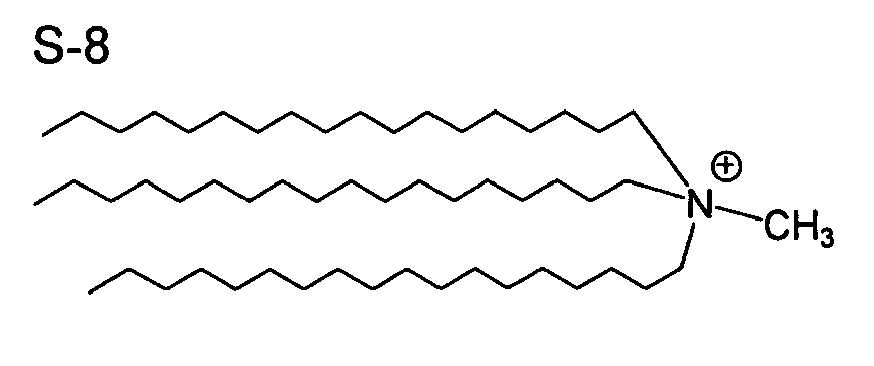


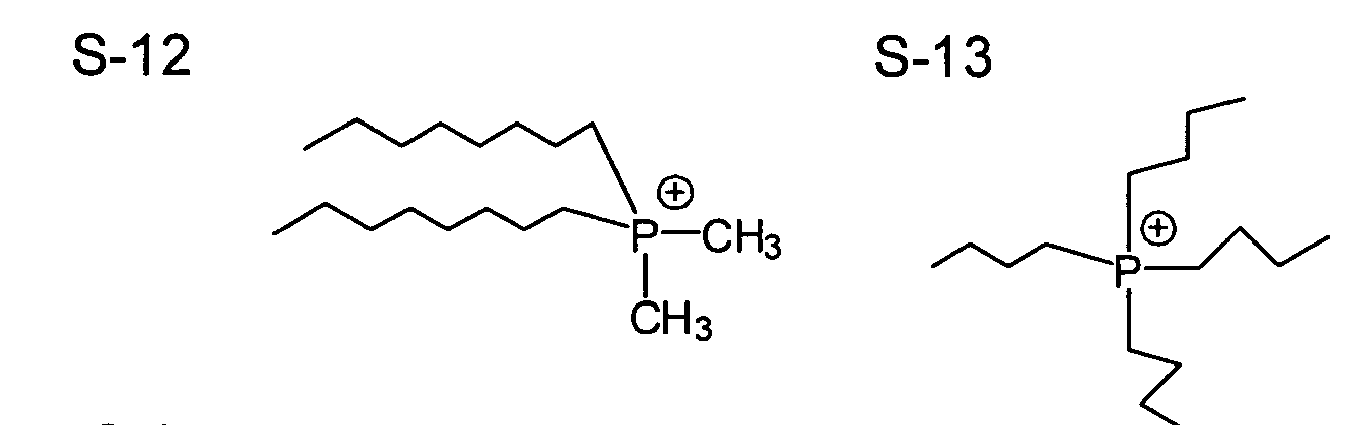


- The adsorption amount of the surfactant is usually from 1 to 100 parts by mass, preferably from 1 to 50 parts by mass, and more preferably from 1 to 20 parts by mass based on 100 parts by mass of the organic crystal. The adsorption of the surfactant on the organic crystal can be carried out by any one of usually employed methods. A method for dispersing the organic crystal in a solvent and adding the surfactant, thereby adsorbing the surfactant thereon is preferable.
- In the composition of the invention, an organic crystal having an inorganic ion adsorbed thereon can be favorably used. When the inorganic ion is adsorbed, the heat decomposition temperature is enhanced, whereby the heat resistant temperature can be enhanced. By enhancing the heat resistant temperature, there is brought an advantage that in melt mixing with a thermoplastic resin, the composition can be used by raising the temperature to a high temperature.
- Examples of the inorganic ion to be used for the adsorption include a calcium ion, a magnesium ion, a sodium ion, a potassium ion, a lithium ion, an aluminum ion, a strontium ion, a barium ion, a radium ion, a copper ion, a silver ion, a gold ion, a zinc ion, a nickel ion and a cobalt ion. Of these, a calcium ion, a magnesium ion, a sodium ion, a potassium ion and a lithium ion are preferable.
- The adsorption amount of the inorganic ion is usually from 0.00001 to 20 parts by mass, preferably from 0.0001 to 10 parts by mass, and more preferably from 0.0001 to 5 parts by mass based on 100 parts by mass of the organic crystal. The adsorption of the inorganic ion on the organic crystal can be carried out by any one of usually employed methods. A method for dispersing the organic crystal in a solvent and adding an inorganic salt, thereby adsorbing the inorganic ion thereon is preferable.
- In the composition of the invention, an organic crystal having a specified inorganic compound bonded therewith can be favorably used. The "specified inorganic compound" as referred to herein refers to one or more inorganic compounds selected from the group consisting of silicon oxide, titanium oxide, aluminum oxide, zirconium oxide, barium oxide and hydroxyapatite. When such an inorganic compound is bonded, the dispersibility in the matrix material is enhanced, thereby obtaining an effect for raising the heat decomposition temperature.
- A proportion of the inorganic compound is usually from 0.0001 to 100 parts by mass, preferably from 0.0001 to 50 parts by mass, and more preferably from 0.0001 to 30 parts by mass based on 100 parts by mass of the organic crystal. The bonding of the inorganic compound with the organic crystal can be carried out by any one of usually employed methods. A method for dispersing the organic crystal in a solvent and adding a metal alkoxide, a silane coupling agent, etc., thereby bonding the inorganic compound therewith is preferable.
- In the composition of the invention, an organic crystal having a group represented by the foregoing formula (1) can be favorably used. When the organic group is bonded, there is brought the same effect as in the adsorption of a surfactant as described previously. That is, the dispersibility into the matrix is enhanced, and coagulation is suppressed, whereby there are brought an effect for enhancing the transparency and an effect for enhancing an elastic modulus.
- In the formula (1), L1 is a connecting group represented by any one of the foregoing formulae (2) to (21). Above all, from the viewpoint of easiness of the formation of a bond, L1 is preferably a connecting group represented by any one of the formulae (2), (3), (4), (6), (7), (8), (10), (11), (15), (16), (17), (18) and (19), more preferably a connecting group represented by any one of the formulae (2), (3), (4), (6), (7), (8), (15), (16) and (18), and further preferably a connecting group represented by any one of the formulae (2), (4), (6), (7) and (15).
- In the case where the organic crystal is crystalline cellulose, the group represented by the formula (1) can be introduced through the reaction with a hydroxyl group on the crystal surface. In that case, it is preferable that L1 in the formula (1) is a connecting group represented by any one of the formulae (2), (4), (6), (7), (15) and (21).
- In the formula (1), n represents an integer of from 0 to 4, preferably from 0 to 2, and more preferably from 1 to 2. When n represents an integer of from 2 to 4, L1s in the number of n may be the same or different.
- In the formula (1), R1 represents an organic group. The molecular weight of the organic group may be not more than 1, 000 or may exceed 1,000.
- Examples of the organic group having a molecular weight of not more than 1,000 include an alkyl group (preferably one having from 1 to 36 carbon atoms, and more preferably one having from 1 to 18 carbon atoms, for example, a methyl group, an ethyl group, an isopropyl group, a tert-butyl group); an aryl group (preferably one having from 6 to 36 carbon atoms, and more preferably one having from 6 to 24 carbon atoms, for example, a phenyl group, a biphenyl group, a naphthyl group); an alkoxy group (preferably one having from 1 to 36 carbon atoms, and more preferably one having from 1 to 18 carbon atoms, for example, a methoxy group, an ethoxy group, an isopropoxy group) ; an acyl group (preferably one having from 2 to 36 carbon atoms, and more preferably one having from 2 to 18 carbon atoms, for example, an acetyl group, a propionyl group, a butyryl group); an acylamino group (preferably one having from 1 to 36 carbon atoms, and more preferably one having from 1 to 18 carbon atoms, for example, a formylamino group, an acetylamino group) ; an aryloxy group (preferably one having from 6 to 36 carbon atoms, and more preferably one having from 6 to 24 carbon atoms, for example, a phenoxy group) ; a cyano group; and a silyl group (for example, a trimethylsilyl group, a triphenylsilyl group, a dimethylbutylsilyl group).
- The organic group may have a substituent. Examples of the substituent include a halogen atom; an alkyl group (for example, a methyl group, an ethyl group, an isopropyl group, a tert-butyl group) ; an aryl group (preferably one having from 6 to 30 carbon atoms, and more preferably one having from 6 to 15 carbon atoms, for example, a phenyl group, a biphenyl group, a naphthyl group); an alkoxy group (preferably one having from 1 to 30 carbon atoms, and more preferably one having from 1 to 12 carbon atoms, for example, a methoxy group, an ethoxy group, an isopropoxy group); an acyl group (preferably one having from 2 to 36 carbon atoms, and more preferably one having from 2 to 18 carbon atoms, for example, an acetyl group, a propionyl group, a butyryl group) ; an acylamino group (preferably one having from 1 to 36 carbon atoms, and more preferably one having from 1 to 18 carbon atoms, for example, a formylamino group, an acetylamino group); an aryloxy group (preferably one having from 6 to 36 carbon atoms, and more preferably one having from 6 to 18 carbon atoms, for example, a phenoxy group) ; an acyloxy group (preferably one having from 2 to 36 carbon atoms, and more preferably one from 2 to 18 carbon atoms, for example, an acetyloxy group, a propionyloxy group, a butyryloxy group); a cyano group; a hydroxyl group; and a nitro group.
- It is possible to use a polymer or an oligomer as the organic group having a molecular weight exceeding 1,000. The case where a polymer or an oligomer is bonded is favorable from the standpoint that the coagulation is suppressed due to steric repulsion in the matrix. The polymer or oligomer may have a substituent as exemplified previously.
- Specific examples of the organic group which can be used in the invention are hereunder given below, but it should not be construed that the organic group which can be employed in the invention is limited thereto.


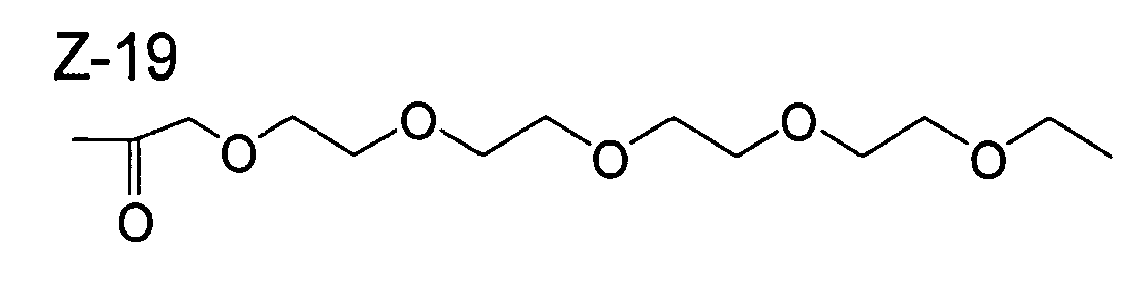
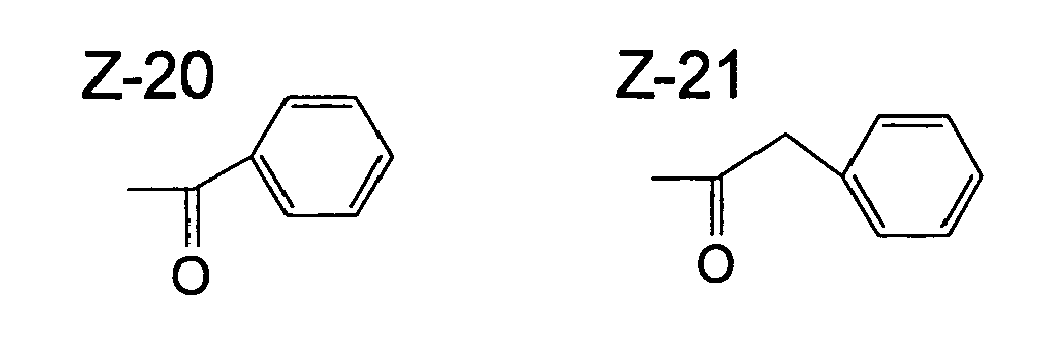


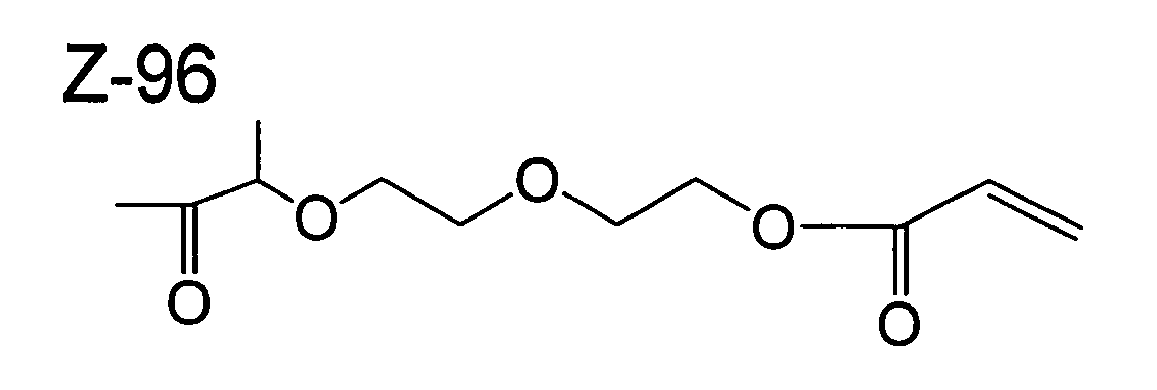


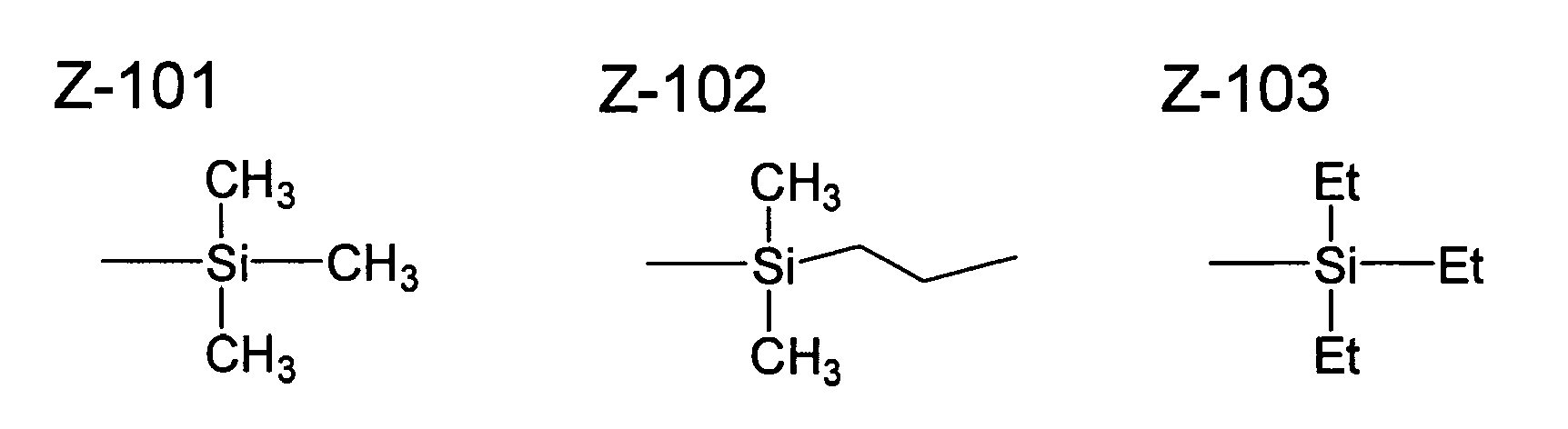


- The organic crystal to be used in the invention may be one which meets only one of the foregoing requirements (1) to (4) or may be one which meets two or more of the foregoing requirements (1) to (4). In order to enhance the dispersibility into the matrix, it is preferable that any one or more of the requirements (1), (3) and (4) are met.
- In the organic crystal to be used in the invention, its tensile elastic modulus is preferably 10 GPa or more, more preferably 50 GPa or more, and especially preferably 100 GPa or more. This is because when the elastic modulus is large, an effect for enhancing the performance of the hybrid composition becomes large. Such is effective for, for example, enhancing the elastic modulus or realizing low thermal expansion.
- In the organic crystal to be used in the invention, its coefficient of thermal expansion is preferably not more than 20 ppm/°C, more preferably not more than 15 ppm/°C, and especially preferably not more than 10 ppm/°C. This is because when the coefficient of thermal expansion is small, an effect for lowering the thermal expansion after hybridization with the matrix becomes large.
- It is preferable that the organic crystal to be used in the invention does not substantially contain a sulfate group. What the organic crystal does not substantially contain a sulfate group refers to the matter that the amount of sulfur derived from a sulfate group to be quantitatively determined by an analysis method such as an inductively coupled plasma (ICP) method is not more than 0.01 mmoles per gram of the organic crystal. When the organic substance does not substantially contain a sulfate group, there are brought advantages that a lowering of the heat decomposition temperature of the organic crystal is suppressed; that the organic crystal can be applied in a process at a higher temperature due to hybridization with the matrix resin; and that the heat resistance of the hybrid composition is enhanced. In particular, in the case where the organic crystal is crystalline cellulose, there is an effect for suppressing a lowering of the heat decomposition temperature. When the case of crystalline cellulose is taken as an example, examples of a method for preparing the organic crystal which does not substantially contain a sulfate group include a method by hydrolysis of microcrystalline cellulose with hydrochloric acid and a counter collision method disclosed in
JP-A-2005-270891 - In the case where the organic crystal to be used in the invention contains a sulfate group, it is preferable that the inorganic ion corresponding to the amount of the sulfate group is adsorbed. In the case where the inorganic ion is monovalent, the amount of the inorganic ion to be adsorbed (molar ratio to the amount of the sulfate group) is preferably from 0.8 to 1.2, more preferably from 0.9 to 1.1, and especially preferably from 0.95 to 1.05. In the case where the inorganic ion is divalent, the amount of the inorganic ion to be adsorbed is preferably from 0.4 to 0.6, more preferably from 0.45 to 0.55, and especially preferably from 0.47 to 0.52. As the preferred inorganic ion, those described previously can be exemplified. When the inorganic ion is adsorbed, there is brought an effect for suppressing a lowering of the heat decomposition temperature due to the sulfate group. However, the adsorption of the inorganic ion lowers the dispersibility of the organic crystal of the invention into the matrix. In order to compensate the lowering of the dispersibility due to the inorganic ion, it is preferable that the surfactant is adsorbed on the organic crystal of the invention and/or modified with the organic group.
- The composition of the invention contains a matrix material.
- The matrix material as referred to in the invention refers to a substance which exists in the surroundings of the organic crystal to be used in the invention and may be any of a gas, a liquid or a solid. Though the type of the matrix material to be used in the invention is not particularly limited, it is preferable to use a resin material. The resin may be used in combination of plural kinds thereof, and a thermoplastic resin, a solvent-soluble resin or a hardening resin can be favorably used. In the case where a thermoplastic resin is used, there is a characteristic that the composition of the invention is easily molded. Also, in the case where a thermoplastic resin or a hardening resin is used, there is a characteristic that optical anisotropy of the composition of the invention becomes small.
- Examples of the thermoplastic resin include polyethylene, polypropylene, ABS resins, PMMA (polymethyl methacrylate), polystyrene, polycarbonates, polycycloolefins (for example, ZEONOR, manufactured by Zeon Corporation; ARTON, manufactured by JSR Corporation; TOPAS, manufactured by Polyplastics Co., Ltd.; APEL, manufactured by Mitsui Chemicals, Inc.), polylactic acid, cellulose acetate propionate, cellulose acetate butyrate, polyethersulfone, polyether imide, polyetheretherketone, polyphenylene sulfide, polyphenylene oxide, polycaprolactone, polyethylene terephthalate, polyethylene naphthalate, polybutylene terephthalate, polypropylene terephthalate, polybutylene succinate, poly-3-hydroxybutyrate, polyallylate, nylons, aramid, thermoplastic elastomers and silicone.
- Examples of the hardening resin include acrylic resins, methacrylic resins, phenol resins, urea resins, melamine resins, unsaturated polyester resins, epoxy resins, silicone resins, diallyl phthalate resins, furan resins, bismaleimide resins and cyanate resins.
- As the solvent-soluble resin, those which are soluble in water or an organic solvent can be used. Examples of an organic solvent capable of dissolving the solvent-soluble resin therein include methanol, ethanol, isopropanol, butanol, methylene chloride, chloroform, DMF (N,N-dimethylformamide), DMAc (N,N-dimethylacetamide), NMP (N-methylpyrrolidone), acetone, methyl ethyl ketone, methyl isobutyl ketone, cyclohexanone, 1,4-dioxane, THF, ethyl acetate, methyl acetate, acetonitrile, glycerin, ethylene glycol, 1,1,1,3,3,3-hexafluoroisopropanol, toluene, xylene, anisole, n-hexane, cyclohexane, 1,2-dichloroethane, acetic acid, trifluoroacetic acid, pyridine, DMSO (dimethyl sulfoxide), nitromethane and nitrobenzene. These solvents can be used singly or in admixture of plural kinds thereof.
- There may be the case where it is preferable to choose the matrix material to be used depending upon the organic crystal to be used in the composition of the invention.
- For example, in the case where an organic crystal on which a surfactant with high hydrophobicity as represented by the foregoing S-4 and S-10 is adsorbed is used, cellulose triacetate, cellulose diacetate, cellulose acetate propionate, cellulose acetate butyrate, polyethers, polyimides, polyamides, polylactic acid, polystyrene, polymethyl methacrylate, polyethylene, polypropylene, polyoxymethylene and the like are preferably used as the matrix resin. Also, in the case where an organic crystal to which a group with high hydrophobicity as represented by the foregoing Z-1, Z-3 and Z-20 is bonded as the group represented by the formula (1) is used, cellulose triacetate, cellulose diacetate, cellulose acetate propionate, cellulose acetate butyrate, polyesters, polyimides, polyamides, polylactic acid, polystyrene, polymethyl methacrylate, polyethylene, polypropylene, polyoxymethylene and the like are preferably used as the matrix resin.
- As to a preferred combination of the organic crystal and the matrix material to be used in the composition of the invention, in the case where the organic crystal is cellulose, cellulose based resins such as cellulose triacetate, cellulose diacetate, cellulose acetate propionate and cellulose acetate butyrate; and aliphatic polyesters such as polylactic acid, polybutylene succinate and polyhydroxyalkanoates are preferable as the matrix material.
- The composition of the invention is obtained by mixing an organic crystal and a matrix material.
- For example, in the case where the matrix material is a thermoplastic resin, the resin having been heated in a molten state can be mixed with the organic crystal using a twin-screw kneader or the like. The kneading temperature is preferably a temperature at which the melt viscosity of the thermoplastic resin becomes low and which is not higher than the heat decomposition temperature of the organic crystal.
- In the case where the organic crystal is crystalline cellulose, the kneading temperature is preferably not higher than 270°C, more preferably not higher than 260°C, and especially preferably not higher than 250°C.
- In the case where the matrix material is a solvent-soluble resin, the resin having been dissolved in a solvent can be mixed with the organic crystal. In the case of the solvent-soluble resin, there is an advantage that mixing can be achieved at a temperature sufficiently lower than the heat decomposition temperature of the organic crystal. Examples of the solvent to be used include water, methanol, ethanol, isopropanol, butanol, methylene chloride, chloroform, DMF (N,N-dimethylformamide), DMAc (N,N-dimethylacetamide), NMP (N-methylpyrrolidone), acetone, methyl ethyl ketone, methyl isobutyl ketone, cyclohexanone, 1,4-dioxane, THF, ethyl acetate, methyl acetate, acetonitrile, glycerin, ethylene glycol, 1,1,1,3,3,3-hexafluoroisopropanol, toluene, xylene, anisole, n-hexane, cyclohexane, 1,2-dichloroethane, acetic acid, trifluoroacetic acid, pyridine, DMSO (dimethyl sulfoxide), nitromethane and nitrobenzene. These solvents may be used as a mixed solvent of plural kinds thereof.
- In the case where the matrix material is a hardening resin, mixing can be achieved by adding the organic crystal in a liquid monomer and/or prepolymer. On that occasion, a solvent may be properly used. The solvents as exemplified previously can be used as the solvent.
- In the composition of the invention, a mixing mass ratio of the matrix to the organic crystal is usually from 1/0.01 to 1/3, preferably from 1/0.01 to 1/2, more preferably from 1/0.02 to 1/2, and further preferably from 1/0.03 to 1/1. When the proportion of the organic crystal is too small, there is a tendency that the effects for lowering the coefficient of thermal expansion and enhancing the elastic modulus are not substantially found; and when the proportion of the organic crystal is too large, there is a tendency that molding becomes difficult.
- The composition of the invention may contain other component than the organic crystal and the matrix material. Examples of such other component include a heat stabilizer, a plasticizer, a UV absorber, a coloring agent, a rubber and an elastomer. The addition amount of such a component is preferably from 0.0001 to 20% by mass, more preferably from 0.0001 to 10% by mass, and further preferably from 0.0001 to 5% by mass.
- The composition of the invention can be used as an article. The article can be produced by a molding method. As a molding method, generally widely employed molding methods such as injection molding, extrusion molding, blow molding, vacuum molding, pressure molding, inflation molding, compression molding, transfer molding and powder molding can be utilized. Of these, injection molding, extrusion molding, compression molding, blow molding and powder molding are preferable. The shape and size of the molding can be properly determined depending upon the use purpose of the article. The article of the invention can be used as, for example, a structural material, a fiber, an optical component (for example, camera lenses, pickup lenses), a packing, a gear, a thin-walled component, a hard coat material.
- The composition of the invention can also be used as a film upon being subjected to production. The film of the invention includes one having a shape which is generally considered to be in a sheet form. As the production method of the film, known methods such a melt casting film formation method and a solution casting film formation method can be employed.
- The film of the invention may be stretched. Stretching can be carried out by a roll uniaxial stretching method, a tenter uniaxial stretching method, a simultaneous biaxial stretching method, a sequential biaxial stretching method, an inflation method or a press stretching method.
- Though the thickness of the film of the invention is not particularly limited, it is preferably from 30 to 700 µm, more preferably from 40 to 200 µm, and further preferably from 50 to 150 µm. Also, in any case, the haze is preferably not more than 3%, more preferably not more than 2%, and further preferably not more than 1%. Also, the total light transmittance is preferably 70% or more, more preferably 80% or more, and further preferably 85% or more.
- In the film of the invention, its tensile elastic modulus is preferably 2 GPa or more, more preferably 3 GPa or more, and especially preferably 4 GPa or more. In the film of the invention, its coefficient of thermal expansion is preferably not more than 50 ppm/°C, more preferably not more than 30 ppm/°C, and especially preferably not more than 20 ppm/°C.
- The film of the invention can be borne with an optical function according to the application. For example, it is possible to provide a film having an Re (in-plane retardation) and an Rth (retardation in a film thickness direction). The Re of the film of the invention is usually from 0 to 500 nm, preferably from 0 to 300 nm, and more preferably from 0 to 200 nm. In order to adjust the Re so as to fall within a preferred range, for example, a method for stretching the film can be employed. The Rth of the film of the invention is usually from 0 to 3,000 nm, preferably from 0 to 2, 000 nm, and more preferably from 0 to 1,000 nm. In the case where it is intended to produce a film having an Rth controlled on a relatively low level, for example, a method of production without using a solvent can be employed. In the case of production without using a solvent, an effect for controlling the Rth is especially noticeable in the case of using the composition of the invention.
- The film of the invention can be subjected to surface treatment or stacking. For example, for the purpose of enhancing adhesion to a component or the like, the film surface of the invention can be treated by a method including saponification, a corona treatment, a flame treatment and a glow discharge treatment. Also, an adhesive layer or an anchor layer may be provided on at least one surface of the film. Furthermore, a variety of known functional layers such as a flattened layer, a hard coat layer, an ultraviolet ray absorbing layer, a surface roughed layer, a transparent conductive layer, a gas barrier layer and a solvent resistant layer can be provided on the film surface depending on the purpose.
- The film of the invention can be used for an optical film, a retardation film, a polarizing plate protective film, a transparent conductive film, a display device substrate, a flexible display substrate, a flat panel display substrate, a solar cell substrate, a touch panel substrate, a flexible circuit substrate, an optical disc protective film, a magnetic recording medium substrate, a light control film, an agricultural film, a gas barrier film, a wrapping film, an electromagnetic radiation prevention film, a defense film, a vibration control film, a soundproof film, a vibration plate, a speaker corn, etc.
- The characteristics of the invention are hereunder described in more detail with reference to the following Preparation Examples, Examples and Comparative Examples. Materials, use amounts, proportions, treatment contents, treatment procedures and the like as shown in the following Examples can be properly changed. In consequence, it should not be construed that the scope of the invention is limitedly interpreted by the following specific examples.
- The measurement methods used in the Preparation Examples, Examples and Comparative Examples are hereunder described.
- The size of an organic crystal was determined by observing it by a transmission electron microscope, totalizing the width (minor axis length) and the length (major axis length) of 100 particles chosen at random within a field of vision and calculating an average value of each of them.
- 3 mL of HNO3 was added to 50 mg of an organic crystal, and the mixture was incinerated by a microwave. Water was added to make 50 mL in total. This prepartion liquid was analyzed by an inductively coupled plasma (ICP-OES) method, thereby quantitatively determining sulfur, sodium and calcium. The sulfur amount as detected herein was defined as a sulfate group amount.
- A loss in weight was measured under nitrogen at a temperature rise rate of 10°C/min using TG/DTA6200, manufactured by Seiko Instruments Inc., and a temperature at which the loss in weight was 2% was defined as a heat decomposition temperature.
- A weight average molecular weight was measured by GPC with tetrahydrofuran as a solvent as reduced into polystyrene using HLC-8120GPC, manufactured by Tosoh Corporation and determined while comparing with a molecular weight reference material of polystyrene.
- A thickness of a film was measured by a dial thickness gauge using K402B, manufactured by Anritsu Corporation.
- A light transmittance of a film was measured by a spectrophotometer (UV-3100PC, manufactured by Shimadzu Corporation). A measured value was reduced into a value of transmittance in the case of a film thickness of 100 µm while defining a value at a measurement wavelength of 550 nm as a representative value.
- A haze of a film was measured by a haze meter (Haze Meter NDH2000, manufactured by Nippon Denshoku Industries Co. , Ltd.).
- A film sample (19 mm x 5 mm) was prepared and measured for coefficient of linear thermal expansion using TMA (EXSTAR 6000, manufactured by Seiko Instruments Inc.). A measurement rate was set up at 3°C/min. The measurement was carried out as to three samples, and an average value thereof was employed. The measurement was carried out in the temperature range of from 50°C to 250°C, and the coefficient of linear thermal expansion was calculated in the range of from 100°C to 150°C at the time of temperature rise. However, as to a comparative sample having a glass transition temperature (Tg) of not higher than 200°C, the coefficient of linear thermal expansion was calculated in the temperature range of from 50°C to (Tg - 30)°C.
- A film sample (piece of 1.0 cm x 5.0 cm) was prepared and after allowing to stand overnight at 25°C and at a relative humidity of 60%, measured for tensile elastic modulus under a condition at 25°C and at a tensile rate of 3 mm/min using a tensilon (Tensilon RTM-25, manufactured by Toyo Baldwin Co., Ltd.) (distance between chucks: 3 cm). The measurement was carried out as to three samples, and an average value thereof was determined for evaluation.
- A value at a wavelength of 589.3 nm was measured by a retardation analyzer (KOBRA-WR, manufactured by Oji Scientific Instruments).
- A surface roughness of a film was measured using Micromap MM3200 (manufactured by Micromap).
- In a 3-liter three-necked flask, 50 g of crystalline cellulose (CEOLUS TGF20, manufactured by Asahi Kasei Chemicals Corporation) was charged, and 500 mL of 64% sulfuric acid (manufactured by Wako Pure Chemical Industries, Ltd.) which had been heated at 45°C in advance was added in the flask. The suspension was kept warm on a water bath such that the temperature was 45°C and stirred under nitrogen. Two hours after stirring, 500 mL of cold water was added step by step while cooling the water bath with ice such that the inner temperature did not exceed 45°C. The suspension was centrifuged (at 10, 000 rpm for 10 minutes), and water washing and centrifugation were repeated for a residual precipitate. When the supernatant became cloudy, all the supernatant and the precipitate were recovered, and water was added such that the total sum of the supernatant and water to be supplemented was 2,000 mL. This liquid was ultrasonically treated for one hour. The suspension was centrifuged to obtain a cloudy supernatant. This cloudy liquid was recovered and dialyzed with distilled water to obtain an aqueous dispersion of a cellulose crystal (hereinafter referred to as "dispersion 1"). This was freeze-dried to obtain a cellulose crystal powder (hereinafter referred to as "W0"). A proportion of the cellulose crystal in the dispersion was 0.94% by weight. As a result of observation by a transmission electron microscope, the size of the cellulose crystal was 8 nm in average minor axis length and 158 nm in average major axis length.
- The dispersion 1 was neutralized with 0.2 moles/L of a sodium hydroxide aqueous solution and dialyzed with distilled water to obtain a sodium-neutralized dispersion (hereinafter referred to as "dispersion 2"). This was freeze-dried to obtain a cellulose crystal powder (hereinafter referred to as "W1").
- A dispersion of a cellulose crystal dispersion (hereinafter referred to as "dispersion 3") was obtained by a method described in Macromolecules, Vol. 28, pages 6365 to 6367 (1995). A proportion of the cellulose crystal in the dispersion 3 was 0.61% by weight. As a result of observation by a transmission electron microscope, the size of the cellulose crystal was 10 nm in average minor axis length and 1,255 nm in average major axis length.
- The dispersion 3 was neutralized with 0.2 moles/L of a sodium hydroxide aqueous solution and dialyzed with distilled water to obtain a sodium-neutralized dispersion (hereinafter referred to as "dispersion 3Na"). This was freeze-dried to obtain a cellulose crystal powder (hereinafter referred to as "WT1").
- An aqueous dispersion of a cellulose crystal (hereinafter referred to as "dispersion 4") was obtained in the same manner as in Preparation Example 1, except for using linter pulp as the raw material. A proportion of the cellulose crystal in the dispersion 4 was 0.55% by weight. As a result of observation by a transmission electron microscope, the size of the cellulose crystal was 5 nm in average minor axis length and 326 nm in average major axis length.
- The dispersion 4 was neutralized with 0.2 moles/L of a sodium hydroxide aqueous solution and dialyzed with distilled water to obtain a sodium-neutralized dispersion (hereinafter referred to as "dispersion 4Na"). This was freeze-dried to obtain a cellulose crystal powder (hereinafter referred to as "WC1").
- An aqueous dispersion of a cellulose crystal (hereinafter referred to as "dispersion 5") was obtained by a method (hydrolysis method of microcrystalline cellulose with hydrochloric acid) described in Langmuir, Vol. 17, pages 21 to 27. A proportion of the cellulose crystal in the dispersion 5 was 0.66% by weight. As a result of observation by a transmission electron microscope, the size of the cellulose crystal was 7 nm in average minor axis length and 165 nm in average major axis length.
- This was freeze-dried to obtain a cellulose crystal powder (hereinafter referred to as "WE1").
- 1.07 g of tributylstearylphosphonium bromide (manufactured by Aldrich) was added in one liter of the dispersion 2 as prepared in Preparation Example 1, and the mixture was stirred at room temperature for one hour. A precipitate was separated by centrifugation, and water washing and centrifugation were repeated three times. An ultimate precipitate was dialyzed in running water of distilled water and then freeze-dried to obtain a surfactant-adsorbed cellulose crystal (hereinafter referred to as "W2").
- A surfactant-adsorbed cellulose crystal (hereinafter referred to as "W3") was obtained in the same operation as in Preparation Example 5, except for using 1.02 g of tributylhexadecylphosphonium bromide (manufactured by Aldrich) as the surfactant in place of the tributylstearylphosphonium bromide.
- A surfactant-adsorbed cellulose crystal (hereinafter referred to as "W4") was obtained in the same operation as in Preparation Example 5, except for using 0.69 g of trimethylstearylammonium chloride as the surfactant in place of the tributylstearylphosphonium bromide.
- A surfactant-adsorbed cellulose crystal (hereinafter referred to as "W5") was obtained in the same operation as in Preparation Example 5, except for using 2.24 g of dimethyldistearylammonium chloride as the surfactant in place of the tributylstearylphosphonium bromide.
- A surfactant-adsorbed cellulose crystal (hereinafter referred to as "W6") was obtained in the same operation as in Preparation Example 5, except that after stirring the precipitate after water washing in a calcium hydroxide aqueous solution (0.01% by weight) for one hour, the operation of centrifugation and water washing was supplemented.
- A surfactant-adsorbed cellulose crystal (hereinafter referred to as "WT2") was obtained in the same operation as in Preparation Example 4, except for using one liter of the dispersion 3 as the dispersion.
- A surfactant-adsorbed cellulose crystal (hereinafter referred to as "WC2") was obtained in the same operation as in Preparation Example 4, except for using one liter of the dispersion 4 as the dispersion.
- The dispersion 1 as prepared in Preparation Example 1 was neutralized with a tetrabutylammonium hydroxide aqueous solution and dialyzed with distilled water. This was freeze-dried to obtain a surfactant-adsorbed cellulose crystal (hereinafter referred to as "WA1").
- 1.0 g of W1 as prepared in Preparation Example 1 was provided and added in 50 mL of dehydrated DMAc, and the mixture was ultrasonically treated to obtain a DMAc dispersion. 1.42 mL (15 mmoles) of acetic anhydride, 1.82 mL (22.5 mmoles) of pyridine and 10 mg of dimethylaminopyridine were added thereto, and the mixture was heated under nitrogen at 100°C for 5 hours. The reaction liquid was thrown into 250 mL of a water/methanol mixed solution (volume ratio: 1/1) having 3 g of sodium chloride dissolved therein, and after stirring, a precipitate was recovered by centrifugation. An operation of stirring of the precipitate in a water/methanol mixed solution (volume ratio: 1/1) and centrifugation was repeated two times. The precipitate was freeze-dried to obtain an acetylated cellulose crystal (hereinafter referred to as "W7").
- A butyrylated cellulose crystal (hereinafter referred to as "W8") was obtained in the same operation as in Preparation Example 13, except for using butyric anhydride in place of the acetic anhydride.
- A benzoylated cellulose crystal (hereinafter referred to as "W9") was obtained in the same operation as in Preparation Example 13, except for using benzoic acid chloride in place of the acetic anhydride.
- An octanoylated cellulose crystal (hereinafter referred to as "W10") was obtained in the same operation as in Preparation Example 13, except for using octanoic acid chloride in place of the acetic anhydride.
- A trifluoroacetylated cellulose crystal (hereinafter referred to as "W11") was obtained in the same operation as in Preparation Example 13, except for using trifluoroacetic anhydride in place of the acetic anhydride.
- The same operation as in Preparation Example 13 was followed, and the precipitate after water washing was stirred in a calcium hydroxide aqueous solution (0.01% by weight) for one hour and then dialyzed in distilled water for 2 days. A dispersion after the dialysis was freeze-dried to obtain an acetylated cellulose crystal (hereinafter referred to as "W12").
- The same operation as in Preparation Example 14 was followed, and the precipitate after water washing was stirred in a calcium hydroxide aqueous solution (0.01% by weight) for one hour and then dialyzed in distilled water for 2 days. A dispersion after the dialysis was freeze-dried to obtain a butyrylated cellulose crystal (hereinafter referred to as "W13").
- A butyrylated cellulose crystal (hereinafter referred to as "WE2") was obtained in the same operation as in Preparation Example 14, except for using WE1 as the raw material.
- The measured values of sulfate group and metal ion and the heat decomposition temperature of the cellulose crystal as prepared in each of Preparation Examples 1, 3, 14, 18, 19 and 20 were summarized in the following Table 1.
Table 1 Preparation Example Cellulose crystal Sulfate group Na Ca Heat decomposition temperature mmole/g mmole/g mmole/g °C 1 W0 0.34 <0.01 <0.01 113 1 W1 0.34 0.33 <0.01 264 3 WE1 <0.01 <0.01 <0.01 262 13 W7 0.18 <0.01 <0.01 151 18 W12 0.18 <0.01 0.09 252 14 W8 0.15 <0.01 <0.01 153 19 W13 0.15 <0.01 0.07 254 20 WE2 <0.01 <0.01 <0.01 260 - In WE1 and WE2 each of which does not substantially contain a sulfate group (<0.01 mmoles/g), the heat decomposition temperature is high. In W0, W7 and W8 each of which contains a sulfate group, the heat decomposition temperature is low. By adsorbing an alkali metal ion thereon, it is possible to increase the heat decomposition temperature. When the heat decomposition temperature is high, in a hybridization process with a matrix resin, it is possible to employ a method of exposing to a high temperature such as melt kneading.
- W2 (2.0 g) as prepared in Preparation Example 5 was added in 80 mL of DMAc, and the mixture was ultrasonically treated to prepare a uniform dispersion. 18.0 g of P-1 (weight average molecular weight: 83,000) represented by the following structural formula was added thereto, and the mixture was stirred by a rotor mixer to prepare a dope. The dope was spread on a glass plate and cast in a clearance of 800 µm by an applicator. A lid was covered on the glass plate; and after drying in an air dryer at 120°C for 2 hours, the resulting dope was stripped off from the glass plate, fixed to a metal frame and then dried in a vacuum dryer at 80°C for one hour, at 100°C for one hour, at 120°C for one hour, at 140°C for one hour and at 150°C for one hour, respectively. The film was taken out from the dryer and cooled to room temperature to prepare a film F-1 having a thickness of 85 µm.

- A film F-2 was prepared in the same operation as in Example 1, except for using W2 (6.0 g) and P-1 (14.0 g).
- A film F-3 was prepared in the same operation as in Example 1, except for using W2 (10.0 g) and P-1 (10.0 g).
- A film F-4 was prepared in the same operation as in Example 2, except for using P-2 (weight average molecular weight: 80, 000) represented by the following structural formula as the resin.

- WA1 (6.0 g) as prepared in Preparation Example 12 was added in 115 mL of N,N-dimethylacetamide, and the mixture was ultrasonically treated to prepare a uniform dispersion. 14.0 g of cellulose diacetate (degree of substitution of acetyl group: 2.15) was added thereto, and the mixture was stirred by a rotor mixer to prepare a uniform dope. The dope was spread on a glass plate and cast by an applicator (clearance: 800 µm). A lid was covered on the glass plate; and after drying in an air dryer at 120°C for 2 hours, the resulting dope was stripped off from the glass plate, fixed to a metal frame and then dried in a vacuum dryer at 80°C for one hour, at 100°C for one hour, at 120°C for one hour, at 140°C for one hour and at 150°C for one hour, respectively. The film was taken out from the dryer and cooled to room temperature to prepare a film F-5 having a thickness of 85 µm.
- A film F-6 was prepared in the same operation as in Example 2, except for using polycarbonate (weight average molecular weight: 60,000) as the resin.
- A film F-7 was prepared in the same operation as in Example 2, except for using polystyrene (weight average molecular weight: 75,000) as the resin.
- W8 (4.0 g) as prepared in Preparation Example 14 was mixed with 16.0 g of a mixture of dicyclopentadienyl diacrylate, acryloylethoxy bisphenol A and 1-hydroxyphenyl ketone (weight ratio: 60/40/2) to prepare a uniform mixture.
- The mixed liquid was spread on a glass plate and cast by an applicator (clearance: 100 µm). After irradiating with UV at 1,000 mJ/cm2, the resulting glass plate was heated under nitrogen in an inert oven at 100°C for one hour and at 170°C for one hour, respectively, thereby hardening the matrix. According to these operations, a film F-8 having a thickness of 90 µm was obtained.
- A film F-9 was prepared in the same operation as in Example 1, except for using WT2 (6.0 g) as prepared in Preparation Example 10 and P-1 (14.0 g).
- A film F-10 was prepared in the same operation as in Example 1, except for using WC2 (6.0 g) as prepared in Preparation Example 11 and P-1 (14.0 g).
- A film F-11 was prepared in the same operation as in Example 1, except for using WE2 (6.0 g) and P-1 (14.0 g).
- A film F-12 was prepared in the same operation as in Example 1, except for using WA1 (6.0 g) and P-1 (14.0 g).
- A film F-13 was prepared in the same operation as in Example 1, except for using W13 (6.0 g) and cellulose acetate propionate (CAP 482-20, manufactured by Eastman Chemical Company: 14.0 g).
- A film F-14 was prepared in the same operation as in Example 1, except for using WA1 (6.0 g) and cellulose acetate propionate (14.0 g).
- A film H-1 was prepared in the same operation as in Example 1, except for using W1 (6.0 g) and P-1 (14.0 g).
- A sheet composed of a cellulose microfibril (hereinafter referred to as "HS-1") was prepared in a method described in Preparation Example 1 of
JP-A-2005-60680 JP-A-2005-60680 - Though it was intended to impregnate HS-1 with a DMAc solution of P-1 (10% by weight) in a method described in Examples 1 to 3 of
JP-A-2005-60680 - Though it was intended to impregnate HS-1 with a DMAc solution of cellulose diacetate (degree of substitution of acetyl group: 2.15) (10% by weight) in a method described in Examples 1 to 3 of
JP-A-2005-60680 - Though it was intended to impregnate HS-1 with a DMAc solution of cellulose acetate propionate (10% by weight) in a method described in Examples 1 to 3 of
JP-A-2005-60680 - A film H-3 having a thickness of 90 µm was obtained in the same operation as in Example 1, except for using 2.0 g of, as a filler, an aluminum borate whisker (ALBOREX YS3A having a fiber diameter of from 0.5 to 1.0 µm and a fiber length of from 10 to 30 µm, manufactured by Shikoku Chemicals Corporation, the surface of which is modified with an aminosilane based material; hereinafter referred to as "YS3A") and 18.0 g of P-1.
- A film H-4 was obtained in the same operation as in Example 4, except for using 2.0 g of YS3A as the filler and 18.0 g of cellulose diacetate.
- A film H-5 was obtained in the same operation as in Example 5, except for using 2.0 g of YS3A as the filler and 18.0 g of cellulose acetate propionate.
- A film H-6 composed of P-1 was obtained in the same operation as in Example 1, except for not adding W2.
- A film H-7 composed of P-2 was obtained in the same operation as in Example 4, except for not adding W2.
- A film H-8 composed of cellulose diacetate was obtained in the same operation as in Example 5, except for not adding WA1.
- A film H-9 composed of cellulose acetate propionate was obtained in the same operation as in Example 13, except for not adding W13.
- A surface-acetylated sheet composed of a cellulose microfibril produced from acetic acid bacteria (hereinafter referred to as "HS-2") was prepared in a method described in Example 5 of
JP-A-2005-60680 JP-A-2005-60680 - Though it was intended to impregnate HS-2 with a DMAc solution of P-1 (10% by weight) in a method described in Examples 1 to 3 of
JP-A-2005-60680 - The measurement results of the above-prepared films F-1 to F-14 and H-1 to H-10 are shown in the following Table 2. As to the films H-3 to H-5, the degree of cloudiness of the film was large, and the light transmittance was low, and therefore, the light transmission, haze, Re and Rth could not be measured. Also, as to the film H-1, the light scattering of the film was large so that the Re and Rth could not be measured.
Table 2 Configuration of film Evaluation of film Film Crystalline organic substance Matrix material Light transmittance (%) Haze (%) Coefficient of thermal expansion (ppm/°C) Tensile elastic modulus (GPa) Re (nm) Rth (nm) Surface roughness (nm) Type Type Average minor axis length (nm) Average major axis length (nm) Type Ex.1 F-1 Cellulose crystal W2 8 158 P-1 84 0.5 38 3.9 10.0 1810 2.5 Ex. 2 F-2 Cellulose crystal W2 8 158 P-1 83 0.7 27 5.7 11.0 1950 3.0 Ex. 3 F-3 Cellulose crystal W2 8 158 P-1 82 0.9 19 8.3 10.0 2030 2.6 Ex. 4 F-4 Cellulose crystal W2 8 158 P-2 82 0.8 35 5.7 8.5 1500 2.8 Ex. 5 F-5 Cellulose crystal WA1 8 158 Cellulose diacetate 85 0.7 40 7.8 2.6 850 1.9 Ex. 6 F-6 Cellulose crystal W2 8 158 Polycarbonate 83 0.9 38 5.5 4.8 920 3.2 Ex. 7 F-7 Cellulose crystal W2 8 158 Polystyrene 83 0.8 37 5.7 7.1 840 2.7 Ex. 8 F-8 Cellulose crystal W8 8 158 Hardening resin 83 0.8 30 5.9 1.2 30 2.0 Ex. 9 F-9 Cellulose crystal WT2 10 1255 P-1 85 0.5 23 5.8 8.3 1920 4.8 Ex.10 F-10 Cellulose crystal WC2 5 326 P-1 84 0.5 24 5.7 7.5 1915 2.1 Ex.11 F-11 Cellulose crystal WE2 7 168 P-1 84 0.5 24 5.7 5.5 1900 2.9 Ex. 12 F-12 Cellulose crystal WA1 8 158 P-1 85 0.5 23 5.8 6.2 1890 3.5 Ex.13 F-13 Cellulose crystal W13 8 158 Cellulose acetate propionate 82 0.6 32 4.1 4.3 825 2.1 Ex. 14 F-14 Cellulose crystal WA1 8 158 Cellulose acetate propionate 83 0.7 31 4.2 3.6 840 1.9 Com. Ex.1 H-1 Cellulose crystal W1 8 158 P-1 65 12.5 29 5.5 Impossible to achieve measurement 5.6 Com. Ex. 2 H-2 Cellulose microfibril HS-1 10 100,000 or more Hardening resin 70 8.6 10 30.0 25.0 2500 58 Com. Ex. 3 - Cellulose microfibril HS-1 10 100,000 or more P-1 Not penetrated and impossible to achieve hybridization Com. Ex. 4 - Cellulose microfibril HS-1 10 100,000 or more Cellulose diacetate Not penetrated and impossible to achieve hybridization Com. Ex. 5 - Cellulose microfibril HS-1 10 100,000 or more Cellulose acetate propionate Not penetrated and impossible to achieve hybridization Com. Ex. 6 H-3 Aluminum borate whisker YS3A 750 20,000 P-1 Impossible to achieve measurement 29 4.0 Impossible to achieve measurement 100 or more Com. Ex. 7 H-4 Aluminum borate whisker YS3A 750 20,000 Cellulose diacetate Impossible to achieve measurement 42 6.2 Impossible to achieve measurement 100 or more Com. Ex. 8 H-5 Aluminum borate whisker YS3A 750 20,000 Cellulose acetate Impossible to achieve measurement 39 3.0 Impossible to achieve measurement 100 or more Com. Ex. 9 H-6 No P-1 85 0.5 45 3.0 2.5 1700 1.2 Com. Ex.10 H-7 No P-2 84 0.5 70 3.1 3.5 750 1.3 Com. Ex.11 H-8 No Cellulose diacetate 90 0.4 95 4.8 0.1 40 1.1 Com. Ex.12 H-9 No Cellulose acetate propionate 90 0.2 87 1.7 0.5 25 1.2 Com. Ex.13 H-10 Acetylated cellulose microfibril HS-2 10 100,000 or more Hardening resin 75 7.8 12 29.0 20 2500 45 Com. Ex.14 - Acetylated cellulose microfibril HS-2 10 100,000 or more P-1 Not penetrated and Impossible to achieve hybridization - In the films composed of the composition of the invention, it was possible to lower the coefficient of thermal expansion and enhance the elastic modulus while keeping high transparency. On the other hand, in the composition using a cellulose microfibril in the Comparative Examples, the haze became large, and it was impossible to achieve hybridization with a matrix other than the hardening monomer. In the case of using an aluminum borate whisker, while it was possible to achieve production, the transparency was largely lowered due to the matter that the whisker was large. By using an organic crystal in a matrix material according to the invention, it was possible to make the obtained film have a large Re.
- A mixture obtained by stirring and mixing 10 g of W13 and 40 g of cellulose acetate propionate was melt kneaded at 220°C in a twin-screw kneader (ULT Nano 15TW, manufactured by Technovel Corporation). The thus prepared strand was cut to prepare a hybrid pellet. The pellet was pressed by a heat press under a condition at 220°C under 5 MPa, thereby preparing a heat molded film F-15.
- A hybrid pellet and a heat molded film F-16 were prepared in the same manner as in Example 15, except for using WE2.
- A mixture obtained by stirring and mixing 10 g of W13 and 40 g of polylactic acid (LACEA H-100, manufactured by Mitsui Chemicals, Inc.) was melt kneaded at 190°C in a twin-screw kneader (ULT Nano 15TW, manufactured by Technovel Corporation) . The thus prepared strand was cut to prepare a hybrid pellet. The pellet was pressed by a heat press under a condition at 200°C under 5 MPa, thereby preparing a heat molded film F-17.
- HS-1 was cut in a size of 2 mm in square and subjected to twin-screw kneading together with cellulose acetate propionate in the same manner as in Example 15. However, kneading could not be substantially achieved, and HS-1 remained in a form as it was.
- HS-2 was cut in a size of 2 mm in square and subjected to twin-screw kneading together with cellulose acetate propionate in the same manner as in Example 15. However, kneading could not be substantially achieved, and HS-2 remained in a form as it was.
- A heat molded film H-11 was prepared in the same manner as in Example 15, except for pelletizing the cellulose acetate propionate without adding W13.
- A heat molded film H-12 was prepared in the same manner as in Example 17, except for pelletizing the polylactic acid without adding W13.
- The measurement results of the above-prepared films F-15 to F-17 and H-11 to H-12 are shown in the following Table 3.
- In the films composed of the composition of the invention, it was possible to lower the coefficient of thermal expansion and to enhance the elastic modulus while keeping high transparency similar to the films prepared from the solution. On the other hand, in the composition using a cellulose microfibril in the Comparative Examples, it was impossible to achieve melt kneading. Also, by performing the production by heat molding, it was possible to prepare a film having a lowered Rth and more optical anisotropy.
Table 3 Configuration of film Evaluation of film Film Crystalline organic substance Matrix material Light transmittance (%) Haze (%) Coefficient of thermal expansion (ppm/°C) Tensile elastic modulus (GPa) Re (nm) Rth (nm) Surface roughness (nm) Type Type Average minor axis length (nm) Average major axis length (nm) Type Ex. 15 F-15 Cellulose crystal W13 8 158 Cellulose acetate propionate 80 1.2 45 3.2 4 80 1.9 Ex. 16 F-16 Cellulose crystal WE2 8 158 Cellulose acetate propionate 80 2.0 43 3.1 3 65 1.9 Ex. 17 F-17 Cellulose crystal W13 8 158 Polylactic acid 82 1.8 49 2.8 5 54 2.2 Com. Ex.15 - Cellulose microfibril HS-1 10 100,000 or more Cellulose acetate propionate Impossible to achieve kneading Com. Ex.16 - Acetylated cellulose microfibril HS-2 10 100,000 or more Cellulose acetate propionate Impossible to achieve kneading Com. Ex.17 H-11 No Cellulose acetate propionate 90 0.2 87 1.7 0.5 25 1.2 Com. Ex.18 H-12 No Polylactic acid 90 0.5 85 1.8 1.2 3.5 1.5 - According to the invention, it is possible to provide an article and a film each having transparency, low thermal expansion properties and high elastic modulus using a wide-ranging matrix material. In particular, by choosing a thermoplastic resin as the matrix material, it is possible to provide a composition with processability and to easily produce an article and a film each having the foregoing characteristics. In consequence, the invention is high in industrial applicability.
- While the present invention has been described in detail and with reference to specific embodiments thereof, it will be apparent to one skilled in the art that various changes and modifications can be made therein without departing from the scope thereof.
- The present disclosure relates to the subject matter contained in Japanese Patent Application No.
195485/2007 filed on July 27, 2007 85519/2008 filed on March 28, 2008 - The foregoing description of preferred embodiments of the invention has been presented for purposes of illustration and description, and is not intended to be exhaustive or to limit the invention to the precise form disclosed. The description was selected to best explain the principles of the invention and their practical application to enable others skilled in the art to best utilize the invention in various embodiments and various modifications as are suited to the particular use contemplated. It is intended that the scope of the invention not be limited by the specification, but be defined claims set forth below.
Claims (15)
- A composition comprising an organic crystal having a minor axis length of from 3 to 100 nm and a major axis length of from 10 to 2, 000 nm and a matrix material, wherein the organic crystal satisfies at least one of the following requirements (1) to (4) :(1) a surfactant is adsorbed on the organic crystal;(2) an inorganic ion is adsorbed on the organic crystal;(3) one or more inorganic compounds selected from the group consisting of silicon oxide, titanium oxide, aluminum oxide, zirconium oxide, barium oxide and hydroxyapatite are bonded with the organic crystal; and(4) the organic crystal is modified with a group represented by the following formula (1):wherein L1 represents a connecting group represented by any one of the following formulae (2) to (21) ; n represents an integer of from 0 to 4; when n represents an integer of from 2 to 4, L1s in the number of n may be the same or different; and R1 represents an organic group:


- The composition according to claim 1, wherein the surfactant is a cationic surfactant.
- The composition according to claim 1 or 2, wherein the organic crystal is modified with at least one group selected from the group consisting of an alkyl group, an acyl group, an acylamino group, a cyano group, an alkoxy group, an aryl group, an amino group, an aryloxy group and a silyl group.
- The composition according to any one of claims 1 to 3, wherein the organic crystal is an organic polymer crystal.
- The composition according to any one of claims 1 to 4, wherein the organic crystal does not substantially contain a sulfate group.
- The composition according to any one of claims 1 to 5, wherein the organic crystal is crystalline cellulose.
- The composition according to any one of claims 1 to 6, wherein the matrix material is a resin.
- The composition according to claim 7, wherein the resin is a thermoplastic resin, a solvent-soluble resin or a hardening resin.
- The composition according to claim 7, wherein the resin is a thermoplastic resin, a solvent-soluble resin or a mixture thereof.
- The composition according to claim 7, wherein the resin is a hardening resin.
- The composition according to claim 7, wherein the organic crystal is crystalline cellulose, and the resin is a cellulose based resin.
- The composition according to claim 7, wherein the organic crystal is crystalline cellulose, and the resin is an aliphatic polyester resin.
- An article comprising the composition of any one of claims 1 to 12.
- A method for producing an article comprising molding the composition of any one of claims 1 to 12 by injection molding, extrusion molding, compression molding, blow molding or powder molding.
- A film comprising the composition of any one of claims 1 to 12.
Applications Claiming Priority (1)
| Application Number | Priority Date | Filing Date | Title |
|---|---|---|---|
| JP2007195485 | 2007-07-27 |
Publications (1)
| Publication Number | Publication Date |
|---|---|
| EP2025711A1 true EP2025711A1 (en) | 2009-02-18 |
Family
ID=39874099
Family Applications (1)
| Application Number | Title | Priority Date | Filing Date |
|---|---|---|---|
| EP08013479A Withdrawn EP2025711A1 (en) | 2007-07-27 | 2008-07-25 | Composition, article and their production method, and film and its production method |
Country Status (4)
| Country | Link |
|---|---|
| US (1) | US7829609B2 (en) |
| EP (1) | EP2025711A1 (en) |
| JP (1) | JP2009052016A (en) |
| CN (1) | CN101353482A (en) |
Families Citing this family (10)
| Publication number | Priority date | Publication date | Assignee | Title |
|---|---|---|---|---|
| US8122996B2 (en) * | 2006-12-22 | 2012-02-28 | Panasonic Corporation | Diaphragm for speaker, frame for speaker, dust cap for speaker, speaker and apparatus using them, and method for manufacturing component for speaker |
| JP5944098B2 (en) * | 2009-12-11 | 2016-07-05 | 花王株式会社 | Fine cellulose fiber composite, fine cellulose fiber dispersion and composite material |
| CN102652154B (en) | 2009-12-11 | 2016-08-24 | 花王株式会社 | Composite |
| US8420735B2 (en) * | 2009-12-22 | 2013-04-16 | Dic Corporation | Modified microfibrillated cellulose and resin composite material containing the same |
| EP2460481A1 (en) * | 2010-12-01 | 2012-06-06 | FACET-LINK Inc. | Fusion implant for facet joints |
| JP6175635B2 (en) * | 2012-03-09 | 2017-08-09 | Dic株式会社 | Modified nanocellulose and production method thereof, and resin composition containing modified nanocellulose |
| EP2880091B1 (en) * | 2012-08-31 | 2017-05-03 | E. I. du Pont de Nemours and Company | Melt stable and hydrolysis resistant compositions |
| JP6440149B2 (en) * | 2016-01-18 | 2018-12-19 | 旭化成株式会社 | Cellulose preparation |
| JP6479904B2 (en) * | 2016-12-28 | 2019-03-06 | 旭化成株式会社 | Cellulose preparation |
| KR102070374B1 (en) * | 2016-12-28 | 2020-01-29 | 아사히 가세이 가부시키가이샤 | Cellulose-Containing Resin Compositions and Cellulose Formulations |
Citations (4)
| Publication number | Priority date | Publication date | Assignee | Title |
|---|---|---|---|---|
| JP2005060680A (en) | 2003-07-31 | 2005-03-10 | Kyoto Univ | FIBER-REINFORCED COMPOSITE MATERIAL, ITS MANUFACTURING METHOD, AND WIRING BOARD |
| EP1582551A1 (en) * | 2004-03-26 | 2005-10-05 | Tetsuo Kondo | Wet pulverizing of polysaccharides |
| JP2007195485A (en) | 2006-01-27 | 2007-08-09 | Watanabe Pipe | Sheet for cultivation |
| JP2008085519A (en) | 2006-09-27 | 2008-04-10 | Sony Corp | Clock control circuit and semiconductor integrated circuit |
Family Cites Families (32)
| Publication number | Priority date | Publication date | Assignee | Title |
|---|---|---|---|---|
| US3063451A (en) * | 1959-09-28 | 1962-11-13 | Arthur J Kowalk | Self-venting type needle |
| US4490139A (en) * | 1983-01-28 | 1984-12-25 | Eli Lilly And Company | Implant needle and method |
| US5208163A (en) * | 1990-08-06 | 1993-05-04 | Miles Inc. | Self-metering fluid analysis device |
| US6368563B1 (en) * | 1999-03-12 | 2002-04-09 | Integ, Inc. | Collection well for body fluid tester |
| WO2001007506A2 (en) * | 1999-07-23 | 2001-02-01 | The Board Of Trustees Of The University Of Illinois | Microfabricated devices and method of manufacturing the same |
| US7640318B1 (en) * | 1999-09-17 | 2009-12-29 | Ricoh Co., Ltd. | Method and apparatus for publishing documents over a network |
| US6710906B2 (en) * | 1999-12-03 | 2004-03-23 | Gentex Corporation | Controlled diffusion coefficient electrochromic materials for use in electrochromic mediums and associated electrochromic devices |
| US6241710B1 (en) * | 1999-12-20 | 2001-06-05 | Tricardia Llc | Hypodermic needle with weeping tip and method of use |
| US7144495B2 (en) * | 2000-12-13 | 2006-12-05 | Lifescan, Inc. | Electrochemical test strip with an integrated micro-needle and associated methods |
| CN1313052C (en) * | 2001-01-12 | 2007-05-02 | 爱科来株式会社 | piercing device |
| US9795747B2 (en) * | 2010-06-02 | 2017-10-24 | Sanofi-Aventis Deutschland Gmbh | Methods and apparatus for lancet actuation |
| US7041068B2 (en) * | 2001-06-12 | 2006-05-09 | Pelikan Technologies, Inc. | Sampling module device and method |
| IL146776A (en) * | 2001-11-27 | 2010-11-30 | Yoram Alroy | Device for blood sampling under vacuum conditions |
| JP3886817B2 (en) * | 2002-02-07 | 2007-02-28 | 京都市 | Biodegradable composite materials and biodegradable plastic moldings |
| US7175642B2 (en) * | 2002-04-19 | 2007-02-13 | Pelikan Technologies, Inc. | Methods and apparatus for lancet actuation |
| US7226461B2 (en) * | 2002-04-19 | 2007-06-05 | Pelikan Technologies, Inc. | Method and apparatus for a multi-use body fluid sampling device with sterility barrier release |
| US20120296233A9 (en) * | 2002-09-05 | 2012-11-22 | Freeman Dominique M | Methods and apparatus for an analyte detecting device |
| EP1644473B1 (en) * | 2003-06-03 | 2014-01-15 | Cantimer Incorporated | Phase change sensor |
| US8029525B2 (en) * | 2003-07-31 | 2011-10-04 | Panasonic Corporation | Puncture instrument, puncture needle cartridge, puncture instrument set, and puncture needle disposal instrument |
| EP1706026B1 (en) * | 2003-12-31 | 2017-03-01 | Sanofi-Aventis Deutschland GmbH | Method and apparatus for improving fluidic flow and sample capture |
| US7003006B2 (en) * | 2004-01-26 | 2006-02-21 | Li-Ning You | Green diode laser |
| CA2562215A1 (en) * | 2004-04-10 | 2005-10-20 | F. Hoffmann-La Roche Ag | Method and system for taking body fluid |
| JP2006036926A (en) * | 2004-07-27 | 2006-02-09 | Kyoto Univ | Fiber reinforced composite material |
| JP4721186B2 (en) * | 2005-02-01 | 2011-07-13 | 国立大学法人京都大学 | Fiber-reinforced composite material and method for producing the same |
| JP4601478B2 (en) * | 2005-04-04 | 2010-12-22 | 旭化成ケミカルズ株式会社 | Resin composition containing cellulose |
| US8057404B2 (en) * | 2005-10-12 | 2011-11-15 | Panasonic Corporation | Blood sensor, blood testing apparatus, and method for controlling blood testing apparatus |
| US8815175B2 (en) * | 2005-11-30 | 2014-08-26 | Abbott Diabetes Care Inc. | Integrated meter for analyzing biological samples |
| JP5351419B6 (en) * | 2006-01-31 | 2023-10-24 | パナソニック株式会社 | Blood test equipment and blood test method |
| US8162968B2 (en) * | 2006-04-10 | 2012-04-24 | Agamatrix, Inc. | Lancing device |
| EP1982653A1 (en) * | 2007-04-18 | 2008-10-22 | Roche Diagnostics GmbH | Pricking device and analysis device |
| US7932665B2 (en) * | 2008-12-02 | 2011-04-26 | Osram Sylvania Inc. | Dual filament lamp for rapid temperature processing |
| US20100198107A1 (en) * | 2009-01-30 | 2010-08-05 | Roche Diagnostics Operations, Inc. | Integrated blood glucose meter and lancing device |
-
2008
- 2008-03-28 JP JP2008085519A patent/JP2009052016A/en active Pending
- 2008-07-24 CN CNA2008101300597A patent/CN101353482A/en active Pending
- 2008-07-25 EP EP08013479A patent/EP2025711A1/en not_active Withdrawn
- 2008-07-25 US US12/180,164 patent/US7829609B2/en not_active Expired - Fee Related
Patent Citations (5)
| Publication number | Priority date | Publication date | Assignee | Title |
|---|---|---|---|---|
| JP2005060680A (en) | 2003-07-31 | 2005-03-10 | Kyoto Univ | FIBER-REINFORCED COMPOSITE MATERIAL, ITS MANUFACTURING METHOD, AND WIRING BOARD |
| EP1582551A1 (en) * | 2004-03-26 | 2005-10-05 | Tetsuo Kondo | Wet pulverizing of polysaccharides |
| JP2005270891A (en) | 2004-03-26 | 2005-10-06 | Tetsuo Kondo | Method for wet grinding of polysaccharides |
| JP2007195485A (en) | 2006-01-27 | 2007-08-09 | Watanabe Pipe | Sheet for cultivation |
| JP2008085519A (en) | 2006-09-27 | 2008-04-10 | Sony Corp | Clock control circuit and semiconductor integrated circuit |
Non-Patent Citations (2)
| Title |
|---|
| LANGMUIR, vol. 17, pages 21 - 27 |
| MACROMOLECULES, vol. 28, 1995, pages 6365 - 6367 |
Also Published As
| Publication number | Publication date |
|---|---|
| CN101353482A (en) | 2009-01-28 |
| US7829609B2 (en) | 2010-11-09 |
| JP2009052016A (en) | 2009-03-12 |
| US20090029169A1 (en) | 2009-01-29 |
Similar Documents
| Publication | Publication Date | Title |
|---|---|---|
| US7829609B2 (en) | Composition, article and their production method, and film and its production method | |
| US7569254B2 (en) | Nanocomposite materials comprising high loadings of filler materials and an in-situ method of making such materials | |
| US7455886B2 (en) | Nanocomposite materials and an in-situ method of making such materials | |
| JP3559894B2 (en) | Resin window and manufacturing method | |
| Hossen et al. | Effect of clay content on the morphological, thermo-mechanical and chemical resistance properties of propionic anhydride treated jute fiber/polyethylene/nanoclay nanocomposites | |
| AU2011211260A1 (en) | Film | |
| WO2007094477A1 (en) | Polylactic acid resin composition and molded item | |
| JP2011033798A (en) | Polarizing plate, method for manufacturing the same, and liquid crystal display device using the polarizing plate | |
| CN108504062B (en) | Halogen-free flame-retardant PC/ABS composite material and product thereof | |
| JP6285384B2 (en) | Agricultural house film | |
| JP6788598B2 (en) | Polymer material, film, circular polarizing plate, image display device and method for manufacturing film | |
| Sahoo et al. | Synthesis and study of mechanical and fire retardant properties of (carboxymethyl cellulose-g-polyacrylonitrile)/montmorillonite biodegradable nanocomposite | |
| US20230107275A1 (en) | Nanocomposites | |
| EP4096925B1 (en) | Multilayer film | |
| JP6896997B2 (en) | Resin composition, resin molded product, and method for producing the resin composition | |
| TW202244111A (en) | Biaxially stretched film, film with cured resin layer, and metal laminated film | |
| Li et al. | Regenerated cellulose/layered double hydroxide nanocomposite films with improved mechanical property | |
| JP2013064029A (en) | Nanofiber film, and resin substrate for electronic device using the same | |
| JP2011245788A (en) | Multilayer film and polarizing plate using the same | |
| CN110268293A (en) | retardation film | |
| JP2011105888A (en) | Transparent film | |
| CN119101337B (en) | Preparation method and application of high-strength graphene-modified polycarbonate | |
| JP2012101449A (en) | Polylactic acid film | |
| JP3866869B2 (en) | Polycarbonate resin composition and molded body thereof | |
| JP5604114B2 (en) | Method for producing molded article, molded article and thermoplastic resin composition |
Legal Events
| Date | Code | Title | Description |
|---|---|---|---|
| PUAI | Public reference made under article 153(3) epc to a published international application that has entered the european phase |
Free format text: ORIGINAL CODE: 0009012 |
|
| AK | Designated contracting states |
Kind code of ref document: A1 Designated state(s): AT BE BG CH CY CZ DE DK EE ES FI FR GB GR HR HU IE IS IT LI LT LU LV MC MT NL NO PL PT RO SE SI SK TR |
|
| AX | Request for extension of the european patent |
Extension state: AL BA MK RS |
|
| 17P | Request for examination filed |
Effective date: 20090622 |
|
| AKX | Designation fees paid |
Designated state(s): AT BE BG CH CY CZ DE DK EE ES FI FR GB GR HR HU IE IS IT LI LT LU LV MC MT NL NO PL PT RO SE SI SK TR |
|
| GRAC | Information related to communication of intention to grant a patent modified |
Free format text: ORIGINAL CODE: EPIDOSCIGR1 |
|
| GRAP | Despatch of communication of intention to grant a patent |
Free format text: ORIGINAL CODE: EPIDOSNIGR1 |
|
| STAA | Information on the status of an ep patent application or granted ep patent |
Free format text: STATUS: THE APPLICATION IS DEEMED TO BE WITHDRAWN |
|
| 18D | Application deemed to be withdrawn |
Effective date: 20110125 |