EP2019299B1 - Hyperspektrale Bilderfassung zur Bestimmung von Objekteigenschaften mit Rückprojektion des Bildes auf das Objekt - Google Patents
Hyperspektrale Bilderfassung zur Bestimmung von Objekteigenschaften mit Rückprojektion des Bildes auf das Objekt Download PDFInfo
- Publication number
- EP2019299B1 EP2019299B1 EP08018882A EP08018882A EP2019299B1 EP 2019299 B1 EP2019299 B1 EP 2019299B1 EP 08018882 A EP08018882 A EP 08018882A EP 08018882 A EP08018882 A EP 08018882A EP 2019299 B1 EP2019299 B1 EP 2019299B1
- Authority
- EP
- European Patent Office
- Prior art keywords
- image
- light
- chemical
- hyperspectral
- data
- Prior art date
- Legal status (The legal status is an assumption and is not a legal conclusion. Google has not performed a legal analysis and makes no representation as to the accuracy of the status listed.)
- Not-in-force
Links
- 239000000126 substance Substances 0.000 title claims abstract description 68
- 238000003384 imaging method Methods 0.000 title description 12
- 238000000034 method Methods 0.000 claims description 33
- 150000001875 compounds Chemical class 0.000 claims description 27
- 238000012545 processing Methods 0.000 claims description 15
- 238000001514 detection method Methods 0.000 claims description 6
- 230000003287 optical effect Effects 0.000 claims description 6
- 239000011159 matrix material Substances 0.000 description 33
- 239000013598 vector Substances 0.000 description 32
- 238000013459 approach Methods 0.000 description 18
- 238000001228 spectrum Methods 0.000 description 15
- 230000003595 spectral effect Effects 0.000 description 12
- 230000008569 process Effects 0.000 description 11
- 239000000203 mixture Substances 0.000 description 10
- 230000008901 benefit Effects 0.000 description 8
- OKKJLVBELUTLKV-UHFFFAOYSA-N Methanol Chemical compound OC OKKJLVBELUTLKV-UHFFFAOYSA-N 0.000 description 6
- 238000000701 chemical imaging Methods 0.000 description 5
- 239000003086 colorant Substances 0.000 description 5
- 230000005055 memory storage Effects 0.000 description 4
- WQZGKKKJIJFFOK-GASJEMHNSA-N Glucose Natural products OC[C@H]1OC(O)[C@H](O)[C@@H](O)[C@@H]1O WQZGKKKJIJFFOK-GASJEMHNSA-N 0.000 description 3
- 238000010521 absorption reaction Methods 0.000 description 3
- 239000008280 blood Substances 0.000 description 3
- 210000004369 blood Anatomy 0.000 description 3
- 238000004364 calculation method Methods 0.000 description 3
- 239000008103 glucose Substances 0.000 description 3
- 238000005070 sampling Methods 0.000 description 3
- LFQSCWFLJHTTHZ-UHFFFAOYSA-N Ethanol Chemical compound CCO LFQSCWFLJHTTHZ-UHFFFAOYSA-N 0.000 description 2
- 230000005540 biological transmission Effects 0.000 description 2
- 239000000872 buffer Substances 0.000 description 2
- 239000013078 crystal Substances 0.000 description 2
- 230000003247 decreasing effect Effects 0.000 description 2
- 238000010586 diagram Methods 0.000 description 2
- 230000000694 effects Effects 0.000 description 2
- 238000005516 engineering process Methods 0.000 description 2
- 238000001914 filtration Methods 0.000 description 2
- 238000000513 principal component analysis Methods 0.000 description 2
- 238000012628 principal component regression Methods 0.000 description 2
- 238000004458 analytical method Methods 0.000 description 1
- 238000013528 artificial neural network Methods 0.000 description 1
- WQZGKKKJIJFFOK-VFUOTHLCSA-N beta-D-glucose Chemical compound OC[C@H]1O[C@@H](O)[C@H](O)[C@@H](O)[C@@H]1O WQZGKKKJIJFFOK-VFUOTHLCSA-N 0.000 description 1
- 230000015572 biosynthetic process Effects 0.000 description 1
- 239000013626 chemical specie Substances 0.000 description 1
- 238000004040 coloring Methods 0.000 description 1
- 238000007796 conventional method Methods 0.000 description 1
- 238000013461 design Methods 0.000 description 1
- 230000005684 electric field Effects 0.000 description 1
- 239000002360 explosive Substances 0.000 description 1
- 239000003721 gunpowder Substances 0.000 description 1
- 238000005286 illumination Methods 0.000 description 1
- 230000001939 inductive effect Effects 0.000 description 1
- 238000007689 inspection Methods 0.000 description 1
- 230000002452 interceptive effect Effects 0.000 description 1
- 238000011835 investigation Methods 0.000 description 1
- 238000012986 modification Methods 0.000 description 1
- 230000004048 modification Effects 0.000 description 1
- 238000012544 monitoring process Methods 0.000 description 1
- 238000000491 multivariate analysis Methods 0.000 description 1
- 239000004081 narcotic agent Substances 0.000 description 1
- 238000003333 near-infrared imaging Methods 0.000 description 1
- 238000013021 overheating Methods 0.000 description 1
- 238000010238 partial least squares regression Methods 0.000 description 1
- 230000000704 physical effect Effects 0.000 description 1
- 238000003672 processing method Methods 0.000 description 1
- 238000000611 regression analysis Methods 0.000 description 1
- 230000004044 response Effects 0.000 description 1
- 238000010187 selection method Methods 0.000 description 1
- 238000012306 spectroscopic technique Methods 0.000 description 1
- 239000007921 spray Substances 0.000 description 1
- 230000001360 synchronised effect Effects 0.000 description 1
- 238000003786 synthesis reaction Methods 0.000 description 1
- 230000007704 transition Effects 0.000 description 1
Images


Classifications
-
- G—PHYSICS
- G01—MEASURING; TESTING
- G01J—MEASUREMENT OF INTENSITY, VELOCITY, SPECTRAL CONTENT, POLARISATION, PHASE OR PULSE CHARACTERISTICS OF INFRARED, VISIBLE OR ULTRAVIOLET LIGHT; COLORIMETRY; RADIATION PYROMETRY
- G01J3/00—Spectrometry; Spectrophotometry; Monochromators; Measuring colours
- G01J3/28—Investigating the spectrum
- G01J3/2823—Imaging spectrometer
-
- G—PHYSICS
- G01—MEASURING; TESTING
- G01J—MEASUREMENT OF INTENSITY, VELOCITY, SPECTRAL CONTENT, POLARISATION, PHASE OR PULSE CHARACTERISTICS OF INFRARED, VISIBLE OR ULTRAVIOLET LIGHT; COLORIMETRY; RADIATION PYROMETRY
- G01J3/00—Spectrometry; Spectrophotometry; Monochromators; Measuring colours
- G01J3/02—Details
-
- G—PHYSICS
- G01—MEASURING; TESTING
- G01J—MEASUREMENT OF INTENSITY, VELOCITY, SPECTRAL CONTENT, POLARISATION, PHASE OR PULSE CHARACTERISTICS OF INFRARED, VISIBLE OR ULTRAVIOLET LIGHT; COLORIMETRY; RADIATION PYROMETRY
- G01J3/00—Spectrometry; Spectrophotometry; Monochromators; Measuring colours
- G01J3/02—Details
- G01J3/0264—Electrical interface; User interface
-
- G—PHYSICS
- G01—MEASURING; TESTING
- G01J—MEASUREMENT OF INTENSITY, VELOCITY, SPECTRAL CONTENT, POLARISATION, PHASE OR PULSE CHARACTERISTICS OF INFRARED, VISIBLE OR ULTRAVIOLET LIGHT; COLORIMETRY; RADIATION PYROMETRY
- G01J3/00—Spectrometry; Spectrophotometry; Monochromators; Measuring colours
- G01J3/02—Details
- G01J3/0272—Handheld
-
- G—PHYSICS
- G01—MEASURING; TESTING
- G01J—MEASUREMENT OF INTENSITY, VELOCITY, SPECTRAL CONTENT, POLARISATION, PHASE OR PULSE CHARACTERISTICS OF INFRARED, VISIBLE OR ULTRAVIOLET LIGHT; COLORIMETRY; RADIATION PYROMETRY
- G01J3/00—Spectrometry; Spectrophotometry; Monochromators; Measuring colours
- G01J3/12—Generating the spectrum; Monochromators
- G01J3/1256—Generating the spectrum; Monochromators using acousto-optic tunable filter
-
- G—PHYSICS
- G01—MEASURING; TESTING
- G01J—MEASUREMENT OF INTENSITY, VELOCITY, SPECTRAL CONTENT, POLARISATION, PHASE OR PULSE CHARACTERISTICS OF INFRARED, VISIBLE OR ULTRAVIOLET LIGHT; COLORIMETRY; RADIATION PYROMETRY
- G01J3/00—Spectrometry; Spectrophotometry; Monochromators; Measuring colours
- G01J3/28—Investigating the spectrum
-
- G—PHYSICS
- G01—MEASURING; TESTING
- G01J—MEASUREMENT OF INTENSITY, VELOCITY, SPECTRAL CONTENT, POLARISATION, PHASE OR PULSE CHARACTERISTICS OF INFRARED, VISIBLE OR ULTRAVIOLET LIGHT; COLORIMETRY; RADIATION PYROMETRY
- G01J3/00—Spectrometry; Spectrophotometry; Monochromators; Measuring colours
- G01J3/28—Investigating the spectrum
- G01J3/30—Measuring the intensity of spectral lines directly on the spectrum itself
- G01J3/32—Investigating bands of a spectrum in sequence by a single detector
-
- G—PHYSICS
- G01—MEASURING; TESTING
- G01N—INVESTIGATING OR ANALYSING MATERIALS BY DETERMINING THEIR CHEMICAL OR PHYSICAL PROPERTIES
- G01N21/00—Investigating or analysing materials by the use of optical means, i.e. using sub-millimetre waves, infrared, visible or ultraviolet light
- G01N21/17—Systems in which incident light is modified in accordance with the properties of the material investigated
- G01N21/25—Colour; Spectral properties, i.e. comparison of effect of material on the light at two or more different wavelengths or wavelength bands
- G01N21/255—Details, e.g. use of specially adapted sources, lighting or optical systems
-
- G—PHYSICS
- G01—MEASURING; TESTING
- G01N—INVESTIGATING OR ANALYSING MATERIALS BY DETERMINING THEIR CHEMICAL OR PHYSICAL PROPERTIES
- G01N21/00—Investigating or analysing materials by the use of optical means, i.e. using sub-millimetre waves, infrared, visible or ultraviolet light
- G01N21/17—Systems in which incident light is modified in accordance with the properties of the material investigated
- G01N21/25—Colour; Spectral properties, i.e. comparison of effect of material on the light at two or more different wavelengths or wavelength bands
- G01N21/31—Investigating relative effect of material at wavelengths characteristic of specific elements or molecules, e.g. atomic absorption spectrometry
-
- G—PHYSICS
- G01—MEASURING; TESTING
- G01N—INVESTIGATING OR ANALYSING MATERIALS BY DETERMINING THEIR CHEMICAL OR PHYSICAL PROPERTIES
- G01N21/00—Investigating or analysing materials by the use of optical means, i.e. using sub-millimetre waves, infrared, visible or ultraviolet light
- G01N21/17—Systems in which incident light is modified in accordance with the properties of the material investigated
- G01N2021/1765—Method using an image detector and processing of image signal
- G01N2021/177—Detector of the video camera type
- G01N2021/1772—Array detector
-
- G—PHYSICS
- G01—MEASURING; TESTING
- G01N—INVESTIGATING OR ANALYSING MATERIALS BY DETERMINING THEIR CHEMICAL OR PHYSICAL PROPERTIES
- G01N21/00—Investigating or analysing materials by the use of optical means, i.e. using sub-millimetre waves, infrared, visible or ultraviolet light
- G01N21/17—Systems in which incident light is modified in accordance with the properties of the material investigated
- G01N2021/1765—Method using an image detector and processing of image signal
- G01N2021/177—Detector of the video camera type
- G01N2021/1776—Colour camera
-
- G—PHYSICS
- G01—MEASURING; TESTING
- G01N—INVESTIGATING OR ANALYSING MATERIALS BY DETERMINING THEIR CHEMICAL OR PHYSICAL PROPERTIES
- G01N21/00—Investigating or analysing materials by the use of optical means, i.e. using sub-millimetre waves, infrared, visible or ultraviolet light
- G01N21/17—Systems in which incident light is modified in accordance with the properties of the material investigated
- G01N21/25—Colour; Spectral properties, i.e. comparison of effect of material on the light at two or more different wavelengths or wavelength bands
- G01N21/31—Investigating relative effect of material at wavelengths characteristic of specific elements or molecules, e.g. atomic absorption spectrometry
- G01N2021/3129—Determining multicomponents by multiwavelength light
- G01N2021/3137—Determining multicomponents by multiwavelength light with selection of wavelengths after the sample
-
- G—PHYSICS
- G01—MEASURING; TESTING
- G01N—INVESTIGATING OR ANALYSING MATERIALS BY DETERMINING THEIR CHEMICAL OR PHYSICAL PROPERTIES
- G01N2201/00—Features of devices classified in G01N21/00
- G01N2201/02—Mechanical
- G01N2201/022—Casings
- G01N2201/0221—Portable; cableless; compact; hand-held
-
- G—PHYSICS
- G01—MEASURING; TESTING
- G01N—INVESTIGATING OR ANALYSING MATERIALS BY DETERMINING THEIR CHEMICAL OR PHYSICAL PROPERTIES
- G01N2201/00—Features of devices classified in G01N21/00
- G01N2201/12—Circuits of general importance; Signal processing
- G01N2201/129—Using chemometrical methods
Definitions
- the present invention relates to apparatus and methods for producing chemical or property images and enabling such images to be visualised more effectively.
- the invention enables real-time or quasi-real-time images to be produced using hyperspectral cameras.
- a chemical (or property) image is an image where the concentration of given chemical(s) (or other property) is shown on a "map" of the sample that is being imaged. This is normally achieved by obtaining spectral information from a large number of spatial points in the sample.
- a conventional digital camera produces a colour image by using a set of filters to separate the light into the red, green and blue bands.
- the data provided by the colours in such images is of very limited value for determining chemical properties of the sample.
- IR infra-red
- NIR near infra-red
- IR and NIR this is due to the absorption of particular frequencies by one or more chemical species within the sample.
- molecules absorb energy at different frequencies, which influence a range of properties such as vibration, rotation, transition between orbitals, nuclear resonance, etc.
- the absorption pattern at a certain set of frequencies can be used to identify different molecular species and physical properties.
- Multispectral and hyperspectral cameras are now available that produce digital output in the form of spatially resolved spectral data. Where the output is less than ten different wavelengths then a multispectral image is produced, spatially resolved image data at a higher number of wavelengths is hyperspectral.
- hyperspectral imaging is the acquisition of images across a large, usually contiguous, series of narrow spectral bands (i.e. at a series of different wavelengths) where the spectral data obtained is comparable to traditional (single-point) spectroscopic techniques.
- Spectral images are visualized as a three-dimensional block of data spanning one wavelength and two spatial dimensions called a hyperspectral datacube or "hypercube".
- this cube has dimensions N x M x K, where N is the number of rows and M the number of columns of pixels and K is the number of wavelengths at which intensity values have been obtained.
- each pixel in the image there is a spectrum, i.e. a set of intensity/absorption values for each of a large number of discrete wavelengths.
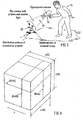
- a hypercube is shown schematically in figure 6 .
- the spectra can be analysed to identify a specific single compound and a map of the distribution of this compound across the sample can then be generated.
- more complex images may be produced showing the distribution of multiple compounds or different properties.
- a regression vector b can be generated using spectral data from mixtures of known composition. This vector relates composition to spectral data and so the vector can be regarded as a model to predict compound concentrations or properties from the spectral data.
- each pixel in the hyperspectral image will have associated with it an entire spectrum - i.e. a set of intensity values corresponding to each sample wavelength - which is a line, or vector, in the hypercube.
- the result is the predicted concentration value of the compound in question at that pixel.
- ( ij ) X n is the intensity value at wavelength n
- b n is the corresponding model vector coefficient.
- y ij ⁇ ij ⁇ x T ⁇ b
- ( ij ) x comprises the intensity values x 1 ...x n at point (i, j).
- the hypercube X of all the spectral data can be analysed by considering it as a series of two-dimensional "slabs" which can readily be handled as matrices.
- the slabs are all parallel to each other in the hypercube; in other words, the complete cube is effectively sliced up like a loaf to form a set of matrices whose dimensions correspond to those of one of the faces of the hypercube.
- estimates of the property across the entire image are provided. This may provide, for example, a map of the concentration of a compound such as glucose across the surface of the sample.
- Classical hyperspectral imaging is performed using one of two basic principles: scanning by a pushbroom approach or by a tuneable filter approach, for example using an Acousto-Optic Tuneable Filter (AOTF).
- AOTF Acousto-Optic Tuneable Filter
- a line camera In a pushbroom scanner, a line camera is used where the light is diffracted into different colour/wavelength components using a spectrograph onto a focal plane array (FPA). Thus, for each position of the line camera a spectrum is obtained for each point on that line. From the FPA, this data is subsequently streamed into a memory storage as the matrix of spectra A j .
- the index j indicates scanned line j .
- the dimensions of matrix A j are [M ⁇ K] where M is the number of spatial points along the line and K is the number of separate wavelengths in each spectrum.
- AOTFs are particularly powerful tuneable filters. They are solid-state devices comprising a crystal filter whose transmission wavelength is controlled by attached piezoelectric transducers. The transducers create pressure waves in the crystal which changes its refractive index. These transducers are controlled by careful manipulation of the frequency of an applied electric field to vary the transmission wavelength of the filter in a stepwise manner. At each wavelength step, an image is captured which provides a matrix I j where j is the wavelength step.
- each matrix I j represents a single monochrome image of the whole sample at wavelength j .
- matrices I j are read into memory where they each form a slab of the hypercube H . (However, it will be noted that the two kinds of matrices contain different sets of information; they are orthogonal to each other in the hypercube).
- the hypercube is generated slab-by-slab and stored in memory.
- the data is then processed as described above in order to produce the desired output image.
- the choice of approach is a matter of design optimisation.
- the spectrograph in a pushbroom system provides better spectral resolution, but at a cost of speed compared to the tuneable filter system where the lack of moving parts enables the hypercube to be generated more rapidly.
- hyperspectral or chemical/property imaging data is to use a computer monitor and where the data is real-time, or recorded for that matter, it may be displayed as a moving picture, for example as the hyperspectral camera (i.e. input device of whatever kind) moves around a three dimensional object or as the object moves.
- the hyperspectral camera i.e. input device of whatever kind
- This enables, for example, the searching of an area (a room, human body, etc.) for traces of particular compounds such as explosives or narcotics. It is also possible to use other known displays.
- One approach to this is to use goggles or head-up display technology so that an image is provided to a user which overlies the subject of that image in the view of the user. This is a useful approach when the operator is not close to the subject or wishes to monitor it without being detected.
- the present invention provides a method of generating a chemical or property image of an object comprising the steps of receiving light from the object, obtaining hyperspectral image data from the light, processing the data to provide a chemical or property image, and projecting light representing the chemical or property image onto the object such that the projected light is in register with the imaged object so that compounds or properties detected in the image may be located on the object.
- the spatial distribution of compounds or properties in/on the object may also be readily visualised.
- the image may be only of part of the object, but can be projected back onto the corresponding part of the object. It will be appreciated that the chemical image may then be seen by any number of viewers. Other kinds of property image may also be visualised in this manner.
- the invention also extends to a corresponding projection apparatus and so, viewed from a further aspect the invention provides an apparatus for generating a chemical or property image of an object comprising a hyperspectral camera arranged to receive light from an object and to output hyperspectral image data, a processor for processing the hyperspectral data to provide a chemical or property image, and a projector arranged to project light representing the chemical or property image back towards the object, such that the chemical or property image is back-projected in register with the imaged object.
- a hyperspectral camera arranged to receive light from an object and to output hyperspectral image data
- a processor for processing the hyperspectral data to provide a chemical or property image
- a projector arranged to project light representing the chemical or property image back towards the object, such that the chemical or property image is back-projected in register with the imaged object.
- the light enters the camera along the same optical axis as the image is transmitted back to the object.
- the projection apparatus may incorporate a rotating mirror, or other arrangement to allow light from the imaged scene to pass into the apparatus via the same optical system as that which projects back the image. Such an arrangement switches the light path as it rotates. It is also possible to use a half-silvered mirror. This has the advantage of eliminating moving parts.
- the detected frequencies of light may be selected to differ from those used in the projected image.
- a filter may be provided (e.g. just in front of the camera) to filter projected light frequencies from the light passing into the hyperspectral camera and/or a filter may be provided (e.g. just in front of the projector) to filter the frequencies being detected from the projected light.
- Another approach is to use a laser projection system to draw the real-time images onto the sample surface.
- laser projection can readily be selected to be outside the detection range of the hyperspectral camera which will permit the recording and drawing of results to be performed simultaneously without the need for any shutters.
- Another advantage is that lasers minimize the problem of focus when drawing on surfaces.
- Applications include surveillance, forensic science, robotics, medical, biological and chemical science or monitoring activities where the user is closely investigating the surfaces of objects for different types of chemicals/properties.
- the system may, for example, be used in place of known systems using fluorescence for detecting blood in crime scene investigations.
- the user wears goggles for filtering certain wavelengths and a special lamp is used for inducing fluorescence.
- this known system has several disadvantages in that the user usually needs to spray a substance onto surfaces that react with the blood, he must switch off other light sources that can disturb the observation process and of course, the use of special goggles further reduces the visibility of the scene.
- the user With the new system the user is able to work in full daylight or in a heavily illuminated area.
- the results from the chemical/property imaging method of this invention may be seen in the original scene itself as patterns and spots of bright artificial colours. This has a large impact on the user-friendliness of the system because it will allow the user, for example a forensic science investigator, to focus on the objects in the scene in a natural way and at the same time obtaining the additional information originating from the chemical/property imaging. This is a much less cumbersome and difficult approach to inspection than using goggles or computer screens.
- the apparatus is configured so that the user is able to switch rapidly between different types of chemical/property image models, e.g. from ethanol to blood to gunpowder to TNT in rapid succession.
- chemical/property image models e.g. from ethanol to blood to gunpowder to TNT in rapid succession.
- the use of multiple artificial colouring makes it possible to overlay the results from more than one model onto the scene.
- the original colours of the objects in the scene may mask or make it difficult to differentiate with respect to the chemical/property images projected onto it and so, preferably, this is taken into account, for example by allowing variation in the colours used for the projected image.
- the back projection is provided by sampling light from a source with a hyperspectral camera, generating a chemical/property image therefrom and then projecting the estimated chemical/property image onto the scene.
- a frame rate of 3-10 frames per second (fps) it may be acceptable to use a frame rate of 3-10 frames per second (fps), provided that the apparatus is not moved quickly.
- fps frames per second
- a rate of 10-20fps or more is used and most preferably it is 25-30fps, as with a TV or cinematic image.
- the apparatus is provided in the form of a hand-held device which can readily be directed at any object by the user.
- the generation of the chemical composition data is interleaved with the obtaining of the hyperspectral image data.
- the image is processed whilst scanning takes place.
- the entire image data set is obtained and stored as a hypercube before being processed.
- the slab that is being processed is held in memory. This therefore avoids the use of a huge amount of computer memory, which is highly advantageous in itself.
- a greater benefit is the increased speed of the process by avoiding the need to address so much memory.
- Steps (a) and (b) will normally be repeated until the chemical or property image has been completed, although there may be applications where the process is truncated, for example where a high frame-rate takes priority or where only a partial image is required, thus every nth line could be omitted.
- Embodiments may comprise apparatus for generating a chemical or property image comprising a hyperspectral camera for obtaining hyperspectral image data from a sample and a processor for generating chemical or property image data from sample image data using a model, wherein the processor is arranged to obtain from the camera only a portion of the hyperspectral image data and to processes said portion of the hyperspectral image data using the model to generate spatially resolved chemical composition data or other property data concerning the sample before obtaining and processing further samples of data.
- hyperspectral camera includes any hyperspectral image input device including those discussed above.
- the apparatus may also comprise a suitable display unit to display an image formed by the chemical composition or other property data.
- the processor preferably repeats the obtaining and processing steps until a complete set of chemical or property image data has been produced.
- each line of the scan may comprise a portion of the hyperspectral data.
- the portion of data therefore comprises a series of spectra corresponding to points on the sample along the line. This may be represented as a matrix whose dimensions are the number of points and the number of sample wavelengths respectively.
- model vector may comprise a regression or classification vector generated theoretically or obtained from samples having known properties, for example using the known chemometric techniques discussed above. Any such model in the form of a vector will be referred to here as a model vector.
- the matrix is multiplied by the model vector to obtain image data for a line of a chemical image.
- This may, for example, provide a map of the distribution, and optionally concentration, of a given compound on (or in) the surface of a sample.
- This step is performed with the image data just after it has been obtained by the camera.
- a plurality of models can be used corresponding to a respective plurality of compounds that are to be detected or properties. This can be done to provide multiple chemical images or single images using, for example, different colours to represent the presence of different compounds or properties. Although it is possible to use each vector sequentially, it is preferred to combine them into a matrix and to multiply the image matrix by this model matrix.
- the result can be displayed on a computer monitor or the like as a moving image.
- each image of the sample at a given sample wavelength may comprise a portion of the hyperspectral data.
- the portion of data therefore comprises a monochromatic image. This may be represented as a matrix whose dimensions correspond to the linear dimensions of the image.
- the model may be in the form of a regression vector.
- the coefficient of the model vector corresponding to the sample wavelength of the monochromatic image is preferably used to multiply each element of that matrix.
- the result may then be stored (e.g. in a particular computer memory location) as a further matrix.
- the next monochrome image, for a further wavelength is then obtained and each pixel intensity value multiplied by the coefficient of the model vector corresponding to the new sample wavelength to form a new matrix, which is then added to that in the memory.
- the memory will contain a complete set of data for a chemical image.
- a desired subset of sample wavelengths may be predetermined based on expert knowledge. Where specific compounds are being targeted, their most characteristic frequencies may be selected to form part or all of the subset.
- the wavelengths could be sampled in any order, and may be sampled in sequence (whilst optionally omitting a selection as discussed above), it is preferred that the wavelengths are sampled in order of importance or magnitude of the model coefficients. It is a characteristic of tuneable filter systems that they can switch wavelength at an extremely high rate so this can readily be accommodated. Thus, the wavelengths corresponding to the largest value coefficients may be sampled first. Most preferably, the wavelengths are sampled in order of decreasing importance or magnitude of the corresponding model coefficients.
- the number of wavelengths actually sampled can be varied.
- a higher frame rate for example if the sample is moving
- a smaller number of wavelengths can be sampled. If the wavelengths are sampled in such an order, then the "lost" data will always be the least important.
- the invention also extends to apparatus arranged to carry out any of the preferred forms of the above method, e.g. using tuneable filter or pushbroom approaches. It is envisaged that the processing steps will be carried out by computer processor(s) and so the invention also extends to computer apparatus configured to process data according to the above method.
- the above processing techniques will normally be performed by means of software running on suitable computer apparatus.
- the invention therefore may comprise such computer apparatus and software arranged to cause such apparatus to perform the processing methods of the invention.
- the invention may comprise a software product whether in tangible form (e.g. on disk) or obtained by way of download etc., configured to provide chemical or property image data from hyperspectral data in accordance with the above methods and/or for causing a computer to perform such a method.
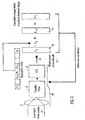
- a conventional pushbroom scanner apparatus 1 comprises a line camera 2, which is arranged to scan line-by-line across a sample 3.
- the camera contains a spectrograph (not shown) where the light is diffracted into different colour/wavelength components before the being detected by a focal plane array (FPA).
- FPA focal plane array
- each line number j is subsequently streamed into memory storage 5, which is part of a data processing apparatus (not shown), in the form of a matrix A j .
- the dimensions of matrix A j are [M ⁇ K] where M is the number of spatial points along the line and K is the number of wavelengths in each spectrum.
- M is the number of spatial points along the line
- K is the number of wavelengths in each spectrum.
- Matrix A j is multiplied directly by a vector b , which has been obtained by a regression analysis in the known manner. This step is carried out immediately after the matrix is read into memory.
- the scanner's line camera 2 is moved to the next line j + 1 and the process above is repeated. This is done for each line until the entire sample has been imaged and the chemical image completed.
- the image may then be transmitted to, and shown on, a conventional computer monitor (not shown) with, for example, a grey-scale indicating the concentration of the compound being detected.
- the concentrations of the different compounds can then be provided in separate images, or in the same image. This can be done by using the intensity of a given colour in the image to represent the concentration of a particular compound. However, it will be appreciated that this will require a very high degree of processing power and may therefore only be practicable where specialist computers can be employed.
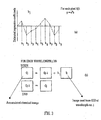
- FIG. 2 A second example is shown in Figure 2 .
- This apparatus is based on the tuneable filter approach discussed earlier.
- the camera apparatus 10 itself is essentially conventional and comprises an objective lens 11, an Acousto-Optic Tuneable Filter (AOTF) 12 and a charge-coupled device 13.
- AOTF Acousto-Optic Tuneable Filter
- Input light 14 reflected from the surface of a sample passes through lens 11 before being filtered by AOTF 12 and the light which falls within the narrow pass-band of the filter 12 is then detected by CCD 13 to provide a two-dimensional greyscale image for that band (which for practical purposes is regarded as being a single wavelength). This is output as signal 14 to data processing apparatus (not shown).
- the pass-band frequency of the filter is varied to allow detection of images for a large number of light wavelengths. Conventionally, the filter would scan stepwise through the IR or NIR band.
- the CCD 13 is synchronised with the operation of the filter 12 so that the entire image is captured and output before the pass-frequency is changed.
- the output signal 14 for the j th pass-frequency is stored as a matrix I j in memory buffer 15. This matrix has dimensions corresponding to the numbers of pixels in the x- and y-directions on the CCD.
- the conventional method for processing the data is to create a hypercube from the full set of matrices I j and then to multiply each of the pixel intensity values forming the hypercube by a regression vector (or vectors if, for example, a plurality of compounds are to be detected), in the same way as a hypercube created by a conventional pushbroom apparatus.
- AOTFs are solid-state devices controlled by attached piezoelectric transducers. These transducers can be controlled by careful manipulation of their applied frequencies to select a particular pass-frequency.
- the control of which wavelengths are transmitted through the filter is determined by the model vector b which has previously been created in the conventional manner using spectra of the same type as observed in the hyperspectral camera.
- the regression vector(s) will contain j coefficients (i.e. one for each wavelength that is detected) and a number of these will be zero or close to zero. Since the product of any matrix coefficient with a zero vector coefficient is obviously zero, there is no need to sample light at that wavelength and so the filter is never set to pass that wavelength. Likewise, very small coefficients will have a negligible effect on the result. To gain even more parsimonious models, various variable selection methods can be used to create models with high precision and small numbers of variables. In other words, to be even more efficient, the apparatus only studies the wavelengths that are necessary to achieve the desired accuracy.
- the filter 12 is controlled in the conventional manner to let through light at the wavelength corresponding to the non-zero coefficient j .
- the CCD 13 then records the light falling on it and sends the resulting data 14 to a memory storage 15 in the data processing apparatus where matrix I j is stored temporarily replacing the previous content of that storage.
- the next step is to multiply each element/pixel in matrix I j by b j (the coefficient - a scalar - for the sampled wavelength) and add the result to matrix C j-1 which is located in another storage 16.
- C j is overwritten once for each regression coefficient.
- each element in C j will contain the finished predicted concentration of a chemical compound or modelled property for every pixel. It will be seen that this is achieved with most of the computation of the chemical image taking place in memory directly connected to the charged coupled device and without the need to generate, store and then process a hypercube.
- the matrix C is complete for the intended compound concentration or property. This takes a fraction of a second and can be repeated many times to enable real-time imaging. The process can then be repeated for the other compounds or properties using a new regression vector and then image(s) can be displayed as with the previous embodiment.
- the storage 16 containing C should be updated at maximum clock frequency in synchronization with the AOTF to deliver optimal performance.
- the camera is controlled in response to the calculation steps.
- the completion of one round of calculations triggers the output of the next matrix of data from the camera.
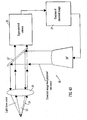
- Figure 4A illustrates schematically the operation of an embodiment of the invention, which is an apparatus for displaying chemical images such as those obtained in the previous examples, and specifically, it relates to an apparatus using a tuneable filter as described above with reference to Figure 2 . It projects a chemical image of an object back onto that object.
- Figure 5 illustrates this apparatus 20 being used by a user 21 to image an object 22. Region 23 is where light travels from the object to the apparatus 20 and back from the apparatus as it projects onto the object.
- light 24 from the object 22 passes through an objective lens 31 of the apparatus.
- the light In its path is rotating mirror 25 and when the mirror is parallel to the path of the rays of light 24, the light is allowed to pass on to hyperspectral camera 26 which is of the AOTF type.
- the output from the camera is transmitted to processor 27 where the chemical image data is generated.
- the camera 26 and processor 27 operate in the manner discussed above whereby a series of monochromatic images are passed to the processor and the image is built up as the camera scans through the appropriate wavelengths.
- the image data is then transmitted to a projector 28 whose output image is focussed by lens 30 towards the rotating mirror 25.
- the image is reflected off the mirror and back through lens 31 to the imaged object 22.
- the apparatus alternately samples light from the object 22 and projects an image onto it.
- the mirror rotates at sufficient speed that the impression of a continuous image is provided.
- a modified embodiment proper filtering of the projection light is performed.
- various filters can be used to block any contributions from the projector in the detection range of the camera. It should be pointed out that such filters may need to be cooled to avoid over-heating.
- a laser projection system is used to draw images onto the sample surface.
- the frequency of light used for projection is chosen to be significantly shifted from that used for imaging and therefore the rotating mirror is not required.
- An advantage of the use of laser light for projection is that is minimizes focussing problems. Furthermore, the frequency of light used for projection is chosen to be significantly shifted from that used for imaging to minimize the interference between the detection and projection parts of the system. This embodiment, also has the advantage of not requiring moving parts, i.e. the rotating mirror.
- lasers with wavelengths of 500-600nm may be used for projection.
- a separate light source may be provided, either integrated with the apparatus or separately.
Landscapes
- Physics & Mathematics (AREA)
- Spectroscopy & Molecular Physics (AREA)
- General Physics & Mathematics (AREA)
- Health & Medical Sciences (AREA)
- Life Sciences & Earth Sciences (AREA)
- Chemical & Material Sciences (AREA)
- Analytical Chemistry (AREA)
- Biochemistry (AREA)
- General Health & Medical Sciences (AREA)
- Immunology (AREA)
- Pathology (AREA)
- Engineering & Computer Science (AREA)
- Human Computer Interaction (AREA)
- Investigating Or Analysing Materials By Optical Means (AREA)
- Apparatus For Radiation Diagnosis (AREA)
- Measuring And Recording Apparatus For Diagnosis (AREA)
- Non-Silver Salt Photosensitive Materials And Non-Silver Salt Photography (AREA)
Claims (9)
- Verfahren zum Erzeugen eines chemischen oder Eigenschaften darstellenden Bildes eines Objekts (22), das die folgenden Schritte umfasst: Empfangen von Licht von dem Objekt, Erhalten hyperspektraler Bilddaten aus dem Licht, Verarbeiten der Daten, um ein chemisches oder Eigenschaften darstellendes Bild zu schaffen, und Projizieren von Licht, das das chemische oder Eigenschaften darstellende Bild repräsentiert, auf das Objekt, so dass das projizierte Licht auf das abgebildete Objekt ausgerichtet ist, so dass Verbindungen oder Eigenschaften, die in dem Bild detektiert werden, an dem Objekt lokalisiert werden können.
- Vorrichtung zum Erzeugen eines chemischen oder Eigenschaften darstellenden Bildes eines Objekts, die enthält: eine hyperspektrale Kamera (20, 26), die dazu ausgelegt ist, Licht von einem Objekt (22) zu empfangen und hyperspektrale Bilddaten auszugeben, einen Prozessor (27), um die hyperspektralen Daten zu verarbeiten, um ein chemisches oder Eigenschaften darstellendes Bild zu schaffen, und einen Projektor (28, 28'), der dazu ausgelegt ist, Licht, das das chemische oder Eigenschaften darstellende Bild repräsentiert, zu dem Objekt zurück zu projizieren, so dass das chemische oder Eigenschaften darstellende Bild ausgerichtet auf das abgebildete Objekt zurück projiziert wird.
- Vorrichtung nach Anspruch 2, wobei das Licht in die Kamera längs derselben optischen Achse eintritt, auf der das Bild zu dem Objekt zurück übertragen wird.
- Vorrichtung nach Anspruch 3, die einen Drehspiegel (25) enthält, der dazu ausgelegt ist, Licht von der abgebildeten Szene zu ermöglichen, sich in die Vorrichtung durch dasselbe optische System wie jenes zu bewegen, das das Bild zurück projiziert.
- Vorrichtung nach Anspruch 3, die einen halbversilberten Spiegel (25') enthält, der dazu ausgelegt ist, Licht von der abgebildeten Szene zu ermöglichen, sich in die Vorrichtung durch dasselbe optische System wie jenes zu bewegen, das das Bild zurück projiziert.
- Vorrichtung nach einem der Ansprüche 2 bis 5, mit einem Laserprojektionssystem (28'), um Bilder auf die Probenoberfläche zu projizieren, wobei die Betriebswellenlänge des Lasers so gewählt ist, dass sie außerhalb des Erfassungsbereichs der hyperspektralen Kamera liegt.
- Vorrichtung nach einem der Ansprüche 2 bis 6, die ein Autofokussierungssystem enthält, das den Brennpunkt des Lichtprojektors in Echtzeit aktualisiert.
- Vorrichtung nach einem der Ansprüche 2 bis 6, wobei ein oder mehrere Filter vorgesehen sind, um die Überlappung der Frequenzen von empfangenem und projiziertem Licht zu beseitigen oder zu verringern.
- Vorrichtung nach Anspruch 5, wobei ein Filter vorgesehen ist, um empfangenes Licht zu filtern, bevor es von der Kamera empfangen wird, und/oder ein Filter vorgesehen ist, um projiziertes Licht zu filtern.
Applications Claiming Priority (2)
| Application Number | Priority Date | Filing Date | Title |
|---|---|---|---|
| GBGB0602137.2A GB0602137D0 (en) | 2006-02-02 | 2006-02-02 | Chemical and property imaging |
| EP07712669A EP1984713A1 (de) | 2006-02-02 | 2007-02-02 | Hyperspektrale chemische und eigenschaftsabbildung |
Related Parent Applications (2)
| Application Number | Title | Priority Date | Filing Date |
|---|---|---|---|
| EP07712669A Division EP1984713A1 (de) | 2006-02-02 | 2007-02-02 | Hyperspektrale chemische und eigenschaftsabbildung |
| EP07712669.6 Division | 2007-02-02 |
Publications (2)
| Publication Number | Publication Date |
|---|---|
| EP2019299A1 EP2019299A1 (de) | 2009-01-28 |
| EP2019299B1 true EP2019299B1 (de) | 2011-04-27 |
Family
ID=36100942
Family Applications (2)
| Application Number | Title | Priority Date | Filing Date |
|---|---|---|---|
| EP07712669A Withdrawn EP1984713A1 (de) | 2006-02-02 | 2007-02-02 | Hyperspektrale chemische und eigenschaftsabbildung |
| EP08018882A Not-in-force EP2019299B1 (de) | 2006-02-02 | 2007-02-02 | Hyperspektrale Bilderfassung zur Bestimmung von Objekteigenschaften mit Rückprojektion des Bildes auf das Objekt |
Family Applications Before (1)
| Application Number | Title | Priority Date | Filing Date |
|---|---|---|---|
| EP07712669A Withdrawn EP1984713A1 (de) | 2006-02-02 | 2007-02-02 | Hyperspektrale chemische und eigenschaftsabbildung |
Country Status (7)
| Country | Link |
|---|---|
| US (1) | US20090015686A1 (de) |
| EP (2) | EP1984713A1 (de) |
| AT (1) | ATE507464T1 (de) |
| DE (1) | DE602007014202D1 (de) |
| ES (1) | ES2365823T3 (de) |
| GB (1) | GB0602137D0 (de) |
| WO (1) | WO2007088382A1 (de) |
Cited By (1)
| Publication number | Priority date | Publication date | Assignee | Title |
|---|---|---|---|---|
| US9870515B2 (en) | 2014-04-05 | 2018-01-16 | Empire Technology Development Llc | Identification system and method |
Families Citing this family (14)
| Publication number | Priority date | Publication date | Assignee | Title |
|---|---|---|---|---|
| WO2008122935A1 (en) * | 2007-04-04 | 2008-10-16 | Koninklijke Philips Electronics N.V. | Remote measuring and display |
| RU2591735C2 (ru) * | 2011-09-20 | 2016-07-20 | Халлибертон Энерджи Сервисез, Инк. | Система и устройство для обнаружения запрещенных или опасных веществ |
| BR112014028811B1 (pt) * | 2013-03-19 | 2020-11-17 | Koninklijke Philips N.V. | sistema de imagem, método para registrar uma imagem de um objeto em uma faixa espectral de radiação de terahertz através da radiografia e visualização da imagem em luz visível, e meio de armazenamento |
| US9237279B2 (en) * | 2013-05-06 | 2016-01-12 | Bergen Teknologioverfoering As | Method of investigating a solid sample |
| DE102014106975A1 (de) * | 2014-05-16 | 2015-11-19 | Vorwerk & Co. Interholding Gmbh | Selbsttätig verfahrbares Reinigungsgerät |
| EP3198330A4 (de) * | 2014-09-22 | 2018-04-11 | Invuity, Inc. | Hyperspektraler bildgeber |
| CN104897583B (zh) * | 2015-06-18 | 2018-03-09 | 重庆理工大学 | 一种微量血迹无损检测装置及方法 |
| US10740309B2 (en) * | 2015-12-18 | 2020-08-11 | Cisco Technology, Inc. | Fast circular database |
| WO2018009670A1 (en) | 2016-07-06 | 2018-01-11 | Chemimage Corporation | Systems and methods for detecting edema |
| CN110114646A (zh) * | 2016-12-27 | 2019-08-09 | 优鲁格斯股份有限公司 | 表观运动中的对象的动态超光谱成像 |
| US10621438B2 (en) * | 2017-09-07 | 2020-04-14 | Syso OU | Hybrid hyperspectral augmented reality device |
| US12295743B2 (en) * | 2019-02-04 | 2025-05-13 | Chemimage Corporation | Quantification of heart failure using molecular chemical imaging |
| CN110609573A (zh) * | 2019-08-26 | 2019-12-24 | 核工业北京地质研究院 | 一种无人机载高光谱遥感实时监测系统 |
| JPWO2022270355A1 (de) * | 2021-06-24 | 2022-12-29 |
Family Cites Families (17)
| Publication number | Priority date | Publication date | Assignee | Title |
|---|---|---|---|---|
| US3560647A (en) * | 1968-02-27 | 1971-02-02 | Bell Telephone Labor Inc | Automatic focusing system |
| US4687326A (en) * | 1985-11-12 | 1987-08-18 | General Electric Company | Integrated range and luminance camera |
| US4928301A (en) * | 1988-12-30 | 1990-05-22 | Bell Communications Research, Inc. | Teleconferencing terminal with camera behind display screen |
| US6208752B1 (en) | 1998-03-12 | 2001-03-27 | The United States Of America As Represented By The Secretary Of The Navy | System for eliminating or reducing exemplar effects in multispectral or hyperspectral sensors |
| US7180588B2 (en) * | 1999-04-09 | 2007-02-20 | Plain Sight Systems, Inc. | Devices and method for spectral measurements |
| US7775003B2 (en) * | 1999-12-08 | 2010-08-17 | Sabac Steven R | Apparatus for securing an impact resistant window to a window frame |
| US6678398B2 (en) * | 2000-09-18 | 2004-01-13 | Sti Medical Systems, Inc. | Dual mode real-time screening and rapid full-area, selective-spectral, remote imaging and analysis device and process |
| US6505674B1 (en) * | 2001-04-19 | 2003-01-14 | Alcoa Inc. | Injector for molten metal supply system |
| US6675106B1 (en) * | 2001-06-01 | 2004-01-06 | Sandia Corporation | Method of multivariate spectral analysis |
| EP1407237A1 (de) * | 2001-06-20 | 2004-04-14 | Delta Dansk Elektronik, Lys & Akustik | Kombination aus einem antwortadaptionsfilter und einem detektor |
| US6965108B2 (en) * | 2001-07-30 | 2005-11-15 | Euro-Celtique, S.A. | Method and apparatus for three dimensional imaging using infrared radiation |
| US7149366B1 (en) * | 2001-09-12 | 2006-12-12 | Flight Landata, Inc. | High-definition hyperspectral imaging system |
| US7551785B2 (en) * | 2003-07-03 | 2009-06-23 | Canadian Space Agency | Method and system for compressing a continuous data flow in real-time using cluster successive approximation multi-stage vector quantization (SAMVQ) |
| US7447345B2 (en) * | 2003-12-16 | 2008-11-04 | General Electric Company | System and method for generating PET-CT images |
| CA3031088A1 (en) * | 2004-11-29 | 2006-06-01 | Hypermed Imaging, Inc. | Medical hyperspectral imaging for evaluation of tissue and tumor |
| CN101237817B (zh) * | 2004-12-28 | 2013-01-23 | 超级医药成像有限公司 | 在全身生理学和休克的判定、评估和监测中的超光谱/多光谱成像 |
| US7515986B2 (en) * | 2007-04-20 | 2009-04-07 | The Boeing Company | Methods and systems for controlling and adjusting heat distribution over a part bed |
-
2006
- 2006-02-02 GB GBGB0602137.2A patent/GB0602137D0/en not_active Ceased
-
2007
- 2007-02-02 US US12/162,486 patent/US20090015686A1/en not_active Abandoned
- 2007-02-02 ES ES08018882T patent/ES2365823T3/es active Active
- 2007-02-02 DE DE602007014202T patent/DE602007014202D1/de active Active
- 2007-02-02 EP EP07712669A patent/EP1984713A1/de not_active Withdrawn
- 2007-02-02 WO PCT/GB2007/000369 patent/WO2007088382A1/en not_active Ceased
- 2007-02-02 EP EP08018882A patent/EP2019299B1/de not_active Not-in-force
- 2007-02-02 AT AT08018882T patent/ATE507464T1/de not_active IP Right Cessation
Cited By (1)
| Publication number | Priority date | Publication date | Assignee | Title |
|---|---|---|---|---|
| US9870515B2 (en) | 2014-04-05 | 2018-01-16 | Empire Technology Development Llc | Identification system and method |
Also Published As
| Publication number | Publication date |
|---|---|
| DE602007014202D1 (de) | 2011-06-09 |
| GB0602137D0 (en) | 2006-03-15 |
| EP1984713A1 (de) | 2008-10-29 |
| US20090015686A1 (en) | 2009-01-15 |
| ATE507464T1 (de) | 2011-05-15 |
| ES2365823T3 (es) | 2011-10-11 |
| EP2019299A1 (de) | 2009-01-28 |
| WO2007088382A1 (en) | 2007-08-09 |
Similar Documents
| Publication | Publication Date | Title |
|---|---|---|
| EP2019299B1 (de) | Hyperspektrale Bilderfassung zur Bestimmung von Objekteigenschaften mit Rückprojektion des Bildes auf das Objekt | |
| EP3830551B1 (de) | Hybrider spektraler bildgeber | |
| Edgar et al. | Principles and prospects for single-pixel imaging | |
| Liang | Punching holes in light: recent progress in single-shot coded-aperture optical imaging | |
| US10992924B2 (en) | Stereo-polarimetric compressed ultrafast photography (SP-CUP) systems and methods | |
| Gao et al. | Single-shot compressed ultrafast photography at one hundred billion frames per second | |
| US7626696B2 (en) | Method and apparatus for reconfigurable field of view in a FAST-based imaging system | |
| EP2728324A1 (de) | Multispektrales abbildungsverfahren für ultraschwache photonenemission und system damit | |
| US20110228116A1 (en) | Spectral imaging of moving objects with a stare down camera | |
| Correa et al. | Multiple snapshot colored compressive spectral imager | |
| Galvis-Carreño et al. | Efficient reconstruction of Raman spectroscopy imaging based on compressive sensing | |
| Arablouei et al. | Fast and robust pushbroom hyperspectral imaging via DMD-based scanning | |
| JP5424108B2 (ja) | ラマンイメージング装置 | |
| Kim et al. | Aperture-encoded snapshot hyperspectral imaging with a lensless camera | |
| US20020135770A1 (en) | Hybrid-imaging spectrometer | |
| US11199448B2 (en) | Spectroscopic measurement device and spectroscopic measurement method | |
| US20230309834A1 (en) | Hadamard-transform fluorescence excitation-emission-matrix imaging systems | |
| Oktem et al. | Computational spectral and ultrafast imaging via convex optimization | |
| US11867615B2 (en) | Field calibration for near real-time Fabry Perot spectral measurements | |
| Rector et al. | High-performance confocal system for microscopic or endoscopic applications | |
| US7034938B1 (en) | Non-scanning computed tomography imaging spectrophotometer | |
| Lindner et al. | Rapid microscopy measurement of very large spectral images | |
| US20080130001A1 (en) | Hybrid-imaging spectrometer | |
| JPH08128899A (ja) | 分光画像収集装置 | |
| JP2020126045A (ja) | 面分光装置および面分光装置の光学収差補正方法 |
Legal Events
| Date | Code | Title | Description |
|---|---|---|---|
| PUAI | Public reference made under article 153(3) epc to a published international application that has entered the european phase |
Free format text: ORIGINAL CODE: 0009012 |
|
| AC | Divisional application: reference to earlier application |
Ref document number: 1984713 Country of ref document: EP Kind code of ref document: P |
|
| AK | Designated contracting states |
Kind code of ref document: A1 Designated state(s): AT BE BG CH CY CZ DE DK EE ES FI FR GB GR HU IE IS IT LI LT LU LV MC NL PL PT RO SE SI SK TR |
|
| AX | Request for extension of the european patent |
Extension state: AL BA HR MK RS |
|
| RIN1 | Information on inventor provided before grant (corrected) |
Inventor name: ALSBERG, BJORN, NTNU TECHNOLOGY TRANSFER AS |
|
| 17P | Request for examination filed |
Effective date: 20090724 |
|
| 17Q | First examination report despatched |
Effective date: 20090820 |
|
| AKX | Designation fees paid |
Designated state(s): AT BE BG CH CY CZ DE DK EE ES FI FR GB GR HU IE IS IT LI LT LU LV MC NL PL PT RO SE SI SK TR |
|
| GRAP | Despatch of communication of intention to grant a patent |
Free format text: ORIGINAL CODE: EPIDOSNIGR1 |
|
| GRAS | Grant fee paid |
Free format text: ORIGINAL CODE: EPIDOSNIGR3 |
|
| GRAA | (expected) grant |
Free format text: ORIGINAL CODE: 0009210 |
|
| AC | Divisional application: reference to earlier application |
Ref document number: 1984713 Country of ref document: EP Kind code of ref document: P |
|
| AK | Designated contracting states |
Kind code of ref document: B1 Designated state(s): AT BE BG CH CY CZ DE DK EE ES FI FR GB GR HU IE IS IT LI LT LU LV MC NL PL PT RO SE SI SK TR |
|
| REG | Reference to a national code |
Ref country code: GB Ref legal event code: FG4D |
|
| REG | Reference to a national code |
Ref country code: CH Ref legal event code: EP |
|
| REG | Reference to a national code |
Ref country code: IE Ref legal event code: FG4D |
|
| REF | Corresponds to: |
Ref document number: 602007014202 Country of ref document: DE Date of ref document: 20110609 Kind code of ref document: P |
|
| REG | Reference to a national code |
Ref country code: DE Ref legal event code: R096 Ref document number: 602007014202 Country of ref document: DE Effective date: 20110609 |
|
| REG | Reference to a national code |
Ref country code: NL Ref legal event code: T3 |
|
| LTIE | Lt: invalidation of european patent or patent extension |
Effective date: 20110427 |
|
| REG | Reference to a national code |
Ref country code: ES Ref legal event code: FG2A Ref document number: 2365823 Country of ref document: ES Kind code of ref document: T3 Effective date: 20111011 |
|
| PG25 | Lapsed in a contracting state [announced via postgrant information from national office to epo] |
Ref country code: PT Free format text: LAPSE BECAUSE OF FAILURE TO SUBMIT A TRANSLATION OF THE DESCRIPTION OR TO PAY THE FEE WITHIN THE PRESCRIBED TIME-LIMIT Effective date: 20110829 Ref country code: LT Free format text: LAPSE BECAUSE OF FAILURE TO SUBMIT A TRANSLATION OF THE DESCRIPTION OR TO PAY THE FEE WITHIN THE PRESCRIBED TIME-LIMIT Effective date: 20110427 Ref country code: SE Free format text: LAPSE BECAUSE OF FAILURE TO SUBMIT A TRANSLATION OF THE DESCRIPTION OR TO PAY THE FEE WITHIN THE PRESCRIBED TIME-LIMIT Effective date: 20110427 |
|
| PG25 | Lapsed in a contracting state [announced via postgrant information from national office to epo] |
Ref country code: SI Free format text: LAPSE BECAUSE OF FAILURE TO SUBMIT A TRANSLATION OF THE DESCRIPTION OR TO PAY THE FEE WITHIN THE PRESCRIBED TIME-LIMIT Effective date: 20110427 Ref country code: IS Free format text: LAPSE BECAUSE OF FAILURE TO SUBMIT A TRANSLATION OF THE DESCRIPTION OR TO PAY THE FEE WITHIN THE PRESCRIBED TIME-LIMIT Effective date: 20110827 Ref country code: AT Free format text: LAPSE BECAUSE OF FAILURE TO SUBMIT A TRANSLATION OF THE DESCRIPTION OR TO PAY THE FEE WITHIN THE PRESCRIBED TIME-LIMIT Effective date: 20110427 Ref country code: FI Free format text: LAPSE BECAUSE OF FAILURE TO SUBMIT A TRANSLATION OF THE DESCRIPTION OR TO PAY THE FEE WITHIN THE PRESCRIBED TIME-LIMIT Effective date: 20110427 Ref country code: CY Free format text: LAPSE BECAUSE OF FAILURE TO SUBMIT A TRANSLATION OF THE DESCRIPTION OR TO PAY THE FEE WITHIN THE PRESCRIBED TIME-LIMIT Effective date: 20110427 Ref country code: LV Free format text: LAPSE BECAUSE OF FAILURE TO SUBMIT A TRANSLATION OF THE DESCRIPTION OR TO PAY THE FEE WITHIN THE PRESCRIBED TIME-LIMIT Effective date: 20110427 Ref country code: GR Free format text: LAPSE BECAUSE OF FAILURE TO SUBMIT A TRANSLATION OF THE DESCRIPTION OR TO PAY THE FEE WITHIN THE PRESCRIBED TIME-LIMIT Effective date: 20110728 Ref country code: BE Free format text: LAPSE BECAUSE OF FAILURE TO SUBMIT A TRANSLATION OF THE DESCRIPTION OR TO PAY THE FEE WITHIN THE PRESCRIBED TIME-LIMIT Effective date: 20110427 |
|
| PG25 | Lapsed in a contracting state [announced via postgrant information from national office to epo] |
Ref country code: EE Free format text: LAPSE BECAUSE OF FAILURE TO SUBMIT A TRANSLATION OF THE DESCRIPTION OR TO PAY THE FEE WITHIN THE PRESCRIBED TIME-LIMIT Effective date: 20110427 Ref country code: CZ Free format text: LAPSE BECAUSE OF FAILURE TO SUBMIT A TRANSLATION OF THE DESCRIPTION OR TO PAY THE FEE WITHIN THE PRESCRIBED TIME-LIMIT Effective date: 20110427 |
|
| PG25 | Lapsed in a contracting state [announced via postgrant information from national office to epo] |
Ref country code: PL Free format text: LAPSE BECAUSE OF FAILURE TO SUBMIT A TRANSLATION OF THE DESCRIPTION OR TO PAY THE FEE WITHIN THE PRESCRIBED TIME-LIMIT Effective date: 20110427 Ref country code: DK Free format text: LAPSE BECAUSE OF FAILURE TO SUBMIT A TRANSLATION OF THE DESCRIPTION OR TO PAY THE FEE WITHIN THE PRESCRIBED TIME-LIMIT Effective date: 20110427 Ref country code: RO Free format text: LAPSE BECAUSE OF FAILURE TO SUBMIT A TRANSLATION OF THE DESCRIPTION OR TO PAY THE FEE WITHIN THE PRESCRIBED TIME-LIMIT Effective date: 20110427 Ref country code: SK Free format text: LAPSE BECAUSE OF FAILURE TO SUBMIT A TRANSLATION OF THE DESCRIPTION OR TO PAY THE FEE WITHIN THE PRESCRIBED TIME-LIMIT Effective date: 20110427 |
|
| PLBE | No opposition filed within time limit |
Free format text: ORIGINAL CODE: 0009261 |
|
| STAA | Information on the status of an ep patent application or granted ep patent |
Free format text: STATUS: NO OPPOSITION FILED WITHIN TIME LIMIT |
|
| 26N | No opposition filed |
Effective date: 20120130 |
|
| REG | Reference to a national code |
Ref country code: DE Ref legal event code: R097 Ref document number: 602007014202 Country of ref document: DE Effective date: 20120130 |
|
| PGFP | Annual fee paid to national office [announced via postgrant information from national office to epo] |
Ref country code: IT Payment date: 20120223 Year of fee payment: 6 |
|
| REG | Reference to a national code |
Ref country code: NL Ref legal event code: SD Effective date: 20120704 |
|
| REG | Reference to a national code |
Ref country code: GB Ref legal event code: 732E Free format text: REGISTERED BETWEEN 20120705 AND 20120711 |
|
| REG | Reference to a national code |
Ref country code: FR Ref legal event code: TP Owner name: NORWEGIAN UNIVERSITY OF SCIENCE AND TECHNOLOGY, NO Effective date: 20120717 Ref country code: FR Ref legal event code: CA Effective date: 20120717 |
|
| PG25 | Lapsed in a contracting state [announced via postgrant information from national office to epo] |
Ref country code: MC Free format text: LAPSE BECAUSE OF NON-PAYMENT OF DUE FEES Effective date: 20120229 |
|
| REG | Reference to a national code |
Ref country code: CH Ref legal event code: PL |
|
| REG | Reference to a national code |
Ref country code: ES Ref legal event code: PC2A Owner name: NORWEGIAN UNIVERSITY OF SCIENCE AND TECHNOLOGY (NT Effective date: 20120926 |
|
| PG25 | Lapsed in a contracting state [announced via postgrant information from national office to epo] |
Ref country code: CH Free format text: LAPSE BECAUSE OF NON-PAYMENT OF DUE FEES Effective date: 20120229 Ref country code: LI Free format text: LAPSE BECAUSE OF NON-PAYMENT OF DUE FEES Effective date: 20120229 |
|
| REG | Reference to a national code |
Ref country code: DE Ref legal event code: R081 Ref document number: 602007014202 Country of ref document: DE Owner name: NORWEGIAN UNIVERSITY OF SCIENCE AND TECHNOLOGY, NO Free format text: FORMER OWNER: NTNU TECHNOLOGY TRANSFER AS, TRONDHEIM, NO Effective date: 20120920 Ref country code: DE Ref legal event code: R082 Ref document number: 602007014202 Country of ref document: DE Representative=s name: DEHNS, GB Effective date: 20120920 |
|
| REG | Reference to a national code |
Ref country code: IE Ref legal event code: MM4A |
|
| PG25 | Lapsed in a contracting state [announced via postgrant information from national office to epo] |
Ref country code: IE Free format text: LAPSE BECAUSE OF NON-PAYMENT OF DUE FEES Effective date: 20120202 |
|
| PGFP | Annual fee paid to national office [announced via postgrant information from national office to epo] |
Ref country code: FR Payment date: 20130321 Year of fee payment: 7 Ref country code: GB Payment date: 20130121 Year of fee payment: 7 Ref country code: ES Payment date: 20130206 Year of fee payment: 7 Ref country code: DE Payment date: 20130219 Year of fee payment: 7 |
|
| PGFP | Annual fee paid to national office [announced via postgrant information from national office to epo] |
Ref country code: NL Payment date: 20130227 Year of fee payment: 7 |
|
| PG25 | Lapsed in a contracting state [announced via postgrant information from national office to epo] |
Ref country code: BG Free format text: LAPSE BECAUSE OF FAILURE TO SUBMIT A TRANSLATION OF THE DESCRIPTION OR TO PAY THE FEE WITHIN THE PRESCRIBED TIME-LIMIT Effective date: 20110727 |
|
| PG25 | Lapsed in a contracting state [announced via postgrant information from national office to epo] |
Ref country code: TR Free format text: LAPSE BECAUSE OF FAILURE TO SUBMIT A TRANSLATION OF THE DESCRIPTION OR TO PAY THE FEE WITHIN THE PRESCRIBED TIME-LIMIT Effective date: 20110427 |
|
| PG25 | Lapsed in a contracting state [announced via postgrant information from national office to epo] |
Ref country code: LU Free format text: LAPSE BECAUSE OF NON-PAYMENT OF DUE FEES Effective date: 20120202 |
|
| PG25 | Lapsed in a contracting state [announced via postgrant information from national office to epo] |
Ref country code: HU Free format text: LAPSE BECAUSE OF FAILURE TO SUBMIT A TRANSLATION OF THE DESCRIPTION OR TO PAY THE FEE WITHIN THE PRESCRIBED TIME-LIMIT Effective date: 20070202 |
|
| REG | Reference to a national code |
Ref country code: DE Ref legal event code: R119 Ref document number: 602007014202 Country of ref document: DE |
|
| REG | Reference to a national code |
Ref country code: NL Ref legal event code: V1 Effective date: 20140901 |
|
| GBPC | Gb: european patent ceased through non-payment of renewal fee |
Effective date: 20140202 |
|
| PG25 | Lapsed in a contracting state [announced via postgrant information from national office to epo] |
Ref country code: NL Free format text: LAPSE BECAUSE OF NON-PAYMENT OF DUE FEES Effective date: 20140901 |
|
| REG | Reference to a national code |
Ref country code: FR Ref legal event code: ST Effective date: 20141031 |
|
| REG | Reference to a national code |
Ref country code: DE Ref legal event code: R119 Ref document number: 602007014202 Country of ref document: DE Effective date: 20140902 |
|
| PG25 | Lapsed in a contracting state [announced via postgrant information from national office to epo] |
Ref country code: GB Free format text: LAPSE BECAUSE OF NON-PAYMENT OF DUE FEES Effective date: 20140202 Ref country code: FR Free format text: LAPSE BECAUSE OF NON-PAYMENT OF DUE FEES Effective date: 20140228 Ref country code: DE Free format text: LAPSE BECAUSE OF NON-PAYMENT OF DUE FEES Effective date: 20140902 |
|
| REG | Reference to a national code |
Ref country code: ES Ref legal event code: FD2A Effective date: 20150401 |
|
| PG25 | Lapsed in a contracting state [announced via postgrant information from national office to epo] |
Ref country code: ES Free format text: LAPSE BECAUSE OF NON-PAYMENT OF DUE FEES Effective date: 20140203 |
|
| PG25 | Lapsed in a contracting state [announced via postgrant information from national office to epo] |
Ref country code: IT Free format text: LAPSE BECAUSE OF NON-PAYMENT OF DUE FEES Effective date: 20140202 |