EP2017274A1 - Acid-amplifier having acetal group and photoresist composition including the same - Google Patents
Acid-amplifier having acetal group and photoresist composition including the same Download PDFInfo
- Publication number
- EP2017274A1 EP2017274A1 EP08012774A EP08012774A EP2017274A1 EP 2017274 A1 EP2017274 A1 EP 2017274A1 EP 08012774 A EP08012774 A EP 08012774A EP 08012774 A EP08012774 A EP 08012774A EP 2017274 A1 EP2017274 A1 EP 2017274A1
- Authority
- EP
- European Patent Office
- Prior art keywords
- acid
- group
- formula
- amplifier
- photoresist
- Prior art date
- Legal status (The legal status is an assumption and is not a legal conclusion. Google has not performed a legal analysis and makes no representation as to the accuracy of the status listed.)
- Granted
Links
- JAPMJSVZDUYFKL-UHFFFAOYSA-N C1C2C1CCC2 Chemical compound C1C2C1CCC2 JAPMJSVZDUYFKL-UHFFFAOYSA-N 0.000 description 1
- RCXRXCSCFGEIFW-UHFFFAOYSA-N CCC[O](OC1C(C)(C)CCCC11OCCO1)(=C(C)C)=O Chemical compound CCC[O](OC1C(C)(C)CCCC11OCCO1)(=C(C)C)=O RCXRXCSCFGEIFW-UHFFFAOYSA-N 0.000 description 1
Images
Classifications
-
- C—CHEMISTRY; METALLURGY
- C07—ORGANIC CHEMISTRY
- C07D—HETEROCYCLIC COMPOUNDS
- C07D317/00—Heterocyclic compounds containing five-membered rings having two oxygen atoms as the only ring hetero atoms
- C07D317/08—Heterocyclic compounds containing five-membered rings having two oxygen atoms as the only ring hetero atoms having the hetero atoms in positions 1 and 3
- C07D317/72—Heterocyclic compounds containing five-membered rings having two oxygen atoms as the only ring hetero atoms having the hetero atoms in positions 1 and 3 spiro-condensed with carbocyclic rings
-
- C—CHEMISTRY; METALLURGY
- C07—ORGANIC CHEMISTRY
- C07D—HETEROCYCLIC COMPOUNDS
- C07D339/00—Heterocyclic compounds containing rings having two sulfur atoms as the only ring hetero atoms
- C07D339/02—Five-membered rings
- C07D339/06—Five-membered rings having the hetero atoms in positions 1 and 3, e.g. cyclic dithiocarbonates
-
- G—PHYSICS
- G03—PHOTOGRAPHY; CINEMATOGRAPHY; ANALOGOUS TECHNIQUES USING WAVES OTHER THAN OPTICAL WAVES; ELECTROGRAPHY; HOLOGRAPHY
- G03F—PHOTOMECHANICAL PRODUCTION OF TEXTURED OR PATTERNED SURFACES, e.g. FOR PRINTING, FOR PROCESSING OF SEMICONDUCTOR DEVICES; MATERIALS THEREFOR; ORIGINALS THEREFOR; APPARATUS SPECIALLY ADAPTED THEREFOR
- G03F7/00—Photomechanical, e.g. photolithographic, production of textured or patterned surfaces, e.g. printing surfaces; Materials therefor, e.g. comprising photoresists; Apparatus specially adapted therefor
- G03F7/004—Photosensitive materials
- G03F7/0045—Photosensitive materials with organic non-macromolecular light-sensitive compounds not otherwise provided for, e.g. dissolution inhibitors
-
- G—PHYSICS
- G03—PHOTOGRAPHY; CINEMATOGRAPHY; ANALOGOUS TECHNIQUES USING WAVES OTHER THAN OPTICAL WAVES; ELECTROGRAPHY; HOLOGRAPHY
- G03F—PHOTOMECHANICAL PRODUCTION OF TEXTURED OR PATTERNED SURFACES, e.g. FOR PRINTING, FOR PROCESSING OF SEMICONDUCTOR DEVICES; MATERIALS THEREFOR; ORIGINALS THEREFOR; APPARATUS SPECIALLY ADAPTED THEREFOR
- G03F7/00—Photomechanical, e.g. photolithographic, production of textured or patterned surfaces, e.g. printing surfaces; Materials therefor, e.g. comprising photoresists; Apparatus specially adapted therefor
- G03F7/004—Photosensitive materials
- G03F7/0046—Photosensitive materials with perfluoro compounds, e.g. for dry lithography
-
- G—PHYSICS
- G03—PHOTOGRAPHY; CINEMATOGRAPHY; ANALOGOUS TECHNIQUES USING WAVES OTHER THAN OPTICAL WAVES; ELECTROGRAPHY; HOLOGRAPHY
- G03F—PHOTOMECHANICAL PRODUCTION OF TEXTURED OR PATTERNED SURFACES, e.g. FOR PRINTING, FOR PROCESSING OF SEMICONDUCTOR DEVICES; MATERIALS THEREFOR; ORIGINALS THEREFOR; APPARATUS SPECIALLY ADAPTED THEREFOR
- G03F7/00—Photomechanical, e.g. photolithographic, production of textured or patterned surfaces, e.g. printing surfaces; Materials therefor, e.g. comprising photoresists; Apparatus specially adapted therefor
- G03F7/004—Photosensitive materials
- G03F7/039—Macromolecular compounds which are photodegradable, e.g. positive electron resists
- G03F7/0392—Macromolecular compounds which are photodegradable, e.g. positive electron resists the macromolecular compound being present in a chemically amplified positive photoresist composition
-
- G—PHYSICS
- G03—PHOTOGRAPHY; CINEMATOGRAPHY; ANALOGOUS TECHNIQUES USING WAVES OTHER THAN OPTICAL WAVES; ELECTROGRAPHY; HOLOGRAPHY
- G03F—PHOTOMECHANICAL PRODUCTION OF TEXTURED OR PATTERNED SURFACES, e.g. FOR PRINTING, FOR PROCESSING OF SEMICONDUCTOR DEVICES; MATERIALS THEREFOR; ORIGINALS THEREFOR; APPARATUS SPECIALLY ADAPTED THEREFOR
- G03F7/00—Photomechanical, e.g. photolithographic, production of textured or patterned surfaces, e.g. printing surfaces; Materials therefor, e.g. comprising photoresists; Apparatus specially adapted therefor
- G03F7/004—Photosensitive materials
- G03F7/039—Macromolecular compounds which are photodegradable, e.g. positive electron resists
- G03F7/0392—Macromolecular compounds which are photodegradable, e.g. positive electron resists the macromolecular compound being present in a chemically amplified positive photoresist composition
- G03F7/0397—Macromolecular compounds which are photodegradable, e.g. positive electron resists the macromolecular compound being present in a chemically amplified positive photoresist composition the macromolecular compound having an alicyclic moiety in a side chain
-
- Y—GENERAL TAGGING OF NEW TECHNOLOGICAL DEVELOPMENTS; GENERAL TAGGING OF CROSS-SECTIONAL TECHNOLOGIES SPANNING OVER SEVERAL SECTIONS OF THE IPC; TECHNICAL SUBJECTS COVERED BY FORMER USPC CROSS-REFERENCE ART COLLECTIONS [XRACs] AND DIGESTS
- Y10—TECHNICAL SUBJECTS COVERED BY FORMER USPC
- Y10S—TECHNICAL SUBJECTS COVERED BY FORMER USPC CROSS-REFERENCE ART COLLECTIONS [XRACs] AND DIGESTS
- Y10S430/00—Radiation imagery chemistry: process, composition, or product thereof
- Y10S430/1053—Imaging affecting physical property or radiation sensitive material, or producing nonplanar or printing surface - process, composition, or product: radiation sensitive composition or product or process of making binder containing
- Y10S430/1055—Radiation sensitive composition or product or process of making
- Y10S430/114—Initiator containing
- Y10S430/122—Sulfur compound containing
- Y10S430/123—Sulfur in heterocyclic ring
Definitions
- This invention relates to an acid-amplifier and a photoresist composition including the same, and more specifically to an acid-amplifier having an acetal group and a photoresist composition including the same.
- the acid-amplifier contained in the photoresist composition according to the present invention produces an acid (second acid) during a post-exposure-bake (PEB), which is induced by an acid (first acid) generated from a photo-acid generator (PAG) at the exposure process. Therefore a line edge roughness (LER) of the photoresist pattern and photoresist energy sensitivity could be improved.
- PEB post-exposure-bake
- PAG photo-acid generator
- the photolithography is a process used to form a circuit pattern of a semiconductor chip or a display element from a semiconductor wafer or a glass for the display element.
- the photoresist composition is the most essential materials to the photolithography process. So, recently, as the patterns for semiconductor devices and the display elements are finer, the need for the photoresist composition having high resolution is more increased.
- Conventional acid-amplified photoresist composition includes a polymer resin, a PAG, an organic solvent and if needed, a base compound. Since the conventional photoresist composition includes the polymer resin as a main component, it has excellent mechanical properties such as processiblity, coating stability and etching resistance and can be easily removed after the succeeding process including an etching process, an ion implantation process etc.
- the PAG having good energy sensitivity to an exposure light enables the fine pattern of the photoresist.
- the photoresist energy sensitivity cannot be sufficiently increased. Accordingly, the LER of the photoresist pattern formed is still not satisfactory.
- an object of the present invention to provide an acid-amplifier which improves the LER of a photoresist pattern and photoresist energy sensitivity, and a photoresist composition including the same.
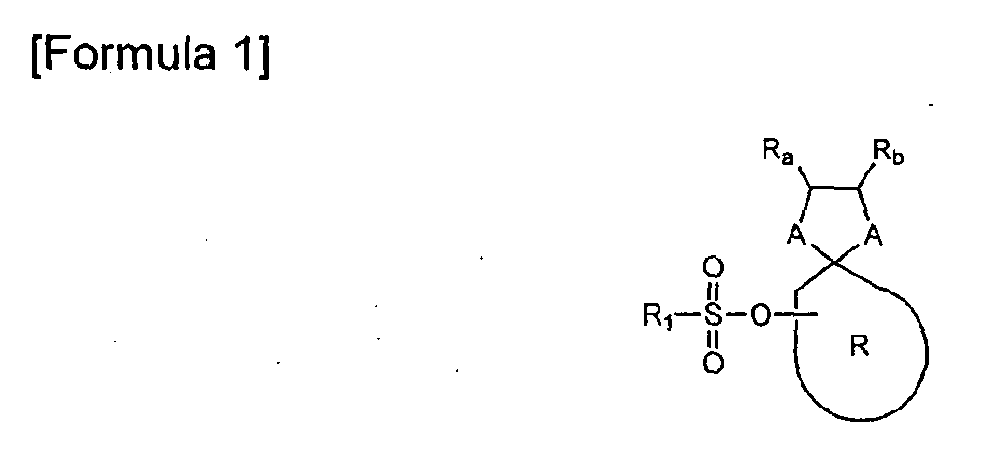
- the present invention provides an acid-amplifier having a structure of Formula 1 and generating a second acid from an acid which is produced from a PAG by an exposure to light.
- R is C 4 ⁇ C 20 mono-cyclic or multi-cyclic saturated hydrocarbon
- R 1 is C 1 ⁇ C 10 linear hydrocarbon, C 1 ⁇ C 10 perfluoro compound, or C 5 ⁇ C 20 aromatic compound.
- R a and R b are independently hydrogen atom or C 1 ⁇ C 4 saturated hydrocarbon and A is independently oxygen atom (O) or sulfur atom (S).
- the present invention also provides a photoresist composition
- a photoresist composition comprising 0.01-5 weight% of an acid-amplifier having a structure of the above Formula 1, 3 ⁇ 10 weight % of photo-sensitive polymer, 0.05 ⁇ 10 weight part of a PAG with respect to 100 weight part of the photo-sensitive polymer and a remaining organic solvent.
- the new acid-amplifier according to the present invention as a compound capable of producing a second acid which is induced from an acid generated at an exposure to light, contains acetal or thioacetal structure in the molecule thereof.
- the new acid-amplifier has a structure of following Formula 1.
- R is C 4 ⁇ C 20 mono-cyclic or multi-cyclic saturated hydrocarbon
- R 1 is C 1 ⁇ C 10 linear hydrocarbon, C 1 ⁇ C 10 perfluoro compound, or C 5 ⁇ C 20 aromatic compound.
- R a and R b are independently hydrogen atom or C 1 ⁇ C 4 saturated hydrocarbon and A is independently oxygen atom (O) or sulfur atom (S).
- the examples of the linear hydrocarbon used as R 1 includes methyl group, ethyl group, propyl group, isopropyl group, tert-butyl group, n-butyl group and hexyl group, etc.
- perfluoro compound used as R 1 includes perfluoromethyl group, perfluoroethyl group, perfluoropropyl group, perfluorobutyl group and perfluorohexyl group, etc.
- aromatic compound used as R 1 includes benzene group, toluene group and tert-butyl benzene group, etc.
- R, R 1 , R a and R b may be substituted with C 1 ⁇ C 4 alkyl group or halogen atom or may not be substituted.
- an intermediate represented by Formula 4 is prepared by reacting hydroxy ketone compound of Formula 2 with a compound of Formula 3 having two alcohol groups or thio alcohol groups, as shown in following Reaction 1.
- R, R a , R b and A are the same as defined in Formula 1.
- the reaction of Reaction 1 is carried out at room temperature and atmospheric pressure.
- the reaction product is washed with water several times to remove a by-product and then re-crystallized with acetone so that intermediate of Formula 4 is prepared.
- the examples of hydroxy ketone compound represented Formula 2 include The examples of compound represented by Formula 3 include
- Reaction 2 the intermediate represented by Formula 4 and sulfonyl halide represented by Formula 5 are reacted to prepare the acid-amplifier of Formula 1.
- the reaction of Reaction 2 is carried out at room temperature and atmospheric pressure.
- the reaction product is washed with water several times to remove a by-product and then re-crystallized with hexane, etc so that the acid-amplifier of Formula 1 is prepared.
- R, R 1 , R a , R b and A are the same as defined in Formula 1, X represents halogen atom, preferably chloride atom or bromine atom, and sulfonyl halide represented by Formula 5 includes etc.
- the acid-amplifier according to the present invention generates an acid (second acid) during a post-exposure-bake (PEB), which is induced by an acid (first acid) generated from a photo-acid generator (PAG) at the exposure process. Therefore the LER of the photoresist pattern and photoresist energy sensitivity are improved.
- PEB post-exposure-bake
- PAG photo-acid generator
- a photoresist composition according to the present invention includes the acid-amplifier represented by Formula 1, a photo-sensitive polymer, a PAG and an organic solvent. And if needed, the photoresist composition further includes a base compound as a quencher and a surfactant.
- An amount of the acid-amplifier represented by Formula 1 is 0.01 ⁇ 5 weight%, preferably 0.5 ⁇ 2 weight% and an amount of the photo-sensitive polymer is 3 ⁇ 10 weight%, preferably 3 ⁇ 5 weight%.
- Preferable amount of the PAG is 0.05 ⁇ 10 weight part with respect to 100 weight part of the photo-sensitive polymer and the rest component of the photoresist composition is the organic solvent. If the base compound is used, the amount thereof is 0.01 ⁇ 10 weight%, preferably 0.01 ⁇ 2 weight%, with respect to the total photoresist composition.
- the amount of the acid-amplifier is too little, amount of second acid generated is little so that the improvement of the LER is slight. If the amount of the acid-amplifier is too much, excess amount of the second acid is generated to let pattern profile uneven and adhesive strength against the contact be weakened. Therefore, the pattern cannot be easily formed. If the amount of the photo-sensitive polymer is too little, it is difficult to form the resist film with a desired thickness. If the amount of the photo-sensitive polymer is too much, thickness of patterns on the wafer is not uniform. Also, if the amount of the base compound is too little, it is not easy to control a diffusion of the acid generated in an exposure process so that the pattern profile is uneven.
- the amount of the base compound is too much, the diffusion of the acid generated is suppressed so that pattern is not easily formed. Further, If the amount of the PAG is too little, the light sensitivity of the photoresist composition may decrease. If the amount of the PAG is too much, the profile of the resist patterns may be deteriorated because the PAG absorbs a lot of ultraviolet rays and a large quantity of acid is produced from the PAG.
- any conventional photo-sensitive polymer for the photoresist which reacts with an acid to vary solubility to a developer, can be used.
- the photo-sensitive polymer which has a protecting group sensitive to an acid and then is separated by the acid, can be preferably used.
- the photo-sensitive polymer may be block copolymer or random copolymer, and the weight-average molecular weight (Mw) of the photo-sensitive polymer is preferably 3,000 ⁇ 20,000.
- Mw weight-average molecular weight
- any conventional PAG which can generate an acid when exposed to light, can be used.
- the non-limiting examples of the PAG include onium salts, for example sulfonium salts or iodonium salts.
- the PAG is selected from a group consisting of phthalimidotrifluoromethane sulfonate, dinitrobenzyltosylate, n-decyl disulfone and naphthylimido trifluoromethane sulfonate.
- the PAG is selected from the group consisting of diphenyl iodonium triflate, diphenyl iodonium nonaflate, diphenyl iodonium hexafluorophosphate, diphenyl iodonium hexafluoroarsenate, diphenyl iodonium hexafluoroantimonate, diphenyl p-methoxyphenyl sulfonium triflate, diphenyl p-toluenyl sulfonium triflate, diphenyl p-tert-butylphenyl sulfonium triflate, diphenyl p-isobutylphenyl sulfonium triflate, triphenylsulfonium triflate, tris(p-tert-butylphenyl) sulfonium triflate, diphenyl p-methoxyphenyl sulfonium nona
- organic solvent examples include, but are not limited to, ethyleneglycol monomethylethyl, ethyleneglycol monoethylether, ethyleneglycol monomethylether, ethyleneglycol monoacetate, diethyleneglycol, diethyleneglycol monoethylether, propyleneglycol monomethyletheracetate(PGMEA), propyleneglycol, propyleneglycol, monoacetate, toluene, xylene, methylethylketone, methyl isoamyl ketone, cyclohexanone, dioxane, methyl lactate, ethyl lactate, methyl pyruvate, ethyl pyruvate, methyl methoxy propionate, ethyl ethoxy propionate, N,N-dimethylformamide, N,N-dimethylace
- the surfactant is added in the present photoresist composition so as to improve a mixing uniformity of the photoresist composition, coating property of the photoresist composition and developing property of the photoresist film after the exposure to light.
- any conventional surfactant which can be used in the photoresist composition, can be used.
- examples of such surfactants include fluorine-based surfactant or fluorine-silicon-based surfactant.
- the amount of the surfactant is 0.001 ⁇ 2 weight part, preferably 0.01 ⁇ 1 weight part with respect to solid content 100 weight part of the photoresist composition. If the amount of the surfactant is too little, function of the surfactant does not sufficiently work and if the amount of the surfactant is too much, the resist property such as shape stability or a storage stability of the composition except for the coating property, may be adversely affected.
- the photoresist composition is applied or coated on a substrate such as silicon wafer, an aluminum substrate, and so on, for example, with a spin coater to form a photoresist layer.
- the photoresist layer is exposed to a light of a predetermined pattern.
- the photoresist pattern is thermally treated(heated), which is called as PEB (Post Exposure Bake), and is developed to form the photoresist pattern.
- PEB Post Exposure Bake
- an alkali aqueous solution including an alkali compound such as sodium hydroxide, potassium hydroxide, sodium carbonate, tetramethylammonium hydroxide (TMAH) of the concentration of 0.1 to 10 weight% can be used.
- the developing solution may further include water-soluble organic solvent such as methanol, ethanol and a surfactant of a proper amount.
- Hydroxy ketone compound of Formula 2 and compound of Formula 3 having two alcohol groups or thio alcohol groups as shown in following Table 1 were added to a reactor, and then 100ml of tetrahydrofuran (THF) of solvent was added to the reactor to dissolve the reactants. Then the dissolved reactant was stirred while maintaining at room temperature. 3.4g of p-toluene sulfonyl acid (PTSA) was dropped to the stirred reactant. After completing the dropping of PTSA, the temperature of the reactor was regulated at 60°C and the contents in the reactor was stirred for 12 hours. After completing the stirring, 200ml of de-inoized water was poured to the reactor.
- THF tetrahydrofuran
- the acid-amplifier compound prepared in each of Examples 2-1 to 2-9 as shown in following Table 3, 2.0g of a photo-sensitive polymer represented by Formula 6 (weight-average molecular weight (Mw): 8,500, PD(polydispersity) 1.81), 0.08g of triphenyl sulfonium triflate, 0.02g of triethanolamine and 0.01 g of R08 (fat-soluble surfactant manufactured by Dainippon Ink & Chemicals (DIC), INC.) were mixed in 20g of PGMEA as an organic solvent. Then filtering was performed to prepare the photoresist composition in each of Examples 3-1 to 3-9. Also, photoresist composition in Comparative Example 1 was prepared by using same elements in the Examples 3-1 to 3-9 except for the acid-amplifier compound.
- 0.08g of triphenyl sulfonium triflate 0.02g of triethanolamine
- a, b and c are molar ratio of respective repeating unit and 40%, 35% and 25%, respectively.
- the respective photoresist composition of Examples 3-1 to 3-9 and Comparative Example 1 were applied on a wafer to form photoresist layer.
- the photoresist layer was pre-baked at 130°C for 90 seconds and then was exposed to ArF excimer laser with 0.60 of numerical aperture.
- PEB Post Exposure Baking
- the photoresist layer was developed for 30 seconds to form 0.14 ⁇ m of line-and-space pattern (1:1).
- 2.38 weight% of tetramethylammonium hydroxide (TMAH) was used as the developing solution.
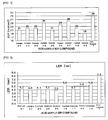
- the minimum resolution, focus margin (depth of focus), optimum level of exposure energy (sensitivity EOP) and LER (line edge roughness) of the pattern formed were measured and the results are shown in following Table 3, Fig. 1 and Fig. 2 .
- the optimum level of exposure energy (sensitivity EOP) means the exposure amount when the pattern formed is 0.14 ⁇ m of line-and-space pattern (1:1).
- the depth of focus margin is defined as the depth of the resist pattern to which exposure light is reached, wherein the size of the resist pattern is 0.14 ⁇ m ⁇ 10%.
- Example Acid-amplifier compound Amount Minimum Focus EOP LER used (g) resolution [ ⁇ m] depth [ ⁇ m] [mJ/cm 2 ] [nm]
- Example 3-1 Formula 1a 0.024 0.060 0.45 21 4.2
- Example 3-2 Formula 1b 0.022 0.065 0.40 22 4.0
- Example 3-3 Formula 1c 0.028 0.060 0.35 22 4.1
- Example 3-4 Formula 1d 0.024 0.065 0.50 25 4.2
- Example 3-5 Formula 1e 0.025 0.065 0.45 21 3.8
- Example 3-6 Formula 1f 0.027 0.060 0.40 24 5.4
- Example 3-7 Formula 1g 0.033 0.065 0.40 26 4.1
- Example 3-8 Formula 1h 0.026 0.060 0.45 22 5.0
- Example 3-9 Formula 1i 0.029 0.060 0.40 19 5.4 Comparative Example 1 - - 0.065 0.35 29 7.8
- the photoresist composition including acid-amplifier compound according to the present invention further improves the LER, process speed in the photolithography and focus margin in comparison with the photoresist composition without acid-amplifier compound. Also, 50nm line-and-space pattern can be successfully formed by using photoresist composition prepared in Examples 3-1 to 3-9 and EUV exposure instrument.
- the acid-amplifier and the photoresist composition according to the present invention improves a focus margin of process as well as the LER of the photoresist pattern and the photoresist energy sensitivity, thereby forming a fine photoresist pattern.
Landscapes
- Physics & Mathematics (AREA)
- Chemical & Material Sciences (AREA)
- Organic Chemistry (AREA)
- Spectroscopy & Molecular Physics (AREA)
- General Physics & Mathematics (AREA)
- Materials For Photolithography (AREA)
- Exposure And Positioning Against Photoresist Photosensitive Materials (AREA)
- Heterocyclic Compounds That Contain Two Or More Ring Oxygen Atoms (AREA)
- Heterocyclic Compounds Containing Sulfur Atoms (AREA)
- Organic Low-Molecular-Weight Compounds And Preparation Thereof (AREA)
Abstract
Description
- This application claims the priority benefit of Korean Patent Application No.
10-2007-0073117 filed on July 20, 2007 - This invention relates to an acid-amplifier and a photoresist composition including the same, and more specifically to an acid-amplifier having an acetal group and a photoresist composition including the same. The acid-amplifier contained in the photoresist composition according to the present invention produces an acid (second acid) during a post-exposure-bake (PEB), which is induced by an acid (first acid) generated from a photo-acid generator (PAG) at the exposure process. Therefore a line edge roughness (LER) of the photoresist pattern and photoresist energy sensitivity could be improved.
- The photolithography is a process used to form a circuit pattern of a semiconductor chip or a display element from a semiconductor wafer or a glass for the display element. The photoresist composition is the most essential materials to the photolithography process. So, recently, as the patterns for semiconductor devices and the display elements are finer, the need for the photoresist composition having high resolution is more increased.
- Conventional acid-amplified photoresist composition includes a polymer resin, a PAG, an organic solvent and if needed, a base compound. Since the conventional photoresist composition includes the polymer resin as a main component, it has excellent mechanical properties such as processiblity, coating stability and etching resistance and can be easily removed after the succeeding process including an etching process, an ion implantation process etc. In the photoresist composition, the PAG having good energy sensitivity to an exposure light enables the fine pattern of the photoresist. However, with only the conventional PAG, the photoresist energy sensitivity cannot be sufficiently increased. Accordingly, the LER of the photoresist pattern formed is still not satisfactory.
- Therefore, it is an object of the present invention to provide an acid-amplifier which improves the LER of a photoresist pattern and photoresist energy sensitivity, and a photoresist composition including the same.
- It is another object of the present invention to provide an acid-amplifier which improves a focus margin of process and is useful for a formation of fine photoresist pattern, and a photoresist composition including the same.
- To accomplish these objects, the present invention provides an acid-amplifier having a structure of Formula 1 and generating a second acid from an acid which is produced from a PAG by an exposure to light.


- In Formula 1, R is C4∼C20 mono-cyclic or multi-cyclic saturated hydrocarbon, R1 is C1∼C10 linear hydrocarbon, C1∼C10 perfluoro compound, or C5∼C20 aromatic compound. Ra and Rb are independently hydrogen atom or C1∼C4 saturated hydrocarbon and A is independently oxygen atom (O) or sulfur atom (S).
- The present invention also provides a photoresist composition comprising 0.01-5 weight% of an acid-amplifier having a structure of the above Formula 1, 3∼10 weight % of photo-sensitive polymer, 0.05∼10 weight part of a PAG with respect to 100 weight part of the photo-sensitive polymer and a remaining organic solvent.
-
-
Fig. 1 shows a bar graph illustrating EOP (mJ/cm2) of the photoresist patterns formed by using photoresist compositions obtained from Examples and a Comparative Example of the present invention. -
Fig. 2 is a bar graph illustrating LER of the photoresist patterns formed by using photoresist compositions obtained from Examples and a Comparative Example of the present invention. - A more complete appreciation of the invention, and many of the attendant advantages thereof, will be better appreciated by reference to the following detailed description.
- The new acid-amplifier according to the present invention, as a compound capable of producing a second acid which is induced from an acid generated at an exposure to light, contains acetal or thioacetal structure in the molecule thereof. In detail, the new acid-amplifier has a structure of following Formula 1.

- In Formula 1, R is C4∼C20 mono-cyclic or multi-cyclic saturated hydrocarbon, R1 is C1∼C10 linear hydrocarbon, C1∼C10 perfluoro compound, or C5∼C20 aromatic compound. Ra and Rb are independently hydrogen atom or C1∼C4 saturated hydrocarbon and A is independently oxygen atom (O) or sulfur atom (S). The examples of the linear hydrocarbon used as R1 includes methyl group, ethyl group, propyl group, isopropyl group, tert-butyl group, n-butyl group and hexyl group, etc. The examples of perfluoro compound used as R1 includes perfluoromethyl group, perfluoroethyl group, perfluoropropyl group, perfluorobutyl group and perfluorohexyl group, etc. The examples of aromatic compound used as R1 includes benzene group, toluene group and tert-butyl benzene group, etc. Also, R, R1, Ra and Rb may be substituted with C1∼C4 alkyl group or halogen atom or may not be substituted.
- The representative examples of the acid-amplifier represented by Formula 1 are as follows.


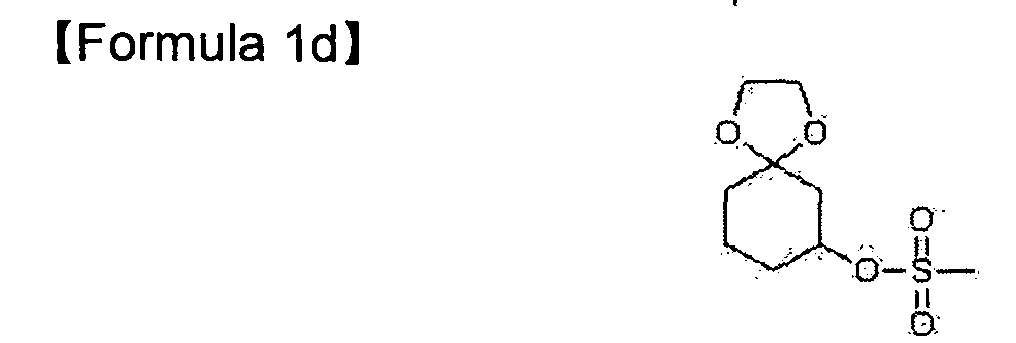


- For manufacturing the acid-amplifier of Formula 1, firstly, an intermediate represented by Formula 4 is prepared by reacting hydroxy ketone compound of Formula 2 with a compound of Formula 3 having two alcohol groups or thio alcohol groups, as shown in following Reaction 1.

- In Reaction 1, R, Ra, Rb and A are the same as defined in Formula 1. The reaction of Reaction 1 is carried out at room temperature and atmospheric pressure. The reaction product is washed with water several times to remove a by-product and then re-crystallized with acetone so that intermediate of Formula 4 is prepared.
- The examples of hydroxy ketone compound represented Formula 2 include


include
- The examples of intermediates represented by Formula 4 include


- Next, as shown in following Reaction 2, the intermediate represented by Formula 4 and sulfonyl halide represented by Formula 5 are reacted to prepare the acid-amplifier of Formula 1. The reaction of Reaction 2 is carried out at room temperature and atmospheric pressure. The reaction product is washed with water several times to remove a by-product and then re-crystallized with hexane, etc so that the acid-amplifier of Formula 1 is prepared.

- In Reaction 2, R, R1, Ra, Rb and A are the same as defined in Formula 1, X represents halogen atom, preferably chloride atom or bromine atom, and sulfonyl halide
represented by Formula 5 includes

- The acid-amplifier according to the present invention generates an acid (second acid) during a post-exposure-bake (PEB), which is induced by an acid (first acid) generated from a photo-acid generator (PAG) at the exposure process. Therefore the LER of the photoresist pattern and photoresist energy sensitivity are improved.
- A photoresist composition according to the present invention includes the acid-amplifier represented by Formula 1, a photo-sensitive polymer, a PAG and an organic solvent. And if needed, the photoresist composition further includes a base compound as a quencher and a surfactant. An amount of the acid-amplifier represented by Formula 1 is 0.01∼ 5 weight%, preferably 0.5 ∼2 weight% and an amount of the photo-sensitive polymer is 3∼ 10 weight%, preferably 3∼5 weight%. Preferable amount of the PAG is 0.05∼10 weight part with respect to 100 weight part of the photo-sensitive polymer and the rest component of the photoresist composition is the organic solvent. If the base compound is used, the amount thereof is 0.01∼10 weight%, preferably 0.01∼2 weight%, with respect to the total photoresist composition.
- If the amount of the acid-amplifier is too little, amount of second acid generated is little so that the improvement of the LER is slight. If the amount of the acid-amplifier is too much, excess amount of the second acid is generated to let pattern profile uneven and adhesive strength against the contact be weakened. Therefore, the pattern cannot be easily formed. If the amount of the photo-sensitive polymer is too little, it is difficult to form the resist film with a desired thickness. If the amount of the photo-sensitive polymer is too much, thickness of patterns on the wafer is not uniform. Also, if the amount of the base compound is too little, it is not easy to control a diffusion of the acid generated in an exposure process so that the pattern profile is uneven. If the amount of the base compound is too much, the diffusion of the acid generated is suppressed so that pattern is not easily formed. Further, If the amount of the PAG is too little, the light sensitivity of the photoresist composition may decrease. If the amount of the PAG is too much, the profile of the resist patterns may be deteriorated because the PAG absorbs a lot of ultraviolet rays and a large quantity of acid is produced from the PAG.
- As the photo-sensitive polymer, any conventional photo-sensitive polymer for the photoresist, which reacts with an acid to vary solubility to a developer, can be used. The photo-sensitive polymer, which has a protecting group sensitive to an acid and then is separated by the acid, can be preferably used. The photo-sensitive polymer may be block copolymer or random copolymer, and the weight-average molecular weight (Mw) of the photo-sensitive polymer is preferably 3,000∼20,000. As the PAG, any conventional PAG, which can generate an acid when exposed to light, can be used. The non-limiting examples of the PAG include onium salts, for example sulfonium salts or iodonium salts. Specifically, the PAG is selected from a group consisting of phthalimidotrifluoromethane sulfonate, dinitrobenzyltosylate, n-decyl disulfone and naphthylimido trifluoromethane sulfonate. Also, the PAG is selected from the group consisting of diphenyl iodonium triflate, diphenyl iodonium nonaflate, diphenyl iodonium hexafluorophosphate, diphenyl iodonium hexafluoroarsenate, diphenyl iodonium hexafluoroantimonate, diphenyl p-methoxyphenyl sulfonium triflate, diphenyl p-toluenyl sulfonium triflate, diphenyl p-tert-butylphenyl sulfonium triflate, diphenyl p-isobutylphenyl sulfonium triflate, triphenylsulfonium triflate, tris(p-tert-butylphenyl) sulfonium triflate, diphenyl p-methoxyphenyl sulfonium nonaflate, diphenyl p-toluenyl sulfonium nonaflate, diphenyl p-tert-butylphenyl sulfonium nonaflate, diphenyl p-isobutylphenyl sulfonium nonaflate, triphenylsulfonium nonaflate, tris(p-tert-butylphenyl) sulfonium nonaflate, triphenylsulfonium hexafluoroarsenate, triphenylsulfonium hexafluoroantimonate, triphenylsulfonium triflate and dibutylnaphthylsulfonium triflate.
- The conventional various organic solvents for the photoresist composition can be used as the organic solvent of the photoresist composition of the present invention. Exemplary organic solvent include, but are not limited to, ethyleneglycol monomethylethyl, ethyleneglycol monoethylether, ethyleneglycol monomethylether, ethyleneglycol monoacetate, diethyleneglycol, diethyleneglycol monoethylether, propyleneglycol monomethyletheracetate(PGMEA), propyleneglycol, propyleneglycol, monoacetate, toluene, xylene, methylethylketone, methyl isoamyl ketone, cyclohexanone, dioxane, methyl lactate, ethyl lactate, methyl pyruvate, ethyl pyruvate, methyl methoxy propionate, ethyl ethoxy propionate, N,N-dimethylformamide, N,N-dimethylacetamide, N-methyl 2-pyrrolidone, 3-ethoxy ethyl propionate, 2-heptanone, γ-butyrolactone, ethyl 2-hydroxy propionate, ethyl 2-hydroxy-2-methyl propionate, ethoxyethyl acetate, hydroxyethyl acetate, methyl 2-hydroxy-3-methylbutanoate, methyl 3-methoxy-2-methylpropionate, ethyl 3-ethoxy propionate, ethyl 3-methoxy-2-methyl propionate, ethyl acetate, butyl acetate, and the mixtures thereof. The base compound as the quencher includes tri-ethylamine, tri-iso-butylamine, tri-iso-octylamine, diethanolamine, tri-ethanolamine and mixture thereof.
- The surfactant, at need, is added in the present photoresist composition so as to improve a mixing uniformity of the photoresist composition, coating property of the photoresist composition and developing property of the photoresist film after the exposure to light. As the surfactant, any conventional surfactant, which can be used in the photoresist composition, can be used. Examples of such surfactants include fluorine-based surfactant or fluorine-silicon-based surfactant. The amount of the surfactant is 0.001∼2 weight part, preferably 0.01∼1 weight part with respect to solid content 100 weight part of the photoresist composition. If the amount of the surfactant is too little, function of the surfactant does not sufficiently work and if the amount of the surfactant is too much, the resist property such as shape stability or a storage stability of the composition except for the coating property, may be adversely affected.
- In order to form a photoresist pattern with the photoresist composition according to the present invention, the following conventional photolithography process can be carried out. First, the photoresist composition is applied or coated on a substrate such as silicon wafer, an aluminum substrate, and so on, for example, with a spin coater to form a photoresist layer. The photoresist layer is exposed to a light of a predetermined pattern. After the exposure, if necessary, the photoresist pattern is thermally treated(heated), which is called as PEB (Post Exposure Bake), and is developed to form the photoresist pattern. As the developing solution for the developing process, an alkali aqueous solution including an alkali compound such as sodium hydroxide, potassium hydroxide, sodium carbonate, tetramethylammonium hydroxide (TMAH) of the concentration of 0.1 to 10 weight% can be used. If necessary, the developing solution may further include water-soluble organic solvent such as methanol, ethanol and a surfactant of a proper amount.
- Hereinafter, the preferable examples are provided for better understanding of the present invention. However, the present invention is not limited to the following examples.
- Hydroxy ketone compound of Formula 2 and compound of Formula 3 having two alcohol groups or thio alcohol groups as shown in following Table 1 were added to a reactor, and then 100ml of tetrahydrofuran (THF) of solvent was added to the reactor to dissolve the reactants. Then the dissolved reactant was stirred while maintaining at room temperature. 3.4g of p-toluene sulfonyl acid (PTSA) was dropped to the stirred reactant. After completing the dropping of PTSA, the temperature of the reactor was regulated at 60°C and the contents in the reactor was stirred for 12 hours. After completing the stirring, 200ml of de-inoized water was poured to the reactor. Then the reaction product was extracted with 300ml of dimethylchloride three times. The organic solution obtained from the above reaction was dried with anhydrous magnesium sulfate and distilled under the reduced pressure. The compound obtained by the distillation was re-crystallized with acetone to prepare target compounds (Formula 4a to 4f) with yield as shown in following Table 1.
[Table 1] Formula 2 Amount used Formula 3 Amount used Synthetic product Amount synthesized Yield Example 1-1 Formula 2a 22.8g Formula 3a 12.4g Formula 4a 27.2g 86% (0.2mol) (0.2mol) Example 1-2 Formula 2b 20.0g Formula 3a 12.4g Formula 4b 26.0g 90% (0.2mol) (0.2mol) Example 1-3 Formula 2c 30.8g Formula 3a 12.4g Formula 4c 33.3g 84% (0.2mol) (0.2mol) Example 1-4 Formula 2d 22.8g Formula 3a 12.4g Formula 4d 27.8g 88% (0.2mol) (0.2mol) Example 1-5 Formula 2a 22.8g Formula 3b 15.2g Formula 4e 31.7g 92% (0.2mol) (0.2mol) Example 1-6 Formula 2a 22.8g Formula 3c 18.8g Formula 4f 28.9g 76% (0.2mol) (0.2mol) - An intermediate of Formula 4 obtained in each of Examples 1-1 to 1-6 as shown in following Table 2 and 21.2g(0.21mol) of tri-ethylamine were added to a reactor, and then 100ml of THF as the solvent was further added to the reactor to dissolve the reactants. Then the dissolved reactant was stirred while maintaining at 0°C. Here, solution which was made by dissolving sulfonyl hydride represented by Formula 5 shown in following Table 2 in 500ml of THF, was slowly dropped with a dropping funnel to the reactor. After the dropping the sulfonyl hydride, the contents in the reactor was stirred for 6 hours while temperature of the reactor was regulated to room temperature. After the stirring, the reaction solution stirred was filtered to remove salts produced therefrom and 200ml of de-ionized water was poured to the reactor. Then the reaction product was extracted with 300ml of dimethylchloride three times. The organic solution obtained from the above reaction was dried with anhydrous magnesium sulfate and distilled under the reduced pressure. The compound obtained by the distillation was re-crystallized with hexane to prepare target compounds (Formula 1 a to 1 i) with yield as shown in following Table 2.
[Table 2] Formula 3 Amount used Formula 5 Amount used Synthetic product Amount synthesized Yield Example Formula 4a 15..8g Formula 5a 12.0g Formula 1 a 18.6g 75% 2-1 (0.1mol) (0.105mol) Example 2-2 Formula 4b 14.4g Formula 5a 12.0g Formula 1b 18.9g 81% (0.1mol) (0.105mol) Example 2-3 Formula 4c 19.8g Formula 5a 12.0g Formula 1c 22.1g 76% (0.1mol) (0.105mol) Example 2-4 Formula 4d 15.8g Formula 5a 12.0g Formula 1d 19.6g 79% (0.1mol) (0.105mol) Example 2-5 Formula 4e 17.2g Formula 5a 12.0g Formula 1e 20.8g 79% (0.1mol) (0.105mol) Example 2-6 Formula 4f 19.0g Formula 5a 12.0g Formula 1f 23.4g 83% (0.1mol) (0.105mol) Example 2-7 Formula 4a 15.8g Formula 5b 20.0g Formula 1g 31.6g 92% (0.1mol) (0.105mol) Example 2-8 Formula 4a 15.8g Formula 5c 15.0g Formula 1h 23.9g 86% (0.1mol) (0.105mol) Example 2-9 Formula 4a 15.8g Formula 5d 17.7g Formula 1i 21.6g 71% (0.1mol) (0.105mol) - 1H-NMR data of the compounds obtained at these examples are as follows.
- 1H-NMR(CDCl 3 , internal standard) of the compound represented by Formula 1a: δ(ppm) 4.52(CH, 1 H), 3.78(CH2, 4H), 2.91 (CH3, 3H), 1.73(CH2, 2H), 1.56(CH2, 2H), 1.45(CH2, 2H), 1.36(CH2, 2H).
- 1H-NMR(CDCl 3 , internal standard) of the compound represented by Formula 1b: δ(ppm) 4.53(CH, 1 H), 3.77(CH2, 4H), 2.89(CH3, 3H), 1.73(CH2, 2H), 1.66(CH2, 2H), 1.49(CH2, 2H).
- 1H-NMR(CDCl 3 , internal standard) of the compound represented by Formula 1c: δ(ppm) 4.33(CH, 1 H), 3.78(CH2, 4H), 2.91(CH3, 3H), 2.01(CH, 1 H), 1.56(CH2, 2H), 1.47(CH, 1 H), 1.39(CH2, 2H), 1.09(CH3, 6H).
- 1H-NMR(CDCl 3 , internal standard) of the compound represented by Formula 1d: δ(ppm) 4.41(CH, 1 H), 3.77(CH2, 4H), 2.90(CH3, 3H), 1.86(CH2, 2H), 1.73(CH2, 2H), 1.56(CH2, 2H), 1.45(CH2, 2H).
- 1H-NMR(CDCl 3 , internal standard) of the compound represented by Formula 1e: δ(ppm) 4.50(CH, 1 H), 4.01(CH2, 1 H), 3.86(CH2, 2H), 2.91(CH3, 3H), 1.72(CH2, 2H), 1.56(CH2, 2H), 1.45(CH2, 2H), 1.36(CH2, 2H), 1.12(CH3, 3H).
- 1H-NMR(CDCl 3 , internal standard) of the compound represented by Formula 1f: δ(ppm) 4.53(CH, 1 H), 2.91(CH2, 4H), 2.88(CH3, 3H), 2.25(CH2, 2H), 1.65(CH2, 2H), 1.40(CH2, 2H), 1.32(CH2, 2H).
- 1H-NMR(CDCl 3 , internal standard) of the compound represented by Formula 1g: δ(ppm) 7.82(CH, 2H), 7.31(CH, 2H), 4.46(CH, 1 H), 3.77(CH2, 4H), 2.44(CH3, 3H), 1.75(CH2, 2H), 1.56(CH2, 2H), 1.46(CH2, 2H), 1.35(CH2, 2H).
- 1H-NMR(CDCl 3 , internal standard) of the compound represented by Formula 1 h: δ(ppm) 4.51 (CH, 1 H), 3.79(CH2, 4H), 3.24(CH2, 2H), 1.83(CH2, 2H), 1.72(CH2, 2H), 1.56(CH2, 2H), 1.45(CH2, 2H), 1.36(CH2, 2H), 0.90(CH3, 3H).
- 1H-NMR(CDCl 3 , internal standard) of the compound represented by Formula 1 i: δ(ppm) 4.64(CH, 1 H), 3.80(CH2, 4H), 1.74(CH2, 2H), 1.52(CH2, 2H), 1.44(CH2, 2H), 1.35(CH2, 2H).
- 1H-NMR(CDCl 3 , internal standard) of the compound represented by Formula 4a: δ(ppm) 4.01(CH2, 4H), 3.78(CH, 1 H), 1.65(CH2, 2H), 1.52(CH2, 2H), 1.43(CH2, 2H), 1.34(CH2, 2H).
- 1H-NMR(CDCl 3 , internal standard) of the compound represented by Formula 4b: δ(ppm) 3.99(CH2, 4H), 3.80 (CH, 1H), 1.75(CH2, 2H), 1.66(CH2, 2H), 1.55(CH2, 2H).
- 1H-NMR(CDCl 3 , internal standard) of the compound represented by Formula 4c: δ(ppm) 4.01(CH2, 4H), 3.71(CH, 1H), 2.01(CH, 1 H), 1.54(CH2, 2H), 1.44(CH, 1 H), 1.35(CH2, 2H), 1.08(CH3, 6H).
- 1H-NMR(CDCl 3 , internal standard) of the compound represented by Formula 4d: δ(ppm) 4.00(CH2, 4H), 3.15(CH, 1 H), 1.88(CH2, 2H), 1.62(CH2, 2H), 1.54(CH2, 2H), 1.48(CH2, 2H).
- 1H-NMR(CDCl 3 , internal standard) of the compound represented by Formula 4e: δ(ppm) 4.11 (CH, 1 H), 3.95(CH2, 2H), 3.80(CH, 1 H), 1.64(CH2, 2H), 1.53(CH2, 2H), 1.44(CH2, 2H), 1.34(CH2, 2H), 1.18(CH3, 6H).
- 1H-NMR(CDCl 3 , internal standard) of the compound represented by Formula 4f: δ(ppm) 3.65(CH, 1 H), 2.91(CH2, 4H), 2.25(CH2, 2H), 1.65(CH3, 2H), 1.39(CH2, 2H), 1.34(CH2, 2H).
- The acid-amplifier compound prepared in each of Examples 2-1 to 2-9 as shown in following Table 3, 2.0g of a photo-sensitive polymer represented by Formula 6 (weight-average molecular weight (Mw): 8,500, PD(polydispersity)= 1.81), 0.08g of triphenyl sulfonium triflate, 0.02g of triethanolamine and 0.01 g of R08 (fat-soluble surfactant manufactured by Dainippon Ink & Chemicals (DIC), INC.) were mixed in 20g of PGMEA as an organic solvent. Then filtering was performed to prepare the photoresist composition in each of Examples 3-1 to 3-9. Also, photoresist composition in Comparative Example 1 was prepared by using same elements in the Examples 3-1 to 3-9 except for the acid-amplifier compound.

- In Formula 6, a, b and c are molar ratio of respective repeating unit and 40%, 35% and 25%, respectively.
- The respective photoresist composition of Examples 3-1 to 3-9 and Comparative Example 1 were applied on a wafer to form photoresist layer. The photoresist layer was pre-baked at 130°C for 90 seconds and then was exposed to ArF excimer laser with 0.60 of numerical aperture. Next, PEB(Post Exposure Baking) was performed at 130°C for 90 seconds. After the PEB, the photoresist layer was developed for 30 seconds to form 0.14 µm of line-and-space pattern (1:1). In the developing process, 2.38 weight% of tetramethylammonium hydroxide (TMAH) was used as the developing solution. The minimum resolution, focus margin (depth of focus), optimum level of exposure energy (sensitivity EOP) and LER (line edge roughness) of the pattern formed were measured and the results are shown in following Table 3,
Fig. 1 and Fig. 2 . The optimum level of exposure energy (sensitivity EOP) means the exposure amount when the pattern formed is 0.14 µm of line-and-space pattern (1:1). The depth of focus margin is defined as the depth of the resist pattern to which exposure light is reached, wherein the size of the resist pattern is 0.14µm ± 10%.[Table 3] Example Acid-amplifier compound Amount Minimum Focus EOP LER used (g) resolution [µm] depth [µm] [mJ/cm2] [nm] Example 3-1 Formula 1a 0.024 0.060 0.45 21 4.2 Example 3-2 Formula 1b 0.022 0.065 0.40 22 4.0 Example 3-3 Formula 1c 0.028 0.060 0.35 22 4.1 Example 3-4 Formula 1d 0.024 0.065 0.50 25 4.2 Example 3-5 Formula 1e 0.025 0.065 0.45 21 3.8 Example 3-6 Formula 1f 0.027 0.060 0.40 24 5.4 Example 3-7 Formula 1g 0.033 0.065 0.40 26 4.1 Example 3-8 Formula 1h 0.026 0.060 0.45 22 5.0 Example 3-9 Formula 1i 0.029 0.060 0.40 19 5.4 Comparative Example 1 - - 0.065 0.35 29 7.8 - From Table 3, the photoresist composition including acid-amplifier compound according to the present invention further improves the LER, process speed in the photolithography and focus margin in comparison with the photoresist composition without acid-amplifier compound. Also, 50nm line-and-space pattern can be successfully formed by using photoresist composition prepared in Examples 3-1 to 3-9 and EUV exposure instrument.
- As described above, the acid-amplifier and the photoresist composition according to the present invention improves a focus margin of process as well as the LER of the photoresist pattern and the photoresist energy sensitivity, thereby forming a fine photoresist pattern.
Claims (6)
- An acid-amplifier having a structure of following Formula 1,

and said acid-amplifier producing a second acid which is induced from an acid generated at an exposure to light. - The acid-amplifier of Claim 1, wherein the linear hydrocarbon used as R1 is selected from a group consisting of methyl group, ethyl group, propyl group, isopropyl group, tert-butyl group, n-butyl group and hexyl group, the perfluoro compound used as R1 is selected from a group consisting of perfluoromethyl group, perfluoroethyl group, perfluoropropyl group, perfluorobutyl group and perfluorohexyl group and the aromatic compound used as R1 is selected from a group consisting of benzene group, toluene group and tert-butyl benzene group.
- The acid-amplifier of Claim 1, wherein said acid-amplifier is selected from a
group consisting of


- A photoresist composition comprising:0.01∼5.0 weight% of an acid-amplifier having a structure of following Formula 1;
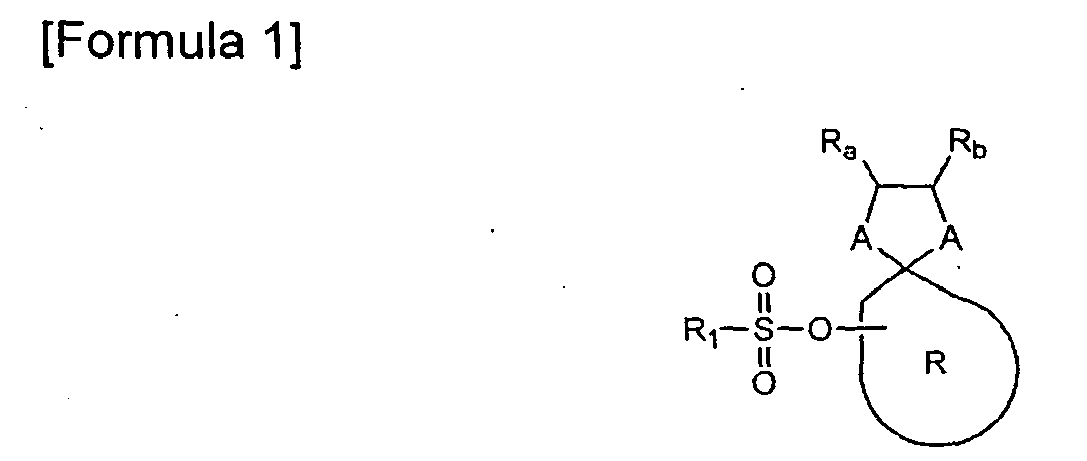 wherein in Formula 1, R is C4∼C20 mono-cyclic or multi-cyclic saturated hydrocarbon, R1 is C1∼C10 linear hydrocarbon, C1∼C10 perfluoro compound, or C5∼C20 aromatic compound, Ra and Rb are independently hydrogen atom or C1∼C4 saturated hydrocarbon and A is independently oxygen atom (O) or sulfur atom (S);3∼10 weight% of a photo-sensitive polymer;0.05∼10 weight part pf a photo-acid generator with respect to 100 weight part of the photo-sensitive polymer; andan organic solvent.
 - The photoresist composition of Claim 4, further comprising 0.01∼10 weight% of a base compound, wherein the base compound is selected from a group of consisting of tri-ethylamine, tri-iso-butylamine, tri-iso-octylamine, diethanolamine, tri-ethanolamine and mixture thereof.
- A method for forming a photoresist pattern, comprising the steps of:a) coating a photoresist composition on a substrate to form a photoresist layer;
wherein the photoresist composition comprises 0.01∼5.0 weight% of an acid-amplifier having a structure of following Formula 1, wherein
3∼10 weight% of a photo-sensitive polymer;
0.05∼10 weight part of a photo-acid generator with the respect to 100 weight part of the photo-sensitive polymer; and
an organic solvent;b) exposing the photoresist layer to a light;c) heating the exposed photoresist layer; andd) developing the heated photoresist layer to form the photoresist pattern.
Applications Claiming Priority (1)
| Application Number | Priority Date | Filing Date | Title |
|---|---|---|---|
| KR1020070073117A KR101357607B1 (en) | 2007-07-20 | 2007-07-20 | Acid-amplifier having acetal group and photoresist composition including the same |
Publications (2)
| Publication Number | Publication Date |
|---|---|
| EP2017274A1 true EP2017274A1 (en) | 2009-01-21 |
| EP2017274B1 EP2017274B1 (en) | 2011-03-30 |
Family
ID=39846591
Family Applications (1)
| Application Number | Title | Priority Date | Filing Date |
|---|---|---|---|
| EP08012774A Not-in-force EP2017274B1 (en) | 2007-07-20 | 2008-07-15 | Acid-amplifier having acetal group, photoresist composition including the same and method for forming a photoresist pattern |
Country Status (7)
| Country | Link |
|---|---|
| US (1) | US7935474B2 (en) |
| EP (1) | EP2017274B1 (en) |
| JP (1) | JP5478851B2 (en) |
| KR (1) | KR101357607B1 (en) |
| AT (1) | ATE503750T1 (en) |
| DE (1) | DE602008005809D1 (en) |
| TW (1) | TWI359330B (en) |
Cited By (1)
| Publication number | Priority date | Publication date | Assignee | Title |
|---|---|---|---|---|
| CN111689941A (en) * | 2020-06-16 | 2020-09-22 | 徐州博康信息化学品有限公司 | Trifluoro sulfonamide 1, 4-dioxospiro [4,5] decane photoresist resin monomer and preparation method thereof |
Families Citing this family (17)
| Publication number | Priority date | Publication date | Assignee | Title |
|---|---|---|---|---|
| WO2008035928A1 (en) * | 2006-09-20 | 2008-03-27 | Lg Chem, Ltd. | Additive for non-aqueous electrolyte and secondary battery using the same |
| WO2010026968A1 (en) * | 2008-09-05 | 2010-03-11 | 住友化学株式会社 | Resist processing method |
| US20140087309A1 (en) * | 2011-04-01 | 2014-03-27 | The Research Foundation Of State University Of New York | Olefin-triggered acid amplifiers |
| US8614047B2 (en) * | 2011-08-26 | 2013-12-24 | International Business Machines Corporation | Photodecomposable bases and photoresist compositions |
| JP6048871B2 (en) * | 2012-09-03 | 2016-12-21 | 学校法人東京理科大学 | Acid proliferating agent and acid-reactive resin composition containing the acid proliferating agent |
| JP6079128B2 (en) * | 2012-10-23 | 2017-02-15 | Jsr株式会社 | Photoresist composition and resist pattern forming method |
| JP6246550B2 (en) * | 2012-11-09 | 2017-12-13 | 住友化学株式会社 | Resist composition and method for producing resist pattern |
| KR20140131609A (en) | 2013-05-02 | 2014-11-14 | 삼성디스플레이 주식회사 | Photosensitive resin composition, method of forming pattern, and liquid crystal display using the same |
| KR102742608B1 (en) | 2022-10-13 | 2024-12-17 | 한인정밀화학(주) | Photoacid generator and photoresist composition comprising the same |
| KR102729062B1 (en) | 2022-12-06 | 2024-11-13 | 한인정밀화학(주) | Photoacid generator and photoresist composition comprising the same |
| KR102728483B1 (en) | 2022-12-06 | 2024-11-11 | 한인정밀화학(주) | Photoacid generator and photoresist composition comprising the same |
| KR102656229B1 (en) | 2023-01-12 | 2024-04-09 | 백용구 | Photoacid generator and photoresist composition comprising the same |
| KR102842834B1 (en) | 2023-03-28 | 2025-08-06 | 주식회사 케미웍스 | Photoacid generator and photoresist composition comprising the same |
| KR102809127B1 (en) | 2023-07-05 | 2025-05-19 | 주식회사 에스티머티리얼즈 | Photoacid generator and photoresist composition comprising the same |
| KR102809121B1 (en) | 2023-07-05 | 2025-05-19 | 주식회사 에스티머티리얼즈 | Photoacid generator and photoresist composition comprising the same |
| KR102874466B1 (en) | 2023-08-23 | 2025-10-22 | 주식회사 에스티머티리얼즈 | Photoacid generator and photoresist composition comprising the same |
| KR20250051275A (en) | 2023-10-10 | 2025-04-17 | (주) 케이앤씨머터리얼스 | Photoacid generator and photoresist composition comprising the same |
Citations (4)
| Publication number | Priority date | Publication date | Assignee | Title |
|---|---|---|---|---|
| US4466977A (en) * | 1981-04-09 | 1984-08-21 | The Upjohn Company | N-[2-Amino(oxy- or thia- group-substituted-cycloaliphatic)]benzeneacetamides and -benzamide analgesics |
| JPH11158118A (en) * | 1997-12-03 | 1999-06-15 | Sumitomo Chem Co Ltd | Acetoacetic acid derivatives, their preparation and use |
| JP2005342913A (en) * | 2004-05-31 | 2005-12-15 | Fuji Photo Film Co Ltd | Original plate of lithographic printing plate, its manufacturing method and lithographic printing method |
| EP1780198A1 (en) * | 2005-10-31 | 2007-05-02 | Shin-Etsu Chemical Co., Ltd. | Novel fluorosulfonyloxyalkyl sulfonate salts and derivatives, photoacid generators, resist compositions, and patterning process |
Family Cites Families (1)
| Publication number | Priority date | Publication date | Assignee | Title |
|---|---|---|---|---|
| US6894084B2 (en) * | 2000-02-15 | 2005-05-17 | Foster-Miller, Inc. | No VOC radiation curable resin compositions |
-
2007
- 2007-07-20 KR KR1020070073117A patent/KR101357607B1/en active Active
-
2008
- 2008-07-15 DE DE602008005809T patent/DE602008005809D1/en active Active
- 2008-07-15 AT AT08012774T patent/ATE503750T1/en not_active IP Right Cessation
- 2008-07-15 EP EP08012774A patent/EP2017274B1/en not_active Not-in-force
- 2008-07-16 TW TW097127010A patent/TWI359330B/en not_active IP Right Cessation
- 2008-07-17 US US12/174,759 patent/US7935474B2/en not_active Expired - Fee Related
- 2008-07-17 JP JP2008185640A patent/JP5478851B2/en not_active Expired - Fee Related
Patent Citations (4)
| Publication number | Priority date | Publication date | Assignee | Title |
|---|---|---|---|---|
| US4466977A (en) * | 1981-04-09 | 1984-08-21 | The Upjohn Company | N-[2-Amino(oxy- or thia- group-substituted-cycloaliphatic)]benzeneacetamides and -benzamide analgesics |
| JPH11158118A (en) * | 1997-12-03 | 1999-06-15 | Sumitomo Chem Co Ltd | Acetoacetic acid derivatives, their preparation and use |
| JP2005342913A (en) * | 2004-05-31 | 2005-12-15 | Fuji Photo Film Co Ltd | Original plate of lithographic printing plate, its manufacturing method and lithographic printing method |
| EP1780198A1 (en) * | 2005-10-31 | 2007-05-02 | Shin-Etsu Chemical Co., Ltd. | Novel fluorosulfonyloxyalkyl sulfonate salts and derivatives, photoacid generators, resist compositions, and patterning process |
Non-Patent Citations (1)
| Title |
|---|
| D. A. CLARK, P. L. FUCHS: "cytochalasinSupport Studies. Macrocycle Synthesis via Enolate-Assisted, Intraannular 1,4-Fragmentation Reactions", JOURNAL OF THE AMERICAN CHEMICAL SOCIETY, vol. 101, no. 13, 18 July 1978 (1978-07-18), pages 3567 - 3576, XP002500745 * |
Cited By (1)
| Publication number | Priority date | Publication date | Assignee | Title |
|---|---|---|---|---|
| CN111689941A (en) * | 2020-06-16 | 2020-09-22 | 徐州博康信息化学品有限公司 | Trifluoro sulfonamide 1, 4-dioxospiro [4,5] decane photoresist resin monomer and preparation method thereof |
Also Published As
| Publication number | Publication date |
|---|---|
| KR101357607B1 (en) | 2014-02-05 |
| KR20090009655A (en) | 2009-01-23 |
| EP2017274B1 (en) | 2011-03-30 |
| JP2009024172A (en) | 2009-02-05 |
| TWI359330B (en) | 2012-03-01 |
| JP5478851B2 (en) | 2014-04-23 |
| US7935474B2 (en) | 2011-05-03 |
| ATE503750T1 (en) | 2011-04-15 |
| TW200914993A (en) | 2009-04-01 |
| US20090023093A1 (en) | 2009-01-22 |
| DE602008005809D1 (en) | 2011-05-12 |
Similar Documents
| Publication | Publication Date | Title |
|---|---|---|
| EP2017274B1 (en) | Acid-amplifier having acetal group, photoresist composition including the same and method for forming a photoresist pattern | |
| KR101399681B1 (en) | Sulfonium salt, resist composition, and patterning process | |
| KR102014600B1 (en) | Sulfonium salt, resist composition, and patterning process | |
| US6395450B1 (en) | Positive working photoresist composition | |
| KR20070096977A (en) | Positive resist composition and pattern formation method using the same | |
| KR20160113022A (en) | Resist composition, method of forming resist pattern, acid generator, and compound | |
| KR20010018077A (en) | Novel photoresist monomer having stability to post exposure delay, polymer thereof and photoresist composition containing it | |
| JPH08160606A (en) | Chemically amplified positive resist material | |
| US8628909B2 (en) | Fluorine-free fused ring heteroaromatic photoacid generators and resist compositions containing the same | |
| JP4516425B2 (en) | Radiosensitive composition | |
| WO2009154114A1 (en) | Method of resist treatment | |
| WO2010004979A1 (en) | Method of resist treatment | |
| WO2010029907A1 (en) | Resist processing method and use of positive resist composition | |
| JP2004334060A (en) | Photoacid generator for chemically amplified resist, resist material containing the same, and pattern forming method | |
| WO2009091704A2 (en) | Aromatic fluorine-free photoacid generators and photoresist compositions containing the same | |
| KR101347284B1 (en) | Photoacid generator and chemically amplified resist composition comprising the same | |
| US7745099B2 (en) | Photosensitive compound and photoresist composition including the same | |
| KR20010045129A (en) | Novel photoresist polymer and photoresist composition containing it | |
| US20090181320A1 (en) | Fluorine-free heteroaromatic photoacid generators and photoresist compositions containing the same | |
| TW201414712A (en) | Photoacid generator and preparing method thereof and resist composition and compound comprising same | |
| US20090068585A1 (en) | Dissolution promoter and photoresist composition including the same | |
| US20030148212A1 (en) | Process for forming an ultra fine pattern using a bottom anti-reflective coating film containing an acid generator | |
| US8124311B2 (en) | Photosensitive molecular compound and photoresist composition including the same | |
| KR100638957B1 (en) | Photoresist Polymer and Photoresist Composition Comprising the Same | |
| KR101287575B1 (en) | Dissolution inhibitor and chemically amplified photoresist composition including the same |
Legal Events
| Date | Code | Title | Description |
|---|---|---|---|
| PUAI | Public reference made under article 153(3) epc to a published international application that has entered the european phase |
Free format text: ORIGINAL CODE: 0009012 |
|
| AK | Designated contracting states |
Kind code of ref document: A1 Designated state(s): AT BE BG CH CY CZ DE DK EE ES FI FR GB GR HR HU IE IS IT LI LT LU LV MC MT NL NO PL PT RO SE SI SK TR |
|
| AX | Request for extension of the european patent |
Extension state: AL BA MK RS |
|
| 17P | Request for examination filed |
Effective date: 20090316 |
|
| 17Q | First examination report despatched |
Effective date: 20090417 |
|
| AKX | Designation fees paid |
Designated state(s): AT BE BG CH CY CZ DE DK EE ES FI FR GB GR HR HU IE IS IT LI LT LU LV MC MT NL NO PL PT RO SE SI SK TR |
|
| RTI1 | Title (correction) |
Free format text: ACID-AMPLIFIER HAVING ACETAL GROUP, PHOTORESIST COMPOSITION INCLUDING THE SAME AND METHOD FOR FORMING A PHOTORESIST PATTERN |
|
| GRAP | Despatch of communication of intention to grant a patent |
Free format text: ORIGINAL CODE: EPIDOSNIGR1 |
|
| GRAS | Grant fee paid |
Free format text: ORIGINAL CODE: EPIDOSNIGR3 |
|
| GRAA | (expected) grant |
Free format text: ORIGINAL CODE: 0009210 |
|
| AK | Designated contracting states |
Kind code of ref document: B1 Designated state(s): AT BE BG CH CY CZ DE DK EE ES FI FR GB GR HR HU IE IS IT LI LT LU LV MC MT NL NO PL PT RO SE SI SK TR |
|
| REG | Reference to a national code |
Ref country code: GB Ref legal event code: FG4D |
|
| REG | Reference to a national code |
Ref country code: CH Ref legal event code: EP |
|
| REG | Reference to a national code |
Ref country code: IE Ref legal event code: FG4D |
|
| REF | Corresponds to: |
Ref document number: 602008005809 Country of ref document: DE Date of ref document: 20110512 Kind code of ref document: P |
|
| REG | Reference to a national code |
Ref country code: DE Ref legal event code: R096 Ref document number: 602008005809 Country of ref document: DE Effective date: 20110512 |
|
| REG | Reference to a national code |
Ref country code: NL Ref legal event code: VDEP Effective date: 20110330 |
|
| PG25 | Lapsed in a contracting state [announced via postgrant information from national office to epo] |
Ref country code: LV Free format text: LAPSE BECAUSE OF FAILURE TO SUBMIT A TRANSLATION OF THE DESCRIPTION OR TO PAY THE FEE WITHIN THE PRESCRIBED TIME-LIMIT Effective date: 20110330 Ref country code: SE Free format text: LAPSE BECAUSE OF FAILURE TO SUBMIT A TRANSLATION OF THE DESCRIPTION OR TO PAY THE FEE WITHIN THE PRESCRIBED TIME-LIMIT Effective date: 20110330 Ref country code: GR Free format text: LAPSE BECAUSE OF FAILURE TO SUBMIT A TRANSLATION OF THE DESCRIPTION OR TO PAY THE FEE WITHIN THE PRESCRIBED TIME-LIMIT Effective date: 20110701 Ref country code: LT Free format text: LAPSE BECAUSE OF FAILURE TO SUBMIT A TRANSLATION OF THE DESCRIPTION OR TO PAY THE FEE WITHIN THE PRESCRIBED TIME-LIMIT Effective date: 20110330 Ref country code: HR Free format text: LAPSE BECAUSE OF FAILURE TO SUBMIT A TRANSLATION OF THE DESCRIPTION OR TO PAY THE FEE WITHIN THE PRESCRIBED TIME-LIMIT Effective date: 20110330 |
|
| LTIE | Lt: invalidation of european patent or patent extension |
Effective date: 20110330 |
|
| PG25 | Lapsed in a contracting state [announced via postgrant information from national office to epo] |
Ref country code: SI Free format text: LAPSE BECAUSE OF FAILURE TO SUBMIT A TRANSLATION OF THE DESCRIPTION OR TO PAY THE FEE WITHIN THE PRESCRIBED TIME-LIMIT Effective date: 20110330 Ref country code: AT Free format text: LAPSE BECAUSE OF FAILURE TO SUBMIT A TRANSLATION OF THE DESCRIPTION OR TO PAY THE FEE WITHIN THE PRESCRIBED TIME-LIMIT Effective date: 20110330 Ref country code: FI Free format text: LAPSE BECAUSE OF FAILURE TO SUBMIT A TRANSLATION OF THE DESCRIPTION OR TO PAY THE FEE WITHIN THE PRESCRIBED TIME-LIMIT Effective date: 20110330 Ref country code: CY Free format text: LAPSE BECAUSE OF FAILURE TO SUBMIT A TRANSLATION OF THE DESCRIPTION OR TO PAY THE FEE WITHIN THE PRESCRIBED TIME-LIMIT Effective date: 20110330 Ref country code: NO Free format text: LAPSE BECAUSE OF FAILURE TO SUBMIT A TRANSLATION OF THE DESCRIPTION OR TO PAY THE FEE WITHIN THE PRESCRIBED TIME-LIMIT Effective date: 20110630 |
|
| PG25 | Lapsed in a contracting state [announced via postgrant information from national office to epo] |
Ref country code: BE Free format text: LAPSE BECAUSE OF FAILURE TO SUBMIT A TRANSLATION OF THE DESCRIPTION OR TO PAY THE FEE WITHIN THE PRESCRIBED TIME-LIMIT Effective date: 20110330 |
|
| PG25 | Lapsed in a contracting state [announced via postgrant information from national office to epo] |
Ref country code: PT Free format text: LAPSE BECAUSE OF FAILURE TO SUBMIT A TRANSLATION OF THE DESCRIPTION OR TO PAY THE FEE WITHIN THE PRESCRIBED TIME-LIMIT Effective date: 20110801 Ref country code: EE Free format text: LAPSE BECAUSE OF FAILURE TO SUBMIT A TRANSLATION OF THE DESCRIPTION OR TO PAY THE FEE WITHIN THE PRESCRIBED TIME-LIMIT Effective date: 20110330 |
|
| PG25 | Lapsed in a contracting state [announced via postgrant information from national office to epo] |
Ref country code: ES Free format text: LAPSE BECAUSE OF FAILURE TO SUBMIT A TRANSLATION OF THE DESCRIPTION OR TO PAY THE FEE WITHIN THE PRESCRIBED TIME-LIMIT Effective date: 20110711 Ref country code: IS Free format text: LAPSE BECAUSE OF FAILURE TO SUBMIT A TRANSLATION OF THE DESCRIPTION OR TO PAY THE FEE WITHIN THE PRESCRIBED TIME-LIMIT Effective date: 20110730 Ref country code: SK Free format text: LAPSE BECAUSE OF FAILURE TO SUBMIT A TRANSLATION OF THE DESCRIPTION OR TO PAY THE FEE WITHIN THE PRESCRIBED TIME-LIMIT Effective date: 20110330 Ref country code: CZ Free format text: LAPSE BECAUSE OF FAILURE TO SUBMIT A TRANSLATION OF THE DESCRIPTION OR TO PAY THE FEE WITHIN THE PRESCRIBED TIME-LIMIT Effective date: 20110330 Ref country code: RO Free format text: LAPSE BECAUSE OF FAILURE TO SUBMIT A TRANSLATION OF THE DESCRIPTION OR TO PAY THE FEE WITHIN THE PRESCRIBED TIME-LIMIT Effective date: 20110330 |
|
| PG25 | Lapsed in a contracting state [announced via postgrant information from national office to epo] |
Ref country code: MT Free format text: LAPSE BECAUSE OF FAILURE TO SUBMIT A TRANSLATION OF THE DESCRIPTION OR TO PAY THE FEE WITHIN THE PRESCRIBED TIME-LIMIT Effective date: 20110330 Ref country code: NL Free format text: LAPSE BECAUSE OF FAILURE TO SUBMIT A TRANSLATION OF THE DESCRIPTION OR TO PAY THE FEE WITHIN THE PRESCRIBED TIME-LIMIT Effective date: 20110330 |
|
| PLBE | No opposition filed within time limit |
Free format text: ORIGINAL CODE: 0009261 |
|
| STAA | Information on the status of an ep patent application or granted ep patent |
Free format text: STATUS: NO OPPOSITION FILED WITHIN TIME LIMIT |
|
| PG25 | Lapsed in a contracting state [announced via postgrant information from national office to epo] |
Ref country code: MC Free format text: LAPSE BECAUSE OF NON-PAYMENT OF DUE FEES Effective date: 20110731 Ref country code: DK Free format text: LAPSE BECAUSE OF FAILURE TO SUBMIT A TRANSLATION OF THE DESCRIPTION OR TO PAY THE FEE WITHIN THE PRESCRIBED TIME-LIMIT Effective date: 20110330 Ref country code: PL Free format text: LAPSE BECAUSE OF FAILURE TO SUBMIT A TRANSLATION OF THE DESCRIPTION OR TO PAY THE FEE WITHIN THE PRESCRIBED TIME-LIMIT Effective date: 20110330 |
|
| 26N | No opposition filed |
Effective date: 20120102 |
|
| REG | Reference to a national code |
Ref country code: FR Ref legal event code: ST Effective date: 20120330 |
|
| REG | Reference to a national code |
Ref country code: IE Ref legal event code: MM4A |
|
| REG | Reference to a national code |
Ref country code: DE Ref legal event code: R097 Ref document number: 602008005809 Country of ref document: DE Effective date: 20120102 |
|
| PG25 | Lapsed in a contracting state [announced via postgrant information from national office to epo] |
Ref country code: FR Free format text: LAPSE BECAUSE OF NON-PAYMENT OF DUE FEES Effective date: 20110801 |
|
| PG25 | Lapsed in a contracting state [announced via postgrant information from national office to epo] |
Ref country code: IT Free format text: LAPSE BECAUSE OF FAILURE TO SUBMIT A TRANSLATION OF THE DESCRIPTION OR TO PAY THE FEE WITHIN THE PRESCRIBED TIME-LIMIT Effective date: 20110330 |
|
| PG25 | Lapsed in a contracting state [announced via postgrant information from national office to epo] |
Ref country code: IE Free format text: LAPSE BECAUSE OF NON-PAYMENT OF DUE FEES Effective date: 20110715 |
|
| PGFP | Annual fee paid to national office [announced via postgrant information from national office to epo] |
Ref country code: DE Payment date: 20120711 Year of fee payment: 5 |
|
| REG | Reference to a national code |
Ref country code: CH Ref legal event code: PL |
|
| GBPC | Gb: european patent ceased through non-payment of renewal fee |
Effective date: 20120715 |
|
| PG25 | Lapsed in a contracting state [announced via postgrant information from national office to epo] |
Ref country code: GB Free format text: LAPSE BECAUSE OF NON-PAYMENT OF DUE FEES Effective date: 20120715 Ref country code: CH Free format text: LAPSE BECAUSE OF NON-PAYMENT OF DUE FEES Effective date: 20120731 Ref country code: LI Free format text: LAPSE BECAUSE OF NON-PAYMENT OF DUE FEES Effective date: 20120731 |
|
| PG25 | Lapsed in a contracting state [announced via postgrant information from national office to epo] |
Ref country code: LU Free format text: LAPSE BECAUSE OF NON-PAYMENT OF DUE FEES Effective date: 20110715 |
|
| PG25 | Lapsed in a contracting state [announced via postgrant information from national office to epo] |
Ref country code: BG Free format text: LAPSE BECAUSE OF FAILURE TO SUBMIT A TRANSLATION OF THE DESCRIPTION OR TO PAY THE FEE WITHIN THE PRESCRIBED TIME-LIMIT Effective date: 20110630 |
|
| PG25 | Lapsed in a contracting state [announced via postgrant information from national office to epo] |
Ref country code: TR Free format text: LAPSE BECAUSE OF FAILURE TO SUBMIT A TRANSLATION OF THE DESCRIPTION OR TO PAY THE FEE WITHIN THE PRESCRIBED TIME-LIMIT Effective date: 20110330 |
|
| PG25 | Lapsed in a contracting state [announced via postgrant information from national office to epo] |
Ref country code: HU Free format text: LAPSE BECAUSE OF FAILURE TO SUBMIT A TRANSLATION OF THE DESCRIPTION OR TO PAY THE FEE WITHIN THE PRESCRIBED TIME-LIMIT Effective date: 20110330 |
|
| REG | Reference to a national code |
Ref country code: DE Ref legal event code: R119 Ref document number: 602008005809 Country of ref document: DE Effective date: 20140201 |
|
| PG25 | Lapsed in a contracting state [announced via postgrant information from national office to epo] |
Ref country code: DE Free format text: LAPSE BECAUSE OF NON-PAYMENT OF DUE FEES Effective date: 20140201 |