EP2015665B1 - A hand washing monitoring system - Google Patents
A hand washing monitoring system Download PDFInfo
- Publication number
- EP2015665B1 EP2015665B1 EP07736107A EP07736107A EP2015665B1 EP 2015665 B1 EP2015665 B1 EP 2015665B1 EP 07736107 A EP07736107 A EP 07736107A EP 07736107 A EP07736107 A EP 07736107A EP 2015665 B1 EP2015665 B1 EP 2015665B1
- Authority
- EP
- European Patent Office
- Prior art keywords
- processor
- monitoring system
- hand
- motion
- skin
- Prior art date
- Legal status (The legal status is an assumption and is not a legal conclusion. Google has not performed a legal analysis and makes no representation as to the accuracy of the status listed.)
- Active
Links
Images



Classifications
-
- G—PHYSICS
- G08—SIGNALLING
- G08B—SIGNALLING SYSTEMS, e.g. PERSONAL CALLING SYSTEMS; ORDER TELEGRAPHS; ALARM SYSTEMS
- G08B21/00—Alarms responsive to a single specified undesired or abnormal condition and not otherwise provided for
- G08B21/18—Status alarms
- G08B21/24—Reminder alarms, e.g. anti-loss alarms
- G08B21/245—Reminder of hygiene compliance policies, e.g. of washing hands
-
- G—PHYSICS
- G06—COMPUTING OR CALCULATING; COUNTING
- G06V—IMAGE OR VIDEO RECOGNITION OR UNDERSTANDING
- G06V40/00—Recognition of biometric, human-related or animal-related patterns in image or video data
- G06V40/20—Movements or behaviour, e.g. gesture recognition
- G06V40/28—Recognition of hand or arm movements, e.g. recognition of deaf sign language
Definitions
- the invention relates to monitoring of hand washing.
- a recommended technique for hand washing consists of the following phases:
- WO03/079278 f describes a system which executes a pattern recognition algorithm with digitized images to generate a pass/fail report for hand washing or disinfectant Application.
- WO2005/093681 describes a cleanliness monitoring system and method involving a fluorescent tracer, a UV irradiation source, and determining the proportion of the hands which are clear of tracer.
- GB2337327 describes pixel-by-pixel analysis of soap on hands
- WO98/36258 also describes an approach involving pixel analysis to detect soap on hands.
- US5952924 describes an RFID badge to trigger measurement of hand washing.
- a motion sensor is used to trigger the device and an alcohol sensor is used to detect if hand washing occurs.
- US6236317 describes an RFID-based tracking system to ensure that people wash their hands when entering and leaving defined zones such as toilets and raw meat counters. IR reflection sensors are used to localise the user in front of the sink.
- US6426701 describes use of audio visual feedback to guide the user through hand washing. Proximity sensors are used to ensure that the user's hands have remained in the sink for 20 seconds.
- the invention is directed towards achieving improved monitoring of hand washing.
- a hand washing monitoring system comprising a camera, a processor, the processor being adapted to receive from the camera images of hand washing activity, characterized in that, the processor is adapted to:
- the processor analyses the images within a region of interest encompassing joined hands.
- the processor generates the indication independently of the order of motion poses.
- the processor extracts information features from the images and generates feature vectors based on the features, including bimanual hand and arm shape vectors, and executes a classifier with the vectors to determine the poses.
- the processor uses edge segmentation to form at least some of the feature vectors.
- the processor uses pixel spatio-temporal measurements to form at least some of the feature vectors.
- the processor decomposes an image into cells and uses each cell to calculate a histogram, and combines the histograms to form a feature vector.
- the processor generates the feature vectors using rules derived from a training phase performed with reference images
- the processor reduces size of the feature vectors.
- the processor reduces feature vector size using Principal Component Analysis.
- the processor uses linear discriminate analysis to reduce feature vector size.
- a self-organising map is generated to represent clustered datasets of a reduced feature vector.
- the processor classifies the feature vectors by executing a multi-class classifier which is trained with exemplar feature vectors to generate an estimate of a hand pose.
- the processor performs the classification using a support vector machine.
- the processor executes an ensemble of support vector machines.
- the processor determines a pose according to votes from different support vector machines.
- the processor filters bimanual hand pose classifications.
- the processor performs said filtering by using probabilistic bimanual hand motion models to remove anomalous results.
- the processor determines a time duration for a pose by registering a count of the number of image frames for a pose.
- the processor assigns a minimum threshold for each pose.
- the processor is calibrated for light level and/or colour changes in an image normalisation process.
- the processor performs segmentation according to colour, texture and/or motion to avoid noise arising from reflections.
- the processor eliminates pixels representing watches or jewellery according to region size and shape analysis.
- the system is battery powered.
- the classifier comprises an ensemble of weak classifiers.
- the processor before feature extraction, detects skin by normalizing pixel colour values to skin and non-skin class bins, and processes bin counts to determine skin probability values.
- the processor executes a lighting compensation filter operating on the basis that the spatial average of surface reflectance in a scene is achromatic.
- the processor performs optical flow calculations based on pixel distance moved and direction of movement, and applies motion data to a filter to eliminate skin false-positive pixels.
- the processor determines increase and decrease factors representing pixel motion increase and decrease, and applies a greater weighting to motion than absence of motion.
- the processor performs hand and arm detection by monitoring geometric characteristics of pixel blobs, including major and minor axes.
- the processor performs feature extraction by generating histograms of gradient orientation in a local part of an image by accumulating votes into each of a plurality of bins, each for an orientation.
- the processor generates a gradient orientation histogram for each of a plurality of pixel cells comprising pre-defined numbers of pixels.
- the processor concentrates all histograms into a single vector.
- the processor normalizes cell histograms.
- the processor performs a training phase in which vectors are generated from training images.
- a soap dispensing unit comprising a monitoring system as defined above.
- a computer readable medium comprising software code for performing operations of a processor of a monitoring system as defined above.
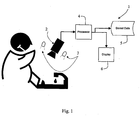
- a monitoring system 1 comprises a camera 2, an illuminator 3, a processor 4, a storage device 5, and a display 6.
- the camera 2 captures images of handwashing activity and these images are processed by the processor 4 to determine if the desired hand motions have taken place by using motion tracking techniques.
- the system 1 tracks the hand motions and classifies the type of motion pattern used by performing the following steps:
- the camera 2 captures images, and the processor 4 analyses the images to analyse bimanual hand washing motions to check if all of the required steps of hand washing have been adequately completed.
- the image processing information is used to determine if the hands are moved in predetermined patterns, that the patterns are each executed for a minimum length of time, and that all required patterns in the hand washing procedure are executed.
- the brightness, colour balance, and contrast of the image are modified on the basis of parameters measured during a set-up phase.
- a typical example of this is to determine the white balance of the camera by the camera capturing an image of a pure white card and associating the values it reads with pure white.
- Lighting compensation or color constancy algorithms are used.
- a greyworld algorithm is used in one embodiment. It is based on the assumption that the spatial average of surface reflectance in a scene is achromatic. Since the light reflected from an achromatic surface is changed equally at all wavelengths, it follows that the spatial average of the light leaving the scene will be the color of the incident illumination.
- BGR avg is mean values of the specific channel in a specific frame.
- BGR std is the 50% ideal grey under the canonical, i.e.
- the BGR avg is the mean of the non-black pixels in each channel.
- the scale factor S c C std lBGR avg is applied for all pixels in the image.
- a skin detector such as a Poesia TM filter identify the regions of the image that can be classified as skin. Sometimes reflections from specular surfaces such as stainless steel sinks will also be classified as skin using this method.
- Non-parametric skin modeling with Bayesian models based on histograms is applied.
- the skin and non-skin colors are modelled through histograms.
- the color space RGB is normalized to a number of bins rgb ⁇ RGB and the processor counts the number of color pixels in each bin N skin ( rgb ) for skin class as well as N nonskin ( rgb ) for non-skin class.
- each bin is normalized to get the discrete conditional skin / non-skin color distribution p ( rgb
- Skin and non-skin reference histograms were obtained from the open source filtering according to the Poesia project.
- the project has compiled 323 3D RGB histograms from the Compaq database and has left them available in two files, one for skin pixels and other for non-skin pixels. Prior probabilities of skin and non-skin are assumed to be 0.4 and 0.6 respectively.
- the skin detection results in a skin probability map Xp ( i, j ).
- a skin binary map Xb ( i, j ) can be made upon a properly selected threshold Th , 0 ⁇ Th ⁇ 1.
- the pixel is said to be a skin pixel if p ( skin / rgb ) > Th, or a non-skin pixel if p ( skin / rgb ) " Th.
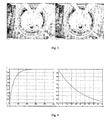
- the technique consists in computing an averaged image integrating both skin and motion features. For each skin pixel, which could be a false positive, the processor measures the motion, after applying an average filter over the motion magnitude image. If the averaged motion magnitude is greater than a fixed threshold T ID the probability is increased. If it is less than T ID , then the probability is decreased.
- I F and D F are the increase and decrease factors with which the processor tunes how fast or slow the variations are when there were motion or not
- M i the motion magnitude of pixel i
- T ID is the threshold value which decides if there is going to be an increase or a decrease in the output image.
- I F and D F are the increase and decrease factors with which the processor tunes how fast or slow the variations are when there were motion or not
- M i is the motion magnitude of pixel i
- T ID is the threshold value which decides if there is going to be an increase or a decrease in the output image.
- T ID 50.
- the increase function reaches the maximum value quickly, whereas the decrease function is less steep. This is because to stress quickly the motion when it appears and penalize the absence of motion in a slower way.
- the system tries to determine if the hands have gone near the taps. This would be a high risk gesture but only if it occurs at the end of the hand wash cycle.
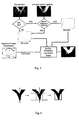
- the processor applies a simple connected components analysis over the binary image, removing small area components. Then, a region of interest covering the hands is selected. The vertical symmetry axis is used for computing upper and lower boundaries, which are then used for computing lateral ones. This process is depicted in Fig. 6 .
- the region of interest should be square sized in order to keep a constant size and not distort the hands pose.
- the processor enlarges the width or the height to obtain a square region of interest. Then it resizes the ROI to a fixed size of 128 x 128 where features will be subsequently extracted.
- the range of hand sizes, large hands, small hands, and the position of the hands, i.e. close to the camera, or far from the camera change the size of the hands in the image.
- the processor passes multiple ROIs to the feature extraction system e.g. 128x128, 64x64, 32x32. Extracting features across a range of scales makes the classification more tolerant to different sizes of hands in the image.
- the system extracts information and measurements from the images.
- the processor uses local Histograms of Oriented Gradients (HOG) as a single frame feature extraction method
- HOG Oriented Gradients
- the aim of this method is to describe an image by a set of local histograms. These histograms count occurrences of gradient orientation in a local part of the image.
- the gradient image is computed.
- the image is split in cells which can be defined as a spatial region like a square with a predefined size in pixels.
- the processor computes the histogram of gradients by accumulating votes into bins for each orientation. Votes are weighted by the magnitude of a gradient, so that the histogram takes into account the importance of gradient at a given point.
- the processor When all histograms have been computed for each cell, the processor builds the descriptor vector of an image, concatenating all histograms in a single vector.
- Cell histograms are locally normalized according to values of the neighboured cell histograms. The normalization is done among a group of cells, which is called a block. A normalization factor is then computed over the block and all histograms within this block are normalized according to this normalization factor. Once this normalization step has been performed, all the histograms can be concatenated in a single feature vector.
- ⁇ is a small regularization constant needed because sometimes empty gradients are going to be evaluated.
- a histogram from a given cell can be involved in several block normalization. Thus, there is some redundant information which improves the performance. This method is illustrated in Fig. 7 .
- ROI dimension In order to compute the vector dimension several parameters have to be taken into account: ROI dimension, cell size, block size, number of bins, and number of overlapped blocks.
- the ROI size is 128 ⁇ 128, each window is divided into cells of size 16 x 16 and each group of 2 ⁇ 2 cells is integrated into a block in a sliding fashion, so blocks overlap with each other.
- Each cell consists of a 16-bin Histogram of Oriented Gradient (HOG) and each block contains a concatenated vector of all its cells.
- HOG Oriented Gradient
- the feature vectors are of 3,136 dimension.
- Fig. 8 in a training phase the system uses stored videos of gestures previously identified by human observers. This information is used to select the relevant features, train the classifier and tune the filters.
- "normal operations" the system executes the image processing, feature extraction, feature selection, classification and filtering operations.
- the training phase includes:
- the full set of features are generated using histogram of Orientation Gradients, or histogram of flows (or "spatio-temporal motion"). This generates a large number of features not all of which are contributing positively to the classification.
- the dimensionality of the feature set is reduced to identify and use only that sub-set of the features which contribute most to the classification of the hand motions.
- Mathematical techniques such as Principal Components Analysis or Linear Discriminant Analysis are used to identify this subset of features. This process is called feature selection.
- the subset of features to be used typically about 10% of the original set, is passed to the classifier. The classifier learns to associate the features with the motion patterns and thus identifies the hand motions used in hand washing.
- the final stage of training is to tune the filters that detect and correct errors of classification by examining the sequence of hand motions along with the underlying prior probabilities of the hand poses.
- Mathematical structures such as Kalman filters, Bayesian networks or Markov decision processes are used to implement these filters.
- ROI regions of interest
- feature extraction algorithms are run.
- a subset of the features are selected according to the prior training and concatenated to form a feature vector.
- This feature vector is passed to the classifier that determines which of the hand motion is currently in use. This result is filtered to remove errors resulting in the final hand motion classification.
- An array of the measurements suitable for classification are made and only those measurements which contribute most to the classification are used.
- the measurements from the feature extraction algorithms are combined to create an array called a feature vector, and this could contain over 3000 different measurements.
- Two approaches to feature vector building are processing histograms of edge orientation, and processing histograms of spatio-temporal motion.
- histograms of flows are used to create a feature vector using the spatio-temporal information a region of interest around the hands and arms is created and dense motion vectors are extracted. The image is divided into cells and the histograms of the motion vector directions are calculated. The histograms from several subsequent frames may also be added to calculate the motion direction histogram over a sequence of frames. The histograms are normalised either globally or in overlapping local neighbourhoods. The resulting histograms are combined to form a feature vector that is passed to the multi-class classifier. This is described in more detail above.
- the processor analyses the variance in the feature vector using Principal Components Analysis (PCA). This helps the processor 5 to identify which feature measurements are contributing most to a correct classification. The processor keeps only those features which contribute most to the correct classification; this could typically be only 10% of our original features.
- PCA Principal Components Analysis
- a data reduction technique other than PCA is used, such as linear discriminate analysis (LDA), particularly Fischer LDA.
- LDA linear discriminate analysis
- Using smaller and better clustered data sets can allow the use of a simple K-nearest neighbour classifier that can be implemented easily in hardware.
- the feature vector is passed to a multi-class classifier to produce an estimate of the current hand pose.
- a simple classifier such as KNN (K nearest neighbour, or "supervised K means" can be used. If a more complex and general classification problem exists an ensemble of Support Vector Machine or a Cascade of Weak Classifiers can be used.
- a multi-class classification system is trained using exemplar feature vectors to produce reliable classifications, a computationally efficient structure and one which generalises well to the wide variety of hand shapes, sizes and bi-manual configurations.
- One such approach is to use an ensemble of support vector machines.
- Several strategies may be used to perform this type of ensemble classification.
- One such strategy is to train an individual support vector machine to classify one pose against a different pose.
- Multiple support vector machines are trained to cover all possible combinations.
- the results of the different support vector machines can be combined using a voting scheme with the pose which has the highest number of votes being selected as the correct pose.
- the Support Vector Machine classifier is a binary classifier algorithm that looks for an optimal hyperplane as a decision function in a high dimensional space. It is a kind of example based machine learning method for both classification and regression problems. This technique has several features that make it particularly attractive.
- Traditional training techniques for classifiers such as multi-layer perceptrons (MLP) use empirical risk minimisation and only guarantee minimum error over the training set.
- MLP multi-layer perceptrons
- SVM based on the structural risk minimisation principle minimise a bound on the generalization error and therefore perform better on novel data.
- the class label of x is then obtained by considering the sign of f ( x ).
- the LIBSVM library is used for training and test.
- the RBF kernel non-linear maps samples into a higher dimensional space, so it, unlike the linear kernel can handle the case when the relation between class labels and attributes is nonlinear.
- the second reason is the number of hyper-parameters which influences the complexity of the model since polynomial kernel has more hyper-parameters than the RBF kernel.
- RBF kernel has less numerical difficulties.
- the bimanual hand poses are represented as a table of transitions from prior poses with probabilities assigned. For example, if the current pose is B and the previous was E, then the likelihood of this transition is 80%. All prior and current poses are assigned poses based on training and analysis. Low probability poses are deleted as they are likely to be the result of misclassification.
- a post classification filter allows for a small and efficient classifier to be used. Occasional classification errors are caught and rectified based on a probabilistic model of hand position reachability. For example, it is unlikely that hands may move immediately from pose A to pose F without some transition pose. It is therefore more likely that pose F is in fact a misclassification and the filter assigns the most likely transition pose. Filters operate on multiple time intervals; frame-to-frame transitions and weighted averages over several frame intervals to produce a reliable sequence of hand pose classifications to the hand motion analysis system.
- Poses which are sustained for a threshold number of frames are passed to an accumulator which counts the number of frames that each pose has been maintained for, which effectively counts the amount of time spent in each pose.
- Each pose has a configurable threshold minimum time. When all thresholds are exceeded the hands are deemed to have been washed to a sufficiently high standard.
- the hand pose information is used to complete a hand hygiene assessment. Each of the hand poses must be recorded for a configurable time period. Bi-manual hand washing poses can be executed in any order. This information is integrated over time and provided to the user via a graphical display such as a speaker or an audio display device. Site-specific options can be implemented regarding overall hand washing metrics such as total time and critical versus non critical hand poses.
- the system 1 displays on the simple low-power display 6 permanent graphics of the individual hand poses.
- the display is a low power LCD display. This indicates to the user that each pose has been achieved.
- the graphics can be easily customised for each installation.
- the system must deal with the challenges posed by changing lighting.
- a typical scenario is where a hand washing facility is positioned where there is a mix of natural and artificial lighting.
- Each of these light sources cause colour casts in the image and depending on the time of day the proportions of artificial and natural light can vary significantly.
- the detection of the hands is a significant issue and uses colour as a significant feature algorithms have been developed to calibrate for colour changes. These are contained within an image normalisation process.
- a supervised labeling process is used for generating training and test data sets. Firstly a database with ROI images and their labels is generated. Thus the reuse of the database is assured. Secondly an off-line application computes the feature vectors for both training and test procedures. Once we have one classifier correctly trained we can use it for on-line pose recognition. The number of training and test samples is depicted in Table 1. We have one class for each one of the different poses of the recommended hand washing procedure. Table 1 . Class distribution of the training and test data sets Data sets Pose 1 Pose 2 Pose 3 Pose 4 Pose 5 Pose 6 Others Training Data Set 638 780 594 977 902 1073 587 Test Data Set 488 414 360 456 477 358 304
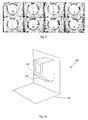
- Fig. 9 depicts the single frame classification results in a sequence.
- the detected class is shown with a picture at the top left of the image.
- the system correctly detects when the hands are separated or joined. Even with a single frame approach the classifier correctly detects the transitions between poses, which are classified as other poses class.
- Second, fifth and sixth poses are correctly classified in both cases: when the left hand is rubbing the right one and vice versa.
- the system 160 comprises a housing 161 with a camera window 162 facing towards a sink unit.
- a processor is contained within the housing, and the system is battery powered.
- a background plate 163 extends outwardly.
- the system can provide the hand washing data to an on-system storage device or can be broadcast via a wireless link to central data storage.
- the records can for part of a HACCP (Hazard Analysis and Critical Control Points) records for use in food preparation or other hygiene standards.
- HACCP Hazard Analysis and Critical Control Points
Landscapes
- Engineering & Computer Science (AREA)
- Physics & Mathematics (AREA)
- Health & Medical Sciences (AREA)
- General Health & Medical Sciences (AREA)
- General Physics & Mathematics (AREA)
- Theoretical Computer Science (AREA)
- Emergency Management (AREA)
- Social Psychology (AREA)
- Psychiatry (AREA)
- Multimedia (AREA)
- Computer Vision & Pattern Recognition (AREA)
- Epidemiology (AREA)
- Public Health (AREA)
- Business, Economics & Management (AREA)
- Human Computer Interaction (AREA)
- Image Analysis (AREA)
- Emergency Alarm Devices (AREA)
- Closed-Circuit Television Systems (AREA)
- Control Of Washing Machine And Dryer (AREA)
- Detergent Compositions (AREA)
- Domestic Plumbing Installations (AREA)
- Iron Core Of Rotating Electric Machines (AREA)
Priority Applications (1)
| Application Number | Priority Date | Filing Date | Title |
|---|---|---|---|
| PL07736107T PL2015665T3 (pl) | 2006-05-04 | 2007-05-04 | System do kontrolowania mycia rąk |
Applications Claiming Priority (3)
| Application Number | Priority Date | Filing Date | Title |
|---|---|---|---|
| IE20060350 | 2006-05-04 | ||
| IE20060905 | 2006-12-12 | ||
| PCT/IE2007/000051 WO2007129289A1 (en) | 2006-05-04 | 2007-05-04 | A hand washing monitoring system |
Publications (2)
| Publication Number | Publication Date |
|---|---|
| EP2015665A1 EP2015665A1 (en) | 2009-01-21 |
| EP2015665B1 true EP2015665B1 (en) | 2009-08-19 |
Family
ID=38180608
Family Applications (1)
| Application Number | Title | Priority Date | Filing Date |
|---|---|---|---|
| EP07736107A Active EP2015665B1 (en) | 2006-05-04 | 2007-05-04 | A hand washing monitoring system |
Country Status (9)
| Country | Link |
|---|---|
| US (1) | US8090155B2 (da) |
| EP (1) | EP2015665B1 (da) |
| AT (1) | ATE439787T1 (da) |
| DE (1) | DE602007002068D1 (da) |
| DK (1) | DK2015665T3 (da) |
| ES (1) | ES2330489T3 (da) |
| IE (1) | IE20070336A1 (da) |
| PL (1) | PL2015665T3 (da) |
| WO (1) | WO2007129289A1 (da) |
Cited By (1)
| Publication number | Priority date | Publication date | Assignee | Title |
|---|---|---|---|---|
| EP3964653A1 (de) | 2020-09-08 | 2022-03-09 | Ideal Standard International NV | Hygienesystem und verfahren zum betreiben eines hygienesystems |
Families Citing this family (70)
| Publication number | Priority date | Publication date | Assignee | Title |
|---|---|---|---|---|
| GB2452814B (en) | 2007-08-23 | 2012-04-04 | Gt Angel Llc | Hand washing monitor |
| WO2009086088A1 (en) * | 2007-12-21 | 2009-07-09 | Honda Motor Co., Ltd. | Controlled human pose estimation from depth image streams |
| US9165199B2 (en) * | 2007-12-21 | 2015-10-20 | Honda Motor Co., Ltd. | Controlled human pose estimation from depth image streams |
| EP2294544A4 (en) | 2008-04-30 | 2013-01-16 | Ecolab Inc | VALIDATED HEALTHCARE CLEANING AND DISINFECTION PRACTICES |
| US8639527B2 (en) | 2008-04-30 | 2014-01-28 | Ecolab Usa Inc. | Validated healthcare cleaning and sanitizing practices |
| KR101592999B1 (ko) * | 2009-02-09 | 2016-02-11 | 삼성전자주식회사 | 휴대용 단말기에서 손 모양을 인식하기 위한 장치 및 방법 |
| WO2010099035A1 (en) * | 2009-02-25 | 2010-09-02 | Honda Motor Co., Ltd. | Body feature detection and human pose estimation using inner distance shape contexts |
| ES2359082B1 (es) * | 2009-04-01 | 2012-03-26 | Fundacion Fibao, Fundacion Para La Investigacion Biosanitaria De Andalucia Oriental-Alejandro Otero | Dispositivo para el lavado de manos y procedimiento de control de lavado de manos. |
| USRE48951E1 (en) | 2015-08-05 | 2022-03-01 | Ecolab Usa Inc. | Hand hygiene compliance monitoring |
| EP2441063B1 (en) | 2009-06-12 | 2015-03-11 | Ecolab USA Inc. | Hand hygiene compliance monitoring |
| US8600166B2 (en) | 2009-11-06 | 2013-12-03 | Sony Corporation | Real time hand tracking, pose classification and interface control |
| US9189949B2 (en) | 2010-12-09 | 2015-11-17 | Sealed Air Corporation (Us) | Automated monitoring and control of contamination in a production area |
| US9406212B2 (en) * | 2010-04-01 | 2016-08-02 | Sealed Air Corporation (Us) | Automated monitoring and control of contamination activity in a production area |
| CA2795144A1 (en) * | 2010-04-01 | 2011-10-06 | Sealed Air Corporation (Us) | Automated monitoring and control of contamination in a production area |
| US9143843B2 (en) | 2010-12-09 | 2015-09-22 | Sealed Air Corporation | Automated monitoring and control of safety in a production area |
| WO2011131800A1 (es) * | 2010-04-22 | 2011-10-27 | Fundación Fibao, Fundación Para La Investigación Biosanitaria De Andalucía Oriental-Alejandro Otero | Dispositivo para el lavado de manos y procedimiento de control de lavado de manos |
| GB2480654B (en) * | 2010-05-27 | 2012-08-15 | Infrared Integrated Syst Ltd | Monitoring handwashing |
| US8750573B2 (en) * | 2010-08-02 | 2014-06-10 | Sony Corporation | Hand gesture detection |
| US8792722B2 (en) * | 2010-08-02 | 2014-07-29 | Sony Corporation | Hand gesture detection |
| US9785744B2 (en) | 2010-09-14 | 2017-10-10 | General Electric Company | System and method for protocol adherence |
| US9011607B2 (en) | 2010-10-07 | 2015-04-21 | Sealed Air Corporation (Us) | Automated monitoring and control of cleaning in a production area |
| US8730157B2 (en) * | 2010-11-15 | 2014-05-20 | Hewlett-Packard Development Company, L.P. | Hand pose recognition |
| TW201223491A (en) * | 2010-12-03 | 2012-06-16 | Nat Taipei University Oftechnology | Intelligent hand-washing monitoring system |
| WO2012081012A1 (en) * | 2010-12-16 | 2012-06-21 | Pointgrab Ltd. | Computer vision based hand identification |
| KR101620933B1 (ko) | 2010-12-31 | 2016-05-13 | 노키아 테크놀로지스 오와이 | 제스쳐 인식 메커니즘을 제공하는 방법 및 장치 |
| US20140210620A1 (en) | 2013-01-25 | 2014-07-31 | Ultraclenz Llc | Wireless communication for dispenser beacons |
| WO2014074585A1 (en) | 2012-11-06 | 2014-05-15 | Johnson Raymond C | Virtual hand-washing coach |
| US20150302769A1 (en) * | 2011-12-05 | 2015-10-22 | Raymond C. Johnson | Virtual Hand-Washing Coach |
| JP5780142B2 (ja) * | 2011-12-07 | 2015-09-16 | 富士通株式会社 | 画像処理装置、画像処理方法 |
| GB2497992B (en) | 2011-12-30 | 2015-06-03 | Hyintel Ltd | A drip tray |
| US20130243077A1 (en) * | 2012-03-13 | 2013-09-19 | Canon Kabushiki Kaisha | Method and apparatus for processing moving image information, and method and apparatus for identifying moving image pattern |
| TWI476702B (zh) * | 2012-03-16 | 2015-03-11 | Pixart Imaging Inc | 使用者辨識系統及辨識使用者的方法 |
| CH706677A1 (fr) * | 2012-06-21 | 2013-12-31 | Hopitaux Universitaires Geneve | Procédé et dispositif de vérification de lavage des mains. |
| WO2014062755A1 (en) * | 2012-10-16 | 2014-04-24 | Johnson Raymond C | Hand washing monitoring system for public restrooms |
| US9076044B2 (en) * | 2012-12-15 | 2015-07-07 | Joseph Ernest Dryer | Apparatus and method for monitoring hand washing |
| DE102013104556B3 (de) * | 2013-05-03 | 2014-03-27 | Itec-Ingenieurbüro für Hygiene Und Lebensmitteltechnik GmbH | Verfahren und Vorrichtung zur automatischen Handreinigung |
| CN104239844A (zh) * | 2013-06-18 | 2014-12-24 | 华硕电脑股份有限公司 | 图像识别系统及图像识别方法 |
| GB2521844A (en) | 2014-01-03 | 2015-07-08 | Fluke Corp | A method and system for monitoring hand washing |
| US9729833B1 (en) | 2014-01-17 | 2017-08-08 | Cerner Innovation, Inc. | Method and system for determining whether an individual takes appropriate measures to prevent the spread of healthcare-associated infections along with centralized monitoring |
| JP6436385B2 (ja) * | 2014-12-17 | 2018-12-12 | パナソニックIpマネジメント株式会社 | 撮像装置、画像処理装置及び画像処理方法 |
| US9881485B2 (en) | 2015-03-17 | 2018-01-30 | Julio Hajdenberg | Device based hygiene reminder, alarm, and reporting system |
| US9724443B2 (en) * | 2015-04-10 | 2017-08-08 | Rememdia LC | System, method, and device for decontamination |
| US9418536B1 (en) * | 2015-04-24 | 2016-08-16 | WashSense Inc. | Hand-washing compliance system |
| US9721452B2 (en) * | 2015-04-24 | 2017-08-01 | WashSense, Inc. | Hand-wash management and compliance system |
| US9418535B1 (en) * | 2015-04-24 | 2016-08-16 | WashSense Inc. | Hand-wash monitoring and compliance system |
| WO2016172390A1 (en) * | 2015-04-24 | 2016-10-27 | WashSense Inc. | Hand-wash monitoring and compliance system |
| US9542828B1 (en) * | 2015-06-22 | 2017-01-10 | Peter D. Haaland | System, device, and method for measurement of hand hygiene technique |
| CN110383355B (zh) | 2017-03-07 | 2021-08-27 | 埃科莱布美国股份有限公司 | 用于手部卫生分配器的监测模块 |
| US10529219B2 (en) | 2017-11-10 | 2020-01-07 | Ecolab Usa Inc. | Hand hygiene compliance monitoring |
| WO2019160919A1 (en) * | 2018-02-13 | 2019-08-22 | Gojo Industries, Inc. | Modular people counters |
| US20200388193A1 (en) * | 2018-08-14 | 2020-12-10 | Food Service Monitoring, Inc. | Method and system for motivating and monitoring hand washing in a food service or related environment |
| TR201818413A2 (tr) * | 2018-12-03 | 2019-02-21 | Erg Mueh Otom Elek Elekt San Ve Tic Ltd Sti | Bi̇r el yikama taki̇p si̇stemi̇ |
| EP3900307A1 (en) | 2018-12-20 | 2021-10-27 | Ecolab USA, Inc. | Adaptive route, bi-directional network communication |
| WO2020264367A1 (en) | 2019-06-28 | 2020-12-30 | 3Derm Systems, Inc. | Monitoring surface cleaning of medical surfaces using video streaming |
| US11017655B2 (en) * | 2019-10-09 | 2021-05-25 | Visualq | Hand sanitation compliance enforcement systems and methods |
| US12148512B2 (en) | 2019-12-31 | 2024-11-19 | Cerner Innovation, Inc. | Patient safety using virtual observation |
| WO2021163447A1 (en) * | 2020-02-13 | 2021-08-19 | Masimo Corporation | System and method for monitoring clinical activities |
| JP7476599B2 (ja) * | 2020-03-24 | 2024-05-01 | 大日本印刷株式会社 | 情報処理システム、及び情報処理方法 |
| AU2021242360A1 (en) * | 2020-03-27 | 2022-10-13 | Hs Vk Idea Factory, Llc | Apparatus and method for protecting against environmental hazards |
| US11756359B2 (en) | 2020-04-27 | 2023-09-12 | Municipal Parking Services, Inc. | Health and sanitation monitoring methods and systems for controlled access to a premises |
| JP7492850B2 (ja) * | 2020-04-30 | 2024-05-30 | 株式会社コンテック | 衛生管理システム |
| JP6875028B1 (ja) * | 2020-04-30 | 2021-05-19 | 株式会社Acculus | 手洗い評価装置および手洗い評価プログラム |
| WO2022011188A1 (en) | 2020-07-08 | 2022-01-13 | Rememdia LC | System, method, and device for facilitating effective decontamination as part of a decontamination event |
| US12397072B2 (en) | 2020-07-08 | 2025-08-26 | Rememdia LC | System, method, and device for facilitating effective decontamination as part of a decontamination event |
| JP7356954B2 (ja) * | 2020-07-17 | 2023-10-05 | 株式会社Nsd先端技術研究所 | 手洗い評価システムとその方法 |
| CN111860448A (zh) * | 2020-07-30 | 2020-10-30 | 北京华捷艾米科技有限公司 | 洗手动作识别方法及系统 |
| WO2022023615A2 (es) * | 2020-07-30 | 2022-02-03 | URBANO RODRÍGUEZ, Manuel | Sistema para el control de accesos mediante verificación de higiene de manos y su aplicación a un carro de curas de acceso controlado |
| US20240242343A1 (en) * | 2020-08-14 | 2024-07-18 | Hygenius, Inc. | Sanitization Analysis and Training Devices, Systems, and Methods |
| US20220080060A1 (en) * | 2020-09-11 | 2022-03-17 | AI Data Innovation Corporation | Disinfection system and method |
| WO2025089535A1 (en) * | 2023-10-23 | 2025-05-01 | Samsung Electronics Co., Ltd. | Electronic devices and methods for identifying gestures associated with a target object |
Family Cites Families (9)
| Publication number | Priority date | Publication date | Assignee | Title |
|---|---|---|---|---|
| GB2337327B (en) | 1997-02-18 | 2000-11-15 | Raymond Charles Johnson | Apparatus and method for monitoring hand washing |
| US6236317B1 (en) * | 1998-04-29 | 2001-05-22 | Food Safety Solution Corp. | Method and apparatus for monitoring actions taken by a user for enhancing hygiene |
| US5952927A (en) * | 1998-06-02 | 1999-09-14 | Eshman; Richard | Portable child safety alarm system |
| US6426701B1 (en) * | 2000-09-20 | 2002-07-30 | Ultraclenz Engineering Group | Handwash monitoring system |
| US6970574B1 (en) * | 2001-03-13 | 2005-11-29 | Johnson Raymond C | Pattern recognition system and method for monitoring hand washing or application of a disinfectant |
| US7542586B2 (en) * | 2001-03-13 | 2009-06-02 | Johnson Raymond C | Touchless identification system for monitoring hand washing or application of a disinfectant |
| ATE341798T1 (de) | 2002-03-12 | 2006-10-15 | Raymond C Johnson | Mustererkennungssystem und verfahren zur überwachung des händewaschens oder des aufbringens eines desinfektionsmittels |
| GB0406704D0 (en) | 2004-03-25 | 2004-04-28 | Bourne Leisure Ltd | Cleanliness monitoring system and related method |
| JP2006132277A (ja) * | 2004-11-09 | 2006-05-25 | Seiken Ika Kogyo Kk | 自動手洗い装置 |
-
2007
- 2007-05-04 PL PL07736107T patent/PL2015665T3/pl unknown
- 2007-05-04 IE IE20070336A patent/IE20070336A1/xx not_active Application Discontinuation
- 2007-05-04 ES ES07736107T patent/ES2330489T3/es active Active
- 2007-05-04 DK DK07736107T patent/DK2015665T3/da active
- 2007-05-04 US US12/226,983 patent/US8090155B2/en active Active
- 2007-05-04 DE DE602007002068T patent/DE602007002068D1/de active Active
- 2007-05-04 EP EP07736107A patent/EP2015665B1/en active Active
- 2007-05-04 WO PCT/IE2007/000051 patent/WO2007129289A1/en not_active Ceased
- 2007-05-04 AT AT07736107T patent/ATE439787T1/de not_active IP Right Cessation
Cited By (1)
| Publication number | Priority date | Publication date | Assignee | Title |
|---|---|---|---|---|
| EP3964653A1 (de) | 2020-09-08 | 2022-03-09 | Ideal Standard International NV | Hygienesystem und verfahren zum betreiben eines hygienesystems |
Also Published As
| Publication number | Publication date |
|---|---|
| DK2015665T3 (da) | 2009-11-16 |
| WO2007129289A1 (en) | 2007-11-15 |
| DE602007002068D1 (de) | 2009-10-01 |
| ATE439787T1 (de) | 2009-09-15 |
| US8090155B2 (en) | 2012-01-03 |
| IE20070336A1 (en) | 2008-06-11 |
| PL2015665T3 (pl) | 2010-01-29 |
| ES2330489T3 (es) | 2009-12-10 |
| US20090087028A1 (en) | 2009-04-02 |
| EP2015665A1 (en) | 2009-01-21 |
Similar Documents
| Publication | Publication Date | Title |
|---|---|---|
| EP2015665B1 (en) | A hand washing monitoring system | |
| Wang et al. | Towards complete and accurate iris segmentation using deep multi-task attention network for non-cooperative iris recognition | |
| Dias et al. | Gaze estimation for assisted living environments | |
| Shakhnarovich et al. | A unified learning framework for real time face detection and classification | |
| Salti et al. | Adaptive appearance modeling for video tracking: Survey and evaluation | |
| Vishwakarma et al. | Hybrid classifier based human activity recognition using the silhouette and cells | |
| Gowsikhaa et al. | Suspicious Human Activity Detection from Surveillance Videos. | |
| Zafar et al. | Pain intensity evaluation through facial action units | |
| Iosifidis et al. | Dynamic action recognition based on dynemes and extreme learning machine | |
| Llorca et al. | A vision-based system for automatic hand washing quality assessment | |
| Guo | Human age estimation and sex classification | |
| Cao et al. | Predicting gender and weight from human metrology using a copula model | |
| Devanne et al. | Recognition of activities of daily living via hierarchical long-short term memory networks | |
| Elder et al. | Pre-attentive and attentive detection of humans in wide-field scenes | |
| Nicolle et al. | Real-time facial action unit intensity prediction with regularized metric learning | |
| Venkat et al. | Recognizing occluded faces by exploiting psychophysically inspired similarity maps | |
| Sun et al. | A hybrid system for on-line blink detection | |
| Wu et al. | NIR-based gaze tracking with fast pupil ellipse fitting for real-time wearable eye trackers | |
| Ryan | Crowd monitoring using computer vision | |
| Lin et al. | A gender classification scheme based on multi-region feature extraction and information fusion for unconstrained images | |
| Llorca et al. | A multi-class SVM classifier ensemble for automatic hand washing quality assessment | |
| Bostanci et al. | A neuro fuzzy embedded agent approach towards the development of an intelligent refrigerator | |
| Fasching et al. | Automated coding of activity videos from an OCD study | |
| Valenti et al. | Machine learning techniques for face analysis | |
| Selvakumar et al. | Robust embedded vision system for face detection and identification in smart surveillance |
Legal Events
| Date | Code | Title | Description |
|---|---|---|---|
| PUAI | Public reference made under article 153(3) epc to a published international application that has entered the european phase |
Free format text: ORIGINAL CODE: 0009012 |
|
| 17P | Request for examination filed |
Effective date: 20081118 |
|
| AK | Designated contracting states |
Kind code of ref document: A1 Designated state(s): AT BE BG CH CY CZ DE DK EE ES FI FR GB GR HU IE IS IT LI LT LU LV MC MT NL PL PT RO SE SI SK TR |
|
| AX | Request for extension of the european patent |
Extension state: AL BA HR MK RS |
|
| GRAP | Despatch of communication of intention to grant a patent |
Free format text: ORIGINAL CODE: EPIDOSNIGR1 |
|
| GRAS | Grant fee paid |
Free format text: ORIGINAL CODE: EPIDOSNIGR3 |
|
| GRAA | (expected) grant |
Free format text: ORIGINAL CODE: 0009210 |
|
| AK | Designated contracting states |
Kind code of ref document: B1 Designated state(s): AT BE BG CH CY CZ DE DK EE ES FI FR GB GR HU IE IS IT LI LT LU LV MC MT NL PL PT RO SE SI SK TR |
|
| REG | Reference to a national code |
Ref country code: GB Ref legal event code: FG4D |
|
| REG | Reference to a national code |
Ref country code: CH Ref legal event code: EP |
|
| REG | Reference to a national code |
Ref country code: IE Ref legal event code: FG4D |
|
| REF | Corresponds to: |
Ref document number: 602007002068 Country of ref document: DE Date of ref document: 20091001 Kind code of ref document: P |
|
| REG | Reference to a national code |
Ref country code: SE Ref legal event code: TRGR |
|
| REG | Reference to a national code |
Ref country code: DK Ref legal event code: T3 |
|
| REG | Reference to a national code |
Ref country code: ES Ref legal event code: FG2A Ref document number: 2330489 Country of ref document: ES Kind code of ref document: T3 |
|
| LTIE | Lt: invalidation of european patent or patent extension |
Effective date: 20090819 |
|
| PG25 | Lapsed in a contracting state [announced via postgrant information from national office to epo] |
Ref country code: LT Free format text: LAPSE BECAUSE OF FAILURE TO SUBMIT A TRANSLATION OF THE DESCRIPTION OR TO PAY THE FEE WITHIN THE PRESCRIBED TIME-LIMIT Effective date: 20090819 Ref country code: IS Free format text: LAPSE BECAUSE OF FAILURE TO SUBMIT A TRANSLATION OF THE DESCRIPTION OR TO PAY THE FEE WITHIN THE PRESCRIBED TIME-LIMIT Effective date: 20091219 Ref country code: FI Free format text: LAPSE BECAUSE OF FAILURE TO SUBMIT A TRANSLATION OF THE DESCRIPTION OR TO PAY THE FEE WITHIN THE PRESCRIBED TIME-LIMIT Effective date: 20090819 Ref country code: AT Free format text: LAPSE BECAUSE OF FAILURE TO SUBMIT A TRANSLATION OF THE DESCRIPTION OR TO PAY THE FEE WITHIN THE PRESCRIBED TIME-LIMIT Effective date: 20090819 |
|
| REG | Reference to a national code |
Ref country code: PL Ref legal event code: T3 |
|
| NLV1 | Nl: lapsed or annulled due to failure to fulfill the requirements of art. 29p and 29m of the patents act | ||
| PG25 | Lapsed in a contracting state [announced via postgrant information from national office to epo] |
Ref country code: SI Free format text: LAPSE BECAUSE OF FAILURE TO SUBMIT A TRANSLATION OF THE DESCRIPTION OR TO PAY THE FEE WITHIN THE PRESCRIBED TIME-LIMIT Effective date: 20090819 Ref country code: NL Free format text: LAPSE BECAUSE OF FAILURE TO SUBMIT A TRANSLATION OF THE DESCRIPTION OR TO PAY THE FEE WITHIN THE PRESCRIBED TIME-LIMIT Effective date: 20090819 Ref country code: LV Free format text: LAPSE BECAUSE OF FAILURE TO SUBMIT A TRANSLATION OF THE DESCRIPTION OR TO PAY THE FEE WITHIN THE PRESCRIBED TIME-LIMIT Effective date: 20090819 |
|
| PG25 | Lapsed in a contracting state [announced via postgrant information from national office to epo] |
Ref country code: CY Free format text: LAPSE BECAUSE OF FAILURE TO SUBMIT A TRANSLATION OF THE DESCRIPTION OR TO PAY THE FEE WITHIN THE PRESCRIBED TIME-LIMIT Effective date: 20090819 Ref country code: PT Free format text: LAPSE BECAUSE OF FAILURE TO SUBMIT A TRANSLATION OF THE DESCRIPTION OR TO PAY THE FEE WITHIN THE PRESCRIBED TIME-LIMIT Effective date: 20091221 Ref country code: BG Free format text: LAPSE BECAUSE OF FAILURE TO SUBMIT A TRANSLATION OF THE DESCRIPTION OR TO PAY THE FEE WITHIN THE PRESCRIBED TIME-LIMIT Effective date: 20091119 |
|
| PG25 | Lapsed in a contracting state [announced via postgrant information from national office to epo] |
Ref country code: CZ Free format text: LAPSE BECAUSE OF FAILURE TO SUBMIT A TRANSLATION OF THE DESCRIPTION OR TO PAY THE FEE WITHIN THE PRESCRIBED TIME-LIMIT Effective date: 20090819 Ref country code: EE Free format text: LAPSE BECAUSE OF FAILURE TO SUBMIT A TRANSLATION OF THE DESCRIPTION OR TO PAY THE FEE WITHIN THE PRESCRIBED TIME-LIMIT Effective date: 20090819 Ref country code: RO Free format text: LAPSE BECAUSE OF FAILURE TO SUBMIT A TRANSLATION OF THE DESCRIPTION OR TO PAY THE FEE WITHIN THE PRESCRIBED TIME-LIMIT Effective date: 20090819 |
|
| PG25 | Lapsed in a contracting state [announced via postgrant information from national office to epo] |
Ref country code: SK Free format text: LAPSE BECAUSE OF FAILURE TO SUBMIT A TRANSLATION OF THE DESCRIPTION OR TO PAY THE FEE WITHIN THE PRESCRIBED TIME-LIMIT Effective date: 20090819 |
|
| PLBE | No opposition filed within time limit |
Free format text: ORIGINAL CODE: 0009261 |
|
| STAA | Information on the status of an ep patent application or granted ep patent |
Free format text: STATUS: NO OPPOSITION FILED WITHIN TIME LIMIT |
|
| PG25 | Lapsed in a contracting state [announced via postgrant information from national office to epo] |
Ref country code: BE Free format text: LAPSE BECAUSE OF FAILURE TO SUBMIT A TRANSLATION OF THE DESCRIPTION OR TO PAY THE FEE WITHIN THE PRESCRIBED TIME-LIMIT Effective date: 20090819 |
|
| 26N | No opposition filed |
Effective date: 20100520 |
|
| PG25 | Lapsed in a contracting state [announced via postgrant information from national office to epo] |
Ref country code: GR Free format text: LAPSE BECAUSE OF FAILURE TO SUBMIT A TRANSLATION OF THE DESCRIPTION OR TO PAY THE FEE WITHIN THE PRESCRIBED TIME-LIMIT Effective date: 20091120 |
|
| PG25 | Lapsed in a contracting state [announced via postgrant information from national office to epo] |
Ref country code: MC Free format text: LAPSE BECAUSE OF NON-PAYMENT OF DUE FEES Effective date: 20100531 |
|
| PG25 | Lapsed in a contracting state [announced via postgrant information from national office to epo] |
Ref country code: IT Free format text: LAPSE BECAUSE OF NON-PAYMENT OF DUE FEES Effective date: 20100504 |
|
| PG25 | Lapsed in a contracting state [announced via postgrant information from national office to epo] |
Ref country code: MT Free format text: LAPSE BECAUSE OF FAILURE TO SUBMIT A TRANSLATION OF THE DESCRIPTION OR TO PAY THE FEE WITHIN THE PRESCRIBED TIME-LIMIT Effective date: 20090819 |
|
| REG | Reference to a national code |
Ref country code: CH Ref legal event code: PL |
|
| PG25 | Lapsed in a contracting state [announced via postgrant information from national office to epo] |
Ref country code: LI Free format text: LAPSE BECAUSE OF NON-PAYMENT OF DUE FEES Effective date: 20110531 Ref country code: CH Free format text: LAPSE BECAUSE OF NON-PAYMENT OF DUE FEES Effective date: 20110531 |
|
| PG25 | Lapsed in a contracting state [announced via postgrant information from national office to epo] |
Ref country code: HU Free format text: LAPSE BECAUSE OF FAILURE TO SUBMIT A TRANSLATION OF THE DESCRIPTION OR TO PAY THE FEE WITHIN THE PRESCRIBED TIME-LIMIT Effective date: 20100220 Ref country code: LU Free format text: LAPSE BECAUSE OF NON-PAYMENT OF DUE FEES Effective date: 20100504 |
|
| PG25 | Lapsed in a contracting state [announced via postgrant information from national office to epo] |
Ref country code: TR Free format text: LAPSE BECAUSE OF FAILURE TO SUBMIT A TRANSLATION OF THE DESCRIPTION OR TO PAY THE FEE WITHIN THE PRESCRIBED TIME-LIMIT Effective date: 20090819 |
|
| REG | Reference to a national code |
Ref country code: FR Ref legal event code: PLFP Year of fee payment: 10 |
|
| REG | Reference to a national code |
Ref country code: FR Ref legal event code: PLFP Year of fee payment: 11 |
|
| REG | Reference to a national code |
Ref country code: FR Ref legal event code: PLFP Year of fee payment: 12 |
|
| PGFP | Annual fee paid to national office [announced via postgrant information from national office to epo] |
Ref country code: NL Payment date: 20190618 Year of fee payment: 13 Ref country code: DK Payment date: 20190515 Year of fee payment: 13 |
|
| REG | Reference to a national code |
Ref country code: DK Ref legal event code: EBP Effective date: 20200531 |
|
| REG | Reference to a national code |
Ref country code: GB Ref legal event code: 732E Free format text: REGISTERED BETWEEN 20210225 AND 20210303 |
|
| PG25 | Lapsed in a contracting state [announced via postgrant information from national office to epo] |
Ref country code: DK Free format text: LAPSE BECAUSE OF NON-PAYMENT OF DUE FEES Effective date: 20200531 |
|
| PG25 | Lapsed in a contracting state [announced via postgrant information from national office to epo] |
Ref country code: PL Free format text: LAPSE BECAUSE OF NON-PAYMENT OF DUE FEES Effective date: 20200504 |
|
| P01 | Opt-out of the competence of the unified patent court (upc) registered |
Effective date: 20230419 |
|
| PGFP | Annual fee paid to national office [announced via postgrant information from national office to epo] |
Ref country code: DE Payment date: 20240513 Year of fee payment: 18 |
|
| PGFP | Annual fee paid to national office [announced via postgrant information from national office to epo] |
Ref country code: ES Payment date: 20240603 Year of fee payment: 18 |
|
| PGFP | Annual fee paid to national office [announced via postgrant information from national office to epo] |
Ref country code: SE Payment date: 20240503 Year of fee payment: 18 |
|
| PGFP | Annual fee paid to national office [announced via postgrant information from national office to epo] |
Ref country code: GB Payment date: 20250401 Year of fee payment: 19 |
|
| PGFP | Annual fee paid to national office [announced via postgrant information from national office to epo] |
Ref country code: IT Payment date: 20250404 Year of fee payment: 19 |
|
| PGFP | Annual fee paid to national office [announced via postgrant information from national office to epo] |
Ref country code: FR Payment date: 20250429 Year of fee payment: 19 |
|
| PGFP | Annual fee paid to national office [announced via postgrant information from national office to epo] |
Ref country code: IE Payment date: 20250401 Year of fee payment: 19 |
|
| REG | Reference to a national code |
Ref country code: DE Ref legal event code: R119 Ref document number: 602007002068 Country of ref document: DE |
|
| PG25 | Lapsed in a contracting state [announced via postgrant information from national office to epo] |
Ref country code: SE Free format text: LAPSE BECAUSE OF NON-PAYMENT OF DUE FEES Effective date: 20250505 |
|
| REG | Reference to a national code |
Ref country code: SE Ref legal event code: EUG |
|
| PG25 | Lapsed in a contracting state [announced via postgrant information from national office to epo] |
Ref country code: DE Free format text: LAPSE BECAUSE OF NON-PAYMENT OF DUE FEES Effective date: 20251202 |