EP2015472B1 - Datenübertragungsverfahren mittels Relaisknoten in einem synchronen Kommunikationsnetzwerk, entsprechendes Empfangsverfahren, Computerprogrammprodukt, Speichermittel und Knoten - Google Patents
Datenübertragungsverfahren mittels Relaisknoten in einem synchronen Kommunikationsnetzwerk, entsprechendes Empfangsverfahren, Computerprogrammprodukt, Speichermittel und Knoten Download PDFInfo
- Publication number
- EP2015472B1 EP2015472B1 EP08158855A EP08158855A EP2015472B1 EP 2015472 B1 EP2015472 B1 EP 2015472B1 EP 08158855 A EP08158855 A EP 08158855A EP 08158855 A EP08158855 A EP 08158855A EP 2015472 B1 EP2015472 B1 EP 2015472B1
- Authority
- EP
- European Patent Office
- Prior art keywords
- chunk
- data
- frame
- node
- data section
- Prior art date
- Legal status (The legal status is an assumption and is not a legal conclusion. Google has not performed a legal analysis and makes no representation as to the accuracy of the status listed.)
- Not-in-force
Links
- 230000005540 biological transmission Effects 0.000 title claims description 61
- 238000000034 method Methods 0.000 title claims description 57
- 230000001360 synchronised effect Effects 0.000 title claims description 28
- 238000004891 communication Methods 0.000 title claims description 23
- 238000004590 computer program Methods 0.000 title claims description 5
- 239000011159 matrix material Substances 0.000 claims description 38
- 238000012545 processing Methods 0.000 claims description 29
- 230000006870 function Effects 0.000 claims description 23
- 238000012360 testing method Methods 0.000 description 16
- 238000012937 correction Methods 0.000 description 6
- 230000008901 benefit Effects 0.000 description 5
- 230000008569 process Effects 0.000 description 5
- 230000005236 sound signal Effects 0.000 description 5
- 230000002123 temporal effect Effects 0.000 description 5
- 238000012546 transfer Methods 0.000 description 5
- 230000006978 adaptation Effects 0.000 description 4
- 230000009897 systematic effect Effects 0.000 description 4
- 238000006243 chemical reaction Methods 0.000 description 3
- 235000008694 Humulus lupulus Nutrition 0.000 description 2
- 230000003321 amplification Effects 0.000 description 2
- 230000008859 change Effects 0.000 description 2
- 238000001514 detection method Methods 0.000 description 2
- 230000009977 dual effect Effects 0.000 description 2
- 230000000694 effects Effects 0.000 description 2
- 238000000605 extraction Methods 0.000 description 2
- 230000006872 improvement Effects 0.000 description 2
- 238000009434 installation Methods 0.000 description 2
- 238000003199 nucleic acid amplification method Methods 0.000 description 2
- 241001522296 Erithacus rubecula Species 0.000 description 1
- 208000029545 Linear nevus sebaceus syndrome Diseases 0.000 description 1
- 238000010420 art technique Methods 0.000 description 1
- 230000006399 behavior Effects 0.000 description 1
- 125000004122 cyclic group Chemical group 0.000 description 1
- 238000001914 filtration Methods 0.000 description 1
- 238000003780 insertion Methods 0.000 description 1
- 230000037431 insertion Effects 0.000 description 1
- 208000020038 linear nevus sebaceous syndrome Diseases 0.000 description 1
- 230000007246 mechanism Effects 0.000 description 1
- 238000012986 modification Methods 0.000 description 1
- 230000004048 modification Effects 0.000 description 1
- 230000004044 response Effects 0.000 description 1
- 230000011218 segmentation Effects 0.000 description 1
- 208000011580 syndromic disease Diseases 0.000 description 1
Images






Classifications
-
- H—ELECTRICITY
- H04—ELECTRIC COMMUNICATION TECHNIQUE
- H04B—TRANSMISSION
- H04B7/00—Radio transmission systems, i.e. using radiation field
- H04B7/24—Radio transmission systems, i.e. using radiation field for communication between two or more posts
- H04B7/26—Radio transmission systems, i.e. using radiation field for communication between two or more posts at least one of which is mobile
- H04B7/2603—Arrangements for wireless physical layer control
- H04B7/2606—Arrangements for base station coverage control, e.g. by using relays in tunnels
-
- H—ELECTRICITY
- H04—ELECTRIC COMMUNICATION TECHNIQUE
- H04B—TRANSMISSION
- H04B7/00—Radio transmission systems, i.e. using radiation field
- H04B7/14—Relay systems
- H04B7/15—Active relay systems
- H04B7/155—Ground-based stations
-
- H—ELECTRICITY
- H04—ELECTRIC COMMUNICATION TECHNIQUE
- H04L—TRANSMISSION OF DIGITAL INFORMATION, e.g. TELEGRAPHIC COMMUNICATION
- H04L1/00—Arrangements for detecting or preventing errors in the information received
- H04L1/0078—Avoidance of errors by organising the transmitted data in a format specifically designed to deal with errors, e.g. location
- H04L1/0079—Formats for control data
- H04L1/008—Formats for control data where the control data relates to payload of a different packet
-
- H—ELECTRICITY
- H04—ELECTRIC COMMUNICATION TECHNIQUE
- H04L—TRANSMISSION OF DIGITAL INFORMATION, e.g. TELEGRAPHIC COMMUNICATION
- H04L1/00—Arrangements for detecting or preventing errors in the information received
- H04L1/12—Arrangements for detecting or preventing errors in the information received by using return channel
- H04L1/16—Arrangements for detecting or preventing errors in the information received by using return channel in which the return channel carries supervisory signals, e.g. repetition request signals
- H04L1/18—Automatic repetition systems, e.g. Van Duuren systems
- H04L1/1867—Arrangements specially adapted for the transmitter end
- H04L1/1887—Scheduling and prioritising arrangements
-
- H—ELECTRICITY
- H04—ELECTRIC COMMUNICATION TECHNIQUE
- H04L—TRANSMISSION OF DIGITAL INFORMATION, e.g. TELEGRAPHIC COMMUNICATION
- H04L1/00—Arrangements for detecting or preventing errors in the information received
- H04L2001/0092—Error control systems characterised by the topology of the transmission link
- H04L2001/0097—Relays
-
- H—ELECTRICITY
- H04—ELECTRIC COMMUNICATION TECHNIQUE
- H04W—WIRELESS COMMUNICATION NETWORKS
- H04W28/00—Network traffic management; Network resource management
- H04W28/02—Traffic management, e.g. flow control or congestion control
- H04W28/06—Optimizing the usage of the radio link, e.g. header compression, information sizing, discarding information
-
- H—ELECTRICITY
- H04—ELECTRIC COMMUNICATION TECHNIQUE
- H04W—WIRELESS COMMUNICATION NETWORKS
- H04W88/00—Devices specially adapted for wireless communication networks, e.g. terminals, base stations or access point devices
- H04W88/02—Terminal devices
- H04W88/04—Terminal devices adapted for relaying to or from another terminal or user
Definitions
- the field of the invention is that of data transmission in synchronous meshed networks.
- the invention can be applied especially but not exclusively to data transmission in a 60 GHz wireless (radio) transmission system.
- 60 GHz radio transmission systems are particularly well suited to short-distance data transmission at very high bit rates.
- such a transmission system is well suited to connectivity between the different elements of a "home cinema".
- the range of the transmission is limited to about ten meters but the bit rates brought into play are very high, sometimes over one gigabit per second because of the nature of the information transmitted (both audio and video information) and the high resolution of this information.
- Such a network is for example:
- a synchronous meshed network there is a predetermined sequence of time intervals at the MAC (medium access control) layer. It may be recalled that the MAC layer manages access to the physical medium and is a part of the data link level corresponding to layer 2 of the OSI model. Each node can send data during time intervals or hops that are allocated to it. During each hop, the data is sent in a frame of fixed size, here below called a MAC frame (or packet).
- a synchronous meshed network applies a clocking that defines a network cycle for data transmission on this network.
- a super frame forms part of each network cycle and includes a plurality of frames, each frame being associated with one of the nodes.
- the meshed network is not 100% reliable. This is the case especially but not exclusively with wireless networks in which the transmission is subject to interference and shadowing and is therefore not reliable.
- the present invention relates specifically to improving the reliability of exchanges at the data link level on a synchronous wireless meshed network.
- ARQ Automatic Repeat Request
- the receiver automatically asks the sender for retransmission if it detects errors or a missing packet.
- This first known technique ARQ therefore introduces solely temporal diversity (same data sent at different points in time). This technique is therefore worthwhile if the transmission conditions between the sender and the receiver are not the same at different points in time.
- the transfer time is not constant (it is all the greater as the number of retransmissions increases). For example, the transfer time is T if there is no transmission error, T+n if there are errors requiring retransmission, and T+k*n if there are errors on k-1 retransmissions.
- this first prior art technique does not introduce any spatial diversity since it is the same transmitter which initially transmits and then retransmits if necessary. It is therefore not efficient against shadowing from an immobile or slow-moving obstacle, i.e. if the conditions of transmission between the sender and the receiver remain the same at different points in time.
- this first known technique has the drawback of introducing an overhead into the network, due to the sending of retransmission requests and corresponding acknowledgements as well as the orientation of the antennas for the reception of these acknowledgements of reception.
- This second known technique has the advantage, as compared with the first known technique (ARQ), of being able to the applied to a synchronous meshed network since it enables a constant transfer time.
- a node plays the role of a relay in using certain of the time intervals or hops that are allocated to it to retransmit data that it has received beforehand. In other words, among the frames that the relay node sends, certain contain only data of the relay node, and others contain only retransmission data.
- US 2007/002766 A1 and WO 2007/109392 A are exemplary documents which use a technique of the third known type.
- the base station receives uplink signals from the source and relay terminals, and said received uplink signals are combined and decoded, so as to obtain a transmit diversity gain in uplink transmission.
- WO 2007/109392 A encompasses a similar method for transmitting data from a base station within a multi-hop communications system.
- This third known technique has the advantage, as compared with the first known technique (ARQ), of being capable of being applied to synchronous meshed networks since it provides for constant transfer time.
- the relay node retransmits data, it is not capable of transmitting its own data.
- the relay node is therefore less reactive.
- the relay node can only transmit data received in the previous network cycle, thus increasing the latency of the network in reception.
- the invention in at least one embodiment, is aimed especially at overcoming these different drawbacks of the prior art.
- one goal is to provide a technique of data transmission in synchronous communications network enabling the improvement of the reliability of the transmission (in the event of interference and/or shadowing) while at the same time preserving the synchronous nature of the network.
- At least one embodiment of the invention is also aimed at providing a technique of this kind to optimize the latency of the network in reception.
- Another goal of at least one embodiment of the invention is to provide a technique of this kind that can be implemented in a simple way and works automatically.
- a particular embodiment of the invention proposes a method of data transmission in a synchronous communications network comprising a plurality of nodes, a super frame being communicated based on a network cycle on the network and comprising a plurality of frames, each frame being associated with one of said nodes.
- Each frame comprises a payload part itself comprising an own data section and a repeat data section.
- Said plurality of nodes comprises at least one relay node associated with an application generating own data of said relay node having to be transmitted to at least one sink node.
- the relay node performs the following steps:
- the general principle of the invention therefore consists of a systematic retransmission of data by at least one relay node with a frame structure used to send, in a same frame, data of the relay node (in the own data section) and re-transmission data (in the repeat data section). This provides for multiple-path transmission with a segmentation of data.
- This technique makes it possible to preserve the synchronous character of the network (the transfer time is constant) while at the same time introducing a dual diversity, temporal and spatial (same data transmitted at different points in time and by different nodes), improving the reliability of the transmission (in the event of interference and/or shadowing).
- the technique of the invention is more reactive, a node being capable of transmitting own data at each cycle.
- the request destination node has the opportunity to respond at each cycle while at the same time fulfilling the function of spatial diversity linked to the sending off retransmission data.
- said reading step used to obtain repeat data only a predetermined part of the data of the own data section of the received frames is read.
- the latency is further reduced. Indeed, the data retransmitted in the new frame is not data already retransmitted by another relay node.
- said reading step used to obtain repeat data is performed as a function of the content of a transmit matrix which indicates the content of the own data section for each node.
- the own data section of each frame comprises a predetermined number of data blocks called chunks.
- said transmit matrix indicates for each chunk rank i, with i ⁇ [1, M], M being the maximum number of chunks per super frame, whether:
- said repeat data writing step is performed as a function of the content of a retransmit matrix which indicates the content of the repeat data section for each node.
- the own data section of each frame comprises a predetermined number of blocks called chunks.
- said retransmit matrix indicates, for each chunk rank i, with i ⁇ [1, M], M being the maximum number of chunks per super frame, whether:
- a padding chunk is written instead of said missing chunk in the repeat data section of the new frame.
- the method comprises a step of storage of the data of the frames received in a memory and, in said read step, said repeat data is read in said memory.
- each frame comprises a predetermined number of data blocks called chunks and each step of storage of the data of the received frames comprises the following steps, for each chunk of each frame:
- each frame comprises a predetermined number of data blocks called chunks and said step of storage of the data of the received frames comprises the following steps for each chunk of each frame:
- the second embodiment is slightly more complex than the first one. However, it can be used to improve the quality of the retransmitted chunks and hence also the quality of the error correction done at reception.
- the invention in another embodiment, relates to a method of reception of data in a synchronous communications network comprising a plurality of nodes, a super frame being communicated based on a network cycle on the network and comprising a plurality of frames, each frame being associated with one of said nodes.
- Each frame comprises a payload part itself comprising an own data section and a repeat data section.
- a sink node belonging to said plurality of nodes performs the following steps:
- the invention relates to a computer program product downloadable from a communications network and/or recorded in a computer-readable support and/or executed by a processor, said computer program product comprising program code instructions for the implementation of the above-mentioned transmission method and/or of the above-mentioned reception method when said program is executed on a computer.
- the invention relates to a storage means, which may be totally or partially detachable, readable by a computer, storing a set of instructions executable by said computer to implement above-mentioned transmission method and/or the above-mentioned reception method.
- the invention concerns a relay node belonging to a plurality of nodes included in a synchronous communications network comprising a plurality of nodes, a super frame being communicated based on a network cycle on the network and comprising a plurality of frames, each frame being associated with one of said nodes.
- Said relay node comprises:
- said reading means used to obtain repeat data are means for reading only a predetermined part of the data of the own data section of the received frames.
- said reading means used to obtain repeat data comprise a transmit matrix which indicates the content of the own data section for each node.
- the own data section of each frame comprises a predetermined number of data blocks called chunks and, for each node, said transmit matrix indicates, for each chunk rank i, with i ⁇ [1, M], M being the maximum number of chunks per super frame, whether:
- said repeat data writing means comprise a retransmit matrix which indicates the content of the repeat data section for each node.
- the own data section of each frame comprises a predetermined number of blocks called chunks and, for each node, said retransmit matrix indicates, for each chunk rank i, with i ⁇ [1, M], M being the maximum number of chunks per super frame, whether :
- said write means write a padding chunk instead of said missing chunk in the repeat data section of the new frame.
- said relay node comprises means of storage of the data of the frames received in a memory and said read means read said repeat data in said memory.
- each frame comprises a predetermined number of data blocks called chunks and said means of storage of the data of the received frames comprise means of implementation of the following storage policy for each chunk of each frame:
- each frame comprises a predetermined number of data blocks called chunks and said means of storage of the data of the received frames comprise means of implementation of the following storage policy, for each chunk of each frame:
- the invention relates to sink node belonging to a plurality of nodes included in a synchronous communications network, a super frame being communicated based on a network cycle and comprising a plurality of frames, each frame being associated with one of said nodes.
- the sink node comprises::
- a particular application of the methods of transmission and reception according to a particular embodiment of the invention is placed here below in the context of a communications network 1000 which is a 5.1 type "home cinema” or “home theater” network illustrated by figure 1 .
- the invention can also be applied in the context of a 7.1 type "home cinema” network.
- the method according to at least one other embodiment of the invention can also be implemented in any communications network in which it is necessary to simultaneously implement several concurrent synchronous applications such as, for example, one of the following networks:
- the speakers are connected to the audio source by means of a meshed wireless network 101.
- the 5.1 home cinema network 1000 comprises an audio-video source terminal 102 (for example a DVD reader), a television screen 103, a first speaker 104, called a center speaker 104, a second speaker 105, called a subwoofer 105, a third speaker 106, called a front-left speaker 106, a fourth speaker 107, called a front-right speaker 107, a fifth speaker 108, called a right ambience speaker 108 and a sixth speaker 109, called a left ambience speaker 109.
- Each speaker plays one of the six audio channels delivered by the source terminal 102.
- the invention uses a wireless ambience controller 110 here below called a WSC ("Wireless Surround Controller") node 110 and first, second, third, fourth, fifth and sixth active wireless nodes 111, hereinafter called WAS nodes (for "Wireless Active Speaker”) 111, each being associated with one of the above-mentioned speakers.
- WSC Wireless Surround Controller
- WAS nodes for "Wireless Active Speaker”
- the function of a WAS node 111 is to set up an interface between the speaker with which it is associated and the WSC node 110 in the wireless meshed node 101.
- Each WAS node 111 is connected to the speaker with which it is associated by a coaxial cable 116.
- the cable 116 conveys digital or analog audio signals.
- the WAS node 111 and the WSC node 110 are each powered by a power connector 113 (this power connector is not represented for each of the nodes 110, 111 in Figure 1 ) and each of them comprises one antenna 112 in order to implement wireless communications.
- the antenna 112 is preferably an electronically steerable electromagnetic antenna.
- the WSC node 110 receives audio-video streams transmitted by the audio-video source terminal 102 through a cable 115. Then, through a wireless communication, it transmits digital video data coming from the received audio-video streams to all the speakers and, through a cable 114, it transmits digital video data from the received audio-video streams to the television screen 103.
- the cables 114 and 115 are HDMI ("High Definition Multimedia Interface") protocol compliant cables.
- the source terminal 102 or the WSC node 110 comprise an audio channel decoder in order to identify and separate the audio data samples of each channel. Furthermore, they include an ambience processor to apply modifications to the audio samples as a function of the acoustic characteristics of the room.
- theWSC node 110 may be integrated into the source terminal 102 and each WAS node 111 may be integrated into the speaker with which it is associated.
- the relative time shift between the audio signal and the video signal coming from a same audio-video content must be minimized.
- the relative time lag between the audio signal and the video signal must remain within the interval ranging from -30 ms to +100 ms.
- the radio transmitters/receivers add time lags due to transmission.
- the audio signal is thus offset relative to the video signal. If this offset becomes greater than hundred milliseconds, then it is necessary to delay the video signal at output of the source terminal 102.
- the distance between the listening stations for the user and the speaker generally varies according to the speaker considered. Owing to the speed of propagation of sound in the air (approximately 343 m/s), the time of propagation of the sound wave from the speaker to the listening station is different for each audio channel. For example, a difference in propagation path of 34 cm between two audio channels implies a time lag of one ms at reception between the two audio channels. Thus, in order to preserve acceptable relative time lags (i.e. shorter than 100 ⁇ s), most of the home cinema systems implement a mechanism of automatic compensation for these time lags.
- the present invention ensures that the transmission time in the network is fixed. Furthermore, in the context of the network 1000, compensation for time lags due to the effects of distance is obtained at output of the WAS 111.
- each WAS node 111 simultaneously delivers an audio sample at its consumer (receiver) application layer, this audio sample coming from a generator (or sender) application of the WSC 110 after a delay that is fixed and common to the WAS nodes.
- the compensation for the time lags due to the effects of distance is achieved in each WAS node before entry into the amplification stage.
- the WSC node and the WAS node are each capable of sending (or transmitting) and receiving data thus enabling N to N, i.e. multipoint-to-multipoint type communications to be set up.
- the transmission and reception methods according to the invention are implemented in the form of a software program and/or a plurality of software sub-programs (comprising a plurality of algorithms described here below) which is/are executed in several machines of the network 1000, for example in the WSC node 110 and in the WAS nodes 111.
- Figure 2a presents a generic algorithm illustrating a particular embodiment of the invention. This algorithm illustrates the steps performed in order to send and receive MAC (medium access controller) frames during a super frame 300.
- the structure of a super frame is described here below with reference to figure 3 .
- an initial step 200 the start of a super frame is awaited. After reception of a super frame start signal (step 201) the intermediate value of the frame counter (or "Hop count intermediate value”) is set at zero (step 202). This intermediate value will count the different frames of the super frame.
- a test step 203 it is decided whether it is the turn of the above-mentioned machine or machines to send a frame or to receive one.
- a MAC frame 301 is received from a given node (step 204) and the operation passes to a step 205 for processing the own data section of the MAC frame.
- a check is made in the mux_demux register 511 (described with reference to figure 6 ) to find out which are the chunk numbers or identifiers corresponding to the data transmitted by this given node in its own data section. With the chunk numbers being known, these chunks are stored in the zone T of the memory (an example of an architecture of the memory is described with reference to figure 10 ).
- the zone T corresponds to the current super frame while the zone T-1 corresponds to the preceding super frame.
- the repeat data section of the MAC frame also called a retransmission data section or again a relay data section is processed.
- the processing consists in consulting the retransmit matrix 510 to obtain the chunk numbers corresponding to the repeat data section of this given node and the storage of these chunk numbers in the zone T or T-1 of the memory, as a function of the values of the matrix.
- the operation then passes to the step 210 in which the frame counter is incremented.
- step 207 if it is our turn to send, the operation passes to the step 207 during which the own data section of the MAC frame to be sent is built. To this end, a check is made in the "function" field 801 of the TDM_MAP register to find out the virtual channels allocated to the local node for the write mode. Thus, the chunk numbers to be consulted in the memory in the zone T (current super frame) are obtained. These chunks are written to the MAC frame encoding module 424 and the operation passes to the step 208.
- the repeat data section of the MAC frame to be sent is built.
- a check is made in the matrix 510 to find out which chunks are allocated to the local node for retransmission and to find out whether these chunks belong to the current super frame or to the preceding super frame. After these chunks have been found in the memory, they are added to the MAC frame encoding module 424.
- the MAC frame is sent and then in the step 210, the frame counter is incremented.
- step 211 which follows the step 210, a test is made to find out if the end of the super frame has been reached. If the answer is yes, the operation returns to the step 200. If the answer is negative, the operation returns to the step 203.
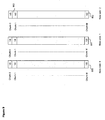
- Figure 2b is an example of a retransmission scheme.
- the table 250 defines the own data section 251 and the repeat data section 252 for each node.
- the node 0 (referenced 253) sends the chunks 0 to 18 as its own data, and will not repeat any data.
- the node 2 (referenced 254) will send the chunk numbered 20 as its own data, the chunks 0 to 2 of the current super frame as part of its repeat data and the chunks 24 and 25 of the preceding super frame also as part of its repeat data.
- the mux_demux register and the retransmit matrix must be filled accordingly. It is necessary only to watch over, when retransmitting chunks of the current super frame, that there is the possibility of receiving them beforehand. For example, the chunk 23 cannot be retransmitted by the node 4 in the same super frame since it is transmitted by the node 5, i.e. after the frame of the node 4.
- Figure 3 is a drawing of a network cycle 313 of transmission in the wireless meshed network 101.
- the super frame 300 forms part of a network cycle 313 of fixed duration, for example a duration of 1ms.
- each WSC or WAS node of the network 101 sends its MAC frame in the wireless meshed network 101 in a predefined sending sequence.
- the frame 1 is sent by the WSC node 110 and the second (frame 2) to seventh (frame 7) frames are sent respectively by the first to sixth WAS nodes.
- These first to seventh MAC nodes form the super frame 300.
- waiting times between the frames referenced "inter_frames 316.1 to 316.7" are provided between the frames Frame 1 to Frame 7 in order to absorb the jitter generated by the different nodes of the network and in order to enable switching over between the sending mode and the reception mode or enable the reorientation of the antennas.
- the data addressed to the receiver application is stored in a set of SSRFs (Synchronous Stream Receive FIFOs) 407 by a TDM bus manager 414. These pieces of data are read by the receiver application at a frequency referenced Fs_OUT.
- SSRFs Synchronous Stream Receive FIFOs
- the application can send and receive control commands by means of a command manager interface 409 and a set of transmit/receive FIFOs comprising a set of "Synchronous Message Receive FIFOs" (SMRF) 410 and a set of Synchronous Message Transmit FIFOs (SMTF) 411.
- SMRF Synchronous Message Receive FIFOs
- SMTF Synchronous Message Transmit FIFOs
- the generic node 400 comprises a reference clock 405 used by the TDM bus manager 414 to define the TDM cycles and the network cycles. This reference clock is also used by a phase-locked loop (PLL) 406 to generate the frequency Fs_OUT.
- PLL phase-locked loop
- the configuration of the phase-locked loop (or PLL) 406 for the generation of the frequency Fs_OUT is achieved by the command management interface 409.
- the command management interface 409 detects and transmits the value of the frequency Fs_IN through the synchronous message transmission FIFO 411.
- the command management interface of this distant node receives this value of the frequency Fs_IN through the synchronous messages receive FIFO of this distant node.
- the distant node can configure its phase-locked looped in order to deliver the same frequency value.
- the TDM bus manager 414 controls a data bus 435 which connects the following FIFOs, the SSRF 407, the SSTF 408, the SMRF 410, the SMTF 411, a "null” values analyzer device 414 and a "null” values insertion device 418.
- the TDM bus manager 414 distributes the application data on TDM virtual channels. This distribution is defined by the already mentioned TDM map register TDM_MAP 415.
- the TDM bus manager 414 requests the null inserter device 418 to read the data of the transmitter application either from the SSTF FIFO 408 or from the SMTF FIFO 411 for all the virtual channels allocated in write mode. It can happen that there are no sufficient data in the SSTF and SMTF FIFOs to satisfy all the allocated virtual channels.
- the null inserter device 418 adds "null" symbols so as to fill the write-allocated virtual channels for which a quantity of data is missing. The "null" symbols are inserted to ensure that the TDM bus manager 414 will always send the same sequence of virtual channels, i.e. the same quantity of data at each network cycle, thus providing for the synchronization of the sender and receiver applications in using strictly the same sequence of virtual channels at each cycle and stop
- the manager of the TDM bus 414 requests the null analyzer device 416 to obtain the TDM data from a SyncRF_from_MAC FIFO 417. These pieces of data are written either to the SSRF 407 or to the SMRF 410 using the TDM map register TDM_MAP 415.
- Certain virtual channels convey TDM data streams having "null" symbols.
- the null analyzer device 416 processes the "null" symbols in such a way that they cannot be interpreted by the TDM bus manager 414 as application data. Since the "null" symbols have been inserted by the null inserter device 418, they should not be communicated to the receiver (or consumer) application. The corresponding virtual channel allocated in read mode is then left empty.
- the "null" symbols are used to ensure that a same quantity of data is sent by the generic node 400 at each network cycle, i.e. the MAC frame which it generates has a fixed size from one network cycle to another, whatever the bit rate of the transmitter (or generator) application. Furthermore, the receiver (consumer) application retrieves the data at the frequency Fs_OUT which corresponds to the frequency Fs_IN used by the transmitter (or generator) application to clock the transmission (or generation) of the data as described here above. The “null” symbols are not transmitted to the receiver (or consumer) application so that it no longer receives data that the transmitter application had sent and thus prevents any time lag in the reception of data and prevent the overflow of the SSRF FIFO 407. The "null” symbols thus ensure that a piece of data would be presented in the same virtual channel as the one that had been used on the transmit node, a certain number of TDM cycles earlier, to send out this same piece of data.
- a MAC adapter 428 included in the "MAC" adaptation module 402b obtains at each TDM cycle:
- the MAC adapter 428 knows the allocation of the virtual channels used in write mode (as well as in read mode) by access to the TDM distribution register TDM_MAP 415.
- these chunks are transmitted to an encoding module 424 in the form of MAC frames during the reception of a signal referenced Tx_cycle_event 451 (indicating the start of the speech time of the generic node 400) delivered by a MAC controller 420. These chunks then constitute the payload data 309 of the MAC frame sent by the generic node 400.
- a FEC (« Forward Error Correction ») type correction can be made on the MAC frame by the encoding module 424 before the MAC frame is transmitted to a MAC frame modulator 425.
- MAC frame demodulator 422 Reciprocally, once a MAC frame is received by a MAC frame demodulator 422, it is transmitted to a MAC frame decoder 423 which can implement a FEC type correction.
- a copy referenced HOP _frame_Rx_hop_id of the MF_id 311 field of the MAC header 308 is sent to the MAC controller 420 at the same time as a signal referenced HOP_frame_Rx_event is activated. This information is then used to synchronize the access control.
- a copy referenced HOP_frame_Rx_event of the field SF_id 310 and a copy referenced HOP_frame_Rx_Node_id of the field NODE_id 312 of the MAC header 308 are sent to the MAC adapter 428 which reads the data blocks in the payload data field 309 of the MAC frame delivered by the MAC frame decoder 423 and stores them in a memory.
- An RF (radio frequency) transmit module 434 performs the usual functions of a radio transmitter: conversion of the intermediate frequency at output of the modulator 425 into the frequency of the carrier used by the radio transmissions (conversion into high frequency), amplification, sending through an antenna etc.
- An RF (radiofrequency) receiver module 434 performs the usual functions of a radio receiver : reception via an antenna, filtering, detection of level, automatic gain control, conversion into low frequency, etc.
- Figure 5 shows an example of architecture of the MAC adapter 428 according to the particular embodiment of the invention.
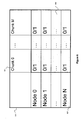
- Figure 6 shows an example of an architecture of the register mux_demux 511 according to a particular embodiment of the invention.
- the register mux_demux 511 indicates the content of the own data section of the MAC frame of each node.
- the register is addressed by rows 602 and by columns 601. Each row corresponds to a node identifier (Node 0 to Node N), and each: corresponds to a chunk number (chunk 0 to chunk M).
- the values stored 603 are 1 or 0 :
- FIG. 8 shows an example of architecture of the TDM distribution register TDM_MAP 415 according to a particular embodiment of the invention.
- the pieces of data in the TDM map register TDM_MAP 415 are ordered according to the numbering of the virtual channels given: at the first offset address aligned on 32 bits of the register, there is the memory zone corresponding to the virtual channel 0 and at the nth offset address aligned on 32 bits of the register, there is the memory zone corresponding to the virtual channel n.
- Figure 10 shows an example of architecture of the memory 500 according to a particular embodiment of the invention.
- the memory 500 is formed by three zones 1001, 1002 and 1003, each associated with a base address (base address 0 for the zone 1001, base address 1 for the zone 1002 and base address 2 for the zone 1003).
- Each zone contains a maximum number M of chunks per super frame. This number M also corresponds to a maximum number of virtual channels (VCO to VCM) per TDM cycle.
- Each chunk 1004 (chunk 0 to chunk M) is formed by a header 1005 and a concatenation of P+1 successive values of a same virtual channel 1006) for example the successive values VC0-0 to VC0-P of the virtual channel VC0, for the chunk Chunk of 0).
- P+1 is the number of TDM cycles per network cycle.
- the chunk number k comprises the value VCk-0 of the virtual channel number k (VCk) during the first TDM cycle, the value VCk-1 of the virtual channel number k (VCk) during the second TDM cycle ...
- Each zone of the memory 500 can contain all the virtual channels of the duration of a network cycle (each zone corresponds to a super frame).
- the channels are ordered as a function of their chunk number, from the smallest chunk number to the biggest chunk number (chunk 0 to chunk M).
- the virtual channels are ordered according to their number, from the smallest to the biggest virtual channel number (VCO to VCM).
- a specific task is assigned to each zone of the memory 500. For example, if for a given network cycle:
- the register RefBaseAddr 504 successively selects the three base addresses of the memory 500 in the following order : base address 2, base address 1 and base address 0.
- the change in value of the base address is activated by the reception of the signal SF_cycle_start, as described here above.
- a signal (also called an event) SF_cycle_start 512 is awaited. This signal indicates the start of a new super frame (i.e. the start of a new network cycle).
- a step 1101 the signal SF_cycle_start 512 is received.
- an internal variable TDM_cycle is set at 0. This internal variable counts the TDM cycles during the super frame.
- the register Chunk_flags 509 which corresponds to the register RefBaseAddr 504 is reset, the register RefBaseAddr 504 pointing to the next super frame in memory 500.
- a search is made for the first write-allocated virtual channel for the local node. This is done in reading the "function" field 801 of the register TDM_MAP 415. If such a virtual channel is found, its number is stored in an internal variable VCnum. If not, the value -1 is stored in the variable VCnum.
- a search is made for the next write-allocated virtual channel, in reading the "function" field 801 of the register TDM_MAP 415. Then, there is a return to the step 1106.
- a step 1112 the processing of a TDM cycle is terminated and the variable TDM_cycle is incremented.
- a test is made to see if the last TDM cycle of the super frame has been reached. If not, there is a return to the step 1103 for a new TDM cycle. If yes, the operation passes to the step 1109 for a new network cycle (i.e. for a new super frame).
- the signal SF_cycle_start 512 (i.e. the start of the new super frame) is awaited.
- the signal SF_cycle_start 512 is received.
- a signal readyForTx 515 is sent to the transmission module towards a MAC layer (Tx_To_MAC) 506, then the step 1102 is returned to.
- the previous super frame is ready to be sent by the MAC adapter 428, i.e. the pieces of data are ready and when the MAC synchronization module 403 is ready, the next super frame will be sent.
- Figure 12 shows the main steps of a processing algorithm implemented by the model of transmission to the MAC layer (Tx_To_MAC) 506, included in the MAC adapter 428, according to a particular embodiment of the invention.
- This module 506 has the function, once the transmission chunk management module (Tx_Chunk_Management) 505 has prepared the chunks for the current super frame, of sending them to the MAC frame encoding module 424 as an own data section. It also takes chunks from the current super frame and the previous super frame to send them to the MAC frame encoding module 424 as a repeat data section.
- Tx_Chunk_Management transmission chunk management module
- step 1200 After reset, there is a wait in a step 1200 for the signal readyForTx generated by the transmission chunk management module (Tx_Chunk_Management) 505 (cf. figure 11 , step 1111).
- a step 1201 the signal readyForTx is received.
- the signal Tx_cycle_event 513 is awaited. This signal is generated by the MAC synchronization module 403 when it is ready to send a MAC frame.
- a search is made for the first write-allocated virtual channel for the local node. This is done in reading the « function » field 801 of the register TDM_MAP 415. If a virtual channel of this kind is found, its number is stored in an internal variable VCnum, if not the value -1 is stored in the variable VCnum. This variable VCnum also indicates the number of the chunk to be read in the memory 500. Furthermore, in this step 1204, the register TxToMacBaseAddr 503 is set with the content of the register RefBaseAddr 504, to address the memory 500 in the zone of the current super frame.
- step 1206 the chunk corresponding to VCnum is read in memory 500. Then, this chunk is written to the MAC frame encoding module 424, then in the step 1214, a search is made for the next write-allocated virtual channel and the operation returns to the step 1205.
- step 1207 a search is made for the first chunk that is to be transmitted, in the retransmit matrix 510, and then in the step 1215, the value of the register TxToMacBaseAddr 503, which is pointing to the current super frame, is saved.
- step 1208 a test is made to find out if all the chunks that are to be retransmitted have been processed. If yes, it means that the processing of the MAC frame repeat data section is terminated and there is a return to the step 1200. If not, the operation passes to the step 1209 to continue the processing of the MAC frame repeat data section.
- a test is made to see the chunk is effectively present in the memory. If certain frames are not received, owing to problems such as shadowing, chunks may be missing in the memory 500. The test is made on the register Chunk_flags 509. If the chunk is present, the operation passes to the step 1211. If not, the operation passes to the step 1212.
- the chunk is read in the memory 500 and written to the MAC frame encoding module 424.
- This module 507 has the function of receiving MAC frames coming from the MAC frame decoder 423 and of processing the data of the own data section and those of the repeat data section.
- a step 1300 the signal 512 is awaited. This signal indicates the start of a new super frame (i.e. the start of a new network cycle).
- the signal HOP_frame_Rx_event is received.
- a test is made to see if the processing of the old data section of the received MAC frame has been ended. If yes, the operation passes to the step 1307 to process the repeat data section. If not, the operation passes to the step 1306 to continue the processing of the own data section.
- the register RxFromMacBaseAddr 502 is modified as a function of the timing information (i.e. « current super frame » or "preceding super frame") contained in the retransmit matrix 510. Then, either the current super frame or the preceding super frame will be addressed.
- step 1310 a check is made in the register registre Chunk_flags 509 to see if this chunk has not already been stored in processing another received MAC frame. If this is the case, the operation passes to the step 1313. There is no need to store the chunk again. If not, the operation passes to the step 1311.
- the first copy received of a particular chunk is kept systematically. This is illustrated in the step 1310 where a test is made to see if a first copy of the chunk has not already been stored. If there is already a first copy, the second copy is not processed.
- Figure 14 presents the main steps of a processing algorithm implemented by the reception module to the TDM bus (Rx_To_TDM) 508, included in the MAC adapter 428, according to a particular embodiment of the invention.
- a step 1400 the signal SF_cycle_start 512 is awaited. This signal indicates the start of a new super frame (i.e. the start of a new network cycle).
- an internal variable TDM_cycle is set at zero. This internal variable counts the TDM cycles during the super frame. Then, the register RxtoTDMBaseAddr 501 is reset with the content of the register RefBaseAddr 504, to address the memory 500 in the zone of the preceding super frame.
- a test is made to see if the variable « I » represents a write-allocated virtual channel number. This is done in reading the "function" field 801 of the register TDM_MAP 415. If the answer is negative, the operation passes to the step 1411. If the answer is yes, the operation passes to the step 1405.
- step 1405 a test is made to see if there is a valid chunk for this virtual channel. This information is given by the register Chunk_flags 509. If no valid container is available, a padding chunk is written to the FIFO SyncRF_from_MAC 417, in the step 1406. If there is a valid chunk, the operation passes to the step 1407.
- the virtual channel is read in the memory 500, and it is written to FIFO SyncRF _from_MAC 417.
- step 1408 a check is made to see if all the virtual channels have been processed. If the answer is negative, the operation returns to the step 1404. If the operation is positive, the operation passes to the step 1409.
- the local variable TDM_cycle is incremented.
- step 1410 a test is made to see if the end of the super frame has been reached (i.e. if all the TDM cycles of the super frame has been processed) if the answer is negative, the operation returns to the step 1403. If it is yes, the operation returns to the step 1400.
Landscapes
- Engineering & Computer Science (AREA)
- Computer Networks & Wireless Communication (AREA)
- Signal Processing (AREA)
- Mobile Radio Communication Systems (AREA)
Claims (24)
- Verfahren zur Datenübertragung in einem synchronen Kommunikationsnetzwerk, das eine Vielzahl von Knoten (110, 111) umfasst, wobei ein Überrahmen auf der Grundlage eines Netzwerkszyklus auf dem Netzwerk kommuniziert wird und eine Vielzahl von Rahmen (301 bis 307) umfasst, wobei jeder Rahmen mit einem der Knoten verbunden ist,
dadurch gekennzeichnet, dass jeder Rahmen einen Nutzlastteil umfasst, der selbst einen Eigene-Datenabschnitt (314) und einen Wiederholungsdatenabschnitt (315) umfasst,
und dass die Vielzahl von Knoten zumindest einen Relaisknoten umfasst, der mit einer Anwendung verbunden ist, die eigene Daten (314) der Relaisknoten erzeugt, die zu zumindest einem Senkenknoten übertragen werden müssen,
und dass der Relaisknoten die nachstehenden Schritte ausführt:- einen Empfang (204) von Rahmen, die von den anderen Knoten kommen,- ein Lesen (208) eines vorbestimmten Teils der Daten von den empfangenen Rahmen, was es ermöglicht, dass Wiederholungsdaten erhalten werden,- ein Schreiben (208) der Wiederholungsdaten in den Wiederholungsdatenabschnitt eines neuen Rahmens, und- ein Schreiben (207) von eigenen Daten des Relaisknotens in den Eigene-Datenabschnitt des neuen Rahmens, und- eine Übertragung (209) des neuen Rahmens. - Verfahren nach Anspruch 1, dadurch gekennzeichnet, dass in dem Leseschritt (208), der zum Erhalten von Wiederholungsdaten verwendet wird, nur ein vorbestimmter Teil der Daten des Eigene-Datenabschnitts (314) der empfangenen Rahmen gelesen wird.
- Verfahren nach einem der Ansprüche 1 und 2, dadurch gekennzeichnet, dass der Leseschritt (208), der zum Erhalten von Wiederholungsdaten verwendet wird, als eine Funktion des Inhalts einer Übertragungsmatrix (511) ausgeführt wird, die den Inhalt des Eigene-Datenabschnitts für jeden Knoten angibt.
- Verfahren nach Anspruch 3, dadurch gekennzeichnet, dass der Eigene-Datenabschnitt jedes Rahmens eine vorbestimmte Anzahl von Datenblöcken umfasst, die Chunks genannt werden, und dass für jeden Knoten die Übertragungsmatrix (511) für jeden Chunk-Rang i, wobei i ∈ [1, M] gilt, wobei M die maximale Anzahl von Chunks pro Überrahmen ist, angibt, ob:- der Chunk mit dem Rang i zu dem Eigene-Datenabschnitt des Rahmens, der mit dem Knoten verbunden ist, übertragen werden soll, oder- der Chunk mit dem Rang i nicht in dem Eigene-Datenabschnitt des Rahmens, der mit dem Knoten verbunden ist, übertragen werden soll.
- Verfahren nach einem der Ansprüche 1 bis 4, dadurch gekennzeichnet, dass der Wiederholungsdatenschreibschritt als eine Funktion des Inhalts einer Neuübertragungsmatrix (510) ausgeführt wird, die den Inhalt des Wiederholungsdatenabschnitts für jeden Knoten angibt.
- Verfahren nach Anspruch 5, dadurch gekennzeichnet, dass der Eigene-Datenabschnitt jedes Rahmens eine vorbestimmte Anzahl von Blöcken umfasst, die Chunks genannt werden, und dass für jeden Knoten die Neuübertragungsmatrix (510) für jeden Chunk-Rang i, wobei i ∈ [1, M] gilt, wobei M die maximale Anzahl von Chunks pro Überrahmen ist, angibt, ob:- der Chunk mit dem Rang i in dem Wiederholungsdatenabschnitt des Rahmens, der mit dem Knoten verbunden ist, nicht erneut übertragen werden soll, oder- der Chunk mit dem Rang i in dem Wiederholungsdatenabschnitt des Rahmens, der mit dem Knoten verbunden ist, erneut übertragen werden soll, indem ein Chunk, der mit dem Rang i verbunden ist und in einem derzeitigen Überrahmen empfangen wird, hergenommen wird, oder- der Chunk mit dem Rang i in dem Wiederholungsdatenabschnitt des Rahmens, der mit dem Knoten verbunden ist, erneut übertragen werden soll, indem ein Chunk, der mit dem Rang i verbunden ist und in einem vorangegangenen Überrahmen empfangen wird, hergenommen wird.
- Verfahren nach einem der Ansprüche 5 und 6, dadurch gekennzeichnet, dass, wenn ein erneut zu übertragender Chunk fehlt, da er während des Leseschritts nicht gelesen worden ist, ein Füllchunk (1406) anstelle des fehlenden Chunks in den Wiederholungsdatenabschnitt des neuen Rahmens geschrieben wird.
- Verfahren nach einem der Ansprüche 1 bis 7, dadurch gekennzeichnet, dass es einen Schritt zur Speicherung der Daten der empfangenen Rahmen in einen Speicher (500, 1000) umfasst, wobei in dem Leseschritt die Wiederholungsdaten in dem Speicher gelesen werden.
- Verfahren nach Anspruch 8, dadurch gekennzeichnet, dass jeder Rahmen eine vorbestimmte Anzahl von Datenblöcken umfasst, die Chunks genannt werden, und jeder Schritt zur Speicherung der Daten der empfangenen Rahmen die nachstehenden Schritte für jeden Chunk jedes Rahmens umfasst:- wenn der Chunk eine erste empfangene Kopie ist, wird der Chunk in dem Speicher gespeichert,- wenn der Chunk nicht eine erste empfangene Kopie ist, sondern eine zweite Kopie ist, und wenn die erste Kopie bereits empfangen und gespeichert worden ist, wird die zweite Kopie nicht in dem Speicher gespeichert.
- Verfahren nach Anspruch 8, dadurch gekennzeichnet, dass jeder Rahmen eine vorbestimmte Anzahl von Datenblöcken umfasst, die Chunks genannt werden, und der Schritt zur Speicherung der Daten der empfangenen Rahmen die nachstehenden Schritte für jeden Chunk jedes Rahmens umfasst:- wenn der Chunk eine erste empfangene Kopie ist, wird der Chunk in dem Speicher gespeichert,- wenn der Chunk nicht eine erste Kopie ist, sondern eine zweite Kopie ist, und wenn die erste Kopie bereits empfangen und gespeichert worden ist, wird die Qualität der ersten und zweiten Kopien verglichen und diejenige der ersten und zweiten Kopien mit der besten Qualität gemäß zumindest einem Qualitätskriterium in dem Speicher gespeichert.
- Verfahren zum Empfangen von Daten in einem synchronen Kommunikationsnetzwerk, das eine Vielzahl von Knoten (110, 111) umfasst, wobei ein Überrahmen auf der Grundlage eines Netzwerkzyklus auf dem Netzwerk kommuniziert wird und eine Vielzahl von Rahmen (301 bis 307) umfasst, wobei jeder Rahmen mit einem der Knoten verbunden ist,
dadurch gekennzeichnet, dass jeder Rahmen einen Nutzlastteil (309) umfasst, der selbst einen Eigene-Datenabschnitt (314) und einen Wiederholungsdatenabschnitt (315) umfasst,
und dass ein Senkenknoten, der zu der Vielzahl von Knoten gehört, die nachstehenden Schritte ausführt:- einen Empfang der Rahmen, die von den anderen Knoten kommen,- ein Lesen der ersten Daten, die für den Senkenknoten bestimmt sind, in einem vorbestimmten Teil des Eigene-Datenabschnitts zumindest eines der empfangenen Rahmen, und- ein Lesen von zweiten Daten, die für den Senkenknoten bestimmt sind, in einem vorbestimmten Teil des Wiederholungsdatenabschnitts zumindest eines der empfangenen Rahmen, und- ein Verarbeiten der ersten und zweiten Teile der gelesenen Daten. - Computerprogrammprodukt, das von einem Kommunikationsnetzwerk herunterladbar ist und/oder in einer computerlesbaren Unterstützungseinrichtung aufgezeichnet ist und/oder durch eine Verarbeitungseinrichtung ausgeführt wird, dadurch gekennzeichnet, dass das Computerprogrammprodukt Programmcodeanweisungen zur Implementierung des Verfahrens nach zumindest einem der Ansprüche 1 bis 11 umfasst, wenn das Programm auf einem Computer ausgeführt wird.
- Speichereinrichtung, die vollständig oder teilweise abnehmbar sein kann, durch einen Computer lesbar sein kann und einen Satz von Anweisungen speichert, die durch den Computer ausführbar sind, um das Verfahren gemäß zumindest einem der Ansprüche 1 bis 11 zu implementieren.
- Relaisknoten, der zu einer Vielzahl von Knoten gehört, die in einem synchronen Kommunikationsnetzwerk beinhaltet sind, das eine Vielzahl von Knoten umfasst, wobei ein Überrahmen auf der Grundlage eines Netzwerkzyklus auf dem Netzwerk kommuniziert wird und eine Vielzahl von Rahmen umfasst, wobei jeder Rahmen mit einem der Knoten verbunden ist,
dadurch gekennzeichnet, dass der Relaisknoten umfasst:- eine Einrichtung zum Empfangen von Rahmen, die von den anderen Knoten kommen, wobei jeder Rahmen einen Nutzlastteil umfasst, der selbst einen Eigene-Datenabschnitt und einen Wiederholungsdatenabschnitt umfasst,- eine Einrichtung zum Lesen eines vorbestimmten Teils der Daten von den empfangenen Rahmen, was es ermöglicht, dass Wiederholungsdaten erhalten werden,- eine Einrichtung zum Schreiben der Wiederholungsdaten in den Wiederholungsdatenabschnitt eines neuen Rahmens,- eine Einrichtung zum Schreiben von eigenen Daten des Relaisknotens in den Eigene-Datenabschnitt des neuen Rahmens, wobei die eigenen Daten durch eine Anwendung erzeugt werden, die mit dem Relaisknoten verbunden ist, und zu zumindest einem Senkenknoten übertragen werden müssen, und- eine Einrichtung zur Übertragung des neuen Rahmens. - Relaisknoten nach Anspruch 14, dadurch gekennzeichnet, dass die Leseeinrichtung, die zum Erhalten von Wiederholungsdaten verwendet wird, eine Einrichtung zum Lesen nur eines vorbestimmten Teils der Daten des Eigene-Datenabschnitts der empfangenen Rahmen ist.
- Relaisknoten nach einem der Ansprüche 14 und 15, dadurch gekennzeichnet, dass die Leseeinrichtung, die zum Erhalten von Wiederholungsdaten verwendet wird, eine Übertragungsmatrix (511) umfasst, die den Inhalt des Eigene-Datenabschnitts für jeden Knoten angibt.
- Relaisknoten nach Anspruch 16, dadurch gekennzeichnet, dass der Eigene-Datenabschnitt jedes Rahmens eine vorbestimmte Anzahl von Datenblöcken umfasst, die Chunks genannt werden, und dass für jeden Knoten die Übertragungsmatrix (511) für jeden Chunk-Rang i, wobei i ∈ [1, M] gilt, wobei M die maximale Anzahl von Chunks pro Überrahmen ist, angibt, ob:- der Chunk mit dem Rang i in dem Eigene-Datenabschnitt des Rahmens, der mit dem Knoten verbunden ist, übertragen werden soll, oder- der Chunk mit dem Rang i in dem Eigene-Datenabschnitt des Rahmens, der mit dem Knoten verbunden ist, nicht übertragen werden soll.
- Relaisknoten nach einem der Ansprüche 14 bis 17, dadurch gekennzeichnet, dass die Wiederholungsdatenschreibeinrichtung eine Neuübertragungsmatrix (510) umfasst, die den Inhalt des Wiederholungsdatenabschnitts für jeden Knoten angibt.
- Relaisknoten nach Anspruch 18, dadurch gekennzeichnet, dass der Eigene-Datenabschnitt jedes Rahmens eine vorbestimmte Anzahl von Blöcken umfasst, die Chunks genannt werden, und dass für jeden Knoten die Neuübertragungsmatrix (510) für jeden Chunk-Rang i, wobei i ∈ [1, M] gilt, wobei M die maximale Anzahl von Chunks pro Überrahmen ist, angibt, ob:- der Chunk mit dem Rang i in dem Wiederholungsdatenabschnitt des Rahmens, der mit dem Knoten verbunden ist, nicht erneut übertragen werden soll, oder- der Chunk mit dem Rang i in dem Wiederholungsdatenabschnitt des Rahmens, der mit dem Knoten verbunden ist, erneut übertragen werden soll, indem ein Chunk, der mit dem Rang i verbunden ist und in einem derzeitigen Überrahmen empfangen wird, hergenommen wird, oder- der Chunk mit dem Rang i in dem Wiederholungsdatenabschnitt des Rahmens, der mit dem Knoten verbunden ist, erneut übertragen werden soll, indem ein Chunk, der mit dem Rang i verbunden ist und in einem vorangegangenen Überrahmen empfangen worden ist, hergenommen wird.
- Relaisknoten nach einem der Ansprüche 18 bis 19, dadurch gekennzeichnet, dass, wenn ein erneut zu übertragender Chunk fehlt, weil er durch die Leseeinrichtung nicht gelesen worden ist, die Schreibeinrichtung einen Füllchunk anstelle des fehlenden Chunks in den Wiederholungsdatenabschnitt des neuen Rahmens schreibt.
- Relaisknoten nach einem der Ansprüche 14 bis 20, dadurch gekennzeichnet, dass der Wiederholungsknoten eine Einrichtung zur Speicherung der Daten der empfangenen Rahmen in einen Speicher umfasst und die Leseeinrichtung die Wiederholungsdaten in dem Speicher liest.
- Relaisknoten nach Anspruch 21, dadurch gekennzeichnet, dass jeder Rahmen eine vorbestimmte Anzahl von Datenblöcken umfasst, die Chunks genannt werden, und dass die Einrichtung zur Speicherung der Daten der empfangenen Rahmen eine Einrichtung zur Implementierung der nachstehend beschriebenen Speicherverfahrensweise für jeden Chunk jedes Rahmens umfasst:- wenn der Chunk eine erste empfangene Kopie ist, wird der Chunk in dem Speicher gespeichert,- wenn der Chunk nicht eine erste empfangene Kopie ist, sondern eine zweite Kopie ist, und wenn die erste Kopie bereits empfangen und gespeichert worden ist, wird die zweite Kopie in dem Speicher nicht gespeichert.
- Relaisknoten nach Anspruch 21, dadurch gekennzeichnet, dass jeder Rahmen eine vorbestimmte Anzahl von Datenblöcken umfasst, die Chunks genannt werden, und die Einrichtung zur Speicherung der Daten der empfangenen Rahmen eine Einrichtung zur Implementierung der nachstehend genannten Speicherverfahrensweise für jeden Chunk jedes Rahmens umfasst:- wenn der Chunk eine erste empfangene Kopie ist, wird der Chunk in dem Speicher gespeichert,- wenn der Chunk nicht eine erste empfangene Kopie ist, sondern eine zweite Kopie ist, und wenn die erste Kopie bereits empfangen und gespeichert worden ist, wird die Qualität der ersten und zweiten Kopien verglichen und diejenige der ersten und zweiten Kopien, die die beste Qualität gemäß zumindest einem Qualitätskriterium aufweist, wird in dem Speicher gespeichert.
- Senkenknoten, der zu einer Vielzahl von Knoten gehört, die in einem synchronen Kommunikationsnetzwerk beinhaltet sind, wobei ein Überrahmen auf der Grundlage eines Netzwerkzyklus kommuniziert wird und eine Vielzahl von Rahmen umfasst, wobei jeder Rahmen mit einem der Knoten verbunden ist,
dadurch gekennzeichnet, dass der Senkenknoten umfasst:- eine Einrichtung zum Empfangen der Rahmen, die von den anderen Knoten kommen, wobei jeder Rahmen einen Nutzlastteil umfasst, der selbst einen Eigene-Datenabschnitt und einen Wiederholungsdatenabschnitt umfasst,- eine Einrichtung zum Lesen von ersten Daten, die für den Senkenknoten bestimmt sind, in einem vorbestimmten Teil des Eigene-Datenabschnitts zumindest eines der empfangenen Rahmen,- eine Einrichtung zum Lesen von zweiten Daten, die für den Senkenknoten bestimmt sind, in einem vorbestimmten Teil des Wiederholungsdatenabschnitts zumindest eines der empfangenen Rahmen, und- eine Einrichtung zur Verarbeitung der ersten und zweiten Teile der gelesenen Daten.
Applications Claiming Priority (1)
| Application Number | Priority Date | Filing Date | Title |
|---|---|---|---|
| FR0756429A FR2918832A1 (fr) | 2007-07-11 | 2007-07-11 | Procedes de transmission de donnees par des noeuds relais dans un reseau de communication synchrone, procede de reception, produit programme d'ordinateur, moyen de stockage et noeuds correspondants. |
Publications (2)
| Publication Number | Publication Date |
|---|---|
| EP2015472A1 EP2015472A1 (de) | 2009-01-14 |
| EP2015472B1 true EP2015472B1 (de) | 2011-05-04 |
Family
ID=39091785
Family Applications (1)
| Application Number | Title | Priority Date | Filing Date |
|---|---|---|---|
| EP08158855A Not-in-force EP2015472B1 (de) | 2007-07-11 | 2008-06-24 | Datenübertragungsverfahren mittels Relaisknoten in einem synchronen Kommunikationsnetzwerk, entsprechendes Empfangsverfahren, Computerprogrammprodukt, Speichermittel und Knoten |
Country Status (5)
| Country | Link |
|---|---|
| US (1) | US8089915B2 (de) |
| EP (1) | EP2015472B1 (de) |
| JP (1) | JP5261047B2 (de) |
| DE (1) | DE602008006632D1 (de) |
| FR (1) | FR2918832A1 (de) |
Families Citing this family (4)
| Publication number | Priority date | Publication date | Assignee | Title |
|---|---|---|---|---|
| US20100172402A1 (en) * | 2009-01-08 | 2010-07-08 | Novafora, Inc. | Content Distribution Systems and Methods |
| FR2954659B1 (fr) * | 2009-12-23 | 2012-06-15 | Canon Kk | Procede de determination d'une sequence de noeuds, produit programme d'ordinateur, moyen de stockage et dispositif correspondants. |
| KR20130007775A (ko) * | 2011-07-11 | 2013-01-21 | 삼성전기주식회사 | 네트워크 장치 및 이의 프레임 재전송 방법 |
| CN108702243B (zh) * | 2016-02-29 | 2022-01-25 | 瑞典爱立信有限公司 | Mmw网络中的中继arq的增强 |
Family Cites Families (24)
| Publication number | Priority date | Publication date | Assignee | Title |
|---|---|---|---|---|
| US6101168A (en) * | 1997-11-13 | 2000-08-08 | Qualcomm Inc. | Method and apparatus for time efficient retransmission using symbol accumulation |
| US7075937B1 (en) * | 1998-05-19 | 2006-07-11 | Canon Kabushiki Kaisha | Method and device for sending data, method and device for receiving data |
| FI108824B (fi) * | 1998-06-03 | 2002-03-28 | Nokia Corp | Datasiirtomenetelmiä tietoliikennejärjestelmässä |
| US6891797B1 (en) * | 1998-07-06 | 2005-05-10 | Canon Kabushiki Kaisha | Method and device for communicating information |
| US6345375B1 (en) * | 1999-02-24 | 2002-02-05 | California Amplifier, Inc. | Packet-based communication methods and systems having improved data throughput |
| EP1051000B1 (de) * | 1999-03-25 | 2014-05-07 | Canon Kabushiki Kaisha | Verfahren und Vorrichtung zur Zuordnung wenigstens einer Weglenkungskennzeichnung zu wenigstens einer Brücke eines Netzes |
| US20030023915A1 (en) * | 2001-07-30 | 2003-01-30 | Koninklijke Philips Electronics N.V. | Forward error correction system and method for packet based communication systems |
| FR2857809A1 (fr) * | 2003-07-15 | 2005-01-21 | Canon Kk | Procede de selection et d'etablissement d'une connexion de flux de donnees via un equipement intermediaire, programme d'ordinateur et equipement intermediaire correspondants. |
| US7609697B2 (en) * | 2004-03-30 | 2009-10-27 | Sony Corporation | Optimizing IEEE 802.11 for TCP/IP data transfer |
| US7839858B2 (en) * | 2004-08-31 | 2010-11-23 | Telefonaktiebolaget Lm Ericsson | Data unit sender and data unit relay device |
| SE0403218D0 (sv) * | 2004-12-30 | 2004-12-30 | Ericsson Telefon Ab L M | Method and apparatus relating to communication- |
| JP2006191279A (ja) * | 2005-01-05 | 2006-07-20 | Matsushita Electric Ind Co Ltd | 無線通信装置 |
| US9439126B2 (en) * | 2005-01-25 | 2016-09-06 | Sipco, Llc | Wireless network protocol system and methods |
| US7570627B2 (en) * | 2005-03-11 | 2009-08-04 | Freescale Semiconductor, Inc. | Method for sharing bandwidth using reduced duty cycle signals and media access control |
| GB2424544B (en) * | 2005-03-23 | 2008-05-21 | Toshiba Res Europ Ltd | Wireless relay |
| JP4763334B2 (ja) * | 2005-04-28 | 2011-08-31 | ルネサスエレクトロニクス株式会社 | 無線アドホック通信システム及び無線アドホック通信システムにおける通信端末の同期化方法 |
| WO2006120650A1 (en) * | 2005-05-12 | 2006-11-16 | Koninklijke Philips Electronics, N.V. | Frame aggregation method for wireless mesh networks |
| KR20070004370A (ko) * | 2005-07-04 | 2007-01-09 | 삼성전자주식회사 | 무선통신시스템을 위한 협동중계전송방법 |
| JP4575265B2 (ja) * | 2005-09-29 | 2010-11-04 | 株式会社東芝 | 無線通信装置 |
| JP2007096917A (ja) * | 2005-09-29 | 2007-04-12 | Toshiba Corp | 通信方法および通信装置 |
| US20070217353A1 (en) * | 2006-03-20 | 2007-09-20 | Motorola, Inc. | Method and Apparatus for Transmitting Data Within a Multi-Hop Communication System |
| WO2007131347A1 (en) * | 2006-05-11 | 2007-11-22 | Nortel Networks Limited | Media access control protocol for multi-hop network systems and method therefore |
| JP4983208B2 (ja) * | 2006-11-07 | 2012-07-25 | 富士通株式会社 | 中継局、無線通信方法 |
| KR101474585B1 (ko) * | 2007-07-06 | 2014-12-18 | 지티이 (유에스에이) 인크. | 무선 멀티홉 중계 네트워크에서의 자원 할당 방법 및 시스템 |
-
2007
- 2007-07-11 FR FR0756429A patent/FR2918832A1/fr not_active Withdrawn
-
2008
- 2008-06-24 DE DE602008006632T patent/DE602008006632D1/de active Active
- 2008-06-24 EP EP08158855A patent/EP2015472B1/de not_active Not-in-force
- 2008-06-30 US US12/164,759 patent/US8089915B2/en active Active
- 2008-07-08 JP JP2008178386A patent/JP5261047B2/ja active Active
Also Published As
| Publication number | Publication date |
|---|---|
| EP2015472A1 (de) | 2009-01-14 |
| FR2918832A1 (fr) | 2009-01-16 |
| DE602008006632D1 (de) | 2011-06-16 |
| US8089915B2 (en) | 2012-01-03 |
| JP5261047B2 (ja) | 2013-08-14 |
| JP2009060591A (ja) | 2009-03-19 |
| US20090016257A1 (en) | 2009-01-15 |
Similar Documents
| Publication | Publication Date | Title |
|---|---|---|
| EP2079193B1 (de) | Verfahren zum Zugriff auf ein Medium in einem synchronen Kommunikationsnetzwerk durch einen Übertragungsknoten, Computerprogrammprodukt, Speichermittel und Übertragungsknoten | |
| EP1983691B1 (de) | Verfahren für die Übertragung und den Empfang von Dateninhalten in einem Kommunikationsnetzwerk, entsprechendes Computerprogrammprodukt, Speichermittel und -Vorrichtungen | |
| JP7092844B2 (ja) | 送信方法および放送局 | |
| CN113242546A (zh) | 音频转发方法、设备和存储介质 | |
| EP2015472B1 (de) | Datenübertragungsverfahren mittels Relaisknoten in einem synchronen Kommunikationsnetzwerk, entsprechendes Empfangsverfahren, Computerprogrammprodukt, Speichermittel und Knoten | |
| EP2165476B1 (de) | Verfahren zur bestimmung einer sequenz für einen zugang zu einem kommunikationsnetzwerk, entsprechendes computerprogrammprodukt, speichermittel und entsprechende vorrichtungen | |
| US20110051745A1 (en) | Method of encapsulating data in digital satellite communication system, and data transmission apparatus therefor | |
| US8838720B2 (en) | Method for managing a distribution of bandwidth in a communications network, corresponding computer-readable storage medium and slave node | |
| US9723515B2 (en) | System and method for transmitting a plurality of multi-service streams over an HF band | |
| CN120957123A (zh) | 无线音频数据传输方法及相关设备 | |
| JPH0653877A (ja) | 衛星通信方式 | |
| JP2005005889A (ja) | 通信装置および通信方法 | |
| Tran et al. | An efficient retransmission scheme for MIMO two-way relay network employing network coding | |
| FR2929484A1 (fr) | Procede de transmission de trames dans un reseau de communication synchrone par un noeud courant, produit programme d'ordinateur, moyen de stockage et noeud courant |
Legal Events
| Date | Code | Title | Description |
|---|---|---|---|
| PUAI | Public reference made under article 153(3) epc to a published international application that has entered the european phase |
Free format text: ORIGINAL CODE: 0009012 |
|
| AK | Designated contracting states |
Kind code of ref document: A1 Designated state(s): AT BE BG CH CY CZ DE DK EE ES FI FR GB GR HR HU IE IS IT LI LT LU LV MC MT NL NO PL PT RO SE SI SK TR |
|
| AX | Request for extension of the european patent |
Extension state: AL BA MK RS |
|
| 17P | Request for examination filed |
Effective date: 20090527 |
|
| AKX | Designation fees paid |
Designated state(s): DE FR GB IT NL |
|
| GRAP | Despatch of communication of intention to grant a patent |
Free format text: ORIGINAL CODE: EPIDOSNIGR1 |
|
| RIC1 | Information provided on ipc code assigned before grant |
Ipc: H04B 7/26 20060101AFI20101119BHEP |
|
| GRAS | Grant fee paid |
Free format text: ORIGINAL CODE: EPIDOSNIGR3 |
|
| GRAA | (expected) grant |
Free format text: ORIGINAL CODE: 0009210 |
|
| AK | Designated contracting states |
Kind code of ref document: B1 Designated state(s): DE FR GB IT NL |
|
| REG | Reference to a national code |
Ref country code: GB Ref legal event code: FG4D |
|
| REF | Corresponds to: |
Ref document number: 602008006632 Country of ref document: DE Date of ref document: 20110616 Kind code of ref document: P |
|
| REG | Reference to a national code |
Ref country code: DE Ref legal event code: R096 Ref document number: 602008006632 Country of ref document: DE Effective date: 20110616 |
|
| REG | Reference to a national code |
Ref country code: NL Ref legal event code: VDEP Effective date: 20110504 |
|
| PG25 | Lapsed in a contracting state [announced via postgrant information from national office to epo] |
Ref country code: NL Free format text: LAPSE BECAUSE OF FAILURE TO SUBMIT A TRANSLATION OF THE DESCRIPTION OR TO PAY THE FEE WITHIN THE PRESCRIBED TIME-LIMIT Effective date: 20110504 |
|
| PLBE | No opposition filed within time limit |
Free format text: ORIGINAL CODE: 0009261 |
|
| STAA | Information on the status of an ep patent application or granted ep patent |
Free format text: STATUS: NO OPPOSITION FILED WITHIN TIME LIMIT |
|
| 26N | No opposition filed |
Effective date: 20120207 |
|
| PG25 | Lapsed in a contracting state [announced via postgrant information from national office to epo] |
Ref country code: IT Free format text: LAPSE BECAUSE OF FAILURE TO SUBMIT A TRANSLATION OF THE DESCRIPTION OR TO PAY THE FEE WITHIN THE PRESCRIBED TIME-LIMIT Effective date: 20110504 |
|
| REG | Reference to a national code |
Ref country code: DE Ref legal event code: R097 Ref document number: 602008006632 Country of ref document: DE Effective date: 20120207 |
|
| PGFP | Annual fee paid to national office [announced via postgrant information from national office to epo] |
Ref country code: DE Payment date: 20120630 Year of fee payment: 5 |
|
| PGFP | Annual fee paid to national office [announced via postgrant information from national office to epo] |
Ref country code: GB Payment date: 20120626 Year of fee payment: 5 |
|
| PGFP | Annual fee paid to national office [announced via postgrant information from national office to epo] |
Ref country code: FR Payment date: 20120712 Year of fee payment: 5 |
|
| GBPC | Gb: european patent ceased through non-payment of renewal fee |
Effective date: 20130624 |
|
| REG | Reference to a national code |
Ref country code: DE Ref legal event code: R119 Ref document number: 602008006632 Country of ref document: DE Effective date: 20140101 |
|
| REG | Reference to a national code |
Ref country code: FR Ref legal event code: ST Effective date: 20140228 |
|
| PG25 | Lapsed in a contracting state [announced via postgrant information from national office to epo] |
Ref country code: DE Free format text: LAPSE BECAUSE OF NON-PAYMENT OF DUE FEES Effective date: 20140101 Ref country code: GB Free format text: LAPSE BECAUSE OF NON-PAYMENT OF DUE FEES Effective date: 20130624 |
|
| PG25 | Lapsed in a contracting state [announced via postgrant information from national office to epo] |
Ref country code: FR Free format text: LAPSE BECAUSE OF NON-PAYMENT OF DUE FEES Effective date: 20130701 |