EP2014352A2 - Appareil pour mélanger et doser des components solides et fluidiques d'un produit anticorrosif, procédé pour la production d'un agent de revêtement et dispositif d'application - Google Patents
Appareil pour mélanger et doser des components solides et fluidiques d'un produit anticorrosif, procédé pour la production d'un agent de revêtement et dispositif d'application Download PDFInfo
- Publication number
- EP2014352A2 EP2014352A2 EP20080016356 EP08016356A EP2014352A2 EP 2014352 A2 EP2014352 A2 EP 2014352A2 EP 20080016356 EP20080016356 EP 20080016356 EP 08016356 A EP08016356 A EP 08016356A EP 2014352 A2 EP2014352 A2 EP 2014352A2
- Authority
- EP
- European Patent Office
- Prior art keywords
- mixing
- container
- batch
- component
- corrosion protection
- Prior art date
- Legal status (The legal status is an assumption and is not a legal conclusion. Google has not performed a legal analysis and makes no representation as to the accuracy of the status listed.)
- Withdrawn
Links
- 238000005260 corrosion Methods 0.000 title claims abstract description 116
- 238000002156 mixing Methods 0.000 title claims abstract description 72
- 239000007787 solid Substances 0.000 title claims abstract description 40
- 238000004519 manufacturing process Methods 0.000 title claims abstract description 16
- 239000003795 chemical substances by application Substances 0.000 title claims description 78
- 239000011248 coating agent Substances 0.000 title description 45
- 238000000576 coating method Methods 0.000 title description 37
- 239000012530 fluid Substances 0.000 title description 2
- 230000007797 corrosion Effects 0.000 claims abstract description 106
- 239000003112 inhibitor Substances 0.000 claims abstract description 66
- 239000007788 liquid Substances 0.000 claims abstract description 38
- 239000007921 spray Substances 0.000 claims abstract description 38
- 239000003638 chemical reducing agent Substances 0.000 claims abstract description 33
- 239000008199 coating composition Substances 0.000 claims abstract description 17
- 238000000034 method Methods 0.000 claims description 33
- 238000013459 approach Methods 0.000 claims description 24
- 239000011814 protection agent Substances 0.000 claims description 24
- 238000003756 stirring Methods 0.000 claims description 17
- 230000008569 process Effects 0.000 claims description 15
- 238000005507 spraying Methods 0.000 claims description 13
- 238000002360 preparation method Methods 0.000 claims description 9
- 238000000265 homogenisation Methods 0.000 claims description 8
- 238000003860 storage Methods 0.000 claims description 7
- HCHKCACWOHOZIP-UHFFFAOYSA-N Zinc Chemical compound [Zn] HCHKCACWOHOZIP-UHFFFAOYSA-N 0.000 abstract description 43
- 239000011230 binding agent Substances 0.000 abstract description 31
- 239000002904 solvent Substances 0.000 abstract description 11
- VYPSYNLAJGMNEJ-UHFFFAOYSA-N Silicium dioxide Chemical compound O=[Si]=O VYPSYNLAJGMNEJ-UHFFFAOYSA-N 0.000 abstract description 8
- 229910052910 alkali metal silicate Inorganic materials 0.000 abstract description 5
- 229910004298 SiO 2 Inorganic materials 0.000 abstract description 4
- 239000000377 silicon dioxide Substances 0.000 abstract description 4
- 235000012239 silicon dioxide Nutrition 0.000 abstract description 4
- 239000000203 mixture Substances 0.000 description 29
- XLOMVQKBTHCTTD-UHFFFAOYSA-N Zinc monoxide Chemical compound [Zn]=O XLOMVQKBTHCTTD-UHFFFAOYSA-N 0.000 description 16
- 230000004224 protection Effects 0.000 description 16
- 239000000654 additive Substances 0.000 description 14
- 239000003973 paint Substances 0.000 description 14
- 239000002245 particle Substances 0.000 description 14
- 238000009472 formulation Methods 0.000 description 13
- 238000012545 processing Methods 0.000 description 11
- XLYOFNOQVPJJNP-UHFFFAOYSA-N water Substances O XLYOFNOQVPJJNP-UHFFFAOYSA-N 0.000 description 11
- 229910052782 aluminium Inorganic materials 0.000 description 10
- XAGFODPZIPBFFR-UHFFFAOYSA-N aluminium Chemical compound [Al] XAGFODPZIPBFFR-UHFFFAOYSA-N 0.000 description 10
- 238000001035 drying Methods 0.000 description 10
- 239000000049 pigment Substances 0.000 description 10
- 235000011837 pasties Nutrition 0.000 description 9
- 239000011787 zinc oxide Substances 0.000 description 8
- 239000000243 solution Substances 0.000 description 7
- 239000000080 wetting agent Substances 0.000 description 7
- 229910052725 zinc Inorganic materials 0.000 description 7
- 239000011701 zinc Substances 0.000 description 7
- OKKJLVBELUTLKV-UHFFFAOYSA-N Methanol Chemical compound OC OKKJLVBELUTLKV-UHFFFAOYSA-N 0.000 description 6
- 238000011161 development Methods 0.000 description 6
- 239000000463 material Substances 0.000 description 6
- 239000000047 product Substances 0.000 description 6
- 101000623895 Bos taurus Mucin-15 Proteins 0.000 description 5
- 238000004140 cleaning Methods 0.000 description 5
- 238000013461 design Methods 0.000 description 5
- 238000010438 heat treatment Methods 0.000 description 5
- 235000019353 potassium silicate Nutrition 0.000 description 5
- 239000000126 substance Substances 0.000 description 5
- 239000000470 constituent Substances 0.000 description 4
- 238000001816 cooling Methods 0.000 description 4
- 230000000694 effects Effects 0.000 description 4
- 238000009776 industrial production Methods 0.000 description 4
- -1 lithium silicates Chemical class 0.000 description 4
- 239000000314 lubricant Substances 0.000 description 4
- 239000002923 metal particle Substances 0.000 description 4
- 239000000758 substrate Substances 0.000 description 4
- 229940073455 tetraethylammonium hydroxide Drugs 0.000 description 4
- LRGJRHZIDJQFCL-UHFFFAOYSA-M tetraethylazanium;hydroxide Chemical compound [OH-].CC[N+](CC)(CC)CC LRGJRHZIDJQFCL-UHFFFAOYSA-M 0.000 description 4
- 239000002562 thickening agent Substances 0.000 description 4
- 239000001993 wax Substances 0.000 description 4
- 229910000831 Steel Inorganic materials 0.000 description 3
- 229910000272 alkali metal oxide Inorganic materials 0.000 description 3
- 239000007864 aqueous solution Substances 0.000 description 3
- 230000001276 controlling effect Effects 0.000 description 3
- 239000002826 coolant Substances 0.000 description 3
- 239000007789 gas Substances 0.000 description 3
- 238000005086 pumping Methods 0.000 description 3
- 150000003839 salts Chemical class 0.000 description 3
- NTHWMYGWWRZVTN-UHFFFAOYSA-N sodium silicate Chemical compound [Na+].[Na+].[O-][Si]([O-])=O NTHWMYGWWRZVTN-UHFFFAOYSA-N 0.000 description 3
- 238000004544 sputter deposition Methods 0.000 description 3
- 239000010959 steel Substances 0.000 description 3
- 238000012360 testing method Methods 0.000 description 3
- 241000196324 Embryophyta Species 0.000 description 2
- XEEYBQQBJWHFJM-UHFFFAOYSA-N Iron Chemical compound [Fe] XEEYBQQBJWHFJM-UHFFFAOYSA-N 0.000 description 2
- XUIMIQQOPSSXEZ-UHFFFAOYSA-N Silicon Chemical compound [Si] XUIMIQQOPSSXEZ-UHFFFAOYSA-N 0.000 description 2
- 230000000996 additive effect Effects 0.000 description 2
- 239000002318 adhesion promoter Substances 0.000 description 2
- 230000008901 benefit Effects 0.000 description 2
- 238000009835 boiling Methods 0.000 description 2
- 239000003054 catalyst Substances 0.000 description 2
- 239000003086 colorant Substances 0.000 description 2
- 238000005336 cracking Methods 0.000 description 2
- 238000005516 engineering process Methods 0.000 description 2
- 238000002474 experimental method Methods 0.000 description 2
- 238000011049 filling Methods 0.000 description 2
- 238000012994 industrial processing Methods 0.000 description 2
- 230000005923 long-lasting effect Effects 0.000 description 2
- 230000007774 longterm Effects 0.000 description 2
- 238000005259 measurement Methods 0.000 description 2
- 229910052751 metal Inorganic materials 0.000 description 2
- 239000002184 metal Substances 0.000 description 2
- 125000002496 methyl group Chemical group [H]C([H])([H])* 0.000 description 2
- 238000012544 monitoring process Methods 0.000 description 2
- 239000004848 polyfunctional curative Substances 0.000 description 2
- 230000002028 premature Effects 0.000 description 2
- 238000004886 process control Methods 0.000 description 2
- 238000005096 rolling process Methods 0.000 description 2
- 229910052710 silicon Inorganic materials 0.000 description 2
- 239000010703 silicon Substances 0.000 description 2
- 229920002050 silicone resin Polymers 0.000 description 2
- 239000003381 stabilizer Substances 0.000 description 2
- 238000009736 wetting Methods 0.000 description 2
- NIXOWILDQLNWCW-UHFFFAOYSA-M Acrylate Chemical compound [O-]C(=O)C=C NIXOWILDQLNWCW-UHFFFAOYSA-M 0.000 description 1
- 229910052582 BN Inorganic materials 0.000 description 1
- PZNSFCLAULLKQX-UHFFFAOYSA-N Boron nitride Chemical compound N#B PZNSFCLAULLKQX-UHFFFAOYSA-N 0.000 description 1
- OKTJSMMVPCPJKN-UHFFFAOYSA-N Carbon Chemical compound [C] OKTJSMMVPCPJKN-UHFFFAOYSA-N 0.000 description 1
- BVKZGUZCCUSVTD-UHFFFAOYSA-L Carbonate Chemical compound [O-]C([O-])=O BVKZGUZCCUSVTD-UHFFFAOYSA-L 0.000 description 1
- BPQQTUXANYXVAA-UHFFFAOYSA-N Orthosilicate Chemical compound [O-][Si]([O-])([O-])[O-] BPQQTUXANYXVAA-UHFFFAOYSA-N 0.000 description 1
- OAICVXFJPJFONN-UHFFFAOYSA-N Phosphorus Chemical compound [P] OAICVXFJPJFONN-UHFFFAOYSA-N 0.000 description 1
- 239000004698 Polyethylene Substances 0.000 description 1
- 239000004743 Polypropylene Substances 0.000 description 1
- 239000004111 Potassium silicate Substances 0.000 description 1
- BLRPTPMANUNPDV-UHFFFAOYSA-N Silane Chemical compound [SiH4] BLRPTPMANUNPDV-UHFFFAOYSA-N 0.000 description 1
- 239000004115 Sodium Silicate Substances 0.000 description 1
- 239000002253 acid Substances 0.000 description 1
- 150000001252 acrylic acid derivatives Chemical class 0.000 description 1
- 238000007605 air drying Methods 0.000 description 1
- 239000003513 alkali Substances 0.000 description 1
- 239000000956 alloy Substances 0.000 description 1
- 229910045601 alloy Inorganic materials 0.000 description 1
- 229910021486 amorphous silicon dioxide Inorganic materials 0.000 description 1
- 230000009286 beneficial effect Effects 0.000 description 1
- 230000015572 biosynthetic process Effects 0.000 description 1
- 235000010338 boric acid Nutrition 0.000 description 1
- 125000005619 boric acid group Chemical class 0.000 description 1
- 150000001639 boron compounds Chemical class 0.000 description 1
- 229910052810 boron oxide Inorganic materials 0.000 description 1
- 230000001680 brushing effect Effects 0.000 description 1
- 239000006229 carbon black Substances 0.000 description 1
- 239000004203 carnauba wax Substances 0.000 description 1
- 235000013869 carnauba wax Nutrition 0.000 description 1
- 230000008859 change Effects 0.000 description 1
- 238000004040 coloring Methods 0.000 description 1
- 238000005056 compaction Methods 0.000 description 1
- 150000001875 compounds Chemical class 0.000 description 1
- 238000010276 construction Methods 0.000 description 1
- 238000010924 continuous production Methods 0.000 description 1
- 230000001419 dependent effect Effects 0.000 description 1
- 239000006185 dispersion Substances 0.000 description 1
- 239000000428 dust Substances 0.000 description 1
- 239000000839 emulsion Substances 0.000 description 1
- 230000007613 environmental effect Effects 0.000 description 1
- 238000004880 explosion Methods 0.000 description 1
- 230000009969 flowable effect Effects 0.000 description 1
- 229910002804 graphite Inorganic materials 0.000 description 1
- 239000010439 graphite Substances 0.000 description 1
- 239000004519 grease Substances 0.000 description 1
- 230000036541 health Effects 0.000 description 1
- 230000006872 improvement Effects 0.000 description 1
- 229910052742 iron Inorganic materials 0.000 description 1
- VAKIVKMUBMZANL-UHFFFAOYSA-N iron phosphide Chemical compound P.[Fe].[Fe].[Fe] VAKIVKMUBMZANL-UHFFFAOYSA-N 0.000 description 1
- VBMVTYDPPZVILR-UHFFFAOYSA-N iron(2+);oxygen(2-) Chemical class [O-2].[Fe+2] VBMVTYDPPZVILR-UHFFFAOYSA-N 0.000 description 1
- JEIPFZHSYJVQDO-UHFFFAOYSA-N iron(III) oxide Inorganic materials O=[Fe]O[Fe]=O JEIPFZHSYJVQDO-UHFFFAOYSA-N 0.000 description 1
- 229910052744 lithium Inorganic materials 0.000 description 1
- 230000001050 lubricating effect Effects 0.000 description 1
- 238000012423 maintenance Methods 0.000 description 1
- 239000012528 membrane Substances 0.000 description 1
- 229910052914 metal silicate Inorganic materials 0.000 description 1
- 239000013528 metallic particle Substances 0.000 description 1
- 239000005078 molybdenum compound Substances 0.000 description 1
- 150000002752 molybdenum compounds Chemical class 0.000 description 1
- CWQXQMHSOZUFJS-UHFFFAOYSA-N molybdenum disulfide Chemical compound S=[Mo]=S CWQXQMHSOZUFJS-UHFFFAOYSA-N 0.000 description 1
- 229910052982 molybdenum disulfide Inorganic materials 0.000 description 1
- QJGQUHMNIGDVPM-UHFFFAOYSA-N nitrogen group Chemical group [N] QJGQUHMNIGDVPM-UHFFFAOYSA-N 0.000 description 1
- 230000003287 optical effect Effects 0.000 description 1
- 239000005416 organic matter Substances 0.000 description 1
- 239000003960 organic solvent Substances 0.000 description 1
- MOWNZPNSYMGTMD-UHFFFAOYSA-N oxidoboron Chemical class O=[B] MOWNZPNSYMGTMD-UHFFFAOYSA-N 0.000 description 1
- 230000002093 peripheral effect Effects 0.000 description 1
- 229910052698 phosphorus Inorganic materials 0.000 description 1
- 239000011574 phosphorus Substances 0.000 description 1
- 229920000573 polyethylene Polymers 0.000 description 1
- 229920001155 polypropylene Polymers 0.000 description 1
- 229920001343 polytetrafluoroethylene Polymers 0.000 description 1
- 239000004810 polytetrafluoroethylene Substances 0.000 description 1
- CHWRSCGUEQEHOH-UHFFFAOYSA-N potassium oxide Chemical compound [O-2].[K+].[K+] CHWRSCGUEQEHOH-UHFFFAOYSA-N 0.000 description 1
- 229910001950 potassium oxide Inorganic materials 0.000 description 1
- NNHHDJVEYQHLHG-UHFFFAOYSA-N potassium silicate Chemical compound [K+].[K+].[O-][Si]([O-])=O NNHHDJVEYQHLHG-UHFFFAOYSA-N 0.000 description 1
- 229910052913 potassium silicate Inorganic materials 0.000 description 1
- 239000000843 powder Substances 0.000 description 1
- 239000011253 protective coating Substances 0.000 description 1
- 230000001681 protective effect Effects 0.000 description 1
- 230000009979 protective mechanism Effects 0.000 description 1
- 150000003242 quaternary ammonium salts Chemical class 0.000 description 1
- 239000002994 raw material Substances 0.000 description 1
- 238000010992 reflux Methods 0.000 description 1
- 230000001105 regulatory effect Effects 0.000 description 1
- 230000000284 resting effect Effects 0.000 description 1
- 239000011265 semifinished product Substances 0.000 description 1
- 238000007493 shaping process Methods 0.000 description 1
- 229910000077 silane Inorganic materials 0.000 description 1
- 235000019351 sodium silicates Nutrition 0.000 description 1
- 238000009987 spinning Methods 0.000 description 1
- 238000013020 steam cleaning Methods 0.000 description 1
- 238000010345 tape casting Methods 0.000 description 1
- 238000005496 tempering Methods 0.000 description 1
- 238000002604 ultrasonography Methods 0.000 description 1
- 238000005303 weighing Methods 0.000 description 1
Images


Classifications
-
- C—CHEMISTRY; METALLURGY
- C09—DYES; PAINTS; POLISHES; NATURAL RESINS; ADHESIVES; COMPOSITIONS NOT OTHERWISE PROVIDED FOR; APPLICATIONS OF MATERIALS NOT OTHERWISE PROVIDED FOR
- C09D—COATING COMPOSITIONS, e.g. PAINTS, VARNISHES OR LACQUERS; FILLING PASTES; CHEMICAL PAINT OR INK REMOVERS; INKS; CORRECTING FLUIDS; WOODSTAINS; PASTES OR SOLIDS FOR COLOURING OR PRINTING; USE OF MATERIALS THEREFOR
- C09D5/00—Coating compositions, e.g. paints, varnishes or lacquers, characterised by their physical nature or the effects produced; Filling pastes
- C09D5/08—Anti-corrosive paints
-
- C—CHEMISTRY; METALLURGY
- C09—DYES; PAINTS; POLISHES; NATURAL RESINS; ADHESIVES; COMPOSITIONS NOT OTHERWISE PROVIDED FOR; APPLICATIONS OF MATERIALS NOT OTHERWISE PROVIDED FOR
- C09D—COATING COMPOSITIONS, e.g. PAINTS, VARNISHES OR LACQUERS; FILLING PASTES; CHEMICAL PAINT OR INK REMOVERS; INKS; CORRECTING FLUIDS; WOODSTAINS; PASTES OR SOLIDS FOR COLOURING OR PRINTING; USE OF MATERIALS THEREFOR
- C09D1/00—Coating compositions, e.g. paints, varnishes or lacquers, based on inorganic substances
- C09D1/02—Coating compositions, e.g. paints, varnishes or lacquers, based on inorganic substances alkali metal silicates
- C09D1/04—Coating compositions, e.g. paints, varnishes or lacquers, based on inorganic substances alkali metal silicates with organic additives
-
- B—PERFORMING OPERATIONS; TRANSPORTING
- B01—PHYSICAL OR CHEMICAL PROCESSES OR APPARATUS IN GENERAL
- B01F—MIXING, e.g. DISSOLVING, EMULSIFYING OR DISPERSING
- B01F23/00—Mixing according to the phases to be mixed, e.g. dispersing or emulsifying
- B01F23/50—Mixing liquids with solids
- B01F23/51—Methods thereof
- B01F23/511—Methods thereof characterised by the composition of the liquids or solids
-
- B—PERFORMING OPERATIONS; TRANSPORTING
- B01—PHYSICAL OR CHEMICAL PROCESSES OR APPARATUS IN GENERAL
- B01F—MIXING, e.g. DISSOLVING, EMULSIFYING OR DISPERSING
- B01F27/00—Mixers with rotary stirring devices in fixed receptacles; Kneaders
- B01F27/80—Mixers with rotary stirring devices in fixed receptacles; Kneaders with stirrers rotating about a substantially vertical axis
- B01F27/86—Mixers with rotary stirring devices in fixed receptacles; Kneaders with stirrers rotating about a substantially vertical axis co-operating with deflectors or baffles fixed to the receptacle
-
- B—PERFORMING OPERATIONS; TRANSPORTING
- B01—PHYSICAL OR CHEMICAL PROCESSES OR APPARATUS IN GENERAL
- B01F—MIXING, e.g. DISSOLVING, EMULSIFYING OR DISPERSING
- B01F27/00—Mixers with rotary stirring devices in fixed receptacles; Kneaders
- B01F27/80—Mixers with rotary stirring devices in fixed receptacles; Kneaders with stirrers rotating about a substantially vertical axis
- B01F27/88—Mixers with rotary stirring devices in fixed receptacles; Kneaders with stirrers rotating about a substantially vertical axis with a separate receptacle-stirrer unit that is adapted to be coupled to a drive mechanism
-
- B—PERFORMING OPERATIONS; TRANSPORTING
- B01—PHYSICAL OR CHEMICAL PROCESSES OR APPARATUS IN GENERAL
- B01F—MIXING, e.g. DISSOLVING, EMULSIFYING OR DISPERSING
- B01F27/00—Mixers with rotary stirring devices in fixed receptacles; Kneaders
- B01F27/80—Mixers with rotary stirring devices in fixed receptacles; Kneaders with stirrers rotating about a substantially vertical axis
- B01F27/93—Mixers with rotary stirring devices in fixed receptacles; Kneaders with stirrers rotating about a substantially vertical axis with rotary discs
-
- B—PERFORMING OPERATIONS; TRANSPORTING
- B01—PHYSICAL OR CHEMICAL PROCESSES OR APPARATUS IN GENERAL
- B01F—MIXING, e.g. DISSOLVING, EMULSIFYING OR DISPERSING
- B01F33/00—Other mixers; Mixing plants; Combinations of mixers
- B01F33/80—Mixing plants; Combinations of mixers
- B01F33/84—Mixing plants with mixing receptacles receiving material dispensed from several component receptacles, e.g. paint tins
-
- B—PERFORMING OPERATIONS; TRANSPORTING
- B01—PHYSICAL OR CHEMICAL PROCESSES OR APPARATUS IN GENERAL
- B01F—MIXING, e.g. DISSOLVING, EMULSIFYING OR DISPERSING
- B01F35/00—Accessories for mixers; Auxiliary operations or auxiliary devices; Parts or details of general application
- B01F35/71—Feed mechanisms
- B01F35/717—Feed mechanisms characterised by the means for feeding the components to the mixer
- B01F35/7174—Feed mechanisms characterised by the means for feeding the components to the mixer using pistons, plungers or syringes
-
- B—PERFORMING OPERATIONS; TRANSPORTING
- B01—PHYSICAL OR CHEMICAL PROCESSES OR APPARATUS IN GENERAL
- B01F—MIXING, e.g. DISSOLVING, EMULSIFYING OR DISPERSING
- B01F35/00—Accessories for mixers; Auxiliary operations or auxiliary devices; Parts or details of general application
- B01F35/71—Feed mechanisms
- B01F35/717—Feed mechanisms characterised by the means for feeding the components to the mixer
- B01F35/71775—Feed mechanisms characterised by the means for feeding the components to the mixer using helical screws
-
- B—PERFORMING OPERATIONS; TRANSPORTING
- B01—PHYSICAL OR CHEMICAL PROCESSES OR APPARATUS IN GENERAL
- B01F—MIXING, e.g. DISSOLVING, EMULSIFYING OR DISPERSING
- B01F35/00—Accessories for mixers; Auxiliary operations or auxiliary devices; Parts or details of general application
- B01F35/80—Forming a predetermined ratio of the substances to be mixed
- B01F35/88—Forming a predetermined ratio of the substances to be mixed by feeding the materials batchwise
- B01F35/881—Forming a predetermined ratio of the substances to be mixed by feeding the materials batchwise by weighing, e.g. with automatic discharge
-
- B—PERFORMING OPERATIONS; TRANSPORTING
- B01—PHYSICAL OR CHEMICAL PROCESSES OR APPARATUS IN GENERAL
- B01F—MIXING, e.g. DISSOLVING, EMULSIFYING OR DISPERSING
- B01F35/00—Accessories for mixers; Auxiliary operations or auxiliary devices; Parts or details of general application
- B01F35/90—Heating or cooling systems
- B01F35/92—Heating or cooling systems for heating the outside of the receptacle, e.g. heated jackets or burners
-
- B—PERFORMING OPERATIONS; TRANSPORTING
- B05—SPRAYING OR ATOMISING IN GENERAL; APPLYING FLUENT MATERIALS TO SURFACES, IN GENERAL
- B05D—PROCESSES FOR APPLYING FLUENT MATERIALS TO SURFACES, IN GENERAL
- B05D7/00—Processes, other than flocking, specially adapted for applying liquids or other fluent materials to particular surfaces or for applying particular liquids or other fluent materials
- B05D7/14—Processes, other than flocking, specially adapted for applying liquids or other fluent materials to particular surfaces or for applying particular liquids or other fluent materials to metal, e.g. car bodies
-
- B—PERFORMING OPERATIONS; TRANSPORTING
- B05—SPRAYING OR ATOMISING IN GENERAL; APPLYING FLUENT MATERIALS TO SURFACES, IN GENERAL
- B05D—PROCESSES FOR APPLYING FLUENT MATERIALS TO SURFACES, IN GENERAL
- B05D7/00—Processes, other than flocking, specially adapted for applying liquids or other fluent materials to particular surfaces or for applying particular liquids or other fluent materials
- B05D7/50—Multilayers
- B05D7/51—One specific pretreatment, e.g. phosphatation, chromatation, in combination with one specific coating
-
- C—CHEMISTRY; METALLURGY
- C09—DYES; PAINTS; POLISHES; NATURAL RESINS; ADHESIVES; COMPOSITIONS NOT OTHERWISE PROVIDED FOR; APPLICATIONS OF MATERIALS NOT OTHERWISE PROVIDED FOR
- C09D—COATING COMPOSITIONS, e.g. PAINTS, VARNISHES OR LACQUERS; FILLING PASTES; CHEMICAL PAINT OR INK REMOVERS; INKS; CORRECTING FLUIDS; WOODSTAINS; PASTES OR SOLIDS FOR COLOURING OR PRINTING; USE OF MATERIALS THEREFOR
- C09D183/00—Coating compositions based on macromolecular compounds obtained by reactions forming in the main chain of the macromolecule a linkage containing silicon, with or without sulfur, nitrogen, oxygen, or carbon only; Coating compositions based on derivatives of such polymers
- C09D183/04—Polysiloxanes
-
- C—CHEMISTRY; METALLURGY
- C09—DYES; PAINTS; POLISHES; NATURAL RESINS; ADHESIVES; COMPOSITIONS NOT OTHERWISE PROVIDED FOR; APPLICATIONS OF MATERIALS NOT OTHERWISE PROVIDED FOR
- C09D—COATING COMPOSITIONS, e.g. PAINTS, VARNISHES OR LACQUERS; FILLING PASTES; CHEMICAL PAINT OR INK REMOVERS; INKS; CORRECTING FLUIDS; WOODSTAINS; PASTES OR SOLIDS FOR COLOURING OR PRINTING; USE OF MATERIALS THEREFOR
- C09D5/00—Coating compositions, e.g. paints, varnishes or lacquers, characterised by their physical nature or the effects produced; Filling pastes
- C09D5/08—Anti-corrosive paints
- C09D5/10—Anti-corrosive paints containing metal dust
-
- C—CHEMISTRY; METALLURGY
- C23—COATING METALLIC MATERIAL; COATING MATERIAL WITH METALLIC MATERIAL; CHEMICAL SURFACE TREATMENT; DIFFUSION TREATMENT OF METALLIC MATERIAL; COATING BY VACUUM EVAPORATION, BY SPUTTERING, BY ION IMPLANTATION OR BY CHEMICAL VAPOUR DEPOSITION, IN GENERAL; INHIBITING CORROSION OF METALLIC MATERIAL OR INCRUSTATION IN GENERAL
- C23C—COATING METALLIC MATERIAL; COATING MATERIAL WITH METALLIC MATERIAL; SURFACE TREATMENT OF METALLIC MATERIAL BY DIFFUSION INTO THE SURFACE, BY CHEMICAL CONVERSION OR SUBSTITUTION; COATING BY VACUUM EVAPORATION, BY SPUTTERING, BY ION IMPLANTATION OR BY CHEMICAL VAPOUR DEPOSITION, IN GENERAL
- C23C22/00—Chemical surface treatment of metallic material by reaction of the surface with a reactive liquid, leaving reaction products of surface material in the coating, e.g. conversion coatings, passivation of metals
-
- C—CHEMISTRY; METALLURGY
- C23—COATING METALLIC MATERIAL; COATING MATERIAL WITH METALLIC MATERIAL; CHEMICAL SURFACE TREATMENT; DIFFUSION TREATMENT OF METALLIC MATERIAL; COATING BY VACUUM EVAPORATION, BY SPUTTERING, BY ION IMPLANTATION OR BY CHEMICAL VAPOUR DEPOSITION, IN GENERAL; INHIBITING CORROSION OF METALLIC MATERIAL OR INCRUSTATION IN GENERAL
- C23C—COATING METALLIC MATERIAL; COATING MATERIAL WITH METALLIC MATERIAL; SURFACE TREATMENT OF METALLIC MATERIAL BY DIFFUSION INTO THE SURFACE, BY CHEMICAL CONVERSION OR SUBSTITUTION; COATING BY VACUUM EVAPORATION, BY SPUTTERING, BY ION IMPLANTATION OR BY CHEMICAL VAPOUR DEPOSITION, IN GENERAL
- C23C22/00—Chemical surface treatment of metallic material by reaction of the surface with a reactive liquid, leaving reaction products of surface material in the coating, e.g. conversion coatings, passivation of metals
- C23C22/05—Chemical surface treatment of metallic material by reaction of the surface with a reactive liquid, leaving reaction products of surface material in the coating, e.g. conversion coatings, passivation of metals using aqueous solutions
- C23C22/60—Chemical surface treatment of metallic material by reaction of the surface with a reactive liquid, leaving reaction products of surface material in the coating, e.g. conversion coatings, passivation of metals using aqueous solutions using alkaline aqueous solutions with pH greater than 8
-
- B—PERFORMING OPERATIONS; TRANSPORTING
- B01—PHYSICAL OR CHEMICAL PROCESSES OR APPARATUS IN GENERAL
- B01F—MIXING, e.g. DISSOLVING, EMULSIFYING OR DISPERSING
- B01F35/00—Accessories for mixers; Auxiliary operations or auxiliary devices; Parts or details of general application
- B01F35/90—Heating or cooling systems
- B01F2035/99—Heating
-
- B—PERFORMING OPERATIONS; TRANSPORTING
- B01—PHYSICAL OR CHEMICAL PROCESSES OR APPARATUS IN GENERAL
- B01F—MIXING, e.g. DISSOLVING, EMULSIFYING OR DISPERSING
- B01F35/00—Accessories for mixers; Auxiliary operations or auxiliary devices; Parts or details of general application
- B01F35/71—Feed mechanisms
- B01F35/715—Feeding the components in several steps, e.g. successive steps
-
- B—PERFORMING OPERATIONS; TRANSPORTING
- B05—SPRAYING OR ATOMISING IN GENERAL; APPLYING FLUENT MATERIALS TO SURFACES, IN GENERAL
- B05D—PROCESSES FOR APPLYING FLUENT MATERIALS TO SURFACES, IN GENERAL
- B05D3/00—Pretreatment of surfaces to which liquids or other fluent materials are to be applied; After-treatment of applied coatings, e.g. intermediate treating of an applied coating preparatory to subsequent applications of liquids or other fluent materials
- B05D3/02—Pretreatment of surfaces to which liquids or other fluent materials are to be applied; After-treatment of applied coatings, e.g. intermediate treating of an applied coating preparatory to subsequent applications of liquids or other fluent materials by baking
- B05D3/0254—After-treatment
-
- B—PERFORMING OPERATIONS; TRANSPORTING
- B05—SPRAYING OR ATOMISING IN GENERAL; APPLYING FLUENT MATERIALS TO SURFACES, IN GENERAL
- B05D—PROCESSES FOR APPLYING FLUENT MATERIALS TO SURFACES, IN GENERAL
- B05D7/00—Processes, other than flocking, specially adapted for applying liquids or other fluent materials to particular surfaces or for applying particular liquids or other fluent materials
- B05D7/50—Multilayers
- B05D7/52—Two layers
- B05D7/54—No clear coat specified
-
- Y—GENERAL TAGGING OF NEW TECHNOLOGICAL DEVELOPMENTS; GENERAL TAGGING OF CROSS-SECTIONAL TECHNOLOGIES SPANNING OVER SEVERAL SECTIONS OF THE IPC; TECHNICAL SUBJECTS COVERED BY FORMER USPC CROSS-REFERENCE ART COLLECTIONS [XRACs] AND DIGESTS
- Y10—TECHNICAL SUBJECTS COVERED BY FORMER USPC
- Y10T—TECHNICAL SUBJECTS COVERED BY FORMER US CLASSIFICATION
- Y10T428/00—Stock material or miscellaneous articles
- Y10T428/12—All metal or with adjacent metals
- Y10T428/12014—All metal or with adjacent metals having metal particles
- Y10T428/12028—Composite; i.e., plural, adjacent, spatially distinct metal components [e.g., layers, etc.]
- Y10T428/12063—Nonparticulate metal component
- Y10T428/12104—Particles discontinuous
- Y10T428/12111—Separated by nonmetal matrix or binder [e.g., welding electrode, etc.]
-
- Y—GENERAL TAGGING OF NEW TECHNOLOGICAL DEVELOPMENTS; GENERAL TAGGING OF CROSS-SECTIONAL TECHNOLOGIES SPANNING OVER SEVERAL SECTIONS OF THE IPC; TECHNICAL SUBJECTS COVERED BY FORMER USPC CROSS-REFERENCE ART COLLECTIONS [XRACs] AND DIGESTS
- Y10—TECHNICAL SUBJECTS COVERED BY FORMER USPC
- Y10T—TECHNICAL SUBJECTS COVERED BY FORMER US CLASSIFICATION
- Y10T428/00—Stock material or miscellaneous articles
- Y10T428/31504—Composite [nonstructural laminate]
- Y10T428/31678—Of metal
Definitions
- the invention relates to a corrosion inhibitor with silicon-based binder, a process for the preparation and application of the corrosion inhibitor and devices for producing and applying the corrosion inhibitor.
- Corrosion inhibitors based on zinc dust and silicate binders have long been known. They are applied as so-called zinc dust paints either in the form of paints or applied as a first, simple corrosion protection coating, called primer, on metallic raw materials or semi-finished products such as tapes, sheets and the like.
- Coatings based on zinc dust paints are applied in high thickness.
- this layer thickness results from the composition of the colors; on the other hand, the layer thickness is an essential component of the protective mechanism on which the corrosion protection is based.
- the layer thickness is an essential component of the protective mechanism on which the corrosion protection is based.
- attempts are made inter alia to counteract the disadvantages of cracking due to the large layer thickness.
- the zinc dust colors Usually used on constructions in the outdoor area (railings, scaffolding, bridges, stairs, ships and the like), it does not depend on the requirements of the layer thickness. Typical of this approach describes z. B. the US 4,162,169 a binder which is suitable for the production of zinc dust paints.
- two-component products are offered, which are mixed ready to use on site immediately before use.
- Two-component products are particularly suitable for commercial users who use larger quantities of zinc dust paints.
- only small amounts of zinc dust color are mixed, which then have to be processed immediately.
- zinc dust paints are not yet suitable for applications, especially industrial applications requiring continuous processing of zinc dust paint.
- This path is the US 5,888,280 , which proposes a two-component formulation containing zinc dust, a Group IA metal silicate, and a carbonate-containing internal hardener in aqueous solution.
- This coating agent is not only suitable as a primer, it should also be suitable as a complete corrosion protection with higher use of zinc particles and reduced water content. By releasing CO 2 , the internal hardener should lower the pH of the coating agent and accelerate curing.
- the invention aims in particular at the use of binders which release as little or no organic components (VOC: volatile organic components) during the processing of the zinc dust color.
- VOC organic components
- the prerequisite for VOC-free and VOC-compliant coating compositions, to which the present invention relates, are defined in the 31st BIMSCHV (Federal Immision Control Ordinance) of 21 August 2001 (BGBl. I, no. Aug. 24, 2001, p. 2180).
- the anticorrosion agent has two components.
- a first component consists essentially of zinc dust, possibly mixed with an anti-settling agent.
- the proportion by weight of the first component is - based on the total formulation - at least 40% by weight, preferably at least 60% by weight, more preferably at least 80% by weight to at most 97% by weight.
- the high content of zinc dust ensures a previously unknown for zinc dust coatings corrosion protection.
- the zinc dust particles have an average particle diameter of up to 10 .mu.m, preferably of up to 8 .mu.m. With this particle size, the ratio of diameter and specific surface area of the particles is optimal for the dry film thicknesses to be built up with this particle.
- anti-settling agents agents are added to the zinc dust to prevent unwanted zinc dust compaction, so-called anti-settling agents.
- Zinc oxide or amorphous SiO 2 is particularly suitable here, for example.
- the proportion of anti-settling agent may in the first component up to 15% by weight based on the amount of zinc dust, preferably up to 10% by weight, particularly preferably up to 5% by weight.
- the use of zinc oxide has surprisingly been found to be particularly advantageous in spraying the corrosion inhibitor, because zinc oxide contributes to improved spray behavior.
- the nozzles of the spraying device tend to clog less with the use of zinc oxide.
- the information for the zinc oxide takes into account that the zinc dust contains 1 to 3% by weight of zinc oxide.
- a second component is composed of an inorganic, silicon-based binder, a VOC-free or VOC-compliant solvent and optionally particles which contribute to the improvement of the corrosion protection.
- alkali metal silicates mixed with silicon dioxide have proven to be suitable. Preference is given to a binder in which the proportion of silicon dioxide is greater than the proportion of the alkali metal oxide (the alkali metal silicate is calculated here on the basis of alkali metal oxide).
- the ratio of SiO 2 to alkali oxide is at least 4: 1, preferably at least 5: 1, preferably at least 6: 1.
- alkali metal silicates for example a mixture of sodium silicates and potassium silicates, or alternatively lithium silicates.
- co-binders may be added to the binder.
- These are preferably polymeric binders, for example methyl silicone resin or saponification-free acrylates. Such binders can serve to adjust the hardness or elasticity of the binder.
- the proportion of the binder in the second component is at least 3% by weight to at most 40% by weight, preferably 10% by weight to 20% by weight.
- VOC-free or VOC-compliant solvents both water, high-boiling solvents or mixtures thereof may be used.
- VOC-compliant solvents are in particular those solvents whose boiling point (above 250 ° C) is so high is that they do not release any organic substances during processing. For reasons of safety at work is preferred when water is used as a solvent. Water also ensures that the corrosion inhibitor is VOC-free.
- metallic particles are usually added to the anticorrosion agent.
- Particularly suitable are those made of passivated aluminum, which are used solely for the optical design of the surface.
- Aluminum can be used in various forms.
- the particles can be stored to improve the corrosion protection as a third component, which is brought together in the preparation of the corrosion inhibitor with the first and the second component, such. B. when the aluminum particles are present as an aqueous paste.
- the pigments are added to the second component of the corrosion inhibitor in an amount of at least 5% by weight based on the total amount of the second component. Preferably, at least 10% by weight to at least 15% by weight, particularly preferably up to 20% by weight of pigments are added.
- the corrosion inhibitor may be added - in either the first component or in the second component - further additives to adapt the anti-corrosion agent to the processing conditions or to ensure predetermined performance characteristics.
- further additives to adapt the anti-corrosion agent to the processing conditions or to ensure predetermined performance characteristics.
- Solid or liquid waxes may also be added as emulsions or dispersions as additives to adjust, for example, the sliding properties of the coating. It can be used conventional and known waxes, z. B. waxes based on polyethylene or polypropylene, polytetrafluoroethylene, but also natural waxes such as carnauba wax or mixtures of the aforementioned substances. Other substances which influence the lubricating and sliding properties, such as graphite, molybdenum disulfide or boron nitride, can also be used as additives. Usual amounts used for lubricants or lubricants are up to 20% by weight, preferably up to 5% by weight, advantageously up to 3% by weight, based on the total formulation of the anticorrosion agent.
- the coating composition may further contain additives which influence the substrate wetting, the defoaming, the flow behavior, the deaeration or the pigment wetting, but also agents for flexibilization or catalysts may be present. These additives may each be added in amounts of 0.01 to 8% by weight based on the total formulation of the coating agent.
- water-dispersible or miscible corrosion inhibitors may be added to the second component with good effect, preferably nitrogen-containing compounds, in particular quaternary ammonium salts.
- a further preferred additive to the coating agent are boron compounds, in particular from the group of boric acids or boron oxides, but also molybdenum compounds or compounds containing phosphorus. These corrosion inhibitors are added in amounts of from 0.01% to 30% by weight based on the total formulation, the lower limit being given by achieving a desired effect, while the upper limit is set for cost reasons.
- the corrosion inhibitor according to the invention has a pH of between 6 and 12, preferably between 8 and 12. Even the alkaline setting of the anticorrosive agent contributes to the protective effect of the basecoat on the workpiece, since in the presence of water, a basic environment sets, that counteracts corrosion. It should also be emphasized as a particular advantage that a corrosion inhibitor with a pH of 10 -12 barely passivates the zinc contained in component I (cf. Roathali, G. Cox and W. Littreal, "Metalls &Alloys", 3.73, 1963 ), so that contain a maximum of cathodically active zinc particles in the coating is.
- the anticorrosion agent according to the invention ensures an extremely efficient and long-lasting rust protection compared with known zinc dust paints.
- a coating in a dry film thickness of 10 microns ensures a life in the salt spray test according to DIN 50 0 21 of at least 200 hours, with twice the coating thickness of the dry coating, the life is at least 500 hours.
- the achievable corrosion protection goes far beyond the values achieved so far.
- the scope for the corrosion inhibitor of the invention extends beyond the use as a simple paint.
- the corrosion inhibitor according to the invention can be applied to the metal surfaces to be coated by a wide variety of application methods. Due to the high effectiveness even with very small layer thicknesses, the agent is very economical and economical.
- the corrosion protection agent according to the invention is suitable to be coated with a further layer, in particular a coloring coating.
- a coating which adheres to the anticorrosion agent according to the invention without impairing its properties a so-called topcoat, is for example composed of the same binder which is contained in the second component of the anticorrosive agent.
- the binder may be supplemented by a co-binder, preferably a polymeric co-binder, especially a methyl silicone resin or a saponification-free acrylate.
- this topcoat is provided with color-imparting pigments, for example with aluminum pigments, carbon black or iron pigments.
- the topcoat can be VOC compliant, containing limited amounts of organic matter released during processing or curing of the topcoate. However, the topcoat is preferably also VOC-free.
- the corrosion inhibitor and optionally the topcoat are advantageously adjusted so that the drying or curing takes place at temperatures of up to 120 ° C, preferably up to 80 ° C, especially preferably up to 40 ° C.
- the invention further relates to a method for applying a corrosion-protective coating on a metallic workpiece. This method is considered as an independent inventive contribution to the invention.
- the inventive method for coating of metallic workpieces provides, if necessary, to clean the surface of the metallic workpiece, then to coat with a VOC-free (preferred) or a VOC-compliant primer, the workpiece then after drying the primer with a corrosion inhibitor according to at least one of claims 1 to 10 to coat and finally to dry the corrosion inhibitor.
- the application of the primer which consists in the simplest case of a water glass solution or a co-binder, as described for the anticorrosion agent, improves the adhesion of the anticorrosion agent on the workpiece and thus ensures a long-lasting corrosion protection of the workpiece.
- the cleaning of the workpiece will usually be required because residues from previous processing steps prevent the adhesion of the anti-corrosion coating.
- any form of surface cleaning is suitable for creating a substrate for the coating according to the invention. It is important, however, that even gentle cleaning process as z. B. are required for the preparation of sensitive materials, also provide a suitable substrate for the aforementioned coating with corrosion inhibitors.
- the cleaning of temperature and / or acid-sensitive materials such. B. special steels using brushes, ultrasound, alkali and / or Lisseffenbad or steam cleaning or a sequence or combination of these cleaning steps creates surfaces that are best suited for coating.
- primers are suitable, for example, co-binders which can be used with the binder of the anticorrosion agent or of the topcoat.
- the primer is a VOC-free solution, e.g. B. a 4% water glass solution, if necessary, with additives that can be processed without problems.
- the primer can be applied in the simplest case without further additives, but it is usually with other additives, eg. B. with wetting agents and possibly added corrosion inhibitors.
- wetting agent and / or corrosion inhibitor are used, advantageously up to 0.05% by weight.
- This coating is then dried. The drying takes place by means of air drying, preferably between room temperature and 100 ° C, so particularly simple and inexpensive.
- the layer thickness of the dried primer is between 100 nm and 3 microns.
- a layer of the corrosion inhibitor described above is applied.
- the corrosion inhibitor can be applied by any application method, in particular spraying, rolling, pouring, brushing, knife coating, rolling, dip-spinning or dip-drawing.
- the coating with the anticorrosion agent is expedient immediately, but no later than 4 hours after drying of the primer to ensure optimum, long-term corrosion protection.
- the anticorrosion agent is quickly touch-proof at room temperature, after only about 30 to 120 seconds it has dried on the surface of the workpiece.
- the actual hardening time is between 24 hours and 72 hours, in extreme cases the hardening time can be up to 14 days.
- the temperatures required for drying are not more than 120 ° C. for the primer and for the anticorrosive agent, preferably not more than 80 ° C., more preferably not more than 40 ° C., preferably not above room temperature.
- the drying or hardening can take place for the primer as well as for the anticorrosion agent with air.
- the z. B. is produced in so-called side compressors. This form of drying requires only little energy and relatively low expenditure on equipment.
- the coated according to the method described above workpiece is protected in the long term against corrosion, even if it is exposed to harsh environmental conditions.
- the coating of primer and corrosion inhibitor described above is very well suited for coating brake discs which must have a resistance to salt spray test of more than 500 hours.
- Brake disks are previously coated with known corrosion inhibitors, which must be heated to temperatures above 300 ° C for complete curing for a long time. This often leads to a deformation of the brake discs, which is not allowed for these products.
- Known coatings therefore lead to a relatively high reject rate.
- Other components are z. B. made of a temperature-sensitive metal or cast. These materials significantly change their properties when heated to over 180 ° C.
- the anticorrosive agent according to the invention offers significantly improved possibilities for comprehensive cathodic corrosion protection.
- the anticorrosion agent of two, possibly three components can be prepared ready for use in a particularly simple manner. It is known from the prior art that zinc dust is stirred into the binder. This coating must then be processed immediately. Due to the extremely short processing time (pot life) is always worked batchwise in known products.
- the liquid components of the anticorrosion agent for a batch of the coating agent is placed in a batch tank.
- the liquid components may, for example, be the liquid component of the coating composition with binder and further additives such as adhesion promoters, wetting agents, thickeners, antifoams, deaerating agents, pigment wetting agents, corrosion inhibitors, but also agents for flexibilization or catalysts. But it can also be submitted to a suitable solvent or water.
- the solid component is added and carried out for uniform mixing of solid and liquid component a homogenization phase.
- solid components is understood in particular to mean particulate substances such as metal particles / flakes, dry pigments and filling material.
- Pasty components ie those which are not or only very limited flowable, are understood in the context of the present invention as solid components.
- the residual amount of the liquid component is added and, if appropriate - blended with the approach - depending on the viscosity of the individual components.
- the metering and mixing of the solid and liquid components is carried out by an automatic control.
- This control also regulates, according to an advantageous development, the maintenance of optimal process parameters, for example temperature, pressure, mixing time and intensity of mixing.
- the advantage of the method is especially in the production of coating compositions with a high proportion of solid components, such.
- Example in the corrosion inhibitor according to the present invention.
- the method allows a quasi-continuous supply of the inventive corrosion inhibitor, for example.
- an approach to corrosion inhibitors in a "batch" is produced by the special, preferably automatic embodiment of the method, however, is a supply of anti-corrosion agent in a continuous industrial process, for example.
- the determination of the subset of the liquid components, which is added to the container at the beginning of the process, is basically dependent on the ratio of the liquid to the solid components and in particular the viscosity of the liquid components.
- the amount should be selected so that during the homogenization a homogeneous paste of medium to high viscosity is obtained, whereby a good mixing is achieved by approximating the viscosities of the individual components.
- the subset is preferably about one third of the total amount of the liquid components.
- a very good homogenization and a singling agglomerated zinc particles is achieved.
- the batch is preferably mixed regularly during the addition of the solid components and / or during the homogenization phase.
- all suitable devices and methods can be used, such as mixing by gas turbulence or continuous or regular pumping of the batch.
- the approach is regular or continuous is stirred.
- conventional stirring devices depending on the size of the batch container, such as. Magnetic stirrer, dissolver or Ultraturrax be used.
- the approach is regularly mixed.
- the quality of the mixing process is determined by the selection of the stirrer and the speed. Basically, therefore, the speed should be selected based on the peripheral speed depending on the means to be homogenized.
- Experimental results of the applicant confirm z. Example, that a speed between 100 and 1500 U / min and preferably 1000 U / min when using a dissolver disk is particularly advantageous for the preparation of a coating agent. Particularly preferably, the speed is controllable, so that different speeds can be set in the individual process steps.
- the temperature of the coating agent formulation is maintained between 4 ° C and 40 ° C during the process.
- the batch container may be suitably designed, for example. With conventional heating / cooling devices. Suitable z. B. double-walled approach tank, which are traversed by a heating or cooling medium. Depending on the binder system, it may be appropriate to pressurize the container during the mixing and dosing with a specified positive or negative pressure. In particular, when applying a vacuum z. As a defoaming and thus a good homogenization of the coating agent can be achieved. Preference is given to a negative pressure of about 1/2 bar below atmospheric pressure.
- solid and / or liquid components and in particular solid and / or liquid additives are added with or after the addition of the residual amount of the liquid components.
- pigments in particular metal particles and / or flakes, such as, for example, aluminum flakes in solid or pasty form, but also lubricants, wetting agents, thickeners or adhesion promoters as described above in connection with the composition of the anticorrosion agent can be added.
- preference should also be given to further mixing or stirring the coating agent mixture during the addition of additives and / or afterward. For stirring after completion of the coating agent, a speed in the range of up to 500 rpm is preferably used.
- an apparatus for mixing and metering solid and liquid components of the anticorrosion agent is provided within the scope of the inventive solution as an independent constituent for producing the anticorrosion agent according to the invention.
- This device is provided with means for measuring the amounts of the respective component of the corrosion protection agent, a mixing container and a mixing device and optionally means for controlling the process. Using such a device, the implementation of the aforementioned method for the preparation of the corrosion protection agent according to the invention in an advantageous manner is easily possible.
- the respective components of the anticorrosive agent are basically all conventional devices, such as scales, pumps or flow meters suitable.
- the solid components such as zinc dust
- the batch container may for example be arranged on a scale in order to determine the weight of the batch container.
- the weight of the batch container is determined and the difference determined from the respective measured value when adding the component.
- liquid components it is also possible, for example, to use clocked pumps or flow meters / sensors to measure the quantities. Even with liquid components, a balance may be used.
- the measurement uncertainty should not exceed a maximum of 2%, preferably 1%, in order to be able to comply with the formulation of the corrosion inhibitor according to the invention.
- the selection of the respective devices for measuring depends on the particular conditions of the substrate to be measured.
- the apparatus for mixing the anticorrosive agent further comprises a batch container for receiving the anticorrosion agent batch and a mixing device on. If possible, the batch container should be easily replaceable in order to be able to be used in quasi-continuous operation in an industrial production. In this case, it is advantageously possible to use the batch container directly after production of the corrosion inhibitor in an application / coating arrangement.
- the batch container is a pressure vessel.
- a pressure vessel is advantageous.
- the device preferably has means for keeping the container temperature of the batch container constant. As a result, compliance with the required temperature range can be maintained even with exothermic solvent or binder systems.
- the batch tank can be designed double-walled, whereby the resulting between the two container walls cavity with coolant or water can be flowed through. With a conventional heating / cooling unit can be done so a tempering of the approach.
- the mixing device should be designed to achieve regular or, preferably, continuous blending of the corrosion inhibitor formulation in the batch tank. Suitable mixing devices may, for example, be designed such that gas nozzles attached to the batch container swirl the corrosion inhibitor batch by applying a corresponding gas pressure. It is also conceivable to remove the corrosion protection agent mixture in a closed circuit from the batch tank via a pump and to add it to the batch tank again (circulation pumping).
- the mixing device is a stirring device.
- Corresponding stirring devices generally have a stirrer, such as, for example, a dissolver disk or a helical stirrer, which are movable via a suitable drive.
- the drive may be, for example, an electric motor.
- the stirrer is designed so that a mixing takes place on the one hand in the plane of the stirrer, but also perpendicular thereto. With such a stirring tool, a good mixing can be achieved, especially in the mixing of anti-corrosion agents with a high concentration of solid components.
- the stirrer should continue to be preferred be adapted to the geometry of the respective neck container.
- the formulation container has customary swirling means in the art, for example baffles on the inside.
- conveying means for conveying a solid or liquid component from the respective storage container are provided in the batch container.
- at least partially automatic mixing and dosing of the components of the coating agent approach is advantageous.
- the tolerances for the individual components are generally relatively low within a formulation, dosing errors can thus be avoided.
- the delivery rate of the conveying means should preferably be controllable.
- the respective funding depends on the component to be transported.
- a screw conveyor is preferably used for liquid components pumps with pipe or hose lines.
- metal particles such as. Fine zinc dust
- a dosage is often difficult to achieve and due to the very low sputtering by the low particle weight sputtering associated with strong and harmful emissions. Therefore, screw conveyors are particularly advantageous here.
- the conveying means may be a squeezing device.
- the device for mixing and dosing control means for controlling the dosage.
- control means facilitate the safe and accurate dosage significantly.
- the control means further process parameters, such as, for example, the mixing by appropriate Monitor and adjust viscosity measurements.
- control means may be designed so that they independently monitor the pot life, depending on the settling behavior of the anticorrosive agent, and thus be integrated into the process control of an application / coating system. It is also conceivable to provide means for monitoring the filling / leveling state in order to automatically start mixing a new anticorrosive agent formulation in the mixing and dosing device when falling below a certain level within the application / coating system.
- Control means are industrially available in the process technology, in particular suitable are, for example, PLC controls or microprocessor controls.
- the application of the corrosion inhibitor according to the invention is difficult, as explained at the outset, owing to the properties of the VOC-conforming anticorrosive agent with respect to settling behavior and short drying time. This can quickly clog pipes and equipment.
- an application arrangement for applying anticorrosive agent to a workpiece is therefore provided within the scope of the inventive solution as an independent component for providing a corrosion protection coating.
- the application arrangement has a batch container, conveying means, at least one pressure reducer connected to the batch container, and a spraying device connected to the batch container.
- the batch tank should in this case be designed so that a batchwise processing within the pot life of the respective corrosion protection composition is possible.
- the size of the batch tank should therefore be selected according to the requirements of the respective coating plant.
- the batch tank should have suitable connections for removal of the corrosion inhibitor.
- suitable conveying means for example, all conventional conveying means, such as, for example, suitable feed pumps, can be used for this purpose.
- Such funding should be designed so that the usually existing lines between approach tank and pressure reducer / sprayer can be supplied with anticorrosion agent under a suitable operating pressure.
- the operating pressure should always be selected depending on the respective cable length. For conventional coating systems, an operating pressure of 1-2 bar has been found suitable. In particular, the operating pressure should therefore not be too low to avoid settling of the solid components of the anticorrosion agent or clogging of the lines.
- a pressure reducer is provided.
- the pressure reducer should be able to safely control the operating pressure generated by the respective conveyor.
- the pressure reducer between the approach container and the associated spray device is interposed.
- a pressure reducer should be present per spray device in order to optimally adjust the spray pressure at each spray gun. In this case, the conduction path between the pressure reducer and the spray gun should be kept as short as possible.
- Such pressure reducers are industrially available in the field of fluid technology.
- the pressure reducer and sprayer should be designed to prevent clogging during operation.
- the pressure reducer is therefore designed contactless, ie the pressure reducer is not in direct contact with the corrosion inhibitor used in the operation.
- Such a design of the pressure reducer is particularly advantageous because conventional diaphragm pressure reducers show the property that, in the coating composition according to the invention with solid and liquid components, parts of the solid components collect within the pressure reducer and thus lead to premature clogging of the pressure reducer.
- the batch container is connected at least in sections by means of a hose with the spray gun and the pressure reducer is designed such that the cross section of the hose is at least partially variable.
- the pressure reducer can, for example, squeeze the hose line by means of a pneumatic cylinder.
- the hose should therefore be suitably designed according to the design of the pressure reducer, and in particular be elastic.
- a hose is used, which should have an inner diameter between 2 mm - 10 mm.
- the spraying device is designed in such a way that the atomizing air flow generated during operation atomizes the anticorrosive agent outside the spraying device.
- the anticorrosion agent thus advantageously comes into contact with the atomizing air flow only outside the spraying device.
- the spray device is designed accordingly, in particular, the nozzle may have an adjustable opening size.
- Corresponding experiments of the applicant show that in particular a nozzle size between 0.5 mm - 1.2 mm is advantageous when using a "Stem-S" nozzle. Of course, any other suitable nozzle can be used.
- a shaping air stream is also provided outside the spraying device, which provides the remaining amount of air necessary for the spraying of the anticorrosive agent during operation and forms the spray jet.
- the configuration of the spraying device of this type is particularly advantageous in the case of the anticorrosive agent according to the invention, since it cures rapidly upon contact with air. Characterized in that the amount of air required for sputtering is added substantially only outside of the spray device, clogging of the spray device can be advantageously avoided in this way.
- the batch container even if it is used in the application arrangement on a mixing device.
- the composition of the anticorrosion agent it may be advantageous to regularly mix or continuously mix the anticorrosion agent batch contained in the batch tank.
- solid components such as, for example, the VOC-compliant corrosion inhibitor according to the invention, premature settling can be advantageously avoided.
- Corresponding usable mixing devices have already been discussed in the explanation of the device for mixing and dosing, to which reference is made here.
- the batch container used in the application arrangement is a pressure vessel and has a device for continuous stirring of the corrosion protection agent.
- a compressed air supply to pressurize the entire tank with the operating pressure.
- compressed air for example, have a helical stirrer for mixing the anticorrosive agent.
- a drive may, for example, be formed by an electric motor, which is preferably arranged outside of the attachment container. In this case, however, care must be taken by means of appropriate seals for a pressure tightness of the neck tank.
- the means for generating pressure include a pump between the batch container and the spray device, in particular a double-membrane pump is preferred.
- a pressure reducer should be arranged between the pump and the spray device.
- a circulation line is disposed between the pump and the pressure reducer and forms a return line to the batch tank.
- the sub-mirror method is used, in which the circulation line is connected to the approach container in such a way that the refluxing anticorrosive agent flows back below the level of the anticorrosive agent present in the approach container.
- the application arrangement for applying corrosion protection comprises a device for mixing and metering, as mentioned above.
- the combination of a device for mixing and dosing and the application arrangement allows a batch operation by replacing the respective batch container.
- a device for mixing and dosing it is not necessary for a device for mixing and dosing to be present per application arrangement in an assembly line; from an economic point of view, it may be expedient to provide a device for mixing and dosing for a multiplicity of application arrangements.
- Due to the combination of the two devices it is also advantageously possible to use only one batch container per batch of anti-corrosion agent.
- the anticorrosive agent can in this case be produced directly in the apparatus for mixing and metering in the batch container, which is then used within the application arrangement for applying anticorrosion coatings to workpieces.
- the application arrangement and the device for mixing and dosing are spatially close to each other or under certain circumstances at some distance from each other, for example.
- the application arrangement and the mixing and dosing device are controlled and controlled by a common process control.
- a device for measuring the level within the batch tank and when falling below a predetermined level in the apparatus for mixing and dosing directly a new approach corrosion protection can be made in a further batch tank.
- component II consists of 25 g of a binder of potassium silicate and silicon dioxide (SiO 2 ), wherein the molar ratio of SiO 2 to potassium oxide is 5: 1.
- the second component is added 7 g of demineralized water.
- the components of the second component are mixed for 15 minutes with a stirrer.
- Component II has a pH above 11. It is VOC-free.
- the component is stored sealed in a conventional container.
- An alternative embodiment of the anticorrosion agent has the following constituents: Component I: 60 g of zinc dust, which, due to its production, contains up to 3 g of zinc oxide.
- Component II 20 g of the binder from Example I, 0.05 g of a thickener, eg Kelzan ST® and 1 g each of a wetting agent, for. Tego Wet 500® and a 20% aqueous solution of tetraethylammonium hydroxide (TEAH) as a stabilizer, and 10 g of a 60% aqueous aluminum paste and 8 g of demineralized water.
- the corrosion inhibitor according to Example II is prepared by first stirring the aluminum paste for at least 30 minutes.
- component II Thereafter, the components of component II are mixed with a stirrer.
- Component II has a pH above 11. It is VOC-free.
- the component is stored sealed in a conventional container.
- Steel brake discs are coated with the corrosion inhibitor according to embodiment II.
- the brake discs were previously cleaned of dust and grease.
- a VOC-free solution containing 4% water glass sprayed.
- the brake discs coated with primer pass through a blower.
- the primer layer (layer thickness 1 ⁇ m) is dried at room temperature.
- the anticorrosion agent is sprayed according to Embodiment II in a 50 micron thick layer. The coating takes place at room temperature.
- the coated brake discs pass through a continuous drying oven, in which by using side compressors a high air velocity is generated by which the anticorrosive agent dries and cures on the brake discs in a short time. Drying at elevated temperatures is not required.
- the brake discs In the salt spray test a service life of the thus coated brake discs of more than 500 hours is measured.
- the brake discs could be coated without warping the brake discs.
- the addition of passivated aluminum particles in the anti-corrosion agent, the brake discs have an attractive, uniform color.
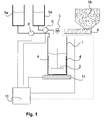
- Fig. 1 shows a first embodiment of a device for mixing and dosing of solid and liquid components of a corrosion inhibitor.
- the device comprises a batch container 1, which has a stirring device for mixing the components.
- the stirring device comprises a dissolver disk 2 and is driven by an arrangement of an axis and an electric motor 3.
- the electric motor 3 is mounted outside of the neck tank 1 at this, or on the container lid (not shown).
- the approach container 1 is made of steel and has lateral baffles 4, which provide for improved mixing, in particular perpendicular to the plane of the dissolver disc 2.
- a dissolver suction disk instead of the dissolver disk 2 to use.
- the device for mixing and dosing further comprises one or more storage containers 5a for liquid to pasty components of low to medium viscosity.
- the solvent here: water
- This may be commercially available impeller pumps, depending on the component used and double diaphragm pumps can be used. In the event that a pasty component is to be metered by means of a pump 6, this should be adapted to the material properties of the respective component.
- solid components of the anticorrosion agent such as. Zinc dust
- the device for mixing and dosing at least one reservoir 5b, the metering of solid components via a screw conveyor. 8
- a microprocessor unit 10 is provided, which is connected to the pump 6 and the screw conveyor 8. Furthermore, the batch container 1 is continuously weighed via a precision balance 11. By evaluating the measured data of the precision balance 11 in the microprocessor unit 10, the pumps 6 and the screw conveyor 8 are controlled in a clocked manner on the basis of the corrosion protection agent recipe in order to precisely dose the corresponding proportions of the components of the corrosion protection agent in one approach. In addition to the control of the dosage, it is also conceivable that the microprocessor unit 10 also controls the electric motor 3, whereby different stirring speeds or resting times can be taken into account. The connection of the microprocessor unit 10 with the devices is done via conventional control lines.
- the dissolver disc 2 is continuously kept rotating at a speed of 1000 rpm. After completion, a speed of 500 rpm is set.
- Fig. 2 shown second embodiment of the Means for mixing and dosing therefore shows a double-walled approach tank 1.
- the resulting gap between the two container walls 21 is filled with coolant.
- the batch container 1 can be tempered so via a heating / cooling unit (not shown), which is connected to the flow 22 and the return 23.
- the heating / cooling device should also be connected to the microprocessor unit 10 for monitoring and control.
- a third form of a storage container 5c which is particularly suitable for pasty components of the corrosion protection agent.
- the metering of the pasty component takes place via a squeezing device 9a, which is driven by an electric motor 9b.
- the electric motor 9b is connected to the microprocessor unit 10.
- squeezing device 9a in the embodiment of Fig. 1 in addition, for example, is used for dosing pasty aluminum.
- a plurality of storage containers 5b are used with corresponding screw conveyors 8 for a corrosion protection agent with a plurality of solid components.
- the corresponding storage containers and dosing agents should be selected in accordance with the composition of the anticorrosion agent.
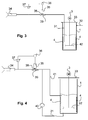
- FIG Fig. 3 A first embodiment of an application arrangement for applying the anticorrosive agent to a workpiece is shown in FIG Fig. 3 shown.
- the application arrangement has the already described approach container 1. This is first used within the previously described device for mixing and dosing. After completion of the anti-corrosion agent approach, the same batch container 1 is used within the application assembly. The use of the same batch container 1 is particularly advantageous for a quasi-continuous operation in the industrial manufacturing process. The replacement of the approach tank 1 between the two systems can be done manually, but also automatically.
- a suitable stirring device for example.
- a lid 33 closes the batch container pressure-tight.
- the Achsen preparer between the electric motor 3 and dissolver 2 is carried out accordingly pressure-tight.
- a pressure port 32 is provided for pressurizing the neck tank 1 with compressed air. When pressurized air is applied to the pressure port 32, the anticorrosion agent is expelled from the batch tank 1 via a conveyor pipe 31.
- the delivery pipe 31 connects the batch tank 1 with a spray gun 34.
- a suitable filter can be used between the batch tank 1 and the spray gun 34.
- a pressure reducer 35 is arranged between the preparation container 1 and the spray gun 34.
- the pressure reducer is controlled by a controller 36 which is connected to a pressure gauge 37.
- the controller 36 allows the setting of the respective spray pressure and regulates the pressure at the spray gun 34 via the pressure reducer 35 using the pressure gauge 37th
- the pressure reducer 35 comprises a displaceable on its longitudinal side of the pressure piston 38, which changes the cross section of a hose 39 depending on the position.
- the pressure reducer 35 includes for this purpose a suitable servomotor (not shown).
- the hose 39 has an inner diameter of 4 mm.
- a second embodiment of the application arrangement is shown.
- Application arrangement shown differs from that in Fig. 3 shown by the fact that a pump 40 is used to promote the corrosion protection agent from the approach tank 1 via the delivery line 31.
- the pump 40 is designed as a double diaphragm pump and promotes sucked corrosion protection agent to the spray gun 34 via suitable lines.
- the pump 40 can be operated continuously, even if the spray gun 34 is not active, a return line 41 is provided, passes through the excess corrosion inhibitor back into the batch tank 1.
- the return line 41 is returned below the level of the anticorrosion agent in the batch tank 1 (bottom-mirror method). To this In the same way, swirling of the corrosion protection agent in the batch container 1 can be achieved so that, depending on the nature of the anti-corrosion agent, the mixer can be dispensed with.
- Fig. 5 Such an embodiment of the application arrangement is in Fig. 5 shown.
- a third embodiment of an application arrangement has a connected to the feed line 31 pump 40 and a return line 41, with the excess corrosion inhibitor is returned to the batch tank 1.
- two spray guns 34 are present in the application assembly.
- Per spray gun 34, an arrangement of pressure reducer 35, controller 36 and pressure gauge 37 is provided to adjust the spray pressure at the respective spray gun 34 can. It is readily possible to arrange further spray guns 34 as shown.
- the pump 40 should then be selected appropriately to provide sufficient pressure.
- the use of multiple spray guns 34 is particularly advantageous in industrial production lines to allow coating of a workpiece from different directions, thereby ensuring uniform coating.
Landscapes
- Chemical & Material Sciences (AREA)
- Chemical Kinetics & Catalysis (AREA)
- Engineering & Computer Science (AREA)
- Wood Science & Technology (AREA)
- Materials Engineering (AREA)
- Organic Chemistry (AREA)
- Life Sciences & Earth Sciences (AREA)
- General Chemical & Material Sciences (AREA)
- Mechanical Engineering (AREA)
- Metallurgy (AREA)
- Inorganic Chemistry (AREA)
- Dispersion Chemistry (AREA)
- Paints Or Removers (AREA)
- Application Of Or Painting With Fluid Materials (AREA)
- Preventing Corrosion Or Incrustation Of Metals (AREA)
- Spray Control Apparatus (AREA)
Applications Claiming Priority (2)
| Application Number | Priority Date | Filing Date | Title |
|---|---|---|---|
| DE102006002545A DE102006002545A1 (de) | 2006-01-18 | 2006-01-18 | Siliziumbasiertes Korrosionsschutzmittel |
| EP07711348A EP1976947A2 (fr) | 2006-01-18 | 2007-01-16 | Agent anti-corrosion à base de silicium |
Related Parent Applications (1)
| Application Number | Title | Priority Date | Filing Date |
|---|---|---|---|
| EP07711348A Division EP1976947A2 (fr) | 2006-01-18 | 2007-01-16 | Agent anti-corrosion à base de silicium |
Publications (2)
| Publication Number | Publication Date |
|---|---|
| EP2014352A2 true EP2014352A2 (fr) | 2009-01-14 |
| EP2014352A3 EP2014352A3 (fr) | 2009-11-18 |
Family
ID=37189001
Family Applications (2)
| Application Number | Title | Priority Date | Filing Date |
|---|---|---|---|
| EP07711348A Withdrawn EP1976947A2 (fr) | 2006-01-18 | 2007-01-16 | Agent anti-corrosion à base de silicium |
| EP20080016356 Withdrawn EP2014352A3 (fr) | 2006-01-18 | 2007-01-16 | Appareil pour mélanger et doser des components solides et fluidiques d'un produit anticorrosif, procédé pour la production d'un agent de revêtement et dispositif d'application |
Family Applications Before (1)
| Application Number | Title | Priority Date | Filing Date |
|---|---|---|---|
| EP07711348A Withdrawn EP1976947A2 (fr) | 2006-01-18 | 2007-01-16 | Agent anti-corrosion à base de silicium |
Country Status (13)
| Country | Link |
|---|---|
| US (1) | US20100221568A1 (fr) |
| EP (2) | EP1976947A2 (fr) |
| JP (1) | JP2009523913A (fr) |
| KR (1) | KR20080085206A (fr) |
| CN (1) | CN101370880A (fr) |
| AU (1) | AU2007207129B2 (fr) |
| BR (1) | BRPI0706582A2 (fr) |
| CA (1) | CA2636668A1 (fr) |
| DE (1) | DE102006002545A1 (fr) |
| EA (1) | EA200870173A1 (fr) |
| IL (1) | IL192641A0 (fr) |
| WO (1) | WO2007082711A2 (fr) |
| ZA (1) | ZA200806173B (fr) |
Cited By (3)
| Publication number | Priority date | Publication date | Assignee | Title |
|---|---|---|---|---|
| DE102016218416A1 (de) | 2016-09-26 | 2018-03-29 | Bayerische Motoren Werke Aktiengesellschaft | Tragbildprüfmaschinenfarbauftragsystem |
| RU2754910C1 (ru) * | 2020-09-28 | 2021-09-08 | Федеральное государственное бюджетное образовательное учреждение высшего образования "Российский химико-технологический университет имени Д, И. Менделеева" (РХТУ им. Д. И. Менделеева) | Установка получения и концентрирования растворов полимеров |
| DE102023204050B3 (de) | 2023-05-02 | 2024-09-26 | Hl Mando Corporation | Fahrzeugradbremse und bremskomponente mit einem verdampfbaren material |
Families Citing this family (27)
| Publication number | Priority date | Publication date | Assignee | Title |
|---|---|---|---|---|
| IT1402193B1 (it) * | 2010-09-23 | 2013-08-28 | Drocco | Metodo di dosaggio e amalgamatura per pitture e rivestimenti murari. |
| WO2012117412A1 (fr) * | 2011-02-28 | 2012-09-07 | Miranda Albert A | Système de dosage de liquide |
| WO2012117413A1 (fr) * | 2011-02-28 | 2012-09-07 | Miranda Albert A | Système automatique de manipulation et de dosage de produits chimiques |
| JP5750318B2 (ja) * | 2011-06-29 | 2015-07-22 | ローバル株式会社 | 水性塗料及びこれを使用する補修方法 |
| DE102012022775A1 (de) * | 2012-11-22 | 2013-09-26 | Daimler Ag | Korrosionsgeschützte Verbundbremsscheibe und Herstellverfahren für dieselbe |
| CN103394298B (zh) * | 2013-08-26 | 2017-09-05 | 上海市机械制造工艺研究所有限公司 | 一种标准化自动化铸造涂料生产装置 |
| CN104772073B (zh) * | 2014-01-13 | 2016-05-25 | 深圳市靶心配比科技有限公司 | 一种led胶和粉精密自动配料设备及其配料方法 |
| JP6408223B2 (ja) * | 2014-01-31 | 2018-10-17 | 株式会社日立製作所 | 医薬品提供システムおよび医薬品提供方法 |
| DE102014113986A1 (de) * | 2014-09-26 | 2016-03-31 | Krones Ag | Vorrichtung und Verfahren zum Befüllen von Behältern mit einem Füllprodukt |
| US20180021506A1 (en) * | 2015-02-05 | 2018-01-25 | Jabil Inc. | Apparatus, system and method for heating fluids |
| CN105833760A (zh) * | 2016-05-11 | 2016-08-10 | 天津市天鹏建筑器材有限公司 | 一种防水涂料混合设备 |
| EP3338881A1 (fr) * | 2016-12-23 | 2018-06-27 | Bühler AG | Mélangeur planétaire, installation de production et procédé |
| CN107523106B (zh) * | 2017-09-26 | 2020-06-05 | 河南青山环保科技有限公司 | 一种高模数水性富锌耐高温防腐漆及其制备方法 |
| CN109530119B (zh) * | 2018-11-01 | 2020-10-09 | 河南中南工业有限责任公司 | 一种粘合剂喷涂方法 |
| CN109731522A (zh) * | 2019-02-22 | 2019-05-10 | 济南秦鲁药业科技有限公司 | 一种退热贴制造原料配比装置 |
| DE102019135827A1 (de) * | 2019-12-27 | 2021-07-01 | Cooper-Standard Automotive (Deutschland) Gmbh | Überwurfschraube für mit wenigstens einem Bördel versehene Rohrleitungen, insbesondere Bremsrohre |
| CN111363440A (zh) * | 2020-03-13 | 2020-07-03 | 熊长生 | 一种防腐性好、附着力佳的有机硅树脂防腐涂料 |
| CN111500098A (zh) * | 2020-04-15 | 2020-08-07 | 上海达克罗涂复工业有限公司 | 一种减摩涂料及其制备方法和应用 |
| CN112090655A (zh) * | 2020-09-17 | 2020-12-18 | 青岛科技大学 | 一种超临界co2喷涂系统 |
| CN112708298A (zh) * | 2020-12-18 | 2021-04-27 | 三棵树(上海)新材料研究有限公司 | 一种双涂层结构的水性无机工业防腐涂料 |
| CN112934054A (zh) * | 2021-02-04 | 2021-06-11 | 北京慕成防火绝热特种材料有限公司 | 一种本征疏水性非膨胀型钢结构防火涂料的生产装置 |
| EP4104934B1 (fr) * | 2021-06-14 | 2025-02-12 | Systems Bioengineering Limited | Couvercle de récipient pour un récipient, ainsi que procédé et dispositif de remplissage d'un récipient |
| CN113477480B (zh) * | 2021-06-30 | 2022-06-14 | 深圳市南极光电子科技股份有限公司 | 一种MiniLED模组的制造设备及制造工艺 |
| CN115155979B (zh) * | 2022-09-07 | 2022-11-25 | 常州铭赛机器人科技股份有限公司 | 磁胶出胶精度高的螺杆阀及其出胶控制方法 |
| CN116328628A (zh) * | 2023-03-29 | 2023-06-27 | 遂宁宽窄印务有限责任公司 | 一种绿色印刷的调墨装置 |
| CN116790144A (zh) * | 2023-06-25 | 2023-09-22 | 东风商用车有限公司 | 一种耐高温涂料、制备方法、喷涂方法及金属零件 |
| CN118341616B (zh) * | 2023-07-18 | 2025-05-13 | 汤杰 | 一种轻量化多功能保养系统及其使用方法和应用 |
Citations (5)
| Publication number | Priority date | Publication date | Assignee | Title |
|---|---|---|---|---|
| CH503093A (de) | 1967-01-21 | 1971-02-15 | Fahlberg List Gmbh | Silicat-Zinkstaubfarbe |
| DE2515305A1 (de) | 1975-04-08 | 1976-10-21 | Teleplast Gmbh & Co Kg | Anstrichmittel auf basis von zinkstaub enthaltenden waessrigen alkalisilikatloesungen |
| US4162169A (en) | 1977-12-21 | 1979-07-24 | The United States Of America As Represented By The Administrator Of The National Aeronautics And Space Administration | Alkali-metal silicate binders and methods of manufacture |
| US5888280A (en) | 1997-06-18 | 1999-03-30 | Ameron International Corporation | Protective coating composition with early water resistance |
| US6468336B1 (en) | 1999-05-26 | 2002-10-22 | J.C. Hempel's Skibsfarve-Fabrik A/S | Water-borne zinc silicate shop primers |
Family Cites Families (22)
| Publication number | Priority date | Publication date | Assignee | Title |
|---|---|---|---|---|
| US3051586A (en) * | 1958-01-27 | 1962-08-28 | Electrofilm Inc | Solid lubricant film resistant to corrosion |
| US3180746A (en) * | 1961-08-03 | 1965-04-27 | Exxon Research Engineering Co | Protective coating |
| FR1539369A (fr) * | 1966-10-07 | 1968-09-13 | Philips Nv | Procédé de préparation d'une suspension |
| US3593928A (en) * | 1969-08-20 | 1971-07-20 | Millmaster Onyx Corp | System for producing printing inks |
| GB2004560B (en) * | 1977-09-13 | 1982-08-18 | Dainippon Toryo Kk | Anti-corrosion coating composition |
| JPS54133523A (en) * | 1978-04-07 | 1979-10-17 | Kansai Paint Co Ltd | Inorganic paint containing zinc powder |
| SU1130388A1 (ru) * | 1982-06-01 | 1984-12-23 | Ярославский политехнический институт | Способ диспергировани пигментов |
| GB8508316D0 (en) * | 1985-03-29 | 1985-05-09 | British Petroleum Co Plc | Corrosion inhibiting coating composition |
| JPS62127366A (ja) * | 1985-11-26 | 1987-06-09 | Kansai Paint Co Ltd | 無機質亜鉛末塗料 |
| AU620542B2 (en) * | 1987-02-13 | 1992-02-20 | Labofina S.A. | Improved shop primer compositions |
| US5859095A (en) * | 1987-05-11 | 1999-01-12 | Morton International, Inc. | Epoxy corrosion-inhibiting coating composition |
| GB8904761D0 (en) * | 1989-03-02 | 1989-04-12 | Ciba Geigy Ag | Corrosion-resistant compositions |
| US5116535A (en) * | 1989-03-21 | 1992-05-26 | Cabot Corporation | Aqueous colloidal dispersion of fumed silica without a stabilizer |
| JP2642221B2 (ja) * | 1990-06-14 | 1997-08-20 | 松下電器産業株式会社 | 磁性塗料混練物の製造方法 |
| US5324346A (en) * | 1993-09-20 | 1994-06-28 | Occidental Chemical Corporation | Paint composition containing ferrophosphorus |
| JPH07179813A (ja) * | 1993-12-24 | 1995-07-18 | Nippon Paint Co Ltd | 水性コーティング組成物 |
| JPH0873777A (ja) * | 1994-09-06 | 1996-03-19 | Kobe Paint Kk | 防錆塗料組成物 |
| EP1179035B1 (fr) * | 1999-03-18 | 2004-06-02 | Akzo Nobel Coatings International B.V. | Composition de revetement pour substrats metalliques |
| JP3721497B2 (ja) * | 1999-07-15 | 2005-11-30 | 株式会社フジミインコーポレーテッド | 研磨用組成物の製造方法 |
| AU9381001A (en) * | 2000-09-13 | 2002-03-26 | Akzo Nobel Nv | Primer coating of steel |
| TR200200828A2 (tr) * | 2002-03-27 | 2004-02-23 | Eda Yapi Si̇stemleri̇ İthalat İhracat San.Ve Ti̇c. Ltd. Şti̇. | Yüksek sıcaklıklara dayanıklı anti-pas boyası |
| DE10315483A1 (de) * | 2003-04-04 | 2004-11-04 | Deutsche Amphibolin-Werke Von Robert Murjahn Stiftung & Co. Kg | Farbe auf Basis mindestens einer Polymerdispersion und Verfahren zum Auftrag der Farbe |
-
2006
- 2006-01-18 DE DE102006002545A patent/DE102006002545A1/de not_active Withdrawn
-
2007
- 2007-01-16 CN CNA2007800024926A patent/CN101370880A/zh active Pending
- 2007-01-16 US US12/161,351 patent/US20100221568A1/en not_active Abandoned
- 2007-01-16 WO PCT/EP2007/000333 patent/WO2007082711A2/fr not_active Ceased
- 2007-01-16 AU AU2007207129A patent/AU2007207129B2/en not_active Ceased
- 2007-01-16 JP JP2008550676A patent/JP2009523913A/ja active Pending
- 2007-01-16 KR KR1020087019361A patent/KR20080085206A/ko not_active Ceased
- 2007-01-16 CA CA 2636668 patent/CA2636668A1/fr not_active Abandoned
- 2007-01-16 BR BRPI0706582-5A patent/BRPI0706582A2/pt not_active IP Right Cessation
- 2007-01-16 EA EA200870173A patent/EA200870173A1/ru unknown
- 2007-01-16 EP EP07711348A patent/EP1976947A2/fr not_active Withdrawn
- 2007-01-16 EP EP20080016356 patent/EP2014352A3/fr not_active Withdrawn
-
2008
- 2008-07-06 IL IL192641A patent/IL192641A0/en unknown
- 2008-07-16 ZA ZA200806173A patent/ZA200806173B/xx unknown
Patent Citations (5)
| Publication number | Priority date | Publication date | Assignee | Title |
|---|---|---|---|---|
| CH503093A (de) | 1967-01-21 | 1971-02-15 | Fahlberg List Gmbh | Silicat-Zinkstaubfarbe |
| DE2515305A1 (de) | 1975-04-08 | 1976-10-21 | Teleplast Gmbh & Co Kg | Anstrichmittel auf basis von zinkstaub enthaltenden waessrigen alkalisilikatloesungen |
| US4162169A (en) | 1977-12-21 | 1979-07-24 | The United States Of America As Represented By The Administrator Of The National Aeronautics And Space Administration | Alkali-metal silicate binders and methods of manufacture |
| US5888280A (en) | 1997-06-18 | 1999-03-30 | Ameron International Corporation | Protective coating composition with early water resistance |
| US6468336B1 (en) | 1999-05-26 | 2002-10-22 | J.C. Hempel's Skibsfarve-Fabrik A/S | Water-borne zinc silicate shop primers |
Non-Patent Citations (1)
| Title |
|---|
| B. ROATHALI; G. COX; W. LITTREAL, METALLS & ALLOYS, 1963, pages 3.73 |
Cited By (4)
| Publication number | Priority date | Publication date | Assignee | Title |
|---|---|---|---|---|
| DE102016218416A1 (de) | 2016-09-26 | 2018-03-29 | Bayerische Motoren Werke Aktiengesellschaft | Tragbildprüfmaschinenfarbauftragsystem |
| DE102016218416B4 (de) | 2016-09-26 | 2024-01-04 | Bayerische Motoren Werke Aktiengesellschaft | Tragbildprüfmaschinenfarbauftragsystem, Verfahren zu dessen Betrieb und Tragbildprüfmaschine |
| RU2754910C1 (ru) * | 2020-09-28 | 2021-09-08 | Федеральное государственное бюджетное образовательное учреждение высшего образования "Российский химико-технологический университет имени Д, И. Менделеева" (РХТУ им. Д. И. Менделеева) | Установка получения и концентрирования растворов полимеров |
| DE102023204050B3 (de) | 2023-05-02 | 2024-09-26 | Hl Mando Corporation | Fahrzeugradbremse und bremskomponente mit einem verdampfbaren material |
Also Published As
| Publication number | Publication date |
|---|---|
| CN101370880A (zh) | 2009-02-18 |
| EA200870173A1 (ru) | 2008-12-30 |
| KR20080085206A (ko) | 2008-09-23 |
| WO2007082711A3 (fr) | 2007-10-11 |
| CA2636668A1 (fr) | 2007-07-26 |
| WO2007082711A2 (fr) | 2007-07-26 |
| BRPI0706582A2 (pt) | 2011-03-29 |
| AU2007207129A1 (en) | 2007-07-26 |
| US20100221568A1 (en) | 2010-09-02 |
| JP2009523913A (ja) | 2009-06-25 |
| AU2007207129B2 (en) | 2011-09-22 |
| ZA200806173B (en) | 2009-04-29 |
| EP1976947A2 (fr) | 2008-10-08 |
| IL192641A0 (en) | 2009-02-11 |
| EP2014352A3 (fr) | 2009-11-18 |
| DE102006002545A1 (de) | 2007-07-19 |
Similar Documents
| Publication | Publication Date | Title |
|---|---|---|
| EP2014352A2 (fr) | Appareil pour mélanger et doser des components solides et fluidiques d'un produit anticorrosif, procédé pour la production d'un agent de revêtement et dispositif d'application | |
| EP3022330B1 (fr) | Procédé de revêtement de surfaces métalliques de substrats et objets revêtus par ce procédé | |
| DE112009000066T5 (de) | Zusammensetzung eines Antihaftlacks und Verfahren zur Herstellung derselben | |
| EP1756236A1 (fr) | Melange de revetement electriquement conducteur radiodurcissable | |
| EP2106425A2 (fr) | Revêtements organiques conducteurs à faible épaisseur de couche et bonne aptitude au formage | |
| DE102018118206A1 (de) | Vorrichtung zur Bereitstellung von Druckgas an einer mit Druckgas arbeitenden Sprühvorrichtung, Verfahren zur Bereitstellung von Druckgas an einer mit Druckgas arbeitenden Sprühvorrichtung sowie Verfahren zum Versprühen eines flüssigen Mediums | |
| DE60304501T2 (de) | Rostschutzzusammensetzung | |
| DE19740757A1 (de) | Verfahren zur Herstellung und Anwendung eines lösungsmittelfreien und/oder wässrigen Beschichtungssystems unter Verwendung von Polymerpartikeln | |
| EP2217742A1 (fr) | Polissage mécano-chimique passivant, en particulier pour l'aluminium, le magnésium et le zinc | |
| DD202584A5 (de) | Loesungsmittelhaltiger lack mit farbpigment | |
| DE60300145T2 (de) | In Wasser lösliches Zinkpulver und Zinkpulver enthaltende Farbe auf Wasserbasis | |
| EP3980498B1 (fr) | Agent de protection contre la corrosion contrôlable par rhéologie à base aqueuse | |
| DE102013201487A1 (de) | Farbauftragvorrichtung | |
| DE102022119862A1 (de) | Korrosionsverhindernde Paste zur Luftfahrtverwendung | |
| CN104231911B (zh) | 铁路出口货车车辆用水溶性漆 | |
| DE3820664A1 (de) | Duennfluessiger korrosionsschutzlack | |
| EP3102641B1 (fr) | Peintures, laques ou autres agents de revêtement contenant un additif anti-cratères, ainsi que leur fabrication et leur utilisation | |
| DE3926531C2 (fr) | ||
| EP3803289A1 (fr) | Récipient comprenant une tête de soupape pour le dosage pneumatique et installation de dosage comprenant un tel récipient | |
| EP3858754B1 (fr) | Procédé et récipient permettant de réduire des adhérences à l'intérieur des récipients remplis | |
| DE102016218416B4 (de) | Tragbildprüfmaschinenfarbauftragsystem, Verfahren zu dessen Betrieb und Tragbildprüfmaschine | |
| WO2024160449A1 (fr) | Traitement en plusieurs étapes pour la phosphatation au zinc activé de composants métalliques | |
| DE2352104A1 (de) | Vorlaeuferbestandteil zur herstellung von ueberzugsmitteln fuer voranstriche | |
| DE102021004818A1 (de) | Verfahren zur Reduzierung von Lackfehlern an einer Fahrzeugkarosserie in einer Produktionsanlage für Fahrzeuge | |
| CN109206989A (zh) | 一种水性金属涂料 |
Legal Events
| Date | Code | Title | Description |
|---|---|---|---|
| PUAI | Public reference made under article 153(3) epc to a published international application that has entered the european phase |
Free format text: ORIGINAL CODE: 0009012 |
|
| AC | Divisional application: reference to earlier application |
Ref document number: 1976947 Country of ref document: EP Kind code of ref document: P |
|
| AK | Designated contracting states |
Kind code of ref document: A2 Designated state(s): AT BE BG CH CY CZ DE DK EE ES FI FR GB GR HU IE IS IT LI LT LU LV MC NL PL PT RO SE SI SK TR |
|
| AX | Request for extension of the european patent |
Extension state: AL BA HR MK RS |
|
| RIN1 | Information on inventor provided before grant (corrected) |
Inventor name: LEWOLDSEN, HOLGER Inventor name: WERNER, BETTINA Inventor name: RABE, CHRISTIAN Inventor name: REUSMANN, GERHARD Inventor name: KRUSE, THOMAS |
|
| RIC1 | Information provided on ipc code assigned before grant |
Ipc: C09D 5/08 20060101ALI20090617BHEP Ipc: C09D 5/10 20060101ALI20090617BHEP Ipc: B05D 7/14 20060101ALI20090617BHEP Ipc: B01F 15/06 20060101ALI20090617BHEP Ipc: B01F 15/02 20060101ALI20090617BHEP Ipc: B01F 15/04 20060101ALI20090617BHEP Ipc: B01F 7/26 20060101ALI20090617BHEP Ipc: B01F 13/10 20060101AFI20081204BHEP |
|
| PUAL | Search report despatched |
Free format text: ORIGINAL CODE: 0009013 |
|
| AK | Designated contracting states |
Kind code of ref document: A3 Designated state(s): AT BE BG CH CY CZ DE DK EE ES FI FR GB GR HU IE IS IT LI LT LU LV MC NL PL PT RO SE SI SK TR |
|
| AX | Request for extension of the european patent |
Extension state: AL BA HR MK RS |
|
| 17P | Request for examination filed |
Effective date: 20100331 |
|
| 17Q | First examination report despatched |
Effective date: 20100521 |
|
| AKX | Designation fees paid |
Designated state(s): AT BE BG CH CY CZ DE DK EE ES FI FR GB GR HU IE IS IT LI LT LU LV MC NL PL PT RO SE SI SK TR |
|
| AXX | Extension fees paid |
Extension state: RS Payment date: 20100331 Extension state: MK Payment date: 20100331 Extension state: HR Payment date: 20100331 Extension state: BA Payment date: 20100331 Extension state: AL Payment date: 20100331 |
|
| STAA | Information on the status of an ep patent application or granted ep patent |
Free format text: STATUS: THE APPLICATION HAS BEEN WITHDRAWN |
|
| 18W | Application withdrawn |
Effective date: 20111221 |