EP2014161A2 - Geräte und Verfahren um Schnecken zu bekämpfen - Google Patents
Geräte und Verfahren um Schnecken zu bekämpfen Download PDFInfo
- Publication number
- EP2014161A2 EP2014161A2 EP08445024A EP08445024A EP2014161A2 EP 2014161 A2 EP2014161 A2 EP 2014161A2 EP 08445024 A EP08445024 A EP 08445024A EP 08445024 A EP08445024 A EP 08445024A EP 2014161 A2 EP2014161 A2 EP 2014161A2
- Authority
- EP
- European Patent Office
- Prior art keywords
- container
- slugs
- slug
- poison
- entrance opening
- Prior art date
- Legal status (The legal status is an assumption and is not a legal conclusion. Google has not performed a legal analysis and makes no representation as to the accuracy of the status listed.)
- Withdrawn
Links
Images
Classifications
-
- A—HUMAN NECESSITIES
- A01—AGRICULTURE; FORESTRY; ANIMAL HUSBANDRY; HUNTING; TRAPPING; FISHING
- A01M—CATCHING, TRAPPING OR SCARING OF ANIMALS; APPARATUS FOR THE DESTRUCTION OF NOXIOUS ANIMALS OR NOXIOUS PLANTS
- A01M25/00—Devices for dispensing poison for animals
- A01M25/002—Bait holders, i.e. stationary devices for holding poisonous bait at the disposal of the animal
- A01M25/004—Bait stations, i.e. boxes completely enclosing the bait and provided with animal entrances
-
- A—HUMAN NECESSITIES
- A01—AGRICULTURE; FORESTRY; ANIMAL HUSBANDRY; HUNTING; TRAPPING; FISHING
- A01M—CATCHING, TRAPPING OR SCARING OF ANIMALS; APPARATUS FOR THE DESTRUCTION OF NOXIOUS ANIMALS OR NOXIOUS PLANTS
- A01M25/00—Devices for dispensing poison for animals
- A01M25/008—Devices specially adapted for snails, e.g. bait stations therefor
Definitions
- the present invention relates to an apparatus for fighting slugs, preferably the Spanish slug, in gardens and other places where the slugs may cause damage.
- the invention also relates to a method for fighting slugs by means of such an apparatus.
- the Spanish slug also called killer slug
- the slugs survive the relatively mild winters in most parts of Sweden, and the slug population grows substantially during the period spring/summer/autumn.
- Each slug lays approx. 400 eggs per season.
- the slugs sustain themselves on most of the commonly occurring plants in gardens and other plantations and can in a short time destroy a common garden.
- Snigelbroms is an electric fence provided with an electric power supply in the form of a transformer.
- the electric fence is 10 centimeters high and 20, alternatively 50 meters long. The slugs die when they come in contact with the electric fence.
- Sptpar sniglar (stops slugs)
- Stops slugs consists of a 1 meter high and 8 meter long net being impregnated with sodium chloride, which is said to have a repellent effect against slugs. It is stated that the net can irritate the skin, and the user is advised to use gloves when handling the net. According to the directions for use, the impregnation might be leached out by rain. The net has to be carefully anchored to the ground and placed at least 15 centimeters from plants which are to be protected. It is stated that grass can yellow by contact, and the net should not come in contact with metal.
- Slug trap consists of a plastic container which to be dug into the ground. According to the manufacturer, a patented bait for slugs is placed in the center of the container and is surrounded by beer into which the slugs fall down and drown. The trap has to be checked every day and emptied of dead slugs. According to the manufacturer, the product is no longer available on the open market, but can only be bought through calling a special phone number.
- slug poisons e.g. the slug poison which is marketed in Sweden under the names "Snigel bin” and “Snigelfritt", respectively, and which are sold in packages of a 1/2 or 1 kg.
- the poison should be distributed evenly on the ground between the plants which are to be protected when the attacks begin.
- the slugs eat of the poison and then crawl away to die.
- the poison pellets should be distributed in the evening and refilling should be done if the pellets are found to be consumed the next day. It is stated that the preparation only attracts slugs. In practical use, it has been found that e.g. magpies and other larger birds also like the preparation, but seem to take no harm from it.
- a first object of the invention is to provide an apparatus which allows a more efficient, safer, and more economical use of the slug poisons available on the market, and a substantial reduction of the number of slugs in gardens without requiring any handling of dead slugs by the user.
- a second object of the present invention is to offer garden owners a method for fighting slugs which is inexpensive, simple, and kind to the environment.
- This second object is achieved by means of a method according to claim 10, which is effected by means of a container for slug poison, having a bottom, at least one side, and at least one entrance opening for said slugs, wherein the container is placed standing on the ground where slugs are expected to appear, a lid of the container is removed, slug poison is applied inside the container, the lid is put back in place again, and wherein a heavy object is placed on top of the lid.
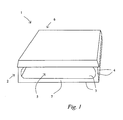
- FIG. 1 is a schematic illustration of an apparatus for fighting slugs according to a preferred embodiment of the invention.
- Figure 1 schematically shows an apparatus for fighting slugs according to a preferred embodiment of the invention.
- the apparatus 1 consists of a container 2 for slug poison, having a bottom 3, at least one side 4, and at least one entrance opening 5 for said slugs. Furthermore, the container 2 has a removable lid 6.
- the container in the preferred embodiment is made of strong, green PET plastic, which blends well with nature and which, furthermore, is kind to the environment.
- a suitable size of the container has proved to be 10 x 10 cm sides and a height of about 3 cm. However, also other sizes are conceivable for the container, for example larger sizes for larger garden composts.
- the container is provided with an entrance opening for the slugs in at least one side and can, when required, be provided with additional entrance openings.
- the entrance opening 5 is designed for functioning also as an exit opening for slugs having eaten of the slug poison.
- the opening is extending longitudinally in the lower part of the side, and is approx. 15 mm high and is delimited at the bottom by a 5 mm high rim 7, extending from the bottom 3 of the container.
- the rim 7 prevents water and soil from penetrating into the container and ensures that the slug poison does not fall out. However, the rim 7 allows the slug poison to retain a certain moisture content, which is considered favorable.
- the design of the entrance opening 5 prevents access by larger animals, such as magpies.
- the container 2 is "baited” with conventional slug poison which is available from most garden stores.
- the slugs eat to a feeling of satisfaction and leave the "dining-table", through the combined entrance and exit opening 5, in order to move away and starve to death. This gives the advantage that the container does not have to be emptied of dead slugs.
- the slug poison is utilized to 100 %. No slug poison is spread on the ground where magpies and other animals could eat it, and no poison disappears into the soil or is dissolved by rain. In this way, the user of the apparatus according to the invention can reduce the number of slugs at a reasonable cost and with the minimal effort of refilling the container with slug poison. If the user intends to go away for a longer period of time, he or she can load a larger quantity, since the slugs only eat until they are satisfied.
- one or several apparatuses according to the invention When used, one or several apparatuses according to the invention are placed on the ground so that the entrance opening is kept free, preferably in the vicinity of such plants which are especially prone to attack by the slugs.
- a garden owner usually knows from where the slugs normally invade the garden and can position a number of apparatuses according to the invention in order to obstruct the slug attack in the best possible way.
- an apparatus according to the invention can be placed on top of the contents in order to solve this problem.
- Magpies are strong and smart birds, and they often try to reach the slug poison.
- the method for fighting slugs according to the invention is performed by means of a container 2 for slug poison having a bottom 3, at least one side 4, and at least one entrance opening 5 for said slugs.
- a container is placed standing on the ground where slugs are expected to appear, a lid 6 of the container is removed, slug poison is applied inside the container 2, the lid 6 is put back in place again, and a heavy object is placed on top of the lid 6.
Landscapes
- Life Sciences & Earth Sciences (AREA)
- Insects & Arthropods (AREA)
- Health & Medical Sciences (AREA)
- General Health & Medical Sciences (AREA)
- Toxicology (AREA)
- Engineering & Computer Science (AREA)
- Pest Control & Pesticides (AREA)
- Wood Science & Technology (AREA)
- Zoology (AREA)
- Environmental Sciences (AREA)
- Catching Or Destruction (AREA)
Applications Claiming Priority (1)
| Application Number | Priority Date | Filing Date | Title |
|---|---|---|---|
| SE0701648A SE0701648L (sv) | 2007-07-09 | 2007-07-09 | Mördarsnigelbekämpning |
Publications (2)
| Publication Number | Publication Date |
|---|---|
| EP2014161A2 true EP2014161A2 (de) | 2009-01-14 |
| EP2014161A3 EP2014161A3 (de) | 2010-09-01 |
Family
ID=39864726
Family Applications (1)
| Application Number | Title | Priority Date | Filing Date |
|---|---|---|---|
| EP08445024A Withdrawn EP2014161A3 (de) | 2007-07-09 | 2008-07-01 | Geräte und Verfahren um Schnecken zu bekämpfen |
Country Status (2)
| Country | Link |
|---|---|
| EP (1) | EP2014161A3 (de) |
| SE (1) | SE0701648L (de) |
Cited By (1)
| Publication number | Priority date | Publication date | Assignee | Title |
|---|---|---|---|---|
| CN114467911A (zh) * | 2022-01-10 | 2022-05-13 | 梅健荣 | 用于铁丝网上的蛞蝓捕捉设备 |
Family Cites Families (2)
| Publication number | Priority date | Publication date | Assignee | Title |
|---|---|---|---|---|
| GB8809246D0 (en) * | 1988-04-20 | 1988-05-25 | Allman D J | Slug trap |
| US6739087B2 (en) * | 2002-10-15 | 2004-05-25 | Exhart Environmental Systems, Inc. | Garden pest trap |
-
2007
- 2007-07-09 SE SE0701648A patent/SE0701648L/xx not_active Application Discontinuation
-
2008
- 2008-07-01 EP EP08445024A patent/EP2014161A3/de not_active Withdrawn
Cited By (1)
| Publication number | Priority date | Publication date | Assignee | Title |
|---|---|---|---|---|
| CN114467911A (zh) * | 2022-01-10 | 2022-05-13 | 梅健荣 | 用于铁丝网上的蛞蝓捕捉设备 |
Also Published As
| Publication number | Publication date |
|---|---|
| SE0701648L (sv) | 2009-01-10 |
| EP2014161A3 (de) | 2010-09-01 |
Similar Documents
| Publication | Publication Date | Title |
|---|---|---|
| US6739087B2 (en) | Garden pest trap | |
| Dietz et al. | A walk-in trap for nesting ducks | |
| US4841668A (en) | Gopher killer | |
| EP2014161A2 (de) | Geräte und Verfahren um Schnecken zu bekämpfen | |
| EP1501356B1 (de) | Schutzabdeckung für lebensmittel- und wasserlagerungsbehälter | |
| Kern Jr | Dealing with Iguanas in the South Florida Landscape: ENY-714/IN528, 8/2004 | |
| WO2002043481A1 (en) | An apparatus and method for controlling wasps or yellow jackets | |
| WO2018156260A1 (en) | Tick trap and method of trapping ticks | |
| Litton et al. | Rio Grande turkey habitat management | |
| Wilen et al. | Snails and slugs | |
| JP6086268B1 (ja) | ナメクジ駆除器 | |
| Johnson | Common injurious mammals of Minnesota | |
| Black | Animal damage management handbook | |
| McFadden | SCIENCE & RESEARCH INTERNAL REPORT NO. 130 | |
| Cooley et al. | Grasshopper control in Montana | |
| Johnson | Rabbit control | |
| O'Connell | Trapping ground squirrels as a control method | |
| Sagers et al. | Controlling Slugs and Snails in Utah | |
| Rucker | Rodent extermination | |
| Sylvester et al. | Trapping wild turkeys on the Kentucky Woodlands Refuge | |
| Boggess | RACCOONS (Procyon lotor) | |
| Lawrence | Live rats and mice as lures for stoats | |
| Byford | Combat wildlife damage with commonsense control methods | |
| Creel | The Rat—A Sanitary Menace and an Economic Burden | |
| Rowe et al. | The poison baiting of corn‐ricks with particular reference to the control of house‐mice |
Legal Events
| Date | Code | Title | Description |
|---|---|---|---|
| PUAI | Public reference made under article 153(3) epc to a published international application that has entered the european phase |
Free format text: ORIGINAL CODE: 0009012 |
|
| AK | Designated contracting states |
Kind code of ref document: A2 Designated state(s): AT BE BG CH CY CZ DE DK EE ES FI FR GB GR HR HU IE IS IT LI LT LU LV MC MT NL NO PL PT RO SE SI SK TR |
|
| AX | Request for extension of the european patent |
Extension state: AL BA MK RS |
|
| PUAL | Search report despatched |
Free format text: ORIGINAL CODE: 0009013 |
|
| AK | Designated contracting states |
Kind code of ref document: A3 Designated state(s): AT BE BG CH CY CZ DE DK EE ES FI FR GB GR HR HU IE IS IT LI LT LU LV MC MT NL NO PL PT RO SE SI SK TR |
|
| AX | Request for extension of the european patent |
Extension state: AL BA MK RS |
|
| STAA | Information on the status of an ep patent application or granted ep patent |
Free format text: STATUS: THE APPLICATION HAS BEEN WITHDRAWN |
|
| 18W | Application withdrawn |
Effective date: 20101029 |