EP1501356B1 - Schutzabdeckung für lebensmittel- und wasserlagerungsbehälter - Google Patents
Schutzabdeckung für lebensmittel- und wasserlagerungsbehälter Download PDFInfo
- Publication number
- EP1501356B1 EP1501356B1 EP03717168A EP03717168A EP1501356B1 EP 1501356 B1 EP1501356 B1 EP 1501356B1 EP 03717168 A EP03717168 A EP 03717168A EP 03717168 A EP03717168 A EP 03717168A EP 1501356 B1 EP1501356 B1 EP 1501356B1
- Authority
- EP
- European Patent Office
- Prior art keywords
- barrier
- textile
- net
- opening
- insect
- Prior art date
- Legal status (The legal status is an assumption and is not a legal conclusion. Google has not performed a legal analysis and makes no representation as to the accuracy of the status listed.)
- Expired - Lifetime
Links
- XLYOFNOQVPJJNP-UHFFFAOYSA-N water Substances O XLYOFNOQVPJJNP-UHFFFAOYSA-N 0.000 title claims abstract description 77
- 235000013305 food Nutrition 0.000 title claims description 7
- 230000001681 protective effect Effects 0.000 title claims description 3
- 238000003860 storage Methods 0.000 title description 7
- 241000238631 Hexapoda Species 0.000 claims abstract description 118
- 230000004888 barrier function Effects 0.000 claims abstract description 104
- 239000004753 textile Substances 0.000 claims abstract description 53
- 239000002917 insecticide Substances 0.000 claims abstract description 52
- 239000000835 fiber Substances 0.000 claims description 23
- 241000255925 Diptera Species 0.000 claims description 15
- 238000000034 method Methods 0.000 claims description 15
- 230000005012 migration Effects 0.000 claims description 11
- 238000013508 migration Methods 0.000 claims description 11
- 230000002633 protecting effect Effects 0.000 claims description 7
- 239000003795 chemical substances by application Substances 0.000 claims description 3
- 239000003599 detergent Substances 0.000 claims description 3
- 238000004381 surface treatment Methods 0.000 claims description 3
- 238000004140 cleaning Methods 0.000 claims description 2
- 239000012459 cleaning agent Substances 0.000 claims description 2
- 239000000645 desinfectant Substances 0.000 claims description 2
- 230000005923 long-lasting effect Effects 0.000 abstract description 2
- 238000009395 breeding Methods 0.000 description 15
- 230000001488 breeding effect Effects 0.000 description 15
- 206010012310 Dengue fever Diseases 0.000 description 11
- 241000256118 Aedes aegypti Species 0.000 description 8
- 239000000126 substance Substances 0.000 description 8
- 208000009714 Severe Dengue Diseases 0.000 description 7
- 239000007788 liquid Substances 0.000 description 7
- 208000001490 Dengue Diseases 0.000 description 6
- 208000025729 dengue disease Diseases 0.000 description 6
- 239000000463 material Substances 0.000 description 6
- 208000003152 Yellow Fever Diseases 0.000 description 5
- 230000008901 benefit Effects 0.000 description 5
- 201000002950 dengue hemorrhagic fever Diseases 0.000 description 5
- WWJZWCUNLNYYAU-UHFFFAOYSA-N temephos Chemical compound C1=CC(OP(=S)(OC)OC)=CC=C1SC1=CC=C(OP(=S)(OC)OC)C=C1 WWJZWCUNLNYYAU-UHFFFAOYSA-N 0.000 description 5
- 235000013601 eggs Nutrition 0.000 description 4
- 230000000749 insecticidal effect Effects 0.000 description 4
- 239000002184 metal Substances 0.000 description 4
- 201000010099 disease Diseases 0.000 description 3
- 208000037265 diseases, disorders, signs and symptoms Diseases 0.000 description 3
- 239000004744 fabric Substances 0.000 description 3
- 239000004576 sand Substances 0.000 description 3
- 230000003442 weekly effect Effects 0.000 description 3
- 241000256173 Aedes albopictus Species 0.000 description 2
- 239000005892 Deltamethrin Substances 0.000 description 2
- 241000699670 Mus sp. Species 0.000 description 2
- 241000700159 Rattus Species 0.000 description 2
- 229960002483 decamethrin Drugs 0.000 description 2
- 238000000354 decomposition reaction Methods 0.000 description 2
- OWZREIFADZCYQD-NSHGMRRFSA-N deltamethrin Chemical compound CC1(C)[C@@H](C=C(Br)Br)[C@H]1C(=O)O[C@H](C#N)C1=CC=CC(OC=2C=CC=CC=2)=C1 OWZREIFADZCYQD-NSHGMRRFSA-N 0.000 description 2
- 201000009892 dengue shock syndrome Diseases 0.000 description 2
- 235000015177 dried meat Nutrition 0.000 description 2
- 230000035622 drinking Effects 0.000 description 2
- 230000000694 effects Effects 0.000 description 2
- 238000011010 flushing procedure Methods 0.000 description 2
- 239000003112 inhibitor Substances 0.000 description 2
- 230000007774 longterm Effects 0.000 description 2
- 235000013372 meat Nutrition 0.000 description 2
- 229920000642 polymer Polymers 0.000 description 2
- 230000002265 prevention Effects 0.000 description 2
- 239000003223 protective agent Substances 0.000 description 2
- 230000009467 reduction Effects 0.000 description 2
- 239000007787 solid Substances 0.000 description 2
- 241000894007 species Species 0.000 description 2
- 239000004575 stone Substances 0.000 description 2
- 229940111630 tea tree oil Drugs 0.000 description 2
- 239000010677 tea tree oil Substances 0.000 description 2
- 238000012360 testing method Methods 0.000 description 2
- 241000894006 Bacteria Species 0.000 description 1
- 206010008631 Cholera Diseases 0.000 description 1
- 235000005979 Citrus limon Nutrition 0.000 description 1
- 244000131522 Citrus pyriformis Species 0.000 description 1
- 241000256054 Culex <genus> Species 0.000 description 1
- 241000725619 Dengue virus Species 0.000 description 1
- 241001641895 Dermestes Species 0.000 description 1
- 241000630736 Ephestia Species 0.000 description 1
- 241000282412 Homo Species 0.000 description 1
- 244000246386 Mentha pulegium Species 0.000 description 1
- 235000016257 Mentha pulegium Nutrition 0.000 description 1
- 235000004357 Mentha x piperita Nutrition 0.000 description 1
- 241000131102 Oryzaephilus Species 0.000 description 1
- 241000131101 Oryzaephilus surinamensis Species 0.000 description 1
- 241000595629 Plodia interpunctella Species 0.000 description 1
- 239000004698 Polyethylene Substances 0.000 description 1
- 241000288906 Primates Species 0.000 description 1
- 241000283984 Rodentia Species 0.000 description 1
- 241000254179 Sitophilus granarius Species 0.000 description 1
- 241000254152 Sitophilus oryzae Species 0.000 description 1
- 241000254105 Tenebrio Species 0.000 description 1
- 241000254086 Tribolium <beetle> Species 0.000 description 1
- 241000710772 Yellow fever virus Species 0.000 description 1
- YJYPHIXNFHFHND-UHFFFAOYSA-N agomelatine Chemical compound C1=CC=C(CCNC(C)=O)C2=CC(OC)=CC=C21 YJYPHIXNFHFHND-UHFFFAOYSA-N 0.000 description 1
- 230000000844 anti-bacterial effect Effects 0.000 description 1
- 230000001580 bacterial effect Effects 0.000 description 1
- 230000009286 beneficial effect Effects 0.000 description 1
- 238000004166 bioassay Methods 0.000 description 1
- 239000004568 cement Substances 0.000 description 1
- 239000003086 colorant Substances 0.000 description 1
- 238000011109 contamination Methods 0.000 description 1
- 230000034994 death Effects 0.000 description 1
- 231100000517 death Toxicity 0.000 description 1
- 239000002283 diesel fuel Substances 0.000 description 1
- 239000003651 drinking water Substances 0.000 description 1
- 235000020188 drinking water Nutrition 0.000 description 1
- 229940079593 drug Drugs 0.000 description 1
- 239000003814 drug Substances 0.000 description 1
- 230000008030 elimination Effects 0.000 description 1
- 238000003379 elimination reaction Methods 0.000 description 1
- 238000013401 experimental design Methods 0.000 description 1
- 239000000796 flavoring agent Substances 0.000 description 1
- 235000019634 flavors Nutrition 0.000 description 1
- 238000003197 gene knockdown Methods 0.000 description 1
- 239000008187 granular material Substances 0.000 description 1
- 235000001050 hortel pimenta Nutrition 0.000 description 1
- 230000002209 hydrophobic effect Effects 0.000 description 1
- 230000007124 immune defense Effects 0.000 description 1
- 238000005470 impregnation Methods 0.000 description 1
- 238000010348 incorporation Methods 0.000 description 1
- 230000002401 inhibitory effect Effects 0.000 description 1
- 230000001788 irregular Effects 0.000 description 1
- 229930014550 juvenile hormone Natural products 0.000 description 1
- 239000002949 juvenile hormone Substances 0.000 description 1
- 150000003633 juvenile hormone derivatives Chemical class 0.000 description 1
- 230000002147 killing effect Effects 0.000 description 1
- 230000001665 lethal effect Effects 0.000 description 1
- 230000000670 limiting effect Effects 0.000 description 1
- 238000007726 management method Methods 0.000 description 1
- 238000004519 manufacturing process Methods 0.000 description 1
- NFGXHKASABOEEW-LDRANXPESA-N methoprene Chemical compound COC(C)(C)CCCC(C)C\C=C\C(\C)=C\C(=O)OC(C)C NFGXHKASABOEEW-LDRANXPESA-N 0.000 description 1
- 239000000203 mixture Substances 0.000 description 1
- 235000019645 odor Nutrition 0.000 description 1
- 230000017448 oviposition Effects 0.000 description 1
- 239000003016 pheromone Substances 0.000 description 1
- 239000002574 poison Substances 0.000 description 1
- 231100000614 poison Toxicity 0.000 description 1
- 229920000728 polyester Polymers 0.000 description 1
- -1 polyethylene Polymers 0.000 description 1
- 229920000573 polyethylene Polymers 0.000 description 1
- 238000002360 preparation method Methods 0.000 description 1
- 230000035755 proliferation Effects 0.000 description 1
- 230000002035 prolonged effect Effects 0.000 description 1
- 230000005180 public health Effects 0.000 description 1
- 230000001846 repelling effect Effects 0.000 description 1
- 239000003206 sterilizing agent Substances 0.000 description 1
- 230000004936 stimulating effect Effects 0.000 description 1
- 231100000331 toxic Toxicity 0.000 description 1
- 230000002588 toxic effect Effects 0.000 description 1
- 239000002023 wood Substances 0.000 description 1
- 229940051021 yellow-fever virus Drugs 0.000 description 1
Images


Classifications
-
- A—HUMAN NECESSITIES
- A01—AGRICULTURE; FORESTRY; ANIMAL HUSBANDRY; HUNTING; TRAPPING; FISHING
- A01N—PRESERVATION OF BODIES OF HUMANS OR ANIMALS OR PLANTS OR PARTS THEREOF; BIOCIDES, e.g. AS DISINFECTANTS, AS PESTICIDES OR AS HERBICIDES; PEST REPELLANTS OR ATTRACTANTS; PLANT GROWTH REGULATORS
- A01N25/00—Biocides, pest repellants or attractants, or plant growth regulators, characterised by their forms, or by their non-active ingredients or by their methods of application, e.g. seed treatment or sequential application; Substances for reducing the noxious effect of the active ingredients to organisms other than pests
- A01N25/34—Shaped forms, e.g. sheets, not provided for in any other sub-group of this main group
Definitions
- the present invention relates to an insect proof container for storing goods, preferably food and water, especially in regions with high risk for vector born diseases
- Dengue fever DF
- dengue hemorrhagic fever DHF
- dengue shock syndrome DFS
- DF dengue fever
- DHF dengue hemorrhagic fever
- DFS dengue shock syndrome
- Aedes albopictus Another important vector that recently has spread worldwide and also to Europe is Aedes albopictus .
- This species is also a vector of dengue virus and yellow fever virus, though often less efficacious than Ae. aegypti .
- Both species are "container breeders". In some areas, the two compete for the same breeding sites, in other areas with longer co-existence, there is a habitat selection where Ae. aegypti breed in house and Ae. albopictus out side, but both have the same biting patterns (aggressive day biters) and are thus difficult to control with bednets and the likes.
- Elimination of Aedes aegypti and albopictus breeding sites is of paramount importance in the prevention and control of dengue and dengue hemorrhagic fever.
- the single most common Aedes aegypti breeding sites are 200 liter - 400 liter water storage jars.
- a survey done in 1999-2000 revealed that water jars constitute over 80% of the total breeding sites, in both wet and dry seasons, for both urban and rural areas. Every effort should be made to prevent these water jars from becoming breeding sites.
- community clean up campaigns will have little effect on the breeding of Ae. aegypti without proper protection of the permanent water storage jars that are the source of most breeding.
- a mesh screen for preventing insects from entering water tanks is known from US patent no. 5,816,288.
- This structure is rather expensive and is therefore not affordable by poor people in tropic countries. If such a cover is used by only some people in the population, still the insects may find breeding places where water jars are covered by less efficient screens or not covered.
- the screen as disclosed in US patent no. 5,816,288 has a solid cover, which prevents rain from entering the water tank.
- the cover should allow rain to drain through, because the removal of the cover during rain may attract insects entering the tank.
- the main purpose is achieved by a method for providing an insect proof container for storing goods, preferably water, wherein said method comprises providing a container with an opening, preferably a substantially upwardly oriented opening, providing an insect barrier comprising a fine meshed net, textile or textile filter containing at least one insecticide, and covering said opening with said insect barrier for prohibiting insects, preferably mosquitoes, to enter said container.
- this method is extremely efficient for protecting goods, especially water, from mosquitoes or other insects.
- a fitting insect barrier with a net may easily be provided for covering the opening, because such nets may be cut into the right size or sewed together for achieving larger covers. Also, nets may easily be repaired when torn.
- the opening may be upwardly oriented or may have en opening at the side of the container having a vertical border.
- the insect for example mosquito
- the insecticide prevents the insect not only to breed in or feed on the goods inside the container but it prevents the insect to breed and feed anywhere else.
- the insecticide may also be a sterilizing agent to obtain that the deposited eggs do not develop into adult insects, for example mosquitoes, and that the insect is rendered sterile.
- a net that possibly may be used for such a cover is disclosed in International Patent Application WO01/37662 by Ole Skovmand assigned to DCT.
- Such net material is commercially available at low cost in tropic countries.
- the material, typically polyethylene or other man-made fibers, for the net is flexible, durable, and mechanically and chemically resistant.
- the net may be impregnated for long lasting efficiency where the impregnation may be repeated by surface treatment from time to time to assure proper functioning.
- a net, textile, or textile based filter instead of a solid cover, reduces the weight of the insect barrier. This aspect is very important, because such insect barriers have to be transported to the place of use, for example in third world areas, where the infrastructure is not so well developed and transport often is achieved by airplanes. Thus, a reduction of the weight reduces the overall costs of the insect barrier. Because of its flexibility, a net can be stored very efficiently taking up only relatively small space, for example as large rolls of net, which also is important for the above mentioned transportation means.
- a net, textile, or textile based filter is also very easy to arrange around an opening, even if the border of the opening is not smooth or plane.
- an insect barrier with a net, textile, or textile based filter according to the invention prevents dirt to enter the water container, especially the textile. If the filter is made sufficiently tight, it may also largely reduce bacterial contamination.
- the textile, or textile based filter according to the invention is water permeable such that rain water may drain through and into a collecting system.
- a simple embodiment of the insect barrier may be a net of the above kind including means for exerting downward force to the barrier for keeping the barrier stretched over the opening, where it is now assumed that the opening is substantially upwardly oriented. This way, a tight contact to the border of the opening can be achieved when the opening is covered with the insect barrier.
- Those means may be weights that have been fastened to the flexible barrier.
- the means may comprise pockets to be filled with stones, sand or other weight material.
- the net or textile may have a flexible rim, for example a rim made of tarpaulin.
- the tarpaulin may be used for fastening the weights or pockets to the insect barrier.
- the tarpaulin may also be designed to rest on the border of the container, for example a water jar, in order to prevent the net from being torn on eventually sharp edges of the border of the container, for example a metal drum used as a water jar.
- the insect barrier may solely be flexible in order to ease transportation of the insect barrier.
- the barrier may be desired to comprise a frame.
- the population may itself build such a frame from the material at hand.
- An insect barrier according to the invention is easily mounted with a frame independently of the dimensions of the frame.
- a frame may already be part of the insect barrier when delivered.
- a frame may be a circular metal or polymer frame covered with a net, textile or textile filter, eventually with a tarpaulin rim.
- a typical diameter of such a frame is around one meter.
- the frame may comprise two identical, rigid parts connected by flexible means, for example the net, textile or textile filter itself, for folding the two parts together to ease transportation of the insect barrier.
- the two parts of the frame are half-circles forming a complete circle when the insect barrier is stretched out.
- the container and the corresponding frame may be such that the frame rest tightly on the border of the opening of the container.
- the opening may be received in the frame such that the frame surrounds the opening of the container.
- the aforementioned circular frame may have a diameter slightly larger than the opening of the container. In this case, the flexible part of the insect barrier will rest on the border of the opening and the weight of the frame keeps the flexible part of the barrier stretched over the border of the opening with a tight contact between the insect barrier and the opening.
- the insect barrier according to the invention may be arranged as an umbrella for covering the container opening in its open state.
- Such an insect barrier is easily contracted into a slim form for transportation and storage.
- a further alternative embodiment is achieved with a net, textile or textile filter equipped with an elastically contractable rim in order to surround the wall of the opening in a tight manner.
- water or other liquid may drain through the net of the barrier.
- the container being ajar with an upwardly oriented opening
- rain water may drain through the net and into the jar.
- water may also be poured out of the container through the net.
- the cover does not require to be removed in order to fill or empty a liquid container.
- water permeable textile or textile filter may be used in an analogue way.
- the textile may be treated to be hydrophobic and thus add to the physical protection of the goods.
- the barrier with the net, textile or textile filter preferably does not contain detergents dissolving any of the insecticides by contact with water.
- a low toxic insecticide may be used, which, in addition, may be partly water soluble, like Temephos.
- the insect barrier may be treated with the at least one insecticide by surface treatment.
- An alternative treatment is incorporation of the insecticide inside the net fiber, typically during manufacture of the fiber.
- the insecticide may then migrate to the surface of the net fiber. This way, the insecticidal properties of the net is maintained for a long time without insecticide surplus on the surface. As a consequence, only a minor amount may be released to the water.
- the migration speed and the release to water of the insecticide may further be controlled by incorporating migration inhibitors for the insecticide.
- the insect barrier may contain a UV protective medium.
- This UV protecting medium may be located at the surface of the net fibers or may be incorporated in the fiber for migration to the surface of the fiber.
- the UV protecting medium may be resistant against water such that it is not dissolved from the insect barrier, for example the net and the tarpaulin rim, in case that the insect barrier is in contact with the water.
- migration inhibitors may be used at a concentration matching the desired migration properties.
- a net according to the invention may in addition be provided with a releasable water cleaning or disinfecting agent.
- a releasable water cleaning or disinfecting agent may be released in predetermined portions during water drainage through the insect barrier.
- the agent may as well be released if the insect barrier is in contact with the water in the jar, for example if the barrier in form of a net is hanging into the water in the jar.
- a net according to the invention may as well be provided with releasable medical substances.
- fluor-compositions are known to have beneficial properties for teeth.
- Drugs in minor amounts for curing certain deceases or for improving the human immune defense system may be incorporated as well.
- tea-tree oil is known for its stimulating and for humans in many ways healthy properties. In this connection, it is worth noting that tea tree oil has also been recognized as being antibacterial and recognized for repelling certain insects.
- certain substances may serve a multi purpose in connection with the insect barrier according to the invention.
- Also incorporated may be substances for giving the water a certain taste, for example lemon flavor or peppermint.
- jars to be protected from insects may contain impure water, for example water for fertilizing the ground.
- impure water for example water for fertilizing the ground.
- Such water may have a high content of bacteria, some of which directly or indirectly may result in decomposition of certain insecticides if the insect barrier is in contact with this water.
- the insect barrier in addition may be provided with substances that retard or prevent this kind of decomposition. Indications have been found that certain UV protecting media have this protecting property.
- the insecticide is preferably an insect killing insecticide, for example Temephos or Deltamethrin. Also used may be various specific larvicides or growth inhibiting insecticides. However, the insecticide may also function in a more sophisticated way in that the insect is not killed after contact with the insecticide but remains sterile. Thus, the insect may still mate and produce egg, but the eggs do not produce larvae. Another option is an insecticide comprising the synthetic juvenile hormone Methopren, which kills larvae when they slough the skin.
- An insect barrier of the above kind may as well be provided with a chemical Cholera filter which would result in an additional reduction of illness in tropic regions.
- the insect barrier In order to manipulate the insecticidal effect of the insect barrier, it may be provided in special colors in order to attract certain insect species, for example blue for attraction of mosquitoes, or to repel certain insect species. Also, the insect barrier may be provided with selected insect attracting substances as pheromones or other attracting odors.
- the jars recruited in the study were arranged in the following manners. One net was partially submerged in the water, one jar cover was without directly contact with the water, and one net was kept away from sunlight and rain.
- FIG. 1a illustrates a container 100 with an insect barrier 200 to cover the opening 102 of the container 100, for example a water jar.
- the insect barrier 200 comprises a frame 201 configured to receive the border 101 of the opening 102 in the frame 201.
- This embodiment of the insect barrier 200 is also shown in cross section in FIG. 1b.
- the frame 201 as shown in FIG. 1b rests tightly on the border 101 of the container preventing insects to enter the container 100.
- the invention covers not only nets, but also textile or textile filters in addition or instead of the net.
- the invention will be explained in the case of a net, however without limiting the scope of the invention.
- a net 202 prevents insects from entering the container 100.
- the rim of the net 202 includes a tarpaulin 203 which again is fastened to the frame 201.
- the insect barrier 200 In case that the insect barrier 200 is to be removed from the container 100, it will typically be lifted and held at the frame 201.
- the tarpaulin 203 protects the net from being damaged under such circumstances.
- the net 202 may be fastened to the frame 201 directly. This is especially of advantage if a light weight structure is desired.
- the frame may be constructed in a different way, which is illustrated in FIG. 1c.
- the shown frame 201' is configured to rest on the border 101 of the container 100, but does not receive the border of the opening in the container. This is of advantage, if the border 101 of the opening 102 of the container 100 is of rather broad dimension, for example if the wall of the container 100 is thick.
- the frame 201' may in this case rest on borders 101 of different sizes as long as the outer diameter of the frame 201' is larger than the inner diameter of the border 101.
- an insect barrier is shown with a frame 201 ", which is configured larger than the border 101 of the opening 102 of the container 100.
- the tarpaulin 203 will rest on the border 101 of the container.
- the border 101 may be sharp edged, for example if the container 100 is an old petrol or diesel oil drum where the top part has been removed and which now is used as a water jar.
- the tarpaulin 203 prevents the net 202 form being damaged by the sharp edge of the border 101.
- FIG. 1e A light weight model of the insect barrier 200 is shown in FIG. 1e.
- a light weight frame 201 "' typically a metal or stiff polymer frame holds the net 202 which spans over more than the outline of the container 100.
- the net 202 covers the opening 102 of the container 100 and rests tightly on the border 101 of the opening 102. This situation is illustrated in FIG. I f.
- the weight of the frame 201"' holds the net in place on the container 100.
- the insect barrier only consists of a net 202 that is placed over the container 100, for example a water jar as shown in FIG. 2.
- weights 204 may be fastened to the net for exerting downwards force on the net 202.
- the weights may accomplished by pockets fastened to the net, into which pockets sand, stones, liquids or other weight material has been inserted.
- the opening of the container may have other cross sections than circular. It may as well be a polygon, for example rectangular, or have any regular or irregular shape.
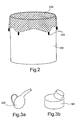
- the invention may as well be used for other types of containers, for example a pitcher 103 as shown in FIG. 3a, or a container 104 with a wide opening 105 for other goods than liquids as shown in FIG. 3b.
- the pitcher 103 as shown in FIG. 3a may be filled and emptied without removing a mounted insect barrier, when the net covers the opening. In this case, however, if the water is used for drinking or food preparation, it is preferred that the insecticide contained in the net is insoluble in water such that the insecticide is not transferred to the water or aqueous liquid inside the container 103.
- Other goods than liquid in a container with insect barrier according to the invention may be wet goods, as meat, or dry goods, as dried meat or grains.
- Wet meat is attractive as a breeding place for a variety of insects, for example flies. Even dried meat is subject to attack by insects, for example Dermestes haemorrhoidales .
- Grains are attractive to a variety of other insects, for example Ephestia kuhniella, Oryzaephilus surinamensis, Sitophilus granarius, S. Oryzae, Tenebrio melitor, Tribolium confusm , and T destructor .
- the insect barrier may be chosen with a textile. A fabric would act as a physical barrier to these insects, where the content of insecticide may be higher than for nettings. In this connection, it has to be pointed out that more than 20% of the third world food storage is spoiled or consumed by insects and rodents every year.
- An insect barrier according to the invention may not protect goods efficiently from rats or mice that may bite holes into the insect barrier.
- a bitter substance as BitrexTM
- rats and mice are less likely to chew themselves through the insect barrier.
- fabrics may be preferred to nettings in this case.
- the insect barrier as shown in FIG. 1 may stay on the container when liquid as water is filled into the container, for example rain water. Also in this case, it is of advantage that the insecticide is insoluble in water and that the net 202 does not contain detergents which could bind the insecticide to water.
- FIG. 4a the cross section of a fiber 300 for the net 200 is shown.
- the fiber 300 contains an insecticide 301 on the surface of the fiber 300, which is illustrated by dots.
- the fiber may also be constructed such, that the insecticide 301 is incorporated in the fiber 300' as shown in FIG b.
- the insecticide 301 may then migrate to the surface of the fiber 300' such that the fiber has an insecticidal property for a long time, as the release of the insecticide is relatively slow, though however fast enough to ensure a concentration of insecticide on the surface of the fiber 300' sufficiently high to have a lethal effect on insects touching the fiber 300'.
- the fiber 300' may have an internal reservoir 302 with insecticide which is released for migration to the surface.
- a UV protecting agent may be incorporated in the fiber 300, 300' as well.
- the UV protecting agent may be on the surface of the fiber, but it may also be incorporated inside the fiber 300' for migration to the surface in order to achieve a slow release with long time protection.
- the tarpaulin 203 surrounding the net 202 may also contain an insecticide 301.
- a tarpaulin may be constructed such that the insecticide is contained inside the tarpaulin 203 material with migration of the insecticide 301 to the surface of the tarpaulin 203, this is illustrated in FIG. 5a.
- the tarpaulin may be a laminated structure with an inside reservoir 304 for release of insecticide for migration through the wall element 305 of the laminated tarpaulin 203.
Landscapes
- Life Sciences & Earth Sciences (AREA)
- General Health & Medical Sciences (AREA)
- Health & Medical Sciences (AREA)
- Dentistry (AREA)
- Pest Control & Pesticides (AREA)
- Plant Pathology (AREA)
- Toxicology (AREA)
- Engineering & Computer Science (AREA)
- Agronomy & Crop Science (AREA)
- Wood Science & Technology (AREA)
- Zoology (AREA)
- Environmental Sciences (AREA)
- Catching Or Destruction (AREA)
- Packages (AREA)
- Agricultural Chemicals And Associated Chemicals (AREA)
- Wrappers (AREA)
Claims (16)
- Verfahren für die Schaffung eines insektensicheren Behälters für die Aufbewahrung von Gütern, vorzugsweise von Lebensmitteln oder Wasser, wobei das Verfahren umfasst:Vorsehen eines Behälters mit einer Öffnung, vorzugsweise mit einer im Wesentlichen nach oben orientierten Öffnung,Vorsehen einer Insektensperre, die ein feinmaschiges Netz, ein Textilelement oder einen auf einem Textilelement basierenden Filter mit wenigstens einem Insektizid enthält,Abdecken der Öffnung mit der Insektensperre, um zu verhindern, dass Insekten, vorzugsweise Moskitos, in den Behälter eindringen.
- Verfahren nach Anspruch 1, wobei das Verfahren eine Oberflächenbehandlung des Netzes, des Textilelements oder des auf einem Textilelement basierenden Filters mit einem Insektizid umfasst.
- Verfahren nach Anspruch 1 oder 2, wobei das Verfahren das Vorsehen einer flexiblen Sperre, optional eines Netzes mit einer flexiblen Krempe, und das Vorsehen von Gewichten, die an der flexiblen Sperre befestigt sind, um auf die Sperre eine abwärtsgerichtete Kraft ausüben, um die Sperre über der Öffnung gespannt zu halten, umfasst, wobei die Öffnung nach oben orientiert ist, wobei ein enger Kontakt mit dem Rand der Öffnung geschaffen wird, wenn die Öffnung mit der Sperre abgedeckt ist.
- Behälter mit Insektensperre, wobei der Behälter eine Öffnung, vorzugsweise eine im Wesentlichen nach oben orientierte Öffnung, besitzt, die durch eine Insektensperre abgedeckt ist, die ein feinmaschiges Netz, ein Textilelement oder einen auf einem Textilelement basierenden Filter mit wenigstens einem Insektizid enthält, abgedeckt ist.
- Behälter mit Insektensperre nach Anspruch 4, wobei die Sperre einen Rahmen, der so konfiguriert ist, dass er die Öffnung des Behälters innerhalb des Rahmens aufnimmt, oder einen Rahmen, der so konfiguriert ist, dass er eng auf dem Rand der Öffnung aufliegt, umfasst.
- Insektensperre für die Verwendung durch ein Verfahren nach Anspruch 1, 2 oder 3 oder für die Verwendung durch einen Behälter mit Insektensperre nach Anspruch 4 oder 5, wobei die Insektensperre ein feinmaschiges Netz, ein Textilelement oder einen auf einem Textilelement basierenden Filter mit wenigstens einem Insektizid umfasst.
- Insektensperre für die Verwendung durch ein Verfahren nach Anspruch 1, 2 oder 3 oder für die Verwendung durch einen Behälter mit Insektensperre nach Anspruch 4, wobei die Insektensperre flexibel, optional ein flexibles Netz mit einer flexiblen Krempe, ist und Mittel umfasst, die auf die Sperre eine abwärtsgerichtete Kraft ausüben, beispielsweise Gewichte, die an der flexiblen Sperre befestigt sind, um die Sperre über eine nach oben gerichtete Öffnung gespannt zu halten, wobei sie mit dem Rand der Öffnung in engem Kontakt ist, wenn die Öffnung mit der Sperre abgedeckt ist.
- Insektensperre für die Verwendung durch ein Verfahren nach Anspruch 1, 2 oder 3 oder für die Verwendung durch einen Behälter mit Insektensperre nach Anspruch 5, wobei die Insektensperre einen Rahmen, der so konfiguriert ist, dass er die Öffnung des Behälters innerhalb des Rahmens aufnimmt, oder einen Rahmen, der so konfiguriert ist, dass er auf dem Rand der Öffnung eng aufliegt, umfasst.
- Insektensperre nach Anspruch 8, wobei der Rahmen zwei völlig gleiche, starre Teile umfasst, die durch flexible Mittel miteinander verbunden sind, um die beiden Teile zusammenzufalten, um den Transport der Insektensperre zu erleichtern.
- Insektensperre nach einem der Ansprüche 6-9, wobei das Netz, das Textilelement oder der auf einem Textilelement basierende Filter wasserdurchlässig ist.
- Insektensperre nach einem der Ansprüche 6-10, wobei das wenigstens eine Insektizid in Wasser unlöslich oder schwer löslich ist.
- Insektensperre nach einem der Ansprüche 6-11, wobei das Netz wenigstens ein Insektizid in den Fasern des Netzes, des Textilelements oder des auf einem Textilelement basierenden Filters enthält, wobei das wenigstens eine Insektizid für eine Migration in die Oberfläche der Fasern geeignet ist.
- Insektensperre nach einem der Ansprüche 6-12, wobei das Netz, das Textilelement oder der auf einem Textilelement basierende Filter mit wenigstens einem Insektizid keine Detergenzien enthält, die eines des wenigstens einen Insektizids durch Kontakt mit Wasser auflösen.
- Insektensperre nach einem der Ansprüche 6-13, wobei das Netz, das Textilelement oder der auf einem Textilelement basierende Filter außerdem ein UV-Schutzmedium enthält, um das wenigstens eine Insektizid vor einer UV-Zersetzung zu schützen.
- Insektensperre nach einem der Ansprüche 6-14, wobei das Netz, das Textilelement oder der auf einem Textilelement basierende Filter außerdem ein wasserlösliches Reinigungs- oder Desinfektionsmittel enthält.
- Insektensperre nach einem der Ansprüche 6-15, wobei das Netz, das Textilelement oder der auf einem Textilelement basierende Filter einen löslichen medizinischen Wirkstoff enthält.
Priority Applications (1)
| Application Number | Priority Date | Filing Date | Title |
|---|---|---|---|
| EP03717168A EP1501356B1 (de) | 2002-04-24 | 2003-04-23 | Schutzabdeckung für lebensmittel- und wasserlagerungsbehälter |
Applications Claiming Priority (4)
| Application Number | Priority Date | Filing Date | Title |
|---|---|---|---|
| EP02009131A EP1356732A1 (de) | 2002-04-24 | 2002-04-24 | Schutzabdeckung für Lebensmittel- und Wasserbehälter |
| EP02009131 | 2002-04-24 | ||
| EP03717168A EP1501356B1 (de) | 2002-04-24 | 2003-04-23 | Schutzabdeckung für lebensmittel- und wasserlagerungsbehälter |
| PCT/DK2003/000267 WO2003090532A1 (en) | 2002-04-24 | 2003-04-23 | Protective cover for food and water storage containers |
Publications (2)
| Publication Number | Publication Date |
|---|---|
| EP1501356A1 EP1501356A1 (de) | 2005-02-02 |
| EP1501356B1 true EP1501356B1 (de) | 2005-08-24 |
Family
ID=28685896
Family Applications (2)
| Application Number | Title | Priority Date | Filing Date |
|---|---|---|---|
| EP02009131A Withdrawn EP1356732A1 (de) | 2002-04-24 | 2002-04-24 | Schutzabdeckung für Lebensmittel- und Wasserbehälter |
| EP03717168A Expired - Lifetime EP1501356B1 (de) | 2002-04-24 | 2003-04-23 | Schutzabdeckung für lebensmittel- und wasserlagerungsbehälter |
Family Applications Before (1)
| Application Number | Title | Priority Date | Filing Date |
|---|---|---|---|
| EP02009131A Withdrawn EP1356732A1 (de) | 2002-04-24 | 2002-04-24 | Schutzabdeckung für Lebensmittel- und Wasserbehälter |
Country Status (9)
| Country | Link |
|---|---|
| EP (2) | EP1356732A1 (de) |
| CN (1) | CN1649495A (de) |
| AT (1) | ATE302547T1 (de) |
| AU (1) | AU2003221613A1 (de) |
| BR (1) | BR0309478A (de) |
| DE (1) | DE60301403D1 (de) |
| DK (1) | DK1501356T3 (de) |
| SV (1) | SV2007001530A (de) |
| WO (1) | WO2003090532A1 (de) |
Families Citing this family (7)
| Publication number | Priority date | Publication date | Assignee | Title |
|---|---|---|---|---|
| JP5166671B2 (ja) | 2004-06-30 | 2013-03-21 | 住友化学株式会社 | 揮散成分保持用担体及び揮散成分保持材 |
| KR20100051635A (ko) | 2007-06-29 | 2010-05-17 | 베스테르고르 프란센 에스에이 | 살충 스레드 |
| CN103479052B (zh) * | 2007-06-29 | 2015-04-15 | 韦斯特高凡德森有限公司 | 部分带有协同剂的杀虫性障壁 |
| DE7764450T1 (de) * | 2007-06-29 | 2011-07-07 | Vestergaard Frandsen Sa | Insektizidsperre, teilweise mit synergist |
| BRPI0916524A2 (pt) | 2008-07-30 | 2015-08-04 | Basf Se | Rede de proteção contra insetos, e, uso de redes de proteção contra insetos |
| US8844191B2 (en) | 2009-03-30 | 2014-09-30 | Tma Corporation Pty Ltd | Composite termite barrier |
| GB201319336D0 (en) * | 2013-11-01 | 2013-12-18 | Liverpool School Tropical Medicine | Mosquito bed net assembly |
Family Cites Families (4)
| Publication number | Priority date | Publication date | Assignee | Title |
|---|---|---|---|---|
| JPH09111815A (ja) * | 1995-10-13 | 1997-04-28 | Sekisui House Ltd | 縦型雨水貯水タンクの上部構造 |
| US5816288A (en) * | 1997-05-09 | 1998-10-06 | Zelch; Clyde H. | Insect and frost proof vent for water storage tanks |
| WO2001037662A1 (en) * | 1999-11-25 | 2001-05-31 | Dct Aps | Composition for impregnation of fabrics and nettings |
| EP1257171A2 (de) * | 2000-02-11 | 2002-11-20 | The Government of the United States of America, as represented by the Secretary, Department of Health & Human Services | Mit insektizid imprägnierte gewebe und verfahren zu ihrer herstellung |
-
2002
- 2002-04-24 EP EP02009131A patent/EP1356732A1/de not_active Withdrawn
-
2003
- 2003-04-23 CN CN03809305.7A patent/CN1649495A/zh active Pending
- 2003-04-23 DE DE60301403T patent/DE60301403D1/de not_active Expired - Lifetime
- 2003-04-23 DK DK03717168T patent/DK1501356T3/da active
- 2003-04-23 BR BR0309478-2A patent/BR0309478A/pt not_active Application Discontinuation
- 2003-04-23 WO PCT/DK2003/000267 patent/WO2003090532A1/en not_active Ceased
- 2003-04-23 AT AT03717168T patent/ATE302547T1/de not_active IP Right Cessation
- 2003-04-23 EP EP03717168A patent/EP1501356B1/de not_active Expired - Lifetime
- 2003-04-23 AU AU2003221613A patent/AU2003221613A1/en not_active Abandoned
- 2003-04-24 SV SV2003001530A patent/SV2007001530A/es active IP Right Grant
Also Published As
| Publication number | Publication date |
|---|---|
| DK1501356T3 (da) | 2006-01-02 |
| SV2007001530A (es) | 2007-02-26 |
| BR0309478A (pt) | 2005-02-01 |
| AU2003221613A1 (en) | 2003-11-10 |
| EP1356732A1 (de) | 2003-10-29 |
| CN1649495A (zh) | 2005-08-03 |
| WO2003090532A1 (en) | 2003-11-06 |
| DE60301403D1 (de) | 2005-09-29 |
| EP1501356A1 (de) | 2005-02-02 |
| ATE302547T1 (de) | 2005-09-15 |
Similar Documents
| Publication | Publication Date | Title |
|---|---|---|
| US5983557A (en) | Lethal mosquito breeding container | |
| CN102946722B (zh) | 蚊虫捕捉器 | |
| Zeichner et al. | Laboratory testing of a lethal ovitrap for Aedes aegypti | |
| US9532560B2 (en) | Mosquito exterminator based on infection/contamination by a float provided with a powdered coating | |
| US7694455B1 (en) | Apparatus and method of mosquito control | |
| EP3092896B1 (de) | Mückenbekämpfungsvorrichtung mit in einer dauerhaften beschichtung eingebetteten pestiziden | |
| US3803753A (en) | Method for controlling yellow jacket populations | |
| EP1501356B1 (de) | Schutzabdeckung für lebensmittel- und wasserlagerungsbehälter | |
| Focks et al. | The integrated use of Toxorhynchites amboinensis and ground-level ULV insecticide application to suppress Aedes aegypti (Diptera: Culicidae) | |
| Howard et al. | House flies | |
| World Health Organization | Report of the nineteenth WHOPES working group meeting: WHO/HQ, Geneva, 8-11 February 2016: review of Veeralin LN, VectoMax GR, Bactivec SC | |
| EP2014161A2 (de) | Geräte und Verfahren um Schnecken zu bekämpfen | |
| Bishopp | Domestic mosquitoes | |
| Howard | The house fly | |
| CN117751911A (zh) | 一种土壤改良消毒剂处理红火蚁蚁巢的方法 | |
| Simpson | Preventive and remedial measures against mosquitoes | |
| Gangloff-Kaufmann | What’s all the buzz about mosquitoes? | |
| Howard et al. | Farmers' Bulletin | |
| Herrick | Some mosquitoes of Mississippi and how to deal with them | |
| Lamche et al. | Biting insect survey of Milingimbi, 7-9 April 2003 | |
| Scott et al. | Flies of public health importance and their control [1962] | |
| MXPA00004325A (en) | Lethal mosquito breeding container | |
| Ross | Instructions for the Prevention of Malarial Fever: For the Use of Residents in Malarious Places | |
| Bartrum et al. | Bees in a Bar-frame Hive | |
| Fowler et al. | Crayfish |
Legal Events
| Date | Code | Title | Description |
|---|---|---|---|
| PUAI | Public reference made under article 153(3) epc to a published international application that has entered the european phase |
Free format text: ORIGINAL CODE: 0009012 |
|
| 17P | Request for examination filed |
Effective date: 20040507 |
|
| AK | Designated contracting states |
Kind code of ref document: A1 Designated state(s): AT BE BG CH CY CZ DE DK EE ES FI FR GB GR HU IE IT LI LU MC NL PT RO SE SI SK TR |
|
| AX | Request for extension of the european patent |
Extension state: AL LT LV MK |
|
| GRAP | Despatch of communication of intention to grant a patent |
Free format text: ORIGINAL CODE: EPIDOSNIGR1 |
|
| GRAS | Grant fee paid |
Free format text: ORIGINAL CODE: EPIDOSNIGR3 |
|
| GRAA | (expected) grant |
Free format text: ORIGINAL CODE: 0009210 |
|
| RIN1 | Information on inventor provided before grant (corrected) |
Inventor name: FRANDSEN, MIKKEL, VESTERGAARD Inventor name: SKOVMAND, OLE Inventor name: FRANDSEN, TORBEN, VESTERGAARD |
|
| AK | Designated contracting states |
Kind code of ref document: B1 Designated state(s): AT BE BG CH CY CZ DE DK EE ES FI FR GB GR HU IE IT LI LU MC NL PT RO SE SI SK TR |
|
| PG25 | Lapsed in a contracting state [announced via postgrant information from national office to epo] |
Ref country code: IT Free format text: LAPSE BECAUSE OF FAILURE TO SUBMIT A TRANSLATION OF THE DESCRIPTION OR TO PAY THE FEE WITHIN THE PRESCRIBED TIME-LIMIT;WARNING: LAPSES OF ITALIAN PATENTS WITH EFFECTIVE DATE BEFORE 2007 MAY HAVE OCCURRED AT ANY TIME BEFORE 2007. THE CORRECT EFFECTIVE DATE MAY BE DIFFERENT FROM THE ONE RECORDED. Effective date: 20050824 Ref country code: RO Free format text: LAPSE BECAUSE OF FAILURE TO SUBMIT A TRANSLATION OF THE DESCRIPTION OR TO PAY THE FEE WITHIN THE PRESCRIBED TIME-LIMIT Effective date: 20050824 Ref country code: CH Free format text: LAPSE BECAUSE OF FAILURE TO SUBMIT A TRANSLATION OF THE DESCRIPTION OR TO PAY THE FEE WITHIN THE PRESCRIBED TIME-LIMIT Effective date: 20050824 Ref country code: SK Free format text: LAPSE BECAUSE OF FAILURE TO SUBMIT A TRANSLATION OF THE DESCRIPTION OR TO PAY THE FEE WITHIN THE PRESCRIBED TIME-LIMIT Effective date: 20050824 Ref country code: LI Free format text: LAPSE BECAUSE OF FAILURE TO SUBMIT A TRANSLATION OF THE DESCRIPTION OR TO PAY THE FEE WITHIN THE PRESCRIBED TIME-LIMIT Effective date: 20050824 Ref country code: AT Free format text: LAPSE BECAUSE OF FAILURE TO SUBMIT A TRANSLATION OF THE DESCRIPTION OR TO PAY THE FEE WITHIN THE PRESCRIBED TIME-LIMIT Effective date: 20050824 Ref country code: CZ Free format text: LAPSE BECAUSE OF FAILURE TO SUBMIT A TRANSLATION OF THE DESCRIPTION OR TO PAY THE FEE WITHIN THE PRESCRIBED TIME-LIMIT Effective date: 20050824 Ref country code: FI Free format text: LAPSE BECAUSE OF FAILURE TO SUBMIT A TRANSLATION OF THE DESCRIPTION OR TO PAY THE FEE WITHIN THE PRESCRIBED TIME-LIMIT Effective date: 20050824 Ref country code: SI Free format text: LAPSE BECAUSE OF FAILURE TO SUBMIT A TRANSLATION OF THE DESCRIPTION OR TO PAY THE FEE WITHIN THE PRESCRIBED TIME-LIMIT Effective date: 20050824 Ref country code: NL Free format text: LAPSE BECAUSE OF FAILURE TO SUBMIT A TRANSLATION OF THE DESCRIPTION OR TO PAY THE FEE WITHIN THE PRESCRIBED TIME-LIMIT Effective date: 20050824 Ref country code: BE Free format text: LAPSE BECAUSE OF FAILURE TO SUBMIT A TRANSLATION OF THE DESCRIPTION OR TO PAY THE FEE WITHIN THE PRESCRIBED TIME-LIMIT Effective date: 20050824 |
|
| REG | Reference to a national code |
Ref country code: GB Ref legal event code: FG4D |
|
| REG | Reference to a national code |
Ref country code: CH Ref legal event code: EP |
|
| REG | Reference to a national code |
Ref country code: IE Ref legal event code: FG4D |
|
| REF | Corresponds to: |
Ref document number: 60301403 Country of ref document: DE Date of ref document: 20050929 Kind code of ref document: P |
|
| PG25 | Lapsed in a contracting state [announced via postgrant information from national office to epo] |
Ref country code: SE Free format text: LAPSE BECAUSE OF FAILURE TO SUBMIT A TRANSLATION OF THE DESCRIPTION OR TO PAY THE FEE WITHIN THE PRESCRIBED TIME-LIMIT Effective date: 20051124 Ref country code: BG Free format text: LAPSE BECAUSE OF FAILURE TO SUBMIT A TRANSLATION OF THE DESCRIPTION OR TO PAY THE FEE WITHIN THE PRESCRIBED TIME-LIMIT Effective date: 20051124 Ref country code: GR Free format text: LAPSE BECAUSE OF FAILURE TO SUBMIT A TRANSLATION OF THE DESCRIPTION OR TO PAY THE FEE WITHIN THE PRESCRIBED TIME-LIMIT Effective date: 20051124 |
|
| PG25 | Lapsed in a contracting state [announced via postgrant information from national office to epo] |
Ref country code: DE Free format text: LAPSE BECAUSE OF FAILURE TO SUBMIT A TRANSLATION OF THE DESCRIPTION OR TO PAY THE FEE WITHIN THE PRESCRIBED TIME-LIMIT Effective date: 20051125 |
|
| PG25 | Lapsed in a contracting state [announced via postgrant information from national office to epo] |
Ref country code: ES Free format text: LAPSE BECAUSE OF FAILURE TO SUBMIT A TRANSLATION OF THE DESCRIPTION OR TO PAY THE FEE WITHIN THE PRESCRIBED TIME-LIMIT Effective date: 20051205 |
|
| REG | Reference to a national code |
Ref country code: DK Ref legal event code: T3 |
|
| PG25 | Lapsed in a contracting state [announced via postgrant information from national office to epo] |
Ref country code: PT Free format text: LAPSE BECAUSE OF FAILURE TO SUBMIT A TRANSLATION OF THE DESCRIPTION OR TO PAY THE FEE WITHIN THE PRESCRIBED TIME-LIMIT Effective date: 20060124 |
|
| NLV1 | Nl: lapsed or annulled due to failure to fulfill the requirements of art. 29p and 29m of the patents act | ||
| PG25 | Lapsed in a contracting state [announced via postgrant information from national office to epo] |
Ref country code: HU Free format text: LAPSE BECAUSE OF FAILURE TO SUBMIT A TRANSLATION OF THE DESCRIPTION OR TO PAY THE FEE WITHIN THE PRESCRIBED TIME-LIMIT Effective date: 20060225 |
|
| REG | Reference to a national code |
Ref country code: CH Ref legal event code: PL |
|
| PG25 | Lapsed in a contracting state [announced via postgrant information from national office to epo] |
Ref country code: IE Free format text: LAPSE BECAUSE OF NON-PAYMENT OF DUE FEES Effective date: 20060424 |
|
| PG25 | Lapsed in a contracting state [announced via postgrant information from national office to epo] |
Ref country code: MC Free format text: LAPSE BECAUSE OF NON-PAYMENT OF DUE FEES Effective date: 20060430 |
|
| PLBE | No opposition filed within time limit |
Free format text: ORIGINAL CODE: 0009261 |
|
| STAA | Information on the status of an ep patent application or granted ep patent |
Free format text: STATUS: NO OPPOSITION FILED WITHIN TIME LIMIT |
|
| 26N | No opposition filed |
Effective date: 20060526 |
|
| EN | Fr: translation not filed | ||
| PG25 | Lapsed in a contracting state [announced via postgrant information from national office to epo] |
Ref country code: FR Free format text: LAPSE BECAUSE OF FAILURE TO SUBMIT A TRANSLATION OF THE DESCRIPTION OR TO PAY THE FEE WITHIN THE PRESCRIBED TIME-LIMIT Effective date: 20061020 |
|
| REG | Reference to a national code |
Ref country code: IE Ref legal event code: MM4A |
|
| GBPC | Gb: european patent ceased through non-payment of renewal fee |
Effective date: 20070423 |
|
| PG25 | Lapsed in a contracting state [announced via postgrant information from national office to epo] |
Ref country code: GB Free format text: LAPSE BECAUSE OF NON-PAYMENT OF DUE FEES Effective date: 20070423 |
|
| PG25 | Lapsed in a contracting state [announced via postgrant information from national office to epo] |
Ref country code: EE Free format text: LAPSE BECAUSE OF FAILURE TO SUBMIT A TRANSLATION OF THE DESCRIPTION OR TO PAY THE FEE WITHIN THE PRESCRIBED TIME-LIMIT Effective date: 20050824 |
|
| PG25 | Lapsed in a contracting state [announced via postgrant information from national office to epo] |
Ref country code: TR Free format text: LAPSE BECAUSE OF FAILURE TO SUBMIT A TRANSLATION OF THE DESCRIPTION OR TO PAY THE FEE WITHIN THE PRESCRIBED TIME-LIMIT Effective date: 20050824 Ref country code: LU Free format text: LAPSE BECAUSE OF NON-PAYMENT OF DUE FEES Effective date: 20060423 |
|
| PG25 | Lapsed in a contracting state [announced via postgrant information from national office to epo] |
Ref country code: FR Free format text: LAPSE BECAUSE OF FAILURE TO SUBMIT A TRANSLATION OF THE DESCRIPTION OR TO PAY THE FEE WITHIN THE PRESCRIBED TIME-LIMIT Effective date: 20050824 Ref country code: CY Free format text: LAPSE BECAUSE OF FAILURE TO SUBMIT A TRANSLATION OF THE DESCRIPTION OR TO PAY THE FEE WITHIN THE PRESCRIBED TIME-LIMIT Effective date: 20050824 |
|
| PGFP | Annual fee paid to national office [announced via postgrant information from national office to epo] |
Ref country code: DK Payment date: 20110429 Year of fee payment: 9 |
|
| REG | Reference to a national code |
Ref country code: DK Ref legal event code: EBP |
|
| PG25 | Lapsed in a contracting state [announced via postgrant information from national office to epo] |
Ref country code: DK Free format text: LAPSE BECAUSE OF NON-PAYMENT OF DUE FEES Effective date: 20120430 |