EP2013367B1 - Method for deashing syrup by electrodialysis - Google Patents
Method for deashing syrup by electrodialysis Download PDFInfo
- Publication number
- EP2013367B1 EP2013367B1 EP07754644A EP07754644A EP2013367B1 EP 2013367 B1 EP2013367 B1 EP 2013367B1 EP 07754644 A EP07754644 A EP 07754644A EP 07754644 A EP07754644 A EP 07754644A EP 2013367 B1 EP2013367 B1 EP 2013367B1
- Authority
- EP
- European Patent Office
- Prior art keywords
- syrup
- exchange resin
- anions
- cation
- cations
- Prior art date
- Legal status (The legal status is an assumption and is not a legal conclusion. Google has not performed a legal analysis and makes no representation as to the accuracy of the status listed.)
- Not-in-force
Links
Images

Classifications
-
- C—CHEMISTRY; METALLURGY
- C13—SUGAR INDUSTRY
- C13B—PRODUCTION OF SUCROSE; APPARATUS SPECIALLY ADAPTED THEREFOR
- C13B20/00—Purification of sugar juices
- C13B20/18—Purification of sugar juices by electrical means
-
- C—CHEMISTRY; METALLURGY
- C13—SUGAR INDUSTRY
- C13B—PRODUCTION OF SUCROSE; APPARATUS SPECIALLY ADAPTED THEREFOR
- C13B20/00—Purification of sugar juices
- C13B20/14—Purification of sugar juices using ion-exchange materials
- C13B20/142—Mixed bed
-
- C—CHEMISTRY; METALLURGY
- C13—SUGAR INDUSTRY
- C13B—PRODUCTION OF SUCROSE; APPARATUS SPECIALLY ADAPTED THEREFOR
- C13B20/00—Purification of sugar juices
- C13B20/16—Purification of sugar juices by physical means, e.g. osmosis or filtration
- C13B20/165—Purification of sugar juices by physical means, e.g. osmosis or filtration using membranes, e.g. osmosis, ultrafiltration
-
- C—CHEMISTRY; METALLURGY
- C13—SUGAR INDUSTRY
- C13K—SACCHARIDES OBTAINED FROM NATURAL SOURCES OR BY HYDROLYSIS OF NATURALLY OCCURRING DISACCHARIDES, OLIGOSACCHARIDES OR POLYSACCHARIDES
- C13K1/00—Glucose; Glucose-containing syrups
Definitions
- the present invention relates generally to the fields of sugar processing. More particularly, it concerns methods for removing ions (ash) from syrup by electrodialysis.
- Sugars such as dextrose, fructose, or sucrose
- Sugars are typically isolated by a process comprising contacting sugar-containing plant matter with water, to yield a syrup.
- Common sugar-containing plants include sugar cane and sugar beet, among others, and other sources of sugars include plants that contain starches that can be readily converted to sugars, such as wheat or maize.
- the syrup generally also contains ions extracted from the plant matter. Such ions are commonly termed "ash.” It is desirable to remove ash from, or deash, a syrup to render it more palatable for consumption in food or drink.
- One deashing technique comprises the use of ion exchange resins.
- the syrup is contacted with a strong acid cation (SAC) resin to remove cations, and is then contacted with a strong base anion (SBA) resin to remove anions.
- SAC strong acid cation
- SBA strong base anion
- these steps must be repeated multiple times to deash the syrup to a desirable low level.
- the ion-removal abilities of the SAC resin and the SBA resin are reduced, and periodic regeneration of the resins with an excess of acid and base, respectively, is required.
- the regeneration process yields large quantities of waste material comprising cations eluted off the SAC resin, anions eluted off the SBA resin, and counterions provided by the acid or base, respectively, in excess over the ash content of the original syrup.
- Another deashing technique involves electrodialysis.
- the syrup is dialyzed in the presence of an electric field which forces ions from the syrup across a membrane into an ion concentration zone.
- electrodialysis generates less waste material than ion exchange, during the course of electrodialysis, the membrane becomes fouled, and fairly quickly needs replacement.
- the cost of electrodialysis membrane replacement can be very high.
- Conventional electrodialysis also can have lower ion removal efficiency than the ion exchange deashing techniques mentioned above.
- US-A-3 383 245 discloses a process for purifying an isomerized corn type conversion syrup of above 70 D.E. in which ash is removed by electrodialysis, color is removed by an anion exchange resin in the chloride form and the syrup is treated with carbon.
- the present invention relates to a method of deashing a syrup, comprising replacing polyvalent cations in the syrup with monovalent cations using a cation-exchange resin; replacing polyvalent anions in the syrup with monovalent anions using an anion-exchange resin; electrodialyzing the syrup to remove cations and anions, to yield a deashed syrup and a brine containing monovalent cations and monovalent anions; regenerating the anion-exchange resin by contacting the anion-exchange resin with a brine containing anions, to yield a regenerated anion-exchange resin and a brine depleted in monovalent anions; and regenerating the cation-exchange resin by contacting the cation-exchange resin with a brine containing cations, to yield a regenerated cation-exchange resin and a brine depleted in monovalent cations.
- the present invention relates to a method of deashing a syrup, comprising replacing polyvalent cations in the syrup with monovalent cations using a cation-exchange resin; replacing polyvalent anions in the syrup with monovalent anions using an anion-exchange resin; electrodialyzing the syrup to remove cations and anions, to yield a deashed syrup and a brine containing monovalent cations and monovalent anions; regenerating the anion-exchange resin by contacting the anion-exchange resin with a brine containing anions, to yield a regenerated anion-exchange resin and a brine depleted in monovalent anions; and regenerating the cation-exchange resin by contacting the cation-exchange resin with a brine containing cations, to yield a regenerated cation-exchange resin and a brine depleted in monovalent cations.
- a syrup is a composition comprising water and a sugar.
- the syrup comprises at least 3 w/v% sugar.
- the sugar can be dextrose, fructose, or sucrose.
- Dextrose and fructose can be made by hydrolysis and saccharification of starch extracted from cereal plants, and sucrose and other sugars can be extracted from several plants, though the skilled artisan will recognize certain species and certain plant structures may have higher concentrations of starch or sugars and may be more economical sources thereof.
- Common sources of starch to make dextrose and fructose include wheat or maize, and common sources of sugars include sugar cane or sugar beet. These common sources are named as examples only.
- Mono- or polyvalent cations which may be present can include sodium, potassium, calcium, or magnesium.
- the monovalent cations can be sodium or potassium.
- the polyvalent cations can be calcium or magnesium.
- Mono- or polyvalent anions which may be present as ash can include chloride, phosphate, sulfate, or oxalate.
- the monovalent anions can be chloride.
- the polyvalent anions can be phosphate, sulfate, or oxalate.
- the method can further comprise removing cations from the deashed syrup and removing anions from the deashed syrup.
- the method can further comprise concentrating the brine containing monovalent cations and monovalent anions.
- Cation-exchange resins can be further defined as strong acid cation (SAC) resins or weak acid cation (WAC) resins.
- SAC resin is a cation-exchange resin with a pKa less than 2.
- WAC resin is a cation-exchange resin with a pKa of 2 to 7.
- Anion-exchange resins can be further defined as strong base anion (SBA) resins or weak base anion (WBA) resins.
- SBA resin is an anion-exchange resin with a pKa of greater than 12.
- WBA resin is an anion-exchange resin with a pKa of 7 to 12.
- the cation-exchange resin is a weak acid cation (WAC) resin and regenerating the cation-exchange resin further comprises contacting the cation-exchange resin with a strong acid.
- WAC weak acid cation
- the anion-exchange resin is a strong base anion (SBA) resin.
- the method provides a deashing method involving electrodialysis which can have a reduced incidence of membrane fouling and a greater removal of ions relative to conventional electrodialysis-based deashing techniques.
- the method also can reduce the amount of waste generated, relative to conventional ion exchange-based deashing techniques. It also can have reduced costs relative to the conventional use of softening techniques.
- a raw syrup 100 is subjected to a cation-exchange step 102.
- the syrup 100 is contacted with a cation-exchange resin, such as on a column containing the cation-exchange resin.
- the cation-exchange resin contains resin beads with anionic groups, and monovalent cations, such as sodium or potassium, are bound to the anionic groups.
- cations, including polyvalent cations, in the syrup compete with the monovalent cations of the cation-exchange resin.
- the monovalent cations are sodium or potassium.
- the syrup 103 is contacted with an anion-exchange resin, such as on a column containing the anion-exchange resin.
- the anion-exchange resin contains resin beads with cationic groups, and monovalent anions, such as chloride, are bound to the cationic groups.
- anions, including polyvalent anions, in the syrup compete with the monovalent anions of the anion-exchange resin.
- Anions formerly in the syrup form bond to the anion-exchange resin cationic groups and monovalent anions formerly bound to the anion-exchange resin cationic groups transfer to the syrup.
- the polyvalent anion level in the syrup 105 can be reduced relative to the raw syrup 100.
- plating means that at least some of the polyvalent anions in the syrup at the start of the step are replaced with monovalent anions by the end of the step.
- the monovalent anions are chloride.
- the cation-exchange step and the anion-exchange step can be performed in either order.
- the cation-exchange step 102 is shown first and the anion-exchange step 104 is shown second.
- the syrup 105 is electrodialyzed to remove cations and anions, to yield a deashed syrup 107 and a brine 110.
- Electrodialysis is a known technique.
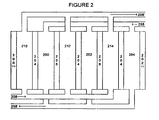
- a schematic representation of an electrodialysis system is shown in Figure 2 .
- An electrodialysis system typically comprises a stack of alternating cation-transfer membranes 204 and anion-transfer membranes 206, which define alternating feed zones 210, 212, and 214 and concentration zones 260, 262, and 264.
- the electrodialysis system also comprises an anode 200 at a first end of the stack and a cathode 202 at the other end of the stack. Through the anode 200 and cathode 202, an electric field is applied across the stack such that there is an electrical potential difference between each feed zone (e.g., 212) and each of the concentration zones adjacent thereto (e.g., 260, 262).
- the syrup 105 is fed to a first feed zone (e.g., 212) from feed source 208 and water 108 is fed to both a first concentration zone to the anode side of the first feed zone (e.g., 260) and a second concentration zone to the cathode side of the first feed zone (e.g., 262) from a water source 258.
- the electric field drives at least some anions from the feed zone 212 toward the anode 200, through an anion-transfer membrane 206 to the first concentration zone 260, and drives at least some cations from the feed zone 212 toward the cathode 202, through a cation-transfer membrane 204 to the second concentration zone 262.
- the syrup 105 can be fed from the first feed zone 260 to a second feed zone 262, where the same driving of ions occurs, and so forth, or it can be passed only once through the electrodialysis system.
- the electrodialysis step results in a syrup with a lower ion concentration, i . e ., a deashed syrup, at the downstream end 208' of the feed zones.
- water 108 is fed through the concentration zones. Water is collected from the concentration zones, where it has gained anions and cations, at the downstream end 258' of the concentration zones.
- the electrodialysis step also results in a brine containing monovalent cations and monovalent anions 110, which is used herein to refer to an aqueous solution containing cations and anions and substantially no sugar.
- the cation need not be sodium, nor does the anion need to be chloride, for a solution to be a brine, as the term is used herein.
- the brine resulting from the electrodialysis step will comprise primarily monovalent cations and monovalent anions.
- electrodialysis can remove about 50% of phosphate anions and about 50-60% of sulfate anions from a dextrose syrup. With performance of the replacing steps, in many cases, electrodialysis can remove about 90% of monovalent anions, such as chloride, from a dextrose syrup.
- the deashed syrup 107 may still contain some residual ions. Depending on the intended use of the deashed syrup 107, the residual ion content may be undesirably high and further ion removal may be appropriate. Therefore, in one embodiment, the method further comprises removing cations from the deashed syrup 107 and removing anions from the deashed syrup 107, shown collectively in Figure 1 as two cycles ("x 2") of cation removal and anion removal ("Polish CA") 112 to yield the final deashed syrup 114. These removing steps can be performed by ion exchange, among other techniques.
- the cation-exchange resin and the anion-exchange resin require periodic regeneration by treatment with a solution containing monovalent ions.
- the electrodialysis step 106 results in a brine 110 containing monovalent ions. Therefore, in one embodiment, the method also involves regenerating either or both resins with a brine 110 originating from the electrodialysis step 106.
- FIG. 1 shows a concentration step 116 involving reverse osmosis ("RO"), yielding brine at 10% salt 120 and water 118. Concentration, however, may not be necessary, depending on the ion content of the brine and the particular regeneration requirements of either or both resins.
- RO reverse osmosis
- the method further comprises regenerating the anion-exchange resin with the brine 120, to yield a regenerated anion-exchange resin and a brine depleted in monovalent anions 125.
- polyvalent anions bound to the anion-exchange resin cationic groups are exchanged with monovalent anions in the brine; monovalent anions bond to the anion-exchange resin cationic groups; and monovalent cations from the starting brine and polyvalent anions exchanged with the anion-exchange resin yield a brine depleted in monovalent anions, by which is meant a brine wherein more anions are polyvalent anions than was true prior to regeneration of the anion-exchange resin.
- the brine depleted in monovalent anions 125 can be used to regenerate the cation-exchange resin.
- calcium salts with polyvalent anions can be insoluble, and thus if calcium is a polyvalent cation bound to cation-exchange resin anionic groups, care should be taken to prevent the formation of insoluble species. Therefore, it can be desirable to regenerate the cation-exchange resin with a strong acid, such as HCl 122 as shown in Figure 1 , as well as the brine depleted in monovalent anions 125. This can be particularly desirable if the cation-exchange resin is a WAC resin.
- a strong acid within this embodiment, is hydrochloric acid, nitric acid, or a mixture thereof.
- the cation-exchange resin can be first contacted with the strong acid 122, to run off calcium chloride or calcium nitrate salt(s), and yield the protonated forms of the cation-exchange resin anionic groups. Then, the brine depleted in monovalent anions 125 can be used to replace some or all of the protons bound to the cation-exchange resin anionic groups with monovalent cations. Typically, about 50% of the protons are replaced with monovalent cations. The result is a regenerated cation-exchange resin and a brine depleted in monovalent cations, collectively waste 124 in Figure 1 .
- the pH of the dextrose syrup exiting the column will be about pH 5.0, similar to the feed pH.
- processing a dextrose syrup it can be useful to keep the pH at pH 5.5 or less to help prevent the growth of micro-organisms and to reduce the degree of color formation in subsequent heating during evaporation.
- the calcium salts and the brine depleted in monovalent cations can be disposed of as waste or used in the preparation of fertilizer or other material.
- the quantity of calcium salts and brine depleted in monovalent cations generated by performance of the method is generally lower than that quantity of salts and brine generated by conventional ion-exchange processes.
- Figure 1 shows regeneration of the anion-exchangc resin followed by regeneration of the cation-exchange resin.
- the brine resulting from electrodialysis can be used in the regeneration of the cation-exchange resin, possibly with a strong acid as described above, and the resulting brine depleted in monovalent cations can be used in the regeneration of the anion-exchange resin.
- a dextrose syrup was pre-treated using ion exchange prior to electrodialysis.
- the pretreatment comprised a single cation column containing 700 L of Purolite C 104 and primary and secondary anion columns containing 900 L each of Purolite Styrene A500PS.
- the dextrose syrup had a concentration of 30 Brix and temperature of 50°C, and was fed to the columns at 800 L/h.
- the service time for the cation column was 100 hours and the primary anion column was regenerated after 60 hours.
- the electrodialysis unit was manufactured by Eurodia Industrie, model EUR40B 40 LCD.
- the unit contained Neosepta membranes manufactured by Tokuyama, Japan.
- the cationic ion exchange membrane type was CMX SB and the anionic exchange membrane type was AMX SB.
- the effective membrane area was 16 m 2 .
- the dextrose syrup feed to the electrodialysis unit had a concentration of 26 Brix and a temperature of 52°C.
- the flow rate was 800 L/h and the conductivity was 1200 ⁇ 200 ⁇ S.
- brine was recycled at a flow rate of 800 L/h with the pressure on either side of the membrane balanced at 0.6 bar.
- the conductivity of the brine was maintained in the range 1.5 to 2.0 millisiemens by adding water and bleeding off the brine.
- the brine was made up initially using process condensate at 52°C and 10% HCl to give a conductivity of 1-7 millisiemens.
- the operating parameters of the electrodialysis unit included a potential difference across the membrane of 40 V and current usage of 30 A. The unit was run until the efficiency (calculated by conductivity difference) was less than 90%. This was typically 24 hours after which the unit and feed tanks underwent chemical cleaning and regeneration with separate cycles of NaOH (to a concentration of 23 pS) and HCl (40 ⁇ S).
- Regeneration of the cation columns was performed by first sweetening off until the effluent was less than 1 Brix using process condensate at 3 L/min. 1350 L of 10% HCl was then passed at 3.5 L/min. This was subsequently washed out by process condensate at 2 L/min until the conductivity leaving the column was less than 70 ⁇ S.
- the C104 resin in acid form was converted to 50% sodium form using 2000 L of 3% NaOH at a flow rate of 4 L/min. Before being put into service the excess chemicals were flushed out using process condensate at 2 L/min until the effluent had a conductivity of less than 70 ⁇ S.
- the anion columns were first sweetened off under the same conditions as the cation columns.
- the regeneration was then performed using 560 L of a 10% NaCl solution and 120 L of 2% NaOH solution passed at 2.5 L/min.
- the excess chemicals were washed out using process condensate at 2 L/min until the solution leaving the column had a conductivity of less than 70 ⁇ S.
- This brine solution is then concentrated using a reverse osmosis system.
- the reverse osmosis is a membrane system that uses high pressure to separate water from dilute salt solutions.
- the reverse osmosis is done using two 4 in diameter Osmonics water treatment membranes.
- the brine is concentrated until it is about 8% concentration.
- caustic soda into the brine obtained after concentration by reverse osmosis.
- the quantity of caustic soda should be 2% of the sodium chloride content.
- SBA strong base anion resin
- both of the resins, the strong base anion resin and the weak acid cation resin should be sufficiently regenerated to allow effective pre-treatment of sugar or dextrose prior to processing by elecrodialysis.
Landscapes
- Chemical & Material Sciences (AREA)
- Organic Chemistry (AREA)
- Life Sciences & Earth Sciences (AREA)
- Biochemistry (AREA)
- General Health & Medical Sciences (AREA)
- Emergency Medicine (AREA)
- Health & Medical Sciences (AREA)
- Engineering & Computer Science (AREA)
- Water Supply & Treatment (AREA)
- Separation Using Semi-Permeable Membranes (AREA)
- Jellies, Jams, And Syrups (AREA)
- Water Treatment By Electricity Or Magnetism (AREA)
- Organic Low-Molecular-Weight Compounds And Preparation Thereof (AREA)
Abstract
Description
- The present invention relates generally to the fields of sugar processing. More particularly, it concerns methods for removing ions (ash) from syrup by electrodialysis.
- Sugars, such as dextrose, fructose, or sucrose, are typically isolated by a process comprising contacting sugar-containing plant matter with water, to yield a syrup. Common sugar-containing plants include sugar cane and sugar beet, among others, and other sources of sugars include plants that contain starches that can be readily converted to sugars, such as wheat or maize. The syrup generally also contains ions extracted from the plant matter. Such ions are commonly termed "ash." It is desirable to remove ash from, or deash, a syrup to render it more palatable for consumption in food or drink.
- One deashing technique comprises the use of ion exchange resins. The syrup is contacted with a strong acid cation (SAC) resin to remove cations, and is then contacted with a strong base anion (SBA) resin to remove anions. Typically, these steps must be repeated multiple times to deash the syrup to a desirable low level. During this process, the ion-removal abilities of the SAC resin and the SBA resin are reduced, and periodic regeneration of the resins with an excess of acid and base, respectively, is required. The regeneration process yields large quantities of waste material comprising cations eluted off the SAC resin, anions eluted off the SBA resin, and counterions provided by the acid or base, respectively, in excess over the ash content of the original syrup.
- It would be desirable to have a deashing technique that generates lower quantities of waste ionic material beyond the ash content of the original syrup.
- Another deashing technique involves electrodialysis. The syrup is dialyzed in the presence of an electric field which forces ions from the syrup across a membrane into an ion concentration zone. Although electrodialysis generates less waste material than ion exchange, during the course of electrodialysis, the membrane becomes fouled, and fairly quickly needs replacement. The cost of electrodialysis membrane replacement can be very high. Conventional electrodialysis also can have lower ion removal efficiency than the ion exchange deashing techniques mentioned above.
- It would be desirable to have a deashing technique which has lower maintenance and replacement costs than conventional electrodialysis and a greater removal of ions relative to conventional electrodialysis.
-
US-A-3 383 245 (Scallet et al. ) discloses a process for purifying an isomerized corn type conversion syrup of above 70 D.E. in which ash is removed by electrodialysis, color is removed by an anion exchange resin in the chloride form and the syrup is treated with carbon. - In one embodiment, the present invention relates to a method of deashing a syrup, comprising replacing polyvalent cations in the syrup with monovalent cations using a cation-exchange resin; replacing polyvalent anions in the syrup with monovalent anions using an anion-exchange resin; electrodialyzing the syrup to remove cations and anions, to yield a deashed syrup and a brine containing monovalent cations and monovalent anions; regenerating the anion-exchange resin by contacting the anion-exchange resin with a brine containing anions, to yield a regenerated anion-exchange resin and a brine depleted in monovalent anions; and regenerating the cation-exchange resin by contacting the cation-exchange resin with a brine containing cations, to yield a regenerated cation-exchange resin and a brine depleted in monovalent cations.
- The following drawings form part of the present specification and are included to further demonstrate certain aspects of the present invention. The invention may be better understood by reference to one or more of these drawings in combination with the detailed description of specific embodiments presented herein.
-
Figure 1 presents a flow diagram of a method of the present invention. -
Figure 2 shows an electrodialysis stack suitable for use in the present invention. - In one embodiment, the present invention relates to a method of deashing a syrup, comprising replacing polyvalent cations in the syrup with monovalent cations using a cation-exchange resin; replacing polyvalent anions in the syrup with monovalent anions using an anion-exchange resin; electrodialyzing the syrup to remove cations and anions, to yield a deashed syrup and a brine containing monovalent cations and monovalent anions; regenerating the anion-exchange resin by contacting the anion-exchange resin with a brine containing anions, to yield a regenerated anion-exchange resin and a brine depleted in monovalent anions; and regenerating the cation-exchange resin by contacting the cation-exchange resin with a brine containing cations, to yield a regenerated cation-exchange resin and a brine depleted in monovalent cations.
- A syrup, as used herein, is a composition comprising water and a sugar. In one embodiment, the syrup comprises at least 3 w/v% sugar. In one embodiment, the sugar can be dextrose, fructose, or sucrose. (The word "or," wherever it is used herein, has the inclusive meaning unless explicitly stated to the contrary). Dextrose and fructose can be made by hydrolysis and saccharification of starch extracted from cereal plants, and sucrose and other sugars can be extracted from several plants, though the skilled artisan will recognize certain species and certain plant structures may have higher concentrations of starch or sugars and may be more economical sources thereof. Common sources of starch to make dextrose and fructose include wheat or maize, and common sources of sugars include sugar cane or sugar beet. These common sources are named as examples only.
- When manufacturing sugars, dextrose, or fructose, other materials are also extracted from the plant and are present in the raw syrup and are considered impurities. Among the impurities are generally mono- or polyvalent cations and mono- or polyvalent anions (generally, "ash"). Mono- or polyvalent cations which may be present can include sodium, potassium, calcium, or magnesium. In one embodiment, the monovalent cations can be sodium or potassium. In one embodiment, the polyvalent cations can be calcium or magnesium.
- Mono- or polyvalent anions which may be present as ash can include chloride, phosphate, sulfate, or oxalate. In one embodiment, the monovalent anions can be chloride. In one embodiment, the polyvalent anions can be phosphate, sulfate, or oxalate.
- In one embodiment, the method can further comprise removing cations from the deashed syrup and removing anions from the deashed syrup.
- In one embodiment, the method can further comprise concentrating the brine containing monovalent cations and monovalent anions.
- Cation-exchange resins can be further defined as strong acid cation (SAC) resins or weak acid cation (WAC) resins. An SAC resin is a cation-exchange resin with a pKa less than 2. A WAC resin is a cation-exchange resin with a pKa of 2 to 7.
- Anion-exchange resins can be further defined as strong base anion (SBA) resins or weak base anion (WBA) resins. An SBA resin is an anion-exchange resin with a pKa of greater than 12. A WBA resin is an anion-exchange resin with a pKa of 7 to 12.
- The following table indicates exemplary SAC, WAC, SBA, and WBA resins which are commercially available.
- 1) Strong acid cation- sulfonate (-SO3H)
- 2) Weak acid cation - carboxlyate (-COOH)
- 3) Strong base anion - quaternary ammonium derivatives eg: Type 1 chloride form (-CH2N(CH3)+Cl-)
- 4) Weak base anion - tertiary amine - chloride form (-CH2NHN(CH3)2 + Cl-)
- In one embodiment, the cation-exchange resin is a weak acid cation (WAC) resin and regenerating the cation-exchange resin further comprises contacting the cation-exchange resin with a strong acid.
- In one embodiment, the anion-exchange resin is a strong base anion (SBA) resin.
- Part of the problem leading to the short life of electrodialysis membranes in conventional processes is calcium and magnesium ions. Softening the liquid to be treated by electrodialysis has been suggested in the treatment of water. Softening is usually carried out with a cation exchange resin to remove calcium and magnesium ions, but is generally considered expensive and of little benefit (e.g.,
Mani, U.S. Pat. No. 6,017,433 ). Others have suggested adding acid to reduce the feed pH to 3.5, to prevent the fouling of the electrodialysis by calcium and magnesium salts and to discourage the growth of microorganisms. However, the acid needs to be removed in the electrodialysis operation, adding to the salt load. - The method provides a deashing method involving electrodialysis which can have a reduced incidence of membrane fouling and a greater removal of ions relative to conventional electrodialysis-based deashing techniques. The method also can reduce the amount of waste generated, relative to conventional ion exchange-based deashing techniques. It also can have reduced costs relative to the conventional use of softening techniques.
- Exemplary embodiments of the present invention are shown in
Figures 1-2 . - Turning to the embodiment shown in
Figure 1 , araw syrup 100 is subjected to a cation-exchange step 102. In the cation-exchange step 102, thesyrup 100 is contacted with a cation-exchange resin, such as on a column containing the cation-exchange resin. The cation-exchange resin contains resin beads with anionic groups, and monovalent cations, such as sodium or potassium, are bound to the anionic groups. When thesyrup 100 is contacted with the cation-exchange resin, cations, including polyvalent cations, in the syrup compete with the monovalent cations of the cation-exchange resin. Cations formerly in the syrup form bond to the cation-exchange resin anionic groups and monovalent cations formerly bound to the cation-exchange resin anionic groups transfer to the syrup. In this way, the polyvalent cation level in thesyrup 103 can be reduced relative to theraw syrup 100. The term "replacing" means that at least some of the polyvalent cations in the syrup at the start of the step are replaced with monovalent cations by the end of the step. - In one embodiment, the monovalent cations are sodium or potassium.
- Continuing through
Figure 1 , in the anion-exchange step 104, thesyrup 103 is contacted with an anion-exchange resin, such as on a column containing the anion-exchange resin. The anion-exchange resin contains resin beads with cationic groups, and monovalent anions, such as chloride, are bound to the cationic groups. When the syrup is contacted with the anion-exchange resin, anions, including polyvalent anions, in the syrup compete with the monovalent anions of the anion-exchange resin. Anions formerly in the syrup form bond to the anion-exchange resin cationic groups and monovalent anions formerly bound to the anion-exchange resin cationic groups transfer to the syrup. In this way, the polyvalent anion level in thesyrup 105 can be reduced relative to theraw syrup 100. The term "replacing" means that at least some of the polyvalent anions in the syrup at the start of the step are replaced with monovalent anions by the end of the step. - In one embodiment, the monovalent anions are chloride.
- The plural "cations" or "anions" refers to a plurality of charged particles, not necessarily a plurality of ionic species.
- In either replacing step, monovalent ions bound to the resin are replaced with polyvalent ions. Periodically, the resin must be regenerated by replacing the polyvalent ions bound to the resin with monovalent ions from a regeneration solution. Regeneration will be discussed in more detail below.
- The cation-exchange step and the anion-exchange step can be performed in either order. In
Figure 1 , the cation-exchange step 102 is shown first and the anion-exchange step 104 is shown second. - After the replacement of polyvalent cations and polyvalent anions, continuing through
Figure 1 , in theelectrodialyzing step 106, thesyrup 105, from which at least some polyvalent ions have been removed, is electrodialyzed to remove cations and anions, to yield adeashed syrup 107 and abrine 110. - Electrodialysis is a known technique. A schematic representation of an electrodialysis system is shown in
Figure 2 . An electrodialysis system typically comprises a stack of alternating cation-transfer membranes 204 and anion-transfer membranes 206, which define alternatingfeed zones concentration zones anode 200 at a first end of the stack and a cathode 202 at the other end of the stack. Through theanode 200 and cathode 202, an electric field is applied across the stack such that there is an electrical potential difference between each feed zone (e.g., 212) and each of the concentration zones adjacent thereto (e.g., 260, 262). - In the electrodialysis step, the
syrup 105 is fed to a first feed zone (e.g., 212) fromfeed source 208 andwater 108 is fed to both a first concentration zone to the anode side of the first feed zone (e.g., 260) and a second concentration zone to the cathode side of the first feed zone (e.g., 262) from awater source 258. The electric field drives at least some anions from thefeed zone 212 toward theanode 200, through an anion-transfer membrane 206 to thefirst concentration zone 260, and drives at least some cations from thefeed zone 212 toward the cathode 202, through a cation-transfer membrane 204 to thesecond concentration zone 262. Thesyrup 105 can be fed from thefirst feed zone 260 to asecond feed zone 262, where the same driving of ions occurs, and so forth, or it can be passed only once through the electrodialysis system. The electrodialysis step results in a syrup with a lower ion concentration, i.e., a deashed syrup, at the downstream end 208' of the feed zones. While thesyrup 105 is being fed from feed zone to feed zone,water 108 is fed through the concentration zones. Water is collected from the concentration zones, where it has gained anions and cations, at the downstream end 258' of the concentration zones. Thus, the electrodialysis step also results in a brine containing monovalent cations andmonovalent anions 110, which is used herein to refer to an aqueous solution containing cations and anions and substantially no sugar. The cation need not be sodium, nor does the anion need to be chloride, for a solution to be a brine, as the term is used herein. The brine resulting from the electrodialysis step will comprise primarily monovalent cations and monovalent anions. - We have discovered that prior performance of the cation-exchange step and the anion-exchange step minimizes fouling of the ion-exchange membranes in the electrodialysis system. In the absence of the replacing steps, and despite routine maintenance to minimize bacterial growth and fouling by mineral precipitation, typical membrane life is on the order of weeks. With performance of the replacing steps and routine maintenance, in many cases, membrane life can be of the order of months. This shows clear economic benefit to the present method.
- We have also discovered that prior performance of the cation-exchange step and the anion-exchange step enhances ion removal. For example, in the absence of the replacing steps, we have observed electrodialysis can remove about 50% of phosphate anions and about 50-60% of sulfate anions from a dextrose syrup. With performance of the replacing steps, in many cases, electrodialysis can remove about 90% of monovalent anions, such as chloride, from a dextrose syrup.
- After electrodialysis, the
deashed syrup 107 may still contain some residual ions. Depending on the intended use of thedeashed syrup 107, the residual ion content may be undesirably high and further ion removal may be appropriate. Therefore, in one embodiment, the method further comprises removing cations from thedeashed syrup 107 and removing anions from thedeashed syrup 107, shown collectively inFigure 1 as two cycles ("x 2") of cation removal and anion removal ("Polish CA") 112 to yield the finaldeashed syrup 114. These removing steps can be performed by ion exchange, among other techniques. - As stated above, the cation-exchange resin and the anion-exchange resin require periodic regeneration by treatment with a solution containing monovalent ions. Also as stated above, the
electrodialysis step 106 results in abrine 110 containing monovalent ions. Therefore, in one embodiment, the method also involves regenerating either or both resins with abrine 110 originating from theelectrodialysis step 106. - Prior to regeneration, it may be desirable to concentrate the brine, such as by reverse osmosis or evaporation, among other techniques known in the art.
Figure 1 shows aconcentration step 116 involving reverse osmosis ("RO"), yielding brine at 10% salt 120 andwater 118. Concentration, however, may not be necessary, depending on the ion content of the brine and the particular regeneration requirements of either or both resins. - In one embodiment, the method further comprises regenerating the anion-exchange resin with the
brine 120, to yield a regenerated anion-exchange resin and a brine depleted inmonovalent anions 125. In the regenerating step, polyvalent anions bound to the anion-exchange resin cationic groups are exchanged with monovalent anions in the brine; monovalent anions bond to the anion-exchange resin cationic groups; and monovalent cations from the starting brine and polyvalent anions exchanged with the anion-exchange resin yield a brine depleted in monovalent anions, by which is meant a brine wherein more anions are polyvalent anions than was true prior to regeneration of the anion-exchange resin. - In a further embodiment, the brine depleted in
monovalent anions 125 can be used to regenerate the cation-exchange resin. However, calcium salts with polyvalent anions can be insoluble, and thus if calcium is a polyvalent cation bound to cation-exchange resin anionic groups, care should be taken to prevent the formation of insoluble species. Therefore, it can be desirable to regenerate the cation-exchange resin with a strong acid, such asHCl 122 as shown inFigure 1 , as well as the brine depleted inmonovalent anions 125. This can be particularly desirable if the cation-exchange resin is a WAC resin. A strong acid, within this embodiment, is hydrochloric acid, nitric acid, or a mixture thereof. If a strong acid is desired, the cation-exchange resin can be first contacted with thestrong acid 122, to run off calcium chloride or calcium nitrate salt(s), and yield the protonated forms of the cation-exchange resin anionic groups. Then, the brine depleted inmonovalent anions 125 can be used to replace some or all of the protons bound to the cation-exchange resin anionic groups with monovalent cations. Typically, about 50% of the protons are replaced with monovalent cations. The result is a regenerated cation-exchange resin and a brine depleted in monovalent cations, collectively waste 124 inFigure 1 . - When about 50% of the protons are replaced, giving a resin column that is 50/50 in the hydrogen and monovalent cation form, the pH of the dextrose syrup exiting the column will be about pH 5.0, similar to the feed pH. When processing a dextrose syrup it can be useful to keep the pH at pH 5.5 or less to help prevent the growth of micro-organisms and to reduce the degree of color formation in subsequent heating during evaporation.
- The calcium salts and the brine depleted in monovalent cations, separately or together as
waste 124, can be disposed of as waste or used in the preparation of fertilizer or other material. We have discovered the quantity of calcium salts and brine depleted in monovalent cations generated by performance of the method is generally lower than that quantity of salts and brine generated by conventional ion-exchange processes.Figure 1 shows regeneration of the anion-exchangc resin followed by regeneration of the cation-exchange resin. - In another embodiment, the brine resulting from electrodialysis can be used in the regeneration of the cation-exchange resin, possibly with a strong acid as described above, and the resulting brine depleted in monovalent cations can be used in the regeneration of the anion-exchange resin.
- A dextrose syrup was pre-treated using ion exchange prior to electrodialysis. The pretreatment comprised a single cation column containing 700 L of
Purolite C 104 and primary and secondary anion columns containing 900 L each of Purolite Styrene A500PS. - The dextrose syrup had a concentration of 30 Brix and temperature of 50°C, and was fed to the columns at 800 L/h. The service time for the cation column was 100 hours and the primary anion column was regenerated after 60 hours.
- After pre-treatment, the dextrose syrup was electrodialyzed. The electrodialysis unit was manufactured by Eurodia Industrie, model EUR40B 40 LCD. The unit contained Neosepta membranes manufactured by Tokuyama, Japan. The cationic ion exchange membrane type was CMX SB and the anionic exchange membrane type was AMX SB. The effective membrane area was 16 m2.
- The dextrose syrup feed to the electrodialysis unit had a concentration of 26 Brix and a temperature of 52°C. The flow rate was 800 L/h and the conductivity was 1200 ± 200 µS.
- In the concentration zones, brine was recycled at a flow rate of 800 L/h with the pressure on either side of the membrane balanced at 0.6 bar. The conductivity of the brine was maintained in the range 1.5 to 2.0 millisiemens by adding water and bleeding off the brine. The brine was made up initially using process condensate at 52°C and 10% HCl to give a conductivity of 1-7 millisiemens.
- The operating parameters of the electrodialysis unit included a potential difference across the membrane of 40 V and current usage of 30 A. The unit was run until the efficiency (calculated by conductivity difference) was less than 90%. This was typically 24 hours after which the unit and feed tanks underwent chemical cleaning and regeneration with separate cycles of NaOH (to a concentration of 23 pS) and HCl (40 µS).
- Regeneration of the cation columns was performed by first sweetening off until the effluent was less than 1 Brix using process condensate at 3 L/min. 1350 L of 10% HCl was then passed at 3.5 L/min. This was subsequently washed out by process condensate at 2 L/min until the conductivity leaving the column was less than 70 µS. The C104 resin in acid form was converted to 50% sodium form using 2000 L of 3% NaOH at a flow rate of 4 L/min. Before being put into service the excess chemicals were flushed out using process condensate at 2 L/min until the effluent had a conductivity of less than 70 µS.
- The anion columns were first sweetened off under the same conditions as the cation columns. The regeneration was then performed using 560 L of a 10% NaCl solution and 120 L of 2% NaOH solution passed at 2.5 L/min. The excess chemicals were washed out using process condensate at 2 L/min until the solution leaving the column had a conductivity of less than 70 µS.
- Take about 1 cubic meter of dilute brine produced by the electrodialysis unit during its running time deashing syrup. This is a dilute solution of the salt that is being removed from the sugar solution being processed by the electrodialysis unit.
- This brine solution is then concentrated using a reverse osmosis system. The reverse osmosis is a membrane system that uses high pressure to separate water from dilute salt solutions. The reverse osmosis is done using two 4 in diameter Osmonics water treatment membranes. The brine is concentrated until it is about 8% concentration.
- Set up two 100 ml glass columns as resin columns with 50 ml of strong base anion (SBA) resin in one and 50 ml of weak acid cation (WAC) resin in the other. The resin used should be exhausted resin taken from the columns used for pre-treatment prior to the electrodialysis unit, as described in Example 1.
- Mix caustic soda into the brine obtained after concentration by reverse osmosis. The quantity of caustic soda should be 2% of the sodium chloride content. Use this brine and caustic soda mix to regenerate the strong base anion resin (SBA). Set the flow of this material at 25 ml per hour and regenerate for about one bed volume. Collect the effluent from the column.
- Carry out the first stage of regeneration of the weak acid cation resin using 100 ml of 10% hydrochloric acid. Discard the effluent from this part regeneration.
- Carry out the second stage of the regeneration of the weak acid cation (WAC) using the effluent from the regeneration of the strong base anion. This material should be passed through the column at a rate of 25 ml per hour and a total of 100 ml should be sufficient for regeneration.
- After the above treatments, both of the resins, the strong base anion resin and the weak acid cation resin, should be sufficiently regenerated to allow effective pre-treatment of sugar or dextrose prior to processing by elecrodialysis.
Claims (11)
- A method of deashing a syrup, comprising:replacing polyvalent cations in the syrup with monovalent cations using a cation-exchange resin;replacing polyvalent anions in the syrup with monovalent anions using an anion-exchange resin;electrodialyzing the syrup to remove cations and anions, to yield a deashed syrup and a brine containing monovalent cations and monovalent anions;regenerating the anion-exchange resin by contacting the anion-exchange resin with a brine containing anions, to yield a regenerated anion-exchange resin and a brine depleted in monovalent anions; andregenerating the cation-exchange resin by contacting the cation-exchange resin with a brine containing cations, to yield a regenerated cation-exchange resin and a brine depleted in monovalent cations.
- The method of claim 1, wherein the syrup comprises dextrose, fructose, or sucrose.
- The method of claim 1, wherein the monovalent cations are sodium or potassium.
- The method of claim 1, wherein the monovalent anions are chloride.
- The method of claim 1, further comprising removing cations from the deashed syrup and removing anions from the deashed syrup.
- The method of claim 1, further comprising concentrating the brine containing monovalent cations and monovalent anions.
- The method of claim 6, wherein the concentrated brine is used in either or both regenerating steps.
- The method of claim 1, wherein the polyvalent cations are calcium or magnesium.
- The method of claim 1, wherein the polyvalent anions are phosphate, sulfate, or oxalate.
- The method of claim 1, wherein the cation-exchange resin is a weak acid cation (WAC) resin and regenerating the cation-exchange resin further comprises contacting the cation-exchange resin with a strong acid.
- The method of claim 1, wherein the anion-exchange resin is a strong base anion (SBA) resin.
Applications Claiming Priority (3)
| Application Number | Priority Date | Filing Date | Title |
|---|---|---|---|
| US74643406P | 2006-05-04 | 2006-05-04 | |
| US11/682,985 US20070256936A1 (en) | 2006-05-04 | 2007-03-07 | Method for Deashing Syrup by Electrodialysis |
| PCT/US2007/008152 WO2007130247A1 (en) | 2006-05-04 | 2007-04-02 | Method for deashing syrup by electrodialysis |
Publications (2)
| Publication Number | Publication Date |
|---|---|
| EP2013367A1 EP2013367A1 (en) | 2009-01-14 |
| EP2013367B1 true EP2013367B1 (en) | 2011-03-23 |
Family
ID=38349462
Family Applications (1)
| Application Number | Title | Priority Date | Filing Date |
|---|---|---|---|
| EP07754644A Not-in-force EP2013367B1 (en) | 2006-05-04 | 2007-04-02 | Method for deashing syrup by electrodialysis |
Country Status (8)
| Country | Link |
|---|---|
| US (1) | US20070256936A1 (en) |
| EP (1) | EP2013367B1 (en) |
| AT (1) | ATE503026T1 (en) |
| AU (1) | AU2007248827A1 (en) |
| DE (1) | DE602007013383D1 (en) |
| DK (1) | DK2013367T3 (en) |
| PT (1) | PT2013367E (en) |
| WO (1) | WO2007130247A1 (en) |
Cited By (1)
| Publication number | Priority date | Publication date | Assignee | Title |
|---|---|---|---|---|
| EP2896628B1 (en) | 2014-01-20 | 2018-09-19 | Jennewein Biotechnologie GmbH | Process for efficient purification of neutral human milk oligosaccharides (HMOs) from microbial fermentation |
Families Citing this family (2)
| Publication number | Priority date | Publication date | Assignee | Title |
|---|---|---|---|---|
| CN101403017B (en) * | 2008-10-31 | 2011-06-08 | 华南理工大学 | Regeneration method for di-mix honey de-kalium-sodium resin |
| CN110835656A (en) * | 2019-12-04 | 2020-02-25 | 双桥(厦门)有限公司 | Sachima syrup purification process based on polysaccharide fiber carbon degumming technology |
Family Cites Families (8)
| Publication number | Priority date | Publication date | Assignee | Title |
|---|---|---|---|---|
| US3383245A (en) * | 1966-11-08 | 1968-05-14 | Anheuser Busch | Process of purifying high d. e.-very sweet syrups |
| GB1296244A (en) * | 1969-07-07 | 1972-11-15 | ||
| GB1350261A (en) * | 1970-10-16 | 1974-04-18 | Hitachi Shipbuilding Eng Co | Sugar refining process |
| US3718560A (en) * | 1972-05-30 | 1973-02-27 | Taito Co | Process for electrodialysis of sugar solutions |
| AU635352B2 (en) * | 1990-11-09 | 1993-03-18 | Applied Membrane Systems Pty Ltd | A method and apparatus for fractionation of sugar containing solution |
| US6017433A (en) * | 1997-11-12 | 2000-01-25 | Archer Daniels Midland Company | Desalting aqueous streams via filled cell electrodialysis |
| US6440222B1 (en) * | 2000-07-18 | 2002-08-27 | Tate & Lyle Industries, Limited | Sugar beet membrane filtration process |
| FR2844209B1 (en) * | 2002-09-06 | 2007-10-19 | Applexion Ste Nouvelle De Rech | PROCESS FOR THE NANOFILTRATION PURIFICATION OF A SUGAR-AQUEOUS SOLUTION CONTAINING MONOVALENT AND VERSATILE ANIONS AND CATIONS |
-
2007
- 2007-03-07 US US11/682,985 patent/US20070256936A1/en not_active Abandoned
- 2007-04-02 DK DK07754644.8T patent/DK2013367T3/en active
- 2007-04-02 AT AT07754644T patent/ATE503026T1/en not_active IP Right Cessation
- 2007-04-02 AU AU2007248827A patent/AU2007248827A1/en not_active Abandoned
- 2007-04-02 WO PCT/US2007/008152 patent/WO2007130247A1/en not_active Ceased
- 2007-04-02 EP EP07754644A patent/EP2013367B1/en not_active Not-in-force
- 2007-04-02 DE DE602007013383T patent/DE602007013383D1/en active Active
- 2007-04-02 PT PT07754644T patent/PT2013367E/en unknown
Cited By (8)
| Publication number | Priority date | Publication date | Assignee | Title |
|---|---|---|---|---|
| EP2896628B1 (en) | 2014-01-20 | 2018-09-19 | Jennewein Biotechnologie GmbH | Process for efficient purification of neutral human milk oligosaccharides (HMOs) from microbial fermentation |
| US10377787B2 (en) | 2014-01-20 | 2019-08-13 | Jennewein Biotechnologie Gmbh | Process for efficient purification of neutral human milk oligosaccharides (HMOs) from microbial fermentation |
| EP3131912B1 (en) | 2014-01-20 | 2020-01-22 | Jennewein Biotechnologie GmbH | Process for efficient purification of neutral human milk oligosaccharides (hmo) from microbial fermentation |
| US10882880B2 (en) | 2014-01-20 | 2021-01-05 | Jennewein Biotechnologie Gmbh | Process for efficient purification of neutral human milk oligosaccharides (HMOs) from microbial fermentation |
| EP3680249B1 (en) | 2014-01-20 | 2023-03-01 | Chr. Hansen HMO GmbH | Process for efficient purification of neutral human milk oligosaccharides (hmos) from microbial fermentation |
| EP3686211B1 (en) | 2014-01-20 | 2023-03-01 | Chr. Hansen HMO GmbH | Process for efficient purification of neutral human milk oligosaccharides (hmos) from microbial fermentation |
| US11597740B2 (en) | 2014-01-20 | 2023-03-07 | Chr. Hansen HMO GmbH | Process for efficient purification of neutral human milk oligosaccharides (HMOs) from microbial fermentation |
| US11661435B2 (en) | 2014-01-20 | 2023-05-30 | Chr. Hansen HMO GmbH | Spray-dried, high-purity, neutral human milk oligosaccharides (HMOs) from microbial fermentation |
Also Published As
| Publication number | Publication date |
|---|---|
| WO2007130247A1 (en) | 2007-11-15 |
| DK2013367T3 (en) | 2011-07-18 |
| PT2013367E (en) | 2011-06-01 |
| EP2013367A1 (en) | 2009-01-14 |
| US20070256936A1 (en) | 2007-11-08 |
| ATE503026T1 (en) | 2011-04-15 |
| AU2007248827A1 (en) | 2007-11-15 |
| DE602007013383D1 (en) | 2011-05-05 |
Similar Documents
| Publication | Publication Date | Title |
|---|---|---|
| EP1963539B1 (en) | Process for the recovery of sucrose and/or non-sucrose components | |
| US5352345A (en) | Ion exchange resin regenerant waste recovery and recycling via bipolar membranes | |
| CA2177706C (en) | Sugar beet juice purification process | |
| US3003940A (en) | Method of preventing fouling of anion selective membranes | |
| US20070256936A1 (en) | Method for Deashing Syrup by Electrodialysis | |
| US20060090749A1 (en) | Direct production of white sugar from sugarcane juice or sugar beet juice | |
| Elmidaoui et al. | Removal of melassigenic ions for beet sugar syrups by electrodialysis using a new anion-exchange membrane | |
| JP3568961B2 (en) | Process for regeneration of ion exchange resin used for sugar decolorization | |
| CN105190808A (en) | Syrup purification by capacitive deionization | |
| JP2775992B2 (en) | Method for producing hydroxylamine | |
| US4165240A (en) | Starch hydrolysate having less than 5 ppm of heavy metals | |
| JPH11509419A (en) | Process for regeneration of ion exchange resin used for sugar decolorization | |
| Fechter et al. | Direct production of white sugar and whitestrap molasses by applying membrane and ion exchange technology in a cane sugar mill | |
| US4100025A (en) | Method of treating a dextrose solution | |
| RU2118664C1 (en) | Method for production of syrup from sugar-bearing primary stuff | |
| CN101671403B (en) | Desalination method of aqueous extract of canada potato or chicory by electrodialysis method | |
| JPS6261320B2 (en) | ||
| PL244772B1 (en) | Method of desalting erythritol fermentation broth | |
| US20230371556A1 (en) | Purification method with recycling of effluents | |
| ES2365163T3 (en) | ASH EXTRACTION PROCEDURE OF A SYRUP BY ELECTRODIALYSIS. | |
| JPH0280000A (en) | Production of sugar from beet sugar concentrate | |
| JP2782115B2 (en) | Liquid sugar production equipment | |
| CN119735621A (en) | Electrodialysis purification desalting process for psicose | |
| JPH059075B2 (en) | ||
| JP2023061672A (en) | Desalting method of sugar solution, production method of refined sugar solution, and desalting system of sugar solution |
Legal Events
| Date | Code | Title | Description |
|---|---|---|---|
| PUAI | Public reference made under article 153(3) epc to a published international application that has entered the european phase |
Free format text: ORIGINAL CODE: 0009012 |
|
| 17P | Request for examination filed |
Effective date: 20081020 |
|
| AK | Designated contracting states |
Kind code of ref document: A1 Designated state(s): AT BE BG CH CY CZ DE DK EE ES FI FR GB GR HU IE IS IT LI LT LU LV MC MT NL PL PT RO SE SI SK TR |
|
| AX | Request for extension of the european patent |
Extension state: AL BA HR MK RS |
|
| 17Q | First examination report despatched |
Effective date: 20090309 |
|
| GRAP | Despatch of communication of intention to grant a patent |
Free format text: ORIGINAL CODE: EPIDOSNIGR1 |
|
| GRAS | Grant fee paid |
Free format text: ORIGINAL CODE: EPIDOSNIGR3 |
|
| DAX | Request for extension of the european patent (deleted) | ||
| RIC1 | Information provided on ipc code assigned before grant |
Ipc: C13B 20/14 20110101AFI20110112BHEP Ipc: C13B 20/16 20110101ALI20110112BHEP Ipc: C13B 20/18 20110101ALI20110112BHEP |
|
| GRAA | (expected) grant |
Free format text: ORIGINAL CODE: 0009210 |
|
| AK | Designated contracting states |
Kind code of ref document: B1 Designated state(s): AT BE BG CH CY CZ DE DK EE ES FI FR GB GR HU IE IS IT LI LT LU LV MC MT NL PL PT RO SE SI SK TR |
|
| REG | Reference to a national code |
Ref country code: GB Ref legal event code: FG4D |
|
| REG | Reference to a national code |
Ref country code: CH Ref legal event code: EP |
|
| REG | Reference to a national code |
Ref country code: IE Ref legal event code: FG4D |
|
| REF | Corresponds to: |
Ref document number: 602007013383 Country of ref document: DE Date of ref document: 20110505 Kind code of ref document: P |
|
| REG | Reference to a national code |
Ref country code: DE Ref legal event code: R096 Ref document number: 602007013383 Country of ref document: DE Effective date: 20110505 |
|
| REG | Reference to a national code |
Ref country code: PT Ref legal event code: SC4A Free format text: AVAILABILITY OF NATIONAL TRANSLATION Effective date: 20110526 |
|
| REG | Reference to a national code |
Ref country code: SE Ref legal event code: TRGR |
|
| REG | Reference to a national code |
Ref country code: DK Ref legal event code: T3 |
|
| REG | Reference to a national code |
Ref country code: NL Ref legal event code: VDEP Effective date: 20110323 |
|
| PG25 | Lapsed in a contracting state [announced via postgrant information from national office to epo] |
Ref country code: LV Free format text: LAPSE BECAUSE OF FAILURE TO SUBMIT A TRANSLATION OF THE DESCRIPTION OR TO PAY THE FEE WITHIN THE PRESCRIBED TIME-LIMIT Effective date: 20110323 Ref country code: GR Free format text: LAPSE BECAUSE OF FAILURE TO SUBMIT A TRANSLATION OF THE DESCRIPTION OR TO PAY THE FEE WITHIN THE PRESCRIBED TIME-LIMIT Effective date: 20110624 Ref country code: LT Free format text: LAPSE BECAUSE OF FAILURE TO SUBMIT A TRANSLATION OF THE DESCRIPTION OR TO PAY THE FEE WITHIN THE PRESCRIBED TIME-LIMIT Effective date: 20110323 |
|
| LTIE | Lt: invalidation of european patent or patent extension |
Effective date: 20110323 |
|
| PG25 | Lapsed in a contracting state [announced via postgrant information from national office to epo] |
Ref country code: BG Free format text: LAPSE BECAUSE OF FAILURE TO SUBMIT A TRANSLATION OF THE DESCRIPTION OR TO PAY THE FEE WITHIN THE PRESCRIBED TIME-LIMIT Effective date: 20110623 Ref country code: CY Free format text: LAPSE BECAUSE OF FAILURE TO SUBMIT A TRANSLATION OF THE DESCRIPTION OR TO PAY THE FEE WITHIN THE PRESCRIBED TIME-LIMIT Effective date: 20110323 Ref country code: SI Free format text: LAPSE BECAUSE OF FAILURE TO SUBMIT A TRANSLATION OF THE DESCRIPTION OR TO PAY THE FEE WITHIN THE PRESCRIBED TIME-LIMIT Effective date: 20110323 Ref country code: AT Free format text: LAPSE BECAUSE OF FAILURE TO SUBMIT A TRANSLATION OF THE DESCRIPTION OR TO PAY THE FEE WITHIN THE PRESCRIBED TIME-LIMIT Effective date: 20110323 |
|
| REG | Reference to a national code |
Ref country code: ES Ref legal event code: FG2A Ref document number: 2365163 Country of ref document: ES Kind code of ref document: T3 Effective date: 20110923 |
|
| PG25 | Lapsed in a contracting state [announced via postgrant information from national office to epo] |
Ref country code: BE Free format text: LAPSE BECAUSE OF FAILURE TO SUBMIT A TRANSLATION OF THE DESCRIPTION OR TO PAY THE FEE WITHIN THE PRESCRIBED TIME-LIMIT Effective date: 20110323 |
|
| REG | Reference to a national code |
Ref country code: PT Ref legal event code: PC4A Owner name: EUROPEAN SUGAR HOLDINGS S.A.R.L, LU Effective date: 20110823 |
|
| PG25 | Lapsed in a contracting state [announced via postgrant information from national office to epo] |
Ref country code: EE Free format text: LAPSE BECAUSE OF FAILURE TO SUBMIT A TRANSLATION OF THE DESCRIPTION OR TO PAY THE FEE WITHIN THE PRESCRIBED TIME-LIMIT Effective date: 20110323 |
|
| PG25 | Lapsed in a contracting state [announced via postgrant information from national office to epo] |
Ref country code: SK Free format text: LAPSE BECAUSE OF FAILURE TO SUBMIT A TRANSLATION OF THE DESCRIPTION OR TO PAY THE FEE WITHIN THE PRESCRIBED TIME-LIMIT Effective date: 20110323 Ref country code: MC Free format text: LAPSE BECAUSE OF NON-PAYMENT OF DUE FEES Effective date: 20110430 Ref country code: RO Free format text: LAPSE BECAUSE OF FAILURE TO SUBMIT A TRANSLATION OF THE DESCRIPTION OR TO PAY THE FEE WITHIN THE PRESCRIBED TIME-LIMIT Effective date: 20110323 Ref country code: CZ Free format text: LAPSE BECAUSE OF FAILURE TO SUBMIT A TRANSLATION OF THE DESCRIPTION OR TO PAY THE FEE WITHIN THE PRESCRIBED TIME-LIMIT Effective date: 20110323 Ref country code: IS Free format text: LAPSE BECAUSE OF FAILURE TO SUBMIT A TRANSLATION OF THE DESCRIPTION OR TO PAY THE FEE WITHIN THE PRESCRIBED TIME-LIMIT Effective date: 20110723 |
|
| REG | Reference to a national code |
Ref country code: CH Ref legal event code: PL |
|
| REG | Reference to a national code |
Ref country code: DE Ref legal event code: R082 Ref document number: 602007013383 Country of ref document: DE Representative=s name: MARKS & CLERK (LUXEMBOURG) LLP, LU |
|
| PG25 | Lapsed in a contracting state [announced via postgrant information from national office to epo] |
Ref country code: NL Free format text: LAPSE BECAUSE OF FAILURE TO SUBMIT A TRANSLATION OF THE DESCRIPTION OR TO PAY THE FEE WITHIN THE PRESCRIBED TIME-LIMIT Effective date: 20110323 Ref country code: MT Free format text: LAPSE BECAUSE OF FAILURE TO SUBMIT A TRANSLATION OF THE DESCRIPTION OR TO PAY THE FEE WITHIN THE PRESCRIBED TIME-LIMIT Effective date: 20110323 |
|
| PLBE | No opposition filed within time limit |
Free format text: ORIGINAL CODE: 0009261 |
|
| STAA | Information on the status of an ep patent application or granted ep patent |
Free format text: STATUS: NO OPPOSITION FILED WITHIN TIME LIMIT |
|
| PG25 | Lapsed in a contracting state [announced via postgrant information from national office to epo] |
Ref country code: LI Free format text: LAPSE BECAUSE OF NON-PAYMENT OF DUE FEES Effective date: 20110430 Ref country code: CH Free format text: LAPSE BECAUSE OF NON-PAYMENT OF DUE FEES Effective date: 20110430 |
|
| REG | Reference to a national code |
Ref country code: IE Ref legal event code: MM4A |
|
| REG | Reference to a national code |
Ref country code: DE Ref legal event code: R081 Ref document number: 602007013383 Country of ref document: DE Owner name: EUROPEAN SUGAR HOLDINGS S.A.R.L, LU Free format text: FORMER OWNER: TATE & LYLE INGREDIENTS AMERICAS, INC., DECATUR, US Effective date: 20111219 Ref country code: DE Ref legal event code: R082 Ref document number: 602007013383 Country of ref document: DE Representative=s name: MARKS & CLERK (LUXEMBOURG) LLP, LU Effective date: 20111219 Ref country code: DE Ref legal event code: R081 Ref document number: 602007013383 Country of ref document: DE Owner name: EUROPEAN SUGAR HOLDINGS S.A.R.L, LU Free format text: FORMER OWNER: TATE & LYLE INGREDIENTS AMERICAS, INC., DECATUR, ILL., US Effective date: 20111219 |
|
| 26N | No opposition filed |
Effective date: 20111227 |
|
| PG25 | Lapsed in a contracting state [announced via postgrant information from national office to epo] |
Ref country code: PL Free format text: LAPSE BECAUSE OF FAILURE TO SUBMIT A TRANSLATION OF THE DESCRIPTION OR TO PAY THE FEE WITHIN THE PRESCRIBED TIME-LIMIT Effective date: 20110323 |
|
| REG | Reference to a national code |
Ref country code: DE Ref legal event code: R097 Ref document number: 602007013383 Country of ref document: DE Effective date: 20111227 |
|
| PG25 | Lapsed in a contracting state [announced via postgrant information from national office to epo] |
Ref country code: IE Free format text: LAPSE BECAUSE OF NON-PAYMENT OF DUE FEES Effective date: 20110402 |
|
| REG | Reference to a national code |
Ref country code: DE Ref legal event code: R082 Ref document number: 602007013383 Country of ref document: DE Representative=s name: MARKS & CLERK (LUXEMBOURG) LLP, LU Effective date: 20120503 Ref country code: DE Ref legal event code: R081 Ref document number: 602007013383 Country of ref document: DE Owner name: EUROPEAN SUGAR HOLDINGS S.A.R.L, LU Free format text: FORMER OWNER: EUROPEAN SUGAR HOLDINGS S.A.R.L, CAPELLEN, LU Effective date: 20120503 |
|
| REG | Reference to a national code |
Ref country code: GB Ref legal event code: 732E Free format text: REGISTERED BETWEEN 20120920 AND 20120926 |
|
| PG25 | Lapsed in a contracting state [announced via postgrant information from national office to epo] |
Ref country code: LU Free format text: LAPSE BECAUSE OF NON-PAYMENT OF DUE FEES Effective date: 20110402 |
|
| PG25 | Lapsed in a contracting state [announced via postgrant information from national office to epo] |
Ref country code: TR Free format text: LAPSE BECAUSE OF FAILURE TO SUBMIT A TRANSLATION OF THE DESCRIPTION OR TO PAY THE FEE WITHIN THE PRESCRIBED TIME-LIMIT Effective date: 20110323 |
|
| PG25 | Lapsed in a contracting state [announced via postgrant information from national office to epo] |
Ref country code: HU Free format text: LAPSE BECAUSE OF FAILURE TO SUBMIT A TRANSLATION OF THE DESCRIPTION OR TO PAY THE FEE WITHIN THE PRESCRIBED TIME-LIMIT Effective date: 20110323 |
|
| REG | Reference to a national code |
Ref country code: FR Ref legal event code: PLFP Year of fee payment: 10 |
|
| REG | Reference to a national code |
Ref country code: FR Ref legal event code: PLFP Year of fee payment: 11 |
|
| PGFP | Annual fee paid to national office [announced via postgrant information from national office to epo] |
Ref country code: DE Payment date: 20170502 Year of fee payment: 11 Ref country code: FR Payment date: 20170428 Year of fee payment: 11 Ref country code: DK Payment date: 20170428 Year of fee payment: 11 Ref country code: GB Payment date: 20170428 Year of fee payment: 11 |
|
| PGFP | Annual fee paid to national office [announced via postgrant information from national office to epo] |
Ref country code: FI Payment date: 20170428 Year of fee payment: 11 Ref country code: SE Payment date: 20170428 Year of fee payment: 11 Ref country code: ES Payment date: 20170504 Year of fee payment: 11 Ref country code: IT Payment date: 20170502 Year of fee payment: 11 Ref country code: PT Payment date: 20170502 Year of fee payment: 11 |
|
| REG | Reference to a national code |
Ref country code: DE Ref legal event code: R119 Ref document number: 602007013383 Country of ref document: DE |
|
| REG | Reference to a national code |
Ref country code: DK Ref legal event code: EBP Effective date: 20180430 |
|
| REG | Reference to a national code |
Ref country code: SE Ref legal event code: EUG |
|
| GBPC | Gb: european patent ceased through non-payment of renewal fee |
Effective date: 20180402 |
|
| PG25 | Lapsed in a contracting state [announced via postgrant information from national office to epo] |
Ref country code: DE Free format text: LAPSE BECAUSE OF NON-PAYMENT OF DUE FEES Effective date: 20181101 Ref country code: PT Free format text: LAPSE BECAUSE OF NON-PAYMENT OF DUE FEES Effective date: 20181002 Ref country code: FI Free format text: LAPSE BECAUSE OF NON-PAYMENT OF DUE FEES Effective date: 20180402 Ref country code: SE Free format text: LAPSE BECAUSE OF NON-PAYMENT OF DUE FEES Effective date: 20180403 |
|
| PG25 | Lapsed in a contracting state [announced via postgrant information from national office to epo] |
Ref country code: GB Free format text: LAPSE BECAUSE OF NON-PAYMENT OF DUE FEES Effective date: 20180402 |
|
| PG25 | Lapsed in a contracting state [announced via postgrant information from national office to epo] |
Ref country code: FR Free format text: LAPSE BECAUSE OF NON-PAYMENT OF DUE FEES Effective date: 20180430 Ref country code: IT Free format text: LAPSE BECAUSE OF NON-PAYMENT OF DUE FEES Effective date: 20180402 |
|
| PG25 | Lapsed in a contracting state [announced via postgrant information from national office to epo] |
Ref country code: DK Free format text: LAPSE BECAUSE OF NON-PAYMENT OF DUE FEES Effective date: 20180430 |
|
| REG | Reference to a national code |
Ref country code: ES Ref legal event code: FD2A Effective date: 20190911 |
|
| PG25 | Lapsed in a contracting state [announced via postgrant information from national office to epo] |
Ref country code: ES Free format text: LAPSE BECAUSE OF NON-PAYMENT OF DUE FEES Effective date: 20180403 |