EP2013144B1 - Metalloxide aus metallorganischen gerüstmaterialien - Google Patents
Metalloxide aus metallorganischen gerüstmaterialien Download PDFInfo
- Publication number
- EP2013144B1 EP2013144B1 EP07728038A EP07728038A EP2013144B1 EP 2013144 B1 EP2013144 B1 EP 2013144B1 EP 07728038 A EP07728038 A EP 07728038A EP 07728038 A EP07728038 A EP 07728038A EP 2013144 B1 EP2013144 B1 EP 2013144B1
- Authority
- EP
- European Patent Office
- Prior art keywords
- acid
- metal
- dicarboxylic acid
- framework material
- dicarboxylic
- Prior art date
- Legal status (The legal status is an assumption and is not a legal conclusion. Google has not performed a legal analysis and makes no representation as to the accuracy of the status listed.)
- Not-in-force
Links
- 229910044991 metal oxide Inorganic materials 0.000 title claims description 37
- 150000004706 metal oxides Chemical class 0.000 title claims description 37
- 239000000463 material Substances 0.000 title claims description 32
- 239000012621 metal-organic framework Substances 0.000 title claims description 17
- 229910052751 metal Inorganic materials 0.000 claims description 24
- 239000002184 metal Substances 0.000 claims description 24
- 229910021645 metal ion Inorganic materials 0.000 claims description 24
- 150000002894 organic compounds Chemical class 0.000 claims description 22
- 238000010438 heat treatment Methods 0.000 claims description 20
- 238000000034 method Methods 0.000 claims description 20
- 150000002739 metals Chemical class 0.000 claims description 15
- 238000000354 decomposition reaction Methods 0.000 claims description 10
- OFOBLEOULBTSOW-UHFFFAOYSA-N Malonic acid Chemical compound OC(=O)CC(O)=O OFOBLEOULBTSOW-UHFFFAOYSA-N 0.000 claims description 8
- 238000004519 manufacturing process Methods 0.000 claims description 8
- 150000000000 tetracarboxylic acids Chemical class 0.000 claims description 8
- 150000003628 tricarboxylic acids Chemical class 0.000 claims description 8
- 229910052782 aluminium Inorganic materials 0.000 claims description 7
- 230000001590 oxidative effect Effects 0.000 claims description 7
- 230000000737 periodic effect Effects 0.000 claims description 7
- QCWXUUIWCKQGHC-UHFFFAOYSA-N Zirconium Chemical compound [Zr] QCWXUUIWCKQGHC-UHFFFAOYSA-N 0.000 claims description 6
- 239000011777 magnesium Substances 0.000 claims description 6
- 229910052726 zirconium Inorganic materials 0.000 claims description 6
- FYYHWMGAXLPEAU-UHFFFAOYSA-N Magnesium Chemical compound [Mg] FYYHWMGAXLPEAU-UHFFFAOYSA-N 0.000 claims description 5
- RTAQQCXQSZGOHL-UHFFFAOYSA-N Titanium Chemical compound [Ti] RTAQQCXQSZGOHL-UHFFFAOYSA-N 0.000 claims description 5
- XAGFODPZIPBFFR-UHFFFAOYSA-N aluminium Chemical compound [Al] XAGFODPZIPBFFR-UHFFFAOYSA-N 0.000 claims description 5
- 229910052749 magnesium Inorganic materials 0.000 claims description 5
- 229910052719 titanium Inorganic materials 0.000 claims description 5
- 239000010936 titanium Substances 0.000 claims description 5
- 125000002524 organometallic group Chemical group 0.000 description 57
- ZMXDDKWLCZADIW-UHFFFAOYSA-N N,N-Dimethylformamide Chemical compound CN(C)C=O ZMXDDKWLCZADIW-UHFFFAOYSA-N 0.000 description 21
- 239000011148 porous material Substances 0.000 description 19
- 239000007789 gas Substances 0.000 description 18
- KKEYFWRCBNTPAC-UHFFFAOYSA-N Terephthalic acid Chemical compound OC(=O)C1=CC=C(C(O)=O)C=C1 KKEYFWRCBNTPAC-UHFFFAOYSA-N 0.000 description 16
- OKKJLVBELUTLKV-UHFFFAOYSA-N Methanol Chemical compound OC OKKJLVBELUTLKV-UHFFFAOYSA-N 0.000 description 15
- 229910052760 oxygen Inorganic materials 0.000 description 14
- XLOMVQKBTHCTTD-UHFFFAOYSA-N Zinc monoxide Chemical compound [Zn]=O XLOMVQKBTHCTTD-UHFFFAOYSA-N 0.000 description 12
- QVGXLLKOCUKJST-UHFFFAOYSA-N atomic oxygen Chemical compound [O] QVGXLLKOCUKJST-UHFFFAOYSA-N 0.000 description 12
- 239000000203 mixture Substances 0.000 description 12
- 239000001301 oxygen Substances 0.000 description 12
- 150000001491 aromatic compounds Chemical class 0.000 description 11
- MUBZPKHOEPUJKR-UHFFFAOYSA-N Oxalic acid Chemical compound OC(=O)C(O)=O MUBZPKHOEPUJKR-UHFFFAOYSA-N 0.000 description 9
- 238000002360 preparation method Methods 0.000 description 9
- IJGRMHOSHXDMSA-UHFFFAOYSA-N Atomic nitrogen Chemical compound N#N IJGRMHOSHXDMSA-UHFFFAOYSA-N 0.000 description 8
- 150000007824 aliphatic compounds Chemical class 0.000 description 8
- 125000000524 functional group Chemical group 0.000 description 8
- 239000002253 acid Substances 0.000 description 7
- 239000000047 product Substances 0.000 description 7
- 229910018072 Al 2 O 3 Inorganic materials 0.000 description 6
- VZCYOOQTPOCHFL-OWOJBTEDSA-N Fumaric acid Chemical compound OC(=O)\C=C\C(O)=O VZCYOOQTPOCHFL-OWOJBTEDSA-N 0.000 description 6
- 125000003118 aryl group Chemical group 0.000 description 6
- QMKYBPDZANOJGF-UHFFFAOYSA-N benzene-1,3,5-tricarboxylic acid Chemical compound OC(=O)C1=CC(C(O)=O)=CC(C(O)=O)=C1 QMKYBPDZANOJGF-UHFFFAOYSA-N 0.000 description 6
- 125000005842 heteroatom Chemical group 0.000 description 6
- QQVIHTHCMHWDBS-UHFFFAOYSA-N isophthalic acid Chemical compound OC(=O)C1=CC=CC(C(O)=O)=C1 QQVIHTHCMHWDBS-UHFFFAOYSA-N 0.000 description 6
- 239000000843 powder Substances 0.000 description 6
- 239000011787 zinc oxide Substances 0.000 description 6
- PNEYBMLMFCGWSK-UHFFFAOYSA-N Alumina Chemical compound [O-2].[O-2].[O-2].[Al+3].[Al+3] PNEYBMLMFCGWSK-UHFFFAOYSA-N 0.000 description 5
- UJMDYLWCYJJYMO-UHFFFAOYSA-N benzene-1,2,3-tricarboxylic acid Chemical class OC(=O)C1=CC=CC(C(O)=O)=C1C(O)=O UJMDYLWCYJJYMO-UHFFFAOYSA-N 0.000 description 5
- KRKNYBCHXYNGOX-UHFFFAOYSA-N citric acid Chemical compound OC(=O)CC(O)(C(O)=O)CC(O)=O KRKNYBCHXYNGOX-UHFFFAOYSA-N 0.000 description 5
- 150000001991 dicarboxylic acids Chemical class 0.000 description 5
- 229910052757 nitrogen Inorganic materials 0.000 description 5
- OYFRNYNHAZOYNF-UHFFFAOYSA-N 2,5-dihydroxyterephthalic acid Chemical compound OC(=O)C1=CC(O)=C(C(O)=O)C=C1O OYFRNYNHAZOYNF-UHFFFAOYSA-N 0.000 description 4
- XKRFYHLGVUSROY-UHFFFAOYSA-N Argon Chemical compound [Ar] XKRFYHLGVUSROY-UHFFFAOYSA-N 0.000 description 4
- CPLXHLVBOLITMK-UHFFFAOYSA-N Magnesium oxide Chemical group [Mg]=O CPLXHLVBOLITMK-UHFFFAOYSA-N 0.000 description 4
- SUAKHGWARZSWIH-UHFFFAOYSA-N N,N‐diethylformamide Chemical compound CCN(CC)C=O SUAKHGWARZSWIH-UHFFFAOYSA-N 0.000 description 4
- 229920002266 Pluriol® Polymers 0.000 description 4
- 230000015572 biosynthetic process Effects 0.000 description 4
- 239000003054 catalyst Substances 0.000 description 4
- 238000009826 distribution Methods 0.000 description 4
- 238000012986 modification Methods 0.000 description 4
- 230000004048 modification Effects 0.000 description 4
- 230000003647 oxidation Effects 0.000 description 4
- 238000007254 oxidation reaction Methods 0.000 description 4
- CYIDZMCFTVVTJO-UHFFFAOYSA-N pyromellitic acid Chemical compound OC(=O)C1=CC(C(O)=O)=C(C(O)=O)C=C1C(O)=O CYIDZMCFTVVTJO-UHFFFAOYSA-N 0.000 description 4
- GJAWHXHKYYXBSV-UHFFFAOYSA-N quinolinic acid Chemical compound OC(=O)C1=CC=CN=C1C(O)=O GJAWHXHKYYXBSV-UHFFFAOYSA-N 0.000 description 4
- 239000007787 solid Substances 0.000 description 4
- 239000000126 substance Substances 0.000 description 4
- VZCYOOQTPOCHFL-UHFFFAOYSA-N trans-butenedioic acid Natural products OC(=O)C=CC(O)=O VZCYOOQTPOCHFL-UHFFFAOYSA-N 0.000 description 4
- ARCGXLSVLAOJQL-UHFFFAOYSA-N trimellitic acid Chemical compound OC(=O)C1=CC=C(C(O)=O)C(C(O)=O)=C1 ARCGXLSVLAOJQL-UHFFFAOYSA-N 0.000 description 4
- 239000011701 zinc Substances 0.000 description 4
- WEVYAHXRMPXWCK-UHFFFAOYSA-N Acetonitrile Chemical compound CC#N WEVYAHXRMPXWCK-UHFFFAOYSA-N 0.000 description 3
- UHOVQNZJYSORNB-UHFFFAOYSA-N Benzene Chemical compound C1=CC=CC=C1 UHOVQNZJYSORNB-UHFFFAOYSA-N 0.000 description 3
- MYMOFIZGZYHOMD-UHFFFAOYSA-N Dioxygen Chemical compound O=O MYMOFIZGZYHOMD-UHFFFAOYSA-N 0.000 description 3
- LFQSCWFLJHTTHZ-UHFFFAOYSA-N Ethanol Chemical compound CCO LFQSCWFLJHTTHZ-UHFFFAOYSA-N 0.000 description 3
- LYCAIKOWRPUZTN-UHFFFAOYSA-N Ethylene glycol Chemical compound OCCO LYCAIKOWRPUZTN-UHFFFAOYSA-N 0.000 description 3
- HEMHJVSKTPXQMS-UHFFFAOYSA-M Sodium hydroxide Chemical compound [OH-].[Na+] HEMHJVSKTPXQMS-UHFFFAOYSA-M 0.000 description 3
- YXFVVABEGXRONW-UHFFFAOYSA-N Toluene Chemical compound CC1=CC=CC=C1 YXFVVABEGXRONW-UHFFFAOYSA-N 0.000 description 3
- ZMANZCXQSJIPKH-UHFFFAOYSA-N Triethylamine Chemical compound CCN(CC)CC ZMANZCXQSJIPKH-UHFFFAOYSA-N 0.000 description 3
- 125000001931 aliphatic group Chemical group 0.000 description 3
- 229910052796 boron Inorganic materials 0.000 description 3
- YTIVTFGABIZHHX-UHFFFAOYSA-N butynedioic acid Chemical compound OC(=O)C#CC(O)=O YTIVTFGABIZHHX-UHFFFAOYSA-N 0.000 description 3
- 125000004432 carbon atom Chemical group C* 0.000 description 3
- 238000006243 chemical reaction Methods 0.000 description 3
- WJJMNDUMQPNECX-UHFFFAOYSA-N dipicolinic acid Chemical compound OC(=O)C1=CC=CC(C(O)=O)=N1 WJJMNDUMQPNECX-UHFFFAOYSA-N 0.000 description 3
- 239000001530 fumaric acid Substances 0.000 description 3
- 239000000543 intermediate Substances 0.000 description 3
- 239000000395 magnesium oxide Substances 0.000 description 3
- 235000006408 oxalic acid Nutrition 0.000 description 3
- XNGIFLGASWRNHJ-UHFFFAOYSA-N phthalic acid Chemical compound OC(=O)C1=CC=CC=C1C(O)=O XNGIFLGASWRNHJ-UHFFFAOYSA-N 0.000 description 3
- 230000000717 retained effect Effects 0.000 description 3
- 238000001179 sorption measurement Methods 0.000 description 3
- 125000001424 substituent group Chemical group 0.000 description 3
- 229910052717 sulfur Inorganic materials 0.000 description 3
- ZEVWQFWTGHFIDH-UHFFFAOYSA-N 1h-imidazole-4,5-dicarboxylic acid Chemical compound OC(=O)C=1N=CNC=1C(O)=O ZEVWQFWTGHFIDH-UHFFFAOYSA-N 0.000 description 2
- UITKHKNFVCYWNG-UHFFFAOYSA-N 4-(3,4-dicarboxybenzoyl)phthalic acid Chemical compound C1=C(C(O)=O)C(C(=O)O)=CC=C1C(=O)C1=CC=C(C(O)=O)C(C(O)=O)=C1 UITKHKNFVCYWNG-UHFFFAOYSA-N 0.000 description 2
- QNVNLUSHGRBCLO-UHFFFAOYSA-N 5-hydroxybenzene-1,3-dicarboxylic acid Chemical compound OC(=O)C1=CC(O)=CC(C(O)=O)=C1 QNVNLUSHGRBCLO-UHFFFAOYSA-N 0.000 description 2
- CSCPPACGZOOCGX-UHFFFAOYSA-N Acetone Chemical compound CC(C)=O CSCPPACGZOOCGX-UHFFFAOYSA-N 0.000 description 2
- KAKZBPTYRLMSJV-UHFFFAOYSA-N Butadiene Chemical compound C=CC=C KAKZBPTYRLMSJV-UHFFFAOYSA-N 0.000 description 2
- OYPRJOBELJOOCE-UHFFFAOYSA-N Calcium Chemical compound [Ca] OYPRJOBELJOOCE-UHFFFAOYSA-N 0.000 description 2
- OKTJSMMVPCPJKN-UHFFFAOYSA-N Carbon Chemical compound [C] OKTJSMMVPCPJKN-UHFFFAOYSA-N 0.000 description 2
- HEDRZPFGACZZDS-UHFFFAOYSA-N Chloroform Chemical compound ClC(Cl)Cl HEDRZPFGACZZDS-UHFFFAOYSA-N 0.000 description 2
- FEWJPZIEWOKRBE-JCYAYHJZSA-N Dextrotartaric acid Chemical compound OC(=O)[C@H](O)[C@@H](O)C(O)=O FEWJPZIEWOKRBE-JCYAYHJZSA-N 0.000 description 2
- RTZKZFJDLAIYFH-UHFFFAOYSA-N Diethyl ether Chemical compound CCOCC RTZKZFJDLAIYFH-UHFFFAOYSA-N 0.000 description 2
- IAZDPXIOMUYVGZ-UHFFFAOYSA-N Dimethylsulphoxide Chemical compound CS(C)=O IAZDPXIOMUYVGZ-UHFFFAOYSA-N 0.000 description 2
- MHAJPDPJQMAIIY-UHFFFAOYSA-N Hydrogen peroxide Chemical compound OO MHAJPDPJQMAIIY-UHFFFAOYSA-N 0.000 description 2
- BAVYZALUXZFZLV-UHFFFAOYSA-N Methylamine Chemical compound NC BAVYZALUXZFZLV-UHFFFAOYSA-N 0.000 description 2
- UFWIBTONFRDIAS-UHFFFAOYSA-N Naphthalene Chemical compound C1=CC=CC2=CC=CC=C21 UFWIBTONFRDIAS-UHFFFAOYSA-N 0.000 description 2
- KDYFGRWQOYBRFD-UHFFFAOYSA-N Succinic acid Natural products OC(=O)CCC(O)=O KDYFGRWQOYBRFD-UHFFFAOYSA-N 0.000 description 2
- FEWJPZIEWOKRBE-UHFFFAOYSA-N Tartaric acid Natural products [H+].[H+].[O-]C(=O)C(O)C(O)C([O-])=O FEWJPZIEWOKRBE-UHFFFAOYSA-N 0.000 description 2
- HCHKCACWOHOZIP-UHFFFAOYSA-N Zinc Chemical compound [Zn] HCHKCACWOHOZIP-UHFFFAOYSA-N 0.000 description 2
- MCMNRKCIXSYSNV-UHFFFAOYSA-N Zirconium dioxide Chemical group O=[Zr]=O MCMNRKCIXSYSNV-UHFFFAOYSA-N 0.000 description 2
- ORILYTVJVMAKLC-UHFFFAOYSA-N adamantane Chemical compound C1C(C2)CC3CC1CC2C3 ORILYTVJVMAKLC-UHFFFAOYSA-N 0.000 description 2
- JZKNMIIVCWHHGX-UHFFFAOYSA-N adamantane-1,2,2,3-tetracarboxylic acid Chemical compound C1C(C2)CC3CC1(C(=O)O)C(C(O)=O)(C(O)=O)C2(C(O)=O)C3 JZKNMIIVCWHHGX-UHFFFAOYSA-N 0.000 description 2
- 239000003463 adsorbent Substances 0.000 description 2
- 229910052786 argon Inorganic materials 0.000 description 2
- 229910052788 barium Inorganic materials 0.000 description 2
- DSAJWYNOEDNPEQ-UHFFFAOYSA-N barium atom Chemical compound [Ba] DSAJWYNOEDNPEQ-UHFFFAOYSA-N 0.000 description 2
- KDYFGRWQOYBRFD-NUQCWPJISA-N butanedioic acid Chemical compound O[14C](=O)CC[14C](O)=O KDYFGRWQOYBRFD-NUQCWPJISA-N 0.000 description 2
- 229910052791 calcium Inorganic materials 0.000 description 2
- 239000011575 calcium Substances 0.000 description 2
- 229910052799 carbon Inorganic materials 0.000 description 2
- MVPPADPHJFYWMZ-UHFFFAOYSA-N chlorobenzene Chemical compound ClC1=CC=CC=C1 MVPPADPHJFYWMZ-UHFFFAOYSA-N 0.000 description 2
- 230000000052 comparative effect Effects 0.000 description 2
- 150000001875 compounds Chemical class 0.000 description 2
- 229910001882 dioxygen Inorganic materials 0.000 description 2
- ZUOUZKKEUPVFJK-UHFFFAOYSA-N diphenyl Chemical compound C1=CC=CC=C1C1=CC=CC=C1 ZUOUZKKEUPVFJK-UHFFFAOYSA-N 0.000 description 2
- CHTHALBTIRVDBM-UHFFFAOYSA-N furan-2,5-dicarboxylic acid Chemical compound OC(=O)C1=CC=C(C(O)=O)O1 CHTHALBTIRVDBM-UHFFFAOYSA-N 0.000 description 2
- 239000011521 glass Substances 0.000 description 2
- 239000001307 helium Substances 0.000 description 2
- 229910052734 helium Inorganic materials 0.000 description 2
- SWQJXJOGLNCZEY-UHFFFAOYSA-N helium atom Chemical compound [He] SWQJXJOGLNCZEY-UHFFFAOYSA-N 0.000 description 2
- 150000002500 ions Chemical class 0.000 description 2
- 239000003446 ligand Substances 0.000 description 2
- JCCNYMKQOSZNPW-UHFFFAOYSA-N loratadine Chemical compound C1CN(C(=O)OCC)CCC1=C1C2=NC=CC=C2CCC2=CC(Cl)=CC=C21 JCCNYMKQOSZNPW-UHFFFAOYSA-N 0.000 description 2
- YIXJRHPUWRPCBB-UHFFFAOYSA-N magnesium nitrate Chemical compound [Mg+2].[O-][N+]([O-])=O.[O-][N+]([O-])=O YIXJRHPUWRPCBB-UHFFFAOYSA-N 0.000 description 2
- AXZKOIWUVFPNLO-UHFFFAOYSA-N magnesium;oxygen(2-) Chemical compound [O-2].[Mg+2] AXZKOIWUVFPNLO-UHFFFAOYSA-N 0.000 description 2
- VNWKTOKETHGBQD-UHFFFAOYSA-N methane Chemical compound C VNWKTOKETHGBQD-UHFFFAOYSA-N 0.000 description 2
- 238000000465 moulding Methods 0.000 description 2
- HRRDCWDFRIJIQZ-UHFFFAOYSA-N naphthalene-1,8-dicarboxylic acid Chemical compound C1=CC(C(O)=O)=C2C(C(=O)O)=CC=CC2=C1 HRRDCWDFRIJIQZ-UHFFFAOYSA-N 0.000 description 2
- RXOHFPCZGPKIRD-UHFFFAOYSA-N naphthalene-2,6-dicarboxylic acid Chemical compound C1=C(C(O)=O)C=CC2=CC(C(=O)O)=CC=C21 RXOHFPCZGPKIRD-UHFFFAOYSA-N 0.000 description 2
- 239000002245 particle Substances 0.000 description 2
- 229910052698 phosphorus Inorganic materials 0.000 description 2
- 239000000049 pigment Substances 0.000 description 2
- ZUCRGHABDDWQPY-UHFFFAOYSA-N pyrazine-2,3-dicarboxylic acid Chemical compound OC(=O)C1=NC=CN=C1C(O)=O ZUCRGHABDDWQPY-UHFFFAOYSA-N 0.000 description 2
- MMXZSJMASHPLLR-UHFFFAOYSA-N pyrroloquinoline quinone Chemical compound C12=C(C(O)=O)C=C(C(O)=O)N=C2C(=O)C(=O)C2=C1NC(C(=O)O)=C2 MMXZSJMASHPLLR-UHFFFAOYSA-N 0.000 description 2
- 229910052710 silicon Inorganic materials 0.000 description 2
- 239000002904 solvent Substances 0.000 description 2
- 229910052712 strontium Inorganic materials 0.000 description 2
- CIOAGBVUUVVLOB-UHFFFAOYSA-N strontium atom Chemical compound [Sr] CIOAGBVUUVVLOB-UHFFFAOYSA-N 0.000 description 2
- TYFQFVWCELRYAO-UHFFFAOYSA-N suberic acid Chemical compound OC(=O)CCCCCCC(O)=O TYFQFVWCELRYAO-UHFFFAOYSA-N 0.000 description 2
- 150000003463 sulfur Chemical class 0.000 description 2
- 239000011975 tartaric acid Substances 0.000 description 2
- 235000002906 tartaric acid Nutrition 0.000 description 2
- UYISKGVFPMWFJV-UHFFFAOYSA-N terephthalic acid;zinc Chemical compound [Zn].OC(=O)C1=CC=C(C(O)=O)C=C1 UYISKGVFPMWFJV-UHFFFAOYSA-N 0.000 description 2
- KQTIIICEAUMSDG-UHFFFAOYSA-N tricarballylic acid Chemical compound OC(=O)CC(C(O)=O)CC(O)=O KQTIIICEAUMSDG-UHFFFAOYSA-N 0.000 description 2
- 229910052725 zinc Inorganic materials 0.000 description 2
- -1 1 Chemical class 0.000 description 1
- HJIAMFHSAAEUKR-UHFFFAOYSA-N (2-hydroxyphenyl)-phenylmethanone Chemical compound OC1=CC=CC=C1C(=O)C1=CC=CC=C1 HJIAMFHSAAEUKR-UHFFFAOYSA-N 0.000 description 1
- TXXHDPDFNKHHGW-UHFFFAOYSA-N (2E,4E)-2,4-hexadienedioic acid Natural products OC(=O)C=CC=CC(O)=O TXXHDPDFNKHHGW-UHFFFAOYSA-N 0.000 description 1
- GGAUUQHSCNMCAU-ZXZARUISSA-N (2s,3r)-butane-1,2,3,4-tetracarboxylic acid Chemical compound OC(=O)C[C@H](C(O)=O)[C@H](C(O)=O)CC(O)=O GGAUUQHSCNMCAU-ZXZARUISSA-N 0.000 description 1
- OYUWHGGWLCJJNP-UHFFFAOYSA-N 1,2-Dihydrophthalic acid Chemical compound OC(=O)C1C=CC=CC1C(O)=O OYUWHGGWLCJJNP-UHFFFAOYSA-N 0.000 description 1
- QSMUFXXTSUEZJA-UHFFFAOYSA-N 1,3-dibenzyl-2-oxoimidazolidine-4,5-dicarboxylic acid Chemical compound O=C1N(CC=2C=CC=CC=2)C(C(=O)O)C(C(O)=O)N1CC1=CC=CC=C1 QSMUFXXTSUEZJA-UHFFFAOYSA-N 0.000 description 1
- FZERLKNAJSFDSQ-UHFFFAOYSA-N 1,4,7,10,13,16-hexaoxacyclooctadecane-2,3,11,12-tetracarboxylic acid Chemical compound OC(=O)C1OCCOCCOC(C(O)=O)C(C(O)=O)OCCOCCOC1C(O)=O FZERLKNAJSFDSQ-UHFFFAOYSA-N 0.000 description 1
- HXAWZHYWALRESW-UHFFFAOYSA-N 1,4-bis(carboxymethyl)piperazine-2,3-dicarboxylic acid Chemical compound OC(=O)CN1CCN(CC(O)=O)C(C(O)=O)C1C(O)=O HXAWZHYWALRESW-UHFFFAOYSA-N 0.000 description 1
- PXGZQGDTEZPERC-UHFFFAOYSA-N 1,4-cyclohexanedicarboxylic acid Chemical compound OC(=O)C1CCC(C(O)=O)CC1 PXGZQGDTEZPERC-UHFFFAOYSA-N 0.000 description 1
- VXNZUUAINFGPBY-UHFFFAOYSA-N 1-Butene Chemical group CCC=C VXNZUUAINFGPBY-UHFFFAOYSA-N 0.000 description 1
- DVGKVEDUHFAIMD-UHFFFAOYSA-N 1-amino-4-methyl-9,10-dioxoanthracene-2,3-dicarboxylic acid Chemical compound O=C1C2=CC=CC=C2C(=O)C2=C1C(N)=C(C(O)=O)C(C(O)=O)=C2C DVGKVEDUHFAIMD-UHFFFAOYSA-N 0.000 description 1
- FNEQHKCQXDKYEO-UHFFFAOYSA-N 1-benzylpyrrole Chemical compound C1=CC=CN1CC1=CC=CC=C1 FNEQHKCQXDKYEO-UHFFFAOYSA-N 0.000 description 1
- XJDOBMJUQFBURS-UHFFFAOYSA-N 1-methylnonane-1,3,5,7-tetracarboxylic acid Chemical compound CCC(C(O)=O)CC(C(O)=O)CC(C(O)=O)CC(C)C(O)=O XJDOBMJUQFBURS-UHFFFAOYSA-N 0.000 description 1
- RHWLNSGYGAWNLU-UHFFFAOYSA-N 1-methylpyrrole-3,4-dicarboxylic acid Chemical compound CN1C=C(C(O)=O)C(C(O)=O)=C1 RHWLNSGYGAWNLU-UHFFFAOYSA-N 0.000 description 1
- RTBFRGCFXZNCOE-UHFFFAOYSA-N 1-methylsulfonylpiperidin-4-one Chemical compound CS(=O)(=O)N1CCC(=O)CC1 RTBFRGCFXZNCOE-UHFFFAOYSA-N 0.000 description 1
- ZUUNZDIGHGJBAR-UHFFFAOYSA-N 1h-imidazole-2,5-dicarboxylic acid Chemical compound OC(=O)C1=CNC(C(O)=O)=N1 ZUUNZDIGHGJBAR-UHFFFAOYSA-N 0.000 description 1
- YDMVPJZBYSWOOP-UHFFFAOYSA-N 1h-pyrazole-3,5-dicarboxylic acid Chemical compound OC(=O)C=1C=C(C(O)=O)NN=1 YDMVPJZBYSWOOP-UHFFFAOYSA-N 0.000 description 1
- IKTPUTARUKSCDG-UHFFFAOYSA-N 1h-pyrazole-4,5-dicarboxylic acid Chemical compound OC(=O)C=1C=NNC=1C(O)=O IKTPUTARUKSCDG-UHFFFAOYSA-N 0.000 description 1
- OHLSHRJUBRUKAN-UHFFFAOYSA-N 2,3-dihydroxyterephthalic acid Chemical class OC(=O)C1=CC=C(C(O)=O)C(O)=C1O OHLSHRJUBRUKAN-UHFFFAOYSA-N 0.000 description 1
- KFZMASHKIDYKFD-UHFFFAOYSA-N 2-(2-ethoxyethoxymethyl)propanedioic acid Chemical compound CCOCCOCC(C(O)=O)C(O)=O KFZMASHKIDYKFD-UHFFFAOYSA-N 0.000 description 1
- ZHGGHNZZJCJQSL-UHFFFAOYSA-N 2-[2-(2-ethoxyethoxy)ethoxymethyl]propanedioic acid Chemical compound CCOCCOCCOCC(C(O)=O)C(O)=O ZHGGHNZZJCJQSL-UHFFFAOYSA-N 0.000 description 1
- CABMTIJINOIHOD-UHFFFAOYSA-N 2-[4-methyl-5-oxo-4-(propan-2-yl)-4,5-dihydro-1H-imidazol-2-yl]quinoline-3-carboxylic acid Chemical compound N1C(=O)C(C(C)C)(C)N=C1C1=NC2=CC=CC=C2C=C1C(O)=O CABMTIJINOIHOD-UHFFFAOYSA-N 0.000 description 1
- IIQLVLWFQUUZII-UHFFFAOYSA-N 2-amino-5-(4-amino-3-carboxyphenyl)benzoic acid Chemical compound C1=C(C(O)=O)C(N)=CC=C1C1=CC=C(N)C(C(O)=O)=C1 IIQLVLWFQUUZII-UHFFFAOYSA-N 0.000 description 1
- RTZDLIFCPWVQEZ-UHFFFAOYSA-N 2-benzoylbenzene-1,3-dicarboxylic acid Chemical compound OC(=O)C1=CC=CC(C(O)=O)=C1C(=O)C1=CC=CC=C1 RTZDLIFCPWVQEZ-UHFFFAOYSA-N 0.000 description 1
- MVDKKZZVTWHVMC-UHFFFAOYSA-N 2-hexadecylpropanedioic acid Chemical compound CCCCCCCCCCCCCCCCC(C(O)=O)C(O)=O MVDKKZZVTWHVMC-UHFFFAOYSA-N 0.000 description 1
- RLHGFJMGWQXPBW-UHFFFAOYSA-N 2-hydroxy-3-(1h-imidazol-5-ylmethyl)benzamide Chemical compound NC(=O)C1=CC=CC(CC=2NC=NC=2)=C1O RLHGFJMGWQXPBW-UHFFFAOYSA-N 0.000 description 1
- DCYCQZSHGUXYGP-UHFFFAOYSA-N 2-methyl-1h-imidazole-4,5-dicarboxylic acid Chemical compound CC1=NC(C(O)=O)=C(C(O)=O)N1 DCYCQZSHGUXYGP-UHFFFAOYSA-N 0.000 description 1
- BQGFRFCKVQNHEC-UHFFFAOYSA-N 2-methylquinoline-3,4-dicarboxylic acid Chemical compound C1=CC=C2C(C(O)=O)=C(C(O)=O)C(C)=NC2=C1 BQGFRFCKVQNHEC-UHFFFAOYSA-N 0.000 description 1
- WDHJMKYIJWJQLY-UHFFFAOYSA-N 2-nonyldecanedioic acid Chemical compound CCCCCCCCCC(C(O)=O)CCCCCCCC(O)=O WDHJMKYIJWJQLY-UHFFFAOYSA-N 0.000 description 1
- IGMCTDOFLKWLPJ-UHFFFAOYSA-N 2-octylundecanedioic acid Chemical compound CCCCCCCCC(C(O)=O)CCCCCCCCC(O)=O IGMCTDOFLKWLPJ-UHFFFAOYSA-N 0.000 description 1
- WDZNOLAORJOIEA-UHFFFAOYSA-N 2-pent-4-enylhexanedioic acid Chemical compound OC(=O)CCCC(C(O)=O)CCCC=C WDZNOLAORJOIEA-UHFFFAOYSA-N 0.000 description 1
- WBKVUCPCJPPVAW-UHFFFAOYSA-N 2-pentatriacontylpropanedioic acid Chemical compound CCCCCCCCCCCCCCCCCCCCCCCCCCCCCCCCCCCC(C(O)=O)C(O)=O WBKVUCPCJPPVAW-UHFFFAOYSA-N 0.000 description 1
- XFEGRFIENDJTCK-UHFFFAOYSA-N 2-phenyl-2,3-dihydroindene-1,1-dicarboxylic acid Chemical compound C1C2=CC=CC=C2C(C(=O)O)(C(O)=O)C1C1=CC=CC=C1 XFEGRFIENDJTCK-UHFFFAOYSA-N 0.000 description 1
- SZHQPBJEOCHCKM-UHFFFAOYSA-N 2-phosphonobutane-1,2,4-tricarboxylic acid Chemical compound OC(=O)CCC(P(O)(O)=O)(C(O)=O)CC(O)=O SZHQPBJEOCHCKM-UHFFFAOYSA-N 0.000 description 1
- YCSKGHLYJDXIQO-UHFFFAOYSA-N 2-propan-2-yl-1h-imidazole-4,5-dicarboxylic acid Chemical compound CC(C)C1=NC(C(O)=O)=C(C(O)=O)N1 YCSKGHLYJDXIQO-UHFFFAOYSA-N 0.000 description 1
- UTXZJSXPLRXPKU-UHFFFAOYSA-N 2-pyridin-2-ylpyridine-3,4-dicarboxylic acid Chemical class OC(=O)C1=CC=NC(C=2N=CC=CC=2)=C1C(O)=O UTXZJSXPLRXPKU-UHFFFAOYSA-N 0.000 description 1
- MVRGLMCHDCMPKD-UHFFFAOYSA-N 3-amino-1h-1,2,4-triazole-5-carboxylic acid Chemical group NC1=NNC(C(O)=O)=N1 MVRGLMCHDCMPKD-UHFFFAOYSA-N 0.000 description 1
- DJYWLLARWWUWLP-UHFFFAOYSA-N 3-amino-5-benzoyl-6-methylbenzene-1,2,4-tricarboxylic acid Chemical compound CC1=C(C(O)=O)C(C(O)=O)=C(N)C(C(O)=O)=C1C(=O)C1=CC=CC=C1 DJYWLLARWWUWLP-UHFFFAOYSA-N 0.000 description 1
- HSSYVKMJJLDTKZ-UHFFFAOYSA-N 3-phenylphthalic acid Chemical class OC(=O)C1=CC=CC(C=2C=CC=CC=2)=C1C(O)=O HSSYVKMJJLDTKZ-UHFFFAOYSA-N 0.000 description 1
- WVDRSXGPQWNUBN-UHFFFAOYSA-N 4-(4-carboxyphenoxy)benzoic acid Chemical compound C1=CC(C(=O)O)=CC=C1OC1=CC=C(C(O)=O)C=C1 WVDRSXGPQWNUBN-UHFFFAOYSA-N 0.000 description 1
- NEQFBGHQPUXOFH-UHFFFAOYSA-N 4-(4-carboxyphenyl)benzoic acid Chemical compound C1=CC(C(=O)O)=CC=C1C1=CC=C(C(O)=O)C=C1 NEQFBGHQPUXOFH-UHFFFAOYSA-N 0.000 description 1
- HLBLWEWZXPIGSM-UHFFFAOYSA-N 4-Aminophenyl ether Chemical compound C1=CC(N)=CC=C1OC1=CC=C(N)C=C1 HLBLWEWZXPIGSM-UHFFFAOYSA-N 0.000 description 1
- VXEMRLSIYMCFQA-UHFFFAOYSA-N 4-[4-(4-carboxyphenyl)-2,3-diphenylphenyl]benzoic acid Chemical compound C1=CC(C(=O)O)=CC=C1C(C(=C1C=2C=CC=CC=2)C=2C=CC=CC=2)=CC=C1C1=CC=C(C(O)=O)C=C1 VXEMRLSIYMCFQA-UHFFFAOYSA-N 0.000 description 1
- CEHPKLRUCVRKFF-UHFFFAOYSA-N 5,6-dimethylpyrazine-2,3-dicarboxylic acid Chemical compound CC1=NC(C(O)=O)=C(C(O)=O)N=C1C CEHPKLRUCVRKFF-UHFFFAOYSA-N 0.000 description 1
- JWQFKVGACKJIAV-UHFFFAOYSA-N 5-[(3-carboxy-4-hydroxyphenyl)methyl]-2-hydroxybenzoic acid Chemical compound C1=C(O)C(C(=O)O)=CC(CC=2C=C(C(O)=CC=2)C(O)=O)=C1 JWQFKVGACKJIAV-UHFFFAOYSA-N 0.000 description 1
- UGTYZLILUXWMRP-UHFFFAOYSA-N 5-acetyl-3-amino-6-methylbenzene-1,2,4-tricarboxylic acid Chemical compound CC(=O)C1=C(C)C(C(O)=O)=C(C(O)=O)C(N)=C1C(O)=O UGTYZLILUXWMRP-UHFFFAOYSA-N 0.000 description 1
- MTAVBTGOXNGCJR-UHFFFAOYSA-N 5-ethylpyridine-2,3-dicarboxylic acid Chemical compound CCC1=CN=C(C(O)=O)C(C(O)=O)=C1 MTAVBTGOXNGCJR-UHFFFAOYSA-N 0.000 description 1
- LSNWNWQKFBPREQ-UHFFFAOYSA-N 5-methoxynaphthalene-2,3-dicarboxylic acid Chemical compound OC(=O)C1=C(C(O)=O)C=C2C(OC)=CC=CC2=C1 LSNWNWQKFBPREQ-UHFFFAOYSA-N 0.000 description 1
- DBLUSQLVRKGZCD-UHFFFAOYSA-N 5-sulfonaphthalene-2,3-dicarboxylic acid Chemical compound C1=CC(S(O)(=O)=O)=C2C=C(C(O)=O)C(C(=O)O)=CC2=C1 DBLUSQLVRKGZCD-UHFFFAOYSA-N 0.000 description 1
- ROKAHPRWXCFCEM-UHFFFAOYSA-N 6-chloroquinoxaline-2,3-dicarboxylic acid Chemical compound C1=C(Cl)C=C2N=C(C(O)=O)C(C(=O)O)=NC2=C1 ROKAHPRWXCFCEM-UHFFFAOYSA-N 0.000 description 1
- FDXVLBJUFHQDRV-UHFFFAOYSA-N 6-pyridin-2-yl-4h-pyridine-3,3-dicarboxylic acid Chemical compound N1=CC(C(=O)O)(C(O)=O)CC=C1C1=CC=CC=N1 FDXVLBJUFHQDRV-UHFFFAOYSA-N 0.000 description 1
- IWBFSTPKXBJTJO-UHFFFAOYSA-N 7-chloro-3-methylquinoline-6,8-dicarboxylic acid Chemical compound OC(=O)C1=C(Cl)C(C(O)=O)=CC2=CC(C)=CN=C21 IWBFSTPKXBJTJO-UHFFFAOYSA-N 0.000 description 1
- FAIDDFBNWSBWQR-UHFFFAOYSA-N 7-chloro-4-oxo-1h-quinoline-2,8-dicarboxylic acid Chemical compound C1=CC(Cl)=C(C(O)=O)C2=NC(C(=O)O)=CC(O)=C21 FAIDDFBNWSBWQR-UHFFFAOYSA-N 0.000 description 1
- YXOVOXUMRLKDKF-UHFFFAOYSA-N 7-chloro-8-methylquinoline-2,3-dicarboxylic acid Chemical compound OC(=O)C1=C(C(O)=O)N=C2C(C)=C(Cl)C=CC2=C1 YXOVOXUMRLKDKF-UHFFFAOYSA-N 0.000 description 1
- BQMIGZNZWWXSHF-UHFFFAOYSA-N 7-chloroquinoline-2,3,8-tricarboxylic acid Chemical compound C1=C(Cl)C(C(O)=O)=C2N=C(C(O)=O)C(C(=O)O)=CC2=C1 BQMIGZNZWWXSHF-UHFFFAOYSA-N 0.000 description 1
- ZYIDIAPHYHJMCU-UHFFFAOYSA-N 7-chloroquinoline-3,8-dicarboxylic acid Chemical compound OC(=O)C1=C(Cl)C=CC2=CC(C(=O)O)=CN=C21 ZYIDIAPHYHJMCU-UHFFFAOYSA-N 0.000 description 1
- NPJWMYCZWPHPIC-UHFFFAOYSA-N 9,10-dioxoanthracene-1,5-dicarboxylic acid Chemical compound O=C1C2=C(C(O)=O)C=CC=C2C(=O)C2=C1C=CC=C2C(=O)O NPJWMYCZWPHPIC-UHFFFAOYSA-N 0.000 description 1
- 229910017090 AlO 2 Inorganic materials 0.000 description 1
- KLSJWNVTNUYHDU-UHFFFAOYSA-N Amitrole Chemical compound NC1=NC=NN1 KLSJWNVTNUYHDU-UHFFFAOYSA-N 0.000 description 1
- ROFVEXUMMXZLPA-UHFFFAOYSA-N Bipyridyl Chemical group N1=CC=CC=C1C1=CC=CC=N1 ROFVEXUMMXZLPA-UHFFFAOYSA-N 0.000 description 1
- ZOXJGFHDIHLPTG-UHFFFAOYSA-N Boron Chemical compound [B] ZOXJGFHDIHLPTG-UHFFFAOYSA-N 0.000 description 1
- BVKZGUZCCUSVTD-UHFFFAOYSA-L Carbonate Chemical compound [O-]C([O-])=O BVKZGUZCCUSVTD-UHFFFAOYSA-L 0.000 description 1
- PBAYDYUZOSNJGU-UHFFFAOYSA-N Chelidonic acid Chemical compound OC(=O)C1=CC(=O)C=C(C(O)=O)O1 PBAYDYUZOSNJGU-UHFFFAOYSA-N 0.000 description 1
- VGGSQFUCUMXWEO-UHFFFAOYSA-N Ethene Chemical compound C=C VGGSQFUCUMXWEO-UHFFFAOYSA-N 0.000 description 1
- 239000005977 Ethylene Substances 0.000 description 1
- GYHNNYVSQQEPJS-UHFFFAOYSA-N Gallium Chemical compound [Ga] GYHNNYVSQQEPJS-UHFFFAOYSA-N 0.000 description 1
- UFHFLCQGNIYNRP-UHFFFAOYSA-N Hydrogen Chemical compound [H][H] UFHFLCQGNIYNRP-UHFFFAOYSA-N 0.000 description 1
- MXRIRQGCELJRSN-UHFFFAOYSA-N O.O.O.[Al] Chemical group O.O.O.[Al] MXRIRQGCELJRSN-UHFFFAOYSA-N 0.000 description 1
- 241000627951 Osteobrama cotio Species 0.000 description 1
- 229910002367 SrTiO Inorganic materials 0.000 description 1
- 239000004809 Teflon Substances 0.000 description 1
- 229920006362 Teflon® Polymers 0.000 description 1
- 150000007513 acids Chemical class 0.000 description 1
- PAVQGHWQOQZQEH-UHFFFAOYSA-N adamantane-1,3-dicarboxylic acid Chemical compound C1C(C2)CC3CC1(C(=O)O)CC2(C(O)=O)C3 PAVQGHWQOQZQEH-UHFFFAOYSA-N 0.000 description 1
- AXLLOYXRJRMBEW-UHFFFAOYSA-N adamantane;benzoic acid Chemical compound OC(=O)C1=CC=CC=C1.OC(=O)C1=CC=CC=C1.C1C(C2)CC3CC1CC2C3 AXLLOYXRJRMBEW-UHFFFAOYSA-N 0.000 description 1
- PHWJXJOZUILKCP-UHFFFAOYSA-N adamantane;benzoic acid Chemical compound OC(=O)C1=CC=CC=C1.OC(=O)C1=CC=CC=C1.OC(=O)C1=CC=CC=C1.OC(=O)C1=CC=CC=C1.C1C(C2)CC3CC1CC2C3 PHWJXJOZUILKCP-UHFFFAOYSA-N 0.000 description 1
- WNLRTRBMVRJNCN-UHFFFAOYSA-N adipic acid Chemical compound OC(=O)CCCCC(O)=O WNLRTRBMVRJNCN-UHFFFAOYSA-N 0.000 description 1
- 235000011037 adipic acid Nutrition 0.000 description 1
- 229960000250 adipic acid Drugs 0.000 description 1
- 150000001298 alcohols Chemical class 0.000 description 1
- 150000001299 aldehydes Chemical class 0.000 description 1
- 239000000783 alginic acid Substances 0.000 description 1
- 125000003545 alkoxy group Chemical group 0.000 description 1
- 125000000217 alkyl group Chemical group 0.000 description 1
- 125000002947 alkylene group Chemical group 0.000 description 1
- IYABWNGZIDDRAK-UHFFFAOYSA-N allene Chemical group C=C=C IYABWNGZIDDRAK-UHFFFAOYSA-N 0.000 description 1
- HSFWRNGVRCDJHI-UHFFFAOYSA-N alpha-acetylene Natural products C#C HSFWRNGVRCDJHI-UHFFFAOYSA-N 0.000 description 1
- 150000004645 aluminates Chemical class 0.000 description 1
- 125000003277 amino group Chemical group 0.000 description 1
- 238000004458 analytical method Methods 0.000 description 1
- JFCQEDHGNNZCLN-UHFFFAOYSA-N anhydrous glutaric acid Natural products OC(=O)CCCC(O)=O JFCQEDHGNNZCLN-UHFFFAOYSA-N 0.000 description 1
- 238000000137 annealing Methods 0.000 description 1
- GQKVCZAPFYNZHX-UHFFFAOYSA-N anthracene-2,3-dicarboxylic acid Chemical compound C1=CC=C2C=C(C=C(C(C(=O)O)=C3)C(O)=O)C3=CC2=C1 GQKVCZAPFYNZHX-UHFFFAOYSA-N 0.000 description 1
- 239000011668 ascorbic acid Substances 0.000 description 1
- 125000004429 atom Chemical group 0.000 description 1
- GIXWDMTZECRIJT-UHFFFAOYSA-N aurintricarboxylic acid Chemical compound C1=CC(=O)C(C(=O)O)=CC1=C(C=1C=C(C(O)=CC=1)C(O)=O)C1=CC=C(O)C(C(O)=O)=C1 GIXWDMTZECRIJT-UHFFFAOYSA-N 0.000 description 1
- 229910001570 bauxite Inorganic materials 0.000 description 1
- IYNRIJPOMDUZRW-UHFFFAOYSA-N benzene;benzoic acid Chemical compound C1=CC=CC=C1.OC(=O)C1=CC=CC=C1.OC(=O)C1=CC=CC=C1.OC(=O)C1=CC=CC=C1 IYNRIJPOMDUZRW-UHFFFAOYSA-N 0.000 description 1
- KCXMKQUNVWSEMD-UHFFFAOYSA-N benzyl chloride Chemical compound ClCC1=CC=CC=C1 KCXMKQUNVWSEMD-UHFFFAOYSA-N 0.000 description 1
- 229940073608 benzyl chloride Drugs 0.000 description 1
- 229910052790 beryllium Inorganic materials 0.000 description 1
- ATBAMAFKBVZNFJ-UHFFFAOYSA-N beryllium atom Chemical compound [Be] ATBAMAFKBVZNFJ-UHFFFAOYSA-N 0.000 description 1
- AFYNADDZULBEJA-UHFFFAOYSA-N bicinchoninic acid Chemical compound C1=CC=CC2=NC(C=3C=C(C4=CC=CC=C4N=3)C(=O)O)=CC(C(O)=O)=C21 AFYNADDZULBEJA-UHFFFAOYSA-N 0.000 description 1
- 235000010290 biphenyl Nutrition 0.000 description 1
- 239000004305 biphenyl Substances 0.000 description 1
- 229910001593 boehmite Inorganic materials 0.000 description 1
- NAJAZZSIKSSBGH-UHFFFAOYSA-N butane-1,1,1,2-tetracarboxylic acid Chemical class CCC(C(O)=O)C(C(O)=O)(C(O)=O)C(O)=O NAJAZZSIKSSBGH-UHFFFAOYSA-N 0.000 description 1
- LOGBRYZYTBQBTB-UHFFFAOYSA-N butane-1,2,4-tricarboxylic acid Chemical compound OC(=O)CCC(C(O)=O)CC(O)=O LOGBRYZYTBQBTB-UHFFFAOYSA-N 0.000 description 1
- 125000002843 carboxylic acid group Chemical group 0.000 description 1
- 150000001735 carboxylic acids Chemical class 0.000 description 1
- 229910010293 ceramic material Inorganic materials 0.000 description 1
- 238000005229 chemical vapour deposition Methods 0.000 description 1
- DJKGDNKYTKCJKD-UHFFFAOYSA-N chlorendic acid Chemical compound ClC1=C(Cl)C2(Cl)C(C(=O)O)C(C(O)=O)C1(Cl)C2(Cl)Cl DJKGDNKYTKCJKD-UHFFFAOYSA-N 0.000 description 1
- MUYSADWCWFFZKR-UHFFFAOYSA-N cinchomeronic acid Chemical compound OC(=O)C1=CC=NC=C1C(O)=O MUYSADWCWFFZKR-UHFFFAOYSA-N 0.000 description 1
- 235000015165 citric acid Nutrition 0.000 description 1
- 239000000470 constituent Substances 0.000 description 1
- 238000001816 cooling Methods 0.000 description 1
- 239000013078 crystal Substances 0.000 description 1
- 239000002178 crystalline material Substances 0.000 description 1
- 125000004122 cyclic group Chemical group 0.000 description 1
- PUDGCYJEHVWLAE-UHFFFAOYSA-N cyclobutane-1,1-dicarboxylic acid;hexadecanedioic acid Chemical compound OC(=O)C1(C(O)=O)CCC1.OC(=O)CCCCCCCCCCCCCCC(O)=O PUDGCYJEHVWLAE-UHFFFAOYSA-N 0.000 description 1
- QDKOFCUUXIAICD-UHFFFAOYSA-N cyclohex-2-ene-1,2-dicarboxylic acid Chemical compound OC(=O)C1CCCC=C1C(O)=O QDKOFCUUXIAICD-UHFFFAOYSA-N 0.000 description 1
- ILUAAIDVFMVTAU-UHFFFAOYSA-N cyclohex-4-ene-1,2-dicarboxylic acid Chemical compound OC(=O)C1CC=CCC1C(O)=O ILUAAIDVFMVTAU-UHFFFAOYSA-N 0.000 description 1
- STZIXLPVKZUAMV-UHFFFAOYSA-N cyclopentane-1,1,2,2-tetracarboxylic acid Chemical class OC(=O)C1(C(O)=O)CCCC1(C(O)=O)C(O)=O STZIXLPVKZUAMV-UHFFFAOYSA-N 0.000 description 1
- WOSVXXBNNCUXMT-UHFFFAOYSA-N cyclopentane-1,2,3,4-tetracarboxylic acid Chemical compound OC(=O)C1CC(C(O)=O)C(C(O)=O)C1C(O)=O WOSVXXBNNCUXMT-UHFFFAOYSA-N 0.000 description 1
- LUEPYSLOLQVVCZ-UHFFFAOYSA-N decane-1,2,9,10-tetracarboxylic acid Chemical compound OC(=O)CC(C(O)=O)CCCCCCC(C(O)=O)CC(O)=O LUEPYSLOLQVVCZ-UHFFFAOYSA-N 0.000 description 1
- 230000007423 decrease Effects 0.000 description 1
- 238000001514 detection method Methods 0.000 description 1
- RAABOESOVLLHRU-UHFFFAOYSA-N diazene Chemical compound N=N RAABOESOVLLHRU-UHFFFAOYSA-N 0.000 description 1
- 229910000071 diazene Inorganic materials 0.000 description 1
- 239000006185 dispersion Substances 0.000 description 1
- HQZAZPULUDJUDP-UHFFFAOYSA-N dodecane-1,2,11,12-tetracarboxylic acid Chemical compound OC(=O)CC(C(O)=O)CCCCCCCCC(C(O)=O)CC(O)=O HQZAZPULUDJUDP-UHFFFAOYSA-N 0.000 description 1
- 238000000635 electron micrograph Methods 0.000 description 1
- 238000001493 electron microscopy Methods 0.000 description 1
- 150000002148 esters Chemical class 0.000 description 1
- 150000002170 ethers Chemical class 0.000 description 1
- 125000005677 ethinylene group Chemical group [*:2]C#C[*:1] 0.000 description 1
- 238000000605 extraction Methods 0.000 description 1
- 239000000945 filler Substances 0.000 description 1
- 239000012065 filter cake Substances 0.000 description 1
- 238000001914 filtration Methods 0.000 description 1
- 238000004108 freeze drying Methods 0.000 description 1
- 229910052733 gallium Inorganic materials 0.000 description 1
- 229910001679 gibbsite Inorganic materials 0.000 description 1
- 229910052735 hafnium Inorganic materials 0.000 description 1
- VBJZVLUMGGDVMO-UHFFFAOYSA-N hafnium atom Chemical compound [Hf] VBJZVLUMGGDVMO-UHFFFAOYSA-N 0.000 description 1
- 150000004820 halides Chemical class 0.000 description 1
- FYHFEMFNYGEMRB-UHFFFAOYSA-N hexane-1,2,5,6-tetracarboxylic acid Chemical compound OC(=O)CC(C(O)=O)CCC(C(O)=O)CC(O)=O FYHFEMFNYGEMRB-UHFFFAOYSA-N 0.000 description 1
- 229910052739 hydrogen Inorganic materials 0.000 description 1
- 239000001257 hydrogen Substances 0.000 description 1
- FAHBNUUHRFUEAI-UHFFFAOYSA-M hydroxidooxidoaluminium Chemical compound O[Al]=O FAHBNUUHRFUEAI-UHFFFAOYSA-M 0.000 description 1
- 238000005470 impregnation Methods 0.000 description 1
- 229910052738 indium Inorganic materials 0.000 description 1
- APFVFJFRJDLVQX-UHFFFAOYSA-N indium atom Chemical compound [In] APFVFJFRJDLVQX-UHFFFAOYSA-N 0.000 description 1
- 239000011261 inert gas Substances 0.000 description 1
- 239000012774 insulation material Substances 0.000 description 1
- YDZQQRWRVYGNER-UHFFFAOYSA-N iron;titanium;trihydrate Chemical compound O.O.O.[Ti].[Fe] YDZQQRWRVYGNER-UHFFFAOYSA-N 0.000 description 1
- LVPMIMZXDYBCDF-UHFFFAOYSA-N isocinchomeronic acid Chemical compound OC(=O)C1=CC=C(C(O)=O)N=C1 LVPMIMZXDYBCDF-UHFFFAOYSA-N 0.000 description 1
- ODBLHEXUDAPZAU-UHFFFAOYSA-N isocitric acid Chemical compound OC(=O)C(O)C(C(O)=O)CC(O)=O ODBLHEXUDAPZAU-UHFFFAOYSA-N 0.000 description 1
- 150000002576 ketones Chemical class 0.000 description 1
- 229910052747 lanthanoid Inorganic materials 0.000 description 1
- 150000002602 lanthanoids Chemical class 0.000 description 1
- 229910052746 lanthanum Inorganic materials 0.000 description 1
- FZLIPJUXYLNCLC-UHFFFAOYSA-N lanthanum atom Chemical compound [La] FZLIPJUXYLNCLC-UHFFFAOYSA-N 0.000 description 1
- 239000007788 liquid Substances 0.000 description 1
- 159000000003 magnesium salts Chemical class 0.000 description 1
- UDDYDPYPRKLYEK-UHFFFAOYSA-N magnesium;naphthalene-2,6-dicarboxylic acid Chemical compound [Mg].C1=C(C(O)=O)C=CC2=CC(C(=O)O)=CC=C21 UDDYDPYPRKLYEK-UHFFFAOYSA-N 0.000 description 1
- VZCYOOQTPOCHFL-UPHRSURJSA-N maleic acid Chemical compound OC(=O)\C=C/C(O)=O VZCYOOQTPOCHFL-UPHRSURJSA-N 0.000 description 1
- 239000011976 maleic acid Substances 0.000 description 1
- 238000005259 measurement Methods 0.000 description 1
- QSHDDOUJBYECFT-UHFFFAOYSA-N mercury Chemical compound [Hg] QSHDDOUJBYECFT-UHFFFAOYSA-N 0.000 description 1
- 229910052753 mercury Inorganic materials 0.000 description 1
- KYTZHLUVELPASH-UHFFFAOYSA-N naphthalene-1,2-dicarboxylic acid Chemical class C1=CC=CC2=C(C(O)=O)C(C(=O)O)=CC=C21 KYTZHLUVELPASH-UHFFFAOYSA-N 0.000 description 1
- OLAPPGSPBNVTRF-UHFFFAOYSA-N naphthalene-1,4,5,8-tetracarboxylic acid Chemical compound C1=CC(C(O)=O)=C2C(C(=O)O)=CC=C(C(O)=O)C2=C1C(O)=O OLAPPGSPBNVTRF-UHFFFAOYSA-N 0.000 description 1
- KHARCSTZAGNHOT-UHFFFAOYSA-N naphthalene-2,3-dicarboxylic acid Chemical compound C1=CC=C2C=C(C(O)=O)C(C(=O)O)=CC2=C1 KHARCSTZAGNHOT-UHFFFAOYSA-N 0.000 description 1
- 125000000449 nitro group Chemical group [O-][N+](*)=O 0.000 description 1
- QUMITRDILMWWBC-UHFFFAOYSA-N nitroterephthalic acid Chemical compound OC(=O)C1=CC=C(C(O)=O)C([N+]([O-])=O)=C1 QUMITRDILMWWBC-UHFFFAOYSA-N 0.000 description 1
- BDJRBEYXGGNYIS-UHFFFAOYSA-N nonanedioic acid Chemical compound OC(=O)CCCCCCCC(O)=O BDJRBEYXGGNYIS-UHFFFAOYSA-N 0.000 description 1
- WDAISVDZHKFVQP-UHFFFAOYSA-N octane-1,2,7,8-tetracarboxylic acid Chemical compound OC(=O)CC(C(O)=O)CCCCC(C(O)=O)CC(O)=O WDAISVDZHKFVQP-UHFFFAOYSA-N 0.000 description 1
- 239000013110 organic ligand Substances 0.000 description 1
- 150000002902 organometallic compounds Chemical class 0.000 description 1
- LAHAPBJSVSVFGR-UHFFFAOYSA-N oxane-4,4-dicarboxylic acid Chemical compound OC(=O)C1(C(O)=O)CCOCC1 LAHAPBJSVSVFGR-UHFFFAOYSA-N 0.000 description 1
- UFOIOXZLTXNHQH-UHFFFAOYSA-N oxolane-2,3,4,5-tetracarboxylic acid Chemical compound OC(=O)C1OC(C(O)=O)C(C(O)=O)C1C(O)=O UFOIOXZLTXNHQH-UHFFFAOYSA-N 0.000 description 1
- RVTZCBVAJQQJTK-UHFFFAOYSA-N oxygen(2-);zirconium(4+) Chemical compound [O-2].[O-2].[Zr+4] RVTZCBVAJQQJTK-UHFFFAOYSA-N 0.000 description 1
- WSRHMJYUEZHUCM-UHFFFAOYSA-N perylene-1,2,3,4-tetracarboxylic acid Chemical class C=12C3=CC=CC2=CC=CC=1C1=C(C(O)=O)C(C(O)=O)=C(C(O)=O)C2=C1C3=CC=C2C(=O)O WSRHMJYUEZHUCM-UHFFFAOYSA-N 0.000 description 1
- KIZSMODMWVZSNT-UHFFFAOYSA-N perylene-1,2-dicarboxylic acid Chemical compound C1=CC(C2=C(C(C(=O)O)=CC=3C2=C2C=CC=3)C(O)=O)=C3C2=CC=CC3=C1 KIZSMODMWVZSNT-UHFFFAOYSA-N 0.000 description 1
- FVDOBFPYBSDRKH-UHFFFAOYSA-N perylene-3,4,9,10-tetracarboxylic acid Chemical compound C=12C3=CC=C(C(O)=O)C2=C(C(O)=O)C=CC=1C1=CC=C(C(O)=O)C2=C1C3=CC=C2C(=O)O FVDOBFPYBSDRKH-UHFFFAOYSA-N 0.000 description 1
- SDPOODQJUWAHOW-UHFFFAOYSA-N perylene-3,9-dicarboxylic acid Chemical compound C=12C3=CC=CC2=C(C(O)=O)C=CC=1C1=CC=CC2=C1C3=CC=C2C(=O)O SDPOODQJUWAHOW-UHFFFAOYSA-N 0.000 description 1
- 150000002989 phenols Chemical class 0.000 description 1
- 239000011941 photocatalyst Substances 0.000 description 1
- 238000002459 porosimetry Methods 0.000 description 1
- 239000013354 porous framework Substances 0.000 description 1
- 239000002244 precipitate Substances 0.000 description 1
- 238000001556 precipitation Methods 0.000 description 1
- 239000002243 precursor Substances 0.000 description 1
- 125000004076 pyridyl group Chemical group 0.000 description 1
- 238000000197 pyrolysis Methods 0.000 description 1
- JPGZDTDZZDLVHW-UHFFFAOYSA-N quinoline-2,4-dicarboxylic acid Chemical compound C1=CC=CC2=NC(C(=O)O)=CC(C(O)=O)=C21 JPGZDTDZZDLVHW-UHFFFAOYSA-N 0.000 description 1
- SXXBQGWQCRMKHR-UHFFFAOYSA-N quinoline-3,4-dicarboxylic acid Chemical compound C1=CC=CC2=C(C(O)=O)C(C(=O)O)=CN=C21 SXXBQGWQCRMKHR-UHFFFAOYSA-N 0.000 description 1
- WCHKKUMRGPRZOG-UHFFFAOYSA-N quinoline-7,8-dicarboxylic acid Chemical compound C1=CC=NC2=C(C(O)=O)C(C(=O)O)=CC=C21 WCHKKUMRGPRZOG-UHFFFAOYSA-N 0.000 description 1
- CQZDWYYGOZOTHY-UHFFFAOYSA-N quinoxaline-2,3-dicarboxylic acid Chemical compound C1=CC=C2N=C(C(O)=O)C(C(=O)O)=NC2=C1 CQZDWYYGOZOTHY-UHFFFAOYSA-N 0.000 description 1
- 239000011541 reaction mixture Substances 0.000 description 1
- 238000010992 reflux Methods 0.000 description 1
- 150000003839 salts Chemical class 0.000 description 1
- 229920006395 saturated elastomer Polymers 0.000 description 1
- 229910052706 scandium Inorganic materials 0.000 description 1
- SIXSYDAISGFNSX-UHFFFAOYSA-N scandium atom Chemical compound [Sc] SIXSYDAISGFNSX-UHFFFAOYSA-N 0.000 description 1
- CXMXRPHRNRROMY-UHFFFAOYSA-N sebacic acid Chemical compound OC(=O)CCCCCCCCC(O)=O CXMXRPHRNRROMY-UHFFFAOYSA-N 0.000 description 1
- 238000000926 separation method Methods 0.000 description 1
- 238000003980 solgel method Methods 0.000 description 1
- 229910052566 spinel group Inorganic materials 0.000 description 1
- 239000007858 starting material Substances 0.000 description 1
- 238000003860 storage Methods 0.000 description 1
- 239000000758 substrate Substances 0.000 description 1
- 238000003786 synthesis reaction Methods 0.000 description 1
- HQHCYKULIHKCEB-UHFFFAOYSA-N tetradecanedioic acid Chemical compound OC(=O)CCCCCCCCCCCCC(O)=O HQHCYKULIHKCEB-UHFFFAOYSA-N 0.000 description 1
- 238000007669 thermal treatment Methods 0.000 description 1
- 238000002411 thermogravimetry Methods 0.000 description 1
- ZWWLLYJRPKYTDF-UHFFFAOYSA-N thiophene-3,4-dicarboxylic acid Chemical compound OC(=O)C1=CSC=C1C(O)=O ZWWLLYJRPKYTDF-UHFFFAOYSA-N 0.000 description 1
- TXXHDPDFNKHHGW-ZPUQHVIOSA-N trans,trans-muconic acid Chemical compound OC(=O)\C=C\C=C\C(O)=O TXXHDPDFNKHHGW-ZPUQHVIOSA-N 0.000 description 1
- 238000005406 washing Methods 0.000 description 1
- XLYOFNOQVPJJNP-UHFFFAOYSA-N water Substances O XLYOFNOQVPJJNP-UHFFFAOYSA-N 0.000 description 1
- 229910052727 yttrium Inorganic materials 0.000 description 1
- VWQVUPCCIRVNHF-UHFFFAOYSA-N yttrium atom Chemical compound [Y] VWQVUPCCIRVNHF-UHFFFAOYSA-N 0.000 description 1
- 229910001928 zirconium oxide Inorganic materials 0.000 description 1
Images
Classifications
-
- B—PERFORMING OPERATIONS; TRANSPORTING
- B01—PHYSICAL OR CHEMICAL PROCESSES OR APPARATUS IN GENERAL
- B01J—CHEMICAL OR PHYSICAL PROCESSES, e.g. CATALYSIS OR COLLOID CHEMISTRY; THEIR RELEVANT APPARATUS
- B01J20/00—Solid sorbent compositions or filter aid compositions; Sorbents for chromatography; Processes for preparing, regenerating or reactivating thereof
- B01J20/02—Solid sorbent compositions or filter aid compositions; Sorbents for chromatography; Processes for preparing, regenerating or reactivating thereof comprising inorganic material
- B01J20/0203—Solid sorbent compositions or filter aid compositions; Sorbents for chromatography; Processes for preparing, regenerating or reactivating thereof comprising inorganic material comprising compounds of metals not provided for in B01J20/04
- B01J20/0211—Compounds of Ti, Zr, Hf
-
- B—PERFORMING OPERATIONS; TRANSPORTING
- B01—PHYSICAL OR CHEMICAL PROCESSES OR APPARATUS IN GENERAL
- B01J—CHEMICAL OR PHYSICAL PROCESSES, e.g. CATALYSIS OR COLLOID CHEMISTRY; THEIR RELEVANT APPARATUS
- B01J20/00—Solid sorbent compositions or filter aid compositions; Sorbents for chromatography; Processes for preparing, regenerating or reactivating thereof
- B01J20/02—Solid sorbent compositions or filter aid compositions; Sorbents for chromatography; Processes for preparing, regenerating or reactivating thereof comprising inorganic material
- B01J20/04—Solid sorbent compositions or filter aid compositions; Sorbents for chromatography; Processes for preparing, regenerating or reactivating thereof comprising inorganic material comprising compounds of alkali metals, alkaline earth metals or magnesium
- B01J20/041—Oxides or hydroxides
-
- B—PERFORMING OPERATIONS; TRANSPORTING
- B01—PHYSICAL OR CHEMICAL PROCESSES OR APPARATUS IN GENERAL
- B01J—CHEMICAL OR PHYSICAL PROCESSES, e.g. CATALYSIS OR COLLOID CHEMISTRY; THEIR RELEVANT APPARATUS
- B01J20/00—Solid sorbent compositions or filter aid compositions; Sorbents for chromatography; Processes for preparing, regenerating or reactivating thereof
- B01J20/02—Solid sorbent compositions or filter aid compositions; Sorbents for chromatography; Processes for preparing, regenerating or reactivating thereof comprising inorganic material
- B01J20/06—Solid sorbent compositions or filter aid compositions; Sorbents for chromatography; Processes for preparing, regenerating or reactivating thereof comprising inorganic material comprising oxides or hydroxides of metals not provided for in group B01J20/04
-
- B—PERFORMING OPERATIONS; TRANSPORTING
- B01—PHYSICAL OR CHEMICAL PROCESSES OR APPARATUS IN GENERAL
- B01J—CHEMICAL OR PHYSICAL PROCESSES, e.g. CATALYSIS OR COLLOID CHEMISTRY; THEIR RELEVANT APPARATUS
- B01J20/00—Solid sorbent compositions or filter aid compositions; Sorbents for chromatography; Processes for preparing, regenerating or reactivating thereof
- B01J20/02—Solid sorbent compositions or filter aid compositions; Sorbents for chromatography; Processes for preparing, regenerating or reactivating thereof comprising inorganic material
- B01J20/06—Solid sorbent compositions or filter aid compositions; Sorbents for chromatography; Processes for preparing, regenerating or reactivating thereof comprising inorganic material comprising oxides or hydroxides of metals not provided for in group B01J20/04
- B01J20/08—Solid sorbent compositions or filter aid compositions; Sorbents for chromatography; Processes for preparing, regenerating or reactivating thereof comprising inorganic material comprising oxides or hydroxides of metals not provided for in group B01J20/04 comprising aluminium oxide or hydroxide; comprising bauxite
-
- B—PERFORMING OPERATIONS; TRANSPORTING
- B01—PHYSICAL OR CHEMICAL PROCESSES OR APPARATUS IN GENERAL
- B01J—CHEMICAL OR PHYSICAL PROCESSES, e.g. CATALYSIS OR COLLOID CHEMISTRY; THEIR RELEVANT APPARATUS
- B01J20/00—Solid sorbent compositions or filter aid compositions; Sorbents for chromatography; Processes for preparing, regenerating or reactivating thereof
- B01J20/28—Solid sorbent compositions or filter aid compositions; Sorbents for chromatography; Processes for preparing, regenerating or reactivating thereof characterised by their form or physical properties
- B01J20/28014—Solid sorbent compositions or filter aid compositions; Sorbents for chromatography; Processes for preparing, regenerating or reactivating thereof characterised by their form or physical properties characterised by their form
- B01J20/28042—Shaped bodies; Monolithic structures
-
- B—PERFORMING OPERATIONS; TRANSPORTING
- B01—PHYSICAL OR CHEMICAL PROCESSES OR APPARATUS IN GENERAL
- B01J—CHEMICAL OR PHYSICAL PROCESSES, e.g. CATALYSIS OR COLLOID CHEMISTRY; THEIR RELEVANT APPARATUS
- B01J20/00—Solid sorbent compositions or filter aid compositions; Sorbents for chromatography; Processes for preparing, regenerating or reactivating thereof
- B01J20/28—Solid sorbent compositions or filter aid compositions; Sorbents for chromatography; Processes for preparing, regenerating or reactivating thereof characterised by their form or physical properties
- B01J20/28054—Solid sorbent compositions or filter aid compositions; Sorbents for chromatography; Processes for preparing, regenerating or reactivating thereof characterised by their form or physical properties characterised by their surface properties or porosity
- B01J20/28057—Surface area, e.g. B.E.T specific surface area
-
- C—CHEMISTRY; METALLURGY
- C01—INORGANIC CHEMISTRY
- C01F—COMPOUNDS OF THE METALS BERYLLIUM, MAGNESIUM, ALUMINIUM, CALCIUM, STRONTIUM, BARIUM, RADIUM, THORIUM, OR OF THE RARE-EARTH METALS
- C01F5/00—Compounds of magnesium
- C01F5/02—Magnesia
-
- C—CHEMISTRY; METALLURGY
- C01—INORGANIC CHEMISTRY
- C01F—COMPOUNDS OF THE METALS BERYLLIUM, MAGNESIUM, ALUMINIUM, CALCIUM, STRONTIUM, BARIUM, RADIUM, THORIUM, OR OF THE RARE-EARTH METALS
- C01F7/00—Compounds of aluminium
- C01F7/02—Aluminium oxide; Aluminium hydroxide; Aluminates
- C01F7/30—Preparation of aluminium oxide or hydroxide by thermal decomposition or by hydrolysis or oxidation of aluminium compounds
-
- C—CHEMISTRY; METALLURGY
- C01—INORGANIC CHEMISTRY
- C01G—COMPOUNDS CONTAINING METALS NOT COVERED BY SUBCLASSES C01D OR C01F
- C01G1/00—Methods of preparing compounds of metals not covered by subclasses C01B, C01C, C01D, or C01F, in general
- C01G1/02—Oxides
-
- C—CHEMISTRY; METALLURGY
- C01—INORGANIC CHEMISTRY
- C01G—COMPOUNDS CONTAINING METALS NOT COVERED BY SUBCLASSES C01D OR C01F
- C01G23/00—Compounds of titanium
- C01G23/04—Oxides; Hydroxides
- C01G23/047—Titanium dioxide
-
- C—CHEMISTRY; METALLURGY
- C01—INORGANIC CHEMISTRY
- C01G—COMPOUNDS CONTAINING METALS NOT COVERED BY SUBCLASSES C01D OR C01F
- C01G25/00—Compounds of zirconium
-
- C—CHEMISTRY; METALLURGY
- C01—INORGANIC CHEMISTRY
- C01G—COMPOUNDS CONTAINING METALS NOT COVERED BY SUBCLASSES C01D OR C01F
- C01G25/00—Compounds of zirconium
- C01G25/02—Oxides
-
- C—CHEMISTRY; METALLURGY
- C01—INORGANIC CHEMISTRY
- C01G—COMPOUNDS CONTAINING METALS NOT COVERED BY SUBCLASSES C01D OR C01F
- C01G9/00—Compounds of zinc
- C01G9/02—Oxides; Hydroxides
-
- C—CHEMISTRY; METALLURGY
- C07—ORGANIC CHEMISTRY
- C07C—ACYCLIC OR CARBOCYCLIC COMPOUNDS
- C07C51/00—Preparation of carboxylic acids or their salts, halides or anhydrides
- C07C51/41—Preparation of salts of carboxylic acids
- C07C51/418—Preparation of metal complexes containing carboxylic acid moieties
-
- C—CHEMISTRY; METALLURGY
- C01—INORGANIC CHEMISTRY
- C01P—INDEXING SCHEME RELATING TO STRUCTURAL AND PHYSICAL ASPECTS OF SOLID INORGANIC COMPOUNDS
- C01P2002/00—Crystal-structural characteristics
- C01P2002/70—Crystal-structural characteristics defined by measured X-ray, neutron or electron diffraction data
- C01P2002/72—Crystal-structural characteristics defined by measured X-ray, neutron or electron diffraction data by d-values or two theta-values, e.g. as X-ray diagram
-
- C—CHEMISTRY; METALLURGY
- C01—INORGANIC CHEMISTRY
- C01P—INDEXING SCHEME RELATING TO STRUCTURAL AND PHYSICAL ASPECTS OF SOLID INORGANIC COMPOUNDS
- C01P2004/00—Particle morphology
- C01P2004/01—Particle morphology depicted by an image
- C01P2004/03—Particle morphology depicted by an image obtained by SEM
-
- C—CHEMISTRY; METALLURGY
- C01—INORGANIC CHEMISTRY
- C01P—INDEXING SCHEME RELATING TO STRUCTURAL AND PHYSICAL ASPECTS OF SOLID INORGANIC COMPOUNDS
- C01P2006/00—Physical properties of inorganic compounds
- C01P2006/12—Surface area
-
- C—CHEMISTRY; METALLURGY
- C01—INORGANIC CHEMISTRY
- C01P—INDEXING SCHEME RELATING TO STRUCTURAL AND PHYSICAL ASPECTS OF SOLID INORGANIC COMPOUNDS
- C01P2006/00—Physical properties of inorganic compounds
- C01P2006/12—Surface area
- C01P2006/13—Surface area thermal stability thereof at high temperatures
-
- Y—GENERAL TAGGING OF NEW TECHNOLOGICAL DEVELOPMENTS; GENERAL TAGGING OF CROSS-SECTIONAL TECHNOLOGIES SPANNING OVER SEVERAL SECTIONS OF THE IPC; TECHNICAL SUBJECTS COVERED BY FORMER USPC CROSS-REFERENCE ART COLLECTIONS [XRACs] AND DIGESTS
- Y10—TECHNICAL SUBJECTS COVERED BY FORMER USPC
- Y10T—TECHNICAL SUBJECTS COVERED BY FORMER US CLASSIFICATION
- Y10T428/00—Stock material or miscellaneous articles
- Y10T428/29—Coated or structually defined flake, particle, cell, strand, strand portion, rod, filament, macroscopic fiber or mass thereof
- Y10T428/2982—Particulate matter [e.g., sphere, flake, etc.]
Definitions
- the present invention relates to processes for the preparation of metal oxides from porous organometallic frameworks, metal oxides obtainable from these processes and their use.
- Metal oxides represent an interesting group of substances and are used for numerous applications.
- ⁇ -alumina is produced from bauxite.
- ⁇ -Al 2 O 3 which is known for its porosity; can be represented for example from hydrargillite or boehmite, wherein at a temperature above 1000 ° C, the ⁇ -Al 2 O 3 in ⁇ -Al 2 O 3 passes.
- ⁇ -Al 2 O 3 serves as adsorbent, catalyst or catalyst support.
- metal oxides and organometallic compounds are used.
- the representation of the metal oxides can in this case be produced for example by means of a chemical vapor deposition.
- layers can be formed on corresponding substrates.
- sol-gel processes, freeze-drying or the production by flame pyrolysis are known.
- first organometallic frameworks consist on the one hand of a metal ion (zinc) and an organic ligand (3-amino-1,2,4-triazole or 3-amino-1,2,4-triazole-5-carboxylic acid) form porous three-dimensional organometallic framework.
- a metal ion a metal ion (zinc)
- an organic ligand 3-amino-1,2,4-triazole or 3-amino-1,2,4-triazole-5-carboxylic acid
- Porous organometallic frameworks based on zinc are known in the literature and have a comparatively high specific surface area, so that these materials are frequently proposed, for example To carry out adsorption of gases.
- Zinc terephthalate (MOF-5) is best known here.
- the oxides of the abovementioned metals of groups 2 to 4 and 13, which are prepared by the process according to the invention, have a comparatively high specific surface area and can thus be used, in particular, in the adsorption of substances.
- These relative to the prior art comparatively high specific surface areas could be explained by the fact that the framework structure of the organometallic framework material is at least partially retained in the structure of the corresponding metal oxide.
- the process according to the invention for producing a metal oxide thus starts from a step in which the porous organometallic framework material is heated.
- the material may be present in a dispersion or as a dry solid.
- the organometallic framework material can be present as a powder or as a shaped body or both.
- the heating is carried out with a porous organometallic framework in the form of a powder.
- the heating can be carried out by methods known to those skilled in the art.
- the heating is carried out in a suitable furnace, such as a muffle furnace or rotary kiln.
- a suitable furnace such as a muffle furnace or rotary kiln.
- a suitable atmosphere such as a gas or gas mixture
- a supply for a corresponding gas or gas mixture may be mounted in or on the furnace, so that the furnace chamber containing the porous organometallic framework material can be flooded with the appropriate gas or gas mixture.
- the porous organometallic framework is heated as necessary to convert the organometallic framework to the corresponding metal oxide. In this case, it is therefore heated over the complete decomposition temperature of the organometallic framework.
- the term "complete decomposition temperature” is to be understood as the temperature at which the porous organometallic framework material begins to convert into the corresponding metal oxide.
- the organometallic framework material is converted via intermediates to the metal oxide.
- a carbonate could have been formed prior to formation of the metal oxide.
- the "complete decomposition temperature” is to be understood as the temperature which is necessary to convert the last intermediate in each case to the metal oxide.
- the determination of the complete decomposition temperature can be carried out by methods known to the person skilled in the art. For example, this temperature can be determined by thermogravimetry, whereby detection of the formation of the corresponding metal oxide can also be carried out by accompanying analysis.
- the complete decomposition temperature required to produce the corresponding metal oxide from an organometallic porous framework material is typically in the range of 250 ° C to 1000 ° C. Further preferably, the complete decomposition temperature is in a range of 350 ° C to 800 ° C. Most preferably, the complete decomposition temperature is in the range of 450 ° C to 650 ° C. If the metal oxide is present in various modifications that can be obtained by thermal treatment, the thermally higher-level modification (s) can be obtained from the organometallic framework by applying the appropriate temperature step, or the lower-level modification (s) ( en) and in a further step, the conversion into the desired modification can then take place. '
- the heating of the porous organometallic framework material can take place in a suitable atmosphere.
- the porous organometallic framework contains at least one at least bidentate organic compound which itself has sufficient oxygen, it is not absolutely necessary to provide an oxygen-providing substance from outside in order to convert the porous organometallic framework into a metal oxide.
- at least bidentate organic compounds containing oxygen are carboxylic acids, alcohols, ketones, aldehydes, ethers, esters and phenols.
- the heating of the porous organometallic framework material could take place in a vacuum. Conveniently, however, the heating is carried out under atmospheric conditions.
- the heating of the porous organometallic framework could take place in the presence of an inert atmosphere.
- atmospheres could be formed by gases such as nitrogen, E-del gases such as helium or argon, and mixtures thereof. However, this is an exception.
- heating of the porous organometallic framework therefore takes place in the presence of an oxidizing atmosphere with an oxygen donating component.
- an oxidizing atmosphere with an oxygen donating component.
- oxygen donating component an oxygen donating component.
- Such oxidizing atmospheres can be obtained by corresponding oxygen-supplying gases or gas mixtures.
- the simplest and preferred gas mixture is air, which normally contains a sufficiently high proportion of molecular oxygen.
- the air can be used enriched with additional oxygen.
- pure oxygen is used as the oxidizing atmosphere.
- gases or gas mixtures can be used, which are enriched, for example, with molecular oxygen.
- inert gases would be preferred.
- suitable gas mixtures for generating an oxidizing atmosphere upon heating of the porous organometallic framework helium, argon, Nitrogen or mixtures thereof, each enriched with oxygen can be used.
- the porous organometallic framework may be exposed to an oxidizing atmosphere such that the atmosphere is not altered during heating.
- the gas or gas mixture surrounding the porous organometallic framework material is thus not exchanged, so that the oxygen-supplying constituent of the atmosphere decreases during the heating.
- the oxygen-providing component be increased during heating. This can serve to control the temperature of the exothermic reaction.
- the atmosphere is replaced by a gas or gas mixture with a higher proportion of oxygen supplying component. This can be done in particular such that the atmosphere is supplied with oxygen after the beginning of the heating, until finally a certain oxygen atmosphere is present. The increase can be gradual or continuous.
- the porous organometallic framework for the method of producing a metal oxide according to the invention must contain the metal ion corresponding to the metal of the metal oxide.
- the porous organometallic framework may also contain multiple metal ions. In this case, a corresponding metal oxide, which is likewise composed of several metals, is formed.
- the organometallic framework In the event that multiple metal ions are present in the organometallic framework, at least one of these metal ions must be capable of coordinating the at least one at least bidentate organic compound to yield the corresponding porous organometallic framework. If, in addition, one or more metals are present in ionic form, this or these can likewise be present by coordination of the at least one at least bidentate organic compounds or further at least bidentate organic compounds in the structure of the organometallic framework. In addition, however, it is also possible that this is not the case. Finally, in the presence of several metal ions, the ratio of the ions may be in a stoichiometric ratio. In addition, a non-stoichiometric ratio may also be present.
- doping porous organometallic framework material a so-called doping porous organometallic framework material.
- doped Framework materials are, for example, in the German patent application with the application number 10 2005 053 430.0 the applicant described.
- Such doped porous organometallic frameworks are characterized in that the distribution of the doping metal is random.
- porous organometallic framework may also be impregnated by another metal, for example in the form of a salt.
- a method of impregnation is, for example, in EP-A 1 070 538 described.
- two metal ions of one and the same metal of different oxidation state are considered as two different metal ions.
- a corresponding metal oxide can be obtained in which the metal is present in different oxidation states.
- such a metal will be present as metal oxide exclusively in the highest stable oxidation state.
- the porous organometallic framework material has exclusively a metal ion of a metal, in particular an oxidation state.
- the metal ion or ions are selected from the metals consisting of groups 2 to 4 and 13 of the Periodic Table of the Elements.
- Particularly suitable metals of group 2 of the Periodic Table of the Elements are beryllium, magnesium, calcium, strontium and barium.
- Particularly suitable metals of the 3rd group of the Periodic Table of the Elements are scandium, yttrium, lanthanum and the lanthanides.
- Particularly suitable metals of Group 4 of the Periodic Table of the Elements are titanium, zirconium and hafnium.
- Particularly suitable metals of the 13th group of the Periodic Table of the Elements are aluminum, boron, gallium and indium.
- metals magnesium, calcium, strontium, barium, zirconium and aluminum are particularly preferred.
- metal ion or the metal ions from the group of metals consisting of aluminum, magnesium and zirconium.
- aluminates of the formula M I AlO 2 or M II Al 2 O 4 can be obtained, wherein M I represents a monovalent metal ion and M "is a divalent metal ion.
- spinels can be obtained.
- titanates in particular ilmenite (FeTiO 3 ) but also MgTiO 3 , MnTiO 3 FeTiO 3 , CoTiO 3 , NiTiO 3 , CaTiO 3 , SrTiO 3 , BaTiO 3
- Mg 2 TiO 4 , Zn 2 TiO 4 and Mn 2 TiO 4 Mg 2 TiO 4 , Zn 2 TiO 4 and Mn 2 TiO 4 .
- zirconium in the organometallic framework material and moreover at least one further metal ion, corresponding zirconates can be obtained.
- Suitable porous organometallic frameworks are known in the art or may be prepared analogously using the methods described in the prior art. Organometallic frameworks are described, for example, in US 5,648,508 . EP-A-0 790 253 . MO Keeffe et al., J. Sol. State Chem., 152 (2000), pages 3 to 20 . Li, H., et al., Nature 402, (1999), 276 . M. Eddaoudi et al., Topics in Catalysis 9, (1999), pages 105 to 111 . Chen et al., Science 291, (2001), pages 1021 to 1023 . DE-A-101 11 230 . WO-A 2005/049892 and AC Sudik et al., J. Am. Chem. Soc. 127 (2005), 7110-7118 ,
- porous organometallic frameworks based on aluminum and magnesium are in particular in DE-A-10 2005 039 623 and the literature cited therein.
- At least bidentate organic compound refers to an organic compound containing at least one functional group capable of having at least two, preferably two coordinative, bonds to a given metal ion, and / or to two or more, preferably two, metal atoms, respectively to form a coordinative bond.
- Examples of functional groups which can be used to form the abovementioned coordinative bonds are, for example, the following functional groups: -CO 2 H, -CS 2 H, -NO 2 , -B (OH) 2 , -SO 3 H, - Si (OH) 3 , -Ge (OH) 3 , -Sn (OH) 3 , -Si (SH) 4 , -Ge (SH) 4 , -Sn (SH) 3 , -PO 3 H, -AsO 3 H, -AsO 4 H, -P (SH) 3 , -As (SH) 3 , -CH (RSH) 2 , -C (RSH) 3 -CH (RNH 2 ) 2 -C (RNH 2 ) 3 , -CH (ROH) 2 , -C (ROH) 3 , -CH (RCN) 2 , -C (RCN) 3 wherein R For example, preference is given to an al
- functional groups are to be mentioned in which the abovementioned radical R is absent.
- -CH (SH) 2 , -C (SH) 3 -CH (NH 2 ) 2 , -C (NH 2 ) 3 , -CH (OH) 2 , -C (OH) 3 , -CH (CN) 2 or -C (CN) 3 to call.
- the at least two functional groups can in principle be bound to any suitable organic compound as long as it is ensured that the organic compound having these functional groups is capable of forming the coordinative bond and the preparation of the framework.
- the organic compounds containing the at least two functional groups are derived from a saturated or unsaturated aliphatic compound or an aromatic compound or an aliphatic as well as an aromatic compound.
- the aliphatic compound or the aliphatic portion of the both aliphatic and aromatic compound may be linear and / or branched and / or cyclic, wherein also several cycles per compound are possible. More preferably, the aliphatic compound or the aliphatic portion of the both aliphatic and aromatic compound contains 1 to 15, more preferably 1 to 14, further preferably 1 to 13, further preferably 1 to 12, further preferably 1 to 11 and particularly preferably 1 to 10 C atoms such as 1, 2, 3, 4, 5, 6, 7, 8, 9 or 10 C atoms. Methane, adamantane, acetylene, ethylene or butadiene are particularly preferred in this case.
- the aromatic compound or the aromatic part of both aromatic and aliphatic compound may have one or more cores, such as two, three, four or five cores, wherein the cores may be separated from each other and / or at least two nuclei in condensed form. More preferably, the aromatic compound or the aromatic moiety of both aliphatic and aromatic compounds has one, two or three nuclei, wherein one or two nuclei are particularly preferred. Independently of one another, each nucleus of the compound mentioned can furthermore contain at least one heteroatom, such as, for example, N, O, S, B, P, Si, Al, preferably N, O and / or S.
- the aromatic compound or the aromatic moiety of the both aromatic and aliphatic compounds contains one or two C 6 cores, the two being either separately or in condensed form.
- benzene, naphthalene and / or biphenyl and / or bipyridyl and / or pyridyl may be mentioned as aromatic compounds.
- the at least bidentate organic compound is particularly preferably derived from a di-, tri- or tetracarboxylic acid or its sulfur analogs.
- the term "derive" in the context of the present invention means that the at least bidentate organic compound can be present in the framework material in partially deprotonated or completely deprotonated form. Furthermore, the at least bidentate organic compound may contain further substituents such as -OH, -NH 2 , -OCH 3 , -CH 3 , -NH (CH 3 ), -N (CH 3 ) 2 , -CN and halides.
- dicarboxylic acids such as oxalic acid, succinic acid, tartaric acid, 1,4-butanedicarboxylic acid, 4-oxo-pyran-2,6-dicarboxylic acid, 1,6-hexanedicarboxylic acid, decanedicarboxylic acid, 1,8-heptadecanedicarboxylic acid, 1, 9-heptadecanedicarboxylic acid, heptadecanedicarboxylic acid, acetylenedicarboxylic acid, 1,2-benzenedicarboxylic acid, 2,3-pyridinedicarboxylic acid, pyridine-2,3-dicarboxylic acid, 1,3-butadiene-1,4-dicarboxylic acid, 1,4-benzenedicarboxylic acid, p-benzenedicarboxylic acid, Imidazole-2,4-dicarboxylic acid, 2-methylquinoline-3,4-dicarboxylic acid, quinoline-2,
- each of the cores can contain at least one heteroatom, where two or more nuclei have identical or different heteroatoms may contain.
- monocarboxylic dicarboxylic acids preference is given to monocarboxylic dicarboxylic acids, monocarboxylic tricarboxylic acids, monocarboxylic tetracarboxylic acids, dicercaric dicarboxylic acids, dicercaric tricarboxylic acids, dicercaric tetracarboxylic acids, tricyclic dicarboxylic acids, tricarboxylic tricarboxylic acids, tricarboxylic tetracarboxylic acids, tetracyclic dicarboxylic acids, tetracyclic tricarboxylic acids and / or tetracyclic tetracarboxylic acids.
- Suitable heteroatoms are, for example, N, O, S, B, P, Si, Al, preferred heteroatoms here are N, S and / or O.
- a suitable substituent in this regard is, inter alia, -OH, a nitro group, an amino group or an alkyl or To name alkoxy group.
- At least bidentate organic compounds are acetylenedicarboxylic acid (ADC), benzenedicarboxylic acids, naphthalenedicarboxylic acids, biphenyldicarboxylic acids such as 4,4'-biphenyldicarboxylic acid (BPDC), bipyridinedicarboxylic acids such as 2,2'-bipyridinedicarboxylic acids such as 2,2'-bipyridine-5, 5-dicarboxylic acid, benzene tricarboxylic acids such as 1,2,3-benzenetricarboxylic acid or 1,3,5-benzenetricarboxylic acid (BTC), adamantane tetracarboxylic acid (ATC).
- ADC acetylenedicarboxylic acid
- benzenedicarboxylic acids naphthalenedicarboxylic acids
- biphenyldicarboxylic acids such as 4,4'-biphenyldicarboxylic acid (BPDC)
- ADB Adamantane dibenzoate
- BTB benzene tribenzoate
- MTB methanetetrabenzoate
- DHBDC adamantane tetrabenzoate or dihydroxyterephthalic acids such as 2,5-dihydroxy-terephthalic acid (DHBDC).
- isophthalic acid, terephthalic acid, 2,5-dihydroxyterephthalic acid, 1,2,3-benzenetricarboxylic acid, 1,2,4-benzenetricarboxylic acid, 1,3,5-benzenetricarboxylic acid, fumaric acid, succinic acid, maleic acid, glutaric acid, 2, are very particularly preferred.
- Particularly preferred are oxalic acid, isophthalic acid or terephthalic acid.
- the at least one at least bidentate organic compound is composed only of the elements carbon, hydrogen and oxygen.
- the molar ratio C 0 ⁇ 3, more preferably ⁇ 2.
- the MOF may also comprise one or more monodentate ligands.
- Suitable solvents for the preparation of the MOF include ethanol, dimethylformamide, toluene, methanol, chlorobenzene, diethylformamide, dimethyl sulfoxide, water, hydrogen peroxide, methylamine, sodium hydroxide, N-methylpolidone ether, acetonitrile, benzyl chloride, triethylamine, ethylene glycol and mixtures thereof.
- Other metal ions, at least bidentate organic compounds and solvents for the production of MOF are, inter alia, in US-A 5,648,508 or DE-A 101 11 230 described.
- the organometallic frameworks for the process according to the invention contain pores, in particular micro and / or mesopores.
- Micropores are defined as those having a diameter of 2 nm or smaller and mesopores are defined by a diameter in the range of 2 to 50 nm, each according to the definition as they are Pure Applied Chem. 57 (1985), pages 603-619 , in particular on page 606.
- the presence of micro- and / or mesopores can be checked by means of sorption measurements, these measurements determining the uptake capacity of the organometallic frameworks for nitrogen at 77 Kelvin according to DIN 66131 and / or DIN 66134.
- the specific surface area - calculated according to the Langmuir model (DIN 66131, 66134) for a MOF in powder form is preferably more than 5 m 2 / g, more preferably more than 10 m 2 / g, more preferably more than 50 m 2 / g , more preferably more than 500 m 2 / g, even more preferably more than 1000 m 2 / g and particularly preferably more than 1500 m 2 / g.
- Moldings of organometallic frameworks may have a lower specific surface area; but preferably more than 10 m 2 / g, more preferably more than 50 m 2 / g, even more preferably more than 500 m 2 / g, in particular more than 1000 m 2 / g.
- the pore size of the porous organometallic framework can be selected by selecting the appropriate ligand and / or the at least bidentate organic compound to be controlled. Generally, the larger the organic compound, the greater the pore size.
- the pore size is preferably from 0.2 nm to 30 nm, more preferably the pore size is in the range from 0.3 nm to 3 nm, based on the crystalline material.
- pores also occur whose size distribution can vary.
- more than 50% of the total pore volume, in particular more than 75%, of pores having a pore diameter of up to 1000 nm is formed.
- a majority of the pore volume is formed by pores of two diameter ranges. It is therefore further preferred if more than 25% of the total pore volume, in particular more than 50% of the total pore volume, is formed by pores which are in a diameter range of 100 nm to 800 nm and if more than 15% of the total pore volume, in particular more than 25% of the total pore volume is formed by pores in a diameter range of up to 10 nm.
- the pore distribution can be determined by means of mercury porosimetry.
- the specific surface area (N 2 to Langmuir) of organometallic framework material to oxide is preferably ⁇ 50: 1, and more preferably ⁇ 20: 1, and insofar as this is the case , more preferably ⁇ 15: 1 and in the case of organometallic frameworks of main group metals in particular ⁇ 5: 1 and more preferably still ⁇ 4: 1.
- the specific surface area is at least 400 m 2 / g (N 2 to Langmuir).
- the metal oxide is MgO
- its specific surface area is at least 100 m 2 / g (Langmuir's N 2 ).
- the metal oxide is ZrO 2
- its specific surface area is at least 50 m 2 / g (Langmuir's N 2 ).
- the metal oxides can each be obtained in the form in which the organometallic framework material was used.
- the organometallic framework material is used as a powder.
- the metal oxides which can be obtained by the process according to the invention can in principle be used for all applications which are known for conventionally obtained metal oxides.
- Exemplary uses of a metal oxide according to the invention are those in which the metal oxide is used as ceramic material, as catalyst, in particular photocatalyst, pigment, for example light protection pigment, support, for example as catalyst support, adsorbent, for example for the storage or separation of substances, in particular liquids or gases, as insulation material , Abrasive, auxiliary or filler is used.
- the thus obtained framework material in the form of a powder is calcined for about 24 hours in a muffle furnace at about 475 to 500 ° C in an air atmosphere.
- the carbon is almost quantitatively removed (residual content 0.35 wt.%).
- the product is an amorphous alumina with an N 2 surface of 452 m 2 / g (Langmuir).
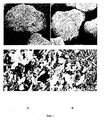
- illustration 1 shows the electron microscopy (SEM) of the organometallic framework (A) and the oxide (B), wherein in the upper half of the scale a scale of 1000: 1 and in the lower half a scale of 20,000: 1 is present. As illustration 1 shows, the morphology of the original particles is largely retained.
- Example 1 Compared to Example 1, the specific surface area of conventionally produced and commercially available alumina is determined. This resulted in the samples Versal 200 (UOP LLC, Des Plaines, US), Spheralite (Procatalyse, Usine de Salwear, FR), Al 2 O 3 from Alcoa Inc. (Pittsburgh, US), Versal 250 (Eurosupport, KH Amersfoort, NL) has a specific surface area value in the range of about 320 to 350 m 2 / g.
- the N 2 surface (according to Langmuir) of a Mg-naphthalenedicarboxylic acid MOF prepared in this way is typically in the range from 80 to 120 m 2 / g.
- the magnesium 2,6-naphthalenedicarboxylic acid MOF is calcined at 650 ° C for 5 hours.
- the product is a magnesium oxide with an N 2 surface area of 133 m 2 / g (Langmuir).
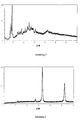
- Figures 2 and 3 show the X-ray diffractogram (XRD) of framework ( Fig. 2 ) and oxide ( Fig. 3 ), where 1 indicates the intensity (Lin (courts)) and 2 ⁇ describes the 2-theta scale.
- XRD X-ray diffractogram
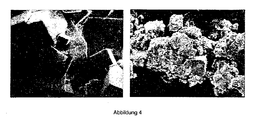
- the morphology of the original particles also remains largely intact.
- the product is a zirconia with an N 2 surface area of 61 m 2 / g (Langmuir).
- the distribution of the pore diameters remains essentially the same.
- Example 5 Preparation of a mixed Al / Zr oxide
- a Zr-doped Al-terephthalic acid MOF is prepared by precipitation in 300 ml of DMF (130 ° C, 17 h). After filtration and washing with DMF and methanol, this is first predried at 150 ° C in a vacuum oven and then calcined at 330 ° C for 48 h in a muffle furnace with air.
- the MOF has an N 2 surface area of 1448 m 2 / g (Langmuir) and, in addition to 8.5% by weight of Al, also contains 9.8% by weight of Zr.
- the MOF precursor is calcined at 500 ° C for 48 hours to convert it to a mixed Al / Zr oxide.
- the product has a Langmuir surface area of 358 m 2 / g.
- the zinc terephthalic acid MOF (MOF-5) has an N 2 surface area of 2811 m 2 / g (Langmuir).
- the resulting powder is calcined at 500 ° C for 16 h.
- the product is a zinc oxide with an N 2 surface area of only 20 m 2 / g (Langmuir).
- Figure 4 shows the electron micrograph (SEM) of MOF-5 (left) and oxide (right) at a resolution of 500: 1. It can be seen that the MOF structure has largely decomposed.
Landscapes
- Chemical & Material Sciences (AREA)
- Organic Chemistry (AREA)
- Inorganic Chemistry (AREA)
- Analytical Chemistry (AREA)
- Chemical Kinetics & Catalysis (AREA)
- Life Sciences & Earth Sciences (AREA)
- Geology (AREA)
- Thermal Sciences (AREA)
- Physics & Mathematics (AREA)
- Environmental & Geological Engineering (AREA)
- General Life Sciences & Earth Sciences (AREA)
- Engineering & Computer Science (AREA)
- Oil, Petroleum & Natural Gas (AREA)
- Solid-Sorbent Or Filter-Aiding Compositions (AREA)
- Organic Low-Molecular-Weight Compounds And Preparation Thereof (AREA)
- Catalysts (AREA)
- Oxygen, Ozone, And Oxides In General (AREA)
- Inorganic Compounds Of Heavy Metals (AREA)
- Compounds Of Alkaline-Earth Elements, Aluminum Or Rare-Earth Metals (AREA)
Description
- Die vorliegende Erfindung betrifft Verfahren zur Herstellung von Metalloxiden aus porösen metallorganischen Gerüstmaterialien, Metalloxiden, die aus diesen Verfahren erhältlich sind sowie deren Verwendung.
- Metalloxide stellen eine interessante Stoffgruppe dar und werden für zahlreiche Anwendungen eingesetzt.
- Nicht zuletzt aus diesem Grund existieren im Stand der Technik zahlreiche Methoden, um solche Metalloxide zu erhalten. Neben der Gewinnung beispielsweise aus Erzen stellt die großtechnische Darstellung insbesondere hoch-reiner Metalloxide eine Möglichkeit dar.
- Ausgangsstoffe solcher Darstellungsmethoden können unterschiedlicher Natur sein. So wird beispielsweise α-Aluminiumoxid aus Bauxit hergestellt. γ-Al2O3, das für seine Porosität bekannt ist; kann beispielsweise aus Hydrargillit oder Böhmit dargestellt werden, wobei bei einer Temperatur oberhalb von 1000 °C das γ-Al2O3 in α-Al2O3 übergeht. γ-Al2O3 dient beispielsweise als Adsorbens, Katalysator oder Katalysatorträger.
- Zur Herstellung von Metalloxiden werden auch metallorganische Verbindungen eingesetzt. Die Darstellung der Metalloxide kann hierbei beispielsweise mit Hilfe einer chemischen Gasphasenabscheidung erzeugt werden. Hierdurch können insbesondere Schichten auf entsprechenden Substraten gebildet werden. Darüber hinaus sind Sol-Gel-Verfahren, Gefriertrocknung oder die Herstellung durch Flammenpyrolyse bekannt.
- Ein interessanter Ansatz zur Darstellung von Zinkoxid ist von C.-Y. Su et al., J. Am. Chem. Soc. 126 (2004), 3576-3586 beschrieben. Hierbei werden zunächst metallorganische Gerüstmaterialien hergestellt, die zum einen aus einem Metallion (Zink) und einem organischen Liganden (3-Amino-1,2,4-triazol oder 3-Amino-1,2,4-triazol-5-carbonsäure) ein poröses dreidimensionales metallorganisches Gerüst bilden. Das Erhitzen des Gerüstmaterials in Sauerstoffatmosphäre führt bei Temperaturen oberhalb 600°C zur Bildung von Zinkoxid.
- Poröse metallorganische Gerüstmaterialien, welche auf Zink basieren, sind in der Literatur bekannt und zeichnen sich durch eine vergleichsweise hohe spezifische Oberfläche aus, so dass diese Materialien häufig vorgeschlagen werden, um beispielsweise Adsorptionen von Gasen durchzuführen. Hierbei ist Zinkterephthalat (MOF-5) am bekanntesten.
- Es ist im Stand der Technik jedoch nicht bekannt, ob das aus einem metallorganischen Gerüstmaterial gebildete Zinkoxid Eigenschaften aufweist, die die Verwendung eines solchen Oxids als vielversprechend darstellen lassen.
- Eine Aufgabe der vorliegenden Erfindung liegt somit darin, Verfahren zur Herstellung von Metalloxiden sowie solche Metalloxide bereitzustellen, um diese einer geeigneten Anwendung zuzuführen.
- Die Aufgabe wird gelöst durch ein Verfahren zur Herstellung eines Metalloxids den Schritt enthaltend
- Erhitzen eines porösen metallorganischen Gerüstmaterials, wobei das Gerüstmaterial mindestens eine an mindestens ein Metallion koordinativ gebundene, mindestens zweizähnige organische Verbindung enthält und das Metallion ausgewählt ist aus den Metallen bestehend aus den Gruppen 2. bis 4. und 13. des Periodensystems der Elemente, über die vollständige Zersetzungstemperatur des Gerüstmaterials.
- Es wurde nämlich gefunden, dass die Oxide der oben genannten Metalle der 2. bis 4. und 13. Gruppe, welche nach dem erfindungsgemäßen Verfahren hergestellt werden, eine vergleichsweise hohe spezifische Oberfläche aufweisen und so insbesondere in Verwendungsgebieten der Adsorption von Stoffen einsetzbar sind. Diese gegenüber dem Stand der Technik vergleichsweise hohen spezifischen Oberflächen könnten dadurch erklärt werden, dass die Gerüststruktur des metallorganischen Gerüstmaterials zumindest teilweise in der Struktur des entsprechenden Metalloxids beibehalten wird.
- Überraschenderweise hat sich jedoch herausgestellt, dass das im Stand der Technik bekannte Zinkoxid aus einem metallorganischen Gerüstmaterial sehr niedrige spezifische Oberflächen aufweist und somit nicht in besonderem Maße geeignet ist, entsprechenden Verwendungen zugeführt zu werden. Es ist daher umso überraschender, dass dies mit den erfindungsgemäßen Metallen möglich ist.
- Das erfindungsgemäße Verfahren zur Herstellung eines Metalloxids geht somit von einem Schritt aus, bei dem das poröse metallorganische Gerüstmaterial erhitzt wird. Hierbei kann das Material in einer Dispersion oder als trockener Feststoff vorliegen. Weiterhin kann das metallorganische Gerüstmaterial als Pulver oder als Formkörper oder beides vorliegen. Vorzugsweise erfolgt das Erhitzen mit einem porösen metallorganischen Gerüstmaterial in Form eines Pulvers.
- Das Erhitzen kann durch für den Fachmann bekannte Methoden erfolgen. Typischerweise erfolgt das Erhitzen in einem dazu geeigneten Ofen, wie beispielsweise einem Muffelofen oder Drehrohrofen. Bei Verwendung eines Ofens ist es weiterhin zweckdienlich, dass Möglichkeiten vorhanden sind, das Erhitzen in Gegenwart einer geeigneten Atmosphäre durchführen zu können. Hierzu kann entsprechend eine Zuführung für ein entsprechendes Gas oder Gasgemisch derart im oder am Ofen angebracht sein, damit der das poröse metallorganische Gerüstmaterial enthaltende Ofenraum mit dem entsprechenden Gas oder Gasgemisch geflutet werden kann.
- Das poröse metallorganische Gerüstmaterial wird soweit erhitzt, wie es erforderlich ist, um das metallorganische Gerüstmaterial in das entsprechende Metalloxid umzuwandeln. Hierbei wird daher über die vollständige Zersetzungstemperatur des metallorganischen Gerüstmaterials erhitzt.
- Im Rahmen der vorliegenden Erfindung ist unter "vollständige Zersetzungstemperatur" diejenige Temperatur zu verstehen, bei der das poröse metallorganische Gerüstmaterial beginnt, sich in das entsprechende Metalloxid umzuwandeln. Es ist jedoch ebenfalls möglich, dass das metallorganische Gerüstmaterial über Zwischenstufen zum Metalloxid umgewandelt wird. Beispielsweise könnte vor Bildung des Metalloxids ein Carbonat gebildet worden sein. In einem solchen Fall ist unter der "vollständigen Zersetzungstemperatur" diejenige Temperatur zu verstehen, die erforderlich ist, die jeweils letzte Zwischenstufe zum Metalloxid zu überführen.
- Die Bestimmung der vollständigen Zersetzungstemperatur kann anhand der vom Fachmann bekannten Methoden durchgeführt werden. Beispielsweise kann durch Thermogravimetrie diese Temperatur bestimmt werden, wobei durch begleitende Analytik ebenfalls der Nachweis der Bildung des entsprechenden Metalloxids geführt werden kann.
- Die vollständige Zersetzungstemperatur, die erforderlich ist, aus einem porösen metallorganischen Gerüstmaterial das entsprechende Metalloxid herzustellen, liegt typischerweise im Bereich von 250°C bis 1000°C. Weiterhin bevorzugt liegt die vollständige Zersetzungstemperatur in einem Bereich von 350°C bis 800°C. Insbesondere bevorzugt liegt die vollständige Zersetzungstemperatur im Bereich von 450°C bis 650°C. Liegt das Metalloxid in verschiedenen Modifikationen vor, die durch Temperaturbehandlung erhalten werden können, kann die thermisch höherstufige(n) Modifikation(en) aus dem metallorganischen Gerüstmaterial durch Anlegen der entsprechenden Temperaturstufe erhalten werden oder es wird zunächst das/die tieferstufige(n) Modifikation(en) erhalten und in einem weiteren Schritt kann dann die Umwandlung in die gewünschte Modifikation erfolgen. '
- Wie bereits oben erwähnt wurde, kann das Erhitzen des porösen metallorganischen Gerüstmaterials in einer geeigneten Atmosphäre stattfinden. Sofern das poröse metallorganische Gerüstmaterial mindestens eine mindestens zweizähnige organische Verbindung enthält, die selbst genügend Sauerstoff aufweist, ist es nicht zwingend erforderlich, dass von außen eine Sauerstoff liefernde Substanz zur Verfügung gestellt wird, um das poröse metallorganische Gerüstmaterial in ein Metalloxid umzuwandeln. Beispiele solcher mindestens zweizähniger organischer Verbindungen, die Sauerstoff enthalten, sind Carbonsäuren, Alkohole, Ketone, Aldehyde, Ether, Ester und Phenole. Insofern könnte das Erhitzen des porösen metallorganischen Gerüstmaterials im Vakuum erfolgen. Zweckdienlicherweise wird jedoch das Erhitzen unter Atmosphärenbedingungen durchgeführt. In einem solchen Falle könnte also auch das Erhitzen des porösen metallorganischen Gerüstmaterials in Gegenwart einer inerten Atmosphäre stattfinden. Solche Atmosphären könnten gebildet sein durch Gase wie Stickstoff, E-delgase wie Helium oder Argon und Gemische hiervon. Dies stellt jedoch eine Ausnahme dar.
- Vorzugsweise findet daher jedoch das Erhitzen des porösen metallorganischen Gerüstmaterials in Gegenwart einer oxidierenden Atmosphäre mit einem Sauerstoff liefernden Bestandteil statt. Hierdurch kann gewährleistet werden, dass für die Umwandlung des porösen metallorganischen Gerüstmaterials in das entsprechende Metalloxid ausreichend Sauerstoff zur Verfügung steht. Dies kann insbesondere auch dazu beitragen, dass die oben erwähnten Zwischenstufen "übersprungen" werden. Solche oxidierenden Atmosphären können durch entsprechend Sauerstoff liefernde Gase oder Gasgemische erhalten werden. Als einfachstes und bevorzugtes Gasgemisch ist hierbei Luft zu nennen, das normalerweise einen ausreichend hohen Anteil an molekularem Sauerstoff enthält. Gegebenenfalls kann die Luft mit weiterem Sauerstoff angereichert eingesetzt werden. Schließlich ist es selbstverständlich ebenso möglich, dass reiner Sauerstoff als oxidierende Atmosphäre verwendet wird. Darüber hinaus können auch andere Gase oder Gasgemische verwendet werden, die beispielsweise mit molekularem Sauerstoff angereichert sind. Hierbei wären insbesondere Inertgase bevorzugt. So können geeignete Gasgemische zur Erzeugung einer oxidierenden Atmosphäre bei Erhitzen des porösen metallorganischen Gerüstmaterials Helium, Argon, Stickstoff oder Gemische hiervon jeweils mit Sauerstoff angereichert eingesetzt werden.
- Das poröse metallorganische Gerüstmaterial kann einer oxidierenden Atmosphäre derart ausgesetzt sein, dass während des Erhitzens die Atmosphäre nicht verändert wird. Das das poröse metallorganische Gerüstmaterial umgebende Gas oder Gasgemisch wird somit nicht ausgetauscht, so dass der Sauerstoff liefernde Bestandteil der Atmosphäre während des Erhitzens abnimmt.
- Darüber hinaus ist es möglich, die Atmosphäre während des Erhitzens in Bezug auf deren Sauerstoff liefernden Bestandteil durch Nachführen zumindest dieses Bestandteils in etwa konstant zu halten.
- Bevorzugt ist jedoch, dass der Sauerstoff liefernde Bestandteil während des Erhitzens erhöht wird. Dies kann zur Temperatursteuerung der exothermen Reaktion dienen. Eine mögliche Ausführungsform ist, dass die Atmosphäre durch ein Gas oder Gasgemisch mit höherem Anteil an Sauerstoff lieferndem Bestandteil ausgetauscht wird. Dies kann insbesondere derart erfolgen, dass der Atmosphäre nach dem Beginn des Erhitzens Sauerstoff zugeführt wird, bis schließlich eine bestimmte Sauerstoffatmosphäre vorliegt. Die Erhöhung kann schrittweise oder kontinuierlich erfolgen.
- Das poröse metallorganische Gerüstmaterial für das erfindungsgemäße Verfahren zur Herstellung eines Metalloxids muss das dem Metall des Metalloxids entsprechende Metallion enthalten. Das poröse metallorganische Gerüstmaterial kann jedoch auch mehrere Metallionen enthalten. Hierbei entsteht dann entsprechend ein Metalloxid, das ebenfalls aus mehreren Metallen aufgebaut ist.
- Für den Fall, dass mehrere Metallionen im metallorganischen Gerüstmaterial vorhanden sind, muss mindestens eines dieser Metallionen fähig sein, die mindestens eine mindestens zweizähnige organische Verbindung koordinativ zu binden, um das entsprechende poröse metallorganische Gerüstmaterial zu erhalten. Sind darüber hinaus ein oder mehrere Metalle in ionischer Form vorhanden, kann dieses oder können diese ebenfalls durch Koordination der mindestens einen mindestens zweizähnigen organischen Verbindungen oder weiterer mindestens zweizähniger organischer Verbindungen am Aufbau des metallorganischen Gerüstmaterials vorhanden sein. Darüber hinaus ist es jedoch ebenso möglich, dass dies nicht der Fall ist. Schließlich kann bei Vorhandensein mehrerer Metallionen das Verhältnis der Ionen in einem stöchiometrischen Verhältnis gegeben sein. Darüber hinaus kann auch ein nicht stöchiometrisches Verhältnis vorliegen. In diesem Zusammenhang kann dann auch von einem sogenannten dotieren porösen metallorganischen Gerüstmaterial ausgegangen werden. Solche dotierten Gerüstmaterialien sind beispielsweise in der deutschen Patentanmeldung mit der Anmeldenummer
10 2005 053 430.0 - Darüber hinaus kann das poröse metallorganische Gerüstmaterial ebenso durch ein weiteres Metall beispielsweise in Form eines Salzes imprägniert sein. Ein Verfahren zum Imprägnieren ist zum Beispiel in
EP-A 1 070 538 beschrieben. - Im Rahmen der vorliegenden Erfindung gelten zwei Metallionen ein und desselben Metalls unterschiedlicher Oxidationsstufe als zwei unterschiedliche Metallionen. Hierbei kann also ein entsprechendes Metalloxid erhalten werden, bei dem das Metall in unterschiedlichen Oxidationsstufen vorliegt. Vorzugsweise wird jedoch insbesondere in Gegenwart einer oxidierenden Atmosphäre ein solches Metall ausschließlich in der höchsten stabilen Oxidationsstufe als Metalloxid vorliegen.
- Im Rahmen der vorliegenden Erfindung ist es bevorzugt, wenn das poröse metallorganische Gerüstmaterial ausschließlich ein Metallion eines Metalls, insbesondere einer Oxidationsstufe, aufweist.
- Das oder die Metallionen sind ausgewählt aus den Metallen bestehend aus den Gruppen 2. bis 4. und 13. des Periodensystems der Elemente.
- Insbesondere geeignete Metalle der Gruppe 2. des Periodensystems der Elemente sind Beryllium, Magnesium, Calcium, Strontium sowie Barium.
- Insbesondere geeignete Metalle der 3. Gruppe des Periodensystems der Elemente sind Scandium, Ytrium, Lanthan sowie die Lanthanide.
- Insbesonders geeignete Metalle der 4. Gruppe des Periodensystems der Elemente sind Titan, Zirkonium sowie Hafnium.
- Insbesondere geeignete Metalle der 13. Gruppe des Periodensystems der Elemente sind Aluminium, Bor, Gallium sowie Indium.
- Weiterhin bevorzugt sind die Metalle Magnesium, Calcium, Strontium, Barium, Zirkonium sowie Aluminium.
- ganz besonders bevorzugt ist das Metallion beziehungsweise die Metallionen aus der Gruppe der Metalle bestehend aus Aluminium, Magnesium und Zirkonium.
- Für den Fall, dass mehr als ein Metallion in porösen metallorganischen Gerüstmaterialien vorhanden ist, können insbesondere Aluminate der Formel MIAlO2 oder MIIAl2O4 erhalten werden, wobei MI ein einwertiges Metallion darstellt und M" ein zweiwertiges Metallion ist. Insbesondere können Spinelle erhalten werden.
- Für den Fall, dass das metallorganische Gerüstmaterial neben Titan weitere Metalle enthält, ist es möglich, Titanate, insbesondere Ilmenit (FeTiO3) aber auch MgTiO3, MnTiO3 FeTiO3, CoTiO3, NiTiO3, CaTiO3, SrTiO3, BaTiO3, Mg2TiO4, Zn2TiO4 sowie Mn2TiO4 zu erhalten.
- Bei Verwendung von Zirkon im metallorganischen Gerüstmaterial und darüber hinaus wenigstens einem weiteren Metallion können entsprechende Zirkonate erhalten werden.
- Geeignete poröse metallorganische Gerüstmaterialien sind aus dem Stand der Technik bekannt oder können anhand der im Stand der Technik beschriebenen Verfahren analog hergestellt werden. Metallorganische Gerüstmaterialien sind beispielsweise beschrieben in
US 5,648,508 ,EP-A-0 790 253 , M.O. Keeffe et al., J. Sol. State Chem., 152 (2000), Seite 3 bis 20, H. Li et al., Nature 402, (1999), Seite 276, M. Eddaoudi et al., Topics in Catalysis 9, (1999), Seite 105 bis 111, B. Chen et al., Science 291, (2001), Seite 1021 bis 1023,DE-A-101 11 230 ,WO-A 2005/049892 und A.C. Sudik et al., J. Am. Chem. Soc. 127 (2005), 7110 bis 7118. - Poröse metallorganische Gerüstmaterialien basierend auf Aluminium und Magnesium sind darüber hinaus insbesondere in
DE A 10 2005 039 623 sowie der darin zitierten Literatur beschrieben. - Poröse metallorganische Gerüstmaterialien basierend auf Zirkonium und Titan sind insbesondere in der parallel eingereichten europäischen Patentanmeldung der Anmelderin mit dem Anwaltsaktenzeichen B06/0128EP beschrieben.
- Der Begriff "mindestens zweizähnige organische Verbindung" bezeichnet eine organische Verbindung, die mindestens eine funktionelle Gruppe enthält, die in der Lage ist, zu einem gegebenen Metallion mindestens zwei, bevorzugt zwei koordinative Bindungen, und/oder zu zwei oder mehr, bevorzugt zwei Metallatomen jeweils eine koordinative Bindung auszubilden.
- Als funktionelle Gruppen, über die die genannten koordinativen Bindungen ausgebildet werden kann, sind insbesondere beispielsweise folgende funktionellen Gruppen zu nennen: -CO2H, -CS2H, -NO2, -B(OH)2, -SO3H, -Si(OH)3, -Ge(OH)3, -Sn(OH)3, -Si(SH)4, -Ge(SH)4, -Sn(SH)3, -PO3H, -AsO3H, -AsO4H, -P(SH)3, -As(SH)3, -CH(RSH)2, -C(RSH)3 -CH(RNH2)2 -C(RNH2)3, -CH(ROH)2, -C(ROH)3, -CH(RCN)2, -C(RCN)3 wobei R beispielsweise bevorzugt eine Alkylengruppe mit 1, 2, 3, 4 oder 5 Kohlenstoffatomen wie beispielsweise eine Methylen-, Ethylen-, n-Propylen-, i-Propylen, n-Butylen-, i-Butylen-, tert-Butylen- oder n-Pentylengruppe, oder eine Arylgruppe, enthaltend 1 oder 2 aromatische Kerne wie beispielsweise 2 C6-Ringe, die gegebenenfalls kondensiert sein können und unabhängig voneinander mit mindestes jeweils einem Substituenten geeignet substituiert sein können, und/oder die unabhängig voneinander jeweils mindestens ein Heteroatom wie beispielsweise N, O und/oder S enthalten können. Gemäß ebenfalls bevorzugter Ausführungsformen sind funktionelle Gruppen zu nennen, bei denen der oben genannte Rest R nicht vorhanden ist. Diesbezüglich sind unter anderem -CH(SH)2, -C(SH)3, -CH(NH2)2, -C(NH2)3, -CH(OH)2, -C(OH)3, -CH(CN)2 oder -C(CN)3 zu nennen.
- Die mindestens zwei funktionellen Gruppen können grundsätzlich an jede geeignete organische Verbindung gebunden sein, solange gewährleistet ist, dass die diese funktionellen Gruppen aufweisende organische Verbindung zur Ausbildung der koordinativen Bindung und zur Herstellung des Gerüstmaterials befähigt ist.
- Bevorzugt leiten sich die organischen Verbindungen, die die mindestens zwei funktionellen Gruppen enthalten, von einer gesättigten oder ungesättigten aliphatischen Verbindung oder einer aromatischen Verbindung oder einer sowohl aliphatischen als auch aromatischen Verbindung ab.
- Die aliphatische Verbindung oder der aliphatische Teil der sowohl aliphatischen als auch aromatischen Verbindung kann linear und/oder verzweigt und/oder cyclisch sein, wobei auch mehrere Cyclen pro Verbindung möglich sind. Weiter bevorzugt enthält die aliphatische Verbindung oder der aliphatische Teil der sowohl aliphatischen als auch aromatischen Verbindung 1 bis 15, weiter bevorzugt 1 bis 14, weiter bevorzugt 1 bis 13, weiter bevorzugt 1 bis 12, weiter bevorzugt 1 bis 11 und insbesondere bevorzugt 1 bis 10 C-Atome wie beispielsweise 1, 2, 3, 4, 5, 6, 7, 8, 9 oder 10 C-Atome. Insbesondere bevorzugt sind hierbei unter anderem Methan, Adamantan, Acetylen, Ethylen oder Butadien.
- Die aromatische Verbindung oder der aromatische Teil der sowohl aromatischen als auch aliphatischen Verbindung kann einen oder auch mehrere Kerne wie beispielsweise zwei, drei, vier oder fünf Kerne aufweisen, wobei die Kerne getrennt voneinander und/oder mindestens zwei Kerne in kondensierter Form vorliegen können. Besonders bevorzugt weist die aromatische Verbindung oder der aromatische Teil der sowohl aliphatischen als auch aromatischen Verbindung einen, zwei oder drei Kerne auf, wobei einer oder zwei Kerne besonders bevorzugt sind. Unabhängig voneinander kann weiter jeder Kern der genannten Verbindung mindestens ein Heteroatom wie beispielsweise N, O, S, B, P, Si, Al, bevorzugt N, O und/oder S enthalten. Weiter bevorzugt enthält die aromatische Verbindung oder der aromatische Teil der sowohl aromatischen als auch aliphatischen Verbindung einen oder zwei C6-Kerne, wobei die zwei entweder getrennt voneinander oder in kondensierter Form vorliegen. Insbesondere sind als aromatische Verbindungen Benzol, Naphthalin und/oder Biphenyl und/oder Bipyridyl und/oder Pyridyl zu nennen.
- Besonders bevorzugt leitet sich die mindestens zweizähnige organische Verbindung von einer Di-, Tri-, oder Tetracarbonsäure oder deren Schwefelanaloga ab. Schwefelanaloga sind die funktionellen Gruppen -C(=O)SH sowie dessen Tautomer und C(=S)SH, die anstelle einer oder mehrerer Carbonsäuregruppen eingesetzt werden können.
- Der Begriff "ableiten" bedeutet im Rahmen der vorliegenden Erfindung, dass die mindestens zweizähnige organische Verbindung im Gerüstmaterial in teilweise deprotonierter oder vollständig deprotonierter Form vorliegen kann. Weiterhin kann die mindestens zweizähnige organische Verbindung weitere Substituenten enthalten, wie beispielsweise -OH, -NH2, -OCH3, -CH3, -NH(CH3), -N(CH3)2, -CN sowie Halogenide.
- Beispielsweise sind im Rahmen der vorliegenden Erfindung Dicarbonsäuren wie etwa Oxalsäure, Bernsteinsäure, Weinsäure, 1,4-Butandicarbonsäure, 4-Oxo-Pyran-2,6-dicarbonsäure, 1,6-Hexandicarbonsäure, Decandicarbonsäure, 1,8-Heptadecandicarbonsäure, 1,9-Heptadecandicarbonsäure, Heptadecandicarbonsäure, Acetylendicarbonsäure, 1,2-Benzoldicarbonsäure, 2,3-Pyridindicarbonsäure, Pyridin-2,3-dicarbonsäure, 1,3-Butadien-1,4-dicarbonsäure, 1,4-Benzoldicarbonsäure, p-Benzoldicarbonsäure, Imidazol-2,4-dicarbonsäure, 2-Methylchinolin-3,4-dicarbonsäure, Chinolin-2,4-dicarbonsäure, Chinoxalin-2,3-dicarbonsäure, 6-Chlorchinoxalin-2,3-dicarbonsäure, 4,4'-Diaminphenylmethan-3,3'-dicarbonsäure, Chinolin-3,4-dicarbonsäure, 7-Chlor-4-hydroxychinolin-2,8-dicarbonsäure, Diimiddicarbonsäure, Pyridin-2,6-dicarbonsäure, 2-Methylimidazol-4,5-dicarbonsäure, Thiophen-3,4-dicarbonsäure, 2-Isopropylimidazol-4,5-dicarbonsäure, Tetrahydropyran-4,4-dicarbonsäure, Perylen-3,9-dicarbonsäure, Perylendicarbonsäure, Pluriol E 200-dicarbonsäure, 3,6-Dioxaoctandicarbonsäure, 3,5-Cyclohexadien-1,2-dicarbonsäure, Octadicarbonsäure, Pentan-3,3-carbonsäure, 4,4'-Diamino-1,1'-diphenyl-3,3'-dicarbon-säure, 4,4'-Diaminodiphenyl-3,3'-dicarbonsäure, Benzidin-3,3'-dicarbonsäure, 1,4-bis-(Phenylaminofbenzol-2,5-dicarbonsäure, 1,1'-Dinaphthyl-5,5'-dicarbonsäure, 7-Chlor-8-methylchinolin-2,3-dicarbonsäure, 1-Anilinoanthrachinon-2,4'-dicarbonsäure, Polytetrahydrofuran-250-dicarbonsäure, 1,4-bis-(Carboxymethyl)-piperazin-2,3-dicarbonsäure, 7-Chlorchinolin-3,8-dicarbonsäure, 1-(4-Carboxy)-phenyl-3-(4-chlor)-phenylpyrazolin-4,5-dicarbonsäure, 1,4,5,6,7,7,-Hexachlor-5-norbornen-2,3-dicarbonsäure, Phenylindandicarbonsäure, 1,3-Dibenzyl-2-oxo-imidazolidin-4,5-dicarbonsäure, 1,4-Cyclohexandicarbonsäure, Naphthalin-1,8-dicarbonsäure, 2-Benzoylbenzol-1,3-dicarbonsäure, 1,3-Dibenzyl-2-oxoimidazolidin-4,5-cis-dicarbonsäure, 2,2'-Bichinolin-4,4'-dicarbonsäure, Pyridin-3,4-dicarbonsäure, 3,6,9-Trioxaundecandicarbonsäure, O-Hydroxybenzophenondicarbonsäure, Pluriol E 300-dicarbonsäure, Pluriol E 400-dicarbonsäure, Pluriol E 600-dicarbonsäure, Pyrazol-3,4-dicarbonsäure, 2,3-Pyrazindicarbonsäure, 5,6-Dimethyl-2,3-pyrazindicarbonsäure, 4,4'-Diaminodiphenyletherdiimiddicarbonsäure, 4,4'-Diaminodiphenylmethandiimiddicarbonsäure, 4,4'-Diaminodiphenylsulfondümiddicarbonsäure, 2,6-Naphthalindicarbonsäure, 1,3-Adamantandicarbonsäure, 1,8-Naphthalindicarbonsäure, 2,3-Naphthalindicarbonsäure, 8-Methoxy-2,3-naphthalindicarbonsäure, 8-Nitro-2,3-naphthalincarbonsäure, 8-Sulfo-2,3-naphthalindicarbonsäure, Anthracen-2,3-dicarbonsäure, 2',3'-Diphenyl-p-terphenyl-4,4"-dicarbonsäure, Diphenylether-4,4'-dicarbonsäure, Imidazol-4,5-dicarbonsäure, 4(1H)-Oxothiochromen-2,8-dicarbonsäure, 5-tert-Butyl-1,3-benzöldicarbonsäure, 7,8-Chinolindicarbonsäure, 4,5-Imidazoldicarbonsäure, 4-Cyclohexen-1,2-dicarbonsäure, Hexatriacontandicarbonsäure, Tetradecandicarbonsäure, 1,7-Heptadicarbonsäure, 5-Hydroxy-1,3-Benzoldicarbonsäure, Pyrazin-2,3-dicarbonsäure, Furan-2,5-dicarbonsäure, 1-Nonen-6,9-dicarbonsäure, Eicosendicarbonsäure, 4,4'-Dihydroxydiphenylmethan-3,3'-dicarbonsäure, 1-Amino-4-methyl-9,10-dioxo-9,10-dihydroanthracen-2,3-dicarbonsäure, 2,5-Pyridindicarbonsäure, Cyclohexen-2,3-dicarbonsäure,2,9-Dichlorfluorubin-4,11-dicarbonsäure, 7-Chlor-3-mtehylchinolin-6,8-dicarbonsäure, 2,4-Dichlorbenzophenon-2',5'-dicarbonsäure, 1,3-benzoldicarbonsäure, 2,6-Pyridindicarbonsäure, 1-Methylpyrrol-3,4-dicarbonsäure, 1-Benzyl-1H-pyrrol-3,4-dicarbonsäure, Anthrachinon-1,5-dicarbonsäure, 3,5-Pyrazoldicarbonsäure, 2-Nitrobenzol-1,4-dicarbonsäure, Heptan-1,7-dicarbonsäure, Cyclobutan-1,1-dicarbonsäure 1,14-Tetradecandicarbonsäure, 5,6-Dehydronorbornan-2,3-dicarbonsäure oder 5-Ethyl-2,3-Pyridindicarbonsäure,
Tricarbonsäuren wie etwa - 2-Hydroxy-1,2,3-propantricarbonsäure, 7-Chlor-2,3,8-chinolintricarbonsäure, 1,2,4-Benzoltricarbonsäure, 1,2,4-Butantricarbonsäure, 2-Phosphono-1,2,4-butantricarbonsäure, 1,3,5-Benzoltricarbonsäure, 1-Hydroxy-1,2,3-Propantricarbonsäure, 4,5-Dihydro-4,5-dioxo-1H-pyrrolo[2,3-F]chinolin-2,7,9-tricarbonsäure, 5-Acetyl-3-amino-6-methylbenzol-1,2,4-tricarbonsäure, 3-Amino-5-benzoyl-6-methylbenzol-1,2,4-tricarbonsäure, 1,2,3-Propantricarbonsäure oder Aurintricarbonsäure,
oder Tetracarbonsäuren wie etwa
1,1-Dioxidperylo[1,12-BCD]thiophen-3,4,9,10-tetracarbonsäure, Perylentetracarbonsäuren wie Perylen-3,4,9,10-tetracarbonsäure oder Perylen-1,12-sulfon-3,4,9,10-tetracarbonsäure, Butantetracarbonsäuren wie 1,2,3,4-Butantetracarbonsäure oder Meso-1,2,3,4-Butantetracarbonsäure, Decan-2,4,6,8-tetracarbonsäure, 1,4,7,10,13,16-Hexaoxacyclooctadecan-2,3,11,12-tetracarbonsäure, 1,2,4,5-Benzoltetracarbonsäure, 1,2,11,12-Dodecantetracarbonsäure, 1,2,5,6-Hexantetracarbonsäure, 1,2,7,8-Octantetracarbonsäure, 1,4,5,8-Naphthalintetracarbonsäure, 1,2,9,10-Decantetracarbonsäure, Benzophenontetracarbonsäure, 3,3',4,4'-Benzophenontetracarbonsäure, Tetrahydrofurantetracarbonsäure oder Cyclopentantetracarbonsäuren wie Cyclopentan-1,2,3,4-tetracarbonsäure
zu nennen. - Ganz besonders bevorzugt werden gegebenenfalls mindestens einfach substituierte mono-, di-, tri-, tetra- oder höherkernige aromatische Di-, Tri- oder Tetracarbonsäuren eingesetzt, wobei jeder der Kerne mindestens ein Heteroatom enthalten kann, wobei zwei oder mehr Kerne gleiche oder unterschiedliche Heteroatome enthalten kann. Beispielsweise bevorzugt werden monokernige Dicarbonsäuren, monokernige Tricarbonsäuren, monokernige Tetracarbonsäuren, dikernige Dicarbonsäuren, dikernige Tricarbonsäuren, dikernige Tetracarbonsäuren, trikernige Dicarbonsäuren, trikernige Tricarbonsäuren, trikernige Tetracarbonsäuren, tetrakernige Dicarbonsäuren, tetrakernige Tricarbonsäuren und/oder tetrakernige Tetracarbonsäuren. Geeignete Heteroatome sind beispielsweise N, O, S, B, P, Si, Al, bevorzugte Heteroatome sind hierbei N, S und/oder O. Als geeigneter Substituent ist diesbezüglich unter anderem -OH, eine Nitrogruppe, eine Aminogruppe oder eine Alkyl- oder Alkoxygruppe zu nennen.
- Insbesondere bevorzugt werden als mindestens zweizähnige organische Verbindungen Acetylendicarbonsäure (ADC), Benzoldicarbonsäuren, Naphthalindicarbonsäuren, Biphenyldicarbonsäuren wie beispielsweise 4,4'-Biphenyldicarbonsäure (BPDC), Bipyridindicarbonsäuren wie beispielsweise 2,2'-Bipyridindicarbonsäuren wie beispielsweise 2,2'-Bipyridin-5,5-dicarbonsäure, Benzoltricarbonsäuren wie beispielsweise 1,2,3-Benzoltricarbonsäure oder 1,3,5-Benzoltricarbonsäure (BTC), Adamantantetracarbonsäure (ATC). Adamantandibenzoat (ADB) Benzoltribenzoat (BTB), Methantetrabenzoat (MTB), Adamantantetrabenzoat oder Dihydroxyterephthalsäuren wie beispielsweise 2,5-Dihydroxylerephthalsäure (DHBDC) eingesetzt.
- Ganz besonders bevorzugt werden unter anderem lsophtalsäure, Terephthalsäure, 2,5-Dihydroxyterephthalsäure, 1,2,3-Benzoltricarbonsäure, 1,2,4-Benzoltricarbonsäure, 1,3,5-Benzoltricarbonsäure, Fumarsäure, Bernsteinsäure, Maleinsäure, Glutarsäure, 2,6-Naphthalindicarbonsäure, 1,2,4,5-Benzoltetracarbonsäure, Citronensäure, Weinsäure oder Oxalsäure eingesetzt. Insbesondere bevorzugt sind Oxalsäure, Isophthalsäure oder Terephthalsäure.
- Es ist bevorzugt, wenn die mindestens eine mindestens zweizähnige organische Verbindung nur aus den Elementen Kohlenstoff, Wasserstoff und Sauerstoff aufgebaut ist. Hierbei ist bevorzugt, dass das molare Verhältnis C : 0 ≤ 3, mehr bevorzugt ≤ 2 ist.
- Neben diesen mindestens zweizähnigen organischen Verbindungen kann der MOF auch eine oder mehrere einzähnige Liganden umfassen.
- Geeignete Lösemittel zur Herstellung der MOF sind unter anderem Ethanol, Dimethylformamid, Toluol, Methanol, Chlorbenzol, Diethylformamid, Dimethylsulfoxid, Wasser, Wasserstoffperoxid, Methylamin, Natronlauge, N-Methylpolidonether, Acetonitril, Benzylchlorid, Triethylamin, Ethylenglykol und Gemische hiervon. Weitere Metallionen, mindestens zweizähnige organische Verbindungen und Lösemittel für die Herstellung von MOF sind unter anderem in
US-A 5,648,508 oderDE-A 101 11 230 beschrieben. - Die metallorganischen Gerüstmaterialien für das erfindungsgemäße Verfahren enthalten Poren, insbesondere Mirko- und/oder Mesoporen. Mikroporen sind definiert als solche mit einem Durchmesser von 2 nm oder kleiner und Mesoporen sind definiert durch einen Durchmesser im Bereich von 2 bis 50 nm, jeweils entsprechend nach der Definition, wie sie Pure Applied Chem. 57 (1985), Seiten 603-619, insbesondere auf Seite 606 angegeben ist. Die Anwesenheit von Mikro- und/oder Mesoporen kann mit Hilfe von Sorptionsmessungen überprüft werden, wobei diese Messungen die Aufnahmekapazität der metallorganischen Gerüstmaterialien für Stickstoff bei 77 Kelvin gemäß DIN 66131 und/oder DIN 66134 bestimmt.
- Vorzugsweise beträgt die spezifische Oberfläche - berechnet nach dem Langmuir-Modell (DIN 66131, 66134) für ein MOF in Pulverform bei mehr als 5 m2/g, mehr bevorzugt über 10 m2/g, mehr bevorzugt mehr als 50 m2/g, weiter mehr bevorzugt mehr als 500 m2/g, weiter mehr bevorzugt mehr als 1000 m2/g und besonders bevorzugt mehr als 1500 m2/g.
- Formkörper aus metallorganischen Gerüstmaterialien können eine niedrigere spezifische Oberfläche besitzen; vorzugsweise jedoch mehr als 10 m2/g, mehr bevorzugt mehr als 50 m2/g, weiter mehr bevorzugt mehr als 500 m2/g, insbesondere mehr als 1000 m2/g.
- Die Porengröße des porösen metallorganischen Gerüstmaterials kann durch Wahl des geeigneten Liganden und/oder der mindestens zweizähnigen organischen Verbindung gesteuert werden. Allgemein gilt, dass je größer die organische Verbindung desto grö-βer die Porengröße ist. Vorzugsweise beträgt die Porengröße von 0,2 nm bis 30 nm, besonders bevorzugt liegt die Porengröße im Bereich von 0,3 nm bis 3 nm bezogen auf das kristalline Material.
- In einem Formkörper des metallorganischen Gerüstmaterials treten jedoch auch größere Poren auf, deren Größenverteilung variieren kann. Vorzugsweise wird jedoch mehr als 50 % des gesamten Porenvolumens, insbesondere mehr als 75 %, von Poren mit einem Porendurchmesser von bis zu 1000 nm gebildet. Vorzugsweise wird jedoch ein Großteil des Porenvolumens von Poren aus zwei Durchmesserbereichen gebildet. Es ist daher weiter bevorzugt, wenn mehr als 25 % des gesamten Porenvolumens, insbesondere mehr als 50 % des gesamten Porenvolumens von Poren gebildet wird, die in einem Durchmesserbereich von 100 nm bis 800 nm liegen und wenn mehr als 15 % des gesamten Porenvolumens, insbesondere mehr als 25 % des gesamten Porenvolumens von Poren gebildet wird, die in einem Durchmesserbereich von bis zu 10 nm liegen. Die Porenverteilung kann mittels Quecksilber-Porosimetrie bestimmt werden.
- Die Herstellung von Formkörpern aus metallorganischen Gerüstmaterialien ist beispielsweise in
WO-A 03/102000 - Da die Gerüststruktur des metallorganischen Gerüstmaterials zumindest teilweise beibehalten wird, ist es bevorzugt, wenn - und insofern dies der Fall ist - die spezifische Oberfläche (N2 nach Langmuir) von metallorganischem Gerüstmaterial zu Oxid vorzugsweise < 50 : 1, besonders bevorzugt < 20 : 1, weiter besonders bevorzugt < 15 : 1 und im Falle von metallorganischen Gerüstmaterialien aus Hauptgruppenmetallen insbesondere < 5 : 1 und weiterhin mehr bevorzugt < 4 : 1 ist.
- Für den Fall, dass das Metalloxid Al2O3 ist, wird bevorzugt, wenn die spezifische Oberfläche mindestens 400 m2/g (N2 nach Langmuir) beträgt.
- Für den Fall, dass das Metalloxid MgO ist, wird bevorzugt, wenn dessen spezifische Oberfläche mindestens 100 m2/g (N2 nach Langmuir) beträgt.
- Für den Fall, dass das Metalloxid ZrO2 ist, wird bevorzugt, wenn dessen spezifische Oberfläche mindestens 50 m2/g (N2 nach Langmuir) ist.
- Die Metalloxide können jeweils in der Form anfallen, wie das metallorganische Gerüstmaterial eingesetzt wurde. Vorzugsweise wird das metallorganische Gerüstmaterial als Pulver eingesetzt.
- Die Metalloxide, welche nach dem erfindungsgemäßen Verfahren erhältlich sind, können prinzipiell für sämtliche Anwendungen eingesetzt werden, welche für konventionell erhaltene Metalloxide bekannt sind.
- Insbesondere sind solche Anwendungen von Interesse, bei denen eine möglichst hohe spezifische Oberfläche von Vorteil ist.
- Beispielhafte Verwendungen eines erfindungsgemäßen Metalloxids sind solche, wobei das Metalloxid als keramischer Werkstoff, als Katalysator, insbesondere Photokatalysator, Pigment, beispielsweise Lichtschutzpigment, Träger, beispielsweise als Katalysatorträger, Adsorbens, beispielsweise zur Speicherung oder Trennung von Stoffen, insbesondere von Flüssigkeiten oder Gasen, als Isolationsmaterial, Schleifmittel, Hilfs - oder Füllstoff eingesetzt wird.
- 23,9 kg Terephthalsäure (BDC) und 28 kg Al2(SO4)3*18H2O werden in 150 kg DMF suspendiert und die Mischung 24 Stunden bei 130°C gerührt. Anschließend wird der Feststoff abfiltriert, mit 4 x 10 kg Methanol gewaschen und mit N2 während 96 Stunden trockengestrippt.
- Hierbei ergibt sich eine Oberfläche (bestimmt mit N2 nach Langmuir) von 1381 m2/g.
- Das so erhaltene Gerüstmaterial in Form eines Pulvers wird ca. 24 h in einem Muffelofen bei etwa 475 bis 500°C in einer Luftatmosphäre calciniert. Dabei ist der Kohlenstoff fast quantitativ entfernt (Restgehalt 0,35 Gew.%). Das Produkt ist ein amorphes Aluminiumoxid mit einer N2-Oberfläche von 452 m2/g (Langmuir).
-
Abbildung 1 zeigt die Elektronenmikroskopie (SEM) des metallorganischen Gerüstmaterials (A) und des Oxids (B), wobei in der oberen Bildhälfte ein Maßstab von 1000:1 und in der unteren Hälfte ein Maßstab von 20000:1 vorliegt. WieAbbildung 1 zeigt, bleibt die Morphologie der ursprünglichen Partikel weitgehend erhalten. - Im Vergleich zu Beispiel 1 wird die spezifische Oberfläche von konventionell hergestelltem und kommerziell erhältlichem Aluminiumoxid bestimmt. Hierbei ergab sich für die Proben Versal 200 (UOP LLC, Des Plaines, US), Spheralite (Procatalyse, Usine de Salindre, FR), Al2O3 der Fa. Alcoa Inc. (Pittsburgh, US), Versal 250 (Eurosupport, KH Amersfoort, NL) ein Wert für die spezifische Oberfläche im Bereich von etwa 320 bis 350 m2/g.
- 10,984 g Magnesiumnitrat*6(H2O) werden in 68,5 g DEF gelöst. In einem Autoklavenbecher (Teflon-Liner) werden 6,657 g 2,6-Naphthalindicarbonsäure in 68,5 g DEF suspendiert. Anschließend wird die magnesiumsalzhaltige Lösung zugegeben und für 10 Min. verrührt. Die Synthese erfolgt anschließend im geschlossenen Autoklav bei 105°C während 24 Stunden. Die gelben Kristalle werden abfiltriert. Der Filterkuchen wird mit 250 ml DMF aufgeschlämmt und für 20 Min. gerührt. Das Produkt wird abfiltriert, danach zuerst mit DMF und anschließend mit Chloroform gewaschen. Anschließend wird an der Luft getrocknet.
- Die N2-Oberfläche (nach Langmuir) eines derart hergestellten Mg-Naphthalindicarbonsäure-MOFs liegt typischerweise im Bereich von 80 bis 120 m2/g.
- Der Magnesium-2,6-Naphthalindicarbonsäure-MOF wird 5 Stunden bei 650°C calciniert. Das Produkt ist ein Magnesiumoxid mit einer N2-Oberfläche von 133 m2/g (Langmuir).
- Die Abbildungen 2 und 3 zeigen das Röntgendiffraktogramm (XRD) von Gerüstmaterial (
Abb. 2 ) und Oxid (Abb. 3 ), wobei 1 die Intensität (Lin (courts)) angibt und 2 Θ die 2-Theta-Skala beschreibt. - Die Morphologie der ursprünglichen Partikel bleibt ebenfalls weitgehend erhalten.
- 5 g ZrOCl2 und 9,33 g Terephthalsäure werden in 300 ml DMF in einem Glaskolben 17 h bei 130°C unter Rückfluss gerührt. Der Niederschlag wird abfiltriert, mit 3 x 50 ml DMF und 4 x 50 ml Methanol gewaschen und 4 Tage im Vakuumtrockenschrank bei 150°C vorgetrocknet. Abschließend wird 2 Tage lang in einem Muffelofen bei 275°C calciniert (100 l/h Luft). Es werden 5,17 g eines braunen Materials erhalten.
- Es ergibt sich eine N2-Oberfläche von 836 m2/g (Langmuir).
- Es wird 48 h bei 500°C calciniert.
- Das Produkt ist ein Zirkonoxid mit einer N2-Oberfläche von 61 m2/g (Langmuir). Die Verteilung der Porendurchmesser bleibt im Wesentlichen erhalten.
- Aus 5 g AlCl3*6H2O, 2,25 g ZrOCl2 und 8,14 g Terephthalsäure wird durch Fällung in 300 ml DMF (130°C, 17 h) ein Zr-dotierter Al-Terephthalsäure-MOF hergestellt. Nach Filtrieren und Waschen mit DMF und Methanol wird dieser zunächst bei 150°C im Vakuumtrockenschrank vorgetrocknet und anschließend bei 330°C 48 h in einem Muffelofen unter Luftzufuhr calciniert. Der MOF weist eine N2-Oberfläche von 1448 m2/g auf (Langmuir) und enthält neben 8,5 Gew.-% Al auch 9,8 Gew.-% Zr.
- Der MOF-Precursor wird 48 h bei 500°C calciniert und so in ein gemischtes Al/Zr-Oxid umgewandelt. Das Produkt hat eine Langmuir-Oberfläche von 358 m2/g.
- 96,7 g Zn(NO3)2*4H2O und 20,8 g Terephthalsäure werden in 2825 g DEF suspendiert. Das Reaktionsgemisch wird 3,5 Stunden bei 130°C gehalten. Nach dem Abkühlen wird der Feststoff abfiltriert und mit 4 x 500 ml wasserfreiem Aceton gewaschen. Der Feststoff wird zunächst bei Raumtemperatur im Stickstoffstrom 2 bis 4 Tage vorgetrocknet und anschließend im Vakuumtrockenschrank 16 Stunden evakuiert (≤ 1 mbar).
- Der Zink-Terephthalsäure-MOF (MOF-5) weist eine N2-Oberfläche von 2811 m2/g (Langmuir) auf.
- Das erhaltene Pulver wird 16 h bei 500°C calciniert. Das Produkt ist ein Zinkoxid mit einer N2-Oberfläche von nur noch 20 m2/g (Langmuir).
Abbildung 4 zeigt die Elektronenmikroskopaufnahme (SEM) von MOF-5 (links) und Oxid (rechts) bei einer Auflösung von 500 : 1. Es ist zu erkennen, dass die MOF-Struktur sich größtenteils zersetzt hat. - 27,8 g Al(NO3)3*9H2O und 4,3 g Fumarsäure werden in 520,5 g DMF suspendiert und 3 Tage bei 130°C im Glaskolben gerührt. Das Produkt wird abfiltriert und mit 2 x 100 ml DMF und 4 x 100 ml MeOH nachgewaschen. Es werden 4,5 g eines AI-Fumarsäure-MOFs mit einer N2-Oberfläche von 776 m2/g (Langmuir) erhalten. Nach Tempern in Luft bei 500°C wird ein Aluminiumoxid mit einer Oberfläche von 510 m2/g erhalten.
Claims (7)
- Verfahren zur Herstellung eines Metalloxids den Schritt enthaltend- Erhitzen eines porösen metallorganischen Gerüstmaterials, wobei das Gerüstmaterial mindestens eine an mindestens ein Metallion koordinativ gebundene, mindestens zweizähnige organische Verbindung enthält und das Metallion ausgewählt ist aus den Metallen bestehend aus den Gruppen 2. bis 4. und 13. des Periodensystems der Elemente, über die vollständige Zersetzungstemperatur des Gerüstmaterials.
- Verfahren nach Anspruch 1, dadurch gekennzeichnet, dass das Metallion ausgewählt ist aus der Gruppe der Metalle bestehend aus Aluminium. Magnesium, Titan und Zirkonium.
- Verfahren nach Anspruch 1 oder 2, dadurch gekennzeichnet, dass das Gerüstmaterial nur aus einem Metall oder in dotierter Form aufgebaut ist.
- Verfahren nach einem der Ansprüche 1 bis 3, dadurch gekennzeichnet, dass das Erhitzen in Gegenwart einer oxidierenden Atmosphäre mit einem Sauerstoff liefernden Bestandteil erfolgt.
- Verfahren nach Anspruch 4, dadurch gekennzeichnet, dass der Sauerstoff liefernde Bestandteil während des Erhitzens erhöht wird.
- Verfahren nach einem der Ansprüche 1 bis 5, dadurch gekennzeichnet, dass die vollständige Zersetzungstemperatur im Bereich von 250 °C bis 1000 °C liegt.
- Verfahren nach einem der Ansprüche 1 bis 6, dadurch gekennzeichnet, dass die mindestens eine mindestens zweizähnige organische Verbindung sich von einer Di-, Tri- oder Tetracarbonsäure ableitet.
Priority Applications (1)
| Application Number | Priority Date | Filing Date | Title |
|---|---|---|---|
| EP07728038A EP2013144B1 (de) | 2006-04-18 | 2007-04-12 | Metalloxide aus metallorganischen gerüstmaterialien |
Applications Claiming Priority (3)
| Application Number | Priority Date | Filing Date | Title |
|---|---|---|---|
| EP06112713 | 2006-04-18 | ||
| PCT/EP2007/053571 WO2007118843A1 (de) | 2006-04-18 | 2007-04-12 | Metalloxide aus metallorganischen gerüstmaterialien |
| EP07728038A EP2013144B1 (de) | 2006-04-18 | 2007-04-12 | Metalloxide aus metallorganischen gerüstmaterialien |
Publications (2)
| Publication Number | Publication Date |
|---|---|
| EP2013144A1 EP2013144A1 (de) | 2009-01-14 |
| EP2013144B1 true EP2013144B1 (de) | 2012-10-03 |
Family
ID=39634045
Family Applications (1)
| Application Number | Title | Priority Date | Filing Date |
|---|---|---|---|
| EP07728038A Not-in-force EP2013144B1 (de) | 2006-04-18 | 2007-04-12 | Metalloxide aus metallorganischen gerüstmaterialien |
Country Status (6)
| Country | Link |
|---|---|
| US (1) | US8501150B2 (de) |
| EP (1) | EP2013144B1 (de) |
| JP (1) | JP2009534280A (de) |
| CA (1) | CA2648145A1 (de) |
| MX (1) | MX2008012765A (de) |
| WO (1) | WO2007118843A1 (de) |
Families Citing this family (36)
| Publication number | Priority date | Publication date | Assignee | Title |
|---|---|---|---|---|
| EP2155390B1 (de) | 2007-04-24 | 2012-10-17 | Basf Se | Metallorganische gerüstmaterialien mit hexagonal-trigonaler struktur basierend auf aluminium, eisen oder chrom, sowie einer dicarbonsäure |
| WO2009042802A1 (en) * | 2007-09-25 | 2009-04-02 | The Regents Of The University Of California | Edible and biocompatible metal-organic frameworks |
| WO2009092777A1 (de) * | 2008-01-24 | 2009-07-30 | Basf Se | Poröse metallorganische gerüstmaterialien als trockenmittel |
| KR101655245B1 (ko) * | 2010-03-23 | 2016-09-07 | 삼성전자 주식회사 | 전기 변색 물질 및 이를 포함하는 전기 변색 소자 |
| WO2011123795A1 (en) | 2010-04-02 | 2011-10-06 | Battelle Memorial Institute | Methods for associating or dissociating guest materials with a metal organic framework, systems for associating or dissociating guest materials within a series of metal organic frameworks, and gas separation assemblies |
| US8597406B2 (en) * | 2010-04-27 | 2013-12-03 | Board Of Regents, The University Of Texas System | Isoreticular metal-organic framework of the formula Zn4O(FMA)3 |
| AU2011298030A1 (en) * | 2010-09-01 | 2013-03-21 | Basf Se | Process for producing carbon-comprising composite |
| US20120049110A1 (en) * | 2010-09-01 | 2012-03-01 | Basf Se | Process For Producing A Carbon-Comprising Composite |
| MX2013003174A (es) | 2010-09-27 | 2014-01-24 | Univ California | Estructuras abiertas conductivas. |
| CN103140495A (zh) * | 2010-09-30 | 2013-06-05 | 巴斯夫欧洲公司 | 制备基于富马酸铝的多孔金属-有机骨架的方法 |
| DE102011057180A1 (de) * | 2011-12-30 | 2013-07-25 | Leibniz-Institut Für Neue Materialien Gemeinnützige Gmbh | Antireflexionsbeschichtung |
| WO2013158484A1 (en) * | 2012-04-18 | 2013-10-24 | King Abdullah University Of Science And Technology | Electrode separator |
| GB201207208D0 (en) * | 2012-04-25 | 2012-06-06 | Johnson Matthey Plc | Compound and method of manufacture |
| ES2774316T3 (es) * | 2013-09-23 | 2020-07-20 | Basf Se | Procedimiento para la recuperación de componentes que forman un material estructural organometálico |
| US10035127B2 (en) | 2013-11-04 | 2018-07-31 | The Regents Of The University Of California | Metal-organic frameworks with a high density of highly charged exposed metal cation sites |
| KR102399422B1 (ko) | 2014-02-19 | 2022-05-18 | 더 리젠츠 오브 더 유니버시티 오브 캘리포니아 | 산, 용매, 및 열 저항성 금속-유기 구조체 |
| KR20160134644A (ko) | 2014-03-18 | 2016-11-23 | 더 리젠츠 오브 더 유니버시티 오브 캘리포니아 | 미세다공성 금속 유기 구조체의 정렬된 초격자로 구성된 메조스코픽 물질 |
| WO2015195179A2 (en) | 2014-03-28 | 2015-12-23 | The Regents Of The University Of California | Metal organic frameworks comprising a plurality of sbus with different metal ions and/or a plurality of organic linking ligands with different functional groups. |
| US10118877B2 (en) | 2014-12-03 | 2018-11-06 | The Regents Of The University Of California | Metal-organic frameworks for aromatic hydrocarbon separations |
| US10058855B2 (en) | 2015-05-14 | 2018-08-28 | The Regents Of The University Of California | Redox-active metal-organic frameworks for the catalytic oxidation of hydrocarbons |
| WO2017048378A1 (en) | 2015-09-17 | 2017-03-23 | Exxonmobil Chemical Patents Inc. | Process for recovering para-xylene using a metal organic framework adsorbent in a simulated moving-bed process |
| EP3380228A1 (de) | 2015-11-27 | 2018-10-03 | The Regents of The University of California | Kovalente organische rahmen mit einer webstruktur |
| WO2017146914A1 (en) | 2016-02-26 | 2017-08-31 | Exxonmobil Chemical Patents Inc. | Process for recovering para-xylene |
| US10106482B2 (en) * | 2016-03-17 | 2018-10-23 | Saudi Arabian Oil Company | Synthesis of magnesium adamantane salts and magnesium oxide nanocomposites, and systems and methods including the salts or the nanocomposites |
| WO2017201159A1 (en) | 2016-05-20 | 2017-11-23 | Exxonmobil Chemical Patents Inc. | Xylene separation process |
| RU2019100351A (ru) * | 2016-06-13 | 2020-07-14 | Басф Корпорейшн | КАТАЛИТИЧЕСКИЙ КОМПОЗИТ И ЕГО ПРИМЕНЕИЕ В СЕЛЕКТИВНОМ КАТАЛИТИЧЕСКОМ ВОССТАНОВЛЕНИИ NOх |
| CN109987585B (zh) * | 2019-04-28 | 2022-04-22 | 江南大学 | 一种电解水产氧的超薄氢氧化物纳米片的制备方法 |
| CN111017992A (zh) * | 2019-11-29 | 2020-04-17 | 中科芯(苏州)微电子科技有限公司 | 一种黑色多孔二氧化锆及其制备方法、应用 |
| US11673848B2 (en) | 2020-02-27 | 2023-06-13 | Exxonmobil Chemical Patents Inc. | Xylene separation processes using a membrane separator |
| AU2021245855A1 (en) * | 2020-03-31 | 2022-11-24 | Numat Technologies Inc. | Modified metal-organic framework (MOF) compositions, process of making and process of use thereof |
| EP4126885A4 (de) | 2020-03-31 | 2024-07-03 | Numat Technologies Inc. | Aktivierte aminohaltige metallorganische gerüstzusammensetzungen, verfahren zur herstellung und verfahren zur verwendung davon |
| JP7277801B2 (ja) | 2021-03-15 | 2023-05-19 | ダイキン工業株式会社 | 吸着システム |
| CN113019352A (zh) * | 2021-03-16 | 2021-06-25 | 山东建筑大学 | 一种嵌入式碱土金属氧化物固体碱的制备方法及其在生物柴油生产中的应用 |
| CN113185881B (zh) * | 2021-05-10 | 2022-02-01 | 北京固斯特国际化工有限公司 | 一种针对混凝土烟囱的渗透反应型防腐材料及其应用 |
| CN116459869B (zh) * | 2023-03-23 | 2024-10-18 | 华南理工大学 | 一种新型光催化制双氧水锆基mof催化剂及其制备方法与应用 |
| CN119100829B (zh) * | 2024-09-05 | 2025-04-25 | 江苏超芯星半导体有限公司 | 一种多孔碳化钽陶瓷及其制备方法与应用 |
Family Cites Families (13)
| Publication number | Priority date | Publication date | Assignee | Title |
|---|---|---|---|---|
| US3908002A (en) * | 1972-05-30 | 1975-09-23 | Shell Oil Co | Production of alpha alumina |
| US4146504A (en) * | 1974-09-26 | 1979-03-27 | Graham Magnetics Inc. | Porous powders and a method for their preparation |
| US4656156A (en) * | 1986-01-21 | 1987-04-07 | Aluminum Company Of America | Adsorbent and substrate products and method of producing same |
| US4778671A (en) * | 1986-07-14 | 1988-10-18 | Corning Glass Works | Preparation of unagglomerated metal oxide particles with uniform particle size |
| JPH02141418A (ja) | 1988-11-21 | 1990-05-30 | Kyowa Chem Ind Co Ltd | 高分散性酸化マグネシウムおよびその製造方法 |
| FR2658806B1 (fr) * | 1990-02-23 | 1992-05-22 | Rhone Poulenc Chimie | Agglomeres d'alumine activee et leur procede d'obtention. |
| US5210063A (en) * | 1990-02-23 | 1993-05-11 | Rhone-Poulenc Chimie | Crush-resistant/adsorptive agglomerates of activated alumina |
| US5922294A (en) * | 1997-03-10 | 1999-07-13 | Ford Global Technologies, Inc. | High surface area, thermally stabilized titania automotive catalyst support |
| US6139814A (en) * | 1997-11-10 | 2000-10-31 | Ford Global Technologies, Inc. | Thermally stable, high-surface-area metal oxides made by organic templating |
| BR9816214B1 (pt) * | 1997-11-28 | 2009-01-13 | dispositivo e processo de medida da velocidade de desaglomeraÇço por ultra-som de uma carga que se apresenta sob a forma de aglomerados de partÍculas. | |
| CA2327097A1 (en) | 1998-03-30 | 1999-10-07 | Wm Marsh Rice University | Chemical control over ceramic porosity using carboxylate-alumoxanes |
| DE10226131A1 (de) * | 2002-06-12 | 2003-12-24 | Studiengesellschaft Kohle Mbh | Thermisch stabile Materialien mit hoher spezifischer Oberfläche |
| US6843919B2 (en) * | 2002-10-04 | 2005-01-18 | Kansas State University Research Foundation | Carbon-coated metal oxide nanoparticles |
-
2007
- 2007-04-12 US US12/297,298 patent/US8501150B2/en not_active Expired - Fee Related
- 2007-04-12 MX MX2008012765A patent/MX2008012765A/es unknown
- 2007-04-12 EP EP07728038A patent/EP2013144B1/de not_active Not-in-force
- 2007-04-12 CA CA002648145A patent/CA2648145A1/en not_active Abandoned
- 2007-04-12 WO PCT/EP2007/053571 patent/WO2007118843A1/de not_active Ceased
- 2007-04-12 JP JP2009505852A patent/JP2009534280A/ja not_active Withdrawn
Also Published As
| Publication number | Publication date |
|---|---|
| EP2013144A1 (de) | 2009-01-14 |
| JP2009534280A (ja) | 2009-09-24 |
| US8501150B2 (en) | 2013-08-06 |
| WO2007118843A1 (de) | 2007-10-25 |
| US20090305040A1 (en) | 2009-12-10 |
| CA2648145A1 (en) | 2007-10-25 |
| MX2008012765A (es) | 2008-10-14 |
Similar Documents
| Publication | Publication Date | Title |
|---|---|---|
| EP2013144A1 (de) | Metalloxide aus metallorganischen gerüstmaterialien | |
| EP1785428B1 (de) | Dotierte metallorganische Gerüstmaterialien | |
| EP1922299B1 (de) | Verfahren zur herstellung von metallorganischen gerüstmaterialien hauptgruppen metallionen enthaltend | |
| CN101421183A (zh) | 由金属有机骨架材料制备的金属氧化物 | |
| EP1984378B1 (de) | Verfahren zur herstellung poröser organischer gerüstmaterialien | |
| US20220023829A1 (en) | Amorphous metal organic frameworks and methods of preparing the same | |
| EP2010547A1 (de) | Verfahren zur herstellung metallorganischer gerüstmaterialien mit metallen der iv. nebengruppe | |
| EP2142297A1 (de) | Mit katalysator-metallkomponenten beladene poröse metallorganische gerüstmaterialien | |
| EP2242557B1 (de) | Poröse metallorganische gerüstmaterialien als trockenmittel | |
| EP3143033B1 (de) | Metallorganische chromgerüste und synthese von metallorganische gerüste | |
| KR101940822B1 (ko) | 알루미늄 푸마레이트 기반의 다공성 금속-유기 골격체의 제조 방법 | |
| EP2010546A1 (de) | Metallorganische gerüstmaterialien aus zirkonium | |
| EP2155390A2 (de) | Metallorganische gerüstmaterialien mit hexagonal-trigonaler struktur basierend auf aluminium, eisen oder chrom, sowie einer dicarbonsäure | |
| DE102004061238A1 (de) | Adsorptive Anreicherung von Methan in Methan-haltigen Gasgemischen | |
| WO2007057391A1 (de) | Metallorganische gerüstmaterialien der iii. nebengruppe | |
| WO2008000694A2 (de) | Speicherung von acetylenhaltigen gasen mit hilfe von metallorganischen gerüstmaterialien | |
| KR20130101038A (ko) | 탄소-함유 복합체의 제조 방법 | |
| EP2117676B1 (de) | Verfahren zur trennung von gasen mit hilfe eines porösen metallorganischen gerüstmaterials |
Legal Events
| Date | Code | Title | Description |
|---|---|---|---|
| PUAI | Public reference made under article 153(3) epc to a published international application that has entered the european phase |
Free format text: ORIGINAL CODE: 0009012 |
|
| 17P | Request for examination filed |
Effective date: 20081118 |
|
| AK | Designated contracting states |
Kind code of ref document: A1 Designated state(s): AT BE BG CH CY CZ DE DK EE ES FI FR GB GR HU IE IS IT LI LT LU LV MC MT NL PL PT RO SE SI SK TR |
|
| AX | Request for extension of the european patent |
Extension state: AL BA HR MK RS |
|
| 17Q | First examination report despatched |
Effective date: 20090313 |
|
| GRAP | Despatch of communication of intention to grant a patent |
Free format text: ORIGINAL CODE: EPIDOSNIGR1 |
|
| DAX | Request for extension of the european patent (deleted) | ||
| GRAS | Grant fee paid |
Free format text: ORIGINAL CODE: EPIDOSNIGR3 |
|
| GRAA | (expected) grant |
Free format text: ORIGINAL CODE: 0009210 |
|
| AK | Designated contracting states |
Kind code of ref document: B1 Designated state(s): AT BE BG CH CY CZ DE DK EE ES FI FR GB GR HU IE IS IT LI LT LU LV MC MT NL PL PT RO SE SI SK TR |
|
| REG | Reference to a national code |
Ref country code: GB Ref legal event code: FG4D Free format text: NOT ENGLISH |
|
| REG | Reference to a national code |
Ref country code: AT Ref legal event code: REF Ref document number: 577893 Country of ref document: AT Kind code of ref document: T Effective date: 20121015 Ref country code: CH Ref legal event code: EP |
|
| REG | Reference to a national code |
Ref country code: IE Ref legal event code: FG4D Free format text: LANGUAGE OF EP DOCUMENT: GERMAN |
|
| REG | Reference to a national code |
Ref country code: DE Ref legal event code: R096 Ref document number: 502007010638 Country of ref document: DE Effective date: 20121129 |
|
| REG | Reference to a national code |
Ref country code: NL Ref legal event code: T3 |
|
| PG25 | Lapsed in a contracting state [announced via postgrant information from national office to epo] |
Ref country code: SI Free format text: LAPSE BECAUSE OF FAILURE TO SUBMIT A TRANSLATION OF THE DESCRIPTION OR TO PAY THE FEE WITHIN THE PRESCRIBED TIME-LIMIT Effective date: 20121003 |
|
| REG | Reference to a national code |
Ref country code: LT Ref legal event code: MG4D |
|
| PG25 | Lapsed in a contracting state [announced via postgrant information from national office to epo] |
Ref country code: SE Free format text: LAPSE BECAUSE OF FAILURE TO SUBMIT A TRANSLATION OF THE DESCRIPTION OR TO PAY THE FEE WITHIN THE PRESCRIBED TIME-LIMIT Effective date: 20121003 Ref country code: IS Free format text: LAPSE BECAUSE OF FAILURE TO SUBMIT A TRANSLATION OF THE DESCRIPTION OR TO PAY THE FEE WITHIN THE PRESCRIBED TIME-LIMIT Effective date: 20130203 Ref country code: FI Free format text: LAPSE BECAUSE OF FAILURE TO SUBMIT A TRANSLATION OF THE DESCRIPTION OR TO PAY THE FEE WITHIN THE PRESCRIBED TIME-LIMIT Effective date: 20121003 Ref country code: ES Free format text: LAPSE BECAUSE OF FAILURE TO SUBMIT A TRANSLATION OF THE DESCRIPTION OR TO PAY THE FEE WITHIN THE PRESCRIBED TIME-LIMIT Effective date: 20130114 Ref country code: LT Free format text: LAPSE BECAUSE OF FAILURE TO SUBMIT A TRANSLATION OF THE DESCRIPTION OR TO PAY THE FEE WITHIN THE PRESCRIBED TIME-LIMIT Effective date: 20121003 |
|
| PG25 | Lapsed in a contracting state [announced via postgrant information from national office to epo] |
Ref country code: LV Free format text: LAPSE BECAUSE OF FAILURE TO SUBMIT A TRANSLATION OF THE DESCRIPTION OR TO PAY THE FEE WITHIN THE PRESCRIBED TIME-LIMIT Effective date: 20121003 Ref country code: PT Free format text: LAPSE BECAUSE OF FAILURE TO SUBMIT A TRANSLATION OF THE DESCRIPTION OR TO PAY THE FEE WITHIN THE PRESCRIBED TIME-LIMIT Effective date: 20130204 Ref country code: CY Free format text: LAPSE BECAUSE OF FAILURE TO SUBMIT A TRANSLATION OF THE DESCRIPTION OR TO PAY THE FEE WITHIN THE PRESCRIBED TIME-LIMIT Effective date: 20121003 Ref country code: GR Free format text: LAPSE BECAUSE OF FAILURE TO SUBMIT A TRANSLATION OF THE DESCRIPTION OR TO PAY THE FEE WITHIN THE PRESCRIBED TIME-LIMIT Effective date: 20130104 Ref country code: PL Free format text: LAPSE BECAUSE OF FAILURE TO SUBMIT A TRANSLATION OF THE DESCRIPTION OR TO PAY THE FEE WITHIN THE PRESCRIBED TIME-LIMIT Effective date: 20121003 |
|
| PG25 | Lapsed in a contracting state [announced via postgrant information from national office to epo] |
Ref country code: BG Free format text: LAPSE BECAUSE OF FAILURE TO SUBMIT A TRANSLATION OF THE DESCRIPTION OR TO PAY THE FEE WITHIN THE PRESCRIBED TIME-LIMIT Effective date: 20130103 Ref country code: DK Free format text: LAPSE BECAUSE OF FAILURE TO SUBMIT A TRANSLATION OF THE DESCRIPTION OR TO PAY THE FEE WITHIN THE PRESCRIBED TIME-LIMIT Effective date: 20121003 Ref country code: CZ Free format text: LAPSE BECAUSE OF FAILURE TO SUBMIT A TRANSLATION OF THE DESCRIPTION OR TO PAY THE FEE WITHIN THE PRESCRIBED TIME-LIMIT Effective date: 20121003 Ref country code: EE Free format text: LAPSE BECAUSE OF FAILURE TO SUBMIT A TRANSLATION OF THE DESCRIPTION OR TO PAY THE FEE WITHIN THE PRESCRIBED TIME-LIMIT Effective date: 20121003 Ref country code: SK Free format text: LAPSE BECAUSE OF FAILURE TO SUBMIT A TRANSLATION OF THE DESCRIPTION OR TO PAY THE FEE WITHIN THE PRESCRIBED TIME-LIMIT Effective date: 20121003 |
|
| PLBE | No opposition filed within time limit |
Free format text: ORIGINAL CODE: 0009261 |
|
| STAA | Information on the status of an ep patent application or granted ep patent |
Free format text: STATUS: NO OPPOSITION FILED WITHIN TIME LIMIT |
|
| PG25 | Lapsed in a contracting state [announced via postgrant information from national office to epo] |
Ref country code: RO Free format text: LAPSE BECAUSE OF FAILURE TO SUBMIT A TRANSLATION OF THE DESCRIPTION OR TO PAY THE FEE WITHIN THE PRESCRIBED TIME-LIMIT Effective date: 20121003 Ref country code: IT Free format text: LAPSE BECAUSE OF FAILURE TO SUBMIT A TRANSLATION OF THE DESCRIPTION OR TO PAY THE FEE WITHIN THE PRESCRIBED TIME-LIMIT Effective date: 20121003 |
|
| 26N | No opposition filed |
Effective date: 20130704 |
|
| BERE | Be: lapsed |
Owner name: BASF SE Effective date: 20130430 |
|
| REG | Reference to a national code |
Ref country code: DE Ref legal event code: R097 Ref document number: 502007010638 Country of ref document: DE Effective date: 20130704 |
|
| PG25 | Lapsed in a contracting state [announced via postgrant information from national office to epo] |
Ref country code: MC Free format text: LAPSE BECAUSE OF FAILURE TO SUBMIT A TRANSLATION OF THE DESCRIPTION OR TO PAY THE FEE WITHIN THE PRESCRIBED TIME-LIMIT Effective date: 20121003 |
|
| REG | Reference to a national code |
Ref country code: CH Ref legal event code: PL |
|
| GBPC | Gb: european patent ceased through non-payment of renewal fee |
Effective date: 20130412 |
|
| REG | Reference to a national code |
Ref country code: IE Ref legal event code: MM4A |
|
| PG25 | Lapsed in a contracting state [announced via postgrant information from national office to epo] |
Ref country code: LI Free format text: LAPSE BECAUSE OF NON-PAYMENT OF DUE FEES Effective date: 20130430 Ref country code: BE Free format text: LAPSE BECAUSE OF NON-PAYMENT OF DUE FEES Effective date: 20130430 Ref country code: CH Free format text: LAPSE BECAUSE OF NON-PAYMENT OF DUE FEES Effective date: 20130430 Ref country code: GB Free format text: LAPSE BECAUSE OF NON-PAYMENT OF DUE FEES Effective date: 20130412 |
|
| PG25 | Lapsed in a contracting state [announced via postgrant information from national office to epo] |
Ref country code: IE Free format text: LAPSE BECAUSE OF NON-PAYMENT OF DUE FEES Effective date: 20130412 |
|
| REG | Reference to a national code |
Ref country code: AT Ref legal event code: MM01 Ref document number: 577893 Country of ref document: AT Kind code of ref document: T Effective date: 20130412 |
|
| PG25 | Lapsed in a contracting state [announced via postgrant information from national office to epo] |
Ref country code: AT Free format text: LAPSE BECAUSE OF NON-PAYMENT OF DUE FEES Effective date: 20130412 |
|
| PGFP | Annual fee paid to national office [announced via postgrant information from national office to epo] |
Ref country code: FR Payment date: 20140430 Year of fee payment: 8 Ref country code: DE Payment date: 20140627 Year of fee payment: 8 Ref country code: NL Payment date: 20140423 Year of fee payment: 8 |
|
| PG25 | Lapsed in a contracting state [announced via postgrant information from national office to epo] |
Ref country code: MT Free format text: LAPSE BECAUSE OF FAILURE TO SUBMIT A TRANSLATION OF THE DESCRIPTION OR TO PAY THE FEE WITHIN THE PRESCRIBED TIME-LIMIT Effective date: 20121003 |
|
| PG25 | Lapsed in a contracting state [announced via postgrant information from national office to epo] |
Ref country code: TR Free format text: LAPSE BECAUSE OF FAILURE TO SUBMIT A TRANSLATION OF THE DESCRIPTION OR TO PAY THE FEE WITHIN THE PRESCRIBED TIME-LIMIT Effective date: 20121003 |
|
| PG25 | Lapsed in a contracting state [announced via postgrant information from national office to epo] |
Ref country code: LU Free format text: LAPSE BECAUSE OF NON-PAYMENT OF DUE FEES Effective date: 20130412 Ref country code: HU Free format text: LAPSE BECAUSE OF FAILURE TO SUBMIT A TRANSLATION OF THE DESCRIPTION OR TO PAY THE FEE WITHIN THE PRESCRIBED TIME-LIMIT; INVALID AB INITIO Effective date: 20070412 |
|
| REG | Reference to a national code |
Ref country code: DE Ref legal event code: R119 Ref document number: 502007010638 Country of ref document: DE |
|
| REG | Reference to a national code |
Ref country code: NL Ref legal event code: MM Effective date: 20150501 |
|
| PG25 | Lapsed in a contracting state [announced via postgrant information from national office to epo] |
Ref country code: DE Free format text: LAPSE BECAUSE OF NON-PAYMENT OF DUE FEES Effective date: 20151103 |
|
| REG | Reference to a national code |
Ref country code: FR Ref legal event code: ST Effective date: 20151231 |
|
| PG25 | Lapsed in a contracting state [announced via postgrant information from national office to epo] |
Ref country code: FR Free format text: LAPSE BECAUSE OF NON-PAYMENT OF DUE FEES Effective date: 20150430 |
|
| PG25 | Lapsed in a contracting state [announced via postgrant information from national office to epo] |
Ref country code: NL Free format text: LAPSE BECAUSE OF NON-PAYMENT OF DUE FEES Effective date: 20150501 |