EP2012647B1 - Abgeschirmter obturator mit flacher klinge - Google Patents
Abgeschirmter obturator mit flacher klinge Download PDFInfo
- Publication number
- EP2012647B1 EP2012647B1 EP07761842.9A EP07761842A EP2012647B1 EP 2012647 B1 EP2012647 B1 EP 2012647B1 EP 07761842 A EP07761842 A EP 07761842A EP 2012647 B1 EP2012647 B1 EP 2012647B1
- Authority
- EP
- European Patent Office
- Prior art keywords
- shaft
- switch
- obturator
- blade
- movable portion
- Prior art date
- Legal status (The legal status is an assumption and is not a legal conclusion. Google has not performed a legal analysis and makes no representation as to the accuracy of the status listed.)
- Active
Links
Images





















Classifications
-
- A—HUMAN NECESSITIES
- A61—MEDICAL OR VETERINARY SCIENCE; HYGIENE
- A61B—DIAGNOSIS; SURGERY; IDENTIFICATION
- A61B17/00—Surgical instruments, devices or methods
- A61B17/34—Trocars; Puncturing needles
- A61B17/3417—Details of tips or shafts, e.g. grooves, expandable, bendable; Multiple coaxial sliding cannulas, e.g. for dilating
-
- A—HUMAN NECESSITIES
- A61—MEDICAL OR VETERINARY SCIENCE; HYGIENE
- A61B—DIAGNOSIS; SURGERY; IDENTIFICATION
- A61B17/00—Surgical instruments, devices or methods
- A61B17/34—Trocars; Puncturing needles
-
- A—HUMAN NECESSITIES
- A61—MEDICAL OR VETERINARY SCIENCE; HYGIENE
- A61B—DIAGNOSIS; SURGERY; IDENTIFICATION
- A61B17/00—Surgical instruments, devices or methods
- A61B17/34—Trocars; Puncturing needles
- A61B17/3494—Trocars; Puncturing needles with safety means for protection against accidental cutting or pricking, e.g. limiting insertion depth, pressure sensors
- A61B17/3496—Protecting sleeves or inner probes; Retractable tips
Definitions
- This invention relates to an obturator generally suitable for trocars or access ports used in endoscopic or laparoscopic surgeries and more particularly, to flat blade shielded obturators.
- a surgical access port or trocar generally has a cannula and a valve housing coupled to one end of the cannula and an obturator inserted into the cannula has a shaft with a sharp blade or tip at one end of the shaft.
- the trocar cannula extends across a body wall, e.g., the abdominal wall, providing access into a body cavity, such as the abdominal cavity.
- the obturator facilitates the placement of the trocar by puncturing and/or penetrating the tissue forming the body wall.
- the obturator is inserted through the cannula and its sharp bladed tip extends beyond one end of the cannula.
- the sharp bladed tip of the obturator cuts tissue as the trocar and obturator are moved through the body wall. Once the trocar and obturator are operatively positioned, the obturator can be removed from the trocar body leaving the cannula to provide working-channel access into the body cavity.
- a spring-loaded tubular safety shield which surrounds the shaft of the obturator may move forward to cover the tip of the obturator once resistance to the movement of the safety shield, e.g., from the body wall, is removed. As such, the cutting stops once the body wall has been penetrated.
- a relatively large force may be required to cause the tip of an obturator to penetrate the body wall. Once the tip penetrates the body wall, resistance to penetration is removed and the tip of the obturator is suddenly free to reach into the body cavity and cause additional cutting. Failure to stop this cutting action can result in complications.
- Obturators having spring-loaded tubular safety shields may require larger incisions and may require considerable time to move the shield to cover the tip, the shield possessing a relatively large mass.
- an obturator comprising:
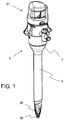
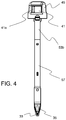
- FIG. 1 a trocar with an obturator 3 inserted into a cannula 5 is shown.
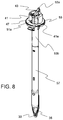
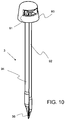
- the obturator 3 has a handle 31, shield 33 and a blade 35.
- a housing 7 is attached to the proximal end of the cannula 51.
- the trocar cannula 5 provides surgical instrument access into the body cavity with the obturator 3 removed.
- the trocar housing 7 releasbly attached to the trocar cannula 51 contains one or more trocar seals to maintain pneumoperitoneum when the obturator and/or surgical instruments are inserted through and withdrawn from the trocar 5.
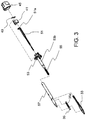
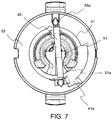
- the obturator handle 31 includes a cover 45 with a switch 41.
- the switch 41 is generally circular and arranged to rotate around the longitudinal axis of the obturator 3.
- the switch has a lever 41 a.
- the lever protrudes through an opening of the periphery of the cover 45 allowing the lever 41 a to be accessible by a user, e.g., a surgeon.
- a spring 43 such as an extension, leaf or the like, is attached on one end to the switch 41, e.g., post 41 b.
- the other end of the spring is attached to a projection 53a extending from a base plate 53.
- the switch 41 and cover 45 are mounted on the base plate 53, securing the switch 41 between the cover 45 and base plate 53.
- Extending away from the base plate and cover along the longitudinal axis of the obturator is an outer shaft 53b.
- the outer shaft 53b is tubular having a lumen through which an inner shaft 51 extends there through.
- a projection or flange 51 a extends from the proximal end of the inner shaft orthogonally from the longitudinal axis of the inner shaft 51.
- the flange 51 a prevents the inner shaft 51 from completely extending through the lumen of the outer shaft 53b.
- the inner shaft 51 slides relative to the outer shaft 53b and is attached to a blade shield 33.
- the blade shield is also moveable, e.g., sliding as the shaft 51 slides.
- the inner shaft 51 and the blade shield 33 may be integral and/or monolithically formed.
- a compression spring 55 surrounds a portion of the inner shaft 51 and biases the inner shaft 51 and blade shield 33 distally. Both the compression spring 55 and a portion of the inner shaft 51 are housed within a fixed shield 57 that is generally tubular.
- One end of the fixed shield 57 is connected to the outer shaft 53b and the other end has one or more projections that extend through a slot in the blade 35 securing the blade 35 to the fixed shield 57.
- a projection or hook extends from the blade shield and through the slot 35a in the blade 35. The hook is situated and slidable between two projections extending from the fixed shield 57 along the slot 35a of the blade 35.
- the other end of the blade shield 33 is connected to the inner shaft 51.
- the blade shield 33 and the inner shaft 51 have corresponding projections and slots to secure the inner shaft to the blade shield 33. As such, as the blade shield 33 moves, the inner shaft 51 also moves and vice versa.
- the blade shield 33 abuts one end of the compression spring 55.
- the other end of the compression spring 55 abuts the outer shaft 53b.
- the compression spring 55 biases the blade shield 33 forward covering one side of the blade 35.
- An example of an asymmetrical blade shield configuration is described in U.S. Patent No. 5,916,232 , the disclosure of which is incorporated by reference as if set forth in full herein.
- a sharp bladed tip of an obturator can comprise of a blade having a symmetrical triangular form. This blade configuration can tend to form an opening, which results in a wound having three cuts each radiating from a central puncture or penetration point.
- Single blade obturators penetrate the body wall through a single incision.
- a lever 41 a is coupled to the handle of the obturator that is manually actuated to unlock the shield (which protects the cutting blade when not in use).
- An extension spring is used that is connected between the rotating lever switch and the fixed shaft. The spring holds the lever biased to one side. As the lever is rotated, the spring is pulled over the centerline of the obturator and pulls the lever to the other side. At this location, the shield is unlocked.
- the obturator is pushed through the abdominal wall, the blade shield 33 and the inner shaft 51 slides up and the blade 35 becomes exposed for cutting.
- the other end of the inner shaft 51 pushes on a cam surface which is part of the lever switch causing the switch to rotate back towards its original position.
- the extension spring is pulled back over the centerline, pulling it in the opposite direction.
- the switch 41 that is coupled to the inner shaft 51 that is coupled to the blade shield 33 controls or regulates the arming/disarming or unlocking/locking of the blade shield 33, e.g., allowing the blade shield 33 to slidably retract back towards a proximal direction. Initially, the switch 41 is in the armed or locked position, such that the blade shield 33 is locked or prevented from retracting to expose the blade 35 for cutting.
- the switch 41 in the armed position is situated to block movement of the inner shaft 51.
- an outer surface or edge of the switch 41 abuts or is in contact with a ledge or projection 51 a of the inner shaft 51 extending laterally from the longitudinal axis of the inner shaft.
- the interaction of the switch 41 with the inner shaft 51 controls the activation or deactivation of the blade shield 33.
- the cover 45 prevents further movement of the switch by limiting the longitudinal movement of the switch 41 and also adds stability to the switch 41.
- the extension spring 43 coupled to the switch 41 biases the switch towards the initial or armed position.
- the extension spring 43 generally extends to an over center condition at the initial or armed position of the switch 41, e.g., more towards one portion or half of the switch or base plate 53. As such, the extension spring 43 in the locked position tends to pull the switch 41 towards a clockwise direction.
- the switch 41 via the lever 41 a is manually actuated to move or rotate from the armed position to the disarmed or unlocked position.
- the switch 41 is rotated in a counter-clockwise direction.
- the extension spring 43 is moved from over center at the initial/locked position towards an over center position at the unlocked position, e.g., more towards an opposing portion or half of the switch 41 or base plate 53.
- the extension spring 43 in the unlocked portion or position tends to pull the switch 41 towards a counter-clockwise direction.
- Such manual actuation overcomes the biasing force of the extension spring 43 that tends to drive the switch towards the armed position.
- the switch 41 moves back to the armed position.
- the switch 41 returns back to its starting position.
- the ledge 51 a of the inner shaft 51 abuts the slanted surface or slot 47 of the switch 41 thereby preventing further rotational movement of the switch 41 back to the armed position.
- the switch 41 when in or moved into the disarmed position, engages a projection or slot on the base plate 53 to maintain the switch in the unlock position.
- the lever 45 When in the disarmed position, the lever 45 recedes within the cover or within a slot or cavity in the cover thereby hiding and preventing inadvertent or undesired activation of the lever to re-lock the blade shield.
- the inner shaft 51 and the blade shield 33 are allowed to retract largely unobstructed by the switch 41.
- the ledge 42 of switch 41 does not abut the ledge 51 a extending from the inner shaft 51, such that the inner shaft is prevented from traveling longitudinally.
- Rotational movement of the switch to the disarmed position positions a cavity or a slanted cam slot 47 over the ledge 51 a of the inner shaft 51.
- the inner shaft 51 is provided a longitudinal path through the switch 41 and as pressure or force is applied to the blade shield 33, the blade shield can retract causing the inner shaft 51 to retract.
- the retracting blade shield 33 exposes blade 35 thereby allowing the surgeon to cut tissue with the blade 35.
- the compression spring 55 coupled to the blade shield 33 and inner shaft 51 resists the retraction movement and facilitates forward movement of the blade to enhance the speed to re-cover the exposed blade 35. Thus, if force or pressure is removed or reduced on the blade shield 33 sufficient to no longer overcome the force from the compression spring 55, the blade shield 33 moves forward.
- the inner shaft 51 forces or moves the switch 41 towards the armed or locked position.
- the switch 41 With the ledge 51 a of the inner shaft retracting or moving longitudinally along the slanted surface 47 in the cavity or notch in the switch 41, the switch 41 is forced to rotate towards the armed position, e.g., clockwise.
- the extension spring 43 moves over center, the extension spring 43 biases the switch 41 towards the armed or locked position.
- the blade shield 33 and inner shaft 51 move forward.
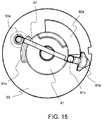
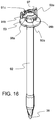
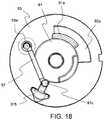
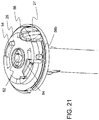
- the obturator 3 has a switch 91 that obstructs movement of a cam shaft 92 that acts as a blade shield preventing exposure of blade 35 for cutting.
- a cover 93 secures the switch 91 to the base plate 53 of the fixed shaft 94 of the obturator.
- An extension spring 97 connects the switch to the base plate 53 and biases the switch to the locked position obstructing retraction of the cam shaft 92.
- a middle pin 95 coupled with a compression spring 96 connects the switch 91 to the cam shaft 92 and biases the cam shaft to cover or prevent exposure of the blade 36 for cutting.
- a lever 91 b extending from the switch 91 through a slot in the cover 93 allows manipulation of the switch 91.
- the switch in the locked or armed position has an edge or flange 91 a interacting with an edge or flange 92a thereby obstructing and preventing retraction of the cam shaft 92.
- the edge 91 a of the switch 91 is rotated out of the path of the flange 92a of the cam shaft 92.
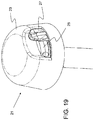
- a slot 98 in the switch is positioned in line with the flange 92a and a ramped cam surface 98a abuts the flange 92a of the cam shaft 92.
- the extension spring 97 biases the switch 91 towards the unlocked position.
- the extension spring 97 produces a force that generates a moment about the centroid of the switch 91, such that the moment forces the switch to rotate towards the unlocked position, e.g., counter-clockwise.
- the cam shaft 92 could comprises of multiple component having a distal portion or component for contacting tissue and a proximal portion or component interacting with the switch 91.
- cam shaft 92 Pressure or force on the cam shaft 92 causes the cam shaft 92 to retract and exposes the blade 35 for cutting.
- the cam shaft 92 retracts, the flange 92a of the cam shaft 92 travels along the cam surface 98a and thereby forces the switch 91 to rotate towards the locked position, e.g., clockwise.
- the extension spring 97 connected to the switch 91 also rotates towards the locked position. In one aspect, the switch 91 rotates about 180 degrees from the unlocked position back to the locked position.
- the extension spring 97 When the switch 91 has rotated about 120 degrees or such that the extension spring 97 is on an opposing side of the centroid relative to the unlocked position of the switch 91, the extension spring 97 generates a moment that forces the switch to rotate towards the locked position, e.g., clockwise.
- the flange 92a of the cam shaft 92 engaged with an opposing surface 98b of the switch 91 limits completion of the rotation of the switch 91 to the locked position.
- the cam shaft 92 moves forward due to removal of pressure or force on the cam shaft 92 and through assistance of the compression spring, the flange 92a clears the surface 98b of the switch 91.
- the switch 91 unobstructed completes the rotation towards the locked position.
- the flange 91 a again obstructs the flange 92a of cam shaft 92 preventing retraction of the cam shaft 92 and thus exposure of the blade 35 for cutting.
- An arming or lockout mechanism may be provided to prevent inadvertent exposure of the blades.
- a lever may be coupled to the handle of the obturator. The lever is manually actuated to unlock the shield that protects the cutting blade.
- In about the center of the lever is a keyway which when rotated, aligns with the keys on the generally center shield shaft of the obturator.
- the obturator is pushed into the abdominal wall causing the shield to retract or pushed up.
- the opposite end that has the key trips the lever, causing the lever to prepare to reset.
- the shield moves forward protecting the blade and the lever resets itself to lock the shield.
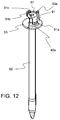
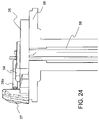
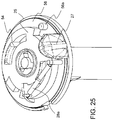
- a handle 21 of a flat blade shielded obturator has a cover 23 and a switch 25 with a lever 27 extending from the switch.
- the switch 25 rests on base plate 56 from which outer shaft 53b extends.
- a compression spring 29 is placed between the cover 23 and the switch 25 biasing the switch 25 into position against the base plate 56.
- the connection between the switch 25 and cover 23 in one aspect is facilitated by tracks, detents or slots outlined on the switch 25 and/or cover 23.
- the spring 29 is coaxial with the longitudinal axis of the obturator and inner shaft 52.
- the inner shaft 52 is movable through an opening in the switch 25.
- the switch 25 also has one or more slots allowing and delimiting the rotation of the switch 25 and slidably connecting the slots 26 to projections 54 of base plate 56.
- the return spring is an extension spring 28a that is connected to a post on the switch 25 and a post on the base plate 56.
- the return spring is a flat spring 28b that is connected to a flange on the switch 25 and to one of the projections 54 of base plate 56.
- a lever stop post 56a extending from the base plate 56 limits the rotation of the switch 25 as the switch is biased towards the locked position.
- Another lever stop post 56b extending from the base plate 56 delimits the unlocked position and limits the rotation of the switch 25 as the switch is moved towards the unlocked position.
- a lever lock ramp 56c extending from the base plate 56 engages a mating slot in the switch holding the switch in the unlocked position.
- the inner shaft 52 has one or more keys 58 extending radially from the inner shaft.
- the one or more keys 58 are arranged to slide pass keyways in the base plate 56.
- Corresponding keyways 22 are situated in the switch 25. However, the keyways 22 are not aligned to the keys 58 of the inner shaft 52 when the switch 25 is in the locked position, thereby preventing longitudinal movement or retraction of the inner shaft 52 and thus the blade shield 33.
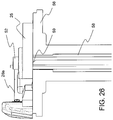
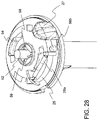
- the user through manipulation of the lever 27 extending from the switch 25 rotates the switch to the disarmed or unlocked position thereby aligning the keyways 22 on switch 25 to be aligned to the keys 58 on the inner shaft 52.
- the inner shaft 52 is unobstructed and thereby allowed to retract to expose the blade 35 for cutting.
- the keys 58 also move out of the keyways 22 of the switch 25. With the keys 58 out of the keyways 22, rotational movement is unobstructed and thus under power of the return spring, the switch moves to the locked position. In the locked position, the switch 25 once again obstructs the path of the inner shaft 51 thereby locking or preventing movement of the blade shield 33 to expose the blade 35 for cutting.
- a pin may protrude through the center of the shield,.
- the center pin is connected to individual blades by a cam assembly.
- the blades are locked to the shield by a pivot point.
- the center pin is moved up into the shield.
- the blades With the center pin connected to the blades by a cam assembly, the blades are extended out of the shield, to expose them. The blades remain exposed outside the shield as long as there is force on the center pin.
- force is removed or reduced from the center pin, e.g., when the pin is through the abdominal wall, the center pin is allowed to reset to its initial position and cause the blades to retract.
- the obturator as such does not rely on friction to push or hold a shield back to expose the blades.
- Force at the tip of the obturator e.g., on the center pin
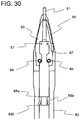
- an obturator 3 has a movable center pin 61.
- the center pin 61 slides forward and retracts back relative to a shaft 63 of the obturator 3.
- the center pin 61 may extend from a movable shaft that is slides within a lumen of fixed inner shaft.
- the fixed inner shaft is encased or incorporated into an outer shaft.
- a flange or enlarged end 68a,b of the center pin 61 engaging with a flange or enlarged end 69a,b of the shaft 63 limits retraction of the pin 61.
- the pin 61 is largely encompassed or encased in the shaft 63.
- An aperture 62 in the tip of the shaft 63 allows passage of the pin 61.
- a pair of opposing slots in the tip of shaft 63 allows passage of opposing pivoting blades 65.
- the blades 65 pivot on pivot pins 64 connected to the shaft 63.
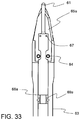
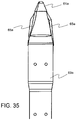
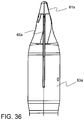
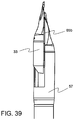
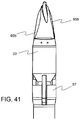
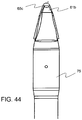
- One or more projections 67 extending from the center pin 61 interact with cam slots 66 in pivoting blades 65. Force or pressure on the center pin 61, retracts the center pin thereby engaging the cam slots 66 of the blades 65 to cause the blades to pivot and be exposed, e.g., displayed outside the shaft via slots in the shaft 63. As force/pressure is removed from the center pin 61, a spring coupled to the pin biases the pin forward causing the blades to retract. Referring to FIGs. 33-37 , the slots 66 in the blades 65a may be further angled or curved to vary, regulate or control the speed and/or time of the blades' exposure.
- the blades 65 or cam slots 66 in the blades 65 may be angled to expose a portion of the blade, e.g., the tips or distal portions, while covering the remaining portion of the blade to enhance cutting of the tissue or increasing covering of the blade after use.
- the size and/or shape of the center pin 61 a may be enlarged or curved to regulate or control the speed and/or time of the blades' exposure.
- the tip or end of the obturator may act as the center pin 61 a.
- An enlarged end increases the contact surface area of the center pin 61 a providing quicker and/or less precise activation to deploy the blades 65a.
- Channels within the center pin 61 a and the shaft 63a allow the range of movement of the pivot ing blades 65a.
- a movable portion of the shaft e.g., the blade shield 33
- the blades 65b pivot on pivot pins 83 connected to the fixed shaft.
- the pivot pins and corresponding slots in the blades 65b have barbs or teeth further securing the blades to the blade shield 33.
- Force or pressure on the blade shield 33 retracts the blade shield thereby engaging the cam slots of the blades to cause the blades to pivot and be exposed, e.g., displayed outside the shaft.
- the compression spring coupled to the blade shield 33 biases the blade shield 33 forward causing the blades to retract or pivot closed.
- the center pin 61 b and single blade 65c may be connected by a linkage 70.
- the linkage 70 transmits the motion and pushes the blade 65c forward, exposing it.
- the linkage may be rotationally attached to a shaft 75 of the obturator via a pin or post 74.
- the post 74 extends through a slot 76 in the center pin 61 b.
- a pivot plate 71 is also connected to the post 74 with the post 74 acting as a pivot point for the plate 71. Channels within the center pin 61 b and the shaft 75 allow the range of movement of the pivot plate 71.
- Pin 72a is connected to the center pin 61 b and extends through a cam slot 71 a on plate 71.
- Pin 72b is connected to the blade 65c and extends through a cam slot 71 b on plate 71.
- the pin 72a engages the cam slot 71 a of the plate 71 causing the plate 71 to rotate about the post 74.
- the cam slot 71 b engages the pin 72b causing the blade 72b to advance or move in the opposite direction of the center pin 61 b thereby exposing the blade 65c for cutting.
- the center pin moves back to its original position. Movement of the center pin back reverses the linkage, i.e., causing the plate 71 to rotate in the opposite direction.
- the blade 65c retracts into the shaft 75.
- retractable blade mechanisms described above may be used in conjunction with the previously described arming or locking shield mechanisms.
- a switch in the locked position can prevent retraction of a center pin thereby preventing the extension or pivoting of the blade or blades.
- the present invention provides a bladed shielded obturator.
Landscapes
- Health & Medical Sciences (AREA)
- Surgery (AREA)
- Life Sciences & Earth Sciences (AREA)
- Medical Informatics (AREA)
- Nuclear Medicine, Radiotherapy & Molecular Imaging (AREA)
- Engineering & Computer Science (AREA)
- Biomedical Technology (AREA)
- Heart & Thoracic Surgery (AREA)
- Pathology (AREA)
- Molecular Biology (AREA)
- Animal Behavior & Ethology (AREA)
- General Health & Medical Sciences (AREA)
- Public Health (AREA)
- Veterinary Medicine (AREA)
- Surgical Instruments (AREA)
- Removal Of Insulation Or Armoring From Wires Or Cables (AREA)
Claims (18)
- Ein Obturator umfassend:einen Griff (31), wobei der Griff (31) einen drehbaren Schalter (41) hat, der so angeordnet ist, dass er sich relativ zum Griff (31) um eine Drehachse aus einer ersten Position in eine zweite Position dreht; undeine mit dem Griff (31) verbundene Welle (33, 53b, 57) mit einer parallel zur Drehachse verlaufenden Längsachse, wobei die Welle (33, 53b, 57) einen beweglichen Teil (33) und einen feststehenden Teil (53b, 35b, 57) hat und wobei eine Klinge (35) mit dem feststehenden Teil (53b) der Welle verbunden ist;dadurch gekennzeichnet, dass der drehbare Schalter (41) in der ersten Position den beweglichen Teil (33) der Welle sperrt, um eine Bewegung des beweglichen Teils (33) der Welle entlang der Längsachse und damit eine Freilegung der Klinge zu vermeiden, und dass er in der zweiten Position den beweglichen Teil (33) der Welle freisetzt, so dass danach der bewegliche Teil (33) der Welle entlang der Längsachse zurückgezogen werden kann, um die Klinge (35) freizulegen.
- Der Obturator nach Anspruch 1, wobei der Schalter (41) mit einer Feder (43) gekoppelt ist, der Schalter (41) in der ersten Position von der Feder (43) in die erste Position hin gelenkt wird und der Schalter (41) in der zweiten Position von der Feder (43) in die zweite Position hin gelenkt wird.
- Der Obturator nach Anspruch 1, wobei der Schalter (41) eine Nut (47) aufweist und die Nut (47) mit der Welle ausgerichtet ist, wenn sich der Schalter (41) in der zweiten Position befindet.
- Der Obturator nach Anspruch 3, wobei die Nut (47) eine Nockenfläche hat, die mit der Welle in Eingriff gebracht werden kann, um die translatorische Bewegung der Welle in die Drehbewegung des Schalters (41) zu übersetzen.
- Der Obturator nach Anspruch 1, wobei sich der bewegliche Teil (33) über die Klinge (35) hinaus erstreckt und sich die Klinge (35) über den feststehenden Teil (53b) hinaus erstreckt, während Teile der Klinge (35) freiliegen.
- Der Obturator nach Anspruch 5, wobei der bewegliche Teil (33) innerhalb des feststehenden Teils (53b) gleitet.
- Der Obturator nach Anspruch 6, wobei eine innere Welle (51) den beweglichen Teil (33) der Welle mit dem Schalter (41) verbindet und die innere Welle (51) einen Flansch aufweist, der mit der Nockenfläche des Schalters (41) in Eingriff gebracht werden kann.
- Der Obturator nach Anspruch 1, wobei die Klinge (35) mehrere drehbare Klingen (65) umfasst.
- Der Obturator nach Anspruch 8, wobei jede Klinge (65) drehbar ist, so dass sie außerhalb des feststehenden Teils der Welle (63) ausgefahren und in den feststehenden Teil der Welle (63) zurückgezogen werden kann.
- Der Obturator nach Anspruch 8, wobei jede Klinge (65) der mehreren drehbaren Klingen (65) eine Nockennut (66) hat, die mit einem sich aus dem beweglichen Teil der Welle erstreckenden Zapfen (67) in Eingriff gebracht werden kann.
- Der Obturator nach Anspruch 1, wobei der feststehende Teil (63) der Welle den beweglichen Teil (61) der Welle einschließt.
- Der Obturator nach Anspruch 1, weiter umfassend eine Drehplatte (71), deren eines Ende mit einem Ende der Klinge (65c) und einem beweglichen Teil (61b) der Welle verbunden ist und deren anderes Ende mit einem anderen Teil der Klinge (65c) verbunden ist, wobei sich die Drehplatte (71) um einen mit dem feststehenden Teil (75) der Welle verbundenen Drehzapfen (74) dreht.
- Der Obturator nach Anspruch 1, wobei die Klinge (65) in den feststehenden Teil (63) der Welle zurückziehbar und aus dem feststehenden Teil (63) der Welle ausfahrbar ist.
- Der Obturator nach Anspruch 1, wobei der bewegliche Teil der Welle eine Keilfläche (58) hat, die sich radial vom beweglichen Teil (52) der Welle weg erstreckt.
- Der Obturator nach Anspruch 1, wobei der Schalter (25) eine radial verlaufende Keilnut (22) hat.
- Der Obturator nach Anspruch 15, wobei der Schalter (25) in der ersten Position die Keilnut (22) versetzt zur Keilfläche (58) des beweglichen Teils (52) der Welle ausrichtet und der Schalter (25) in der zweiten Position die Keilnut (22) mit der Keilfläche (58) des beweglichen Teil (52) der Welle ausrichtet.
- Der Obturator nach Anspruch 16, wobei die Keilfläche (58) des beweglichen Teils (52) der Welle eine Nockenfläche (59) hat, die mit dem Schalter (25) in Eingriff gebracht werden kann, um eine Drehbewegung des Schalters (25) zu bewirken.
- Der Obturator nach einem der vorhergehenden Ansprüche, wobei durch das Zurückziehen des beweglichen Teils (33) der Welle der drehbare Schalter (41) in die erste Position gedreht wird.
Applications Claiming Priority (4)
| Application Number | Priority Date | Filing Date | Title |
|---|---|---|---|
| US74631306P | 2006-05-03 | 2006-05-03 | |
| US91267907P | 2007-04-18 | 2007-04-18 | |
| US91554507P | 2007-05-02 | 2007-05-02 | |
| PCT/US2007/068164 WO2007131121A2 (en) | 2006-05-03 | 2007-05-03 | Flat blade shielded obturator |
Publications (3)
| Publication Number | Publication Date |
|---|---|
| EP2012647A2 EP2012647A2 (de) | 2009-01-14 |
| EP2012647A4 EP2012647A4 (de) | 2013-03-13 |
| EP2012647B1 true EP2012647B1 (de) | 2016-12-14 |
Family
ID=38668561
Family Applications (1)
| Application Number | Title | Priority Date | Filing Date |
|---|---|---|---|
| EP07761842.9A Active EP2012647B1 (de) | 2006-05-03 | 2007-05-03 | Abgeschirmter obturator mit flacher klinge |
Country Status (2)
| Country | Link |
|---|---|
| EP (1) | EP2012647B1 (de) |
| WO (1) | WO2007131121A2 (de) |
Family Cites Families (5)
| Publication number | Priority date | Publication date | Assignee | Title |
|---|---|---|---|---|
| US5904699A (en) * | 1997-09-19 | 1999-05-18 | Ethicon Endo-Surgery, Inc. | Trocar for penetration and skin incision |
| US20040230155A1 (en) * | 1999-06-22 | 2004-11-18 | Erblan Surgical Inc. | Insufflator and method of use |
| US6450992B1 (en) * | 1999-07-02 | 2002-09-17 | Smith & Nephew, Inc. | Cannula interface |
| US20050070947A1 (en) * | 2003-09-30 | 2005-03-31 | Franer Paul T. | Rotational latching system for a trocar |
| US7419496B2 (en) * | 2004-08-03 | 2008-09-02 | Staudner Rupert A | Trocar with retractable cutting surface |
-
2007
- 2007-05-03 WO PCT/US2007/068164 patent/WO2007131121A2/en not_active Ceased
- 2007-05-03 EP EP07761842.9A patent/EP2012647B1/de active Active
Non-Patent Citations (1)
| Title |
|---|
| None * |
Also Published As
| Publication number | Publication date |
|---|---|
| WO2007131121A2 (en) | 2007-11-15 |
| EP2012647A4 (de) | 2013-03-13 |
| EP2012647A2 (de) | 2009-01-14 |
| WO2007131121A3 (en) | 2008-11-20 |
Similar Documents
| Publication | Publication Date | Title |
|---|---|---|
| US8801741B2 (en) | Flat blade shielded obturator | |
| US8657843B2 (en) | Shield lockout for bladed obturator and trocars | |
| EP0807414B1 (de) | Trokar mit federbelasteter Vorrichtung | |
| US5868773A (en) | Shielded trocar with safety locking mechanism | |
| JP4860888B2 (ja) | 成形トロカールラッチ | |
| US5904699A (en) | Trocar for penetration and skin incision | |
| US5364372A (en) | Trocar and cannula | |
| US9113953B2 (en) | Two-mode trocar assembly | |
| US8192353B2 (en) | Visual obturator | |
| JP3757246B2 (ja) | トロカール | |
| US5984941A (en) | Trocar | |
| US8002788B2 (en) | Two-mode bladeless trocar assembly | |
| US5411515A (en) | Obturator with rotating, self-locking and resettable safety shield | |
| KR20220011654A (ko) | 봉합사 해제 메커니즘, 천자 코어 어셈블리, 천자 장치 및 그 사용 방법 | |
| AU2001283219A1 (en) | Molded trocar latch | |
| WO1995006489A1 (en) | Safety device for laparoscopic instruments | |
| CN110584853B (zh) | 操作系统、植入物输送系统及输送方法 | |
| EP2012647B1 (de) | Abgeschirmter obturator mit flacher klinge | |
| WO2024221913A1 (zh) | 缝合器 | |
| MXPA05009572A (es) | Insuflador y metodo de uso. | |
| EP1900333B1 (de) | Geformter Trokarverschluss |
Legal Events
| Date | Code | Title | Description |
|---|---|---|---|
| PUAI | Public reference made under article 153(3) epc to a published international application that has entered the european phase |
Free format text: ORIGINAL CODE: 0009012 |
|
| 17P | Request for examination filed |
Effective date: 20081007 |
|
| AK | Designated contracting states |
Kind code of ref document: A2 Designated state(s): AT BE BG CH CY CZ DE DK EE ES FI FR GB GR HU IE IS IT LI LT LU LV MC MT NL PL PT RO SE SI SK TR |
|
| AX | Request for extension of the european patent |
Extension state: AL BA HR MK RS |
|
| DAX | Request for extension of the european patent (deleted) | ||
| RBV | Designated contracting states (corrected) |
Designated state(s): DE FR GB |
|
| A4 | Supplementary search report drawn up and despatched |
Effective date: 20130207 |
|
| RIC1 | Information provided on ipc code assigned before grant |
Ipc: A61B 1/00 20060101AFI20130201BHEP Ipc: A61B 17/34 20060101ALI20130201BHEP Ipc: A61M 5/178 20060101ALI20130201BHEP |
|
| 17Q | First examination report despatched |
Effective date: 20130225 |
|
| GRAP | Despatch of communication of intention to grant a patent |
Free format text: ORIGINAL CODE: EPIDOSNIGR1 |
|
| INTG | Intention to grant announced |
Effective date: 20160704 |
|
| GRAS | Grant fee paid |
Free format text: ORIGINAL CODE: EPIDOSNIGR3 |
|
| GRAA | (expected) grant |
Free format text: ORIGINAL CODE: 0009210 |
|
| AK | Designated contracting states |
Kind code of ref document: B1 Designated state(s): DE FR GB |
|
| REG | Reference to a national code |
Ref country code: GB Ref legal event code: FG4D |
|
| REG | Reference to a national code |
Ref country code: DE Ref legal event code: R096 Ref document number: 602007049147 Country of ref document: DE |
|
| REG | Reference to a national code |
Ref country code: FR Ref legal event code: PLFP Year of fee payment: 11 |
|
| REG | Reference to a national code |
Ref country code: DE Ref legal event code: R097 Ref document number: 602007049147 Country of ref document: DE |
|
| PLBE | No opposition filed within time limit |
Free format text: ORIGINAL CODE: 0009261 |
|
| STAA | Information on the status of an ep patent application or granted ep patent |
Free format text: STATUS: NO OPPOSITION FILED WITHIN TIME LIMIT |
|
| 26N | No opposition filed |
Effective date: 20170915 |
|
| REG | Reference to a national code |
Ref country code: FR Ref legal event code: PLFP Year of fee payment: 12 |
|
| P01 | Opt-out of the competence of the unified patent court (upc) registered |
Effective date: 20230521 |
|
| PGFP | Annual fee paid to national office [announced via postgrant information from national office to epo] |
Ref country code: DE Payment date: 20250529 Year of fee payment: 19 |
|
| PGFP | Annual fee paid to national office [announced via postgrant information from national office to epo] |
Ref country code: GB Payment date: 20250527 Year of fee payment: 19 |
|
| PGFP | Annual fee paid to national office [announced via postgrant information from national office to epo] |
Ref country code: FR Payment date: 20250526 Year of fee payment: 19 |