EP2012379A2 - Active material, electrode, battery, and method of manufacturing active material - Google Patents
Active material, electrode, battery, and method of manufacturing active material Download PDFInfo
- Publication number
- EP2012379A2 EP2012379A2 EP08007877A EP08007877A EP2012379A2 EP 2012379 A2 EP2012379 A2 EP 2012379A2 EP 08007877 A EP08007877 A EP 08007877A EP 08007877 A EP08007877 A EP 08007877A EP 2012379 A2 EP2012379 A2 EP 2012379A2
- Authority
- EP
- European Patent Office
- Prior art keywords
- active material
- livopo
- core particle
- coating part
- particles
- Prior art date
- Legal status (The legal status is an assumption and is not a legal conclusion. Google has not performed a legal analysis and makes no representation as to the accuracy of the status listed.)
- Granted
Links
Images


Classifications
-
- H—ELECTRICITY
- H01—ELECTRIC ELEMENTS
- H01M—PROCESSES OR MEANS, e.g. BATTERIES, FOR THE DIRECT CONVERSION OF CHEMICAL ENERGY INTO ELECTRICAL ENERGY
- H01M4/00—Electrodes
- H01M4/02—Electrodes composed of, or comprising, active material
- H01M4/36—Selection of substances as active materials, active masses, active liquids
- H01M4/58—Selection of substances as active materials, active masses, active liquids of inorganic compounds other than oxides or hydroxides, e.g. sulfides, selenides, tellurides, halogenides or LiCoFy; of polyanionic structures, e.g. phosphates, silicates or borates
- H01M4/5825—Oxygenated metallic salts or polyanionic structures, e.g. borates, phosphates, silicates, olivines
-
- H—ELECTRICITY
- H01—ELECTRIC ELEMENTS
- H01M—PROCESSES OR MEANS, e.g. BATTERIES, FOR THE DIRECT CONVERSION OF CHEMICAL ENERGY INTO ELECTRICAL ENERGY
- H01M4/00—Electrodes
- H01M4/02—Electrodes composed of, or comprising, active material
- H01M4/13—Electrodes for accumulators with non-aqueous electrolyte, e.g. for lithium-accumulators; Processes of manufacture thereof
- H01M4/131—Electrodes based on mixed oxides or hydroxides, or on mixtures of oxides or hydroxides, e.g. LiCoOx
-
- H—ELECTRICITY
- H01—ELECTRIC ELEMENTS
- H01M—PROCESSES OR MEANS, e.g. BATTERIES, FOR THE DIRECT CONVERSION OF CHEMICAL ENERGY INTO ELECTRICAL ENERGY
- H01M4/00—Electrodes
- H01M4/02—Electrodes composed of, or comprising, active material
- H01M4/36—Selection of substances as active materials, active masses, active liquids
- H01M4/362—Composites
- H01M4/366—Composites as layered products
-
- H—ELECTRICITY
- H01—ELECTRIC ELEMENTS
- H01M—PROCESSES OR MEANS, e.g. BATTERIES, FOR THE DIRECT CONVERSION OF CHEMICAL ENERGY INTO ELECTRICAL ENERGY
- H01M4/00—Electrodes
- H01M4/02—Electrodes composed of, or comprising, active material
- H01M4/36—Selection of substances as active materials, active masses, active liquids
- H01M4/48—Selection of substances as active materials, active masses, active liquids of inorganic oxides or hydroxides
- H01M4/485—Selection of substances as active materials, active masses, active liquids of inorganic oxides or hydroxides of mixed oxides or hydroxides for inserting or intercalating light metals, e.g. LiTi2O4 or LiTi2OxFy
-
- H—ELECTRICITY
- H01—ELECTRIC ELEMENTS
- H01M—PROCESSES OR MEANS, e.g. BATTERIES, FOR THE DIRECT CONVERSION OF CHEMICAL ENERGY INTO ELECTRICAL ENERGY
- H01M4/00—Electrodes
- H01M4/02—Electrodes composed of, or comprising, active material
- H01M4/36—Selection of substances as active materials, active masses, active liquids
- H01M4/48—Selection of substances as active materials, active masses, active liquids of inorganic oxides or hydroxides
- H01M4/50—Selection of substances as active materials, active masses, active liquids of inorganic oxides or hydroxides of manganese
- H01M4/505—Selection of substances as active materials, active masses, active liquids of inorganic oxides or hydroxides of manganese of mixed oxides or hydroxides containing manganese for inserting or intercalating light metals, e.g. LiMn2O4 or LiMn2OxFy
-
- H—ELECTRICITY
- H01—ELECTRIC ELEMENTS
- H01M—PROCESSES OR MEANS, e.g. BATTERIES, FOR THE DIRECT CONVERSION OF CHEMICAL ENERGY INTO ELECTRICAL ENERGY
- H01M4/00—Electrodes
- H01M4/02—Electrodes composed of, or comprising, active material
- H01M4/36—Selection of substances as active materials, active masses, active liquids
- H01M4/48—Selection of substances as active materials, active masses, active liquids of inorganic oxides or hydroxides
- H01M4/52—Selection of substances as active materials, active masses, active liquids of inorganic oxides or hydroxides of nickel, cobalt or iron
- H01M4/525—Selection of substances as active materials, active masses, active liquids of inorganic oxides or hydroxides of nickel, cobalt or iron of mixed oxides or hydroxides containing iron, cobalt or nickel for inserting or intercalating light metals, e.g. LiNiO2, LiCoO2 or LiCoOxFy
-
- Y—GENERAL TAGGING OF NEW TECHNOLOGICAL DEVELOPMENTS; GENERAL TAGGING OF CROSS-SECTIONAL TECHNOLOGIES SPANNING OVER SEVERAL SECTIONS OF THE IPC; TECHNICAL SUBJECTS COVERED BY FORMER USPC CROSS-REFERENCE ART COLLECTIONS [XRACs] AND DIGESTS
- Y02—TECHNOLOGIES OR APPLICATIONS FOR MITIGATION OR ADAPTATION AGAINST CLIMATE CHANGE
- Y02E—REDUCTION OF GREENHOUSE GAS [GHG] EMISSIONS, RELATED TO ENERGY GENERATION, TRANSMISSION OR DISTRIBUTION
- Y02E60/00—Enabling technologies; Technologies with a potential or indirect contribution to GHG emissions mitigation
- Y02E60/10—Energy storage using batteries
Definitions
- the present invention relates to an active material, an electrode, a battery, and a method of manufacturing the active material.
- LiNiMnCoO 2 , LiMn 2 O 4 , LiFePO 4 , and LiVOPO 4 have been known as positive electrode active materials for lithium ion secondary batteries (see, for example, Japanese Patent Application Laid-Open Nos. 2002-198050 , 2001-307730 , 2002-75368 , 2004-87299 , and 2004-303527 , J. Electrochem. Soc., Vol. 151, Issue 6, p. A796 (2004 ), and the like).
- LiCo (1-x) M x O 2 such as LiNiMnCoO 2 is an oxide having a layer-like structure. Though it can achieve a high capacity (e.g., about 150 mAh/g or higher) and has a high discharge voltage of about 3.8 V vs. lithium, its thermal stability is not sufficient in a highly charged state in particular, since oxygen atoms in its crystal structure are likely to react with electrolytes so as to be released from the crystal.
- Li(Mn (1-y) M y ) 2 O 4 such as LiMn 2 O 4 is an oxide having a spinel structure. Though it has a high theoretical capacity of about 148 mAh/g and a high discharge voltage of about 3.9 V vs. lithium, Mn 3+ ions tend to dissolve in electrolytes in a high-temperature state (e.g., 45°C or higher), so that the negative electrode on which these ions are deposited is likely to deteriorate, whereby its stability in the high-temperature state is insufficient.
- a high-temperature state e.g. 45°C or higher
- LiFePO 4 which is excellent in high-temperature stability has a relatively high theoretical capacity, it exhibits a low discharge voltage of about 3.4 V vs. lithium.
- LiMnPO 4 has a conductivity lower than that of LiVOPO 4 which will be explained later. Therefore, an active material coated with any of them decreases its discharge energy as a whole.
- LiVOPO 4 has a high structural stability at a high temperature, a high theoretical capacity of 159 mAh/g, and a high discharge voltage of 3.8 to 3.9 V vs. lithium. Also, it has a sufficiently high conductivity and thus can attain a sufficiently high effective capacity. Further, the atmosphere at the time of its synthesis is not required to be controlled so strictly.
- the active material in accordance with the present invention comprises a core particle containing LiCo (1-x) M x O 2 and/or Li(Mn (1-y) M y ) 2 O 4 and a coating part covering at least part of a surface of the core particle, while the coating part contains LiVOPO 4 .
- M is at least one element selected from the group consisting of Al, Mg, and transition elements, 0.95 ⁇ x ⁇ 0, 0.2 ⁇ y ⁇ 0, and V in LiVOPO 4 may partly be substituted by at least one element selected from the group consisting of Ti, Ni, Co, Mn, Fe, Zr, Cu, Zn, and Yb.
- the surface of LiCo (1-x )M x O 2 having a layer-like structure which is likely to come into contact with and react with an electrolyte at a high temperature and/or the surface of Li(Mn (1-y) M y ) 2 O 4 from which Mn 3+ ions are likely to be eluted into the electrolyte at the high temperature is covered with the coating part containing LiVOPO 4 which is excellent in structural stability at the high temperature, whereby the core particle and the electrolyte can be restrained from coming into direct contact with each other. This can suppress the release of oxygen and elution of Mn 3+ from the crystal structure, thereby stabilizing the crystal structure at the high temperature.
- LiVOPO 4 is easy to insert and release Li ions, functions as an active material, and has not only a sufficiently high theoretical capacity but also a sufficiently high discharge voltage of 3.8 to 3.9 V vs. lithium. Its crystal structure is stable even at the high temperature and deteriorates less even when in contact with the electrolyte.
- the coating part has a thickness of 50 nm to 1 ⁇ m.
- LiVOPO 4 has an electron conductivity somewhat lower than that of the core particle. Therefore, making its thickness 1 ⁇ m or less can sufficiently restrain characteristics (such as impedance) from being worsened by the lowness in electron conductivity. The thickness of 50 nm or greater can fully prevent the electrolyte and the core particle from coming into direct contact with each other.
- the lithium ion secondary battery in accordance with the present invention is a lithium ion secondary battery containing the above-mentioned active material.
- the method of manufacturing an active material in accordance with the present invention includes a supporting step of causing at least part of a surface of a core particle containing LiCo (1-x ) M x O 2 and/or Li(Mn (1-y) M y ) 2 O 4 to support LiVOPO 4 . This can easily manufacture the above-mentioned active material.
- the supporting step mixes the core particle and an LiVOPO 4 particle in a fluidized bed.
- the supporting step may mix a solution containing a precursor of LiVOPO 4 and the core particle and then synthesize LiVOPO 4 in the solution.
- the present invention provides an active material excellent in stability at a high temperature and in discharge energy, a battery using the same, and a method of manufacturing the active material.
- Fig. 1 is a schematic sectional view of an active material in accordance with an embodiment
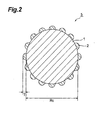
- Fig. 2 is a schematic sectional view of another active material in accordance with the embodiment.
- Fig. 3 is a schematic sectional view of the lithium ion secondary battery in accordance with an embodiment.
- the active material 5 in accordance with the present invention comprises a core particle 1 and a coating part 2 covering at least part of the surface of the core particle 1.
- the core particle 1 contains LiCo (1-x) M x O 2 and/or Li(Mn (1-y) M y ) z O 4 .
- M is at least one element selected from the group consisting of Al, Mg, and transition elements, 0.95 ⁇ x ⁇ 0, and 0.2 ⁇ y ⁇ 0.
- transition elements are Ti, Cr, Mn, Fe, Co, Ni, Cu, and Zn.
- LiCo (1-x) M x O 2 include LiCoO 2 , LiCo 1-x Ni x1 Mn x2 O 2 , and LiCo 1-x Ni x1 Al x2 O 2 .
- x1 + x2 x.
- Li(Mn (1-y) M y ) 2 O 4 include LiMn 2 O 4 and Li(Mn (1-x) Al x ) 2 O 4 .
- the core particle 1 is mainly composed of LiCo (1-x) M x O 2 and/or Li(Mn (1-y) M y ) 2 O 4 , i.e., LiCo (1-x) M x O 2 and/or Li(Mn (1-y) M y ) 2 O 4 occupies the largest weight fraction, 90 wt % or more in particular, in all the ingredients of the core particle.
- the coating part 2 contains LiVOPO 4 .
- V in LiVOPO 4 may partly be substituted by at least one element selected from the group consisting of Ti, Ni, Co, Mn, Fe, Zr, Cu, Zn, and Yb.
- the ratio of substitution is preferably 5 atom % or less.
- the coating part 2 is mainly composed of LiVOPO 4 , i.e., LiVOPO 4 occupies the largest weight fraction, 90 wt % or more in particular, in all the ingredients of the coating part.
- LiVOPO 4 is orthorhombic.
- the coating part 2 may cover the whole surface of the core particle 1 as shown in Fig. 1 or part' thereof as shown in Fig. 2 .
- the surface coverage is preferably 50% or more.
- the thickness T of the coating part 2 is preferably 1 ⁇ m or less, since the electron conductivity of LiVOPO 4 is lower than that of the core particle. From the viewpoint of fully restraining an electrolyte and the core particle 1 from coming into direct contact with each other, on the other hand, the thickness T is preferably 50 nm or more.
- the ratio (T/Rc) of the thickness T of the coating part 2 to the particle size Rc of the core particle 1 is preferably 1/100 to 1/10.
- the particle size of the active material 5 is preferably on the order of 0.5 to 15 ⁇ m.
- the particle size of LiVOPO 4 particles contained in the coating part 2 is preferably on the order of 10 nm to 500 nm from the viewpoint of favorable conductivity.
- the coating part 2 may contain particles made of carbonaceous matters from the viewpoint of securing a sufficient conductivity.
- the surface of LiCo (1-x) M x O 2 having a layer-like structure which is likely to come into contact with and react with an electrolyte at a high temperature and/or the surface of Li(Mn (1-y) M y ) 2 O 4 from which Mn 3+ ions are likely to be eluted into the electrolyte at the high temperature is covered with the coating part 2 containing LiVOPO 4 which is excellent in structural stability at the high temperature, whereby the core particle 1 and the electrolyte can be restrained from coming into direct contact with each other. This can suppress the release of oxygen and elution of Mn 3+ from the crystal structure of the core particle 1, thereby stabilizing the crystal structure of the core particle 1 at the high temperature.
- LiVOPO 4 is easy to insert and release Li ions, functions as an active material, and has not only a sufficiently high theoretical capacity but also a sufficiently high discharge voltage of 3.8 to 3.9 V vs. lithium. Further, its crystal structure is stable even at the high temperature and deteriorates less even when in contact with the electrolyte. Therefore, a lithium ion secondary battery which is highly stable at the high temperature while having a sufficient discharge energy per volume and weight can be provided. Also, the actual capacity can fully be secured, since the conductivity is sufficient.
- particles containing LiCo (1-x) M x O 2 and/or Li(Mn (1-y) M y ) 2 O 4 to become the core particle 1 are prepared. These particles can be manufactured by a known method. A preferred particle size is 0.5 to 15 ⁇ m.
- LiVOPO 4 particles to become the coating part 2 are prepared.
- the LiVOPO 4 particles can be manufactured by the following method, for example.
- V may partly be substituted by at least one element selected from the group consisting of Ti, Ni, Co, Mn, Fe, Zr, Cu, Zn, and Yb. In this case, a substituent element source is added.
- Li source examples include lithium hydroxide; lithium nitrate, lithium carbonate, and lithium acetate.
- V source examples include vanadium dioxide, vanadium trioxide, vanadium pentoxide, and ammonium vanadate.
- P source examples include ammonium phosphate, ammonium dihydrogen phosphate, ammonium phosphate dibasic, phosphoric acid, and phosphoric anhydride.
- the firing is preferably performed in an oxygen-containing atmosphere such as air at a firing temperature of preferably 500°C or higher but 670°C or lower, more preferably 650°C or lower, for 10 hr or more but 100 hr or less, more preferably 50 hr or less.
- the particle size is adjusted by a known apparatus such as ball mill, satellite ball mill, roller mill, atomizer, pin disc mill, or jet mill.
- the LiCo (1-x) M x O 2 and/or Li(Mn (1-y) M y ) 2 O 4 particles and the LiVOPO 4 particles are caused to collide against each other, so that LiVOPO 4 is supported on the LiCo (1-x) M x O 2 and/or Li(Mn (1-y) M y ) 2 O 4 particles.
- Examples of the colliding method include one mixing the LiCo (1-x) M x O 2 and/or Li(Mn (1-y) M y ) 2 O 4 particles with the LiVOPO 4 particles in a ball mill and one putting the LiCo (1-x) M x O 2 and/or Li(Mn (1-y) M y ) 2 O 4 particles and the LiVOPO 4 particles into a fluidized bed fluidizing at a high speed.
- the second manufacturing method mixes the LiCo (1-x) M x O 2 and/or Li(Mn (1-y) M y ) 2 O 4 particles into the above-mentioned precursor aqueous solution used for manufacturing LiVOPO 4 , synthesizes LiVOPO 4 in the solution by heating thereafter, and then performs drying and firing.
- the firing is preferably performed in an oxygen-containing atmosphere such as air so as not to generate oxygen vacancies in the LiCo (1-x) M x O 2 and/or Li(Mn (1-y) M y ) 2 O 4 particles. It is difficult for this manufacturing method to use other kinds of LiMPO 4 (where M is Fe, Co, Ni, Mn, or the like) for which a reducing atmosphere is a preferred firing atmosphere, such as LiFePO 4 in particular.
- the lithium ion secondary battery 100 mainly comprises a multilayer body 30, a case 50 accommodating the multilayer body 30 in a sealed state, and a pair of leads 60, 62 connected to the multilayer body 30.
- the multilayer body 30 is one in which a pair of electrodes 10, 20 are arranged so as to oppose each other while holding a separator 18 therebetween.
- the positive electrode 10 is one in which a positive electrode active material layer 14 is provided on a positive electrode current collector 12.
- the negative electrode 20 is one in which a negative electrode active material layer 24 is provided on a negative electrode current collector 22.
- the positive electrode active material layer 14 and negative electrode active material layer 24 are in contact with both sides of the separator 18, respectively.
- the leads 60, 62 are connected to respective end parts of the negative electrode current collector 22 and positive electrode current collector 12, while having end parts extending to the outside of the case 50.
- the positive electrode active material layer 14 is a layer containing the above-mentioned active material 5, a binder, and a conductive agent which is compounded when necessary.
- the binder is not restricted in particular as long as it can bind the above-mentioned active material and conductive agent to the current collector, whereby known binding agents can be used.
- the binder include fluorine resins such as polyvinylidene fluoride (PVDF), polytetrafluoroethylene (PTYE), and vinylidene fluoride/hexafluoropropylene copolymer.
- Examples of the conductive agent include carbon blacks, carbon materials, and conductive oxides such as ITO.
- Such a positive electrode can be manufactured by a known method, for example, by preparing a slurry in which the above-mentioned active material 5, binder, and conductive agent are added to a solvent corresponding to the binder, e.g., N-methyl-2-pyrrolidone, N,N-dimethylformamide, or the like in the case of PVDF, applying the slurry to the surface of the positive electrode current collector 12, and then drying it.
- a solvent corresponding to the binder e.g., N-methyl-2-pyrrolidone, N,N-dimethylformamide, or the like in the case of PVDF
- a copper foil or the like can be used as the negative electrode current collector 22.
- the negative electrode active material layer 24 one containing a negative electrode active material, a conductive agent, and a binder can be used.
- the conductive agent used when necessary is not limited in particular, whereby known conductive agents can be used. Examples of the conductive agent include carbon blacks; carbon materials; powders of metals such as copper, nickel, stainless, and iron; mixtures of carbon materials and metal powders; and conductive oxides such as ITO.
- known binding agents can be used without any restrictions in particular.
- binder examples include fluorine resins such as polyvinylidene fluoride (PVDF), polytetrafluoroethylene (PTFE), tetrafluoroetllylene/hexafluoropropylene copolymer (FEP), tetrafluoroethylene/perfluoroalkylvinylether copolymer (PFA), ethylene/tetrafluoroethylene copolymer (ETFE), polychlorotrifluoroethylene (PCTFE), ethylene/chlorotrifluoroethylene copolymer (ECTFE), and polyvinyl fluoride (PVF).
- PVDF polyvinylidene fluoride
- PTFE polytetrafluoroethylene
- FEP tetrafluoroetllylene/hexafluoropropylene copolymer
- PFA tetrafluoroethylene/perfluoroalkylvinylether copolymer
- ETFE ethylene/tetrafluoroethylene
- the binder not only binds constituent materials of the active material particle, the conductive agent added when necessary, and the like to each other, but also contributes to binding the constituent materials and the current collector to each other.
- the binder also include polyethylene, polypropylene, polyethylene terephthalate, aromatic polyamides, cellulose, styrene/butadiene rubber, isoprene rubber, butadiene rubber, and ethylene/propylene rubber in addition to those mentioned above.
- Thermoplastic elastomeric polymers such as styrene/butadiene/styrene block copolymer, its hydrogen adducts, styrene/ethylene/butadiene/styrene copolymer, styrene/isoprene/styrene block copolymer, and its hydrogen adducts may also be used. Further, syndiotactic 1,2-polybutadiene, ethylene/vinyl acetate copolymer, propylene/a-olefin (having a carbon number of 2 to 12) copolymer, and the like may be used. Conductive polymers may be used as well.
- the negative electrode active material examples include particles containing carbon materials which can occlude/release lithium ions (by intercalating/deintercalating or doping/undoping), such as graphite, carbon which is hard to graphitize, carbon which is easy to graphitize, and carbon fired at a low temperature; metals adapted to combine with lithium, such as Al, Si, and Sn; amorphous compounds mainly composed of oxides, such as SiO 2 and SnO 2 ; and lithium titanate (Li 4 Ti 5 O 12 ).
- carbon materials which can occlude/release lithium ions by intercalating/deintercalating or doping/undoping
- graphite carbon which is hard to graphitize
- carbon which is easy to graphitize and carbon fired at a low temperature
- metals adapted to combine with lithium such as Al, Si, and Sn
- amorphous compounds mainly composed of oxides, such as SiO 2 and SnO 2 such as SiO 2 and SnO 2
- lithium titanate Li 4 Ti 5 O
- the negative electrode 20 may be manufactured by preparing a slum and applying it to the current collector as in the method of manufacturing the positive electrode 10.
- the electrolyte solution is one contained within the positive electrode active material layer 14, negative electrode active material layer 24, and separator 18.
- the electrolyte solution is not restricted in particular, whereby electrolyte solutions (aqueous electrolyte solutions and electrolyte solutions using organic solvents) containing lithium salts can be used in this embodiment, for example.
- the electrolyte solutions using organic solvents are preferred, since the aqueous electrolyte solutions electrochemically have a low decomposition voltage which limits their withstand voltage.
- the electrolyte solution is one in which a lithium salt is dissolved in a nonaqueous solvent (organic solvent).
- lithium salt examples include LiPF 6 , LiClO 4 , LiBF 4 , LiAsF 6 , LiCF 3 SO 3 , LiCF 3 CF 2 SO 3 , LiC(CF 3 SO 2 ) 3 , LiN(CF 3 SO 2 ) 2 , LiN(CF 3 CF 2 SO 2 ) 2 , LiN(CF 3 SO 2 )(C 4 F 9 SO 2 ), LiN(CF 3 CF 2 CO) 2 , and LiBOB. These salts may be used either singly or in combinations of two or more.
- organic solvent examples include propylene carbonate, ethylene carbonate, diethyl carbonate, dimethyl carbonate, and methylethyl carbonate. They may be used either singly or in combinations of two or more.
- the electrolyte solution is not limited to a liquid, but may be a gelled electrolyte obtained by adding a gelling agent thereto.
- a solid electrolyte electrolyte made of a solid polymer electrolyte or ionically conductive inorganic material
- electrolyte solution may be contained as well.
- the separator 18 is formed from an electrically insulating porous body. Its examples include a single or multilayer film made of polyethylene, polypropylene, or polyolefin; extended films of mixtures of the resins mentioned above; and fibrous nonwoven fabrics made of at least one kind of constituent material selected from the group consisting of cellulose, polyester, and polypropylene.
- the case 50 is one sealing the multilayer body 30 and electrolyte therewithin.
- the case 50 is not restricted in particular as long as it can keep the electrolyte from leaking out and inhibit the moisture and the like from entering the inside of the lithium ion secondary battery 100 from the outside.
- a metal laminate film in which a metal foil 52 is coated with polymer films 54 from both sides as shown in Fig. 1 can be utilized as the case 50.
- An aluminum foil can be used as the metal foil 52, while films such as polypropylene can be used as the synthetic resin films 54, for example.
- Preferred examples of the material for the outer polymer film 54 include polymers having a high melting point such as polyethylene terephthalate (PET) and polyamides.
- Preferred examples of the material for the inner polymer film 54 include polyethylene and polypropylene.
- the leads 60, 62 are formed from a conductive material such as aluminum.
- LiCoO 2 particles having an average particle size of about 10 ⁇ m and LiVOPO 4 particles having an average particle size of about 0.5 ⁇ m were prepared. With respect to a particle layer in which these particles were mixed, a gas-phase fluidized bed rotationally fluidizing at a high speed was formed, so as to cause the particles to collide against each other, thereby forming a coating part made of LiVOPO 4 on each core particle made of LiCoO 2 . Thus, an active material was manufactured. The thickness of the coating part was about 200 nm, while its coverage was about 80%.
- a slurry was made by mixing the above-mentioned active material (93 wt %), PVDF (3 wt %) as a binder, and carbon black (4 wt %) as a conductive agent into N,N-dimethylformamide.
- the slurry was applied to an aluminum foil (having a thickness of 20 ⁇ m) employed as a positive electrode current collector, dried, and then pressed with a roll, so as to manufacture a positive electrode.
- An active material and an electrode were manufactured as in Example 1 except that LiMn 2 O 4 particles having an average particle size of about 10 ⁇ m and LiVOPO 4 particles having an average particle size of about 0.5 ⁇ m were used as raw materials for the active material.
- An active material and an electrode were manufactured as in Example 1 except that only LiCoO 2 particles having an average particle size of about 10 ⁇ m were used as the raw material for the active material and that no coating part was formed.
- An active material and an electrode were manufactured as in Example 1 except that only LiMn 2 O 4 particles having an average particle size of about 10 ⁇ m were used as the raw material for the active material and that no coating part was formed.
- An active material and an electrode were manufactured as in Example 1 except that LiCoO 2 particles having an average particle size of about 10 ⁇ m and LiFePO 4 particles having an average particle size of about 0.5 ⁇ m were used as raw materials for the active material.
- An active material and an electrode were manufactured as in Example 1 except that LiCoO 2 particles having an average particle size of about 10 ⁇ m and LiMnPO 4 particles having an average particle size of about 0.5 ⁇ m were used as raw materials for the active material.
- Example 1 was superior to Comparative Examples 1, 3, and 4 in terms of thermal stability and discharge energy.
- Example 2 improved the capacity maintenance ratio at a high temperature without losing properties of LiMn 2 O 4 having a high thermal stability.
Landscapes
- Chemical & Material Sciences (AREA)
- Chemical Kinetics & Catalysis (AREA)
- Electrochemistry (AREA)
- General Chemical & Material Sciences (AREA)
- Inorganic Chemistry (AREA)
- Composite Materials (AREA)
- Crystallography & Structural Chemistry (AREA)
- Engineering & Computer Science (AREA)
- Materials Engineering (AREA)
- Battery Electrode And Active Subsutance (AREA)
- Secondary Cells (AREA)
Abstract
Description
- The present invention relates to an active material, an electrode, a battery, and a method of manufacturing the active material.
- LiNiMnCoO2, LiMn2O4, LiFePO4, and LiVOPO4 have been known as positive electrode active materials for lithium ion secondary batteries (see, for example, Japanese Patent Application Laid-Open Nos.
2002-198050 2001-307730 2002-75368 2004-87299 2004-303527 - LiCo(1-x)MxO2 such as LiNiMnCoO2 is an oxide having a layer-like structure. Though it can achieve a high capacity (e.g., about 150 mAh/g or higher) and has a high discharge voltage of about 3.8 V vs. lithium, its thermal stability is not sufficient in a highly charged state in particular, since oxygen atoms in its crystal structure are likely to react with electrolytes so as to be released from the crystal.
- Li(Mn(1-y)My)2O4 such as LiMn2O4 is an oxide having a spinel structure. Though it has a high theoretical capacity of about 148 mAh/g and a high discharge voltage of about 3.9 V vs. lithium, Mn3+ ions tend to dissolve in electrolytes in a high-temperature state (e.g., 45°C or higher), so that the negative electrode on which these ions are deposited is likely to deteriorate, whereby its stability in the high-temperature state is insufficient.
- On the other hand, an active material in which LNiCoO2 is coated with LiFePO4 and an active material in which LiNiO2 is coated with LiFePO4 have been known. Though LiFePO4 which is excellent in high-temperature stability has a relatively high theoretical capacity, it exhibits a low discharge voltage of about 3.4 V vs. lithium. LiMnPO4 has a conductivity lower than that of LiVOPO4 which will be explained later. Therefore, an active material coated with any of them decreases its discharge energy as a whole.
- In view of the problem mentioned above, it is an object of the present invention to provide an active material excellent in stability at a high temperature and in discharge energy, a battery using the same, and a method of manufacturing the active material.
- The inventors have focused attention on LiVOPO4. It has a high structural stability at a high temperature, a high theoretical capacity of 159 mAh/g, and a high discharge voltage of 3.8 to 3.9 V vs. lithium. Also, it has a sufficiently high conductivity and thus can attain a sufficiently high effective capacity. Further, the atmosphere at the time of its synthesis is not required to be controlled so strictly.
- The active material in accordance with the present invention comprises a core particle containing LiCo(1-x)MxO2 and/or Li(Mn(1-y)My)2O4 and a coating part covering at least part of a surface of the core particle, while the coating part contains LiVOPO4.
- Here, M is at least one element selected from the group consisting of Al, Mg, and transition elements, 0.95 ≥ x ≥ 0, 0.2 ≥ y ≥ 0, and V in LiVOPO4 may partly be substituted by at least one element selected from the group consisting of Ti, Ni, Co, Mn, Fe, Zr, Cu, Zn, and Yb.
- In the present invention, the surface of LiCo(1-x)MxO2 having a layer-like structure which is likely to come into contact with and react with an electrolyte at a high temperature and/or the surface of Li(Mn(1-y) My)2O4 from which Mn3+ ions are likely to be eluted into the electrolyte at the high temperature is covered with the coating part containing LiVOPO4 which is excellent in structural stability at the high temperature, whereby the core particle and the electrolyte can be restrained from coming into direct contact with each other. This can suppress the release of oxygen and elution of Mn3+ from the crystal structure, thereby stabilizing the crystal structure at the high temperature.
- LiVOPO4 is easy to insert and release Li ions, functions as an active material, and has not only a sufficiently high theoretical capacity but also a sufficiently high discharge voltage of 3.8 to 3.9 V vs. lithium. Its crystal structure is stable even at the high temperature and deteriorates less even when in contact with the electrolyte.
- Preferably, the coating part has a thickness of 50 nm to 1 µm.
- LiVOPO4 has an electron conductivity somewhat lower than that of the core particle. Therefore, making its
thickness 1 µm or less can sufficiently restrain characteristics (such as impedance) from being worsened by the lowness in electron conductivity. The thickness of 50 nm or greater can fully prevent the electrolyte and the core particle from coming into direct contact with each other. - The lithium ion secondary battery in accordance with the present invention is a lithium ion secondary battery containing the above-mentioned active material.
- The method of manufacturing an active material in accordance with the present invention includes a supporting step of causing at least part of a surface of a core particle containing LiCo(1-x) MxO2 and/or Li(Mn(1-y)My)2O4 to support LiVOPO4. This can easily manufacture the above-mentioned active material.
- Preferably, the supporting step mixes the core particle and an LiVOPO4 particle in a fluidized bed.
- This can easily cover at least part of the surface of the core particle with LiVOPO4.
- The supporting step may mix a solution containing a precursor of LiVOPO4 and the core particle and then synthesize LiVOPO4 in the solution.
- This can also easily cover at least part of the surface of the core particle with LiVOPO4.
- The present invention provides an active material excellent in stability at a high temperature and in discharge energy, a battery using the same, and a method of manufacturing the active material.
-
Fig. 1 is a schematic sectional view of an active material in accordance with an embodiment; -
Fig. 2 is a schematic sectional view of another active material in accordance with the embodiment; and -
Fig. 3 is a schematic sectional view of the lithium ion secondary battery in accordance with an embodiment.[Explanations of Numerals] 1...core particle, 2...coating part; 5...active material; 10...positive electrode (electrode); 12...positive electrode current collector; 14...positive electrode active material layer (active material layer); 100...lithium ion secondary battery - In the following, preferred embodiments of the present invention will be explained in detail with reference to the accompanying drawings. In the explanation of the drawings, constituents identical or equivalent to each other will be referred to with the same numerals while omitting their overlapping descriptions. Ratios of dimensions in each drawing do not always coincide with those in practice.
- An active material 5 in accordance with the present invention will now be explained. As shown in
Figs. 1 and2 , the active material 5 in accordance with the present invention comprises acore particle 1 and acoating part 2 covering at least part of the surface of thecore particle 1. - The
core particle 1 contains LiCo(1-x)MxO2 and/or Li(Mn(1-y) My)zO4. Here, M is at least one element selected from the group consisting of Al, Mg, and transition elements, 0.95 ≥ x ≥ 0, and 0.2 ≥ y ≥ 0. Preferred in particular among the transition elements are Ti, Cr, Mn, Fe, Co, Ni, Cu, and Zn. - Particularly preferred examples of LiCo(1-x)MxO2 include LiCoO2, LiCo1-xNix1Mnx2O2, and LiCo1-xNix1Alx2O2. Here, x1 + x2 = x.
- Particularly preferred examples of Li(Mn(1-y)My)2O4 include LiMn2O4 and Li(Mn(1-x)Alx)2O4.
- Preferably, the
core particle 1 is mainly composed of LiCo(1-x) MxO2 and/or Li(Mn(1-y)My)2O4, i.e., LiCo(1-x)MxO2 and/or Li(Mn(1-y) My)2O4 occupies the largest weight fraction, 90 wt % or more in particular, in all the ingredients of the core particle. - The
coating part 2 contains LiVOPO4. V in LiVOPO4 may partly be substituted by at least one element selected from the group consisting of Ti, Ni, Co, Mn, Fe, Zr, Cu, Zn, and Yb. The ratio of substitution is preferably 5 atom % or less. - Preferably, the
coating part 2 is mainly composed of LiVOPO4, i.e., LiVOPO4 occupies the largest weight fraction, 90 wt % or more in particular, in all the ingredients of the coating part. Preferably, LiVOPO4 is orthorhombic. - The
coating part 2 may cover the whole surface of thecore particle 1 as shown inFig. 1 or part' thereof as shown inFig. 2 . The surface coverage is preferably 50% or more. - Though not restricted in particular, the thickness T of the
coating part 2 is preferably 1 µm or less, since the electron conductivity of LiVOPO4 is lower than that of the core particle. From the viewpoint of fully restraining an electrolyte and thecore particle 1 from coming into direct contact with each other, on the other hand, the thickness T is preferably 50 nm or more. - The ratio (T/Rc) of the thickness T of the
coating part 2 to the particle size Rc of thecore particle 1 is preferably 1/100 to 1/10. - Though not restricted in particular, the particle size of the active material 5 is preferably on the order of 0.5 to 15 µm. Though not restricted in particular, the particle size of LiVOPO4 particles contained in the
coating part 2 is preferably on the order of 10 nm to 500 nm from the viewpoint of favorable conductivity. Thecoating part 2 may contain particles made of carbonaceous matters from the viewpoint of securing a sufficient conductivity. - In such an active material, the surface of LiCo(1-x)MxO2 having a layer-like structure which is likely to come into contact with and react with an electrolyte at a high temperature and/or the surface of Li(Mn(1-y) My)2O4 from which Mn3+ ions are likely to be eluted into the electrolyte at the high temperature is covered with the
coating part 2 containing LiVOPO4 which is excellent in structural stability at the high temperature, whereby thecore particle 1 and the electrolyte can be restrained from coming into direct contact with each other. This can suppress the release of oxygen and elution of Mn3+ from the crystal structure of thecore particle 1, thereby stabilizing the crystal structure of thecore particle 1 at the high temperature. - LiVOPO4 is easy to insert and release Li ions, functions as an active material, and has not only a sufficiently high theoretical capacity but also a sufficiently high discharge voltage of 3.8 to 3.9 V vs. lithium. Further, its crystal structure is stable even at the high temperature and deteriorates less even when in contact with the electrolyte. Therefore, a lithium ion secondary battery which is highly stable at the high temperature while having a sufficient discharge energy per volume and weight can be provided. Also, the actual capacity can fully be secured, since the conductivity is sufficient.
- Methods of manufacturing the active material 5 will now be explained.
- First, particles containing LiCo(1-x)MxO2 and/or Li(Mn(1-y) My)2O4 to become the
core particle 1 are prepared. These particles can be manufactured by a known method. A preferred particle size is 0.5 to 15 µm. - On the other hand, LiVOPO4 particles to become the
coating part 2 are prepared. The LiVOPO4 particles can be manufactured by the following method, for example. - For example, a precursor aqueous solution containing Li, V, and P sources at a molar ratio of Li:V:P = about 1:1:1 is stirred while heating them, dried, and then fired. As mentioned above, V may partly be substituted by at least one element selected from the group consisting of Ti, Ni, Co, Mn, Fe, Zr, Cu, Zn, and Yb. In this case, a substituent element source is added.
- Examples of the Li source include lithium hydroxide; lithium nitrate, lithium carbonate, and lithium acetate. Examples of the V source include vanadium dioxide, vanadium trioxide, vanadium pentoxide, and ammonium vanadate. Examples of the P source include ammonium phosphate, ammonium dihydrogen phosphate, ammonium phosphate dibasic, phosphoric acid, and phosphoric anhydride.
- The firing is preferably performed in an oxygen-containing atmosphere such as air at a firing temperature of preferably 500°C or higher but 670°C or lower, more preferably 650°C or lower, for 10 hr or more but 100 hr or less, more preferably 50 hr or less.
- After the firing, if necessary, the particle size is adjusted by a known apparatus such as ball mill, satellite ball mill, roller mill, atomizer, pin disc mill, or jet mill.
- Subsequently, the LiCo(1-x)MxO2 and/or Li(Mn(1-y)My)2O4 particles and the LiVOPO4 particles are caused to collide against each other, so that LiVOPO4 is supported on the LiCo(1-x)MxO2 and/or Li(Mn(1-y)My)2O4 particles. Examples of the colliding method include one mixing the LiCo(1-x)MxO2 and/or Li(Mn(1-y)My)2O4 particles with the LiVOPO4 particles in a ball mill and one putting the LiCo(1-x)MxO2 and/or Li(Mn(1-y)My)2O4 particles and the LiVOPO4 particles into a fluidized bed fluidizing at a high speed.
- The second manufacturing method mixes the LiCo(1-x)MxO2 and/or Li(Mn(1-y)My)2O4 particles into the above-mentioned precursor aqueous solution used for manufacturing LiVOPO4, synthesizes LiVOPO4 in the solution by heating thereafter, and then performs drying and firing. In this case, the firing is preferably performed in an oxygen-containing atmosphere such as air so as not to generate oxygen vacancies in the LiCo(1-x)MxO2 and/or Li(Mn(1-y)My)2O4 particles. It is difficult for this manufacturing method to use other kinds of LiMPO4 (where M is Fe, Co, Ni, Mn, or the like) for which a reducing atmosphere is a preferred firing atmosphere, such as LiFePO4 in particular.
- The electrode and lithium ion secondary battery in accordance with the present invention will now be explained in brief with reference to
Fig. 3 . - The lithium ion
secondary battery 100 mainly comprises amultilayer body 30, acase 50 accommodating themultilayer body 30 in a sealed state, and a pair ofleads multilayer body 30. - The
multilayer body 30 is one in which a pair ofelectrodes 10, 20 are arranged so as to oppose each other while holding aseparator 18 therebetween. The positive electrode 10 is one in which a positive electrode active material layer 14 is provided on a positive electrode current collector 12. Thenegative electrode 20 is one in which a negative electrodeactive material layer 24 is provided on a negative electrodecurrent collector 22. The positive electrode active material layer 14 and negative electrodeactive material layer 24 are in contact with both sides of theseparator 18, respectively. The leads 60, 62 are connected to respective end parts of the negative electrodecurrent collector 22 and positive electrode current collector 12, while having end parts extending to the outside of thecase 50. - As the positive electrode current collector 12, an aluminum foil can be used, for example. The positive electrode active material layer 14 is a layer containing the above-mentioned active material 5, a binder, and a conductive agent which is compounded when necessary.
- The binder is not restricted in particular as long as it can bind the above-mentioned active material and conductive agent to the current collector, whereby known binding agents can be used. Examples of the binder include fluorine resins such as polyvinylidene fluoride (PVDF), polytetrafluoroethylene (PTYE), and vinylidene fluoride/hexafluoropropylene copolymer.
- Examples of the conductive agent include carbon blacks, carbon materials, and conductive oxides such as ITO.
- Such a positive electrode can be manufactured by a known method, for example, by preparing a slurry in which the above-mentioned active material 5, binder, and conductive agent are added to a solvent corresponding to the binder, e.g., N-methyl-2-pyrrolidone, N,N-dimethylformamide, or the like in the case of PVDF, applying the slurry to the surface of the positive electrode current collector 12, and then drying it.
- A copper foil or the like can be used as the negative electrode
current collector 22. As the negative electrodeactive material layer 24, one containing a negative electrode active material, a conductive agent, and a binder can be used. The conductive agent used when necessary is not limited in particular, whereby known conductive agents can be used. Examples of the conductive agent include carbon blacks; carbon materials; powders of metals such as copper, nickel, stainless, and iron; mixtures of carbon materials and metal powders; and conductive oxides such as ITO. As the binder used in the negative electrode, known binding agents can be used without any restrictions in particular. Examples of the binder include fluorine resins such as polyvinylidene fluoride (PVDF), polytetrafluoroethylene (PTFE), tetrafluoroetllylene/hexafluoropropylene copolymer (FEP), tetrafluoroethylene/perfluoroalkylvinylether copolymer (PFA), ethylene/tetrafluoroethylene copolymer (ETFE), polychlorotrifluoroethylene (PCTFE), ethylene/chlorotrifluoroethylene copolymer (ECTFE), and polyvinyl fluoride (PVF). The binder not only binds constituent materials of the active material particle, the conductive agent added when necessary, and the like to each other, but also contributes to binding the constituent materials and the current collector to each other. Examples of the binder also include polyethylene, polypropylene, polyethylene terephthalate, aromatic polyamides, cellulose, styrene/butadiene rubber, isoprene rubber, butadiene rubber, and ethylene/propylene rubber in addition to those mentioned above. Thermoplastic elastomeric polymers such as styrene/butadiene/styrene block copolymer, its hydrogen adducts, styrene/ethylene/butadiene/styrene copolymer, styrene/isoprene/styrene block copolymer, and its hydrogen adducts may also be used. Further, syndiotactic 1,2-polybutadiene, ethylene/vinyl acetate copolymer, propylene/a-olefin (having a carbon number of 2 to 12) copolymer, and the like may be used. Conductive polymers may be used as well. - Examples of the negative electrode active material include particles containing carbon materials which can occlude/release lithium ions (by intercalating/deintercalating or doping/undoping), such as graphite, carbon which is hard to graphitize, carbon which is easy to graphitize, and carbon fired at a low temperature; metals adapted to combine with lithium, such as Al, Si, and Sn; amorphous compounds mainly composed of oxides, such as SiO2 and SnO2; and lithium titanate (Li4Ti5O12).
- The
negative electrode 20 may be manufactured by preparing a slum and applying it to the current collector as in the method of manufacturing the positive electrode 10. - The electrolyte solution is one contained within the positive electrode active material layer 14, negative electrode
active material layer 24, andseparator 18. The electrolyte solution is not restricted in particular, whereby electrolyte solutions (aqueous electrolyte solutions and electrolyte solutions using organic solvents) containing lithium salts can be used in this embodiment, for example. However, the electrolyte solutions using organic solvents (nonaqueous electrolyte solutions) are preferred, since the aqueous electrolyte solutions electrochemically have a low decomposition voltage which limits their withstand voltage. Preferably used as the electrolyte solution is one in which a lithium salt is dissolved in a nonaqueous solvent (organic solvent). Examples of the lithium salt include LiPF6, LiClO4, LiBF4, LiAsF6, LiCF3SO3, LiCF3CF2SO3, LiC(CF3SO2)3, LiN(CF3SO2)2, LiN(CF3CF2SO2)2, LiN(CF3SO2)(C4F9SO2), LiN(CF3CF2CO)2, and LiBOB. These salts may be used either singly or in combinations of two or more. - Preferred examples of the organic solvent include propylene carbonate, ethylene carbonate, diethyl carbonate, dimethyl carbonate, and methylethyl carbonate. They may be used either singly or in combinations of two or more.
- In this embodiment, the electrolyte solution is not limited to a liquid, but may be a gelled electrolyte obtained by adding a gelling agent thereto. Instead of the electrolyte solution, a solid electrolyte (electrolyte made of a solid polymer electrolyte or ionically conductive inorganic material) may be contained as well.
- The
separator 18 is formed from an electrically insulating porous body. Its examples include a single or multilayer film made of polyethylene, polypropylene, or polyolefin; extended films of mixtures of the resins mentioned above; and fibrous nonwoven fabrics made of at least one kind of constituent material selected from the group consisting of cellulose, polyester, and polypropylene. - The
case 50 is one sealing themultilayer body 30 and electrolyte therewithin. Thecase 50 is not restricted in particular as long as it can keep the electrolyte from leaking out and inhibit the moisture and the like from entering the inside of the lithium ionsecondary battery 100 from the outside. For example, a metal laminate film in which ametal foil 52 is coated withpolymer films 54 from both sides as shown inFig. 1 can be utilized as thecase 50. An aluminum foil can be used as themetal foil 52, while films such as polypropylene can be used as thesynthetic resin films 54, for example. Preferred examples of the material for theouter polymer film 54 include polymers having a high melting point such as polyethylene terephthalate (PET) and polyamides. Preferred examples of the material for theinner polymer film 54 include polyethylene and polypropylene. - The leads 60, 62 are formed from a conductive material such as aluminum.
- First, LiCoO2 particles having an average particle size of about 10 µm and LiVOPO4 particles having an average particle size of about 0.5 µm were prepared. With respect to a particle layer in which these particles were mixed, a gas-phase fluidized bed rotationally fluidizing at a high speed was formed, so as to cause the particles to collide against each other, thereby forming a coating part made of LiVOPO4 on each core particle made of LiCoO2. Thus, an active material was manufactured. The thickness of the coating part was about 200 nm, while its coverage was about 80%.
- A slurry was made by mixing the above-mentioned active material (93 wt %), PVDF (3 wt %) as a binder, and carbon black (4 wt %) as a conductive agent into N,N-dimethylformamide. The slurry was applied to an aluminum foil (having a thickness of 20 µm) employed as a positive electrode current collector, dried, and then pressed with a roll, so as to manufacture a positive electrode.
- An active material and an electrode were manufactured as in Example 1 except that LiMn2O4 particles having an average particle size of about 10 µm and LiVOPO4 particles having an average particle size of about 0.5 µm were used as raw materials for the active material.
- An active material and an electrode were manufactured as in Example 1 except that only LiCoO2 particles having an average particle size of about 10 µm were used as the raw material for the active material and that no coating part was formed.
- An active material and an electrode were manufactured as in Example 1 except that only LiMn2O4 particles having an average particle size of about 10 µm were used as the raw material for the active material and that no coating part was formed.
- An active material and an electrode were manufactured as in Example 1 except that LiCoO2 particles having an average particle size of about 10 µm and LiFePO4 particles having an average particle size of about 0.5 µm were used as raw materials for the active material.
- An active material and an electrode were manufactured as in Example 1 except that LiCoO2 particles having an average particle size of about 10 µm and LiMnPO4 particles having an average particle size of about 0.5 µm were used as raw materials for the active material.
- Using metallic lithium as a negative electrode (reference electrode) and a 1 mol/L LiPF6 solution (whose solvent contained ethylene carbonate and diethyl carbonate at a volume ratio of 30:70 as an electrolyte), respective cells including the positive electrodes of the foregoing examples and comparative examples were constructed. After being charged to 4.5 V vs. lithium, each cell was disassembled. An appropriate amount of the positive electrode active material layer was collected from the disassembled cell and encapsulated into a metal container. Thereafter, its heating behavior in the coexistence with the electrolyte was analyzed by differential scanning calorimetry. The calorific value was represented relative to that of Comparative Example 1 taken as 100.
- At 55°C, 300 cycles of charging and discharging at a rate of 1 C were performed, so as to determine a capacity maintenance ratio (discharge capacity after 300 cycles/initial discharge capacity).
[Table 1] Active material Heating Start temp. Calorific value Discharge capacity
(mAh/g)Discharge Voltage
(V)Example 1 LiCoO2/LiVOPO4 243□ 58 150 3.9 Comparative Example 1 LiCoO2 180□ 100 153 3.9 Comparative Example 3 LiCoO2/LiFePO4 258□ 59 150 3.75 Comparative Example 4 LiCoO2/LiMnPO4 250□ 55 125 3.9 [Table 2] Active material Heating Start temp. Calorific value Discharge capacity
(mAh/g)Capacity Maintenance Ratio
(at 60°C, 300 cycles)Example 2 LiMn2O4/LiVOPO4 233□ 100 109 49% Comparative Example 2 LiMn2O4 231□ 100 108 60% - Example 1 was superior to Comparative Examples 1, 3, and 4 in terms of thermal stability and discharge energy. Example 2 improved the capacity maintenance ratio at a high temperature without losing properties of LiMn2O4 having a high thermal stability.
Claims (7)
- An active material comprising:a core particle containing LiCo(1-x)MxO2 and/or Li(Mn(1-y) My)2O4; anda coating part covering at least part of a surface of the core particle;wherein the coating part contains LiVOPO4;where M is at least one element selected from the group consisting of Al, Mg, and transition elements, 0.95 ≥ x ≥ 0, 0.2 ≥ y ≥ 0, and V in LiVOPO4 may partly be substituted by at least one element selected from the group consisting of Ti, Ni, Co, Mn, Fe, Zr, Cu, Zn, and Yb.
- An active material according to claim 1, wherein the coating part has a thickness of 50 nm to 1 µm.
- An electrode comprising a current collector and an active material containing layer provided on the current collector, the active material containing layer containing the active material of claim 1 or 2.
- A lithium ion secondary battery including the electrode of claim 3.
- A method of manufacturing an active material, the method including a step of causing at least part of a surface of a core particle containing LiCo(1-x)MxO2 and/or Li(Mn(1-y)My)2O4 to support LiVOPO4;
wherein M is at least one element selected from the group consisting of Al, Mg, and transition elements, 0.95 ≥ x ≥ 0, 0.2 ≥ y ≥ 0, and V in LiVOPO4 may partly be substituted by at least one element selected from the group consisting of Ti, Ni, Co, Mn, Fe, Zr, Cu, Zn, and Yb. - A method of manufacturing an active material according to claim 5, wherein the step mixes the core particle and an LiVOPO4 particle in a fluidized bed.
- A method of manufacturing an active material according to claim 5, wherein the step mixes a solution containing a precursor of LiVOPO4 and the core particle and then synthesizes LiVOPO4 in the solution.
Applications Claiming Priority (1)
| Application Number | Priority Date | Filing Date | Title |
|---|---|---|---|
| JP2007119778A JP4317571B2 (en) | 2007-04-27 | 2007-04-27 | Active material, electrode, battery, and method for producing active material |
Publications (3)
| Publication Number | Publication Date |
|---|---|
| EP2012379A2 true EP2012379A2 (en) | 2009-01-07 |
| EP2012379A3 EP2012379A3 (en) | 2011-03-30 |
| EP2012379B1 EP2012379B1 (en) | 2012-04-04 |
Family
ID=39887385
Family Applications (1)
| Application Number | Title | Priority Date | Filing Date |
|---|---|---|---|
| EP08007877A Active EP2012379B1 (en) | 2007-04-27 | 2008-04-23 | Active material, electrode, battery, and method of manufacturing active material |
Country Status (4)
| Country | Link |
|---|---|
| US (1) | US8785045B2 (en) |
| EP (1) | EP2012379B1 (en) |
| JP (1) | JP4317571B2 (en) |
| CN (1) | CN101295788B (en) |
Families Citing this family (58)
| Publication number | Priority date | Publication date | Assignee | Title |
|---|---|---|---|---|
| JP5396798B2 (en) * | 2008-09-30 | 2014-01-22 | Tdk株式会社 | Active material, positive electrode and lithium ion secondary battery using the same |
| US8821763B2 (en) * | 2008-09-30 | 2014-09-02 | Tdk Corporation | Active material and method of manufacturing active material |
| US20100233545A1 (en) * | 2009-03-16 | 2010-09-16 | Tdk Corporation | Active material, method of manufacturing active material, electrode, and lithium-ion secondary battery |
| JP5515343B2 (en) * | 2009-03-16 | 2014-06-11 | Tdk株式会社 | Active material manufacturing method, active material, electrode, and lithium ion secondary battery |
| JP5159681B2 (en) | 2009-03-25 | 2013-03-06 | 株式会社東芝 | Non-aqueous electrolyte battery |
| JP5682970B2 (en) * | 2009-05-27 | 2015-03-11 | エルジー・ケム・リミテッド | Positive electrode active material, positive electrode including the same, and lithium secondary battery |
| US20110052995A1 (en) * | 2009-08-28 | 2011-03-03 | Tdk Corporation | Active material, electrode containing the same, lithium secondary battery provided therewith and method for manufacture of the active material |
| WO2011065464A1 (en) * | 2009-11-27 | 2011-06-03 | 戸田工業株式会社 | Particulate powder of positive active material for nonaqueous-electrolyte secondary battery, process for producing same, and nonaqueous-electrolyte secondary battery |
| CN101740752B (en) * | 2009-12-16 | 2012-01-18 | 深圳市德方纳米科技有限公司 | Core-shell composite anode material for lithium ion battery and preparation method thereof |
| JP5623100B2 (en) | 2010-03-12 | 2014-11-12 | 三洋電機株式会社 | Non-aqueous electrolyte secondary battery and manufacturing method thereof |
| WO2011114918A1 (en) * | 2010-03-19 | 2011-09-22 | Semiconductor Energy Laboratory Co., Ltd. | Power storage device and manufacturing method thereof |
| JP5738667B2 (en) | 2010-05-28 | 2015-06-24 | 株式会社半導体エネルギー研究所 | Power storage device |
| CN105140512B (en) | 2010-06-02 | 2019-01-22 | 株式会社半导体能源研究所 | power storage device |
| US9419271B2 (en) | 2010-07-02 | 2016-08-16 | Semiconductor Energy Laboratory Co., Ltd. | Electrode material and method for forming electrode material |
| JP5205424B2 (en) * | 2010-08-06 | 2013-06-05 | 株式会社日立製作所 | Positive electrode material for lithium secondary battery, lithium secondary battery, and secondary battery module using the same |
| EP2621650B1 (en) | 2010-09-28 | 2020-12-09 | Albemarle Germany GmbH | Stabilized, pure lithium metal powder and method for producing the same |
| CN102447096B (en) * | 2010-10-08 | 2014-05-07 | 中国科学院理化技术研究所 | Lithium vanadium iron phosphate solid solution, anode material for lithium ion battery, preparation method and application thereof |
| US9287557B2 (en) | 2011-01-07 | 2016-03-15 | Semiconductor Energy Laboratory Co., Ltd. | Method for manufacturing nonaqueous electrolyte secondary battery |
| KR101924989B1 (en) | 2011-01-07 | 2018-12-04 | 가부시키가이샤 한도오따이 에네루기 켄큐쇼 | Method for manufacturing power storage device |
| US9577261B2 (en) | 2011-03-18 | 2017-02-21 | Semiconductor Energy Laboratory Co., Ltd. | Lithium ion secondary battery and method for manufacturing the same |
| US8945498B2 (en) | 2011-03-18 | 2015-02-03 | Semiconductor Energy Laboratory Co., Ltd. | Method for manufacturing lithium-containing composite oxide |
| KR102131859B1 (en) | 2011-03-25 | 2020-07-08 | 가부시키가이샤 한도오따이 에네루기 켄큐쇼 | Lithium-ion secondary battery |
| JP5810587B2 (en) * | 2011-03-31 | 2015-11-11 | Tdk株式会社 | Active material for lithium ion secondary battery, electrode for lithium ion secondary battery, lithium ion secondary battery |
| US9249524B2 (en) | 2011-08-31 | 2016-02-02 | Semiconductor Energy Laboratory Co., Ltd. | Manufacturing method of composite oxide and manufacturing method of power storage device |
| US9118077B2 (en) | 2011-08-31 | 2015-08-25 | Semiconductor Energy Laboratory Co., Ltd. | Manufacturing method of composite oxide and manufacturing method of power storage device |
| JP5815354B2 (en) * | 2011-09-30 | 2015-11-17 | 富士重工業株式会社 | Electric storage device and positive electrode for electric storage device |
| US20130101893A1 (en) * | 2011-10-25 | 2013-04-25 | Apple Inc. | High-voltage lithium-polymer batteries for portable electronic devices |
| KR101689212B1 (en) | 2011-12-07 | 2016-12-26 | 삼성에스디아이 주식회사 | Positive active material for lithium secondary, method for preparing thereof, and lithium secondary battery containing the same |
| CA2861036C (en) * | 2012-01-13 | 2022-03-15 | Rockwood Lithium GmbH | Stabilized lithium metal impressions coated with alloy-forming elements and method for production thereof |
| JP6226412B2 (en) * | 2012-03-14 | 2017-11-08 | セイコーインスツル株式会社 | Positive electrode for non-aqueous electrolyte secondary battery and non-aqueous electrolyte secondary battery using the same |
| CN104205437B (en) * | 2012-03-27 | 2016-11-09 | Tdk株式会社 | Active material, the electrode using this active material and lithium rechargeable battery |
| CN102709552A (en) * | 2012-05-22 | 2012-10-03 | 吉首大学 | Preparation method of iron-doped lithium vanadium oxygen phosphate (LiVOPO4) positive material for lithium ion battery |
| CN102709551A (en) * | 2012-05-22 | 2012-10-03 | 吉首大学 | Preparation method of manganese-doped lithium vanadyl phosphate anode material for lithium ion battery |
| CN104350636B (en) * | 2012-07-09 | 2017-11-03 | 株式会社Lg 化学 | Lithium secondary battery for high-tension positive electrode active materials and comprising it |
| JP5958763B2 (en) * | 2012-12-28 | 2016-08-02 | トヨタ自動車株式会社 | Positive electrode active material particles and use thereof |
| JP5999430B2 (en) * | 2013-01-28 | 2016-09-28 | 株式会社豊田自動織機 | Positive electrode active material for lithium ion secondary battery and lithium ion secondary battery having the same |
| US10797310B2 (en) * | 2013-03-21 | 2020-10-06 | Sila Nanotechnologies Inc. | Electrochemical energy storage devices and components |
| JP6065746B2 (en) * | 2013-05-22 | 2017-01-25 | 株式会社豊田自動織機 | Layered rock salt structure active material manufacturing method, layered rock salt structure active material |
| CN104134796A (en) * | 2014-07-28 | 2014-11-05 | 北京万源工业有限公司 | Modification method of ternary anode material of lithium ion battery |
| CN106058166B (en) * | 2015-04-02 | 2021-08-10 | 松下知识产权经营株式会社 | Battery and positive electrode material for battery |
| CN105470500A (en) * | 2016-01-13 | 2016-04-06 | 四川富骅新能源科技有限公司 | High voltage lithium cobalt oxide positive electrode material and preparation method therefor |
| JP2017152118A (en) * | 2016-02-23 | 2017-08-31 | Tdk株式会社 | Positive electrode active material, positive electrode for lithium ion secondary battery and lithium ion secondary battery using the same |
| US10629896B2 (en) | 2016-02-25 | 2020-04-21 | Tdk Corporation | Positive electrode and lithium ion secondary battery |
| JP6917161B2 (en) | 2016-03-03 | 2021-08-11 | 株式会社半導体エネルギー研究所 | Positive electrode active material for lithium-ion secondary batteries, secondary batteries, battery control units and electronic devices |
| CN114068898A (en) | 2016-03-14 | 2022-02-18 | 苹果公司 | Cathode active material for lithium ion battery |
| JP2017188424A (en) * | 2016-03-30 | 2017-10-12 | Tdk株式会社 | Positive electrode active material for lithium ion secondary battery and lithium ion secondary battery positive electrode using the same, and lithium ion secondary battery |
| CN106257715B (en) * | 2016-08-26 | 2018-10-02 | 浙江长兴金太阳电源有限公司 | Lithium ion battery adulterates the preparation method of nickel-cobalt lithium manganate material with ytterbium |
| CN112158891B (en) | 2016-09-20 | 2023-03-31 | 苹果公司 | Cathode active material having improved particle morphology |
| WO2018057621A1 (en) | 2016-09-21 | 2018-03-29 | Apple Inc. | Surface stabilized cathode material for lithium ion batteries and synthesizing method of the same |
| US11830672B2 (en) | 2016-11-23 | 2023-11-28 | KYOCERA AVX Components Corporation | Ultracapacitor for use in a solder reflow process |
| US11695108B2 (en) | 2018-08-02 | 2023-07-04 | Apple Inc. | Oxide mixture and complex oxide coatings for cathode materials |
| US11749799B2 (en) | 2018-08-17 | 2023-09-05 | Apple Inc. | Coatings for cathode active materials |
| US11757096B2 (en) | 2019-08-21 | 2023-09-12 | Apple Inc. | Aluminum-doped lithium cobalt manganese oxide batteries |
| US12074321B2 (en) | 2019-08-21 | 2024-08-27 | Apple Inc. | Cathode active materials for lithium ion batteries |
| US12206100B2 (en) | 2019-08-21 | 2025-01-21 | Apple Inc. | Mono-grain cathode materials |
| US20230006201A1 (en) * | 2021-06-30 | 2023-01-05 | GM Global Technology Operations LLC | Over-lithiated cathode materials and methods of forming the same |
| EP4611070A1 (en) * | 2022-10-27 | 2025-09-03 | Sumitomo Metal Mining Co., Ltd. | Coating-equipped positive electrode active material for lithium secondary battery, solution for forming coating layer, and lithium secondary battery |
| CN117038996B (en) * | 2023-10-10 | 2024-01-23 | 浙江帕瓦新能源股份有限公司 | α-NaVOPO 4 Coated sodium ion battery positive electrode material, preparation method thereof and sodium ion battery |
Citations (5)
| Publication number | Priority date | Publication date | Assignee | Title |
|---|---|---|---|---|
| JP2001307730A (en) | 2000-04-25 | 2001-11-02 | Sony Corp | Cathode and non-aqueous electrolyte battery |
| JP2002075368A (en) | 2000-09-05 | 2002-03-15 | Sony Corp | Positive electrode active material, non-aqueous electrolyte battery, and method for producing them |
| JP2002198050A (en) | 2000-12-27 | 2002-07-12 | Denso Corp | Cathode active material and non-aqueous electrolyte secondary battery |
| JP2004087299A (en) | 2002-08-27 | 2004-03-18 | Sony Corp | Cathode active material and non-aqueous electrolyte secondary battery |
| JP2004303527A (en) | 2003-03-31 | 2004-10-28 | Yusaku Takita | Electrode active material for non-aqueous electrolyte secondary battery, electrode for non-aqueous electrolyte secondary battery, and non-aqueous electrolyte secondary battery |
Family Cites Families (6)
| Publication number | Priority date | Publication date | Assignee | Title |
|---|---|---|---|---|
| JP2001110414A (en) * | 1999-10-04 | 2001-04-20 | Nippon Telegr & Teleph Corp <Ntt> | Lithium secondary battery positive electrode active material and lithium secondary battery |
| KR100324624B1 (en) * | 2000-02-26 | 2002-02-27 | 박호군 | Metal oxide electrodes coated with a porous metal film, a porous metaloxide film or a porous carbon film, its fabrication method and lithium secondary battery using it |
| US7041239B2 (en) * | 2003-04-03 | 2006-05-09 | Valence Technology, Inc. | Electrodes comprising mixed active particles |
| US7901810B2 (en) * | 2003-06-03 | 2011-03-08 | Valence Technology, Inc. | Battery active materials and methods for synthesis |
| JP4502664B2 (en) * | 2004-02-24 | 2010-07-14 | 三洋電機株式会社 | Non-aqueous electrolyte secondary battery |
| JP5159048B2 (en) | 2005-09-08 | 2013-03-06 | 三洋電機株式会社 | Nonaqueous electrolyte secondary battery |
-
2007
- 2007-04-27 JP JP2007119778A patent/JP4317571B2/en active Active
-
2008
- 2008-04-23 EP EP08007877A patent/EP2012379B1/en active Active
- 2008-04-23 US US12/108,244 patent/US8785045B2/en active Active
- 2008-04-25 CN CN2008100953153A patent/CN101295788B/en active Active
Patent Citations (5)
| Publication number | Priority date | Publication date | Assignee | Title |
|---|---|---|---|---|
| JP2001307730A (en) | 2000-04-25 | 2001-11-02 | Sony Corp | Cathode and non-aqueous electrolyte battery |
| JP2002075368A (en) | 2000-09-05 | 2002-03-15 | Sony Corp | Positive electrode active material, non-aqueous electrolyte battery, and method for producing them |
| JP2002198050A (en) | 2000-12-27 | 2002-07-12 | Denso Corp | Cathode active material and non-aqueous electrolyte secondary battery |
| JP2004087299A (en) | 2002-08-27 | 2004-03-18 | Sony Corp | Cathode active material and non-aqueous electrolyte secondary battery |
| JP2004303527A (en) | 2003-03-31 | 2004-10-28 | Yusaku Takita | Electrode active material for non-aqueous electrolyte secondary battery, electrode for non-aqueous electrolyte secondary battery, and non-aqueous electrolyte secondary battery |
Non-Patent Citations (1)
| Title |
|---|
| J. ELECTROCHEM. SOC., vol. 151, no. 6, 2004, pages A796 |
Also Published As
| Publication number | Publication date |
|---|---|
| EP2012379B1 (en) | 2012-04-04 |
| JP4317571B2 (en) | 2009-08-19 |
| EP2012379A3 (en) | 2011-03-30 |
| CN101295788A (en) | 2008-10-29 |
| US8785045B2 (en) | 2014-07-22 |
| US20080268339A1 (en) | 2008-10-30 |
| CN101295788B (en) | 2011-09-14 |
| JP2008277152A (en) | 2008-11-13 |
Similar Documents
| Publication | Publication Date | Title |
|---|---|---|
| EP2012379B1 (en) | Active material, electrode, battery, and method of manufacturing active material | |
| EP2203948B1 (en) | Positive electrode active material, lithium secondary battery, and manufacture methods therefore | |
| EP2043183B1 (en) | Composite particle for electrode and electrochemical device | |
| JP4317239B2 (en) | Method for producing composite particles for electrodes | |
| EP2237348B1 (en) | Positive electrode material for lithium secondary battery, lithium secondary battery, and secondary battery module using lithium secondary battery | |
| EP2600444B1 (en) | Secondary battery with an improved lithium ion mobility and cell capacity | |
| JP4336372B2 (en) | Composite particle for electrode, method for producing the same, and electrochemical device | |
| EP3117474B1 (en) | Cathode for lithium batteries | |
| EP3533101B1 (en) | Battery module for starting a power equipment | |
| KR102425828B1 (en) | Positive active material, positive electrode and lithium battery containing the material, method of manufacturing the material | |
| EP2113957B1 (en) | Positive electrode for lithium secondary cell and lithium secondary cell using the same | |
| EP2858149B1 (en) | Negative electrode for lithium ion secondary battery, negative electrode slurry for lithium ion secondary battery, and lithium ion secondary battery | |
| EP2597706B1 (en) | Lithium ion secondary battery | |
| EP2495795A1 (en) | Lithium secondary battery | |
| CN102376948A (en) | Positive electrode material for lithium-ion secondary battery, lithium-ion secondary battery and secondary battery module using the same | |
| US20090068560A1 (en) | Non-aqueous electrolyte secondary battery | |
| KR20140009928A (en) | Bimodal type-anode active material and lithium secondary battery comprising the same | |
| EP4024512A1 (en) | Globular carbon-based anode active material, method for manufacturing same, and anode and lithium secondary battery comprising same | |
| CN104205437A (en) | Active material, electrode using same, and lithium ion secondary battery | |
| KR20170099642A (en) | Negative electrode for rechargeable lithium battery and rechargeable lithium battery including same | |
| JP6197541B2 (en) | Positive electrode material for lithium ion secondary battery, positive electrode for lithium ion secondary battery and lithium ion secondary battery | |
| US10211456B2 (en) | Positive electrode active material for lithium ion secondary battery, and lithium ion secondary battery positive electrode and lithium ion secondary battery using the same | |
| KR101989532B1 (en) | A high power cathode comprising lithium irion oxide and a secondary battery including the same | |
| JP6197540B2 (en) | Positive electrode material for lithium ion secondary battery, positive electrode for lithium ion secondary battery and lithium ion secondary battery | |
| EP4651225A1 (en) | Rechargeable lithium batteries |
Legal Events
| Date | Code | Title | Description |
|---|---|---|---|
| PUAI | Public reference made under article 153(3) epc to a published international application that has entered the european phase |
Free format text: ORIGINAL CODE: 0009012 |
|
| AK | Designated contracting states |
Kind code of ref document: A2 Designated state(s): AT BE BG CH CY CZ DE DK EE ES FI FR GB GR HR HU IE IS IT LI LT LU LV MC MT NL NO PL PT RO SE SI SK TR |
|
| AX | Request for extension of the european patent |
Extension state: AL BA MK RS |
|
| PUAL | Search report despatched |
Free format text: ORIGINAL CODE: 0009013 |
|
| AK | Designated contracting states |
Kind code of ref document: A3 Designated state(s): AT BE BG CH CY CZ DE DK EE ES FI FR GB GR HR HU IE IS IT LI LT LU LV MC MT NL NO PL PT RO SE SI SK TR |
|
| AX | Request for extension of the european patent |
Extension state: AL BA MK RS |
|
| 17P | Request for examination filed |
Effective date: 20110429 |
|
| GRAP | Despatch of communication of intention to grant a patent |
Free format text: ORIGINAL CODE: EPIDOSNIGR1 |
|
| AKX | Designation fees paid |
Designated state(s): DE FR GB |
|
| GRAS | Grant fee paid |
Free format text: ORIGINAL CODE: EPIDOSNIGR3 |
|
| GRAA | (expected) grant |
Free format text: ORIGINAL CODE: 0009210 |
|
| AK | Designated contracting states |
Kind code of ref document: B1 Designated state(s): DE FR GB |
|
| REG | Reference to a national code |
Ref country code: GB Ref legal event code: FG4D |
|
| REG | Reference to a national code |
Ref country code: DE Ref legal event code: R096 Ref document number: 602008014554 Country of ref document: DE Effective date: 20120531 |
|
| PLBE | No opposition filed within time limit |
Free format text: ORIGINAL CODE: 0009261 |
|
| STAA | Information on the status of an ep patent application or granted ep patent |
Free format text: STATUS: NO OPPOSITION FILED WITHIN TIME LIMIT |
|
| 26N | No opposition filed |
Effective date: 20130107 |
|
| REG | Reference to a national code |
Ref country code: DE Ref legal event code: R097 Ref document number: 602008014554 Country of ref document: DE Effective date: 20130107 |
|
| REG | Reference to a national code |
Ref country code: FR Ref legal event code: PLFP Year of fee payment: 9 |
|
| REG | Reference to a national code |
Ref country code: FR Ref legal event code: PLFP Year of fee payment: 10 |
|
| REG | Reference to a national code |
Ref country code: FR Ref legal event code: PLFP Year of fee payment: 11 |
|
| P01 | Opt-out of the competence of the unified patent court (upc) registered |
Effective date: 20230512 |
|
| PGFP | Annual fee paid to national office [announced via postgrant information from national office to epo] |
Ref country code: DE Payment date: 20250305 Year of fee payment: 18 |
|
| PGFP | Annual fee paid to national office [announced via postgrant information from national office to epo] |
Ref country code: GB Payment date: 20260313 Year of fee payment: 19 |
|
| PGFP | Annual fee paid to national office [announced via postgrant information from national office to epo] |
Ref country code: FR Payment date: 20260309 Year of fee payment: 19 |