EP2012151B1 - Mounting structure of semiconductor optical element - Google Patents
Mounting structure of semiconductor optical element Download PDFInfo
- Publication number
- EP2012151B1 EP2012151B1 EP08158119A EP08158119A EP2012151B1 EP 2012151 B1 EP2012151 B1 EP 2012151B1 EP 08158119 A EP08158119 A EP 08158119A EP 08158119 A EP08158119 A EP 08158119A EP 2012151 B1 EP2012151 B1 EP 2012151B1
- Authority
- EP
- European Patent Office
- Prior art keywords
- optical element
- semiconductor optical
- mounting structure
- refractive index
- waveguide
- Prior art date
- Legal status (The legal status is an assumption and is not a legal conclusion. Google has not performed a legal analysis and makes no representation as to the accuracy of the status listed.)
- Expired - Fee Related
Links
- 230000003287 optical effect Effects 0.000 title claims description 92
- 239000004065 semiconductor Substances 0.000 title claims description 62
- 239000000499 gel Substances 0.000 description 20
- 230000005540 biological transmission Effects 0.000 description 6
- 230000008878 coupling Effects 0.000 description 6
- 238000010168 coupling process Methods 0.000 description 6
- 238000005859 coupling reaction Methods 0.000 description 6
- 239000000835 fiber Substances 0.000 description 5
- 239000013307 optical fiber Substances 0.000 description 4
- 230000010355 oscillation Effects 0.000 description 4
- 239000011248 coating agent Substances 0.000 description 3
- 238000000576 coating method Methods 0.000 description 3
- 238000004519 manufacturing process Methods 0.000 description 3
- 238000000034 method Methods 0.000 description 3
- 239000012790 adhesive layer Substances 0.000 description 2
- 230000008901 benefit Effects 0.000 description 2
- 230000008859 change Effects 0.000 description 2
- 238000004891 communication Methods 0.000 description 1
- 238000013461 design Methods 0.000 description 1
- 230000006866 deterioration Effects 0.000 description 1
- 238000012986 modification Methods 0.000 description 1
- 230000004048 modification Effects 0.000 description 1
- 239000010453 quartz Substances 0.000 description 1
- 230000009467 reduction Effects 0.000 description 1
- 238000011160 research Methods 0.000 description 1
- VYPSYNLAJGMNEJ-UHFFFAOYSA-N silicon dioxide Inorganic materials O=[Si]=O VYPSYNLAJGMNEJ-UHFFFAOYSA-N 0.000 description 1
- 239000000758 substrate Substances 0.000 description 1
Images
Classifications
-
- G—PHYSICS
- G02—OPTICS
- G02B—OPTICAL ELEMENTS, SYSTEMS OR APPARATUS
- G02B6/00—Light guides; Structural details of arrangements comprising light guides and other optical elements, e.g. couplings
- G02B6/24—Coupling light guides
- G02B6/26—Optical coupling means
- G02B6/30—Optical coupling means for use between fibre and thin-film device
-
- G—PHYSICS
- G02—OPTICS
- G02B—OPTICAL ELEMENTS, SYSTEMS OR APPARATUS
- G02B6/00—Light guides; Structural details of arrangements comprising light guides and other optical elements, e.g. couplings
- G02B6/24—Coupling light guides
- G02B6/42—Coupling light guides with opto-electronic elements
- G02B6/4201—Packages, e.g. shape, construction, internal or external details
- G02B6/4204—Packages, e.g. shape, construction, internal or external details the coupling comprising intermediate optical elements, e.g. lenses, holograms
- G02B6/4212—Packages, e.g. shape, construction, internal or external details the coupling comprising intermediate optical elements, e.g. lenses, holograms the intermediate optical element being a coupling medium interposed therebetween, e.g. epoxy resin, refractive index matching material, index grease, matching liquid or gel
-
- H—ELECTRICITY
- H01—ELECTRIC ELEMENTS
- H01S—DEVICES USING THE PROCESS OF LIGHT AMPLIFICATION BY STIMULATED EMISSION OF RADIATION [LASER] TO AMPLIFY OR GENERATE LIGHT; DEVICES USING STIMULATED EMISSION OF ELECTROMAGNETIC RADIATION IN WAVE RANGES OTHER THAN OPTICAL
- H01S5/00—Semiconductor lasers
- H01S5/02—Structural details or components not essential to laser action
Definitions
- the present invention relates to a mounting structure of a semiconductor optical element, and more particularly to a mounting structure of a semiconductor optical element configured to take out an optical output from an opposite side to a PLC (Planar Lightwave Circuit).
- PLC Planar Lightwave Circuit
- the use of the DWDM apparatus (dense wavelength division multiplexing apparatus), which enables higher speed transmission by multiplexing tens of optical wavelengths, has also been spread.
- DWDM apparatus dense wavelength division multiplexing apparatus
- a light source is required for each optical wavelength, and hence the number of necessary light sources is remarkably increased in correspondence with the higher multiplexing.
- ROADM Reconfigurable Optical Add/Drop Multiplexers
- optical access system various module structures have been proposed in order to realize a lower cost optical module.
- the structures used in the optical access system are roughly classified into two types.
- the one is a structure in which full duplex communication is realized in such a way that a beam splitter is introduced in a module and that different wavelengths are used for the incoming and outgoing transmission.
- the beam splitter in which a wavelength filter is introduced, a semiconductor laser, and a light receiving element are introduced in the module.
- a wavelength filter in which a wavelength filter is introduced, a semiconductor laser, and a light receiving element are introduced in the module.
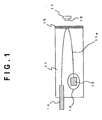
- Fig. 1 shows an example of the structure of the latter optical module.
- a branching waveguide is formed by a PLC.
- An optical fiber 14 is mounted, without being adjusted, on a PLC platform 11 by using a V-groove.
- the optical fiber core and the waveguide 11 a can be positioned at a micrometer level.
- a semiconductor laser 12 and the optical fiber 14 can be coupled to the waveguide at a sub-micrometer level, without the need of optical axis alignment, in such a way that a mark pattern formed on the semiconductor laser 12 and a mark pattern formed on the PLC platform 11 are matched with each other by using infrared transmitted light.
- optical module configured in this way, all the work of optical axis alignment can be automated. This greatly contributes to reducing the production cost of the optical module.
- the optical module is configured such that an optical filter 15 is arranged at a returning portion of the waveguide 11a, and that only light of a specific wavelength is returned at the returning portion and light of the other wavelengths is received by a PD 16 supported by a PD carrier I7.
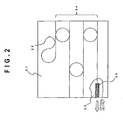
- a wavelength tunable laser As a device in which the passive alignment is used, there is a wavelength tunable laser as shown in Fig. 2 .
- This device is regarded as a key device of the WDM transmission system and is energetically studied in many research institutes.
- three stages of ring resonators 24 are connected in series on a PLC platform 21, and the waveguide is configured to be turned back by a waveguide mirror 25.
- a wavelength tunable operation is realized by performing phase control in such a way that the refractive index is locally changed by energizing a heater formed in the each ring resonator.
- One of the ring resonators is adjusted to match a predetermined period (for example, a period of ITU grid), so that a highly precise wavelength locking operation is realized.
- Japanese Patent Laid Open Publication No. 2001-272582 there is disclosed an invention in which a structure configured to make the end of an adhesive layer recede to the inside from a light emitting surface is adopted, and in which it is thereby prevented that the end of the adhesive layer is extended to be raised to the emitting surface side and projects in the optical path so as to shield the emitted light.
- the viscosity of the refractive index matching gel is generally low.
- the gel is spread over a wide area. Therefore, in the case where the refractive index matching gel is used, even when the end of the coating area is set to the inside of the light emitting surface as in the invention disclosed in Japanese Patent Laid Open Publication No. 2001-272582 , a part of the gel may be turned to reach the light emitting surface, so as to thereby prevent the light emission. That is, a part of gels may also be turned to reach the light emitting section of the SOA with phase control. In this case, there is a possibility that the front surface reflectance is made lower than a design value, or that the efficiency of coupling with the optical fiber is lowered by deformation of the light emitting surface.
- the turning of the refractive index matching gel causes a characteristic change and causes to lower the yield.
- An exemplary object of the present invention is to provide a mounting structure of a semiconductor optical element, in which structure the turning of the refractive index matching gel is prevented.
- a mounting structure of a semiconductor optical element in which structure signal light emitted from one end of the semiconductor optical element mounted to a platform with an optical waveguide formed therein is made incident on the optical waveguide and is then again made incident on the semiconductor optical element to be emitted from the other end of the semiconductor optical element, wherein the semiconductor optical element is mounted to the platform in a state where the other end is projected from the platform, and wherein a refractive index matching gel is arranged between the one end of the semiconductor optical element and the optical waveguide.
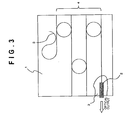
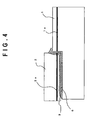
- Fig. 3 and Fig. 4 show a mounting structure of a semiconductor optical element according to the present embodiment.
- An SOA 2 with phase control is mounted on a PLC platform 1 by the passive alignment.
- the passive alignment technique is a technique in which the positioning is performed by using a mark pattern formed on the PLC substrate surface and a mark pattern of an LD chip, and which eliminates the need of optical axis alignment previously performed in manufacturing an optical module and greatly improves the cost and the lead time for producing the module.
- pedestals 6 are arranged between the SOA 2 with phase control and the PLC platform 1.
- the waveguide 1a coupled to the SOA 2 with phase control, three stages of ring resonators 4 are formed. Further, the waveguide 1a is configured to be turned back by a waveguide mirror 5, so that a wavelength tunable operation is performed.
- the end surface of the SOA 2 with phase control mounted by the passive alignment is projected from the end surface of the PLC platform 1.
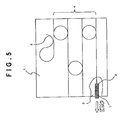
- Fig. 5 shows a configuration of a modulator integrated wavelength tunable laser in the case where a modulator 7 is mounted as another chip by the passive alignment in addition to the SOA 2 with phase control.
- the configuration of the second exemplary embodiment is almost the same as that of the first exemplary embodiment, but is different in that the modulator 7 is further provided.
- the oscillation characteristics can be more stabilized as the reflectance of the emitting end of the modulator 7 is reduced. For this reason, when the refractive index matching gel 3 is brought into contact with the emitting end surface of the modulator 7, the reflectance of the emitting end of the modulator is increased, so that the oscillating operation of the wavelength tunable laser is made unstable. In addition, the coupling characteristics with the fiber may be deteriorated by the deformation of the emitting end surface.
- the end surface of the light taking-out modulator 7 is projected from the PLC platform 1. This prevents the refractive index matching gel 3 from being brought into contact with the emitting end surface of the modulator 7, so that the stable operation and the excellent coupling characteristics with the fiber can be realized.
- the each embodiment as described above is configured such that the wavelength tunable operation is performed by using the three stages of ring resonators, but the number of stages of ring resonators can be arbitrarily set. Further, as long as the wavelength tunable operation can be performed, the ring resonator need not be necessarily used.
- each embodiment as described above is configured such that the SOA with phase control is used as an example of a semiconductor optical element.
- the present invention can be applied to all semiconductor optical elements including a semiconductor laser.
- An example 1 is a mounting structure of a semiconductor optical element, in which structure signal light emitted from one end of the semiconductor optical element mounted to a platform with an optical waveguide formed therein is made incident on the optical waveguide and is then again made incident on the semiconductor optical element to be emitted from the other end of the semiconductor optical element, wherein the semiconductor optical element is mounted to the platform in a state where the other end is projected from the platform, and wherein a refractive index matching gel is arranged between the one end of the semiconductor optical element and the optical waveguide.
- An example 2 is the mounting structure of the semiconductor optical element according to example 1, wherein the signal light turned back by a mirror formed at the end of the optical waveguide is again made incident on the semiconductor optical element.
- An example 3 is the mounting structure of the semiconductor optical element according to one of example 1 or 2, wherein a wavelength tunable circuit is formed in the platform by the optical waveguide.
- An example 4 is the mounting structure of the semiconductor optical element according to example 3, wherein the wavelength tunable circuit comprises at least one stage of a ring resonator.
- An example 5 is the mounting structure of the semiconductor optical element according to any one of examples 1 to 4, wherein a refractive index of the refractive index matching gel is set closer to a refractive index of the optical waveguide than to a refractive index of the semiconductor optical element.
- An example 6 is the mounting structure of the semiconductor optical element according to any one of examples 1 to 5, wherein the semiconductor optical element is a semiconductor optical amplifier with phase control.
- An example 7 is the mounting structure of the semiconductor optical element according to any one of examples 1 to 5, wherein the semiconductor optical element includes a semiconductor optical amplifier with phase control arranged on the side of the one end and coupled to the optical waveguide, and a modulator arranged on the side of the other end and configured to modulate the light signal again made incident.
- the semiconductor optical element includes a semiconductor optical amplifier with phase control arranged on the side of the one end and coupled to the optical waveguide, and a modulator arranged on the side of the other end and configured to modulate the light signal again made incident.
Landscapes
- Physics & Mathematics (AREA)
- General Physics & Mathematics (AREA)
- Optics & Photonics (AREA)
- Semiconductor Lasers (AREA)
- Optical Couplings Of Light Guides (AREA)
- Optical Integrated Circuits (AREA)
Description
- This application is based upon and claims the benefit of priority from Japanese paten application No.
2007-177139, filed on July 5, 2007 - The present invention relates to a mounting structure of a semiconductor optical element, and more particularly to a mounting structure of a semiconductor optical element configured to take out an optical output from an opposite side to a PLC (Planar Lightwave Circuit).
- With the advent of the broadband era, various optical devices are used in the optical transmission system. In the trunk system, the introduction of the WDM (Wavelength Division Multiplexing) transmission system has been increasing.
- In recent years, the use of the DWDM apparatus (dense wavelength division multiplexing apparatus), which enables higher speed transmission by multiplexing tens of optical wavelengths, has also been spread. In each WDM transmission system, a light source is required for each optical wavelength, and hence the number of necessary light sources is remarkably increased in correspondence with the higher multiplexing.
- Further, in recent years, the ROADM (Reconfigurable Optical Add/Drop Multiplexers) configured to add or drop an arbitrary wavelength at each node has been studied in order to be commercialized.
- In the optical access system, various module structures have been proposed in order to realize a lower cost optical module. The structures used in the optical access system are roughly classified into two types.
- The one is a structure in which full duplex communication is realized in such a way that a beam splitter is introduced in a module and that different wavelengths are used for the incoming and outgoing transmission. In this structure, the beam splitter in which a wavelength filter is introduced, a semiconductor laser, and a light receiving element are introduced in the module. However, in this structure, because of the complicated module structure and the need for strict alignment accuracy, it is considered to be difficult to satisfy the demand of low cost.
- As the other structure, in order to provide an optical module at low cost, there is proposed a structure in which a semiconductor laser and a light receiving element are mounted on a platform with a quartz waveguide formed therein.
-
Fig. 1 shows an example of the structure of the latter optical module. A branching waveguide is formed by a PLC. An optical fiber 14 is mounted, without being adjusted, on a PLC platform 11 by using a V-groove. By this method, the optical fiber core and the waveguide 11 a can be positioned at a micrometer level. Further, a semiconductor laser 12 and the optical fiber 14 can be coupled to the waveguide at a sub-micrometer level, without the need of optical axis alignment, in such a way that a mark pattern formed on the semiconductor laser 12 and a mark pattern formed on the PLC platform 11 are matched with each other by using infrared transmitted light. - In the optical module configured in this way, all the work of optical axis alignment can be automated. This greatly contributes to reducing the production cost of the optical module.
- The optical module is configured such that an optical filter 15 is arranged at a returning portion of the waveguide 11a, and that only light of a specific wavelength is returned at the returning portion and light of the other wavelengths is received by a PD 16 supported by a PD carrier I7.
- As a device in which the passive alignment is used, there is a wavelength tunable laser as shown in
Fig. 2 . This device is regarded as a key device of the WDM transmission system and is energetically studied in many research institutes. In the structure shown inFig. 2 , three stages ofring resonators 24 are connected in series on a PLC platform 21, and the waveguide is configured to be turned back by a waveguide mirror 25. - A wavelength tunable operation is realized by performing phase control in such a way that the refractive index is locally changed by energizing a heater formed in the each ring resonator. One of the ring resonators is adjusted to match a predetermined period (for example, a period of ITU grid), so that a highly precise wavelength locking operation is realized. An SOA (Semiconductor Optical Amplifier) 22 with phase control, which is a type of the semiconductor optical element, is mounted on the PLC platform 21 with high precision by the passive alignment.
- As advantages of this structure, there are listed highly reliable operation based on a structure with no movable portion, production cost reduction based on a simple structure realized by integrating functions as a wavelength tunable laser into one chip, and the like.
- Usually, when a semiconductor optical element is mounted by the passive alignment, Fresnel reflection is caused at a connection position because of a difference in the refractive index between the waveguide and the semiconductor optical element. In order to prevent the reflection, there is used a refractive index matching gel with a refractive index close to the refractive index of the waveguide of the PLC platform. In the example shown in
Fig. 2 , even when a non-reflection coating is not applied to the waveguide, it is possible to realize a stable operation with little ripple in such a way that the non-reflection coating is not applied to air but is applied to the refractiveindex matching gel 23 to thereby prevent the reflection. - In Japanese Patent Laid Open Publication No.
2001-272582 - See also
JP 63060578 - The viscosity of the refractive index matching gel is generally low. Thus, even when the refractive index matching gel is applied to only the vicinity of the connection point between the waveguide and the SOA with phase control, the gel is spread over a wide area. Therefore, in the case where the refractive index matching gel is used, even when the end of the coating area is set to the inside of the light emitting surface as in the invention disclosed in Japanese Patent Laid Open Publication No.
2001-272582 - In this way, the turning of the refractive index matching gel causes a characteristic change and causes to lower the yield. In the case where light is directly taken from the semiconductor optical element mounted by the passive alignment as in the above described wavelength tunable laser, it is important in particular to avoid the turning of the refractive index matching gel.
- The present invention has been made in view of the above described problem. An exemplary object of the present invention is to provide a mounting structure of a semiconductor optical element, in which structure the turning of the refractive index matching gel is prevented.
- To this end, according to the present invention, there is provided a mounting structure of a semiconductor optical element, in which structure signal light emitted from one end of the semiconductor optical element mounted to a platform with an optical waveguide formed therein is made incident on the optical waveguide and is then again made incident on the semiconductor optical element to be emitted from the other end of the semiconductor optical element, wherein the semiconductor optical element is mounted to the platform in a state where the other end is projected from the platform, and wherein a refractive index matching gel is arranged between the one end of the semiconductor optical element and the optical waveguide.
- The invention is further described with reference to the drawings:
-
Fig. 1 is a view showing a configuration of a common optical module; -
Fig. 2 is a view showing a configuration of a wavelength tunable laser in which ring resonance circuits are used; -
Fig. 3 is a view showing a configuration of a semiconductor laser according to a first exemplary embodiment in which the present invention is preferably implemented; -
Fig. 4 is a view showing a configuration of the semiconductor laser according to the first exemplary embodiment; and -
Fig. 5 is a view showing a configuration of a semiconductor laser according to a second exemplary embodiment in which the present invention is preferably implemented. - There will be described a first exemplary embodiment in which the present invention is preferably implemented.
-
Fig. 3 andFig. 4 show a mounting structure of a semiconductor optical element according to the present embodiment. AnSOA 2 with phase control is mounted on aPLC platform 1 by the passive alignment. The passive alignment technique is a technique in which the positioning is performed by using a mark pattern formed on the PLC substrate surface and a mark pattern of an LD chip, and which eliminates the need of optical axis alignment previously performed in manufacturing an optical module and greatly improves the cost and the lead time for producing the module. - In order to match the height of a waveguide 11a formed in the
PLC platform 1 with the height of a waveguide 2a formed in theSOA 2 with phase control,pedestals 6 are arranged between theSOA 2 with phase control and thePLC platform 1. - In the waveguide 1a coupled to the
SOA 2 with phase control, three stages ofring resonators 4 are formed. Further, the waveguide 1a is configured to be turned back by awaveguide mirror 5, so that a wavelength tunable operation is performed. - The end surface of the
SOA 2 with phase control mounted by the passive alignment is projected from the end surface of thePLC platform 1. With this configuration, even when a refractiveindex matching gel 3 with low viscosity is used, it is possible to prevent the refractiveindex matching gel 3 from being turned to reach the light emitting end surface, and thereby possible to prevent change in the oscillation characteristics and deterioration in the coupling characteristics with the fiber. - With the configuration in which the end surface of the light taking-out element (
SOA 2 with phase control) is projected from thePLC platform 1 in this way, it is possible to prevent the refractiveindex matching gel 3 from being turned to reach the end surface of the element. Thereby, it is possible to stabilize the oscillation characteristics and to realize excellent coupling characteristics with the fiber with high yield. - There will be described a second exemplary embodiment in which present invention is preferably implemented.
-
Fig. 5 shows a configuration of a modulator integrated wavelength tunable laser in the case where amodulator 7 is mounted as another chip by the passive alignment in addition to theSOA 2 with phase control. The configuration of the second exemplary embodiment is almost the same as that of the first exemplary embodiment, but is different in that themodulator 7 is further provided. - In this configuration, the oscillation characteristics can be more stabilized as the reflectance of the emitting end of the
modulator 7 is reduced. For this reason, when the refractiveindex matching gel 3 is brought into contact with the emitting end surface of themodulator 7, the reflectance of the emitting end of the modulator is increased, so that the oscillating operation of the wavelength tunable laser is made unstable. In addition, the coupling characteristics with the fiber may be deteriorated by the deformation of the emitting end surface. - In order to prevent such faults, it is configured such that the end surface of the light taking-out
modulator 7 is projected from thePLC platform 1. This prevents the refractiveindex matching gel 3 from being brought into contact with the emitting end surface of themodulator 7, so that the stable operation and the excellent coupling characteristics with the fiber can be realized. - In this way, with the configuration in which the end surface of the light taking-out element (modulator 7) is projected from the
PLC platform 1, it is possible to prevent the refractiveindex matching gel 3 from being turned to reach the end surface of the light taking-out element. Thereby, it is possible to stabilize the oscillation characteristics and to realize excellent coupling characteristics with the fiber with high yield. - Note that the above described embodiments are examples in which the present invention is preferably implemented, but the present invention is not limited to these.
- For example, the each embodiment as described above is configured such that the wavelength tunable operation is performed by using the three stages of ring resonators, but the number of stages of ring resonators can be arbitrarily set. Further, as long as the wavelength tunable operation can be performed, the ring resonator need not be necessarily used.
- Further, the each embodiment as described above is configured such that the SOA with phase control is used as an example of a semiconductor optical element. However, it is needless to say that the present invention can be applied to all semiconductor optical elements including a semiconductor laser.
- In this way, various modifications are possible within the scope and spirit of the present invention.
- An example 1 is a mounting structure of a semiconductor optical element, in which structure signal light emitted from one end of the semiconductor optical element mounted to a platform with an optical waveguide formed therein is made incident on the optical waveguide and is then again made incident on the semiconductor optical element to be emitted from the other end of the semiconductor optical element,
wherein the semiconductor optical element is mounted to the platform in a state where the other end is projected from the platform, and
wherein a refractive index matching gel is arranged between the one end of the semiconductor optical element and the optical waveguide. - An example 2 is the mounting structure of the semiconductor optical element according to example 1, wherein the signal light turned back by a mirror formed at the end of the optical waveguide is again made incident on the semiconductor optical element.
- An example 3 is the mounting structure of the semiconductor optical element according to one of example 1 or 2, wherein a wavelength tunable circuit is formed in the platform by the optical waveguide.
- An example 4 is the mounting structure of the semiconductor optical element according to example 3, wherein the wavelength tunable circuit comprises at least one stage of a ring resonator.
- An example 5 is the mounting structure of the semiconductor optical element according to any one of examples 1 to 4, wherein a refractive index of the refractive index matching gel is set closer to a refractive index of the optical waveguide than to a refractive index of the semiconductor optical element.
- An example 6 is the mounting structure of the semiconductor optical element according to any one of examples 1 to 5, wherein the semiconductor optical element is a semiconductor optical amplifier with phase control.
- An example 7 is the mounting structure of the semiconductor optical element according to any one of examples 1 to 5, wherein the semiconductor optical element includes a semiconductor optical amplifier with phase control arranged on the side of the one end and coupled to the optical waveguide, and a modulator arranged on the side of the other end and configured to modulate the light signal again made incident.
Claims (7)
- A mounting structure of a semiconductor optical element, in which structure signal light emitted from one end of the semiconductor optical element (2) mounted to a platform (1) with an optical waveguide (1a) formed therein is made incident on the optical waveguide and is then again made incident on the semiconductor optical element (2) to be emitted from the other end of the semiconductor optical element (2),
characterized in that the semiconductor optical element (2) is mounted to the platform (1) in a state where the other end is projected from the platform (1), and
wherein a refractive index matching gel (3) is arranged between the one end of the semiconductor optical element (2) and the optical waveguide (1a). - The mounting structure of the semiconductor optical element according to claim 1, wherein the signal light turned back by a mirror (5) formed at the end of the optical waveguide (1a) is again made incident on the semiconductor optical element (2).
- The mounting structure of the semiconductor optical element according to one of claim 1 or 2, wherein a wavelength tunable circuit is formed in the platform by the optical waveguide.
- The mounting structure of the semiconductor optical element according to claim 3, wherein the wavelength tunable circuit comprises at least one stage of a ring resonator (4).
- The mounting structure of the semiconductor optical element according to any one of claims 1 to 4, wherein a refractive index of the refractive index matching gel (3) is set closer to a refractive index of the optical waveguide (1a) than to a refractive index of the semiconductor optical element (2).
- The mounting structure of the semiconductor optical element according to any one of claims 1 to 5, wherein the semiconductor optical element is a semiconductor optical amplifier (2) with phase control.
- The mounting structure of the semiconductor optical element according to any one of claims 1 to 5, wherein the semiconductor optical element includes a semiconductor optical amplifier (2) with phase control arranged on the side of the one end and coupled to the optical waveguide (1a) , and a modulator arranged on the side of the other end and configured to modulate the light signal again made incident.
Applications Claiming Priority (1)
| Application Number | Priority Date | Filing Date | Title |
|---|---|---|---|
| JP2007177139A JP2009016594A (en) | 2007-07-05 | 2007-07-05 | Mounting structure of semiconductor optical element |
Publications (3)
| Publication Number | Publication Date |
|---|---|
| EP2012151A2 EP2012151A2 (en) | 2009-01-07 |
| EP2012151A3 EP2012151A3 (en) | 2009-10-21 |
| EP2012151B1 true EP2012151B1 (en) | 2013-03-06 |
Family
ID=39816913
Family Applications (1)
| Application Number | Title | Priority Date | Filing Date |
|---|---|---|---|
| EP08158119A Expired - Fee Related EP2012151B1 (en) | 2007-07-05 | 2008-06-12 | Mounting structure of semiconductor optical element |
Country Status (6)
| Country | Link |
|---|---|
| US (1) | US7539370B2 (en) |
| EP (1) | EP2012151B1 (en) |
| JP (1) | JP2009016594A (en) |
| CN (1) | CN101339278B (en) |
| AU (1) | AU2008202724A1 (en) |
| CA (1) | CA2636094C (en) |
Families Citing this family (8)
| Publication number | Priority date | Publication date | Assignee | Title |
|---|---|---|---|---|
| KR101405419B1 (en) * | 2010-06-18 | 2014-06-27 | 한국전자통신연구원 | laser module |
| JP5708009B2 (en) | 2011-02-17 | 2015-04-30 | セイコーエプソン株式会社 | Optical module and electronic equipment |
| JP2012256667A (en) * | 2011-06-08 | 2012-12-27 | Nippon Telegr & Teleph Corp <Ntt> | Semiconductor laser light source |
| US9577410B2 (en) | 2013-02-01 | 2017-02-21 | Nec Corporation | Optical functional integrated unit and method for manufacturing thereof |
| US9787054B2 (en) * | 2015-05-05 | 2017-10-10 | Sifotonics Technologies Co., Ltd. | Optical package providing efficient coupling between DFB-LD and silicon PIC edge couplers with low return loss |
| CN107065082B (en) * | 2016-02-01 | 2019-03-05 | 硅光电科技股份有限公司 | Silicon photonics low return loss package structure with edge coupler |
| US10234701B2 (en) * | 2016-10-18 | 2019-03-19 | Morton Photonics | Waveguide array modulator for high performance systems |
| JP7211017B2 (en) | 2018-11-02 | 2023-01-24 | 株式会社デンソー | Optical filter, laser light source and optical transmitter/receiver using the same |
Family Cites Families (17)
| Publication number | Priority date | Publication date | Assignee | Title |
|---|---|---|---|---|
| JPS5870592A (en) * | 1981-10-23 | 1983-04-27 | Hitachi Ltd | Laser diode |
| US4611884A (en) * | 1982-11-24 | 1986-09-16 | Magnetic Controls Company | Bi-directional optical fiber coupler |
| JPS6063981A (en) * | 1984-07-27 | 1985-04-12 | Hitachi Ltd | Semiconductor light emitting device |
| JPS6360578A (en) * | 1986-09-01 | 1988-03-16 | Sumitomo Electric Ind Ltd | Solid-state laser element |
| JPH0731314B2 (en) * | 1987-06-30 | 1995-04-10 | 日本電気株式会社 | Optical signal modulator |
| JP2001024268A (en) * | 1999-07-05 | 2001-01-26 | Matsushita Electric Ind Co Ltd | Semiconductor laser device |
| JP3990113B2 (en) | 2000-01-19 | 2007-10-10 | 日本オプネクスト株式会社 | Optoelectronic device and manufacturing method thereof |
| US6476379B2 (en) * | 2000-01-19 | 2002-11-05 | Hitachi, Ltd. | Optoelectronic devices and manufacturing method thereof |
| JP2001330762A (en) * | 2000-05-24 | 2001-11-30 | Oki Electric Ind Co Ltd | Optical module |
| US6907054B2 (en) * | 2001-06-29 | 2005-06-14 | Sharp Kabushiki Kaisha | Semiconductor laser device |
| US6810058B2 (en) * | 2002-04-23 | 2004-10-26 | Adc Telecommunications, Inc. | Semiconductor laser with gain waveguide layer providing transversal and longitudinal mode stability |
| US20040208458A1 (en) * | 2002-11-26 | 2004-10-21 | Hitoshi Uno | Bidirectional optical module, optical drop module, and optical transmission device |
| US20040223712A1 (en) * | 2003-04-28 | 2004-11-11 | Ruolin Li | Technique for stabilizing laser wavelength and phase |
| JP2006278769A (en) * | 2005-03-29 | 2006-10-12 | Nec Corp | Variable wavelength laser |
| JP2007133011A (en) * | 2005-11-08 | 2007-05-31 | Nec Corp | Optical coupling structure, manufacturing method thereof, and optical module |
| JP2007171488A (en) * | 2005-12-21 | 2007-07-05 | Fuji Xerox Co Ltd | Optical waveguide for optical communication and optical transceiver |
| JP5078256B2 (en) | 2005-12-28 | 2012-11-21 | 株式会社ブリヂストン | Rubber composition and pneumatic tire using modified conjugated diene polymer |
-
2007
- 2007-07-05 JP JP2007177139A patent/JP2009016594A/en active Pending
-
2008
- 2008-06-12 EP EP08158119A patent/EP2012151B1/en not_active Expired - Fee Related
- 2008-06-20 AU AU2008202724A patent/AU2008202724A1/en not_active Abandoned
- 2008-06-24 US US12/145,064 patent/US7539370B2/en active Active
- 2008-06-25 CA CA2636094A patent/CA2636094C/en not_active Expired - Fee Related
- 2008-07-07 CN CN200810135605.6A patent/CN101339278B/en active Active
Also Published As
| Publication number | Publication date |
|---|---|
| US20090010592A1 (en) | 2009-01-08 |
| US7539370B2 (en) | 2009-05-26 |
| CA2636094C (en) | 2012-10-02 |
| CN101339278A (en) | 2009-01-07 |
| EP2012151A2 (en) | 2009-01-07 |
| JP2009016594A (en) | 2009-01-22 |
| AU2008202724A1 (en) | 2009-01-22 |
| CN101339278B (en) | 2012-05-30 |
| CA2636094A1 (en) | 2009-01-05 |
| EP2012151A3 (en) | 2009-10-21 |
Similar Documents
| Publication | Publication Date | Title |
|---|---|---|
| US11086078B2 (en) | Methods and system for wavelength tunable optical components and sub-systems | |
| US7539370B2 (en) | Mounting structure of semiconductor optical element | |
| US7843986B2 (en) | Planar lightwave circuit and tunable laser device having the same | |
| US8145017B2 (en) | Optical module | |
| US7539369B2 (en) | Optical device and manufacturing method thereof | |
| US8885675B2 (en) | Wavelength variable laser device, and method and program for controlling the same | |
| US7440643B2 (en) | Variable light controlling device and variable light controlling method | |
| US8643943B2 (en) | Tunable laser source using intracavity laser light outcoupling and module containing the same | |
| US10509165B2 (en) | Optical transposer assembly | |
| US20010053265A1 (en) | Optical device for use in detecting the wavelength and intensity of light | |
| CN104937790A (en) | Optical function integration unit and method for producing same | |
| US20160261092A1 (en) | Temperature insensitive laser | |
| EP1008211A1 (en) | Integrated multi-wavelength transmitter | |
| US20250208348A1 (en) | Wavelength locker integration methods and processes exploiting printed photonic structures | |
| Zhao et al. | Integrated Filtered-Feedback Multi-Wavelength Laser | |
| US20090268762A1 (en) | Optical intergrated device | |
| Wang et al. | Optics in Computer Architectures: Basis of WDM, Technologies and Potentials | |
| WO2009054808A1 (en) | Packaged tunable semiconductor laser structure and its fabrication | |
| Kitamura | PLC based bi-directional optical module for access fiber networks |
Legal Events
| Date | Code | Title | Description |
|---|---|---|---|
| PUAI | Public reference made under article 153(3) epc to a published international application that has entered the european phase |
Free format text: ORIGINAL CODE: 0009012 |
|
| AK | Designated contracting states |
Kind code of ref document: A2 Designated state(s): AT BE BG CH CY CZ DE DK EE ES FI FR GB GR HR HU IE IS IT LI LT LU LV MC MT NL NO PL PT RO SE SI SK TR |
|
| AX | Request for extension of the european patent |
Extension state: AL BA MK RS |
|
| PUAL | Search report despatched |
Free format text: ORIGINAL CODE: 0009013 |
|
| AK | Designated contracting states |
Kind code of ref document: A3 Designated state(s): AT BE BG CH CY CZ DE DK EE ES FI FR GB GR HR HU IE IS IT LI LT LU LV MC MT NL NO PL PT RO SE SI SK TR |
|
| AX | Request for extension of the european patent |
Extension state: AL BA MK RS |
|
| 17P | Request for examination filed |
Effective date: 20100331 |
|
| 17Q | First examination report despatched |
Effective date: 20100506 |
|
| AKX | Designation fees paid |
Designated state(s): DE FR GB |
|
| GRAP | Despatch of communication of intention to grant a patent |
Free format text: ORIGINAL CODE: EPIDOSNIGR1 |
|
| GRAS | Grant fee paid |
Free format text: ORIGINAL CODE: EPIDOSNIGR3 |
|
| GRAA | (expected) grant |
Free format text: ORIGINAL CODE: 0009210 |
|
| RIN1 | Information on inventor provided before grant (corrected) |
Inventor name: YAMAZAKI, HIROYUKI |
|
| AK | Designated contracting states |
Kind code of ref document: B1 Designated state(s): DE FR GB |
|
| REG | Reference to a national code |
Ref country code: GB Ref legal event code: FG4D |
|
| REG | Reference to a national code |
Ref country code: DE Ref legal event code: R096 Ref document number: 602008022655 Country of ref document: DE Effective date: 20130502 |
|
| PGFP | Annual fee paid to national office [announced via postgrant information from national office to epo] |
Ref country code: GB Payment date: 20130415 Year of fee payment: 6 |
|
| PGFP | Annual fee paid to national office [announced via postgrant information from national office to epo] |
Ref country code: DE Payment date: 20130731 Year of fee payment: 6 |
|
| PGFP | Annual fee paid to national office [announced via postgrant information from national office to epo] |
Ref country code: FR Payment date: 20130726 Year of fee payment: 6 |
|
| PLBE | No opposition filed within time limit |
Free format text: ORIGINAL CODE: 0009261 |
|
| STAA | Information on the status of an ep patent application or granted ep patent |
Free format text: STATUS: NO OPPOSITION FILED WITHIN TIME LIMIT |
|
| 26N | No opposition filed |
Effective date: 20131209 |
|
| REG | Reference to a national code |
Ref country code: DE Ref legal event code: R097 Ref document number: 602008022655 Country of ref document: DE Effective date: 20131209 |
|
| REG | Reference to a national code |
Ref country code: DE Ref legal event code: R119 Ref document number: 602008022655 Country of ref document: DE |
|
| GBPC | Gb: european patent ceased through non-payment of renewal fee |
Effective date: 20140612 |
|
| REG | Reference to a national code |
Ref country code: FR Ref legal event code: ST Effective date: 20150227 |
|
| REG | Reference to a national code |
Ref country code: DE Ref legal event code: R119 Ref document number: 602008022655 Country of ref document: DE Effective date: 20150101 |
|
| PG25 | Lapsed in a contracting state [announced via postgrant information from national office to epo] |
Ref country code: DE Free format text: LAPSE BECAUSE OF NON-PAYMENT OF DUE FEES Effective date: 20150101 |
|
| PG25 | Lapsed in a contracting state [announced via postgrant information from national office to epo] |
Ref country code: GB Free format text: LAPSE BECAUSE OF NON-PAYMENT OF DUE FEES Effective date: 20140612 Ref country code: FR Free format text: LAPSE BECAUSE OF NON-PAYMENT OF DUE FEES Effective date: 20140630 |