EP2011797A1 - Process for production of camptothecin derivative - Google Patents
Process for production of camptothecin derivative Download PDFInfo
- Publication number
- EP2011797A1 EP2011797A1 EP07742590A EP07742590A EP2011797A1 EP 2011797 A1 EP2011797 A1 EP 2011797A1 EP 07742590 A EP07742590 A EP 07742590A EP 07742590 A EP07742590 A EP 07742590A EP 2011797 A1 EP2011797 A1 EP 2011797A1
- Authority
- EP
- European Patent Office
- Prior art keywords
- compound
- piperidino
- ethyl
- carbonyloxycamptot
- hecin
- Prior art date
- Legal status (The legal status is an assumption and is not a legal conclusion. Google has not performed a legal analysis and makes no representation as to the accuracy of the status listed.)
- Withdrawn
Links
- 0 OI(C(C=C1c2cc(cccc3)c3c(C3I=C3)c2C*11)=C(CO2)C1=O)C2=O Chemical compound OI(C(C=C1c2cc(cccc3)c3c(C3I=C3)c2C*11)=C(CO2)C1=O)C2=O 0.000 description 2
Classifications
-
- C—CHEMISTRY; METALLURGY
- C07—ORGANIC CHEMISTRY
- C07B—GENERAL METHODS OF ORGANIC CHEMISTRY; APPARATUS THEREFOR
- C07B53/00—Asymmetric syntheses
-
- C—CHEMISTRY; METALLURGY
- C07—ORGANIC CHEMISTRY
- C07D—HETEROCYCLIC COMPOUNDS
- C07D491/00—Heterocyclic compounds containing in the condensed ring system both one or more rings having oxygen atoms as the only ring hetero atoms and one or more rings having nitrogen atoms as the only ring hetero atoms, not provided for by groups C07D451/00 - C07D459/00, C07D463/00, C07D477/00 or C07D489/00
- C07D491/22—Heterocyclic compounds containing in the condensed ring system both one or more rings having oxygen atoms as the only ring hetero atoms and one or more rings having nitrogen atoms as the only ring hetero atoms, not provided for by groups C07D451/00 - C07D459/00, C07D463/00, C07D477/00 or C07D489/00 in which the condensed system contains four or more hetero rings
Definitions
- the present invention relates to a process for preparing 7-ethyl-10-[4-(1-piperidino)-1-piperidino]carbonyloxycamptot hecin and its derivatives.
- Camptothecin (hereinafter, referred to as CPT) is a pentacyclic alkaloid isolated from natural materials such as Camptotheca acuminata, Nyssaceae, which is native to China.
- CPT Camptothecin
- Various effective semi-synthetic derivatives having anti-tumor activity prepared using CPT as a starting material have been provided from searching studies by the present inventors and others.
- CTP-11 which is a hydrochloride trihydrate of 7-ethyl-10-[4-(1-piperidino)-1-piperidino]carbonyloxycamptot hecin (hereinafter, referred to as SN-38B-11) derivatized from CPT, is a compound having high anti-tumor activity with low toxicity, and CPT-11 is widely sold as an anti-tumor agent (general name: irinotecan hydrochloride) at present.
- SN-38B-11 hydrochloride trihydrate of 7-ethyl-10-[4-(1-piperidino)-1-piperidino]carbonyloxycamptot hecin
- CPT-11 is prepared from a naturally-derived extract after isolation and purification, a difference in raw materials such as Camptotheca acuminata and Nothapodytes foetida may cause the inclusion of different impurities.
- the extract when Nothapodytes foetida is used as the raw material, the extract contains 18,19-dehydrocamptothecin represented by a formula (1): at a rate of several percent relative to CPT (refer to Patent document 1, Non-patent document 1).
- vinyl-form compounds having a vinyl group such as 18, 19-dehydrocamptothecin
- the vinyl group remains in the subsequent production processes of CPT-11 as shown below, and the vinyl form cannot be completely removed by silica-gel column chromatography and others in any of the subsequent processes; therefore, it was difficult to obtain CPT-11 with high purity, when Nothapodytes foetida was used as the raw material.
- an object of the present invention is to provide a process for preparing 7-ethyl-10-[4-(1-piperidino)-1-piperidino]carbonyloxycamptot hecin that does not comprise a vinyl form, from a camptothecin composition comprising 18,19-dehydrocamptothecin.
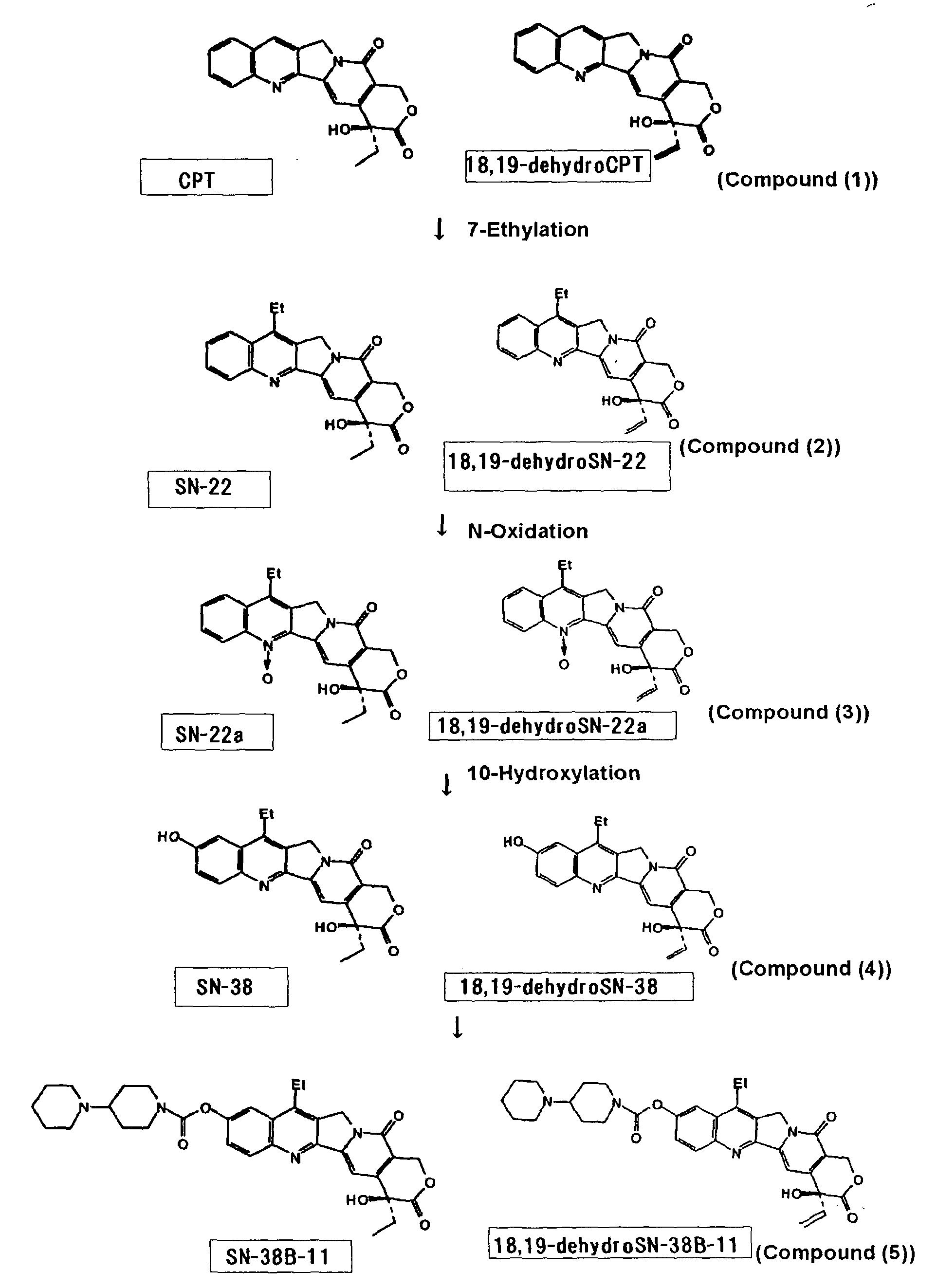
- the present invention relates to a process for preparing 7-ethyl-10-[4-(1-piperidino)-1-piperidino]carbonyloxycamptot hecin from a composition comprising a compound represented by formula (1): characterized in that in the process of producing a compound (2) : from the compound (1), then producing a compound (3): from the compound (2), then producing a compound (4): from the compound (3), and then producing a compound (5) : from the compound (4), at least one compound selected from the compounds (1)-(5) is catalytically reduced.
- the present invention relates to said process for preparing 7-ethyl-10-[4-(1-piperidino)-1-piperidino]carbonyloxycamptot hecin, characterized in that the compound (5) is catalytically reduced.
- the present invention relates to said process for preparing 7-ethyl-10-[4-(1-piperidino)-1-piperidino]carbonyloxycamptot hecin, wherein the composition comprising the compound (1) is a mixture with a compound (6):
- the present invention relates to said process for preparing 7-ethyl-10-[4-(1-piperidino)-1-piperidino]carbonyloxycamptot hecin, wherein the composition comprising the compound (1) is an extract of Nothapodytes foetida.
- the present invention relates to said process for preparing 7-ethyl-10-[4-(1-piperidino)-1-piperidino]carbonyloxycamptothecin, wherein the catalytic reduction is performed under the presence of a catalyst using hydrogen or a formic acid or its salt as a hydrogen source.
- camptothecin composition comprising 18,19-dehydrocamptothecin such as a Nothapodytes foetida extract, which is difficult to be used to date as a raw material of CPT-11, in the preparation of 7-ethyl-10-[4-(1-piperidino)-1-piperidino]carbonyloxycamptot hecin; the process exhibits extremely superior effects in terms of procurement of raw materials and improvement in product purities.
- 7-Ethyl-10-[4-(1-piperidino)-1-piperidino]carbonyloxyc amptothecin is prepared from a camptothecin composition comprising 18,19-dehydrocamptothecin, by the following processes.
- the compound (5) has a higher solubility to a reaction medium so that the amount of the reaction medium can be reduced; therefore, catalytic reduction can be performed at a high concentration, thereby increasing reaction efficiency when the same amount of a catalyst is used, and the catalytic reduction can be completed within a shorter period.
- the reduction of the compound (5) is particularly preferred.
- Catalytic reduction can be performed under the presence of a catalyst, using hydrogen or a formic acid or its salt as a hydrogen source.
- the catalyst used include platinum-group catalysts such as palladium, platinum, rhodium, ruthenium and the like, or nickel-group catalysts such as nickel and the like, or salts thereof; palladium, rhodium, ruthenium and nickel are preferred, and palladium is particularly preferred.
- the formate used as a hydrogen source include ammonium formate, triethylammonium formate and the like; ammonium formate is preferred. The use of ammonium formate is most preferred from the viewpoint of safety and handling.
- the process of the present invention can be applied to any camptothecin composition comprising 18, 19-dehydrocamptothecin; it is suitable for a 18,19-dehydrocamptothecin-containing composition extracted from Nothapodytes foetida.
- the content of the vinyl form (compound (5)) in the SN-38B-11 obtained by isolation and purification is shown in Table 1 below.
- the SN-38B-11 (100 mg) comprising the vinyl form (compound (5)) obtained by isolation and purification is dissolved in 20 mL of a dioxane-ethanol mixture solution (1:1) in a hydrogenation reaction vessel (100 mL), and approximately 10 mg of 10% Pd-C is added to the resultant mixture. Approximately 1.2 mL of the mixture is measured, filtered through a membrane filter (0.45 ⁇ m), and 1 mL of the filtrate is precisely measured, which is then made precisely to a volume of 10 mL by adding a dissolved solution [MeOH-H 2 O-0.1 N HCl (5:4:1)]; thus, an initial sample solution is obtained. The reaction vessel is deaerated under reduced pressure and shaken under hydrogen atmosphere.
- Catalytic reduction was performed using ammonium formate as the hydrogen source instead of hydrogen gas.
- camptothecin that comprises 18,19-dehydrocamptothecin (18,19-dehydroCPT, compound (1)
- SN-38B-11 is prepared from a camptothecin comprising 18,19-dehydrocamptothecin (compound (1)) isolated from Nothapodytes foetida, in accordance with the preparation process of SN-38B-11, so that SN-22, SN-22a, and SN-38 that respectively comprise an intermediate 18,19-dehydroSN-22 (compound (2)), 18,19-dehydroSN-22a (compound (3)), and 18,19-dehydroSN-38 (compound (4)) are obtained.
- the contents of the vinyl form (compound (1), compound (2), compound (3), and compound (4)) in CPT, SN-22, SN-22a and SN-38 used in the test are shown in Table 4.
- the CPT (100 mg) comprising the vinyl form (compound (1)) is dissolved in 200 mL of a dioxane-methanol mixture solution (1:1) in a recovery flask, and approximately 20 mg of 10% Pd-C is added to the resultant mixture. Approximately 1 mL of the mixture is measured and filtered through a membrane filter (0.45 ⁇ m), giving an initial sample solution.
- the reaction vessel is deaerated under reduced pressure and vigorously stirred under hydrogen atmosphere at room temperature. At 1, 3, and 5 hr thereafter, approximately 1 mL of the sample is measured and filtered through a membrane filter (0.45 ⁇ m), giving a sample solution at each time point.
- the content of the vinyl form (compound (1)) in the reaction mixture is measured under the HPLC operating conditions described below. Table 4 shows the experimental results. No vinyl form (compound (1)) was detected at 5 hr after.
- the SN-22 (100 mg) comprising the vinyl form (compound (2)) is dissolved in 100 mL of a dioxane-ethanol mixture solution (1: 1) in a recovery flask, and approximately 10 mg of 10% Pd-C is added to the resultant mixture. Approximately 1 mL of the mixture is measured and filtered through a membrane filter (0. 45 ⁇ m), giving an initial sample solution.
- the reaction vessel is deaerated under reduced pressure and vigorously stirred under hydrogen atmosphere at room temperature. At 1, 3, 5 and 7 hr thereafter, approximately 1 mL of the sample is measured and filtered through a membrane filter (0.45 ⁇ m), giving a sample solution at each time point.
- the content of the vinyl form (compound (2)) in the reactionmixture is measured under the HPLC operating conditions of Example 3. Table 4 shows the experimental results. No vinyl form (compound (2)) was detected at 7 hr after.
- the SN-38 (100 mg) comprising the vinyl form (compound (4)) is dissolved in 40 mL of a dioxane-methanol mixture solution (1: 1) in a recovery flask, and approximately 20 mg of 10% Pd-C and 0.15 mL of water are added to the resultant mixture. Approximately 0.5 mL of the mixture is measured and filtered through a membrane filter (0.45 ⁇ m), giving an initial sample solution. Ammonium formate (100 mg) is added to this mixture and vigorously stirred at room temperature. At 1 and 3 hr thereafter, approximately 0.5 mL of the sample is measured and filtered through a membrane filter (0.45 ⁇ m), giving a sample solution at each time point. Regarding 4 ⁇ L of each sample solution, the content of the vinyl form (compound (4)) in the reaction mixture is measured under the HPLC operating conditions of Example 3. Table 4 shows the experimental results. No vinyl form (compound (4)) was detected at 3 hr after.
- Table 5 shows the fractionation by column chromatography using silica gel with an amount approximately 150 times and its analytical results.
- the sample 1 is charged on a silica gel column (Merck Silica Gel 60, 230-400 mesh ATMS, 2 x 10 cm, approximately 30 g) and is flown down with a CHCl 3 -MeOH (20: 1) mixture solution (10 mL/min).
- the flowing-down solution is fractionated by 30 mL. Each fraction is concentrated to dryness under reduced pressure, and the residue is dissolved into a dissolving solution to achieve the concentration of 1 mg/mL, giving a sample solution. 10 ⁇ L of the sample solution is tested under the HPLC operating conditions shown below.
- Dissolving solution MeOH-H 2 O-0.1 N HCl (5:4:1)
Landscapes
- Chemical & Material Sciences (AREA)
- Organic Chemistry (AREA)
- Nitrogen Condensed Heterocyclic Rings (AREA)
- Pharmaceuticals Containing Other Organic And Inorganic Compounds (AREA)
Abstract
Description
- The present invention relates to a process for preparing 7-ethyl-10-[4-(1-piperidino)-1-piperidino]carbonyloxycamptot hecin and its derivatives.
- Camptothecin (hereinafter, referred to as CPT) is a pentacyclic alkaloid isolated from natural materials such as Camptotheca acuminata, Nyssaceae, which is native to China. Various effective semi-synthetic derivatives having anti-tumor activity prepared using CPT as a starting material have been provided from searching studies by the present inventors and others.
CTP-11, which is a hydrochloride trihydrate of 7-ethyl-10-[4-(1-piperidino)-1-piperidino]carbonyloxycamptot hecin (hereinafter, referred to as SN-38B-11) derivatized from CPT, is a compound having high anti-tumor activity with low toxicity, and CPT-11 is widely sold as an anti-tumor agent (general name: irinotecan hydrochloride) at present. - However, since the amount of CPT that can be obtained from a natural material such as Camptotheca acuminata, which is a raw material, is extremely small, it is anticipated that it will become difficult to supply a sufficient amount of CPT as the demand of CPT-11, which is its effective derivative, increases, although means to procure the raw material including planting has been taken. Furthermore, since CPT-11 is prepared from a naturally-derived extract after isolation and purification, a difference in raw materials such as Camptotheca acuminata and Nothapodytes foetida may cause the inclusion of different impurities. Thus, when Nothapodytes foetida is used as the raw material, the extract contains 18,19-dehydrocamptothecin represented by a formula (1):

-
-
- [Patent document 1]
JP, A, 64-61482 - [Non-patent document1]R.Aiyama,etal.,Phytochemistry,Vol.27, No.11, pp.3663-3664, 1988.
- Therefore, an object of the present invention is to provide a process for preparing 7-ethyl-10-[4-(1-piperidino)-1-piperidino]carbonyloxycamptot hecin that does not comprise a vinyl form, from a camptothecin composition comprising 18,19-dehydrocamptothecin.
- During the present inventors' keen examination to solve the above-mentioned problem, they have found that, by the reduction under a certain condition of any one of the intermediates obtained by a process for preparing 7-ethyl-10-[4-(1-piperidino)-1-piperidino]carbonyloxycamptot hecin from CPT, while a double bond and a carbonyl group within the heterocyclic ring of the CPT or 18,19-dehydrocamptothecin are not reduced but only a vinyl group is reduced, so that finally 7-ethyl-10-[4-(1-piperidino)-1-piperidino]carbonyloxycamptot hecin that does not comprise a vinyl form can be prepared; the present invention has thus been accomplished.
- Namely, the present invention relates to a process for preparing 7-ethyl-10-[4-(1-piperidino)-1-piperidino]carbonyloxycamptot hecin from a composition comprising a compound represented by formula (1):


- In addition, the present invention relates to said process for preparing 7-ethyl-10-[4-(1-piperidino)-1-piperidino]carbonyloxycamptot hecin, characterized in that the compound (5) is catalytically reduced.
Furthermore, the present invention relates to said process for preparing 7-ethyl-10-[4-(1-piperidino)-1-piperidino]carbonyloxycamptot hecin, wherein the composition comprising the compound (1) is a mixture with a compound (6):
Furthermore, the present invention relates to said process for preparing 7-ethyl-10-[4-(1-piperidino)-1-piperidino]carbonyloxycamptothecin, wherein the catalytic reduction is performed under the presence of a catalyst using hydrogen or a formic acid or its salt as a hydrogen source. - According to the inventive process, it becomes possible to use a camptothecin composition comprising 18,19-dehydrocamptothecin such as a Nothapodytes foetida extract, which is difficult to be used to date as a raw material of CPT-11, in the preparation of 7-ethyl-10-[4-(1-piperidino)-1-piperidino]carbonyloxycamptot hecin; the process exhibits extremely superior effects in terms of procurement of raw materials and improvement in product purities.
- A process for preparing 7-ethyl-10-[4-(1-piperidino)-1-piperidino]carbonyloxycamptothecin according to the present invention is explained herein below; however, the present invention is not limited thereto.
7-Ethyl-10-[4-(1-piperidino)-1-piperidino]carbonyloxyc amptothecin is prepared from a camptothecin composition comprising 18,19-dehydrocamptothecin, by the following processes.
- With respect to CPT that is a starting material as well as reaction conditions and others in each process, refer to
JP A 62-42914 JP A 62-47193 JP A 3-68007 WO 01/070747
In the process of the present invention, by means of catalytically reducing any one of the above compounds (1)-(5), 7-ethyl-10-[4-(1-piperidino)-1-piperidino]carbonyloxycamptot hecin that does not comprise a vinyl form, and its hydrochloride trihydrate, i.e., CPT-11, can finally be prepared.
Compared to the compounds (1)-(4), the compound (5) has a higher solubility to a reaction medium so that the amount of the reaction medium can be reduced; therefore, catalytic reduction can be performed at a high concentration, thereby increasing reaction efficiency when the same amount of a catalyst is used, and the catalytic reduction can be completed within a shorter period. Thus, the reduction of the compound (5) is particularly preferred. - Catalytic reduction can be performed under the presence of a catalyst, using hydrogen or a formic acid or its salt as a hydrogen source. Examples of the catalyst used include platinum-group catalysts such as palladium, platinum, rhodium, ruthenium and the like, or nickel-group catalysts such as nickel and the like, or salts thereof; palladium, rhodium, ruthenium and nickel are preferred, and palladium is particularly preferred. In addition, examples of the formate used as a hydrogen source include ammonium formate, triethylammonium formate and the like; ammonium formate is preferred.
The use of ammonium formate is most preferred from the viewpoint of safety and handling.
The process of the present invention can be applied to any camptothecin composition comprising 18, 19-dehydrocamptothecin; it is suitable for a 18,19-dehydrocamptothecin-containing composition extracted from Nothapodytes foetida. - The present invention is illustrated further in detail by reference to Examples.
- Catalytic reduction of 7-ethyl-10-[4-(1-piperidino)-1-piperidino]carbonyloxycamptot hecin (SN-38B-11) that comprises 7-ethyl-10-[4-(1-piperidino)-1-piperidino]carbonyloxy-18,19-dehydrocamptothecin (18,19-dehydroSN-38B-11, compound (5))
- A camptothecin comprising approximately 3% of 18,19-dehydrocamptothecin (compound (1)), which has been isolated and purified from Nothapodytes foetida, is prepared in accordance with the preparation process of SN-38B-11, giving a SN-38B-11 that comprises 18,19-dehydroSN-38B-11 (compound (5)).
The content of the vinyl form (compound (5)) in the SN-38B-11 obtained by isolation and purification is shown in Table 1 below. -
[Table 1] SN-38B-11 Vinyl form Sample 1 Sample 2 Sample 3 (%) 1.63 1.94 1.95 - The SN-38B-11 (100 mg) comprising the vinyl form (compound (5)) obtained by isolation and purification is dissolved in 20 mL of a dioxane-ethanol mixture solution (1:1) in a hydrogenation reaction vessel (100 mL), and approximately 10 mg of 10% Pd-C is added to the resultant mixture. Approximately 1.2 mL of the mixture is measured, filtered through a membrane filter (0.45 µm), and 1 mL of the filtrate is precisely measured, which is then made precisely to a volume of 10 mL by adding a dissolved solution [MeOH-H2O-0.1 N HCl (5:4:1)]; thus, an initial sample solution is obtained. The reaction vessel is deaerated under reduced pressure and shaken under hydrogen atmosphere. At 30, 60, 120 and 240 min thereafter, approximately 1.2 mL of the sample is measured, filtered through a membrane filter (0.45 µm), and 1 mL of the filtrate is precisely measured, which is then made precisely to a volume of 10 mL by adding the dissolved solution; thus, a sample solution at each time point is obtained. Regarding 20 µL of each sample solution, the content of the vinyl form (compound (5)) in the reaction mixture is measured under the HPLC operating conditions described below.
-
- [HPLC operating conditions]
- Column: Inertsil ODS2, 5 µm, 4.6 mm x 25 cm
- Eluent: 20 mM PBS (pH 3.5)-MeOH-MeCN (3.5:1:1)
- Detect: 254 nm
-
[Table 2] SN-38B-11 Time(min) Sample 1 Sample 2 Sample 3 0 1.63 1.94 1.95 30 0.62 0.91 0.95 60 0.22 0.47 0.53 120 0.08 0.12 0.15 240 ND ND ND % peak area - After the above-described reaction, no vinyl form (compound (5)) was detected in any sample at 240 min after.
- Catalytic reduction of 7-ethyl-10-[4-(1-piperidino)-1-piperidino]carbonyloxycamptot hecin (SN-38B-11) that comprises 7-ethyl-10-[4-(1-piperidino)-1-piperidino]carbonyloxy-18,19-dehydrocamptothecin (18,19-dehydroSN-38B-11, compound (5))
- Catalytic reduction was performed using ammonium formate as the hydrogen source instead of hydrogen gas.
- Crude SN-38B-11 was added and dissolved into methanol (60 v/w) and dioxane (15 v/w), and Pd-C (10%) (dry matter equivalent: 0.05, 0.05, 0.10 w/w) suspended in filtered water (approximately 0.2 w/w) was added to the resultant solution, which was then reacted by adding an ammonium formate (0.50, 1.00, 1.00 w/w) ; the content of the vinyl form (compound (5)) in the reaction mixture at 1, 2, 3 and 4 h after the reaction was measured by HPLC. Table 3 shows the results.
-
- [HPLC operating conditions]
- Column: Chemcosorb 5-ODS-H, 4.6 mm ID x 150 mm
- Eluent: 0.1% (v/v) phosphoric acid/CH3CN(4/1)
- Detect: 254 nm
- Temperature: 40°C
- Flow rate: 1 mL/min
-
[Table 3] Experiment No. 92-011 92-012 92-017 Pd-C (10%) dry matter equivalent (w/w) 0.05 0.05 0.10 Ammonium formate (w/w) 0.50 1.00 1.00 Vinyl form (compound (5)) before reaction 1.05% 1.05% 0.74% Reaction time (hr) 1 0.64%* 0.22% ND 2 0.44% 0.05% ND 3 0.38% 0.01% ND 4 0.37% - - *% peak area of vinyl form - By using 0.10 w/w of Pd-C (10%) (relative to the crude SN-38B-11) and 1.00 w/w of ammonium formate, the reaction was completed in 60-180 min.
- SN-38B-11 is prepared from a camptothecin comprising 18,19-dehydrocamptothecin (compound (1)) isolated from Nothapodytes foetida, in accordance with the preparation process of SN-38B-11, so that SN-22, SN-22a, and SN-38 that respectively comprise an intermediate 18,19-dehydroSN-22 (compound (2)), 18,19-dehydroSN-22a (compound (3)), and 18,19-dehydroSN-38 (compound (4)) are obtained.
The contents of the vinyl form (compound (1), compound (2), compound (3), and compound (4)) in CPT, SN-22, SN-22a and SN-38 used in the test are shown in Table 4. - The CPT (100 mg) comprising the vinyl form (compound (1)) is dissolved in 200 mL of a dioxane-methanol mixture solution (1:1) in a recovery flask, and approximately 20 mg of 10% Pd-C is added to the resultant mixture. Approximately 1 mL of the mixture is measured and filtered through a membrane filter (0.45 µm), giving an initial sample solution. The reaction vessel is deaerated under reduced pressure and vigorously stirred under hydrogen atmosphere at room temperature. At 1, 3, and 5 hr thereafter, approximately 1 mL of the sample is measured and filtered through a membrane filter (0.45 µm), giving a sample solution at each time point. Regarding 20 µL of each sample solution, the content of the vinyl form (compound (1)) in the reaction mixture is measured under the HPLC operating conditions described below.
Table 4 shows the experimental results. No vinyl form (compound (1)) was detected at 5 hr after. -
- [HPLC operating conditions]
- Column: Chemcosorb 5-ODS-H, 4.6 mm ID x 150 mm
- Temperature: 40°C
- Eluent: Methanol/0.1% (v/v) phosphoric acid (53/47) mixture solution
- Detect: 254 nm
- Flow rate: 0.8 mL/min
- The SN-22 (100 mg) comprising the vinyl form (compound (2)) is dissolved in 100 mL of a dioxane-ethanol mixture solution (1: 1) in a recovery flask, and approximately 10 mg of 10% Pd-C is added to the resultant mixture. Approximately 1 mL of the mixture is measured and filtered through a membrane filter (0. 45 µm), giving an initial sample solution. The reaction vessel is deaerated under reduced pressure and vigorously stirred under hydrogen atmosphere at room temperature. At 1, 3, 5 and 7 hr thereafter, approximately 1 mL of the sample is measured and filtered through a membrane filter (0.45 µm), giving a sample solution at each time point. Regarding 10 µL of each sample solution, the content of the vinyl form (compound (2)) in the reactionmixture is measured under the HPLC operating conditions of Example 3.
Table 4 shows the experimental results. No vinyl form (compound (2)) was detected at 7 hr after. - With respect to the SN-22a (100 mg) comprising the vinyl form (compound (3)), a sample solution is prepared and collected by the catalytic reduction process similar to that in Example 4, and the content of the vinyl form (compound (3)) in the reaction mixture is measured under the HPLC operating conditions shown below.
Table 4 shows the experimental results. No vinyl form (compound (3)) was detected at 7 hr after. -
- [HPLC operating conditions]
- Column: Chemcosorb 5-ODS-H, 4.6 mm ID x 150 mm
- Temperature: 35°C
- Eluent: Methanol/0.1% (v/v) phosphoric acid (53/47) mixture solution
- Detect: 254 nm
- Flow rate: 0.8 mL/min
- The SN-38 (100 mg) comprising the vinyl form (compound (4)) is dissolved in 40 mL of a dioxane-methanol mixture solution (1: 1) in a recovery flask, and approximately 20 mg of 10% Pd-C and 0.15 mL of water are added to the resultant mixture. Approximately 0.5 mL of the mixture is measured and filtered through a membrane filter (0.45 µm), giving an initial sample solution. Ammonium formate (100 mg) is added to this mixture and vigorously stirred at room temperature. At 1 and 3 hr thereafter, approximately 0.5 mL of the sample is measured and filtered through a membrane filter (0.45 µm), giving a sample solution at each time point. Regarding 4 µL of each sample solution, the content of the vinyl form (compound (4)) in the reaction mixture is measured under the HPLC operating conditions of Example 3.
Table 4 shows the experimental results. No vinyl form (compound (4)) was detected at 3 hr after. -
[Table 4] Reaction Content of vinyl form (%) Time(hr) Compound(1) Compound(2) Compound(3) Compound(4) 0 1.41 1.25 1.13 1.06 1 0.73 0.52 0.59 0.11 3 0.18 0.12 0.18 ND 5 ND 0.02 0.16 - 7 - ND ND - - Regarding 200 mg of the sample 1 in Table 1, Table 5 shows the fractionation by column chromatography using silica gel with an amount approximately 150 times and its analytical results.
- The sample 1 is charged on a silica gel column (Merck Silica Gel 60, 230-400 mesh ATMS, 2 x 10 cm, approximately 30 g) and is flown down with a CHCl3-MeOH (20: 1) mixture solution (10 mL/min). The flowing-down solution is fractionated by 30 mL. Each fraction is concentrated to dryness under reduced pressure, and the residue is dissolved into a dissolving solution to achieve the concentration of 1 mg/mL, giving a sample solution. 10 µL of the sample solution is tested under the HPLC operating conditions shown below.
Dissolving solution: MeOH-H2O-0.1 N HCl (5:4:1) -
- [HPLC operating conditions]
- Column: Inertsil ODS2, 5 µm, 4.6 mm x 25 cm
- Eluent: 20 mM PBS (pH 3.5)-MeOH-MeCN (3.5:1:1)
- Detect: 254 nm
-
[Table 5] Fr.No. (g) Vinyl form (compound (5))(%) SN-38B-11(%) 1 0.05 0.36 97.33 2 0.05 0.76 98.62 3 0.03 1.36 98.16 4 0.02 2.17 97.62 5 0.02 2.47 97.25 6 0.01 2.52 97.23 7 0.01 2.79 96.81 8 0.01 2.76 96.62 % peak area - The contents of the vinyl form increased at the latter portions of the SN-38B-11 fractions. The removal of the vinyl form was therefore difficult under these operating conditions.
Claims (5)
- A process for preparing 7-ethyl-10-[4-(1-piperidino)-1-piperidino]carbonyloxycamptot hecin from a composition comprising a compound represented by formula (1):


- The process for preparing 7-ethyl-10-[4-(1-piperidino)-1-piperidino]carbonyloxycamptot hecin according to Claim 1, characterized in that the compound (5) is catalytically reduced.
- The process for preparing 7-ethyl-10-[4-(1-piperidino)-1-piperidino]carbonyloxycamptot hecin according to Claim 1 or 2, wherein the composition comprising the compound (1) is a mixture with a compound (6):

- The process for preparing 7-ethyl-10-[4-(1-piperidino)-1-piperidino]carbonyloxycamptot hecin according to any one of Claims 1 to 3, wherein the composition comprising the compound (1) is an extract of Nothapodytes foetida.
- The process for preparing 7-ethyl-10-[4-(1-piperidino)-1-piperidino]carbonyloxycamptot hecin according to any one of Claims 1 to 4, wherein the catalytic reduction is performed under the presence of a catalyst using hydrogen or a formic acid or its salt as a hydrogen source.
Applications Claiming Priority (2)
| Application Number | Priority Date | Filing Date | Title |
|---|---|---|---|
| JP2006123816 | 2006-04-27 | ||
| PCT/JP2007/059155 WO2007126046A1 (en) | 2006-04-27 | 2007-04-27 | Process for production of camptothecin derivative |
Publications (2)
| Publication Number | Publication Date |
|---|---|
| EP2011797A1 true EP2011797A1 (en) | 2009-01-07 |
| EP2011797A4 EP2011797A4 (en) | 2012-01-04 |
Family
ID=38655567
Family Applications (1)
| Application Number | Title | Priority Date | Filing Date |
|---|---|---|---|
| EP07742590A Withdrawn EP2011797A4 (en) | 2006-04-27 | 2007-04-27 | PROCESS FOR PRODUCING CAMPTOTHECINE DERIVATIVE |
Country Status (8)
| Country | Link |
|---|---|
| US (1) | US8476438B2 (en) |
| EP (1) | EP2011797A4 (en) |
| JP (1) | JP5238493B2 (en) |
| CN (1) | CN101432288B (en) |
| AU (1) | AU2007244288B2 (en) |
| CA (1) | CA2649676A1 (en) |
| TW (1) | TWI396690B (en) |
| WO (1) | WO2007126046A1 (en) |
Family Cites Families (15)
| Publication number | Priority date | Publication date | Assignee | Title |
|---|---|---|---|---|
| JPS56158786A (en) | 1980-05-09 | 1981-12-07 | Yakult Honsha Co Ltd | Novel camptothecin derivative and its preparation |
| US4399282A (en) | 1979-07-10 | 1983-08-16 | Kabushiki Kaisha Yakult Honsha | Camptothecin derivatives |
| US4473692A (en) | 1981-09-04 | 1984-09-25 | Kabushiki Kaisha Yakult Honsha | Camptothecin derivatives and process for preparing same |
| JPS5839683A (en) | 1981-09-04 | 1983-03-08 | Yakult Honsha Co Ltd | Novel camptothecin derivative |
| JPS6185319A (en) * | 1984-10-03 | 1986-04-30 | Yakult Honsha Co Ltd | Antineoplastic agent |
| JPS6242914A (en) | 1985-08-19 | 1987-02-24 | Sansho Seiyaku Kk | Permanent waving agent |
| JPS6247193A (en) | 1985-08-26 | 1987-02-28 | 内橋エステック株式会社 | Soldering of electronic part |
| JPS6461482A (en) | 1987-08-31 | 1989-03-08 | Yakult Honsha Kk | Dehydrocamptothecin and production thereof |
| JPH0368007A (en) | 1989-08-08 | 1991-03-25 | Seiko Epson Corp | information processing equipment |
| JP3068007B2 (en) * | 1995-06-30 | 2000-07-24 | 松下電器産業株式会社 | Rendering device and mapping device, and rendering method and mapping method |
| AR027687A1 (en) | 2000-03-22 | 2003-04-09 | Yakult Honsha Kk | PROCEDURE TO PREPARE CAMPTOTECHINE |
| US6476225B2 (en) | 2001-02-15 | 2002-11-05 | Boehringer Ingelheim Pharma Kg | Process for purifying 20(S)-camptothecin |
| DE10106969C1 (en) | 2001-02-15 | 2002-10-02 | Boehringer Ingelheim Pharma | Process for the purification and production of 20 (S) -camptothecin |
| JP6242914B2 (en) | 2013-01-11 | 2017-12-06 | ソムニクス インコーポレイテッドSomnics,Inc. | Oral device for removing air space in the oral cavity and system for removing air space in the oral cavity |
| JP6247193B2 (en) | 2014-10-10 | 2017-12-13 | 山下 健一 | Advertisement browsing promotion system, information processing method and program |
-
2007
- 2007-04-25 TW TW096114708A patent/TWI396690B/en not_active IP Right Cessation
- 2007-04-27 CA CA002649676A patent/CA2649676A1/en not_active Abandoned
- 2007-04-27 CN CN2007800148952A patent/CN101432288B/en not_active Expired - Fee Related
- 2007-04-27 AU AU2007244288A patent/AU2007244288B2/en not_active Ceased
- 2007-04-27 WO PCT/JP2007/059155 patent/WO2007126046A1/en not_active Ceased
- 2007-04-27 EP EP07742590A patent/EP2011797A4/en not_active Withdrawn
- 2007-04-27 US US12/226,506 patent/US8476438B2/en not_active Expired - Fee Related
- 2007-04-27 JP JP2008513287A patent/JP5238493B2/en not_active Expired - Fee Related
Also Published As
| Publication number | Publication date |
|---|---|
| WO2007126046A1 (en) | 2007-11-08 |
| CN101432288A (en) | 2009-05-13 |
| AU2007244288B2 (en) | 2011-06-02 |
| US8476438B2 (en) | 2013-07-02 |
| TW200811183A (en) | 2008-03-01 |
| US20120142926A1 (en) | 2012-06-07 |
| TWI396690B (en) | 2013-05-21 |
| CA2649676A1 (en) | 2007-11-08 |
| CN101432288B (en) | 2011-10-05 |
| AU2007244288A1 (en) | 2007-11-08 |
| JPWO2007126046A1 (en) | 2009-09-10 |
| JP5238493B2 (en) | 2013-07-17 |
| EP2011797A4 (en) | 2012-01-04 |
Similar Documents
| Publication | Publication Date | Title |
|---|---|---|
| SK25993A3 (en) | Water-soluble camptothecin analogues, process and method | |
| EP3421503B1 (en) | Sugammadex preparation and purification method | |
| US20010034446A1 (en) | Condensed-hexacyclic compounds and a process therefor | |
| DE69527400T2 (en) | WATER-SOLUBLE CAMPTOTHECIN DERIVATIVES, METHOD FOR THE PRODUCTION THEREOF AND THEIR USE AS AN ANTITUMOR AGENT | |
| EP0538534A1 (en) | Improved process for chemical reactions on camptothecin or analogs thereof | |
| EP4328221A1 (en) | Preparation method of l-nicotine | |
| CN113717060A (en) | Synthesis method of noradrenaline and bitartrate thereof | |
| DE69521266T2 (en) | METHOD FOR PRODUCING 9-AMINO CAMPTOTHECIN | |
| Mundy et al. | Convenient synthesis of myosmine | |
| US8476438B2 (en) | Process for production of camptothecin derivative | |
| EP3030567B1 (en) | Method for the synthesis of irinotecan | |
| US20110087024A1 (en) | process for the preparation of paliperidone intermediates | |
| CA2591071C (en) | Process for producing [1,4'] bipiperidinyl-1'-carbonyl chloride or hydrochloride thereof | |
| JP5863846B2 (en) | Method for producing irinotecan | |
| RU2749134C1 (en) | METHOD FOR SYNTHESIS OF 3β-HYDROXY-17-(1H-BENZIMIDAZOL-1-YL)ANDROSTA-5,16-DIENE | |
| US20160046594A1 (en) | Anticancer Miliusane Derivatives | |
| CN114249723A (en) | Preparation method of zolpidem and key intermediate thereof | |
| CN110857283A (en) | Preparation method of fluoroquinolone decarboxylation impurity, sitafloxacin impurity and application | |
| EP4424687A1 (en) | Novel process for synthesizing opioid derivatives | |
| JPH07101956A (en) | Process for producing hydroxycamptothecin compound | |
| KR20130019600A (en) | Methods for stereoselective synthesis of tetrabenazine | |
| EP1362051B1 (en) | Method for purifying 20(s)-camptothecin | |
| CN107698634A (en) | A kind of preparation method of idarubicin hydrochloride | |
| CN114105974A (en) | Preparation method of zolpidem | |
| CN121064175A (en) | Piperine compound, and preparation method and application thereof |
Legal Events
| Date | Code | Title | Description |
|---|---|---|---|
| PUAI | Public reference made under article 153(3) epc to a published international application that has entered the european phase |
Free format text: ORIGINAL CODE: 0009012 |
|
| 17P | Request for examination filed |
Effective date: 20081014 |
|
| AK | Designated contracting states |
Kind code of ref document: A1 Designated state(s): AT BE BG CH CY CZ DE DK EE ES FI FR GB GR HU IE IS IT LI LT LU LV MC MT NL PL PT RO SE SI SK TR |
|
| AX | Request for extension of the european patent |
Extension state: AL BA HR MK RS |
|
| A4 | Supplementary search report drawn up and despatched |
Effective date: 20111202 |
|
| RIC1 | Information provided on ipc code assigned before grant |
Ipc: C07B 53/00 20060101ALI20111128BHEP Ipc: C07D 491/22 20060101AFI20111128BHEP |
|
| DAX | Request for extension of the european patent (deleted) | ||
| 17Q | First examination report despatched |
Effective date: 20140702 |
|
| STAA | Information on the status of an ep patent application or granted ep patent |
Free format text: STATUS: THE APPLICATION IS DEEMED TO BE WITHDRAWN |
|
| 18D | Application deemed to be withdrawn |
Effective date: 20141101 |