EP2005387B1 - Konstruktion eines bildpanoramas unter verwendung von einzelbildauswahl - Google Patents
Konstruktion eines bildpanoramas unter verwendung von einzelbildauswahl Download PDFInfo
- Publication number
- EP2005387B1 EP2005387B1 EP07705604A EP07705604A EP2005387B1 EP 2005387 B1 EP2005387 B1 EP 2005387B1 EP 07705604 A EP07705604 A EP 07705604A EP 07705604 A EP07705604 A EP 07705604A EP 2005387 B1 EP2005387 B1 EP 2005387B1
- Authority
- EP
- European Patent Office
- Prior art keywords
- frames
- frame
- image
- evaluating
- panorama
- Prior art date
- Legal status (The legal status is an assumption and is not a legal conclusion. Google has not performed a legal analysis and makes no representation as to the accuracy of the status listed.)
- Active
Links
Images


Classifications
-
- G—PHYSICS
- G06—COMPUTING OR CALCULATING; COUNTING
- G06T—IMAGE DATA PROCESSING OR GENERATION, IN GENERAL
- G06T7/00—Image analysis
- G06T7/0002—Inspection of images, e.g. flaw detection
-
- G—PHYSICS
- G06—COMPUTING OR CALCULATING; COUNTING
- G06T—IMAGE DATA PROCESSING OR GENERATION, IN GENERAL
- G06T3/00—Geometric image transformations in the plane of the image
- G06T3/40—Scaling of whole images or parts thereof, e.g. expanding or contracting
- G06T3/4038—Image mosaicing, e.g. composing plane images from plane sub-images
-
- H—ELECTRICITY
- H04—ELECTRIC COMMUNICATION TECHNIQUE
- H04N—PICTORIAL COMMUNICATION, e.g. TELEVISION
- H04N23/00—Cameras or camera modules comprising electronic image sensors; Control thereof
- H04N23/60—Control of cameras or camera modules
- H04N23/66—Remote control of cameras or camera parts, e.g. by remote control devices
- H04N23/661—Transmitting camera control signals through networks, e.g. control via the Internet
-
- H—ELECTRICITY
- H04—ELECTRIC COMMUNICATION TECHNIQUE
- H04N—PICTORIAL COMMUNICATION, e.g. TELEVISION
- H04N23/00—Cameras or camera modules comprising electronic image sensors; Control thereof
- H04N23/60—Control of cameras or camera modules
- H04N23/698—Control of cameras or camera modules for achieving an enlarged field of view, e.g. panoramic image capture
-
- H—ELECTRICITY
- H04—ELECTRIC COMMUNICATION TECHNIQUE
- H04N—PICTORIAL COMMUNICATION, e.g. TELEVISION
- H04N23/00—Cameras or camera modules comprising electronic image sensors; Control thereof
- H04N23/95—Computational photography systems, e.g. light-field imaging systems
- H04N23/951—Computational photography systems, e.g. light-field imaging systems by using two or more images to influence resolution, frame rate or aspect ratio
-
- G—PHYSICS
- G06—COMPUTING OR CALCULATING; COUNTING
- G06T—IMAGE DATA PROCESSING OR GENERATION, IN GENERAL
- G06T2207/00—Indexing scheme for image analysis or image enhancement
- G06T2207/30—Subject of image; Context of image processing
- G06T2207/30168—Image quality inspection
-
- H—ELECTRICITY
- H04—ELECTRIC COMMUNICATION TECHNIQUE
- H04N—PICTORIAL COMMUNICATION, e.g. TELEVISION
- H04N2101/00—Still video cameras
Definitions
- This invention relates to electronic imaging, and more specifically to constructing an image panorama from a plurality of images.
- An image panorama (or image mosaicing) is commonly used to increase the visual field of a camera by pasting together several images.
- Many approaches for creating an image panorama from a series of overlapping image frames have been proposed.
- the process of combining the image frames into an image panorama consists of: (i) registering all available image frames with respect to the coordinates of one of the frames, called the reference frame, and (ii) adjusting the colors of image pixels located in the overlapping areas of one or more frames in order to have a smooth transition between image regions captured in different frames.
- a method for constructing by an electronic device an image panorama from a plurality of images comprises: evaluating image quality of K consecutive frames out of the plurality of images using a predetermined criterion, wherein K is an integer of at least a value of two; selecting one frame out of the evaluated frames with the best image quality using a predetermined rule; and appending the one frame to other selected frames for constructing the image panorama.
- K may be a predetermined number of a constant value.
- K may be variable. Further, K may be selected in response to an amount of motion of a sensor capturing the K consecutive frames during the capturing using a pre-selected criterion. Further still, K may be assigned an initial value and then is iterated during the evaluating by monitoring a relative motion speed of features in adjacent frames using a pre-selected rule. Yet still further, using the pre-selected rule, K may be increased by a pre-selected value when the relative motion speed is smaller than a threshold value or K may be decreased by a further pre-selected value when the relative motion speed is larger than a further threshold value.
- the electronic device may comprise a memory for storing the plurality of images to perform the steps of evaluating, selecting and appending.
- the electronic device may be configured to access the plurality of images through network communications.
- only one frame at a time may be saved in a memory of the electronic device.
- the evaluating image quality for each of the K consecutive frames may use the predetermined criterion by evaluating at least one of the following four image characteristics: a) a sharpness, b) a registration accuracy, c) an amount of overlap with other frames, d) a type and an amount of motion.
- the predetermined criterion may comprise all four image characteristics.
- the electronic device may be a digital camera, a communication device, a wireless communication device, a portable electronic device, a mobile electronic device or a camera phone.
- the boundary of the selected frame may be excluded and substantially only a central part of the selected frame is appended to the other selected frames.
- the selected frame may be stored after the selecting and appended to the image panorama only after all frames to be appended to the image panorama out of the plurality of images are selected.
- the one frame may be appended to previously selected frames right after the selecting.
- a computer program product comprises: a computer readable storage structure embodying computer program code thereon for execution by a computer processor with the computer program code, wherein said computer program code comprises instructions for performing the first aspect of the invention, indicated as being performed by any component of the electronic device.
- an electronic device adopted for constructing an image panorama from a plurality of images comprises: a frame image quality evaluation module, configured to evaluate image quality of K consecutive frames out of the plurality of images using a predetermined criterion, wherein K is an integer of at least a value of two; a frame selection module, configured to select one frame out of the evaluated frames with the best image quality using a predetermined rule; and an image panorama construction block, configured to append the one frame to other selected frames for constructing the image panorama.
- the electronic device may be configured to store the selected frame after the selecting and to append the selected frame to the image panorama only after all frames to be appended to the image panorama out of the plurality of images are selected.
- the electronic device may be configured to append the one frame to previously selected frames right after the selecting.
- K may be a predetermined number of a constant value.
- K may be variable. Further, K may be selected in response to an amount of motion of a sensor capturing the K consecutive frames during the capturing using a pre-selected criterion. Further still, K may be assigned an initial value and then is iterated during the evaluating by monitoring a relative motion speed of features in adjacent frames using a pre-selected rule.
- the electronic device may further comprise: a memory for storing the plurality of images for performing the evaluating, selecting and appending.
- the electronic device may be configured to access the plurality of images through network communications. Further, during the evaluating image quality of the K consecutive frames only one frame at a time may be saved in a memory of the electronic device.
- the evaluating image quality for each of the K consecutive frames uses the predetermined criterion by evaluating at least one of the following four image characteristics: a) a sharpness, b) a registration accuracy, c) an amount of overlap with other frames, d) a type and an amount of motion.
- the electronic device may be a digital camera, a communication device, a wireless communication device, a portable electronic device, a mobile electronic device or a camera phone.
- a system adopted for constructing an image panorama from a plurality of images comprises: means for capturing the plurality of images; and an electronic device, comprises: a frame image quality evaluation module, configured to evaluate image quality of K consecutive frames out of the plurality of images using a predetermined criterion, wherein each of the K consecutive frames is provided to the electronic device through a network communication, and K is an integer of at least a value of two; a frame selection module, configured to select one frame out of the evaluated frames with the best image quality using a predetermined rule; and an image panorama construction block, configured to append the one frame to other selected frames for constructing the image panorama.
- the network communications may be network communications over Internet.
- a method, system, apparatus and software product are presented for constructing by an electronic device an image panorama from a plurality of images based on their visual quality.
- the same portion of a panoramic image scene is typically captured on multiple neighborhood video frames from which one can choose the best visual representation to be pasted into the panorama.
- the electronic device can be (but is not limited to) a digital camera, a communication device, a wireless communication device, a portable electronic device, a mobile electronic device, a camera phone, etc.
- an off-line implementation assumes availability of all video frames which are stored on some support (e.g., a memory of the electronic device). These video frames can be also stored externally to the electronic device and accessed through the network communications.
- an on-line implementation is creating the panorama during capturing the video frames, with minimal memory requirements and possibly involving network communications (e.g., using Internet), i.e., capturing the video frames remotely from the electronic device which then can construct the image panorama.
- the on-line implementation can be also performed within the same electronic device without involving network connections if the electronic device comprises the means for capturing the plurality of images.
- constructing (or composing) by an electronic device the image panorama from the plurality of captured images can comprise the following steps: a) evaluating image quality of K, K being an integer of at least a value of two, consecutive frames out of the captured plurality of images using a predetermined criterion, b) selecting one image out of the evaluated K frames with the best image quality using a predetermined rule, and c) appending said selected frame to previously selected frames for constructing the image panorama.
- a first frame (or a reference frame) starting the process of constructing the image panorama can be the first frame in the plurality of captured images or it can be the frame chosen among the first group of K frames using the above selection process.
- the boundary of the selected frame can be excluded and substantially only a central part of the selected frame is then appended to the previously selected frames in the image panorama.
- K can be a predetermined number of a constant value or K can be variable. If K is variable, it can be varied, e.g., by a degree of motion of a sensor capturing the K consecutive frames during the capturing, using a pre-selected criterion.
- the selection of the best frame in each group of consecutive frames can be carried out either using a software approach, and/or based on information received from motion sensors used for monitoring motions of the sensor capturing the plurality of images. In all cases the frames that are captured during time intervals when the camera is less moved will be selected.
- the evaluating image quality (e.g., for a software approach) for each of the K consecutive frames can use the predetermined criterion by evaluating at least one or all of the following four image characteristics: a) a sharpness, b) a registration accuracy, c) an amount of overlap with other frames, and d) a type and an amount of moving objects in the scene.
- Other image characteristics can be also utilized in establishing the predetermined criterion.
- the sharpness of an image frame can be estimated based on the amount of high frequency components it contains. If the high frequency components are missing, it is reasonable to assume that the frame is blurred. This can be evaluated by applying a high-pass spatial filter onto the image, and summing up the absolute values of image pixels after filtering (e.g., using Fourier transform analysis).
- the frame registration process is not accurate and would lead to distortions in the mosaic (image panorama) if the failure would be left without notice.
- the registration accuracy is determined by counting the differences in the overlapping areas of the two frames. For robustness to luminance variations this difference can be calculated between the gradient fields of the two frames, wherein the "derivative" function returns the gradient magnitude in each image pixel.
- the area of overlap in the two frames is too small, it increases the possibility of the frame registration failure, although it might appear like the registration has succeeded.
- the area of overlap is too large, it means that the new frame does not extend the mosaic image in reasonable amounts. The allowed range for the overlap can be established.
- Moving objects captured in the frames chosen for the image panorama can lead to low-quality results.
- the moving objects often become clipped, or duplicated, when their presence is not known. Thus, if there is much movement in the frame, it is wise to discard the frame and choose another one for the mosaic to avoid problems.
- the type and amount of motion can be calculated, e.g., by getting the difference in the two consecutive frames, compare the difference image against a threshold to separate a false motion and then determine if there is a motion in the various parts of the image.
- the frame image quality can be determined by combining the four parameters presented above using the predetermined rule.
- An example of applying the selection rule for one parameter is presented below, wherein: P is a previous selected frame, C is a frame to be evaluated, v is a frame quality value (e.g., the bigger the value, the better), c1, c2 are constants, and v is a frame sharpness.
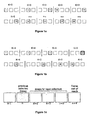
- Figures 1-6 present various examples demonstrating different embodiments of the present invention.
- the frames selected in each group for creating the image panorama are numbered in the picture, e.g. the first frame from the first group, fifth frame for the second group, etc.
- the first frame is selected as the reference frame.
- Figure 1b shows an example among others of a schematic representation of dividing the available image frames in small groups of a variable number of frames, according to an embodiment of the present invention. Number of frames in the group varies from 3 to 5 in the example of Figure 1b .
- Figure 1c shows another example among others of a schematic representation for dividing the available image frames in small groups with adaptive estimation of a variable number of frames, according to an embodiment of the present invention.
- This example can utilize a pure software approach for adaptive K estimation.
- the darkened frame has previously been selected and now the successive frames n+1 ... n+3 are candidates for being selected next.
- the frame n+4 is too far away and therefore is not included in the selection process.
- Figure 1c illustrates that the next frame for the mosaic is selected from a group of K frames that lie within a certain distance from the previously selected frame. It is important to emphasize here that this distance does not represent number of frames but rather it characterizes the displacement between one frame and the previously selected frame.
- the amount of overlap (overlapping area) between the two frames may be used as an inverse measure of the displacement between the two frames.
- the value of K is adaptively changed to ensure a minimum amount of overlap O between two consecutively selected frames. For example, if the camera is not moving at all, then the overlap between frames is always larger than O and hence the number K (or the scope for next selection) is infinite. On the other hand, if the camera is moving (e.g., panning), then the amount of overlap with respect to the previously selected frame decreases with each new frame such that at some moment it will drop below the threshold (the minimum amount of overlap) O.
- the number K (or the scope for next selection) is automatically adapted to the speed of motion, i.e., the minimum amount of overlap O is achieved in a smaller or larger number of frames as the motion is faster or slower, respectively.
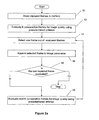
- Figure 2a shows an example of a flow chart demonstrating constructing an image panorama from a plurality of images off-line by evaluating a constant number of frames in a group (K is constant), according to an embodiment of the present invention.
- a first step 10 captured plurality of images are stored in a memory, e.g., of the electronic device.
- a next step 12 K consecutive frames are evaluated for image quality using the predetermined criterion, according to the embodiments of the present invention.
- a next step 14 one frame out of the evaluated frames is selected using the predetermined rule.
- the selected frame is appended to the image panorama. It is noted that in some systems, frame capture and selection may take too much processing time to append frames to the image panorama in real-time, immediately after selecting them. In practice the frames, that are selected to be appended to the image panorama, could be also put aside (i.e., stored) until all frames to be appended to the image panorama are selected. After that the selected frames are combined into the image panorama.
- next step 18 it is ascertain whether the last captured frame is evaluated. If that is the case, the process stops. If, however, it is ascertained that the last captured frame is not evaluated, in a next step 20 , next K consecutive frames are evaluated for image quality using the predetermined criterion and the process goes back to step 14 .
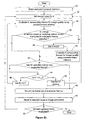
- Figure 2b shows an example of a flow chart demonstrating constructing an image panorama from a plurality of images off-line by evaluating a variable number of frames in a group (K is not constant), according to an embodiment of the present invention.
- a first step 30 captured plurality of images are stored in a memory, e.g., of the electronic device (or externally).
- K consecutive frames are evaluated for image quality using the predetermined criterion, according to the embodiments of the present invention.
- step 36 If, however, it is ascertained in step 36 that the change in motion speed or image capturing sensor motion during last K evaluated frames is not detected, in a next step 42 , it is ascertained whether the predetermined rule for the selection is met for any of the evaluated frame. If that is the case, the process goes to step 48 . If, however, it is ascertained that the predetermined rules for the selection are not met for any of the evaluated frames, in a next step 44 , it is ascertained whether the parameter K is at its maximum allowed value (e.g., predetermined value K max ).
- K max maximum allowed value
- a step 48 one frame out of the evaluated frames is selected using the predetermined rule.
- a next step 50 the selected frame is appended to the image panorama.
- a next step 52 it is ascertain whether the last captured frame is evaluated. If that is the case, the process stops. If, however, it is ascertained that the last captured frame is not evaluated, the process goes back to step 32 and the next group of consecutive frames will be evaluated.
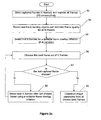
- Figure 2c shows an example of a flow chart demonstrating the construction of an image panorama from a plurality of images when the value of K is adaptively changed based on the amount of overlap between the frames, according to an embodiment of the present invention.
- a next step 54 track moving objects are detected in all N frames and the frame quality is estimated for these N frames.
- first K frames are selected for evaluation based on a suitable frame overlap criterion (K is variable).
- K is variable.
- the best frame out of K frames is chosen.
- next step 57 it is ascertained whether the last captured frame is chosen. If that is not the case, in a next step 58 , next K frames after last chosen frame are selected using a suitable frame overlap criterion and the process goes back to step 56 . If, however, it is ascertained that the last captured frame is chosen, in a next step 59 , the image panorama is constructed from all chosen best frames.
- Figure 3 shows an example of a flow chart demonstrating constructing an image panorama from a plurality of images on-line, according to an embodiment of the present invention.
- This approach has minimum memory requirements for performing panorama imaging, since only one frame should be stored in its memory at a time through the evaluation process.
- a next step 62 the first frame in the group is captured and evaluated for image quality using predetermined criterion and then stored in the memory.
- a next step 66 the next frame in the group is evaluated for image quality using the predetermined criterion.
- next step 68 it is ascertained whether the next frame has higher quality than the frame stored in the memory. If that is the case, in a next step 70 , the frame stored in memory is erased and the next frame (which is evaluated in step 66 ) is stored in the memory and the process goes to step 72 . However, if it is ascertained that the next frame does not have higher quality than the frame stored in the memory, in a next step 72 , it is ascertained whether the parameter k is at its maximum allowed value for the number of frames in the evaluation group (e.g., predetermined value K). It is noted that K can be constant or variable, according to the embodiments of the present invention as discussed above (e.g., see Figures 1a and 1b ).
- the image panorama is constructed by successively appending selected frames as they are captured by the video camera.
- some problems may occur due to geometric deformations close to the frame boundary.
- it is recommended to include into the panorama only the central part of each frame, as it is exemplified in Figure 4 .
- the highest level of the algorithm can be described as belowing to the group of algorithms that perform a select-and-append process, where the already existing part of the mosaic image is appended with frames that produce the best image quality for the whole mosaic, as illustrated in Figure 5 .
- the mosaic creation may either take the first frame as the reference frame, or choose the reference frame among the first group of K frames captured by the camera.
- Figure 6 illustrates an example among others of a block diagram of an electronic device 80 (e.g., a camera-phone) adapted for constructing an image panorama from a plurality of images, according to an embodiment of the present invention.
- the device 80 can operate on-line and off-line using images created by the image generating and processing block 82 (e.g., using camera sensor 84 and a processing block 86 ), stored in a memory 88 and process them using, e.g., the procedure outlined in the flow charts of Figure 2a , 2b or 3 .
- the electronic device 80 can operate on-line (as well as off-line) using, e.g., the receiving/sending/processing block 98 (which typically includes transmitter, receiver, CPU, etc.) to receive video frames externally and process them using, e.g., the procedure outlined in the flow chart of Figure 2a , 2b or 3 .
- the receiving/sending/processing block 98 which typically includes transmitter, receiver, CPU, etc.
- the frame quality evaluation for both off-line and on-line cases can be performed by a frame image quality evaluation module 90 which provides frame evaluation information to a frame selection block 91. After selecting the appropriate frame using the predetermined rules, the selected frame is appended to the image panorama by the image panorama construction block 94. After completion, the image panorama can be stored in the memory 88 and/or displayed on a display 96.
- a motion sensor 92 can provide information on the motion of the camera sensor 84 capturing the plurality of images used for constructing the image panorama.
- the module 90 can be also used to adjust K, the number of evaluated frames in one group, using image quality evaluation and/or input from the block 92 using, e.g., the procedure outlined in the flow chart of Figure 2b .
- the block 90 , 91 or 94 can be implemented as a software or a hardware block or a combination thereof. Furthermore, the block 90 , 91 , or 94 can be implemented as a separate block or can be combined with any other block of the electronic device 80 or it can be split into several blocks according to their functionality.
- the frame image quality evaluation module 90 can generally be means for evaluating or a structural equivalence (or an equivalent structure) thereof.
- the frame selection module 91 can generally be means for selecting or a structural equivalence (or equivalent structure) thereof
- the image panorama construction block 94 can generally be means for appending or a structural equivalence (or equivalent structure) thereof
- the embodiments of the present invention mainly address the case when the image panorama is constructed from a set of video frames rather than from a few, almost disjoint, pictures.
- the difference is that the consecutive video frames captured at normal frame rates (e.g., > 10fps) contain large overlapping areas. Because of this, it is very likely that the same portion of the scene is actually present in several consecutive frames from which only one is selected to include into the image panorama.
- This allows constructing a higher visual quality image panorama than the approaches proposed in prior art which typically combine all image frames captured from the scene. This also results in lower complexity than previous approaches since only a reduced number of image frames are used in order to create the image panorama.
- the invention provides both a method and corresponding equipment consisting of various modules providing the functionality for performing the steps of the method.
- the modules may be implemented as hardware, or may be implemented as software or firmware for execution by a computer processor.
- firmware or software the invention can be provided as a computer program product including a computer readable storage structure embodying computer program code (i.e., the software or firmware) thereon for execution by the computer processor.
Landscapes
- Engineering & Computer Science (AREA)
- Multimedia (AREA)
- Signal Processing (AREA)
- Theoretical Computer Science (AREA)
- General Physics & Mathematics (AREA)
- Physics & Mathematics (AREA)
- Computing Systems (AREA)
- Quality & Reliability (AREA)
- Computer Vision & Pattern Recognition (AREA)
- Studio Devices (AREA)
- Stereoscopic And Panoramic Photography (AREA)
- Image Processing (AREA)
- Studio Circuits (AREA)
- Editing Of Facsimile Originals (AREA)
Claims (17)
- Verfahren, das Folgendes umfasst:Ausführen einer Verarbeitung zum Aufteilen mehrerer aufgenommener Bilder in Gruppen, wobei jede Gruppe eine Anzahl aufeinanderfolgender Frames umfasst, wobei die Anzahl eine ganze Zahl von mindestens einem Wert von zwei ist;Beurteilen, für jede der Gruppen, der Bildqualität eines jeden der aufeinanderfolgenden Frames anhand eines vorgegebenen Kriteriums;Auswählen, aus jeder der Gruppen, den Frame mit der besten Bildqualität unter den beurteilten Frames, wobei der Frame anhand einer vorgegebenen Regel ausgewählt wird; undErstellen eines Bildpanoramas durch Anhängen jedes ausgewählten Frames an andere Frames mit der besten Bildqualität, die aus anderen Gruppen ausgewählt wurden,wobei das Verfahren durch eine Vorrichtung ausgeführt wird.
- Verfahren nach Anspruch 1, wobei die Anzahl eine vorgegebene Zahl eines konstanten Wertes für alle Gruppen ist.
- Verfahren nach Anspruch 1, wobei die Anzahl für die Gruppen variabel ist.
- Verfahren nach Anspruch 3, wobei die Anzahl K ist und in Reaktion auf einen Bewegungsbetrag eines Sensors, der die K aufeinanderfolgenden Frames erfasst, während des Erfassens anhand eines zuvor ausgewählten Kriteriums ausgewählt wird.
- Verfahren nach Anspruch 3, wobei der Anzahl ein Anfangswert zugewiesen wird und die Anzahl dann während des Beurteilens durch Überwachen einer relativen Bewegungsgeschwindigkeit von Merkmalen in benachbarten Frames anhand einer zuvor ausgewählten Regel iteriert wird.
- Verfahren nach Anspruch 5, wobei, anhand der zuvor ausgewählten Regel, die Anzahl um einen zuvor ausgewählten Wert erhöht wird, wenn die relative Bewegungsgeschwindigkeit kleiner als ein Schwellenwert ist, oder die Anzahl um einen weiteren zuvor ausgewählten Wert verringert wird, wenn die relative Bewegungsgeschwindigkeit größer als ein weiterer Schwellenwert ist.
- Verfahren nach Anspruch 1, wobei die mehreren Bilder in einem Speicher gespeichert werden, um das Beurteilen, Auswählen und Anhängen auszuführen.
- Verfahren nach Anspruch 1, wobei das Beurteilen, Auswählen und Anhängen durch ein elektronisches Gerät ausgeführt werden, indem auf die mehreren Bilder mittels einer Netzwerkkommunikation zugegriffen wird.
- Verfahren nach Anspruch 1, wobei während des Beurteilens der Bildqualität der Anzahl der aufeinanderfolgenden Frames nur ein Frame auf einmal in einem Speicher gespeichert wird.
- Verfahren nach Anspruch 1, wobei das Beurteilen der Bildqualität für jedes der Anzahl der aufeinanderfolgenden Frames das vorgegebene Kriterium nutzt, indem mindestens eine der folgenden vier Bildeigenschaften beurteilt wird:eine Schärfe,eine Registrierungsgenauigkeit,ein Betrag einer Überlappung mit anderen Frames,eine Art und ein Betrag einer Bewegung.
- Verfahren nach Anspruch 1, wobei das Beurteilen, Auswählen und Anhängen durch ein elektronisches Gerät ausgeführt werden, das eine Digitalkamera, ein Kommunikationsgerät, ein Drahtlos-Kommunikationsgerät, ein tragbares elektronisches Gerät, ein mobiles elektronisches Gerät oder ein Kameratelefon ist.
- Verfahren nach Anspruch 1, wobei Grenzen des ausgewählten Frames ausgeschlossen werden und im Wesentlichen nur ein mittiger Teil des ausgewählten Vollbildes an die anderen ausgewählten Frames angehängt wird.
- Verfahren nach Anspruch 1, wobei der ausgewählte Frame nach dem Auswählen gespeichert wird und erst an das Bildpanorama angehängt wird, nachdem alle Frames, die aus den mehreren Bildern an das Bildpanorama angehängt werden sollen, ausgewählt wurden.
- Verfahren nach Anspruch 1, wobei der eine Frame an zuvor ausgewählte Frames direkt nach dem Auswählen angehängt wird.
- Computerprogrammprodukt, das Folgendes umfasst: eine computerlesbare Speicherstruktur, auf der ein Computerprogrammcode verkörpert ist, um durch einen Computerprozessor mit dem Computerprogrammcode ausgeführt zu werden, wobei der Computerprogrammcode Anweisungen umfasst, um den Computerprozessor zu veranlassen, das Verfahren nach Anspruch 1 auszuführen.
- Vorrichtung, die Folgendes umfasst:ein Mittel zum Ausführen einer Verarbeitung zum Aufteilen mehrerer aufgenommener Bilder in Gruppen, wobei jede Gruppe eine Anzahl aufeinanderfolgender Frames umfasst, wobei die Anzahl eine ganze Zahl von mindestens einem Wert von zwei ist;ein Mittel zum Beurteilen, für jede der Gruppen, der Bildqualität eines jeden der aufeinanderfolgenden Frames anhand eines vorgegebenen Kriteriums;ein Mittel zum Auswählen, aus jeder der Gruppen, des Frames mit der besten Bildqualität unter den beurteilten Frames, wobei der Frame anhand einer vorgegebenen Regel ausgewählt wird; undein Mittel zum Erstellen eines Bildpanoramas durch Anhängen jedes ausgewählten Frames an andere Frames mit der besten Bildqualität, die aus anderen Gruppen ausgewählt wurden.
- Vorrichtung nach Anspruch 16, wobei das Mittel zum Beurteilen ein Frame-Bildqualitätsbeurteilungsmodul ist, das Mittel zum Auswählen ein Frameauswahlmodul ist und das Mittel zum Anhängen ein Bildpanorama-Erstellungsblock ist.
Applications Claiming Priority (2)
| Application Number | Priority Date | Filing Date | Title |
|---|---|---|---|
| US11/402,306 US7860343B2 (en) | 2006-04-10 | 2006-04-10 | Constructing image panorama using frame selection |
| PCT/IB2007/000375 WO2007116248A1 (en) | 2006-04-10 | 2007-02-15 | Constructing image panorama using frame selection |
Publications (3)
| Publication Number | Publication Date |
|---|---|
| EP2005387A1 EP2005387A1 (de) | 2008-12-24 |
| EP2005387A4 EP2005387A4 (de) | 2010-01-06 |
| EP2005387B1 true EP2005387B1 (de) | 2012-12-05 |
Family
ID=38575344
Family Applications (1)
| Application Number | Title | Priority Date | Filing Date |
|---|---|---|---|
| EP07705604A Active EP2005387B1 (de) | 2006-04-10 | 2007-02-15 | Konstruktion eines bildpanoramas unter verwendung von einzelbildauswahl |
Country Status (5)
| Country | Link |
|---|---|
| US (1) | US7860343B2 (de) |
| EP (1) | EP2005387B1 (de) |
| JP (1) | JP4653235B2 (de) |
| CN (1) | CN101421759B (de) |
| WO (1) | WO2007116248A1 (de) |
Cited By (1)
| Publication number | Priority date | Publication date | Assignee | Title |
|---|---|---|---|---|
| US9569846B2 (en) | 2013-12-18 | 2017-02-14 | Canon Kabushiki Kaisha | Ophthalmic reference image selection |
Families Citing this family (63)
| Publication number | Priority date | Publication date | Assignee | Title |
|---|---|---|---|---|
| JP2008078726A (ja) * | 2006-09-19 | 2008-04-03 | Fujifilm Corp | 静止画像抽出装置および方法並びにプログラム |
| US9936143B2 (en) | 2007-10-31 | 2018-04-03 | Google Technology Holdings LLC | Imager module with electronic shutter |
| JP5223318B2 (ja) * | 2007-12-07 | 2013-06-26 | ソニー株式会社 | 画像処理装置、画像処理方法およびプログラム |
| US8472675B2 (en) * | 2008-05-05 | 2013-06-25 | Biotronics, Inc. | Systems, methods and devices for use in filter-based assessment of carcass grading |
| WO2009137456A1 (en) * | 2008-05-05 | 2009-11-12 | Biotronics, Inc. | Systems, methods and devices for use in assessing carcass grading |
| US11119396B1 (en) | 2008-05-19 | 2021-09-14 | Spatial Cam Llc | Camera system with a plurality of image sensors |
| US8355042B2 (en) * | 2008-10-16 | 2013-01-15 | Spatial Cam Llc | Controller in a camera for creating a panoramic image |
| US10585344B1 (en) | 2008-05-19 | 2020-03-10 | Spatial Cam Llc | Camera system with a plurality of image sensors |
| US12140855B2 (en) | 2008-05-19 | 2024-11-12 | Peter Lablans | Camera system with a plurality of image sensors |
| US9307165B2 (en) * | 2008-08-08 | 2016-04-05 | Qualcomm Technologies, Inc. | In-camera panorama image stitching assistance |
| WO2010025309A1 (en) * | 2008-08-28 | 2010-03-04 | Zoran Corporation | Robust fast panorama stitching in mobile phones or cameras |
| JP4735693B2 (ja) * | 2008-09-22 | 2011-07-27 | ソニー株式会社 | 画像処理装置、撮像装置、画像処理方法およびプログラム |
| US8947502B2 (en) | 2011-04-06 | 2015-02-03 | Qualcomm Technologies, Inc. | In camera implementation of selecting and stitching frames for panoramic imagery |
| JP5352406B2 (ja) * | 2009-09-30 | 2013-11-27 | 富士フイルム株式会社 | 合成画像作成方法ならびにそのプログラムおよび情報処理装置 |
| JP5665013B2 (ja) * | 2011-04-06 | 2015-02-04 | カシオ計算機株式会社 | 画像処理装置、画像処理方法、及びプログラム |
| JP5735846B2 (ja) * | 2011-04-11 | 2015-06-17 | キヤノン株式会社 | 画像処理装置およびその方法 |
| US9088714B2 (en) | 2011-05-17 | 2015-07-21 | Apple Inc. | Intelligent image blending for panoramic photography |
| US8957944B2 (en) * | 2011-05-17 | 2015-02-17 | Apple Inc. | Positional sensor-assisted motion filtering for panoramic photography |
| US9762794B2 (en) | 2011-05-17 | 2017-09-12 | Apple Inc. | Positional sensor-assisted perspective correction for panoramic photography |
| US9247133B2 (en) | 2011-06-01 | 2016-01-26 | Apple Inc. | Image registration using sliding registration windows |
| JP5754308B2 (ja) * | 2011-09-02 | 2015-07-29 | 株式会社ニコン | 電子カメラ、画像処理装置、および画像処理プログラム |
| US8736706B1 (en) | 2012-03-13 | 2014-05-27 | Google Inc. | Method and system for generating high resolution composite images |
| US9959634B2 (en) | 2012-03-13 | 2018-05-01 | Google Llc | Method and system for identifying depth data associated with an object |
| US9392322B2 (en) | 2012-05-10 | 2016-07-12 | Google Technology Holdings LLC | Method of visually synchronizing differing camera feeds with common subject |
| US10306140B2 (en) | 2012-06-06 | 2019-05-28 | Apple Inc. | Motion adaptive image slice selection |
| US9098922B2 (en) | 2012-06-06 | 2015-08-04 | Apple Inc. | Adaptive image blending operations |
| TWI573454B (zh) | 2013-02-01 | 2017-03-01 | 宏達國際電子股份有限公司 | 電子裝置及其影像合成方法 |
| US9712746B2 (en) * | 2013-03-14 | 2017-07-18 | Microsoft Technology Licensing, Llc | Image capture and ordering |
| US9832378B2 (en) | 2013-06-06 | 2017-11-28 | Apple Inc. | Exposure mapping and dynamic thresholding for blending of multiple images using floating exposure |
| KR20150059534A (ko) * | 2013-11-22 | 2015-06-01 | 삼성전자주식회사 | 파노라마 영상 생성 방법, 상기 방법을 기록한 컴퓨터 판독 가능 저장매체 및 파노라마 영상 생성 장치. |
| US9357127B2 (en) | 2014-03-18 | 2016-05-31 | Google Technology Holdings LLC | System for auto-HDR capture decision making |
| US20150271381A1 (en) * | 2014-03-20 | 2015-09-24 | Htc Corporation | Methods and systems for determining frames and photo composition within multiple frames |
| US9774779B2 (en) * | 2014-05-21 | 2017-09-26 | Google Technology Holdings LLC | Enhanced image capture |
| US9729784B2 (en) | 2014-05-21 | 2017-08-08 | Google Technology Holdings LLC | Enhanced image capture |
| US9813611B2 (en) | 2014-05-21 | 2017-11-07 | Google Technology Holdings LLC | Enhanced image capture |
| US9628702B2 (en) | 2014-05-21 | 2017-04-18 | Google Technology Holdings LLC | Enhanced image capture |
| JP6438216B2 (ja) * | 2014-05-22 | 2018-12-12 | キヤノン株式会社 | 画像生成装置および画像生成方法 |
| US9575560B2 (en) | 2014-06-03 | 2017-02-21 | Google Inc. | Radar-based gesture-recognition through a wearable device |
| US9413947B2 (en) | 2014-07-31 | 2016-08-09 | Google Technology Holdings LLC | Capturing images of active subjects according to activity profiles |
| US9811164B2 (en) | 2014-08-07 | 2017-11-07 | Google Inc. | Radar-based gesture sensing and data transmission |
| US9778749B2 (en) | 2014-08-22 | 2017-10-03 | Google Inc. | Occluded gesture recognition |
| US11169988B2 (en) | 2014-08-22 | 2021-11-09 | Google Llc | Radar recognition-aided search |
| KR102206244B1 (ko) | 2014-08-27 | 2021-01-22 | 엘지전자 주식회사 | 디스플레이 디바이스 및 그 제어 방법 |
| JP6463047B2 (ja) * | 2014-09-05 | 2019-01-30 | キヤノン株式会社 | 眼科装置及び眼科装置の作動方法 |
| US9654700B2 (en) | 2014-09-16 | 2017-05-16 | Google Technology Holdings LLC | Computational camera using fusion of image sensors |
| US9600080B2 (en) | 2014-10-02 | 2017-03-21 | Google Inc. | Non-line-of-sight radar-based gesture recognition |
| US9420177B2 (en) * | 2014-10-10 | 2016-08-16 | IEC Infrared Systems LLC | Panoramic view imaging system with laser range finding and blind spot detection |
| CN107466389B (zh) | 2015-04-30 | 2021-02-12 | 谷歌有限责任公司 | 用于确定类型不可知的rf信号表示的方法和装置 |
| EP3885882A1 (de) | 2015-04-30 | 2021-09-29 | Google LLC | Hf-basierte mikrobewegungsverfolgung für gestenverfolgung und -erkennung |
| CN107430443B (zh) | 2015-04-30 | 2020-07-10 | 谷歌有限责任公司 | 基于宽场雷达的手势识别 |
| US10088908B1 (en) | 2015-05-27 | 2018-10-02 | Google Llc | Gesture detection and interactions |
| US9693592B2 (en) | 2015-05-27 | 2017-07-04 | Google Inc. | Attaching electronic components to interactive textiles |
| US10817065B1 (en) | 2015-10-06 | 2020-10-27 | Google Llc | Gesture recognition using multiple antenna |
| RU2632272C1 (ru) | 2016-04-04 | 2017-10-03 | Общество С Ограниченной Ответственностью "Яндекс" | Способ создания синтетического изображения |
| US10492302B2 (en) | 2016-05-03 | 2019-11-26 | Google Llc | Connecting an electronic component to an interactive textile |
| US10285456B2 (en) | 2016-05-16 | 2019-05-14 | Google Llc | Interactive fabric |
| WO2017200570A1 (en) | 2016-05-16 | 2017-11-23 | Google Llc | Interactive object with multiple electronics modules |
| US9990536B2 (en) | 2016-08-03 | 2018-06-05 | Microsoft Technology Licensing, Llc | Combining images aligned to reference frame |
| US20180121733A1 (en) * | 2016-10-27 | 2018-05-03 | Microsoft Technology Licensing, Llc | Reducing computational overhead via predictions of subjective quality of automated image sequence processing |
| CN106713741B (zh) * | 2016-11-16 | 2020-09-25 | 深圳六滴科技有限公司 | 全景视频的质量诊断方法及装置 |
| JP6929133B2 (ja) * | 2017-05-30 | 2021-09-01 | キヤノン株式会社 | 撮像装置、撮像装置の制御方法およびプログラム |
| WO2019031086A1 (ja) | 2017-08-09 | 2019-02-14 | 富士フイルム株式会社 | 画像処理システム、サーバ装置、画像処理方法、及び画像処理プログラム |
| EP4067818B1 (de) * | 2021-03-30 | 2024-08-28 | Hexagon Technology Center GmbH | Messsystem mit panoramabildaufnahmefunktionalität |
Family Cites Families (22)
| Publication number | Priority date | Publication date | Assignee | Title |
|---|---|---|---|---|
| JP3104327B2 (ja) | 1991-10-18 | 2000-10-30 | 松下電器産業株式会社 | 歪曲収差補正装置および画像合成装置 |
| US5649032A (en) * | 1994-11-14 | 1997-07-15 | David Sarnoff Research Center, Inc. | System for automatically aligning images to form a mosaic image |
| US6075905A (en) * | 1996-07-17 | 2000-06-13 | Sarnoff Corporation | Method and apparatus for mosaic image construction |
| US6356297B1 (en) * | 1998-01-15 | 2002-03-12 | International Business Machines Corporation | Method and apparatus for displaying panoramas with streaming video |
| US6807306B1 (en) * | 1999-05-28 | 2004-10-19 | Xerox Corporation | Time-constrained keyframe selection method |
| JP2000354185A (ja) * | 1999-06-10 | 2000-12-19 | Olympus Optical Co Ltd | 電子カメラ |
| US6978051B2 (en) | 2000-03-06 | 2005-12-20 | Sony Corporation | System and method for capturing adjacent images by utilizing a panorama mode |
| US6901110B1 (en) * | 2000-03-10 | 2005-05-31 | Obvious Technology | Systems and methods for tracking objects in video sequences |
| US6930703B1 (en) * | 2000-04-29 | 2005-08-16 | Hewlett-Packard Development Company, L.P. | Method and apparatus for automatically capturing a plurality of images during a pan |
| US6975352B2 (en) * | 2000-12-18 | 2005-12-13 | Xerox Corporation | Apparatus and method for capturing a composite digital image with regions of varied focus and magnification |
| JP2003198902A (ja) | 2001-12-25 | 2003-07-11 | Sony Corp | パノラマ画像生成装置 |
| GB0227565D0 (en) | 2002-11-26 | 2002-12-31 | British Telecomm | Method and system for generating panoramic images from video sequences |
| US20050063608A1 (en) * | 2003-09-24 | 2005-03-24 | Ian Clarke | System and method for creating a panorama image from a plurality of source images |
| JP4180083B2 (ja) | 2003-09-26 | 2008-11-12 | シャープ株式会社 | パノラマ画像作成装置及びパノラマ画像撮影装置 |
| EP1683346A1 (de) | 2003-10-28 | 2006-07-26 | Koninklijke Philips Electronics N.V. | Digitalkamera mit panoorama oder mosaik-funktionalität |
| US7436438B2 (en) * | 2004-03-16 | 2008-10-14 | Creative Technology Ltd. | Digital still camera and method of forming a panoramic image |
| WO2005099281A2 (en) * | 2004-03-30 | 2005-10-20 | Cernium, Inc. | Quality analysis in imaging |
| US7542588B2 (en) * | 2004-04-30 | 2009-06-02 | International Business Machines Corporation | System and method for assuring high resolution imaging of distinctive characteristics of a moving object |
| US7916173B2 (en) * | 2004-06-22 | 2011-03-29 | Canon Kabushiki Kaisha | Method for detecting and selecting good quality image frames from video |
| JP4579980B2 (ja) | 2004-07-02 | 2010-11-10 | ソニー エリクソン モバイル コミュニケーションズ, エービー | 一続きの画像の撮像 |
| US20070103544A1 (en) * | 2004-08-26 | 2007-05-10 | Naofumi Nakazawa | Panorama image creation device and panorama image imaging device |
| US7636466B2 (en) * | 2006-01-11 | 2009-12-22 | Orbotech Ltd | System and method for inspecting workpieces having microscopic features |
-
2006
- 2006-04-10 US US11/402,306 patent/US7860343B2/en active Active
-
2007
- 2007-02-15 JP JP2009504838A patent/JP4653235B2/ja active Active
- 2007-02-15 CN CN2007800128696A patent/CN101421759B/zh active Active
- 2007-02-15 EP EP07705604A patent/EP2005387B1/de active Active
- 2007-02-15 WO PCT/IB2007/000375 patent/WO2007116248A1/en not_active Ceased
Cited By (1)
| Publication number | Priority date | Publication date | Assignee | Title |
|---|---|---|---|---|
| US9569846B2 (en) | 2013-12-18 | 2017-02-14 | Canon Kabushiki Kaisha | Ophthalmic reference image selection |
Also Published As
| Publication number | Publication date |
|---|---|
| CN101421759B (zh) | 2012-06-06 |
| WO2007116248A1 (en) | 2007-10-18 |
| EP2005387A4 (de) | 2010-01-06 |
| US7860343B2 (en) | 2010-12-28 |
| US20070237423A1 (en) | 2007-10-11 |
| EP2005387A1 (de) | 2008-12-24 |
| JP4653235B2 (ja) | 2011-03-16 |
| CN101421759A (zh) | 2009-04-29 |
| JP2009533924A (ja) | 2009-09-17 |
Similar Documents
| Publication | Publication Date | Title |
|---|---|---|
| EP2005387B1 (de) | Konstruktion eines bildpanoramas unter verwendung von einzelbildauswahl | |
| CN113992861B (zh) | 一种图像处理方法及图像处理装置 | |
| US8103134B2 (en) | Method and a handheld device for capturing motion | |
| US10645290B2 (en) | Method, system and apparatus for stabilising frames of a captured video sequence | |
| US9591237B2 (en) | Automated generation of panning shots | |
| US20090161982A1 (en) | Restoring images | |
| CN103493473B (zh) | 图像处理装置、图像处理方法、图像处理程序和记录介质 | |
| KR101312895B1 (ko) | 파노라마 사진 촬영 방법 | |
| CN111553362B (zh) | 一种视频处理方法、电子设备和计算机可读存储介质 | |
| JPWO2018047687A1 (ja) | 三次元モデル生成装置及び三次元モデル生成方法 | |
| US7599568B2 (en) | Image processing method, apparatus, and program | |
| EP2103109A2 (de) | Bildstabilisierung mit mehrfachbelichtungsstruktur | |
| CN112437253B (zh) | 一种视频拼接方法、装置、系统、计算机设备和存储介质 | |
| CN105574813A (zh) | 一种图像处理方法和装置 | |
| CN110084765A (zh) | 一种图像处理方法、图像处理装置及终端设备 | |
| US8644555B2 (en) | Device and method for detecting movement of object | |
| US20070070199A1 (en) | Method and apparatus for automatically adjusting monitoring frames based on image variation | |
| CN116168045B (zh) | 扫变镜头的分割方法和系统、存储介质及电子设备 | |
| CN115330936B (zh) | 合成三维图像的方法、装置及电子设备 | |
| JP2002232838A (ja) | デジタルカメラ | |
| CN116934654A (zh) | 图像模糊度的确定方法及其相关设备 | |
| US20190114793A1 (en) | Image Registration Method and Apparatus for Terminal, and Terminal | |
| JP2002230572A (ja) | 映像効果方法と装置および画像補間方法と装置 | |
| CN114168891B (zh) | 震动图像数值化的方法、装置、终端设备及介质 | |
| CN108540728A (zh) | 长曝光拍照方法及装置 |
Legal Events
| Date | Code | Title | Description |
|---|---|---|---|
| PUAI | Public reference made under article 153(3) epc to a published international application that has entered the european phase |
Free format text: ORIGINAL CODE: 0009012 |
|
| 17P | Request for examination filed |
Effective date: 20081006 |
|
| AK | Designated contracting states |
Kind code of ref document: A1 Designated state(s): AT BE BG CH CY CZ DE DK EE ES FI FR GB GR HU IE IS IT LI LT LU LV MC NL PL PT RO SE SI SK TR |
|
| A4 | Supplementary search report drawn up and despatched |
Effective date: 20091208 |
|
| 17Q | First examination report despatched |
Effective date: 20100322 |
|
| REG | Reference to a national code |
Ref country code: DE Ref legal event code: R079 Ref document number: 602007027115 Country of ref document: DE Free format text: PREVIOUS MAIN CLASS: G06T0003000000 Ipc: G06T0007000000 |
|
| RIC1 | Information provided on ipc code assigned before grant |
Ipc: G06T 7/00 20060101AFI20120423BHEP Ipc: G06T 3/40 20060101ALI20120423BHEP |
|
| GRAJ | Information related to disapproval of communication of intention to grant by the applicant or resumption of examination proceedings by the epo deleted |
Free format text: ORIGINAL CODE: EPIDOSDIGR1 |
|
| GRAP | Despatch of communication of intention to grant a patent |
Free format text: ORIGINAL CODE: EPIDOSNIGR1 |
|
| GRAP | Despatch of communication of intention to grant a patent |
Free format text: ORIGINAL CODE: EPIDOSNIGR1 |
|
| DAX | Request for extension of the european patent (deleted) | ||
| GRAS | Grant fee paid |
Free format text: ORIGINAL CODE: EPIDOSNIGR3 |
|
| GRAA | (expected) grant |
Free format text: ORIGINAL CODE: 0009210 |
|
| AK | Designated contracting states |
Kind code of ref document: B1 Designated state(s): AT BE BG CH CY CZ DE DK EE ES FI FR GB GR HU IE IS IT LI LT LU LV MC NL PL PT RO SE SI SK TR |
|
| REG | Reference to a national code |
Ref country code: GB Ref legal event code: FG4D |
|
| REG | Reference to a national code |
Ref country code: CH Ref legal event code: EP |
|
| REG | Reference to a national code |
Ref country code: AT Ref legal event code: REF Ref document number: 587625 Country of ref document: AT Kind code of ref document: T Effective date: 20121215 |
|
| REG | Reference to a national code |
Ref country code: IE Ref legal event code: FG4D |
|
| REG | Reference to a national code |
Ref country code: DE Ref legal event code: R096 Ref document number: 602007027115 Country of ref document: DE Effective date: 20130124 |
|
| REG | Reference to a national code |
Ref country code: NL Ref legal event code: T3 |
|
| REG | Reference to a national code |
Ref country code: AT Ref legal event code: MK05 Ref document number: 587625 Country of ref document: AT Kind code of ref document: T Effective date: 20121205 |
|
| PG25 | Lapsed in a contracting state [announced via postgrant information from national office to epo] |
Ref country code: FI Free format text: LAPSE BECAUSE OF FAILURE TO SUBMIT A TRANSLATION OF THE DESCRIPTION OR TO PAY THE FEE WITHIN THE PRESCRIBED TIME-LIMIT Effective date: 20121205 Ref country code: LT Free format text: LAPSE BECAUSE OF FAILURE TO SUBMIT A TRANSLATION OF THE DESCRIPTION OR TO PAY THE FEE WITHIN THE PRESCRIBED TIME-LIMIT Effective date: 20121205 Ref country code: SE Free format text: LAPSE BECAUSE OF FAILURE TO SUBMIT A TRANSLATION OF THE DESCRIPTION OR TO PAY THE FEE WITHIN THE PRESCRIBED TIME-LIMIT Effective date: 20121205 Ref country code: ES Free format text: LAPSE BECAUSE OF FAILURE TO SUBMIT A TRANSLATION OF THE DESCRIPTION OR TO PAY THE FEE WITHIN THE PRESCRIBED TIME-LIMIT Effective date: 20130316 |
|
| REG | Reference to a national code |
Ref country code: LT Ref legal event code: MG4D |
|
| PG25 | Lapsed in a contracting state [announced via postgrant information from national office to epo] |
Ref country code: SI Free format text: LAPSE BECAUSE OF FAILURE TO SUBMIT A TRANSLATION OF THE DESCRIPTION OR TO PAY THE FEE WITHIN THE PRESCRIBED TIME-LIMIT Effective date: 20121205 Ref country code: GR Free format text: LAPSE BECAUSE OF FAILURE TO SUBMIT A TRANSLATION OF THE DESCRIPTION OR TO PAY THE FEE WITHIN THE PRESCRIBED TIME-LIMIT Effective date: 20130306 Ref country code: LV Free format text: LAPSE BECAUSE OF FAILURE TO SUBMIT A TRANSLATION OF THE DESCRIPTION OR TO PAY THE FEE WITHIN THE PRESCRIBED TIME-LIMIT Effective date: 20121205 Ref country code: PL Free format text: LAPSE BECAUSE OF FAILURE TO SUBMIT A TRANSLATION OF THE DESCRIPTION OR TO PAY THE FEE WITHIN THE PRESCRIBED TIME-LIMIT Effective date: 20121205 Ref country code: CY Free format text: LAPSE BECAUSE OF FAILURE TO SUBMIT A TRANSLATION OF THE DESCRIPTION OR TO PAY THE FEE WITHIN THE PRESCRIBED TIME-LIMIT Effective date: 20121205 |
|
| PG25 | Lapsed in a contracting state [announced via postgrant information from national office to epo] |
Ref country code: AT Free format text: LAPSE BECAUSE OF FAILURE TO SUBMIT A TRANSLATION OF THE DESCRIPTION OR TO PAY THE FEE WITHIN THE PRESCRIBED TIME-LIMIT Effective date: 20121205 |
|
| PG25 | Lapsed in a contracting state [announced via postgrant information from national office to epo] |
Ref country code: CZ Free format text: LAPSE BECAUSE OF FAILURE TO SUBMIT A TRANSLATION OF THE DESCRIPTION OR TO PAY THE FEE WITHIN THE PRESCRIBED TIME-LIMIT Effective date: 20121205 Ref country code: SK Free format text: LAPSE BECAUSE OF FAILURE TO SUBMIT A TRANSLATION OF THE DESCRIPTION OR TO PAY THE FEE WITHIN THE PRESCRIBED TIME-LIMIT Effective date: 20121205 Ref country code: BE Free format text: LAPSE BECAUSE OF FAILURE TO SUBMIT A TRANSLATION OF THE DESCRIPTION OR TO PAY THE FEE WITHIN THE PRESCRIBED TIME-LIMIT Effective date: 20121205 Ref country code: BG Free format text: LAPSE BECAUSE OF FAILURE TO SUBMIT A TRANSLATION OF THE DESCRIPTION OR TO PAY THE FEE WITHIN THE PRESCRIBED TIME-LIMIT Effective date: 20130305 Ref country code: IS Free format text: LAPSE BECAUSE OF FAILURE TO SUBMIT A TRANSLATION OF THE DESCRIPTION OR TO PAY THE FEE WITHIN THE PRESCRIBED TIME-LIMIT Effective date: 20130405 Ref country code: EE Free format text: LAPSE BECAUSE OF FAILURE TO SUBMIT A TRANSLATION OF THE DESCRIPTION OR TO PAY THE FEE WITHIN THE PRESCRIBED TIME-LIMIT Effective date: 20121205 |
|
| PG25 | Lapsed in a contracting state [announced via postgrant information from national office to epo] |
Ref country code: PT Free format text: LAPSE BECAUSE OF FAILURE TO SUBMIT A TRANSLATION OF THE DESCRIPTION OR TO PAY THE FEE WITHIN THE PRESCRIBED TIME-LIMIT Effective date: 20130405 Ref country code: RO Free format text: LAPSE BECAUSE OF FAILURE TO SUBMIT A TRANSLATION OF THE DESCRIPTION OR TO PAY THE FEE WITHIN THE PRESCRIBED TIME-LIMIT Effective date: 20121205 |
|
| PG25 | Lapsed in a contracting state [announced via postgrant information from national office to epo] |
Ref country code: MC Free format text: LAPSE BECAUSE OF NON-PAYMENT OF DUE FEES Effective date: 20130228 |
|
| REG | Reference to a national code |
Ref country code: CH Ref legal event code: PL |
|
| PLBE | No opposition filed within time limit |
Free format text: ORIGINAL CODE: 0009261 |
|
| STAA | Information on the status of an ep patent application or granted ep patent |
Free format text: STATUS: NO OPPOSITION FILED WITHIN TIME LIMIT |
|
| PG25 | Lapsed in a contracting state [announced via postgrant information from national office to epo] |
Ref country code: LI Free format text: LAPSE BECAUSE OF NON-PAYMENT OF DUE FEES Effective date: 20130228 Ref country code: DK Free format text: LAPSE BECAUSE OF FAILURE TO SUBMIT A TRANSLATION OF THE DESCRIPTION OR TO PAY THE FEE WITHIN THE PRESCRIBED TIME-LIMIT Effective date: 20121205 Ref country code: CH Free format text: LAPSE BECAUSE OF NON-PAYMENT OF DUE FEES Effective date: 20130228 |
|
| 26N | No opposition filed |
Effective date: 20130906 |
|
| REG | Reference to a national code |
Ref country code: FR Ref legal event code: ST Effective date: 20131031 |
|
| GBPC | Gb: european patent ceased through non-payment of renewal fee |
Effective date: 20130305 |
|
| REG | Reference to a national code |
Ref country code: IE Ref legal event code: MM4A |
|
| REG | Reference to a national code |
Ref country code: HU Ref legal event code: AG4A Ref document number: E017474 Country of ref document: HU |
|
| PG25 | Lapsed in a contracting state [announced via postgrant information from national office to epo] |
Ref country code: IT Free format text: LAPSE BECAUSE OF FAILURE TO SUBMIT A TRANSLATION OF THE DESCRIPTION OR TO PAY THE FEE WITHIN THE PRESCRIBED TIME-LIMIT Effective date: 20121205 |
|
| REG | Reference to a national code |
Ref country code: DE Ref legal event code: R097 Ref document number: 602007027115 Country of ref document: DE Effective date: 20130906 |
|
| PG25 | Lapsed in a contracting state [announced via postgrant information from national office to epo] |
Ref country code: IE Free format text: LAPSE BECAUSE OF NON-PAYMENT OF DUE FEES Effective date: 20130215 Ref country code: GB Free format text: LAPSE BECAUSE OF NON-PAYMENT OF DUE FEES Effective date: 20130305 Ref country code: FR Free format text: LAPSE BECAUSE OF NON-PAYMENT OF DUE FEES Effective date: 20130228 |
|
| PG25 | Lapsed in a contracting state [announced via postgrant information from national office to epo] |
Ref country code: LU Free format text: LAPSE BECAUSE OF NON-PAYMENT OF DUE FEES Effective date: 20130215 |
|
| REG | Reference to a national code |
Ref country code: DE Ref legal event code: R081 Ref document number: 602007027115 Country of ref document: DE Owner name: NOKIA TECHNOLOGIES OY, FI Free format text: FORMER OWNER: NOKIA CORP., 02610 ESPOO, FI |
|
| REG | Reference to a national code |
Ref country code: NL Ref legal event code: PD Owner name: NOKIA TECHNOLOGIES OY; FI Free format text: DETAILS ASSIGNMENT: VERANDERING VAN EIGENAAR(S), OVERDRACHT; FORMER OWNER NAME: NOKIA CORPORATION Effective date: 20151111 |
|
| PGFP | Annual fee paid to national office [announced via postgrant information from national office to epo] |
Ref country code: HU Payment date: 20160114 Year of fee payment: 10 |
|
| PG25 | Lapsed in a contracting state [announced via postgrant information from national office to epo] |
Ref country code: HU Free format text: LAPSE BECAUSE OF NON-PAYMENT OF DUE FEES Effective date: 20170216 |
|
| P01 | Opt-out of the competence of the unified patent court (upc) registered |
Effective date: 20230527 |
|
| PGFP | Annual fee paid to national office [announced via postgrant information from national office to epo] |
Ref country code: NL Payment date: 20250106 Year of fee payment: 19 |
|
| PGFP | Annual fee paid to national office [announced via postgrant information from national office to epo] |
Ref country code: DE Payment date: 20241231 Year of fee payment: 19 |
|
| PGFP | Annual fee paid to national office [announced via postgrant information from national office to epo] |
Ref country code: TR Payment date: 20250129 Year of fee payment: 19 |