EP2003643B1 - Procédé et appareil pour coder et décoder un signal audio par résolution temporelle à commutation adaptative dans le domaine spectral - Google Patents
Procédé et appareil pour coder et décoder un signal audio par résolution temporelle à commutation adaptative dans le domaine spectral Download PDFInfo
- Publication number
- EP2003643B1 EP2003643B1 EP08157415.4A EP08157415A EP2003643B1 EP 2003643 B1 EP2003643 B1 EP 2003643B1 EP 08157415 A EP08157415 A EP 08157415A EP 2003643 B1 EP2003643 B1 EP 2003643B1
- Authority
- EP
- European Patent Office
- Prior art keywords
- mdct
- transform
- length
- dct
- sections
- Prior art date
- Legal status (The legal status is an assumption and is not a legal conclusion. Google has not performed a legal analysis and makes no representation as to the accuracy of the status listed.)
- Ceased
Links
- 230000002123 temporal effect Effects 0.000 title claims description 64
- 230000003595 spectral effect Effects 0.000 title claims description 21
- 238000000034 method Methods 0.000 title claims description 19
- 230000005236 sound signal Effects 0.000 title description 15
- 230000006870 function Effects 0.000 claims description 45
- 230000011664 signaling Effects 0.000 claims description 5
- 230000003044 adaptive effect Effects 0.000 claims description 4
- 230000001131 transforming effect Effects 0.000 claims description 4
- 230000003287 optical effect Effects 0.000 claims 1
- 230000001052 transient effect Effects 0.000 description 16
- 230000007704 transition Effects 0.000 description 11
- 230000008447 perception Effects 0.000 description 4
- 238000010276 construction Methods 0.000 description 3
- 238000005192 partition Methods 0.000 description 3
- 230000009467 reduction Effects 0.000 description 3
- 230000009466 transformation Effects 0.000 description 3
- 230000015572 biosynthetic process Effects 0.000 description 2
- 230000000694 effects Effects 0.000 description 2
- 230000005284 excitation Effects 0.000 description 2
- 239000011159 matrix material Substances 0.000 description 2
- 238000003786 synthesis reaction Methods 0.000 description 2
- 238000003775 Density Functional Theory Methods 0.000 description 1
- 230000008901 benefit Effects 0.000 description 1
- 230000005540 biological transmission Effects 0.000 description 1
- 230000008859 change Effects 0.000 description 1
- 238000005056 compaction Methods 0.000 description 1
- 230000001419 dependent effect Effects 0.000 description 1
- 238000001514 detection method Methods 0.000 description 1
- 230000008569 process Effects 0.000 description 1
- 238000005070 sampling Methods 0.000 description 1
- 238000001228 spectrum Methods 0.000 description 1
- 230000000007 visual effect Effects 0.000 description 1
Images

Classifications
-
- G—PHYSICS
- G10—MUSICAL INSTRUMENTS; ACOUSTICS
- G10L—SPEECH ANALYSIS TECHNIQUES OR SPEECH SYNTHESIS; SPEECH RECOGNITION; SPEECH OR VOICE PROCESSING TECHNIQUES; SPEECH OR AUDIO CODING OR DECODING
- G10L19/00—Speech or audio signals analysis-synthesis techniques for redundancy reduction, e.g. in vocoders; Coding or decoding of speech or audio signals, using source filter models or psychoacoustic analysis
- G10L19/02—Speech or audio signals analysis-synthesis techniques for redundancy reduction, e.g. in vocoders; Coding or decoding of speech or audio signals, using source filter models or psychoacoustic analysis using spectral analysis, e.g. transform vocoders or subband vocoders
- G10L19/03—Spectral prediction for preventing pre-echo; Temporary noise shaping [TNS], e.g. in MPEG2 or MPEG4
-
- G—PHYSICS
- G10—MUSICAL INSTRUMENTS; ACOUSTICS
- G10L—SPEECH ANALYSIS TECHNIQUES OR SPEECH SYNTHESIS; SPEECH RECOGNITION; SPEECH OR VOICE PROCESSING TECHNIQUES; SPEECH OR AUDIO CODING OR DECODING
- G10L19/00—Speech or audio signals analysis-synthesis techniques for redundancy reduction, e.g. in vocoders; Coding or decoding of speech or audio signals, using source filter models or psychoacoustic analysis
- G10L19/02—Speech or audio signals analysis-synthesis techniques for redundancy reduction, e.g. in vocoders; Coding or decoding of speech or audio signals, using source filter models or psychoacoustic analysis using spectral analysis, e.g. transform vocoders or subband vocoders
- G10L19/0212—Speech or audio signals analysis-synthesis techniques for redundancy reduction, e.g. in vocoders; Coding or decoding of speech or audio signals, using source filter models or psychoacoustic analysis using spectral analysis, e.g. transform vocoders or subband vocoders using orthogonal transformation
-
- G—PHYSICS
- G10—MUSICAL INSTRUMENTS; ACOUSTICS
- G10L—SPEECH ANALYSIS TECHNIQUES OR SPEECH SYNTHESIS; SPEECH RECOGNITION; SPEECH OR VOICE PROCESSING TECHNIQUES; SPEECH OR AUDIO CODING OR DECODING
- G10L19/00—Speech or audio signals analysis-synthesis techniques for redundancy reduction, e.g. in vocoders; Coding or decoding of speech or audio signals, using source filter models or psychoacoustic analysis
- G10L19/02—Speech or audio signals analysis-synthesis techniques for redundancy reduction, e.g. in vocoders; Coding or decoding of speech or audio signals, using source filter models or psychoacoustic analysis using spectral analysis, e.g. transform vocoders or subband vocoders
-
- G—PHYSICS
- G10—MUSICAL INSTRUMENTS; ACOUSTICS
- G10L—SPEECH ANALYSIS TECHNIQUES OR SPEECH SYNTHESIS; SPEECH RECOGNITION; SPEECH OR VOICE PROCESSING TECHNIQUES; SPEECH OR AUDIO CODING OR DECODING
- G10L19/00—Speech or audio signals analysis-synthesis techniques for redundancy reduction, e.g. in vocoders; Coding or decoding of speech or audio signals, using source filter models or psychoacoustic analysis
- G10L19/02—Speech or audio signals analysis-synthesis techniques for redundancy reduction, e.g. in vocoders; Coding or decoding of speech or audio signals, using source filter models or psychoacoustic analysis using spectral analysis, e.g. transform vocoders or subband vocoders
- G10L19/022—Blocking, i.e. grouping of samples in time; Choice of analysis windows; Overlap factoring
Definitions
- the invention relates to a method and to an apparatus for encoding and decoding an audio signal using transform coding and adaptive switching of the temporal resolution in the spectral domain.
- Perceptual audio codecs make use of filter banks and MDCT (modified discrete cosine transform, a forward transform) in order to achieve a compact representation of the audio signal, i.e. a redundancy reduction, and to be able to reduce irrelevancy from the original audio signal.
- MDCT modified discrete cosine transform, a forward transform
- a high frequency or spectral resolution of the filter bank is advantageous in order to achieve a high coding gain, but this high frequency resolution is coupled to a coarse temporal resolution that becomes a problem during transient signal parts.
- a well-know consequence are audible pre-echo effects.
- US-2007/0016405 discloses a "time-split transform" in the frequency domain to improve the temporal resolution for transient signal regions.
- the time-split transform may be followed by a reduction of the window size in the time domain if the achieved results do not produce sufficient quality.
- a problem to be solved by the invention is to provide an improved coding/decoding gain by applying a high frequency resolution as well as high temporal resolution for transient audio signal parts. This problem is solved by the methods disclosed in claims 1 and 3. Apparatuses that utilise these methods are disclosed in claims 2 and 4.
- the invention achieves improved coding/decoding quality by applying on top of the output of a first filter bank a second non-uniform filter bank, i.e. a cascaded MDCT.
- the inventive codec uses switching to an additional extension filter bank (or multi-resolution filter bank) in order to regroup the time-frequency representation during transient or fast changing audio signal sections. By applying a corresponding switching control, pre-echo effects are avoided and a high coding gain is achieved.
- the inventive codec has a low coding delay (no look-ahead).
- the inventive encoding method is suited for encoding an input signal, e.g. an audio signal, using a first forward transform into the frequency domain being applied to first-length sections of said input signal, and using adaptive switching of the temporal resolution, followed by quantisation and entropy encoding of the values of the resulting frequency domain bins, wherein control of said switching, quantisation and/or entropy encoding is derived from a psycho-acoustic analysis of said input signal, including the steps of:
- the inventive encoding apparatus is suited for encoding an input signal, e.g. an audio signal, said apparatus including:
- the inventive decoding method is suited for decoding an encoded signal, e.g. an audio signal, that was encoded using a first forward transform into the frequency domain being applied to first-length sections of said input signal, wherein the temporal resolution was adaptively switched by performing a second forward transform following said first forward transform and being applied to second-length sections of said transformed first-length sections, wherein said second length is smaller than said first length and either the output values of said first forward transform or the output values of said second forward transform were processed in a quantisation and entropy encoding, and wherein control of said switching, quantisation and/or entropy encoding was derived from a psycho-acoustic analysis of said input signal and corresponding temporal resolution control information was attached to the encoding output signal as side information, said decoding method including the steps of:
- the inventive decoding apparatus is suited for decoding an encoded signal, e.g. an audio signal, that was encoded using a first forward transform into the frequency domain being applied to first-length sections of said input signal, wherein the temporal resolution was adaptively switched by performing a second forward transform following said first forward transform and being applied to second-length sections of said transformed first-length sections, wherein said second length is smaller than said first length and either the output values of said first forward transform or the output values of said second forward transform were processed in a quantisation and entropy encoding, and wherein control of said switching, quantisation and/or entropy encoding was derived from a psycho-acoustic analysis of said input signal and corresponding temporal resolution control information was attached to the encoding output signal as side information, said apparatus including:
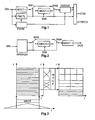
- Fig. 1 the magnitude values of each successive overlapping block or segment or section of samples of a coder input audio signal CIS are weighted by a window function and transformed in a long (i.e. a high frequency resolution) MDCT filter bank or transform stage or step MDCT-1, providing corresponding transform coefficients or frequency bins.
- a second MDCT filter bank or transform stage or step MDCT-2 is applied to the frequency bins of the first forward transform (i.e. on the same block) in order to change the frequency and temporal filter resolutions, i.e.
- a series of non-uniform MDCTs is applied to the frequency data, whereby a non-uniform time/frequency representation is generated.
- the amplitude values of each successive overlapping section of frequency bins of the first forward transform are weighted by a window function prior to the second-stage transform.
- the window functions used for the weighting are explained in connection with figures 4 to 7 and equations (3) and (4).
- the sections are 50% overlapping.
- the degree of overlapping can be different.
- that step or stage when considered alone is similar to the above-mentioned Edler codec.
- the switching on or off of the second MDCT filter bank MDCT-2 can be performed using first and second switches SW1 and SW2 and is controlled by a filter bank control unit or step FBCTL that is integrated into, or is operating in parallel to, a psycho-acoustic analyser stage or step PSYM, which both receive signal CIS.
- Stage or step PSYM uses temporal and spectral information from the input signal CIS.
- the topology or status of the 2nd stage filter MDCT-2 is coded as side information into the coder output bit stream COS.
- the frequency data output from switch SW2 is quantised and entropy encoded in a quantiser and entropy encoding stage or step QUCOD that is controlled by psycho-acoustic analyser PSYM, in particular the quantisation step sizes.
- stages QUCOD encoded frequency bins
- FBCTL topology or status information or temporal resolution control information or switching information SWI or side information
- the quantising can be replaced by inserting a distortion signal.
- the decoder input bit stream DIS is de-packed and correspondingly decoded and inversely 'quantised' (or re-quantised) in a depacking, decoding and re-quantising stage or step DPCRQU, which provides correspondingly decoded frequency bins and switching information SWI.
- a correspondingly inverse non-uniform MDCT step or stage iMDCT-2 is applied to these decoded frequency bins using e.g. switches SW3 and SW4, if so signalled by the bit stream via switching information SWI.
- the amplitude values of each successive section of inversely transformed values are weighted by a window function following the transform in step or stage iMDCT-2, which weighting is followed by an overlap-add processing.
- the signal is reconstructed by applying either to the decoded frequency bins or to the output of step or stage iMDCT-2 a correspondingly inverse high-resolution MDCT step or stage iMDCT-1.
- the amplitude values of each successive section of inversely transformed values are weighted by a window function following the transform in step or stage iMDCT-1, which weighting is followed by an overlap-add processing. Thereafter, the PCM audio decoder output signal DOS.
- the transform lengths applied at decoding side mirror the corresponding transport lengths applied at encoding side, i.e. the same block of received values is inverse transformed twice.
- the window functions used for the weighting are explained in connection with figures 4 to 7 and equations (3) and (4).
- the sections are 50% overlapping.
- the degree of overlapping can be different.
- Fig. 3 depicts the above-mentioned processing, i.e. applying first and second stage filter banks.
- On the left side a block of time domain samples is windowed and transformed in a long MDCT to the frequency domain.
- a series of non-uniform MDCTs is applied to the frequency data to generate a non-uniform time/frequency representation shown at the right side of Fig. 3 .
- the time/frequency representations are displayed in grey or hatched.
- the time/frequency representation (on the left side) of the first stage transform or filter bank MDCT-1 offers a high frequency or spectral resolution that is optimum for encoding stationary signal sections.
- Filter banks MDCT-1 and iMDCT-1 represent a constant-size MDCT and iMDCT pair with 50% overlapping blocks.
- Overlay-and-add (OLA) is used in filter bank iMDCT-1 to cancel the time domain alias. Therefore the filter bank pair MDCT-1 and iMDCT-1 is capable of theoretical perfect reconstruction.
- Fast changing signal sections, especially transient signals, are better represented in time/frequency with resolutions matching the human perception or representing a maximum signal compaction tuned to time/frequency.
- This is achieved by applying the second transform filter bank MDCT-2 onto a block of selected frequency bins of the first forward transform filter bank MDCT-1.
- the second forward transform is characterised by using 50% overlapping windows of different sizes, using transition window functions (i.e.
- 'Edler window functions' each of which having asymmetric slopes) when switching from one size to another, as shown in the medium section of Fig. 3 .
- Window sizes start from length 4 to length 2 n , wherein n is an integer number greater 2.
- a window size of '4' combines two frequency bins and doubled time resolution, a window size of 2 n combines 2 (n-1) frequency bins and increases the temporal resolution by factor 2 (n-1) .
- Special start and stop window functions are used at the beginning and at the end of the series of MDCTs.
- filter bank iMDCT-2 applies the inverse transform including OLA. Thereby the filter bank pair MDCT-2/iMDCT-2 is capable of theoretical perfect reconstruction.
- the output data of filter bank MDCT-2 is combined with single-resolution bins of filter bank MDCT-1 which were not included when applying filter bank MDCT-2.
- the output of each transform or MDCT of filter bank MDCT-2 can be interpreted as time-reversed temporal samples of the combined frequency bins of the first forward transform.
- a construction of a non-uniform time/frequency representation as depicted at the right side of Fig. 3 now becomes feasible.
- the filter bank control unit or step FBCTL performs a signal analysis of the actual processing block using time data and excitation patterns from the psycho-acoustic model in psycho-acoustic analyser stage or step PSYM.
- it switches during transient signal sections to fixed-filter topologies of filter bank MDCT-2, which filter bank may make use of a time/frequency resolution of human perception.
- filter bank MDCT-2 which filter bank may make use of a time/frequency resolution of human perception.
- only few bits of side information are required for signalling to the decoding side, as a code-book entry, the desired topology of filter bank iMDCT-2.
- the filter bank control unit or step FBCTL evaluates the spectral and temporal flatness of input signal CIS and determines a flexible filter topology of filter bank MDCT-2. In this embodiment it is sufficient to transmit to the decoder the coded starting locations of the start window, transition window and stop window positions in order to enable the construction of filter bank iMDCT-2.
- the psycho-acoustic model makes use of the high spectral resolution equivalent to the resolution of filter bank MDCT-1 and, at the same time, of a coarse spectral but high temporal resolution signal analysis. This second resolution can match the coarsest frequency resolution of filter bank MDCT-2.
- the psycho-acoustic model can also be driven directly by the output of filter bank MDCT-1, and during transient signal sections by the time/frequency representation as depicted at the right side of Fig. 3 following applying filter bank MDCT-2.
- filter bank MDCT-1 the output of filter bank MDCT-1
- transient signal sections by the time/frequency representation as depicted at the right side of Fig. 3 following applying filter bank MDCT-2.
- the Modified Discrete Cosine Transformation (MDCT) and the inverse MDCT (iMDCT) can be considered as representing a critically sampled filter bank.
- the MDCT was first named " Oddly-stacked time domain alias cancellation transform" by J.P. Princen and A.B. Bradley in "Analysis/synthesis filter bank design based on time domain aliasing cancellation", IEEE Transactions on Acoust. Speech Sig. Proc. ASSP-34 (5), pp.1153-1161, 1986 . H.S. Malvar, "Signal processing with lapped transform", Artech House Inc., Norwood, 1992 , and M. Temerinac, B.
- the inverse transform converts in each case M frequency bins to N time samples and thereafter the magnitude values are weighted by window function h(n), wherein N and M are integer numbers.
- a following overlay-add procedure cancels out the time alias.
- Edler has shown switching the MDCT time-frequency resolution using transition windows.
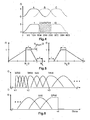
- An example of switching (caused by transient conditions) using transition windows 1, 10 from a long transform to eight short transforms is depicted in the bottom part of Fig. 4 , which shows the gain G of the window functions in vertical direction and the time, i.e. the input signal samples, in horizontal direction.
- Fig. 4 shows the gain G of the window functions in vertical direction and the time, i.e. the input signal samples, in horizontal direction.
- three successive basic window functions A, B and C as applied in steady state conditions are shown.
- the first-stage filter bank MDCT-1, iMDCT-1 is a high resolution MDCT filter bank having a sub-band filter bandwidth of e.g. 15-25 Hz. For audio sampling rates of e.g. 32-48 kHz a typical length of N L is 2048 samples.
- the window function h(n) satisfies equations (3) and (4).
- Following application of filter MDCT-1 there are 1024 frequency bins in the preferred embodiment. For stationary input signal sections, these bins are quantised according to psycho-acoustic considerations.
- Fast changing, transient input signal sections are processed by the additional MDCT applied to the bins of the first MDCT. This additional step or stage merges two, four, eight, sixteen or more sub-bands and thereby increases the temporal resolution, as depicted in the right part of Fig. 3 .
- Fig. 6 shows an example sequence of applied windowing for the second-stage MDCTs within the frequency domain. Therefore the horizontal axis is related to f/bins.
- the transition window functions are designed according to Fig. 5 and equation (6), like in the time domain.
- Special start window functions STW and stop window functions SPW handle the start and end sections of the transformed signal, i.e. the first and the last MDCT.
- the design principle of these start and stop window functions is shown in Fig. 7 .
- One half of these window functions mirrors a half-window function of a normal or regular window function NW, e.g. a sine window function according to equation (5).
- NW normal or regular window function
- the adjacent half has a continuous gain of 'one' (or a 'unity' constant) and the other half has the gain zero.
- each one of such new MDCT can be regarded as a new frequency line (bin) that has combined the original windowed bins, and the time reversed output of that new MDCT can be regarded as the new temporal blocks.
- the presentation in Figures 8 and 9 is based on this assumption or condition.
- Indices ki in Fig. 6 indicate the regions of changing temporal resolution. Frequency bins starting from position zero up to position k1 -1 are copied from (i.e. represent) the first forward transform (MDCT-1), which corresponds to a single temporal resolution. Bins from index k1- 1 to index k2 are transformed to g1 frequency lines. g1 is equal to the number of transforms performed (that number corresponds to the number of overlapping windows and can be considered as the number of frequency bins in the second or upper transform level MDCT-2). The start index is bin k1 -1 because index k1 is selected as the second sample in the first forward transform in Fig. 6 (the first sample has a zero amplitude, see also Fig. 10a ).
- the regular window size is e.g. 8 bins, which size results in a section with quadrupled temporal resolution.
- the next section in Fig. 6 is transformed by windows (transform length) spanning e.g. 16 bins, which size results in sections having eightfold temporal resolution.
- Windowing starts at bin k3 -5. If this is the last resolution selected (as is true for Fig. 6 ), then it ends at bin k4 +4, otherwise at bin k4 .
- the order (i.e. the length) of the second-stage transform is variable over successive transform blocks, starting from frequency bins corresponding to low frequency lines, the first second-stage MDCTs will start with a small order and the following second-stage MDCTs will have a higher order. Transition windows fulfilling the characteristics for perfect reconstruction are used.
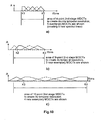
- Fig. 10 shows a sample-accurate assignment of frequency indices that mark areas of a second (i.e. cascaded) transform (MDCT-2), which second transform achieves a better temporal resolution.
- the circles represent bin positions, i.e. frequency lines of the first or initial transform (MDCT-1).
- Fig. 10a shows the area of 4-point second-stage MDCTs that are used to provide doubled temporal resolution.
- the five MDCT sections depicted create five new spectral lines.
- Fig. 10b shows the area of 8-point second-stage MDCTs that are used to provide fourfold temporal resolution.
- Three MDCT sections are depicted.
- Fig. 10c shows the area of 16-point second-stage MDCTs that are used to provide eightfold temporal resolution. Four MDCT sections are depicted.
- filter bank iMDCT-1 the iMDCT of the long transform blocks including the overlay-add procedure (OLA) to cancel the time alias.
- OLA overlay-add procedure
- the simplest embodiment makes use of a single fixed topology for filter bank MDCT-2/iMDCT-2 and signals this with a single bit in the transferred bitstream.
- a corresponding number of bits is used for signalling the currently used one of the topologies.
- More advanced embodiments pick the best out of a set of fixed code-book topologies and signal a corresponding code-book entry inside the bitstream.
- a corresponding side information is transmitted in the encoding output bitstream.
- indices k1, k2 , k3 , k4, ..., kend are transmitted.
- k2 is transmitted with the same value as in k1 equal to bin zero.
- the value transmitted in kend is copied to k4 , k3, ... .
- bi is a place holder for a frequency bin as a value.
- Topology with 1x, 2x, 4x, 8x temporal resolutions (like in Fig. 6 ) b1>1 b2 b3 b4 b4
- FIG. 8 and 9 depict two examples of multi-resolution T/F (time/frequency) energy plots of a second-stage filter bank.
- Fig. 8 shows an '8x temporal resolution only' topology.
- a time domain signal transient in Fig. 8a is depicted as amplitude over time (time expressed in samples).
- Fig. 8b shows the corresponding T/F energy plot of the first-stage MDCT (frequency in bins over normalised time corresponding to one transform block), and
- Fig. 8c shows the corresponding T/F plot of the second-stage MDCTs (8*128 time-frequency tiles).
- Fig. 9 shows a '1x 2x, 4x, 8x topology'.
- FIG. 9a is depicted as amplitude over time (time expressed in samples).
- the simplest embodiment can use any state-of-the-art transient detector to switch to a fixed topology matching, or for coming close to, the T/F resolution of human perception.
- the preferred embodiment uses a more advanced control processing:
- the topology is determined by the following steps:
- the MDCT can be replaced by a DCT, in particular a DCT-4.
- a DCT in particular a DCT-4.
- the psycho-acoustic analyser PSYM is replaced by an analyser taking into account the human visual system properties.
- the invention can be use in a watermark embedder.
- the cascaded filter bank is used with a audio watermarking system.
- a first (integer) MDCT is performed in the watermarking encoder.
- a first watermark is inserted into bins 0 to k1-1 using a psycho-acoustic controlled embedding process.
- the purpose of this watermark can be frame synchronisation at the watermark decoder.
- Second-stage variable size (integer) MDCTs are applied to bins starting from bin index k1 as described before.
- the output of this second stage is resorted to gain a time-frequency expression by interpreting the output as time-reversed temporal blocks and each second-stage MDCT as a new frequency line (bin).
- a second watermark signal is added onto each one of these new frequency lines by using an attenuation factor that is controlled by psycho-acoustic considerations.
- the data is resorted and the inverse (integer) MDCT (related to the above-mentioned second-stage MDCT) is performed as described for the above embodiments (decoder), including windowing and overlay/add.
- the full spectrum related to the first forward transform is restored.
- the full-size inverse (integer) MDCT performed onto that data, windowing and overlay/add restores a time signal with a watermark embedded.
- the multi-resolution filter bank is also used within the watermark decoder.
- the topology of the second-stage MDCTs is fixed by the application.
Landscapes
- Engineering & Computer Science (AREA)
- Physics & Mathematics (AREA)
- Spectroscopy & Molecular Physics (AREA)
- Computational Linguistics (AREA)
- Signal Processing (AREA)
- Health & Medical Sciences (AREA)
- Audiology, Speech & Language Pathology (AREA)
- Human Computer Interaction (AREA)
- Acoustics & Sound (AREA)
- Multimedia (AREA)
- Compression, Expansion, Code Conversion, And Decoders (AREA)
Claims (10)
- Procédé pour coder un signal d'entrée audio ou vidéo (CIS), à l'aide d'une première transformée TCDM ou TCDM d'entier ou TCD-4 (TCDM-1) en le domaine de fréquence appliqué aux sections de première longueur (N1) dudit signal d'entrée, et par commutation adaptative de la résolution temporelle, suivie du codage de quantification et entropique (QUCOD) des valeurs des compartiments de domaines de fréquence en résultant, dans lequel la commande (PSYM, FBCTL) de ladite commutation, et du codage de quantification et/ou entropique est dérivée d'une analyse psycho-acoustique dudit signal d'entrée, ledit procédé comprenant les étapes suivantes : commande adaptative (SW1, SW2, SWI) de ladite résolution temporelle par une deuxième transformée TCDM ou TCDM d'entier ou TCD-4 (TCDM-2) suite à de ladite première TCDM ou TCDM d'entier ou TCD-4 (TCDM-1) et appliquée aux sections de seconde longueurs (N short) desdites sections de première longueur transformées, où ladite seconde longueur est inférieure à ladite première longueur (N1) et, soit les valeurs de sortie de ladite première TCDM ou TCDM d'entier ou TCD-4, soit les valeurs de ladite seconde TCDM ou TCDM d'entier ou TCD-4 et les valeurs de sorties restantes correspondantes de ladite première TCDM ou TCDM d'entier ou TCD-4, sont traitées dans ledit codage de quantification et entropique (QUCOD), dans lequel, avant lesdites premières et secondes transformées, les valeurs d'amplitude desdites sections de première longueur et de seconde longueur sont pesées à l'aide de fonctions de fenêtre et un traitement d'addition/décalage pour lesdites sections de première longueur et de seconde longueur est appliqué, et où, pour des fenêtres transitionnelles, les valeurs d'amplitude sont pesées à l'aide de fonction de fenêtres asymétriques, et où pour lesdites sections de seconde longueur pour ledit pesage, des fonctions de fenêtre de démarrage et d'arrêt sont utilisées ;- attache (STRPCK) au signal de sortie de codage (COS) des informations de commande de résolution temporelles correspondantes (SWI) en tant qu'informations secondaires.
- Appareil pour le codage de signaux audio et vidéo d'entrée (CIS), ledit appareil comprenant :- un moyen de première transformée TCDM ou TCDM d'entier ou TCD-4 (MbCT-1) adapté pour la transformation des sections de première partie (NL) dudit signal d'entrée dans le domaine de fréquence ;- un moyen de deuxième transformée TCDM ou TCDM d'entier ou TCD-4 (TCDM-2) adapté pour la transformation des sections de seconde longueur (N short) desdites sections de première longueur transformées dans lequel ladite seconde longueur est inférieure à ladite première longueur (NL) ;- un moyen (QUCOD) adapté pour le codage de quantification et entropique des valeurs de sortie de ladite première transformée TCDM ou TCDM d'entier ou TCD-4, ou des valeurs de sortie dudit moyen de deuxième transformée TCDM ou TCDM d'entier ou TCD-4 et des valeurs de sortie restantes correspondantes dudit moyen de première transformée TCDM ou TCDM d'entier ou TCD-4 ;- un moyen (PSYM, FBCTL) adapté pour la commande dudit codage de quantification et/ou entropique et pour la commande adaptative permettant de savoir si les valeurs de sortie dudit moyen de première transformée TCDM ou TCDM d'entier ou TCD-4, ou les valeurs de sortie des moyens de deuxième transformée TCDM ou TCDM d'entier ou TCD-4 et les valeurs de sortie restantes dudit moyen de première transformée TCDM ou TCDM d'entier ou TCD-4, sont traités par lesdits moyen de codage de quantification et entropiques, où ladite commande est dérivée d'une analyse psycho-acoustique dudit signal d'entrée, où, avant les premières et secondes transformées, les valeurs d'amplitude desdites sections de première longueur et de seconde longueur sont pesées à l'aide de fonctions de fenêtre et un traitement d'addition/décalage pour lesdites sections de première longueur et de seconde longueur est appliqué et où, pour des fenêtre transitionnelles, les valeurs d'amplitude sont pesées à l'aide de fonction de fenêtre asymétriques, et où pour lesdites sections de seconde longueur pour ledit pesage, des fonctions de fenêtre de démarrage et d'arrêt sont utilisées ;- moyen (STRPCK) adapté pour attacher au signal de sortie de l'appareil de codage (COS) des informations de commande de résolution temporelle correspondantes (SWI) en tant qu'informations secondaires.
- Procédé pour décoder un signal audio ou vidéo codé (DIS) qui était codé à l'aide d'une première transformée TCDM ou TCDM d'entier ou TCD-4 (HTCD-1) en le domaine de fréquence étant appliqué aux sections de première longueur (N1) dudit signal d'entrée, où la résolution temporelle a été commutée de manière adaptative (SWI, SW2) en réalisant une deuxième transformée TCDM ou TCDM d'entier ou TCD-4 (TCDM-2) suite à ladite première transformée TCDM ou TCDM d'entier ou TCD-4 (TCDM-1) et étant appliqué aux sections de seconde longueur (N short) desdites sections de première longueur transformées, dans lequel ladite seconde longueur est inférieure à ladite première longueur (NL) et soit les valeurs de sorties de ladite première transformée TCDM ou TCDM d'entier ou TCD-q, soit les valeurs de sortie de ladite deuxième transformée TCDM ou TCDM d'entier ou TCD-4 et les valeurs de sortie restantes correspondantes de ladite première transformée TCDM ou TCDM d'entier ou TCD-4, ont été traitées dans un codage de quantification ou entropique (QUCOD), et où la commande (PSYM, FBCTL) de ladite commutation, de ladite quantification et/ou dudit codage entropique est dérivée d'une analyse psycho-acoustique dudit signal de sortie et les informations de commande de résolution temporelle correspondantes (SWI) sont attachées (STRPCK) au signal de sortie de codage (COS) en tant qu'informations secondaires, ledit procédé de codage comprenant les étapes suivantes :- fourniture (DPCRQU) à partir dudit signal codé (DIS) desdites informations secondaires (SNI);- quantification et décodage entropique inversé (DPCRQU) dudit signal codé (DIS);- correspondance avec lesdites informations secondaires, soit (SW3, SW4) effectuant une première transformée inverse TCDM ou TCDM d'entier ou TCD-4 (iTCDM-1) dans le domaine temporel, de ladite première transformée inverse TCDM ou TCDM d'entier ou TCD-4 fonctionnant sur des sections de signal de première longueur (NL) dudit signal décodé inversé de quantification et entropique et de ladite première transformée inverse TCDM ou TCDM d'entier ou TCD-4 fournissant le signal décodé (DOS), ou traitant des sections de seconde longueur (N short) dudit signal de quantification et entropique décodé de manière inverse dans une deuxième transformée inverse TCDM ou TCDM d'entier ou TCD-4 (iTCDM-2) avant d'effectuer ladite première transformée inverse TCDM ou TCDM d'entier ou TCD-4 (iTCDM-1), où, suite auxdites première et deuxième transformées inverses, les valeurs d'amplitude desdites sections de première longueur et de seconde longueur sont pesées à l'aide de fonctions de fenêtre et un traitement d'addition/décalage desdites sections de première longueur et seconde longueur est appliqué, et où, pour les fenêtres transitionnelles, les valeurs d'amplitude sont pesées à l'aide de fonctions de fenêtre asymétriques, et où, pour lesdites sections de seconde longueur, pour ladite pesée, des fonctions de fenêtre de démarrage et d'arrêt sont utilisées.
- Appareil pour décoder un signal audio ou vidéo codé (DIS) qui était codé à l'aide d'une première transformée TCDM ou TCDM d'entier ou TCD-4 (TCDM-1) en le domaine de fréquence étant appliqué aux sections de première longueur (NL) dudit signal d'entrée, où la résolution temporelle a été commutée de manière adaptative (SWI, SW2) en réalisant une deuxième transformée TCDM ou TCDM d'entier ou TCD-4 (TCDM-2) suite à ladite première transformée TCDM ou TCDM d'entier ou TCD-4 (TCDM-1) et étant appliqué aux sections de seconde longueur (N short) desdites sections de première longueur transformées, dans lesquelles ladite seconde longueur est inférieure à ladite première longueur (NL) et soit les valeurs de sortie de ladite première transformée TCDM ou TCDM d'entier ou TCD-4, soit les valeurs de sortie de ladite deuxième transformée TCDM ou TCDM d'entier ou TCD-4 et les valeurs de sortie restantes correspondantes de ladite première transformée TCDM ou TCDM d'entier ou TCD-4, ont été traitées dans un codage de quantification ou entropique (QUCOD), et où la commande (PSYM, FBCTL) de ladite commutation, de ladite quantification et/ou dudit codage entropique est dérivée d'une analyse psycho-acoustique dudit signal d'entrée et les informations de commande de résolution temporelle correspondantes (SWI) sont attachées (STRPCK) au signal de sortie de codage (COS) en tant qu'informations secondaires, ledit procédé de codage comprenant les étapes suivantes :- un moyen (DPCRQU) adapté pour fournir à partir dudit signal codé (DIS) lesdites informations secondaires (SWI) et pour ledit décodage inverse de quantification et entropique dudit signal codé ;- un moyen (iTCDM-1, iNTCD-2, S v3, SW4) adapté pour faire correspondre aux informations secondaires, soit en effectuant une première transformée inverse TCDM ou TCDM d'entier ou TCD-4 dans le domaine temporel, ladite première transformée inverse TCDM ou TCDM d'entier ou TCD-4 fonctionnant sur les sections de signal de la première partie (NL) dudit signal décodé inverse de quantification et entropique et de ladite première transformée inverse TCDM ou TCDM d'entier ou TCD-4 fournissant le signal décodé (DOS), soit en traitant les sections de seconde longueur (N short) dudit signal décodé inverse de quantification et entropique dans une deuxième transformée inverse TCDM ou TCDM d'entier ou OCT4 avant d'effectuer la première transformée inverse TCDM ou TCDM d'entier ou TCD-4, où, suite auxdites première et deuxième transformées, les valeurs d'amplitude desdites sections de première longueur et de seconde longueur sont pesées à l'aide de fonctions de fenêtre et un traitement d'addition/décalage desdites sections de première longueur et de seconde longueur est appliqué, et où pour les fenêtres transitionnelles, les valeurs d'amplitude sont pesées à l'aide de fonctions de fenêtre asymétriques, et où pour lesdites sections de seconde longueur pour ladite pesée des fonctions de fenêtre de démarrage et d'arrêt sont utilisées
- Procédé selon la revendication 1 ou 3, ou appareil selon la revendication 2 ou 4, dans lequel, au cas où, si plus d'une seconde longueur différente est utilisée, pour signaler la topologie des secondes longueurs différentes appliquées, plusieurs indices indiquant la région de la résolution temporelle modifiée, ou un numéro d'index renvoyant à une entrée correspondante à un code livre correspondant accessible du côté décodage, sont contenus dans lesdites informations secondaires.
- Procédé selon l'une des revendications 1, 3 et 5, ou appareil selon l'une des revendications 2, 4 et 5, dans lequel, si plus d'une seconde longueur différente est utilisée successivement, les longueurs augmentent en commençant au niveau des compartiments de fréquence représentant les lignes de basse fréquence.
- Procédé selon la revendication 5 ou 6, ou appareil selon la revendication 5 ou 6, dans lequel ladite topologie est déterminée par les étapes suivantes :- réalisation d'une mesure de l'uniformité du spectre SFM à l'aide d'une première transformée TCDM ou TCDM d'entier ou TCD-4 en déterminant, pour des bandes de fréquence sélectionnées, la puissance spectrale des compartiments de transformées, et en divisant la valeur arithmétique moyenne desdites valeurs de puissance spectrales par leur valeur géométrique moyenne ;- sous-segmentation d'une section de signal d'entrée non-pesée, en effectuant une pesée et des transformées courtes sur m sous-sections dans lesquelles la résolution de fréquence de ces transformées correspond auxdites bandes de fréquence sélectionnées ;- pour chaque ligne de fréquence consistant en m segments de transformée, détermination de la puissance spectrale et calcul d'une mesure de l'uniformité du spectre TFM en déterminant la moyenne arithmétique divisée par la moyenne géométrique des segments m ;- détermination des bandes tonales ou bruyantes à l'aide des valeurs SFM ;- utilisation des valeurs TFM pour reconnaître les variations temporelles de ces bandes et utilisation de valeurs seuil pour commutation vers une résolution temporelle plus précise pour lesdites bandes de fréquence bruyantes identifiées.
- Signal vidéo numérique qui a été encodé selon le procédé de l'une des revendications 1 et 5 à 7.
- Support de stockage, par exemple disque optique, qui contient ou stocke, ou a enregistré, un signal vidéo numérique selon la revendication 8.
- Utilisation du procédé selon l'une des revendications 1 et 5 à 7 dans un élément d'insertion de filigrane.
Priority Applications (1)
| Application Number | Priority Date | Filing Date | Title |
|---|---|---|---|
| EP08157415.4A EP2003643B1 (fr) | 2007-06-14 | 2008-06-02 | Procédé et appareil pour coder et décoder un signal audio par résolution temporelle à commutation adaptative dans le domaine spectral |
Applications Claiming Priority (2)
| Application Number | Priority Date | Filing Date | Title |
|---|---|---|---|
| EP07110289A EP2015293A1 (fr) | 2007-06-14 | 2007-06-14 | Procédé et appareil pour coder et décoder un signal audio par résolution temporelle à commutation adaptative dans le domaine spectral |
| EP08157415.4A EP2003643B1 (fr) | 2007-06-14 | 2008-06-02 | Procédé et appareil pour coder et décoder un signal audio par résolution temporelle à commutation adaptative dans le domaine spectral |
Publications (2)
| Publication Number | Publication Date |
|---|---|
| EP2003643A1 EP2003643A1 (fr) | 2008-12-17 |
| EP2003643B1 true EP2003643B1 (fr) | 2014-02-12 |
Family
ID=38541993
Family Applications (2)
| Application Number | Title | Priority Date | Filing Date |
|---|---|---|---|
| EP07110289A Withdrawn EP2015293A1 (fr) | 2007-06-14 | 2007-06-14 | Procédé et appareil pour coder et décoder un signal audio par résolution temporelle à commutation adaptative dans le domaine spectral |
| EP08157415.4A Ceased EP2003643B1 (fr) | 2007-06-14 | 2008-06-02 | Procédé et appareil pour coder et décoder un signal audio par résolution temporelle à commutation adaptative dans le domaine spectral |
Family Applications Before (1)
| Application Number | Title | Priority Date | Filing Date |
|---|---|---|---|
| EP07110289A Withdrawn EP2015293A1 (fr) | 2007-06-14 | 2007-06-14 | Procédé et appareil pour coder et décoder un signal audio par résolution temporelle à commutation adaptative dans le domaine spectral |
Country Status (5)
| Country | Link |
|---|---|
| US (1) | US8095359B2 (fr) |
| EP (2) | EP2015293A1 (fr) |
| JP (1) | JP5627843B2 (fr) |
| KR (1) | KR101445396B1 (fr) |
| CN (1) | CN101325060B (fr) |
Cited By (1)
| Publication number | Priority date | Publication date | Assignee | Title |
|---|---|---|---|---|
| US20250024037A1 (en) * | 2019-08-12 | 2025-01-16 | Hanwha Vision Co., Ltd. | Method and device for high-level image segmentation and image encoding/decoding |
Families Citing this family (47)
| Publication number | Priority date | Publication date | Assignee | Title |
|---|---|---|---|---|
| FR2894759A1 (fr) * | 2005-12-12 | 2007-06-15 | Nextamp Sa | Procede et dispositif de tatouage sur flux |
| PT3550564T (pt) * | 2007-08-27 | 2020-08-18 | Ericsson Telefon Ab L M | Análise/síntese espectral de baixa complexidade utilizando resolução temporal selecionável |
| KR101325335B1 (ko) * | 2008-07-11 | 2013-11-08 | 프라운호퍼-게젤샤프트 추르 푀르데룽 데어 안제반텐 포르슝 에 파우 | 오디오 샘플 인코드 및 디코드용 오디오 인코더 및 디코더 |
| JP5606433B2 (ja) | 2008-07-11 | 2014-10-15 | フラウンホーファー−ゲゼルシャフト・ツール・フェルデルング・デル・アンゲヴァンテン・フォルシュング・アインゲトラーゲネル・フェライン | オーディオエンコーダ及びオーディオデコーダ |
| WO2010032992A2 (fr) | 2008-09-18 | 2010-03-25 | 한국전자통신연구원 | Appareil de codage et appareil de décodage permettant de passer d’un codeur basé sur une transformée en cosinus discrète modifiée à un hétérocodeur, et inversement |
| WO2010086373A2 (fr) * | 2009-01-28 | 2010-08-05 | Fraunhofer-Gesellschaft zur Förderung der angewandten Forschung e.V. | Encodeur audio, décodeur audio, informations audio encodées, procédés d'encodage et de décodage d'un signal audio et programme d'ordinateur |
| CN101527139B (zh) * | 2009-02-16 | 2012-03-28 | 成都九洲电子信息系统股份有限公司 | 一种音频编码解码方法及其装置 |
| CN102265338A (zh) * | 2009-03-24 | 2011-11-30 | 华为技术有限公司 | 信号延时切换的方法和装置 |
| US20110087494A1 (en) * | 2009-10-09 | 2011-04-14 | Samsung Electronics Co., Ltd. | Apparatus and method of encoding audio signal by switching frequency domain transformation scheme and time domain transformation scheme |
| ES3051142T3 (en) | 2009-10-21 | 2025-12-26 | Dolby Int Ab | Oversampling in a combined transposer filter bank |
| US9279839B2 (en) * | 2009-11-12 | 2016-03-08 | Digital Harmonic Llc | Domain identification and separation for precision measurement of waveforms |
| US9390066B2 (en) * | 2009-11-12 | 2016-07-12 | Digital Harmonic Llc | Precision measurement of waveforms using deconvolution and windowing |
| CN102081926B (zh) * | 2009-11-27 | 2013-06-05 | 中兴通讯股份有限公司 | 格型矢量量化音频编解码方法和系统 |
| BR112012022741B1 (pt) | 2010-03-10 | 2021-09-21 | Fraunhofer-Gesellschaft Zur Fõrderung Der Angewandten Forschung E.V. | Decodificador de sinal de áudio, codificador de sinal de áudio e métodos utilizando uma codificação de contorno da deformação no tempo dependente da taxa de amostragem |
| KR101790373B1 (ko) | 2010-06-14 | 2017-10-25 | 파나소닉 주식회사 | 오디오 하이브리드 부호화 장치 및 오디오 하이브리드 복호 장치 |
| CA3025108C (fr) | 2010-07-02 | 2020-10-27 | Dolby International Ab | Decodage audio avec post-filtrage selectifeurs ou codeurs |
| WO2012070866A2 (fr) * | 2010-11-24 | 2012-05-31 | 엘지전자 주식회사 | Procédé de codage de signal de parole et procédé de décodage de signal de parole |
| KR20150032614A (ko) * | 2012-06-04 | 2015-03-27 | 삼성전자주식회사 | 오디오 부호화방법 및 장치, 오디오 복호화방법 및 장치, 및 이를 채용하는 멀티미디어 기기 |
| EP4336501A3 (fr) * | 2013-01-29 | 2024-05-22 | Fraunhofer-Gesellschaft zur Förderung der angewandten Forschung e.V. | Codeur audio, procédé et programme informatique utilisant une résolution temporelle accrue dans la proximité temporelle d'apparitions ou de décalages de friandises ou d'affricates |
| AU2014220725B2 (en) | 2013-02-20 | 2016-11-17 | Fraunhofer-Gesellschaft Zur Foerderung Der Angewandten Forschung E.V. | Apparatus and method for encoding or decoding an audio signal using a transient-location dependent overlap |
| KR102383819B1 (ko) | 2013-04-05 | 2022-04-08 | 돌비 인터네셔널 에이비 | 오디오 인코더 및 디코더 |
| EP2804176A1 (fr) * | 2013-05-13 | 2014-11-19 | Fraunhofer-Gesellschaft zur Förderung der angewandten Forschung e.V. | Séparation d'un objet audio d'un signal de mélange utilisant des résolutions de temps/fréquence spécifiques à l'objet |
| DE112013007199B4 (de) * | 2013-06-26 | 2017-08-10 | University Of Ottawa | Verfahren, Steuervorrichtung und Rechnervorrichtung zum mehrfachauflösungsbasierten Schätzen einer spektralen Leistungsdichte |
| EP2830058A1 (fr) | 2013-07-22 | 2015-01-28 | Fraunhofer-Gesellschaft zur Förderung der angewandten Forschung e.V. | Codage audio en domaine de fréquence supportant la commutation de longueur de transformée |
| MX395108B (es) | 2013-10-18 | 2025-03-24 | Ericsson Telefon Ab L M | Codificacion y decodificacion de posiciones de picos espectrales. |
| CN105451842B (zh) | 2014-07-28 | 2019-06-11 | 弗劳恩霍夫应用研究促进协会 | 选择第一编码演算法和第二编码演算法之一的装置与方法 |
| EP2980795A1 (fr) | 2014-07-28 | 2016-02-03 | Fraunhofer-Gesellschaft zur Förderung der angewandten Forschung e.V. | Codage et décodage audio à l'aide d'un processeur de domaine fréquentiel, processeur de domaine temporel et processeur transversal pour l'initialisation du processeur de domaine temporel |
| EP2980794A1 (fr) | 2014-07-28 | 2016-02-03 | Fraunhofer-Gesellschaft zur Förderung der angewandten Forschung e.V. | Codeur et décodeur audio utilisant un processeur du domaine fréquentiel et processeur de domaine temporel |
| EP2980798A1 (fr) * | 2014-07-28 | 2016-02-03 | Fraunhofer-Gesellschaft zur Förderung der angewandten Forschung e.V. | Commande dépendant de l'harmonicité d'un outil de filtre d'harmoniques |
| CN104538038B (zh) * | 2014-12-11 | 2017-10-17 | 清华大学 | 具有鲁棒性的音频水印嵌入和提取方法及装置 |
| EP3067889A1 (fr) | 2015-03-09 | 2016-09-14 | Fraunhofer-Gesellschaft zur Förderung der angewandten Forschung e.V. | Procédé et appareil de commutation de noyau de transformée adaptive de signal en codage audio |
| CN105280190B (zh) * | 2015-09-16 | 2018-11-23 | 深圳广晟信源技术有限公司 | 带宽扩展编码和解码方法以及装置 |
| US10504530B2 (en) | 2015-11-03 | 2019-12-10 | Dolby Laboratories Licensing Corporation | Switching between transforms |
| EP3276620A1 (fr) | 2016-07-29 | 2018-01-31 | Fraunhofer-Gesellschaft zur Förderung der angewandten Forschung e.V. | Réduction de repliement de domaine temporel des bancs de filtres non-uniformes utilisant l'analyse spectrale suivie par synthèse partielle |
| EP3382701A1 (fr) | 2017-03-31 | 2018-10-03 | Fraunhofer-Gesellschaft zur Förderung der angewandten Forschung e.V. | Appareil et procédé de post-traitement d'un signal audio à l'aide d'une mise en forme à base de prédiction |
| CN110870006B (zh) * | 2017-04-28 | 2023-09-22 | Dts公司 | 对音频信号进行编码的方法以及音频编码器 |
| EP3483884A1 (fr) | 2017-11-10 | 2019-05-15 | Fraunhofer-Gesellschaft zur Förderung der angewandten Forschung e.V. | Filtrage de signal |
| EP3483878A1 (fr) | 2017-11-10 | 2019-05-15 | Fraunhofer-Gesellschaft zur Förderung der angewandten Forschung e.V. | Décodeur audio supportant un ensemble de différents outils de dissimulation de pertes |
| EP3483880A1 (fr) | 2017-11-10 | 2019-05-15 | Fraunhofer-Gesellschaft zur Förderung der angewandten Forschung e.V. | Mise en forme de bruit temporel |
| EP3483879A1 (fr) | 2017-11-10 | 2019-05-15 | Fraunhofer-Gesellschaft zur Förderung der angewandten Forschung e.V. | Fonction de fenêtrage d'analyse/de synthèse pour une transformation chevauchante modulée |
| EP3483886A1 (fr) | 2017-11-10 | 2019-05-15 | Fraunhofer-Gesellschaft zur Förderung der angewandten Forschung e.V. | Sélection de délai tonal |
| WO2019091573A1 (fr) | 2017-11-10 | 2019-05-16 | Fraunhofer-Gesellschaft zur Förderung der angewandten Forschung e.V. | Appareil et procédé de codage et de décodage d'un signal audio utilisant un sous-échantillonnage ou une interpolation de paramètres d'échelle |
| EP3483883A1 (fr) | 2017-11-10 | 2019-05-15 | Fraunhofer-Gesellschaft zur Förderung der angewandten Forschung e.V. | Codage et décodage de signaux audio avec postfiltrage séléctif |
| WO2019091576A1 (fr) | 2017-11-10 | 2019-05-16 | Fraunhofer-Gesellschaft zur Förderung der angewandten Forschung e.V. | Codeurs audio, décodeurs audio, procédés et programmes informatiques adaptant un codage et un décodage de bits les moins significatifs |
| EP3483882A1 (fr) | 2017-11-10 | 2019-05-15 | Fraunhofer-Gesellschaft zur Förderung der angewandten Forschung e.V. | Contrôle de la bande passante dans des codeurs et/ou des décodeurs |
| EP3644313A1 (fr) * | 2018-10-26 | 2020-04-29 | Fraunhofer Gesellschaft zur Förderung der Angewand | Codage audio perceptuel comportant un pavage adaptatif de temps/fréquence non uniforme par fusion de sous-bandes et par réduction de repliement dans le domaine temporel |
| EP4602596A1 (fr) * | 2022-10-20 | 2025-08-20 | Google LLC | Codage audio basé sur une dct non fenêtrée à l'aide d'une quantification avancée |
Family Cites Families (21)
| Publication number | Priority date | Publication date | Assignee | Title |
|---|---|---|---|---|
| WO1995001633A1 (fr) * | 1993-06-30 | 1995-01-12 | Sony Corporation | Procede et appareil de codage de signaux numeriques, procede et appareil de decodage des signaux codes, et support d'enregistrement des signaux codes |
| DE69427222T2 (de) * | 1993-10-08 | 2001-08-30 | Sony Corp., Tokio/Tokyo | Digitaler signalprozessor, verfahren zum verarbeiten digitaler signale und medium zum aufnehmen von signalen |
| JPH08162964A (ja) * | 1994-12-08 | 1996-06-21 | Sony Corp | 情報圧縮装置及び方法、情報伸張装置及び方法、並びに記録媒体 |
| JP3418305B2 (ja) * | 1996-03-19 | 2003-06-23 | ルーセント テクノロジーズ インコーポレーテッド | オーディオ信号を符号化する方法および装置および知覚的に符号化されたオーディオ信号を処理する装置 |
| US6115689A (en) * | 1998-05-27 | 2000-09-05 | Microsoft Corporation | Scalable audio coder and decoder |
| US6029126A (en) | 1998-06-30 | 2000-02-22 | Microsoft Corporation | Scalable audio coder and decoder |
| US6253165B1 (en) * | 1998-06-30 | 2001-06-26 | Microsoft Corporation | System and method for modeling probability distribution functions of transform coefficients of encoded signal |
| JP3806770B2 (ja) * | 2000-03-17 | 2006-08-09 | 松下電器産業株式会社 | 窓処理装置および窓処理方法 |
| DE10217297A1 (de) * | 2002-04-18 | 2003-11-06 | Fraunhofer Ges Forschung | Vorrichtung und Verfahren zum Codieren eines zeitdiskreten Audiosignals und Vorrichtung und Verfahren zum Decodieren von codierten Audiodaten |
| TW594674B (en) * | 2003-03-14 | 2004-06-21 | Mediatek Inc | Encoder and a encoding method capable of detecting audio signal transient |
| DE10328777A1 (de) * | 2003-06-25 | 2005-01-27 | Coding Technologies Ab | Vorrichtung und Verfahren zum Codieren eines Audiosignals und Vorrichtung und Verfahren zum Decodieren eines codierten Audiosignals |
| CN1460992A (zh) * | 2003-07-01 | 2003-12-10 | 北京阜国数字技术有限公司 | 用于感知音频编/解码的低延时、自适应的多分辨率滤波器组 |
| US20050143979A1 (en) * | 2003-12-26 | 2005-06-30 | Lee Mi S. | Variable-frame speech coding/decoding apparatus and method |
| KR100651731B1 (ko) * | 2003-12-26 | 2006-12-01 | 한국전자통신연구원 | 가변 프레임 음성 부호화/복호화 장치 및 그 방법 |
| US7516064B2 (en) * | 2004-02-19 | 2009-04-07 | Dolby Laboratories Licensing Corporation | Adaptive hybrid transform for signal analysis and synthesis |
| DE102004021403A1 (de) * | 2004-04-30 | 2005-11-24 | Fraunhofer-Gesellschaft zur Förderung der angewandten Forschung e.V. | Informationssignalverarbeitung durch Modifikation in der Spektral-/Modulationsspektralbereichsdarstellung |
| DE102004021404B4 (de) * | 2004-04-30 | 2007-05-10 | Fraunhofer-Gesellschaft zur Förderung der angewandten Forschung e.V. | Wasserzeicheneinbettung |
| US7630902B2 (en) * | 2004-09-17 | 2009-12-08 | Digital Rise Technology Co., Ltd. | Apparatus and methods for digital audio coding using codebook application ranges |
| US7546240B2 (en) * | 2005-07-15 | 2009-06-09 | Microsoft Corporation | Coding with improved time resolution for selected segments via adaptive block transformation of a group of samples from a subband decomposition |
| US7516074B2 (en) * | 2005-09-01 | 2009-04-07 | Auditude, Inc. | Extraction and matching of characteristic fingerprints from audio signals |
| JPWO2007088853A1 (ja) * | 2006-01-31 | 2009-06-25 | パナソニック株式会社 | 音声符号化装置、音声復号装置、音声符号化システム、音声符号化方法及び音声復号方法 |
-
2007
- 2007-06-14 EP EP07110289A patent/EP2015293A1/fr not_active Withdrawn
-
2008
- 2008-06-02 EP EP08157415.4A patent/EP2003643B1/fr not_active Ceased
- 2008-06-04 US US12/156,748 patent/US8095359B2/en not_active Expired - Fee Related
- 2008-06-12 JP JP2008154011A patent/JP5627843B2/ja not_active Expired - Fee Related
- 2008-06-13 CN CN2008101113001A patent/CN101325060B/zh not_active Expired - Fee Related
- 2008-06-13 KR KR1020080055986A patent/KR101445396B1/ko not_active Expired - Fee Related
Cited By (2)
| Publication number | Priority date | Publication date | Assignee | Title |
|---|---|---|---|---|
| US20250024037A1 (en) * | 2019-08-12 | 2025-01-16 | Hanwha Vision Co., Ltd. | Method and device for high-level image segmentation and image encoding/decoding |
| US12634456B2 (en) * | 2019-08-12 | 2026-05-19 | Hanwha Vision Co., Ltd. | Method and device for high-level image segmentation and image encoding/decoding |
Also Published As
| Publication number | Publication date |
|---|---|
| EP2003643A1 (fr) | 2008-12-17 |
| CN101325060A (zh) | 2008-12-17 |
| US8095359B2 (en) | 2012-01-10 |
| EP2015293A1 (fr) | 2009-01-14 |
| JP5627843B2 (ja) | 2014-11-19 |
| KR101445396B1 (ko) | 2014-09-26 |
| CN101325060B (zh) | 2012-10-31 |
| US20090012797A1 (en) | 2009-01-08 |
| JP2008310327A (ja) | 2008-12-25 |
| KR20080110542A (ko) | 2008-12-18 |
Similar Documents
| Publication | Publication Date | Title |
|---|---|---|
| EP2003643A1 (fr) | Procédé et appareil pour coder et décoder un signal audio par résolution temporelle à commutation adaptative dans le domaine spectral | |
| EP2186088B1 (fr) | Analyse/synthèse spectrale de faible complexité faisant appel à une résolution temporelle sélectionnable | |
| EP2301020B1 (fr) | Dispositif et procédé d encodage/de décodage d'un signal audio utilisant une méthode de commutation à repliement | |
| JP4081447B2 (ja) | 時間離散オーディオ信号を符号化する装置と方法および符号化されたオーディオデータを復号化する装置と方法 | |
| EP2959482B1 (fr) | Appareil et procédé de codage ou de décodage d'un signal audio au moyen d'un chevauchement dépendant d'un emplacement de transitoire | |
| US7343287B2 (en) | Method and apparatus for scalable encoding and method and apparatus for scalable decoding | |
| Geiger et al. | Audio coding based on integer transforms | |
| US7512539B2 (en) | Method and device for processing time-discrete audio sampled values | |
| CN101086845B (zh) | 声音编码装置及方法以及声音解码装置及方法 | |
| JP5400143B2 (ja) | オーバーラッピング変換の2つのブロック変換への因数分解 | |
| US6678647B1 (en) | Perceptual coding of audio signals using cascaded filterbanks for performing irrelevancy reduction and redundancy reduction with different spectral/temporal resolution | |
| AU2023282303B2 (en) | Improved Harmonic Transposition | |
| US20090006081A1 (en) | Method, medium and apparatus for encoding and/or decoding signal | |
| AU2015221516A1 (en) | Improved Harmonic Transposition | |
| HK1155842B (en) | Apparatus and method for encoding/decoding an audio signal using an aliasing switch scheme |
Legal Events
| Date | Code | Title | Description |
|---|---|---|---|
| PUAI | Public reference made under article 153(3) epc to a published international application that has entered the european phase |
Free format text: ORIGINAL CODE: 0009012 |
|
| AK | Designated contracting states |
Kind code of ref document: A1 Designated state(s): AT BE BG CH CY CZ DE DK EE ES FI FR GB GR HR HU IE IS IT LI LT LU LV MC MT NL NO PL PT RO SE SI SK TR |
|
| AX | Request for extension of the european patent |
Extension state: AL BA MK RS |
|
| 17P | Request for examination filed |
Effective date: 20090516 |
|
| 17Q | First examination report despatched |
Effective date: 20090619 |
|
| AKX | Designation fees paid |
Designated state(s): DE FR GB |
|
| RAP1 | Party data changed (applicant data changed or rights of an application transferred) |
Owner name: THOMSON LICENSING |
|
| REG | Reference to a national code |
Ref country code: DE Ref legal event code: R079 Ref document number: 602008030229 Country of ref document: DE Free format text: PREVIOUS MAIN CLASS: G10L0019020000 Ipc: G10L0019022000 |
|
| RIC1 | Information provided on ipc code assigned before grant |
Ipc: G10L 19/02 20130101ALI20130514BHEP Ipc: G10L 19/093 20130101ALI20130514BHEP Ipc: G10L 19/022 20130101AFI20130514BHEP |
|
| GRAP | Despatch of communication of intention to grant a patent |
Free format text: ORIGINAL CODE: EPIDOSNIGR1 |
|
| INTG | Intention to grant announced |
Effective date: 20130704 |
|
| GRAP | Despatch of communication of intention to grant a patent |
Free format text: ORIGINAL CODE: EPIDOSNIGR1 |
|
| INTG | Intention to grant announced |
Effective date: 20130909 |
|
| GRAS | Grant fee paid |
Free format text: ORIGINAL CODE: EPIDOSNIGR3 |
|
| GRAA | (expected) grant |
Free format text: ORIGINAL CODE: 0009210 |
|
| AK | Designated contracting states |
Kind code of ref document: B1 Designated state(s): DE FR GB |
|
| REG | Reference to a national code |
Ref country code: GB Ref legal event code: FG4D |
|
| REG | Reference to a national code |
Ref country code: DE Ref legal event code: R084 Ref document number: 602008030229 Country of ref document: DE |
|
| REG | Reference to a national code |
Ref country code: DE Ref legal event code: R096 Ref document number: 602008030229 Country of ref document: DE Effective date: 20140327 |
|
| REG | Reference to a national code |
Ref country code: DE Ref legal event code: R084 Ref document number: 602008030229 Country of ref document: DE Effective date: 20140304 |
|
| REG | Reference to a national code |
Ref country code: DE Ref legal event code: R097 Ref document number: 602008030229 Country of ref document: DE |
|
| PLBE | No opposition filed within time limit |
Free format text: ORIGINAL CODE: 0009261 |
|
| STAA | Information on the status of an ep patent application or granted ep patent |
Free format text: STATUS: NO OPPOSITION FILED WITHIN TIME LIMIT |
|
| 26N | No opposition filed |
Effective date: 20141113 |
|
| GBPC | Gb: european patent ceased through non-payment of renewal fee |
Effective date: 20140602 |
|
| REG | Reference to a national code |
Ref country code: DE Ref legal event code: R097 Ref document number: 602008030229 Country of ref document: DE Effective date: 20141113 |
|
| PG25 | Lapsed in a contracting state [announced via postgrant information from national office to epo] |
Ref country code: GB Free format text: LAPSE BECAUSE OF NON-PAYMENT OF DUE FEES Effective date: 20140602 |
|
| REG | Reference to a national code |
Ref country code: FR Ref legal event code: PLFP Year of fee payment: 8 |
|
| REG | Reference to a national code |
Ref document number: 602008030229 Representative=s name: HERNANDEZ, YORCK, DIPL.-ING., DE Ref country code: DE Ref legal event code: R082 Ref document number: 602008030229 Country of ref document: DE Representative=s name: DEHNS GERMANY, DE Ref country code: DE Ref legal event code: R082 Country of ref document: DE Ref country code: DE Ref legal event code: R082 Ref document number: 602008030229 Country of ref document: DE Representative=s name: DEHNS, DE Ref country code: DE Ref legal event code: R082 Ref document number: 602008030229 Country of ref document: DE Representative=s name: KASTEL PATENTANWAELTE, DE |
|
| REG | Reference to a national code |
Ref country code: DE Ref legal event code: R082 Ref document number: 602008030229 Country of ref document: DE Representative=s name: HERNANDEZ, YORCK, DIPL.-ING., DE Ref country code: DE Ref legal event code: R082 Ref document number: 602008030229 Country of ref document: DE Representative=s name: DEHNS GERMANY, DE Ref country code: DE Ref legal event code: R082 Ref document number: 602008030229 Country of ref document: DE Representative=s name: DEHNS, DE |
|
| REG | Reference to a national code |
Ref country code: FR Ref legal event code: PLFP Year of fee payment: 9 |
|
| REG | Reference to a national code |
Ref country code: FR Ref legal event code: PLFP Year of fee payment: 10 |
|
| REG | Reference to a national code |
Ref country code: DE Ref legal event code: R081 Ref document number: 602008030229 Country of ref document: DE Owner name: GUANGDONG OPPO MOBILE TELECOMMUNICATIONS CORP., CN Free format text: FORMER OWNER: THOMSON LICENSING, ISSY-LES-MOULINEAUX, FR Ref country code: DE Ref legal event code: R082 Ref document number: 602008030229 Country of ref document: DE Representative=s name: HERNANDEZ, YORCK, DIPL.-ING., DE Ref country code: DE Ref legal event code: R081 Ref document number: 602008030229 Country of ref document: DE Owner name: DOLBY INTERNATIONAL AB, NL Free format text: FORMER OWNER: THOMSON LICENSING, ISSY-LES-MOULINEAUX, FR |
|
| REG | Reference to a national code |
Ref country code: FR Ref legal event code: TP Owner name: DOLBY INTERNATIONAL AB, NL Effective date: 20180423 |
|
| REG | Reference to a national code |
Ref country code: FR Ref legal event code: PLFP Year of fee payment: 11 |
|
| REG | Reference to a national code |
Ref country code: DE Ref legal event code: R082 Ref document number: 602008030229 Country of ref document: DE Representative=s name: HERNANDEZ, YORCK, DIPL.-ING., DE Ref country code: DE Ref legal event code: R081 Ref document number: 602008030229 Country of ref document: DE Owner name: GUANGDONG OPPO MOBILE TELECOMMUNICATIONS CORP., CN Free format text: FORMER OWNER: DOLBY INTERNATIONAL AB, AMSTERDAM, NL |
|
| PGFP | Annual fee paid to national office [announced via postgrant information from national office to epo] |
Ref country code: DE Payment date: 20210616 Year of fee payment: 14 Ref country code: FR Payment date: 20210630 Year of fee payment: 14 |
|
| REG | Reference to a national code |
Ref country code: DE Ref legal event code: R119 Ref document number: 602008030229 Country of ref document: DE |
|
| PG25 | Lapsed in a contracting state [announced via postgrant information from national office to epo] |
Ref country code: FR Free format text: LAPSE BECAUSE OF NON-PAYMENT OF DUE FEES Effective date: 20220630 |
|
| PG25 | Lapsed in a contracting state [announced via postgrant information from national office to epo] |
Ref country code: DE Free format text: LAPSE BECAUSE OF NON-PAYMENT OF DUE FEES Effective date: 20230103 |
|
| P01 | Opt-out of the competence of the unified patent court (upc) registered |
Effective date: 20230412 |