EP2003102A9 - Composter. - Google Patents
Composter. Download PDFInfo
- Publication number
- EP2003102A9 EP2003102A9 EP20070730493 EP07730493A EP2003102A9 EP 2003102 A9 EP2003102 A9 EP 2003102A9 EP 20070730493 EP20070730493 EP 20070730493 EP 07730493 A EP07730493 A EP 07730493A EP 2003102 A9 EP2003102 A9 EP 2003102A9
- Authority
- EP
- European Patent Office
- Prior art keywords
- composter
- plastic
- compost
- waste
- panels
- Prior art date
- Legal status (The legal status is an assumption and is not a legal conclusion. Google has not performed a legal analysis and makes no representation as to the accuracy of the status listed.)
- Withdrawn
Links
- 239000004033 plastic Substances 0.000 claims abstract description 27
- 229920003023 plastic Polymers 0.000 claims abstract description 27
- 239000000463 material Substances 0.000 claims abstract description 15
- 239000002699 waste material Substances 0.000 claims abstract description 15
- 239000004411 aluminium Substances 0.000 claims abstract description 6
- 229910052782 aluminium Inorganic materials 0.000 claims abstract description 6
- XAGFODPZIPBFFR-UHFFFAOYSA-N aluminium Chemical compound [Al] XAGFODPZIPBFFR-UHFFFAOYSA-N 0.000 claims abstract description 6
- 239000011111 cardboard Substances 0.000 claims abstract description 6
- 239000004744 fabric Substances 0.000 claims abstract description 6
- 239000000123 paper Substances 0.000 claims abstract description 6
- 239000005020 polyethylene terephthalate Substances 0.000 claims abstract description 6
- 238000003825 pressing Methods 0.000 claims abstract description 5
- 239000010815 organic waste Substances 0.000 claims abstract description 4
- 239000002361 compost Substances 0.000 claims description 17
- 229920000098 polyolefin Polymers 0.000 claims description 7
- 239000000203 mixture Substances 0.000 claims description 6
- -1 polypropylene Polymers 0.000 claims description 6
- 229920001903 high density polyethylene Polymers 0.000 claims description 5
- 239000004700 high-density polyethylene Substances 0.000 claims description 5
- 239000004698 Polyethylene Substances 0.000 claims description 4
- 239000004743 Polypropylene Substances 0.000 claims description 3
- 229920000573 polyethylene Polymers 0.000 claims description 3
- 229920001155 polypropylene Polymers 0.000 claims description 3
- 230000002441 reversible effect Effects 0.000 claims description 3
- 210000000078 claw Anatomy 0.000 description 8
- 238000004519 manufacturing process Methods 0.000 description 5
- 239000005416 organic matter Substances 0.000 description 5
- 238000004064 recycling Methods 0.000 description 5
- 238000005273 aeration Methods 0.000 description 3
- 238000009264 composting Methods 0.000 description 3
- 239000003337 fertilizer Substances 0.000 description 3
- 238000000034 method Methods 0.000 description 3
- 235000013311 vegetables Nutrition 0.000 description 3
- 239000003599 detergent Substances 0.000 description 2
- 244000005700 microbiome Species 0.000 description 2
- 239000013502 plastic waste Substances 0.000 description 2
- XLYOFNOQVPJJNP-UHFFFAOYSA-N water Substances O XLYOFNOQVPJJNP-UHFFFAOYSA-N 0.000 description 2
- 244000025254 Cannabis sativa Species 0.000 description 1
- 241000196324 Embryophyta Species 0.000 description 1
- 206010040844 Skin exfoliation Diseases 0.000 description 1
- 244000269722 Thea sinensis Species 0.000 description 1
- 230000015572 biosynthetic process Effects 0.000 description 1
- 230000002950 deficient Effects 0.000 description 1
- 210000003278 egg shell Anatomy 0.000 description 1
- 239000010794 food waste Substances 0.000 description 1
- 238000010438 heat treatment Methods 0.000 description 1
- 235000008216 herbs Nutrition 0.000 description 1
- 238000001746 injection moulding Methods 0.000 description 1
- 238000005304 joining Methods 0.000 description 1
- 229910052751 metal Inorganic materials 0.000 description 1
- 239000002184 metal Substances 0.000 description 1
- 235000019645 odor Nutrition 0.000 description 1
- 239000002420 orchard Substances 0.000 description 1
- 239000011368 organic material Substances 0.000 description 1
- 230000001737 promoting effect Effects 0.000 description 1
- 238000003908 quality control method Methods 0.000 description 1
- 238000011084 recovery Methods 0.000 description 1
- 239000002689 soil Substances 0.000 description 1
Images

Classifications
-
- C—CHEMISTRY; METALLURGY
- C05—FERTILISERS; MANUFACTURE THEREOF
- C05F—ORGANIC FERTILISERS NOT COVERED BY SUBCLASSES C05B, C05C, e.g. FERTILISERS FROM WASTE OR REFUSE
- C05F17/00—Preparation of fertilisers characterised by biological or biochemical treatment steps, e.g. composting or fermentation
- C05F17/90—Apparatus therefor
- C05F17/907—Small-scale devices without mechanical means for feeding or discharging material, e.g. garden compost bins
-
- Y—GENERAL TAGGING OF NEW TECHNOLOGICAL DEVELOPMENTS; GENERAL TAGGING OF CROSS-SECTIONAL TECHNOLOGIES SPANNING OVER SEVERAL SECTIONS OF THE IPC; TECHNICAL SUBJECTS COVERED BY FORMER USPC CROSS-REFERENCE ART COLLECTIONS [XRACs] AND DIGESTS
- Y02—TECHNOLOGIES OR APPLICATIONS FOR MITIGATION OR ADAPTATION AGAINST CLIMATE CHANGE
- Y02P—CLIMATE CHANGE MITIGATION TECHNOLOGIES IN THE PRODUCTION OR PROCESSING OF GOODS
- Y02P20/00—Technologies relating to chemical industry
- Y02P20/141—Feedstock
- Y02P20/145—Feedstock the feedstock being materials of biological origin
-
- Y—GENERAL TAGGING OF NEW TECHNOLOGICAL DEVELOPMENTS; GENERAL TAGGING OF CROSS-SECTIONAL TECHNOLOGIES SPANNING OVER SEVERAL SECTIONS OF THE IPC; TECHNICAL SUBJECTS COVERED BY FORMER USPC CROSS-REFERENCE ART COLLECTIONS [XRACs] AND DIGESTS
- Y02—TECHNOLOGIES OR APPLICATIONS FOR MITIGATION OR ADAPTATION AGAINST CLIMATE CHANGE
- Y02W—CLIMATE CHANGE MITIGATION TECHNOLOGIES RELATED TO WASTEWATER TREATMENT OR WASTE MANAGEMENT
- Y02W30/00—Technologies for solid waste management
- Y02W30/40—Bio-organic fraction processing; Production of fertilisers from the organic fraction of waste or refuse
Definitions
- the present invention relates to a composter for recycling of organic matter to be subsequently used as fertilizer.
- the composter of the invention comprises a body formed by series of side panels of plastic material that define an inner space where the organic matter is to be provided.
- Composting refers to the practice of recycling organic waste (compost).
- Compost is a mixture of organic matter (food waste, such as peelings, vegetable waste, crushed eggshells, tea bags, coffee dregs, etc; plants, herbs, grass, etc.) decomposed and biologically transformed.
- Composting therefore involves returning organic material to soil with the goal of obtaining fertilizer that could be used in an orchard, a garden, etc. in place of (or complementing) commonly used artificial fertilizers.
- a typical composter includes a body formed by side panels that define an inner space where the compost (organic matter) is stored. Panels are fitted with holes or openings to allow aeration of organic matter contained therein.
- the body of the composter has no base, so that the compost is always on the ground so that nature microorganisms come into contact with compost placed inside the composter and so that drainage of excess water from vegetables is allowed.
- the body of the composter may include a cover for closing the inner space.
- Composters known so far are made of metal and more commonly of recycled plastic, for example injected PE.
- said composters are capital intensive because of the cost of materials and the cost of molds, with a mold for each different composter made through different injection molding techniques being required.
- the invention provides a composter that comprises, as noted above, a body formed with at least one series of plastic side panels that define an inner space where organic waste is placed. At least these panels that define the body of the composter of the invention are obtained by pressing a material consisting essentially of plastic and other waste materials, particularly consisting essentially of plastic from waste, for example waste from selective urban collection.
- the plastic from which at least said panels are obtained has a composition of 80-95% of polyolefins, and 5-20% of at least one element selected from paper, cardboard, fabric, PET, aluminium, with such elements being from waste, such as waste from selective urban collection.
- said plastic has a composition of 85-90% of polyolefins and 10-15% of at least one element selected from paper, cardboard, fabric, PET, aluminium (obtained, for example, from Tetrabrik packages).
- Polyolefins may comprise polypropylene (obtained, for example, from bottle caps), polyethylene (obtained, for example, from bags), or high-density polyethylene (HDPE) (obtained, for example, from detergent bottles).
- polypropylene obtained, for example, from bottle caps
- polyethylene obtained, for example, from bags
- HDPE high-density polyethylene
- These panels of the body of the composter may be reversible, such that they may be arranged upwards or downwards as desired. This allows mold costs to be reduced as well as the industrial process of manufacture to be simplified. Due to this feature, the capacity of the compost may be expanded by the user without having to purchase a new one. It is only necessary to acquire several individual pieces and combine them with those of the original composter.
- the panels can be arranged in several rows of panels according to the desired height of the composter. At least some of the panels can be hinged to each other for providing greater accessibility to the interior of the composter and further facilitating the assembly detachment.
- claws are provided in the side edge of the panel such that, in an assembled position, the claws of a panel are arranged above the claws of another, adjacent panel, with a bar or rod passing through an inner space in each claw such that adjacent panels of the body of the composter are hingedly joined.
- the body of the composter may further include a top cover (made from said plastic material) which can be either press fitted in the inner profile of the upper portion of the body of the composter or hinged to the top portion thereof.
- a top cover made from said plastic material which can be either press fitted in the inner profile of the upper portion of the body of the composter or hinged to the top portion thereof.
- the manufacturing process of the parts defining the composter of the invention, the side panels and the top cover, starts with recovery of plastic waste from urban collection for recycling. Plastic waste is cut up into pieces and mixed in the above described preferred proportions before being loaded into the production line.
- the plastic is passed through heating means so that temperature of the plastic is raised up to 170 °C, in which plastic becomes melted into a homogeneous paste.
- the plastic is ready for being shaped, providing an appropriate amount thereof into a suitable mold where it is under pressure, in the order of a hundred tons.
- the already made parts are then removed from the mold and they can be passed through a quality control station for checking the characteristics of obtained plastic parts (thickness, weight, etc.) and rejecting those that do not meet the required quality requirements.
- the pieces considered as being defective are cut up into pieces once again and the plastic is reused again to make other pieces for the composter.
- a composter with good technical features and with a low cost is thus obtained by using an organic, recycled and recyclable material.
- the composter 1 shown is formed with a substantially frusto pyramidal shaped body with an essentially square base.
- the geometry of the composter 1, however, may be different, as required. In the example described, this geometry is determined by the shape of plastic side panels 2 each of which is trapezoidal in shape.
- the body thereof is defined by four series of said side panels 2 and a top cover 3.
- the top cover 3 is hinged, through a suitable hinge 3a, to the upper portion of the body of the composter 1.
- Each series of side panels 2 comprises a bottom panel and a top panel.
- the series of panels 2 may be as many as desired according to the height required for the composter 1 depending on recycling capacity needs in the interior 4 thereof.
- the body of the composter 1 has no bottom base. Thus, compost (not shown) is always on the ground and nature microorganisms are in contact with the compost placed inside the composter 1 further allowing drainage of excess water from vegetables.
- the panels 2 of the body of the composter are reversible, so that they can be arranged upwards or downwards as desired.
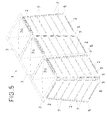
- Fig. 5 which illustrates a composter 1 formed with three bodies
- the central module of the composter 1 has the panels 2 in a reversed position relative to the panels 2 of the adjacent end modules. Therefore, it is thus possible for the composter 1 to expand its capacity without having to replace it with a new, larger capacity composter 1.
- Each panel is fitted 2, at its side edge 5, with claws 6.
- the claws of a panel 6 are arranged above the claws 6 of an adjacent panel 2.
- the claws 6 define an inner space through which a bar (not shown) can be passed for hingedly joining the panels 2 to one another.
- each panel 2 has a pair of substantially parallel horizontal grooves 7 for allowing compost aeration and thus promoting the aerobic process of its formation while allowing odors to be avoided.
- These aeration grooves 7 are arranged in correspondence with ribs 8 formed on the inner portion of each panel 2, as shown in the sectional view of Fig. 3 of the drawings.
- the panels 2 of the composter 1 are made of a plastic material.
- This material has the feature that it is obtained by a pressing process of a material essentially consisting of plastic and other waste materials, specifically plastic from urban waste collection.
- This plastic is composed of 85-90% of polyolefins, which may include polypropylene (obtained, for example, from bottle caps), polyethylene (obtained, for example, from bags), or high-density polyethylene (HDPE) (obtained, for example, from detergent bottles) and 10-15% of paper, cardboard, fabric, PET, aluminium (obtained, for example, Tetrabrik packages). These elements are from urban waste collection.
- the top cover 3 can also be made from this material.
Landscapes
- Chemical & Material Sciences (AREA)
- Chemical Kinetics & Catalysis (AREA)
- Life Sciences & Earth Sciences (AREA)
- Engineering & Computer Science (AREA)
- Biochemistry (AREA)
- Biotechnology (AREA)
- Health & Medical Sciences (AREA)
- General Chemical & Material Sciences (AREA)
- Microbiology (AREA)
- Molecular Biology (AREA)
- Organic Chemistry (AREA)
- Fertilizers (AREA)
- Processing Of Solid Wastes (AREA)
Abstract
Description
- The present invention relates to a composter for recycling of organic matter to be subsequently used as fertilizer. The composter of the invention comprises a body formed by series of side panels of plastic material that define an inner space where the organic matter is to be provided.
- Composting, as defined herein, refers to the practice of recycling organic waste (compost). Compost is a mixture of organic matter (food waste, such as peelings, vegetable waste, crushed eggshells, tea bags, coffee dregs, etc; plants, herbs, grass, etc.) decomposed and biologically transformed.
- Composting therefore involves returning organic material to soil with the goal of obtaining fertilizer that could be used in an orchard, a garden, etc. in place of (or complementing) commonly used artificial fertilizers.
- The use of composters for carrying out composting is known. The use of composters allows recycling organic remains in a convenient, easy and hygienic way avoiding the disadvantages of making a pile on the floor. A typical composter includes a body formed by side panels that define an inner space where the compost (organic matter) is stored. Panels are fitted with holes or openings to allow aeration of organic matter contained therein. Typically, the body of the composter has no base, so that the compost is always on the ground so that nature microorganisms come into contact with compost placed inside the composter and so that drainage of excess water from vegetables is allowed. The body of the composter may include a cover for closing the inner space.
- Composters known so far are made of metal and more commonly of recycled plastic, for example injected PE. However, said composters are capital intensive because of the cost of materials and the cost of molds, with a mold for each different composter made through different injection molding techniques being required.
- The invention provides a composter that comprises, as noted above, a body formed with at least one series of plastic side panels that define an inner space where organic waste is placed. At least these panels that define the body of the composter of the invention are obtained by pressing a material consisting essentially of plastic and other waste materials, particularly consisting essentially of plastic from waste, for example waste from selective urban collection.
- Preferably, the plastic from which at least said panels are obtained has a composition of 80-95% of polyolefins, and 5-20% of at least one element selected from paper, cardboard, fabric, PET, aluminium, with such elements being from waste, such as waste from selective urban collection.
- In a preferred composition, said plastic has a composition of 85-90% of polyolefins and 10-15% of at least one element selected from paper, cardboard, fabric, PET, aluminium (obtained, for example, from Tetrabrik packages).
- Polyolefins may comprise polypropylene (obtained, for example, from bottle caps), polyethylene (obtained, for example, from bags), or high-density polyethylene (HDPE) (obtained, for example, from detergent bottles).
- These panels of the body of the composter may be reversible, such that they may be arranged upwards or downwards as desired. This allows mold costs to be reduced as well as the industrial process of manufacture to be simplified. Due to this feature, the capacity of the compost may be expanded by the user without having to purchase a new one. It is only necessary to acquire several individual pieces and combine them with those of the original composter.
- The panels can be arranged in several rows of panels according to the desired height of the composter. At least some of the panels can be hinged to each other for providing greater accessibility to the interior of the composter and further facilitating the assembly detachment. For this purpose, claws are provided in the side edge of the panel such that, in an assembled position, the claws of a panel are arranged above the claws of another, adjacent panel, with a bar or rod passing through an inner space in each claw such that adjacent panels of the body of the composter are hingedly joined.
- The body of the composter may further include a top cover (made from said plastic material) which can be either press fitted in the inner profile of the upper portion of the body of the composter or hinged to the top portion thereof.
- The manufacturing process of the parts defining the composter of the invention, the side panels and the top cover, starts with recovery of plastic waste from urban collection for recycling. Plastic waste is cut up into pieces and mixed in the above described preferred proportions before being loaded into the production line.
- In this production process, the plastic is passed through heating means so that temperature of the plastic is raised up to 170 °C, in which plastic becomes melted into a homogeneous paste. In this state, the plastic is ready for being shaped, providing an appropriate amount thereof into a suitable mold where it is under pressure, in the order of a hundred tons. The already made parts are then removed from the mold and they can be passed through a quality control station for checking the characteristics of obtained plastic parts (thickness, weight, etc.) and rejecting those that do not meet the required quality requirements. The pieces considered as being defective are cut up into pieces once again and the plastic is reused again to make other pieces for the composter.
- A composter with good technical features and with a low cost is thus obtained by using an organic, recycled and recyclable material.
- Other objects, advantages and features of the composter of the present invention will be clear from the description of the invention of a preferred embodiment. This description is given by way of a non limiting example and it is shown in the appended drawings herein.
- In these drawings,
-
Figure 1 is a perspective view of one embodiment in which the side panels and the top cover in a closed position are shown; -
Figure 2 is a perspective view of the embodiment of the composter inFig. 1 , in which the top cover is partially open to allow access inside the composter; -
Figure 3 is a front elevational view of one of the panels of the body of the composter of the invention; -
Figure 4 is a sectional side elevational view of one of the panels of the body of the composter of the invention taken along line AA' inFig. 3 ; -
Figure 5 is a perspective view of the composter of the invention, which is formed by arranging three coupled modular bodies. - One example of embodiment of a composter, which has been indicated as a whole with
reference numeral 1, has been shown in the figures herein enclosed in the present specification. - The
composter 1 shown is formed with a substantially frusto pyramidal shaped body with an essentially square base. The geometry of thecomposter 1, however, may be different, as required. In the example described, this geometry is determined by the shape ofplastic side panels 2 each of which is trapezoidal in shape. - In the example of the
composter 1 in the figures, the body thereof is defined by four series of saidside panels 2 and atop cover 3. Thetop cover 3 is hinged, through asuitable hinge 3a, to the upper portion of the body of thecomposter 1. - Each series of
side panels 2 comprises a bottom panel and a top panel. The series ofpanels 2 may be as many as desired according to the height required for thecomposter 1 depending on recycling capacity needs in the interior 4 thereof. - The body of the
composter 1 has no bottom base. Thus, compost (not shown) is always on the ground and nature microorganisms are in contact with the compost placed inside thecomposter 1 further allowing drainage of excess water from vegetables. - In the embodiment shown in the figures, the
panels 2 of the body of the composter are reversible, so that they can be arranged upwards or downwards as desired. In the example shown inFig. 5 , which illustrates acomposter 1 formed with three bodies, the central module of thecomposter 1 has thepanels 2 in a reversed position relative to thepanels 2 of the adjacent end modules. Therefore, it is thus possible for thecomposter 1 to expand its capacity without having to replace it with a new,larger capacity composter 1. - Each panel is fitted 2, at its
side edge 5, withclaws 6. In an assembled position, the claws of apanel 6 are arranged above theclaws 6 of anadjacent panel 2. Theclaws 6 define an inner space through which a bar (not shown) can be passed for hingedly joining thepanels 2 to one another. - As shown in the figures, each
panel 2 has a pair of substantially parallelhorizontal grooves 7 for allowing compost aeration and thus promoting the aerobic process of its formation while allowing odors to be avoided. Theseaeration grooves 7 are arranged in correspondence withribs 8 formed on the inner portion of eachpanel 2, as shown in the sectional view ofFig. 3 of the drawings. - The
panels 2 of thecomposter 1 are made of a plastic material. This material has the feature that it is obtained by a pressing process of a material essentially consisting of plastic and other waste materials, specifically plastic from urban waste collection. This plastic is composed of 85-90% of polyolefins, which may include polypropylene (obtained, for example, from bottle caps), polyethylene (obtained, for example, from bags), or high-density polyethylene (HDPE) (obtained, for example, from detergent bottles) and 10-15% of paper, cardboard, fabric, PET, aluminium (obtained, for example, Tetrabrik packages). These elements are from urban waste collection. Thetop cover 3 can also be made from this material. - While the present invention has been described in the specification and has been shown in the accompanying drawings with reference to a preferred embodiment thereof, the composter of the invention is susceptible to various changes without departing from the scope of protection defined by the following claims.
Claims (9)
- Composter (1) which comprises a body formed with at least one series of side panels (2) of plastic material that define an inner space (4) where organic waste is to be provided, characterized in that at least said panels (2) are obtained by pressing of a material essentially consisting of plastic and other waste materials.
- Compost (1) as claimed in claim 1, wherein at least said panels (2) are obtained by pressing of a material essentially consisting of plastic from selective collection waste.
- Compost (1) as claimed in claim 1 or claim 2, wherein said plastic has a composition of 80-95% of polyolefins, and 5-20% of at least one element selected from paper, cardboard, fabric, PET, aluminium, with such elements being from waste, such as waste from selective urban collection
- Compost (1) as claimed in claim 1 or claim 2, wherein the plastic has a composition of 85-90% of polyolefins and 10-15% of at least one element selected from paper, cardboard, fabric, PET, aluminium.
- Compost (1) as claimed in claim 3, wherein said polyolefins comprise at least one of polypropylene, polyethylene and HDPE.
- Compost (1) as claimed in claim 1 or claim 2, wherein said side panels (2) are reversible, such that they may be arranged upwards or downwards.
- Compost (1) as claimed in claim 1 or claim 2, wherein the body further comprises a top cover (3).
- Compost (1) as claimed in claim 7, wherein the top cover (3) is press fitted in the upper portion of the body of the composter (1).
- Compost (1) as claimed in claim 7, wherein said top cover (3) is hinged to the upper portion of the body of the composter (1).
Applications Claiming Priority (2)
| Application Number | Priority Date | Filing Date | Title |
|---|---|---|---|
| ES200600657U ES1062467Y (en) | 2006-03-16 | 2006-03-16 | COMPOSTER |
| PCT/ES2007/070053 WO2007104821A1 (en) | 2006-03-16 | 2007-03-15 | Composter. |
Publications (3)
| Publication Number | Publication Date |
|---|---|
| EP2003102A2 EP2003102A2 (en) | 2008-12-17 |
| EP2003102A9 true EP2003102A9 (en) | 2009-04-15 |
| EP2003102A4 EP2003102A4 (en) | 2012-11-21 |
Family
ID=36593568
Family Applications (1)
| Application Number | Title | Priority Date | Filing Date |
|---|---|---|---|
| EP07730493A Withdrawn EP2003102A4 (en) | 2006-03-16 | 2007-03-15 | Composter. |
Country Status (6)
| Country | Link |
|---|---|
| US (1) | US20090100888A1 (en) |
| EP (1) | EP2003102A4 (en) |
| JP (1) | JP2009530216A (en) |
| CA (1) | CA2644839A1 (en) |
| ES (1) | ES1062467Y (en) |
| WO (1) | WO2007104821A1 (en) |
Families Citing this family (3)
| Publication number | Priority date | Publication date | Assignee | Title |
|---|---|---|---|---|
| DE102007040750A1 (en) | 2007-08-28 | 2009-03-05 | Brusa Elektronik Ag | Electrically excited synchronous motor, in particular for vehicle drives |
| US20100122661A1 (en) * | 2008-11-14 | 2010-05-20 | Four Paws Products, Ltd. | Housing for a pet waste disposal system |
| RU208336U1 (en) * | 2021-08-31 | 2021-12-14 | Акционерное общество «Павловское производственно-экспериментальное предприятие «Заря» | Garden composter |
Family Cites Families (19)
| Publication number | Priority date | Publication date | Assignee | Title |
|---|---|---|---|---|
| US4184602A (en) * | 1978-05-30 | 1980-01-22 | Henry Moliard | Collapsible expansible container |
| US4352888A (en) * | 1981-12-23 | 1982-10-05 | Custom Plastics, Inc. | Container for holding organic matter during decomposition |
| GB2154549B (en) * | 1984-02-23 | 1987-09-30 | Ian Millington Shutes | Container |
| FI73957C (en) * | 1985-09-04 | 1988-11-02 | Rolate Oy | FOERFARANDE FOER KOMPOSTERING AV OLIKA ORGANISKA AVFALL SAMT KOMPOSTOR FOER UTFOERANDE AV FOERFARANDET. |
| US5490604A (en) * | 1991-07-11 | 1996-02-13 | Shape Plastics Corp. | Composter |
| JPH0620440U (en) * | 1992-05-19 | 1994-03-18 | 晴司 中川 | Simple compost fermenter |
| US5346171A (en) * | 1993-02-25 | 1994-09-13 | Recycled Plastics, Inc. | Method and apparatus for forming plastic panels from recycled plastic chips |
| DE4420978A1 (en) * | 1994-06-16 | 1996-07-11 | Wolf Oskar | Compost bin assembly system using low quality recycled plastic |
| WO1996006815A1 (en) * | 1994-08-31 | 1996-03-07 | Prodevco (N.Z.) Limited | Improvements in or relating to a composter |
| DE69709948T2 (en) * | 1996-11-01 | 2002-08-29 | Cicer Scandinavia Ab, Mala | METHOD FOR RECYCLING VULCANIZED RUBBER AND THE PRODUCTS OBTAINED HERE |
| US5944122A (en) * | 1997-12-04 | 1999-08-31 | Driltech Inc. | Methods and apparatus for controlling an air compressor in a drill string flushing system |
| US6537653B1 (en) * | 1998-07-17 | 2003-03-25 | Namba Press Works Co., Ltd. | Ligneous fibrous filler/olefinic plastic composite sheet for bonding |
| DE29816364U1 (en) * | 1998-09-11 | 1998-12-10 | Paulsen, Hans, 25842 Langenhorn | System multi plastic plate |
| DE29905839U1 (en) * | 1999-03-30 | 1999-06-17 | remaplan GmbH Produkte für die Umwelt, 82008 Unterhaching | Thermal composter for organic waste |
| DE10027209A1 (en) * | 2000-05-31 | 2001-12-20 | Remaplan Anlagenbau Gmbh | Process for injection molding a molded body |
| JP3589617B2 (en) * | 2000-06-16 | 2004-11-17 | ミサワホーム株式会社 | Method of manufacturing wood-like molded products |
| JP3650804B2 (en) * | 2001-05-10 | 2005-05-25 | ミサワホーム株式会社 | Extruded material |
| JP3660337B2 (en) * | 2002-11-06 | 2005-06-15 | 株式会社コーハン | Manufacturing method of wooden synthetic resin board |
| DE202005010721U1 (en) * | 2005-07-07 | 2005-12-01 | Albrecht Braun Gmbh | Compost container in kit form comprising panels joined at corners by interlocking and vertical rod passed through holes in ends of each panel |
-
2006
- 2006-03-16 ES ES200600657U patent/ES1062467Y/en not_active Expired - Fee Related
-
2007
- 2007-03-15 CA CA 2644839 patent/CA2644839A1/en not_active Abandoned
- 2007-03-15 JP JP2008558836A patent/JP2009530216A/en active Pending
- 2007-03-15 WO PCT/ES2007/070053 patent/WO2007104821A1/en not_active Ceased
- 2007-03-15 US US12/293,224 patent/US20090100888A1/en not_active Abandoned
- 2007-03-15 EP EP07730493A patent/EP2003102A4/en not_active Withdrawn
Also Published As
| Publication number | Publication date |
|---|---|
| CA2644839A1 (en) | 2007-09-20 |
| JP2009530216A (en) | 2009-08-27 |
| US20090100888A1 (en) | 2009-04-23 |
| WO2007104821A1 (en) | 2007-09-20 |
| ES1062467Y (en) | 2006-09-16 |
| EP2003102A2 (en) | 2008-12-17 |
| EP2003102A4 (en) | 2012-11-21 |
| ES1062467U (en) | 2006-06-16 |
Similar Documents
| Publication | Publication Date | Title |
|---|---|---|
| US5762225A (en) | Compost container | |
| US12493858B2 (en) | Waste management and processing system | |
| US5190572A (en) | Composting method and device | |
| US5322793A (en) | Composting bin | |
| US20140050423A1 (en) | Biodegradable lawn waste collection system | |
| EP1602600B1 (en) | Ventilated system for the collection of organic waste | |
| EP2575426A1 (en) | Stackable containers and associated method for the transport of plants | |
| US5096080A (en) | Storage bin | |
| EP2003102A2 (en) | Composter. | |
| US5403740A (en) | Biodegradable compost bins | |
| JP3153931U (en) | Nursing box for composting garbage | |
| DE3802011C2 (en) | ||
| US5441552A (en) | Method and apparatus for composting solid waste and sludge | |
| DE4111204A1 (en) | Urine-faeces mixts. disposal and conditioning - by adjusting moisture content, pH etc, pressing to coarse pellet form, and bio-reacting in stacked ventilated containers | |
| EP1931572B1 (en) | Bag for collecting organic waste or foodstuffs | |
| WO2001040140A1 (en) | Composting container | |
| US20010009771A1 (en) | Method of composting and container therefor | |
| DE29604924U1 (en) | Composting bin | |
| US5730524A (en) | Dual container composting device with mixing structure | |
| JPH1150400A (en) | Waste paper material recycled product and its production | |
| CN201033646Y (en) | Shredded tobacco storing case | |
| Stone | Evaluation of biosolids for use in biodegradable transplant containers | |
| KR200291903Y1 (en) | Receptacle | |
| US12084394B1 (en) | Vermicomposting apparatus and method | |
| DE4128399A1 (en) | Natural degradation of biological and cellulose-contg. waste - by depositing waste in container made of fibrous cellulose-contg. waste material and rotting waste and container together |
Legal Events
| Date | Code | Title | Description |
|---|---|---|---|
| PUAI | Public reference made under article 153(3) epc to a published international application that has entered the european phase |
Free format text: ORIGINAL CODE: 0009012 |
|
| 17P | Request for examination filed |
Effective date: 20081016 |
|
| AK | Designated contracting states |
Kind code of ref document: A2 Designated state(s): AT BE BG CH CY CZ DE DK EE ES FI FR GB GR HU IE IS IT LI LT LU LV MC MT NL PL PT RO SE SI SK TR |
|
| PUAB | Information related to the publication of an a document modified or deleted |
Free format text: ORIGINAL CODE: 0009199EPPU |
|
| RAP1 | Party data changed (applicant data changed or rights of an application transferred) |
Owner name: COMPOSTADORES, S. L. |
|
| RIN1 | Information on inventor provided before grant (corrected) |
Inventor name: COMPOSTADORES, S. L. |
|
| RIN1 | Information on inventor provided before grant (corrected) |
Inventor name: CASTEJON TRAVIESO, EUGENI |
|
| DAX | Request for extension of the european patent (deleted) | ||
| A4 | Supplementary search report drawn up and despatched |
Effective date: 20121018 |
|
| RIC1 | Information provided on ipc code assigned before grant |
Ipc: C05F 17/02 20060101AFI20121012BHEP |
|
| STAA | Information on the status of an ep patent application or granted ep patent |
Free format text: STATUS: THE APPLICATION IS DEEMED TO BE WITHDRAWN |
|
| 18D | Application deemed to be withdrawn |
Effective date: 20130517 |