EP1999262B1 - Procédé de purification de l'antitrypsine alpha 1 recombinante impliquant une étape de chromatographie échangeuse d'anions - Google Patents
Procédé de purification de l'antitrypsine alpha 1 recombinante impliquant une étape de chromatographie échangeuse d'anions Download PDFInfo
- Publication number
- EP1999262B1 EP1999262B1 EP07723781A EP07723781A EP1999262B1 EP 1999262 B1 EP1999262 B1 EP 1999262B1 EP 07723781 A EP07723781 A EP 07723781A EP 07723781 A EP07723781 A EP 07723781A EP 1999262 B1 EP1999262 B1 EP 1999262B1
- Authority
- EP
- European Patent Office
- Prior art keywords
- raat
- buffer
- pooling
- anion exchange
- absorption
- Prior art date
- Legal status (The legal status is an assumption and is not a legal conclusion. Google has not performed a legal analysis and makes no representation as to the accuracy of the status listed.)
- Not-in-force
Links
Images


Classifications
-
- C—CHEMISTRY; METALLURGY
- C07—ORGANIC CHEMISTRY
- C07K—PEPTIDES
- C07K14/00—Peptides having more than 20 amino acids; Gastrins; Somatostatins; Melanotropins; Derivatives thereof
- C07K14/81—Protease inhibitors
- C07K14/8107—Endopeptidase (E.C. 3.4.21-99) inhibitors
- C07K14/811—Serine protease (E.C. 3.4.21) inhibitors
- C07K14/8121—Serpins
- C07K14/8125—Alpha-1-antitrypsin
Definitions
- the present invention relates to a method for obtaining highly purified recombinant alpha1 antitrypsin (rAAT) using anion exchange chromatography, wherein a composition comprising rAAT and at least one impurity originating from cultivation of cells used for generating of rAAT is loaded onto a column containing anion exchange material and the anion exchange chromatography is carried out with buffers containing phosphate ions and N-acetylcysteine (NAC).
- rAAT highly purified recombinant alpha1 antitrypsin
- Displacement chromatography has been developed in the middle of the 20 th century mainly for the separation of anorganic metal ions or rare earth elements, organic substances, and later also for small biomolecules like antibiotics, amino acids and peptides. At the beginning of the 80s this type of chromatography has begun to be applied for the separation of proteins.
- the theory and practical examples are summarized in various reviews, like Katti et al. 1992 ( Katti A.M., Guichon G.A. Fundamentals in Nonlinear Chromatography: Prediction of experimental Profiles in "Advances in Chromatography” (J.C.Gidding, E.Grushka, P.R.Brown, eds.) Vol 31, pp.
- non-linear effects are common. These are seen as concentration-dependent retention times and asymmetric (e.g. tailing or fronting) peaks. Asymmetric peaks can result from a number of other causes as well, i.e. large extra-column volumes. In many applications, non-linear effects are disadvantageous as they decrease peak resolution and disturb quantitative evaluation. However, in preparative chromatography, heavy overloading is employed in order to increase material throughput, leading to prominent non-linear effects. A comprehensive text on non-linear chromatography has been published by G. Guiochon, S. Golshan Shirazi and A. M. Katti, Fundamentals of Preparative and Non-linear Chromatography, Academic Press, Inc. Boston (1994 ).
- Alpha1 antitrypsin is intended to be used for patients suffering from genetically alpha1 antitrypsin deficiency that can cause severe lung disease (known as hereditary emphysema).
- a recombinant AAT has been developed that is produced in bakers yeast Saccharomyces cerevisia without addition of any human or animal derived raw materials in the fermentation process, during the purification, and in the final formulation.
- the rAAT is intended to be delivered to the lung of the patients using a nebulizer.
- an rAAT product with high purity is required, especially in combination with high doses.
- One embodiment of the invention provides methods for obtaining highly purified recombinant alpha1-antitrypsin (rAAT) from a composition comprising the rAAT and at least one impurity originating from cultivation of cells used for generating rAAT.
- the methods comprise
- the at least one impurity is an impurity originating from cells used for generating rAAT.
- the at least one impurity is a yeast cell protein.
- the at least one impurity is selected from: 12 kDa heat shock protein, YOL09wp, dihydroliponamide dehydrogenase, ribose 5-phosphate isomerase, rAAT fragments, cystathionine gamma-lyase, glucokinase, O-acetylhomoserine sulfhydrylase, rAAT-dimer, argininosuccinate lyase, 2-hydroxyacid dehydrogenase, hexokinase A.
- the anion exchange material is selected from the group consisting of Q Sepharose HP, Cellufine Q, SourceQ, Fractogel EMD DEAE and Toyopearl QAE.
- buffer A has a pH of about 6 to about 9 and buffer B has a pH of about 6 to about 9.
- buffer A and buffer B have the same pH.
- step (i) comprises loading about 2 to 50 mg / rAAT per ml anion exchange material onto the column.
- step (iii) comprises eluting the rAAT from the anion exchange material using a gradient from a buffer composition comprising 100% (v/v) of buffer A to a buffer composition comprising 100% (v/v) buffer B within about 30 CV.
- the starting point for the pooling in step (iv) is determined by UV absorption of the eluent at a wavelength in the range of 340 nm to 430 nm and the end point for the pooling is determined by UV absorption of the eluent at 280 nm.
- the method according to claim 10 wherein the rAAT fraction pooling starts when the UV absorption at 395 nm of the sharp peak just preceding the rAAT main peak has declined to less than 10% of the maximum absorbance and wherein the rAAT fraction pooling is terminated when the UV absorption at 280 nm has declined to 40% of the UV absorption monitored at the beginning of the pooling.
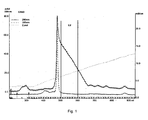
- Figure 1 shows the chromatogram of purification run according to Example 1.
- the chromatogram of the wash and gradient elution phase is depicted.
- the UV absorption signal at 280 nm is shown as solid line, the signal at 395 nm is shown as dashed line and the conductivity signal is displayed as dotted line.
- the borders of the main QHP pool (E2) are indicated by two vertical black lines. Due to technical reasons, the signal at 280 nm was about 7 fold lower than expected.
- the left vertical (y) axis shows the UV absorption in milli absorption units (mAU at 280 nm)
- the right vertical (y) axis shows the conductivity in mS/cm
- the horizontal (x) axis shows the volume pumped (ml).
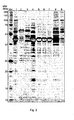
- FIG. 2 shows the SDS-PAGE analysis of samples of the QHP purification run according to Example 1.
- Various fractions of a purification run on QHP are analysed by SDS-PAGE on a 12% gel.
- the separated polypeptides are visualized by silver staining.
- the main rAAT product is Pool E2, whereas Pool E1 represents the residual rAAT at the ascending part of the peak and Pool E3 the residual rAAT at the descending part of the peak.
- Approximately 4.5 ⁇ g rAAT are loaded for the E2 and E3 samples.
- Lane 1 load, Lane 2: flow through, Lane 3: wash, Lane 4: Pool E1, Lane 5: Pool E2, Lane 6: Pool E2 (repooled), Lane 7: Pool E3, Lane 8: Pool E4, Lane 9: Strip 1. Std.: Molecular Mass standard Precision Plus Dual Color (Biorad Laboratories).
- Figure 3 shows the chromatogram of the purification run according to Example 2.
- the chromatogram of the wash and gradient elution phase is depicted.
- the UV absorption signal at 280 nm is shown as solid line
- the signal at 395 nm is shown as dashed line
- the conductivity signal is displayed as dotted line.
- the borders of the main QHP pool (E2) are indicated by two vertical black lines.
- the left vertical (y) axis shows the UV absorption in milli absorption units (mAU at 280 nm)
- the right vertical (y) axis shows the conductivity in mS/cm
- the horizontal (x) axis shows the volume pumped (ml).
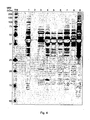
- FIG. 4 shows the SDS-PAGE analysis of samples of the QHP purification run according to Example 2.
- Various fractions of a purification run on QHP are analysed by SDS-PAGE on a 12% gel.
- the separated polypeptides are visualized by silver staining.
- the main rAAT product is Pool E2, whereas Pool E1 represents the residual rAAT at the ascending part of the peak and Pool E3 the residual rAAT at the descending part of the peak.
- Approximately 4.5 ⁇ g rAAT are loaded for the E2 and E3 samples.
- Std. Molecular Mass standard Precision Plus Dual Color (Biorad Laboratories)
- FIG. 5 shows the Anti-Yeast Cell Protein Western Blot of rAAT QHP pools (E2).
- rAAT QHP E2 pools (main product pools) are analysed by SDS-PAGE on a 12% gel loading approximately 12.5 ⁇ g rAAT per lane.
- the separated polypeptides are visualized by Western Blot Technique using goat anti-yeast cell protein Immunoglobulines for the primary detection reaction.
- the dark band at about 50 kDa represents Yeast Hexokinase A.
- Std pre-stained molecular mass standard "Precision Plus Dual Color" (Biorad Laboratories).
- the fractions used for pooling are indicted in parenthesis when more than one pool was generated.
- Lane 1 RS-002 (control)
- Lane 2 Example 2 - Pool E2
- Lane 9 Example 1 - Pool E2 (C4-D4)
- Lane 10 Example 1 - Pool E2 (C3-D3).
- the present invention relates to a method for obtaining highly purified recombinant alpha 1-antitrypsin (rAAT) by means of an anion exchange chromatography, e.g. using Q Sepharose HP as anion exchange material, wherein (i) a composition comprising rAAT and at least one impurity originating from cultivation of cells used for generating rAAT, is loaded onto a column containing an anion exchange material, (ii) the anion exchange material is washed using a buffer A containing phosphate ions and N-acetylcysteine and (iii) rAAT is eluted from the anion exchange material using a gradient of buffers A and B both containing phosphate ions and N-acetylcysteine (NAC).
- the impurities may be host cell impurities or more specifically may be yeast cell protein (YCP) impurities.
- the expression "highly purified rAAT” means, for example, a purity of rAAT of higher than 99% w/w of total protein.
- the content of the at least one impurity is, for example, below 1%, preferably below 0.5%.
- the percentage values of the impurities refer to weight/weight of product, i.e. rAAT, and can be measured, for example, by HPLC or by the determination of the rAAT antigen or impurity protein antigen by ELISA.
- the present invention employing the elution with a phosphate gradient provides a method to reduce the content of the at least one impurity to about 50% or less compared to an elution with a gradient of one or more other salts than phosphate, preferably to about 40% or less, most preferably to about 30% or less, even more preferably to about 20% or less, and most preferably to about 10% or less.
- the content of a combination of yeast cell proteins can be reduced to about 50% or less, preferably to about 40% or less, most preferably to about 30% or less, even more preferably to about 20% or less, and most preferably to about 10% or less, compared to the elution with a NaCl gradient in a Tris buffer.
- the content of the combination of yeast cell proteins can be determined, for example, by using the respective immunoglobuline combination in an ELISA (see, e.g., Example 2).
- Yeast hexokinase activity can be reduced by the method according to the invention to less than 50%, preferably to about 40% or less, most preferably to about 30% or less, even more preferably to about 20% or less, and most preferably to about 15% or less, compared to an elution with a NaCl gradient in a Tris buffer.
- the hexokinase activity can be determined, for example, by an enzymatic activity assay as described, for example, in Example 2.
- the comparative amounts of the impurities given above refer to amounts measured by the same method.
- the respective reduced amount of said impurity in a preparation purified by the method of the present invention is also measured by HPLC.
- this refers only to the comparison of one single parameter. Different parameters can be compared even if measured by different methods, as e.g. the amount of YCP (measured by ELISA) in relation to the amount of rAAT (measured by HPLC), see Table 2.
- rAAT recombinant alphal-antitrypsin
- rAAT does not underlie a specific restriction and may include any rAAT obtained via a recombinant DNA technology, or a biologically active derivative thereof.
- biologically active derivative includes any derivative of a protein, protein complex or polypeptide having substantially the same functional and/or biological properties of rAAT such as binding properties, and/or the same structural basis, such as peptidic backbone. Minor deletions, additions and/or substitutions of amino acids of the polypeptide sequence of rAAT which are not altering the biological activity of said polypeptide are also included in the present application as biologically active derivatives.
- the rAAT according to the present invention may be derived from any vertebrate, e.g. a mammal. In one specific example of the present invention, the rAAT is human rAAT.
- the rAAT according to the present invention may be produced by any method known in the art. This may include any method known in the art (i) for the production of recombinant DNA by genetic engineering, e.g. via reverse transcription of RNA and/or amplification of DNA, (ii) the introduction of recombinant DNA into prokaryotic or eukaryotic cells by transfection, e.g. via electroporation or microinjection, (iii) the cultivation of said transformed cells, e.g. in a continuous or batchwise manner, (iv) the expression of the rAAT, e.g. constitutive or upon induction, and (v) the isolation of the protein, e.g.
- the recombinant DNA coding for rAAT e.g. a plasmid
- the cells used as host cells for producing rAAT are yeast cells.
- crude rAAT is obtained from harvested cultured cells according to any method known in the art, e.g. by applying the steps of cell disruption by high pressure homogenization, clarification by micofiltration and a chromatographic capture step (e.g. on Q Sepharose XL).
- crude rAAT may be further purified (pre-purified) using any purifying method known in the art, e.g. by metal chelate affinity chromatography such as copper chelating Sepharose Fast Flow (IMAC), optionally followed by one or more steps selected from the group consisting of the steps of negative chromatography on Phenyl Boronate Prosep (PB) resin, concentration by ultrafiltration and buffer exchange by diafiltration.
- metal chelate affinity chromatography such as copper chelating Sepharose Fast Flow (IMAC)
- IMAC copper chelating Sepharose Fast Flow
- prepurification is carried out according to the following steps:
- the function of this process step is to provide a crude purification and concentration of the diluted, clarified extract.
- the diluted clarified extract containing the product is loaded onto the column that is fitted with two sets of guard filters operated in series.
- a wash step with a buffer containing about 70 mM NaCl removes part of the host cell impurities.
- the product is eluted using a buffer containing approximately 160 mM NaCl.
- the function of this process step is to provide a primary purification of the Capture column pool.
- the column is operated in a pseudo-affinity mode: chromatographic conditions are selected that allow for preferential binding of soluble AAT to the chelated Cu 2+ ions bound to the resin matrix.
- the product contained in the capture pool is treated with NaCl and is subsequently loaded onto the column.
- Bound host cell impurities are removed from the column applying a series of two wash steps using buffers containing 300 mM NaCl and 300 mM NaCl plus 6.5 mM imidazole, respectively.
- the product is eluted from the resin with a buffer containing 20 mM imidazole.
- the primary function of this process step is to separate glycosylated host cell protein contaminants.
- the column is operated in a "negative chromatographic" mode: host cell impurities are removed by chromatographic retention via selective interaction with the resin matrix, while rAAT flows through during the loading step.
- the column is equilibrated and the IMAC pool containing the product is pumped through the column after adjusting the NaCl concentration to 1.2 M using a stock solution.
- the product is contained in the column effluent fraction, host cell impurities bound to the resin are eluted by a wash and strip step.
- the purpose of this step is to a) concentrate the pool and b) prepare the concentrate for loading onto the Q-Sepharose HP chromatography step by performing a buffer exchange.
- the Ultra/diafiltration system is operated with a 10K membrane. After buffer exchange by diafiltration the concentrated product is contained in the retentate fraction.
- pre-purified includes all forms of rAAT which have been treated in a way to reduce impurities. This treatment may be for example gel electrophoresis, chromatography, gel filtration, centrifugation, filtration, precipitation, crystallization or any other method known in the art to reduce impurities.
- impurity includes any impurity originating from the production of the rAAT and may include for example host cell protein impurities, polypeptide impurities, nucleic acid impurities, buffer and salt impurities, impurities originating from the cell culture medium, product related impurities such as dimers or fragments, and combinations thereof.
- the at least one impurity of the method as defined above is a yeast cell protein (YCP) impurity.
- the at least one impurity of the method as defined above is selected from the group consisting of 12 kDa heat shock protein, YOL09wp, dihydroliponamide dehydrogenase, ribose 5-phosphate isomerase, rAAT fragments, cystathionine gamma-lyase, glucokinase, O-acetylhomoserine sulfhydrylase, rAAT-dimer and argininosuccinate lyase, 2-hydroxyacid dehydrogenase, hexokinase A.
- the at least one impurity may be a combination of yeast cell proteins which can be determined, for example, by the respective immunoglobuline combination in an ELISA (see, e.g., the ELISA described in Example 2 using a polyclonal immunoglobuline combination).
- the content of an impurity is usually given in weight/weight of product or weight/Unit of product. If percentage values are given, they usually refer to weight impurity per weight of product.
- the anion exchange chromatography material (also designated as "resin") used in the method of the present invention does not underlie a specific restriction, as long as the above-defined impurities being removed to obtain a highly purified rAAT.
- the resin includes any material suitable for anion exchange chromatography and is , for example, an agarose based chromatography material.
- the anion exchange material is Sepharose, which is based on modified agarose, the polysaccharide chains of which are crosslinked to form a 3-dimensional network.
- the anion exchange material is commercially available Q Sepharose HP.
- the anion exchange resin matrix is selected from the group consisting of polystyrene/divinylbenzene (e.g. available from GE Healthcare, formerly Amersham Bioscience), methacrylate type polymers (e.g. available from Tosohaas, Biorad, Merck), Cellulose (e.g. available from Millipore) and acrylic copolymers (e.g. available from PALL).
- the resins suitable in the purification of rAAT according to the present invention are not restricted in view of their ligands and may contain any anion exchange ligand known in the art.
- the ligands may be selected from the group consisting of quaternary ammonium (Q), quaternary aminoethyl (QAE), dimethyl aminoethyl (DMAE) and diethylaminoethyl (DEAE), or any combination thereof.
- the resin may be any commercially available resin selected from the group consisting of Cellufine Q (Millipore), SourceQ (GE Healthcare), Fractogel EMD DEAE (Merck) and Toyopearl QAE (Tosohaas).
- the amount of the composition comprising the rAAT and the at least one impurity loaded onto the column according to step (i) of the method as defined above is in the range of about 2 to about 50 mg rAAT / ml resin, preferably in the range of 5 to 40 mg rAAT / ml resin and more preferably in the range of 10 to 30 mg rAAT / mg resin.
- the bed height of the anion exchange material in the column may be in the range of about 15 to about 35 cm, such as in the range of 18 to 30 cm. In a specific example of the present invention, the bed height of the anion exchange material may be in the range of 24 ⁇ 2 cm, such as 23 to 25 cm.
- the column diameter is in the range of about 50 to about 130 cm, such as in a range of 80 to 120 cm. In a specific example, the column diameter is about 100 cm.
- phosphate ions further includes all ions derived from phosphoric acid, such as hydrogenphosphate (HPO 4 2- ) and dihydrogenphosphate (H 2 PO 4 - ).
- HPO 4 2- hydrogenphosphate
- H 2 PO 4 - dihydrogenphosphate
- any compound may be used suited to provide said phosphate ions, preferably phosphate salts.
- Those phosphate salts usable in the preparation of the phosphate buffers of the present invention should be well soluble, such as sodium or potassium phosphate.
- the buffers according to the present invention may also include mixtures of different types of ions derived from phosphoric acid, such as mixtures of hydrogenphosphate and dihydrogenphosphate.
- the gradient used in step (iii) of the method as defined above may be a linear gradient from a buffer composition comprising 100% (v/v) of buffer A to a buffer composition of 100% (v/v) of buffer B.
- the starting composition of the gradient used in step (iii) of the above-defined method may also be any mixture of buffer A and buffer B.
- the gradient ends at a buffer composition comprising 30 to 60% (v/v) of buffer A and 70 to 40% (v/v) of buffer B.
- the gradient ends at a buffer composition comprising 35 to 55% (v/v) of buffer A and 65 to 45% (v/v) of buffer B.
- the gradient may end at a buffer composition comprising 40 to 50% (v/v) of buffer A and 60 to 50% (v/v) of buffer B.
- the pH of buffers A and B may be different from each other or may be the same.
- the pH of buffers A and B is in the range of about 6 to about 9, preferably in the range of 7 to 8 and more preferably in the range of 7.3 to 7.8.
- the pH of buffers A and B is 7.7.
- the gradient used in step (iii) of the method according to the present invention may extend over a range of about 5 to about 100 column volumes (CV) of buffer solution.
- the gradient may extend over a range of 10 to 40 CV.
- the gradient may extend over a range of 12 to 18 CV.
- buffer A used in the method as defined above comprises phosphate ions in the range of about 1 to about 80 mM, preferably in the range of 20 to 50 mM and more preferably in the range of 25 to 35 mM, and N-acetylcysteine (NAC) in the range of about 0.1 to about 50 mM, preferably in the range of 1 to 30 mM and more preferably in the range of 2 to 5 mM.
- NAC N-acetylcysteine
- Buffer B used in the method according to the present invention comprises phosphate ions in the range of about 50 to about 1000 mM, preferably in the range of 100 to 300 mM and more preferably in the range of 130 to 170 mM, and N-acetylcysteine (NAC) in the range of about 0.1 to about 50 mM, preferably in the range of 1 to 30 mM and more preferably in the range of 2 to 5 mM.
- NAC N-acetylcysteine
- buffers A and B may contain additional components such as organic and/or inorganic salts, examples of which are NaCl or Tris, as long as these additional components do not have any negative impact on the above-defined method.
- the operating temperature used for the method according to the present invention does not underlie a specific limitation, and can be, for example, at about room temperature or below room temperature, such as in the range of 0 to 15°C.
- the starting point for the pooling defined in step (iv) of the above-defined method may be advantageously determined by UV absorption of the eluent at a wavelength from the - range of 340 to 430 nm, preferably from the range of about 380 to about 410 nm, and optionally simultaneously starting recording the beginning of the pooling at 280 nm, and the end point for the pooling may be determined by UV absorption of the eluent at 280 nm.
- the pooling in step (iv) of the method as defined above is started when the UV absorption at 395 nm of the sharp peak just preceding the rAAT main peak (see Figures 1 and 3 ) has declined to less than 10%, preferably less than 4% of the maximum absorbance.
- the pooling in step (iv) of the method as defined above is terminated when the UV absorption at 280 nm has declined to less than 60%, preferably less than 40% of the UV absorption monitored at the beginning of the pooling.
- the anion exchange material in the chromatography column is a 34 ⁇ m mean Q High Performance Sepharose (Amersham Bioscience) having a packed bed height of 24 ⁇ 2 cm, such as in the range of 23 to 25 cm, a packing of > 5000 plates/meter and wherein the column diameter is in the range of 80 to 120 cm, such as 100 cm.
- a 1.2 ⁇ m Sartopure GF2 filter is used as a column pre-filter.
- buffer A comprises 30 mM phosphate ions and 3 mM NAC at a pH of 7.7
- buffer B comprises 150 mM phosphate ions and 3 mM NAC at a pH of 7.7
- the load composition comprises from 10 to 30 mg of rAAT / ml resin as well as 30 mM phosphate ions and 3 mM NAC at a pH of 7.7.
- the operating temperature ranges from 6 to 10°C and the elution is performed using a linear gradient from 100% of buffer A to a buffer composition of 40% of buffer A and 60% of buffer B, wherein the gradient extends over a range of 15.5 to 16.5 column volumes (CV).
- the rAAT pooling starts when the UV absorption at 395 nm of the sharp peak just preceding the rAAT main peak has declined to less than 10% of the maximum absorbance and the UV absorption at 280 nm is recorded for the beginning of the pooling. Finally, the rAAT pooling ends when the UV absorption at 280 nm has declined to 40% of the UV absorption monitored at the beginning of the pooling.
- the bakers yeast Saccharomyces cerevisiae strain containing the plasmid for the production of rAAT is grown in a fermenter at a controlled temperature (30°C), dissolved oxygen concentration, pH and glucose concentration for about 70 hours. After cooling the fermenter broth the cells are harvested and washed by centrifugation. The cell concentrate is resuspended in a buffer and the cells are disrupted by passing once through a high pressure homogenizer. The obtained homogenate is then clarified by microfiltration to remove particulate material followed by a buffer change.
- the rAAT contained in the clarified permeate is then captured by anion exchange chromatography at Q-Sepaharose XL followed by a purification step on Chelating Sepharose FF resin (Immobilized Metal Affinity Chromatography).
- the obtained eluate pool is then passed over a Phenyl Boronate resin operated in negative mode to further remove host cell proteins.
- the product contained in the column flow through fraction is then concentrated by Ultrafiltration followed by a buffer exchange by Diafiltration. This rAAT concentrate serves as the load material for the final polishing step on Q-Sepharose HP.
- the resulting column used in the purification runs according to Example 1 shows a bed height of 24.6 cm, a column volume of 23.4 ml, 2216 plates/m and an asymmetry of 2.10.
- buffer B 150 mM sodium phosphate and 3 mM NAC at a pH of 7.7
- buffer A 30 mM sodium phosphate and 3 mM NAC at a pH of 7.7
- the load composition is a rAAT Ultra/Diaflitrate with a concentration of 13.5 mg/ml rAAT in a buffer formulation containing 30 mM phosphate and 3 mM N-acetylcysteine (NAC) at a pH of 7.7.
- the loading composition is then pumped through the column at a flow of 60 ⁇ 15 cm/h and at a temperature of 8 ⁇ 2 °C to reach a column load of 20.7 mg rAAT / ml anion exchange material (resin).
- rAAT is eluted from the resin applying a linear gradient with buffer A and buffer B.
- the start and endpoint of the gradient is from 100% (v/v) buffer A to 100% (v/v) buffer B within 27 column volumes.
- the column effluent is collected in fractions of approximately 5 - 7 ml.
- the pooling boundaries were defined by fraction impurity testing. At the ascending part of the peak pooling started with the fraction having a rAAT purity of larger or equal 99% of total protein, determined by HPLC and quantified by integration of the area under the peak.
- the UV absorption at 280 nm was 51.6 mAU, the UV adsorption at 395 nm was 2.3 mAU, which is 3.1 % of the maximum adsorption detected in pre-pool E1.
- the load composition is a rAAT Ultra/Diaflitrate with a concentration of 27 mg/ml rAAT in a buffer formulation containing 20 mM Tris at a pH of 7.7.
- the loading composition is then pumped through the column at a flow of 60 ⁇ 15 cm/h and at a temperature of 8 ⁇ 2°C to reach a column load of 11.6 mg rAAT / ml anion exchange material (resin).
- the column When loading is finished, the column is flushed with 3 CV of buffer A (20 mM Tris at a pH of 7.7) at a flow rate of 60 ⁇ 15 cm/h to displace the remaining load from the column. Then the column is washed with 4 CV of a buffer mix containing 60 % (v/v) buffer A (20 mM Tris at a pH of 7.7) and 40% (v/v) buffer B (20 mM Tris, 250 mM NaCl at a pH of 7.7) at a flow rate of 60 ⁇ 15 cm/h to remove weakly bound impurities.
- buffer A 20 mM Tris at a pH of 7.7
- 40% (v/v) buffer B (20 mM Tris, 250 mM NaCl at a pH of 7.7
- rAAT is eluted from the resin applying a linear gradient with buffer A and buffer B.
- the gradient starts with a buffer mix containing 60 % (v/v) buffer A (20 mM Tris at a pH of 7.7) and 40% (v/v) buffer B (20 mM Tris, 250 mM NaCl at a pH of 7.7) and ends with a buffer mix containing 28 % (v/v) buffer A (20 mM Tris at a pH of 7.7) and 72% (v/v) buffer B (20 mM Tris, 250 mM NaCl at a pH of 7.7) performed within 27 column volumes.
- the column effluent is collected in fractions of approximately 5 - 7 ml.
- the UV absorption at 280 nm was 333.7 mAU
- the UV adsorption at 395 nm was 0.27 mAU, which is 2.8 % of the maximum adsorption detected in pre-pool E1.
- the fraction having a UV absorption at 280 run of 153.1 mAU which is about 45 % of the absorption at begin of pooling.
- Example 1 The load and buffer formulations of the purification runs according to Example 1 and Example 2 are summarized in following Table 1.
- Table 1 Run ID Load Buffer A Buffer B Gradient 0 -100% (v/v)
- Table 1 shows the load and buffer formulations used in the purification runs according to Example 1 and Example 2.
- the pH refers to a temperature of 8 ⁇ 2°C.
- the extension -G25 in the sample code for the load indicate a buffer exchange on a G25 column. *: a retesting of the pH of the buffer resulted in 7.3.
- Example 1 The results of the respective purification runs according to Example 1 and Example 2 are summarized in the Table 2.
- Table 2 Run ID comment Column load Yield rAAT conc. (HPLC) YCP (IGEN) Hexokinase (mg/ml resin) (%) ( ⁇ g/ml) ( ⁇ g/ml rAAT) (mU/mg rAAT)
- Table 2 shows comparison runs on QHP of Example 1 and Example 2.
- the data in the table represents the analytics of the QHP pools that were generated based on the UV signal.
- Example 1 The chromatographic elution profiles of Example 1 and Example 2 are shown in Figures 1 and 3 with the borders of the main product pool (E2) indicated by vertical lines.
- the relevant analytical data of these purification runs on QHP are summarized in Table 2.
- the content of yeast host cell proteins is reduced about 12-fold in the QHP pool of Example 1 manufactured with the phosphate buffer system according to the present invention compared to the pools derived from the Tris buffer manufacture of Example 2 as determined with the IGEN Immunoligand assay (see below).
- Example 2 phosphate buffer
- SDS-PAGE analyses confirm the increased purity of rAAT in the product pool (E2) of the "Phosphate" purification run (Example 1) compared to "Tris buffered” purification run (Example 2) and show in particular a significant reduction of the major impurity Yeast Hexokinase at 50 kDa.
- the yeast host cell proteins are determined by applying an immunoligand assay on a IGEN M8 Analyzer using goat polyclonal anti-yeast immunoglobulines.
- the detection procedure on the M8 Analyzer is performed according the instructions of the manufacturer (BioVeris Corp.).
- the sample is incubated with two different goat anti-yeast polyclonal immunoglobuline preparations (IgGs), where one is labelled with an electrochemoluminescence tag and the other part is labelled with biotin.
- IgGs goat anti-yeast polyclonal immunoglobuline preparations
- the solution is then pumped into the detection cell and immunocomplexes are captured by magnetic forces on an electrode.
- the detection reaction is initiated by applying voltage causing the emission of light which is quantified and related to the content of immunodetectable yeast antigen present in the sample.
- For calibration of the assay a well characterized preparation of yeast host cell proteins is used.
- Hexokinase and/or hexokinase like activity is measured using the conversion of ⁇ -nicotinamide adenosine dinucleotide phosphate (NADP) to NADPH that can be followed at 340 nm.
- NADP ⁇ -nicotinamide adenosine dinucleotide phosphate
- glucose-6-phosphat is oxidized to 6-phospho-D-gluconate by the enzyme glucose-6-phosphate dehydrogenase (G-6-PDH) with NADP as a cofactor.
- G-6-PDH glucose-6-phosphate dehydrogenase
- Glucose-6-phosphat is synthesized in an enzymatic reaction from glucose and ATP by hexokinase (or glucokinase).
Landscapes
- Chemical & Material Sciences (AREA)
- Organic Chemistry (AREA)
- Health & Medical Sciences (AREA)
- General Health & Medical Sciences (AREA)
- Biochemistry (AREA)
- Biophysics (AREA)
- Life Sciences & Earth Sciences (AREA)
- Genetics & Genomics (AREA)
- Medicinal Chemistry (AREA)
- Molecular Biology (AREA)
- Proteomics, Peptides & Aminoacids (AREA)
- Gastroenterology & Hepatology (AREA)
- Peptides Or Proteins (AREA)
- Preparation Of Compounds By Using Micro-Organisms (AREA)
Claims (12)
- Procédé d'obtention d'alpha-1-antitrypsine recombinante (rAAT) hautement purifiée présentant une pureté de rAAT supérieure à 99 % pds/pds de protéine totale à partir d'une composition comprenant la rAAT et au moins une impureté provenant de la culture de cellules utilisées pour produire de la rAAT, le procédé comprenant les étapes consistant à :(i) charger une composition comprenant de la rAAT et au moins une impureté sur une colonne comprenant une matière échangeuse d'anions ;(ii) laver la matière échangeuse d'anions à l'aide d'un tampon A comprenant 1 à 80 mM d'ions phosphate et 0,1 à 50 mM de N-acétylcystéine (NAC) ;(iii) éluer la rAAT à partir de la matière échangeuse d'anions à l'aide d'un gradient commençant par une composition de tampon comprenant 100 % (v/v) de tampon A et se terminant par une composition de tampon comprenant 100 % (v/v) de tampon B à l'intérieur de 5 à 100 volumes de colonne (CV), dans lequel le tampon B comprend 50 à 1 000 mM d'ions phosphate et 0,1 à 50 mM de NAC,
de manière à produire un éluant comprenant des fractions contenant de la rAAT purifiée ; et(iv) réunir les fractions contenant la rAAT purifiée. - Procédé selon la revendication 1, dans lequel ladite au moins une impureté est une impureté provenant de cellules utilisées pour produire de la rAAT.
- Procédé selon la revendication 1, dans lequel ladite au moins une impureté est une protéine de cellule de levure.
- Procédé selon la revendication 1, dans lequel ladite au moins une impureté est choisie à partir du groupe constitué de protéine de choc thermique de 12 kDa, de YOL09wp, de dihydrolipoamide déshydrogénase, de ribose-5-phosphate isomérase, de fragments de rAAT, de cystathionine gamma-lyase, de glucokinase, d'O-acétylhomosérine sulfhydrylase, de dimère de rAAT, d'argininosuccinate lyase, de 2-hydroxyacide déshydrogénase, d'hexokinase A.
- Procédé selon la revendication 1, dans lequel la matière échangeuse d'anions est choisie à partir du groupe constitué de Q-Sepharose HP, de Cellufine Q, de SourceQ, de Fractogel EMD DEAE et de Toyopearl QAE.
- Procédé selon la revendication 1, dans lequel le tampon A a un pH de 6 à 9 et le tampon B a un pH de 6 à 9.
- Procédé selon la revendication 1, dans lequel le tampon A et le tampon B ont le même pH.
- Procédé selon la revendication 1, dans lequel l'étape (i) comprend le chargement d'environ 2 à 50 mg de rAAT par ml de matière échangeuse d'anions sur la colonne.
- Procédé selon la revendication 1, dans lequel l'étape (iii) comprend l'élution de la rAAT à partir de la matière échangeuse d'anions à l'aide d'un gradient allant d'une composition de tampon comprenant 100 % (v/v) de tampon A à une composition de tampon comprenant 100 % (v/v) de tampon B à l'intérieur d'environ 30 CV.
- Procédé selon la revendication 1, dans lequel le point de départ de la réunion à l'étape (iv) est déterminé par l'absorption UV de l'éluant à une longueur d'onde comprise dans la plage de 340 nm à 430 nm et le point final de la réunion est déterminé par l'absorption UV de l'éluant à 280 nm.
- Procédé selon la revendication 10, dans lequel la réunion de fractions de rAAT commence lorsque l'absorption UV à 395 nm du pic aigu immédiatement antérieur au pic principal de la rAAT a chuté à moins de 10 % de l'absorbance maximale et dans lequel la réunion des fractions de rAAT est terminée lorsque l'absorption UV à 280 nm a chuté à 40 % de l'absorption UV contrôlée au début de la réunion.
- Procédé selon la revendication 1, dans lequell'étape (i) comprend le chargement d'environ 10 à 30 mg de rAAT par ml de résine sur une colonne présentant un diamètre d'environ 80 à 120 cm et comprenant une Q-Sepharose HP de 34 µm en moyenne présentant une hauteur de lit de 24 ± 2 cm et un tassement de plus de 5 000 plaques/mètre ;l'étape (ii) comprend le lavage de la matière échangeuse d'anions avec un tampon A comprenant 30 mM de phosphate de sodium et 3 mM de N-acétylcystéine (NAC) à un pH de 7,7 ; etl'étape (iii) comprend l'élution de la rAAT à partir de la matière échangeuse d'anions à l'aide d'un gradient linéaire commençant par une composition de tampon comprenant 100 % (v/v) de tampon A et se terminant par une composition de tampon comprenant 50 % (v/v) de tampon A et 50 % (v/v) de tampon B, dans lequel le tampon B comprend 150 mM de phosphate de sodium et 3 mM de NAC à un pH de 7,7 ; etl'étape (iv) comprend la réunion des fractions contenant la rAAT purifiée, dans lequel la réunion de la rAAT commence lorsque l'absorption UV à 395 nm du pic aigu immédiatement antérieur au pic principal de la rAAT a chuté à moins de 10 % de l'absorbance maximale et la réunion de la rAAT est terminée lorsque l'absorption UV à 280 nm a chuté à 40 % de l'absorption UV contrôlée au début de la réunion.
Priority Applications (2)
| Application Number | Priority Date | Filing Date | Title |
|---|---|---|---|
| SI200731044T SI1999262T1 (sl) | 2006-03-30 | 2007-03-29 | Postopek za čiščenje rekombinantnega alfa 1-antitripsina, ki vključuje stopnjo anionske izmenjevalne kromatografije |
| PL07723781T PL1999262T3 (pl) | 2006-03-30 | 2007-03-29 | Sposób oczyszczania rekombinowanej antytrypsyny alfa 1 obejmujący etap chromatografii anionowymiennej |
Applications Claiming Priority (2)
| Application Number | Priority Date | Filing Date | Title |
|---|---|---|---|
| US78736506P | 2006-03-30 | 2006-03-30 | |
| PCT/EP2007/002839 WO2007112953A1 (fr) | 2006-03-30 | 2007-03-29 | Procédé de purification de l'antitrypsine alpha 1 recombinante impliquant une étape de chromatographie échangeuse d'anions |
Publications (2)
| Publication Number | Publication Date |
|---|---|
| EP1999262A1 EP1999262A1 (fr) | 2008-12-10 |
| EP1999262B1 true EP1999262B1 (fr) | 2012-09-26 |
Family
ID=38266253
Family Applications (1)
| Application Number | Title | Priority Date | Filing Date |
|---|---|---|---|
| EP07723781A Not-in-force EP1999262B1 (fr) | 2006-03-30 | 2007-03-29 | Procédé de purification de l'antitrypsine alpha 1 recombinante impliquant une étape de chromatographie échangeuse d'anions |
Country Status (8)
| Country | Link |
|---|---|
| US (1) | US8148502B2 (fr) |
| EP (1) | EP1999262B1 (fr) |
| DK (1) | DK1999262T3 (fr) |
| ES (1) | ES2395667T3 (fr) |
| PL (1) | PL1999262T3 (fr) |
| PT (1) | PT1999262E (fr) |
| SI (1) | SI1999262T1 (fr) |
| WO (1) | WO2007112953A1 (fr) |
Families Citing this family (3)
| Publication number | Priority date | Publication date | Assignee | Title |
|---|---|---|---|---|
| EP2748180B1 (fr) * | 2011-10-14 | 2018-08-15 | Baxalta GmbH | Purification de protéines par chromatographie par echange d'anions |
| US9353165B2 (en) * | 2012-07-25 | 2016-05-31 | Grifols, S.A. | Purification of cell culture derived alpha1 protease inhibitor |
| CN107163138B (zh) * | 2017-03-28 | 2021-02-09 | 深圳市卫光生物制品股份有限公司 | 一种人血浆蛋白α1-抗胰蛋白酶的分离纯化方法 |
Family Cites Families (3)
| Publication number | Priority date | Publication date | Assignee | Title |
|---|---|---|---|---|
| US4629567A (en) * | 1986-03-07 | 1986-12-16 | Smithkline-Rit | Alpha-1-antiprotease purification |
| US5616693A (en) * | 1996-07-01 | 1997-04-01 | Alpha Therapeutic Corporation | Process for seperating alpha-1-proteinase inhibitor from COHN IV1 +1V4 paste |
| AT407114B (de) * | 1997-06-10 | 2000-12-27 | Immuno Ag | Alpha 1-antitrypsin-präparation sowie verfahren zu deren herstellung |
-
2007
- 2007-03-29 WO PCT/EP2007/002839 patent/WO2007112953A1/fr not_active Ceased
- 2007-03-29 EP EP07723781A patent/EP1999262B1/fr not_active Not-in-force
- 2007-03-29 PL PL07723781T patent/PL1999262T3/pl unknown
- 2007-03-29 US US11/693,609 patent/US8148502B2/en not_active Expired - Fee Related
- 2007-03-29 ES ES07723781T patent/ES2395667T3/es active Active
- 2007-03-29 PT PT07723781T patent/PT1999262E/pt unknown
- 2007-03-29 SI SI200731044T patent/SI1999262T1/sl unknown
- 2007-03-29 DK DK07723781.6T patent/DK1999262T3/da active
Also Published As
| Publication number | Publication date |
|---|---|
| ES2395667T3 (es) | 2013-02-14 |
| WO2007112953A1 (fr) | 2007-10-11 |
| DK1999262T3 (da) | 2012-10-22 |
| US20070260044A1 (en) | 2007-11-08 |
| EP1999262A1 (fr) | 2008-12-10 |
| PT1999262E (pt) | 2012-10-11 |
| PL1999262T3 (pl) | 2013-02-28 |
| US8148502B2 (en) | 2012-04-03 |
| WO2007112953A8 (fr) | 2007-12-06 |
| SI1999262T1 (sl) | 2012-12-31 |
| HK1125970A1 (en) | 2009-08-21 |
Similar Documents
| Publication | Publication Date | Title |
|---|---|---|
| US10246484B2 (en) | Method for purifying recombinant protein | |
| EP1463942B2 (fr) | Methodes de purification d'une proteine | |
| RU2558367C2 (ru) | Способ очистки полипептидных растворов | |
| EP1571208B1 (fr) | Nouveaux procédés de purification du facteur IX | |
| US7999085B2 (en) | Enhanced capacity and purification of protein by mixed mode chromatography in the presence of aqueous-soluble nonionic organic polymers | |
| EP3325614B1 (fr) | Procédés de purification de vecteurs d'adénovirus | |
| EP3337818B1 (fr) | Purification par chromatographie d'affinité avec un tampon de lavage à faible conductivité | |
| CN106380519B (zh) | 一种单克隆抗体的纯化方法 | |
| US8148502B2 (en) | R-ALPHA1 antitrypsin anion exchange chromatography | |
| EP1698637B1 (fr) | Méthode pour améliorer la récupération d'une protéine en moyens de filtration sur gel chromatographie et arginine | |
| CN111153993B (zh) | 抗TNF-α单克隆抗体的制备方法 | |
| US20230143163A1 (en) | Protein a chromatography purification of an antibody | |
| KR100730902B1 (ko) | 글리코실화된 단백질과 비글리코실화된 단백질을 분리하는방법 | |
| HK1125970B (en) | Process for the purification of recombinant alpha 1-antitrypsin involving a step of anion exchange chromatography | |
| US20210380638A1 (en) | A method for improving aggregate removal by Protein A chromatography | |
| EP3731871B1 (fr) | Procédé de fournir des protéines pégylée | |
| HUE033582T2 (hu) | Sejttenyészetbõl nyert alfa-1-proteáz-inhibitor tisztítása | |
| CN111269316A (zh) | 抗her2单克隆抗体的纯化方法 | |
| TWI400128B (zh) | 蛋白質純化方法 | |
| KR100344059B1 (ko) | 재조합 인간 에리트로포이에틴의 정제 방법 | |
| EP2836504B1 (fr) | Procédé de fractionnement en une seule étape | |
| US20250251376A1 (en) | Systems and methods for separation of crispr/cas components | |
| CA2587139C (fr) | Purification du facteur xiii humain recombine | |
| KR0162517B1 (ko) | 재조합 인간 에리스로포이에틴의 정제방법 | |
| Liryaei et al. | Effects of industrial ultrafiltration process condition on the purity and structure of recombinant erythropoietin |
Legal Events
| Date | Code | Title | Description |
|---|---|---|---|
| PUAI | Public reference made under article 153(3) epc to a published international application that has entered the european phase |
Free format text: ORIGINAL CODE: 0009012 |
|
| 17P | Request for examination filed |
Effective date: 20080814 |
|
| AK | Designated contracting states |
Kind code of ref document: A1 Designated state(s): AT BE BG CH CY CZ DE DK EE ES FI FR GB GR HU IE IS IT LI LT LU LV MC MT NL PL PT RO SE SI SK TR |
|
| 17Q | First examination report despatched |
Effective date: 20090512 |
|
| REG | Reference to a national code |
Ref country code: HK Ref legal event code: DE Ref document number: 1125970 Country of ref document: HK |
|
| GRAP | Despatch of communication of intention to grant a patent |
Free format text: ORIGINAL CODE: EPIDOSNIGR1 |
|
| DAX | Request for extension of the european patent (deleted) | ||
| GRAS | Grant fee paid |
Free format text: ORIGINAL CODE: EPIDOSNIGR3 |
|
| GRAA | (expected) grant |
Free format text: ORIGINAL CODE: 0009210 |
|
| RAP1 | Party data changed (applicant data changed or rights of an application transferred) |
Owner name: BAXTER HEALTHCARE SA Owner name: BAXTER INTERNATIONAL INC. |
|
| AK | Designated contracting states |
Kind code of ref document: B1 Designated state(s): AT BE BG CH CY CZ DE DK EE ES FI FR GB GR HU IE IS IT LI LT LU LV MC MT NL PL PT RO SE SI SK TR |
|
| REG | Reference to a national code |
Ref country code: GB Ref legal event code: FG4D |
|
| REG | Reference to a national code |
Ref country code: CH Ref legal event code: EP |
|
| REG | Reference to a national code |
Ref country code: PT Ref legal event code: SC4A Free format text: AVAILABILITY OF NATIONAL TRANSLATION Effective date: 20121004 |
|
| REG | Reference to a national code |
Ref country code: AT Ref legal event code: REF Ref document number: 577095 Country of ref document: AT Kind code of ref document: T Effective date: 20121015 Ref country code: CH Ref legal event code: NV Representative=s name: KIRKER & CIE S.A. |
|
| REG | Reference to a national code |
Ref country code: DK Ref legal event code: T3 |
|
| REG | Reference to a national code |
Ref country code: IE Ref legal event code: FG4D |
|
| REG | Reference to a national code |
Ref country code: DE Ref legal event code: R096 Ref document number: 602007025704 Country of ref document: DE Effective date: 20121122 |
|
| REG | Reference to a national code |
Ref country code: NL Ref legal event code: T3 |
|
| REG | Reference to a national code |
Ref country code: SE Ref legal event code: TRGR |
|
| REG | Reference to a national code |
Ref country code: HK Ref legal event code: GR Ref document number: 1125970 Country of ref document: HK |
|
| REG | Reference to a national code |
Ref country code: GR Ref legal event code: EP Ref document number: 20120402204 Country of ref document: GR Effective date: 20121122 |
|
| PG25 | Lapsed in a contracting state [announced via postgrant information from national office to epo] |
Ref country code: LT Free format text: LAPSE BECAUSE OF FAILURE TO SUBMIT A TRANSLATION OF THE DESCRIPTION OR TO PAY THE FEE WITHIN THE PRESCRIBED TIME-LIMIT Effective date: 20120926 |
|
| REG | Reference to a national code |
Ref country code: ES Ref legal event code: FG2A Ref document number: 2395667 Country of ref document: ES Kind code of ref document: T3 Effective date: 20130214 |
|
| REG | Reference to a national code |
Ref country code: LT Ref legal event code: MG4D Effective date: 20120926 |
|
| PG25 | Lapsed in a contracting state [announced via postgrant information from national office to epo] |
Ref country code: LV Free format text: LAPSE BECAUSE OF FAILURE TO SUBMIT A TRANSLATION OF THE DESCRIPTION OR TO PAY THE FEE WITHIN THE PRESCRIBED TIME-LIMIT Effective date: 20120926 |
|
| REG | Reference to a national code |
Ref country code: PL Ref legal event code: T3 |
|
| PG25 | Lapsed in a contracting state [announced via postgrant information from national office to epo] |
Ref country code: IS Free format text: LAPSE BECAUSE OF FAILURE TO SUBMIT A TRANSLATION OF THE DESCRIPTION OR TO PAY THE FEE WITHIN THE PRESCRIBED TIME-LIMIT Effective date: 20130126 Ref country code: RO Free format text: LAPSE BECAUSE OF FAILURE TO SUBMIT A TRANSLATION OF THE DESCRIPTION OR TO PAY THE FEE WITHIN THE PRESCRIBED TIME-LIMIT Effective date: 20120926 Ref country code: EE Free format text: LAPSE BECAUSE OF FAILURE TO SUBMIT A TRANSLATION OF THE DESCRIPTION OR TO PAY THE FEE WITHIN THE PRESCRIBED TIME-LIMIT Effective date: 20120926 |
|
| PG25 | Lapsed in a contracting state [announced via postgrant information from national office to epo] |
Ref country code: CY Free format text: LAPSE BECAUSE OF FAILURE TO SUBMIT A TRANSLATION OF THE DESCRIPTION OR TO PAY THE FEE WITHIN THE PRESCRIBED TIME-LIMIT Effective date: 20120926 |
|
| PG25 | Lapsed in a contracting state [announced via postgrant information from national office to epo] |
Ref country code: BG Free format text: LAPSE BECAUSE OF FAILURE TO SUBMIT A TRANSLATION OF THE DESCRIPTION OR TO PAY THE FEE WITHIN THE PRESCRIBED TIME-LIMIT Effective date: 20121226 |
|
| PLBE | No opposition filed within time limit |
Free format text: ORIGINAL CODE: 0009261 |
|
| REG | Reference to a national code |
Ref country code: SK Ref legal event code: T3 Ref document number: E 14162 Country of ref document: SK |
|
| STAA | Information on the status of an ep patent application or granted ep patent |
Free format text: STATUS: NO OPPOSITION FILED WITHIN TIME LIMIT |
|
| 26N | No opposition filed |
Effective date: 20130627 |
|
| REG | Reference to a national code |
Ref country code: DE Ref legal event code: R097 Ref document number: 602007025704 Country of ref document: DE Effective date: 20130627 |
|
| REG | Reference to a national code |
Ref country code: HU Ref legal event code: AG4A Ref document number: E016988 Country of ref document: HU |
|
| PG25 | Lapsed in a contracting state [announced via postgrant information from national office to epo] |
Ref country code: MC Free format text: LAPSE BECAUSE OF NON-PAYMENT OF DUE FEES Effective date: 20130331 |
|
| PG25 | Lapsed in a contracting state [announced via postgrant information from national office to epo] |
Ref country code: MT Free format text: LAPSE BECAUSE OF FAILURE TO SUBMIT A TRANSLATION OF THE DESCRIPTION OR TO PAY THE FEE WITHIN THE PRESCRIBED TIME-LIMIT Effective date: 20120926 |
|
| REG | Reference to a national code |
Ref country code: FR Ref legal event code: PLFP Year of fee payment: 9 |
|
| PG25 | Lapsed in a contracting state [announced via postgrant information from national office to epo] |
Ref country code: LU Free format text: LAPSE BECAUSE OF NON-PAYMENT OF DUE FEES Effective date: 20130329 |
|
| REG | Reference to a national code |
Ref country code: DE Ref legal event code: R082 Ref document number: 602007025704 Country of ref document: DE Representative=s name: MUELLER-BORE & PARTNER PATENTANWAELTE PARTG MB, DE Ref country code: DE Ref legal event code: R081 Ref document number: 602007025704 Country of ref document: DE Owner name: BAXTER HEALTHCARE SA, GLATTPARK, CH Free format text: FORMER OWNERS: BAXTER HEALTHCARE SA, GLATTPARK, OPFIKON, CH; BAXTER INTERNATIONAL INC., DEERFIELD, ILL., US Ref country code: DE Ref legal event code: R081 Ref document number: 602007025704 Country of ref document: DE Owner name: BAXALTA INCORPORATED, BANNOCKBURN, US Free format text: FORMER OWNERS: BAXTER HEALTHCARE SA, GLATTPARK, OPFIKON, CH; BAXTER INTERNATIONAL INC., DEERFIELD, ILL., US Ref country code: DE Ref legal event code: R081 Ref document number: 602007025704 Country of ref document: DE Owner name: BAXALTA GMBH, GLATTPARK, CH Free format text: FORMER OWNERS: BAXTER HEALTHCARE SA, GLATTPARK, OPFIKON, CH; BAXTER INTERNATIONAL INC., DEERFIELD, ILL., US Ref country code: DE Ref legal event code: R082 Ref document number: 602007025704 Country of ref document: DE Representative=s name: HOFFMANN - EITLE PATENT- UND RECHTSANWAELTE PA, DE |
|
| REG | Reference to a national code |
Ref country code: FR Ref legal event code: TQ Owner name: BAXALTA INCORPORATED, US Effective date: 20160127 Ref country code: FR Ref legal event code: TQ Owner name: BAXALTA GMBH, CH Effective date: 20160127 Ref country code: FR Ref legal event code: TQ Owner name: BAXTER HEALTHCARE SA, CH Effective date: 20160127 |
|
| REG | Reference to a national code |
Ref country code: SI Ref legal event code: SP73 Owner name: BAXALTA INCORPORATED; CH Effective date: 20160129 |
|
| REG | Reference to a national code |
Ref country code: PT Ref legal event code: PC4A Owner name: , CH Effective date: 20160219 Ref country code: PT Ref legal event code: PC4A Owner name: , US Effective date: 20160219 |
|
| REG | Reference to a national code |
Ref country code: GB Ref legal event code: 732E Free format text: REGISTERED BETWEEN 20160218 AND 20160224 |
|
| REG | Reference to a national code |
Ref country code: GB Ref legal event code: 732E Free format text: REGISTERED BETWEEN 20160225 AND 20160302 |
|
| REG | Reference to a national code |
Ref country code: FR Ref legal event code: PLFP Year of fee payment: 10 |
|
| REG | Reference to a national code |
Ref country code: DE Ref legal event code: R082 Ref document number: 602007025704 Country of ref document: DE Representative=s name: MUELLER-BORE & PARTNER PATENTANWAELTE PARTG MB, DE Ref country code: DE Ref legal event code: R081 Ref document number: 602007025704 Country of ref document: DE Owner name: BAXALTA GMBH, GLATTPARK, CH Free format text: FORMER OWNERS: BAXALTA GMBH, GLATTPARK, OPFIKON, CH; BAXALTA INCORPORATED, BANNOCKBURN, ILL., US; BAXTER HEALTHCARE SA, GLATTPARK, OPFIKON, CH Ref country code: DE Ref legal event code: R081 Ref document number: 602007025704 Country of ref document: DE Owner name: BAXALTA INCORPORATED, BANNOCKBURN, US Free format text: FORMER OWNERS: BAXALTA GMBH, GLATTPARK, OPFIKON, CH; BAXALTA INCORPORATED, BANNOCKBURN, ILL., US; BAXTER HEALTHCARE SA, GLATTPARK, OPFIKON, CH Ref country code: DE Ref legal event code: R082 Ref document number: 602007025704 Country of ref document: DE Representative=s name: HOFFMANN - EITLE PATENT- UND RECHTSANWAELTE PA, DE |
|
| REG | Reference to a national code |
Ref country code: SK Ref legal event code: PC4A Ref document number: E 14162 Country of ref document: SK Owner name: BAXALTA INCORPORATED, BANNOCKBURN, IL, US Free format text: FORMER OWNER: BAXTER INTERNATIONAL INC., DEERFIELD, IL, US; BAXTER HEALTHCARE S.A., GLATTPARK (OPFIKON), CH Effective date: 20150811 Ref country code: SK Ref legal event code: PC4A Ref document number: E 14162 Country of ref document: SK Owner name: BAXALTA GMBH, GLATTPARK, OPFIKON, CH Free format text: FORMER OWNER: BAXTER INTERNATIONAL INC., DEERFIELD, IL, US; BAXTER HEALTHCARE S.A., GLATTPARK (OPFIKON), CH Effective date: 20150811 |
|
| REG | Reference to a national code |
Ref country code: HU Ref legal event code: GB9C Owner name: BAXALTA INCORPORATED, US Free format text: FORMER OWNER(S): BAXTER INTERNATIONAL INC., US; BAXTER HEALTHCARE SA, CH Ref country code: HU Ref legal event code: GB9C Owner name: BAXALTA GMBH, CH Free format text: FORMER OWNER(S): BAXTER INTERNATIONAL INC., US; BAXTER HEALTHCARE SA, CH |
|
| REG | Reference to a national code |
Ref country code: NL Ref legal event code: PD Owner name: BAXALTA GMBH; CH Free format text: DETAILS ASSIGNMENT: VERANDERING VAN EIGENAAR(S), OVERDRACHT; FORMER OWNER NAME: BAXTER INTERNATIONAL INC. Effective date: 20160405 |
|
| REG | Reference to a national code |
Ref country code: ES Ref legal event code: PC2A Owner name: BAXALTA GMBH Effective date: 20160608 |
|
| REG | Reference to a national code |
Ref country code: ES Ref legal event code: PC2A Owner name: BAXALTA GMBH Effective date: 20160620 |
|
| REG | Reference to a national code |
Ref country code: CH Ref legal event code: PUE Owner name: BAXALTA GMBH, US Free format text: FORMER OWNER: BAXTER INTERNATIONAL INC., CH Ref country code: CH Ref legal event code: NV Representative=s name: KELLER AND PARTNER PATENTANWAELTE AG, CH |
|
| REG | Reference to a national code |
Ref country code: AT Ref legal event code: PC Ref document number: 577095 Country of ref document: AT Kind code of ref document: T Owner name: BAXALTA INCORPORATED, US Effective date: 20160830 Ref country code: AT Ref legal event code: PC Ref document number: 577095 Country of ref document: AT Kind code of ref document: T Owner name: BAXALTA GMBH, CH Effective date: 20160830 |
|
| REG | Reference to a national code |
Ref country code: FR Ref legal event code: PLFP Year of fee payment: 11 |
|
| REG | Reference to a national code |
Ref country code: DE Ref legal event code: R082 Ref document number: 602007025704 Country of ref document: DE Representative=s name: HOFFMANN - EITLE PATENT- UND RECHTSANWAELTE PA, DE |
|
| REG | Reference to a national code |
Ref country code: FR Ref legal event code: PLFP Year of fee payment: 12 |
|
| PGFP | Annual fee paid to national office [announced via postgrant information from national office to epo] |
Ref country code: NL Payment date: 20190225 Year of fee payment: 13 |
|
| PGFP | Annual fee paid to national office [announced via postgrant information from national office to epo] |
Ref country code: IT Payment date: 20190219 Year of fee payment: 13 Ref country code: CZ Payment date: 20190307 Year of fee payment: 13 Ref country code: PL Payment date: 20190221 Year of fee payment: 13 Ref country code: FI Payment date: 20190221 Year of fee payment: 13 Ref country code: IE Payment date: 20190221 Year of fee payment: 13 Ref country code: GB Payment date: 20190222 Year of fee payment: 13 Ref country code: CH Payment date: 20190222 Year of fee payment: 13 Ref country code: DE Payment date: 20190219 Year of fee payment: 13 |
|
| PGFP | Annual fee paid to national office [announced via postgrant information from national office to epo] |
Ref country code: BE Payment date: 20190222 Year of fee payment: 13 Ref country code: SI Payment date: 20190228 Year of fee payment: 13 Ref country code: SE Payment date: 20190227 Year of fee payment: 13 Ref country code: HU Payment date: 20190322 Year of fee payment: 13 Ref country code: GR Payment date: 20190221 Year of fee payment: 13 Ref country code: FR Payment date: 20190220 Year of fee payment: 13 Ref country code: DK Payment date: 20190227 Year of fee payment: 13 Ref country code: TR Payment date: 20190305 Year of fee payment: 13 Ref country code: AT Payment date: 20190221 Year of fee payment: 13 |
|
| PGFP | Annual fee paid to national office [announced via postgrant information from national office to epo] |
Ref country code: SK Payment date: 20190220 Year of fee payment: 13 |
|
| PGFP | Annual fee paid to national office [announced via postgrant information from national office to epo] |
Ref country code: ES Payment date: 20190401 Year of fee payment: 13 Ref country code: PT Payment date: 20190301 Year of fee payment: 13 |
|
| REG | Reference to a national code |
Ref country code: CH Ref legal event code: PFA Owner name: BAXALTA GMBH, US Free format text: FORMER OWNER: BAXALTA GMBH, US |
|
| REG | Reference to a national code |
Ref country code: DE Ref legal event code: R119 Ref document number: 602007025704 Country of ref document: DE |
|
| REG | Reference to a national code |
Ref country code: FI Ref legal event code: MAE |
|
| PG25 | Lapsed in a contracting state [announced via postgrant information from national office to epo] |
Ref country code: CZ Free format text: LAPSE BECAUSE OF NON-PAYMENT OF DUE FEES Effective date: 20200329 Ref country code: PT Free format text: LAPSE BECAUSE OF NON-PAYMENT OF DUE FEES Effective date: 20200929 Ref country code: FI Free format text: LAPSE BECAUSE OF NON-PAYMENT OF DUE FEES Effective date: 20200329 |
|
| REG | Reference to a national code |
Ref country code: CH Ref legal event code: PL |
|
| REG | Reference to a national code |
Ref country code: DK Ref legal event code: EBP Effective date: 20200331 |
|
| REG | Reference to a national code |
Ref country code: NL Ref legal event code: MM Effective date: 20200401 |
|
| REG | Reference to a national code |
Ref country code: AT Ref legal event code: MM01 Ref document number: 577095 Country of ref document: AT Kind code of ref document: T Effective date: 20200329 |
|
| REG | Reference to a national code |
Ref country code: SK Ref legal event code: MM4A Ref document number: E 14162 Country of ref document: SK Effective date: 20200329 |
|
| REG | Reference to a national code |
Ref country code: BE Ref legal event code: MM Effective date: 20200331 |
|
| PG25 | Lapsed in a contracting state [announced via postgrant information from national office to epo] |
Ref country code: NL Free format text: LAPSE BECAUSE OF NON-PAYMENT OF DUE FEES Effective date: 20200401 |
|
| PG25 | Lapsed in a contracting state [announced via postgrant information from national office to epo] |
Ref country code: AT Free format text: LAPSE BECAUSE OF NON-PAYMENT OF DUE FEES Effective date: 20200329 Ref country code: GR Free format text: LAPSE BECAUSE OF NON-PAYMENT OF DUE FEES Effective date: 20201008 Ref country code: SE Free format text: LAPSE BECAUSE OF NON-PAYMENT OF DUE FEES Effective date: 20200330 Ref country code: IE Free format text: LAPSE BECAUSE OF NON-PAYMENT OF DUE FEES Effective date: 20200329 Ref country code: HU Free format text: LAPSE BECAUSE OF NON-PAYMENT OF DUE FEES Effective date: 20200330 Ref country code: FR Free format text: LAPSE BECAUSE OF NON-PAYMENT OF DUE FEES Effective date: 20200331 Ref country code: LI Free format text: LAPSE BECAUSE OF NON-PAYMENT OF DUE FEES Effective date: 20200331 Ref country code: CH Free format text: LAPSE BECAUSE OF NON-PAYMENT OF DUE FEES Effective date: 20200331 Ref country code: DE Free format text: LAPSE BECAUSE OF NON-PAYMENT OF DUE FEES Effective date: 20201001 |
|
| PG25 | Lapsed in a contracting state [announced via postgrant information from national office to epo] |
Ref country code: SK Free format text: LAPSE BECAUSE OF NON-PAYMENT OF DUE FEES Effective date: 20200329 Ref country code: BE Free format text: LAPSE BECAUSE OF NON-PAYMENT OF DUE FEES Effective date: 20200331 |
|
| GBPC | Gb: european patent ceased through non-payment of renewal fee |
Effective date: 20200329 |
|
| PG25 | Lapsed in a contracting state [announced via postgrant information from national office to epo] |
Ref country code: GB Free format text: LAPSE BECAUSE OF NON-PAYMENT OF DUE FEES Effective date: 20200329 Ref country code: DK Free format text: LAPSE BECAUSE OF NON-PAYMENT OF DUE FEES Effective date: 20200331 |
|
| PG25 | Lapsed in a contracting state [announced via postgrant information from national office to epo] |
Ref country code: SI Free format text: LAPSE BECAUSE OF NON-PAYMENT OF DUE FEES Effective date: 20200330 |
|
| REG | Reference to a national code |
Ref country code: ES Ref legal event code: FD2A Effective date: 20210812 |
|
| PG25 | Lapsed in a contracting state [announced via postgrant information from national office to epo] |
Ref country code: IT Free format text: LAPSE BECAUSE OF NON-PAYMENT OF DUE FEES Effective date: 20200329 |
|
| PG25 | Lapsed in a contracting state [announced via postgrant information from national office to epo] |
Ref country code: ES Free format text: LAPSE BECAUSE OF NON-PAYMENT OF DUE FEES Effective date: 20200330 |
|
| PG25 | Lapsed in a contracting state [announced via postgrant information from national office to epo] |
Ref country code: TR Free format text: LAPSE BECAUSE OF NON-PAYMENT OF DUE FEES Effective date: 20200329 |
|
| PG25 | Lapsed in a contracting state [announced via postgrant information from national office to epo] |
Ref country code: PL Free format text: LAPSE BECAUSE OF NON-PAYMENT OF DUE FEES Effective date: 20200329 |