EP1986371B1 - Ein fehlerverarbeitungsverfahren und ein system und zugehörige vorrichtung - Google Patents
Ein fehlerverarbeitungsverfahren und ein system und zugehörige vorrichtung Download PDFInfo
- Publication number
- EP1986371B1 EP1986371B1 EP07720767A EP07720767A EP1986371B1 EP 1986371 B1 EP1986371 B1 EP 1986371B1 EP 07720767 A EP07720767 A EP 07720767A EP 07720767 A EP07720767 A EP 07720767A EP 1986371 B1 EP1986371 B1 EP 1986371B1
- Authority
- EP
- European Patent Office
- Prior art keywords
- node
- lsp
- recovery
- state information
- control state
- Prior art date
- Legal status (The legal status is an assumption and is not a legal conclusion. Google has not performed a legal analysis and makes no representation as to the accuracy of the status listed.)
- Active
Links
Images




Classifications
-
- H—ELECTRICITY
- H04—ELECTRIC COMMUNICATION TECHNIQUE
- H04L—TRANSMISSION OF DIGITAL INFORMATION, e.g. TELEGRAPHIC COMMUNICATION
- H04L41/00—Arrangements for maintenance, administration or management of data switching networks, e.g. of packet switching networks
- H04L41/06—Management of faults, events, alarms or notifications
- H04L41/0654—Management of faults, events, alarms or notifications using network fault recovery
-
- H—ELECTRICITY
- H04—ELECTRIC COMMUNICATION TECHNIQUE
- H04L—TRANSMISSION OF DIGITAL INFORMATION, e.g. TELEGRAPHIC COMMUNICATION
- H04L45/00—Routing or path finding of packets in data switching networks
- H04L45/28—Routing or path finding of packets in data switching networks using route fault recovery
-
- H—ELECTRICITY
- H04—ELECTRIC COMMUNICATION TECHNIQUE
- H04L—TRANSMISSION OF DIGITAL INFORMATION, e.g. TELEGRAPHIC COMMUNICATION
- H04L45/00—Routing or path finding of packets in data switching networks
- H04L45/50—Routing or path finding of packets in data switching networks using label swapping, e.g. multi-protocol label switch [MPLS]
-
- H—ELECTRICITY
- H04—ELECTRIC COMMUNICATION TECHNIQUE
- H04Q—SELECTING
- H04Q11/00—Selecting arrangements for multiplex systems
- H04Q11/0001—Selecting arrangements for multiplex systems using optical switching
- H04Q11/0062—Network aspects
-
- H—ELECTRICITY
- H04—ELECTRIC COMMUNICATION TECHNIQUE
- H04Q—SELECTING
- H04Q11/00—Selecting arrangements for multiplex systems
- H04Q11/0001—Selecting arrangements for multiplex systems using optical switching
- H04Q11/0062—Network aspects
- H04Q2011/0079—Operation or maintenance aspects
- H04Q2011/0081—Fault tolerance; Redundancy; Recovery; Reconfigurability
-
- H—ELECTRICITY
- H04—ELECTRIC COMMUNICATION TECHNIQUE
- H04Q—SELECTING
- H04Q11/00—Selecting arrangements for multiplex systems
- H04Q11/0001—Selecting arrangements for multiplex systems using optical switching
- H04Q11/0062—Network aspects
- H04Q2011/0088—Signalling aspects
Definitions
- the present invention relates to generalized multi-protocol label switching (GMPLS) technology, and more particularly to a method, a system and a device for processing failure in GMPLS technology.
- GMPLS generalized multi-protocol label switching
- IP Internet Protocol
- IP service requires the realization of dynamic allocation of network bandwidth due to its emergency and uncertainty It is difficult for a conventional static optical transmission network to satisfy the requirements of dynamic allocation, and an intelligent optical network thus emerges.
- the intelligent optical network directly introduces an intelligent control technology based on IP into an optical network, thereby efficiently supporting dynamic establishment and removal of a connection, reasonably allocating network resources on demand based on traffic engineering, and providing good network protection/recovery performance.
- the intelligent optical network introduces a generalized multi-protocol label switching (GMPLS) control plane, thereby endowing a failed network with strong surviving capability, realizing dynamic application, release, and reconfiguration of bandwidth, simplifying network management, and providing new value-added services.
- GMPLS generalized multi-protocol label switching
- the most serious challenges are stability and security problems when an IP-based GMPLS signaling protocol is applied in telecommunication and optical transmission network.
- any failure occurred in the control plane should not influence and interrupt services that have been established by a transmission plane.
- the network In practical application, no matter whether the control plane has one or several continuously failed control nodes, the network must be good at isolating and recovering the failures of the control plane. After one or several continuous control nodes fail and are recovered, the services established before failures may be recovered normally in a signaling state regarding the control nodes.
- the Request for Comments 3473 of the Internet Engineering Task Force defines a Resource Reservation Protocol-Traffic Engineering (RSVP-TE) to perform recovering operation on the restart of the node in the control plane.
- IETF RFC 3209 defines Label-switched path (LSP) tunnels which can be automatically routed away from network failure.
- RSVP Resource Reservation Protocol-Traffic Engineering
- LSP Label-switched path
- "Extensions to GMPL RSVP Grateful Restart” uses RSVP Hello extensions defined in RFC 3209, and extensions for state recovery on nodal faults defined in RFC 3473, can recover all previously transmitted path state, and can also be used to recover signaling state after the restart of an ingress node.
- CN 1567844 provides a method to recover the path state information when communication failure occur between two nodes of the LSP.
- Mechanism of multiple adjacent nodes RSVP graceful restart simultaneously puts forward extension to solve the problem for the restart node to actively inform RSVP graceful restart to the neighbor, and further provides the relevant mechanism to support recovery processing of RSVP graceful restart at simultaneous
- FIG 1 is a flow chart of an existing method for processing node restart in the prior art. As shown in FIG 1 , the method includes the following steps.
- Step 101 a node A cannot receive a HELLO message from a node B when the node B powers off.
- the nodes A and B are two nodes in a GMPLS control plane.
- the nodes A and B may inform each other of the operating state of the control plane software by sending a HELLO message to each other when they are both in a normal state, and refresh control state information in the two nodes by periodically sending a refresh message to each other.
- the node B which powers off cannot send the HELLO message to the node A.
- Step 102 the node A starts a Restart_Timer and performs a self-refresh.
- node A When a label switched path (LSP) passing through both the nodes A and B exists, node A starts its own Restart_Timer after determining that itself cannot receive the HELLO message from the node B. After that, the node A stops periodically sending the refresh message corresponding to the LSP to the node B, but realizes self-refresh process through keeping LSP-related control state information. In other words, although not receiving the periodic refresh message from the adjacent node B, the node A still keeps the control state information corresponding to the LSP in a counting period of the Restart_Timer. The node A deletes the unrefreshed LSP if not receiving the refresh message from the adjacent node after the Restart_Timer times out.
- LSP label switched path
- every node on a normally operating LSP receives a Path message from an upstream node and an RESV message from a downstream node.
- Every node establishes a path state block (PSB) and a reservation state block (RSB) with regard to the LSP, for preserving the control state information carried in the Path message and the RESV message respectively, such as label values, bandwidth values, and LSP routing information.
- PSB path state block
- RSB reservation state block
- the node which powers off can neither send the RESV message to its upstream adjacent node, nor send the Path message to its downstream adjacent node, the RSB in the upstream adjacent node cannot be refreshed periodically, i.e., the node A performs the self-refresh process on its own RSB relating to the node B.
- Step 103 the node A continually sends the HELLO message to the node B, and requests the node B to reply.
- Steps 104-105 the node B powers up and restarts, starts a Recovery_Timer, and sends the HELLO message to the node A to indicate that the node B has restarted.
- the Recovery_Timer in the node B has the following functions.
- the node B requires its adjacent node to finish the recovery of the control state information of the LSPs passing through the nodes B and A before timeout of the Recovery_Timer. After the timeout of the Recovery_Timer, the node B deletes the LSPs which are not recovered.
- the HELLO message usually includes cells such as a src-instance and a dst-instance.
- the src-instance has a uniform constant filled therein, and the uniform constant is a constant of the node that sends the HELLO message and runs in a normally operating state.
- the constant may be preserved in the situation that a node powers off, and the preserved power-off value plus 1 after the node restarts.
- the dst-instance has a src-instance value filled therein, the src-instance value is included in the latest HELLO message received from the opposite node. If the HELLO message from the opposite node has not been received, or the restarted node sends the HELLO message for the first time, the value in the cell is 0.
- the src-instance value in the HELLO message from the node is the value, before restart, plus 1, and the dst-instance value is 0.
- the src-instance value in the HELLO message sent by the node is equal to the value before the communication link breaks down, and the dst-instance value is 0.
- the node receiving the HELLO message determines whether the adjacent node restarts or merely communication link breakdown occurs.
- Steps 106-107 the node A stops the Restart_Timer, stops self-refreshing the control state information relating to the LSPs passing through the nodes A and B, and sends a Path message having a Recovery_label to the node B.
- the node A After the node A, according to the HELLO message from the node B, determines that the node B restarts, the node A begins recovery operation on the LSPs passing through the nodes A and B through the Path messages according to the control state information in its own PSB. Each LSP corresponds to one Path message.
- Steps 108-109 the node B returns an ACK message replying the Path message to the node A, which indicates that the node B has received the Path message from the node A. Furthermore, the node B performs the recovery operation on the control state information relating to the LSP according to the received Path message.
- the node B Since the control state information in the PSB has lost as the node B powers off, the node B creates a corresponding PSB after receiving the Path message from the node A, and records the control state information in the upstream direction which contained in the Path message into the PSB. In addition, if the LSP passing through the node B still has a downstream node, the node B sends the Path message to the downstream node, and the downstream node also sends an RESV message to the node B. After receiving the RESV message, the node B creates a corresponding RSB, and records the control state information in the RESV message. The establishment in the PSB and RSB in the node B represents the end of recovery of the corresponding LSP.
- Step 110 the Recovery_Timer times out, and the node B deletes the LSPs that are not recovered.
- the aforementioned flow aims at single node restart.
- the LSP will be deleted if the aforementioned flow is adopted.
- the nodes B and C power off, the upstream node B restarts firstly, and the downstream node C needs a long time to restart.
- the node A determines that the node B restarts, and sends a Path message to the node B.
- the node B according to the Path message from the node A, recovers a corresponding PSB.
- the node B cannot receive an RESV message from the node C and cannot recover the RSB, thereby failing to send the RESV message to the node A to refresh the RSB in the node A.
- the node A has stopped self-refresh process after receiving the HELLO message from the node B again. If the node A has not received the RESV refresh message from the node B for a long time, the node A deletes the RSB corresponding to the node A. Then, the node A sends a Path_Tear message to the node B to notify the node B to delete the local PSB, thereby causing the deletion of the LSP corresponding to the node B.
- the downstream node C restarts firstly, and the upstream node B needs a long time to restart, the node C, after restarting, cannot receive the Path message from the node B. Therefore, the PSB on the node C cannot be recovered.
- the node D stops the self-refresh process on the PSB after receiving the HELLO message from the node C, and then the PSB on the node D is deleted because the node D cannot receive the Path message from the node C for a long time to cause timeout.
- the node D will send a message Resv_Tear to the node C to notify the node C to delete the local RSB, thereby causing the deletion of the LSP corresponding to the node C.
- the existing method for processing node restart in the prior art cannot recover the LSP reliably when several continuous nodes on the LSP suffer communication failure, as a result, failures of the control plane influence services of the transmission plane.
- the present invention is directed to a failure processing method, capable of recovering a label switched path (LSP) reliably when several nodes on the LSP suffer communication failure.
- LSP label switched path
- the present invention provides a method for processing failure, applicable to an LSP, using Resource Reservation Protocol-Traffic Engineering, RSVP-TE, including a first node, a second node and a third node.
- the first node and the second node are adjacent nodes suffering communication breakdown.
- the first node restarts.
- the third node is a normal node closest to the restarted first node.
- the method includes the following steps.
- the third node sends a recovery message to the first node.
- the first node recovers control state information corresponding to the LSP according to the recovery message received, and sends communication breakdown failure information to the third node.
- the third node counts a certain period of time after receiving the communication breakdown failure information. When the communication between the first node and the second node is broken, the third node maintains control state information of the LSP in the certain period of time.
- the first node, the second node and the third node recover the control state information in a path state block, PSB, and/or in a reservation state block, RSB, corresponding to the LSP.
- the present invention further provides a method for processing failure, applicable to a label switched path, LSP, using Resource Reservation Protocol-Traffic Engineering, RSVP-TE, including a first node, a second node and a third node, wherein the first node and the second node are adjacent nodes suffering communication breakdown, the first node restarts, and the third node is a normal node adjacent to the restarted first node.
- RSVP-TE Resource Reservation Protocol-Traffic Engineering
- the third node sends a recovery message to the first node.
- the first node recovers control state information corresponding to the LSP according to the recovery message received, and counts a certain period of time.
- the third node receives communication breakdown failure information sent by the first node, and maintains control state information of the LSP within the certain period of time when communication between the first node and the second node is broken.
- the first node, the second node and the third node recover the control state information in a path state block, PSB, and/or in a reservation state block, RSB, corresponding to the LSP when the communication between the first node and the second node is recovered within the certain period of time.
- the present invention further provides a method for processing failure, applicable to a label switched path, LSP, using Resource Reservation Protocol-Traffic Engineering, RSVP-TE, comprising a first node, a second node and a third node, wherein the first node and the second node are adjacent nodes suffering communication breakdown, the first node restarts, and the third node is a normal node adjacent to the restarted first node.
- the method includes the following steps.
- the third node sends a recovery message to the first node.
- the first node recovers control state information corresponding to the LSP according to the recovery message received, counts a certain period of time, and maintains the control state information corresponding to the LSP within the certain period of time.
- the third node receives a recovery reply message sent by the first node, and enters a normal refresh process.
- the first node, the second node and the third node recover the control state information in a path state block, PSB, and/or in a reservation state block, RSB, corresponding to the LSP when the communication between the first node and the second node is recovered within the certain period of time.
- the present invention further provides a system for processing failure including a first node, a second node and a third node.
- the first node and the second node are adjacent nodes suffering communication breakdown.
- the first node restarts.
- the third node is a normal node adjacent to the restarted first node.
- the third node is adapted to send a recovery message to the first node.
- the first node is adapted to recover control state information corresponding to the LSP according to the recovery message received, count a certain period of time, maintain the control state information corresponding to the LSP within the certain period of time, construct a recovery reply message after receiving a recovery message from the third node, and send the recovery reply message to the third node.
- the third node is further adapted to receive the recovery reply message sent by the first node, enter a normal refresh process, and recover the control state information corresponding to the LSP if the communication between the first node and the second node is recovered.
- the first node is further adapted to recover the control state information corresponding to the LSP if the communication between the first node and the second node is recovered in the certain period of time.
- the second node is adapted to recover the control state information corresponding to the LSP if the communication between the first node and the second node is recovered in the certain period of time.
- the present invention further provides a system for processing failure , including a first node, a second node and a third node.
- the first node and the second node are adjacent nodes suffering communication breakdown.
- the first node restarts.
- the third node is a normal node adjacent to the restarted first node.
- the third node is adapted to send a recovery message to the first node.
- the first node is adapted to recover control state information corresponding to the LSP according to the recovery message received, and send communication breakdown failure information to the third node.
- the third node is further adapted to count a certain period of time after receiving the communication breakdown failure information, maintain control state information corresponding to the LSP in the certain period of time when communication between the first node and the second node is broken, and recover the control state information corresponding to the LSP if the communication between the first node and the second node is recovered in the certain period of time.
- the first node is further adapted to recover the control state information corresponding to the LSP if the communication between the first node and the second node is recovered in the certain period of time.
- the second node is adapted to recover the control state information corresponding to the LSP if the communication between the first node and the second node is recovered in the certain period of time.
- the present invention further provides a system for processing failure, including a first node, a second node and a third node the first node and the second node being adjacent nodes suffering communication breakdown.
- the first node restarts.
- the third node is a normal node adjacent to the restarted first node.
- the third node is adapted to send a recovery message to the first node.
- the first node is adapted to recover control state information corresponding to the LSP according to the recovery message received, count a certain period of time, and send communication breakdown failure information to the third node.
- the third node is further adapted to receive the communication breakdown failure information, maintain control state information corresponding to the LSP in the certain period of time when communication between the first node and the second node is broken, and recover, the control state information corresponding to the LSP when the communication between the first node and the second node is recovered in the certain period of time.
- the first node is further adapted to recover control state information corresponding to the LSP when the communication between the first node and the second node is recovered in the certain period of time.
- the second node is adapted to recover control state information corresponding to the LSP when the communication between the first node and the second node is recovered in the certain period of time.
- the LSP may be reliably recovered when several nodes on the LSP have communication failures. More specifically, the present invention has the following advantageous effects.
- the nodes on the LSP may maintain the control state information corresponding to the LSP in the nodes through self-refresh process during the recovery waiting time. Furthermore, if all the nodes having communication failures are recovered to be normal in the recovery waiting time, the unrecovered control state information in the nodes on the LSP is recovered, thereby efficiently protecting the LSP from being deleted abnormally and enhancing the reliability of LSP recovery.
- the present invention can realize quick deletion of LSP under the circumstance that the LSP cannot be recovered due to breakdown failures not belonging to communication, thereby quickly and accurately removing a failed connection, being favorable to quickly release network resources occupied by the LSP, and enhance the utilization rate of the network resources.
- FIG 1 is a flow chart of a method for processing node restart in the prior art
- FIGS 2 is an exemplary flow chart of a method for processing failure according to the present invention.
- FIG. 3 is a schematic diagram for illustrating operating situations of nodes on an LSP according to embodiments 1, 2 and 3 of the present invention
- FIGS 4 is a flow chart of a method for processing failure according to embodiment 1 of the present invention.
- FIG. 5 is a flow chart of a method for processing failure according to embodiment 2 of the present invention.
- FIG 6 is a flow chart of a method for processing failure according to embodiment 3 of the present invention.
- FIG. 7 is a schematic view of operating situations of nodes in an LSP according to embodiment 4 and embodiment 5 of the present invention.
- FIG. 8 is a flow chart of a method for processing failure according to embodiment 4 of the present invention.
- FIG. 9 is a flow chart of a method for processing failure according to embodiment 5 of the present invention.
- An embodiment of the present invention provides a failure processing method, in which a normal node in an LSP closest to a restarted node performs self-refresh process on control state information corresponding to the LSP during a recovery waiting time.
- FIG 2 is an exemplary flow chart of a method for processing failure according to the present invention. As shown in FIG. 2 , the method includes the following steps.
- Step 201 when at least one node on the LSP restarts, the restarted node determines that the control channel communication is broken between itself and an adjacent node;
- Step 202 a node on the LSP maintains the control state information corresponding to the LSP in the node during the recovery waiting time, and when the communication between the restarted node and the adjacent node is recovered during the recovery waiting time, the node on the LSP recovers the control state information corresponding to the LSP.
- the node on the LSP deletes the control state information corresponding to the LSP.
- a method according to an embodiment of the present invention includes the following three processing modes.
- the restarted node After determining that the communication between the restarted node and the adjacent node is broken, the restarted node sends communication breakdown failure information. After receiving the communication breakdown failure information, a normal node on the LSP closest to the restarted node counts time according to the recovery waiting time. During the recovery waiting time, the node on the LSP performs a recovery waiting process by maintaining the control state information corresponding to the LSP, and stops the recovery waiting process and recovers the control state information of the LSP when normal communication between the restarted node and the adjacent node is recovered.
- the restarted node After determining that the communication between the restarted node and the adjacent node is broken, the restarted node sends communication breakdown failure information and counts time according to the recovery waiting time.
- the node on the LSP performs a recovery waiting process by maintaining the control state information corresponding to the LSP, and stops the recovery waiting process and recovers the control state information of the LSP when normal communication between the restarted node and the adjacent node is recovered.
- the restarted node constructs a normal recovery reply message and sends the normal recovery reply message to the normal node on the LSP. Furthermore, the restarted node counts time according to the recovery waiting time. During the recovery waiting time, the node on the LSP performs a recovery waiting process by maintaining the control state information corresponding to the LSP, and stops the recovery waiting process and recovers the control state information of the LSP when normal communication between the restarted node and the adjacent node is recovered.
- Possible causes for the control channel communication between the restarted node and the adjacent node becoming broken are: The adjacent node does not restart after powering off, or a communication link between the restarted node and the adjacent node is broken while the adjacent node operates normally.
- the control channel is broken between the restarted node and the adjacent node due to any one of the aforementioned causes, the multi-node failure processing methods according to an embodiment of the present invention have the same operation.
- the failure processing method of the present invention is illustrated through five embodiments below by taking the adjacent node of the restarted node not restarting for a long time as an example.
- FIG. 3 shows operating situations of the nodes on the LSP.
- the nodes B and C power off, the node B restarts, and the node C cannot restart for a long time.
- the node B is a restarted node
- the node C is an adjacent node of the node B
- the node A is a normal node in an upstream direction closest to the restarted node B
- the node D is a normal node in a downstream direction closest to the restarted node B.
- a recovery waiting time is set on a normal node on the LSP closest to the restarted node, i.e., the node A.
- FIG. 4 is a flow chart of a method for processing failure in this embodiment. As shown in FIG. 4 , the method includes the following steps.
- Steps 401-402 when the node B powers up and restarts, the node B sends a HELLO message to the node A and the node C, and the node B learns through the HELLO message mechanism that the control channel communication is broken between the node B and the node C.
- a src-instance value is a value +1 before power-off, and a dst-instance value is 0, so as to enable the node A and the node C to learn the restart of the node B.
- the node B After sending the HELLO message to the node C, the node B determines that the communication between the node B and the node C is broken due to failing to receive a reply to the HELLO message from the node C.
- Reasons why the communication between the two nodes is broken may be that the node C powers off and does not restart or that a communication link between the node B and the node C fails.
- Steps 403-404 the node A sends a recovery message to the node B to inform the node B to recover the control state information corresponding to the LSP.
- the node B according to the received recovery message, performs recovery operation and informs the node A the communication breakdown failure information between the node B and the node C.
- the node A sends a recovery message to the node B, such as a Path message with a Recovery _ label, so that the node B may, according to the received recovery message, establish a PSB and store the state control information carried in the recovery message in the PSB, so as to realize the recovery of the local control state information.
- a recovery message such as a Path message with a Recovery _ label
- the node B In a normal situation, after finishing the recovery in the PSB, the node B sends a recovery message to the node C. However, since the node C does not restart, an RSB in the node B cannot be recovered according to a normal protocol flow described in RFC3473. Therefore, the node B, along a direction opposite to the direction of receiving the recovery message, informs the node A the communication breakdown failure information concerning a breakdown between the node B and the node C.
- Step 405 the node A starts a Restart _ Timer counting time according to the recovery waiting time, and maintains the control state information in the RSB corresponding to the LSP through a self refresh process.
- the node A determines that the LSP cannot be recovered for the time being, starts the Restart _ Timer counting time according to the recovery waiting time, and performs self-refresh process on the control state information in the RSB corresponding to the LSP in the node A as the timer counts time, so as to prevent the RSB from being deleted as the timer corresponding to the RSB times out.
- the Restart_Timer may be preset in advance and started in this step, and may also be set and started both in this step.
- the node D since the communication between the adjacent node D in the downstream of the node C and the node C is also broken, the node D performs self refresh process on the control state information corresponding to the LSP before the Restart_Timer in the node D times out. For example, the node D performs the self-refresh process on the PSB corresponding to the LSP in the node D.
- Steps 406-407 the node C restarts before the Restart_Timer in the node A times out, and sends a HELLO message to the nodes B and D to indicate that the node C powers up and restarts.
- Steps 408-412 the node B sends a recovery message to the node C.
- the node C after finishing recovery of the control state information, sends a recovery message to the node D.
- the node D enters a normal refresh process on the control state information.
- the node D sends a recovery reply message to the node A through the nodes C and B.
- the node A stops the Restart _ Timer and enters a normal refresh process.
- the node C After receiving the recovery message, the node C determines whether itself is a destination node of the LSP. If the node C is the destination node, the node C recovers the control state information in the PSB and RSB corresponding to the LSP in the node C, and sends a recovery reply message such as an RESV message to the node B. The node B, according to the received recovery reply message, recovers the RSB corresponding to the LSP in the node B and sends a recovery reply message to the node A. The node A, after receiving the recovery reply message, stops Restart_Timer in itself and begins a normal refresh process on the control state information.
- the node C If the node C is not a destination node, the node C recovers the control state information in the PSB corresponding to the LSP in the node C, and forwards a recovery message to the normal node D in the downstream direction.
- the node D after receiving the recovery message, synchronizes the PSB corresponding to the LSP through a normal refresh process on the control state information. Then, the node D sends a recovery reply message hop-by-hop along the upstream direction.
- the node C and the node B receiving the recovery reply message recover the control state information in the RSB corresponding to the LSP.
- the node A after receiving the recovery reply message, stops the Restart_Timer and begins the normal refresh process on the control state information.
- the node C as the destination node, after receiving the recovery message, recovers its own control state information through normal refresh process.
- the node C restarts before the Restart_Timer in the node A times out.
- the node A performs a process of deleting the unrecovered LSP, and sends a message of deleting the LSP.
- the node B after receiving the message of deleting the LSP from the node A, deletes the control state information in the node and corresponding to the LSP.
- the node D deletes the control state information in the node corresponding to the LSP because a local fixed restart time times out.
- the node D will also delete the control state information in the node D corresponding to the LSP for failing to receive the recovery message from the upstream node C for a long time.
- the downstream node will quickly delete the control state information of the LSP in the node, and this embodiment may delete the LSP according to the method described in the protocol RFC3473, thereby quickly and accurately eliminating failure connections, facilitating quick release of the network resources occupied by the LSP, and enhancing the utilization rate of network resources.
- This embodiment still takes the LSP shown in FIG. 3 as an example.
- the node B restarts and the node C cannot restart for a long time.
- a recovery waiting time is set on a restarted node, i.e., the node B, and communication breakdown failure information is sent to the node A.
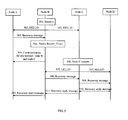
- FIG. 5 is a flow chart of a method for processing failure in this embodiment. As shown in FIG. 5 , the method includes the following steps.
- Steps 501-502 when the node B powers up and restarts, the node B sends a HELLO message to the node A and the node C, and the node B learns through the HELLO message mechanism that the control channel communication is broken between the node B and the node C.
- a src-instance value is a value +1 before power-off, and a dst-instance value is 0, so as to enable the node A and the node C to learn the restart of the node B.
- the node B After sending the HELLO message to the node C, the node B determines that the communication between the node B and the node C is broken for failing to receive a reply to the HELLO message from the node C.
- Reasons why the communication between the two nodes is broken may lie in not only that the node C powers off and does not restart, but also that a communication link between the node B and the node C fails.
- Steps 503-505 the node A sends a recovery message to the node B to inform the node B to recover the control state information corresponding to the LSP.
- the node B according to the received recovery message, performs recovery operation, and then starts a Restart_Timer. Furthermore, the node B informs the node A the communication breakdown failure information between the node B and the node C, and the node A performs self-refresh process on the control state information in the RSB corresponding to the LSP.
- the node A sends a recovery message to the node B, such as a Path message with a Recovery_label, so that the node B may, according to the received recovery message, establish a PSB and store the state control information carried in the recovery message in the PSB, so as to realize the recovery of the local control state information.
- a recovery message such as a Path message with a Recovery_label
- the node B Since the node C does not restart, the RSB in the node B cannot be recovered according to the normal protocol flow described in RFC3473, the node B, after finishing the recovery in the PSB, starts the Restart_Timer counting time according to the recovery waiting time, and informs the node A the communication breakdown failure information between the node B and the node C.
- the node A after receiving the communication breakdown failure information from the node B, performs self-refresh process on the control state information in the RSB corresponding to the LSP in the node.
- the Restart_Timer may be preset in advance and started in this step, and may also be set and started both in this step.
- the node D since the communication between the adjacent node D in the downstream of the node C and the node C is also broken, the node D performs self-refresh process on the control state information corresponding to the LSP before the Restart_Timer in the node D times out.
- Steps 506-507 the node C restarts before the Restart _ Timer in the node A times out, the node C sends the HELLO message to the nodes B and D to indicate that the node C powers up and restarts.
- Steps 508-512 the node B stops the Restart_Timer, enters a normal refresh process, and sends the recovery message to the node C.
- the node C after finishing the recovery of the control state information, sends the recovery message to the node D, and the node D enters the normal refresh process.
- the node D sends a recovery reply message to the node A through the nodes C and B.
- the node B after learning that the node C restarts through the HELLO mechanism, stops its own Restart_Timer. After receiving the recovery message, the node C determines whether it is a destination node of the LSP If the node C is the destination node, the node C recovers the control state information in the PSB and RSB corresponding to the LSP in the node C, and sends a recovery reply message such as an RESV message to the node B. The node B, according to the received recovery reply message, recovers the RSB corresponding to the LSP in this node through a normal refresh process on the control state information.
- the node C If the node C is not a destination node, the node C recovers the control state information in the PSB corresponding to the LSP in the node C, and forwards a recovery message to the normal node D in the downstream direction.
- the node D after receiving the recovery message, synchronizes the PSB corresponding to the LSP through a normal refresh process on the control state information. Then, the node D sends the recovery reply message hop-by-hop along the upstream direction.
- the node C and the node B receiving the recovery reply message recover the control state information in the RSB corresponding to the LSP
- the node A after receiving the recovery reply message, synchronizes the control state information of its own RSB through a normal refresh process on the control state information.
- the node C restarts before the Restart_Timer in the node B times out.
- the node B performs a process of deleting the unrecovered LSP in the direction of the node A, and sends a message of deleting the LSP.
- the node A after receiving the message of deleting the LSP from the node B, deletes the control state information corresponding to the LSP in the node.
- the node D deletes the control state information corresponding to the LSP in the node because a local fixed restart time times out.
- the node D will also delete the control state information corresponding to the LSP in the node D for failing to receive the recovery message from the upstream node C for a long time.
- this embodiment may quickly delete the LSP according to the method described in the protocol RFC3473, thereby quickly and accurately eliminating failure connections, facilitating quick release of the network resources occupied by the LSP, and enhancing the utilization rate of network resources.
- This embodiment still takes the LSP shown in FIG 3 as an example.
- the node B restarts and the node C cannot restart for a long time.
- a recovery waiting time is set on a restarted node and a normal recovery reply message is constructed and sent to the node A.
- FIG. 6 is a flow chart of a method for processing failure in this embodiment. As shown in FIG. 6 , the method includes the following steps.
- Steps 601-602 when the node B powers up and restarts, the node B sends a HELLO message to the node A and the node C, and the node B learns through the HELLO message mechanism that the control channel communication between the node B and the node C is broken.
- the node B After sending the HELLO message to the node C, the node B determines that the communication between the node B and the node C is broken for failing to receive a reply to the HELLO message from the node C.
- Reasons why the communication between the two nodes is broken may lie in not only that the node C powers off and does not restart, but also that a communication link between the node B and the node C fails.
- the node A sends a recovery message to the node B to inform the node B to recover control state information corresponding to the LSP.
- the node B according to the received recovery message, performs the recovery operation.
- the node B starts the Restart_Timer, and establishes a PSB therein according to the recovery message from the node A and a transmission plane message stored in the node B, and constructs and sends a normal recovery reply message to the node A.
- the node A after receiving the recovery reply message, synchronizes the control state information in the RSB corresponding to the LSP through normal refresh process.
- the node A sends a recovery message to the node B, such as a Path message with a Recovery_label, so that the node B may, according to the received recovery message, establish a PSB and store the state control information carried in the recovery message in the PSB, so as to realize the recovery of the local control state information.
- a recovery message such as a Path message with a Recovery_label
- the node B Since the node C does not restart, although the RSB in the node B can normally send a refresh message such as an RESV message to an upstream node A, the node B merely stores a part of the control state information in the RSB for failing to receive the refresh message such as the RESV message from the node C. Therefore, the node B, after finishing the recovery in the PSB and a part in the RSB, starts the Restart_Timer counting time according to the recovery waiting time, and performs a self-refresh process on the control state information in the RSB corresponding to the LSP in the node B. Meanwhile, the node B constructs and sends a normal recovery reply message to the node A. Such operation aims that, only the restarted node, i.e., the node B, learns that the communication is broken between itself and the node C, while other normal nodes on the LSP refresh the LSP in a normal manner.
- the node D since the communication between the adjacent node D in the downstream of the node C and the node C is also broken, the node D performs self-refresh process on the control state information corresponding to the LSP before the Restart_Timer in the node D times out, for example, performs self-refresh process the PSB corresponding to the LSP in the node D.
- Steps 606-607 the node C restarts before the Restart-Timer in the node B times out, and sends the HELLO message to the nodes B and D to indicate that the node C powers up and restarts.
- Steps 608-611 the node B stops the Restart _ Timer, enters a normal refresh process, and sends the recovery message to the node C.
- the node C after finishing the recovery of the control state information, sends the recovery message to the node D, and the node D enters the normal refresh process.
- the node D sends a recovery reply message to the nodes C and B, and the nodes C and B perform recovery according to the reply message.
- the node B after learning that the node. C restarts through the HELLO mechanism, stops its own Restart_Timer. After receiving the recovery message, the node C determines whether itself is a destination node of the LSP.
- the node C If the node C is the destination node, the node C recovers the control state information in the PSB and RSB corresponding to the LSP in the node C, and sends a recovery reply message such as an RESV message to the node B.
- the node B according to the received recovery reply message, recovers the control state information in the RSB corresponding to the LSP in this node through a normal refresh process on the control state information together with the node C.
- the node C If the node C is not a destination node, the node C recovers the control state information in the PSB corresponding to the LSP in the node C, and forwards a recovery message to the normal node D in the downstream direction.
- the node D after receiving the recovery message, synchronizes the PSB corresponding to the LSP, and begins a normal refresh process on the control state information. Then, the node D sends the recovery reply message hop-by-hop along the upstream direction.
- the node C receiving the recovery reply message recovers the control state information in the RSB corresponding to the LSP.
- the node B after receiving the recovery reply message, recovers its own control state information through a normal refresh process on the control state information between the node B and the node C.
- the node C restarts before the Restart_Timer in the node B times out.
- the node B performs a process of deleting the unrecovered LSP in the direction of the node A, and sends a message of deleting the LSP to the node A.
- the node A after receiving the message of deleting the LSP, deletes the control state information corresponding to the LSP in the node.
- the node D deletes the control state information corresponding to the LSP in the node because a local fixed restart time times out.
- the node D will also delete the control state information corresponding to the LSP in the node D for failing to receive the recovery message from the upstream node C for a long time.
- this embodiment may quickly delete the LSP according to the method described in the protocol RFC3473, thereby quickly and accurately eliminating failure connections, facilitating quick release of the network resources occupied by the LSP, and enhancing the utilization rate of network resources.
- FIG. 7 shows operating status of the nodes.
- the nodes B and C power off, the node C restarts, and the node B cannot restart for a long time.
- the node C is a restarted node
- the node B is a adjacent node of the node C
- the node A is a normal node in an upstream direction closest to the restarted node C
- the node D is a normal node in a downstream direction closest to the restarted node C.
- a recovery waiting time is set on a normal node on the LSP closest to the restarted node, i.e., the node D.
- FIG. 8 is a flow chart of a method for processing failure in this embodiment. Referring to FIG. 8 , the method includes the following steps.
- Steps 801-802 when the node C powers up and restarts, the node C sends a HELLO message to the node B and the node D, and the node C learns through the HELLO message mechanism that the control channel communication is broken between the node C and the node B.
- the node C After sending the HELLO message to the node B, the node C determines that the communication between the node B and the node C is broken for failing to receive a reply to the HELLO message from the node B.
- Reasons why the communication between the two nodes is broken may lie in not only that the node B powers off and does not restart, but also that a communication link between the node B and the node C fails.
- Steps 803-804 the node D sends a recovery message to the node C to inform the node C to recover control state information corresponding to the LSP.
- the node C according to the received recovery message, performs recovery operation and informs the node D of the communication breakdown failure information between the node B and the node C.
- the node D sends a recovery message such as a Recovery_Path message.
- the node C according to the received recovery message, recovers the control state information in the PSB corresponding to the LSP in the node C. Since the node B does not restart, the node C informs the communication breakdown failure information between the node C and the node B to the node D.
- Step 805 the node D starts a Restart_Timer and performs a self-refresh process on the control state information in the PSB corresponding to the LSP.
- the node D determines that the LSP cannot be recovered for the time being, starts the preset Restart_Timer counting time according to the recovery waiting time, and performs self-refresh process on the control state information in the PSB corresponding to the LSP in the node D, so as to prevent the timer corresponding to the PSB from timing out and prevent deleting the PSB.
- the self-refresh process is performed on the control state information corresponding to the LSP before the Restart_Timer in the node A times out, for example, the self-refresh process is performed on the RSB corresponding to the LSP in the node A.
- Steps 806-807 the node B restarts before the Restart_Tuner in the node D times out, and sends the HELLO message to the nodes A and C to indicate that the node B powers up and restarts.
- Steps 808-813 the node A and the node C both send the recovery message to the node B.
- the node B after finishing the recovery of the control state information, sends the recovery message to the node C.
- the node C after finishing the synchronization of the control state information, sends the recovery message to the node D.
- the node D after receiving the recovery message, stops the Restart_Timer and synchronizes its own control state information through a normal refresh process.
- the node D sends the recovery reply message to the normal node A in the upstream direction through the node C and the node B.
- the node B after receiving the recovery message from the node C in the downstream direction, determines whether it is a source node of the LSP.
- the node B If the node B is the source node, the node B recovers the control state information in the PSB and RSB corresponding to the LSP in the node B, and sends a recovery message such as a Path message with a Recovery_label to the node C.
- the node C according to the received recovery message, synchronizes the PSB corresponding to the LSP in this node, and sends the recovery message to the node D.
- the node D after receiving the recovery message, synchronizes its own control state information, stops its own Recovery_Timer, and begins a normal refresh process on the control state information.
- the node B If the node B is not the source node of the LSP, the node B maintains part of the control state information in the PSB in itself through a normal refresh process in the downstream direction.
- the node B does not send the recovery message with a Recovery_label such as a Path message to the node C until receiving the recovery message from the node A in the upstream direction.
- the node C according to the received recovery message, synchronizes the PSB in the node corresponding to the LSP, and sends the recovery message to the node D.
- the node D after receiving the recovery message, synchronizes its own control state information, stops its own Restart_Timer, and begins the normal refresh process on the control state information.
- the node D sends the recovery reply message such as an RESV message hop-by-hop to the normal node A in the upstream direction through the node C and the node B.
- the node C and the node B after receiving the recovery reply message, recovers the control state information of the local RSB.
- the node A after receiving the recovery reply message, synchronizes the control state information of the local RSB through the normal refresh process.
- the node B restarts before the Restart_Timer in the node D times out
- the counted time of the Restart_Timer reaches a preset recovery waiting time, i.e., after the timer stops counting time, but the node B still does not restart
- the node D performs a process of deleting the unrecovered LSP.
- This embodiment is similar to embodiment 1.
- the LSP may be efficiently prevented from being deleted abnormally, and reliability of recovering the LSP may be enhanced.
- this embodiment may delete the LSP according to the method described in the protocol RFC3473, thereby quickly and accurately eliminating failure connections, facilitating quick release of the network resources occupied by the LSP, and enhancing the utilization rate of network resources.
- This embodiment still takes the LSP shown in FIG. 7 as an example.
- the node C restarts, and the node B cannot restart for a long time.
- a recovery waiting time is preset on a restarted node, i.e., the node C.
- FIG. 9 is a flow chart of a method for processing failure in this embodiment. Referring to FIG. 9 , the method includes the following steps.
- Steps 901-902 when the node C powers up and restarts, the node C sends a HELLO message to the node B and the node D, and the node C learns through the HELLO message mechanism that the control channel communication between the node C and the node B is broken.
- Steps 903-905 the node D sends a recovery message to the node C to inform the node C to recover control state information corresponding to the LSP.
- the node C according to the received recovery message, performs recovery operation, and then starts a Restart_Timer. Furthermore, the node C informs the node D of the communication breakdown failure information between the node B and the node C, and the node D performs self-refresh process on the control state information in the RSB corresponding to the LSP.
- Steps 906-907 the node B restarts before the Restart_Timer in the node D times out, the node B sends the HELLO message to the nodes A and C to indicate that the node B powers up and restarts.
- Steps 908-913 the node A and the node C both send the recovery message to the node B.
- the node B after finishing the recovery of the control state information, sends the recovery message to the node C.
- the node C after finishing the synchronization of the control state information, stops the Restart_Timer, and sends the recovery message to the node D.
- the node D after receiving the recovery message, synchronizes its own control state information through a normal refresh process.
- the node D sends the recovery reply message to the normal node A in the upstream direction through the node C and the node B.
- the node B after receiving the recovery message from the node C in the downstream direction, determines whether it is a source node of the LSP.
- the node B If the node B is the source node, the node B recovers the control state information in the PSB and RSB corresponding to the LSP in the node B, and sends a recovery message with a Recovery_label such as a Path message to the node C.
- the node C according to the received recovery message, synchronizes the PSB corresponding to the LSP in this node, stops the Restart_Timer, and sends the recovery message to the node D.
- the node D after receiving the recovery message, synchronizes its own control state information through a normal refresh process on the control state information.
- the node B If the node B is not the source node of the LSP, the node B maintains a part of the control state information in the PSB in this node through a normal refresh process in the downstream direction.
- the node B will not send the recovery message such as a Path message with a Recovery_label to the node C until receiving the recovery message from the node A in the upstream direction.
- the node C according to the received recovery message, synchronizes the PSB corresponding to the LSP in the node, stops the Restart_Timer, and sends the recovery message to the node D.
- the node D after receiving the recovery message, synchronizes its own control state information through the normal refresh process on the control state information.
- the node D sends the recovery reply message such as an RESV message hop-by-hop to the normal node A in the upstream direction through the node C and the node B.
- the node C and the node B after receiving the recovery reply message, recovers the control state information of the local RSB.
- the node A after receiving the recovery reply message, synchronizes the control state information of the local RSB through the normal refresh process.
- the node B restarts before the Restart_Timer in the node C times out.
- the counted time of the Restart_Timer reaches a preset recovery waiting time, i.e., after the timer stops counting time, but the node B still does not restart, the node D deletes the unrecovered LSP.
- This embodiment is similar to embodiment 2.
- the LSP may be efficiently prevented from being deleted abnormally, and reliability of recovering the LSP may be enhanced. If other non-communication failures occur on the LSP, this embodiment may delete the LSP according to the method described in the protocol RFC3473, thereby quickly and accurately eliminating failed connections, facilitating quick release of the network resources occupied by the LSP, and enhancing the utilization rate of network resources.
- the Restart_Timer in the node C counts time. Furthermore, when determining that the communication between the node C and the node B is broken the node C constructs and sends a normal recovery reply message to the node D. Furthermore, after the communication between the node B and the node C is recovered, the recovery is processed according to a method similar to that in embodiment 3.
- the node C according to the recovery message from a node in the downstream direction and a transmission plane message stored therein, establishes a PSB corresponding to the LSP therein, maintains the control state information in the PSB through the self-refresh process, and constructs and sends a normal recovery reply message to the normal node D on the LSP.
- the node D according to the received normal recovery reply message, refreshes the control state information corresponding to the LSP in the node D, and sends a normal refresh message in the direction of the restarted node C.
- the node C receiving the refresh message recovers the control state information corresponding to the LSP in the node C through the normal refresh process.
- the node C determines whether itself is a source node of the LSP.
- the node B If the node B is the source node, the node B recovers or synchronizes the control state information in the PSB corresponding to the LSP in the node B, and sends a recovery message to the node C.
- the node C according to the received recovery message, synchronizes the control state information in the PSB corresponding to the LSP in this node, stops its own Restart_Timer, and sends the refresh message to the node B.
- the node B receiving the refresh message recovers the control state information in the RSB corresponding to the LSP in this node through a normal refresh process, and the flow ends.
- the node B If the node B is not the source node, the node B maintains a part of the control state information in the PSB in this node through a refresh process in the downstream direction.
- the node B does not send the recovery message such as a Path message with a Recovery_label to the node C until receiving the recovery message from the node A in the upstream direction.
- the node C stops its own Restart_Timer, synchronizes the control state information in the PSB corresponding to the LSP in the node, and sends a refresh message to the normal node A in the upstream direction through the node B.
- the node B receiving the refresh message recovers the control state information in the RSB corresponding to the LSP in the node B.
- the node A after receiving the refresh message, synchronizes the control state information in the RSB corresponding to the LSP in the node A through a normal refresh process and the flow ends.
- the restarted node after receiving the recovery message from the adjacent node in the upstream or downstream direction, sends communication breakdown failure information to a normal node.
- the restarted node may also sends the communication breakdown failure information to the normal node according to the routing information of the LSP recorded in the restarted node in advance after detecting that the communication between and the adjacent node is broken when receiving no recovery message.
- the aforementioned five embodiments all describe the circumstance that communication failures occur when the nodes on the LSP do not restart for a long time.
- the method according to the ideas of the present invention may be further adapted to the circumstance that the communication link between the nodes is broken to cause communication failures while the restarted node and adjacent node operate normally, under this circumstance, the restarted node detects that the communication link between the restarted node and the adjacent node is broken through the HELLO message mechanism after restarting. After that, operation may be performed according to the method disclosed in any abovementioned embodiment.
- the embodiments of the present invention provide a system for processing failure, which includes a first node, a second node and at least one third node.
- the first node and the second node are adjacent nodes suffering communication breakdown, the first node restarts, and the third node is a normal node closest to the restarted first node.
- the third node is adapted, in a certain period of time, to maintain the control state information of the LSP if the communication between the first node and the second node is broken, and recover the control state information of the LSP if the communication between the first node and the second node is recovered.
- the first node is adapted to recover the control state information of the LSP if the communication between the first node and the second node is recovered in the certain period of time.
- the second node is adapted to recover the control state information of the LSP if the communication between the first node and the second node is recovered in the certain period of time.
- the system also provides the following three methods.
- the first node is adapted to construct a recovery reply message after receiving the recovery message from the third node, send the recovery reply message to the third node, and begin counting time; and stop counting time if the communication between the first node and the second node is recovered when counted time does not exceed the certain period of time.
- the third node is adapted to send the recovery message to the first node, and maintain the control state information of the LSP according to the recovery reply message when counted time does not exceed the certain period of time.
- the first node is adapted to send communication breakdown failure information between the first node and the second node.
- the third node is adapted to begin counting time after receiving the communication breakdown failure information; maintain the control state information of the LSP if the communication between the first node and the second node is broken when counted time does not exceed the certain period of time; and stop counting time if the communication between the first node and the second node is recovered.
- the first node is adapted to send the communication breakdown failure information and begin counting time; and stop counting time if the communication between the first node and the second node is recovered when counted time does not exceed the certain period of time.
- the third node is adapted to maintain the control state information of the LSP when counted time does not exceed the certain period of time.
- the embodiments of the present invention provide a device along an LSP.
- the first device and the second device are adjacent devices suffering communication breakdown, the first device restarts, and the third device is a normal device closest to the started first device.
- the device is the third device, the device includes a first module and a second module.
- the first module is adapted to begin counting time when communication between the first device and the second device is broken, and stop counting time if communication between the first device and the second device is recovered when counted time does not exceed a certain period of time.
- the second module is adapted to maintain control state information of the device if the communication between the first device and the second device is broken when a time counted by the first module does not exceed the certain period of time, and recover the control state information of the device if the communication between the first device and the second device is recovered.
- the device When the device is the first device, the device further includes a third module.
- the third module is adapted to report communication breakdown failure information between the first device and the second device to the third device.
- the first module is adapted to begin counting time when the third module reports the communication breakdown failure information; and stop counting time if communication between the first device and the second device is recovered when the counted time does not exceed the certain period of time.
- the device When the device is the first device, the device further includes a fourth module.
- the fourth module is adapted to construct and return a normal recovery reply message to the third device when the third device sends a recovery message to the first device.
- the first module is adapted to begin counting time when the fourth module returns the recovery reply message; and stop counting time if communication between the first device and the second device is recovered when the counted time does not exceed the certain period of time.
- the LSP when several continuous nodes on the LSP suffer communication failures, and each node takes different time to recover to be normal, the LSP may be efficiently prevented from being deleted abnormally, and reliability of recovering the LSP may be enhanced. If other non-communication failures occur on the LSP, this embodiment may delete the LSP according to the method described in the protocol RFC3473, thereby quickly and accurately eliminating failure connections, facilitating quick release of the network resources occupied by the LSP, and enhancing the utilization rate of network resources.
Landscapes
- Engineering & Computer Science (AREA)
- Computer Networks & Wireless Communication (AREA)
- Signal Processing (AREA)
- Data Exchanges In Wide-Area Networks (AREA)
- Hardware Redundancy (AREA)
- Maintenance And Management Of Digital Transmission (AREA)
- Mobile Radio Communication Systems (AREA)
- Small-Scale Networks (AREA)
Claims (15)
- Verfahren zum Beheben eines Fehlers in einem GMPLS-System, das auf einen Label Switched Path, LSP, anwendbar ist, unter Verwendung eines Resource Reservation Protocol-Traffic Engineering, RSVP-TE, wobei das Verfahren einen ersten Knoten, einen zweiten Knoten und einen dritten Knoten in einem LSP umfasst, wobei der erste Knoten und der zweite Knoten benachbarte Knoten sind, die einen Kommunikationszusammenbruch erleiden, wobei der erste Knoten neu startet und der dritte Knoten ein normaler Knoten ist, der zu dem neu gestarteten ersten Knoten benachbart ist, und wobei das Verfahren Folgendes umfasst:Senden einer Wiederherstellungsmeldung an den ersten Knoten durch den dritten Knoten (403, 803);Wiederherstellen von dem LSP entsprechenden Steuerzustandsinformationen in Übereinstimmung mit der empfangenen Wiederherstellungsmeldung durch den ersten Knoten und Senden von Kommunikationszusammenbruchs-Fehlerinformationen an den dritten Knoten (404, 804);Zählen einer bestimmten Zeitdauer nach Empfang der Kommunikationszusammenbruchs-Fehlerinformationen, die einen Zusammenbruch zwischen dem ersten und dem zweiten Knoten betreffen, durch den dritten Knoten,Selbstauffrischen der dem LSP entsprechenden Steuerzustandsinformationen in einem Wegzustandsblock, PSB, und/oder in einem Reservierungszustandsblock, RSB, innerhalb der bestimmten Zeitdauer, wenn die Kommunikation zwischen dem ersten Knoten und dem zweiten Knoten unterbrochen ist (405, 805); undWiederherstellen der dem LSP entsprechenden Steuerzustandsinformationen in dem PSB und/oder in dem RSB durch den ersten Knoten, durch den zweiten Knoten unddurch den dritten Knoten, wenn die Kommunikation zwischen dem ersten Knoten und dem zweiten Knoten innerhalb der bestimmten Zeitdauer wiederhergestellt wird.
- Verfahren nach Anspruch 1, wobei der erste Knoten ein stromaufwärtiger Knoten des zweiten Knotens ist; wobei der dritte Knoten ein stromaufwärtiger Knoten des ersten Knotens ist; wobei das Verfahren ferner einen vierten Knoten umfasst und wobei der vierte Knoten ein normaler Knoten ist, der dem ersten Knoten in stromabwärtiger Richtung am nächsten ist;
wobei der dritte Knoten über einen Selbstauffrischprozess dem LSP entsprechende Steuerzustandsinformationen in einem Reservierungszustandsblock, RSB, aufrechterhält;
wobei der zweite Knoten bestimmt, ob der zweite Knoten ein Zielknoten des LSP ist, wenn die gezählte Zeit die bestimmte Zeitdauer nicht übersteigt, falls die Kommunikation zwischen dem ersten Knoten und dem zweiten Knoten wiederhergestellt wird und falls der erste Knoten eine Wiederherstellungsmeldung an den zweiten Knoten sendet (408);
wobei, falls der zweite Knoten der Zielknoten ist, der zweite Knoten in Übereinstimmung mit der empfangenen Wiederherstellungsmeldung dem LSP entsprechende Steuerzustandsinformationen in einem Wegzustandsblock, PSB, und in dem RSB des zweiten Knotens wiederherstellt und eine Wiederherstellungsantwortmeldung an den ersten Knoten sendet (411); wobei der erste Knoten in Übereinstimmung mit der empfangenen Wiederherstellungsantwortmeldung die dem LSP entsprechenden Steuerzustandsinformationen in dem RSB des ersten Knotens wiederherstellt und die Wiederherstellungsantwortmeldung entlang einer stromaufwärtigen Richtung an den dritten Knoten sendet (412) und ein stromaufwärtiger Knoten, der die Wiederherstellungsantwortmeldung empfängt, die dem LSP entsprechenden Steuerzustandsinformationen in dem RSB des Knotens wiederherstellt; und
wobei, falls der zweite Knoten kein Zielknoten ist, der zweite Knoten in Übereinstimmung mit der empfangenen Wiederherstellungsmeldung die dem LSP entsprechenden Steuerzustandsinformationen in dem PSB des zweiten Knotens wiederherstellt und die Wiederherstellungsmeldung abschnittsweise entlang einer stromabwärtigen Richtung an den vierten Knoten sendet (409), wobei ein stromabwärtiger Knoten, der die Wiederherstellungsmeldung empfängt, die dem LSP entsprechenden Steuerzustandsinformationen in dem PSB des stromabwärtigen Knotens über einen normalen Auffrischprozess wiederherstellt oder synchronisiert, woraufhin der vierte Knoten eine Wiederherstellungsantwortmeldung entlang der stromaufwärtigen Richtung an den dritten Knoten sendet (410-412) und der dritte Knoten, der die Wiederherstellungsantwortmeldung empfängt, die dem LSP entsprechenden Steuerzustandsinformationen in dem RSB des dritten Knotens wiederherstellt. - Verfahren nach Anspruch 1, wobei der erste Knoten ein stromabwärtiger Knoten des zweiten Knotens ist; wobei der dritte Knoten ein stromabwärtiger Knoten des ersten Knotens ist, wobei das Verfahren ferner einen vierten Knoten umfasst und wobei der vierte Knoten ein normaler Knoten ist, der dem ersten Knoten in der stromaufwärtigen Richtung am nächsten ist;
wobei der dritte Knoten dem LSP entsprechende Steuerzustandsinformationen in einem PSB durch Selbstauffrischen aufrechterhält;
wobei der zweite Knoten, wenn die gezählte Zeit die bestimmte Zeitdauer nicht übersteigt, falls die Kommunikation zwischen dem ersten Knoten und dem zweiten Knoten wiederhergestellt wird und der erste Knoten eine Wiederherstellungsmeldung an den zweiten Knoten sendet (808), bestimmt, ob der zweite Knoten ein Quellknoten des LSP ist;
wobei, falls der zweite Knoten der Quellknoten ist, der zweite Knoten in Übereinstimmung mit der empfangenen Wiederherstellungsmeldung von dem ersten Knoten die Steuerzustandsinformationen in einem dem LSP entsprechenden PSB und/oder in einem RSB in dem zweiten Knoten wiederherstellt und der zweite Knoten die Wiederherstellungsmeldung abschnittsweise entlang einer strömabwärtigen Richtung an den dritten Knoten sendet (809-810); wobei der dritte Knoten Steuerzustandsinformationen des dritten Knotens wiederherstellt oder synchronisiert und eine Wiederherstellungsantwortmeldung entlang einer stromaufwärtigen Richtung an den zweiten Knoten sendet (811-812), wobei ein stromaufwärtiger Knoten, der die Wiederherstellungsantwortmeldung empfängt, die dem LSP entsprechenden Steuerzustandsinformationen in einem RSB in dem Knoten über einen normalen Auffrischprozess wiederherstellt oder synchronisiert; und wobei, falls der zweite Knoten nicht der Quellknoten ist, der zweite Knoten, nachdem er eine Wiederherstellungsmeldung von dem vierten Knoten empfangen hat (808), in Übereinstimmung mit der Wiederherstellungsmeldung von dem vierten Knoten und von dem ersten Knoten einem LSP entsprechende Steuerzustandsinformationen in einem PSB in dem zweiten Knoten wiederherstellt und die Wiederherstellungsmeldung entlang einer stromabwärtigen Richtung an den dritten Knoten sendet (809-810); wobei der dritte Knoten Steuerzustandsinformationen des dritten Knotens wiederherstellt oder synchronisiert und eine Wiederherstellungsantwortmeldung abschnittsweise entlang einer stromaufwärtigen Richtung an den vierten Knoten sendet (811-813), wobei ein stromaufwärtiger Knoten, der die Wiederherstellungsantwortmeldung empfängt, die einem LSP entsprechenden Steuerzustandsinformationen in einem RSB in dem stromaufwärtigen Knoten über einen normalen Auffrischprozess wiederherstellt oder synchronisiert. - Verfahren nach Anspruch 1, wobei die Tatsache, dass der erste Knoten und der zweite Knoten in einem Kommunikationszusammenbruchszustand sind, Folgendes umfasst: der zweite Knoten startet nicht neu oder eine Kommunikationsverbindung zwischen dem ersten Knoten und dem zweiten Knoten ist unterbrochen.
- Verfahren zum Beheben eines Fehlers in einem GMPLS-System, das auf einen Label Switched Path, LSP, anwendbar ist, unter Verwendung eines Resource Reservation Protocol-Traffic Engineering, RSVP-TE, wobei das System einen ersten Knoten, einen zweiten Knoten und einen dritten Knoten in einem LSP umfasst, wobei der erste Knoten und der zweite Knoten benachbarte Knoten sind, die einen Kommunikationszusammenbruch erleiden, wobei der erste Knoten neu startet und der dritte Knoten ein normaler Knoten ist, der zu dem neu gestarteten ersten Knoten benachbart ist, und wobei das Verfahren Folgendes umfasst:Senden einer Wiederherstellungsmeldung an den ersten Knoten durch den dritten Knoten (503, 903);Wiederherstellen von dem LSP entsprechenden Steuerzustandsinformationen in Übereinstimmung mit der empfangenen Wiederherstellungsmeldung durch den ersten Knoten und Zählen einer bestimmten Zeitdauer (504, 904);Empfangen von Kommunikationszusammenbruchs-Fehlerinformationen, die einen Zusammenbruch zwischen dem ersten Knoten und dem zweiten Knoten betreffen,die durch den ersten Knoten gesendet werden, durch den dritten Knoten (505, 905) und Selbstauffrischen der dem LSP entsprechenden Steuerzustandsinformationen in einem Wegzustandsblock, PSB, und/oder in einem Reservierungszustandsblock, RSB, innerhalb der bestimmten Zeitdauer, wenn die Kommunikation zwischen dem ersten Knoten und dem zweiten Knoten unterbrochen ist; undWiederherstellen der dem LSP entsprechenden Steuerzustandsinformationen in dem PSB und/oder in dem RSB durch den ersten Knoten, durch den zweiten Knoten unddurch den dritten Knoten, wenn die Kommunikation zwischen dem ersten Knoten und dem zweiten Knoten innerhalb der bestimmten Zeitdauer wiederhergestellt wird.
- Verfahren nach Anspruch 5, wobei der erste Knoten ein stromaufwärtiger Knoten des zweiten Knotens ist; wobei der dritte Knoten ein stromaufwärtiger Knoten des ersten Knotens ist; wobei das Verfahren ferner einen vierten Knoten umfasst und wobei der vierte Knoten ein normaler Knoten ist, der dem ersten Knoten in stromabwärtiger Richtung am nächsten ist;
wobei der dritte Knoten über einen Selbstauffrischprozess dem LSP entsprechende Steuerzustandsinformationen in einem Reservierungszustandsblock, RSB, aufrechterhält;
wobei der zweite Knoten bestimmt, ob der zweite Knoten ein Zielknoten des LSP ist, wenn die gezählte Zeit die bestimmte Zeitdauer nicht übersteigt, falls die Kommunikation zwischen dem ersten Knoten und dem zweiten Knoten wiederhergestellt wird und falls der erste Knoten eine Wiederherstellungsmeldung an den zweiten Knoten sendet (508);
wobei, falls der zweite Knoten der Zielknoten ist, der zweite Knoten in Übereinstimmung mit der empfangenen Wiederherstellungsmeldung dem LSP entsprechende Steuerzustandsinformationen in einem Wegzustandsblock, PSB, und in dem RSB des zweiten Knotens wiederherstellt und eine Wiederherstellungsantwortmeldung an den ersten Knoten sendet (511); wobei der erste Knoten in Übereinstimmung mit der empfangenen Wiederherstellungsantwortmeldung die dem LSP entsprechenden Steuerzustandsinformationen in dem RSB des ersten Knotens wiederherstellt und die Wiederherstellungsantwortmeldung entlang einer stromaufwärtigen Richtung an den dritten Knoten sendet (512) und ein stromaufwärtiger Knoten, der die Wiederherstellungsantwortmeldung empfängt, die dem LSP entsprechenden Steuerzustandsinformationen in dem RSB des Knotens wiederherstellt; und
wobei, falls der zweite Knoten kein Zielknoten ist, der zweite Knoten in Übereinstimmung mit der empfangenen Wiederherstellungsmeldung die dem LSP entsprechenden Steuerzustandsinformationen in dem PSB des zweiten Knotens wiederherstellt und die Wiederherstellungsmeldung abschnittsweise entlang einer stromabwärtigen Richtung an den vierten Knoten sendet (509), wobei ein stromabwärtiger Knoten, der die Wiederherstellungsmeldung empfängt, die dem LSP entsprechenden Steuerzustandsinformationen in dem PSB des stromabwärtigen Knotens über einen normalen Auffrischprozess wiederherstellt oder synchronisiert, woraufhin der vierte Knoten eine Wiederherstellungsantwortmeldung entlang der stromaufwärtigen Richtung an den dritten Knoten sendet (510-512) und der dritte Knoten, der die Wiederherstellungsantwortmeldung empfängt, die dem LSP entsprechenden Steuerzustandsinformationen in dem RSB des dritten Knotens wiederherstellt. - Verfahren nach Anspruch 5, wobei der erste Knoten ein stromabwärtiger Knoten des zweiten Knotens ist; wobei der dritte Knoten ein stromabwärtiger Knoten des ersten Knotens ist, wobei das Verfahren ferner einen vierten Knoten umfasst und wobei der vierte Knoten ein normaler Knoten ist, der dem ersten Knoten in der stromaufwärtigen Richtung am nächsten ist;
wobei der dritte Knoten die dem LSP entsprechenden Steuerzustandsinformationen in einem PSB durch Selbstauffrischen aufrechterhält;
wobei der zweite Knoten, wenn die gezählte Zeit die bestimmte Zeitdauer nicht übersteigt, falls die Kommunikation zwischen dem ersten Knoten und dem zweiten Knoten wiederhergestellt wird und der erste Knoten eine Wiederherstellungsmeldung an den zweiten Knoten sendet (908), bestimmt, ob der zweite Knoten ein Quellknoten des LSP ist;
wobei, falls der zweite Knoten der Quellknoten ist, der zweite Knoten in Übereinstimmung mit der empfangenen Wiederherstellungsmeldung von dem ersten Knoten die dem LSP entsprechenden Steuerzustandsinformationen in einem PSB und/oder in einem RSB in dem zweiten Knoten wiederherstellt und der zweite Knoten die Wiederherstellungsmeldung abschnittsweise entlang einer stromabwärtigen Richtung an den dritten Knoten sendet (909-910); wobei der dritte Knoten Steuerzustandsinformationen des dritten Knotens wiederherstellt oder synchronisiert und eine Wiederherstellungsantwortmeldung entlang einer stromaufwärtigen Richtung an den zweiten Knoten sendet (911-912), wobei ein Knoten, der die Wiederherstellungsantwortmeldung empfängt, die dem LSP entsprechenden Steuerzustandsinformationen in einem RSB in dem Knoten über einen normalen Auffrischprozess wiederherstellt oder synchronisiert; und
wobei, falls der zweite Knoten nicht der Quellknoten ist, der zweite Knoten nachdem er eine Wiederherstellungsmeldung von dem vierten Knoten empfangen hat (908), in Übereinstimmung mit der Wiederherstellungsmeldung von dem vierten Knoten und von dem ersten Knoten einem LSP entsprechende Steuerzustandsinformationen in einem PSB in dem zweiten Knoten wiederherstellt und die Wiederherstellungsmeldung entlang einer stromabwärtigen Richtung an den dritten Knoten sendet (909-910); wobei der dritte Knoten Steuerzustandsinformationen des Knotens wiederherstellt oder synchronisiert und eine Wiederherstellungsantwortmeldung abschnittsweise entlang einer stromaufwärtigen Richtung an den vierten Knoten sendet (911-913), wobei ein stromaufwärtiger Knoten, der die Wiederherstellungsantwortmeldung empfängt, die einem LSP entsprechenden Steuerzustandsinformationen in einem RSB in dem stromaufwärtigen Knoten über einen normalen Auffrischprozess wiederherstellt oder synchronisiert. - Verfahren nach Anspruch 5, wobei die Tatsache, dass der erste Knoten und der zweite Knoten in einem Kommunikationszusammenbruchszustand sind, Folgendes umfasst: der zweite Knoten startet nicht neu oder eine Kommunikationsverbindung zwischen dem ersten Knoten und dem zweiten Knoten ist unterbrochen.
- Verfahren zum Beheben eines Fehlers in einem GMPLS, das auf einen Label Switched Path, LSP, anwendbar ist, unter Verwendung eines Resource Reservation Protocol-Traffic Engineering, RSVP-TE, wobei das System einen ersten Knoten, einen zweiten Knoten und einen dritten Knoten auf einem LSP umfasst, wobei der erste Knoten und der zweite Knoten benachbarte Knoten sind, die einen Kommunikationszusammenbruch erleiden, wobei der erste Knoten neu startet und wobei der dritte Knoten eine normaler Knoten ist, der zu dem neu gestarteten ersten Knoten benachbart ist, und wobei das Verfahren Folgendes umfasst:Senden einer Wiederherstellungsmeldung an den ersten Knoten durch den dritten Knoten (603);Wiederherstellen von dem LSP entsprechenden Steuerzustandsinformationen in Übereinstimmung mit der empfangenen Wiederherstellungsmeldung durch den ersten Knoten, Zählen einer bestimmten Zeitdauer und Selbstauffrischen der dem LSP entsprechenden Steuerzustandsinformationen in einem Wegzustandsblock, PSB,und/oder in einem Reservierungszustandsblock, RSB, innerhalb der bestimmten Zeitdauer (604);Empfangen einer durch den ersten Knoten gesendeten Wiederherstellungsantwortmeldung durch den dritten Knoten und Eintreten in einen normalen Auffrischprozess (605);Wiederherstellen der dem LSP entsprechenden Steuerzustandsinformationen in dem PSB und/oder in dem RSB durch den ersten Knoten, durch den zweiten Knoten unddurch den dritten Knoten, wenn die Kommunikation zwischen dem ersten Knoten und dem zweiten Knoten innerhalb der bestimmten Zeitdauer wiederhergestellt wird.
- Verfahren nach Anspruch 9, wobei das Verfahren, wenn der erste Knoten ein stromaufwärtiger Knoten des zweiten Knotens ist; wenn der dritte Knoten ein stromaufwärtiger Knoten des ersten Knotens ist; ferner einen vierten Knoten umfasst und der vierte Knoten ein normaler Knoten ist, der dem ersten Knoten in der stromabwärtigen Richtung am nächsten ist;
wobei, wenn die gezählte Zeit die bestimmte Zeitdauer nicht übersteigt, falls die Kommunikation zwischen dem ersten Knoten und dem zweiten Knoten unterbrochen ist, der erste Knoten in Übereinstimmung mit einer Wiederherstellungsmeldung, die von dem dritten Knoten gesendet wird, und mit Übertragungsebeneninformationen, die in dem ersten Knoten gespeichert sind, in dem ersten Knoten einen dem LSP entsprechenden PSB erzeugt, Steuerzustandsinformationen in dem PSB durch Selbstauffrischen aufrechterhält und eine konstruierte Wiederherstellungsantwortmeldung an den dritten Knoten sendet (605); wobei der dritte Knoten in Übereinstimmung mit der empfangenen Wiederherstellungsantwortmeldung einem LSP entsprechende Steuerzustandsinformationen in dem dritten stromaufwärtigen Knoten synchronisiert; wobei, wenn die gezählte Zeit die bestimmte Zeitdauer nicht übersteigt, falls die Kommunikation zwischen dem ersten Knoten und dem zweiten Knoten wiederhergestellt wird und der zweite Knoten die Wiederherstellungsmeldung von dem ersten Knoten empfängt (608), der zweite Knoten bestimmt, ob er ein Zielknoten des LSP ist;
wobei, falls der zweite Knoten der Zielknoten ist, der zweite Knoten einem LSP entsprechende Steuerzustandsinformationen in einem PSB und in einem RSB in dem zweiten Knoten wiederherstellt und eine Wiederherstellungsantwortmeldung an den ersten Knoten sendet (611); wobei der erste Knoten, der die Wiederherstellungsantwortmeldung empfängt, einem LSP entsprechende Steuerzustandsinformationen in einem RSB in dem ersten Knoten wiederherstellt und der erste Knoten und der zweite Knoten in einen normalen Auffrischprozess eintreten; und
wobei der zweite Knoten, falls der zweite Knoten nicht der Zielknoten ist, in Übereinstimmung mit der empfangenen Wiederherstellungsmeldung einem LSP entsprechende Steuerzustandsinformationen in einem PSB in dem zweiten Knoten wiederherstellt und die Wiederherstellungsmeldung abschnittsweise entlang einer stromabwärtigen Richtung an den vierten Knoten sendet (609), wobei ein stromabwärtiger Knoten, der die Wiederherstellungsmeldung empfängt, die einem LSP entsprechenden Steuerzustandsinformationen in einem PSB in dem Knoten, über einen normalen Auffrischprozess wiederherstellt; und der vierte Knoten eine Wiederherstellungsantwortmeldung entlang einer stromaufwärtigen Richtung an den ersten Knoten sendet (610-611) und ein stromaufwärtiger Knoten, der die Wiederherstellungsantwortmeldung empfängt, die einem LSP entsprechenden Steuerzustandsinformationen in einem RSB in dem Knoten über einen normalen Auffrischprozess wiederherstellt oder synchronisiert. - Verfahren nach Anspruch 9, wobei der erste Knoten ein stromabwärtiger Knoten des zweiten Knotens ist; der dritte Knoten ein stromabwärtiger Knoten des ersten Knotens ist; wobei das Verfahren ferner einen vierten Knoten umfasst und der vierte Knoten ein normaler Knoten ist, der dem ersten Knoten in der stromaufwärtigen Richtung am nächsten ist;
wobei, wenn die gezählte Zeit die bestimmte Zeitdauer nicht übersteigt, falls die Kommunikation zwischen dem ersten Knoten und dem zweiten Knoten unterbrochen ist, der erste Knoten in Übereinstimmung mit einer Wiederherstellungsmeldung, die von dem dritten Knoten gesendet wird, und mit einer Übertragungsebenenmeldung, die in dem ersten Knoten gespeichert ist, in dem ersten Knoten einen einem LSP entsprechenden PSB erzeugt, Steuerzustandsinformationen in dem PSB durch Selbstauffrischen aufrechterhält und eine Wiederherstellungsantwortmeldung an den dritten Knoten sendet; wobei der dritte Knoten in Übereinstimmung mit der empfangenen Wiederherstellungsantwortmeldung einem LSP entsprechende Steuerzustandsinformationen in dem dritten Knoten synchronisiert;
wobei, wenn gezählte Zeit die bestimmte Zeitdauer nicht übersteigt, falls die Kommunikation zwischen dem ersten Knoten und dem zweiten Knoten wiederhergestellt wird und der erste Knoten die Wiederherstellungsmeldung an den zweiten Knoten sendet, der zweite Knoten bestimmt, ob der zweite Knoten ein Quellknoten des LSP ist;
wobei, falls der zweite Knoten der Quellknoten ist, der zweite Knoten in Übereinstimmung mit der empfangenen Wiederherstellungsmeldung von dem ersten Knoten einem LSP entsprechende Steuerzustandsinformationen in einem PSB und/oder in einem RSB in dem zweiten Knoten wiederherstellt oder synchronisiert und die Wiederherstellungsmeldung an den ersten Knoten sendet, der erste Knoten, der die Wiederherstellungsmeldung empfängt, die einem LSP entsprechenden Steuerzustandsinformationen in einem PSB in dem ersten Knoten wiederherstellt und eine Wiederherstellungsantwortmeldung an den zweiten Knoten sendet, der zweite Knoten, der die Wiederherstellungsantwortmeldung empfängt, dem LSP entsprechende Steuerzustandsinformationen in einem RSB in dem zweiten Knoten über einen normalen Auffrischprozess wiederherstellt; und
wobei, falls der zweite Knoten nicht der Quellknoten ist, der zweite Knoten in Übereinstimmung mit einer Wiederherstellungsmeldung von dem vierten Knoten und von dem ersten Knoten dem LSP entsprechende Steuerzustandsinformationen in einem PSB in dem zweiten Knoten wiederherstellt und die Wiederherstellungsmeldung an den ersten Knoten sendet, der erste Knoten, der die Wiederherstellungsmeldung empfängt, einem LSP entsprechende Steuerzustandsinformationen in einem PSB in dem ersten Knoten wiederherstellt und eine Wiederherstellungsantwortmeldung an den zweiten Knoten sendet, der zweite Knoten, der die Wiederherstellungsantwortmeldung empfängt, dem LSP entsprechende Steuerzustandsinformationen in einem RSB in dem zweiten Knoten über einen normalen Auffrischprozess wiederherstellt oder synchronisiert und der zweite Knoten die Wiederherstellungsantwortmeldung an den vierten Knoten sendet. - Verfahren nach Anspruch 9, wobei die Tatsache, dass der erste Knoten und der zweite Knoten in einem Kommunikationszusammenbruchszustand sind, Folgendes umfasst: der zweite Knoten startet nicht neu oder eine Kommunikationsverbindung zwischen dem ersten Knoten und dem zweiten Knoten ist unterbrochen.
- GMPLS-System zur Behebung eines Fehlers, das einen ersten Knoten, einen zweiten Knoten und einen dritten Knoten auf einem LSP umfasst, wobei der erste Knoten und der zweite Knoten benachbarte Knoten sind, die einen Kommunikationszusammenbruch erleiden, wobei der erste Knoten neu startet, wobei der dritte Knoten ein normaler Knoten ist, der zu dem neu gestarteten ersten Knoten benachbart ist, wobei
der dritte Knoten zum Senden einer Wiederherstellungsmeldung an den ersten Knoten ausgelegt ist;
wobei der erste Knoten zum Wiederherstellen von dem LSP entsprechenden Steuerzustandsinformationen in Übereinstimmung mit der empfangenen Wiederherstellungsmeldung, zum Zählen einer bestimmten Zeitdauer, zum Selbstauffrischen der dem LSP entsprechenden Steuerzustandsinformationen in einem Wegzustandsblock, PSB, und/oder in einem Reservierungszustandsblock, RSB, innerhalb der bestimmten Zeitdauer, zum Konstruieren einer Wiederherstellungsantwortmeldung nach Empfangen einer Wiederherstellungsmeldung von dem dritten Knoten und zum Senden der Wiederherstellungsantwortmeldung an den dritten Knoten ausgelegt ist;
wobei der dritte Knoten ferner zum Empfangen der durch den ersten Knoten gesendeten Wiederherstellungsantwortmeldung, zum Eintreten in einen normalen Auffrischprozess und zum Wiederherstellen der dem LSP entsprechenden Steuerzustandsinformationen, falls die Kommunikation zwischen dem ersten Knoten und dem zweiten Knoten in der bestimmten Zeitdauer wiederhergestellt wird, ausgelegt ist;
wobei der erste Knoten ferner zum Wiederherstellen der dem LSP entsprechenden Steuerzustandsinformationen, falls die Kommunikation zwischen dem ersten Knoten und dem zweiten Knoten in der bestimmten Zeitdauer wiederhergestellt wird, ausgelegt ist;
wobei der zweite Knoten zum Wiederherstellen der dem LSP entsprechenden Steuerzustandsinformationen, falls die Kommunikation zwischen dem ersten Knoten und dem zweiten Knoten innerhalb der bestimmten Zeitdauer wiederhergestellt wird, ausgelegt ist. - GMPLS-System zum Beheben eines Fehlers, das einen ersten Knoten, einen zweiten Knoten und einen dritten Knoten auf einem LSP umfasst, wobei der erste Knoten und der zweite Knoten benachbarte Knoten sind, die einen Kommunikationszusammenbruch erleiden, wobei der erste Knoten neu startet, wobei der dritte Knoten ein normaler Knoten ist, der zu dem neu gestarteten ersten Knoten benachbart ist, wobei
der dritte Knoten zum Senden einer Wiederherstellungsmeldung an den ersten Knoten ausgelegt ist,
der erste Knoten zum Wiederherstellen von dem LSP entsprechenden Steuerzustandsinformationen in Übereinstimmung mit der empfangenen Wiederherstellungsmeldung und zum Senden von Kommunikationszusammenbruchs-Fehlerinformationen an den dritten Knoten ausgelegt ist;
wobei der dritte Knoten ferner zum Zählen einer bestimmten Zeitdauer nach Empfang der Kommunikationszusammenbruchs-Fehlerinformationen, die einen Zusammenbruch zwischen dem ersten Knoten und dem zweiten Knoten betreffen, zum Selbstauffrischen der dem LSP entsprechenden Steuerzustandsinformationen in einem Wegzustandsblock, PSB, und/oder in einem Reservierungszustandsblock, RSB, innerhalb der bestimmten Zeitdauer, wenn die Kommunikation zwischen dem ersten Knoten und dem zweiten Knoten unterbrochen ist, und zum Wiederherstellen der dem LSP entsprechenden Steuerzustandsinformationen, falls die Kommunikation zwischen dem ersten Knoten und dem zweiten Knoten in der bestimmten Zeitdauer wiederhergestellt wird, ausgelegt ist;
wobei der erste Knoten ferner zum Wiederherstellen der dem LSP entsprechenden Steuerzustandsinformationen, falls die Kommunikation zwischen dem ersten Knoten und dem zweiten Knoten innerhalb der bestimmten Zeitdauer wiederhergestellt wird, ausgelegt ist;
wobei der zweite Knoten zum Wiederherstellen der dem LSP entsprechenden Steuerzustandsinformationen, falls die Kommunikation zwischen dem ersten Knoten und dem zweiten Knoten innerhalb der bestimmten Zeitdauer wiederhergestellt wird, ausgelegt ist. - GMPLS-System zum Beheben eines Fehlers, das einen ersten Knoten, einen zweiten Knoten und einen dritten Knoten auf einem LSP umfasst, wobei der erste Knoten und der zweite Knoten benachbarte Knoten sind, die einen Kommunikationszusammenbruch erleiden, wobei der erste Knoten neu startet, wobei der dritte Knoten ein normaler Knoten ist, der zu dem neu gestarteten ersten Knoten benachbart ist, wobei
der dritte Knoten zum Senden einer Wiederherstellungsmeldung an den ersten Knoten ausgelegt ist;
der erste Knoten zum Wiederherstellen von dem LSP entsprechenden Steuerzustandsinformationen in Übereinstimmung mit der empfangenen Wiederherstellungsmeldung, zum Zählen einer bestimmten Zeitdauer und zum Senden von Kommunikationszusammenbruchs-Fehlerinformationen an den dritten Knoten ausgelegt ist;
der dritte Knoten ferner zum Empfangen der Kommunikationszusammenbruchs-Fehlerinformationen, zum Selbstauffrischen von dem LSP entsprechenden Steuerzustandsinformationen in einem Wegzustandsblock, PSB, und/oder in einem Reservierungszustandsblock, RSB, innerhalb der bestimmten Zeitdauer, wenn die Kommunikation zwischen dem ersten Knoten und dem zweiten Knoten unterbrochen ist, und zum Wiederherstellen der dem LSP entsprechenden Steuerzustandsinformationen, wenn die Kommunikation zwischen dem ersten Knoten und dem zweiten Knoten innerhalb der bestimmten Zeitdauer wiederhergestellt wird, ausgelegt ist;
der erste Knoten ferner zum Wiederherstellen von dem LSP entsprechenden Steuerzustandsinformationen, wenn die Kommunikation zwischen dem ersten Knoten und dem zweiten Knoten innerhalb der bestimmten Zeitdauer wiederhergestellt wird, ausgelegt ist;
der zweite Knoten zum Wiederherstellen von dem LSP entsprechenden Steuerzustandsinformationen, wenn die Kommunikation zwischen dem ersten Knoten und dem zweiten Knoten innerhalb der vorgegebenen Zeitdauer wiederhergestellt wird, ausgelegt ist.
Applications Claiming Priority (2)
| Application Number | Priority Date | Filing Date | Title |
|---|---|---|---|
| CN200610092914A CN101087207B (zh) | 2006-06-09 | 2006-06-09 | 一种多节点通信故障的处理方法 |
| PCT/CN2007/001194 WO2007140689A1 (en) | 2006-06-09 | 2007-04-12 | A failure processing method and a system and a device thereof |
Publications (3)
| Publication Number | Publication Date |
|---|---|
| EP1986371A1 EP1986371A1 (de) | 2008-10-29 |
| EP1986371A4 EP1986371A4 (de) | 2009-04-15 |
| EP1986371B1 true EP1986371B1 (de) | 2011-12-14 |
Family
ID=38801054
Family Applications (1)
| Application Number | Title | Priority Date | Filing Date |
|---|---|---|---|
| EP07720767A Active EP1986371B1 (de) | 2006-06-09 | 2007-04-12 | Ein fehlerverarbeitungsverfahren und ein system und zugehörige vorrichtung |
Country Status (7)
| Country | Link |
|---|---|
| US (1) | US8040793B2 (de) |
| EP (1) | EP1986371B1 (de) |
| CN (1) | CN101087207B (de) |
| AT (1) | ATE537664T1 (de) |
| DK (1) | DK1986371T3 (de) |
| ES (1) | ES2376361T3 (de) |
| WO (1) | WO2007140689A1 (de) |
Families Citing this family (26)
| Publication number | Priority date | Publication date | Assignee | Title |
|---|---|---|---|---|
| CN101616069B (zh) * | 2008-06-23 | 2012-04-04 | 华为技术有限公司 | 基于优雅重启的信息恢复方法和路由器 |
| ATE525875T1 (de) * | 2008-11-04 | 2011-10-15 | Htc Corp | Verfahren zur verbesserung der aufwärtsstreckenübertragung in einem drahtlosen kommunikationssystem |
| US20100284268A1 (en) * | 2009-05-07 | 2010-11-11 | Shan Zhu | Node State Recovery for a Communication Network |
| US20100284269A1 (en) * | 2009-05-07 | 2010-11-11 | Shan Zhu | Multi-Node State Recovery for a Communication Network |
| CN101964925B (zh) * | 2009-07-21 | 2014-04-30 | 中兴通讯股份有限公司 | 自动交换光网络中控制平面节点重启后的恢复方法及系统 |
| US8850014B2 (en) * | 2010-05-06 | 2014-09-30 | Telefonaktiebolaget L M Ericsson (Publ) | Handling failure of request message during set up of label switched path |
| US9197380B2 (en) * | 2010-12-17 | 2015-11-24 | Cisco Technology, Inc. | Repeater nodes in shared media networks |
| CN102130830B (zh) * | 2010-12-28 | 2013-04-17 | 华为技术有限公司 | 一种备用lsp的激活方法、装置和系统 |
| CN102136947A (zh) * | 2011-03-10 | 2011-07-27 | 华为技术有限公司 | 链路故障处理方法及装置 |
| CN102123097B (zh) | 2011-03-14 | 2015-05-20 | 杭州华三通信技术有限公司 | 一种路由保护方法和设备 |
| JP5835043B2 (ja) * | 2012-03-19 | 2015-12-24 | 富士通株式会社 | リスタート方法及びノード装置 |
| US9686188B2 (en) * | 2012-09-13 | 2017-06-20 | Telefonaktiebolaget Lm Ericsson (Publ) | Method and apparatus for node realignment in a telecommunications network |
| CN103354521B (zh) * | 2013-07-08 | 2016-09-07 | 杭州华三通信技术有限公司 | 一种基于ldp的lsp更新的优化方法和装置 |
| US9176833B2 (en) * | 2013-07-11 | 2015-11-03 | Globalfoundries U.S. 2 Llc | Tolerating failures using concurrency in a cluster |
| US9641455B2 (en) | 2013-07-18 | 2017-05-02 | International Business Machines Corporation | Mechanism for terminating relay operations in a distributed switch with cascaded configuration |
| CN104980295A (zh) * | 2014-04-09 | 2015-10-14 | 中兴通讯股份有限公司 | 防止网络节点老化的方法、装置及系统 |
| CN105530117A (zh) * | 2014-10-24 | 2016-04-27 | 中兴通讯股份有限公司 | 控制通道协议状态的更新方法、装置及系统 |
| CN105991480A (zh) * | 2015-02-27 | 2016-10-05 | 中兴通讯股份有限公司 | 一种实现rsvp-te协议报文处理的方法及装置 |
| CN106028385B (zh) * | 2016-05-05 | 2019-06-07 | 南京邮电大学 | 一种移动物联网系统故障测定方法 |
| CN107248941B (zh) * | 2017-06-30 | 2020-01-10 | 华为技术有限公司 | 一种检测路径的方法和装置 |
| US10721159B2 (en) * | 2018-04-25 | 2020-07-21 | Hewlett Packard Enterprise Development Lp | Rebuilt flow events |
| CN110661550B (zh) * | 2019-09-27 | 2021-08-31 | 青岛联众芯云科技有限公司 | 一种hplc通信链路中转发报文的方法、装置、存储介质和电子设备 |
| CN115509776B (zh) * | 2022-09-29 | 2024-02-06 | 南京远能电力工程有限公司监理分公司 | 基于电力工程智慧监理平台的数据分析方法及系统 |
| CN117632569B (zh) * | 2024-01-12 | 2024-04-12 | 宝德计算机系统股份有限公司 | 一种bmc网页端pci设备信息缺失的补救方法及其装置 |
| CN120803801B (zh) * | 2025-09-15 | 2025-11-14 | 厦门紫光展锐科技有限公司 | 一种核间通信的通路异常状态恢复方法、装置及存储介质 |
| CN120915648B (zh) * | 2025-09-29 | 2026-01-30 | 苏州元脑智能科技有限公司 | 集中式存储集群的节点重启方法 |
Family Cites Families (23)
| Publication number | Priority date | Publication date | Assignee | Title |
|---|---|---|---|---|
| US7298693B1 (en) * | 1999-10-21 | 2007-11-20 | Tellabs Operations, Inc. | Reverse notification tree for data networks |
| US6590868B2 (en) * | 2001-06-02 | 2003-07-08 | Redback Networks Inc. | Method and apparatus for restart communication between network elements |
| US6950427B1 (en) * | 2001-08-09 | 2005-09-27 | Cisco Technology, Inc. | Technique for resynchronizing LSDB in OSPF after a software reload in a non-stop forwarding intermediate node of a computer network |
| US7639680B1 (en) * | 2001-10-04 | 2009-12-29 | Cisco Technology, Inc. | Out of band data base synchronization for OSPF |
| CA2420842C (en) * | 2002-03-06 | 2010-05-11 | Nippon Telegraph And Telephone Corporation | Upper layer node, lower layer node, and node control method |
| US7760652B2 (en) * | 2002-04-16 | 2010-07-20 | Enterasys Networks, Inc. | Methods and apparatus for improved failure recovery of intermediate systems |
| US20040229294A1 (en) * | 2002-05-21 | 2004-11-18 | Po-Ying Chan-Hui | ErbB surface receptor complexes as biomarkers |
| US7248579B1 (en) * | 2002-10-15 | 2007-07-24 | Cisco Technology, Inc. | System and method for providing a link state database (LSDB) snapshot for neighbor synchronization |
| CN1269321C (zh) * | 2002-10-25 | 2006-08-09 | 华为技术有限公司 | 智能光网络中多节点重启后控制平面的恢复方法 |
| CN100349406C (zh) * | 2003-06-22 | 2007-11-14 | 华为技术有限公司 | 一种基于资源预留协议控制建立标签交换路径的方法 |
| GB2421158B (en) * | 2003-10-03 | 2007-07-11 | Avici Systems Inc | Rapid alternate paths for network destinations |
| US7680028B1 (en) * | 2003-11-21 | 2010-03-16 | Cisco Technology, Inc. | Method and apparatus for restarting RSVP processes in multiple network devices |
| JPWO2005057864A1 (ja) * | 2003-12-12 | 2007-07-12 | 富士通株式会社 | ネットワークの経路切替えシステム |
| JP4460358B2 (ja) * | 2004-05-19 | 2010-05-12 | Kddi株式会社 | 障害救済処理方法およびプログラム |
| US7957266B2 (en) * | 2004-05-28 | 2011-06-07 | Alcatel-Lucent Usa Inc. | Efficient and robust routing independent of traffic pattern variability |
| JP4434867B2 (ja) * | 2004-07-15 | 2010-03-17 | 富士通株式会社 | Mplsネットワークシステム及びノード |
| CN1801802B (zh) * | 2004-12-31 | 2010-06-02 | 华为技术有限公司 | 通用多协议标签交换路径上节点重启恢复的方法 |
| KR100693052B1 (ko) * | 2005-01-14 | 2007-03-12 | 삼성전자주식회사 | Mpls 멀티캐스트의 고속 재경로 설정 장치 및 방법 |
| US7881183B2 (en) * | 2005-09-08 | 2011-02-01 | Her Majesty The Queen In Right Of Canada As Represented By The Minister Of Industry, Through The Communications Research Centre Canada | Recovery from control plane failures in the LDP signalling protocol |
| US20070280140A1 (en) * | 2006-05-30 | 2007-12-06 | Thiruvengadam Venketesan | Self-optimizing network tunneling protocol |
| JP4580372B2 (ja) * | 2006-08-10 | 2010-11-10 | 株式会社日立製作所 | ネットワークシステム |
| CN101155124B (zh) * | 2006-09-27 | 2011-09-14 | 华为技术有限公司 | 一种实现组播快速重路由的方法 |
| US7969866B2 (en) * | 2008-03-31 | 2011-06-28 | Telefonaktiebolaget L M Ericsson (Publ) | Hierarchical virtual private LAN service hub connectivity failure recovery |
-
2006
- 2006-06-09 CN CN200610092914A patent/CN101087207B/zh active Active
-
2007
- 2007-04-12 EP EP07720767A patent/EP1986371B1/de active Active
- 2007-04-12 WO PCT/CN2007/001194 patent/WO2007140689A1/zh not_active Ceased
- 2007-04-12 DK DK07720767.8T patent/DK1986371T3/da active
- 2007-04-12 AT AT07720767T patent/ATE537664T1/de active
- 2007-04-12 ES ES07720767T patent/ES2376361T3/es active Active
-
2008
- 2008-12-09 US US12/331,125 patent/US8040793B2/en active Active
Also Published As
| Publication number | Publication date |
|---|---|
| WO2007140689A1 (en) | 2007-12-13 |
| ES2376361T3 (es) | 2012-03-13 |
| CN101087207A (zh) | 2007-12-12 |
| US8040793B2 (en) | 2011-10-18 |
| CN101087207B (zh) | 2010-05-12 |
| EP1986371A4 (de) | 2009-04-15 |
| US20090086623A1 (en) | 2009-04-02 |
| EP1986371A1 (de) | 2008-10-29 |
| DK1986371T3 (da) | 2012-02-27 |
| ATE537664T1 (de) | 2011-12-15 |
Similar Documents
| Publication | Publication Date | Title |
|---|---|---|
| EP1986371B1 (de) | Ein fehlerverarbeitungsverfahren und ein system und zugehörige vorrichtung | |
| US7787362B2 (en) | Method and device for recovering a shared mesh network | |
| US7881183B2 (en) | Recovery from control plane failures in the LDP signalling protocol | |
| EP2658182B1 (de) | Ringnetzwerk-Schutzverfahren, Netzwerkknoten dafür und Ringnetzwerk | |
| US8289843B2 (en) | Service failure recovery method and system | |
| CN101340380B (zh) | 一种实现主备倒换中双向转发检测包无中断转发的方法和装置 | |
| CN102684973B (zh) | 一种环网保护的方法及系统 | |
| CN100512154C (zh) | 一种提高多层网络业务恢复性能的方法及装置 | |
| EP1942604B1 (de) | Verfahren zur dienstevermittlung und entsprechender netzknoten | |
| EP1921797B1 (de) | Verfahren und vorrichtung zur wiederherstellung nach einem aussergewöhnlichen löschvorgang in einem lsp (label-switched path) eines optischen netzes | |
| CN1801802B (zh) | 通用多协议标签交换路径上节点重启恢复的方法 | |
| US9774492B2 (en) | Message passing to assure deletion of label switched path | |
| EP1936882B1 (de) | Verfahren zum wiederherstellen der dienstweiterleitungsroute und system dafür | |
| CN101420378B (zh) | 资源预留协议流量工程下优雅重启的实现装置及方法 | |
| EP2704382B1 (de) | Verfahren zur Verwaltung von Diensten in einem mit Generalized-Multi-Protocol-Label-Switching (GMPLS) gesteuerten Netzwerk | |
| WO2015154583A1 (zh) | 控制通道协议状态的更新方法、装置及系统 | |
| KR100501320B1 (ko) | 다중 프로토콜 레이블 교환 시스템에서의 씨알-엘에스피복구 방법 | |
| KR100428778B1 (ko) | 다중 프로토콜 레이블 교환 시스템에서의 씨알-엘에스피의경로 보호 방법 및 이를 위한 기록매체 | |
| Jiao et al. | OPN02-6: Achieving Complete Control Plane Recovery in Optical User Network Interface | |
| KR20130056069A (ko) | 보호 복구 절체 방법 |
Legal Events
| Date | Code | Title | Description |
|---|---|---|---|
| PUAI | Public reference made under article 153(3) epc to a published international application that has entered the european phase |
Free format text: ORIGINAL CODE: 0009012 |
|
| 17P | Request for examination filed |
Effective date: 20080912 |
|
| AK | Designated contracting states |
Kind code of ref document: A1 Designated state(s): AT BE BG CH CY CZ DE DK EE ES FI FR GB GR HU IE IS IT LI LT LU LV MC MT NL PL PT RO SE SI SK TR |
|
| RIC1 | Information provided on ipc code assigned before grant |
Ipc: H04L 12/56 20060101ALI20090303BHEP Ipc: H04L 12/24 20060101AFI20080221BHEP |
|
| A4 | Supplementary search report drawn up and despatched |
Effective date: 20090312 |
|
| 17Q | First examination report despatched |
Effective date: 20090319 |
|
| REG | Reference to a national code |
Ref country code: DE Ref legal event code: R079 Ref document number: 602007019331 Country of ref document: DE Free format text: PREVIOUS MAIN CLASS: H04L0012240000 Ipc: H04Q0011000000 |
|
| GRAP | Despatch of communication of intention to grant a patent |
Free format text: ORIGINAL CODE: EPIDOSNIGR1 |
|
| RIC1 | Information provided on ipc code assigned before grant |
Ipc: H04L 12/24 20060101ALI20110810BHEP Ipc: H04L 12/56 20060101ALI20110810BHEP Ipc: H04Q 11/00 20060101AFI20110810BHEP |
|
| RTI1 | Title (correction) |
Free format text: A FAILURE PROCESSING METHOD AND A SYSTEM AND A DEVICE THEREOF |
|
| DAX | Request for extension of the european patent (deleted) | ||
| GRAS | Grant fee paid |
Free format text: ORIGINAL CODE: EPIDOSNIGR3 |
|
| GRAA | (expected) grant |
Free format text: ORIGINAL CODE: 0009210 |
|
| AK | Designated contracting states |
Kind code of ref document: B1 Designated state(s): AT BE BG CH CY CZ DE DK EE ES FI FR GB GR HU IE IS IT LI LT LU LV MC MT NL PL PT RO SE SI SK TR |
|
| REG | Reference to a national code |
Ref country code: GB Ref legal event code: FG4D |
|
| REG | Reference to a national code |
Ref country code: CH Ref legal event code: EP |
|
| REG | Reference to a national code |
Ref country code: IE Ref legal event code: FG4D |
|
| REG | Reference to a national code |
Ref country code: DE Ref legal event code: R096 Ref document number: 602007019331 Country of ref document: DE Effective date: 20120209 |
|
| REG | Reference to a national code |
Ref country code: SE Ref legal event code: TRGR |
|
| REG | Reference to a national code |
Ref country code: DK Ref legal event code: T3 |
|
| REG | Reference to a national code |
Ref country code: ES Ref legal event code: FG2A Ref document number: 2376361 Country of ref document: ES Kind code of ref document: T3 Effective date: 20120313 |
|
| REG | Reference to a national code |
Ref country code: NL Ref legal event code: VDEP Effective date: 20111214 |
|
| PG25 | Lapsed in a contracting state [announced via postgrant information from national office to epo] |
Ref country code: LT Free format text: LAPSE BECAUSE OF FAILURE TO SUBMIT A TRANSLATION OF THE DESCRIPTION OR TO PAY THE FEE WITHIN THE PRESCRIBED TIME-LIMIT Effective date: 20111214 |
|
| LTIE | Lt: invalidation of european patent or patent extension |
Effective date: 20111214 |
|
| PG25 | Lapsed in a contracting state [announced via postgrant information from national office to epo] |
Ref country code: NL Free format text: LAPSE BECAUSE OF FAILURE TO SUBMIT A TRANSLATION OF THE DESCRIPTION OR TO PAY THE FEE WITHIN THE PRESCRIBED TIME-LIMIT Effective date: 20111214 Ref country code: SI Free format text: LAPSE BECAUSE OF FAILURE TO SUBMIT A TRANSLATION OF THE DESCRIPTION OR TO PAY THE FEE WITHIN THE PRESCRIBED TIME-LIMIT Effective date: 20111214 Ref country code: LV Free format text: LAPSE BECAUSE OF FAILURE TO SUBMIT A TRANSLATION OF THE DESCRIPTION OR TO PAY THE FEE WITHIN THE PRESCRIBED TIME-LIMIT Effective date: 20111214 Ref country code: GR Free format text: LAPSE BECAUSE OF FAILURE TO SUBMIT A TRANSLATION OF THE DESCRIPTION OR TO PAY THE FEE WITHIN THE PRESCRIBED TIME-LIMIT Effective date: 20120315 |
|
| PG25 | Lapsed in a contracting state [announced via postgrant information from national office to epo] |
Ref country code: CY Free format text: LAPSE BECAUSE OF FAILURE TO SUBMIT A TRANSLATION OF THE DESCRIPTION OR TO PAY THE FEE WITHIN THE PRESCRIBED TIME-LIMIT Effective date: 20111214 |
|
| PG25 | Lapsed in a contracting state [announced via postgrant information from national office to epo] |
Ref country code: CZ Free format text: LAPSE BECAUSE OF FAILURE TO SUBMIT A TRANSLATION OF THE DESCRIPTION OR TO PAY THE FEE WITHIN THE PRESCRIBED TIME-LIMIT Effective date: 20111214 Ref country code: EE Free format text: LAPSE BECAUSE OF FAILURE TO SUBMIT A TRANSLATION OF THE DESCRIPTION OR TO PAY THE FEE WITHIN THE PRESCRIBED TIME-LIMIT Effective date: 20111214 Ref country code: BG Free format text: LAPSE BECAUSE OF FAILURE TO SUBMIT A TRANSLATION OF THE DESCRIPTION OR TO PAY THE FEE WITHIN THE PRESCRIBED TIME-LIMIT Effective date: 20120314 Ref country code: SK Free format text: LAPSE BECAUSE OF FAILURE TO SUBMIT A TRANSLATION OF THE DESCRIPTION OR TO PAY THE FEE WITHIN THE PRESCRIBED TIME-LIMIT Effective date: 20111214 Ref country code: IS Free format text: LAPSE BECAUSE OF FAILURE TO SUBMIT A TRANSLATION OF THE DESCRIPTION OR TO PAY THE FEE WITHIN THE PRESCRIBED TIME-LIMIT Effective date: 20120414 |
|
| PG25 | Lapsed in a contracting state [announced via postgrant information from national office to epo] |
Ref country code: PL Free format text: LAPSE BECAUSE OF FAILURE TO SUBMIT A TRANSLATION OF THE DESCRIPTION OR TO PAY THE FEE WITHIN THE PRESCRIBED TIME-LIMIT Effective date: 20111214 Ref country code: PT Free format text: LAPSE BECAUSE OF FAILURE TO SUBMIT A TRANSLATION OF THE DESCRIPTION OR TO PAY THE FEE WITHIN THE PRESCRIBED TIME-LIMIT Effective date: 20120416 Ref country code: RO Free format text: LAPSE BECAUSE OF FAILURE TO SUBMIT A TRANSLATION OF THE DESCRIPTION OR TO PAY THE FEE WITHIN THE PRESCRIBED TIME-LIMIT Effective date: 20111214 |
|
| REG | Reference to a national code |
Ref country code: AT Ref legal event code: MK05 Ref document number: 537664 Country of ref document: AT Kind code of ref document: T Effective date: 20111214 |
|
| PLBE | No opposition filed within time limit |
Free format text: ORIGINAL CODE: 0009261 |
|
| STAA | Information on the status of an ep patent application or granted ep patent |
Free format text: STATUS: NO OPPOSITION FILED WITHIN TIME LIMIT |
|
| 26N | No opposition filed |
Effective date: 20120917 |
|
| PG25 | Lapsed in a contracting state [announced via postgrant information from national office to epo] |
Ref country code: MC Free format text: LAPSE BECAUSE OF NON-PAYMENT OF DUE FEES Effective date: 20120430 |
|
| REG | Reference to a national code |
Ref country code: DE Ref legal event code: R097 Ref document number: 602007019331 Country of ref document: DE Effective date: 20120917 |
|
| REG | Reference to a national code |
Ref country code: IE Ref legal event code: MM4A |
|
| PG25 | Lapsed in a contracting state [announced via postgrant information from national office to epo] |
Ref country code: AT Free format text: LAPSE BECAUSE OF FAILURE TO SUBMIT A TRANSLATION OF THE DESCRIPTION OR TO PAY THE FEE WITHIN THE PRESCRIBED TIME-LIMIT Effective date: 20111214 Ref country code: IE Free format text: LAPSE BECAUSE OF NON-PAYMENT OF DUE FEES Effective date: 20120412 |
|
| PG25 | Lapsed in a contracting state [announced via postgrant information from national office to epo] |
Ref country code: FI Free format text: LAPSE BECAUSE OF FAILURE TO SUBMIT A TRANSLATION OF THE DESCRIPTION OR TO PAY THE FEE WITHIN THE PRESCRIBED TIME-LIMIT Effective date: 20111214 |
|
| PG25 | Lapsed in a contracting state [announced via postgrant information from national office to epo] |
Ref country code: MT Free format text: LAPSE BECAUSE OF FAILURE TO SUBMIT A TRANSLATION OF THE DESCRIPTION OR TO PAY THE FEE WITHIN THE PRESCRIBED TIME-LIMIT Effective date: 20111214 |
|
| PG25 | Lapsed in a contracting state [announced via postgrant information from national office to epo] |
Ref country code: TR Free format text: LAPSE BECAUSE OF FAILURE TO SUBMIT A TRANSLATION OF THE DESCRIPTION OR TO PAY THE FEE WITHIN THE PRESCRIBED TIME-LIMIT Effective date: 20111214 |
|
| PG25 | Lapsed in a contracting state [announced via postgrant information from national office to epo] |
Ref country code: LU Free format text: LAPSE BECAUSE OF NON-PAYMENT OF DUE FEES Effective date: 20120412 |
|
| PG25 | Lapsed in a contracting state [announced via postgrant information from national office to epo] |
Ref country code: HU Free format text: LAPSE BECAUSE OF FAILURE TO SUBMIT A TRANSLATION OF THE DESCRIPTION OR TO PAY THE FEE WITHIN THE PRESCRIBED TIME-LIMIT Effective date: 20070412 |
|
| REG | Reference to a national code |
Ref country code: FR Ref legal event code: PLFP Year of fee payment: 10 |
|
| REG | Reference to a national code |
Ref country code: FR Ref legal event code: PLFP Year of fee payment: 11 |
|
| REG | Reference to a national code |
Ref country code: FR Ref legal event code: PLFP Year of fee payment: 12 |
|
| PGFP | Annual fee paid to national office [announced via postgrant information from national office to epo] |
Ref country code: DE Payment date: 20250305 Year of fee payment: 19 |
|
| PGFP | Annual fee paid to national office [announced via postgrant information from national office to epo] |
Ref country code: ES Payment date: 20250506 Year of fee payment: 19 Ref country code: DK Payment date: 20250411 Year of fee payment: 19 |
|
| PGFP | Annual fee paid to national office [announced via postgrant information from national office to epo] |
Ref country code: CH Payment date: 20250501 Year of fee payment: 19 |
|
| PGFP | Annual fee paid to national office [announced via postgrant information from national office to epo] |
Ref country code: SE Payment date: 20260312 Year of fee payment: 20 |
|
| PGFP | Annual fee paid to national office [announced via postgrant information from national office to epo] |
Ref country code: GB Payment date: 20260310 Year of fee payment: 20 |
|
| PGFP | Annual fee paid to national office [announced via postgrant information from national office to epo] |
Ref country code: BE Payment date: 20260317 Year of fee payment: 20 Ref country code: IT Payment date: 20260320 Year of fee payment: 20 |
|
| PGFP | Annual fee paid to national office [announced via postgrant information from national office to epo] |
Ref country code: FR Payment date: 20260309 Year of fee payment: 20 |