EP1984433B1 - Optical articles from curable compositions - Google Patents
Optical articles from curable compositions Download PDFInfo
- Publication number
- EP1984433B1 EP1984433B1 EP07717192A EP07717192A EP1984433B1 EP 1984433 B1 EP1984433 B1 EP 1984433B1 EP 07717192 A EP07717192 A EP 07717192A EP 07717192 A EP07717192 A EP 07717192A EP 1984433 B1 EP1984433 B1 EP 1984433B1
- Authority
- EP
- European Patent Office
- Prior art keywords
- optical
- prism
- meth
- weight
- acrylate
- Prior art date
- Legal status (The legal status is an assumption and is not a legal conclusion. Google has not performed a legal analysis and makes no representation as to the accuracy of the status listed.)
- Not-in-force
Links
- 239000000203 mixture Substances 0.000 title claims abstract description 116
- 230000003287 optical effect Effects 0.000 title claims abstract description 82
- 239000000178 monomer Substances 0.000 claims abstract description 74
- 125000000524 functional group Chemical group 0.000 claims abstract description 48
- 239000003085 diluting agent Substances 0.000 claims abstract description 34
- 239000003431 cross linking reagent Substances 0.000 claims abstract description 15
- 239000012788 optical film Substances 0.000 claims abstract description 12
- 239000013307 optical fiber Substances 0.000 claims abstract description 4
- 239000010408 film Substances 0.000 claims description 52
- 229920000642 polymer Polymers 0.000 claims description 27
- 125000003647 acryloyl group Chemical group O=C([*])C([H])=C([H])[H] 0.000 claims description 14
- 238000004519 manufacturing process Methods 0.000 claims description 12
- 230000009477 glass transition Effects 0.000 claims description 11
- 238000005266 casting Methods 0.000 claims description 5
- 238000003491 array Methods 0.000 claims description 3
- 239000000853 adhesive Substances 0.000 abstract description 26
- 230000001070 adhesive effect Effects 0.000 abstract description 26
- 238000004383 yellowing Methods 0.000 abstract description 6
- NIXOWILDQLNWCW-UHFFFAOYSA-M Acrylate Chemical compound [O-]C(=O)C=C NIXOWILDQLNWCW-UHFFFAOYSA-M 0.000 description 77
- -1 light pipes Substances 0.000 description 58
- 239000000463 material Substances 0.000 description 54
- 239000011521 glass Substances 0.000 description 38
- 238000000034 method Methods 0.000 description 33
- 238000006116 polymerization reaction Methods 0.000 description 26
- 239000003999 initiator Substances 0.000 description 22
- 229910052724 xenon Inorganic materials 0.000 description 21
- FHNFHKCVQCLJFQ-UHFFFAOYSA-N xenon atom Chemical compound [Xe] FHNFHKCVQCLJFQ-UHFFFAOYSA-N 0.000 description 21
- 239000006188 syrup Substances 0.000 description 20
- 235000020357 syrup Nutrition 0.000 description 20
- OZAIFHULBGXAKX-UHFFFAOYSA-N 2-(2-cyanopropan-2-yldiazenyl)-2-methylpropanenitrile Chemical group N#CC(C)(C)N=NC(C)(C)C#N OZAIFHULBGXAKX-UHFFFAOYSA-N 0.000 description 19
- 230000005855 radiation Effects 0.000 description 18
- 150000001252 acrylic acid derivatives Chemical class 0.000 description 17
- 238000000465 moulding Methods 0.000 description 16
- 238000006243 chemical reaction Methods 0.000 description 15
- 238000000576 coating method Methods 0.000 description 15
- SAPGBCWOQLHKKZ-UHFFFAOYSA-N 6-(2-methylprop-2-enoyloxy)hexyl 2-methylprop-2-enoate Chemical compound CC(=C)C(=O)OCCCCCCOC(=O)C(C)=C SAPGBCWOQLHKKZ-UHFFFAOYSA-N 0.000 description 13
- 238000001723 curing Methods 0.000 description 13
- 125000002887 hydroxy group Chemical group [H]O* 0.000 description 13
- 238000002360 preparation method Methods 0.000 description 13
- 239000000047 product Substances 0.000 description 13
- 239000010409 thin film Substances 0.000 description 13
- ZMDDERVSCYEKPQ-UHFFFAOYSA-N Ethyl (mesitylcarbonyl)phenylphosphinate Chemical compound C=1C=CC=CC=1P(=O)(OCC)C(=O)C1=C(C)C=C(C)C=C1C ZMDDERVSCYEKPQ-UHFFFAOYSA-N 0.000 description 12
- 229920003023 plastic Polymers 0.000 description 12
- 239000004033 plastic Substances 0.000 description 12
- 230000009102 absorption Effects 0.000 description 11
- 238000010521 absorption reaction Methods 0.000 description 11
- XLYOFNOQVPJJNP-UHFFFAOYSA-N water Substances O XLYOFNOQVPJJNP-UHFFFAOYSA-N 0.000 description 11
- 230000008569 process Effects 0.000 description 10
- 239000000758 substrate Substances 0.000 description 10
- 239000004593 Epoxy Substances 0.000 description 9
- JOYRKODLDBILNP-UHFFFAOYSA-N Ethyl urethane Chemical compound CCOC(N)=O JOYRKODLDBILNP-UHFFFAOYSA-N 0.000 description 9
- 125000001931 aliphatic group Chemical group 0.000 description 9
- 239000011248 coating agent Substances 0.000 description 9
- 150000001875 compounds Chemical class 0.000 description 9
- 150000003254 radicals Chemical class 0.000 description 9
- 239000000126 substance Substances 0.000 description 9
- 230000032683 aging Effects 0.000 description 8
- 125000000217 alkyl group Chemical group 0.000 description 8
- 230000010287 polarization Effects 0.000 description 8
- 229920000570 polyether Polymers 0.000 description 8
- 229910001220 stainless steel Inorganic materials 0.000 description 8
- 239000010935 stainless steel Substances 0.000 description 8
- 239000004721 Polyphenylene oxide Substances 0.000 description 7
- 239000012986 chain transfer agent Substances 0.000 description 7
- 239000004417 polycarbonate Substances 0.000 description 7
- 229920000515 polycarbonate Polymers 0.000 description 7
- 229920000647 polyepoxide Polymers 0.000 description 7
- 238000012360 testing method Methods 0.000 description 7
- 125000000391 vinyl group Chemical group [H]C([*])=C([H])[H] 0.000 description 7
- IJGRMHOSHXDMSA-UHFFFAOYSA-N Atomic nitrogen Chemical compound N#N IJGRMHOSHXDMSA-UHFFFAOYSA-N 0.000 description 6
- PPBRXRYQALVLMV-UHFFFAOYSA-N Styrene Chemical compound C=CC1=CC=CC=C1 PPBRXRYQALVLMV-UHFFFAOYSA-N 0.000 description 6
- 125000003118 aryl group Chemical group 0.000 description 6
- 230000005540 biological transmission Effects 0.000 description 6
- IISBACLAFKSPIT-UHFFFAOYSA-N bisphenol A Chemical compound C=1C=C(O)C=CC=1C(C)(C)C1=CC=C(O)C=C1 IISBACLAFKSPIT-UHFFFAOYSA-N 0.000 description 6
- 125000004432 carbon atom Chemical group C* 0.000 description 6
- 229910052751 metal Inorganic materials 0.000 description 6
- 239000002184 metal Substances 0.000 description 6
- 229920000728 polyester Polymers 0.000 description 6
- CERQOIWHTDAKMF-UHFFFAOYSA-M Methacrylate Chemical compound CC(=C)C([O-])=O CERQOIWHTDAKMF-UHFFFAOYSA-M 0.000 description 5
- 125000003178 carboxy group Chemical group [H]OC(*)=O 0.000 description 5
- 238000010438 heat treatment Methods 0.000 description 5
- 239000012948 isocyanate Substances 0.000 description 5
- 238000005259 measurement Methods 0.000 description 5
- 238000002156 mixing Methods 0.000 description 5
- 229920000139 polyethylene terephthalate Polymers 0.000 description 5
- 239000005020 polyethylene terephthalate Substances 0.000 description 5
- 229920005862 polyol Polymers 0.000 description 5
- 238000001542 size-exclusion chromatography Methods 0.000 description 5
- 230000035882 stress Effects 0.000 description 5
- 238000010998 test method Methods 0.000 description 5
- 238000002834 transmittance Methods 0.000 description 5
- 229920002554 vinyl polymer Polymers 0.000 description 5
- FIHBHSQYSYVZQE-UHFFFAOYSA-N 6-prop-2-enoyloxyhexyl prop-2-enoate Chemical compound C=CC(=O)OCCCCCCOC(=O)C=C FIHBHSQYSYVZQE-UHFFFAOYSA-N 0.000 description 4
- SOGAXMICEFXMKE-UHFFFAOYSA-N Butylmethacrylate Chemical compound CCCCOC(=O)C(C)=C SOGAXMICEFXMKE-UHFFFAOYSA-N 0.000 description 4
- LYCAIKOWRPUZTN-UHFFFAOYSA-N Ethylene glycol Chemical compound OCCO LYCAIKOWRPUZTN-UHFFFAOYSA-N 0.000 description 4
- BAPJBEWLBFYGME-UHFFFAOYSA-N Methyl acrylate Chemical compound COC(=O)C=C BAPJBEWLBFYGME-UHFFFAOYSA-N 0.000 description 4
- VVQNEPGJFQJSBK-UHFFFAOYSA-N Methyl methacrylate Chemical compound COC(=O)C(C)=C VVQNEPGJFQJSBK-UHFFFAOYSA-N 0.000 description 4
- NIXOWILDQLNWCW-UHFFFAOYSA-N acrylic acid group Chemical group C(C=C)(=O)O NIXOWILDQLNWCW-UHFFFAOYSA-N 0.000 description 4
- QVGXLLKOCUKJST-UHFFFAOYSA-N atomic oxygen Chemical compound [O] QVGXLLKOCUKJST-UHFFFAOYSA-N 0.000 description 4
- 125000001261 isocyanato group Chemical group *N=C=O 0.000 description 4
- 230000028161 membrane depolarization Effects 0.000 description 4
- 125000005968 oxazolinyl group Chemical group 0.000 description 4
- 229910052760 oxygen Inorganic materials 0.000 description 4
- 239000001301 oxygen Substances 0.000 description 4
- 150000003077 polyols Chemical class 0.000 description 4
- 230000009257 reactivity Effects 0.000 description 4
- 239000007787 solid Substances 0.000 description 4
- 239000002904 solvent Substances 0.000 description 4
- 125000003837 (C1-C20) alkyl group Chemical group 0.000 description 3
- ZDQNWDNMNKSMHI-UHFFFAOYSA-N 1-[2-(2-prop-2-enoyloxypropoxy)propoxy]propan-2-yl prop-2-enoate Chemical compound C=CC(=O)OC(C)COC(C)COCC(C)OC(=O)C=C ZDQNWDNMNKSMHI-UHFFFAOYSA-N 0.000 description 3
- KWVGIHKZDCUPEU-UHFFFAOYSA-N 2,2-dimethoxy-2-phenylacetophenone Chemical compound C=1C=CC=CC=1C(OC)(OC)C(=O)C1=CC=CC=C1 KWVGIHKZDCUPEU-UHFFFAOYSA-N 0.000 description 3
- 125000003903 2-propenyl group Chemical group [H]C([*])([H])C([H])=C([H])[H] 0.000 description 3
- OKTJSMMVPCPJKN-UHFFFAOYSA-N Carbon Chemical compound [C] OKTJSMMVPCPJKN-UHFFFAOYSA-N 0.000 description 3
- WOBHKFSMXKNTIM-UHFFFAOYSA-N Hydroxyethyl methacrylate Chemical compound CC(=C)C(=O)OCCO WOBHKFSMXKNTIM-UHFFFAOYSA-N 0.000 description 3
- 239000004820 Pressure-sensitive adhesive Substances 0.000 description 3
- VYPSYNLAJGMNEJ-UHFFFAOYSA-N Silicium dioxide Chemical compound O=[Si]=O VYPSYNLAJGMNEJ-UHFFFAOYSA-N 0.000 description 3
- 108091092920 SmY RNA Proteins 0.000 description 3
- 241001237710 Smyrna Species 0.000 description 3
- DAKWPKUUDNSNPN-UHFFFAOYSA-N Trimethylolpropane triacrylate Chemical compound C=CC(=O)OCC(CC)(COC(=O)C=C)COC(=O)C=C DAKWPKUUDNSNPN-UHFFFAOYSA-N 0.000 description 3
- VZTQQYMRXDUHDO-UHFFFAOYSA-N [2-hydroxy-3-[4-[2-[4-(2-hydroxy-3-prop-2-enoyloxypropoxy)phenyl]propan-2-yl]phenoxy]propyl] prop-2-enoate Chemical compound C=1C=C(OCC(O)COC(=O)C=C)C=CC=1C(C)(C)C1=CC=C(OCC(O)COC(=O)C=C)C=C1 VZTQQYMRXDUHDO-UHFFFAOYSA-N 0.000 description 3
- KYIKRXIYLAGAKQ-UHFFFAOYSA-N abcn Chemical compound C1CCCCC1(C#N)N=NC1(C#N)CCCCC1 KYIKRXIYLAGAKQ-UHFFFAOYSA-N 0.000 description 3
- 125000002947 alkylene group Chemical group 0.000 description 3
- 229910052782 aluminium Inorganic materials 0.000 description 3
- XAGFODPZIPBFFR-UHFFFAOYSA-N aluminium Chemical compound [Al] XAGFODPZIPBFFR-UHFFFAOYSA-N 0.000 description 3
- 150000008064 anhydrides Chemical group 0.000 description 3
- 125000004069 aziridinyl group Chemical group 0.000 description 3
- 229940106691 bisphenol a Drugs 0.000 description 3
- 229910052799 carbon Inorganic materials 0.000 description 3
- 239000011203 carbon fibre reinforced carbon Substances 0.000 description 3
- 229910001610 cryolite Inorganic materials 0.000 description 3
- 125000004122 cyclic group Chemical group 0.000 description 3
- 125000000113 cyclohexyl group Chemical group [H]C1([H])C([H])([H])C([H])([H])C([H])(*)C([H])([H])C1([H])[H] 0.000 description 3
- 230000000694 effects Effects 0.000 description 3
- 125000003700 epoxy group Chemical group 0.000 description 3
- DNJIEGIFACGWOD-UHFFFAOYSA-N ethanethiol Chemical compound CCS DNJIEGIFACGWOD-UHFFFAOYSA-N 0.000 description 3
- 239000003112 inhibitor Substances 0.000 description 3
- 150000002513 isocyanates Chemical class 0.000 description 3
- 238000012634 optical imaging Methods 0.000 description 3
- 239000003505 polymerization initiator Substances 0.000 description 3
- 239000005077 polysulfide Substances 0.000 description 3
- 229920001021 polysulfide Polymers 0.000 description 3
- 150000008117 polysulfides Polymers 0.000 description 3
- 229920002635 polyurethane Polymers 0.000 description 3
- 239000004814 polyurethane Substances 0.000 description 3
- 230000002028 premature Effects 0.000 description 3
- 238000007342 radical addition reaction Methods 0.000 description 3
- 125000000467 secondary amino group Chemical group [H]N([*:1])[*:2] 0.000 description 3
- 125000000999 tert-butyl group Chemical group [H]C([H])([H])C(*)(C([H])([H])[H])C([H])([H])[H] 0.000 description 3
- 238000012546 transfer Methods 0.000 description 3
- DTGKSKDOIYIVQL-WEDXCCLWSA-N (+)-borneol Chemical group C1C[C@@]2(C)[C@@H](O)C[C@@H]1C2(C)C DTGKSKDOIYIVQL-WEDXCCLWSA-N 0.000 description 2
- MYRTYDVEIRVNKP-UHFFFAOYSA-N 1,2-Divinylbenzene Chemical group C=CC1=CC=CC=C1C=C MYRTYDVEIRVNKP-UHFFFAOYSA-N 0.000 description 2
- OXBLVCZKDOZZOJ-UHFFFAOYSA-N 2,3-Dihydrothiophene Chemical compound C1CC=CS1 OXBLVCZKDOZZOJ-UHFFFAOYSA-N 0.000 description 2
- DABQKEQFLJIRHU-UHFFFAOYSA-N 2-Propenoic acid, 2-methyl-, 3,3,5-trimethylcyclohexyl ester Chemical compound CC1CC(OC(=O)C(C)=C)CC(C)(C)C1 DABQKEQFLJIRHU-UHFFFAOYSA-N 0.000 description 2
- HCLJOFJIQIJXHS-UHFFFAOYSA-N 2-[2-[2-(2-prop-2-enoyloxyethoxy)ethoxy]ethoxy]ethyl prop-2-enoate Chemical compound C=CC(=O)OCCOCCOCCOCCOC(=O)C=C HCLJOFJIQIJXHS-UHFFFAOYSA-N 0.000 description 2
- 125000000954 2-hydroxyethyl group Chemical group [H]C([*])([H])C([H])([H])O[H] 0.000 description 2
- RUMACXVDVNRZJZ-UHFFFAOYSA-N 2-methylpropyl 2-methylprop-2-enoate Chemical compound CC(C)COC(=O)C(C)=C RUMACXVDVNRZJZ-UHFFFAOYSA-N 0.000 description 2
- KUDUQBURMYMBIJ-UHFFFAOYSA-N 2-prop-2-enoyloxyethyl prop-2-enoate Chemical compound C=CC(=O)OCCOC(=O)C=C KUDUQBURMYMBIJ-UHFFFAOYSA-N 0.000 description 2
- 125000001494 2-propynyl group Chemical group [H]C#CC([H])([H])* 0.000 description 2
- IUNVCWLKOOCPIT-UHFFFAOYSA-N 6-methylheptylsulfanyl 2-hydroxyacetate Chemical compound CC(C)CCCCCSOC(=O)CO IUNVCWLKOOCPIT-UHFFFAOYSA-N 0.000 description 2
- RZVAJINKPMORJF-UHFFFAOYSA-N Acetaminophen Chemical compound CC(=O)NC1=CC=C(O)C=C1 RZVAJINKPMORJF-UHFFFAOYSA-N 0.000 description 2
- 102100026735 Coagulation factor VIII Human genes 0.000 description 2
- 239000004971 Cross linker Substances 0.000 description 2
- LFQSCWFLJHTTHZ-UHFFFAOYSA-N Ethanol Chemical compound CCO LFQSCWFLJHTTHZ-UHFFFAOYSA-N 0.000 description 2
- JIGUQPWFLRLWPJ-UHFFFAOYSA-N Ethyl acrylate Chemical compound CCOC(=O)C=C JIGUQPWFLRLWPJ-UHFFFAOYSA-N 0.000 description 2
- 101000911390 Homo sapiens Coagulation factor VIII Proteins 0.000 description 2
- PXHVJJICTQNCMI-UHFFFAOYSA-N Nickel Chemical compound [Ni] PXHVJJICTQNCMI-UHFFFAOYSA-N 0.000 description 2
- 239000002202 Polyethylene glycol Substances 0.000 description 2
- BQCADISMDOOEFD-UHFFFAOYSA-N Silver Chemical compound [Ag] BQCADISMDOOEFD-UHFFFAOYSA-N 0.000 description 2
- 244000028419 Styrax benzoin Species 0.000 description 2
- 235000000126 Styrax benzoin Nutrition 0.000 description 2
- 235000008411 Sumatra benzointree Nutrition 0.000 description 2
- KKEYFWRCBNTPAC-UHFFFAOYSA-N Terephthalic acid Chemical compound OC(=O)C1=CC=C(C(O)=O)C=C1 KKEYFWRCBNTPAC-UHFFFAOYSA-N 0.000 description 2
- GWEVSGVZZGPLCZ-UHFFFAOYSA-N Titan oxide Chemical compound O=[Ti]=O GWEVSGVZZGPLCZ-UHFFFAOYSA-N 0.000 description 2
- OKKRPWIIYQTPQF-UHFFFAOYSA-N Trimethylolpropane trimethacrylate Chemical compound CC(=C)C(=O)OCC(CC)(COC(=O)C(C)=C)COC(=O)C(C)=C OKKRPWIIYQTPQF-UHFFFAOYSA-N 0.000 description 2
- 150000008062 acetophenones Chemical class 0.000 description 2
- 239000002253 acid Substances 0.000 description 2
- 150000001266 acyl halides Chemical class 0.000 description 2
- 239000000654 additive Substances 0.000 description 2
- 238000004458 analytical method Methods 0.000 description 2
- 230000000712 assembly Effects 0.000 description 2
- 238000000429 assembly Methods 0.000 description 2
- 230000009286 beneficial effect Effects 0.000 description 2
- 230000008901 benefit Effects 0.000 description 2
- 229960002130 benzoin Drugs 0.000 description 2
- 125000001797 benzyl group Chemical group [H]C1=C([H])C([H])=C(C([H])=C1[H])C([H])([H])* 0.000 description 2
- WQAQPCDUOCURKW-UHFFFAOYSA-N butanethiol Chemical compound CCCCS WQAQPCDUOCURKW-UHFFFAOYSA-N 0.000 description 2
- CQEYYJKEWSMYFG-UHFFFAOYSA-N butyl acrylate Chemical compound CCCCOC(=O)C=C CQEYYJKEWSMYFG-UHFFFAOYSA-N 0.000 description 2
- 230000008859 change Effects 0.000 description 2
- 239000003795 chemical substances by application Substances 0.000 description 2
- 239000002131 composite material Substances 0.000 description 2
- 238000001816 cooling Methods 0.000 description 2
- 229920001577 copolymer Polymers 0.000 description 2
- 239000010949 copper Substances 0.000 description 2
- PMHQVHHXPFUNSP-UHFFFAOYSA-M copper(1+);methylsulfanylmethane;bromide Chemical compound Br[Cu].CSC PMHQVHHXPFUNSP-UHFFFAOYSA-M 0.000 description 2
- 229920006037 cross link polymer Polymers 0.000 description 2
- 238000004132 cross linking Methods 0.000 description 2
- 230000007547 defect Effects 0.000 description 2
- 238000000151 deposition Methods 0.000 description 2
- ISAOCJYIOMOJEB-UHFFFAOYSA-N desyl alcohol Natural products C=1C=CC=CC=1C(O)C(=O)C1=CC=CC=C1 ISAOCJYIOMOJEB-UHFFFAOYSA-N 0.000 description 2
- 125000004386 diacrylate group Chemical group 0.000 description 2
- GYZLOYUZLJXAJU-UHFFFAOYSA-N diglycidyl ether Chemical compound C1OC1COCC1CO1 GYZLOYUZLJXAJU-UHFFFAOYSA-N 0.000 description 2
- 125000005442 diisocyanate group Chemical group 0.000 description 2
- 229910001873 dinitrogen Inorganic materials 0.000 description 2
- 238000005566 electron beam evaporation Methods 0.000 description 2
- 238000000572 ellipsometry Methods 0.000 description 2
- 230000002708 enhancing effect Effects 0.000 description 2
- 150000002148 esters Chemical class 0.000 description 2
- SUPCQIBBMFXVTL-UHFFFAOYSA-N ethyl 2-methylprop-2-enoate Chemical compound CCOC(=O)C(C)=C SUPCQIBBMFXVTL-UHFFFAOYSA-N 0.000 description 2
- JZMPIUODFXBXSC-UHFFFAOYSA-N ethyl carbamate;prop-2-enoic acid Chemical compound OC(=O)C=C.OC(=O)C=C.CCOC(N)=O JZMPIUODFXBXSC-UHFFFAOYSA-N 0.000 description 2
- UHESRSKEBRADOO-UHFFFAOYSA-N ethyl carbamate;prop-2-enoic acid Chemical compound OC(=O)C=C.CCOC(N)=O UHESRSKEBRADOO-UHFFFAOYSA-N 0.000 description 2
- 239000000835 fiber Substances 0.000 description 2
- 238000007306 functionalization reaction Methods 0.000 description 2
- 239000005337 ground glass Substances 0.000 description 2
- 235000019382 gum benzoic Nutrition 0.000 description 2
- 229910000449 hafnium oxide Inorganic materials 0.000 description 2
- WIHZLLGSGQNAGK-UHFFFAOYSA-N hafnium(4+);oxygen(2-) Chemical compound [O-2].[O-2].[Hf+4] WIHZLLGSGQNAGK-UHFFFAOYSA-N 0.000 description 2
- XXMIOPMDWAUFGU-UHFFFAOYSA-N hexane-1,6-diol Chemical compound OCCCCCCO XXMIOPMDWAUFGU-UHFFFAOYSA-N 0.000 description 2
- 239000001257 hydrogen Substances 0.000 description 2
- 229910052739 hydrogen Inorganic materials 0.000 description 2
- 239000004615 ingredient Substances 0.000 description 2
- 230000000977 initiatory effect Effects 0.000 description 2
- 238000002347 injection Methods 0.000 description 2
- 239000007924 injection Substances 0.000 description 2
- ORUIBWPALBXDOA-UHFFFAOYSA-L magnesium fluoride Chemical compound [F-].[F-].[Mg+2] ORUIBWPALBXDOA-UHFFFAOYSA-L 0.000 description 2
- 229910001635 magnesium fluoride Inorganic materials 0.000 description 2
- 239000011159 matrix material Substances 0.000 description 2
- 230000007246 mechanism Effects 0.000 description 2
- QSHDDOUJBYECFT-UHFFFAOYSA-N mercury Chemical compound [Hg] QSHDDOUJBYECFT-UHFFFAOYSA-N 0.000 description 2
- ZQMHJBXHRFJKOT-UHFFFAOYSA-N methyl 2-[(1-methoxy-2-methyl-1-oxopropan-2-yl)diazenyl]-2-methylpropanoate Chemical compound COC(=O)C(C)(C)N=NC(C)(C)C(=O)OC ZQMHJBXHRFJKOT-UHFFFAOYSA-N 0.000 description 2
- 125000002496 methyl group Chemical group [H]C([H])([H])* 0.000 description 2
- 229910052757 nitrogen Inorganic materials 0.000 description 2
- HMZGPNHSPWNGEP-UHFFFAOYSA-N octadecyl 2-methylprop-2-enoate Chemical compound CCCCCCCCCCCCCCCCCCOC(=O)C(C)=C HMZGPNHSPWNGEP-UHFFFAOYSA-N 0.000 description 2
- ZDHCZVWCTKTBRY-UHFFFAOYSA-N omega-Hydroxydodecanoic acid Natural products OCCCCCCCCCCCC(O)=O ZDHCZVWCTKTBRY-UHFFFAOYSA-N 0.000 description 2
- RVTZCBVAJQQJTK-UHFFFAOYSA-N oxygen(2-);zirconium(4+) Chemical compound [O-2].[O-2].[Zr+4] RVTZCBVAJQQJTK-UHFFFAOYSA-N 0.000 description 2
- 239000002245 particle Substances 0.000 description 2
- PNJWIWWMYCMZRO-UHFFFAOYSA-N pent‐4‐en‐2‐one Natural products CC(=O)CC=C PNJWIWWMYCMZRO-UHFFFAOYSA-N 0.000 description 2
- 150000002978 peroxides Chemical class 0.000 description 2
- 125000001997 phenyl group Chemical group [H]C1=C([H])C([H])=C(*)C([H])=C1[H] 0.000 description 2
- 229920005906 polyester polyol Polymers 0.000 description 2
- 229920001223 polyethylene glycol Polymers 0.000 description 2
- 230000000379 polymerizing effect Effects 0.000 description 2
- 229920000193 polymethacrylate Polymers 0.000 description 2
- 125000002924 primary amino group Chemical group [H]N([H])* 0.000 description 2
- KCTAWXVAICEBSD-UHFFFAOYSA-N prop-2-enoyloxy prop-2-eneperoxoate Chemical compound C=CC(=O)OOOC(=O)C=C KCTAWXVAICEBSD-UHFFFAOYSA-N 0.000 description 2
- BOQSSGDQNWEFSX-UHFFFAOYSA-N propan-2-yl 2-methylprop-2-enoate Chemical compound CC(C)OC(=O)C(C)=C BOQSSGDQNWEFSX-UHFFFAOYSA-N 0.000 description 2
- 239000005297 pyrex Substances 0.000 description 2
- 239000011541 reaction mixture Substances 0.000 description 2
- 238000002310 reflectometry Methods 0.000 description 2
- 238000010992 reflux Methods 0.000 description 2
- 229920005989 resin Polymers 0.000 description 2
- 239000011347 resin Substances 0.000 description 2
- 229910052594 sapphire Inorganic materials 0.000 description 2
- 239000010980 sapphire Substances 0.000 description 2
- 230000035945 sensitivity Effects 0.000 description 2
- 235000012239 silicon dioxide Nutrition 0.000 description 2
- 229910052709 silver Inorganic materials 0.000 description 2
- 239000004332 silver Substances 0.000 description 2
- 238000002791 soaking Methods 0.000 description 2
- 239000000243 solution Substances 0.000 description 2
- 230000003595 spectral effect Effects 0.000 description 2
- 125000004079 stearyl group Chemical group [H]C([*])([H])C([H])([H])C([H])([H])C([H])([H])C([H])([H])C([H])([H])C([H])([H])C([H])([H])C([H])([H])C([H])([H])C([H])([H])C([H])([H])C([H])([H])C([H])([H])C([H])([H])C([H])([H])C([H])([H])C([H])([H])[H] 0.000 description 2
- HJUGFYREWKUQJT-UHFFFAOYSA-N tetrabromomethane Chemical compound BrC(Br)(Br)Br HJUGFYREWKUQJT-UHFFFAOYSA-N 0.000 description 2
- 238000002207 thermal evaporation Methods 0.000 description 2
- 238000012719 thermal polymerization Methods 0.000 description 2
- 229920001567 vinyl ester resin Polymers 0.000 description 2
- 239000003643 water by type Substances 0.000 description 2
- 238000003466 welding Methods 0.000 description 2
- 229910001928 zirconium oxide Inorganic materials 0.000 description 2
- QEQBMZQFDDDTPN-UHFFFAOYSA-N (2-methylpropan-2-yl)oxy benzenecarboperoxoate Chemical compound CC(C)(C)OOOC(=O)C1=CC=CC=C1 QEQBMZQFDDDTPN-UHFFFAOYSA-N 0.000 description 1
- 125000004169 (C1-C6) alkyl group Chemical group 0.000 description 1
- 125000004209 (C1-C8) alkyl group Chemical group 0.000 description 1
- 229920002818 (Hydroxyethyl)methacrylate Polymers 0.000 description 1
- YXIWHUQXZSMYRE-UHFFFAOYSA-N 1,3-benzothiazole-2-thiol Chemical class C1=CC=C2SC(S)=NC2=C1 YXIWHUQXZSMYRE-UHFFFAOYSA-N 0.000 description 1
- OHLKMGYGBHFODF-UHFFFAOYSA-N 1,4-bis(isocyanatomethyl)benzene Chemical compound O=C=NCC1=CC=C(CN=C=O)C=C1 OHLKMGYGBHFODF-UHFFFAOYSA-N 0.000 description 1
- PXGZQGDTEZPERC-UHFFFAOYSA-N 1,4-cyclohexanedicarboxylic acid Chemical compound OC(=O)C1CCC(C(O)=O)CC1 PXGZQGDTEZPERC-UHFFFAOYSA-N 0.000 description 1
- FWWWRCRHNMOYQY-UHFFFAOYSA-N 1,5-diisocyanato-2,4-dimethylbenzene Chemical compound CC1=CC(C)=C(N=C=O)C=C1N=C=O FWWWRCRHNMOYQY-UHFFFAOYSA-N 0.000 description 1
- SCMVPOVMOHQFKU-UHFFFAOYSA-N 1-(aziridin-1-yl)prop-2-en-1-one Chemical compound C=CC(=O)N1CC1 SCMVPOVMOHQFKU-UHFFFAOYSA-N 0.000 description 1
- ILVIYRLLZTXZQL-UHFFFAOYSA-N 1-dimethoxyphosphoryl-2,2-dimethylpropan-1-one Chemical compound COP(=O)(OC)C(=O)C(C)(C)C ILVIYRLLZTXZQL-UHFFFAOYSA-N 0.000 description 1
- VOBUAPTXJKMNCT-UHFFFAOYSA-N 1-prop-2-enoyloxyhexyl prop-2-enoate Chemical compound CCCCCC(OC(=O)C=C)OC(=O)C=C VOBUAPTXJKMNCT-UHFFFAOYSA-N 0.000 description 1
- BBTRIQQWKACMRJ-UHFFFAOYSA-N 1-prop-2-enylaziridine Chemical compound C=CCN1CC1 BBTRIQQWKACMRJ-UHFFFAOYSA-N 0.000 description 1
- WBELHNUIWMNAFH-UHFFFAOYSA-N 12-prop-2-enoyloxydodecyl prop-2-enoate Chemical compound C=CC(=O)OCCCCCCCCCCCCOC(=O)C=C WBELHNUIWMNAFH-UHFFFAOYSA-N 0.000 description 1
- PIZHFBODNLEQBL-UHFFFAOYSA-N 2,2-diethoxy-1-phenylethanone Chemical compound CCOC(OCC)C(=O)C1=CC=CC=C1 PIZHFBODNLEQBL-UHFFFAOYSA-N 0.000 description 1
- YAJYJWXEWKRTPO-UHFFFAOYSA-N 2,3,3,4,4,5-hexamethylhexane-2-thiol Chemical compound CC(C)C(C)(C)C(C)(C)C(C)(C)S YAJYJWXEWKRTPO-UHFFFAOYSA-N 0.000 description 1
- DMWVYCCGCQPJEA-UHFFFAOYSA-N 2,5-bis(tert-butylperoxy)-2,5-dimethylhexane Chemical compound CC(C)(C)OOC(C)(C)CCC(C)(C)OOC(C)(C)C DMWVYCCGCQPJEA-UHFFFAOYSA-N 0.000 description 1
- AZUHIVLOSAPWDM-UHFFFAOYSA-N 2-(1h-imidazol-2-yl)-1h-imidazole Chemical compound C1=CNC(C=2NC=CN=2)=N1 AZUHIVLOSAPWDM-UHFFFAOYSA-N 0.000 description 1
- AVTLBBWTUPQRAY-UHFFFAOYSA-N 2-(2-cyanobutan-2-yldiazenyl)-2-methylbutanenitrile Chemical compound CCC(C)(C#N)N=NC(C)(CC)C#N AVTLBBWTUPQRAY-UHFFFAOYSA-N 0.000 description 1
- JJBFVQSGPLGDNX-UHFFFAOYSA-N 2-(2-methylprop-2-enoyloxy)propyl 2-methylprop-2-enoate Chemical compound CC(=C)C(=O)OC(C)COC(=O)C(C)=C JJBFVQSGPLGDNX-UHFFFAOYSA-N 0.000 description 1
- CNDCQWGRLNGNNO-UHFFFAOYSA-N 2-(2-sulfanylethoxy)ethanethiol Chemical compound SCCOCCS CNDCQWGRLNGNNO-UHFFFAOYSA-N 0.000 description 1
- WYGWHHGCAGTUCH-UHFFFAOYSA-N 2-[(2-cyano-4-methylpentan-2-yl)diazenyl]-2,4-dimethylpentanenitrile Chemical compound CC(C)CC(C)(C#N)N=NC(C)(C#N)CC(C)C WYGWHHGCAGTUCH-UHFFFAOYSA-N 0.000 description 1
- LCZVSXRMYJUNFX-UHFFFAOYSA-N 2-[2-(2-hydroxypropoxy)propoxy]propan-1-ol Chemical compound CC(O)COC(C)COC(C)CO LCZVSXRMYJUNFX-UHFFFAOYSA-N 0.000 description 1
- SEFYJVFBMNOLBK-UHFFFAOYSA-N 2-[2-[2-(oxiran-2-ylmethoxy)ethoxy]ethoxymethyl]oxirane Chemical compound C1OC1COCCOCCOCC1CO1 SEFYJVFBMNOLBK-UHFFFAOYSA-N 0.000 description 1
- WTYYGFLRBWMFRY-UHFFFAOYSA-N 2-[6-(oxiran-2-ylmethoxy)hexoxymethyl]oxirane Chemical compound C1OC1COCCCCCCOCC1CO1 WTYYGFLRBWMFRY-UHFFFAOYSA-N 0.000 description 1
- AOUSBQVEVZBMNI-UHFFFAOYSA-N 2-bromoethyl 2-methylprop-2-enoate Chemical compound CC(=C)C(=O)OCCBr AOUSBQVEVZBMNI-UHFFFAOYSA-N 0.000 description 1
- DZZAHLOABNWIFA-UHFFFAOYSA-N 2-butoxy-1,2-diphenylethanone Chemical compound C=1C=CC=CC=1C(OCCCC)C(=O)C1=CC=CC=C1 DZZAHLOABNWIFA-UHFFFAOYSA-N 0.000 description 1
- HXVJTLFCFCSHHM-UHFFFAOYSA-N 2-ethenyl-4h-1,3-oxazol-5-one Chemical compound C=CC1=NCC(=O)O1 HXVJTLFCFCSHHM-UHFFFAOYSA-N 0.000 description 1
- XRXANEMIFVRKLN-UHFFFAOYSA-N 2-hydroperoxy-2-methylbutane Chemical compound CCC(C)(C)OO XRXANEMIFVRKLN-UHFFFAOYSA-N 0.000 description 1
- XMLYCEVDHLAQEL-UHFFFAOYSA-N 2-hydroxy-2-methyl-1-phenylpropan-1-one Chemical compound CC(C)(O)C(=O)C1=CC=CC=C1 XMLYCEVDHLAQEL-UHFFFAOYSA-N 0.000 description 1
- OMIGHNLMNHATMP-UHFFFAOYSA-N 2-hydroxyethyl prop-2-enoate Chemical compound OCCOC(=O)C=C OMIGHNLMNHATMP-UHFFFAOYSA-N 0.000 description 1
- FLFWJIBUZQARMD-UHFFFAOYSA-N 2-mercapto-1,3-benzoxazole Chemical class C1=CC=C2OC(S)=NC2=C1 FLFWJIBUZQARMD-UHFFFAOYSA-N 0.000 description 1
- BQZJOQXSCSZQPS-UHFFFAOYSA-N 2-methoxy-1,2-diphenylethanone Chemical compound C=1C=CC=CC=1C(OC)C(=O)C1=CC=CC=C1 BQZJOQXSCSZQPS-UHFFFAOYSA-N 0.000 description 1
- JJRDRFZYKKFYMO-UHFFFAOYSA-N 2-methyl-2-(2-methylbutan-2-ylperoxy)butane Chemical compound CCC(C)(C)OOC(C)(C)CC JJRDRFZYKKFYMO-UHFFFAOYSA-N 0.000 description 1
- 125000001622 2-naphthyl group Chemical group [H]C1=C([H])C([H])=C2C([H])=C(*)C([H])=C([H])C2=C1[H] 0.000 description 1
- ZAWQXWZJKKICSZ-UHFFFAOYSA-N 3,3-dimethyl-2-methylidenebutanamide Chemical compound CC(C)(C)C(=C)C(N)=O ZAWQXWZJKKICSZ-UHFFFAOYSA-N 0.000 description 1
- ZYWDONFDIMSBGY-UHFFFAOYSA-N 3-ethynoxyprop-1-ene Chemical compound C=CCOC#C ZYWDONFDIMSBGY-UHFFFAOYSA-N 0.000 description 1
- FBXDMYKUMYUYHT-UHFFFAOYSA-N 4,4-dimethyl-2-prop-1-enyl-1,3-oxazol-5-one Chemical compound CC=CC1=NC(C)(C)C(=O)O1 FBXDMYKUMYUYHT-UHFFFAOYSA-N 0.000 description 1
- LBSXSAXOLABXMF-UHFFFAOYSA-N 4-Vinylaniline Chemical compound NC1=CC=C(C=C)C=C1 LBSXSAXOLABXMF-UHFFFAOYSA-N 0.000 description 1
- VPAZNSOHCKIFRX-UHFFFAOYSA-N 4-ethenoxybutyl 2-methyl-2-(prop-2-enoylamino)propanoate Chemical compound C=CC(=O)NC(C)(C)C(=O)OCCCCOC=C VPAZNSOHCKIFRX-UHFFFAOYSA-N 0.000 description 1
- LUDIZGLSSBRCJZ-UHFFFAOYSA-N 4-ethynoxybut-1-ene Chemical compound C=CCCOC#C LUDIZGLSSBRCJZ-UHFFFAOYSA-N 0.000 description 1
- SXIFAEWFOJETOA-UHFFFAOYSA-N 4-hydroxy-butyl Chemical group [CH2]CCCO SXIFAEWFOJETOA-UHFFFAOYSA-N 0.000 description 1
- NDWUBGAGUCISDV-UHFFFAOYSA-N 4-hydroxybutyl prop-2-enoate Chemical compound OCCCCOC(=O)C=C NDWUBGAGUCISDV-UHFFFAOYSA-N 0.000 description 1
- IZSHZLKNFQAAKX-UHFFFAOYSA-N 5-cyclopenta-2,4-dien-1-ylcyclopenta-1,3-diene Chemical group C1=CC=CC1C1C=CC=C1 IZSHZLKNFQAAKX-UHFFFAOYSA-N 0.000 description 1
- HRPVXLWXLXDGHG-UHFFFAOYSA-N Acrylamide Chemical compound NC(=O)C=C HRPVXLWXLXDGHG-UHFFFAOYSA-N 0.000 description 1
- NLHHRLWOUZZQLW-UHFFFAOYSA-N Acrylonitrile Chemical compound C=CC#N NLHHRLWOUZZQLW-UHFFFAOYSA-N 0.000 description 1
- 239000004342 Benzoyl peroxide Substances 0.000 description 1
- OMPJBNCRMGITSC-UHFFFAOYSA-N Benzoylperoxide Chemical compound C=1C=CC=CC=1C(=O)OOC(=O)C1=CC=CC=C1 OMPJBNCRMGITSC-UHFFFAOYSA-N 0.000 description 1
- 229910001369 Brass Inorganic materials 0.000 description 1
- 240000008100 Brassica rapa Species 0.000 description 1
- BVKZGUZCCUSVTD-UHFFFAOYSA-L Carbonate Chemical compound [O-]C([O-])=O BVKZGUZCCUSVTD-UHFFFAOYSA-L 0.000 description 1
- 229920001634 Copolyester Polymers 0.000 description 1
- RYGMFSIKBFXOCR-UHFFFAOYSA-N Copper Chemical compound [Cu] RYGMFSIKBFXOCR-UHFFFAOYSA-N 0.000 description 1
- VGGSQFUCUMXWEO-UHFFFAOYSA-N Ethene Chemical group C=C VGGSQFUCUMXWEO-UHFFFAOYSA-N 0.000 description 1
- 239000005977 Ethylene Substances 0.000 description 1
- UFHFLCQGNIYNRP-UHFFFAOYSA-N Hydrogen Chemical compound [H][H] UFHFLCQGNIYNRP-UHFFFAOYSA-N 0.000 description 1
- 239000005058 Isophorone diisocyanate Substances 0.000 description 1
- YIVJZNGAASQVEM-UHFFFAOYSA-N Lauroyl peroxide Chemical compound CCCCCCCCCCCC(=O)OOC(=O)CCCCCCCCCCC YIVJZNGAASQVEM-UHFFFAOYSA-N 0.000 description 1
- 229910052765 Lutetium Inorganic materials 0.000 description 1
- CERQOIWHTDAKMF-UHFFFAOYSA-N Methacrylic acid Chemical compound CC(=C)C(O)=O CERQOIWHTDAKMF-UHFFFAOYSA-N 0.000 description 1
- AFCARXCZXQIEQB-UHFFFAOYSA-N N-[3-oxo-3-(2,4,6,7-tetrahydrotriazolo[4,5-c]pyridin-5-yl)propyl]-2-[[3-(trifluoromethoxy)phenyl]methylamino]pyrimidine-5-carboxamide Chemical compound O=C(CCNC(=O)C=1C=NC(=NC=1)NCC1=CC(=CC=C1)OC(F)(F)F)N1CC2=C(CC1)NN=N2 AFCARXCZXQIEQB-UHFFFAOYSA-N 0.000 description 1
- 239000004793 Polystyrene Substances 0.000 description 1
- OFOBLEOULBTSOW-UHFFFAOYSA-N Propanedioic acid Natural products OC(=O)CC(O)=O OFOBLEOULBTSOW-UHFFFAOYSA-N 0.000 description 1
- 241000125258 Scandix pecten-veneris Species 0.000 description 1
- NINIDFKCEFEMDL-UHFFFAOYSA-N Sulfur Chemical compound [S] NINIDFKCEFEMDL-UHFFFAOYSA-N 0.000 description 1
- LCXXNKZQVOXMEH-UHFFFAOYSA-N Tetrahydrofurfuryl methacrylate Chemical compound CC(=C)C(=O)OCC1CCCO1 LCXXNKZQVOXMEH-UHFFFAOYSA-N 0.000 description 1
- ZJCCRDAZUWHFQH-UHFFFAOYSA-N Trimethylolpropane Chemical compound CCC(CO)(CO)CO ZJCCRDAZUWHFQH-UHFFFAOYSA-N 0.000 description 1
- 239000007875 V-40 Substances 0.000 description 1
- 239000007877 V-601 Substances 0.000 description 1
- XTXRWKRVRITETP-UHFFFAOYSA-N Vinyl acetate Chemical compound CC(=O)OC=C XTXRWKRVRITETP-UHFFFAOYSA-N 0.000 description 1
- 239000005083 Zinc sulfide Substances 0.000 description 1
- HVVWZTWDBSEWIH-UHFFFAOYSA-N [2-(hydroxymethyl)-3-prop-2-enoyloxy-2-(prop-2-enoyloxymethyl)propyl] prop-2-enoate Chemical compound C=CC(=O)OCC(CO)(COC(=O)C=C)COC(=O)C=C HVVWZTWDBSEWIH-UHFFFAOYSA-N 0.000 description 1
- XRMBQHTWUBGQDN-UHFFFAOYSA-N [2-[2,2-bis(prop-2-enoyloxymethyl)butoxymethyl]-2-(prop-2-enoyloxymethyl)butyl] prop-2-enoate Chemical compound C=CC(=O)OCC(COC(=O)C=C)(CC)COCC(CC)(COC(=O)C=C)COC(=O)C=C XRMBQHTWUBGQDN-UHFFFAOYSA-N 0.000 description 1
- YPCHGLDQZXOZFW-UHFFFAOYSA-N [2-[[4-methyl-3-[[3-prop-2-enoyloxy-2,2-bis(prop-2-enoyloxymethyl)propoxy]carbonylamino]phenyl]carbamoyloxymethyl]-3-prop-2-enoyloxy-2-(prop-2-enoyloxymethyl)propyl] prop-2-enoate Chemical compound CC1=CC=C(NC(=O)OCC(COC(=O)C=C)(COC(=O)C=C)COC(=O)C=C)C=C1NC(=O)OCC(COC(=O)C=C)(COC(=O)C=C)COC(=O)C=C YPCHGLDQZXOZFW-UHFFFAOYSA-N 0.000 description 1
- YIMQCDZDWXUDCA-UHFFFAOYSA-N [4-(hydroxymethyl)cyclohexyl]methanol Chemical compound OCC1CCC(CO)CC1 YIMQCDZDWXUDCA-UHFFFAOYSA-N 0.000 description 1
- FHLPGTXWCFQMIU-UHFFFAOYSA-N [4-[2-(4-prop-2-enoyloxyphenyl)propan-2-yl]phenyl] prop-2-enoate Chemical compound C=1C=C(OC(=O)C=C)C=CC=1C(C)(C)C1=CC=C(OC(=O)C=C)C=C1 FHLPGTXWCFQMIU-UHFFFAOYSA-N 0.000 description 1
- UKLDJPRMSDWDSL-UHFFFAOYSA-L [dibutyl(dodecanoyloxy)stannyl] dodecanoate Chemical compound CCCCCCCCCCCC(=O)O[Sn](CCCC)(CCCC)OC(=O)CCCCCCCCCCC UKLDJPRMSDWDSL-UHFFFAOYSA-L 0.000 description 1
- GUCYFKSBFREPBC-UHFFFAOYSA-N [phenyl-(2,4,6-trimethylbenzoyl)phosphoryl]-(2,4,6-trimethylphenyl)methanone Chemical compound CC1=CC(C)=CC(C)=C1C(=O)P(=O)(C=1C=CC=CC=1)C(=O)C1=C(C)C=C(C)C=C1C GUCYFKSBFREPBC-UHFFFAOYSA-N 0.000 description 1
- 125000002339 acetoacetyl group Chemical group O=C([*])C([H])([H])C(=O)C([H])([H])[H] 0.000 description 1
- 125000001539 acetonyl group Chemical group [H]C([H])([H])C(=O)C([H])([H])* 0.000 description 1
- 125000002777 acetyl group Chemical group [H]C([H])([H])C(*)=O 0.000 description 1
- 150000003926 acrylamides Chemical class 0.000 description 1
- HFBMWMNUJJDEQZ-UHFFFAOYSA-N acryloyl chloride Chemical compound ClC(=O)C=C HFBMWMNUJJDEQZ-UHFFFAOYSA-N 0.000 description 1
- 238000012644 addition polymerization Methods 0.000 description 1
- 238000007259 addition reaction Methods 0.000 description 1
- 229920003232 aliphatic polyester Polymers 0.000 description 1
- 125000005907 alkyl ester group Chemical class 0.000 description 1
- 150000001408 amides Chemical class 0.000 description 1
- 150000001412 amines Chemical class 0.000 description 1
- 125000004103 aminoalkyl group Chemical group 0.000 description 1
- 238000000137 annealing Methods 0.000 description 1
- 150000001491 aromatic compounds Chemical class 0.000 description 1
- 239000011324 bead Substances 0.000 description 1
- WURBFLDFSFBTLW-UHFFFAOYSA-N benzil Chemical compound C=1C=CC=CC=1C(=O)C(=O)C1=CC=CC=C1 WURBFLDFSFBTLW-UHFFFAOYSA-N 0.000 description 1
- 239000012965 benzophenone Substances 0.000 description 1
- 150000008366 benzophenones Chemical class 0.000 description 1
- 235000019400 benzoyl peroxide Nutrition 0.000 description 1
- AOJOEFVRHOZDFN-UHFFFAOYSA-N benzyl 2-methylprop-2-enoate Chemical compound CC(=C)C(=O)OCC1=CC=CC=C1 AOJOEFVRHOZDFN-UHFFFAOYSA-N 0.000 description 1
- 230000008033 biological extinction Effects 0.000 description 1
- 125000000319 biphenyl-4-yl group Chemical group [H]C1=C([H])C([H])=C([H])C([H])=C1C1=C([H])C([H])=C([*])C([H])=C1[H] 0.000 description 1
- 239000004841 bisphenol A epoxy resin Substances 0.000 description 1
- 239000010951 brass Substances 0.000 description 1
- 244000309464 bull Species 0.000 description 1
- 239000006227 byproduct Substances 0.000 description 1
- 239000003054 catalyst Substances 0.000 description 1
- 125000002091 cationic group Chemical group 0.000 description 1
- 239000000919 ceramic Substances 0.000 description 1
- 238000007156 chain growth polymerization reaction Methods 0.000 description 1
- 239000007795 chemical reaction product Substances 0.000 description 1
- 239000003153 chemical reaction reagent Substances 0.000 description 1
- 230000001427 coherent effect Effects 0.000 description 1
- 238000004891 communication Methods 0.000 description 1
- 230000000052 comparative effect Effects 0.000 description 1
- 238000009833 condensation Methods 0.000 description 1
- 230000005494 condensation Effects 0.000 description 1
- 238000010276 construction Methods 0.000 description 1
- 238000011109 contamination Methods 0.000 description 1
- 229910052802 copper Inorganic materials 0.000 description 1
- 238000005336 cracking Methods 0.000 description 1
- 238000013036 cure process Methods 0.000 description 1
- 125000004093 cyano group Chemical group *C#N 0.000 description 1
- 125000002993 cycloalkylene group Chemical group 0.000 description 1
- OIWOHHBRDFKZNC-UHFFFAOYSA-N cyclohexyl 2-methylprop-2-enoate Chemical compound CC(=C)C(=O)OC1CCCCC1 OIWOHHBRDFKZNC-UHFFFAOYSA-N 0.000 description 1
- KBLWLMPSVYBVDK-UHFFFAOYSA-N cyclohexyl prop-2-enoate Chemical compound C=CC(=O)OC1CCCCC1 KBLWLMPSVYBVDK-UHFFFAOYSA-N 0.000 description 1
- 230000007423 decrease Effects 0.000 description 1
- 125000002704 decyl group Chemical group [H]C([H])([H])C([H])([H])C([H])([H])C([H])([H])C([H])([H])C([H])([H])C([H])([H])C([H])([H])C([H])([H])C([H])([H])* 0.000 description 1
- 238000007872 degassing Methods 0.000 description 1
- 230000003635 deoxygenating effect Effects 0.000 description 1
- 230000001419 dependent effect Effects 0.000 description 1
- 230000008021 deposition Effects 0.000 description 1
- 239000012975 dibutyltin dilaurate Substances 0.000 description 1
- 238000009792 diffusion process Methods 0.000 description 1
- VFHVQBAGLAREND-UHFFFAOYSA-N diphenylphosphoryl-(2,4,6-trimethylphenyl)methanone Chemical compound CC1=CC(C)=CC(C)=C1C(=O)P(=O)(C=1C=CC=CC=1)C1=CC=CC=C1 VFHVQBAGLAREND-UHFFFAOYSA-N 0.000 description 1
- 238000002845 discoloration Methods 0.000 description 1
- 239000006185 dispersion Substances 0.000 description 1
- 238000006073 displacement reaction Methods 0.000 description 1
- 238000009826 distribution Methods 0.000 description 1
- WNAHIZMDSQCWRP-UHFFFAOYSA-N dodecane-1-thiol Chemical compound CCCCCCCCCCCCS WNAHIZMDSQCWRP-UHFFFAOYSA-N 0.000 description 1
- 230000005670 electromagnetic radiation Effects 0.000 description 1
- 238000010894 electron beam technology Methods 0.000 description 1
- 238000000313 electron-beam-induced deposition Methods 0.000 description 1
- 238000005516 engineering process Methods 0.000 description 1
- 230000007613 environmental effect Effects 0.000 description 1
- 230000006353 environmental stress Effects 0.000 description 1
- 239000003822 epoxy resin Substances 0.000 description 1
- YCUBDDIKWLELPD-UHFFFAOYSA-N ethenyl 2,2-dimethylpropanoate Chemical compound CC(C)(C)C(=O)OC=C YCUBDDIKWLELPD-UHFFFAOYSA-N 0.000 description 1
- WBZPMFHFKXZDRZ-UHFFFAOYSA-N ethenyl 6,6-dimethylheptanoate Chemical compound CC(C)(C)CCCCC(=O)OC=C WBZPMFHFKXZDRZ-UHFFFAOYSA-N 0.000 description 1
- UIWXSTHGICQLQT-UHFFFAOYSA-N ethenyl propanoate Chemical compound CCC(=O)OC=C UIWXSTHGICQLQT-UHFFFAOYSA-N 0.000 description 1
- MKVYSRNJLWTVIK-UHFFFAOYSA-N ethyl carbamate;2-methylprop-2-enoic acid Chemical compound CCOC(N)=O.CC(=C)C(O)=O.CC(=C)C(O)=O MKVYSRNJLWTVIK-UHFFFAOYSA-N 0.000 description 1
- 125000001495 ethyl group Chemical group [H]C([H])([H])C([H])([H])* 0.000 description 1
- 238000011049 filling Methods 0.000 description 1
- 238000009472 formulation Methods 0.000 description 1
- 239000012634 fragment Substances 0.000 description 1
- 238000001879 gelation Methods 0.000 description 1
- 125000003055 glycidyl group Chemical group C(C1CO1)* 0.000 description 1
- PCHJSUWPFVWCPO-UHFFFAOYSA-N gold Chemical compound [Au] PCHJSUWPFVWCPO-UHFFFAOYSA-N 0.000 description 1
- 229910052737 gold Inorganic materials 0.000 description 1
- 239000010931 gold Substances 0.000 description 1
- 150000008282 halocarbons Chemical class 0.000 description 1
- 229910052736 halogen Inorganic materials 0.000 description 1
- 150000002367 halogens Chemical class 0.000 description 1
- LNEPOXFFQSENCJ-UHFFFAOYSA-N haloperidol Chemical compound C1CC(O)(C=2C=CC(Cl)=CC=2)CCN1CCCC(=O)C1=CC=C(F)C=C1 LNEPOXFFQSENCJ-UHFFFAOYSA-N 0.000 description 1
- RRAMGCGOFNQTLD-UHFFFAOYSA-N hexamethylene diisocyanate Chemical compound O=C=NCCCCCCN=C=O RRAMGCGOFNQTLD-UHFFFAOYSA-N 0.000 description 1
- 238000004128 high performance liquid chromatography Methods 0.000 description 1
- 239000012943 hotmelt Substances 0.000 description 1
- 150000002431 hydrogen Chemical group 0.000 description 1
- 150000002432 hydroperoxides Chemical class 0.000 description 1
- 230000002209 hydrophobic effect Effects 0.000 description 1
- 125000002768 hydroxyalkyl group Chemical group 0.000 description 1
- 238000005286 illumination Methods 0.000 description 1
- 238000010348 incorporation Methods 0.000 description 1
- 238000001746 injection moulding Methods 0.000 description 1
- 230000003993 interaction Effects 0.000 description 1
- 238000001659 ion-beam spectroscopy Methods 0.000 description 1
- IQPQWNKOIGAROB-UHFFFAOYSA-N isocyanate group Chemical group [N-]=C=O IQPQWNKOIGAROB-UHFFFAOYSA-N 0.000 description 1
- 125000001972 isopentyl group Chemical group [H]C([H])([H])C([H])(C([H])([H])[H])C([H])([H])C([H])([H])* 0.000 description 1
- NIMLQBUJDJZYEJ-UHFFFAOYSA-N isophorone diisocyanate Chemical compound CC1(C)CC(N=C=O)CC(C)(CN=C=O)C1 NIMLQBUJDJZYEJ-UHFFFAOYSA-N 0.000 description 1
- 125000003253 isopropoxy group Chemical group [H]C([H])([H])C([H])(O*)C([H])([H])[H] 0.000 description 1
- 125000001449 isopropyl group Chemical group [H]C([H])([H])C([H])(*)C([H])([H])[H] 0.000 description 1
- 230000031700 light absorption Effects 0.000 description 1
- 125000005647 linker group Chemical group 0.000 description 1
- 239000007788 liquid Substances 0.000 description 1
- 239000004973 liquid crystal related substance Substances 0.000 description 1
- 238000011068 loading method Methods 0.000 description 1
- 229920002521 macromolecule Polymers 0.000 description 1
- VZCYOOQTPOCHFL-UPHRSURJSA-N maleic acid Chemical compound OC(=O)\C=C/C(O)=O VZCYOOQTPOCHFL-UPHRSURJSA-N 0.000 description 1
- 239000011976 maleic acid Substances 0.000 description 1
- 230000013011 mating Effects 0.000 description 1
- 238000010128 melt processing Methods 0.000 description 1
- 239000012528 membrane Substances 0.000 description 1
- 150000002739 metals Chemical class 0.000 description 1
- FQPSGWSUVKBHSU-UHFFFAOYSA-N methacrylamide Chemical group CC(=C)C(N)=O FQPSGWSUVKBHSU-UHFFFAOYSA-N 0.000 description 1
- DCUFMVPCXCSVNP-UHFFFAOYSA-N methacrylic anhydride Chemical compound CC(=C)C(=O)OC(=O)C(C)=C DCUFMVPCXCSVNP-UHFFFAOYSA-N 0.000 description 1
- VXVLTXUYMPQNAF-UHFFFAOYSA-N methyl n-[1-[[1-(methoxycarbonylamino)cyclohexyl]diazenyl]cyclohexyl]carbamate Chemical compound C1CCCCC1(NC(=O)OC)N=NC1(NC(=O)OC)CCCCC1 VXVLTXUYMPQNAF-UHFFFAOYSA-N 0.000 description 1
- 239000002991 molded plastic Substances 0.000 description 1
- 125000002950 monocyclic group Chemical group 0.000 description 1
- PJUIMOJAAPLTRJ-UHFFFAOYSA-N monothioglycerol Chemical compound OCC(O)CS PJUIMOJAAPLTRJ-UHFFFAOYSA-N 0.000 description 1
- OVHHHVAVHBHXAK-UHFFFAOYSA-N n,n-diethylprop-2-enamide Chemical compound CCN(CC)C(=O)C=C OVHHHVAVHBHXAK-UHFFFAOYSA-N 0.000 description 1
- 229940088644 n,n-dimethylacrylamide Drugs 0.000 description 1
- YLGYACDQVQQZSW-UHFFFAOYSA-N n,n-dimethylprop-2-enamide Chemical compound CN(C)C(=O)C=C YLGYACDQVQQZSW-UHFFFAOYSA-N 0.000 description 1
- 125000004108 n-butyl group Chemical group [H]C([H])([H])C([H])([H])C([H])([H])C([H])([H])* 0.000 description 1
- 125000003136 n-heptyl group Chemical group [H]C([H])([H])C([H])([H])C([H])([H])C([H])([H])C([H])([H])C([H])([H])C([H])([H])* 0.000 description 1
- 125000001280 n-hexyl group Chemical group C(CCCCC)* 0.000 description 1
- AWGZKFQMWZYCHF-UHFFFAOYSA-N n-octylprop-2-enamide Chemical compound CCCCCCCCNC(=O)C=C AWGZKFQMWZYCHF-UHFFFAOYSA-N 0.000 description 1
- QNILTEGFHQSKFF-UHFFFAOYSA-N n-propan-2-ylprop-2-enamide Chemical compound CC(C)NC(=O)C=C QNILTEGFHQSKFF-UHFFFAOYSA-N 0.000 description 1
- 229910052759 nickel Inorganic materials 0.000 description 1
- 125000004433 nitrogen atom Chemical group N* 0.000 description 1
- 230000000269 nucleophilic effect Effects 0.000 description 1
- 238000006384 oligomerization reaction Methods 0.000 description 1
- 230000003647 oxidation Effects 0.000 description 1
- 238000007254 oxidation reaction Methods 0.000 description 1
- TWNQGVIAIRXVLR-UHFFFAOYSA-N oxo(oxoalumanyloxy)alumane Chemical compound O=[Al]O[Al]=O TWNQGVIAIRXVLR-UHFFFAOYSA-N 0.000 description 1
- WXZMFSXDPGVJKK-UHFFFAOYSA-N pentaerythritol Chemical compound OCC(CO)(CO)CO WXZMFSXDPGVJKK-UHFFFAOYSA-N 0.000 description 1
- 238000000016 photochemical curing Methods 0.000 description 1
- 229920003207 poly(ethylene-2,6-naphthalate) Polymers 0.000 description 1
- 229920003229 poly(methyl methacrylate) Polymers 0.000 description 1
- 229920000058 polyacrylate Polymers 0.000 description 1
- 229920001515 polyalkylene glycol Polymers 0.000 description 1
- 239000011112 polyethylene naphthalate Substances 0.000 description 1
- 238000012667 polymer degradation Methods 0.000 description 1
- 239000002861 polymer material Substances 0.000 description 1
- 229920000575 polymersome Polymers 0.000 description 1
- 229920001451 polypropylene glycol Polymers 0.000 description 1
- 150000007519 polyprotic acids Polymers 0.000 description 1
- 229920001296 polysiloxane Polymers 0.000 description 1
- 229920002223 polystyrene Polymers 0.000 description 1
- 229920000909 polytetrahydrofuran Polymers 0.000 description 1
- 239000000843 powder Substances 0.000 description 1
- FBCQUCJYYPMKRO-UHFFFAOYSA-N prop-2-enyl 2-methylprop-2-enoate Chemical compound CC(=C)C(=O)OCC=C FBCQUCJYYPMKRO-UHFFFAOYSA-N 0.000 description 1
- HJWLCRVIBGQPNF-UHFFFAOYSA-N prop-2-enylbenzene Chemical compound C=CCC1=CC=CC=C1 HJWLCRVIBGQPNF-UHFFFAOYSA-N 0.000 description 1
- PNXMTCDJUBJHQJ-UHFFFAOYSA-N propyl prop-2-enoate Chemical compound CCCOC(=O)C=C PNXMTCDJUBJHQJ-UHFFFAOYSA-N 0.000 description 1
- WGYKZJWCGVVSQN-UHFFFAOYSA-N propylamine Chemical group CCCN WGYKZJWCGVVSQN-UHFFFAOYSA-N 0.000 description 1
- 238000000746 purification Methods 0.000 description 1
- 239000010453 quartz Substances 0.000 description 1
- 238000010526 radical polymerization reaction Methods 0.000 description 1
- 239000002516 radical scavenger Substances 0.000 description 1
- 230000035484 reaction time Effects 0.000 description 1
- 239000000377 silicon dioxide Substances 0.000 description 1
- HQVNEWCFYHHQES-UHFFFAOYSA-N silicon nitride Chemical class N12[Si]34N5[Si]62N3[Si]51N64 HQVNEWCFYHHQES-UHFFFAOYSA-N 0.000 description 1
- 229920002379 silicone rubber Polymers 0.000 description 1
- 239000004945 silicone rubber Substances 0.000 description 1
- 239000011343 solid material Substances 0.000 description 1
- 241000894007 species Species 0.000 description 1
- 238000001228 spectrum Methods 0.000 description 1
- 238000003756 stirring Methods 0.000 description 1
- 238000003860 storage Methods 0.000 description 1
- 150000005846 sugar alcohols Polymers 0.000 description 1
- 229910052717 sulfur Inorganic materials 0.000 description 1
- 239000011593 sulfur Substances 0.000 description 1
- 150000003464 sulfur compounds Chemical class 0.000 description 1
- OPQYOFWUFGEMRZ-UHFFFAOYSA-N tert-butyl 2,2-dimethylpropaneperoxoate Chemical compound CC(C)(C)OOC(=O)C(C)(C)C OPQYOFWUFGEMRZ-UHFFFAOYSA-N 0.000 description 1
- CIHOLLKRGTVIJN-UHFFFAOYSA-N tert‐butyl hydroperoxide Chemical compound CC(C)(C)OO CIHOLLKRGTVIJN-UHFFFAOYSA-N 0.000 description 1
- WYURNTSHIVDZCO-UHFFFAOYSA-N tetrahydrofuran Substances C1CCOC1 WYURNTSHIVDZCO-UHFFFAOYSA-N 0.000 description 1
- 230000008646 thermal stress Effects 0.000 description 1
- 239000012815 thermoplastic material Substances 0.000 description 1
- 238000007736 thin film deposition technique Methods 0.000 description 1
- 239000004408 titanium dioxide Substances 0.000 description 1
- DVKJHBMWWAPEIU-UHFFFAOYSA-N toluene 2,4-diisocyanate Chemical compound CC1=CC=C(N=C=O)C=C1N=C=O DVKJHBMWWAPEIU-UHFFFAOYSA-N 0.000 description 1
- VZCYOOQTPOCHFL-UHFFFAOYSA-N trans-butenedioic acid Natural products OC(=O)C=CC(O)=O VZCYOOQTPOCHFL-UHFFFAOYSA-N 0.000 description 1
- 239000012780 transparent material Substances 0.000 description 1
- ZIBGPFATKBEMQZ-UHFFFAOYSA-N triethylene glycol Chemical compound OCCOCCOCCO ZIBGPFATKBEMQZ-UHFFFAOYSA-N 0.000 description 1
- 150000003673 urethanes Chemical class 0.000 description 1
- 238000007740 vapor deposition Methods 0.000 description 1
- DRDVZXDWVBGGMH-UHFFFAOYSA-N zinc;sulfide Chemical compound [S-2].[Zn+2] DRDVZXDWVBGGMH-UHFFFAOYSA-N 0.000 description 1
- DGVVWUTYPXICAM-UHFFFAOYSA-N β‐Mercaptoethanol Chemical compound OCCS DGVVWUTYPXICAM-UHFFFAOYSA-N 0.000 description 1
Images
Classifications
-
- C—CHEMISTRY; METALLURGY
- C08—ORGANIC MACROMOLECULAR COMPOUNDS; THEIR PREPARATION OR CHEMICAL WORKING-UP; COMPOSITIONS BASED THEREON
- C08J—WORKING-UP; GENERAL PROCESSES OF COMPOUNDING; AFTER-TREATMENT NOT COVERED BY SUBCLASSES C08B, C08C, C08F, C08G or C08H
- C08J5/00—Manufacture of articles or shaped materials containing macromolecular substances
- C08J5/12—Bonding of a preformed macromolecular material to the same or other solid material such as metal, glass, leather, e.g. using adhesives
-
- G—PHYSICS
- G02—OPTICS
- G02B—OPTICAL ELEMENTS, SYSTEMS OR APPARATUS
- G02B27/00—Optical systems or apparatus not provided for by any of the groups G02B1/00 - G02B26/00, G02B30/00
- G02B27/28—Optical systems or apparatus not provided for by any of the groups G02B1/00 - G02B26/00, G02B30/00 for polarising
- G02B27/283—Optical systems or apparatus not provided for by any of the groups G02B1/00 - G02B26/00, G02B30/00 for polarising used for beam splitting or combining
-
- C—CHEMISTRY; METALLURGY
- C08—ORGANIC MACROMOLECULAR COMPOUNDS; THEIR PREPARATION OR CHEMICAL WORKING-UP; COMPOSITIONS BASED THEREON
- C08F—MACROMOLECULAR COMPOUNDS OBTAINED BY REACTIONS ONLY INVOLVING CARBON-TO-CARBON UNSATURATED BONDS
- C08F265/00—Macromolecular compounds obtained by polymerising monomers on to polymers of unsaturated monocarboxylic acids or derivatives thereof as defined in group C08F20/00
- C08F265/04—Macromolecular compounds obtained by polymerising monomers on to polymers of unsaturated monocarboxylic acids or derivatives thereof as defined in group C08F20/00 on to polymers of esters
-
- C—CHEMISTRY; METALLURGY
- C08—ORGANIC MACROMOLECULAR COMPOUNDS; THEIR PREPARATION OR CHEMICAL WORKING-UP; COMPOSITIONS BASED THEREON
- C08F—MACROMOLECULAR COMPOUNDS OBTAINED BY REACTIONS ONLY INVOLVING CARBON-TO-CARBON UNSATURATED BONDS
- C08F289/00—Macromolecular compounds obtained by polymerising monomers on to macromolecular compounds not provided for in groups C08F251/00 - C08F287/00
-
- C—CHEMISTRY; METALLURGY
- C08—ORGANIC MACROMOLECULAR COMPOUNDS; THEIR PREPARATION OR CHEMICAL WORKING-UP; COMPOSITIONS BASED THEREON
- C08F—MACROMOLECULAR COMPOUNDS OBTAINED BY REACTIONS ONLY INVOLVING CARBON-TO-CARBON UNSATURATED BONDS
- C08F290/00—Macromolecular compounds obtained by polymerising monomers on to polymers modified by introduction of aliphatic unsaturated end or side groups
- C08F290/02—Macromolecular compounds obtained by polymerising monomers on to polymers modified by introduction of aliphatic unsaturated end or side groups on to polymers modified by introduction of unsaturated end groups
- C08F290/06—Polymers provided for in subclass C08G
-
- G—PHYSICS
- G02—OPTICS
- G02B—OPTICAL ELEMENTS, SYSTEMS OR APPARATUS
- G02B1/00—Optical elements characterised by the material of which they are made; Optical coatings for optical elements
- G02B1/04—Optical elements characterised by the material of which they are made; Optical coatings for optical elements made of organic materials, e.g. plastics
-
- G—PHYSICS
- G02—OPTICS
- G02B—OPTICAL ELEMENTS, SYSTEMS OR APPARATUS
- G02B5/00—Optical elements other than lenses
-
- G—PHYSICS
- G02—OPTICS
- G02B—OPTICAL ELEMENTS, SYSTEMS OR APPARATUS
- G02B6/00—Light guides; Structural details of arrangements comprising light guides and other optical elements, e.g. couplings
Definitions
- the present invention discloses oligomeric compositions containing oligomers that are readily cured to produce optical articles and coatings.
- Optical materials and optical products arc useful to control the flow and intensity of light.
- useful optical products include optical lenses such as Fresnel lenses, prisms, optical light fibers, light pipes, optical films including totally internal reflecting films, retroreflective sheeting, and microreplicated products such as brightness enhancement films and security products. Examples of some of these products are described in U.S. Pat. Nos. 4,542,449 , 5,175,030 , 5,591,527 , 5,394,255 , among others.
- Polymeric materials have found a variety of uses in optical articles and are widely used in place of such articles made from ground glass because the former are light in weight and inexpensive to produce.
- Carbonate polymers for example are characterized by excellent clarity, resistance to discoloration, high strength, and high impact resistance.
- thermal polymerization of monomers to form polymers is generally accompanied by high shrinkage during cure (e.g., from 11 to 20%) and extended curing time (e.g., from 5 to 16 hours or more).
- the high shrinkage levels create difficulties in the production of precision optics (such as lenses or prisms) from this material, particularly in the production of articles having larger thicknesses or large differences in thickness between the center and edges of the article.
- the extended cure times tie up production facilities and lead to inefficient utilization of the dies in which the articles are molded.
- the thermal cure cycle used to polymerize the monomer consumes large amounts of energy and undesirably thermally stresses the dies.
- Optical products can be prepared from high index of refraction materials, including monomers such as high index of refraction (meth)acrylate monomers, halogenated monomers, etc., and other such high index of refraction monomers that are known in the optical product art. See, e.g., U.S. Pat. Nos. 4,568,445 , 4,721,377 , 4,812,032 , and 5,424,339 . Some of these polymers may be advantageously injection molded, but such molding operations lead to high birefringence in the resulting article, and a subsequent annealing step may be required. Further, poly(methyl methacrylate) polymers tend to be moisture sensitive, and will swell on exposure to moisture or humidity, further leading to birefringence.
- monomers such as high index of refraction (meth)acrylate monomers, halogenated monomers, etc.
- other such high index of refraction monomers that are known in the optical product art. See, e.g.
- optical coatings which are generally less than two mils (50.8 micrometers) thick. They fail to descnbe if those compositions would have a desired balance of useful properties such as low polymerisation shrinkage, low viscosity, absence of coloration, high hardness, resistance to stress cracking, moisture or humidity sensitivity and low birefringence necessary in the production of precision optical components such as lenses, including Fresnel lenses, and prisms. Additionally, they fail to teach how to obtain resins providing the desired balance of properties that are useful for providing cast precision optical articles. Moreover, many of the polymeric compositions generally have too high a viscosity to be useful for optical casting purposes.
- US-A-2005/196,679 discloses a holographic optical recording medium comprising a recording layer containing a three dimensionally cross-linked polymer matrix, a radically polymerizable compound, and a photoradical polymerization initiator, the three dimensionally cross-linked polymer matrix comprising a cured material of a reaction product between a diglycidyl ether and an amine, the diglycidyl ether being selected from the group consisting of 1,6-hexanediol diglycidyl ether and diethylene glycol diglycidyl ether.
- WO 03/040250 relates to a specific curable adhesive composition comprising polyacrylate component, epoxy component, and cationic initiator.
- EP-A-1 227 076 describes a fluorinated multifunctional alcohol synthesized from at least one core molecule having at least three equivalents of hydroxy-reacting functional groups and at least one fluorinated molecule having at least two hydroxyl groups.
- a fluorinated multifunctional alcohol having at least 3 primary hydroxyl groups is disclosed in US-A-2002/111,518 .
- US-A-6,039,913 relates to a process for the manufacture of a molding, which comprises the following steps: a) providing at least one prepolymer comprising one or more crosslinkable groups, wherein the prepolymer is an amphiphilic segmented copolymer comprising at least one hydrophobic segment A and one hydrophilic segment B; b) preparing a mesophase of the prepolymer which is at least partly bicontinuous; c) introducing the mesophase obtained into an ophthalmic mold; d) triggering of the crosslinking; and e) opening the mold such that the molding can be removed.
- the process of the invention is stated to be suited for the manufacture of membranes and ophthalmic moldings such as contact lenses.
- US-A-2005/001,983 discloses a polarizing beam splitter comprising: (a) a birefringent film comprising a plurality of first material layers and a plurality of second material layers, wherein the first material layers comprise a polymer selected from a group consisting of polyethylene terephthalate and copolymers of polyethylene terephthalate and polyethylene naphthalate and the second material layers comprise a copolyester comprising, as comonomer subunits, 1,4-terephthalate, 1,2-ethane diol, 1,4-cyclohexane dicarboxylate, and 1,4-cyclohexane dimethanol; and (b) at least one prism comprising a base adjacent a first major surface of the birefringent film, wherein the at least one prism comprises a refractive index greater than 1.6.
- US-A-6,136,880 describes a radiation-curable composition for optical fiber coatings comprising about 10 wt. % to about 90 wt. % of at least one radiation-curable oligomer (A), about 10 wt. % to about 90 wt. % of at least one radiation-curable monomer diluent (B), and an effective amount of at least one specific photoinitiator (C).
- US-A-6,856,745 discloses several planar waveguides.
- US-A-6,323,361 and US-A-2001/053502 refer to specific di-, tri- or tetra-acrylates which contain a chlorofluorinated or bromofluorinated alkylene chain.
- the present invention provides an optical article comprising a cured composition comprising certain amounts of an oligomer having a plurality of pendent, ethylenically unsaturated, free-radically polymerizable functional groups, and having a T g ⁇ 20°C (preferably having a T g ⁇ 50°C); a free-radically polymerizable crosslinking agent and/or a diluent monomer; and a photoinitiator.
- the oligomer comprises polymerized monomer units comprising:
- curable systems containing a significant amount of solvent, monomers and reactive diluents can give rise to a significant increase in density when transformed from the uncured to the cured state causing a net shrinkage in volume.
- shrinkage can cause unpredictable registration in precise molding operations such as those required in manufactured of optical elements such as lenses.
- Shrinkage can also create residual stress in such optical articlesn which can subsequently lead to optical defects, including high birefringence.
- the present invention also provides a method for preparing the optical articles comprising, in one embodiment, the steps of:
- the present invention addresses the needs of the industry by providing a rapid cure, solvent free, curable composition, to produce thick precision optics such as optical lenses, light guides, prisms, etc., with low birefringence for applications in electronic displays, cameras, binoculars, fax machines, bar code scanners, and optical communication devices.
- the present invention is especially useful in preparing prisms such as those used in polarizing beam splitters (PBS's) used in optical imager systems and optical reader systems.
- PBS's polarizing beam splitters
- optical imager system as used herein is meant to include a wide variety of optical systems that produce an image for a viewer to view.
- Optical imager systems of the present invention may be used, for example, in front and rear projection systems, projection displays, head-mounted displays, virtual viewers, heads-up displays, optical computing systems, optical correlation systems, and other optical viewing and display systems.
- a PBS is an optical component that splits incident light rays into a first polarization component and a second polarization component.
- Traditional PBS's function based on the plane of incidence of the light, that is, a plane defined by the incident light ray and a normal to the polarizing surface.
- the plane of incidence also is referred to as the reflection plane, defined by the reflected light ray and a normal to the reflecting surface.
- light has been described as having two polarization components, a p and an s-component.
- the p-component corresponds to light polarized in the plane of incidence.
- the s-component corresponds to light polarized perpendicular to the plane of incidence.
- a low f/# system is desirable (see, F.E. Doany et al., Projection display throughput; Efficiency of optical transmission and light-source collection. I BM J. Res. Develop V42. May/July 1998. pp 587-398 ).
- the f/# (or F) measures the size of the cone of light that may be used to illuminate an optical element. The lower the f/#, the faster the lens and the larger the cone of light that may be used with that optical element. A larger cone of light generally translates to higher light throughput.
- a faster (lower f/#) illumination system requires a PBS able to accept light rays having a wider range of incident angles.
- ⁇ B tan - 1 n 1 / n 0
- the transmitted beam portion becomes preferentially (but not completely) polarized in the plane parallel to the plane of incidence.
- a MacNeille polarizer is constructed from multiple layers of thin films of materials meeting the Brewster angle condition for the desired angle. The film thicknesses are chosen such that the film layer pairs form a quarter wave stack.
- MacNeille PBS's are contained in glass cubes, wherein a PBS thin-film stack is applied along a diagonal plane of the cube.
- the PBS may be constructed so that light incident normal to the face of the cube is incident at the Brewster angle of the PBS.
- the use of cubes gives rise to certain disadvantages, principally associated with the generation of thermal stress-induced birefringence that degrades the polarization performance of the component. Even expensive pre-annealed cubes may suffer from this difficulty. Also cubes add significant weight to a compact system.
- MacNeille-type PBS's reportedly have been developed capable of discrimination between s- and p-polarized light at f/#'s as low as f/2.5, while providing extinction levels in excess of 100: 1 between incident beams of pure s- or pure p- polarization.
- the contrast is degraded due to depolarization of rays of light having a reflection plane rotated relative to the reflection plane of the principal ray.
- depolarization is meant to describe the deviation of the polarization state of a light ray from that of the principal light ray.
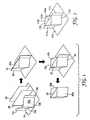
- Figures 1 and 2 are schematics of a process useful in the invention.
- the present invention provides an optical article comprising a cured composition comprising:
- curable materials with low shrinkage, residual stress and birefringence are used that are optically clear and non-yellowing for applications in precision optics and electronic displays.
- the composition minimizes shrinkage and birefringence due to optimum molecular weight of the oligomer and loading of the crosslinker and/or reactive diluent.
- the low shrinkage compositions are particularly useful in molding applications or in any applications where accurate molding and/or registration is required.
- the new compositions may be formulated as 100% solids, cured by free-radical means and exhibit properties that meet or exceed those of the art.
- the compositions exhibit less than 5% shrinkage, and preferably less than 3%.
- the compositions are low in viscosity and suitable for molding processes, including precision molding processes.
- compositions generally have a viscosity less than 20,000 centipoise, less than 15,000 centipoise, or less than 10,000 centipoise at application temperatures of 100°C or less.
- compositions generally have a viscosity of at least 100 centipoise, or at least 500 centipoise at application temperatures of 100°C or less.
- the articles of the invention may have a thickness greater than about 0.5 millimeters, generally a birefringence (absolute) of less than 1x10 -6 , light transmission greater than about 85%, preferably greater than 90%, and a CIELAB b* less than about 1.5 units, preferably less than about 1.0 unit for samples with thickness of 4.8 millimeters.
- composition comprises:
- the crosslinking agent comprises 1 to 40 parts by weight, preferably 1 to 30 parts by weight, and most preferably 1 to 20 parts by weight. In some embodiments, the reactive diluent comprises less than 25 parts by weight, preferably less than 15 parts by weight and most preferably less than 10 narts bv weight.
- the oligomer is defined above and may be selected from poly(meth)acrylate, polyurethane; polyepoxide, polyester, polyether, polysulfide, and polycarbonate oligomers. Suitable oligomers have a glass transition temperature (Tg) of greater than about 20 °C, preferably greater than about 50°C.
- Tg glass transition temperature
- the (meth)acryloyl-functionalized oligomers useful in the compositions can be represented by the general structure (I) below: where R 1 is H or CH 3 ; Z is R 2 is (CH 2 ) m , where m is 1 to 6; X is an polyvalent radical group resulting from oligomerized monomer units (i.e.
- oligomer chain such as a poly(meth)acryloyl, polyurethane, polyepoxide, polyester, polyether, polysulfide, polyepoxide, and polycarbonate; and n is greater than or equal to 2.
- the oligomer having a plurality of pendent or terminal, free-radically polymerizable groups is selected such that free-radical homopolymerization of the oligomer (e.g., by photo- or thermal initiation) results in a polymer having a glass transition temperature at or above 20°C, preferably at or above 50 °C.
- an oligomer having a plurality of pendent or terminal (meth)acryloyl groups is provided.
- oligomers are utilized having n such that the degree of polymerization from 10 to 300, preferably 15 to 200, more preferably 20 to 200.
- Preferably Formula I defines a (meth)acrylated aliphatic urethane oligomer, (meth)acrylated aliphatic polyester oligomer, (meth)acrylated aliphatic epoxy oligomer, (meth)acrylated aliphatic polycarbonate oligomer, or a (meth)acrylated aliphatic acrylic oligomer. Methods for making such oligomers are well known in the an, and many useful free-radically polymerizable oligomers are commercially available.
- (Meth)acrylated urethanes are multifunctional (meth)acrylate esters of hydroxy terminated isocyanate extended polyols, polyesters or polyethers.
- (Meth)acrylated urethane oligomers can be synthesized, for example, by reacting a diisocyanate or other polyvalent isocyanate compound with a polyvalent radical polyol (including polyether and polyester polyols) to yield an isocyanate terminated urethane prepolymer.
- a polyester polyol can be formed by reacting a polybasic acid (e.g., terephthalic acid or maleic acid) with a polyhydric alcohol (e.g., ethylene glycol or 1,6-hexanediol).
- a polyether polyol useful for making the acrylate functionalized urethane oligomer can be chosen from, for example, polyethylene glycol, polypropylene glycol, poly(tetrahydrofuran), poly(2-methyl-tetrahydrofuran), poly(3-methyl-tetrahydrofuran) and the like.
- the polyol linkage of an acrylated urethane oligomer (structure (II)) can be a polycarbonate polyol.
- (meth)acrylates having a hydroxyl group can then be reacted with the terminal isocyanate groups of the prepolymer.
- Both aromatic and the preferred aliphatic isocyanates can be used to react with the urethane to obtain the oligomer.
- diisocyanates useful for making the acrylated oligomers are 2,4-tolylene diisocyanate, 2,6-tolylene diiscyanate, 1,3-xylylene diisocyanate, 1,4-xylylene diisocyanate, 1,6-hexane diisocyanate, isophorone diisocyanate and the like.
- hydroxy terminated acrylates useful for making the acrylated oligomers include, but are not limited to, 2-hydroxyethyl (meth)acrylate, 2-hydroxypropyl (meth)acrylate, 4-hydroxybutyl acrylate, polyethylene glycol (meth)acrylate and the like.
- a (meth)acrylated urethane oligomer can be, for example, any urethane oligomer having at least two acrylate functionalities and generally less than about six functionalities.
- Suitable (meth)acrylated urethane oligomers are also commercially available such as, for example, those known by the trade designations PHOTOMER 6008, 6019, 6184 (aliphatic urethane triacrylates) available from Henkel Corp.; EBECRYL 220 (hexafunctional aromatic urethane acrylate of 1000 molecular weight), EBECRYL 284 (aliphatic urethane diacrylate of 1200 molecular weight diluted with 12% of 1,6-hexanediol diacrylate), EBECRYL 4830 (aliphatic urethane diacrylate of 1200 molecular weight diluted with 10% of tetra ethylene glycol diacrylate), and EBECRYL 6602 (trifunctional aromatic urethanc acrylate of 1300 mo
- the acrylate functionalized oligomers can be polyester acrylate oligomers, acrylated acrylic oligomers, polycarbonate acrylate oligomers or polyether acrylate oligomers.
- Suitable acrylated acrylic oligomers include, for example, commercially available products such as Ebecryl 745 and 1710 both of which are available from UCB Chemicals (Smyrna, GA).
- Useful polyester acrylate oligomers include CN293, CN294, and CN2250, 2281, 2900 from Sartomer Co. (Exton, PA) and EBECRYL 80, 657, 830, and 1810 from UCB Chemicals (Smyrna, GA).
- Suitable polyether acrylate oligomers include CN501, 502, and 551 from Sartomer Co. (Exton, PA).
- Useful polycarbonate acrylate oligomers can be prepared according to US 6451958 (Sartomer Technology Company Inc., Wilmington, DE).
- (Meth)acrylated epoxies are multifunctional (meth)acrylate esters of epoxy resins, such as the (meth)acrylated esters of bisphenol-A epoxy resin.
- Examples of commercially available acrylated epoxies include those known by the trade designations EBECRYL 600 (bisphenol A epoxy diacrylate of 525 molecular weight), EBECRYL 605 (EBECRYL 600 with 25% tripropylene glycol diacrylate), EBECRYL 3700 (bispenol A diacrylate of 524 molecular weight) and EBECRYL 3720H (bisphenol A diacrylate of 524 molecular weight with 20% hexanediol diacrylate) available from UCB Chemical, Smyrna, GA; and PHOTOMER 3016 (bisphenol A epoxy acrylate), PHOTOMER 3016-40R (epoxy acrylate and 40% tripropylene glycol diacrylate blend), and PHOTOMER 3072 (modified bisphenol A acryl
- the oligomer comprises polymerized acryloyl monomer units comprising:
- the first component oligomer comprises one or more high T 8 monomers, which if homopolymcrized, yield a polymer having a T g > 20°C, preferably > 50°C.
- Preferred high T g monomers are monofunctional (meth)acrylate esters of mono- and bicyclic aliphatic alcohols having at least 6 carbon atoms, and of aromatic alcohols. Both the cycloaliphatic and aromatic groups may be substituted, for example, by C 1-6 alkyl, halogen, sulfur, cyano, and the like.
- high Tg monomers include 3,5-dimethyladamantyl (meth)acrylate; isobomyl (meth)acrylate; 4-biphenyl (meth)acrylate; phenyl (meth)acrylate; benzyl methacrylate; and 2-naphthyl (meth)acrylate; dicyclopentadienyl (meth)acrylate.
- Mixtures of high Tg monomers may also be used.
- Providing the monomer can be polymerized with the rest of the monomers that comprise the (meth)acrylate monomers, any high Tg monomer including styrene, vinylesters and the like, can be used.
- the high Tg monomer is typically an acrylate or methacrylate ester.
- Other high T g monomers include C 1 -C 20 alkyl (meth)acrylates such as methyl methacrylate, ethyl methacrylate, isopropyl methacrylate, n-butyl methacrylate, isobutyl methacrylate, t-butyl (meth)acrylate, stearyl methacrylate, cyclohexyl methaorylate, 3,3,5-trimethylcyclohexyl methacrylate, tetrahydrofurfuryl methacrylate, allyl methaylacrylate, bromoethyl methacrylate; styrene; vinyl toluene; vinyl esters such as vinyl propionate, vinyl acetate, vinyl pivalate, and vinyl neononanoate; acrylamides such as N,N-dimethyl acrylamide, N,N-diethyl acrylamide, N-isopropyl acrylamide, N-octyl acrylamide
- Most preferred high T g monomers are selected from linear, branched, cyclo, bridged cyclo aliphatic (meth)acrylates, such as isobornyl (meth)acrylate, cyclohexyl methacrylate, 3,3,5-trimethylcyclohexyl methacrylate, methyl methacrylate, ethyl methacrylate, isopropyl methacrylate, n-butyl methacrylate, isobutyl methacrylate, t-butyl (meth)acrylate, stearyl methacrylate, and mixtures there of, for their environmental (heat and light) stability.
- linear, branched, cyclo, bridged cyclo aliphatic (meth)acrylates such as isobornyl (meth)acrylate, cyclohexyl methacrylate, 3,3,5-trimethylcyclohexyl methacrylate, methyl methacrylate, ethyl methacrylate,
- the second component oligomer of the composition comprises one or more pendent groups that include free-radically polymerizable unsaturation.
- Preferred pendent unsaturated groups include (meth)acryloyl, (meth)acryloxy, propargyl, and (meth)acrylamido.
- Such pendent groups can be incorporated into the polymer in at least two ways. The most direct method is to include among the monomer units of ethylene di(meth)acrylate, 1,6-hexanediol diacrylate (HDDA), or bisphenol-A di(meth)acrylate.
- Useful polyunsaturated monomers include allyl, propargyl, and crotyl (meth)acrylates, trimethylolpropane triacrylate, pentaerythritol triacrylate, and allyl 2-acrylamido-2,2-dimethylacetate.
- useful functional monomers include those unsaturated aliphatic, cycloaliphatic, and aromatic compounds having up to about 36 carbon atoms that include a functional group capable of free radical addition such as those groups containing a carbon-carbon double bond including vinyl, vinyloxy, (meth)acrylate, (meth)acrylamido, and acetylenic functional groups.
- polyethylenically unsaturated monomers examples include; but are not limited to, polyacrylic-functional monomers such as ethylene glycol diacrylate, propylene glycol dimethacrylate, trimethylolpropane triacrylate, 1,6-hexamethylenedioldiacrylate, pentaerythritol di-, tri-, and tetraacrylate, and 1,12-dodecanedioldiacrylate; olefinic-acrylic-functional monomers such as allyl methacrylate, 2-allyloxycarbonylamidoethyl methacrylate, and 2-allylaminoethyl acrylate; allyl 2-acrylamido-2,2-dimethylacetate; divinylbenzene; vinyloxy group-substituted functional monomers such as 2-(ethenyloxy)ethyl (meth)acrylate, 3-(ethynyloxy)-1-propene, 4-(ethynyloxy)
- Preferred polyunsaturated monomers are those where the unsaturated groups are of unequal reactivity.
- the particular moieties attached to the unsaturated groups affect the relative reactivities of those unsaturated groups.
- a polyunsaturated monomer having unsaturated groups of equal reactivity e.g., HDDA
- premature gellation of the composition must be guarded against by, for example, the presence of oxygen, which acts as a radical scavenger.
- the more reactive group such as (meth)acrylate and (meth)acrylamido
- the less reactive unsaturated group such as vinyl, allyl, vinyloxy, or acetylenic
- An indirect, but preferred, method of incorporating pendent groups that comprise polymerizable unsaturation into the first polymer is to include among the monomer units of the polymer some that comprise a reactive functional group.
- Useful reactive functional groups include, but are not limited to, hydroxyl, amino (especially secondary amino), oxazolonyl, oxazolinyl, acetoacetyl, carboxyl, isocyanato, epoxy, aziridinyl, acyl halide, and cyclic anhydride groups. Preferred among these are carboxyl, hydroxyl and aziridinyl groups.
- These pendent reactive functional groups are reacted with unsaturated compounds that comprise functional groups that are co-reactive with the reactive pendent functional group. When the two functional groups react, an oligomer with pendent unsaturation results.
- useful reactive functional groups include hydroxyl, secondary amino, oxazolinyl, oxazolonyl, acetyl, acetonyl, carboxyl, isocyanato, epoxy, aziridinyl, acyl halide, vinyloxy, and cyclic anhydride groups.
- the pendent reactive functional group is an isocyanato functional group
- the co-reactive functional group preferably comprises a secondary amino or hydroxyl group.
- the co-reactive functional group preferably comprises a carboxyl, isocyanato, epoxy, anhydride, or oxazolinyl group.
- the co-reactive functional group preferably comprises a hydroxyl, amino, epoxy, isocyanate, or oxazolinyl group.
- the reaction is between nucleophilic and electrophilic functional groups that react by a displacement or condensation mechanism.
- useful co-reactive compounds include hydroxyalkyl (meth)acrylates such as 2-hydroxyethyl (meth)acrylate, 4-hydroxybutyl (meth)acrylate, and 2-(2-hydroxyethoxy)ethyl (meth)acrylate; aminoalkyl (meth)acrylates such as 3-aminopropyl (meth)acrylate and 4-aminostyrene, oxazolinyl compounds such as 2-ethenyl-1,3-oxazolin-5-one and 2-propenyl-4,4-dimethyl-1,3-oxazolin-5-one; carboxy-substituted compounds such as (meth)acrylic acid and 4-carboxybenzyl (meth)acrylate; isocyanato-substituted compounds such as isocyanatoethyl (meth)acrylate and 4-isocyanatocyclohexyl (meth)acrylate; epoxy-substituted compounds such as glycidyl
- Preferred functional monomers have the general formula wherein R 1 is hydrogen, a C 1 to C 4 alkyl group, or a phenyl group, preferably hydrogen or a methyl group; R 2 is a single bond or a divalent linking group that joins an ethylenically unsaturated group to polymerizable or reactive functional group A and preferably contains up to 34, preferably up to 18, more preferably up to 10, carbon and, optionally, oxygen and nitrogen atoms and, when R 2 is not a single bond, is preferably selected from wherein R 3 is an alkylene group having 1 to 6 carbon atoms, a 5- or 6-membered cycloalkylene group having 5 to 10 carbon atoms, or an alkylene-oxyalkylene in which each alkylene includes 1 to 6 carbon atoms or is a divalent aromatic group having 6 to 16 carbon atoms; and A is a functional group, capable of free-radical addition to carbon-carbon double bonds, or a reactive functional group capable of reacting with a co
- the ethylenically-unsaturated monomer possessing a free-radically polymerizable group is chosen such that it is free-radically polymerizable with the crosslinking agent and reactive diluent.
- the reactions between functional groups provide a crosslink by forming a covalent bond by free-radical addition reactions of ethylenically-unsaturated groups between components.
- the pendent functional groups react by an addition reaction in which no by-product molecules are created, and the exemplified reaction partners react by this preferred mode.
- the curable composition is to be processed using high temperatures and the direct method of including pendent unsaturation has been used, care must be taken not to activate those pendent groups and cause premature gelation.
- hot-melt processing temperatures can be kept relatively low and polymerization inhibitors can be added to the mixture. Accordingly, where heat is to be used to process the composition, the above-described indirect method is the preferred way of incorporating the pendent unsaturated groups.
- the oligomer may optionally further comprise lower T g alkyl (meth)acrylate esters or amides that may be homopolymerized to polymers having a T g of less than 20°C.
- Alkyl (meth)acrylate ester monomers useful in the invention include straight-chain, cyclic, and branched-chain isomers of alkyl esters containing C 1 - C 20 alkyl groups. Due to T g and side chain crystallinity considerations, preferred lower T g alkyl (meth)acrylate esters are those having from C 1 - C 8 alkyl groups.
- alkyl (meth)acrylate esters include: methyl acrylate, ethyl acrylate, n-propyl acrylate, butyl acrylate, iso-amyl (meth)acrylate, n-hexyl (meth)acrylate, n-heptyl (meth)acrylate, n-octyl (meth)acrylate, iso-octyl (meth)acrylate, 2-ethylhexyl (meth)acrylate, iso-nonyl (meth)acrylate, and decyl (meth)acrylate.
- Most preferred (meth)acrylate esters include methyl acrylate, ethyl acrylate, butyl acrylate, isooctyl (meth)acrylate, 2-ethylhexyl (meth)acrylate, cyclohexyl acrylate.
- the lower T g alkyl (meth)acrytate esters are added in such an amount such that the resulting oligomer has a T g of 20°C or greater.
- such low T g monomers are used in amounts of 40 parts by weight or less, preferably 30 parts by weight or less, most preferable 20 parts by weight or less.
- the Fox equation may be used for a system with more than two components.
- the oligomer may be prepared using radical polymerization techniques by combining an initiator and monomers in the presence of a chain transfer agent. In this reaction, a chain transfer agent transfers the active site on one growing chain to another molecule that can then start a new chain so the degree of polymerization may be controlled.
- the degree of polymerization of the resulting oligomer may be 10 to 300, preferably 15 to 200, more preferably 20 to 200. It has been found if the degree of polymerization is too high, the composition is too high in viscosity, and not easily melt processible, and. Conversely, if the degree of polymerization is too low, the shrinkage of the cured composition is excessive and leads to high birefringence in the cured composition.
- Chain transfer agents may be used when polymerizing the monomers described herein to control the molecular weight of the resulting oligomer.
- Suitable chain transfer agents include halogenated hydrocarbons (e.g., carbon tetrabromide) and sulfur compounds (e.g., lauryl mercaptan, butyl mercaptan, ethanethiol, and 2-mercaptoethyl ether, isooctyl thioglycolate, t-dodecylmercaptan, 3-mercapto-1,2-propanediol).
- the amount of chain transfer agent that is useful depends upon the desired molecular weight of the oligomer and the type of chain transfer agent.
- the chain transfer agent is typically used in amounts from about 0.1 parts to about 10 parts; preferably 0.1 to about 8 parts; and more preferably from about 0.5 parts to about 6 parts based on total weight of the monomers.
- Suitable initiators for this oligomerization reaction include, for example, thermal and photoinitiators.
- Useful thermal initiators include azo compounds and peroxides. Examples of useful azo compounds include 2,2'-azobis(2,4-dimethylpentanenitrile), (Vazo 52, commercially available from E. I. duPont de Nemours & Co.); 2,2'-azobis(isobutyronitrile), (Vazo 64, commercially available from E. I. duPont de Nemours & Co.); 2,2'-azobis(2-methylbutyronitrile), (Vazo 67, commercially available from E. I.
- duPont de Nemours & Co. 1,1'-azobis(cyanocyclohexane), (Vazo 88, commercially available from E. I. duPont de Nemours & Co.); 1,1'-azobis(1-cyclohexane-1-carbonitrile), (V-40, commercially available from Wako Pure Chemical Industries, Ltd.); and dimethyl 2,2'-azobis(isobutyrate), (V-601, commercially available from Wako Pure Chemical Industries. Ltd.).
- useful peroxides include benzoyl peroxide: di-t-amyl peroxide, t-butyl peroxy benzoate, 2,5-dimethyl-2,5 Di-(t-butylperoxy)hexane, 2.5-dimethyl-2,3-Di-(t-butylperoxy)hexyne-3, lauroyl peroxide, and t-butyl peroxy pivalate.
- Useful organie hydroperoxides include but are not limited to compounds such as t-amyl hydroperoxide and t-butyl hydroperoxide.
- Useful photoinitiators include benzoin ethers such as benzoin methyl ether and benzoin butyl ether; acetophenone derivatives such as 2,2-dimethoxy-2-phenylacetophenone and 2,2-diethoxy acetophenone; and acylphosphine oxide derivatives and acylphosphonate derivatives such as diphenyl-2,4,6-trimethylbenzoylphosphine oxide, isopropoxy(phanyl)-2,4,6-trimethylbenzoylphosphine oxide, and dimethyl pivaloylphosphonate. Of these, 2,2-dimethoxy-2-phenyl-acetophenone is preferred.
- the initiator is typically used at a level of 0.001 to 5 parts by weight per 100 parts by weight monomer(s).
- the composition further comprises a crosslinking agent having a plurality of pendent, ethylenically unsaturated, free-radically polymerizable functional groups.
- Useful crosslinking agents have an average functionality (average number of ethylenically unsaturated, free-radically polymerizable functional groups per molecule) of greater than one, and preferably greater than or equal to two.
- the functional groups are chosen to be copolymerizable with the pendent ethylenically unsaturated, free-radically polymerizable functional groups on the first component oligomer.
- Useful functional groups include those described for the first component oligomer and include, but are not limited to vinyl, vinyloxy, (meth)acryloyl and acetylenic functional groups.
- Useful crosslinking agents have the general formula: R-(Z) n where Z is a free-radically polymerizable functional group such as a carbon-carbon double bond, n is greater than 1 and R is an organic radical having a valency of n.
- R is an aliphatic alkyl radical of valency n which may be linear or branched.
- crosslinking agents examples include: C 2 -C 18 alkylenediol di(meth)acrylates, C 3 -C 18 alkylenetriol tri(meth)acrylates, such as 1,6-hexanediol di(meth)acrylate, trimethylolpropane tri(meth)acrylate, propoxylated trimethylolpropane triacrylate.
- CD501 from Sratomer Co., Exton, PA
- triethyleneglycol di(meth)acrylate, pentaeritritol tri(meth)acrylate, and tripropyleneglycol di(meth)acrylate tri-trimethylolpropane tetraacrylate
- polyalkyleneglycol dimethacrylate such as Bisomer TM EP100DMA from Cognis Co.
- the preferred crosslinking agent is not a solid material at application temperatures.
- the composition according to the invention may comprise at least one reactive diluent.
- the reactive diluents can be used to adjust the viscosity of the composition.
- the reactive diluents can each be a low viscosity monomer containing at least one functional group capable of polymerization when exposed to actinic radiation.
- vinyl reactive diluents and (meth)acrylate monomer diluents may be used.
- the functional group present on the reactive diluents may be the same as that used in the curable (meth)acrylate oligomer.
- the radiation-curable functional group present in the reactive diluent is capable of copolymerizing with the radiation-curable functional group present on the radiation-curable oligomer.
- the reactive diluents generally have a molecular weight of not more than about 550 or a viscosity at room temperature of less than about 500 mPascal.sec (measured as 100% diluent).
- the reactive diluent may comprise monomers having a (meth)acryloyl or vinyl functionality and a C 1 -C 20 alkyl moiety.
- reactive diluents are ethyl (meth)acrylate, isopropyl (meth)acrylate, t-butyl (meth)acrylate, n-butyl (meth)acrylate, cyclohexyl (meth)acrylate, isobomyl (meth)acrylate, isooctyl (meth)acrylate, 2-ethylhexyl (meth)acrylate, stearyl (meth)acrylate, phenoxyethyl (meth)acrylate, benzyl (meth)acrylate and the like.
- Low volatile alkyl (meth)acrylates such as isobornyl (meth)acrylate, 2-ethylhexyl (meth)acrylate, cyclohexyl (meth)acrylate, isooctyl (meth)acrylate, stearyl (meth)acrylate, phenoxyethyl (meth)acrylate, benzyl (meth)acrylate are preferred reactive diluents.
- the reactive diluent is preferably added in such an amount that the shrinkage of the cured compositions does not exceed around 5%, preferably not above around 3%, as measured by the test method described herein.
- Suitable amounts of the reactive diluents have been found to be less than about 25 parts by weight, preferably about 0 to about 15 parts by weight, and more preferably about 0 to about 10 parts by weight.
- the sum of the amounts of the reactive diluent and the crosslinking agent is less than 40 parts by weight.
- the components of the composition may be combined and cured-with a photoinitiator.
- the photoinitiator improves the rate of cure and percent conversion of the curable compositions, but the depth of cure (of thicker coatings or shaped articles) may be deleteriously effected as the photoiniuator may attenuate the transmitted light that penetrates the thickness of the sample.
- the photoinitiator is used in an amount of less than 1.0 weight %, preferably less than 0.1 weight %, most preferably less than 0.05 weight %
- photoinitiators can be used. Examples include benzophenones, acetophenone derivatives, such as ⁇ -hydroxyalkylphenylketones, benzoin alkyl ethers and benzil ketals, monoacylphosphine oxides, and bis-acylphosphine oxides.
- Preferred photoinitiators are ethyl 2,4,6-trimethylbenzoylphenyl phosphinate (Lucirin TPO-L) available from BASF, Mt.
- Suitable photoinitiators include mercaptobenzothiazoles, mercaptobenzooxazoles and hexaryl bisimidazole. Often, mixtures of photoinitiators provide a suitable balance of properties.
- compositions can then be applied to the desired substrate or added to a mold and exposed to actinic radiation such as UV light.
- actinic radiation such as UV light.
- the composition may be exposed to any form of actinic radiation, such as visible light or UV radiation, but is preferably exposed to UVA (320 to 390 nm) or UVB (395 to 445 nm) radiation.
- the amount of actinic radiation should be sufficient to form a non-tacky, dimensionally stable solid mass.
- the amount of energy required for curing the compositions of the invention ranges from about 0.2 to 20.0 J/cm 2 .
- the photopolymerization may be effected by-any suitable light source including carbon arc lights, low, medium, or high pressure mercury vapor lamps, swirl-flow plasma arc lamps, xenon flash lamps, ultraviolet light emitting diodes, and ultraviolet light emitting lasers.
- a suitable LED source is the Norlux large area array, series 808 (available from Norlux, Carol Stream, IL).
- a preferred method of making the oligomer is through an adiabatic polymerization method (see for example, U.S. 5,986,011 (Ellis ) or U.S. 5,753,768 (Ellis )).
- the polymerization initiator(s) may be used at a low level; to reduce color due to the initiator fragments incorporated into the polymer.
- conditions can be selected such that the initiator is essentially completely consumed during the polymerization or at the end of the polymerization.
- thermal polymerization initiator consumed advantageously prevents ur reduces unwanted polymerization and crosslinking during the functionalization step of the oligomer using the "indirect method" of incorporating the pendent, free-radically polymerizable functional groups (described herein). Further, having no significant traces of thermal initiator present beneficially improve the stability of the functionalized oligomer during storage and transport, prior to molding and further curing.
- the adiabatic polymerization process comprises the steps of:
- the conversion to polymer can be advantageously controlled to be sufficiently high so as to provide curable materials with low shrinkage, residual stress and birefringence Further, in some instances, the functionalization and addition of reactive diluents can then be performed while in the same reaction equipment minimizing contamination and oxidation of the final curable formulation.
- composition and process for making optical products of the present invention are applicable to a variety of applications needing-optical elements including, for example, optical lenses such as Fresnel lenses, prisms, optical films, such as high index of refraction films, non-warping and low birefringence film e.g., microreplicated films such as totally internal reflecting films, or brightness enhancing films, flat films, multilayer films, retroreflective sheeting, optical light fibers or rubes, and others.
- optical products are useful in optical assemblies, optical projection systems, such as projection televisions, as well as displays and other devices containing the optical assemblies.
- the optical products of this invention include articles that are currently prepared from ground glass, or injection molded plastic.
- Such articles may have a thickness of about 0.5 mm or greater, and can be prepared from a curable composition of this invention which is made by mixing in a suitable vessel, in any convenient order, the oligomer, crosslinking agent and/or reactive diluent, and a photoinitiator. Mixing is continued until the components of the composition are in a single phase. Thicknesses of 25 mm articles have been achieved using the composition and curing process of this invention.
- the composition is preferably degassed using a vacuum of less than about 25 Torr or by flowing the composition in a thin film past a suitable boundary.
- the degassed composition is introduced, optionally using a pressure of about 2 to 400 Kg/cm 2 . into a mold corresponding to the shape of the article that is desired to be prepared.
- Such molds are generally made of plastic, glass or metal, or combinations thereof.
- the curable composition may be applied to the surface of the mold having the requisite shape or to mold elements corresponding to the desired optical article, such as a lens.
- the volume of curable composition that enters the mold or mold elements can be controlled by sliding a squeegee across the surface of the mold.
- the amount of curable composition can also be applied by other known coating techniques, such as by the use of a roller.
- heating may be used to reduce the viscosity of the composition and provide more efficient molding.
- many embodiments of the invention are melt-processible, i.e. possess or achieve a suitable low viscosity for coating ur molding at temperatures less than or equal to 100°C.
- the mold elements may be completely filled ur may be partially filled. If the photopolymerizable composition is a 100% solids, non-shrinking, curable material, then the shape of the cured composition will remain the same as that ot the mold elements. However, if the photopolymerizable composition shrinks as it hardens, then the liquid will contract, creating unreliable registration, and introducing optical defects.
- the photopolymerizable composition includes materials that shrink by less than about 5% by volume, and preferably less than about 3%, during curing.
- the molds are filled, placed under a source of actinic radiation such as a high-energy ultraviolet source having a duration and intensity of such exposure to provide for essentially complete (greater than 80%) polymerization of the composition contained in the molds.
- a source of actinic radiation such as a high-energy ultraviolet source having a duration and intensity of such exposure to provide for essentially complete (greater than 80%) polymerization of the composition contained in the molds.
- filters may be employed to exclude wavelengths that may deleteriously affect the reactive components or the photopolymerization.
- Photopolymerization may be effected via an exposed surface of the curable composition, or "through-mold" by appropriate selection of a mold material having the requisite transmission at the wavelengths necessary to effect polymerization.
- Photoinitiation energy sources emit actinic radiation, i.e., radiation having a wavelength of 700 nanometers or less which is capable of producing, either directly or indirectly, free radicals capable of initiating addition polymerization and chain-growth polymerization of the optical casting resins of this invention.
- Preferred photoinitiation energy sources emit ultraviolet radiation, i.e., radiation having a wavelength between about 180 and 460 nanometers, including photoinitiation energy sources such as carbon arc lights, low, medium, or high pressure mercury vapor lamps, swirl-flow plasma arc lamps, xenon flash lamps, ultraviolet light emitting diodes, and ultraviolet light emitting lasers.
- Particularly preferred ultraviolet light sources are xenon flash lamps available from Xenon Corp, Wilburn, MA, such as models RC-600, RC-700 and RC-747 pulsed UV-Vis curing systems and LED sources such as Norlux Series 808 large area array, (available from Norlux, Carol Stream, IL).
- the curable composition may also use convention thermal initiators, previously described.
- the optical product can contain one or more features, such as flat or curved surfaces (including convex and concave surfaces), or replicated or microreplicated surfaces (such as Fresnel lenses), either of which can be derived from the composition of the invention and a suitable mold.
- Structure-bearing articles can be constructed in a variety of forms, including those including plurality of linear prismatic structures having a series of alternating tips and grooves.
- An example uf such a film is BEF, having regular repeating pattern of symmetrical tips and grooves.
- Other examples include patterns in which the tips and grooves are not symmetrical and in which the size, orientation, or distance between the tips and grooves is not uniform.
- surface structure bearing articles useful as brightness enhancing films are described in U.S. S,175,030, (Lu et al. ) and U.S. 5,183,597, (Lu ).
- a structure-bearing optical product can be prepared by a method including the steps of (a) preparing a polymerizable composition; (b) depositing the polymerizable composition onto a master negative microstructured molding surface in an amount barely sufficient to fill the cavities of the master; (c) filling the cavities by moving a bead of the polymerizable composition between a preformed base and the master, at least one of which is flexible; and (d) curing the composition.
- the master can be metallic, such as nickel, nickel-plated copper or brass, or can be a thermoplastic material that is stable under the polymerization conditions, and that preferably has a surface energy that allows clean removal of the polymerized material from the master.
- the optical article comprises a polarizing beam splitter, wherein incident light is split into first and second substantially polarized beam states that may be used in an image display system.
- the beam splitter comprises a first prism (60a), a second prism (60b) and a polarizing layer having a pass axis disposed therebetween (20).
- At least one prism comprises the instant cured composition.
- Each of the prisms has a first surface coincident with the polarizing layer, and two or more outer surfaces.
- the term "prism" refers to an optical element that controls the angular transmission of incident light through the polarizing layer, and the angular character of light exiting the article.
- the prisms may be regular polygons, such as triangular prisms, or may have one or more features that confer optical power to the article, such as curved faces, or microreplicated features, such as microlenses (and arrays thereof) or Fresnel lenses. Further, the prisms may further comprise mirrored elements, such as a vapor deposited metal coating on or more surfaces. Combinations of these element are also contemplated, for example, a curved surface additionally having a diffractive element, such as a microlens or microlens array, or a curved surface having a mirror element.
- the prisms may be any suitable shape disposed on one or both sides of the polarizing layer to achieve the desired purpose of the PBS.
- one or more of the outer surfaces of the first and second prisms i.e. one of the surfaces not adjacent the polarizing layer, may be curved, either convex or concave, or may comprise a structured surface, such as a Fresnel lens surface.
- Such curved surfaces provide optical power to the polarizing beam splitter; i.e., they converge or diverge light passing therethrough.
- the degree to which a lens or mirror converges or diverges light usually is equal to the reciprocal of the focal length of the device.
- first surfaces i.e. the surface adjacent to the polarizing layer
- first prism may have a convex first surface
- second prism may have a mating concave first surface, with a polarizing layer disposed therebetween.
- one or more of the outer surfaces of the first and second prisms, may be fully or partially reflective; i.e. comprises a vapor-deposited metal coating.
- Reflective polarizing layers in exemplary PBS's constructed according to the present disclosure include linear reflective polarizers having a pass axis.
- the polarizing layer may be a wire grid polarizer, such as those described in Schnabel et at., "Study on Polarizing Visible Light by Subwavelength-Period Metal-Stripe Gratings", Optical Engineering 38(2), pp. 220-226, February 1999 , relevant portions of which are hereby included by reference.
- a wire grid polarizer consists of an array of very fine parallel lines or ribbons of metal coated on glass or other transparent substrates. The wire array efficiently polarizes the incident light when the width and spacing are small compared to the incident wavelength(s). Common metals for the wire grid array include gold, silver, and aluminum among others known in the art.
- the polarizing beam splitter may comprise a first prism having a first surface and at least two outer surfaces, a second prism having a first surface and least two outer surfaces, and a wire grid polarizer disposed between the first surfaces of the first and second prisms.
- a wire grid polarizer comprising a substrate, such as glass, is bonded to the first surfaces by means of an optical adhesive Less preferably, the wire grid is deposited, such as by vapor deposition techniques, on one of said first surfaces, and the second prism bonded thereto.
- Wire-grid polarizers absorb small portions of the received light. This generates heat in the substrates and is therefore not preferred. For example, 5-10% of the light is absorbed by aluminum stripes in the same manner as an aluminum mirror surface. Since the performance of the wire-grid polarizer is sensitive to the geometric stability of the metal stripes, a small change in the substrates due to thermal expansion can degrade the polarizer's performance.
- the polarizing layer may comprise alternating repeating layers of a pair of inorganic thin film materials deposited on the first surface of one or both prisms.
- the pair of thin film materials comprises one low refractive index material and one high refractive index material.
- the indices called a MacNeille pair, are chosen such that, for a given angle of incidence of a light beam, the reflection coefficient for p-polarized light (r d is essentially zero at each thin film interface.
- the angle at which r p is zero is called the Brewster angle, and the formula relating the Brewster angle to the numerical values of the indices is called the MacNeille condition.
- the reflection coefficient for s-polarized light (r s ) is non-zero at each thin film interface.
- the repeating layers of a pair of inorganic thin film materials is deposited on the first surface of a prism and the bonded to the first surface of a second prism, such as with an optical adhesive to form a polarizing beam splitter.
- the polarizing beam splitter comprises at least one set of pairs of alternating layers of materials having low and high indices of refraction compared to each other.
- the thicknesses of the layers are chosen such that the quarterwave criterion is met for the wavelength of the incident collimated light bearn by each of layers of low and high refractive index materials.
- the optical properties of the prism material, and the properties of the composite optical stack all combine to divide the incident light beam into two polarization components.
- Suitable material for the thin films include any materials that are transparent (exhibit low absorption) in the spectrum of interest.
- thermal and electron beam evaporation should provide good thin film qualities and sufficiently high deposition rates for acceptable manufacturing rates.
- low index films such as magnesium fluoride and cryolite can be deposited by this method.
- Electron beam deposition is regularly used in the coatings industry for high index materials such as titanium dioxide, zirconium oxide, hafnium oxide, and aluminum nitride.
- the polarizing layer may be a multilayer optical film.
- reflective polarizing films suitable for use as polarizing film in the embodiments of the present disclosure include reflective polarizers including a birefringent material, manufactured by 3M Corporation, St. Paul, MN, such as those described in U.S. 5,882,774; (Jonza et-al. ); U.S. 6,609,795 (Weber et al. ); and U.S. 6,719,426 (Magarill et al. ).
- Suitable reflective polarizing films for polarizing film 20 also include polymeric reflective polarizing films that include multiple layers of different polymeric materials.
- polarizing film may include a first layer and a second layer, where the polymeric materials of the first and second layer are different and at least one of the first and second layers is birefringent.
- the polarizing film may include a multi-layer stack of first and second alternating layers of different polymer materials, as disclosed in U.S. 6,609,795 (Weber et al. ).
- Other materials suitable for making multilayer reflective polarizers are listed, for example in Jonza et al., U.S. Patent No. 5.882,774 ; Weber et al., U.S. Patent No. 6,609,795 .
- multiple reflective polarizing films may be used.
- Suitable reflective polarizing films are typically characterized by a large refractive index difference between first and second polymeric materials along a first direction in the plane of the film and a small refractive index difference between first and second polymeric materials along a second direction in the plane of the film, orthogonal to the first direction.
- reflective polarizing films are also characterized by a small refractive index difference between the first and second polymeric materials along the thickness direction of the film (e.g., between the first and second layers of different polymeric materials). Examples of suitable refractive index differences between the first and second polymeric materials in the stretched direction (i.e., x-direction) range from about. 0.15 to about 0.20.
- the refractive indices in the non-stretched directions are desirably within about 5% of one another for a given material or layer, and within about 5% of the corresponding non-stretched directions of a different material or an adjacent layer.
- the polymeric materials selected for the layers of an exemplary multilayer polarizing film may include materials that exhibit low levels of light absorption.
- PET polyethylene terephthalate
- the calculated absorption is about 0.000023%, which is about 1/200,000 of an absorption of a comparable wire-grid polarizer.
- the present invention provides a multilayer article comprising a multilayer optical film and a cured optical coating on one or both major surfaces of the optical film. Providing such a coating protects the multilayer optical film from environmental stresses and adds strength and rigidity thereto.
- the multilayer article may be prepared by providing a multilayer optical film, coating at least one major surface of the multilayer optical film with the curable composition, and curing. In another embodiment, separately prepared films comprising the cured composition may be adhered to one or both major surfaces of the multilayer optical film by means of an optical adhesive, described further herein.
- the present invention provides a method of making a polarizing beam splitter.
- the method comprise introducing the curable composition into a suitable mold, and curing the composition to form a prism.
- the mold may be of any suitable configuration, one or more surfaces of which may be curved.
- the polarizing layer may then be bonded, adhered, or otherwise affixed to the resulting prism(s) by any optical adhesive, such as known in the art.
- a first prism may be bonded to a first surface of the polarizing layer, the second prism bonded sequentially to the exposed surface of the polarizing layer.
- the first and second prisms are concurrently bonded to opposite surfaces of the polarizing layer.
- Useful optical adhesives are substantially free of UV-absorbing chromophores such as extended aromatic structures or conjugated double bonds.
- Useful adhesives include, for example: NOA61, a UV cured thiol-ene based adhesive available from the Norland Company (Cranbury, N.J.); Loctite series (e.g., 3492, 3175) UV cured acrylic adhesives available from Henkel Loctite Corp., Rocky Hill, Conn.; OP series (e.g., 21, 4-20632, 54, 44) UV cured acrylic adhesives available from Dymax Corporation, Torrington, Conn.
- One useful adhesive include those compositions described in U.S. Published Appln. No. 20040202879 (Xia et al. ), which comprise at least one polymer with either an acid or base functionality that forms a pressure sensitive adhesive, a high Tg polymer with an weight average molecular weight greater than 100,000 with an acid or base functionality, and a crosslinker, wherein the functionality on the pressure sensitive adhesive and the high T g polymer cause an acid-base interaction that forms a compatibilized blend.
- the adhesive mixture After accelerated aging of the adhesive composition at 80°C and 90% relative humidity for approximately 500 hours in an oven, the adhesive mixture is translucent or optically clear.
- microstructured adhesive which comprise a continuous:layer of a pressure-sensitive adhesive having a micro structured surface, wherein the microstructured surface comprises a series of features and wherein the lateral aspect ratio of the features range from about 0.1 to about 10, wherein the spacing aspect ratio of the features range from about 1 to about 1.9, and wherein each feature has a height of about 2.5 to about 375 micrometers.
- Such adhesives are described in U.S. Patent Nos. 5,650,215 , 6, 123,890 , 6,315,851 , 6,440,880 and 6,838, 150 (each Benson et al. ).
- SunkenTM 1885 PSA commercially available from Soken Chemical & Engineering Cu., Lid, Japan
- NEA PSA as described in the Example 1 uf published U.S. 20040202879 (Lu et al. )
- Lens BondTM Type C59 a thermally cured styrene based adhesive available from Summers Optical, Hatfield, Pa., a division of EMS Acquisition Corp.
- NOA61TM a UV cured thiol-ene based adhesive, available from Norland Company, Cranbury, N.J.
- the polarizer may be prepared as shown schematically in Figure 1 .
- a prism mold 10a having an open first surface or face, and optional tabs 11a and b , is combined with a polarizing layer 20 and rigid side plate 30 .
- the angles between the mold faces may be varied as desired, and either or both outer faces 12a/b may be curved or have any desired pattern imparted thereto, such as a diffracting pattern, such as a Fresnel lens may be integrally molded.
- the respective first surfaces of the first and second prisms may also be curved, or have an integral microreplicated pattern.
- the curved first surfaces of the first and second prisms may configured so they may be mated, such as with a concave and convex surface, with the polarizing layer disposed therebetween.
- the parts 10a , 20 and 30 may be secured via clamps on tabs 11a/b , or by other suitable means.
- a tensioning means (not shown) may be used to maintain the polarizing layer flat.
- the assembled mold may rest on a smooth, rigid surface 15, such as glass, or an integral bottom may be provided to the mold 10a .
- This assembly defines a prism shaped cavity 40a , into which the curable composition may be introduced, and cured by application of UV energy.
- a second rigid surface (not shown) may cover the top of the mold to protect it from atmospheric oxygen. Desirably, either rid surface 15 or second rigid surface is made of glass or other suitable material transparent to the incident light source for curing.
- the mold assembly may be blanketed with an inert glass to exclude oxygen.
- the rigid side plate 30 may be removed, and a second prism mold 10b secured thereto, forming a second chamber 40b, with the polarizing layer 20 forming the common faces between molds 10a and 10b , so that the first surfaces of the first and second prisms will each be adjacent the polarizing layer.
- the polarizing layer is now integral to the first surface of the first prism-shaped cured composition.
- the second mold may also have curved outer faces or other desired moulded shape (not shown).
- Thins second chamber 40b may be filled with the curable composition, cured, the mold assembly removed to provide a polarizing beam splitter 60a having two prisms, and an integral polarizing layer disposed therebetween, on the respective first surfaces of the prisms.
- the respective prisms may be provided, by a suitably configured mold, with integral interlocking tabs for securing the first and second prisms together or may comprise tabs for securing the beam splitter into a mount in a display device.
- the first and/or second prisms may be providing with alignment means, such as tabs or indicators, for aligning the first and second prisms with respect to each other, the polarizing layer, and a mount in a display device.
- the alignment means may comprise corresponding male and female portions that interconnect.
- the polarizing beams splitter may comprise a first prism and second prism, where first prism includes male portion, and second prism that includes female portion.
- Male portion may be a rectangular surface that encompasses a portion of the surface of first prism adjacent to the reflective polarizing film, and which may project therefrom.
- female portion may be a rectangular depression that is disposed within the majority of the surface of second prism adjacent to the reflective polarizing film.
- the male members and female portions may be substituted with other engagement mechanisms such that one prism includes at least one male member that is configured to engage with a respective female portion located in the opposing prism.
- one prism includes at least one male member that is configured to engage with a respective female portion located in the opposing prism.
- Those of ordinary skill in the art will also readily appreciate that different numbers of the male members and the female portions than those exemplified herein may be used in accordance with the present disclosure.
- an exemplary PBS may include three or more male members received within three or more female portions.
- the male members and the female portions discussed above may be molded with the respective first and second prisms.
- the first and second prisms may then be secured together with the assistance of the male portions and the female portions to form polarizing beam splitters.
- This technique may involve placing the reflective polarizing film between the first prism and the second prism.
- the first prism may then be oriented relative to the second prism such that the male portion(s) are aligned with the corresponding female portion(s). This alignment is beneficial for ensuring that the first prism is accurately positioned relative to the second prism.
- the first prism may then engage second prism hy concurrently inserting male portions into the corresponding female portions.
- the mate portion(s) may be secured to the corresponding female portions with an adhesive.
- the first prism may be secured to the second prism by fitting and/or welding the male members to the corresponding female portions (e.g., ultrasonic, infrared, heat staking, snap fits, press fits, and chemical welding).
- FIG. 2 An alternate process is shown schematically in Figure 2 .
- two prism molds having open faces, 110a and 10b (corresponding to the first surfaces of the resultant prisms) are secured together via optional tabs 111a and b (or any suitable means), with the polarizing layer 120 disposed between on the common first surfaces of molds 110a and b .
- the molds may be of any suitable shape and size, and the exterior faces may be curved.
- Size exclusion chromatography for molecular weight and molecular weight distribution was performed using a Waters 717Plus autosampler, 1515 HPLC pump, 2410 differential detector, and the following Waters columns: Styragel HR 5E, Styragel HR 1. All samples were run in THF at 35°C with a flow rate of 1.0 mL/min. Linear polystyrene standards were used for calibration.
- DMA for 1g and modulus determination of cured compositions was performed using a LC-ARES Test Station (Rheometric Scientific, Piscataway, NJ) in a torsion mode.
- the sample size was approximately 25 millimeters by 10 millimeters by 1 millimeter.
- the length of the sample was measured by the test station and the width and thickness of the sample were measured with a caliper.
- the test was performed by ramping the temperature From 25°C to 180°C at 5°C per minute. The frequency used was 1Hertz.
- %Transmittance (%T) at a wavelength of 420 nanometers of 3.2 centimeter (1.25 inches) diameter by 0.5 centimeter (0.19 inch) thick cured samples was measured before and after 7 days aging in a 120°C oven.
- the %T was measured using a TC S Plus Spectrophotometer (BYK-Gardner USA, Silver Spring, MO).
- TC S Plus Spectrophotometer BYK-Gardner USA, Silver Spring, MO.
- samples with %T at 420 nanometers of less than 85% display a yellow color.
- a sample is considered to have good yellowing resistance if the %T at 420 nanometers after aging is greater than 85%.
- a weighed 3.2 centimeter (1.25 inches) diameter by 0.5 centimeter (0.19 inch) thick cured disk sample is placed in water at 23°C for 14 days.
- % water absorption 100 x (sample weight after 14 days in water - sample weight before water soaking)/sample weight before water soaking.
- TSE Transmission Spectral Ellipsometry
- Birefringence of the sample was determined by dividing the retardance by sample thickness.
- the sample is a round disc, 3.2 centimeter (1.25 inches) diameter by 0.5 centimeter (0.19 inch) thick
- thermal initiators Vazo 52 and 88 according to Table 1, were added to a four neck flask equipped with a reflux condenser, thermometer, mechanical stirrer, and nitrogen gas inlet. The mixture was stirred and heated to 60°C under nitrogen. The temperature of the reaction mixture peaked at around 150°C during the polymerization. After the reaction peak, the batch was further polymerized at 140°C for 30 minutes with the addition of the 2 nd initiator, Vazo 88, to reduce residual monomers and eliminate initiator. A sample was taken at the end of this reaction period for oligomer molecular weight determination by SEC.
- the batch was cooled to 100°C.
- the HDDMA reactive diluent was added to the reactor to reduce viscosity of the batch.
- a solution of the DBDL catalyst in IEM was then added to the batch to react with the hydroxyls on the IBOA/HEA polymer chains, incorporating methacrylate functional groups to the polymer. The reaction was complete in 2 hours.
- the reactive oligomer syrups of Table 1 were formulated with 0.02 weight % TPOL photoinitiator and cured by a Xenon Flash lamp according to the procedures described in the section Preparation of Test Samples.
- the cured samples were tested for % volume shrinkage, birefringence, Tg, water absorption, % transmittance, and aging stability, using the methods described in the above Test Method section.
- HDDMA reactive diluent according to Table 2, was added to samples of the reactive oligomer syrup prepared in Example 7.
- the reactive oligomer syrups were formulated with 0.02 weight% TPOL photoinitiator and cured by a Xenon Flash lamp at 80°C for 5 minutes.
- the cured samples were tested for % volume shrinkage, birefringence, Tg, water absorption, % transmittance, and aging stability, using the methods described in the above Test Method section.
- Example 8 9 10 Oligomer/HDDMA Ratio 80/20 70/30 60/40
- Example 7 (grams) 20.0 20.0 20.0 HDDMA (grams) 2.50 5.71 10.0 TPOL photoinitiator (grams) 0.0045 0.0051 0.0060
- the reactive oligomer and reactive diluent mixtures, CN945A60, CN1963 were formulated with 0.02% TPOL photoinitiator and, cured by a Xenon Flash lamp at 80°C for 5 minutes according to procedures described in the preparation of test sample.
- Table 4 Example 13 14 CN945A60 (g) 100 ---- CN1963 (g) ---- 100 TPOL photoinitiator (g) 0.02 0.02
- Curable compositions with photoinitiator and other additives were prepared by preheating the oligomer syrups described in the Examples and Comparative Examples with a desired photoinitiator and other additives (if used) at 80°C and mixing in a white disposable cup by a DAC-100 mixer (both cup and mixer are available from Flack Tek Inc, Landrum, New Jersey). The compositions were degassed in a vacuum chamber and then allowed to cool to room temperature before use.
- Curing of the above curable materials was carried out by the following steps: 1) Onto a Pyrex glass plate approximately 15 centimeters (6 inches) by 15 centimeters (6 inches) by 0.5 centimeter (0.19 inch) was placed an approximately 15 centimeters (6 inches) by 15 centimeters (6 inches) piece of 51 micrometers (2 mils) A31 release liner, 2) on top of the release liner was placed an approximate same size glass or silicone rubber mold with a 3 centimeter (1.25 inches) diameter opening at the center, 3) then the mold was filled with the curable compositions taking care to avoid bubbles, 4) then a second piece of approximately 15 centimeters (6 inches) by 15 centimeters (6 inches) of 51 micrometers (2 mils) A31 release liner was placed on top of the filled mold, 5) another Pyrex glass, plate approximately 15 centimeters (6 inches) by 15 centimeters (6 inches) by 0.5 centimeter (0.19 inch) was placed on top of the release liner, and 6) finally, the filled mold
- Example 15 IBOA, HEA, chain transfer agent IOTG, and the 1 st charge of thermal initiators Vazo 52 and 88, according to Table 7, were added to a four neck flask equipped with a reflux condenser, thermometer, mechanical stirrer, and nitrogen gas inlet. The mixture was stirred and heated to 60°C under nitrogen. The temperature of the reaction mixture peaked at around 180°C during the polymerization. After the reaction peak, the batch was further polymerized at 140°C for 30 minutes with the addition of the 2 nd initiator, Vazo 88, to reduce residual monomers and eliminate initiator. After that, the batch was cooled to 120°C and the IBOA reactive diluent was added to the reactor to reduce viscosity of the batch.
- Example 15 IBOA (g) 185 REA (g) 15 IOTG (g) 8 Vazo 52 (g)/ 0.025/ Vazo 88 (g) 0.025 Vazo 88 (g) 0.050 IBOA (g) 10 MAnh (g) 21.18 HDDMA (g) 35.3 Lucirin TPOL (g) 0.055
- Example 16 the prism mold described in Figure 1 was used.
- Component 10a was made of stainless steel with component 15 being a glass plate, component 20 was not used and component 30 was a glass microscope slide.
- the volume 40a was filled with the formulated reactive oligomer syrup prepared in Example 15 and another glass plate was placed on top of filled volume 40a.
- the assembly was cured with a Xenon flash lamp at room temperature for 5 minutes.
- Example 17 the prism mold described in Figure 1 was used.
- Component 10a was made of stainless steel with component 15 being a glass plate, component 20 was PBS FILM and component 30 was a glass microscope slide.
- the volumes 400a was filled with the formulated reactive oligomer syrup prepared in Example 15 and another glass plate was placed on top of filled volume 40a.
- the assembly was cured with a Xenon flash lamp at room temperature for 5 minutes.
- the glass slide was removed and a plastic prism such as prepared in Example 16 was attached to the PBS FILM surface with the formulated reaticve oligomer syrup prepared in Example 15 used as an optical adhesive to generate a PRS prism
- the adhesive was cured with a Xenon flash lamp at room temperature for 5 minutes.
- Example 18 the prism molds described in Figure 1 were used Component 10a was made of stainless steel with component 15 being a glass plate, component 20 was PBS FILM and component 30 was a glass microscope slide.
- the volume 40a was filled with the formulated reactive oligomer syrup prepared in Example 15 and another glass plate was placed on top of filled volume 40a.
- the assembly was cured with a Xenon flash lamp at room temperature for 5 minutes.
- the component 30 was then removed and a second mold 10b was placed adjacent to the cured mold.
- the volume 40b was filled with the formulated reactive oligomer syrup prepared in Example 15 and a glass plate was placed on top of filled volumes 40b.
- the assembly was cured with a Xenon flash lamp at room temperature for 5 minutes.
- Example 19 the prism molds described in Figure 2 were used.
- Components 110a and 110b were made of stainless steel with component 115 being a glass plate, component 120 was PBS FILM.
- the volumes on either side of 120 were filled with the formulated reactive oligomer syrup prepared in Example 15 and another glass plate was placed on top of the filled volumes.
- the assembly was cured with a Xenon flash lamp at room temperature for 5 minutes.
- Example 20 the prism mold described in Figure 1 was used.
- Component 10a was made of stainless steel with component 15 being a glass plate, component 20 was not used and component 30 was a glass microscope slide.
- the volume 40a was filled with the formulated reactive oligomer syrup prepared in Example 14 and another glass plate was placed on top of filled volume 40a.
- the assembly was cured with a Xenon flash lamp at room temperature for 5 minutes.
- Example 21 the prism mold described in Figure 1 was used Component 10a was made of stainless steel with component 15 being a glass plate, component 20 was PBS FILM and component 30 was a glass microscope slide.
- the volume 40a was filled with the formulated reactive oligomer syrup prepared in Example 14 and another glass plate was placed on top of filled volume 40a.
- the assembly was cured with a Xenon flash lamp at room temperature for 5 minutes.
- the glass slide was removed and a plastic prism such ' as prepared in Example 20 was attached to the PBS FILM surface with the syrup prepared in Example 14 used as an optical adhesive, to generate a PBS prism.
- the adhesive was cured with a Xenon flash lamp at room temperature for 5 minutes.
- Example 22 the prism molds described in Figure 1 were used.
- Component 10a was made of stainless steel with component 15 being a glass plate, component 20 was PBS FILM and component 30 was a glass microscope slide.
- the volume 40a was filled with the formulated reactive oligomer syrup prepared in Example 14 and another glass plate was placed on top of filled volume 40a.
- the assembly was cured with a Xenon flash lamp at room temperature for 5 minutes.
- the component 30 was then removed and a second mold 10b was placed adjacent to the cured mold.
- the volume 40b was filled with the formulated reactive oligomer syrup prepared in Example 14 and a glass plate was placed on top of filled volume 40b.
- the assembly was cured with a Xenon flash lamp at room temperature for 5 minutes.
- Example 23 the prism molds described in Figure 2 were used.
- Components 110a and 110b were made of stainless steel with component 115 being a glass plate, component 120 was PBS FILM.
- the volumes on either side of 120 were filled with the formulated reactive oligomer syrup prepared in Example 14 and another glass plate was placed on top of the filled volumes.
- the assembly was cured with a Xenon flash lamp at room temperature for 5 minutes.
Landscapes
- Chemical & Material Sciences (AREA)
- Physics & Mathematics (AREA)
- Medicinal Chemistry (AREA)
- Health & Medical Sciences (AREA)
- Chemical Kinetics & Catalysis (AREA)
- Polymers & Plastics (AREA)
- Organic Chemistry (AREA)
- Optics & Photonics (AREA)
- General Physics & Mathematics (AREA)
- Engineering & Computer Science (AREA)
- Manufacturing & Machinery (AREA)
- Materials Engineering (AREA)
- Macromonomer-Based Addition Polymer (AREA)
- Addition Polymer Or Copolymer, Post-Treatments, Or Chemical Modifications (AREA)
Applications Claiming Priority (2)
| Application Number | Priority Date | Filing Date | Title |
|---|---|---|---|
| US11/276,070 US7463417B2 (en) | 2006-02-13 | 2006-02-13 | Optical articles from curable compositions |
| PCT/US2007/002950 WO2007094979A1 (en) | 2006-02-13 | 2007-02-02 | Optical articles from curable compositions |
Publications (3)
| Publication Number | Publication Date |
|---|---|
| EP1984433A1 EP1984433A1 (en) | 2008-10-29 |
| EP1984433A4 EP1984433A4 (en) | 2009-05-13 |
| EP1984433B1 true EP1984433B1 (en) | 2011-06-15 |
Family
ID=38368119
Family Applications (1)
| Application Number | Title | Priority Date | Filing Date |
|---|---|---|---|
| EP07717192A Not-in-force EP1984433B1 (en) | 2006-02-13 | 2007-02-02 | Optical articles from curable compositions |
Country Status (7)
| Country | Link |
|---|---|
| US (1) | US7463417B2 (https=) |
| EP (1) | EP1984433B1 (https=) |
| JP (1) | JP2009527003A (https=) |
| KR (1) | KR20080096537A (https=) |
| CN (1) | CN101384649B (https=) |
| AT (1) | ATE513002T1 (https=) |
| WO (1) | WO2007094979A1 (https=) |
Families Citing this family (37)
| Publication number | Priority date | Publication date | Assignee | Title |
|---|---|---|---|---|
| US20070191506A1 (en) * | 2006-02-13 | 2007-08-16 | 3M Innovative Properties Company | Curable compositions for optical articles |
| TW200819899A (en) * | 2006-07-31 | 2008-05-01 | 3M Innovative Properties Co | Combination camera/projector system |
| EP2372797A3 (en) * | 2006-07-31 | 2017-01-18 | 3M Innovative Properties Co. | Light emitting diode source with hollow collection lens |
| TW200815709A (en) * | 2006-07-31 | 2008-04-01 | 3M Innovative Properties Co | Integrating light source module |
| US20080036972A1 (en) * | 2006-07-31 | 2008-02-14 | 3M Innovative Properties Company | Led mosaic |
| US7901083B2 (en) * | 2006-07-31 | 2011-03-08 | 3M Innovative Properties Company | Optical projection subsystem |
| US8075140B2 (en) * | 2006-07-31 | 2011-12-13 | 3M Innovative Properties Company | LED illumination system with polarization recycling |
| US20080085381A1 (en) * | 2006-10-06 | 2008-04-10 | 3M Innovative Properties Company | Optical element with a polarizer and a support layer |
| JP5330404B2 (ja) * | 2007-12-12 | 2013-10-30 | スリーエム イノベイティブ プロパティズ カンパニー | 微小構造化された抗微生物フィルム |
| WO2010118421A1 (en) * | 2009-04-10 | 2010-10-14 | Pixeloptics, Inc. | Curable adhesive compositions |
| US20100311861A1 (en) * | 2009-06-03 | 2010-12-09 | 3M Innovative Properties Company | Thiol-yne shape memory polymer |
| DE102010014783A1 (de) * | 2010-04-13 | 2011-10-13 | Leuze Electronic Gmbh & Co. Kg | Optoelektronische Vorrichtung |
| TWI424025B (zh) * | 2010-11-12 | 2014-01-21 | Daxin Materials Corp | A photohardenable (alkyl) acrylate composition |
| US9074040B2 (en) | 2010-12-20 | 2015-07-07 | Mitsui Chemicals, Inc. | Curable adhesive compositions |
| CN103946329B (zh) * | 2011-10-05 | 2016-03-23 | 3M创新有限公司 | 微结构化转移带 |
| US8975346B2 (en) | 2012-05-18 | 2015-03-10 | Sabic Global Technologies B.V. | Polycarbonate copolymers via controlled radical polymerization |
| EP2888625A2 (en) * | 2012-08-22 | 2015-07-01 | 3M Innovative Properties Company | Polarizing beam splitter and methods of making same |
| DE102012221011B3 (de) * | 2012-11-16 | 2014-04-10 | Schildtec GmbH | Verfahren zum Herstellen optischer Strahlteilerwürfel |
| US20150077873A1 (en) | 2013-09-16 | 2015-03-19 | 3M Innovative Properties Company | Adhesive articles containing light shielding film substrates, method of making thereof and articles therefrom |
| US9519096B2 (en) | 2013-12-23 | 2016-12-13 | 3M Innovative Properties Company | Pressure sensitive adhesive light guides |
| WO2015172163A1 (en) * | 2014-04-25 | 2015-11-12 | Uni-Pixel Displays, Inc. | Radiation-curable optically clear coating composition for touch sensors |
| WO2016007239A1 (en) * | 2014-04-25 | 2016-01-14 | Uni-Pixel Displays, Inc. | Radiation-curable hard-coat composition |
| KR101580617B1 (ko) | 2014-06-05 | 2015-12-28 | 오병오 | 빛의 조사구간 선택이 용이한 실외용 엘이디등기구 |
| TWI526505B (zh) | 2014-09-11 | 2016-03-21 | 財團法人工業技術研究院 | 硬塗層組成物及應用其之偏光膜和顯示器 |
| JP6428101B2 (ja) * | 2014-09-26 | 2018-11-28 | 住友電気工業株式会社 | 光ファイバ心線及び光ファイバテープ心線 |
| TWI796331B (zh) * | 2017-04-26 | 2023-03-21 | 美商康寧公司 | 用於透明複合膜之硬塗層組成物及方法以及包含該膜之可撓性顯示裝置 |
| US11739168B2 (en) | 2017-09-01 | 2023-08-29 | Threebond Co., Ltd. | Photocurable composition |
| JP2019091029A (ja) * | 2017-11-10 | 2019-06-13 | 住友化学株式会社 | 複合位相差板、光学積層体、及び画像表示装置 |
| CN109358390B (zh) * | 2018-10-30 | 2024-03-22 | 东莞市谷麦光学科技有限公司 | 一种出光均匀的导光组件 |
| CN109438657B (zh) * | 2018-11-01 | 2021-04-23 | 无锡阿科力科技股份有限公司 | 一种聚氨酯丙烯酸低聚物及其制备方法和用途 |
| CN109407315B (zh) * | 2018-11-09 | 2021-09-17 | 京东方科技集团股份有限公司 | 显示系统及其显示方法 |
| TWI864144B (zh) * | 2019-10-23 | 2024-12-01 | 日商三菱瓦斯化學股份有限公司 | 硬化用樹脂組成物、其硬化方法及成形品 |
| CN111484699B (zh) * | 2020-04-17 | 2023-10-13 | 阜阳师范大学 | 一种环氧丙烯酸酯3d打印光敏树脂及其制备方法 |
| JP7597996B2 (ja) * | 2020-05-26 | 2024-12-11 | 日亜化学工業株式会社 | 発光装置 |
| EP4001328A1 (de) * | 2020-11-24 | 2022-05-25 | Rudolf GmbH | Polymerisierbare zusammensetzung zur bondierung von fasereinheiten |
| US12224387B2 (en) | 2020-12-24 | 2025-02-11 | Nichia Corporation | Light emitting device |
| CN116903778B (zh) * | 2023-06-26 | 2024-07-05 | 浙江精一新材料科技有限公司 | 一种用于光阀的悬浮介质材料及光阀 |
Family Cites Families (48)
| Publication number | Priority date | Publication date | Assignee | Title |
|---|---|---|---|---|
| US4242449A (en) * | 1978-02-21 | 1980-12-30 | Yamanouchi Pharmaceutical Co., Ltd. | 7-Methoxy cephalosporins and process of producing them |
| US4576850A (en) | 1978-07-20 | 1986-03-18 | Minnesota Mining And Manufacturing Company | Shaped plastic articles having replicated microstructure surfaces |
| US4542449A (en) | 1983-08-29 | 1985-09-17 | Canadian Patents & Development Limited | Lighting panel with opposed 45° corrugations |
| EP0176874A3 (en) | 1984-09-19 | 1988-02-10 | Toray Industries, Inc. | A highly-refractive plastic lens |
| US4812032A (en) | 1984-09-19 | 1989-03-14 | Toray Industries, Inc. | Highly-refractive plastic lens |
| US4568445A (en) | 1984-12-21 | 1986-02-04 | Honeywell Inc. | Electrode system for an electro-chemical sensor for measuring vapor concentrations |
| US5183597A (en) | 1989-02-10 | 1993-02-02 | Minnesota Mining And Manufacturing Company | Method of molding microstructure bearing composite plastic articles |
| US5175030A (en) | 1989-02-10 | 1992-12-29 | Minnesota Mining And Manufacturing Company | Microstructure-bearing composite plastic articles and method of making |
| JPH06508449A (ja) | 1991-06-13 | 1994-09-22 | ミネソタ・マイニング・アンド・マニュファクチュアリング・カンパニー | 再帰反射偏光子 |
| CA2088113C (en) | 1992-01-27 | 1999-03-30 | Tomohiro Yokota | Light adjusting sheet for a planar lighting device and a planar lighting device and a liquid crystal display using the sheet |
| JP3155327B2 (ja) | 1992-03-27 | 2001-04-09 | 三菱化学株式会社 | 高屈折率光学材料およびその製造法 |
| US6440880B2 (en) | 1993-10-29 | 2002-08-27 | 3M Innovative Properties Company | Pressure-sensitive adhesives having microstructured surfaces |
| CA2173855C (en) | 1993-10-29 | 2007-06-26 | Mieczyslaw H. Mazurek | Pressure-sensitive adhesives having microstructured surfaces |
| US5428469A (en) | 1993-11-16 | 1995-06-27 | Minnesota Mining And Manufacturing Company | Liquid crystal display projection systems employing polarizing beam splitters and passing light through display cell from both directions |
| US5882774A (en) | 1993-12-21 | 1999-03-16 | Minnesota Mining And Manufacturing Company | Optical film |
| US5591527A (en) | 1994-11-02 | 1997-01-07 | Minnesota Mining And Manufacturing Company | Optical security articles and methods for making same |
| US5635278A (en) | 1995-02-03 | 1997-06-03 | Minnesota Mining And Manufacturing Company | Scratch resistant optical films and method for producing same |
| WO1996024644A1 (en) | 1995-02-10 | 1996-08-15 | Minnesota Mining And Manufacturing Company | Process for the production of an article coated with a crosslinked pressure sensitive adhesive |
| US5637646A (en) | 1995-12-14 | 1997-06-10 | Minnesota Mining And Manufacturing Company | Bulk radical polymerization using a batch reactor |
| US6323361B1 (en) | 1997-04-17 | 2001-11-27 | Corning Inc. | Photocurable halofluorinated acrylates |
| EP0975693B2 (en) | 1997-04-22 | 2006-01-18 | Koninklijke DSM N.V. | Liquid curable resin composition |
| US6107364A (en) | 1997-05-09 | 2000-08-22 | 3M Innovative Properties Company | Methyl styrene as a high index of refraction monomer |
| US6486997B1 (en) | 1997-10-28 | 2002-11-26 | 3M Innovative Properties Company | Reflective LCD projection system using wide-angle Cartesian polarizing beam splitter |
| US6569515B2 (en) * | 1998-01-13 | 2003-05-27 | 3M Innovative Properties Company | Multilayered polymer films with recyclable or recycled layers |
| US6039913A (en) | 1998-08-27 | 2000-03-21 | Novartis Ag | Process for the manufacture of an ophthalmic molding |
| DE69934330T2 (de) | 1998-09-22 | 2007-06-21 | ZMS, LLC, Emeryville | Endabmessungsnahe gegenstände und polymerisationsverfahren und materialen dafür |
| EP1166156A1 (en) | 1999-03-16 | 2002-01-02 | Zms, Llc | Precision integral articles |
| US6448337B1 (en) | 1999-10-07 | 2002-09-10 | 3M Innovative Properties Company | Pressure sensitive adhesives possessing high load bearing capability |
| US6416690B1 (en) | 2000-02-16 | 2002-07-09 | Zms, Llc | Precision composite lens |
| US6419858B1 (en) | 2000-06-13 | 2002-07-16 | Zms, Llc | Morphology trapping and materials suitable for use therewith |
| US6448301B1 (en) | 2000-09-08 | 2002-09-10 | 3M Innovative Properties Company | Crosslinkable polymeric compositions and use thereof |
| US20020115820A1 (en) * | 2001-01-25 | 2002-08-22 | Fang Wang | Hyperbranched fluorinated multifunctional alcohols and derivatives |
| US6689900B2 (en) | 2001-02-09 | 2004-02-10 | E. I. Du Pont De Nemours And Company | Fluorinated crosslinker and composition |
| US6451958B1 (en) | 2001-04-06 | 2002-09-17 | Sartomer Technology Company Inc. | Radiation curable acrylate-terminated polymers having polycarbonate repeating units |
| US6609795B2 (en) | 2001-06-11 | 2003-08-26 | 3M Innovative Properties Company | Polarizing beam splitter |
| US6635690B2 (en) | 2001-06-19 | 2003-10-21 | 3M Innovative Properties Company | Reactive oligomers |
| US20040266941A1 (en) | 2001-06-27 | 2004-12-30 | Houston Michael R. | Biomedical molding materials from semi-solid precursors |
| US6949297B2 (en) * | 2001-11-02 | 2005-09-27 | 3M Innovative Properties Company | Hybrid adhesives, articles, and methods |
| EP1478965A1 (en) | 2002-02-28 | 2004-11-24 | 3M Innovative Properties Company | Compound polarization beam splitters |
| US6856745B2 (en) | 2002-07-02 | 2005-02-15 | Lucent Technologies Inc. | Waveguide and applications therefor |
| US6887917B2 (en) | 2002-12-30 | 2005-05-03 | 3M Innovative Properties Company | Curable pressure sensitive adhesive compositions |
| US7927703B2 (en) | 2003-04-11 | 2011-04-19 | 3M Innovative Properties Company | Adhesive blends, articles, and methods |
| JP4022498B2 (ja) * | 2003-04-18 | 2007-12-19 | インターナショナル・ビジネス・マシーンズ・コーポレーション | 光リンク・モジュール、光接続方法、該光リンク・モジュールを含む情報処理装置、信号転送方法、プリズム、およびその製造方法 |
| US7250611B2 (en) | 2003-12-02 | 2007-07-31 | 3M Innovative Properties Company | LED curing apparatus and method |
| US7234816B2 (en) | 2004-02-03 | 2007-06-26 | 3M Innovative Properties Company | Polarizing beam splitter assembly adhesive |
| JP3914211B2 (ja) | 2004-03-03 | 2007-05-16 | 株式会社東芝 | ホログラム記録媒体 |
| US20070023941A1 (en) | 2005-07-29 | 2007-02-01 | Duncan John E | Method for making polarizing beam splitters |
| US7362507B2 (en) * | 2005-07-29 | 2008-04-22 | 3M Innovative Properties Company | Polarizing beam splitter |
-
2006
- 2006-02-13 US US11/276,070 patent/US7463417B2/en active Active
-
2007
- 2007-02-02 CN CN200780005369XA patent/CN101384649B/zh not_active Expired - Fee Related
- 2007-02-02 EP EP07717192A patent/EP1984433B1/en not_active Not-in-force
- 2007-02-02 JP JP2008554283A patent/JP2009527003A/ja not_active Withdrawn
- 2007-02-02 KR KR1020087019722A patent/KR20080096537A/ko not_active Withdrawn
- 2007-02-02 AT AT07717192T patent/ATE513002T1/de not_active IP Right Cessation
- 2007-02-02 WO PCT/US2007/002950 patent/WO2007094979A1/en not_active Ceased
Also Published As
| Publication number | Publication date |
|---|---|
| JP2009527003A (ja) | 2009-07-23 |
| CN101384649A (zh) | 2009-03-11 |
| US20070188864A1 (en) | 2007-08-16 |
| EP1984433A1 (en) | 2008-10-29 |
| CN101384649B (zh) | 2013-01-02 |
| WO2007094979A1 (en) | 2007-08-23 |
| KR20080096537A (ko) | 2008-10-30 |
| EP1984433A4 (en) | 2009-05-13 |
| ATE513002T1 (de) | 2011-07-15 |
| US7463417B2 (en) | 2008-12-09 |
Similar Documents
| Publication | Publication Date | Title |
|---|---|---|
| EP1984433B1 (en) | Optical articles from curable compositions | |
| EP2013004B1 (en) | Curable compositions for optical articles | |
| EP2275459B1 (en) | Polyfunctional vinyl aromatic copolymer, process for producing the same, and resin composition | |
| US8853291B2 (en) | Curable resin composition, cured article thereof, and optical material | |
| US20080085381A1 (en) | Optical element with a polarizer and a support layer | |
| JP5781384B2 (ja) | 硬化性樹脂組成物及びその硬化物 | |
| TW546349B (en) | Photo curable resin composition and optical parts | |
| EP0909399B1 (en) | Radiation curable resin composition | |
| CN106414525B (zh) | 光固化性树脂组合物 | |
| JP2013137485A (ja) | フィルム | |
| KR20150134398A (ko) | 경화성 수지 조성물, 경화물 및 광학 물품 | |
| KR101377651B1 (ko) | 위상차 필름 및 위상차 필름 적층체 및 이들의 제조방법 | |
| JP4774648B2 (ja) | 光学素子用重合性組成物及びこれを用いた光学素子 | |
| KR101841595B1 (ko) | 지환식 구조를 가지는 가용성 다관능 (메타)아크릴산에스테르 공중합체, 경화성 수지 조성물, 및 경화물 | |
| JP2004346125A (ja) | 光学用硬化型樹脂組成物および耐光性光学部品 | |
| JP2024126760A (ja) | メチレンビスナフタレン化合物、メチレンビスナフタレン樹脂組成物、硬化物、成形体および光学材料 | |
| JP3481987B2 (ja) | 重合性組成物およびその利用 | |
| KR20100118855A (ko) | 광경화성 코팅 조성물 | |
| KR20060086954A (ko) | 광학 부품 |
Legal Events
| Date | Code | Title | Description |
|---|---|---|---|
| PUAI | Public reference made under article 153(3) epc to a published international application that has entered the european phase |
Free format text: ORIGINAL CODE: 0009012 |
|
| 17P | Request for examination filed |
Effective date: 20080822 |
|
| AK | Designated contracting states |
Kind code of ref document: A1 Designated state(s): AT BE BG CH CY CZ DE DK EE ES FI FR GB GR HU IE IS IT LI LT LU LV MC NL PL PT RO SE SI SK TR |
|
| A4 | Supplementary search report drawn up and despatched |
Effective date: 20090414 |
|
| 17Q | First examination report despatched |
Effective date: 20090803 |
|
| GRAP | Despatch of communication of intention to grant a patent |
Free format text: ORIGINAL CODE: EPIDOSNIGR1 |
|
| DAX | Request for extension of the european patent (deleted) | ||
| GRAS | Grant fee paid |
Free format text: ORIGINAL CODE: EPIDOSNIGR3 |
|
| GRAA | (expected) grant |
Free format text: ORIGINAL CODE: 0009210 |
|
| AK | Designated contracting states |
Kind code of ref document: B1 Designated state(s): AT BE BG CH CY CZ DE DK EE ES FI FR GB GR HU IE IS IT LI LT LU LV MC NL PL PT RO SE SI SK TR |
|
| REG | Reference to a national code |
Ref country code: GB Ref legal event code: FG4D Ref country code: CH Ref legal event code: EP |
|
| REG | Reference to a national code |
Ref country code: IE Ref legal event code: FG4D |
|
| REG | Reference to a national code |
Ref country code: DE Ref legal event code: R096 Ref document number: 602007015226 Country of ref document: DE Effective date: 20110721 |
|
| REG | Reference to a national code |
Ref country code: NL Ref legal event code: T3 |
|
| PG25 | Lapsed in a contracting state [announced via postgrant information from national office to epo] |
Ref country code: LT Free format text: LAPSE BECAUSE OF FAILURE TO SUBMIT A TRANSLATION OF THE DESCRIPTION OR TO PAY THE FEE WITHIN THE PRESCRIBED TIME-LIMIT Effective date: 20110615 Ref country code: SE Free format text: LAPSE BECAUSE OF FAILURE TO SUBMIT A TRANSLATION OF THE DESCRIPTION OR TO PAY THE FEE WITHIN THE PRESCRIBED TIME-LIMIT Effective date: 20110615 |
|
| PG25 | Lapsed in a contracting state [announced via postgrant information from national office to epo] |
Ref country code: LV Free format text: LAPSE BECAUSE OF FAILURE TO SUBMIT A TRANSLATION OF THE DESCRIPTION OR TO PAY THE FEE WITHIN THE PRESCRIBED TIME-LIMIT Effective date: 20110615 Ref country code: CY Free format text: LAPSE BECAUSE OF FAILURE TO SUBMIT A TRANSLATION OF THE DESCRIPTION OR TO PAY THE FEE WITHIN THE PRESCRIBED TIME-LIMIT Effective date: 20110615 Ref country code: SI Free format text: LAPSE BECAUSE OF FAILURE TO SUBMIT A TRANSLATION OF THE DESCRIPTION OR TO PAY THE FEE WITHIN THE PRESCRIBED TIME-LIMIT Effective date: 20110615 Ref country code: AT Free format text: LAPSE BECAUSE OF FAILURE TO SUBMIT A TRANSLATION OF THE DESCRIPTION OR TO PAY THE FEE WITHIN THE PRESCRIBED TIME-LIMIT Effective date: 20110615 Ref country code: FI Free format text: LAPSE BECAUSE OF FAILURE TO SUBMIT A TRANSLATION OF THE DESCRIPTION OR TO PAY THE FEE WITHIN THE PRESCRIBED TIME-LIMIT Effective date: 20110615 Ref country code: GR Free format text: LAPSE BECAUSE OF FAILURE TO SUBMIT A TRANSLATION OF THE DESCRIPTION OR TO PAY THE FEE WITHIN THE PRESCRIBED TIME-LIMIT Effective date: 20110916 |
|
| PG25 | Lapsed in a contracting state [announced via postgrant information from national office to epo] |
Ref country code: BE Free format text: LAPSE BECAUSE OF FAILURE TO SUBMIT A TRANSLATION OF THE DESCRIPTION OR TO PAY THE FEE WITHIN THE PRESCRIBED TIME-LIMIT Effective date: 20110615 |
|
| PG25 | Lapsed in a contracting state [announced via postgrant information from national office to epo] |
Ref country code: PT Free format text: LAPSE BECAUSE OF FAILURE TO SUBMIT A TRANSLATION OF THE DESCRIPTION OR TO PAY THE FEE WITHIN THE PRESCRIBED TIME-LIMIT Effective date: 20111017 Ref country code: EE Free format text: LAPSE BECAUSE OF FAILURE TO SUBMIT A TRANSLATION OF THE DESCRIPTION OR TO PAY THE FEE WITHIN THE PRESCRIBED TIME-LIMIT Effective date: 20110615 Ref country code: CZ Free format text: LAPSE BECAUSE OF FAILURE TO SUBMIT A TRANSLATION OF THE DESCRIPTION OR TO PAY THE FEE WITHIN THE PRESCRIBED TIME-LIMIT Effective date: 20110615 Ref country code: IS Free format text: LAPSE BECAUSE OF FAILURE TO SUBMIT A TRANSLATION OF THE DESCRIPTION OR TO PAY THE FEE WITHIN THE PRESCRIBED TIME-LIMIT Effective date: 20111015 |
|
| PG25 | Lapsed in a contracting state [announced via postgrant information from national office to epo] |
Ref country code: SK Free format text: LAPSE BECAUSE OF FAILURE TO SUBMIT A TRANSLATION OF THE DESCRIPTION OR TO PAY THE FEE WITHIN THE PRESCRIBED TIME-LIMIT Effective date: 20110615 Ref country code: PL Free format text: LAPSE BECAUSE OF FAILURE TO SUBMIT A TRANSLATION OF THE DESCRIPTION OR TO PAY THE FEE WITHIN THE PRESCRIBED TIME-LIMIT Effective date: 20110615 Ref country code: RO Free format text: LAPSE BECAUSE OF FAILURE TO SUBMIT A TRANSLATION OF THE DESCRIPTION OR TO PAY THE FEE WITHIN THE PRESCRIBED TIME-LIMIT Effective date: 20110615 |
|
| PLBE | No opposition filed within time limit |
Free format text: ORIGINAL CODE: 0009261 |
|
| STAA | Information on the status of an ep patent application or granted ep patent |
Free format text: STATUS: NO OPPOSITION FILED WITHIN TIME LIMIT |
|
| 26N | No opposition filed |
Effective date: 20120316 |
|
| PG25 | Lapsed in a contracting state [announced via postgrant information from national office to epo] |
Ref country code: IT Free format text: LAPSE BECAUSE OF FAILURE TO SUBMIT A TRANSLATION OF THE DESCRIPTION OR TO PAY THE FEE WITHIN THE PRESCRIBED TIME-LIMIT Effective date: 20110615 |
|
| PG25 | Lapsed in a contracting state [announced via postgrant information from national office to epo] |
Ref country code: DK Free format text: LAPSE BECAUSE OF FAILURE TO SUBMIT A TRANSLATION OF THE DESCRIPTION OR TO PAY THE FEE WITHIN THE PRESCRIBED TIME-LIMIT Effective date: 20110615 |
|
| REG | Reference to a national code |
Ref country code: DE Ref legal event code: R097 Ref document number: 602007015226 Country of ref document: DE Effective date: 20120316 |
|
| PGFP | Annual fee paid to national office [announced via postgrant information from national office to epo] |
Ref country code: NL Payment date: 20120217 Year of fee payment: 6 |
|
| PG25 | Lapsed in a contracting state [announced via postgrant information from national office to epo] |
Ref country code: MC Free format text: LAPSE BECAUSE OF NON-PAYMENT OF DUE FEES Effective date: 20120229 |
|
| REG | Reference to a national code |
Ref country code: CH Ref legal event code: PL |
|
| GBPC | Gb: european patent ceased through non-payment of renewal fee |
Effective date: 20120202 |
|
| PG25 | Lapsed in a contracting state [announced via postgrant information from national office to epo] |
Ref country code: CH Free format text: LAPSE BECAUSE OF NON-PAYMENT OF DUE FEES Effective date: 20120229 Ref country code: LI Free format text: LAPSE BECAUSE OF NON-PAYMENT OF DUE FEES Effective date: 20120229 |
|
| REG | Reference to a national code |
Ref country code: IE Ref legal event code: MM4A |
|
| REG | Reference to a national code |
Ref country code: FR Ref legal event code: ST Effective date: 20121031 |
|
| PG25 | Lapsed in a contracting state [announced via postgrant information from national office to epo] |
Ref country code: FR Free format text: LAPSE BECAUSE OF NON-PAYMENT OF DUE FEES Effective date: 20120229 Ref country code: IE Free format text: LAPSE BECAUSE OF NON-PAYMENT OF DUE FEES Effective date: 20120202 Ref country code: GB Free format text: LAPSE BECAUSE OF NON-PAYMENT OF DUE FEES Effective date: 20120202 |
|
| PG25 | Lapsed in a contracting state [announced via postgrant information from national office to epo] |
Ref country code: ES Free format text: LAPSE BECAUSE OF FAILURE TO SUBMIT A TRANSLATION OF THE DESCRIPTION OR TO PAY THE FEE WITHIN THE PRESCRIBED TIME-LIMIT Effective date: 20110926 |
|
| PGFP | Annual fee paid to national office [announced via postgrant information from national office to epo] |
Ref country code: DE Payment date: 20130131 Year of fee payment: 7 |
|
| PG25 | Lapsed in a contracting state [announced via postgrant information from national office to epo] |
Ref country code: BG Free format text: LAPSE BECAUSE OF FAILURE TO SUBMIT A TRANSLATION OF THE DESCRIPTION OR TO PAY THE FEE WITHIN THE PRESCRIBED TIME-LIMIT Effective date: 20110915 |
|
| REG | Reference to a national code |
Ref country code: NL Ref legal event code: V1 Effective date: 20130901 |
|
| PG25 | Lapsed in a contracting state [announced via postgrant information from national office to epo] |
Ref country code: NL Free format text: LAPSE BECAUSE OF NON-PAYMENT OF DUE FEES Effective date: 20130901 |
|
| PG25 | Lapsed in a contracting state [announced via postgrant information from national office to epo] |
Ref country code: TR Free format text: LAPSE BECAUSE OF FAILURE TO SUBMIT A TRANSLATION OF THE DESCRIPTION OR TO PAY THE FEE WITHIN THE PRESCRIBED TIME-LIMIT Effective date: 20110615 |
|
| PG25 | Lapsed in a contracting state [announced via postgrant information from national office to epo] |
Ref country code: LU Free format text: LAPSE BECAUSE OF NON-PAYMENT OF DUE FEES Effective date: 20120202 |
|
| PG25 | Lapsed in a contracting state [announced via postgrant information from national office to epo] |
Ref country code: HU Free format text: LAPSE BECAUSE OF FAILURE TO SUBMIT A TRANSLATION OF THE DESCRIPTION OR TO PAY THE FEE WITHIN THE PRESCRIBED TIME-LIMIT Effective date: 20070202 |
|
| REG | Reference to a national code |
Ref country code: DE Ref legal event code: R119 Ref document number: 602007015226 Country of ref document: DE |
|
| REG | Reference to a national code |
Ref country code: DE Ref legal event code: R119 Ref document number: 602007015226 Country of ref document: DE Effective date: 20140902 |
|
| PG25 | Lapsed in a contracting state [announced via postgrant information from national office to epo] |
Ref country code: DE Free format text: LAPSE BECAUSE OF NON-PAYMENT OF DUE FEES Effective date: 20140902 |