EP1982981A1 - Process for production of lasofoxifene or analogue thereof - Google Patents
Process for production of lasofoxifene or analogue thereof Download PDFInfo
- Publication number
- EP1982981A1 EP1982981A1 EP07707418A EP07707418A EP1982981A1 EP 1982981 A1 EP1982981 A1 EP 1982981A1 EP 07707418 A EP07707418 A EP 07707418A EP 07707418 A EP07707418 A EP 07707418A EP 1982981 A1 EP1982981 A1 EP 1982981A1
- Authority
- EP
- European Patent Office
- Prior art keywords
- group
- formula
- atom
- compound expressed
- those described
- Prior art date
- Legal status (The legal status is an assumption and is not a legal conclusion. Google has not performed a legal analysis and makes no representation as to the accuracy of the status listed.)
- Withdrawn
Links
- 0 CCCCC[C@](*C(C1)C=CC(C2CCC2)C2C1(CC=C)C(C)CC2C)C(CCCC*C(C*C1)=C(C)C[C@]1(C)C(C)C(CC*1)C11C(*2)C2C1)=CC Chemical compound CCCCC[C@](*C(C1)C=CC(C2CCC2)C2C1(CC=C)C(C)CC2C)C(CCCC*C(C*C1)=C(C)C[C@]1(C)C(C)C(CC*1)C11C(*2)C2C1)=CC 0.000 description 2
- ROAOATHOCPRUKG-UHFFFAOYSA-N COc(cc1CC2)ccc1C(c(cc1)ccc1O)=C2c1ccccc1 Chemical compound COc(cc1CC2)ccc1C(c(cc1)ccc1O)=C2c1ccccc1 ROAOATHOCPRUKG-UHFFFAOYSA-N 0.000 description 1
Images


Classifications
-
- C—CHEMISTRY; METALLURGY
- C07—ORGANIC CHEMISTRY
- C07C—ACYCLIC OR CARBOCYCLIC COMPOUNDS
- C07C67/00—Preparation of carboxylic acid esters
- C07C67/28—Preparation of carboxylic acid esters by modifying the hydroxylic moiety of the ester, such modification not being an introduction of an ester group
- C07C67/287—Preparation of carboxylic acid esters by modifying the hydroxylic moiety of the ester, such modification not being an introduction of an ester group by introduction of halogen; by substitution of halogen atoms by other halogen atoms
-
- A—HUMAN NECESSITIES
- A61—MEDICAL OR VETERINARY SCIENCE; HYGIENE
- A61P—SPECIFIC THERAPEUTIC ACTIVITY OF CHEMICAL COMPOUNDS OR MEDICINAL PREPARATIONS
- A61P15/00—Drugs for genital or sexual disorders; Contraceptives
- A61P15/12—Drugs for genital or sexual disorders; Contraceptives for climacteric disorders
-
- A—HUMAN NECESSITIES
- A61—MEDICAL OR VETERINARY SCIENCE; HYGIENE
- A61P—SPECIFIC THERAPEUTIC ACTIVITY OF CHEMICAL COMPOUNDS OR MEDICINAL PREPARATIONS
- A61P19/00—Drugs for skeletal disorders
- A61P19/08—Drugs for skeletal disorders for bone diseases, e.g. rachitism, Paget's disease
- A61P19/10—Drugs for skeletal disorders for bone diseases, e.g. rachitism, Paget's disease for osteoporosis
-
- A—HUMAN NECESSITIES
- A61—MEDICAL OR VETERINARY SCIENCE; HYGIENE
- A61P—SPECIFIC THERAPEUTIC ACTIVITY OF CHEMICAL COMPOUNDS OR MEDICINAL PREPARATIONS
- A61P43/00—Drugs for specific purposes, not provided for in groups A61P1/00-A61P41/00
-
- A—HUMAN NECESSITIES
- A61—MEDICAL OR VETERINARY SCIENCE; HYGIENE
- A61P—SPECIFIC THERAPEUTIC ACTIVITY OF CHEMICAL COMPOUNDS OR MEDICINAL PREPARATIONS
- A61P5/00—Drugs for disorders of the endocrine system
- A61P5/24—Drugs for disorders of the endocrine system of the sex hormones
- A61P5/30—Oestrogens
-
- A—HUMAN NECESSITIES
- A61—MEDICAL OR VETERINARY SCIENCE; HYGIENE
- A61P—SPECIFIC THERAPEUTIC ACTIVITY OF CHEMICAL COMPOUNDS OR MEDICINAL PREPARATIONS
- A61P5/00—Drugs for disorders of the endocrine system
- A61P5/24—Drugs for disorders of the endocrine system of the sex hormones
- A61P5/32—Antioestrogens
-
- A—HUMAN NECESSITIES
- A61—MEDICAL OR VETERINARY SCIENCE; HYGIENE
- A61P—SPECIFIC THERAPEUTIC ACTIVITY OF CHEMICAL COMPOUNDS OR MEDICINAL PREPARATIONS
- A61P9/00—Drugs for disorders of the cardiovascular system
-
- C—CHEMISTRY; METALLURGY
- C07—ORGANIC CHEMISTRY
- C07C—ACYCLIC OR CARBOCYCLIC COMPOUNDS
- C07C41/00—Preparation of ethers; Preparation of compounds having groups, groups or groups
- C07C41/01—Preparation of ethers
- C07C41/18—Preparation of ethers by reactions not forming ether-oxygen bonds
- C07C41/24—Preparation of ethers by reactions not forming ether-oxygen bonds by elimination of halogens, e.g. elimination of HCl
-
- C—CHEMISTRY; METALLURGY
- C07—ORGANIC CHEMISTRY
- C07C—ACYCLIC OR CARBOCYCLIC COMPOUNDS
- C07C41/00—Preparation of ethers; Preparation of compounds having groups, groups or groups
- C07C41/01—Preparation of ethers
- C07C41/18—Preparation of ethers by reactions not forming ether-oxygen bonds
- C07C41/26—Preparation of ethers by reactions not forming ether-oxygen bonds by introduction of hydroxy or O-metal groups
-
- C—CHEMISTRY; METALLURGY
- C07—ORGANIC CHEMISTRY
- C07C—ACYCLIC OR CARBOCYCLIC COMPOUNDS
- C07C41/00—Preparation of ethers; Preparation of compounds having groups, groups or groups
- C07C41/01—Preparation of ethers
- C07C41/32—Preparation of ethers by isomerisation
-
- C—CHEMISTRY; METALLURGY
- C07—ORGANIC CHEMISTRY
- C07C—ACYCLIC OR CARBOCYCLIC COMPOUNDS
- C07C67/00—Preparation of carboxylic acid esters
- C07C67/28—Preparation of carboxylic acid esters by modifying the hydroxylic moiety of the ester, such modification not being an introduction of an ester group
- C07C67/293—Preparation of carboxylic acid esters by modifying the hydroxylic moiety of the ester, such modification not being an introduction of an ester group by isomerisation; by change of size of the carbon skeleton
-
- C—CHEMISTRY; METALLURGY
- C07—ORGANIC CHEMISTRY
- C07D—HETEROCYCLIC COMPOUNDS
- C07D295/00—Heterocyclic compounds containing polymethylene-imine rings with at least five ring members, 3-azabicyclo [3.2.2] nonane, piperazine, morpholine or thiomorpholine rings, having only hydrogen atoms directly attached to the ring carbon atoms
- C07D295/04—Heterocyclic compounds containing polymethylene-imine rings with at least five ring members, 3-azabicyclo [3.2.2] nonane, piperazine, morpholine or thiomorpholine rings, having only hydrogen atoms directly attached to the ring carbon atoms with substituted hydrocarbon radicals attached to ring nitrogen atoms
- C07D295/08—Heterocyclic compounds containing polymethylene-imine rings with at least five ring members, 3-azabicyclo [3.2.2] nonane, piperazine, morpholine or thiomorpholine rings, having only hydrogen atoms directly attached to the ring carbon atoms with substituted hydrocarbon radicals attached to ring nitrogen atoms substituted by singly bound oxygen or sulfur atoms
- C07D295/084—Heterocyclic compounds containing polymethylene-imine rings with at least five ring members, 3-azabicyclo [3.2.2] nonane, piperazine, morpholine or thiomorpholine rings, having only hydrogen atoms directly attached to the ring carbon atoms with substituted hydrocarbon radicals attached to ring nitrogen atoms substituted by singly bound oxygen or sulfur atoms with the ring nitrogen atoms and the oxygen or sulfur atoms attached to the same carbon chain, which is not interrupted by carbocyclic rings
-
- C—CHEMISTRY; METALLURGY
- C07—ORGANIC CHEMISTRY
- C07C—ACYCLIC OR CARBOCYCLIC COMPOUNDS
- C07C2602/00—Systems containing two condensed rings
- C07C2602/02—Systems containing two condensed rings the rings having only two atoms in common
- C07C2602/04—One of the condensed rings being a six-membered aromatic ring
- C07C2602/10—One of the condensed rings being a six-membered aromatic ring the other ring being six-membered, e.g. tetraline
Definitions
- the present invention relates to a process for producing lasofoxifene, known as a selective estrogen receptor modulator, or analogues thereof, a novel and useful intermediate, used for the production process, and a process for producing the same.
- Selective estrogen receptor modulators generally refer to agents that exert or do not exert an estrogen effect depending on organs or tissues; for example, the agents have an antiestrogen effect on the uterus, mammary gland, etc., whereas they exert an estrogen effect on postmenopausal osteoporosis, serum cholesterol, cardiovascular system, etc.
- These agents are exemplified by tamoxifen, raloxifene, lasofoxifene, etc.; among these, lasofoxifene appears promising as a prophylactic or therapeutic agent of postmenopausal osteoporosis, and clinical tests thereof have currently been progressing in a large scale.
- the process for producing lasofoxifene is exemplified by the following two processes.
- a starting compound of 2-bromo-5-methoxy-toluene is brominated to obtain 1-bromo-2-bromomethyl-4-methoxy-benzene, which is then used to alkylate ethylbenzoylacetate, then to undergo decarboxylation, thereby obtaining 3-(2-bromo-5-methoxyphenyl)-1-phenyl-propane-1-one, which is then protected by ketalation and sequentially subjected to an introduction reaction of an alkoxybenzoyl group, diketonization, formation of a naphthalene ring by McMurry coupling reaction mitigated by titanium, and an introduction reaction of an N-ethyl-pyrrolidino side chain, thereby obtaining an intermediate of cis-1- ⁇ 2-[4-(6-methoxy-2-phenyl-1,2,3,4-tetrahydron
- a starting material of 1,4-dibromobenzene is reacted with 1-hydroxyethyl-pyrrolidine to obtain 1-[2-(4-bromophenoxy)ethyl]pyrrolidine, which is made into an organic cerium reagent then reacted with 6-methoxy-tetralone to obtain 1- ⁇ 2-[4-(6-emthoxy-3,4-dihydronaphthalene-1-yl)phenoxy]ethyl ⁇ pyrrolidine.
- lasofoxifene is prepared through introduction of a bromo group into 2-position of a dihydronaphthalene ring, substitution of a bromo group with a phenyl group, hydrogenation reaction, and demethylation reaction of a methoxy group (see Patent Document 2).
- the former process includes as many as 8 reaction steps from the starting compound to the lasofoxifene, and is thus far from an effective process.
- the latter process includes a lower number of 6 reaction steps; however, in order to provide a drug substance of pharmaceutical grade, there is a disadvantage in that a coupling reaction should be carried out in the final synthesis stage with low yield using a heavy metal catalyst difficult to remove therefrom.
- both of the processes are specialized for the production of lasofoxifene such that intermediate products in the production processes are inadequate for an intermediate for producing various lasofoxifene analogues.
- Patent Document 1 Japanese Unexamined Patent Application, First Publication No. 2000-327670
- Patent Document 2 Japanese Unexamined Patent Application, First Publication No. H10-503215
- R 1 represents a hydrogen atom, an alkyl group, an acyl group, an alicyclic group, or an aromatic group
- R 3 represents at least one substituent selected from a hydrogen atom, an alkyl group, an acyl group, an alicyclic group, an aromatic group, a halogen atom, a hydroxyl group, an alkyloxy group, an acyloxy group, a cyano group, and a nitro group
- n represents an integer of 1 to 4.
- R' represents at least one substituent selected from a hydrogen atom, an alkyl group, an acyl group, an alicyclic group, an aromatic group, a halogen atom, a hydroxyl group, an alkyloxy group, an acyloxy group, and a cyano group
- M represents a silicon atom, a boron atom, a tin atom, a zinc atom, or a magnesium atom
- R 4 represents at least one substituent selected from a hydrogen atom, an alkyl group, an acyl group, an alicyclic group, an aromatic group, a halogen atom, a hydroxyl group, an alkyloxy group, an acyloxy group, a cyano group, and a nitro group
- m represents an integer of 1 to 5
- p represents an integer of 1 to 4.
- R 2 represents a hydrogen atom, an alkyl group, an acyl group, an alicyclic group, or an aromatic group
- R 5 represents at least one substituent selected from a hydrogen atom, an alkyl group, an acyl group, an alicyclic group, an aromatic group, a halogen atom, a hydroxyl group, an alkyloxy group, and an acyloxy group
- q represents an integer of 1 to 3.
- R 1 to R 5 , n, m, and q are each the same as those described above; and the wave lines represent a bond of R or S configuration.
- the present invention is as follows.
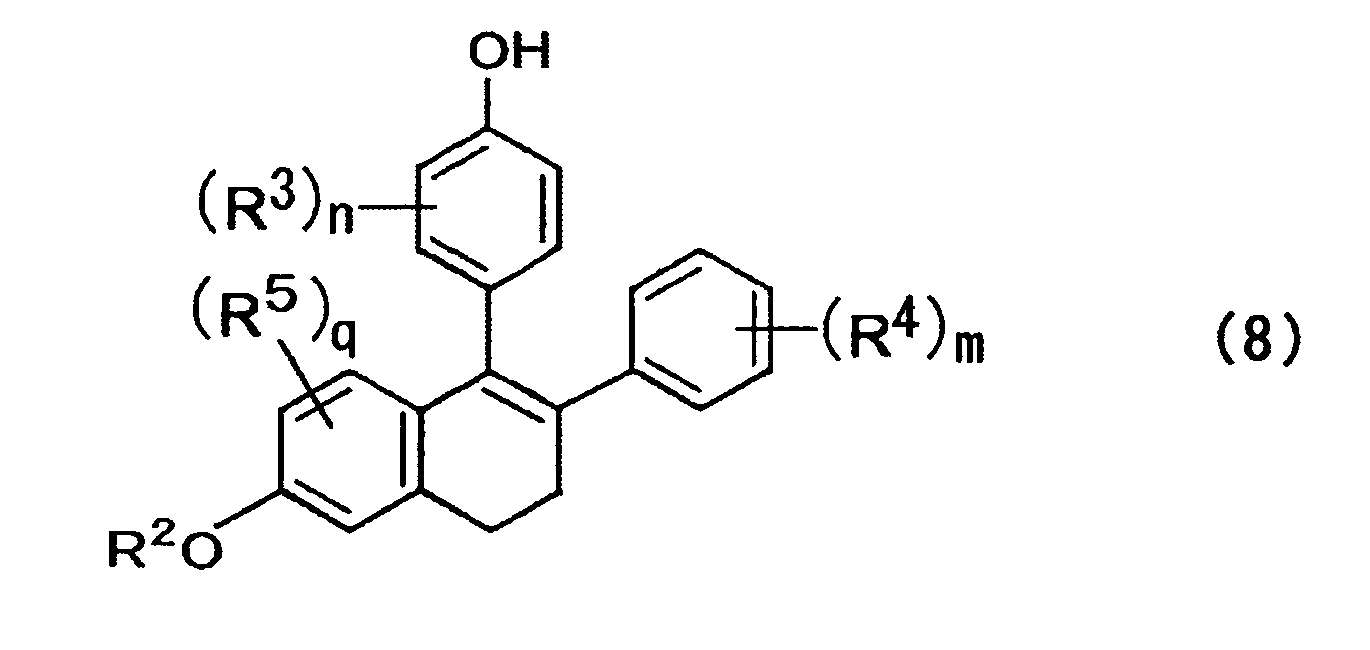
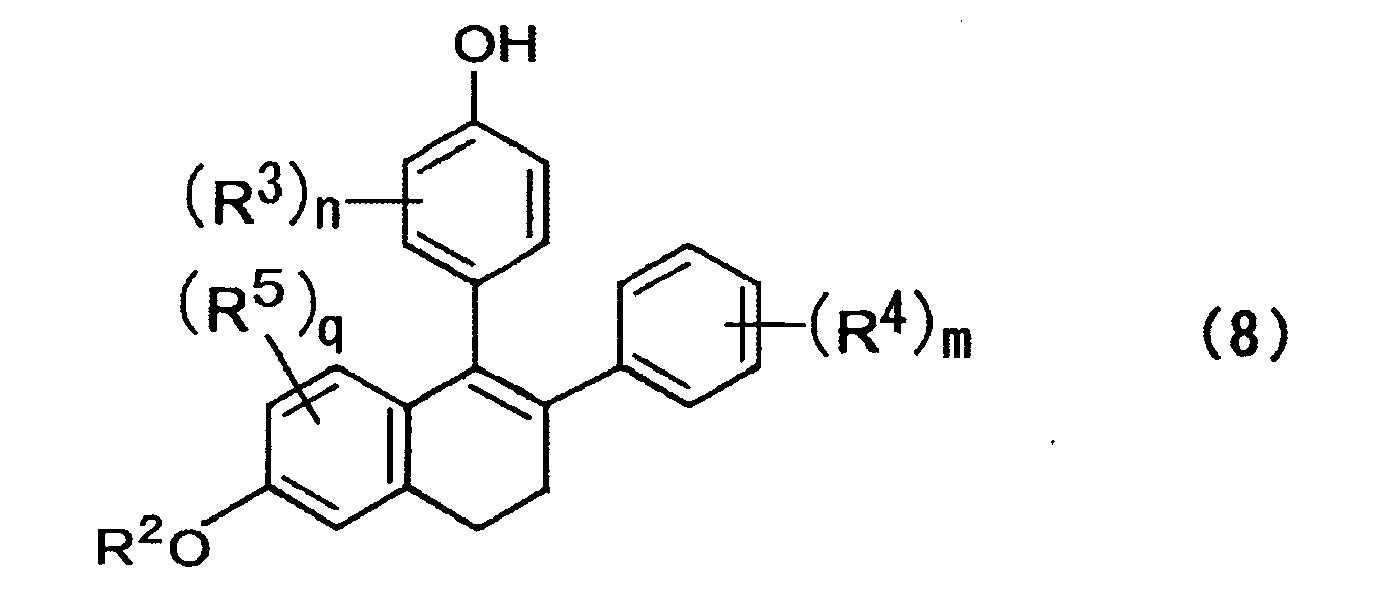
- a method for producing a compound expressed by the formula (8) includes affecting one of a compound expressed by the formula (5) and a mixture of isomers thereof with an alcoholate and/or an amine salt to cause de-hydrogen halide, rearrangement of a double bond, and elimination reaction of R 1 group to prepare a compound expressed by the formula (8) below; where, in the formula above, R 1 to R 5 , n, m, and q are each the same as those described above; X represents a halogen atom; and the wave lines represent a bond of R or S configuration; where, in the formula above, R 2 to R 5 , n, m, and q are each the same as those described above.
- a fourth aspect in a method for producing one of nafoxidine and an analogue thereof, 1-pyrrolidino-ethylation is performed on a compound expressed by the formula (8) ; where, in the formula above, R 2 to R 5 , n, m, and q are each the same as those described above.
- a compound is expressed by one of the formula (5) below and a mixture of isomers thereof; where, in the formula above, R 1 to R 5 , n, m, and q are each the same as those described above; X represents a halogen atom; and the wave lines represent a bond of R or S configuration.
- a compound is expressed by the formula (8) below; where, in the formula above, R 2 to R 5 , n, m, and q are each the same as those described above.
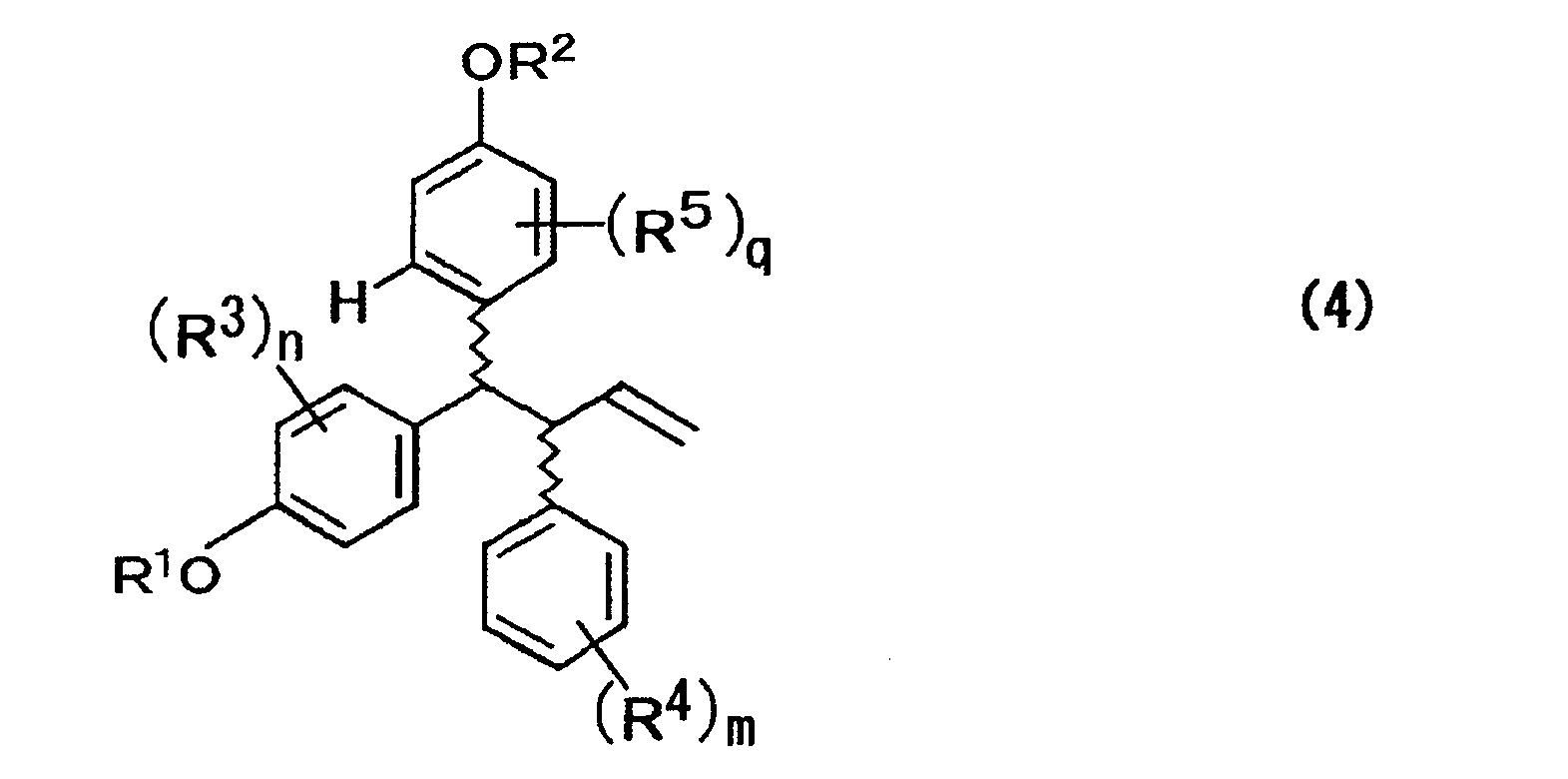
- the present invention is characterized in that a compound, represented by the formula (4) below, which is prepared under one step of three-component coupling using a compound represented by the formula (1) below, a compound represented by the formula (2) below, and a compound represented by the formula (3) below as raw compounds thereof, is used as an intermediate of lasofoxifene and analogues thereof, whereby the process can produce lasofoxifene and analogues thereof in a reduced number of steps and is practically superior. Accordingly, the present invention can economically mass produce lasofoxifene and analogues thereof as a selective estrogen receptor modulator (SERM), particularly ones expected as a therapeutic agent of postmenopausal osteoporosis.
- SERM selective estrogen receptor modulator
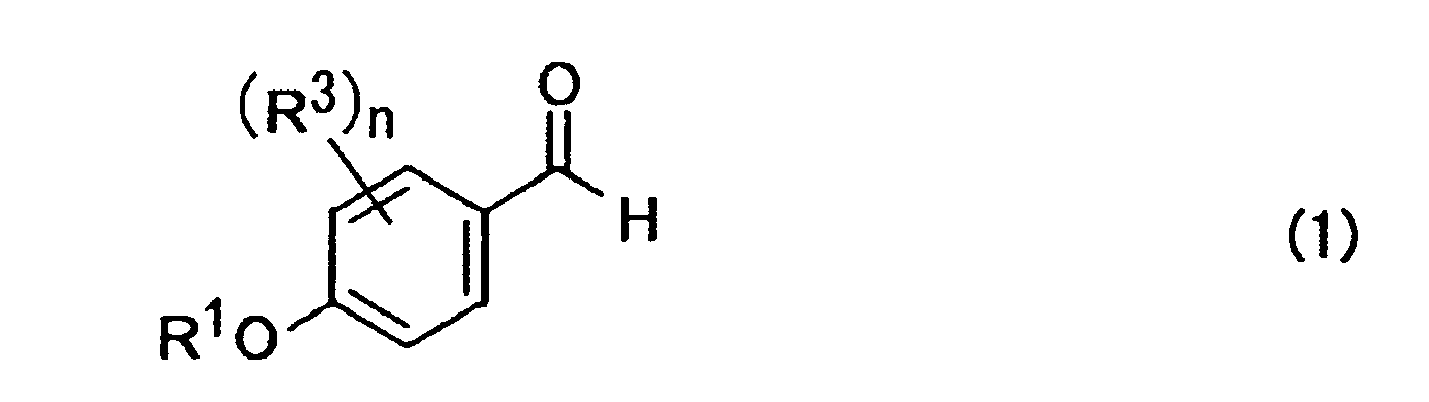
- a compound represented by the formula (4) is synthesized in one step using a compound represented by the formula (1), a compound represented by the formula (2), and a compound represented by the formula (3) as raw compounds thereof.
- Preferable compounds expressed by the formula (1) are exemplified by 4-acetoxybenzaldehyde, 4-pivaloyloxybenzaldehyde, 4-propanoyloxybenzaldehyde, 4-ethoxycarbonyloxybenzaldehyde, 4-benzyloxycarbonyloxybenzaldehyde, 4-silyloxybenzaldehyde, etc.
- Preferable compounds expressed by the formula (2) are exemplified by trimethyl cinnamylsilane, tributyl cinnamyltin, dimethyl cinnamylboron, etc.
- Compounds of the formula (3) are preferably 2-methoxybenzene, 2-ethoxybenzene, 2-benzyloxybenzene, etc.
- An acid catalyst such as Lewis acids, e.g. HfCl 4 or proton acids, and a co-catalyst such as trimethylsilyl trifluoromethanesulfonate (TMSOTf) are used in this reaction step.
- TMSOTf trimethylsilyl chloride
- metal salts of the 4th group such as Hf(OTf) 4 , TiCl 4 and TiCl 2 (OTf) 2
- metal salts of 3rd group such AlCl 3 , BCl 3 and Sc(OTf) 3
- metal salts of 2nd group such SnCl 2 and Sn (OTf) 2
- Hydrochloric acid, sulfuric acid, nitric acid, hydrobromic acid, trifluoroacetic acid, trifluoromethanesulfonic acid, etc. can be used as the proton acid. These may be used alone or in combinations of two or more.
- Reaction temperature is in the range of 0°C to 40°C, and may be room temperature.
- the reaction time is in the range of 1 to 10 hours.
- R 1 to R 5 , n, m, and q are each the same as those described above; and the wave lines represent a bond of R or S configuration.
- the mixture of isomers, obtained in the abovementioned step, is then subjected to a halogen-induced carbocyclization reaction using a halogenating agent such as imide N-chlorosuccinate, imide N-bromosuccinate, imide N-iodosuccinate and I (Py) 2 BF 4 and an acid such as HBF 4 , BF 3 -OEt 2 and CF 3 SO 3 H in the presence of a solvent such as ethylene ether and methylene chloride, whereby a mixture of isomers of compounds expressed by the formula (5) is prepared.
- a halogenating agent such as imide N-chlorosuccinate, imide N-bromosuccinate, imide N-iodosuccinate and I (Py) 2 BF 4 and an acid such as HBF 4 , BF 3 -OEt 2 and CF 3 SO 3 H
- a solvent such as ethylene ether and methylene chloride
- R 1 to R 5 , n, m, and q are each the same as those described above;
- X represents a halogen atom; and the wave lines represent a bond of R or S configuration.
- the reaction temperature is in the range of -78°C to 0°C.
- the mixture of isomers is a mixture of compounds expressed by the abovementioned formula (5), more specifically, by a mixture of compounds of eight species in total containing enantiomers of respective compounds expressed by the formulae (11) to (14) below.
- R 3 , R 4 , R 5 , n, m, and q are each the same as those described above.
- compounds of the formula (8) can be obtained through de-hydrogen halide, rearrangement of a double bond, and elimination reaction of R 1 group by action of alcoholates such as t-butylate, methylate and ethylate or alcoholates and amine bases such as DBU, DBN and DABCO, without separating or isolating the respective compounds. These reactions may be carried out sequentially or simultaneously.
- the intermediate product may not be removed particularly in this step and a plurality of the reaction steps can progress in one reaction vessel.
- the reaction temperature is the range of 0°C to 80°C, and preferably the range of room temperature to 50°C.
- R 3 , R 4 , R 5 , n, m, q and wave lines are each the same as those described above.
- lasofoxifene expressed by the formula (20) can be obtained through hydrogen addition, introduction of a side chain, and removal of an alkyl group in sequence; incidentally, the hydrogen addition may be carried out after the introduction of a side chain, and then an alkyl group may be removed. In this case, the reaction goes through nafoxidine or an analogue thereof by introducing a side chain.
- the hydrogen addition is carried out in the presence of a metal catalyst such as Pd (OH) 2 , Pd/carbon, Pd black, Pt black and rhodium chloride complexes under normal pressure to a pressure of about 500 kPa; the introduction of a side chain is carried out by reaction with pyrrolidinoethyl bromide or pyrrolidinoethyl chloride in the presence of chlorine or with 1-(2-hydroxyethyl)pyrrolidine in the presence of an azo reagent such as diethylazodicarboxylate and diisopropyl dicarboxylate and a reducing agent such as triphenylphosphine and quinones.
- a strong acid such as BBr 3 , 47% HBr and HBr/acetic acid.
- nafoxidine expressed by the formula (21) below can be obtained through introducing a side chain in a similar manner as described above.
- R 2 is other alkyl groups, nafoxidine analogues are obtained.
- Examples 2 to 4 relate to a reaction without separating an intermediate mixture of isomers
- Examples 5 and 6 relate to a reaction using a single compound of a mixture of isomers.
- Hafnium chloride (39.2 mg, 0.122 mmol) was suspended in anisole (3, 0.02 mL) under an argon atmosphere, and then an anisole solution (0.22 mL) of 4-(pivaloyloxy)benzaldehyde (1, 25 mg, 0.121 mmol) and trimethyl cinnamylsilane (2, 46.7 mg, 0.245 mmol) was slowly added dropwise thereto under cooling by ice. The reaction mixture was stirred overnight at room temperature, then a saturated aqueous sodium bicarbonate solution (5 mL) was poured thereto, and the mixture was intensively stirred and extracted by adding diethyl ether (10 mL).
- reaction mixture was further extracted two times using diethyl ether (10 mL), and then an organic layer was collected and rinsed with a saturated aqueous sodium chloride solution (5 mL), followed by drying with anhydrous magnesium sulfate and concentration thereof.
- Bis(pyridine)iodonium tetrafluoroborate (65.8 mg, 0.177 mmol) was suspended in methylene chloride (3.4 mL), and the suspension was cooled to -78°C in a dry ice/acetone bath.
- reaction mixture was further extracted two times using ether (10 mL), and then an organic layer was collected and rinsed with a saturated aqueous sodium chloride solution, followed by drying with anhydrous magnesium sulfate and concentration thereof.
- Bis(pyridine)iodonium tetrafluoroborate (57.1 mg, 0.154 mmol) was suspended in methylene chloride (3.4 mL), and the suspension was cooled to -78°C in a dry ice/acetone bath.
- the reactant was stirred at -78°C for 2 hours, and then a saturated aqueous ammonium chloride solution was added thereto to stop the reaction. Diethyl ether was added to the mixture, which was then extracted three times, and then an organic layer was collected and rinsed with a saturated aqueous sodium chloride solution, followed by drying with anhydrous magnesium sulfate and concentration thereof.
- Mass spectrum m/e: calculated value 563.11 as (C 28 H 29 IO 3 +Na) + , experimental value 563.11.
- Mass spectrum m/e: calculated value 563.11 as (C 28 H 29 IO 3 +Na) + , experimental value 563.11.
- the dimethyl sulfoxide was sufficiently degassed prior to use thereof.
Landscapes
- Chemical & Material Sciences (AREA)
- Organic Chemistry (AREA)
- Health & Medical Sciences (AREA)
- Chemical Kinetics & Catalysis (AREA)
- Life Sciences & Earth Sciences (AREA)
- Public Health (AREA)
- Veterinary Medicine (AREA)
- General Chemical & Material Sciences (AREA)
- Medicinal Chemistry (AREA)
- Nuclear Medicine, Radiotherapy & Molecular Imaging (AREA)
- Bioinformatics & Cheminformatics (AREA)
- Pharmacology & Pharmacy (AREA)
- Engineering & Computer Science (AREA)
- Animal Behavior & Ethology (AREA)
- General Health & Medical Sciences (AREA)
- Endocrinology (AREA)
- Physical Education & Sports Medicine (AREA)
- Diabetes (AREA)
- Orthopedic Medicine & Surgery (AREA)
- Rheumatology (AREA)
- Cardiology (AREA)
- Heart & Thoracic Surgery (AREA)
- Reproductive Health (AREA)
- Organic Low-Molecular-Weight Compounds And Preparation Thereof (AREA)
- Low-Molecular Organic Synthesis Reactions Using Catalysts (AREA)
- Pharmaceuticals Containing Other Organic And Inorganic Compounds (AREA)
Abstract



Description
- The present invention relates to a process for producing lasofoxifene, known as a selective estrogen receptor modulator, or analogues thereof, a novel and useful intermediate, used for the production process, and a process for producing the same.
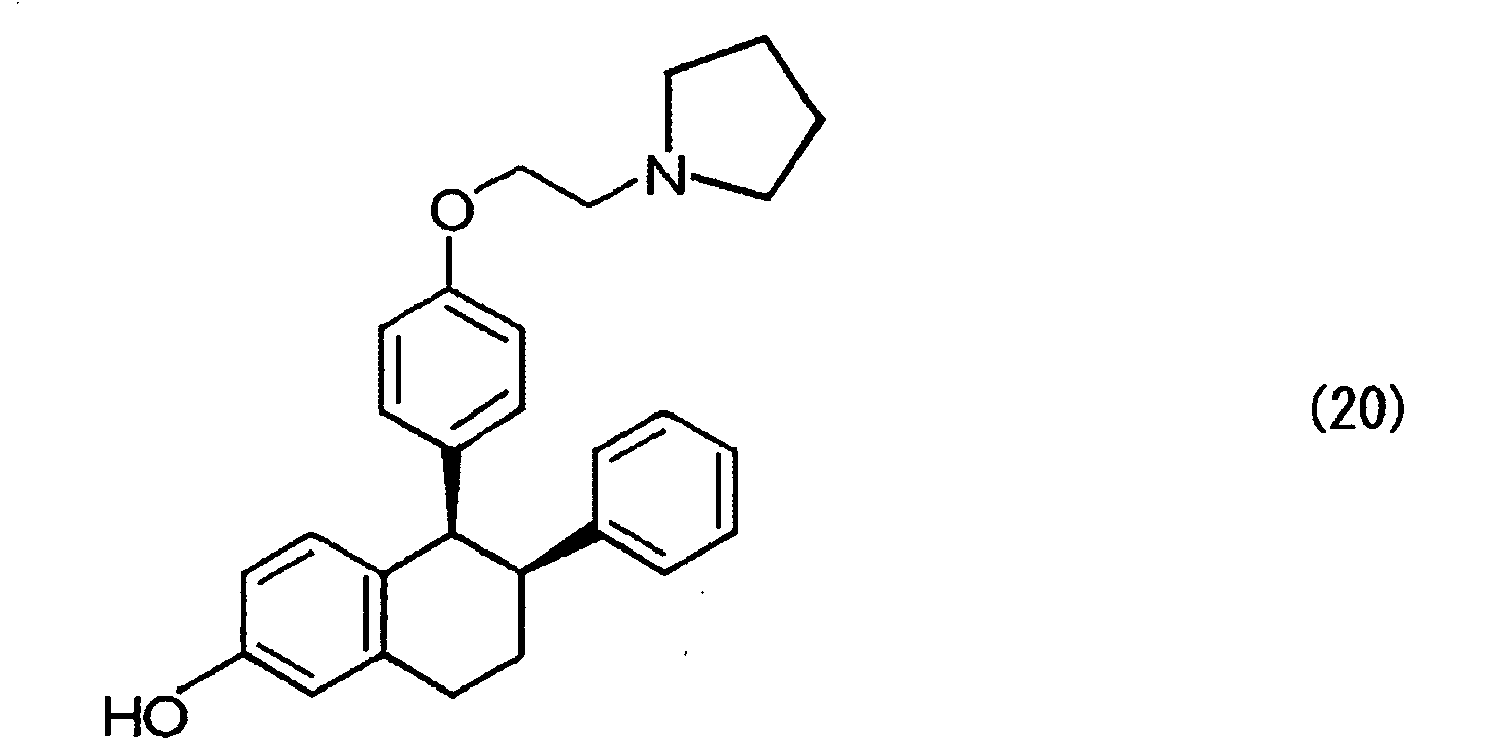
- Selective estrogen receptor modulators (SERMs) generally refer to agents that exert or do not exert an estrogen effect depending on organs or tissues; for example, the agents have an antiestrogen effect on the uterus, mammary gland, etc., whereas they exert an estrogen effect on postmenopausal osteoporosis, serum cholesterol, cardiovascular system, etc. These agents are exemplified by tamoxifen, raloxifene, lasofoxifene, etc.; among these, lasofoxifene appears promising as a prophylactic or therapeutic agent of postmenopausal osteoporosis, and clinical tests thereof have currently been progressing in a large scale. The chemical structure of the lasofoxifene, (cis-6-phenyl-5-[4-(2-pyrrolidine-1-ylethoxyphenyl]-5,6,7,8-tetrahydronaphthalen-2-ol), is shown below.
- The process for producing lasofoxifene is exemplified by the following two processes. In one of the processes, a starting compound of 2-bromo-5-methoxy-toluene is brominated to obtain 1-bromo-2-bromomethyl-4-methoxy-benzene, which is then used to alkylate ethylbenzoylacetate, then to undergo decarboxylation, thereby obtaining 3-(2-bromo-5-methoxyphenyl)-1-phenyl-propane-1-one, which is then protected by ketalation and sequentially subjected to an introduction reaction of an alkoxybenzoyl group, diketonization, formation of a naphthalene ring by McMurry coupling reaction mitigated by titanium, and an introduction reaction of an N-ethyl-pyrrolidino side chain, thereby obtaining an intermediate of cis-1-{2-[4-(6-methoxy-2-phenyl-1,2,3,4-tetrahydronaphthalene-1-yl)phenoxy]-ethyl}-pyrrolidine, followed by demethylation of a methoxy group on the tetrahydronaphthalene ring to obtain lasofoxifene (see Patent Document 1).
- In the other process, a starting material of 1,4-dibromobenzene is reacted with 1-hydroxyethyl-pyrrolidine to obtain 1-[2-(4-bromophenoxy)ethyl]pyrrolidine, which is made into an organic cerium reagent then reacted with 6-methoxy-tetralone to obtain 1-{2-[4-(6-emthoxy-3,4-dihydronaphthalene-1-yl)phenoxy]ethyl}pyrrolidine. Afterwards, lasofoxifene is prepared through introduction of a bromo group into 2-position of a dihydronaphthalene ring, substitution of a bromo group with a phenyl group, hydrogenation reaction, and demethylation reaction of a methoxy group (see Patent Document 2).
- However, the former process includes as many as 8 reaction steps from the starting compound to the lasofoxifene, and is thus far from an effective process.
- In addition, the latter process includes a lower number of 6 reaction steps; however, in order to provide a drug substance of pharmaceutical grade, there is a disadvantage in that a coupling reaction should be carried out in the final synthesis stage with low yield using a heavy metal catalyst difficult to remove therefrom.
- Furthermore, both of the processes are specialized for the production of lasofoxifene such that intermediate products in the production processes are inadequate for an intermediate for producing various lasofoxifene analogues.
- Patent Document 1: Japanese Unexamined Patent Application, First Publication No.
2000-327670 - Patent Document 2: Japanese Unexamined Patent Application, First Publication No.
H10-503215 - It is an object of the present invention to solve the problems of the prior art described above, and more specifically, to provide an effective process for producing lasofoxifene or an analogue thereof, which is superior in practical use by a reduced number of reaction steps, and also to provide a novel and useful intermediate that allows to effectively produce various lasofoxifene analogues. Means for Solving the Problems
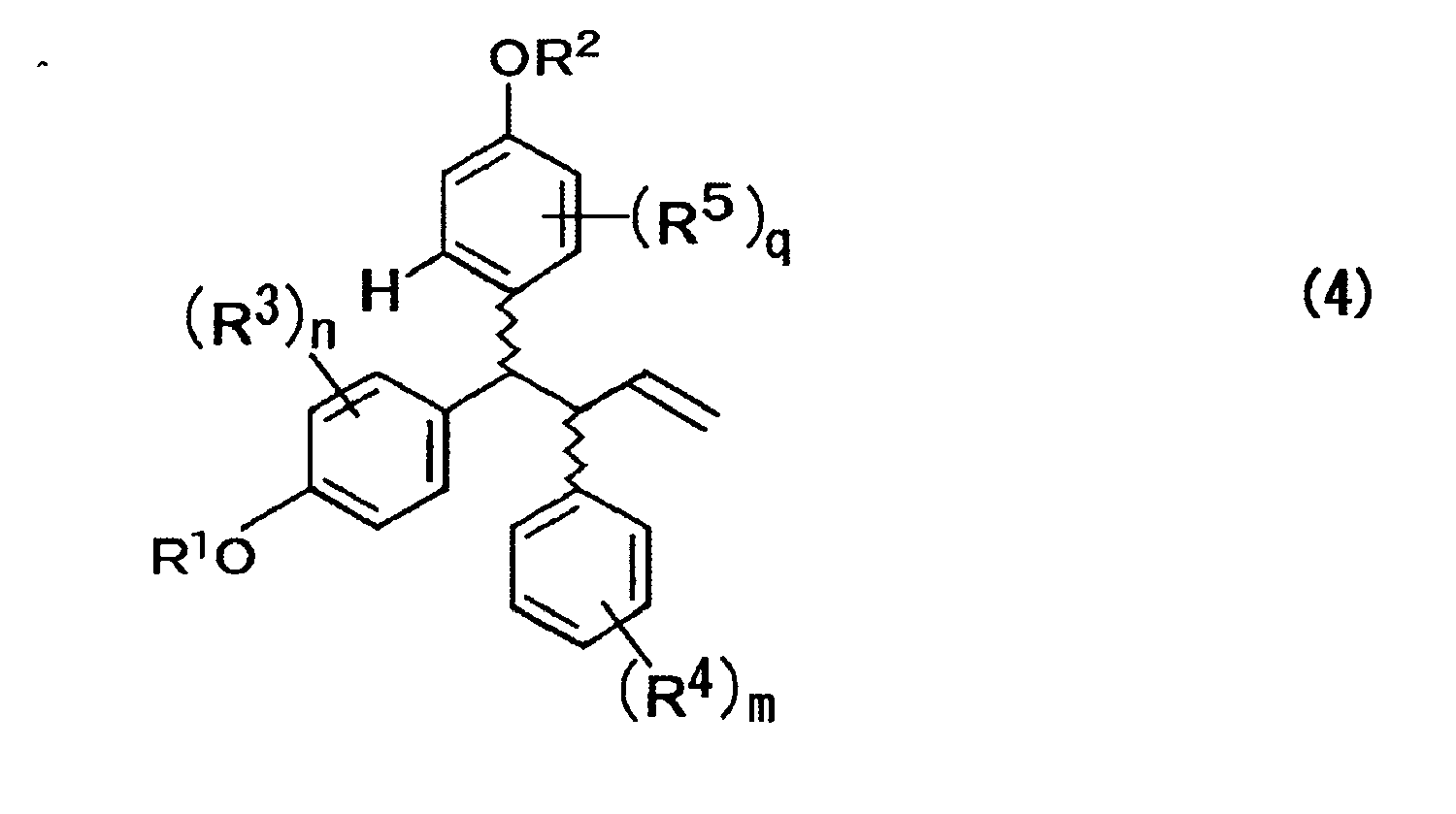
- As a result of thorough investigation by present inventors, it has been discovered that lasofoxifene or analogues thereof can be effectively produced in a reduced number of steps and intermediate products in the production steps allow for effective production of various species of lasofoxifene analogues, and also are superior in practical utility thereof by use of a compound, represented by the formula (4) below, as an intermediate prepared under one step of three-component coupling using a compound represented by the formula (1) below, a compound represented by the formula (2) below, and a compound represented by the formula (3) below as raw compounds thereof, thereby achieving the present invention.

- In the above formula, R1 represents a hydrogen atom, an alkyl group, an acyl group, an alicyclic group, or an aromatic group; R3 represents at least one substituent selected from a hydrogen atom, an alkyl group, an acyl group, an alicyclic group, an aromatic group, a halogen atom, a hydroxyl group, an alkyloxy group, an acyloxy group, a cyano group, and a nitro group; and n represents an integer of 1 to 4.

- In the above formula, R' represents at least one substituent selected from a hydrogen atom, an alkyl group, an acyl group, an alicyclic group, an aromatic group, a halogen atom, a hydroxyl group, an alkyloxy group, an acyloxy group, and a cyano group; M represents a silicon atom, a boron atom, a tin atom, a zinc atom, or a magnesium atom; R4 represents at least one substituent selected from a hydrogen atom, an alkyl group, an acyl group, an alicyclic group, an aromatic group, a halogen atom, a hydroxyl group, an alkyloxy group, an acyloxy group, a cyano group, and a nitro group; m represents an integer of 1 to 5; and p represents an integer of 1 to 4.

- In the above formula, R2 represents a hydrogen atom, an alkyl group, an acyl group, an alicyclic group, or an aromatic group; R5 represents at least one substituent selected from a hydrogen atom, an alkyl group, an acyl group, an alicyclic group, an aromatic group, a halogen atom, a hydroxyl group, an alkyloxy group, and an acyloxy group; and q represents an integer of 1 to 3.

- In the above formula, R1 to R5, n, m, and q are each the same as those described above; and the wave lines represent a bond of R or S configuration.
- That is, the present invention is as follows.
- According to a first aspect, in a method for producing lasofoxifene, nafoxidine, or an analogue thereof, the below sequential steps are performed:
- (a) reacting compounds expressed by the formulae (1), (2) and (3) below in the presence of an acid catalyst to prepare one of a compound expressed by the formula (4) and a mixture of isomers thereof;


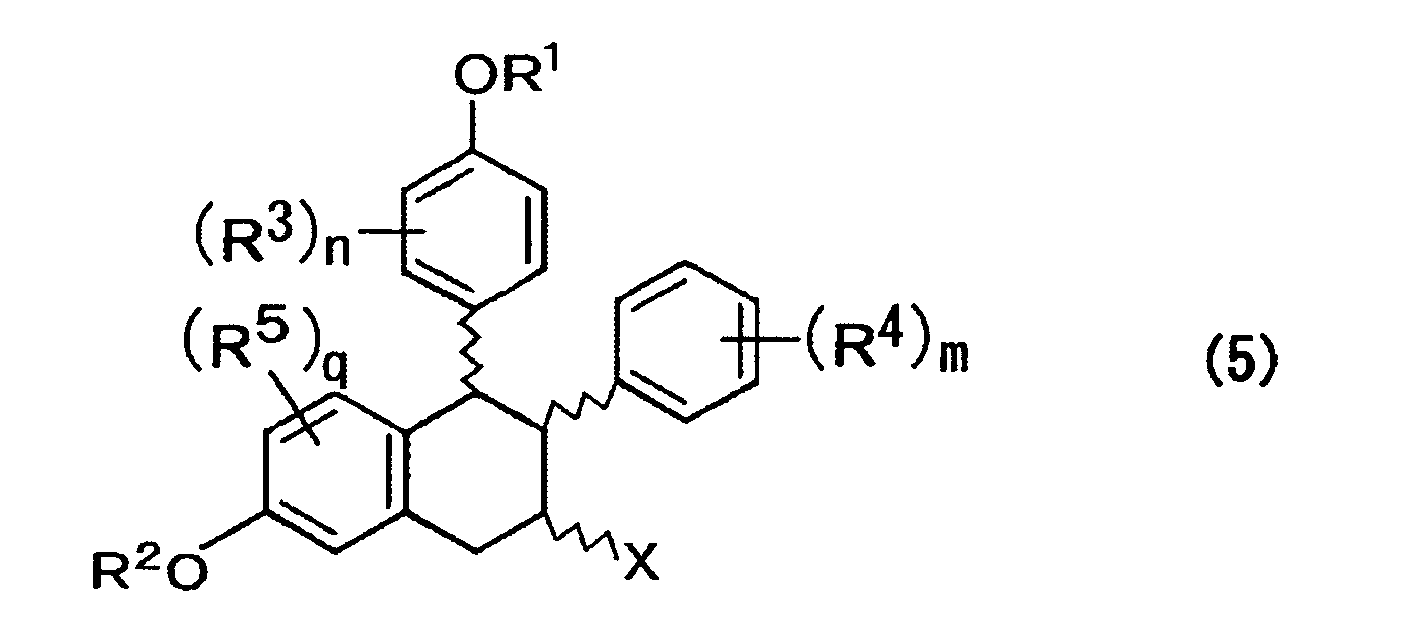
- (b) obtaining a compound expressed by the formula (5) below by a halogen-induced carbocyclization reaction of one of a compound expressed by the formula (4) and a mixture of isomers thereof;
- (c) preparing a compound expressed by the formula (8) below by de-hydrogen halide, rearrangement of a double bond, and elimination reaction of R1 group of one of a compound expressed by the formula (5) and a mixture of isomers thereof in the presence of an alcoholate and/or an amine salt;

- (d) obtaining one of nafoxidine and an analogue thereof by 1-pyrrolidino-ethylation of the compound expressed by the formula (8) to prepare, or performing hydrogen addition of the compound expressed by the formula (8) followed by 1-pyrrolidino-ethylation or 1-pyrrolidino-ethylation of the compound expressed by the formula (8) followed by hydrogen addition and subsequent removal of R2 group to prepare one of lasofoxifene and an analogue thereof.
- According to a second aspect, in a method for producing a compound expressed by the formula (5), the below sequential steps are performed of:
- (a) reacting compounds expressed by the formulae (1), (2) and (3) below in the presence of an acid catalyst to prepare one of a compound expressed by the formula (4) and a mixture of isomers thereof;


- (b) obtaining one of a compound expressed by the formula (5) below and a mixture of isomers thereof by halogen-induced carbocyclization reaction of one of a compound expressed by the formula (4) and a mixture of isomers thereof;

- In a third aspect, a method for producing a compound expressed by the formula (8) includes affecting one of a compound expressed by the formula (5) and a mixture of isomers thereof with an alcoholate and/or an amine salt to cause de-hydrogen halide, rearrangement of a double bond, and elimination reaction of R1 group to prepare a compound expressed by the formula (8) below;


- According to a fourth aspect, in a method for producing one of nafoxidine and an analogue thereof, 1-pyrrolidino-ethylation is performed on a compound expressed by the formula (8) ;
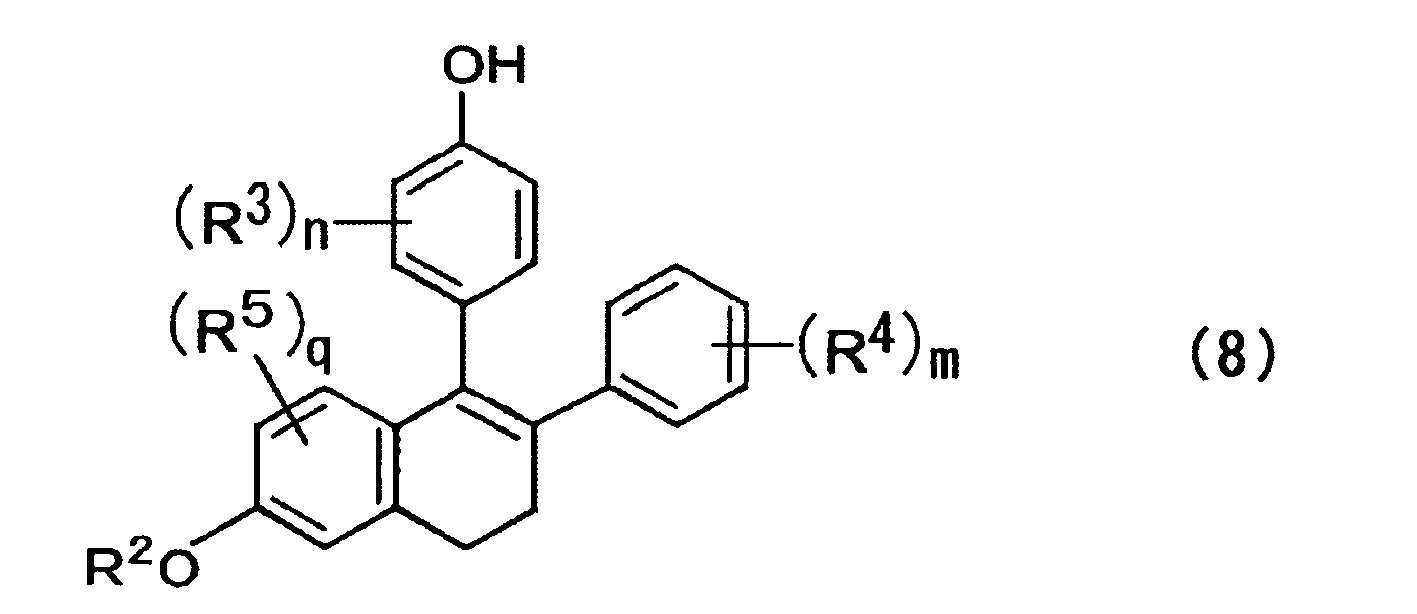
- According to a fifth aspect, in a method for producing one of lasofoxifene and an analogue thereof, hydrogen addition is performed on the compound expressed by the formula (8) below, followed by one of 1-pyrrolidino-ethylation and 1-pyrrolidino-ethylation thereof, followed by hydrogen addition and subsequent removal of R2 group;

- In a sixth aspect, a compound is expressed by one of the formula (5) below and a mixture of isomers thereof;

- In a seventh aspect, a compound is expressed by the formula (8) below;

- The present invention is characterized in that a compound, represented by the formula (4) below, which is prepared under one step of three-component coupling using a compound represented by the formula (1) below, a compound represented by the formula (2) below, and a compound represented by the formula (3) below as raw compounds thereof, is used as an intermediate of lasofoxifene and analogues thereof, whereby the process can produce lasofoxifene and analogues thereof in a reduced number of steps and is practically superior. Accordingly, the present invention can economically mass produce lasofoxifene and analogues thereof as a selective estrogen receptor modulator (SERM), particularly ones expected as a therapeutic agent of postmenopausal osteoporosis.
- The structure of lasofoxifene is shown by the formula (20) below.
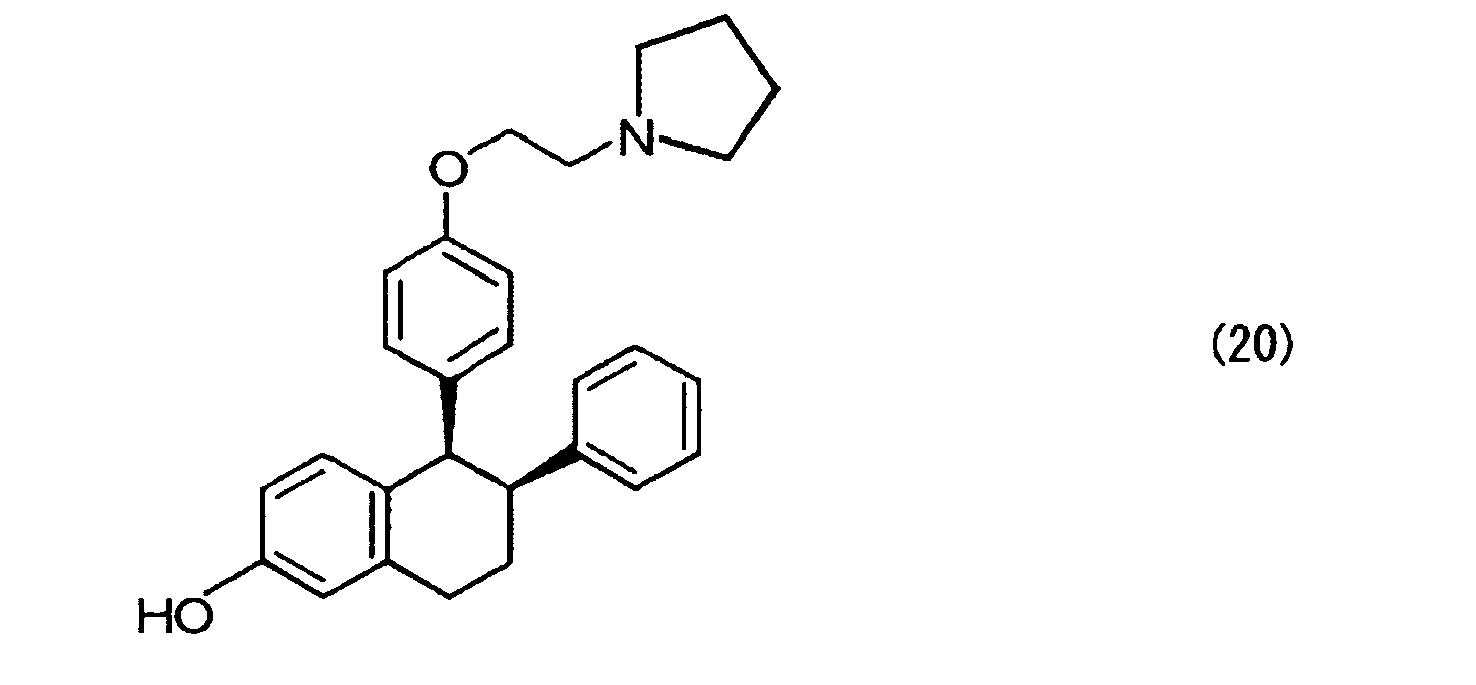
- The respective steps of the production process of the present invention are explained below with reference to
FIG. 1 . Production Process (FIG. 1 ) - In the present invention, initially, a compound represented by the formula (4) is synthesized in one step using a compound represented by the formula (1), a compound represented by the formula (2), and a compound represented by the formula (3) as raw compounds thereof.
- Preferable compounds expressed by the formula (1) are exemplified by 4-acetoxybenzaldehyde, 4-pivaloyloxybenzaldehyde, 4-propanoyloxybenzaldehyde, 4-ethoxycarbonyloxybenzaldehyde, 4-benzyloxycarbonyloxybenzaldehyde, 4-silyloxybenzaldehyde, etc. Preferable compounds expressed by the formula (2) are exemplified by trimethyl cinnamylsilane, tributyl cinnamyltin, dimethyl cinnamylboron, etc.
- Compounds of the formula (3) are preferably 2-methoxybenzene, 2-ethoxybenzene, 2-benzyloxybenzene, etc.
- An acid catalyst such as Lewis acids, e.g. HfCl4 or proton acids, and a co-catalyst such as trimethylsilyl trifluoromethanesulfonate (TMSOTf) are used in this reaction step. As for the catalyst, trimethylsilyl chloride can be used in addition to the TMSOTf; and for the Lewis acid, metal salts of the 4th group such as Hf(OTf)4, TiCl4 and TiCl2 (OTf)2, metal salts of 3rd group such AlCl3, BCl3 and Sc(OTf) 3, and metal salts of 2nd group such SnCl2 and Sn (OTf) 2 can be used in addition to ones described above. Hydrochloric acid, sulfuric acid, nitric acid, hydrobromic acid, trifluoroacetic acid, trifluoromethanesulfonic acid, etc. can be used as the proton acid. These may be used alone or in combinations of two or more. Reaction temperature is in the range of 0°C to 40°C, and may be room temperature. The reaction time is in the range of 1 to 10 hours.

- Here, in the formula above, R1 to R5, n, m, and q are each the same as those described above; and the wave lines represent a bond of R or S configuration. Step of Cyclization Reaction
- The mixture of isomers, obtained in the abovementioned step, is then subjected to a halogen-induced carbocyclization reaction using a halogenating agent such as imide N-chlorosuccinate, imide N-bromosuccinate, imide N-iodosuccinate and I (Py) 2BF4 and an acid such as HBF4, BF3-OEt2 and CF3SO3H in the presence of a solvent such as ethylene ether and methylene chloride, whereby a mixture of isomers of compounds expressed by the formula (5) is prepared.

- Here, in the formula above, R1 to R5, n, m, and q are each the same as those described above; X represents a halogen atom; and the wave lines represent a bond of R or S configuration.
- The reaction temperature is in the range of -78°C to 0°C.
- The mixture of isomers is a mixture of compounds expressed by the abovementioned formula (5), more specifically, by a mixture of compounds of eight species in total containing enantiomers of respective compounds expressed by the formulae (11) to (14) below.

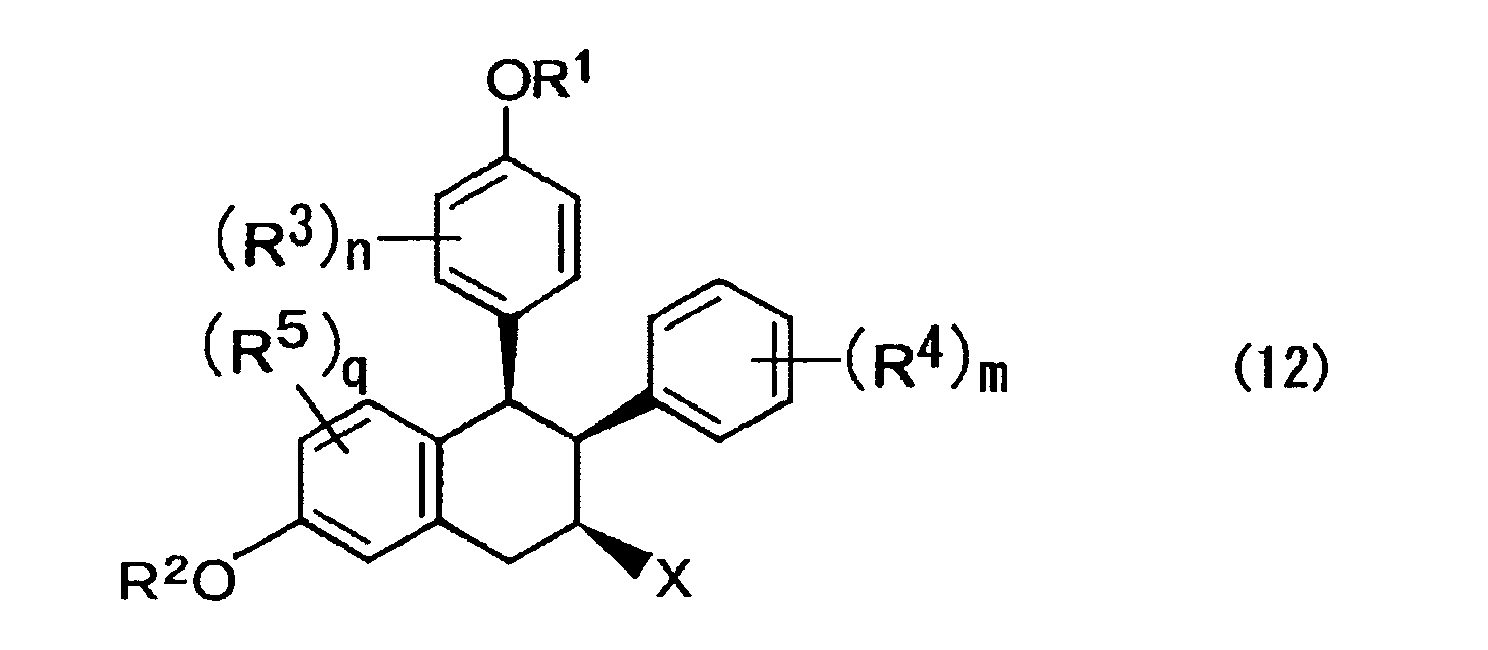


- Here, in the formulae (11) to (14), R3, R4, R5, n, m, and q are each the same as those described above. Step of Removing Acyl Group and Removing Iodine
- From the mixture of isomers obtained in the abovementioned step, compounds of the formula (8) can be obtained through de-hydrogen halide, rearrangement of a double bond, and elimination reaction of R1 group by action of alcoholates such as t-butylate, methylate and ethylate or alcoholates and amine bases such as DBU, DBN and DABCO, without separating or isolating the respective compounds. These reactions may be carried out sequentially or simultaneously.
- When amine bases such as DBU are used in these reactions and an intermediate product containing a compound expressed by the formula (10) below is yielded, the intermediate product may not be removed particularly in this step and a plurality of the reaction steps can progress in one reaction vessel. The reaction temperature is the range of 0°C to 80°C, and preferably the range of room temperature to 50°C.

- Here, R3, R4, R5, n, m, q and wave lines are each the same as those described above.

- Here, R3, R4, R5, n, m, and q are each the same as those described above. Step of Producing Lasofoxifene and Nafoxidine
- From the compound of the formula (8), lasofoxifene expressed by the formula (20) can be obtained through hydrogen addition, introduction of a side chain, and removal of an alkyl group in sequence; incidentally, the hydrogen addition may be carried out after the introduction of a side chain, and then an alkyl group may be removed. In this case, the reaction goes through nafoxidine or an analogue thereof by introducing a side chain.

- The hydrogen addition is carried out in the presence of a metal catalyst such as Pd (OH)2, Pd/carbon, Pd black, Pt black and rhodium chloride complexes under normal pressure to a pressure of about 500 kPa; the introduction of a side chain is carried out by reaction with pyrrolidinoethyl bromide or pyrrolidinoethyl chloride in the presence of chlorine or with 1-(2-hydroxyethyl)pyrrolidine in the presence of an azo reagent such as diethylazodicarboxylate and diisopropyl dicarboxylate and a reducing agent such as triphenylphosphine and quinones. The removal of an alkyl group is carried out by action of a strong acid such as BBr3, 47% HBr and HBr/acetic acid.
- When R2 is a methyl group in the formula (8), nafoxidine expressed by the formula (21) below can be obtained through introducing a side chain in a similar manner as described above. When R2 is other alkyl groups, nafoxidine analogues are obtained.
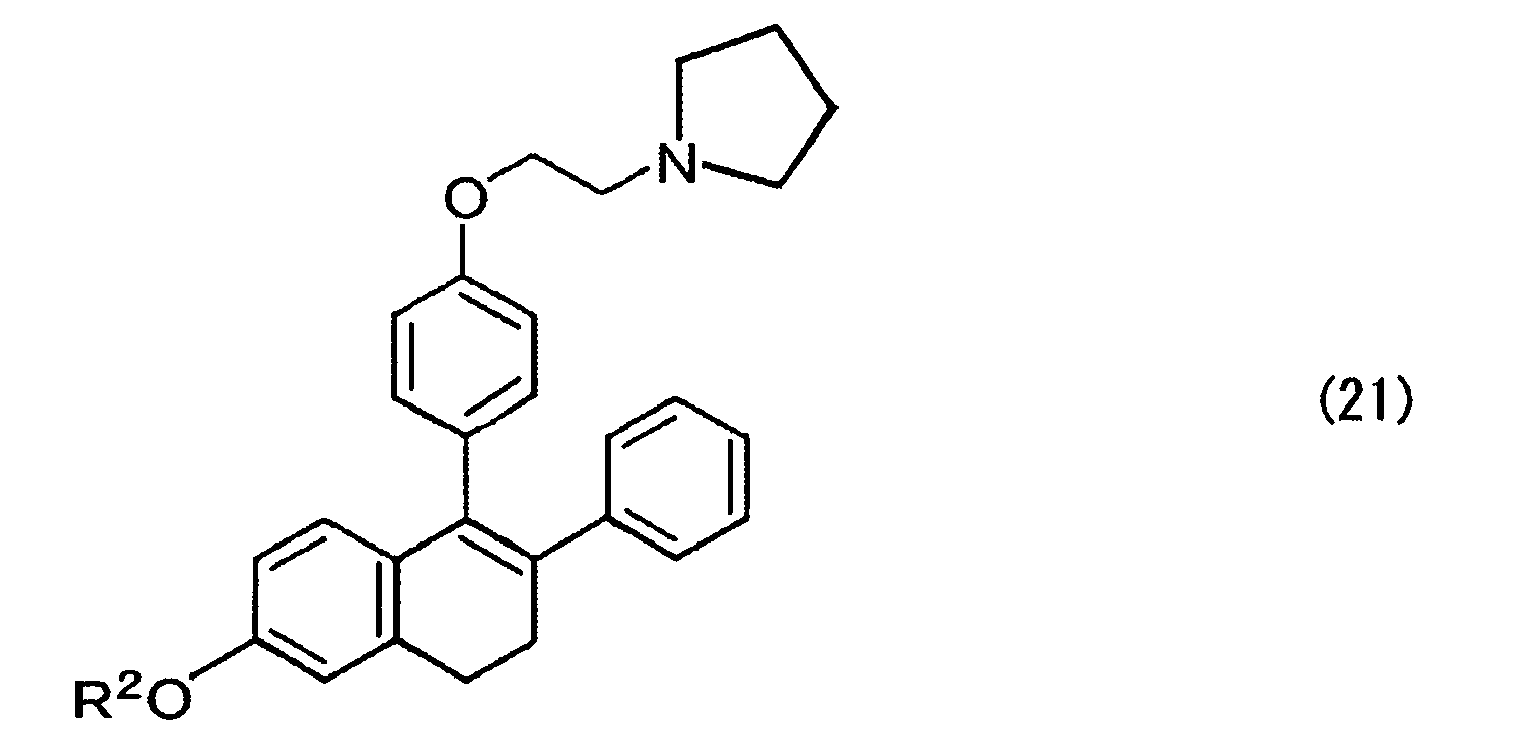
- The present invention is explained with specific reference to examples hereinafter; however, the present invention should not be limited thereto. In regards to the examples below, Examples 2 to 4 relate to a reaction without separating an intermediate mixture of isomers, and Examples 5 and 6 relate to a reaction using a single compound of a mixture of isomers.
-

- Hafnium chloride (39.2 mg, 0.122 mmol) was suspended in anisole (3, 0.02 mL) under an argon atmosphere, and then an anisole solution (0.22 mL) of 4-(pivaloyloxy)benzaldehyde (1, 25 mg, 0.121 mmol) and trimethyl cinnamylsilane (2, 46.7 mg, 0.245 mmol) was slowly added dropwise thereto under cooling by ice. The reaction mixture was stirred overnight at room temperature, then a saturated aqueous sodium bicarbonate solution (5 mL) was poured thereto, and the mixture was intensively stirred and extracted by adding diethyl ether (10 mL). The reaction mixture was further extracted two times using diethyl ether (10 mL), and then an organic layer was collected and rinsed with a saturated aqueous sodium chloride solution (5 mL), followed by drying with anhydrous magnesium sulfate and concentration thereof. The residue was purified by thin layer chromatography (hexane/methylene chloride/diethyl ether=4/1/1) to obtain the title compound as a colorless oily substance (37.7 mg, yield 75%, cin/anti mixture).
- 1H NMR (CDCl3, tetramethylsilane) δ (ppm): 1.20 and 1.26 (s, 9H), 3.59 and 3.70 (s, 3H), 4.01 (dd, 1H, J= 7.8, 11.3 Hz), 4.19 (d, 1H, 11.3 Hz), 4.7-4.9 (m, 2H), 5.8-5.9 (m, 1H), 6.6-7.3 (m, 13H).
- Infrared absorption spectrum (liquid membrane technique) cm-1: 2974, 1749, 1610, 1511, 1462, 1252, 1203, 1167, 1120, 1032, 753, 700.
- Mass spectrum m/e: calculated value 415.23 as (C28H30O3+H)+, experimental value 415.23
-

- Bis(pyridine)iodonium tetrafluoroborate (65.8 mg, 0.177 mmol) was suspended in methylene chloride (3.4 mL), and the suspension was cooled to -78°C in a dry ice/acetone bath. A methylene chloride (1.8 mL) solution of 1-(4-methoxyphenyl)-2-phenyl-1-(4-pivaloyloxyphenyl)-3-butene (4, 56.0 mg, 0.135 mmol) was added to the suspension, and also a tribromoborane diethyl ether complex (0.015 mL, 0.118 mmol) was added stepwise three times. Thereafter, the reactant was stirred at -78°C for 1 hour, then a saturated aqueous ammonium chloride solution (5 mL) was added thereto to stop the reaction, and the reactant was cooled to room temperature and then extracted three times with diethyl ether (10 mL). An organic layer was collected and rinsed with a saturated aqueous sodium chloride solution (10 mL), followed by drying with anhydrous sodium sulfate and concentrating. The residue was purified by thin layer chromatography to obtain the title compound as a light yellow oily substance (51.6 mg, yield 71%).
- 1H NMR (CDCl3, tetramethylsilane) δ (ppm): 1.32, 1.35 and 1.32 (s, 9H), 3.3 (m, 1H), 3.7-3.9 (m, 5H), 4.2 (d, 1H, J=10.6 Hz), 4.7-4.8 (m, 1H), 6.6-7.2 (m, 12H).
- Infrared absorption spectrum (liquid membrane technique) cm-1: 2972, 1751, 1610, 1510, 1503, 1122, 1031.
- Mass spectrum m/e: calculated value 541.12 as (C28H29IO3+H) +, experimental value 541.12
-

- 2-Iodo-7-methoxy-3-phenyl-4-(4-pivaloyloxyphenyl)-1,2,3,4-tetrahydronaphthalene (5, 39.4 mg, 0.0729 mmol) was dissolved in toluene (1.5 mL), then 1,8-diazabicyclo[5.4.0]undecene-7(DBU, 0.035 mL, 0.234 mmol) was added thereto, and the mixture was stirred for 15 minutes while heating at 80°C. After allowing cooling, a saturated aqueous ammonium chloride solution (10 mL) was added under cooling by ice, and then the mixture was intensively stirred and extracted by adding ether (10 mL). The reaction mixture was further extracted two times using ether (10 mL), and then an organic layer was collected and rinsed with a saturated aqueous sodium chloride solution, followed by drying with anhydrous magnesium sulfate and concentration thereof. The residue was purified by thin layer chromatography (benzene/hexane=10/1) to obtain the title compound (6, 22.7 mg) as a colorless oily substance (yield 75%).
- 1H NMR (CDCl3, tetramethylsilane) δ (ppm): 1.34 and 1.36 (s, 9H), 3.76 and 3.80 (s, 3H), 3.84 (dd, 1H, J=4.2, 7.5 Hz), 4.17 (d, 1H, J=7.5 Hz), 5.98 (dd, 1H, 4.2, 9.6 Hz), 6.6-7.2 (m, 12H).
-

- A solution of 7-methoxy-3-phenyl-4-(4-pivaloyloxyphenyl)-3,4-dihydronaphthalene (6, 29.3 mg, 0.0710 mmol) in dimethyl sulfoxide (0.8 mL) was added to a solution of tertiary butoxy potassium (40.3 mg, 0.359 mmol) in dimethyl sulfoxide (0.6 mL), and the reaction mixture was stirred at room temperature for one day. A saturated aqueous ammonium chloride solution (10 mL) was added to the reaction mixture, which was sufficiently stirred and then extracted three times by diethyl ether (10 mL). An organic layer was collected and rinsed with a saturated aqueous sodium chloride solution (10 mL), followed by drying with anhydrous magnesium sulfate and concentration thereof. The residue was purified by thin layer chromatography (toluene/ethyl acetate=10/1) to obtain the title compound (7, 16.0 mg, yield 69%).
- 1H NMR (CDCl3, tetramethylsilane) δ (ppm): 2.91(ddd, 2H), 2.75 (ddd, 2H), 3.79 (s, 3H), 6.6-7.2 (m, 12H).
-

- Bis(pyridine)iodonium tetrafluoroborate (57.1 mg, 0.154 mmol) was suspended in methylene chloride (3.4 mL), and the suspension was cooled to -78°C in a dry ice/acetone bath. A methylene chloride (2 mL) solution of 1-(4-methoxyphenyl)-2-phenyl-1-(4-pivaloyloxyphenyl)-3-butene (4, 56.0 mg, 0.135 mmol) was added to the suspension, and also a tribromoborane diethyl ether complex (0.015 mL, 0.118 mmol) was added stepwise three times. The reactant was stirred at -78°C for 2 hours, and then a saturated aqueous ammonium chloride solution was added thereto to stop the reaction. Diethyl ether was added to the mixture, which was then extracted three times, and then an organic layer was collected and rinsed with a saturated aqueous sodium chloride solution, followed by drying with anhydrous magnesium sulfate and concentration thereof. The residue was purified by thin layer chromatography (toluene) to obtain two compounds: a compound having a lower Rf value in the thin layer chromatography was a compound 5' (29.9 mg, yield 41%) suited to a precursor of lasofoxifene or nafoxidine and another compound having a larger Rf value was a compound 15 (20.0 mg, yield 27%, cyclization yield 68%). 2-iodo-7-methoxy-3-phenyl-4-(4-pivaloyloxyphenyl)-1,2,3,4-tetrahydronaphthalene (5'), amorphous solid
- 1H NMR (CDCl3, tetramethylsilane) δ (ppm) :7.2-6.5 (m, 12H, Ph), 4.68 (dt, 1H, J=5.1, 11.7 Hz, 2-H), 4.13 (d, 1H, J=10.5 Hz, 4-H), 3.76 (dd, 1H, J=11.7, 16.2 Hz, 1-Htrans), 3.67 (s, 3H, OCH3), 3.65 (dd, 1H, J=5.1, 16.2 Hz, 1-Hcis), 3.21 (dd, 1H, J=10.5, 11.7 Hz, 3-H), m, 1H) , 1.23 (s, 9H, C(CH3)3).
- Infrared absorption spectrum (KBr) cm-1: 2971, 1750, 1610, 1503, 1271, 1119, 1032.
- Mass spectrum m/e: calculated value 563.11 as (C28H29IO3+Na)+, experimental value 563.11.
- 1H NMR (CDCl3, tetramethylsilane) δ (ppm): 7.3-6.6 (m, 1H, Ph), 4.77 (ddd, 1H, J=5.1, 11.7, 12.0 Hz, 2-H), 4.19 (d, 1H, J=10.2 Hz, 4-H), 3.87 (dd, 1H, J=11.7, 15.9 Hz, 1-H trans), 3.75 (dd, 1H, J=5.1, 15.9 Hz, 1-Hcis), 3.72 (s, 3H, OCH3), 3.32 (dd, 1H, J=10.2, 12.0 Hz, 3-H), 1.35 (s, 9H, C (CH3) 3) .
- Infrared absorption spectrum (liquid membrane technique) cm-1: 2972, 1750, 1603, 1571, 1504, 1266, 1202, 1119, 1032.
- Mass spectrum m/e: calculated value 563.11 as (C28H29IO3+Na)+, experimental value 563.11.
-

- Potassium tert-butoxide solution 0.5 mol/L in dimethyl sulfoxide (1.10 mL, 0.55 mmol) was added to and dissolved in 2-iodo-7-methoxy-3-phenyl-4-(4-pivaloyloxyphenyl)-1,2,3,4-tetrahydronaphthalene (5', 74.4 mg, 0.138 mmol) under an argon atmosphere, and the resulting aubergine solution was stirred for 1 hour while heating at 90°C. Thereafter, the reaction mixture was cooled with ice, and then a saturated aqueous ammonium chloride solution (7 mL) was added thereto and sufficiently stirred, followed by extracting four times with a mixed liquid (4 mL) of hexane/diethyl ether (1:1). An organic layer was collected, followed by drying with anhydrous magnesium sulfate and concentration thereof. The residue was purified by silica gel column chromatography (hexane/ethyl acetate=4/1) to obtain the title compound (7, 41.1 mg, yield 89%), the same as that of Example 4.
- The dimethyl sulfoxide was sufficiently degassed prior to use thereof.
-

- 4-(4-Hydroxyphenyl)-7-methoxy-3-phenyl-1,2-dihydronaphthalene (7, 31.7 mg, 0.0965 mmol) was dissolved in N,N-dimethylformamide (1 mL) under an argon atmosphere, and then 60% sodium hydride (13.4 mg, 0.335 mmol) was added thereto and stirred for 20 minutes at room temperature.
- Pyrrolidinoethyl chloride hydrochloride (33.4 mg, 0.196 mmol) was added to the mixture and stirred at 50°C for 11 hours. Thereafter, the reaction mixture was cooled with ice, and then a saturated aqueous ammonium chloride solution was poured thereto to stop the reaction, followed by extracting four times with ethyl acetate. An organic layer was collected, dried with anhydrous sodium sulfate and concentrated, and then the residue was purified by thin layer chromatography (hexane/ethyl acetate/concentrated ammonia water=7/3/1) to obtain the title compound (21: nafoxidine, 3.5 mg, yield 82%) as a light yellow oily substance.
- 1H NMR (CDCl3, tetramethylsilane) δ (ppm): 7.2-6.5 (m, 12H, Ph), 4.18 (t, 2H, J=3.6 Hz, OCH2) , 3.80 (s, 3H, OCH3) , 3.04 (t, 2H, J=3.6 Hz, NCH2), 2.94 (m, 2H, 1-H), 2.84 (m, 4H, pyrrolidine 2-H), 2.77 (m, 2H, 2-H), 1.90 (m, 4H, pyrrolidine 3-H).
- Infrared absorption spectrum (liquid membrane technique) cm-1: 3031, 2936, 1669, 1606, 1568, 1508, 1241, 1174, 1037.
- Mass spectrum m/e: calculated value 426.24 as (C29H31NO2+H)+, experimental value 426.24
-
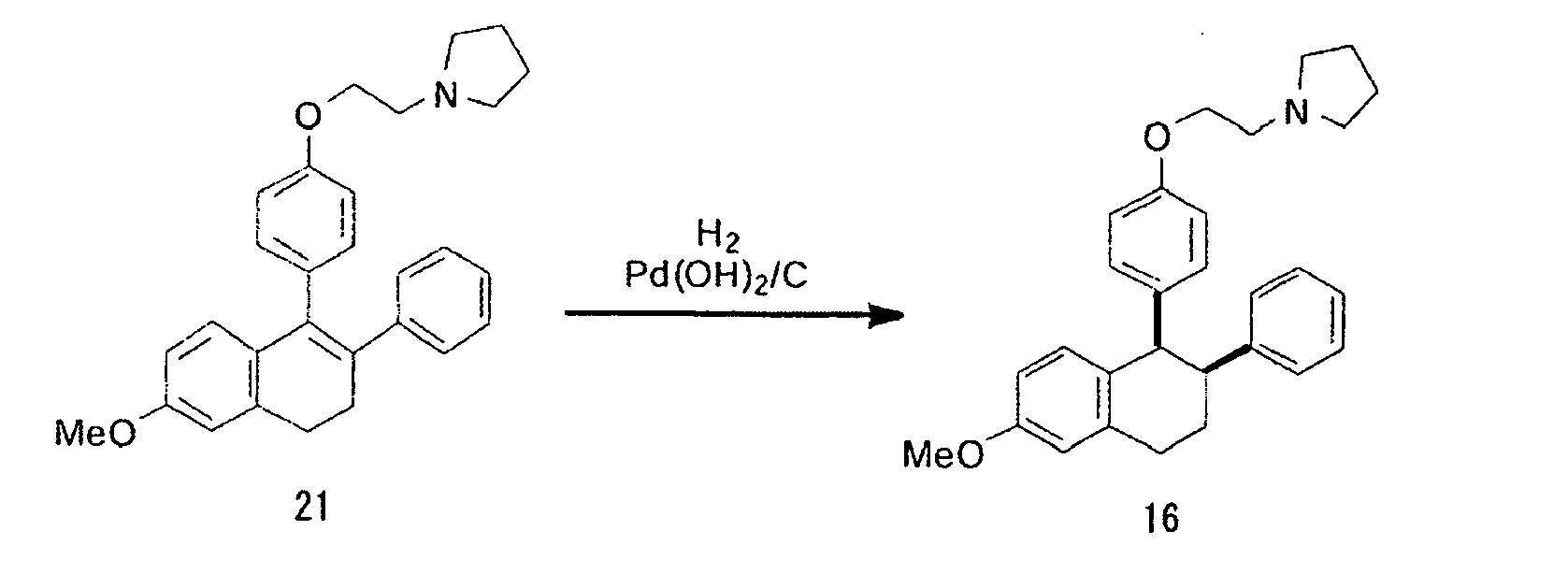
- 7-Methoxy-3-phenyl-4-[4-(2-(pyrrolidine-1-yl)ethoxy)]phenyl-1,2-dihydronaphthalene (21, 36.0 mg, 0.0846 mmol) was dissolved in ethanol (3 mL) in a pressure-resistant container, then palladium hydroxide-carbon (36.0 mg) was added thereto, and then the container was filled with hydrogen and sealed, followed by stirring for 22 hours at 50°C under 0.25 MPa. Thereafter, the catalyst was passed through a Cerite layer to filter and separate, a filtered layer was rinsed with ethyl acetate, and then an organic layer was collected and concentrated to obtain the title compound (16) as a colorless oily substance (25.2 mg, yield 70%).
- 1H NMR (CDCl3, tetramethylsilane) δ (ppm):7.2-6.6 (m, 8H, Ph), 6.55 (d, 2H, J=8.7 Hz, Ph), 6.31 (d, 2H, J=8. 7 Hz, Ph), 4.24 (d, 1H, J=5.1 Hz, 4-H), 4.00 (t, 2H, J=6.0 Hz, OCH2), 3.82 (s, 3H, OCH3), 3.36 (ddd, 1H, J=2.1, 5.1, 12.9 Hz, 3-H), 3.06 (m, 2H, 1-H), 2.85 (t, 2H, J=6.0 Hz, NCH2), 2.7-2.5 (m, 4H, pyrrolidine 2-H), 2.19 (m, 1H, 2-H), 1.80 (m, 1H, 2-H), 1.7-1.8 (m, 4H, pyrrolidine 3-H).
- Infrared absorption spectrum (liquid membrane technique) cm-1: 2932, 1608, 1506, 1460, 1240, 1178, 1155, 1038, 823.
- Mass spectrum m/e: calculated value 428.26 as (C29H33NO2+H)+, experimental value 428.26.
- Cameron et al. describe the abovementioned hydrochloride compound in Japanese Unexamined Patent Application, First Publication No.
H10-503215 -

- 7-Methoxy-3-phenyl-4-[4-(2-pyrrolidine -1-ylethoxy)]phenyl-1,2,3,4-tetrahydronaphthalene (16, 10.1 mg, 0.0236 mmol) was dissolved in methylene chloride (0.6 mL), and the solution was cooled to -78°C, and then boron tribromide/
methylene chloride solution 1 mol/L (120 µL, 0.12 mmol) was slowly added thereto dropwise. Thereafter, the reactant was warmed to -23°C, and allowed to further react at 0°C for 2 hours. Thereafter, a saturated aqueous sodium hydrogen carbonate solution was added thereto to stop reaction, followed by extracting with methylene chloride. After further extracting three times with ethyl acetate, an organic layer was collected, dried with anhydrous sodium sulfate and concentrated. The residual was purified by thin layer chromatography (hexane/ethyl acetate/concentrated ammonia water=3/6/1) to obtain lasofoxifene (20) as a light yellow oily substance (7.4 mg, yield 76%). - 1H NMR (CDCl3, tetramethylsilane) δ (ppm): 7.1-6.4 (m, 8H, Ph), 6.27 (d, 2H, J=8.7 Hz, Ph), 6.16 (d, 2H, J=8.7 Hz, Ph), 4.10 (d, 1H, J=4.8 Hz, 4-H), 3.91 (t, 2H, J=4.2 Hz, OCH2), 3.24 (dd, 1H, J=4.8, 11.4 Hz, 3-H), 3.0-2.6 (m, 8H, 1-H, NCH2, pyrrolidine 2-H), 2.00 (m, 1H, 2-H), 1.8 (m, 4H, pyrrolidine 3-H), 1.65 (m, 1H, 2-H).
- Infrared absorption spectrum (liquid membrane technique) cm-1: 3471, 2928, 2873, 1668, 1506, 1455, 1177, 1035, 823, 757.
- Mass spectrum m/e: calculated value 414.24 as (C28H31NO2+H)+, experimental value 414.24.
- The abovementioned spectrum correlates well with that of the Patent Document (Japanese Unexamined Patent Application, First Publication No.
H10-503215 -
-
FIG. 1 schematically shows the process to produce lasofoxifene and nafoxidine according to the present invention; and -
FIG. 2 schematically shows reaction steps of Examples 1 to 9 according to the present invention.
Claims (7)
- A method for producing one of lasofoxifene, nafoxidine, and an analogue thereof, comprising the following sequential steps of:(a) reacting compounds expressed by the formulae (1), (2) and (3) below in the presence of an acid catalyst to prepare one of a compound expressed by the formula (4) and a mixture of isomers thereof;


 (b) preparing a compound expressed by the formula (5) below by halogen-induced carbocyclization reaction of one of a compound expressed by the formula (4) and a mixture of isomers thereof;
 (c) preparing a compound expressed by the formula (8) below by de-hydrogen halide, rearrangement of double bond, and elimination reaction of R1 group of one of a compound expressed by the formula (5) and a mixture of isomers thereof in the presence of at least one of an alcoholate and an amine salt;
 (d) one of preparing one selected from nafoxidine and an analogue thereof, and hydrogen addition of the compound expressed by the formula (8), followed by one of 1-pyrrolidino-ethylation and 1-pyrrolidino-ethylation of the compound expressed by the formula (8) followed by hydrogen addition and subsequent removal of R2 group, to prepare one of lasofoxifene and an analogue thereof by 1-pyrrolidino-ethylation of the compound expressed by the formula (8).
 - A method for producing a compound expressed by the formula (5), comprising the following sequential steps of:(a) reacting compounds expressed by the formulae (1), (2) and (3) below in the presence of an acid catalyst to prepare one of a compound expressed by the formula (4) and a mixture of isomers thereof;


 (b) preparing one of a compound expressed by the formula (5) below and a mixture of isomers thereof by halogen-induced carbocyclization reaction of one of a compound expressed by the formula (4) and a mixture of isomers thereof;where, in the formula above, R1 to R5 , n, m, and q are each the same as those described above; X represents a halogen atom; and the wave lines represent a bond of R or S configuration.
- A method for producing a compound expressed by the formula (8), comprising affecting one of a compound expressed by the formula (5) and a mixture of isomers thereof with at least one of an alcoholate and an amine salt to cause de-hydrogen halide, rearrangement of double bond, and elimination reaction of R1 group to prepare a compound expressed by the formula (8) below,


- A method for producing one of nafoxidine and an analogue thereof, comprising 1-pyrrolidino-ethylation of a compound expressed by the formula (8).

- A method for producing one of lasofoxifene and an analogue thereof, comprising hydrogen addition of the compound expressed by the formula (8) below followed by one of 1-pyrrolidino-ethylation and 1-pyrrolidino-ethylation thereof followed by hydrogen addition, and subsequent removal of R2 group;
- A compound expressed by one of the formula (5) below and a mixture of isomers thereof;

- A compound expressed by the formula (8) below,

Applications Claiming Priority (3)
| Application Number | Priority Date | Filing Date | Title |
|---|---|---|---|
| JP2006018079 | 2006-01-26 | ||
| JP2007001114A JP5212931B2 (en) | 2006-01-26 | 2007-01-09 | Method for producing lasofoxifene and its analogs |
| PCT/JP2007/051186 WO2007086471A1 (en) | 2006-01-26 | 2007-01-25 | Process for production of lasofoxifene or analogue thereof |
Publications (2)
| Publication Number | Publication Date |
|---|---|
| EP1982981A1 true EP1982981A1 (en) | 2008-10-22 |
| EP1982981A4 EP1982981A4 (en) | 2012-01-04 |
Family
ID=38309260
Family Applications (1)
| Application Number | Title | Priority Date | Filing Date |
|---|---|---|---|
| EP07707418A Withdrawn EP1982981A4 (en) | 2006-01-26 | 2007-01-25 | PROCESS FOR PRODUCING LASOFOXIFEN OR ANALOGUE |
Country Status (4)
| Country | Link |
|---|---|
| US (1) | US8193394B2 (en) |
| EP (1) | EP1982981A4 (en) |
| JP (1) | JP5212931B2 (en) |
| WO (1) | WO2007086471A1 (en) |
Families Citing this family (2)
| Publication number | Priority date | Publication date | Assignee | Title |
|---|---|---|---|---|
| US8183235B2 (en) | 2007-09-11 | 2012-05-22 | Tokyo University Of Science Educational Foundation Administrative Organization | Dihydronaphthalene compound and use thereof |
| CN103483293B (en) * | 2013-08-24 | 2015-01-07 | 福建省微生物研究所 | Synthetic method of lasofoxifene precursor nafaxidine |
Family Cites Families (4)
| Publication number | Priority date | Publication date | Assignee | Title |
|---|---|---|---|---|
| US3919327A (en) * | 1963-07-03 | 1975-11-11 | Upjohn Co | Phenolic diphenylbenzocycloalkenes |
| US5552412A (en) | 1995-01-09 | 1996-09-03 | Pfizer Inc | 5-substitued-6-cyclic-5,6,7,8-tetrahydronaphthalen2-ol compounds which are useful for treating osteoporosis |
| FR2778404B1 (en) * | 1998-05-06 | 2000-06-30 | Hoechst Marion Roussel Inc | DERIVATIVES OF DIHYDRO OR TETRAHYDRONAPHTALENE, AND PHARMACEUTICAL COMPOSITIONS CONTAINING THEM |
| YU26700A (en) * | 1999-05-24 | 2002-06-19 | Pfizer Products Inc. | Process for cis -1-(2-(4-(6-metoxy-2-pheniyl-1,2,3,4-tetrahydronaphtalen-1-yl)phenoksy)etil)pyrrolidine |
-
2007
- 2007-01-09 JP JP2007001114A patent/JP5212931B2/en not_active Expired - Fee Related
- 2007-01-25 US US12/162,068 patent/US8193394B2/en not_active Expired - Fee Related
- 2007-01-25 EP EP07707418A patent/EP1982981A4/en not_active Withdrawn
- 2007-01-25 WO PCT/JP2007/051186 patent/WO2007086471A1/en not_active Ceased
Also Published As
| Publication number | Publication date |
|---|---|
| WO2007086471A1 (en) | 2007-08-02 |
| EP1982981A4 (en) | 2012-01-04 |
| JP2007224016A (en) | 2007-09-06 |
| JP5212931B2 (en) | 2013-06-19 |
| US8193394B2 (en) | 2012-06-05 |
| US20090012314A1 (en) | 2009-01-08 |
Similar Documents
| Publication | Publication Date | Title |
|---|---|---|
| EP2044001B1 (en) | Process for preparation of 3-(2-hydroxy-5-substituted phenyl)-n-alkyl-3-phenylpropylamines | |
| JP5747394B2 (en) | Proteasome inhibitor | |
| US20040106818A1 (en) | Process for the preparation of cyclohexanol derivatives | |
| CN113773204B (en) | Preparation method of fluoroaniline | |
| US8193394B2 (en) | Process for production of lasofoxifene or analogue thereof | |
| CN101790509A (en) | Preparation of estrogen-antagonistic 11β-fluoro-17α-alkylestra-1,3,5(10)-trienes containing 7α-(ξ-alkylamino-ω-perfluoroalkyl)alkyl side chains Process for 3,17-diols and α-alkyl(amino)-ω-perfluoro(alkyl)alkanes and processes for their preparation | |
| KR20010029733A (en) | Process for Cis-1-[2-[4-(6-Methoxy-2-Phenyl-1,2,3,4-Tetrahydronaphthalen-1-yl)Phenoxy]Ethyl]Pyrrolidine | |
| CN109053525B (en) | Preparation method of (R) -2- (2-substituted-5-fluorobenzene) pyrrolidine | |
| Beugelmans et al. | Studies in SRN1 series. 19. A general SRN1-based method for total synthesis of unsymmetrically hydroxylated 2, 2'-binaphthalenes | |
| EP1506958B1 (en) | Process for producing shogaol and intermediates for the synthesis thereof | |
| CN114213443B (en) | Method for preparing alkyl boron ester from alkenyl boron ester | |
| JP5223305B2 (en) | Method for producing fluorine-containing keto alcohol and derivatives thereof | |
| CA2443784C (en) | A new method for the preparation of 2-{2-[4-(4-chloro-1,2-diphenylbut-1-enyl)phenoxy]ethoxy}ethanol and its isomers | |
| CZ75299A3 (en) | Process for preparing fluoxetin | |
| JP2008526969A (en) | Method for preparing aminoethoxybenzyl alcohol | |
| CN102079708B (en) | Synthetic method of 4-(4-halobutyryl)-alpha, alpha-dimethyl phenylacetate | |
| JPH0390038A (en) | Hydroxylated enketone, acetylene glynia and inketone hydroxylated from these preparations | |
| JP4572407B2 (en) | Method for producing droloxifene | |
| JP2867368B2 (en) | Method for producing cyclohexanol derivative | |
| CN120058473A (en) | 3-Alkyl-3-aryl-4, 4-trifluoro-1-butyne compound and preparation method thereof | |
| KR100918692B1 (en) | Method for preparing tolterodine racemate, intermediates for tolterodine racemate and method for preparing same | |
| KR100519715B1 (en) | Preparation of 2-halo 1,3-diene from allenol | |
| KR20030078245A (en) | Method for preparing aryl- or alkenyl-substituted or -disubstituted terminal alkynes using copper catalyst and iodonium salts | |
| JPH01213250A (en) | Tertiary butyl akynol | |
| WO2013185740A1 (en) | A method for the preparation of fingolimod |
Legal Events
| Date | Code | Title | Description |
|---|---|---|---|
| PUAI | Public reference made under article 153(3) epc to a published international application that has entered the european phase |
Free format text: ORIGINAL CODE: 0009012 |
|
| 17P | Request for examination filed |
Effective date: 20080814 |
|
| AK | Designated contracting states |
Kind code of ref document: A1 Designated state(s): DE FR GB |
|
| RAP1 | Party data changed (applicant data changed or rights of an application transferred) |
Owner name: TOKYO UNIVERSITY OF SCIENCE EDUCATIONAL FOUNDATION |
|
| DAX | Request for extension of the european patent (deleted) | ||
| RBV | Designated contracting states (corrected) |
Designated state(s): DE FR GB |
|
| A4 | Supplementary search report drawn up and despatched |
Effective date: 20111202 |
|
| RIC1 | Information provided on ipc code assigned before grant |
Ipc: C07C 43/23 20060101ALI20111128BHEP Ipc: C07C 41/24 20060101ALI20111128BHEP Ipc: C07D 295/08 20060101AFI20111128BHEP Ipc: A61P 5/32 20060101ALI20111128BHEP Ipc: A61P 9/00 20060101ALI20111128BHEP Ipc: A61P 43/00 20060101ALI20111128BHEP Ipc: A61P 19/10 20060101ALI20111128BHEP Ipc: C07C 67/293 20060101ALI20111128BHEP Ipc: A61P 15/12 20060101ALI20111128BHEP Ipc: A61P 5/30 20060101ALI20111128BHEP Ipc: A61K 31/40 20060101ALI20111128BHEP Ipc: C07C 69/63 20060101ALI20111128BHEP Ipc: C07C 41/26 20060101ALI20111128BHEP |
|
| 17Q | First examination report despatched |
Effective date: 20130828 |
|
| GRAP | Despatch of communication of intention to grant a patent |
Free format text: ORIGINAL CODE: EPIDOSNIGR1 |
|
| INTG | Intention to grant announced |
Effective date: 20181114 |
|
| STAA | Information on the status of an ep patent application or granted ep patent |
Free format text: STATUS: THE APPLICATION IS DEEMED TO BE WITHDRAWN |
|
| 18D | Application deemed to be withdrawn |
Effective date: 20190326 |