EP1982958A1 - Installation de dessalement des eaux salines et résidus industriels à décharge liquide zéro - Google Patents
Installation de dessalement des eaux salines et résidus industriels à décharge liquide zéro Download PDFInfo
- Publication number
- EP1982958A1 EP1982958A1 EP06755374A EP06755374A EP1982958A1 EP 1982958 A1 EP1982958 A1 EP 1982958A1 EP 06755374 A EP06755374 A EP 06755374A EP 06755374 A EP06755374 A EP 06755374A EP 1982958 A1 EP1982958 A1 EP 1982958A1
- Authority
- EP
- European Patent Office
- Prior art keywords
- water
- deposit
- sent
- desalination
- plant
- Prior art date
- Legal status (The legal status is an assumption and is not a legal conclusion. Google has not performed a legal analysis and makes no representation as to the accuracy of the status listed.)
- Withdrawn
Links
Images
Classifications
-
- C—CHEMISTRY; METALLURGY
- C02—TREATMENT OF WATER, WASTE WATER, SEWAGE, OR SLUDGE
- C02F—TREATMENT OF WATER, WASTE WATER, SEWAGE, OR SLUDGE
- C02F1/00—Treatment of water, waste water, or sewage
- C02F1/02—Treatment of water, waste water, or sewage by heating
- C02F1/04—Treatment of water, waste water, or sewage by heating by distillation or evaporation
-
- B—PERFORMING OPERATIONS; TRANSPORTING
- B01—PHYSICAL OR CHEMICAL PROCESSES OR APPARATUS IN GENERAL
- B01D—SEPARATION
- B01D1/00—Evaporating
- B01D1/0011—Heating features
- B01D1/0058—Use of waste energy from other processes or sources, e.g. combustion gas
-
- B—PERFORMING OPERATIONS; TRANSPORTING
- B01—PHYSICAL OR CHEMICAL PROCESSES OR APPARATUS IN GENERAL
- B01D—SEPARATION
- B01D61/00—Processes of separation using semi-permeable membranes, e.g. dialysis, osmosis or ultrafiltration; Apparatus, accessories or auxiliary operations specially adapted therefor
- B01D61/02—Reverse osmosis; Hyperfiltration ; Nanofiltration
- B01D61/025—Reverse osmosis; Hyperfiltration
-
- B—PERFORMING OPERATIONS; TRANSPORTING
- B01—PHYSICAL OR CHEMICAL PROCESSES OR APPARATUS IN GENERAL
- B01D—SEPARATION
- B01D61/00—Processes of separation using semi-permeable membranes, e.g. dialysis, osmosis or ultrafiltration; Apparatus, accessories or auxiliary operations specially adapted therefor
- B01D61/02—Reverse osmosis; Hyperfiltration ; Nanofiltration
- B01D61/025—Reverse osmosis; Hyperfiltration
- B01D61/026—Reverse osmosis; Hyperfiltration comprising multiple reverse osmosis steps
-
- C—CHEMISTRY; METALLURGY
- C02—TREATMENT OF WATER, WASTE WATER, SEWAGE, OR SLUDGE
- C02F—TREATMENT OF WATER, WASTE WATER, SEWAGE, OR SLUDGE
- C02F1/00—Treatment of water, waste water, or sewage
- C02F1/02—Treatment of water, waste water, or sewage by heating
- C02F1/04—Treatment of water, waste water, or sewage by heating by distillation or evaporation
- C02F1/042—Prevention of deposits
-
- C—CHEMISTRY; METALLURGY
- C02—TREATMENT OF WATER, WASTE WATER, SEWAGE, OR SLUDGE
- C02F—TREATMENT OF WATER, WASTE WATER, SEWAGE, OR SLUDGE
- C02F1/00—Treatment of water, waste water, or sewage
- C02F1/02—Treatment of water, waste water, or sewage by heating
- C02F1/04—Treatment of water, waste water, or sewage by heating by distillation or evaporation
- C02F1/048—Purification of waste water by evaporation
-
- C—CHEMISTRY; METALLURGY
- C02—TREATMENT OF WATER, WASTE WATER, SEWAGE, OR SLUDGE
- C02F—TREATMENT OF WATER, WASTE WATER, SEWAGE, OR SLUDGE
- C02F1/00—Treatment of water, waste water, or sewage
- C02F1/02—Treatment of water, waste water, or sewage by heating
- C02F1/04—Treatment of water, waste water, or sewage by heating by distillation or evaporation
- C02F1/16—Treatment of water, waste water, or sewage by heating by distillation or evaporation using waste heat from other processes
-
- C—CHEMISTRY; METALLURGY
- C02—TREATMENT OF WATER, WASTE WATER, SEWAGE, OR SLUDGE
- C02F—TREATMENT OF WATER, WASTE WATER, SEWAGE, OR SLUDGE
- C02F1/00—Treatment of water, waste water, or sewage
- C02F1/44—Treatment of water, waste water, or sewage by dialysis, osmosis or reverse osmosis
- C02F1/441—Treatment of water, waste water, or sewage by dialysis, osmosis or reverse osmosis by reverse osmosis
-
- C—CHEMISTRY; METALLURGY
- C02—TREATMENT OF WATER, WASTE WATER, SEWAGE, OR SLUDGE
- C02F—TREATMENT OF WATER, WASTE WATER, SEWAGE, OR SLUDGE
- C02F9/00—Multistage treatment of water, waste water or sewage
-
- C—CHEMISTRY; METALLURGY
- C02—TREATMENT OF WATER, WASTE WATER, SEWAGE, OR SLUDGE
- C02F—TREATMENT OF WATER, WASTE WATER, SEWAGE, OR SLUDGE
- C02F1/00—Treatment of water, waste water, or sewage
- C02F1/001—Processes for the treatment of water whereby the filtration technique is of importance
-
- C—CHEMISTRY; METALLURGY
- C02—TREATMENT OF WATER, WASTE WATER, SEWAGE, OR SLUDGE
- C02F—TREATMENT OF WATER, WASTE WATER, SEWAGE, OR SLUDGE
- C02F1/00—Treatment of water, waste water, or sewage
- C02F1/02—Treatment of water, waste water, or sewage by heating
- C02F1/04—Treatment of water, waste water, or sewage by heating by distillation or evaporation
- C02F1/10—Treatment of water, waste water, or sewage by heating by distillation or evaporation by direct contact with a particulate solid or with a fluid, as a heat transfer medium
- C02F1/12—Spray evaporation
-
- C—CHEMISTRY; METALLURGY
- C02—TREATMENT OF WATER, WASTE WATER, SEWAGE, OR SLUDGE
- C02F—TREATMENT OF WATER, WASTE WATER, SEWAGE, OR SLUDGE
- C02F1/00—Treatment of water, waste water, or sewage
- C02F1/38—Treatment of water, waste water, or sewage by centrifugal separation
- C02F1/385—Treatment of water, waste water, or sewage by centrifugal separation by centrifuging suspensions
-
- C—CHEMISTRY; METALLURGY
- C02—TREATMENT OF WATER, WASTE WATER, SEWAGE, OR SLUDGE
- C02F—TREATMENT OF WATER, WASTE WATER, SEWAGE, OR SLUDGE
- C02F1/00—Treatment of water, waste water, or sewage
- C02F1/66—Treatment of water, waste water, or sewage by neutralisation; pH adjustment
-
- C—CHEMISTRY; METALLURGY
- C02—TREATMENT OF WATER, WASTE WATER, SEWAGE, OR SLUDGE
- C02F—TREATMENT OF WATER, WASTE WATER, SEWAGE, OR SLUDGE
- C02F2103/00—Nature of the water, waste water, sewage or sludge to be treated
- C02F2103/08—Seawater, e.g. for desalination
-
- C—CHEMISTRY; METALLURGY
- C02—TREATMENT OF WATER, WASTE WATER, SEWAGE, OR SLUDGE
- C02F—TREATMENT OF WATER, WASTE WATER, SEWAGE, OR SLUDGE
- C02F2201/00—Apparatus for treatment of water, waste water or sewage
- C02F2201/009—Apparatus with independent power supply, e.g. solar cells, windpower or fuel cells
-
- C—CHEMISTRY; METALLURGY
- C02—TREATMENT OF WATER, WASTE WATER, SEWAGE, OR SLUDGE
- C02F—TREATMENT OF WATER, WASTE WATER, SEWAGE, OR SLUDGE
- C02F2209/00—Controlling or monitoring parameters in water treatment
- C02F2209/02—Temperature
-
- C—CHEMISTRY; METALLURGY
- C02—TREATMENT OF WATER, WASTE WATER, SEWAGE, OR SLUDGE
- C02F—TREATMENT OF WATER, WASTE WATER, SEWAGE, OR SLUDGE
- C02F2209/00—Controlling or monitoring parameters in water treatment
- C02F2209/05—Conductivity or salinity
-
- C—CHEMISTRY; METALLURGY
- C02—TREATMENT OF WATER, WASTE WATER, SEWAGE, OR SLUDGE
- C02F—TREATMENT OF WATER, WASTE WATER, SEWAGE, OR SLUDGE
- C02F2209/00—Controlling or monitoring parameters in water treatment
- C02F2209/06—Controlling or monitoring parameters in water treatment pH
-
- C—CHEMISTRY; METALLURGY
- C02—TREATMENT OF WATER, WASTE WATER, SEWAGE, OR SLUDGE
- C02F—TREATMENT OF WATER, WASTE WATER, SEWAGE, OR SLUDGE
- C02F5/00—Softening water; Preventing scale; Adding scale preventatives or scale removers to water, e.g. adding sequestering agents
- C02F5/02—Softening water by precipitation of the hardness
-
- Y—GENERAL TAGGING OF NEW TECHNOLOGICAL DEVELOPMENTS; GENERAL TAGGING OF CROSS-SECTIONAL TECHNOLOGIES SPANNING OVER SEVERAL SECTIONS OF THE IPC; TECHNICAL SUBJECTS COVERED BY FORMER USPC CROSS-REFERENCE ART COLLECTIONS [XRACs] AND DIGESTS
- Y02—TECHNOLOGIES OR APPLICATIONS FOR MITIGATION OR ADAPTATION AGAINST CLIMATE CHANGE
- Y02A—TECHNOLOGIES FOR ADAPTATION TO CLIMATE CHANGE
- Y02A20/00—Water conservation; Efficient water supply; Efficient water use
- Y02A20/124—Water desalination
-
- Y—GENERAL TAGGING OF NEW TECHNOLOGICAL DEVELOPMENTS; GENERAL TAGGING OF CROSS-SECTIONAL TECHNOLOGIES SPANNING OVER SEVERAL SECTIONS OF THE IPC; TECHNICAL SUBJECTS COVERED BY FORMER USPC CROSS-REFERENCE ART COLLECTIONS [XRACs] AND DIGESTS
- Y02—TECHNOLOGIES OR APPLICATIONS FOR MITIGATION OR ADAPTATION AGAINST CLIMATE CHANGE
- Y02A—TECHNOLOGIES FOR ADAPTATION TO CLIMATE CHANGE
- Y02A20/00—Water conservation; Efficient water supply; Efficient water use
- Y02A20/124—Water desalination
- Y02A20/131—Reverse-osmosis
-
- Y—GENERAL TAGGING OF NEW TECHNOLOGICAL DEVELOPMENTS; GENERAL TAGGING OF CROSS-SECTIONAL TECHNOLOGIES SPANNING OVER SEVERAL SECTIONS OF THE IPC; TECHNICAL SUBJECTS COVERED BY FORMER USPC CROSS-REFERENCE ART COLLECTIONS [XRACs] AND DIGESTS
- Y02—TECHNOLOGIES OR APPLICATIONS FOR MITIGATION OR ADAPTATION AGAINST CLIMATE CHANGE
- Y02A—TECHNOLOGIES FOR ADAPTATION TO CLIMATE CHANGE
- Y02A20/00—Water conservation; Efficient water supply; Efficient water use
- Y02A20/20—Controlling water pollution; Waste water treatment
- Y02A20/208—Off-grid powered water treatment
- Y02A20/211—Solar-powered water purification
-
- Y—GENERAL TAGGING OF NEW TECHNOLOGICAL DEVELOPMENTS; GENERAL TAGGING OF CROSS-SECTIONAL TECHNOLOGIES SPANNING OVER SEVERAL SECTIONS OF THE IPC; TECHNICAL SUBJECTS COVERED BY FORMER USPC CROSS-REFERENCE ART COLLECTIONS [XRACs] AND DIGESTS
- Y02—TECHNOLOGIES OR APPLICATIONS FOR MITIGATION OR ADAPTATION AGAINST CLIMATE CHANGE
- Y02A—TECHNOLOGIES FOR ADAPTATION TO CLIMATE CHANGE
- Y02A20/00—Water conservation; Efficient water supply; Efficient water use
- Y02A20/20—Controlling water pollution; Waste water treatment
- Y02A20/208—Off-grid powered water treatment
- Y02A20/212—Solar-powered wastewater sewage treatment, e.g. spray evaporation
Definitions
- the invention relates to, as expressed in the work specification, a plant for the desalination/purification brackish water and industrial waste with zero liquid discharge, whose aim is to achieve fresh and drinking water by means of the desalination or purification of water from different origins, without generating any liquid residuals, thus totally solving the environmental problems presented by brine in the case of desalination, and on the other hand by industrial residuals or waste, which when solidified after their passage through the plant can be used to advantage in different application; integrating for this processes of reverse osmosis (RO) or filtering with complex chemical treatments of the brines or waste and with centrifugal and high vacuum processes, generating the environmental advantages of use and production of electric power and the heat from the cooling and waste water from the engine.
- RO reverse osmosis
- the aim of the invention is a desalination-purification plant that combines the aforementioned processes which achieving, at an affordable price, fresh water of excellent quality, energy of a sufficient volume so that it is profitable to export it to the network and thus compensate all the energy and calories costs of the rest of the process, thanks to the optimisation achieved with the system, and the solid control of waste that could damage the environment, and which can then be valued to be commercialised.
- the field of application of the invention is in the industry for the development of drinking water, desalination or purification plants.
- the desalination-purification plant for brackish waters and industrial waste with zero liquid discharge proposed by the invention is in itself an evident novelty within its field of application, as according to its installation and use, we precisely manage to give a complete solution to the aforementioned problem, with advantageous cost savings.
- the plant incorporates a series of modules, which based on the function of their application as a water desalination plant or purification of industrial waters, respective options for alternatives, vary slightly, being basically made up by a group of deposits with input for fluid to be treated and two outlets, one for purified water and another for waters, which are suitable interconnected through the pertinent conducts and pumping systems for transporting the waste.
- centrifuge module dryers, powered by the hot air produced by the cogeneration engine and transported by air generators, and deposits for solid waste, to which these arrive during a first or second phase of the process, with a heat circuit supplied by the heat of the refrigeration water of the aforementioned cogeneration engine by means of heat pipes and high vacuum chambers that have ejectors supplied by soft water coming from the same production as the engine water, to extract the vapours produced by boiling.
- Said brine is sent to a second reverse osmosis and the waste produced by this, more concentrated that in the previous one, is sent to the heat circuit with different exchangers, passing from here to the high vacuum chambers where desalinated water is obtained as well as a very concentrated rejection of NaCl which proceeds to spraying dryer supplied by engine exhaust heat, thus forming common salt in powder form that is easily handled and can be recovered.
- the incrusting salts mainly with calcium and magnesium, precipitated in the application of physical and chemical principles, pass on to another dryer where the distilled water is condensed, and the dry salt obtained is bagged for the application of agricultural corrections or for its subsequent industrialisation and separation of its most commercial component.
- RO steps consisting in the first step in a filtration in which the raw water is pumped from the input point and chemically conditioned is eliminated.
- the solid waste produced by said filtration is transferred to the deposits and as in the previous case, depending on the waste types in its composition, physical and chemical principles are applied to separate these solid components, being aimed, after their centrifuging, to the dryer modules and ensilaged in deposits for this purpose for their subsequent assessment or to the dump in case they cannot be assessed.
- the waste water with solid elements is chemically conditioned and sent to the heat circuit where it is heated, as has been mentioned, by means of exchangers, before entering the high vacuum chambers in which instant evaporation is produced, and this vapour is pulled by the flow of the engine fluids of the ejectors, thus obtaining high quality distilled water and a very concentrated waste of treated industrial waste, which passed through the dryers' module, creating dry waste than can be easily handled and can be recovered.
- the desalination-purification plant integrates the whole process in a single system which one optimising energy is configured as a cogeneration plant with a significant surplus of energy to be exported to the grid, thus compensating the power costs of the different processes such as reverse osmosis and the different pumps, as well as the necessary residual heat for applying the thermal power to increase the water flow temperature entering the high vacuum chambers, and for the hot air of the dryers that is necessary for drying the salt or waste produced.
- the water to be desalinated before entering the reverse osmosis (RO) module, whose object is the inhibition of precipitation of not very soluble salts, by means of dosing the acid and inhibitor, carrying out said dosing by means of dosing pumps, usually magnetic membrane.
- RO reverse osmosis
- This pre-treatment is aimed at protecting the membranes of the RO module and to avoid excessive frequency of chemical cleaning of the same, avoiding precipitation in the form of encrusting salts on the surface.
- biocide which is normally a chlorine component
- membranes of osmosis are sensitive to the effect of chlorine
- it is later used as a product to neutralise the oxidising effect of the chlorine.
- the physical pre-treatment is normally carried out through filtering in a sand bed, followed by microfiltration with polypropylene cartridges with suitable selectivity, and thus all possible undesirable substances are eliminated, suspended particles and colloids which could enter the feed water.
- the conditioned feed water is aimed at the high pressure pump unit, which is formed by a motor pump group, normally of multi-step type centrifuge, driving the water towards the membranes at variable pressure depending on the salinity of feed water, calculating it on each case.
- the high pressure pump unit which is formed by a motor pump group, normally of multi-step type centrifuge, driving the water towards the membranes at variable pressure depending on the salinity of feed water, calculating it on each case.
- protection devices are installed, both upstream water of the pump through pressure controllers that detect falls in pressure such as downstream waters which detect excess pressures that could irreversible damage the reverse osmosis membranes.
- the RO unit is formed by banks consisting of pressure tubes which accommodate the membrane elements and each pressure tube has an inlet and two outlets, one for permeates and another for the reject or brine.
- Part of the permeate or water from the osmosis is sent to a deposit that is used for storage so that in the event of a stoppage of the plant, sluicing of the existent brine can be executed in the pressure tubes, diluting it with product water, thus protecting the reverse osmosis membranes.
- the rejection or brine flow is sent to storage tanks, where it is submitted to chemical and physical principles for separating its encrusted salt components, depending to the quality of the waters, but which normally is carried out as follows:
- Brine water with encrusted salts The concentrated brine with encrusted salts is sent to a deposit where it is then subjected to a centrifugal process and then dried. The surplus water is sent to the brine deposit with sodium chlorine.
- This brine flow only with sodium chlorine, is sent to a deposit where through a high-pressure pump it is sent to a second reverse osmosis unit.
- the reject flow of the second RO is sent to a storage deposit where it is then sent to a heat circuit by the heat of the refrigeration water of the plant's engine, then sent to the vacuum module, where high vacuum is produced by means of two ejectors, thus achieving the ideal temperature and pressure conditions for boiling the brine.
- This brine is pumped to the treatment dryers powered by hot exhaust air from the engine, from where the water vapour is used by condensation in the form of distilled water, eliminating all the liquid residues, obtaining a solid residue that is easily handled and with the possibility of recovery of chemical elements, with adequate processes, and that can be assessed.
- the refrigeration engine water is fundamentally used to heat the existing heat circuit with exchangers, before entering the vacuum chambers, and the exhaust gases are used, by means of exchangers, to hear the air of the salt or residue dryers.
- the new desalination-purification plant of brackish water and industrial waste with zero liquid discharge thus represents an innovative structure of structural and constitutive characteristics unknown to now for such a purpose, reasons which when linked to the practical use, give it sufficient justification to obtain the requested exclusivity privilege.
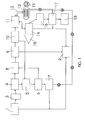
- Figure number 1 Sample of a block diagram, a schematic representation corresponding to the elements that integrate the invention's plant as a desalination plant, as well as the processes carried out within, from the reverse osmosis (RO) treatments to the processes for the elimination of encrusted salts, to the recovery of salts by means of process of heat, high vacuum, centrifugation and drying.
- RO reverse osmosis
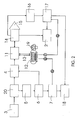
- Finger number 2.- .- Sample of a block diagram, a schematic representation corresponding to the elements that integrate the invention's plant in the form of an alternative use as a purifying plant of industrial waters, in which we also show the main components as well as the different processes that are applied within.
- the plant in its variant as a water desalination plant, in a first step consists of a reverse osmosis plant (1), which are pumped into from the sea or a well and which then circulate at a 4 bar pressure through a primary circuit in which different parameters are measures, conductivity, pH, temperature, to then pass onto said (RO) module (1), from where the produced soft water is sent to the main storage deposit (2) and the brine residues to another deposit (3) from where a flow of this brine is driven through a group of deposits (4) in which it will be subjected to different chemical treatments with the aim of freeing it of the encrusted salts that could damage the system.
- a reverse osmosis plant (1) which are pumped into from the sea or a well and which then circulate at a 4 bar pressure through a primary circuit in which different parameters are measures, conductivity, pH, temperature, to then pass onto said (RO) module (1), from where the produced soft water is sent to the main storage deposit (2) and the brine residues to another deposit (3) from where
- the non-evaporated brine water in the high vacuum chambers (14) circulated in the closed heat circuit (11), returning from these at the beginning of the circuit powered by the pumps, and does this circuit numerous times, so that once the adequate connectivity is reached, after successive evaporation processes, it is pumped to a concentrated brine deposit (16) named the brine lung.
- This stored concentrated brine in said deposit (16) is pumped to the dryers module (17) which operates with hot air from the cogeneration engine exhaust gases (12) and transported be means of air generators.
- the concentrated brine enters the dryers (17) through injectors that spray it, and on contact with the hot air, the brine water turns into vapour and when condensed is sent as distilled water to the main storage deposit (2) and the salt in powder form precipitates to the bottom of the dryers (17), and are then transported to a deposit or silo (18).
- Part of said distilled water is used to carry out a "sweeping" in order to clean the possible particle of salt deposited throughout the circuit.
- the invention consists in an initial passage through a deposit (3) of industrial waters to be treated, from where they are sent to a filtration module (20), and the semi-solid residues are sent to the deposit (5) from where they move onto the centrifugation module (6), and from which these humid solids are sent to the dryers (7) to be subjected to a drying process and then sent to the final residue deposit (18) created for this purpose.
- the industrial water free of solid residues is sent to the deposit (4), as are the liquids from the centrifugation phase carried out previously in module (6), to then be subjected to suitable chemical conditioning. From here the flow goes to the heat (11) circuit, powered, as described in the previous case, by the heat of the water of the cogeneration refrigeration water (12) by means of exchangers (13) and from here to the high vacuum (14) chambers where once the flow reaches the programmed temperature, a significant vacuum takes place by means of the ejectors (15) powered by fresh water from the same production as the engine fluid, extracting the vapours produced by boiling the input industrial residue in the high vacuum chambers (14); sending the produced fresh water to the main storage deposit (2) and that if the very concentrated residue to the deposit (16) from where it goes to the dryers (17) powered by hot air produced by the engine (12) and transported by air generators.
- the invention has a power unit comprising a combustion engine (12), which is connected to an alternator (19) to produce electric power, thus configuring it as a cogeneration plant, achieved with said engine (12), as well as the necessary power for operating the plant, it produces significant surplus power which can be exported to the Grid, taking advantage of the thermal power of the exhaust gases and the refrigeration of the engine to heat the closed heat circuit (11) and to heat the air in the dryers (17).
Landscapes
- Chemical & Material Sciences (AREA)
- Engineering & Computer Science (AREA)
- Water Supply & Treatment (AREA)
- Environmental & Geological Engineering (AREA)
- Life Sciences & Earth Sciences (AREA)
- Hydrology & Water Resources (AREA)
- Organic Chemistry (AREA)
- Chemical Kinetics & Catalysis (AREA)
- Nanotechnology (AREA)
- Separation Using Semi-Permeable Membranes (AREA)
- Heat Treatment Of Water, Waste Water Or Sewage (AREA)
Applications Claiming Priority (2)
| Application Number | Priority Date | Filing Date | Title |
|---|---|---|---|
| ES200600257A ES2296503B1 (es) | 2006-02-06 | 2006-02-06 | Planta desaladora-depuradora de aguas salobres y residuos industriales con descarga liquida cero. |
| PCT/ES2006/000291 WO2007090905A1 (fr) | 2006-02-06 | 2006-05-24 | Installation de dessalement des eaux salines et résidus industriels à décharge liquide zéro |
Publications (2)
| Publication Number | Publication Date |
|---|---|
| EP1982958A1 true EP1982958A1 (fr) | 2008-10-22 |
| EP1982958A4 EP1982958A4 (fr) | 2011-10-19 |
Family
ID=38344879
Family Applications (1)
| Application Number | Title | Priority Date | Filing Date |
|---|---|---|---|
| EP06755374A Withdrawn EP1982958A4 (fr) | 2006-02-06 | 2006-05-24 | Installation de dessalement des eaux salines et résidus industriels à décharge liquide zéro |
Country Status (6)
| Country | Link |
|---|---|
| US (1) | US20090045116A1 (fr) |
| EP (1) | EP1982958A4 (fr) |
| CN (1) | CN101336211A (fr) |
| AU (1) | AU2006337920A1 (fr) |
| ES (1) | ES2296503B1 (fr) |
| WO (1) | WO2007090905A1 (fr) |
Cited By (7)
| Publication number | Priority date | Publication date | Assignee | Title |
|---|---|---|---|---|
| WO2010119152A1 (fr) * | 2009-04-14 | 2010-10-21 | Barbero Ferrandiz Jose Antonio | Procédé de traitement de l'eau |
| WO2013093840A1 (fr) | 2011-12-23 | 2013-06-27 | Degremont | Procédé de traitement d'eaux usées industrielles ou urbaines pour une réutilisation, et installation pour mettre en oeuvre ce procédé |
| WO2013160515A1 (fr) * | 2012-04-26 | 2013-10-31 | Barbero Ferrandiz Jose Antonio | Procédé de décomposition de solutions ou de suspensions en eau distillée et sels secs, et installation correspondante pour la mise en oeuvre de ce procédé |
| ITTO20130760A1 (it) * | 2013-09-20 | 2015-03-21 | Scam S P A | Impianto di dissalazione a scarico liquido zero |
| WO2016056896A1 (fr) * | 2014-10-08 | 2016-04-14 | Bredenoord B.V. | Ensemble de production combinée d'énergie électrique et d'eau distillée |
| NL2014686B1 (en) * | 2014-10-08 | 2016-10-03 | Bredenoord B V | Assembly for combined electrical power and distilled water generation. |
| IT201900005078A1 (it) * | 2019-04-04 | 2019-07-04 | Giacomo Floris | sistema di raffreddamento desalinizzante per motore a combustione interna |
Families Citing this family (13)
| Publication number | Priority date | Publication date | Assignee | Title |
|---|---|---|---|---|
| WO2010018249A1 (fr) * | 2008-07-30 | 2010-02-18 | Desalacion Integral Systems, S.L. | Station de déssalement/d'épuration d'eaux saumâtres et de résidus industriels sans rejet liquide perfectionnée |
| CN103108838B (zh) * | 2010-01-11 | 2014-08-13 | 海洋瓦格有限公司 | 从海水中制造胶原和痕量元素的方法 |
| US10017407B2 (en) | 2010-01-11 | 2018-07-10 | Seawagen Co., Ltd. | Process for manufacturing collagen and trace elements from sea water |
| US20130032540A1 (en) * | 2010-03-04 | 2013-02-07 | Terragroup Corporation | Lightweight modular water purification system with reconfigurable pump power options |
| US8282823B2 (en) * | 2010-03-04 | 2012-10-09 | Terragroup Corporation | Lightweight modular water purification system with reconfigurable pump power options |
| CA2797995A1 (fr) * | 2011-12-06 | 2013-06-06 | Drake Water Technologies, Inc. | Procede anti-solvant pour traiter les liquides ayant une teneur elevee en solides dissous |
| EP2878581A1 (fr) * | 2013-12-02 | 2015-06-03 | Lappeenrannan Teknillinen Yliopisto | Système de purification des eaux usées |
| TW201714834A (zh) * | 2015-03-02 | 2017-05-01 | 席凡索斯公司 | 高效率海水淡化 |
| WO2020072080A1 (fr) * | 2018-10-05 | 2020-04-09 | Maher Isaac Kelada | Systèmes d'osmose symbiotique induite de 3 à 5 boucles de circulation en cascade de membranes semi-perméables pour la production d'énergie par saumures ou eau salée ou le dessalement |
| CN108947068B (zh) * | 2018-07-23 | 2021-06-11 | 深圳市锦润防务科技有限公司 | 一种新型高效海水淡化装置 |
| TWI697459B (zh) * | 2019-02-12 | 2020-07-01 | 義鎧科技股份有限公司 | 節能濃縮系統 |
| ES2928026B2 (es) * | 2021-05-11 | 2024-02-26 | Water Challenge S L | Equipo y procedimiento de extracion de solidos en fluidos contaminados |
| AU2022401687A1 (en) * | 2021-12-04 | 2024-07-18 | Heat Ip Holdco, Llc | Water, minerals and cooling generation system |
Family Cites Families (10)
| Publication number | Priority date | Publication date | Assignee | Title |
|---|---|---|---|---|
| US3352107A (en) * | 1965-12-17 | 1967-11-14 | Combustion Eng | Desalination and power generating system |
| US3671404A (en) * | 1968-07-12 | 1972-06-20 | Milton Meckler | Peltier effect concentric still with high temperature heat supplying means |
| US4104164A (en) * | 1977-03-02 | 1978-08-01 | Chelton Robert G | Device for treating waste water |
| DE3105550C2 (de) * | 1981-02-16 | 1983-10-20 | Hager & Elsässer GmbH, 7000 Stuttgart | Verfahren zur weitestgehenden Aufbereitung von Süßwasser, Brackwasser, Meerwasser und Abwasser zu Trink- und Brauchwasserzwecken |
| US4467621A (en) * | 1982-09-22 | 1984-08-28 | Brien Paul R O | Fluid/vacuum chamber to remove heat and heat vapor from a refrigerant fluid |
| DE3913482A1 (de) * | 1989-04-24 | 1990-10-25 | Charles Zampieri | Verfahren und vorrichtung zur behandlung von salzlaken und verunreinigten mineralsalzen oder -salzgemischen |
| US6365051B1 (en) * | 1999-10-12 | 2002-04-02 | Mansour S. Bader | Precipitation-membrane distillation hybrid system for the treatment of aqueous streams |
| US6946081B2 (en) * | 2001-12-31 | 2005-09-20 | Poseidon Resources Corporation | Desalination system |
| US7037430B2 (en) * | 2002-04-10 | 2006-05-02 | Efficient Production Technologies, Inc. | System and method for desalination of brackish water from an underground water supply |
| ES2224801B1 (es) * | 2002-07-29 | 2006-01-16 | Desalacion Integral Systems, S.L. | Desaladora de alto vacio dual integral. |
-
2006
- 2006-02-06 ES ES200600257A patent/ES2296503B1/es not_active Expired - Fee Related
- 2006-05-24 US US12/278,534 patent/US20090045116A1/en not_active Abandoned
- 2006-05-24 AU AU2006337920A patent/AU2006337920A1/en not_active Abandoned
- 2006-05-24 WO PCT/ES2006/000291 patent/WO2007090905A1/fr not_active Ceased
- 2006-05-24 EP EP06755374A patent/EP1982958A4/fr not_active Withdrawn
- 2006-05-24 CN CNA2006800523243A patent/CN101336211A/zh active Pending
Cited By (9)
| Publication number | Priority date | Publication date | Assignee | Title |
|---|---|---|---|---|
| WO2010119152A1 (fr) * | 2009-04-14 | 2010-10-21 | Barbero Ferrandiz Jose Antonio | Procédé de traitement de l'eau |
| WO2013093840A1 (fr) | 2011-12-23 | 2013-06-27 | Degremont | Procédé de traitement d'eaux usées industrielles ou urbaines pour une réutilisation, et installation pour mettre en oeuvre ce procédé |
| WO2013160515A1 (fr) * | 2012-04-26 | 2013-10-31 | Barbero Ferrandiz Jose Antonio | Procédé de décomposition de solutions ou de suspensions en eau distillée et sels secs, et installation correspondante pour la mise en oeuvre de ce procédé |
| ES2431893A1 (es) * | 2012-04-26 | 2013-11-28 | Jose Antonio BARBERO FERRÁNDIZ | Procedimiento de descomposición de soluciones en agua destilada y sales secas, y correspondiente instalación para la puesta en práctica del mismo |
| ITTO20130760A1 (it) * | 2013-09-20 | 2015-03-21 | Scam S P A | Impianto di dissalazione a scarico liquido zero |
| WO2015040576A1 (fr) * | 2013-09-20 | 2015-03-26 | Scam S.P.A. | Usine de dessalement sans refoulement de liquide |
| WO2016056896A1 (fr) * | 2014-10-08 | 2016-04-14 | Bredenoord B.V. | Ensemble de production combinée d'énergie électrique et d'eau distillée |
| NL2014686B1 (en) * | 2014-10-08 | 2016-10-03 | Bredenoord B V | Assembly for combined electrical power and distilled water generation. |
| IT201900005078A1 (it) * | 2019-04-04 | 2019-07-04 | Giacomo Floris | sistema di raffreddamento desalinizzante per motore a combustione interna |
Also Published As
| Publication number | Publication date |
|---|---|
| CN101336211A (zh) | 2008-12-31 |
| US20090045116A1 (en) | 2009-02-19 |
| ES2296503A1 (es) | 2008-04-16 |
| ES2296503B1 (es) | 2009-03-16 |
| AU2006337920A1 (en) | 2007-08-16 |
| EP1982958A4 (fr) | 2011-10-19 |
| WO2007090905A1 (fr) | 2007-08-16 |
Similar Documents
| Publication | Publication Date | Title |
|---|---|---|
| EP1982958A1 (fr) | Installation de dessalement des eaux salines et résidus industriels à décharge liquide zéro | |
| Nair et al. | Water desalination and challenges: The Middle East perspective: a review | |
| Ansari et al. | Performance evaluation of a brackish water reverse osmosis pilot-plant desalination process under different operating conditions: Experimental study | |
| Kim et al. | Overview of systems engineering approaches for a large-scale seawater desalination plant with a reverse osmosis network | |
| TWI570064B (zh) | 海水脫鹽方法 | |
| US20140299529A1 (en) | Systems, Apparatus, and Methods for Separating Salts from Water | |
| US20140196753A1 (en) | Regeneration of ion exchange resin and recovery of regenerant solution | |
| Ma et al. | An integrated membrane-and thermal-based system for coal chemical wastewater treatment with near-zero liquid discharge | |
| CN107261847A (zh) | 渗透分离系统和方法 | |
| KR20160140761A (ko) | 삼투 분리 시스템 및 방법 | |
| CN103459326A (zh) | 高效净水系统 | |
| Chen et al. | Separation technologies for salty wastewater reduction in the dairy industry | |
| Bora et al. | Promising integrated technique for the treatment of highly saline nanofiltration rejected stream of steel industry | |
| Ning et al. | Seawater RO treatment of RO concentrate to extreme silica concentrations | |
| EP2374760A1 (fr) | Installation de dessalement d'eau | |
| EP2310325B1 (fr) | Procédé et système d' élimination en conditions supercritiques d' un composé inorganique | |
| Prabakar et al. | Emerging investigator series: a state-of-the-art review on large-scale desalination technologies and their brine management | |
| Avramidi et al. | Innovative solution for the recovery of clean water and high-purity minerals from the coal mine sector | |
| Salman et al. | Desalination methods and their role in solving and managing the problem of salinization in Iraqi water resources | |
| Subramani et al. | Recovery optimization of membrane processes for treatment of produced water with high silica content | |
| US12583779B2 (en) | Production of potable water using chemically forced precipitation | |
| Cohen et al. | Membrane desalination of agricultural drainage water | |
| Johnson et al. | VSEP treatment of RO reject from brackish well water | |
| Mustafa et al. | Transforming Seawater Brine into Resources: A Circular Economy Approach at the Haql Brine Mining Plant | |
| Palenzuela et al. | State of the Art of Desalination Processes |
Legal Events
| Date | Code | Title | Description |
|---|---|---|---|
| PUAI | Public reference made under article 153(3) epc to a published international application that has entered the european phase |
Free format text: ORIGINAL CODE: 0009012 |
|
| 17P | Request for examination filed |
Effective date: 20080801 |
|
| AK | Designated contracting states |
Kind code of ref document: A1 Designated state(s): AT BE BG CH CY CZ DE DK EE ES FI FR GB GR HU IE IS IT LI LT LU LV MC NL PL PT RO SE SI SK TR |
|
| A4 | Supplementary search report drawn up and despatched |
Effective date: 20110920 |
|
| RIC1 | Information provided on ipc code assigned before grant |
Ipc: B01D 1/00 20060101ALI20110914BHEP Ipc: C02F 1/04 20060101AFI20110914BHEP Ipc: C02F 1/44 20060101ALI20110914BHEP Ipc: C02F 1/16 20060101ALI20110914BHEP Ipc: B01D 61/02 20060101ALI20110914BHEP |
|
| STAA | Information on the status of an ep patent application or granted ep patent |
Free format text: STATUS: THE APPLICATION IS DEEMED TO BE WITHDRAWN |
|
| 18D | Application deemed to be withdrawn |
Effective date: 20111201 |